User login
Infants born with the use of assisted reproductive technology make up a disproportionately large fraction of low-birth-weight infants, compared with the general birth population, the Centers for Disease Control and Prevention said.
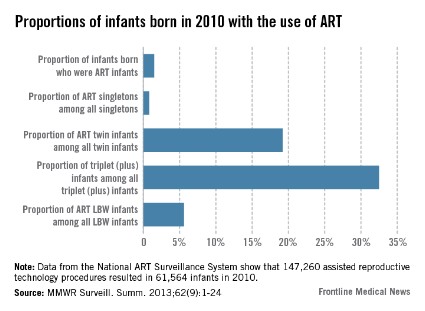
In 2010, 5.6% of all low-birth-weight infants were conceived through ART. In comparison, the overall proportion of infants born who were ART infants was 1.5% that year. ART infants also "accounted for approximately 4.0% of all preterm births" in 2010, the CDC noted.
That same year, ART infants were overrepresented among multiple births, with 19.2% of twin and 32.5% of triplet and higher-order births involving ART. These numbers, however, are the latest in a downward trend, as "the percentage of ART-conceived multiple infants declined by 13.0%" from 2000 to 2010, the CDC reported (MMWR Surveill. Summ. 2013;62(9):1-24).
According to data from the CDC's National ART Surveillance System, there were 147,260 ART procedures performed in 2010 at 443 fertility clinics, resulting in 47,090 live-birth deliveries and 61,564 infants.
Infants born with the use of assisted reproductive technology make up a disproportionately large fraction of low-birth-weight infants, compared with the general birth population, the Centers for Disease Control and Prevention said.
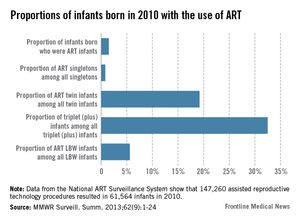
In 2010, 5.6% of all low-birth-weight infants were conceived through ART. In comparison, the overall proportion of infants born who were ART infants was 1.5% that year. ART infants also "accounted for approximately 4.0% of all preterm births" in 2010, the CDC noted.
That same year, ART infants were overrepresented among multiple births, with 19.2% of twin and 32.5% of triplet and higher-order births involving ART. These numbers, however, are the latest in a downward trend, as "the percentage of ART-conceived multiple infants declined by 13.0%" from 2000 to 2010, the CDC reported (MMWR Surveill. Summ. 2013;62(9):1-24).
According to data from the CDC's National ART Surveillance System, there were 147,260 ART procedures performed in 2010 at 443 fertility clinics, resulting in 47,090 live-birth deliveries and 61,564 infants.
Infants born with the use of assisted reproductive technology make up a disproportionately large fraction of low-birth-weight infants, compared with the general birth population, the Centers for Disease Control and Prevention said.
In 2010, 5.6% of all low-birth-weight infants were conceived through ART. In comparison, the overall proportion of infants born who were ART infants was 1.5% that year. ART infants also "accounted for approximately 4.0% of all preterm births" in 2010, the CDC noted.
That same year, ART infants were overrepresented among multiple births, with 19.2% of twin and 32.5% of triplet and higher-order births involving ART. These numbers, however, are the latest in a downward trend, as "the percentage of ART-conceived multiple infants declined by 13.0%" from 2000 to 2010, the CDC reported (MMWR Surveill. Summ. 2013;62(9):1-24).
According to data from the CDC's National ART Surveillance System, there were 147,260 ART procedures performed in 2010 at 443 fertility clinics, resulting in 47,090 live-birth deliveries and 61,564 infants.
FROM MMWR