User login
Drug granted fast track designation for PNH
The US Food and Drug Administration (FDA) has granted fast track designation for the complement C3 inhibitor APL-2.
The designation applies to APL-2 in the treatment of patients with paroxysmal nocturnal hemoglobinuria (PNH) who continue to experience hemolysis and require red blood cell transfusions despite receiving therapy with eculizumab.
APL-2 is also being developed as a treatment for PNH patients not previously treated with eculizumab.
The company developing APL-2 is Apellis Pharmaceuticals, Inc.
APL-2 is a synthetic cyclic peptide conjugated to a polyethylene glycol polymer that binds specifically to C3 and C3b, blocking all 3 pathways of complement activation (classical, lectin, and alternative).
According to Apellis, this comprehensive inhibition of complement-mediated pathology may have the potential to control symptoms and modify underlying disease in patients with PNH.
Results from a pair of phase 1 studies of APL-2 in healthy volunteers were recently presented at the 2016 ASH Annual Meeting (abstract 1251).
Now, Apellis is evaluating APL-2 in a pair of phase 1b clinical trials of patients with PNH.
In PADDOCK (NCT02588833), researchers are assessing the safety, tolerability, pharmacokinetics, pharmacodynamics, and preliminary efficacy of multiple doses of APL-2 administered by daily subcutaneous injection in patients with PNH who have not received the standard of care in the past.
In PHAROAH (NCT02264639), researchers are assessing the safety, tolerability, pharmacokinetics, and pharmacodynamics of single and multiple doses of APL-2 administered by subcutaneous injection as an add-on to the standard of care in patients with PNH.
About fast track designation
The FDA’s fast track program is designed to facilitate the development and expedite the review of products intended to treat or prevent serious or life-threatening conditions and address unmet medical need.
Through the FDA’s fast track program, a product may be eligible for priority review. In addition, the company developing the product may be allowed to submit sections of the biologic license application or new drug application on a rolling basis as data become available.
Fast track designation also provides the company with opportunities for more frequent meetings and written communications with the FDA. 
The US Food and Drug Administration (FDA) has granted fast track designation for the complement C3 inhibitor APL-2.
The designation applies to APL-2 in the treatment of patients with paroxysmal nocturnal hemoglobinuria (PNH) who continue to experience hemolysis and require red blood cell transfusions despite receiving therapy with eculizumab.
APL-2 is also being developed as a treatment for PNH patients not previously treated with eculizumab.
The company developing APL-2 is Apellis Pharmaceuticals, Inc.
APL-2 is a synthetic cyclic peptide conjugated to a polyethylene glycol polymer that binds specifically to C3 and C3b, blocking all 3 pathways of complement activation (classical, lectin, and alternative).
According to Apellis, this comprehensive inhibition of complement-mediated pathology may have the potential to control symptoms and modify underlying disease in patients with PNH.
Results from a pair of phase 1 studies of APL-2 in healthy volunteers were recently presented at the 2016 ASH Annual Meeting (abstract 1251).
Now, Apellis is evaluating APL-2 in a pair of phase 1b clinical trials of patients with PNH.
In PADDOCK (NCT02588833), researchers are assessing the safety, tolerability, pharmacokinetics, pharmacodynamics, and preliminary efficacy of multiple doses of APL-2 administered by daily subcutaneous injection in patients with PNH who have not received the standard of care in the past.
In PHAROAH (NCT02264639), researchers are assessing the safety, tolerability, pharmacokinetics, and pharmacodynamics of single and multiple doses of APL-2 administered by subcutaneous injection as an add-on to the standard of care in patients with PNH.
About fast track designation
The FDA’s fast track program is designed to facilitate the development and expedite the review of products intended to treat or prevent serious or life-threatening conditions and address unmet medical need.
Through the FDA’s fast track program, a product may be eligible for priority review. In addition, the company developing the product may be allowed to submit sections of the biologic license application or new drug application on a rolling basis as data become available.
Fast track designation also provides the company with opportunities for more frequent meetings and written communications with the FDA.
The US Food and Drug Administration (FDA) has granted fast track designation for the complement C3 inhibitor APL-2.
The designation applies to APL-2 in the treatment of patients with paroxysmal nocturnal hemoglobinuria (PNH) who continue to experience hemolysis and require red blood cell transfusions despite receiving therapy with eculizumab.
APL-2 is also being developed as a treatment for PNH patients not previously treated with eculizumab.
The company developing APL-2 is Apellis Pharmaceuticals, Inc.
APL-2 is a synthetic cyclic peptide conjugated to a polyethylene glycol polymer that binds specifically to C3 and C3b, blocking all 3 pathways of complement activation (classical, lectin, and alternative).
According to Apellis, this comprehensive inhibition of complement-mediated pathology may have the potential to control symptoms and modify underlying disease in patients with PNH.
Results from a pair of phase 1 studies of APL-2 in healthy volunteers were recently presented at the 2016 ASH Annual Meeting (abstract 1251).
Now, Apellis is evaluating APL-2 in a pair of phase 1b clinical trials of patients with PNH.
In PADDOCK (NCT02588833), researchers are assessing the safety, tolerability, pharmacokinetics, pharmacodynamics, and preliminary efficacy of multiple doses of APL-2 administered by daily subcutaneous injection in patients with PNH who have not received the standard of care in the past.
In PHAROAH (NCT02264639), researchers are assessing the safety, tolerability, pharmacokinetics, and pharmacodynamics of single and multiple doses of APL-2 administered by subcutaneous injection as an add-on to the standard of care in patients with PNH.
About fast track designation
The FDA’s fast track program is designed to facilitate the development and expedite the review of products intended to treat or prevent serious or life-threatening conditions and address unmet medical need.
Through the FDA’s fast track program, a product may be eligible for priority review. In addition, the company developing the product may be allowed to submit sections of the biologic license application or new drug application on a rolling basis as data become available.
Fast track designation also provides the company with opportunities for more frequent meetings and written communications with the FDA.
Intermittent fasting fights ALL, not AML, in mice

Photo by Steve Berger
Intermittent fasting inhibits the development and progression of acute lymphoblastic leukemia (ALL), according to preclinical research published in Nature Medicine.
Fasting had an inhibitory effect in mouse models of T-cell and B-cell ALL but not acute myeloid leukemia (AML).
“This study using mouse models indicates that the effects of fasting on blood cancers are type-dependent and provides a platform for identifying new targets for leukemia treatments,” said study author Chengcheng “Alec” Zhang, PhD, of UT Southwestern Medical Center in Dallas, Texas.
“We also identified a mechanism responsible for the differing response to the fasting treatment.”
For this study, Dr Zhang and his colleagues created mouse models of acute leukemia—N-Myc B-ALL, activated Notch1 T-ALL, MLL-AF9 AML, and AML driven by the AML1-Eto9a oncogene—and tested the effects of various dietary restriction plans.
The team used green or yellow florescent proteins to mark and trace the leukemia cells so they could determine if the cells’ levels rose or fell in response to the fasting treatment.
“Strikingly, we found that, in models of ALL, a regimen consisting of 6 cycles of 1 day of fasting followed by 1 day of feeding completely inhibited cancer development,” Dr Zhang said.
At the end of 7 weeks, fasted mice with B-ALL had virtually no detectible cancerous cells—an average of 0.48%—compared to an average of 67.68% of cells found to be cancerous in the test areas of the non-fasted B-ALL mice.
Dr Zhang noted that, compared to B-ALL mice that ate normally, the mice on alternate-day fasting had dramatic reductions in the percentage of ALL cells in the bone marrow and spleen, as well as reduced numbers of white blood cells.
In addition, the spleens and lymph nodes in the fasted mice with B-ALL were similar in size to those of normal mice.
“Although initially cancerous, the few fluorescent cells that remained in the fasted mice after 7 weeks appeared to behave like normal cells,” Dr Zhang said. “Mice in the [B-ALL] model group that ate normally died within 59 days, while 75% of the fasted mice survived more than 120 days without signs of leukemia.”
Dr Zhang and his colleagues said they observed similar results in the T-ALL model but not the AML models. There was no decrease in leukemia cells among fasted mice with AML. And fasting actually shortened survival time in these mice.
Identifying the mechanism
Fasting is known to reduce the level of leptin, a cell signaling molecule created by fat tissue. In addition, previous studies have shown weakened activity by leptin receptors in humans with ALL. For those reasons, the researchers studied both leptin levels and leptin receptors in the mouse models.
The team found that mice with ALL showed reduced leptin receptor activity that increased with intermittent fasting.
“We found that fasting decreased the levels of leptin circulating in the bloodstream as well as decreased the leptin levels in the bone marrow,” Dr Zhang said. “These effects became more pronounced with repeated cycles of fasting. After fasting, the rate at which the leptin levels recovered seemed to correspond to the rate at which the cancerous ALL cells were cleared from the blood.”
The researchers also found that AML was associated with higher levels of leptin receptors that were unaffected by fasting, which could help explain why the fasting treatment was ineffective against this type of leukemia.
It also suggests a mechanism—the leptin receptor pathway—by which fasting exerts its effects in ALL, Dr Zhang said.
“It will be important to determine whether ALL cells can become resistant to the effects of fasting,” he noted. “It also will be interesting to investigate whether we can find alternative ways that mimic fasting to block ALL development.”
Given that this study did not involve drug treatment, researchers are discussing with clinicians whether the tested regimen might be able to move forward quickly to clinical trials.
Photo by Steve Berger
Intermittent fasting inhibits the development and progression of acute lymphoblastic leukemia (ALL), according to preclinical research published in Nature Medicine.
Fasting had an inhibitory effect in mouse models of T-cell and B-cell ALL but not acute myeloid leukemia (AML).
“This study using mouse models indicates that the effects of fasting on blood cancers are type-dependent and provides a platform for identifying new targets for leukemia treatments,” said study author Chengcheng “Alec” Zhang, PhD, of UT Southwestern Medical Center in Dallas, Texas.
“We also identified a mechanism responsible for the differing response to the fasting treatment.”
For this study, Dr Zhang and his colleagues created mouse models of acute leukemia—N-Myc B-ALL, activated Notch1 T-ALL, MLL-AF9 AML, and AML driven by the AML1-Eto9a oncogene—and tested the effects of various dietary restriction plans.
The team used green or yellow florescent proteins to mark and trace the leukemia cells so they could determine if the cells’ levels rose or fell in response to the fasting treatment.
“Strikingly, we found that, in models of ALL, a regimen consisting of 6 cycles of 1 day of fasting followed by 1 day of feeding completely inhibited cancer development,” Dr Zhang said.
At the end of 7 weeks, fasted mice with B-ALL had virtually no detectible cancerous cells—an average of 0.48%—compared to an average of 67.68% of cells found to be cancerous in the test areas of the non-fasted B-ALL mice.
Dr Zhang noted that, compared to B-ALL mice that ate normally, the mice on alternate-day fasting had dramatic reductions in the percentage of ALL cells in the bone marrow and spleen, as well as reduced numbers of white blood cells.
In addition, the spleens and lymph nodes in the fasted mice with B-ALL were similar in size to those of normal mice.
“Although initially cancerous, the few fluorescent cells that remained in the fasted mice after 7 weeks appeared to behave like normal cells,” Dr Zhang said. “Mice in the [B-ALL] model group that ate normally died within 59 days, while 75% of the fasted mice survived more than 120 days without signs of leukemia.”
Dr Zhang and his colleagues said they observed similar results in the T-ALL model but not the AML models. There was no decrease in leukemia cells among fasted mice with AML. And fasting actually shortened survival time in these mice.
Identifying the mechanism
Fasting is known to reduce the level of leptin, a cell signaling molecule created by fat tissue. In addition, previous studies have shown weakened activity by leptin receptors in humans with ALL. For those reasons, the researchers studied both leptin levels and leptin receptors in the mouse models.
The team found that mice with ALL showed reduced leptin receptor activity that increased with intermittent fasting.
“We found that fasting decreased the levels of leptin circulating in the bloodstream as well as decreased the leptin levels in the bone marrow,” Dr Zhang said. “These effects became more pronounced with repeated cycles of fasting. After fasting, the rate at which the leptin levels recovered seemed to correspond to the rate at which the cancerous ALL cells were cleared from the blood.”
The researchers also found that AML was associated with higher levels of leptin receptors that were unaffected by fasting, which could help explain why the fasting treatment was ineffective against this type of leukemia.
It also suggests a mechanism—the leptin receptor pathway—by which fasting exerts its effects in ALL, Dr Zhang said.
“It will be important to determine whether ALL cells can become resistant to the effects of fasting,” he noted. “It also will be interesting to investigate whether we can find alternative ways that mimic fasting to block ALL development.”
Given that this study did not involve drug treatment, researchers are discussing with clinicians whether the tested regimen might be able to move forward quickly to clinical trials.
Photo by Steve Berger
Intermittent fasting inhibits the development and progression of acute lymphoblastic leukemia (ALL), according to preclinical research published in Nature Medicine.
Fasting had an inhibitory effect in mouse models of T-cell and B-cell ALL but not acute myeloid leukemia (AML).
“This study using mouse models indicates that the effects of fasting on blood cancers are type-dependent and provides a platform for identifying new targets for leukemia treatments,” said study author Chengcheng “Alec” Zhang, PhD, of UT Southwestern Medical Center in Dallas, Texas.
“We also identified a mechanism responsible for the differing response to the fasting treatment.”
For this study, Dr Zhang and his colleagues created mouse models of acute leukemia—N-Myc B-ALL, activated Notch1 T-ALL, MLL-AF9 AML, and AML driven by the AML1-Eto9a oncogene—and tested the effects of various dietary restriction plans.
The team used green or yellow florescent proteins to mark and trace the leukemia cells so they could determine if the cells’ levels rose or fell in response to the fasting treatment.
“Strikingly, we found that, in models of ALL, a regimen consisting of 6 cycles of 1 day of fasting followed by 1 day of feeding completely inhibited cancer development,” Dr Zhang said.
At the end of 7 weeks, fasted mice with B-ALL had virtually no detectible cancerous cells—an average of 0.48%—compared to an average of 67.68% of cells found to be cancerous in the test areas of the non-fasted B-ALL mice.
Dr Zhang noted that, compared to B-ALL mice that ate normally, the mice on alternate-day fasting had dramatic reductions in the percentage of ALL cells in the bone marrow and spleen, as well as reduced numbers of white blood cells.
In addition, the spleens and lymph nodes in the fasted mice with B-ALL were similar in size to those of normal mice.
“Although initially cancerous, the few fluorescent cells that remained in the fasted mice after 7 weeks appeared to behave like normal cells,” Dr Zhang said. “Mice in the [B-ALL] model group that ate normally died within 59 days, while 75% of the fasted mice survived more than 120 days without signs of leukemia.”
Dr Zhang and his colleagues said they observed similar results in the T-ALL model but not the AML models. There was no decrease in leukemia cells among fasted mice with AML. And fasting actually shortened survival time in these mice.
Identifying the mechanism
Fasting is known to reduce the level of leptin, a cell signaling molecule created by fat tissue. In addition, previous studies have shown weakened activity by leptin receptors in humans with ALL. For those reasons, the researchers studied both leptin levels and leptin receptors in the mouse models.
The team found that mice with ALL showed reduced leptin receptor activity that increased with intermittent fasting.
“We found that fasting decreased the levels of leptin circulating in the bloodstream as well as decreased the leptin levels in the bone marrow,” Dr Zhang said. “These effects became more pronounced with repeated cycles of fasting. After fasting, the rate at which the leptin levels recovered seemed to correspond to the rate at which the cancerous ALL cells were cleared from the blood.”
The researchers also found that AML was associated with higher levels of leptin receptors that were unaffected by fasting, which could help explain why the fasting treatment was ineffective against this type of leukemia.
It also suggests a mechanism—the leptin receptor pathway—by which fasting exerts its effects in ALL, Dr Zhang said.
“It will be important to determine whether ALL cells can become resistant to the effects of fasting,” he noted. “It also will be interesting to investigate whether we can find alternative ways that mimic fasting to block ALL development.”
Given that this study did not involve drug treatment, researchers are discussing with clinicians whether the tested regimen might be able to move forward quickly to clinical trials.
JCAR017 gets PRIME access, breakthrough designation
The chimeric antigen receptor (CAR) T-cell therapy JCAR017 has received breakthrough therapy designation from the US Food and Drug Administration (FDA) and access to the European Medicines Agency’s (EMA) Priority Medicines (PRIME) program.
JCAR017 has gained access to the PRIME program as a treatment for relapsed/refractory diffuse large B-cell lymphoma (DLBCL).
The breakthrough designation is for JCAR017 in the treatment of patients with relapsed/refractory, aggressive, large B-cell non-Hodgkin lymphoma, including DLBCL not otherwise specified (de novo or transformed from indolent lymphoma), primary mediastinal B-cell lymphoma, and grade 3B follicular lymphoma.
JCAR017 uses a defined CD4:CD8 cell composition and 4-1BB as the costimulatory domain. The product is being developed by Juno Therapeutics, Inc. and Celgene Corporation.
The breakthrough therapy designation and PRIME eligibility for JCAR017 were granted by the FDA and EMA, respectively, on the basis of early clinical results with JCAR017 in relapsed/refractory DLBCL.
Results from a phase 1 trial of JCAR017 in relapsed/refractory DLBCL and mantle cell lymphoma were recently presented at the 2016 ASH Annual Meeting (abstract 4192).
About the PRIME program
The goal of the EMA’s PRIME program is to accelerate the development of therapies that target unmet medical needs.
The program provides enhanced EMA support and increased interaction to developers, in order to optimize development plans and speed regulatory evaluations to potentially bring these therapies to patients more quickly.
To be accepted for PRIME, a therapy must demonstrate the potential to benefit patients with unmet medical need through early clinical or nonclinical data.
About breakthrough designation
The FDA’s breakthrough therapy designation is intended to expedite the development and review of new treatments for serious or life-threatening conditions.
Breakthrough designation entitles the company developing a therapy to more intensive FDA guidance on an efficient and accelerated development program, as well as eligibility for other actions to expedite FDA review, such as a rolling submission and priority review.
To earn breakthrough designation, a treatment must show encouraging early clinical results demonstrating substantial improvement over available therapies with regard to a clinically significant endpoint, or it must fulfill an unmet need.
The chimeric antigen receptor (CAR) T-cell therapy JCAR017 has received breakthrough therapy designation from the US Food and Drug Administration (FDA) and access to the European Medicines Agency’s (EMA) Priority Medicines (PRIME) program.
JCAR017 has gained access to the PRIME program as a treatment for relapsed/refractory diffuse large B-cell lymphoma (DLBCL).
The breakthrough designation is for JCAR017 in the treatment of patients with relapsed/refractory, aggressive, large B-cell non-Hodgkin lymphoma, including DLBCL not otherwise specified (de novo or transformed from indolent lymphoma), primary mediastinal B-cell lymphoma, and grade 3B follicular lymphoma.
JCAR017 uses a defined CD4:CD8 cell composition and 4-1BB as the costimulatory domain. The product is being developed by Juno Therapeutics, Inc. and Celgene Corporation.
The breakthrough therapy designation and PRIME eligibility for JCAR017 were granted by the FDA and EMA, respectively, on the basis of early clinical results with JCAR017 in relapsed/refractory DLBCL.
Results from a phase 1 trial of JCAR017 in relapsed/refractory DLBCL and mantle cell lymphoma were recently presented at the 2016 ASH Annual Meeting (abstract 4192).
About the PRIME program
The goal of the EMA’s PRIME program is to accelerate the development of therapies that target unmet medical needs.
The program provides enhanced EMA support and increased interaction to developers, in order to optimize development plans and speed regulatory evaluations to potentially bring these therapies to patients more quickly.
To be accepted for PRIME, a therapy must demonstrate the potential to benefit patients with unmet medical need through early clinical or nonclinical data.
About breakthrough designation
The FDA’s breakthrough therapy designation is intended to expedite the development and review of new treatments for serious or life-threatening conditions.
Breakthrough designation entitles the company developing a therapy to more intensive FDA guidance on an efficient and accelerated development program, as well as eligibility for other actions to expedite FDA review, such as a rolling submission and priority review.
To earn breakthrough designation, a treatment must show encouraging early clinical results demonstrating substantial improvement over available therapies with regard to a clinically significant endpoint, or it must fulfill an unmet need.
The chimeric antigen receptor (CAR) T-cell therapy JCAR017 has received breakthrough therapy designation from the US Food and Drug Administration (FDA) and access to the European Medicines Agency’s (EMA) Priority Medicines (PRIME) program.
JCAR017 has gained access to the PRIME program as a treatment for relapsed/refractory diffuse large B-cell lymphoma (DLBCL).
The breakthrough designation is for JCAR017 in the treatment of patients with relapsed/refractory, aggressive, large B-cell non-Hodgkin lymphoma, including DLBCL not otherwise specified (de novo or transformed from indolent lymphoma), primary mediastinal B-cell lymphoma, and grade 3B follicular lymphoma.
JCAR017 uses a defined CD4:CD8 cell composition and 4-1BB as the costimulatory domain. The product is being developed by Juno Therapeutics, Inc. and Celgene Corporation.
The breakthrough therapy designation and PRIME eligibility for JCAR017 were granted by the FDA and EMA, respectively, on the basis of early clinical results with JCAR017 in relapsed/refractory DLBCL.
Results from a phase 1 trial of JCAR017 in relapsed/refractory DLBCL and mantle cell lymphoma were recently presented at the 2016 ASH Annual Meeting (abstract 4192).
About the PRIME program
The goal of the EMA’s PRIME program is to accelerate the development of therapies that target unmet medical needs.
The program provides enhanced EMA support and increased interaction to developers, in order to optimize development plans and speed regulatory evaluations to potentially bring these therapies to patients more quickly.
To be accepted for PRIME, a therapy must demonstrate the potential to benefit patients with unmet medical need through early clinical or nonclinical data.
About breakthrough designation
The FDA’s breakthrough therapy designation is intended to expedite the development and review of new treatments for serious or life-threatening conditions.
Breakthrough designation entitles the company developing a therapy to more intensive FDA guidance on an efficient and accelerated development program, as well as eligibility for other actions to expedite FDA review, such as a rolling submission and priority review.
To earn breakthrough designation, a treatment must show encouraging early clinical results demonstrating substantial improvement over available therapies with regard to a clinically significant endpoint, or it must fulfill an unmet need.
Lymphoma patients report high levels of distress

Photo courtesy of ESMO
SINGAPORE—Cancer survivors in Malaysia may have impaired health-related quality of life (HRQOL) and high levels of psychological distress 1 year after diagnosis, according to research presented at the ESMO Asia 2016 Congress.*
Of all the patients studied, those with lymphoma had the lowest global health score (according to the EORTC QLQ C30 questionnaire) and the highest levels of psychological distress (anxiety and depression).
“We urgently need new ways of supporting cancer survivors and addressing wider aspects of wellbeing,” said study investigator Shridevi Subramaniam, of the Clinical Research Centre, Ministry of Health Malaysia, in Kuala Lumpur.
“Instead of just focusing on clinical outcome, doctors must focus equally on quality of life for cancer patients, especially psychologically, financially, and socially.”
Patient population
Subramaniam and her colleagues assessed HRQOL in 1376 cancer patients who had survived 12 months from diagnosis. The patients’ mean age was 52, and 64% were female.
Patients had breast cancer (n=403), lymphomas (n=349), colorectal cancer (n=160), mouth cancer (n=108), and female reproductive cancer (n=91).
Forty-one percent of patients had late-stage cancer, 30% had early stage, and 29% had hematologic cancer. Twenty-eight percent of patients had comorbidities.
Thirty-five percent of patients underwent surgery, 73% received chemotherapy, 43% received radiotherapy, and 13% received hormonal therapy.
Forty-six percent of patients were treated at public hospitals, 48% were treated at academic hospitals, and 6% were treated at private hospitals.
Nearly three-quarters of patients (73%) had no insurance, 20% had private insurance, 5% had insurance via their employers, and 4% had other insurance. Forty-one percent of patients had low income status, 30% middle income, and 20% high income.
Overall HRQOL
The patients reported their HRQOL using the EORTC QLQ C30, Hospital Anxiety and Depression Scale, and EQ-5D questionnaire.
For the entire patient cohort, EORTC QLQ-Q30 scores were as follows:
- Mean global health score—53.0
- Mean physical function score—72.6
- Mean emotional function score—63.0
- Mean fatigue score—32.3
- Mean pain score—26.5
The patients’ mean generic HRQOL index score (according to EQ-5D) was 0.7. And a majority of patients reported anxiety (83.5%, n=949) and depression (79.1%, n=899).
HRQOL by cancer type
Anxiety and depression was most common among patients with lymphoma. These patients also had the lowest global health score. Subramaniam said these findings might be explained by side effects from aggressive treatment.
Mean global health scores were 33.3 for lymphoma patients, 59.4 for female breast cancer patients, 59.6 for colorectal cancer patients, 59.8 for patients with mouth cancer, and 67.8 for patients with female reproductive cancers.
The generic HRQOL index scores were 0.69 (colorectal), 0.73 (lymphoma, breast, and mouth), and 0.80 (reproductive).
The proportion of patients with anxiety was 94% (lymphoma), 87.4% (colorectal), 80.5% (breast), 72.6% (mouth), and 51.7% (reproductive).
The proportion of patients with depression was 86.7% (lymphoma), 80.9% (colorectal), 75.8% (mouth), 74.4% (breast), and 50.5% (reproductive).
Predictors of HRQOL
Subramaniam and her colleagues found several significant predictors of HRQOL.
Older patients had decreased physical function and global health, as well as increased pain and fatigue. Married patients had increased fatigue. And patients without comorbidities had increased physical and emotional function as well as decreased fatigue.
Compared with those treated at private hospitals, patients treated at academic hospitals had decreased physical and emotional functions and increased fatigue. Subramaniam said this could be due to long wait times at academic hospitals, which lead to worsening conditions and more pain and discomfort.
Compared to patients with high income status, those from low income groups had increased global health and physical and emotional functions, as well as decreased pain and fatigue. Subramaniam said this could be due to higher expectations among patients with higher incomes.
Compared to patients with early stage cancers, patients with hematologic and late stage cancers had decreased global health and physical function, as well as increased pain and fatigue. Subramaniam said this could be attributed to side effects of treatment.
She added that treatment side effects might also explain why patients who did not receive chemotherapy had higher global health scores.
Patients who didn’t receive radiotherapy were twice as likely as those who did to report psychological distress. And Subramaniam attributed this to a loss of hope among patients who were not treated.
Patients treated in public and academic hospitals were less likely to be psychologically distressed than those treated in private centers. Subramaniam said this could be related to financial distress.
In closing, Subramaniam said this study indicates that cancer survivors in Malaysia have impaired HRQOL, and many experience psychological distress. Therefore, clinicians should focus on “supporting patients throughout their whole cancer ‘journey,’ especially in their lives after treatment.”
*Abstract 496O_PR—“Health-related quality of life and psychological distress among cancer survivors in a middle-income Asian country.” (Information in the abstract differs from the presentation.)
Photo courtesy of ESMO
SINGAPORE—Cancer survivors in Malaysia may have impaired health-related quality of life (HRQOL) and high levels of psychological distress 1 year after diagnosis, according to research presented at the ESMO Asia 2016 Congress.*
Of all the patients studied, those with lymphoma had the lowest global health score (according to the EORTC QLQ C30 questionnaire) and the highest levels of psychological distress (anxiety and depression).
“We urgently need new ways of supporting cancer survivors and addressing wider aspects of wellbeing,” said study investigator Shridevi Subramaniam, of the Clinical Research Centre, Ministry of Health Malaysia, in Kuala Lumpur.
“Instead of just focusing on clinical outcome, doctors must focus equally on quality of life for cancer patients, especially psychologically, financially, and socially.”
Patient population
Subramaniam and her colleagues assessed HRQOL in 1376 cancer patients who had survived 12 months from diagnosis. The patients’ mean age was 52, and 64% were female.
Patients had breast cancer (n=403), lymphomas (n=349), colorectal cancer (n=160), mouth cancer (n=108), and female reproductive cancer (n=91).
Forty-one percent of patients had late-stage cancer, 30% had early stage, and 29% had hematologic cancer. Twenty-eight percent of patients had comorbidities.
Thirty-five percent of patients underwent surgery, 73% received chemotherapy, 43% received radiotherapy, and 13% received hormonal therapy.
Forty-six percent of patients were treated at public hospitals, 48% were treated at academic hospitals, and 6% were treated at private hospitals.
Nearly three-quarters of patients (73%) had no insurance, 20% had private insurance, 5% had insurance via their employers, and 4% had other insurance. Forty-one percent of patients had low income status, 30% middle income, and 20% high income.
Overall HRQOL
The patients reported their HRQOL using the EORTC QLQ C30, Hospital Anxiety and Depression Scale, and EQ-5D questionnaire.
For the entire patient cohort, EORTC QLQ-Q30 scores were as follows:
- Mean global health score—53.0
- Mean physical function score—72.6
- Mean emotional function score—63.0
- Mean fatigue score—32.3
- Mean pain score—26.5
The patients’ mean generic HRQOL index score (according to EQ-5D) was 0.7. And a majority of patients reported anxiety (83.5%, n=949) and depression (79.1%, n=899).
HRQOL by cancer type
Anxiety and depression was most common among patients with lymphoma. These patients also had the lowest global health score. Subramaniam said these findings might be explained by side effects from aggressive treatment.
Mean global health scores were 33.3 for lymphoma patients, 59.4 for female breast cancer patients, 59.6 for colorectal cancer patients, 59.8 for patients with mouth cancer, and 67.8 for patients with female reproductive cancers.
The generic HRQOL index scores were 0.69 (colorectal), 0.73 (lymphoma, breast, and mouth), and 0.80 (reproductive).
The proportion of patients with anxiety was 94% (lymphoma), 87.4% (colorectal), 80.5% (breast), 72.6% (mouth), and 51.7% (reproductive).
The proportion of patients with depression was 86.7% (lymphoma), 80.9% (colorectal), 75.8% (mouth), 74.4% (breast), and 50.5% (reproductive).
Predictors of HRQOL
Subramaniam and her colleagues found several significant predictors of HRQOL.
Older patients had decreased physical function and global health, as well as increased pain and fatigue. Married patients had increased fatigue. And patients without comorbidities had increased physical and emotional function as well as decreased fatigue.
Compared with those treated at private hospitals, patients treated at academic hospitals had decreased physical and emotional functions and increased fatigue. Subramaniam said this could be due to long wait times at academic hospitals, which lead to worsening conditions and more pain and discomfort.
Compared to patients with high income status, those from low income groups had increased global health and physical and emotional functions, as well as decreased pain and fatigue. Subramaniam said this could be due to higher expectations among patients with higher incomes.
Compared to patients with early stage cancers, patients with hematologic and late stage cancers had decreased global health and physical function, as well as increased pain and fatigue. Subramaniam said this could be attributed to side effects of treatment.
She added that treatment side effects might also explain why patients who did not receive chemotherapy had higher global health scores.
Patients who didn’t receive radiotherapy were twice as likely as those who did to report psychological distress. And Subramaniam attributed this to a loss of hope among patients who were not treated.
Patients treated in public and academic hospitals were less likely to be psychologically distressed than those treated in private centers. Subramaniam said this could be related to financial distress.
In closing, Subramaniam said this study indicates that cancer survivors in Malaysia have impaired HRQOL, and many experience psychological distress. Therefore, clinicians should focus on “supporting patients throughout their whole cancer ‘journey,’ especially in their lives after treatment.”
*Abstract 496O_PR—“Health-related quality of life and psychological distress among cancer survivors in a middle-income Asian country.” (Information in the abstract differs from the presentation.)
Photo courtesy of ESMO
SINGAPORE—Cancer survivors in Malaysia may have impaired health-related quality of life (HRQOL) and high levels of psychological distress 1 year after diagnosis, according to research presented at the ESMO Asia 2016 Congress.*
Of all the patients studied, those with lymphoma had the lowest global health score (according to the EORTC QLQ C30 questionnaire) and the highest levels of psychological distress (anxiety and depression).
“We urgently need new ways of supporting cancer survivors and addressing wider aspects of wellbeing,” said study investigator Shridevi Subramaniam, of the Clinical Research Centre, Ministry of Health Malaysia, in Kuala Lumpur.
“Instead of just focusing on clinical outcome, doctors must focus equally on quality of life for cancer patients, especially psychologically, financially, and socially.”
Patient population
Subramaniam and her colleagues assessed HRQOL in 1376 cancer patients who had survived 12 months from diagnosis. The patients’ mean age was 52, and 64% were female.
Patients had breast cancer (n=403), lymphomas (n=349), colorectal cancer (n=160), mouth cancer (n=108), and female reproductive cancer (n=91).
Forty-one percent of patients had late-stage cancer, 30% had early stage, and 29% had hematologic cancer. Twenty-eight percent of patients had comorbidities.
Thirty-five percent of patients underwent surgery, 73% received chemotherapy, 43% received radiotherapy, and 13% received hormonal therapy.
Forty-six percent of patients were treated at public hospitals, 48% were treated at academic hospitals, and 6% were treated at private hospitals.
Nearly three-quarters of patients (73%) had no insurance, 20% had private insurance, 5% had insurance via their employers, and 4% had other insurance. Forty-one percent of patients had low income status, 30% middle income, and 20% high income.
Overall HRQOL
The patients reported their HRQOL using the EORTC QLQ C30, Hospital Anxiety and Depression Scale, and EQ-5D questionnaire.
For the entire patient cohort, EORTC QLQ-Q30 scores were as follows:
- Mean global health score—53.0
- Mean physical function score—72.6
- Mean emotional function score—63.0
- Mean fatigue score—32.3
- Mean pain score—26.5
The patients’ mean generic HRQOL index score (according to EQ-5D) was 0.7. And a majority of patients reported anxiety (83.5%, n=949) and depression (79.1%, n=899).
HRQOL by cancer type
Anxiety and depression was most common among patients with lymphoma. These patients also had the lowest global health score. Subramaniam said these findings might be explained by side effects from aggressive treatment.
Mean global health scores were 33.3 for lymphoma patients, 59.4 for female breast cancer patients, 59.6 for colorectal cancer patients, 59.8 for patients with mouth cancer, and 67.8 for patients with female reproductive cancers.
The generic HRQOL index scores were 0.69 (colorectal), 0.73 (lymphoma, breast, and mouth), and 0.80 (reproductive).
The proportion of patients with anxiety was 94% (lymphoma), 87.4% (colorectal), 80.5% (breast), 72.6% (mouth), and 51.7% (reproductive).
The proportion of patients with depression was 86.7% (lymphoma), 80.9% (colorectal), 75.8% (mouth), 74.4% (breast), and 50.5% (reproductive).
Predictors of HRQOL
Subramaniam and her colleagues found several significant predictors of HRQOL.
Older patients had decreased physical function and global health, as well as increased pain and fatigue. Married patients had increased fatigue. And patients without comorbidities had increased physical and emotional function as well as decreased fatigue.
Compared with those treated at private hospitals, patients treated at academic hospitals had decreased physical and emotional functions and increased fatigue. Subramaniam said this could be due to long wait times at academic hospitals, which lead to worsening conditions and more pain and discomfort.
Compared to patients with high income status, those from low income groups had increased global health and physical and emotional functions, as well as decreased pain and fatigue. Subramaniam said this could be due to higher expectations among patients with higher incomes.
Compared to patients with early stage cancers, patients with hematologic and late stage cancers had decreased global health and physical function, as well as increased pain and fatigue. Subramaniam said this could be attributed to side effects of treatment.
She added that treatment side effects might also explain why patients who did not receive chemotherapy had higher global health scores.
Patients who didn’t receive radiotherapy were twice as likely as those who did to report psychological distress. And Subramaniam attributed this to a loss of hope among patients who were not treated.
Patients treated in public and academic hospitals were less likely to be psychologically distressed than those treated in private centers. Subramaniam said this could be related to financial distress.
In closing, Subramaniam said this study indicates that cancer survivors in Malaysia have impaired HRQOL, and many experience psychological distress. Therefore, clinicians should focus on “supporting patients throughout their whole cancer ‘journey,’ especially in their lives after treatment.”
*Abstract 496O_PR—“Health-related quality of life and psychological distress among cancer survivors in a middle-income Asian country.” (Information in the abstract differs from the presentation.)
Agios stops developing drug for PK deficiency
Agios Pharmaceuticals, Inc. is no longer developing one of its pyruvate kinase-R (PKR) activators, AG-519, for the treatment of pyruvate kinase (PK) deficiency.
The company withdrew its investigational new drug application for AG-519 following a verbal notification of a clinical hold from the US Food and Drug Administration (FDA).
The hold resulted from an adverse event—cholestatic hepatitis—observed in a phase 1 trial of healthy volunteers.
“[W]e received feedback from the FDA that AG-519 no longer has an appropriate risk-benefit ratio to move forward in clinical development and was placed on clinical hold due to that case of cholestatic hepatitis,” said David Schenkein, MD, chief executive officer at Agios.
“We made the decision to withdraw the IND [investigational new drug application] and discontinue development of AG-519 and advance AG-348, our first-in-class and lead pyruvate kinase activator into pivotal development. We share the FDA’s commitment to patient safety and believe this is the right decision to ultimately help people with PK deficiency.”
About AG-519
Agios has described AG-519 as a potent, highly selective, and orally bioavailable PKR activator devoid of the aromatase inhibitory effects that were observed with the company’s other PKR activator, AG-348.
AG-519 was evaluated in a phase 1 study of healthy volunteers in the UK. The goal of this study was to assess the drug’s safety, tolerability, pharmacokinetics, pharmacodynamics, and bioavailability.
A case of drug-induced cholestatic hepatitis occurred in the bioavailability portion of the study. This volunteer continues to be monitored and is showing improvement, according to Dr Schenkein.
Agios said other adverse events observed in this trial were largely mild or moderate (grade 1/2). The most common of these was headache.
The company did note a case of grade 2 thrombocytopenia that resolved spontaneously within 7 days after the last dose of AG-519.
Results from this trial were presented at the 2015 ASH Annual Meeting (abstract 1264).
AG-519 was also under investigation in a palatability study of volunteers in the US. The goal of this study was to develop a formulation of the drug for potential future development.
In total, 98 volunteers have received AG-519. No volunteers or patients are currently receiving the drug.
About AG-348
Agios’s decision to stop developing AG-519 does not affect the company’s ongoing phase 2 study (DRIVE PK) of AG-348, an activator of both wild-type and mutated PKR enzymes.
“AG-348 and AG-519 are different molecules with different structures,” Dr Schenkein noted.
Agios is advancing AG-348 into development as the first potential disease-modifying treatment for PK deficiency.
Results from a pair of phase 1 studies of AG-348 were presented at the 2014 ASH Annual Meeting (abstract 4007).
About PK deficiency
PK deficiency is a rare inherited disease that presents as hemolytic anemia. The inherited mutations in PKR enzymes cause a deficit in cellular energy within the red blood cell, as evidenced by lower PK enzyme activity, a decline in adenosine triphosphate levels, and a build-up of upstream metabolites, including 2,3-DPG.
The current standard of care for PK deficiency is supportive care, including blood transfusions, splenectomy, chelation therapy to address iron overload, and/or interventions for other treatment- and disease-related morbidities.
There is, at present, no approved therapy to treat the underlying cause of PK deficiency.
Agios Pharmaceuticals, Inc. is no longer developing one of its pyruvate kinase-R (PKR) activators, AG-519, for the treatment of pyruvate kinase (PK) deficiency.
The company withdrew its investigational new drug application for AG-519 following a verbal notification of a clinical hold from the US Food and Drug Administration (FDA).
The hold resulted from an adverse event—cholestatic hepatitis—observed in a phase 1 trial of healthy volunteers.
“[W]e received feedback from the FDA that AG-519 no longer has an appropriate risk-benefit ratio to move forward in clinical development and was placed on clinical hold due to that case of cholestatic hepatitis,” said David Schenkein, MD, chief executive officer at Agios.
“We made the decision to withdraw the IND [investigational new drug application] and discontinue development of AG-519 and advance AG-348, our first-in-class and lead pyruvate kinase activator into pivotal development. We share the FDA’s commitment to patient safety and believe this is the right decision to ultimately help people with PK deficiency.”
About AG-519
Agios has described AG-519 as a potent, highly selective, and orally bioavailable PKR activator devoid of the aromatase inhibitory effects that were observed with the company’s other PKR activator, AG-348.
AG-519 was evaluated in a phase 1 study of healthy volunteers in the UK. The goal of this study was to assess the drug’s safety, tolerability, pharmacokinetics, pharmacodynamics, and bioavailability.
A case of drug-induced cholestatic hepatitis occurred in the bioavailability portion of the study. This volunteer continues to be monitored and is showing improvement, according to Dr Schenkein.
Agios said other adverse events observed in this trial were largely mild or moderate (grade 1/2). The most common of these was headache.
The company did note a case of grade 2 thrombocytopenia that resolved spontaneously within 7 days after the last dose of AG-519.
Results from this trial were presented at the 2015 ASH Annual Meeting (abstract 1264).
AG-519 was also under investigation in a palatability study of volunteers in the US. The goal of this study was to develop a formulation of the drug for potential future development.
In total, 98 volunteers have received AG-519. No volunteers or patients are currently receiving the drug.
About AG-348
Agios’s decision to stop developing AG-519 does not affect the company’s ongoing phase 2 study (DRIVE PK) of AG-348, an activator of both wild-type and mutated PKR enzymes.
“AG-348 and AG-519 are different molecules with different structures,” Dr Schenkein noted.
Agios is advancing AG-348 into development as the first potential disease-modifying treatment for PK deficiency.
Results from a pair of phase 1 studies of AG-348 were presented at the 2014 ASH Annual Meeting (abstract 4007).
About PK deficiency
PK deficiency is a rare inherited disease that presents as hemolytic anemia. The inherited mutations in PKR enzymes cause a deficit in cellular energy within the red blood cell, as evidenced by lower PK enzyme activity, a decline in adenosine triphosphate levels, and a build-up of upstream metabolites, including 2,3-DPG.
The current standard of care for PK deficiency is supportive care, including blood transfusions, splenectomy, chelation therapy to address iron overload, and/or interventions for other treatment- and disease-related morbidities.
There is, at present, no approved therapy to treat the underlying cause of PK deficiency.
Agios Pharmaceuticals, Inc. is no longer developing one of its pyruvate kinase-R (PKR) activators, AG-519, for the treatment of pyruvate kinase (PK) deficiency.
The company withdrew its investigational new drug application for AG-519 following a verbal notification of a clinical hold from the US Food and Drug Administration (FDA).
The hold resulted from an adverse event—cholestatic hepatitis—observed in a phase 1 trial of healthy volunteers.
“[W]e received feedback from the FDA that AG-519 no longer has an appropriate risk-benefit ratio to move forward in clinical development and was placed on clinical hold due to that case of cholestatic hepatitis,” said David Schenkein, MD, chief executive officer at Agios.
“We made the decision to withdraw the IND [investigational new drug application] and discontinue development of AG-519 and advance AG-348, our first-in-class and lead pyruvate kinase activator into pivotal development. We share the FDA’s commitment to patient safety and believe this is the right decision to ultimately help people with PK deficiency.”
About AG-519
Agios has described AG-519 as a potent, highly selective, and orally bioavailable PKR activator devoid of the aromatase inhibitory effects that were observed with the company’s other PKR activator, AG-348.
AG-519 was evaluated in a phase 1 study of healthy volunteers in the UK. The goal of this study was to assess the drug’s safety, tolerability, pharmacokinetics, pharmacodynamics, and bioavailability.
A case of drug-induced cholestatic hepatitis occurred in the bioavailability portion of the study. This volunteer continues to be monitored and is showing improvement, according to Dr Schenkein.
Agios said other adverse events observed in this trial were largely mild or moderate (grade 1/2). The most common of these was headache.
The company did note a case of grade 2 thrombocytopenia that resolved spontaneously within 7 days after the last dose of AG-519.
Results from this trial were presented at the 2015 ASH Annual Meeting (abstract 1264).
AG-519 was also under investigation in a palatability study of volunteers in the US. The goal of this study was to develop a formulation of the drug for potential future development.
In total, 98 volunteers have received AG-519. No volunteers or patients are currently receiving the drug.
About AG-348
Agios’s decision to stop developing AG-519 does not affect the company’s ongoing phase 2 study (DRIVE PK) of AG-348, an activator of both wild-type and mutated PKR enzymes.
“AG-348 and AG-519 are different molecules with different structures,” Dr Schenkein noted.
Agios is advancing AG-348 into development as the first potential disease-modifying treatment for PK deficiency.
Results from a pair of phase 1 studies of AG-348 were presented at the 2014 ASH Annual Meeting (abstract 4007).
About PK deficiency
PK deficiency is a rare inherited disease that presents as hemolytic anemia. The inherited mutations in PKR enzymes cause a deficit in cellular energy within the red blood cell, as evidenced by lower PK enzyme activity, a decline in adenosine triphosphate levels, and a build-up of upstream metabolites, including 2,3-DPG.
The current standard of care for PK deficiency is supportive care, including blood transfusions, splenectomy, chelation therapy to address iron overload, and/or interventions for other treatment- and disease-related morbidities.
There is, at present, no approved therapy to treat the underlying cause of PK deficiency.
Hospitalized patients may fare better with female doctors

Photo courtesy of CDC
New research suggests that hospitalized patients on Medicare may fare better when treated by female internists.
Researchers analyzed data on more than 1.5 million hospitalizations of Medicare beneficiaries and found that patients treated by female physicians had lower rates of 30-day mortality and hospital readmission than those treated by male physicians.
The results were published in JAMA Internal Medicine alongside a related editorial.
“There’s a lot of evidence out there that male and female physicians practice medicine differently,” noted study author Ashish K. Jha, MD, of the Harvard T. H. Chan School of Public Health in Boston, Massachusetts.
“Female physicians are more likely to adhere to clinical practice guidelines. They’re more likely to practice evidence-based medicine. And while that data has been out there, we don’t really know to what extent that actually matters for patient outcomes.”
So with this study, Dr Jha and his colleagues set out to determine if differences in practice patterns translate into differences in patient outcomes.
The researchers analyzed data on 1,583,028 hospitalizations to assess 30-day mortality rates and 1,540,797 hospitalizations to assess readmissions. The hospitalizations occurred from January 1, 2011, to December 31, 2014.
In the 30-day mortality analysis, the patients’ mean age was 80.2 years, 621,412 patients were male, and 961,616 were female.
In the hospital readmission analysis, the mean patient age was 80.1 years, 602,115 patients were male, and 938,682 were female.
Physician characteristics
During the study period, 58,344 internists treated at least 1 hospitalized Medicare beneficiary. Among those physicians, 18,751 were women (32.1%).
Female physicians tended to be younger than males, with mean ages of 42.8 and 47.8, respectively. Females were also more likely than males to have had osteopathic training—8.4% and 7.0%, respectively.
Females were more likely than males to work in large hospitals (41.9% vs 35.7%), nonprofit hospitals (78.2% vs 75.6%), major teaching hospitals (29.0% vs 21.1%), and hospitals located in the Northeast (26.8% vs 22.7%).
Female physicians tended to treat fewer patients than males—131.9 and 180.5 hospitalizations per year, respectively.
Patient characteristics were largely similar between male and female physicians. However, female physicians treated a higher proportion of female patients than male physicians did—62.1% and 60.2%, respectively.
Results
An adjusted analysis showed that patients treated by female physicians had lower 30-day mortality rates than those treated by males—11.07% and 11.49%, respectively (risk difference, –0.43%; 95% confidence interval, –0.57% to –0.28%; P<0.001; number needed to treat to prevent 1 death, 233).
An adjusted analysis for 30-day hospital readmission rates showed a lower rate for patients treated by females than those treated by males—15.02% and 15.57%, respectively (risk difference, –0.55%; 95% confidence interval, –0.71% to –0.39%; P<0.001; number needed to treat to prevent 1 readmission, 182).
These analyses were adjusted for patient characteristics, hospital-fixed effects, and physician characteristics.
The researchers noted that patients treated by female physicians had lower 30-day mortality and readmission rates regardless of their medical condition or the severity of their illness.
“Across a wide range of conditions, we see a very consistent pattern—that patients who are treated by female physicians had modest but consistently better outcomes than patients treated by male physicians,” Dr Jha said.
“That was true across conditions. It was also true across severity of illness. In fact, among the patients who were the sickest, that’s where we saw some of the largest gaps between female and male physicians.”
The researchers also adjusted their analyses for patients’ length of stay, use of care, discharge location, patient volume, and physicians’ years of practice. But this did not affect the results.
Dr Jha and his colleagues said the results of this study suggest differences in practice patterns between male and female physicians may have important clinical implications for patients. And understanding why these differences exist may provide valuable insights into improving the quality of patient care.
Photo courtesy of CDC
New research suggests that hospitalized patients on Medicare may fare better when treated by female internists.
Researchers analyzed data on more than 1.5 million hospitalizations of Medicare beneficiaries and found that patients treated by female physicians had lower rates of 30-day mortality and hospital readmission than those treated by male physicians.
The results were published in JAMA Internal Medicine alongside a related editorial.
“There’s a lot of evidence out there that male and female physicians practice medicine differently,” noted study author Ashish K. Jha, MD, of the Harvard T. H. Chan School of Public Health in Boston, Massachusetts.
“Female physicians are more likely to adhere to clinical practice guidelines. They’re more likely to practice evidence-based medicine. And while that data has been out there, we don’t really know to what extent that actually matters for patient outcomes.”
So with this study, Dr Jha and his colleagues set out to determine if differences in practice patterns translate into differences in patient outcomes.
The researchers analyzed data on 1,583,028 hospitalizations to assess 30-day mortality rates and 1,540,797 hospitalizations to assess readmissions. The hospitalizations occurred from January 1, 2011, to December 31, 2014.
In the 30-day mortality analysis, the patients’ mean age was 80.2 years, 621,412 patients were male, and 961,616 were female.
In the hospital readmission analysis, the mean patient age was 80.1 years, 602,115 patients were male, and 938,682 were female.
Physician characteristics
During the study period, 58,344 internists treated at least 1 hospitalized Medicare beneficiary. Among those physicians, 18,751 were women (32.1%).
Female physicians tended to be younger than males, with mean ages of 42.8 and 47.8, respectively. Females were also more likely than males to have had osteopathic training—8.4% and 7.0%, respectively.
Females were more likely than males to work in large hospitals (41.9% vs 35.7%), nonprofit hospitals (78.2% vs 75.6%), major teaching hospitals (29.0% vs 21.1%), and hospitals located in the Northeast (26.8% vs 22.7%).
Female physicians tended to treat fewer patients than males—131.9 and 180.5 hospitalizations per year, respectively.
Patient characteristics were largely similar between male and female physicians. However, female physicians treated a higher proportion of female patients than male physicians did—62.1% and 60.2%, respectively.
Results
An adjusted analysis showed that patients treated by female physicians had lower 30-day mortality rates than those treated by males—11.07% and 11.49%, respectively (risk difference, –0.43%; 95% confidence interval, –0.57% to –0.28%; P<0.001; number needed to treat to prevent 1 death, 233).
An adjusted analysis for 30-day hospital readmission rates showed a lower rate for patients treated by females than those treated by males—15.02% and 15.57%, respectively (risk difference, –0.55%; 95% confidence interval, –0.71% to –0.39%; P<0.001; number needed to treat to prevent 1 readmission, 182).
These analyses were adjusted for patient characteristics, hospital-fixed effects, and physician characteristics.
The researchers noted that patients treated by female physicians had lower 30-day mortality and readmission rates regardless of their medical condition or the severity of their illness.
“Across a wide range of conditions, we see a very consistent pattern—that patients who are treated by female physicians had modest but consistently better outcomes than patients treated by male physicians,” Dr Jha said.
“That was true across conditions. It was also true across severity of illness. In fact, among the patients who were the sickest, that’s where we saw some of the largest gaps between female and male physicians.”
The researchers also adjusted their analyses for patients’ length of stay, use of care, discharge location, patient volume, and physicians’ years of practice. But this did not affect the results.
Dr Jha and his colleagues said the results of this study suggest differences in practice patterns between male and female physicians may have important clinical implications for patients. And understanding why these differences exist may provide valuable insights into improving the quality of patient care.
Photo courtesy of CDC
New research suggests that hospitalized patients on Medicare may fare better when treated by female internists.
Researchers analyzed data on more than 1.5 million hospitalizations of Medicare beneficiaries and found that patients treated by female physicians had lower rates of 30-day mortality and hospital readmission than those treated by male physicians.
The results were published in JAMA Internal Medicine alongside a related editorial.
“There’s a lot of evidence out there that male and female physicians practice medicine differently,” noted study author Ashish K. Jha, MD, of the Harvard T. H. Chan School of Public Health in Boston, Massachusetts.
“Female physicians are more likely to adhere to clinical practice guidelines. They’re more likely to practice evidence-based medicine. And while that data has been out there, we don’t really know to what extent that actually matters for patient outcomes.”
So with this study, Dr Jha and his colleagues set out to determine if differences in practice patterns translate into differences in patient outcomes.
The researchers analyzed data on 1,583,028 hospitalizations to assess 30-day mortality rates and 1,540,797 hospitalizations to assess readmissions. The hospitalizations occurred from January 1, 2011, to December 31, 2014.
In the 30-day mortality analysis, the patients’ mean age was 80.2 years, 621,412 patients were male, and 961,616 were female.
In the hospital readmission analysis, the mean patient age was 80.1 years, 602,115 patients were male, and 938,682 were female.
Physician characteristics
During the study period, 58,344 internists treated at least 1 hospitalized Medicare beneficiary. Among those physicians, 18,751 were women (32.1%).
Female physicians tended to be younger than males, with mean ages of 42.8 and 47.8, respectively. Females were also more likely than males to have had osteopathic training—8.4% and 7.0%, respectively.
Females were more likely than males to work in large hospitals (41.9% vs 35.7%), nonprofit hospitals (78.2% vs 75.6%), major teaching hospitals (29.0% vs 21.1%), and hospitals located in the Northeast (26.8% vs 22.7%).
Female physicians tended to treat fewer patients than males—131.9 and 180.5 hospitalizations per year, respectively.
Patient characteristics were largely similar between male and female physicians. However, female physicians treated a higher proportion of female patients than male physicians did—62.1% and 60.2%, respectively.
Results
An adjusted analysis showed that patients treated by female physicians had lower 30-day mortality rates than those treated by males—11.07% and 11.49%, respectively (risk difference, –0.43%; 95% confidence interval, –0.57% to –0.28%; P<0.001; number needed to treat to prevent 1 death, 233).
An adjusted analysis for 30-day hospital readmission rates showed a lower rate for patients treated by females than those treated by males—15.02% and 15.57%, respectively (risk difference, –0.55%; 95% confidence interval, –0.71% to –0.39%; P<0.001; number needed to treat to prevent 1 readmission, 182).
These analyses were adjusted for patient characteristics, hospital-fixed effects, and physician characteristics.
The researchers noted that patients treated by female physicians had lower 30-day mortality and readmission rates regardless of their medical condition or the severity of their illness.
“Across a wide range of conditions, we see a very consistent pattern—that patients who are treated by female physicians had modest but consistently better outcomes than patients treated by male physicians,” Dr Jha said.
“That was true across conditions. It was also true across severity of illness. In fact, among the patients who were the sickest, that’s where we saw some of the largest gaps between female and male physicians.”
The researchers also adjusted their analyses for patients’ length of stay, use of care, discharge location, patient volume, and physicians’ years of practice. But this did not affect the results.
Dr Jha and his colleagues said the results of this study suggest differences in practice patterns between male and female physicians may have important clinical implications for patients. And understanding why these differences exist may provide valuable insights into improving the quality of patient care.
Combo improves ORR, PFS in relapsed/refractory CLL

Image by Mary Ann Thompson
Adding an anti-CD37 molecule to treatment with bendamustine can improve outcomes in patients with relapsed/refractory chronic lymphocytic leukemia (CLL), according to research published in the British Journal of Haematology.
In a phase 2 trial, researchers found that combining the anti-CD37 molecule otlertuzumab with bendamustine significantly improved overall response rates (ORRs) and progression-free survival (PFS) when compared to bendamustine alone.
“We’re very encouraged by the phase 2 data, which demonstrated a significant increase in median progression-free survival, from approximately 10 to 16 months in patients receiving combination otlertuzumab/bendamustine therapy,” said Marvin L. White, president and chief executive officer of Aptevo Therapeutics Inc, the company developing otlertuzumab.
“These data, coupled with additional results from ongoing studies of otlertuzumab used in combination with current CLL therapies, should help position otlertuzumab for a potential partnership to advance into phase 3 clinical development.”
The phase 2 trial was sponsored by Emergent Product Development Seattle LLC. Aptevo Therapeutics is a spin-off of Emergent Biosolutions.
About otlertuzumab
Otlertuzumab (formerly TRU-016) is a humanized, monospecific ADAPTIR™ molecule that targets CD37.
Aptevo Therapeutics says the company is applying its ADAPTIR technology to develop immuno-oncology candidates that focus on redirected T-cell cytotoxicity. ADAPTIR technology can be used to generate immunotherapeutics with unique mechanisms of action, including targeted cytokine delivery, targeting 2 cell surface receptors, or neutralization of multiple soluble proteins.
According to Aptevo, otlertuzumab mediates death of CD37-expressing cells through various mechanisms, including direct cell death, antibody-dependent cell-mediated cytotoxicity, and phagocytosis. Otlertuzumab is being investigated as part of combination therapies for the treatment of CLL.
Study design
This phase 2 study enrolled 65 patients with relapsed/refractory CLL—32 who received a combination of otlertuzumab and bendamustine and 33 who received bendamustine alone.
Patients in the combination arm received otlertuzumab at 20 mg/kg weekly by intravenous infusion for two 28-day cycles, then every 14 days for four 28-day cycles.
Patients in both arms received intravenous bendamustine at 70 mg/m2 on days 1 and 2 of each cycle for up to six 28-day cycles. Dosing was adjusted according to neutrophil and platelet counts.
The study’s primary endpoint was ORR (per IWCLL criteria), and secondary endpoints included PFS and safety.
Patient characteristics
The researchers said the treatment arms were generally well balanced. However, patients in the combination arm were older, had more prior treatment regimens, a longer time from diagnosis, and more bulky disease. More patients in the control arm were Rai stage III or IV.
Two patients in the combination arm and 5 in the control arm had 17p deletion. Four patients in the combination arm and 6 in the control arm had TP53 mutations.
There were 5 patients in the combination arm and 3 in the control arm who were refractory to their prior treatment.
In both arms, patients received a median of 6 cycles of study treatment. Bendamustine exposure was similar between the arms—a median of 143 days. The median treatment duration for otlertuzumab was 156 days.
Seven patients (22%) in the combination arm and 12 (36%) in the control arm discontinued treatment early.
In the combination arm, 3 patients discontinued due to adverse events (AEs), 3 due to disease progression, and 1 patient withdrew to have a stem cell transplant.
In the control arm, 7 patients discontinued due to AEs, 3 due to progression, 1 withdrew for an unspecified reason, and 1 patient died of acute heart failure.
Response and survival
The ORR was 69% in the combination arm and 39% in the control arm (P=0.025).
In the combination arm, 3 patients (9%) had a complete response (CR), 1 patient had a CR with incomplete marrow recovery, and 19 (59%) had a partial response.
In the control arm, 1 patient (3%) had a CR and 12 (36%) had a partial response.
The median PFS was 15.9 months in the combination arm and 10.2 months in the control arm (P=0.0192).
The median overall survival was not reached in either arm. After 2 years of follow-up, there were no deaths in the combination arm and 3 deaths in the control arm.
Safety
Ninety-one percent of patients in the combination arm and 100% of those in the control arm experienced an AE. Serious AEs occurred in 31% and 45%, respectively.
Severe neutropenia was more frequent in the combination arm than the control arm (56% vs 39%), as was severe thrombocytopenia (19% vs 15%).
However, there were fewer grade 3/4 infections in the combination arm than the control arm (13% vs 27%). And 2 patients in the control arm had febrile neutropenia, but there were no cases in the combination arm.
“These latest data show the combination of otlertuzumab and bendamustine is well tolerated and significantly increases the response rate and PFS in patients with relapsed or refractory CLL,” said Scott Stromatt, MD, study director and chief medical officer for Aptevo.
“Consequently, we are now exploring the utility of otlertuzumab in combination with additional CLL therapies to evaluate clinical benefit in distinct CLL patient subgroups.”
Image by Mary Ann Thompson
Adding an anti-CD37 molecule to treatment with bendamustine can improve outcomes in patients with relapsed/refractory chronic lymphocytic leukemia (CLL), according to research published in the British Journal of Haematology.
In a phase 2 trial, researchers found that combining the anti-CD37 molecule otlertuzumab with bendamustine significantly improved overall response rates (ORRs) and progression-free survival (PFS) when compared to bendamustine alone.
“We’re very encouraged by the phase 2 data, which demonstrated a significant increase in median progression-free survival, from approximately 10 to 16 months in patients receiving combination otlertuzumab/bendamustine therapy,” said Marvin L. White, president and chief executive officer of Aptevo Therapeutics Inc, the company developing otlertuzumab.
“These data, coupled with additional results from ongoing studies of otlertuzumab used in combination with current CLL therapies, should help position otlertuzumab for a potential partnership to advance into phase 3 clinical development.”
The phase 2 trial was sponsored by Emergent Product Development Seattle LLC. Aptevo Therapeutics is a spin-off of Emergent Biosolutions.
About otlertuzumab
Otlertuzumab (formerly TRU-016) is a humanized, monospecific ADAPTIR™ molecule that targets CD37.
Aptevo Therapeutics says the company is applying its ADAPTIR technology to develop immuno-oncology candidates that focus on redirected T-cell cytotoxicity. ADAPTIR technology can be used to generate immunotherapeutics with unique mechanisms of action, including targeted cytokine delivery, targeting 2 cell surface receptors, or neutralization of multiple soluble proteins.
According to Aptevo, otlertuzumab mediates death of CD37-expressing cells through various mechanisms, including direct cell death, antibody-dependent cell-mediated cytotoxicity, and phagocytosis. Otlertuzumab is being investigated as part of combination therapies for the treatment of CLL.
Study design
This phase 2 study enrolled 65 patients with relapsed/refractory CLL—32 who received a combination of otlertuzumab and bendamustine and 33 who received bendamustine alone.
Patients in the combination arm received otlertuzumab at 20 mg/kg weekly by intravenous infusion for two 28-day cycles, then every 14 days for four 28-day cycles.
Patients in both arms received intravenous bendamustine at 70 mg/m2 on days 1 and 2 of each cycle for up to six 28-day cycles. Dosing was adjusted according to neutrophil and platelet counts.
The study’s primary endpoint was ORR (per IWCLL criteria), and secondary endpoints included PFS and safety.
Patient characteristics
The researchers said the treatment arms were generally well balanced. However, patients in the combination arm were older, had more prior treatment regimens, a longer time from diagnosis, and more bulky disease. More patients in the control arm were Rai stage III or IV.
Two patients in the combination arm and 5 in the control arm had 17p deletion. Four patients in the combination arm and 6 in the control arm had TP53 mutations.
There were 5 patients in the combination arm and 3 in the control arm who were refractory to their prior treatment.
In both arms, patients received a median of 6 cycles of study treatment. Bendamustine exposure was similar between the arms—a median of 143 days. The median treatment duration for otlertuzumab was 156 days.
Seven patients (22%) in the combination arm and 12 (36%) in the control arm discontinued treatment early.
In the combination arm, 3 patients discontinued due to adverse events (AEs), 3 due to disease progression, and 1 patient withdrew to have a stem cell transplant.
In the control arm, 7 patients discontinued due to AEs, 3 due to progression, 1 withdrew for an unspecified reason, and 1 patient died of acute heart failure.
Response and survival
The ORR was 69% in the combination arm and 39% in the control arm (P=0.025).
In the combination arm, 3 patients (9%) had a complete response (CR), 1 patient had a CR with incomplete marrow recovery, and 19 (59%) had a partial response.
In the control arm, 1 patient (3%) had a CR and 12 (36%) had a partial response.
The median PFS was 15.9 months in the combination arm and 10.2 months in the control arm (P=0.0192).
The median overall survival was not reached in either arm. After 2 years of follow-up, there were no deaths in the combination arm and 3 deaths in the control arm.
Safety
Ninety-one percent of patients in the combination arm and 100% of those in the control arm experienced an AE. Serious AEs occurred in 31% and 45%, respectively.
Severe neutropenia was more frequent in the combination arm than the control arm (56% vs 39%), as was severe thrombocytopenia (19% vs 15%).
However, there were fewer grade 3/4 infections in the combination arm than the control arm (13% vs 27%). And 2 patients in the control arm had febrile neutropenia, but there were no cases in the combination arm.
“These latest data show the combination of otlertuzumab and bendamustine is well tolerated and significantly increases the response rate and PFS in patients with relapsed or refractory CLL,” said Scott Stromatt, MD, study director and chief medical officer for Aptevo.
“Consequently, we are now exploring the utility of otlertuzumab in combination with additional CLL therapies to evaluate clinical benefit in distinct CLL patient subgroups.”
Image by Mary Ann Thompson
Adding an anti-CD37 molecule to treatment with bendamustine can improve outcomes in patients with relapsed/refractory chronic lymphocytic leukemia (CLL), according to research published in the British Journal of Haematology.
In a phase 2 trial, researchers found that combining the anti-CD37 molecule otlertuzumab with bendamustine significantly improved overall response rates (ORRs) and progression-free survival (PFS) when compared to bendamustine alone.
“We’re very encouraged by the phase 2 data, which demonstrated a significant increase in median progression-free survival, from approximately 10 to 16 months in patients receiving combination otlertuzumab/bendamustine therapy,” said Marvin L. White, president and chief executive officer of Aptevo Therapeutics Inc, the company developing otlertuzumab.
“These data, coupled with additional results from ongoing studies of otlertuzumab used in combination with current CLL therapies, should help position otlertuzumab for a potential partnership to advance into phase 3 clinical development.”
The phase 2 trial was sponsored by Emergent Product Development Seattle LLC. Aptevo Therapeutics is a spin-off of Emergent Biosolutions.
About otlertuzumab
Otlertuzumab (formerly TRU-016) is a humanized, monospecific ADAPTIR™ molecule that targets CD37.
Aptevo Therapeutics says the company is applying its ADAPTIR technology to develop immuno-oncology candidates that focus on redirected T-cell cytotoxicity. ADAPTIR technology can be used to generate immunotherapeutics with unique mechanisms of action, including targeted cytokine delivery, targeting 2 cell surface receptors, or neutralization of multiple soluble proteins.
According to Aptevo, otlertuzumab mediates death of CD37-expressing cells through various mechanisms, including direct cell death, antibody-dependent cell-mediated cytotoxicity, and phagocytosis. Otlertuzumab is being investigated as part of combination therapies for the treatment of CLL.
Study design
This phase 2 study enrolled 65 patients with relapsed/refractory CLL—32 who received a combination of otlertuzumab and bendamustine and 33 who received bendamustine alone.
Patients in the combination arm received otlertuzumab at 20 mg/kg weekly by intravenous infusion for two 28-day cycles, then every 14 days for four 28-day cycles.
Patients in both arms received intravenous bendamustine at 70 mg/m2 on days 1 and 2 of each cycle for up to six 28-day cycles. Dosing was adjusted according to neutrophil and platelet counts.
The study’s primary endpoint was ORR (per IWCLL criteria), and secondary endpoints included PFS and safety.
Patient characteristics
The researchers said the treatment arms were generally well balanced. However, patients in the combination arm were older, had more prior treatment regimens, a longer time from diagnosis, and more bulky disease. More patients in the control arm were Rai stage III or IV.
Two patients in the combination arm and 5 in the control arm had 17p deletion. Four patients in the combination arm and 6 in the control arm had TP53 mutations.
There were 5 patients in the combination arm and 3 in the control arm who were refractory to their prior treatment.
In both arms, patients received a median of 6 cycles of study treatment. Bendamustine exposure was similar between the arms—a median of 143 days. The median treatment duration for otlertuzumab was 156 days.
Seven patients (22%) in the combination arm and 12 (36%) in the control arm discontinued treatment early.
In the combination arm, 3 patients discontinued due to adverse events (AEs), 3 due to disease progression, and 1 patient withdrew to have a stem cell transplant.
In the control arm, 7 patients discontinued due to AEs, 3 due to progression, 1 withdrew for an unspecified reason, and 1 patient died of acute heart failure.
Response and survival
The ORR was 69% in the combination arm and 39% in the control arm (P=0.025).
In the combination arm, 3 patients (9%) had a complete response (CR), 1 patient had a CR with incomplete marrow recovery, and 19 (59%) had a partial response.
In the control arm, 1 patient (3%) had a CR and 12 (36%) had a partial response.
The median PFS was 15.9 months in the combination arm and 10.2 months in the control arm (P=0.0192).
The median overall survival was not reached in either arm. After 2 years of follow-up, there were no deaths in the combination arm and 3 deaths in the control arm.
Safety
Ninety-one percent of patients in the combination arm and 100% of those in the control arm experienced an AE. Serious AEs occurred in 31% and 45%, respectively.
Severe neutropenia was more frequent in the combination arm than the control arm (56% vs 39%), as was severe thrombocytopenia (19% vs 15%).
However, there were fewer grade 3/4 infections in the combination arm than the control arm (13% vs 27%). And 2 patients in the control arm had febrile neutropenia, but there were no cases in the combination arm.
“These latest data show the combination of otlertuzumab and bendamustine is well tolerated and significantly increases the response rate and PFS in patients with relapsed or refractory CLL,” said Scott Stromatt, MD, study director and chief medical officer for Aptevo.
“Consequently, we are now exploring the utility of otlertuzumab in combination with additional CLL therapies to evaluate clinical benefit in distinct CLL patient subgroups.”
CHMP recommends authorization of rituximab biosimilar

Photo by Linda Bartlett
The European Medicines Agency’s Committee for Medicinal Products for Human Use (CHMP) has recommended that the rituximab biosimilar Truxima receive marketing authorization for the treatment of several conditions.
The CHMP said studies have shown that Truxima is comparable to the reference product, Mabthera, which was authorized for use in the European Union in 1998.
The active substance in both products is the anti-CD20 monoclonal antibody rituximab.
Truxima is being developed by Celltrion Healthcare Hungary Kft.
The CHMP’s recommendation for Truxima will be reviewed by the European Commission, which normally issues its decision on a product within 67 days of the time the CHMP adopts its opinion.
If the European Commission grants marketing authorization for Truxima, it will be available as a 500 mg concentrate for solution for infusion.
The CHMP has recommended marketing authorization for Truxima in the treatment of non-Hodgkin lymphoma, chronic lymphocytic leukemia, rheumatoid arthritis, and granulomatosis with polyangiitis and microscopic polyangiitis.
The full indications are as follows.
Non-Hodgkin lymphoma
Truxima is indicated for use in combination with chemotherapy to treat previously untreated patients with stage III-IV follicular lymphoma.
Truxima maintenance therapy is indicated for the treatment of follicular lymphoma patients responding to induction therapy.
Truxima monotherapy is indicated for treatment of patients with stage III-IV follicular lymphoma who are chemo-resistant or are in their second or subsequent relapse after chemotherapy.
Truxima is indicated for use in combination with CHOP (cyclophosphamide, doxorubicin, vincristine, prednisolone) for the treatment of patients with CD20-positive diffuse large B-cell lymphoma.
Chronic lymphocytic leukemia
Truxima in combination with chemotherapy is indicated for the treatment of patients with previously untreated and relapsed/refractory chronic lymphocytic leukemia.
The CHMP noted that only limited data are available on efficacy and safety for patients previously treated with monoclonal antibodies, including Truxima, or patients refractory to previous Truxima plus chemotherapy.
Rheumatoid arthritis
Truxima in combination with methotrexate is indicated for the treatment of adults with severe active rheumatoid arthritis who have had an inadequate response or cannot tolerate other disease-modifying anti-rheumatic drugs, including one or more tumor necrosis factor inhibitor therapies.
The CHMP noted that Truxima has been shown to reduce the rate of progression of joint damage as measured by X-ray and to improve physical function, when given in combination with methotrexate.
Granulomatosis with polyangiitis and microscopic polyangiitis
Truxima in combination with glucocorticoids is indicated for the induction of remission in adults with severe, active granulomatosis with polyangiitis and microscopic polyangiitis.
The CHMP proposed that Truxima be administered under the close supervision of an experienced healthcare professional and in an environment where full resuscitation facilities are immediately available.
Photo by Linda Bartlett
The European Medicines Agency’s Committee for Medicinal Products for Human Use (CHMP) has recommended that the rituximab biosimilar Truxima receive marketing authorization for the treatment of several conditions.
The CHMP said studies have shown that Truxima is comparable to the reference product, Mabthera, which was authorized for use in the European Union in 1998.
The active substance in both products is the anti-CD20 monoclonal antibody rituximab.
Truxima is being developed by Celltrion Healthcare Hungary Kft.
The CHMP’s recommendation for Truxima will be reviewed by the European Commission, which normally issues its decision on a product within 67 days of the time the CHMP adopts its opinion.
If the European Commission grants marketing authorization for Truxima, it will be available as a 500 mg concentrate for solution for infusion.
The CHMP has recommended marketing authorization for Truxima in the treatment of non-Hodgkin lymphoma, chronic lymphocytic leukemia, rheumatoid arthritis, and granulomatosis with polyangiitis and microscopic polyangiitis.
The full indications are as follows.
Non-Hodgkin lymphoma
Truxima is indicated for use in combination with chemotherapy to treat previously untreated patients with stage III-IV follicular lymphoma.
Truxima maintenance therapy is indicated for the treatment of follicular lymphoma patients responding to induction therapy.
Truxima monotherapy is indicated for treatment of patients with stage III-IV follicular lymphoma who are chemo-resistant or are in their second or subsequent relapse after chemotherapy.
Truxima is indicated for use in combination with CHOP (cyclophosphamide, doxorubicin, vincristine, prednisolone) for the treatment of patients with CD20-positive diffuse large B-cell lymphoma.
Chronic lymphocytic leukemia
Truxima in combination with chemotherapy is indicated for the treatment of patients with previously untreated and relapsed/refractory chronic lymphocytic leukemia.
The CHMP noted that only limited data are available on efficacy and safety for patients previously treated with monoclonal antibodies, including Truxima, or patients refractory to previous Truxima plus chemotherapy.
Rheumatoid arthritis
Truxima in combination with methotrexate is indicated for the treatment of adults with severe active rheumatoid arthritis who have had an inadequate response or cannot tolerate other disease-modifying anti-rheumatic drugs, including one or more tumor necrosis factor inhibitor therapies.
The CHMP noted that Truxima has been shown to reduce the rate of progression of joint damage as measured by X-ray and to improve physical function, when given in combination with methotrexate.
Granulomatosis with polyangiitis and microscopic polyangiitis
Truxima in combination with glucocorticoids is indicated for the induction of remission in adults with severe, active granulomatosis with polyangiitis and microscopic polyangiitis.
The CHMP proposed that Truxima be administered under the close supervision of an experienced healthcare professional and in an environment where full resuscitation facilities are immediately available.
Photo by Linda Bartlett
The European Medicines Agency’s Committee for Medicinal Products for Human Use (CHMP) has recommended that the rituximab biosimilar Truxima receive marketing authorization for the treatment of several conditions.
The CHMP said studies have shown that Truxima is comparable to the reference product, Mabthera, which was authorized for use in the European Union in 1998.
The active substance in both products is the anti-CD20 monoclonal antibody rituximab.
Truxima is being developed by Celltrion Healthcare Hungary Kft.
The CHMP’s recommendation for Truxima will be reviewed by the European Commission, which normally issues its decision on a product within 67 days of the time the CHMP adopts its opinion.
If the European Commission grants marketing authorization for Truxima, it will be available as a 500 mg concentrate for solution for infusion.
The CHMP has recommended marketing authorization for Truxima in the treatment of non-Hodgkin lymphoma, chronic lymphocytic leukemia, rheumatoid arthritis, and granulomatosis with polyangiitis and microscopic polyangiitis.
The full indications are as follows.
Non-Hodgkin lymphoma
Truxima is indicated for use in combination with chemotherapy to treat previously untreated patients with stage III-IV follicular lymphoma.
Truxima maintenance therapy is indicated for the treatment of follicular lymphoma patients responding to induction therapy.
Truxima monotherapy is indicated for treatment of patients with stage III-IV follicular lymphoma who are chemo-resistant or are in their second or subsequent relapse after chemotherapy.
Truxima is indicated for use in combination with CHOP (cyclophosphamide, doxorubicin, vincristine, prednisolone) for the treatment of patients with CD20-positive diffuse large B-cell lymphoma.
Chronic lymphocytic leukemia
Truxima in combination with chemotherapy is indicated for the treatment of patients with previously untreated and relapsed/refractory chronic lymphocytic leukemia.
The CHMP noted that only limited data are available on efficacy and safety for patients previously treated with monoclonal antibodies, including Truxima, or patients refractory to previous Truxima plus chemotherapy.
Rheumatoid arthritis
Truxima in combination with methotrexate is indicated for the treatment of adults with severe active rheumatoid arthritis who have had an inadequate response or cannot tolerate other disease-modifying anti-rheumatic drugs, including one or more tumor necrosis factor inhibitor therapies.
The CHMP noted that Truxima has been shown to reduce the rate of progression of joint damage as measured by X-ray and to improve physical function, when given in combination with methotrexate.
Granulomatosis with polyangiitis and microscopic polyangiitis
Truxima in combination with glucocorticoids is indicated for the induction of remission in adults with severe, active granulomatosis with polyangiitis and microscopic polyangiitis.
The CHMP proposed that Truxima be administered under the close supervision of an experienced healthcare professional and in an environment where full resuscitation facilities are immediately available.
CHMP recommends approval of topical gel for MF

mycosis fungoides
The European Medicines Agency’s Committee for Medicinal Products for Human Use (CHMP) has recommended that chlormethine gel (Ledaga®) be approved for use in adults with mycosis fungoides (MF).
Ledaga is a hybrid medicine of Caryolysine, which has been approved for use in the European Union since 1946.
Ledaga contains the same active substance as Caryolysine but is a gel intended for cutaneous use.
The active substance of Ledaga is chlormethine, a bifunctional alkylating agent that inhibits rapidly proliferating cells.
Hybrid drug applications rely, in part, on the results of preclinical tests and clinical trials for a reference product and, in part, on new data.
The CHMP said studies have demonstrated the satisfactory quality of Ledaga. Since Ledaga is administered as a topical agent and results in no systemic exposure, a bioequivalence study versus the reference product, Caryolysine, was not required.
The CHMP’s recommendation for Ledaga will be reviewed by the European Commission, which is expected to issue a final decision by the end of February 2017.
If approved, Ledaga will be available as a 160 μg/g gel.
Actelion Pharmaceuticals Ltd, the company developing Ledaga, has agreed to a list of recommendations from the CHMP (post-authorization measures) with regard to the release of Ledaga in Europe.
Subject to the agreed recommendations and achieving market access in different countries, a potential first launch of Ledaga could occur at the end of 2017, at the earliest.
Phase 2 study
The CHMP’s positive opinion of Ledaga is based on results of a multicenter, randomized, observer-blinded, active-controlled study of patients with stage I and IIA MF. Results from this phase 2 study were published in JAMA Dermatology.
The study enrolled 260 patients who were randomized 1:1 to receive topical treatment with Ledaga or compounded control—chlormethine HCl 0.02% compounded in Aquaphor® ointment—once daily for up to 12 months.
A response was defined as at least a 50% improvement in the baseline Composite Assessment of Index Lesion Severity score.
In the intent-to-treat population, 59% (76/130) of patients who received Ledaga achieved a clinical response, compared to 48% (62/130) of patients treated with the compounded control. The rate of complete response was 14% (n=18) and 12% (n=15), respectively.
Patients who were treated for at least 6 months were included in the efficacy-evaluable population. In this population, 77% (69/90) of patients who received Ledaga achieved a clinical response, compared to 59% (56/95) of patients treated with the compounded control. The rate of complete response was 19% (n=17) and 15% (n=14), respectively.
Reductions in mean lesion severity were seen as early as 4 weeks into the study, with further reductions observed with continuing therapy. The time to first confirmed response favored Ledaga.
The most frequent adverse reactions reported with Ledaga were skin-related—dermatitis (55%; eg, skin irritation, erythema, rash, urticaria, skin-burning sensation, pain of the skin), pruritus (20%), skin infections (12%), skin ulceration and blistering (6%), and skin hyperpigmentation (6%).
No systemic absorption of chlormethine was detected with treatment.
mycosis fungoides
The European Medicines Agency’s Committee for Medicinal Products for Human Use (CHMP) has recommended that chlormethine gel (Ledaga®) be approved for use in adults with mycosis fungoides (MF).
Ledaga is a hybrid medicine of Caryolysine, which has been approved for use in the European Union since 1946.
Ledaga contains the same active substance as Caryolysine but is a gel intended for cutaneous use.
The active substance of Ledaga is chlormethine, a bifunctional alkylating agent that inhibits rapidly proliferating cells.
Hybrid drug applications rely, in part, on the results of preclinical tests and clinical trials for a reference product and, in part, on new data.
The CHMP said studies have demonstrated the satisfactory quality of Ledaga. Since Ledaga is administered as a topical agent and results in no systemic exposure, a bioequivalence study versus the reference product, Caryolysine, was not required.
The CHMP’s recommendation for Ledaga will be reviewed by the European Commission, which is expected to issue a final decision by the end of February 2017.
If approved, Ledaga will be available as a 160 μg/g gel.
Actelion Pharmaceuticals Ltd, the company developing Ledaga, has agreed to a list of recommendations from the CHMP (post-authorization measures) with regard to the release of Ledaga in Europe.
Subject to the agreed recommendations and achieving market access in different countries, a potential first launch of Ledaga could occur at the end of 2017, at the earliest.
Phase 2 study
The CHMP’s positive opinion of Ledaga is based on results of a multicenter, randomized, observer-blinded, active-controlled study of patients with stage I and IIA MF. Results from this phase 2 study were published in JAMA Dermatology.
The study enrolled 260 patients who were randomized 1:1 to receive topical treatment with Ledaga or compounded control—chlormethine HCl 0.02% compounded in Aquaphor® ointment—once daily for up to 12 months.
A response was defined as at least a 50% improvement in the baseline Composite Assessment of Index Lesion Severity score.
In the intent-to-treat population, 59% (76/130) of patients who received Ledaga achieved a clinical response, compared to 48% (62/130) of patients treated with the compounded control. The rate of complete response was 14% (n=18) and 12% (n=15), respectively.
Patients who were treated for at least 6 months were included in the efficacy-evaluable population. In this population, 77% (69/90) of patients who received Ledaga achieved a clinical response, compared to 59% (56/95) of patients treated with the compounded control. The rate of complete response was 19% (n=17) and 15% (n=14), respectively.
Reductions in mean lesion severity were seen as early as 4 weeks into the study, with further reductions observed with continuing therapy. The time to first confirmed response favored Ledaga.
The most frequent adverse reactions reported with Ledaga were skin-related—dermatitis (55%; eg, skin irritation, erythema, rash, urticaria, skin-burning sensation, pain of the skin), pruritus (20%), skin infections (12%), skin ulceration and blistering (6%), and skin hyperpigmentation (6%).
No systemic absorption of chlormethine was detected with treatment.
mycosis fungoides
The European Medicines Agency’s Committee for Medicinal Products for Human Use (CHMP) has recommended that chlormethine gel (Ledaga®) be approved for use in adults with mycosis fungoides (MF).
Ledaga is a hybrid medicine of Caryolysine, which has been approved for use in the European Union since 1946.
Ledaga contains the same active substance as Caryolysine but is a gel intended for cutaneous use.
The active substance of Ledaga is chlormethine, a bifunctional alkylating agent that inhibits rapidly proliferating cells.
Hybrid drug applications rely, in part, on the results of preclinical tests and clinical trials for a reference product and, in part, on new data.
The CHMP said studies have demonstrated the satisfactory quality of Ledaga. Since Ledaga is administered as a topical agent and results in no systemic exposure, a bioequivalence study versus the reference product, Caryolysine, was not required.
The CHMP’s recommendation for Ledaga will be reviewed by the European Commission, which is expected to issue a final decision by the end of February 2017.
If approved, Ledaga will be available as a 160 μg/g gel.
Actelion Pharmaceuticals Ltd, the company developing Ledaga, has agreed to a list of recommendations from the CHMP (post-authorization measures) with regard to the release of Ledaga in Europe.
Subject to the agreed recommendations and achieving market access in different countries, a potential first launch of Ledaga could occur at the end of 2017, at the earliest.
Phase 2 study
The CHMP’s positive opinion of Ledaga is based on results of a multicenter, randomized, observer-blinded, active-controlled study of patients with stage I and IIA MF. Results from this phase 2 study were published in JAMA Dermatology.
The study enrolled 260 patients who were randomized 1:1 to receive topical treatment with Ledaga or compounded control—chlormethine HCl 0.02% compounded in Aquaphor® ointment—once daily for up to 12 months.
A response was defined as at least a 50% improvement in the baseline Composite Assessment of Index Lesion Severity score.
In the intent-to-treat population, 59% (76/130) of patients who received Ledaga achieved a clinical response, compared to 48% (62/130) of patients treated with the compounded control. The rate of complete response was 14% (n=18) and 12% (n=15), respectively.
Patients who were treated for at least 6 months were included in the efficacy-evaluable population. In this population, 77% (69/90) of patients who received Ledaga achieved a clinical response, compared to 59% (56/95) of patients treated with the compounded control. The rate of complete response was 19% (n=17) and 15% (n=14), respectively.
Reductions in mean lesion severity were seen as early as 4 weeks into the study, with further reductions observed with continuing therapy. The time to first confirmed response favored Ledaga.
The most frequent adverse reactions reported with Ledaga were skin-related—dermatitis (55%; eg, skin irritation, erythema, rash, urticaria, skin-burning sensation, pain of the skin), pruritus (20%), skin infections (12%), skin ulceration and blistering (6%), and skin hyperpigmentation (6%).
No systemic absorption of chlormethine was detected with treatment.
Predicting the risk of CKD in sickle cell anemia
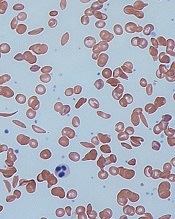
and normal red blood cells
Image by Graham Beards
Researchers say they have identified a genetic risk profile that can be used to predict which patients with sickle cell anemia (SCA) are likely to develop chronic kidney disease (CKD).
The team found evidence to suggest that a profile incorporating APOL1 G1/G2, α-thalassemia, and BCL11A can help physicians categorize SCA patients as having a high or low risk of CKD.
The researchers reported these findings in Haematologica.
Identifying SCA patients at the greatest risk of CKD can help physicians develop proactive, individualized strategies to reduce the high rate of early mortality due to CKD, said study author Santosh Saraf, MD, of the University of Illinois at Chicago.
“We looked at the genetic factors already known to be associated with kidney disease or the degree of red blood cell hemolysis and examined the relationship they had with the condition in sickle cell patients,” Dr Saraf said.
“Our hypothesis was that a genetic risk profile that integrated APOL1, α-thalassemia, and BCL11A would improve our ability to predict a patient’s risk for developing chronic kidney disease.”
To test this theory, Dr Saraf and his colleagues recruited 262 adult patients with SCA treated at a single center between 2010 and 2016. The team collected patient data, drew blood, analyzed genetic markers, and prospectively followed the patients to see if they developed CKD.
Stratification
The researchers used their genetic profile to stratify patients according to risk for CKD.
Patients were considered high-risk if they had APOL1 G1/G2 and wild-type BCL11A but did not have α-thalassemia.
Patients were considered low-risk if they were negative for APOL1 G1/G2 but had α-thalassemia (either α-/αα or α-/α-) and the BCL11A rs1427407 T allele (either G/T or T/T).
The researchers defined all other combinations as intermediate-risk.
The team found the genetic profile identified SCA patients at high and low risk for albuminuria or an estimated glomerular filtration rate less than 60 mL/min/1.73m2.
The researchers also said application of the genetic profile revealed progressively higher rates of CKD progression.
Mechanisms
Dr Saraf and his colleagues noted that homozygosity or compound heterozygosity for APOL1 G1/G2 is the strongest genetic association for CKD in African Americans, and APOL1 G1/G2 is associated with proteinuria and albuminuria in SCA patients.
The researchers pointed out that APOL1 G1/G2 variants associate with CKD in African
Americans by unknown mechanisms, but the team found an association with
hemolysis in SCA, as reflected by hemoglobinuria.
As for α-thalassemia, it’s associated with reduced hemolysis and protection from albuminuria. The researchers said α-thalassemia reduces hemolysis in SCA by decreasing the
intra-erythrocyte concentration of sickle hemoglobin (HbS) and reducing
HbS polymerization.
Finally, Dr Saraf and his colleagues noted that BCL11A rs1427407 leads to higher fetal hemoglobin (HbF) levels, reduced hemolysis, and amelioration of SCA-related complications. The team said the BCL11A rs1427407 T variant leads to decreased function of BCL11A at the HbF promoter and therefore increases HbF, leading to decreased HbS polymerization.
“The results of this study are encouraging,” Dr Saraf said. “By understanding more about the genetic risk factors of kidney disease in sickle cell patients, we are one step closer to improving the length and quality of life for the millions of people worldwide living with sickle cell disease.”
“Using combinations of genes to better predict complications in sickle cell anemia is a new approach,” added study author Victor Gordeuk, MD, of the University of Illinois at Chicago.
“The results of this study indicate that it is effective and probably can be improved on in the future to be an important part of our evaluation of patients.”
The researchers said the small sample size and observational nature of this study are limitations, and they hope to validate the results with larger studies.
and normal red blood cells
Image by Graham Beards
Researchers say they have identified a genetic risk profile that can be used to predict which patients with sickle cell anemia (SCA) are likely to develop chronic kidney disease (CKD).
The team found evidence to suggest that a profile incorporating APOL1 G1/G2, α-thalassemia, and BCL11A can help physicians categorize SCA patients as having a high or low risk of CKD.
The researchers reported these findings in Haematologica.
Identifying SCA patients at the greatest risk of CKD can help physicians develop proactive, individualized strategies to reduce the high rate of early mortality due to CKD, said study author Santosh Saraf, MD, of the University of Illinois at Chicago.
“We looked at the genetic factors already known to be associated with kidney disease or the degree of red blood cell hemolysis and examined the relationship they had with the condition in sickle cell patients,” Dr Saraf said.
“Our hypothesis was that a genetic risk profile that integrated APOL1, α-thalassemia, and BCL11A would improve our ability to predict a patient’s risk for developing chronic kidney disease.”
To test this theory, Dr Saraf and his colleagues recruited 262 adult patients with SCA treated at a single center between 2010 and 2016. The team collected patient data, drew blood, analyzed genetic markers, and prospectively followed the patients to see if they developed CKD.
Stratification
The researchers used their genetic profile to stratify patients according to risk for CKD.
Patients were considered high-risk if they had APOL1 G1/G2 and wild-type BCL11A but did not have α-thalassemia.
Patients were considered low-risk if they were negative for APOL1 G1/G2 but had α-thalassemia (either α-/αα or α-/α-) and the BCL11A rs1427407 T allele (either G/T or T/T).
The researchers defined all other combinations as intermediate-risk.
The team found the genetic profile identified SCA patients at high and low risk for albuminuria or an estimated glomerular filtration rate less than 60 mL/min/1.73m2.
The researchers also said application of the genetic profile revealed progressively higher rates of CKD progression.
Mechanisms
Dr Saraf and his colleagues noted that homozygosity or compound heterozygosity for APOL1 G1/G2 is the strongest genetic association for CKD in African Americans, and APOL1 G1/G2 is associated with proteinuria and albuminuria in SCA patients.
The researchers pointed out that APOL1 G1/G2 variants associate with CKD in African
Americans by unknown mechanisms, but the team found an association with
hemolysis in SCA, as reflected by hemoglobinuria.
As for α-thalassemia, it’s associated with reduced hemolysis and protection from albuminuria. The researchers said α-thalassemia reduces hemolysis in SCA by decreasing the
intra-erythrocyte concentration of sickle hemoglobin (HbS) and reducing
HbS polymerization.
Finally, Dr Saraf and his colleagues noted that BCL11A rs1427407 leads to higher fetal hemoglobin (HbF) levels, reduced hemolysis, and amelioration of SCA-related complications. The team said the BCL11A rs1427407 T variant leads to decreased function of BCL11A at the HbF promoter and therefore increases HbF, leading to decreased HbS polymerization.
“The results of this study are encouraging,” Dr Saraf said. “By understanding more about the genetic risk factors of kidney disease in sickle cell patients, we are one step closer to improving the length and quality of life for the millions of people worldwide living with sickle cell disease.”
“Using combinations of genes to better predict complications in sickle cell anemia is a new approach,” added study author Victor Gordeuk, MD, of the University of Illinois at Chicago.
“The results of this study indicate that it is effective and probably can be improved on in the future to be an important part of our evaluation of patients.”
The researchers said the small sample size and observational nature of this study are limitations, and they hope to validate the results with larger studies.
and normal red blood cells
Image by Graham Beards
Researchers say they have identified a genetic risk profile that can be used to predict which patients with sickle cell anemia (SCA) are likely to develop chronic kidney disease (CKD).
The team found evidence to suggest that a profile incorporating APOL1 G1/G2, α-thalassemia, and BCL11A can help physicians categorize SCA patients as having a high or low risk of CKD.
The researchers reported these findings in Haematologica.
Identifying SCA patients at the greatest risk of CKD can help physicians develop proactive, individualized strategies to reduce the high rate of early mortality due to CKD, said study author Santosh Saraf, MD, of the University of Illinois at Chicago.
“We looked at the genetic factors already known to be associated with kidney disease or the degree of red blood cell hemolysis and examined the relationship they had with the condition in sickle cell patients,” Dr Saraf said.
“Our hypothesis was that a genetic risk profile that integrated APOL1, α-thalassemia, and BCL11A would improve our ability to predict a patient’s risk for developing chronic kidney disease.”
To test this theory, Dr Saraf and his colleagues recruited 262 adult patients with SCA treated at a single center between 2010 and 2016. The team collected patient data, drew blood, analyzed genetic markers, and prospectively followed the patients to see if they developed CKD.
Stratification
The researchers used their genetic profile to stratify patients according to risk for CKD.
Patients were considered high-risk if they had APOL1 G1/G2 and wild-type BCL11A but did not have α-thalassemia.
Patients were considered low-risk if they were negative for APOL1 G1/G2 but had α-thalassemia (either α-/αα or α-/α-) and the BCL11A rs1427407 T allele (either G/T or T/T).
The researchers defined all other combinations as intermediate-risk.
The team found the genetic profile identified SCA patients at high and low risk for albuminuria or an estimated glomerular filtration rate less than 60 mL/min/1.73m2.
The researchers also said application of the genetic profile revealed progressively higher rates of CKD progression.
Mechanisms
Dr Saraf and his colleagues noted that homozygosity or compound heterozygosity for APOL1 G1/G2 is the strongest genetic association for CKD in African Americans, and APOL1 G1/G2 is associated with proteinuria and albuminuria in SCA patients.
The researchers pointed out that APOL1 G1/G2 variants associate with CKD in African
Americans by unknown mechanisms, but the team found an association with
hemolysis in SCA, as reflected by hemoglobinuria.
As for α-thalassemia, it’s associated with reduced hemolysis and protection from albuminuria. The researchers said α-thalassemia reduces hemolysis in SCA by decreasing the
intra-erythrocyte concentration of sickle hemoglobin (HbS) and reducing
HbS polymerization.
Finally, Dr Saraf and his colleagues noted that BCL11A rs1427407 leads to higher fetal hemoglobin (HbF) levels, reduced hemolysis, and amelioration of SCA-related complications. The team said the BCL11A rs1427407 T variant leads to decreased function of BCL11A at the HbF promoter and therefore increases HbF, leading to decreased HbS polymerization.
“The results of this study are encouraging,” Dr Saraf said. “By understanding more about the genetic risk factors of kidney disease in sickle cell patients, we are one step closer to improving the length and quality of life for the millions of people worldwide living with sickle cell disease.”
“Using combinations of genes to better predict complications in sickle cell anemia is a new approach,” added study author Victor Gordeuk, MD, of the University of Illinois at Chicago.
“The results of this study indicate that it is effective and probably can be improved on in the future to be an important part of our evaluation of patients.”
The researchers said the small sample size and observational nature of this study are limitations, and they hope to validate the results with larger studies.