User login
Larry Beresford is an Oakland, Calif.-based freelance medical journalist with a breadth of experience writing about the policy, financial, clinical, management and human aspects of hospice, palliative care, end-of-life care, death, and dying. He is a longtime contributor to The Hospitalist, for which he covers re-admissions, pain management, palliative care, physician stress and burnout, quality improvement, waste prevention, practice management, innovation, and technology. He also contributes to Medscape. Learn more about his work at www.larryberesford.com; follow him on Twitter @larryberesford.
Professional Development Program Advances Hospitalist Leadership Skills
Akin to other doctors, hospitalists seek clinical and nonclinical continuing medical education (CME) opportunities in subjects that they hope will improve their professional skill set. But Emory School of Medicine’s Division of Hospital Medicine has tried to make this training more systematic for its 110 members. Since 2005, competitively awarded grants have supported faculty development training in the areas of administrative leadership, quality improvement and research, and education and training.
According to an abstract presented at HM11, Emory’s faculty development program has helped train 36 HM physicians. The upshot of the program: Thirty-three hospitalists now fill formal leadership positions in six Emory-affiliated hospitals. Examples include hospital chief medical officers, chief quality officers, and medical directors for care coordination.
“Hospital medicine is a young field, and we had a young group of clinicians lacking experience that other physicians might get in the course of a career,” says Daniel Dressler, MD, MSc, SFHM, director of education for the hospital medicine division of the Atlanta-based group. “If we were going to be asked to do things, leadershipwise, in the hospital, we needed to build a program to help individuals get additional training for them.”
The physicians pick courses in areas where they want to better themselves, either local educational offerings or national conferences. A committee applies a structured process for reviewing their applications, with funding coming from the department. “We ask the doctors to come back and report on what they learned,” says Dr. Dressler, an SHM board member.
Akin to other doctors, hospitalists seek clinical and nonclinical continuing medical education (CME) opportunities in subjects that they hope will improve their professional skill set. But Emory School of Medicine’s Division of Hospital Medicine has tried to make this training more systematic for its 110 members. Since 2005, competitively awarded grants have supported faculty development training in the areas of administrative leadership, quality improvement and research, and education and training.
According to an abstract presented at HM11, Emory’s faculty development program has helped train 36 HM physicians. The upshot of the program: Thirty-three hospitalists now fill formal leadership positions in six Emory-affiliated hospitals. Examples include hospital chief medical officers, chief quality officers, and medical directors for care coordination.
“Hospital medicine is a young field, and we had a young group of clinicians lacking experience that other physicians might get in the course of a career,” says Daniel Dressler, MD, MSc, SFHM, director of education for the hospital medicine division of the Atlanta-based group. “If we were going to be asked to do things, leadershipwise, in the hospital, we needed to build a program to help individuals get additional training for them.”
The physicians pick courses in areas where they want to better themselves, either local educational offerings or national conferences. A committee applies a structured process for reviewing their applications, with funding coming from the department. “We ask the doctors to come back and report on what they learned,” says Dr. Dressler, an SHM board member.
Akin to other doctors, hospitalists seek clinical and nonclinical continuing medical education (CME) opportunities in subjects that they hope will improve their professional skill set. But Emory School of Medicine’s Division of Hospital Medicine has tried to make this training more systematic for its 110 members. Since 2005, competitively awarded grants have supported faculty development training in the areas of administrative leadership, quality improvement and research, and education and training.
According to an abstract presented at HM11, Emory’s faculty development program has helped train 36 HM physicians. The upshot of the program: Thirty-three hospitalists now fill formal leadership positions in six Emory-affiliated hospitals. Examples include hospital chief medical officers, chief quality officers, and medical directors for care coordination.
“Hospital medicine is a young field, and we had a young group of clinicians lacking experience that other physicians might get in the course of a career,” says Daniel Dressler, MD, MSc, SFHM, director of education for the hospital medicine division of the Atlanta-based group. “If we were going to be asked to do things, leadershipwise, in the hospital, we needed to build a program to help individuals get additional training for them.”
The physicians pick courses in areas where they want to better themselves, either local educational offerings or national conferences. A committee applies a structured process for reviewing their applications, with funding coming from the department. “We ask the doctors to come back and report on what they learned,” says Dr. Dressler, an SHM board member.
Palliative Care ‘Report Card’ Released
The Center to Advance Palliative Care recently issued its 2011 state-by-state report card, “America’s Care of Serious Illness”
(www.capc.org/reportcard), counting the proportion of each state’s hospitals with access to organized palliative-care programs. Eight states and the District of Columbia received “A” grades, as 80% of their acute-care hospitals also provided palliative-care services. Two states, Delaware and Mississippi, received “F” grades, as their hospitals hit only 20%.
The authors say palliative-care teams can reduce suffering and distress among patients with serious illnesses, regardless of age or disease state, improve communication, and reduce unwanted medical interventions. According to the most recent survey by the American Hospital Association, 1,894 U.S. hospitals have palliative-care programs, including 85% of those with 300 beds or more.
The Center to Advance Palliative Care recently issued its 2011 state-by-state report card, “America’s Care of Serious Illness”
(www.capc.org/reportcard), counting the proportion of each state’s hospitals with access to organized palliative-care programs. Eight states and the District of Columbia received “A” grades, as 80% of their acute-care hospitals also provided palliative-care services. Two states, Delaware and Mississippi, received “F” grades, as their hospitals hit only 20%.
The authors say palliative-care teams can reduce suffering and distress among patients with serious illnesses, regardless of age or disease state, improve communication, and reduce unwanted medical interventions. According to the most recent survey by the American Hospital Association, 1,894 U.S. hospitals have palliative-care programs, including 85% of those with 300 beds or more.
The Center to Advance Palliative Care recently issued its 2011 state-by-state report card, “America’s Care of Serious Illness”
(www.capc.org/reportcard), counting the proportion of each state’s hospitals with access to organized palliative-care programs. Eight states and the District of Columbia received “A” grades, as 80% of their acute-care hospitals also provided palliative-care services. Two states, Delaware and Mississippi, received “F” grades, as their hospitals hit only 20%.
The authors say palliative-care teams can reduce suffering and distress among patients with serious illnesses, regardless of age or disease state, improve communication, and reduce unwanted medical interventions. According to the most recent survey by the American Hospital Association, 1,894 U.S. hospitals have palliative-care programs, including 85% of those with 300 beds or more.
IOM Report Outlines Health IT Concerns
The Institute of Medicine in November issued a new report, “Patient Safety and Health IT (HIT): Building Safer Systems for Better Care,” which identifies potential harm that could stem from a digital healthcare system and proposes 10 recommendations. Many of the suggestions are directed at the U.S. Secretary of Health and Human Services, urging the office to work with the private sector and research groups on patient safety, ensure the free exchange of information on healthcare information technology (HIT) issues, and create a process for reporting HIT-related deaths and injuries.
“Concerns about potential harm are emerging as providers increasingly rely on electronic medical records, secure patient portals, and other technologies to deliver care,” the report states, but there is a lack of published research quantifying the risks. For more on the HIT report, check out the Policy Corner.
The Institute of Medicine in November issued a new report, “Patient Safety and Health IT (HIT): Building Safer Systems for Better Care,” which identifies potential harm that could stem from a digital healthcare system and proposes 10 recommendations. Many of the suggestions are directed at the U.S. Secretary of Health and Human Services, urging the office to work with the private sector and research groups on patient safety, ensure the free exchange of information on healthcare information technology (HIT) issues, and create a process for reporting HIT-related deaths and injuries.
“Concerns about potential harm are emerging as providers increasingly rely on electronic medical records, secure patient portals, and other technologies to deliver care,” the report states, but there is a lack of published research quantifying the risks. For more on the HIT report, check out the Policy Corner.
The Institute of Medicine in November issued a new report, “Patient Safety and Health IT (HIT): Building Safer Systems for Better Care,” which identifies potential harm that could stem from a digital healthcare system and proposes 10 recommendations. Many of the suggestions are directed at the U.S. Secretary of Health and Human Services, urging the office to work with the private sector and research groups on patient safety, ensure the free exchange of information on healthcare information technology (HIT) issues, and create a process for reporting HIT-related deaths and injuries.
“Concerns about potential harm are emerging as providers increasingly rely on electronic medical records, secure patient portals, and other technologies to deliver care,” the report states, but there is a lack of published research quantifying the risks. For more on the HIT report, check out the Policy Corner.
Hospitalist Leads Project to Improve Antimicrobial Prescribing
Hospitalists are at the center of many proposed interventions to improve antimicrobial prescribing practices, half of which are estimated to be unnecessary or inappropriate, with serious cost and safety consequences, says Scott Flanders, MD, FACP, SFHM, professor of medicine and director of the hospitalist program at the University of Michigan Health System in Ann Arbor.
Dr. Flanders, past president of SHM, is on the faculty of a new Institute for Healthcare Improvement (IHI) initiative kicked off in Boston in late October to test the feasibility of those interventions in hospitals of varying models.
The CDC's national campaign Get Smart for Healthcare recommends formal antimicrobial stewardship programs in hospitals to ensure that patients routinely receive the right antibiotic in the right dose at the right time for the right duration. The CDC website cites a number of studies showing the positive effects of such stewardship on antimicrobial use, antimicrobial resistance, the incidence of Clostridium difficile infections, cost, and other endpoints.
The CDC has engaged IHI to define and pilot-test the feasibility of expert-recommended interventions and approaches at eight hospitals through June 2012. The testing could lead to modifications in approaches, perhaps a second round of testing, and an IHI collaborative, says Diane Jacobsen, IHI project manager.
Eventually, Dr. Flanders adds, SHM might offer its own toolkit of resources for hospitals and hospitalists, and mentored implementation along the lines of its other major quality initiatives.
"The biggest thing for hospitalists is awareness of the problem, and then a commitment to appropriate, evidence-based selection and de-escalation of antibiotics," Jacobsen adds.
Hospitalists are at the center of many proposed interventions to improve antimicrobial prescribing practices, half of which are estimated to be unnecessary or inappropriate, with serious cost and safety consequences, says Scott Flanders, MD, FACP, SFHM, professor of medicine and director of the hospitalist program at the University of Michigan Health System in Ann Arbor.
Dr. Flanders, past president of SHM, is on the faculty of a new Institute for Healthcare Improvement (IHI) initiative kicked off in Boston in late October to test the feasibility of those interventions in hospitals of varying models.
The CDC's national campaign Get Smart for Healthcare recommends formal antimicrobial stewardship programs in hospitals to ensure that patients routinely receive the right antibiotic in the right dose at the right time for the right duration. The CDC website cites a number of studies showing the positive effects of such stewardship on antimicrobial use, antimicrobial resistance, the incidence of Clostridium difficile infections, cost, and other endpoints.
The CDC has engaged IHI to define and pilot-test the feasibility of expert-recommended interventions and approaches at eight hospitals through June 2012. The testing could lead to modifications in approaches, perhaps a second round of testing, and an IHI collaborative, says Diane Jacobsen, IHI project manager.
Eventually, Dr. Flanders adds, SHM might offer its own toolkit of resources for hospitals and hospitalists, and mentored implementation along the lines of its other major quality initiatives.
"The biggest thing for hospitalists is awareness of the problem, and then a commitment to appropriate, evidence-based selection and de-escalation of antibiotics," Jacobsen adds.
Hospitalists are at the center of many proposed interventions to improve antimicrobial prescribing practices, half of which are estimated to be unnecessary or inappropriate, with serious cost and safety consequences, says Scott Flanders, MD, FACP, SFHM, professor of medicine and director of the hospitalist program at the University of Michigan Health System in Ann Arbor.
Dr. Flanders, past president of SHM, is on the faculty of a new Institute for Healthcare Improvement (IHI) initiative kicked off in Boston in late October to test the feasibility of those interventions in hospitals of varying models.
The CDC's national campaign Get Smart for Healthcare recommends formal antimicrobial stewardship programs in hospitals to ensure that patients routinely receive the right antibiotic in the right dose at the right time for the right duration. The CDC website cites a number of studies showing the positive effects of such stewardship on antimicrobial use, antimicrobial resistance, the incidence of Clostridium difficile infections, cost, and other endpoints.
The CDC has engaged IHI to define and pilot-test the feasibility of expert-recommended interventions and approaches at eight hospitals through June 2012. The testing could lead to modifications in approaches, perhaps a second round of testing, and an IHI collaborative, says Diane Jacobsen, IHI project manager.
Eventually, Dr. Flanders adds, SHM might offer its own toolkit of resources for hospitals and hospitalists, and mentored implementation along the lines of its other major quality initiatives.
"The biggest thing for hospitalists is awareness of the problem, and then a commitment to appropriate, evidence-based selection and de-escalation of antibiotics," Jacobsen adds.
Health Plans, Physician Groups Show Interest in Post-Discharge Clinics
Not all post-discharge clinics are established by hospitalist groups or their parent hospitals. As Tallahassee (Fla.) Memorial Hospital’s experience with a collaborative approach shows (see “Is a Post-Discharge Clinic in Your Hospital’s Future?”), health plans might take an interest in successful discharge protocols to prevent unnecessary readmissions. In other cases, medical specialty practices have established clinics for patients with specific diseases—CHF, COPD, even post-ICU delirium.
In Southern California, two large, established physician groups that assume financial risk or insurance functions see the potential benefit, given that their financial incentives are more obviously aligned to such clinics than are hospitals’. Cerritos, Calif.-based CareMore is a Medicare health plan that started out as a medical group and remains a care delivery system for Medicare Advantage patients, making significant use of hospitalists.
“We call ourselves ‘extensivists,’” says CareMore medical director and hospitalist Hyong Kim, MD. The company’s hospitalists generally
“This approach wouldn’t work in fee-for-service, but it works well in pre-paid environments. We pay our PCPs a capitated rate, and they continue to receive capitation after the hospitalist takes over the care,” he explains. “Our extensivists are salaried, with incentives based on readmissions.”
The company uses chronic-disease managers, who check in daily with the hospitalists. “We also have a house-call physician program, sending physicians and social workers to patients’ homes after discharge,” Dr. Kim says.
Torrance, Calif.-based HealthCare Partners, a large, physician-owned multispecialty medical group, operates in many ways like a health plan, says Tyler Jung, MD, medical director for hospitalists, high-risk groups, and post-discharge clinics. “We’re fully delegated. We accept financial risk from virtually all of the major health plans in the area,” he explains.
—Tyler Jung, MD, medical director, hospitalists, high-risk groups, and post-discharge clinics, HealthCare Partners, Torrance, Calif.
Dr. Jung’s team views the first 30 days after patients leave the hospital as “the riskiest time period for our members. We’ve had hospitalists for 15 to 20 years, and just recently we began looking at the post-discharge clinic option,” he says. “I’m still undecided: Is it a Band-Aid or something we need to intervene in the post-discharge period?”
HealthCare Partners operates six community care and disease management centers across Southern California, each of which houses a post-discharge clinic staffed by a doctor, social worker, and case manager. The post-discharge physicians are internists, not necessarily hospitalists, “although many moonlight in our hospitalist program and the most successful ones have hospitalist experience,” Dr. Jung says. “Our clinics are designed for 45-minute appointments: The patient meets with the doctor and maybe the social worker and case manager—a real multidisciplinary approach.”
Three-fourths of referrals are patients coming home from the hospital and a quarter are high-risk patients identified in primary-care clinics. “The first visit deals with medically complicated issues, but the next couple may have more to do with reinforcing the care plan that was established,” as well as looking at social issues, he says.
Finding the right physician is no easy task. “They’ve got to get it,” he says. “You need to be judicious about how long to keep the patient—versus referring them back to primary care—and setting limits is hard. We don’t have magic criteria for this. It’s mostly subjective right now.”
Another challenge is measuring success. “These clinics can be expensive to run, and we need to show the return on investment,” he says.
Larry Beresford is a freelance writer based in Oakland, Calif.
Not all post-discharge clinics are established by hospitalist groups or their parent hospitals. As Tallahassee (Fla.) Memorial Hospital’s experience with a collaborative approach shows (see “Is a Post-Discharge Clinic in Your Hospital’s Future?”), health plans might take an interest in successful discharge protocols to prevent unnecessary readmissions. In other cases, medical specialty practices have established clinics for patients with specific diseases—CHF, COPD, even post-ICU delirium.
In Southern California, two large, established physician groups that assume financial risk or insurance functions see the potential benefit, given that their financial incentives are more obviously aligned to such clinics than are hospitals’. Cerritos, Calif.-based CareMore is a Medicare health plan that started out as a medical group and remains a care delivery system for Medicare Advantage patients, making significant use of hospitalists.
“We call ourselves ‘extensivists,’” says CareMore medical director and hospitalist Hyong Kim, MD. The company’s hospitalists generally
“This approach wouldn’t work in fee-for-service, but it works well in pre-paid environments. We pay our PCPs a capitated rate, and they continue to receive capitation after the hospitalist takes over the care,” he explains. “Our extensivists are salaried, with incentives based on readmissions.”
The company uses chronic-disease managers, who check in daily with the hospitalists. “We also have a house-call physician program, sending physicians and social workers to patients’ homes after discharge,” Dr. Kim says.
Torrance, Calif.-based HealthCare Partners, a large, physician-owned multispecialty medical group, operates in many ways like a health plan, says Tyler Jung, MD, medical director for hospitalists, high-risk groups, and post-discharge clinics. “We’re fully delegated. We accept financial risk from virtually all of the major health plans in the area,” he explains.
—Tyler Jung, MD, medical director, hospitalists, high-risk groups, and post-discharge clinics, HealthCare Partners, Torrance, Calif.
Dr. Jung’s team views the first 30 days after patients leave the hospital as “the riskiest time period for our members. We’ve had hospitalists for 15 to 20 years, and just recently we began looking at the post-discharge clinic option,” he says. “I’m still undecided: Is it a Band-Aid or something we need to intervene in the post-discharge period?”
HealthCare Partners operates six community care and disease management centers across Southern California, each of which houses a post-discharge clinic staffed by a doctor, social worker, and case manager. The post-discharge physicians are internists, not necessarily hospitalists, “although many moonlight in our hospitalist program and the most successful ones have hospitalist experience,” Dr. Jung says. “Our clinics are designed for 45-minute appointments: The patient meets with the doctor and maybe the social worker and case manager—a real multidisciplinary approach.”
Three-fourths of referrals are patients coming home from the hospital and a quarter are high-risk patients identified in primary-care clinics. “The first visit deals with medically complicated issues, but the next couple may have more to do with reinforcing the care plan that was established,” as well as looking at social issues, he says.
Finding the right physician is no easy task. “They’ve got to get it,” he says. “You need to be judicious about how long to keep the patient—versus referring them back to primary care—and setting limits is hard. We don’t have magic criteria for this. It’s mostly subjective right now.”
Another challenge is measuring success. “These clinics can be expensive to run, and we need to show the return on investment,” he says.
Larry Beresford is a freelance writer based in Oakland, Calif.
Not all post-discharge clinics are established by hospitalist groups or their parent hospitals. As Tallahassee (Fla.) Memorial Hospital’s experience with a collaborative approach shows (see “Is a Post-Discharge Clinic in Your Hospital’s Future?”), health plans might take an interest in successful discharge protocols to prevent unnecessary readmissions. In other cases, medical specialty practices have established clinics for patients with specific diseases—CHF, COPD, even post-ICU delirium.
In Southern California, two large, established physician groups that assume financial risk or insurance functions see the potential benefit, given that their financial incentives are more obviously aligned to such clinics than are hospitals’. Cerritos, Calif.-based CareMore is a Medicare health plan that started out as a medical group and remains a care delivery system for Medicare Advantage patients, making significant use of hospitalists.
“We call ourselves ‘extensivists,’” says CareMore medical director and hospitalist Hyong Kim, MD. The company’s hospitalists generally
“This approach wouldn’t work in fee-for-service, but it works well in pre-paid environments. We pay our PCPs a capitated rate, and they continue to receive capitation after the hospitalist takes over the care,” he explains. “Our extensivists are salaried, with incentives based on readmissions.”
The company uses chronic-disease managers, who check in daily with the hospitalists. “We also have a house-call physician program, sending physicians and social workers to patients’ homes after discharge,” Dr. Kim says.
Torrance, Calif.-based HealthCare Partners, a large, physician-owned multispecialty medical group, operates in many ways like a health plan, says Tyler Jung, MD, medical director for hospitalists, high-risk groups, and post-discharge clinics. “We’re fully delegated. We accept financial risk from virtually all of the major health plans in the area,” he explains.
—Tyler Jung, MD, medical director, hospitalists, high-risk groups, and post-discharge clinics, HealthCare Partners, Torrance, Calif.
Dr. Jung’s team views the first 30 days after patients leave the hospital as “the riskiest time period for our members. We’ve had hospitalists for 15 to 20 years, and just recently we began looking at the post-discharge clinic option,” he says. “I’m still undecided: Is it a Band-Aid or something we need to intervene in the post-discharge period?”
HealthCare Partners operates six community care and disease management centers across Southern California, each of which houses a post-discharge clinic staffed by a doctor, social worker, and case manager. The post-discharge physicians are internists, not necessarily hospitalists, “although many moonlight in our hospitalist program and the most successful ones have hospitalist experience,” Dr. Jung says. “Our clinics are designed for 45-minute appointments: The patient meets with the doctor and maybe the social worker and case manager—a real multidisciplinary approach.”
Three-fourths of referrals are patients coming home from the hospital and a quarter are high-risk patients identified in primary-care clinics. “The first visit deals with medically complicated issues, but the next couple may have more to do with reinforcing the care plan that was established,” as well as looking at social issues, he says.
Finding the right physician is no easy task. “They’ve got to get it,” he says. “You need to be judicious about how long to keep the patient—versus referring them back to primary care—and setting limits is hard. We don’t have magic criteria for this. It’s mostly subjective right now.”
Another challenge is measuring success. “These clinics can be expensive to run, and we need to show the return on investment,” he says.
Larry Beresford is a freelance writer based in Oakland, Calif.

San Fran General’s Transitional Care Clinic Undergoes Makeover
San Francisco General Hospital opened its post-discharge transitional care clinic for many of the same reasons as other safety net hospitals, but through staff transitions a new role has emerged: the training of medicine residents. A nurse practitioner (NP), hired in 2007, first identified the large
In 2009, the NP established a “bridge clinic” five half-days a week within an existing hospital-based general medicine clinic. She encouraged referrals of any patients who needed post-discharge services and then triaged those at greatest risk into available clinic slots. But when she went on maternity leave, the clinic’s presence shrank to one half-day per week.
“It really made us take a step back and think philosophically about whether this was a necessary Band-Aid, or whether the system had changed enough that we no longer needed it,” Dr. Schneidermann says. “We found out through our assessment that things, unfortunately, hadn’t changed that much, and the need was still there for a bridge clinic.”
The “mini” bridge clinic collaborates with a new cadre of care coordinators working on discharge planning and with a new group of hospitalists to create an opportunity for medical residents to learn the challenges of care transitions hands-on. “What’s been interesting about this scaled-down version, which we call the mini-bridge clinic, is that it has made us more resourceful,” says SFGH’s Larissa Thomas, MD, MPH.
Dr. Schneidermann says the NP is planning to return in January, which will mean a new set of challenges. “We’ll need to coordinate with her around how to integrate these two approaches. But we find this is an incredible opportunity to teach future physicians about care transitions,” she says.
—Michelle Schneidermann, MD, hospitalist at San Francisco General Hospital.
The challenge now, Dr. Thomas says, is to view transitional medicine in the 30 days following hospital discharge as an essential part of HM, and then build that into the training of residents. “We’re trying to reframe how we think about medicine and looking to create an integrated curriculum,” she says. “Not only will residents have the experience of the transitional care clinic, but when they’re on an inpatient rotation, they’ll be more mindful of the things that affect patient well-being after discharge.”
Larry Beresford is a freelance writer based in Oakland, Calif.
San Francisco General Hospital opened its post-discharge transitional care clinic for many of the same reasons as other safety net hospitals, but through staff transitions a new role has emerged: the training of medicine residents. A nurse practitioner (NP), hired in 2007, first identified the large
In 2009, the NP established a “bridge clinic” five half-days a week within an existing hospital-based general medicine clinic. She encouraged referrals of any patients who needed post-discharge services and then triaged those at greatest risk into available clinic slots. But when she went on maternity leave, the clinic’s presence shrank to one half-day per week.
“It really made us take a step back and think philosophically about whether this was a necessary Band-Aid, or whether the system had changed enough that we no longer needed it,” Dr. Schneidermann says. “We found out through our assessment that things, unfortunately, hadn’t changed that much, and the need was still there for a bridge clinic.”
The “mini” bridge clinic collaborates with a new cadre of care coordinators working on discharge planning and with a new group of hospitalists to create an opportunity for medical residents to learn the challenges of care transitions hands-on. “What’s been interesting about this scaled-down version, which we call the mini-bridge clinic, is that it has made us more resourceful,” says SFGH’s Larissa Thomas, MD, MPH.
Dr. Schneidermann says the NP is planning to return in January, which will mean a new set of challenges. “We’ll need to coordinate with her around how to integrate these two approaches. But we find this is an incredible opportunity to teach future physicians about care transitions,” she says.
—Michelle Schneidermann, MD, hospitalist at San Francisco General Hospital.
The challenge now, Dr. Thomas says, is to view transitional medicine in the 30 days following hospital discharge as an essential part of HM, and then build that into the training of residents. “We’re trying to reframe how we think about medicine and looking to create an integrated curriculum,” she says. “Not only will residents have the experience of the transitional care clinic, but when they’re on an inpatient rotation, they’ll be more mindful of the things that affect patient well-being after discharge.”
Larry Beresford is a freelance writer based in Oakland, Calif.
San Francisco General Hospital opened its post-discharge transitional care clinic for many of the same reasons as other safety net hospitals, but through staff transitions a new role has emerged: the training of medicine residents. A nurse practitioner (NP), hired in 2007, first identified the large
In 2009, the NP established a “bridge clinic” five half-days a week within an existing hospital-based general medicine clinic. She encouraged referrals of any patients who needed post-discharge services and then triaged those at greatest risk into available clinic slots. But when she went on maternity leave, the clinic’s presence shrank to one half-day per week.
“It really made us take a step back and think philosophically about whether this was a necessary Band-Aid, or whether the system had changed enough that we no longer needed it,” Dr. Schneidermann says. “We found out through our assessment that things, unfortunately, hadn’t changed that much, and the need was still there for a bridge clinic.”
The “mini” bridge clinic collaborates with a new cadre of care coordinators working on discharge planning and with a new group of hospitalists to create an opportunity for medical residents to learn the challenges of care transitions hands-on. “What’s been interesting about this scaled-down version, which we call the mini-bridge clinic, is that it has made us more resourceful,” says SFGH’s Larissa Thomas, MD, MPH.
Dr. Schneidermann says the NP is planning to return in January, which will mean a new set of challenges. “We’ll need to coordinate with her around how to integrate these two approaches. But we find this is an incredible opportunity to teach future physicians about care transitions,” she says.
—Michelle Schneidermann, MD, hospitalist at San Francisco General Hospital.
The challenge now, Dr. Thomas says, is to view transitional medicine in the 30 days following hospital discharge as an essential part of HM, and then build that into the training of residents. “We’re trying to reframe how we think about medicine and looking to create an integrated curriculum,” she says. “Not only will residents have the experience of the transitional care clinic, but when they’re on an inpatient rotation, they’ll be more mindful of the things that affect patient well-being after discharge.”
Larry Beresford is a freelance writer based in Oakland, Calif.
ONLINE EXCLUSIVE: San Fran General’s Transitional Care Clinic Undergoes Transition
San Francisco General Hospital opened its post-discharge transitional care clinic for many of the same reasons as other safety net hospitals, but through staff transitions a new role has emerged: the training of medicine residents. A nurse practitioner (NP), hired in 2007, first identified the large number of patients who either did not have a primary care physician (PCP) or hadn’t seen one in a while, “but had a lot of complex care transition issues and were falling through the cracks,” explains Michelle Schneidermann, MD, hospitalist at SFGH.
—Larissa Thomas, MD, MPH, San Francisco General Hospital.
In 2009, the NP established a “bridge clinic” five half-days a week within an existing hospital-based general medicine clinic. She encouraged referrals of any patients who needed post-discharge services and then triaged those at greatest risk into available clinic slots. But when she went on maternity leave, the clinic’s presence shrank to one half-day per week.
“It really made us take a step back and think philosophically about whether this was a necessary Band-Aid, or whether the system had changed enough that we no longer needed it,” Dr. Schneidermann says. “We found out through our assessment that things, unfortunately, hadn’t changed that much, and the need was still there for a bridge clinic.”
The “mini” bridge clinic collaborates with a new cadre of care coordinators working on discharge planning and with a new group of hospitalists to create an opportunity for medical residents to learn the challenges of care transitions hands-on. “What’s been interesting about this scaled-down version, which we call the mini-bridge clinic, is that it has made us more resourceful,” says SFGH’s Larissa Thomas, MD, MPH.
Dr. Schneidermann says the NP is planning to return in January, which will mean a new set of challenges. “We’ll need to coordinate with her around how to integrate these two approaches. But we find this is an incredible opportunity to teach future physicians about care transitions,” she says.
The challenge now, Dr. Thomas says, is to view transitional medicine in the 30 days following hospital discharge as an essential part of HM, and then build that into the training of residents. “We’re trying to reframe how we think about medicine and looking to create an integrated curriculum,” she says. “Not only will residents have the experience of the transitional care clinic, but when they’re on an inpatient rotation, they’ll be more mindful of the things that affect patient well-being after discharge.”
Larry Beresford is a freelance writer based in Oakland, Calif.
San Francisco General Hospital opened its post-discharge transitional care clinic for many of the same reasons as other safety net hospitals, but through staff transitions a new role has emerged: the training of medicine residents. A nurse practitioner (NP), hired in 2007, first identified the large number of patients who either did not have a primary care physician (PCP) or hadn’t seen one in a while, “but had a lot of complex care transition issues and were falling through the cracks,” explains Michelle Schneidermann, MD, hospitalist at SFGH.
—Larissa Thomas, MD, MPH, San Francisco General Hospital.
In 2009, the NP established a “bridge clinic” five half-days a week within an existing hospital-based general medicine clinic. She encouraged referrals of any patients who needed post-discharge services and then triaged those at greatest risk into available clinic slots. But when she went on maternity leave, the clinic’s presence shrank to one half-day per week.
“It really made us take a step back and think philosophically about whether this was a necessary Band-Aid, or whether the system had changed enough that we no longer needed it,” Dr. Schneidermann says. “We found out through our assessment that things, unfortunately, hadn’t changed that much, and the need was still there for a bridge clinic.”
The “mini” bridge clinic collaborates with a new cadre of care coordinators working on discharge planning and with a new group of hospitalists to create an opportunity for medical residents to learn the challenges of care transitions hands-on. “What’s been interesting about this scaled-down version, which we call the mini-bridge clinic, is that it has made us more resourceful,” says SFGH’s Larissa Thomas, MD, MPH.
Dr. Schneidermann says the NP is planning to return in January, which will mean a new set of challenges. “We’ll need to coordinate with her around how to integrate these two approaches. But we find this is an incredible opportunity to teach future physicians about care transitions,” she says.
The challenge now, Dr. Thomas says, is to view transitional medicine in the 30 days following hospital discharge as an essential part of HM, and then build that into the training of residents. “We’re trying to reframe how we think about medicine and looking to create an integrated curriculum,” she says. “Not only will residents have the experience of the transitional care clinic, but when they’re on an inpatient rotation, they’ll be more mindful of the things that affect patient well-being after discharge.”
Larry Beresford is a freelance writer based in Oakland, Calif.
San Francisco General Hospital opened its post-discharge transitional care clinic for many of the same reasons as other safety net hospitals, but through staff transitions a new role has emerged: the training of medicine residents. A nurse practitioner (NP), hired in 2007, first identified the large number of patients who either did not have a primary care physician (PCP) or hadn’t seen one in a while, “but had a lot of complex care transition issues and were falling through the cracks,” explains Michelle Schneidermann, MD, hospitalist at SFGH.
—Larissa Thomas, MD, MPH, San Francisco General Hospital.
In 2009, the NP established a “bridge clinic” five half-days a week within an existing hospital-based general medicine clinic. She encouraged referrals of any patients who needed post-discharge services and then triaged those at greatest risk into available clinic slots. But when she went on maternity leave, the clinic’s presence shrank to one half-day per week.
“It really made us take a step back and think philosophically about whether this was a necessary Band-Aid, or whether the system had changed enough that we no longer needed it,” Dr. Schneidermann says. “We found out through our assessment that things, unfortunately, hadn’t changed that much, and the need was still there for a bridge clinic.”
The “mini” bridge clinic collaborates with a new cadre of care coordinators working on discharge planning and with a new group of hospitalists to create an opportunity for medical residents to learn the challenges of care transitions hands-on. “What’s been interesting about this scaled-down version, which we call the mini-bridge clinic, is that it has made us more resourceful,” says SFGH’s Larissa Thomas, MD, MPH.
Dr. Schneidermann says the NP is planning to return in January, which will mean a new set of challenges. “We’ll need to coordinate with her around how to integrate these two approaches. But we find this is an incredible opportunity to teach future physicians about care transitions,” she says.
The challenge now, Dr. Thomas says, is to view transitional medicine in the 30 days following hospital discharge as an essential part of HM, and then build that into the training of residents. “We’re trying to reframe how we think about medicine and looking to create an integrated curriculum,” she says. “Not only will residents have the experience of the transitional care clinic, but when they’re on an inpatient rotation, they’ll be more mindful of the things that affect patient well-being after discharge.”
Larry Beresford is a freelance writer based in Oakland, Calif.
ONLINE EXCLUSIVE: Listen to Lauren Doctoroff discuss BIDMC’s postdischarge clinic
Click here to listen to Dr. Doctoroff
Click here to listen to Dr. Doctoroff
Click here to listen to Dr. Doctoroff
Is a Post-Discharge Clinic in Your Hospital's Future?
The hospitalist concept was established on the foundation of timely, informative handoffs to primary-care physicians (PCPs) once a patient’s hospital stay is complete. With sicker patients and shorter hospital stays, pending test results, and complex post-discharge medication regimens to sort out, this handoff is crucial to successful discharges. But what if a discharged patient can’t get in to see the PCP, or has no established PCP?
Recent research on hospital readmissions by the Dartmouth Atlas Project found that only 42% of hospitalized Medicare patients had any contact with a primary-care clinician within 14 days of discharge.1 For patients with ongoing medical needs, such missed connections are a major contributor to hospital readmissions, and thus a target for hospitals and HM groups wanting to control their readmission rates before Medicare imposes reimbursement penalties starting in October 2012 (see “Value-Based Purchasing Raises the Stakes,” May 2011, p. 1).
One proposed solution is the post-discharge clinic, typically located on or near a hospital’s campus and staffed by hospitalists, PCPs, or advanced-practice nurses. The patient can be seen once or a few times in the post-discharge clinic to make sure that health education started in the hospital is understood and followed, and that prescriptions ordered in the hospital are being taken on schedule.
—Lauren Doctoroff, MD, hospitalist, director, post-discharge clinic, Beth Israel Deaconess Medical Center, Boston
Mark V. Williams, MD, FACP, FHM, professor and chief of the division of hospital medicine at Northwestern University’s Feinberg School of Medicine in Chicago, describes hospitalist-led post-discharge clinics as “Band-Aids for an inadequate primary-care system.” What would be better, he says, is focusing on the underlying problem and working to improve post-discharge access to primary care. Dr. Williams acknowledges, however, that sometimes a patch is needed to stanch the blood flow—e.g., to better manage care transitions—while waiting on healthcare reform and medical homes to improve care coordination throughout the system.
Working in a post-discharge clinic might seem like “a stretch for many hospitalists, especially those who chose this field because they didn’t want to do outpatient medicine,” says Lauren Doctoroff, MD, a hospitalist who directs a post-discharge clinic at Beth Israel Deaconess Medical Center (BIDMC) in Boston. “But there are times when it may be appropriate for hospital-based doctors to extend their responsibility out of the hospital.”
Dr. Doctoroff also says that working in such a clinic can be practice-changing for hospitalists. “All of a sudden, you have a different view of your hospitalized patients, and you start to ask different questions while they’re in the hospital than you ever did before,” she explains.
What is a Post-Discharge Clinic?
The post-discharge clinic, also known as a transitional-care clinic or after-care clinic, is intended to bridge medical coverage between the hospital and primary care. The clinic at BIDMC is for patients affiliated with its Health Care Associates faculty practice “discharged from either our hospital or another hospital, who need care that their PCP or specialist, because of scheduling conflicts, cannot provide within the needed time frame,” Dr. Doctoroff says.
Four hospitalists from BIDMC’s large HM group were selected to staff the clinic. The hospitalists work in one-month rotations (a total of three months on service per year), and are relieved of other responsibilities during their month in clinic. They provide five half-day clinic sessions per week, with a 40-minute-per-patient visit schedule. Thirty minutes are allotted for patients referred from the hospital’s ED who did not get admitted to the hospital but need clinical follow-up.
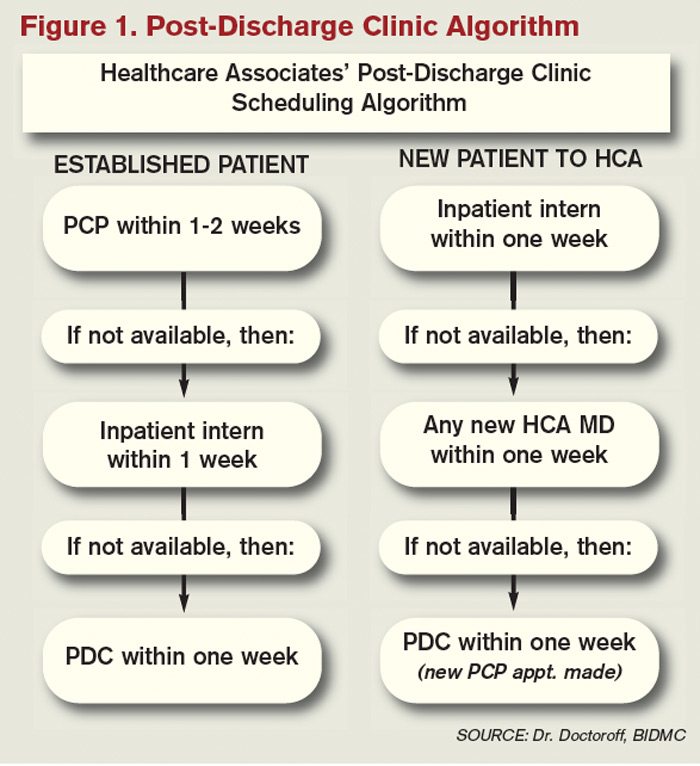
The clinic is based in a BIDMC-affiliated primary-care practice, “which allows us to use its administrative structure and logistical support,” Dr. Doctoroff explains. “A hospital-based administrative service helps set up outpatient visits prior to discharge using computerized physician order entry and a scheduling algorhythm.” (See Figure 1) Patients who can be seen by their PCP in a timely fashion are referred to the PCP office; if not, they are scheduled in the post-discharge clinic. “That helps preserve the PCP relationship, which I think is paramount,” she says.
The first two years were spent getting the clinic established, but in the near future, BIDMC will start measuring such outcomes as access to care and quality. “But not necessarily readmission rates,” Dr. Doctoroff adds. “I know many people think of post-discharge clinics in the context of preventing readmissions, although we don’t have the data yet to fully support that. In fact, some readmissions may result from seeing a doctor. If you get a closer look at some patients after discharge and they are doing badly, they are more likely to be readmitted than if they had just stayed home.” In such cases, readmission could actually be a better outcome for the patient, she notes.
Dr. Doctoroff describes a typical user of her post-discharge clinic as a non-English-speaking patient who was discharged from the hospital with severe back pain from a herniated disk. “He came back to see me 10 days later, still barely able to walk. He hadn’t been able to fill any of the prescriptions from his hospital stay. Within two hours after I saw him, we got his meds filled and outpatient services set up,” she says. “We take care of many patients like him in the hospital with acute pain issues, whom we discharge as soon as they can walk, and later we see them limping into outpatient clinics. It makes me think differently now about how I plan their discharges.”

—Shay Martinez, MD, hospitalist, medical director, Harborview Medical Center, Seattle
Who else needs these clinics? Dr. Doctoroff suggests two ways of looking at the question.
“Even for a simple patient admitted to the hospital, that can represent a significant change in the medical picture—a sort of sentinel event. In the discharge clinic, we give them an opportunity to review the hospitalization and answer their questions,” she says. “A lot of information presented to patients in the hospital is not well heard, and the initial visit may be their first time to really talk about what happened.” For other patients with conditions such as congestive heart failure (CHF), chronic obstructive pulmonary disease (COPD), or poorly controlled diabetes, treatment guidelines might dictate a pattern for post-discharge follow-up—for example, medical visits in seven or 10 days.
In Seattle, Harborview Medical Center established its After Care Clinic, staffed by hospitalists and nurse practitioners, to provide transitional care for patients discharged from inpatient wards or the ED in need of follow-up, says medical director and hospitalist Shay Martinez, MD. A second priority is to see any CHF patient within 48 hours of discharge.
“We try to limit patients to a maximum of three visits in our clinic,” she says. “At that point, we help them get established in a medical home, either here in one of our primary-care clinics, or in one of the many excellent community clinics in the area.
“This model works well with our patient population. We actually try to do primary care on the inpatient side as well. Our hospitalists are specialized in that approach, given our patient population. We see a lot of immigrants, non-English speakers, people with low health literacy, and the homeless, many of whom lack primary care,” Dr. Martinez says. “We do medication reconciliation, reassessments, and follow-ups with lab tests. We also try to assess who is more likely to be a no-show, and who needs more help with scheduling follow-up appointments.”
Clinical coverage of post-discharge clinics varies by setting, staffing, and scope. If demand is low, hospitalists or ED physicians can be called off the floor to see patients who return to the clinic, or they could staff the clinic after their hospitalist shift ends. Post-discharge clinic staff whose schedules are light can flex into providing primary-care visits in the clinic. Post-discharge can also could be provided in conjunction with—or as an alternative to—physician house calls to patients’ homes. Some post-discharge clinics work with medical call centers or telephonic case managers; some even use telemedicine.
It also could be a growth opportunity for hospitalist practices. “It is an exciting potential role for hospitalists interested in doing a little outpatient care,” Dr. Martinez says. “This is also a good way to be a safety net for your safety-net hospital.”
continued below...
What Do PCPs Think? It May Be Harder than It Looks
Although some PCPs instinctively will be suspicious of a hospitalist-run post-discharge clinic, it should be possible to clearly limit the service to short-term, immediate-post-hospital encounters focused on issues related to patients unable to get timely access to primary care, according to Dr. Doctoroff.
“I think there is a diversity of opinion by PCPs,” she says. “Some doctors really believe that it interferes with the patient-doctor relationship. But after we’ve been here for a couple of years, we’ve built up credibility with many providers.”
Charles Cutler, MD, FACP, a general internist with a practice in Norristown, Pa., and a member of the ACP’s Board of Regents, says the post-discharge clinic is “a novel idea.”
“I’d be very curious to see if this really is a way to provide better and more cost-effective care,” adds Dr. Cutler, who normally retains management of his own patients when they are hospitalized but agrees that hospitals need to find a solution for lapses in care transitions.
Even so, he says, establishing an outpatient clinic presence may be more difficult than many hospitalists appreciate. “You can’t just put a doc in a room. That physician needs equipment, scheduling, and support staff,” he says. “In our small practice, we employ one person just to ensure that each patient chart is up to date. The overhead necessary to replicate a typical medical office, even one merely providing a transition of care, could be substantial.”
Dr. Cutler emphasizes such office-based challenges as billing, which is distinctly different from hospital billing, and credentialing by insurance companies.
“There are many aspects that have to be thought through. If you see the patient, you need to make yourself available for follow-up calls, because you’ve created a relationship,” he says. “I’m a believer that hospital medicine requires a degree of specialization. But so does an office practice.”
Dr. Cutler acknowledges that some PCPs will be resentful of post-discharge clinics. “But if you don’t like a hospitalist-run discharge clinic, then you have a responsibility to rearrange your schedule to accommodate patients after their hospital discharge,” he says.
Partner with Community
Tallahassee (Fla.) Memorial Hospital (TMH) in February launched a transitional-care clinic in collaboration with faculty from Florida State University, community-based health providers, and the local Capital Health Plan. Hospitalists don’t staff the clinic, but the HM group is its major source of referrals, says Dean Watson, MD, chief medical officer at TMH. Patients can be followed for up to eight weeks, during which time they get comprehensive assessments, medication review and optimization, and referral by the clinic social worker to a PCP and to available community services.
“Three years ago, we came up with the idea for a patient population we know is at high risk for readmission. Why don’t we partner with organizations in the community, form a clinic, teach students and residents, and learn together?” Dr. Watson says. “In addition to the usual patients, TMH targets those who have been readmitted to the hospital three times or more in the past year.”
The clinic, open five days a week, is staffed by a physician, nurse practitioner, telephonic nurse, and social worker, and also has a geriatric assessment clinic.
“We set up a system to identify patients through our electronic health record, and when they come to the clinic, we focus on their social environment and other non-medical issues that might cause readmissions,” he says. The clinic has a pharmacy and funds to support medications for patients without insurance. “In our first six months, we reduced emergency room visits and readmissions for these patients by 68 percent.”
One key partner, Capital Health Plan, bought and refurbished a building, and made it available for the clinic at no cost. Capital’s motivation, says Tom Glennon, a senior vice president for the plan, is its commitment to the community and to community service.
“We’re a nonprofit HMO. We’re focused on what we can do to serve the community, and we’re looking at this as a way for the hospital to have fewer costly, unreimbursed bouncebacks,” Glennon says. “That’s a win-win for all of us.”
Most of the patients who use the clinic are not members of Capital Health Plan, Glennon adds. “If we see CHP members turning up at the transitions clinic, then we have a problem—a breakdown in our case management,” he explains. “Our goal is to have our members taken care of by primary-care providers.”
Hard Data? Not So Fast
How many post-discharge clinics are in operation today is not known. Fundamental financial data, too, are limited, but some say it is unlikely a post-discharge clinic will cover operating expenses from billing revenues alone.
Thus, such clinics will require funding from the hospital, HM group, health system, or health plans, based on the benefits the clinic provides to discharged patients and the impact on 30-day readmissions (for more about the logistical challenges post-discharge clinics present, see “What Do PCPs Think?”).
Some also suggest that many of the post-discharge clinics now in operation are too new to have demonstrated financial impact or return on investment. “We have not yet been asked to show our financial viability,” Dr. Doctoroff says. “I think the clinic leadership thinks we are fulfilling other goals for now, such as creating easier access for their patients after discharge.”
Amy Boutwell, MD, MPP, a hospitalist at Newton Wellesley Hospital in Massachusetts and founder of Collaborative Healthcare Strategies, is among the post-discharge skeptics. She agrees with Dr. Williams that the post-discharge concept is more of a temporary fix to the long-term issues in primary care. “I think the idea is getting more play than actual activity out there right now,” she says. “We need to find opportunities to manage transitions within our scope today and tomorrow while strategically looking at where we want to be in five years [as hospitals and health systems].”
Dr. Boutwell says she’s experienced the frustration of trying to make follow-up appointments with physicians who don’t have any open slots for hospitalized patients awaiting discharge. “We think of follow up as physician-led, but there are alternatives and physician extenders,” she says. “It is well-documented that our healthcare system underuses home health care and other services that might be helpful. We forget how many other opportunities there are in our communities to get another clinician to touch the patient.”
Hospitalists, as key players in the healthcare system, can speak out in support of strengthening primary-care networks and building more collaborative relationships with PCPs, according to Dr. Williams. “If you’re going to set up an outpatient clinic, ideally, have it staffed by PCPs who can funnel the patients into primary-care networks. If that’s not feasible, then hospitalists should proceed with caution, since this approach begins to take them out of their scope of practice,” he says.
With 13 years of experience in urban hospital settings, Dr. Williams is familiar with the dangers unassigned patients present at discharge. “But I don’t know that we’ve yet optimized the hospital discharge process at any hospital in the United States,” he says.
That said, Dr. Williams knows his hospital in downtown Chicago is now working to establish a post-discharge clinic. It will be staffed by PCPs and will target patients who don’t have a PCP, are on Medicaid, or lack insurance.
“Where it starts to make me uncomfortable,” Dr. Williams says, “is what happens when you follow patients out into the outpatient setting?
It’s hard to do just one visit and draw the line. Yes, you may prevent a readmission, but the patient is still left with chronic illness and the need for primary care.”
Larry Beresford is a freelance writer based in Oakland, Calif.
What Does the Research Say?

Post-discharge clinic advocates acknowledge that the research documenting outcomes from such clinics is scarce. A recent study from Northwestern University looked at 12 distinct care-transitions activities and their effect on readmission rates.2 Post-discharge clinics were not studied as a separate category, although they fit into the category of physician continuity across inpatient and outpatient settings.
“There’s definitely a hole in the literature regarding post-discharge care,” says lead author Luke Hansen, MD, MHS. The authors found that “no single intervention implemented alone was regularly associated with reduced risk for 30-day rehospitalizations.”
On the other hand, Misky et al found that discharged patients who lacked timely follow-up (within four weeks of discharge) were 10 times more likely to be readmitted than those who got the follow-up.3
Medical teams from around the world, including in Canada, the United Kingdom, Israel, and Australia, are studying readmission rates and care-transitions strategies. A study by physicians at National Taiwan University Hospital in Taipei describes its integrated transitional care to address post-discharge discontinuities and prevent rehospitalizations, including telephonic monitoring, hotline counseling, and referral to a hospital-run post-discharge clinic located within a hospitalist-managed ward.4 “Patients are treated primarily by the hospitalists who are familiar with them,” in a clinic open from 8 a.m. to 9 p.m., lead author Chin-Chung Shu, MD, wrote in an email. The clinic sees 15 to 30 patients per month; 80% of them are discharged patients without a PCP.
“We typically see patients one or two times in 30 days and then refer them to a suitable physician,” Dr. Shu says. In his study, patients who received post-discharge transitional care, including the post-discharge clinic, had lower rates of readmission and death within 30 days, 15% compared with 25% for a control group.
References
- Goodman, DC, Fisher ES, Chang C. After Hospitalization: A Dartmouth Atlas Report on Post-Acute Care for Medicare Beneficiaries. Dartmouth Atlas website. Available at: www.dartmouthatlas.org/downloads/reports/Post_discharge_events_092811.pdf. Accessed Nov. 3, 2011.
- Hansen LO, Young RS, Hinami K, Leung A, Williams MV. Interventions to reduce 3-day rehospitalization: A systematic review. Ann Int Med. 2011;155(8): 520-528.
- Misky GJ, Wald HL, Coleman EA. Post-hospitalization transitions: Examining the effects of timing of primary care provider follow-up. J Hosp Med. 2010;5(7):392-397.
- Shu CC, Hsu NC, Lin YF, et al. Integrated post-discharge transitional care in Taiwan. BMC Medicine website. Available at: www.biomedcentral.com/1741-7015/9/96. Accessed Nov. 1, 2011.
The hospitalist concept was established on the foundation of timely, informative handoffs to primary-care physicians (PCPs) once a patient’s hospital stay is complete. With sicker patients and shorter hospital stays, pending test results, and complex post-discharge medication regimens to sort out, this handoff is crucial to successful discharges. But what if a discharged patient can’t get in to see the PCP, or has no established PCP?
Recent research on hospital readmissions by the Dartmouth Atlas Project found that only 42% of hospitalized Medicare patients had any contact with a primary-care clinician within 14 days of discharge.1 For patients with ongoing medical needs, such missed connections are a major contributor to hospital readmissions, and thus a target for hospitals and HM groups wanting to control their readmission rates before Medicare imposes reimbursement penalties starting in October 2012 (see “Value-Based Purchasing Raises the Stakes,” May 2011, p. 1).
One proposed solution is the post-discharge clinic, typically located on or near a hospital’s campus and staffed by hospitalists, PCPs, or advanced-practice nurses. The patient can be seen once or a few times in the post-discharge clinic to make sure that health education started in the hospital is understood and followed, and that prescriptions ordered in the hospital are being taken on schedule.
—Lauren Doctoroff, MD, hospitalist, director, post-discharge clinic, Beth Israel Deaconess Medical Center, Boston
Mark V. Williams, MD, FACP, FHM, professor and chief of the division of hospital medicine at Northwestern University’s Feinberg School of Medicine in Chicago, describes hospitalist-led post-discharge clinics as “Band-Aids for an inadequate primary-care system.” What would be better, he says, is focusing on the underlying problem and working to improve post-discharge access to primary care. Dr. Williams acknowledges, however, that sometimes a patch is needed to stanch the blood flow—e.g., to better manage care transitions—while waiting on healthcare reform and medical homes to improve care coordination throughout the system.
Working in a post-discharge clinic might seem like “a stretch for many hospitalists, especially those who chose this field because they didn’t want to do outpatient medicine,” says Lauren Doctoroff, MD, a hospitalist who directs a post-discharge clinic at Beth Israel Deaconess Medical Center (BIDMC) in Boston. “But there are times when it may be appropriate for hospital-based doctors to extend their responsibility out of the hospital.”
Dr. Doctoroff also says that working in such a clinic can be practice-changing for hospitalists. “All of a sudden, you have a different view of your hospitalized patients, and you start to ask different questions while they’re in the hospital than you ever did before,” she explains.
What is a Post-Discharge Clinic?
The post-discharge clinic, also known as a transitional-care clinic or after-care clinic, is intended to bridge medical coverage between the hospital and primary care. The clinic at BIDMC is for patients affiliated with its Health Care Associates faculty practice “discharged from either our hospital or another hospital, who need care that their PCP or specialist, because of scheduling conflicts, cannot provide within the needed time frame,” Dr. Doctoroff says.
Four hospitalists from BIDMC’s large HM group were selected to staff the clinic. The hospitalists work in one-month rotations (a total of three months on service per year), and are relieved of other responsibilities during their month in clinic. They provide five half-day clinic sessions per week, with a 40-minute-per-patient visit schedule. Thirty minutes are allotted for patients referred from the hospital’s ED who did not get admitted to the hospital but need clinical follow-up.
The clinic is based in a BIDMC-affiliated primary-care practice, “which allows us to use its administrative structure and logistical support,” Dr. Doctoroff explains. “A hospital-based administrative service helps set up outpatient visits prior to discharge using computerized physician order entry and a scheduling algorhythm.” (See Figure 1) Patients who can be seen by their PCP in a timely fashion are referred to the PCP office; if not, they are scheduled in the post-discharge clinic. “That helps preserve the PCP relationship, which I think is paramount,” she says.
The first two years were spent getting the clinic established, but in the near future, BIDMC will start measuring such outcomes as access to care and quality. “But not necessarily readmission rates,” Dr. Doctoroff adds. “I know many people think of post-discharge clinics in the context of preventing readmissions, although we don’t have the data yet to fully support that. In fact, some readmissions may result from seeing a doctor. If you get a closer look at some patients after discharge and they are doing badly, they are more likely to be readmitted than if they had just stayed home.” In such cases, readmission could actually be a better outcome for the patient, she notes.
Dr. Doctoroff describes a typical user of her post-discharge clinic as a non-English-speaking patient who was discharged from the hospital with severe back pain from a herniated disk. “He came back to see me 10 days later, still barely able to walk. He hadn’t been able to fill any of the prescriptions from his hospital stay. Within two hours after I saw him, we got his meds filled and outpatient services set up,” she says. “We take care of many patients like him in the hospital with acute pain issues, whom we discharge as soon as they can walk, and later we see them limping into outpatient clinics. It makes me think differently now about how I plan their discharges.”
—Shay Martinez, MD, hospitalist, medical director, Harborview Medical Center, Seattle
Who else needs these clinics? Dr. Doctoroff suggests two ways of looking at the question.
“Even for a simple patient admitted to the hospital, that can represent a significant change in the medical picture—a sort of sentinel event. In the discharge clinic, we give them an opportunity to review the hospitalization and answer their questions,” she says. “A lot of information presented to patients in the hospital is not well heard, and the initial visit may be their first time to really talk about what happened.” For other patients with conditions such as congestive heart failure (CHF), chronic obstructive pulmonary disease (COPD), or poorly controlled diabetes, treatment guidelines might dictate a pattern for post-discharge follow-up—for example, medical visits in seven or 10 days.
In Seattle, Harborview Medical Center established its After Care Clinic, staffed by hospitalists and nurse practitioners, to provide transitional care for patients discharged from inpatient wards or the ED in need of follow-up, says medical director and hospitalist Shay Martinez, MD. A second priority is to see any CHF patient within 48 hours of discharge.
“We try to limit patients to a maximum of three visits in our clinic,” she says. “At that point, we help them get established in a medical home, either here in one of our primary-care clinics, or in one of the many excellent community clinics in the area.
“This model works well with our patient population. We actually try to do primary care on the inpatient side as well. Our hospitalists are specialized in that approach, given our patient population. We see a lot of immigrants, non-English speakers, people with low health literacy, and the homeless, many of whom lack primary care,” Dr. Martinez says. “We do medication reconciliation, reassessments, and follow-ups with lab tests. We also try to assess who is more likely to be a no-show, and who needs more help with scheduling follow-up appointments.”
Clinical coverage of post-discharge clinics varies by setting, staffing, and scope. If demand is low, hospitalists or ED physicians can be called off the floor to see patients who return to the clinic, or they could staff the clinic after their hospitalist shift ends. Post-discharge clinic staff whose schedules are light can flex into providing primary-care visits in the clinic. Post-discharge can also could be provided in conjunction with—or as an alternative to—physician house calls to patients’ homes. Some post-discharge clinics work with medical call centers or telephonic case managers; some even use telemedicine.
It also could be a growth opportunity for hospitalist practices. “It is an exciting potential role for hospitalists interested in doing a little outpatient care,” Dr. Martinez says. “This is also a good way to be a safety net for your safety-net hospital.”
continued below...
What Do PCPs Think? It May Be Harder than It Looks
Although some PCPs instinctively will be suspicious of a hospitalist-run post-discharge clinic, it should be possible to clearly limit the service to short-term, immediate-post-hospital encounters focused on issues related to patients unable to get timely access to primary care, according to Dr. Doctoroff.
“I think there is a diversity of opinion by PCPs,” she says. “Some doctors really believe that it interferes with the patient-doctor relationship. But after we’ve been here for a couple of years, we’ve built up credibility with many providers.”
Charles Cutler, MD, FACP, a general internist with a practice in Norristown, Pa., and a member of the ACP’s Board of Regents, says the post-discharge clinic is “a novel idea.”
“I’d be very curious to see if this really is a way to provide better and more cost-effective care,” adds Dr. Cutler, who normally retains management of his own patients when they are hospitalized but agrees that hospitals need to find a solution for lapses in care transitions.
Even so, he says, establishing an outpatient clinic presence may be more difficult than many hospitalists appreciate. “You can’t just put a doc in a room. That physician needs equipment, scheduling, and support staff,” he says. “In our small practice, we employ one person just to ensure that each patient chart is up to date. The overhead necessary to replicate a typical medical office, even one merely providing a transition of care, could be substantial.”
Dr. Cutler emphasizes such office-based challenges as billing, which is distinctly different from hospital billing, and credentialing by insurance companies.
“There are many aspects that have to be thought through. If you see the patient, you need to make yourself available for follow-up calls, because you’ve created a relationship,” he says. “I’m a believer that hospital medicine requires a degree of specialization. But so does an office practice.”
Dr. Cutler acknowledges that some PCPs will be resentful of post-discharge clinics. “But if you don’t like a hospitalist-run discharge clinic, then you have a responsibility to rearrange your schedule to accommodate patients after their hospital discharge,” he says.
Partner with Community
Tallahassee (Fla.) Memorial Hospital (TMH) in February launched a transitional-care clinic in collaboration with faculty from Florida State University, community-based health providers, and the local Capital Health Plan. Hospitalists don’t staff the clinic, but the HM group is its major source of referrals, says Dean Watson, MD, chief medical officer at TMH. Patients can be followed for up to eight weeks, during which time they get comprehensive assessments, medication review and optimization, and referral by the clinic social worker to a PCP and to available community services.
“Three years ago, we came up with the idea for a patient population we know is at high risk for readmission. Why don’t we partner with organizations in the community, form a clinic, teach students and residents, and learn together?” Dr. Watson says. “In addition to the usual patients, TMH targets those who have been readmitted to the hospital three times or more in the past year.”
The clinic, open five days a week, is staffed by a physician, nurse practitioner, telephonic nurse, and social worker, and also has a geriatric assessment clinic.
“We set up a system to identify patients through our electronic health record, and when they come to the clinic, we focus on their social environment and other non-medical issues that might cause readmissions,” he says. The clinic has a pharmacy and funds to support medications for patients without insurance. “In our first six months, we reduced emergency room visits and readmissions for these patients by 68 percent.”
One key partner, Capital Health Plan, bought and refurbished a building, and made it available for the clinic at no cost. Capital’s motivation, says Tom Glennon, a senior vice president for the plan, is its commitment to the community and to community service.
“We’re a nonprofit HMO. We’re focused on what we can do to serve the community, and we’re looking at this as a way for the hospital to have fewer costly, unreimbursed bouncebacks,” Glennon says. “That’s a win-win for all of us.”
Most of the patients who use the clinic are not members of Capital Health Plan, Glennon adds. “If we see CHP members turning up at the transitions clinic, then we have a problem—a breakdown in our case management,” he explains. “Our goal is to have our members taken care of by primary-care providers.”
Hard Data? Not So Fast
How many post-discharge clinics are in operation today is not known. Fundamental financial data, too, are limited, but some say it is unlikely a post-discharge clinic will cover operating expenses from billing revenues alone.
Thus, such clinics will require funding from the hospital, HM group, health system, or health plans, based on the benefits the clinic provides to discharged patients and the impact on 30-day readmissions (for more about the logistical challenges post-discharge clinics present, see “What Do PCPs Think?”).
Some also suggest that many of the post-discharge clinics now in operation are too new to have demonstrated financial impact or return on investment. “We have not yet been asked to show our financial viability,” Dr. Doctoroff says. “I think the clinic leadership thinks we are fulfilling other goals for now, such as creating easier access for their patients after discharge.”
Amy Boutwell, MD, MPP, a hospitalist at Newton Wellesley Hospital in Massachusetts and founder of Collaborative Healthcare Strategies, is among the post-discharge skeptics. She agrees with Dr. Williams that the post-discharge concept is more of a temporary fix to the long-term issues in primary care. “I think the idea is getting more play than actual activity out there right now,” she says. “We need to find opportunities to manage transitions within our scope today and tomorrow while strategically looking at where we want to be in five years [as hospitals and health systems].”
Dr. Boutwell says she’s experienced the frustration of trying to make follow-up appointments with physicians who don’t have any open slots for hospitalized patients awaiting discharge. “We think of follow up as physician-led, but there are alternatives and physician extenders,” she says. “It is well-documented that our healthcare system underuses home health care and other services that might be helpful. We forget how many other opportunities there are in our communities to get another clinician to touch the patient.”
Hospitalists, as key players in the healthcare system, can speak out in support of strengthening primary-care networks and building more collaborative relationships with PCPs, according to Dr. Williams. “If you’re going to set up an outpatient clinic, ideally, have it staffed by PCPs who can funnel the patients into primary-care networks. If that’s not feasible, then hospitalists should proceed with caution, since this approach begins to take them out of their scope of practice,” he says.
With 13 years of experience in urban hospital settings, Dr. Williams is familiar with the dangers unassigned patients present at discharge. “But I don’t know that we’ve yet optimized the hospital discharge process at any hospital in the United States,” he says.
That said, Dr. Williams knows his hospital in downtown Chicago is now working to establish a post-discharge clinic. It will be staffed by PCPs and will target patients who don’t have a PCP, are on Medicaid, or lack insurance.
“Where it starts to make me uncomfortable,” Dr. Williams says, “is what happens when you follow patients out into the outpatient setting?
It’s hard to do just one visit and draw the line. Yes, you may prevent a readmission, but the patient is still left with chronic illness and the need for primary care.”
Larry Beresford is a freelance writer based in Oakland, Calif.
What Does the Research Say?
Post-discharge clinic advocates acknowledge that the research documenting outcomes from such clinics is scarce. A recent study from Northwestern University looked at 12 distinct care-transitions activities and their effect on readmission rates.2 Post-discharge clinics were not studied as a separate category, although they fit into the category of physician continuity across inpatient and outpatient settings.
“There’s definitely a hole in the literature regarding post-discharge care,” says lead author Luke Hansen, MD, MHS. The authors found that “no single intervention implemented alone was regularly associated with reduced risk for 30-day rehospitalizations.”
On the other hand, Misky et al found that discharged patients who lacked timely follow-up (within four weeks of discharge) were 10 times more likely to be readmitted than those who got the follow-up.3
Medical teams from around the world, including in Canada, the United Kingdom, Israel, and Australia, are studying readmission rates and care-transitions strategies. A study by physicians at National Taiwan University Hospital in Taipei describes its integrated transitional care to address post-discharge discontinuities and prevent rehospitalizations, including telephonic monitoring, hotline counseling, and referral to a hospital-run post-discharge clinic located within a hospitalist-managed ward.4 “Patients are treated primarily by the hospitalists who are familiar with them,” in a clinic open from 8 a.m. to 9 p.m., lead author Chin-Chung Shu, MD, wrote in an email. The clinic sees 15 to 30 patients per month; 80% of them are discharged patients without a PCP.
“We typically see patients one or two times in 30 days and then refer them to a suitable physician,” Dr. Shu says. In his study, patients who received post-discharge transitional care, including the post-discharge clinic, had lower rates of readmission and death within 30 days, 15% compared with 25% for a control group.
References
- Goodman, DC, Fisher ES, Chang C. After Hospitalization: A Dartmouth Atlas Report on Post-Acute Care for Medicare Beneficiaries. Dartmouth Atlas website. Available at: www.dartmouthatlas.org/downloads/reports/Post_discharge_events_092811.pdf. Accessed Nov. 3, 2011.
- Hansen LO, Young RS, Hinami K, Leung A, Williams MV. Interventions to reduce 3-day rehospitalization: A systematic review. Ann Int Med. 2011;155(8): 520-528.
- Misky GJ, Wald HL, Coleman EA. Post-hospitalization transitions: Examining the effects of timing of primary care provider follow-up. J Hosp Med. 2010;5(7):392-397.
- Shu CC, Hsu NC, Lin YF, et al. Integrated post-discharge transitional care in Taiwan. BMC Medicine website. Available at: www.biomedcentral.com/1741-7015/9/96. Accessed Nov. 1, 2011.
The hospitalist concept was established on the foundation of timely, informative handoffs to primary-care physicians (PCPs) once a patient’s hospital stay is complete. With sicker patients and shorter hospital stays, pending test results, and complex post-discharge medication regimens to sort out, this handoff is crucial to successful discharges. But what if a discharged patient can’t get in to see the PCP, or has no established PCP?
Recent research on hospital readmissions by the Dartmouth Atlas Project found that only 42% of hospitalized Medicare patients had any contact with a primary-care clinician within 14 days of discharge.1 For patients with ongoing medical needs, such missed connections are a major contributor to hospital readmissions, and thus a target for hospitals and HM groups wanting to control their readmission rates before Medicare imposes reimbursement penalties starting in October 2012 (see “Value-Based Purchasing Raises the Stakes,” May 2011, p. 1).
One proposed solution is the post-discharge clinic, typically located on or near a hospital’s campus and staffed by hospitalists, PCPs, or advanced-practice nurses. The patient can be seen once or a few times in the post-discharge clinic to make sure that health education started in the hospital is understood and followed, and that prescriptions ordered in the hospital are being taken on schedule.
—Lauren Doctoroff, MD, hospitalist, director, post-discharge clinic, Beth Israel Deaconess Medical Center, Boston
Mark V. Williams, MD, FACP, FHM, professor and chief of the division of hospital medicine at Northwestern University’s Feinberg School of Medicine in Chicago, describes hospitalist-led post-discharge clinics as “Band-Aids for an inadequate primary-care system.” What would be better, he says, is focusing on the underlying problem and working to improve post-discharge access to primary care. Dr. Williams acknowledges, however, that sometimes a patch is needed to stanch the blood flow—e.g., to better manage care transitions—while waiting on healthcare reform and medical homes to improve care coordination throughout the system.
Working in a post-discharge clinic might seem like “a stretch for many hospitalists, especially those who chose this field because they didn’t want to do outpatient medicine,” says Lauren Doctoroff, MD, a hospitalist who directs a post-discharge clinic at Beth Israel Deaconess Medical Center (BIDMC) in Boston. “But there are times when it may be appropriate for hospital-based doctors to extend their responsibility out of the hospital.”
Dr. Doctoroff also says that working in such a clinic can be practice-changing for hospitalists. “All of a sudden, you have a different view of your hospitalized patients, and you start to ask different questions while they’re in the hospital than you ever did before,” she explains.
What is a Post-Discharge Clinic?
The post-discharge clinic, also known as a transitional-care clinic or after-care clinic, is intended to bridge medical coverage between the hospital and primary care. The clinic at BIDMC is for patients affiliated with its Health Care Associates faculty practice “discharged from either our hospital or another hospital, who need care that their PCP or specialist, because of scheduling conflicts, cannot provide within the needed time frame,” Dr. Doctoroff says.
Four hospitalists from BIDMC’s large HM group were selected to staff the clinic. The hospitalists work in one-month rotations (a total of three months on service per year), and are relieved of other responsibilities during their month in clinic. They provide five half-day clinic sessions per week, with a 40-minute-per-patient visit schedule. Thirty minutes are allotted for patients referred from the hospital’s ED who did not get admitted to the hospital but need clinical follow-up.
The clinic is based in a BIDMC-affiliated primary-care practice, “which allows us to use its administrative structure and logistical support,” Dr. Doctoroff explains. “A hospital-based administrative service helps set up outpatient visits prior to discharge using computerized physician order entry and a scheduling algorhythm.” (See Figure 1) Patients who can be seen by their PCP in a timely fashion are referred to the PCP office; if not, they are scheduled in the post-discharge clinic. “That helps preserve the PCP relationship, which I think is paramount,” she says.
The first two years were spent getting the clinic established, but in the near future, BIDMC will start measuring such outcomes as access to care and quality. “But not necessarily readmission rates,” Dr. Doctoroff adds. “I know many people think of post-discharge clinics in the context of preventing readmissions, although we don’t have the data yet to fully support that. In fact, some readmissions may result from seeing a doctor. If you get a closer look at some patients after discharge and they are doing badly, they are more likely to be readmitted than if they had just stayed home.” In such cases, readmission could actually be a better outcome for the patient, she notes.
Dr. Doctoroff describes a typical user of her post-discharge clinic as a non-English-speaking patient who was discharged from the hospital with severe back pain from a herniated disk. “He came back to see me 10 days later, still barely able to walk. He hadn’t been able to fill any of the prescriptions from his hospital stay. Within two hours after I saw him, we got his meds filled and outpatient services set up,” she says. “We take care of many patients like him in the hospital with acute pain issues, whom we discharge as soon as they can walk, and later we see them limping into outpatient clinics. It makes me think differently now about how I plan their discharges.”
—Shay Martinez, MD, hospitalist, medical director, Harborview Medical Center, Seattle
Who else needs these clinics? Dr. Doctoroff suggests two ways of looking at the question.
“Even for a simple patient admitted to the hospital, that can represent a significant change in the medical picture—a sort of sentinel event. In the discharge clinic, we give them an opportunity to review the hospitalization and answer their questions,” she says. “A lot of information presented to patients in the hospital is not well heard, and the initial visit may be their first time to really talk about what happened.” For other patients with conditions such as congestive heart failure (CHF), chronic obstructive pulmonary disease (COPD), or poorly controlled diabetes, treatment guidelines might dictate a pattern for post-discharge follow-up—for example, medical visits in seven or 10 days.
In Seattle, Harborview Medical Center established its After Care Clinic, staffed by hospitalists and nurse practitioners, to provide transitional care for patients discharged from inpatient wards or the ED in need of follow-up, says medical director and hospitalist Shay Martinez, MD. A second priority is to see any CHF patient within 48 hours of discharge.
“We try to limit patients to a maximum of three visits in our clinic,” she says. “At that point, we help them get established in a medical home, either here in one of our primary-care clinics, or in one of the many excellent community clinics in the area.
“This model works well with our patient population. We actually try to do primary care on the inpatient side as well. Our hospitalists are specialized in that approach, given our patient population. We see a lot of immigrants, non-English speakers, people with low health literacy, and the homeless, many of whom lack primary care,” Dr. Martinez says. “We do medication reconciliation, reassessments, and follow-ups with lab tests. We also try to assess who is more likely to be a no-show, and who needs more help with scheduling follow-up appointments.”
Clinical coverage of post-discharge clinics varies by setting, staffing, and scope. If demand is low, hospitalists or ED physicians can be called off the floor to see patients who return to the clinic, or they could staff the clinic after their hospitalist shift ends. Post-discharge clinic staff whose schedules are light can flex into providing primary-care visits in the clinic. Post-discharge can also could be provided in conjunction with—or as an alternative to—physician house calls to patients’ homes. Some post-discharge clinics work with medical call centers or telephonic case managers; some even use telemedicine.
It also could be a growth opportunity for hospitalist practices. “It is an exciting potential role for hospitalists interested in doing a little outpatient care,” Dr. Martinez says. “This is also a good way to be a safety net for your safety-net hospital.”
continued below...
What Do PCPs Think? It May Be Harder than It Looks
Although some PCPs instinctively will be suspicious of a hospitalist-run post-discharge clinic, it should be possible to clearly limit the service to short-term, immediate-post-hospital encounters focused on issues related to patients unable to get timely access to primary care, according to Dr. Doctoroff.
“I think there is a diversity of opinion by PCPs,” she says. “Some doctors really believe that it interferes with the patient-doctor relationship. But after we’ve been here for a couple of years, we’ve built up credibility with many providers.”
Charles Cutler, MD, FACP, a general internist with a practice in Norristown, Pa., and a member of the ACP’s Board of Regents, says the post-discharge clinic is “a novel idea.”
“I’d be very curious to see if this really is a way to provide better and more cost-effective care,” adds Dr. Cutler, who normally retains management of his own patients when they are hospitalized but agrees that hospitals need to find a solution for lapses in care transitions.
Even so, he says, establishing an outpatient clinic presence may be more difficult than many hospitalists appreciate. “You can’t just put a doc in a room. That physician needs equipment, scheduling, and support staff,” he says. “In our small practice, we employ one person just to ensure that each patient chart is up to date. The overhead necessary to replicate a typical medical office, even one merely providing a transition of care, could be substantial.”
Dr. Cutler emphasizes such office-based challenges as billing, which is distinctly different from hospital billing, and credentialing by insurance companies.
“There are many aspects that have to be thought through. If you see the patient, you need to make yourself available for follow-up calls, because you’ve created a relationship,” he says. “I’m a believer that hospital medicine requires a degree of specialization. But so does an office practice.”
Dr. Cutler acknowledges that some PCPs will be resentful of post-discharge clinics. “But if you don’t like a hospitalist-run discharge clinic, then you have a responsibility to rearrange your schedule to accommodate patients after their hospital discharge,” he says.
Partner with Community
Tallahassee (Fla.) Memorial Hospital (TMH) in February launched a transitional-care clinic in collaboration with faculty from Florida State University, community-based health providers, and the local Capital Health Plan. Hospitalists don’t staff the clinic, but the HM group is its major source of referrals, says Dean Watson, MD, chief medical officer at TMH. Patients can be followed for up to eight weeks, during which time they get comprehensive assessments, medication review and optimization, and referral by the clinic social worker to a PCP and to available community services.
“Three years ago, we came up with the idea for a patient population we know is at high risk for readmission. Why don’t we partner with organizations in the community, form a clinic, teach students and residents, and learn together?” Dr. Watson says. “In addition to the usual patients, TMH targets those who have been readmitted to the hospital three times or more in the past year.”
The clinic, open five days a week, is staffed by a physician, nurse practitioner, telephonic nurse, and social worker, and also has a geriatric assessment clinic.
“We set up a system to identify patients through our electronic health record, and when they come to the clinic, we focus on their social environment and other non-medical issues that might cause readmissions,” he says. The clinic has a pharmacy and funds to support medications for patients without insurance. “In our first six months, we reduced emergency room visits and readmissions for these patients by 68 percent.”
One key partner, Capital Health Plan, bought and refurbished a building, and made it available for the clinic at no cost. Capital’s motivation, says Tom Glennon, a senior vice president for the plan, is its commitment to the community and to community service.
“We’re a nonprofit HMO. We’re focused on what we can do to serve the community, and we’re looking at this as a way for the hospital to have fewer costly, unreimbursed bouncebacks,” Glennon says. “That’s a win-win for all of us.”
Most of the patients who use the clinic are not members of Capital Health Plan, Glennon adds. “If we see CHP members turning up at the transitions clinic, then we have a problem—a breakdown in our case management,” he explains. “Our goal is to have our members taken care of by primary-care providers.”
Hard Data? Not So Fast
How many post-discharge clinics are in operation today is not known. Fundamental financial data, too, are limited, but some say it is unlikely a post-discharge clinic will cover operating expenses from billing revenues alone.
Thus, such clinics will require funding from the hospital, HM group, health system, or health plans, based on the benefits the clinic provides to discharged patients and the impact on 30-day readmissions (for more about the logistical challenges post-discharge clinics present, see “What Do PCPs Think?”).
Some also suggest that many of the post-discharge clinics now in operation are too new to have demonstrated financial impact or return on investment. “We have not yet been asked to show our financial viability,” Dr. Doctoroff says. “I think the clinic leadership thinks we are fulfilling other goals for now, such as creating easier access for their patients after discharge.”
Amy Boutwell, MD, MPP, a hospitalist at Newton Wellesley Hospital in Massachusetts and founder of Collaborative Healthcare Strategies, is among the post-discharge skeptics. She agrees with Dr. Williams that the post-discharge concept is more of a temporary fix to the long-term issues in primary care. “I think the idea is getting more play than actual activity out there right now,” she says. “We need to find opportunities to manage transitions within our scope today and tomorrow while strategically looking at where we want to be in five years [as hospitals and health systems].”
Dr. Boutwell says she’s experienced the frustration of trying to make follow-up appointments with physicians who don’t have any open slots for hospitalized patients awaiting discharge. “We think of follow up as physician-led, but there are alternatives and physician extenders,” she says. “It is well-documented that our healthcare system underuses home health care and other services that might be helpful. We forget how many other opportunities there are in our communities to get another clinician to touch the patient.”
Hospitalists, as key players in the healthcare system, can speak out in support of strengthening primary-care networks and building more collaborative relationships with PCPs, according to Dr. Williams. “If you’re going to set up an outpatient clinic, ideally, have it staffed by PCPs who can funnel the patients into primary-care networks. If that’s not feasible, then hospitalists should proceed with caution, since this approach begins to take them out of their scope of practice,” he says.
With 13 years of experience in urban hospital settings, Dr. Williams is familiar with the dangers unassigned patients present at discharge. “But I don’t know that we’ve yet optimized the hospital discharge process at any hospital in the United States,” he says.
That said, Dr. Williams knows his hospital in downtown Chicago is now working to establish a post-discharge clinic. It will be staffed by PCPs and will target patients who don’t have a PCP, are on Medicaid, or lack insurance.
“Where it starts to make me uncomfortable,” Dr. Williams says, “is what happens when you follow patients out into the outpatient setting?
It’s hard to do just one visit and draw the line. Yes, you may prevent a readmission, but the patient is still left with chronic illness and the need for primary care.”
Larry Beresford is a freelance writer based in Oakland, Calif.
What Does the Research Say?
Post-discharge clinic advocates acknowledge that the research documenting outcomes from such clinics is scarce. A recent study from Northwestern University looked at 12 distinct care-transitions activities and their effect on readmission rates.2 Post-discharge clinics were not studied as a separate category, although they fit into the category of physician continuity across inpatient and outpatient settings.
“There’s definitely a hole in the literature regarding post-discharge care,” says lead author Luke Hansen, MD, MHS. The authors found that “no single intervention implemented alone was regularly associated with reduced risk for 30-day rehospitalizations.”
On the other hand, Misky et al found that discharged patients who lacked timely follow-up (within four weeks of discharge) were 10 times more likely to be readmitted than those who got the follow-up.3
Medical teams from around the world, including in Canada, the United Kingdom, Israel, and Australia, are studying readmission rates and care-transitions strategies. A study by physicians at National Taiwan University Hospital in Taipei describes its integrated transitional care to address post-discharge discontinuities and prevent rehospitalizations, including telephonic monitoring, hotline counseling, and referral to a hospital-run post-discharge clinic located within a hospitalist-managed ward.4 “Patients are treated primarily by the hospitalists who are familiar with them,” in a clinic open from 8 a.m. to 9 p.m., lead author Chin-Chung Shu, MD, wrote in an email. The clinic sees 15 to 30 patients per month; 80% of them are discharged patients without a PCP.
“We typically see patients one or two times in 30 days and then refer them to a suitable physician,” Dr. Shu says. In his study, patients who received post-discharge transitional care, including the post-discharge clinic, had lower rates of readmission and death within 30 days, 15% compared with 25% for a control group.
References
- Goodman, DC, Fisher ES, Chang C. After Hospitalization: A Dartmouth Atlas Report on Post-Acute Care for Medicare Beneficiaries. Dartmouth Atlas website. Available at: www.dartmouthatlas.org/downloads/reports/Post_discharge_events_092811.pdf. Accessed Nov. 3, 2011.
- Hansen LO, Young RS, Hinami K, Leung A, Williams MV. Interventions to reduce 3-day rehospitalization: A systematic review. Ann Int Med. 2011;155(8): 520-528.
- Misky GJ, Wald HL, Coleman EA. Post-hospitalization transitions: Examining the effects of timing of primary care provider follow-up. J Hosp Med. 2010;5(7):392-397.
- Shu CC, Hsu NC, Lin YF, et al. Integrated post-discharge transitional care in Taiwan. BMC Medicine website. Available at: www.biomedcentral.com/1741-7015/9/96. Accessed Nov. 1, 2011.
Hospitalist Joins C-Suite Elite
Pediatric hospitalist Jeff Sperring, MD, didn't set out to be a hospital administrator. But earlier this month he became the president and CEO of Riley Hospital for Children at Indiana University Health in Indianapolis.
Dr. Sperring's path to the C-suite started in 2002, when he helped launch Riley's pediatric HM program following four years in community practice. The program eventually grew to a team of 22 physicians at four hospital sites. He was promoted to Riley's associate chief medical officer (CMO) in 2007, and in 2009 became the hospital's CMO.
"Being a hospitalist was critical to that progression," Dr. Sperring says. "You understand what needs to be changed. More than anything else it's just being available, willing, and able to help."
Dr. Sperring spearheaded a quality project to address the hospital's average length of stay (LOS), which was excessive by national benchmarks. The project helped reduce Riley's LOS by two full days.
He also helped develop a health-system-wide call center for patient referrals from physicians across the state. "Leading a project leads to additional roles, and that leads to this," he says.
Other keys to his advancement: drawing upon mentors and coaches, both within and outside of his health system; relying on his team in the HM department; and building effective partnerships with community physicians, he says. He has not pursued a formal business degree, focusing instead on leadership development training opportunities, including the multi-professional Hoosier Fellows Program at Indiana University. He plans to continue working as hospitalist at Riley, "a week here and there" when he can squeeze it into his expanded administrative responsibilities.
SHM President Joseph Ming Wah Li, MD, MBA, SFHM, says he is not aware of other examples of working hospitalists rising to the top of their hospital's organizational charts. "But I would expect we'd see more and more hospitalists becoming hospital CEOs—both pediatric and adult," he says.
Pediatric hospitalist Jeff Sperring, MD, didn't set out to be a hospital administrator. But earlier this month he became the president and CEO of Riley Hospital for Children at Indiana University Health in Indianapolis.
Dr. Sperring's path to the C-suite started in 2002, when he helped launch Riley's pediatric HM program following four years in community practice. The program eventually grew to a team of 22 physicians at four hospital sites. He was promoted to Riley's associate chief medical officer (CMO) in 2007, and in 2009 became the hospital's CMO.
"Being a hospitalist was critical to that progression," Dr. Sperring says. "You understand what needs to be changed. More than anything else it's just being available, willing, and able to help."
Dr. Sperring spearheaded a quality project to address the hospital's average length of stay (LOS), which was excessive by national benchmarks. The project helped reduce Riley's LOS by two full days.
He also helped develop a health-system-wide call center for patient referrals from physicians across the state. "Leading a project leads to additional roles, and that leads to this," he says.
Other keys to his advancement: drawing upon mentors and coaches, both within and outside of his health system; relying on his team in the HM department; and building effective partnerships with community physicians, he says. He has not pursued a formal business degree, focusing instead on leadership development training opportunities, including the multi-professional Hoosier Fellows Program at Indiana University. He plans to continue working as hospitalist at Riley, "a week here and there" when he can squeeze it into his expanded administrative responsibilities.
SHM President Joseph Ming Wah Li, MD, MBA, SFHM, says he is not aware of other examples of working hospitalists rising to the top of their hospital's organizational charts. "But I would expect we'd see more and more hospitalists becoming hospital CEOs—both pediatric and adult," he says.
Pediatric hospitalist Jeff Sperring, MD, didn't set out to be a hospital administrator. But earlier this month he became the president and CEO of Riley Hospital for Children at Indiana University Health in Indianapolis.
Dr. Sperring's path to the C-suite started in 2002, when he helped launch Riley's pediatric HM program following four years in community practice. The program eventually grew to a team of 22 physicians at four hospital sites. He was promoted to Riley's associate chief medical officer (CMO) in 2007, and in 2009 became the hospital's CMO.
"Being a hospitalist was critical to that progression," Dr. Sperring says. "You understand what needs to be changed. More than anything else it's just being available, willing, and able to help."
Dr. Sperring spearheaded a quality project to address the hospital's average length of stay (LOS), which was excessive by national benchmarks. The project helped reduce Riley's LOS by two full days.
He also helped develop a health-system-wide call center for patient referrals from physicians across the state. "Leading a project leads to additional roles, and that leads to this," he says.
Other keys to his advancement: drawing upon mentors and coaches, both within and outside of his health system; relying on his team in the HM department; and building effective partnerships with community physicians, he says. He has not pursued a formal business degree, focusing instead on leadership development training opportunities, including the multi-professional Hoosier Fellows Program at Indiana University. He plans to continue working as hospitalist at Riley, "a week here and there" when he can squeeze it into his expanded administrative responsibilities.
SHM President Joseph Ming Wah Li, MD, MBA, SFHM, says he is not aware of other examples of working hospitalists rising to the top of their hospital's organizational charts. "But I would expect we'd see more and more hospitalists becoming hospital CEOs—both pediatric and adult," he says.