User login
Acyclovir Ineffective in Serodiscordant Couples
Major Finding: A daily regimen of 800 mg acyclovir did not prevent HIV-1 infection in serodiscordant couples.
Data Source: A randomized, controlled trial of 3,360 HIV-1 serodiscordant couples in Africa.
Disclosures: The study was funded by grants from the Bill and Melinda Gates Foundation and the University of Washington, Seattle. Dr. Celum reported receiving grant money and serving on an advisory board for GlaxoSmithKline.
Acyclovir therapy does not reduce the risk of HIV-1 transmission in people with concurrent herpes simplex 2 infections, according to results from a randomized, placebo-controlled trial of 3,360 couples from 14 sites in Africa.
The drug does, however, reduce the HIV-1 viral load and the risk of developing HSV-2 genital ulcers. Acyclovir lowered the mean plasma concentration of HIV-1 RNA by 0.25 log10 copies/mL, but this was not enough to prevent transmission any better than placebo did, Dr. Connie Celum and her coauthors wrote.
“The lack of efficacy … in our study suggests that a greater reduction in HIV-1 levels is needed to reduce the risk of transmission,” wrote Dr. Celum of the University of Washington, Seattle, and her associates.
The determination that “a greater reduction in the plasma viral load may have to be achieved provides information that can be useful in the development of other biomedical strategies for the prevention of HIV-1, such as the treatment of coexisting infections “and in the development of HIV-1 vaccines directed at reducing the HIV-1 viral load.” they commented.
In each couple participating in the study, one partner was infected with both HIV-1 and HSV-2 at enrollment and not taking any antiretroviral drugs; the other partner was free of HIV-1, but 68% also had HSV-2 (N. Engl. J. Med. 2010:362:427-39).
HIV-1 infected partners were randomized to placebo or 400 mg acyclovir twice daily. The study's main end point was HIV-1 transmission after 24 months.
Most of the infected partners (68%) were women. Ages varied widely, from 18 years to older than 36 years. Couples had been together for a median of 5 years; most (90%) were living together and 76% were married.
Among partners infected with HIV-1, the median CD4 count at baseline was 462 cells/mm
Couples were seen monthly for pill distribution and counseling. At every visit, both received intensive counseling on risk reduction, free condoms, and treatment for any sexually transmitted disease. Full 24-month follow-up occurred in 92% of the infected partners and 84% of the non-infected partners. The study accumulated 4,868 person-years of follow-up.
Seroconversion to HIV-1 occurred in 132 initially noninfected partners, an overall incidence of 2.7/100 person-years. Of these new infections, 38 were not genetically linked to the infected partner, reflecting HIV-1 transmission from a different person. Three transmissions could not be genetically classified; six were excluded because the women became pregnant and stopped taking the study drug; and one was excluded because an incorrect drug was dispensed.
Thus, 84 new HIV-1 infections genetically linked to the study partner were included in the intention-to-treat analysis. The overall transmission rate was 1.8/100 person-years. Males, with a transmission rate of 2.5/100 person-years, were 65% more likely to transmit the disease to females than females were to males, Dr. Celum and her associates reported.
Of the 84 new infections, 41 occurred in the acyclovir group and 43 in the placebo group, a nonsignificant difference. The difference remained nonsignificant when the investigators included all transmissions.
Acyclovir, however, did significantly lower the HIV-1 viral load, compared with placebo. The mean plasma concentration of HIV-1 during the follow-up period was 0.25 log10 copies/mL lower in the active group than in the placebo group.
Medication adherence played a role, with a reduction of 0.16 log10 copies/mL in those who were less than 75% adherent, and 0.27 log10 copies/mL in those who were at least 90% adherent, Dr. Celum and her associates reported.
Acyclovir also reduced outbreaks of genital ulcers by 61%, compared with placebo (217 episodes vs. 550 episodes; risk ratio 0.39).
There were no adverse events related to acyclovir treatment. The overall transmission rate in the study (2.7/100 person-years) is less than the rate reported in other observational studies of a similar population, the authors noted.
“It is likely that the lower rate in our study was due largely to our having provided monthly counseling on risk reduction, free condoms, and other preventive services,” Dr. Celum and her associates said.
They recommended that serodiscordant couples always receive counseling about safe sexual practices, especially when engaging in sex with a partner outside the relationship, whose HIV status is unknown.
Major Finding: A daily regimen of 800 mg acyclovir did not prevent HIV-1 infection in serodiscordant couples.
Data Source: A randomized, controlled trial of 3,360 HIV-1 serodiscordant couples in Africa.
Disclosures: The study was funded by grants from the Bill and Melinda Gates Foundation and the University of Washington, Seattle. Dr. Celum reported receiving grant money and serving on an advisory board for GlaxoSmithKline.
Acyclovir therapy does not reduce the risk of HIV-1 transmission in people with concurrent herpes simplex 2 infections, according to results from a randomized, placebo-controlled trial of 3,360 couples from 14 sites in Africa.
The drug does, however, reduce the HIV-1 viral load and the risk of developing HSV-2 genital ulcers. Acyclovir lowered the mean plasma concentration of HIV-1 RNA by 0.25 log10 copies/mL, but this was not enough to prevent transmission any better than placebo did, Dr. Connie Celum and her coauthors wrote.
“The lack of efficacy … in our study suggests that a greater reduction in HIV-1 levels is needed to reduce the risk of transmission,” wrote Dr. Celum of the University of Washington, Seattle, and her associates.
The determination that “a greater reduction in the plasma viral load may have to be achieved provides information that can be useful in the development of other biomedical strategies for the prevention of HIV-1, such as the treatment of coexisting infections “and in the development of HIV-1 vaccines directed at reducing the HIV-1 viral load.” they commented.
In each couple participating in the study, one partner was infected with both HIV-1 and HSV-2 at enrollment and not taking any antiretroviral drugs; the other partner was free of HIV-1, but 68% also had HSV-2 (N. Engl. J. Med. 2010:362:427-39).
HIV-1 infected partners were randomized to placebo or 400 mg acyclovir twice daily. The study's main end point was HIV-1 transmission after 24 months.
Most of the infected partners (68%) were women. Ages varied widely, from 18 years to older than 36 years. Couples had been together for a median of 5 years; most (90%) were living together and 76% were married.
Among partners infected with HIV-1, the median CD4 count at baseline was 462 cells/mm
Couples were seen monthly for pill distribution and counseling. At every visit, both received intensive counseling on risk reduction, free condoms, and treatment for any sexually transmitted disease. Full 24-month follow-up occurred in 92% of the infected partners and 84% of the non-infected partners. The study accumulated 4,868 person-years of follow-up.
Seroconversion to HIV-1 occurred in 132 initially noninfected partners, an overall incidence of 2.7/100 person-years. Of these new infections, 38 were not genetically linked to the infected partner, reflecting HIV-1 transmission from a different person. Three transmissions could not be genetically classified; six were excluded because the women became pregnant and stopped taking the study drug; and one was excluded because an incorrect drug was dispensed.
Thus, 84 new HIV-1 infections genetically linked to the study partner were included in the intention-to-treat analysis. The overall transmission rate was 1.8/100 person-years. Males, with a transmission rate of 2.5/100 person-years, were 65% more likely to transmit the disease to females than females were to males, Dr. Celum and her associates reported.
Of the 84 new infections, 41 occurred in the acyclovir group and 43 in the placebo group, a nonsignificant difference. The difference remained nonsignificant when the investigators included all transmissions.
Acyclovir, however, did significantly lower the HIV-1 viral load, compared with placebo. The mean plasma concentration of HIV-1 during the follow-up period was 0.25 log10 copies/mL lower in the active group than in the placebo group.
Medication adherence played a role, with a reduction of 0.16 log10 copies/mL in those who were less than 75% adherent, and 0.27 log10 copies/mL in those who were at least 90% adherent, Dr. Celum and her associates reported.
Acyclovir also reduced outbreaks of genital ulcers by 61%, compared with placebo (217 episodes vs. 550 episodes; risk ratio 0.39).
There were no adverse events related to acyclovir treatment. The overall transmission rate in the study (2.7/100 person-years) is less than the rate reported in other observational studies of a similar population, the authors noted.
“It is likely that the lower rate in our study was due largely to our having provided monthly counseling on risk reduction, free condoms, and other preventive services,” Dr. Celum and her associates said.
They recommended that serodiscordant couples always receive counseling about safe sexual practices, especially when engaging in sex with a partner outside the relationship, whose HIV status is unknown.
Major Finding: A daily regimen of 800 mg acyclovir did not prevent HIV-1 infection in serodiscordant couples.
Data Source: A randomized, controlled trial of 3,360 HIV-1 serodiscordant couples in Africa.
Disclosures: The study was funded by grants from the Bill and Melinda Gates Foundation and the University of Washington, Seattle. Dr. Celum reported receiving grant money and serving on an advisory board for GlaxoSmithKline.
Acyclovir therapy does not reduce the risk of HIV-1 transmission in people with concurrent herpes simplex 2 infections, according to results from a randomized, placebo-controlled trial of 3,360 couples from 14 sites in Africa.
The drug does, however, reduce the HIV-1 viral load and the risk of developing HSV-2 genital ulcers. Acyclovir lowered the mean plasma concentration of HIV-1 RNA by 0.25 log10 copies/mL, but this was not enough to prevent transmission any better than placebo did, Dr. Connie Celum and her coauthors wrote.
“The lack of efficacy … in our study suggests that a greater reduction in HIV-1 levels is needed to reduce the risk of transmission,” wrote Dr. Celum of the University of Washington, Seattle, and her associates.
The determination that “a greater reduction in the plasma viral load may have to be achieved provides information that can be useful in the development of other biomedical strategies for the prevention of HIV-1, such as the treatment of coexisting infections “and in the development of HIV-1 vaccines directed at reducing the HIV-1 viral load.” they commented.
In each couple participating in the study, one partner was infected with both HIV-1 and HSV-2 at enrollment and not taking any antiretroviral drugs; the other partner was free of HIV-1, but 68% also had HSV-2 (N. Engl. J. Med. 2010:362:427-39).
HIV-1 infected partners were randomized to placebo or 400 mg acyclovir twice daily. The study's main end point was HIV-1 transmission after 24 months.
Most of the infected partners (68%) were women. Ages varied widely, from 18 years to older than 36 years. Couples had been together for a median of 5 years; most (90%) were living together and 76% were married.
Among partners infected with HIV-1, the median CD4 count at baseline was 462 cells/mm
Couples were seen monthly for pill distribution and counseling. At every visit, both received intensive counseling on risk reduction, free condoms, and treatment for any sexually transmitted disease. Full 24-month follow-up occurred in 92% of the infected partners and 84% of the non-infected partners. The study accumulated 4,868 person-years of follow-up.
Seroconversion to HIV-1 occurred in 132 initially noninfected partners, an overall incidence of 2.7/100 person-years. Of these new infections, 38 were not genetically linked to the infected partner, reflecting HIV-1 transmission from a different person. Three transmissions could not be genetically classified; six were excluded because the women became pregnant and stopped taking the study drug; and one was excluded because an incorrect drug was dispensed.
Thus, 84 new HIV-1 infections genetically linked to the study partner were included in the intention-to-treat analysis. The overall transmission rate was 1.8/100 person-years. Males, with a transmission rate of 2.5/100 person-years, were 65% more likely to transmit the disease to females than females were to males, Dr. Celum and her associates reported.
Of the 84 new infections, 41 occurred in the acyclovir group and 43 in the placebo group, a nonsignificant difference. The difference remained nonsignificant when the investigators included all transmissions.
Acyclovir, however, did significantly lower the HIV-1 viral load, compared with placebo. The mean plasma concentration of HIV-1 during the follow-up period was 0.25 log10 copies/mL lower in the active group than in the placebo group.
Medication adherence played a role, with a reduction of 0.16 log10 copies/mL in those who were less than 75% adherent, and 0.27 log10 copies/mL in those who were at least 90% adherent, Dr. Celum and her associates reported.
Acyclovir also reduced outbreaks of genital ulcers by 61%, compared with placebo (217 episodes vs. 550 episodes; risk ratio 0.39).
There were no adverse events related to acyclovir treatment. The overall transmission rate in the study (2.7/100 person-years) is less than the rate reported in other observational studies of a similar population, the authors noted.
“It is likely that the lower rate in our study was due largely to our having provided monthly counseling on risk reduction, free condoms, and other preventive services,” Dr. Celum and her associates said.
They recommended that serodiscordant couples always receive counseling about safe sexual practices, especially when engaging in sex with a partner outside the relationship, whose HIV status is unknown.
Stem Cells May Improve Fat Grafting Outcomes
ORLANDO — Stem cells may be the key to creating durable fat grafts and long-lasting repairs for soft tissue defects, including severe facial trauma.
In the United States, autologous fat grafting has been employed primarily for cosmetic procedures, such as facial filling and breast and buttock augmentation. However, much of the fat is resorbed within 6 months of such a procedure.
But in Europe and Asia, researchers have shown that fat grafts enriched with adipose stem cells can provide long-lasting benefits both for surgical and cosmetic patients, according to Kacey Marra, Ph.D.
Those studies have examined enriched fat transfer in breast augmentation as well as lupus-related facial atrophy, radiotherapy damage, and Crohn's fistula healing - all with very promising results, Dr. Marra said at the annual meeting of the American Academy of Cosmetic Surgery. The addition of adipose-derived stem cells encourages the fat cells to grow and form cohesive tissue, rather than dispersing into the surrounding tissues.
Some U.S. surgeons already are using stem-cell enriched fat for cosmetic surgery, said Dr. Marra, but no national studies have confirmed its safety and efficacy. The European and Asian reports "are very promising as far as safety and efficacy," but they don't provide the data needed to justify widespread adaptation of stem-cell enriched fat transfer in the United States, Dr. Marra said.
The Adipose Stem Cell Center at the University of Pittsburgh - which she directs along with Dr. J. Peter Rubin - is a leader in this area of research. Most adipose stem cell transfer includes only the stromal vascular fraction of the harvested fat, which can easily be obtained in the operating room in about an hour.
However, the stromal vascular fraction is lean when it comes to stem cells, which compose only 3%-5% of it, Dr. Marra explained.
"It's not optimal because there are so many other types of cells in it," she said in an interview. "But we can culture those stem cells into a pure population, and when we have injected them [mixed with fat] in our animal studies, we see a great potential to grow fat tissue and maintain its volume over time."
From Animals to Humans
The lab is gearing up for its first human trial in collaboration with the Department of Defense, said Dr. Rubin. The 9-month study will include 20 veterans who sustained severe facial trauma from blast injuries.
"These are severe facial injuries that involve soft tissue," Dr. Rubin said. "In most trauma patients, we can reconstruct the bony structures fairly well. But it's the soft tissue that gives us our recognizable human appearance, and that is where we have difficulty in reconstruction. These kinds of injuries have a very severe impact on people's lives."
In that early study, all of the subjects will undergo fat grafting using non-stem cell enriched fat. It's a first step to validating the techniques, Dr. Rubin said.
"One of the issues with fat grafting for any purpose is that we don't have really good data on quantifying the longevity of the grafts and the resorption over time," he said. "This will do that in a controlled fashion, using a combination of volumetric analysis and high-resolution CT scanning to assess the actual volume of the fat grafts over time."
Dr. Marra and Dr. Rubin have a follow-up study waiting in the wings. They're hoping to receive additional federal funding for a similar 9-month study of 20 more soldiers with facial injuries, who will receive fat grafts enriched with stem cells derived from the stromovascular fraction.
"Even though fat grafting has become a common procedure, there are a lot of very important questions we need to answer," Dr. Rubin said. "We need to learn the optimal way of processing the fat tissue, and we really need to get some good clinical data about the longevity of the grafts and how they hold up clinically. A lot of evidence presented is just anecdotal and hasn't been well qualified. We hope this study will provide some important benchmark data."
The Future of Fat
Getting stem cells to grow on a culture plate is one thing - getting them to grow in a body is quite another, Dr. Marra said. Her studies are advancing ways to encourage the cells to grow and develop into cohesive tissue. "We can't just inject stem cells and have them grow, she said. "We need to optimize the delivery vehicle to enhance tissue growth."
One way to do this is to provide a structure to which the stem cells can adhere. Scaffolds made from hyaluronic acid are one way. Not only do they provide a matrix for the cells, they can be loaded with growth factors to help encourage viability, differentiation, and vascularization. "We can put any growth factors we want inside them - insulin, dexamethasone, or vascular endothelial growth factor," Dr. Marra explained.
She is also working on a temperature-sensitive gel that could be used as a delivery vehicle in the transfer procedure. At room temperature, the substance is liquid; but at body temperature, it turns into a gel. "We envision a viscous liquid that we can put the stem cells into - something that we can easily syringe into the defect, where it immediately gels," Dr. Marra said.
The gel has a microporous structure, which provides scaffolding for adipose cell growth. It gradually degrades, leaving an intact tissue bed behind. "We're looking at something that would last 3-5 months and give the stem cells a chance to survive and produce tissue," she said.
Dr. Marra is optimistic about the future. "The whole tone about the future of stem cells is very positive," she said. "Cautious, but very supportive."
Neither Dr. Marra nor Dr. Rubin had any relevant financial disclosures. The National Institutes of Health also supported the fat grafting trial.
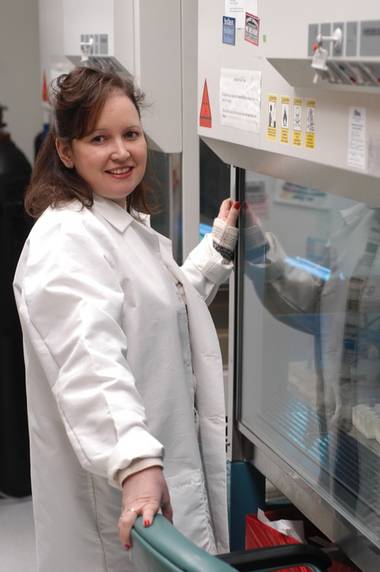
Kacey Marra, Ph.D./ Photo courtesy Jedidiah McAtee
ORLANDO — Stem cells may be the key to creating durable fat grafts and long-lasting repairs for soft tissue defects, including severe facial trauma.
In the United States, autologous fat grafting has been employed primarily for cosmetic procedures, such as facial filling and breast and buttock augmentation. However, much of the fat is resorbed within 6 months of such a procedure.
But in Europe and Asia, researchers have shown that fat grafts enriched with adipose stem cells can provide long-lasting benefits both for surgical and cosmetic patients, according to Kacey Marra, Ph.D.
Those studies have examined enriched fat transfer in breast augmentation as well as lupus-related facial atrophy, radiotherapy damage, and Crohn's fistula healing - all with very promising results, Dr. Marra said at the annual meeting of the American Academy of Cosmetic Surgery. The addition of adipose-derived stem cells encourages the fat cells to grow and form cohesive tissue, rather than dispersing into the surrounding tissues.
Some U.S. surgeons already are using stem-cell enriched fat for cosmetic surgery, said Dr. Marra, but no national studies have confirmed its safety and efficacy. The European and Asian reports "are very promising as far as safety and efficacy," but they don't provide the data needed to justify widespread adaptation of stem-cell enriched fat transfer in the United States, Dr. Marra said.
The Adipose Stem Cell Center at the University of Pittsburgh - which she directs along with Dr. J. Peter Rubin - is a leader in this area of research. Most adipose stem cell transfer includes only the stromal vascular fraction of the harvested fat, which can easily be obtained in the operating room in about an hour.
However, the stromal vascular fraction is lean when it comes to stem cells, which compose only 3%-5% of it, Dr. Marra explained.
"It's not optimal because there are so many other types of cells in it," she said in an interview. "But we can culture those stem cells into a pure population, and when we have injected them [mixed with fat] in our animal studies, we see a great potential to grow fat tissue and maintain its volume over time."
From Animals to Humans
The lab is gearing up for its first human trial in collaboration with the Department of Defense, said Dr. Rubin. The 9-month study will include 20 veterans who sustained severe facial trauma from blast injuries.
"These are severe facial injuries that involve soft tissue," Dr. Rubin said. "In most trauma patients, we can reconstruct the bony structures fairly well. But it's the soft tissue that gives us our recognizable human appearance, and that is where we have difficulty in reconstruction. These kinds of injuries have a very severe impact on people's lives."
In that early study, all of the subjects will undergo fat grafting using non-stem cell enriched fat. It's a first step to validating the techniques, Dr. Rubin said.
"One of the issues with fat grafting for any purpose is that we don't have really good data on quantifying the longevity of the grafts and the resorption over time," he said. "This will do that in a controlled fashion, using a combination of volumetric analysis and high-resolution CT scanning to assess the actual volume of the fat grafts over time."
Dr. Marra and Dr. Rubin have a follow-up study waiting in the wings. They're hoping to receive additional federal funding for a similar 9-month study of 20 more soldiers with facial injuries, who will receive fat grafts enriched with stem cells derived from the stromovascular fraction.
"Even though fat grafting has become a common procedure, there are a lot of very important questions we need to answer," Dr. Rubin said. "We need to learn the optimal way of processing the fat tissue, and we really need to get some good clinical data about the longevity of the grafts and how they hold up clinically. A lot of evidence presented is just anecdotal and hasn't been well qualified. We hope this study will provide some important benchmark data."
The Future of Fat
Getting stem cells to grow on a culture plate is one thing - getting them to grow in a body is quite another, Dr. Marra said. Her studies are advancing ways to encourage the cells to grow and develop into cohesive tissue. "We can't just inject stem cells and have them grow, she said. "We need to optimize the delivery vehicle to enhance tissue growth."
One way to do this is to provide a structure to which the stem cells can adhere. Scaffolds made from hyaluronic acid are one way. Not only do they provide a matrix for the cells, they can be loaded with growth factors to help encourage viability, differentiation, and vascularization. "We can put any growth factors we want inside them - insulin, dexamethasone, or vascular endothelial growth factor," Dr. Marra explained.
She is also working on a temperature-sensitive gel that could be used as a delivery vehicle in the transfer procedure. At room temperature, the substance is liquid; but at body temperature, it turns into a gel. "We envision a viscous liquid that we can put the stem cells into - something that we can easily syringe into the defect, where it immediately gels," Dr. Marra said.
The gel has a microporous structure, which provides scaffolding for adipose cell growth. It gradually degrades, leaving an intact tissue bed behind. "We're looking at something that would last 3-5 months and give the stem cells a chance to survive and produce tissue," she said.
Dr. Marra is optimistic about the future. "The whole tone about the future of stem cells is very positive," she said. "Cautious, but very supportive."
Neither Dr. Marra nor Dr. Rubin had any relevant financial disclosures. The National Institutes of Health also supported the fat grafting trial.
Kacey Marra, Ph.D./ Photo courtesy Jedidiah McAtee
ORLANDO — Stem cells may be the key to creating durable fat grafts and long-lasting repairs for soft tissue defects, including severe facial trauma.
In the United States, autologous fat grafting has been employed primarily for cosmetic procedures, such as facial filling and breast and buttock augmentation. However, much of the fat is resorbed within 6 months of such a procedure.
But in Europe and Asia, researchers have shown that fat grafts enriched with adipose stem cells can provide long-lasting benefits both for surgical and cosmetic patients, according to Kacey Marra, Ph.D.
Those studies have examined enriched fat transfer in breast augmentation as well as lupus-related facial atrophy, radiotherapy damage, and Crohn's fistula healing - all with very promising results, Dr. Marra said at the annual meeting of the American Academy of Cosmetic Surgery. The addition of adipose-derived stem cells encourages the fat cells to grow and form cohesive tissue, rather than dispersing into the surrounding tissues.
Some U.S. surgeons already are using stem-cell enriched fat for cosmetic surgery, said Dr. Marra, but no national studies have confirmed its safety and efficacy. The European and Asian reports "are very promising as far as safety and efficacy," but they don't provide the data needed to justify widespread adaptation of stem-cell enriched fat transfer in the United States, Dr. Marra said.
The Adipose Stem Cell Center at the University of Pittsburgh - which she directs along with Dr. J. Peter Rubin - is a leader in this area of research. Most adipose stem cell transfer includes only the stromal vascular fraction of the harvested fat, which can easily be obtained in the operating room in about an hour.
However, the stromal vascular fraction is lean when it comes to stem cells, which compose only 3%-5% of it, Dr. Marra explained.
"It's not optimal because there are so many other types of cells in it," she said in an interview. "But we can culture those stem cells into a pure population, and when we have injected them [mixed with fat] in our animal studies, we see a great potential to grow fat tissue and maintain its volume over time."
From Animals to Humans
The lab is gearing up for its first human trial in collaboration with the Department of Defense, said Dr. Rubin. The 9-month study will include 20 veterans who sustained severe facial trauma from blast injuries.
"These are severe facial injuries that involve soft tissue," Dr. Rubin said. "In most trauma patients, we can reconstruct the bony structures fairly well. But it's the soft tissue that gives us our recognizable human appearance, and that is where we have difficulty in reconstruction. These kinds of injuries have a very severe impact on people's lives."
In that early study, all of the subjects will undergo fat grafting using non-stem cell enriched fat. It's a first step to validating the techniques, Dr. Rubin said.
"One of the issues with fat grafting for any purpose is that we don't have really good data on quantifying the longevity of the grafts and the resorption over time," he said. "This will do that in a controlled fashion, using a combination of volumetric analysis and high-resolution CT scanning to assess the actual volume of the fat grafts over time."
Dr. Marra and Dr. Rubin have a follow-up study waiting in the wings. They're hoping to receive additional federal funding for a similar 9-month study of 20 more soldiers with facial injuries, who will receive fat grafts enriched with stem cells derived from the stromovascular fraction.
"Even though fat grafting has become a common procedure, there are a lot of very important questions we need to answer," Dr. Rubin said. "We need to learn the optimal way of processing the fat tissue, and we really need to get some good clinical data about the longevity of the grafts and how they hold up clinically. A lot of evidence presented is just anecdotal and hasn't been well qualified. We hope this study will provide some important benchmark data."
The Future of Fat
Getting stem cells to grow on a culture plate is one thing - getting them to grow in a body is quite another, Dr. Marra said. Her studies are advancing ways to encourage the cells to grow and develop into cohesive tissue. "We can't just inject stem cells and have them grow, she said. "We need to optimize the delivery vehicle to enhance tissue growth."
One way to do this is to provide a structure to which the stem cells can adhere. Scaffolds made from hyaluronic acid are one way. Not only do they provide a matrix for the cells, they can be loaded with growth factors to help encourage viability, differentiation, and vascularization. "We can put any growth factors we want inside them - insulin, dexamethasone, or vascular endothelial growth factor," Dr. Marra explained.
She is also working on a temperature-sensitive gel that could be used as a delivery vehicle in the transfer procedure. At room temperature, the substance is liquid; but at body temperature, it turns into a gel. "We envision a viscous liquid that we can put the stem cells into - something that we can easily syringe into the defect, where it immediately gels," Dr. Marra said.
The gel has a microporous structure, which provides scaffolding for adipose cell growth. It gradually degrades, leaving an intact tissue bed behind. "We're looking at something that would last 3-5 months and give the stem cells a chance to survive and produce tissue," she said.
Dr. Marra is optimistic about the future. "The whole tone about the future of stem cells is very positive," she said. "Cautious, but very supportive."
Neither Dr. Marra nor Dr. Rubin had any relevant financial disclosures. The National Institutes of Health also supported the fat grafting trial.
Kacey Marra, Ph.D./ Photo courtesy Jedidiah McAtee
Laser-Assisted Liposuction Leaves Skin Tighter
ORLANDO - Laser-assisted liposuction appears to be safer than power-assisted liposuction, leaving patients with significantly fewer complications and side effects by 3 months.
Patients undergoing the laser-assisted procedure also requested significantly fewer revisions, Dr. Jeffry B. Schafer said at the annual meeting of the American Academy of Cosmetic Surgery.
The laser exerts a dual effect - fat removal and skin tightening - in one procedure, Dr. Schafer said in an interview. "The laser gives you smoothing by melting the fat and tightens the skin by heating the collagen so you get tighter skin, eliminating both lumps and loose skin - the complaints after lipo," he said.
He reported a retrospective study of 214 patients treated with liposuction; half underwent the traditional, power- or suction-assisted liposuction (PAL), and half underwent laser-assisted liposuction (LAL).
During LAL, Dr. Schafer uses a 4-mm Mercedes cannula with a dual wavelength laser (924 nm and 975 nm). He uses both settings at the highest power and makes two lasing passes. "The first pass is to soften and remove the adipose tissue, and the second pass is right beneath the skin, to tighten the collagen," he said. He uses a handheld infrared thermometer to monitor the temperature; it should be at about 35ºC to liquify the fat, and 40ºC to affect the collagen.
The 107 PAL patients were a mean of 40 years old, with a mean body mass index of 27 kg/m2. The 107 LAL patients were not significantly different: their mean age was 38, and their mean BMI was 28 kg/m2.
The mean tumescent anesthesia volume used in the LAL group was 3,756 cc; the mean volume in the PAL group was 4,485 cc. Mean procedure time was slightly longer in the LAL group (57 vs. 46 minutes), because of the additional 27-minute lasing time. Actual suction time in the LAL group was 32 minutes.
Lasing time in the LAL group varied with the wattage system, Dr. Schafer pointed out. "That time is reduced by about 6 minutes if using the 40-watt system compared to the 24-watt system. So the lasing time could be about 21 minutes instead of 27 minutes if using 40 watts."
Side effects were described as an anticipated reaction that resolved without medical intervention, and included hardness, swelling, and abrasions. Overall, side effects were significantly less common in the LAL group at both 1 month (16% vs. 56%) and 3 months (12% vs. 54%). Hardness was the most commonly reported, occurring in 11% of the LAL group and 54% of the PAL group.
Complications were described as anticipated reactions that may not resolve with medical intervention, and included seroma, scar tissue, loose skin, and irregularity in skin surface. At 1 month, the complication rate was similar (4% LAL vs. 3% PAL). By 3 months, the rate was significantly less in the LAL group than in the PAL group (3% vs. 13%). Seroma was more common in the LAL group both at 1 month (3% vs. 1%) and 3 months (2% vs. 0%). At 3 months, scar tissue occurred in 1% of the LAL group and 3% of the PAL group. Also at 3 months, fewer LAL patients reported loose skin (0% vs. 8%).
Revisions were significantly less common in the LAL group (4 vs. 73). "Fewer revisions mean less patient hand-holding in the post treatment period," Dr. Schafer said.
Some samples of the aspirate were sent for stem cell extraction. Under gross observation, the fat extracted with LAL appeared smoother, Dr. Schafer said.
Histology showed intact membranes on the adipocytes; cell membranes in the PAL-extracted samples were ruptured. "Aspirate with LAL is more homogenous with higher fat content than PAL," Dr. Schafer said. "Melting from laser leaves much smoother skin, fewer contour issues, less lipo filling, and a high degree of skin tightening." Maintaining intact adipocytes is also critical if the fat is to be used in a transfer, he added.
Dr. Schafer is in private practice in Coronado, Calif. He disclosed that he helped develop the SlimLipo machine, which he used in the study. He is also a teacher and speaker for Palomar Medical Technologies Inc., the Burlington, Mass., company that developed the system.
ORLANDO - Laser-assisted liposuction appears to be safer than power-assisted liposuction, leaving patients with significantly fewer complications and side effects by 3 months.
Patients undergoing the laser-assisted procedure also requested significantly fewer revisions, Dr. Jeffry B. Schafer said at the annual meeting of the American Academy of Cosmetic Surgery.
The laser exerts a dual effect - fat removal and skin tightening - in one procedure, Dr. Schafer said in an interview. "The laser gives you smoothing by melting the fat and tightens the skin by heating the collagen so you get tighter skin, eliminating both lumps and loose skin - the complaints after lipo," he said.
He reported a retrospective study of 214 patients treated with liposuction; half underwent the traditional, power- or suction-assisted liposuction (PAL), and half underwent laser-assisted liposuction (LAL).
During LAL, Dr. Schafer uses a 4-mm Mercedes cannula with a dual wavelength laser (924 nm and 975 nm). He uses both settings at the highest power and makes two lasing passes. "The first pass is to soften and remove the adipose tissue, and the second pass is right beneath the skin, to tighten the collagen," he said. He uses a handheld infrared thermometer to monitor the temperature; it should be at about 35ºC to liquify the fat, and 40ºC to affect the collagen.
The 107 PAL patients were a mean of 40 years old, with a mean body mass index of 27 kg/m2. The 107 LAL patients were not significantly different: their mean age was 38, and their mean BMI was 28 kg/m2.
The mean tumescent anesthesia volume used in the LAL group was 3,756 cc; the mean volume in the PAL group was 4,485 cc. Mean procedure time was slightly longer in the LAL group (57 vs. 46 minutes), because of the additional 27-minute lasing time. Actual suction time in the LAL group was 32 minutes.
Lasing time in the LAL group varied with the wattage system, Dr. Schafer pointed out. "That time is reduced by about 6 minutes if using the 40-watt system compared to the 24-watt system. So the lasing time could be about 21 minutes instead of 27 minutes if using 40 watts."
Side effects were described as an anticipated reaction that resolved without medical intervention, and included hardness, swelling, and abrasions. Overall, side effects were significantly less common in the LAL group at both 1 month (16% vs. 56%) and 3 months (12% vs. 54%). Hardness was the most commonly reported, occurring in 11% of the LAL group and 54% of the PAL group.
Complications were described as anticipated reactions that may not resolve with medical intervention, and included seroma, scar tissue, loose skin, and irregularity in skin surface. At 1 month, the complication rate was similar (4% LAL vs. 3% PAL). By 3 months, the rate was significantly less in the LAL group than in the PAL group (3% vs. 13%). Seroma was more common in the LAL group both at 1 month (3% vs. 1%) and 3 months (2% vs. 0%). At 3 months, scar tissue occurred in 1% of the LAL group and 3% of the PAL group. Also at 3 months, fewer LAL patients reported loose skin (0% vs. 8%).
Revisions were significantly less common in the LAL group (4 vs. 73). "Fewer revisions mean less patient hand-holding in the post treatment period," Dr. Schafer said.
Some samples of the aspirate were sent for stem cell extraction. Under gross observation, the fat extracted with LAL appeared smoother, Dr. Schafer said.
Histology showed intact membranes on the adipocytes; cell membranes in the PAL-extracted samples were ruptured. "Aspirate with LAL is more homogenous with higher fat content than PAL," Dr. Schafer said. "Melting from laser leaves much smoother skin, fewer contour issues, less lipo filling, and a high degree of skin tightening." Maintaining intact adipocytes is also critical if the fat is to be used in a transfer, he added.
Dr. Schafer is in private practice in Coronado, Calif. He disclosed that he helped develop the SlimLipo machine, which he used in the study. He is also a teacher and speaker for Palomar Medical Technologies Inc., the Burlington, Mass., company that developed the system.
ORLANDO - Laser-assisted liposuction appears to be safer than power-assisted liposuction, leaving patients with significantly fewer complications and side effects by 3 months.
Patients undergoing the laser-assisted procedure also requested significantly fewer revisions, Dr. Jeffry B. Schafer said at the annual meeting of the American Academy of Cosmetic Surgery.
The laser exerts a dual effect - fat removal and skin tightening - in one procedure, Dr. Schafer said in an interview. "The laser gives you smoothing by melting the fat and tightens the skin by heating the collagen so you get tighter skin, eliminating both lumps and loose skin - the complaints after lipo," he said.
He reported a retrospective study of 214 patients treated with liposuction; half underwent the traditional, power- or suction-assisted liposuction (PAL), and half underwent laser-assisted liposuction (LAL).
During LAL, Dr. Schafer uses a 4-mm Mercedes cannula with a dual wavelength laser (924 nm and 975 nm). He uses both settings at the highest power and makes two lasing passes. "The first pass is to soften and remove the adipose tissue, and the second pass is right beneath the skin, to tighten the collagen," he said. He uses a handheld infrared thermometer to monitor the temperature; it should be at about 35ºC to liquify the fat, and 40ºC to affect the collagen.
The 107 PAL patients were a mean of 40 years old, with a mean body mass index of 27 kg/m2. The 107 LAL patients were not significantly different: their mean age was 38, and their mean BMI was 28 kg/m2.
The mean tumescent anesthesia volume used in the LAL group was 3,756 cc; the mean volume in the PAL group was 4,485 cc. Mean procedure time was slightly longer in the LAL group (57 vs. 46 minutes), because of the additional 27-minute lasing time. Actual suction time in the LAL group was 32 minutes.
Lasing time in the LAL group varied with the wattage system, Dr. Schafer pointed out. "That time is reduced by about 6 minutes if using the 40-watt system compared to the 24-watt system. So the lasing time could be about 21 minutes instead of 27 minutes if using 40 watts."
Side effects were described as an anticipated reaction that resolved without medical intervention, and included hardness, swelling, and abrasions. Overall, side effects were significantly less common in the LAL group at both 1 month (16% vs. 56%) and 3 months (12% vs. 54%). Hardness was the most commonly reported, occurring in 11% of the LAL group and 54% of the PAL group.
Complications were described as anticipated reactions that may not resolve with medical intervention, and included seroma, scar tissue, loose skin, and irregularity in skin surface. At 1 month, the complication rate was similar (4% LAL vs. 3% PAL). By 3 months, the rate was significantly less in the LAL group than in the PAL group (3% vs. 13%). Seroma was more common in the LAL group both at 1 month (3% vs. 1%) and 3 months (2% vs. 0%). At 3 months, scar tissue occurred in 1% of the LAL group and 3% of the PAL group. Also at 3 months, fewer LAL patients reported loose skin (0% vs. 8%).
Revisions were significantly less common in the LAL group (4 vs. 73). "Fewer revisions mean less patient hand-holding in the post treatment period," Dr. Schafer said.
Some samples of the aspirate were sent for stem cell extraction. Under gross observation, the fat extracted with LAL appeared smoother, Dr. Schafer said.
Histology showed intact membranes on the adipocytes; cell membranes in the PAL-extracted samples were ruptured. "Aspirate with LAL is more homogenous with higher fat content than PAL," Dr. Schafer said. "Melting from laser leaves much smoother skin, fewer contour issues, less lipo filling, and a high degree of skin tightening." Maintaining intact adipocytes is also critical if the fat is to be used in a transfer, he added.
Dr. Schafer is in private practice in Coronado, Calif. He disclosed that he helped develop the SlimLipo machine, which he used in the study. He is also a teacher and speaker for Palomar Medical Technologies Inc., the Burlington, Mass., company that developed the system.
Occult Coronary Artery Disease Found In Diabetic Retinopathy Patients
Up to a quarter of patients with diabetic retinopathy may also have unrecognized stenotic coronary artery disease, putting them at risk for heart attack or sudden cardiovascular death, reported Dr. Takayuki Ohno and colleagues at the University of Tokyo.
The investigators found that 12% of patients attending a retinocoronary clinic had undiagnosed coronary artery disease. Diabetic retinopathy (DR) is present in 3 million Japanese citizens, they said; therefore, 363,000 of these people could have unsuspected heart disease. “These estimates suggest that a large number of patients with DR … would remain without diagnoses until a fatal coronary event,” they wrote.
To test this hypothesis, the researchers opened a diabetic retinocoronary clinic in 2007. Patients with type 2 diabetes and DR who were getting outpatient ophthalmologic care were randomly referred to the clinic. There they were asked to undergo a cardiac screening, which included a cardiovascular history, physical exam, risk factor assessment, resting electrocardiography, and an exercise treadmill test. Patients who tested positive were asked to undergo exercise thallium scintigraphy or a coronary computed tomography scan. Those with abnormal results in this second tier of screening were approached for coronary angiography for further diagnosis.
Over an 18-month period, 286 patients were referred to the clinic; 214 were included in the study. Of these, 59 had nonproliferative DR and 155 had proliferative DR. Most patients (82%) were asymptomatic for cardiac problems; 12 % had previously reported atypical chest discomfort (J. Thorac. Cardiovasc. Surg. 2010;139:92-7).
A normal resting ECG was observed in 159 patients (74%). However, 4 patients (2%) had Q-waves, 39 (18%) had nonspecific ST-T changes, 9 (4%) had right bundle branch block, 2 (1%) had atrial fibrillation, and 1 (0.5%) had second-degree atrioventricular block.
A total of 172 underwent an exercise tolerance test. The results were positive in 50 (29%) and nondiagnostic in 15 (9%). A total of 33 patients underwent exercise thallium scintigraphy, with abnormal results in eight (24%). A coronary CT was performed in 24 patients, 7 of whom (29%) showed atherosclerotic coronary artery disease.
A total of 65 patients had a coronary angiography; 55 of these (26% of the entire cohort of 214) had angiographically confirmed stenotic coronary artery disease (CAD). Compared with patients without confirmed CAD, these patients were older (62 vs. 58 years) and more likely to have Q-wave or ST-T changes on resting ECG (47% vs. 21%, respectively). There were no significant differences in serum creatinine, hemoglobin A1c, or lipid levels. A total of 65 patients had a coronary angiography; 55 of these (26% of the entire cohort of 214) had angiographically confirmed stenotic coronary artery disease (CAD). Compared with patients without confirmed CAD, these patients were older (62 vs. 58 years) and more likely to have Q-wave or ST-T changes on resting ECG (47% vs. 21%, respectively). There were no significant differences in serum creatinine, HbA1c, or lipid levels.
During the clinic's daily coronary conference, CABG was recommended for 17 patients, PCI for 25, and aggressive medical therapy alone for 13. So far, 12 have undergone CABG (including 3 for whom PCI was recommended) and 27 have undergone PCI. Three refused to have any type of coronary revascularization.
During the 288-day follow-up period, all patients have remained alive with no myocardial infarction. But eight (four in each intervention group), all of whom had proliferative DR, did experience the vision-threatening complication of vitreous hemorrhage. “Progression of [diabetic retinopathy] involving vitreous hemorrhage can take place spontaneously in diabetic patients after coronary revascularization with either PCI or CABG,” but little about its prevalence is known, the authors noted.
Up to a quarter of patients with diabetic retinopathy may also have unrecognized stenotic coronary artery disease, putting them at risk for heart attack or sudden cardiovascular death, reported Dr. Takayuki Ohno and colleagues at the University of Tokyo.
The investigators found that 12% of patients attending a retinocoronary clinic had undiagnosed coronary artery disease. Diabetic retinopathy (DR) is present in 3 million Japanese citizens, they said; therefore, 363,000 of these people could have unsuspected heart disease. “These estimates suggest that a large number of patients with DR … would remain without diagnoses until a fatal coronary event,” they wrote.
To test this hypothesis, the researchers opened a diabetic retinocoronary clinic in 2007. Patients with type 2 diabetes and DR who were getting outpatient ophthalmologic care were randomly referred to the clinic. There they were asked to undergo a cardiac screening, which included a cardiovascular history, physical exam, risk factor assessment, resting electrocardiography, and an exercise treadmill test. Patients who tested positive were asked to undergo exercise thallium scintigraphy or a coronary computed tomography scan. Those with abnormal results in this second tier of screening were approached for coronary angiography for further diagnosis.
Over an 18-month period, 286 patients were referred to the clinic; 214 were included in the study. Of these, 59 had nonproliferative DR and 155 had proliferative DR. Most patients (82%) were asymptomatic for cardiac problems; 12 % had previously reported atypical chest discomfort (J. Thorac. Cardiovasc. Surg. 2010;139:92-7).
A normal resting ECG was observed in 159 patients (74%). However, 4 patients (2%) had Q-waves, 39 (18%) had nonspecific ST-T changes, 9 (4%) had right bundle branch block, 2 (1%) had atrial fibrillation, and 1 (0.5%) had second-degree atrioventricular block.
A total of 172 underwent an exercise tolerance test. The results were positive in 50 (29%) and nondiagnostic in 15 (9%). A total of 33 patients underwent exercise thallium scintigraphy, with abnormal results in eight (24%). A coronary CT was performed in 24 patients, 7 of whom (29%) showed atherosclerotic coronary artery disease.
A total of 65 patients had a coronary angiography; 55 of these (26% of the entire cohort of 214) had angiographically confirmed stenotic coronary artery disease (CAD). Compared with patients without confirmed CAD, these patients were older (62 vs. 58 years) and more likely to have Q-wave or ST-T changes on resting ECG (47% vs. 21%, respectively). There were no significant differences in serum creatinine, hemoglobin A1c, or lipid levels. A total of 65 patients had a coronary angiography; 55 of these (26% of the entire cohort of 214) had angiographically confirmed stenotic coronary artery disease (CAD). Compared with patients without confirmed CAD, these patients were older (62 vs. 58 years) and more likely to have Q-wave or ST-T changes on resting ECG (47% vs. 21%, respectively). There were no significant differences in serum creatinine, HbA1c, or lipid levels.
During the clinic's daily coronary conference, CABG was recommended for 17 patients, PCI for 25, and aggressive medical therapy alone for 13. So far, 12 have undergone CABG (including 3 for whom PCI was recommended) and 27 have undergone PCI. Three refused to have any type of coronary revascularization.
During the 288-day follow-up period, all patients have remained alive with no myocardial infarction. But eight (four in each intervention group), all of whom had proliferative DR, did experience the vision-threatening complication of vitreous hemorrhage. “Progression of [diabetic retinopathy] involving vitreous hemorrhage can take place spontaneously in diabetic patients after coronary revascularization with either PCI or CABG,” but little about its prevalence is known, the authors noted.
Up to a quarter of patients with diabetic retinopathy may also have unrecognized stenotic coronary artery disease, putting them at risk for heart attack or sudden cardiovascular death, reported Dr. Takayuki Ohno and colleagues at the University of Tokyo.
The investigators found that 12% of patients attending a retinocoronary clinic had undiagnosed coronary artery disease. Diabetic retinopathy (DR) is present in 3 million Japanese citizens, they said; therefore, 363,000 of these people could have unsuspected heart disease. “These estimates suggest that a large number of patients with DR … would remain without diagnoses until a fatal coronary event,” they wrote.
To test this hypothesis, the researchers opened a diabetic retinocoronary clinic in 2007. Patients with type 2 diabetes and DR who were getting outpatient ophthalmologic care were randomly referred to the clinic. There they were asked to undergo a cardiac screening, which included a cardiovascular history, physical exam, risk factor assessment, resting electrocardiography, and an exercise treadmill test. Patients who tested positive were asked to undergo exercise thallium scintigraphy or a coronary computed tomography scan. Those with abnormal results in this second tier of screening were approached for coronary angiography for further diagnosis.
Over an 18-month period, 286 patients were referred to the clinic; 214 were included in the study. Of these, 59 had nonproliferative DR and 155 had proliferative DR. Most patients (82%) were asymptomatic for cardiac problems; 12 % had previously reported atypical chest discomfort (J. Thorac. Cardiovasc. Surg. 2010;139:92-7).
A normal resting ECG was observed in 159 patients (74%). However, 4 patients (2%) had Q-waves, 39 (18%) had nonspecific ST-T changes, 9 (4%) had right bundle branch block, 2 (1%) had atrial fibrillation, and 1 (0.5%) had second-degree atrioventricular block.
A total of 172 underwent an exercise tolerance test. The results were positive in 50 (29%) and nondiagnostic in 15 (9%). A total of 33 patients underwent exercise thallium scintigraphy, with abnormal results in eight (24%). A coronary CT was performed in 24 patients, 7 of whom (29%) showed atherosclerotic coronary artery disease.
A total of 65 patients had a coronary angiography; 55 of these (26% of the entire cohort of 214) had angiographically confirmed stenotic coronary artery disease (CAD). Compared with patients without confirmed CAD, these patients were older (62 vs. 58 years) and more likely to have Q-wave or ST-T changes on resting ECG (47% vs. 21%, respectively). There were no significant differences in serum creatinine, hemoglobin A1c, or lipid levels. A total of 65 patients had a coronary angiography; 55 of these (26% of the entire cohort of 214) had angiographically confirmed stenotic coronary artery disease (CAD). Compared with patients without confirmed CAD, these patients were older (62 vs. 58 years) and more likely to have Q-wave or ST-T changes on resting ECG (47% vs. 21%, respectively). There were no significant differences in serum creatinine, HbA1c, or lipid levels.
During the clinic's daily coronary conference, CABG was recommended for 17 patients, PCI for 25, and aggressive medical therapy alone for 13. So far, 12 have undergone CABG (including 3 for whom PCI was recommended) and 27 have undergone PCI. Three refused to have any type of coronary revascularization.
During the 288-day follow-up period, all patients have remained alive with no myocardial infarction. But eight (four in each intervention group), all of whom had proliferative DR, did experience the vision-threatening complication of vitreous hemorrhage. “Progression of [diabetic retinopathy] involving vitreous hemorrhage can take place spontaneously in diabetic patients after coronary revascularization with either PCI or CABG,” but little about its prevalence is known, the authors noted.
Robotic Surgery Works for Staging Endometrial Ca
Major Finding: Robotic surgery was associated with significantly less blood loss and shorter hospital stays than laparotomy for the surgical staging of endometrial cancer.
Data Source: A retrospective study of 97 patients.
Disclosures: None reported.
KISSIMMEE, Fla. — Robotic laparoscopic surgery is an acceptable alternative to laparotomy for the surgical staging of endometrial cancer, based on results of a retrospective study of 97 patients.
While node retrieval numbers were similar for the two procedures, robotic surgery was associated with significantly less blood loss and shorter hospital stays. Moreover, patients undergoing robotic surgery had fewer intraoperative complications, despite being significantly more overweight than those undergoing laparotomy, Dr. Meenu Goel said at the annual meeting of the AAGL.
Dr. Goel of Indiana University, Indianapolis, examined outcomes for 97 patients who underwent surgical staging for endometrial cancer from 2003 to 2008. The 38 patients who had laparotomies underwent surgery from 2003 to 2005, when this was the standard approach at the hospital. From 2006 to 2008, all endometrial cancer staging was performed with robotic laparoscopy; this cohort included 59 patients.
Patients in the open surgery group were significantly older than those in the robotic surgery group (66 vs. 59 years). But those in the robotic group were significantly heavier, with a mean body mass index of 39 kg/m
Operative times were 175 vs. 185 minutes, respectively, for the open and robotic groups. The number of pelvic nodes retrieved was similar (9 in the open group vs. 11 in the robotic group), as was the number of aortic nodes (3 in the open group vs. 2 in the robotic group). Half of the patients in each group were diagnosed with stage III cancer, “probably due to the fact that we are a referral hospital,” Dr. Goel said.
The open group had a significantly longer mean hospital stay (3 days vs. 1 day).
The rate of complications was significantly less in the robotic group than in the open group (3% vs. 13%). There were two complications in the robotic group: a tear in the right external iliac vein that required open management and a transfusion, and a pelvic abscess, which was treated with postoperative antibiotics. There were five complications in the open surgery group: two cases of wound dehiscence, one intraoperative small bowel resection, one cardiac arrhythmia that required a pacemaker, and one pulmonary embolism.
Major Finding: Robotic surgery was associated with significantly less blood loss and shorter hospital stays than laparotomy for the surgical staging of endometrial cancer.
Data Source: A retrospective study of 97 patients.
Disclosures: None reported.
KISSIMMEE, Fla. — Robotic laparoscopic surgery is an acceptable alternative to laparotomy for the surgical staging of endometrial cancer, based on results of a retrospective study of 97 patients.
While node retrieval numbers were similar for the two procedures, robotic surgery was associated with significantly less blood loss and shorter hospital stays. Moreover, patients undergoing robotic surgery had fewer intraoperative complications, despite being significantly more overweight than those undergoing laparotomy, Dr. Meenu Goel said at the annual meeting of the AAGL.
Dr. Goel of Indiana University, Indianapolis, examined outcomes for 97 patients who underwent surgical staging for endometrial cancer from 2003 to 2008. The 38 patients who had laparotomies underwent surgery from 2003 to 2005, when this was the standard approach at the hospital. From 2006 to 2008, all endometrial cancer staging was performed with robotic laparoscopy; this cohort included 59 patients.
Patients in the open surgery group were significantly older than those in the robotic surgery group (66 vs. 59 years). But those in the robotic group were significantly heavier, with a mean body mass index of 39 kg/m
Operative times were 175 vs. 185 minutes, respectively, for the open and robotic groups. The number of pelvic nodes retrieved was similar (9 in the open group vs. 11 in the robotic group), as was the number of aortic nodes (3 in the open group vs. 2 in the robotic group). Half of the patients in each group were diagnosed with stage III cancer, “probably due to the fact that we are a referral hospital,” Dr. Goel said.
The open group had a significantly longer mean hospital stay (3 days vs. 1 day).
The rate of complications was significantly less in the robotic group than in the open group (3% vs. 13%). There were two complications in the robotic group: a tear in the right external iliac vein that required open management and a transfusion, and a pelvic abscess, which was treated with postoperative antibiotics. There were five complications in the open surgery group: two cases of wound dehiscence, one intraoperative small bowel resection, one cardiac arrhythmia that required a pacemaker, and one pulmonary embolism.
Major Finding: Robotic surgery was associated with significantly less blood loss and shorter hospital stays than laparotomy for the surgical staging of endometrial cancer.
Data Source: A retrospective study of 97 patients.
Disclosures: None reported.
KISSIMMEE, Fla. — Robotic laparoscopic surgery is an acceptable alternative to laparotomy for the surgical staging of endometrial cancer, based on results of a retrospective study of 97 patients.
While node retrieval numbers were similar for the two procedures, robotic surgery was associated with significantly less blood loss and shorter hospital stays. Moreover, patients undergoing robotic surgery had fewer intraoperative complications, despite being significantly more overweight than those undergoing laparotomy, Dr. Meenu Goel said at the annual meeting of the AAGL.
Dr. Goel of Indiana University, Indianapolis, examined outcomes for 97 patients who underwent surgical staging for endometrial cancer from 2003 to 2008. The 38 patients who had laparotomies underwent surgery from 2003 to 2005, when this was the standard approach at the hospital. From 2006 to 2008, all endometrial cancer staging was performed with robotic laparoscopy; this cohort included 59 patients.
Patients in the open surgery group were significantly older than those in the robotic surgery group (66 vs. 59 years). But those in the robotic group were significantly heavier, with a mean body mass index of 39 kg/m
Operative times were 175 vs. 185 minutes, respectively, for the open and robotic groups. The number of pelvic nodes retrieved was similar (9 in the open group vs. 11 in the robotic group), as was the number of aortic nodes (3 in the open group vs. 2 in the robotic group). Half of the patients in each group were diagnosed with stage III cancer, “probably due to the fact that we are a referral hospital,” Dr. Goel said.
The open group had a significantly longer mean hospital stay (3 days vs. 1 day).
The rate of complications was significantly less in the robotic group than in the open group (3% vs. 13%). There were two complications in the robotic group: a tear in the right external iliac vein that required open management and a transfusion, and a pelvic abscess, which was treated with postoperative antibiotics. There were five complications in the open surgery group: two cases of wound dehiscence, one intraoperative small bowel resection, one cardiac arrhythmia that required a pacemaker, and one pulmonary embolism.
Infection Rate Low in Outpatient Hysteroscopy
KISSIMMEE, FLA. — Operative hysteroscopy can be performed in the office without anesthesia and with an extremely low infection rate, by using small instruments and maintaining a constant, low intrauterine pressure, according to Dr. Luigi Nappi.
“The secret of an almost pain-free procedure,” with a 1% postoperative infection rate, is to use an electronic irrigation and suction device that keeps an intrauterine pressure of 30-40 mm Hg, he said at the annual meeting of the AAGL. That pressure level prevents the stretching of the myometrium, thereby avoiding painful contractions.
Small diagnostic and operative instruments, with a diameter of about 4 mm, are also a necessity, said Dr. Nappi of the University of Foggia (Italy).
Dr. Nappi discussed his techniques in the context of a randomized trial showing that prophylactic antibiotics do not reduce the rate of infections after an in-office hysteroscopy. The trial included 886 patients who underwent the procedure for benign intrauterine pathology (polyps or myomas). Surgery was postponed for any woman who showed any sign of a vaginal or urinary tract infection. The women were randomized to either 1 g of cefazolin or placebo given 30 minutes before the procedure. All procedures were performed using a continuous flow operative hysteroscope with a diameter of 4 or 5 mm and a bipolar electrode. No analgesia or anesthesia was used.
The overall rate of postprocedural infection was 1.3%. The infection rate in the cefazolin group was 0.5%, and the rate in the placebo group was 1.4%—not significantly different.
KISSIMMEE, FLA. — Operative hysteroscopy can be performed in the office without anesthesia and with an extremely low infection rate, by using small instruments and maintaining a constant, low intrauterine pressure, according to Dr. Luigi Nappi.
“The secret of an almost pain-free procedure,” with a 1% postoperative infection rate, is to use an electronic irrigation and suction device that keeps an intrauterine pressure of 30-40 mm Hg, he said at the annual meeting of the AAGL. That pressure level prevents the stretching of the myometrium, thereby avoiding painful contractions.
Small diagnostic and operative instruments, with a diameter of about 4 mm, are also a necessity, said Dr. Nappi of the University of Foggia (Italy).
Dr. Nappi discussed his techniques in the context of a randomized trial showing that prophylactic antibiotics do not reduce the rate of infections after an in-office hysteroscopy. The trial included 886 patients who underwent the procedure for benign intrauterine pathology (polyps or myomas). Surgery was postponed for any woman who showed any sign of a vaginal or urinary tract infection. The women were randomized to either 1 g of cefazolin or placebo given 30 minutes before the procedure. All procedures were performed using a continuous flow operative hysteroscope with a diameter of 4 or 5 mm and a bipolar electrode. No analgesia or anesthesia was used.
The overall rate of postprocedural infection was 1.3%. The infection rate in the cefazolin group was 0.5%, and the rate in the placebo group was 1.4%—not significantly different.
KISSIMMEE, FLA. — Operative hysteroscopy can be performed in the office without anesthesia and with an extremely low infection rate, by using small instruments and maintaining a constant, low intrauterine pressure, according to Dr. Luigi Nappi.
“The secret of an almost pain-free procedure,” with a 1% postoperative infection rate, is to use an electronic irrigation and suction device that keeps an intrauterine pressure of 30-40 mm Hg, he said at the annual meeting of the AAGL. That pressure level prevents the stretching of the myometrium, thereby avoiding painful contractions.
Small diagnostic and operative instruments, with a diameter of about 4 mm, are also a necessity, said Dr. Nappi of the University of Foggia (Italy).
Dr. Nappi discussed his techniques in the context of a randomized trial showing that prophylactic antibiotics do not reduce the rate of infections after an in-office hysteroscopy. The trial included 886 patients who underwent the procedure for benign intrauterine pathology (polyps or myomas). Surgery was postponed for any woman who showed any sign of a vaginal or urinary tract infection. The women were randomized to either 1 g of cefazolin or placebo given 30 minutes before the procedure. All procedures were performed using a continuous flow operative hysteroscope with a diameter of 4 or 5 mm and a bipolar electrode. No analgesia or anesthesia was used.
The overall rate of postprocedural infection was 1.3%. The infection rate in the cefazolin group was 0.5%, and the rate in the placebo group was 1.4%—not significantly different.
Study: Single-Incision Sling Successful Tx for SUI
Major Finding: The single-incision midurethral sling had an 89% cure rate for stress urinary incontinence at 1 year.
Data Source: Prospective study of 31 patients.
Disclosures: None reported.
KISSIMMEE, FLA. — The single-incision midurethral sling is a safe and effective treatment for stress urinary incontinence, with an 89% cure rate at 1 year after the procedure, based on the results of a small prospective study.
Although the intraoperative complication rate was low—6%—a cystoscopy should be performed immediately after the sling procedure to rule out any inadvertent urogenital injury, Dr. Bilal Kaaki said at the annual meeting of the AAGL.
In his series, “there were two intraoperative complications—one bladder perforation and a urethral perforation,” said Dr. Kaaki, an ob.gyn in Waterloo, Iowa. “A cystoscopy can rule out any such injuries.”
Dr. Kaaki reported on his series of 31 patients who underwent the procedure at Allen Memorial Hospital in Waterloo.
The patients' average age was 56 years (range, 35-82 years).
Their mean body mass index was 32 kg/m
The sling—a hammock-shaped polypropylene mesh—was inserted transvaginally through a single incision at the midurethral level.
The self-fixating tips were anchored in the obturator internus muscles.
Tension was adjusted intraoperatively by response to the cough stress test.
Patient response was measured at baseline and at 1 week, 2 months, and 1 year after the surgery. Measures included the cough stress test, the Urogenital Distress Inventory Short Form (UDI-6), and the Incontinence Impact Questionnaire (IIQ-7).
At 1 week, there was an objective cure rate of 92%, as measured by a negative finding on a standing cough stress test. The patients who failed the stress test at 1 year also had reported stress incontinence at the 2-month visit, but elected to have no further treatment, Dr. Kaaki said.
At 1-year follow-up, the cure rate was 89%. Compared with baseline scores, scores at 1 year on both the UDI-6 and IIQ-7 were significantly reduced. Changes in these scores were not significantly associated with age, body mass index, parity, or prior surgery.
Also at 1 year, 60% of the group reported the surgery as “very successful,” and 35% reported it as “moderately successful.”
There were three postoperative complications: two cases of urinary retention that required release of the surgical tape and one case of pyelonephritis. There were no erosions, extrusions, or infections, and no hematomas or blood transfusions.
Dr. Kaaki said the procedure has the potential of being performed in the office, but more research is needed for validation.
Major Finding: The single-incision midurethral sling had an 89% cure rate for stress urinary incontinence at 1 year.
Data Source: Prospective study of 31 patients.
Disclosures: None reported.
KISSIMMEE, FLA. — The single-incision midurethral sling is a safe and effective treatment for stress urinary incontinence, with an 89% cure rate at 1 year after the procedure, based on the results of a small prospective study.
Although the intraoperative complication rate was low—6%—a cystoscopy should be performed immediately after the sling procedure to rule out any inadvertent urogenital injury, Dr. Bilal Kaaki said at the annual meeting of the AAGL.
In his series, “there were two intraoperative complications—one bladder perforation and a urethral perforation,” said Dr. Kaaki, an ob.gyn in Waterloo, Iowa. “A cystoscopy can rule out any such injuries.”
Dr. Kaaki reported on his series of 31 patients who underwent the procedure at Allen Memorial Hospital in Waterloo.
The patients' average age was 56 years (range, 35-82 years).
Their mean body mass index was 32 kg/m
The sling—a hammock-shaped polypropylene mesh—was inserted transvaginally through a single incision at the midurethral level.
The self-fixating tips were anchored in the obturator internus muscles.
Tension was adjusted intraoperatively by response to the cough stress test.
Patient response was measured at baseline and at 1 week, 2 months, and 1 year after the surgery. Measures included the cough stress test, the Urogenital Distress Inventory Short Form (UDI-6), and the Incontinence Impact Questionnaire (IIQ-7).
At 1 week, there was an objective cure rate of 92%, as measured by a negative finding on a standing cough stress test. The patients who failed the stress test at 1 year also had reported stress incontinence at the 2-month visit, but elected to have no further treatment, Dr. Kaaki said.
At 1-year follow-up, the cure rate was 89%. Compared with baseline scores, scores at 1 year on both the UDI-6 and IIQ-7 were significantly reduced. Changes in these scores were not significantly associated with age, body mass index, parity, or prior surgery.
Also at 1 year, 60% of the group reported the surgery as “very successful,” and 35% reported it as “moderately successful.”
There were three postoperative complications: two cases of urinary retention that required release of the surgical tape and one case of pyelonephritis. There were no erosions, extrusions, or infections, and no hematomas or blood transfusions.
Dr. Kaaki said the procedure has the potential of being performed in the office, but more research is needed for validation.
Major Finding: The single-incision midurethral sling had an 89% cure rate for stress urinary incontinence at 1 year.
Data Source: Prospective study of 31 patients.
Disclosures: None reported.
KISSIMMEE, FLA. — The single-incision midurethral sling is a safe and effective treatment for stress urinary incontinence, with an 89% cure rate at 1 year after the procedure, based on the results of a small prospective study.
Although the intraoperative complication rate was low—6%—a cystoscopy should be performed immediately after the sling procedure to rule out any inadvertent urogenital injury, Dr. Bilal Kaaki said at the annual meeting of the AAGL.
In his series, “there were two intraoperative complications—one bladder perforation and a urethral perforation,” said Dr. Kaaki, an ob.gyn in Waterloo, Iowa. “A cystoscopy can rule out any such injuries.”
Dr. Kaaki reported on his series of 31 patients who underwent the procedure at Allen Memorial Hospital in Waterloo.
The patients' average age was 56 years (range, 35-82 years).
Their mean body mass index was 32 kg/m
The sling—a hammock-shaped polypropylene mesh—was inserted transvaginally through a single incision at the midurethral level.
The self-fixating tips were anchored in the obturator internus muscles.
Tension was adjusted intraoperatively by response to the cough stress test.
Patient response was measured at baseline and at 1 week, 2 months, and 1 year after the surgery. Measures included the cough stress test, the Urogenital Distress Inventory Short Form (UDI-6), and the Incontinence Impact Questionnaire (IIQ-7).
At 1 week, there was an objective cure rate of 92%, as measured by a negative finding on a standing cough stress test. The patients who failed the stress test at 1 year also had reported stress incontinence at the 2-month visit, but elected to have no further treatment, Dr. Kaaki said.
At 1-year follow-up, the cure rate was 89%. Compared with baseline scores, scores at 1 year on both the UDI-6 and IIQ-7 were significantly reduced. Changes in these scores were not significantly associated with age, body mass index, parity, or prior surgery.
Also at 1 year, 60% of the group reported the surgery as “very successful,” and 35% reported it as “moderately successful.”
There were three postoperative complications: two cases of urinary retention that required release of the surgical tape and one case of pyelonephritis. There were no erosions, extrusions, or infections, and no hematomas or blood transfusions.
Dr. Kaaki said the procedure has the potential of being performed in the office, but more research is needed for validation.
Ticagrelor With Invasive Strategy Cut Deaths
Major Finding: ACS patients with a planned invasive strategy who received ticagrelor had a 16% reduction in risk of cardiovascular death, MI, or stroke, compared with patients given clopidogrel over 1 year.
Data Source: 13,408 ACS patients in the PLATO trial who were scheduled for invasive procedures.
Disclosures: Funding by AstraZeneca, which makes ticagrelor. Dr. Stone, Dr. Cannon, and all of the study authors but one reported financial relationships with AstraZeneca.
Patients with acute coronary syndrome who received ticagrelor before an invasive cardiovascular procedure were 16% less likely to die from heart attack or stroke over the course of 1 year than were those given clopidogrel, according to a new subanalysis of the PLATO trial.
The benefit accrued without a significantly increased risk of bleeding and, unlike other early antithrombotic treatments, occurred in patients both with and without ST-segment elevation MI, investigators reported.
“This mortality benefit compared with clopidogrel is similar in magnitude to other major advances such as streptokinase or aspirin versus placebo, tissue plasminogen activator, and primary percutaneous intervention in care of patients with ST-elevation myocardial infarction,” wrote Dr. Christopher P. Cannon of Brigham and Women's Hospital, Boston, and his co-authors (Lancet 2010; DOI:10.1016/S0140–6736(09)62191–7).
“We estimate the use of ticagrelor instead of clopidogrel for 1 year in 1,000 patients with acute coronary syndromes who are planned to undergo an invasive strategy at the start of drug treatment would lead to 11 fewer deaths, 13 fewer myocardial infarctions, and six fewer cases of stent thrombosis,” they wrote.
In an accompanying editorial, Dr. Gregg W. Stone called the results a “landmark event that should redefine the care of patients with acute coronary syndromes.”
However, he cautioned against adopting them as a cookbook recipe for all ACS patients. “A personalized approach to drug selection should be used, wherein each patient's individualized risk of ischemia versus bleeding is considered,” wrote Dr. Stone of Columbia University Medical Center, New York. “Clopidogrel might still be appropriate for selected patients who are at relatively low risk of myocardial infarction or stent thrombosis and/or high risk of major bleeding and/or for whom noncompliance with ticagrelor because of cost or other considerations (such as twice-daily dosing) is a concern” (Lancet 2010: DOI:10.1016/S0140-6736(10)60070-0).
The PLATO (Platelet Inhibition and Patient Outcomes) study comprised 18,758 patients hospitalized for acute coronary symptoms and randomized to either clopidogrel plus placebo or ticagrelor plus placebo. This subanalysis focused on safety and efficacy in a subgroup of 13,408 patients for whom an invasive strategy was planned. Of these, 6,732 received ticagrelor (180 mg loading dose followed by 90 mg twice daily) and 6,676 received clopidogrel (300- to 600-mg loading dose followed by 75 mg/day). All patients received 75–100 mg aspirin/day. The follow-up period was 1 year.
The patients' mean age was 61 years; most were white (91%) and male (75%). About half had STEMI, 38% had non-STEMI, and 13% had unstable angina. For most, the invasive therapy included a coronary angiography (97%) and a primary percutaneous intervention (77%).
The primary efficacy end point was cardiovascular death, MI, or stroke. By the end of the follow-up period, the primary end point had been reached in 569 (9%) of the ticagrelor group and 668 (11%) of the clopidogrel group, showing a hazard ratio of 0.84 for the ticagrelor patients.
Ticagrelor was also significantly more effective than clopidogrel in a secondary composite end point of MI, stroke, and all cause-mortality (9% vs. 11%; HR 0.84).
It was significantly better than clopidogrel in patients with non-STEMI, reducing the risk of death by 17%. The 14% risk reduction seen in STEMI patients (8% vs. 9.5%) did not quite reach statistical significance. Both drugs similarly reduced the overall rate of stroke to 1%.
The rate of definite stent thrombosis was significantly lower in patients receiving ticagrelor (HR 0.64). Patients with a bare-metal stent reaped most of that benefit, experiencing a 38% reduction, compared with a 31% reduction in patients with a drug-eluting stent.
There were no significant between-group differences in the incidence of major bleeding (11.5% ticagrelor vs. 11.6% clopidogrel) or in life-threatening, fatal, or intracranial bleeding.
Major Finding: ACS patients with a planned invasive strategy who received ticagrelor had a 16% reduction in risk of cardiovascular death, MI, or stroke, compared with patients given clopidogrel over 1 year.
Data Source: 13,408 ACS patients in the PLATO trial who were scheduled for invasive procedures.
Disclosures: Funding by AstraZeneca, which makes ticagrelor. Dr. Stone, Dr. Cannon, and all of the study authors but one reported financial relationships with AstraZeneca.
Patients with acute coronary syndrome who received ticagrelor before an invasive cardiovascular procedure were 16% less likely to die from heart attack or stroke over the course of 1 year than were those given clopidogrel, according to a new subanalysis of the PLATO trial.
The benefit accrued without a significantly increased risk of bleeding and, unlike other early antithrombotic treatments, occurred in patients both with and without ST-segment elevation MI, investigators reported.
“This mortality benefit compared with clopidogrel is similar in magnitude to other major advances such as streptokinase or aspirin versus placebo, tissue plasminogen activator, and primary percutaneous intervention in care of patients with ST-elevation myocardial infarction,” wrote Dr. Christopher P. Cannon of Brigham and Women's Hospital, Boston, and his co-authors (Lancet 2010; DOI:10.1016/S0140–6736(09)62191–7).
“We estimate the use of ticagrelor instead of clopidogrel for 1 year in 1,000 patients with acute coronary syndromes who are planned to undergo an invasive strategy at the start of drug treatment would lead to 11 fewer deaths, 13 fewer myocardial infarctions, and six fewer cases of stent thrombosis,” they wrote.
In an accompanying editorial, Dr. Gregg W. Stone called the results a “landmark event that should redefine the care of patients with acute coronary syndromes.”
However, he cautioned against adopting them as a cookbook recipe for all ACS patients. “A personalized approach to drug selection should be used, wherein each patient's individualized risk of ischemia versus bleeding is considered,” wrote Dr. Stone of Columbia University Medical Center, New York. “Clopidogrel might still be appropriate for selected patients who are at relatively low risk of myocardial infarction or stent thrombosis and/or high risk of major bleeding and/or for whom noncompliance with ticagrelor because of cost or other considerations (such as twice-daily dosing) is a concern” (Lancet 2010: DOI:10.1016/S0140-6736(10)60070-0).
The PLATO (Platelet Inhibition and Patient Outcomes) study comprised 18,758 patients hospitalized for acute coronary symptoms and randomized to either clopidogrel plus placebo or ticagrelor plus placebo. This subanalysis focused on safety and efficacy in a subgroup of 13,408 patients for whom an invasive strategy was planned. Of these, 6,732 received ticagrelor (180 mg loading dose followed by 90 mg twice daily) and 6,676 received clopidogrel (300- to 600-mg loading dose followed by 75 mg/day). All patients received 75–100 mg aspirin/day. The follow-up period was 1 year.
The patients' mean age was 61 years; most were white (91%) and male (75%). About half had STEMI, 38% had non-STEMI, and 13% had unstable angina. For most, the invasive therapy included a coronary angiography (97%) and a primary percutaneous intervention (77%).
The primary efficacy end point was cardiovascular death, MI, or stroke. By the end of the follow-up period, the primary end point had been reached in 569 (9%) of the ticagrelor group and 668 (11%) of the clopidogrel group, showing a hazard ratio of 0.84 for the ticagrelor patients.
Ticagrelor was also significantly more effective than clopidogrel in a secondary composite end point of MI, stroke, and all cause-mortality (9% vs. 11%; HR 0.84).
It was significantly better than clopidogrel in patients with non-STEMI, reducing the risk of death by 17%. The 14% risk reduction seen in STEMI patients (8% vs. 9.5%) did not quite reach statistical significance. Both drugs similarly reduced the overall rate of stroke to 1%.
The rate of definite stent thrombosis was significantly lower in patients receiving ticagrelor (HR 0.64). Patients with a bare-metal stent reaped most of that benefit, experiencing a 38% reduction, compared with a 31% reduction in patients with a drug-eluting stent.
There were no significant between-group differences in the incidence of major bleeding (11.5% ticagrelor vs. 11.6% clopidogrel) or in life-threatening, fatal, or intracranial bleeding.
Major Finding: ACS patients with a planned invasive strategy who received ticagrelor had a 16% reduction in risk of cardiovascular death, MI, or stroke, compared with patients given clopidogrel over 1 year.
Data Source: 13,408 ACS patients in the PLATO trial who were scheduled for invasive procedures.
Disclosures: Funding by AstraZeneca, which makes ticagrelor. Dr. Stone, Dr. Cannon, and all of the study authors but one reported financial relationships with AstraZeneca.
Patients with acute coronary syndrome who received ticagrelor before an invasive cardiovascular procedure were 16% less likely to die from heart attack or stroke over the course of 1 year than were those given clopidogrel, according to a new subanalysis of the PLATO trial.
The benefit accrued without a significantly increased risk of bleeding and, unlike other early antithrombotic treatments, occurred in patients both with and without ST-segment elevation MI, investigators reported.
“This mortality benefit compared with clopidogrel is similar in magnitude to other major advances such as streptokinase or aspirin versus placebo, tissue plasminogen activator, and primary percutaneous intervention in care of patients with ST-elevation myocardial infarction,” wrote Dr. Christopher P. Cannon of Brigham and Women's Hospital, Boston, and his co-authors (Lancet 2010; DOI:10.1016/S0140–6736(09)62191–7).
“We estimate the use of ticagrelor instead of clopidogrel for 1 year in 1,000 patients with acute coronary syndromes who are planned to undergo an invasive strategy at the start of drug treatment would lead to 11 fewer deaths, 13 fewer myocardial infarctions, and six fewer cases of stent thrombosis,” they wrote.
In an accompanying editorial, Dr. Gregg W. Stone called the results a “landmark event that should redefine the care of patients with acute coronary syndromes.”
However, he cautioned against adopting them as a cookbook recipe for all ACS patients. “A personalized approach to drug selection should be used, wherein each patient's individualized risk of ischemia versus bleeding is considered,” wrote Dr. Stone of Columbia University Medical Center, New York. “Clopidogrel might still be appropriate for selected patients who are at relatively low risk of myocardial infarction or stent thrombosis and/or high risk of major bleeding and/or for whom noncompliance with ticagrelor because of cost or other considerations (such as twice-daily dosing) is a concern” (Lancet 2010: DOI:10.1016/S0140-6736(10)60070-0).
The PLATO (Platelet Inhibition and Patient Outcomes) study comprised 18,758 patients hospitalized for acute coronary symptoms and randomized to either clopidogrel plus placebo or ticagrelor plus placebo. This subanalysis focused on safety and efficacy in a subgroup of 13,408 patients for whom an invasive strategy was planned. Of these, 6,732 received ticagrelor (180 mg loading dose followed by 90 mg twice daily) and 6,676 received clopidogrel (300- to 600-mg loading dose followed by 75 mg/day). All patients received 75–100 mg aspirin/day. The follow-up period was 1 year.
The patients' mean age was 61 years; most were white (91%) and male (75%). About half had STEMI, 38% had non-STEMI, and 13% had unstable angina. For most, the invasive therapy included a coronary angiography (97%) and a primary percutaneous intervention (77%).
The primary efficacy end point was cardiovascular death, MI, or stroke. By the end of the follow-up period, the primary end point had been reached in 569 (9%) of the ticagrelor group and 668 (11%) of the clopidogrel group, showing a hazard ratio of 0.84 for the ticagrelor patients.
Ticagrelor was also significantly more effective than clopidogrel in a secondary composite end point of MI, stroke, and all cause-mortality (9% vs. 11%; HR 0.84).
It was significantly better than clopidogrel in patients with non-STEMI, reducing the risk of death by 17%. The 14% risk reduction seen in STEMI patients (8% vs. 9.5%) did not quite reach statistical significance. Both drugs similarly reduced the overall rate of stroke to 1%.
The rate of definite stent thrombosis was significantly lower in patients receiving ticagrelor (HR 0.64). Patients with a bare-metal stent reaped most of that benefit, experiencing a 38% reduction, compared with a 31% reduction in patients with a drug-eluting stent.
There were no significant between-group differences in the incidence of major bleeding (11.5% ticagrelor vs. 11.6% clopidogrel) or in life-threatening, fatal, or intracranial bleeding.
Daily Headache Occurs in 20% After Blasts
PHILADELPHIA – About 20% of soldiers who return from deployment in Iraq or Afghanistan develop chronic daily headache after blast exposure or concussion, according to data from a preliminary study.
Dr. Brett Theeler and his colleagues found that newly returned soldiers who had been exposed to blast explosions within 60 feet of them and those who suffered concussion injuries with or without loss of consciousness were likely to develop headache within 1 week of their experience.
After returning to the United States, soldiers who screened positive for a concussion, blast exposure, or traumatic brain injury completed a 13-question headache survey. Chronic daily headache was defined as headaches occurring at least 15 days per month.
In the cohort of 5,270 soldiers who completed the survey, 957 screened positive for any of the risk factors: of those, 196 were classified as having chronic daily headache (CDH) and 761 did not have CDH.
The mean headache frequency was 23 days per month for the CDH group and 5 days per month for those in the non-CDH group. Headaches were migraine type in 66% of soldiers with CDH and 48% of soldiers without CDH. Most of those with CDH (55%) developed headaches within 1 week of having had a concussion, compared with 33% of those without CDH, Dr. Theeler reported at the International Headache Congress.
Soldiers with CDH were also exposed to more blasts on average than those without CDH (6 vs. 5, respectively). Although the average difference in blast exposure was small, there was a very wide range of exposures among those with CDH, “leading us to consider that there may be a dose-response relationship between blast exposure and headache,” said Dr. Theeler, a neurologist and U.S. Army captain at the William Beaumont Army Medical Center in El Paso, Tex.
More than twice as many solders with CDH also screened positive for posttraumatic stress disorder, (40% vs. 17%), he said.
Dr. Theeler said his data were preliminary and he had not yet performed any regression analyses to determine hazard ratios.
However, he published a recent article suggesting that a history of mild head trauma consistent with blast exposure was present in 50% of soldiers who screened positive for headache upon returning from Iraq or Afghanistan (Headache 2009;49:529–34).
The International Headache Society and the American Headache Society sponsored the congress.
PHILADELPHIA – About 20% of soldiers who return from deployment in Iraq or Afghanistan develop chronic daily headache after blast exposure or concussion, according to data from a preliminary study.
Dr. Brett Theeler and his colleagues found that newly returned soldiers who had been exposed to blast explosions within 60 feet of them and those who suffered concussion injuries with or without loss of consciousness were likely to develop headache within 1 week of their experience.
After returning to the United States, soldiers who screened positive for a concussion, blast exposure, or traumatic brain injury completed a 13-question headache survey. Chronic daily headache was defined as headaches occurring at least 15 days per month.
In the cohort of 5,270 soldiers who completed the survey, 957 screened positive for any of the risk factors: of those, 196 were classified as having chronic daily headache (CDH) and 761 did not have CDH.
The mean headache frequency was 23 days per month for the CDH group and 5 days per month for those in the non-CDH group. Headaches were migraine type in 66% of soldiers with CDH and 48% of soldiers without CDH. Most of those with CDH (55%) developed headaches within 1 week of having had a concussion, compared with 33% of those without CDH, Dr. Theeler reported at the International Headache Congress.
Soldiers with CDH were also exposed to more blasts on average than those without CDH (6 vs. 5, respectively). Although the average difference in blast exposure was small, there was a very wide range of exposures among those with CDH, “leading us to consider that there may be a dose-response relationship between blast exposure and headache,” said Dr. Theeler, a neurologist and U.S. Army captain at the William Beaumont Army Medical Center in El Paso, Tex.
More than twice as many solders with CDH also screened positive for posttraumatic stress disorder, (40% vs. 17%), he said.
Dr. Theeler said his data were preliminary and he had not yet performed any regression analyses to determine hazard ratios.
However, he published a recent article suggesting that a history of mild head trauma consistent with blast exposure was present in 50% of soldiers who screened positive for headache upon returning from Iraq or Afghanistan (Headache 2009;49:529–34).
The International Headache Society and the American Headache Society sponsored the congress.
PHILADELPHIA – About 20% of soldiers who return from deployment in Iraq or Afghanistan develop chronic daily headache after blast exposure or concussion, according to data from a preliminary study.
Dr. Brett Theeler and his colleagues found that newly returned soldiers who had been exposed to blast explosions within 60 feet of them and those who suffered concussion injuries with or without loss of consciousness were likely to develop headache within 1 week of their experience.
After returning to the United States, soldiers who screened positive for a concussion, blast exposure, or traumatic brain injury completed a 13-question headache survey. Chronic daily headache was defined as headaches occurring at least 15 days per month.
In the cohort of 5,270 soldiers who completed the survey, 957 screened positive for any of the risk factors: of those, 196 were classified as having chronic daily headache (CDH) and 761 did not have CDH.
The mean headache frequency was 23 days per month for the CDH group and 5 days per month for those in the non-CDH group. Headaches were migraine type in 66% of soldiers with CDH and 48% of soldiers without CDH. Most of those with CDH (55%) developed headaches within 1 week of having had a concussion, compared with 33% of those without CDH, Dr. Theeler reported at the International Headache Congress.
Soldiers with CDH were also exposed to more blasts on average than those without CDH (6 vs. 5, respectively). Although the average difference in blast exposure was small, there was a very wide range of exposures among those with CDH, “leading us to consider that there may be a dose-response relationship between blast exposure and headache,” said Dr. Theeler, a neurologist and U.S. Army captain at the William Beaumont Army Medical Center in El Paso, Tex.
More than twice as many solders with CDH also screened positive for posttraumatic stress disorder, (40% vs. 17%), he said.
Dr. Theeler said his data were preliminary and he had not yet performed any regression analyses to determine hazard ratios.
However, he published a recent article suggesting that a history of mild head trauma consistent with blast exposure was present in 50% of soldiers who screened positive for headache upon returning from Iraq or Afghanistan (Headache 2009;49:529–34).
The International Headache Society and the American Headache Society sponsored the congress.
Obesity, Diabetes Trends Portend AD Wave : Most effective method of treating cognitive impairment might be preventing insulin resistance.
VIENNA – If current trends in child and adolescent obesity continue, by 2040, one-third of the 81 million expected Alzheimer's cases worldwide may be a direct result of obesity-driven diabetes, according to researchers at the International Conference on Alzheimer's Disease who labeled the outlook as “dire.”
“We need to identify the contributions to this increase in dementia and figure out how to decrease this burden,” said Mary Haan, Ph.D., said at the meeting. “In the setting of diabetes and Alzheimer's, this means we need to think about intervening earlier in the process and treating across the life span. Our focus should be prevention, which is probably more effective when begun at younger ages.”
Dr. Haan is the primary investigator on the Sacramento Area Latino Study on Aging (SALSA), a prospective cohort study that has been ongoing since 1997. SALSA consists entirely of Mexican-Americans, whose high rates of type 2 diabetes, metabolic syndrome, and hypertension create an ideal population in which to study the impact of these disorders on cognition.
At the meeting, Dr. Haan of the University of California, San Francisco, presented 9 years of follow-up data on this group of 1,789 men and women (mean baseline age, 72 years). At study entrance, 33% of the group had type 2 diabetes and 40% had a body mass index of more than 25 kg/m
Over 9 years, 158 incident cases of dementia or nondementia cognitive impairment developed. After controlling for age, gender, girth, diabetes treatment, fasting insulin, and C-reactive protein, Dr. Haan said the presence of diabetes at baseline more than doubled the risk of dementia or cognitive impairment. “This translates into a population attributable risk of 19%,” she said. “Nineteen percent of all these dementia cases were the direct result of type 2 diabetes.”
When carried forward in accordance with the projected increases in obesity, that 19% figure means that by 2040, 24 million cases of dementia could be directly tied to type 2 diabetes, Dr. Haan said. Unfortunately, “there are no randomized controlled trials that support the notion that we should be treating [cognitive impairment] with an antidiabetic drug.” Instead, the most effective method is probably to prevent obesity and insulin resistance.
Suzanne Craft, Ph.D., agreed. “The concern is this current epidemic of diabetes associated with insulin resistance, in conjunction with a rapidly aging population, foreshadows an epidemic of Alzheimer's.” And while it makes sense to investigate the impact that diabetes treatment might have on cognition, an incredibly effective intervention already exists.
“Exercise is the most potent insulin-sensitizing agent we have,” said Dr. Craft, a geriatrician and Alzheimer's researcher at the Veterans Administration Puget Sound Health Care System, Seattle. “A single bout of aerobic exercise improves insulin sensitivity for 24 hours. It's much more potent than any medication. Caloric restriction also lowers hyperinsulinemia and improves insulin sensitivity.”
A large body of work now suggests that insulin resistance increases the risk of Alzheimer's by multiple mechanisms, Dr. Craft said. Far from being active only in the periphery, insulin readily crosses the blood-brain barrier and binds to receptors located throughout the brain–especially in areas of strategic importance in cognition: the hippocampus, entorhinal cortex, and frontal cortex. Once in the brain, insulin interacts with amyloid beta in several ways, increasing its intracellular clearance through insulin degrading enzyme and apparently even protecting neurons from the protein's toxic effects.
“This has been known for some time, but recent research has shown that amyloid beta may have its own independent effects on insulin signaling,” Dr. Craft said. A series of experiments by William L. Klein, Ph.D., concluded that soluble oligomers of amyloid beta can remove insulin receptors from the dendritic plasma membranes of hippocampal neurons. However, Dr. Craft said, “If insulin were administered before the oligomeric Abeta, the dendritic spines were protected.”
The study concluded that insulin receptor signaling downregulated the oligomeric binding sites. Adding rosiglitazone potentiated this effect, suggesting that insulin-sensitizing agents may have some role in cognitive protection (Proc. Natl. Acad. Sci. U.S.A. 2009;106:1971–6).
“Insulin appears to mitigate many of the negative effects of amyloid and regulates its clearance, while beta amyloid appears to reduce insulin signaling. So high levels of insulin in the brain can induce a brain insulin-resistance by removing the insulin receptors from the nerve cell membranes,” Dr. Craft said.
She recently investigated insulin's effect on memory in a group of 33 patients with Alzheimer's or mild cognitive impairment and 59 elderly controls. The patients received placebo or five escalating doses of intranasal insulin. Cognition was tested 15 minutes after each treatment. “We saw a 50% improvement in memory compared with baseline with the highest dose,” Dr. Craft said (J. Alz. Dis. 2008;13:323–31).
In insulin resistance, there is a downregulation of the phosphoinositide-3 (PI3) kinase pathway, which mediates vascular relaxation. But the mitogen-activated protein (MAP) kinase pathway, which mediates vasoconstriction, is driven by high levels of insulin and thus, does not downregulate with insulin resistance. “You get a reduction in vasodilation and hyperactivation of vasoconstriction,” Dr. Craft said.
She saw this in a recent study of 196 brains (71 with dementia). The brains were divided into four groups: normal; diabetic without dementia; diabetic with dementia; and dementia without diabetes (Arch. Neuro. 2009;66:315–22).
“We saw a surprising pattern when we looked at plaques and tangles: the brains of the patients with dementia but no diabetes had a high load, as anticipated, but the brains of diabetic patients with dementia had a plaque load that was similar to the normal controls,” she said.
The patients with dementia and diabetes did, however, show high levels of microvascular lesions, which were absent in the other groups.
“The volume of the lesions is small, so they are almost certainly not directly responsible for the cognitive impairment, but this finding may point to some broader based vascular dysfunction,” Dr. Craft said.

The synapse deterioration seen in AD might be tied to the loss of insulin receptors (red) on dendrites of hippocampal neurons attacked by amyloid beta oligomers (green).
Source Courtesy Fernanda G. De Felice and William L. Klein, Ph.D. (appeared in Proc. Natl. Acad. Sci. U.S.A. 2009;106:1971–6)
VIENNA – If current trends in child and adolescent obesity continue, by 2040, one-third of the 81 million expected Alzheimer's cases worldwide may be a direct result of obesity-driven diabetes, according to researchers at the International Conference on Alzheimer's Disease who labeled the outlook as “dire.”
“We need to identify the contributions to this increase in dementia and figure out how to decrease this burden,” said Mary Haan, Ph.D., said at the meeting. “In the setting of diabetes and Alzheimer's, this means we need to think about intervening earlier in the process and treating across the life span. Our focus should be prevention, which is probably more effective when begun at younger ages.”
Dr. Haan is the primary investigator on the Sacramento Area Latino Study on Aging (SALSA), a prospective cohort study that has been ongoing since 1997. SALSA consists entirely of Mexican-Americans, whose high rates of type 2 diabetes, metabolic syndrome, and hypertension create an ideal population in which to study the impact of these disorders on cognition.
At the meeting, Dr. Haan of the University of California, San Francisco, presented 9 years of follow-up data on this group of 1,789 men and women (mean baseline age, 72 years). At study entrance, 33% of the group had type 2 diabetes and 40% had a body mass index of more than 25 kg/m
Over 9 years, 158 incident cases of dementia or nondementia cognitive impairment developed. After controlling for age, gender, girth, diabetes treatment, fasting insulin, and C-reactive protein, Dr. Haan said the presence of diabetes at baseline more than doubled the risk of dementia or cognitive impairment. “This translates into a population attributable risk of 19%,” she said. “Nineteen percent of all these dementia cases were the direct result of type 2 diabetes.”
When carried forward in accordance with the projected increases in obesity, that 19% figure means that by 2040, 24 million cases of dementia could be directly tied to type 2 diabetes, Dr. Haan said. Unfortunately, “there are no randomized controlled trials that support the notion that we should be treating [cognitive impairment] with an antidiabetic drug.” Instead, the most effective method is probably to prevent obesity and insulin resistance.
Suzanne Craft, Ph.D., agreed. “The concern is this current epidemic of diabetes associated with insulin resistance, in conjunction with a rapidly aging population, foreshadows an epidemic of Alzheimer's.” And while it makes sense to investigate the impact that diabetes treatment might have on cognition, an incredibly effective intervention already exists.
“Exercise is the most potent insulin-sensitizing agent we have,” said Dr. Craft, a geriatrician and Alzheimer's researcher at the Veterans Administration Puget Sound Health Care System, Seattle. “A single bout of aerobic exercise improves insulin sensitivity for 24 hours. It's much more potent than any medication. Caloric restriction also lowers hyperinsulinemia and improves insulin sensitivity.”
A large body of work now suggests that insulin resistance increases the risk of Alzheimer's by multiple mechanisms, Dr. Craft said. Far from being active only in the periphery, insulin readily crosses the blood-brain barrier and binds to receptors located throughout the brain–especially in areas of strategic importance in cognition: the hippocampus, entorhinal cortex, and frontal cortex. Once in the brain, insulin interacts with amyloid beta in several ways, increasing its intracellular clearance through insulin degrading enzyme and apparently even protecting neurons from the protein's toxic effects.
“This has been known for some time, but recent research has shown that amyloid beta may have its own independent effects on insulin signaling,” Dr. Craft said. A series of experiments by William L. Klein, Ph.D., concluded that soluble oligomers of amyloid beta can remove insulin receptors from the dendritic plasma membranes of hippocampal neurons. However, Dr. Craft said, “If insulin were administered before the oligomeric Abeta, the dendritic spines were protected.”
The study concluded that insulin receptor signaling downregulated the oligomeric binding sites. Adding rosiglitazone potentiated this effect, suggesting that insulin-sensitizing agents may have some role in cognitive protection (Proc. Natl. Acad. Sci. U.S.A. 2009;106:1971–6).
“Insulin appears to mitigate many of the negative effects of amyloid and regulates its clearance, while beta amyloid appears to reduce insulin signaling. So high levels of insulin in the brain can induce a brain insulin-resistance by removing the insulin receptors from the nerve cell membranes,” Dr. Craft said.
She recently investigated insulin's effect on memory in a group of 33 patients with Alzheimer's or mild cognitive impairment and 59 elderly controls. The patients received placebo or five escalating doses of intranasal insulin. Cognition was tested 15 minutes after each treatment. “We saw a 50% improvement in memory compared with baseline with the highest dose,” Dr. Craft said (J. Alz. Dis. 2008;13:323–31).
In insulin resistance, there is a downregulation of the phosphoinositide-3 (PI3) kinase pathway, which mediates vascular relaxation. But the mitogen-activated protein (MAP) kinase pathway, which mediates vasoconstriction, is driven by high levels of insulin and thus, does not downregulate with insulin resistance. “You get a reduction in vasodilation and hyperactivation of vasoconstriction,” Dr. Craft said.
She saw this in a recent study of 196 brains (71 with dementia). The brains were divided into four groups: normal; diabetic without dementia; diabetic with dementia; and dementia without diabetes (Arch. Neuro. 2009;66:315–22).
“We saw a surprising pattern when we looked at plaques and tangles: the brains of the patients with dementia but no diabetes had a high load, as anticipated, but the brains of diabetic patients with dementia had a plaque load that was similar to the normal controls,” she said.
The patients with dementia and diabetes did, however, show high levels of microvascular lesions, which were absent in the other groups.
“The volume of the lesions is small, so they are almost certainly not directly responsible for the cognitive impairment, but this finding may point to some broader based vascular dysfunction,” Dr. Craft said.
The synapse deterioration seen in AD might be tied to the loss of insulin receptors (red) on dendrites of hippocampal neurons attacked by amyloid beta oligomers (green).
Source Courtesy Fernanda G. De Felice and William L. Klein, Ph.D. (appeared in Proc. Natl. Acad. Sci. U.S.A. 2009;106:1971–6)
VIENNA – If current trends in child and adolescent obesity continue, by 2040, one-third of the 81 million expected Alzheimer's cases worldwide may be a direct result of obesity-driven diabetes, according to researchers at the International Conference on Alzheimer's Disease who labeled the outlook as “dire.”
“We need to identify the contributions to this increase in dementia and figure out how to decrease this burden,” said Mary Haan, Ph.D., said at the meeting. “In the setting of diabetes and Alzheimer's, this means we need to think about intervening earlier in the process and treating across the life span. Our focus should be prevention, which is probably more effective when begun at younger ages.”
Dr. Haan is the primary investigator on the Sacramento Area Latino Study on Aging (SALSA), a prospective cohort study that has been ongoing since 1997. SALSA consists entirely of Mexican-Americans, whose high rates of type 2 diabetes, metabolic syndrome, and hypertension create an ideal population in which to study the impact of these disorders on cognition.
At the meeting, Dr. Haan of the University of California, San Francisco, presented 9 years of follow-up data on this group of 1,789 men and women (mean baseline age, 72 years). At study entrance, 33% of the group had type 2 diabetes and 40% had a body mass index of more than 25 kg/m
Over 9 years, 158 incident cases of dementia or nondementia cognitive impairment developed. After controlling for age, gender, girth, diabetes treatment, fasting insulin, and C-reactive protein, Dr. Haan said the presence of diabetes at baseline more than doubled the risk of dementia or cognitive impairment. “This translates into a population attributable risk of 19%,” she said. “Nineteen percent of all these dementia cases were the direct result of type 2 diabetes.”
When carried forward in accordance with the projected increases in obesity, that 19% figure means that by 2040, 24 million cases of dementia could be directly tied to type 2 diabetes, Dr. Haan said. Unfortunately, “there are no randomized controlled trials that support the notion that we should be treating [cognitive impairment] with an antidiabetic drug.” Instead, the most effective method is probably to prevent obesity and insulin resistance.
Suzanne Craft, Ph.D., agreed. “The concern is this current epidemic of diabetes associated with insulin resistance, in conjunction with a rapidly aging population, foreshadows an epidemic of Alzheimer's.” And while it makes sense to investigate the impact that diabetes treatment might have on cognition, an incredibly effective intervention already exists.
“Exercise is the most potent insulin-sensitizing agent we have,” said Dr. Craft, a geriatrician and Alzheimer's researcher at the Veterans Administration Puget Sound Health Care System, Seattle. “A single bout of aerobic exercise improves insulin sensitivity for 24 hours. It's much more potent than any medication. Caloric restriction also lowers hyperinsulinemia and improves insulin sensitivity.”
A large body of work now suggests that insulin resistance increases the risk of Alzheimer's by multiple mechanisms, Dr. Craft said. Far from being active only in the periphery, insulin readily crosses the blood-brain barrier and binds to receptors located throughout the brain–especially in areas of strategic importance in cognition: the hippocampus, entorhinal cortex, and frontal cortex. Once in the brain, insulin interacts with amyloid beta in several ways, increasing its intracellular clearance through insulin degrading enzyme and apparently even protecting neurons from the protein's toxic effects.
“This has been known for some time, but recent research has shown that amyloid beta may have its own independent effects on insulin signaling,” Dr. Craft said. A series of experiments by William L. Klein, Ph.D., concluded that soluble oligomers of amyloid beta can remove insulin receptors from the dendritic plasma membranes of hippocampal neurons. However, Dr. Craft said, “If insulin were administered before the oligomeric Abeta, the dendritic spines were protected.”
The study concluded that insulin receptor signaling downregulated the oligomeric binding sites. Adding rosiglitazone potentiated this effect, suggesting that insulin-sensitizing agents may have some role in cognitive protection (Proc. Natl. Acad. Sci. U.S.A. 2009;106:1971–6).
“Insulin appears to mitigate many of the negative effects of amyloid and regulates its clearance, while beta amyloid appears to reduce insulin signaling. So high levels of insulin in the brain can induce a brain insulin-resistance by removing the insulin receptors from the nerve cell membranes,” Dr. Craft said.
She recently investigated insulin's effect on memory in a group of 33 patients with Alzheimer's or mild cognitive impairment and 59 elderly controls. The patients received placebo or five escalating doses of intranasal insulin. Cognition was tested 15 minutes after each treatment. “We saw a 50% improvement in memory compared with baseline with the highest dose,” Dr. Craft said (J. Alz. Dis. 2008;13:323–31).
In insulin resistance, there is a downregulation of the phosphoinositide-3 (PI3) kinase pathway, which mediates vascular relaxation. But the mitogen-activated protein (MAP) kinase pathway, which mediates vasoconstriction, is driven by high levels of insulin and thus, does not downregulate with insulin resistance. “You get a reduction in vasodilation and hyperactivation of vasoconstriction,” Dr. Craft said.
She saw this in a recent study of 196 brains (71 with dementia). The brains were divided into four groups: normal; diabetic without dementia; diabetic with dementia; and dementia without diabetes (Arch. Neuro. 2009;66:315–22).
“We saw a surprising pattern when we looked at plaques and tangles: the brains of the patients with dementia but no diabetes had a high load, as anticipated, but the brains of diabetic patients with dementia had a plaque load that was similar to the normal controls,” she said.
The patients with dementia and diabetes did, however, show high levels of microvascular lesions, which were absent in the other groups.
“The volume of the lesions is small, so they are almost certainly not directly responsible for the cognitive impairment, but this finding may point to some broader based vascular dysfunction,” Dr. Craft said.
The synapse deterioration seen in AD might be tied to the loss of insulin receptors (red) on dendrites of hippocampal neurons attacked by amyloid beta oligomers (green).
Source Courtesy Fernanda G. De Felice and William L. Klein, Ph.D. (appeared in Proc. Natl. Acad. Sci. U.S.A. 2009;106:1971–6)