User login
For children who have a zinc deficiency, supplementation significantly reduced their overall risk of death as well as risk of death from diarrhea and lower respiratory tract infection, based on a Cochrane Review of 80 randomized controlled trials that included more than 200,000 children aged 6 months to 12 years.
Most of the studies in the review were conducted in countries with impoverished populations – South and Central America, Africa, and Asia – although a few were conducted in impoverished communities in developed countries, including the United States, wrote Evan Mayo-Wilson, Ph.D., an epidemiologist at the Johns Hopkins University Bloomberg School of Public Health, Baltimore, and his colleagues (Cochrane Database Syst. Rev. 2014;CD009384 [doi:10.1002/14651858.CD009384.pub2]).
"At both national and individual levels, zinc deficiency and its consequences are linked to poverty. Firstly, foods from animal sources, which are rich in zinc, are often expensive. Particularly in low- and middle-income countries, poor individuals may primarily eat foods such as cereals, grains, and legumes. These foods have relatively low concentrations of zinc; they also have relatively high concentrations of fiber and phytate molecules, which reduce zinc absorption by the intestine," they said.
The review also found that "zinc supplementation may have a very small effect on growth, but eating more calories would probably have a larger effect for many malnourished children," wrote Dr. Mayo-Wilson and his colleagues.
Also, water-borne illnesses common in Third World countries cause diarrhea that impairs intestinal zinc absorption.
The studies looked at orally administered zinc given as a supplement, regardless of compound, formulation, dose, duration, or frequency. Comparators were placebo, wait-list controls, or populations with no intervention. Hospitalized children and children with chronic diseases or conditions were excluded as were those using food fortification or intake, sprinkles, and therapeutic interventions.
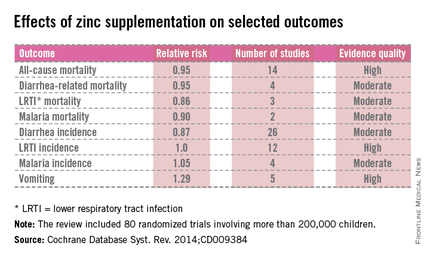
Risk reductions for mortality ranged from 5% to 14%. The only significant disease reduction occurred with all-cause diarrhea.
Zinc possibly reduced the risks of death from malaria and the incidence of malaria and lower respiratory tract infection, but the authors said those findings were "imprecise."
Although zinc slightly increased the incidence of vomiting, "in our opinion, the benefits of preventive zinc supplementation outweigh the harms in areas where the risk of zinc deficiency is relatively high," the authors said.
No author disclosures were listed in the paper.
On Twitter @alz_gal
For children who have a zinc deficiency, supplementation significantly reduced their overall risk of death as well as risk of death from diarrhea and lower respiratory tract infection, based on a Cochrane Review of 80 randomized controlled trials that included more than 200,000 children aged 6 months to 12 years.
Most of the studies in the review were conducted in countries with impoverished populations – South and Central America, Africa, and Asia – although a few were conducted in impoverished communities in developed countries, including the United States, wrote Evan Mayo-Wilson, Ph.D., an epidemiologist at the Johns Hopkins University Bloomberg School of Public Health, Baltimore, and his colleagues (Cochrane Database Syst. Rev. 2014;CD009384 [doi:10.1002/14651858.CD009384.pub2]).
"At both national and individual levels, zinc deficiency and its consequences are linked to poverty. Firstly, foods from animal sources, which are rich in zinc, are often expensive. Particularly in low- and middle-income countries, poor individuals may primarily eat foods such as cereals, grains, and legumes. These foods have relatively low concentrations of zinc; they also have relatively high concentrations of fiber and phytate molecules, which reduce zinc absorption by the intestine," they said.
The review also found that "zinc supplementation may have a very small effect on growth, but eating more calories would probably have a larger effect for many malnourished children," wrote Dr. Mayo-Wilson and his colleagues.
Also, water-borne illnesses common in Third World countries cause diarrhea that impairs intestinal zinc absorption.
The studies looked at orally administered zinc given as a supplement, regardless of compound, formulation, dose, duration, or frequency. Comparators were placebo, wait-list controls, or populations with no intervention. Hospitalized children and children with chronic diseases or conditions were excluded as were those using food fortification or intake, sprinkles, and therapeutic interventions.
Risk reductions for mortality ranged from 5% to 14%. The only significant disease reduction occurred with all-cause diarrhea.
Zinc possibly reduced the risks of death from malaria and the incidence of malaria and lower respiratory tract infection, but the authors said those findings were "imprecise."
Although zinc slightly increased the incidence of vomiting, "in our opinion, the benefits of preventive zinc supplementation outweigh the harms in areas where the risk of zinc deficiency is relatively high," the authors said.
No author disclosures were listed in the paper.
On Twitter @alz_gal
For children who have a zinc deficiency, supplementation significantly reduced their overall risk of death as well as risk of death from diarrhea and lower respiratory tract infection, based on a Cochrane Review of 80 randomized controlled trials that included more than 200,000 children aged 6 months to 12 years.
Most of the studies in the review were conducted in countries with impoverished populations – South and Central America, Africa, and Asia – although a few were conducted in impoverished communities in developed countries, including the United States, wrote Evan Mayo-Wilson, Ph.D., an epidemiologist at the Johns Hopkins University Bloomberg School of Public Health, Baltimore, and his colleagues (Cochrane Database Syst. Rev. 2014;CD009384 [doi:10.1002/14651858.CD009384.pub2]).
"At both national and individual levels, zinc deficiency and its consequences are linked to poverty. Firstly, foods from animal sources, which are rich in zinc, are often expensive. Particularly in low- and middle-income countries, poor individuals may primarily eat foods such as cereals, grains, and legumes. These foods have relatively low concentrations of zinc; they also have relatively high concentrations of fiber and phytate molecules, which reduce zinc absorption by the intestine," they said.
The review also found that "zinc supplementation may have a very small effect on growth, but eating more calories would probably have a larger effect for many malnourished children," wrote Dr. Mayo-Wilson and his colleagues.
Also, water-borne illnesses common in Third World countries cause diarrhea that impairs intestinal zinc absorption.
The studies looked at orally administered zinc given as a supplement, regardless of compound, formulation, dose, duration, or frequency. Comparators were placebo, wait-list controls, or populations with no intervention. Hospitalized children and children with chronic diseases or conditions were excluded as were those using food fortification or intake, sprinkles, and therapeutic interventions.
Risk reductions for mortality ranged from 5% to 14%. The only significant disease reduction occurred with all-cause diarrhea.
Zinc possibly reduced the risks of death from malaria and the incidence of malaria and lower respiratory tract infection, but the authors said those findings were "imprecise."
Although zinc slightly increased the incidence of vomiting, "in our opinion, the benefits of preventive zinc supplementation outweigh the harms in areas where the risk of zinc deficiency is relatively high," the authors said.
No author disclosures were listed in the paper.
On Twitter @alz_gal
FROM THE COCHRANE REVIEW
Key clinical point: Zinc supplements reduced the risk of death and some diseases for children who were deficient in the mineral.
Major finding: Zinc supplementation reduced the overall risk of death by 5% and the incidence of diarrhea by 13%.
Data source: The Cochrane Review comprised 80 studies of 205,401 children.
Disclosures: No author disclosures were listed in the paper.