User login
Color vision deficiency was significantly more prevalent among non-Hispanic white boys than among blacks and Hispanics in a study involving more than 4,000 preschool-age children.
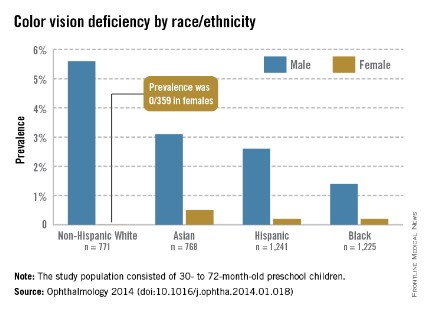
Prevalence among non-Hispanic white boys aged 30-72 months was 5.6%, compared with 1.4% in black boys and 2.6% in Hispanics boys. Prevalence in Asian boys was lower at 3.1%, but the difference was not significant, Dr. John Z. Xie and his associates reported (Ophthalmology 2014 [doi:10.1016/j.ophtha.2014.01.018]).
Of the 4,005 children tested, 63 were found to have color vision deficiency: 59 were boys and 4 were girls, and none of the 4 girls was white, said Dr. Xie of the Gavin Herbert Eye Institute at the University of California, Irvine, and his associates.
All of the subjects were participants in the Multi-Ethnic Pediatric Eye Diseases Study, a population-based, cross-sectional study of preschool children in Southern California. The study was supported by the National Institutes of Health and an unrestricted grant from Research to Prevent Blindness.
Color vision deficiency was significantly more prevalent among non-Hispanic white boys than among blacks and Hispanics in a study involving more than 4,000 preschool-age children.
Prevalence among non-Hispanic white boys aged 30-72 months was 5.6%, compared with 1.4% in black boys and 2.6% in Hispanics boys. Prevalence in Asian boys was lower at 3.1%, but the difference was not significant, Dr. John Z. Xie and his associates reported (Ophthalmology 2014 [doi:10.1016/j.ophtha.2014.01.018]).
Of the 4,005 children tested, 63 were found to have color vision deficiency: 59 were boys and 4 were girls, and none of the 4 girls was white, said Dr. Xie of the Gavin Herbert Eye Institute at the University of California, Irvine, and his associates.
All of the subjects were participants in the Multi-Ethnic Pediatric Eye Diseases Study, a population-based, cross-sectional study of preschool children in Southern California. The study was supported by the National Institutes of Health and an unrestricted grant from Research to Prevent Blindness.
Color vision deficiency was significantly more prevalent among non-Hispanic white boys than among blacks and Hispanics in a study involving more than 4,000 preschool-age children.
Prevalence among non-Hispanic white boys aged 30-72 months was 5.6%, compared with 1.4% in black boys and 2.6% in Hispanics boys. Prevalence in Asian boys was lower at 3.1%, but the difference was not significant, Dr. John Z. Xie and his associates reported (Ophthalmology 2014 [doi:10.1016/j.ophtha.2014.01.018]).
Of the 4,005 children tested, 63 were found to have color vision deficiency: 59 were boys and 4 were girls, and none of the 4 girls was white, said Dr. Xie of the Gavin Herbert Eye Institute at the University of California, Irvine, and his associates.
All of the subjects were participants in the Multi-Ethnic Pediatric Eye Diseases Study, a population-based, cross-sectional study of preschool children in Southern California. The study was supported by the National Institutes of Health and an unrestricted grant from Research to Prevent Blindness.
FROM OPHTHALMOLOGY