User login
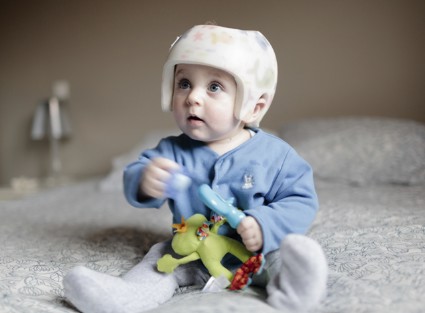
Researchers have discouraged the use of helmet therapy in infants with positional skull deformation after a single-blinded, randomized controlled trial showed no advantages over allowing the generally cosmetic condition to run its natural course.
The Dutch study found no differences in the change score at 2 years of age for both plagiocephaly and brachycephaly in 84 infants randomized either to 6 months of helmet therapy or to the natural course of the condition, according to a study published May 1 in BMJ (2014;348:g2741 [doi: 10.1136/bmj.g2741]).
Detailed measurements of each child’s head were done at age 2 years. Just more than a quarter (26%) of children who had helmet therapy experienced a full recovery at that time, compared with 23% of those who did not use a helmet. The difference was not significant.
All parents in the helmet therapy group reported one or more side effects, the most common being problems with acceptance of the helmet, skin irritation, augmented sweating, unpleasant odor of the helmet, pain associated with the helmet, and feeling hindered from cuddling their child.
However, those parents also showed slightly higher satisfaction scores and a slightly lower anxiety state when their infants were 2 years old.
The study was funded by a grant from ZonMw, the Netherlands Organization for Health Research and Development. No other conflicts of interest were declared.
Researchers have discouraged the use of helmet therapy in infants with positional skull deformation after a single-blinded, randomized controlled trial showed no advantages over allowing the generally cosmetic condition to run its natural course.
The Dutch study found no differences in the change score at 2 years of age for both plagiocephaly and brachycephaly in 84 infants randomized either to 6 months of helmet therapy or to the natural course of the condition, according to a study published May 1 in BMJ (2014;348:g2741 [doi: 10.1136/bmj.g2741]).
Detailed measurements of each child’s head were done at age 2 years. Just more than a quarter (26%) of children who had helmet therapy experienced a full recovery at that time, compared with 23% of those who did not use a helmet. The difference was not significant.
All parents in the helmet therapy group reported one or more side effects, the most common being problems with acceptance of the helmet, skin irritation, augmented sweating, unpleasant odor of the helmet, pain associated with the helmet, and feeling hindered from cuddling their child.
However, those parents also showed slightly higher satisfaction scores and a slightly lower anxiety state when their infants were 2 years old.
The study was funded by a grant from ZonMw, the Netherlands Organization for Health Research and Development. No other conflicts of interest were declared.
Researchers have discouraged the use of helmet therapy in infants with positional skull deformation after a single-blinded, randomized controlled trial showed no advantages over allowing the generally cosmetic condition to run its natural course.
The Dutch study found no differences in the change score at 2 years of age for both plagiocephaly and brachycephaly in 84 infants randomized either to 6 months of helmet therapy or to the natural course of the condition, according to a study published May 1 in BMJ (2014;348:g2741 [doi: 10.1136/bmj.g2741]).
Detailed measurements of each child’s head were done at age 2 years. Just more than a quarter (26%) of children who had helmet therapy experienced a full recovery at that time, compared with 23% of those who did not use a helmet. The difference was not significant.
All parents in the helmet therapy group reported one or more side effects, the most common being problems with acceptance of the helmet, skin irritation, augmented sweating, unpleasant odor of the helmet, pain associated with the helmet, and feeling hindered from cuddling their child.
However, those parents also showed slightly higher satisfaction scores and a slightly lower anxiety state when their infants were 2 years old.
The study was funded by a grant from ZonMw, the Netherlands Organization for Health Research and Development. No other conflicts of interest were declared.
FROM BMJ
Key clinical point: Watchful waiting may be best for infant positional skull deformity.
Major finding: About a quarter (26%) of helmet-treated infants had a full recovery vs. 23% of untreated infants.
Data source: Single-blinded, randomized controlled trial in 84 infants aged 5-6 months with positional skull deformity.
Disclosures: The study was funded by a grant from ZonMw, the Netherlands Organization for Health Research and Development. No other conflicts of interest were declared.