User login
The Treatment of Obstructive Hypertrophic Cardiomyopathy is best in Higher-Volume Hospitals
NEW YORK (Reuters Health) - Higher-volume hospitals do better in treatment of obstructive hypertrophic cardiomyopathy (HCM), but more efforts are needed to direct patients to these centers, according to New York-based researchers.
In an April 27 online paper in JAMA Cardiology, they note that recommendations are that the treatments, septal myectomy (SM) and alcohol septal ablation (ASA), be performed only by experienced operators with dedicated HCM clinical programs.
"Our study demonstrates that a significant number of cases of septal myectomy and alcohol septal ablation are not being performed at centers of excellence despite the guideline," Dr. Luke K. Kim, of Weill Cornell Medical College, told Reuters Health by email.
Dr. Kim and colleagues investigated compliance and its influence on outcome by examining nationwide data from 2003 to 2009 on 6,386 patients who underwent SM and 4,862 who had ASA. During this period almost 60% of institutions performed 10 or fewer SM procedures. The corresponding proportion for ASAs was 67%.
The incidence of in-hospital death after SM was significantly lower in hospitals in the highest volume tertile (3.8%) than those in the middle (9.6%) and lowest tertiles (15.6%). Corresponding proportions for ASA were 0.6%, 0.8% and 2.3%. There was a similar pattern for acute renal failure after ASA (2.4%, 7.6% and 6.2%).
After adjustment, being in the lowest tertile of SM volume was an independent predictor of in-hospital all-cause mortality (odds ratio, 3.11) and bleeding (OR, 3.77). However, being in the lowest volume for ASA was not independently associated with an increased risk of adverse post-procedural events.
In addition, hospitalization at a high-volume center was associated with a shorter stay and lower costs for both procedures.
However, over the study period, wrote the investigators, "Most centers that provide septal reduction therapy performed few SM and ASA procedures" and were "below the threshold recommended."
In particular, they concluded "Low SM volume was associated with worse outcomes, including higher mortality, longer length of stay, and higher costs. More efforts are needed to encourage referral of patients to centers of excellence for septal reduction therapy."
Commenting on the findings by email, Dr. Steve R. Ommen, coauthor of an accompanying invited opinion, told Reuters Health that "patients deserve to be offered the best care and outcomes possible and that appears to be possible only at centers with focused expertise in the management of HCM. Simply being a high-volume facility does not translate into achieving the safety nor the success observed at expert centers."
Dr. Ommen of the Mayo Clinic, Rochester, Minnesota, added that "Success takes a comprehensive understanding of the underlying HCM disease process. That is really the main take-home message from my point of view."
The other really astonishing finding," he concluded, "was that the median number of procedures performed was only one per year per hospital in the study."
The Michael Wolk Heart Foundation and the New York Cardiac Center supported this research. Two coauthors reported disclosures.
NEW YORK (Reuters Health) - Higher-volume hospitals do better in treatment of obstructive hypertrophic cardiomyopathy (HCM), but more efforts are needed to direct patients to these centers, according to New York-based researchers.
In an April 27 online paper in JAMA Cardiology, they note that recommendations are that the treatments, septal myectomy (SM) and alcohol septal ablation (ASA), be performed only by experienced operators with dedicated HCM clinical programs.
"Our study demonstrates that a significant number of cases of septal myectomy and alcohol septal ablation are not being performed at centers of excellence despite the guideline," Dr. Luke K. Kim, of Weill Cornell Medical College, told Reuters Health by email.
Dr. Kim and colleagues investigated compliance and its influence on outcome by examining nationwide data from 2003 to 2009 on 6,386 patients who underwent SM and 4,862 who had ASA. During this period almost 60% of institutions performed 10 or fewer SM procedures. The corresponding proportion for ASAs was 67%.
The incidence of in-hospital death after SM was significantly lower in hospitals in the highest volume tertile (3.8%) than those in the middle (9.6%) and lowest tertiles (15.6%). Corresponding proportions for ASA were 0.6%, 0.8% and 2.3%. There was a similar pattern for acute renal failure after ASA (2.4%, 7.6% and 6.2%).
After adjustment, being in the lowest tertile of SM volume was an independent predictor of in-hospital all-cause mortality (odds ratio, 3.11) and bleeding (OR, 3.77). However, being in the lowest volume for ASA was not independently associated with an increased risk of adverse post-procedural events.
In addition, hospitalization at a high-volume center was associated with a shorter stay and lower costs for both procedures.
However, over the study period, wrote the investigators, "Most centers that provide septal reduction therapy performed few SM and ASA procedures" and were "below the threshold recommended."
In particular, they concluded "Low SM volume was associated with worse outcomes, including higher mortality, longer length of stay, and higher costs. More efforts are needed to encourage referral of patients to centers of excellence for septal reduction therapy."
Commenting on the findings by email, Dr. Steve R. Ommen, coauthor of an accompanying invited opinion, told Reuters Health that "patients deserve to be offered the best care and outcomes possible and that appears to be possible only at centers with focused expertise in the management of HCM. Simply being a high-volume facility does not translate into achieving the safety nor the success observed at expert centers."
Dr. Ommen of the Mayo Clinic, Rochester, Minnesota, added that "Success takes a comprehensive understanding of the underlying HCM disease process. That is really the main take-home message from my point of view."
The other really astonishing finding," he concluded, "was that the median number of procedures performed was only one per year per hospital in the study."
The Michael Wolk Heart Foundation and the New York Cardiac Center supported this research. Two coauthors reported disclosures.
NEW YORK (Reuters Health) - Higher-volume hospitals do better in treatment of obstructive hypertrophic cardiomyopathy (HCM), but more efforts are needed to direct patients to these centers, according to New York-based researchers.
In an April 27 online paper in JAMA Cardiology, they note that recommendations are that the treatments, septal myectomy (SM) and alcohol septal ablation (ASA), be performed only by experienced operators with dedicated HCM clinical programs.
"Our study demonstrates that a significant number of cases of septal myectomy and alcohol septal ablation are not being performed at centers of excellence despite the guideline," Dr. Luke K. Kim, of Weill Cornell Medical College, told Reuters Health by email.
Dr. Kim and colleagues investigated compliance and its influence on outcome by examining nationwide data from 2003 to 2009 on 6,386 patients who underwent SM and 4,862 who had ASA. During this period almost 60% of institutions performed 10 or fewer SM procedures. The corresponding proportion for ASAs was 67%.
The incidence of in-hospital death after SM was significantly lower in hospitals in the highest volume tertile (3.8%) than those in the middle (9.6%) and lowest tertiles (15.6%). Corresponding proportions for ASA were 0.6%, 0.8% and 2.3%. There was a similar pattern for acute renal failure after ASA (2.4%, 7.6% and 6.2%).
After adjustment, being in the lowest tertile of SM volume was an independent predictor of in-hospital all-cause mortality (odds ratio, 3.11) and bleeding (OR, 3.77). However, being in the lowest volume for ASA was not independently associated with an increased risk of adverse post-procedural events.
In addition, hospitalization at a high-volume center was associated with a shorter stay and lower costs for both procedures.
However, over the study period, wrote the investigators, "Most centers that provide septal reduction therapy performed few SM and ASA procedures" and were "below the threshold recommended."
In particular, they concluded "Low SM volume was associated with worse outcomes, including higher mortality, longer length of stay, and higher costs. More efforts are needed to encourage referral of patients to centers of excellence for septal reduction therapy."
Commenting on the findings by email, Dr. Steve R. Ommen, coauthor of an accompanying invited opinion, told Reuters Health that "patients deserve to be offered the best care and outcomes possible and that appears to be possible only at centers with focused expertise in the management of HCM. Simply being a high-volume facility does not translate into achieving the safety nor the success observed at expert centers."
Dr. Ommen of the Mayo Clinic, Rochester, Minnesota, added that "Success takes a comprehensive understanding of the underlying HCM disease process. That is really the main take-home message from my point of view."
The other really astonishing finding," he concluded, "was that the median number of procedures performed was only one per year per hospital in the study."
The Michael Wolk Heart Foundation and the New York Cardiac Center supported this research. Two coauthors reported disclosures.
Report Shows Implanted Cardioveter-defibrillators Carries High Risk
NEW YORK (Reuters Health) - Implanted cardioverter-defibrillators (ICDs) carry a high risk of long-term complications, especially for younger patients, women, and blacks, researchers report.
Early implantation-related risks such as device malfunction are well known, but longer-term risks -- especially beyond the first year after implantation -- are poorly defined, Dr. Isuru Ranasinghe of Queen Elizabeth Hospital in South Australia and colleagues observed in an article online May 2 in Annals of
Internal Medicine.
"Knowing the long-term risks is important for patients to make an informed choice, because (implantation) is a lifelong treatment," Dr. Ranasinghe told Reuters Health by email. "Moreover, more than two-thirds of patients who receive an ICD for prevention of future events never require treatment from the ICD, although they continue to be at risk for device-related harms."
To investigate, the researchers analyzed data from the American College of Cardiology Foundation's National Cardiovascular Data Registry ICD Registry and Medicare claims to assess the long-term nonfatal risks for ICD-related complications among 114,484 patients at 1,437 U.S. centers with first-time implantations.
Implanted devices included single-chamber ICDs (19.8% of patients); dual-chamber ICDs (41.3%), and cardiac resynchronization therapy with a defibrillator (CRT-D; 38.9%).
During a median follow-up of 2.7 years, 40,072 patients died, representing 12.6 deaths per 100 patient years of followup. After accounting for the deaths, "there were 6.1 ICD-related complications per 100 patient years where the patient required an acute hospitalization or a reoperation," Dr. Ranasinghe said.
"In addition, there were 3.9 device reoperations per 100 patient years for reasons other than complications. Typically performed to replace the ICD battery, these reoperations are somewhat expected with time. Nevertheless, these surgical procedures are important for patients, as they carry a risk of patient harm," he observed.
Those more likely to experience long-term complications were women (16% higher risk), blacks (14% higher risk), and patients ages 65-69 at implantation (55% higher risk compared with those 85 and older) -- findings that require further investigation, according to Dr. Ranasinghe.
"Patients were 38% more likely to experience a complication if they had the more complex CRT-D compared with a simpler (single-chamber) device. A patient with a CRT-D device was also four times more likely to require a reoperation for reasons other than complications compared with a single-chamber ICD during the study period," he said.
Dr Ranasinghe added, "The rate of complications is substantial and higher than previously reported. The continued occurrence of complications long after the initial implantation indicates the need for vigilance and ongoing surveillance of ICD-related complications."
"There is considerable debate as to the added benefit of more complex devices compared with simpler single-chamber ICDs. Where possible, using a simpler device may reduce the risk of ICD-related harm," he said.
Dr. Paul J. Hauptman of Saint Louis University School of Medicine in Missouri, told Reuters Health by email, "The study adds to a rich literature that highlights the need for clinicians and patients to carefully consider the potential risks and benefits of implantable defibrillators and CRT devices."
"Although (this was) not a primary focus of the paper, I was struck by the 35% mortality at a median of 2.7 years (in addition to a significant ICD-related complication rate)," said Dr. Hauptman, who has done work in this area. "By linking registry and Medicare data, the authors succeed in providing meaningful insight into what happens to real patients in the real world. We would be abrogating our role as physicians if we ignore analyses like this one."
The study was funded by the American College of Cardiology Foundation's National Cardiovascular Data Registry and other organizations. Five coauthors reported disclosures.
NEW YORK (Reuters Health) - Implanted cardioverter-defibrillators (ICDs) carry a high risk of long-term complications, especially for younger patients, women, and blacks, researchers report.
Early implantation-related risks such as device malfunction are well known, but longer-term risks -- especially beyond the first year after implantation -- are poorly defined, Dr. Isuru Ranasinghe of Queen Elizabeth Hospital in South Australia and colleagues observed in an article online May 2 in Annals of
Internal Medicine.
"Knowing the long-term risks is important for patients to make an informed choice, because (implantation) is a lifelong treatment," Dr. Ranasinghe told Reuters Health by email. "Moreover, more than two-thirds of patients who receive an ICD for prevention of future events never require treatment from the ICD, although they continue to be at risk for device-related harms."
To investigate, the researchers analyzed data from the American College of Cardiology Foundation's National Cardiovascular Data Registry ICD Registry and Medicare claims to assess the long-term nonfatal risks for ICD-related complications among 114,484 patients at 1,437 U.S. centers with first-time implantations.
Implanted devices included single-chamber ICDs (19.8% of patients); dual-chamber ICDs (41.3%), and cardiac resynchronization therapy with a defibrillator (CRT-D; 38.9%).
During a median follow-up of 2.7 years, 40,072 patients died, representing 12.6 deaths per 100 patient years of followup. After accounting for the deaths, "there were 6.1 ICD-related complications per 100 patient years where the patient required an acute hospitalization or a reoperation," Dr. Ranasinghe said.
"In addition, there were 3.9 device reoperations per 100 patient years for reasons other than complications. Typically performed to replace the ICD battery, these reoperations are somewhat expected with time. Nevertheless, these surgical procedures are important for patients, as they carry a risk of patient harm," he observed.
Those more likely to experience long-term complications were women (16% higher risk), blacks (14% higher risk), and patients ages 65-69 at implantation (55% higher risk compared with those 85 and older) -- findings that require further investigation, according to Dr. Ranasinghe.
"Patients were 38% more likely to experience a complication if they had the more complex CRT-D compared with a simpler (single-chamber) device. A patient with a CRT-D device was also four times more likely to require a reoperation for reasons other than complications compared with a single-chamber ICD during the study period," he said.
Dr Ranasinghe added, "The rate of complications is substantial and higher than previously reported. The continued occurrence of complications long after the initial implantation indicates the need for vigilance and ongoing surveillance of ICD-related complications."
"There is considerable debate as to the added benefit of more complex devices compared with simpler single-chamber ICDs. Where possible, using a simpler device may reduce the risk of ICD-related harm," he said.
Dr. Paul J. Hauptman of Saint Louis University School of Medicine in Missouri, told Reuters Health by email, "The study adds to a rich literature that highlights the need for clinicians and patients to carefully consider the potential risks and benefits of implantable defibrillators and CRT devices."
"Although (this was) not a primary focus of the paper, I was struck by the 35% mortality at a median of 2.7 years (in addition to a significant ICD-related complication rate)," said Dr. Hauptman, who has done work in this area. "By linking registry and Medicare data, the authors succeed in providing meaningful insight into what happens to real patients in the real world. We would be abrogating our role as physicians if we ignore analyses like this one."
The study was funded by the American College of Cardiology Foundation's National Cardiovascular Data Registry and other organizations. Five coauthors reported disclosures.
NEW YORK (Reuters Health) - Implanted cardioverter-defibrillators (ICDs) carry a high risk of long-term complications, especially for younger patients, women, and blacks, researchers report.
Early implantation-related risks such as device malfunction are well known, but longer-term risks -- especially beyond the first year after implantation -- are poorly defined, Dr. Isuru Ranasinghe of Queen Elizabeth Hospital in South Australia and colleagues observed in an article online May 2 in Annals of
Internal Medicine.
"Knowing the long-term risks is important for patients to make an informed choice, because (implantation) is a lifelong treatment," Dr. Ranasinghe told Reuters Health by email. "Moreover, more than two-thirds of patients who receive an ICD for prevention of future events never require treatment from the ICD, although they continue to be at risk for device-related harms."
To investigate, the researchers analyzed data from the American College of Cardiology Foundation's National Cardiovascular Data Registry ICD Registry and Medicare claims to assess the long-term nonfatal risks for ICD-related complications among 114,484 patients at 1,437 U.S. centers with first-time implantations.
Implanted devices included single-chamber ICDs (19.8% of patients); dual-chamber ICDs (41.3%), and cardiac resynchronization therapy with a defibrillator (CRT-D; 38.9%).
During a median follow-up of 2.7 years, 40,072 patients died, representing 12.6 deaths per 100 patient years of followup. After accounting for the deaths, "there were 6.1 ICD-related complications per 100 patient years where the patient required an acute hospitalization or a reoperation," Dr. Ranasinghe said.
"In addition, there were 3.9 device reoperations per 100 patient years for reasons other than complications. Typically performed to replace the ICD battery, these reoperations are somewhat expected with time. Nevertheless, these surgical procedures are important for patients, as they carry a risk of patient harm," he observed.
Those more likely to experience long-term complications were women (16% higher risk), blacks (14% higher risk), and patients ages 65-69 at implantation (55% higher risk compared with those 85 and older) -- findings that require further investigation, according to Dr. Ranasinghe.
"Patients were 38% more likely to experience a complication if they had the more complex CRT-D compared with a simpler (single-chamber) device. A patient with a CRT-D device was also four times more likely to require a reoperation for reasons other than complications compared with a single-chamber ICD during the study period," he said.
Dr Ranasinghe added, "The rate of complications is substantial and higher than previously reported. The continued occurrence of complications long after the initial implantation indicates the need for vigilance and ongoing surveillance of ICD-related complications."
"There is considerable debate as to the added benefit of more complex devices compared with simpler single-chamber ICDs. Where possible, using a simpler device may reduce the risk of ICD-related harm," he said.
Dr. Paul J. Hauptman of Saint Louis University School of Medicine in Missouri, told Reuters Health by email, "The study adds to a rich literature that highlights the need for clinicians and patients to carefully consider the potential risks and benefits of implantable defibrillators and CRT devices."
"Although (this was) not a primary focus of the paper, I was struck by the 35% mortality at a median of 2.7 years (in addition to a significant ICD-related complication rate)," said Dr. Hauptman, who has done work in this area. "By linking registry and Medicare data, the authors succeed in providing meaningful insight into what happens to real patients in the real world. We would be abrogating our role as physicians if we ignore analyses like this one."
The study was funded by the American College of Cardiology Foundation's National Cardiovascular Data Registry and other organizations. Five coauthors reported disclosures.
Barriers to Achieving High Reliability
The conceptual models being used in healthcare’s efforts to achieve high reliability may have weaknesses, according to Marc T. Edwards, MD, MBA, author of “An Organizational Learning Framework for Patient Safety,” published in the American Journal of Medical Quality. Those weaknesses could explain why controversy over basic issues around the subject remain.
His paper analyzes those barriers to achieving high reliability in healthcare and points to a way forward—specifically, a different framework for identifying leverage points for improvement based on organizational learning theory.
“Organizations learn from others, from defects, from measurement, and from mindfulness,” he writes. “These learning modes correspond with contemporary themes of collaboration, no blame for human error, accountability for performance, and managing the unexpected. The collaborative model has dominated improvement efforts. Greater attention to the underdeveloped modes of organizational learning may foster more rapid progress in patient safety by increasing organizational capabilities, strengthening a culture of safety, and fixing more of the process problems that contribute to patient harm.”
To help bring this about, hospitalists can contribute by “embracing accountability for clinical performance, developing appropriate measures, and engaging in safety improvement activities — the most salient and important of which is reporting adverse events, near misses, and hazardous conditions affecting their own patients,” Dr. Edwards says. “This means taking responsibility for ending the culture of blame in healthcare, which currently blocks physicians from such self-reporting.”
He adds that hospitalists can do this by changing the model by which they conduct clinical peer review: Instead of focusing on whether individual physicians practiced according to standards, they could look broadly at learning opportunities for improvement in the system of care.
Reference
- Edwards MT. An organizational learning framework for patient safety [published online ahead of print February 25, 2016]. Am J Med Qual. pii:1062860616632295.
The conceptual models being used in healthcare’s efforts to achieve high reliability may have weaknesses, according to Marc T. Edwards, MD, MBA, author of “An Organizational Learning Framework for Patient Safety,” published in the American Journal of Medical Quality. Those weaknesses could explain why controversy over basic issues around the subject remain.
His paper analyzes those barriers to achieving high reliability in healthcare and points to a way forward—specifically, a different framework for identifying leverage points for improvement based on organizational learning theory.
“Organizations learn from others, from defects, from measurement, and from mindfulness,” he writes. “These learning modes correspond with contemporary themes of collaboration, no blame for human error, accountability for performance, and managing the unexpected. The collaborative model has dominated improvement efforts. Greater attention to the underdeveloped modes of organizational learning may foster more rapid progress in patient safety by increasing organizational capabilities, strengthening a culture of safety, and fixing more of the process problems that contribute to patient harm.”
To help bring this about, hospitalists can contribute by “embracing accountability for clinical performance, developing appropriate measures, and engaging in safety improvement activities — the most salient and important of which is reporting adverse events, near misses, and hazardous conditions affecting their own patients,” Dr. Edwards says. “This means taking responsibility for ending the culture of blame in healthcare, which currently blocks physicians from such self-reporting.”
He adds that hospitalists can do this by changing the model by which they conduct clinical peer review: Instead of focusing on whether individual physicians practiced according to standards, they could look broadly at learning opportunities for improvement in the system of care.
Reference
- Edwards MT. An organizational learning framework for patient safety [published online ahead of print February 25, 2016]. Am J Med Qual. pii:1062860616632295.
The conceptual models being used in healthcare’s efforts to achieve high reliability may have weaknesses, according to Marc T. Edwards, MD, MBA, author of “An Organizational Learning Framework for Patient Safety,” published in the American Journal of Medical Quality. Those weaknesses could explain why controversy over basic issues around the subject remain.
His paper analyzes those barriers to achieving high reliability in healthcare and points to a way forward—specifically, a different framework for identifying leverage points for improvement based on organizational learning theory.
“Organizations learn from others, from defects, from measurement, and from mindfulness,” he writes. “These learning modes correspond with contemporary themes of collaboration, no blame for human error, accountability for performance, and managing the unexpected. The collaborative model has dominated improvement efforts. Greater attention to the underdeveloped modes of organizational learning may foster more rapid progress in patient safety by increasing organizational capabilities, strengthening a culture of safety, and fixing more of the process problems that contribute to patient harm.”
To help bring this about, hospitalists can contribute by “embracing accountability for clinical performance, developing appropriate measures, and engaging in safety improvement activities — the most salient and important of which is reporting adverse events, near misses, and hazardous conditions affecting their own patients,” Dr. Edwards says. “This means taking responsibility for ending the culture of blame in healthcare, which currently blocks physicians from such self-reporting.”
He adds that hospitalists can do this by changing the model by which they conduct clinical peer review: Instead of focusing on whether individual physicians practiced according to standards, they could look broadly at learning opportunities for improvement in the system of care.
Reference
- Edwards MT. An organizational learning framework for patient safety [published online ahead of print February 25, 2016]. Am J Med Qual. pii:1062860616632295.
Is Email an Endangered Species?

And yet despite the seemingly definitive place email communication holds for hospitalists—for messages to one another, missives to hospital administrators, instructions to patients, and myriad other uses—there are those who often wonder if email is outmoded. In a world bent on text messaging, Facebook, Twitter, Skype, Vine, Periscope, and Google Talk (not to mention dozens of lesser-known services and a seemingly endless string of startups aiming to be the proverbial next big thing), is email old-fashioned or ineffective?
In a word, no.
But that doesn’t mean email is the only communication method in a hospitalist’s toolbox or the best one for every situation. Physicians and communication experts interviewed by The Hospitalist agree that email has a function and isn’t going anywhere anytime soon. However, that function is dependent on trust, urgency, formality, and relationships.
“It has a place in communication, especially for busy hospitals, but the key is to figure out what is that place,” says Vineet Arora, MD, MAPP, FHM, a hospitalist at the University of Chicago, who has spoken at SHM annual meetings on how hospitalists communicate. “All of the information that is coming to you is in a push-pull model … There is information that you want pushed to you because it’s important and you want to see it. And then there is information that you want to pull because perhaps you know it relates to a patient in front of you … Where does email fit into it?”
Communications consultant A.J. Moore, associate professor of communication at Rider University in Lawrenceville, N.J., put it even more bluntly when assuring that email isn’t going anywhere.
“Research shows, and I know I do it myself, the first thing I do in the morning when I pick up my phone is check my email,” he says. “People often check their email before they check the weather, before they check social media.
“Sure, there are other places to go, there’s other ways of communicating. But I still think that email is the center point. It’s the starting line for your communication.”
A Modus for the Medium
Hospitalist Aaron Jacobs, MD, associate chief medical information officer at University of New Mexico Hospital in Albuquerque, appreciates the academic discussion over the future of email, but he also knows he uses it every day. To him, there are several factors that go into choosing which medium he uses for a particular message.
“It depends on the situation and the message you are sending,” says Dr. Jacobs, associate professor in the Department of Pediatrics at the University of New Mexico School of Medicine. “If I’m friends with the pediatric nephrologist, I may text him a quick question about a [glomerular filtration rate] or a clinical question. But if I’m not on those terms with another subspecialist, I wouldn’t do that.
“There’s definitely a relationship aspect that is relevant.”
Another factor in choosing to send an email versus a text message versus a tweet is timing. In the days when email was the only alternative to in-person communication or a phone call, the electronic message was the fastest way to reach a person. It was the best way to hold a synchronous conversation. But in today’s era of smartphones, tablets, and even wristwatches that have instant access, email is no longer the fastest option. In fact, email today is best tailored to asynchronous conversations, Dr. Arora says.
“Texting is really more invasive. It’s more demanding of the recipient’s time in an immediate sort of way,” Dr. Jacobs says. “With email, you’re basically saying, ‘Please take a look at this at your convenience, and when you can, write me back.’ In contrast, when people send text messages, they’re typically expecting a response in minutes. This may seem logical and trivial, but it can also be disruptive. Since some texts are urgent, all texts must at least initially be treated as such.”
The urgency that comes with a text message or a direct message on Facebook or Twitter is the flip side of the formality that comes with an email, says Moore.
“Email has more of a professional connotation to it than a Facebook message,” Moore says. “Even if I work with somebody, even if I’m Facebook friends with somebody and that person is one door away from me, if it is a work conversation, I am going to send them an email.”
Formality is the delineation between social media and what Moore half-jokingly calls “professional media.” And while in some ways technology gaps can often be a generational difference, Moore doesn’t see email usage through that prism and certainly not when he’s interacting with the young adults in his classes.
“I look at myself as a professor, and I have that formal relationship with younger people being students. They could find me on social media. There’s nothing preventing them,” he says. “But still they reach out to me via email, and I communicate with them via email.”
That being said, a generational gap does exist that can cause older physicians to refrain from embracing newer technologies that could be effective alternatives to email, says Howard Landa, chief medical information officer of the Alameda Health System in Oakland, Calif., and vice chairman of the board of advisors for the Association of Medical Directors of Information Systems. Many communication tools (Shortmail, Fridge, Apple Mail) either were discontinued, wrapped into larger technologies, or never became mainstream enough to be worthwhile. So the idea that some technologies won’t catch on discourages some from using anything but email.
“The younger we are, the easier the changes are and the more receptive we are to change,” Landa says. “We have seen a lot of flash-in-the-pan technology, snake oil, new ideas that go crazy for [a while]. They get to the top in the hype cycle, they drop to the bottom of the pit in the depression, and then they never move.
“With the older physicians, I think there is a reluctance to try something just because it’s new, whereas with the younger docs, there is every week a new technology that I want to try because I am willing to go through 20 of them before I find one that works. They have more energy and are more open to it.”
Security Is Job One
The safety of email is a major reason that many continually question its fate. In a broad sense, that is the natural question when a technology is new, says Ben Compaine, director of the fellows program at the Columbia University Institute for Tele-Information and a lecturer in the D’Amore-McKim School of Business at Northeastern University in Boston.
“There are always people who will find something to fear,” Compaine says. “Like when ATMs came along, there was stuff being written about safety concerns: ‘People will go to an ATM, and someone just holds them up and gets their money.’ It’s happened, but given the hundreds of millions of transactions that go on, you don’t throw out the baby with the bathwater.”
Dr. Arora cautions that the difference for hospitalists is that when a safety mistake is made with email, it can constitute a violation of the Health Insurance Portability and Accountability Act (HIPAA). And while those mistakes can happen innocently enough on social media or via text messaging, she says email issues are the most common.
“I’ve seen HIPAA violations where a patient would send an email to a doctor and the doctor would reply all to all of the [hospitalists] in their group saying, ‘Can anyone help me answer this question?’” she says. “So the forward email and forward and reply all are the most dangerous features because you have to know what you are forwarding and would that person want it shared with everybody.”
Landa believes that part of the problem with the efficacy of email is that it’s become so fast and so easy that people don’t take their time thinking about the impact of each email. Dr. Arora agrees and suggests hospitalists think carefully about what is in an email, particularly when it involves patient information.
“Share the minimum necessary information with a minimum number of people to try to accomplish what you are trying to do,” she adds. “That way, you are not clogging the inbox of everybody involved.”
Another potential pitfall to the efficacy of email is the “lost in translation” phenomenon, Landa says.
“How many times have you written am email and someone misinterpreted sarcasm or a joke or a particular word or a phrase and got upset because of what they thought you were saying?” he says. “I think that when you talk about the synchronous and rapid-fire style of the forms of communication, I think you elevate the risk by an order of magnitude. That’s the reason we have developed all the emoticons and all the visual references that are out there—to make sure that people don’t misinterpret what we’re saying.”
What’s Old Is New
So if hospitalists and communications experts believe email retains a place in the way information is conveyed, why is the question of its impending death a continuing parlor game for some?
“Because there’s always something new,” Moore says. “Because Messenger on Facebook looks a little bit flashier than email. Because now we have Periscope. Now we have Twitter. Now we have different types of platforms that message within each other. They all look flashier.”
But, in essence, each is simply a somewhat more modernized version, more bells and whistles, Moore says. He likes to compare it to the U.S. Postal Service. As technology progressed and communication became more real-time in ways well beyond telephone conversations, many pundits forecasted the end of what is derisively called snail mail, itself an admission of the speed and efficacy of electronic mail.
“You could make the analogy between the death of email and the death of the U.S. mail,” Moore says. “Ten years ago, people were writing this article about the death of the U.S. mail. And it certainly changed. Yes, there are less letters and less traffic and less parcels that the post office sends. But it’s still there. It’s not going away; it’s just adapting in a certain way.
“If you want to pinpoint a time that there is ‘the death of email,’ I think the death of the U.S. mail comes before it.” TH
Richard Quinn is a freelance writer in New Jersey.
Email should not replace face-to-face conversation, other workplace interactions

Hospitalist Aaron Jacobs, MD, associate chief medical information officer at University of New Mexico Hospital in Albuquerque, deals with the intersection of HM and technology for a living, particularly email. But perhaps email’s greatest use to him? A reminder that for all it is, it isn’t a face-to-face conversation.
“I more and more am reminding myself: Pick up the phone. Walk down to their office. Go to the coffee cart and see who shows up there so you can actually have a conversation,” he says. “I really enjoy those interactions.
“[Email] is an absolutely vital form of communication, but it’s just one of many and has obvious limitations.”
In the years-long discussion over whether email is antiquated in the face of instant-messaging services and other mobile applications, Dr. Jacobs clearly sides with those who see a future for email. It’s just too ubiquitous in hospitalist workflow at this point.
But the debate is a clarion call that hospitalists should take some time to focus on the clearest interpersonal interactions they can. It’s a message echoed by hospitalist pioneer Robert Wachter, MD, MHM, who used his annual closing lecture at HM15 in National Harbor, Md., last year to note that the advent of communicative technology has reduced the role of face-to-face meetings among hospital staff from different specialties.
For his part, Dr. Jacobs tries to focus as much as possible on making sure that email is just one piece of his communications spectrum.
“We rely too much on technology,” he says. “We’ve seen that with computerized physician order entries [CPOE]. For some reason, people put an order into a computer and they assume that it gets communicated effectively to everybody that needs to get that message.
“I think it’s the same with emailing or text messaging. You assume it gets there. People sometimes forget … a common-sense approach. Why don’t you follow up on that email? Why don’t you talk to the nurse, as well? Make sure that there is no misunderstanding. That’s where the errors are really going to hurt us … when we stop doing those other things to follow up on the messages.” TH
Richard Quinn is a freelance writer in New Jersey.
And yet despite the seemingly definitive place email communication holds for hospitalists—for messages to one another, missives to hospital administrators, instructions to patients, and myriad other uses—there are those who often wonder if email is outmoded. In a world bent on text messaging, Facebook, Twitter, Skype, Vine, Periscope, and Google Talk (not to mention dozens of lesser-known services and a seemingly endless string of startups aiming to be the proverbial next big thing), is email old-fashioned or ineffective?
In a word, no.
But that doesn’t mean email is the only communication method in a hospitalist’s toolbox or the best one for every situation. Physicians and communication experts interviewed by The Hospitalist agree that email has a function and isn’t going anywhere anytime soon. However, that function is dependent on trust, urgency, formality, and relationships.
“It has a place in communication, especially for busy hospitals, but the key is to figure out what is that place,” says Vineet Arora, MD, MAPP, FHM, a hospitalist at the University of Chicago, who has spoken at SHM annual meetings on how hospitalists communicate. “All of the information that is coming to you is in a push-pull model … There is information that you want pushed to you because it’s important and you want to see it. And then there is information that you want to pull because perhaps you know it relates to a patient in front of you … Where does email fit into it?”
Communications consultant A.J. Moore, associate professor of communication at Rider University in Lawrenceville, N.J., put it even more bluntly when assuring that email isn’t going anywhere.
“Research shows, and I know I do it myself, the first thing I do in the morning when I pick up my phone is check my email,” he says. “People often check their email before they check the weather, before they check social media.
“Sure, there are other places to go, there’s other ways of communicating. But I still think that email is the center point. It’s the starting line for your communication.”
A Modus for the Medium
Hospitalist Aaron Jacobs, MD, associate chief medical information officer at University of New Mexico Hospital in Albuquerque, appreciates the academic discussion over the future of email, but he also knows he uses it every day. To him, there are several factors that go into choosing which medium he uses for a particular message.
“It depends on the situation and the message you are sending,” says Dr. Jacobs, associate professor in the Department of Pediatrics at the University of New Mexico School of Medicine. “If I’m friends with the pediatric nephrologist, I may text him a quick question about a [glomerular filtration rate] or a clinical question. But if I’m not on those terms with another subspecialist, I wouldn’t do that.
“There’s definitely a relationship aspect that is relevant.”
Another factor in choosing to send an email versus a text message versus a tweet is timing. In the days when email was the only alternative to in-person communication or a phone call, the electronic message was the fastest way to reach a person. It was the best way to hold a synchronous conversation. But in today’s era of smartphones, tablets, and even wristwatches that have instant access, email is no longer the fastest option. In fact, email today is best tailored to asynchronous conversations, Dr. Arora says.
“Texting is really more invasive. It’s more demanding of the recipient’s time in an immediate sort of way,” Dr. Jacobs says. “With email, you’re basically saying, ‘Please take a look at this at your convenience, and when you can, write me back.’ In contrast, when people send text messages, they’re typically expecting a response in minutes. This may seem logical and trivial, but it can also be disruptive. Since some texts are urgent, all texts must at least initially be treated as such.”
The urgency that comes with a text message or a direct message on Facebook or Twitter is the flip side of the formality that comes with an email, says Moore.
“Email has more of a professional connotation to it than a Facebook message,” Moore says. “Even if I work with somebody, even if I’m Facebook friends with somebody and that person is one door away from me, if it is a work conversation, I am going to send them an email.”
Formality is the delineation between social media and what Moore half-jokingly calls “professional media.” And while in some ways technology gaps can often be a generational difference, Moore doesn’t see email usage through that prism and certainly not when he’s interacting with the young adults in his classes.
“I look at myself as a professor, and I have that formal relationship with younger people being students. They could find me on social media. There’s nothing preventing them,” he says. “But still they reach out to me via email, and I communicate with them via email.”
That being said, a generational gap does exist that can cause older physicians to refrain from embracing newer technologies that could be effective alternatives to email, says Howard Landa, chief medical information officer of the Alameda Health System in Oakland, Calif., and vice chairman of the board of advisors for the Association of Medical Directors of Information Systems. Many communication tools (Shortmail, Fridge, Apple Mail) either were discontinued, wrapped into larger technologies, or never became mainstream enough to be worthwhile. So the idea that some technologies won’t catch on discourages some from using anything but email.
“The younger we are, the easier the changes are and the more receptive we are to change,” Landa says. “We have seen a lot of flash-in-the-pan technology, snake oil, new ideas that go crazy for [a while]. They get to the top in the hype cycle, they drop to the bottom of the pit in the depression, and then they never move.
“With the older physicians, I think there is a reluctance to try something just because it’s new, whereas with the younger docs, there is every week a new technology that I want to try because I am willing to go through 20 of them before I find one that works. They have more energy and are more open to it.”
Security Is Job One
The safety of email is a major reason that many continually question its fate. In a broad sense, that is the natural question when a technology is new, says Ben Compaine, director of the fellows program at the Columbia University Institute for Tele-Information and a lecturer in the D’Amore-McKim School of Business at Northeastern University in Boston.
“There are always people who will find something to fear,” Compaine says. “Like when ATMs came along, there was stuff being written about safety concerns: ‘People will go to an ATM, and someone just holds them up and gets their money.’ It’s happened, but given the hundreds of millions of transactions that go on, you don’t throw out the baby with the bathwater.”
Dr. Arora cautions that the difference for hospitalists is that when a safety mistake is made with email, it can constitute a violation of the Health Insurance Portability and Accountability Act (HIPAA). And while those mistakes can happen innocently enough on social media or via text messaging, she says email issues are the most common.
“I’ve seen HIPAA violations where a patient would send an email to a doctor and the doctor would reply all to all of the [hospitalists] in their group saying, ‘Can anyone help me answer this question?’” she says. “So the forward email and forward and reply all are the most dangerous features because you have to know what you are forwarding and would that person want it shared with everybody.”
Landa believes that part of the problem with the efficacy of email is that it’s become so fast and so easy that people don’t take their time thinking about the impact of each email. Dr. Arora agrees and suggests hospitalists think carefully about what is in an email, particularly when it involves patient information.
“Share the minimum necessary information with a minimum number of people to try to accomplish what you are trying to do,” she adds. “That way, you are not clogging the inbox of everybody involved.”
Another potential pitfall to the efficacy of email is the “lost in translation” phenomenon, Landa says.
“How many times have you written am email and someone misinterpreted sarcasm or a joke or a particular word or a phrase and got upset because of what they thought you were saying?” he says. “I think that when you talk about the synchronous and rapid-fire style of the forms of communication, I think you elevate the risk by an order of magnitude. That’s the reason we have developed all the emoticons and all the visual references that are out there—to make sure that people don’t misinterpret what we’re saying.”
What’s Old Is New
So if hospitalists and communications experts believe email retains a place in the way information is conveyed, why is the question of its impending death a continuing parlor game for some?
“Because there’s always something new,” Moore says. “Because Messenger on Facebook looks a little bit flashier than email. Because now we have Periscope. Now we have Twitter. Now we have different types of platforms that message within each other. They all look flashier.”
But, in essence, each is simply a somewhat more modernized version, more bells and whistles, Moore says. He likes to compare it to the U.S. Postal Service. As technology progressed and communication became more real-time in ways well beyond telephone conversations, many pundits forecasted the end of what is derisively called snail mail, itself an admission of the speed and efficacy of electronic mail.
“You could make the analogy between the death of email and the death of the U.S. mail,” Moore says. “Ten years ago, people were writing this article about the death of the U.S. mail. And it certainly changed. Yes, there are less letters and less traffic and less parcels that the post office sends. But it’s still there. It’s not going away; it’s just adapting in a certain way.
“If you want to pinpoint a time that there is ‘the death of email,’ I think the death of the U.S. mail comes before it.” TH
Richard Quinn is a freelance writer in New Jersey.
Email should not replace face-to-face conversation, other workplace interactions
Hospitalist Aaron Jacobs, MD, associate chief medical information officer at University of New Mexico Hospital in Albuquerque, deals with the intersection of HM and technology for a living, particularly email. But perhaps email’s greatest use to him? A reminder that for all it is, it isn’t a face-to-face conversation.
“I more and more am reminding myself: Pick up the phone. Walk down to their office. Go to the coffee cart and see who shows up there so you can actually have a conversation,” he says. “I really enjoy those interactions.
“[Email] is an absolutely vital form of communication, but it’s just one of many and has obvious limitations.”
In the years-long discussion over whether email is antiquated in the face of instant-messaging services and other mobile applications, Dr. Jacobs clearly sides with those who see a future for email. It’s just too ubiquitous in hospitalist workflow at this point.
But the debate is a clarion call that hospitalists should take some time to focus on the clearest interpersonal interactions they can. It’s a message echoed by hospitalist pioneer Robert Wachter, MD, MHM, who used his annual closing lecture at HM15 in National Harbor, Md., last year to note that the advent of communicative technology has reduced the role of face-to-face meetings among hospital staff from different specialties.
For his part, Dr. Jacobs tries to focus as much as possible on making sure that email is just one piece of his communications spectrum.
“We rely too much on technology,” he says. “We’ve seen that with computerized physician order entries [CPOE]. For some reason, people put an order into a computer and they assume that it gets communicated effectively to everybody that needs to get that message.
“I think it’s the same with emailing or text messaging. You assume it gets there. People sometimes forget … a common-sense approach. Why don’t you follow up on that email? Why don’t you talk to the nurse, as well? Make sure that there is no misunderstanding. That’s where the errors are really going to hurt us … when we stop doing those other things to follow up on the messages.” TH
Richard Quinn is a freelance writer in New Jersey.
And yet despite the seemingly definitive place email communication holds for hospitalists—for messages to one another, missives to hospital administrators, instructions to patients, and myriad other uses—there are those who often wonder if email is outmoded. In a world bent on text messaging, Facebook, Twitter, Skype, Vine, Periscope, and Google Talk (not to mention dozens of lesser-known services and a seemingly endless string of startups aiming to be the proverbial next big thing), is email old-fashioned or ineffective?
In a word, no.
But that doesn’t mean email is the only communication method in a hospitalist’s toolbox or the best one for every situation. Physicians and communication experts interviewed by The Hospitalist agree that email has a function and isn’t going anywhere anytime soon. However, that function is dependent on trust, urgency, formality, and relationships.
“It has a place in communication, especially for busy hospitals, but the key is to figure out what is that place,” says Vineet Arora, MD, MAPP, FHM, a hospitalist at the University of Chicago, who has spoken at SHM annual meetings on how hospitalists communicate. “All of the information that is coming to you is in a push-pull model … There is information that you want pushed to you because it’s important and you want to see it. And then there is information that you want to pull because perhaps you know it relates to a patient in front of you … Where does email fit into it?”
Communications consultant A.J. Moore, associate professor of communication at Rider University in Lawrenceville, N.J., put it even more bluntly when assuring that email isn’t going anywhere.
“Research shows, and I know I do it myself, the first thing I do in the morning when I pick up my phone is check my email,” he says. “People often check their email before they check the weather, before they check social media.
“Sure, there are other places to go, there’s other ways of communicating. But I still think that email is the center point. It’s the starting line for your communication.”
A Modus for the Medium
Hospitalist Aaron Jacobs, MD, associate chief medical information officer at University of New Mexico Hospital in Albuquerque, appreciates the academic discussion over the future of email, but he also knows he uses it every day. To him, there are several factors that go into choosing which medium he uses for a particular message.
“It depends on the situation and the message you are sending,” says Dr. Jacobs, associate professor in the Department of Pediatrics at the University of New Mexico School of Medicine. “If I’m friends with the pediatric nephrologist, I may text him a quick question about a [glomerular filtration rate] or a clinical question. But if I’m not on those terms with another subspecialist, I wouldn’t do that.
“There’s definitely a relationship aspect that is relevant.”
Another factor in choosing to send an email versus a text message versus a tweet is timing. In the days when email was the only alternative to in-person communication or a phone call, the electronic message was the fastest way to reach a person. It was the best way to hold a synchronous conversation. But in today’s era of smartphones, tablets, and even wristwatches that have instant access, email is no longer the fastest option. In fact, email today is best tailored to asynchronous conversations, Dr. Arora says.
“Texting is really more invasive. It’s more demanding of the recipient’s time in an immediate sort of way,” Dr. Jacobs says. “With email, you’re basically saying, ‘Please take a look at this at your convenience, and when you can, write me back.’ In contrast, when people send text messages, they’re typically expecting a response in minutes. This may seem logical and trivial, but it can also be disruptive. Since some texts are urgent, all texts must at least initially be treated as such.”
The urgency that comes with a text message or a direct message on Facebook or Twitter is the flip side of the formality that comes with an email, says Moore.
“Email has more of a professional connotation to it than a Facebook message,” Moore says. “Even if I work with somebody, even if I’m Facebook friends with somebody and that person is one door away from me, if it is a work conversation, I am going to send them an email.”
Formality is the delineation between social media and what Moore half-jokingly calls “professional media.” And while in some ways technology gaps can often be a generational difference, Moore doesn’t see email usage through that prism and certainly not when he’s interacting with the young adults in his classes.
“I look at myself as a professor, and I have that formal relationship with younger people being students. They could find me on social media. There’s nothing preventing them,” he says. “But still they reach out to me via email, and I communicate with them via email.”
That being said, a generational gap does exist that can cause older physicians to refrain from embracing newer technologies that could be effective alternatives to email, says Howard Landa, chief medical information officer of the Alameda Health System in Oakland, Calif., and vice chairman of the board of advisors for the Association of Medical Directors of Information Systems. Many communication tools (Shortmail, Fridge, Apple Mail) either were discontinued, wrapped into larger technologies, or never became mainstream enough to be worthwhile. So the idea that some technologies won’t catch on discourages some from using anything but email.
“The younger we are, the easier the changes are and the more receptive we are to change,” Landa says. “We have seen a lot of flash-in-the-pan technology, snake oil, new ideas that go crazy for [a while]. They get to the top in the hype cycle, they drop to the bottom of the pit in the depression, and then they never move.
“With the older physicians, I think there is a reluctance to try something just because it’s new, whereas with the younger docs, there is every week a new technology that I want to try because I am willing to go through 20 of them before I find one that works. They have more energy and are more open to it.”
Security Is Job One
The safety of email is a major reason that many continually question its fate. In a broad sense, that is the natural question when a technology is new, says Ben Compaine, director of the fellows program at the Columbia University Institute for Tele-Information and a lecturer in the D’Amore-McKim School of Business at Northeastern University in Boston.
“There are always people who will find something to fear,” Compaine says. “Like when ATMs came along, there was stuff being written about safety concerns: ‘People will go to an ATM, and someone just holds them up and gets their money.’ It’s happened, but given the hundreds of millions of transactions that go on, you don’t throw out the baby with the bathwater.”
Dr. Arora cautions that the difference for hospitalists is that when a safety mistake is made with email, it can constitute a violation of the Health Insurance Portability and Accountability Act (HIPAA). And while those mistakes can happen innocently enough on social media or via text messaging, she says email issues are the most common.
“I’ve seen HIPAA violations where a patient would send an email to a doctor and the doctor would reply all to all of the [hospitalists] in their group saying, ‘Can anyone help me answer this question?’” she says. “So the forward email and forward and reply all are the most dangerous features because you have to know what you are forwarding and would that person want it shared with everybody.”
Landa believes that part of the problem with the efficacy of email is that it’s become so fast and so easy that people don’t take their time thinking about the impact of each email. Dr. Arora agrees and suggests hospitalists think carefully about what is in an email, particularly when it involves patient information.
“Share the minimum necessary information with a minimum number of people to try to accomplish what you are trying to do,” she adds. “That way, you are not clogging the inbox of everybody involved.”
Another potential pitfall to the efficacy of email is the “lost in translation” phenomenon, Landa says.
“How many times have you written am email and someone misinterpreted sarcasm or a joke or a particular word or a phrase and got upset because of what they thought you were saying?” he says. “I think that when you talk about the synchronous and rapid-fire style of the forms of communication, I think you elevate the risk by an order of magnitude. That’s the reason we have developed all the emoticons and all the visual references that are out there—to make sure that people don’t misinterpret what we’re saying.”
What’s Old Is New
So if hospitalists and communications experts believe email retains a place in the way information is conveyed, why is the question of its impending death a continuing parlor game for some?
“Because there’s always something new,” Moore says. “Because Messenger on Facebook looks a little bit flashier than email. Because now we have Periscope. Now we have Twitter. Now we have different types of platforms that message within each other. They all look flashier.”
But, in essence, each is simply a somewhat more modernized version, more bells and whistles, Moore says. He likes to compare it to the U.S. Postal Service. As technology progressed and communication became more real-time in ways well beyond telephone conversations, many pundits forecasted the end of what is derisively called snail mail, itself an admission of the speed and efficacy of electronic mail.
“You could make the analogy between the death of email and the death of the U.S. mail,” Moore says. “Ten years ago, people were writing this article about the death of the U.S. mail. And it certainly changed. Yes, there are less letters and less traffic and less parcels that the post office sends. But it’s still there. It’s not going away; it’s just adapting in a certain way.
“If you want to pinpoint a time that there is ‘the death of email,’ I think the death of the U.S. mail comes before it.” TH
Richard Quinn is a freelance writer in New Jersey.
Email should not replace face-to-face conversation, other workplace interactions
Hospitalist Aaron Jacobs, MD, associate chief medical information officer at University of New Mexico Hospital in Albuquerque, deals with the intersection of HM and technology for a living, particularly email. But perhaps email’s greatest use to him? A reminder that for all it is, it isn’t a face-to-face conversation.
“I more and more am reminding myself: Pick up the phone. Walk down to their office. Go to the coffee cart and see who shows up there so you can actually have a conversation,” he says. “I really enjoy those interactions.
“[Email] is an absolutely vital form of communication, but it’s just one of many and has obvious limitations.”
In the years-long discussion over whether email is antiquated in the face of instant-messaging services and other mobile applications, Dr. Jacobs clearly sides with those who see a future for email. It’s just too ubiquitous in hospitalist workflow at this point.
But the debate is a clarion call that hospitalists should take some time to focus on the clearest interpersonal interactions they can. It’s a message echoed by hospitalist pioneer Robert Wachter, MD, MHM, who used his annual closing lecture at HM15 in National Harbor, Md., last year to note that the advent of communicative technology has reduced the role of face-to-face meetings among hospital staff from different specialties.
For his part, Dr. Jacobs tries to focus as much as possible on making sure that email is just one piece of his communications spectrum.
“We rely too much on technology,” he says. “We’ve seen that with computerized physician order entries [CPOE]. For some reason, people put an order into a computer and they assume that it gets communicated effectively to everybody that needs to get that message.
“I think it’s the same with emailing or text messaging. You assume it gets there. People sometimes forget … a common-sense approach. Why don’t you follow up on that email? Why don’t you talk to the nurse, as well? Make sure that there is no misunderstanding. That’s where the errors are really going to hurt us … when we stop doing those other things to follow up on the messages.” TH
Richard Quinn is a freelance writer in New Jersey.

Study Shows Statins lower the Risk of Cardiovascular Disease
NEW YORK (Reuters Health) - Lipid-lowering therapy, consisting almost entirely of statins, substantially lowered the risk of cardiovascular disease (CVD) and cardiovascular death in individuals with type 1 diabetes without a history of CVD, according to a new study.
Among more than 24,000 Swedish patients with type 1 diabetes, over a mean follow-up of six years, primary prevention with lipid-lowering therapy (LLT) reduced the incidence of cardiovascular death, all-cause death, stroke, coronary heart disease, and acute myocardial infarction.
The risk of cardiovascular death was reduced by 40%, while the reductions for acute MI and coronary heart disease were 22% and 15%, respectively, according to an article online on April 18 in Diabetes Care.
In email to Reuters Health, corresponding author Dr. Christel Hero, of the Institute of Medicine, University of Gothenburg, Sahlgrenska University Hospital, Gothenburg, Sweden, emphasized that "individuals with type 1 diabetes are at enhanced risk for CVD compared to the general population."
The study encompassed 24,230 individuals with type 1 diabetes (mean age 39.4 years): 5,387 treated with lipid-lowering medication and 18,843 untreated. In 97% of cases, LLT was with statins.
Hazard ratios for treated versus untreated participants were significant for all outcomes: cardiovascular death, 0.60; all-cause death, 0.56; fatal/nonfatal stroke, 0.56; fatal/nonfatal acute myocardial infarction, 0.78; and fatal/nonfatal coronary heart disease 0.85. Hazard ratios in a one-to-one matched cohort with 4,025 treated and 4,025 untreated individuals were significant only for all-cause death (0.74).
"Our study shows convincing effects of LLT in preventing all cardiovascular endpoints, even if the effect on reducing cardiovascular morbidity, except for stroke, was lesser than the effect on cardiovascular death and all-cause death," the authors wrote.
This study, Dr. Urman said, supports the idea that essentially all type 1 diabetics should be taking statins (absent any contraindications).
NEW YORK (Reuters Health) - Lipid-lowering therapy, consisting almost entirely of statins, substantially lowered the risk of cardiovascular disease (CVD) and cardiovascular death in individuals with type 1 diabetes without a history of CVD, according to a new study.
Among more than 24,000 Swedish patients with type 1 diabetes, over a mean follow-up of six years, primary prevention with lipid-lowering therapy (LLT) reduced the incidence of cardiovascular death, all-cause death, stroke, coronary heart disease, and acute myocardial infarction.
The risk of cardiovascular death was reduced by 40%, while the reductions for acute MI and coronary heart disease were 22% and 15%, respectively, according to an article online on April 18 in Diabetes Care.
In email to Reuters Health, corresponding author Dr. Christel Hero, of the Institute of Medicine, University of Gothenburg, Sahlgrenska University Hospital, Gothenburg, Sweden, emphasized that "individuals with type 1 diabetes are at enhanced risk for CVD compared to the general population."
The study encompassed 24,230 individuals with type 1 diabetes (mean age 39.4 years): 5,387 treated with lipid-lowering medication and 18,843 untreated. In 97% of cases, LLT was with statins.
Hazard ratios for treated versus untreated participants were significant for all outcomes: cardiovascular death, 0.60; all-cause death, 0.56; fatal/nonfatal stroke, 0.56; fatal/nonfatal acute myocardial infarction, 0.78; and fatal/nonfatal coronary heart disease 0.85. Hazard ratios in a one-to-one matched cohort with 4,025 treated and 4,025 untreated individuals were significant only for all-cause death (0.74).
"Our study shows convincing effects of LLT in preventing all cardiovascular endpoints, even if the effect on reducing cardiovascular morbidity, except for stroke, was lesser than the effect on cardiovascular death and all-cause death," the authors wrote.
This study, Dr. Urman said, supports the idea that essentially all type 1 diabetics should be taking statins (absent any contraindications).
NEW YORK (Reuters Health) - Lipid-lowering therapy, consisting almost entirely of statins, substantially lowered the risk of cardiovascular disease (CVD) and cardiovascular death in individuals with type 1 diabetes without a history of CVD, according to a new study.
Among more than 24,000 Swedish patients with type 1 diabetes, over a mean follow-up of six years, primary prevention with lipid-lowering therapy (LLT) reduced the incidence of cardiovascular death, all-cause death, stroke, coronary heart disease, and acute myocardial infarction.
The risk of cardiovascular death was reduced by 40%, while the reductions for acute MI and coronary heart disease were 22% and 15%, respectively, according to an article online on April 18 in Diabetes Care.
In email to Reuters Health, corresponding author Dr. Christel Hero, of the Institute of Medicine, University of Gothenburg, Sahlgrenska University Hospital, Gothenburg, Sweden, emphasized that "individuals with type 1 diabetes are at enhanced risk for CVD compared to the general population."
The study encompassed 24,230 individuals with type 1 diabetes (mean age 39.4 years): 5,387 treated with lipid-lowering medication and 18,843 untreated. In 97% of cases, LLT was with statins.
Hazard ratios for treated versus untreated participants were significant for all outcomes: cardiovascular death, 0.60; all-cause death, 0.56; fatal/nonfatal stroke, 0.56; fatal/nonfatal acute myocardial infarction, 0.78; and fatal/nonfatal coronary heart disease 0.85. Hazard ratios in a one-to-one matched cohort with 4,025 treated and 4,025 untreated individuals were significant only for all-cause death (0.74).
"Our study shows convincing effects of LLT in preventing all cardiovascular endpoints, even if the effect on reducing cardiovascular morbidity, except for stroke, was lesser than the effect on cardiovascular death and all-cause death," the authors wrote.
This study, Dr. Urman said, supports the idea that essentially all type 1 diabetics should be taking statins (absent any contraindications).
Benefits of Hospital-Wide Mortality Reviews

Most divisions within a hospital will have a morbidity or mortality round where they review deaths that occurred in that department, but doing that on an institution-wide level is unusual and important. “It gives a totally different viewpoint,” he says. “When it’s a couple highly selected patients whose cases you examine, you really don’t have an idea at the end if the problems you identified are systemwide issues in your institution.”
The major issue the study identified was an inadequate discussion of goals of care. “This was often a patient who was dying, and in retrospect, it was clear that they were at high risk for death, but there had been no discussion with the patient about prognosis or about symptom management,” Dr. Kobewka says. “It seemed that care was directed at prolonging life. When we looked back at the case, that wasn’t realistic. That accounted for 25% of the quality issues that we identified: The discussion of prognosis and goals of care was inadequate or even absent all together. I think every hospital needs to think about those discussions and how and where and when we have them.”
Another revelation from the study: Errors in care are common but also underdiscussed. “When a physician is aware that maybe there was an error in care, it’s easy for there to be guilt and secrecy,” Dr. Kobewka says. “This is just a reminder that it’s common, and we need an open discussion about it. We need high-level, institution-wide systems to help us with this, but even at the individual provider level, this discussion needs to happen. Any quality improvement process needs engagement of frontline staff.”
Reference
- Kobewka DM, van Walraven C, Turnbull J, Worthington J, Calder L, Forster A. Quality gaps identified through mortality review [published online ahead of print February 8, 2016]. BMJ Qual Saf. doi:10.1136/bmjqs-2015-004735.
Most divisions within a hospital will have a morbidity or mortality round where they review deaths that occurred in that department, but doing that on an institution-wide level is unusual and important. “It gives a totally different viewpoint,” he says. “When it’s a couple highly selected patients whose cases you examine, you really don’t have an idea at the end if the problems you identified are systemwide issues in your institution.”
The major issue the study identified was an inadequate discussion of goals of care. “This was often a patient who was dying, and in retrospect, it was clear that they were at high risk for death, but there had been no discussion with the patient about prognosis or about symptom management,” Dr. Kobewka says. “It seemed that care was directed at prolonging life. When we looked back at the case, that wasn’t realistic. That accounted for 25% of the quality issues that we identified: The discussion of prognosis and goals of care was inadequate or even absent all together. I think every hospital needs to think about those discussions and how and where and when we have them.”
Another revelation from the study: Errors in care are common but also underdiscussed. “When a physician is aware that maybe there was an error in care, it’s easy for there to be guilt and secrecy,” Dr. Kobewka says. “This is just a reminder that it’s common, and we need an open discussion about it. We need high-level, institution-wide systems to help us with this, but even at the individual provider level, this discussion needs to happen. Any quality improvement process needs engagement of frontline staff.”
Reference
- Kobewka DM, van Walraven C, Turnbull J, Worthington J, Calder L, Forster A. Quality gaps identified through mortality review [published online ahead of print February 8, 2016]. BMJ Qual Saf. doi:10.1136/bmjqs-2015-004735.
Most divisions within a hospital will have a morbidity or mortality round where they review deaths that occurred in that department, but doing that on an institution-wide level is unusual and important. “It gives a totally different viewpoint,” he says. “When it’s a couple highly selected patients whose cases you examine, you really don’t have an idea at the end if the problems you identified are systemwide issues in your institution.”
The major issue the study identified was an inadequate discussion of goals of care. “This was often a patient who was dying, and in retrospect, it was clear that they were at high risk for death, but there had been no discussion with the patient about prognosis or about symptom management,” Dr. Kobewka says. “It seemed that care was directed at prolonging life. When we looked back at the case, that wasn’t realistic. That accounted for 25% of the quality issues that we identified: The discussion of prognosis and goals of care was inadequate or even absent all together. I think every hospital needs to think about those discussions and how and where and when we have them.”
Another revelation from the study: Errors in care are common but also underdiscussed. “When a physician is aware that maybe there was an error in care, it’s easy for there to be guilt and secrecy,” Dr. Kobewka says. “This is just a reminder that it’s common, and we need an open discussion about it. We need high-level, institution-wide systems to help us with this, but even at the individual provider level, this discussion needs to happen. Any quality improvement process needs engagement of frontline staff.”
Reference
- Kobewka DM, van Walraven C, Turnbull J, Worthington J, Calder L, Forster A. Quality gaps identified through mortality review [published online ahead of print February 8, 2016]. BMJ Qual Saf. doi:10.1136/bmjqs-2015-004735.
SHM Seats Its First Non-Physician Board Member
New Society of Hospital Medicine board member Tracy Cardin, ACNP-BC, SFHM, isn’t on the board because she’s a nurse practitioner (NP). But that doesn’t make her election as the first NP or physician assistant (PA) as a voting member of SHM’s oversight panel any less momentous.
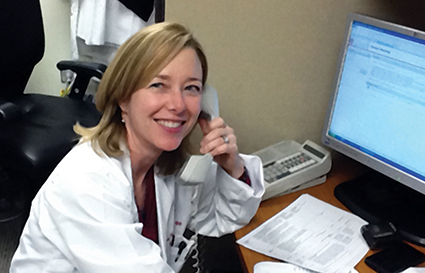
“I can’t describe to you how passionately I believe that [NPs and PAs] have a huge role moving forward,” Cardin says. “I think our representation, our visibility, has sort of been flabby and kind of under the wire for a long time. We can really impact the design of care models at the bedside in a way that’s innovative and more efficient and in a way that’s really huge. I think there’s a transformation that’s going to be coming, and we’re going to be a huge part of it.”
Cardin officially started her new position as a board member in March at HM16 in San Diego. She previously—and fittingly—was chair of SHM’s Nurse Practitioner/Physician Assistant Committee. Last year, she received the society’s Award in Excellence in Hospital Medicine for NPs and PAs. She has worked at the University of Chicago for about 10 years.
SHM Past President Robert Harrington Jr., MD, SFHM, who pushed for her inclusion on the board, says that the value of bringing different perspectives to the society’s board can’t be overstated.
“I’m a family medicine–trained hospitalist, and so from firsthand experience, it was important to me before I ever thought about running for the board that there was some representation of our constituency whether that was at the committee level or at the board level,” Dr. Harrington says. “I think that is part of what drew me to seek a higher voice within SHM. … I thought it was important that somebody represent those growing constituencies.”
Dr. Harrington, who among others refers to SHM as a “big tent organization,” says Cardin’s appointment is evidence of that. He believes that his background in family medicine and her background as an NP show healthcare professionals that SHM is not just a group for doctors.
“It does send a message to the rest of our membership that SHM values those other constituencies and that this is not a physician membership organization but rather a membership organization comprised of people who are interested in improving healthcare for our hospitalized patients,” he says.
In fact, Dr. Harrington says one of the first official actions he took as president was to name Cardin an ex officio member of the board. While that meant she could not vote on issues, her perspective alone helped shape conversations.
“Over the course of the last year, she has proven herself to be exactly what I would have hoped she would be: a voice of an important constituency within our membership,” he says. “And as a result of that, [she] ended up being voted into the board.”
Cardin says the time is perfect for her to bring an added viewpoint to the board. First, the number of NPs and PAs is growing.
“NPs and PAs are such a huge part of all acute-care practices,” says Cardin, a past member of Team Hospitalist, the volunteer editorial advisory group for The Hospitalist. “The State of Hospital Medicine surveys showed that 83% of hospitalist groups are utilizing NPs and PAs. I think that is going to be reflected not only in hospitalist practices but in all acute-care practices—there is going to be more deployment and integration of NPs and PAs into practice.
“[SHM] is ahead of the curve recognizing that value.”
Second, healthcare is undergoing payment reform unseen since the introduction of Medicare and Medicaid. Technology is revamping bedside manner, care delivery, and everything in between. And quality of care is more important than ever as doctors will be increasingly paid for how well patients get, not for services provided to them.
“NP and PA providers can have a great impact on care design and throughput as well as other contributions in the hospital environment,” she adds.
Cardin says there can’t be too many educated viewpoints on complicated issues that will affect care delivery in the United States for decades to come. And the first NP/PA voice might be, gulp, just what the doctors ordered.
“We’re at a pivotal time for this organization and also for healthcare in general with the shifts in how we’re paid and what we’re paid for and the complexity of electronic medical records and fragmented healthcare and billing and quality metrics—there’s just so many challenges right now,” she says. “It’s just hugely humbling to be a part of that and try to anticipate what direction that we as a society should go into.” TH
Richard Quinn is a freelance writer based in New Jersey.
New Society of Hospital Medicine board member Tracy Cardin, ACNP-BC, SFHM, isn’t on the board because she’s a nurse practitioner (NP). But that doesn’t make her election as the first NP or physician assistant (PA) as a voting member of SHM’s oversight panel any less momentous.
“I can’t describe to you how passionately I believe that [NPs and PAs] have a huge role moving forward,” Cardin says. “I think our representation, our visibility, has sort of been flabby and kind of under the wire for a long time. We can really impact the design of care models at the bedside in a way that’s innovative and more efficient and in a way that’s really huge. I think there’s a transformation that’s going to be coming, and we’re going to be a huge part of it.”
Cardin officially started her new position as a board member in March at HM16 in San Diego. She previously—and fittingly—was chair of SHM’s Nurse Practitioner/Physician Assistant Committee. Last year, she received the society’s Award in Excellence in Hospital Medicine for NPs and PAs. She has worked at the University of Chicago for about 10 years.
SHM Past President Robert Harrington Jr., MD, SFHM, who pushed for her inclusion on the board, says that the value of bringing different perspectives to the society’s board can’t be overstated.
“I’m a family medicine–trained hospitalist, and so from firsthand experience, it was important to me before I ever thought about running for the board that there was some representation of our constituency whether that was at the committee level or at the board level,” Dr. Harrington says. “I think that is part of what drew me to seek a higher voice within SHM. … I thought it was important that somebody represent those growing constituencies.”
Dr. Harrington, who among others refers to SHM as a “big tent organization,” says Cardin’s appointment is evidence of that. He believes that his background in family medicine and her background as an NP show healthcare professionals that SHM is not just a group for doctors.
“It does send a message to the rest of our membership that SHM values those other constituencies and that this is not a physician membership organization but rather a membership organization comprised of people who are interested in improving healthcare for our hospitalized patients,” he says.
In fact, Dr. Harrington says one of the first official actions he took as president was to name Cardin an ex officio member of the board. While that meant she could not vote on issues, her perspective alone helped shape conversations.
“Over the course of the last year, she has proven herself to be exactly what I would have hoped she would be: a voice of an important constituency within our membership,” he says. “And as a result of that, [she] ended up being voted into the board.”
Cardin says the time is perfect for her to bring an added viewpoint to the board. First, the number of NPs and PAs is growing.
“NPs and PAs are such a huge part of all acute-care practices,” says Cardin, a past member of Team Hospitalist, the volunteer editorial advisory group for The Hospitalist. “The State of Hospital Medicine surveys showed that 83% of hospitalist groups are utilizing NPs and PAs. I think that is going to be reflected not only in hospitalist practices but in all acute-care practices—there is going to be more deployment and integration of NPs and PAs into practice.
“[SHM] is ahead of the curve recognizing that value.”
Second, healthcare is undergoing payment reform unseen since the introduction of Medicare and Medicaid. Technology is revamping bedside manner, care delivery, and everything in between. And quality of care is more important than ever as doctors will be increasingly paid for how well patients get, not for services provided to them.
“NP and PA providers can have a great impact on care design and throughput as well as other contributions in the hospital environment,” she adds.
Cardin says there can’t be too many educated viewpoints on complicated issues that will affect care delivery in the United States for decades to come. And the first NP/PA voice might be, gulp, just what the doctors ordered.
“We’re at a pivotal time for this organization and also for healthcare in general with the shifts in how we’re paid and what we’re paid for and the complexity of electronic medical records and fragmented healthcare and billing and quality metrics—there’s just so many challenges right now,” she says. “It’s just hugely humbling to be a part of that and try to anticipate what direction that we as a society should go into.” TH
Richard Quinn is a freelance writer based in New Jersey.
New Society of Hospital Medicine board member Tracy Cardin, ACNP-BC, SFHM, isn’t on the board because she’s a nurse practitioner (NP). But that doesn’t make her election as the first NP or physician assistant (PA) as a voting member of SHM’s oversight panel any less momentous.
“I can’t describe to you how passionately I believe that [NPs and PAs] have a huge role moving forward,” Cardin says. “I think our representation, our visibility, has sort of been flabby and kind of under the wire for a long time. We can really impact the design of care models at the bedside in a way that’s innovative and more efficient and in a way that’s really huge. I think there’s a transformation that’s going to be coming, and we’re going to be a huge part of it.”
Cardin officially started her new position as a board member in March at HM16 in San Diego. She previously—and fittingly—was chair of SHM’s Nurse Practitioner/Physician Assistant Committee. Last year, she received the society’s Award in Excellence in Hospital Medicine for NPs and PAs. She has worked at the University of Chicago for about 10 years.
SHM Past President Robert Harrington Jr., MD, SFHM, who pushed for her inclusion on the board, says that the value of bringing different perspectives to the society’s board can’t be overstated.
“I’m a family medicine–trained hospitalist, and so from firsthand experience, it was important to me before I ever thought about running for the board that there was some representation of our constituency whether that was at the committee level or at the board level,” Dr. Harrington says. “I think that is part of what drew me to seek a higher voice within SHM. … I thought it was important that somebody represent those growing constituencies.”
Dr. Harrington, who among others refers to SHM as a “big tent organization,” says Cardin’s appointment is evidence of that. He believes that his background in family medicine and her background as an NP show healthcare professionals that SHM is not just a group for doctors.
“It does send a message to the rest of our membership that SHM values those other constituencies and that this is not a physician membership organization but rather a membership organization comprised of people who are interested in improving healthcare for our hospitalized patients,” he says.
In fact, Dr. Harrington says one of the first official actions he took as president was to name Cardin an ex officio member of the board. While that meant she could not vote on issues, her perspective alone helped shape conversations.
“Over the course of the last year, she has proven herself to be exactly what I would have hoped she would be: a voice of an important constituency within our membership,” he says. “And as a result of that, [she] ended up being voted into the board.”
Cardin says the time is perfect for her to bring an added viewpoint to the board. First, the number of NPs and PAs is growing.
“NPs and PAs are such a huge part of all acute-care practices,” says Cardin, a past member of Team Hospitalist, the volunteer editorial advisory group for The Hospitalist. “The State of Hospital Medicine surveys showed that 83% of hospitalist groups are utilizing NPs and PAs. I think that is going to be reflected not only in hospitalist practices but in all acute-care practices—there is going to be more deployment and integration of NPs and PAs into practice.
“[SHM] is ahead of the curve recognizing that value.”
Second, healthcare is undergoing payment reform unseen since the introduction of Medicare and Medicaid. Technology is revamping bedside manner, care delivery, and everything in between. And quality of care is more important than ever as doctors will be increasingly paid for how well patients get, not for services provided to them.
“NP and PA providers can have a great impact on care design and throughput as well as other contributions in the hospital environment,” she adds.
Cardin says there can’t be too many educated viewpoints on complicated issues that will affect care delivery in the United States for decades to come. And the first NP/PA voice might be, gulp, just what the doctors ordered.
“We’re at a pivotal time for this organization and also for healthcare in general with the shifts in how we’re paid and what we’re paid for and the complexity of electronic medical records and fragmented healthcare and billing and quality metrics—there’s just so many challenges right now,” she says. “It’s just hugely humbling to be a part of that and try to anticipate what direction that we as a society should go into.” TH
Richard Quinn is a freelance writer based in New Jersey.
Helicobacter Pylori Treatment is Associated with a Short-term Increase in the Risk of Neuropsychiatic Events
NEW YORK (Reuters Health) - Helicobacter pylori treatment containing clarithromycin is associated with a short-term increase in the risk of neuropsychiatric events, according to a study from Hong Kong.
Neuropsychiatric events following clarithromycin therapy have been reported previously, but no population-based study had assessed the neuropsychiatric risk associated with clarithromycin.
Dr. Esther W. Chan, from Li Ka Shing Faculty of Medicine, University of Hong Kong, and colleagues used data from the University of Hong Kong Clinical Data Analysis and Reporting System to investigate the association between H. pylori therapy containing clarithromycin and acute neuropsychiatric events.
Current use of clarithromycin as part of the H. pylori regimen was associated with a 4.12-fold increased risk of neuropsychiatric events, including a 5.42-fold increase in psychotic events and a 2.63-fold increase in cognitive impairment, compared with baseline.
These increased risks appear to be limited to days 2 to 14 since the prescription start date, according to the May 2 online report in JAMA Internal Medicine.
The crude absolute risks per 1000 prescriptions were 0.45 for neuropsychiatric events, 0.12 for psychotic events, and 0.12 for cognitive impairment during current use of therapy.
"Given the low absolute neuropsychiatric risk, an abrupt change in prescribing practice based on the observed increase in neuropsychiatric events is not suggested, particularly in the absence of better treatment alternatives," the researchers conclude.
"Such transient neuropsychiatric events will usually resolve spontaneously after treatment cessation and psychiatric interventions can be avoided," the authors note.
"Because we investigated H. pylori therapy as the exposure, we could not pinpoint which drug in the regimen contributed to the neuropsychiatric events in our study," they caution. "We hypothesized that clarithromycin is the most probable drug because very limited evidence suggested that neuropsychiatric
events are associated with amoxicillin or proton pump inhibitors."
Dr. Chan was unable to provide comments in time for publication.
The authors reported no funding or disclosures.
NEW YORK (Reuters Health) - Helicobacter pylori treatment containing clarithromycin is associated with a short-term increase in the risk of neuropsychiatric events, according to a study from Hong Kong.
Neuropsychiatric events following clarithromycin therapy have been reported previously, but no population-based study had assessed the neuropsychiatric risk associated with clarithromycin.
Dr. Esther W. Chan, from Li Ka Shing Faculty of Medicine, University of Hong Kong, and colleagues used data from the University of Hong Kong Clinical Data Analysis and Reporting System to investigate the association between H. pylori therapy containing clarithromycin and acute neuropsychiatric events.
Current use of clarithromycin as part of the H. pylori regimen was associated with a 4.12-fold increased risk of neuropsychiatric events, including a 5.42-fold increase in psychotic events and a 2.63-fold increase in cognitive impairment, compared with baseline.
These increased risks appear to be limited to days 2 to 14 since the prescription start date, according to the May 2 online report in JAMA Internal Medicine.
The crude absolute risks per 1000 prescriptions were 0.45 for neuropsychiatric events, 0.12 for psychotic events, and 0.12 for cognitive impairment during current use of therapy.
"Given the low absolute neuropsychiatric risk, an abrupt change in prescribing practice based on the observed increase in neuropsychiatric events is not suggested, particularly in the absence of better treatment alternatives," the researchers conclude.
"Such transient neuropsychiatric events will usually resolve spontaneously after treatment cessation and psychiatric interventions can be avoided," the authors note.
"Because we investigated H. pylori therapy as the exposure, we could not pinpoint which drug in the regimen contributed to the neuropsychiatric events in our study," they caution. "We hypothesized that clarithromycin is the most probable drug because very limited evidence suggested that neuropsychiatric
events are associated with amoxicillin or proton pump inhibitors."
Dr. Chan was unable to provide comments in time for publication.
The authors reported no funding or disclosures.
NEW YORK (Reuters Health) - Helicobacter pylori treatment containing clarithromycin is associated with a short-term increase in the risk of neuropsychiatric events, according to a study from Hong Kong.
Neuropsychiatric events following clarithromycin therapy have been reported previously, but no population-based study had assessed the neuropsychiatric risk associated with clarithromycin.
Dr. Esther W. Chan, from Li Ka Shing Faculty of Medicine, University of Hong Kong, and colleagues used data from the University of Hong Kong Clinical Data Analysis and Reporting System to investigate the association between H. pylori therapy containing clarithromycin and acute neuropsychiatric events.
Current use of clarithromycin as part of the H. pylori regimen was associated with a 4.12-fold increased risk of neuropsychiatric events, including a 5.42-fold increase in psychotic events and a 2.63-fold increase in cognitive impairment, compared with baseline.
These increased risks appear to be limited to days 2 to 14 since the prescription start date, according to the May 2 online report in JAMA Internal Medicine.
The crude absolute risks per 1000 prescriptions were 0.45 for neuropsychiatric events, 0.12 for psychotic events, and 0.12 for cognitive impairment during current use of therapy.
"Given the low absolute neuropsychiatric risk, an abrupt change in prescribing practice based on the observed increase in neuropsychiatric events is not suggested, particularly in the absence of better treatment alternatives," the researchers conclude.
"Such transient neuropsychiatric events will usually resolve spontaneously after treatment cessation and psychiatric interventions can be avoided," the authors note.
"Because we investigated H. pylori therapy as the exposure, we could not pinpoint which drug in the regimen contributed to the neuropsychiatric events in our study," they caution. "We hypothesized that clarithromycin is the most probable drug because very limited evidence suggested that neuropsychiatric
events are associated with amoxicillin or proton pump inhibitors."
Dr. Chan was unable to provide comments in time for publication.
The authors reported no funding or disclosures.
Leadership Academy to Be Held in Florida
A successful hospitalist program requires strong leadership from the floor to the C-suite. SHM’s Leadership Academy prepares clinical and academic leaders with vital skills traditionally not taught in medical school or typical residency programs. This year’s meeting will be held from October 24 to 27 at Disney’s BoardWalk Inn in Lake Buena Vista, Fla. Courses offered include:
- Leadership Foundations: Evaluate your personal leadership strengths and weaknesses, understand key hospital drivers, and more.
- Advanced Leadership: Influential Management: Learn the skills needed to drive culture change through specific leadership behaviors and actions as well as financial storytelling.
(Prerequisite: Leadership Foundations or an advanced management degree upon course director approval.)
- Advanced Leadership: Mastering Teamwork: Learn to critically assess program growth opportunities, lead and motivate teams, and design effective communication strategies. (Prerequisite: Leadership Foundations or an advanced management degree upon course director approval.)
Build the skills and resources necessary to successfully lead and manage a hospital medicine program now and in the future. Learn more at www.shmleadershipacademy.org.
A successful hospitalist program requires strong leadership from the floor to the C-suite. SHM’s Leadership Academy prepares clinical and academic leaders with vital skills traditionally not taught in medical school or typical residency programs. This year’s meeting will be held from October 24 to 27 at Disney’s BoardWalk Inn in Lake Buena Vista, Fla. Courses offered include:
- Leadership Foundations: Evaluate your personal leadership strengths and weaknesses, understand key hospital drivers, and more.
- Advanced Leadership: Influential Management: Learn the skills needed to drive culture change through specific leadership behaviors and actions as well as financial storytelling.
(Prerequisite: Leadership Foundations or an advanced management degree upon course director approval.)
- Advanced Leadership: Mastering Teamwork: Learn to critically assess program growth opportunities, lead and motivate teams, and design effective communication strategies. (Prerequisite: Leadership Foundations or an advanced management degree upon course director approval.)
Build the skills and resources necessary to successfully lead and manage a hospital medicine program now and in the future. Learn more at www.shmleadershipacademy.org.
A successful hospitalist program requires strong leadership from the floor to the C-suite. SHM’s Leadership Academy prepares clinical and academic leaders with vital skills traditionally not taught in medical school or typical residency programs. This year’s meeting will be held from October 24 to 27 at Disney’s BoardWalk Inn in Lake Buena Vista, Fla. Courses offered include:
- Leadership Foundations: Evaluate your personal leadership strengths and weaknesses, understand key hospital drivers, and more.
- Advanced Leadership: Influential Management: Learn the skills needed to drive culture change through specific leadership behaviors and actions as well as financial storytelling.
(Prerequisite: Leadership Foundations or an advanced management degree upon course director approval.)
- Advanced Leadership: Mastering Teamwork: Learn to critically assess program growth opportunities, lead and motivate teams, and design effective communication strategies. (Prerequisite: Leadership Foundations or an advanced management degree upon course director approval.)
Build the skills and resources necessary to successfully lead and manage a hospital medicine program now and in the future. Learn more at www.shmleadershipacademy.org.
Hospital Medicine's Movers and Shakers – May 2016


Business Moves
Winter Haven Hospital in Winter Haven, Fla., is now offering pediatric hospitalist services thanks to an agreement with Watson Clinic, based in Lakeland, Fla. The new pediatric unit consists of eight beds and is supervised by three pediatric hospitalists. Winter Haven Hospital is a 468-bed nonprofit hospital and is one of 14 hospitals in the BayCare Health System, which serves the greater Tampa Bay region of Florida.


Business Moves
Winter Haven Hospital in Winter Haven, Fla., is now offering pediatric hospitalist services thanks to an agreement with Watson Clinic, based in Lakeland, Fla. The new pediatric unit consists of eight beds and is supervised by three pediatric hospitalists. Winter Haven Hospital is a 468-bed nonprofit hospital and is one of 14 hospitals in the BayCare Health System, which serves the greater Tampa Bay region of Florida.
Business Moves
Winter Haven Hospital in Winter Haven, Fla., is now offering pediatric hospitalist services thanks to an agreement with Watson Clinic, based in Lakeland, Fla. The new pediatric unit consists of eight beds and is supervised by three pediatric hospitalists. Winter Haven Hospital is a 468-bed nonprofit hospital and is one of 14 hospitals in the BayCare Health System, which serves the greater Tampa Bay region of Florida.