User login
WASHINGTON – Only about 11% of health plan payments to physicians and hospitals are tied to performance or efficiency – meaning that almost 90% of payments are still fee for service, according to a report released by Catalyst for Payment Reform.
The San Francisco–based nonprofit is a collaborative of employers and health plans that advocates the overhaul of the nation’s health care payment infrastructure by encouraging more value-based payment.

Using data provided by commercial health plans, the group determined that 11% of hospital payments, 6% of outpatient specialist payments, and 6% of primary care physician payments are "value oriented."
Of those payment arrangements, 57% involve provider risk such as bundled payment, capitation, and shared risk payment. The remaining 43% provide incentives, such as shared savings or pay for performance.
The main goal of Catalyst for Payment Reform (CPR) is to raise the volume of value-based commercial payments to health care providers to 20% by 2020. Coalition members said that they saw reason for both pessimism and optimism in the report’s findings.
"Obviously, these results are pretty disappointing," said Dr. Robert Galvin, chief executive officer of Equity Healthcare, which buys health care coverage for private equity companies. Even so, the report itself represents "the triumph of transparency," he said at the press briefing. "It is just simply good to know."
Susan Delbanco, executive director of CPR, noted that in 2010, 1%-3% of provider payments were tied to performance. Given the latest information, "it looks to me like we are on a fast track and that we may get there before 2020,"she said.
The group’s research also found that about 2% of health plan enrollees are enrolled in an accountable care organization or a patient-centered medical home.
Most health plan payments (about 75%) are still made to specialists, while 25% go to primary care physicians, according to their analysis. Non–fee-for-service payments are still not entirely rewarding or providing incentives to improve the quality of care. Only 35% of those value-based payments have quality of care as a factor.
Dr. Richard Gilfillan, director of the Center for Medicare and Medicaid Innovation at the Centers for Medicare and Medicaid Services, said that the agency was "thrilled" with the report, noting that it showed that private payers were helping encourage a transformation in payment.
"We’re not discouraged – we think that change is happening, it’s underway," Dr. Gilfillan said at the press briefing.
The growing number of physicians participating in new payment models reflects a cultural shift, said Dr. Mark Smith, president and chief executive officer of the California HealthCare Foundation. "I think we have turned the corner on providers recognizing the feasibility, the desirability, and in fact, the inevitability of the kinds of payment reforms that you’ve heard about."
The California HealthCare Foundation and the Commonwealth Fund provided the funding for the National Scorecard on Payment Reform, and a sister effort, the National Compendium on Payment Reform.
The scorecard tabulated data that 57 health plans provided to the National Business Coalition on Health. Participation is voluntary, and not all 57 plans answered all questions posed. The plans represent 104 million people in the commercial group market, or about two-thirds of the total commercially insured population in the United States. Respondents were primarily large health plans, which means the results may not necessarily reflect the entire group market.
Most vascular surgeons deal predominantly with Medicare, which is leading the shift to value-based reimbursement, bundling, and ACO management. This report indicates that the commercial insurance programs surveyed are starting to follow suit. Whether the shift away from fee-for-service to value-based reimbursement is "inevitable" will depend in large part on the strength and integrity of the means of measuring value, including notable contributions from the SVS Vascular Quality Initiative (VQI) and the ACS NSQIP programs.
Predictable challenges include adjusting the system to minimize "gaming" and entrepreneurial bias. In addition, despite the accountability implicit in a name on the operative report, it is not entirely clear how the new system will apply rewards or penalties to individual surgeons as we work more and more within teams of midlevel providers and subspecialists. As we move away from "piece work" and "widget" accounting to protocol-driven pathways and squad care, there will probably be more pressure for many surgeons to work within a larger organization on a salaried model. As is increasingly the case around the country, "productivity" will be measured by RVUs and "value" will be measured by quality metrics, with compensation calculated by a formula resulting in fair allocation of the organization’s global earnings among its members. The soundness and "value" of this monumental change will become clear as we track further developments in the commercial insurance sector. We won't know until the changes in health care are fully implemented if Catalyst for Payment Reform will mean CPR for private practice as we know it.
Dr. Magruder C. Donaldson is chairman of Surgery at Metrowest Medical Center, Framingham, Mass., and an associate medical editor for Vascular Specialist.
Most vascular surgeons deal predominantly with Medicare, which is leading the shift to value-based reimbursement, bundling, and ACO management. This report indicates that the commercial insurance programs surveyed are starting to follow suit. Whether the shift away from fee-for-service to value-based reimbursement is "inevitable" will depend in large part on the strength and integrity of the means of measuring value, including notable contributions from the SVS Vascular Quality Initiative (VQI) and the ACS NSQIP programs.
Predictable challenges include adjusting the system to minimize "gaming" and entrepreneurial bias. In addition, despite the accountability implicit in a name on the operative report, it is not entirely clear how the new system will apply rewards or penalties to individual surgeons as we work more and more within teams of midlevel providers and subspecialists. As we move away from "piece work" and "widget" accounting to protocol-driven pathways and squad care, there will probably be more pressure for many surgeons to work within a larger organization on a salaried model. As is increasingly the case around the country, "productivity" will be measured by RVUs and "value" will be measured by quality metrics, with compensation calculated by a formula resulting in fair allocation of the organization’s global earnings among its members. The soundness and "value" of this monumental change will become clear as we track further developments in the commercial insurance sector. We won't know until the changes in health care are fully implemented if Catalyst for Payment Reform will mean CPR for private practice as we know it.
Dr. Magruder C. Donaldson is chairman of Surgery at Metrowest Medical Center, Framingham, Mass., and an associate medical editor for Vascular Specialist.
Most vascular surgeons deal predominantly with Medicare, which is leading the shift to value-based reimbursement, bundling, and ACO management. This report indicates that the commercial insurance programs surveyed are starting to follow suit. Whether the shift away from fee-for-service to value-based reimbursement is "inevitable" will depend in large part on the strength and integrity of the means of measuring value, including notable contributions from the SVS Vascular Quality Initiative (VQI) and the ACS NSQIP programs.
Predictable challenges include adjusting the system to minimize "gaming" and entrepreneurial bias. In addition, despite the accountability implicit in a name on the operative report, it is not entirely clear how the new system will apply rewards or penalties to individual surgeons as we work more and more within teams of midlevel providers and subspecialists. As we move away from "piece work" and "widget" accounting to protocol-driven pathways and squad care, there will probably be more pressure for many surgeons to work within a larger organization on a salaried model. As is increasingly the case around the country, "productivity" will be measured by RVUs and "value" will be measured by quality metrics, with compensation calculated by a formula resulting in fair allocation of the organization’s global earnings among its members. The soundness and "value" of this monumental change will become clear as we track further developments in the commercial insurance sector. We won't know until the changes in health care are fully implemented if Catalyst for Payment Reform will mean CPR for private practice as we know it.
Dr. Magruder C. Donaldson is chairman of Surgery at Metrowest Medical Center, Framingham, Mass., and an associate medical editor for Vascular Specialist.
WASHINGTON – Only about 11% of health plan payments to physicians and hospitals are tied to performance or efficiency – meaning that almost 90% of payments are still fee for service, according to a report released by Catalyst for Payment Reform.
The San Francisco–based nonprofit is a collaborative of employers and health plans that advocates the overhaul of the nation’s health care payment infrastructure by encouraging more value-based payment.
Using data provided by commercial health plans, the group determined that 11% of hospital payments, 6% of outpatient specialist payments, and 6% of primary care physician payments are "value oriented."
Of those payment arrangements, 57% involve provider risk such as bundled payment, capitation, and shared risk payment. The remaining 43% provide incentives, such as shared savings or pay for performance.
The main goal of Catalyst for Payment Reform (CPR) is to raise the volume of value-based commercial payments to health care providers to 20% by 2020. Coalition members said that they saw reason for both pessimism and optimism in the report’s findings.
"Obviously, these results are pretty disappointing," said Dr. Robert Galvin, chief executive officer of Equity Healthcare, which buys health care coverage for private equity companies. Even so, the report itself represents "the triumph of transparency," he said at the press briefing. "It is just simply good to know."
Susan Delbanco, executive director of CPR, noted that in 2010, 1%-3% of provider payments were tied to performance. Given the latest information, "it looks to me like we are on a fast track and that we may get there before 2020,"she said.
The group’s research also found that about 2% of health plan enrollees are enrolled in an accountable care organization or a patient-centered medical home.
Most health plan payments (about 75%) are still made to specialists, while 25% go to primary care physicians, according to their analysis. Non–fee-for-service payments are still not entirely rewarding or providing incentives to improve the quality of care. Only 35% of those value-based payments have quality of care as a factor.
Dr. Richard Gilfillan, director of the Center for Medicare and Medicaid Innovation at the Centers for Medicare and Medicaid Services, said that the agency was "thrilled" with the report, noting that it showed that private payers were helping encourage a transformation in payment.
"We’re not discouraged – we think that change is happening, it’s underway," Dr. Gilfillan said at the press briefing.
The growing number of physicians participating in new payment models reflects a cultural shift, said Dr. Mark Smith, president and chief executive officer of the California HealthCare Foundation. "I think we have turned the corner on providers recognizing the feasibility, the desirability, and in fact, the inevitability of the kinds of payment reforms that you’ve heard about."
The California HealthCare Foundation and the Commonwealth Fund provided the funding for the National Scorecard on Payment Reform, and a sister effort, the National Compendium on Payment Reform.
The scorecard tabulated data that 57 health plans provided to the National Business Coalition on Health. Participation is voluntary, and not all 57 plans answered all questions posed. The plans represent 104 million people in the commercial group market, or about two-thirds of the total commercially insured population in the United States. Respondents were primarily large health plans, which means the results may not necessarily reflect the entire group market.
WASHINGTON – Only about 11% of health plan payments to physicians and hospitals are tied to performance or efficiency – meaning that almost 90% of payments are still fee for service, according to a report released by Catalyst for Payment Reform.
The San Francisco–based nonprofit is a collaborative of employers and health plans that advocates the overhaul of the nation’s health care payment infrastructure by encouraging more value-based payment.
Using data provided by commercial health plans, the group determined that 11% of hospital payments, 6% of outpatient specialist payments, and 6% of primary care physician payments are "value oriented."
Of those payment arrangements, 57% involve provider risk such as bundled payment, capitation, and shared risk payment. The remaining 43% provide incentives, such as shared savings or pay for performance.
The main goal of Catalyst for Payment Reform (CPR) is to raise the volume of value-based commercial payments to health care providers to 20% by 2020. Coalition members said that they saw reason for both pessimism and optimism in the report’s findings.
"Obviously, these results are pretty disappointing," said Dr. Robert Galvin, chief executive officer of Equity Healthcare, which buys health care coverage for private equity companies. Even so, the report itself represents "the triumph of transparency," he said at the press briefing. "It is just simply good to know."
Susan Delbanco, executive director of CPR, noted that in 2010, 1%-3% of provider payments were tied to performance. Given the latest information, "it looks to me like we are on a fast track and that we may get there before 2020,"she said.
The group’s research also found that about 2% of health plan enrollees are enrolled in an accountable care organization or a patient-centered medical home.
Most health plan payments (about 75%) are still made to specialists, while 25% go to primary care physicians, according to their analysis. Non–fee-for-service payments are still not entirely rewarding or providing incentives to improve the quality of care. Only 35% of those value-based payments have quality of care as a factor.
Dr. Richard Gilfillan, director of the Center for Medicare and Medicaid Innovation at the Centers for Medicare and Medicaid Services, said that the agency was "thrilled" with the report, noting that it showed that private payers were helping encourage a transformation in payment.
"We’re not discouraged – we think that change is happening, it’s underway," Dr. Gilfillan said at the press briefing.
The growing number of physicians participating in new payment models reflects a cultural shift, said Dr. Mark Smith, president and chief executive officer of the California HealthCare Foundation. "I think we have turned the corner on providers recognizing the feasibility, the desirability, and in fact, the inevitability of the kinds of payment reforms that you’ve heard about."
The California HealthCare Foundation and the Commonwealth Fund provided the funding for the National Scorecard on Payment Reform, and a sister effort, the National Compendium on Payment Reform.
The scorecard tabulated data that 57 health plans provided to the National Business Coalition on Health. Participation is voluntary, and not all 57 plans answered all questions posed. The plans represent 104 million people in the commercial group market, or about two-thirds of the total commercially insured population in the United States. Respondents were primarily large health plans, which means the results may not necessarily reflect the entire group market.
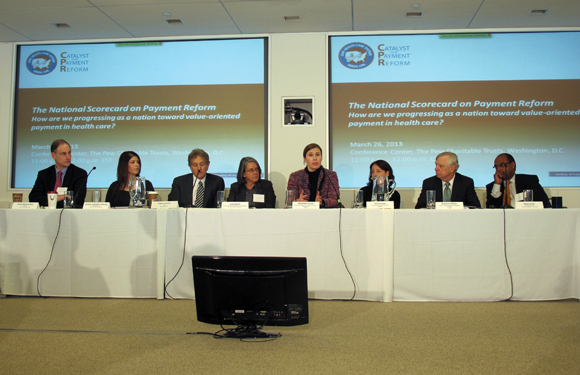
AT A PRESS BRIEFING HELD BY CATALYST FOR PAYMENT REFORM