User login
Dermatology Author Gender Trends During the COVID-19 Pandemic
To the Editor:
Peer-reviewed publications are important determinants for promotions, academic leadership, and grants in dermatology.1 The impact of the COVID-19 pandemic on dermatology research productivity remains an area of investigation. We sought to determine authorship trends for males and females during the pandemic.
A cross-sectional retrospective study of the top 20 dermatology journals—determined by impact factor and Google Scholar H5-index—was conducted to identify manuscripts with submission date specified prepandemic (May 1, 2019–October 31, 2019) and during the pandemic (May 1, 2020–October 31, 2020). Submission date, first/last author name, sex, and affiliated country were extracted. Single authors were designated as first authors. Gender API (https://gender-api.com/en/) classified gender. A χ2 test (P<.05) compared differences in proportions of female first/last authors from 2019 to 2020.
Overall, 811 and 1061 articles submitted in 2019 and 2020, respectively, were included. There were 1517 articles submitted to clinical journals and 355 articles submitted to basic science journals (Table). For the 7 clinical journals included, there was a 7.7% decrease in the proportion of female last authors in 2020 vs 2019 (P=.002), with the largest decrease between August and September 2020. Although other comparisons did not yield statistically significant differences (P>.05 all)(Table), several trends were observed. For clinical journals, there was a 1.8% decrease in the proportion of female first authors. For the 4 basic science journals included, there was a 4.9% increase and a 0.3% decrease in percentages of female first and last authors, respectively, for 2020 vs 2019.
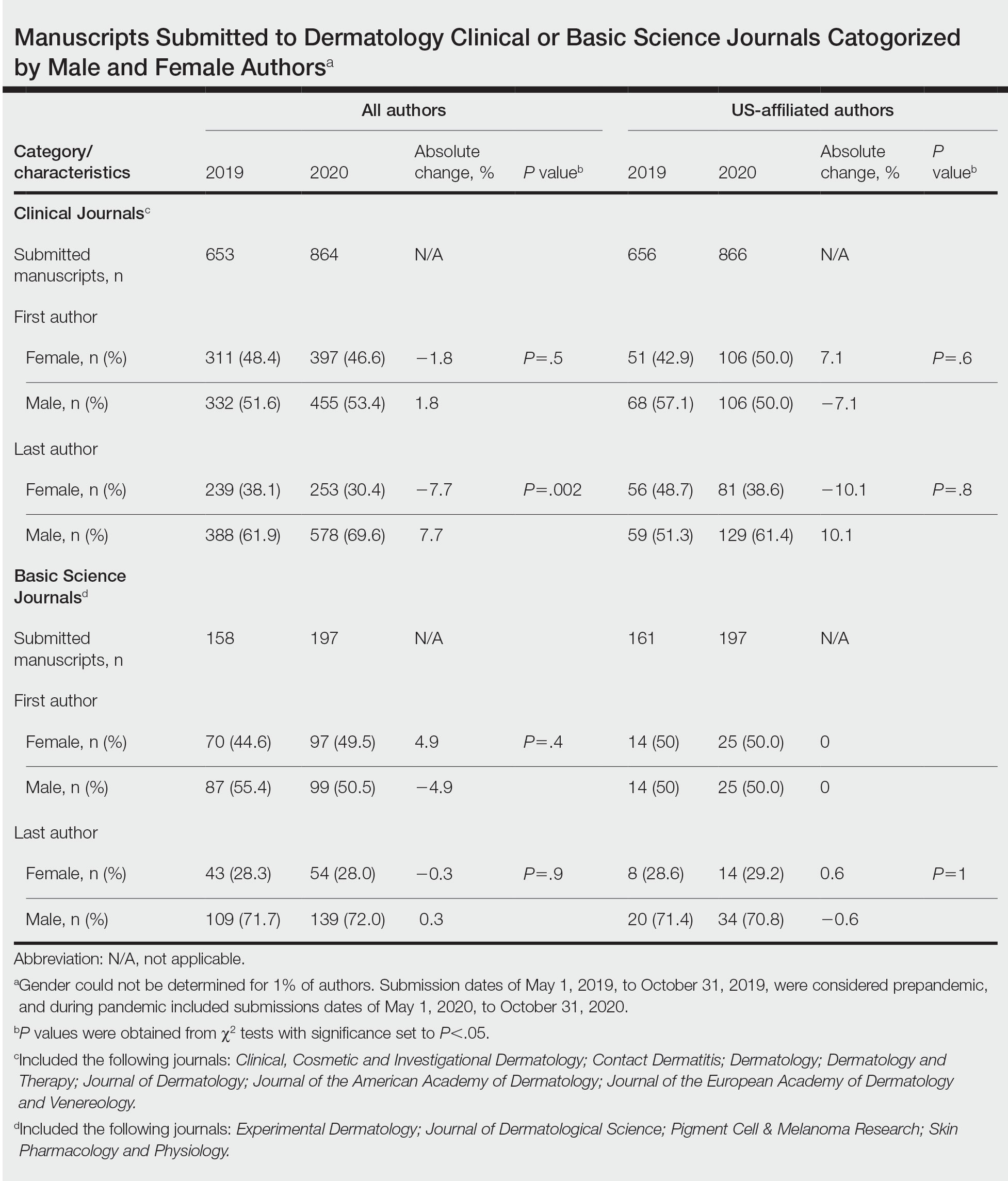
Our findings indicate that the COVID-19 pandemic may have impacted female authors’ productivity in clinical dermatology publications. In a survey-based study for 2010 to 2011, female physician-researchers (n=437) spent 8.5 more hours per week on domestic activities and childcare and were more likely to take time off for childcare if their partner worked full time compared with males (n=612)(42.6% vs 12.4%, respectively).2 Our observation that female last authors had a significant decrease in publications may suggest that this population had a disproportionate burden of domestic labor and childcare during the pandemic. It is possible that last authors, who generally are more senior researchers, may be more likely to have childcare, eldercare, and other types of domestic responsibilities. Similarly, in a study of surgery submissions (n=1068), there were 6%, 7%, and 4% decreases in percentages of female last, corresponding, and first authors, respectively, from 2019 to 2020.3Our study had limitations. Only 11 journals were analyzed because others did not have specified submission dates. Some journals only provided submission information for a subset of articles (eg, those published in the In Press section), which may have accounted for the large discrepancy in submission numbers for 2019 to 2020. Gender could not be determined for 1% of authors and was limited to female and male. Although our study submission time frame (May–October 2020) aimed at identifying research conducted during the height of the COVID-19 pandemic, some of these studies may have been conducted months or years before the pandemic. Future studies should focus on longer and more comprehensive time frames. Finally, estimated dates of stay-at-home orders fail to consider differences within countries.
The proportion of female US-affiliated first and last authors publishing in dermatology journals increased from 12% to 48% in 1976 and from 6% to 31% in 2006,4 which is encouraging. However, a gender gap persists, with one-third of National Institutes of Health grants in dermatology and one-fourth of research project grants in dermatology awarded to women.5 Consequences of the pandemic on academic productivity may include fewer women represented in higher academic ranks, lower compensation, and lower career satisfaction compared with men.1 We urge academic institutions and funding agencies to recognize and take action to mitigate long-term sequelae. Extended grant end dates and submission periods, funding opportunities dedicated to women, and prioritization of female-authored submissions are some strategies that can safeguard equitable career progression in dermatology research.
- Stewart C, Lipner SR. Gender and race trends in academic rank of dermatologists at top U.S. institutions: a cross-sectional study. Int J Womens Dermatol. 2020;6:283-285. doi:10.1016/j .ijwd.2020.04.010
- Jolly S, Griffith KA, DeCastro R, et al. Gender differences in time spent on parenting and domestic responsibilities by highachieving young physician-researchers. Ann Intern Med. 2014; 160:344-353. doi:10.7326/M13-0974
- Kibbe MR. Consequences of the COVID-19 pandemic on manuscript submissions by women. JAMA Surg. 2020;155:803-804. doi:10.1001/jamasurg.2020.3917
- Feramisco JD, Leitenberger JJ, Redfern SI, et al. A gender gap in the dermatology literature? cross-sectional analysis of manuscript authorship trends in dermatology journals during 3 decades. J Am Acad Dermatol. 2009;6:63-69. doi:10.1016/j.jaad.2008.06.044
- Cheng MY, Sukhov A, Sultani H, et al. Trends in national institutes of health funding of principal investigators in dermatology research by academic degree and sex. JAMA Dermatol. 2016;152:883-888. doi:10.1001/jamadermatol.2016.0271
To the Editor:
Peer-reviewed publications are important determinants for promotions, academic leadership, and grants in dermatology.1 The impact of the COVID-19 pandemic on dermatology research productivity remains an area of investigation. We sought to determine authorship trends for males and females during the pandemic.
A cross-sectional retrospective study of the top 20 dermatology journals—determined by impact factor and Google Scholar H5-index—was conducted to identify manuscripts with submission date specified prepandemic (May 1, 2019–October 31, 2019) and during the pandemic (May 1, 2020–October 31, 2020). Submission date, first/last author name, sex, and affiliated country were extracted. Single authors were designated as first authors. Gender API (https://gender-api.com/en/) classified gender. A χ2 test (P<.05) compared differences in proportions of female first/last authors from 2019 to 2020.
Overall, 811 and 1061 articles submitted in 2019 and 2020, respectively, were included. There were 1517 articles submitted to clinical journals and 355 articles submitted to basic science journals (Table). For the 7 clinical journals included, there was a 7.7% decrease in the proportion of female last authors in 2020 vs 2019 (P=.002), with the largest decrease between August and September 2020. Although other comparisons did not yield statistically significant differences (P>.05 all)(Table), several trends were observed. For clinical journals, there was a 1.8% decrease in the proportion of female first authors. For the 4 basic science journals included, there was a 4.9% increase and a 0.3% decrease in percentages of female first and last authors, respectively, for 2020 vs 2019.
Our findings indicate that the COVID-19 pandemic may have impacted female authors’ productivity in clinical dermatology publications. In a survey-based study for 2010 to 2011, female physician-researchers (n=437) spent 8.5 more hours per week on domestic activities and childcare and were more likely to take time off for childcare if their partner worked full time compared with males (n=612)(42.6% vs 12.4%, respectively).2 Our observation that female last authors had a significant decrease in publications may suggest that this population had a disproportionate burden of domestic labor and childcare during the pandemic. It is possible that last authors, who generally are more senior researchers, may be more likely to have childcare, eldercare, and other types of domestic responsibilities. Similarly, in a study of surgery submissions (n=1068), there were 6%, 7%, and 4% decreases in percentages of female last, corresponding, and first authors, respectively, from 2019 to 2020.3Our study had limitations. Only 11 journals were analyzed because others did not have specified submission dates. Some journals only provided submission information for a subset of articles (eg, those published in the In Press section), which may have accounted for the large discrepancy in submission numbers for 2019 to 2020. Gender could not be determined for 1% of authors and was limited to female and male. Although our study submission time frame (May–October 2020) aimed at identifying research conducted during the height of the COVID-19 pandemic, some of these studies may have been conducted months or years before the pandemic. Future studies should focus on longer and more comprehensive time frames. Finally, estimated dates of stay-at-home orders fail to consider differences within countries.
The proportion of female US-affiliated first and last authors publishing in dermatology journals increased from 12% to 48% in 1976 and from 6% to 31% in 2006,4 which is encouraging. However, a gender gap persists, with one-third of National Institutes of Health grants in dermatology and one-fourth of research project grants in dermatology awarded to women.5 Consequences of the pandemic on academic productivity may include fewer women represented in higher academic ranks, lower compensation, and lower career satisfaction compared with men.1 We urge academic institutions and funding agencies to recognize and take action to mitigate long-term sequelae. Extended grant end dates and submission periods, funding opportunities dedicated to women, and prioritization of female-authored submissions are some strategies that can safeguard equitable career progression in dermatology research.
To the Editor:
Peer-reviewed publications are important determinants for promotions, academic leadership, and grants in dermatology.1 The impact of the COVID-19 pandemic on dermatology research productivity remains an area of investigation. We sought to determine authorship trends for males and females during the pandemic.
A cross-sectional retrospective study of the top 20 dermatology journals—determined by impact factor and Google Scholar H5-index—was conducted to identify manuscripts with submission date specified prepandemic (May 1, 2019–October 31, 2019) and during the pandemic (May 1, 2020–October 31, 2020). Submission date, first/last author name, sex, and affiliated country were extracted. Single authors were designated as first authors. Gender API (https://gender-api.com/en/) classified gender. A χ2 test (P<.05) compared differences in proportions of female first/last authors from 2019 to 2020.
Overall, 811 and 1061 articles submitted in 2019 and 2020, respectively, were included. There were 1517 articles submitted to clinical journals and 355 articles submitted to basic science journals (Table). For the 7 clinical journals included, there was a 7.7% decrease in the proportion of female last authors in 2020 vs 2019 (P=.002), with the largest decrease between August and September 2020. Although other comparisons did not yield statistically significant differences (P>.05 all)(Table), several trends were observed. For clinical journals, there was a 1.8% decrease in the proportion of female first authors. For the 4 basic science journals included, there was a 4.9% increase and a 0.3% decrease in percentages of female first and last authors, respectively, for 2020 vs 2019.
Our findings indicate that the COVID-19 pandemic may have impacted female authors’ productivity in clinical dermatology publications. In a survey-based study for 2010 to 2011, female physician-researchers (n=437) spent 8.5 more hours per week on domestic activities and childcare and were more likely to take time off for childcare if their partner worked full time compared with males (n=612)(42.6% vs 12.4%, respectively).2 Our observation that female last authors had a significant decrease in publications may suggest that this population had a disproportionate burden of domestic labor and childcare during the pandemic. It is possible that last authors, who generally are more senior researchers, may be more likely to have childcare, eldercare, and other types of domestic responsibilities. Similarly, in a study of surgery submissions (n=1068), there were 6%, 7%, and 4% decreases in percentages of female last, corresponding, and first authors, respectively, from 2019 to 2020.3Our study had limitations. Only 11 journals were analyzed because others did not have specified submission dates. Some journals only provided submission information for a subset of articles (eg, those published in the In Press section), which may have accounted for the large discrepancy in submission numbers for 2019 to 2020. Gender could not be determined for 1% of authors and was limited to female and male. Although our study submission time frame (May–October 2020) aimed at identifying research conducted during the height of the COVID-19 pandemic, some of these studies may have been conducted months or years before the pandemic. Future studies should focus on longer and more comprehensive time frames. Finally, estimated dates of stay-at-home orders fail to consider differences within countries.
The proportion of female US-affiliated first and last authors publishing in dermatology journals increased from 12% to 48% in 1976 and from 6% to 31% in 2006,4 which is encouraging. However, a gender gap persists, with one-third of National Institutes of Health grants in dermatology and one-fourth of research project grants in dermatology awarded to women.5 Consequences of the pandemic on academic productivity may include fewer women represented in higher academic ranks, lower compensation, and lower career satisfaction compared with men.1 We urge academic institutions and funding agencies to recognize and take action to mitigate long-term sequelae. Extended grant end dates and submission periods, funding opportunities dedicated to women, and prioritization of female-authored submissions are some strategies that can safeguard equitable career progression in dermatology research.
- Stewart C, Lipner SR. Gender and race trends in academic rank of dermatologists at top U.S. institutions: a cross-sectional study. Int J Womens Dermatol. 2020;6:283-285. doi:10.1016/j .ijwd.2020.04.010
- Jolly S, Griffith KA, DeCastro R, et al. Gender differences in time spent on parenting and domestic responsibilities by highachieving young physician-researchers. Ann Intern Med. 2014; 160:344-353. doi:10.7326/M13-0974
- Kibbe MR. Consequences of the COVID-19 pandemic on manuscript submissions by women. JAMA Surg. 2020;155:803-804. doi:10.1001/jamasurg.2020.3917
- Feramisco JD, Leitenberger JJ, Redfern SI, et al. A gender gap in the dermatology literature? cross-sectional analysis of manuscript authorship trends in dermatology journals during 3 decades. J Am Acad Dermatol. 2009;6:63-69. doi:10.1016/j.jaad.2008.06.044
- Cheng MY, Sukhov A, Sultani H, et al. Trends in national institutes of health funding of principal investigators in dermatology research by academic degree and sex. JAMA Dermatol. 2016;152:883-888. doi:10.1001/jamadermatol.2016.0271
- Stewart C, Lipner SR. Gender and race trends in academic rank of dermatologists at top U.S. institutions: a cross-sectional study. Int J Womens Dermatol. 2020;6:283-285. doi:10.1016/j .ijwd.2020.04.010
- Jolly S, Griffith KA, DeCastro R, et al. Gender differences in time spent on parenting and domestic responsibilities by highachieving young physician-researchers. Ann Intern Med. 2014; 160:344-353. doi:10.7326/M13-0974
- Kibbe MR. Consequences of the COVID-19 pandemic on manuscript submissions by women. JAMA Surg. 2020;155:803-804. doi:10.1001/jamasurg.2020.3917
- Feramisco JD, Leitenberger JJ, Redfern SI, et al. A gender gap in the dermatology literature? cross-sectional analysis of manuscript authorship trends in dermatology journals during 3 decades. J Am Acad Dermatol. 2009;6:63-69. doi:10.1016/j.jaad.2008.06.044
- Cheng MY, Sukhov A, Sultani H, et al. Trends in national institutes of health funding of principal investigators in dermatology research by academic degree and sex. JAMA Dermatol. 2016;152:883-888. doi:10.1001/jamadermatol.2016.0271
Practice Points
- The academic productivity of female dermatologists as last authors in dermatology clinical journals has potentially been impacted by the COVID-19 pandemic.
- To potentially aid in the resurgence of female dermatologist authors impacted by the pandemic, academic institutions and funding agencies may consider implementing strategies such as extending grant end dates, providing dedicated funding opportunities, and prioritizing female-authored submissions in dermatology research.
Dupilumab-Associated Sweet Syndrome
Sweet syndrome (SS), also known as acute febrile neutrophilic dermatosis, was first described in 1964. 1 Since then, several subtypes of SS have been recognized, including classic or idiopathic, which typically follows an acute viral illness; cancer related, typically in the form of a paraneoplastic syndrome; and drug induced. 2 Drug-induced SS is defined by the following: (1) an abrupt onset of painful erythematous plaques or nodules; (2) histopathologic evidence of a dense neutrophilic infiltrate without evidence of leukocytoclastic vasculitis; (3) pyrexia above 38 ° C; (4) temporal relationship between drug and clinical presentation or temporally related recurrence after rechallenge; and (5) temporally related resolution of lesions after drug withdrawal or treatment with systemic corticosteroids. 3 All 5 criteria must be met to make a diagnosis of drug-induced SS. Since these criteria were established by Walker and Cohen, 3 various drugs have been identified as causative agents, including antibiotics, antiepileptics, antiretrovirals, antineoplastic agents, antipsychotics, oral contraceptives, nonsteroidal anti-inflammatory agents, and retinoids. 4 W e present a rare case of SS caused by dupilumab, a monoclonal antibody therapy, used in the treatment of severe eosinophilic asthma and atopic dermatitis.
Case Report
A 53-year-old woman presented with painful skin lesions, arthralgia, fever, and leukocytosis following initiation of dupilumab. She had a history of adult-onset, severe, persistent eosinophilic asthma, as well as chronic rhinosinusitis with nasal polyps, plaque psoriasis, and hypertrophic cardiomyopathy. She started mepolizumab 3 years prior to the current presentation for persistently uncontrolled asthma with a baseline peripheral eosinophil count of 860 cells/µL. After 3 years of minimal response to mepolizumab, she was started on dupilumab. Within 2 weeks of the first dose of dupilumab, she started experiencing bilateral knee pain. She subsequently developed daily fevers (temperature, 38.3 °C to 39.4 °C), fatigue, and pain in the back of the neck and head. After the second dose of dupilumab, she started experiencing painful skin lesions on the bilateral knuckles, elbows, and abdomen (Figure 1). She had difficulty using her hands and walking secondary to intense arthralgia involving the bilateral finger joints, elbows, and knees. Her primary care physician obtained a laboratory evaluation, which revealed an elevated total white blood cell count of 20×103/mm3 (reference range, 4–11×103/mm3) with 27.5% neutrophils and severely elevated eosinophils above her baseline to 57.3% with an absolute eosinophil count of 11,700 cells/µL (reference range, <400 cells/µL). Further assessment revealed an elevated erythrocyte sedimentation rate of 64 mm/h (reference range, 0–30 mm/h) and C-reactive protein level of 34 mg/dL (reference range, ≤0.80 mg/dL), with negative antinuclear antibody, rheumatoid factor, antineutrophilic cytoplasmic antibody, and Lyme antibody. IgG, IgA, and IgM levels were within reference range, and the IgE level was not elevated above her baseline. She had normal serum tryptase, and a peripheral D816V c-KIT mutation was not detected. She was subsequently hospitalized for further evaluation, at which time there was no fever or localizing infectious signs or symptoms. An infectious evaluation including urinalysis; respiratory swab for adenovirus, coronaviruses, human metapneumovirus, rhinovirus/enterovirus, influenza A and B, parainfluenza viruses, respiratory syncytial virus, Chlamydophila pneumoniae, and Mycoplasma pneumoniae; Lyme serology; and a computed tomography (CT) scan of the chest, abdomen, and pelvis revealed no evidence of infection. A parasite evaluation was ordered but was not performed. There was no evidence of malignancy on CT of the chest, abdomen, and pelvis or CT of the head without contrast. A lumbar puncture was considered but was ultimately deferred.

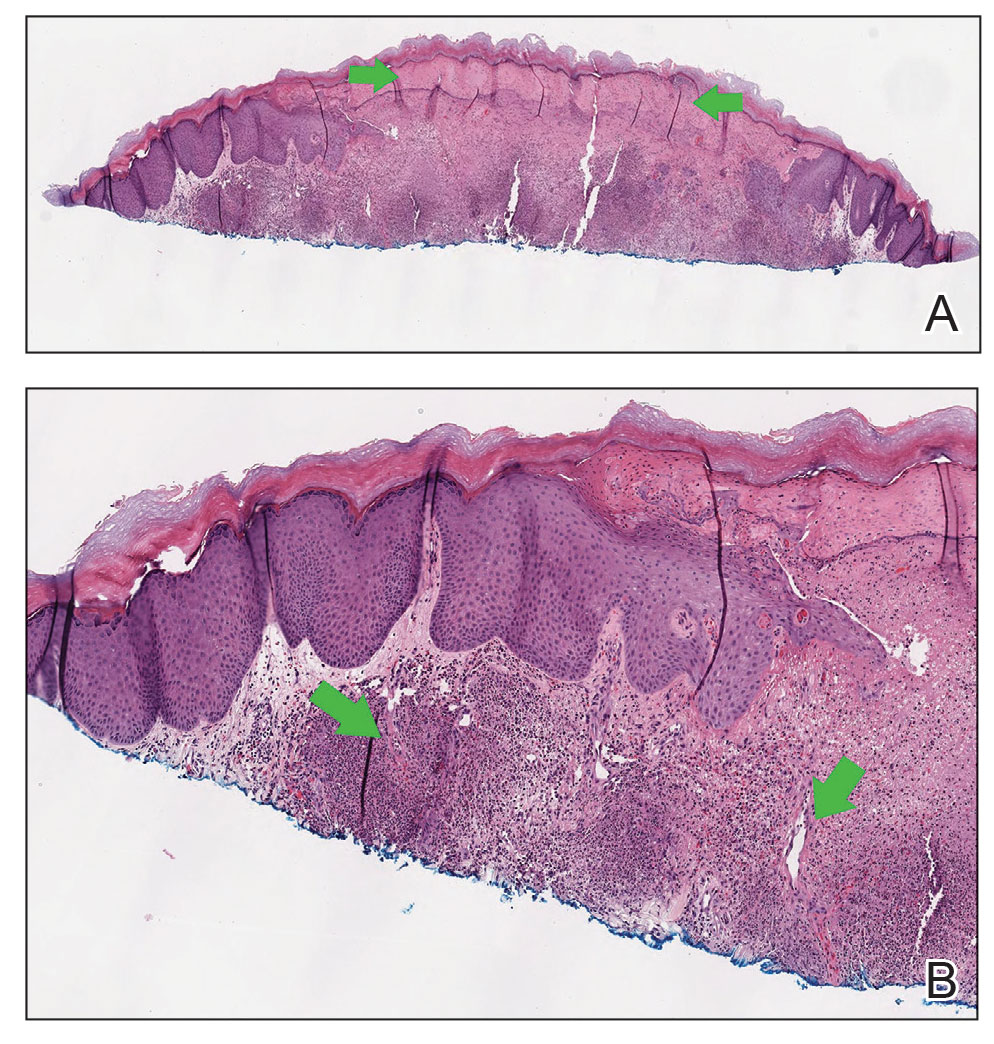
At the current presentation, the patient was following up in the dermatology clinic shortly after discharge. The lesions on the fingers and arms were described by the dermatologist as deep, erythematous, 0.5-cm bullous papules. The differential diagnosis at this time included a cutaneous or systemic infection, vasculitis, drug eruption, or cutaneous manifestation of an autoimmune condition. A shave biopsy of a skin lesion on the right hand demonstrated epidermal necrosis with a dense dermal neutrophilic infiltrate consistent with a neutrophilic dermatosis (Figure 2). There was no evidence of leukocytoclastic vasculitis. The histologic differential diagnosis included cutaneous infection, neutrophilic dermatosis of the hand, and SS. Special stains for infectious organisms including Gram, Grocott methenamine-silver, and auramine-rhodamine stains were negative for bacterial, fungal, and mycobacterial organisms, ruling out cutaneous infection. A diagnosis of drug-induced SS was made based on the histologic findings, diffuse distribution of the lesions, negative infectious evaluation, lack of underlying malignancy or autoimmune conditions, and onset following initiation of dupilumab.
Dupilumab was discontinued, and the patient was started on prednisone with rapid improvement in the symptoms. She underwent a slow taper of the prednisone over approximately 2 months with a slow downtrend of eosinophils. She was transitioned to a different biologic agent, benralizumab, with no further recurrence of the rash or arthralgia.
Comment
Dupilumab is a human monoclonal IgG4 antibody that inhibits IL-4 and IL-13 signaling by binding to the IL-4Rα subunit. By blocking IL-4Rα, dupilumab inhibits IL-4 and IL-13 cytokine-induced inflammatory responses, including the release of proinflammatory cytokines, chemokines, nitric oxide, and IgE. Currently, dupilumab is approved to treat refractory forms of moderate to severe asthma characterized by an eosinophilic phenotype or with corticosteroid-dependent asthma, moderate to severe atopic dermatitis, chronic rhinosinusitis with nasal polyposis, and eosinophilic esophagitis. The most common adverse events (incidence ≥1%) are injection-site reactions, oropharyngeal pain, and eosinophilia.5 Interestingly, our patient did exhibit a high degree of eosinophilia; however, she met all criteria for drug-induced SS, and the skin biopsy was not consistent with an eosinophilic process. Notably, the peripheral neutrophils were not elevated. Neutrophilia often is seen in classic SS but is not required for a diagnosis of drug-induced SS. Rare cases of dupilumab-associated arthritis and serum sickness–like reaction have been described,6-8 but our patient’s presentation was distinct, given other described signs, symptoms, and skin biopsy results. Histopathology results were not consistent with leukocytoclastic vasculitis, a potential mimicker of SS. Although the infectious and paraneoplastic evaluation was not exhaustive, the negative imaging from head to pelvis, the lack of recurrence of skin lesions, and the laboratory abnormalities after dupilumab discontinuation supported the conclusion that the culprit was not an infection or underlying malignancy. She had not started any other medications during this time frame, leaving dupilumab as the most likely offending agent. The mechanism for this reaction is not clear. It is possible that inhibition of IL-4 and IL-13 in the T helper 2 (TH2) cell pathway may have led to upregulated IL-17–mediated inflammation9 as well as a neutrophilic process in the skin, but this would not explain the concurrent peripheral eosinophilia that was noted. Further studies are needed to investigate the pathophysiology of SS.
Conclusion
We report a rare case of dupilumab-induced SS. Corticosteroids accompanied by cessation of the medication proved to be an effective treatment.
- Sweet RB. An acute febrile neutrophilic dermatosis. Br J Dermatol. 1964;76:349-356.
- Cohen PR, Kurzrock R. Sweet’s syndrome revisited: a review of disease concepts. Int J Dermatol. 2003;42:761-778.
- Walker DC, Cohen PR. Trimethoprim-sulfamethoxazole-associated acute febrile neutrophilic dermatosis: case report and review of drug-induced Sweet’s syndrome. J Am Acad Dermatol. 1996;34:918-923.
- Cohen PR. Sweet’s syndrome—a comprehensive review of an acute febrile neutrophilic dermatosis. Orphanet J Rare Dis. 2007;2:34.
- Jackson K, Bahna SL. Hypersensitivity and adverse reactions to biologics for asthma and allergic diseases. Expert Rev Clin Immunol. 2020;16:311-319.
- Willsmore ZN, Woolf RT, Hughes C, et al. Development of inflammatory arthritis and enthesitis in patients on dupilumab: a case series. Br J Dermatol. 2019;181:1068-1070.
- de Wijs LEM, van der Waa JD, de Jong PHP, et al. Acute arthritis and arthralgia as an adverse drug reaction to dupilumab. Clin Exp Dermatol. 2020;45:262-263.
- Treudler R, Delaroque N, Puder M, et al. Dupilumab-induced serum sickness-like reaction: an unusual adverse effect in a patient with atopic eczema. J Eur Acad Dermatol Venereol. 2021;35:E30-E32.
- Guenova E, Skabytska Y, Hoetzenecker W, et al. IL-4 abrogates TH17 cell-mediated inflammation by selective silencing of IL-23 in antigen-presenting cells. Proc Natl Acad Sci U S A. 2015;112:2163-2168.
Sweet syndrome (SS), also known as acute febrile neutrophilic dermatosis, was first described in 1964. 1 Since then, several subtypes of SS have been recognized, including classic or idiopathic, which typically follows an acute viral illness; cancer related, typically in the form of a paraneoplastic syndrome; and drug induced. 2 Drug-induced SS is defined by the following: (1) an abrupt onset of painful erythematous plaques or nodules; (2) histopathologic evidence of a dense neutrophilic infiltrate without evidence of leukocytoclastic vasculitis; (3) pyrexia above 38 ° C; (4) temporal relationship between drug and clinical presentation or temporally related recurrence after rechallenge; and (5) temporally related resolution of lesions after drug withdrawal or treatment with systemic corticosteroids. 3 All 5 criteria must be met to make a diagnosis of drug-induced SS. Since these criteria were established by Walker and Cohen, 3 various drugs have been identified as causative agents, including antibiotics, antiepileptics, antiretrovirals, antineoplastic agents, antipsychotics, oral contraceptives, nonsteroidal anti-inflammatory agents, and retinoids. 4 W e present a rare case of SS caused by dupilumab, a monoclonal antibody therapy, used in the treatment of severe eosinophilic asthma and atopic dermatitis.
Case Report
A 53-year-old woman presented with painful skin lesions, arthralgia, fever, and leukocytosis following initiation of dupilumab. She had a history of adult-onset, severe, persistent eosinophilic asthma, as well as chronic rhinosinusitis with nasal polyps, plaque psoriasis, and hypertrophic cardiomyopathy. She started mepolizumab 3 years prior to the current presentation for persistently uncontrolled asthma with a baseline peripheral eosinophil count of 860 cells/µL. After 3 years of minimal response to mepolizumab, she was started on dupilumab. Within 2 weeks of the first dose of dupilumab, she started experiencing bilateral knee pain. She subsequently developed daily fevers (temperature, 38.3 °C to 39.4 °C), fatigue, and pain in the back of the neck and head. After the second dose of dupilumab, she started experiencing painful skin lesions on the bilateral knuckles, elbows, and abdomen (Figure 1). She had difficulty using her hands and walking secondary to intense arthralgia involving the bilateral finger joints, elbows, and knees. Her primary care physician obtained a laboratory evaluation, which revealed an elevated total white blood cell count of 20×103/mm3 (reference range, 4–11×103/mm3) with 27.5% neutrophils and severely elevated eosinophils above her baseline to 57.3% with an absolute eosinophil count of 11,700 cells/µL (reference range, <400 cells/µL). Further assessment revealed an elevated erythrocyte sedimentation rate of 64 mm/h (reference range, 0–30 mm/h) and C-reactive protein level of 34 mg/dL (reference range, ≤0.80 mg/dL), with negative antinuclear antibody, rheumatoid factor, antineutrophilic cytoplasmic antibody, and Lyme antibody. IgG, IgA, and IgM levels were within reference range, and the IgE level was not elevated above her baseline. She had normal serum tryptase, and a peripheral D816V c-KIT mutation was not detected. She was subsequently hospitalized for further evaluation, at which time there was no fever or localizing infectious signs or symptoms. An infectious evaluation including urinalysis; respiratory swab for adenovirus, coronaviruses, human metapneumovirus, rhinovirus/enterovirus, influenza A and B, parainfluenza viruses, respiratory syncytial virus, Chlamydophila pneumoniae, and Mycoplasma pneumoniae; Lyme serology; and a computed tomography (CT) scan of the chest, abdomen, and pelvis revealed no evidence of infection. A parasite evaluation was ordered but was not performed. There was no evidence of malignancy on CT of the chest, abdomen, and pelvis or CT of the head without contrast. A lumbar puncture was considered but was ultimately deferred.
At the current presentation, the patient was following up in the dermatology clinic shortly after discharge. The lesions on the fingers and arms were described by the dermatologist as deep, erythematous, 0.5-cm bullous papules. The differential diagnosis at this time included a cutaneous or systemic infection, vasculitis, drug eruption, or cutaneous manifestation of an autoimmune condition. A shave biopsy of a skin lesion on the right hand demonstrated epidermal necrosis with a dense dermal neutrophilic infiltrate consistent with a neutrophilic dermatosis (Figure 2). There was no evidence of leukocytoclastic vasculitis. The histologic differential diagnosis included cutaneous infection, neutrophilic dermatosis of the hand, and SS. Special stains for infectious organisms including Gram, Grocott methenamine-silver, and auramine-rhodamine stains were negative for bacterial, fungal, and mycobacterial organisms, ruling out cutaneous infection. A diagnosis of drug-induced SS was made based on the histologic findings, diffuse distribution of the lesions, negative infectious evaluation, lack of underlying malignancy or autoimmune conditions, and onset following initiation of dupilumab.
Dupilumab was discontinued, and the patient was started on prednisone with rapid improvement in the symptoms. She underwent a slow taper of the prednisone over approximately 2 months with a slow downtrend of eosinophils. She was transitioned to a different biologic agent, benralizumab, with no further recurrence of the rash or arthralgia.
Comment
Dupilumab is a human monoclonal IgG4 antibody that inhibits IL-4 and IL-13 signaling by binding to the IL-4Rα subunit. By blocking IL-4Rα, dupilumab inhibits IL-4 and IL-13 cytokine-induced inflammatory responses, including the release of proinflammatory cytokines, chemokines, nitric oxide, and IgE. Currently, dupilumab is approved to treat refractory forms of moderate to severe asthma characterized by an eosinophilic phenotype or with corticosteroid-dependent asthma, moderate to severe atopic dermatitis, chronic rhinosinusitis with nasal polyposis, and eosinophilic esophagitis. The most common adverse events (incidence ≥1%) are injection-site reactions, oropharyngeal pain, and eosinophilia.5 Interestingly, our patient did exhibit a high degree of eosinophilia; however, she met all criteria for drug-induced SS, and the skin biopsy was not consistent with an eosinophilic process. Notably, the peripheral neutrophils were not elevated. Neutrophilia often is seen in classic SS but is not required for a diagnosis of drug-induced SS. Rare cases of dupilumab-associated arthritis and serum sickness–like reaction have been described,6-8 but our patient’s presentation was distinct, given other described signs, symptoms, and skin biopsy results. Histopathology results were not consistent with leukocytoclastic vasculitis, a potential mimicker of SS. Although the infectious and paraneoplastic evaluation was not exhaustive, the negative imaging from head to pelvis, the lack of recurrence of skin lesions, and the laboratory abnormalities after dupilumab discontinuation supported the conclusion that the culprit was not an infection or underlying malignancy. She had not started any other medications during this time frame, leaving dupilumab as the most likely offending agent. The mechanism for this reaction is not clear. It is possible that inhibition of IL-4 and IL-13 in the T helper 2 (TH2) cell pathway may have led to upregulated IL-17–mediated inflammation9 as well as a neutrophilic process in the skin, but this would not explain the concurrent peripheral eosinophilia that was noted. Further studies are needed to investigate the pathophysiology of SS.
Conclusion
We report a rare case of dupilumab-induced SS. Corticosteroids accompanied by cessation of the medication proved to be an effective treatment.
Sweet syndrome (SS), also known as acute febrile neutrophilic dermatosis, was first described in 1964. 1 Since then, several subtypes of SS have been recognized, including classic or idiopathic, which typically follows an acute viral illness; cancer related, typically in the form of a paraneoplastic syndrome; and drug induced. 2 Drug-induced SS is defined by the following: (1) an abrupt onset of painful erythematous plaques or nodules; (2) histopathologic evidence of a dense neutrophilic infiltrate without evidence of leukocytoclastic vasculitis; (3) pyrexia above 38 ° C; (4) temporal relationship between drug and clinical presentation or temporally related recurrence after rechallenge; and (5) temporally related resolution of lesions after drug withdrawal or treatment with systemic corticosteroids. 3 All 5 criteria must be met to make a diagnosis of drug-induced SS. Since these criteria were established by Walker and Cohen, 3 various drugs have been identified as causative agents, including antibiotics, antiepileptics, antiretrovirals, antineoplastic agents, antipsychotics, oral contraceptives, nonsteroidal anti-inflammatory agents, and retinoids. 4 W e present a rare case of SS caused by dupilumab, a monoclonal antibody therapy, used in the treatment of severe eosinophilic asthma and atopic dermatitis.
Case Report
A 53-year-old woman presented with painful skin lesions, arthralgia, fever, and leukocytosis following initiation of dupilumab. She had a history of adult-onset, severe, persistent eosinophilic asthma, as well as chronic rhinosinusitis with nasal polyps, plaque psoriasis, and hypertrophic cardiomyopathy. She started mepolizumab 3 years prior to the current presentation for persistently uncontrolled asthma with a baseline peripheral eosinophil count of 860 cells/µL. After 3 years of minimal response to mepolizumab, she was started on dupilumab. Within 2 weeks of the first dose of dupilumab, she started experiencing bilateral knee pain. She subsequently developed daily fevers (temperature, 38.3 °C to 39.4 °C), fatigue, and pain in the back of the neck and head. After the second dose of dupilumab, she started experiencing painful skin lesions on the bilateral knuckles, elbows, and abdomen (Figure 1). She had difficulty using her hands and walking secondary to intense arthralgia involving the bilateral finger joints, elbows, and knees. Her primary care physician obtained a laboratory evaluation, which revealed an elevated total white blood cell count of 20×103/mm3 (reference range, 4–11×103/mm3) with 27.5% neutrophils and severely elevated eosinophils above her baseline to 57.3% with an absolute eosinophil count of 11,700 cells/µL (reference range, <400 cells/µL). Further assessment revealed an elevated erythrocyte sedimentation rate of 64 mm/h (reference range, 0–30 mm/h) and C-reactive protein level of 34 mg/dL (reference range, ≤0.80 mg/dL), with negative antinuclear antibody, rheumatoid factor, antineutrophilic cytoplasmic antibody, and Lyme antibody. IgG, IgA, and IgM levels were within reference range, and the IgE level was not elevated above her baseline. She had normal serum tryptase, and a peripheral D816V c-KIT mutation was not detected. She was subsequently hospitalized for further evaluation, at which time there was no fever or localizing infectious signs or symptoms. An infectious evaluation including urinalysis; respiratory swab for adenovirus, coronaviruses, human metapneumovirus, rhinovirus/enterovirus, influenza A and B, parainfluenza viruses, respiratory syncytial virus, Chlamydophila pneumoniae, and Mycoplasma pneumoniae; Lyme serology; and a computed tomography (CT) scan of the chest, abdomen, and pelvis revealed no evidence of infection. A parasite evaluation was ordered but was not performed. There was no evidence of malignancy on CT of the chest, abdomen, and pelvis or CT of the head without contrast. A lumbar puncture was considered but was ultimately deferred.
At the current presentation, the patient was following up in the dermatology clinic shortly after discharge. The lesions on the fingers and arms were described by the dermatologist as deep, erythematous, 0.5-cm bullous papules. The differential diagnosis at this time included a cutaneous or systemic infection, vasculitis, drug eruption, or cutaneous manifestation of an autoimmune condition. A shave biopsy of a skin lesion on the right hand demonstrated epidermal necrosis with a dense dermal neutrophilic infiltrate consistent with a neutrophilic dermatosis (Figure 2). There was no evidence of leukocytoclastic vasculitis. The histologic differential diagnosis included cutaneous infection, neutrophilic dermatosis of the hand, and SS. Special stains for infectious organisms including Gram, Grocott methenamine-silver, and auramine-rhodamine stains were negative for bacterial, fungal, and mycobacterial organisms, ruling out cutaneous infection. A diagnosis of drug-induced SS was made based on the histologic findings, diffuse distribution of the lesions, negative infectious evaluation, lack of underlying malignancy or autoimmune conditions, and onset following initiation of dupilumab.
Dupilumab was discontinued, and the patient was started on prednisone with rapid improvement in the symptoms. She underwent a slow taper of the prednisone over approximately 2 months with a slow downtrend of eosinophils. She was transitioned to a different biologic agent, benralizumab, with no further recurrence of the rash or arthralgia.
Comment
Dupilumab is a human monoclonal IgG4 antibody that inhibits IL-4 and IL-13 signaling by binding to the IL-4Rα subunit. By blocking IL-4Rα, dupilumab inhibits IL-4 and IL-13 cytokine-induced inflammatory responses, including the release of proinflammatory cytokines, chemokines, nitric oxide, and IgE. Currently, dupilumab is approved to treat refractory forms of moderate to severe asthma characterized by an eosinophilic phenotype or with corticosteroid-dependent asthma, moderate to severe atopic dermatitis, chronic rhinosinusitis with nasal polyposis, and eosinophilic esophagitis. The most common adverse events (incidence ≥1%) are injection-site reactions, oropharyngeal pain, and eosinophilia.5 Interestingly, our patient did exhibit a high degree of eosinophilia; however, she met all criteria for drug-induced SS, and the skin biopsy was not consistent with an eosinophilic process. Notably, the peripheral neutrophils were not elevated. Neutrophilia often is seen in classic SS but is not required for a diagnosis of drug-induced SS. Rare cases of dupilumab-associated arthritis and serum sickness–like reaction have been described,6-8 but our patient’s presentation was distinct, given other described signs, symptoms, and skin biopsy results. Histopathology results were not consistent with leukocytoclastic vasculitis, a potential mimicker of SS. Although the infectious and paraneoplastic evaluation was not exhaustive, the negative imaging from head to pelvis, the lack of recurrence of skin lesions, and the laboratory abnormalities after dupilumab discontinuation supported the conclusion that the culprit was not an infection or underlying malignancy. She had not started any other medications during this time frame, leaving dupilumab as the most likely offending agent. The mechanism for this reaction is not clear. It is possible that inhibition of IL-4 and IL-13 in the T helper 2 (TH2) cell pathway may have led to upregulated IL-17–mediated inflammation9 as well as a neutrophilic process in the skin, but this would not explain the concurrent peripheral eosinophilia that was noted. Further studies are needed to investigate the pathophysiology of SS.
Conclusion
We report a rare case of dupilumab-induced SS. Corticosteroids accompanied by cessation of the medication proved to be an effective treatment.
- Sweet RB. An acute febrile neutrophilic dermatosis. Br J Dermatol. 1964;76:349-356.
- Cohen PR, Kurzrock R. Sweet’s syndrome revisited: a review of disease concepts. Int J Dermatol. 2003;42:761-778.
- Walker DC, Cohen PR. Trimethoprim-sulfamethoxazole-associated acute febrile neutrophilic dermatosis: case report and review of drug-induced Sweet’s syndrome. J Am Acad Dermatol. 1996;34:918-923.
- Cohen PR. Sweet’s syndrome—a comprehensive review of an acute febrile neutrophilic dermatosis. Orphanet J Rare Dis. 2007;2:34.
- Jackson K, Bahna SL. Hypersensitivity and adverse reactions to biologics for asthma and allergic diseases. Expert Rev Clin Immunol. 2020;16:311-319.
- Willsmore ZN, Woolf RT, Hughes C, et al. Development of inflammatory arthritis and enthesitis in patients on dupilumab: a case series. Br J Dermatol. 2019;181:1068-1070.
- de Wijs LEM, van der Waa JD, de Jong PHP, et al. Acute arthritis and arthralgia as an adverse drug reaction to dupilumab. Clin Exp Dermatol. 2020;45:262-263.
- Treudler R, Delaroque N, Puder M, et al. Dupilumab-induced serum sickness-like reaction: an unusual adverse effect in a patient with atopic eczema. J Eur Acad Dermatol Venereol. 2021;35:E30-E32.
- Guenova E, Skabytska Y, Hoetzenecker W, et al. IL-4 abrogates TH17 cell-mediated inflammation by selective silencing of IL-23 in antigen-presenting cells. Proc Natl Acad Sci U S A. 2015;112:2163-2168.
- Sweet RB. An acute febrile neutrophilic dermatosis. Br J Dermatol. 1964;76:349-356.
- Cohen PR, Kurzrock R. Sweet’s syndrome revisited: a review of disease concepts. Int J Dermatol. 2003;42:761-778.
- Walker DC, Cohen PR. Trimethoprim-sulfamethoxazole-associated acute febrile neutrophilic dermatosis: case report and review of drug-induced Sweet’s syndrome. J Am Acad Dermatol. 1996;34:918-923.
- Cohen PR. Sweet’s syndrome—a comprehensive review of an acute febrile neutrophilic dermatosis. Orphanet J Rare Dis. 2007;2:34.
- Jackson K, Bahna SL. Hypersensitivity and adverse reactions to biologics for asthma and allergic diseases. Expert Rev Clin Immunol. 2020;16:311-319.
- Willsmore ZN, Woolf RT, Hughes C, et al. Development of inflammatory arthritis and enthesitis in patients on dupilumab: a case series. Br J Dermatol. 2019;181:1068-1070.
- de Wijs LEM, van der Waa JD, de Jong PHP, et al. Acute arthritis and arthralgia as an adverse drug reaction to dupilumab. Clin Exp Dermatol. 2020;45:262-263.
- Treudler R, Delaroque N, Puder M, et al. Dupilumab-induced serum sickness-like reaction: an unusual adverse effect in a patient with atopic eczema. J Eur Acad Dermatol Venereol. 2021;35:E30-E32.
- Guenova E, Skabytska Y, Hoetzenecker W, et al. IL-4 abrogates TH17 cell-mediated inflammation by selective silencing of IL-23 in antigen-presenting cells. Proc Natl Acad Sci U S A. 2015;112:2163-2168.
Practice Points
- Prescribers of dupilumab should be aware that Sweet syndrome is a potential adverse reaction.
- Sweet syndrome should be suspected if there is abrupt onset of painful erythematous plaques or nodules accompanied by pyrexia following injection of dupilumab. Biopsy of the nodules should be obtained to confirm the diagnosis.
- Systemic corticosteroids with cessation of dupilumab are effective treatments.
- Following treatment, dupilumab should not be reinitiated, and alternative therapies should be used.
Colorectal cancer: Younger patients fare worse
The incidence of metastatic colorectal cancer (mCRC) among adults younger than 50 years has been increasing, and although younger patients are treated with aggressive regimens similarly to older patients, outcomes data, including incidence of toxic effects, across age groups are limited, wrote Lingbin Meng, MD, of H. Lee Moffitt Cancer Center & Research Institute, Tampa, Fla., and colleagues, in their paper on the new research.
“Studies on the age-related disparity ... provided mixed findings,” said corresponding author Hao Xie, MD, of the Mayo Clinic in Rochester, Minn., in an interview.
According to the paper, published in JAMA Network Open, the researchers sought to evaluate the association between age and mCRC treatment-related adverse events and survival.
The study population included 1,223 mCRC patients who underwent first-line treatment with fluorouracil and oxaliplatin therapy in three clinical trials. An additional 736 patients with mCRC from the Moffitt Cancer Center were used to assess genomic alterations and serve as an external validation cohort.
Methods and results
Patients were divided into three age groups: younger than 50 years, 50-65 years, and 65 years and older. Early onset was defined as younger than 50 years. Approximately 58% of the study population was male.
The primary outcomes were treatment-related adverse events and survival rates. Overall survival (OS) and progression-free survival (PFS) were was significantly shorter in the early-onset group, compared with the 50-65 years group (hazard ratios, 1.48 and 1.46, respectively, P < .001 for both) in a multivariate analysis. The shorter OS in the early-onset group was confirmed in the validation cohort.
The early-onset patients had significantly higher incidence of nausea and vomiting, severe abdominal pain, severe anemia, and severe rash, compared with patients in both the 50- to 65-year-old group and the older than 65 years group. In addition, abdominal pain and severe liver toxicity effects were associated with shorter survival in the early-onset patients.
Genomic data from the Moffitt cohort showed a higher prevalence of CTNNB1 mutation among patients younger than 50 years, compared with the 50- to 65-year-old group and the older than 65 years group (6.6%, 3.1%, and 2.3%, respectively; P = .047), as well as ERBB2 amplification (5.1%, 0.6%, and 2.3%, respectively; P = .005), and CREBBP mutation (3.1%, 0.9%, and 0.5%; P = .05), although the prevalence of BRAF mutation was significantly lower in the younger patients, compared with patients in the older groups (7.7%, 8.5%, and 16.7%, respectively; P = .002).
These data suggest that distinct genomic profiles may play a role in the worse outcomes for patients with early-onset mCRC, the researchers said.
The findings were limited by several factors, including the timing of the trials prior to the use of biologics as standard first-line therapy, the researchers noted. Other limitations include a lack of data on treatment adherence and intensity and the location and number of metastases, and potential limited generalizability to other populations given that the majority of the participants were white, they said.
Data support individualized treatment
“We were surprised to find that patients with early-onset metastatic colorectal cancer had worse survival outcome, compared to older patients with metastatic colorectal cancer,” Dr. Xie said, in an interview. “On the other hand, we were not surprised to find unique adverse-event patterns in patients with early-onset metastatic colorectal cancer.”
For clinicians, “The take home message is that we should adopt individualized management approaches [regarding] cancer-direct treatments and treatment-related side effects in patients with early-onset metastatic colorectal cancer,” said Dr. Xie. However, more research is needed in the form of prospective and interventional studies to address treatment-related side effects and to develop novel and personalized therapeutics for patients with early-onset metastatic colorectal cancer, Dr. Xie added.
Early-onset cancer concerns persist
“The increasing shift in early colon cancers demands better understanding, in particular as we attempt a more patient-focused approach to treatments,” said David A. Johnson, MD, chief of gastroenterology at Eastern Virginia Medical School, Norfolk, in an interview. “Clearly, genetic amplifications and oncogene mutations play an essential role in tumorigenesis and tumor progression, but data on specifics are needed.”
With regard to the current study, “it makes sense that the pathways to CRC development and progression at least in part play a role in age-related cancers,” said Dr. Johnson, who was not involved in the study.
The clinical implications from the study are that early-onset CRC “can be aggressive and progressive,” Dr. Johnson said. “Younger patients need to recognize the earlier ages for beginning CRC screening, age 45 years for those at average risk, and certainly report any new sign or symptom to their care provider, in particular blood in the stool.”
As for additional research, “The oncogenetic markers will be helpful in guiding treatment approaches to be more individual specific, rather than just disease focused,” Dr. Johnson said. “The role of the gut microbiome will need evaluation as it relates to these oncogenetic factors,” he noted. Considerations include not only the potential influence of the gut microbiome on the expression of these factors, but also the impact of the gut microbiome on the chemotherapeutic response, as has been evident with checkpoint inhibitors, he added.
The study was supported by a Moffitt Support Grant to Dr. Xie and the University of South Florida Continuing Medical Education Funding. The researchers had no financial conflicts to disclose. Dr. Johnson had no relevant financial conflicts to disclose.
The incidence of metastatic colorectal cancer (mCRC) among adults younger than 50 years has been increasing, and although younger patients are treated with aggressive regimens similarly to older patients, outcomes data, including incidence of toxic effects, across age groups are limited, wrote Lingbin Meng, MD, of H. Lee Moffitt Cancer Center & Research Institute, Tampa, Fla., and colleagues, in their paper on the new research.
“Studies on the age-related disparity ... provided mixed findings,” said corresponding author Hao Xie, MD, of the Mayo Clinic in Rochester, Minn., in an interview.
According to the paper, published in JAMA Network Open, the researchers sought to evaluate the association between age and mCRC treatment-related adverse events and survival.
The study population included 1,223 mCRC patients who underwent first-line treatment with fluorouracil and oxaliplatin therapy in three clinical trials. An additional 736 patients with mCRC from the Moffitt Cancer Center were used to assess genomic alterations and serve as an external validation cohort.
Methods and results
Patients were divided into three age groups: younger than 50 years, 50-65 years, and 65 years and older. Early onset was defined as younger than 50 years. Approximately 58% of the study population was male.
The primary outcomes were treatment-related adverse events and survival rates. Overall survival (OS) and progression-free survival (PFS) were was significantly shorter in the early-onset group, compared with the 50-65 years group (hazard ratios, 1.48 and 1.46, respectively, P < .001 for both) in a multivariate analysis. The shorter OS in the early-onset group was confirmed in the validation cohort.
The early-onset patients had significantly higher incidence of nausea and vomiting, severe abdominal pain, severe anemia, and severe rash, compared with patients in both the 50- to 65-year-old group and the older than 65 years group. In addition, abdominal pain and severe liver toxicity effects were associated with shorter survival in the early-onset patients.
Genomic data from the Moffitt cohort showed a higher prevalence of CTNNB1 mutation among patients younger than 50 years, compared with the 50- to 65-year-old group and the older than 65 years group (6.6%, 3.1%, and 2.3%, respectively; P = .047), as well as ERBB2 amplification (5.1%, 0.6%, and 2.3%, respectively; P = .005), and CREBBP mutation (3.1%, 0.9%, and 0.5%; P = .05), although the prevalence of BRAF mutation was significantly lower in the younger patients, compared with patients in the older groups (7.7%, 8.5%, and 16.7%, respectively; P = .002).
These data suggest that distinct genomic profiles may play a role in the worse outcomes for patients with early-onset mCRC, the researchers said.
The findings were limited by several factors, including the timing of the trials prior to the use of biologics as standard first-line therapy, the researchers noted. Other limitations include a lack of data on treatment adherence and intensity and the location and number of metastases, and potential limited generalizability to other populations given that the majority of the participants were white, they said.
Data support individualized treatment
“We were surprised to find that patients with early-onset metastatic colorectal cancer had worse survival outcome, compared to older patients with metastatic colorectal cancer,” Dr. Xie said, in an interview. “On the other hand, we were not surprised to find unique adverse-event patterns in patients with early-onset metastatic colorectal cancer.”
For clinicians, “The take home message is that we should adopt individualized management approaches [regarding] cancer-direct treatments and treatment-related side effects in patients with early-onset metastatic colorectal cancer,” said Dr. Xie. However, more research is needed in the form of prospective and interventional studies to address treatment-related side effects and to develop novel and personalized therapeutics for patients with early-onset metastatic colorectal cancer, Dr. Xie added.
Early-onset cancer concerns persist
“The increasing shift in early colon cancers demands better understanding, in particular as we attempt a more patient-focused approach to treatments,” said David A. Johnson, MD, chief of gastroenterology at Eastern Virginia Medical School, Norfolk, in an interview. “Clearly, genetic amplifications and oncogene mutations play an essential role in tumorigenesis and tumor progression, but data on specifics are needed.”
With regard to the current study, “it makes sense that the pathways to CRC development and progression at least in part play a role in age-related cancers,” said Dr. Johnson, who was not involved in the study.
The clinical implications from the study are that early-onset CRC “can be aggressive and progressive,” Dr. Johnson said. “Younger patients need to recognize the earlier ages for beginning CRC screening, age 45 years for those at average risk, and certainly report any new sign or symptom to their care provider, in particular blood in the stool.”
As for additional research, “The oncogenetic markers will be helpful in guiding treatment approaches to be more individual specific, rather than just disease focused,” Dr. Johnson said. “The role of the gut microbiome will need evaluation as it relates to these oncogenetic factors,” he noted. Considerations include not only the potential influence of the gut microbiome on the expression of these factors, but also the impact of the gut microbiome on the chemotherapeutic response, as has been evident with checkpoint inhibitors, he added.
The study was supported by a Moffitt Support Grant to Dr. Xie and the University of South Florida Continuing Medical Education Funding. The researchers had no financial conflicts to disclose. Dr. Johnson had no relevant financial conflicts to disclose.
The incidence of metastatic colorectal cancer (mCRC) among adults younger than 50 years has been increasing, and although younger patients are treated with aggressive regimens similarly to older patients, outcomes data, including incidence of toxic effects, across age groups are limited, wrote Lingbin Meng, MD, of H. Lee Moffitt Cancer Center & Research Institute, Tampa, Fla., and colleagues, in their paper on the new research.
“Studies on the age-related disparity ... provided mixed findings,” said corresponding author Hao Xie, MD, of the Mayo Clinic in Rochester, Minn., in an interview.
According to the paper, published in JAMA Network Open, the researchers sought to evaluate the association between age and mCRC treatment-related adverse events and survival.
The study population included 1,223 mCRC patients who underwent first-line treatment with fluorouracil and oxaliplatin therapy in three clinical trials. An additional 736 patients with mCRC from the Moffitt Cancer Center were used to assess genomic alterations and serve as an external validation cohort.
Methods and results
Patients were divided into three age groups: younger than 50 years, 50-65 years, and 65 years and older. Early onset was defined as younger than 50 years. Approximately 58% of the study population was male.
The primary outcomes were treatment-related adverse events and survival rates. Overall survival (OS) and progression-free survival (PFS) were was significantly shorter in the early-onset group, compared with the 50-65 years group (hazard ratios, 1.48 and 1.46, respectively, P < .001 for both) in a multivariate analysis. The shorter OS in the early-onset group was confirmed in the validation cohort.
The early-onset patients had significantly higher incidence of nausea and vomiting, severe abdominal pain, severe anemia, and severe rash, compared with patients in both the 50- to 65-year-old group and the older than 65 years group. In addition, abdominal pain and severe liver toxicity effects were associated with shorter survival in the early-onset patients.
Genomic data from the Moffitt cohort showed a higher prevalence of CTNNB1 mutation among patients younger than 50 years, compared with the 50- to 65-year-old group and the older than 65 years group (6.6%, 3.1%, and 2.3%, respectively; P = .047), as well as ERBB2 amplification (5.1%, 0.6%, and 2.3%, respectively; P = .005), and CREBBP mutation (3.1%, 0.9%, and 0.5%; P = .05), although the prevalence of BRAF mutation was significantly lower in the younger patients, compared with patients in the older groups (7.7%, 8.5%, and 16.7%, respectively; P = .002).
These data suggest that distinct genomic profiles may play a role in the worse outcomes for patients with early-onset mCRC, the researchers said.
The findings were limited by several factors, including the timing of the trials prior to the use of biologics as standard first-line therapy, the researchers noted. Other limitations include a lack of data on treatment adherence and intensity and the location and number of metastases, and potential limited generalizability to other populations given that the majority of the participants were white, they said.
Data support individualized treatment
“We were surprised to find that patients with early-onset metastatic colorectal cancer had worse survival outcome, compared to older patients with metastatic colorectal cancer,” Dr. Xie said, in an interview. “On the other hand, we were not surprised to find unique adverse-event patterns in patients with early-onset metastatic colorectal cancer.”
For clinicians, “The take home message is that we should adopt individualized management approaches [regarding] cancer-direct treatments and treatment-related side effects in patients with early-onset metastatic colorectal cancer,” said Dr. Xie. However, more research is needed in the form of prospective and interventional studies to address treatment-related side effects and to develop novel and personalized therapeutics for patients with early-onset metastatic colorectal cancer, Dr. Xie added.
Early-onset cancer concerns persist
“The increasing shift in early colon cancers demands better understanding, in particular as we attempt a more patient-focused approach to treatments,” said David A. Johnson, MD, chief of gastroenterology at Eastern Virginia Medical School, Norfolk, in an interview. “Clearly, genetic amplifications and oncogene mutations play an essential role in tumorigenesis and tumor progression, but data on specifics are needed.”
With regard to the current study, “it makes sense that the pathways to CRC development and progression at least in part play a role in age-related cancers,” said Dr. Johnson, who was not involved in the study.
The clinical implications from the study are that early-onset CRC “can be aggressive and progressive,” Dr. Johnson said. “Younger patients need to recognize the earlier ages for beginning CRC screening, age 45 years for those at average risk, and certainly report any new sign or symptom to their care provider, in particular blood in the stool.”
As for additional research, “The oncogenetic markers will be helpful in guiding treatment approaches to be more individual specific, rather than just disease focused,” Dr. Johnson said. “The role of the gut microbiome will need evaluation as it relates to these oncogenetic factors,” he noted. Considerations include not only the potential influence of the gut microbiome on the expression of these factors, but also the impact of the gut microbiome on the chemotherapeutic response, as has been evident with checkpoint inhibitors, he added.
The study was supported by a Moffitt Support Grant to Dr. Xie and the University of South Florida Continuing Medical Education Funding. The researchers had no financial conflicts to disclose. Dr. Johnson had no relevant financial conflicts to disclose.
FROM JAMA NETWORK OPEN
Anti-CGRP monoclonal antibody offers relief from migraine and comorbid depression
AUSTIN, TEX. – , new research shows.
Patients with both conditions who were randomly assigned to receive fremanezumab showed a statistically significant reduction in both the 17-item Hamilton Depression Rating Scale (HAMD-17) and the nine-criteria Patient Health Questionnaire (PHQ-9) scores, compared with matched controls who received placebo.
The results from the UNITE trial were presented at the annual meeting of the American Headache Society.
Long-standing questions
“It’s been well known for a long time that migraine is comorbid with a number of illnesses, and one of the most common is depression,” said study investigator Richard B. Lipton, a professor of neurology at Albert Einstein College of Medicine and the director of the Montefiore Headache Center, New York.
“Do you treat the depression? Do you treat the migraine? Do you independently treat both? Those have been long-standing questions for clinicians,” Dr. Lipton said.
Investigators randomly assigned 330 adults with migraine who were diagnosed with moderate-to-severe MDD (defined as a PHQ-9 score of 10 or greater) to receive 225 mg subcutaneous monthly fremanezumab (n = 164) or placebo (n = 166) for 12 weeks.
The trial continued as an open-label trial for another 12 weeks.
During the double-blind phase of the study, the mean change from baseline in the HAMD-17 score with placebo was –4.6 at week 8 and –5.4 at week 12, compared with –6.0 with fremanezumab at week 8 (P = .0205) and –6.7 at week 12 (P = .0228).
The change from baseline in PHQ-9 total score at week 8 was –5.8 for placebo and –7.1 for fremanezumab (P = .0283). At week 12, the change was –6.3 for placebo versus –7.8 for fremanezumab (P = .0108). These reductions were maintained throughout the open-label period of the trial.
The beneficial effect on depression and migraine demonstrated in the study is interesting on several levels, Dr. Lipton said.
“One, it tells us that if the patient has migraine and depression and you treat with fremanezumab, both disorders get better to a statistically significant degree. That’s critically important,” he said.
“The other thing, and this is actually what I find most interesting about this study, is that fremanezumab doesn’t get into the brain. There are many antimigraine therapies that do, so you can treat a patient with migraine and depression with a tricyclic antidepressant.”
“It may make the migraine better and the depression better, but you don’t know if the benefit in depression comes from the improvement in migraine, because of course the antidepressant works for both conditions. Maybe there are people who would disagree with this, but my interpretation [of the trial results] is that the depression got better because the migraine got better,” he added.
The link between migraine and depression is well established, Dr. Lipton added. Longitudinal studies have shown that people with depression but without migraine develop migraine at increased rates, compared with people with no depression. Conversely, people with migraine but no depression develop depression at increased rates.
“Both disorders may have a common substrate, but I also think many forms of chronic pain lead to depression, and that’s the part we’re making better,” he said.
If fremanezumab has this dual effect on migraine and depression, it is possible that other anti-CGRP drugs will have a similar effect, Dr. Lipton said.
“Honestly, my hope is that other companies that make effective drugs will do similar studies to see if other monoclonal antibodies that target CGRP have the same effect. My guess is that all of them work but until the studies are done, I’m going to use fremanezumab, the one that has been studied, in my patients.”
He added that depression is an important comorbidity of migraine and represents a huge challenge for clinicians. “A lot of headache patients want to know what to do about comorbid anxiety or comorbid depression. I run a headache center in a specialty practice, and when people come in with migraine, they almost always come in with migraine and depression or anxiety or another pain disorder, or something else, and one of the great challenges in the practice is managing these comorbidities,” he said.
A bidirectional relationship
The overlap between migraine and depression and anxiety has been known for quite a while, agreed Elizabeth W. Loder, MD, MPH, vice chair of academic affairs, department of neurology, Brigham and Women’s Hospital, and professor of neurology at Harvard Medical School, both in Boston.
“I think the relationship is generally viewed as bidirectional and causality is uncertain. I still do not think I would assume that any drug that reduces migraine would reduce depression,” said Dr. Loder.
However, she added, the fremanezumab study data are interesting. “The effects of any drug on depression could be due to improvement of migraine or it could be due to some other effect of the treatment on depression. That is what makes these results so intriguing. If the findings are borne out by other studies, it could mean that these treatments would be preferred to those older ones in patients with depression,” Dr. Loder said.
Also commenting on the findings, Huma Sheikh, MD, CEO of NY Neurology Medicine PC, said the study is important because it confirms the strong association between migraine and depression. “Both conditions have similar underlying neurobiological pathophysiologies, and if you are impacting one area in the brain with the CGRP inhibitors, you might also be targeting some of the receptors or pathways that are involved in depression,” Dr. Sheikh said.
The study was funded by Teva Pharmaceuticals. Dr. Lipton reported financial relationships with Teva and multiple other pharmaceutical companies. Dr. Loder and Dr. Sheikh have disclosed no relevant financial relationships.
A version of this article originally appeared on Medscape.com.
AUSTIN, TEX. – , new research shows.
Patients with both conditions who were randomly assigned to receive fremanezumab showed a statistically significant reduction in both the 17-item Hamilton Depression Rating Scale (HAMD-17) and the nine-criteria Patient Health Questionnaire (PHQ-9) scores, compared with matched controls who received placebo.
The results from the UNITE trial were presented at the annual meeting of the American Headache Society.
Long-standing questions
“It’s been well known for a long time that migraine is comorbid with a number of illnesses, and one of the most common is depression,” said study investigator Richard B. Lipton, a professor of neurology at Albert Einstein College of Medicine and the director of the Montefiore Headache Center, New York.
“Do you treat the depression? Do you treat the migraine? Do you independently treat both? Those have been long-standing questions for clinicians,” Dr. Lipton said.
Investigators randomly assigned 330 adults with migraine who were diagnosed with moderate-to-severe MDD (defined as a PHQ-9 score of 10 or greater) to receive 225 mg subcutaneous monthly fremanezumab (n = 164) or placebo (n = 166) for 12 weeks.
The trial continued as an open-label trial for another 12 weeks.
During the double-blind phase of the study, the mean change from baseline in the HAMD-17 score with placebo was –4.6 at week 8 and –5.4 at week 12, compared with –6.0 with fremanezumab at week 8 (P = .0205) and –6.7 at week 12 (P = .0228).
The change from baseline in PHQ-9 total score at week 8 was –5.8 for placebo and –7.1 for fremanezumab (P = .0283). At week 12, the change was –6.3 for placebo versus –7.8 for fremanezumab (P = .0108). These reductions were maintained throughout the open-label period of the trial.
The beneficial effect on depression and migraine demonstrated in the study is interesting on several levels, Dr. Lipton said.
“One, it tells us that if the patient has migraine and depression and you treat with fremanezumab, both disorders get better to a statistically significant degree. That’s critically important,” he said.
“The other thing, and this is actually what I find most interesting about this study, is that fremanezumab doesn’t get into the brain. There are many antimigraine therapies that do, so you can treat a patient with migraine and depression with a tricyclic antidepressant.”
“It may make the migraine better and the depression better, but you don’t know if the benefit in depression comes from the improvement in migraine, because of course the antidepressant works for both conditions. Maybe there are people who would disagree with this, but my interpretation [of the trial results] is that the depression got better because the migraine got better,” he added.
The link between migraine and depression is well established, Dr. Lipton added. Longitudinal studies have shown that people with depression but without migraine develop migraine at increased rates, compared with people with no depression. Conversely, people with migraine but no depression develop depression at increased rates.
“Both disorders may have a common substrate, but I also think many forms of chronic pain lead to depression, and that’s the part we’re making better,” he said.
If fremanezumab has this dual effect on migraine and depression, it is possible that other anti-CGRP drugs will have a similar effect, Dr. Lipton said.
“Honestly, my hope is that other companies that make effective drugs will do similar studies to see if other monoclonal antibodies that target CGRP have the same effect. My guess is that all of them work but until the studies are done, I’m going to use fremanezumab, the one that has been studied, in my patients.”
He added that depression is an important comorbidity of migraine and represents a huge challenge for clinicians. “A lot of headache patients want to know what to do about comorbid anxiety or comorbid depression. I run a headache center in a specialty practice, and when people come in with migraine, they almost always come in with migraine and depression or anxiety or another pain disorder, or something else, and one of the great challenges in the practice is managing these comorbidities,” he said.
A bidirectional relationship
The overlap between migraine and depression and anxiety has been known for quite a while, agreed Elizabeth W. Loder, MD, MPH, vice chair of academic affairs, department of neurology, Brigham and Women’s Hospital, and professor of neurology at Harvard Medical School, both in Boston.
“I think the relationship is generally viewed as bidirectional and causality is uncertain. I still do not think I would assume that any drug that reduces migraine would reduce depression,” said Dr. Loder.
However, she added, the fremanezumab study data are interesting. “The effects of any drug on depression could be due to improvement of migraine or it could be due to some other effect of the treatment on depression. That is what makes these results so intriguing. If the findings are borne out by other studies, it could mean that these treatments would be preferred to those older ones in patients with depression,” Dr. Loder said.
Also commenting on the findings, Huma Sheikh, MD, CEO of NY Neurology Medicine PC, said the study is important because it confirms the strong association between migraine and depression. “Both conditions have similar underlying neurobiological pathophysiologies, and if you are impacting one area in the brain with the CGRP inhibitors, you might also be targeting some of the receptors or pathways that are involved in depression,” Dr. Sheikh said.
The study was funded by Teva Pharmaceuticals. Dr. Lipton reported financial relationships with Teva and multiple other pharmaceutical companies. Dr. Loder and Dr. Sheikh have disclosed no relevant financial relationships.
A version of this article originally appeared on Medscape.com.
AUSTIN, TEX. – , new research shows.
Patients with both conditions who were randomly assigned to receive fremanezumab showed a statistically significant reduction in both the 17-item Hamilton Depression Rating Scale (HAMD-17) and the nine-criteria Patient Health Questionnaire (PHQ-9) scores, compared with matched controls who received placebo.
The results from the UNITE trial were presented at the annual meeting of the American Headache Society.
Long-standing questions
“It’s been well known for a long time that migraine is comorbid with a number of illnesses, and one of the most common is depression,” said study investigator Richard B. Lipton, a professor of neurology at Albert Einstein College of Medicine and the director of the Montefiore Headache Center, New York.
“Do you treat the depression? Do you treat the migraine? Do you independently treat both? Those have been long-standing questions for clinicians,” Dr. Lipton said.
Investigators randomly assigned 330 adults with migraine who were diagnosed with moderate-to-severe MDD (defined as a PHQ-9 score of 10 or greater) to receive 225 mg subcutaneous monthly fremanezumab (n = 164) or placebo (n = 166) for 12 weeks.
The trial continued as an open-label trial for another 12 weeks.
During the double-blind phase of the study, the mean change from baseline in the HAMD-17 score with placebo was –4.6 at week 8 and –5.4 at week 12, compared with –6.0 with fremanezumab at week 8 (P = .0205) and –6.7 at week 12 (P = .0228).
The change from baseline in PHQ-9 total score at week 8 was –5.8 for placebo and –7.1 for fremanezumab (P = .0283). At week 12, the change was –6.3 for placebo versus –7.8 for fremanezumab (P = .0108). These reductions were maintained throughout the open-label period of the trial.
The beneficial effect on depression and migraine demonstrated in the study is interesting on several levels, Dr. Lipton said.
“One, it tells us that if the patient has migraine and depression and you treat with fremanezumab, both disorders get better to a statistically significant degree. That’s critically important,” he said.
“The other thing, and this is actually what I find most interesting about this study, is that fremanezumab doesn’t get into the brain. There are many antimigraine therapies that do, so you can treat a patient with migraine and depression with a tricyclic antidepressant.”
“It may make the migraine better and the depression better, but you don’t know if the benefit in depression comes from the improvement in migraine, because of course the antidepressant works for both conditions. Maybe there are people who would disagree with this, but my interpretation [of the trial results] is that the depression got better because the migraine got better,” he added.
The link between migraine and depression is well established, Dr. Lipton added. Longitudinal studies have shown that people with depression but without migraine develop migraine at increased rates, compared with people with no depression. Conversely, people with migraine but no depression develop depression at increased rates.
“Both disorders may have a common substrate, but I also think many forms of chronic pain lead to depression, and that’s the part we’re making better,” he said.
If fremanezumab has this dual effect on migraine and depression, it is possible that other anti-CGRP drugs will have a similar effect, Dr. Lipton said.
“Honestly, my hope is that other companies that make effective drugs will do similar studies to see if other monoclonal antibodies that target CGRP have the same effect. My guess is that all of them work but until the studies are done, I’m going to use fremanezumab, the one that has been studied, in my patients.”
He added that depression is an important comorbidity of migraine and represents a huge challenge for clinicians. “A lot of headache patients want to know what to do about comorbid anxiety or comorbid depression. I run a headache center in a specialty practice, and when people come in with migraine, they almost always come in with migraine and depression or anxiety or another pain disorder, or something else, and one of the great challenges in the practice is managing these comorbidities,” he said.
A bidirectional relationship
The overlap between migraine and depression and anxiety has been known for quite a while, agreed Elizabeth W. Loder, MD, MPH, vice chair of academic affairs, department of neurology, Brigham and Women’s Hospital, and professor of neurology at Harvard Medical School, both in Boston.
“I think the relationship is generally viewed as bidirectional and causality is uncertain. I still do not think I would assume that any drug that reduces migraine would reduce depression,” said Dr. Loder.
However, she added, the fremanezumab study data are interesting. “The effects of any drug on depression could be due to improvement of migraine or it could be due to some other effect of the treatment on depression. That is what makes these results so intriguing. If the findings are borne out by other studies, it could mean that these treatments would be preferred to those older ones in patients with depression,” Dr. Loder said.
Also commenting on the findings, Huma Sheikh, MD, CEO of NY Neurology Medicine PC, said the study is important because it confirms the strong association between migraine and depression. “Both conditions have similar underlying neurobiological pathophysiologies, and if you are impacting one area in the brain with the CGRP inhibitors, you might also be targeting some of the receptors or pathways that are involved in depression,” Dr. Sheikh said.
The study was funded by Teva Pharmaceuticals. Dr. Lipton reported financial relationships with Teva and multiple other pharmaceutical companies. Dr. Loder and Dr. Sheikh have disclosed no relevant financial relationships.
A version of this article originally appeared on Medscape.com.
AT AHS 2023
Commentary: Evaluating new and established treatments for PsA, July 2023

Despite using methotrexate (MTX) in the management of psoriasis and PsA for more than 50 years, there is paucity of data on its effectiveness in PsA. It is also largely assumed that MTX is more effective for rheumatoid arthritis (RA) than for PsA. To evaluate MTX effectiveness vis-à-vis RA, Lindström and colleagues conducted an observational study with disease-modifying antirheumatic drug (DMARD)–naive patients with newly diagnosed PsA (n = 3642) who initiated MTX and matched comparator patients with RA (n = 3642) from national Swedish registers. At 6 months, although both groups of patients had improvement in pain, global health, and remission, the rates were higher in RA compared with PsA. Overall, 71% of patients with PsA and 76% of patients with RA were still taking MTX 2 years after initiating MTX. The time to starting another DMARD was shorter in RA compared with PsA. Thus, in early PsA, MTX treatment seems to provide significant benefits. However, the improvements are less impressive than they are for RA.
Biologic agents are generally safe and effective in the treatment of PsA. However, there are limited data on the safety and effectiveness in older and younger populations with PsA. Gossec and colleagues conducted a post hoc analysis of the PsABio trial that included patients with PsA who received ustekinumab, an interleukin 12/23 inhibitor, and were subgrouped into those < 60 years (n = 336) and ≥ 60 years (n = 103). At 6 months, a numerically higher proportion of patients < 60 years achieved clinical Disease Activity Index for Psoriatic Arthritis low disease activity compared with those ≥ 60 years. The proportions of patients reporting at least one (32.7% vs 40.9%) or serious (5.3% vs 9.6%) adverse events were numerically higher in the older population. However, treatment persistence was numerically higher in the older subgroup. These differences were not clinically meaningful; thus, ustekinumab may be safely used in older populations.
There are also limited data on the effectiveness of biologics in patients with juvenile PsA (jPsA). To address this, Correll and colleagues evaluated the safety and effectiveness of etanercept, an anti–tumor necrosis factor agent, in patients with jPsA using data from the Childhood Arthritis and Rheumatology Research Alliance Registry. In 226 patients, the overall incidence of adverse events of special interest and serious adverse events were low and included three cases of uveitis (incidence rate [IR]/100 person-years 0.55; 95% CI 0.18-1.69), one of neuropathy (IR/100 person-years 0.18; 95% CI 0.03-1.29), and one of cancer (IR/100 person-years 0.13; 95% CI 0.02-0.90). The ACR provisional criteria for inactive disease were achieved by 51.9% and 43.8% of patients at 6 and 12 months. Thus, etanercept is safe and effective in jPsA.
Despite using methotrexate (MTX) in the management of psoriasis and PsA for more than 50 years, there is paucity of data on its effectiveness in PsA. It is also largely assumed that MTX is more effective for rheumatoid arthritis (RA) than for PsA. To evaluate MTX effectiveness vis-à-vis RA, Lindström and colleagues conducted an observational study with disease-modifying antirheumatic drug (DMARD)–naive patients with newly diagnosed PsA (n = 3642) who initiated MTX and matched comparator patients with RA (n = 3642) from national Swedish registers. At 6 months, although both groups of patients had improvement in pain, global health, and remission, the rates were higher in RA compared with PsA. Overall, 71% of patients with PsA and 76% of patients with RA were still taking MTX 2 years after initiating MTX. The time to starting another DMARD was shorter in RA compared with PsA. Thus, in early PsA, MTX treatment seems to provide significant benefits. However, the improvements are less impressive than they are for RA.
Biologic agents are generally safe and effective in the treatment of PsA. However, there are limited data on the safety and effectiveness in older and younger populations with PsA. Gossec and colleagues conducted a post hoc analysis of the PsABio trial that included patients with PsA who received ustekinumab, an interleukin 12/23 inhibitor, and were subgrouped into those < 60 years (n = 336) and ≥ 60 years (n = 103). At 6 months, a numerically higher proportion of patients < 60 years achieved clinical Disease Activity Index for Psoriatic Arthritis low disease activity compared with those ≥ 60 years. The proportions of patients reporting at least one (32.7% vs 40.9%) or serious (5.3% vs 9.6%) adverse events were numerically higher in the older population. However, treatment persistence was numerically higher in the older subgroup. These differences were not clinically meaningful; thus, ustekinumab may be safely used in older populations.
There are also limited data on the effectiveness of biologics in patients with juvenile PsA (jPsA). To address this, Correll and colleagues evaluated the safety and effectiveness of etanercept, an anti–tumor necrosis factor agent, in patients with jPsA using data from the Childhood Arthritis and Rheumatology Research Alliance Registry. In 226 patients, the overall incidence of adverse events of special interest and serious adverse events were low and included three cases of uveitis (incidence rate [IR]/100 person-years 0.55; 95% CI 0.18-1.69), one of neuropathy (IR/100 person-years 0.18; 95% CI 0.03-1.29), and one of cancer (IR/100 person-years 0.13; 95% CI 0.02-0.90). The ACR provisional criteria for inactive disease were achieved by 51.9% and 43.8% of patients at 6 and 12 months. Thus, etanercept is safe and effective in jPsA.
Despite using methotrexate (MTX) in the management of psoriasis and PsA for more than 50 years, there is paucity of data on its effectiveness in PsA. It is also largely assumed that MTX is more effective for rheumatoid arthritis (RA) than for PsA. To evaluate MTX effectiveness vis-à-vis RA, Lindström and colleagues conducted an observational study with disease-modifying antirheumatic drug (DMARD)–naive patients with newly diagnosed PsA (n = 3642) who initiated MTX and matched comparator patients with RA (n = 3642) from national Swedish registers. At 6 months, although both groups of patients had improvement in pain, global health, and remission, the rates were higher in RA compared with PsA. Overall, 71% of patients with PsA and 76% of patients with RA were still taking MTX 2 years after initiating MTX. The time to starting another DMARD was shorter in RA compared with PsA. Thus, in early PsA, MTX treatment seems to provide significant benefits. However, the improvements are less impressive than they are for RA.
Biologic agents are generally safe and effective in the treatment of PsA. However, there are limited data on the safety and effectiveness in older and younger populations with PsA. Gossec and colleagues conducted a post hoc analysis of the PsABio trial that included patients with PsA who received ustekinumab, an interleukin 12/23 inhibitor, and were subgrouped into those < 60 years (n = 336) and ≥ 60 years (n = 103). At 6 months, a numerically higher proportion of patients < 60 years achieved clinical Disease Activity Index for Psoriatic Arthritis low disease activity compared with those ≥ 60 years. The proportions of patients reporting at least one (32.7% vs 40.9%) or serious (5.3% vs 9.6%) adverse events were numerically higher in the older population. However, treatment persistence was numerically higher in the older subgroup. These differences were not clinically meaningful; thus, ustekinumab may be safely used in older populations.
There are also limited data on the effectiveness of biologics in patients with juvenile PsA (jPsA). To address this, Correll and colleagues evaluated the safety and effectiveness of etanercept, an anti–tumor necrosis factor agent, in patients with jPsA using data from the Childhood Arthritis and Rheumatology Research Alliance Registry. In 226 patients, the overall incidence of adverse events of special interest and serious adverse events were low and included three cases of uveitis (incidence rate [IR]/100 person-years 0.55; 95% CI 0.18-1.69), one of neuropathy (IR/100 person-years 0.18; 95% CI 0.03-1.29), and one of cancer (IR/100 person-years 0.13; 95% CI 0.02-0.90). The ACR provisional criteria for inactive disease were achieved by 51.9% and 43.8% of patients at 6 and 12 months. Thus, etanercept is safe and effective in jPsA.
Physician suicide roundtable: 8 important initiatives that can help
Physician suicide continues to be a challenging problem in the United States. Each year, 1 in 10 doctors think about or attempt suicide, and 400 die by suicide each year. More than half of the doctors reading this know a colleague who has attempted or died by suicide.
These are part of a public health suicide prevention strategy, the preferred method for prevention, in hospitals and institutions around the country. A public health model for preventing suicide is a multifaceted approach that includes universal education, health promotion, selective and targeted prevention, and treatment and recovery.
These physicians hope to continue creating and implementing these and other risk-reduction measures across all health care organizations.
Our physician experts for this discussion
Mary Moffit, PhD, is an associate professor in the department of psychiatry at Oregon Health & Science University, Portland. She directs the resident and faculty wellness program and is director of the OHSU peer support program. She helped design and developed a comprehensive wellness program that is now a national model for academic medical centers.
Christine Yu Moutier, MD, is the chief medical officer of the American Foundation for Suicide Prevention. She is the author of “Suicide Prevention,” a Cambridge University Press clinical handbook. She has been a practicing psychiatrist, professor of psychiatry, dean in the medical school at the University of California, San Diego, and medical director of the inpatient psychiatric unit at the VA Medical Center in La Jolla, Calif.
Michael F. Myers, MD, is a professor of clinical psychiatry in the department of psychiatry & behavioral sciences at the State University of New York, Brooklyn. He is recent past vice-chair of education and director of training in the department of psychiatry & behavioral sciences at the university. He is the author of several books, including “Why Physicians Die By Suicide,” “The Physician as Patient,” and “Touched by Suicide.”
The participants discussed these risk-reduction initiatives as having much potential for helping physicians at risk for suicide and suicidal ideations.
The importance of peer support programs
Peer support program models may differ across institutions but typically describe colleagues providing some degree of emotional first aid to peers who may be at risk.
Dr. Moffit: The Pew support program that we have in place at OHSU, similar to what’s available in many hospitals and systems nationwide, trains individual physicians across multiple specialties in a peer support model. It’s not specifically emotional first aid, although that’s integral to it. It’s also for adverse events: Having a tragic patient death, having learned that you will be named in a lawsuit, and exposure to trauma in the medical role.
Peer to peer is not where we anticipate physicians seeking someone to talk to about their marital relationship not going well. However, the peer supporter will know about resources throughout the university and the community for what is needed. We’ve got 20-30 peer supporters. We try to match them – for example, a surgeon with a surgeon, a primary care doc with a primary care doc. Physicians who use peer support aren’t tracked, and no notes are taken or documented. It takes place informally but has changed the culture and lowered a barrier. We have a waiting list of people who want to be peer supporters.
Dr. Moutier: Peer-to-peer support is usually part of a multi-pronged program and is usually not the only effort going on. Depending on how they’re set up, the goals may be slightly different for each program. Peer-to-peer can be one of the most powerful ways to augment awareness raising and education, which is almost always a basic first step.
Dr. Myers: It doesn’t feel as threatening when people start in a peer-to-peer support group. Users may have been afraid of getting a mental health diagnosis, but with peers, many of whom are often not psychiatrists, that eases distress. Peer support can break down that sense of isolation and loneliness so that someone can take the next step.
Dr. Moutier: To be connected to family, to any community resource, frankly, is a protective factor that mitigates suicide risk. So that’s the logic model from a suicide prevention standpoint. It may be the only opportunity for someone to start disclosing what they’re experiencing, receive validation and support, and not a judgmental response. It can open up the avenue toward help-seeking.
Opt-in/opt-out support for medical residents
This initiative matches residents with a counselor as part of their orientation.
Dr. Moffit: Each resident has a meet and greet with a counselor when they arrive or in their first 6 months at their university. The resident can opt out and cancel the meeting, but they’re scheduled for it as part of their “curriculum.” Institutions like Michigan, Columbia, Montefiore, Mount Sinai, and the University of California, San Diego, have this in place. It starts something like: ‘Hello. Good afternoon. How’s it going? I’m Dr. Moffitt, and here are the services available in this program.’
Dr. Myers: It’s another excellent example of normalizing the stress in the rigors of training and making it part of the wellness initiative.
Dr. Moutier: It’s just a normal part of orientation. Again, as a universal strategy, one thing that I was doing at UCSD with a particular group of medical students, who were at higher risk, was a postbaccalaureate program that found students from underrepresented, under-resourced backgrounds and brought them into this post-bacc year. I was directing it and mentoring these students.
So, I could afford a lot more intensive time and attention to them because it was a small group, but every one of them had regular meetings with me every 2 weeks. My approach was to help them uncover their unique strengths and vulnerabilities as they started this program. They all made it into med school.
It was a very intensive and more concierge-personalized approach. It’s like personalized medicine. What specific self-care, mentoring, and mental health care plan would each student codesign with me to stay on track?
And it would involve very holistic things, like if part of their vulnerability was that leaving their Chicano family was creating stress because their father had said: ‘You’re leaving our culture and our family by going into the profession of medicine,’ then we had specific plans around how to care for that aspect of their struggle. It was a much more informed, customized mentoring approach called the UCSD CAP (Conditional Acceptance Post-Baccalaureate Program). It could be a feature in a more specialized opt-in/opt-out program.
One-question survey: How full is your gas tank?
This initiative is a one-question survey emailed/texted to residents to check in on their wellness. We ask, how full is your gas tank? Select 1 to 5 (Empty to Full). If they flag low, they receive a follow-up.
Dr. Moffit: It’s certainly a metaphor that we use. It’s the idea of being depleted in combination with being extremely sleep deprived and the inability to access the usual sources of support or outlets, and how that can create a perfect storm of a level of distress that can put physicians at risk.
Dr. Moutier: It is a way to help people realize that there are things they can do proactively to keep that tank at least somewhat full enough.
Dr. Myers: Using colloquial or figurative language can get better buy-in than “Here’s a PHQ-9.” It also has a caring or intimate tone to it. Somebody could feel they’re a 1 in this rotation but a 4-5 the next. We know from a lot of the literature that when residents get a good, welcoming orientation, their satisfaction with that rotation is uniformly better than if they’re thrown to the wolves. And we know trial by fire can put trainees at risk.
A buddy to check in with
This initiative is when you’re assigned a buddy in or out of residency that you regularly check in with about how you’re doing.
Dr. Myers: Not to be cynical, but there has been some mentor/mentee research that if you’re assigned a mentor, the results are not nearly as good. And if it’s left to the individual to find a mentor, results could be marginal as well. You need a guide to say, ‘Here are some potential mentors for you, but you decide.’ We do a lot of that at (SUNY) Downstate instead of assigning a person. So, it may require some oversight. Picking a check-in buddy from a list provided rather than having one assigned may be more beneficial.
A lot of what we’re talking about are universal strategies that allow for increased interpersonal connection, which is a protective factor that normalizes help-seeking.
A platform or social media forum to share experiences
An online forum or platform where medical students, residents, and physicians can discuss mental health and suicide prevention. Physicians with personal experience could provide testimonials.
Dr. Myers: I’ve recently signed a book contract, and the working title is “Physicians With Lived Experience: How Their Stories Give Clinical Guidance.” When I talk with doctors who have published their personal stories in the New England Journal of Medicine, JAMA, or sometimes The Washington Post or The New York Times, many of them have said they had no idea at the beginning of their journey that they would do something like this: be transparent about their story. It’s a measure of their health, growth, and grace.
Dr. Moutier: The current president of the Academic Association of Surgeons, Carrie Cunningham, MD, MPH, used her platform at the annual AAS conference in 2022 to focus on suicide prevention. She told her own recent story of having gotten into recovery after having been near suicide and struggling with addiction. It was a groundbreaking moment for the field of surgery and produced a ripple effect. She risked everything to tell her story, which was highly emotional since it was still raw. It got everyone engaged, a real turning point for that field. Storytelling and a place for trainees to discuss suicide prevention, and physicians to recall their lived experiences can be highly beneficial.
Interactive Screening Program
The Interactive Screening Program (ISP) is used in higher education to allow physicians to take a safe, confidential screening test and receive a personalized response that can connect them to mental health services before a crisis emerges.
Dr. Moutier: ISP is a tool within a public health model that can afford anonymity to the user so they can safely have their needs addressed. It’s a way for high-risk individuals to sync up with treatment and support. It’s sometimes used in the universal approach because it can be offered to everyone within the health system community of physicians and staff.
It can produce a ripple effect of normalizing that we all have mental health to take care of. Its intended value is in identifying those with a higher risk for suicide, but it doesn’t stop at identifying those at risk. It helps physicians move past a stage of suffering in silence.
Our data show that 86% of a very high-risk group (currently having suicidal ideation, a recent attempt, or other high-risk factors for suicide) aren’t in any form of treatment and have not disclosed their situation to anyone. A fairly high percentage of those going through ISP request a referral to treatment. It’s a unique, very niche tool, and because users remain anonymous, that affords safety around confidentiality.
It’s usually part of a multipronged approach with education, stigma reduction, storytelling, peer support, and other modalities. In my experience with the UCSD HEAR (Healer Assessment Education and Recovery) program, which is still going strong in about its 15th year, the program went from seeing 13 physicians die by suicide in the years leading up to its launch and in the 15 years since it’s been going, one suicide. We all believe that the ISP is the heart of prevention.
Even though all of the universal strategies are important, they probably wouldn’t be sufficient by themselves because the risk [for suicide] is dynamic, and you have to catch people when they are suffering and ready to seek treatment. Suicide prevention is challenging and must be strategic, multifaceted, and sustained over time.
The importance of confidentiality for physicians
In the past, physicians may have been hesitant to seek treatment when struggling with mental health, substance use disorder and suicidal ideations because they heard stories from doctors who said they had to disclose mental health treatment to medical and state licensing boards.
Dr. Myers: There is so much dated stuff out there, and it gets propagated by people who have had a bad experience. I’m not challenging the authenticity of that, but I feel like those are in the minority. The vast majority of people are seeking help. The Federation of State Physician Health Programs is working with state boards to update and get rid of antiquated questions, and they’re working with credentialing groups.
When I was in practice and my patient was petrified of having to come into the hospital [because of confidentiality] I would just be their physician and say: “Look, I know that this is a worry for you [licensing and credentialing issues] but trust me, I’m going to help you get well; that’s my job. And I’m going to help you sort all that out afterward.” It was part of my work as their physician that if they were going to have to jump through hurdles to get their license reinstated, etc., I could help.
The Dr. Lorna Breen Heroes’ Foundation is also doing so much good work in this area, especially with their toolkits to audit, change, remove, and communicate the changes about intrusive language in licensing applications and credentialing. (Dr. Breen was a New York City ED physician who died by suicide in April 2020 during the early days and height of the COVID-19 pandemic. Her father was quoted as saying: “She was in the trenches. She was a hero.”)
Dr. Moutier: We’re seeing hundreds of physicians get therapy and psychiatric treatment annually. And the advocacy effort is incredibly important, and I think we are witnessing a swifter pace to eliminate those inappropriate and illegal questions about mental health and mental health treatment for physicians and nurses.
Dr. Moffit: We have lowered barriers, not only in individual institutions but also with programming. We have also worked with the Federation of State Medical Boards and The Lorna Breen Foundation to change the legislation. The Foundation has audited and changed 20 state medical boards to remove intrusive language from licensing applications.
Support for colleagues working to help each other
Dr. Myers: One final note for those physicians who need to take time out for medical leave: In my clinical experience, I find that they felt lonely as they were getting well. I can’t tell you how much it made a difference for those who received a phone call, a card, or an email from their colleagues at work. It doesn’t take long for a vibrant, active physician to feel out of the loop when ill.
We know from suicide literature that when somebody’s discharged from the hospital or the emergency department, caring communications, brief expressions of care and concern by email, letter, card, text message, etc., can make all the difference to their recovery. Reaching out to those struggling and those in recovery can help your fellow physician.
A version of this article originally appeared on Medscape.com.
Physician suicide continues to be a challenging problem in the United States. Each year, 1 in 10 doctors think about or attempt suicide, and 400 die by suicide each year. More than half of the doctors reading this know a colleague who has attempted or died by suicide.
These are part of a public health suicide prevention strategy, the preferred method for prevention, in hospitals and institutions around the country. A public health model for preventing suicide is a multifaceted approach that includes universal education, health promotion, selective and targeted prevention, and treatment and recovery.
These physicians hope to continue creating and implementing these and other risk-reduction measures across all health care organizations.
Our physician experts for this discussion
Mary Moffit, PhD, is an associate professor in the department of psychiatry at Oregon Health & Science University, Portland. She directs the resident and faculty wellness program and is director of the OHSU peer support program. She helped design and developed a comprehensive wellness program that is now a national model for academic medical centers.
Christine Yu Moutier, MD, is the chief medical officer of the American Foundation for Suicide Prevention. She is the author of “Suicide Prevention,” a Cambridge University Press clinical handbook. She has been a practicing psychiatrist, professor of psychiatry, dean in the medical school at the University of California, San Diego, and medical director of the inpatient psychiatric unit at the VA Medical Center in La Jolla, Calif.
Michael F. Myers, MD, is a professor of clinical psychiatry in the department of psychiatry & behavioral sciences at the State University of New York, Brooklyn. He is recent past vice-chair of education and director of training in the department of psychiatry & behavioral sciences at the university. He is the author of several books, including “Why Physicians Die By Suicide,” “The Physician as Patient,” and “Touched by Suicide.”
The participants discussed these risk-reduction initiatives as having much potential for helping physicians at risk for suicide and suicidal ideations.
The importance of peer support programs
Peer support program models may differ across institutions but typically describe colleagues providing some degree of emotional first aid to peers who may be at risk.
Dr. Moffit: The Pew support program that we have in place at OHSU, similar to what’s available in many hospitals and systems nationwide, trains individual physicians across multiple specialties in a peer support model. It’s not specifically emotional first aid, although that’s integral to it. It’s also for adverse events: Having a tragic patient death, having learned that you will be named in a lawsuit, and exposure to trauma in the medical role.
Peer to peer is not where we anticipate physicians seeking someone to talk to about their marital relationship not going well. However, the peer supporter will know about resources throughout the university and the community for what is needed. We’ve got 20-30 peer supporters. We try to match them – for example, a surgeon with a surgeon, a primary care doc with a primary care doc. Physicians who use peer support aren’t tracked, and no notes are taken or documented. It takes place informally but has changed the culture and lowered a barrier. We have a waiting list of people who want to be peer supporters.
Dr. Moutier: Peer-to-peer support is usually part of a multi-pronged program and is usually not the only effort going on. Depending on how they’re set up, the goals may be slightly different for each program. Peer-to-peer can be one of the most powerful ways to augment awareness raising and education, which is almost always a basic first step.
Dr. Myers: It doesn’t feel as threatening when people start in a peer-to-peer support group. Users may have been afraid of getting a mental health diagnosis, but with peers, many of whom are often not psychiatrists, that eases distress. Peer support can break down that sense of isolation and loneliness so that someone can take the next step.
Dr. Moutier: To be connected to family, to any community resource, frankly, is a protective factor that mitigates suicide risk. So that’s the logic model from a suicide prevention standpoint. It may be the only opportunity for someone to start disclosing what they’re experiencing, receive validation and support, and not a judgmental response. It can open up the avenue toward help-seeking.
Opt-in/opt-out support for medical residents
This initiative matches residents with a counselor as part of their orientation.
Dr. Moffit: Each resident has a meet and greet with a counselor when they arrive or in their first 6 months at their university. The resident can opt out and cancel the meeting, but they’re scheduled for it as part of their “curriculum.” Institutions like Michigan, Columbia, Montefiore, Mount Sinai, and the University of California, San Diego, have this in place. It starts something like: ‘Hello. Good afternoon. How’s it going? I’m Dr. Moffitt, and here are the services available in this program.’
Dr. Myers: It’s another excellent example of normalizing the stress in the rigors of training and making it part of the wellness initiative.
Dr. Moutier: It’s just a normal part of orientation. Again, as a universal strategy, one thing that I was doing at UCSD with a particular group of medical students, who were at higher risk, was a postbaccalaureate program that found students from underrepresented, under-resourced backgrounds and brought them into this post-bacc year. I was directing it and mentoring these students.
So, I could afford a lot more intensive time and attention to them because it was a small group, but every one of them had regular meetings with me every 2 weeks. My approach was to help them uncover their unique strengths and vulnerabilities as they started this program. They all made it into med school.
It was a very intensive and more concierge-personalized approach. It’s like personalized medicine. What specific self-care, mentoring, and mental health care plan would each student codesign with me to stay on track?
And it would involve very holistic things, like if part of their vulnerability was that leaving their Chicano family was creating stress because their father had said: ‘You’re leaving our culture and our family by going into the profession of medicine,’ then we had specific plans around how to care for that aspect of their struggle. It was a much more informed, customized mentoring approach called the UCSD CAP (Conditional Acceptance Post-Baccalaureate Program). It could be a feature in a more specialized opt-in/opt-out program.
One-question survey: How full is your gas tank?
This initiative is a one-question survey emailed/texted to residents to check in on their wellness. We ask, how full is your gas tank? Select 1 to 5 (Empty to Full). If they flag low, they receive a follow-up.
Dr. Moffit: It’s certainly a metaphor that we use. It’s the idea of being depleted in combination with being extremely sleep deprived and the inability to access the usual sources of support or outlets, and how that can create a perfect storm of a level of distress that can put physicians at risk.
Dr. Moutier: It is a way to help people realize that there are things they can do proactively to keep that tank at least somewhat full enough.
Dr. Myers: Using colloquial or figurative language can get better buy-in than “Here’s a PHQ-9.” It also has a caring or intimate tone to it. Somebody could feel they’re a 1 in this rotation but a 4-5 the next. We know from a lot of the literature that when residents get a good, welcoming orientation, their satisfaction with that rotation is uniformly better than if they’re thrown to the wolves. And we know trial by fire can put trainees at risk.
A buddy to check in with
This initiative is when you’re assigned a buddy in or out of residency that you regularly check in with about how you’re doing.
Dr. Myers: Not to be cynical, but there has been some mentor/mentee research that if you’re assigned a mentor, the results are not nearly as good. And if it’s left to the individual to find a mentor, results could be marginal as well. You need a guide to say, ‘Here are some potential mentors for you, but you decide.’ We do a lot of that at (SUNY) Downstate instead of assigning a person. So, it may require some oversight. Picking a check-in buddy from a list provided rather than having one assigned may be more beneficial.
A lot of what we’re talking about are universal strategies that allow for increased interpersonal connection, which is a protective factor that normalizes help-seeking.
A platform or social media forum to share experiences
An online forum or platform where medical students, residents, and physicians can discuss mental health and suicide prevention. Physicians with personal experience could provide testimonials.
Dr. Myers: I’ve recently signed a book contract, and the working title is “Physicians With Lived Experience: How Their Stories Give Clinical Guidance.” When I talk with doctors who have published their personal stories in the New England Journal of Medicine, JAMA, or sometimes The Washington Post or The New York Times, many of them have said they had no idea at the beginning of their journey that they would do something like this: be transparent about their story. It’s a measure of their health, growth, and grace.
Dr. Moutier: The current president of the Academic Association of Surgeons, Carrie Cunningham, MD, MPH, used her platform at the annual AAS conference in 2022 to focus on suicide prevention. She told her own recent story of having gotten into recovery after having been near suicide and struggling with addiction. It was a groundbreaking moment for the field of surgery and produced a ripple effect. She risked everything to tell her story, which was highly emotional since it was still raw. It got everyone engaged, a real turning point for that field. Storytelling and a place for trainees to discuss suicide prevention, and physicians to recall their lived experiences can be highly beneficial.
Interactive Screening Program
The Interactive Screening Program (ISP) is used in higher education to allow physicians to take a safe, confidential screening test and receive a personalized response that can connect them to mental health services before a crisis emerges.
Dr. Moutier: ISP is a tool within a public health model that can afford anonymity to the user so they can safely have their needs addressed. It’s a way for high-risk individuals to sync up with treatment and support. It’s sometimes used in the universal approach because it can be offered to everyone within the health system community of physicians and staff.
It can produce a ripple effect of normalizing that we all have mental health to take care of. Its intended value is in identifying those with a higher risk for suicide, but it doesn’t stop at identifying those at risk. It helps physicians move past a stage of suffering in silence.
Our data show that 86% of a very high-risk group (currently having suicidal ideation, a recent attempt, or other high-risk factors for suicide) aren’t in any form of treatment and have not disclosed their situation to anyone. A fairly high percentage of those going through ISP request a referral to treatment. It’s a unique, very niche tool, and because users remain anonymous, that affords safety around confidentiality.
It’s usually part of a multipronged approach with education, stigma reduction, storytelling, peer support, and other modalities. In my experience with the UCSD HEAR (Healer Assessment Education and Recovery) program, which is still going strong in about its 15th year, the program went from seeing 13 physicians die by suicide in the years leading up to its launch and in the 15 years since it’s been going, one suicide. We all believe that the ISP is the heart of prevention.
Even though all of the universal strategies are important, they probably wouldn’t be sufficient by themselves because the risk [for suicide] is dynamic, and you have to catch people when they are suffering and ready to seek treatment. Suicide prevention is challenging and must be strategic, multifaceted, and sustained over time.
The importance of confidentiality for physicians
In the past, physicians may have been hesitant to seek treatment when struggling with mental health, substance use disorder and suicidal ideations because they heard stories from doctors who said they had to disclose mental health treatment to medical and state licensing boards.
Dr. Myers: There is so much dated stuff out there, and it gets propagated by people who have had a bad experience. I’m not challenging the authenticity of that, but I feel like those are in the minority. The vast majority of people are seeking help. The Federation of State Physician Health Programs is working with state boards to update and get rid of antiquated questions, and they’re working with credentialing groups.
When I was in practice and my patient was petrified of having to come into the hospital [because of confidentiality] I would just be their physician and say: “Look, I know that this is a worry for you [licensing and credentialing issues] but trust me, I’m going to help you get well; that’s my job. And I’m going to help you sort all that out afterward.” It was part of my work as their physician that if they were going to have to jump through hurdles to get their license reinstated, etc., I could help.
The Dr. Lorna Breen Heroes’ Foundation is also doing so much good work in this area, especially with their toolkits to audit, change, remove, and communicate the changes about intrusive language in licensing applications and credentialing. (Dr. Breen was a New York City ED physician who died by suicide in April 2020 during the early days and height of the COVID-19 pandemic. Her father was quoted as saying: “She was in the trenches. She was a hero.”)
Dr. Moutier: We’re seeing hundreds of physicians get therapy and psychiatric treatment annually. And the advocacy effort is incredibly important, and I think we are witnessing a swifter pace to eliminate those inappropriate and illegal questions about mental health and mental health treatment for physicians and nurses.
Dr. Moffit: We have lowered barriers, not only in individual institutions but also with programming. We have also worked with the Federation of State Medical Boards and The Lorna Breen Foundation to change the legislation. The Foundation has audited and changed 20 state medical boards to remove intrusive language from licensing applications.
Support for colleagues working to help each other
Dr. Myers: One final note for those physicians who need to take time out for medical leave: In my clinical experience, I find that they felt lonely as they were getting well. I can’t tell you how much it made a difference for those who received a phone call, a card, or an email from their colleagues at work. It doesn’t take long for a vibrant, active physician to feel out of the loop when ill.
We know from suicide literature that when somebody’s discharged from the hospital or the emergency department, caring communications, brief expressions of care and concern by email, letter, card, text message, etc., can make all the difference to their recovery. Reaching out to those struggling and those in recovery can help your fellow physician.
A version of this article originally appeared on Medscape.com.
Physician suicide continues to be a challenging problem in the United States. Each year, 1 in 10 doctors think about or attempt suicide, and 400 die by suicide each year. More than half of the doctors reading this know a colleague who has attempted or died by suicide.
These are part of a public health suicide prevention strategy, the preferred method for prevention, in hospitals and institutions around the country. A public health model for preventing suicide is a multifaceted approach that includes universal education, health promotion, selective and targeted prevention, and treatment and recovery.
These physicians hope to continue creating and implementing these and other risk-reduction measures across all health care organizations.
Our physician experts for this discussion
Mary Moffit, PhD, is an associate professor in the department of psychiatry at Oregon Health & Science University, Portland. She directs the resident and faculty wellness program and is director of the OHSU peer support program. She helped design and developed a comprehensive wellness program that is now a national model for academic medical centers.
Christine Yu Moutier, MD, is the chief medical officer of the American Foundation for Suicide Prevention. She is the author of “Suicide Prevention,” a Cambridge University Press clinical handbook. She has been a practicing psychiatrist, professor of psychiatry, dean in the medical school at the University of California, San Diego, and medical director of the inpatient psychiatric unit at the VA Medical Center in La Jolla, Calif.
Michael F. Myers, MD, is a professor of clinical psychiatry in the department of psychiatry & behavioral sciences at the State University of New York, Brooklyn. He is recent past vice-chair of education and director of training in the department of psychiatry & behavioral sciences at the university. He is the author of several books, including “Why Physicians Die By Suicide,” “The Physician as Patient,” and “Touched by Suicide.”
The participants discussed these risk-reduction initiatives as having much potential for helping physicians at risk for suicide and suicidal ideations.
The importance of peer support programs
Peer support program models may differ across institutions but typically describe colleagues providing some degree of emotional first aid to peers who may be at risk.
Dr. Moffit: The Pew support program that we have in place at OHSU, similar to what’s available in many hospitals and systems nationwide, trains individual physicians across multiple specialties in a peer support model. It’s not specifically emotional first aid, although that’s integral to it. It’s also for adverse events: Having a tragic patient death, having learned that you will be named in a lawsuit, and exposure to trauma in the medical role.
Peer to peer is not where we anticipate physicians seeking someone to talk to about their marital relationship not going well. However, the peer supporter will know about resources throughout the university and the community for what is needed. We’ve got 20-30 peer supporters. We try to match them – for example, a surgeon with a surgeon, a primary care doc with a primary care doc. Physicians who use peer support aren’t tracked, and no notes are taken or documented. It takes place informally but has changed the culture and lowered a barrier. We have a waiting list of people who want to be peer supporters.
Dr. Moutier: Peer-to-peer support is usually part of a multi-pronged program and is usually not the only effort going on. Depending on how they’re set up, the goals may be slightly different for each program. Peer-to-peer can be one of the most powerful ways to augment awareness raising and education, which is almost always a basic first step.
Dr. Myers: It doesn’t feel as threatening when people start in a peer-to-peer support group. Users may have been afraid of getting a mental health diagnosis, but with peers, many of whom are often not psychiatrists, that eases distress. Peer support can break down that sense of isolation and loneliness so that someone can take the next step.
Dr. Moutier: To be connected to family, to any community resource, frankly, is a protective factor that mitigates suicide risk. So that’s the logic model from a suicide prevention standpoint. It may be the only opportunity for someone to start disclosing what they’re experiencing, receive validation and support, and not a judgmental response. It can open up the avenue toward help-seeking.
Opt-in/opt-out support for medical residents
This initiative matches residents with a counselor as part of their orientation.
Dr. Moffit: Each resident has a meet and greet with a counselor when they arrive or in their first 6 months at their university. The resident can opt out and cancel the meeting, but they’re scheduled for it as part of their “curriculum.” Institutions like Michigan, Columbia, Montefiore, Mount Sinai, and the University of California, San Diego, have this in place. It starts something like: ‘Hello. Good afternoon. How’s it going? I’m Dr. Moffitt, and here are the services available in this program.’
Dr. Myers: It’s another excellent example of normalizing the stress in the rigors of training and making it part of the wellness initiative.
Dr. Moutier: It’s just a normal part of orientation. Again, as a universal strategy, one thing that I was doing at UCSD with a particular group of medical students, who were at higher risk, was a postbaccalaureate program that found students from underrepresented, under-resourced backgrounds and brought them into this post-bacc year. I was directing it and mentoring these students.
So, I could afford a lot more intensive time and attention to them because it was a small group, but every one of them had regular meetings with me every 2 weeks. My approach was to help them uncover their unique strengths and vulnerabilities as they started this program. They all made it into med school.
It was a very intensive and more concierge-personalized approach. It’s like personalized medicine. What specific self-care, mentoring, and mental health care plan would each student codesign with me to stay on track?
And it would involve very holistic things, like if part of their vulnerability was that leaving their Chicano family was creating stress because their father had said: ‘You’re leaving our culture and our family by going into the profession of medicine,’ then we had specific plans around how to care for that aspect of their struggle. It was a much more informed, customized mentoring approach called the UCSD CAP (Conditional Acceptance Post-Baccalaureate Program). It could be a feature in a more specialized opt-in/opt-out program.
One-question survey: How full is your gas tank?
This initiative is a one-question survey emailed/texted to residents to check in on their wellness. We ask, how full is your gas tank? Select 1 to 5 (Empty to Full). If they flag low, they receive a follow-up.
Dr. Moffit: It’s certainly a metaphor that we use. It’s the idea of being depleted in combination with being extremely sleep deprived and the inability to access the usual sources of support or outlets, and how that can create a perfect storm of a level of distress that can put physicians at risk.
Dr. Moutier: It is a way to help people realize that there are things they can do proactively to keep that tank at least somewhat full enough.
Dr. Myers: Using colloquial or figurative language can get better buy-in than “Here’s a PHQ-9.” It also has a caring or intimate tone to it. Somebody could feel they’re a 1 in this rotation but a 4-5 the next. We know from a lot of the literature that when residents get a good, welcoming orientation, their satisfaction with that rotation is uniformly better than if they’re thrown to the wolves. And we know trial by fire can put trainees at risk.
A buddy to check in with
This initiative is when you’re assigned a buddy in or out of residency that you regularly check in with about how you’re doing.
Dr. Myers: Not to be cynical, but there has been some mentor/mentee research that if you’re assigned a mentor, the results are not nearly as good. And if it’s left to the individual to find a mentor, results could be marginal as well. You need a guide to say, ‘Here are some potential mentors for you, but you decide.’ We do a lot of that at (SUNY) Downstate instead of assigning a person. So, it may require some oversight. Picking a check-in buddy from a list provided rather than having one assigned may be more beneficial.
A lot of what we’re talking about are universal strategies that allow for increased interpersonal connection, which is a protective factor that normalizes help-seeking.
A platform or social media forum to share experiences
An online forum or platform where medical students, residents, and physicians can discuss mental health and suicide prevention. Physicians with personal experience could provide testimonials.
Dr. Myers: I’ve recently signed a book contract, and the working title is “Physicians With Lived Experience: How Their Stories Give Clinical Guidance.” When I talk with doctors who have published their personal stories in the New England Journal of Medicine, JAMA, or sometimes The Washington Post or The New York Times, many of them have said they had no idea at the beginning of their journey that they would do something like this: be transparent about their story. It’s a measure of their health, growth, and grace.
Dr. Moutier: The current president of the Academic Association of Surgeons, Carrie Cunningham, MD, MPH, used her platform at the annual AAS conference in 2022 to focus on suicide prevention. She told her own recent story of having gotten into recovery after having been near suicide and struggling with addiction. It was a groundbreaking moment for the field of surgery and produced a ripple effect. She risked everything to tell her story, which was highly emotional since it was still raw. It got everyone engaged, a real turning point for that field. Storytelling and a place for trainees to discuss suicide prevention, and physicians to recall their lived experiences can be highly beneficial.
Interactive Screening Program
The Interactive Screening Program (ISP) is used in higher education to allow physicians to take a safe, confidential screening test and receive a personalized response that can connect them to mental health services before a crisis emerges.
Dr. Moutier: ISP is a tool within a public health model that can afford anonymity to the user so they can safely have their needs addressed. It’s a way for high-risk individuals to sync up with treatment and support. It’s sometimes used in the universal approach because it can be offered to everyone within the health system community of physicians and staff.
It can produce a ripple effect of normalizing that we all have mental health to take care of. Its intended value is in identifying those with a higher risk for suicide, but it doesn’t stop at identifying those at risk. It helps physicians move past a stage of suffering in silence.
Our data show that 86% of a very high-risk group (currently having suicidal ideation, a recent attempt, or other high-risk factors for suicide) aren’t in any form of treatment and have not disclosed their situation to anyone. A fairly high percentage of those going through ISP request a referral to treatment. It’s a unique, very niche tool, and because users remain anonymous, that affords safety around confidentiality.
It’s usually part of a multipronged approach with education, stigma reduction, storytelling, peer support, and other modalities. In my experience with the UCSD HEAR (Healer Assessment Education and Recovery) program, which is still going strong in about its 15th year, the program went from seeing 13 physicians die by suicide in the years leading up to its launch and in the 15 years since it’s been going, one suicide. We all believe that the ISP is the heart of prevention.
Even though all of the universal strategies are important, they probably wouldn’t be sufficient by themselves because the risk [for suicide] is dynamic, and you have to catch people when they are suffering and ready to seek treatment. Suicide prevention is challenging and must be strategic, multifaceted, and sustained over time.
The importance of confidentiality for physicians
In the past, physicians may have been hesitant to seek treatment when struggling with mental health, substance use disorder and suicidal ideations because they heard stories from doctors who said they had to disclose mental health treatment to medical and state licensing boards.
Dr. Myers: There is so much dated stuff out there, and it gets propagated by people who have had a bad experience. I’m not challenging the authenticity of that, but I feel like those are in the minority. The vast majority of people are seeking help. The Federation of State Physician Health Programs is working with state boards to update and get rid of antiquated questions, and they’re working with credentialing groups.
When I was in practice and my patient was petrified of having to come into the hospital [because of confidentiality] I would just be their physician and say: “Look, I know that this is a worry for you [licensing and credentialing issues] but trust me, I’m going to help you get well; that’s my job. And I’m going to help you sort all that out afterward.” It was part of my work as their physician that if they were going to have to jump through hurdles to get their license reinstated, etc., I could help.
The Dr. Lorna Breen Heroes’ Foundation is also doing so much good work in this area, especially with their toolkits to audit, change, remove, and communicate the changes about intrusive language in licensing applications and credentialing. (Dr. Breen was a New York City ED physician who died by suicide in April 2020 during the early days and height of the COVID-19 pandemic. Her father was quoted as saying: “She was in the trenches. She was a hero.”)
Dr. Moutier: We’re seeing hundreds of physicians get therapy and psychiatric treatment annually. And the advocacy effort is incredibly important, and I think we are witnessing a swifter pace to eliminate those inappropriate and illegal questions about mental health and mental health treatment for physicians and nurses.
Dr. Moffit: We have lowered barriers, not only in individual institutions but also with programming. We have also worked with the Federation of State Medical Boards and The Lorna Breen Foundation to change the legislation. The Foundation has audited and changed 20 state medical boards to remove intrusive language from licensing applications.
Support for colleagues working to help each other
Dr. Myers: One final note for those physicians who need to take time out for medical leave: In my clinical experience, I find that they felt lonely as they were getting well. I can’t tell you how much it made a difference for those who received a phone call, a card, or an email from their colleagues at work. It doesn’t take long for a vibrant, active physician to feel out of the loop when ill.
We know from suicide literature that when somebody’s discharged from the hospital or the emergency department, caring communications, brief expressions of care and concern by email, letter, card, text message, etc., can make all the difference to their recovery. Reaching out to those struggling and those in recovery can help your fellow physician.
A version of this article originally appeared on Medscape.com.
Dyshidroticlike Contact Dermatitis and Paronychia Resulting From a Dip Powder Manicure
To the Editor:
A 58-year-old woman presented to our dermatology clinic with a pruritic weeping eruption circumferentially on the distal digits of both hands of 5 weeks’ duration. The patient disclosed that she had been receiving dip powder manicures at a local nail salon approximately every 2 weeks over the last 3 to 6 months. She had received frequent acrylic nail extensions over the last 8 years prior to starting the dip powder manicures. Physical examination revealed well-demarcated eczematous plaques involving the lateral and proximal nail folds of the right thumb with an overlying serous crust and loss of the cuticle (Figure 1A). Erythematous plaques with firm deep-seated microvesicles also were present on the other digits, distributed distal to the distal interphalangeal joints (Figure 1B). She was diagnosed with dyshidroticlike contact dermatitis and paronychia. Treatment included phenol 1.5% colorless solution and clobetasol ointment 0.05% for twice-daily application to the affected areas. The patient also was advised to stop receiving manicures. At 1-month follow-up, the paronychia had resolved and the dermatitis had nearly resolved.
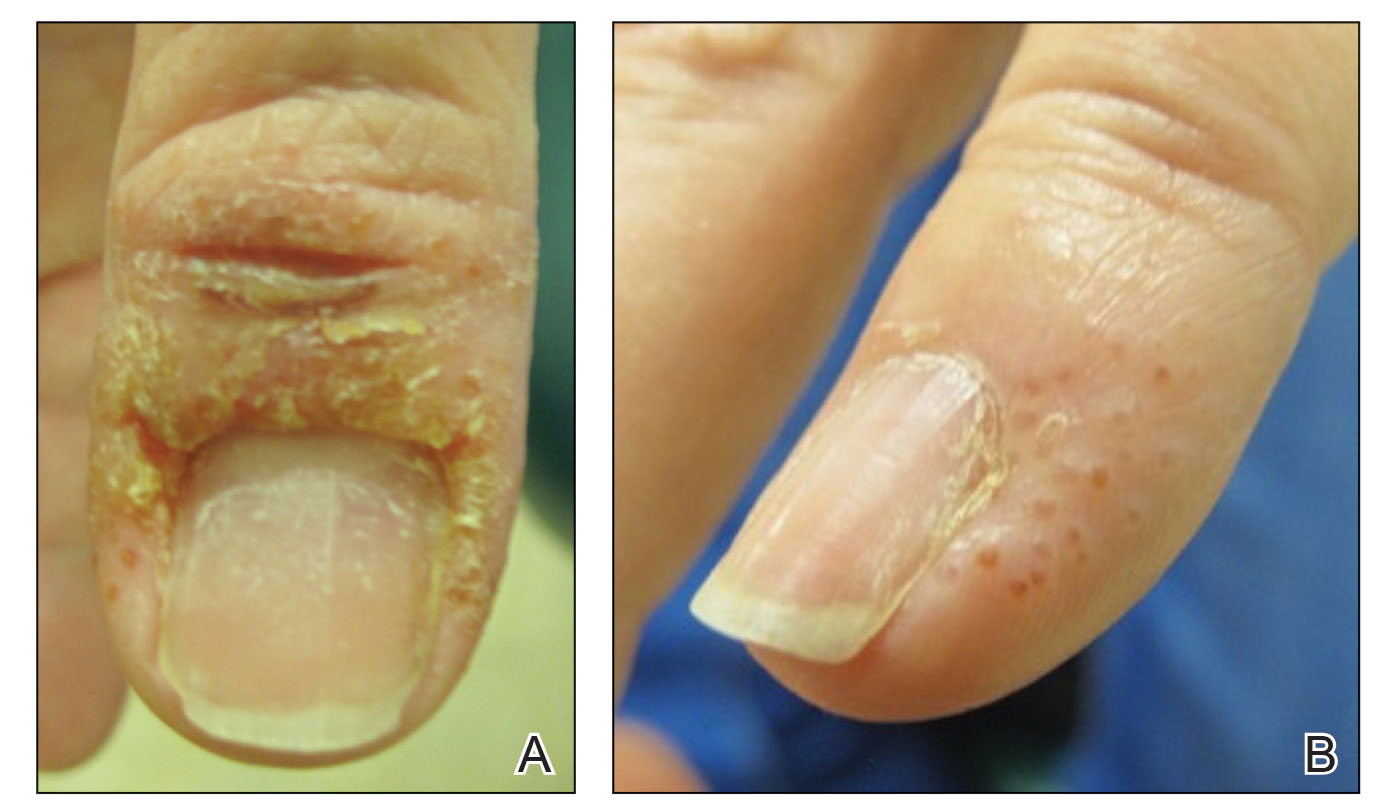
Dip powder manicures use a wet adhesive base coat with acrylic powder and an activator topcoat to initiate a chemical reaction that hardens and sets the nail polish. The colored powder typically is applied by dipping the digit up to the distal interphalangeal joint into a small container of loose powder and then brushing away the excess (Figure 2). Acrylate, a chemical present in dip powders, is a known allergen and has been associated with the development of allergic contact dermatitis and onychodystrophy in patients after receiving acrylic and UV-cured gel polish manicures.1,2 Inadequate sanitation practices at nail salons also have been associated with infection transmission.3,4 Additionally, the news media has covered the potential risk of infection due to contamination from reused dip manicure powder and the use of communal powder containers.5
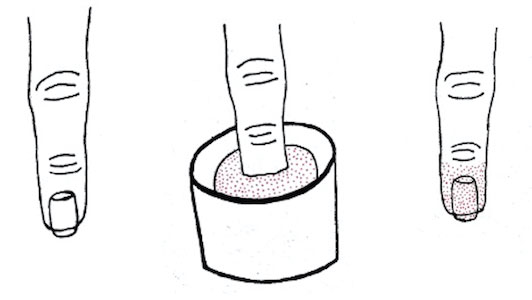
To increase clinical awareness of the dip manicure technique, we describe the presentation and successful treatment of dyshidroticlike contact dermatitis and paronychia that occurred in a patient after she received a dip powder manicure. Dermatoses and infection limited to the distal phalanges will present in patients more frequently as dip powder manicures continue to increase in popularity and frequency.
- Baran R. Nail cosmetics: allergies and irritations. Am J Clin Dermatol. 2002;3:547-555.
- Chen AF, Chimento SM, Hu S, et al. Nail damage from gel polish manicure. J Cosmet Dermatol. 2012;11:27-29.
- Schmidt AN, Zic JA, Boyd AS. Pedicure-associated Mycobacterium chelonae infection in a hospitalized patient. J Am Acad Dermatol. 2014;71:E248-E250.
- Sniezek PJ, Graham BS, Busch HB, et al. Rapidly growing mycobacterial infections after pedicures. Arch Dermatol. 2003;139:629-634.
- Joseph T. You could be risking an infection with nail dipping. NBC Universal Media, LLC. Updated July 11, 2019. Accessed June 7, 2023. https://www.nbcmiami.com/news/local/You-Could-Be-Risking-an-Infection-with-Nail-Dipping-512550372.html
To the Editor:
A 58-year-old woman presented to our dermatology clinic with a pruritic weeping eruption circumferentially on the distal digits of both hands of 5 weeks’ duration. The patient disclosed that she had been receiving dip powder manicures at a local nail salon approximately every 2 weeks over the last 3 to 6 months. She had received frequent acrylic nail extensions over the last 8 years prior to starting the dip powder manicures. Physical examination revealed well-demarcated eczematous plaques involving the lateral and proximal nail folds of the right thumb with an overlying serous crust and loss of the cuticle (Figure 1A). Erythematous plaques with firm deep-seated microvesicles also were present on the other digits, distributed distal to the distal interphalangeal joints (Figure 1B). She was diagnosed with dyshidroticlike contact dermatitis and paronychia. Treatment included phenol 1.5% colorless solution and clobetasol ointment 0.05% for twice-daily application to the affected areas. The patient also was advised to stop receiving manicures. At 1-month follow-up, the paronychia had resolved and the dermatitis had nearly resolved.
Dip powder manicures use a wet adhesive base coat with acrylic powder and an activator topcoat to initiate a chemical reaction that hardens and sets the nail polish. The colored powder typically is applied by dipping the digit up to the distal interphalangeal joint into a small container of loose powder and then brushing away the excess (Figure 2). Acrylate, a chemical present in dip powders, is a known allergen and has been associated with the development of allergic contact dermatitis and onychodystrophy in patients after receiving acrylic and UV-cured gel polish manicures.1,2 Inadequate sanitation practices at nail salons also have been associated with infection transmission.3,4 Additionally, the news media has covered the potential risk of infection due to contamination from reused dip manicure powder and the use of communal powder containers.5
To increase clinical awareness of the dip manicure technique, we describe the presentation and successful treatment of dyshidroticlike contact dermatitis and paronychia that occurred in a patient after she received a dip powder manicure. Dermatoses and infection limited to the distal phalanges will present in patients more frequently as dip powder manicures continue to increase in popularity and frequency.
To the Editor:
A 58-year-old woman presented to our dermatology clinic with a pruritic weeping eruption circumferentially on the distal digits of both hands of 5 weeks’ duration. The patient disclosed that she had been receiving dip powder manicures at a local nail salon approximately every 2 weeks over the last 3 to 6 months. She had received frequent acrylic nail extensions over the last 8 years prior to starting the dip powder manicures. Physical examination revealed well-demarcated eczematous plaques involving the lateral and proximal nail folds of the right thumb with an overlying serous crust and loss of the cuticle (Figure 1A). Erythematous plaques with firm deep-seated microvesicles also were present on the other digits, distributed distal to the distal interphalangeal joints (Figure 1B). She was diagnosed with dyshidroticlike contact dermatitis and paronychia. Treatment included phenol 1.5% colorless solution and clobetasol ointment 0.05% for twice-daily application to the affected areas. The patient also was advised to stop receiving manicures. At 1-month follow-up, the paronychia had resolved and the dermatitis had nearly resolved.
Dip powder manicures use a wet adhesive base coat with acrylic powder and an activator topcoat to initiate a chemical reaction that hardens and sets the nail polish. The colored powder typically is applied by dipping the digit up to the distal interphalangeal joint into a small container of loose powder and then brushing away the excess (Figure 2). Acrylate, a chemical present in dip powders, is a known allergen and has been associated with the development of allergic contact dermatitis and onychodystrophy in patients after receiving acrylic and UV-cured gel polish manicures.1,2 Inadequate sanitation practices at nail salons also have been associated with infection transmission.3,4 Additionally, the news media has covered the potential risk of infection due to contamination from reused dip manicure powder and the use of communal powder containers.5
To increase clinical awareness of the dip manicure technique, we describe the presentation and successful treatment of dyshidroticlike contact dermatitis and paronychia that occurred in a patient after she received a dip powder manicure. Dermatoses and infection limited to the distal phalanges will present in patients more frequently as dip powder manicures continue to increase in popularity and frequency.
- Baran R. Nail cosmetics: allergies and irritations. Am J Clin Dermatol. 2002;3:547-555.
- Chen AF, Chimento SM, Hu S, et al. Nail damage from gel polish manicure. J Cosmet Dermatol. 2012;11:27-29.
- Schmidt AN, Zic JA, Boyd AS. Pedicure-associated Mycobacterium chelonae infection in a hospitalized patient. J Am Acad Dermatol. 2014;71:E248-E250.
- Sniezek PJ, Graham BS, Busch HB, et al. Rapidly growing mycobacterial infections after pedicures. Arch Dermatol. 2003;139:629-634.
- Joseph T. You could be risking an infection with nail dipping. NBC Universal Media, LLC. Updated July 11, 2019. Accessed June 7, 2023. https://www.nbcmiami.com/news/local/You-Could-Be-Risking-an-Infection-with-Nail-Dipping-512550372.html
- Baran R. Nail cosmetics: allergies and irritations. Am J Clin Dermatol. 2002;3:547-555.
- Chen AF, Chimento SM, Hu S, et al. Nail damage from gel polish manicure. J Cosmet Dermatol. 2012;11:27-29.
- Schmidt AN, Zic JA, Boyd AS. Pedicure-associated Mycobacterium chelonae infection in a hospitalized patient. J Am Acad Dermatol. 2014;71:E248-E250.
- Sniezek PJ, Graham BS, Busch HB, et al. Rapidly growing mycobacterial infections after pedicures. Arch Dermatol. 2003;139:629-634.
- Joseph T. You could be risking an infection with nail dipping. NBC Universal Media, LLC. Updated July 11, 2019. Accessed June 7, 2023. https://www.nbcmiami.com/news/local/You-Could-Be-Risking-an-Infection-with-Nail-Dipping-512550372.html
Practice Points
- Manicures performed at nail salons have been associated with the development of paronychia due to inadequate sanitation practices and contact dermatitis caused by acrylates present in nail polish.
- The dip powder manicure is a relatively new manicure technique. The distribution of dermatoses and infection limited to the distal phalanges will present in patients more frequently as dip powder manicures continue to increase in popularity and are performed more frequently.
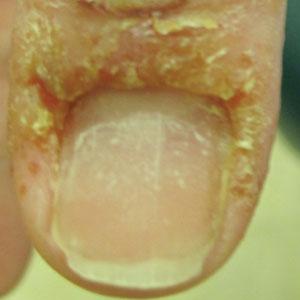
Can a puff of cool air up the nose stop acute migraine?
AUSTIN, TEX. – , according to the results of a small study. Most patients reported relief of their symptoms after receiving 15 minutes of transnasal evaporative cooling, without any need for rescue medication.
The cooling may modulate the sphenopalatine ganglion, a large ganglion implicated in migraine, said lead author Larry Charleston IV, MD, director of the headache and facial pain division, and professor of neurology at Michigan State University, East Lansing.
“The transnasal evaporative cooling device cools by blowing dry, ambient air across the nasal turbinates and may work by neuromodulation via the sphenopalatine ganglion for migraine,” Dr. Charleston said.
The findings were presented at the annual meeting of the American Headache Society.
A ‘cool’ approach to migraine treatment
“Everyone who has migraine disease needs abortive treatment,” Dr. Charleston said. “There is a need for safe and effective acute treatment for migraine. As we understand more about the pathophysiology of migraine, we learn that peripheral input plays a role in migraine disease.
“I was excited to learn of the device and to learn how we might take advantage of our knowledge of the sphenopalatine ganglia in the treatment of migraine, and was very enthusiastic to be involved in researching a nonpharmacological treatment to abort migraine attacks,” he said. “I thought this approach to migraine treatment was really ‘cool.’ ”
Twenty-four patients who met diagnostic criteria for episodic migraine with or without aura were randomized to receive 15 minutes of cooling induced by the CoolStat Transnasal Thermal Regulating Device (CoolTech LLC), or to a sham treatment with a CoolStat sham device.
Participants receiving active treatment were further randomized to receive one of the following flow rates: 24 liters per minute (LPM; n = 6 patients), 18 LPM (n = 9 patients), and 6 LPM (n = 9 patients).
All patients were instructed to get to their headache clinic during a migraine attack to start treatment.
The researchers looked at pain levels and most bothersome symptoms at baseline, and then at 2 and 24 hours after treatment. The primary endpoint was pain relief at 2 hours. Other endpoints included tolerability, relief from most bothersome symptoms, and freedom from pain at 2 hours.
The results showed that 88% (8/9 patients) of the 6-LPM group reported pain relief at 2 hours. Of these, 44% (4/9) reported being pain free at 2 hours, all without need for rescue medication. Similarly, pain relief at 2 hours occurred in 44% (4/9) of patients in the 18-LPM group, and in 50% (3/6) of the patients in the 24-LPM group.
No participants in the 18-LPM or the 24-LPM groups reported pain freedom at 2 hours.
Most bothersome symptoms were reduced. Response was greater with 6-LPM treatment. At 2 hours, 77% (7/9) of patients in the 6-LPM group reported relief of their symptoms, followed by 66% (6/9) of the 18-LPM group and 50% (3/6) of the 24-LPM group.
However, nasal discomfort was a bothersome adverse effect, Dr. Charleston noted. The rate of nasal discomfort occurred in all groups but was lower in the 6-LPM group.
Moderate intranasal discomfort during treatment was reported by 11% of the 6-LPM group, compared with 33% (3/9) in the 18-LPM group and 83% (5/6) in the 24-LPM group.
However, the study was terminated due to insufficient subject accrual rate.
“Originally, 87 participants were recruited and consented. It may have been challenging for some to come in to study clinic sites for the study treatment at the onset of their migraine attacks. The next iteration of the treatment device is a more portable model and study treatment may be used at home. This will likely be more convenient and enhance study participation,” Dr. Charleston said.
The data in the current study will help inform dose ranging analyses in future studies, to optimize efficacy and increase tolerability, he added.
The findings are promising and merit further assessment in a larger study with a sham control group, said Richard B. Lipton, MD, Edwin S. Lowe Professor and vice chair of neurology, and director of the Montefiore Headache Center, Albert Einstein College of Medicine, New York.
“Charleston et al. report that the lowest flow dose (6 liters per minute) was most effective, with a 2-hour pain-relief rate of 88% and a 2-hour pain-free rate of 50%, but, though these rates of pain relief and pain freedom are high, caution in interpretation is required,” Dr. Lipton said.
“The sample size is very modest with only nine patients in the 6-liter-per-minute treatment arm. In addition, the study lacks results from the group that got the sham device, making it difficult to contextualize the findings,” Dr. Lipton said.
He added that it is unusual for higher doses to be less effective but that may be because air flow higher than 6 LPM is irritating to the nasal mucosa during migraine attacks.
Always a need for effective nonpharmaceuticals
Also commenting on this study, Nina Riggins, MD, director of the Headache Center at the University of California, San Diego, said she found the novel device “exciting and really clever.
“I really enjoyed reviewing this abstract because I am a big fan of sphenopalatine ganglion block in the palatine ganglion. When we do those, we basically apply numbing medication to decrease the sensation and discharges coming from this group of neural cells in order to decrease pain,” Dr. Riggins said. “The procedure is very well tolerated and usually sphenopalatine ganglion blocks are used in patients when we do not want any side effects, such as in pregnant and postpartum women.”
The novel technique has the potential to have fewer side effects than those of oral medications, she said. “For example, the triptans are effective drugs but they constrict the blood vessels and we don’t want to use them in people with heart disease or history of stroke. This is where these potentially safer devices can play an important role. We can have more options to offer our patients,” Dr. Riggins said.
“I am super excited and looking forward to see what will come out of future research. I am really grateful that the authors are looking into new neuromodulation devices which can be so useful,” she said.
Migraine is the second leading cause of disability worldwide, Dr. Riggins noted. “It peaks in the years when people are most productive and affects families and communities. Medications are good, of course, but now with these novel devices, these are wonderful areas for research. Also now, we can offer so much more to people with migraine and other headache disorders,” she said.
“When I started in the field, I remember we were very limited in resources, and now, it’s just so wonderful.”
The study was sponsored by CoolTech Corp LLC. Dr. Charleston reports financial relationships with Allergan/AbbVie, Amgen, Amneal, Biohaven, Haleon, Linpharma, Satsuma, and Teva, and that he has received CME honoraria from the American Headache Society and the American Academy of Neurology. Dr. Lipton reports financial relationships with multiple pharmaceutical companies. Dr. Riggins reports no relevant financial relationships.
A version of this article originally appeared on Medscape.com.
AUSTIN, TEX. – , according to the results of a small study. Most patients reported relief of their symptoms after receiving 15 minutes of transnasal evaporative cooling, without any need for rescue medication.
The cooling may modulate the sphenopalatine ganglion, a large ganglion implicated in migraine, said lead author Larry Charleston IV, MD, director of the headache and facial pain division, and professor of neurology at Michigan State University, East Lansing.
“The transnasal evaporative cooling device cools by blowing dry, ambient air across the nasal turbinates and may work by neuromodulation via the sphenopalatine ganglion for migraine,” Dr. Charleston said.
The findings were presented at the annual meeting of the American Headache Society.
A ‘cool’ approach to migraine treatment
“Everyone who has migraine disease needs abortive treatment,” Dr. Charleston said. “There is a need for safe and effective acute treatment for migraine. As we understand more about the pathophysiology of migraine, we learn that peripheral input plays a role in migraine disease.
“I was excited to learn of the device and to learn how we might take advantage of our knowledge of the sphenopalatine ganglia in the treatment of migraine, and was very enthusiastic to be involved in researching a nonpharmacological treatment to abort migraine attacks,” he said. “I thought this approach to migraine treatment was really ‘cool.’ ”
Twenty-four patients who met diagnostic criteria for episodic migraine with or without aura were randomized to receive 15 minutes of cooling induced by the CoolStat Transnasal Thermal Regulating Device (CoolTech LLC), or to a sham treatment with a CoolStat sham device.
Participants receiving active treatment were further randomized to receive one of the following flow rates: 24 liters per minute (LPM; n = 6 patients), 18 LPM (n = 9 patients), and 6 LPM (n = 9 patients).
All patients were instructed to get to their headache clinic during a migraine attack to start treatment.
The researchers looked at pain levels and most bothersome symptoms at baseline, and then at 2 and 24 hours after treatment. The primary endpoint was pain relief at 2 hours. Other endpoints included tolerability, relief from most bothersome symptoms, and freedom from pain at 2 hours.
The results showed that 88% (8/9 patients) of the 6-LPM group reported pain relief at 2 hours. Of these, 44% (4/9) reported being pain free at 2 hours, all without need for rescue medication. Similarly, pain relief at 2 hours occurred in 44% (4/9) of patients in the 18-LPM group, and in 50% (3/6) of the patients in the 24-LPM group.
No participants in the 18-LPM or the 24-LPM groups reported pain freedom at 2 hours.
Most bothersome symptoms were reduced. Response was greater with 6-LPM treatment. At 2 hours, 77% (7/9) of patients in the 6-LPM group reported relief of their symptoms, followed by 66% (6/9) of the 18-LPM group and 50% (3/6) of the 24-LPM group.
However, nasal discomfort was a bothersome adverse effect, Dr. Charleston noted. The rate of nasal discomfort occurred in all groups but was lower in the 6-LPM group.
Moderate intranasal discomfort during treatment was reported by 11% of the 6-LPM group, compared with 33% (3/9) in the 18-LPM group and 83% (5/6) in the 24-LPM group.
However, the study was terminated due to insufficient subject accrual rate.
“Originally, 87 participants were recruited and consented. It may have been challenging for some to come in to study clinic sites for the study treatment at the onset of their migraine attacks. The next iteration of the treatment device is a more portable model and study treatment may be used at home. This will likely be more convenient and enhance study participation,” Dr. Charleston said.
The data in the current study will help inform dose ranging analyses in future studies, to optimize efficacy and increase tolerability, he added.
The findings are promising and merit further assessment in a larger study with a sham control group, said Richard B. Lipton, MD, Edwin S. Lowe Professor and vice chair of neurology, and director of the Montefiore Headache Center, Albert Einstein College of Medicine, New York.
“Charleston et al. report that the lowest flow dose (6 liters per minute) was most effective, with a 2-hour pain-relief rate of 88% and a 2-hour pain-free rate of 50%, but, though these rates of pain relief and pain freedom are high, caution in interpretation is required,” Dr. Lipton said.
“The sample size is very modest with only nine patients in the 6-liter-per-minute treatment arm. In addition, the study lacks results from the group that got the sham device, making it difficult to contextualize the findings,” Dr. Lipton said.
He added that it is unusual for higher doses to be less effective but that may be because air flow higher than 6 LPM is irritating to the nasal mucosa during migraine attacks.
Always a need for effective nonpharmaceuticals
Also commenting on this study, Nina Riggins, MD, director of the Headache Center at the University of California, San Diego, said she found the novel device “exciting and really clever.
“I really enjoyed reviewing this abstract because I am a big fan of sphenopalatine ganglion block in the palatine ganglion. When we do those, we basically apply numbing medication to decrease the sensation and discharges coming from this group of neural cells in order to decrease pain,” Dr. Riggins said. “The procedure is very well tolerated and usually sphenopalatine ganglion blocks are used in patients when we do not want any side effects, such as in pregnant and postpartum women.”
The novel technique has the potential to have fewer side effects than those of oral medications, she said. “For example, the triptans are effective drugs but they constrict the blood vessels and we don’t want to use them in people with heart disease or history of stroke. This is where these potentially safer devices can play an important role. We can have more options to offer our patients,” Dr. Riggins said.
“I am super excited and looking forward to see what will come out of future research. I am really grateful that the authors are looking into new neuromodulation devices which can be so useful,” she said.
Migraine is the second leading cause of disability worldwide, Dr. Riggins noted. “It peaks in the years when people are most productive and affects families and communities. Medications are good, of course, but now with these novel devices, these are wonderful areas for research. Also now, we can offer so much more to people with migraine and other headache disorders,” she said.
“When I started in the field, I remember we were very limited in resources, and now, it’s just so wonderful.”
The study was sponsored by CoolTech Corp LLC. Dr. Charleston reports financial relationships with Allergan/AbbVie, Amgen, Amneal, Biohaven, Haleon, Linpharma, Satsuma, and Teva, and that he has received CME honoraria from the American Headache Society and the American Academy of Neurology. Dr. Lipton reports financial relationships with multiple pharmaceutical companies. Dr. Riggins reports no relevant financial relationships.
A version of this article originally appeared on Medscape.com.
AUSTIN, TEX. – , according to the results of a small study. Most patients reported relief of their symptoms after receiving 15 minutes of transnasal evaporative cooling, without any need for rescue medication.
The cooling may modulate the sphenopalatine ganglion, a large ganglion implicated in migraine, said lead author Larry Charleston IV, MD, director of the headache and facial pain division, and professor of neurology at Michigan State University, East Lansing.
“The transnasal evaporative cooling device cools by blowing dry, ambient air across the nasal turbinates and may work by neuromodulation via the sphenopalatine ganglion for migraine,” Dr. Charleston said.
The findings were presented at the annual meeting of the American Headache Society.
A ‘cool’ approach to migraine treatment
“Everyone who has migraine disease needs abortive treatment,” Dr. Charleston said. “There is a need for safe and effective acute treatment for migraine. As we understand more about the pathophysiology of migraine, we learn that peripheral input plays a role in migraine disease.
“I was excited to learn of the device and to learn how we might take advantage of our knowledge of the sphenopalatine ganglia in the treatment of migraine, and was very enthusiastic to be involved in researching a nonpharmacological treatment to abort migraine attacks,” he said. “I thought this approach to migraine treatment was really ‘cool.’ ”
Twenty-four patients who met diagnostic criteria for episodic migraine with or without aura were randomized to receive 15 minutes of cooling induced by the CoolStat Transnasal Thermal Regulating Device (CoolTech LLC), or to a sham treatment with a CoolStat sham device.
Participants receiving active treatment were further randomized to receive one of the following flow rates: 24 liters per minute (LPM; n = 6 patients), 18 LPM (n = 9 patients), and 6 LPM (n = 9 patients).
All patients were instructed to get to their headache clinic during a migraine attack to start treatment.
The researchers looked at pain levels and most bothersome symptoms at baseline, and then at 2 and 24 hours after treatment. The primary endpoint was pain relief at 2 hours. Other endpoints included tolerability, relief from most bothersome symptoms, and freedom from pain at 2 hours.
The results showed that 88% (8/9 patients) of the 6-LPM group reported pain relief at 2 hours. Of these, 44% (4/9) reported being pain free at 2 hours, all without need for rescue medication. Similarly, pain relief at 2 hours occurred in 44% (4/9) of patients in the 18-LPM group, and in 50% (3/6) of the patients in the 24-LPM group.
No participants in the 18-LPM or the 24-LPM groups reported pain freedom at 2 hours.
Most bothersome symptoms were reduced. Response was greater with 6-LPM treatment. At 2 hours, 77% (7/9) of patients in the 6-LPM group reported relief of their symptoms, followed by 66% (6/9) of the 18-LPM group and 50% (3/6) of the 24-LPM group.
However, nasal discomfort was a bothersome adverse effect, Dr. Charleston noted. The rate of nasal discomfort occurred in all groups but was lower in the 6-LPM group.
Moderate intranasal discomfort during treatment was reported by 11% of the 6-LPM group, compared with 33% (3/9) in the 18-LPM group and 83% (5/6) in the 24-LPM group.
However, the study was terminated due to insufficient subject accrual rate.
“Originally, 87 participants were recruited and consented. It may have been challenging for some to come in to study clinic sites for the study treatment at the onset of their migraine attacks. The next iteration of the treatment device is a more portable model and study treatment may be used at home. This will likely be more convenient and enhance study participation,” Dr. Charleston said.
The data in the current study will help inform dose ranging analyses in future studies, to optimize efficacy and increase tolerability, he added.
The findings are promising and merit further assessment in a larger study with a sham control group, said Richard B. Lipton, MD, Edwin S. Lowe Professor and vice chair of neurology, and director of the Montefiore Headache Center, Albert Einstein College of Medicine, New York.
“Charleston et al. report that the lowest flow dose (6 liters per minute) was most effective, with a 2-hour pain-relief rate of 88% and a 2-hour pain-free rate of 50%, but, though these rates of pain relief and pain freedom are high, caution in interpretation is required,” Dr. Lipton said.
“The sample size is very modest with only nine patients in the 6-liter-per-minute treatment arm. In addition, the study lacks results from the group that got the sham device, making it difficult to contextualize the findings,” Dr. Lipton said.
He added that it is unusual for higher doses to be less effective but that may be because air flow higher than 6 LPM is irritating to the nasal mucosa during migraine attacks.
Always a need for effective nonpharmaceuticals
Also commenting on this study, Nina Riggins, MD, director of the Headache Center at the University of California, San Diego, said she found the novel device “exciting and really clever.
“I really enjoyed reviewing this abstract because I am a big fan of sphenopalatine ganglion block in the palatine ganglion. When we do those, we basically apply numbing medication to decrease the sensation and discharges coming from this group of neural cells in order to decrease pain,” Dr. Riggins said. “The procedure is very well tolerated and usually sphenopalatine ganglion blocks are used in patients when we do not want any side effects, such as in pregnant and postpartum women.”
The novel technique has the potential to have fewer side effects than those of oral medications, she said. “For example, the triptans are effective drugs but they constrict the blood vessels and we don’t want to use them in people with heart disease or history of stroke. This is where these potentially safer devices can play an important role. We can have more options to offer our patients,” Dr. Riggins said.
“I am super excited and looking forward to see what will come out of future research. I am really grateful that the authors are looking into new neuromodulation devices which can be so useful,” she said.
Migraine is the second leading cause of disability worldwide, Dr. Riggins noted. “It peaks in the years when people are most productive and affects families and communities. Medications are good, of course, but now with these novel devices, these are wonderful areas for research. Also now, we can offer so much more to people with migraine and other headache disorders,” she said.
“When I started in the field, I remember we were very limited in resources, and now, it’s just so wonderful.”
The study was sponsored by CoolTech Corp LLC. Dr. Charleston reports financial relationships with Allergan/AbbVie, Amgen, Amneal, Biohaven, Haleon, Linpharma, Satsuma, and Teva, and that he has received CME honoraria from the American Headache Society and the American Academy of Neurology. Dr. Lipton reports financial relationships with multiple pharmaceutical companies. Dr. Riggins reports no relevant financial relationships.
A version of this article originally appeared on Medscape.com.
At ASH 2023
New data on traumatic brain injury show it’s chronic, evolving
The data show that patients with TBI may continue to improve or decline during a period of up to 7 years after injury, making it more of a chronic condition, the investigators report.
“Our results dispute the notion that TBI is a discrete, isolated medical event with a finite, static functional outcome following a relatively short period of upward recovery (typically up to 1 year),” Benjamin Brett, PhD, assistant professor, departments of neurosurgery and neurology, Medical College of Wisconsin, Milwaukee, told this news organization.
“Rather, individuals continue to exhibit improvement and decline across a range of domains, including psychiatric, cognitive, and functional outcomes, even 2-7 years after their injury,” Dr. Brett said.
“Ultimately, our findings support conceptualizing TBI as a chronic condition for many patients, which requires routine follow-up, medical monitoring, responsive care, and support, adapting to their evolving needs many years following injury,” he said.
Results of the TRACK TBI LONG (Transforming Research and Clinical Knowledge in TBI Longitudinal study) were published online in Neurology.
Chronic and evolving
The results are based on 1,264 adults (mean age at injury, 41 years) from the initial TRACK TBI study, including 917 with mild TBI (mTBI) and 193 with moderate/severe TBI (msTBI), who were matched to 154 control patients who had experienced orthopedic trauma without evidence of head injury (OTC).
The participants were followed annually for up to 7 years after injury using the Glasgow Outcome Scale–Extended (GOSE), Brief Symptom Inventory–18 (BSI), and the Brief Test of Adult Cognition by Telephone (BTACT), as well as a self-reported perception of function. The researchers calculated rates of change (classified as stable, improved, or declined) for individual outcomes at each long-term follow-up.
In general, “stable” was the most frequent change outcome for the individual measures from postinjury baseline assessment to 7 years post injury.
However, a substantial proportion of patients with TBI (regardless of severity) experienced changes in psychiatric status, cognition, and functional outcomes over the years.
When the GOSE, BSI, and BTACT were considered collectively, rates of decline were 21% for mTBI, 26% for msTBI, and 15% for OTC.
The highest rates of decline were in functional outcomes (GOSE scores). On average, over the course of 2-7 years post injury, 29% of patients with mTBI and 23% of those with msTBI experienced a decline in the ability to function with daily activities.
A pattern of improvement on the GOSE was noted in 36% of patients with msTBI and 22% patients with mTBI.
Notably, said Dr. Brett, patients who experienced greater difficulties near the time of injury showed improvement for a period of 2-7 years post injury. Patient factors, such as older age at the time of the injury, were associated with greater risk of long-term decline.
“Our findings highlight the need to embrace conceptualization of TBI as a chronic condition in order to establish systems of care that provide continued follow-up with treatment and supports that adapt to evolving patient needs, regardless of the directions of change,” Dr. Brett told this news organization.
Important and novel work
In a linked editorial, Robynne Braun, MD, PhD, with the department of neurology, University of Maryland, Baltimore, notes that there have been “few prospective studies examining postinjury outcomes on this longer timescale, especially in mild TBI, making this an important and novel body of work.”
The study “effectively demonstrates that changes in function across multiple domains continue to occur well beyond the conventionally tracked 6- to 12-month period of injury recovery,” Dr. Braun writes.
The observation that over the 7-year follow-up, a substantial proportion of patients with mTBI and msTBI exhibited a pattern of decline on the GOSE suggests that they “may have needed more ongoing medical monitoring, rehabilitation, or supportive services to prevent worsening,” Dr. Braun adds.
At the same time, the improvement pattern on the GOSE suggests “opportunities for recovery that further rehabilitative or medical services might have enhanced.”
The study was funded by the National Institute of Neurological Disorders and Stroke, the National Institute on Aging, the National Football League Scientific Advisory Board, and the U.S. Department of Defense. Dr. Brett and Dr. Braun have disclosed no relevant financial relationships.
A version of this article originally appeared on Medscape.com.
The data show that patients with TBI may continue to improve or decline during a period of up to 7 years after injury, making it more of a chronic condition, the investigators report.
“Our results dispute the notion that TBI is a discrete, isolated medical event with a finite, static functional outcome following a relatively short period of upward recovery (typically up to 1 year),” Benjamin Brett, PhD, assistant professor, departments of neurosurgery and neurology, Medical College of Wisconsin, Milwaukee, told this news organization.
“Rather, individuals continue to exhibit improvement and decline across a range of domains, including psychiatric, cognitive, and functional outcomes, even 2-7 years after their injury,” Dr. Brett said.
“Ultimately, our findings support conceptualizing TBI as a chronic condition for many patients, which requires routine follow-up, medical monitoring, responsive care, and support, adapting to their evolving needs many years following injury,” he said.
Results of the TRACK TBI LONG (Transforming Research and Clinical Knowledge in TBI Longitudinal study) were published online in Neurology.
Chronic and evolving
The results are based on 1,264 adults (mean age at injury, 41 years) from the initial TRACK TBI study, including 917 with mild TBI (mTBI) and 193 with moderate/severe TBI (msTBI), who were matched to 154 control patients who had experienced orthopedic trauma without evidence of head injury (OTC).
The participants were followed annually for up to 7 years after injury using the Glasgow Outcome Scale–Extended (GOSE), Brief Symptom Inventory–18 (BSI), and the Brief Test of Adult Cognition by Telephone (BTACT), as well as a self-reported perception of function. The researchers calculated rates of change (classified as stable, improved, or declined) for individual outcomes at each long-term follow-up.
In general, “stable” was the most frequent change outcome for the individual measures from postinjury baseline assessment to 7 years post injury.
However, a substantial proportion of patients with TBI (regardless of severity) experienced changes in psychiatric status, cognition, and functional outcomes over the years.
When the GOSE, BSI, and BTACT were considered collectively, rates of decline were 21% for mTBI, 26% for msTBI, and 15% for OTC.
The highest rates of decline were in functional outcomes (GOSE scores). On average, over the course of 2-7 years post injury, 29% of patients with mTBI and 23% of those with msTBI experienced a decline in the ability to function with daily activities.
A pattern of improvement on the GOSE was noted in 36% of patients with msTBI and 22% patients with mTBI.
Notably, said Dr. Brett, patients who experienced greater difficulties near the time of injury showed improvement for a period of 2-7 years post injury. Patient factors, such as older age at the time of the injury, were associated with greater risk of long-term decline.
“Our findings highlight the need to embrace conceptualization of TBI as a chronic condition in order to establish systems of care that provide continued follow-up with treatment and supports that adapt to evolving patient needs, regardless of the directions of change,” Dr. Brett told this news organization.
Important and novel work
In a linked editorial, Robynne Braun, MD, PhD, with the department of neurology, University of Maryland, Baltimore, notes that there have been “few prospective studies examining postinjury outcomes on this longer timescale, especially in mild TBI, making this an important and novel body of work.”
The study “effectively demonstrates that changes in function across multiple domains continue to occur well beyond the conventionally tracked 6- to 12-month period of injury recovery,” Dr. Braun writes.
The observation that over the 7-year follow-up, a substantial proportion of patients with mTBI and msTBI exhibited a pattern of decline on the GOSE suggests that they “may have needed more ongoing medical monitoring, rehabilitation, or supportive services to prevent worsening,” Dr. Braun adds.
At the same time, the improvement pattern on the GOSE suggests “opportunities for recovery that further rehabilitative or medical services might have enhanced.”
The study was funded by the National Institute of Neurological Disorders and Stroke, the National Institute on Aging, the National Football League Scientific Advisory Board, and the U.S. Department of Defense. Dr. Brett and Dr. Braun have disclosed no relevant financial relationships.
A version of this article originally appeared on Medscape.com.
The data show that patients with TBI may continue to improve or decline during a period of up to 7 years after injury, making it more of a chronic condition, the investigators report.
“Our results dispute the notion that TBI is a discrete, isolated medical event with a finite, static functional outcome following a relatively short period of upward recovery (typically up to 1 year),” Benjamin Brett, PhD, assistant professor, departments of neurosurgery and neurology, Medical College of Wisconsin, Milwaukee, told this news organization.
“Rather, individuals continue to exhibit improvement and decline across a range of domains, including psychiatric, cognitive, and functional outcomes, even 2-7 years after their injury,” Dr. Brett said.
“Ultimately, our findings support conceptualizing TBI as a chronic condition for many patients, which requires routine follow-up, medical monitoring, responsive care, and support, adapting to their evolving needs many years following injury,” he said.
Results of the TRACK TBI LONG (Transforming Research and Clinical Knowledge in TBI Longitudinal study) were published online in Neurology.
Chronic and evolving
The results are based on 1,264 adults (mean age at injury, 41 years) from the initial TRACK TBI study, including 917 with mild TBI (mTBI) and 193 with moderate/severe TBI (msTBI), who were matched to 154 control patients who had experienced orthopedic trauma without evidence of head injury (OTC).
The participants were followed annually for up to 7 years after injury using the Glasgow Outcome Scale–Extended (GOSE), Brief Symptom Inventory–18 (BSI), and the Brief Test of Adult Cognition by Telephone (BTACT), as well as a self-reported perception of function. The researchers calculated rates of change (classified as stable, improved, or declined) for individual outcomes at each long-term follow-up.
In general, “stable” was the most frequent change outcome for the individual measures from postinjury baseline assessment to 7 years post injury.
However, a substantial proportion of patients with TBI (regardless of severity) experienced changes in psychiatric status, cognition, and functional outcomes over the years.
When the GOSE, BSI, and BTACT were considered collectively, rates of decline were 21% for mTBI, 26% for msTBI, and 15% for OTC.
The highest rates of decline were in functional outcomes (GOSE scores). On average, over the course of 2-7 years post injury, 29% of patients with mTBI and 23% of those with msTBI experienced a decline in the ability to function with daily activities.
A pattern of improvement on the GOSE was noted in 36% of patients with msTBI and 22% patients with mTBI.
Notably, said Dr. Brett, patients who experienced greater difficulties near the time of injury showed improvement for a period of 2-7 years post injury. Patient factors, such as older age at the time of the injury, were associated with greater risk of long-term decline.
“Our findings highlight the need to embrace conceptualization of TBI as a chronic condition in order to establish systems of care that provide continued follow-up with treatment and supports that adapt to evolving patient needs, regardless of the directions of change,” Dr. Brett told this news organization.
Important and novel work
In a linked editorial, Robynne Braun, MD, PhD, with the department of neurology, University of Maryland, Baltimore, notes that there have been “few prospective studies examining postinjury outcomes on this longer timescale, especially in mild TBI, making this an important and novel body of work.”
The study “effectively demonstrates that changes in function across multiple domains continue to occur well beyond the conventionally tracked 6- to 12-month period of injury recovery,” Dr. Braun writes.
The observation that over the 7-year follow-up, a substantial proportion of patients with mTBI and msTBI exhibited a pattern of decline on the GOSE suggests that they “may have needed more ongoing medical monitoring, rehabilitation, or supportive services to prevent worsening,” Dr. Braun adds.
At the same time, the improvement pattern on the GOSE suggests “opportunities for recovery that further rehabilitative or medical services might have enhanced.”
The study was funded by the National Institute of Neurological Disorders and Stroke, the National Institute on Aging, the National Football League Scientific Advisory Board, and the U.S. Department of Defense. Dr. Brett and Dr. Braun have disclosed no relevant financial relationships.
A version of this article originally appeared on Medscape.com.
FROM NEUROLOGY
New AAP framework seeks to help pediatricians monitor premature babies
About 1 in 10 babies in the United States are born before full term. Even when they are discharged from neonatal intensive care units (NICUs), these babies are still at risk for conditions like cerebral palsy, autism spectrum disorder, deafness, and severe hearing loss.
The framework, published in Pediatrics, consolidates existing research into a guide for busy pediatricians to categorize patients as very high risk, high risk, or moderate-low risk for neurodevelopmental disabilities. The guidance also lists key identifiers to help providers flag issues early, such as asymmetry of hand use.
Beth Ellen Davis, MD, MPH, a framework author, said the goal is to help pediatricians determine what surveillance and screening they can conduct to promote positive health outcomes.
Dr. Davis said she wished she had this guidance on caring for children who were born prematurely during her 10 years as a general pediatrician in the U.S. Army Medical Corps.
“I didn’t know what I was supposed to do differently with [the former NICU babies],” said Dr. Davis, a professor in the division of neurodevelopmental behavioral pediatrics at the University of Virginia, Charlottesville.
For instance, babies born earlier than 28 weeks who have hypoxic ischemic encephalopathy or retinopathy of prematurity requiring surgery or intervention are classified as very high risk for the adverse outcomes, including intellectual disability.
The authors recommend follow-up and surveillance based on risk level at roughly 9-month intervals until around age 5. Each visit includes assessing for developmental milestones, like walking by 18 months or noting atypical pencil grasp at age 3.
Kendell German, MD, a neonatologist at University of Washington Medical Center, Seattle, and Seattle Children’s Hospital and a coauthor of the publication, said the tool will hopefully ensure that children are referred earlier to specialists.
“As neonatologists, we think about risk factors, but further out from birth, some of those things may be missed – particularly when we start thinking about kids who are transitioning in school and thinking about learning disabilities,” Dr. German said.
The guidance also outlines when pediatricians should – or should not – reassure families that an intellectual disability won’t develop. According to the authors, by age 3, the majority of children who have severe developmental disabilities will have been diagnosed.
“Some say you have to always keep suspicion out there for families of children who are born premature,” Dr. Davis said. “But we feel that after a period of time of monitoring and a child meeting their milestones, we can reassure parents that it is very unlikely their child will develop some of these severe developmental disabilities.”
Douglas Vanderbilt, MD, MS, chief of the developmental-behavioral pediatrics division and director of newborn and infant follow-up program at Children’s Hospital Los Angeles, said that general pediatricians and family practice clinicians may face barriers to implementation such as not having enough time to screen patients or difficulty collaborating with specialists.
But, “whatever we can do to articulate, educate, and facilitate a capacity within general pediatrics to improve training is a really good thing,” said Dr. Vanderbilt, who was not involved with the guidance.
The authors also highlighted lower-severity conditions that can result from prematurity, such as language and speech disorders, developmental coordination disorders, ADHD, and visual motor integration problems.
“Those of us in the medical field can be quite focused on the most severe disabilities that are possible,” said Andrea Duncan, MD, MSc, director of the neonatal follow-up program at the Children’s Hospital of Philadelphia, who was not associated with the report. But, “most of the disabilities we see in follow-up are more subtle or milder but can have a very significant impact on school function, participation, and the overall quality of a child’s life.
Dr. Duncan said the framework doesn’t entirely put the onus on primary care clinicians, but helps stratify risk and indicates when referrals to specialists may be appropriate.
“The importance of partnerships really comes through,” with specialties like neurology, audiology, and developmental behavioral pediatrics, Dr. Duncan said. “As long as those partnerships are made and families have access to services, implementation should be relatively easy.”
The authors of the report declared no relevant financial relationships. Dr. Vanderbilt is a consultant for a startup called Develo. He has no equity in the company.
A version of this article originally appeared on Medscape.com.
About 1 in 10 babies in the United States are born before full term. Even when they are discharged from neonatal intensive care units (NICUs), these babies are still at risk for conditions like cerebral palsy, autism spectrum disorder, deafness, and severe hearing loss.
The framework, published in Pediatrics, consolidates existing research into a guide for busy pediatricians to categorize patients as very high risk, high risk, or moderate-low risk for neurodevelopmental disabilities. The guidance also lists key identifiers to help providers flag issues early, such as asymmetry of hand use.
Beth Ellen Davis, MD, MPH, a framework author, said the goal is to help pediatricians determine what surveillance and screening they can conduct to promote positive health outcomes.
Dr. Davis said she wished she had this guidance on caring for children who were born prematurely during her 10 years as a general pediatrician in the U.S. Army Medical Corps.
“I didn’t know what I was supposed to do differently with [the former NICU babies],” said Dr. Davis, a professor in the division of neurodevelopmental behavioral pediatrics at the University of Virginia, Charlottesville.
For instance, babies born earlier than 28 weeks who have hypoxic ischemic encephalopathy or retinopathy of prematurity requiring surgery or intervention are classified as very high risk for the adverse outcomes, including intellectual disability.
The authors recommend follow-up and surveillance based on risk level at roughly 9-month intervals until around age 5. Each visit includes assessing for developmental milestones, like walking by 18 months or noting atypical pencil grasp at age 3.
Kendell German, MD, a neonatologist at University of Washington Medical Center, Seattle, and Seattle Children’s Hospital and a coauthor of the publication, said the tool will hopefully ensure that children are referred earlier to specialists.
“As neonatologists, we think about risk factors, but further out from birth, some of those things may be missed – particularly when we start thinking about kids who are transitioning in school and thinking about learning disabilities,” Dr. German said.
The guidance also outlines when pediatricians should – or should not – reassure families that an intellectual disability won’t develop. According to the authors, by age 3, the majority of children who have severe developmental disabilities will have been diagnosed.
“Some say you have to always keep suspicion out there for families of children who are born premature,” Dr. Davis said. “But we feel that after a period of time of monitoring and a child meeting their milestones, we can reassure parents that it is very unlikely their child will develop some of these severe developmental disabilities.”
Douglas Vanderbilt, MD, MS, chief of the developmental-behavioral pediatrics division and director of newborn and infant follow-up program at Children’s Hospital Los Angeles, said that general pediatricians and family practice clinicians may face barriers to implementation such as not having enough time to screen patients or difficulty collaborating with specialists.
But, “whatever we can do to articulate, educate, and facilitate a capacity within general pediatrics to improve training is a really good thing,” said Dr. Vanderbilt, who was not involved with the guidance.
The authors also highlighted lower-severity conditions that can result from prematurity, such as language and speech disorders, developmental coordination disorders, ADHD, and visual motor integration problems.
“Those of us in the medical field can be quite focused on the most severe disabilities that are possible,” said Andrea Duncan, MD, MSc, director of the neonatal follow-up program at the Children’s Hospital of Philadelphia, who was not associated with the report. But, “most of the disabilities we see in follow-up are more subtle or milder but can have a very significant impact on school function, participation, and the overall quality of a child’s life.
Dr. Duncan said the framework doesn’t entirely put the onus on primary care clinicians, but helps stratify risk and indicates when referrals to specialists may be appropriate.
“The importance of partnerships really comes through,” with specialties like neurology, audiology, and developmental behavioral pediatrics, Dr. Duncan said. “As long as those partnerships are made and families have access to services, implementation should be relatively easy.”
The authors of the report declared no relevant financial relationships. Dr. Vanderbilt is a consultant for a startup called Develo. He has no equity in the company.
A version of this article originally appeared on Medscape.com.
About 1 in 10 babies in the United States are born before full term. Even when they are discharged from neonatal intensive care units (NICUs), these babies are still at risk for conditions like cerebral palsy, autism spectrum disorder, deafness, and severe hearing loss.
The framework, published in Pediatrics, consolidates existing research into a guide for busy pediatricians to categorize patients as very high risk, high risk, or moderate-low risk for neurodevelopmental disabilities. The guidance also lists key identifiers to help providers flag issues early, such as asymmetry of hand use.
Beth Ellen Davis, MD, MPH, a framework author, said the goal is to help pediatricians determine what surveillance and screening they can conduct to promote positive health outcomes.
Dr. Davis said she wished she had this guidance on caring for children who were born prematurely during her 10 years as a general pediatrician in the U.S. Army Medical Corps.
“I didn’t know what I was supposed to do differently with [the former NICU babies],” said Dr. Davis, a professor in the division of neurodevelopmental behavioral pediatrics at the University of Virginia, Charlottesville.
For instance, babies born earlier than 28 weeks who have hypoxic ischemic encephalopathy or retinopathy of prematurity requiring surgery or intervention are classified as very high risk for the adverse outcomes, including intellectual disability.
The authors recommend follow-up and surveillance based on risk level at roughly 9-month intervals until around age 5. Each visit includes assessing for developmental milestones, like walking by 18 months or noting atypical pencil grasp at age 3.
Kendell German, MD, a neonatologist at University of Washington Medical Center, Seattle, and Seattle Children’s Hospital and a coauthor of the publication, said the tool will hopefully ensure that children are referred earlier to specialists.
“As neonatologists, we think about risk factors, but further out from birth, some of those things may be missed – particularly when we start thinking about kids who are transitioning in school and thinking about learning disabilities,” Dr. German said.
The guidance also outlines when pediatricians should – or should not – reassure families that an intellectual disability won’t develop. According to the authors, by age 3, the majority of children who have severe developmental disabilities will have been diagnosed.
“Some say you have to always keep suspicion out there for families of children who are born premature,” Dr. Davis said. “But we feel that after a period of time of monitoring and a child meeting their milestones, we can reassure parents that it is very unlikely their child will develop some of these severe developmental disabilities.”
Douglas Vanderbilt, MD, MS, chief of the developmental-behavioral pediatrics division and director of newborn and infant follow-up program at Children’s Hospital Los Angeles, said that general pediatricians and family practice clinicians may face barriers to implementation such as not having enough time to screen patients or difficulty collaborating with specialists.
But, “whatever we can do to articulate, educate, and facilitate a capacity within general pediatrics to improve training is a really good thing,” said Dr. Vanderbilt, who was not involved with the guidance.
The authors also highlighted lower-severity conditions that can result from prematurity, such as language and speech disorders, developmental coordination disorders, ADHD, and visual motor integration problems.
“Those of us in the medical field can be quite focused on the most severe disabilities that are possible,” said Andrea Duncan, MD, MSc, director of the neonatal follow-up program at the Children’s Hospital of Philadelphia, who was not associated with the report. But, “most of the disabilities we see in follow-up are more subtle or milder but can have a very significant impact on school function, participation, and the overall quality of a child’s life.
Dr. Duncan said the framework doesn’t entirely put the onus on primary care clinicians, but helps stratify risk and indicates when referrals to specialists may be appropriate.
“The importance of partnerships really comes through,” with specialties like neurology, audiology, and developmental behavioral pediatrics, Dr. Duncan said. “As long as those partnerships are made and families have access to services, implementation should be relatively easy.”
The authors of the report declared no relevant financial relationships. Dr. Vanderbilt is a consultant for a startup called Develo. He has no equity in the company.
A version of this article originally appeared on Medscape.com.
FROM PEDIATRICS