User login
7 steps to a successful antipsychotic switch
Patient education and timing are crucial to promoting a positive outcome after switching antipsychotics. Although little empiric evidence is available to guide these medication switches,1-3 we find the following process helpful based on our clinical experience.
Think Before You Switch
Before switching antipsychotics, ask:
- Did the first antipsychotic have some effect on psychosis or mood or on associated symptoms, such as sleep, anxiety, or agitation? If so, anticipate and manage the benefits that will be lost while tapering off the antipsychotic.
- How stable is the patient?
- How much external monitoring or support is available? If the patient has limited external support, make the switch slowly and monitor the patient more closely.
- How urgent is the medication switch?
- Is the patient suffering severe adverse effects from the first antipsychotic?
- Is a high dosage of the new antipsychotic needed to manage positive symptoms?
Dos and Don’Ts Of Switching
If switching antipsychotics is necessary, follow these seven steps:
- Don’t switch while the patient is unstable, particularly if you are switching because of side effects or for administrative reasons such as formulary restrictions or cost. Delay the switch until the patient is stable, if possible. For unstable patients who are inadequately controlled on the first antipsychotic, consider temporarily adding another antipsychotic and deferring the switch until the patient is more stable.
- Explain the switch’s risks and benefits to the patient. Mention how long before the new drug begins to work and when side effects could surface. Also, give the patient a choice regarding alternate medications, when to switch, and how gradual the switch should be. A collaborative approach is more likely to be successful.
- Make sure the patient’s family, case managers, or group home operators understand why you are switching antipsychotics. Instruct them to watch for worsening symptoms after the patient starts the new medication.
- Stay in touch with the patient—by phone and in person—during and after the switch. Numerous factors—including the patient’s stability and whether family or friends are monitoring him—should guide frequency of contact.
- Tell the patient to call you if a problem arises. Counsel the patient through minor or temporary side effects with the new antipsychotic.
- Do not switch multiple medications at once, if possible, as this can destabilize the patient and make it difficult to assess the new medications’ benefits and adverse effects.
- An adjuvant medication can reduce pharmacodynamic changes resulting from the switch. For example, consider adding a hypnotic and/or an anxiolytic when switching from a sedating to a nonsedating antipsychotic. When switching from an antipsychotic with significant anticholinergic properties—such as olanzapine or quetiapine—consider adding an anticholinergic that may be tapered off later.
- Don’t switch while the patient is unstable
- Explain the switch’s risks and benefits
- Discuss the change with family, case managers, or group home operators
- Stay in touch with the patient
- Tell the patient to call you if a problem arises
- Don’t switch multiple medications at once
- Consider an adjuvant medication
1. Remington G, Chue P, Stip E, et al. The crossover approach to switching antipsychotics: what is the evidence? Schizophr Res 2005;76:267-72.
2. Edlinger M, Baumgartner S, Eltanaihi-Furtmuller N, et al. Switching between second-generation antipsychotics: why and how? CNS Drugs 2005;19:27-42.
3. Masand P. A review of pharmacologic strategies for switching to atypical antipsychotics. Prim Care Companion J Clin Psychiatry 2005;7:121-9.
Dr. Mago is assistant professor of psychiatry, Thomas Jefferson University, Philadelphia, PA, and director of its mood disorders program.
Dr. Pinninti is associate professor of psychiatry, School of Osteopathic Medicine, University of Medicine and Dentistry of New Jersey, and medical director, Steininger Behavioral Care Services, Cherry Hill, NJ.
Patient education and timing are crucial to promoting a positive outcome after switching antipsychotics. Although little empiric evidence is available to guide these medication switches,1-3 we find the following process helpful based on our clinical experience.
Think Before You Switch
Before switching antipsychotics, ask:
- Did the first antipsychotic have some effect on psychosis or mood or on associated symptoms, such as sleep, anxiety, or agitation? If so, anticipate and manage the benefits that will be lost while tapering off the antipsychotic.
- How stable is the patient?
- How much external monitoring or support is available? If the patient has limited external support, make the switch slowly and monitor the patient more closely.
- How urgent is the medication switch?
- Is the patient suffering severe adverse effects from the first antipsychotic?
- Is a high dosage of the new antipsychotic needed to manage positive symptoms?
Dos and Don’Ts Of Switching
If switching antipsychotics is necessary, follow these seven steps:
- Don’t switch while the patient is unstable, particularly if you are switching because of side effects or for administrative reasons such as formulary restrictions or cost. Delay the switch until the patient is stable, if possible. For unstable patients who are inadequately controlled on the first antipsychotic, consider temporarily adding another antipsychotic and deferring the switch until the patient is more stable.
- Explain the switch’s risks and benefits to the patient. Mention how long before the new drug begins to work and when side effects could surface. Also, give the patient a choice regarding alternate medications, when to switch, and how gradual the switch should be. A collaborative approach is more likely to be successful.
- Make sure the patient’s family, case managers, or group home operators understand why you are switching antipsychotics. Instruct them to watch for worsening symptoms after the patient starts the new medication.
- Stay in touch with the patient—by phone and in person—during and after the switch. Numerous factors—including the patient’s stability and whether family or friends are monitoring him—should guide frequency of contact.
- Tell the patient to call you if a problem arises. Counsel the patient through minor or temporary side effects with the new antipsychotic.
- Do not switch multiple medications at once, if possible, as this can destabilize the patient and make it difficult to assess the new medications’ benefits and adverse effects.
- An adjuvant medication can reduce pharmacodynamic changes resulting from the switch. For example, consider adding a hypnotic and/or an anxiolytic when switching from a sedating to a nonsedating antipsychotic. When switching from an antipsychotic with significant anticholinergic properties—such as olanzapine or quetiapine—consider adding an anticholinergic that may be tapered off later.
- Don’t switch while the patient is unstable
- Explain the switch’s risks and benefits
- Discuss the change with family, case managers, or group home operators
- Stay in touch with the patient
- Tell the patient to call you if a problem arises
- Don’t switch multiple medications at once
- Consider an adjuvant medication
Patient education and timing are crucial to promoting a positive outcome after switching antipsychotics. Although little empiric evidence is available to guide these medication switches,1-3 we find the following process helpful based on our clinical experience.
Think Before You Switch
Before switching antipsychotics, ask:
- Did the first antipsychotic have some effect on psychosis or mood or on associated symptoms, such as sleep, anxiety, or agitation? If so, anticipate and manage the benefits that will be lost while tapering off the antipsychotic.
- How stable is the patient?
- How much external monitoring or support is available? If the patient has limited external support, make the switch slowly and monitor the patient more closely.
- How urgent is the medication switch?
- Is the patient suffering severe adverse effects from the first antipsychotic?
- Is a high dosage of the new antipsychotic needed to manage positive symptoms?
Dos and Don’Ts Of Switching
If switching antipsychotics is necessary, follow these seven steps:
- Don’t switch while the patient is unstable, particularly if you are switching because of side effects or for administrative reasons such as formulary restrictions or cost. Delay the switch until the patient is stable, if possible. For unstable patients who are inadequately controlled on the first antipsychotic, consider temporarily adding another antipsychotic and deferring the switch until the patient is more stable.
- Explain the switch’s risks and benefits to the patient. Mention how long before the new drug begins to work and when side effects could surface. Also, give the patient a choice regarding alternate medications, when to switch, and how gradual the switch should be. A collaborative approach is more likely to be successful.
- Make sure the patient’s family, case managers, or group home operators understand why you are switching antipsychotics. Instruct them to watch for worsening symptoms after the patient starts the new medication.
- Stay in touch with the patient—by phone and in person—during and after the switch. Numerous factors—including the patient’s stability and whether family or friends are monitoring him—should guide frequency of contact.
- Tell the patient to call you if a problem arises. Counsel the patient through minor or temporary side effects with the new antipsychotic.
- Do not switch multiple medications at once, if possible, as this can destabilize the patient and make it difficult to assess the new medications’ benefits and adverse effects.
- An adjuvant medication can reduce pharmacodynamic changes resulting from the switch. For example, consider adding a hypnotic and/or an anxiolytic when switching from a sedating to a nonsedating antipsychotic. When switching from an antipsychotic with significant anticholinergic properties—such as olanzapine or quetiapine—consider adding an anticholinergic that may be tapered off later.
- Don’t switch while the patient is unstable
- Explain the switch’s risks and benefits
- Discuss the change with family, case managers, or group home operators
- Stay in touch with the patient
- Tell the patient to call you if a problem arises
- Don’t switch multiple medications at once
- Consider an adjuvant medication
1. Remington G, Chue P, Stip E, et al. The crossover approach to switching antipsychotics: what is the evidence? Schizophr Res 2005;76:267-72.
2. Edlinger M, Baumgartner S, Eltanaihi-Furtmuller N, et al. Switching between second-generation antipsychotics: why and how? CNS Drugs 2005;19:27-42.
3. Masand P. A review of pharmacologic strategies for switching to atypical antipsychotics. Prim Care Companion J Clin Psychiatry 2005;7:121-9.
Dr. Mago is assistant professor of psychiatry, Thomas Jefferson University, Philadelphia, PA, and director of its mood disorders program.
Dr. Pinninti is associate professor of psychiatry, School of Osteopathic Medicine, University of Medicine and Dentistry of New Jersey, and medical director, Steininger Behavioral Care Services, Cherry Hill, NJ.
1. Remington G, Chue P, Stip E, et al. The crossover approach to switching antipsychotics: what is the evidence? Schizophr Res 2005;76:267-72.
2. Edlinger M, Baumgartner S, Eltanaihi-Furtmuller N, et al. Switching between second-generation antipsychotics: why and how? CNS Drugs 2005;19:27-42.
3. Masand P. A review of pharmacologic strategies for switching to atypical antipsychotics. Prim Care Companion J Clin Psychiatry 2005;7:121-9.
Dr. Mago is assistant professor of psychiatry, Thomas Jefferson University, Philadelphia, PA, and director of its mood disorders program.
Dr. Pinninti is associate professor of psychiatry, School of Osteopathic Medicine, University of Medicine and Dentistry of New Jersey, and medical director, Steininger Behavioral Care Services, Cherry Hill, NJ.
Set 4 ground rules at the first office visit
Setting ground rules with patients at the first visit can prevent conflicts and strengthen your therapeutic alliance. Remember four “P’s”: punctuality, appointment policies, paperwork, and payment.
Punctuality
Starting and ending sessions on time gives patients a sense that they—and their time—matter. Patients can interpret late starts to mean that the previous patient was more important. For consistently late patients, starting on time lets you explain the importance of punctuality without hypocrisy. Effective time management also makes appointments predictable, which can reduce patients’ anxiety.
Appointment policies
Be realistic about what can be accomplished at each visit. Tell patients before each session how much time is available. Allow time to write prescriptions, schedule follow-up appointments, sign consent forms, and document the visit.
Complicated patients—such as those with multiple psychiatric or medical comorbidities or an extensive medication regimen—may need additional sessions for psychoeducation and treatment planning after the initial evaluation. These extra sessions can cement the therapeutic relationship and reinforce treatment adherence.
Provide a written copy of your policy on missed appointments and discuss it with patients at the first visit. Post the policy prominently in the waiting area.
Paperwork
Schedule an additional appointment to write letters or complete paperwork that patients may require. Allowing patients to assist with the writing process improves accuracy and patient control over disclosure of sensitive information.
Payment
Address fee nonpayment early and often, as non-payment can have multiple dynamic meanings that can be explored during therapy. For instance, some patients may withhold payment to “punish” the therapist for what they perceive as ineffective treatment. Discussing nonpayment can increase patients’ insight into their behavior and help you decide whether to stop treatment.
Discussing financial matters in therapy can be awkward,1 but a comfortable discussion of payment policies can help some patients open up about sensitive matters later. It also subtly affirms your confidence in the treatment you provide.
Acknowledgment
Dr. Newman thanks the Clinical Scholars and Resident Research Track residents and faculty for their help with this article.
1. Geistwhite R. Inadequacy and indebtedness. J Psychother Pract Res 2000;9:142-8.
Dr. Newman is chief resident, child and adolescent psychiatry fellowship, University of Michigan, Ann Arbor.
Setting ground rules with patients at the first visit can prevent conflicts and strengthen your therapeutic alliance. Remember four “P’s”: punctuality, appointment policies, paperwork, and payment.
Punctuality
Starting and ending sessions on time gives patients a sense that they—and their time—matter. Patients can interpret late starts to mean that the previous patient was more important. For consistently late patients, starting on time lets you explain the importance of punctuality without hypocrisy. Effective time management also makes appointments predictable, which can reduce patients’ anxiety.
Appointment policies
Be realistic about what can be accomplished at each visit. Tell patients before each session how much time is available. Allow time to write prescriptions, schedule follow-up appointments, sign consent forms, and document the visit.
Complicated patients—such as those with multiple psychiatric or medical comorbidities or an extensive medication regimen—may need additional sessions for psychoeducation and treatment planning after the initial evaluation. These extra sessions can cement the therapeutic relationship and reinforce treatment adherence.
Provide a written copy of your policy on missed appointments and discuss it with patients at the first visit. Post the policy prominently in the waiting area.
Paperwork
Schedule an additional appointment to write letters or complete paperwork that patients may require. Allowing patients to assist with the writing process improves accuracy and patient control over disclosure of sensitive information.
Payment
Address fee nonpayment early and often, as non-payment can have multiple dynamic meanings that can be explored during therapy. For instance, some patients may withhold payment to “punish” the therapist for what they perceive as ineffective treatment. Discussing nonpayment can increase patients’ insight into their behavior and help you decide whether to stop treatment.
Discussing financial matters in therapy can be awkward,1 but a comfortable discussion of payment policies can help some patients open up about sensitive matters later. It also subtly affirms your confidence in the treatment you provide.
Acknowledgment
Dr. Newman thanks the Clinical Scholars and Resident Research Track residents and faculty for their help with this article.
Setting ground rules with patients at the first visit can prevent conflicts and strengthen your therapeutic alliance. Remember four “P’s”: punctuality, appointment policies, paperwork, and payment.
Punctuality
Starting and ending sessions on time gives patients a sense that they—and their time—matter. Patients can interpret late starts to mean that the previous patient was more important. For consistently late patients, starting on time lets you explain the importance of punctuality without hypocrisy. Effective time management also makes appointments predictable, which can reduce patients’ anxiety.
Appointment policies
Be realistic about what can be accomplished at each visit. Tell patients before each session how much time is available. Allow time to write prescriptions, schedule follow-up appointments, sign consent forms, and document the visit.
Complicated patients—such as those with multiple psychiatric or medical comorbidities or an extensive medication regimen—may need additional sessions for psychoeducation and treatment planning after the initial evaluation. These extra sessions can cement the therapeutic relationship and reinforce treatment adherence.
Provide a written copy of your policy on missed appointments and discuss it with patients at the first visit. Post the policy prominently in the waiting area.
Paperwork
Schedule an additional appointment to write letters or complete paperwork that patients may require. Allowing patients to assist with the writing process improves accuracy and patient control over disclosure of sensitive information.
Payment
Address fee nonpayment early and often, as non-payment can have multiple dynamic meanings that can be explored during therapy. For instance, some patients may withhold payment to “punish” the therapist for what they perceive as ineffective treatment. Discussing nonpayment can increase patients’ insight into their behavior and help you decide whether to stop treatment.
Discussing financial matters in therapy can be awkward,1 but a comfortable discussion of payment policies can help some patients open up about sensitive matters later. It also subtly affirms your confidence in the treatment you provide.
Acknowledgment
Dr. Newman thanks the Clinical Scholars and Resident Research Track residents and faculty for their help with this article.
1. Geistwhite R. Inadequacy and indebtedness. J Psychother Pract Res 2000;9:142-8.
Dr. Newman is chief resident, child and adolescent psychiatry fellowship, University of Michigan, Ann Arbor.
1. Geistwhite R. Inadequacy and indebtedness. J Psychother Pract Res 2000;9:142-8.
Dr. Newman is chief resident, child and adolescent psychiatry fellowship, University of Michigan, Ann Arbor.
Defuse patient demands and other difficult behaviors
Mishandling patients’ suicidal thoughts, delusions, medication demands, and other difficult behaviors can damage the therapeutic alliance, cause you unnecessary consternation, and even endanger patients’ lives.
The following strategies can help you overcome six of psychiatry’s clinical conundrums (Box).
Assessing suicidality
Dealing with insistent delusions
Defusing intimidation
Weighing medication demands
Protecting patient confidentiality
Documenting patient complaints
1. Assessing suicidality
Not having a suicide plan is not necessarily protective; a patient with unremitting depression can deteriorate rapidly from “no plan” to high risk.
Besides probing for plans, ask what is stopping a patient with suicidal thoughts from completing suicide. Suspect increased risk in patients who:
- say they have not tried suicide because they fear the attempt will fail
- cannot express a reason to live.
2. Dealing with insistent delusions
If a delusional patient complains that previous physicians thought he was “lying” or “crazy” and asks if you believe his delusional statements:
- reassure him that you feel he sincerely believes what he says is true.
- affirm that you believe he is accurately and truthfully reporting his feelings.
3. Defusing intimidation
When an intimidating patient demands that you prescribe a controlled substance, be calm, patient, and firm. If the patient stands up and leans toward you or shows other threatening postures, calmly ask him to “please sit down.”
Refuse the patient’s request for the controlled substance by gently informing him that:
- the substance is not medically indicated
- the substance could be “detrimental to your health”
- prescribing the substance would not be good medical care
- you are prescribing a safer substitute.
4. Weighing medication demands
Patients who demand specific medications—controlled or not—might in fact be asking for a reasonable choice. Weigh the request against the patient’s symptoms and history. Don’t be put off by obnoxious, demanding patients who complain about providers who deny their requests for medication.
Barring contraindications or side effects, respect a competent patient’s desire to take an older medication he prefers.
Judge medication requests from incompetent or psychotic patients on a case-by-case basis. In many cases they can remember what worked best in the past.
5. Protecting patient confidentiality
Information about your patients from collateral sources can be valuable. Remember that you are not breaching the patient’s confidentiality when you:
- listen to someone who offers unsolicited information
- do not disclose that you are treating the patient to someone who calls you about him or her.
6. Documenting patient complaints
View with skepticism any history that patients tell you about collateral sources until you confirm the information. All persons—delusional or competent—filter their experiences through their own beliefs.
Be cautious about documenting a patient’s report of abusive treatment as factual. Preface documentation of derogatory or accusatory statements with comments such as, “The patient claims…” or “The patient feels….”
Dr. Roth is attending psychiatrist, Department of Veterans Affairs Medical Center, North Chicago, IL
Mishandling patients’ suicidal thoughts, delusions, medication demands, and other difficult behaviors can damage the therapeutic alliance, cause you unnecessary consternation, and even endanger patients’ lives.
The following strategies can help you overcome six of psychiatry’s clinical conundrums (Box).
Assessing suicidality
Dealing with insistent delusions
Defusing intimidation
Weighing medication demands
Protecting patient confidentiality
Documenting patient complaints
1. Assessing suicidality
Not having a suicide plan is not necessarily protective; a patient with unremitting depression can deteriorate rapidly from “no plan” to high risk.
Besides probing for plans, ask what is stopping a patient with suicidal thoughts from completing suicide. Suspect increased risk in patients who:
- say they have not tried suicide because they fear the attempt will fail
- cannot express a reason to live.
2. Dealing with insistent delusions
If a delusional patient complains that previous physicians thought he was “lying” or “crazy” and asks if you believe his delusional statements:
- reassure him that you feel he sincerely believes what he says is true.
- affirm that you believe he is accurately and truthfully reporting his feelings.
3. Defusing intimidation
When an intimidating patient demands that you prescribe a controlled substance, be calm, patient, and firm. If the patient stands up and leans toward you or shows other threatening postures, calmly ask him to “please sit down.”
Refuse the patient’s request for the controlled substance by gently informing him that:
- the substance is not medically indicated
- the substance could be “detrimental to your health”
- prescribing the substance would not be good medical care
- you are prescribing a safer substitute.
4. Weighing medication demands
Patients who demand specific medications—controlled or not—might in fact be asking for a reasonable choice. Weigh the request against the patient’s symptoms and history. Don’t be put off by obnoxious, demanding patients who complain about providers who deny their requests for medication.
Barring contraindications or side effects, respect a competent patient’s desire to take an older medication he prefers.
Judge medication requests from incompetent or psychotic patients on a case-by-case basis. In many cases they can remember what worked best in the past.
5. Protecting patient confidentiality
Information about your patients from collateral sources can be valuable. Remember that you are not breaching the patient’s confidentiality when you:
- listen to someone who offers unsolicited information
- do not disclose that you are treating the patient to someone who calls you about him or her.
6. Documenting patient complaints
View with skepticism any history that patients tell you about collateral sources until you confirm the information. All persons—delusional or competent—filter their experiences through their own beliefs.
Be cautious about documenting a patient’s report of abusive treatment as factual. Preface documentation of derogatory or accusatory statements with comments such as, “The patient claims…” or “The patient feels….”
Mishandling patients’ suicidal thoughts, delusions, medication demands, and other difficult behaviors can damage the therapeutic alliance, cause you unnecessary consternation, and even endanger patients’ lives.
The following strategies can help you overcome six of psychiatry’s clinical conundrums (Box).
Assessing suicidality
Dealing with insistent delusions
Defusing intimidation
Weighing medication demands
Protecting patient confidentiality
Documenting patient complaints
1. Assessing suicidality
Not having a suicide plan is not necessarily protective; a patient with unremitting depression can deteriorate rapidly from “no plan” to high risk.
Besides probing for plans, ask what is stopping a patient with suicidal thoughts from completing suicide. Suspect increased risk in patients who:
- say they have not tried suicide because they fear the attempt will fail
- cannot express a reason to live.
2. Dealing with insistent delusions
If a delusional patient complains that previous physicians thought he was “lying” or “crazy” and asks if you believe his delusional statements:
- reassure him that you feel he sincerely believes what he says is true.
- affirm that you believe he is accurately and truthfully reporting his feelings.
3. Defusing intimidation
When an intimidating patient demands that you prescribe a controlled substance, be calm, patient, and firm. If the patient stands up and leans toward you or shows other threatening postures, calmly ask him to “please sit down.”
Refuse the patient’s request for the controlled substance by gently informing him that:
- the substance is not medically indicated
- the substance could be “detrimental to your health”
- prescribing the substance would not be good medical care
- you are prescribing a safer substitute.
4. Weighing medication demands
Patients who demand specific medications—controlled or not—might in fact be asking for a reasonable choice. Weigh the request against the patient’s symptoms and history. Don’t be put off by obnoxious, demanding patients who complain about providers who deny their requests for medication.
Barring contraindications or side effects, respect a competent patient’s desire to take an older medication he prefers.
Judge medication requests from incompetent or psychotic patients on a case-by-case basis. In many cases they can remember what worked best in the past.
5. Protecting patient confidentiality
Information about your patients from collateral sources can be valuable. Remember that you are not breaching the patient’s confidentiality when you:
- listen to someone who offers unsolicited information
- do not disclose that you are treating the patient to someone who calls you about him or her.
6. Documenting patient complaints
View with skepticism any history that patients tell you about collateral sources until you confirm the information. All persons—delusional or competent—filter their experiences through their own beliefs.
Be cautious about documenting a patient’s report of abusive treatment as factual. Preface documentation of derogatory or accusatory statements with comments such as, “The patient claims…” or “The patient feels….”
Dr. Roth is attending psychiatrist, Department of Veterans Affairs Medical Center, North Chicago, IL
Dr. Roth is attending psychiatrist, Department of Veterans Affairs Medical Center, North Chicago, IL
Can virtual reality help your patients?
Imagine helping your patient overcome acrophobia by sending her “up” to the 80th floor, or telling a patient to get “behind the wheel” to see if he can drive safely.
The ability to simulate real situations with virtual reality (VR) technology has shown promise for treating phobias, assessing patient function, diagnosing anxiety disorders, and other psychiatric clinical applications. Though used predominantly in academic settings, technological advances have made VR less expensive and more “realistic.”
VR’s early promise
In 1991, psychiatrists were introduced to VR at the American Psychiatric Association annual meeting. By donning a headset and cyber glove, exhibit hall passers-by could tour the optic nerve.
The experience revealed VR’s promise and limitations. The head-mounted display (HMD) was heavy, graphics were rudimentary, and distracting delays between user movements and visuals plagued the tracking system. Also, the system cost about $50,000. Even so, this glimpse of a burgeoning technology wowed participants. I was sure that VR would become commonplace within a few years.
Fifteen years later, however, VR remains on the cutting edge, mostly because no VR application has been popular enough to drive its use. Consumer demand for more-intuitive and interactive electronic games has pushed computer development in many areas, but most gamers consider VR too awkward and nausea producing to justify the expense.
VR Advances
Some industries—particularly aerospace and the military—took interest in simulating objects and environments and spearheaded gradual improvements to VR technology. HMDs are lighter, graphic displays and sounds are more realistic, and touch, smell, and other sensory inputs can be added. Many VR systems run on today’s faster personal computers.
Virtually Better, a corporation formed in 2000 by researchers at Georgia Tech’s Graphics Visualization and Usability (GVU) Center, develops applications for VR systems and licenses and supports the hardware and software for psychiatric clinical uses.
Virtually Better has improved VR technology and greatly broadened the situations targeted for desensitization—from airplane flights, storms, and combat, to job interviews, public speaking, and environments that cue substance use. The GVU center uses VR to simulate a skyscraper and elevator, and VR systems can create a virtual Vietnam, World Trade Center, or “crack house.”
VR in psychiatric care
Exposure therapy. The GVU Center uses VR to expose patients with posttraumatic stress disorder and various phobias to feared stimuli.1 The center uses a virtual skyscraper and elevator to treat acrophobia, for example.
Assessing patient function. The ability to create controlled, predictable conditions that mimic real-world situations could also help assess patient function:
- Rizzo et al have shown that the current battery of tests used to gauge ability to drive2 does not adequately predict real-world driver safety. His team is experimenting with driving simulators as being more accurate than routine cognitive testing and safer than a real road test.
- Zhang et al3 used a virtual kitchen to assess patients’ functioning after a brain injury. Two assessments 7 to 10 days apart showed the patients were less able than non-injured controls to process information, identify logical sequencing, and complete the assessment. The findings suggest that a virtual environment can supplement traditional rehabilitation assessment.
Diagnosis. VR could be used to diagnose and treat primary psychiatric disorders. By “creating” people and environments, psychiatrists could invent standardized interpersonal interactions that would be difficult to duplicate in the real world.
Freeman et al4 created a neutral virtual environment (a library) populated by computer-generated characters. The investigators used a Cave Automatic Virtual Environment (CAVE) system to project images on the walls while subjects wore 3-D glasses, allowing them to walk through the environment. The subjects, college students without psychiatric disorders, then recorded their thoughts after interacting with the characters. Though most experiences were positive, some reported ideas of reference and persecutory thoughts. These students were more likely than those without such thoughts to report anxiety and high interpersonal sensitivity.
Although the study was devised to investigate how persecutory thoughts originate, it also showed how VR convincingly replicates human interaction, suggesting endless treatment possibilities.
Further research will determine whether:
- VR offers a tangible advantage over more-traditional techniques
- that advantage would justify the expense of a VR system.
Can VR help your patients?
VR system prices, though still substantial, have decreased considerably over 15 years. Depending on configuration, hardware/software systems supported by Virtually Better cost $5,500 to $7,000.
Third-party payers generally have been covering VR, and some VR therapists are “preferred providers” for major insurers in their areas. Some providers bill the insurer, while others request payment up front and require the patient to seek reimbursement.
Related resources
HPCCV Publications. The CAVE: A virtual reality theater. http://www.evl.uic.edu/pape/CAVE/oldCAVE/CAVE.html
Georgia Institute of Technology. Graphics Visualization & Usability (GVU) Center. http://www-static.cc.gatech.edu/gvu
Virtually Better www.virtuallybetter.com
Disclosure
Dr. Boland report no financial relationship with any company whose products are mentioned in this article, or with manufacturers of competing products. The opinions he expresses in this column are his own and do not necessarily reflect those of Current Psychiatry.
1. Luo JL. In a virtual world, games can be therapeutic. Current Psychiatry 2002;1(9). Available at: http://www.currentpsychiatry.com/article_pages.asp?AID=549&UID=14468. Accessed February 22, 2006.
2. Carroll L. Better methods needed to determine driver safety in early Alzheimer disease. Neurology Today 2004;4(10):1,14-16.
3. Zhang L, Abreu BC, Masel B, et al. Virtual reality in the assessment of selected cognitive function after brain injury. Am J Phys Med Rehabil 2001;80:597-604
4. Freeman D, Slater M, Bebbington PE, et al. Can virtual reality be used to investigate persecutory ideation? J Nerv Ment Dis 2003;191:509-14.
Imagine helping your patient overcome acrophobia by sending her “up” to the 80th floor, or telling a patient to get “behind the wheel” to see if he can drive safely.
The ability to simulate real situations with virtual reality (VR) technology has shown promise for treating phobias, assessing patient function, diagnosing anxiety disorders, and other psychiatric clinical applications. Though used predominantly in academic settings, technological advances have made VR less expensive and more “realistic.”
VR’s early promise
In 1991, psychiatrists were introduced to VR at the American Psychiatric Association annual meeting. By donning a headset and cyber glove, exhibit hall passers-by could tour the optic nerve.
The experience revealed VR’s promise and limitations. The head-mounted display (HMD) was heavy, graphics were rudimentary, and distracting delays between user movements and visuals plagued the tracking system. Also, the system cost about $50,000. Even so, this glimpse of a burgeoning technology wowed participants. I was sure that VR would become commonplace within a few years.
Fifteen years later, however, VR remains on the cutting edge, mostly because no VR application has been popular enough to drive its use. Consumer demand for more-intuitive and interactive electronic games has pushed computer development in many areas, but most gamers consider VR too awkward and nausea producing to justify the expense.
VR Advances
Some industries—particularly aerospace and the military—took interest in simulating objects and environments and spearheaded gradual improvements to VR technology. HMDs are lighter, graphic displays and sounds are more realistic, and touch, smell, and other sensory inputs can be added. Many VR systems run on today’s faster personal computers.
Virtually Better, a corporation formed in 2000 by researchers at Georgia Tech’s Graphics Visualization and Usability (GVU) Center, develops applications for VR systems and licenses and supports the hardware and software for psychiatric clinical uses.
Virtually Better has improved VR technology and greatly broadened the situations targeted for desensitization—from airplane flights, storms, and combat, to job interviews, public speaking, and environments that cue substance use. The GVU center uses VR to simulate a skyscraper and elevator, and VR systems can create a virtual Vietnam, World Trade Center, or “crack house.”
VR in psychiatric care
Exposure therapy. The GVU Center uses VR to expose patients with posttraumatic stress disorder and various phobias to feared stimuli.1 The center uses a virtual skyscraper and elevator to treat acrophobia, for example.
Assessing patient function. The ability to create controlled, predictable conditions that mimic real-world situations could also help assess patient function:
- Rizzo et al have shown that the current battery of tests used to gauge ability to drive2 does not adequately predict real-world driver safety. His team is experimenting with driving simulators as being more accurate than routine cognitive testing and safer than a real road test.
- Zhang et al3 used a virtual kitchen to assess patients’ functioning after a brain injury. Two assessments 7 to 10 days apart showed the patients were less able than non-injured controls to process information, identify logical sequencing, and complete the assessment. The findings suggest that a virtual environment can supplement traditional rehabilitation assessment.
Diagnosis. VR could be used to diagnose and treat primary psychiatric disorders. By “creating” people and environments, psychiatrists could invent standardized interpersonal interactions that would be difficult to duplicate in the real world.
Freeman et al4 created a neutral virtual environment (a library) populated by computer-generated characters. The investigators used a Cave Automatic Virtual Environment (CAVE) system to project images on the walls while subjects wore 3-D glasses, allowing them to walk through the environment. The subjects, college students without psychiatric disorders, then recorded their thoughts after interacting with the characters. Though most experiences were positive, some reported ideas of reference and persecutory thoughts. These students were more likely than those without such thoughts to report anxiety and high interpersonal sensitivity.
Although the study was devised to investigate how persecutory thoughts originate, it also showed how VR convincingly replicates human interaction, suggesting endless treatment possibilities.
Further research will determine whether:
- VR offers a tangible advantage over more-traditional techniques
- that advantage would justify the expense of a VR system.
Can VR help your patients?
VR system prices, though still substantial, have decreased considerably over 15 years. Depending on configuration, hardware/software systems supported by Virtually Better cost $5,500 to $7,000.
Third-party payers generally have been covering VR, and some VR therapists are “preferred providers” for major insurers in their areas. Some providers bill the insurer, while others request payment up front and require the patient to seek reimbursement.
Related resources
HPCCV Publications. The CAVE: A virtual reality theater. http://www.evl.uic.edu/pape/CAVE/oldCAVE/CAVE.html
Georgia Institute of Technology. Graphics Visualization & Usability (GVU) Center. http://www-static.cc.gatech.edu/gvu
Virtually Better www.virtuallybetter.com
Disclosure
Dr. Boland report no financial relationship with any company whose products are mentioned in this article, or with manufacturers of competing products. The opinions he expresses in this column are his own and do not necessarily reflect those of Current Psychiatry.
Imagine helping your patient overcome acrophobia by sending her “up” to the 80th floor, or telling a patient to get “behind the wheel” to see if he can drive safely.
The ability to simulate real situations with virtual reality (VR) technology has shown promise for treating phobias, assessing patient function, diagnosing anxiety disorders, and other psychiatric clinical applications. Though used predominantly in academic settings, technological advances have made VR less expensive and more “realistic.”
VR’s early promise
In 1991, psychiatrists were introduced to VR at the American Psychiatric Association annual meeting. By donning a headset and cyber glove, exhibit hall passers-by could tour the optic nerve.
The experience revealed VR’s promise and limitations. The head-mounted display (HMD) was heavy, graphics were rudimentary, and distracting delays between user movements and visuals plagued the tracking system. Also, the system cost about $50,000. Even so, this glimpse of a burgeoning technology wowed participants. I was sure that VR would become commonplace within a few years.
Fifteen years later, however, VR remains on the cutting edge, mostly because no VR application has been popular enough to drive its use. Consumer demand for more-intuitive and interactive electronic games has pushed computer development in many areas, but most gamers consider VR too awkward and nausea producing to justify the expense.
VR Advances
Some industries—particularly aerospace and the military—took interest in simulating objects and environments and spearheaded gradual improvements to VR technology. HMDs are lighter, graphic displays and sounds are more realistic, and touch, smell, and other sensory inputs can be added. Many VR systems run on today’s faster personal computers.
Virtually Better, a corporation formed in 2000 by researchers at Georgia Tech’s Graphics Visualization and Usability (GVU) Center, develops applications for VR systems and licenses and supports the hardware and software for psychiatric clinical uses.
Virtually Better has improved VR technology and greatly broadened the situations targeted for desensitization—from airplane flights, storms, and combat, to job interviews, public speaking, and environments that cue substance use. The GVU center uses VR to simulate a skyscraper and elevator, and VR systems can create a virtual Vietnam, World Trade Center, or “crack house.”
VR in psychiatric care
Exposure therapy. The GVU Center uses VR to expose patients with posttraumatic stress disorder and various phobias to feared stimuli.1 The center uses a virtual skyscraper and elevator to treat acrophobia, for example.
Assessing patient function. The ability to create controlled, predictable conditions that mimic real-world situations could also help assess patient function:
- Rizzo et al have shown that the current battery of tests used to gauge ability to drive2 does not adequately predict real-world driver safety. His team is experimenting with driving simulators as being more accurate than routine cognitive testing and safer than a real road test.
- Zhang et al3 used a virtual kitchen to assess patients’ functioning after a brain injury. Two assessments 7 to 10 days apart showed the patients were less able than non-injured controls to process information, identify logical sequencing, and complete the assessment. The findings suggest that a virtual environment can supplement traditional rehabilitation assessment.
Diagnosis. VR could be used to diagnose and treat primary psychiatric disorders. By “creating” people and environments, psychiatrists could invent standardized interpersonal interactions that would be difficult to duplicate in the real world.
Freeman et al4 created a neutral virtual environment (a library) populated by computer-generated characters. The investigators used a Cave Automatic Virtual Environment (CAVE) system to project images on the walls while subjects wore 3-D glasses, allowing them to walk through the environment. The subjects, college students without psychiatric disorders, then recorded their thoughts after interacting with the characters. Though most experiences were positive, some reported ideas of reference and persecutory thoughts. These students were more likely than those without such thoughts to report anxiety and high interpersonal sensitivity.
Although the study was devised to investigate how persecutory thoughts originate, it also showed how VR convincingly replicates human interaction, suggesting endless treatment possibilities.
Further research will determine whether:
- VR offers a tangible advantage over more-traditional techniques
- that advantage would justify the expense of a VR system.
Can VR help your patients?
VR system prices, though still substantial, have decreased considerably over 15 years. Depending on configuration, hardware/software systems supported by Virtually Better cost $5,500 to $7,000.
Third-party payers generally have been covering VR, and some VR therapists are “preferred providers” for major insurers in their areas. Some providers bill the insurer, while others request payment up front and require the patient to seek reimbursement.
Related resources
HPCCV Publications. The CAVE: A virtual reality theater. http://www.evl.uic.edu/pape/CAVE/oldCAVE/CAVE.html
Georgia Institute of Technology. Graphics Visualization & Usability (GVU) Center. http://www-static.cc.gatech.edu/gvu
Virtually Better www.virtuallybetter.com
Disclosure
Dr. Boland report no financial relationship with any company whose products are mentioned in this article, or with manufacturers of competing products. The opinions he expresses in this column are his own and do not necessarily reflect those of Current Psychiatry.
1. Luo JL. In a virtual world, games can be therapeutic. Current Psychiatry 2002;1(9). Available at: http://www.currentpsychiatry.com/article_pages.asp?AID=549&UID=14468. Accessed February 22, 2006.
2. Carroll L. Better methods needed to determine driver safety in early Alzheimer disease. Neurology Today 2004;4(10):1,14-16.
3. Zhang L, Abreu BC, Masel B, et al. Virtual reality in the assessment of selected cognitive function after brain injury. Am J Phys Med Rehabil 2001;80:597-604
4. Freeman D, Slater M, Bebbington PE, et al. Can virtual reality be used to investigate persecutory ideation? J Nerv Ment Dis 2003;191:509-14.
1. Luo JL. In a virtual world, games can be therapeutic. Current Psychiatry 2002;1(9). Available at: http://www.currentpsychiatry.com/article_pages.asp?AID=549&UID=14468. Accessed February 22, 2006.
2. Carroll L. Better methods needed to determine driver safety in early Alzheimer disease. Neurology Today 2004;4(10):1,14-16.
3. Zhang L, Abreu BC, Masel B, et al. Virtual reality in the assessment of selected cognitive function after brain injury. Am J Phys Med Rehabil 2001;80:597-604
4. Freeman D, Slater M, Bebbington PE, et al. Can virtual reality be used to investigate persecutory ideation? J Nerv Ment Dis 2003;191:509-14.
5-step ‘listen therapy’ for somatic complaints
Patients referred to you with somatic complaints are frustrated that no one understands how they feel. Suggesting a psychological cause for their symptoms often triggers disbelief, resistance, or denial.
Hearing these patient’s feelings affirms that you are not dismissing their concerns. We have found the following 5-step, systematized approach helpful for validating somatic symptoms. Supportive psychotherapy1 also can help patients develop coping mechanisms or recall skills learned elsewhere.
STEP 1
Give patients an opportunity to outline their physical symptoms. Listen to their complaints without interrupting—except for clarification—or offering solutions. Emphasize that all illnesses have a physical basis and ask about prior workups.
STEP 2
Acknowledge how difficult it must be to have these symptoms. Be nonverbally attentive: maintain good eye contact, show concern, display a relaxed posture and demeanor, and give undivided attention. Keep your phone and beeper off or turned down if possible.
STEP 3
Encourage patients to devise solutions, or help them acknowledge ways they have coped with the problem previously. Discuss responses and support the use of constructive strategies.
If patients say nothing has worked for them, ask what they have tried and whether these “trials” were adequate. Some patients, such as those with personality disorders, may naysay suggestions or be unwilling to find solutions. Empathize again with their frustration, and go to step 4.
STEP 4
Present a tentative suggestion, but leave it to patients to implement when they are ready. For example, recommend that a patient complaining of light-headedness get up from bed slowly to decrease dizziness. Ask whether your suggestion sounds reasonable and how difficult it would be to do.
STEP 5
Patients who are not receptive to suggested interventions might inadvertently convey what they want—such as a referral to a specialist or to see you more frequently. Again, start with what patients present as solutions and discuss their feasibility.
Acknowledgment
The authors thank Alan D. Schmetzer, MD, for his contributions to this article.
Reference
1. Pinsker H. The supportive component of psychotherapy. Psychiatric Times 1998;15(11). Available at: http://www.psychiatrictimes.com/p981160.html. Accessed March 1, 2006.
Dr. Bhagar is assistant professor of clinical psychiatry, Indiana University School of Medicine, and staff psychiatrist, Larue Carter Hospital, Indianapolis, IN.
Dr. Pisano is assistant professor of clinical psychiatry, Indiana University School of Medicine, and staff psychologist, Larue Carter Hospital.
Patients referred to you with somatic complaints are frustrated that no one understands how they feel. Suggesting a psychological cause for their symptoms often triggers disbelief, resistance, or denial.
Hearing these patient’s feelings affirms that you are not dismissing their concerns. We have found the following 5-step, systematized approach helpful for validating somatic symptoms. Supportive psychotherapy1 also can help patients develop coping mechanisms or recall skills learned elsewhere.
STEP 1
Give patients an opportunity to outline their physical symptoms. Listen to their complaints without interrupting—except for clarification—or offering solutions. Emphasize that all illnesses have a physical basis and ask about prior workups.
STEP 2
Acknowledge how difficult it must be to have these symptoms. Be nonverbally attentive: maintain good eye contact, show concern, display a relaxed posture and demeanor, and give undivided attention. Keep your phone and beeper off or turned down if possible.
STEP 3
Encourage patients to devise solutions, or help them acknowledge ways they have coped with the problem previously. Discuss responses and support the use of constructive strategies.
If patients say nothing has worked for them, ask what they have tried and whether these “trials” were adequate. Some patients, such as those with personality disorders, may naysay suggestions or be unwilling to find solutions. Empathize again with their frustration, and go to step 4.
STEP 4
Present a tentative suggestion, but leave it to patients to implement when they are ready. For example, recommend that a patient complaining of light-headedness get up from bed slowly to decrease dizziness. Ask whether your suggestion sounds reasonable and how difficult it would be to do.
STEP 5
Patients who are not receptive to suggested interventions might inadvertently convey what they want—such as a referral to a specialist or to see you more frequently. Again, start with what patients present as solutions and discuss their feasibility.
Acknowledgment
The authors thank Alan D. Schmetzer, MD, for his contributions to this article.
Patients referred to you with somatic complaints are frustrated that no one understands how they feel. Suggesting a psychological cause for their symptoms often triggers disbelief, resistance, or denial.
Hearing these patient’s feelings affirms that you are not dismissing their concerns. We have found the following 5-step, systematized approach helpful for validating somatic symptoms. Supportive psychotherapy1 also can help patients develop coping mechanisms or recall skills learned elsewhere.
STEP 1
Give patients an opportunity to outline their physical symptoms. Listen to their complaints without interrupting—except for clarification—or offering solutions. Emphasize that all illnesses have a physical basis and ask about prior workups.
STEP 2
Acknowledge how difficult it must be to have these symptoms. Be nonverbally attentive: maintain good eye contact, show concern, display a relaxed posture and demeanor, and give undivided attention. Keep your phone and beeper off or turned down if possible.
STEP 3
Encourage patients to devise solutions, or help them acknowledge ways they have coped with the problem previously. Discuss responses and support the use of constructive strategies.
If patients say nothing has worked for them, ask what they have tried and whether these “trials” were adequate. Some patients, such as those with personality disorders, may naysay suggestions or be unwilling to find solutions. Empathize again with their frustration, and go to step 4.
STEP 4
Present a tentative suggestion, but leave it to patients to implement when they are ready. For example, recommend that a patient complaining of light-headedness get up from bed slowly to decrease dizziness. Ask whether your suggestion sounds reasonable and how difficult it would be to do.
STEP 5
Patients who are not receptive to suggested interventions might inadvertently convey what they want—such as a referral to a specialist or to see you more frequently. Again, start with what patients present as solutions and discuss their feasibility.
Acknowledgment
The authors thank Alan D. Schmetzer, MD, for his contributions to this article.
Reference
1. Pinsker H. The supportive component of psychotherapy. Psychiatric Times 1998;15(11). Available at: http://www.psychiatrictimes.com/p981160.html. Accessed March 1, 2006.
Dr. Bhagar is assistant professor of clinical psychiatry, Indiana University School of Medicine, and staff psychiatrist, Larue Carter Hospital, Indianapolis, IN.
Dr. Pisano is assistant professor of clinical psychiatry, Indiana University School of Medicine, and staff psychologist, Larue Carter Hospital.
Reference
1. Pinsker H. The supportive component of psychotherapy. Psychiatric Times 1998;15(11). Available at: http://www.psychiatrictimes.com/p981160.html. Accessed March 1, 2006.
Dr. Bhagar is assistant professor of clinical psychiatry, Indiana University School of Medicine, and staff psychiatrist, Larue Carter Hospital, Indianapolis, IN.
Dr. Pisano is assistant professor of clinical psychiatry, Indiana University School of Medicine, and staff psychologist, Larue Carter Hospital.
A prescription to improve drug regimens?
Technology companies are offering two new computerized tools to reduce the “trial and error” of prescribing. Thanks to quantitative EEG (QEEG) testing and pharmacogenetic testing, you may one day be able to consistently choose medications that offer optimal benefit and minimal adverse events—without subjecting patients to unsuccessful trials.
How quantitative eeg works
QEEG adds modern computer and statistical analyses to traditional EEG recordings. The computer creates a graphic display on a schematic map of the head. The procedure is often called brain electrical activity mapping (BEAM) or simply “mapping.”1
QEEG is nearly identical to EEG, but approximately 50% more electrodes are applied to the scalp. The additional electrodes provide better definition and about twice the data compared with traditional EEG.
The UCLA Quantitative EEG Laboratory developed cordance,2 a QEEG measure, to study regional brain activity. Cordance is calculated with reference to absolute and relative power measures from the various electrodes on the brain. It is more closely correlated than traditional EEG with regional cerebral perfusion, which may offer clues to brain activity under different conditions such as depression and medication treatment.
What the data show
Several studies suggest that QEEG can trace response to medication.
Cook et al3 used QEEG in a double-blind study comparing response to fluoxetine, 20 mg/d, and placebo across 8 weeks in 24 adults with unipolar major depression. Subjects were classified as concordant or discordant depending on how many electrodes showed discordance.
Concordant patients showed a more-robust response to fluoxetine than did the discordant group, as evidenced by lower Beck Depression Inventory and Hamilton Rating Scale for Depression (HRSD) scores. The findings suggest that cordance may identify patients who will or will not respond to an antidepressant.
Cook et al4 also used cordance to measure response to fluoxetine, 20 mg/d, venlafaxine, 150 mg/d, or placebo in 51 adults with unipolar depression. Responders to antidepressants (defined as HRSD score ≤10) showed decreased prefrontal cordance after 48 hours and 1 week, suggesting that the prefrontal region may mediate antidepressant response.
A recent study in Korea5 investigated the effects of methylphenidate, 0.7 mg/kg/d (range 15 to 35 mg/d) on QEEG patterns in 20 boys ages 6 to 12 while at work or rest. Numerous changes in band waves were seen during continuous performance tests, but none were reported while the subjects were at rest. This suggests that methylphenidate exerts greater electrophysiologic influence during attention-related tasks.
Clinical applicability
QEEG has just begun to enter mainstream practice, with vendors offering analysis services. As patients increasingly demand improved diagnostic reliability and medication effectiveness, QEEG use could become a standard of practice within 5 years.
Lexicor offers a QEEG analysis to diagnose attention-deficit/hyperactivity disorder based on theta/beta band wave ratio. Lexicor says its analysis offers 86% to 90% sensitivity and 94% to 98% specificity, both far greater than traditional methods such as the Child Behavior Checklist, Behavior Assessment System for Children, and Devereaux Scales of Mental Disorder.
Major health plans offer limited coverage of quantitative EEG testing, however, so many patients would pay $200 or more for tests out of pocket. Also, the American Academy of Neurology and American Clinical Neurophysiology Society endorse QEEG for use in screening for and assessing epilepsy, but not in mental disorders,6 making insurers less likely to cover these tests for psychiatric purposes.
Pharmacogenetic testing
With the sequencing of the human genome and improved speed of genetic analysis, pharmacogenetic testing could supplement quantitative EEG in identifying an appropriate medication.
Companies such as Genelex (www.healthanddna.com/professional/pharmacogenetics.html) and Signature Genetics (www.signaturegenetics.com) have begun offering tests to detect variants of the cytochrome-P(CYP) 2C9, 2C19, 2D6, and 1A2 genes. The findings indicate if the patient will metabolize a medication too slowly or rapidly through these pathways. Psychiatrists can then adjust the dosage accordingly or try another medication. Physicians can order any combination of gene tests, which cost about $150 to $200 each, or all available tests for a discounted price of approximately $600.
Genelex and Signature Genetics can create individualized CYP-450 function reports to facilitate prescribing and customized reports that take into account the patient’s medication and diet regimen. Genelex also offers an Internet-based software tool, GeneMedRx, which allows doctors to customize medication regimens based on potential drug-drug interactions and genomic information.
Signature Genetics offers a prospective assessment of drugs based on genetic test results. This assessment provides a comprehensive report of which medications are affected by the test results.
Genetic profiling can help psychiatrists improve the likelihood of treatment success and minimize potential drug-drug interactions and adverse reactions. Patients will be more satisfied, knowing that their medications fit their individual needs. Also, as more is learned about genetic analysis, genetic testing could one day reveal susceptibility to Alzheimer’s disease, heart attack risk, or other medical problems.
As with QEEG, however, few insurance companies cover genetic testing. Also, insurance companies might charge higher premiums to patients found to have a higher likelihood of developing certain diseases.
Related resources
- Indiana University School of Medicine. Drug interactions table. http://medicine.iupui.edu/flockhart/clinlist.htm.
Disclosure
Dr. Luo reports no financial relationship with any company whose products are mentioned in this article. The opinions expressed by Dr. Luo in this column are his own and do not necessarily reflect those of Current Psychiatry.
1. Children’s Hospital Boston. Child Health A to Z. What is qEEG? Available at: http://www.childrenshospital.org/az/Site1509/printerfriendlypageS1509P0.html. Accessed March 16, 2006.
2. UCLA Quantitative EEG Laboratory. QEEG Cordance. Available at: http://www.qeeg.npi.ucla.edu/cordance. Accessed March 16, 2006.
3. Cook IA, Leuchter AF, Witte E, et al. Neurophysiologic predictors of treatment response to fluoxetine in major depression. Psychiatry Res 1999;85:263-73.
4. Cook IA, Leuchter AF, Morgan M, et al. Early changes in prefrontal activity characterize clinical responders to antidepressants. Neuropsychopharmacology 2002;27:120-31.
5. Song DH, Shin DW, Jon DI, Ha EH. Effects of methylphenidate on quantitative EEG of boys with attention-deficit hyperactivity disorder in continuous performance test. Yonsei Med J 2005;46:34-41.
6. Nuwer M. Assessment of digital EEG, quantitative EEG, and EEG brain mapping: report of the American Academy of Neurology and the American Clinical Neurophysiology Society. Neurology 1997;49:277-92.
Technology companies are offering two new computerized tools to reduce the “trial and error” of prescribing. Thanks to quantitative EEG (QEEG) testing and pharmacogenetic testing, you may one day be able to consistently choose medications that offer optimal benefit and minimal adverse events—without subjecting patients to unsuccessful trials.
How quantitative eeg works
QEEG adds modern computer and statistical analyses to traditional EEG recordings. The computer creates a graphic display on a schematic map of the head. The procedure is often called brain electrical activity mapping (BEAM) or simply “mapping.”1
QEEG is nearly identical to EEG, but approximately 50% more electrodes are applied to the scalp. The additional electrodes provide better definition and about twice the data compared with traditional EEG.
The UCLA Quantitative EEG Laboratory developed cordance,2 a QEEG measure, to study regional brain activity. Cordance is calculated with reference to absolute and relative power measures from the various electrodes on the brain. It is more closely correlated than traditional EEG with regional cerebral perfusion, which may offer clues to brain activity under different conditions such as depression and medication treatment.
What the data show
Several studies suggest that QEEG can trace response to medication.
Cook et al3 used QEEG in a double-blind study comparing response to fluoxetine, 20 mg/d, and placebo across 8 weeks in 24 adults with unipolar major depression. Subjects were classified as concordant or discordant depending on how many electrodes showed discordance.
Concordant patients showed a more-robust response to fluoxetine than did the discordant group, as evidenced by lower Beck Depression Inventory and Hamilton Rating Scale for Depression (HRSD) scores. The findings suggest that cordance may identify patients who will or will not respond to an antidepressant.
Cook et al4 also used cordance to measure response to fluoxetine, 20 mg/d, venlafaxine, 150 mg/d, or placebo in 51 adults with unipolar depression. Responders to antidepressants (defined as HRSD score ≤10) showed decreased prefrontal cordance after 48 hours and 1 week, suggesting that the prefrontal region may mediate antidepressant response.
A recent study in Korea5 investigated the effects of methylphenidate, 0.7 mg/kg/d (range 15 to 35 mg/d) on QEEG patterns in 20 boys ages 6 to 12 while at work or rest. Numerous changes in band waves were seen during continuous performance tests, but none were reported while the subjects were at rest. This suggests that methylphenidate exerts greater electrophysiologic influence during attention-related tasks.
Clinical applicability
QEEG has just begun to enter mainstream practice, with vendors offering analysis services. As patients increasingly demand improved diagnostic reliability and medication effectiveness, QEEG use could become a standard of practice within 5 years.
Lexicor offers a QEEG analysis to diagnose attention-deficit/hyperactivity disorder based on theta/beta band wave ratio. Lexicor says its analysis offers 86% to 90% sensitivity and 94% to 98% specificity, both far greater than traditional methods such as the Child Behavior Checklist, Behavior Assessment System for Children, and Devereaux Scales of Mental Disorder.
Major health plans offer limited coverage of quantitative EEG testing, however, so many patients would pay $200 or more for tests out of pocket. Also, the American Academy of Neurology and American Clinical Neurophysiology Society endorse QEEG for use in screening for and assessing epilepsy, but not in mental disorders,6 making insurers less likely to cover these tests for psychiatric purposes.
Pharmacogenetic testing
With the sequencing of the human genome and improved speed of genetic analysis, pharmacogenetic testing could supplement quantitative EEG in identifying an appropriate medication.
Companies such as Genelex (www.healthanddna.com/professional/pharmacogenetics.html) and Signature Genetics (www.signaturegenetics.com) have begun offering tests to detect variants of the cytochrome-P(CYP) 2C9, 2C19, 2D6, and 1A2 genes. The findings indicate if the patient will metabolize a medication too slowly or rapidly through these pathways. Psychiatrists can then adjust the dosage accordingly or try another medication. Physicians can order any combination of gene tests, which cost about $150 to $200 each, or all available tests for a discounted price of approximately $600.
Genelex and Signature Genetics can create individualized CYP-450 function reports to facilitate prescribing and customized reports that take into account the patient’s medication and diet regimen. Genelex also offers an Internet-based software tool, GeneMedRx, which allows doctors to customize medication regimens based on potential drug-drug interactions and genomic information.
Signature Genetics offers a prospective assessment of drugs based on genetic test results. This assessment provides a comprehensive report of which medications are affected by the test results.
Genetic profiling can help psychiatrists improve the likelihood of treatment success and minimize potential drug-drug interactions and adverse reactions. Patients will be more satisfied, knowing that their medications fit their individual needs. Also, as more is learned about genetic analysis, genetic testing could one day reveal susceptibility to Alzheimer’s disease, heart attack risk, or other medical problems.
As with QEEG, however, few insurance companies cover genetic testing. Also, insurance companies might charge higher premiums to patients found to have a higher likelihood of developing certain diseases.
Related resources
- Indiana University School of Medicine. Drug interactions table. http://medicine.iupui.edu/flockhart/clinlist.htm.
Disclosure
Dr. Luo reports no financial relationship with any company whose products are mentioned in this article. The opinions expressed by Dr. Luo in this column are his own and do not necessarily reflect those of Current Psychiatry.
Technology companies are offering two new computerized tools to reduce the “trial and error” of prescribing. Thanks to quantitative EEG (QEEG) testing and pharmacogenetic testing, you may one day be able to consistently choose medications that offer optimal benefit and minimal adverse events—without subjecting patients to unsuccessful trials.
How quantitative eeg works
QEEG adds modern computer and statistical analyses to traditional EEG recordings. The computer creates a graphic display on a schematic map of the head. The procedure is often called brain electrical activity mapping (BEAM) or simply “mapping.”1
QEEG is nearly identical to EEG, but approximately 50% more electrodes are applied to the scalp. The additional electrodes provide better definition and about twice the data compared with traditional EEG.
The UCLA Quantitative EEG Laboratory developed cordance,2 a QEEG measure, to study regional brain activity. Cordance is calculated with reference to absolute and relative power measures from the various electrodes on the brain. It is more closely correlated than traditional EEG with regional cerebral perfusion, which may offer clues to brain activity under different conditions such as depression and medication treatment.
What the data show
Several studies suggest that QEEG can trace response to medication.
Cook et al3 used QEEG in a double-blind study comparing response to fluoxetine, 20 mg/d, and placebo across 8 weeks in 24 adults with unipolar major depression. Subjects were classified as concordant or discordant depending on how many electrodes showed discordance.
Concordant patients showed a more-robust response to fluoxetine than did the discordant group, as evidenced by lower Beck Depression Inventory and Hamilton Rating Scale for Depression (HRSD) scores. The findings suggest that cordance may identify patients who will or will not respond to an antidepressant.
Cook et al4 also used cordance to measure response to fluoxetine, 20 mg/d, venlafaxine, 150 mg/d, or placebo in 51 adults with unipolar depression. Responders to antidepressants (defined as HRSD score ≤10) showed decreased prefrontal cordance after 48 hours and 1 week, suggesting that the prefrontal region may mediate antidepressant response.
A recent study in Korea5 investigated the effects of methylphenidate, 0.7 mg/kg/d (range 15 to 35 mg/d) on QEEG patterns in 20 boys ages 6 to 12 while at work or rest. Numerous changes in band waves were seen during continuous performance tests, but none were reported while the subjects were at rest. This suggests that methylphenidate exerts greater electrophysiologic influence during attention-related tasks.
Clinical applicability
QEEG has just begun to enter mainstream practice, with vendors offering analysis services. As patients increasingly demand improved diagnostic reliability and medication effectiveness, QEEG use could become a standard of practice within 5 years.
Lexicor offers a QEEG analysis to diagnose attention-deficit/hyperactivity disorder based on theta/beta band wave ratio. Lexicor says its analysis offers 86% to 90% sensitivity and 94% to 98% specificity, both far greater than traditional methods such as the Child Behavior Checklist, Behavior Assessment System for Children, and Devereaux Scales of Mental Disorder.
Major health plans offer limited coverage of quantitative EEG testing, however, so many patients would pay $200 or more for tests out of pocket. Also, the American Academy of Neurology and American Clinical Neurophysiology Society endorse QEEG for use in screening for and assessing epilepsy, but not in mental disorders,6 making insurers less likely to cover these tests for psychiatric purposes.
Pharmacogenetic testing
With the sequencing of the human genome and improved speed of genetic analysis, pharmacogenetic testing could supplement quantitative EEG in identifying an appropriate medication.
Companies such as Genelex (www.healthanddna.com/professional/pharmacogenetics.html) and Signature Genetics (www.signaturegenetics.com) have begun offering tests to detect variants of the cytochrome-P(CYP) 2C9, 2C19, 2D6, and 1A2 genes. The findings indicate if the patient will metabolize a medication too slowly or rapidly through these pathways. Psychiatrists can then adjust the dosage accordingly or try another medication. Physicians can order any combination of gene tests, which cost about $150 to $200 each, or all available tests for a discounted price of approximately $600.
Genelex and Signature Genetics can create individualized CYP-450 function reports to facilitate prescribing and customized reports that take into account the patient’s medication and diet regimen. Genelex also offers an Internet-based software tool, GeneMedRx, which allows doctors to customize medication regimens based on potential drug-drug interactions and genomic information.
Signature Genetics offers a prospective assessment of drugs based on genetic test results. This assessment provides a comprehensive report of which medications are affected by the test results.
Genetic profiling can help psychiatrists improve the likelihood of treatment success and minimize potential drug-drug interactions and adverse reactions. Patients will be more satisfied, knowing that their medications fit their individual needs. Also, as more is learned about genetic analysis, genetic testing could one day reveal susceptibility to Alzheimer’s disease, heart attack risk, or other medical problems.
As with QEEG, however, few insurance companies cover genetic testing. Also, insurance companies might charge higher premiums to patients found to have a higher likelihood of developing certain diseases.
Related resources
- Indiana University School of Medicine. Drug interactions table. http://medicine.iupui.edu/flockhart/clinlist.htm.
Disclosure
Dr. Luo reports no financial relationship with any company whose products are mentioned in this article. The opinions expressed by Dr. Luo in this column are his own and do not necessarily reflect those of Current Psychiatry.
1. Children’s Hospital Boston. Child Health A to Z. What is qEEG? Available at: http://www.childrenshospital.org/az/Site1509/printerfriendlypageS1509P0.html. Accessed March 16, 2006.
2. UCLA Quantitative EEG Laboratory. QEEG Cordance. Available at: http://www.qeeg.npi.ucla.edu/cordance. Accessed March 16, 2006.
3. Cook IA, Leuchter AF, Witte E, et al. Neurophysiologic predictors of treatment response to fluoxetine in major depression. Psychiatry Res 1999;85:263-73.
4. Cook IA, Leuchter AF, Morgan M, et al. Early changes in prefrontal activity characterize clinical responders to antidepressants. Neuropsychopharmacology 2002;27:120-31.
5. Song DH, Shin DW, Jon DI, Ha EH. Effects of methylphenidate on quantitative EEG of boys with attention-deficit hyperactivity disorder in continuous performance test. Yonsei Med J 2005;46:34-41.
6. Nuwer M. Assessment of digital EEG, quantitative EEG, and EEG brain mapping: report of the American Academy of Neurology and the American Clinical Neurophysiology Society. Neurology 1997;49:277-92.
1. Children’s Hospital Boston. Child Health A to Z. What is qEEG? Available at: http://www.childrenshospital.org/az/Site1509/printerfriendlypageS1509P0.html. Accessed March 16, 2006.
2. UCLA Quantitative EEG Laboratory. QEEG Cordance. Available at: http://www.qeeg.npi.ucla.edu/cordance. Accessed March 16, 2006.
3. Cook IA, Leuchter AF, Witte E, et al. Neurophysiologic predictors of treatment response to fluoxetine in major depression. Psychiatry Res 1999;85:263-73.
4. Cook IA, Leuchter AF, Morgan M, et al. Early changes in prefrontal activity characterize clinical responders to antidepressants. Neuropsychopharmacology 2002;27:120-31.
5. Song DH, Shin DW, Jon DI, Ha EH. Effects of methylphenidate on quantitative EEG of boys with attention-deficit hyperactivity disorder in continuous performance test. Yonsei Med J 2005;46:34-41.
6. Nuwer M. Assessment of digital EEG, quantitative EEG, and EEG brain mapping: report of the American Academy of Neurology and the American Clinical Neurophysiology Society. Neurology 1997;49:277-92.
Smartphones: Ask 4 questions before you buy
‘Smartphones,’ hybrid cell phones and personal digital assistants (PDAs), are increasingly helping psychiatrists stay in touch on the road or manage multi-site practices.
This article reviews the capabilities of most smartphone models (Table) and offers practical advice to help you choose the right device for your practice.
What you can do with a smartphone
Make phone calls. Most smartphones integrate high-end wireless phone features such as selective call screening, Bluetooth wireless device compatibility, moderate-resolution cameras, and voice recognition for hands-free dialing. Call quality varies by device but is generally above average as cell phones go.
Smartphones cost between $100 and $500 depending on model (the more cutting-edge the smartphone, the higher the price) and whether a service activation discount is offered. A service provider’s area and coverage uniformity usually affects call quality.
Some service plans include data service (ie, e-mail) with phone service, whereas others charge an extra monthly fee depending on volume of data to be transmitted.
Send and receive e-mail. Smartphones include fully featured e-mail clients. While away from the office, you can save immeasurable time communicating with staff and colleagues via text instead of paging and waiting for callbacks.
“Pop-ups” let you quickly view and respond to e-mails without disrupting workflow. You can automatically send messages such as “will call you after this meeting” and “please call my receptionist for a meeting time” without having to type them.
Smartphones can be set to check e-mail at intervals. Many wireless service providers offer “push e-mail,” which is broadcast to your device as soon as the e-mail server receives it, but you don’t need this service if you are satisfied with receiving e-mail every 15 minutes or longer.
Search the Web. Smartphones are equipped with browsers, so you can enter key words and quickly retrieve online abstracts while away from the office. For psychiatrists practicing at multiple sites or without immediate Internet access, this point-of-care search capability can be priceless.
Organize your schedule. Datebook/calendar, address book, memo, and task list functions are cross-linked with telephony. You can make a phone call directly from an address book listing, dial by tapping on a number included in an e-mail message, and automatically add a contact to your address book after a call. You can insert contact numbers and tasks into the calendar and set reminder alarms and alerts as needed.
Task lists consolidate daily to-do lists, and reminders keep missed tasks top of mind the next day. On more-advanced models, appointment calendars can be updated wirelessly several times daily, so you can add appointments or meetings while away from the office without having to call in for a scheduling update.
Create/edit multimedia files. Recording, editing, and playing back videos, photos, audio recordings (dictation and MP3s), and even feature-length movies are becoming common handheld features.
More-advanced smartphones that are compatible with Palm OS and Pocket PC let you open and edit Microsoft Office documents, edit and play back PowerPoint presentations through a monitor or LCD projector, or create or modify Microsoft Word or Excel documents on a mobile platform. This mobile software is included with some phones and can be purchased with others.
Beat ‘belt clutter.’ Some smartphones consolidate cell phone, pager, PDA, dictation recorder, appointment book, and wristwatch functions. By taking the place of these devices, a smartphone can reduce pocket and belt clutter, a common problem among doctors.
Drawbacks
Screen size. The smartphone’s screen size and slow downloading impede its use as a stand-alone Internet browser. Smartphone screens can be similar in size to a PDA screen (4 inches diagonally) or relatively small (2 inches-by-2 inches), although resolution is usually high. Viewing full-size Web pages can be challenging, though most phones offer an option to adapt them for small-screen viewing.
Internet surfing. Broadband data transfer rates are only now appearing with service providers in different areas. Broadband will make smartphone Web surfing and data transfers much faster. By and large, however, Internet surfing is limited to analog modem speeds, so you’ll be waiting a while for Web pages to appear on your screen.
Security. Most smartphones use Bluetooth short-range radio to connect with headsets and computers. Hackers have exploited this technology in public places, so phones left open to Bluetooth ‘discovery’ by other phones can be breached.
This can spell trouble if you store medical records on your smartphone. If an unauthorized person accesses these records, you would be violating HIPAA privacy regulations because you are responsible for protecting patient information.
You can activate a password protection system using various encryption algorithms on your smartphone to guard against theft. You can also selectively encrypt some files, though having to repeatedly enter passwords to access the secure files slows daily use.
Choosing a smartphone
Your new smartphone will be your practice “companion,” so you want to get this choice right. As you shop for a smartphone, ask yourself:
- Which medical reference software do I plan to use? As with PDAs, smartphones work on the Palm OS/Windows Mobile/Pocket PC operating systems. Although most major medical reference titles—such as Lexi-Comp and Epocrates—come in Palm OS and Windows Mobile/Pocket PC versions, others are compatible with only one operating system.
- Can I read the screen display? Although text usually can be enlarged or shrunk, screen size determines how much you can see at a glance. Make sure you’re comfortable with the display before you purchase.
- Can I work the keyboard? Most smartphones integrate a small QWERTY keyboard for sending e-mail. Each smartphone keyboard has a different feel; make sure you can type comfortably and accurately.
- Which form feels most comfortable? Smartphones range from candy-bar shaped and flip phones, to slider and clamshell models.
In the end, the answers to these questions—plus a hefty dose of visceral appeal—should influence your choice. Smartphones are constantly evolving, so you’re better off taking the plunge rather than waiting for the ultimate smartphone.
Table
Smartphone models: Sample listing
| Model | Key features/cost |
|---|---|

| - Microsoft Windows Mobile 5.0 |
| - Slim form factor | |
| - Cutting-edge design | |
| - Price unknown | |
| - Available this Spring | |

| - Palm OS (650) |
| - Ergonomic design | |
| - Largest library of medical reference software available | |
| - Touch screen 320×320 pixels | |
| - $219-$548 | |
| - Windows Mobile 5.0 |
| - Ergonomic design | |
| - Touch screen 240×240 pixels | |
| - $399-$499 | |

| - Microsoft Windows Mobile for Pocket PC Phone Edition 2003 SE |
| - Runs full Microsoft Office Mobile suite | |
| - Slide-out keyboard and touch screen input | |
| - $429-$499 | |

| - RIM Blackberry OS |
| - EDGE enabled for fast Web browsing | |
| - Push e-mail (no latency) | |
| - $0-$299 | |

| - Microsoft Windows Mobile 5.0 Pocket PC Phone Edition |
| - Integrated GPS receiver with navigation software | |
| - Runs full Microsoft Office Mobile suite | |
| - Wi-Fi- and EDGE-enabled for fast Web browsing | |
| - Push e-mail | |
| - Pricing unknown | |
| - Available late spring | |
| Source: www.cnet.com | |
Related resources
Brighthand Consulting. Reviews and other information on smartphones, other handhelds. www.brighthand.com.
Cnet.com. Listing of 90 smartphone models by manufacturer, carrier, other criteria. http://reviews.cnet.com/4566-6452_7-0.html?tag=coco.
Engadget. Reviews of smartphone models. http://www.engadget.com/search/?q=smartphones.
Disclosure
Dr. Montgomery reports no financial relationship with any manufacturer whose products are mentioned in this article or with manufacturers of competing products.
‘Smartphones,’ hybrid cell phones and personal digital assistants (PDAs), are increasingly helping psychiatrists stay in touch on the road or manage multi-site practices.
This article reviews the capabilities of most smartphone models (Table) and offers practical advice to help you choose the right device for your practice.
What you can do with a smartphone
Make phone calls. Most smartphones integrate high-end wireless phone features such as selective call screening, Bluetooth wireless device compatibility, moderate-resolution cameras, and voice recognition for hands-free dialing. Call quality varies by device but is generally above average as cell phones go.
Smartphones cost between $100 and $500 depending on model (the more cutting-edge the smartphone, the higher the price) and whether a service activation discount is offered. A service provider’s area and coverage uniformity usually affects call quality.
Some service plans include data service (ie, e-mail) with phone service, whereas others charge an extra monthly fee depending on volume of data to be transmitted.
Send and receive e-mail. Smartphones include fully featured e-mail clients. While away from the office, you can save immeasurable time communicating with staff and colleagues via text instead of paging and waiting for callbacks.
“Pop-ups” let you quickly view and respond to e-mails without disrupting workflow. You can automatically send messages such as “will call you after this meeting” and “please call my receptionist for a meeting time” without having to type them.
Smartphones can be set to check e-mail at intervals. Many wireless service providers offer “push e-mail,” which is broadcast to your device as soon as the e-mail server receives it, but you don’t need this service if you are satisfied with receiving e-mail every 15 minutes or longer.
Search the Web. Smartphones are equipped with browsers, so you can enter key words and quickly retrieve online abstracts while away from the office. For psychiatrists practicing at multiple sites or without immediate Internet access, this point-of-care search capability can be priceless.
Organize your schedule. Datebook/calendar, address book, memo, and task list functions are cross-linked with telephony. You can make a phone call directly from an address book listing, dial by tapping on a number included in an e-mail message, and automatically add a contact to your address book after a call. You can insert contact numbers and tasks into the calendar and set reminder alarms and alerts as needed.
Task lists consolidate daily to-do lists, and reminders keep missed tasks top of mind the next day. On more-advanced models, appointment calendars can be updated wirelessly several times daily, so you can add appointments or meetings while away from the office without having to call in for a scheduling update.
Create/edit multimedia files. Recording, editing, and playing back videos, photos, audio recordings (dictation and MP3s), and even feature-length movies are becoming common handheld features.
More-advanced smartphones that are compatible with Palm OS and Pocket PC let you open and edit Microsoft Office documents, edit and play back PowerPoint presentations through a monitor or LCD projector, or create or modify Microsoft Word or Excel documents on a mobile platform. This mobile software is included with some phones and can be purchased with others.
Beat ‘belt clutter.’ Some smartphones consolidate cell phone, pager, PDA, dictation recorder, appointment book, and wristwatch functions. By taking the place of these devices, a smartphone can reduce pocket and belt clutter, a common problem among doctors.
Drawbacks
Screen size. The smartphone’s screen size and slow downloading impede its use as a stand-alone Internet browser. Smartphone screens can be similar in size to a PDA screen (4 inches diagonally) or relatively small (2 inches-by-2 inches), although resolution is usually high. Viewing full-size Web pages can be challenging, though most phones offer an option to adapt them for small-screen viewing.
Internet surfing. Broadband data transfer rates are only now appearing with service providers in different areas. Broadband will make smartphone Web surfing and data transfers much faster. By and large, however, Internet surfing is limited to analog modem speeds, so you’ll be waiting a while for Web pages to appear on your screen.
Security. Most smartphones use Bluetooth short-range radio to connect with headsets and computers. Hackers have exploited this technology in public places, so phones left open to Bluetooth ‘discovery’ by other phones can be breached.
This can spell trouble if you store medical records on your smartphone. If an unauthorized person accesses these records, you would be violating HIPAA privacy regulations because you are responsible for protecting patient information.
You can activate a password protection system using various encryption algorithms on your smartphone to guard against theft. You can also selectively encrypt some files, though having to repeatedly enter passwords to access the secure files slows daily use.
Choosing a smartphone
Your new smartphone will be your practice “companion,” so you want to get this choice right. As you shop for a smartphone, ask yourself:
- Which medical reference software do I plan to use? As with PDAs, smartphones work on the Palm OS/Windows Mobile/Pocket PC operating systems. Although most major medical reference titles—such as Lexi-Comp and Epocrates—come in Palm OS and Windows Mobile/Pocket PC versions, others are compatible with only one operating system.
- Can I read the screen display? Although text usually can be enlarged or shrunk, screen size determines how much you can see at a glance. Make sure you’re comfortable with the display before you purchase.
- Can I work the keyboard? Most smartphones integrate a small QWERTY keyboard for sending e-mail. Each smartphone keyboard has a different feel; make sure you can type comfortably and accurately.
- Which form feels most comfortable? Smartphones range from candy-bar shaped and flip phones, to slider and clamshell models.
In the end, the answers to these questions—plus a hefty dose of visceral appeal—should influence your choice. Smartphones are constantly evolving, so you’re better off taking the plunge rather than waiting for the ultimate smartphone.
Table
Smartphone models: Sample listing
| Model | Key features/cost |
|---|---|
|
| - Microsoft Windows Mobile 5.0 |
| - Slim form factor | |
| - Cutting-edge design | |
| - Price unknown | |
| - Available this Spring | |
|
| - Palm OS (650) |
| - Ergonomic design | |
| - Largest library of medical reference software available | |
| - Touch screen 320×320 pixels | |
| - $219-$548 | |
|
| - Windows Mobile 5.0 |
| - Ergonomic design | |
| - Touch screen 240×240 pixels | |
| - $399-$499 | |
|
| - Microsoft Windows Mobile for Pocket PC Phone Edition 2003 SE |
| - Runs full Microsoft Office Mobile suite | |
| - Slide-out keyboard and touch screen input | |
| - $429-$499 | |
|
| - RIM Blackberry OS |
| - EDGE enabled for fast Web browsing | |
| - Push e-mail (no latency) | |
| - $0-$299 | |
|
| - Microsoft Windows Mobile 5.0 Pocket PC Phone Edition |
| - Integrated GPS receiver with navigation software | |
| - Runs full Microsoft Office Mobile suite | |
| - Wi-Fi- and EDGE-enabled for fast Web browsing | |
| - Push e-mail | |
| - Pricing unknown | |
| - Available late spring | |
| Source: www.cnet.com | |
Related resources
Brighthand Consulting. Reviews and other information on smartphones, other handhelds. www.brighthand.com.
Cnet.com. Listing of 90 smartphone models by manufacturer, carrier, other criteria. http://reviews.cnet.com/4566-6452_7-0.html?tag=coco.
Engadget. Reviews of smartphone models. http://www.engadget.com/search/?q=smartphones.
Disclosure
Dr. Montgomery reports no financial relationship with any manufacturer whose products are mentioned in this article or with manufacturers of competing products.
‘Smartphones,’ hybrid cell phones and personal digital assistants (PDAs), are increasingly helping psychiatrists stay in touch on the road or manage multi-site practices.
This article reviews the capabilities of most smartphone models (Table) and offers practical advice to help you choose the right device for your practice.
What you can do with a smartphone
Make phone calls. Most smartphones integrate high-end wireless phone features such as selective call screening, Bluetooth wireless device compatibility, moderate-resolution cameras, and voice recognition for hands-free dialing. Call quality varies by device but is generally above average as cell phones go.
Smartphones cost between $100 and $500 depending on model (the more cutting-edge the smartphone, the higher the price) and whether a service activation discount is offered. A service provider’s area and coverage uniformity usually affects call quality.
Some service plans include data service (ie, e-mail) with phone service, whereas others charge an extra monthly fee depending on volume of data to be transmitted.
Send and receive e-mail. Smartphones include fully featured e-mail clients. While away from the office, you can save immeasurable time communicating with staff and colleagues via text instead of paging and waiting for callbacks.
“Pop-ups” let you quickly view and respond to e-mails without disrupting workflow. You can automatically send messages such as “will call you after this meeting” and “please call my receptionist for a meeting time” without having to type them.
Smartphones can be set to check e-mail at intervals. Many wireless service providers offer “push e-mail,” which is broadcast to your device as soon as the e-mail server receives it, but you don’t need this service if you are satisfied with receiving e-mail every 15 minutes or longer.
Search the Web. Smartphones are equipped with browsers, so you can enter key words and quickly retrieve online abstracts while away from the office. For psychiatrists practicing at multiple sites or without immediate Internet access, this point-of-care search capability can be priceless.
Organize your schedule. Datebook/calendar, address book, memo, and task list functions are cross-linked with telephony. You can make a phone call directly from an address book listing, dial by tapping on a number included in an e-mail message, and automatically add a contact to your address book after a call. You can insert contact numbers and tasks into the calendar and set reminder alarms and alerts as needed.
Task lists consolidate daily to-do lists, and reminders keep missed tasks top of mind the next day. On more-advanced models, appointment calendars can be updated wirelessly several times daily, so you can add appointments or meetings while away from the office without having to call in for a scheduling update.
Create/edit multimedia files. Recording, editing, and playing back videos, photos, audio recordings (dictation and MP3s), and even feature-length movies are becoming common handheld features.
More-advanced smartphones that are compatible with Palm OS and Pocket PC let you open and edit Microsoft Office documents, edit and play back PowerPoint presentations through a monitor or LCD projector, or create or modify Microsoft Word or Excel documents on a mobile platform. This mobile software is included with some phones and can be purchased with others.
Beat ‘belt clutter.’ Some smartphones consolidate cell phone, pager, PDA, dictation recorder, appointment book, and wristwatch functions. By taking the place of these devices, a smartphone can reduce pocket and belt clutter, a common problem among doctors.
Drawbacks
Screen size. The smartphone’s screen size and slow downloading impede its use as a stand-alone Internet browser. Smartphone screens can be similar in size to a PDA screen (4 inches diagonally) or relatively small (2 inches-by-2 inches), although resolution is usually high. Viewing full-size Web pages can be challenging, though most phones offer an option to adapt them for small-screen viewing.
Internet surfing. Broadband data transfer rates are only now appearing with service providers in different areas. Broadband will make smartphone Web surfing and data transfers much faster. By and large, however, Internet surfing is limited to analog modem speeds, so you’ll be waiting a while for Web pages to appear on your screen.
Security. Most smartphones use Bluetooth short-range radio to connect with headsets and computers. Hackers have exploited this technology in public places, so phones left open to Bluetooth ‘discovery’ by other phones can be breached.
This can spell trouble if you store medical records on your smartphone. If an unauthorized person accesses these records, you would be violating HIPAA privacy regulations because you are responsible for protecting patient information.
You can activate a password protection system using various encryption algorithms on your smartphone to guard against theft. You can also selectively encrypt some files, though having to repeatedly enter passwords to access the secure files slows daily use.
Choosing a smartphone
Your new smartphone will be your practice “companion,” so you want to get this choice right. As you shop for a smartphone, ask yourself:
- Which medical reference software do I plan to use? As with PDAs, smartphones work on the Palm OS/Windows Mobile/Pocket PC operating systems. Although most major medical reference titles—such as Lexi-Comp and Epocrates—come in Palm OS and Windows Mobile/Pocket PC versions, others are compatible with only one operating system.
- Can I read the screen display? Although text usually can be enlarged or shrunk, screen size determines how much you can see at a glance. Make sure you’re comfortable with the display before you purchase.
- Can I work the keyboard? Most smartphones integrate a small QWERTY keyboard for sending e-mail. Each smartphone keyboard has a different feel; make sure you can type comfortably and accurately.
- Which form feels most comfortable? Smartphones range from candy-bar shaped and flip phones, to slider and clamshell models.
In the end, the answers to these questions—plus a hefty dose of visceral appeal—should influence your choice. Smartphones are constantly evolving, so you’re better off taking the plunge rather than waiting for the ultimate smartphone.
Table
Smartphone models: Sample listing
| Model | Key features/cost |
|---|---|
|
| - Microsoft Windows Mobile 5.0 |
| - Slim form factor | |
| - Cutting-edge design | |
| - Price unknown | |
| - Available this Spring | |
|
| - Palm OS (650) |
| - Ergonomic design | |
| - Largest library of medical reference software available | |
| - Touch screen 320×320 pixels | |
| - $219-$548 | |
|
| - Windows Mobile 5.0 |
| - Ergonomic design | |
| - Touch screen 240×240 pixels | |
| - $399-$499 | |
|
| - Microsoft Windows Mobile for Pocket PC Phone Edition 2003 SE |
| - Runs full Microsoft Office Mobile suite | |
| - Slide-out keyboard and touch screen input | |
| - $429-$499 | |
|
| - RIM Blackberry OS |
| - EDGE enabled for fast Web browsing | |
| - Push e-mail (no latency) | |
| - $0-$299 | |
|
| - Microsoft Windows Mobile 5.0 Pocket PC Phone Edition |
| - Integrated GPS receiver with navigation software | |
| - Runs full Microsoft Office Mobile suite | |
| - Wi-Fi- and EDGE-enabled for fast Web browsing | |
| - Push e-mail | |
| - Pricing unknown | |
| - Available late spring | |
| Source: www.cnet.com | |
Related resources
Brighthand Consulting. Reviews and other information on smartphones, other handhelds. www.brighthand.com.
Cnet.com. Listing of 90 smartphone models by manufacturer, carrier, other criteria. http://reviews.cnet.com/4566-6452_7-0.html?tag=coco.
Engadget. Reviews of smartphone models. http://www.engadget.com/search/?q=smartphones.
Disclosure
Dr. Montgomery reports no financial relationship with any manufacturer whose products are mentioned in this article or with manufacturers of competing products.
Beware of PHATS in metabolic syndrome
Making time to monitor all five risk factors for metabolic syndrome can be challenging in a busy psychiatric setting. But with higher prevalence in persons with psychiatric disorders and/or taking psychotropics,1 this precursor for type 2 diabetes and cardiovascular disease demands your attention.2 The mnemonic PHATS can help you monitor metabolic syndrome risk factors thoroughly and quickly (Table).
Based on National Cholesterol Education Program (NCEP) criteria,3 patients with three of five PHATS elements have metabolic syndrome. A recent study of patients taking atypical antipsychotics suggests that abdominal obesity and elevated fasting blood glucose might be the most accurate and cost-effective indicators; combining these two factors correctly identified 100% of patients with metabolic syndrome.4 Until additional studies can confirm this finding, use NCEP guidelines—the basis for PHATS.
You can easily monitor for metabolic syndrome with a blood pressure cuff, a tape measure, and periodic blood glucose and lipid profiles. An extra minute or two can help prevent metabolic complications in at-risk patients.
Table
PHATS: 3 of 5 positive criteria indicate metabolic syndrome
| Pressure | >130/85 mm Hg |
| HDL cholesterol | |
| Abdominal obesity | Waist circumference |
| >102 cm in men | |
| >88 cm in women | |
| Triglycerides | ≥150 mg/dL |
| Sugar | Fasting blood glucose |
| ≥110 mg/dL |
1. Casey DE. Dyslipidemia and atypical antipsychotic drugs. J Clin Psychiatry 2004;65(suppl 18):27-35.
2. Gracious BL, Meyer AE. Psychotropic-induced weight gain and potential pharmacologic strategies. Psychiatry 2005;2:36-42.
3. Executive summary of the third report of the national cholesterol education program (NCEP) expert panel on detection, evaluation, and treatment of high blood cholesterol in adults. JAMA 2001;285:2486-97.
4. Straker D, Correll CU, Kramer-Ginsberg E, et al. Cost-effective screening for the metabolic syndrome in patients treated with second-generation antipsychotic medications. Am J Psychiatry 2005;162(6):1217-20.
Dr. Grove, a psychiatrist, practices in Scottsdale, AZ.
Making time to monitor all five risk factors for metabolic syndrome can be challenging in a busy psychiatric setting. But with higher prevalence in persons with psychiatric disorders and/or taking psychotropics,1 this precursor for type 2 diabetes and cardiovascular disease demands your attention.2 The mnemonic PHATS can help you monitor metabolic syndrome risk factors thoroughly and quickly (Table).
Based on National Cholesterol Education Program (NCEP) criteria,3 patients with three of five PHATS elements have metabolic syndrome. A recent study of patients taking atypical antipsychotics suggests that abdominal obesity and elevated fasting blood glucose might be the most accurate and cost-effective indicators; combining these two factors correctly identified 100% of patients with metabolic syndrome.4 Until additional studies can confirm this finding, use NCEP guidelines—the basis for PHATS.
You can easily monitor for metabolic syndrome with a blood pressure cuff, a tape measure, and periodic blood glucose and lipid profiles. An extra minute or two can help prevent metabolic complications in at-risk patients.
Table
PHATS: 3 of 5 positive criteria indicate metabolic syndrome
| Pressure | >130/85 mm Hg |
| HDL cholesterol | |
| Abdominal obesity | Waist circumference |
| >102 cm in men | |
| >88 cm in women | |
| Triglycerides | ≥150 mg/dL |
| Sugar | Fasting blood glucose |
| ≥110 mg/dL |
Making time to monitor all five risk factors for metabolic syndrome can be challenging in a busy psychiatric setting. But with higher prevalence in persons with psychiatric disorders and/or taking psychotropics,1 this precursor for type 2 diabetes and cardiovascular disease demands your attention.2 The mnemonic PHATS can help you monitor metabolic syndrome risk factors thoroughly and quickly (Table).
Based on National Cholesterol Education Program (NCEP) criteria,3 patients with three of five PHATS elements have metabolic syndrome. A recent study of patients taking atypical antipsychotics suggests that abdominal obesity and elevated fasting blood glucose might be the most accurate and cost-effective indicators; combining these two factors correctly identified 100% of patients with metabolic syndrome.4 Until additional studies can confirm this finding, use NCEP guidelines—the basis for PHATS.
You can easily monitor for metabolic syndrome with a blood pressure cuff, a tape measure, and periodic blood glucose and lipid profiles. An extra minute or two can help prevent metabolic complications in at-risk patients.
Table
PHATS: 3 of 5 positive criteria indicate metabolic syndrome
| Pressure | >130/85 mm Hg |
| HDL cholesterol | |
| Abdominal obesity | Waist circumference |
| >102 cm in men | |
| >88 cm in women | |
| Triglycerides | ≥150 mg/dL |
| Sugar | Fasting blood glucose |
| ≥110 mg/dL |
1. Casey DE. Dyslipidemia and atypical antipsychotic drugs. J Clin Psychiatry 2004;65(suppl 18):27-35.
2. Gracious BL, Meyer AE. Psychotropic-induced weight gain and potential pharmacologic strategies. Psychiatry 2005;2:36-42.
3. Executive summary of the third report of the national cholesterol education program (NCEP) expert panel on detection, evaluation, and treatment of high blood cholesterol in adults. JAMA 2001;285:2486-97.
4. Straker D, Correll CU, Kramer-Ginsberg E, et al. Cost-effective screening for the metabolic syndrome in patients treated with second-generation antipsychotic medications. Am J Psychiatry 2005;162(6):1217-20.
Dr. Grove, a psychiatrist, practices in Scottsdale, AZ.
1. Casey DE. Dyslipidemia and atypical antipsychotic drugs. J Clin Psychiatry 2004;65(suppl 18):27-35.
2. Gracious BL, Meyer AE. Psychotropic-induced weight gain and potential pharmacologic strategies. Psychiatry 2005;2:36-42.
3. Executive summary of the third report of the national cholesterol education program (NCEP) expert panel on detection, evaluation, and treatment of high blood cholesterol in adults. JAMA 2001;285:2486-97.
4. Straker D, Correll CU, Kramer-Ginsberg E, et al. Cost-effective screening for the metabolic syndrome in patients treated with second-generation antipsychotic medications. Am J Psychiatry 2005;162(6):1217-20.
Dr. Grove, a psychiatrist, practices in Scottsdale, AZ.
Oral board jitters? Try these rehearsal tips
Many candidates become anxious before and during the American Board of Psychiatry and Neurology (ABPN) part II oral exam, especially if they failed before. As many as 50% of candidates fail the part II oral exam on the first try, and those who fail a second time risk failing several times.1
Studying more and worrying less can improve your chance of passing, whether it’s your first time taking the test or after an initial failure. You may also perform better if you begin the certification process promptly after residency training.2 By fitting rehearsal opportunities into a busy schedule, you—or residents you supervise—can prepare for the exam’s oral portion and reduce test-taking anxiety.
Form a study group. Take turns performing oral board-type interviews with other candidates. Give and receive informal feedback while you practice.
Conduct many mock board interviews. Mock interviews with volunteer patients who have given written or verbal consent are the most-thorough form of exam preparation, especially when supervised by psychiatrists who have been examiners. Try to do as many as your schedule permits.
Practice on your patients. When you see a new patient, keep the board process in mind and try to do a 30-minute interview. Imagine you are in front of the examiners.
Dictate evaluations as if presenting to examiners. Tape-recording dictations allows you to review your presentation later and critique yourself.
Practice for the exam’s video portion. Because this part is commonly overlooked, many candidates pass the live interview but fail the video portion.
For the video portion, you are asked to watch a short video of a patient interview and present a case based on information from the video. You can purchase sample videos from commercial test preparation organizations, which often advertise in American Psychiatric Association newsletters.
Videotape yourself interviewing and presenting the case. Reviewing the videos can help you identify and correct body language problems so that you convey warmth, empathy, and confidence. You can videotape an interview after obtaining written consent from the patient. If no patients agree, videotape yourself giving the case presentation only.
Practice in inpatient, outpatient, and office settings. This gives you a chance to practice interviewing patients with a variety of psychiatric conditions.
These tips can help you make the 30-minute interview and presentation second nature, reduce exam anxiety, and increase your chance of passing.
1. Moran M. Project helps candidate succeed on ABPN exam. Psychiatr News 2005;40(17):22.-
2. Juul D, Scully JH, Jr, Scheiber SC. Achieving board certification in psychiatry: a cohort study. Am J Psychiatry 2003;160(3):563-5.
Dr. Khawaja is staff psychiatrist, VA Medical Center, Minneapolis, and has recently been appointed assistant professor, department of psychiatry, University of Minnesota.
Many candidates become anxious before and during the American Board of Psychiatry and Neurology (ABPN) part II oral exam, especially if they failed before. As many as 50% of candidates fail the part II oral exam on the first try, and those who fail a second time risk failing several times.1
Studying more and worrying less can improve your chance of passing, whether it’s your first time taking the test or after an initial failure. You may also perform better if you begin the certification process promptly after residency training.2 By fitting rehearsal opportunities into a busy schedule, you—or residents you supervise—can prepare for the exam’s oral portion and reduce test-taking anxiety.
Form a study group. Take turns performing oral board-type interviews with other candidates. Give and receive informal feedback while you practice.
Conduct many mock board interviews. Mock interviews with volunteer patients who have given written or verbal consent are the most-thorough form of exam preparation, especially when supervised by psychiatrists who have been examiners. Try to do as many as your schedule permits.
Practice on your patients. When you see a new patient, keep the board process in mind and try to do a 30-minute interview. Imagine you are in front of the examiners.
Dictate evaluations as if presenting to examiners. Tape-recording dictations allows you to review your presentation later and critique yourself.
Practice for the exam’s video portion. Because this part is commonly overlooked, many candidates pass the live interview but fail the video portion.
For the video portion, you are asked to watch a short video of a patient interview and present a case based on information from the video. You can purchase sample videos from commercial test preparation organizations, which often advertise in American Psychiatric Association newsletters.
Videotape yourself interviewing and presenting the case. Reviewing the videos can help you identify and correct body language problems so that you convey warmth, empathy, and confidence. You can videotape an interview after obtaining written consent from the patient. If no patients agree, videotape yourself giving the case presentation only.
Practice in inpatient, outpatient, and office settings. This gives you a chance to practice interviewing patients with a variety of psychiatric conditions.
These tips can help you make the 30-minute interview and presentation second nature, reduce exam anxiety, and increase your chance of passing.
Many candidates become anxious before and during the American Board of Psychiatry and Neurology (ABPN) part II oral exam, especially if they failed before. As many as 50% of candidates fail the part II oral exam on the first try, and those who fail a second time risk failing several times.1
Studying more and worrying less can improve your chance of passing, whether it’s your first time taking the test or after an initial failure. You may also perform better if you begin the certification process promptly after residency training.2 By fitting rehearsal opportunities into a busy schedule, you—or residents you supervise—can prepare for the exam’s oral portion and reduce test-taking anxiety.
Form a study group. Take turns performing oral board-type interviews with other candidates. Give and receive informal feedback while you practice.
Conduct many mock board interviews. Mock interviews with volunteer patients who have given written or verbal consent are the most-thorough form of exam preparation, especially when supervised by psychiatrists who have been examiners. Try to do as many as your schedule permits.
Practice on your patients. When you see a new patient, keep the board process in mind and try to do a 30-minute interview. Imagine you are in front of the examiners.
Dictate evaluations as if presenting to examiners. Tape-recording dictations allows you to review your presentation later and critique yourself.
Practice for the exam’s video portion. Because this part is commonly overlooked, many candidates pass the live interview but fail the video portion.
For the video portion, you are asked to watch a short video of a patient interview and present a case based on information from the video. You can purchase sample videos from commercial test preparation organizations, which often advertise in American Psychiatric Association newsletters.
Videotape yourself interviewing and presenting the case. Reviewing the videos can help you identify and correct body language problems so that you convey warmth, empathy, and confidence. You can videotape an interview after obtaining written consent from the patient. If no patients agree, videotape yourself giving the case presentation only.
Practice in inpatient, outpatient, and office settings. This gives you a chance to practice interviewing patients with a variety of psychiatric conditions.
These tips can help you make the 30-minute interview and presentation second nature, reduce exam anxiety, and increase your chance of passing.
1. Moran M. Project helps candidate succeed on ABPN exam. Psychiatr News 2005;40(17):22.-
2. Juul D, Scully JH, Jr, Scheiber SC. Achieving board certification in psychiatry: a cohort study. Am J Psychiatry 2003;160(3):563-5.
Dr. Khawaja is staff psychiatrist, VA Medical Center, Minneapolis, and has recently been appointed assistant professor, department of psychiatry, University of Minnesota.
1. Moran M. Project helps candidate succeed on ABPN exam. Psychiatr News 2005;40(17):22.-
2. Juul D, Scully JH, Jr, Scheiber SC. Achieving board certification in psychiatry: a cohort study. Am J Psychiatry 2003;160(3):563-5.
Dr. Khawaja is staff psychiatrist, VA Medical Center, Minneapolis, and has recently been appointed assistant professor, department of psychiatry, University of Minnesota.
4 ECT electrode options: Which is best for your patient?
Patients with severe mood disorders tend to respond more favorably to electroconvulsive therapy (ECT) when electrode placement has been individually selected for them. Yet most ECT practitioners use one electrode placement—bitemporal—for all patients (Figure 1).1
While standard bitemporal ECT is generally most effective, it also produces the greatest degree of disorientation, which can prolong a hospital stay or increase the need for supportive care.
Bifrontal ECT (Figure 2, part A) has been shown as efficacious as bitemporal placement while producing less disorientation.2 I have found left anterior right temporal (LART) placement (Figure 2, part B), to be equally effective with fewer side effects.
Figure 1 Bitemporal electrode placement
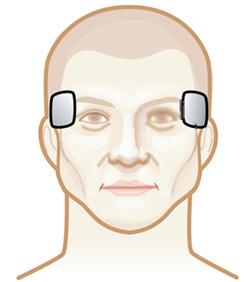
This generally effective and most widely used electrode placement causes the greatest post-ECT disorientation.
Figure 2a Bifrontal placement
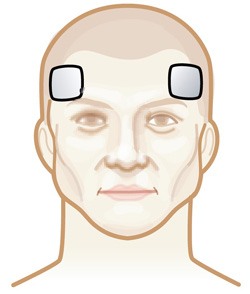
Figure 2b Left anterior right temporal (LART) placement
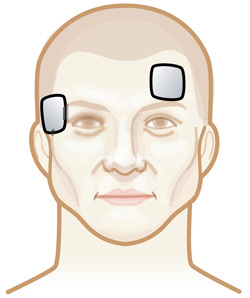
Figure 2c Right unilateral placement
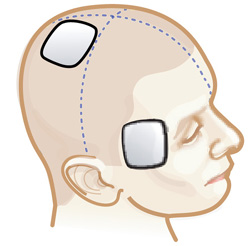
Side Effects of Lart
Side effects such as disorientation and loss of self-care should be less severe and prevalent with LART than with other bilateral placements because:
- the left electrode is far anterior to the temporal lobe, rather than close to it as in bitemporal placement.
- LART avoids symmetrical effect, which can block compensation by the opposite hemisphere.
Hypothetically, some patients might not respond to bifrontal or LART placement but respond to bitemporal ECT, although no such instances have been reported in the literature. By contrast, response to bitemporal ECT after failure of right unilateral ECT (Figure 2, part C) is well known; indeed, studies of unilateral ECT typically include provisions for changing to bitemporal ECT. Moreover, early relapse (within 2 months) appears more frequently after unilateral ECT.
Patient Selection and Dosing
Low-dose right unilateral ECT should suffice in men younger than age 40 because they usually develop vigorous seizures without substantial disorientation afterward. Low dose in unilateral ECT is millicoulomb (mC) charge less than 4 times the patient’s age in years.
In patients who do not develop vigorous seizures—a common problem in men age >65—unilateral ECT is more likely to produce disappointing results than other ECT configurations. Moreover, severe confusion from unilateral ECT is not rare in patients older than 65. Unilateral ECT should not be a routine choice for this age group.
Stimulus dosing in effect alters electrode placement. High dose spreads the stimulus as if the electrodes were much larger. As a result, all forms of placement at high stimulus doses more closely resemble bitemporal ECT, increasing side effect risk and negating differences among the forms of electrode placement. In fact side effects from unilateral ECT at high stimulus doses approximate those of bitemporal ECT.3 Right unilateral ECT in this context has no apparent advantages.
When intervention with ECT is urgently needed—such as for patients with severe catatonia, inanition, or active suicidality—efficacy is paramount and bitemporal ECT is the usual choice. Typical starting dose in mC is 2.5 times age.
In nonemergency circumstances, my experience with LART placement has resulted in strong enthusiasm for ECT by nursing staff and patients who recognize improvement without noticeable side effects.
Clinicians who use ECT should obtain first-hand experience with all four methods of electrode placement. In addition, use of brief-pulse rather than sine-wave stimuli is as important to minimizing side effects as electrode placement.
Disclosure
Dr. Swartz has equity interests in Somatics, LLC, a manufacturer of ECT instruments.
1. Prudic J, Olfson M, Sackeim HA. Electro-convulsive therapy practices in the community. Psychol Med 2001;31:929-34.
2. Swartz CM, Nelson AI. Rational electroconvulsive therapy electrode placement. Psychiatry 2005 2005;2(7):37-43.Available at: http://psychiatrymmc.com/displayArticle.cfm?articleID=article14. Accessed February 6, 2006.
3. McCall WV, Dunn A, Rosenquist PB, Hughes D. Markedly suprathreshold right unilateral ECT versus minimally suprathreshold bilateral ECT: antidepressant and memory effects. J ECT 2002;3:126-9.
Dr. Swartz is professor and chief, division of psychiatric research, Southern Illinois University School of Medicine, Springfield, IL.
Patients with severe mood disorders tend to respond more favorably to electroconvulsive therapy (ECT) when electrode placement has been individually selected for them. Yet most ECT practitioners use one electrode placement—bitemporal—for all patients (Figure 1).1
While standard bitemporal ECT is generally most effective, it also produces the greatest degree of disorientation, which can prolong a hospital stay or increase the need for supportive care.
Bifrontal ECT (Figure 2, part A) has been shown as efficacious as bitemporal placement while producing less disorientation.2 I have found left anterior right temporal (LART) placement (Figure 2, part B), to be equally effective with fewer side effects.
Figure 1 Bitemporal electrode placement
This generally effective and most widely used electrode placement causes the greatest post-ECT disorientation.
Figure 2a Bifrontal placement
Figure 2b Left anterior right temporal (LART) placement
Figure 2c Right unilateral placement
Side Effects of Lart
Side effects such as disorientation and loss of self-care should be less severe and prevalent with LART than with other bilateral placements because:
- the left electrode is far anterior to the temporal lobe, rather than close to it as in bitemporal placement.
- LART avoids symmetrical effect, which can block compensation by the opposite hemisphere.
Hypothetically, some patients might not respond to bifrontal or LART placement but respond to bitemporal ECT, although no such instances have been reported in the literature. By contrast, response to bitemporal ECT after failure of right unilateral ECT (Figure 2, part C) is well known; indeed, studies of unilateral ECT typically include provisions for changing to bitemporal ECT. Moreover, early relapse (within 2 months) appears more frequently after unilateral ECT.
Patient Selection and Dosing
Low-dose right unilateral ECT should suffice in men younger than age 40 because they usually develop vigorous seizures without substantial disorientation afterward. Low dose in unilateral ECT is millicoulomb (mC) charge less than 4 times the patient’s age in years.
In patients who do not develop vigorous seizures—a common problem in men age >65—unilateral ECT is more likely to produce disappointing results than other ECT configurations. Moreover, severe confusion from unilateral ECT is not rare in patients older than 65. Unilateral ECT should not be a routine choice for this age group.
Stimulus dosing in effect alters electrode placement. High dose spreads the stimulus as if the electrodes were much larger. As a result, all forms of placement at high stimulus doses more closely resemble bitemporal ECT, increasing side effect risk and negating differences among the forms of electrode placement. In fact side effects from unilateral ECT at high stimulus doses approximate those of bitemporal ECT.3 Right unilateral ECT in this context has no apparent advantages.
When intervention with ECT is urgently needed—such as for patients with severe catatonia, inanition, or active suicidality—efficacy is paramount and bitemporal ECT is the usual choice. Typical starting dose in mC is 2.5 times age.
In nonemergency circumstances, my experience with LART placement has resulted in strong enthusiasm for ECT by nursing staff and patients who recognize improvement without noticeable side effects.
Clinicians who use ECT should obtain first-hand experience with all four methods of electrode placement. In addition, use of brief-pulse rather than sine-wave stimuli is as important to minimizing side effects as electrode placement.
Disclosure
Dr. Swartz has equity interests in Somatics, LLC, a manufacturer of ECT instruments.
Patients with severe mood disorders tend to respond more favorably to electroconvulsive therapy (ECT) when electrode placement has been individually selected for them. Yet most ECT practitioners use one electrode placement—bitemporal—for all patients (Figure 1).1
While standard bitemporal ECT is generally most effective, it also produces the greatest degree of disorientation, which can prolong a hospital stay or increase the need for supportive care.
Bifrontal ECT (Figure 2, part A) has been shown as efficacious as bitemporal placement while producing less disorientation.2 I have found left anterior right temporal (LART) placement (Figure 2, part B), to be equally effective with fewer side effects.
Figure 1 Bitemporal electrode placement
This generally effective and most widely used electrode placement causes the greatest post-ECT disorientation.
Figure 2a Bifrontal placement
Figure 2b Left anterior right temporal (LART) placement
Figure 2c Right unilateral placement
Side Effects of Lart
Side effects such as disorientation and loss of self-care should be less severe and prevalent with LART than with other bilateral placements because:
- the left electrode is far anterior to the temporal lobe, rather than close to it as in bitemporal placement.
- LART avoids symmetrical effect, which can block compensation by the opposite hemisphere.
Hypothetically, some patients might not respond to bifrontal or LART placement but respond to bitemporal ECT, although no such instances have been reported in the literature. By contrast, response to bitemporal ECT after failure of right unilateral ECT (Figure 2, part C) is well known; indeed, studies of unilateral ECT typically include provisions for changing to bitemporal ECT. Moreover, early relapse (within 2 months) appears more frequently after unilateral ECT.
Patient Selection and Dosing
Low-dose right unilateral ECT should suffice in men younger than age 40 because they usually develop vigorous seizures without substantial disorientation afterward. Low dose in unilateral ECT is millicoulomb (mC) charge less than 4 times the patient’s age in years.
In patients who do not develop vigorous seizures—a common problem in men age >65—unilateral ECT is more likely to produce disappointing results than other ECT configurations. Moreover, severe confusion from unilateral ECT is not rare in patients older than 65. Unilateral ECT should not be a routine choice for this age group.
Stimulus dosing in effect alters electrode placement. High dose spreads the stimulus as if the electrodes were much larger. As a result, all forms of placement at high stimulus doses more closely resemble bitemporal ECT, increasing side effect risk and negating differences among the forms of electrode placement. In fact side effects from unilateral ECT at high stimulus doses approximate those of bitemporal ECT.3 Right unilateral ECT in this context has no apparent advantages.
When intervention with ECT is urgently needed—such as for patients with severe catatonia, inanition, or active suicidality—efficacy is paramount and bitemporal ECT is the usual choice. Typical starting dose in mC is 2.5 times age.
In nonemergency circumstances, my experience with LART placement has resulted in strong enthusiasm for ECT by nursing staff and patients who recognize improvement without noticeable side effects.
Clinicians who use ECT should obtain first-hand experience with all four methods of electrode placement. In addition, use of brief-pulse rather than sine-wave stimuli is as important to minimizing side effects as electrode placement.
Disclosure
Dr. Swartz has equity interests in Somatics, LLC, a manufacturer of ECT instruments.
1. Prudic J, Olfson M, Sackeim HA. Electro-convulsive therapy practices in the community. Psychol Med 2001;31:929-34.
2. Swartz CM, Nelson AI. Rational electroconvulsive therapy electrode placement. Psychiatry 2005 2005;2(7):37-43.Available at: http://psychiatrymmc.com/displayArticle.cfm?articleID=article14. Accessed February 6, 2006.
3. McCall WV, Dunn A, Rosenquist PB, Hughes D. Markedly suprathreshold right unilateral ECT versus minimally suprathreshold bilateral ECT: antidepressant and memory effects. J ECT 2002;3:126-9.
Dr. Swartz is professor and chief, division of psychiatric research, Southern Illinois University School of Medicine, Springfield, IL.
1. Prudic J, Olfson M, Sackeim HA. Electro-convulsive therapy practices in the community. Psychol Med 2001;31:929-34.
2. Swartz CM, Nelson AI. Rational electroconvulsive therapy electrode placement. Psychiatry 2005 2005;2(7):37-43.Available at: http://psychiatrymmc.com/displayArticle.cfm?articleID=article14. Accessed February 6, 2006.
3. McCall WV, Dunn A, Rosenquist PB, Hughes D. Markedly suprathreshold right unilateral ECT versus minimally suprathreshold bilateral ECT: antidepressant and memory effects. J ECT 2002;3:126-9.
Dr. Swartz is professor and chief, division of psychiatric research, Southern Illinois University School of Medicine, Springfield, IL.