User login
Your recap of the 2019 Gut Microbiota for Health World Summit
On March 23 and 24, AGA and the European Society of Neurogastroenterology and Motility (ESNM) gathered 350+ international clinicians and researchers to network and discuss the latest evidence on the interaction between diet, nutrition and the gut microbiome at the 2019 Gut Microbiota for Health World Summit.
Twenty-three novel abstracts were presented as posters at the meeting. The abstracts covered topics ranging from probiotics to diet to potential microbiome-driven treatments for GI disorders.
Below are some key takeaways (as shared on Twitter) from the meeting. Stay tuned for more news and resources from the 2019 Gut Microbiota for Health World Summit, including an official meeting report in Gastroenterology, on-demand presentation recordings, video clips, and more.
“Excess zinc supplementation can change the gut #microbiota and increase risk AND severity of #cdiff infection, says @joeyzacks #GMFH2019 @cdiffFoundation” — Dr. Caterina Oneto (@caterina_oneto)
“You need a #dietitian for low #FODMAP diet education to ensure the patient consumes a nutritionally adequate diet. @MagnusSimren #GMFH2019” — Kate Scarlata, RDN (@KateScarlata_RD)
“Patients with cirrhosis have increased bacteremia, blood LPS levels and intestinal permeability. This background has led to study the role of gut microbiota in liver disease #GMFH2019” — GutMicrobiota Health (@GMFHx)
“Much anticipated talk on #probiotics happening now at #GMFH2019 led by AGA’s probiotics experts @KashyapPurna & Geoffrey Preidis. This work will culminate in a new AGA guideline on using probiotics in clinical practice. Additional data will be presented at #DDW19” — AGA (@AmerGastroAssn)
“Eric Martens: while a low fibre diet may not drive inflammation in the short term, it may increase disease risk in the long term, due to changes in microbiota & mucus degrading bacteria! #GMFH2019” — Andrea Hardy RD (@AndreaHardyRD)
View additional Twitter coverage of the meeting: #GMFH2019.
On March 23 and 24, AGA and the European Society of Neurogastroenterology and Motility (ESNM) gathered 350+ international clinicians and researchers to network and discuss the latest evidence on the interaction between diet, nutrition and the gut microbiome at the 2019 Gut Microbiota for Health World Summit.
Twenty-three novel abstracts were presented as posters at the meeting. The abstracts covered topics ranging from probiotics to diet to potential microbiome-driven treatments for GI disorders.
Below are some key takeaways (as shared on Twitter) from the meeting. Stay tuned for more news and resources from the 2019 Gut Microbiota for Health World Summit, including an official meeting report in Gastroenterology, on-demand presentation recordings, video clips, and more.
“Excess zinc supplementation can change the gut #microbiota and increase risk AND severity of #cdiff infection, says @joeyzacks #GMFH2019 @cdiffFoundation” — Dr. Caterina Oneto (@caterina_oneto)
“You need a #dietitian for low #FODMAP diet education to ensure the patient consumes a nutritionally adequate diet. @MagnusSimren #GMFH2019” — Kate Scarlata, RDN (@KateScarlata_RD)
“Patients with cirrhosis have increased bacteremia, blood LPS levels and intestinal permeability. This background has led to study the role of gut microbiota in liver disease #GMFH2019” — GutMicrobiota Health (@GMFHx)
“Much anticipated talk on #probiotics happening now at #GMFH2019 led by AGA’s probiotics experts @KashyapPurna & Geoffrey Preidis. This work will culminate in a new AGA guideline on using probiotics in clinical practice. Additional data will be presented at #DDW19” — AGA (@AmerGastroAssn)
“Eric Martens: while a low fibre diet may not drive inflammation in the short term, it may increase disease risk in the long term, due to changes in microbiota & mucus degrading bacteria! #GMFH2019” — Andrea Hardy RD (@AndreaHardyRD)
View additional Twitter coverage of the meeting: #GMFH2019.
On March 23 and 24, AGA and the European Society of Neurogastroenterology and Motility (ESNM) gathered 350+ international clinicians and researchers to network and discuss the latest evidence on the interaction between diet, nutrition and the gut microbiome at the 2019 Gut Microbiota for Health World Summit.
Twenty-three novel abstracts were presented as posters at the meeting. The abstracts covered topics ranging from probiotics to diet to potential microbiome-driven treatments for GI disorders.
Below are some key takeaways (as shared on Twitter) from the meeting. Stay tuned for more news and resources from the 2019 Gut Microbiota for Health World Summit, including an official meeting report in Gastroenterology, on-demand presentation recordings, video clips, and more.
“Excess zinc supplementation can change the gut #microbiota and increase risk AND severity of #cdiff infection, says @joeyzacks #GMFH2019 @cdiffFoundation” — Dr. Caterina Oneto (@caterina_oneto)
“You need a #dietitian for low #FODMAP diet education to ensure the patient consumes a nutritionally adequate diet. @MagnusSimren #GMFH2019” — Kate Scarlata, RDN (@KateScarlata_RD)
“Patients with cirrhosis have increased bacteremia, blood LPS levels and intestinal permeability. This background has led to study the role of gut microbiota in liver disease #GMFH2019” — GutMicrobiota Health (@GMFHx)
“Much anticipated talk on #probiotics happening now at #GMFH2019 led by AGA’s probiotics experts @KashyapPurna & Geoffrey Preidis. This work will culminate in a new AGA guideline on using probiotics in clinical practice. Additional data will be presented at #DDW19” — AGA (@AmerGastroAssn)
“Eric Martens: while a low fibre diet may not drive inflammation in the short term, it may increase disease risk in the long term, due to changes in microbiota & mucus degrading bacteria! #GMFH2019” — Andrea Hardy RD (@AndreaHardyRD)
View additional Twitter coverage of the meeting: #GMFH2019.
Meet a rising star in fecal incontinence research
The AGA Research Foundation offers its flagship grant, the AGA Research Scholar Award, to the most promising early career investigators. Kyle Staller, MD, MPH, an assistant professor of medicine at Harvard Medical School in Boston, is no exception. We’re thrilled to highlight Dr. Staller – a 2016 AGA Research Scholar Award winner — as our AGA Research Foundation researcher of the month.

The Staller lab’s AGA-funded project is specifically focused on the risk factors for fecal incontinence, which have not been well studied. One in 10 women over age 80 suffer from this debilitating condition. Dr. Staller looked at the lifestyles and dietary factors of female study participants in research databases to determine whether they were predisposed to developing fecal incontinence beyond the usual risk factors such as childbirth, which can cause injury to the pelvic floor, and diabetes. Dr. Staller believes that understanding and modifying risk factors could decrease the chance, or even prevent, women from developing this condition.
With his AGA Research Foundation grant, Dr. Staller found that consuming dietary fiber in higher quantities, and increasing moderate exercise up to a point, lowered the risk of developing fecal incontinence. “This tells us that not only is fiber healthy but also preventative to fecal incontinence,” he said.
Dr. Staller says that he became interested in this area of study after patients, who were getting excited about their impending retirement or enjoying their retirement years, developed this life-altering condition. His compassion for his patients inspired him to study the factors leading to fecal incontinence, which will likely become more prevalent as the U.S. population ages.
Dr. Staller is using the baseline data from his AGA Research Foundation grant to support his application for a 5-year NIH grant designed to help young investigators learn new research skills to further their careers.
Read more and get to know Dr. Staller by visiting https://www.gastro.org/news/meet-a-rising-star-in-fecal-incontinence-research.
Help AGA build a community of investigators through the AGA Research Foundation.
Your donation to the AGA Research Foundation can fund future success stories by keeping young scientists working to advance our understanding of digestive diseases. Donate today at www.gastro.org/donateonline.
The AGA Research Foundation offers its flagship grant, the AGA Research Scholar Award, to the most promising early career investigators. Kyle Staller, MD, MPH, an assistant professor of medicine at Harvard Medical School in Boston, is no exception. We’re thrilled to highlight Dr. Staller – a 2016 AGA Research Scholar Award winner — as our AGA Research Foundation researcher of the month.
The Staller lab’s AGA-funded project is specifically focused on the risk factors for fecal incontinence, which have not been well studied. One in 10 women over age 80 suffer from this debilitating condition. Dr. Staller looked at the lifestyles and dietary factors of female study participants in research databases to determine whether they were predisposed to developing fecal incontinence beyond the usual risk factors such as childbirth, which can cause injury to the pelvic floor, and diabetes. Dr. Staller believes that understanding and modifying risk factors could decrease the chance, or even prevent, women from developing this condition.
With his AGA Research Foundation grant, Dr. Staller found that consuming dietary fiber in higher quantities, and increasing moderate exercise up to a point, lowered the risk of developing fecal incontinence. “This tells us that not only is fiber healthy but also preventative to fecal incontinence,” he said.
Dr. Staller says that he became interested in this area of study after patients, who were getting excited about their impending retirement or enjoying their retirement years, developed this life-altering condition. His compassion for his patients inspired him to study the factors leading to fecal incontinence, which will likely become more prevalent as the U.S. population ages.
Dr. Staller is using the baseline data from his AGA Research Foundation grant to support his application for a 5-year NIH grant designed to help young investigators learn new research skills to further their careers.
Read more and get to know Dr. Staller by visiting https://www.gastro.org/news/meet-a-rising-star-in-fecal-incontinence-research.
Help AGA build a community of investigators through the AGA Research Foundation.
Your donation to the AGA Research Foundation can fund future success stories by keeping young scientists working to advance our understanding of digestive diseases. Donate today at www.gastro.org/donateonline.
The AGA Research Foundation offers its flagship grant, the AGA Research Scholar Award, to the most promising early career investigators. Kyle Staller, MD, MPH, an assistant professor of medicine at Harvard Medical School in Boston, is no exception. We’re thrilled to highlight Dr. Staller – a 2016 AGA Research Scholar Award winner — as our AGA Research Foundation researcher of the month.
The Staller lab’s AGA-funded project is specifically focused on the risk factors for fecal incontinence, which have not been well studied. One in 10 women over age 80 suffer from this debilitating condition. Dr. Staller looked at the lifestyles and dietary factors of female study participants in research databases to determine whether they were predisposed to developing fecal incontinence beyond the usual risk factors such as childbirth, which can cause injury to the pelvic floor, and diabetes. Dr. Staller believes that understanding and modifying risk factors could decrease the chance, or even prevent, women from developing this condition.
With his AGA Research Foundation grant, Dr. Staller found that consuming dietary fiber in higher quantities, and increasing moderate exercise up to a point, lowered the risk of developing fecal incontinence. “This tells us that not only is fiber healthy but also preventative to fecal incontinence,” he said.
Dr. Staller says that he became interested in this area of study after patients, who were getting excited about their impending retirement or enjoying their retirement years, developed this life-altering condition. His compassion for his patients inspired him to study the factors leading to fecal incontinence, which will likely become more prevalent as the U.S. population ages.
Dr. Staller is using the baseline data from his AGA Research Foundation grant to support his application for a 5-year NIH grant designed to help young investigators learn new research skills to further their careers.
Read more and get to know Dr. Staller by visiting https://www.gastro.org/news/meet-a-rising-star-in-fecal-incontinence-research.
Help AGA build a community of investigators through the AGA Research Foundation.
Your donation to the AGA Research Foundation can fund future success stories by keeping young scientists working to advance our understanding of digestive diseases. Donate today at www.gastro.org/donateonline.
Donate Auction Items for Gala
The ‘Vascular Spectacular’ Gala has officially sold out, but it’s not too late to donate auction items for the live and silent auctions. So far donations consist of vacation stays, tickets to sporting events, entertainment, travel and time shares, chef and other classes, sports memorabilia, wine tastings and much more. All are welcome to participate as bidders in the silent auction. Get the full details here.
The ‘Vascular Spectacular’ Gala has officially sold out, but it’s not too late to donate auction items for the live and silent auctions. So far donations consist of vacation stays, tickets to sporting events, entertainment, travel and time shares, chef and other classes, sports memorabilia, wine tastings and much more. All are welcome to participate as bidders in the silent auction. Get the full details here.
The ‘Vascular Spectacular’ Gala has officially sold out, but it’s not too late to donate auction items for the live and silent auctions. So far donations consist of vacation stays, tickets to sporting events, entertainment, travel and time shares, chef and other classes, sports memorabilia, wine tastings and much more. All are welcome to participate as bidders in the silent auction. Get the full details here.
Programming for PAs Slated
The SVS will once again host an afternoon of education programming specifically for physician assistants. The afternoon session will be from 1 to 5 p.m. Thursday, June 13. Topics include discussions of PAs in different team settings, vascular diagnostics, venous disease and wound management, and dialysis access. Attendees can also earn additional credits. VAM is designated for 30 AAPA Category 1 CME credits. Register for VAM today.
The SVS will once again host an afternoon of education programming specifically for physician assistants. The afternoon session will be from 1 to 5 p.m. Thursday, June 13. Topics include discussions of PAs in different team settings, vascular diagnostics, venous disease and wound management, and dialysis access. Attendees can also earn additional credits. VAM is designated for 30 AAPA Category 1 CME credits. Register for VAM today.
The SVS will once again host an afternoon of education programming specifically for physician assistants. The afternoon session will be from 1 to 5 p.m. Thursday, June 13. Topics include discussions of PAs in different team settings, vascular diagnostics, venous disease and wound management, and dialysis access. Attendees can also earn additional credits. VAM is designated for 30 AAPA Category 1 CME credits. Register for VAM today.
Register for VAM by Tomorrow for a Chance to Win
The Society for Vascular Surgery will provide complimentary meeting registration to a lucky attendee. To be eligible, all you must do is register for the meeting before 5 p.m. CDT tomorrow, April 24. The winner will be selected at random. This year’s meeting will be June 12 to 15 at the Gaylord National Resort & Convention Center in National Harbor, Md., just outside Washington D.C. Read more about the VAM contest, and more, in the latest SVS VAMail.
The Society for Vascular Surgery will provide complimentary meeting registration to a lucky attendee. To be eligible, all you must do is register for the meeting before 5 p.m. CDT tomorrow, April 24. The winner will be selected at random. This year’s meeting will be June 12 to 15 at the Gaylord National Resort & Convention Center in National Harbor, Md., just outside Washington D.C. Read more about the VAM contest, and more, in the latest SVS VAMail.
The Society for Vascular Surgery will provide complimentary meeting registration to a lucky attendee. To be eligible, all you must do is register for the meeting before 5 p.m. CDT tomorrow, April 24. The winner will be selected at random. This year’s meeting will be June 12 to 15 at the Gaylord National Resort & Convention Center in National Harbor, Md., just outside Washington D.C. Read more about the VAM contest, and more, in the latest SVS VAMail.
Join SVS Section on Outpatient & Office Vascular Care
The SVS recently established the Section on Outpatient & Office Vascular Care (SOOVC) for clinicians who work in outpatient and office vascular care centers. SOOVC membership is available to all SVS members in good standing, and hospital/practice administrators are welcome to join as Affiliate Members. Benefits for SOOVC members include, but are not limited to, specific programming at the Vascular Annual Meeting, discounts on SVS events, networking opportunities and access to SVSConnect. Please reach out to [email protected] or 312-334-2349 with questions.
The SVS recently established the Section on Outpatient & Office Vascular Care (SOOVC) for clinicians who work in outpatient and office vascular care centers. SOOVC membership is available to all SVS members in good standing, and hospital/practice administrators are welcome to join as Affiliate Members. Benefits for SOOVC members include, but are not limited to, specific programming at the Vascular Annual Meeting, discounts on SVS events, networking opportunities and access to SVSConnect. Please reach out to [email protected] or 312-334-2349 with questions.
The SVS recently established the Section on Outpatient & Office Vascular Care (SOOVC) for clinicians who work in outpatient and office vascular care centers. SOOVC membership is available to all SVS members in good standing, and hospital/practice administrators are welcome to join as Affiliate Members. Benefits for SOOVC members include, but are not limited to, specific programming at the Vascular Annual Meeting, discounts on SVS events, networking opportunities and access to SVSConnect. Please reach out to [email protected] or 312-334-2349 with questions.
Plan Your VAM
Begin planning your Vascular Annual Meeting experience today with the recently launched SVS Online Planner. This includes the entire VAM schedule, as well as the schedule for the Society for Vascular Nursing’s annual conference. The Vascular Quality Initiative’s meeting, VQI@VAM, will be available on the planner soon. With the Online Planner, you can easily search for information, such as presenters, specific topics, session types, intended audience and credit availability. It also makes creating a schedule simple and time-efficient. Access the online planner now.
Begin planning your Vascular Annual Meeting experience today with the recently launched SVS Online Planner. This includes the entire VAM schedule, as well as the schedule for the Society for Vascular Nursing’s annual conference. The Vascular Quality Initiative’s meeting, VQI@VAM, will be available on the planner soon. With the Online Planner, you can easily search for information, such as presenters, specific topics, session types, intended audience and credit availability. It also makes creating a schedule simple and time-efficient. Access the online planner now.
Begin planning your Vascular Annual Meeting experience today with the recently launched SVS Online Planner. This includes the entire VAM schedule, as well as the schedule for the Society for Vascular Nursing’s annual conference. The Vascular Quality Initiative’s meeting, VQI@VAM, will be available on the planner soon. With the Online Planner, you can easily search for information, such as presenters, specific topics, session types, intended audience and credit availability. It also makes creating a schedule simple and time-efficient. Access the online planner now.
Submit Comments on Clinical Practice Guidelines
The SVS is now seeking comments on draft Clinical Practice Guidelines on the Management of Visceral Aneurysms. Your comments are essential to strengthen the content of these guidelines, and to ensure relevance in clinical practice and potential for improvements in patient care. Feedback received during the comment period will be shared with the writing committee. Anyone, from SVS members to patients, is welcome to review these draft guidelines and provide comments before April 23.
The SVS is now seeking comments on draft Clinical Practice Guidelines on the Management of Visceral Aneurysms. Your comments are essential to strengthen the content of these guidelines, and to ensure relevance in clinical practice and potential for improvements in patient care. Feedback received during the comment period will be shared with the writing committee. Anyone, from SVS members to patients, is welcome to review these draft guidelines and provide comments before April 23.
The SVS is now seeking comments on draft Clinical Practice Guidelines on the Management of Visceral Aneurysms. Your comments are essential to strengthen the content of these guidelines, and to ensure relevance in clinical practice and potential for improvements in patient care. Feedback received during the comment period will be shared with the writing committee. Anyone, from SVS members to patients, is welcome to review these draft guidelines and provide comments before April 23.
Register for VAM for a Chance to Win
The Society for Vascular Surgery will provide complimentary meeting registration to a lucky attendee. To be eligible, all you must do is register for the meeting before 5 p.m. CDT Wednesday, April 24. The winner will be selected at random. This year’s meeting will be June 12 to 15 at the Gaylord National Resort & Convention Center in National Harbor, Md., just outside Washington D.C. Read more about the VAM contest, and more, in the latest SVS VAMail.
The Society for Vascular Surgery will provide complimentary meeting registration to a lucky attendee. To be eligible, all you must do is register for the meeting before 5 p.m. CDT Wednesday, April 24. The winner will be selected at random. This year’s meeting will be June 12 to 15 at the Gaylord National Resort & Convention Center in National Harbor, Md., just outside Washington D.C. Read more about the VAM contest, and more, in the latest SVS VAMail.
The Society for Vascular Surgery will provide complimentary meeting registration to a lucky attendee. To be eligible, all you must do is register for the meeting before 5 p.m. CDT Wednesday, April 24. The winner will be selected at random. This year’s meeting will be June 12 to 15 at the Gaylord National Resort & Convention Center in National Harbor, Md., just outside Washington D.C. Read more about the VAM contest, and more, in the latest SVS VAMail.
Social media for physicians: Strong medicine or snake oil?
For most of us, social media is a daunting new reality that we are pressured to be part of but that we struggle to fit into our increasingly demanding schedules. My first social media foray as a physician was a Facebook fan page as a hobby rather than a professional presence. Years later, I have learned the incredible benefit that being on social media in other platforms brought to my profession.
What’s social media going to bring to my medical practice?
The days where physicians retreat to the safety of our offices to deliver our care, or to issue carefully structured opinions, or interactions with patients have made way for more direct interaction. Social media has, indeed, allowed us to share more personal glimpses of our daily struggle to save lives, behind-the-scenes snapshot of ethical struggles in decision making, our difficulties qualifying patients for therapies due to insurance complications, or real-time addressing medical news and combating misinformation. Moreover, when patients self-refer, or are referred to my practice, they look me up online before coming to my office. Online profiles are the new “first impression” of the bedside manner of a physician.
Other personal examples of social media benefits include being informed of new publications, since many journals now have an online presence; being able to interact in real-time with authors; learning from physicians in other countries how they handled issues, such as shortage of critical medications; or earning CME, such as the Twitter chats hosted by CHEST (eg, new biologic agents in difficult to treat asthma, or patient selection in triple therapy for COPD).
Why should I pay attention to social media presence?
The pace by which social media changed the landscape took the medical community by surprise. Patients, third-party websites, and online review agencies (official or not) adopted it well before physicians became comfortable with it. As such, when I decided to google myself online, I was shocked at the level of misinformation about me (as a pulmonologist, I didn’t know I had performed sigmoidoscopies, yet that’s what my patients learned before they met me). That was an important lesson: If I don’t control the narrative, someone else will. Consequently, I dedicated a few hours to establish an online presence in order to introduce myself accurately and to be accessible to my patients and colleagues online.
Who decides what’s ethical and what’s not?
As the lines blurred, our community struggled to define what was appropriate and what was not. Finally, we welcomed with relief the issuance of a Code of Ethics, regarding social media use by physicians, from several societies, including the American Medical Association (https://www.ama-assn.org/delivering-care/ethics/professionalism-use-social-media). The principles guiding physicians use of social media include respect for human dignity and rights, honesty and upholding the standards of professionalism, and the duty to safeguard patient confidences and privacy.
Which platform should I use? There are so many.
While any content can be shared on any platform, social media sites have organically differentiated into being more amenable to one content vs the other. Some accounts tend to be more for professional use (ie, Twitter and LinkedIn), and other accounts for personal use (ie, Facebook, Instagram, Snapchat, and Pinterest). CHEST has selected Twitter to host its CME chats regarding preselected topics, post information about an upcoming lecture during the CHEST meeting, etc. New social media sites are now “physician only,” such as Sermo, Doximity, QuantiMD, and Doc2Doc. Many of these sites require doctors to submit their credentials to a site gatekeeper, recreating the intimacy of a “physicians’ lounge” in an online environment (J Med Internet Res. 2014:Feb 11;16[2]:e13). Lastly, Figure1 is a media sharing app between physicians allowing discussions of de-identified images or cases, recreating the “curbside” consult concept online.
I heard about hashtags. What are they?
Hashtags are simply clickable topic titles (#COPD #Sepsis # Education, etc.) that can be added to a post, in order to widen its reach. For instance, if I am interested in sepsis, I can click on the hashtag #Sepsis, and it would bring up all the posts on any Twitter account that added that hashtag. It’s a filter that takes me to that topic of interest. I can then click on the button “Like” on the message or the account itself where the post was found. The “Like” is similar to a bookmark for that account on my own Twitter. In the future, all the posts from that account would be available to me.
What are influencers or thought leaders?
Anyone who “liked” my account is now “following” me. The number of followers has become a measure of the popularity of anyone on social media. If it reaches a high level, then the person with the account is dubbed an “influencer.” Social media “influencers” are individuals whose opinion is followed by hundreds of thousands. Influencers may even be rewarded for harnessing their reach to make money off advertising. One can easily see how it is powerful for a physician to become an influencer or a “thought leader,” not to make money but to expand their reach on social media to spread the correct information about diets, drugs, e-cigarettes, and vaccinations, to name a few.
Can social media get me in trouble?
In 2012, a survey of the state medical boards published by JAMA (2012;307[11]:1141) revealed that approximately 30% of state medical boards reported complaints of “online violations of patient confidentiality.” More than 10% stated they had encountered a case of an “online depiction of intoxication.”
Another study a year earlier revealed that 13% of physicians reported they have discussed individual, though anonymized, cases with other physicians in public online forums (http://www.quantiamd.com/qqcp/DoctorsPatientSocialMedia.pdf).
Even if posted anonymously, or on a “personal” rather than professional social media site, various investigative methods may potentially be used to directly link information to a specific person or incident. The most current case law dictates that such information is “discoverable.” In fact, Facebook’s policy for the use of data informs users that, “we may access, preserve, and share your information in response to a legal request” both within and outside of U.S. jurisdiction”.
What kind of trouble could I be exposed to?
Poor quality of information, damage to our professional image, breaches of patient’s privacy, violation of patient-physician boundary, license revoking by state boards, and erroneous medical advice given in the absence of examining a patient, are all potential pitfalls for physicians in the careless use of social media.
How can I minimize my legal risk when interacting online?
It has been suggested that a legally sound approach in response to requests for online medical advice would be to send a standard response form that:
• informs the inquirer that the health-care provider does not answer online questions;
• supplies offline contact information so that an appointment can be made, if desired; and
• identifies a source for emergency services if the inquirer cannot wait for an appointment.
In circumstances where a patient–physician relationship already exists, informed consent should be obtained, which should include a careful explanation regarding the risks of online communication, expected response times, and the handling of emergencies, then documented in the patient’s chart (PT. 2014 Jul;39[7]:491,520).
In Summary
Social media, much like any area of medicine one is interested in, can be daunting and exciting but fraught with potential difficulties. I liken its adoption in our daily practice to any other decision or interest, including being in a private or academic setting, adopting procedural medicine or sticking to diagnostic consultations, or participating in research. In the end, it’s an individual expression of our desire to practice medicine. However, verifying information already existing online about us is of paramount importance. If I don’t tell my story, someone else will, and they may not be as truthful.
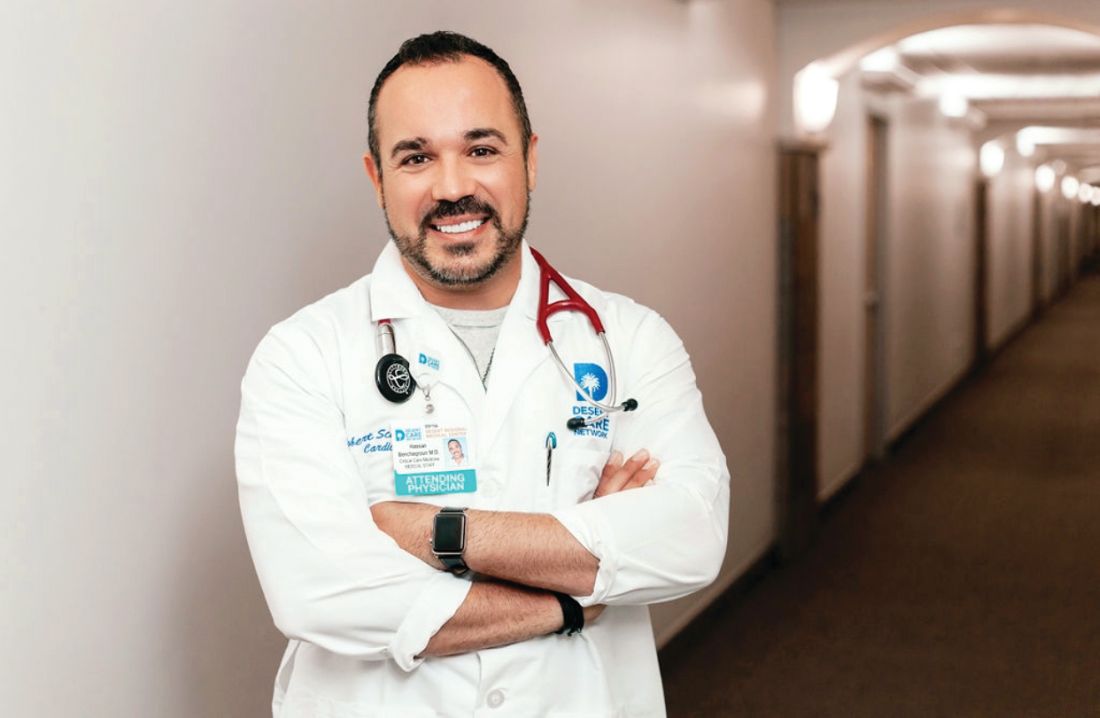
Dr. Bencheqroun is Assistant Professor, University of California Riverside School of Medicine, Pulmonary/Critical Care Faculty Program Coordinator & Research Mentor - Internal Medicine Residency Program Desert Regional Medical Center, Palm Springs CA; and Immediate Past Chair of the CHEST Council of Networks.
For most of us, social media is a daunting new reality that we are pressured to be part of but that we struggle to fit into our increasingly demanding schedules. My first social media foray as a physician was a Facebook fan page as a hobby rather than a professional presence. Years later, I have learned the incredible benefit that being on social media in other platforms brought to my profession.
What’s social media going to bring to my medical practice?
The days where physicians retreat to the safety of our offices to deliver our care, or to issue carefully structured opinions, or interactions with patients have made way for more direct interaction. Social media has, indeed, allowed us to share more personal glimpses of our daily struggle to save lives, behind-the-scenes snapshot of ethical struggles in decision making, our difficulties qualifying patients for therapies due to insurance complications, or real-time addressing medical news and combating misinformation. Moreover, when patients self-refer, or are referred to my practice, they look me up online before coming to my office. Online profiles are the new “first impression” of the bedside manner of a physician.
Other personal examples of social media benefits include being informed of new publications, since many journals now have an online presence; being able to interact in real-time with authors; learning from physicians in other countries how they handled issues, such as shortage of critical medications; or earning CME, such as the Twitter chats hosted by CHEST (eg, new biologic agents in difficult to treat asthma, or patient selection in triple therapy for COPD).
Why should I pay attention to social media presence?
The pace by which social media changed the landscape took the medical community by surprise. Patients, third-party websites, and online review agencies (official or not) adopted it well before physicians became comfortable with it. As such, when I decided to google myself online, I was shocked at the level of misinformation about me (as a pulmonologist, I didn’t know I had performed sigmoidoscopies, yet that’s what my patients learned before they met me). That was an important lesson: If I don’t control the narrative, someone else will. Consequently, I dedicated a few hours to establish an online presence in order to introduce myself accurately and to be accessible to my patients and colleagues online.
Who decides what’s ethical and what’s not?
As the lines blurred, our community struggled to define what was appropriate and what was not. Finally, we welcomed with relief the issuance of a Code of Ethics, regarding social media use by physicians, from several societies, including the American Medical Association (https://www.ama-assn.org/delivering-care/ethics/professionalism-use-social-media). The principles guiding physicians use of social media include respect for human dignity and rights, honesty and upholding the standards of professionalism, and the duty to safeguard patient confidences and privacy.
Which platform should I use? There are so many.
While any content can be shared on any platform, social media sites have organically differentiated into being more amenable to one content vs the other. Some accounts tend to be more for professional use (ie, Twitter and LinkedIn), and other accounts for personal use (ie, Facebook, Instagram, Snapchat, and Pinterest). CHEST has selected Twitter to host its CME chats regarding preselected topics, post information about an upcoming lecture during the CHEST meeting, etc. New social media sites are now “physician only,” such as Sermo, Doximity, QuantiMD, and Doc2Doc. Many of these sites require doctors to submit their credentials to a site gatekeeper, recreating the intimacy of a “physicians’ lounge” in an online environment (J Med Internet Res. 2014:Feb 11;16[2]:e13). Lastly, Figure1 is a media sharing app between physicians allowing discussions of de-identified images or cases, recreating the “curbside” consult concept online.
I heard about hashtags. What are they?
Hashtags are simply clickable topic titles (#COPD #Sepsis # Education, etc.) that can be added to a post, in order to widen its reach. For instance, if I am interested in sepsis, I can click on the hashtag #Sepsis, and it would bring up all the posts on any Twitter account that added that hashtag. It’s a filter that takes me to that topic of interest. I can then click on the button “Like” on the message or the account itself where the post was found. The “Like” is similar to a bookmark for that account on my own Twitter. In the future, all the posts from that account would be available to me.
What are influencers or thought leaders?
Anyone who “liked” my account is now “following” me. The number of followers has become a measure of the popularity of anyone on social media. If it reaches a high level, then the person with the account is dubbed an “influencer.” Social media “influencers” are individuals whose opinion is followed by hundreds of thousands. Influencers may even be rewarded for harnessing their reach to make money off advertising. One can easily see how it is powerful for a physician to become an influencer or a “thought leader,” not to make money but to expand their reach on social media to spread the correct information about diets, drugs, e-cigarettes, and vaccinations, to name a few.
Can social media get me in trouble?
In 2012, a survey of the state medical boards published by JAMA (2012;307[11]:1141) revealed that approximately 30% of state medical boards reported complaints of “online violations of patient confidentiality.” More than 10% stated they had encountered a case of an “online depiction of intoxication.”
Another study a year earlier revealed that 13% of physicians reported they have discussed individual, though anonymized, cases with other physicians in public online forums (http://www.quantiamd.com/qqcp/DoctorsPatientSocialMedia.pdf).
Even if posted anonymously, or on a “personal” rather than professional social media site, various investigative methods may potentially be used to directly link information to a specific person or incident. The most current case law dictates that such information is “discoverable.” In fact, Facebook’s policy for the use of data informs users that, “we may access, preserve, and share your information in response to a legal request” both within and outside of U.S. jurisdiction”.
What kind of trouble could I be exposed to?
Poor quality of information, damage to our professional image, breaches of patient’s privacy, violation of patient-physician boundary, license revoking by state boards, and erroneous medical advice given in the absence of examining a patient, are all potential pitfalls for physicians in the careless use of social media.
How can I minimize my legal risk when interacting online?
It has been suggested that a legally sound approach in response to requests for online medical advice would be to send a standard response form that:
• informs the inquirer that the health-care provider does not answer online questions;
• supplies offline contact information so that an appointment can be made, if desired; and
• identifies a source for emergency services if the inquirer cannot wait for an appointment.
In circumstances where a patient–physician relationship already exists, informed consent should be obtained, which should include a careful explanation regarding the risks of online communication, expected response times, and the handling of emergencies, then documented in the patient’s chart (PT. 2014 Jul;39[7]:491,520).
In Summary
Social media, much like any area of medicine one is interested in, can be daunting and exciting but fraught with potential difficulties. I liken its adoption in our daily practice to any other decision or interest, including being in a private or academic setting, adopting procedural medicine or sticking to diagnostic consultations, or participating in research. In the end, it’s an individual expression of our desire to practice medicine. However, verifying information already existing online about us is of paramount importance. If I don’t tell my story, someone else will, and they may not be as truthful.
Dr. Bencheqroun is Assistant Professor, University of California Riverside School of Medicine, Pulmonary/Critical Care Faculty Program Coordinator & Research Mentor - Internal Medicine Residency Program Desert Regional Medical Center, Palm Springs CA; and Immediate Past Chair of the CHEST Council of Networks.
For most of us, social media is a daunting new reality that we are pressured to be part of but that we struggle to fit into our increasingly demanding schedules. My first social media foray as a physician was a Facebook fan page as a hobby rather than a professional presence. Years later, I have learned the incredible benefit that being on social media in other platforms brought to my profession.
What’s social media going to bring to my medical practice?
The days where physicians retreat to the safety of our offices to deliver our care, or to issue carefully structured opinions, or interactions with patients have made way for more direct interaction. Social media has, indeed, allowed us to share more personal glimpses of our daily struggle to save lives, behind-the-scenes snapshot of ethical struggles in decision making, our difficulties qualifying patients for therapies due to insurance complications, or real-time addressing medical news and combating misinformation. Moreover, when patients self-refer, or are referred to my practice, they look me up online before coming to my office. Online profiles are the new “first impression” of the bedside manner of a physician.
Other personal examples of social media benefits include being informed of new publications, since many journals now have an online presence; being able to interact in real-time with authors; learning from physicians in other countries how they handled issues, such as shortage of critical medications; or earning CME, such as the Twitter chats hosted by CHEST (eg, new biologic agents in difficult to treat asthma, or patient selection in triple therapy for COPD).
Why should I pay attention to social media presence?
The pace by which social media changed the landscape took the medical community by surprise. Patients, third-party websites, and online review agencies (official or not) adopted it well before physicians became comfortable with it. As such, when I decided to google myself online, I was shocked at the level of misinformation about me (as a pulmonologist, I didn’t know I had performed sigmoidoscopies, yet that’s what my patients learned before they met me). That was an important lesson: If I don’t control the narrative, someone else will. Consequently, I dedicated a few hours to establish an online presence in order to introduce myself accurately and to be accessible to my patients and colleagues online.
Who decides what’s ethical and what’s not?
As the lines blurred, our community struggled to define what was appropriate and what was not. Finally, we welcomed with relief the issuance of a Code of Ethics, regarding social media use by physicians, from several societies, including the American Medical Association (https://www.ama-assn.org/delivering-care/ethics/professionalism-use-social-media). The principles guiding physicians use of social media include respect for human dignity and rights, honesty and upholding the standards of professionalism, and the duty to safeguard patient confidences and privacy.
Which platform should I use? There are so many.
While any content can be shared on any platform, social media sites have organically differentiated into being more amenable to one content vs the other. Some accounts tend to be more for professional use (ie, Twitter and LinkedIn), and other accounts for personal use (ie, Facebook, Instagram, Snapchat, and Pinterest). CHEST has selected Twitter to host its CME chats regarding preselected topics, post information about an upcoming lecture during the CHEST meeting, etc. New social media sites are now “physician only,” such as Sermo, Doximity, QuantiMD, and Doc2Doc. Many of these sites require doctors to submit their credentials to a site gatekeeper, recreating the intimacy of a “physicians’ lounge” in an online environment (J Med Internet Res. 2014:Feb 11;16[2]:e13). Lastly, Figure1 is a media sharing app between physicians allowing discussions of de-identified images or cases, recreating the “curbside” consult concept online.
I heard about hashtags. What are they?
Hashtags are simply clickable topic titles (#COPD #Sepsis # Education, etc.) that can be added to a post, in order to widen its reach. For instance, if I am interested in sepsis, I can click on the hashtag #Sepsis, and it would bring up all the posts on any Twitter account that added that hashtag. It’s a filter that takes me to that topic of interest. I can then click on the button “Like” on the message or the account itself where the post was found. The “Like” is similar to a bookmark for that account on my own Twitter. In the future, all the posts from that account would be available to me.
What are influencers or thought leaders?
Anyone who “liked” my account is now “following” me. The number of followers has become a measure of the popularity of anyone on social media. If it reaches a high level, then the person with the account is dubbed an “influencer.” Social media “influencers” are individuals whose opinion is followed by hundreds of thousands. Influencers may even be rewarded for harnessing their reach to make money off advertising. One can easily see how it is powerful for a physician to become an influencer or a “thought leader,” not to make money but to expand their reach on social media to spread the correct information about diets, drugs, e-cigarettes, and vaccinations, to name a few.
Can social media get me in trouble?
In 2012, a survey of the state medical boards published by JAMA (2012;307[11]:1141) revealed that approximately 30% of state medical boards reported complaints of “online violations of patient confidentiality.” More than 10% stated they had encountered a case of an “online depiction of intoxication.”
Another study a year earlier revealed that 13% of physicians reported they have discussed individual, though anonymized, cases with other physicians in public online forums (http://www.quantiamd.com/qqcp/DoctorsPatientSocialMedia.pdf).
Even if posted anonymously, or on a “personal” rather than professional social media site, various investigative methods may potentially be used to directly link information to a specific person or incident. The most current case law dictates that such information is “discoverable.” In fact, Facebook’s policy for the use of data informs users that, “we may access, preserve, and share your information in response to a legal request” both within and outside of U.S. jurisdiction”.
What kind of trouble could I be exposed to?
Poor quality of information, damage to our professional image, breaches of patient’s privacy, violation of patient-physician boundary, license revoking by state boards, and erroneous medical advice given in the absence of examining a patient, are all potential pitfalls for physicians in the careless use of social media.
How can I minimize my legal risk when interacting online?
It has been suggested that a legally sound approach in response to requests for online medical advice would be to send a standard response form that:
• informs the inquirer that the health-care provider does not answer online questions;
• supplies offline contact information so that an appointment can be made, if desired; and
• identifies a source for emergency services if the inquirer cannot wait for an appointment.
In circumstances where a patient–physician relationship already exists, informed consent should be obtained, which should include a careful explanation regarding the risks of online communication, expected response times, and the handling of emergencies, then documented in the patient’s chart (PT. 2014 Jul;39[7]:491,520).
In Summary
Social media, much like any area of medicine one is interested in, can be daunting and exciting but fraught with potential difficulties. I liken its adoption in our daily practice to any other decision or interest, including being in a private or academic setting, adopting procedural medicine or sticking to diagnostic consultations, or participating in research. In the end, it’s an individual expression of our desire to practice medicine. However, verifying information already existing online about us is of paramount importance. If I don’t tell my story, someone else will, and they may not be as truthful.
Dr. Bencheqroun is Assistant Professor, University of California Riverside School of Medicine, Pulmonary/Critical Care Faculty Program Coordinator & Research Mentor - Internal Medicine Residency Program Desert Regional Medical Center, Palm Springs CA; and Immediate Past Chair of the CHEST Council of Networks.