User login
Bridge Grant Applications Due Oct. 1
Applications are due Oct. 1 for the SVS Foundation's new Bridge Grant, which provides funding from one grant to another. The grant targets those investigators with previous national funding for basic research, such as an NIH R01 grant, and who applied for another R01 grant but did not receive a high enough priority score to be funded again. Apply today.
Applications are due Oct. 1 for the SVS Foundation's new Bridge Grant, which provides funding from one grant to another. The grant targets those investigators with previous national funding for basic research, such as an NIH R01 grant, and who applied for another R01 grant but did not receive a high enough priority score to be funded again. Apply today.
Applications are due Oct. 1 for the SVS Foundation's new Bridge Grant, which provides funding from one grant to another. The grant targets those investigators with previous national funding for basic research, such as an NIH R01 grant, and who applied for another R01 grant but did not receive a high enough priority score to be funded again. Apply today.
Dr. Valerie W. Rusch to receive ACS Distinguished Service Award
The Board of Regents of the American College of Surgeons (ACS) has selected Valerie W. Rusch, MD, FACS, an esteemed thoracic surgeon in New York, NY, as the recipient of the 2018 Distinguished Service Award (DSA)--the College's highest honor. The Board of Regents will present the award to Dr. Rusch, vice-chair, clinical research, department of surgery; Miner Family Chair in Intrathoracic Cancers; attending surgeon, thoracic service, department of surgery, Memorial Sloan-Kettering Cancer Center; and professor of surgery, Weill Cornell Medical College, New York, NY, at the Convocation ceremony at 6:00 pm October 21 at the Clinical Congress 2018 in Boston, MA.
The Board of Regents is presenting the DSA to Dr. Rusch for "her exemplary leadership of many professional organizations and as a mentor, teacher, and trainer of the next generation of surgeons in clinical trial development and her dedication to expand access to surgical care to underserved global populations," according to the award citation.
The award also is being presented to Dr. Rusch "in admiration of her natural leadership, integrity, vision, and steadfast commitment to the College's initiatives and principles, serving as a role model to surgeons everywhere to always do the right thing for patients."
Leadership in the ACS
An ACS Fellow since 1986, Dr. Rusch has led several prominent ACS bodies, including serving as Chair of the Board of Governors (2006−2008) and Board of Regents (2015−2016). A Regent from 2008 to 2017, she chaired the Central Judiciary Committee (2009–2013), the Program Committee (2011–2017), the Board of Regents Nominating Committee (2011–2012), and the Committee on Global Engagement (2016−2017). She served on the Board of Regents Honors Committee (2012−2016), Executive Committee (2013−2016), and Finance Committee (2014−2016).
In addition, she has been a member of the College’s Advisory Council for Cardiothoracic Surgery (2002−2017), International Relations Committee (2007−2013, Executive Committee, 2009−2012), Commission on Cancer Executive Committee (2012−2017), Scholarships Committee (2008−2012), and Research and Optimal Patient Care Committee (2008−2015).
Renowned thoracic surgeon
Dr. Rusch specializes in the diagnosis and treatment of patients with cancers of the lung, airways (trachea, bronchi), esophagus, mediastinum, chest wall, and pleura (malignant pleural mesothelioma). She was among the first women in the U.S. to be board certified in thoracic surgery.
For more than 30 years, she has emphasized a multidisciplinary approach to treating patients with thoracic malignancy. Her research has focused on the molecular behaviors of asbestos cancers and the genetic tendencies of lung cancer as a means to identify certain cancers in the earlier stages.
Dr. Rusch has been a leader in national and international clinical trials for the treatment of thoracic malignancies and played a pivotal role in establishing the ACS Oncology Group--now the ACS Clinical Research Program. Among her many honors, in 2007, Dr. Rusch received the Thoracic Surgery Foundation for Research and Education Socrates Award, and in 2012, the Association of Women Surgeons awarded her the Nina Starr Braunwald Award for lifetime contributions to the advancement of women in surgery.
She has held 25 visiting professorships and lectureships and given more than 300 major lectures on thoracic cancers at medical conferences around the world. Her curriculum vitae boasts more than 400 peer-reviewed publications.
In addition to the ACS, Dr. Rusch has been a leader of other surgical organizations. More specifically, she served as chair of the American Board of Thoracic Surgery, chair of the Lung and Esophagus Task Force of the American Joint Commission on Cancer, and chair of the Mesothelioma Subcommittee of the International Association for the Study of Lung Cancer Staging Committee.
Dr. Rusch is fluent in both French and English, having graduated from the Lycée Français de New York. She graduated from Vassar College, Poughkeepsie, NY, with a degree in biochemistry. She earned her medical degree from the Columbia University College of Physicians and Surgeons, New York, and she completed surgical residency training in general surgery and thoracic surgery at the University of Washington, Seattle, followed by a fellowship at the University of Texas MD Anderson Cancer Center, Houston.
The Board of Regents of the American College of Surgeons (ACS) has selected Valerie W. Rusch, MD, FACS, an esteemed thoracic surgeon in New York, NY, as the recipient of the 2018 Distinguished Service Award (DSA)--the College's highest honor. The Board of Regents will present the award to Dr. Rusch, vice-chair, clinical research, department of surgery; Miner Family Chair in Intrathoracic Cancers; attending surgeon, thoracic service, department of surgery, Memorial Sloan-Kettering Cancer Center; and professor of surgery, Weill Cornell Medical College, New York, NY, at the Convocation ceremony at 6:00 pm October 21 at the Clinical Congress 2018 in Boston, MA.
The Board of Regents is presenting the DSA to Dr. Rusch for "her exemplary leadership of many professional organizations and as a mentor, teacher, and trainer of the next generation of surgeons in clinical trial development and her dedication to expand access to surgical care to underserved global populations," according to the award citation.
The award also is being presented to Dr. Rusch "in admiration of her natural leadership, integrity, vision, and steadfast commitment to the College's initiatives and principles, serving as a role model to surgeons everywhere to always do the right thing for patients."
Leadership in the ACS
An ACS Fellow since 1986, Dr. Rusch has led several prominent ACS bodies, including serving as Chair of the Board of Governors (2006−2008) and Board of Regents (2015−2016). A Regent from 2008 to 2017, she chaired the Central Judiciary Committee (2009–2013), the Program Committee (2011–2017), the Board of Regents Nominating Committee (2011–2012), and the Committee on Global Engagement (2016−2017). She served on the Board of Regents Honors Committee (2012−2016), Executive Committee (2013−2016), and Finance Committee (2014−2016).
In addition, she has been a member of the College’s Advisory Council for Cardiothoracic Surgery (2002−2017), International Relations Committee (2007−2013, Executive Committee, 2009−2012), Commission on Cancer Executive Committee (2012−2017), Scholarships Committee (2008−2012), and Research and Optimal Patient Care Committee (2008−2015).
Renowned thoracic surgeon
Dr. Rusch specializes in the diagnosis and treatment of patients with cancers of the lung, airways (trachea, bronchi), esophagus, mediastinum, chest wall, and pleura (malignant pleural mesothelioma). She was among the first women in the U.S. to be board certified in thoracic surgery.
For more than 30 years, she has emphasized a multidisciplinary approach to treating patients with thoracic malignancy. Her research has focused on the molecular behaviors of asbestos cancers and the genetic tendencies of lung cancer as a means to identify certain cancers in the earlier stages.
Dr. Rusch has been a leader in national and international clinical trials for the treatment of thoracic malignancies and played a pivotal role in establishing the ACS Oncology Group--now the ACS Clinical Research Program. Among her many honors, in 2007, Dr. Rusch received the Thoracic Surgery Foundation for Research and Education Socrates Award, and in 2012, the Association of Women Surgeons awarded her the Nina Starr Braunwald Award for lifetime contributions to the advancement of women in surgery.
She has held 25 visiting professorships and lectureships and given more than 300 major lectures on thoracic cancers at medical conferences around the world. Her curriculum vitae boasts more than 400 peer-reviewed publications.
In addition to the ACS, Dr. Rusch has been a leader of other surgical organizations. More specifically, she served as chair of the American Board of Thoracic Surgery, chair of the Lung and Esophagus Task Force of the American Joint Commission on Cancer, and chair of the Mesothelioma Subcommittee of the International Association for the Study of Lung Cancer Staging Committee.
Dr. Rusch is fluent in both French and English, having graduated from the Lycée Français de New York. She graduated from Vassar College, Poughkeepsie, NY, with a degree in biochemistry. She earned her medical degree from the Columbia University College of Physicians and Surgeons, New York, and she completed surgical residency training in general surgery and thoracic surgery at the University of Washington, Seattle, followed by a fellowship at the University of Texas MD Anderson Cancer Center, Houston.
The Board of Regents of the American College of Surgeons (ACS) has selected Valerie W. Rusch, MD, FACS, an esteemed thoracic surgeon in New York, NY, as the recipient of the 2018 Distinguished Service Award (DSA)--the College's highest honor. The Board of Regents will present the award to Dr. Rusch, vice-chair, clinical research, department of surgery; Miner Family Chair in Intrathoracic Cancers; attending surgeon, thoracic service, department of surgery, Memorial Sloan-Kettering Cancer Center; and professor of surgery, Weill Cornell Medical College, New York, NY, at the Convocation ceremony at 6:00 pm October 21 at the Clinical Congress 2018 in Boston, MA.
The Board of Regents is presenting the DSA to Dr. Rusch for "her exemplary leadership of many professional organizations and as a mentor, teacher, and trainer of the next generation of surgeons in clinical trial development and her dedication to expand access to surgical care to underserved global populations," according to the award citation.
The award also is being presented to Dr. Rusch "in admiration of her natural leadership, integrity, vision, and steadfast commitment to the College's initiatives and principles, serving as a role model to surgeons everywhere to always do the right thing for patients."
Leadership in the ACS
An ACS Fellow since 1986, Dr. Rusch has led several prominent ACS bodies, including serving as Chair of the Board of Governors (2006−2008) and Board of Regents (2015−2016). A Regent from 2008 to 2017, she chaired the Central Judiciary Committee (2009–2013), the Program Committee (2011–2017), the Board of Regents Nominating Committee (2011–2012), and the Committee on Global Engagement (2016−2017). She served on the Board of Regents Honors Committee (2012−2016), Executive Committee (2013−2016), and Finance Committee (2014−2016).
In addition, she has been a member of the College’s Advisory Council for Cardiothoracic Surgery (2002−2017), International Relations Committee (2007−2013, Executive Committee, 2009−2012), Commission on Cancer Executive Committee (2012−2017), Scholarships Committee (2008−2012), and Research and Optimal Patient Care Committee (2008−2015).
Renowned thoracic surgeon
Dr. Rusch specializes in the diagnosis and treatment of patients with cancers of the lung, airways (trachea, bronchi), esophagus, mediastinum, chest wall, and pleura (malignant pleural mesothelioma). She was among the first women in the U.S. to be board certified in thoracic surgery.
For more than 30 years, she has emphasized a multidisciplinary approach to treating patients with thoracic malignancy. Her research has focused on the molecular behaviors of asbestos cancers and the genetic tendencies of lung cancer as a means to identify certain cancers in the earlier stages.
Dr. Rusch has been a leader in national and international clinical trials for the treatment of thoracic malignancies and played a pivotal role in establishing the ACS Oncology Group--now the ACS Clinical Research Program. Among her many honors, in 2007, Dr. Rusch received the Thoracic Surgery Foundation for Research and Education Socrates Award, and in 2012, the Association of Women Surgeons awarded her the Nina Starr Braunwald Award for lifetime contributions to the advancement of women in surgery.
She has held 25 visiting professorships and lectureships and given more than 300 major lectures on thoracic cancers at medical conferences around the world. Her curriculum vitae boasts more than 400 peer-reviewed publications.
In addition to the ACS, Dr. Rusch has been a leader of other surgical organizations. More specifically, she served as chair of the American Board of Thoracic Surgery, chair of the Lung and Esophagus Task Force of the American Joint Commission on Cancer, and chair of the Mesothelioma Subcommittee of the International Association for the Study of Lung Cancer Staging Committee.
Dr. Rusch is fluent in both French and English, having graduated from the Lycée Français de New York. She graduated from Vassar College, Poughkeepsie, NY, with a degree in biochemistry. She earned her medical degree from the Columbia University College of Physicians and Surgeons, New York, and she completed surgical residency training in general surgery and thoracic surgery at the University of Washington, Seattle, followed by a fellowship at the University of Texas MD Anderson Cancer Center, Houston.
CHEST keynote to bridge the gap between generations
Scott Zimmer, a product of generation X, went through college with a passion for public speaking, as well as a deep interest in the generational divide. In 2013, he began working for a company called BridgeWorks and so began his career as one of three speakers at this firm of “generational junkies and trend spotters.”
Founded in 1998, Bridgeworks strives to bridge the generational gaps that are found in all workplaces through research, keynote speakers, workshops, blogs, training, trivia, and more. Bridgeworks is a team of 13 people coming from the baby boomer generation down to millennials on the cusp of being classified with generation Z (gen edgers, as Zimmer calls them). Each team member has their own interesting and diverse background with a passion for the topic of generations, and everyone engages this passion by conducting research with the BridgeWorks team.
There are generational clashes in every single industry, according to Zimmer. Just at BridgeWorks, he even notices when simply sending a text he perceives as “normal” to one of his millennial coworkers, that it is sometimes received as curt and leaves the recipient concerned that they have done something to offend him. This topic is not foreign to anyone— everyone has had a moment of saying “kids these days,” or “ugh, old people.” Because of this, Zimmer starts every session knowing that each person will leave with relevant insights and actionable takeaways.
Zimmer also loves to integrate nostalgia into his presentations, and working with generational theory at BridgeWorks allows him to do just that in a way that helps drive home points and makes ideas more relatable. “Some people like to say we are all just people and we grow out of certain things. But we develop specific traits and values at an impressionable age, and I love looking at what was happening in our lives during those formative years. What are these shared experiences that will form who we are?” This love of nostalgia set Zimmer up for a great opportunity to develop his own trivia gameshow at BridgeWorks. GenPOP! is an interactive trivia gameshow that pairs members of different generations up and quizzes them on all things pop culture from different decades, while also teaching audience members new things about the people they interact with every day.
“So much goes into who we are and who shows up to the workplace, what effects our behavior, and our motivation,” says Zimmer when asked where his passion for this topic stems. “It could be our gender, the region we grew up in, or birth order, and I personally like looking at it through the lens of these different generations.”
So, what will Zimmer bring to CHEST 2018? During his keynote presentation in San Antonio, Zimmer will examine the generational gaps that are existent in the medical community. “You don’t want your young medical professionals to feel like they are sitting at the ‘kids table’ or being talked down to when they have something to share because they do not have equal experience.”
Each generation and each member of a medical team communicates differently, and understanding those differences and feeling like an equal part of the team is very important. How information is conveyed to patients and medical team members of any age affects how they perceive given information and the level of comfort that is felt by each party. Finding ways to bridge the obvious gaps between the generations is a key component to making any team work efficiently.
Scott Zimmer, a product of generation X, went through college with a passion for public speaking, as well as a deep interest in the generational divide. In 2013, he began working for a company called BridgeWorks and so began his career as one of three speakers at this firm of “generational junkies and trend spotters.”
Founded in 1998, Bridgeworks strives to bridge the generational gaps that are found in all workplaces through research, keynote speakers, workshops, blogs, training, trivia, and more. Bridgeworks is a team of 13 people coming from the baby boomer generation down to millennials on the cusp of being classified with generation Z (gen edgers, as Zimmer calls them). Each team member has their own interesting and diverse background with a passion for the topic of generations, and everyone engages this passion by conducting research with the BridgeWorks team.
There are generational clashes in every single industry, according to Zimmer. Just at BridgeWorks, he even notices when simply sending a text he perceives as “normal” to one of his millennial coworkers, that it is sometimes received as curt and leaves the recipient concerned that they have done something to offend him. This topic is not foreign to anyone— everyone has had a moment of saying “kids these days,” or “ugh, old people.” Because of this, Zimmer starts every session knowing that each person will leave with relevant insights and actionable takeaways.
Zimmer also loves to integrate nostalgia into his presentations, and working with generational theory at BridgeWorks allows him to do just that in a way that helps drive home points and makes ideas more relatable. “Some people like to say we are all just people and we grow out of certain things. But we develop specific traits and values at an impressionable age, and I love looking at what was happening in our lives during those formative years. What are these shared experiences that will form who we are?” This love of nostalgia set Zimmer up for a great opportunity to develop his own trivia gameshow at BridgeWorks. GenPOP! is an interactive trivia gameshow that pairs members of different generations up and quizzes them on all things pop culture from different decades, while also teaching audience members new things about the people they interact with every day.
“So much goes into who we are and who shows up to the workplace, what effects our behavior, and our motivation,” says Zimmer when asked where his passion for this topic stems. “It could be our gender, the region we grew up in, or birth order, and I personally like looking at it through the lens of these different generations.”
So, what will Zimmer bring to CHEST 2018? During his keynote presentation in San Antonio, Zimmer will examine the generational gaps that are existent in the medical community. “You don’t want your young medical professionals to feel like they are sitting at the ‘kids table’ or being talked down to when they have something to share because they do not have equal experience.”
Each generation and each member of a medical team communicates differently, and understanding those differences and feeling like an equal part of the team is very important. How information is conveyed to patients and medical team members of any age affects how they perceive given information and the level of comfort that is felt by each party. Finding ways to bridge the obvious gaps between the generations is a key component to making any team work efficiently.
Scott Zimmer, a product of generation X, went through college with a passion for public speaking, as well as a deep interest in the generational divide. In 2013, he began working for a company called BridgeWorks and so began his career as one of three speakers at this firm of “generational junkies and trend spotters.”
Founded in 1998, Bridgeworks strives to bridge the generational gaps that are found in all workplaces through research, keynote speakers, workshops, blogs, training, trivia, and more. Bridgeworks is a team of 13 people coming from the baby boomer generation down to millennials on the cusp of being classified with generation Z (gen edgers, as Zimmer calls them). Each team member has their own interesting and diverse background with a passion for the topic of generations, and everyone engages this passion by conducting research with the BridgeWorks team.
There are generational clashes in every single industry, according to Zimmer. Just at BridgeWorks, he even notices when simply sending a text he perceives as “normal” to one of his millennial coworkers, that it is sometimes received as curt and leaves the recipient concerned that they have done something to offend him. This topic is not foreign to anyone— everyone has had a moment of saying “kids these days,” or “ugh, old people.” Because of this, Zimmer starts every session knowing that each person will leave with relevant insights and actionable takeaways.
Zimmer also loves to integrate nostalgia into his presentations, and working with generational theory at BridgeWorks allows him to do just that in a way that helps drive home points and makes ideas more relatable. “Some people like to say we are all just people and we grow out of certain things. But we develop specific traits and values at an impressionable age, and I love looking at what was happening in our lives during those formative years. What are these shared experiences that will form who we are?” This love of nostalgia set Zimmer up for a great opportunity to develop his own trivia gameshow at BridgeWorks. GenPOP! is an interactive trivia gameshow that pairs members of different generations up and quizzes them on all things pop culture from different decades, while also teaching audience members new things about the people they interact with every day.
“So much goes into who we are and who shows up to the workplace, what effects our behavior, and our motivation,” says Zimmer when asked where his passion for this topic stems. “It could be our gender, the region we grew up in, or birth order, and I personally like looking at it through the lens of these different generations.”
So, what will Zimmer bring to CHEST 2018? During his keynote presentation in San Antonio, Zimmer will examine the generational gaps that are existent in the medical community. “You don’t want your young medical professionals to feel like they are sitting at the ‘kids table’ or being talked down to when they have something to share because they do not have equal experience.”
Each generation and each member of a medical team communicates differently, and understanding those differences and feeling like an equal part of the team is very important. How information is conveyed to patients and medical team members of any age affects how they perceive given information and the level of comfort that is felt by each party. Finding ways to bridge the obvious gaps between the generations is a key component to making any team work efficiently.
Impact factor news for the journal CHEST®
The journal CHEST® was recently awarded a 2-year impact factor of 7.652, the highest in its history, which equates to a 24% increase over last year’s score. In addition, our 5-year impact factor is 7.854, a 7% increase over last year. With respect to the 2-year factor, CHEST® is ranked 4th out of 33 journals in the Critical Care category and 7th out of 59 journals in the Respiratory System category.
Our recent Eigenfactor places us as the second-highest ranked journal in both respiratory and critical care categories. The Eigenfactor metric adjusts the impact factor by eliminating self-citations and factoring in citations in the top-tier journals.
Congratulations to our journal CHEST® !
The journal CHEST® was recently awarded a 2-year impact factor of 7.652, the highest in its history, which equates to a 24% increase over last year’s score. In addition, our 5-year impact factor is 7.854, a 7% increase over last year. With respect to the 2-year factor, CHEST® is ranked 4th out of 33 journals in the Critical Care category and 7th out of 59 journals in the Respiratory System category.
Our recent Eigenfactor places us as the second-highest ranked journal in both respiratory and critical care categories. The Eigenfactor metric adjusts the impact factor by eliminating self-citations and factoring in citations in the top-tier journals.
Congratulations to our journal CHEST® !
The journal CHEST® was recently awarded a 2-year impact factor of 7.652, the highest in its history, which equates to a 24% increase over last year’s score. In addition, our 5-year impact factor is 7.854, a 7% increase over last year. With respect to the 2-year factor, CHEST® is ranked 4th out of 33 journals in the Critical Care category and 7th out of 59 journals in the Respiratory System category.
Our recent Eigenfactor places us as the second-highest ranked journal in both respiratory and critical care categories. The Eigenfactor metric adjusts the impact factor by eliminating self-citations and factoring in citations in the top-tier journals.
Congratulations to our journal CHEST® !
CHEST NetWorks
Palliative and End-of-Life Care
Patient-tailored goals-of-care discussions: Is this the new standard?
Goals-of-care discussions can be challenging conversations for even the most seasoned physicians. The challenge often is not just the timing but also knowing how to stitch together the content of the discussion. In most cases, physicians have minimal prior knowledge of patient and family preferences, and this adds to the complexity. In addition, the majority of these discussions happen in the inpatient setting (Mack et al. Ann Intern Med. 2012;156[3]:204) where the acuity of the illness adds to the barriers of effective communication (Fulmer et al. J Am Geriatr Soc. 2018;May 23. doi: 10.1111/jgs.15374. [Epub ahead of print]). Can these discussions be tailored to suit individual patient needs and can such attempts better goals-of-care communication? A recent publication by Curtis et al in JAMA Internal Medicine (2018;178[7]:930) attempts to shed light on these unanswered questions and provide physician guidance to better engage in these critical discussions. The cluster-randomized trial included both clinicians and patients. Patients were sent a survey assessing their individual preferences, and physicians were given a summary and communication tips based on these preferences (Jumpstart-Tips). This simple, cost-effective yet scalable intervention was able to improve the frequency, documentation, and patient-assessed quality of goals-of-care discussions in an outpatient setting. In addition, the delivery of goal-concordant care was increased at 3 months in the subgroup of patients with stable goals. A notable limitation of this study was the low participation among physicians. Further studies will be needed to further dissect the characteristics of participating and nonparticipating physicians. Research will also be needed to ascertain how to seamlessly integrate this into health-care delivery. But one irrefutable point is that interventions to improve communication hold the key to better end-of-life care delivery for our patients with serious illnesses. Drs. Paladino and Bernacki have aptly noted in their commentary (JAMA Intern Med. 2018;178[7]:940): “In the age of precision medicine, one can imagine a future of precision communication, where we….provide customized direction for clinicians to begin these discussions based on patient-specific needs.” One question remains. Will this be the new standard? The answer lies with us, the clinicians. My answer to this is a resounding “Yes,” and I hope early adopters will lead the way and prove me right.
Shine Raju, MD, MBBS
Steering Committee Member
Respiratory Care
Prevention of health-care professional errors in use of inhalers
Asthma affects approximately 300 million people worldwide. The 2018 Global Initiative for Asthma (GINA) guidelines recommend assessing the patient’s inhaler technique on a regular basis (www.ginasthma.org. Updated 2018. Accessed August 1, 2018).
The pressurized metered-dose inhaler (pMDI) and dry powder inhaler (DPI) are the most common aerosolized medication delivery devices.
Proper inhaler technique optimizes delivery of medication, and patients rely on a variety of their health-care providers (HCP) to teach them to use the devices. Unfortunately, evidence demonstrates patients are unable to use their inhalers properly (Sanchis et al. Chest. 2016;150[2]:394). Improper and inadequate inhaler technique is commonly associated with poor disease control, exacerbations, hospitalization stays, and need for systemic corticosteroids and antibiotic therapy (Capanoglu et al. J Asthma. 2015;52[8]:838; Levy et al. Prim Care Respir J. 2013;22:406; Westerik et al. J Asthma. 2015;53[3]:1).
Incorrect inhaler use is attributed to the design of the device, poor patient understanding, and HCPs having insufficient knowledge of the inhalers and performed the correct inhaled technique 15.5% of the time (Plaza et al. J Allergy Clin Immunol Prac. 2018;6[3]:987).
Health-care providers who are directly responsible for managing patients with pulmonary disease must have knowledge of correct inhaler techniques to effectively teach patients and properly assess their use of these devices. The quality of the HCP instruction to the patient is key to reducing poor inhaler technique (Klijn et al. NPJ Prim Care Respir Med. 2017;;27[1]:24. doi: 10.1038/s41533-017-0022-1). Targeted inhaler technique educational programs for HCPs have been shown to improve clinical outcomes of patients with asthma (Myers. Respir Care. 2015;60[8]:1190). The Respiratory Care NetWork is developing HCP and patient handouts for each aerosol delivery device which may be available in early 2019.
De De Gardner, DrPH, RRT-NPS, FCCP
Steering Committee Member
Sleep Medicine
Pediatric Sleep Disorders
The Sleep Medicine Network has worked hard to contribute to the CHEST 2018 exciting program of events by highlighting hot topics, discussing clinical controversies, and presenting challenging cases in sleep medicine. The goal of the Sleep Medicine Network has been to design content relevant to the diverse audience attending CHEST in San Antonio this year.
This goal includes topics relevant to pediatric sleep medicine. Why is this important to the larger audience at CHEST? Demand for pediatric sleep physicians significantly out paces access in many areas of this country (Phillips et al. Am J Respir Crit Care Med. 2015;192[8]:915). Adult sleep physicians may treat older children or adolescents in their practice, they may care for medically complex children when they transition to adulthood, and they may be asked for advice regarding the sleep concerns of children of their friends and colleagues. Sleep problems in children are common and may affect up to a quarter of children at some point during their lifetime (Owens. Prim Care. 2008;35[3]:533). The entire household is affected when children are not receiving adequate sleep; the sleep of their caregivers and family members is impacted. While many similarities exist between adult and pediatric sleep medicine, physicians who regularly care for children need to be aware of the important differences in the evaluation and treatment of pediatric sleep disorders.
How else can we connect with your practice? If you have an important topic you would like considered for CHEST 2019 please seek out the Sleep Medicine Network meeting in San Antonio, so we can continue to generate relevant content for your practice.
Julie Baughn, MD
Steering Committee Member
Palliative and End-of-Life Care
Patient-tailored goals-of-care discussions: Is this the new standard?
Goals-of-care discussions can be challenging conversations for even the most seasoned physicians. The challenge often is not just the timing but also knowing how to stitch together the content of the discussion. In most cases, physicians have minimal prior knowledge of patient and family preferences, and this adds to the complexity. In addition, the majority of these discussions happen in the inpatient setting (Mack et al. Ann Intern Med. 2012;156[3]:204) where the acuity of the illness adds to the barriers of effective communication (Fulmer et al. J Am Geriatr Soc. 2018;May 23. doi: 10.1111/jgs.15374. [Epub ahead of print]). Can these discussions be tailored to suit individual patient needs and can such attempts better goals-of-care communication? A recent publication by Curtis et al in JAMA Internal Medicine (2018;178[7]:930) attempts to shed light on these unanswered questions and provide physician guidance to better engage in these critical discussions. The cluster-randomized trial included both clinicians and patients. Patients were sent a survey assessing their individual preferences, and physicians were given a summary and communication tips based on these preferences (Jumpstart-Tips). This simple, cost-effective yet scalable intervention was able to improve the frequency, documentation, and patient-assessed quality of goals-of-care discussions in an outpatient setting. In addition, the delivery of goal-concordant care was increased at 3 months in the subgroup of patients with stable goals. A notable limitation of this study was the low participation among physicians. Further studies will be needed to further dissect the characteristics of participating and nonparticipating physicians. Research will also be needed to ascertain how to seamlessly integrate this into health-care delivery. But one irrefutable point is that interventions to improve communication hold the key to better end-of-life care delivery for our patients with serious illnesses. Drs. Paladino and Bernacki have aptly noted in their commentary (JAMA Intern Med. 2018;178[7]:940): “In the age of precision medicine, one can imagine a future of precision communication, where we….provide customized direction for clinicians to begin these discussions based on patient-specific needs.” One question remains. Will this be the new standard? The answer lies with us, the clinicians. My answer to this is a resounding “Yes,” and I hope early adopters will lead the way and prove me right.
Shine Raju, MD, MBBS
Steering Committee Member
Respiratory Care
Prevention of health-care professional errors in use of inhalers
Asthma affects approximately 300 million people worldwide. The 2018 Global Initiative for Asthma (GINA) guidelines recommend assessing the patient’s inhaler technique on a regular basis (www.ginasthma.org. Updated 2018. Accessed August 1, 2018).
The pressurized metered-dose inhaler (pMDI) and dry powder inhaler (DPI) are the most common aerosolized medication delivery devices.
Proper inhaler technique optimizes delivery of medication, and patients rely on a variety of their health-care providers (HCP) to teach them to use the devices. Unfortunately, evidence demonstrates patients are unable to use their inhalers properly (Sanchis et al. Chest. 2016;150[2]:394). Improper and inadequate inhaler technique is commonly associated with poor disease control, exacerbations, hospitalization stays, and need for systemic corticosteroids and antibiotic therapy (Capanoglu et al. J Asthma. 2015;52[8]:838; Levy et al. Prim Care Respir J. 2013;22:406; Westerik et al. J Asthma. 2015;53[3]:1).
Incorrect inhaler use is attributed to the design of the device, poor patient understanding, and HCPs having insufficient knowledge of the inhalers and performed the correct inhaled technique 15.5% of the time (Plaza et al. J Allergy Clin Immunol Prac. 2018;6[3]:987).
Health-care providers who are directly responsible for managing patients with pulmonary disease must have knowledge of correct inhaler techniques to effectively teach patients and properly assess their use of these devices. The quality of the HCP instruction to the patient is key to reducing poor inhaler technique (Klijn et al. NPJ Prim Care Respir Med. 2017;;27[1]:24. doi: 10.1038/s41533-017-0022-1). Targeted inhaler technique educational programs for HCPs have been shown to improve clinical outcomes of patients with asthma (Myers. Respir Care. 2015;60[8]:1190). The Respiratory Care NetWork is developing HCP and patient handouts for each aerosol delivery device which may be available in early 2019.
De De Gardner, DrPH, RRT-NPS, FCCP
Steering Committee Member
Sleep Medicine
Pediatric Sleep Disorders
The Sleep Medicine Network has worked hard to contribute to the CHEST 2018 exciting program of events by highlighting hot topics, discussing clinical controversies, and presenting challenging cases in sleep medicine. The goal of the Sleep Medicine Network has been to design content relevant to the diverse audience attending CHEST in San Antonio this year.
This goal includes topics relevant to pediatric sleep medicine. Why is this important to the larger audience at CHEST? Demand for pediatric sleep physicians significantly out paces access in many areas of this country (Phillips et al. Am J Respir Crit Care Med. 2015;192[8]:915). Adult sleep physicians may treat older children or adolescents in their practice, they may care for medically complex children when they transition to adulthood, and they may be asked for advice regarding the sleep concerns of children of their friends and colleagues. Sleep problems in children are common and may affect up to a quarter of children at some point during their lifetime (Owens. Prim Care. 2008;35[3]:533). The entire household is affected when children are not receiving adequate sleep; the sleep of their caregivers and family members is impacted. While many similarities exist between adult and pediatric sleep medicine, physicians who regularly care for children need to be aware of the important differences in the evaluation and treatment of pediatric sleep disorders.
How else can we connect with your practice? If you have an important topic you would like considered for CHEST 2019 please seek out the Sleep Medicine Network meeting in San Antonio, so we can continue to generate relevant content for your practice.
Julie Baughn, MD
Steering Committee Member
Palliative and End-of-Life Care
Patient-tailored goals-of-care discussions: Is this the new standard?
Goals-of-care discussions can be challenging conversations for even the most seasoned physicians. The challenge often is not just the timing but also knowing how to stitch together the content of the discussion. In most cases, physicians have minimal prior knowledge of patient and family preferences, and this adds to the complexity. In addition, the majority of these discussions happen in the inpatient setting (Mack et al. Ann Intern Med. 2012;156[3]:204) where the acuity of the illness adds to the barriers of effective communication (Fulmer et al. J Am Geriatr Soc. 2018;May 23. doi: 10.1111/jgs.15374. [Epub ahead of print]). Can these discussions be tailored to suit individual patient needs and can such attempts better goals-of-care communication? A recent publication by Curtis et al in JAMA Internal Medicine (2018;178[7]:930) attempts to shed light on these unanswered questions and provide physician guidance to better engage in these critical discussions. The cluster-randomized trial included both clinicians and patients. Patients were sent a survey assessing their individual preferences, and physicians were given a summary and communication tips based on these preferences (Jumpstart-Tips). This simple, cost-effective yet scalable intervention was able to improve the frequency, documentation, and patient-assessed quality of goals-of-care discussions in an outpatient setting. In addition, the delivery of goal-concordant care was increased at 3 months in the subgroup of patients with stable goals. A notable limitation of this study was the low participation among physicians. Further studies will be needed to further dissect the characteristics of participating and nonparticipating physicians. Research will also be needed to ascertain how to seamlessly integrate this into health-care delivery. But one irrefutable point is that interventions to improve communication hold the key to better end-of-life care delivery for our patients with serious illnesses. Drs. Paladino and Bernacki have aptly noted in their commentary (JAMA Intern Med. 2018;178[7]:940): “In the age of precision medicine, one can imagine a future of precision communication, where we….provide customized direction for clinicians to begin these discussions based on patient-specific needs.” One question remains. Will this be the new standard? The answer lies with us, the clinicians. My answer to this is a resounding “Yes,” and I hope early adopters will lead the way and prove me right.
Shine Raju, MD, MBBS
Steering Committee Member
Respiratory Care
Prevention of health-care professional errors in use of inhalers
Asthma affects approximately 300 million people worldwide. The 2018 Global Initiative for Asthma (GINA) guidelines recommend assessing the patient’s inhaler technique on a regular basis (www.ginasthma.org. Updated 2018. Accessed August 1, 2018).
The pressurized metered-dose inhaler (pMDI) and dry powder inhaler (DPI) are the most common aerosolized medication delivery devices.
Proper inhaler technique optimizes delivery of medication, and patients rely on a variety of their health-care providers (HCP) to teach them to use the devices. Unfortunately, evidence demonstrates patients are unable to use their inhalers properly (Sanchis et al. Chest. 2016;150[2]:394). Improper and inadequate inhaler technique is commonly associated with poor disease control, exacerbations, hospitalization stays, and need for systemic corticosteroids and antibiotic therapy (Capanoglu et al. J Asthma. 2015;52[8]:838; Levy et al. Prim Care Respir J. 2013;22:406; Westerik et al. J Asthma. 2015;53[3]:1).
Incorrect inhaler use is attributed to the design of the device, poor patient understanding, and HCPs having insufficient knowledge of the inhalers and performed the correct inhaled technique 15.5% of the time (Plaza et al. J Allergy Clin Immunol Prac. 2018;6[3]:987).
Health-care providers who are directly responsible for managing patients with pulmonary disease must have knowledge of correct inhaler techniques to effectively teach patients and properly assess their use of these devices. The quality of the HCP instruction to the patient is key to reducing poor inhaler technique (Klijn et al. NPJ Prim Care Respir Med. 2017;;27[1]:24. doi: 10.1038/s41533-017-0022-1). Targeted inhaler technique educational programs for HCPs have been shown to improve clinical outcomes of patients with asthma (Myers. Respir Care. 2015;60[8]:1190). The Respiratory Care NetWork is developing HCP and patient handouts for each aerosol delivery device which may be available in early 2019.
De De Gardner, DrPH, RRT-NPS, FCCP
Steering Committee Member
Sleep Medicine
Pediatric Sleep Disorders
The Sleep Medicine Network has worked hard to contribute to the CHEST 2018 exciting program of events by highlighting hot topics, discussing clinical controversies, and presenting challenging cases in sleep medicine. The goal of the Sleep Medicine Network has been to design content relevant to the diverse audience attending CHEST in San Antonio this year.
This goal includes topics relevant to pediatric sleep medicine. Why is this important to the larger audience at CHEST? Demand for pediatric sleep physicians significantly out paces access in many areas of this country (Phillips et al. Am J Respir Crit Care Med. 2015;192[8]:915). Adult sleep physicians may treat older children or adolescents in their practice, they may care for medically complex children when they transition to adulthood, and they may be asked for advice regarding the sleep concerns of children of their friends and colleagues. Sleep problems in children are common and may affect up to a quarter of children at some point during their lifetime (Owens. Prim Care. 2008;35[3]:533). The entire household is affected when children are not receiving adequate sleep; the sleep of their caregivers and family members is impacted. While many similarities exist between adult and pediatric sleep medicine, physicians who regularly care for children need to be aware of the important differences in the evaluation and treatment of pediatric sleep disorders.
How else can we connect with your practice? If you have an important topic you would like considered for CHEST 2019 please seek out the Sleep Medicine Network meeting in San Antonio, so we can continue to generate relevant content for your practice.
Julie Baughn, MD
Steering Committee Member
CHEST Keynote: Reflections of a Lifetime Practicing Chest Medicine
Dr. Richard Irwin, the Editor in Chief for the journal CHEST, and Chair of UMass Memorial Medical Center’s Department of Critical Care, has observed the way patient-focused care has evolved through the years. He will be speaking on this topic at the CHEST 2018 opening session on Sunday, October 7.
During Dr. Irwin’s early years at UMass Memorial, the then chairman of Medicine, Dr. James Dalen, a longtime CHEST member who was about to begin his term as CHEST President, strongly encouraged Dr. Irwin to join the organization. By joining the college, Dr. Irwin was able to form strong connections with other influential chest medicine professionals, such as Dr. Jack Weg, a former CHEST President, and Dr. Alfred Soffer – who was the Editor in Chief of CHEST.
While Dr. Irwin was not yet a member of the CHEST community, the college became instrumental in focusing Dr. Irwin’s academic career because of a manuscript that he and colleagues had been working on, titled Cough. A Comprehensive Review. After submitting the early version of his manuscript to ten different journals and being rejected by each one, Dr. Irwin contacted Dr. Soffer and asked him, if he had the time, could he please read it and offer advice. Dr. Soffer, who had a reputation of being a mentor with endless generosity of his time, reviewed the manuscript and worked with Dr. Irwin on the article, leading to its publication in the Archives of Internal Medicine in 1977. Dr. Soffer’s kindness would lead to the start of Dr. Irwin’s 40-year career of studying cough.
Dr. Irwin has been very influential within the CHEST organization throughout his career. In addition to his years as the Editor in Chief of CHEST, he also served on every major CHEST committee and held the office of CHEST President in 2003-2004. “If you want to join a society that has a family-feel to it and focuses on clinical care and education, then CHEST is the place to be.”
Throughout his years as a physician, Dr. Irwin has been interested in the way physicians learn. During his formative years, he says the way he learned was to “see one, do one, teach one.” He gives the example of the flexible fiber-optic bronchoscope, which was developed in Japan in the late 1960s, arriving in the US in 1970. It was a new way of performing bronchoscopy, which led to physicians reading about it, and then putting what they read into action. Now – there are high fidelity simulation instruments and models and a lot of experiential learning prefacing the use of new technologies for patients. We have CHEST to thank for being a leader in experiential learning and an international resource for simulation training.
Dr. Richard Irwin, the Editor in Chief for the journal CHEST, and Chair of UMass Memorial Medical Center’s Department of Critical Care, has observed the way patient-focused care has evolved through the years. He will be speaking on this topic at the CHEST 2018 opening session on Sunday, October 7.
During Dr. Irwin’s early years at UMass Memorial, the then chairman of Medicine, Dr. James Dalen, a longtime CHEST member who was about to begin his term as CHEST President, strongly encouraged Dr. Irwin to join the organization. By joining the college, Dr. Irwin was able to form strong connections with other influential chest medicine professionals, such as Dr. Jack Weg, a former CHEST President, and Dr. Alfred Soffer – who was the Editor in Chief of CHEST.
While Dr. Irwin was not yet a member of the CHEST community, the college became instrumental in focusing Dr. Irwin’s academic career because of a manuscript that he and colleagues had been working on, titled Cough. A Comprehensive Review. After submitting the early version of his manuscript to ten different journals and being rejected by each one, Dr. Irwin contacted Dr. Soffer and asked him, if he had the time, could he please read it and offer advice. Dr. Soffer, who had a reputation of being a mentor with endless generosity of his time, reviewed the manuscript and worked with Dr. Irwin on the article, leading to its publication in the Archives of Internal Medicine in 1977. Dr. Soffer’s kindness would lead to the start of Dr. Irwin’s 40-year career of studying cough.
Dr. Irwin has been very influential within the CHEST organization throughout his career. In addition to his years as the Editor in Chief of CHEST, he also served on every major CHEST committee and held the office of CHEST President in 2003-2004. “If you want to join a society that has a family-feel to it and focuses on clinical care and education, then CHEST is the place to be.”
Throughout his years as a physician, Dr. Irwin has been interested in the way physicians learn. During his formative years, he says the way he learned was to “see one, do one, teach one.” He gives the example of the flexible fiber-optic bronchoscope, which was developed in Japan in the late 1960s, arriving in the US in 1970. It was a new way of performing bronchoscopy, which led to physicians reading about it, and then putting what they read into action. Now – there are high fidelity simulation instruments and models and a lot of experiential learning prefacing the use of new technologies for patients. We have CHEST to thank for being a leader in experiential learning and an international resource for simulation training.
Dr. Richard Irwin, the Editor in Chief for the journal CHEST, and Chair of UMass Memorial Medical Center’s Department of Critical Care, has observed the way patient-focused care has evolved through the years. He will be speaking on this topic at the CHEST 2018 opening session on Sunday, October 7.
During Dr. Irwin’s early years at UMass Memorial, the then chairman of Medicine, Dr. James Dalen, a longtime CHEST member who was about to begin his term as CHEST President, strongly encouraged Dr. Irwin to join the organization. By joining the college, Dr. Irwin was able to form strong connections with other influential chest medicine professionals, such as Dr. Jack Weg, a former CHEST President, and Dr. Alfred Soffer – who was the Editor in Chief of CHEST.
While Dr. Irwin was not yet a member of the CHEST community, the college became instrumental in focusing Dr. Irwin’s academic career because of a manuscript that he and colleagues had been working on, titled Cough. A Comprehensive Review. After submitting the early version of his manuscript to ten different journals and being rejected by each one, Dr. Irwin contacted Dr. Soffer and asked him, if he had the time, could he please read it and offer advice. Dr. Soffer, who had a reputation of being a mentor with endless generosity of his time, reviewed the manuscript and worked with Dr. Irwin on the article, leading to its publication in the Archives of Internal Medicine in 1977. Dr. Soffer’s kindness would lead to the start of Dr. Irwin’s 40-year career of studying cough.
Dr. Irwin has been very influential within the CHEST organization throughout his career. In addition to his years as the Editor in Chief of CHEST, he also served on every major CHEST committee and held the office of CHEST President in 2003-2004. “If you want to join a society that has a family-feel to it and focuses on clinical care and education, then CHEST is the place to be.”
Throughout his years as a physician, Dr. Irwin has been interested in the way physicians learn. During his formative years, he says the way he learned was to “see one, do one, teach one.” He gives the example of the flexible fiber-optic bronchoscope, which was developed in Japan in the late 1960s, arriving in the US in 1970. It was a new way of performing bronchoscopy, which led to physicians reading about it, and then putting what they read into action. Now – there are high fidelity simulation instruments and models and a lot of experiential learning prefacing the use of new technologies for patients. We have CHEST to thank for being a leader in experiential learning and an international resource for simulation training.
NetWorks Challenge recap
The CHEST Foundation is proud to announce the completion of the 2018 NetWorks Challenge Giving Month! Through your generous contributions, we reached our ambitious fundraising goal of $60,000 over the course of just 1 month.
This year, every NetWork was eligible to win travel grants to CHEST 2018 by donating in their NetWorks name during the month of June.
The highest contributing NetWork, Pulmonary and Vascular Disease NetWork, and the NetWork with highest percentage of participation, the Practice Operations NetWork, each receive additional travel grants and session time at CHEST 2018! Additionally, the Transplant NetWork raised over $5,000 through their efforts and will be receiving a travel grant to CHEST 2018 for their strong support of our clinical research grants, patient education initiatives, and community service events.
Thank you to all who contributed during the NetWorks Challenge Giving Month!
The CHEST Foundation is proud to announce the completion of the 2018 NetWorks Challenge Giving Month! Through your generous contributions, we reached our ambitious fundraising goal of $60,000 over the course of just 1 month.
This year, every NetWork was eligible to win travel grants to CHEST 2018 by donating in their NetWorks name during the month of June.
The highest contributing NetWork, Pulmonary and Vascular Disease NetWork, and the NetWork with highest percentage of participation, the Practice Operations NetWork, each receive additional travel grants and session time at CHEST 2018! Additionally, the Transplant NetWork raised over $5,000 through their efforts and will be receiving a travel grant to CHEST 2018 for their strong support of our clinical research grants, patient education initiatives, and community service events.
Thank you to all who contributed during the NetWorks Challenge Giving Month!
The CHEST Foundation is proud to announce the completion of the 2018 NetWorks Challenge Giving Month! Through your generous contributions, we reached our ambitious fundraising goal of $60,000 over the course of just 1 month.
This year, every NetWork was eligible to win travel grants to CHEST 2018 by donating in their NetWorks name during the month of June.
The highest contributing NetWork, Pulmonary and Vascular Disease NetWork, and the NetWork with highest percentage of participation, the Practice Operations NetWork, each receive additional travel grants and session time at CHEST 2018! Additionally, the Transplant NetWork raised over $5,000 through their efforts and will be receiving a travel grant to CHEST 2018 for their strong support of our clinical research grants, patient education initiatives, and community service events.
Thank you to all who contributed during the NetWorks Challenge Giving Month!
NAMDRC News
NAMDRC will host its 42nd Annual Educational Conference March 14-16, 2019, in Sonoma, California, with a blue chip program featuring nationally recognized speakers. Keynote speakers include Bartolome Celli, MD, FCCP; E. Wesley Ely Jr., MD, FCCP; and a special “Conversation on Health Care Strategies” with Troyen Brennan, MD, Executive Vice President and Chief Medical Officer of CVS Health.
The NAMDRC conference format is unlike other pulmonary focused conferences. All sessions are plenary, and speakers are encouraged to take advantage of our wireless audience response system by simply texting their responses to questions. Sessions begin by 8:00 AM each day and conclude by 12:30 PM to provide ample time for all attendees to enjoy the Napa Sonoma region.
Details regarding registration, lodging, and more specifics regarding the program, social events, and related matters are available at the NAMDRC website at www.namdrc.org.
A few highlights:
• Thursday, March 14
Wesley Ely, MD – ICU Liberation and the ABCDEF Bundle – New Data; and ICU Delirium in Ventilated Patients – New Data
Neil MacIntyre, MD – Managing Severe Hypoxemic Respiratory Failure: The Ever Expanding Evidence Base
Samuel Hammerman, MD – Role of Long Term Acute Care
A Panel with Drs. Ely and MacIntyre – Challenges in Critical Care: Spontaneous Ventilation in Lung Injury, ECMO and Other.
Troyen Brennan, MD – A Conversation on Health Care Strategies
• Friday, March 15
Peter Gay, MD, FCCP – Heart Failure in Central Sleep Apnea
Susan Jacobs, RN, Christine Garvey, FNP, MSN, Phil Porte – Optimizing Oxygen Therapy
Bartolome Celli, MD, FCCP – Changing the Natural Course of COPD
Alan Plummer, MD, FCCP – Coding Update, 2019
Steve Peters, MD, FCCP – Practice Management Update
Phillip Porte – Legislative and Regulatory Updates
• Saturday, March 16
Bartolome Celli, MD, FCCP -- Pharmacological Therapy of COPD: Reasons for Optimism
Richard Channick, MD – Management of Acute Pulmonary Embolism: New Approaches
Colleen Channick, MD – The Role of Interventional Pulmonology in the Management of Cancer: From Diagnosis to Palliation
Stanley Yung-Chuan Lui, MD – Surgical Approach to OSA
Daniel Culver, DO, FCCP – Sarcoidosis
Regulatory proposals from CMS trigger NAMDRC responses
CMS has released several proposed rules to take effect January 1 that, if implemented as proposed, will impact patients, as well as physicians. The first regulation recommends important changes in the durable medical equipment competitive bidding program in general, with specific recommendations related to improving availability of liquid oxygen. CMS acknowledges that access to liquid oxygen has become problematic and is seeking comment on a proposal that would bump payment for liquid oxygen, including high flow, approximately 50%.
While the acknowledgement is important, the proposed solution falls far short of what virtually everyone in the industry believes is workable. For perspective, allowable charges for 2016 for liquid portable systems was just over $2 million, less than 2% of all outlays for portable equipment. Statutory language would require “budget neutrality,” thereby reducing payment for all other oxygen systems to bump liquid payment. Experts in the field agree that the proposed 50% bump is nowhere near the bump necessary to address the costs to suppliers to provide oxygen. Just as most oxygen modalities fit into the “nondelivery business model” that has reduced direct contact with patients, liquid fits into a “delivery business model” that necessitates constant refills by the supplier. That added cost needs to be reflected in any payment, and competitive bidding has eviscerated that payment.
NAMDRC and other societies recommend a “carve out” for liquid oxygen, removing it entirely from competitive bidding. While this approach would revert to a 1986 payment methodology, adjusted over time, it could be enough incentive for some suppliers to re-enter the liquid arena.
The second proposal espoused by CMS reduces payment for Level 4 and Level 5 office visits, with extra dollars going to lower intensity visits. Depending on a physician’s particular practice, the impact could be minimal or, at the other end of the spectrum, quite damaging. The proposal has its origins with the family practice community, long frustrated by the relatively low payment for Level 1 and level 2 visits. CMS ostensibly refers to reduced paperwork, but most physician groups see the real impact affecting their memberships.
CMS will publish final rules, reflecting public comment, around November 1, with an implementation date of January 1, 2019.
NAMDRC will host its 42nd Annual Educational Conference March 14-16, 2019, in Sonoma, California, with a blue chip program featuring nationally recognized speakers. Keynote speakers include Bartolome Celli, MD, FCCP; E. Wesley Ely Jr., MD, FCCP; and a special “Conversation on Health Care Strategies” with Troyen Brennan, MD, Executive Vice President and Chief Medical Officer of CVS Health.
The NAMDRC conference format is unlike other pulmonary focused conferences. All sessions are plenary, and speakers are encouraged to take advantage of our wireless audience response system by simply texting their responses to questions. Sessions begin by 8:00 AM each day and conclude by 12:30 PM to provide ample time for all attendees to enjoy the Napa Sonoma region.
Details regarding registration, lodging, and more specifics regarding the program, social events, and related matters are available at the NAMDRC website at www.namdrc.org.
A few highlights:
• Thursday, March 14
Wesley Ely, MD – ICU Liberation and the ABCDEF Bundle – New Data; and ICU Delirium in Ventilated Patients – New Data
Neil MacIntyre, MD – Managing Severe Hypoxemic Respiratory Failure: The Ever Expanding Evidence Base
Samuel Hammerman, MD – Role of Long Term Acute Care
A Panel with Drs. Ely and MacIntyre – Challenges in Critical Care: Spontaneous Ventilation in Lung Injury, ECMO and Other.
Troyen Brennan, MD – A Conversation on Health Care Strategies
• Friday, March 15
Peter Gay, MD, FCCP – Heart Failure in Central Sleep Apnea
Susan Jacobs, RN, Christine Garvey, FNP, MSN, Phil Porte – Optimizing Oxygen Therapy
Bartolome Celli, MD, FCCP – Changing the Natural Course of COPD
Alan Plummer, MD, FCCP – Coding Update, 2019
Steve Peters, MD, FCCP – Practice Management Update
Phillip Porte – Legislative and Regulatory Updates
• Saturday, March 16
Bartolome Celli, MD, FCCP -- Pharmacological Therapy of COPD: Reasons for Optimism
Richard Channick, MD – Management of Acute Pulmonary Embolism: New Approaches
Colleen Channick, MD – The Role of Interventional Pulmonology in the Management of Cancer: From Diagnosis to Palliation
Stanley Yung-Chuan Lui, MD – Surgical Approach to OSA
Daniel Culver, DO, FCCP – Sarcoidosis
Regulatory proposals from CMS trigger NAMDRC responses
CMS has released several proposed rules to take effect January 1 that, if implemented as proposed, will impact patients, as well as physicians. The first regulation recommends important changes in the durable medical equipment competitive bidding program in general, with specific recommendations related to improving availability of liquid oxygen. CMS acknowledges that access to liquid oxygen has become problematic and is seeking comment on a proposal that would bump payment for liquid oxygen, including high flow, approximately 50%.
While the acknowledgement is important, the proposed solution falls far short of what virtually everyone in the industry believes is workable. For perspective, allowable charges for 2016 for liquid portable systems was just over $2 million, less than 2% of all outlays for portable equipment. Statutory language would require “budget neutrality,” thereby reducing payment for all other oxygen systems to bump liquid payment. Experts in the field agree that the proposed 50% bump is nowhere near the bump necessary to address the costs to suppliers to provide oxygen. Just as most oxygen modalities fit into the “nondelivery business model” that has reduced direct contact with patients, liquid fits into a “delivery business model” that necessitates constant refills by the supplier. That added cost needs to be reflected in any payment, and competitive bidding has eviscerated that payment.
NAMDRC and other societies recommend a “carve out” for liquid oxygen, removing it entirely from competitive bidding. While this approach would revert to a 1986 payment methodology, adjusted over time, it could be enough incentive for some suppliers to re-enter the liquid arena.
The second proposal espoused by CMS reduces payment for Level 4 and Level 5 office visits, with extra dollars going to lower intensity visits. Depending on a physician’s particular practice, the impact could be minimal or, at the other end of the spectrum, quite damaging. The proposal has its origins with the family practice community, long frustrated by the relatively low payment for Level 1 and level 2 visits. CMS ostensibly refers to reduced paperwork, but most physician groups see the real impact affecting their memberships.
CMS will publish final rules, reflecting public comment, around November 1, with an implementation date of January 1, 2019.
NAMDRC will host its 42nd Annual Educational Conference March 14-16, 2019, in Sonoma, California, with a blue chip program featuring nationally recognized speakers. Keynote speakers include Bartolome Celli, MD, FCCP; E. Wesley Ely Jr., MD, FCCP; and a special “Conversation on Health Care Strategies” with Troyen Brennan, MD, Executive Vice President and Chief Medical Officer of CVS Health.
The NAMDRC conference format is unlike other pulmonary focused conferences. All sessions are plenary, and speakers are encouraged to take advantage of our wireless audience response system by simply texting their responses to questions. Sessions begin by 8:00 AM each day and conclude by 12:30 PM to provide ample time for all attendees to enjoy the Napa Sonoma region.
Details regarding registration, lodging, and more specifics regarding the program, social events, and related matters are available at the NAMDRC website at www.namdrc.org.
A few highlights:
• Thursday, March 14
Wesley Ely, MD – ICU Liberation and the ABCDEF Bundle – New Data; and ICU Delirium in Ventilated Patients – New Data
Neil MacIntyre, MD – Managing Severe Hypoxemic Respiratory Failure: The Ever Expanding Evidence Base
Samuel Hammerman, MD – Role of Long Term Acute Care
A Panel with Drs. Ely and MacIntyre – Challenges in Critical Care: Spontaneous Ventilation in Lung Injury, ECMO and Other.
Troyen Brennan, MD – A Conversation on Health Care Strategies
• Friday, March 15
Peter Gay, MD, FCCP – Heart Failure in Central Sleep Apnea
Susan Jacobs, RN, Christine Garvey, FNP, MSN, Phil Porte – Optimizing Oxygen Therapy
Bartolome Celli, MD, FCCP – Changing the Natural Course of COPD
Alan Plummer, MD, FCCP – Coding Update, 2019
Steve Peters, MD, FCCP – Practice Management Update
Phillip Porte – Legislative and Regulatory Updates
• Saturday, March 16
Bartolome Celli, MD, FCCP -- Pharmacological Therapy of COPD: Reasons for Optimism
Richard Channick, MD – Management of Acute Pulmonary Embolism: New Approaches
Colleen Channick, MD – The Role of Interventional Pulmonology in the Management of Cancer: From Diagnosis to Palliation
Stanley Yung-Chuan Lui, MD – Surgical Approach to OSA
Daniel Culver, DO, FCCP – Sarcoidosis
Regulatory proposals from CMS trigger NAMDRC responses
CMS has released several proposed rules to take effect January 1 that, if implemented as proposed, will impact patients, as well as physicians. The first regulation recommends important changes in the durable medical equipment competitive bidding program in general, with specific recommendations related to improving availability of liquid oxygen. CMS acknowledges that access to liquid oxygen has become problematic and is seeking comment on a proposal that would bump payment for liquid oxygen, including high flow, approximately 50%.
While the acknowledgement is important, the proposed solution falls far short of what virtually everyone in the industry believes is workable. For perspective, allowable charges for 2016 for liquid portable systems was just over $2 million, less than 2% of all outlays for portable equipment. Statutory language would require “budget neutrality,” thereby reducing payment for all other oxygen systems to bump liquid payment. Experts in the field agree that the proposed 50% bump is nowhere near the bump necessary to address the costs to suppliers to provide oxygen. Just as most oxygen modalities fit into the “nondelivery business model” that has reduced direct contact with patients, liquid fits into a “delivery business model” that necessitates constant refills by the supplier. That added cost needs to be reflected in any payment, and competitive bidding has eviscerated that payment.
NAMDRC and other societies recommend a “carve out” for liquid oxygen, removing it entirely from competitive bidding. While this approach would revert to a 1986 payment methodology, adjusted over time, it could be enough incentive for some suppliers to re-enter the liquid arena.
The second proposal espoused by CMS reduces payment for Level 4 and Level 5 office visits, with extra dollars going to lower intensity visits. Depending on a physician’s particular practice, the impact could be minimal or, at the other end of the spectrum, quite damaging. The proposal has its origins with the family practice community, long frustrated by the relatively low payment for Level 1 and level 2 visits. CMS ostensibly refers to reduced paperwork, but most physician groups see the real impact affecting their memberships.
CMS will publish final rules, reflecting public comment, around November 1, with an implementation date of January 1, 2019.
ACS hosts briefing on military health care
The American College of Surgeons (ACS) hosted a Capitol Hill briefing July 23 featuring a panel of experts on military surgical care—John H. Armstrong, MD, FACS; Arthur Kellerman, MD, MPH; CAPT Eric Elster, MD, FACS, USN; and COL Frederick Lough, MD, FACS, USA. The panelists focused on themes from the recent publication, Out of the Crucible: How the U.S. Military Transformed Combat Casualty Care in Iraq and Afghanistan, and the role military-civilian trauma partnerships play in maintaining trauma care readiness.
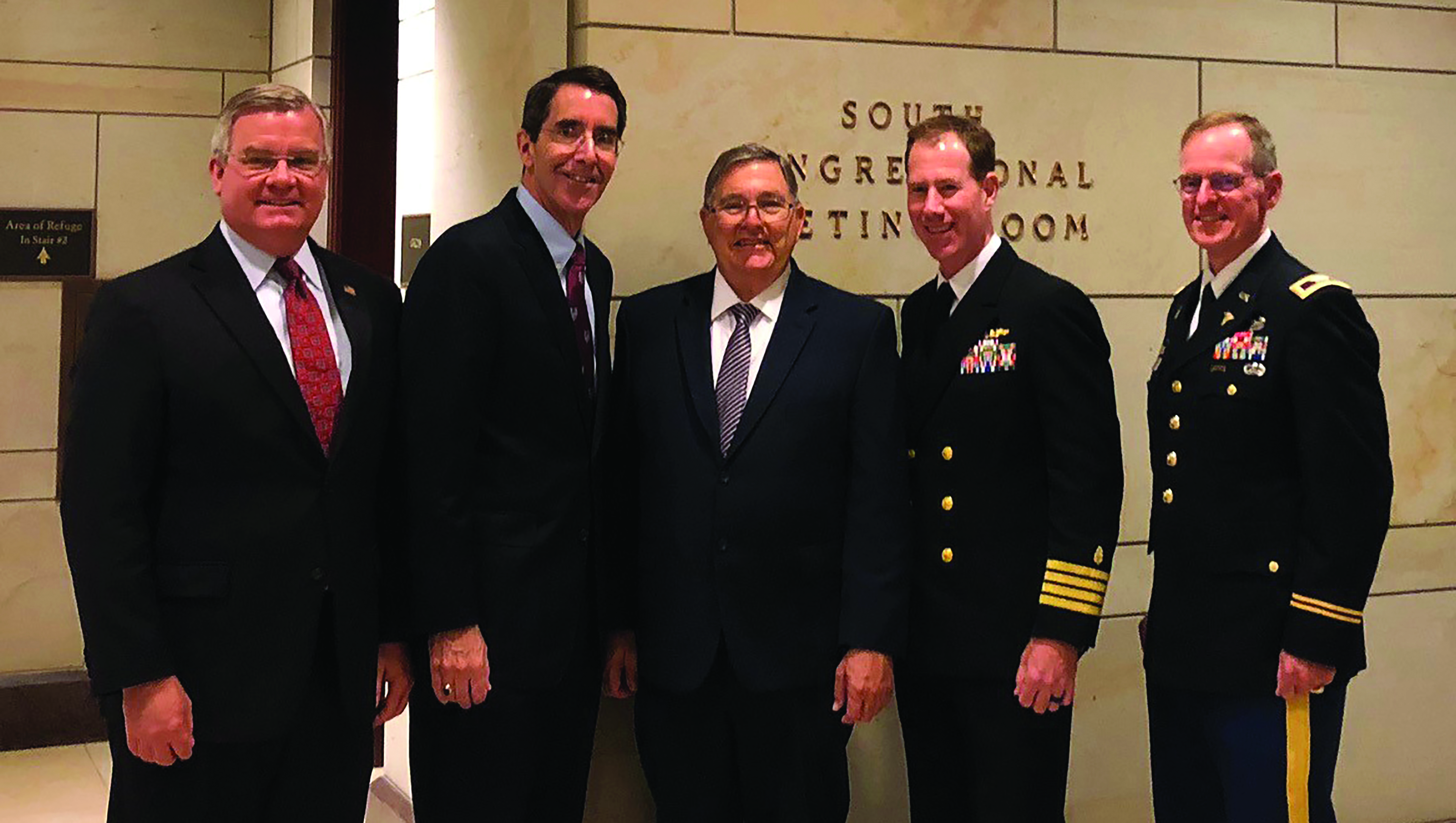
Attendees learned that the prolonged conflicts in Operation Iraqi Freedom and Operation Enduring Freedom saw an unprecedented improvement in military combat casualty care and the creation of the Joint Trauma System (JTS), allowing for the development and dissemination of best trauma practices across the Department of Defense. Preserving the JTS and establishing a fully integrated military-civilian trauma system are among the primary efforts of the Military Health System Strategic Partnership American College of Surgeons.
For more information about this briefing, contact Carrie Zlatos, ACS Senior Congressional Lobbyist, at [email protected] or 202-672-1508.
The American College of Surgeons (ACS) hosted a Capitol Hill briefing July 23 featuring a panel of experts on military surgical care—John H. Armstrong, MD, FACS; Arthur Kellerman, MD, MPH; CAPT Eric Elster, MD, FACS, USN; and COL Frederick Lough, MD, FACS, USA. The panelists focused on themes from the recent publication, Out of the Crucible: How the U.S. Military Transformed Combat Casualty Care in Iraq and Afghanistan, and the role military-civilian trauma partnerships play in maintaining trauma care readiness.
Attendees learned that the prolonged conflicts in Operation Iraqi Freedom and Operation Enduring Freedom saw an unprecedented improvement in military combat casualty care and the creation of the Joint Trauma System (JTS), allowing for the development and dissemination of best trauma practices across the Department of Defense. Preserving the JTS and establishing a fully integrated military-civilian trauma system are among the primary efforts of the Military Health System Strategic Partnership American College of Surgeons.
For more information about this briefing, contact Carrie Zlatos, ACS Senior Congressional Lobbyist, at [email protected] or 202-672-1508.
The American College of Surgeons (ACS) hosted a Capitol Hill briefing July 23 featuring a panel of experts on military surgical care—John H. Armstrong, MD, FACS; Arthur Kellerman, MD, MPH; CAPT Eric Elster, MD, FACS, USN; and COL Frederick Lough, MD, FACS, USA. The panelists focused on themes from the recent publication, Out of the Crucible: How the U.S. Military Transformed Combat Casualty Care in Iraq and Afghanistan, and the role military-civilian trauma partnerships play in maintaining trauma care readiness.
Attendees learned that the prolonged conflicts in Operation Iraqi Freedom and Operation Enduring Freedom saw an unprecedented improvement in military combat casualty care and the creation of the Joint Trauma System (JTS), allowing for the development and dissemination of best trauma practices across the Department of Defense. Preserving the JTS and establishing a fully integrated military-civilian trauma system are among the primary efforts of the Military Health System Strategic Partnership American College of Surgeons.
For more information about this briefing, contact Carrie Zlatos, ACS Senior Congressional Lobbyist, at [email protected] or 202-672-1508.
Become a member at Clinical Congress
If you are not already a member of the American College of Surgeons (ACS) or you know an interested non-member colleague who is attending the Clinical Congress 2018 in Boston, MA, visit the Become a Member booth to apply for ACS membership. The membership application fee will be waived for individuals who apply at the meeting.
The Become a Member booth will be located in the Registration Area of the Boston Convention & Exhibition Center and will be open the same hours as registration, which are as follows:
• Sunday, October 21: 7:00 am–6:00 pm
• Monday, October 22: 6:30 am–5:00 pm
• Tuesday, October 23: 7:00 am–4:00 pm
• Wednesday, October 24: 7:00 am–4:00 pm
• Thursday, October 25: 7:00–10:00 am
Plan ahead to apply at the meeting for one of the following membership categories and have access to the documents listed to support and speed up your application process:
• Fellows (U.S. and Canada): Copy of board certification document, current curriculum vitae (CV), and names of five ACS Fellows to serve as references. Watch the video about the domestic application process at www.youtube.com/watch?v=2VUqvveNYf8&.
• International Fellows: Copy of medical license, board/country certification document, current CV, and names of three ACS Fellows to serve as references. Watch the video about the international application process at www.youtube.com/watch?v=djoMUAUTA4I.
• Associate Fellows: Copy of residency completion document or an official board/country certification document.
• Residents: Letter verifying training status.
• Medical Students: Letter verifying educational status.
• Affiliate Members: The name of a Fellow as a reference.
Familiarize yourself with the ACS Member Benefits (facs.org/member-services/benefits) and make time to apply for membership while at the meeting. For additional information, contact Member Services at [email protected] or 800-621-4111. We look forward to assisting you.
If you are not already a member of the American College of Surgeons (ACS) or you know an interested non-member colleague who is attending the Clinical Congress 2018 in Boston, MA, visit the Become a Member booth to apply for ACS membership. The membership application fee will be waived for individuals who apply at the meeting.
The Become a Member booth will be located in the Registration Area of the Boston Convention & Exhibition Center and will be open the same hours as registration, which are as follows:
• Sunday, October 21: 7:00 am–6:00 pm
• Monday, October 22: 6:30 am–5:00 pm
• Tuesday, October 23: 7:00 am–4:00 pm
• Wednesday, October 24: 7:00 am–4:00 pm
• Thursday, October 25: 7:00–10:00 am
Plan ahead to apply at the meeting for one of the following membership categories and have access to the documents listed to support and speed up your application process:
• Fellows (U.S. and Canada): Copy of board certification document, current curriculum vitae (CV), and names of five ACS Fellows to serve as references. Watch the video about the domestic application process at www.youtube.com/watch?v=2VUqvveNYf8&.
• International Fellows: Copy of medical license, board/country certification document, current CV, and names of three ACS Fellows to serve as references. Watch the video about the international application process at www.youtube.com/watch?v=djoMUAUTA4I.
• Associate Fellows: Copy of residency completion document or an official board/country certification document.
• Residents: Letter verifying training status.
• Medical Students: Letter verifying educational status.
• Affiliate Members: The name of a Fellow as a reference.
Familiarize yourself with the ACS Member Benefits (facs.org/member-services/benefits) and make time to apply for membership while at the meeting. For additional information, contact Member Services at [email protected] or 800-621-4111. We look forward to assisting you.
If you are not already a member of the American College of Surgeons (ACS) or you know an interested non-member colleague who is attending the Clinical Congress 2018 in Boston, MA, visit the Become a Member booth to apply for ACS membership. The membership application fee will be waived for individuals who apply at the meeting.
The Become a Member booth will be located in the Registration Area of the Boston Convention & Exhibition Center and will be open the same hours as registration, which are as follows:
• Sunday, October 21: 7:00 am–6:00 pm
• Monday, October 22: 6:30 am–5:00 pm
• Tuesday, October 23: 7:00 am–4:00 pm
• Wednesday, October 24: 7:00 am–4:00 pm
• Thursday, October 25: 7:00–10:00 am
Plan ahead to apply at the meeting for one of the following membership categories and have access to the documents listed to support and speed up your application process:
• Fellows (U.S. and Canada): Copy of board certification document, current curriculum vitae (CV), and names of five ACS Fellows to serve as references. Watch the video about the domestic application process at www.youtube.com/watch?v=2VUqvveNYf8&.
• International Fellows: Copy of medical license, board/country certification document, current CV, and names of three ACS Fellows to serve as references. Watch the video about the international application process at www.youtube.com/watch?v=djoMUAUTA4I.
• Associate Fellows: Copy of residency completion document or an official board/country certification document.
• Residents: Letter verifying training status.
• Medical Students: Letter verifying educational status.
• Affiliate Members: The name of a Fellow as a reference.
Familiarize yourself with the ACS Member Benefits (facs.org/member-services/benefits) and make time to apply for membership while at the meeting. For additional information, contact Member Services at [email protected] or 800-621-4111. We look forward to assisting you.