User login
Richard Franki is the associate editor who writes and creates graphs. He started with the company in 1987, when it was known as the International Medical News Group. In his years as a journalist, Richard has worked for Cap Cities/ABC, Disney, Harcourt, Elsevier, Quadrant, Frontline, and Internet Brands. In the 1990s, he was a contributor to the ill-fated Indications column, predecessor of Livin' on the MDedge.
Pathogenic ball pits, zombie bacteria, and OTC beer
It’s the pits
Physical therapists sometimes use therapeutic ball pits to provide stimulation to pediatric patients with sensory impairments. However, anyone who’s ever been to a fast food joint or a Chuck E. Cheeses in the last 30 years knows that ball pits are not as innocent as they seem – instead of being simply a joyous sunken hole of fun, they are a prime breeding ground for all sorts of bacteria. And adhesive bandages. Why are there always bandages??

Researchers recently took a deep, disgusting dive into the underworld of clinical ball pits, which do not seem to be regulated by any governing body. There are no clinical guidelines from the Ball Pit Association of America on how or when to clean these cesspools of spheres. In fact, there’s no Ball Pit Association of America at all! Shocking.
Unsurprisingly (for any parent or person older than 14), the ball pits sampled were teeming with human and zoonotic-associated microorganisms. Researchers found that “bacterial colonization was found to be as high as thousands of cells per ball” (gag), exposing children to a lot of opportunity for infections. In case the diapers and bandages swimming in the McDonald’s ball pit didn’t turn you off them, this certainly should.
Zom-bacteria are coming
Special edition: Zombie Bacteria vs. The World. Recent research reveals that one type of bacteria, Bacillus subtilis, enters an oligotrophic state when nutrient starved, in which they are not fully dormant but verrrrrry slowly continue to grow and divide. Much like zombies verrrrry slowly continue to walk and eat flesh.

This research fundamentally changes the way we look at bacteria’s ability to survive. Previously, all bacteria were thought to go into a state of complete dormancy within a protective endospore. It appears that the zombie-like bacteria can awaken more easily from their oligotrophic state than bacteria using an endospore, which may shed light on how bacteria can escape antibiotic treatments. As if superbugs weren’t enough to deal with already.
An OTC beer keeps the doctor away
There’s plenty of evidence that a beer or two every now and again is good for your health. But the owner of the Seery Athlone Brewing Company in Addison, Ill., may have taken things too far.

While the reason of its closure just a few months after its grand opening in December 2018 is technically still a mystery, we feel fairly safe in speculating that it had something to do with the fact that brewery owner James Stephen was making his beer at the same location as his main business – a pharmaceutical company engaging in testing of over-the-counter drugs.
In fact, the Food and Drug Administration sent Mr. Stephen a letter in August 2018 warning him that, among numerous other transgressions, fermenting beer literally 10 feet away from where drugs were being tested is a health hazard, for both the beer and the drugs. The FDA ordered the brewery shut down, but the intrepid Mr. Stephen soldiered on, to obviously limited success.
Our advice to Mr. Stephen? Go all in with the pharmaceutical theme. Who wouldn’t want to drink an ibuprofen IPA, ranitidine red ale, loratadine lambic, pseudoephedrine porter, or diphenhydramine doppelbock? You’ll make millions!
A seat in the oval office
No, not that seat, and not the Oval Office. This is LOTME, after all, not Politico. The “seat” we’re talking about is a cardiovascular monitoring system, and “oval office” is just a euphemism for a toilet.
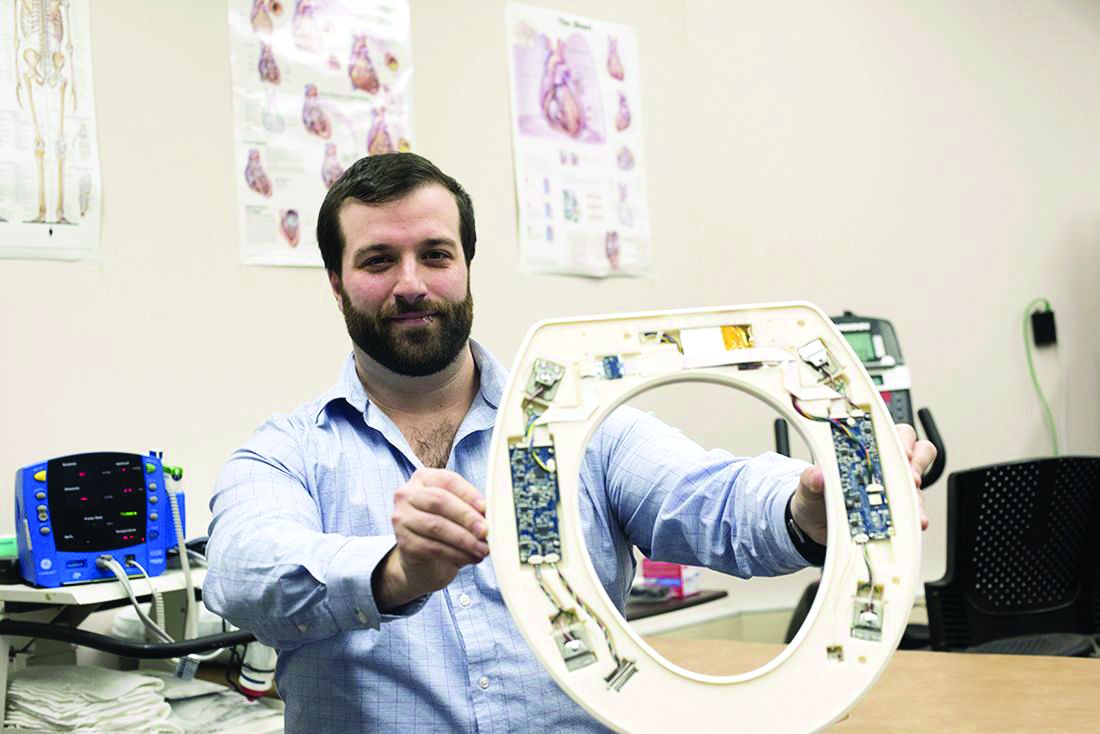
Here’s the deal: A company called Heart Health Intelligence (See? Intelligence is involved, so clearly we’re not talking about politics) has developed a toilet seat equipped “with an integrated electrocardiogram, ballistocardiogram , and photoplethysmogram … capable of clinical-grade measurements of systolic and diastolic blood pressure, stroke volume, and peripheral blood oxygenation.” Wait, ballistocardiogram? That sounds like something from that show House; it sounds too cool to pass up: “Chase, you idiot, why didn’t you do that ballistocardiogram I ordered?”
The idea is to prevent expensive readmissions by keeping track of patients with heart failure after they leave the hospital in a way that fits into their daily routine and ensures adherence.
It would cost about $200,000 to provide 150 heart failure patients with the toilet seats when they left the hospital, the company estimated, but the penalties from the Centers for Medicare & Medicaid Services for readmitting 150 patients come to $500,000 a year. Thus saving money by flushing it down the toilet.
So it looks like we were talking about politics after all. An intelligent toilet seat is like the Oval Office because, in both cases, the buck stops here.
It’s the pits
Physical therapists sometimes use therapeutic ball pits to provide stimulation to pediatric patients with sensory impairments. However, anyone who’s ever been to a fast food joint or a Chuck E. Cheeses in the last 30 years knows that ball pits are not as innocent as they seem – instead of being simply a joyous sunken hole of fun, they are a prime breeding ground for all sorts of bacteria. And adhesive bandages. Why are there always bandages??
Researchers recently took a deep, disgusting dive into the underworld of clinical ball pits, which do not seem to be regulated by any governing body. There are no clinical guidelines from the Ball Pit Association of America on how or when to clean these cesspools of spheres. In fact, there’s no Ball Pit Association of America at all! Shocking.
Unsurprisingly (for any parent or person older than 14), the ball pits sampled were teeming with human and zoonotic-associated microorganisms. Researchers found that “bacterial colonization was found to be as high as thousands of cells per ball” (gag), exposing children to a lot of opportunity for infections. In case the diapers and bandages swimming in the McDonald’s ball pit didn’t turn you off them, this certainly should.
Zom-bacteria are coming
Special edition: Zombie Bacteria vs. The World. Recent research reveals that one type of bacteria, Bacillus subtilis, enters an oligotrophic state when nutrient starved, in which they are not fully dormant but verrrrrry slowly continue to grow and divide. Much like zombies verrrrry slowly continue to walk and eat flesh.
This research fundamentally changes the way we look at bacteria’s ability to survive. Previously, all bacteria were thought to go into a state of complete dormancy within a protective endospore. It appears that the zombie-like bacteria can awaken more easily from their oligotrophic state than bacteria using an endospore, which may shed light on how bacteria can escape antibiotic treatments. As if superbugs weren’t enough to deal with already.
An OTC beer keeps the doctor away
There’s plenty of evidence that a beer or two every now and again is good for your health. But the owner of the Seery Athlone Brewing Company in Addison, Ill., may have taken things too far.
While the reason of its closure just a few months after its grand opening in December 2018 is technically still a mystery, we feel fairly safe in speculating that it had something to do with the fact that brewery owner James Stephen was making his beer at the same location as his main business – a pharmaceutical company engaging in testing of over-the-counter drugs.
In fact, the Food and Drug Administration sent Mr. Stephen a letter in August 2018 warning him that, among numerous other transgressions, fermenting beer literally 10 feet away from where drugs were being tested is a health hazard, for both the beer and the drugs. The FDA ordered the brewery shut down, but the intrepid Mr. Stephen soldiered on, to obviously limited success.
Our advice to Mr. Stephen? Go all in with the pharmaceutical theme. Who wouldn’t want to drink an ibuprofen IPA, ranitidine red ale, loratadine lambic, pseudoephedrine porter, or diphenhydramine doppelbock? You’ll make millions!
A seat in the oval office
No, not that seat, and not the Oval Office. This is LOTME, after all, not Politico. The “seat” we’re talking about is a cardiovascular monitoring system, and “oval office” is just a euphemism for a toilet.
Here’s the deal: A company called Heart Health Intelligence (See? Intelligence is involved, so clearly we’re not talking about politics) has developed a toilet seat equipped “with an integrated electrocardiogram, ballistocardiogram , and photoplethysmogram … capable of clinical-grade measurements of systolic and diastolic blood pressure, stroke volume, and peripheral blood oxygenation.” Wait, ballistocardiogram? That sounds like something from that show House; it sounds too cool to pass up: “Chase, you idiot, why didn’t you do that ballistocardiogram I ordered?”
The idea is to prevent expensive readmissions by keeping track of patients with heart failure after they leave the hospital in a way that fits into their daily routine and ensures adherence.
It would cost about $200,000 to provide 150 heart failure patients with the toilet seats when they left the hospital, the company estimated, but the penalties from the Centers for Medicare & Medicaid Services for readmitting 150 patients come to $500,000 a year. Thus saving money by flushing it down the toilet.
So it looks like we were talking about politics after all. An intelligent toilet seat is like the Oval Office because, in both cases, the buck stops here.
It’s the pits
Physical therapists sometimes use therapeutic ball pits to provide stimulation to pediatric patients with sensory impairments. However, anyone who’s ever been to a fast food joint or a Chuck E. Cheeses in the last 30 years knows that ball pits are not as innocent as they seem – instead of being simply a joyous sunken hole of fun, they are a prime breeding ground for all sorts of bacteria. And adhesive bandages. Why are there always bandages??
Researchers recently took a deep, disgusting dive into the underworld of clinical ball pits, which do not seem to be regulated by any governing body. There are no clinical guidelines from the Ball Pit Association of America on how or when to clean these cesspools of spheres. In fact, there’s no Ball Pit Association of America at all! Shocking.
Unsurprisingly (for any parent or person older than 14), the ball pits sampled were teeming with human and zoonotic-associated microorganisms. Researchers found that “bacterial colonization was found to be as high as thousands of cells per ball” (gag), exposing children to a lot of opportunity for infections. In case the diapers and bandages swimming in the McDonald’s ball pit didn’t turn you off them, this certainly should.
Zom-bacteria are coming
Special edition: Zombie Bacteria vs. The World. Recent research reveals that one type of bacteria, Bacillus subtilis, enters an oligotrophic state when nutrient starved, in which they are not fully dormant but verrrrrry slowly continue to grow and divide. Much like zombies verrrrry slowly continue to walk and eat flesh.
This research fundamentally changes the way we look at bacteria’s ability to survive. Previously, all bacteria were thought to go into a state of complete dormancy within a protective endospore. It appears that the zombie-like bacteria can awaken more easily from their oligotrophic state than bacteria using an endospore, which may shed light on how bacteria can escape antibiotic treatments. As if superbugs weren’t enough to deal with already.
An OTC beer keeps the doctor away
There’s plenty of evidence that a beer or two every now and again is good for your health. But the owner of the Seery Athlone Brewing Company in Addison, Ill., may have taken things too far.
While the reason of its closure just a few months after its grand opening in December 2018 is technically still a mystery, we feel fairly safe in speculating that it had something to do with the fact that brewery owner James Stephen was making his beer at the same location as his main business – a pharmaceutical company engaging in testing of over-the-counter drugs.
In fact, the Food and Drug Administration sent Mr. Stephen a letter in August 2018 warning him that, among numerous other transgressions, fermenting beer literally 10 feet away from where drugs were being tested is a health hazard, for both the beer and the drugs. The FDA ordered the brewery shut down, but the intrepid Mr. Stephen soldiered on, to obviously limited success.
Our advice to Mr. Stephen? Go all in with the pharmaceutical theme. Who wouldn’t want to drink an ibuprofen IPA, ranitidine red ale, loratadine lambic, pseudoephedrine porter, or diphenhydramine doppelbock? You’ll make millions!
A seat in the oval office
No, not that seat, and not the Oval Office. This is LOTME, after all, not Politico. The “seat” we’re talking about is a cardiovascular monitoring system, and “oval office” is just a euphemism for a toilet.
Here’s the deal: A company called Heart Health Intelligence (See? Intelligence is involved, so clearly we’re not talking about politics) has developed a toilet seat equipped “with an integrated electrocardiogram, ballistocardiogram , and photoplethysmogram … capable of clinical-grade measurements of systolic and diastolic blood pressure, stroke volume, and peripheral blood oxygenation.” Wait, ballistocardiogram? That sounds like something from that show House; it sounds too cool to pass up: “Chase, you idiot, why didn’t you do that ballistocardiogram I ordered?”
The idea is to prevent expensive readmissions by keeping track of patients with heart failure after they leave the hospital in a way that fits into their daily routine and ensures adherence.
It would cost about $200,000 to provide 150 heart failure patients with the toilet seats when they left the hospital, the company estimated, but the penalties from the Centers for Medicare & Medicaid Services for readmitting 150 patients come to $500,000 a year. Thus saving money by flushing it down the toilet.
So it looks like we were talking about politics after all. An intelligent toilet seat is like the Oval Office because, in both cases, the buck stops here.
Gender wage gap varies by specialty
There is no specialty in which women physicians make as much as men, but hematology came the closest in 2018, according to a new survey by the medical social network Doximity.
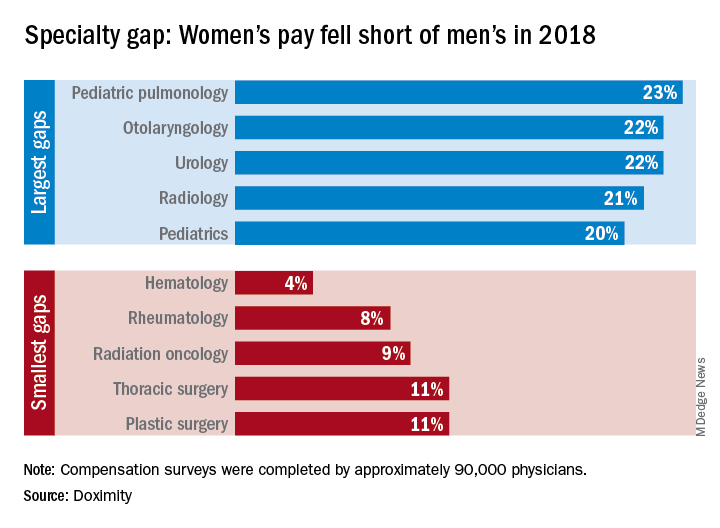
Female hematologists averaged $309,000 in earnings in 2018, just 4% less than their male counterparts, who brought in an average of $323,000. Rheumatology had the next-smallest gap, 8%, between women and men, followed by radiation oncology at 9% and thoracic surgery and plastic surgery at 11% each, Doximity reported March 26. All of the 90,000 physicians involved in the survey worked at least 40 hours per week.
At the other end of the scale is pediatric pulmonology, home of the largest gender wage gap. Average compensation for women in the specialty was $195,000, or 23% less than the $253,000 that men received. Women in otolaryngology and urology were next, earning 22% less than men in those specialties, while women in radiology and pediatrics averaged 21% and 20% less, respectively, than men, Doximity said in its report.
The gender wage gap has been persistent, but the latest data show that it is starting to close as the earnings curve for male physicians flattened in 2018 while pay increased for female physicians.
“Compensation transparency is a powerful force. As more data becomes available to us, exposing the pay gap between men and women, we see more movements to rectify this issue,” said Christopher Whaley, PhD, of the University of California, Berkeley, School of Public Health, who was lead author of the study.
To account for differences in specialty, geography, and physician-specific factors, the Doximity researchers used “a multivariate regression with fixed effects for provider specialty and [metropolitan statistical area].” They also controlled for how long each physician has been in practice and their self-reported average hours worked.
There is no specialty in which women physicians make as much as men, but hematology came the closest in 2018, according to a new survey by the medical social network Doximity.
Female hematologists averaged $309,000 in earnings in 2018, just 4% less than their male counterparts, who brought in an average of $323,000. Rheumatology had the next-smallest gap, 8%, between women and men, followed by radiation oncology at 9% and thoracic surgery and plastic surgery at 11% each, Doximity reported March 26. All of the 90,000 physicians involved in the survey worked at least 40 hours per week.
At the other end of the scale is pediatric pulmonology, home of the largest gender wage gap. Average compensation for women in the specialty was $195,000, or 23% less than the $253,000 that men received. Women in otolaryngology and urology were next, earning 22% less than men in those specialties, while women in radiology and pediatrics averaged 21% and 20% less, respectively, than men, Doximity said in its report.
The gender wage gap has been persistent, but the latest data show that it is starting to close as the earnings curve for male physicians flattened in 2018 while pay increased for female physicians.
“Compensation transparency is a powerful force. As more data becomes available to us, exposing the pay gap between men and women, we see more movements to rectify this issue,” said Christopher Whaley, PhD, of the University of California, Berkeley, School of Public Health, who was lead author of the study.
To account for differences in specialty, geography, and physician-specific factors, the Doximity researchers used “a multivariate regression with fixed effects for provider specialty and [metropolitan statistical area].” They also controlled for how long each physician has been in practice and their self-reported average hours worked.
There is no specialty in which women physicians make as much as men, but hematology came the closest in 2018, according to a new survey by the medical social network Doximity.
Female hematologists averaged $309,000 in earnings in 2018, just 4% less than their male counterparts, who brought in an average of $323,000. Rheumatology had the next-smallest gap, 8%, between women and men, followed by radiation oncology at 9% and thoracic surgery and plastic surgery at 11% each, Doximity reported March 26. All of the 90,000 physicians involved in the survey worked at least 40 hours per week.
At the other end of the scale is pediatric pulmonology, home of the largest gender wage gap. Average compensation for women in the specialty was $195,000, or 23% less than the $253,000 that men received. Women in otolaryngology and urology were next, earning 22% less than men in those specialties, while women in radiology and pediatrics averaged 21% and 20% less, respectively, than men, Doximity said in its report.
The gender wage gap has been persistent, but the latest data show that it is starting to close as the earnings curve for male physicians flattened in 2018 while pay increased for female physicians.
“Compensation transparency is a powerful force. As more data becomes available to us, exposing the pay gap between men and women, we see more movements to rectify this issue,” said Christopher Whaley, PhD, of the University of California, Berkeley, School of Public Health, who was lead author of the study.
To account for differences in specialty, geography, and physician-specific factors, the Doximity researchers used “a multivariate regression with fixed effects for provider specialty and [metropolitan statistical area].” They also controlled for how long each physician has been in practice and their self-reported average hours worked.
United States now over 300 measles cases for the year
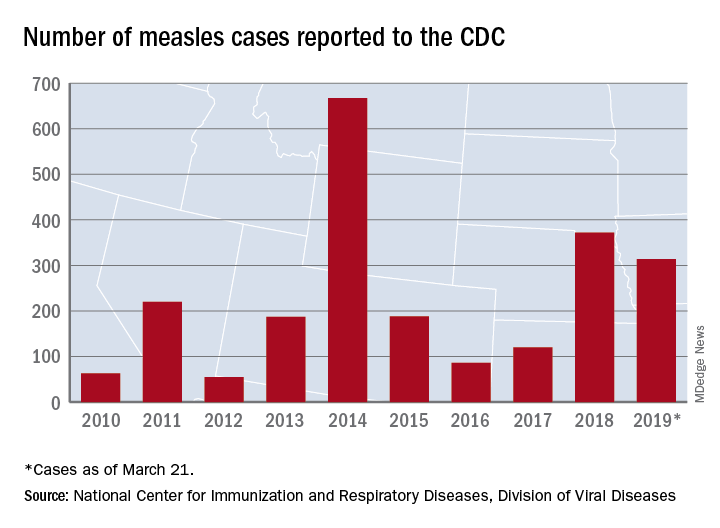
Despite those 46 new cases, the number of states with reported cases remains at 15, the CDC reported March 25.
For the fifth consecutive week the busiest outbreak was in Brooklyn, N.Y., which added 23 new cases. New York’s Rockland County, which is just north of New York City and has 46 confirmed cases for the year, is home to another of the six current outbreaks in the country, with the other four located in Washington (74 total cases for the state), Texas (14 cases), California (7 cases), and Illinois (6 cases). Other states with cases are Arizona, Colorado, Connecticut, Georgia, Kentucky, Missouri, New Hampshire, New Jersey, and Oregon, reported the CDC.
This year’s case total through less than 3 months is nearing the 372 that occurred in 2018, which was the second-worst year for measles in the last decade, but is still well off the 10-year high of 667 reported in 2014, the CDC said.
Despite those 46 new cases, the number of states with reported cases remains at 15, the CDC reported March 25.
For the fifth consecutive week the busiest outbreak was in Brooklyn, N.Y., which added 23 new cases. New York’s Rockland County, which is just north of New York City and has 46 confirmed cases for the year, is home to another of the six current outbreaks in the country, with the other four located in Washington (74 total cases for the state), Texas (14 cases), California (7 cases), and Illinois (6 cases). Other states with cases are Arizona, Colorado, Connecticut, Georgia, Kentucky, Missouri, New Hampshire, New Jersey, and Oregon, reported the CDC.
This year’s case total through less than 3 months is nearing the 372 that occurred in 2018, which was the second-worst year for measles in the last decade, but is still well off the 10-year high of 667 reported in 2014, the CDC said.
Despite those 46 new cases, the number of states with reported cases remains at 15, the CDC reported March 25.
For the fifth consecutive week the busiest outbreak was in Brooklyn, N.Y., which added 23 new cases. New York’s Rockland County, which is just north of New York City and has 46 confirmed cases for the year, is home to another of the six current outbreaks in the country, with the other four located in Washington (74 total cases for the state), Texas (14 cases), California (7 cases), and Illinois (6 cases). Other states with cases are Arizona, Colorado, Connecticut, Georgia, Kentucky, Missouri, New Hampshire, New Jersey, and Oregon, reported the CDC.
This year’s case total through less than 3 months is nearing the 372 that occurred in 2018, which was the second-worst year for measles in the last decade, but is still well off the 10-year high of 667 reported in 2014, the CDC said.
H3N2 putting a damper on flu season’s departure
The decline of influenza activity remains slow, largely “driven by a wave of H3N2 virus activity” in recent weeks, according to the Centers for Disease Control and Prevention.
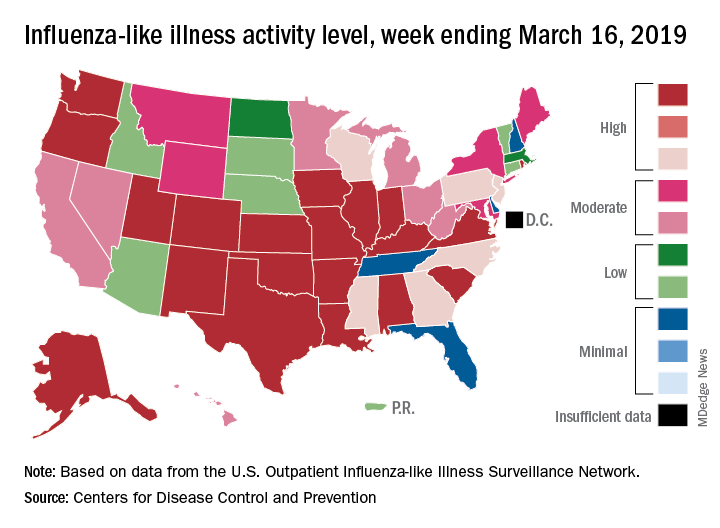
Fewer states reported the highest level of influenza-like illness (ILI) activity on the CDC’s 1-10 scale for the week ending March 16, but the national proportion of outpatient visits for ILI was 4.4% for the second consecutive week, the CDC’s influenza division reported March 22. The outpatient-visit figure for the week ending March 9 was originally reported as 4.5% last week, but it has been revised down to 4.4% this week.
Another measure of activity – the percentage of respiratory specimens testing positive for influenza viruses in clinical laboratories – actually increased slightly during the week ending March 16, the CDC noted.
For the current week, there were 26 states in the high (8-10) range of activity – 20 states were at level 10 and another 6 states were at level 8 – compared with the previous week, when 21 states were at level 10 and 30 states were in the high range, the CDC’s Outpatient ILI Surveillance Network reported.
There were eight ILI-related deaths in children reported during the week ending March 16, seven of which occurred in previous weeks. The total for the 2018-2019 season so far is 76, the CDC said.
New preliminary estimates on influenza’s burden nationally put the total number of deaths at 25,000-41,500 since the beginning of the season on Oct. 1, 2018. There also have been 375,000-454,000 flu-related hospitalizations, 13.2 million to 15.4 million medical visits, and 28.5 to 32.8 million individual illnesses, the CDC said.
Since the CDC “expects flu activity to remain elevated for a number of weeks,” it continues to recommend flu vaccination and the use of influenza antiviral drugs as “an important second line of defense that can be used to treat flu illness. H3N2 viruses are typically associated with more severe illness in older adults, and flu vaccine may protect less well against H3N2 illness in older adults, making prompt treatment with flu antivirals in this age group especially important during the current period of H3N2 predominance.”
The decline of influenza activity remains slow, largely “driven by a wave of H3N2 virus activity” in recent weeks, according to the Centers for Disease Control and Prevention.
Fewer states reported the highest level of influenza-like illness (ILI) activity on the CDC’s 1-10 scale for the week ending March 16, but the national proportion of outpatient visits for ILI was 4.4% for the second consecutive week, the CDC’s influenza division reported March 22. The outpatient-visit figure for the week ending March 9 was originally reported as 4.5% last week, but it has been revised down to 4.4% this week.
Another measure of activity – the percentage of respiratory specimens testing positive for influenza viruses in clinical laboratories – actually increased slightly during the week ending March 16, the CDC noted.
For the current week, there were 26 states in the high (8-10) range of activity – 20 states were at level 10 and another 6 states were at level 8 – compared with the previous week, when 21 states were at level 10 and 30 states were in the high range, the CDC’s Outpatient ILI Surveillance Network reported.
There were eight ILI-related deaths in children reported during the week ending March 16, seven of which occurred in previous weeks. The total for the 2018-2019 season so far is 76, the CDC said.
New preliminary estimates on influenza’s burden nationally put the total number of deaths at 25,000-41,500 since the beginning of the season on Oct. 1, 2018. There also have been 375,000-454,000 flu-related hospitalizations, 13.2 million to 15.4 million medical visits, and 28.5 to 32.8 million individual illnesses, the CDC said.
Since the CDC “expects flu activity to remain elevated for a number of weeks,” it continues to recommend flu vaccination and the use of influenza antiviral drugs as “an important second line of defense that can be used to treat flu illness. H3N2 viruses are typically associated with more severe illness in older adults, and flu vaccine may protect less well against H3N2 illness in older adults, making prompt treatment with flu antivirals in this age group especially important during the current period of H3N2 predominance.”
The decline of influenza activity remains slow, largely “driven by a wave of H3N2 virus activity” in recent weeks, according to the Centers for Disease Control and Prevention.
Fewer states reported the highest level of influenza-like illness (ILI) activity on the CDC’s 1-10 scale for the week ending March 16, but the national proportion of outpatient visits for ILI was 4.4% for the second consecutive week, the CDC’s influenza division reported March 22. The outpatient-visit figure for the week ending March 9 was originally reported as 4.5% last week, but it has been revised down to 4.4% this week.
Another measure of activity – the percentage of respiratory specimens testing positive for influenza viruses in clinical laboratories – actually increased slightly during the week ending March 16, the CDC noted.
For the current week, there were 26 states in the high (8-10) range of activity – 20 states were at level 10 and another 6 states were at level 8 – compared with the previous week, when 21 states were at level 10 and 30 states were in the high range, the CDC’s Outpatient ILI Surveillance Network reported.
There were eight ILI-related deaths in children reported during the week ending March 16, seven of which occurred in previous weeks. The total for the 2018-2019 season so far is 76, the CDC said.
New preliminary estimates on influenza’s burden nationally put the total number of deaths at 25,000-41,500 since the beginning of the season on Oct. 1, 2018. There also have been 375,000-454,000 flu-related hospitalizations, 13.2 million to 15.4 million medical visits, and 28.5 to 32.8 million individual illnesses, the CDC said.
Since the CDC “expects flu activity to remain elevated for a number of weeks,” it continues to recommend flu vaccination and the use of influenza antiviral drugs as “an important second line of defense that can be used to treat flu illness. H3N2 viruses are typically associated with more severe illness in older adults, and flu vaccine may protect less well against H3N2 illness in older adults, making prompt treatment with flu antivirals in this age group especially important during the current period of H3N2 predominance.”
Sleepless democracy, space herpes, and the F-bomb diet
Sleep: the key to democracy?
You might need to lie down for this one. Insufficient sleep could be affecting the very institutions and behaviors that keep society from crumbling.

Lack of sleep is proven to affect “private” behaviors, like working, but a new study has shown that exhaustion also has consequences on a national scale. Sleeping less negatively affects the “social behaviors that hold society and democracy together,” according to the study’s authors.
Willingness to vote, donate to charities, and sign petitions decreased in sleep-deprived participants. Although that last one is iffy – is anyone really willing to sign a petition, regardless of sleep intake? One thing to glean from this study is, if you’re holding a clipboard, let the most tired-looking people keep walking.
Perhaps we should start a petition to make the day before Election Day a national napping holiday.
I hear you knocking, but you can’t come in
LOTME takes you to the ends of the earth for this edition of Bacteria vs. the World. Let’s go to our correspondent, Danielle Kang, on the International Space Station. 
Hi, this is Briny Baird in Berlin, Germany. The space station’s extreme environment weakens astronauts’ immune systems, but it has the opposite effect on bacteria, as Elisabeth Grohmann, PhD, of Beuth University of Applied Sciences explains.
“The bacteria [astronauts] carry become hardier – developing thick protective coatings and resistance to antibiotics – and more vigorous, multiplying and metabolizing faster.”
This is, as scientists put it, bad. To prevent an on-board bacterial bacchanal, Dr. Grohmann and her associates covered a vital piece of ISS equipment, the toilet door, with a new coating containing “silver and ruthenium, conditioned by a vitamin derivative.” After 19 months in space, the coated section of the door had 80% fewer bacteria on it than an uncoated control surface.
With long-term missions to Mars being considered, it should be safer for astronauts and their toilet doors to … go where no one has gone before. Back to the studio.
The F-bomb diet
You might think vulgarities and Homo sapiens have been an inseparable pair since the first human bashed her thumb while chipping stones into spearheads to add meat to her diet. You’d probably be right – except for blue-tinged language built on the consonant foundations of the letters F and V.

New linguistics research finds that those $#%*! letters, like truckers and Marine gunnery sergeants, are relatively modern developments. As humans moved away from finger-harming hunting and gathering and toward finger-harming farming, they developed a taste for softer foods. And their speech picked up “labiodentals” such as F and V – which are sounds made when we touch our lower lips to our upper teeth. Half the world’s languages are now riddled with soft-food profanities, er, labiodentals.
Next on the linguists’ research list: Does the paleo diet lead to the dropping of fewer F-bombs?
Herpes! In space!
Viruses can never let bacteria have all the fun. Where there’s an immune system weakened by radiation and microgravity, rest assured, our old friend the herpes virus will be waiting for us.

Yes, it looks like frequent bathroom trips won’t be the only issue future Dr. McCoys will be treating. According to a study published in Frontiers in Microbiology, four of the eight herpes viruses were discovered in the saliva and urine of more than half of the hundred or so astronauts who had samples analyzed during spaceflight.
The good news is that only six astronauts actually had symptoms emerge, all of which were minor. The bad news is that the strength, frequency, and duration of viral shedding through urine and saliva increased as more time was spent in space. Also, only one of the herpes varieties found has a vaccine. The rest will just have to be treated as symptoms emerge.
We’ll just hope Captain Kirk doesn’t come down with a case of mononucleosis while fighting the Klingons. Damn it, Jim, I’m a doctor, not a miracle worker!
Sleep: the key to democracy?
You might need to lie down for this one. Insufficient sleep could be affecting the very institutions and behaviors that keep society from crumbling.
Lack of sleep is proven to affect “private” behaviors, like working, but a new study has shown that exhaustion also has consequences on a national scale. Sleeping less negatively affects the “social behaviors that hold society and democracy together,” according to the study’s authors.
Willingness to vote, donate to charities, and sign petitions decreased in sleep-deprived participants. Although that last one is iffy – is anyone really willing to sign a petition, regardless of sleep intake? One thing to glean from this study is, if you’re holding a clipboard, let the most tired-looking people keep walking.
Perhaps we should start a petition to make the day before Election Day a national napping holiday.
I hear you knocking, but you can’t come in
LOTME takes you to the ends of the earth for this edition of Bacteria vs. the World. Let’s go to our correspondent, Danielle Kang, on the International Space Station.
Hi, this is Briny Baird in Berlin, Germany. The space station’s extreme environment weakens astronauts’ immune systems, but it has the opposite effect on bacteria, as Elisabeth Grohmann, PhD, of Beuth University of Applied Sciences explains.
“The bacteria [astronauts] carry become hardier – developing thick protective coatings and resistance to antibiotics – and more vigorous, multiplying and metabolizing faster.”
This is, as scientists put it, bad. To prevent an on-board bacterial bacchanal, Dr. Grohmann and her associates covered a vital piece of ISS equipment, the toilet door, with a new coating containing “silver and ruthenium, conditioned by a vitamin derivative.” After 19 months in space, the coated section of the door had 80% fewer bacteria on it than an uncoated control surface.
With long-term missions to Mars being considered, it should be safer for astronauts and their toilet doors to … go where no one has gone before. Back to the studio.
The F-bomb diet
You might think vulgarities and Homo sapiens have been an inseparable pair since the first human bashed her thumb while chipping stones into spearheads to add meat to her diet. You’d probably be right – except for blue-tinged language built on the consonant foundations of the letters F and V.
New linguistics research finds that those $#%*! letters, like truckers and Marine gunnery sergeants, are relatively modern developments. As humans moved away from finger-harming hunting and gathering and toward finger-harming farming, they developed a taste for softer foods. And their speech picked up “labiodentals” such as F and V – which are sounds made when we touch our lower lips to our upper teeth. Half the world’s languages are now riddled with soft-food profanities, er, labiodentals.
Next on the linguists’ research list: Does the paleo diet lead to the dropping of fewer F-bombs?
Herpes! In space!
Viruses can never let bacteria have all the fun. Where there’s an immune system weakened by radiation and microgravity, rest assured, our old friend the herpes virus will be waiting for us.
Yes, it looks like frequent bathroom trips won’t be the only issue future Dr. McCoys will be treating. According to a study published in Frontiers in Microbiology, four of the eight herpes viruses were discovered in the saliva and urine of more than half of the hundred or so astronauts who had samples analyzed during spaceflight.
The good news is that only six astronauts actually had symptoms emerge, all of which were minor. The bad news is that the strength, frequency, and duration of viral shedding through urine and saliva increased as more time was spent in space. Also, only one of the herpes varieties found has a vaccine. The rest will just have to be treated as symptoms emerge.
We’ll just hope Captain Kirk doesn’t come down with a case of mononucleosis while fighting the Klingons. Damn it, Jim, I’m a doctor, not a miracle worker!
Sleep: the key to democracy?
You might need to lie down for this one. Insufficient sleep could be affecting the very institutions and behaviors that keep society from crumbling.
Lack of sleep is proven to affect “private” behaviors, like working, but a new study has shown that exhaustion also has consequences on a national scale. Sleeping less negatively affects the “social behaviors that hold society and democracy together,” according to the study’s authors.
Willingness to vote, donate to charities, and sign petitions decreased in sleep-deprived participants. Although that last one is iffy – is anyone really willing to sign a petition, regardless of sleep intake? One thing to glean from this study is, if you’re holding a clipboard, let the most tired-looking people keep walking.
Perhaps we should start a petition to make the day before Election Day a national napping holiday.
I hear you knocking, but you can’t come in
LOTME takes you to the ends of the earth for this edition of Bacteria vs. the World. Let’s go to our correspondent, Danielle Kang, on the International Space Station.
Hi, this is Briny Baird in Berlin, Germany. The space station’s extreme environment weakens astronauts’ immune systems, but it has the opposite effect on bacteria, as Elisabeth Grohmann, PhD, of Beuth University of Applied Sciences explains.
“The bacteria [astronauts] carry become hardier – developing thick protective coatings and resistance to antibiotics – and more vigorous, multiplying and metabolizing faster.”
This is, as scientists put it, bad. To prevent an on-board bacterial bacchanal, Dr. Grohmann and her associates covered a vital piece of ISS equipment, the toilet door, with a new coating containing “silver and ruthenium, conditioned by a vitamin derivative.” After 19 months in space, the coated section of the door had 80% fewer bacteria on it than an uncoated control surface.
With long-term missions to Mars being considered, it should be safer for astronauts and their toilet doors to … go where no one has gone before. Back to the studio.
The F-bomb diet
You might think vulgarities and Homo sapiens have been an inseparable pair since the first human bashed her thumb while chipping stones into spearheads to add meat to her diet. You’d probably be right – except for blue-tinged language built on the consonant foundations of the letters F and V.
New linguistics research finds that those $#%*! letters, like truckers and Marine gunnery sergeants, are relatively modern developments. As humans moved away from finger-harming hunting and gathering and toward finger-harming farming, they developed a taste for softer foods. And their speech picked up “labiodentals” such as F and V – which are sounds made when we touch our lower lips to our upper teeth. Half the world’s languages are now riddled with soft-food profanities, er, labiodentals.
Next on the linguists’ research list: Does the paleo diet lead to the dropping of fewer F-bombs?
Herpes! In space!
Viruses can never let bacteria have all the fun. Where there’s an immune system weakened by radiation and microgravity, rest assured, our old friend the herpes virus will be waiting for us.
Yes, it looks like frequent bathroom trips won’t be the only issue future Dr. McCoys will be treating. According to a study published in Frontiers in Microbiology, four of the eight herpes viruses were discovered in the saliva and urine of more than half of the hundred or so astronauts who had samples analyzed during spaceflight.
The good news is that only six astronauts actually had symptoms emerge, all of which were minor. The bad news is that the strength, frequency, and duration of viral shedding through urine and saliva increased as more time was spent in space. Also, only one of the herpes varieties found has a vaccine. The rest will just have to be treated as symptoms emerge.
We’ll just hope Captain Kirk doesn’t come down with a case of mononucleosis while fighting the Klingons. Damn it, Jim, I’m a doctor, not a miracle worker!
Measles cases confirmed in three more states
Forty more cases and three more states were added to the measles count in the last week, bringing the U.S. total to 268 cases in 15 states so far in 2019, according to the Centers for Disease Control and Prevention.
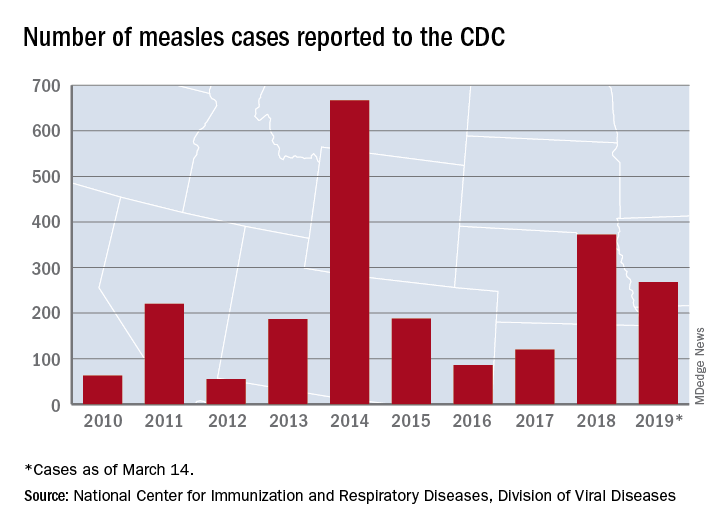
Arizona, Michigan, and Missouri reported their first confirmed cases of the year, joining California (one outbreak), Colorado, Connecticut, Georgia, Illinois (one outbreak), Kentucky, New Hampshire, New Jersey, New York (two outbreaks), Oregon, Texas (one outbreak), and Washington (one outbreak), the CDC reported March 18.
Brooklyn, N.Y., has become the epicenter of measles activity since mid-February, and with 25 of the 40 new cases occurring there, the borough has now led the nation for four consecutive weeks. There have been 157 confirmed cases in Brooklyn and one in Queens since the outbreak began in October of 2018, the New York City Department of Health and Mental Hygiene reported.
Michigan’s first case of measles is travel related and involved an individual visiting from Israel following a stay in New York, the Michigan Department of Health and Human Services and Oakland County Health Division announced March 13.
In Arizona, the state department of health services and the Pima County Public Health Department announced that a 12-month-old infant from Pima County has been diagnosed with measles after traveling to Asia.
A single case of measles, contracted while the person was traveling out of state, has been reported in Jefferson County, Mo., and is being managed by the county health department, according to St. Louis Public Radio.
Forty more cases and three more states were added to the measles count in the last week, bringing the U.S. total to 268 cases in 15 states so far in 2019, according to the Centers for Disease Control and Prevention.
Arizona, Michigan, and Missouri reported their first confirmed cases of the year, joining California (one outbreak), Colorado, Connecticut, Georgia, Illinois (one outbreak), Kentucky, New Hampshire, New Jersey, New York (two outbreaks), Oregon, Texas (one outbreak), and Washington (one outbreak), the CDC reported March 18.
Brooklyn, N.Y., has become the epicenter of measles activity since mid-February, and with 25 of the 40 new cases occurring there, the borough has now led the nation for four consecutive weeks. There have been 157 confirmed cases in Brooklyn and one in Queens since the outbreak began in October of 2018, the New York City Department of Health and Mental Hygiene reported.
Michigan’s first case of measles is travel related and involved an individual visiting from Israel following a stay in New York, the Michigan Department of Health and Human Services and Oakland County Health Division announced March 13.
In Arizona, the state department of health services and the Pima County Public Health Department announced that a 12-month-old infant from Pima County has been diagnosed with measles after traveling to Asia.
A single case of measles, contracted while the person was traveling out of state, has been reported in Jefferson County, Mo., and is being managed by the county health department, according to St. Louis Public Radio.
Forty more cases and three more states were added to the measles count in the last week, bringing the U.S. total to 268 cases in 15 states so far in 2019, according to the Centers for Disease Control and Prevention.
Arizona, Michigan, and Missouri reported their first confirmed cases of the year, joining California (one outbreak), Colorado, Connecticut, Georgia, Illinois (one outbreak), Kentucky, New Hampshire, New Jersey, New York (two outbreaks), Oregon, Texas (one outbreak), and Washington (one outbreak), the CDC reported March 18.
Brooklyn, N.Y., has become the epicenter of measles activity since mid-February, and with 25 of the 40 new cases occurring there, the borough has now led the nation for four consecutive weeks. There have been 157 confirmed cases in Brooklyn and one in Queens since the outbreak began in October of 2018, the New York City Department of Health and Mental Hygiene reported.
Michigan’s first case of measles is travel related and involved an individual visiting from Israel following a stay in New York, the Michigan Department of Health and Human Services and Oakland County Health Division announced March 13.
In Arizona, the state department of health services and the Pima County Public Health Department announced that a 12-month-old infant from Pima County has been diagnosed with measles after traveling to Asia.
A single case of measles, contracted while the person was traveling out of state, has been reported in Jefferson County, Mo., and is being managed by the county health department, according to St. Louis Public Radio.
Survey: Americans support regulation of vaping products
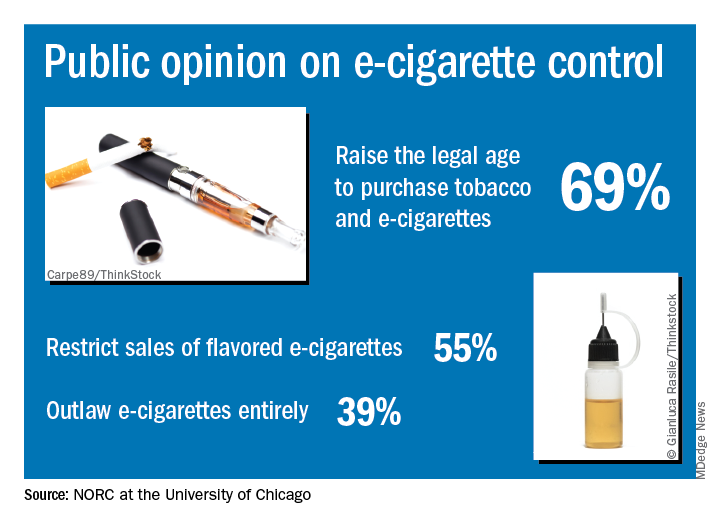
Almost 70% of adults believe that the Food and Drug Administration should raise the legal age to purchase e-cigarettes and tobacco, according to a new survey by NORC at the University of Chicago, a nonpartisan research institution.
“Americans are particularly concerned about teens becoming newly addicted to e-cigarettes, and they support a range of actions the federal government could take to make vaping products less available, less addictive, and less appealing,” Caroline Pearson, senior vice president at NORC, said in a written statement.
The AmeriSpeak Spotlight on Health Poll, conducted Feb. 14-18, 2019 (margin of error, plus or minus 4.12%), showed that 69% of adults strongly or somewhat support raising the age limit to purchase e-cigarettes and tobacco and 55% support restricting sales of flavored e-cigarettes, NORC reported. Almost 40% of the 1,004 respondents expressed support for a complete ban on e-cigarettes.
Despite FDA efforts under Commissioner Scott Gottlieb, MD, to raise awareness of teen vaping, only 21% of those surveyed correctly responded that e-cigarettes generally contain more nicotine that regular cigarettes. Dr. Gottlieb announced his resignation recently, “but he indicated that the Trump Administration will continue efforts to increase regulation of e-cigarettes,” NORC said.
Almost 70% of adults believe that the Food and Drug Administration should raise the legal age to purchase e-cigarettes and tobacco, according to a new survey by NORC at the University of Chicago, a nonpartisan research institution.
“Americans are particularly concerned about teens becoming newly addicted to e-cigarettes, and they support a range of actions the federal government could take to make vaping products less available, less addictive, and less appealing,” Caroline Pearson, senior vice president at NORC, said in a written statement.
The AmeriSpeak Spotlight on Health Poll, conducted Feb. 14-18, 2019 (margin of error, plus or minus 4.12%), showed that 69% of adults strongly or somewhat support raising the age limit to purchase e-cigarettes and tobacco and 55% support restricting sales of flavored e-cigarettes, NORC reported. Almost 40% of the 1,004 respondents expressed support for a complete ban on e-cigarettes.
Despite FDA efforts under Commissioner Scott Gottlieb, MD, to raise awareness of teen vaping, only 21% of those surveyed correctly responded that e-cigarettes generally contain more nicotine that regular cigarettes. Dr. Gottlieb announced his resignation recently, “but he indicated that the Trump Administration will continue efforts to increase regulation of e-cigarettes,” NORC said.
Almost 70% of adults believe that the Food and Drug Administration should raise the legal age to purchase e-cigarettes and tobacco, according to a new survey by NORC at the University of Chicago, a nonpartisan research institution.
“Americans are particularly concerned about teens becoming newly addicted to e-cigarettes, and they support a range of actions the federal government could take to make vaping products less available, less addictive, and less appealing,” Caroline Pearson, senior vice president at NORC, said in a written statement.
The AmeriSpeak Spotlight on Health Poll, conducted Feb. 14-18, 2019 (margin of error, plus or minus 4.12%), showed that 69% of adults strongly or somewhat support raising the age limit to purchase e-cigarettes and tobacco and 55% support restricting sales of flavored e-cigarettes, NORC reported. Almost 40% of the 1,004 respondents expressed support for a complete ban on e-cigarettes.
Despite FDA efforts under Commissioner Scott Gottlieb, MD, to raise awareness of teen vaping, only 21% of those surveyed correctly responded that e-cigarettes generally contain more nicotine that regular cigarettes. Dr. Gottlieb announced his resignation recently, “but he indicated that the Trump Administration will continue efforts to increase regulation of e-cigarettes,” NORC said.
Match Day 2019: Internal medicine slots up by 7.6%
Internal medicine residency positions rose by 7.6% for Match Day 2019, but the number of slots filled by U.S. allopathic seniors dropped for the fourth consecutive year, according to the National Resident Matching Program (NRMP).
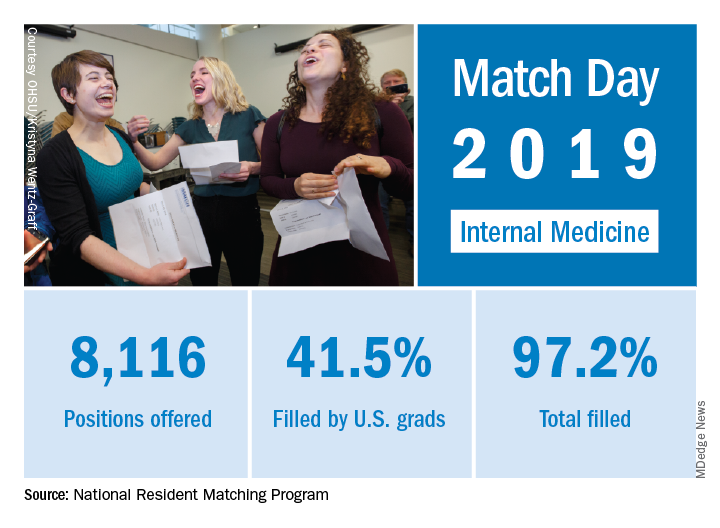
First-year (PGY-1) IM slots rose from 7,542 to 8,116 as internal medicine manged to exceed the 6.5% increase in PGY-1 positions over 2018 for all specialties combined. The total numbers of applicants (38,376) and positions offered (35,185) were both record highs for the Match, although they were affected, in part, by “increased numbers of osteopathic programs that joined the Main Residency Match as a result of the ongoing transition to a single accreditation system for graduate medical education programs,” the NRMP noted in a statement.
and 44.9% in 2017 and continues a fairly long-term trend of increased participation by international medical graduates. Overall, IM filled 97.2% of all available PGY-1 slots in this year, which was above the 94.9% for all specialties in the Match, the NRMP reported.
The primary care specialties – family medicine, internal medicine, internal medicine–pediatrics, internal medicine–primary, pediatrics, and pediatrics-primary – offered 15,946 first-year positions, just under half of the 32,194 available in this year’s Match. Overall, 7.8% more primary care slots were offered this year, compared with in 2018.
“The results of the Match are closely watched because they can be predictors of future physician workforce supply. There also is significant interest in the competitiveness of specialties, as measured by the percentage of positions filled overall and the percentage filled by senior students in U.S. allopathic medical schools,” the NRMP noted.
Internal medicine residency positions rose by 7.6% for Match Day 2019, but the number of slots filled by U.S. allopathic seniors dropped for the fourth consecutive year, according to the National Resident Matching Program (NRMP).
First-year (PGY-1) IM slots rose from 7,542 to 8,116 as internal medicine manged to exceed the 6.5% increase in PGY-1 positions over 2018 for all specialties combined. The total numbers of applicants (38,376) and positions offered (35,185) were both record highs for the Match, although they were affected, in part, by “increased numbers of osteopathic programs that joined the Main Residency Match as a result of the ongoing transition to a single accreditation system for graduate medical education programs,” the NRMP noted in a statement.
and 44.9% in 2017 and continues a fairly long-term trend of increased participation by international medical graduates. Overall, IM filled 97.2% of all available PGY-1 slots in this year, which was above the 94.9% for all specialties in the Match, the NRMP reported.
The primary care specialties – family medicine, internal medicine, internal medicine–pediatrics, internal medicine–primary, pediatrics, and pediatrics-primary – offered 15,946 first-year positions, just under half of the 32,194 available in this year’s Match. Overall, 7.8% more primary care slots were offered this year, compared with in 2018.
“The results of the Match are closely watched because they can be predictors of future physician workforce supply. There also is significant interest in the competitiveness of specialties, as measured by the percentage of positions filled overall and the percentage filled by senior students in U.S. allopathic medical schools,” the NRMP noted.
Internal medicine residency positions rose by 7.6% for Match Day 2019, but the number of slots filled by U.S. allopathic seniors dropped for the fourth consecutive year, according to the National Resident Matching Program (NRMP).
First-year (PGY-1) IM slots rose from 7,542 to 8,116 as internal medicine manged to exceed the 6.5% increase in PGY-1 positions over 2018 for all specialties combined. The total numbers of applicants (38,376) and positions offered (35,185) were both record highs for the Match, although they were affected, in part, by “increased numbers of osteopathic programs that joined the Main Residency Match as a result of the ongoing transition to a single accreditation system for graduate medical education programs,” the NRMP noted in a statement.
and 44.9% in 2017 and continues a fairly long-term trend of increased participation by international medical graduates. Overall, IM filled 97.2% of all available PGY-1 slots in this year, which was above the 94.9% for all specialties in the Match, the NRMP reported.
The primary care specialties – family medicine, internal medicine, internal medicine–pediatrics, internal medicine–primary, pediatrics, and pediatrics-primary – offered 15,946 first-year positions, just under half of the 32,194 available in this year’s Match. Overall, 7.8% more primary care slots were offered this year, compared with in 2018.
“The results of the Match are closely watched because they can be predictors of future physician workforce supply. There also is significant interest in the competitiveness of specialties, as measured by the percentage of positions filled overall and the percentage filled by senior students in U.S. allopathic medical schools,” the NRMP noted.
Match Day 2019: Another strong year for neurology
according to the National Resident Matching Program (NRMP).
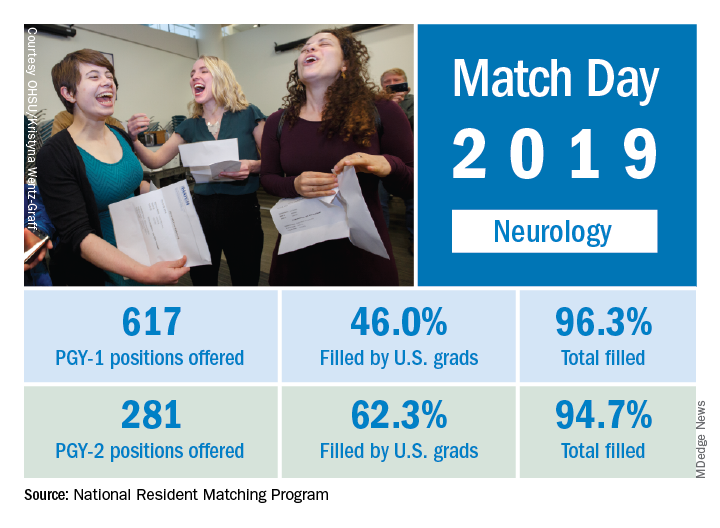
This year, 617 first-year (PGY-1) neurology slots were offered, an increase of 11.8% over the 552 offered in 2018 and well above the 6.5% gain recorded for the Match as whole. The 114 neurology programs participating this year filled 96.3% of those PGY-1 positions, compared with 94.7% for the 52 programs that offered PGY-2 positions, the NRMP reported.
“The results of the Match are closely watched because they can be predictors of future physician workforce supply. There also is significant interest in the competitiveness of specialties, as measured by the percentage of positions filled overall and the percentage filled by senior students in U.S. allopathic medical schools,” the NRMP said.
The proportion of PGY-1 neurology positions filled by U.S. seniors dropped to 46.0% from 50.7% last year, although the number of U.S. seniors filling spots actually went up from 280 in 2018 to 284. The PGY-2 positions saw declines in both cases: The 175 U.S. seniors represented 62.3% of the 2019 spots, compared with the 190 U.S. seniors who filled 66.2% of slots in 2018, the NRMP data show.
The total numbers of applicants (38,376) and positions offered (35,185) were both record highs for the Match, although they were affected, in part, by “increased numbers of osteopathic programs that joined the Main Residency Match as a result of the ongoing transition to a single accreditation system for graduate medical education programs,” the NRMP noted.
according to the National Resident Matching Program (NRMP).
This year, 617 first-year (PGY-1) neurology slots were offered, an increase of 11.8% over the 552 offered in 2018 and well above the 6.5% gain recorded for the Match as whole. The 114 neurology programs participating this year filled 96.3% of those PGY-1 positions, compared with 94.7% for the 52 programs that offered PGY-2 positions, the NRMP reported.
“The results of the Match are closely watched because they can be predictors of future physician workforce supply. There also is significant interest in the competitiveness of specialties, as measured by the percentage of positions filled overall and the percentage filled by senior students in U.S. allopathic medical schools,” the NRMP said.
The proportion of PGY-1 neurology positions filled by U.S. seniors dropped to 46.0% from 50.7% last year, although the number of U.S. seniors filling spots actually went up from 280 in 2018 to 284. The PGY-2 positions saw declines in both cases: The 175 U.S. seniors represented 62.3% of the 2019 spots, compared with the 190 U.S. seniors who filled 66.2% of slots in 2018, the NRMP data show.
The total numbers of applicants (38,376) and positions offered (35,185) were both record highs for the Match, although they were affected, in part, by “increased numbers of osteopathic programs that joined the Main Residency Match as a result of the ongoing transition to a single accreditation system for graduate medical education programs,” the NRMP noted.
according to the National Resident Matching Program (NRMP).
This year, 617 first-year (PGY-1) neurology slots were offered, an increase of 11.8% over the 552 offered in 2018 and well above the 6.5% gain recorded for the Match as whole. The 114 neurology programs participating this year filled 96.3% of those PGY-1 positions, compared with 94.7% for the 52 programs that offered PGY-2 positions, the NRMP reported.
“The results of the Match are closely watched because they can be predictors of future physician workforce supply. There also is significant interest in the competitiveness of specialties, as measured by the percentage of positions filled overall and the percentage filled by senior students in U.S. allopathic medical schools,” the NRMP said.
The proportion of PGY-1 neurology positions filled by U.S. seniors dropped to 46.0% from 50.7% last year, although the number of U.S. seniors filling spots actually went up from 280 in 2018 to 284. The PGY-2 positions saw declines in both cases: The 175 U.S. seniors represented 62.3% of the 2019 spots, compared with the 190 U.S. seniors who filled 66.2% of slots in 2018, the NRMP data show.
The total numbers of applicants (38,376) and positions offered (35,185) were both record highs for the Match, although they were affected, in part, by “increased numbers of osteopathic programs that joined the Main Residency Match as a result of the ongoing transition to a single accreditation system for graduate medical education programs,” the NRMP noted.
Match Day 2019: Family medicine slots up by 13%
for the first time since 2009, according to the National Resident Matching Program (NRMP).
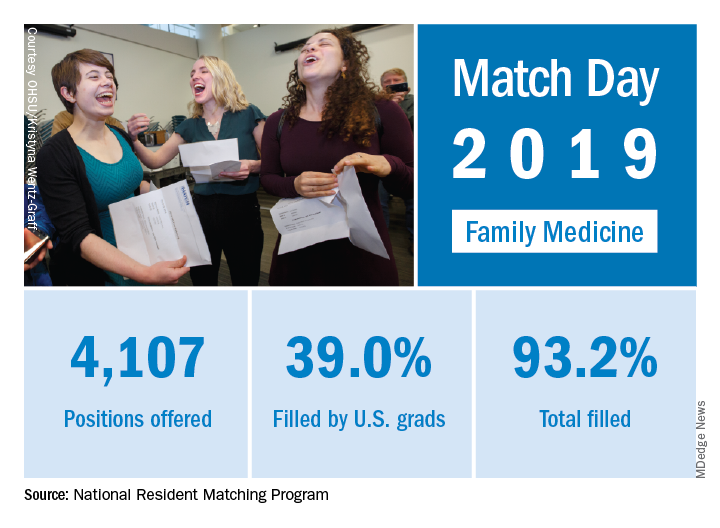
First-year FP slots rose from 3,629 to 4,107 as family medicine doubled the 6.5% increase in all first-year positions over 2018. The numbers of applicants (38,376) and total positions offered (35,185) were both record highs for the Match,although they were affected, in part, by “increased numbers of osteopathic programs that joined the Main Residency Match as a result of the ongoing transition to a single accreditation system for graduate medical education programs,” the NRMP noted.
Family medicine programs filled 39.0% of first-year positions with U.S. allopathic seniors, which was down from 44.9% in 2018 and 45.1% in 2017. In terms of the numbers of U.S. seniors involved, the drop was fairly small: from 1,628 in 2018 to 1,601 in 2019; however, the 986 osteopathic students and graduates who matched set a new record and accounted for almost 26% of all successful FP applicants, the NRMP reported.“The results of the Match are closely watched because they can be predictors of future physician workforce supply. There also is significant interest in the competitiveness of specialties, as measured by the percentage of positions filled overall and the percentage filled by senior students in U.S. allopathic medical schools,” the NRMP said in a written statement.
for the first time since 2009, according to the National Resident Matching Program (NRMP).
First-year FP slots rose from 3,629 to 4,107 as family medicine doubled the 6.5% increase in all first-year positions over 2018. The numbers of applicants (38,376) and total positions offered (35,185) were both record highs for the Match,although they were affected, in part, by “increased numbers of osteopathic programs that joined the Main Residency Match as a result of the ongoing transition to a single accreditation system for graduate medical education programs,” the NRMP noted.
Family medicine programs filled 39.0% of first-year positions with U.S. allopathic seniors, which was down from 44.9% in 2018 and 45.1% in 2017. In terms of the numbers of U.S. seniors involved, the drop was fairly small: from 1,628 in 2018 to 1,601 in 2019; however, the 986 osteopathic students and graduates who matched set a new record and accounted for almost 26% of all successful FP applicants, the NRMP reported.“The results of the Match are closely watched because they can be predictors of future physician workforce supply. There also is significant interest in the competitiveness of specialties, as measured by the percentage of positions filled overall and the percentage filled by senior students in U.S. allopathic medical schools,” the NRMP said in a written statement.
for the first time since 2009, according to the National Resident Matching Program (NRMP).
First-year FP slots rose from 3,629 to 4,107 as family medicine doubled the 6.5% increase in all first-year positions over 2018. The numbers of applicants (38,376) and total positions offered (35,185) were both record highs for the Match,although they were affected, in part, by “increased numbers of osteopathic programs that joined the Main Residency Match as a result of the ongoing transition to a single accreditation system for graduate medical education programs,” the NRMP noted.
Family medicine programs filled 39.0% of first-year positions with U.S. allopathic seniors, which was down from 44.9% in 2018 and 45.1% in 2017. In terms of the numbers of U.S. seniors involved, the drop was fairly small: from 1,628 in 2018 to 1,601 in 2019; however, the 986 osteopathic students and graduates who matched set a new record and accounted for almost 26% of all successful FP applicants, the NRMP reported.“The results of the Match are closely watched because they can be predictors of future physician workforce supply. There also is significant interest in the competitiveness of specialties, as measured by the percentage of positions filled overall and the percentage filled by senior students in U.S. allopathic medical schools,” the NRMP said in a written statement.