User login
AIMS65 Score Helps Predict Inpatient Mortality in Acute Upper Gastrointestinal Bleed
Clinical question: Does AIMS65 risk stratification score predict inpatient mortality in patients with acute upper gastrointestinal bleed (UGIB)?

Background: Acute UGIB is associated with significant morbidity and mortality, which makes it crucial to identify high-risk patients early. Several prognostic algorithms such as Glasgow-Blatchford (GBS) and pre-endoscopy (pre-RS) and post-endoscopy (post-RS) Rockall scores are available to triage such patients. The goal of this study was to validate AIMS65 score as a predictor of inpatient mortality in patients with acute UGIB compared to these other prognostic scores.
Study Design: Retrospective, cohort study.
Setting: Tertiary-care center in Australia, January 2010 to June 2013.
Synopsis: Using ICD-10 diagnosis codes, investigators identified 424 patients with UGIB requiring endoscopy. All patients were risk-stratified using AIMS65, GBS, pre-RS, and post-RS. The AIMS65 score was found to be superior in predicting inpatient mortality compared to GBS and pre-RS scores and statistically superior to all other scores in predicting need for ICU admission.
In addition to being a single-center, retrospective study, other limitations include the use of ICD-10 codes to identify patients. Further prospective studies are needed to further validate the AIMS65 in acute UGIB.
Bottom line: AIMS65 is a simple and useful tool in predicting inpatient mortality in patients with acute UGIB. However, its applicability in making clinical decisions remains unclear.
Citation: Robertson M, Majumdar A, Boyapati R, et al. Risk stratification in acute upper GI bleeding: comparison of the AIMS65 score with the Glasgow-Blatchford and Rockall scoring systems [published online ahead of print October 16, 2015]. Gastrointest Endosc. doi:10.1016/j.gie.2015.10.021.
Clinical question: Does AIMS65 risk stratification score predict inpatient mortality in patients with acute upper gastrointestinal bleed (UGIB)?
Background: Acute UGIB is associated with significant morbidity and mortality, which makes it crucial to identify high-risk patients early. Several prognostic algorithms such as Glasgow-Blatchford (GBS) and pre-endoscopy (pre-RS) and post-endoscopy (post-RS) Rockall scores are available to triage such patients. The goal of this study was to validate AIMS65 score as a predictor of inpatient mortality in patients with acute UGIB compared to these other prognostic scores.
Study Design: Retrospective, cohort study.
Setting: Tertiary-care center in Australia, January 2010 to June 2013.
Synopsis: Using ICD-10 diagnosis codes, investigators identified 424 patients with UGIB requiring endoscopy. All patients were risk-stratified using AIMS65, GBS, pre-RS, and post-RS. The AIMS65 score was found to be superior in predicting inpatient mortality compared to GBS and pre-RS scores and statistically superior to all other scores in predicting need for ICU admission.
In addition to being a single-center, retrospective study, other limitations include the use of ICD-10 codes to identify patients. Further prospective studies are needed to further validate the AIMS65 in acute UGIB.
Bottom line: AIMS65 is a simple and useful tool in predicting inpatient mortality in patients with acute UGIB. However, its applicability in making clinical decisions remains unclear.
Citation: Robertson M, Majumdar A, Boyapati R, et al. Risk stratification in acute upper GI bleeding: comparison of the AIMS65 score with the Glasgow-Blatchford and Rockall scoring systems [published online ahead of print October 16, 2015]. Gastrointest Endosc. doi:10.1016/j.gie.2015.10.021.
Clinical question: Does AIMS65 risk stratification score predict inpatient mortality in patients with acute upper gastrointestinal bleed (UGIB)?
Background: Acute UGIB is associated with significant morbidity and mortality, which makes it crucial to identify high-risk patients early. Several prognostic algorithms such as Glasgow-Blatchford (GBS) and pre-endoscopy (pre-RS) and post-endoscopy (post-RS) Rockall scores are available to triage such patients. The goal of this study was to validate AIMS65 score as a predictor of inpatient mortality in patients with acute UGIB compared to these other prognostic scores.
Study Design: Retrospective, cohort study.
Setting: Tertiary-care center in Australia, January 2010 to June 2013.
Synopsis: Using ICD-10 diagnosis codes, investigators identified 424 patients with UGIB requiring endoscopy. All patients were risk-stratified using AIMS65, GBS, pre-RS, and post-RS. The AIMS65 score was found to be superior in predicting inpatient mortality compared to GBS and pre-RS scores and statistically superior to all other scores in predicting need for ICU admission.
In addition to being a single-center, retrospective study, other limitations include the use of ICD-10 codes to identify patients. Further prospective studies are needed to further validate the AIMS65 in acute UGIB.
Bottom line: AIMS65 is a simple and useful tool in predicting inpatient mortality in patients with acute UGIB. However, its applicability in making clinical decisions remains unclear.
Citation: Robertson M, Majumdar A, Boyapati R, et al. Risk stratification in acute upper GI bleeding: comparison of the AIMS65 score with the Glasgow-Blatchford and Rockall scoring systems [published online ahead of print October 16, 2015]. Gastrointest Endosc. doi:10.1016/j.gie.2015.10.021.

SHM Student-Resident Program to Tour U.S. Cities
Interested in a career in hospital medicine? Know someone who is? SHM hosts a series of special events for students and residents on campuses throughout the country. These catered networking receptions feature nationally recognized hospitalists speaking on their careers and the many options and opportunities within the hospital medicine specialty.
Don’t miss the opportunity to consider a career choice in medicine’s fastest growing specialty and network with the hospital medicine community. The tentative 2016 schedule includes stops in the following cities:
Spring: Baltimore, San Antonio, Seattle, Tempe, Ariz.
Fall: Atlanta, Chicago, Denver, New York City, Philadelphia, San Francisco, St. Louis
Visit www.futureofhospitalmedicine.org/events to learn more and see updated schedule details.
Interested in a career in hospital medicine? Know someone who is? SHM hosts a series of special events for students and residents on campuses throughout the country. These catered networking receptions feature nationally recognized hospitalists speaking on their careers and the many options and opportunities within the hospital medicine specialty.
Don’t miss the opportunity to consider a career choice in medicine’s fastest growing specialty and network with the hospital medicine community. The tentative 2016 schedule includes stops in the following cities:
Spring: Baltimore, San Antonio, Seattle, Tempe, Ariz.
Fall: Atlanta, Chicago, Denver, New York City, Philadelphia, San Francisco, St. Louis
Visit www.futureofhospitalmedicine.org/events to learn more and see updated schedule details.
Interested in a career in hospital medicine? Know someone who is? SHM hosts a series of special events for students and residents on campuses throughout the country. These catered networking receptions feature nationally recognized hospitalists speaking on their careers and the many options and opportunities within the hospital medicine specialty.
Don’t miss the opportunity to consider a career choice in medicine’s fastest growing specialty and network with the hospital medicine community. The tentative 2016 schedule includes stops in the following cities:
Spring: Baltimore, San Antonio, Seattle, Tempe, Ariz.
Fall: Atlanta, Chicago, Denver, New York City, Philadelphia, San Francisco, St. Louis
Visit www.futureofhospitalmedicine.org/events to learn more and see updated schedule details.
Tips for Policy and Procedure Manuals, Along with Roles for NP/PAs
Editor’s note: Second in a three-part series.
This month continues my list of important issues that help position your hospitalist group for greatest success. SHM’s “Key Principles and Characteristics of an Effective Hospital Medicine Group” is the definitive list, and this is my much smaller list. Last month, I discussed a culture (or mindset) of practice ownership, a formal system of group decision-making, and the importance of hospitalists themselves playing an active role in recruitment.
Policy and Procedure Manual
New protocols and decisions are being implemented every day. It is impossible to keep track of them, especially the ones that come into play infrequently. For example, many adult hospitalist groups have reached decisions about whether to admit teenagers (e.g., admit only 16 and older or 18 and older, etc.) and whether a hospitalist or obstetrician serves as attending for pregnant women admitted for a medical problem like asthma or pneumonia. But ask everyone in your group to recite the policies, and I bet the answers will differ.
My experience is that only about 20% to 25% of hospitalist groups have written these things down in one place, but all should. It doesn’t need to be fancy and could just start as a Word document in which the lead hospitalist or other designated person writes down a handful of policies and then updates them on an ongoing basis. For example, if a group meeting results in adopting a new policy, it could be added to the document as soon as the meeting adjourns. In some cases, a policy is communicated by email; it would be fine to just copy the body of that email into the manual.
This “living” document could be maintained on a shared computer drive accessible from anywhere in or out of the hospital. That way, when the solo night doctor thinks, “Do we admit 17-year-olds or not?,” she has a place to find the answer right away. And the manual will be a real asset to orient new providers to your practice.
You could start the policy and procedure manual by listing categories, including human resource issues like sick-day policy, how to request days off or scheduling changes, clinical policies like which hip fractures are admitted by hospitalists versus orthopedics, billing and coding practices such as always turn in charges at end of each day, and so on.
I’ve seen useful manuals that are about 10 pages and others that run more than 50 pages.
An Effective Performance Dashboard
Every hospitalist group should have some sort of routine performance report (dashboard) provided in the same format at regular intervals, yet in my experience many, or even most, don’t. It is worth the sometimes considerable effort to develop a meaningful dashboard, and in 2006, SHM published a helpful guide. Even though it is getting old, most of the advice is still very relevant even if the metrics we care most about have changed.
I’m a big believer in providing unblinded performance data to all in the hospitalist group. For example, a report of individual work relative value unit (wRVU) productivity would show productivity for each doctor by name. I think it is healthy to be transparent and ensure all in the group know how others are performing. There is nothing like finding out you are a performance outlier to spark an interest in understanding why and what should be done about it.
Roles for NPs and PAs
Nurse practitioners (NPs) and physician assistants (PAs) can be valuable contributors to a successful hospitalist program, and according to the 2014 State of Hospital Medicine Report, 65% of hospitalist groups nationally had at least one such clinician—an increase over prior years.
While the idea of NP/PAs contributing to the practice is a sound one, my experience is that many groups execute the idea poorly and end up creating a role that can be both professionally unsatisfying and not serve as a platform to contribute effectively to the group. A common scenario is a hospitalist group has trouble with recruiting physicians, so it turns to NP/PAs because they are more readily available. But so often the group has thought little about the precise role NP/PAs will serve (nothing more than “they will help out the docs”). Too often the result is NP/PAs who will say many physician hospitalists simply repeat all the work on each patient, which certainly isn’t a rewarding or cost-effective role.
All should be convinced that the practice is better off in terms of increased overall productivity and/or other benefits by investing in NP/PAs than if those same dollars were instead invested in physician staffing. So one economic model to consider is to calculate the total cost (salary, benefits, malpractice, etc.) for an NP/PA and divide that by those costs for a physician. Let’s say that shows an NP/PA costs half as much as a physician (ranges 40% to 60% in my experience). That staffing cost could be considered in “physician FTE equivalents” so that, for example, a practice with four NP/PAs each costing 50% as much as a physician, or two physician equivalents, could be said to have a total of two physician-equivalent FTEs of staffing. Is the practice better off configured that way, or would it be better to have two physicians instead of the four NP/PAs? The answer will vary, but I think every practice should look at NP/PA staffing through this lens, as well as other considerations, to determine whether they’ve made the best choice.
Having NP/PAs and physicians share rounding duties can be tricky to do efficiently. In my experience, NP/PAs can be better positioned to contribute optimally and find greater professional satisfaction if responsible for a specific portion of the group’s work. For example, at a large hospital, NP/PAs might see all orthopedic consults or psych unit admissions reasonably independently, though with physician backup available. Or NP/PAs could serve as evening (“swing”) shift staffing and manage cross-cover and some admissions. In these roles, the division of labor between NP/PAs and physicians is clearer and allows NP/PAs to contribute most effectively. TH

Editor’s note: Second in a three-part series.
This month continues my list of important issues that help position your hospitalist group for greatest success. SHM’s “Key Principles and Characteristics of an Effective Hospital Medicine Group” is the definitive list, and this is my much smaller list. Last month, I discussed a culture (or mindset) of practice ownership, a formal system of group decision-making, and the importance of hospitalists themselves playing an active role in recruitment.
Policy and Procedure Manual
New protocols and decisions are being implemented every day. It is impossible to keep track of them, especially the ones that come into play infrequently. For example, many adult hospitalist groups have reached decisions about whether to admit teenagers (e.g., admit only 16 and older or 18 and older, etc.) and whether a hospitalist or obstetrician serves as attending for pregnant women admitted for a medical problem like asthma or pneumonia. But ask everyone in your group to recite the policies, and I bet the answers will differ.
My experience is that only about 20% to 25% of hospitalist groups have written these things down in one place, but all should. It doesn’t need to be fancy and could just start as a Word document in which the lead hospitalist or other designated person writes down a handful of policies and then updates them on an ongoing basis. For example, if a group meeting results in adopting a new policy, it could be added to the document as soon as the meeting adjourns. In some cases, a policy is communicated by email; it would be fine to just copy the body of that email into the manual.
This “living” document could be maintained on a shared computer drive accessible from anywhere in or out of the hospital. That way, when the solo night doctor thinks, “Do we admit 17-year-olds or not?,” she has a place to find the answer right away. And the manual will be a real asset to orient new providers to your practice.
You could start the policy and procedure manual by listing categories, including human resource issues like sick-day policy, how to request days off or scheduling changes, clinical policies like which hip fractures are admitted by hospitalists versus orthopedics, billing and coding practices such as always turn in charges at end of each day, and so on.
I’ve seen useful manuals that are about 10 pages and others that run more than 50 pages.
An Effective Performance Dashboard
Every hospitalist group should have some sort of routine performance report (dashboard) provided in the same format at regular intervals, yet in my experience many, or even most, don’t. It is worth the sometimes considerable effort to develop a meaningful dashboard, and in 2006, SHM published a helpful guide. Even though it is getting old, most of the advice is still very relevant even if the metrics we care most about have changed.
I’m a big believer in providing unblinded performance data to all in the hospitalist group. For example, a report of individual work relative value unit (wRVU) productivity would show productivity for each doctor by name. I think it is healthy to be transparent and ensure all in the group know how others are performing. There is nothing like finding out you are a performance outlier to spark an interest in understanding why and what should be done about it.
Roles for NPs and PAs
Nurse practitioners (NPs) and physician assistants (PAs) can be valuable contributors to a successful hospitalist program, and according to the 2014 State of Hospital Medicine Report, 65% of hospitalist groups nationally had at least one such clinician—an increase over prior years.
While the idea of NP/PAs contributing to the practice is a sound one, my experience is that many groups execute the idea poorly and end up creating a role that can be both professionally unsatisfying and not serve as a platform to contribute effectively to the group. A common scenario is a hospitalist group has trouble with recruiting physicians, so it turns to NP/PAs because they are more readily available. But so often the group has thought little about the precise role NP/PAs will serve (nothing more than “they will help out the docs”). Too often the result is NP/PAs who will say many physician hospitalists simply repeat all the work on each patient, which certainly isn’t a rewarding or cost-effective role.
All should be convinced that the practice is better off in terms of increased overall productivity and/or other benefits by investing in NP/PAs than if those same dollars were instead invested in physician staffing. So one economic model to consider is to calculate the total cost (salary, benefits, malpractice, etc.) for an NP/PA and divide that by those costs for a physician. Let’s say that shows an NP/PA costs half as much as a physician (ranges 40% to 60% in my experience). That staffing cost could be considered in “physician FTE equivalents” so that, for example, a practice with four NP/PAs each costing 50% as much as a physician, or two physician equivalents, could be said to have a total of two physician-equivalent FTEs of staffing. Is the practice better off configured that way, or would it be better to have two physicians instead of the four NP/PAs? The answer will vary, but I think every practice should look at NP/PA staffing through this lens, as well as other considerations, to determine whether they’ve made the best choice.
Having NP/PAs and physicians share rounding duties can be tricky to do efficiently. In my experience, NP/PAs can be better positioned to contribute optimally and find greater professional satisfaction if responsible for a specific portion of the group’s work. For example, at a large hospital, NP/PAs might see all orthopedic consults or psych unit admissions reasonably independently, though with physician backup available. Or NP/PAs could serve as evening (“swing”) shift staffing and manage cross-cover and some admissions. In these roles, the division of labor between NP/PAs and physicians is clearer and allows NP/PAs to contribute most effectively. TH
Editor’s note: Second in a three-part series.
This month continues my list of important issues that help position your hospitalist group for greatest success. SHM’s “Key Principles and Characteristics of an Effective Hospital Medicine Group” is the definitive list, and this is my much smaller list. Last month, I discussed a culture (or mindset) of practice ownership, a formal system of group decision-making, and the importance of hospitalists themselves playing an active role in recruitment.
Policy and Procedure Manual
New protocols and decisions are being implemented every day. It is impossible to keep track of them, especially the ones that come into play infrequently. For example, many adult hospitalist groups have reached decisions about whether to admit teenagers (e.g., admit only 16 and older or 18 and older, etc.) and whether a hospitalist or obstetrician serves as attending for pregnant women admitted for a medical problem like asthma or pneumonia. But ask everyone in your group to recite the policies, and I bet the answers will differ.
My experience is that only about 20% to 25% of hospitalist groups have written these things down in one place, but all should. It doesn’t need to be fancy and could just start as a Word document in which the lead hospitalist or other designated person writes down a handful of policies and then updates them on an ongoing basis. For example, if a group meeting results in adopting a new policy, it could be added to the document as soon as the meeting adjourns. In some cases, a policy is communicated by email; it would be fine to just copy the body of that email into the manual.
This “living” document could be maintained on a shared computer drive accessible from anywhere in or out of the hospital. That way, when the solo night doctor thinks, “Do we admit 17-year-olds or not?,” she has a place to find the answer right away. And the manual will be a real asset to orient new providers to your practice.
You could start the policy and procedure manual by listing categories, including human resource issues like sick-day policy, how to request days off or scheduling changes, clinical policies like which hip fractures are admitted by hospitalists versus orthopedics, billing and coding practices such as always turn in charges at end of each day, and so on.
I’ve seen useful manuals that are about 10 pages and others that run more than 50 pages.
An Effective Performance Dashboard
Every hospitalist group should have some sort of routine performance report (dashboard) provided in the same format at regular intervals, yet in my experience many, or even most, don’t. It is worth the sometimes considerable effort to develop a meaningful dashboard, and in 2006, SHM published a helpful guide. Even though it is getting old, most of the advice is still very relevant even if the metrics we care most about have changed.
I’m a big believer in providing unblinded performance data to all in the hospitalist group. For example, a report of individual work relative value unit (wRVU) productivity would show productivity for each doctor by name. I think it is healthy to be transparent and ensure all in the group know how others are performing. There is nothing like finding out you are a performance outlier to spark an interest in understanding why and what should be done about it.
Roles for NPs and PAs
Nurse practitioners (NPs) and physician assistants (PAs) can be valuable contributors to a successful hospitalist program, and according to the 2014 State of Hospital Medicine Report, 65% of hospitalist groups nationally had at least one such clinician—an increase over prior years.
While the idea of NP/PAs contributing to the practice is a sound one, my experience is that many groups execute the idea poorly and end up creating a role that can be both professionally unsatisfying and not serve as a platform to contribute effectively to the group. A common scenario is a hospitalist group has trouble with recruiting physicians, so it turns to NP/PAs because they are more readily available. But so often the group has thought little about the precise role NP/PAs will serve (nothing more than “they will help out the docs”). Too often the result is NP/PAs who will say many physician hospitalists simply repeat all the work on each patient, which certainly isn’t a rewarding or cost-effective role.
All should be convinced that the practice is better off in terms of increased overall productivity and/or other benefits by investing in NP/PAs than if those same dollars were instead invested in physician staffing. So one economic model to consider is to calculate the total cost (salary, benefits, malpractice, etc.) for an NP/PA and divide that by those costs for a physician. Let’s say that shows an NP/PA costs half as much as a physician (ranges 40% to 60% in my experience). That staffing cost could be considered in “physician FTE equivalents” so that, for example, a practice with four NP/PAs each costing 50% as much as a physician, or two physician equivalents, could be said to have a total of two physician-equivalent FTEs of staffing. Is the practice better off configured that way, or would it be better to have two physicians instead of the four NP/PAs? The answer will vary, but I think every practice should look at NP/PA staffing through this lens, as well as other considerations, to determine whether they’ve made the best choice.
Having NP/PAs and physicians share rounding duties can be tricky to do efficiently. In my experience, NP/PAs can be better positioned to contribute optimally and find greater professional satisfaction if responsible for a specific portion of the group’s work. For example, at a large hospital, NP/PAs might see all orthopedic consults or psych unit admissions reasonably independently, though with physician backup available. Or NP/PAs could serve as evening (“swing”) shift staffing and manage cross-cover and some admissions. In these roles, the division of labor between NP/PAs and physicians is clearer and allows NP/PAs to contribute most effectively. TH
Heart Disease Rates Have Dropped but Vary Widely by Region
(Reuters Health) - Over the last 40 years, heart disease rates have dropped in the U.S. overall, but the changes varied widely by region, with the highest rates of the disease shifting from the Northeast to the South, researchers say.
"The consistent progression southward over the past few decades suggests that the pattern is not random - and could be attributed to geographic differences in prevention and treatment opportunities," said lead author Michele Casper of the CDC's Division for Heart Disease and Stroke Prevention in Atlanta, Georgia.
"Identifying those counties and regions with the greatest burden of mortality is a necessary first step to target appropriate resources that will ultimately reduce death rates," Casper told Reuters Health by email.
The researchers used data on heart disease deaths among people age 35 and over in the U.S. collected in two year intervals, between 1973 and 2010, from more than 3,000 counties of the 48 contiguous states.
Every county saw a decline in heart disease deaths. The average decline across the U.S. was 61%, but some counties only saw a decline of 9% while others cut heart disease deaths by 83%.
At the beginning of the study, heart disease deaths were most common in the Northeast through Appalachia and into the Midwest. Coastal North Carolina, South Carolina and Georgia also had high rates.
Most counties with the lowest death rates were located in the West, with some low-rate counties also scattered in Alabama, Florida and Mississippi.
By 2010, most high-rate counties were still in the eastern half of the country, but in the South, rather than in the North, with some parts of New England becoming pockets with lower death rates.
Declines were slowest in counties in Alabama, Mississippi, Louisiana, Arkansas, Oklahoma and parts of Texas, the authors reported in a paper scheduled for publication in Circulation.
Since the 1970s, national attention on the dangers of cigarette smoking and uncontrolled high blood pressure has led to a significant decline in deaths from coronary heart disease and myocardial infarction, but "heart disease" includes other conditions, such as heart failure, which have not decreased as much, said Dr. Donald A. Barr of Stanford University School of Medicine in California, who wrote an editorial accompanying the new study.
Comparable data for heart failure (associated with diabetes, obesity and underlying hypertension) has not been coming down as fast, Barr told Reuters Health by phone. He noted that heart failure is projected to increase over the next couple of decades, while coronary heart disease is expected to decline.
Heart failure disproportionately affects low-income Americans and African Americans, he said. "These at-risk populations are found in a somewhat higher proportion in those southeastern states."
"Combining heart failure and coronary heart disease under the global term 'heart disease' combines good news with not so good news," Barr said.
There were still meaningful declines in heart disease deaths in the South, Casper noted.
"Heart disease-related deaths are largely preventable, and with targeted public health efforts, it's possible to alleviate much of the heavy burden of this disease and close the geographic gap in declining heart disease death rates," Casper said.
"With collaboration, government agencies, medical care organizations, community groups, businesses and other organizations can provide more local opportunities for physical activity, as well as access to smoke-free spaces, affordable healthy foods, quality healthcare and social and economic well-being," Casper said.
(Reuters Health) - Over the last 40 years, heart disease rates have dropped in the U.S. overall, but the changes varied widely by region, with the highest rates of the disease shifting from the Northeast to the South, researchers say.
"The consistent progression southward over the past few decades suggests that the pattern is not random - and could be attributed to geographic differences in prevention and treatment opportunities," said lead author Michele Casper of the CDC's Division for Heart Disease and Stroke Prevention in Atlanta, Georgia.
"Identifying those counties and regions with the greatest burden of mortality is a necessary first step to target appropriate resources that will ultimately reduce death rates," Casper told Reuters Health by email.
The researchers used data on heart disease deaths among people age 35 and over in the U.S. collected in two year intervals, between 1973 and 2010, from more than 3,000 counties of the 48 contiguous states.
Every county saw a decline in heart disease deaths. The average decline across the U.S. was 61%, but some counties only saw a decline of 9% while others cut heart disease deaths by 83%.
At the beginning of the study, heart disease deaths were most common in the Northeast through Appalachia and into the Midwest. Coastal North Carolina, South Carolina and Georgia also had high rates.
Most counties with the lowest death rates were located in the West, with some low-rate counties also scattered in Alabama, Florida and Mississippi.
By 2010, most high-rate counties were still in the eastern half of the country, but in the South, rather than in the North, with some parts of New England becoming pockets with lower death rates.
Declines were slowest in counties in Alabama, Mississippi, Louisiana, Arkansas, Oklahoma and parts of Texas, the authors reported in a paper scheduled for publication in Circulation.
Since the 1970s, national attention on the dangers of cigarette smoking and uncontrolled high blood pressure has led to a significant decline in deaths from coronary heart disease and myocardial infarction, but "heart disease" includes other conditions, such as heart failure, which have not decreased as much, said Dr. Donald A. Barr of Stanford University School of Medicine in California, who wrote an editorial accompanying the new study.
Comparable data for heart failure (associated with diabetes, obesity and underlying hypertension) has not been coming down as fast, Barr told Reuters Health by phone. He noted that heart failure is projected to increase over the next couple of decades, while coronary heart disease is expected to decline.
Heart failure disproportionately affects low-income Americans and African Americans, he said. "These at-risk populations are found in a somewhat higher proportion in those southeastern states."
"Combining heart failure and coronary heart disease under the global term 'heart disease' combines good news with not so good news," Barr said.
There were still meaningful declines in heart disease deaths in the South, Casper noted.
"Heart disease-related deaths are largely preventable, and with targeted public health efforts, it's possible to alleviate much of the heavy burden of this disease and close the geographic gap in declining heart disease death rates," Casper said.
"With collaboration, government agencies, medical care organizations, community groups, businesses and other organizations can provide more local opportunities for physical activity, as well as access to smoke-free spaces, affordable healthy foods, quality healthcare and social and economic well-being," Casper said.
(Reuters Health) - Over the last 40 years, heart disease rates have dropped in the U.S. overall, but the changes varied widely by region, with the highest rates of the disease shifting from the Northeast to the South, researchers say.
"The consistent progression southward over the past few decades suggests that the pattern is not random - and could be attributed to geographic differences in prevention and treatment opportunities," said lead author Michele Casper of the CDC's Division for Heart Disease and Stroke Prevention in Atlanta, Georgia.
"Identifying those counties and regions with the greatest burden of mortality is a necessary first step to target appropriate resources that will ultimately reduce death rates," Casper told Reuters Health by email.
The researchers used data on heart disease deaths among people age 35 and over in the U.S. collected in two year intervals, between 1973 and 2010, from more than 3,000 counties of the 48 contiguous states.
Every county saw a decline in heart disease deaths. The average decline across the U.S. was 61%, but some counties only saw a decline of 9% while others cut heart disease deaths by 83%.
At the beginning of the study, heart disease deaths were most common in the Northeast through Appalachia and into the Midwest. Coastal North Carolina, South Carolina and Georgia also had high rates.
Most counties with the lowest death rates were located in the West, with some low-rate counties also scattered in Alabama, Florida and Mississippi.
By 2010, most high-rate counties were still in the eastern half of the country, but in the South, rather than in the North, with some parts of New England becoming pockets with lower death rates.
Declines were slowest in counties in Alabama, Mississippi, Louisiana, Arkansas, Oklahoma and parts of Texas, the authors reported in a paper scheduled for publication in Circulation.
Since the 1970s, national attention on the dangers of cigarette smoking and uncontrolled high blood pressure has led to a significant decline in deaths from coronary heart disease and myocardial infarction, but "heart disease" includes other conditions, such as heart failure, which have not decreased as much, said Dr. Donald A. Barr of Stanford University School of Medicine in California, who wrote an editorial accompanying the new study.
Comparable data for heart failure (associated with diabetes, obesity and underlying hypertension) has not been coming down as fast, Barr told Reuters Health by phone. He noted that heart failure is projected to increase over the next couple of decades, while coronary heart disease is expected to decline.
Heart failure disproportionately affects low-income Americans and African Americans, he said. "These at-risk populations are found in a somewhat higher proportion in those southeastern states."
"Combining heart failure and coronary heart disease under the global term 'heart disease' combines good news with not so good news," Barr said.
There were still meaningful declines in heart disease deaths in the South, Casper noted.
"Heart disease-related deaths are largely preventable, and with targeted public health efforts, it's possible to alleviate much of the heavy burden of this disease and close the geographic gap in declining heart disease death rates," Casper said.
"With collaboration, government agencies, medical care organizations, community groups, businesses and other organizations can provide more local opportunities for physical activity, as well as access to smoke-free spaces, affordable healthy foods, quality healthcare and social and economic well-being," Casper said.
Care Teams Work Best When Members Have a Voice
I stumbled upon an absolutely brilliant TED talk about how we need to forget about the “pecking order” within workplaces and how we need to focus on team social connectedness as a strategy to enhance teamwork and productivity.1 I found the analogy in the presenter’s talk so incredibly poignant for the work we do every day in hospital medicine. As we work to solve incredibly challenging problems daily, we do so among continuously changing and highly charged teams. How can we create our teams to be the most effective and productive to serve the greater good?
The speaker, Margaret Heffernan, is an entrepreneur and former CEO of five companies. She tells a story about a study performed by an evolutionary biologist by the name of William Muir of Purdue University in West Lafayette, Ind.2 Muir undertook a series of studies evaluating the social order and productivity of chickens (as measured by egg production) and the team characteristics that make chickens more or less productive. After watching flocks of chickens for several generations, he picked out the most productive chickens and put them all together in a “super flock.” He then watched their productivity over the next several generations and compared their productivity to those in the regular flock.
What he found was that the regular flock became more productive and most of the members of the super flock were dead!
The most productive members of the super flock had essentially pecked the other members to death. He surmised that the only reason the super chickens were initially productive was by suppressing the productivity of the original flock members. The chickens in the regular flock that were initially less aggressive (and less productive) over time sustained fewer injuries and were able to be more productive in the absence of super chickens. The energy that the animals had previously invested in negative behaviors (pecking, injuries, and healing) was redirected into positive behaviors (making eggs).
Muir and his team have gone on to research a tool to predict social aggressiveness and social agreeableness in individual animals. Those high on the socially agreeable scales (and low on the socially aggressive scales) are more valuable for producing highly effective teams of agricultural animals by enhancing group dynamics, social interactions, and actual productivity.
Backward Thinking
Heffernan argues that we have run most businesses (hospitals included) and many societies (at least capitalistic ones) in the super chicken model. In this model, we view leadership as a trait to be individually owned and perfected, and we think that leaders are supposed to have all the answers. In order to determine our leaders, we charge highly competent people to compete against one another as if in a talent contest. It has long been thought that to be successful as teams, we should recruit the best and brightest, pit them against on another, and see who wins, then promote the winner, put them in charge of everything, and give them all the resources they could want or need to be a super chicken.
But this model inevitably suppresses the remainder of the flock and leads to aggression and waste.
In many scenarios in our hospitals, physicians view themselves as and act like super chickens; we try to be the hardest working, the brightest, and the most powerful. How many times have we heard of or witnessed circumstances where a physician suppresses the candor or opinion from other disciplines on the care team? I think we all know physicians (ourselves included) who demand the role of decision maker and ignore the opinions or needs of the remainder of the team, including patients or their family.
Alternatives
So if we should not be subscribing to the super chicken theory, then what type of leadership structures should we be subscribing to within medical teams to produce the best outcomes for ourselves and for our patients and their families?
A study performed by MIT scientists gives us some insight. Researchers found that when random groups of people are given very difficult problems to solve (e.g., think about diagnostic dilemmas or very difficult patients), certain group attributes made it more likely that the group would be successful in solving these difficult problems. The groups that were most effective were not those with a few people with extremely high IQs or with the highest collective IQ. The teams that were most effective and able to solve difficult problems were those that showed high degrees of social sensitivity among members (i.e., empathy). The highest-performing teams gave roughly equal time to each member (e.g., think about physicians, pharmacists, social workers, case managers, consultants on a typical medical team). They also found the highest-performing teams had more women in them. (I feel so redeemed!)
In summary, what they learned from these experiments was that the most successful teams were more socially connected and more highly attuned and sensitive to one another. This is not to say that highly successful teams were leaderless. There is absolutely a vital role that leaders play in such teams. In Jim Collins’ famous book Good to Great, in studying leadership and teams, he did not find the best leaders were super chickens who autocratically made unilateral decisions. Instead, he found the best leaders function more like facilitators, having the humility and skill to draw out shared solutions from large participatory teams.3 Doesn’t this sound like how a hospitalist should run multidisciplinary rounds?
The other major attribute that the MIT researchers noticed about highly functional teams is that each and every member of the team was extremely willing and able to give and receive help. They found that teams with high mutual understanding and trust were more likely to seamlessly—and almost effortlessly—give and receive help from one another. They ended up acting as one another’s social support network. If any team member was confronted by a difficult problem or situation, each felt confident that it could be easily solved with the collective skill and wisdom of the team.
As a result of such research, some companies have developed and implemented strategies to enhance such social capital, such as synchronizing coffee breaks and disallowing coffee mugs at individual desks. These companies consider it a vital strategic mission to ensure that team members get to know and understand one another and that they serve as a social support network at work. They believe that it is reliance and interdependency that ensures trust and enhances productivity.
So what really matters is the mortar, not just the bricks.
HM Takeaway
For hospital medicine teams, what we need to do is accept that teams work best when every member has a voice and is valued. When others look to us (usually seen as team leaders) to make all the decisions (as if we are super chickens), we need to empower our team members to make decisions with us.
We need to actively work toward this model of being a team leader, break any cycles of dependency that we have set up, and produce better outcomes.
We need to avoid acting like super chickens and appreciate and empower a true team effort.
We need to stop accepting that management and promotions occur by talent contests that pit employees against one another and insist that rivalry at every level has to be replaced by social capital and social connectedness.
Only then will our leadership result in creating effective and productive bricks and mortar. TH
References
- Heffernan M. Margaret Heffernan: why it’s time to forget the pecking order at work. TED Talks. June 16, 2015. Available at: https://www.youtube.com/watch?v=Vyn_xLrtZaY&feature=youtu.be.
- Steeves SA. Scientists find method to pick non-competitive animals, improve production. Available at: https://news.uns.purdue.edu/x/2007a/070212MuirSelection.html.
- Collins J. Good to Great. New York, N.Y.: HarperBusiness; 2011.

I stumbled upon an absolutely brilliant TED talk about how we need to forget about the “pecking order” within workplaces and how we need to focus on team social connectedness as a strategy to enhance teamwork and productivity.1 I found the analogy in the presenter’s talk so incredibly poignant for the work we do every day in hospital medicine. As we work to solve incredibly challenging problems daily, we do so among continuously changing and highly charged teams. How can we create our teams to be the most effective and productive to serve the greater good?
The speaker, Margaret Heffernan, is an entrepreneur and former CEO of five companies. She tells a story about a study performed by an evolutionary biologist by the name of William Muir of Purdue University in West Lafayette, Ind.2 Muir undertook a series of studies evaluating the social order and productivity of chickens (as measured by egg production) and the team characteristics that make chickens more or less productive. After watching flocks of chickens for several generations, he picked out the most productive chickens and put them all together in a “super flock.” He then watched their productivity over the next several generations and compared their productivity to those in the regular flock.
What he found was that the regular flock became more productive and most of the members of the super flock were dead!
The most productive members of the super flock had essentially pecked the other members to death. He surmised that the only reason the super chickens were initially productive was by suppressing the productivity of the original flock members. The chickens in the regular flock that were initially less aggressive (and less productive) over time sustained fewer injuries and were able to be more productive in the absence of super chickens. The energy that the animals had previously invested in negative behaviors (pecking, injuries, and healing) was redirected into positive behaviors (making eggs).
Muir and his team have gone on to research a tool to predict social aggressiveness and social agreeableness in individual animals. Those high on the socially agreeable scales (and low on the socially aggressive scales) are more valuable for producing highly effective teams of agricultural animals by enhancing group dynamics, social interactions, and actual productivity.
Backward Thinking
Heffernan argues that we have run most businesses (hospitals included) and many societies (at least capitalistic ones) in the super chicken model. In this model, we view leadership as a trait to be individually owned and perfected, and we think that leaders are supposed to have all the answers. In order to determine our leaders, we charge highly competent people to compete against one another as if in a talent contest. It has long been thought that to be successful as teams, we should recruit the best and brightest, pit them against on another, and see who wins, then promote the winner, put them in charge of everything, and give them all the resources they could want or need to be a super chicken.
But this model inevitably suppresses the remainder of the flock and leads to aggression and waste.
In many scenarios in our hospitals, physicians view themselves as and act like super chickens; we try to be the hardest working, the brightest, and the most powerful. How many times have we heard of or witnessed circumstances where a physician suppresses the candor or opinion from other disciplines on the care team? I think we all know physicians (ourselves included) who demand the role of decision maker and ignore the opinions or needs of the remainder of the team, including patients or their family.
Alternatives
So if we should not be subscribing to the super chicken theory, then what type of leadership structures should we be subscribing to within medical teams to produce the best outcomes for ourselves and for our patients and their families?
A study performed by MIT scientists gives us some insight. Researchers found that when random groups of people are given very difficult problems to solve (e.g., think about diagnostic dilemmas or very difficult patients), certain group attributes made it more likely that the group would be successful in solving these difficult problems. The groups that were most effective were not those with a few people with extremely high IQs or with the highest collective IQ. The teams that were most effective and able to solve difficult problems were those that showed high degrees of social sensitivity among members (i.e., empathy). The highest-performing teams gave roughly equal time to each member (e.g., think about physicians, pharmacists, social workers, case managers, consultants on a typical medical team). They also found the highest-performing teams had more women in them. (I feel so redeemed!)
In summary, what they learned from these experiments was that the most successful teams were more socially connected and more highly attuned and sensitive to one another. This is not to say that highly successful teams were leaderless. There is absolutely a vital role that leaders play in such teams. In Jim Collins’ famous book Good to Great, in studying leadership and teams, he did not find the best leaders were super chickens who autocratically made unilateral decisions. Instead, he found the best leaders function more like facilitators, having the humility and skill to draw out shared solutions from large participatory teams.3 Doesn’t this sound like how a hospitalist should run multidisciplinary rounds?
The other major attribute that the MIT researchers noticed about highly functional teams is that each and every member of the team was extremely willing and able to give and receive help. They found that teams with high mutual understanding and trust were more likely to seamlessly—and almost effortlessly—give and receive help from one another. They ended up acting as one another’s social support network. If any team member was confronted by a difficult problem or situation, each felt confident that it could be easily solved with the collective skill and wisdom of the team.
As a result of such research, some companies have developed and implemented strategies to enhance such social capital, such as synchronizing coffee breaks and disallowing coffee mugs at individual desks. These companies consider it a vital strategic mission to ensure that team members get to know and understand one another and that they serve as a social support network at work. They believe that it is reliance and interdependency that ensures trust and enhances productivity.
So what really matters is the mortar, not just the bricks.
HM Takeaway
For hospital medicine teams, what we need to do is accept that teams work best when every member has a voice and is valued. When others look to us (usually seen as team leaders) to make all the decisions (as if we are super chickens), we need to empower our team members to make decisions with us.
We need to actively work toward this model of being a team leader, break any cycles of dependency that we have set up, and produce better outcomes.
We need to avoid acting like super chickens and appreciate and empower a true team effort.
We need to stop accepting that management and promotions occur by talent contests that pit employees against one another and insist that rivalry at every level has to be replaced by social capital and social connectedness.
Only then will our leadership result in creating effective and productive bricks and mortar. TH
References
- Heffernan M. Margaret Heffernan: why it’s time to forget the pecking order at work. TED Talks. June 16, 2015. Available at: https://www.youtube.com/watch?v=Vyn_xLrtZaY&feature=youtu.be.
- Steeves SA. Scientists find method to pick non-competitive animals, improve production. Available at: https://news.uns.purdue.edu/x/2007a/070212MuirSelection.html.
- Collins J. Good to Great. New York, N.Y.: HarperBusiness; 2011.
I stumbled upon an absolutely brilliant TED talk about how we need to forget about the “pecking order” within workplaces and how we need to focus on team social connectedness as a strategy to enhance teamwork and productivity.1 I found the analogy in the presenter’s talk so incredibly poignant for the work we do every day in hospital medicine. As we work to solve incredibly challenging problems daily, we do so among continuously changing and highly charged teams. How can we create our teams to be the most effective and productive to serve the greater good?
The speaker, Margaret Heffernan, is an entrepreneur and former CEO of five companies. She tells a story about a study performed by an evolutionary biologist by the name of William Muir of Purdue University in West Lafayette, Ind.2 Muir undertook a series of studies evaluating the social order and productivity of chickens (as measured by egg production) and the team characteristics that make chickens more or less productive. After watching flocks of chickens for several generations, he picked out the most productive chickens and put them all together in a “super flock.” He then watched their productivity over the next several generations and compared their productivity to those in the regular flock.
What he found was that the regular flock became more productive and most of the members of the super flock were dead!
The most productive members of the super flock had essentially pecked the other members to death. He surmised that the only reason the super chickens were initially productive was by suppressing the productivity of the original flock members. The chickens in the regular flock that were initially less aggressive (and less productive) over time sustained fewer injuries and were able to be more productive in the absence of super chickens. The energy that the animals had previously invested in negative behaviors (pecking, injuries, and healing) was redirected into positive behaviors (making eggs).
Muir and his team have gone on to research a tool to predict social aggressiveness and social agreeableness in individual animals. Those high on the socially agreeable scales (and low on the socially aggressive scales) are more valuable for producing highly effective teams of agricultural animals by enhancing group dynamics, social interactions, and actual productivity.
Backward Thinking
Heffernan argues that we have run most businesses (hospitals included) and many societies (at least capitalistic ones) in the super chicken model. In this model, we view leadership as a trait to be individually owned and perfected, and we think that leaders are supposed to have all the answers. In order to determine our leaders, we charge highly competent people to compete against one another as if in a talent contest. It has long been thought that to be successful as teams, we should recruit the best and brightest, pit them against on another, and see who wins, then promote the winner, put them in charge of everything, and give them all the resources they could want or need to be a super chicken.
But this model inevitably suppresses the remainder of the flock and leads to aggression and waste.
In many scenarios in our hospitals, physicians view themselves as and act like super chickens; we try to be the hardest working, the brightest, and the most powerful. How many times have we heard of or witnessed circumstances where a physician suppresses the candor or opinion from other disciplines on the care team? I think we all know physicians (ourselves included) who demand the role of decision maker and ignore the opinions or needs of the remainder of the team, including patients or their family.
Alternatives
So if we should not be subscribing to the super chicken theory, then what type of leadership structures should we be subscribing to within medical teams to produce the best outcomes for ourselves and for our patients and their families?
A study performed by MIT scientists gives us some insight. Researchers found that when random groups of people are given very difficult problems to solve (e.g., think about diagnostic dilemmas or very difficult patients), certain group attributes made it more likely that the group would be successful in solving these difficult problems. The groups that were most effective were not those with a few people with extremely high IQs or with the highest collective IQ. The teams that were most effective and able to solve difficult problems were those that showed high degrees of social sensitivity among members (i.e., empathy). The highest-performing teams gave roughly equal time to each member (e.g., think about physicians, pharmacists, social workers, case managers, consultants on a typical medical team). They also found the highest-performing teams had more women in them. (I feel so redeemed!)
In summary, what they learned from these experiments was that the most successful teams were more socially connected and more highly attuned and sensitive to one another. This is not to say that highly successful teams were leaderless. There is absolutely a vital role that leaders play in such teams. In Jim Collins’ famous book Good to Great, in studying leadership and teams, he did not find the best leaders were super chickens who autocratically made unilateral decisions. Instead, he found the best leaders function more like facilitators, having the humility and skill to draw out shared solutions from large participatory teams.3 Doesn’t this sound like how a hospitalist should run multidisciplinary rounds?
The other major attribute that the MIT researchers noticed about highly functional teams is that each and every member of the team was extremely willing and able to give and receive help. They found that teams with high mutual understanding and trust were more likely to seamlessly—and almost effortlessly—give and receive help from one another. They ended up acting as one another’s social support network. If any team member was confronted by a difficult problem or situation, each felt confident that it could be easily solved with the collective skill and wisdom of the team.
As a result of such research, some companies have developed and implemented strategies to enhance such social capital, such as synchronizing coffee breaks and disallowing coffee mugs at individual desks. These companies consider it a vital strategic mission to ensure that team members get to know and understand one another and that they serve as a social support network at work. They believe that it is reliance and interdependency that ensures trust and enhances productivity.
So what really matters is the mortar, not just the bricks.
HM Takeaway
For hospital medicine teams, what we need to do is accept that teams work best when every member has a voice and is valued. When others look to us (usually seen as team leaders) to make all the decisions (as if we are super chickens), we need to empower our team members to make decisions with us.
We need to actively work toward this model of being a team leader, break any cycles of dependency that we have set up, and produce better outcomes.
We need to avoid acting like super chickens and appreciate and empower a true team effort.
We need to stop accepting that management and promotions occur by talent contests that pit employees against one another and insist that rivalry at every level has to be replaced by social capital and social connectedness.
Only then will our leadership result in creating effective and productive bricks and mortar. TH
References
- Heffernan M. Margaret Heffernan: why it’s time to forget the pecking order at work. TED Talks. June 16, 2015. Available at: https://www.youtube.com/watch?v=Vyn_xLrtZaY&feature=youtu.be.
- Steeves SA. Scientists find method to pick non-competitive animals, improve production. Available at: https://news.uns.purdue.edu/x/2007a/070212MuirSelection.html.
- Collins J. Good to Great. New York, N.Y.: HarperBusiness; 2011.
Study Shows an Increase in Older Americans that Take at Least Five Medications
(Reuters Health) - The proportion of older Americans taking at least five medications or supplements went up in a recent study.
The increase in people using multiple medications - known as polypharmacy - paralleled an increase in the number of older Americans at risk for major drug interactions, researchers found.
"That's a concern from a public health standpoint, because it's getting worse," said Dima Qato, the study's lead author from the University of Illinois at Chicago.
Qato and her colleagues previously reported that polypharmacy is common among older Americans. More than half were taking prescription and nonprescription medications between 2005 and 2006.
There have been a lot of changes in U.S. regulations and the pharmacy market since that time, however. Some of those changes include new and less expensive generic drugs and the implementation of Medicare Part D, which is the prescription component of the government-run health insurance program for the elderly or disabled.
To evaluate the change in polypharmacy over time, the researchers compared the 2005-2006 results to data collected from 2010-2011.
Participants in the study were between the ages of 62 and 85 and were living at home. The researchers interviewed 2,351 people in 2005-2006 and 2,206 in 2010-2011.
Overall, about 67 percent were taking five or more medications or supplements in 2010-2011, up from about 53 percent in 2005-2006.
Use of cholesterol-lowering statins rose from about 34 percent to about 46 percent, the researchers reported in JAMA Internal Medicine. The proportion of people taking blood-thinning medications also increased, from about 33 percent to 43 percent, and use of omega-3 fish oil pills rose from about 5 percent to about 19 percent.
Along with the increase in polypharmacy, the researchers found the risk of major drug interactions nearly doubled, going from about 8 percent to about 15 percent.
"I think we have to keep in mind that while it's important to improve access to medications, we need to make sure they're used safely," said Qato.
On one hand, the new results can be seen as positive, said Dr. Michael Steinman, a gerontologist at the University of California, San Francisco.
We're treating more people with medications that could potentially help them," he said. "But when people have four or five chronic conditions, medications quickly balloon to a large number."
It's important to ensure clear communication between everyone involved in a patient's care, including the patient, said Steinman, who wrote an editorial accompanying the new study.
"You can get rid of problems and excess medications by talking with your doctors," he said.
A separate study reported in the same issue of the journal found that nearly 42 percent of adults did not tell their doctors about the use of complementary or alternative medicine, which includes - among other things - supplements, herbs, homeopathy, special diets and acupuncture.
Many patients said they didn't tell their doctors about these alternative medicines because they weren't asked or because their doctors didn't need to know that information, write Judy Juo and Pamela Jo Johnson, of the University of Minnesota in Minneapolis.
"If a person is talking with their doctor about the medications they're using, they should be talking about all the medications they're using," said Steinman.
(Reuters Health) - The proportion of older Americans taking at least five medications or supplements went up in a recent study.
The increase in people using multiple medications - known as polypharmacy - paralleled an increase in the number of older Americans at risk for major drug interactions, researchers found.
"That's a concern from a public health standpoint, because it's getting worse," said Dima Qato, the study's lead author from the University of Illinois at Chicago.
Qato and her colleagues previously reported that polypharmacy is common among older Americans. More than half were taking prescription and nonprescription medications between 2005 and 2006.
There have been a lot of changes in U.S. regulations and the pharmacy market since that time, however. Some of those changes include new and less expensive generic drugs and the implementation of Medicare Part D, which is the prescription component of the government-run health insurance program for the elderly or disabled.
To evaluate the change in polypharmacy over time, the researchers compared the 2005-2006 results to data collected from 2010-2011.
Participants in the study were between the ages of 62 and 85 and were living at home. The researchers interviewed 2,351 people in 2005-2006 and 2,206 in 2010-2011.
Overall, about 67 percent were taking five or more medications or supplements in 2010-2011, up from about 53 percent in 2005-2006.
Use of cholesterol-lowering statins rose from about 34 percent to about 46 percent, the researchers reported in JAMA Internal Medicine. The proportion of people taking blood-thinning medications also increased, from about 33 percent to 43 percent, and use of omega-3 fish oil pills rose from about 5 percent to about 19 percent.
Along with the increase in polypharmacy, the researchers found the risk of major drug interactions nearly doubled, going from about 8 percent to about 15 percent.
"I think we have to keep in mind that while it's important to improve access to medications, we need to make sure they're used safely," said Qato.
On one hand, the new results can be seen as positive, said Dr. Michael Steinman, a gerontologist at the University of California, San Francisco.
We're treating more people with medications that could potentially help them," he said. "But when people have four or five chronic conditions, medications quickly balloon to a large number."
It's important to ensure clear communication between everyone involved in a patient's care, including the patient, said Steinman, who wrote an editorial accompanying the new study.
"You can get rid of problems and excess medications by talking with your doctors," he said.
A separate study reported in the same issue of the journal found that nearly 42 percent of adults did not tell their doctors about the use of complementary or alternative medicine, which includes - among other things - supplements, herbs, homeopathy, special diets and acupuncture.
Many patients said they didn't tell their doctors about these alternative medicines because they weren't asked or because their doctors didn't need to know that information, write Judy Juo and Pamela Jo Johnson, of the University of Minnesota in Minneapolis.
"If a person is talking with their doctor about the medications they're using, they should be talking about all the medications they're using," said Steinman.
(Reuters Health) - The proportion of older Americans taking at least five medications or supplements went up in a recent study.
The increase in people using multiple medications - known as polypharmacy - paralleled an increase in the number of older Americans at risk for major drug interactions, researchers found.
"That's a concern from a public health standpoint, because it's getting worse," said Dima Qato, the study's lead author from the University of Illinois at Chicago.
Qato and her colleagues previously reported that polypharmacy is common among older Americans. More than half were taking prescription and nonprescription medications between 2005 and 2006.
There have been a lot of changes in U.S. regulations and the pharmacy market since that time, however. Some of those changes include new and less expensive generic drugs and the implementation of Medicare Part D, which is the prescription component of the government-run health insurance program for the elderly or disabled.
To evaluate the change in polypharmacy over time, the researchers compared the 2005-2006 results to data collected from 2010-2011.
Participants in the study were between the ages of 62 and 85 and were living at home. The researchers interviewed 2,351 people in 2005-2006 and 2,206 in 2010-2011.
Overall, about 67 percent were taking five or more medications or supplements in 2010-2011, up from about 53 percent in 2005-2006.
Use of cholesterol-lowering statins rose from about 34 percent to about 46 percent, the researchers reported in JAMA Internal Medicine. The proportion of people taking blood-thinning medications also increased, from about 33 percent to 43 percent, and use of omega-3 fish oil pills rose from about 5 percent to about 19 percent.
Along with the increase in polypharmacy, the researchers found the risk of major drug interactions nearly doubled, going from about 8 percent to about 15 percent.
"I think we have to keep in mind that while it's important to improve access to medications, we need to make sure they're used safely," said Qato.
On one hand, the new results can be seen as positive, said Dr. Michael Steinman, a gerontologist at the University of California, San Francisco.
We're treating more people with medications that could potentially help them," he said. "But when people have four or five chronic conditions, medications quickly balloon to a large number."
It's important to ensure clear communication between everyone involved in a patient's care, including the patient, said Steinman, who wrote an editorial accompanying the new study.
"You can get rid of problems and excess medications by talking with your doctors," he said.
A separate study reported in the same issue of the journal found that nearly 42 percent of adults did not tell their doctors about the use of complementary or alternative medicine, which includes - among other things - supplements, herbs, homeopathy, special diets and acupuncture.
Many patients said they didn't tell their doctors about these alternative medicines because they weren't asked or because their doctors didn't need to know that information, write Judy Juo and Pamela Jo Johnson, of the University of Minnesota in Minneapolis.
"If a person is talking with their doctor about the medications they're using, they should be talking about all the medications they're using," said Steinman.
Medical Students Receive Grants from Society of Hospital Medicine
Philadelphia, PA –The Society of Hospital Medicine (SHM)’s Physician in Training Committee recently announced the 2016 Student Hospitalist Scholar Grant recipients, who earned the scholarship based on their abilities and interest in hospital medicine, prior educational training and dedication to scholarly activity in the field.
SHM’s Physician in Training Committee launched the scholarship program for medical students in 2015 to inspire future hospitalists to play an active role in transforming healthcare and revolutionizing patient care. For more information on the Student Hospitalist Scholar Grant. All information for trainees interested in hospital medicine can be found at, SHM’s website dedicated to resources for those interested in a career as a hospitalist. To join SHM as a medical student member at no cost.
The four grant recipients, each of whom is a student member of SHM, will use their funding to complete scholarly work with an active SHM member as their mentor on a project related to patient safety or quality improvement. The 2016 Student Hospitalist Scholarship recipients are:
- Shane Ali, University of Texas School of Medicine at San Antonio
Mentor: Nilam Soni, MD
Project: Pleural Fluid Echogenicity by Ultrasound Imaging and Computer Based Pixilation to Determine Transudative vs. Exudative Effusions
Project Site: University of Texas Health Science Center, San Antonio, Texas
- Joseph Moo-Young, University of North Carolina School of Medicine
Mentor: Ria Dancel, MD, FHM
Project: Analysis and Optimization of the Inpatient Pediatric Discharge Process
Project Site: University of North Carolina Children's Hospital
- Aram Namavar, Loyola University Chicago – Stritch School of Medicine
Mentor: Nasim Afsar, MD, SFHM
Project: Evaluation of Decisional Conflict as a Simple Tool to assess Risk for Readmission
Location of Project: Ronald Reagan UCLA Medical Center, Los Angeles, CA
- Haverly Snyder, Medical College of Wisconsin
Mentor: Kathlyn Fletcher, MD, FHM
Project: The Trauma of Hospitalization: Identifying Causes and Potential Solutions
Project Site: Froedtert Memorial Lutheran Hospital, Milwaukee, Wisconsin
Throughout their experiences, the student scholars will be blogging about their projects on SHM’s official blog, The Hospital Leader, and posting in the Future of Hospital Medicine community on the Hospital Medicine Exchange (HMX), SHM’s online member engagement platform. Upon completing their projects, the students will draft progress reports and submit their findings as abstracts for the Research, Innovations and Clinical Vignettes (RIV) competition at Hospital Medicine 2017, SHM’s annual meeting to be held in Las Vegas in May.
Philadelphia, PA –The Society of Hospital Medicine (SHM)’s Physician in Training Committee recently announced the 2016 Student Hospitalist Scholar Grant recipients, who earned the scholarship based on their abilities and interest in hospital medicine, prior educational training and dedication to scholarly activity in the field.
SHM’s Physician in Training Committee launched the scholarship program for medical students in 2015 to inspire future hospitalists to play an active role in transforming healthcare and revolutionizing patient care. For more information on the Student Hospitalist Scholar Grant. All information for trainees interested in hospital medicine can be found at, SHM’s website dedicated to resources for those interested in a career as a hospitalist. To join SHM as a medical student member at no cost.
The four grant recipients, each of whom is a student member of SHM, will use their funding to complete scholarly work with an active SHM member as their mentor on a project related to patient safety or quality improvement. The 2016 Student Hospitalist Scholarship recipients are:
- Shane Ali, University of Texas School of Medicine at San Antonio
Mentor: Nilam Soni, MD
Project: Pleural Fluid Echogenicity by Ultrasound Imaging and Computer Based Pixilation to Determine Transudative vs. Exudative Effusions
Project Site: University of Texas Health Science Center, San Antonio, Texas
- Joseph Moo-Young, University of North Carolina School of Medicine
Mentor: Ria Dancel, MD, FHM
Project: Analysis and Optimization of the Inpatient Pediatric Discharge Process
Project Site: University of North Carolina Children's Hospital
- Aram Namavar, Loyola University Chicago – Stritch School of Medicine
Mentor: Nasim Afsar, MD, SFHM
Project: Evaluation of Decisional Conflict as a Simple Tool to assess Risk for Readmission
Location of Project: Ronald Reagan UCLA Medical Center, Los Angeles, CA
- Haverly Snyder, Medical College of Wisconsin
Mentor: Kathlyn Fletcher, MD, FHM
Project: The Trauma of Hospitalization: Identifying Causes and Potential Solutions
Project Site: Froedtert Memorial Lutheran Hospital, Milwaukee, Wisconsin
Throughout their experiences, the student scholars will be blogging about their projects on SHM’s official blog, The Hospital Leader, and posting in the Future of Hospital Medicine community on the Hospital Medicine Exchange (HMX), SHM’s online member engagement platform. Upon completing their projects, the students will draft progress reports and submit their findings as abstracts for the Research, Innovations and Clinical Vignettes (RIV) competition at Hospital Medicine 2017, SHM’s annual meeting to be held in Las Vegas in May.
Philadelphia, PA –The Society of Hospital Medicine (SHM)’s Physician in Training Committee recently announced the 2016 Student Hospitalist Scholar Grant recipients, who earned the scholarship based on their abilities and interest in hospital medicine, prior educational training and dedication to scholarly activity in the field.
SHM’s Physician in Training Committee launched the scholarship program for medical students in 2015 to inspire future hospitalists to play an active role in transforming healthcare and revolutionizing patient care. For more information on the Student Hospitalist Scholar Grant. All information for trainees interested in hospital medicine can be found at, SHM’s website dedicated to resources for those interested in a career as a hospitalist. To join SHM as a medical student member at no cost.
The four grant recipients, each of whom is a student member of SHM, will use their funding to complete scholarly work with an active SHM member as their mentor on a project related to patient safety or quality improvement. The 2016 Student Hospitalist Scholarship recipients are:
- Shane Ali, University of Texas School of Medicine at San Antonio
Mentor: Nilam Soni, MD
Project: Pleural Fluid Echogenicity by Ultrasound Imaging and Computer Based Pixilation to Determine Transudative vs. Exudative Effusions
Project Site: University of Texas Health Science Center, San Antonio, Texas
- Joseph Moo-Young, University of North Carolina School of Medicine
Mentor: Ria Dancel, MD, FHM
Project: Analysis and Optimization of the Inpatient Pediatric Discharge Process
Project Site: University of North Carolina Children's Hospital
- Aram Namavar, Loyola University Chicago – Stritch School of Medicine
Mentor: Nasim Afsar, MD, SFHM
Project: Evaluation of Decisional Conflict as a Simple Tool to assess Risk for Readmission
Location of Project: Ronald Reagan UCLA Medical Center, Los Angeles, CA
- Haverly Snyder, Medical College of Wisconsin
Mentor: Kathlyn Fletcher, MD, FHM
Project: The Trauma of Hospitalization: Identifying Causes and Potential Solutions
Project Site: Froedtert Memorial Lutheran Hospital, Milwaukee, Wisconsin
Throughout their experiences, the student scholars will be blogging about their projects on SHM’s official blog, The Hospital Leader, and posting in the Future of Hospital Medicine community on the Hospital Medicine Exchange (HMX), SHM’s online member engagement platform. Upon completing their projects, the students will draft progress reports and submit their findings as abstracts for the Research, Innovations and Clinical Vignettes (RIV) competition at Hospital Medicine 2017, SHM’s annual meeting to be held in Las Vegas in May.
Research Finds the Main Cause of Inferior Vena Cava Thrombosis
NEW YORK (Reuters Health) - In the absence of a congenital anomaly, the main cause of inferior vena cava (IVC) thrombosis is the presence of an unretrieved IVC filter, researchers report.
"Since IVC filter thrombosis is the main etiology for IVC thrombosis, physicians may want to ensure the absolute need for the filter before its placement," Dr. Mohamad Alkhouli from University of Rochester Medical Center, New York told Reuters Health by email. "A tracking system should be instituted to follow up with these patients, and the implanted IVC filter should be pulled out as soon as is safe and reasonable."
IVC thrombosis accompanies lower extremity deep vein thrombosis (DVT) in 4% or more of patients, leading to post-thrombotic syndrome (PTS) in up to 90% of patients, disabling venous claudication in 45%, pulmonary embolism in 30%, and venous ulceration in 15%, according to Dr. Alkhouli and colleagues, who reviewed the diagnosis and management of IVC thrombosis in a report online March 9th in JACC: Cardiovascular Interventions.
IVC filter placement rates are 25 times higher in the U.S. than in Europe, and late filter thrombosis has been reported in up to a third of patients, yet retrieval rates are consistently low.
Presenting symptoms of IVC thrombosis include leg heaviness, pain, swelling, and cramping, often preceded by nonspecific back and abdominal/pelvic pain. Because of the ambiguous symptoms and insidious onset, IVC thrombosis often goes undiagnosed until clot migration or embolization into the lungs and renal veins results in dyspnea and oliguria.
Lower extremity duplex ultrasound can be used to screen for IVC thrombosis, but appropriately timed CT and MRI are essential for diagnosis and assessment of the extent of thrombosis.
Once IVC thrombosis is diagnosed, the mainstay of treatment is anticoagulation, although specific guidelines are lacking.
In observational studies, thrombus removal with pharmacomechanical catheter directed thrombolysis (PMCT) has reduced the incidence of PTS and improved quality of life, but whether this is as safe as standard anticoagulation remains unclear.
While acute thrombosis may be amenable to PMCT and catheter-directed thrombolysis (CDT), the presence of a fibrotic component in patients who present late may require balloon venoplasty with or without stenting.
The available treatments work best when IVC thrombosis is recognized early, Dr. Alkhouli said.
Dr. Michael Jaff from Massachusetts General Hospital, Harvard Medical School, Boston, Massachusetts, who wrote an editorial related to this report, told Reuters Health by email, "Limit placement of IVC filters to only absolute indications, and retrieve them as soon as possible."
Dr. Jaff explained, "There are three basic questions I ask myself when considering catheter-based intervention for IVC thrombosis: (1) How long has the patient had symptoms/signs suggestive of this, and how severe are they? (2) What is my estimation of bleeding risk? (3) Do I have an interventionist with skill and experience available to perform the intervention?"
He continued, "Regarding question 1, shorter duration of symptoms and more severe symptoms and signs prompt me to aggressively consider catheter-based intervention. Regarding question 2, if there is significant bleeding risk (for example, inflammatory bowel disease as the underlying culprit for the IVC thrombosis), I am reluctant to consider catheter-based intervention.Regarding question 3, don't consider this if your colleague has little experience performing this procedure or managing the complications of the procedure."
Dr. Xiao-Qiang Li from Second Affiliated Hospital of Soochow University in Suzhou, China, who recently described the experience with CDT combined with manual aspiration thrombectomy for acute inferior vena cava filter thrombosis, told Reuters Health by email, "As you see, no consensuses have been reached."
"For a new patient with acute DVT, if he or she has no contraindications for thrombolysis, especially with a life expectancy more than one year, we prefer to perform catheter-based interventions, including catheter-directed thrombolysis, pharmacomechanical thrombolysis, ultrasound-assisted catheter-directed thrombolysis and subsequent percutaneous transluminal angioplasty and stenting,"Dr. Li said."But, of note, anticoagulation is the basic treatment whatever catheter-based interventions are adopted."
NEW YORK (Reuters Health) - In the absence of a congenital anomaly, the main cause of inferior vena cava (IVC) thrombosis is the presence of an unretrieved IVC filter, researchers report.
"Since IVC filter thrombosis is the main etiology for IVC thrombosis, physicians may want to ensure the absolute need for the filter before its placement," Dr. Mohamad Alkhouli from University of Rochester Medical Center, New York told Reuters Health by email. "A tracking system should be instituted to follow up with these patients, and the implanted IVC filter should be pulled out as soon as is safe and reasonable."
IVC thrombosis accompanies lower extremity deep vein thrombosis (DVT) in 4% or more of patients, leading to post-thrombotic syndrome (PTS) in up to 90% of patients, disabling venous claudication in 45%, pulmonary embolism in 30%, and venous ulceration in 15%, according to Dr. Alkhouli and colleagues, who reviewed the diagnosis and management of IVC thrombosis in a report online March 9th in JACC: Cardiovascular Interventions.
IVC filter placement rates are 25 times higher in the U.S. than in Europe, and late filter thrombosis has been reported in up to a third of patients, yet retrieval rates are consistently low.
Presenting symptoms of IVC thrombosis include leg heaviness, pain, swelling, and cramping, often preceded by nonspecific back and abdominal/pelvic pain. Because of the ambiguous symptoms and insidious onset, IVC thrombosis often goes undiagnosed until clot migration or embolization into the lungs and renal veins results in dyspnea and oliguria.
Lower extremity duplex ultrasound can be used to screen for IVC thrombosis, but appropriately timed CT and MRI are essential for diagnosis and assessment of the extent of thrombosis.
Once IVC thrombosis is diagnosed, the mainstay of treatment is anticoagulation, although specific guidelines are lacking.
In observational studies, thrombus removal with pharmacomechanical catheter directed thrombolysis (PMCT) has reduced the incidence of PTS and improved quality of life, but whether this is as safe as standard anticoagulation remains unclear.
While acute thrombosis may be amenable to PMCT and catheter-directed thrombolysis (CDT), the presence of a fibrotic component in patients who present late may require balloon venoplasty with or without stenting.
The available treatments work best when IVC thrombosis is recognized early, Dr. Alkhouli said.
Dr. Michael Jaff from Massachusetts General Hospital, Harvard Medical School, Boston, Massachusetts, who wrote an editorial related to this report, told Reuters Health by email, "Limit placement of IVC filters to only absolute indications, and retrieve them as soon as possible."
Dr. Jaff explained, "There are three basic questions I ask myself when considering catheter-based intervention for IVC thrombosis: (1) How long has the patient had symptoms/signs suggestive of this, and how severe are they? (2) What is my estimation of bleeding risk? (3) Do I have an interventionist with skill and experience available to perform the intervention?"
He continued, "Regarding question 1, shorter duration of symptoms and more severe symptoms and signs prompt me to aggressively consider catheter-based intervention. Regarding question 2, if there is significant bleeding risk (for example, inflammatory bowel disease as the underlying culprit for the IVC thrombosis), I am reluctant to consider catheter-based intervention.Regarding question 3, don't consider this if your colleague has little experience performing this procedure or managing the complications of the procedure."
Dr. Xiao-Qiang Li from Second Affiliated Hospital of Soochow University in Suzhou, China, who recently described the experience with CDT combined with manual aspiration thrombectomy for acute inferior vena cava filter thrombosis, told Reuters Health by email, "As you see, no consensuses have been reached."
"For a new patient with acute DVT, if he or she has no contraindications for thrombolysis, especially with a life expectancy more than one year, we prefer to perform catheter-based interventions, including catheter-directed thrombolysis, pharmacomechanical thrombolysis, ultrasound-assisted catheter-directed thrombolysis and subsequent percutaneous transluminal angioplasty and stenting,"Dr. Li said."But, of note, anticoagulation is the basic treatment whatever catheter-based interventions are adopted."
NEW YORK (Reuters Health) - In the absence of a congenital anomaly, the main cause of inferior vena cava (IVC) thrombosis is the presence of an unretrieved IVC filter, researchers report.
"Since IVC filter thrombosis is the main etiology for IVC thrombosis, physicians may want to ensure the absolute need for the filter before its placement," Dr. Mohamad Alkhouli from University of Rochester Medical Center, New York told Reuters Health by email. "A tracking system should be instituted to follow up with these patients, and the implanted IVC filter should be pulled out as soon as is safe and reasonable."
IVC thrombosis accompanies lower extremity deep vein thrombosis (DVT) in 4% or more of patients, leading to post-thrombotic syndrome (PTS) in up to 90% of patients, disabling venous claudication in 45%, pulmonary embolism in 30%, and venous ulceration in 15%, according to Dr. Alkhouli and colleagues, who reviewed the diagnosis and management of IVC thrombosis in a report online March 9th in JACC: Cardiovascular Interventions.
IVC filter placement rates are 25 times higher in the U.S. than in Europe, and late filter thrombosis has been reported in up to a third of patients, yet retrieval rates are consistently low.
Presenting symptoms of IVC thrombosis include leg heaviness, pain, swelling, and cramping, often preceded by nonspecific back and abdominal/pelvic pain. Because of the ambiguous symptoms and insidious onset, IVC thrombosis often goes undiagnosed until clot migration or embolization into the lungs and renal veins results in dyspnea and oliguria.
Lower extremity duplex ultrasound can be used to screen for IVC thrombosis, but appropriately timed CT and MRI are essential for diagnosis and assessment of the extent of thrombosis.
Once IVC thrombosis is diagnosed, the mainstay of treatment is anticoagulation, although specific guidelines are lacking.
In observational studies, thrombus removal with pharmacomechanical catheter directed thrombolysis (PMCT) has reduced the incidence of PTS and improved quality of life, but whether this is as safe as standard anticoagulation remains unclear.
While acute thrombosis may be amenable to PMCT and catheter-directed thrombolysis (CDT), the presence of a fibrotic component in patients who present late may require balloon venoplasty with or without stenting.
The available treatments work best when IVC thrombosis is recognized early, Dr. Alkhouli said.
Dr. Michael Jaff from Massachusetts General Hospital, Harvard Medical School, Boston, Massachusetts, who wrote an editorial related to this report, told Reuters Health by email, "Limit placement of IVC filters to only absolute indications, and retrieve them as soon as possible."
Dr. Jaff explained, "There are three basic questions I ask myself when considering catheter-based intervention for IVC thrombosis: (1) How long has the patient had symptoms/signs suggestive of this, and how severe are they? (2) What is my estimation of bleeding risk? (3) Do I have an interventionist with skill and experience available to perform the intervention?"
He continued, "Regarding question 1, shorter duration of symptoms and more severe symptoms and signs prompt me to aggressively consider catheter-based intervention. Regarding question 2, if there is significant bleeding risk (for example, inflammatory bowel disease as the underlying culprit for the IVC thrombosis), I am reluctant to consider catheter-based intervention.Regarding question 3, don't consider this if your colleague has little experience performing this procedure or managing the complications of the procedure."
Dr. Xiao-Qiang Li from Second Affiliated Hospital of Soochow University in Suzhou, China, who recently described the experience with CDT combined with manual aspiration thrombectomy for acute inferior vena cava filter thrombosis, told Reuters Health by email, "As you see, no consensuses have been reached."
"For a new patient with acute DVT, if he or she has no contraindications for thrombolysis, especially with a life expectancy more than one year, we prefer to perform catheter-based interventions, including catheter-directed thrombolysis, pharmacomechanical thrombolysis, ultrasound-assisted catheter-directed thrombolysis and subsequent percutaneous transluminal angioplasty and stenting,"Dr. Li said."But, of note, anticoagulation is the basic treatment whatever catheter-based interventions are adopted."
Did You Commit to ‘Fight the Resistance’ at HM16?

If you missed HM16 but still want to show your support, visit www.FightTheResistance.org to review SHM’s recommendations for promoting antibiotic stewardship, download copies of our three posters, and submit your case study about how you’re fighting antibiotic resistance in your hospital.
Continue to check www.FightTheResistance.org and follow the #FightTheResistance hashtag on Twitter to learn about new SHM resources to help you continue the fight.
If you missed HM16 but still want to show your support, visit www.FightTheResistance.org to review SHM’s recommendations for promoting antibiotic stewardship, download copies of our three posters, and submit your case study about how you’re fighting antibiotic resistance in your hospital.
Continue to check www.FightTheResistance.org and follow the #FightTheResistance hashtag on Twitter to learn about new SHM resources to help you continue the fight.
If you missed HM16 but still want to show your support, visit www.FightTheResistance.org to review SHM’s recommendations for promoting antibiotic stewardship, download copies of our three posters, and submit your case study about how you’re fighting antibiotic resistance in your hospital.
Continue to check www.FightTheResistance.org and follow the #FightTheResistance hashtag on Twitter to learn about new SHM resources to help you continue the fight.

Jerome C. Siy, MD, SFHM Explores Hospital Medicine’s Global Reach

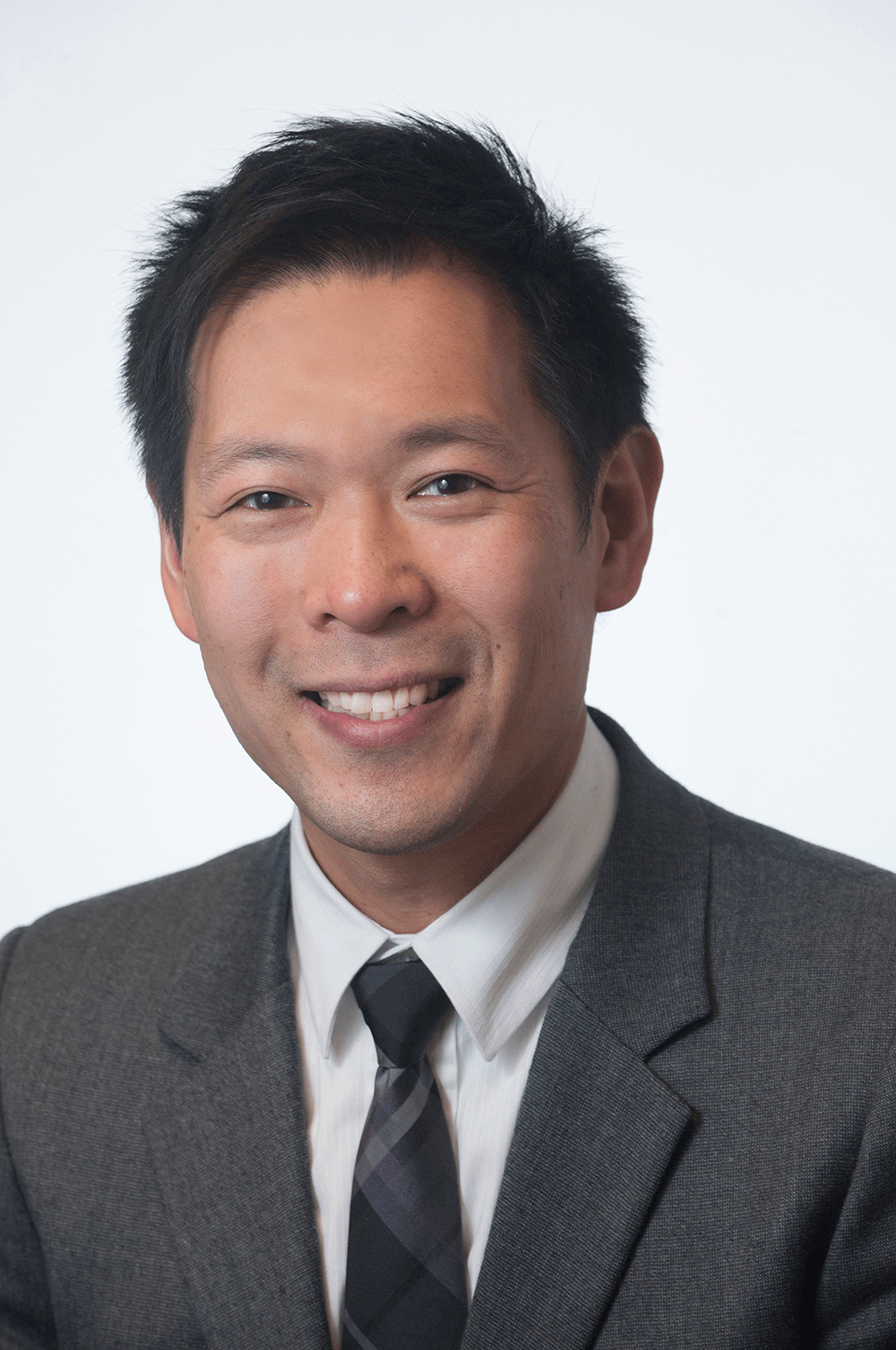
Hospitalist Jerome C. Siy, MD, SFHM, CHIE, is head of the Department of Hospital Medicine at HealthPartners in Minneapolis-St. Paul, Minn., and chair of SHM’s Practice Management Committee. As a member of SHM for more than 15 years and recipient of SHM’s prestigious Award of Excellence for Clinical Excellence in 2009, Dr. Siy has been a driving force in advancing hospitalist practice and improving patient care in the U.S. and beyond.
Question: What led you to a career in hospital medicine?
Answer: After graduating from the Mayo Graduate School of Medical Education, I started in the med-peds residency program at the University of Minnesota and then transitioned to an internal medicine residency program. It was at the University of Minnesota that I recognized my intense passion for the care of acutely ill hospitalized patients. During my residency, I had the good fortune of finding exceptional hospitalist role models in my program. As I worked with them, my passion for working with hospitalized patients continued to grow; I realized that my ideal job was to work with this group of doctors that I so greatly admired. In 2000, I joined the Department of Hospital Medicine at HealthPartners in Minneapolis-St. Paul and now proudly lead the department.
Q: When did you first get involved with SHM? What value does it bring to your daily practice?
A: When I first joined HealthPartners, Dr. Rusty Holman was our director. He was extremely active in the early days of SHM, when it was known as the National Association of Inpatient Physicians (NAIP). Our team at HealthPartners was fairly small, between 15 and 18 hospitalists, and identified early on with the hospital medicine specialty and NAIP. Many of them are still engaged with SHM 16 years later. As a team, we continue to encourage our entire group of over 90 practitioners, including our PAs and NPs, to get involved with SHM.
At SHM, chances to connect with people exist everywhere. So many hospitalists tell stories about how they went to an SHM meeting and ran into an old friend or medical school colleague that they didn’t realize was a hospitalist. That’s exactly why the SHM community is a fertile ground to build and expand upon ideas for your own program. For example, at HealthPartners, we are embarking on early work with telemedicine. With the network of hospitalists at SHM, I immediately knew colleagues who were working in hospital medicine and was able to visit some of them at their telemedicine specialty center.
Whether you join committees, give a joint lecture, or attend a session at an annual meeting with someone, you are opening yourself up to collaboration that will ultimately lead to better care for patients.
Q: What is one of the most unique or rewarding experiences you have had while practicing hospital medicine?
A: After 10 years at HealthPartners, I took a personal sabbatical to study Chinese in Taiwan for eight months. Even though I was away from my hospital, hospital medicine followed me overseas. While in Asia, I visited contacts in Taiwan and Japan. With the U.S. government just rolling out the Affordable Care Act, I wanted to gain a better understanding of how nationalized healthcare programs impacted care providers and care delivery.
While visiting the University of Osaka and one of the earliest hospital medicine groups at National Taiwan University Hospital, I had the opportunity to explore how a nation’s healthcare system impacted physicians and patients outside the U.S. A major takeaway for me was how important it is for physicians and care providers to be an active part of the healthcare system to create change that can influence the way they practice—and ultimately improve patient care.
In East Asia, whenever there was concern about evolving their healthcare models and the way providers take care of patients, physicians often felt limited in their potential impact. Culturally, senior physicians are the ones more apt to network and influence policy changes. The more physicians felt empowered to influence these senior leaders to address these issues with government officials, the better the chances of driving positive change.
As luck would have it, a hospitalist colleague invited me back to National Taiwan University Hospital in December 2015 to share my knowledge of how the specialty can continue to evolve, taking into consideration the challenges of navigating healthcare systems, physician engagement, and burnout. Even though many of their programs are relatively new, I stressed the fact that the more interactive you are with your healthcare system, the better your chances of engaging the right stakeholders and effectively influencing healthcare policy.
While their definition of burnout may differ slightly from ours in the U.S., they wanted to hear about what we experience in the U.S. and how we address it. I was able to share some techniques we are implementing at HealthPartners to minimize burnout and maximize engagement, including regular department meetings, during which there is an open forum for hot topics. This provides the care team with an avenue to express concerns or address important topics affecting their daily practice. We also have an internal website, where our team can access a repository of resources and a discussion board to share challenges, concerns, and best practices. I also emphasized the importance of professional development and investing in staff to improve their professional career and their patient care.
Q: What are some initiatives you are currently working on that you see having a substantial impact in hospital medicine?
A: As part of the Practice Management Committee at SHM, we are exploring opportunities in telemedicine, especially as it relates to rural care. Telemedicine could be the next big step to provide support for rural hospitalists and rural communities. Geographically speaking, the vast majority of the U.S. is rural, and SHM is poised to have a great impact on the clinicians serving these communities.
Another initiative the committee is working on is developing an update to co-management best practices. As hospital medicine has matured, its scope has changed dramatically, and so has the idea of co-management. We must truly embrace opportunities to improve care across specialties. This is especially important as we welcome younger physicians to the specialty who have not had the benefit of witnessing the evolution of the practice. They need to have a firm hold on the varied daily interactions of a hospitalist and their ultimate impact on outcomes.
At HealthPartners, we are actively addressing hospitalist engagement and burnout. We are mindful of how much our health systems have evolved and how much extra work they have asked us to accommodate. To be proactive, we are trying to be much more creative and innovative with our staffing model and our use of scarce resources in order to provide the best patient care possible. Over the last 16 years, we have worked hard to continue to develop our program but, more important, develop our patient care through the development of our physicians, NPs, and PAs. This includes developing a pathway for residents who wish to become hospitalists, introducing vigorous training for PAs during their student and post-graduate years, and providing staff with the professional development resources they need to expand their skills and knowledge base and stay up-to-date on the latest advances in medicine—whether that is through leadership development or skill straining like point-of-care ultrasound.
Hospital medicine has matured and grown, and our scope has changed dramatically to include observation care, research and academic medicine, telemedicine, palliative care, perioperative medicine, and more. At HealthPartners, we are embracing the opportunity to grow in scope and improve care across specialties.
Q: Given your experience in the U.S. and abroad, what words of advice would you give to medical students and residents considering a career in hospital medicine?
A: As you enter this career out of training, recognize that your potential impact is greater than you ever imagined in medical school. As you continue to grow in your career and make it your own, you will make lasting impacts on your patients and also be extremely creative in what you do. Just as the specialty continues to evolve, so will you. Keep an open mind and embrace the many opportunities that come your way. TH
Brett Radler is SHM’s communications coordinator.
Hospitalist Jerome C. Siy, MD, SFHM, CHIE, is head of the Department of Hospital Medicine at HealthPartners in Minneapolis-St. Paul, Minn., and chair of SHM’s Practice Management Committee. As a member of SHM for more than 15 years and recipient of SHM’s prestigious Award of Excellence for Clinical Excellence in 2009, Dr. Siy has been a driving force in advancing hospitalist practice and improving patient care in the U.S. and beyond.
Question: What led you to a career in hospital medicine?
Answer: After graduating from the Mayo Graduate School of Medical Education, I started in the med-peds residency program at the University of Minnesota and then transitioned to an internal medicine residency program. It was at the University of Minnesota that I recognized my intense passion for the care of acutely ill hospitalized patients. During my residency, I had the good fortune of finding exceptional hospitalist role models in my program. As I worked with them, my passion for working with hospitalized patients continued to grow; I realized that my ideal job was to work with this group of doctors that I so greatly admired. In 2000, I joined the Department of Hospital Medicine at HealthPartners in Minneapolis-St. Paul and now proudly lead the department.
Q: When did you first get involved with SHM? What value does it bring to your daily practice?
A: When I first joined HealthPartners, Dr. Rusty Holman was our director. He was extremely active in the early days of SHM, when it was known as the National Association of Inpatient Physicians (NAIP). Our team at HealthPartners was fairly small, between 15 and 18 hospitalists, and identified early on with the hospital medicine specialty and NAIP. Many of them are still engaged with SHM 16 years later. As a team, we continue to encourage our entire group of over 90 practitioners, including our PAs and NPs, to get involved with SHM.
At SHM, chances to connect with people exist everywhere. So many hospitalists tell stories about how they went to an SHM meeting and ran into an old friend or medical school colleague that they didn’t realize was a hospitalist. That’s exactly why the SHM community is a fertile ground to build and expand upon ideas for your own program. For example, at HealthPartners, we are embarking on early work with telemedicine. With the network of hospitalists at SHM, I immediately knew colleagues who were working in hospital medicine and was able to visit some of them at their telemedicine specialty center.
Whether you join committees, give a joint lecture, or attend a session at an annual meeting with someone, you are opening yourself up to collaboration that will ultimately lead to better care for patients.
Q: What is one of the most unique or rewarding experiences you have had while practicing hospital medicine?
A: After 10 years at HealthPartners, I took a personal sabbatical to study Chinese in Taiwan for eight months. Even though I was away from my hospital, hospital medicine followed me overseas. While in Asia, I visited contacts in Taiwan and Japan. With the U.S. government just rolling out the Affordable Care Act, I wanted to gain a better understanding of how nationalized healthcare programs impacted care providers and care delivery.
While visiting the University of Osaka and one of the earliest hospital medicine groups at National Taiwan University Hospital, I had the opportunity to explore how a nation’s healthcare system impacted physicians and patients outside the U.S. A major takeaway for me was how important it is for physicians and care providers to be an active part of the healthcare system to create change that can influence the way they practice—and ultimately improve patient care.
In East Asia, whenever there was concern about evolving their healthcare models and the way providers take care of patients, physicians often felt limited in their potential impact. Culturally, senior physicians are the ones more apt to network and influence policy changes. The more physicians felt empowered to influence these senior leaders to address these issues with government officials, the better the chances of driving positive change.
As luck would have it, a hospitalist colleague invited me back to National Taiwan University Hospital in December 2015 to share my knowledge of how the specialty can continue to evolve, taking into consideration the challenges of navigating healthcare systems, physician engagement, and burnout. Even though many of their programs are relatively new, I stressed the fact that the more interactive you are with your healthcare system, the better your chances of engaging the right stakeholders and effectively influencing healthcare policy.
While their definition of burnout may differ slightly from ours in the U.S., they wanted to hear about what we experience in the U.S. and how we address it. I was able to share some techniques we are implementing at HealthPartners to minimize burnout and maximize engagement, including regular department meetings, during which there is an open forum for hot topics. This provides the care team with an avenue to express concerns or address important topics affecting their daily practice. We also have an internal website, where our team can access a repository of resources and a discussion board to share challenges, concerns, and best practices. I also emphasized the importance of professional development and investing in staff to improve their professional career and their patient care.
Q: What are some initiatives you are currently working on that you see having a substantial impact in hospital medicine?
A: As part of the Practice Management Committee at SHM, we are exploring opportunities in telemedicine, especially as it relates to rural care. Telemedicine could be the next big step to provide support for rural hospitalists and rural communities. Geographically speaking, the vast majority of the U.S. is rural, and SHM is poised to have a great impact on the clinicians serving these communities.
Another initiative the committee is working on is developing an update to co-management best practices. As hospital medicine has matured, its scope has changed dramatically, and so has the idea of co-management. We must truly embrace opportunities to improve care across specialties. This is especially important as we welcome younger physicians to the specialty who have not had the benefit of witnessing the evolution of the practice. They need to have a firm hold on the varied daily interactions of a hospitalist and their ultimate impact on outcomes.
At HealthPartners, we are actively addressing hospitalist engagement and burnout. We are mindful of how much our health systems have evolved and how much extra work they have asked us to accommodate. To be proactive, we are trying to be much more creative and innovative with our staffing model and our use of scarce resources in order to provide the best patient care possible. Over the last 16 years, we have worked hard to continue to develop our program but, more important, develop our patient care through the development of our physicians, NPs, and PAs. This includes developing a pathway for residents who wish to become hospitalists, introducing vigorous training for PAs during their student and post-graduate years, and providing staff with the professional development resources they need to expand their skills and knowledge base and stay up-to-date on the latest advances in medicine—whether that is through leadership development or skill straining like point-of-care ultrasound.
Hospital medicine has matured and grown, and our scope has changed dramatically to include observation care, research and academic medicine, telemedicine, palliative care, perioperative medicine, and more. At HealthPartners, we are embracing the opportunity to grow in scope and improve care across specialties.
Q: Given your experience in the U.S. and abroad, what words of advice would you give to medical students and residents considering a career in hospital medicine?
A: As you enter this career out of training, recognize that your potential impact is greater than you ever imagined in medical school. As you continue to grow in your career and make it your own, you will make lasting impacts on your patients and also be extremely creative in what you do. Just as the specialty continues to evolve, so will you. Keep an open mind and embrace the many opportunities that come your way. TH
Brett Radler is SHM’s communications coordinator.
Hospitalist Jerome C. Siy, MD, SFHM, CHIE, is head of the Department of Hospital Medicine at HealthPartners in Minneapolis-St. Paul, Minn., and chair of SHM’s Practice Management Committee. As a member of SHM for more than 15 years and recipient of SHM’s prestigious Award of Excellence for Clinical Excellence in 2009, Dr. Siy has been a driving force in advancing hospitalist practice and improving patient care in the U.S. and beyond.
Question: What led you to a career in hospital medicine?
Answer: After graduating from the Mayo Graduate School of Medical Education, I started in the med-peds residency program at the University of Minnesota and then transitioned to an internal medicine residency program. It was at the University of Minnesota that I recognized my intense passion for the care of acutely ill hospitalized patients. During my residency, I had the good fortune of finding exceptional hospitalist role models in my program. As I worked with them, my passion for working with hospitalized patients continued to grow; I realized that my ideal job was to work with this group of doctors that I so greatly admired. In 2000, I joined the Department of Hospital Medicine at HealthPartners in Minneapolis-St. Paul and now proudly lead the department.
Q: When did you first get involved with SHM? What value does it bring to your daily practice?
A: When I first joined HealthPartners, Dr. Rusty Holman was our director. He was extremely active in the early days of SHM, when it was known as the National Association of Inpatient Physicians (NAIP). Our team at HealthPartners was fairly small, between 15 and 18 hospitalists, and identified early on with the hospital medicine specialty and NAIP. Many of them are still engaged with SHM 16 years later. As a team, we continue to encourage our entire group of over 90 practitioners, including our PAs and NPs, to get involved with SHM.
At SHM, chances to connect with people exist everywhere. So many hospitalists tell stories about how they went to an SHM meeting and ran into an old friend or medical school colleague that they didn’t realize was a hospitalist. That’s exactly why the SHM community is a fertile ground to build and expand upon ideas for your own program. For example, at HealthPartners, we are embarking on early work with telemedicine. With the network of hospitalists at SHM, I immediately knew colleagues who were working in hospital medicine and was able to visit some of them at their telemedicine specialty center.
Whether you join committees, give a joint lecture, or attend a session at an annual meeting with someone, you are opening yourself up to collaboration that will ultimately lead to better care for patients.
Q: What is one of the most unique or rewarding experiences you have had while practicing hospital medicine?
A: After 10 years at HealthPartners, I took a personal sabbatical to study Chinese in Taiwan for eight months. Even though I was away from my hospital, hospital medicine followed me overseas. While in Asia, I visited contacts in Taiwan and Japan. With the U.S. government just rolling out the Affordable Care Act, I wanted to gain a better understanding of how nationalized healthcare programs impacted care providers and care delivery.
While visiting the University of Osaka and one of the earliest hospital medicine groups at National Taiwan University Hospital, I had the opportunity to explore how a nation’s healthcare system impacted physicians and patients outside the U.S. A major takeaway for me was how important it is for physicians and care providers to be an active part of the healthcare system to create change that can influence the way they practice—and ultimately improve patient care.
In East Asia, whenever there was concern about evolving their healthcare models and the way providers take care of patients, physicians often felt limited in their potential impact. Culturally, senior physicians are the ones more apt to network and influence policy changes. The more physicians felt empowered to influence these senior leaders to address these issues with government officials, the better the chances of driving positive change.
As luck would have it, a hospitalist colleague invited me back to National Taiwan University Hospital in December 2015 to share my knowledge of how the specialty can continue to evolve, taking into consideration the challenges of navigating healthcare systems, physician engagement, and burnout. Even though many of their programs are relatively new, I stressed the fact that the more interactive you are with your healthcare system, the better your chances of engaging the right stakeholders and effectively influencing healthcare policy.
While their definition of burnout may differ slightly from ours in the U.S., they wanted to hear about what we experience in the U.S. and how we address it. I was able to share some techniques we are implementing at HealthPartners to minimize burnout and maximize engagement, including regular department meetings, during which there is an open forum for hot topics. This provides the care team with an avenue to express concerns or address important topics affecting their daily practice. We also have an internal website, where our team can access a repository of resources and a discussion board to share challenges, concerns, and best practices. I also emphasized the importance of professional development and investing in staff to improve their professional career and their patient care.
Q: What are some initiatives you are currently working on that you see having a substantial impact in hospital medicine?
A: As part of the Practice Management Committee at SHM, we are exploring opportunities in telemedicine, especially as it relates to rural care. Telemedicine could be the next big step to provide support for rural hospitalists and rural communities. Geographically speaking, the vast majority of the U.S. is rural, and SHM is poised to have a great impact on the clinicians serving these communities.
Another initiative the committee is working on is developing an update to co-management best practices. As hospital medicine has matured, its scope has changed dramatically, and so has the idea of co-management. We must truly embrace opportunities to improve care across specialties. This is especially important as we welcome younger physicians to the specialty who have not had the benefit of witnessing the evolution of the practice. They need to have a firm hold on the varied daily interactions of a hospitalist and their ultimate impact on outcomes.
At HealthPartners, we are actively addressing hospitalist engagement and burnout. We are mindful of how much our health systems have evolved and how much extra work they have asked us to accommodate. To be proactive, we are trying to be much more creative and innovative with our staffing model and our use of scarce resources in order to provide the best patient care possible. Over the last 16 years, we have worked hard to continue to develop our program but, more important, develop our patient care through the development of our physicians, NPs, and PAs. This includes developing a pathway for residents who wish to become hospitalists, introducing vigorous training for PAs during their student and post-graduate years, and providing staff with the professional development resources they need to expand their skills and knowledge base and stay up-to-date on the latest advances in medicine—whether that is through leadership development or skill straining like point-of-care ultrasound.
Hospital medicine has matured and grown, and our scope has changed dramatically to include observation care, research and academic medicine, telemedicine, palliative care, perioperative medicine, and more. At HealthPartners, we are embracing the opportunity to grow in scope and improve care across specialties.
Q: Given your experience in the U.S. and abroad, what words of advice would you give to medical students and residents considering a career in hospital medicine?
A: As you enter this career out of training, recognize that your potential impact is greater than you ever imagined in medical school. As you continue to grow in your career and make it your own, you will make lasting impacts on your patients and also be extremely creative in what you do. Just as the specialty continues to evolve, so will you. Keep an open mind and embrace the many opportunities that come your way. TH
Brett Radler is SHM’s communications coordinator.