User login
New ICD-10 deadline: Oct. 1, 2015
The new deadline for making the switch to the ICD-10 coding system is Oct. 1, 2015, the Centers for Medicare & Medicaid Services announced.
On April 1, President Obama signed legislation that delayed the start of ICD-10 from Oct. 1, 2014, until at least a year later. The law did not specify a new start date, leaving the physicians and health care providers wondering how long they would have to prepare for the new code set.
CMS officials said they will release an interim final rule in the "near future" with more details about the compliance date. But the rule will require physicians to continue to use ICD-9 through Sept. 30, 2015.
On Twitter @maryellenny
The new deadline for making the switch to the ICD-10 coding system is Oct. 1, 2015, the Centers for Medicare & Medicaid Services announced.
On April 1, President Obama signed legislation that delayed the start of ICD-10 from Oct. 1, 2014, until at least a year later. The law did not specify a new start date, leaving the physicians and health care providers wondering how long they would have to prepare for the new code set.
CMS officials said they will release an interim final rule in the "near future" with more details about the compliance date. But the rule will require physicians to continue to use ICD-9 through Sept. 30, 2015.
On Twitter @maryellenny
The new deadline for making the switch to the ICD-10 coding system is Oct. 1, 2015, the Centers for Medicare & Medicaid Services announced.
On April 1, President Obama signed legislation that delayed the start of ICD-10 from Oct. 1, 2014, until at least a year later. The law did not specify a new start date, leaving the physicians and health care providers wondering how long they would have to prepare for the new code set.
CMS officials said they will release an interim final rule in the "near future" with more details about the compliance date. But the rule will require physicians to continue to use ICD-9 through Sept. 30, 2015.
On Twitter @maryellenny

ACA exchanges most expensive in state-based systems
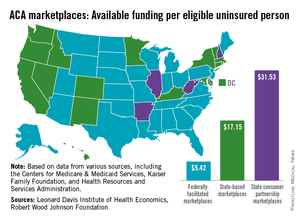
States that opted to run their own Affordable Care Act–mandated health insurance marketplace spent more than three times as much per uninsured person to assist consumers than did states with federally run exchanges.
An analysis by the Leonard Davis Institute of Economics and the Robert Wood Johnson Foundation showed that the 17 state-based marketplaces (SBMs) spent an average of $17.15/eligible uninsured person, compared with $5.42/eligible uninsured person in the 29 federally facilitated marketplaces (FFMs). The five states that use a state-consumer partnership to run their marketplaces spent $31.53/uninsured person.
"SBMs accounted for 50% of total consumer assistance funds, although they have just 31% of all uninsured. In contrast, 63% of the uninsured live in FFM states, which accounted for 33% of the funding. The five partnership states in charge of consumer assistance functions were home to just 6% of the uninsured, but garnered 17% of the funding," the report noted.
The District of Columbia, grouped among the SBM states, spent $163.93/uninsured person, which was higher than any state. The highest-spending state was Hawaii (SBM) at $87.86, and the lowest-spending state was Georgia (FFM), which spent $4.24 per uninsured person, according to the report.
The joint study used data from the Centers for Medicare & Medicaid Services, the Kaiser Family Foundation, and the Health Resources and Services Administration. The Leonard Davis Institute is a cooperative venture between the University of Pennsylvania and the Children’s Hospital of Philadelphia.
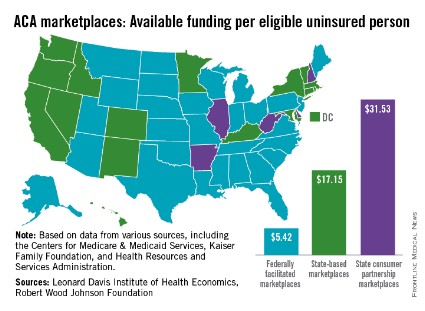
States that opted to run their own Affordable Care Act–mandated health insurance marketplace spent more than three times as much per uninsured person to assist consumers than did states with federally run exchanges.
An analysis by the Leonard Davis Institute of Economics and the Robert Wood Johnson Foundation showed that the 17 state-based marketplaces (SBMs) spent an average of $17.15/eligible uninsured person, compared with $5.42/eligible uninsured person in the 29 federally facilitated marketplaces (FFMs). The five states that use a state-consumer partnership to run their marketplaces spent $31.53/uninsured person.
"SBMs accounted for 50% of total consumer assistance funds, although they have just 31% of all uninsured. In contrast, 63% of the uninsured live in FFM states, which accounted for 33% of the funding. The five partnership states in charge of consumer assistance functions were home to just 6% of the uninsured, but garnered 17% of the funding," the report noted.
The District of Columbia, grouped among the SBM states, spent $163.93/uninsured person, which was higher than any state. The highest-spending state was Hawaii (SBM) at $87.86, and the lowest-spending state was Georgia (FFM), which spent $4.24 per uninsured person, according to the report.
The joint study used data from the Centers for Medicare & Medicaid Services, the Kaiser Family Foundation, and the Health Resources and Services Administration. The Leonard Davis Institute is a cooperative venture between the University of Pennsylvania and the Children’s Hospital of Philadelphia.
States that opted to run their own Affordable Care Act–mandated health insurance marketplace spent more than three times as much per uninsured person to assist consumers than did states with federally run exchanges.
An analysis by the Leonard Davis Institute of Economics and the Robert Wood Johnson Foundation showed that the 17 state-based marketplaces (SBMs) spent an average of $17.15/eligible uninsured person, compared with $5.42/eligible uninsured person in the 29 federally facilitated marketplaces (FFMs). The five states that use a state-consumer partnership to run their marketplaces spent $31.53/uninsured person.
"SBMs accounted for 50% of total consumer assistance funds, although they have just 31% of all uninsured. In contrast, 63% of the uninsured live in FFM states, which accounted for 33% of the funding. The five partnership states in charge of consumer assistance functions were home to just 6% of the uninsured, but garnered 17% of the funding," the report noted.
The District of Columbia, grouped among the SBM states, spent $163.93/uninsured person, which was higher than any state. The highest-spending state was Hawaii (SBM) at $87.86, and the lowest-spending state was Georgia (FFM), which spent $4.24 per uninsured person, according to the report.
The joint study used data from the Centers for Medicare & Medicaid Services, the Kaiser Family Foundation, and the Health Resources and Services Administration. The Leonard Davis Institute is a cooperative venture between the University of Pennsylvania and the Children’s Hospital of Philadelphia.
Eight million enroll in ACA plans; 28% are young adults
With the official figures in, the federal government reported that more than 8 million Americans enrolled in private health plans through either state- or federally run insurance marketplaces between Oct. 1 and April 19.
A month after the close of the Affordable Care Act’s first open enrollment period, the Health & Human Services department released a detailed accounting of enrollment through the marketplaces. The final number for private plans was 8,019,763, including individuals who enrolled during the special enrollment extension ending April 19.

HHS officials still could not say how many of the individuals who signed up for coverage had paid their premiums. That information won’t be available until later this year, they said.
It’s also still unclear how many of those who signed up for health plans through the marketplaces gained coverage for the first time. Among the 5.18 million individuals who selected plans in the federal marketplaces and also applied for financial assistance, only 13% said they had coverage at the time of their application. But HHS officials said that number is probably not reliable because it only includes a subset of enrollees and they were asked a narrow question about coverage, which did not take into account whether individuals had recently lost their coverage.
According to federal officials, an additional 4.8 million people gained insurance coverage via Medicaid and the Children’s Health Insurance Program, an additional 3 million adults under age 26 gained coverage by staying on their parents’ health plans, and an estimated 5 million people gained coverage by buying ACA-compliant plans outside of the marketplaces.
The report also sheds some light on who the newly insured are.
The majority of those who signed up for coverage on the ACA marketplaces were women (54%). About a third were under age 35, with 28% between the ages of 18 and 34 years. The largest number of sign-ups were among individuals aged 45-54 years (23%) and 55-64 years (25%).
Most who signed up (85%) qualified for financial assistance. The most popular type of health plan was the "silver" plan, with 65% selecting that plan and another 20% opting for the "bronze" plans.
Race/ethnicity was reported by 69% of enrollees. Of those, nearly 63% reported their race/ethnicity as white, 17% were African American, 11% were Latino, 8% were Asian, 1% were multiracial, and less than 1% were American Indian/Alaska Native and Native Hawaiian/Pacific Islander.
Republican lawmakers on the House Energy and Commerce Committee contend that only 67% of those who have selected a health plan in the federal marketplaces had paid their first month’s premium as of April 15. The committee said their information came from asking the insurance companies participating in the marketplaces for their enrollment data.
On Twitter @maryellenny
With the official figures in, the federal government reported that more than 8 million Americans enrolled in private health plans through either state- or federally run insurance marketplaces between Oct. 1 and April 19.
A month after the close of the Affordable Care Act’s first open enrollment period, the Health & Human Services department released a detailed accounting of enrollment through the marketplaces. The final number for private plans was 8,019,763, including individuals who enrolled during the special enrollment extension ending April 19.
HHS officials still could not say how many of the individuals who signed up for coverage had paid their premiums. That information won’t be available until later this year, they said.
It’s also still unclear how many of those who signed up for health plans through the marketplaces gained coverage for the first time. Among the 5.18 million individuals who selected plans in the federal marketplaces and also applied for financial assistance, only 13% said they had coverage at the time of their application. But HHS officials said that number is probably not reliable because it only includes a subset of enrollees and they were asked a narrow question about coverage, which did not take into account whether individuals had recently lost their coverage.
According to federal officials, an additional 4.8 million people gained insurance coverage via Medicaid and the Children’s Health Insurance Program, an additional 3 million adults under age 26 gained coverage by staying on their parents’ health plans, and an estimated 5 million people gained coverage by buying ACA-compliant plans outside of the marketplaces.
The report also sheds some light on who the newly insured are.
The majority of those who signed up for coverage on the ACA marketplaces were women (54%). About a third were under age 35, with 28% between the ages of 18 and 34 years. The largest number of sign-ups were among individuals aged 45-54 years (23%) and 55-64 years (25%).
Most who signed up (85%) qualified for financial assistance. The most popular type of health plan was the "silver" plan, with 65% selecting that plan and another 20% opting for the "bronze" plans.
Race/ethnicity was reported by 69% of enrollees. Of those, nearly 63% reported their race/ethnicity as white, 17% were African American, 11% were Latino, 8% were Asian, 1% were multiracial, and less than 1% were American Indian/Alaska Native and Native Hawaiian/Pacific Islander.
Republican lawmakers on the House Energy and Commerce Committee contend that only 67% of those who have selected a health plan in the federal marketplaces had paid their first month’s premium as of April 15. The committee said their information came from asking the insurance companies participating in the marketplaces for their enrollment data.
On Twitter @maryellenny
With the official figures in, the federal government reported that more than 8 million Americans enrolled in private health plans through either state- or federally run insurance marketplaces between Oct. 1 and April 19.
A month after the close of the Affordable Care Act’s first open enrollment period, the Health & Human Services department released a detailed accounting of enrollment through the marketplaces. The final number for private plans was 8,019,763, including individuals who enrolled during the special enrollment extension ending April 19.
HHS officials still could not say how many of the individuals who signed up for coverage had paid their premiums. That information won’t be available until later this year, they said.
It’s also still unclear how many of those who signed up for health plans through the marketplaces gained coverage for the first time. Among the 5.18 million individuals who selected plans in the federal marketplaces and also applied for financial assistance, only 13% said they had coverage at the time of their application. But HHS officials said that number is probably not reliable because it only includes a subset of enrollees and they were asked a narrow question about coverage, which did not take into account whether individuals had recently lost their coverage.
According to federal officials, an additional 4.8 million people gained insurance coverage via Medicaid and the Children’s Health Insurance Program, an additional 3 million adults under age 26 gained coverage by staying on their parents’ health plans, and an estimated 5 million people gained coverage by buying ACA-compliant plans outside of the marketplaces.
The report also sheds some light on who the newly insured are.
The majority of those who signed up for coverage on the ACA marketplaces were women (54%). About a third were under age 35, with 28% between the ages of 18 and 34 years. The largest number of sign-ups were among individuals aged 45-54 years (23%) and 55-64 years (25%).
Most who signed up (85%) qualified for financial assistance. The most popular type of health plan was the "silver" plan, with 65% selecting that plan and another 20% opting for the "bronze" plans.
Race/ethnicity was reported by 69% of enrollees. Of those, nearly 63% reported their race/ethnicity as white, 17% were African American, 11% were Latino, 8% were Asian, 1% were multiracial, and less than 1% were American Indian/Alaska Native and Native Hawaiian/Pacific Islander.
Republican lawmakers on the House Energy and Commerce Committee contend that only 67% of those who have selected a health plan in the federal marketplaces had paid their first month’s premium as of April 15. The committee said their information came from asking the insurance companies participating in the marketplaces for their enrollment data.
On Twitter @maryellenny

Medicare projects $241M drop in hospital payments
General acute care hospitals are likely to see their Medicare payments drop slightly next year because of penalties for readmissions and hospital-acquired conditions, as well as other proposed payment cuts.
The Centers for Medicare & Medicaid Services released a proposed rule with new payment policies for fiscal year 2015 under the Inpatient Prospective Payment System and the Long-Term Care Hospital Prospective Payment System April 30. The proposal would provide a 1.3% payment increase for general acute care hospitals for fiscal year 2015 and a 0.8% increase for long-term care hospitals.

But the agency estimates that general acute care hospitals will actually see a 0.8% pay cut because of reductions from the Hospital Readmissions Reduction Program, the Hospital-Acquired Condition Reduction Program, cuts to disproportionate share hospitals, and the expiration of some temporary payment increases.
Overall, the CMS estimates that Medicare spending on inpatient hospital services will drop by about $241 million in the next fiscal year, while payments to long-term care hospitals are projected to increase by $44 million.
The proposal also places new requirements on hospitals to be open with their patients about prices. Under the rule, the CMS is requiring hospitals to either make a list of their standard charges publicly available or publicize their policies for allowing the public to view a list of charges upon request.
"This proposed rule is geared toward improving hospital performance while creating an environment for improved Medicare beneficiary care and satisfaction," CMS Administrator Marilyn Tavenner said in a statement.
The proposal also increases the penalties for some quality improvement programs: For example, the CMS will reduce the base operating diagnosis-related group payment amounts for all hospitals 1.5%, up from 1.25% this year. Overall, the CMS estimates that $1.4 billion will be available to fund incentive payments through the program in the next fiscal year.
The proposal also calls for increasing penalties* for hospital readmissions from 2% to 3% starting in October. Hospitals will be evaluated based on how well they do in reducing readmissions due to myocardial infarction, heart failure, pneumonia, chronic obstructive pulmonary disease, and hip/knee arthroplasty.
The CMS is also proposing to launch the Hospital Acquired Condition Reduction Program in October. This Affordable Care Act program will reduce Medicare inpatient payments by 1% for hospitals with the poorest record of preventing hospital-acquired conditions.
The public can comment on the proposal until June 30 at regulations.gov. The CMS said a final rule will be issued by Aug. 1.
On Twitter @maryellenny
*CORRECTION, 5/2/2014: An earlier version of this story incorrectly stated that there would be increased payments for hospital readmissions
General acute care hospitals are likely to see their Medicare payments drop slightly next year because of penalties for readmissions and hospital-acquired conditions, as well as other proposed payment cuts.
The Centers for Medicare & Medicaid Services released a proposed rule with new payment policies for fiscal year 2015 under the Inpatient Prospective Payment System and the Long-Term Care Hospital Prospective Payment System April 30. The proposal would provide a 1.3% payment increase for general acute care hospitals for fiscal year 2015 and a 0.8% increase for long-term care hospitals.
But the agency estimates that general acute care hospitals will actually see a 0.8% pay cut because of reductions from the Hospital Readmissions Reduction Program, the Hospital-Acquired Condition Reduction Program, cuts to disproportionate share hospitals, and the expiration of some temporary payment increases.
Overall, the CMS estimates that Medicare spending on inpatient hospital services will drop by about $241 million in the next fiscal year, while payments to long-term care hospitals are projected to increase by $44 million.
The proposal also places new requirements on hospitals to be open with their patients about prices. Under the rule, the CMS is requiring hospitals to either make a list of their standard charges publicly available or publicize their policies for allowing the public to view a list of charges upon request.
"This proposed rule is geared toward improving hospital performance while creating an environment for improved Medicare beneficiary care and satisfaction," CMS Administrator Marilyn Tavenner said in a statement.
The proposal also increases the penalties for some quality improvement programs: For example, the CMS will reduce the base operating diagnosis-related group payment amounts for all hospitals 1.5%, up from 1.25% this year. Overall, the CMS estimates that $1.4 billion will be available to fund incentive payments through the program in the next fiscal year.
The proposal also calls for increasing penalties* for hospital readmissions from 2% to 3% starting in October. Hospitals will be evaluated based on how well they do in reducing readmissions due to myocardial infarction, heart failure, pneumonia, chronic obstructive pulmonary disease, and hip/knee arthroplasty.
The CMS is also proposing to launch the Hospital Acquired Condition Reduction Program in October. This Affordable Care Act program will reduce Medicare inpatient payments by 1% for hospitals with the poorest record of preventing hospital-acquired conditions.
The public can comment on the proposal until June 30 at regulations.gov. The CMS said a final rule will be issued by Aug. 1.
On Twitter @maryellenny
*CORRECTION, 5/2/2014: An earlier version of this story incorrectly stated that there would be increased payments for hospital readmissions
General acute care hospitals are likely to see their Medicare payments drop slightly next year because of penalties for readmissions and hospital-acquired conditions, as well as other proposed payment cuts.
The Centers for Medicare & Medicaid Services released a proposed rule with new payment policies for fiscal year 2015 under the Inpatient Prospective Payment System and the Long-Term Care Hospital Prospective Payment System April 30. The proposal would provide a 1.3% payment increase for general acute care hospitals for fiscal year 2015 and a 0.8% increase for long-term care hospitals.
But the agency estimates that general acute care hospitals will actually see a 0.8% pay cut because of reductions from the Hospital Readmissions Reduction Program, the Hospital-Acquired Condition Reduction Program, cuts to disproportionate share hospitals, and the expiration of some temporary payment increases.
Overall, the CMS estimates that Medicare spending on inpatient hospital services will drop by about $241 million in the next fiscal year, while payments to long-term care hospitals are projected to increase by $44 million.
The proposal also places new requirements on hospitals to be open with their patients about prices. Under the rule, the CMS is requiring hospitals to either make a list of their standard charges publicly available or publicize their policies for allowing the public to view a list of charges upon request.
"This proposed rule is geared toward improving hospital performance while creating an environment for improved Medicare beneficiary care and satisfaction," CMS Administrator Marilyn Tavenner said in a statement.
The proposal also increases the penalties for some quality improvement programs: For example, the CMS will reduce the base operating diagnosis-related group payment amounts for all hospitals 1.5%, up from 1.25% this year. Overall, the CMS estimates that $1.4 billion will be available to fund incentive payments through the program in the next fiscal year.
The proposal also calls for increasing penalties* for hospital readmissions from 2% to 3% starting in October. Hospitals will be evaluated based on how well they do in reducing readmissions due to myocardial infarction, heart failure, pneumonia, chronic obstructive pulmonary disease, and hip/knee arthroplasty.
The CMS is also proposing to launch the Hospital Acquired Condition Reduction Program in October. This Affordable Care Act program will reduce Medicare inpatient payments by 1% for hospitals with the poorest record of preventing hospital-acquired conditions.
The public can comment on the proposal until June 30 at regulations.gov. The CMS said a final rule will be issued by Aug. 1.
On Twitter @maryellenny
*CORRECTION, 5/2/2014: An earlier version of this story incorrectly stated that there would be increased payments for hospital readmissions

Society of Hospital Medicine’s Hospitalist Program Peak Performance Sets Foundation for Improvement
SHM’s Hospitalist Program Peak Performance, HP3 for short, will conclude at the end of 2014, but it will leave a legacy that will continue to improve HM groups everywhere for years to come.
The product of a unique collaboration among SHM, hospitalist consulting firm Nelson/Flores, and others, HP3 was designed as a key component of the Preventing Readmissions through Effective Partnerships (PREP) collaborative, sponsored by BlueCross BlueShield of Illinois in collaboration with the Illinois Hospital Association and Northwestern University Feinberg School of Medicine. The overall goal of the PREP collaborative is to help move Illinois from the bottom quartile to the upper quartile ranking on readmission rates by providing tools and approaches to improve transitions of care.
“HP3 was designed to be a little like getting a personal trainer at the gym,” says John Nelson, MD, MHM, who helped create the program. “Each hospitalist group was assigned an experienced hospitalist leader as a mentor, who in some ways acted like a personal trainer, guiding and encouraging efforts to complete projects to improve their practice.
“I think most groups were surprised and pleased that they were able to accomplish more than they realized. Our hope is that they will continue ‘working out’ to improve their practice even after their participation in HP3 concludes.”
Today, many of the lessons learned from HP3—including the idea that a healthy, high-functioning hospitalist practice is an important part of improving care—have been carried into other important SHM projects, like the recent “Key Principles and Characteristics of an Effective Hospital Medicine Group,” an assessment guide developed by SHM and published in the February 2014 Journal of Hospital Medicine.
Among the ideas presented in the “Key Principles and Characteristics” guide is the concept of hospitalist engagement, which is what Dr. Mark Williams thinks hospitals can also take away from HP3.
“Engaging hospitalists is key to improving care for hospitalized patients,” says Dr. Williams, who notes that engaging hospitalists means engaging much of the entire hospital. “Hospitalists are fully integrated into hospital care delivery for general medicine patients and many—if not most—specialty and surgical patients.”
HP3 faculty Leslie Flores, MHA, SFHM, saw a two-fold benefit from HP3: an outside perspective and an introduction to techniques that will continue beyond HP3.
“It caused them to look critically at their hospitalist program and assess its organization and performance against an objective benchmark. For many, it was the first time they had been challenged to think about their hospitalist program in this way,” Flores says.
She noticed that HP3 “also taught the participants how to use basic quality improvement and project management techniques to improve their own group’s performance—these are skills they can use again and again going forward.”
Flores thinks that HP3 also benefited from another core piece of SHM’s DNA: its award-winning Mentored Implementation (MI) model, which pairs hospital sites with national experts in hospital medicine. But, instead of being focused solely on quality improvement, it broadened the MI approach to operational improvement, opening up the possibility of improved quality outcomes.
As with many SHM educational programs, the learning went in both directions and may continue after the end of HP3, according to Flores.
“I think we [the faculty and mentors], in some cases, learned as much from our participants as they learned from us,” she says. “Some of them are doing some really great things that we can add to our fund of practice management ‘best practices’ and share with others!”
SHM’s Hospitalist Program Peak Performance, HP3 for short, will conclude at the end of 2014, but it will leave a legacy that will continue to improve HM groups everywhere for years to come.
The product of a unique collaboration among SHM, hospitalist consulting firm Nelson/Flores, and others, HP3 was designed as a key component of the Preventing Readmissions through Effective Partnerships (PREP) collaborative, sponsored by BlueCross BlueShield of Illinois in collaboration with the Illinois Hospital Association and Northwestern University Feinberg School of Medicine. The overall goal of the PREP collaborative is to help move Illinois from the bottom quartile to the upper quartile ranking on readmission rates by providing tools and approaches to improve transitions of care.
“HP3 was designed to be a little like getting a personal trainer at the gym,” says John Nelson, MD, MHM, who helped create the program. “Each hospitalist group was assigned an experienced hospitalist leader as a mentor, who in some ways acted like a personal trainer, guiding and encouraging efforts to complete projects to improve their practice.
“I think most groups were surprised and pleased that they were able to accomplish more than they realized. Our hope is that they will continue ‘working out’ to improve their practice even after their participation in HP3 concludes.”
Today, many of the lessons learned from HP3—including the idea that a healthy, high-functioning hospitalist practice is an important part of improving care—have been carried into other important SHM projects, like the recent “Key Principles and Characteristics of an Effective Hospital Medicine Group,” an assessment guide developed by SHM and published in the February 2014 Journal of Hospital Medicine.
Among the ideas presented in the “Key Principles and Characteristics” guide is the concept of hospitalist engagement, which is what Dr. Mark Williams thinks hospitals can also take away from HP3.
“Engaging hospitalists is key to improving care for hospitalized patients,” says Dr. Williams, who notes that engaging hospitalists means engaging much of the entire hospital. “Hospitalists are fully integrated into hospital care delivery for general medicine patients and many—if not most—specialty and surgical patients.”
HP3 faculty Leslie Flores, MHA, SFHM, saw a two-fold benefit from HP3: an outside perspective and an introduction to techniques that will continue beyond HP3.
“It caused them to look critically at their hospitalist program and assess its organization and performance against an objective benchmark. For many, it was the first time they had been challenged to think about their hospitalist program in this way,” Flores says.
She noticed that HP3 “also taught the participants how to use basic quality improvement and project management techniques to improve their own group’s performance—these are skills they can use again and again going forward.”
Flores thinks that HP3 also benefited from another core piece of SHM’s DNA: its award-winning Mentored Implementation (MI) model, which pairs hospital sites with national experts in hospital medicine. But, instead of being focused solely on quality improvement, it broadened the MI approach to operational improvement, opening up the possibility of improved quality outcomes.
As with many SHM educational programs, the learning went in both directions and may continue after the end of HP3, according to Flores.
“I think we [the faculty and mentors], in some cases, learned as much from our participants as they learned from us,” she says. “Some of them are doing some really great things that we can add to our fund of practice management ‘best practices’ and share with others!”
SHM’s Hospitalist Program Peak Performance, HP3 for short, will conclude at the end of 2014, but it will leave a legacy that will continue to improve HM groups everywhere for years to come.
The product of a unique collaboration among SHM, hospitalist consulting firm Nelson/Flores, and others, HP3 was designed as a key component of the Preventing Readmissions through Effective Partnerships (PREP) collaborative, sponsored by BlueCross BlueShield of Illinois in collaboration with the Illinois Hospital Association and Northwestern University Feinberg School of Medicine. The overall goal of the PREP collaborative is to help move Illinois from the bottom quartile to the upper quartile ranking on readmission rates by providing tools and approaches to improve transitions of care.
“HP3 was designed to be a little like getting a personal trainer at the gym,” says John Nelson, MD, MHM, who helped create the program. “Each hospitalist group was assigned an experienced hospitalist leader as a mentor, who in some ways acted like a personal trainer, guiding and encouraging efforts to complete projects to improve their practice.
“I think most groups were surprised and pleased that they were able to accomplish more than they realized. Our hope is that they will continue ‘working out’ to improve their practice even after their participation in HP3 concludes.”
Today, many of the lessons learned from HP3—including the idea that a healthy, high-functioning hospitalist practice is an important part of improving care—have been carried into other important SHM projects, like the recent “Key Principles and Characteristics of an Effective Hospital Medicine Group,” an assessment guide developed by SHM and published in the February 2014 Journal of Hospital Medicine.
Among the ideas presented in the “Key Principles and Characteristics” guide is the concept of hospitalist engagement, which is what Dr. Mark Williams thinks hospitals can also take away from HP3.
“Engaging hospitalists is key to improving care for hospitalized patients,” says Dr. Williams, who notes that engaging hospitalists means engaging much of the entire hospital. “Hospitalists are fully integrated into hospital care delivery for general medicine patients and many—if not most—specialty and surgical patients.”
HP3 faculty Leslie Flores, MHA, SFHM, saw a two-fold benefit from HP3: an outside perspective and an introduction to techniques that will continue beyond HP3.
“It caused them to look critically at their hospitalist program and assess its organization and performance against an objective benchmark. For many, it was the first time they had been challenged to think about their hospitalist program in this way,” Flores says.
She noticed that HP3 “also taught the participants how to use basic quality improvement and project management techniques to improve their own group’s performance—these are skills they can use again and again going forward.”
Flores thinks that HP3 also benefited from another core piece of SHM’s DNA: its award-winning Mentored Implementation (MI) model, which pairs hospital sites with national experts in hospital medicine. But, instead of being focused solely on quality improvement, it broadened the MI approach to operational improvement, opening up the possibility of improved quality outcomes.
As with many SHM educational programs, the learning went in both directions and may continue after the end of HP3, according to Flores.
“I think we [the faculty and mentors], in some cases, learned as much from our participants as they learned from us,” she says. “Some of them are doing some really great things that we can add to our fund of practice management ‘best practices’ and share with others!”
Healthcare Changes Under Affordable Care Act Raise Concerns for Hospital Chief Financial Officers

The changes launched by the Affordable Care Act are upon us and have created considerable trepidation among many in healthcare, particularly our chief financial officers (CFOs). The CFOs’ core responsibilities include financial planning, contracting, and setting budgets. Although finance teams and clinical leaders sometimes feel like they are speaking different languages—and, in fact, many physicians couldn’t pick their hospital’s CFO out of a police lineup—successful healthcare systems bridge that gap, enabling clinical and finance leaders to work together toward common goals.
It’s easy for us doctor types to be leery of our hospital’s financial team. If you’ve ever been in direct conversation with your CFO, you may have found the discussion was packed with terms like “EBIDA,” “capital allocation,” and “operating margin,” and seemed to imply that the organization is prioritizing its bond rating over its composite PSI [patient safety indicators] performance. But the truth is that our finance teams are frustrated, too. In fact, they are more than frustrated—they are scared.
They really haven’t been sleeping well lately. They’d feel better if doctors could try to see the world that they see. A CFO’s core responsibility is ensuring a responsible, long-range financial plan that meets the needs of their hospital stakeholders—to paraphrase Tom Wolfe paraphrasing astronaut Gus Grissom, “no bucks, no Buck Rogers”—and that responsibility got a lot harder in 2014. By understanding their perspective, we clinicians should be able to take actions that result in better care of our patients today—and ensure a sustainable hospital that can take care of patients tomorrow. So that we can better empathize with our green-visored colleagues, here are a few of the thoughts going through their heads as they toss and turn at 3 a.m.
Change Is All Around
There are many urgent pressures on hospital, physician, and healthcare revenues. Keep in mind that a hospital’s costs in terms of pharmaceuticals, equipment, and labor (the average hospital has nearly 60% of its cost in labor) are not really going down to offset that revenue loss. While we’ve become uncomfortably familiar with RAC audits, value-based purchasing, the sustainable growth rate, and sequestration, I’d suggest that these revenue challenges pale in comparison to the insomnia created by the rapid rise of healthcare consumerism. Lost, or at least buried, in the stories about ACA politics, coverage of the uninsured, website malfunctions, and dropped insurance plans is the fact that the nature of insurance is changing.
Although offerings like medical savings accounts and high-deductible plans have been around for years, they are increasingly mainstream, because the plans offered through the insurance exchanges, which have surpassed the seven million mark in enrollment as of the time of this writing, all carry substantial patient commitments. The great majority of these plans—81% through February—are either “bronze” or “silver” level—and keep in mind that the average “gold” plan, in covering 80% of anticipated expenses, leaves patients with higher commitments than most large-employer group plans probably do. From that standpoint, they require patients, doctors, and hospitals to manage healthcare differently than they have in the past: We have to be mindful that patients are paying more of the “first dollar.”
The problem, from a CFO’s perspective, is at least twofold: First, a lot of patients don’t pay the portion of their bill for which they are responsible. Many doctors, hospitals, and healthcare systems are moving toward more assertive and up-front collections for non-emergency care; unfortunately, at best, we don’t do a very good job and, at worst, we create an uncomfortable space where we either channel the practices of collection agencies or leave much-needed funds on the table. As the deductibles, co-pays, and co-insurance obligations rise, so do the uncollected accounts. Our advocacy for patients increasingly requires us to be better stewards of their resources.
The second insomnia-inducing aspect of consumerism is transparency of pricing. As the exchanges move to create a “Priceline.com”-like approach to selecting an insurance plan, a similar transformation is occurring in how payers—and, with the spread of plans with higher patient obligations, patients themselves—are looking at how we set prices for everything from MRIs and laboratory services to hospitalization and physician charges. While we as individuals are used to price transparency in purchasing consumer goods, the third-party payment system in healthcare has insulated us, and our hospitals, from the consequences of the market system. (Please note, dear reader: I’m not defending either the past practices or current policy. I’m simply diagnosing why your CFO has black circles under his or her eyes.)
So, prices are increasingly published and available for comparison shopping by both insurers and individuals with those high deductibles or co-insurance amounts. As charges hit their pocketbooks, there is good reason to believe that patients will be “brand loyal” only to the point where they stop appreciating value. Systems with a reliable advantage in pricing (think: academic medical centers) run a great risk of losing business quickly if they cannot demonstrate value for those prices. Hospital-based physicians have been in the position of being the “translators” of value-based care—by always advocating for measurably better care, we help both our patients and our organizations.
Variation in Care
Perhaps most befuddling to our CFO friends are the variations in costs, outcomes, and clinical processes that seemingly similar patients with seemingly similar problems incur. Wide variations might occur based on just about any parameter, from the name of the attending physician to the day of the week of admission. Of course, at times, this variation could be explainable by, say, clinically relevant features that are simply not adjusted for, or the absence of literature to guide decisions. But, all too often, no reasonable explanation exists, and underneath that is a simmering concern that wide variations reflect failure to adhere to known guidelines, uneven distribution of resources, and “waste” deeply embedded in the healthcare value stream.
Less widely understood to clinicians is that, from the CFO’s perspective, the movement toward “value over volume” and risk-bearing systems such as accountable care organizations (ACOs) requires healthcare organizations to think like insurance companies. They must be able to accurately predict clinical outcomes within a population so that they can assess their actuarial risk and manage appropriately. Wide variations in care make those predictions less valid and outcomes more unpredictable, greatly raising the stakes for an ACO or other risk-bearing model.
From the CFO’s perspective, a key advantage to the move toward systems directly employing physicians is that a management structure can be created to decrease this variation; however, I’d question whether many physician groups, much less employed-group practices, have the appropriate management culture or the sophistication with data to do this effectively.
The Cost of Recapitalization
Most of the hospitals I’ve worked in are a jumble of incrementally newer additions built on a decades-old core facility. Clinicians tend to see the consequences as patients see them: not enough private rooms, outdated technology and equipment, poorly integrated computer and health IT systems, and inadequate storage for equipment. Your CFO certainly sees these same things, but has the additional challenge of trying to keep up with the demands for new facilities and capital purchases while maintaining the older physical plant and preserving the long-term financial strength of the organization. Even though roofing, HVAC, and new flooring are rarely as sexy as a new surgical robot, it won’t do much good to invest in that new OR equipment if the roof is leaking. And healthcare construction is really expensive, even more so because of entirely appropriate requirements that renovations bring older structures up to modern codes.
In the healthcare world, these expenses are formidable. Hospitals, like other businesses, sometimes borrow money to fund projects—particularly new construction projects. Nonprofit hospitals can be attractive to lenders because of their tax-advantaged nature. But, like our personal credit ratings, a healthcare system that enters into the bond market has specific metrics at which lenders look carefully to determine the cost of such lending, such as payer mix, income margin, debt ratios, and earnings before interest, depreciation, and amortization (EBIDA). And that’s where we come full circle to that latest conversation with the CFO.
So in order to preserve the ability to meet the needs of stakeholders, our friends in finance need to make sure a long-range plan is in place that continues to fund operations, growth, and ongoing maintenance, including the ability to borrow money when appropriate. Going forward, thriving healthcare organizations will have to be consumer-minded and successful in managing the risks of population health. The uncertainty created by the exchanges and transparency, and the inability to accurately gauge and manage the risk of adverse outcomes, has our CFO colleagues pleading with us for a prescription that will ease their restless nights. Here’s how we can help:
- Focus on working with your group to measure and minimize variations in care processes and outcomes among patients and doctors;
- Be mindful that in a value-based world, CMS and insurers now look at both inpatient and outpatient utilization and costs, and we need to do the same in our transitional care planning; and
- Be conscious that our prescriptions for care are increasingly impacting patients’ wallets, so we need to articulate and demonstrate the clinical value that underlies each decision.
In Sum
The next time you or your nocturnist is admitting that nth patient at 3 a.m., consider that your CFO may also be wide awake, struggling with his or her own version of a management challenge. As physicians who practice in hospitals, which are perhaps the most costly environments in the healthcare world, you and your colleagues may be well positioned to help make your hospitals more efficient, to better manage and improve those outcomes, and to help identify and prioritize the most pressing capital needs.
In short, just what the doctor ordered for your CFO to finally get a good night’s sleep.
Dr. Harte is president of Hillcrest Hospital in Mayfield Heights, Ohio, part of the Cleveland Clinic Health System. He is associate professor of medicine at the Lerner College of Medicine in Cleveland and an SHM board member.
The changes launched by the Affordable Care Act are upon us and have created considerable trepidation among many in healthcare, particularly our chief financial officers (CFOs). The CFOs’ core responsibilities include financial planning, contracting, and setting budgets. Although finance teams and clinical leaders sometimes feel like they are speaking different languages—and, in fact, many physicians couldn’t pick their hospital’s CFO out of a police lineup—successful healthcare systems bridge that gap, enabling clinical and finance leaders to work together toward common goals.
It’s easy for us doctor types to be leery of our hospital’s financial team. If you’ve ever been in direct conversation with your CFO, you may have found the discussion was packed with terms like “EBIDA,” “capital allocation,” and “operating margin,” and seemed to imply that the organization is prioritizing its bond rating over its composite PSI [patient safety indicators] performance. But the truth is that our finance teams are frustrated, too. In fact, they are more than frustrated—they are scared.
They really haven’t been sleeping well lately. They’d feel better if doctors could try to see the world that they see. A CFO’s core responsibility is ensuring a responsible, long-range financial plan that meets the needs of their hospital stakeholders—to paraphrase Tom Wolfe paraphrasing astronaut Gus Grissom, “no bucks, no Buck Rogers”—and that responsibility got a lot harder in 2014. By understanding their perspective, we clinicians should be able to take actions that result in better care of our patients today—and ensure a sustainable hospital that can take care of patients tomorrow. So that we can better empathize with our green-visored colleagues, here are a few of the thoughts going through their heads as they toss and turn at 3 a.m.
Change Is All Around
There are many urgent pressures on hospital, physician, and healthcare revenues. Keep in mind that a hospital’s costs in terms of pharmaceuticals, equipment, and labor (the average hospital has nearly 60% of its cost in labor) are not really going down to offset that revenue loss. While we’ve become uncomfortably familiar with RAC audits, value-based purchasing, the sustainable growth rate, and sequestration, I’d suggest that these revenue challenges pale in comparison to the insomnia created by the rapid rise of healthcare consumerism. Lost, or at least buried, in the stories about ACA politics, coverage of the uninsured, website malfunctions, and dropped insurance plans is the fact that the nature of insurance is changing.
Although offerings like medical savings accounts and high-deductible plans have been around for years, they are increasingly mainstream, because the plans offered through the insurance exchanges, which have surpassed the seven million mark in enrollment as of the time of this writing, all carry substantial patient commitments. The great majority of these plans—81% through February—are either “bronze” or “silver” level—and keep in mind that the average “gold” plan, in covering 80% of anticipated expenses, leaves patients with higher commitments than most large-employer group plans probably do. From that standpoint, they require patients, doctors, and hospitals to manage healthcare differently than they have in the past: We have to be mindful that patients are paying more of the “first dollar.”
The problem, from a CFO’s perspective, is at least twofold: First, a lot of patients don’t pay the portion of their bill for which they are responsible. Many doctors, hospitals, and healthcare systems are moving toward more assertive and up-front collections for non-emergency care; unfortunately, at best, we don’t do a very good job and, at worst, we create an uncomfortable space where we either channel the practices of collection agencies or leave much-needed funds on the table. As the deductibles, co-pays, and co-insurance obligations rise, so do the uncollected accounts. Our advocacy for patients increasingly requires us to be better stewards of their resources.
The second insomnia-inducing aspect of consumerism is transparency of pricing. As the exchanges move to create a “Priceline.com”-like approach to selecting an insurance plan, a similar transformation is occurring in how payers—and, with the spread of plans with higher patient obligations, patients themselves—are looking at how we set prices for everything from MRIs and laboratory services to hospitalization and physician charges. While we as individuals are used to price transparency in purchasing consumer goods, the third-party payment system in healthcare has insulated us, and our hospitals, from the consequences of the market system. (Please note, dear reader: I’m not defending either the past practices or current policy. I’m simply diagnosing why your CFO has black circles under his or her eyes.)
So, prices are increasingly published and available for comparison shopping by both insurers and individuals with those high deductibles or co-insurance amounts. As charges hit their pocketbooks, there is good reason to believe that patients will be “brand loyal” only to the point where they stop appreciating value. Systems with a reliable advantage in pricing (think: academic medical centers) run a great risk of losing business quickly if they cannot demonstrate value for those prices. Hospital-based physicians have been in the position of being the “translators” of value-based care—by always advocating for measurably better care, we help both our patients and our organizations.
Variation in Care
Perhaps most befuddling to our CFO friends are the variations in costs, outcomes, and clinical processes that seemingly similar patients with seemingly similar problems incur. Wide variations might occur based on just about any parameter, from the name of the attending physician to the day of the week of admission. Of course, at times, this variation could be explainable by, say, clinically relevant features that are simply not adjusted for, or the absence of literature to guide decisions. But, all too often, no reasonable explanation exists, and underneath that is a simmering concern that wide variations reflect failure to adhere to known guidelines, uneven distribution of resources, and “waste” deeply embedded in the healthcare value stream.
Less widely understood to clinicians is that, from the CFO’s perspective, the movement toward “value over volume” and risk-bearing systems such as accountable care organizations (ACOs) requires healthcare organizations to think like insurance companies. They must be able to accurately predict clinical outcomes within a population so that they can assess their actuarial risk and manage appropriately. Wide variations in care make those predictions less valid and outcomes more unpredictable, greatly raising the stakes for an ACO or other risk-bearing model.
From the CFO’s perspective, a key advantage to the move toward systems directly employing physicians is that a management structure can be created to decrease this variation; however, I’d question whether many physician groups, much less employed-group practices, have the appropriate management culture or the sophistication with data to do this effectively.
The Cost of Recapitalization
Most of the hospitals I’ve worked in are a jumble of incrementally newer additions built on a decades-old core facility. Clinicians tend to see the consequences as patients see them: not enough private rooms, outdated technology and equipment, poorly integrated computer and health IT systems, and inadequate storage for equipment. Your CFO certainly sees these same things, but has the additional challenge of trying to keep up with the demands for new facilities and capital purchases while maintaining the older physical plant and preserving the long-term financial strength of the organization. Even though roofing, HVAC, and new flooring are rarely as sexy as a new surgical robot, it won’t do much good to invest in that new OR equipment if the roof is leaking. And healthcare construction is really expensive, even more so because of entirely appropriate requirements that renovations bring older structures up to modern codes.
In the healthcare world, these expenses are formidable. Hospitals, like other businesses, sometimes borrow money to fund projects—particularly new construction projects. Nonprofit hospitals can be attractive to lenders because of their tax-advantaged nature. But, like our personal credit ratings, a healthcare system that enters into the bond market has specific metrics at which lenders look carefully to determine the cost of such lending, such as payer mix, income margin, debt ratios, and earnings before interest, depreciation, and amortization (EBIDA). And that’s where we come full circle to that latest conversation with the CFO.
So in order to preserve the ability to meet the needs of stakeholders, our friends in finance need to make sure a long-range plan is in place that continues to fund operations, growth, and ongoing maintenance, including the ability to borrow money when appropriate. Going forward, thriving healthcare organizations will have to be consumer-minded and successful in managing the risks of population health. The uncertainty created by the exchanges and transparency, and the inability to accurately gauge and manage the risk of adverse outcomes, has our CFO colleagues pleading with us for a prescription that will ease their restless nights. Here’s how we can help:
- Focus on working with your group to measure and minimize variations in care processes and outcomes among patients and doctors;
- Be mindful that in a value-based world, CMS and insurers now look at both inpatient and outpatient utilization and costs, and we need to do the same in our transitional care planning; and
- Be conscious that our prescriptions for care are increasingly impacting patients’ wallets, so we need to articulate and demonstrate the clinical value that underlies each decision.
In Sum
The next time you or your nocturnist is admitting that nth patient at 3 a.m., consider that your CFO may also be wide awake, struggling with his or her own version of a management challenge. As physicians who practice in hospitals, which are perhaps the most costly environments in the healthcare world, you and your colleagues may be well positioned to help make your hospitals more efficient, to better manage and improve those outcomes, and to help identify and prioritize the most pressing capital needs.
In short, just what the doctor ordered for your CFO to finally get a good night’s sleep.
Dr. Harte is president of Hillcrest Hospital in Mayfield Heights, Ohio, part of the Cleveland Clinic Health System. He is associate professor of medicine at the Lerner College of Medicine in Cleveland and an SHM board member.
The changes launched by the Affordable Care Act are upon us and have created considerable trepidation among many in healthcare, particularly our chief financial officers (CFOs). The CFOs’ core responsibilities include financial planning, contracting, and setting budgets. Although finance teams and clinical leaders sometimes feel like they are speaking different languages—and, in fact, many physicians couldn’t pick their hospital’s CFO out of a police lineup—successful healthcare systems bridge that gap, enabling clinical and finance leaders to work together toward common goals.
It’s easy for us doctor types to be leery of our hospital’s financial team. If you’ve ever been in direct conversation with your CFO, you may have found the discussion was packed with terms like “EBIDA,” “capital allocation,” and “operating margin,” and seemed to imply that the organization is prioritizing its bond rating over its composite PSI [patient safety indicators] performance. But the truth is that our finance teams are frustrated, too. In fact, they are more than frustrated—they are scared.
They really haven’t been sleeping well lately. They’d feel better if doctors could try to see the world that they see. A CFO’s core responsibility is ensuring a responsible, long-range financial plan that meets the needs of their hospital stakeholders—to paraphrase Tom Wolfe paraphrasing astronaut Gus Grissom, “no bucks, no Buck Rogers”—and that responsibility got a lot harder in 2014. By understanding their perspective, we clinicians should be able to take actions that result in better care of our patients today—and ensure a sustainable hospital that can take care of patients tomorrow. So that we can better empathize with our green-visored colleagues, here are a few of the thoughts going through their heads as they toss and turn at 3 a.m.
Change Is All Around
There are many urgent pressures on hospital, physician, and healthcare revenues. Keep in mind that a hospital’s costs in terms of pharmaceuticals, equipment, and labor (the average hospital has nearly 60% of its cost in labor) are not really going down to offset that revenue loss. While we’ve become uncomfortably familiar with RAC audits, value-based purchasing, the sustainable growth rate, and sequestration, I’d suggest that these revenue challenges pale in comparison to the insomnia created by the rapid rise of healthcare consumerism. Lost, or at least buried, in the stories about ACA politics, coverage of the uninsured, website malfunctions, and dropped insurance plans is the fact that the nature of insurance is changing.
Although offerings like medical savings accounts and high-deductible plans have been around for years, they are increasingly mainstream, because the plans offered through the insurance exchanges, which have surpassed the seven million mark in enrollment as of the time of this writing, all carry substantial patient commitments. The great majority of these plans—81% through February—are either “bronze” or “silver” level—and keep in mind that the average “gold” plan, in covering 80% of anticipated expenses, leaves patients with higher commitments than most large-employer group plans probably do. From that standpoint, they require patients, doctors, and hospitals to manage healthcare differently than they have in the past: We have to be mindful that patients are paying more of the “first dollar.”
The problem, from a CFO’s perspective, is at least twofold: First, a lot of patients don’t pay the portion of their bill for which they are responsible. Many doctors, hospitals, and healthcare systems are moving toward more assertive and up-front collections for non-emergency care; unfortunately, at best, we don’t do a very good job and, at worst, we create an uncomfortable space where we either channel the practices of collection agencies or leave much-needed funds on the table. As the deductibles, co-pays, and co-insurance obligations rise, so do the uncollected accounts. Our advocacy for patients increasingly requires us to be better stewards of their resources.
The second insomnia-inducing aspect of consumerism is transparency of pricing. As the exchanges move to create a “Priceline.com”-like approach to selecting an insurance plan, a similar transformation is occurring in how payers—and, with the spread of plans with higher patient obligations, patients themselves—are looking at how we set prices for everything from MRIs and laboratory services to hospitalization and physician charges. While we as individuals are used to price transparency in purchasing consumer goods, the third-party payment system in healthcare has insulated us, and our hospitals, from the consequences of the market system. (Please note, dear reader: I’m not defending either the past practices or current policy. I’m simply diagnosing why your CFO has black circles under his or her eyes.)
So, prices are increasingly published and available for comparison shopping by both insurers and individuals with those high deductibles or co-insurance amounts. As charges hit their pocketbooks, there is good reason to believe that patients will be “brand loyal” only to the point where they stop appreciating value. Systems with a reliable advantage in pricing (think: academic medical centers) run a great risk of losing business quickly if they cannot demonstrate value for those prices. Hospital-based physicians have been in the position of being the “translators” of value-based care—by always advocating for measurably better care, we help both our patients and our organizations.
Variation in Care
Perhaps most befuddling to our CFO friends are the variations in costs, outcomes, and clinical processes that seemingly similar patients with seemingly similar problems incur. Wide variations might occur based on just about any parameter, from the name of the attending physician to the day of the week of admission. Of course, at times, this variation could be explainable by, say, clinically relevant features that are simply not adjusted for, or the absence of literature to guide decisions. But, all too often, no reasonable explanation exists, and underneath that is a simmering concern that wide variations reflect failure to adhere to known guidelines, uneven distribution of resources, and “waste” deeply embedded in the healthcare value stream.
Less widely understood to clinicians is that, from the CFO’s perspective, the movement toward “value over volume” and risk-bearing systems such as accountable care organizations (ACOs) requires healthcare organizations to think like insurance companies. They must be able to accurately predict clinical outcomes within a population so that they can assess their actuarial risk and manage appropriately. Wide variations in care make those predictions less valid and outcomes more unpredictable, greatly raising the stakes for an ACO or other risk-bearing model.
From the CFO’s perspective, a key advantage to the move toward systems directly employing physicians is that a management structure can be created to decrease this variation; however, I’d question whether many physician groups, much less employed-group practices, have the appropriate management culture or the sophistication with data to do this effectively.
The Cost of Recapitalization
Most of the hospitals I’ve worked in are a jumble of incrementally newer additions built on a decades-old core facility. Clinicians tend to see the consequences as patients see them: not enough private rooms, outdated technology and equipment, poorly integrated computer and health IT systems, and inadequate storage for equipment. Your CFO certainly sees these same things, but has the additional challenge of trying to keep up with the demands for new facilities and capital purchases while maintaining the older physical plant and preserving the long-term financial strength of the organization. Even though roofing, HVAC, and new flooring are rarely as sexy as a new surgical robot, it won’t do much good to invest in that new OR equipment if the roof is leaking. And healthcare construction is really expensive, even more so because of entirely appropriate requirements that renovations bring older structures up to modern codes.
In the healthcare world, these expenses are formidable. Hospitals, like other businesses, sometimes borrow money to fund projects—particularly new construction projects. Nonprofit hospitals can be attractive to lenders because of their tax-advantaged nature. But, like our personal credit ratings, a healthcare system that enters into the bond market has specific metrics at which lenders look carefully to determine the cost of such lending, such as payer mix, income margin, debt ratios, and earnings before interest, depreciation, and amortization (EBIDA). And that’s where we come full circle to that latest conversation with the CFO.
So in order to preserve the ability to meet the needs of stakeholders, our friends in finance need to make sure a long-range plan is in place that continues to fund operations, growth, and ongoing maintenance, including the ability to borrow money when appropriate. Going forward, thriving healthcare organizations will have to be consumer-minded and successful in managing the risks of population health. The uncertainty created by the exchanges and transparency, and the inability to accurately gauge and manage the risk of adverse outcomes, has our CFO colleagues pleading with us for a prescription that will ease their restless nights. Here’s how we can help:
- Focus on working with your group to measure and minimize variations in care processes and outcomes among patients and doctors;
- Be mindful that in a value-based world, CMS and insurers now look at both inpatient and outpatient utilization and costs, and we need to do the same in our transitional care planning; and
- Be conscious that our prescriptions for care are increasingly impacting patients’ wallets, so we need to articulate and demonstrate the clinical value that underlies each decision.
In Sum
The next time you or your nocturnist is admitting that nth patient at 3 a.m., consider that your CFO may also be wide awake, struggling with his or her own version of a management challenge. As physicians who practice in hospitals, which are perhaps the most costly environments in the healthcare world, you and your colleagues may be well positioned to help make your hospitals more efficient, to better manage and improve those outcomes, and to help identify and prioritize the most pressing capital needs.
In short, just what the doctor ordered for your CFO to finally get a good night’s sleep.
Dr. Harte is president of Hillcrest Hospital in Mayfield Heights, Ohio, part of the Cleveland Clinic Health System. He is associate professor of medicine at the Lerner College of Medicine in Cleveland and an SHM board member.
Bill to Clarify Three-Midnight Rule for Medicare Patients Gains Support from Congress, Hospitalists
In 2010, my office received a call from a Norwich, Conn., family whose 89-year-old father had fallen and broken his hip. After he was treated in the local hospital for four days, his doctor prescribed follow-on skilled nursing facility (SNF) care. Upon his arrival at the nursing home, his family was informed that they would have to pay more than $10,000 up front to cover the cost of his care: Because he had never been admitted to the hospital as an inpatient, Medicare would not cover the prescribed rehabilitative care that he needed to return home safely.
I know that hospitalists are already far too familiar with stories like this. Together, we can work to make sure it doesn’t happen again.
Support Is Growing
For me, that family’s story was a call for action. Shortly after speaking with the family, I introduced the Improving Access to Medicare Coverage Act (H.R. 1179). The bill is simple: It would restore the three-day hospital stay standard for SNF coverage, whether the stay is coded as inpatient under Part A or outpatient observation under Part B. Two Congresses later, support for the proposal is growing. In the 113th Congress, the bill has 137 bipartisan cosponsors, an indication of how widespread this problem is for Medicare beneficiaries.
The outdated Medicare law on skilled nursing care coverage is creating financial and healthcare dilemmas for families across the country. Under current law, beneficiaries must have a hospital inpatient stay of at least three days in order to qualify for Medicare coverage SNF benefits; however, more and more patients are being coded under observation status, and access to post-acute SNF care is diminishing. Patients are suffering, and healthcare providers are caught in the middle.
In fact, the Office of the Inspector General at the Department of Health and Human Services released a report last fall that showed that Medicare beneficiaries in 2012 had more than 600,000 hospital stays that lasted three nights, yet none were admitted as inpatients. Even though these beneficiaries likely received the same care inpatients received, their observation status designation disqualified them from Medicare coverage of the SNF benefit. For their families, prescribed follow-on SNF care would have an out-of-pocket cost averaging more than $10,000. For seniors on fixed incomes, that is a devastating financial penalty for a service that should be covered by their health plans.

—Rep. Joe Courtney
Administrative Oversight
There are many reasons for the growth in observation status treatments, but a primary driver is increasing scrutiny of admitting practices by recovery audit contractors (RACs). The consequences of RAC review processes have created difficult situations for hospitals, because admitting decisions are reviewable for three years, and hospitals can be hit with claw-back penalties for payments on behalf of patients RACs determine were incorrectly admitted. To prevent costly penalties and protracted appeals of individual cases, many hospitals feel an understandable amount of pressure to err on the side of treating patients under outpatient observation status covered under Part B.
The original intent of the three-day inpatient stay requirement was to serve as a tangible measure of medical necessity of SNF care. And, when the three-day inpatient stay prerequisite was written into law, long-term hospital observation stays were nonexistent. This intent has been lost in a changing system of hospital oversight under RACs and admitting practices.
The impact on patients and families is tragic.
Ann Sheehy, MD, MS, FHM, a hospitalist speaking on behalf of the Society of Hospital Medicine on a recent conference call I hosted, detailed the scenes she sees every day with her own patients. She described how doctors, knowing that a patient lacks the means to pay for rehabilitative care out of pocket and the support system to recover safely at home, sometimes keep the patient in the hospital longer, at a higher cost to Medicare. In other cases, Dr. Sheehy noted that patients end up back in the hospital soon after being discharged, having foregone expensive SNF care and subsequently suffered preventable injuries and illnesses. Both of these outcomes are bad for patients—and bad for Medicare expenditures.
Three-Day Fix
While the problem of observation status treatment is complex, the solution is simple.
As observation status becomes more ingrained in the healthcare lexicon, a legislative fix to restore the three-day hospital stay standard is needed now more than ever. Three days in the hospital—whether as an inpatient or under outpatient observation—should count for three days in the hospital when Medicare determines eligibility for SNF coverage.
My bill, H.R. 1179, is the most direct solution to rectify the flaw that leaves hundreds of thousands of beneficiaries wondering how their stay in the hospital does not “count” and scrambling to figure out how to pay for care—or foregoing it entirely. The strong support in the advocacy community for this legislation—especially from SHM—and the sway of outside groups cannot be overstated. In Washington’s current climate, the only thing that moves bipartisan issues forward is outside pressure.
Together, I hope hospitalists and members of Congress will reach the critical mass needed to pass this legislation and ensure that Medicare beneficiaries are covered for medically necessary care.
Joseph “Joe” Courtney is the U.S. Representative for Connecticut’s second congressional district, serving since 2007. The district includes most of the eastern third of the state, including Norwich and New London.
In 2010, my office received a call from a Norwich, Conn., family whose 89-year-old father had fallen and broken his hip. After he was treated in the local hospital for four days, his doctor prescribed follow-on skilled nursing facility (SNF) care. Upon his arrival at the nursing home, his family was informed that they would have to pay more than $10,000 up front to cover the cost of his care: Because he had never been admitted to the hospital as an inpatient, Medicare would not cover the prescribed rehabilitative care that he needed to return home safely.
I know that hospitalists are already far too familiar with stories like this. Together, we can work to make sure it doesn’t happen again.
Support Is Growing
For me, that family’s story was a call for action. Shortly after speaking with the family, I introduced the Improving Access to Medicare Coverage Act (H.R. 1179). The bill is simple: It would restore the three-day hospital stay standard for SNF coverage, whether the stay is coded as inpatient under Part A or outpatient observation under Part B. Two Congresses later, support for the proposal is growing. In the 113th Congress, the bill has 137 bipartisan cosponsors, an indication of how widespread this problem is for Medicare beneficiaries.
The outdated Medicare law on skilled nursing care coverage is creating financial and healthcare dilemmas for families across the country. Under current law, beneficiaries must have a hospital inpatient stay of at least three days in order to qualify for Medicare coverage SNF benefits; however, more and more patients are being coded under observation status, and access to post-acute SNF care is diminishing. Patients are suffering, and healthcare providers are caught in the middle.
In fact, the Office of the Inspector General at the Department of Health and Human Services released a report last fall that showed that Medicare beneficiaries in 2012 had more than 600,000 hospital stays that lasted three nights, yet none were admitted as inpatients. Even though these beneficiaries likely received the same care inpatients received, their observation status designation disqualified them from Medicare coverage of the SNF benefit. For their families, prescribed follow-on SNF care would have an out-of-pocket cost averaging more than $10,000. For seniors on fixed incomes, that is a devastating financial penalty for a service that should be covered by their health plans.
—Rep. Joe Courtney
Administrative Oversight
There are many reasons for the growth in observation status treatments, but a primary driver is increasing scrutiny of admitting practices by recovery audit contractors (RACs). The consequences of RAC review processes have created difficult situations for hospitals, because admitting decisions are reviewable for three years, and hospitals can be hit with claw-back penalties for payments on behalf of patients RACs determine were incorrectly admitted. To prevent costly penalties and protracted appeals of individual cases, many hospitals feel an understandable amount of pressure to err on the side of treating patients under outpatient observation status covered under Part B.
The original intent of the three-day inpatient stay requirement was to serve as a tangible measure of medical necessity of SNF care. And, when the three-day inpatient stay prerequisite was written into law, long-term hospital observation stays were nonexistent. This intent has been lost in a changing system of hospital oversight under RACs and admitting practices.
The impact on patients and families is tragic.
Ann Sheehy, MD, MS, FHM, a hospitalist speaking on behalf of the Society of Hospital Medicine on a recent conference call I hosted, detailed the scenes she sees every day with her own patients. She described how doctors, knowing that a patient lacks the means to pay for rehabilitative care out of pocket and the support system to recover safely at home, sometimes keep the patient in the hospital longer, at a higher cost to Medicare. In other cases, Dr. Sheehy noted that patients end up back in the hospital soon after being discharged, having foregone expensive SNF care and subsequently suffered preventable injuries and illnesses. Both of these outcomes are bad for patients—and bad for Medicare expenditures.
Three-Day Fix
While the problem of observation status treatment is complex, the solution is simple.
As observation status becomes more ingrained in the healthcare lexicon, a legislative fix to restore the three-day hospital stay standard is needed now more than ever. Three days in the hospital—whether as an inpatient or under outpatient observation—should count for three days in the hospital when Medicare determines eligibility for SNF coverage.
My bill, H.R. 1179, is the most direct solution to rectify the flaw that leaves hundreds of thousands of beneficiaries wondering how their stay in the hospital does not “count” and scrambling to figure out how to pay for care—or foregoing it entirely. The strong support in the advocacy community for this legislation—especially from SHM—and the sway of outside groups cannot be overstated. In Washington’s current climate, the only thing that moves bipartisan issues forward is outside pressure.
Together, I hope hospitalists and members of Congress will reach the critical mass needed to pass this legislation and ensure that Medicare beneficiaries are covered for medically necessary care.
Joseph “Joe” Courtney is the U.S. Representative for Connecticut’s second congressional district, serving since 2007. The district includes most of the eastern third of the state, including Norwich and New London.
In 2010, my office received a call from a Norwich, Conn., family whose 89-year-old father had fallen and broken his hip. After he was treated in the local hospital for four days, his doctor prescribed follow-on skilled nursing facility (SNF) care. Upon his arrival at the nursing home, his family was informed that they would have to pay more than $10,000 up front to cover the cost of his care: Because he had never been admitted to the hospital as an inpatient, Medicare would not cover the prescribed rehabilitative care that he needed to return home safely.
I know that hospitalists are already far too familiar with stories like this. Together, we can work to make sure it doesn’t happen again.
Support Is Growing
For me, that family’s story was a call for action. Shortly after speaking with the family, I introduced the Improving Access to Medicare Coverage Act (H.R. 1179). The bill is simple: It would restore the three-day hospital stay standard for SNF coverage, whether the stay is coded as inpatient under Part A or outpatient observation under Part B. Two Congresses later, support for the proposal is growing. In the 113th Congress, the bill has 137 bipartisan cosponsors, an indication of how widespread this problem is for Medicare beneficiaries.
The outdated Medicare law on skilled nursing care coverage is creating financial and healthcare dilemmas for families across the country. Under current law, beneficiaries must have a hospital inpatient stay of at least three days in order to qualify for Medicare coverage SNF benefits; however, more and more patients are being coded under observation status, and access to post-acute SNF care is diminishing. Patients are suffering, and healthcare providers are caught in the middle.
In fact, the Office of the Inspector General at the Department of Health and Human Services released a report last fall that showed that Medicare beneficiaries in 2012 had more than 600,000 hospital stays that lasted three nights, yet none were admitted as inpatients. Even though these beneficiaries likely received the same care inpatients received, their observation status designation disqualified them from Medicare coverage of the SNF benefit. For their families, prescribed follow-on SNF care would have an out-of-pocket cost averaging more than $10,000. For seniors on fixed incomes, that is a devastating financial penalty for a service that should be covered by their health plans.
—Rep. Joe Courtney
Administrative Oversight
There are many reasons for the growth in observation status treatments, but a primary driver is increasing scrutiny of admitting practices by recovery audit contractors (RACs). The consequences of RAC review processes have created difficult situations for hospitals, because admitting decisions are reviewable for three years, and hospitals can be hit with claw-back penalties for payments on behalf of patients RACs determine were incorrectly admitted. To prevent costly penalties and protracted appeals of individual cases, many hospitals feel an understandable amount of pressure to err on the side of treating patients under outpatient observation status covered under Part B.
The original intent of the three-day inpatient stay requirement was to serve as a tangible measure of medical necessity of SNF care. And, when the three-day inpatient stay prerequisite was written into law, long-term hospital observation stays were nonexistent. This intent has been lost in a changing system of hospital oversight under RACs and admitting practices.
The impact on patients and families is tragic.
Ann Sheehy, MD, MS, FHM, a hospitalist speaking on behalf of the Society of Hospital Medicine on a recent conference call I hosted, detailed the scenes she sees every day with her own patients. She described how doctors, knowing that a patient lacks the means to pay for rehabilitative care out of pocket and the support system to recover safely at home, sometimes keep the patient in the hospital longer, at a higher cost to Medicare. In other cases, Dr. Sheehy noted that patients end up back in the hospital soon after being discharged, having foregone expensive SNF care and subsequently suffered preventable injuries and illnesses. Both of these outcomes are bad for patients—and bad for Medicare expenditures.
Three-Day Fix
While the problem of observation status treatment is complex, the solution is simple.
As observation status becomes more ingrained in the healthcare lexicon, a legislative fix to restore the three-day hospital stay standard is needed now more than ever. Three days in the hospital—whether as an inpatient or under outpatient observation—should count for three days in the hospital when Medicare determines eligibility for SNF coverage.
My bill, H.R. 1179, is the most direct solution to rectify the flaw that leaves hundreds of thousands of beneficiaries wondering how their stay in the hospital does not “count” and scrambling to figure out how to pay for care—or foregoing it entirely. The strong support in the advocacy community for this legislation—especially from SHM—and the sway of outside groups cannot be overstated. In Washington’s current climate, the only thing that moves bipartisan issues forward is outside pressure.
Together, I hope hospitalists and members of Congress will reach the critical mass needed to pass this legislation and ensure that Medicare beneficiaries are covered for medically necessary care.
Joseph “Joe” Courtney is the U.S. Representative for Connecticut’s second congressional district, serving since 2007. The district includes most of the eastern third of the state, including Norwich and New London.
State of the Art

It has been a couple of years since Jason Stein, MD, SFHM, a hospitalist at Emory University School of Medicine in Atlanta, first reported on his experience with accountable care units (ACUs) and structured interdisciplinary bedside rounds (SIBR). With ACUs, Jason and his team undertook an “extreme makeover” of care on the hospital ward. Because most hospitalist groups are endeavoring to address team-based care, I took the opportunity to catch up with and learn from Jason, who has created an exciting and compelling approach to multidisciplinary, collaborative care in the hospital.
In 2012, Jason’s team won SHM’s Excellence in Teamwork in Quality Improvement Award, and Jason was selected as an innovation advisor to the Center for Medicare and Medicaid Innovation. Since then, ACUs and SIBR have been implemented at a number of sites in the U.S. and abroad, and the work has been referenced by the Agency for Healthcare Research and Quality and the Harvard Business Review. Jason has created Centripital, a nonprofit that trains members of the hospital team to collaborate optimally around the patient and family, the central focus of care.
Here are some excerpts from my interview with Jason:
Question: What is an accountable care unit (ACU)?
Answer: We defined an ACU as a geographic inpatient care area consistently responsible for the clinical, service, and cost outcomes it produces. There are four essential design features of ACUs: 1) unit-based physician teams; 2) structured interdisciplinary bedside rounds, or SIBR; 3) unit-level performance reports; and 4) unit co-management by nurse and physician directors.
Q: What were you observing in the care of the hospitalized patient that led you to create ACUs?
A: We saw fragmentation. We saw weak cohesiveness and poor communication among doctors, nurses, and allied health professionals. HM physicians who travel all over the hospital seeing patients are living with an illusion of teamwork. In reality, to be a high-functioning team, physicians have to share time, space, and a standard way to work together with nurses, patients, and families. When we embraced this way of thinking, we realized we could be so much better than we were. The key was to re-engineer a way to really work together.
Q: What makes an ACU successful?
A: In a word, control. An ACU creates new control levers for all of the key players to have greater influence on other members of the team—nurses with doctors, doctors with nurses, patients with everyone, and vice versa. It’s actually quite simple how this happens. The ACU clinical team spends the day together, caring for the same group of patients. Everyone communicates face to face, rather than by page, text, or phone. Stronger relationships are built, and clinicians are more respectful of one another. A different level of responsiveness and accountability is created. The feeling that every person is accountable to the patient and to the other team members allows the team to gain greater control over what happens on the unit. That’s a very powerful dynamic.
SIBR further reinforces the mutual accountability on an ACU. During SIBR, each person has a chance to hear and be heard, to share their perspective, and to contribute to the care plan. Day after day, SIBR creates a positive, collaborative culture of patient care. Once clinicians realize how much control and how much self-actualization they gain on an ACU, it seems impossible to go back to the old way.

—Jason Stein, MD, SFHM
Q: What is the biggest challenge in implementing and sustaining an ACU?
A: The first challenge, of course, is that this is change. And up front—before they realize they will actually gain greater control from the ACU-SIBR model—nurses and, particularly, doctors can perceive this change as a loss of control. “You’re telling me I have to SIBR every morning? At what time? And I have to do all my primary data gathering, including a patient interview and physical exam, before SIBR? Let me stop you right there. I’m way too busy for that.”
Naturally, not everyone immediately sees that they can gain rather than lose efficiency.
Another challenge is the logistics of implementing and then maintaining unit-based physician teams. There are multiple forces that can make geographic units a challenge to create and sustain, but all the logistics are manageable.
Q: How have you helped hospitals transition from a physician-centric model to the geographic-based model?
A: The most important factor in transitioning to an ACU model is for physicians to come to terms with the reality that geography must be the primary driver of physician assignments to patients. Nurses figured this out a long time ago. Do any of us know, bedside nurses who care for patients on multiple different units? As physicians, we’re due for the same realization.
But this means sacrificing long-practiced physician-centric methods of assigning ourselves to patients: call schedules, load balancing across practice partners—even the cherished concept of continuity is a force that can be at odds with geography as the driver. The way to approach the transition to unit-based teams is to have an honest dialogue. Why do we come to work in the hospital every day? If it’s to serve physician needs first, the old model deserves our loyalty. But if the needs of our patients and families are our focus, then we should embrace models that enable us to work effectively together, to become a great team.
Q: How have ACUs performed so far?
A: In the highest-acuity ACUs, we’ve seen mortality reductions of nearly 50%. In addition, there is a wide range of anecdotal outcomes reported. Most ACUs appear to be seeing reductions in length of stay and improvements in patient satisfaction and employee engagement. One ACU reports significant reductions in average cost per patient per day. Another ACU in a geriatric unit has seen dramatic reductions in falls. Some ACUs have seen improvements in glycemic control and VTE prophylaxis, and reductions in catheter utilization.
The benefits of the model seem to be many and probably depend on the patient population, severity of illness, baseline level of performance, and the focus and ability of the unit leadership team to get the most out of the model.
Q: Will ACUs or ACU features become de rigueur in a transformed healthcare landscape?
A: It’s hard to imagine a reality where features of ACUs do not become the standard of care. Once patients and professionals experience the impact of the ACU model, there’ll be no going back. It feels like exactly what we should be doing together. Several ACU design features are reinforced pretty cogently by Richard Bohmer in a New England Journal of Medicine perspective called “The Four Habits of High-Value Health Care Organizations.”1
Q: Any final thoughts?
A: I did not imagine my career as a QI practitioner at Emory becoming so immersed in social and industrial engineering. Of course, it’s obvious to me now that it’s happened, but six years ago when I first started directing SHM’s quality course, I thought the future in HM was health IT and real-time dashboards. Now I know those things will be important, but only if we first figure out how to get our frontline interdisciplinary clinicians to work as an effective team.
Dr. Whitcomb is Chief Medical Officer of Remedy Partners. He is co-founder and past president of SHM. Email him at [email protected].
Reference
It has been a couple of years since Jason Stein, MD, SFHM, a hospitalist at Emory University School of Medicine in Atlanta, first reported on his experience with accountable care units (ACUs) and structured interdisciplinary bedside rounds (SIBR). With ACUs, Jason and his team undertook an “extreme makeover” of care on the hospital ward. Because most hospitalist groups are endeavoring to address team-based care, I took the opportunity to catch up with and learn from Jason, who has created an exciting and compelling approach to multidisciplinary, collaborative care in the hospital.
In 2012, Jason’s team won SHM’s Excellence in Teamwork in Quality Improvement Award, and Jason was selected as an innovation advisor to the Center for Medicare and Medicaid Innovation. Since then, ACUs and SIBR have been implemented at a number of sites in the U.S. and abroad, and the work has been referenced by the Agency for Healthcare Research and Quality and the Harvard Business Review. Jason has created Centripital, a nonprofit that trains members of the hospital team to collaborate optimally around the patient and family, the central focus of care.
Here are some excerpts from my interview with Jason:
Question: What is an accountable care unit (ACU)?
Answer: We defined an ACU as a geographic inpatient care area consistently responsible for the clinical, service, and cost outcomes it produces. There are four essential design features of ACUs: 1) unit-based physician teams; 2) structured interdisciplinary bedside rounds, or SIBR; 3) unit-level performance reports; and 4) unit co-management by nurse and physician directors.
Q: What were you observing in the care of the hospitalized patient that led you to create ACUs?
A: We saw fragmentation. We saw weak cohesiveness and poor communication among doctors, nurses, and allied health professionals. HM physicians who travel all over the hospital seeing patients are living with an illusion of teamwork. In reality, to be a high-functioning team, physicians have to share time, space, and a standard way to work together with nurses, patients, and families. When we embraced this way of thinking, we realized we could be so much better than we were. The key was to re-engineer a way to really work together.
Q: What makes an ACU successful?
A: In a word, control. An ACU creates new control levers for all of the key players to have greater influence on other members of the team—nurses with doctors, doctors with nurses, patients with everyone, and vice versa. It’s actually quite simple how this happens. The ACU clinical team spends the day together, caring for the same group of patients. Everyone communicates face to face, rather than by page, text, or phone. Stronger relationships are built, and clinicians are more respectful of one another. A different level of responsiveness and accountability is created. The feeling that every person is accountable to the patient and to the other team members allows the team to gain greater control over what happens on the unit. That’s a very powerful dynamic.
SIBR further reinforces the mutual accountability on an ACU. During SIBR, each person has a chance to hear and be heard, to share their perspective, and to contribute to the care plan. Day after day, SIBR creates a positive, collaborative culture of patient care. Once clinicians realize how much control and how much self-actualization they gain on an ACU, it seems impossible to go back to the old way.
—Jason Stein, MD, SFHM
Q: What is the biggest challenge in implementing and sustaining an ACU?
A: The first challenge, of course, is that this is change. And up front—before they realize they will actually gain greater control from the ACU-SIBR model—nurses and, particularly, doctors can perceive this change as a loss of control. “You’re telling me I have to SIBR every morning? At what time? And I have to do all my primary data gathering, including a patient interview and physical exam, before SIBR? Let me stop you right there. I’m way too busy for that.”
Naturally, not everyone immediately sees that they can gain rather than lose efficiency.
Another challenge is the logistics of implementing and then maintaining unit-based physician teams. There are multiple forces that can make geographic units a challenge to create and sustain, but all the logistics are manageable.
Q: How have you helped hospitals transition from a physician-centric model to the geographic-based model?
A: The most important factor in transitioning to an ACU model is for physicians to come to terms with the reality that geography must be the primary driver of physician assignments to patients. Nurses figured this out a long time ago. Do any of us know, bedside nurses who care for patients on multiple different units? As physicians, we’re due for the same realization.
But this means sacrificing long-practiced physician-centric methods of assigning ourselves to patients: call schedules, load balancing across practice partners—even the cherished concept of continuity is a force that can be at odds with geography as the driver. The way to approach the transition to unit-based teams is to have an honest dialogue. Why do we come to work in the hospital every day? If it’s to serve physician needs first, the old model deserves our loyalty. But if the needs of our patients and families are our focus, then we should embrace models that enable us to work effectively together, to become a great team.
Q: How have ACUs performed so far?
A: In the highest-acuity ACUs, we’ve seen mortality reductions of nearly 50%. In addition, there is a wide range of anecdotal outcomes reported. Most ACUs appear to be seeing reductions in length of stay and improvements in patient satisfaction and employee engagement. One ACU reports significant reductions in average cost per patient per day. Another ACU in a geriatric unit has seen dramatic reductions in falls. Some ACUs have seen improvements in glycemic control and VTE prophylaxis, and reductions in catheter utilization.
The benefits of the model seem to be many and probably depend on the patient population, severity of illness, baseline level of performance, and the focus and ability of the unit leadership team to get the most out of the model.
Q: Will ACUs or ACU features become de rigueur in a transformed healthcare landscape?
A: It’s hard to imagine a reality where features of ACUs do not become the standard of care. Once patients and professionals experience the impact of the ACU model, there’ll be no going back. It feels like exactly what we should be doing together. Several ACU design features are reinforced pretty cogently by Richard Bohmer in a New England Journal of Medicine perspective called “The Four Habits of High-Value Health Care Organizations.”1
Q: Any final thoughts?
A: I did not imagine my career as a QI practitioner at Emory becoming so immersed in social and industrial engineering. Of course, it’s obvious to me now that it’s happened, but six years ago when I first started directing SHM’s quality course, I thought the future in HM was health IT and real-time dashboards. Now I know those things will be important, but only if we first figure out how to get our frontline interdisciplinary clinicians to work as an effective team.
Dr. Whitcomb is Chief Medical Officer of Remedy Partners. He is co-founder and past president of SHM. Email him at [email protected].
Reference
It has been a couple of years since Jason Stein, MD, SFHM, a hospitalist at Emory University School of Medicine in Atlanta, first reported on his experience with accountable care units (ACUs) and structured interdisciplinary bedside rounds (SIBR). With ACUs, Jason and his team undertook an “extreme makeover” of care on the hospital ward. Because most hospitalist groups are endeavoring to address team-based care, I took the opportunity to catch up with and learn from Jason, who has created an exciting and compelling approach to multidisciplinary, collaborative care in the hospital.
In 2012, Jason’s team won SHM’s Excellence in Teamwork in Quality Improvement Award, and Jason was selected as an innovation advisor to the Center for Medicare and Medicaid Innovation. Since then, ACUs and SIBR have been implemented at a number of sites in the U.S. and abroad, and the work has been referenced by the Agency for Healthcare Research and Quality and the Harvard Business Review. Jason has created Centripital, a nonprofit that trains members of the hospital team to collaborate optimally around the patient and family, the central focus of care.
Here are some excerpts from my interview with Jason:
Question: What is an accountable care unit (ACU)?
Answer: We defined an ACU as a geographic inpatient care area consistently responsible for the clinical, service, and cost outcomes it produces. There are four essential design features of ACUs: 1) unit-based physician teams; 2) structured interdisciplinary bedside rounds, or SIBR; 3) unit-level performance reports; and 4) unit co-management by nurse and physician directors.
Q: What were you observing in the care of the hospitalized patient that led you to create ACUs?
A: We saw fragmentation. We saw weak cohesiveness and poor communication among doctors, nurses, and allied health professionals. HM physicians who travel all over the hospital seeing patients are living with an illusion of teamwork. In reality, to be a high-functioning team, physicians have to share time, space, and a standard way to work together with nurses, patients, and families. When we embraced this way of thinking, we realized we could be so much better than we were. The key was to re-engineer a way to really work together.
Q: What makes an ACU successful?
A: In a word, control. An ACU creates new control levers for all of the key players to have greater influence on other members of the team—nurses with doctors, doctors with nurses, patients with everyone, and vice versa. It’s actually quite simple how this happens. The ACU clinical team spends the day together, caring for the same group of patients. Everyone communicates face to face, rather than by page, text, or phone. Stronger relationships are built, and clinicians are more respectful of one another. A different level of responsiveness and accountability is created. The feeling that every person is accountable to the patient and to the other team members allows the team to gain greater control over what happens on the unit. That’s a very powerful dynamic.
SIBR further reinforces the mutual accountability on an ACU. During SIBR, each person has a chance to hear and be heard, to share their perspective, and to contribute to the care plan. Day after day, SIBR creates a positive, collaborative culture of patient care. Once clinicians realize how much control and how much self-actualization they gain on an ACU, it seems impossible to go back to the old way.
—Jason Stein, MD, SFHM
Q: What is the biggest challenge in implementing and sustaining an ACU?
A: The first challenge, of course, is that this is change. And up front—before they realize they will actually gain greater control from the ACU-SIBR model—nurses and, particularly, doctors can perceive this change as a loss of control. “You’re telling me I have to SIBR every morning? At what time? And I have to do all my primary data gathering, including a patient interview and physical exam, before SIBR? Let me stop you right there. I’m way too busy for that.”
Naturally, not everyone immediately sees that they can gain rather than lose efficiency.
Another challenge is the logistics of implementing and then maintaining unit-based physician teams. There are multiple forces that can make geographic units a challenge to create and sustain, but all the logistics are manageable.
Q: How have you helped hospitals transition from a physician-centric model to the geographic-based model?
A: The most important factor in transitioning to an ACU model is for physicians to come to terms with the reality that geography must be the primary driver of physician assignments to patients. Nurses figured this out a long time ago. Do any of us know, bedside nurses who care for patients on multiple different units? As physicians, we’re due for the same realization.
But this means sacrificing long-practiced physician-centric methods of assigning ourselves to patients: call schedules, load balancing across practice partners—even the cherished concept of continuity is a force that can be at odds with geography as the driver. The way to approach the transition to unit-based teams is to have an honest dialogue. Why do we come to work in the hospital every day? If it’s to serve physician needs first, the old model deserves our loyalty. But if the needs of our patients and families are our focus, then we should embrace models that enable us to work effectively together, to become a great team.
Q: How have ACUs performed so far?
A: In the highest-acuity ACUs, we’ve seen mortality reductions of nearly 50%. In addition, there is a wide range of anecdotal outcomes reported. Most ACUs appear to be seeing reductions in length of stay and improvements in patient satisfaction and employee engagement. One ACU reports significant reductions in average cost per patient per day. Another ACU in a geriatric unit has seen dramatic reductions in falls. Some ACUs have seen improvements in glycemic control and VTE prophylaxis, and reductions in catheter utilization.
The benefits of the model seem to be many and probably depend on the patient population, severity of illness, baseline level of performance, and the focus and ability of the unit leadership team to get the most out of the model.
Q: Will ACUs or ACU features become de rigueur in a transformed healthcare landscape?
A: It’s hard to imagine a reality where features of ACUs do not become the standard of care. Once patients and professionals experience the impact of the ACU model, there’ll be no going back. It feels like exactly what we should be doing together. Several ACU design features are reinforced pretty cogently by Richard Bohmer in a New England Journal of Medicine perspective called “The Four Habits of High-Value Health Care Organizations.”1
Q: Any final thoughts?
A: I did not imagine my career as a QI practitioner at Emory becoming so immersed in social and industrial engineering. Of course, it’s obvious to me now that it’s happened, but six years ago when I first started directing SHM’s quality course, I thought the future in HM was health IT and real-time dashboards. Now I know those things will be important, but only if we first figure out how to get our frontline interdisciplinary clinicians to work as an effective team.
Dr. Whitcomb is Chief Medical Officer of Remedy Partners. He is co-founder and past president of SHM. Email him at [email protected].
Reference
Hospital Medicine Leaders Share Practice Management Pearls at HM14

LAS VEGAS—Susan Eschenburg, practice program manager at Independent Hospitalist Practice in Jackson, Mich., sat in the practice management pre-course at HM14 and listened to a panel of experts discuss hospitalists’ growing role in post-acute care centers such as skilled nursing facilities.
You could almost hear the bell go off in her head.
“We work in an underserved area, and we’ve just [been asked] if we would be interested in supplying a hospitalist in some of these nursing homes,” Eschenburg said. “We’re going to listen to a spiel next month about that. That was real-time and interesting to listen to.”
That was the point of the practice management sessions at SHM’s annual meeting here at the Mandalay Bay Resort and Casino: to give the most current updates available to administrators, group leaders, and rank-and-file hospitalists about best practices in the day-to-day operation of a group.
For Eschenburg, the lessons learned here are particularly helpful; her group just launched its hospitalist program in September and is dealing with a variety of implementation questions, including whether to use scribes to enhance patient-physician interaction, improve documentation, save physician time, and reduce technology-related errors. Other issues that resonate with her include scheduling and the amount of time that administrative leaders should spend in the clinical setting.
The meeting helped “[us] to see if there’s anything out there that we haven’t thought about or talked about,” Eschenburg said. “We’re not this big corporate giant that can’t make quick movements.”
Whether a hospitalist is working at a new practice in an underserved area or as a department head at a massive academic institution, a new white paper from SHM can provide information on how to move toward those best practices. “The Key Principles and Characteristics of an Effective Hospital Medicine Group: An Assessment Guide for Hospitals and Hospitalists” (http://onlinelibrary.wiley.com/doi/10.1002/jhm.2119/full), published in February in the Journal of Hospital Medicine, lists 10 guiding principles and 47 individual characteristics as a launching point for best practices.
Although the white paper is a first-of-its-kind initiative, SHM isn’t stopping there. Society staff and committee members are working to roll out a pilot program later this year that will ask group leaders to validate the key characteristics. SHM will provide back-up documentation, such as sample business plans or other toolkits, to implement some of the recommendations. Group leaders will be asked to use the documentation to determine whether or not it helps them achieve the goals.

–Dr. Wellikson
“One valuable thing that could come out of the pilot is not just feedback from you that will help us refine the key characteristics, but also ideas about resources that SHM can provide to help you better accomplish the things the key characteristics set forth,” said Leslie Flores, MHA, a partner in Nelson Flores Hospital Medicine Consultants, a member of SHM’s Practice Analysis Committee, and a co-director for the popular practice management pre-course, “Where the Rubber Meets the Road: Managing in the Era of Healthcare Reform.”
Put more simply by Flores’ consulting colleague, John Nelson, MD, MHM, FACP: “We’ll learn from each other the best ways to do this.”
SHM senior vice president Joe Miller added that the white paper “simply identifies the characteristics and includes a rationale as to why they’re included.” The pilot program, however, will produce “a more enriched tool that you can use in a more directed fashion,” Miller said, “but we felt it was important to get this out right now and get the sense that we’ve identified the right issues.”
SHM CEO Larry Wellikson, MD, SFHM, said the initiative is “bold” and encouraged HM groups that are below standard in any area to step up their games.
“What we’re saying to you and your colleagues is that some of you aren’t performing necessarily at the best level you can,” Dr. Wellikson said. “We want to give you a pathway to get better, because at the end of the day, we’re all in this to deliver the best care we can to our patients. So we recognize where we aren’t perfect, and we try to improve.”
Those seeking practice management advice said they’re always thinking about ways to improve, and being with 3,600 like-minded folks often helps tease out tidbits and strategies to get better.
Sunil Kartham, MD, a hospitalist at Altru Health System in Grand Forks, N.D., said he enjoys hearing HM leaders give advice, whether they’re practice administrators in individual sessions or keynote speakers in large ballrooms.
“When you’re [an] individual physician, you don’t know what to expect in the future,” Dr. Kartham said. “When the leaders come and speak, they lay out a map for you…so you can prepare yourself.”
Preparing for what the future might bring is what drew Angelo Barile, MD, to the meeting. As the head of the hospitalist group at Cleveland Clinic Lorain Family Health and Surgery Center in Lorain, Ohio, he’s always looking for tips on how to improve the practical side of running a 12-FTE group.
“It helps to see how other people do it, and you get a nice framework of how to do it,” said Dr. Barile. “As busy as we are, running the group [and] seeing patients, it’s nice to get away from the pager [and] get away from my administrators and my bosses and say, ‘I want to try to learn something here.’ It is refreshing.”
Education doesn’t end with the meeting’s finale. Dr. Barile traditionally holds a sit-down with his staff as soon as he returns home. The doctors discuss the new ideas Dr. Barile learned and determine as a group what could work in their practice.
Eschenburg, the nascent program manager in Michigan, said she gets the same reaction when she returns from professional meetings.
“It’s certainly something that people are looking for when you get back,” she said. “What did you learn? What can you share with us?”
LAS VEGAS—Susan Eschenburg, practice program manager at Independent Hospitalist Practice in Jackson, Mich., sat in the practice management pre-course at HM14 and listened to a panel of experts discuss hospitalists’ growing role in post-acute care centers such as skilled nursing facilities.
You could almost hear the bell go off in her head.
“We work in an underserved area, and we’ve just [been asked] if we would be interested in supplying a hospitalist in some of these nursing homes,” Eschenburg said. “We’re going to listen to a spiel next month about that. That was real-time and interesting to listen to.”
That was the point of the practice management sessions at SHM’s annual meeting here at the Mandalay Bay Resort and Casino: to give the most current updates available to administrators, group leaders, and rank-and-file hospitalists about best practices in the day-to-day operation of a group.
For Eschenburg, the lessons learned here are particularly helpful; her group just launched its hospitalist program in September and is dealing with a variety of implementation questions, including whether to use scribes to enhance patient-physician interaction, improve documentation, save physician time, and reduce technology-related errors. Other issues that resonate with her include scheduling and the amount of time that administrative leaders should spend in the clinical setting.
The meeting helped “[us] to see if there’s anything out there that we haven’t thought about or talked about,” Eschenburg said. “We’re not this big corporate giant that can’t make quick movements.”
Whether a hospitalist is working at a new practice in an underserved area or as a department head at a massive academic institution, a new white paper from SHM can provide information on how to move toward those best practices. “The Key Principles and Characteristics of an Effective Hospital Medicine Group: An Assessment Guide for Hospitals and Hospitalists” (http://onlinelibrary.wiley.com/doi/10.1002/jhm.2119/full), published in February in the Journal of Hospital Medicine, lists 10 guiding principles and 47 individual characteristics as a launching point for best practices.
Although the white paper is a first-of-its-kind initiative, SHM isn’t stopping there. Society staff and committee members are working to roll out a pilot program later this year that will ask group leaders to validate the key characteristics. SHM will provide back-up documentation, such as sample business plans or other toolkits, to implement some of the recommendations. Group leaders will be asked to use the documentation to determine whether or not it helps them achieve the goals.
–Dr. Wellikson
“One valuable thing that could come out of the pilot is not just feedback from you that will help us refine the key characteristics, but also ideas about resources that SHM can provide to help you better accomplish the things the key characteristics set forth,” said Leslie Flores, MHA, a partner in Nelson Flores Hospital Medicine Consultants, a member of SHM’s Practice Analysis Committee, and a co-director for the popular practice management pre-course, “Where the Rubber Meets the Road: Managing in the Era of Healthcare Reform.”
Put more simply by Flores’ consulting colleague, John Nelson, MD, MHM, FACP: “We’ll learn from each other the best ways to do this.”
SHM senior vice president Joe Miller added that the white paper “simply identifies the characteristics and includes a rationale as to why they’re included.” The pilot program, however, will produce “a more enriched tool that you can use in a more directed fashion,” Miller said, “but we felt it was important to get this out right now and get the sense that we’ve identified the right issues.”
SHM CEO Larry Wellikson, MD, SFHM, said the initiative is “bold” and encouraged HM groups that are below standard in any area to step up their games.
“What we’re saying to you and your colleagues is that some of you aren’t performing necessarily at the best level you can,” Dr. Wellikson said. “We want to give you a pathway to get better, because at the end of the day, we’re all in this to deliver the best care we can to our patients. So we recognize where we aren’t perfect, and we try to improve.”
Those seeking practice management advice said they’re always thinking about ways to improve, and being with 3,600 like-minded folks often helps tease out tidbits and strategies to get better.
Sunil Kartham, MD, a hospitalist at Altru Health System in Grand Forks, N.D., said he enjoys hearing HM leaders give advice, whether they’re practice administrators in individual sessions or keynote speakers in large ballrooms.
“When you’re [an] individual physician, you don’t know what to expect in the future,” Dr. Kartham said. “When the leaders come and speak, they lay out a map for you…so you can prepare yourself.”
Preparing for what the future might bring is what drew Angelo Barile, MD, to the meeting. As the head of the hospitalist group at Cleveland Clinic Lorain Family Health and Surgery Center in Lorain, Ohio, he’s always looking for tips on how to improve the practical side of running a 12-FTE group.
“It helps to see how other people do it, and you get a nice framework of how to do it,” said Dr. Barile. “As busy as we are, running the group [and] seeing patients, it’s nice to get away from the pager [and] get away from my administrators and my bosses and say, ‘I want to try to learn something here.’ It is refreshing.”
Education doesn’t end with the meeting’s finale. Dr. Barile traditionally holds a sit-down with his staff as soon as he returns home. The doctors discuss the new ideas Dr. Barile learned and determine as a group what could work in their practice.
Eschenburg, the nascent program manager in Michigan, said she gets the same reaction when she returns from professional meetings.
“It’s certainly something that people are looking for when you get back,” she said. “What did you learn? What can you share with us?”
LAS VEGAS—Susan Eschenburg, practice program manager at Independent Hospitalist Practice in Jackson, Mich., sat in the practice management pre-course at HM14 and listened to a panel of experts discuss hospitalists’ growing role in post-acute care centers such as skilled nursing facilities.
You could almost hear the bell go off in her head.
“We work in an underserved area, and we’ve just [been asked] if we would be interested in supplying a hospitalist in some of these nursing homes,” Eschenburg said. “We’re going to listen to a spiel next month about that. That was real-time and interesting to listen to.”
That was the point of the practice management sessions at SHM’s annual meeting here at the Mandalay Bay Resort and Casino: to give the most current updates available to administrators, group leaders, and rank-and-file hospitalists about best practices in the day-to-day operation of a group.
For Eschenburg, the lessons learned here are particularly helpful; her group just launched its hospitalist program in September and is dealing with a variety of implementation questions, including whether to use scribes to enhance patient-physician interaction, improve documentation, save physician time, and reduce technology-related errors. Other issues that resonate with her include scheduling and the amount of time that administrative leaders should spend in the clinical setting.
The meeting helped “[us] to see if there’s anything out there that we haven’t thought about or talked about,” Eschenburg said. “We’re not this big corporate giant that can’t make quick movements.”
Whether a hospitalist is working at a new practice in an underserved area or as a department head at a massive academic institution, a new white paper from SHM can provide information on how to move toward those best practices. “The Key Principles and Characteristics of an Effective Hospital Medicine Group: An Assessment Guide for Hospitals and Hospitalists” (http://onlinelibrary.wiley.com/doi/10.1002/jhm.2119/full), published in February in the Journal of Hospital Medicine, lists 10 guiding principles and 47 individual characteristics as a launching point for best practices.
Although the white paper is a first-of-its-kind initiative, SHM isn’t stopping there. Society staff and committee members are working to roll out a pilot program later this year that will ask group leaders to validate the key characteristics. SHM will provide back-up documentation, such as sample business plans or other toolkits, to implement some of the recommendations. Group leaders will be asked to use the documentation to determine whether or not it helps them achieve the goals.
–Dr. Wellikson
“One valuable thing that could come out of the pilot is not just feedback from you that will help us refine the key characteristics, but also ideas about resources that SHM can provide to help you better accomplish the things the key characteristics set forth,” said Leslie Flores, MHA, a partner in Nelson Flores Hospital Medicine Consultants, a member of SHM’s Practice Analysis Committee, and a co-director for the popular practice management pre-course, “Where the Rubber Meets the Road: Managing in the Era of Healthcare Reform.”
Put more simply by Flores’ consulting colleague, John Nelson, MD, MHM, FACP: “We’ll learn from each other the best ways to do this.”
SHM senior vice president Joe Miller added that the white paper “simply identifies the characteristics and includes a rationale as to why they’re included.” The pilot program, however, will produce “a more enriched tool that you can use in a more directed fashion,” Miller said, “but we felt it was important to get this out right now and get the sense that we’ve identified the right issues.”
SHM CEO Larry Wellikson, MD, SFHM, said the initiative is “bold” and encouraged HM groups that are below standard in any area to step up their games.
“What we’re saying to you and your colleagues is that some of you aren’t performing necessarily at the best level you can,” Dr. Wellikson said. “We want to give you a pathway to get better, because at the end of the day, we’re all in this to deliver the best care we can to our patients. So we recognize where we aren’t perfect, and we try to improve.”
Those seeking practice management advice said they’re always thinking about ways to improve, and being with 3,600 like-minded folks often helps tease out tidbits and strategies to get better.
Sunil Kartham, MD, a hospitalist at Altru Health System in Grand Forks, N.D., said he enjoys hearing HM leaders give advice, whether they’re practice administrators in individual sessions or keynote speakers in large ballrooms.
“When you’re [an] individual physician, you don’t know what to expect in the future,” Dr. Kartham said. “When the leaders come and speak, they lay out a map for you…so you can prepare yourself.”
Preparing for what the future might bring is what drew Angelo Barile, MD, to the meeting. As the head of the hospitalist group at Cleveland Clinic Lorain Family Health and Surgery Center in Lorain, Ohio, he’s always looking for tips on how to improve the practical side of running a 12-FTE group.
“It helps to see how other people do it, and you get a nice framework of how to do it,” said Dr. Barile. “As busy as we are, running the group [and] seeing patients, it’s nice to get away from the pager [and] get away from my administrators and my bosses and say, ‘I want to try to learn something here.’ It is refreshing.”
Education doesn’t end with the meeting’s finale. Dr. Barile traditionally holds a sit-down with his staff as soon as he returns home. The doctors discuss the new ideas Dr. Barile learned and determine as a group what could work in their practice.
Eschenburg, the nascent program manager in Michigan, said she gets the same reaction when she returns from professional meetings.
“It’s certainly something that people are looking for when you get back,” she said. “What did you learn? What can you share with us?”
How Hospitalists Can Improve Efficiency on Inpatient Wards

At some point in residency, we all learn that time management and multitasking are vital to ward efficiency; however, it is important to note that efficiency as a hospitalist is as much about providing high quality clinical care as it is about maximizing resources, reducing waste, and avoiding redundancy in the process.
This article examines the pre-rounding, rounding, and follow-up phases of a hospitalist’s typical workday and provides suggestions to help streamline your work—and enhance both personal and system efficiency.
Pre-Rounding
While most would agree that preparing for rounds is essential to making them effective, longer patient lists may lead to hours of pre-rounding. Often, by the time you get to the “rounding stage,” things change. To make this a more productive exercise, we recommend “focused pre-rounding,” which allows you to organize your efforts as follows:
- For overnight admissions, skim through such data as presenting complaint, relevant past medical history, exam, labs, and radiology, looking for any critical values or findings that may need immediate attention. As you prioritize your order of rounding, you are also familiarizing yourself with the cases, which will reassure your new patients.
- For patients who are already on service, do a quick review of any acute overnight events or important management needs. For example, you may have to follow up on a CT head for a patient who fell overnight or check fasting blood sugars to modify a diabetic ketoacidosis patient’s morning insulin dose. These are time-sensitive issues that may need your attention before you actually lay eyes on the patient.
- Prioritize visits and learn to manage patient expectations. Organize your patient visits based on the data gathered from pre-rounding. Seeing potential discharges first helps the hospital open up beds early and facilitates patient throughput. As appealing as early discharge is to any hospital administrator, those working in a teaching setting might argue that first priority should go to night float admissions that have not been “staffed” by an attending yet.
Barring urgent patient care issues, we would recommend that patients who are ready for discharge pending a face-to-face visit or a morning lab should be seen first. You can attend to the new admissions next. In contrast, there is no rush to see potential discharges undergoing a procedure such as an esophagogastroduodenoscopy or stress test. Furthermore, if your decision-making hinges on these test results, timing your visit so that it occurs after the procedure makes your rounding even more efficient. In these situations, informing the patient the evening prior to rounding that you will be visiting them late the next day is not only professionally courteous, but also goes a long way in managing their expectations and enhancing patient satisfaction.
Rounding (The Patient Encounter)
Be professional. Introduce yourself and, if necessary, explain your role as a hospitalist. Sit down when possible. Studies have shown that just the act of sitting makes patients feel that you are communicating better and spending more time with them. If you normally walk or talk quickly, try to slow down temporarily while in the room. The art is for you to be cognizant of the time while avoiding the appearance of impatience.
Engage the patient and/or family. Interact with patients in a way that makes them feel included in their care. For example, show patients X-rays or use diagrams to explain their disease pathophysiology or any upcoming procedures. We feel that even the less educated patient will have a better understanding of her illness when it’s less abstract and more visually defined.
Set reasonable expectations. The patient or family may have many questions during rounds. If time does not permit, especially when you are rounding with housestaff, it is more efficient to say, “We need to move on for now, but one of us will return later to discuss all of this in more depth.”
For particularly demanding patients and families, manage expectations by communicating honestly about your other patient care responsibilities, while still acknowledging their needs. In these situations, setting up a family meeting to discuss plans of care early in the hospital course can be very productive.
Integrate inter-professional care when possible: Rounding with a care coordinator or the patient’s nurse allows you to share clinical information and plans of care in real time. This can help minimize interruptions and pages later in the day, while enhancing patient safety by limiting communication failures.
Perform tasks “as you go.” Entering orders and calling urgent consults as you round not only provides timely medical care but, by limiting unfinished tasks, also reduces the chances of medical errors.
Post Rounds (Follow-Up Care and Planning)
Start discharge planning on day 1. As you gain experience, predicting patients’ hospital stays and anticipating their discharge needs becomes part of your hospitalist “sixth sense.” Obtaining timely therapy, social work, and case management consults is fundamental to your efficiency as a hospitalist. It is also prudent to keep patients and their families updated on discharge plans.
Delegate responsibilities when possible. Efficiency can be fueled by sharing your workload, especially non-clinical tasks such as obtaining occupational safety and health records, completing SNF forms, or scheduling follow-up appointments. Potential resources include ward secretaries, nurses, or, for more clinical tasks, housestaff, nurse practitioners, or physician assistants. The availability of this support varies substantially between institutions. Still, your goal should be to advocate for a collaborative work environment where support staff are expected to contribute to team efficiency and, by corollary, patient satisfaction.
Document succinctly and in a timely manner. Your notes should reflect the patient’s clinical progress and your thought process. You don’t need to import every detail that can be found elsewhere in the EHR, and you should refrain from long, cut and pasted notes that are often meaningless “note bloat.” Likewise, discharge summaries should be high quality informative documents that list key elements, including discharge diagnoses, discharge medications, follow-up appointments, procedures, and a brief hospital course. These are best done in real time or even the day before, when the case is fresh in your memory. Spending an extra 15 - 30 minutes on this important task is well worth it. Do not let records pile up!
“Run the list.” Among the million other things you’re doing all day, this quick end-of-the-day review of your patient list helps you prepare for the next day. It’s an opportunity to ready things for potential next day discharges, discontinue redundant lab testing, remove unnecessary Foley catheters and lines, and identify any medication order errors.
In Sum
Many personal habits can improve the quality and efficiency of patient care, and hospitalist efficiency is intimately related to system performance. As hospitalists, each one of us can enhance the system, whether we do so by facilitating patient throughput, improving communication, or utilizing resources in a cost-conscious manner. Volunteering to serve on information technology or quality assurance committees is also a “big picture” way of contributing. It is our hope that the tips in this article will have a qualitative impact on both your work habits and your organization’s performance, thereby improving patient care and, ultimately, your own career satisfaction.
Dr. Chandra is assistant professor of medicine at Case Western Reserve University and chief of the division of general internal medicine, University Hospitals Case Medical Center in Cleveland, Ohio. Dr. Donahue is assistant professor of medicine at the University of Massachusetts Medical School in Worcester. Dr. Smith is a hospitalist at Aurora Medical Center in Summit, Wis.
At some point in residency, we all learn that time management and multitasking are vital to ward efficiency; however, it is important to note that efficiency as a hospitalist is as much about providing high quality clinical care as it is about maximizing resources, reducing waste, and avoiding redundancy in the process.
This article examines the pre-rounding, rounding, and follow-up phases of a hospitalist’s typical workday and provides suggestions to help streamline your work—and enhance both personal and system efficiency.
Pre-Rounding
While most would agree that preparing for rounds is essential to making them effective, longer patient lists may lead to hours of pre-rounding. Often, by the time you get to the “rounding stage,” things change. To make this a more productive exercise, we recommend “focused pre-rounding,” which allows you to organize your efforts as follows:
- For overnight admissions, skim through such data as presenting complaint, relevant past medical history, exam, labs, and radiology, looking for any critical values or findings that may need immediate attention. As you prioritize your order of rounding, you are also familiarizing yourself with the cases, which will reassure your new patients.
- For patients who are already on service, do a quick review of any acute overnight events or important management needs. For example, you may have to follow up on a CT head for a patient who fell overnight or check fasting blood sugars to modify a diabetic ketoacidosis patient’s morning insulin dose. These are time-sensitive issues that may need your attention before you actually lay eyes on the patient.
- Prioritize visits and learn to manage patient expectations. Organize your patient visits based on the data gathered from pre-rounding. Seeing potential discharges first helps the hospital open up beds early and facilitates patient throughput. As appealing as early discharge is to any hospital administrator, those working in a teaching setting might argue that first priority should go to night float admissions that have not been “staffed” by an attending yet.
Barring urgent patient care issues, we would recommend that patients who are ready for discharge pending a face-to-face visit or a morning lab should be seen first. You can attend to the new admissions next. In contrast, there is no rush to see potential discharges undergoing a procedure such as an esophagogastroduodenoscopy or stress test. Furthermore, if your decision-making hinges on these test results, timing your visit so that it occurs after the procedure makes your rounding even more efficient. In these situations, informing the patient the evening prior to rounding that you will be visiting them late the next day is not only professionally courteous, but also goes a long way in managing their expectations and enhancing patient satisfaction.
Rounding (The Patient Encounter)
Be professional. Introduce yourself and, if necessary, explain your role as a hospitalist. Sit down when possible. Studies have shown that just the act of sitting makes patients feel that you are communicating better and spending more time with them. If you normally walk or talk quickly, try to slow down temporarily while in the room. The art is for you to be cognizant of the time while avoiding the appearance of impatience.
Engage the patient and/or family. Interact with patients in a way that makes them feel included in their care. For example, show patients X-rays or use diagrams to explain their disease pathophysiology or any upcoming procedures. We feel that even the less educated patient will have a better understanding of her illness when it’s less abstract and more visually defined.
Set reasonable expectations. The patient or family may have many questions during rounds. If time does not permit, especially when you are rounding with housestaff, it is more efficient to say, “We need to move on for now, but one of us will return later to discuss all of this in more depth.”
For particularly demanding patients and families, manage expectations by communicating honestly about your other patient care responsibilities, while still acknowledging their needs. In these situations, setting up a family meeting to discuss plans of care early in the hospital course can be very productive.
Integrate inter-professional care when possible: Rounding with a care coordinator or the patient’s nurse allows you to share clinical information and plans of care in real time. This can help minimize interruptions and pages later in the day, while enhancing patient safety by limiting communication failures.
Perform tasks “as you go.” Entering orders and calling urgent consults as you round not only provides timely medical care but, by limiting unfinished tasks, also reduces the chances of medical errors.
Post Rounds (Follow-Up Care and Planning)
Start discharge planning on day 1. As you gain experience, predicting patients’ hospital stays and anticipating their discharge needs becomes part of your hospitalist “sixth sense.” Obtaining timely therapy, social work, and case management consults is fundamental to your efficiency as a hospitalist. It is also prudent to keep patients and their families updated on discharge plans.
Delegate responsibilities when possible. Efficiency can be fueled by sharing your workload, especially non-clinical tasks such as obtaining occupational safety and health records, completing SNF forms, or scheduling follow-up appointments. Potential resources include ward secretaries, nurses, or, for more clinical tasks, housestaff, nurse practitioners, or physician assistants. The availability of this support varies substantially between institutions. Still, your goal should be to advocate for a collaborative work environment where support staff are expected to contribute to team efficiency and, by corollary, patient satisfaction.
Document succinctly and in a timely manner. Your notes should reflect the patient’s clinical progress and your thought process. You don’t need to import every detail that can be found elsewhere in the EHR, and you should refrain from long, cut and pasted notes that are often meaningless “note bloat.” Likewise, discharge summaries should be high quality informative documents that list key elements, including discharge diagnoses, discharge medications, follow-up appointments, procedures, and a brief hospital course. These are best done in real time or even the day before, when the case is fresh in your memory. Spending an extra 15 - 30 minutes on this important task is well worth it. Do not let records pile up!
“Run the list.” Among the million other things you’re doing all day, this quick end-of-the-day review of your patient list helps you prepare for the next day. It’s an opportunity to ready things for potential next day discharges, discontinue redundant lab testing, remove unnecessary Foley catheters and lines, and identify any medication order errors.
In Sum
Many personal habits can improve the quality and efficiency of patient care, and hospitalist efficiency is intimately related to system performance. As hospitalists, each one of us can enhance the system, whether we do so by facilitating patient throughput, improving communication, or utilizing resources in a cost-conscious manner. Volunteering to serve on information technology or quality assurance committees is also a “big picture” way of contributing. It is our hope that the tips in this article will have a qualitative impact on both your work habits and your organization’s performance, thereby improving patient care and, ultimately, your own career satisfaction.
Dr. Chandra is assistant professor of medicine at Case Western Reserve University and chief of the division of general internal medicine, University Hospitals Case Medical Center in Cleveland, Ohio. Dr. Donahue is assistant professor of medicine at the University of Massachusetts Medical School in Worcester. Dr. Smith is a hospitalist at Aurora Medical Center in Summit, Wis.
At some point in residency, we all learn that time management and multitasking are vital to ward efficiency; however, it is important to note that efficiency as a hospitalist is as much about providing high quality clinical care as it is about maximizing resources, reducing waste, and avoiding redundancy in the process.
This article examines the pre-rounding, rounding, and follow-up phases of a hospitalist’s typical workday and provides suggestions to help streamline your work—and enhance both personal and system efficiency.
Pre-Rounding
While most would agree that preparing for rounds is essential to making them effective, longer patient lists may lead to hours of pre-rounding. Often, by the time you get to the “rounding stage,” things change. To make this a more productive exercise, we recommend “focused pre-rounding,” which allows you to organize your efforts as follows:
- For overnight admissions, skim through such data as presenting complaint, relevant past medical history, exam, labs, and radiology, looking for any critical values or findings that may need immediate attention. As you prioritize your order of rounding, you are also familiarizing yourself with the cases, which will reassure your new patients.
- For patients who are already on service, do a quick review of any acute overnight events or important management needs. For example, you may have to follow up on a CT head for a patient who fell overnight or check fasting blood sugars to modify a diabetic ketoacidosis patient’s morning insulin dose. These are time-sensitive issues that may need your attention before you actually lay eyes on the patient.
- Prioritize visits and learn to manage patient expectations. Organize your patient visits based on the data gathered from pre-rounding. Seeing potential discharges first helps the hospital open up beds early and facilitates patient throughput. As appealing as early discharge is to any hospital administrator, those working in a teaching setting might argue that first priority should go to night float admissions that have not been “staffed” by an attending yet.
Barring urgent patient care issues, we would recommend that patients who are ready for discharge pending a face-to-face visit or a morning lab should be seen first. You can attend to the new admissions next. In contrast, there is no rush to see potential discharges undergoing a procedure such as an esophagogastroduodenoscopy or stress test. Furthermore, if your decision-making hinges on these test results, timing your visit so that it occurs after the procedure makes your rounding even more efficient. In these situations, informing the patient the evening prior to rounding that you will be visiting them late the next day is not only professionally courteous, but also goes a long way in managing their expectations and enhancing patient satisfaction.
Rounding (The Patient Encounter)
Be professional. Introduce yourself and, if necessary, explain your role as a hospitalist. Sit down when possible. Studies have shown that just the act of sitting makes patients feel that you are communicating better and spending more time with them. If you normally walk or talk quickly, try to slow down temporarily while in the room. The art is for you to be cognizant of the time while avoiding the appearance of impatience.
Engage the patient and/or family. Interact with patients in a way that makes them feel included in their care. For example, show patients X-rays or use diagrams to explain their disease pathophysiology or any upcoming procedures. We feel that even the less educated patient will have a better understanding of her illness when it’s less abstract and more visually defined.
Set reasonable expectations. The patient or family may have many questions during rounds. If time does not permit, especially when you are rounding with housestaff, it is more efficient to say, “We need to move on for now, but one of us will return later to discuss all of this in more depth.”
For particularly demanding patients and families, manage expectations by communicating honestly about your other patient care responsibilities, while still acknowledging their needs. In these situations, setting up a family meeting to discuss plans of care early in the hospital course can be very productive.
Integrate inter-professional care when possible: Rounding with a care coordinator or the patient’s nurse allows you to share clinical information and plans of care in real time. This can help minimize interruptions and pages later in the day, while enhancing patient safety by limiting communication failures.
Perform tasks “as you go.” Entering orders and calling urgent consults as you round not only provides timely medical care but, by limiting unfinished tasks, also reduces the chances of medical errors.
Post Rounds (Follow-Up Care and Planning)
Start discharge planning on day 1. As you gain experience, predicting patients’ hospital stays and anticipating their discharge needs becomes part of your hospitalist “sixth sense.” Obtaining timely therapy, social work, and case management consults is fundamental to your efficiency as a hospitalist. It is also prudent to keep patients and their families updated on discharge plans.
Delegate responsibilities when possible. Efficiency can be fueled by sharing your workload, especially non-clinical tasks such as obtaining occupational safety and health records, completing SNF forms, or scheduling follow-up appointments. Potential resources include ward secretaries, nurses, or, for more clinical tasks, housestaff, nurse practitioners, or physician assistants. The availability of this support varies substantially between institutions. Still, your goal should be to advocate for a collaborative work environment where support staff are expected to contribute to team efficiency and, by corollary, patient satisfaction.
Document succinctly and in a timely manner. Your notes should reflect the patient’s clinical progress and your thought process. You don’t need to import every detail that can be found elsewhere in the EHR, and you should refrain from long, cut and pasted notes that are often meaningless “note bloat.” Likewise, discharge summaries should be high quality informative documents that list key elements, including discharge diagnoses, discharge medications, follow-up appointments, procedures, and a brief hospital course. These are best done in real time or even the day before, when the case is fresh in your memory. Spending an extra 15 - 30 minutes on this important task is well worth it. Do not let records pile up!
“Run the list.” Among the million other things you’re doing all day, this quick end-of-the-day review of your patient list helps you prepare for the next day. It’s an opportunity to ready things for potential next day discharges, discontinue redundant lab testing, remove unnecessary Foley catheters and lines, and identify any medication order errors.
In Sum
Many personal habits can improve the quality and efficiency of patient care, and hospitalist efficiency is intimately related to system performance. As hospitalists, each one of us can enhance the system, whether we do so by facilitating patient throughput, improving communication, or utilizing resources in a cost-conscious manner. Volunteering to serve on information technology or quality assurance committees is also a “big picture” way of contributing. It is our hope that the tips in this article will have a qualitative impact on both your work habits and your organization’s performance, thereby improving patient care and, ultimately, your own career satisfaction.
Dr. Chandra is assistant professor of medicine at Case Western Reserve University and chief of the division of general internal medicine, University Hospitals Case Medical Center in Cleveland, Ohio. Dr. Donahue is assistant professor of medicine at the University of Massachusetts Medical School in Worcester. Dr. Smith is a hospitalist at Aurora Medical Center in Summit, Wis.