User login
ILC: New single daily pill eradicates hepatitis C
VIENNA – A new, once-daily, single-pill regimen for treating chronic hepatitis C infection without interferon or ribavirin showed 95% eradication efficacy after 12 weeks of safe treatment in a pivotal trial with 421 treatment-naive patients.
The study results also showed that the combination of grazoprevir and elbasvir, drugs that target two different hepatitis C proteins, was equally effective in noncirrhotic and compensated cirrhotic patents. Although more than 90% of the enrolled patients were infected by genotype 1 hepatitis C, the new combination also showed efficacy in the small number of patients enrolled who were infected by either genotype 4 or genotype 6 virus.

Perhaps the most important consequence of the new study, the C-EDGE trial, is that it put the grazoprevir-elbasvir combination on track for near-term approval as another simple, effective, interferon- and ribavirin-free regimen to cure patients of chronic hepatitis C infection, a step that would sharpen competition in this niche and could lead to price reductions among the currently available, high-cost treatments.
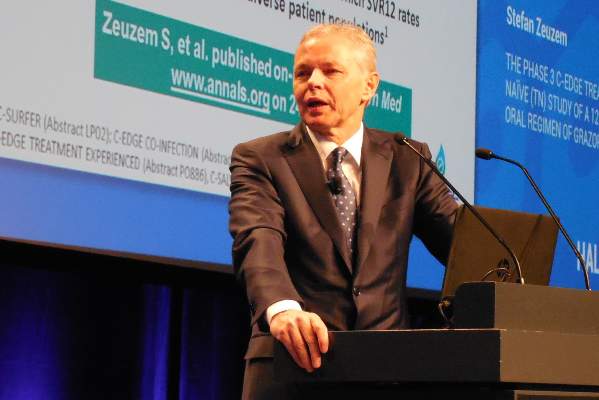
“I love competition,” said Dr. Stefan Zeuzem as he reported the results at the meeting, which was sponsored by the European Association for the Study of the Liver. “We should have many regimens that produce excellent sustained virologic response because we see in the data that certain drug combinations fit better for special indications,” said Dr. Zeuzem, professor and chief of medicine at J.W. Goethe University Hospital in Frankfurt, Germany.
“This provides an excellent option, and we need more options” for treating chronic hepatitis C, said Dr. K. Rajender Reddy, a coauthor with Dr. Zeuzem on the study and professor and director of hepatology at the University of Pennsylvania in Philadelphia.
“It’s one pill, it works in more than 90% of patients, the side effect profile is good,” and the grazoprevir-elbasvir combination can be used in patients with severe renal impairment and a glomerular filtration rate below 30 mL/min per 1.73 m2, something not recommended with one of the major drugs now available for treating hepatitis C, sofosbuvir (Sovaldi and Harvoni), Dr. Reddy said in an interview.

And it’s a “huge step” toward simpler hepatitis C–treatment regimens that are applicable to a broader range of patients, commented Dr. Donald M. Jensen, a hepatologist in Oak Park, Ill. who helped develop hepatitis C–treatment recommendations for the American Association for the Study of Liver Diseases.
“It offers the ability to treat multiple genotypes and had a high success rate, but it still relies on a protease inhibitor so it will still have issues of drug-drug interactions,” Dr. Jensen said in an interview. “Hopefully, as more regimens come out, companies will have to price their regimens competitively.”
The C-EDGE trial randomized 316 patients to immediate treatment with the grazoprevir-elbasvir combination and 105 patients to 4 weeks of placebo treatment as controls for adverse-effect monitoring, after which they also began active treatment. The trial enrolled patients during June 2014-March 2015 at 60 centers in nine countries. The rate of sustained virologic response after 12 weeks, the study’s primary endpoint, occurred in 92% of patients infected with genotype 1a, 99% of those infected by 1b, 100% of the 18 patients infected by genotype 4, and in 8 of the 10 patients infected by genotype 6, Dr. Zeuzem reported.
Concurrent with his talk at the meeting on April 24, the results were published online (Ann. Int. Med. 2015 [doi:10.7326/M15-0785]).

“You can use this regimen comfortably for genotype 4. Whether you want to take the data seriously for genotype 6 is a question,” noted Dr. Reddy, who acknowledged that the 10-patient experience for genotype 6 is too preliminary to provide firm guidance on efficacy. The apparent efficacy of the grazoprevir-elbasvir combination beyond genotype 1 reflects the fact that both drugs are “second generation” agents, particularly designed to have pan-genotype efficacy, Dr. Reddy said.
The safety profile of the two drugs was encouraging, with adverse events occurring at rates no different than in the placebo arm. No patient had a serious adverse event on active treatment, and two patients in the active arm discontinued because of an adverse event.
The data also showed that the regimen was effective regardless of age, sex, race, or the presence of compensated cirrhosis. All of the virologic failures occurred in patients with high viral loads – greater than 800,000 IU/mL – when they started treatment, a finding consistent with prior reports, Dr. Zeuzem said. The patients who had virologic failure carried resistance-associated variant strains of hepatitis C.
The C-EDGE trial was sponsored by Merck, which is developing the drugs used in the study. Dr. Zeuzem has been a consultant for and speaker on behalf of Merck and for AbbVie, Bristol-Myers Squibb, Gilead, and Janssen. Dr. Reddy has been a consultant to and received research support from Merck and Bristol-Myers Squibb, AbbVie, Janssen, and Gilead, Dr. Jensen had no disclosures.
VIENNA – A new, once-daily, single-pill regimen for treating chronic hepatitis C infection without interferon or ribavirin showed 95% eradication efficacy after 12 weeks of safe treatment in a pivotal trial with 421 treatment-naive patients.
The study results also showed that the combination of grazoprevir and elbasvir, drugs that target two different hepatitis C proteins, was equally effective in noncirrhotic and compensated cirrhotic patents. Although more than 90% of the enrolled patients were infected by genotype 1 hepatitis C, the new combination also showed efficacy in the small number of patients enrolled who were infected by either genotype 4 or genotype 6 virus.
Perhaps the most important consequence of the new study, the C-EDGE trial, is that it put the grazoprevir-elbasvir combination on track for near-term approval as another simple, effective, interferon- and ribavirin-free regimen to cure patients of chronic hepatitis C infection, a step that would sharpen competition in this niche and could lead to price reductions among the currently available, high-cost treatments.
“I love competition,” said Dr. Stefan Zeuzem as he reported the results at the meeting, which was sponsored by the European Association for the Study of the Liver. “We should have many regimens that produce excellent sustained virologic response because we see in the data that certain drug combinations fit better for special indications,” said Dr. Zeuzem, professor and chief of medicine at J.W. Goethe University Hospital in Frankfurt, Germany.
“This provides an excellent option, and we need more options” for treating chronic hepatitis C, said Dr. K. Rajender Reddy, a coauthor with Dr. Zeuzem on the study and professor and director of hepatology at the University of Pennsylvania in Philadelphia.
“It’s one pill, it works in more than 90% of patients, the side effect profile is good,” and the grazoprevir-elbasvir combination can be used in patients with severe renal impairment and a glomerular filtration rate below 30 mL/min per 1.73 m2, something not recommended with one of the major drugs now available for treating hepatitis C, sofosbuvir (Sovaldi and Harvoni), Dr. Reddy said in an interview.
And it’s a “huge step” toward simpler hepatitis C–treatment regimens that are applicable to a broader range of patients, commented Dr. Donald M. Jensen, a hepatologist in Oak Park, Ill. who helped develop hepatitis C–treatment recommendations for the American Association for the Study of Liver Diseases.
“It offers the ability to treat multiple genotypes and had a high success rate, but it still relies on a protease inhibitor so it will still have issues of drug-drug interactions,” Dr. Jensen said in an interview. “Hopefully, as more regimens come out, companies will have to price their regimens competitively.”
The C-EDGE trial randomized 316 patients to immediate treatment with the grazoprevir-elbasvir combination and 105 patients to 4 weeks of placebo treatment as controls for adverse-effect monitoring, after which they also began active treatment. The trial enrolled patients during June 2014-March 2015 at 60 centers in nine countries. The rate of sustained virologic response after 12 weeks, the study’s primary endpoint, occurred in 92% of patients infected with genotype 1a, 99% of those infected by 1b, 100% of the 18 patients infected by genotype 4, and in 8 of the 10 patients infected by genotype 6, Dr. Zeuzem reported.
Concurrent with his talk at the meeting on April 24, the results were published online (Ann. Int. Med. 2015 [doi:10.7326/M15-0785]).
“You can use this regimen comfortably for genotype 4. Whether you want to take the data seriously for genotype 6 is a question,” noted Dr. Reddy, who acknowledged that the 10-patient experience for genotype 6 is too preliminary to provide firm guidance on efficacy. The apparent efficacy of the grazoprevir-elbasvir combination beyond genotype 1 reflects the fact that both drugs are “second generation” agents, particularly designed to have pan-genotype efficacy, Dr. Reddy said.
The safety profile of the two drugs was encouraging, with adverse events occurring at rates no different than in the placebo arm. No patient had a serious adverse event on active treatment, and two patients in the active arm discontinued because of an adverse event.
The data also showed that the regimen was effective regardless of age, sex, race, or the presence of compensated cirrhosis. All of the virologic failures occurred in patients with high viral loads – greater than 800,000 IU/mL – when they started treatment, a finding consistent with prior reports, Dr. Zeuzem said. The patients who had virologic failure carried resistance-associated variant strains of hepatitis C.
The C-EDGE trial was sponsored by Merck, which is developing the drugs used in the study. Dr. Zeuzem has been a consultant for and speaker on behalf of Merck and for AbbVie, Bristol-Myers Squibb, Gilead, and Janssen. Dr. Reddy has been a consultant to and received research support from Merck and Bristol-Myers Squibb, AbbVie, Janssen, and Gilead, Dr. Jensen had no disclosures.
VIENNA – A new, once-daily, single-pill regimen for treating chronic hepatitis C infection without interferon or ribavirin showed 95% eradication efficacy after 12 weeks of safe treatment in a pivotal trial with 421 treatment-naive patients.
The study results also showed that the combination of grazoprevir and elbasvir, drugs that target two different hepatitis C proteins, was equally effective in noncirrhotic and compensated cirrhotic patents. Although more than 90% of the enrolled patients were infected by genotype 1 hepatitis C, the new combination also showed efficacy in the small number of patients enrolled who were infected by either genotype 4 or genotype 6 virus.
Perhaps the most important consequence of the new study, the C-EDGE trial, is that it put the grazoprevir-elbasvir combination on track for near-term approval as another simple, effective, interferon- and ribavirin-free regimen to cure patients of chronic hepatitis C infection, a step that would sharpen competition in this niche and could lead to price reductions among the currently available, high-cost treatments.
“I love competition,” said Dr. Stefan Zeuzem as he reported the results at the meeting, which was sponsored by the European Association for the Study of the Liver. “We should have many regimens that produce excellent sustained virologic response because we see in the data that certain drug combinations fit better for special indications,” said Dr. Zeuzem, professor and chief of medicine at J.W. Goethe University Hospital in Frankfurt, Germany.
“This provides an excellent option, and we need more options” for treating chronic hepatitis C, said Dr. K. Rajender Reddy, a coauthor with Dr. Zeuzem on the study and professor and director of hepatology at the University of Pennsylvania in Philadelphia.
“It’s one pill, it works in more than 90% of patients, the side effect profile is good,” and the grazoprevir-elbasvir combination can be used in patients with severe renal impairment and a glomerular filtration rate below 30 mL/min per 1.73 m2, something not recommended with one of the major drugs now available for treating hepatitis C, sofosbuvir (Sovaldi and Harvoni), Dr. Reddy said in an interview.
And it’s a “huge step” toward simpler hepatitis C–treatment regimens that are applicable to a broader range of patients, commented Dr. Donald M. Jensen, a hepatologist in Oak Park, Ill. who helped develop hepatitis C–treatment recommendations for the American Association for the Study of Liver Diseases.
“It offers the ability to treat multiple genotypes and had a high success rate, but it still relies on a protease inhibitor so it will still have issues of drug-drug interactions,” Dr. Jensen said in an interview. “Hopefully, as more regimens come out, companies will have to price their regimens competitively.”
The C-EDGE trial randomized 316 patients to immediate treatment with the grazoprevir-elbasvir combination and 105 patients to 4 weeks of placebo treatment as controls for adverse-effect monitoring, after which they also began active treatment. The trial enrolled patients during June 2014-March 2015 at 60 centers in nine countries. The rate of sustained virologic response after 12 weeks, the study’s primary endpoint, occurred in 92% of patients infected with genotype 1a, 99% of those infected by 1b, 100% of the 18 patients infected by genotype 4, and in 8 of the 10 patients infected by genotype 6, Dr. Zeuzem reported.
Concurrent with his talk at the meeting on April 24, the results were published online (Ann. Int. Med. 2015 [doi:10.7326/M15-0785]).
“You can use this regimen comfortably for genotype 4. Whether you want to take the data seriously for genotype 6 is a question,” noted Dr. Reddy, who acknowledged that the 10-patient experience for genotype 6 is too preliminary to provide firm guidance on efficacy. The apparent efficacy of the grazoprevir-elbasvir combination beyond genotype 1 reflects the fact that both drugs are “second generation” agents, particularly designed to have pan-genotype efficacy, Dr. Reddy said.
The safety profile of the two drugs was encouraging, with adverse events occurring at rates no different than in the placebo arm. No patient had a serious adverse event on active treatment, and two patients in the active arm discontinued because of an adverse event.
The data also showed that the regimen was effective regardless of age, sex, race, or the presence of compensated cirrhosis. All of the virologic failures occurred in patients with high viral loads – greater than 800,000 IU/mL – when they started treatment, a finding consistent with prior reports, Dr. Zeuzem said. The patients who had virologic failure carried resistance-associated variant strains of hepatitis C.
The C-EDGE trial was sponsored by Merck, which is developing the drugs used in the study. Dr. Zeuzem has been a consultant for and speaker on behalf of Merck and for AbbVie, Bristol-Myers Squibb, Gilead, and Janssen. Dr. Reddy has been a consultant to and received research support from Merck and Bristol-Myers Squibb, AbbVie, Janssen, and Gilead, Dr. Jensen had no disclosures.
AT THE INTERNATIONAL LIVER CONGRESS 2015
Key clinical point: Once-daily, single-pill combination treatment with grazoprevir and elbasvir for 12 weeks was safe and effective for eradicating chronic hepatitis C infection.
Major finding: Twelve weeks of treatment produced a sustained virologic response in 95% of patients.
Data source: The C-EDGE trial, which enrolled 421 treatment-naive patients with chronic hepatitis C infection at 60 centers in nine countries.
Disclosures: The C-EDGE trial was sponsored by Merck, which is developing the drugs used in the study. Dr. Zeuzem has been a consultant for and speaker on behalf of Merck and for AbbVie, Bristol-Myers Squibb, Gilead, and Janssen. Dr. Reddy has been a consultant to and received research support from Merck and Bristol-Myers Squibb, AbbVie, Janssen, and Gilead, Dr. Jensen had no disclosures.
Alcoholic hepatitis: Pentoxifylline, prednisolone don’t improve survival
Neither pentoxifylline nor prednisolone reduced 28-day mortality, 90-day mortality, or 1-year mortality among adults with alcoholic hepatitis in a multicenter clinical trial comparing the two agents, according to a report published online April 23 in the New England Journal of Medicine.
Pentoxifylline and glucocorticoids are the only drugs endorsed for this indication in treatment guidelines from the American Association for the Study of Liver Disease and the European Association for the Study of the Liver. However, the evidence in support of both has been conflicting, and their use remains controversial. The Steroids or Pentoxifylline for Alcoholic Hepatitis (SOPAH) study was a randomized, double-blind trial comparing the two drugs against each other and against placebo in 1,103 patients enrolled during a 3-year period at 65 hospitals across the United Kingdom, said Dr. Mark R. Thursz of Imperial College, London, and his associates.
The primary endpoint of the study, mortality at the conclusion of the 28-day course of treatment, was 14% in the group taking prednisolone plus placebo, 19% in those taking pentoxifylline plus placebo, 13% in those taking both prednisolone plus pentoxifylline, and 17% in those taking two placebos – all nonsignificant differences. In addition, neither active drug affected mortality or the need for liver transplantation at 90 days or at 1 year, the investigators reported (N. Engl. J. Med. 2015 April 23 [doi:10.1056/NEJMoa1412278]).
Cumulative mortality at 1 year was “alarming” but nearly identical between the groups who received the two active agents and the groups who did not: 56% with pentoxifylline and 57% without it; 57% with prednisolone and 56% without it.
Infection accounted for 24% of all deaths, but the number of infections among patients receiving prednisolone was no higher than that for the other patient groups, Dr. Thursz and his associates added.
Neither pentoxifylline nor prednisolone reduced 28-day mortality, 90-day mortality, or 1-year mortality among adults with alcoholic hepatitis in a multicenter clinical trial comparing the two agents, according to a report published online April 23 in the New England Journal of Medicine.
Pentoxifylline and glucocorticoids are the only drugs endorsed for this indication in treatment guidelines from the American Association for the Study of Liver Disease and the European Association for the Study of the Liver. However, the evidence in support of both has been conflicting, and their use remains controversial. The Steroids or Pentoxifylline for Alcoholic Hepatitis (SOPAH) study was a randomized, double-blind trial comparing the two drugs against each other and against placebo in 1,103 patients enrolled during a 3-year period at 65 hospitals across the United Kingdom, said Dr. Mark R. Thursz of Imperial College, London, and his associates.
The primary endpoint of the study, mortality at the conclusion of the 28-day course of treatment, was 14% in the group taking prednisolone plus placebo, 19% in those taking pentoxifylline plus placebo, 13% in those taking both prednisolone plus pentoxifylline, and 17% in those taking two placebos – all nonsignificant differences. In addition, neither active drug affected mortality or the need for liver transplantation at 90 days or at 1 year, the investigators reported (N. Engl. J. Med. 2015 April 23 [doi:10.1056/NEJMoa1412278]).
Cumulative mortality at 1 year was “alarming” but nearly identical between the groups who received the two active agents and the groups who did not: 56% with pentoxifylline and 57% without it; 57% with prednisolone and 56% without it.
Infection accounted for 24% of all deaths, but the number of infections among patients receiving prednisolone was no higher than that for the other patient groups, Dr. Thursz and his associates added.
Neither pentoxifylline nor prednisolone reduced 28-day mortality, 90-day mortality, or 1-year mortality among adults with alcoholic hepatitis in a multicenter clinical trial comparing the two agents, according to a report published online April 23 in the New England Journal of Medicine.
Pentoxifylline and glucocorticoids are the only drugs endorsed for this indication in treatment guidelines from the American Association for the Study of Liver Disease and the European Association for the Study of the Liver. However, the evidence in support of both has been conflicting, and their use remains controversial. The Steroids or Pentoxifylline for Alcoholic Hepatitis (SOPAH) study was a randomized, double-blind trial comparing the two drugs against each other and against placebo in 1,103 patients enrolled during a 3-year period at 65 hospitals across the United Kingdom, said Dr. Mark R. Thursz of Imperial College, London, and his associates.
The primary endpoint of the study, mortality at the conclusion of the 28-day course of treatment, was 14% in the group taking prednisolone plus placebo, 19% in those taking pentoxifylline plus placebo, 13% in those taking both prednisolone plus pentoxifylline, and 17% in those taking two placebos – all nonsignificant differences. In addition, neither active drug affected mortality or the need for liver transplantation at 90 days or at 1 year, the investigators reported (N. Engl. J. Med. 2015 April 23 [doi:10.1056/NEJMoa1412278]).
Cumulative mortality at 1 year was “alarming” but nearly identical between the groups who received the two active agents and the groups who did not: 56% with pentoxifylline and 57% without it; 57% with prednisolone and 56% without it.
Infection accounted for 24% of all deaths, but the number of infections among patients receiving prednisolone was no higher than that for the other patient groups, Dr. Thursz and his associates added.
FROM THE NEW ENGLAND JOURNAL OF MEDICINE
Key clinical point: Neither pentoxifylline nor prednisolone improves 28-day, 90-day, or 1-year survival in alcoholic hepatitis.
Major finding: Mortality at the conclusion of the 28-day course of treatment was 14% in the group taking prednisolone plus placebo, 19% in those taking pentoxifylline plus placebo, 13% in those taking both prednisolone plus pentoxifylline, and 17% in those taking two placebos — all nonsignificant differences.
Data source: A multicenter, randomized double-blind clinical trial involving 1,103 adults followed for 1 year.
Disclosures: This study was supported by the National Institute for Health Research’s Health Technology Assessment program. Dr. Thursz reported receiving lecture and consulting fees from Gilead, Bristol-Myers Squibb, AbbVie, and Abbott; one of his associates received consulting fees from Norgine.
FDA adds warnings to simeprevir label
The Food and Drug Administration has approved changes to the warnings and precautions section of the package insert for Olysio (simeprevir).
One addition to the insert is that serious symptomatic bradycardia has been reported by individuals who have taken amiodarone with sofosbuvir and another HCV direct-acting antiviral, including Olysio.
Another change is the inclusion of a statement that hepatic decompensation and hepatic failure have been reported in patients treated with Olysio in combination with peginterferon alfa and ribavirin. Related to this finding, is the other new recommendation that patients with moderate or severe hepatic impairment not take Olysio.
More details on these and other related label changes for Olysio can be found at the FDA website.
The Food and Drug Administration has approved changes to the warnings and precautions section of the package insert for Olysio (simeprevir).
One addition to the insert is that serious symptomatic bradycardia has been reported by individuals who have taken amiodarone with sofosbuvir and another HCV direct-acting antiviral, including Olysio.
Another change is the inclusion of a statement that hepatic decompensation and hepatic failure have been reported in patients treated with Olysio in combination with peginterferon alfa and ribavirin. Related to this finding, is the other new recommendation that patients with moderate or severe hepatic impairment not take Olysio.
More details on these and other related label changes for Olysio can be found at the FDA website.
The Food and Drug Administration has approved changes to the warnings and precautions section of the package insert for Olysio (simeprevir).
One addition to the insert is that serious symptomatic bradycardia has been reported by individuals who have taken amiodarone with sofosbuvir and another HCV direct-acting antiviral, including Olysio.
Another change is the inclusion of a statement that hepatic decompensation and hepatic failure have been reported in patients treated with Olysio in combination with peginterferon alfa and ribavirin. Related to this finding, is the other new recommendation that patients with moderate or severe hepatic impairment not take Olysio.
More details on these and other related label changes for Olysio can be found at the FDA website.
Insulin glargine reduced liver fat burden more than liraglutide
Insulin glargine therapy was associated with significantly greater reductions in liver fat burden in patients with type 2 diabetes than was liraglutide, judging from the findings of a prospective randomized controlled trial.
Both treatments significantly improved glycosylated hemoglobin. However, neither led to a significant change in liver fat fraction, as measured with magnetic resonance spectroscopy (MRS), according to a study published online March 26 in Diabetes Care.
Researchers randomized 35 patients, whose type 2 diabetes was inadequately controlled on either metformin monotherapy or combination therapy, to 12 weeks therapy starting with 10 IU of subcutaneous insulin glargine daily or a starting dose of 0.6 mg of subcutaneous liraglutide, titrated to 1.8 mg or the maximal tolerated dose.
Patients on insulin glargine showed significant reductions in MRS-based liver proton density fat fraction (13.8% to 10.6%; P = .005), and MRI-based liver volume (2,010.6 mL to 1,858.7 mL; P = .01) and total liver fat index (304.4 vs. 209.3%; P = .01).
They also showed a trend toward a decreased MRS-based liver proton density fat fraction (12.6% to 9.9%; P = 0.06).
However patients treated with liraglutide showed no significant changes in any of these indexes (Diabetes Care 2015, March 26 [doi:10.2337/dc14-2548]).
While insulin is associated with weight gain and may be lipogenic, previous imaging studies have actually showed a reduction in liver fat with insulin therapy.
“The mechanisms by which insulin therapy may reduce liver fat include inhibition of lipolysis, which may reduce free fatty acid flux to the liver and decreased production of endogenous insulin passing through the liver to stimulate hepatic lipogenesis,” wrote Dr. An Tang, from the University of Montreal, and coauthors.
At the same time, GLP-1 agonists such as liraglutide promote weight loss and were thought to decrease liver fat by increasing fatty acid uptake and very low density–lipoprotein transport.
However, the study failed to find any significant change in biomarkers of liver fat burden among those patients randomized to liraglutide.
“It is possible that the postprandial increase in insulin secretion in the portal circulation and the decrease in glucagon secretion induced by the GLP-1 analogs could favor lipogenesis and therefore explain the lack of effect of liraglutide on hepatic steatosis observed in the current study,” the authors wrote.
The study found that patients taking liraglutide showed a significant reduction in body mass index or BMI (31.3 to 30.1 kg/m2; P = .008) while those on insulin glargine did not (31.2 to 31.3 kg/m2; P = .92).
“Interestingly, the improvement in BMI in patients randomized to liraglutide therapy was not associated with concomitant changes in the liver fat burden,” they wrote.
They noted a similar rate of adverse events in the insulin glargine and liraglutide groups.
The authors said that while the study’s short duration may have worked against liraglutide, because its impact on BMI may have had a longer term impact on liver fat fraction, they argued it was enough to address the primary end point.
“This reduction in liver fat burden on insulin therapy is reassuring and important because many patients with type 2 diabetes and NALFD [nonalcoholic fatty liver disease] have to be treated with insulin to achieve adequate glycemic control,” the authors wrote.
The study was supported by the Radiological Society of North America Research and Education Foundation, and Diabète Québec. Authors reported grants, honorarium, personal fees, and research funds from private industry.
Insulin glargine therapy was associated with significantly greater reductions in liver fat burden in patients with type 2 diabetes than was liraglutide, judging from the findings of a prospective randomized controlled trial.
Both treatments significantly improved glycosylated hemoglobin. However, neither led to a significant change in liver fat fraction, as measured with magnetic resonance spectroscopy (MRS), according to a study published online March 26 in Diabetes Care.
Researchers randomized 35 patients, whose type 2 diabetes was inadequately controlled on either metformin monotherapy or combination therapy, to 12 weeks therapy starting with 10 IU of subcutaneous insulin glargine daily or a starting dose of 0.6 mg of subcutaneous liraglutide, titrated to 1.8 mg or the maximal tolerated dose.
Patients on insulin glargine showed significant reductions in MRS-based liver proton density fat fraction (13.8% to 10.6%; P = .005), and MRI-based liver volume (2,010.6 mL to 1,858.7 mL; P = .01) and total liver fat index (304.4 vs. 209.3%; P = .01).
They also showed a trend toward a decreased MRS-based liver proton density fat fraction (12.6% to 9.9%; P = 0.06).
However patients treated with liraglutide showed no significant changes in any of these indexes (Diabetes Care 2015, March 26 [doi:10.2337/dc14-2548]).
While insulin is associated with weight gain and may be lipogenic, previous imaging studies have actually showed a reduction in liver fat with insulin therapy.
“The mechanisms by which insulin therapy may reduce liver fat include inhibition of lipolysis, which may reduce free fatty acid flux to the liver and decreased production of endogenous insulin passing through the liver to stimulate hepatic lipogenesis,” wrote Dr. An Tang, from the University of Montreal, and coauthors.
At the same time, GLP-1 agonists such as liraglutide promote weight loss and were thought to decrease liver fat by increasing fatty acid uptake and very low density–lipoprotein transport.
However, the study failed to find any significant change in biomarkers of liver fat burden among those patients randomized to liraglutide.
“It is possible that the postprandial increase in insulin secretion in the portal circulation and the decrease in glucagon secretion induced by the GLP-1 analogs could favor lipogenesis and therefore explain the lack of effect of liraglutide on hepatic steatosis observed in the current study,” the authors wrote.
The study found that patients taking liraglutide showed a significant reduction in body mass index or BMI (31.3 to 30.1 kg/m2; P = .008) while those on insulin glargine did not (31.2 to 31.3 kg/m2; P = .92).
“Interestingly, the improvement in BMI in patients randomized to liraglutide therapy was not associated with concomitant changes in the liver fat burden,” they wrote.
They noted a similar rate of adverse events in the insulin glargine and liraglutide groups.
The authors said that while the study’s short duration may have worked against liraglutide, because its impact on BMI may have had a longer term impact on liver fat fraction, they argued it was enough to address the primary end point.
“This reduction in liver fat burden on insulin therapy is reassuring and important because many patients with type 2 diabetes and NALFD [nonalcoholic fatty liver disease] have to be treated with insulin to achieve adequate glycemic control,” the authors wrote.
The study was supported by the Radiological Society of North America Research and Education Foundation, and Diabète Québec. Authors reported grants, honorarium, personal fees, and research funds from private industry.
Insulin glargine therapy was associated with significantly greater reductions in liver fat burden in patients with type 2 diabetes than was liraglutide, judging from the findings of a prospective randomized controlled trial.
Both treatments significantly improved glycosylated hemoglobin. However, neither led to a significant change in liver fat fraction, as measured with magnetic resonance spectroscopy (MRS), according to a study published online March 26 in Diabetes Care.
Researchers randomized 35 patients, whose type 2 diabetes was inadequately controlled on either metformin monotherapy or combination therapy, to 12 weeks therapy starting with 10 IU of subcutaneous insulin glargine daily or a starting dose of 0.6 mg of subcutaneous liraglutide, titrated to 1.8 mg or the maximal tolerated dose.
Patients on insulin glargine showed significant reductions in MRS-based liver proton density fat fraction (13.8% to 10.6%; P = .005), and MRI-based liver volume (2,010.6 mL to 1,858.7 mL; P = .01) and total liver fat index (304.4 vs. 209.3%; P = .01).
They also showed a trend toward a decreased MRS-based liver proton density fat fraction (12.6% to 9.9%; P = 0.06).
However patients treated with liraglutide showed no significant changes in any of these indexes (Diabetes Care 2015, March 26 [doi:10.2337/dc14-2548]).
While insulin is associated with weight gain and may be lipogenic, previous imaging studies have actually showed a reduction in liver fat with insulin therapy.
“The mechanisms by which insulin therapy may reduce liver fat include inhibition of lipolysis, which may reduce free fatty acid flux to the liver and decreased production of endogenous insulin passing through the liver to stimulate hepatic lipogenesis,” wrote Dr. An Tang, from the University of Montreal, and coauthors.
At the same time, GLP-1 agonists such as liraglutide promote weight loss and were thought to decrease liver fat by increasing fatty acid uptake and very low density–lipoprotein transport.
However, the study failed to find any significant change in biomarkers of liver fat burden among those patients randomized to liraglutide.
“It is possible that the postprandial increase in insulin secretion in the portal circulation and the decrease in glucagon secretion induced by the GLP-1 analogs could favor lipogenesis and therefore explain the lack of effect of liraglutide on hepatic steatosis observed in the current study,” the authors wrote.
The study found that patients taking liraglutide showed a significant reduction in body mass index or BMI (31.3 to 30.1 kg/m2; P = .008) while those on insulin glargine did not (31.2 to 31.3 kg/m2; P = .92).
“Interestingly, the improvement in BMI in patients randomized to liraglutide therapy was not associated with concomitant changes in the liver fat burden,” they wrote.
They noted a similar rate of adverse events in the insulin glargine and liraglutide groups.
The authors said that while the study’s short duration may have worked against liraglutide, because its impact on BMI may have had a longer term impact on liver fat fraction, they argued it was enough to address the primary end point.
“This reduction in liver fat burden on insulin therapy is reassuring and important because many patients with type 2 diabetes and NALFD [nonalcoholic fatty liver disease] have to be treated with insulin to achieve adequate glycemic control,” the authors wrote.
The study was supported by the Radiological Society of North America Research and Education Foundation, and Diabète Québec. Authors reported grants, honorarium, personal fees, and research funds from private industry.
Key clinical point: Insulin glargine therapy was associated with significantly greater reductions in liver fat burden in patients with type 2 diabetes than was liraglutide.
Major finding: Patients on insulin glargine showed significant reductions in MRS-based liver proton density fat fraction and MRI-based liver volume, and total liver fat index.
Data source: Prospective, open-label, randomized trial in 35 patients with inadequately controlled type 2 diabetes.
Disclosures: The study was supported by the Radiological Society of North America Research and Education Foundation, and Diabète Québec. Authors reported grants, honorarium, personal fees, and research funds from private industry.
Sovaldi’s high price limits drug access
The high cost of the hepatitis C treatment Sovaldi has caused a steep increase in Medicaid spending, though access to the drug remains extremely limited for low-income patients, reports the Wall Street Journal’s Joseph Walker in an analysis of federal data.
The drug, manufactured by Gilead Sciences, comes at a cost of $84,000 for the course of treatment, or $1,000 per pill.
State Medicaid programs spent $1.08 billion on Sovaldi alone and $1.33 billion on all HCV treatments in the first 9 months of 2014, according to the analysis. As a result, states have started to limit access to only the most severe HCV cases, sparking tension among physicians, patients, and state officials.
Though competition between Sovaldi and AbbVie’s Viekira Pak would allow states to negotiate greater discounts and expand coverage, most states continue to deny access to all but the sickest eligible patients, according to the report.Read the full Wall Street Journal article here.
The high cost of the hepatitis C treatment Sovaldi has caused a steep increase in Medicaid spending, though access to the drug remains extremely limited for low-income patients, reports the Wall Street Journal’s Joseph Walker in an analysis of federal data.
The drug, manufactured by Gilead Sciences, comes at a cost of $84,000 for the course of treatment, or $1,000 per pill.
State Medicaid programs spent $1.08 billion on Sovaldi alone and $1.33 billion on all HCV treatments in the first 9 months of 2014, according to the analysis. As a result, states have started to limit access to only the most severe HCV cases, sparking tension among physicians, patients, and state officials.
Though competition between Sovaldi and AbbVie’s Viekira Pak would allow states to negotiate greater discounts and expand coverage, most states continue to deny access to all but the sickest eligible patients, according to the report.Read the full Wall Street Journal article here.
The high cost of the hepatitis C treatment Sovaldi has caused a steep increase in Medicaid spending, though access to the drug remains extremely limited for low-income patients, reports the Wall Street Journal’s Joseph Walker in an analysis of federal data.
The drug, manufactured by Gilead Sciences, comes at a cost of $84,000 for the course of treatment, or $1,000 per pill.
State Medicaid programs spent $1.08 billion on Sovaldi alone and $1.33 billion on all HCV treatments in the first 9 months of 2014, according to the analysis. As a result, states have started to limit access to only the most severe HCV cases, sparking tension among physicians, patients, and state officials.
Though competition between Sovaldi and AbbVie’s Viekira Pak would allow states to negotiate greater discounts and expand coverage, most states continue to deny access to all but the sickest eligible patients, according to the report.Read the full Wall Street Journal article here.
All-oral simeprevir-sofosbuvir beat interferon-based regimen for HCV with compensated cirrhosis
Patients with compensated cirrhosis and chronic genotype 1 hepatitis C virus infections were significantly more likely to clear their infections and had fewer adverse effects when treated with simeprevir and sofosbuvir instead of peginterferon, ribavirin, and sofosbuvir, investigators reported in the April issue of Gastroenterology. “Patients given the interferon-containing regimen had a significantly greater rate of virologic relapse than patients given simeprevir and sofosbuvir ... and reported worse outcomes and more side effects,” said Dr. Brian L. Pearlman and his associates of Atlanta Medical Center and Emory University, Atlanta.
Liver disease associated with chronic hepatitis C virus (HCV) infection causes at least 350,000 deaths per year worldwide. Genotype 1 (GT-1) HCV is the most common HCV strain and the hardest to treat, especially when patients have cirrhosis. Treatments for chronic GT-1 HCV infections historically included interferon, but achieved only moderate rates of sustained virologic response (SVR) and caused adverse somatic and psychiatric effects. All-oral, interferon-free regimens are now in widespread use, but many of the pivotal trials were industry sponsored and had strict enrollment criteria, potentially limiting their generalizability in community settings, the researchers reported (Gastroenterology 2015 April [doi:10.1053/j.gastro.2014.12.027]).Their open-label trial included 82 patients with HCV GT-1a infection and Child’s grade A cirrhosis recruited from two clinical practices in Atlanta. Thirty-two of the patients were treatment naive, while 50 had previously not responded to peginterferon and ribavirin treatment. Patients were randomized to either 12 weeks of all-oral simeprevir (150 mg/day) and sofosbuvir (400 mg/day), or peginterferon alfa 2b (1.5 mcg/kg per week), ribavirin (1000-1200 mg/day), and sofosbuvir (400 mg/day).Fully 54 of 58 (93%) patients given the simeprevir-sofosbuvir regimen had undetectable levels of HCV RNA at 12 weeks (SVR12), compared with 18 of 24 (75%) patients who received the interferon-containing regimen (P = .02), the researchers reported. Rates of SVR12 among prior nonresponders were 92% and 64%, and were 95% and 80% for treatment-naive patients, although P-values did not reach statistical significance. The interferon group also had a higher rate of virologic relapse than did patients given simeprevir and sofosbuvir (P = .009), and had worse self-reported outcomes and more side effects, the researchers said. Patients in both groups who achieved SVR12 had higher quality-of-life scores than those who did not. Notably, almost half of patients were African American, a group that has historically had lower cure rates compared with other racial groups, said the investigators.
“Given that several new regimens for genotype 1 infection, including the sofosbuvir-ledipasvir combination pill, already have been approved, we believe that this study is very timely,” Dr. Pearlman and his associates said. “Although these are not head-to-head comparisons, the 12-week simeprevir and sofosbuvir regimen in this trial may compare favorably with the SVR rates for 12 weeks of sofosbuvir/ledipasvir and 12 weeks of the regimen, paritaprevir/ritonavir, ombitasvir and dasabuvir plus ribavirin for patients with cirrhosis, particularly for prior nonresponders to older therapies, with the caveat that many more patients were studied in the registration trials.”While industry-sponsored trials have had psychiatric exclusion criteria, several patients in the open-label trial had serious psychiatric conditions, said the researchers. A patient with stable bipolar disorder received the interferon-containing regimen, and two patients with stable schizophrenia received the all-oral regimen. None reported worsening psychiatric symptoms on treatment.
Dr. Pearlman reported having contracted research for Johnson & Johnson, Gilead, Abbvie, Bristol-Myers Squibb, Boehringer Ingelheim, and Merck; and having served on speaker and advisory boards for Johnson & Johnson, Gilead, and Abbvie. He also was an investigator and author in the COSMOS trial of simeprevir and sofosbuvir in patients with HCV/HIV coinfection. The other authors reported no conflicts of interest.
At the time of sofosbuvir (SOF) and simeprevir (SMV) approval, efficacy results of the combinations assessed in this study were still limited, especially in patients with cirrhosis, GT-1a, and/or previous nonresponse. The recent study by Dr. Pearlman and his associates aims to give light to some of the questions

|
| Dr. Xavier Forns |
raised. In this open-label trial, 82 patients with GT-1a cirrhosis (61% null responders) were recruited. Patients were randomized 2:1 to either 12 weeks of all-oral SMV/SOF or to peginterferon (PEG)/ribavirin (RBV)/SOF. Fully 93% of patients given the all-oral regimen achieved SVR12, compared with 75% who received the interferon-containing regimen. SVR12 rates were higher in the SMV/SOF arm than in the PEG/RBV/SOF arm, independent of previous response (92% vs. 64% in null responders and 95% vs. 80% in naive patients). Moreover, virologic relapse was lower in the all-oral arm (12.5% vs. 8%; P = .009). These results, however, are based on a limited number of patients, particularly in the interferon-containing arm. In addition, the PEG used in this study was alfa-2b, which has not been studied in combination with SOF in clinical trials (its potential impact is thus unknown). One important point of the study is the lack of prognostic value of early viral kinetics: Rapid virologic response was not related to SVR12, which has been a hallmark in previous interferon-based regimens.
Regarding safety and tolerance, there were poorer self-reported outcomes and more side effects in the interferon group. The latter seems obvious because of
|
| Dr. Sabela Lens |
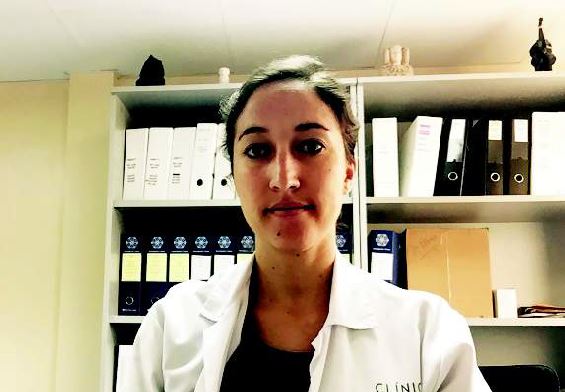
the well-known interferon profile, but RBV has been associated with higher rates of anemia in patients with cirrhosis undergoing interferon-free regimens. The use of SMV/SOF without RBV is certainly a crucial point of the study.
With the inherent limitations of the small number of patients, the study by Dr. Pearlman and his associates supports a greater efficacy and a better tolerance for a regimen combining SMV/SOF as compared to PEG/RBV/SOF in patients with GT-1a cirrhosis.
Dr. Sabela Lens and Dr. Xavier Forns are in the Liver Unit, Hospital Clínic Barcelona, IDIBAPS and CIBERehd, University of Barcelona. Dr. Lens has acted as an adviser for Janssen, MSD, and Gilead, and Dr. Forns has acted as an adviser for Janssen, Abbvie, and Gilead and has received unrestricted grant support from Janssen and MSD.
At the time of sofosbuvir (SOF) and simeprevir (SMV) approval, efficacy results of the combinations assessed in this study were still limited, especially in patients with cirrhosis, GT-1a, and/or previous nonresponse. The recent study by Dr. Pearlman and his associates aims to give light to some of the questions
|
|
| Dr. Xavier Forns |
raised. In this open-label trial, 82 patients with GT-1a cirrhosis (61% null responders) were recruited. Patients were randomized 2:1 to either 12 weeks of all-oral SMV/SOF or to peginterferon (PEG)/ribavirin (RBV)/SOF. Fully 93% of patients given the all-oral regimen achieved SVR12, compared with 75% who received the interferon-containing regimen. SVR12 rates were higher in the SMV/SOF arm than in the PEG/RBV/SOF arm, independent of previous response (92% vs. 64% in null responders and 95% vs. 80% in naive patients). Moreover, virologic relapse was lower in the all-oral arm (12.5% vs. 8%; P = .009). These results, however, are based on a limited number of patients, particularly in the interferon-containing arm. In addition, the PEG used in this study was alfa-2b, which has not been studied in combination with SOF in clinical trials (its potential impact is thus unknown). One important point of the study is the lack of prognostic value of early viral kinetics: Rapid virologic response was not related to SVR12, which has been a hallmark in previous interferon-based regimens.
Regarding safety and tolerance, there were poorer self-reported outcomes and more side effects in the interferon group. The latter seems obvious because of
|
|
| Dr. Sabela Lens |
the well-known interferon profile, but RBV has been associated with higher rates of anemia in patients with cirrhosis undergoing interferon-free regimens. The use of SMV/SOF without RBV is certainly a crucial point of the study.
With the inherent limitations of the small number of patients, the study by Dr. Pearlman and his associates supports a greater efficacy and a better tolerance for a regimen combining SMV/SOF as compared to PEG/RBV/SOF in patients with GT-1a cirrhosis.
Dr. Sabela Lens and Dr. Xavier Forns are in the Liver Unit, Hospital Clínic Barcelona, IDIBAPS and CIBERehd, University of Barcelona. Dr. Lens has acted as an adviser for Janssen, MSD, and Gilead, and Dr. Forns has acted as an adviser for Janssen, Abbvie, and Gilead and has received unrestricted grant support from Janssen and MSD.
At the time of sofosbuvir (SOF) and simeprevir (SMV) approval, efficacy results of the combinations assessed in this study were still limited, especially in patients with cirrhosis, GT-1a, and/or previous nonresponse. The recent study by Dr. Pearlman and his associates aims to give light to some of the questions
|
|
| Dr. Xavier Forns |
raised. In this open-label trial, 82 patients with GT-1a cirrhosis (61% null responders) were recruited. Patients were randomized 2:1 to either 12 weeks of all-oral SMV/SOF or to peginterferon (PEG)/ribavirin (RBV)/SOF. Fully 93% of patients given the all-oral regimen achieved SVR12, compared with 75% who received the interferon-containing regimen. SVR12 rates were higher in the SMV/SOF arm than in the PEG/RBV/SOF arm, independent of previous response (92% vs. 64% in null responders and 95% vs. 80% in naive patients). Moreover, virologic relapse was lower in the all-oral arm (12.5% vs. 8%; P = .009). These results, however, are based on a limited number of patients, particularly in the interferon-containing arm. In addition, the PEG used in this study was alfa-2b, which has not been studied in combination with SOF in clinical trials (its potential impact is thus unknown). One important point of the study is the lack of prognostic value of early viral kinetics: Rapid virologic response was not related to SVR12, which has been a hallmark in previous interferon-based regimens.
Regarding safety and tolerance, there were poorer self-reported outcomes and more side effects in the interferon group. The latter seems obvious because of
|
|
| Dr. Sabela Lens |
the well-known interferon profile, but RBV has been associated with higher rates of anemia in patients with cirrhosis undergoing interferon-free regimens. The use of SMV/SOF without RBV is certainly a crucial point of the study.
With the inherent limitations of the small number of patients, the study by Dr. Pearlman and his associates supports a greater efficacy and a better tolerance for a regimen combining SMV/SOF as compared to PEG/RBV/SOF in patients with GT-1a cirrhosis.
Dr. Sabela Lens and Dr. Xavier Forns are in the Liver Unit, Hospital Clínic Barcelona, IDIBAPS and CIBERehd, University of Barcelona. Dr. Lens has acted as an adviser for Janssen, MSD, and Gilead, and Dr. Forns has acted as an adviser for Janssen, Abbvie, and Gilead and has received unrestricted grant support from Janssen and MSD.
Patients with compensated cirrhosis and chronic genotype 1 hepatitis C virus infections were significantly more likely to clear their infections and had fewer adverse effects when treated with simeprevir and sofosbuvir instead of peginterferon, ribavirin, and sofosbuvir, investigators reported in the April issue of Gastroenterology. “Patients given the interferon-containing regimen had a significantly greater rate of virologic relapse than patients given simeprevir and sofosbuvir ... and reported worse outcomes and more side effects,” said Dr. Brian L. Pearlman and his associates of Atlanta Medical Center and Emory University, Atlanta.
Liver disease associated with chronic hepatitis C virus (HCV) infection causes at least 350,000 deaths per year worldwide. Genotype 1 (GT-1) HCV is the most common HCV strain and the hardest to treat, especially when patients have cirrhosis. Treatments for chronic GT-1 HCV infections historically included interferon, but achieved only moderate rates of sustained virologic response (SVR) and caused adverse somatic and psychiatric effects. All-oral, interferon-free regimens are now in widespread use, but many of the pivotal trials were industry sponsored and had strict enrollment criteria, potentially limiting their generalizability in community settings, the researchers reported (Gastroenterology 2015 April [doi:10.1053/j.gastro.2014.12.027]).Their open-label trial included 82 patients with HCV GT-1a infection and Child’s grade A cirrhosis recruited from two clinical practices in Atlanta. Thirty-two of the patients were treatment naive, while 50 had previously not responded to peginterferon and ribavirin treatment. Patients were randomized to either 12 weeks of all-oral simeprevir (150 mg/day) and sofosbuvir (400 mg/day), or peginterferon alfa 2b (1.5 mcg/kg per week), ribavirin (1000-1200 mg/day), and sofosbuvir (400 mg/day).Fully 54 of 58 (93%) patients given the simeprevir-sofosbuvir regimen had undetectable levels of HCV RNA at 12 weeks (SVR12), compared with 18 of 24 (75%) patients who received the interferon-containing regimen (P = .02), the researchers reported. Rates of SVR12 among prior nonresponders were 92% and 64%, and were 95% and 80% for treatment-naive patients, although P-values did not reach statistical significance. The interferon group also had a higher rate of virologic relapse than did patients given simeprevir and sofosbuvir (P = .009), and had worse self-reported outcomes and more side effects, the researchers said. Patients in both groups who achieved SVR12 had higher quality-of-life scores than those who did not. Notably, almost half of patients were African American, a group that has historically had lower cure rates compared with other racial groups, said the investigators.
“Given that several new regimens for genotype 1 infection, including the sofosbuvir-ledipasvir combination pill, already have been approved, we believe that this study is very timely,” Dr. Pearlman and his associates said. “Although these are not head-to-head comparisons, the 12-week simeprevir and sofosbuvir regimen in this trial may compare favorably with the SVR rates for 12 weeks of sofosbuvir/ledipasvir and 12 weeks of the regimen, paritaprevir/ritonavir, ombitasvir and dasabuvir plus ribavirin for patients with cirrhosis, particularly for prior nonresponders to older therapies, with the caveat that many more patients were studied in the registration trials.”While industry-sponsored trials have had psychiatric exclusion criteria, several patients in the open-label trial had serious psychiatric conditions, said the researchers. A patient with stable bipolar disorder received the interferon-containing regimen, and two patients with stable schizophrenia received the all-oral regimen. None reported worsening psychiatric symptoms on treatment.
Dr. Pearlman reported having contracted research for Johnson & Johnson, Gilead, Abbvie, Bristol-Myers Squibb, Boehringer Ingelheim, and Merck; and having served on speaker and advisory boards for Johnson & Johnson, Gilead, and Abbvie. He also was an investigator and author in the COSMOS trial of simeprevir and sofosbuvir in patients with HCV/HIV coinfection. The other authors reported no conflicts of interest.
Patients with compensated cirrhosis and chronic genotype 1 hepatitis C virus infections were significantly more likely to clear their infections and had fewer adverse effects when treated with simeprevir and sofosbuvir instead of peginterferon, ribavirin, and sofosbuvir, investigators reported in the April issue of Gastroenterology. “Patients given the interferon-containing regimen had a significantly greater rate of virologic relapse than patients given simeprevir and sofosbuvir ... and reported worse outcomes and more side effects,” said Dr. Brian L. Pearlman and his associates of Atlanta Medical Center and Emory University, Atlanta.
Liver disease associated with chronic hepatitis C virus (HCV) infection causes at least 350,000 deaths per year worldwide. Genotype 1 (GT-1) HCV is the most common HCV strain and the hardest to treat, especially when patients have cirrhosis. Treatments for chronic GT-1 HCV infections historically included interferon, but achieved only moderate rates of sustained virologic response (SVR) and caused adverse somatic and psychiatric effects. All-oral, interferon-free regimens are now in widespread use, but many of the pivotal trials were industry sponsored and had strict enrollment criteria, potentially limiting their generalizability in community settings, the researchers reported (Gastroenterology 2015 April [doi:10.1053/j.gastro.2014.12.027]).Their open-label trial included 82 patients with HCV GT-1a infection and Child’s grade A cirrhosis recruited from two clinical practices in Atlanta. Thirty-two of the patients were treatment naive, while 50 had previously not responded to peginterferon and ribavirin treatment. Patients were randomized to either 12 weeks of all-oral simeprevir (150 mg/day) and sofosbuvir (400 mg/day), or peginterferon alfa 2b (1.5 mcg/kg per week), ribavirin (1000-1200 mg/day), and sofosbuvir (400 mg/day).Fully 54 of 58 (93%) patients given the simeprevir-sofosbuvir regimen had undetectable levels of HCV RNA at 12 weeks (SVR12), compared with 18 of 24 (75%) patients who received the interferon-containing regimen (P = .02), the researchers reported. Rates of SVR12 among prior nonresponders were 92% and 64%, and were 95% and 80% for treatment-naive patients, although P-values did not reach statistical significance. The interferon group also had a higher rate of virologic relapse than did patients given simeprevir and sofosbuvir (P = .009), and had worse self-reported outcomes and more side effects, the researchers said. Patients in both groups who achieved SVR12 had higher quality-of-life scores than those who did not. Notably, almost half of patients were African American, a group that has historically had lower cure rates compared with other racial groups, said the investigators.
“Given that several new regimens for genotype 1 infection, including the sofosbuvir-ledipasvir combination pill, already have been approved, we believe that this study is very timely,” Dr. Pearlman and his associates said. “Although these are not head-to-head comparisons, the 12-week simeprevir and sofosbuvir regimen in this trial may compare favorably with the SVR rates for 12 weeks of sofosbuvir/ledipasvir and 12 weeks of the regimen, paritaprevir/ritonavir, ombitasvir and dasabuvir plus ribavirin for patients with cirrhosis, particularly for prior nonresponders to older therapies, with the caveat that many more patients were studied in the registration trials.”While industry-sponsored trials have had psychiatric exclusion criteria, several patients in the open-label trial had serious psychiatric conditions, said the researchers. A patient with stable bipolar disorder received the interferon-containing regimen, and two patients with stable schizophrenia received the all-oral regimen. None reported worsening psychiatric symptoms on treatment.
Dr. Pearlman reported having contracted research for Johnson & Johnson, Gilead, Abbvie, Bristol-Myers Squibb, Boehringer Ingelheim, and Merck; and having served on speaker and advisory boards for Johnson & Johnson, Gilead, and Abbvie. He also was an investigator and author in the COSMOS trial of simeprevir and sofosbuvir in patients with HCV/HIV coinfection. The other authors reported no conflicts of interest.
Key clinical point: An all-oral simeprevir-sofosbuvir combination outperformed peginterferon/ribavirin/sofosbuvir in patients with genotype 1a HCV infection and compensated cirrhosis.
Major finding: Rates of sustained virologic response at 12 weeks were 93% for the simeprevir-sofosbuvir regimen and 75% for the interferon-containing regimen (P = .02).
Data source: Prospective open-label study of 82 treatment-naive and treatment-experienced patients with HCV infection and Child’s grade A cirrhosis.
Disclosures: Dr. Pearlman reported having contracted research for Johnson & Johnson, Gilead, Abbvie, Bristol-Myers Squibb, Boehringer Ingelheim, and Merck; and having served on speaker and advisory boards for Johnson & Johnson, Gilead, and Abbvie. Dr. Pearlman also reported having been an investigator and author in the COSMOS trial of sofosbuvir and simeprevir. The other authors reported no conflicts of interest.
New hepatitis treatment cost effective for some patient types
For individuals infected with hepatitis C virus (HCV), new regimens are highly effective, but also very expensive, at approximately $28,000 for 4 weeks of treatment. However, the treatment is cost effective for HCV patients with cirrhosis and for those without cirrhosis who have failed other treatments, according to a new study.

In an analysis of the cost effectiveness of sofosbuvir-based treatments for patients with HCV genotypes 2 and 3, Dr. Benjamin Linas of Boston Medical Center reported that when compared with pegylated interferon and ribavirin therapy, treatment regimens based on the new direct-acting antiviral are only cost effective for select groups (Ann. Intern Med, [doi:10.7326/M15-0674]).
Cure rates with sofosbuvir are higher than are rates with the previous standard of care, and sustained virologic response (SVR) “is associated with a greatly reduced lifetime risk for liver-related morbidity and mortality,” noted Dr. Linas and his colleagues.
Using sophisticated statistical modeling to compare HCV treatment with pegylated interferon and ribavirin – the previous standard of care – to the newly Food and Drug Administration–approved sofosbuvir-ribavirin regimen, Dr. Linas explored clinical outcomes and costs for several different patient groups, including treatment-naive and treatment-experienced HCV genotype 2 and 3 patients with and without cirrhosis.
Clinical outcomes, modeled from clinical trial and observational cohort data, were expressed as life expectancy in quality-adjusted life-years (QALYs) and lifetime medical costs. Investigators then calculated the incremental cost-effectiveness ratio (ICER) for each treatment strategy, dividing any additional cost for a more expensive treatment by the QALYs gained from this regimen.
Using the commonly accepted ICER threshold of $100,000 per QALY, Dr. Linas and colleagues concluded that sofosbuvir-based HCV therapy for treatment-naive patients without cirrhosis was not cost effective, with ICERs of $238,000-$266,000. Interferon-based treatments, they noted, still achieve an approximately 80% rate of cure in this population.
In the constrained resources of the real world, Dr. Linas and his associates noted that this analysis is important. “Treatment strategies that do not use limited resources where they are likely to have the greatest impact may result in unequal access to interferon-free regimens, thereby limiting the population-level benefits of new HCV treatments,” they said.
AGA Note
Review the AGA Hepatitis C Clinical Service Line to learn more about managing the disease.
In an editorial accompanying Dr. Linas’ study, Dr. Etzion and Dr. Ghany placed this analysis of the cost-effectiveness of sofosbuvir in the context of payer and clinician priorities. They noted that “from the patient and physician perspective, the benefits of new treatment are evident.” For payers, however, resources are constrained and tough decisions will have to be made.
This cost-effectiveness analysis is needed to inform resource allocation decisions, since the cost of using direct-acting antivirals to treat all those infected in the United States alone would exceed $300 billion. In that context, the editorial noted, quality-of-life assessments become important. HCV infection causes relatively little diminution of quality of life until the stage of cirrhosis is reached; in this analysis, therefore, interferon-based regimens are still a reasonable choice for treatment-naive HCV patients without cirrhosis.
Though Dr. Linas’ study also models incremental cost-effectiveness ratios for various lower price points for sofosbuvir, the editorial authors point out that the price point for the public’s willingness to eradicate HCV has not been established.
Dr. Ohad Etzion and Dr. Marc G. Ghany are at the National Institute of Diabetes and Digestive and Kidney Diseases, National Institutes of Health, Bethesda, Md. Dr. Ghany reported nonfinancial support from Bristol Meyers Squibb.
In an editorial accompanying Dr. Linas’ study, Dr. Etzion and Dr. Ghany placed this analysis of the cost-effectiveness of sofosbuvir in the context of payer and clinician priorities. They noted that “from the patient and physician perspective, the benefits of new treatment are evident.” For payers, however, resources are constrained and tough decisions will have to be made.
This cost-effectiveness analysis is needed to inform resource allocation decisions, since the cost of using direct-acting antivirals to treat all those infected in the United States alone would exceed $300 billion. In that context, the editorial noted, quality-of-life assessments become important. HCV infection causes relatively little diminution of quality of life until the stage of cirrhosis is reached; in this analysis, therefore, interferon-based regimens are still a reasonable choice for treatment-naive HCV patients without cirrhosis.
Though Dr. Linas’ study also models incremental cost-effectiveness ratios for various lower price points for sofosbuvir, the editorial authors point out that the price point for the public’s willingness to eradicate HCV has not been established.
Dr. Ohad Etzion and Dr. Marc G. Ghany are at the National Institute of Diabetes and Digestive and Kidney Diseases, National Institutes of Health, Bethesda, Md. Dr. Ghany reported nonfinancial support from Bristol Meyers Squibb.
In an editorial accompanying Dr. Linas’ study, Dr. Etzion and Dr. Ghany placed this analysis of the cost-effectiveness of sofosbuvir in the context of payer and clinician priorities. They noted that “from the patient and physician perspective, the benefits of new treatment are evident.” For payers, however, resources are constrained and tough decisions will have to be made.
This cost-effectiveness analysis is needed to inform resource allocation decisions, since the cost of using direct-acting antivirals to treat all those infected in the United States alone would exceed $300 billion. In that context, the editorial noted, quality-of-life assessments become important. HCV infection causes relatively little diminution of quality of life until the stage of cirrhosis is reached; in this analysis, therefore, interferon-based regimens are still a reasonable choice for treatment-naive HCV patients without cirrhosis.
Though Dr. Linas’ study also models incremental cost-effectiveness ratios for various lower price points for sofosbuvir, the editorial authors point out that the price point for the public’s willingness to eradicate HCV has not been established.
Dr. Ohad Etzion and Dr. Marc G. Ghany are at the National Institute of Diabetes and Digestive and Kidney Diseases, National Institutes of Health, Bethesda, Md. Dr. Ghany reported nonfinancial support from Bristol Meyers Squibb.
For individuals infected with hepatitis C virus (HCV), new regimens are highly effective, but also very expensive, at approximately $28,000 for 4 weeks of treatment. However, the treatment is cost effective for HCV patients with cirrhosis and for those without cirrhosis who have failed other treatments, according to a new study.
In an analysis of the cost effectiveness of sofosbuvir-based treatments for patients with HCV genotypes 2 and 3, Dr. Benjamin Linas of Boston Medical Center reported that when compared with pegylated interferon and ribavirin therapy, treatment regimens based on the new direct-acting antiviral are only cost effective for select groups (Ann. Intern Med, [doi:10.7326/M15-0674]).
Cure rates with sofosbuvir are higher than are rates with the previous standard of care, and sustained virologic response (SVR) “is associated with a greatly reduced lifetime risk for liver-related morbidity and mortality,” noted Dr. Linas and his colleagues.
Using sophisticated statistical modeling to compare HCV treatment with pegylated interferon and ribavirin – the previous standard of care – to the newly Food and Drug Administration–approved sofosbuvir-ribavirin regimen, Dr. Linas explored clinical outcomes and costs for several different patient groups, including treatment-naive and treatment-experienced HCV genotype 2 and 3 patients with and without cirrhosis.
Clinical outcomes, modeled from clinical trial and observational cohort data, were expressed as life expectancy in quality-adjusted life-years (QALYs) and lifetime medical costs. Investigators then calculated the incremental cost-effectiveness ratio (ICER) for each treatment strategy, dividing any additional cost for a more expensive treatment by the QALYs gained from this regimen.
Using the commonly accepted ICER threshold of $100,000 per QALY, Dr. Linas and colleagues concluded that sofosbuvir-based HCV therapy for treatment-naive patients without cirrhosis was not cost effective, with ICERs of $238,000-$266,000. Interferon-based treatments, they noted, still achieve an approximately 80% rate of cure in this population.
In the constrained resources of the real world, Dr. Linas and his associates noted that this analysis is important. “Treatment strategies that do not use limited resources where they are likely to have the greatest impact may result in unequal access to interferon-free regimens, thereby limiting the population-level benefits of new HCV treatments,” they said.
AGA Note
Review the AGA Hepatitis C Clinical Service Line to learn more about managing the disease.
For individuals infected with hepatitis C virus (HCV), new regimens are highly effective, but also very expensive, at approximately $28,000 for 4 weeks of treatment. However, the treatment is cost effective for HCV patients with cirrhosis and for those without cirrhosis who have failed other treatments, according to a new study.
In an analysis of the cost effectiveness of sofosbuvir-based treatments for patients with HCV genotypes 2 and 3, Dr. Benjamin Linas of Boston Medical Center reported that when compared with pegylated interferon and ribavirin therapy, treatment regimens based on the new direct-acting antiviral are only cost effective for select groups (Ann. Intern Med, [doi:10.7326/M15-0674]).
Cure rates with sofosbuvir are higher than are rates with the previous standard of care, and sustained virologic response (SVR) “is associated with a greatly reduced lifetime risk for liver-related morbidity and mortality,” noted Dr. Linas and his colleagues.
Using sophisticated statistical modeling to compare HCV treatment with pegylated interferon and ribavirin – the previous standard of care – to the newly Food and Drug Administration–approved sofosbuvir-ribavirin regimen, Dr. Linas explored clinical outcomes and costs for several different patient groups, including treatment-naive and treatment-experienced HCV genotype 2 and 3 patients with and without cirrhosis.
Clinical outcomes, modeled from clinical trial and observational cohort data, were expressed as life expectancy in quality-adjusted life-years (QALYs) and lifetime medical costs. Investigators then calculated the incremental cost-effectiveness ratio (ICER) for each treatment strategy, dividing any additional cost for a more expensive treatment by the QALYs gained from this regimen.
Using the commonly accepted ICER threshold of $100,000 per QALY, Dr. Linas and colleagues concluded that sofosbuvir-based HCV therapy for treatment-naive patients without cirrhosis was not cost effective, with ICERs of $238,000-$266,000. Interferon-based treatments, they noted, still achieve an approximately 80% rate of cure in this population.
In the constrained resources of the real world, Dr. Linas and his associates noted that this analysis is important. “Treatment strategies that do not use limited resources where they are likely to have the greatest impact may result in unequal access to interferon-free regimens, thereby limiting the population-level benefits of new HCV treatments,” they said.
AGA Note
Review the AGA Hepatitis C Clinical Service Line to learn more about managing the disease.
FROM ANNALS OF INTERNAL MEDICINE
Key clinical point: New treatment for hepatitis C virus (HCV) is cost effective for patients with cirrhosis and for those without cirrhosis who have failed other treatments.
Major finding: Incremental cost-effectiveness ratios for sofosbuvir-based HCV treatment ranged from $238,000 to $266,000 for treatment-naive noncirrhotic patients, exceeding the $100,000 per quality-adjusted life-year cost-effectiveness threshold.
Data source: Application of the Hepatitis C Cost-Effectiveness model to clinical trial and observational cohort data.
Disclosures: The National Institute on Drug Abuse and the National Institute of Allergy and Infectious Disease provided funding. Dr. Weinstein reported receiving personal compensation from OptumInsight; Dr. Kim reported receiving grants and personal compensation from Gilead Sciences, AbbVie Pharmaceuticals, and Bristol-Myers Squibb. The remaining authors reported no relevant disclosures.

FDA: Avoid using amiodarone with some hepatitis C antivirals
Taking the antiarrythmic drug amiodarone with the hepatitis C antiviral drugs ledipasvir and sofosbuvir, or with sofosbuvir plus another direct-acting antiviral drug, has been associated with cases of symptomatic bradycardia – including a fatal cardiac arrest – according to the Food and Drug Administration.

Because of the reports, the antiviral drugs’ labels now recommend against using amiodarone with those hepatitis C drugs.
An FDA statement issued March 24 described the bradycardia cases as “serious and life-threatening.” Gilead Sciences markets the ledipasvir and sofosbuvir combination as Harvoni and markets sofosbuvir as Sovaldi to treat chronic hepatitis C virus (HCV) infection.
Gilead issued a “Dear Health Care Provider” letter that provides further details of the cases. There have been nine postmarketing reports of symptomatic bradycardia in patients who were taking amiodarone with Harvoni; amiodarone with Sovaldi plus another hepatitis C antiviral drug, simeprevir (Olysio); or amiodarone with an investigational hepatitis C antiviral drug, daclatasvir.
Of those cases, six occurred with in the first 24 hours of starting treatment with the antivirals, and three cases occurred within the first 2-12 days after antiviral therapy was started. A pacemaker was needed in three cases, and one case was a fatal cardiac arrest.
In three cases, a “rechallenge with HCV treatment in the setting of continued amiodarone therapy resulted in recurrence of symptomatic bradycardia,” according to the Gilead letter.
The effect of coadministration on the blood levels of the antiviral drugs is not known, nor is the mechanism behind the cardiac effect.
The labeling of the fixed-dose combination of ledipasvir and sofosbuvir (Harvoni) now includes a section on “serious symptomatic bradycardia” when coadministered with amiodarone, and says that coadministration is not recommended. The label adds that if a patient on amiodarone or Harvoni has no other alternative than to take that combination, patients should be counseled about the bradycardia risk.
Cardiac monitoring is recommended for inpatients during the first 48 hours the patient is taking the drugs, “after which outpatient or self-monitoring of the heart rate should occur on a daily basis through at least the first 2 weeks of treatment.”
The label notes that amiodarone has a long half-life, so cardiac monitoring is still necessary if the patient discontinues amiodarone just before starting treatment with Harvoni. Similar labeling changes have been made to the Sovaldi label.
Adverse events associated with Harvoni or Sovaldi should be reported to the FDA’s MedWatch program at 800-332-1088 or www.fda.gov/Safety/MedWatch/.
Taking the antiarrythmic drug amiodarone with the hepatitis C antiviral drugs ledipasvir and sofosbuvir, or with sofosbuvir plus another direct-acting antiviral drug, has been associated with cases of symptomatic bradycardia – including a fatal cardiac arrest – according to the Food and Drug Administration.
Because of the reports, the antiviral drugs’ labels now recommend against using amiodarone with those hepatitis C drugs.
An FDA statement issued March 24 described the bradycardia cases as “serious and life-threatening.” Gilead Sciences markets the ledipasvir and sofosbuvir combination as Harvoni and markets sofosbuvir as Sovaldi to treat chronic hepatitis C virus (HCV) infection.
Gilead issued a “Dear Health Care Provider” letter that provides further details of the cases. There have been nine postmarketing reports of symptomatic bradycardia in patients who were taking amiodarone with Harvoni; amiodarone with Sovaldi plus another hepatitis C antiviral drug, simeprevir (Olysio); or amiodarone with an investigational hepatitis C antiviral drug, daclatasvir.
Of those cases, six occurred with in the first 24 hours of starting treatment with the antivirals, and three cases occurred within the first 2-12 days after antiviral therapy was started. A pacemaker was needed in three cases, and one case was a fatal cardiac arrest.
In three cases, a “rechallenge with HCV treatment in the setting of continued amiodarone therapy resulted in recurrence of symptomatic bradycardia,” according to the Gilead letter.
The effect of coadministration on the blood levels of the antiviral drugs is not known, nor is the mechanism behind the cardiac effect.
The labeling of the fixed-dose combination of ledipasvir and sofosbuvir (Harvoni) now includes a section on “serious symptomatic bradycardia” when coadministered with amiodarone, and says that coadministration is not recommended. The label adds that if a patient on amiodarone or Harvoni has no other alternative than to take that combination, patients should be counseled about the bradycardia risk.
Cardiac monitoring is recommended for inpatients during the first 48 hours the patient is taking the drugs, “after which outpatient or self-monitoring of the heart rate should occur on a daily basis through at least the first 2 weeks of treatment.”
The label notes that amiodarone has a long half-life, so cardiac monitoring is still necessary if the patient discontinues amiodarone just before starting treatment with Harvoni. Similar labeling changes have been made to the Sovaldi label.
Adverse events associated with Harvoni or Sovaldi should be reported to the FDA’s MedWatch program at 800-332-1088 or www.fda.gov/Safety/MedWatch/.
Taking the antiarrythmic drug amiodarone with the hepatitis C antiviral drugs ledipasvir and sofosbuvir, or with sofosbuvir plus another direct-acting antiviral drug, has been associated with cases of symptomatic bradycardia – including a fatal cardiac arrest – according to the Food and Drug Administration.
Because of the reports, the antiviral drugs’ labels now recommend against using amiodarone with those hepatitis C drugs.
An FDA statement issued March 24 described the bradycardia cases as “serious and life-threatening.” Gilead Sciences markets the ledipasvir and sofosbuvir combination as Harvoni and markets sofosbuvir as Sovaldi to treat chronic hepatitis C virus (HCV) infection.
Gilead issued a “Dear Health Care Provider” letter that provides further details of the cases. There have been nine postmarketing reports of symptomatic bradycardia in patients who were taking amiodarone with Harvoni; amiodarone with Sovaldi plus another hepatitis C antiviral drug, simeprevir (Olysio); or amiodarone with an investigational hepatitis C antiviral drug, daclatasvir.
Of those cases, six occurred with in the first 24 hours of starting treatment with the antivirals, and three cases occurred within the first 2-12 days after antiviral therapy was started. A pacemaker was needed in three cases, and one case was a fatal cardiac arrest.
In three cases, a “rechallenge with HCV treatment in the setting of continued amiodarone therapy resulted in recurrence of symptomatic bradycardia,” according to the Gilead letter.
The effect of coadministration on the blood levels of the antiviral drugs is not known, nor is the mechanism behind the cardiac effect.
The labeling of the fixed-dose combination of ledipasvir and sofosbuvir (Harvoni) now includes a section on “serious symptomatic bradycardia” when coadministered with amiodarone, and says that coadministration is not recommended. The label adds that if a patient on amiodarone or Harvoni has no other alternative than to take that combination, patients should be counseled about the bradycardia risk.
Cardiac monitoring is recommended for inpatients during the first 48 hours the patient is taking the drugs, “after which outpatient or self-monitoring of the heart rate should occur on a daily basis through at least the first 2 weeks of treatment.”
The label notes that amiodarone has a long half-life, so cardiac monitoring is still necessary if the patient discontinues amiodarone just before starting treatment with Harvoni. Similar labeling changes have been made to the Sovaldi label.
Adverse events associated with Harvoni or Sovaldi should be reported to the FDA’s MedWatch program at 800-332-1088 or www.fda.gov/Safety/MedWatch/.

FDA approves cholic acid for rare metabolic conditions
The Food and Drug Administration approved cholic acid capsules for treatment of children aged 3 weeks and older and adults with bile acid synthesis disorders due to single enzyme defects. It is the first drug approved for this indication, the agency announced.
The bile acid also was approved as adjunctive treatment of peroxisomal disorders including Zellweger spectrum disorders in patients who exhibit manifestations of liver disease, steatorrhea, or complications from decreased fat soluble vitamin absorption. Cholic acid will be marketed as Cholbam by Asklepion Pharmaceuticals, the FDA said in its statement.

Approval was based on uncontrolled studies, which evaluated treatment of patients, mostly children, over a period of 18 years. In the study of 62 patients with bile acid synthesis disorders due to single enzyme defects, 64% of patients with evaluable data responded with improvements in baseline liver function tests and weight; two-thirds of patients survived longer than 3 years. In the study of cholic acid for the treatment of peroxisomal disorder in 31 children, improvements in baseline liver function tests and weight were noted in 46%; 42% of patients survived longer than 3 years.
Diarrhea was the most common adverse event associated with treatment. “The use of Cholbam should be carefully monitored by an experienced hepatologist or pediatric gastroenterologist, and treatment discontinued in patients developing worsening liver function,” according to the FDA statement.
The manufacturer is required to conduct a postapproval observational study to evaluate the long-term safety of cholic acid.
The prescribing information is available at www.accessdata.fda.gov/drugsatfda_docs/label/2015/205750s000lbl.pdf.
The Food and Drug Administration approved cholic acid capsules for treatment of children aged 3 weeks and older and adults with bile acid synthesis disorders due to single enzyme defects. It is the first drug approved for this indication, the agency announced.
The bile acid also was approved as adjunctive treatment of peroxisomal disorders including Zellweger spectrum disorders in patients who exhibit manifestations of liver disease, steatorrhea, or complications from decreased fat soluble vitamin absorption. Cholic acid will be marketed as Cholbam by Asklepion Pharmaceuticals, the FDA said in its statement.
Approval was based on uncontrolled studies, which evaluated treatment of patients, mostly children, over a period of 18 years. In the study of 62 patients with bile acid synthesis disorders due to single enzyme defects, 64% of patients with evaluable data responded with improvements in baseline liver function tests and weight; two-thirds of patients survived longer than 3 years. In the study of cholic acid for the treatment of peroxisomal disorder in 31 children, improvements in baseline liver function tests and weight were noted in 46%; 42% of patients survived longer than 3 years.
Diarrhea was the most common adverse event associated with treatment. “The use of Cholbam should be carefully monitored by an experienced hepatologist or pediatric gastroenterologist, and treatment discontinued in patients developing worsening liver function,” according to the FDA statement.
The manufacturer is required to conduct a postapproval observational study to evaluate the long-term safety of cholic acid.
The prescribing information is available at www.accessdata.fda.gov/drugsatfda_docs/label/2015/205750s000lbl.pdf.
The Food and Drug Administration approved cholic acid capsules for treatment of children aged 3 weeks and older and adults with bile acid synthesis disorders due to single enzyme defects. It is the first drug approved for this indication, the agency announced.
The bile acid also was approved as adjunctive treatment of peroxisomal disorders including Zellweger spectrum disorders in patients who exhibit manifestations of liver disease, steatorrhea, or complications from decreased fat soluble vitamin absorption. Cholic acid will be marketed as Cholbam by Asklepion Pharmaceuticals, the FDA said in its statement.
Approval was based on uncontrolled studies, which evaluated treatment of patients, mostly children, over a period of 18 years. In the study of 62 patients with bile acid synthesis disorders due to single enzyme defects, 64% of patients with evaluable data responded with improvements in baseline liver function tests and weight; two-thirds of patients survived longer than 3 years. In the study of cholic acid for the treatment of peroxisomal disorder in 31 children, improvements in baseline liver function tests and weight were noted in 46%; 42% of patients survived longer than 3 years.
Diarrhea was the most common adverse event associated with treatment. “The use of Cholbam should be carefully monitored by an experienced hepatologist or pediatric gastroenterologist, and treatment discontinued in patients developing worsening liver function,” according to the FDA statement.
The manufacturer is required to conduct a postapproval observational study to evaluate the long-term safety of cholic acid.
The prescribing information is available at www.accessdata.fda.gov/drugsatfda_docs/label/2015/205750s000lbl.pdf.

Obeticholic acid for NASH improves markers and fibrosis
For patients with nonalcoholic steatohepatitis (NASH), a bile acid derivative that acts on a nuclear receptor reduced liver fat and fibrosis, but patients taking the drug also had worsening in serum lipid values and increased insulin resistance.
The lipophilic bile acid obeticholic acid showed promise in the FLINT trial (Farnesoid X Receptor Ligand Obeticholic Acid in NASH Treatment) for NASH patients whose liver disease improved but did not resolve.
Dr. Brent Neuschwander-Tetri of Saint Louis University, and coinvestigators in the National Institute of Diabetes and Digestive and Kidney Diseases’ NASH Clinical Research Network, conducted the multicenter, randomized, placebo-controlled study. The findings were published in the Lancet.
Obeticholic acid, a farnesoid X nuclear receptor agonist, works at a site whose activation promotes increased insulin sensitivity and decreased serum triglycerides. Serum lipids may also be improved by increased peripheral clearance of VLDL, increased reverse cholesterol transport, and reduced lipid synthesis in the liver. Currently, the only other treatments for NASH, aside from diet and lifestyle modifications, are thiazolidinediones and vitamin E. Long-term safety and efficacy of these medications are unknown, especially in NASH patients with diabetes (Lancet 2015;385:956-65 [doi:10.1016/S0140-6736(14)61933-4]).
Study participants were adults with biopsy-confirmed NASH or borderline NASH with histologic steatosis, ballooning, and lobular inflammation, but without cirrhosis. The study excluded heavy consumers of alcohol. Baseline and final assessments included liver biopsy and demographic and anthropometric information, as well as metabolic and lipid markers and liver enzymes.
FLINT’s primary outcome measure was improved liver histology, defined as a decrease of two or more points on a nonalcoholic fatty liver disease (NAFLD) pathology scoring system, without a worsening of liver fibrosis. Resolution of NASH was a secondary outcome, as were changes in liver enzymes, body measurements, and homeostasis model of assessment of insulin resistance (HOMA-IR) levels.
The study’s Data Safety Monitoring Board recommended stopping biopsies after about half the patients had received biopsies and the primary histologic outcome measure was met, in order to avoid unnecessary patient risk.
An intention-to-treat analysis found that 50 (45%) of 110 patients receiving obeticholic acid had improved liver histology, compared to 23 (21%) of 109 patients receiving placebo (relative risk 1.9, 95% CI 1.3-2.8, P = .0002). This difference did not change with prespecified subgroup analyses. Serum AST and ALT measures decreased significantly for the treatment group. The medication was generally well tolerated, though pruritis developed in 33 (23%) of 141 patients in the intervention group and 9 (6%) of the placebo group.
Total serum cholesterol and LDL cholesterol, however, increased for the obeticholic acid group, while HDL cholesterol decreased. Insulin resistance as measured by HOMA-IR increased slightly for the treatment group, an unexpected effect. Study authors noted that this class of medication’s effect on cholesterol transport is complex. “Future studies of farnesoid X nuclear receptor agonists,” they noted, “will need to address the consequences of these changes on cardiovascular outcomes.”
Dr. Neuschwander-Tetri disclosed ties with Genentech/Roche, Nimbus Discovery, Boehringer Ingelheim, and Bristol-Myers Squibb. Several coinvestigators disclosed ties with various companies, including Intercept Pharmaceuticals, which provided partial funding for the trial under a Collaborative Research and Development Agreement with the National Institute of Diabetes and Digestive and Kidney Diseases.
For patients with nonalcoholic steatohepatitis (NASH), a bile acid derivative that acts on a nuclear receptor reduced liver fat and fibrosis, but patients taking the drug also had worsening in serum lipid values and increased insulin resistance.
The lipophilic bile acid obeticholic acid showed promise in the FLINT trial (Farnesoid X Receptor Ligand Obeticholic Acid in NASH Treatment) for NASH patients whose liver disease improved but did not resolve.
Dr. Brent Neuschwander-Tetri of Saint Louis University, and coinvestigators in the National Institute of Diabetes and Digestive and Kidney Diseases’ NASH Clinical Research Network, conducted the multicenter, randomized, placebo-controlled study. The findings were published in the Lancet.
Obeticholic acid, a farnesoid X nuclear receptor agonist, works at a site whose activation promotes increased insulin sensitivity and decreased serum triglycerides. Serum lipids may also be improved by increased peripheral clearance of VLDL, increased reverse cholesterol transport, and reduced lipid synthesis in the liver. Currently, the only other treatments for NASH, aside from diet and lifestyle modifications, are thiazolidinediones and vitamin E. Long-term safety and efficacy of these medications are unknown, especially in NASH patients with diabetes (Lancet 2015;385:956-65 [doi:10.1016/S0140-6736(14)61933-4]).
Study participants were adults with biopsy-confirmed NASH or borderline NASH with histologic steatosis, ballooning, and lobular inflammation, but without cirrhosis. The study excluded heavy consumers of alcohol. Baseline and final assessments included liver biopsy and demographic and anthropometric information, as well as metabolic and lipid markers and liver enzymes.
FLINT’s primary outcome measure was improved liver histology, defined as a decrease of two or more points on a nonalcoholic fatty liver disease (NAFLD) pathology scoring system, without a worsening of liver fibrosis. Resolution of NASH was a secondary outcome, as were changes in liver enzymes, body measurements, and homeostasis model of assessment of insulin resistance (HOMA-IR) levels.
The study’s Data Safety Monitoring Board recommended stopping biopsies after about half the patients had received biopsies and the primary histologic outcome measure was met, in order to avoid unnecessary patient risk.
An intention-to-treat analysis found that 50 (45%) of 110 patients receiving obeticholic acid had improved liver histology, compared to 23 (21%) of 109 patients receiving placebo (relative risk 1.9, 95% CI 1.3-2.8, P = .0002). This difference did not change with prespecified subgroup analyses. Serum AST and ALT measures decreased significantly for the treatment group. The medication was generally well tolerated, though pruritis developed in 33 (23%) of 141 patients in the intervention group and 9 (6%) of the placebo group.
Total serum cholesterol and LDL cholesterol, however, increased for the obeticholic acid group, while HDL cholesterol decreased. Insulin resistance as measured by HOMA-IR increased slightly for the treatment group, an unexpected effect. Study authors noted that this class of medication’s effect on cholesterol transport is complex. “Future studies of farnesoid X nuclear receptor agonists,” they noted, “will need to address the consequences of these changes on cardiovascular outcomes.”
Dr. Neuschwander-Tetri disclosed ties with Genentech/Roche, Nimbus Discovery, Boehringer Ingelheim, and Bristol-Myers Squibb. Several coinvestigators disclosed ties with various companies, including Intercept Pharmaceuticals, which provided partial funding for the trial under a Collaborative Research and Development Agreement with the National Institute of Diabetes and Digestive and Kidney Diseases.
For patients with nonalcoholic steatohepatitis (NASH), a bile acid derivative that acts on a nuclear receptor reduced liver fat and fibrosis, but patients taking the drug also had worsening in serum lipid values and increased insulin resistance.
The lipophilic bile acid obeticholic acid showed promise in the FLINT trial (Farnesoid X Receptor Ligand Obeticholic Acid in NASH Treatment) for NASH patients whose liver disease improved but did not resolve.
Dr. Brent Neuschwander-Tetri of Saint Louis University, and coinvestigators in the National Institute of Diabetes and Digestive and Kidney Diseases’ NASH Clinical Research Network, conducted the multicenter, randomized, placebo-controlled study. The findings were published in the Lancet.
Obeticholic acid, a farnesoid X nuclear receptor agonist, works at a site whose activation promotes increased insulin sensitivity and decreased serum triglycerides. Serum lipids may also be improved by increased peripheral clearance of VLDL, increased reverse cholesterol transport, and reduced lipid synthesis in the liver. Currently, the only other treatments for NASH, aside from diet and lifestyle modifications, are thiazolidinediones and vitamin E. Long-term safety and efficacy of these medications are unknown, especially in NASH patients with diabetes (Lancet 2015;385:956-65 [doi:10.1016/S0140-6736(14)61933-4]).
Study participants were adults with biopsy-confirmed NASH or borderline NASH with histologic steatosis, ballooning, and lobular inflammation, but without cirrhosis. The study excluded heavy consumers of alcohol. Baseline and final assessments included liver biopsy and demographic and anthropometric information, as well as metabolic and lipid markers and liver enzymes.
FLINT’s primary outcome measure was improved liver histology, defined as a decrease of two or more points on a nonalcoholic fatty liver disease (NAFLD) pathology scoring system, without a worsening of liver fibrosis. Resolution of NASH was a secondary outcome, as were changes in liver enzymes, body measurements, and homeostasis model of assessment of insulin resistance (HOMA-IR) levels.
The study’s Data Safety Monitoring Board recommended stopping biopsies after about half the patients had received biopsies and the primary histologic outcome measure was met, in order to avoid unnecessary patient risk.
An intention-to-treat analysis found that 50 (45%) of 110 patients receiving obeticholic acid had improved liver histology, compared to 23 (21%) of 109 patients receiving placebo (relative risk 1.9, 95% CI 1.3-2.8, P = .0002). This difference did not change with prespecified subgroup analyses. Serum AST and ALT measures decreased significantly for the treatment group. The medication was generally well tolerated, though pruritis developed in 33 (23%) of 141 patients in the intervention group and 9 (6%) of the placebo group.
Total serum cholesterol and LDL cholesterol, however, increased for the obeticholic acid group, while HDL cholesterol decreased. Insulin resistance as measured by HOMA-IR increased slightly for the treatment group, an unexpected effect. Study authors noted that this class of medication’s effect on cholesterol transport is complex. “Future studies of farnesoid X nuclear receptor agonists,” they noted, “will need to address the consequences of these changes on cardiovascular outcomes.”
Dr. Neuschwander-Tetri disclosed ties with Genentech/Roche, Nimbus Discovery, Boehringer Ingelheim, and Bristol-Myers Squibb. Several coinvestigators disclosed ties with various companies, including Intercept Pharmaceuticals, which provided partial funding for the trial under a Collaborative Research and Development Agreement with the National Institute of Diabetes and Digestive and Kidney Diseases.
FROM THE LANCET
Key clinical point: The farnesoid X nuclear receptor agonist obeticholic acid improved clinical markers of nonalcoholic steatohepatitis (NASH) but increased serum cholesterol.
Major finding: Of patients assigned to receive liver biopsies, 50/110 (45%) receiving obeticholic acid showed improvement in liver histology compared with 23/109 (21%) in the placebo group (P = .0002).
Data source: The Farnesoid X Receptor Ligand Obeticholic Acid in NASH Treatment (FLINT) study, a 72 week multicenter, double-blind, placebo-controlled trial of obeticholic acid for treatment of 283 patients with noncirrhotic NASH.
Disclosures: Dr. Neuschwander-Tetri disclosed ties with Genentech/Roche, Nimbus Discovery, Boehringer Ingelheim, and Bristol-Myers Squibb. Several coinvestigators disclosed ties with various companies, including Intercept Pharmaceuticals, which provided partial funding for the trial under a Collaborative Research and Development Agreement with the National Institute of Diabetes and Digestive and Kidney Diseases.