User login
ICS/LABA exacerbation benefit outweighs pneumonia risk
LONDON – The benefit of a fixed-dose inhaled corticosteroid (ICS) and long-acting beta-agonist (LABA) combination in reducing exacerbations of chronic obstructive pulmonary disease (COPD) far outweighed any risk for pneumonia in a post hoc analysis of the 48-week FORWARD study.
Although there were 13 extra pneumonia events when a fixed-dose combination of beclometasone diproprionate and formoterol fumarate (Foster, Chiesi Farmaceutici SpA) was used as compared to formoterol fumarate alone, there were 123 fewer moderate to severe COPD exacerbations over a 342-day analysis period.
“Analysis of pneumonia and exacerbation cumulative number of events shows that the number of incident pneumonia remains very small relative to that of moderate to severe exacerbations,” Massimo Corradi, MD, of the University of Parma (Italy), reported at the annual congress of the European Respiratory Society.
Dr. Corradi added that the new analysis confirms that the ICS/LABA combination has a “positive risk-benefit balance over LABA monotherapy, supporting [the argument that] the benefits of adding an ICS to a bronchodilator significantly outweigh potential risks.”

The FORWARD study was a two-arm trial designed to compare the efficacy and safety of fixed-dose treatment with beclometasone diproprionate and formoterol fumarate versus formoterol fumarate alone in 1,199 patients with severe COPD.
For inclusion in the study, patients had to have a post-bronchodilator forced expiratory volume in 1 second below 50% of predicted and a forced vital capacity ratio of less than 0.7. They also had to have a smoking history of 10 pack-years or more, and a history of at least one COPD exacerbation in the previous 12 months that had required treatment or hospitalization (Eur Respir J. 2013;41[1]:12-7).
After a 2-week run-in period, where all patients received a 24-mcg dose of formoterol fumarate, patients were randomized to continue treatment with formoterol fumarate or to receive the fixed-dose combination of beclometasone diproprionate 400 mcg and beclometasone diproprionate 24 mcg for 48 weeks.
A total of 1,186 patients, most of whom were male (69%) with a mean age of 64 years, formed the intention-to-treat population.
Published results (Respir Med. 2014;108[8]:1153-62) showed that the combination of the ICS beclometasone diproprionate and the LABA formoterol fumarate (Chiesi Farmaceutici SpA) was associated with a 28% reduction in the annual rate of moderate to severe exacerbations versus the LABA alone.
The adjusted rate of exacerbations per patient per year was 0.80 in patients treated with the ICS/LABA combination versus 1.12 for those treated with just the LABA, with an adjusted rate ratio of 0.72 (P less than .001).
The published data also showed that pneumonia was reported by 23 patients (3.8%) treated with the ICS/LABA and by 11 (1.8%) treated with the LABA only.
For the new analysis, Dr. Corradi and his coinvestigators looked at the cases of pneumonia and COPD exacerbations in more detail, plotting out the cumulative number of events over time and also characterizing the types of pneumonia in more detail.
All patients had a chest x-ray to confirm the presence of pneumonia, he said, noting that overall there were 35 cases of pneumonia, 24 occurring in patients treated with the fixed-dose beclometasone diproprionate and formoterol fumarate combination and 11 in patients treated only with formoterol fumarate.
Of these cases, 25 required in-hospital treatment – 16 patients in the ICS/LABA arm and 9 in the LABA-only arm. There were three instances of patients acquiring pneumonia in hospital – two in the ICS/LABA and one in the LABA-only arm.
There were also two fatal cases of pneumonia – one in each treatment group. Neither were thought to be related to either of the treatments.
These findings are in line with a recent review of the use of ICS for COPD by the European Medicines Agency (EMA/488280/2016), which noted that “overall the benefits of inhaled corticosteroid medicines in treating COPD continue to outweigh their risks and there should be no change to the way in which these medicines are used.”
The European Medicines Agency advised that patients and clinicians need to “be alert for signs and symptoms of pneumonia, bearing in mind that the clinical features of pneumonia overlap with those of a worsening (exacerbation) of the underlying disease.”
Dr. Corradi has received speaker fees from Chiesi Farmaceutici SpA, which funded the FORWARD study, and his coauthors are employees of the company.
LONDON – The benefit of a fixed-dose inhaled corticosteroid (ICS) and long-acting beta-agonist (LABA) combination in reducing exacerbations of chronic obstructive pulmonary disease (COPD) far outweighed any risk for pneumonia in a post hoc analysis of the 48-week FORWARD study.
Although there were 13 extra pneumonia events when a fixed-dose combination of beclometasone diproprionate and formoterol fumarate (Foster, Chiesi Farmaceutici SpA) was used as compared to formoterol fumarate alone, there were 123 fewer moderate to severe COPD exacerbations over a 342-day analysis period.
“Analysis of pneumonia and exacerbation cumulative number of events shows that the number of incident pneumonia remains very small relative to that of moderate to severe exacerbations,” Massimo Corradi, MD, of the University of Parma (Italy), reported at the annual congress of the European Respiratory Society.
Dr. Corradi added that the new analysis confirms that the ICS/LABA combination has a “positive risk-benefit balance over LABA monotherapy, supporting [the argument that] the benefits of adding an ICS to a bronchodilator significantly outweigh potential risks.”
The FORWARD study was a two-arm trial designed to compare the efficacy and safety of fixed-dose treatment with beclometasone diproprionate and formoterol fumarate versus formoterol fumarate alone in 1,199 patients with severe COPD.
For inclusion in the study, patients had to have a post-bronchodilator forced expiratory volume in 1 second below 50% of predicted and a forced vital capacity ratio of less than 0.7. They also had to have a smoking history of 10 pack-years or more, and a history of at least one COPD exacerbation in the previous 12 months that had required treatment or hospitalization (Eur Respir J. 2013;41[1]:12-7).
After a 2-week run-in period, where all patients received a 24-mcg dose of formoterol fumarate, patients were randomized to continue treatment with formoterol fumarate or to receive the fixed-dose combination of beclometasone diproprionate 400 mcg and beclometasone diproprionate 24 mcg for 48 weeks.
A total of 1,186 patients, most of whom were male (69%) with a mean age of 64 years, formed the intention-to-treat population.
Published results (Respir Med. 2014;108[8]:1153-62) showed that the combination of the ICS beclometasone diproprionate and the LABA formoterol fumarate (Chiesi Farmaceutici SpA) was associated with a 28% reduction in the annual rate of moderate to severe exacerbations versus the LABA alone.
The adjusted rate of exacerbations per patient per year was 0.80 in patients treated with the ICS/LABA combination versus 1.12 for those treated with just the LABA, with an adjusted rate ratio of 0.72 (P less than .001).
The published data also showed that pneumonia was reported by 23 patients (3.8%) treated with the ICS/LABA and by 11 (1.8%) treated with the LABA only.
For the new analysis, Dr. Corradi and his coinvestigators looked at the cases of pneumonia and COPD exacerbations in more detail, plotting out the cumulative number of events over time and also characterizing the types of pneumonia in more detail.
All patients had a chest x-ray to confirm the presence of pneumonia, he said, noting that overall there were 35 cases of pneumonia, 24 occurring in patients treated with the fixed-dose beclometasone diproprionate and formoterol fumarate combination and 11 in patients treated only with formoterol fumarate.
Of these cases, 25 required in-hospital treatment – 16 patients in the ICS/LABA arm and 9 in the LABA-only arm. There were three instances of patients acquiring pneumonia in hospital – two in the ICS/LABA and one in the LABA-only arm.
There were also two fatal cases of pneumonia – one in each treatment group. Neither were thought to be related to either of the treatments.
These findings are in line with a recent review of the use of ICS for COPD by the European Medicines Agency (EMA/488280/2016), which noted that “overall the benefits of inhaled corticosteroid medicines in treating COPD continue to outweigh their risks and there should be no change to the way in which these medicines are used.”
The European Medicines Agency advised that patients and clinicians need to “be alert for signs and symptoms of pneumonia, bearing in mind that the clinical features of pneumonia overlap with those of a worsening (exacerbation) of the underlying disease.”
Dr. Corradi has received speaker fees from Chiesi Farmaceutici SpA, which funded the FORWARD study, and his coauthors are employees of the company.
LONDON – The benefit of a fixed-dose inhaled corticosteroid (ICS) and long-acting beta-agonist (LABA) combination in reducing exacerbations of chronic obstructive pulmonary disease (COPD) far outweighed any risk for pneumonia in a post hoc analysis of the 48-week FORWARD study.
Although there were 13 extra pneumonia events when a fixed-dose combination of beclometasone diproprionate and formoterol fumarate (Foster, Chiesi Farmaceutici SpA) was used as compared to formoterol fumarate alone, there were 123 fewer moderate to severe COPD exacerbations over a 342-day analysis period.
“Analysis of pneumonia and exacerbation cumulative number of events shows that the number of incident pneumonia remains very small relative to that of moderate to severe exacerbations,” Massimo Corradi, MD, of the University of Parma (Italy), reported at the annual congress of the European Respiratory Society.
Dr. Corradi added that the new analysis confirms that the ICS/LABA combination has a “positive risk-benefit balance over LABA monotherapy, supporting [the argument that] the benefits of adding an ICS to a bronchodilator significantly outweigh potential risks.”
The FORWARD study was a two-arm trial designed to compare the efficacy and safety of fixed-dose treatment with beclometasone diproprionate and formoterol fumarate versus formoterol fumarate alone in 1,199 patients with severe COPD.
For inclusion in the study, patients had to have a post-bronchodilator forced expiratory volume in 1 second below 50% of predicted and a forced vital capacity ratio of less than 0.7. They also had to have a smoking history of 10 pack-years or more, and a history of at least one COPD exacerbation in the previous 12 months that had required treatment or hospitalization (Eur Respir J. 2013;41[1]:12-7).
After a 2-week run-in period, where all patients received a 24-mcg dose of formoterol fumarate, patients were randomized to continue treatment with formoterol fumarate or to receive the fixed-dose combination of beclometasone diproprionate 400 mcg and beclometasone diproprionate 24 mcg for 48 weeks.
A total of 1,186 patients, most of whom were male (69%) with a mean age of 64 years, formed the intention-to-treat population.
Published results (Respir Med. 2014;108[8]:1153-62) showed that the combination of the ICS beclometasone diproprionate and the LABA formoterol fumarate (Chiesi Farmaceutici SpA) was associated with a 28% reduction in the annual rate of moderate to severe exacerbations versus the LABA alone.
The adjusted rate of exacerbations per patient per year was 0.80 in patients treated with the ICS/LABA combination versus 1.12 for those treated with just the LABA, with an adjusted rate ratio of 0.72 (P less than .001).
The published data also showed that pneumonia was reported by 23 patients (3.8%) treated with the ICS/LABA and by 11 (1.8%) treated with the LABA only.
For the new analysis, Dr. Corradi and his coinvestigators looked at the cases of pneumonia and COPD exacerbations in more detail, plotting out the cumulative number of events over time and also characterizing the types of pneumonia in more detail.
All patients had a chest x-ray to confirm the presence of pneumonia, he said, noting that overall there were 35 cases of pneumonia, 24 occurring in patients treated with the fixed-dose beclometasone diproprionate and formoterol fumarate combination and 11 in patients treated only with formoterol fumarate.
Of these cases, 25 required in-hospital treatment – 16 patients in the ICS/LABA arm and 9 in the LABA-only arm. There were three instances of patients acquiring pneumonia in hospital – two in the ICS/LABA and one in the LABA-only arm.
There were also two fatal cases of pneumonia – one in each treatment group. Neither were thought to be related to either of the treatments.
These findings are in line with a recent review of the use of ICS for COPD by the European Medicines Agency (EMA/488280/2016), which noted that “overall the benefits of inhaled corticosteroid medicines in treating COPD continue to outweigh their risks and there should be no change to the way in which these medicines are used.”
The European Medicines Agency advised that patients and clinicians need to “be alert for signs and symptoms of pneumonia, bearing in mind that the clinical features of pneumonia overlap with those of a worsening (exacerbation) of the underlying disease.”
Dr. Corradi has received speaker fees from Chiesi Farmaceutici SpA, which funded the FORWARD study, and his coauthors are employees of the company.
AT THE ERS CONGRESS 2016
Key clinical point: The risk for pneumonia associated with drugs containing inhaled corticosteroids (ICS) is outweighed by the reduction in chronic obstructive pulmonary disease (COPD) exacerbations that can be achieved.
Major finding: There were 13 extra pneumonia events but 123 fewer COPD exacerbations when a fixed dose ICS/long-acting beta-agonist (LABA) combination was used versus a LABA alone.
Data source: Post hoc analysis of the FORWARD study, a multicenter, randomized, double-blind, active-controlled 48-week trial of a fixed-dose ICS/LABA combination versus LABA for reducing exacerbations in 1,186 patients with COPD.
Disclosures: Dr. Corradi has received speaker fees from Chiesi Farmaceutici SpA, which funded the FORWARD study, and his coauthors are employees of the company.

Siponimod curbs disability in secondary progressive multiple sclerosis
LONDON – Siponimod delayed disability progression in patients with secondary progressive multiple sclerosis, according to top-line findings from the phase III EXPAND study.
Siponimod reduced the primary endpoint of the time to 3-month confirmed disease progression (CDP) assessed via the Expanded Disability Status Scale (EDSS) by 21%, compared with placebo (P = .013).

“It is reassuring that this primary outcome is supported by an important secondary outcome of the time to CDP at 6 months,” presenting author Ludwig Kappos, MD, of University Hospital Basel (Switzerland), said at the annual congress of the European Committee for Treatment and Research in Multiple Sclerosis (ECTRIMS).
He reported that a 26% reduction in the 6-month CDP was also observed comparing the active and placebo treatments (P = .006) in the multicenter, randomized, double-blind trial that involved 1,646 patients “with the whole spectrum” of secondary progressive multiple sclerosis (SPMS).
The findings build on those of the phase II BOLD study in patients with relapsing-remitting MS (RRMS) (Lancet Neurol. 2013;12[8]:756-67) and showed a reduction in relapse rates and a reduction in the number of brain lesions seen on MRI scans for siponimod, compared with placebo.
Recently reported data from the 24-month extension of the BOLD phase II trial (JAMA Neurol. 2016;73[9]:1089-98) also showed that disease activity was low in patients treated with siponimod, and that there were no new safety signals. Dose reduction during initiation mitigated cardiac adverse effects, an approach that was also used successfully in the phase III study.
Siponimod is a once-daily oral treatment being developed by Novartis for the treatment of MS. Like fingolimod (Gilenya), which is licensed for the treatment of RRMS, siponimod is a selective sphingosine 1-phosphate receptor (S1P) modulator. Unlike fingolimod, which targets S1P subtypes 1, 3, 4, and 5, siponimod only targets the S1P 1 and 5 subtypes.
Fingolimod is also known to cause temporary changes in heart rate, heartbeat, and blood pressure, which necessitates early electrocardiographic monitoring during the first 6 hours when the drug is first given. At the present time, it doesn’t seem that siponimod will have unwanted cardiac effects, but longer-term follow-up data are needed.
“Adverse events were as you would expect with an S1P receptor modulator,” Dr. Kappos said, noting that there was nothing new. Overall, any adverse event occurred in 88% of actively-treated and 81% of placebo-treated patients. The rate of serious adverse events was similar in the siponimod (3.8%) and placebo (3.7%) arms, and a similar percentage of patients were reported to have infections (48% and 49%, respectively).
Analysis of all the various secondary endpoints is still ongoing; Dr. Kappos noted that the primary endpoint data had just recently become available. Some initial findings, however, show benefit for siponimod over placebo.
The change in T2 lesion volume from baseline to both 12 and 24 months was significantly less with siponimod than with placebo, at a 79.1% lower average change (P less than .0001).
The annualized relapse rate was reduced by 55% with the active treatment versus placebo, and there was less percent change in brain volume with active therapy versus placebo from baseline to 12 and 24 months’ follow-up (23.4% lower average change, P = .0002).
The time to 3-month confirmed worsening by 20% or more from baseline in the timed 25-foot walk test was reduced by 6.2%. Although not significant, the trend was “in the right direction,” Dr. Kappos said.
The mean age of recruited patients was 48 years, with an average duration of MS of 16-17 years, and just under 4 years since their conversion to SPMS. Baseline EDSS was a mean of 5.4, around 35%-37% had one or more relapses in the 2 years before screening, and 20% had gadolinium-enhancing lesions at baseline.
A variety of predefined subgroup analyses showed a benefit for siponimod over placebo. These included analyses looking at the effect by the number of gadolinium-enhancing lesions at baseline, previous disease-modifying treatment, whether patients’ MS was rapidly progressing, whether patients’ disease was moderate or severe, the baseline EDSS, and the duration of MS since the first recognition of symptoms.
“What is the optimal patient population?” an audience member asked Dr. Kappos during the Q&A period following his presentation at the ECTRIMS meeting. He responded: “I think younger patients with the more active disease will certainly be the best candidates.” But, he added, it was reassuring to note that the drug seems to work equally well in all patient subtypes.
Novartis funded the study. Dr. Kappos disclosed that his institution has received financial support for research purposes from multiple MS drug manufacturers – including Novartis – and charitable organizations.
LONDON – Siponimod delayed disability progression in patients with secondary progressive multiple sclerosis, according to top-line findings from the phase III EXPAND study.
Siponimod reduced the primary endpoint of the time to 3-month confirmed disease progression (CDP) assessed via the Expanded Disability Status Scale (EDSS) by 21%, compared with placebo (P = .013).
“It is reassuring that this primary outcome is supported by an important secondary outcome of the time to CDP at 6 months,” presenting author Ludwig Kappos, MD, of University Hospital Basel (Switzerland), said at the annual congress of the European Committee for Treatment and Research in Multiple Sclerosis (ECTRIMS).
He reported that a 26% reduction in the 6-month CDP was also observed comparing the active and placebo treatments (P = .006) in the multicenter, randomized, double-blind trial that involved 1,646 patients “with the whole spectrum” of secondary progressive multiple sclerosis (SPMS).
The findings build on those of the phase II BOLD study in patients with relapsing-remitting MS (RRMS) (Lancet Neurol. 2013;12[8]:756-67) and showed a reduction in relapse rates and a reduction in the number of brain lesions seen on MRI scans for siponimod, compared with placebo.
Recently reported data from the 24-month extension of the BOLD phase II trial (JAMA Neurol. 2016;73[9]:1089-98) also showed that disease activity was low in patients treated with siponimod, and that there were no new safety signals. Dose reduction during initiation mitigated cardiac adverse effects, an approach that was also used successfully in the phase III study.
Siponimod is a once-daily oral treatment being developed by Novartis for the treatment of MS. Like fingolimod (Gilenya), which is licensed for the treatment of RRMS, siponimod is a selective sphingosine 1-phosphate receptor (S1P) modulator. Unlike fingolimod, which targets S1P subtypes 1, 3, 4, and 5, siponimod only targets the S1P 1 and 5 subtypes.
Fingolimod is also known to cause temporary changes in heart rate, heartbeat, and blood pressure, which necessitates early electrocardiographic monitoring during the first 6 hours when the drug is first given. At the present time, it doesn’t seem that siponimod will have unwanted cardiac effects, but longer-term follow-up data are needed.
“Adverse events were as you would expect with an S1P receptor modulator,” Dr. Kappos said, noting that there was nothing new. Overall, any adverse event occurred in 88% of actively-treated and 81% of placebo-treated patients. The rate of serious adverse events was similar in the siponimod (3.8%) and placebo (3.7%) arms, and a similar percentage of patients were reported to have infections (48% and 49%, respectively).
Analysis of all the various secondary endpoints is still ongoing; Dr. Kappos noted that the primary endpoint data had just recently become available. Some initial findings, however, show benefit for siponimod over placebo.
The change in T2 lesion volume from baseline to both 12 and 24 months was significantly less with siponimod than with placebo, at a 79.1% lower average change (P less than .0001).
The annualized relapse rate was reduced by 55% with the active treatment versus placebo, and there was less percent change in brain volume with active therapy versus placebo from baseline to 12 and 24 months’ follow-up (23.4% lower average change, P = .0002).
The time to 3-month confirmed worsening by 20% or more from baseline in the timed 25-foot walk test was reduced by 6.2%. Although not significant, the trend was “in the right direction,” Dr. Kappos said.
The mean age of recruited patients was 48 years, with an average duration of MS of 16-17 years, and just under 4 years since their conversion to SPMS. Baseline EDSS was a mean of 5.4, around 35%-37% had one or more relapses in the 2 years before screening, and 20% had gadolinium-enhancing lesions at baseline.
A variety of predefined subgroup analyses showed a benefit for siponimod over placebo. These included analyses looking at the effect by the number of gadolinium-enhancing lesions at baseline, previous disease-modifying treatment, whether patients’ MS was rapidly progressing, whether patients’ disease was moderate or severe, the baseline EDSS, and the duration of MS since the first recognition of symptoms.
“What is the optimal patient population?” an audience member asked Dr. Kappos during the Q&A period following his presentation at the ECTRIMS meeting. He responded: “I think younger patients with the more active disease will certainly be the best candidates.” But, he added, it was reassuring to note that the drug seems to work equally well in all patient subtypes.
Novartis funded the study. Dr. Kappos disclosed that his institution has received financial support for research purposes from multiple MS drug manufacturers – including Novartis – and charitable organizations.
LONDON – Siponimod delayed disability progression in patients with secondary progressive multiple sclerosis, according to top-line findings from the phase III EXPAND study.
Siponimod reduced the primary endpoint of the time to 3-month confirmed disease progression (CDP) assessed via the Expanded Disability Status Scale (EDSS) by 21%, compared with placebo (P = .013).
“It is reassuring that this primary outcome is supported by an important secondary outcome of the time to CDP at 6 months,” presenting author Ludwig Kappos, MD, of University Hospital Basel (Switzerland), said at the annual congress of the European Committee for Treatment and Research in Multiple Sclerosis (ECTRIMS).
He reported that a 26% reduction in the 6-month CDP was also observed comparing the active and placebo treatments (P = .006) in the multicenter, randomized, double-blind trial that involved 1,646 patients “with the whole spectrum” of secondary progressive multiple sclerosis (SPMS).
The findings build on those of the phase II BOLD study in patients with relapsing-remitting MS (RRMS) (Lancet Neurol. 2013;12[8]:756-67) and showed a reduction in relapse rates and a reduction in the number of brain lesions seen on MRI scans for siponimod, compared with placebo.
Recently reported data from the 24-month extension of the BOLD phase II trial (JAMA Neurol. 2016;73[9]:1089-98) also showed that disease activity was low in patients treated with siponimod, and that there were no new safety signals. Dose reduction during initiation mitigated cardiac adverse effects, an approach that was also used successfully in the phase III study.
Siponimod is a once-daily oral treatment being developed by Novartis for the treatment of MS. Like fingolimod (Gilenya), which is licensed for the treatment of RRMS, siponimod is a selective sphingosine 1-phosphate receptor (S1P) modulator. Unlike fingolimod, which targets S1P subtypes 1, 3, 4, and 5, siponimod only targets the S1P 1 and 5 subtypes.
Fingolimod is also known to cause temporary changes in heart rate, heartbeat, and blood pressure, which necessitates early electrocardiographic monitoring during the first 6 hours when the drug is first given. At the present time, it doesn’t seem that siponimod will have unwanted cardiac effects, but longer-term follow-up data are needed.
“Adverse events were as you would expect with an S1P receptor modulator,” Dr. Kappos said, noting that there was nothing new. Overall, any adverse event occurred in 88% of actively-treated and 81% of placebo-treated patients. The rate of serious adverse events was similar in the siponimod (3.8%) and placebo (3.7%) arms, and a similar percentage of patients were reported to have infections (48% and 49%, respectively).
Analysis of all the various secondary endpoints is still ongoing; Dr. Kappos noted that the primary endpoint data had just recently become available. Some initial findings, however, show benefit for siponimod over placebo.
The change in T2 lesion volume from baseline to both 12 and 24 months was significantly less with siponimod than with placebo, at a 79.1% lower average change (P less than .0001).
The annualized relapse rate was reduced by 55% with the active treatment versus placebo, and there was less percent change in brain volume with active therapy versus placebo from baseline to 12 and 24 months’ follow-up (23.4% lower average change, P = .0002).
The time to 3-month confirmed worsening by 20% or more from baseline in the timed 25-foot walk test was reduced by 6.2%. Although not significant, the trend was “in the right direction,” Dr. Kappos said.
The mean age of recruited patients was 48 years, with an average duration of MS of 16-17 years, and just under 4 years since their conversion to SPMS. Baseline EDSS was a mean of 5.4, around 35%-37% had one or more relapses in the 2 years before screening, and 20% had gadolinium-enhancing lesions at baseline.
A variety of predefined subgroup analyses showed a benefit for siponimod over placebo. These included analyses looking at the effect by the number of gadolinium-enhancing lesions at baseline, previous disease-modifying treatment, whether patients’ MS was rapidly progressing, whether patients’ disease was moderate or severe, the baseline EDSS, and the duration of MS since the first recognition of symptoms.
“What is the optimal patient population?” an audience member asked Dr. Kappos during the Q&A period following his presentation at the ECTRIMS meeting. He responded: “I think younger patients with the more active disease will certainly be the best candidates.” But, he added, it was reassuring to note that the drug seems to work equally well in all patient subtypes.
Novartis funded the study. Dr. Kappos disclosed that his institution has received financial support for research purposes from multiple MS drug manufacturers – including Novartis – and charitable organizations.
AT ECTRIMS 2016
Key clinical point: Siponimod is an investigational treatment that could help patients with secondary progressive multiple sclerosis.
Major finding: Siponimod reduced the 3-month confirmed disability progression by 21%, compared with placebo (hazard ratio, 0.79; P = .013).
Data source: Phase III, multicenter, randomized, double-blind, placebo-controlled trial of siponimod versus placebo in the treatment of 1,646 patients with SPMS.
Disclosures: Novartis funded the study. Dr. Kappos disclosed that his institution has received financial support for research purposes from many MS drug manufacturers – including Novartis – and charitable organizations.

European guidelines cover entire spectrum of MS treatment
LONDON – New European guidelines on the pharmacologic treatment of multiple sclerosis consider all types of adult patients, including those with clinically isolated syndrome.
In addition to advocating early treatment in clinically isolated syndrome (CIS), the guidelines look at the treatment of relapsing-remitting multiple sclerosis (RRMS) and primary progressive MS (PPMS), and give recommendations on monitoring therapy, what to do if a treatment needs to be stopped or switched, and how to treat in special situations such as pregnancy.
Developed jointly by the European Committee for Treatment and Research in Multiple Sclerosis (ECTRIMS) and the European Academy of Neurology (EAN), the guidelines are the first to formalize how best to use new disease-modifying drugs and strategies in Europe, based on current evidence.

“With several new drugs available in the past years, and others soon to come, this poses a major challenge to advice on a specific treatment for a specific patient,” said Susana Otero-Romero, MD, of the Centre d’Esclerosi Múltiple de Catalunya (CEMCAT) at Vall d’Hebron University Hospital in Barcelona.
Dr. Otero-Romero, who presented some general recommendations from the draft guidelines at the ECTRIMS annual congress, added that evidence-based guidance was needed and so ECTRIMS and EAN convened an expert panel in 2015 to review available data. The focus was on disease-modifying therapies approved by the European Medicines Agency.
The expert panel was chaired by the president of ECTRIMS, Xavier Montalbán, MD, of CEMCAT, and Ralf Gold, MD, of Ruhr-Universität Bochum in Germany, on behalf of the EAN, and included MS experts from across Europe, as well as patient representatives from groups such as the Multiple Sclerosis International Federation and the European Multiple Sclerosis Platform.
The panel followed the EAN’s recently issued framework for developing guidelines (Eur J Neurol. 2015 Dec;22[12]:1505-10) and Dr. Otero-Romero emphasized that the guidelines were built on the evidence base, using GRADE (Grading of Recommendations Assessment, Development Evaluation) methodology, to rate the quality and strength of each recommendation. Where no evidence was found, expert consensus was used.
Dr. Otero-Romero noted that an overall recommendation was that “the entire spectrum of disease-modifying drugs should only be prescribed in centers where there was the infrastructure to provide the proper monitoring of patients, comprehensive assessment, and detection of side effects and how to address them.”
That doesn’t mean patients need to be treated in specialist centers, Dr. Montalbán was keen to point out during discussions. It means that centers who prescribe the expanding range of MS drugs need to have a process to enable them to take good care of patients, monitor them, be aware of side effects, and have the expertise to be able to manage patients if side effects do occur.
“We looked specifically at the subpopulation of patients with CIS,” Dr. Otero-Romero noted, and said the panel decided that treatment with interferon or glatiramer acetate was the best option for CIS patients with an abnormal MRI scan who do not fulfill MS diagnostic criteria.
During discussion, a delegate queried why only injectable drugs were recommended when patients in this early phase of disease would probably be asking for oral treatment. Dr. Otero-Romero responded that this recommendation was based purely on the evidence available. “For now, this would only support starting on interferon or glatiramer acetate,” she said.
For patients with RRMS, defined as multiple relapses, MRI activity, or both, the recommendation is to offer early treatment with disease-modifying drugs. Which drug should be used is not specified, although the guidelines provide general advice on factors to consider when choosing a drug, including patient characteristics and comorbidities, disease severity and activity, the drug’s safety profile, and accessibility to the drug.
“There have not really been any head-to-head comparisons between drugs, so we do not have enough evidence to recommend one over another,” Dr. Otero-Romero said. “If you do not have good evidence you cannot really stratify the drugs and say ‘this one goes first, this one goes second,’ so we still need more evidence.”
For monitoring, consider MRI together with clinical measures. A reference brain MRI, taken within 6 months of starting disease-modifying treatment, is advocated, with a follow-up brain scan at 1 year, although the timing will need to be adjusted based on the drug treatment being used and the level of disease activity.
If there is a poor response to interferon or glatiramer acetate therapy or there is evidence of disease activity, the recommendation is to offer a more efficacious drug. If a highly efficacious drug then needs to be stopped for any reason, another highly efficacious drug should be considered. Factors to consider when switching include the degree of disease activity, which dictates how quickly the switch needs to be made, drugs’ respective half-lives and biological activity, and the potential for rebounding disease activity, particularly with natalizumab (Tysabri).
Although the expert panel has included a recommendation on the use of ocrelizumab for PPMS based on available phase III trial data, this is only if the drug is licensed for use by the EMA by the time the guidelines are published.
“We have agreed on our first set of recommendations. We will probably still work to refine some of these, and we expect to publish at the beginning of next year,” Dr. Otero-Romero said.
Providing independent comment in an interview, Samuel F. Hunter, MD, of the Advanced Neurosciences Institute in Nashville, Tenn., said that the European guidelines were of interest as there were no up-to-date guidelines on drug therapy for MS available in the United States.
While the American Academy of Neurology has produced practice guidelines on the use of disease-modifying therapies in MS (Neurology. 2002;58[2]:169-78) and issued specific guidance on natalizumab (Neurology. 2008;71[10]:766–73), these documents were published years ago. Five new therapies have appeared since then, Dr. Hunter said.
“Guidance is so far behind the advancement of therapy for MS, such that we don’t have any accepted guidelines. The current opinion from various groups is that all therapies should be available for all patients, according to physician advice,” Dr. Hunter said.
“People predominantly follow individual escalation of therapy efficacy guideline for the majority of patients, and people with very severe, fulminant relapses are relegated to higher-efficacy therapies,” he added.
The new European guidelines will influence what is happening in the United States, Dr. Hunter said, but there is such a diversity of interests among the large managed care organizations, the government, payers, pharmaceutical companies, and different academic centers, for example, that reaching a consensus will be difficult.
Dr. Otero-Romero did not declare any specific disclosures in relation to her presentation of the guidelines. Dr. Hunter did not have any disclosure relevant to his comments.
LONDON – New European guidelines on the pharmacologic treatment of multiple sclerosis consider all types of adult patients, including those with clinically isolated syndrome.
In addition to advocating early treatment in clinically isolated syndrome (CIS), the guidelines look at the treatment of relapsing-remitting multiple sclerosis (RRMS) and primary progressive MS (PPMS), and give recommendations on monitoring therapy, what to do if a treatment needs to be stopped or switched, and how to treat in special situations such as pregnancy.
Developed jointly by the European Committee for Treatment and Research in Multiple Sclerosis (ECTRIMS) and the European Academy of Neurology (EAN), the guidelines are the first to formalize how best to use new disease-modifying drugs and strategies in Europe, based on current evidence.
“With several new drugs available in the past years, and others soon to come, this poses a major challenge to advice on a specific treatment for a specific patient,” said Susana Otero-Romero, MD, of the Centre d’Esclerosi Múltiple de Catalunya (CEMCAT) at Vall d’Hebron University Hospital in Barcelona.
Dr. Otero-Romero, who presented some general recommendations from the draft guidelines at the ECTRIMS annual congress, added that evidence-based guidance was needed and so ECTRIMS and EAN convened an expert panel in 2015 to review available data. The focus was on disease-modifying therapies approved by the European Medicines Agency.
The expert panel was chaired by the president of ECTRIMS, Xavier Montalbán, MD, of CEMCAT, and Ralf Gold, MD, of Ruhr-Universität Bochum in Germany, on behalf of the EAN, and included MS experts from across Europe, as well as patient representatives from groups such as the Multiple Sclerosis International Federation and the European Multiple Sclerosis Platform.
The panel followed the EAN’s recently issued framework for developing guidelines (Eur J Neurol. 2015 Dec;22[12]:1505-10) and Dr. Otero-Romero emphasized that the guidelines were built on the evidence base, using GRADE (Grading of Recommendations Assessment, Development Evaluation) methodology, to rate the quality and strength of each recommendation. Where no evidence was found, expert consensus was used.
Dr. Otero-Romero noted that an overall recommendation was that “the entire spectrum of disease-modifying drugs should only be prescribed in centers where there was the infrastructure to provide the proper monitoring of patients, comprehensive assessment, and detection of side effects and how to address them.”
That doesn’t mean patients need to be treated in specialist centers, Dr. Montalbán was keen to point out during discussions. It means that centers who prescribe the expanding range of MS drugs need to have a process to enable them to take good care of patients, monitor them, be aware of side effects, and have the expertise to be able to manage patients if side effects do occur.
“We looked specifically at the subpopulation of patients with CIS,” Dr. Otero-Romero noted, and said the panel decided that treatment with interferon or glatiramer acetate was the best option for CIS patients with an abnormal MRI scan who do not fulfill MS diagnostic criteria.
During discussion, a delegate queried why only injectable drugs were recommended when patients in this early phase of disease would probably be asking for oral treatment. Dr. Otero-Romero responded that this recommendation was based purely on the evidence available. “For now, this would only support starting on interferon or glatiramer acetate,” she said.
For patients with RRMS, defined as multiple relapses, MRI activity, or both, the recommendation is to offer early treatment with disease-modifying drugs. Which drug should be used is not specified, although the guidelines provide general advice on factors to consider when choosing a drug, including patient characteristics and comorbidities, disease severity and activity, the drug’s safety profile, and accessibility to the drug.
“There have not really been any head-to-head comparisons between drugs, so we do not have enough evidence to recommend one over another,” Dr. Otero-Romero said. “If you do not have good evidence you cannot really stratify the drugs and say ‘this one goes first, this one goes second,’ so we still need more evidence.”
For monitoring, consider MRI together with clinical measures. A reference brain MRI, taken within 6 months of starting disease-modifying treatment, is advocated, with a follow-up brain scan at 1 year, although the timing will need to be adjusted based on the drug treatment being used and the level of disease activity.
If there is a poor response to interferon or glatiramer acetate therapy or there is evidence of disease activity, the recommendation is to offer a more efficacious drug. If a highly efficacious drug then needs to be stopped for any reason, another highly efficacious drug should be considered. Factors to consider when switching include the degree of disease activity, which dictates how quickly the switch needs to be made, drugs’ respective half-lives and biological activity, and the potential for rebounding disease activity, particularly with natalizumab (Tysabri).
Although the expert panel has included a recommendation on the use of ocrelizumab for PPMS based on available phase III trial data, this is only if the drug is licensed for use by the EMA by the time the guidelines are published.
“We have agreed on our first set of recommendations. We will probably still work to refine some of these, and we expect to publish at the beginning of next year,” Dr. Otero-Romero said.
Providing independent comment in an interview, Samuel F. Hunter, MD, of the Advanced Neurosciences Institute in Nashville, Tenn., said that the European guidelines were of interest as there were no up-to-date guidelines on drug therapy for MS available in the United States.
While the American Academy of Neurology has produced practice guidelines on the use of disease-modifying therapies in MS (Neurology. 2002;58[2]:169-78) and issued specific guidance on natalizumab (Neurology. 2008;71[10]:766–73), these documents were published years ago. Five new therapies have appeared since then, Dr. Hunter said.
“Guidance is so far behind the advancement of therapy for MS, such that we don’t have any accepted guidelines. The current opinion from various groups is that all therapies should be available for all patients, according to physician advice,” Dr. Hunter said.
“People predominantly follow individual escalation of therapy efficacy guideline for the majority of patients, and people with very severe, fulminant relapses are relegated to higher-efficacy therapies,” he added.
The new European guidelines will influence what is happening in the United States, Dr. Hunter said, but there is such a diversity of interests among the large managed care organizations, the government, payers, pharmaceutical companies, and different academic centers, for example, that reaching a consensus will be difficult.
Dr. Otero-Romero did not declare any specific disclosures in relation to her presentation of the guidelines. Dr. Hunter did not have any disclosure relevant to his comments.
LONDON – New European guidelines on the pharmacologic treatment of multiple sclerosis consider all types of adult patients, including those with clinically isolated syndrome.
In addition to advocating early treatment in clinically isolated syndrome (CIS), the guidelines look at the treatment of relapsing-remitting multiple sclerosis (RRMS) and primary progressive MS (PPMS), and give recommendations on monitoring therapy, what to do if a treatment needs to be stopped or switched, and how to treat in special situations such as pregnancy.
Developed jointly by the European Committee for Treatment and Research in Multiple Sclerosis (ECTRIMS) and the European Academy of Neurology (EAN), the guidelines are the first to formalize how best to use new disease-modifying drugs and strategies in Europe, based on current evidence.
“With several new drugs available in the past years, and others soon to come, this poses a major challenge to advice on a specific treatment for a specific patient,” said Susana Otero-Romero, MD, of the Centre d’Esclerosi Múltiple de Catalunya (CEMCAT) at Vall d’Hebron University Hospital in Barcelona.
Dr. Otero-Romero, who presented some general recommendations from the draft guidelines at the ECTRIMS annual congress, added that evidence-based guidance was needed and so ECTRIMS and EAN convened an expert panel in 2015 to review available data. The focus was on disease-modifying therapies approved by the European Medicines Agency.
The expert panel was chaired by the president of ECTRIMS, Xavier Montalbán, MD, of CEMCAT, and Ralf Gold, MD, of Ruhr-Universität Bochum in Germany, on behalf of the EAN, and included MS experts from across Europe, as well as patient representatives from groups such as the Multiple Sclerosis International Federation and the European Multiple Sclerosis Platform.
The panel followed the EAN’s recently issued framework for developing guidelines (Eur J Neurol. 2015 Dec;22[12]:1505-10) and Dr. Otero-Romero emphasized that the guidelines were built on the evidence base, using GRADE (Grading of Recommendations Assessment, Development Evaluation) methodology, to rate the quality and strength of each recommendation. Where no evidence was found, expert consensus was used.
Dr. Otero-Romero noted that an overall recommendation was that “the entire spectrum of disease-modifying drugs should only be prescribed in centers where there was the infrastructure to provide the proper monitoring of patients, comprehensive assessment, and detection of side effects and how to address them.”
That doesn’t mean patients need to be treated in specialist centers, Dr. Montalbán was keen to point out during discussions. It means that centers who prescribe the expanding range of MS drugs need to have a process to enable them to take good care of patients, monitor them, be aware of side effects, and have the expertise to be able to manage patients if side effects do occur.
“We looked specifically at the subpopulation of patients with CIS,” Dr. Otero-Romero noted, and said the panel decided that treatment with interferon or glatiramer acetate was the best option for CIS patients with an abnormal MRI scan who do not fulfill MS diagnostic criteria.
During discussion, a delegate queried why only injectable drugs were recommended when patients in this early phase of disease would probably be asking for oral treatment. Dr. Otero-Romero responded that this recommendation was based purely on the evidence available. “For now, this would only support starting on interferon or glatiramer acetate,” she said.
For patients with RRMS, defined as multiple relapses, MRI activity, or both, the recommendation is to offer early treatment with disease-modifying drugs. Which drug should be used is not specified, although the guidelines provide general advice on factors to consider when choosing a drug, including patient characteristics and comorbidities, disease severity and activity, the drug’s safety profile, and accessibility to the drug.
“There have not really been any head-to-head comparisons between drugs, so we do not have enough evidence to recommend one over another,” Dr. Otero-Romero said. “If you do not have good evidence you cannot really stratify the drugs and say ‘this one goes first, this one goes second,’ so we still need more evidence.”
For monitoring, consider MRI together with clinical measures. A reference brain MRI, taken within 6 months of starting disease-modifying treatment, is advocated, with a follow-up brain scan at 1 year, although the timing will need to be adjusted based on the drug treatment being used and the level of disease activity.
If there is a poor response to interferon or glatiramer acetate therapy or there is evidence of disease activity, the recommendation is to offer a more efficacious drug. If a highly efficacious drug then needs to be stopped for any reason, another highly efficacious drug should be considered. Factors to consider when switching include the degree of disease activity, which dictates how quickly the switch needs to be made, drugs’ respective half-lives and biological activity, and the potential for rebounding disease activity, particularly with natalizumab (Tysabri).
Although the expert panel has included a recommendation on the use of ocrelizumab for PPMS based on available phase III trial data, this is only if the drug is licensed for use by the EMA by the time the guidelines are published.
“We have agreed on our first set of recommendations. We will probably still work to refine some of these, and we expect to publish at the beginning of next year,” Dr. Otero-Romero said.
Providing independent comment in an interview, Samuel F. Hunter, MD, of the Advanced Neurosciences Institute in Nashville, Tenn., said that the European guidelines were of interest as there were no up-to-date guidelines on drug therapy for MS available in the United States.
While the American Academy of Neurology has produced practice guidelines on the use of disease-modifying therapies in MS (Neurology. 2002;58[2]:169-78) and issued specific guidance on natalizumab (Neurology. 2008;71[10]:766–73), these documents were published years ago. Five new therapies have appeared since then, Dr. Hunter said.
“Guidance is so far behind the advancement of therapy for MS, such that we don’t have any accepted guidelines. The current opinion from various groups is that all therapies should be available for all patients, according to physician advice,” Dr. Hunter said.
“People predominantly follow individual escalation of therapy efficacy guideline for the majority of patients, and people with very severe, fulminant relapses are relegated to higher-efficacy therapies,” he added.
The new European guidelines will influence what is happening in the United States, Dr. Hunter said, but there is such a diversity of interests among the large managed care organizations, the government, payers, pharmaceutical companies, and different academic centers, for example, that reaching a consensus will be difficult.
Dr. Otero-Romero did not declare any specific disclosures in relation to her presentation of the guidelines. Dr. Hunter did not have any disclosure relevant to his comments.
AT ECTRIMS 2016
COPD patient characteristics predict response to maintenance drug
LONDON – Maintenance azithromycin may be best reserved for patients with mild to moderate chronic obstructive pulmonary disease (COPD) who also have few symptoms, according to an analysis from the COLUMBUS randomized controlled trial.
Significantly fewer exacerbations (1.06 vs. 2.62; P = .02) occurred at 1 year in patients treated with the macrolide antibiotic azithromycin rather than placebo if they were classified as having GOLD [Global Initiative for Chronic Obstructive Lung Disease] stage 1 or 2 versus stage 4.

Study participants who were classified as being part of GOLD group C (which includes patients with a high risk of COPD exacerbation but a low level of COPD symptoms) who were treated with maintenance azithromycin were also more likely to have fewer exacerbations at 1 year, compared with patients classified as being part of GOLD group D (which includes patients with a high risk of COPD exacerbation and a high level of COPD symptoms), who took the same antibiotic (0.45 vs. 2.18; P less than .01).
Having a high serum eosinophil level (2% or higher) was a third factor found in COPD patients that was predictive of fewer exacerbations following azithromycin use (1.26 vs. 2.5; P = .02).
“Azithromycin maintenance therapy should not be given to every COPD patient,” Remco Djamin, MD, of Amphia Hospital Breda in the Netherlands said in an interview at the annual congress of the European Respiratory Society. There is, of course, the concern over antibiotic resistance developing and macrolide antibiotic use has been linked with heart problems such as arrhythmia.
These data show, however, that there are certain predictors that might help clinicians decide if long-term antibiotic therapy might be beneficial for their patients who are experiencing frequent acute exacerbations of COPD.
Further research should look at the dosing and duration of azithromycin, Dr. Djamin suggested. Perhaps reducing the dose by half to 250 mg three times per week would be just as good; maybe 6 months’ rather than 12 months’ treatment would be sufficient, or perhaps it could be given intermittently. The aim is to ensure that patients are not being exposed unnecessarily, as there is concern over antibiotic resistance.
The use of azithromycin is not currently recommended in guidelines for COPD management to prevent exacerbations, but it is something that is likely to be added to the guidelines, as the evidence for its benefit mounts, Dr. Djamin said.
In addition to COLUMBUS, there have been at least two other studies looking at long-term antibiotic use to prevent exacerbations in patients with COPD. One (Am J Respir Crit Care Med. 2008;178:1139-47) showed erythromycin could decrease the exacerbation rate at 1 year by 36%, compared with placebo, while the other (N Engl J Med. 2011;365:689-8) again showed a benefit for azithromycin, with a 27% decrease in the 1-year exacerbation rate.
In COLUMBUS, 92 patients who had experienced at least three or more acute COPD exacerbations in the previous year were randomized to treatment with azithromycin 500 mg or placebo, taken three times per week for 12 months. This was a single-center, double-blind trial conducted in the Netherlands that showed a 42% reduction in the 1-year exacerbation rate could be achieved with the antibiotic treatment (Lancet Respir Med. 2014;2:361-8).
An additional benefit to using the antibiotic was seen in patients with GOLD stage 1-2 over patients with GOLD stage 4 and in patients with a higher percentage of serum eosinophils. The GOLD stage 1-2 patients experienced fewer exacerbations leading to hospitalization, compared with patients with GOLD stage 4 (0.31 vs. 1.00; P = .04), while the patients with higher levels of eosinophils experienced fewer exacerbations requiring hospitalization than those patients with lower percentages of eosinophils (0.26 vs. 1.07; P = 0.01).
“What you should consider is that this is a group of patients who have frequent exacerbations, and most of these exacerbations are caused by infections,” Dr. Djamin said, during a poster presentation at the conference. “Their exacerbations are often already being treated with antibiotics and so maintaining treatment has become one possible way of perhaps preventing exacerbations in the future.”
The study received no industry funding. Dr. Djamin had no competing interests to disclose.
LONDON – Maintenance azithromycin may be best reserved for patients with mild to moderate chronic obstructive pulmonary disease (COPD) who also have few symptoms, according to an analysis from the COLUMBUS randomized controlled trial.
Significantly fewer exacerbations (1.06 vs. 2.62; P = .02) occurred at 1 year in patients treated with the macrolide antibiotic azithromycin rather than placebo if they were classified as having GOLD [Global Initiative for Chronic Obstructive Lung Disease] stage 1 or 2 versus stage 4.
Study participants who were classified as being part of GOLD group C (which includes patients with a high risk of COPD exacerbation but a low level of COPD symptoms) who were treated with maintenance azithromycin were also more likely to have fewer exacerbations at 1 year, compared with patients classified as being part of GOLD group D (which includes patients with a high risk of COPD exacerbation and a high level of COPD symptoms), who took the same antibiotic (0.45 vs. 2.18; P less than .01).
Having a high serum eosinophil level (2% or higher) was a third factor found in COPD patients that was predictive of fewer exacerbations following azithromycin use (1.26 vs. 2.5; P = .02).
“Azithromycin maintenance therapy should not be given to every COPD patient,” Remco Djamin, MD, of Amphia Hospital Breda in the Netherlands said in an interview at the annual congress of the European Respiratory Society. There is, of course, the concern over antibiotic resistance developing and macrolide antibiotic use has been linked with heart problems such as arrhythmia.
These data show, however, that there are certain predictors that might help clinicians decide if long-term antibiotic therapy might be beneficial for their patients who are experiencing frequent acute exacerbations of COPD.
Further research should look at the dosing and duration of azithromycin, Dr. Djamin suggested. Perhaps reducing the dose by half to 250 mg three times per week would be just as good; maybe 6 months’ rather than 12 months’ treatment would be sufficient, or perhaps it could be given intermittently. The aim is to ensure that patients are not being exposed unnecessarily, as there is concern over antibiotic resistance.
The use of azithromycin is not currently recommended in guidelines for COPD management to prevent exacerbations, but it is something that is likely to be added to the guidelines, as the evidence for its benefit mounts, Dr. Djamin said.
In addition to COLUMBUS, there have been at least two other studies looking at long-term antibiotic use to prevent exacerbations in patients with COPD. One (Am J Respir Crit Care Med. 2008;178:1139-47) showed erythromycin could decrease the exacerbation rate at 1 year by 36%, compared with placebo, while the other (N Engl J Med. 2011;365:689-8) again showed a benefit for azithromycin, with a 27% decrease in the 1-year exacerbation rate.
In COLUMBUS, 92 patients who had experienced at least three or more acute COPD exacerbations in the previous year were randomized to treatment with azithromycin 500 mg or placebo, taken three times per week for 12 months. This was a single-center, double-blind trial conducted in the Netherlands that showed a 42% reduction in the 1-year exacerbation rate could be achieved with the antibiotic treatment (Lancet Respir Med. 2014;2:361-8).
An additional benefit to using the antibiotic was seen in patients with GOLD stage 1-2 over patients with GOLD stage 4 and in patients with a higher percentage of serum eosinophils. The GOLD stage 1-2 patients experienced fewer exacerbations leading to hospitalization, compared with patients with GOLD stage 4 (0.31 vs. 1.00; P = .04), while the patients with higher levels of eosinophils experienced fewer exacerbations requiring hospitalization than those patients with lower percentages of eosinophils (0.26 vs. 1.07; P = 0.01).
“What you should consider is that this is a group of patients who have frequent exacerbations, and most of these exacerbations are caused by infections,” Dr. Djamin said, during a poster presentation at the conference. “Their exacerbations are often already being treated with antibiotics and so maintaining treatment has become one possible way of perhaps preventing exacerbations in the future.”
The study received no industry funding. Dr. Djamin had no competing interests to disclose.
LONDON – Maintenance azithromycin may be best reserved for patients with mild to moderate chronic obstructive pulmonary disease (COPD) who also have few symptoms, according to an analysis from the COLUMBUS randomized controlled trial.
Significantly fewer exacerbations (1.06 vs. 2.62; P = .02) occurred at 1 year in patients treated with the macrolide antibiotic azithromycin rather than placebo if they were classified as having GOLD [Global Initiative for Chronic Obstructive Lung Disease] stage 1 or 2 versus stage 4.
Study participants who were classified as being part of GOLD group C (which includes patients with a high risk of COPD exacerbation but a low level of COPD symptoms) who were treated with maintenance azithromycin were also more likely to have fewer exacerbations at 1 year, compared with patients classified as being part of GOLD group D (which includes patients with a high risk of COPD exacerbation and a high level of COPD symptoms), who took the same antibiotic (0.45 vs. 2.18; P less than .01).
Having a high serum eosinophil level (2% or higher) was a third factor found in COPD patients that was predictive of fewer exacerbations following azithromycin use (1.26 vs. 2.5; P = .02).
“Azithromycin maintenance therapy should not be given to every COPD patient,” Remco Djamin, MD, of Amphia Hospital Breda in the Netherlands said in an interview at the annual congress of the European Respiratory Society. There is, of course, the concern over antibiotic resistance developing and macrolide antibiotic use has been linked with heart problems such as arrhythmia.
These data show, however, that there are certain predictors that might help clinicians decide if long-term antibiotic therapy might be beneficial for their patients who are experiencing frequent acute exacerbations of COPD.
Further research should look at the dosing and duration of azithromycin, Dr. Djamin suggested. Perhaps reducing the dose by half to 250 mg three times per week would be just as good; maybe 6 months’ rather than 12 months’ treatment would be sufficient, or perhaps it could be given intermittently. The aim is to ensure that patients are not being exposed unnecessarily, as there is concern over antibiotic resistance.
The use of azithromycin is not currently recommended in guidelines for COPD management to prevent exacerbations, but it is something that is likely to be added to the guidelines, as the evidence for its benefit mounts, Dr. Djamin said.
In addition to COLUMBUS, there have been at least two other studies looking at long-term antibiotic use to prevent exacerbations in patients with COPD. One (Am J Respir Crit Care Med. 2008;178:1139-47) showed erythromycin could decrease the exacerbation rate at 1 year by 36%, compared with placebo, while the other (N Engl J Med. 2011;365:689-8) again showed a benefit for azithromycin, with a 27% decrease in the 1-year exacerbation rate.
In COLUMBUS, 92 patients who had experienced at least three or more acute COPD exacerbations in the previous year were randomized to treatment with azithromycin 500 mg or placebo, taken three times per week for 12 months. This was a single-center, double-blind trial conducted in the Netherlands that showed a 42% reduction in the 1-year exacerbation rate could be achieved with the antibiotic treatment (Lancet Respir Med. 2014;2:361-8).
An additional benefit to using the antibiotic was seen in patients with GOLD stage 1-2 over patients with GOLD stage 4 and in patients with a higher percentage of serum eosinophils. The GOLD stage 1-2 patients experienced fewer exacerbations leading to hospitalization, compared with patients with GOLD stage 4 (0.31 vs. 1.00; P = .04), while the patients with higher levels of eosinophils experienced fewer exacerbations requiring hospitalization than those patients with lower percentages of eosinophils (0.26 vs. 1.07; P = 0.01).
“What you should consider is that this is a group of patients who have frequent exacerbations, and most of these exacerbations are caused by infections,” Dr. Djamin said, during a poster presentation at the conference. “Their exacerbations are often already being treated with antibiotics and so maintaining treatment has become one possible way of perhaps preventing exacerbations in the future.”
The study received no industry funding. Dr. Djamin had no competing interests to disclose.
AT THE ERS CONGRESS 2016
Key clinical point: Maintenance azithromycin may be best reserved for patients with more mild to moderate chronic obstructive pulmonary disease and few symptoms.
Major finding: Fewer exacerbations at 1 year occurred in patients with higher vs. lower serum eosinophil levels, GOLD stage 1-2 vs. GOLD stage 4, and GOLD group C vs. group D COPD.
Data source: Analysis of the COLUMBUS randomized, double-blind, placebo-controlled trial of 92 COPD patients with frequent exacerbations who were treated with maintenance azithromycin or placebo for 1 year.
Disclosures: The study received no industry funding. Dr. Djamin had no competing interests to disclose.

Benralizumab reduces exacerbations in pivotal severe asthma trials
LONDON – The investigational treatment benralizumab significantly reduced the number of exacerbations that patients with severe, uncontrolled asthma experienced during the course of a year in two phase III studies.
In the SIROCCO and CALIMA trials, which altogether involved more than 2,000 adult patients, the annual exacerbation rate (AER) was cut by 28%-51%, compared with placebo when benralizumab was added to standard combination therapy of an inhaled corticosteroid (ICS) and a long-acting beta-agonist (LABA).
Benralizumab treatment was also associated with significant improvements in lung function (up to 159 mL increase in FEV1), and reduced daily asthma symptoms of wheeze, cough, and dyspnea versus placebo. There were also improvements seen in patient-reported measures of asthma control and quality of life.
The results of these two multicenter, randomized, double-blind, placebo-controlled, parallel group studies were published in full online in The Lancet to coincide with their presentation at the annual congress of the European Respiratory Society.
Benralizumab is a humanized, monoclonal antibody that has been shown to rapidly and almost completely deplete the number of eosinophils in the blood, airways, and bone marrow, Eugene R Bleecker, MD, who presented the results of the SIROCCO study, explained at the meeting.
Dr. Bleecker, who is the director of the Center for Genomics and Personalized Medicine Research at Wake Forest University in Winston-Salem, N.C., observed that benralizumab “works a little bit differently” to other interleukin (IL)-5–targeting monoclonal antibodies, such as mepolizumab and reslizumab. Rather than target the IL-5 ligand itself, benralizumab binds to IL-5 receptors present on the surface of eosinophils. This action activates natural killer cells, which then destroy the eosinophils via antibody-dependent cell-mediated cytotoxicity.
Phase IIb data have already shown a benefit for benralizumab versus placebo in patients with uncontrolled asthma with high (300 cells/mcL or greater) eosinophil counts in the blood. The aim of the SIROCCO and CALIMA phase III trials was thus to examine the efficacy and safety of the novel agent further in this patient population.
In SIROCCO, 1,205 patients were randomized, and 1,306 were randomized in CALIMA. Key inclusion criteria were physician-diagnosed asthma requiring ICS/LABA therapy and at least two exacerbations in the past 12 months. Patients also needed to be symptomatic during a 4-week run-in period before being randomized to one of three study groups. The groups included one that received benralizumab at a subcutaneous dose of 30 mg every 4 weeks; another that received benralizumab at a subcutaneous dose of 30 mg every 4 weeks for the first three doses then a 30 mg dose or placebo injection alternating every 4 weeks; and a third group that received placebo injections every 4 weeks.
The mean age of patients in both studies and across treatment arms was broadly similar, ranging from 47 to 50 years. Around two thirds of the study population was female, with similar baseline characteristics.
The primary endpoint was the AER in patients with a blood eosinophil count of 300 cells/mcL or higher. In SIROCCO this was measured at 48 weeks and in CALIMA at 56 weeks. The respective AERs for placebo and for the 4- and 8-week dosing regimens of benralizumab were 1.33, 0.73, and 0.65 in SIROCCO and 0.93, 0.6, and 0.66 in CALIMA. This represented a 45% reduction in the AER for the 4-week and a 51% reduction for the 8-week regimens of benralizumab versus placebo in SIROCCO, and a 36% and 28% reduction, respectively, in CALIMA.
There was a large placebo effect and the overall population recruited into CALIMA may have had less severe asthma than the patients who participated in SIROCCO, the principal investigator for CALIMA, Mark FitzGerald, MD, pointed out during a press briefing organized by AstraZeneca. “But when you look at the composite of both studies together, you can see that the results are quite robust,” said Dr. FitzGerald, the director of the Centre for Lung and Heart Health at Vancouver Coastal Health Research Institute.
There was also some evidence that patients who had three or more prior exacerbations fared better, he said, highlighting the importance of defining the patient population who may benefit the most from this treatment.
Something that needs to be investigated further is why patients given the 8-week benralizumab regimen seemed to do better, at least numerically, than those given the 4-week regimen. Dr. FitzGerald suggested that “because eosinophil cells are such a powerful driver of disease, perhaps you may not actually need to be treated as frequently as historically we might have done.”
Other similar biologic agents need dosing every 2 to 4 weeks, but perhaps every 8 weeks is a possibility in the future for benralizumab. A lot can be learned from how biologics are used in rheumatology, he suggested, where treatments have started being given less frequently, because the biology of the various rheumatic diseases is now better understood.
Any adverse event was reported by a similar percentage of actively-treated (71%-75%) and placebo-treated (73%-78%) patients. The frequency and nature of other adverse events were similar to placebo.
The SIROCCO and CALIMA trial data will form part of AstraZeneca’s U.S. and EU regulatory submissions later this year for benralizumab as a treatment for severe, uncontrolled, eosinophilic asthma.
“Potentially, when it becomes available, benralizumab will provide a new therapeutic option for this class of patient.” Dr. FitzGerald said.
Benralizumab is also being investigated as a possible treatment for patients with less severe eosinophilic asthma in the BISE phase III study and as an option for those with severe chronic obstructive pulmonary disease who have high levels of eosinophils in the phase III VOYAGER program.
AstraZeneca and Kyowa Hakko Kirin funded the studies. Dr. Bleecker is the principal investigator for the SIROCCO trial and disclosed receiving research funding or consulting for AstraZeneca-MedImmune, Boehringer Ingelheim, Genentech/Roche, GlaxoSmithKline, Johnson & Johnson (Janssen), Merck, Novartis, Sanofi, Cephalon/Teva, and Regeneron-Sanofi. Dr. FitzGerald disclosed acting as an advisory board participant, receiving funding or fees, or both from AstraZeneca, ALK Abello, Boehringer Ingelheim, Hoffman-La Roche, Genentech, GlaxoSmithKline, MedImmune, Merck, Novartis, and Teva.
LONDON – The investigational treatment benralizumab significantly reduced the number of exacerbations that patients with severe, uncontrolled asthma experienced during the course of a year in two phase III studies.
In the SIROCCO and CALIMA trials, which altogether involved more than 2,000 adult patients, the annual exacerbation rate (AER) was cut by 28%-51%, compared with placebo when benralizumab was added to standard combination therapy of an inhaled corticosteroid (ICS) and a long-acting beta-agonist (LABA).
Benralizumab treatment was also associated with significant improvements in lung function (up to 159 mL increase in FEV1), and reduced daily asthma symptoms of wheeze, cough, and dyspnea versus placebo. There were also improvements seen in patient-reported measures of asthma control and quality of life.
The results of these two multicenter, randomized, double-blind, placebo-controlled, parallel group studies were published in full online in The Lancet to coincide with their presentation at the annual congress of the European Respiratory Society.
Benralizumab is a humanized, monoclonal antibody that has been shown to rapidly and almost completely deplete the number of eosinophils in the blood, airways, and bone marrow, Eugene R Bleecker, MD, who presented the results of the SIROCCO study, explained at the meeting.
Dr. Bleecker, who is the director of the Center for Genomics and Personalized Medicine Research at Wake Forest University in Winston-Salem, N.C., observed that benralizumab “works a little bit differently” to other interleukin (IL)-5–targeting monoclonal antibodies, such as mepolizumab and reslizumab. Rather than target the IL-5 ligand itself, benralizumab binds to IL-5 receptors present on the surface of eosinophils. This action activates natural killer cells, which then destroy the eosinophils via antibody-dependent cell-mediated cytotoxicity.
Phase IIb data have already shown a benefit for benralizumab versus placebo in patients with uncontrolled asthma with high (300 cells/mcL or greater) eosinophil counts in the blood. The aim of the SIROCCO and CALIMA phase III trials was thus to examine the efficacy and safety of the novel agent further in this patient population.
In SIROCCO, 1,205 patients were randomized, and 1,306 were randomized in CALIMA. Key inclusion criteria were physician-diagnosed asthma requiring ICS/LABA therapy and at least two exacerbations in the past 12 months. Patients also needed to be symptomatic during a 4-week run-in period before being randomized to one of three study groups. The groups included one that received benralizumab at a subcutaneous dose of 30 mg every 4 weeks; another that received benralizumab at a subcutaneous dose of 30 mg every 4 weeks for the first three doses then a 30 mg dose or placebo injection alternating every 4 weeks; and a third group that received placebo injections every 4 weeks.
The mean age of patients in both studies and across treatment arms was broadly similar, ranging from 47 to 50 years. Around two thirds of the study population was female, with similar baseline characteristics.
The primary endpoint was the AER in patients with a blood eosinophil count of 300 cells/mcL or higher. In SIROCCO this was measured at 48 weeks and in CALIMA at 56 weeks. The respective AERs for placebo and for the 4- and 8-week dosing regimens of benralizumab were 1.33, 0.73, and 0.65 in SIROCCO and 0.93, 0.6, and 0.66 in CALIMA. This represented a 45% reduction in the AER for the 4-week and a 51% reduction for the 8-week regimens of benralizumab versus placebo in SIROCCO, and a 36% and 28% reduction, respectively, in CALIMA.
There was a large placebo effect and the overall population recruited into CALIMA may have had less severe asthma than the patients who participated in SIROCCO, the principal investigator for CALIMA, Mark FitzGerald, MD, pointed out during a press briefing organized by AstraZeneca. “But when you look at the composite of both studies together, you can see that the results are quite robust,” said Dr. FitzGerald, the director of the Centre for Lung and Heart Health at Vancouver Coastal Health Research Institute.
There was also some evidence that patients who had three or more prior exacerbations fared better, he said, highlighting the importance of defining the patient population who may benefit the most from this treatment.
Something that needs to be investigated further is why patients given the 8-week benralizumab regimen seemed to do better, at least numerically, than those given the 4-week regimen. Dr. FitzGerald suggested that “because eosinophil cells are such a powerful driver of disease, perhaps you may not actually need to be treated as frequently as historically we might have done.”
Other similar biologic agents need dosing every 2 to 4 weeks, but perhaps every 8 weeks is a possibility in the future for benralizumab. A lot can be learned from how biologics are used in rheumatology, he suggested, where treatments have started being given less frequently, because the biology of the various rheumatic diseases is now better understood.
Any adverse event was reported by a similar percentage of actively-treated (71%-75%) and placebo-treated (73%-78%) patients. The frequency and nature of other adverse events were similar to placebo.
The SIROCCO and CALIMA trial data will form part of AstraZeneca’s U.S. and EU regulatory submissions later this year for benralizumab as a treatment for severe, uncontrolled, eosinophilic asthma.
“Potentially, when it becomes available, benralizumab will provide a new therapeutic option for this class of patient.” Dr. FitzGerald said.
Benralizumab is also being investigated as a possible treatment for patients with less severe eosinophilic asthma in the BISE phase III study and as an option for those with severe chronic obstructive pulmonary disease who have high levels of eosinophils in the phase III VOYAGER program.
AstraZeneca and Kyowa Hakko Kirin funded the studies. Dr. Bleecker is the principal investigator for the SIROCCO trial and disclosed receiving research funding or consulting for AstraZeneca-MedImmune, Boehringer Ingelheim, Genentech/Roche, GlaxoSmithKline, Johnson & Johnson (Janssen), Merck, Novartis, Sanofi, Cephalon/Teva, and Regeneron-Sanofi. Dr. FitzGerald disclosed acting as an advisory board participant, receiving funding or fees, or both from AstraZeneca, ALK Abello, Boehringer Ingelheim, Hoffman-La Roche, Genentech, GlaxoSmithKline, MedImmune, Merck, Novartis, and Teva.
LONDON – The investigational treatment benralizumab significantly reduced the number of exacerbations that patients with severe, uncontrolled asthma experienced during the course of a year in two phase III studies.
In the SIROCCO and CALIMA trials, which altogether involved more than 2,000 adult patients, the annual exacerbation rate (AER) was cut by 28%-51%, compared with placebo when benralizumab was added to standard combination therapy of an inhaled corticosteroid (ICS) and a long-acting beta-agonist (LABA).
Benralizumab treatment was also associated with significant improvements in lung function (up to 159 mL increase in FEV1), and reduced daily asthma symptoms of wheeze, cough, and dyspnea versus placebo. There were also improvements seen in patient-reported measures of asthma control and quality of life.
The results of these two multicenter, randomized, double-blind, placebo-controlled, parallel group studies were published in full online in The Lancet to coincide with their presentation at the annual congress of the European Respiratory Society.
Benralizumab is a humanized, monoclonal antibody that has been shown to rapidly and almost completely deplete the number of eosinophils in the blood, airways, and bone marrow, Eugene R Bleecker, MD, who presented the results of the SIROCCO study, explained at the meeting.
Dr. Bleecker, who is the director of the Center for Genomics and Personalized Medicine Research at Wake Forest University in Winston-Salem, N.C., observed that benralizumab “works a little bit differently” to other interleukin (IL)-5–targeting monoclonal antibodies, such as mepolizumab and reslizumab. Rather than target the IL-5 ligand itself, benralizumab binds to IL-5 receptors present on the surface of eosinophils. This action activates natural killer cells, which then destroy the eosinophils via antibody-dependent cell-mediated cytotoxicity.
Phase IIb data have already shown a benefit for benralizumab versus placebo in patients with uncontrolled asthma with high (300 cells/mcL or greater) eosinophil counts in the blood. The aim of the SIROCCO and CALIMA phase III trials was thus to examine the efficacy and safety of the novel agent further in this patient population.
In SIROCCO, 1,205 patients were randomized, and 1,306 were randomized in CALIMA. Key inclusion criteria were physician-diagnosed asthma requiring ICS/LABA therapy and at least two exacerbations in the past 12 months. Patients also needed to be symptomatic during a 4-week run-in period before being randomized to one of three study groups. The groups included one that received benralizumab at a subcutaneous dose of 30 mg every 4 weeks; another that received benralizumab at a subcutaneous dose of 30 mg every 4 weeks for the first three doses then a 30 mg dose or placebo injection alternating every 4 weeks; and a third group that received placebo injections every 4 weeks.
The mean age of patients in both studies and across treatment arms was broadly similar, ranging from 47 to 50 years. Around two thirds of the study population was female, with similar baseline characteristics.
The primary endpoint was the AER in patients with a blood eosinophil count of 300 cells/mcL or higher. In SIROCCO this was measured at 48 weeks and in CALIMA at 56 weeks. The respective AERs for placebo and for the 4- and 8-week dosing regimens of benralizumab were 1.33, 0.73, and 0.65 in SIROCCO and 0.93, 0.6, and 0.66 in CALIMA. This represented a 45% reduction in the AER for the 4-week and a 51% reduction for the 8-week regimens of benralizumab versus placebo in SIROCCO, and a 36% and 28% reduction, respectively, in CALIMA.
There was a large placebo effect and the overall population recruited into CALIMA may have had less severe asthma than the patients who participated in SIROCCO, the principal investigator for CALIMA, Mark FitzGerald, MD, pointed out during a press briefing organized by AstraZeneca. “But when you look at the composite of both studies together, you can see that the results are quite robust,” said Dr. FitzGerald, the director of the Centre for Lung and Heart Health at Vancouver Coastal Health Research Institute.
There was also some evidence that patients who had three or more prior exacerbations fared better, he said, highlighting the importance of defining the patient population who may benefit the most from this treatment.
Something that needs to be investigated further is why patients given the 8-week benralizumab regimen seemed to do better, at least numerically, than those given the 4-week regimen. Dr. FitzGerald suggested that “because eosinophil cells are such a powerful driver of disease, perhaps you may not actually need to be treated as frequently as historically we might have done.”
Other similar biologic agents need dosing every 2 to 4 weeks, but perhaps every 8 weeks is a possibility in the future for benralizumab. A lot can be learned from how biologics are used in rheumatology, he suggested, where treatments have started being given less frequently, because the biology of the various rheumatic diseases is now better understood.
Any adverse event was reported by a similar percentage of actively-treated (71%-75%) and placebo-treated (73%-78%) patients. The frequency and nature of other adverse events were similar to placebo.
The SIROCCO and CALIMA trial data will form part of AstraZeneca’s U.S. and EU regulatory submissions later this year for benralizumab as a treatment for severe, uncontrolled, eosinophilic asthma.
“Potentially, when it becomes available, benralizumab will provide a new therapeutic option for this class of patient.” Dr. FitzGerald said.
Benralizumab is also being investigated as a possible treatment for patients with less severe eosinophilic asthma in the BISE phase III study and as an option for those with severe chronic obstructive pulmonary disease who have high levels of eosinophils in the phase III VOYAGER program.
AstraZeneca and Kyowa Hakko Kirin funded the studies. Dr. Bleecker is the principal investigator for the SIROCCO trial and disclosed receiving research funding or consulting for AstraZeneca-MedImmune, Boehringer Ingelheim, Genentech/Roche, GlaxoSmithKline, Johnson & Johnson (Janssen), Merck, Novartis, Sanofi, Cephalon/Teva, and Regeneron-Sanofi. Dr. FitzGerald disclosed acting as an advisory board participant, receiving funding or fees, or both from AstraZeneca, ALK Abello, Boehringer Ingelheim, Hoffman-La Roche, Genentech, GlaxoSmithKline, MedImmune, Merck, Novartis, and Teva.
AT THE ERS CONGRESS 2016
Key clinical point: Benralizumab significantly reduced the annual exacerbation rate (AER), improved lung function, and reduced asthma symptoms.
Major finding: There was a 28%-51% decrease in the AER comparing (primary endpoint) two benralizumab regimens with placebo added to standard combination therapy.
Data source: Two randomized, double-blind, placebo-controlled, parallel group, phase III studies involving more than 2,000 adult patients with severe, uncontrolled, eosinophilic asthma.
Disclosures: AstraZeneca and Kyowa Hakko Kirin funded the studies. Dr. Bleecker is the principal investigator for the SIROCCO trial and disclosed receiving research funding or consulting for AstraZeneca-MedImmune, Boehringer Ingelheim, Genentech/Roche, GlaxoSmithKline, Johnson & Johnson (Jansen), Merck, Novartis, Sanofi, Cephalon/Teva, and Regeneron-Sanofi. Dr. FitzGerald is the principal investigator for the CALIMA trial. He disclosed acting as an advisory board participant, receiving funding or fees, or both from AstraZeneca, ALK Abello, Boehringer Ingelheim, Hoffman-La Roche, Genentech, GlaxoSmithKline, MedImmune, Merck, Novartis, and Teva.
RPL-554 adds to short-acting drugs’ benefits in COPD
LONDON – Improved lung function was seen in patients with chronic obstructive pulmonary disease (COPD) when an inhaled dual phosphodiesterase (PDE) inhibitor, RPL-554, was used on top of standard short-acting treatment in a single-center, crossover study.
There was a 51% increase in the peak forced expiratory volume in 1 second (FEV1) from baseline to the time of measurement up to 12 hours later in patients given RPL-554 in addition to the short-acting beta2-agonist (SABA) salbutamol versus the SABA alone. A benefit also resulted from adding RPL-554 to the short-acting muscarinic antagonist (SAMA) ipratropium. Taking this second combination of drugs resulted in a 66% higher FEV1, when compared with taking the SAMA alone (P less than .001 comparing the combinations with the SABA or SAMA alone).

“We were primarily interested to know if giving this novel drug in addition to a beta-agonist or antimuscarinic could produce more bronchodilation, and that’s what we saw,” said David Singh, MD, of the University of Manchester (England), who presented the study findings at the annual congress of the European Respiratory Society.
In addition to inducing “significant and clinically relevant” additional bronchodilation, a single dose of RPL-554 was found to increase lung volumes when administered on top of standard-of-care bronchodilators. The peak forced vital capacity (FVC) increased by 79.5% when RPL-554 was added to salbutamol and by 43.2% when it was added to ipratropium. There were also improvements in the baseline residual lung volume and in airway conductance.
RPL-554 is a novel inhaled dual PDE-3/4 inhibitor under investigation in the treatment of both COPD and asthmatic patients. “This is a reformulation of RPL-554, delivered by nebulization,” Dr. Singh observed. It has been shown to have both anti-inflammatory and bronchodilatory properties in clinical studies, he added, with the latter action thought to be additive to beta-agonists and synergistic with antimuscarinic agents according to preclinical data.
The aim of the study was to look at the potential additive or synergistic bronchodilatory effects of RPL-554 in a clinical study for patients who had moderate to severe COPD. A total of 36 patients (19 men and 17 women) were recruited; 30 completed the study. The mean age of the recruited patients was 61 years; mean body mass index was 27.7 kg/m2, mean baseline FEV1 was 50.4% or 1.44 L, and the patients exhibited a mean increase in FEV1 of 17.7%, 30 minutes after being given salbutamol or ipratropium at screening. The latter “gives you an idea of the reversibility of the population,” Dr. Singh said.
Six treatment options were compared: salbutamol 200 mcg, salbutamol 200 mcg plus RPL-554 6 mg, ipratropium 40 mcg, ipratropium 40 mcg plus RPL-554 6 mg, RPL-554 6 mg, and placebo. At each treatment visit patients were dosed, in a double-blind fashion, with salbutamol, ipratropium, or placebo via a metered-dose inhaler (MDI), and then randomized to receive either inhaled RPL-554 or a placebo via a nasal nebulizer. Spirometry was performed before and up to 12 hours after treatment, and plethysmography was performed before and at 1 and 4 hours after dosing.
The addition of RPL-554 to standard bronchodilator therapy was associated with a faster onset of bronchodilation when compared to either the SABA or SAMA as monotherapies – at 3.6 minutes when added to salbutamol versus 5.2 minutes for the SABA alone, and 4.2 minutes when added to ipratropium versus 18.4 minutes for the SAMA alone. Used alone, however, RPL-554 had an onset of effect of 14.3 minutes.
Overall, the single-doses of RPL-554 used were well tolerated when given alone or in combination with the other treatments. “Obviously with a PDE-3 inhibitor we want to be careful about cardiovascular changes and monitor that, but we did not see anything,” Dr. Singh reported.
Verona Pharma Plc sponsored the study. Dr. Singh reported receiving sponsorship, honoraria, or research funding from Almirall, AstraZeneca, Boehringer Ingelheim, Chiesi, Genentech, GlaxoSmithKline, Glenmark, Johnson and Johnson, Merck, NAPP, Novartis, Pfizer, Skyepharma, Takeda, Teva, Theravance, and Verona Pharma Plc.
LONDON – Improved lung function was seen in patients with chronic obstructive pulmonary disease (COPD) when an inhaled dual phosphodiesterase (PDE) inhibitor, RPL-554, was used on top of standard short-acting treatment in a single-center, crossover study.
There was a 51% increase in the peak forced expiratory volume in 1 second (FEV1) from baseline to the time of measurement up to 12 hours later in patients given RPL-554 in addition to the short-acting beta2-agonist (SABA) salbutamol versus the SABA alone. A benefit also resulted from adding RPL-554 to the short-acting muscarinic antagonist (SAMA) ipratropium. Taking this second combination of drugs resulted in a 66% higher FEV1, when compared with taking the SAMA alone (P less than .001 comparing the combinations with the SABA or SAMA alone).
“We were primarily interested to know if giving this novel drug in addition to a beta-agonist or antimuscarinic could produce more bronchodilation, and that’s what we saw,” said David Singh, MD, of the University of Manchester (England), who presented the study findings at the annual congress of the European Respiratory Society.
In addition to inducing “significant and clinically relevant” additional bronchodilation, a single dose of RPL-554 was found to increase lung volumes when administered on top of standard-of-care bronchodilators. The peak forced vital capacity (FVC) increased by 79.5% when RPL-554 was added to salbutamol and by 43.2% when it was added to ipratropium. There were also improvements in the baseline residual lung volume and in airway conductance.
RPL-554 is a novel inhaled dual PDE-3/4 inhibitor under investigation in the treatment of both COPD and asthmatic patients. “This is a reformulation of RPL-554, delivered by nebulization,” Dr. Singh observed. It has been shown to have both anti-inflammatory and bronchodilatory properties in clinical studies, he added, with the latter action thought to be additive to beta-agonists and synergistic with antimuscarinic agents according to preclinical data.
The aim of the study was to look at the potential additive or synergistic bronchodilatory effects of RPL-554 in a clinical study for patients who had moderate to severe COPD. A total of 36 patients (19 men and 17 women) were recruited; 30 completed the study. The mean age of the recruited patients was 61 years; mean body mass index was 27.7 kg/m2, mean baseline FEV1 was 50.4% or 1.44 L, and the patients exhibited a mean increase in FEV1 of 17.7%, 30 minutes after being given salbutamol or ipratropium at screening. The latter “gives you an idea of the reversibility of the population,” Dr. Singh said.
Six treatment options were compared: salbutamol 200 mcg, salbutamol 200 mcg plus RPL-554 6 mg, ipratropium 40 mcg, ipratropium 40 mcg plus RPL-554 6 mg, RPL-554 6 mg, and placebo. At each treatment visit patients were dosed, in a double-blind fashion, with salbutamol, ipratropium, or placebo via a metered-dose inhaler (MDI), and then randomized to receive either inhaled RPL-554 or a placebo via a nasal nebulizer. Spirometry was performed before and up to 12 hours after treatment, and plethysmography was performed before and at 1 and 4 hours after dosing.
The addition of RPL-554 to standard bronchodilator therapy was associated with a faster onset of bronchodilation when compared to either the SABA or SAMA as monotherapies – at 3.6 minutes when added to salbutamol versus 5.2 minutes for the SABA alone, and 4.2 minutes when added to ipratropium versus 18.4 minutes for the SAMA alone. Used alone, however, RPL-554 had an onset of effect of 14.3 minutes.
Overall, the single-doses of RPL-554 used were well tolerated when given alone or in combination with the other treatments. “Obviously with a PDE-3 inhibitor we want to be careful about cardiovascular changes and monitor that, but we did not see anything,” Dr. Singh reported.
Verona Pharma Plc sponsored the study. Dr. Singh reported receiving sponsorship, honoraria, or research funding from Almirall, AstraZeneca, Boehringer Ingelheim, Chiesi, Genentech, GlaxoSmithKline, Glenmark, Johnson and Johnson, Merck, NAPP, Novartis, Pfizer, Skyepharma, Takeda, Teva, Theravance, and Verona Pharma Plc.
LONDON – Improved lung function was seen in patients with chronic obstructive pulmonary disease (COPD) when an inhaled dual phosphodiesterase (PDE) inhibitor, RPL-554, was used on top of standard short-acting treatment in a single-center, crossover study.
There was a 51% increase in the peak forced expiratory volume in 1 second (FEV1) from baseline to the time of measurement up to 12 hours later in patients given RPL-554 in addition to the short-acting beta2-agonist (SABA) salbutamol versus the SABA alone. A benefit also resulted from adding RPL-554 to the short-acting muscarinic antagonist (SAMA) ipratropium. Taking this second combination of drugs resulted in a 66% higher FEV1, when compared with taking the SAMA alone (P less than .001 comparing the combinations with the SABA or SAMA alone).
“We were primarily interested to know if giving this novel drug in addition to a beta-agonist or antimuscarinic could produce more bronchodilation, and that’s what we saw,” said David Singh, MD, of the University of Manchester (England), who presented the study findings at the annual congress of the European Respiratory Society.
In addition to inducing “significant and clinically relevant” additional bronchodilation, a single dose of RPL-554 was found to increase lung volumes when administered on top of standard-of-care bronchodilators. The peak forced vital capacity (FVC) increased by 79.5% when RPL-554 was added to salbutamol and by 43.2% when it was added to ipratropium. There were also improvements in the baseline residual lung volume and in airway conductance.
RPL-554 is a novel inhaled dual PDE-3/4 inhibitor under investigation in the treatment of both COPD and asthmatic patients. “This is a reformulation of RPL-554, delivered by nebulization,” Dr. Singh observed. It has been shown to have both anti-inflammatory and bronchodilatory properties in clinical studies, he added, with the latter action thought to be additive to beta-agonists and synergistic with antimuscarinic agents according to preclinical data.
The aim of the study was to look at the potential additive or synergistic bronchodilatory effects of RPL-554 in a clinical study for patients who had moderate to severe COPD. A total of 36 patients (19 men and 17 women) were recruited; 30 completed the study. The mean age of the recruited patients was 61 years; mean body mass index was 27.7 kg/m2, mean baseline FEV1 was 50.4% or 1.44 L, and the patients exhibited a mean increase in FEV1 of 17.7%, 30 minutes after being given salbutamol or ipratropium at screening. The latter “gives you an idea of the reversibility of the population,” Dr. Singh said.
Six treatment options were compared: salbutamol 200 mcg, salbutamol 200 mcg plus RPL-554 6 mg, ipratropium 40 mcg, ipratropium 40 mcg plus RPL-554 6 mg, RPL-554 6 mg, and placebo. At each treatment visit patients were dosed, in a double-blind fashion, with salbutamol, ipratropium, or placebo via a metered-dose inhaler (MDI), and then randomized to receive either inhaled RPL-554 or a placebo via a nasal nebulizer. Spirometry was performed before and up to 12 hours after treatment, and plethysmography was performed before and at 1 and 4 hours after dosing.
The addition of RPL-554 to standard bronchodilator therapy was associated with a faster onset of bronchodilation when compared to either the SABA or SAMA as monotherapies – at 3.6 minutes when added to salbutamol versus 5.2 minutes for the SABA alone, and 4.2 minutes when added to ipratropium versus 18.4 minutes for the SAMA alone. Used alone, however, RPL-554 had an onset of effect of 14.3 minutes.
Overall, the single-doses of RPL-554 used were well tolerated when given alone or in combination with the other treatments. “Obviously with a PDE-3 inhibitor we want to be careful about cardiovascular changes and monitor that, but we did not see anything,” Dr. Singh reported.
Verona Pharma Plc sponsored the study. Dr. Singh reported receiving sponsorship, honoraria, or research funding from Almirall, AstraZeneca, Boehringer Ingelheim, Chiesi, Genentech, GlaxoSmithKline, Glenmark, Johnson and Johnson, Merck, NAPP, Novartis, Pfizer, Skyepharma, Takeda, Teva, Theravance, and Verona Pharma Plc.
AT THE ERS CONGRESS 2016
Key clinical point: RPL-554 added to short-acting reliever medications produced greater lung function benefits than did the monotherapies.
Major finding: Peak FEV1 was improved by 51%-66% with addition of RPL-554 to salbutamol or ipratropium (P less than .001).
Data source: Single-center, randomized, double-blind, double-dummy, single-dose, six-way crossover trial of 36 stable patients with moderate to severe chronic obstructive pulmonary disease.
Disclosures: Verona Pharma Plc sponsored the study. Dr. Singh reported receiving sponsorship, honoraria, or research funding from Almirall, AstraZeneca, Boehringer Ingelheim, Chiesi, Genentech, GlaxoSmithKline, Glenmark, Johnson & Johnson, Merck, NAPP, Novartis, Pfizer, Skyepharma, Takeda, Teva, Theravance, and Verona Pharma Plc.

Noninvasive ventilation prevents rehospitalization in COPD patients
LONDON – Patients with chronic obstructive pulmonary disease (COPD) and persistent hypercapnia were half as likely to be readmitted to hospital 1 year after an acute hypercapnic exacerbation if they had received home mechanical ventilation (HMV) in addition to home oxygen therapy (HOT) than if they had not.
The median admission-free survival time in the HOT-HMV U.K. trial was 4.3 months when HMV was used in addition to HOT, versus 1.4 months for HOT alone (unadjusted hazard ratio = 0.54, P = .007).

“I think what’s really important is that we now have a treatment that we know that if we direct toward [patients with persistent hypercapnia after acute hypercapnic exacerbation] that we effect a significant change in their outcomes,” said study investigator Patrick Murphy, MBBS, PhD, a consultant physician and honorary senior lecturer at the Lane Fox Respiratory Unit at Guy’s and St Thomas’ NHS Foundation Trust (London).
Speaking at the annual congress of the European Respiratory Society, he added: “We need to titrate the home ventilation to control nocturnal hypoventilation, and although I’ve not presented the data as time is short, there is no deleterious effect on quality of life.”
Nicholas Hart, MBBS, PhD, co–study investigator and clinical and academic director of Lane Fox Respiratory Unit, said in a statement issued by Philips Respironics that the results “have the ability to change the way that COPD patients are treated worldwide.”
“We’re looking forward to continuing the trial over the next 5 years to monitor survival rates, which we hope will rise, and readmission rates, which will hopefully fall,” he added.
The HOT-HMV UK Trial was conducted in 15 centers and involved patients with severe COPD who had persistent hypercapnia 2-4 weeks after experiencing an acute, life-threatening hypercapnic exacerbation requiring hospitalization. Persistent hypercapnia was defined as a pH of 7.3 or more and a PaCO2 of 7 kPa or higher. Patients had to have a 20-year or more pack year history of smoking, a forced expiratory volume in 1 second (FEV1) of 50% or less, and FEV1 to forced vital capacity (FVC) ratio of below 60%.
Dr. Murphy observed that the trial design assumed that the rate of hospital readmission at 1 year could be reduced from 55% to 25% with the use of noninvasive ventilation (NIV). The hypothesis was that HMV plus long-term HOT would increase admission-free survival compared with HOT alone.
More than 2,000 patients were initially screened for inclusion in the trial, with 116 randomized. Of the excluded patients, 1,609 did not meet inclusion criteria, 296 declined to participate, and 8 patients were not included for other reasons.
The average age of patients participating in the study was 67 years. The patients had a median body mass index of 21.6 kg/m2 and most (61%) were female. Prior long-term oxygen therapy had been used by most (80%), and 61% had three or more COPD-related hospital admissions in the last year.
Putting the primary endpoint data into perspective, Dr. Murphy said that six patients with persistent hypercapnia after treatment for an acute exacerbation needed to be treated with HMV to prevent one readmission in the following 12-month period.
Improved nocturnal hypercapnia and sleep-disordered breathing led to improved daytime hypercapnia, he observed. The change in daytime hypercapnia after 6 weeks and 3 months showed a clear statistical benefit for the combined HMV/HOT approach over HOT alone, although this lost statistical significance after 6 and 12 months’ follow-up. “That’s in part explained by the fact that the patient numbers were reduced, but also by the fact that, as part of the trial protocol, once [HOT only] patients had reached the primary outcome we allowed them to move onto HMV.”
The study was supported by Guy’s and St. Thomas’ Charity, Philips Respironics, ResMed, and the ResMed Foundation. Dr. Murphy has received hospitality for conferences and lecturing from Philips Respironics, lecturing from Fisher & Paykel Healthcare, and hospitality for conferences from ResMed.
LONDON – Patients with chronic obstructive pulmonary disease (COPD) and persistent hypercapnia were half as likely to be readmitted to hospital 1 year after an acute hypercapnic exacerbation if they had received home mechanical ventilation (HMV) in addition to home oxygen therapy (HOT) than if they had not.
The median admission-free survival time in the HOT-HMV U.K. trial was 4.3 months when HMV was used in addition to HOT, versus 1.4 months for HOT alone (unadjusted hazard ratio = 0.54, P = .007).
“I think what’s really important is that we now have a treatment that we know that if we direct toward [patients with persistent hypercapnia after acute hypercapnic exacerbation] that we effect a significant change in their outcomes,” said study investigator Patrick Murphy, MBBS, PhD, a consultant physician and honorary senior lecturer at the Lane Fox Respiratory Unit at Guy’s and St Thomas’ NHS Foundation Trust (London).
Speaking at the annual congress of the European Respiratory Society, he added: “We need to titrate the home ventilation to control nocturnal hypoventilation, and although I’ve not presented the data as time is short, there is no deleterious effect on quality of life.”
Nicholas Hart, MBBS, PhD, co–study investigator and clinical and academic director of Lane Fox Respiratory Unit, said in a statement issued by Philips Respironics that the results “have the ability to change the way that COPD patients are treated worldwide.”
“We’re looking forward to continuing the trial over the next 5 years to monitor survival rates, which we hope will rise, and readmission rates, which will hopefully fall,” he added.
The HOT-HMV UK Trial was conducted in 15 centers and involved patients with severe COPD who had persistent hypercapnia 2-4 weeks after experiencing an acute, life-threatening hypercapnic exacerbation requiring hospitalization. Persistent hypercapnia was defined as a pH of 7.3 or more and a PaCO2 of 7 kPa or higher. Patients had to have a 20-year or more pack year history of smoking, a forced expiratory volume in 1 second (FEV1) of 50% or less, and FEV1 to forced vital capacity (FVC) ratio of below 60%.
Dr. Murphy observed that the trial design assumed that the rate of hospital readmission at 1 year could be reduced from 55% to 25% with the use of noninvasive ventilation (NIV). The hypothesis was that HMV plus long-term HOT would increase admission-free survival compared with HOT alone.
More than 2,000 patients were initially screened for inclusion in the trial, with 116 randomized. Of the excluded patients, 1,609 did not meet inclusion criteria, 296 declined to participate, and 8 patients were not included for other reasons.
The average age of patients participating in the study was 67 years. The patients had a median body mass index of 21.6 kg/m2 and most (61%) were female. Prior long-term oxygen therapy had been used by most (80%), and 61% had three or more COPD-related hospital admissions in the last year.
Putting the primary endpoint data into perspective, Dr. Murphy said that six patients with persistent hypercapnia after treatment for an acute exacerbation needed to be treated with HMV to prevent one readmission in the following 12-month period.
Improved nocturnal hypercapnia and sleep-disordered breathing led to improved daytime hypercapnia, he observed. The change in daytime hypercapnia after 6 weeks and 3 months showed a clear statistical benefit for the combined HMV/HOT approach over HOT alone, although this lost statistical significance after 6 and 12 months’ follow-up. “That’s in part explained by the fact that the patient numbers were reduced, but also by the fact that, as part of the trial protocol, once [HOT only] patients had reached the primary outcome we allowed them to move onto HMV.”
The study was supported by Guy’s and St. Thomas’ Charity, Philips Respironics, ResMed, and the ResMed Foundation. Dr. Murphy has received hospitality for conferences and lecturing from Philips Respironics, lecturing from Fisher & Paykel Healthcare, and hospitality for conferences from ResMed.
LONDON – Patients with chronic obstructive pulmonary disease (COPD) and persistent hypercapnia were half as likely to be readmitted to hospital 1 year after an acute hypercapnic exacerbation if they had received home mechanical ventilation (HMV) in addition to home oxygen therapy (HOT) than if they had not.
The median admission-free survival time in the HOT-HMV U.K. trial was 4.3 months when HMV was used in addition to HOT, versus 1.4 months for HOT alone (unadjusted hazard ratio = 0.54, P = .007).
“I think what’s really important is that we now have a treatment that we know that if we direct toward [patients with persistent hypercapnia after acute hypercapnic exacerbation] that we effect a significant change in their outcomes,” said study investigator Patrick Murphy, MBBS, PhD, a consultant physician and honorary senior lecturer at the Lane Fox Respiratory Unit at Guy’s and St Thomas’ NHS Foundation Trust (London).
Speaking at the annual congress of the European Respiratory Society, he added: “We need to titrate the home ventilation to control nocturnal hypoventilation, and although I’ve not presented the data as time is short, there is no deleterious effect on quality of life.”
Nicholas Hart, MBBS, PhD, co–study investigator and clinical and academic director of Lane Fox Respiratory Unit, said in a statement issued by Philips Respironics that the results “have the ability to change the way that COPD patients are treated worldwide.”
“We’re looking forward to continuing the trial over the next 5 years to monitor survival rates, which we hope will rise, and readmission rates, which will hopefully fall,” he added.
The HOT-HMV UK Trial was conducted in 15 centers and involved patients with severe COPD who had persistent hypercapnia 2-4 weeks after experiencing an acute, life-threatening hypercapnic exacerbation requiring hospitalization. Persistent hypercapnia was defined as a pH of 7.3 or more and a PaCO2 of 7 kPa or higher. Patients had to have a 20-year or more pack year history of smoking, a forced expiratory volume in 1 second (FEV1) of 50% or less, and FEV1 to forced vital capacity (FVC) ratio of below 60%.
Dr. Murphy observed that the trial design assumed that the rate of hospital readmission at 1 year could be reduced from 55% to 25% with the use of noninvasive ventilation (NIV). The hypothesis was that HMV plus long-term HOT would increase admission-free survival compared with HOT alone.
More than 2,000 patients were initially screened for inclusion in the trial, with 116 randomized. Of the excluded patients, 1,609 did not meet inclusion criteria, 296 declined to participate, and 8 patients were not included for other reasons.
The average age of patients participating in the study was 67 years. The patients had a median body mass index of 21.6 kg/m2 and most (61%) were female. Prior long-term oxygen therapy had been used by most (80%), and 61% had three or more COPD-related hospital admissions in the last year.
Putting the primary endpoint data into perspective, Dr. Murphy said that six patients with persistent hypercapnia after treatment for an acute exacerbation needed to be treated with HMV to prevent one readmission in the following 12-month period.
Improved nocturnal hypercapnia and sleep-disordered breathing led to improved daytime hypercapnia, he observed. The change in daytime hypercapnia after 6 weeks and 3 months showed a clear statistical benefit for the combined HMV/HOT approach over HOT alone, although this lost statistical significance after 6 and 12 months’ follow-up. “That’s in part explained by the fact that the patient numbers were reduced, but also by the fact that, as part of the trial protocol, once [HOT only] patients had reached the primary outcome we allowed them to move onto HMV.”
The study was supported by Guy’s and St. Thomas’ Charity, Philips Respironics, ResMed, and the ResMed Foundation. Dr. Murphy has received hospitality for conferences and lecturing from Philips Respironics, lecturing from Fisher & Paykel Healthcare, and hospitality for conferences from ResMed.
AT THE ERS CONGRESS 2016
Key clinical point: Using home mechanical ventilation (HMV) plus home oxygen therapy (HOT) significantly improves the length of time patients stay out of the hospital.
Major finding: The median admission-free survival time was 4.3 months for HMV plus HOT versus 1.4 months for HOT alone (hazard ratio = 0.54, P = .007).
Data source: Multicenter, randomized, open-label, controlled trial of HMV plus HOT in 116 patients with chronic obstructive pulmonary disease after an acute hypercapnic exacerbation.
Disclosures: The study was supported by Guy’s and St. Thomas’ Charity, Philips Respironics, ResMed, and the ResMed Foundation. Dr. Murphy has received hospitality for conferences and lecturing from Philips Respironics, lecturing from Fisher & Paykel Healthcare, and hospitality for conferences from ResMed.

Trials confirm benefits of triple COPD therapy
LONDON – Phase III evidence confirms the multiple benefits of using a triple, fixed-dose combination (FDC) therapy over standard options in patients with severe chronic obstructive pulmonary disease (COPD), according to a presentation on two trials at the annual congress of the European Respiratory Society.
In the TRINITY trial, the combination of the inhaled corticosteroid (ICS) beclometasone diproprionate (BDP), the long-acting beta-agonist (LABA) formoterol fumarate (FF), and the long-acting muscarinic antagonist (LAMA) glycopyrronium bromide (GB) delivered via a single pressurized metered-dose inhaler (pMDI), was more effective at reducing exacerbations than was tiotropium bromide (Spiriva, Boehringer Ingelheim) monotherapy.
Results of the TRILOGY trial, which were simultaneously published in The Lancet (doi: 10.1016/S0140-6736(16)31354-X) at the time of their presentation at the ERS meeting, showed that the novel single-inhaler, triple fixed-dose combination could induce greater improvements in lung function when compared to a double fixed-dose combination of BDP and FF (Foster, Chiesi Farmaceutici SpA).
“LAMA monotherapy or ICS/LABA are standard options for treating patients with advanced COPD,” Jørgen Vestbo, MD, president of ERS and professor of respiratory medicine at the University of Manchester (England), said in an interview.
Dr. Vestbo, who was an investigator in both the TRINITY and TRILOGY trials, added that the Global Initiative for Chronic Obstructive Pulmonary Disease (GOLD) guidelines also mention that these drugs can be combined in patients who continue to experience COPD exacerbations. “But the evidence behind that is fairly weak,” he observed.
Although many patients are already being treated with triple therapy, this is via two inhalers, and “there have not been that many really good, long-term outcome studies” that have proven this approach to be the best way to manage those at risk for continued exacerbations of COPD, he said.
Drug companies are now starting to combine these three drugs into one inhaler, however, and this means that registration studies need to be done to get the products licensed, and so “there is an interest in coming up with the evidence,” Dr. Vestbo said.
“What is good about these two studies is that they are both 1-year studies and they are of sufficient size to give quite good estimates … These are studies that we should have done 5 years ago,” he said. Although the ideal is to have patients on as little therapy as possible, the results of TRINITY and TRILOGY now provide much needed evidence that it will work better than either LAMA or ICS/LABA.
The piece of evidence that is still missing is what the benefit, if any, is over a LAMA/LABA combination, a fact noted during discussion following the presentations of these data at the ERS meeting and in an editorial by Peter Calverley, MD, of the University of Liverpool (England) that accompanied the published TRILOGY findings (Lancet. 2016;388:937-8). There also is a question over whether twice daily is really better than once daily dosing, or vice versa.
“Until these next studies become available, we can be comforted by the knowledge that three therapies can be combined in a single inhaler which offers more effective therapy than at least one of the recommended treatment regimens for patients with severe COPD,” Dr. Calverley observed in reference to TRILOGY only.
Dr. Vestbo noted that at the time the TRILOGY and TRINITY studies were designed, there wasn’t the evidence from other studies such as the FLAME study (N Engl J Med. 2016. doi: 10.1056/NEJMoa1516385), showing the benefit of the LABA/LAMA combination over ICS/LABA. The TRILOGY and TRINITY studies “give that degree of evidence that was needed,” he said.
“I am not sure that the guidelines [for treating severe COPD] will change much, but at least they can say with better certainty that you can use the triple,” he added.
TRINITY – can triple better LAMA monotherapy?
The TRINITY study looked at whether patients with GOLD 3-4 COPD would be better off treated with LAMA monotherapy (tiotropium 18 mcg, one puff per day), the triple fixed-dose combination of BDP (100 mcg), FF (6 mcg), and GB (12.5 mcg) given via the novel pressurized metered-dose inhaler (two puffs twice daily), or a “free” triple combination of BDP (100 mcg) and FF (6 mcg) given via one pressurized metered-dose inhaler (two puffs daily) plus the same dose of the once-daily LAMA.
In all, 2,690 patients were randomized to these three treatments arms. The mean age of patients was 63 years and the majority (74%-77%) were men, with an average FEV1 predicted of 36% and one COPD exacerbation in the past year. Just under half of the study population were current smokers. Most (75%) had received prior treatment with an ICS/LABA combination, with about 11% receiving LAMA, and the rest either ICS/LAMA (3%), or LABA/LAMA (12%)
The annualized exacerbation rate (the primary endpoint) was 0.457 in the 1,077 patients who were treated with the triple fixed-dose combination versus 0.571 in the 1,074 patients who received tiotropium alone. The rate ratio was 0.8 indicating a 20% reduction in exacerbations was achieved (P = .003).
The annualized exacerbation rate in the 532 patients given the “free” triple combination (BDP/FF plus tiotropium) was 0.452, with a rate ratio of 0.790 (P =.010) versus those who received the LAMA as monotherapy.
There was no significant difference between the two triple combination strategies.
Presenting these data, Dr. Vestbo noted that the benefit was seen in preventing both severe and moderate COPD exacerbations. Significantly improved lung function, as measured by the change in FEV1 from baseline to week 52, was also observed to a greater degree with the triple therapy approaches than with the LAMA monotherapy.
“All three treatments were well tolerated and there were no particular safety concerns in this study,” he said.
TRILOGY – are three drugs better than two?
In contrast to the TRINITY study, the TRILOGY study looked at whether patients with severe COPD would be better off taking an ICS/LABA or the new triple fixed-dose combination pressurized metered-dose inhaler.
Just over 1,200 patients were recruited into the study, which had two co–primary endpoints: change from baseline to week 26 in predose morning FEV1 and 2-hour postdose FEV1, and the change in transition dyspnea index focal score at week 26.
Results showed that the triple fixed-dose combination improved predose FEV1 by 0.081 L and 2-hour postdose FEV1 by 0.117 L compared with the ICS/LABA combination (P less than .001 for both comparisons). Mean transition dyspnea index scores were 1.71 and 1.50, with a nonsignificant difference of 0.21.
“To be honest, I don’t think we had expected that [the triple combination] would mean much for patients, but we were hoping there would be a significant increase in lung function and a reduction of symptoms,” Dr. Vestbo said about the TRILOGY study. “What we saw was there was [symptomatic improvement] but it was not quite as impressive as we thought, but we reduced exacerbations.”
There was a significant, 23% reduction in the annualized exacerbation rate via the triple combination versus the ICS/LABA combination (0.41 vs 0.53, adjusted rate ratio 0.77, P = .005).
The triple approach was well tolerated, with no increase in adverse events versus the dual combination. The results support the idea that instead of giving patients an ICS/LABA at the start, better disease control can be achieved with a triple fixed-dose combination, Dr. Vestbo suggested.
Writing in The Lancet, Dr. Calverley noted: “The inability to meet one part of a co–primary endpoint clouds the interpretation of the other findings in the study, a familiar problem in COPD trials.” He added that there was a significant difference in the overall St George’s Respiratory Questionnaire scores favoring the triple over double therapy.
Chiesi Farmaceutici SpA funded the studies. Dr. Vestbo was an investigator for both TRINITY and TRILOGY and has received honoraria for advising and presenting from AstraZeneca, Boehringer Ingelheim, Chiesi, GlaxoSmithKline, and Novartis. Dr. Calverley has consulted for Boehringer Ingelheim, GlaxoSmithKline, and AstraZeneca.
LONDON – Phase III evidence confirms the multiple benefits of using a triple, fixed-dose combination (FDC) therapy over standard options in patients with severe chronic obstructive pulmonary disease (COPD), according to a presentation on two trials at the annual congress of the European Respiratory Society.
In the TRINITY trial, the combination of the inhaled corticosteroid (ICS) beclometasone diproprionate (BDP), the long-acting beta-agonist (LABA) formoterol fumarate (FF), and the long-acting muscarinic antagonist (LAMA) glycopyrronium bromide (GB) delivered via a single pressurized metered-dose inhaler (pMDI), was more effective at reducing exacerbations than was tiotropium bromide (Spiriva, Boehringer Ingelheim) monotherapy.
Results of the TRILOGY trial, which were simultaneously published in The Lancet (doi: 10.1016/S0140-6736(16)31354-X) at the time of their presentation at the ERS meeting, showed that the novel single-inhaler, triple fixed-dose combination could induce greater improvements in lung function when compared to a double fixed-dose combination of BDP and FF (Foster, Chiesi Farmaceutici SpA).
“LAMA monotherapy or ICS/LABA are standard options for treating patients with advanced COPD,” Jørgen Vestbo, MD, president of ERS and professor of respiratory medicine at the University of Manchester (England), said in an interview.
Dr. Vestbo, who was an investigator in both the TRINITY and TRILOGY trials, added that the Global Initiative for Chronic Obstructive Pulmonary Disease (GOLD) guidelines also mention that these drugs can be combined in patients who continue to experience COPD exacerbations. “But the evidence behind that is fairly weak,” he observed.
Although many patients are already being treated with triple therapy, this is via two inhalers, and “there have not been that many really good, long-term outcome studies” that have proven this approach to be the best way to manage those at risk for continued exacerbations of COPD, he said.
Drug companies are now starting to combine these three drugs into one inhaler, however, and this means that registration studies need to be done to get the products licensed, and so “there is an interest in coming up with the evidence,” Dr. Vestbo said.
“What is good about these two studies is that they are both 1-year studies and they are of sufficient size to give quite good estimates … These are studies that we should have done 5 years ago,” he said. Although the ideal is to have patients on as little therapy as possible, the results of TRINITY and TRILOGY now provide much needed evidence that it will work better than either LAMA or ICS/LABA.
The piece of evidence that is still missing is what the benefit, if any, is over a LAMA/LABA combination, a fact noted during discussion following the presentations of these data at the ERS meeting and in an editorial by Peter Calverley, MD, of the University of Liverpool (England) that accompanied the published TRILOGY findings (Lancet. 2016;388:937-8). There also is a question over whether twice daily is really better than once daily dosing, or vice versa.
“Until these next studies become available, we can be comforted by the knowledge that three therapies can be combined in a single inhaler which offers more effective therapy than at least one of the recommended treatment regimens for patients with severe COPD,” Dr. Calverley observed in reference to TRILOGY only.
Dr. Vestbo noted that at the time the TRILOGY and TRINITY studies were designed, there wasn’t the evidence from other studies such as the FLAME study (N Engl J Med. 2016. doi: 10.1056/NEJMoa1516385), showing the benefit of the LABA/LAMA combination over ICS/LABA. The TRILOGY and TRINITY studies “give that degree of evidence that was needed,” he said.
“I am not sure that the guidelines [for treating severe COPD] will change much, but at least they can say with better certainty that you can use the triple,” he added.
TRINITY – can triple better LAMA monotherapy?
The TRINITY study looked at whether patients with GOLD 3-4 COPD would be better off treated with LAMA monotherapy (tiotropium 18 mcg, one puff per day), the triple fixed-dose combination of BDP (100 mcg), FF (6 mcg), and GB (12.5 mcg) given via the novel pressurized metered-dose inhaler (two puffs twice daily), or a “free” triple combination of BDP (100 mcg) and FF (6 mcg) given via one pressurized metered-dose inhaler (two puffs daily) plus the same dose of the once-daily LAMA.
In all, 2,690 patients were randomized to these three treatments arms. The mean age of patients was 63 years and the majority (74%-77%) were men, with an average FEV1 predicted of 36% and one COPD exacerbation in the past year. Just under half of the study population were current smokers. Most (75%) had received prior treatment with an ICS/LABA combination, with about 11% receiving LAMA, and the rest either ICS/LAMA (3%), or LABA/LAMA (12%)
The annualized exacerbation rate (the primary endpoint) was 0.457 in the 1,077 patients who were treated with the triple fixed-dose combination versus 0.571 in the 1,074 patients who received tiotropium alone. The rate ratio was 0.8 indicating a 20% reduction in exacerbations was achieved (P = .003).
The annualized exacerbation rate in the 532 patients given the “free” triple combination (BDP/FF plus tiotropium) was 0.452, with a rate ratio of 0.790 (P =.010) versus those who received the LAMA as monotherapy.
There was no significant difference between the two triple combination strategies.
Presenting these data, Dr. Vestbo noted that the benefit was seen in preventing both severe and moderate COPD exacerbations. Significantly improved lung function, as measured by the change in FEV1 from baseline to week 52, was also observed to a greater degree with the triple therapy approaches than with the LAMA monotherapy.
“All three treatments were well tolerated and there were no particular safety concerns in this study,” he said.
TRILOGY – are three drugs better than two?
In contrast to the TRINITY study, the TRILOGY study looked at whether patients with severe COPD would be better off taking an ICS/LABA or the new triple fixed-dose combination pressurized metered-dose inhaler.
Just over 1,200 patients were recruited into the study, which had two co–primary endpoints: change from baseline to week 26 in predose morning FEV1 and 2-hour postdose FEV1, and the change in transition dyspnea index focal score at week 26.
Results showed that the triple fixed-dose combination improved predose FEV1 by 0.081 L and 2-hour postdose FEV1 by 0.117 L compared with the ICS/LABA combination (P less than .001 for both comparisons). Mean transition dyspnea index scores were 1.71 and 1.50, with a nonsignificant difference of 0.21.
“To be honest, I don’t think we had expected that [the triple combination] would mean much for patients, but we were hoping there would be a significant increase in lung function and a reduction of symptoms,” Dr. Vestbo said about the TRILOGY study. “What we saw was there was [symptomatic improvement] but it was not quite as impressive as we thought, but we reduced exacerbations.”
There was a significant, 23% reduction in the annualized exacerbation rate via the triple combination versus the ICS/LABA combination (0.41 vs 0.53, adjusted rate ratio 0.77, P = .005).
The triple approach was well tolerated, with no increase in adverse events versus the dual combination. The results support the idea that instead of giving patients an ICS/LABA at the start, better disease control can be achieved with a triple fixed-dose combination, Dr. Vestbo suggested.
Writing in The Lancet, Dr. Calverley noted: “The inability to meet one part of a co–primary endpoint clouds the interpretation of the other findings in the study, a familiar problem in COPD trials.” He added that there was a significant difference in the overall St George’s Respiratory Questionnaire scores favoring the triple over double therapy.
Chiesi Farmaceutici SpA funded the studies. Dr. Vestbo was an investigator for both TRINITY and TRILOGY and has received honoraria for advising and presenting from AstraZeneca, Boehringer Ingelheim, Chiesi, GlaxoSmithKline, and Novartis. Dr. Calverley has consulted for Boehringer Ingelheim, GlaxoSmithKline, and AstraZeneca.
LONDON – Phase III evidence confirms the multiple benefits of using a triple, fixed-dose combination (FDC) therapy over standard options in patients with severe chronic obstructive pulmonary disease (COPD), according to a presentation on two trials at the annual congress of the European Respiratory Society.
In the TRINITY trial, the combination of the inhaled corticosteroid (ICS) beclometasone diproprionate (BDP), the long-acting beta-agonist (LABA) formoterol fumarate (FF), and the long-acting muscarinic antagonist (LAMA) glycopyrronium bromide (GB) delivered via a single pressurized metered-dose inhaler (pMDI), was more effective at reducing exacerbations than was tiotropium bromide (Spiriva, Boehringer Ingelheim) monotherapy.
Results of the TRILOGY trial, which were simultaneously published in The Lancet (doi: 10.1016/S0140-6736(16)31354-X) at the time of their presentation at the ERS meeting, showed that the novel single-inhaler, triple fixed-dose combination could induce greater improvements in lung function when compared to a double fixed-dose combination of BDP and FF (Foster, Chiesi Farmaceutici SpA).
“LAMA monotherapy or ICS/LABA are standard options for treating patients with advanced COPD,” Jørgen Vestbo, MD, president of ERS and professor of respiratory medicine at the University of Manchester (England), said in an interview.
Dr. Vestbo, who was an investigator in both the TRINITY and TRILOGY trials, added that the Global Initiative for Chronic Obstructive Pulmonary Disease (GOLD) guidelines also mention that these drugs can be combined in patients who continue to experience COPD exacerbations. “But the evidence behind that is fairly weak,” he observed.
Although many patients are already being treated with triple therapy, this is via two inhalers, and “there have not been that many really good, long-term outcome studies” that have proven this approach to be the best way to manage those at risk for continued exacerbations of COPD, he said.
Drug companies are now starting to combine these three drugs into one inhaler, however, and this means that registration studies need to be done to get the products licensed, and so “there is an interest in coming up with the evidence,” Dr. Vestbo said.
“What is good about these two studies is that they are both 1-year studies and they are of sufficient size to give quite good estimates … These are studies that we should have done 5 years ago,” he said. Although the ideal is to have patients on as little therapy as possible, the results of TRINITY and TRILOGY now provide much needed evidence that it will work better than either LAMA or ICS/LABA.
The piece of evidence that is still missing is what the benefit, if any, is over a LAMA/LABA combination, a fact noted during discussion following the presentations of these data at the ERS meeting and in an editorial by Peter Calverley, MD, of the University of Liverpool (England) that accompanied the published TRILOGY findings (Lancet. 2016;388:937-8). There also is a question over whether twice daily is really better than once daily dosing, or vice versa.
“Until these next studies become available, we can be comforted by the knowledge that three therapies can be combined in a single inhaler which offers more effective therapy than at least one of the recommended treatment regimens for patients with severe COPD,” Dr. Calverley observed in reference to TRILOGY only.
Dr. Vestbo noted that at the time the TRILOGY and TRINITY studies were designed, there wasn’t the evidence from other studies such as the FLAME study (N Engl J Med. 2016. doi: 10.1056/NEJMoa1516385), showing the benefit of the LABA/LAMA combination over ICS/LABA. The TRILOGY and TRINITY studies “give that degree of evidence that was needed,” he said.
“I am not sure that the guidelines [for treating severe COPD] will change much, but at least they can say with better certainty that you can use the triple,” he added.
TRINITY – can triple better LAMA monotherapy?
The TRINITY study looked at whether patients with GOLD 3-4 COPD would be better off treated with LAMA monotherapy (tiotropium 18 mcg, one puff per day), the triple fixed-dose combination of BDP (100 mcg), FF (6 mcg), and GB (12.5 mcg) given via the novel pressurized metered-dose inhaler (two puffs twice daily), or a “free” triple combination of BDP (100 mcg) and FF (6 mcg) given via one pressurized metered-dose inhaler (two puffs daily) plus the same dose of the once-daily LAMA.
In all, 2,690 patients were randomized to these three treatments arms. The mean age of patients was 63 years and the majority (74%-77%) were men, with an average FEV1 predicted of 36% and one COPD exacerbation in the past year. Just under half of the study population were current smokers. Most (75%) had received prior treatment with an ICS/LABA combination, with about 11% receiving LAMA, and the rest either ICS/LAMA (3%), or LABA/LAMA (12%)
The annualized exacerbation rate (the primary endpoint) was 0.457 in the 1,077 patients who were treated with the triple fixed-dose combination versus 0.571 in the 1,074 patients who received tiotropium alone. The rate ratio was 0.8 indicating a 20% reduction in exacerbations was achieved (P = .003).
The annualized exacerbation rate in the 532 patients given the “free” triple combination (BDP/FF plus tiotropium) was 0.452, with a rate ratio of 0.790 (P =.010) versus those who received the LAMA as monotherapy.
There was no significant difference between the two triple combination strategies.
Presenting these data, Dr. Vestbo noted that the benefit was seen in preventing both severe and moderate COPD exacerbations. Significantly improved lung function, as measured by the change in FEV1 from baseline to week 52, was also observed to a greater degree with the triple therapy approaches than with the LAMA monotherapy.
“All three treatments were well tolerated and there were no particular safety concerns in this study,” he said.
TRILOGY – are three drugs better than two?
In contrast to the TRINITY study, the TRILOGY study looked at whether patients with severe COPD would be better off taking an ICS/LABA or the new triple fixed-dose combination pressurized metered-dose inhaler.
Just over 1,200 patients were recruited into the study, which had two co–primary endpoints: change from baseline to week 26 in predose morning FEV1 and 2-hour postdose FEV1, and the change in transition dyspnea index focal score at week 26.
Results showed that the triple fixed-dose combination improved predose FEV1 by 0.081 L and 2-hour postdose FEV1 by 0.117 L compared with the ICS/LABA combination (P less than .001 for both comparisons). Mean transition dyspnea index scores were 1.71 and 1.50, with a nonsignificant difference of 0.21.
“To be honest, I don’t think we had expected that [the triple combination] would mean much for patients, but we were hoping there would be a significant increase in lung function and a reduction of symptoms,” Dr. Vestbo said about the TRILOGY study. “What we saw was there was [symptomatic improvement] but it was not quite as impressive as we thought, but we reduced exacerbations.”
There was a significant, 23% reduction in the annualized exacerbation rate via the triple combination versus the ICS/LABA combination (0.41 vs 0.53, adjusted rate ratio 0.77, P = .005).
The triple approach was well tolerated, with no increase in adverse events versus the dual combination. The results support the idea that instead of giving patients an ICS/LABA at the start, better disease control can be achieved with a triple fixed-dose combination, Dr. Vestbo suggested.
Writing in The Lancet, Dr. Calverley noted: “The inability to meet one part of a co–primary endpoint clouds the interpretation of the other findings in the study, a familiar problem in COPD trials.” He added that there was a significant difference in the overall St George’s Respiratory Questionnaire scores favoring the triple over double therapy.
Chiesi Farmaceutici SpA funded the studies. Dr. Vestbo was an investigator for both TRINITY and TRILOGY and has received honoraria for advising and presenting from AstraZeneca, Boehringer Ingelheim, Chiesi, GlaxoSmithKline, and Novartis. Dr. Calverley has consulted for Boehringer Ingelheim, GlaxoSmithKline, and AstraZeneca.
AT THE ERS CONGRESS 2016
Key clinical point: A triple, fixed-dose combination therapy delivered by a single inhaler could be a new treatment option for severe COPD.
Major finding: Exacerbations were reduced by 20% with the triple combination versus current standards of care for COPD.
Data source: TRINITY and TRILOGY: Two 1-year, multicenter, randomized, double-blind, active controlled, parallel group, phase III studies of more than 4,000 patients with severe COPD.
Disclosures: Chiesi Farmaceutici SpA funded the studies. Dr. Vestbo was an investigator for both TRINITY and TRILOGY and has received honoraria for advising and presenting from AstraZeneca, Boehringer Ingelheim, Chiesi, GlaxoSmithKline, and Novartis. Dr. Calverley has consulted for Boehringer Ingelheim, GlaxoSmithKline, and AstraZeneca.
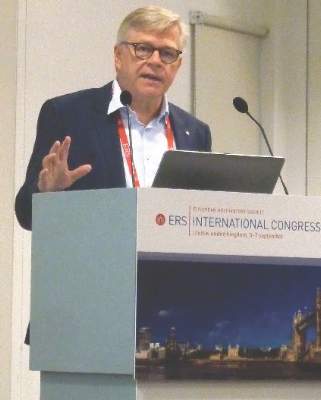
LABA withdrawal does not worsen asthma control
LONDON – Real-life experience shows that stopping treatment with a long-acting beta-agonist (LABA) does not worsen asthma control, nor does it lead to any immediate decline in lung function.
Spirometric parameters were similar before and 3 weeks after stopping LABA therapy in an observational study of 58 patients who had stable asthma and were being treated with an inhaled corticosteroid (ICS) and a LABA.
The forced expiratory volume in 1 second (FEV1) was 88.8% at baseline and 89.5% at the 3-week visit after stepping down their LABA therapy (P = .55). Patients’ average peak expiratory flow rate was 462 L/min both before and after LABA withdrawal.
In addition, no changes were seen in lung function based on impulse oscillometry, a noninvasive method for measuring airway resistance and reactance (Chest. 2014;146[3]:841-7). Similar levels of fractional exhaled nitric oxide (FeNO, 38 and 36 ppb) were recorded.
The findings were presented at the annual congress of the European Respiratory Society (ERS) and have been published in an early online edition of the Annals of Allergy, Asthma & Immunology (doi: 10.1016/j.anai.2016.07.022).
“About 45% of the UK adult asthma population are taking step 3 GINA [Global Initiative for Asthma] therapy, which is ICS/LABA,” explained Sunny Jabbal, MD, of the Scottish Centre for Respiratory Research at Ninewells Hospital in Dundee, Scotland, where the study was conducted. Patients should be on the lowest of the five steps in the 2016 GINA guidelines that achieve asthma control and should be regularly reviewed.
To test whether the LABA could be safely withdrawn, that is stepped down to ICS only [GINA step 2], Dr. Jabbal and colleagues studied 58 patients with a mean age of 39 years. All had well-controlled asthma, and had been receiving ICS/LABA for at least 3 months with no asthma exacerbations requiring treatment. None of the patients were current smokers.
At study entry, patients underwent spirometry, impulse oscillometry, and had FeNO measured. Their LABA was then stopped, and patients were reassessed 3 weeks later. “In accordance with GINA, their ICS dose was also reduced by approximately 25%,” Dr. Jabbal said.
Patients recorded their symptoms and short-term reliever (albuterol) use on simple diary cards. They were also given a 24-hour emergency mobile number, but no calls were received and no adverse events reported. The mean daily symptom score recorded during the step down process was 0.4 (out of a possible score of 3), and the mean albuterol usage was one puff per day.
One of the chairs of the session, Omar Usmani, MD, of Imperial College London noted that some clinicians are “very apprehensive” about stopping LABA and stepping down ICS therapy in their patients.
This was a short-term study, Dr. Jabbal acknowledged. Although a follow-up of 3 weeks may be enough to determine the effects of stopping a LABA, that time may not be sufficient to assess the effects of stepping down the ICS. Further real-life studies are needed to evaluate outcomes such as exacerbations and overall quality of life.
Improved adherence with ICS therapy after LABA withdrawal might explain the lack of deleterious effects, or perhaps some patients may not have initially needed an ICS/LABA combination, he speculated. Maybe even the steroid dose could be reduced further in this particular patient population.
The study received no commercial funding. Dr. Jabbal had no conflicts of interest related to his presentation.
LONDON – Real-life experience shows that stopping treatment with a long-acting beta-agonist (LABA) does not worsen asthma control, nor does it lead to any immediate decline in lung function.
Spirometric parameters were similar before and 3 weeks after stopping LABA therapy in an observational study of 58 patients who had stable asthma and were being treated with an inhaled corticosteroid (ICS) and a LABA.
The forced expiratory volume in 1 second (FEV1) was 88.8% at baseline and 89.5% at the 3-week visit after stepping down their LABA therapy (P = .55). Patients’ average peak expiratory flow rate was 462 L/min both before and after LABA withdrawal.
In addition, no changes were seen in lung function based on impulse oscillometry, a noninvasive method for measuring airway resistance and reactance (Chest. 2014;146[3]:841-7). Similar levels of fractional exhaled nitric oxide (FeNO, 38 and 36 ppb) were recorded.
The findings were presented at the annual congress of the European Respiratory Society (ERS) and have been published in an early online edition of the Annals of Allergy, Asthma & Immunology (doi: 10.1016/j.anai.2016.07.022).
“About 45% of the UK adult asthma population are taking step 3 GINA [Global Initiative for Asthma] therapy, which is ICS/LABA,” explained Sunny Jabbal, MD, of the Scottish Centre for Respiratory Research at Ninewells Hospital in Dundee, Scotland, where the study was conducted. Patients should be on the lowest of the five steps in the 2016 GINA guidelines that achieve asthma control and should be regularly reviewed.
To test whether the LABA could be safely withdrawn, that is stepped down to ICS only [GINA step 2], Dr. Jabbal and colleagues studied 58 patients with a mean age of 39 years. All had well-controlled asthma, and had been receiving ICS/LABA for at least 3 months with no asthma exacerbations requiring treatment. None of the patients were current smokers.
At study entry, patients underwent spirometry, impulse oscillometry, and had FeNO measured. Their LABA was then stopped, and patients were reassessed 3 weeks later. “In accordance with GINA, their ICS dose was also reduced by approximately 25%,” Dr. Jabbal said.
Patients recorded their symptoms and short-term reliever (albuterol) use on simple diary cards. They were also given a 24-hour emergency mobile number, but no calls were received and no adverse events reported. The mean daily symptom score recorded during the step down process was 0.4 (out of a possible score of 3), and the mean albuterol usage was one puff per day.
One of the chairs of the session, Omar Usmani, MD, of Imperial College London noted that some clinicians are “very apprehensive” about stopping LABA and stepping down ICS therapy in their patients.
This was a short-term study, Dr. Jabbal acknowledged. Although a follow-up of 3 weeks may be enough to determine the effects of stopping a LABA, that time may not be sufficient to assess the effects of stepping down the ICS. Further real-life studies are needed to evaluate outcomes such as exacerbations and overall quality of life.
Improved adherence with ICS therapy after LABA withdrawal might explain the lack of deleterious effects, or perhaps some patients may not have initially needed an ICS/LABA combination, he speculated. Maybe even the steroid dose could be reduced further in this particular patient population.
The study received no commercial funding. Dr. Jabbal had no conflicts of interest related to his presentation.
LONDON – Real-life experience shows that stopping treatment with a long-acting beta-agonist (LABA) does not worsen asthma control, nor does it lead to any immediate decline in lung function.
Spirometric parameters were similar before and 3 weeks after stopping LABA therapy in an observational study of 58 patients who had stable asthma and were being treated with an inhaled corticosteroid (ICS) and a LABA.
The forced expiratory volume in 1 second (FEV1) was 88.8% at baseline and 89.5% at the 3-week visit after stepping down their LABA therapy (P = .55). Patients’ average peak expiratory flow rate was 462 L/min both before and after LABA withdrawal.
In addition, no changes were seen in lung function based on impulse oscillometry, a noninvasive method for measuring airway resistance and reactance (Chest. 2014;146[3]:841-7). Similar levels of fractional exhaled nitric oxide (FeNO, 38 and 36 ppb) were recorded.
The findings were presented at the annual congress of the European Respiratory Society (ERS) and have been published in an early online edition of the Annals of Allergy, Asthma & Immunology (doi: 10.1016/j.anai.2016.07.022).
“About 45% of the UK adult asthma population are taking step 3 GINA [Global Initiative for Asthma] therapy, which is ICS/LABA,” explained Sunny Jabbal, MD, of the Scottish Centre for Respiratory Research at Ninewells Hospital in Dundee, Scotland, where the study was conducted. Patients should be on the lowest of the five steps in the 2016 GINA guidelines that achieve asthma control and should be regularly reviewed.
To test whether the LABA could be safely withdrawn, that is stepped down to ICS only [GINA step 2], Dr. Jabbal and colleagues studied 58 patients with a mean age of 39 years. All had well-controlled asthma, and had been receiving ICS/LABA for at least 3 months with no asthma exacerbations requiring treatment. None of the patients were current smokers.
At study entry, patients underwent spirometry, impulse oscillometry, and had FeNO measured. Their LABA was then stopped, and patients were reassessed 3 weeks later. “In accordance with GINA, their ICS dose was also reduced by approximately 25%,” Dr. Jabbal said.
Patients recorded their symptoms and short-term reliever (albuterol) use on simple diary cards. They were also given a 24-hour emergency mobile number, but no calls were received and no adverse events reported. The mean daily symptom score recorded during the step down process was 0.4 (out of a possible score of 3), and the mean albuterol usage was one puff per day.
One of the chairs of the session, Omar Usmani, MD, of Imperial College London noted that some clinicians are “very apprehensive” about stopping LABA and stepping down ICS therapy in their patients.
This was a short-term study, Dr. Jabbal acknowledged. Although a follow-up of 3 weeks may be enough to determine the effects of stopping a LABA, that time may not be sufficient to assess the effects of stepping down the ICS. Further real-life studies are needed to evaluate outcomes such as exacerbations and overall quality of life.
Improved adherence with ICS therapy after LABA withdrawal might explain the lack of deleterious effects, or perhaps some patients may not have initially needed an ICS/LABA combination, he speculated. Maybe even the steroid dose could be reduced further in this particular patient population.
The study received no commercial funding. Dr. Jabbal had no conflicts of interest related to his presentation.
AT THE ERS CONGRESS 2016
Key clinical point: Step-down treatment works well in routine asthma care, with no loss of control or lung function decline.
Major finding: No significant changes in FEV1 (88.8% vs. 89.5%), PEF (462 L/min vs. 462 L/min), or other lung function variables were seen before or 3 weeks after LABA withdrawal.
Data source: Observational study of 58 stable asthmatic patients being treated with ICS/LABA (GINA step 3).
Disclosures: The study received no commercial funding. Dr. Jabbal had no conflicts of interest related to his presentation.
Etanercept biosimilar proves effective, tolerated in phase III trial
LONDON – Biosimilar etanercept (CHS-0214) is as effective and well tolerated as etanercept (Enbrel) for the treatment of rheumatoid arthritis according to the results of a randomized, double-blind, phase III trial conducted in 13 countries.
The primary endpoint of an American College of Rheumatology (ACR) 20 at 24 weeks was achieved by 91% of patients given CHS-0214 and 90.6% of those given etanercept, giving a treatment difference of just 0.4%. The percentages of patients achieving ACR 50 (67.6% and 63.7%) and ACR 70 (38.3% and 37.9%) were also comparable.

These are the first clinical data to be presented on this biosimilar, which is a fusion protein comprising the soluble human p75 tumor necrosis factor (TNF) receptor and the Fc region of human immunoglobulin G1.
“Like all biosimilars CHD-0214 has undergone extensive analytical characterization, which had demonstrated highly similar structure and function to etanercept,” study investigator James O’Dell, MD, of the University of Nebraska Medical Center, Omaha, said at the European Congress of Rheumatology. “Studies have demonstrated that CHS-0214 is similar to etanercept with regard to in vitro pharmacology, in vivo pharmacokinetics, and toxicology,” he observed.
A total of 644 patients with moderate to severe rheumatoid arthritis who had an inadequate response to methotrexate were enrolled in the phase III trial and randomized to receive CHS-0214 or etanercept at a subcutaneous dose of 50 mg once a week for 24 weeks. After the double-blind period had ended, patients could continue on open-label CHS-0214 for another 24 weeks. Assessment of efficacy was performed on 512 patients as an issue with the production of the biosimilar resulted in a dosing interruption for 132 patients.
Remission, defined as a DAS28-CRP (Disease Activity Score 28–C-reactive protein) score of less than 2.6, was achieved in a similar percentage of subjects in the CHS-0214 and etanercept groups, at 40.6% and 42.4%, respectively.
There was a similar percentage of any adverse event (60.8% vs. 65%) occurring among patients receiving the biosimilar and those getting etanercept. Treatment-related adverse events (16.4% vs. 21.9%), and treatment-related serious adverse events (0.9% vs. 0.3%) were also comparable. Drug-drug antibodies occurred in numerically fewer patients treated with the biosimilar than with etanercept (1.3% vs. 4.7%).
Asked after his presentation about why he thought the ACR responses seen in the study were so high, Dr. O’Dell said: “We were surprised by that.” There are a number of potential explanations, he suggested. “We had a remarkable completion rate in the trial, 95%, so we lost very few patients, and we are in the process of analyzing other trials to see if that is a major factor.” In addition, patients were on relatively lower doses of methotrexate than in some other trials “because a quarter of them came from Japan,” he said. Patients were also all biologic naive and many were recruited from countries where they don’t have the opportunity to be exposed to a lot of therapies.
“The studies on all biosimilars so far suggest that they are indeed biosimilar,” Dr. O’Dell said in an interview. So how might clinicians begin to choose between the various biosimilars? “Well, there is very, very little data to compare any biologic to another biologic,” he answered.
“You haven’t seen studies comparing one TNF inhibitor to another TNF inhibitor. So it’s not surprising that we don’t have data that compare this biosimilar to that biosimilar,” he added. Such studies are probably also unlikely to ever be conducted so the choice of biosimilar, like anti-TNF therapy is probably going to be dictated by national and local guidelines, and medical insurance policies.
“Today, the biosimilars look biosimilar, so I have no problems if somebody tells me I have to start a biosimilar as opposed to the innovator product. I do have a problem if they tell me I have to switch, because that’s interchangeability and that’s a whole different story,” he noted.
Dr. O’Dell observed, however, that data from the DANBIO registry presented during the same session had shown that an enforced national switch from infliximab (Remicade) to biosimilar infliximab had shown that this did not appear to pose a problem in routine care in Denmark. Indeed 3 months’ clinical outcomes in patients with RA, psoriatic arthritis, or axial spondyloarthritis who were switched appeared to be comparable. Whether this is true across all the biosimilars needs to be established.
Coherus Biosciences funded the study. Dr. O’Dell has been a study investigator for, received research grants from, or acted as a speaker or consultant to Coherus Biosciences, Medac, Eli Lilly, Bristol-Myers Squibb, GlaxoSmithKline, Antares, and Crescendo.
LONDON – Biosimilar etanercept (CHS-0214) is as effective and well tolerated as etanercept (Enbrel) for the treatment of rheumatoid arthritis according to the results of a randomized, double-blind, phase III trial conducted in 13 countries.
The primary endpoint of an American College of Rheumatology (ACR) 20 at 24 weeks was achieved by 91% of patients given CHS-0214 and 90.6% of those given etanercept, giving a treatment difference of just 0.4%. The percentages of patients achieving ACR 50 (67.6% and 63.7%) and ACR 70 (38.3% and 37.9%) were also comparable.
These are the first clinical data to be presented on this biosimilar, which is a fusion protein comprising the soluble human p75 tumor necrosis factor (TNF) receptor and the Fc region of human immunoglobulin G1.
“Like all biosimilars CHD-0214 has undergone extensive analytical characterization, which had demonstrated highly similar structure and function to etanercept,” study investigator James O’Dell, MD, of the University of Nebraska Medical Center, Omaha, said at the European Congress of Rheumatology. “Studies have demonstrated that CHS-0214 is similar to etanercept with regard to in vitro pharmacology, in vivo pharmacokinetics, and toxicology,” he observed.
A total of 644 patients with moderate to severe rheumatoid arthritis who had an inadequate response to methotrexate were enrolled in the phase III trial and randomized to receive CHS-0214 or etanercept at a subcutaneous dose of 50 mg once a week for 24 weeks. After the double-blind period had ended, patients could continue on open-label CHS-0214 for another 24 weeks. Assessment of efficacy was performed on 512 patients as an issue with the production of the biosimilar resulted in a dosing interruption for 132 patients.
Remission, defined as a DAS28-CRP (Disease Activity Score 28–C-reactive protein) score of less than 2.6, was achieved in a similar percentage of subjects in the CHS-0214 and etanercept groups, at 40.6% and 42.4%, respectively.
There was a similar percentage of any adverse event (60.8% vs. 65%) occurring among patients receiving the biosimilar and those getting etanercept. Treatment-related adverse events (16.4% vs. 21.9%), and treatment-related serious adverse events (0.9% vs. 0.3%) were also comparable. Drug-drug antibodies occurred in numerically fewer patients treated with the biosimilar than with etanercept (1.3% vs. 4.7%).
Asked after his presentation about why he thought the ACR responses seen in the study were so high, Dr. O’Dell said: “We were surprised by that.” There are a number of potential explanations, he suggested. “We had a remarkable completion rate in the trial, 95%, so we lost very few patients, and we are in the process of analyzing other trials to see if that is a major factor.” In addition, patients were on relatively lower doses of methotrexate than in some other trials “because a quarter of them came from Japan,” he said. Patients were also all biologic naive and many were recruited from countries where they don’t have the opportunity to be exposed to a lot of therapies.
“The studies on all biosimilars so far suggest that they are indeed biosimilar,” Dr. O’Dell said in an interview. So how might clinicians begin to choose between the various biosimilars? “Well, there is very, very little data to compare any biologic to another biologic,” he answered.
“You haven’t seen studies comparing one TNF inhibitor to another TNF inhibitor. So it’s not surprising that we don’t have data that compare this biosimilar to that biosimilar,” he added. Such studies are probably also unlikely to ever be conducted so the choice of biosimilar, like anti-TNF therapy is probably going to be dictated by national and local guidelines, and medical insurance policies.
“Today, the biosimilars look biosimilar, so I have no problems if somebody tells me I have to start a biosimilar as opposed to the innovator product. I do have a problem if they tell me I have to switch, because that’s interchangeability and that’s a whole different story,” he noted.
Dr. O’Dell observed, however, that data from the DANBIO registry presented during the same session had shown that an enforced national switch from infliximab (Remicade) to biosimilar infliximab had shown that this did not appear to pose a problem in routine care in Denmark. Indeed 3 months’ clinical outcomes in patients with RA, psoriatic arthritis, or axial spondyloarthritis who were switched appeared to be comparable. Whether this is true across all the biosimilars needs to be established.
Coherus Biosciences funded the study. Dr. O’Dell has been a study investigator for, received research grants from, or acted as a speaker or consultant to Coherus Biosciences, Medac, Eli Lilly, Bristol-Myers Squibb, GlaxoSmithKline, Antares, and Crescendo.
LONDON – Biosimilar etanercept (CHS-0214) is as effective and well tolerated as etanercept (Enbrel) for the treatment of rheumatoid arthritis according to the results of a randomized, double-blind, phase III trial conducted in 13 countries.
The primary endpoint of an American College of Rheumatology (ACR) 20 at 24 weeks was achieved by 91% of patients given CHS-0214 and 90.6% of those given etanercept, giving a treatment difference of just 0.4%. The percentages of patients achieving ACR 50 (67.6% and 63.7%) and ACR 70 (38.3% and 37.9%) were also comparable.
These are the first clinical data to be presented on this biosimilar, which is a fusion protein comprising the soluble human p75 tumor necrosis factor (TNF) receptor and the Fc region of human immunoglobulin G1.
“Like all biosimilars CHD-0214 has undergone extensive analytical characterization, which had demonstrated highly similar structure and function to etanercept,” study investigator James O’Dell, MD, of the University of Nebraska Medical Center, Omaha, said at the European Congress of Rheumatology. “Studies have demonstrated that CHS-0214 is similar to etanercept with regard to in vitro pharmacology, in vivo pharmacokinetics, and toxicology,” he observed.
A total of 644 patients with moderate to severe rheumatoid arthritis who had an inadequate response to methotrexate were enrolled in the phase III trial and randomized to receive CHS-0214 or etanercept at a subcutaneous dose of 50 mg once a week for 24 weeks. After the double-blind period had ended, patients could continue on open-label CHS-0214 for another 24 weeks. Assessment of efficacy was performed on 512 patients as an issue with the production of the biosimilar resulted in a dosing interruption for 132 patients.
Remission, defined as a DAS28-CRP (Disease Activity Score 28–C-reactive protein) score of less than 2.6, was achieved in a similar percentage of subjects in the CHS-0214 and etanercept groups, at 40.6% and 42.4%, respectively.
There was a similar percentage of any adverse event (60.8% vs. 65%) occurring among patients receiving the biosimilar and those getting etanercept. Treatment-related adverse events (16.4% vs. 21.9%), and treatment-related serious adverse events (0.9% vs. 0.3%) were also comparable. Drug-drug antibodies occurred in numerically fewer patients treated with the biosimilar than with etanercept (1.3% vs. 4.7%).
Asked after his presentation about why he thought the ACR responses seen in the study were so high, Dr. O’Dell said: “We were surprised by that.” There are a number of potential explanations, he suggested. “We had a remarkable completion rate in the trial, 95%, so we lost very few patients, and we are in the process of analyzing other trials to see if that is a major factor.” In addition, patients were on relatively lower doses of methotrexate than in some other trials “because a quarter of them came from Japan,” he said. Patients were also all biologic naive and many were recruited from countries where they don’t have the opportunity to be exposed to a lot of therapies.
“The studies on all biosimilars so far suggest that they are indeed biosimilar,” Dr. O’Dell said in an interview. So how might clinicians begin to choose between the various biosimilars? “Well, there is very, very little data to compare any biologic to another biologic,” he answered.
“You haven’t seen studies comparing one TNF inhibitor to another TNF inhibitor. So it’s not surprising that we don’t have data that compare this biosimilar to that biosimilar,” he added. Such studies are probably also unlikely to ever be conducted so the choice of biosimilar, like anti-TNF therapy is probably going to be dictated by national and local guidelines, and medical insurance policies.
“Today, the biosimilars look biosimilar, so I have no problems if somebody tells me I have to start a biosimilar as opposed to the innovator product. I do have a problem if they tell me I have to switch, because that’s interchangeability and that’s a whole different story,” he noted.
Dr. O’Dell observed, however, that data from the DANBIO registry presented during the same session had shown that an enforced national switch from infliximab (Remicade) to biosimilar infliximab had shown that this did not appear to pose a problem in routine care in Denmark. Indeed 3 months’ clinical outcomes in patients with RA, psoriatic arthritis, or axial spondyloarthritis who were switched appeared to be comparable. Whether this is true across all the biosimilars needs to be established.
Coherus Biosciences funded the study. Dr. O’Dell has been a study investigator for, received research grants from, or acted as a speaker or consultant to Coherus Biosciences, Medac, Eli Lilly, Bristol-Myers Squibb, GlaxoSmithKline, Antares, and Crescendo.
AT THE EULAR 2016 CONGRESS
Key clinical point: Biosimilar etanercept (CHS-0214) was shown to be as effective and well tolerated as etanercept.
Major finding: ACR 20 at 24 weeks (primary endpoint) was achieved by 91% given the biosimilar and 90.6% of those given etanercept.
Data source: Multicenter, randomized, double-blind, phase III trial comparing the etanercept biosimilar CHS-0215 with etanercept in 644 patients with rheumatoid arthritis.
Disclosures: Coherus Biosciences funded the study. Dr. O’Dell has been a study investigator for, received research grants from, or acted as a speaker or consultant to Coherus Biosciences, Medac, Eli Lilly, Bristol-Myers Squibb, GlaxoSmithKline, Antares, and Crescendo.