User login
Official news magazine of the Society of Hospital Medicine
Copyright by Society of Hospital Medicine or related companies. All rights reserved. ISSN 1553-085X
nav[contains(@class, 'nav-ce-stack nav-ce-stack__large-screen')]
header[@id='header']
div[contains(@class, 'header__large-screen')]
div[contains(@class, 'read-next-article')]
div[contains(@class, 'main-prefix')]
div[contains(@class, 'nav-primary')]
nav[contains(@class, 'nav-primary')]
section[contains(@class, 'footer-nav-section-wrapper')]
footer[@id='footer']
section[contains(@class, 'nav-hidden')]
div[contains(@class, 'ce-card-content')]
nav[contains(@class, 'nav-ce-stack')]
div[contains(@class, 'view-medstat-quiz-listing-panes')]
div[contains(@class, 'pane-article-sidebar-latest-news')]
div[contains(@class, 'pane-pub-article-hospitalist')]
Medical Students Receive Grants from Society of Hospital Medicine
Philadelphia, PA –The Society of Hospital Medicine (SHM)’s Physician in Training Committee recently announced the 2016 Student Hospitalist Scholar Grant recipients, who earned the scholarship based on their abilities and interest in hospital medicine, prior educational training and dedication to scholarly activity in the field.
SHM’s Physician in Training Committee launched the scholarship program for medical students in 2015 to inspire future hospitalists to play an active role in transforming healthcare and revolutionizing patient care. For more information on the Student Hospitalist Scholar Grant. All information for trainees interested in hospital medicine can be found at, SHM’s website dedicated to resources for those interested in a career as a hospitalist. To join SHM as a medical student member at no cost.
The four grant recipients, each of whom is a student member of SHM, will use their funding to complete scholarly work with an active SHM member as their mentor on a project related to patient safety or quality improvement. The 2016 Student Hospitalist Scholarship recipients are:
- Shane Ali, University of Texas School of Medicine at San Antonio
Mentor: Nilam Soni, MD
Project: Pleural Fluid Echogenicity by Ultrasound Imaging and Computer Based Pixilation to Determine Transudative vs. Exudative Effusions
Project Site: University of Texas Health Science Center, San Antonio, Texas
- Joseph Moo-Young, University of North Carolina School of Medicine
Mentor: Ria Dancel, MD, FHM
Project: Analysis and Optimization of the Inpatient Pediatric Discharge Process
Project Site: University of North Carolina Children's Hospital
- Aram Namavar, Loyola University Chicago – Stritch School of Medicine
Mentor: Nasim Afsar, MD, SFHM
Project: Evaluation of Decisional Conflict as a Simple Tool to assess Risk for Readmission
Location of Project: Ronald Reagan UCLA Medical Center, Los Angeles, CA
- Haverly Snyder, Medical College of Wisconsin
Mentor: Kathlyn Fletcher, MD, FHM
Project: The Trauma of Hospitalization: Identifying Causes and Potential Solutions
Project Site: Froedtert Memorial Lutheran Hospital, Milwaukee, Wisconsin
Throughout their experiences, the student scholars will be blogging about their projects on SHM’s official blog, The Hospital Leader, and posting in the Future of Hospital Medicine community on the Hospital Medicine Exchange (HMX), SHM’s online member engagement platform. Upon completing their projects, the students will draft progress reports and submit their findings as abstracts for the Research, Innovations and Clinical Vignettes (RIV) competition at Hospital Medicine 2017, SHM’s annual meeting to be held in Las Vegas in May.
Philadelphia, PA –The Society of Hospital Medicine (SHM)’s Physician in Training Committee recently announced the 2016 Student Hospitalist Scholar Grant recipients, who earned the scholarship based on their abilities and interest in hospital medicine, prior educational training and dedication to scholarly activity in the field.
SHM’s Physician in Training Committee launched the scholarship program for medical students in 2015 to inspire future hospitalists to play an active role in transforming healthcare and revolutionizing patient care. For more information on the Student Hospitalist Scholar Grant. All information for trainees interested in hospital medicine can be found at, SHM’s website dedicated to resources for those interested in a career as a hospitalist. To join SHM as a medical student member at no cost.
The four grant recipients, each of whom is a student member of SHM, will use their funding to complete scholarly work with an active SHM member as their mentor on a project related to patient safety or quality improvement. The 2016 Student Hospitalist Scholarship recipients are:
- Shane Ali, University of Texas School of Medicine at San Antonio
Mentor: Nilam Soni, MD
Project: Pleural Fluid Echogenicity by Ultrasound Imaging and Computer Based Pixilation to Determine Transudative vs. Exudative Effusions
Project Site: University of Texas Health Science Center, San Antonio, Texas
- Joseph Moo-Young, University of North Carolina School of Medicine
Mentor: Ria Dancel, MD, FHM
Project: Analysis and Optimization of the Inpatient Pediatric Discharge Process
Project Site: University of North Carolina Children's Hospital
- Aram Namavar, Loyola University Chicago – Stritch School of Medicine
Mentor: Nasim Afsar, MD, SFHM
Project: Evaluation of Decisional Conflict as a Simple Tool to assess Risk for Readmission
Location of Project: Ronald Reagan UCLA Medical Center, Los Angeles, CA
- Haverly Snyder, Medical College of Wisconsin
Mentor: Kathlyn Fletcher, MD, FHM
Project: The Trauma of Hospitalization: Identifying Causes and Potential Solutions
Project Site: Froedtert Memorial Lutheran Hospital, Milwaukee, Wisconsin
Throughout their experiences, the student scholars will be blogging about their projects on SHM’s official blog, The Hospital Leader, and posting in the Future of Hospital Medicine community on the Hospital Medicine Exchange (HMX), SHM’s online member engagement platform. Upon completing their projects, the students will draft progress reports and submit their findings as abstracts for the Research, Innovations and Clinical Vignettes (RIV) competition at Hospital Medicine 2017, SHM’s annual meeting to be held in Las Vegas in May.
Philadelphia, PA –The Society of Hospital Medicine (SHM)’s Physician in Training Committee recently announced the 2016 Student Hospitalist Scholar Grant recipients, who earned the scholarship based on their abilities and interest in hospital medicine, prior educational training and dedication to scholarly activity in the field.
SHM’s Physician in Training Committee launched the scholarship program for medical students in 2015 to inspire future hospitalists to play an active role in transforming healthcare and revolutionizing patient care. For more information on the Student Hospitalist Scholar Grant. All information for trainees interested in hospital medicine can be found at, SHM’s website dedicated to resources for those interested in a career as a hospitalist. To join SHM as a medical student member at no cost.
The four grant recipients, each of whom is a student member of SHM, will use their funding to complete scholarly work with an active SHM member as their mentor on a project related to patient safety or quality improvement. The 2016 Student Hospitalist Scholarship recipients are:
- Shane Ali, University of Texas School of Medicine at San Antonio
Mentor: Nilam Soni, MD
Project: Pleural Fluid Echogenicity by Ultrasound Imaging and Computer Based Pixilation to Determine Transudative vs. Exudative Effusions
Project Site: University of Texas Health Science Center, San Antonio, Texas
- Joseph Moo-Young, University of North Carolina School of Medicine
Mentor: Ria Dancel, MD, FHM
Project: Analysis and Optimization of the Inpatient Pediatric Discharge Process
Project Site: University of North Carolina Children's Hospital
- Aram Namavar, Loyola University Chicago – Stritch School of Medicine
Mentor: Nasim Afsar, MD, SFHM
Project: Evaluation of Decisional Conflict as a Simple Tool to assess Risk for Readmission
Location of Project: Ronald Reagan UCLA Medical Center, Los Angeles, CA
- Haverly Snyder, Medical College of Wisconsin
Mentor: Kathlyn Fletcher, MD, FHM
Project: The Trauma of Hospitalization: Identifying Causes and Potential Solutions
Project Site: Froedtert Memorial Lutheran Hospital, Milwaukee, Wisconsin
Throughout their experiences, the student scholars will be blogging about their projects on SHM’s official blog, The Hospital Leader, and posting in the Future of Hospital Medicine community on the Hospital Medicine Exchange (HMX), SHM’s online member engagement platform. Upon completing their projects, the students will draft progress reports and submit their findings as abstracts for the Research, Innovations and Clinical Vignettes (RIV) competition at Hospital Medicine 2017, SHM’s annual meeting to be held in Las Vegas in May.
Research Finds the Main Cause of Inferior Vena Cava Thrombosis
NEW YORK (Reuters Health) - In the absence of a congenital anomaly, the main cause of inferior vena cava (IVC) thrombosis is the presence of an unretrieved IVC filter, researchers report.
"Since IVC filter thrombosis is the main etiology for IVC thrombosis, physicians may want to ensure the absolute need for the filter before its placement," Dr. Mohamad Alkhouli from University of Rochester Medical Center, New York told Reuters Health by email. "A tracking system should be instituted to follow up with these patients, and the implanted IVC filter should be pulled out as soon as is safe and reasonable."
IVC thrombosis accompanies lower extremity deep vein thrombosis (DVT) in 4% or more of patients, leading to post-thrombotic syndrome (PTS) in up to 90% of patients, disabling venous claudication in 45%, pulmonary embolism in 30%, and venous ulceration in 15%, according to Dr. Alkhouli and colleagues, who reviewed the diagnosis and management of IVC thrombosis in a report online March 9th in JACC: Cardiovascular Interventions.
IVC filter placement rates are 25 times higher in the U.S. than in Europe, and late filter thrombosis has been reported in up to a third of patients, yet retrieval rates are consistently low.
Presenting symptoms of IVC thrombosis include leg heaviness, pain, swelling, and cramping, often preceded by nonspecific back and abdominal/pelvic pain. Because of the ambiguous symptoms and insidious onset, IVC thrombosis often goes undiagnosed until clot migration or embolization into the lungs and renal veins results in dyspnea and oliguria.
Lower extremity duplex ultrasound can be used to screen for IVC thrombosis, but appropriately timed CT and MRI are essential for diagnosis and assessment of the extent of thrombosis.
Once IVC thrombosis is diagnosed, the mainstay of treatment is anticoagulation, although specific guidelines are lacking.
In observational studies, thrombus removal with pharmacomechanical catheter directed thrombolysis (PMCT) has reduced the incidence of PTS and improved quality of life, but whether this is as safe as standard anticoagulation remains unclear.
While acute thrombosis may be amenable to PMCT and catheter-directed thrombolysis (CDT), the presence of a fibrotic component in patients who present late may require balloon venoplasty with or without stenting.
The available treatments work best when IVC thrombosis is recognized early, Dr. Alkhouli said.
Dr. Michael Jaff from Massachusetts General Hospital, Harvard Medical School, Boston, Massachusetts, who wrote an editorial related to this report, told Reuters Health by email, "Limit placement of IVC filters to only absolute indications, and retrieve them as soon as possible."
Dr. Jaff explained, "There are three basic questions I ask myself when considering catheter-based intervention for IVC thrombosis: (1) How long has the patient had symptoms/signs suggestive of this, and how severe are they? (2) What is my estimation of bleeding risk? (3) Do I have an interventionist with skill and experience available to perform the intervention?"
He continued, "Regarding question 1, shorter duration of symptoms and more severe symptoms and signs prompt me to aggressively consider catheter-based intervention. Regarding question 2, if there is significant bleeding risk (for example, inflammatory bowel disease as the underlying culprit for the IVC thrombosis), I am reluctant to consider catheter-based intervention.Regarding question 3, don't consider this if your colleague has little experience performing this procedure or managing the complications of the procedure."
Dr. Xiao-Qiang Li from Second Affiliated Hospital of Soochow University in Suzhou, China, who recently described the experience with CDT combined with manual aspiration thrombectomy for acute inferior vena cava filter thrombosis, told Reuters Health by email, "As you see, no consensuses have been reached."
"For a new patient with acute DVT, if he or she has no contraindications for thrombolysis, especially with a life expectancy more than one year, we prefer to perform catheter-based interventions, including catheter-directed thrombolysis, pharmacomechanical thrombolysis, ultrasound-assisted catheter-directed thrombolysis and subsequent percutaneous transluminal angioplasty and stenting,"Dr. Li said."But, of note, anticoagulation is the basic treatment whatever catheter-based interventions are adopted."
NEW YORK (Reuters Health) - In the absence of a congenital anomaly, the main cause of inferior vena cava (IVC) thrombosis is the presence of an unretrieved IVC filter, researchers report.
"Since IVC filter thrombosis is the main etiology for IVC thrombosis, physicians may want to ensure the absolute need for the filter before its placement," Dr. Mohamad Alkhouli from University of Rochester Medical Center, New York told Reuters Health by email. "A tracking system should be instituted to follow up with these patients, and the implanted IVC filter should be pulled out as soon as is safe and reasonable."
IVC thrombosis accompanies lower extremity deep vein thrombosis (DVT) in 4% or more of patients, leading to post-thrombotic syndrome (PTS) in up to 90% of patients, disabling venous claudication in 45%, pulmonary embolism in 30%, and venous ulceration in 15%, according to Dr. Alkhouli and colleagues, who reviewed the diagnosis and management of IVC thrombosis in a report online March 9th in JACC: Cardiovascular Interventions.
IVC filter placement rates are 25 times higher in the U.S. than in Europe, and late filter thrombosis has been reported in up to a third of patients, yet retrieval rates are consistently low.
Presenting symptoms of IVC thrombosis include leg heaviness, pain, swelling, and cramping, often preceded by nonspecific back and abdominal/pelvic pain. Because of the ambiguous symptoms and insidious onset, IVC thrombosis often goes undiagnosed until clot migration or embolization into the lungs and renal veins results in dyspnea and oliguria.
Lower extremity duplex ultrasound can be used to screen for IVC thrombosis, but appropriately timed CT and MRI are essential for diagnosis and assessment of the extent of thrombosis.
Once IVC thrombosis is diagnosed, the mainstay of treatment is anticoagulation, although specific guidelines are lacking.
In observational studies, thrombus removal with pharmacomechanical catheter directed thrombolysis (PMCT) has reduced the incidence of PTS and improved quality of life, but whether this is as safe as standard anticoagulation remains unclear.
While acute thrombosis may be amenable to PMCT and catheter-directed thrombolysis (CDT), the presence of a fibrotic component in patients who present late may require balloon venoplasty with or without stenting.
The available treatments work best when IVC thrombosis is recognized early, Dr. Alkhouli said.
Dr. Michael Jaff from Massachusetts General Hospital, Harvard Medical School, Boston, Massachusetts, who wrote an editorial related to this report, told Reuters Health by email, "Limit placement of IVC filters to only absolute indications, and retrieve them as soon as possible."
Dr. Jaff explained, "There are three basic questions I ask myself when considering catheter-based intervention for IVC thrombosis: (1) How long has the patient had symptoms/signs suggestive of this, and how severe are they? (2) What is my estimation of bleeding risk? (3) Do I have an interventionist with skill and experience available to perform the intervention?"
He continued, "Regarding question 1, shorter duration of symptoms and more severe symptoms and signs prompt me to aggressively consider catheter-based intervention. Regarding question 2, if there is significant bleeding risk (for example, inflammatory bowel disease as the underlying culprit for the IVC thrombosis), I am reluctant to consider catheter-based intervention.Regarding question 3, don't consider this if your colleague has little experience performing this procedure or managing the complications of the procedure."
Dr. Xiao-Qiang Li from Second Affiliated Hospital of Soochow University in Suzhou, China, who recently described the experience with CDT combined with manual aspiration thrombectomy for acute inferior vena cava filter thrombosis, told Reuters Health by email, "As you see, no consensuses have been reached."
"For a new patient with acute DVT, if he or she has no contraindications for thrombolysis, especially with a life expectancy more than one year, we prefer to perform catheter-based interventions, including catheter-directed thrombolysis, pharmacomechanical thrombolysis, ultrasound-assisted catheter-directed thrombolysis and subsequent percutaneous transluminal angioplasty and stenting,"Dr. Li said."But, of note, anticoagulation is the basic treatment whatever catheter-based interventions are adopted."
NEW YORK (Reuters Health) - In the absence of a congenital anomaly, the main cause of inferior vena cava (IVC) thrombosis is the presence of an unretrieved IVC filter, researchers report.
"Since IVC filter thrombosis is the main etiology for IVC thrombosis, physicians may want to ensure the absolute need for the filter before its placement," Dr. Mohamad Alkhouli from University of Rochester Medical Center, New York told Reuters Health by email. "A tracking system should be instituted to follow up with these patients, and the implanted IVC filter should be pulled out as soon as is safe and reasonable."
IVC thrombosis accompanies lower extremity deep vein thrombosis (DVT) in 4% or more of patients, leading to post-thrombotic syndrome (PTS) in up to 90% of patients, disabling venous claudication in 45%, pulmonary embolism in 30%, and venous ulceration in 15%, according to Dr. Alkhouli and colleagues, who reviewed the diagnosis and management of IVC thrombosis in a report online March 9th in JACC: Cardiovascular Interventions.
IVC filter placement rates are 25 times higher in the U.S. than in Europe, and late filter thrombosis has been reported in up to a third of patients, yet retrieval rates are consistently low.
Presenting symptoms of IVC thrombosis include leg heaviness, pain, swelling, and cramping, often preceded by nonspecific back and abdominal/pelvic pain. Because of the ambiguous symptoms and insidious onset, IVC thrombosis often goes undiagnosed until clot migration or embolization into the lungs and renal veins results in dyspnea and oliguria.
Lower extremity duplex ultrasound can be used to screen for IVC thrombosis, but appropriately timed CT and MRI are essential for diagnosis and assessment of the extent of thrombosis.
Once IVC thrombosis is diagnosed, the mainstay of treatment is anticoagulation, although specific guidelines are lacking.
In observational studies, thrombus removal with pharmacomechanical catheter directed thrombolysis (PMCT) has reduced the incidence of PTS and improved quality of life, but whether this is as safe as standard anticoagulation remains unclear.
While acute thrombosis may be amenable to PMCT and catheter-directed thrombolysis (CDT), the presence of a fibrotic component in patients who present late may require balloon venoplasty with or without stenting.
The available treatments work best when IVC thrombosis is recognized early, Dr. Alkhouli said.
Dr. Michael Jaff from Massachusetts General Hospital, Harvard Medical School, Boston, Massachusetts, who wrote an editorial related to this report, told Reuters Health by email, "Limit placement of IVC filters to only absolute indications, and retrieve them as soon as possible."
Dr. Jaff explained, "There are three basic questions I ask myself when considering catheter-based intervention for IVC thrombosis: (1) How long has the patient had symptoms/signs suggestive of this, and how severe are they? (2) What is my estimation of bleeding risk? (3) Do I have an interventionist with skill and experience available to perform the intervention?"
He continued, "Regarding question 1, shorter duration of symptoms and more severe symptoms and signs prompt me to aggressively consider catheter-based intervention. Regarding question 2, if there is significant bleeding risk (for example, inflammatory bowel disease as the underlying culprit for the IVC thrombosis), I am reluctant to consider catheter-based intervention.Regarding question 3, don't consider this if your colleague has little experience performing this procedure or managing the complications of the procedure."
Dr. Xiao-Qiang Li from Second Affiliated Hospital of Soochow University in Suzhou, China, who recently described the experience with CDT combined with manual aspiration thrombectomy for acute inferior vena cava filter thrombosis, told Reuters Health by email, "As you see, no consensuses have been reached."
"For a new patient with acute DVT, if he or she has no contraindications for thrombolysis, especially with a life expectancy more than one year, we prefer to perform catheter-based interventions, including catheter-directed thrombolysis, pharmacomechanical thrombolysis, ultrasound-assisted catheter-directed thrombolysis and subsequent percutaneous transluminal angioplasty and stenting,"Dr. Li said."But, of note, anticoagulation is the basic treatment whatever catheter-based interventions are adopted."
Did You Commit to ‘Fight the Resistance’ at HM16?

If you missed HM16 but still want to show your support, visit www.FightTheResistance.org to review SHM’s recommendations for promoting antibiotic stewardship, download copies of our three posters, and submit your case study about how you’re fighting antibiotic resistance in your hospital.
Continue to check www.FightTheResistance.org and follow the #FightTheResistance hashtag on Twitter to learn about new SHM resources to help you continue the fight.
If you missed HM16 but still want to show your support, visit www.FightTheResistance.org to review SHM’s recommendations for promoting antibiotic stewardship, download copies of our three posters, and submit your case study about how you’re fighting antibiotic resistance in your hospital.
Continue to check www.FightTheResistance.org and follow the #FightTheResistance hashtag on Twitter to learn about new SHM resources to help you continue the fight.
If you missed HM16 but still want to show your support, visit www.FightTheResistance.org to review SHM’s recommendations for promoting antibiotic stewardship, download copies of our three posters, and submit your case study about how you’re fighting antibiotic resistance in your hospital.
Continue to check www.FightTheResistance.org and follow the #FightTheResistance hashtag on Twitter to learn about new SHM resources to help you continue the fight.

Jerome C. Siy, MD, SFHM Explores Hospital Medicine’s Global Reach

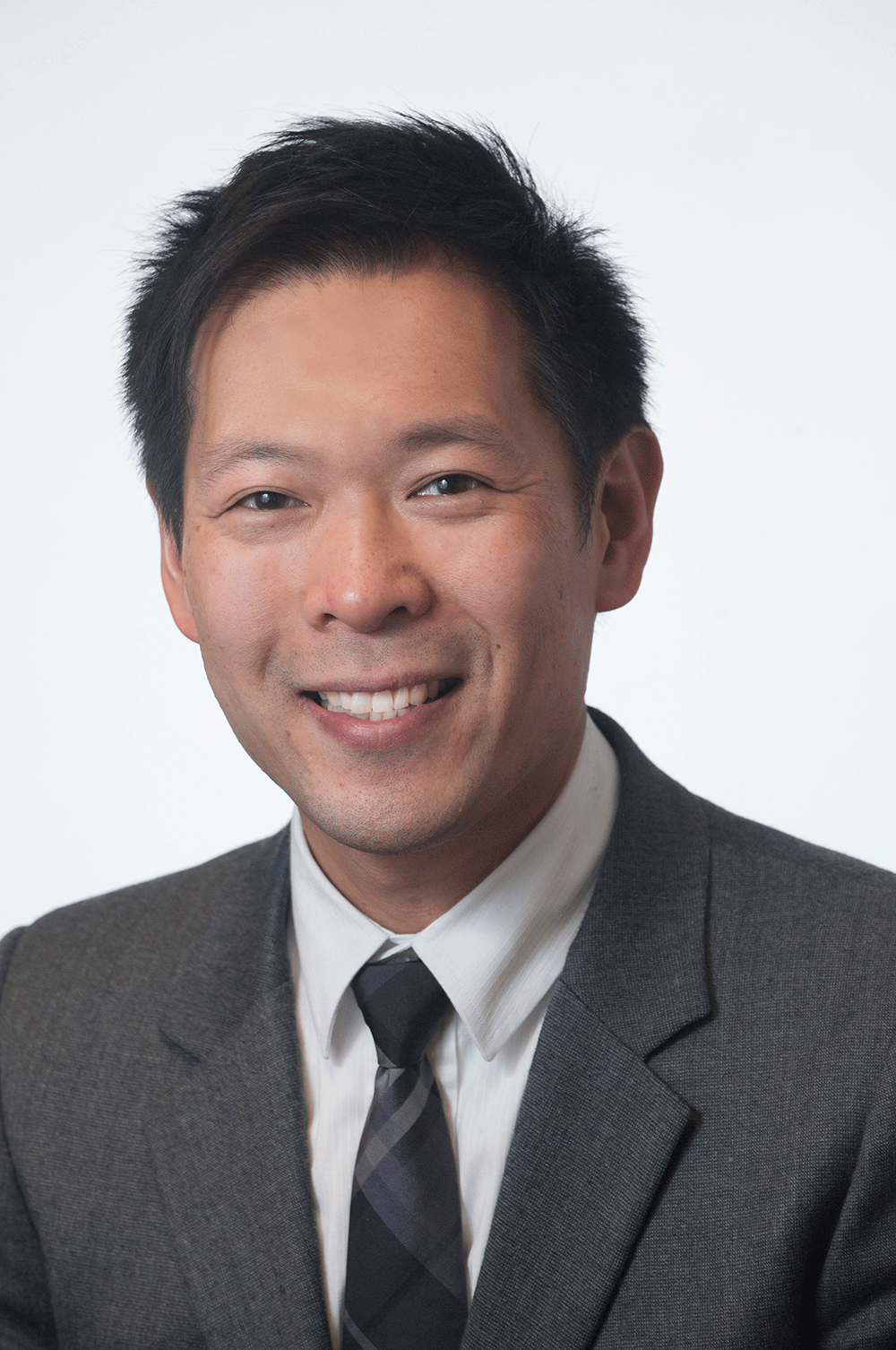
Hospitalist Jerome C. Siy, MD, SFHM, CHIE, is head of the Department of Hospital Medicine at HealthPartners in Minneapolis-St. Paul, Minn., and chair of SHM’s Practice Management Committee. As a member of SHM for more than 15 years and recipient of SHM’s prestigious Award of Excellence for Clinical Excellence in 2009, Dr. Siy has been a driving force in advancing hospitalist practice and improving patient care in the U.S. and beyond.
Question: What led you to a career in hospital medicine?
Answer: After graduating from the Mayo Graduate School of Medical Education, I started in the med-peds residency program at the University of Minnesota and then transitioned to an internal medicine residency program. It was at the University of Minnesota that I recognized my intense passion for the care of acutely ill hospitalized patients. During my residency, I had the good fortune of finding exceptional hospitalist role models in my program. As I worked with them, my passion for working with hospitalized patients continued to grow; I realized that my ideal job was to work with this group of doctors that I so greatly admired. In 2000, I joined the Department of Hospital Medicine at HealthPartners in Minneapolis-St. Paul and now proudly lead the department.
Q: When did you first get involved with SHM? What value does it bring to your daily practice?
A: When I first joined HealthPartners, Dr. Rusty Holman was our director. He was extremely active in the early days of SHM, when it was known as the National Association of Inpatient Physicians (NAIP). Our team at HealthPartners was fairly small, between 15 and 18 hospitalists, and identified early on with the hospital medicine specialty and NAIP. Many of them are still engaged with SHM 16 years later. As a team, we continue to encourage our entire group of over 90 practitioners, including our PAs and NPs, to get involved with SHM.
At SHM, chances to connect with people exist everywhere. So many hospitalists tell stories about how they went to an SHM meeting and ran into an old friend or medical school colleague that they didn’t realize was a hospitalist. That’s exactly why the SHM community is a fertile ground to build and expand upon ideas for your own program. For example, at HealthPartners, we are embarking on early work with telemedicine. With the network of hospitalists at SHM, I immediately knew colleagues who were working in hospital medicine and was able to visit some of them at their telemedicine specialty center.
Whether you join committees, give a joint lecture, or attend a session at an annual meeting with someone, you are opening yourself up to collaboration that will ultimately lead to better care for patients.
Q: What is one of the most unique or rewarding experiences you have had while practicing hospital medicine?
A: After 10 years at HealthPartners, I took a personal sabbatical to study Chinese in Taiwan for eight months. Even though I was away from my hospital, hospital medicine followed me overseas. While in Asia, I visited contacts in Taiwan and Japan. With the U.S. government just rolling out the Affordable Care Act, I wanted to gain a better understanding of how nationalized healthcare programs impacted care providers and care delivery.
While visiting the University of Osaka and one of the earliest hospital medicine groups at National Taiwan University Hospital, I had the opportunity to explore how a nation’s healthcare system impacted physicians and patients outside the U.S. A major takeaway for me was how important it is for physicians and care providers to be an active part of the healthcare system to create change that can influence the way they practice—and ultimately improve patient care.
In East Asia, whenever there was concern about evolving their healthcare models and the way providers take care of patients, physicians often felt limited in their potential impact. Culturally, senior physicians are the ones more apt to network and influence policy changes. The more physicians felt empowered to influence these senior leaders to address these issues with government officials, the better the chances of driving positive change.
As luck would have it, a hospitalist colleague invited me back to National Taiwan University Hospital in December 2015 to share my knowledge of how the specialty can continue to evolve, taking into consideration the challenges of navigating healthcare systems, physician engagement, and burnout. Even though many of their programs are relatively new, I stressed the fact that the more interactive you are with your healthcare system, the better your chances of engaging the right stakeholders and effectively influencing healthcare policy.
While their definition of burnout may differ slightly from ours in the U.S., they wanted to hear about what we experience in the U.S. and how we address it. I was able to share some techniques we are implementing at HealthPartners to minimize burnout and maximize engagement, including regular department meetings, during which there is an open forum for hot topics. This provides the care team with an avenue to express concerns or address important topics affecting their daily practice. We also have an internal website, where our team can access a repository of resources and a discussion board to share challenges, concerns, and best practices. I also emphasized the importance of professional development and investing in staff to improve their professional career and their patient care.
Q: What are some initiatives you are currently working on that you see having a substantial impact in hospital medicine?
A: As part of the Practice Management Committee at SHM, we are exploring opportunities in telemedicine, especially as it relates to rural care. Telemedicine could be the next big step to provide support for rural hospitalists and rural communities. Geographically speaking, the vast majority of the U.S. is rural, and SHM is poised to have a great impact on the clinicians serving these communities.
Another initiative the committee is working on is developing an update to co-management best practices. As hospital medicine has matured, its scope has changed dramatically, and so has the idea of co-management. We must truly embrace opportunities to improve care across specialties. This is especially important as we welcome younger physicians to the specialty who have not had the benefit of witnessing the evolution of the practice. They need to have a firm hold on the varied daily interactions of a hospitalist and their ultimate impact on outcomes.
At HealthPartners, we are actively addressing hospitalist engagement and burnout. We are mindful of how much our health systems have evolved and how much extra work they have asked us to accommodate. To be proactive, we are trying to be much more creative and innovative with our staffing model and our use of scarce resources in order to provide the best patient care possible. Over the last 16 years, we have worked hard to continue to develop our program but, more important, develop our patient care through the development of our physicians, NPs, and PAs. This includes developing a pathway for residents who wish to become hospitalists, introducing vigorous training for PAs during their student and post-graduate years, and providing staff with the professional development resources they need to expand their skills and knowledge base and stay up-to-date on the latest advances in medicine—whether that is through leadership development or skill straining like point-of-care ultrasound.
Hospital medicine has matured and grown, and our scope has changed dramatically to include observation care, research and academic medicine, telemedicine, palliative care, perioperative medicine, and more. At HealthPartners, we are embracing the opportunity to grow in scope and improve care across specialties.
Q: Given your experience in the U.S. and abroad, what words of advice would you give to medical students and residents considering a career in hospital medicine?
A: As you enter this career out of training, recognize that your potential impact is greater than you ever imagined in medical school. As you continue to grow in your career and make it your own, you will make lasting impacts on your patients and also be extremely creative in what you do. Just as the specialty continues to evolve, so will you. Keep an open mind and embrace the many opportunities that come your way. TH
Brett Radler is SHM’s communications coordinator.
Hospitalist Jerome C. Siy, MD, SFHM, CHIE, is head of the Department of Hospital Medicine at HealthPartners in Minneapolis-St. Paul, Minn., and chair of SHM’s Practice Management Committee. As a member of SHM for more than 15 years and recipient of SHM’s prestigious Award of Excellence for Clinical Excellence in 2009, Dr. Siy has been a driving force in advancing hospitalist practice and improving patient care in the U.S. and beyond.
Question: What led you to a career in hospital medicine?
Answer: After graduating from the Mayo Graduate School of Medical Education, I started in the med-peds residency program at the University of Minnesota and then transitioned to an internal medicine residency program. It was at the University of Minnesota that I recognized my intense passion for the care of acutely ill hospitalized patients. During my residency, I had the good fortune of finding exceptional hospitalist role models in my program. As I worked with them, my passion for working with hospitalized patients continued to grow; I realized that my ideal job was to work with this group of doctors that I so greatly admired. In 2000, I joined the Department of Hospital Medicine at HealthPartners in Minneapolis-St. Paul and now proudly lead the department.
Q: When did you first get involved with SHM? What value does it bring to your daily practice?
A: When I first joined HealthPartners, Dr. Rusty Holman was our director. He was extremely active in the early days of SHM, when it was known as the National Association of Inpatient Physicians (NAIP). Our team at HealthPartners was fairly small, between 15 and 18 hospitalists, and identified early on with the hospital medicine specialty and NAIP. Many of them are still engaged with SHM 16 years later. As a team, we continue to encourage our entire group of over 90 practitioners, including our PAs and NPs, to get involved with SHM.
At SHM, chances to connect with people exist everywhere. So many hospitalists tell stories about how they went to an SHM meeting and ran into an old friend or medical school colleague that they didn’t realize was a hospitalist. That’s exactly why the SHM community is a fertile ground to build and expand upon ideas for your own program. For example, at HealthPartners, we are embarking on early work with telemedicine. With the network of hospitalists at SHM, I immediately knew colleagues who were working in hospital medicine and was able to visit some of them at their telemedicine specialty center.
Whether you join committees, give a joint lecture, or attend a session at an annual meeting with someone, you are opening yourself up to collaboration that will ultimately lead to better care for patients.
Q: What is one of the most unique or rewarding experiences you have had while practicing hospital medicine?
A: After 10 years at HealthPartners, I took a personal sabbatical to study Chinese in Taiwan for eight months. Even though I was away from my hospital, hospital medicine followed me overseas. While in Asia, I visited contacts in Taiwan and Japan. With the U.S. government just rolling out the Affordable Care Act, I wanted to gain a better understanding of how nationalized healthcare programs impacted care providers and care delivery.
While visiting the University of Osaka and one of the earliest hospital medicine groups at National Taiwan University Hospital, I had the opportunity to explore how a nation’s healthcare system impacted physicians and patients outside the U.S. A major takeaway for me was how important it is for physicians and care providers to be an active part of the healthcare system to create change that can influence the way they practice—and ultimately improve patient care.
In East Asia, whenever there was concern about evolving their healthcare models and the way providers take care of patients, physicians often felt limited in their potential impact. Culturally, senior physicians are the ones more apt to network and influence policy changes. The more physicians felt empowered to influence these senior leaders to address these issues with government officials, the better the chances of driving positive change.
As luck would have it, a hospitalist colleague invited me back to National Taiwan University Hospital in December 2015 to share my knowledge of how the specialty can continue to evolve, taking into consideration the challenges of navigating healthcare systems, physician engagement, and burnout. Even though many of their programs are relatively new, I stressed the fact that the more interactive you are with your healthcare system, the better your chances of engaging the right stakeholders and effectively influencing healthcare policy.
While their definition of burnout may differ slightly from ours in the U.S., they wanted to hear about what we experience in the U.S. and how we address it. I was able to share some techniques we are implementing at HealthPartners to minimize burnout and maximize engagement, including regular department meetings, during which there is an open forum for hot topics. This provides the care team with an avenue to express concerns or address important topics affecting their daily practice. We also have an internal website, where our team can access a repository of resources and a discussion board to share challenges, concerns, and best practices. I also emphasized the importance of professional development and investing in staff to improve their professional career and their patient care.
Q: What are some initiatives you are currently working on that you see having a substantial impact in hospital medicine?
A: As part of the Practice Management Committee at SHM, we are exploring opportunities in telemedicine, especially as it relates to rural care. Telemedicine could be the next big step to provide support for rural hospitalists and rural communities. Geographically speaking, the vast majority of the U.S. is rural, and SHM is poised to have a great impact on the clinicians serving these communities.
Another initiative the committee is working on is developing an update to co-management best practices. As hospital medicine has matured, its scope has changed dramatically, and so has the idea of co-management. We must truly embrace opportunities to improve care across specialties. This is especially important as we welcome younger physicians to the specialty who have not had the benefit of witnessing the evolution of the practice. They need to have a firm hold on the varied daily interactions of a hospitalist and their ultimate impact on outcomes.
At HealthPartners, we are actively addressing hospitalist engagement and burnout. We are mindful of how much our health systems have evolved and how much extra work they have asked us to accommodate. To be proactive, we are trying to be much more creative and innovative with our staffing model and our use of scarce resources in order to provide the best patient care possible. Over the last 16 years, we have worked hard to continue to develop our program but, more important, develop our patient care through the development of our physicians, NPs, and PAs. This includes developing a pathway for residents who wish to become hospitalists, introducing vigorous training for PAs during their student and post-graduate years, and providing staff with the professional development resources they need to expand their skills and knowledge base and stay up-to-date on the latest advances in medicine—whether that is through leadership development or skill straining like point-of-care ultrasound.
Hospital medicine has matured and grown, and our scope has changed dramatically to include observation care, research and academic medicine, telemedicine, palliative care, perioperative medicine, and more. At HealthPartners, we are embracing the opportunity to grow in scope and improve care across specialties.
Q: Given your experience in the U.S. and abroad, what words of advice would you give to medical students and residents considering a career in hospital medicine?
A: As you enter this career out of training, recognize that your potential impact is greater than you ever imagined in medical school. As you continue to grow in your career and make it your own, you will make lasting impacts on your patients and also be extremely creative in what you do. Just as the specialty continues to evolve, so will you. Keep an open mind and embrace the many opportunities that come your way. TH
Brett Radler is SHM’s communications coordinator.
Hospitalist Jerome C. Siy, MD, SFHM, CHIE, is head of the Department of Hospital Medicine at HealthPartners in Minneapolis-St. Paul, Minn., and chair of SHM’s Practice Management Committee. As a member of SHM for more than 15 years and recipient of SHM’s prestigious Award of Excellence for Clinical Excellence in 2009, Dr. Siy has been a driving force in advancing hospitalist practice and improving patient care in the U.S. and beyond.
Question: What led you to a career in hospital medicine?
Answer: After graduating from the Mayo Graduate School of Medical Education, I started in the med-peds residency program at the University of Minnesota and then transitioned to an internal medicine residency program. It was at the University of Minnesota that I recognized my intense passion for the care of acutely ill hospitalized patients. During my residency, I had the good fortune of finding exceptional hospitalist role models in my program. As I worked with them, my passion for working with hospitalized patients continued to grow; I realized that my ideal job was to work with this group of doctors that I so greatly admired. In 2000, I joined the Department of Hospital Medicine at HealthPartners in Minneapolis-St. Paul and now proudly lead the department.
Q: When did you first get involved with SHM? What value does it bring to your daily practice?
A: When I first joined HealthPartners, Dr. Rusty Holman was our director. He was extremely active in the early days of SHM, when it was known as the National Association of Inpatient Physicians (NAIP). Our team at HealthPartners was fairly small, between 15 and 18 hospitalists, and identified early on with the hospital medicine specialty and NAIP. Many of them are still engaged with SHM 16 years later. As a team, we continue to encourage our entire group of over 90 practitioners, including our PAs and NPs, to get involved with SHM.
At SHM, chances to connect with people exist everywhere. So many hospitalists tell stories about how they went to an SHM meeting and ran into an old friend or medical school colleague that they didn’t realize was a hospitalist. That’s exactly why the SHM community is a fertile ground to build and expand upon ideas for your own program. For example, at HealthPartners, we are embarking on early work with telemedicine. With the network of hospitalists at SHM, I immediately knew colleagues who were working in hospital medicine and was able to visit some of them at their telemedicine specialty center.
Whether you join committees, give a joint lecture, or attend a session at an annual meeting with someone, you are opening yourself up to collaboration that will ultimately lead to better care for patients.
Q: What is one of the most unique or rewarding experiences you have had while practicing hospital medicine?
A: After 10 years at HealthPartners, I took a personal sabbatical to study Chinese in Taiwan for eight months. Even though I was away from my hospital, hospital medicine followed me overseas. While in Asia, I visited contacts in Taiwan and Japan. With the U.S. government just rolling out the Affordable Care Act, I wanted to gain a better understanding of how nationalized healthcare programs impacted care providers and care delivery.
While visiting the University of Osaka and one of the earliest hospital medicine groups at National Taiwan University Hospital, I had the opportunity to explore how a nation’s healthcare system impacted physicians and patients outside the U.S. A major takeaway for me was how important it is for physicians and care providers to be an active part of the healthcare system to create change that can influence the way they practice—and ultimately improve patient care.
In East Asia, whenever there was concern about evolving their healthcare models and the way providers take care of patients, physicians often felt limited in their potential impact. Culturally, senior physicians are the ones more apt to network and influence policy changes. The more physicians felt empowered to influence these senior leaders to address these issues with government officials, the better the chances of driving positive change.
As luck would have it, a hospitalist colleague invited me back to National Taiwan University Hospital in December 2015 to share my knowledge of how the specialty can continue to evolve, taking into consideration the challenges of navigating healthcare systems, physician engagement, and burnout. Even though many of their programs are relatively new, I stressed the fact that the more interactive you are with your healthcare system, the better your chances of engaging the right stakeholders and effectively influencing healthcare policy.
While their definition of burnout may differ slightly from ours in the U.S., they wanted to hear about what we experience in the U.S. and how we address it. I was able to share some techniques we are implementing at HealthPartners to minimize burnout and maximize engagement, including regular department meetings, during which there is an open forum for hot topics. This provides the care team with an avenue to express concerns or address important topics affecting their daily practice. We also have an internal website, where our team can access a repository of resources and a discussion board to share challenges, concerns, and best practices. I also emphasized the importance of professional development and investing in staff to improve their professional career and their patient care.
Q: What are some initiatives you are currently working on that you see having a substantial impact in hospital medicine?
A: As part of the Practice Management Committee at SHM, we are exploring opportunities in telemedicine, especially as it relates to rural care. Telemedicine could be the next big step to provide support for rural hospitalists and rural communities. Geographically speaking, the vast majority of the U.S. is rural, and SHM is poised to have a great impact on the clinicians serving these communities.
Another initiative the committee is working on is developing an update to co-management best practices. As hospital medicine has matured, its scope has changed dramatically, and so has the idea of co-management. We must truly embrace opportunities to improve care across specialties. This is especially important as we welcome younger physicians to the specialty who have not had the benefit of witnessing the evolution of the practice. They need to have a firm hold on the varied daily interactions of a hospitalist and their ultimate impact on outcomes.
At HealthPartners, we are actively addressing hospitalist engagement and burnout. We are mindful of how much our health systems have evolved and how much extra work they have asked us to accommodate. To be proactive, we are trying to be much more creative and innovative with our staffing model and our use of scarce resources in order to provide the best patient care possible. Over the last 16 years, we have worked hard to continue to develop our program but, more important, develop our patient care through the development of our physicians, NPs, and PAs. This includes developing a pathway for residents who wish to become hospitalists, introducing vigorous training for PAs during their student and post-graduate years, and providing staff with the professional development resources they need to expand their skills and knowledge base and stay up-to-date on the latest advances in medicine—whether that is through leadership development or skill straining like point-of-care ultrasound.
Hospital medicine has matured and grown, and our scope has changed dramatically to include observation care, research and academic medicine, telemedicine, palliative care, perioperative medicine, and more. At HealthPartners, we are embracing the opportunity to grow in scope and improve care across specialties.
Q: Given your experience in the U.S. and abroad, what words of advice would you give to medical students and residents considering a career in hospital medicine?
A: As you enter this career out of training, recognize that your potential impact is greater than you ever imagined in medical school. As you continue to grow in your career and make it your own, you will make lasting impacts on your patients and also be extremely creative in what you do. Just as the specialty continues to evolve, so will you. Keep an open mind and embrace the many opportunities that come your way. TH
Brett Radler is SHM’s communications coordinator.

No Mortality Benefit to Cardiac Catheterization in Patients with Stable Ischemic Heart Disease
Clinical question: Can cardiac catheterization prolong survival in patients with stable ischemic heart disease?

Background: Previous results from the COURAGE trial found no benefit of percutaneous intervention (PCI) as compared to medical therapy on a composite endpoint of death or nonfatal myocardial infarction or in total mortality at 4.6 years follow-up. The authors now report 15-year follow-up of the same patients.
Study design: Randomized, controlled trial.
Setting: The majority of the patients were from Veterans Affairs (VA) medical centers, although non-VA hospitals in the U.S. also were included.
Synopsis: Originally, 2,287 patients with stable ischemic heart disease and either an abnormal stress test or evidence of ischemia on ECG, as well at least 70% stenosis on angiography, were randomized to medical therapy or medical therapy plus PCI. Now, investigators have obtained extended follow-up information for 1,211 of the original patients (53%). They concluded that after 15 years of follow-up, there was no survival difference for the patients who initially received PCI in addition to medical management.
One limitation of the study was that it did not reflect important advances in both medical and interventional management of ischemic heart disease that have taken place since the study was conducted, which may affect patient mortality. It is also noteworthy that the investigators were unable to determine how many patients in the medical management group subsequently underwent revascularization after the study concluded and therefore may have crossed over between groups. Nevertheless, for now it appears that the major utility of PCI in stable ischemic heart disease is in symptomatic management.
Bottom Line: After 15 years of follow-up, there was still no mortality benefit to PCI as compared to optimal medical therapy for stable ischemic heart disease.
Citation: Sedlis SP, Hartigan PM, Teo KK, et al. Effect of PCI on long-term survival in patients with stable ischemic heart disease. N Engl J Med. 2015;373(20):1937-1946
Short Take
Cauti Infections Are Rarely Clinically Relevant and Associated with Low Complication Rate
A single-center retrospective study in the ICU setting shows that the definition of catheter-associated urinary tract infections (CAUTIs) is nonspecific and they’re mostly diagnosed when urine cultures are sent for workup of fever. Most of the time, there are alternative explanations for the fever.
Citation: Tedja R, Wentink J, O’Horo J, Thompson R, Sampathkumar P et al. Catheter-associated urinary tract infections in intensive care unit patients. Infect Control Hosp Epidemiol. 2015;36(11):1330-1334.
Clinical question: Can cardiac catheterization prolong survival in patients with stable ischemic heart disease?
Background: Previous results from the COURAGE trial found no benefit of percutaneous intervention (PCI) as compared to medical therapy on a composite endpoint of death or nonfatal myocardial infarction or in total mortality at 4.6 years follow-up. The authors now report 15-year follow-up of the same patients.
Study design: Randomized, controlled trial.
Setting: The majority of the patients were from Veterans Affairs (VA) medical centers, although non-VA hospitals in the U.S. also were included.
Synopsis: Originally, 2,287 patients with stable ischemic heart disease and either an abnormal stress test or evidence of ischemia on ECG, as well at least 70% stenosis on angiography, were randomized to medical therapy or medical therapy plus PCI. Now, investigators have obtained extended follow-up information for 1,211 of the original patients (53%). They concluded that after 15 years of follow-up, there was no survival difference for the patients who initially received PCI in addition to medical management.
One limitation of the study was that it did not reflect important advances in both medical and interventional management of ischemic heart disease that have taken place since the study was conducted, which may affect patient mortality. It is also noteworthy that the investigators were unable to determine how many patients in the medical management group subsequently underwent revascularization after the study concluded and therefore may have crossed over between groups. Nevertheless, for now it appears that the major utility of PCI in stable ischemic heart disease is in symptomatic management.
Bottom Line: After 15 years of follow-up, there was still no mortality benefit to PCI as compared to optimal medical therapy for stable ischemic heart disease.
Citation: Sedlis SP, Hartigan PM, Teo KK, et al. Effect of PCI on long-term survival in patients with stable ischemic heart disease. N Engl J Med. 2015;373(20):1937-1946
Short Take
Cauti Infections Are Rarely Clinically Relevant and Associated with Low Complication Rate
A single-center retrospective study in the ICU setting shows that the definition of catheter-associated urinary tract infections (CAUTIs) is nonspecific and they’re mostly diagnosed when urine cultures are sent for workup of fever. Most of the time, there are alternative explanations for the fever.
Citation: Tedja R, Wentink J, O’Horo J, Thompson R, Sampathkumar P et al. Catheter-associated urinary tract infections in intensive care unit patients. Infect Control Hosp Epidemiol. 2015;36(11):1330-1334.
Clinical question: Can cardiac catheterization prolong survival in patients with stable ischemic heart disease?
Background: Previous results from the COURAGE trial found no benefit of percutaneous intervention (PCI) as compared to medical therapy on a composite endpoint of death or nonfatal myocardial infarction or in total mortality at 4.6 years follow-up. The authors now report 15-year follow-up of the same patients.
Study design: Randomized, controlled trial.
Setting: The majority of the patients were from Veterans Affairs (VA) medical centers, although non-VA hospitals in the U.S. also were included.
Synopsis: Originally, 2,287 patients with stable ischemic heart disease and either an abnormal stress test or evidence of ischemia on ECG, as well at least 70% stenosis on angiography, were randomized to medical therapy or medical therapy plus PCI. Now, investigators have obtained extended follow-up information for 1,211 of the original patients (53%). They concluded that after 15 years of follow-up, there was no survival difference for the patients who initially received PCI in addition to medical management.
One limitation of the study was that it did not reflect important advances in both medical and interventional management of ischemic heart disease that have taken place since the study was conducted, which may affect patient mortality. It is also noteworthy that the investigators were unable to determine how many patients in the medical management group subsequently underwent revascularization after the study concluded and therefore may have crossed over between groups. Nevertheless, for now it appears that the major utility of PCI in stable ischemic heart disease is in symptomatic management.
Bottom Line: After 15 years of follow-up, there was still no mortality benefit to PCI as compared to optimal medical therapy for stable ischemic heart disease.
Citation: Sedlis SP, Hartigan PM, Teo KK, et al. Effect of PCI on long-term survival in patients with stable ischemic heart disease. N Engl J Med. 2015;373(20):1937-1946
Short Take
Cauti Infections Are Rarely Clinically Relevant and Associated with Low Complication Rate
A single-center retrospective study in the ICU setting shows that the definition of catheter-associated urinary tract infections (CAUTIs) is nonspecific and they’re mostly diagnosed when urine cultures are sent for workup of fever. Most of the time, there are alternative explanations for the fever.
Citation: Tedja R, Wentink J, O’Horo J, Thompson R, Sampathkumar P et al. Catheter-associated urinary tract infections in intensive care unit patients. Infect Control Hosp Epidemiol. 2015;36(11):1330-1334.

Increase in Broad-Spectrum Antibiotics Disproportionate to Rate of Resistant Organisms
Clinical question: Have healthcare-associated pneumonia (HCAP) guidelines improved treatment accuracy?
Background: Guidelines released in 2005 call for the use of broad-spectrum antibiotics for patients presenting with pneumonia who have had recent healthcare exposure. However, there is scant evidence to support the risk factors they identify, and the guidelines are likely to increase use of broad-spectrum antibiotics.
Study design: Observational, retrospective.
Setting: VA medical centers, 2006–2010.
Synopsis: In this study, VA medical center physicians evaluated 95,511 hospitalizations for pneumonia at 128 hospitals between 2006 and 2010, the years following the 2005 guidelines. Annual analyses were performed to assess antibiotics selection as well as evidence of resistant bacteria from blood and respiratory cultures. Researchers found that while the use of broad-spectrum antibiotics increased drastically during the study period (vancomycin from 16% to 31% and piperacillin-tazobactam from 16% to 27%, P<0.001 for both), the incidence of resistant organisms either decreased or remained stable.
Additionally, physicians were no better at matching broad-spectrum antibiotics to patients infected with resistant organisms at the end of the study period than they were at the start. They conclude that more research is urgently needed to identify patients at risk for resistant organisms in order to more appropriately prescribe broad-spectrum antibiotics.
This study did not evaluate patients’ clinical outcomes, so it is unclear whether they may have benefitted clinically from the implementation of the guidelines. For now, the optimal approach to empiric therapy for HCAP remains undefined.
Bottom line: Despite a marked increase in the use of broad-spectrum antibiotics for HCAP in the years following a change in treatment guidelines, doctors showed no improvement at matching these antibiotics to patients infected with resistant organisms.
Citation: Jones BE, Jones MM, Huttner B, et al. Trends in antibiotic use and nosocomial pathogens in hospitalized veterans with pneumonia at 128 medical centers, 2006-2010. Clin Infect Dis. 2015;61(9):1403-1410.
Clinical question: Have healthcare-associated pneumonia (HCAP) guidelines improved treatment accuracy?
Background: Guidelines released in 2005 call for the use of broad-spectrum antibiotics for patients presenting with pneumonia who have had recent healthcare exposure. However, there is scant evidence to support the risk factors they identify, and the guidelines are likely to increase use of broad-spectrum antibiotics.
Study design: Observational, retrospective.
Setting: VA medical centers, 2006–2010.
Synopsis: In this study, VA medical center physicians evaluated 95,511 hospitalizations for pneumonia at 128 hospitals between 2006 and 2010, the years following the 2005 guidelines. Annual analyses were performed to assess antibiotics selection as well as evidence of resistant bacteria from blood and respiratory cultures. Researchers found that while the use of broad-spectrum antibiotics increased drastically during the study period (vancomycin from 16% to 31% and piperacillin-tazobactam from 16% to 27%, P<0.001 for both), the incidence of resistant organisms either decreased or remained stable.
Additionally, physicians were no better at matching broad-spectrum antibiotics to patients infected with resistant organisms at the end of the study period than they were at the start. They conclude that more research is urgently needed to identify patients at risk for resistant organisms in order to more appropriately prescribe broad-spectrum antibiotics.
This study did not evaluate patients’ clinical outcomes, so it is unclear whether they may have benefitted clinically from the implementation of the guidelines. For now, the optimal approach to empiric therapy for HCAP remains undefined.
Bottom line: Despite a marked increase in the use of broad-spectrum antibiotics for HCAP in the years following a change in treatment guidelines, doctors showed no improvement at matching these antibiotics to patients infected with resistant organisms.
Citation: Jones BE, Jones MM, Huttner B, et al. Trends in antibiotic use and nosocomial pathogens in hospitalized veterans with pneumonia at 128 medical centers, 2006-2010. Clin Infect Dis. 2015;61(9):1403-1410.
Clinical question: Have healthcare-associated pneumonia (HCAP) guidelines improved treatment accuracy?
Background: Guidelines released in 2005 call for the use of broad-spectrum antibiotics for patients presenting with pneumonia who have had recent healthcare exposure. However, there is scant evidence to support the risk factors they identify, and the guidelines are likely to increase use of broad-spectrum antibiotics.
Study design: Observational, retrospective.
Setting: VA medical centers, 2006–2010.
Synopsis: In this study, VA medical center physicians evaluated 95,511 hospitalizations for pneumonia at 128 hospitals between 2006 and 2010, the years following the 2005 guidelines. Annual analyses were performed to assess antibiotics selection as well as evidence of resistant bacteria from blood and respiratory cultures. Researchers found that while the use of broad-spectrum antibiotics increased drastically during the study period (vancomycin from 16% to 31% and piperacillin-tazobactam from 16% to 27%, P<0.001 for both), the incidence of resistant organisms either decreased or remained stable.
Additionally, physicians were no better at matching broad-spectrum antibiotics to patients infected with resistant organisms at the end of the study period than they were at the start. They conclude that more research is urgently needed to identify patients at risk for resistant organisms in order to more appropriately prescribe broad-spectrum antibiotics.
This study did not evaluate patients’ clinical outcomes, so it is unclear whether they may have benefitted clinically from the implementation of the guidelines. For now, the optimal approach to empiric therapy for HCAP remains undefined.
Bottom line: Despite a marked increase in the use of broad-spectrum antibiotics for HCAP in the years following a change in treatment guidelines, doctors showed no improvement at matching these antibiotics to patients infected with resistant organisms.
Citation: Jones BE, Jones MM, Huttner B, et al. Trends in antibiotic use and nosocomial pathogens in hospitalized veterans with pneumonia at 128 medical centers, 2006-2010. Clin Infect Dis. 2015;61(9):1403-1410.
Considering Costs U.S. Hospitals choose Anticoagulant Rivaroxaban Over Warfarin
NEW YORK (Reuters Health) - U.S. hospitals save money when they use the novel oral anticoagulant rivaroxaban instead of warfarin to treat patients with venous thromboembolism (VTE), a new analysis finds.
"These days it's important to consider the cost of new drugs to the health system," Dr. Steven Deitelzweig from Ochsner Health System in New Orleans, Louisiana, noted in an interview with Reuters Health.
"This retrospective observational analysis had an ample number of patients, they had very good clinical outcomes with rivaroxaban, and we also demonstrated that those clinical outcomes could be achieved with a notable reduction in the all-important utilization side of healthcare," he said.
It's estimated that VTE affects more than 900,000 Americans each year, at a cost to the healthcare system between $13 and $27 billion.
Dr. Deitelzweig and his colleagues did an economic analysis of rivaroxaban versus low-molecular-weight heparin (LMWH)/warfarin for VTE in the hospital setting.
Using Truven MarketScan Hospital Drug Database, they identified more than 2,400 older adults hospitalized for primary VTE between 2012 and 2013. They created two groups of 1,223 patients each. Each group included 751 pulmonary embolism (PE) patients and 472 deep vein thrombosis (DVT) patients.
According to the analysis, total hospitalization costs - including room rate, laboratory tests, inpatient procedures, pharmacy costs and all other inpatient services - were significantly lower and length of stay was significantly shorter for patients treated with rivaroxaban rather than LMWH/warfarin.
Patients receiving rivaroxaban spent an average of 1.5 fewer days in the hospital than their peers on LMWH/warfarin (3.7 versus 5.2 days, p<0.001).
"This finding is consistent with the length of stay reduction found in the EINSTEIN VTE clinical trials," the researchers note in their poster presented March 7 at the Society of Hospital Medicine annual meeting in San Diego, California.
"Length of stay is one metric that we track quite closely and care about. Even one day less in a hospital is a significant cost savings and allows hospitals that are very busy to take care of the next patient, as appropriate," Dr. Deitelzweig told Reuters Health.
The rivaroxaban group had an adjusted average cost savings of $1,888 per admission compared with the LMWH/warfarin group ($8,387 versus $10,275; p<0.001), the study found.
Limitations of the study include the fact that patient medical history was limited to the patient's current admission. Outpatient treatment prior to admission, particularly whether they had received either rivaroxaban or LMWH/warfarin prior to admission was unknown. And despite propensity score matching and further statistical modeling, there remains the potential for unmeasured confounders, they note.
The study was funded by Janssen Scientific Affairs, LLC. Janssen Pharmaceuticals markets rivaroxaban under the trade name Xarelto. Four authors are employees of Janssen Research and Development, LLC.
NEW YORK (Reuters Health) - U.S. hospitals save money when they use the novel oral anticoagulant rivaroxaban instead of warfarin to treat patients with venous thromboembolism (VTE), a new analysis finds.
"These days it's important to consider the cost of new drugs to the health system," Dr. Steven Deitelzweig from Ochsner Health System in New Orleans, Louisiana, noted in an interview with Reuters Health.
"This retrospective observational analysis had an ample number of patients, they had very good clinical outcomes with rivaroxaban, and we also demonstrated that those clinical outcomes could be achieved with a notable reduction in the all-important utilization side of healthcare," he said.
It's estimated that VTE affects more than 900,000 Americans each year, at a cost to the healthcare system between $13 and $27 billion.
Dr. Deitelzweig and his colleagues did an economic analysis of rivaroxaban versus low-molecular-weight heparin (LMWH)/warfarin for VTE in the hospital setting.
Using Truven MarketScan Hospital Drug Database, they identified more than 2,400 older adults hospitalized for primary VTE between 2012 and 2013. They created two groups of 1,223 patients each. Each group included 751 pulmonary embolism (PE) patients and 472 deep vein thrombosis (DVT) patients.
According to the analysis, total hospitalization costs - including room rate, laboratory tests, inpatient procedures, pharmacy costs and all other inpatient services - were significantly lower and length of stay was significantly shorter for patients treated with rivaroxaban rather than LMWH/warfarin.
Patients receiving rivaroxaban spent an average of 1.5 fewer days in the hospital than their peers on LMWH/warfarin (3.7 versus 5.2 days, p<0.001).
"This finding is consistent with the length of stay reduction found in the EINSTEIN VTE clinical trials," the researchers note in their poster presented March 7 at the Society of Hospital Medicine annual meeting in San Diego, California.
"Length of stay is one metric that we track quite closely and care about. Even one day less in a hospital is a significant cost savings and allows hospitals that are very busy to take care of the next patient, as appropriate," Dr. Deitelzweig told Reuters Health.
The rivaroxaban group had an adjusted average cost savings of $1,888 per admission compared with the LMWH/warfarin group ($8,387 versus $10,275; p<0.001), the study found.
Limitations of the study include the fact that patient medical history was limited to the patient's current admission. Outpatient treatment prior to admission, particularly whether they had received either rivaroxaban or LMWH/warfarin prior to admission was unknown. And despite propensity score matching and further statistical modeling, there remains the potential for unmeasured confounders, they note.
The study was funded by Janssen Scientific Affairs, LLC. Janssen Pharmaceuticals markets rivaroxaban under the trade name Xarelto. Four authors are employees of Janssen Research and Development, LLC.
NEW YORK (Reuters Health) - U.S. hospitals save money when they use the novel oral anticoagulant rivaroxaban instead of warfarin to treat patients with venous thromboembolism (VTE), a new analysis finds.
"These days it's important to consider the cost of new drugs to the health system," Dr. Steven Deitelzweig from Ochsner Health System in New Orleans, Louisiana, noted in an interview with Reuters Health.
"This retrospective observational analysis had an ample number of patients, they had very good clinical outcomes with rivaroxaban, and we also demonstrated that those clinical outcomes could be achieved with a notable reduction in the all-important utilization side of healthcare," he said.
It's estimated that VTE affects more than 900,000 Americans each year, at a cost to the healthcare system between $13 and $27 billion.
Dr. Deitelzweig and his colleagues did an economic analysis of rivaroxaban versus low-molecular-weight heparin (LMWH)/warfarin for VTE in the hospital setting.
Using Truven MarketScan Hospital Drug Database, they identified more than 2,400 older adults hospitalized for primary VTE between 2012 and 2013. They created two groups of 1,223 patients each. Each group included 751 pulmonary embolism (PE) patients and 472 deep vein thrombosis (DVT) patients.
According to the analysis, total hospitalization costs - including room rate, laboratory tests, inpatient procedures, pharmacy costs and all other inpatient services - were significantly lower and length of stay was significantly shorter for patients treated with rivaroxaban rather than LMWH/warfarin.
Patients receiving rivaroxaban spent an average of 1.5 fewer days in the hospital than their peers on LMWH/warfarin (3.7 versus 5.2 days, p<0.001).
"This finding is consistent with the length of stay reduction found in the EINSTEIN VTE clinical trials," the researchers note in their poster presented March 7 at the Society of Hospital Medicine annual meeting in San Diego, California.
"Length of stay is one metric that we track quite closely and care about. Even one day less in a hospital is a significant cost savings and allows hospitals that are very busy to take care of the next patient, as appropriate," Dr. Deitelzweig told Reuters Health.
The rivaroxaban group had an adjusted average cost savings of $1,888 per admission compared with the LMWH/warfarin group ($8,387 versus $10,275; p<0.001), the study found.
Limitations of the study include the fact that patient medical history was limited to the patient's current admission. Outpatient treatment prior to admission, particularly whether they had received either rivaroxaban or LMWH/warfarin prior to admission was unknown. And despite propensity score matching and further statistical modeling, there remains the potential for unmeasured confounders, they note.
The study was funded by Janssen Scientific Affairs, LLC. Janssen Pharmaceuticals markets rivaroxaban under the trade name Xarelto. Four authors are employees of Janssen Research and Development, LLC.
10 Reasons to Attend the Quality and Safety Educators Academy
Teaching quality improvement and patient safety is no longer an elective—it’s a necessity. The Quality and Safety Educators Academy (QSEA, sites.hospitalmedicine.org/qsea) provides medical educators with the knowledge and tools to integrate quality improvement and safety concepts into their curricula. This year, QSEA will be held May 23–25 at Tempe Mission Palms Hotel and Conference Center in Arizona.

Here are the top 10 reasons you can’t afford to miss it—and will be glad you went!
- Unparalleled Education: Develop and refine your knowledge in the field of quality and patient safety.
- Curriculum Development: Return to your institution with a collection of new curriculum ideas from QSEA faculty and peers.
- Professional Development: Spend focused time developing and reflecting on your career goals as a physician educator in quality and safety.
- Networking: Build a network of quality and safety educators with both faculty mentors and colleagues with similar career interests.
- Institutional Support: Learn strategies to engage your institutional and program leaders to support and implement a quality and patient safety curriculum to meet the Accreditation Council for Graduate Medical Education (ACGME) Next Accreditation System/Clinical Learning Environment Review (CLER) expectations and improve patient care.
- Hands-On Activities: Dive in to an interactive learning environment with a 10-to-1 student-to-faculty ratio, including facilitated large group sessions, small group activities, and mentor groups.
- Variety of Content: Each day features a variety of topics, such as the principles of quality improvement and patient safety, mentoring trainees in quality improvement project work, high-value care curriculum, curriculum development and assessment in medical education, and many others.
- Distinguished Faculty: All sessions are led by experienced physicians known for their ability to practice and teach quality improvement and patient safety, mentor junior faculty, and guide educators in curriculum development.
- Valuable Resources: Leave with a tool kit of educational resources for quality and safety education.
- Desert Beauty: Enjoy sunny Tempe, Arizona, or travel to nearby Phoenix or Scottsdale!
It’s no surprise that QSEA sold out each of the past four years, so don’t delay—it’s almost here! Register online or via phone at 800-843-3360. Questions? Email [email protected].
Teaching quality improvement and patient safety is no longer an elective—it’s a necessity. The Quality and Safety Educators Academy (QSEA, sites.hospitalmedicine.org/qsea) provides medical educators with the knowledge and tools to integrate quality improvement and safety concepts into their curricula. This year, QSEA will be held May 23–25 at Tempe Mission Palms Hotel and Conference Center in Arizona.
Here are the top 10 reasons you can’t afford to miss it—and will be glad you went!
- Unparalleled Education: Develop and refine your knowledge in the field of quality and patient safety.
- Curriculum Development: Return to your institution with a collection of new curriculum ideas from QSEA faculty and peers.
- Professional Development: Spend focused time developing and reflecting on your career goals as a physician educator in quality and safety.
- Networking: Build a network of quality and safety educators with both faculty mentors and colleagues with similar career interests.
- Institutional Support: Learn strategies to engage your institutional and program leaders to support and implement a quality and patient safety curriculum to meet the Accreditation Council for Graduate Medical Education (ACGME) Next Accreditation System/Clinical Learning Environment Review (CLER) expectations and improve patient care.
- Hands-On Activities: Dive in to an interactive learning environment with a 10-to-1 student-to-faculty ratio, including facilitated large group sessions, small group activities, and mentor groups.
- Variety of Content: Each day features a variety of topics, such as the principles of quality improvement and patient safety, mentoring trainees in quality improvement project work, high-value care curriculum, curriculum development and assessment in medical education, and many others.
- Distinguished Faculty: All sessions are led by experienced physicians known for their ability to practice and teach quality improvement and patient safety, mentor junior faculty, and guide educators in curriculum development.
- Valuable Resources: Leave with a tool kit of educational resources for quality and safety education.
- Desert Beauty: Enjoy sunny Tempe, Arizona, or travel to nearby Phoenix or Scottsdale!
It’s no surprise that QSEA sold out each of the past four years, so don’t delay—it’s almost here! Register online or via phone at 800-843-3360. Questions? Email [email protected].
Teaching quality improvement and patient safety is no longer an elective—it’s a necessity. The Quality and Safety Educators Academy (QSEA, sites.hospitalmedicine.org/qsea) provides medical educators with the knowledge and tools to integrate quality improvement and safety concepts into their curricula. This year, QSEA will be held May 23–25 at Tempe Mission Palms Hotel and Conference Center in Arizona.
Here are the top 10 reasons you can’t afford to miss it—and will be glad you went!
- Unparalleled Education: Develop and refine your knowledge in the field of quality and patient safety.
- Curriculum Development: Return to your institution with a collection of new curriculum ideas from QSEA faculty and peers.
- Professional Development: Spend focused time developing and reflecting on your career goals as a physician educator in quality and safety.
- Networking: Build a network of quality and safety educators with both faculty mentors and colleagues with similar career interests.
- Institutional Support: Learn strategies to engage your institutional and program leaders to support and implement a quality and patient safety curriculum to meet the Accreditation Council for Graduate Medical Education (ACGME) Next Accreditation System/Clinical Learning Environment Review (CLER) expectations and improve patient care.
- Hands-On Activities: Dive in to an interactive learning environment with a 10-to-1 student-to-faculty ratio, including facilitated large group sessions, small group activities, and mentor groups.
- Variety of Content: Each day features a variety of topics, such as the principles of quality improvement and patient safety, mentoring trainees in quality improvement project work, high-value care curriculum, curriculum development and assessment in medical education, and many others.
- Distinguished Faculty: All sessions are led by experienced physicians known for their ability to practice and teach quality improvement and patient safety, mentor junior faculty, and guide educators in curriculum development.
- Valuable Resources: Leave with a tool kit of educational resources for quality and safety education.
- Desert Beauty: Enjoy sunny Tempe, Arizona, or travel to nearby Phoenix or Scottsdale!
It’s no surprise that QSEA sold out each of the past four years, so don’t delay—it’s almost here! Register online or via phone at 800-843-3360. Questions? Email [email protected].

2016 Fellows in Hospital Medicine
MHM
Tina Budnitz, MPH, MHM
Greg Maynard, MD, MHM
Eric Howell, MD, MHM
FHM
Nicole Adler, MD, FHM
Tochukwu Agbata, MD, FHM
Alka Aggarwal, MD, FHM
Gaurav Ahuja, MD, MBBS, FHM
Sameena Akhtar, MD, FHM
Karan Singh S. Alag, MD, MBBS, FHM
Venkata N. Allada, MD, FACP, FHM
Margaret M. Ameyaw, MBChB, FHM
Robert L. Anderson, MD, FHM
Jorge Arboleda, DO, FHM
Michael Aref, MD, PhD, FACP, FHM
Elizabeth M. Arias, MD, FACP, FHM
Amarpreet S. Bains, MD, FHM
Ebrahim Barkoudah, MD, MPH, FACP, FHM
Wanes Barsemian, MD, FHM
Jeffrey T. Bates, MD, FACP, FHM
John F. Bell, MD, MPH, FHM
Kjell Benson, MD, FHM
Azmina Bhaiji, MD, FHM
Sai-Sridhar Boddupalli, MD, FHM
Ani Bodoutchian, MD, MBA, FAAFP, FHM
Tanya M. Boldenow, MD, FHM
Dennis T. Bolger Jr., MD, FHM
Greg D. Bowling, MD, FHM
David A. Bozaan, MD, FHM
Marcia Carbo, MD, FAAP, FHM
Donna Cardoza, MD, FHM
Frank R. Carson Jr., MD, FHM
Kelly Caverzagie, MD, FACP, FHM
Elizabeth A. Cerceo, MD, FACP, FHM
Jeffrey M. Ceresnak, MD, FHM
Romil Chadha, MD, MPH, FACP, FHM
Charles Charman, MD, FHM
Bushra I. Chaudhry, MD, FHM
Justin J. Chow, MD, FHM
Douglas E. Cohen, MD, FHM
John M. Colombo Jr., MD, FHM
Steven Connelly, MD, FACP, FHM
David Corman, MD, FHM
Christopher C. Costa, MD, FHM
William C. Crowe Jr., DNP, ACNP, FNP, MSN, RN, FHM
Ria Dancel, MD, FAAP, FHM
Zubaer Dawlah, MD, FHM
Chandrasekhar R. Dinasarapu, MD, MBBS, MPH, FHM
Vijay Saradhi Dontu, MD, FHM
Oleg Dulkin, MD, FHM
Kevin C. Eaton, PA-C, FHM
Eric Edwards, MD, FHM
Mary E. Fedor, MD, FHM
John W. Fowler Jr., MD, FACP, FHM
Maria G. Frank, MD, FACP, FHM
Yelena Galumyan, MD, FHM
Christopher D. Gamble, MD, FACP, FHM
David J. Goldstein, MD, FHM
Kalpana Gorthi, MD, FHM
Manjula V. Gunawardane, MD, FHM
Craig G. Gunderson, MD, FHM
Theodore J. Haland, MD, FHM
Aaron C. Hamilton, MD, MBA, FHM
Anil Hanuman, DO, FHM
Catriona M. Harrop, MD, FHM
Hossan Hassan, FAAFP, FHM
Eileen Hennrikus, MD, FHM
Arif Hussain, MD, FHM
Javid Iqbal, MD, FHM
Shadi Jarjous, MD, FHM
Jeremy Jaskunas, MD, FHM
John David Johnston, MD, FHM
Gurmeet Kaur Kalra, MD, FHM
Stephen K. Keiser, FHM
Sirajabid Khatib, MD, FHM
Joanna Kipnes, MD, FHM
Mukesh Kumar, MBBS, MD, FACP, FHM
Rumman A. Langah, MD, FACP, FHM
Rebecca Lauderdale, MD, FHM
Lajide R. Lawoyin, MD, FACP, FHM
Lien Le, MD, FHM
Alex Leung, FHM
William I. Levin, MD, FHM
David Lichtman, PA, FHM
Doris Wei-Hwa Lin, MD, FHM
Caroline E. Lyon, MD, MPH, FHM
John D. Machado, DO, FHM
Yvonne Maduka, MD, FHM
Lawrence L. Magras, MD, MBA, FHM
Anamaria Massier, MD, FHM
Daniel McFarlane, MD, FHM
Tresa A. McNeal, MD, FHM
Johnny Mei, MD, MHA, FACP, FHM
Rovie Mesola, MD, FHM
Henry J. Michtalik, MD, MHS, MPH, FHM
Prateek Mishra, MD, FHM
Adrian M. Mogos, MD, FHM
Wajahath A. Mohsini, MD, FACP, FHM
Ashwin Narasimhan, MD, FACP, FHM
Sivakumar Natanasabapathy, MRCP, FHM
Monica C. Necula, MD, FHM
Naomi Nomizu, MD, FHM
Shervin Nourparvar, MD, FHM
Allan L. Ong, MD, FHM
Pia Ong, MD, FHM
Chike Onyejekwe, MD, FHM
Binu T. Pappachen, MD, FHM
Akash Parashar MD, MBBS, FHM
Hiren B. Parikh, MD, MBA, FHM
Jung Hyun Park, MD, FHM
Shailesh Mansukh Patel, DO, FHM
Frank A. Perry, MD, FHM
Jeffrey W. Petry, MD, MMM, FHM
John R. Pierce Jr., MD, MPH, FHM
Jeffrey Poulos, MD, FHM
Richard N. Pulido, MD, FHM
Charu Puri, MD, FHM
Carolyn Quan, MD, FHM
Saraswathi V. Racherla, MD, FHM
Aisha Rahim, MD, FHM
Edwin Q. Ravano, MD, FHM
Behzad Razavi, MD, FACP, FHM
Erin N. Reis, MD, FHM
Maria Anaizza Aurora Reyna, MD, FHM
Mark Safalow, MD, FHM
Javaid Saleem, MD, MBBS, FHM
Mandeep S. Saluja, MD, FHM
Edward R. Sampt, MD, FHM
Jorge Santibanez, MD, FHM
Anne E. Sayers, MD, FHM
Brian Schroeder, FACHE, MHA, FHM
Scott E. Sears, MD, FACP, FHM
Meghan M. Sebasky, MD, FHM
Patricia L. Seymour, MD, FHM
Neel B. Shah, MB, BCh, FACP, FACMG, FHM
Poonam Sharma, MD, FHM
Umesh Sharma, MD, MS, FACP, FHM
Ashwin B. Shivakumar, MD, MSPH, FHM
Mohammed Fazil Siddiqi, MD, FHM
Sonya Sidhu-Izzo, MD, FHM
Alana E. Sigmund, MD, FHM
Shantnu Singh, MBBS, FHM
Amith Skandhan, MD, FHM
Christopher G. Skinner, MD, FACP, FHM
Dustin T. Smith, MD, FHM
Todd I. Smith, MD, FHM
Jeffrey D. Solomon, MD, FHM
Alberto Enrique Soyano, MD, FHM
Rodney R. Story, MD, FHM
John R. Sullivan, MD, FHM
Joseph G. Surber, DO, FHM
Heather R. Swanson, MD, FHM
Preetham Talari, MD, FHM
Sofia Teferi, MD, FAAP, FHM
Rafael A. Teran, MD, FHM
Abey K. Thomas, MD, FACP, FHM
Anca R. Udrea, MD, FHM
Shawn N. Usery, MD, FHM
Moncy Varughese, MD, FACP, FHM
Leigh Vaughan, MD, FHM
Manivannan Veerasamy, MD, FACP, FHM
Ruvan Chandika Wickramasinghe, MD, FHM
Michael Williams, DO, FHM
Sandra C. Wilson, MD, FACP, MA, FHM
Kareem Z. Yahya, MD, FHM
Deyun Yang, MD, PhD, FACP, FHM
Hector L. Yordan, MD, FHM
Elham A. Yousef, MD, MSc, FHM
Anthony M. Zepeda, MD, FHM
SFHM
Ashfaq Ahmad, MD, MBA, SFHM
Aziz Ansari, DO, SFHM
Anna M. Arroyo Plasencia, MD, SFHM
Andy Arwari, MD, FACP, SFHM
Jonathan G. Bae, MD, SFHM
Ankush K. Bansal, MD, FACP, SFHM
Jitendra Barmecha, MD, MPH, SFHM
Bishara A. Bates, BS, MHA, SFHM
Valerie F. Briones-Pryor, MD, FACP, SFHM
Michael E. Burton, MD, SFHM
Tracy E. Cardin, ACNP-BC, SFHM
Chris Cockerham, MD, SFHM
Timothy J. Crone, MD, SFHM
Debasish Dasgupta, MBBS, MHA, FACP, FACHE, SFHM, CPE, CPHQ
Kapil J. Dave, MD, SFHM
Shaker M. Eid, MD, MBA, SFHM
Howard R. Epstein, MD, SFHM
Christopher M. Frost, MD, SFHM
Timothy M. Gawronski, PA-C, SFHM
Amy S. Giarrusso, MD, SFHM
Jeffrey A. Gindi, MD, SFHM
Jason A. Green, MD, SFHM
Paul William Helgerson, MD, SFHM
Maliha Iqbal, MD, SFHM
James J. Jeffries II, MD, FACP, SFHM
Ian H. Jenkins, MD, SFHM
Scott Kaatz, DO, MSc, FACP, SFHM
Khurram Kamran, MD, SFHM
Anand Kartha, MD, MS, SFHM
Attila Kasza, MD, SFHM
Amy M. Keech, MD, SFHM
William A. Landis, MD, SFHM
Jimmie E. Lewis Jr., MD, MHA, SFHM
James W. Leyhane, MD, SFHM
Michael Lin, MD, SFHM
Julianna Lindsey, MD, SFHM
Madaiah Lokeshwari, MD, SFHM
Laszlo I. Madaras, MD, MPH, SFHM
Murthy V. Madduri, MD, SFHM
Arun V. Mohan, MD, SFHM
David R. Munoz, MD, SFHM
Mark A. Murray, MD, SFHM
Vasantha Natarajan, MD, SFHM
G. Xon Ng, MD, SFHM
Andy Odden, MD, SFHM
Tiffani M. Panek, MA, CLHM, SFHM
Shannon Connor Phillips, MD, MPH, SFHM
Preethi Prakash, MD, FACP, SFHM
Alberto Puig, MD, PhD, SFHM
Rebecca P. Ramirez, MD, SFHM
Allen B. Repp, MD, FACP, MS, SFHM
Scott C. Rissmiller, MD, SFHM
Frank Romero Jr., MD, SFHM
Marcus Lindley Scarbrough, MD, FACP, SFHM
Anneliese M. Schleyer, MD, SFHM
Eric R. Schumacher, DO, SFHM
Noppon Pooh Setji, MD, SFHM
Mohammad R. Shaheed, MD, SFHM
Jeffrey Scott Shapiro, MD, SFHM
Ann Sheehy, MD, MS, SFHM
R. Lucas Shelly, DO, SFHM
Andres F. Soto, MD, SFHM
John R. Stephens, MD, SFHM
Camille N. Upchurch, MD, SFHM
Fernando S. Waldemar, MD, SFHM
Michael D. Wang, MD, SFHM
Charlotta Weaver, MD, SFHM
Andrew White, MD, SFHM
Anthony Williams, MD, MBA, SFHM
MHM
Tina Budnitz, MPH, MHM
Greg Maynard, MD, MHM
Eric Howell, MD, MHM
FHM
Nicole Adler, MD, FHM
Tochukwu Agbata, MD, FHM
Alka Aggarwal, MD, FHM
Gaurav Ahuja, MD, MBBS, FHM
Sameena Akhtar, MD, FHM
Karan Singh S. Alag, MD, MBBS, FHM
Venkata N. Allada, MD, FACP, FHM
Margaret M. Ameyaw, MBChB, FHM
Robert L. Anderson, MD, FHM
Jorge Arboleda, DO, FHM
Michael Aref, MD, PhD, FACP, FHM
Elizabeth M. Arias, MD, FACP, FHM
Amarpreet S. Bains, MD, FHM
Ebrahim Barkoudah, MD, MPH, FACP, FHM
Wanes Barsemian, MD, FHM
Jeffrey T. Bates, MD, FACP, FHM
John F. Bell, MD, MPH, FHM
Kjell Benson, MD, FHM
Azmina Bhaiji, MD, FHM
Sai-Sridhar Boddupalli, MD, FHM
Ani Bodoutchian, MD, MBA, FAAFP, FHM
Tanya M. Boldenow, MD, FHM
Dennis T. Bolger Jr., MD, FHM
Greg D. Bowling, MD, FHM
David A. Bozaan, MD, FHM
Marcia Carbo, MD, FAAP, FHM
Donna Cardoza, MD, FHM
Frank R. Carson Jr., MD, FHM
Kelly Caverzagie, MD, FACP, FHM
Elizabeth A. Cerceo, MD, FACP, FHM
Jeffrey M. Ceresnak, MD, FHM
Romil Chadha, MD, MPH, FACP, FHM
Charles Charman, MD, FHM
Bushra I. Chaudhry, MD, FHM
Justin J. Chow, MD, FHM
Douglas E. Cohen, MD, FHM
John M. Colombo Jr., MD, FHM
Steven Connelly, MD, FACP, FHM
David Corman, MD, FHM
Christopher C. Costa, MD, FHM
William C. Crowe Jr., DNP, ACNP, FNP, MSN, RN, FHM
Ria Dancel, MD, FAAP, FHM
Zubaer Dawlah, MD, FHM
Chandrasekhar R. Dinasarapu, MD, MBBS, MPH, FHM
Vijay Saradhi Dontu, MD, FHM
Oleg Dulkin, MD, FHM
Kevin C. Eaton, PA-C, FHM
Eric Edwards, MD, FHM
Mary E. Fedor, MD, FHM
John W. Fowler Jr., MD, FACP, FHM
Maria G. Frank, MD, FACP, FHM
Yelena Galumyan, MD, FHM
Christopher D. Gamble, MD, FACP, FHM
David J. Goldstein, MD, FHM
Kalpana Gorthi, MD, FHM
Manjula V. Gunawardane, MD, FHM
Craig G. Gunderson, MD, FHM
Theodore J. Haland, MD, FHM
Aaron C. Hamilton, MD, MBA, FHM
Anil Hanuman, DO, FHM
Catriona M. Harrop, MD, FHM
Hossan Hassan, FAAFP, FHM
Eileen Hennrikus, MD, FHM
Arif Hussain, MD, FHM
Javid Iqbal, MD, FHM
Shadi Jarjous, MD, FHM
Jeremy Jaskunas, MD, FHM
John David Johnston, MD, FHM
Gurmeet Kaur Kalra, MD, FHM
Stephen K. Keiser, FHM
Sirajabid Khatib, MD, FHM
Joanna Kipnes, MD, FHM
Mukesh Kumar, MBBS, MD, FACP, FHM
Rumman A. Langah, MD, FACP, FHM
Rebecca Lauderdale, MD, FHM
Lajide R. Lawoyin, MD, FACP, FHM
Lien Le, MD, FHM
Alex Leung, FHM
William I. Levin, MD, FHM
David Lichtman, PA, FHM
Doris Wei-Hwa Lin, MD, FHM
Caroline E. Lyon, MD, MPH, FHM
John D. Machado, DO, FHM
Yvonne Maduka, MD, FHM
Lawrence L. Magras, MD, MBA, FHM
Anamaria Massier, MD, FHM
Daniel McFarlane, MD, FHM
Tresa A. McNeal, MD, FHM
Johnny Mei, MD, MHA, FACP, FHM
Rovie Mesola, MD, FHM
Henry J. Michtalik, MD, MHS, MPH, FHM
Prateek Mishra, MD, FHM
Adrian M. Mogos, MD, FHM
Wajahath A. Mohsini, MD, FACP, FHM
Ashwin Narasimhan, MD, FACP, FHM
Sivakumar Natanasabapathy, MRCP, FHM
Monica C. Necula, MD, FHM
Naomi Nomizu, MD, FHM
Shervin Nourparvar, MD, FHM
Allan L. Ong, MD, FHM
Pia Ong, MD, FHM
Chike Onyejekwe, MD, FHM
Binu T. Pappachen, MD, FHM
Akash Parashar MD, MBBS, FHM
Hiren B. Parikh, MD, MBA, FHM
Jung Hyun Park, MD, FHM
Shailesh Mansukh Patel, DO, FHM
Frank A. Perry, MD, FHM
Jeffrey W. Petry, MD, MMM, FHM
John R. Pierce Jr., MD, MPH, FHM
Jeffrey Poulos, MD, FHM
Richard N. Pulido, MD, FHM
Charu Puri, MD, FHM
Carolyn Quan, MD, FHM
Saraswathi V. Racherla, MD, FHM
Aisha Rahim, MD, FHM
Edwin Q. Ravano, MD, FHM
Behzad Razavi, MD, FACP, FHM
Erin N. Reis, MD, FHM
Maria Anaizza Aurora Reyna, MD, FHM
Mark Safalow, MD, FHM
Javaid Saleem, MD, MBBS, FHM
Mandeep S. Saluja, MD, FHM
Edward R. Sampt, MD, FHM
Jorge Santibanez, MD, FHM
Anne E. Sayers, MD, FHM
Brian Schroeder, FACHE, MHA, FHM
Scott E. Sears, MD, FACP, FHM
Meghan M. Sebasky, MD, FHM
Patricia L. Seymour, MD, FHM
Neel B. Shah, MB, BCh, FACP, FACMG, FHM
Poonam Sharma, MD, FHM
Umesh Sharma, MD, MS, FACP, FHM
Ashwin B. Shivakumar, MD, MSPH, FHM
Mohammed Fazil Siddiqi, MD, FHM
Sonya Sidhu-Izzo, MD, FHM
Alana E. Sigmund, MD, FHM
Shantnu Singh, MBBS, FHM
Amith Skandhan, MD, FHM
Christopher G. Skinner, MD, FACP, FHM
Dustin T. Smith, MD, FHM
Todd I. Smith, MD, FHM
Jeffrey D. Solomon, MD, FHM
Alberto Enrique Soyano, MD, FHM
Rodney R. Story, MD, FHM
John R. Sullivan, MD, FHM
Joseph G. Surber, DO, FHM
Heather R. Swanson, MD, FHM
Preetham Talari, MD, FHM
Sofia Teferi, MD, FAAP, FHM
Rafael A. Teran, MD, FHM
Abey K. Thomas, MD, FACP, FHM
Anca R. Udrea, MD, FHM
Shawn N. Usery, MD, FHM
Moncy Varughese, MD, FACP, FHM
Leigh Vaughan, MD, FHM
Manivannan Veerasamy, MD, FACP, FHM
Ruvan Chandika Wickramasinghe, MD, FHM
Michael Williams, DO, FHM
Sandra C. Wilson, MD, FACP, MA, FHM
Kareem Z. Yahya, MD, FHM
Deyun Yang, MD, PhD, FACP, FHM
Hector L. Yordan, MD, FHM
Elham A. Yousef, MD, MSc, FHM
Anthony M. Zepeda, MD, FHM
SFHM
Ashfaq Ahmad, MD, MBA, SFHM
Aziz Ansari, DO, SFHM
Anna M. Arroyo Plasencia, MD, SFHM
Andy Arwari, MD, FACP, SFHM
Jonathan G. Bae, MD, SFHM
Ankush K. Bansal, MD, FACP, SFHM
Jitendra Barmecha, MD, MPH, SFHM
Bishara A. Bates, BS, MHA, SFHM
Valerie F. Briones-Pryor, MD, FACP, SFHM
Michael E. Burton, MD, SFHM
Tracy E. Cardin, ACNP-BC, SFHM
Chris Cockerham, MD, SFHM
Timothy J. Crone, MD, SFHM
Debasish Dasgupta, MBBS, MHA, FACP, FACHE, SFHM, CPE, CPHQ
Kapil J. Dave, MD, SFHM
Shaker M. Eid, MD, MBA, SFHM
Howard R. Epstein, MD, SFHM
Christopher M. Frost, MD, SFHM
Timothy M. Gawronski, PA-C, SFHM
Amy S. Giarrusso, MD, SFHM
Jeffrey A. Gindi, MD, SFHM
Jason A. Green, MD, SFHM
Paul William Helgerson, MD, SFHM
Maliha Iqbal, MD, SFHM
James J. Jeffries II, MD, FACP, SFHM
Ian H. Jenkins, MD, SFHM
Scott Kaatz, DO, MSc, FACP, SFHM
Khurram Kamran, MD, SFHM
Anand Kartha, MD, MS, SFHM
Attila Kasza, MD, SFHM
Amy M. Keech, MD, SFHM
William A. Landis, MD, SFHM
Jimmie E. Lewis Jr., MD, MHA, SFHM
James W. Leyhane, MD, SFHM
Michael Lin, MD, SFHM
Julianna Lindsey, MD, SFHM
Madaiah Lokeshwari, MD, SFHM
Laszlo I. Madaras, MD, MPH, SFHM
Murthy V. Madduri, MD, SFHM
Arun V. Mohan, MD, SFHM
David R. Munoz, MD, SFHM
Mark A. Murray, MD, SFHM
Vasantha Natarajan, MD, SFHM
G. Xon Ng, MD, SFHM
Andy Odden, MD, SFHM
Tiffani M. Panek, MA, CLHM, SFHM
Shannon Connor Phillips, MD, MPH, SFHM
Preethi Prakash, MD, FACP, SFHM
Alberto Puig, MD, PhD, SFHM
Rebecca P. Ramirez, MD, SFHM
Allen B. Repp, MD, FACP, MS, SFHM
Scott C. Rissmiller, MD, SFHM
Frank Romero Jr., MD, SFHM
Marcus Lindley Scarbrough, MD, FACP, SFHM
Anneliese M. Schleyer, MD, SFHM
Eric R. Schumacher, DO, SFHM
Noppon Pooh Setji, MD, SFHM
Mohammad R. Shaheed, MD, SFHM
Jeffrey Scott Shapiro, MD, SFHM
Ann Sheehy, MD, MS, SFHM
R. Lucas Shelly, DO, SFHM
Andres F. Soto, MD, SFHM
John R. Stephens, MD, SFHM
Camille N. Upchurch, MD, SFHM
Fernando S. Waldemar, MD, SFHM
Michael D. Wang, MD, SFHM
Charlotta Weaver, MD, SFHM
Andrew White, MD, SFHM
Anthony Williams, MD, MBA, SFHM
MHM
Tina Budnitz, MPH, MHM
Greg Maynard, MD, MHM
Eric Howell, MD, MHM
FHM
Nicole Adler, MD, FHM
Tochukwu Agbata, MD, FHM
Alka Aggarwal, MD, FHM
Gaurav Ahuja, MD, MBBS, FHM
Sameena Akhtar, MD, FHM
Karan Singh S. Alag, MD, MBBS, FHM
Venkata N. Allada, MD, FACP, FHM
Margaret M. Ameyaw, MBChB, FHM
Robert L. Anderson, MD, FHM
Jorge Arboleda, DO, FHM
Michael Aref, MD, PhD, FACP, FHM
Elizabeth M. Arias, MD, FACP, FHM
Amarpreet S. Bains, MD, FHM
Ebrahim Barkoudah, MD, MPH, FACP, FHM
Wanes Barsemian, MD, FHM
Jeffrey T. Bates, MD, FACP, FHM
John F. Bell, MD, MPH, FHM
Kjell Benson, MD, FHM
Azmina Bhaiji, MD, FHM
Sai-Sridhar Boddupalli, MD, FHM
Ani Bodoutchian, MD, MBA, FAAFP, FHM
Tanya M. Boldenow, MD, FHM
Dennis T. Bolger Jr., MD, FHM
Greg D. Bowling, MD, FHM
David A. Bozaan, MD, FHM
Marcia Carbo, MD, FAAP, FHM
Donna Cardoza, MD, FHM
Frank R. Carson Jr., MD, FHM
Kelly Caverzagie, MD, FACP, FHM
Elizabeth A. Cerceo, MD, FACP, FHM
Jeffrey M. Ceresnak, MD, FHM
Romil Chadha, MD, MPH, FACP, FHM
Charles Charman, MD, FHM
Bushra I. Chaudhry, MD, FHM
Justin J. Chow, MD, FHM
Douglas E. Cohen, MD, FHM
John M. Colombo Jr., MD, FHM
Steven Connelly, MD, FACP, FHM
David Corman, MD, FHM
Christopher C. Costa, MD, FHM
William C. Crowe Jr., DNP, ACNP, FNP, MSN, RN, FHM
Ria Dancel, MD, FAAP, FHM
Zubaer Dawlah, MD, FHM
Chandrasekhar R. Dinasarapu, MD, MBBS, MPH, FHM
Vijay Saradhi Dontu, MD, FHM
Oleg Dulkin, MD, FHM
Kevin C. Eaton, PA-C, FHM
Eric Edwards, MD, FHM
Mary E. Fedor, MD, FHM
John W. Fowler Jr., MD, FACP, FHM
Maria G. Frank, MD, FACP, FHM
Yelena Galumyan, MD, FHM
Christopher D. Gamble, MD, FACP, FHM
David J. Goldstein, MD, FHM
Kalpana Gorthi, MD, FHM
Manjula V. Gunawardane, MD, FHM
Craig G. Gunderson, MD, FHM
Theodore J. Haland, MD, FHM
Aaron C. Hamilton, MD, MBA, FHM
Anil Hanuman, DO, FHM
Catriona M. Harrop, MD, FHM
Hossan Hassan, FAAFP, FHM
Eileen Hennrikus, MD, FHM
Arif Hussain, MD, FHM
Javid Iqbal, MD, FHM
Shadi Jarjous, MD, FHM
Jeremy Jaskunas, MD, FHM
John David Johnston, MD, FHM
Gurmeet Kaur Kalra, MD, FHM
Stephen K. Keiser, FHM
Sirajabid Khatib, MD, FHM
Joanna Kipnes, MD, FHM
Mukesh Kumar, MBBS, MD, FACP, FHM
Rumman A. Langah, MD, FACP, FHM
Rebecca Lauderdale, MD, FHM
Lajide R. Lawoyin, MD, FACP, FHM
Lien Le, MD, FHM
Alex Leung, FHM
William I. Levin, MD, FHM
David Lichtman, PA, FHM
Doris Wei-Hwa Lin, MD, FHM
Caroline E. Lyon, MD, MPH, FHM
John D. Machado, DO, FHM
Yvonne Maduka, MD, FHM
Lawrence L. Magras, MD, MBA, FHM
Anamaria Massier, MD, FHM
Daniel McFarlane, MD, FHM
Tresa A. McNeal, MD, FHM
Johnny Mei, MD, MHA, FACP, FHM
Rovie Mesola, MD, FHM
Henry J. Michtalik, MD, MHS, MPH, FHM
Prateek Mishra, MD, FHM
Adrian M. Mogos, MD, FHM
Wajahath A. Mohsini, MD, FACP, FHM
Ashwin Narasimhan, MD, FACP, FHM
Sivakumar Natanasabapathy, MRCP, FHM
Monica C. Necula, MD, FHM
Naomi Nomizu, MD, FHM
Shervin Nourparvar, MD, FHM
Allan L. Ong, MD, FHM
Pia Ong, MD, FHM
Chike Onyejekwe, MD, FHM
Binu T. Pappachen, MD, FHM
Akash Parashar MD, MBBS, FHM
Hiren B. Parikh, MD, MBA, FHM
Jung Hyun Park, MD, FHM
Shailesh Mansukh Patel, DO, FHM
Frank A. Perry, MD, FHM
Jeffrey W. Petry, MD, MMM, FHM
John R. Pierce Jr., MD, MPH, FHM
Jeffrey Poulos, MD, FHM
Richard N. Pulido, MD, FHM
Charu Puri, MD, FHM
Carolyn Quan, MD, FHM
Saraswathi V. Racherla, MD, FHM
Aisha Rahim, MD, FHM
Edwin Q. Ravano, MD, FHM
Behzad Razavi, MD, FACP, FHM
Erin N. Reis, MD, FHM
Maria Anaizza Aurora Reyna, MD, FHM
Mark Safalow, MD, FHM
Javaid Saleem, MD, MBBS, FHM
Mandeep S. Saluja, MD, FHM
Edward R. Sampt, MD, FHM
Jorge Santibanez, MD, FHM
Anne E. Sayers, MD, FHM
Brian Schroeder, FACHE, MHA, FHM
Scott E. Sears, MD, FACP, FHM
Meghan M. Sebasky, MD, FHM
Patricia L. Seymour, MD, FHM
Neel B. Shah, MB, BCh, FACP, FACMG, FHM
Poonam Sharma, MD, FHM
Umesh Sharma, MD, MS, FACP, FHM
Ashwin B. Shivakumar, MD, MSPH, FHM
Mohammed Fazil Siddiqi, MD, FHM
Sonya Sidhu-Izzo, MD, FHM
Alana E. Sigmund, MD, FHM
Shantnu Singh, MBBS, FHM
Amith Skandhan, MD, FHM
Christopher G. Skinner, MD, FACP, FHM
Dustin T. Smith, MD, FHM
Todd I. Smith, MD, FHM
Jeffrey D. Solomon, MD, FHM
Alberto Enrique Soyano, MD, FHM
Rodney R. Story, MD, FHM
John R. Sullivan, MD, FHM
Joseph G. Surber, DO, FHM
Heather R. Swanson, MD, FHM
Preetham Talari, MD, FHM
Sofia Teferi, MD, FAAP, FHM
Rafael A. Teran, MD, FHM
Abey K. Thomas, MD, FACP, FHM
Anca R. Udrea, MD, FHM
Shawn N. Usery, MD, FHM
Moncy Varughese, MD, FACP, FHM
Leigh Vaughan, MD, FHM
Manivannan Veerasamy, MD, FACP, FHM
Ruvan Chandika Wickramasinghe, MD, FHM
Michael Williams, DO, FHM
Sandra C. Wilson, MD, FACP, MA, FHM
Kareem Z. Yahya, MD, FHM
Deyun Yang, MD, PhD, FACP, FHM
Hector L. Yordan, MD, FHM
Elham A. Yousef, MD, MSc, FHM
Anthony M. Zepeda, MD, FHM
SFHM
Ashfaq Ahmad, MD, MBA, SFHM
Aziz Ansari, DO, SFHM
Anna M. Arroyo Plasencia, MD, SFHM
Andy Arwari, MD, FACP, SFHM
Jonathan G. Bae, MD, SFHM
Ankush K. Bansal, MD, FACP, SFHM
Jitendra Barmecha, MD, MPH, SFHM
Bishara A. Bates, BS, MHA, SFHM
Valerie F. Briones-Pryor, MD, FACP, SFHM
Michael E. Burton, MD, SFHM
Tracy E. Cardin, ACNP-BC, SFHM
Chris Cockerham, MD, SFHM
Timothy J. Crone, MD, SFHM
Debasish Dasgupta, MBBS, MHA, FACP, FACHE, SFHM, CPE, CPHQ
Kapil J. Dave, MD, SFHM
Shaker M. Eid, MD, MBA, SFHM
Howard R. Epstein, MD, SFHM
Christopher M. Frost, MD, SFHM
Timothy M. Gawronski, PA-C, SFHM
Amy S. Giarrusso, MD, SFHM
Jeffrey A. Gindi, MD, SFHM
Jason A. Green, MD, SFHM
Paul William Helgerson, MD, SFHM
Maliha Iqbal, MD, SFHM
James J. Jeffries II, MD, FACP, SFHM
Ian H. Jenkins, MD, SFHM
Scott Kaatz, DO, MSc, FACP, SFHM
Khurram Kamran, MD, SFHM
Anand Kartha, MD, MS, SFHM
Attila Kasza, MD, SFHM
Amy M. Keech, MD, SFHM
William A. Landis, MD, SFHM
Jimmie E. Lewis Jr., MD, MHA, SFHM
James W. Leyhane, MD, SFHM
Michael Lin, MD, SFHM
Julianna Lindsey, MD, SFHM
Madaiah Lokeshwari, MD, SFHM
Laszlo I. Madaras, MD, MPH, SFHM
Murthy V. Madduri, MD, SFHM
Arun V. Mohan, MD, SFHM
David R. Munoz, MD, SFHM
Mark A. Murray, MD, SFHM
Vasantha Natarajan, MD, SFHM
G. Xon Ng, MD, SFHM
Andy Odden, MD, SFHM
Tiffani M. Panek, MA, CLHM, SFHM
Shannon Connor Phillips, MD, MPH, SFHM
Preethi Prakash, MD, FACP, SFHM
Alberto Puig, MD, PhD, SFHM
Rebecca P. Ramirez, MD, SFHM
Allen B. Repp, MD, FACP, MS, SFHM
Scott C. Rissmiller, MD, SFHM
Frank Romero Jr., MD, SFHM
Marcus Lindley Scarbrough, MD, FACP, SFHM
Anneliese M. Schleyer, MD, SFHM
Eric R. Schumacher, DO, SFHM
Noppon Pooh Setji, MD, SFHM
Mohammad R. Shaheed, MD, SFHM
Jeffrey Scott Shapiro, MD, SFHM
Ann Sheehy, MD, MS, SFHM
R. Lucas Shelly, DO, SFHM
Andres F. Soto, MD, SFHM
John R. Stephens, MD, SFHM
Camille N. Upchurch, MD, SFHM
Fernando S. Waldemar, MD, SFHM
Michael D. Wang, MD, SFHM
Charlotta Weaver, MD, SFHM
Andrew White, MD, SFHM
Anthony Williams, MD, MBA, SFHM
HM16 Speakers, Attendees Focus on Training, Advancement, Work-Life Balance
SAN DIEGO — If you arrived late, or even right on time, to the session on becoming a better attending, you’d better have been ready to find a clear spot on the floor or have had the energy to stand for an hour.
Read more about the speakers at HM16.
But the dynamic talk, you could even say performance, by Jeffrey Wiese, MD, MHM, crackled with energy, so there was plenty of it to go around. The session, in its 10th year and now practically an institution of its own at the annual meeting, was a highlight among the offerings on career development at HM16.
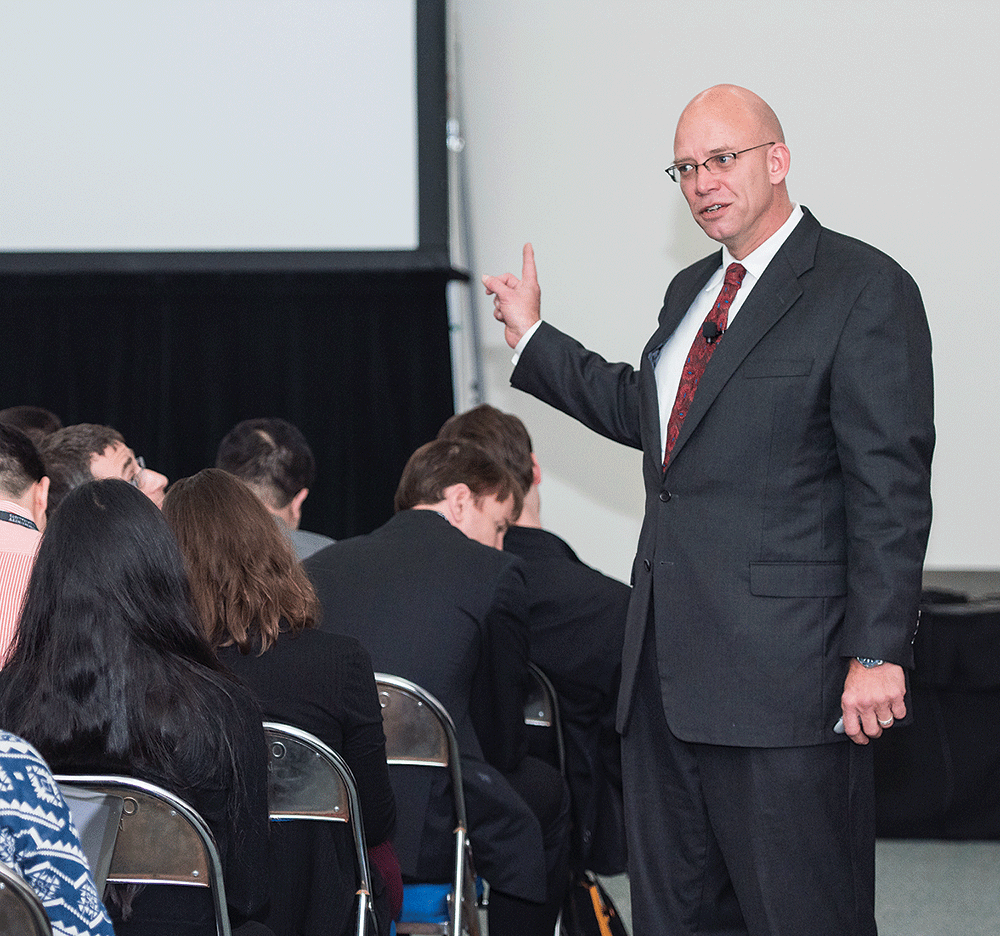
Dr. Wiese liberally seasoned the session with role-playing and humor—the “patient” on the session-room floor but without a pillow meant “Press Ganey’s going to take a hit on this one,” he joked. He emphasized the importance of attending physicians to give reasons to support the expectations they have for their trainees.
“The key piece is giving that rationale. Once they have a reason for why they’re going to do it, now the expectation’s grounded, now it actually makes sense,” said Dr. Wiese, professor of medicine at Tulane University Health Sciences Center in New Orleans and a past SHM president. “You don’t do that, they’re going to fill in the gaps with their own expectations.”
Other points of emphasis:
- The importance of autonomy and choice so that trainees have a sense of purpose;
- The transition from self-interested medical students to residents who are concerned with the well-being of team members;
- The assurance of an endpoint so that hectic periods don’t spiral out of control; and
- Acts of ritual, such as using Purell before entering a patient’s room, as moments of “genuflect” to regain perspective.
Charles Kast, MD, an attending physician at Long Island Jewish Medical Center in New Hyde Park, N.Y., said the relationship theme resonated with him the most.
“It’s more the relationships the attendings have with their residents and with their students, and it’s more of an emotional connection,” he said. “Whether it’s education or mentoring or what have you, it’s all about developing that trust between the resident and the attending.”
But it’s a gradual process.
“It’s baby steps,” Dr. Kast added. “There were 17 different lists in there, right? So you’ve got to pick one and kind of go with it. I think it’s kind of an organic process, where one thing kind of leads to the next.”
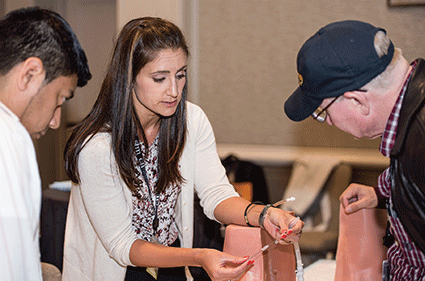
Tactics to avoid burnout—by cultivating a sense of purpose while understanding and relating to trainees’ concerns—were a key part of Dr. Wiese’s message. Burnout was a topic that HM16 attendees returned to again and again when discussing their take-homes from the meeting. The subject popped up in almost every session to one degree or another.
David Nevin, MD, a hospitalist at ThedaCare in Wisconsin, said that he was reminded in one session—“Staying in the Game: Self-Care for Hospitalists”—that taking even brief moments for yourself can make a difference.
“Focusing on the positive for a moment and what’s good about your life, and doing that kind of exercise, helps sort of deal with burnout and bring things into perspective,” he said. “You get sort of worn down, you’re not as sharp, you miss things when you’re not at your peak in terms of looking at things.”
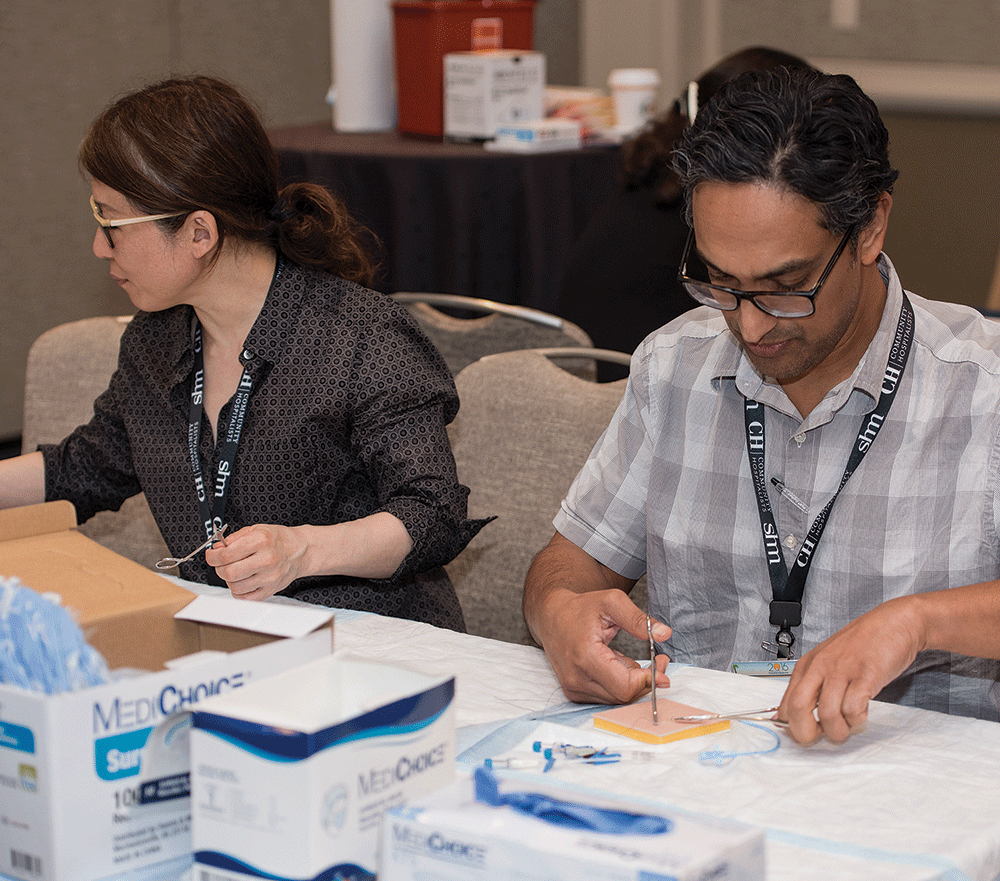
Ariana Peters, DO, who works at Mayo Clinic in Scottsdale, Ariz., said a similar message resonated with her, as well. There are ample situations when, if she doesn’t consciously take time for herself, things will seem to mushroom.
In just one recent example, she reflected on an especially difficult day.
“I had 18 patients, and it was horrible,” she said. “I left my office in the morning and didn’t come back until 8 p.m. that night. I was literally eating peanut butter and graham crackers on the floor.
“It doesn’t take long to just stop and take a breath. Twenty seconds is not a long time.”

Waiting for a session on personal productivity to start, Adam Garber, MD, assistant professor at Virginia Commonwealth University in Richmond, said that he found the introduction to the SMART approach (Specific, Measurable, Achievable, Relevant, and Time-Bound), meaning being able to be done within a certain period, was a good guideline to approaching projects of all kinds.
“I think you can apply it to any problem and career-development project you want to work on,” he said. “It just kind of gives you that framework of how to organize it, present it logically, and carry it out.” TH
SAN DIEGO — If you arrived late, or even right on time, to the session on becoming a better attending, you’d better have been ready to find a clear spot on the floor or have had the energy to stand for an hour.
Read more about the speakers at HM16.
But the dynamic talk, you could even say performance, by Jeffrey Wiese, MD, MHM, crackled with energy, so there was plenty of it to go around. The session, in its 10th year and now practically an institution of its own at the annual meeting, was a highlight among the offerings on career development at HM16.
Dr. Wiese liberally seasoned the session with role-playing and humor—the “patient” on the session-room floor but without a pillow meant “Press Ganey’s going to take a hit on this one,” he joked. He emphasized the importance of attending physicians to give reasons to support the expectations they have for their trainees.
“The key piece is giving that rationale. Once they have a reason for why they’re going to do it, now the expectation’s grounded, now it actually makes sense,” said Dr. Wiese, professor of medicine at Tulane University Health Sciences Center in New Orleans and a past SHM president. “You don’t do that, they’re going to fill in the gaps with their own expectations.”
Other points of emphasis:
- The importance of autonomy and choice so that trainees have a sense of purpose;
- The transition from self-interested medical students to residents who are concerned with the well-being of team members;
- The assurance of an endpoint so that hectic periods don’t spiral out of control; and
- Acts of ritual, such as using Purell before entering a patient’s room, as moments of “genuflect” to regain perspective.
Charles Kast, MD, an attending physician at Long Island Jewish Medical Center in New Hyde Park, N.Y., said the relationship theme resonated with him the most.
“It’s more the relationships the attendings have with their residents and with their students, and it’s more of an emotional connection,” he said. “Whether it’s education or mentoring or what have you, it’s all about developing that trust between the resident and the attending.”
But it’s a gradual process.
“It’s baby steps,” Dr. Kast added. “There were 17 different lists in there, right? So you’ve got to pick one and kind of go with it. I think it’s kind of an organic process, where one thing kind of leads to the next.”
Tactics to avoid burnout—by cultivating a sense of purpose while understanding and relating to trainees’ concerns—were a key part of Dr. Wiese’s message. Burnout was a topic that HM16 attendees returned to again and again when discussing their take-homes from the meeting. The subject popped up in almost every session to one degree or another.
David Nevin, MD, a hospitalist at ThedaCare in Wisconsin, said that he was reminded in one session—“Staying in the Game: Self-Care for Hospitalists”—that taking even brief moments for yourself can make a difference.
“Focusing on the positive for a moment and what’s good about your life, and doing that kind of exercise, helps sort of deal with burnout and bring things into perspective,” he said. “You get sort of worn down, you’re not as sharp, you miss things when you’re not at your peak in terms of looking at things.”
Ariana Peters, DO, who works at Mayo Clinic in Scottsdale, Ariz., said a similar message resonated with her, as well. There are ample situations when, if she doesn’t consciously take time for herself, things will seem to mushroom.
In just one recent example, she reflected on an especially difficult day.
“I had 18 patients, and it was horrible,” she said. “I left my office in the morning and didn’t come back until 8 p.m. that night. I was literally eating peanut butter and graham crackers on the floor.
“It doesn’t take long to just stop and take a breath. Twenty seconds is not a long time.”
Waiting for a session on personal productivity to start, Adam Garber, MD, assistant professor at Virginia Commonwealth University in Richmond, said that he found the introduction to the SMART approach (Specific, Measurable, Achievable, Relevant, and Time-Bound), meaning being able to be done within a certain period, was a good guideline to approaching projects of all kinds.
“I think you can apply it to any problem and career-development project you want to work on,” he said. “It just kind of gives you that framework of how to organize it, present it logically, and carry it out.” TH
SAN DIEGO — If you arrived late, or even right on time, to the session on becoming a better attending, you’d better have been ready to find a clear spot on the floor or have had the energy to stand for an hour.
Read more about the speakers at HM16.
But the dynamic talk, you could even say performance, by Jeffrey Wiese, MD, MHM, crackled with energy, so there was plenty of it to go around. The session, in its 10th year and now practically an institution of its own at the annual meeting, was a highlight among the offerings on career development at HM16.
Dr. Wiese liberally seasoned the session with role-playing and humor—the “patient” on the session-room floor but without a pillow meant “Press Ganey’s going to take a hit on this one,” he joked. He emphasized the importance of attending physicians to give reasons to support the expectations they have for their trainees.
“The key piece is giving that rationale. Once they have a reason for why they’re going to do it, now the expectation’s grounded, now it actually makes sense,” said Dr. Wiese, professor of medicine at Tulane University Health Sciences Center in New Orleans and a past SHM president. “You don’t do that, they’re going to fill in the gaps with their own expectations.”
Other points of emphasis:
- The importance of autonomy and choice so that trainees have a sense of purpose;
- The transition from self-interested medical students to residents who are concerned with the well-being of team members;
- The assurance of an endpoint so that hectic periods don’t spiral out of control; and
- Acts of ritual, such as using Purell before entering a patient’s room, as moments of “genuflect” to regain perspective.
Charles Kast, MD, an attending physician at Long Island Jewish Medical Center in New Hyde Park, N.Y., said the relationship theme resonated with him the most.
“It’s more the relationships the attendings have with their residents and with their students, and it’s more of an emotional connection,” he said. “Whether it’s education or mentoring or what have you, it’s all about developing that trust between the resident and the attending.”
But it’s a gradual process.
“It’s baby steps,” Dr. Kast added. “There were 17 different lists in there, right? So you’ve got to pick one and kind of go with it. I think it’s kind of an organic process, where one thing kind of leads to the next.”
Tactics to avoid burnout—by cultivating a sense of purpose while understanding and relating to trainees’ concerns—were a key part of Dr. Wiese’s message. Burnout was a topic that HM16 attendees returned to again and again when discussing their take-homes from the meeting. The subject popped up in almost every session to one degree or another.
David Nevin, MD, a hospitalist at ThedaCare in Wisconsin, said that he was reminded in one session—“Staying in the Game: Self-Care for Hospitalists”—that taking even brief moments for yourself can make a difference.
“Focusing on the positive for a moment and what’s good about your life, and doing that kind of exercise, helps sort of deal with burnout and bring things into perspective,” he said. “You get sort of worn down, you’re not as sharp, you miss things when you’re not at your peak in terms of looking at things.”
Ariana Peters, DO, who works at Mayo Clinic in Scottsdale, Ariz., said a similar message resonated with her, as well. There are ample situations when, if she doesn’t consciously take time for herself, things will seem to mushroom.
In just one recent example, she reflected on an especially difficult day.
“I had 18 patients, and it was horrible,” she said. “I left my office in the morning and didn’t come back until 8 p.m. that night. I was literally eating peanut butter and graham crackers on the floor.
“It doesn’t take long to just stop and take a breath. Twenty seconds is not a long time.”
Waiting for a session on personal productivity to start, Adam Garber, MD, assistant professor at Virginia Commonwealth University in Richmond, said that he found the introduction to the SMART approach (Specific, Measurable, Achievable, Relevant, and Time-Bound), meaning being able to be done within a certain period, was a good guideline to approaching projects of all kinds.
“I think you can apply it to any problem and career-development project you want to work on,” he said. “It just kind of gives you that framework of how to organize it, present it logically, and carry it out.” TH