User login
Shift from fee-for-service proposed
The fee-for-service payment system has contributed to high health care costs and inconsistent quality of care and should be replaced with a blended payment model that includes fixed payments, according to a new report from a panel of physicians and health care experts.
In a report released in March, the National Commission on Physician Payment Reform recommended phasing out the current fee-for-service system over 5 years in favor of bundled payments, capitation, and increased financial risk-sharing.
"We can’t control runaway medical spending without changing how doctors get paid," Dr. Bill Frist, honorary chair of the commission and former Senate majority leader, said in a statement. "This is a bipartisan issue. We all want to get the most from our health care dollars and that requires rethinking the way we pay for health care."
But the 14-member commission predicted that fee-for-service would continue to play a large role. By the end of the decade, they called for a blended system of fee-for-service, fixed payments, and salary.
The commission also recommended eliminating the Sustainable Growth Rate (SGR) formula, which ties Medicare physician payments to changes in the gross domestic product (GDP). The Congressional Budget Office (CBO) recently estimated the price of eliminating the SGR at $138 billion over 10 years, which the commission said could be paid for by reducing overutilization of Medicare services and cutting down on fraud.
The commission, which was convened by the Society of General Internal Medicine, is chaired by Dr. Steven A. Schroeder, former president of the Robert Wood Johnson Foundation. The other members include physicians from various specialties, as well as experts in health care policy. The commission is funded in part by the Robert Wood Johnson Foundation and the California HealthCare Foundation.
Some of the other recommendations include:
• Increasing payments for evaluation and management codes, while freezing procedural diagnosis codes for 3 years.
• Eliminating higher payments for facility-based services that can be performed in lower-cost settings of care.
• Incorporating quality metrics into fee-for-service contracts.
• Using fixed payment models in areas such as the management of multiple chronic diseases and in-hospital procedures and follow-up.
• Changing the membership of the Relative Value Scale Update Committee (RUC) to make it more representative of the medical profession.
There is no doubt that the exponentially rising cost of medical care is not sustainable. Currently, nearly 3 trillion dollars annually, or roughly 18% of the GDP, is spent on health care. I’m not sure the percent being spent currently in and of itself is intolerable, but the trend of accelerating cost increase shows no sign of abating, and we will inevitably reach some crisis point soon. There are obviously several drivers for health care cost, physician payment being one of the larger components. U.S. physician salaries, interestingly, are among the lowest among western nations, accounting for 8.6% of health care dollars annually, with only Sweden devoting a lower amount at 8.5%.
First, I would say that I have no objection to consideration of physician payment reform if it is part of an overall plan where all parties have some skin in the game, including payments for technology, pharmaceuticals, hospitals, insurers, etc. Second, if we Americans spend so much on health care yet U.S. physicians take home such a comparatively small amount, perhaps their costs outside of their salaries are too high, such as outrageous education costs resulting in massive student loan repayments or sky-high malpractice insurance premiums. Now that I have alienated lawyers, insurers, educational institutions and large corporations with my global perspective, let me drill down into some specific details of this report.
Dr. Brian Rubin |
The "National Commission on Physician Payment Reform" sounds like some federal government generated project, but is in fact the handiwork of the Society of General Internal Medicine. As you might expect from its name, this is a society of "more than 3,000 academic generalists," according to the information on its website. It strikes me as an inherently biased setup when a group of generalists decides that specialists who do procedures are being paid excessively and therefore the rules of physician reimbursement must change. Not every recommendation seems off base. For example it seems appropriate to couple fee-for-service with outcomes metrics into contracts, but we all know how challenging it is to get meaningful outcome measures.
Some recommendations have consequences that would seem to potentially worsen the problem the commission is trying to solve, such as repeal of the SGR. Most of the recommendations, however, are simply a direct assault on payments to proceduralists. This includes freezing procedure payments at current rates for 3 years while increasing payment for E&M codes. Or "recalibrating fee-for-service payments to ... penalize behavior that overuses care," whatever that means and to be determined by whom? The full list of recommendations is available online. The list of commissioners was equally interesting, since it appears as though the panel’s conclusions were pre-ordained based on their prior occupations, appointments, or publications. My takeaway impression of their overall message was "there is too much money being spent on health care overall and physicians specifically, so give more of it to internists and we will spend it better."
We, as a country, must begin to make some difficult decisions as to how to spend our limited resources. I suspect my surgical colleagues are willing to shoulder their fair share of the cost-cutting pain, but we cannot be the only group asked to shoulder this burden. All the parties involved should be prepared to make concessions, including patients, physicians of all types, and payers.
Dr. Brian Rubin is a professor of surgery at Washington University in St. Louis and an associate medical editor for Vascular Specialist.
There is no doubt that the exponentially rising cost of medical care is not sustainable. Currently, nearly 3 trillion dollars annually, or roughly 18% of the GDP, is spent on health care. I’m not sure the percent being spent currently in and of itself is intolerable, but the trend of accelerating cost increase shows no sign of abating, and we will inevitably reach some crisis point soon. There are obviously several drivers for health care cost, physician payment being one of the larger components. U.S. physician salaries, interestingly, are among the lowest among western nations, accounting for 8.6% of health care dollars annually, with only Sweden devoting a lower amount at 8.5%.
First, I would say that I have no objection to consideration of physician payment reform if it is part of an overall plan where all parties have some skin in the game, including payments for technology, pharmaceuticals, hospitals, insurers, etc. Second, if we Americans spend so much on health care yet U.S. physicians take home such a comparatively small amount, perhaps their costs outside of their salaries are too high, such as outrageous education costs resulting in massive student loan repayments or sky-high malpractice insurance premiums. Now that I have alienated lawyers, insurers, educational institutions and large corporations with my global perspective, let me drill down into some specific details of this report.
Dr. Brian Rubin |
The "National Commission on Physician Payment Reform" sounds like some federal government generated project, but is in fact the handiwork of the Society of General Internal Medicine. As you might expect from its name, this is a society of "more than 3,000 academic generalists," according to the information on its website. It strikes me as an inherently biased setup when a group of generalists decides that specialists who do procedures are being paid excessively and therefore the rules of physician reimbursement must change. Not every recommendation seems off base. For example it seems appropriate to couple fee-for-service with outcomes metrics into contracts, but we all know how challenging it is to get meaningful outcome measures.
Some recommendations have consequences that would seem to potentially worsen the problem the commission is trying to solve, such as repeal of the SGR. Most of the recommendations, however, are simply a direct assault on payments to proceduralists. This includes freezing procedure payments at current rates for 3 years while increasing payment for E&M codes. Or "recalibrating fee-for-service payments to ... penalize behavior that overuses care," whatever that means and to be determined by whom? The full list of recommendations is available online. The list of commissioners was equally interesting, since it appears as though the panel’s conclusions were pre-ordained based on their prior occupations, appointments, or publications. My takeaway impression of their overall message was "there is too much money being spent on health care overall and physicians specifically, so give more of it to internists and we will spend it better."
We, as a country, must begin to make some difficult decisions as to how to spend our limited resources. I suspect my surgical colleagues are willing to shoulder their fair share of the cost-cutting pain, but we cannot be the only group asked to shoulder this burden. All the parties involved should be prepared to make concessions, including patients, physicians of all types, and payers.
Dr. Brian Rubin is a professor of surgery at Washington University in St. Louis and an associate medical editor for Vascular Specialist.
There is no doubt that the exponentially rising cost of medical care is not sustainable. Currently, nearly 3 trillion dollars annually, or roughly 18% of the GDP, is spent on health care. I’m not sure the percent being spent currently in and of itself is intolerable, but the trend of accelerating cost increase shows no sign of abating, and we will inevitably reach some crisis point soon. There are obviously several drivers for health care cost, physician payment being one of the larger components. U.S. physician salaries, interestingly, are among the lowest among western nations, accounting for 8.6% of health care dollars annually, with only Sweden devoting a lower amount at 8.5%.
First, I would say that I have no objection to consideration of physician payment reform if it is part of an overall plan where all parties have some skin in the game, including payments for technology, pharmaceuticals, hospitals, insurers, etc. Second, if we Americans spend so much on health care yet U.S. physicians take home such a comparatively small amount, perhaps their costs outside of their salaries are too high, such as outrageous education costs resulting in massive student loan repayments or sky-high malpractice insurance premiums. Now that I have alienated lawyers, insurers, educational institutions and large corporations with my global perspective, let me drill down into some specific details of this report.
Dr. Brian Rubin |
The "National Commission on Physician Payment Reform" sounds like some federal government generated project, but is in fact the handiwork of the Society of General Internal Medicine. As you might expect from its name, this is a society of "more than 3,000 academic generalists," according to the information on its website. It strikes me as an inherently biased setup when a group of generalists decides that specialists who do procedures are being paid excessively and therefore the rules of physician reimbursement must change. Not every recommendation seems off base. For example it seems appropriate to couple fee-for-service with outcomes metrics into contracts, but we all know how challenging it is to get meaningful outcome measures.
Some recommendations have consequences that would seem to potentially worsen the problem the commission is trying to solve, such as repeal of the SGR. Most of the recommendations, however, are simply a direct assault on payments to proceduralists. This includes freezing procedure payments at current rates for 3 years while increasing payment for E&M codes. Or "recalibrating fee-for-service payments to ... penalize behavior that overuses care," whatever that means and to be determined by whom? The full list of recommendations is available online. The list of commissioners was equally interesting, since it appears as though the panel’s conclusions were pre-ordained based on their prior occupations, appointments, or publications. My takeaway impression of their overall message was "there is too much money being spent on health care overall and physicians specifically, so give more of it to internists and we will spend it better."
We, as a country, must begin to make some difficult decisions as to how to spend our limited resources. I suspect my surgical colleagues are willing to shoulder their fair share of the cost-cutting pain, but we cannot be the only group asked to shoulder this burden. All the parties involved should be prepared to make concessions, including patients, physicians of all types, and payers.
Dr. Brian Rubin is a professor of surgery at Washington University in St. Louis and an associate medical editor for Vascular Specialist.
The fee-for-service payment system has contributed to high health care costs and inconsistent quality of care and should be replaced with a blended payment model that includes fixed payments, according to a new report from a panel of physicians and health care experts.
In a report released in March, the National Commission on Physician Payment Reform recommended phasing out the current fee-for-service system over 5 years in favor of bundled payments, capitation, and increased financial risk-sharing.
"We can’t control runaway medical spending without changing how doctors get paid," Dr. Bill Frist, honorary chair of the commission and former Senate majority leader, said in a statement. "This is a bipartisan issue. We all want to get the most from our health care dollars and that requires rethinking the way we pay for health care."
But the 14-member commission predicted that fee-for-service would continue to play a large role. By the end of the decade, they called for a blended system of fee-for-service, fixed payments, and salary.
The commission also recommended eliminating the Sustainable Growth Rate (SGR) formula, which ties Medicare physician payments to changes in the gross domestic product (GDP). The Congressional Budget Office (CBO) recently estimated the price of eliminating the SGR at $138 billion over 10 years, which the commission said could be paid for by reducing overutilization of Medicare services and cutting down on fraud.
The commission, which was convened by the Society of General Internal Medicine, is chaired by Dr. Steven A. Schroeder, former president of the Robert Wood Johnson Foundation. The other members include physicians from various specialties, as well as experts in health care policy. The commission is funded in part by the Robert Wood Johnson Foundation and the California HealthCare Foundation.
Some of the other recommendations include:
• Increasing payments for evaluation and management codes, while freezing procedural diagnosis codes for 3 years.
• Eliminating higher payments for facility-based services that can be performed in lower-cost settings of care.
• Incorporating quality metrics into fee-for-service contracts.
• Using fixed payment models in areas such as the management of multiple chronic diseases and in-hospital procedures and follow-up.
• Changing the membership of the Relative Value Scale Update Committee (RUC) to make it more representative of the medical profession.
The fee-for-service payment system has contributed to high health care costs and inconsistent quality of care and should be replaced with a blended payment model that includes fixed payments, according to a new report from a panel of physicians and health care experts.
In a report released in March, the National Commission on Physician Payment Reform recommended phasing out the current fee-for-service system over 5 years in favor of bundled payments, capitation, and increased financial risk-sharing.
"We can’t control runaway medical spending without changing how doctors get paid," Dr. Bill Frist, honorary chair of the commission and former Senate majority leader, said in a statement. "This is a bipartisan issue. We all want to get the most from our health care dollars and that requires rethinking the way we pay for health care."
But the 14-member commission predicted that fee-for-service would continue to play a large role. By the end of the decade, they called for a blended system of fee-for-service, fixed payments, and salary.
The commission also recommended eliminating the Sustainable Growth Rate (SGR) formula, which ties Medicare physician payments to changes in the gross domestic product (GDP). The Congressional Budget Office (CBO) recently estimated the price of eliminating the SGR at $138 billion over 10 years, which the commission said could be paid for by reducing overutilization of Medicare services and cutting down on fraud.
The commission, which was convened by the Society of General Internal Medicine, is chaired by Dr. Steven A. Schroeder, former president of the Robert Wood Johnson Foundation. The other members include physicians from various specialties, as well as experts in health care policy. The commission is funded in part by the Robert Wood Johnson Foundation and the California HealthCare Foundation.
Some of the other recommendations include:
• Increasing payments for evaluation and management codes, while freezing procedural diagnosis codes for 3 years.
• Eliminating higher payments for facility-based services that can be performed in lower-cost settings of care.
• Incorporating quality metrics into fee-for-service contracts.
• Using fixed payment models in areas such as the management of multiple chronic diseases and in-hospital procedures and follow-up.
• Changing the membership of the Relative Value Scale Update Committee (RUC) to make it more representative of the medical profession.

Sunshine Rule Requires Physicians to Report Gifts from Drug, Medical Device Companies


—Joshua Lenchus, DO, RPh, FACP, SFHM
Hospitalist leaders are taking a wait-and-see approach to the Physician Payment Sunshine Act, which requires reporting of payments and gifts from drug and medical device companies. But as wary as many are after publication of the Final Rule 1 in February, SHM and other groups already have claimed at least one victory in tweaking the new rules.
The Sunshine Rule, as it’s known, was included in the Affordable Care Act of 2010. The rule, created by the Centers for Medicaid & Medicare Services (CMS), requires manufacturers to publicly report gifts, payments, or other transfers of value to physicians from pharmaceutical and medical device manufacturers worth more than $10 (see “Dos and Don’ts,” below).1
One major change to the law sought by SHM and others was tied to the reporting of indirect payments to speakers at accredited continuing medical education (CME) classes or courses. The proposed rule required reporting of those payments even if a particular industry group did not select the speakers or pay them. SHM and three dozen other societies lobbied CMS to change the rule.2 The final rule says indirect payments don’t have to be reported if the CME program meets widely accepted accreditation standards and the industry participant is neither directly paid nor selected by the vendor.
CME Coalition, a Washington, D.C.-based advocacy group, said in a statement the caveat recognizes that CMS “is sending a strong message to commercial supporters: Underwriting accredited continuing education programs for health-care providers is to be applauded, not restricted.”
SHM Public Policy Committee member Joshua Lenchus, DO, RPh, FACP, SFHM, said the initial rule was too restrictive and could have reduced physician participation in important CME activities. He said the Accreditation Council for Continuing Medical Education (ACCME) and other industry groups already govern the ethical issue of accepting direct payments that could imply bias to patients.
“I’m not so sure we needed the Sunshine Act as part of the ACA at all because these same things were in effect from the ACCME and other CME accrediting organizations,” said Dr. Lenchus, a Team Hospitalist member and president of the medical staff at Jackson Health System in Miami. “What this has done is impose additional administrative requirements that now take time away from our seeing patients or doing clinical activity.”
Those costs will add up quickly, according to figures from the Federal Register, Dr. Lenchus said. CMS projects the administrative costs of reviewing reports at $1.9 million for teaching hospital staff—the category Dr. Lenchus says is most applicable to hospitalists.
Dr. Lenchus says there was discussion within the Public Policy Committee about how much information needed to be publicly reported in relation to CME. Some members “wanted nothing recorded” and “some people wanted everything recorded.”
“The rule that has been implemented strikes a nice balance between the two,” he said.
Transparent Process
Industry groups and group purchasing organizations (GPOs) currently are working to put in place systems and procedures to begin collecting the data in August. Data will be collected through the end of 2013 and must be reported to CMS by March 31, 2014. CMS will then unveil a public website showcasing the information by Sept. 30, 2014.
Public Policy Committee member Jack Percelay, MD, MPH, FAAP, SFHM, said some hospitalists might feel they are “being picked on again” by having to report the added information. He instead looks at the intended push toward added transparency as “a set of obligations we have as physicians.”
“We have tremendous discretion about how health-care dollars are spent and with that comes a fiduciary responsibility, both to the patient and to the public,” he said. “This does not seem terribly burdensome to me. If I was getting nickel and dimed for every piece of candy I took through the exhibit hall during a meeting, that would be ridiculous. I’m happy to do this in a reasoned way.”
Dr. Percelay noted that the Sunshine Rule does not prevent industry payments to physicians or groups, but simply requires the public reporting and display of the remuneration. In that vein, he likened it to ethical rules that govern those who hold elected office.
“Someone should be able to Google and see that I’ve [received] funds from market research,” he said. “It’s not much different from politicians. It’s then up to the public and the media to do their due diligence.”
Dr. Lenchus said the public database has the potential to be misinterpreted by a public unfamiliar with how health care works. In particular, patients might not be able to discern the differences between the value of lunches, the payments for being on advisory boards, and industry-funded research.
“I really fear the public will look at this website, see there is any financial inducement to any physician, and erroneously conclude that any prescription of that company’s medication means that person is getting a kickback,” he says. “And we know that’s absolutely false.”
Richard Quinn is a freelance writer in New Jersey.
References
- Centers for Medicare & Medicaid Services. Medicare, Medicaid, Children’s Health Insurance Programs; transparency reports and reporting of physician ownership or investment interests. Federal Register website. Available at: https://www.federalregister.gov/articles/2013/02/08/2013-02572/medicare-mediaid-childrens-health-insurance-programs-transparency-reports-and-reporting-of. Accessed March 24, 2013.
- Council of Medical Specialty Societies. Letter to CMS. SHM website. Available at: http://www.hospitalmedicine.org/AM/Template.cfm?Section=Letters_to_Congress_ and_Regulatory_Agencies&Template=/CM/ContentDisplay.cfm&ContentID=30674. Accessed March 24, 2013.
—Joshua Lenchus, DO, RPh, FACP, SFHM
Hospitalist leaders are taking a wait-and-see approach to the Physician Payment Sunshine Act, which requires reporting of payments and gifts from drug and medical device companies. But as wary as many are after publication of the Final Rule 1 in February, SHM and other groups already have claimed at least one victory in tweaking the new rules.
The Sunshine Rule, as it’s known, was included in the Affordable Care Act of 2010. The rule, created by the Centers for Medicaid & Medicare Services (CMS), requires manufacturers to publicly report gifts, payments, or other transfers of value to physicians from pharmaceutical and medical device manufacturers worth more than $10 (see “Dos and Don’ts,” below).1
One major change to the law sought by SHM and others was tied to the reporting of indirect payments to speakers at accredited continuing medical education (CME) classes or courses. The proposed rule required reporting of those payments even if a particular industry group did not select the speakers or pay them. SHM and three dozen other societies lobbied CMS to change the rule.2 The final rule says indirect payments don’t have to be reported if the CME program meets widely accepted accreditation standards and the industry participant is neither directly paid nor selected by the vendor.
CME Coalition, a Washington, D.C.-based advocacy group, said in a statement the caveat recognizes that CMS “is sending a strong message to commercial supporters: Underwriting accredited continuing education programs for health-care providers is to be applauded, not restricted.”
SHM Public Policy Committee member Joshua Lenchus, DO, RPh, FACP, SFHM, said the initial rule was too restrictive and could have reduced physician participation in important CME activities. He said the Accreditation Council for Continuing Medical Education (ACCME) and other industry groups already govern the ethical issue of accepting direct payments that could imply bias to patients.
“I’m not so sure we needed the Sunshine Act as part of the ACA at all because these same things were in effect from the ACCME and other CME accrediting organizations,” said Dr. Lenchus, a Team Hospitalist member and president of the medical staff at Jackson Health System in Miami. “What this has done is impose additional administrative requirements that now take time away from our seeing patients or doing clinical activity.”
Those costs will add up quickly, according to figures from the Federal Register, Dr. Lenchus said. CMS projects the administrative costs of reviewing reports at $1.9 million for teaching hospital staff—the category Dr. Lenchus says is most applicable to hospitalists.
Dr. Lenchus says there was discussion within the Public Policy Committee about how much information needed to be publicly reported in relation to CME. Some members “wanted nothing recorded” and “some people wanted everything recorded.”
“The rule that has been implemented strikes a nice balance between the two,” he said.
Transparent Process
Industry groups and group purchasing organizations (GPOs) currently are working to put in place systems and procedures to begin collecting the data in August. Data will be collected through the end of 2013 and must be reported to CMS by March 31, 2014. CMS will then unveil a public website showcasing the information by Sept. 30, 2014.
Public Policy Committee member Jack Percelay, MD, MPH, FAAP, SFHM, said some hospitalists might feel they are “being picked on again” by having to report the added information. He instead looks at the intended push toward added transparency as “a set of obligations we have as physicians.”
“We have tremendous discretion about how health-care dollars are spent and with that comes a fiduciary responsibility, both to the patient and to the public,” he said. “This does not seem terribly burdensome to me. If I was getting nickel and dimed for every piece of candy I took through the exhibit hall during a meeting, that would be ridiculous. I’m happy to do this in a reasoned way.”
Dr. Percelay noted that the Sunshine Rule does not prevent industry payments to physicians or groups, but simply requires the public reporting and display of the remuneration. In that vein, he likened it to ethical rules that govern those who hold elected office.
“Someone should be able to Google and see that I’ve [received] funds from market research,” he said. “It’s not much different from politicians. It’s then up to the public and the media to do their due diligence.”
Dr. Lenchus said the public database has the potential to be misinterpreted by a public unfamiliar with how health care works. In particular, patients might not be able to discern the differences between the value of lunches, the payments for being on advisory boards, and industry-funded research.
“I really fear the public will look at this website, see there is any financial inducement to any physician, and erroneously conclude that any prescription of that company’s medication means that person is getting a kickback,” he says. “And we know that’s absolutely false.”
Richard Quinn is a freelance writer in New Jersey.
References
- Centers for Medicare & Medicaid Services. Medicare, Medicaid, Children’s Health Insurance Programs; transparency reports and reporting of physician ownership or investment interests. Federal Register website. Available at: https://www.federalregister.gov/articles/2013/02/08/2013-02572/medicare-mediaid-childrens-health-insurance-programs-transparency-reports-and-reporting-of. Accessed March 24, 2013.
- Council of Medical Specialty Societies. Letter to CMS. SHM website. Available at: http://www.hospitalmedicine.org/AM/Template.cfm?Section=Letters_to_Congress_ and_Regulatory_Agencies&Template=/CM/ContentDisplay.cfm&ContentID=30674. Accessed March 24, 2013.
—Joshua Lenchus, DO, RPh, FACP, SFHM
Hospitalist leaders are taking a wait-and-see approach to the Physician Payment Sunshine Act, which requires reporting of payments and gifts from drug and medical device companies. But as wary as many are after publication of the Final Rule 1 in February, SHM and other groups already have claimed at least one victory in tweaking the new rules.
The Sunshine Rule, as it’s known, was included in the Affordable Care Act of 2010. The rule, created by the Centers for Medicaid & Medicare Services (CMS), requires manufacturers to publicly report gifts, payments, or other transfers of value to physicians from pharmaceutical and medical device manufacturers worth more than $10 (see “Dos and Don’ts,” below).1
One major change to the law sought by SHM and others was tied to the reporting of indirect payments to speakers at accredited continuing medical education (CME) classes or courses. The proposed rule required reporting of those payments even if a particular industry group did not select the speakers or pay them. SHM and three dozen other societies lobbied CMS to change the rule.2 The final rule says indirect payments don’t have to be reported if the CME program meets widely accepted accreditation standards and the industry participant is neither directly paid nor selected by the vendor.
CME Coalition, a Washington, D.C.-based advocacy group, said in a statement the caveat recognizes that CMS “is sending a strong message to commercial supporters: Underwriting accredited continuing education programs for health-care providers is to be applauded, not restricted.”
SHM Public Policy Committee member Joshua Lenchus, DO, RPh, FACP, SFHM, said the initial rule was too restrictive and could have reduced physician participation in important CME activities. He said the Accreditation Council for Continuing Medical Education (ACCME) and other industry groups already govern the ethical issue of accepting direct payments that could imply bias to patients.
“I’m not so sure we needed the Sunshine Act as part of the ACA at all because these same things were in effect from the ACCME and other CME accrediting organizations,” said Dr. Lenchus, a Team Hospitalist member and president of the medical staff at Jackson Health System in Miami. “What this has done is impose additional administrative requirements that now take time away from our seeing patients or doing clinical activity.”
Those costs will add up quickly, according to figures from the Federal Register, Dr. Lenchus said. CMS projects the administrative costs of reviewing reports at $1.9 million for teaching hospital staff—the category Dr. Lenchus says is most applicable to hospitalists.
Dr. Lenchus says there was discussion within the Public Policy Committee about how much information needed to be publicly reported in relation to CME. Some members “wanted nothing recorded” and “some people wanted everything recorded.”
“The rule that has been implemented strikes a nice balance between the two,” he said.
Transparent Process
Industry groups and group purchasing organizations (GPOs) currently are working to put in place systems and procedures to begin collecting the data in August. Data will be collected through the end of 2013 and must be reported to CMS by March 31, 2014. CMS will then unveil a public website showcasing the information by Sept. 30, 2014.
Public Policy Committee member Jack Percelay, MD, MPH, FAAP, SFHM, said some hospitalists might feel they are “being picked on again” by having to report the added information. He instead looks at the intended push toward added transparency as “a set of obligations we have as physicians.”
“We have tremendous discretion about how health-care dollars are spent and with that comes a fiduciary responsibility, both to the patient and to the public,” he said. “This does not seem terribly burdensome to me. If I was getting nickel and dimed for every piece of candy I took through the exhibit hall during a meeting, that would be ridiculous. I’m happy to do this in a reasoned way.”
Dr. Percelay noted that the Sunshine Rule does not prevent industry payments to physicians or groups, but simply requires the public reporting and display of the remuneration. In that vein, he likened it to ethical rules that govern those who hold elected office.
“Someone should be able to Google and see that I’ve [received] funds from market research,” he said. “It’s not much different from politicians. It’s then up to the public and the media to do their due diligence.”
Dr. Lenchus said the public database has the potential to be misinterpreted by a public unfamiliar with how health care works. In particular, patients might not be able to discern the differences between the value of lunches, the payments for being on advisory boards, and industry-funded research.
“I really fear the public will look at this website, see there is any financial inducement to any physician, and erroneously conclude that any prescription of that company’s medication means that person is getting a kickback,” he says. “And we know that’s absolutely false.”
Richard Quinn is a freelance writer in New Jersey.
References
- Centers for Medicare & Medicaid Services. Medicare, Medicaid, Children’s Health Insurance Programs; transparency reports and reporting of physician ownership or investment interests. Federal Register website. Available at: https://www.federalregister.gov/articles/2013/02/08/2013-02572/medicare-mediaid-childrens-health-insurance-programs-transparency-reports-and-reporting-of. Accessed March 24, 2013.
- Council of Medical Specialty Societies. Letter to CMS. SHM website. Available at: http://www.hospitalmedicine.org/AM/Template.cfm?Section=Letters_to_Congress_ and_Regulatory_Agencies&Template=/CM/ContentDisplay.cfm&ContentID=30674. Accessed March 24, 2013.
Only 11% of health plan payments are value based
WASHINGTON – Only about 11% of health plan payments to physicians and hospitals are tied to performance or efficiency – meaning that almost 90% of payments are still fee for service, according to a report released by Catalyst for Payment Reform.
The San Francisco–based nonprofit is a collaborative of employers and health plans that advocates the overhaul of the nation’s health care payment infrastructure by encouraging more value-based payment.

Using data provided by commercial health plans, the group determined that 11% of hospital payments, 6% of outpatient specialist payments, and 6% of primary care physician payments are "value oriented."
Of those payment arrangements, 57% involve provider risk such as bundled payment, capitation, and shared risk payment. The remaining 43% provide incentives, such as shared savings or pay for performance.
The main goal of Catalyst for Payment Reform (CPR) is to raise the volume of value-based commercial payments to health care providers to 20% by 2020. Coalition members said that they saw reason for both pessimism and optimism in the report’s findings.
"Obviously, these results are pretty disappointing," said Dr. Robert Galvin, chief executive officer of Equity Healthcare, which buys health care coverage for private equity companies. Even so, the report itself represents "the triumph of transparency," he said at the press briefing. "It is just simply good to know."
Susan Delbanco, executive director of CPR, noted that in 2010, 1%-3% of provider payments were tied to performance. Given the latest information, "it looks to me like we are on a fast track and that we may get there before 2020,"she said.
The group’s research also found that about 2% of health plan enrollees are enrolled in an accountable care organization or a patient-centered medical home.
Most health plan payments (about 75%) are still made to specialists, while 25% go to primary care physicians, according to their analysis. Non–fee-for-service payments are still not entirely rewarding or providing incentives to improve the quality of care. Only 35% of those value-based payments have quality of care as a factor.
Dr. Richard Gilfillan, director of the Center for Medicare and Medicaid Innovation at the Centers for Medicare and Medicaid Services, said that the agency was "thrilled" with the report, noting that it showed that private payers were helping encourage a transformation in payment.
"We’re not discouraged – we think that change is happening, it’s underway," Dr. Gilfillan said at the press briefing.
The growing number of physicians participating in new payment models reflects a cultural shift, said Dr. Mark Smith, president and chief executive officer of the California HealthCare Foundation. "I think we have turned the corner on providers recognizing the feasibility, the desirability, and in fact, the inevitability of the kinds of payment reforms that you’ve heard about."
The California HealthCare Foundation and the Commonwealth Fund provided the funding for the National Scorecard on Payment Reform, and a sister effort, the National Compendium on Payment Reform.
The scorecard tabulated data that 57 health plans provided to the National Business Coalition on Health. Participation is voluntary, and not all 57 plans answered all questions posed. The plans represent 104 million people in the commercial group market, or about two-thirds of the total commercially insured population in the United States. Respondents were primarily large health plans, which means the results may not necessarily reflect the entire group market.
Most vascular surgeons deal predominantly with Medicare, which is leading the shift to value-based reimbursement, bundling, and ACO management. This report indicates that the commercial insurance programs surveyed are starting to follow suit. Whether the shift away from fee-for-service to value-based reimbursement is "inevitable" will depend in large part on the strength and integrity of the means of measuring value, including notable contributions from the SVS Vascular Quality Initiative (VQI) and the ACS NSQIP programs.
Predictable challenges include adjusting the system to minimize "gaming" and entrepreneurial bias. In addition, despite the accountability implicit in a name on the operative report, it is not entirely clear how the new system will apply rewards or penalties to individual surgeons as we work more and more within teams of midlevel providers and subspecialists. As we move away from "piece work" and "widget" accounting to protocol-driven pathways and squad care, there will probably be more pressure for many surgeons to work within a larger organization on a salaried model. As is increasingly the case around the country, "productivity" will be measured by RVUs and "value" will be measured by quality metrics, with compensation calculated by a formula resulting in fair allocation of the organization’s global earnings among its members. The soundness and "value" of this monumental change will become clear as we track further developments in the commercial insurance sector. We won't know until the changes in health care are fully implemented if Catalyst for Payment Reform will mean CPR for private practice as we know it.
Dr. Magruder C. Donaldson is chairman of Surgery at Metrowest Medical Center, Framingham, Mass., and an associate medical editor for Vascular Specialist.
Most vascular surgeons deal predominantly with Medicare, which is leading the shift to value-based reimbursement, bundling, and ACO management. This report indicates that the commercial insurance programs surveyed are starting to follow suit. Whether the shift away from fee-for-service to value-based reimbursement is "inevitable" will depend in large part on the strength and integrity of the means of measuring value, including notable contributions from the SVS Vascular Quality Initiative (VQI) and the ACS NSQIP programs.
Predictable challenges include adjusting the system to minimize "gaming" and entrepreneurial bias. In addition, despite the accountability implicit in a name on the operative report, it is not entirely clear how the new system will apply rewards or penalties to individual surgeons as we work more and more within teams of midlevel providers and subspecialists. As we move away from "piece work" and "widget" accounting to protocol-driven pathways and squad care, there will probably be more pressure for many surgeons to work within a larger organization on a salaried model. As is increasingly the case around the country, "productivity" will be measured by RVUs and "value" will be measured by quality metrics, with compensation calculated by a formula resulting in fair allocation of the organization’s global earnings among its members. The soundness and "value" of this monumental change will become clear as we track further developments in the commercial insurance sector. We won't know until the changes in health care are fully implemented if Catalyst for Payment Reform will mean CPR for private practice as we know it.
Dr. Magruder C. Donaldson is chairman of Surgery at Metrowest Medical Center, Framingham, Mass., and an associate medical editor for Vascular Specialist.
Most vascular surgeons deal predominantly with Medicare, which is leading the shift to value-based reimbursement, bundling, and ACO management. This report indicates that the commercial insurance programs surveyed are starting to follow suit. Whether the shift away from fee-for-service to value-based reimbursement is "inevitable" will depend in large part on the strength and integrity of the means of measuring value, including notable contributions from the SVS Vascular Quality Initiative (VQI) and the ACS NSQIP programs.
Predictable challenges include adjusting the system to minimize "gaming" and entrepreneurial bias. In addition, despite the accountability implicit in a name on the operative report, it is not entirely clear how the new system will apply rewards or penalties to individual surgeons as we work more and more within teams of midlevel providers and subspecialists. As we move away from "piece work" and "widget" accounting to protocol-driven pathways and squad care, there will probably be more pressure for many surgeons to work within a larger organization on a salaried model. As is increasingly the case around the country, "productivity" will be measured by RVUs and "value" will be measured by quality metrics, with compensation calculated by a formula resulting in fair allocation of the organization’s global earnings among its members. The soundness and "value" of this monumental change will become clear as we track further developments in the commercial insurance sector. We won't know until the changes in health care are fully implemented if Catalyst for Payment Reform will mean CPR for private practice as we know it.
Dr. Magruder C. Donaldson is chairman of Surgery at Metrowest Medical Center, Framingham, Mass., and an associate medical editor for Vascular Specialist.
WASHINGTON – Only about 11% of health plan payments to physicians and hospitals are tied to performance or efficiency – meaning that almost 90% of payments are still fee for service, according to a report released by Catalyst for Payment Reform.
The San Francisco–based nonprofit is a collaborative of employers and health plans that advocates the overhaul of the nation’s health care payment infrastructure by encouraging more value-based payment.
Using data provided by commercial health plans, the group determined that 11% of hospital payments, 6% of outpatient specialist payments, and 6% of primary care physician payments are "value oriented."
Of those payment arrangements, 57% involve provider risk such as bundled payment, capitation, and shared risk payment. The remaining 43% provide incentives, such as shared savings or pay for performance.
The main goal of Catalyst for Payment Reform (CPR) is to raise the volume of value-based commercial payments to health care providers to 20% by 2020. Coalition members said that they saw reason for both pessimism and optimism in the report’s findings.
"Obviously, these results are pretty disappointing," said Dr. Robert Galvin, chief executive officer of Equity Healthcare, which buys health care coverage for private equity companies. Even so, the report itself represents "the triumph of transparency," he said at the press briefing. "It is just simply good to know."
Susan Delbanco, executive director of CPR, noted that in 2010, 1%-3% of provider payments were tied to performance. Given the latest information, "it looks to me like we are on a fast track and that we may get there before 2020,"she said.
The group’s research also found that about 2% of health plan enrollees are enrolled in an accountable care organization or a patient-centered medical home.
Most health plan payments (about 75%) are still made to specialists, while 25% go to primary care physicians, according to their analysis. Non–fee-for-service payments are still not entirely rewarding or providing incentives to improve the quality of care. Only 35% of those value-based payments have quality of care as a factor.
Dr. Richard Gilfillan, director of the Center for Medicare and Medicaid Innovation at the Centers for Medicare and Medicaid Services, said that the agency was "thrilled" with the report, noting that it showed that private payers were helping encourage a transformation in payment.
"We’re not discouraged – we think that change is happening, it’s underway," Dr. Gilfillan said at the press briefing.
The growing number of physicians participating in new payment models reflects a cultural shift, said Dr. Mark Smith, president and chief executive officer of the California HealthCare Foundation. "I think we have turned the corner on providers recognizing the feasibility, the desirability, and in fact, the inevitability of the kinds of payment reforms that you’ve heard about."
The California HealthCare Foundation and the Commonwealth Fund provided the funding for the National Scorecard on Payment Reform, and a sister effort, the National Compendium on Payment Reform.
The scorecard tabulated data that 57 health plans provided to the National Business Coalition on Health. Participation is voluntary, and not all 57 plans answered all questions posed. The plans represent 104 million people in the commercial group market, or about two-thirds of the total commercially insured population in the United States. Respondents were primarily large health plans, which means the results may not necessarily reflect the entire group market.
WASHINGTON – Only about 11% of health plan payments to physicians and hospitals are tied to performance or efficiency – meaning that almost 90% of payments are still fee for service, according to a report released by Catalyst for Payment Reform.
The San Francisco–based nonprofit is a collaborative of employers and health plans that advocates the overhaul of the nation’s health care payment infrastructure by encouraging more value-based payment.
Using data provided by commercial health plans, the group determined that 11% of hospital payments, 6% of outpatient specialist payments, and 6% of primary care physician payments are "value oriented."
Of those payment arrangements, 57% involve provider risk such as bundled payment, capitation, and shared risk payment. The remaining 43% provide incentives, such as shared savings or pay for performance.
The main goal of Catalyst for Payment Reform (CPR) is to raise the volume of value-based commercial payments to health care providers to 20% by 2020. Coalition members said that they saw reason for both pessimism and optimism in the report’s findings.
"Obviously, these results are pretty disappointing," said Dr. Robert Galvin, chief executive officer of Equity Healthcare, which buys health care coverage for private equity companies. Even so, the report itself represents "the triumph of transparency," he said at the press briefing. "It is just simply good to know."
Susan Delbanco, executive director of CPR, noted that in 2010, 1%-3% of provider payments were tied to performance. Given the latest information, "it looks to me like we are on a fast track and that we may get there before 2020,"she said.
The group’s research also found that about 2% of health plan enrollees are enrolled in an accountable care organization or a patient-centered medical home.
Most health plan payments (about 75%) are still made to specialists, while 25% go to primary care physicians, according to their analysis. Non–fee-for-service payments are still not entirely rewarding or providing incentives to improve the quality of care. Only 35% of those value-based payments have quality of care as a factor.
Dr. Richard Gilfillan, director of the Center for Medicare and Medicaid Innovation at the Centers for Medicare and Medicaid Services, said that the agency was "thrilled" with the report, noting that it showed that private payers were helping encourage a transformation in payment.
"We’re not discouraged – we think that change is happening, it’s underway," Dr. Gilfillan said at the press briefing.
The growing number of physicians participating in new payment models reflects a cultural shift, said Dr. Mark Smith, president and chief executive officer of the California HealthCare Foundation. "I think we have turned the corner on providers recognizing the feasibility, the desirability, and in fact, the inevitability of the kinds of payment reforms that you’ve heard about."
The California HealthCare Foundation and the Commonwealth Fund provided the funding for the National Scorecard on Payment Reform, and a sister effort, the National Compendium on Payment Reform.
The scorecard tabulated data that 57 health plans provided to the National Business Coalition on Health. Participation is voluntary, and not all 57 plans answered all questions posed. The plans represent 104 million people in the commercial group market, or about two-thirds of the total commercially insured population in the United States. Respondents were primarily large health plans, which means the results may not necessarily reflect the entire group market.
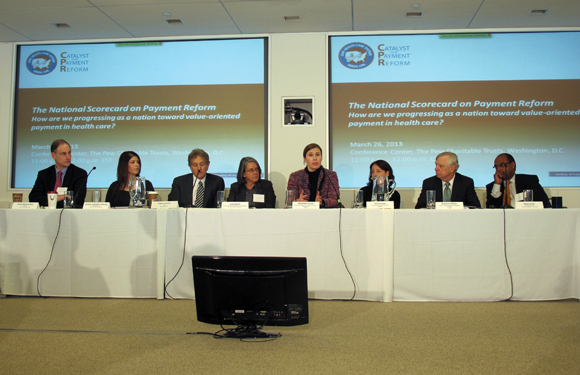
AT A PRESS BRIEFING HELD BY CATALYST FOR PAYMENT REFORM
Commission proposes shifting away from fee-for-service to alternatives
The fee-for-service payment system has contributed to high health care costs and inconsistent quality of care and should be replaced with a blended payment model that includes fixed payments, according to a new report released by a panel of physicians and health care experts.
In a recently published report, the National Commission on Physician Payment Reform recommended phasing out the current fee-for-service system over 5 years in favor of bundled payments, capitation, and increased financial risk-sharing.
"We can’t control runaway medical spending without changing how doctors get paid," Dr. Bill Frist, honorary chair of the commission and former Senate majority leader, said in a statement.
"This is a bipartisan issue. We all want to get the most from our health care dollars and that requires rethinking the way we pay for health care."
But the 14-member commission predicted that fee-for-service would continue to play a large role. By the end of the decade, they called for a blended system of fee-for-service, fixed payments, and salary.
The commission also recommended eliminating the Sustainable Growth Rate (SGR) formula, which ties Medicare physician payments to changes in the gross domestic product (GDP). The Congressional Budget Office (CBO) recently estimated the price of eliminating the SGR at $138 billion over 10 years, which the commission said could be paid for by reducing the overutilization of Medicare services and cutting down on fraud.
The commission, which was convened by the Society of General Internal Medicine last March, is chaired by Dr. Steven A. Schroeder, former president of the Robert Wood Johnson Foundation.
The other members include physicians from various specialties, as well as experts in health care policy. The commission is funded in part by the Robert Wood Johnson Foundation and the California HealthCare Foundation.
Some of the commission’s other recommendations include:
• Increasing payments for evaluation and management codes, while freezing procedural diagnosis codes for 3 years.
• Eliminating higher payments for facility-based services that can be performed in lower-cost settings of care.
• Incorporating quality metrics into fee-for-service contracts.
• Using fixed payment models in areas such as the management of multiple chronic diseases and in-hospital procedures and follow-up.
• Changing the membership of the Relative Value Scale Update Committee (RUC) to make it more representative of the medical profession.
The fee-for-service payment system has contributed to high health care costs and inconsistent quality of care and should be replaced with a blended payment model that includes fixed payments, according to a new report released by a panel of physicians and health care experts.
In a recently published report, the National Commission on Physician Payment Reform recommended phasing out the current fee-for-service system over 5 years in favor of bundled payments, capitation, and increased financial risk-sharing.
"We can’t control runaway medical spending without changing how doctors get paid," Dr. Bill Frist, honorary chair of the commission and former Senate majority leader, said in a statement.
"This is a bipartisan issue. We all want to get the most from our health care dollars and that requires rethinking the way we pay for health care."
But the 14-member commission predicted that fee-for-service would continue to play a large role. By the end of the decade, they called for a blended system of fee-for-service, fixed payments, and salary.
The commission also recommended eliminating the Sustainable Growth Rate (SGR) formula, which ties Medicare physician payments to changes in the gross domestic product (GDP). The Congressional Budget Office (CBO) recently estimated the price of eliminating the SGR at $138 billion over 10 years, which the commission said could be paid for by reducing the overutilization of Medicare services and cutting down on fraud.
The commission, which was convened by the Society of General Internal Medicine last March, is chaired by Dr. Steven A. Schroeder, former president of the Robert Wood Johnson Foundation.
The other members include physicians from various specialties, as well as experts in health care policy. The commission is funded in part by the Robert Wood Johnson Foundation and the California HealthCare Foundation.
Some of the commission’s other recommendations include:
• Increasing payments for evaluation and management codes, while freezing procedural diagnosis codes for 3 years.
• Eliminating higher payments for facility-based services that can be performed in lower-cost settings of care.
• Incorporating quality metrics into fee-for-service contracts.
• Using fixed payment models in areas such as the management of multiple chronic diseases and in-hospital procedures and follow-up.
• Changing the membership of the Relative Value Scale Update Committee (RUC) to make it more representative of the medical profession.
The fee-for-service payment system has contributed to high health care costs and inconsistent quality of care and should be replaced with a blended payment model that includes fixed payments, according to a new report released by a panel of physicians and health care experts.
In a recently published report, the National Commission on Physician Payment Reform recommended phasing out the current fee-for-service system over 5 years in favor of bundled payments, capitation, and increased financial risk-sharing.
"We can’t control runaway medical spending without changing how doctors get paid," Dr. Bill Frist, honorary chair of the commission and former Senate majority leader, said in a statement.
"This is a bipartisan issue. We all want to get the most from our health care dollars and that requires rethinking the way we pay for health care."
But the 14-member commission predicted that fee-for-service would continue to play a large role. By the end of the decade, they called for a blended system of fee-for-service, fixed payments, and salary.
The commission also recommended eliminating the Sustainable Growth Rate (SGR) formula, which ties Medicare physician payments to changes in the gross domestic product (GDP). The Congressional Budget Office (CBO) recently estimated the price of eliminating the SGR at $138 billion over 10 years, which the commission said could be paid for by reducing the overutilization of Medicare services and cutting down on fraud.
The commission, which was convened by the Society of General Internal Medicine last March, is chaired by Dr. Steven A. Schroeder, former president of the Robert Wood Johnson Foundation.
The other members include physicians from various specialties, as well as experts in health care policy. The commission is funded in part by the Robert Wood Johnson Foundation and the California HealthCare Foundation.
Some of the commission’s other recommendations include:
• Increasing payments for evaluation and management codes, while freezing procedural diagnosis codes for 3 years.
• Eliminating higher payments for facility-based services that can be performed in lower-cost settings of care.
• Incorporating quality metrics into fee-for-service contracts.
• Using fixed payment models in areas such as the management of multiple chronic diseases and in-hospital procedures and follow-up.
• Changing the membership of the Relative Value Scale Update Committee (RUC) to make it more representative of the medical profession.
DoD Launches Healthy Base Initiative; Raising Awareness of Prediabetes; Gulf War Illness: Closer to a Solution; Is Malaria on the Way Out?
CMS rules on reporting physician COI
Federal health officials have finally released the details on how online public reporting of industry payments to physicians will work.
Under the final rule released by the Centers for Medicare and Medicaid Services (CMS), drug, device, and medical supply manufacturers who participate in Medicare, Medicaid, or the Children’s Health Insurance Program will be required to submit annual reports to the federal government on any payments of $10 or more that they made to physicians and teaching hospitals. They also will be required to report on all payments if the payments and transfers of value to a single physician reach $100 in aggregate value for a year.

Manufacturers and group purchasing organizations (GPOs) must also report on physician ownership and investment interests each year. CMS will post the information on a public website. The requirements are mandated under the Affordable Care Act (ACA).
"You should know when your doctor has a financial relationship with the companies that manufacture or supply the medicines or medical devices you may need," Dr. Peter Budetti, CMS deputy administrator for Program Integrity, said in a statement. "Disclosure of these relationships allows patients to have more informed discussions with their doctors."
Manufacturers and GPOs have until Aug. 1 to begin collecting data. They must submit their reports on payments made in 2013 by March 31, 2014. CMS will post the data online by Sept. 30, 2014.
CMS did not meet the deadline set by law for issuing this final regulation: Under the ACA, data collection was supposed to begin in January 2012.
The final rule contains plenty of exceptions, however. For instance, reporting is not required for gifts between individuals with an existing personal relationship. Other exclusions include small payments of less than $10, educational materials that directly benefit patients or are intended for patient use, discounts for rebates for drugs and devices, in-kind items for charity care, and samples.
Indirect payments made to speakers at accredited or certified continuing medical education (CME) events also do not need to be reported as long as the manufacturer doesn’t suggest speakers.
The final rule also clarifies that companies sponsoring large-scale conferences do not need to track and report on small gifts and food items worth less than $10 such as pens and bottles of water. These items also won’t count toward the minimum yearly reporting threshold of $100, according to CMS.
"I think this will make life easier, because it will contribute toward a more relaxed atmosphere at meetings so that attendees won’t have to worry every time they pick up a bottle of water or a granola bar," said Dr. Daniel Carlat, project director for the Pew Prescription Project, which works for greater transparency in physician-industry relationships.
Dr. Carlat said the final rule strikes the right balance between increasing payment transparency and not overburdening physicians with the requirements.
Although the data collection and reporting requirements are on the drug and device industry, physicians are responsible for reviewing their information before publication. Under the final rule, physicians will have 45 days to review the reports and another 15 days to work with the manufacturers to correct any disputed reports. After that, if there are still disputes, the information will be posted publicly but will include a disclaimer that it is disputed, according to the final rule.
The new transparency initiative will likely enhance the public’s trust and confidence in their physicians, Dr. Carlat said. Consumers often hear about the worst-case scenarios, where physicians are taking millions of dollars that may cause conflicts of interest, but the new reporting is likely to show that is rare, he said.
"I think we’ll find with these transparency reports that the vast majority of payments and gifts are of very low value and are the equivalent of $50 to $100 or a few hundred dollars a year," Dr. Carlat said. "I think when patients see these figures, their concerns about relationships between doctors and companies will be to some extent allayed."
Federal health officials have finally released the details on how online public reporting of industry payments to physicians will work.
Under the final rule released by the Centers for Medicare and Medicaid Services (CMS), drug, device, and medical supply manufacturers who participate in Medicare, Medicaid, or the Children’s Health Insurance Program will be required to submit annual reports to the federal government on any payments of $10 or more that they made to physicians and teaching hospitals. They also will be required to report on all payments if the payments and transfers of value to a single physician reach $100 in aggregate value for a year.
Manufacturers and group purchasing organizations (GPOs) must also report on physician ownership and investment interests each year. CMS will post the information on a public website. The requirements are mandated under the Affordable Care Act (ACA).
"You should know when your doctor has a financial relationship with the companies that manufacture or supply the medicines or medical devices you may need," Dr. Peter Budetti, CMS deputy administrator for Program Integrity, said in a statement. "Disclosure of these relationships allows patients to have more informed discussions with their doctors."
Manufacturers and GPOs have until Aug. 1 to begin collecting data. They must submit their reports on payments made in 2013 by March 31, 2014. CMS will post the data online by Sept. 30, 2014.
CMS did not meet the deadline set by law for issuing this final regulation: Under the ACA, data collection was supposed to begin in January 2012.
The final rule contains plenty of exceptions, however. For instance, reporting is not required for gifts between individuals with an existing personal relationship. Other exclusions include small payments of less than $10, educational materials that directly benefit patients or are intended for patient use, discounts for rebates for drugs and devices, in-kind items for charity care, and samples.
Indirect payments made to speakers at accredited or certified continuing medical education (CME) events also do not need to be reported as long as the manufacturer doesn’t suggest speakers.
The final rule also clarifies that companies sponsoring large-scale conferences do not need to track and report on small gifts and food items worth less than $10 such as pens and bottles of water. These items also won’t count toward the minimum yearly reporting threshold of $100, according to CMS.
"I think this will make life easier, because it will contribute toward a more relaxed atmosphere at meetings so that attendees won’t have to worry every time they pick up a bottle of water or a granola bar," said Dr. Daniel Carlat, project director for the Pew Prescription Project, which works for greater transparency in physician-industry relationships.
Dr. Carlat said the final rule strikes the right balance between increasing payment transparency and not overburdening physicians with the requirements.
Although the data collection and reporting requirements are on the drug and device industry, physicians are responsible for reviewing their information before publication. Under the final rule, physicians will have 45 days to review the reports and another 15 days to work with the manufacturers to correct any disputed reports. After that, if there are still disputes, the information will be posted publicly but will include a disclaimer that it is disputed, according to the final rule.
The new transparency initiative will likely enhance the public’s trust and confidence in their physicians, Dr. Carlat said. Consumers often hear about the worst-case scenarios, where physicians are taking millions of dollars that may cause conflicts of interest, but the new reporting is likely to show that is rare, he said.
"I think we’ll find with these transparency reports that the vast majority of payments and gifts are of very low value and are the equivalent of $50 to $100 or a few hundred dollars a year," Dr. Carlat said. "I think when patients see these figures, their concerns about relationships between doctors and companies will be to some extent allayed."
Federal health officials have finally released the details on how online public reporting of industry payments to physicians will work.
Under the final rule released by the Centers for Medicare and Medicaid Services (CMS), drug, device, and medical supply manufacturers who participate in Medicare, Medicaid, or the Children’s Health Insurance Program will be required to submit annual reports to the federal government on any payments of $10 or more that they made to physicians and teaching hospitals. They also will be required to report on all payments if the payments and transfers of value to a single physician reach $100 in aggregate value for a year.
Manufacturers and group purchasing organizations (GPOs) must also report on physician ownership and investment interests each year. CMS will post the information on a public website. The requirements are mandated under the Affordable Care Act (ACA).
"You should know when your doctor has a financial relationship with the companies that manufacture or supply the medicines or medical devices you may need," Dr. Peter Budetti, CMS deputy administrator for Program Integrity, said in a statement. "Disclosure of these relationships allows patients to have more informed discussions with their doctors."
Manufacturers and GPOs have until Aug. 1 to begin collecting data. They must submit their reports on payments made in 2013 by March 31, 2014. CMS will post the data online by Sept. 30, 2014.
CMS did not meet the deadline set by law for issuing this final regulation: Under the ACA, data collection was supposed to begin in January 2012.
The final rule contains plenty of exceptions, however. For instance, reporting is not required for gifts between individuals with an existing personal relationship. Other exclusions include small payments of less than $10, educational materials that directly benefit patients or are intended for patient use, discounts for rebates for drugs and devices, in-kind items for charity care, and samples.
Indirect payments made to speakers at accredited or certified continuing medical education (CME) events also do not need to be reported as long as the manufacturer doesn’t suggest speakers.
The final rule also clarifies that companies sponsoring large-scale conferences do not need to track and report on small gifts and food items worth less than $10 such as pens and bottles of water. These items also won’t count toward the minimum yearly reporting threshold of $100, according to CMS.
"I think this will make life easier, because it will contribute toward a more relaxed atmosphere at meetings so that attendees won’t have to worry every time they pick up a bottle of water or a granola bar," said Dr. Daniel Carlat, project director for the Pew Prescription Project, which works for greater transparency in physician-industry relationships.
Dr. Carlat said the final rule strikes the right balance between increasing payment transparency and not overburdening physicians with the requirements.
Although the data collection and reporting requirements are on the drug and device industry, physicians are responsible for reviewing their information before publication. Under the final rule, physicians will have 45 days to review the reports and another 15 days to work with the manufacturers to correct any disputed reports. After that, if there are still disputes, the information will be posted publicly but will include a disclaimer that it is disputed, according to the final rule.
The new transparency initiative will likely enhance the public’s trust and confidence in their physicians, Dr. Carlat said. Consumers often hear about the worst-case scenarios, where physicians are taking millions of dollars that may cause conflicts of interest, but the new reporting is likely to show that is rare, he said.
"I think we’ll find with these transparency reports that the vast majority of payments and gifts are of very low value and are the equivalent of $50 to $100 or a few hundred dollars a year," Dr. Carlat said. "I think when patients see these figures, their concerns about relationships between doctors and companies will be to some extent allayed."

Mental Illness and Smoking; Hypervigilance and PTSD Risk
Doctors support bipartisan SGR repeal bill
WASHINGTON -- A bill with bipartisan sponsors has been introduced in the U.S. House of Representatives to permanently repeal Medicare's Sustainable Growth Rate formula.
Rep. Joe Heck (R-Nev.) and Rep. Allyson Schwartz (D-Penn.) unveiled their proposal at a briefing with reporters on Feb. 6. They were surrounded by supporters, including representatives from the American College of Physicians, the American Academy of Family Physicians, the American College of Osteopathic Family Physicians, and the National Coalition on Health Care.

In addition to repealing the SGR, the bill also "stabilizes the current payment system for physicians, and it institutes measures to ensure access to primary care with increased updates for primary care physicians in the short term," said Rep. Schwartz, who added that it also "aggressively" tests new payment and delivery models and rewards high value, high quality health care.
Rep. Schwartz and Rep. Heck, an osteopathic physician trained in emergency medicine, also introduced the bill in the last Congress. But both said that they think that legislators are primed to act, in part because of the struggle to reduce health care spending and the deficit.
If the SGR is not replaced or repealed by the end of the year, physicians will see a 27% reduction in pay beginning in January 2014. Each year the cuts are delayed merely adds more on to the final tally for fixing the formula, noted Rep. Heck. The Congressional Budget Office estimated in its latest economic outlook released on Feb. 5 that it would cost about $138 billion to permanently repeal the SGR. That's less than the $245 billion in previous CBO estimates.
"The time right now is perfect to finally pass this legislation," said Rep. Heck.
"I think the imminent process of sequestration may add a little urgency to reform because across the board cuts are not going to get us where we need to go," said John Rother, president and CEO of the National Coalition on Health Care, an umbrella group representing medical societies, businesses, unions, health care providers, religious associations, insurers, and consumers. "And the alternative here is smarter and much more oriented toward value, and it provides a very practical and beneficial alternative to the kind of meat-axe approaches in sequestration," Mr. Rother said.
Physician groups said they are hopeful that the proposal has legs this year.
The constant uncertainty about whether SGR cuts will occur "undermines the family doctor's ability to continue to keep doors open and to invest in their practices," said Dr. Jeffrey Cain, president of the AAFP. He praised the Heck-Schwartz bill, which had not been officially introduced in the House at press time, saying that it would put an end to "the annual question of whether physicians can continue to afford to practice in Medicare," and that it also "stabilizes the Medicare cost system and provides solutions that are based on successful and proven methods that can improve quality and incent value."
Dr. Chuck Cutler, chair-elect of the ACP Board of Regents, said that "the stability that this bill brings to the marketplace and to our practice is particularly encouraging." He also said that the ACP was happy that the bill would maintain 2013 payment levels through the end of 2014 and then provide "positive and predictable updates" through 2019.
That is especially important as physicians test out new delivery and payment models, said Dr. Cutler.
From 2015 to 2018, the bill calls for annual increases of 2.5% for primary care, preventive, and care-coordination services. All other physicians would get a 0.5% increase for the 4-year period.
By 2019, physicians who continue to use a volume-drive fee-for-service model would get a smaller increase than would those who have transitioned to new models.
In addition to the groups who participated in the briefing, the bill also is supported by the American College of Obstetricians and Gynecologists, the Society of Hospital Medicine, the American College of Rheumatology, the American College of Cardiology, the American Academy of Neurology, and the American Academy of Pediatrics.
On Twitter @aliciaault
WASHINGTON -- A bill with bipartisan sponsors has been introduced in the U.S. House of Representatives to permanently repeal Medicare's Sustainable Growth Rate formula.
Rep. Joe Heck (R-Nev.) and Rep. Allyson Schwartz (D-Penn.) unveiled their proposal at a briefing with reporters on Feb. 6. They were surrounded by supporters, including representatives from the American College of Physicians, the American Academy of Family Physicians, the American College of Osteopathic Family Physicians, and the National Coalition on Health Care.
In addition to repealing the SGR, the bill also "stabilizes the current payment system for physicians, and it institutes measures to ensure access to primary care with increased updates for primary care physicians in the short term," said Rep. Schwartz, who added that it also "aggressively" tests new payment and delivery models and rewards high value, high quality health care.
Rep. Schwartz and Rep. Heck, an osteopathic physician trained in emergency medicine, also introduced the bill in the last Congress. But both said that they think that legislators are primed to act, in part because of the struggle to reduce health care spending and the deficit.
If the SGR is not replaced or repealed by the end of the year, physicians will see a 27% reduction in pay beginning in January 2014. Each year the cuts are delayed merely adds more on to the final tally for fixing the formula, noted Rep. Heck. The Congressional Budget Office estimated in its latest economic outlook released on Feb. 5 that it would cost about $138 billion to permanently repeal the SGR. That's less than the $245 billion in previous CBO estimates.
"The time right now is perfect to finally pass this legislation," said Rep. Heck.
"I think the imminent process of sequestration may add a little urgency to reform because across the board cuts are not going to get us where we need to go," said John Rother, president and CEO of the National Coalition on Health Care, an umbrella group representing medical societies, businesses, unions, health care providers, religious associations, insurers, and consumers. "And the alternative here is smarter and much more oriented toward value, and it provides a very practical and beneficial alternative to the kind of meat-axe approaches in sequestration," Mr. Rother said.
Physician groups said they are hopeful that the proposal has legs this year.
The constant uncertainty about whether SGR cuts will occur "undermines the family doctor's ability to continue to keep doors open and to invest in their practices," said Dr. Jeffrey Cain, president of the AAFP. He praised the Heck-Schwartz bill, which had not been officially introduced in the House at press time, saying that it would put an end to "the annual question of whether physicians can continue to afford to practice in Medicare," and that it also "stabilizes the Medicare cost system and provides solutions that are based on successful and proven methods that can improve quality and incent value."
Dr. Chuck Cutler, chair-elect of the ACP Board of Regents, said that "the stability that this bill brings to the marketplace and to our practice is particularly encouraging." He also said that the ACP was happy that the bill would maintain 2013 payment levels through the end of 2014 and then provide "positive and predictable updates" through 2019.
That is especially important as physicians test out new delivery and payment models, said Dr. Cutler.
From 2015 to 2018, the bill calls for annual increases of 2.5% for primary care, preventive, and care-coordination services. All other physicians would get a 0.5% increase for the 4-year period.
By 2019, physicians who continue to use a volume-drive fee-for-service model would get a smaller increase than would those who have transitioned to new models.
In addition to the groups who participated in the briefing, the bill also is supported by the American College of Obstetricians and Gynecologists, the Society of Hospital Medicine, the American College of Rheumatology, the American College of Cardiology, the American Academy of Neurology, and the American Academy of Pediatrics.
On Twitter @aliciaault
WASHINGTON -- A bill with bipartisan sponsors has been introduced in the U.S. House of Representatives to permanently repeal Medicare's Sustainable Growth Rate formula.
Rep. Joe Heck (R-Nev.) and Rep. Allyson Schwartz (D-Penn.) unveiled their proposal at a briefing with reporters on Feb. 6. They were surrounded by supporters, including representatives from the American College of Physicians, the American Academy of Family Physicians, the American College of Osteopathic Family Physicians, and the National Coalition on Health Care.
In addition to repealing the SGR, the bill also "stabilizes the current payment system for physicians, and it institutes measures to ensure access to primary care with increased updates for primary care physicians in the short term," said Rep. Schwartz, who added that it also "aggressively" tests new payment and delivery models and rewards high value, high quality health care.
Rep. Schwartz and Rep. Heck, an osteopathic physician trained in emergency medicine, also introduced the bill in the last Congress. But both said that they think that legislators are primed to act, in part because of the struggle to reduce health care spending and the deficit.
If the SGR is not replaced or repealed by the end of the year, physicians will see a 27% reduction in pay beginning in January 2014. Each year the cuts are delayed merely adds more on to the final tally for fixing the formula, noted Rep. Heck. The Congressional Budget Office estimated in its latest economic outlook released on Feb. 5 that it would cost about $138 billion to permanently repeal the SGR. That's less than the $245 billion in previous CBO estimates.
"The time right now is perfect to finally pass this legislation," said Rep. Heck.
"I think the imminent process of sequestration may add a little urgency to reform because across the board cuts are not going to get us where we need to go," said John Rother, president and CEO of the National Coalition on Health Care, an umbrella group representing medical societies, businesses, unions, health care providers, religious associations, insurers, and consumers. "And the alternative here is smarter and much more oriented toward value, and it provides a very practical and beneficial alternative to the kind of meat-axe approaches in sequestration," Mr. Rother said.
Physician groups said they are hopeful that the proposal has legs this year.
The constant uncertainty about whether SGR cuts will occur "undermines the family doctor's ability to continue to keep doors open and to invest in their practices," said Dr. Jeffrey Cain, president of the AAFP. He praised the Heck-Schwartz bill, which had not been officially introduced in the House at press time, saying that it would put an end to "the annual question of whether physicians can continue to afford to practice in Medicare," and that it also "stabilizes the Medicare cost system and provides solutions that are based on successful and proven methods that can improve quality and incent value."
Dr. Chuck Cutler, chair-elect of the ACP Board of Regents, said that "the stability that this bill brings to the marketplace and to our practice is particularly encouraging." He also said that the ACP was happy that the bill would maintain 2013 payment levels through the end of 2014 and then provide "positive and predictable updates" through 2019.
That is especially important as physicians test out new delivery and payment models, said Dr. Cutler.
From 2015 to 2018, the bill calls for annual increases of 2.5% for primary care, preventive, and care-coordination services. All other physicians would get a 0.5% increase for the 4-year period.
By 2019, physicians who continue to use a volume-drive fee-for-service model would get a smaller increase than would those who have transitioned to new models.
In addition to the groups who participated in the briefing, the bill also is supported by the American College of Obstetricians and Gynecologists, the Society of Hospital Medicine, the American College of Rheumatology, the American College of Cardiology, the American Academy of Neurology, and the American Academy of Pediatrics.
On Twitter @aliciaault

Despite Ban, 18% of hospitalized smokers light up
More than 18% of smokers who were inpatients at a large urban teaching hospital reported smoking during their stay, even though smoking was prohibited in the hospital buildings, according to an online report in the Archives of Internal Medicine.
Nicotine replacement therapy at admission delayed but did not prevent these patients from smoking eventually, said Susan Regan, Ph.D., of the tobacco research and treatment center at Massachusetts General Hospital, Boston, and her associates.
Virtually all hospitals now prohibit smoking indoors, but many allow patients, as well as staff, to smoke outdoors on the hospital grounds. "The fact that patients may go outside to smoke, especially without supervision or in inclement weather, raises safety concerns," the investigators said.
It also may compromise quality of care and hospital efficiency if patients aren’t available for assessments or treatments because they’re outside smoking. And smoking during a hospitalization can delay recovery and impair wound healing. In addition, inpatients who duck outside to smoke "deprive themselves of an opportunity to initiate a quit attempt in a supportive, smoke-free environment," Dr. Regan and her colleagues said.
They studied inpatient smoking during a 3-year period at the hospital, where smoking is banned indoors and outdoors except for two outdoor shelters. The study subjects were 2,185 adult inpatients who were automatically referred to the facility’s tobacco treatment service at admission, which facilitated the ordering of nicotine replacement therapy and provided a bedside counselor to assist in managing nicotine withdrawal.
The counselor also gave brief (5 minutes or less) advice on quitting smoking, as well as longer (20 minutes) cessation counseling for patients who expressed interest in quitting. Patients’ in-hospital smoking was assessed by self-report during their hospital stays and telephone follow-up in the 2 weeks after discharge.
Median length of stay was 5 days, and 62% of the subjects received nicotine replacement therapy; one-third received the therapy on the first day of their stay. The mean patient age was 53 years, and 58% of the study subjects were men.
Overall, 18.4% of these patients reported that they smoked during their hospital stay. Patients were more likely to report such smoking if they were younger, had longer hospitalizations, and had no plans to quit.
"Patients with longer stays might require increasing nicotine dose or supplementation of patch with shorter-acting forms of nicotine replacement therapy" such as nicotine gum or lozenges, the investigators said (Arch. Intern. Med. 2012; doi:10.1001/2013.jamainternmend.300).
The number of cigarettes that subjects typically smoked was not as predictive of smoking during hospitalization as was the intensity of their cigarette cravings.
"It may be difficult to predict the intensity of cravings during an admission from preadmission smoking level, due to individual variability in response to illness and the hospital environment. Routine ongoing assessment of cigarette craving, although more time-consuming, might be a more effective means of identifying patients who will have difficulty remaining abstinent during their stay and assist in titrating nicotine dose for patients already receiving nicotine replacement therapy," Dr. Regan and her associates said.
She reported no financial conflicts.
The TRTC has previously reported that, "High intensity behavioural interventions that begin during a hospital stay and include at least one month of supportive contact after discharge promote smoking cessation among hospitalized patients....There was no evidence of effect for interventions of lower intensity or shorter duration" (Cochrane Database Syst Rev. 2012 May 16;5:CD001837. doi:10.1002/14651858.CD001837.pub3.).
| Dr. Brian Rubin |
Based solely on my professional experiences, I have personally concluded that no external influence will ever successfully result in smoking cessation. Patients who want to quit of their own volition- not physician tales of limb loss or cancer, not nagging spouses or family members- is the single critical identifier of those who will successfully stop smoking. They may need some pharmacotherapy to ease their transition, but the initial driving force behind the decision must be internal. I have yet to meet the patient who was unaware of the risks of smoking, so patient "education" on the hazards of tobacco has been pointless in my hands. Smoking is already heavily regulated as regards permissible smoking locations, so setting an arbitrary boundary of the hospital perimeter is hardly much of an impediment for determined smokers to overcome, even when wheelchair-bound and lugging an IV pole in the snow. Perhaps we need to go where the problem lies and have the behavioral counselors greet the 18% recidivist smokers near the hot air vents, initiate high intensity behavioral interventions on site, and swap cell phone numbers for supportive contact after discharge for the few who are self-motivated to actually quit.
Dr. Brian Rubin is a professor of the department of surgery at the Washington University School of Medicine, St. Louis, Missouri.
The TRTC has previously reported that, "High intensity behavioural interventions that begin during a hospital stay and include at least one month of supportive contact after discharge promote smoking cessation among hospitalized patients....There was no evidence of effect for interventions of lower intensity or shorter duration" (Cochrane Database Syst Rev. 2012 May 16;5:CD001837. doi:10.1002/14651858.CD001837.pub3.).
| Dr. Brian Rubin |
Based solely on my professional experiences, I have personally concluded that no external influence will ever successfully result in smoking cessation. Patients who want to quit of their own volition- not physician tales of limb loss or cancer, not nagging spouses or family members- is the single critical identifier of those who will successfully stop smoking. They may need some pharmacotherapy to ease their transition, but the initial driving force behind the decision must be internal. I have yet to meet the patient who was unaware of the risks of smoking, so patient "education" on the hazards of tobacco has been pointless in my hands. Smoking is already heavily regulated as regards permissible smoking locations, so setting an arbitrary boundary of the hospital perimeter is hardly much of an impediment for determined smokers to overcome, even when wheelchair-bound and lugging an IV pole in the snow. Perhaps we need to go where the problem lies and have the behavioral counselors greet the 18% recidivist smokers near the hot air vents, initiate high intensity behavioral interventions on site, and swap cell phone numbers for supportive contact after discharge for the few who are self-motivated to actually quit.
Dr. Brian Rubin is a professor of the department of surgery at the Washington University School of Medicine, St. Louis, Missouri.
The TRTC has previously reported that, "High intensity behavioural interventions that begin during a hospital stay and include at least one month of supportive contact after discharge promote smoking cessation among hospitalized patients....There was no evidence of effect for interventions of lower intensity or shorter duration" (Cochrane Database Syst Rev. 2012 May 16;5:CD001837. doi:10.1002/14651858.CD001837.pub3.).
| Dr. Brian Rubin |
Based solely on my professional experiences, I have personally concluded that no external influence will ever successfully result in smoking cessation. Patients who want to quit of their own volition- not physician tales of limb loss or cancer, not nagging spouses or family members- is the single critical identifier of those who will successfully stop smoking. They may need some pharmacotherapy to ease their transition, but the initial driving force behind the decision must be internal. I have yet to meet the patient who was unaware of the risks of smoking, so patient "education" on the hazards of tobacco has been pointless in my hands. Smoking is already heavily regulated as regards permissible smoking locations, so setting an arbitrary boundary of the hospital perimeter is hardly much of an impediment for determined smokers to overcome, even when wheelchair-bound and lugging an IV pole in the snow. Perhaps we need to go where the problem lies and have the behavioral counselors greet the 18% recidivist smokers near the hot air vents, initiate high intensity behavioral interventions on site, and swap cell phone numbers for supportive contact after discharge for the few who are self-motivated to actually quit.
Dr. Brian Rubin is a professor of the department of surgery at the Washington University School of Medicine, St. Louis, Missouri.
More than 18% of smokers who were inpatients at a large urban teaching hospital reported smoking during their stay, even though smoking was prohibited in the hospital buildings, according to an online report in the Archives of Internal Medicine.
Nicotine replacement therapy at admission delayed but did not prevent these patients from smoking eventually, said Susan Regan, Ph.D., of the tobacco research and treatment center at Massachusetts General Hospital, Boston, and her associates.
Virtually all hospitals now prohibit smoking indoors, but many allow patients, as well as staff, to smoke outdoors on the hospital grounds. "The fact that patients may go outside to smoke, especially without supervision or in inclement weather, raises safety concerns," the investigators said.
It also may compromise quality of care and hospital efficiency if patients aren’t available for assessments or treatments because they’re outside smoking. And smoking during a hospitalization can delay recovery and impair wound healing. In addition, inpatients who duck outside to smoke "deprive themselves of an opportunity to initiate a quit attempt in a supportive, smoke-free environment," Dr. Regan and her colleagues said.
They studied inpatient smoking during a 3-year period at the hospital, where smoking is banned indoors and outdoors except for two outdoor shelters. The study subjects were 2,185 adult inpatients who were automatically referred to the facility’s tobacco treatment service at admission, which facilitated the ordering of nicotine replacement therapy and provided a bedside counselor to assist in managing nicotine withdrawal.
The counselor also gave brief (5 minutes or less) advice on quitting smoking, as well as longer (20 minutes) cessation counseling for patients who expressed interest in quitting. Patients’ in-hospital smoking was assessed by self-report during their hospital stays and telephone follow-up in the 2 weeks after discharge.
Median length of stay was 5 days, and 62% of the subjects received nicotine replacement therapy; one-third received the therapy on the first day of their stay. The mean patient age was 53 years, and 58% of the study subjects were men.
Overall, 18.4% of these patients reported that they smoked during their hospital stay. Patients were more likely to report such smoking if they were younger, had longer hospitalizations, and had no plans to quit.
"Patients with longer stays might require increasing nicotine dose or supplementation of patch with shorter-acting forms of nicotine replacement therapy" such as nicotine gum or lozenges, the investigators said (Arch. Intern. Med. 2012; doi:10.1001/2013.jamainternmend.300).
The number of cigarettes that subjects typically smoked was not as predictive of smoking during hospitalization as was the intensity of their cigarette cravings.
"It may be difficult to predict the intensity of cravings during an admission from preadmission smoking level, due to individual variability in response to illness and the hospital environment. Routine ongoing assessment of cigarette craving, although more time-consuming, might be a more effective means of identifying patients who will have difficulty remaining abstinent during their stay and assist in titrating nicotine dose for patients already receiving nicotine replacement therapy," Dr. Regan and her associates said.
She reported no financial conflicts.
More than 18% of smokers who were inpatients at a large urban teaching hospital reported smoking during their stay, even though smoking was prohibited in the hospital buildings, according to an online report in the Archives of Internal Medicine.
Nicotine replacement therapy at admission delayed but did not prevent these patients from smoking eventually, said Susan Regan, Ph.D., of the tobacco research and treatment center at Massachusetts General Hospital, Boston, and her associates.
Virtually all hospitals now prohibit smoking indoors, but many allow patients, as well as staff, to smoke outdoors on the hospital grounds. "The fact that patients may go outside to smoke, especially without supervision or in inclement weather, raises safety concerns," the investigators said.
It also may compromise quality of care and hospital efficiency if patients aren’t available for assessments or treatments because they’re outside smoking. And smoking during a hospitalization can delay recovery and impair wound healing. In addition, inpatients who duck outside to smoke "deprive themselves of an opportunity to initiate a quit attempt in a supportive, smoke-free environment," Dr. Regan and her colleagues said.
They studied inpatient smoking during a 3-year period at the hospital, where smoking is banned indoors and outdoors except for two outdoor shelters. The study subjects were 2,185 adult inpatients who were automatically referred to the facility’s tobacco treatment service at admission, which facilitated the ordering of nicotine replacement therapy and provided a bedside counselor to assist in managing nicotine withdrawal.
The counselor also gave brief (5 minutes or less) advice on quitting smoking, as well as longer (20 minutes) cessation counseling for patients who expressed interest in quitting. Patients’ in-hospital smoking was assessed by self-report during their hospital stays and telephone follow-up in the 2 weeks after discharge.
Median length of stay was 5 days, and 62% of the subjects received nicotine replacement therapy; one-third received the therapy on the first day of their stay. The mean patient age was 53 years, and 58% of the study subjects were men.
Overall, 18.4% of these patients reported that they smoked during their hospital stay. Patients were more likely to report such smoking if they were younger, had longer hospitalizations, and had no plans to quit.
"Patients with longer stays might require increasing nicotine dose or supplementation of patch with shorter-acting forms of nicotine replacement therapy" such as nicotine gum or lozenges, the investigators said (Arch. Intern. Med. 2012; doi:10.1001/2013.jamainternmend.300).
The number of cigarettes that subjects typically smoked was not as predictive of smoking during hospitalization as was the intensity of their cigarette cravings.
"It may be difficult to predict the intensity of cravings during an admission from preadmission smoking level, due to individual variability in response to illness and the hospital environment. Routine ongoing assessment of cigarette craving, although more time-consuming, might be a more effective means of identifying patients who will have difficulty remaining abstinent during their stay and assist in titrating nicotine dose for patients already receiving nicotine replacement therapy," Dr. Regan and her associates said.
She reported no financial conflicts.
Major Finding: 18.4% of the study subjects reported that they smoked at some time during their hospitalization, even though smoking was prohibited in the hospital buildings.
Data Source: An observational study of 2,185 adult smokers who were hospitalized for a variety of indications at a single medical center over the course of 3 years.
Disclosures: This study was supported by the National Heart, Lung, and Blood Institute. Dr. Regan reported no financial conflicts of interest, but one of her associates reported ties to Nabi Biopharmaceuticals, Pfizer, and Alere Wellbeing.

The 2013 outlook in medicine: Is SGR action possible?
Could 2013 finally be the year to eliminate the Sustainable Growth Rate formula?
Officials at the American Medical Association say there's a chance that Congress could decide to permanently scrap the unpopular formula, which drives payment under the Medicare physician fee schedule, as part of a larger deal to cut the federal deficit.

"The fact that we've got this big potential deficit-reduction package would make us more optimistic that we can get [the SGR] taken care of this coming year," said Dr. Jeremy A. Lazarus, president of the American Medical Association.
On Jan. 1, lawmakers passed legislation providing a short-term, 1-year delay to the scheduled 26.5% SGR cut. The bill also included a 2-month delay to scheduled tax hikes and federal spending cuts that were planned as part of a deficit- reduction process known as sequestration. That gives Congress several weeks to craft a new plan to deal with the nation’s debt and the growth in Medicare spending.
It wouldn't be unprecedented for a permanent SGR fix to be considered as part of comprehensive deficit-reduction legislation. SGR repeal was included in bipartisan plans created by outside groups several times, including the Simpson-Bowles Commission, the Senate Gang of Six, and others, Dr. Lazarus said..
Although complete SGR repeal carries a 10-year price tag of nearly $300 billion, physicians argue that, since Congress always acts to avert the pay cuts triggered by the formula, the federal government does not save any money by keeping it on the books. The large cost of repeal, however, means that it may be easier to get the SGR fix inserted into a larger bill than to get lawmakers to approve it separately, Dr. Lazarus said.
The AMA is asking Congress to not only repeal the SGR but also to establish a period of stable Medicare payments so that physicians can begin to transition to a new payment system that focuses on quality of care, Dr. Lazarus said. In the meantime, the AMA and other groups have been working on developing new delivery and payment reform options that could offer an alternative to the current fee for service system.
"We do hope we can start changing the equation on reimbursement and going from fee for service to accounting for quality," said Dr. William A. Zoghbi, president of the American College of Cardiology.
ACC officials are eager to move away from the SGR but they are concerned about where the money to do so might come from. Dr. Zoghbi said that he doesn't want to see lawmakers robbing other health care priorities to pay for the fix. For instance, in December, lawmakers considered a proposal to pay for a 1-year SGR fix using money that was slated for increasing Medicaid payments to physicians providing primary care services. Instead, lawmakers financed the 1-year SGR fix mainly through cuts to hospital payments.
"These fixes cannot be on the backs of the professionals providing care," Dr. Zoghbi said.
ACA milestones
This year also will see some practice-impacting milestones under the Affordable Care Act.
Federal money now helps pay for preventive services for Medicaid patients, and many primary care services provided under Medicaid now are paid at the higher Medicare rate. Under the ACA, Medicaid payment increases to 100% of Medicare rates for family physicians, internists, and pediatricians when they provide certain primary care services. Subspecialists in these areas are also eligible for increased payments. The pay hike is for 2013 and 2014.
The law also provides an additional 2 years of funding to the Children's Health Insurance Program to continue coverage for those children for eligible under the Medicaid program.
The Independent Payment Advisory Board is slated to start work this year, even though its members have yet to be named by President Obama. The controversial 15-member panel is charged with making recommendations on how to reduce Medicare spending. Dr. Lazarus said the AMA will continue to work toward eliminating the IPAB.
Some of the biggest changes under the ACA - the expansion of Medicaid eligibility and the creation of state-based health insurance exchanges - are coming in 2014, but physician leaders said that doctors need to start preparing this year.
Exactly how to get ready will vary by state since both the Medicaid expansion and the exchanges will be largely state-run. The AMA is pushing to give physicians greater say by getting them seats on the boards of state exchanges. But even as physicians await more information on these changes, they can prepare by becoming more familiar with the Medicaid program since they are likely to see more of those patients, said Robert Doherty, senior vice president for governmental affairs and public policy at the American College of Physicians.
Penalties kick in
This year the Physician Quality Reporting System (PQRS) transitions from a pure incentive program to a mixed incentive/disincentive program. Previously, PQRS offered small bonus payments to physicians for successfully reporting on quality measures. Now, physicians who don't participate in the program will be assessed a penalty. The 1.5% cut to Medicare fees won’t come until 2015, but it will be based on participation this year. Physicians will see a 2% penalty in 2016 if they don't successfully report data during 2014.
"People don't realize that if they get past 2013, they won't have an opportunity to fix it for the next year," said Dr. Bruce Bagley, medical director for quality improvement at the American Academy of Family Physicians.
There are also penalties coming in Medicare's Electronic Prescribing (eRx) Incentive Program. To avoid a 2% penalty in 2014, physicians must meet Medicare's e-prescribing requirements by June 30, 2013.
Penalties from the Medicare Electronic Health Record (EHR) Incentive Program aren't coming until 2015, but Dr. Bagley said that physicians should take a good look at this program now to try to earn some money to offset the cost of EHR implementation. "The sooner you get going on this stuff, the better," he said.
A physician who starts participating this year can earn up to $39,000 over 4 years. Start next year and the bonus drops to $24,000. A 1% penalty takes effect in 2015, increasing to 2% the following year.
The transition to the ICD-10 coding set is another requirement that physicians need to keep in mind, ACP's Mr. Doherty said. The Department of Health and Human Services delayed the move to ICD-10 until October 2014, but Mr. Doherty said physicians can't afford to wait that long to prepare. The ACP is trying to convince federal officials to accept some alternative ways of coding that would both satisfy the ICD-10 requirements and be clinically relevant, he said.
Primary care gets a boost
Overall, the 2013 outlook will probably vary by specialty. The 2013 Medicare Physician Fee Schedule dealt some tough blows to subspecialists, making deep payment cuts in interventional cardiology, among others..
The 2013 fee schedule included two new transitional care management services codes (99495 and 99496) that will pay physicians for managing complex patients who have recently been discharged from a hospital or skilled nursing facility.
CPT code 99495 requires physicians or their staffs to make direct contact, by phone or electronically, with the patient or caregiver within 2 business days of discharge. A face-to-face visit with the patient is required within 14 calendar days of discharge. CPT code 99496 requires direct contact with the patient or caregiver within 2 business days and a face-to-face visit within 7 calendar days.
The ACP, the AMA, and other groups are developing a series of proposals calling on Medicare to begin paying for more of the non-face-to-face work involved in chronic care management.
Could 2013 finally be the year to eliminate the Sustainable Growth Rate formula?
Officials at the American Medical Association say there's a chance that Congress could decide to permanently scrap the unpopular formula, which drives payment under the Medicare physician fee schedule, as part of a larger deal to cut the federal deficit.
"The fact that we've got this big potential deficit-reduction package would make us more optimistic that we can get [the SGR] taken care of this coming year," said Dr. Jeremy A. Lazarus, president of the American Medical Association.
On Jan. 1, lawmakers passed legislation providing a short-term, 1-year delay to the scheduled 26.5% SGR cut. The bill also included a 2-month delay to scheduled tax hikes and federal spending cuts that were planned as part of a deficit- reduction process known as sequestration. That gives Congress several weeks to craft a new plan to deal with the nation’s debt and the growth in Medicare spending.
It wouldn't be unprecedented for a permanent SGR fix to be considered as part of comprehensive deficit-reduction legislation. SGR repeal was included in bipartisan plans created by outside groups several times, including the Simpson-Bowles Commission, the Senate Gang of Six, and others, Dr. Lazarus said..
Although complete SGR repeal carries a 10-year price tag of nearly $300 billion, physicians argue that, since Congress always acts to avert the pay cuts triggered by the formula, the federal government does not save any money by keeping it on the books. The large cost of repeal, however, means that it may be easier to get the SGR fix inserted into a larger bill than to get lawmakers to approve it separately, Dr. Lazarus said.
The AMA is asking Congress to not only repeal the SGR but also to establish a period of stable Medicare payments so that physicians can begin to transition to a new payment system that focuses on quality of care, Dr. Lazarus said. In the meantime, the AMA and other groups have been working on developing new delivery and payment reform options that could offer an alternative to the current fee for service system.
"We do hope we can start changing the equation on reimbursement and going from fee for service to accounting for quality," said Dr. William A. Zoghbi, president of the American College of Cardiology.
ACC officials are eager to move away from the SGR but they are concerned about where the money to do so might come from. Dr. Zoghbi said that he doesn't want to see lawmakers robbing other health care priorities to pay for the fix. For instance, in December, lawmakers considered a proposal to pay for a 1-year SGR fix using money that was slated for increasing Medicaid payments to physicians providing primary care services. Instead, lawmakers financed the 1-year SGR fix mainly through cuts to hospital payments.
"These fixes cannot be on the backs of the professionals providing care," Dr. Zoghbi said.
ACA milestones
This year also will see some practice-impacting milestones under the Affordable Care Act.
Federal money now helps pay for preventive services for Medicaid patients, and many primary care services provided under Medicaid now are paid at the higher Medicare rate. Under the ACA, Medicaid payment increases to 100% of Medicare rates for family physicians, internists, and pediatricians when they provide certain primary care services. Subspecialists in these areas are also eligible for increased payments. The pay hike is for 2013 and 2014.
The law also provides an additional 2 years of funding to the Children's Health Insurance Program to continue coverage for those children for eligible under the Medicaid program.
The Independent Payment Advisory Board is slated to start work this year, even though its members have yet to be named by President Obama. The controversial 15-member panel is charged with making recommendations on how to reduce Medicare spending. Dr. Lazarus said the AMA will continue to work toward eliminating the IPAB.
Some of the biggest changes under the ACA - the expansion of Medicaid eligibility and the creation of state-based health insurance exchanges - are coming in 2014, but physician leaders said that doctors need to start preparing this year.
Exactly how to get ready will vary by state since both the Medicaid expansion and the exchanges will be largely state-run. The AMA is pushing to give physicians greater say by getting them seats on the boards of state exchanges. But even as physicians await more information on these changes, they can prepare by becoming more familiar with the Medicaid program since they are likely to see more of those patients, said Robert Doherty, senior vice president for governmental affairs and public policy at the American College of Physicians.
Penalties kick in
This year the Physician Quality Reporting System (PQRS) transitions from a pure incentive program to a mixed incentive/disincentive program. Previously, PQRS offered small bonus payments to physicians for successfully reporting on quality measures. Now, physicians who don't participate in the program will be assessed a penalty. The 1.5% cut to Medicare fees won’t come until 2015, but it will be based on participation this year. Physicians will see a 2% penalty in 2016 if they don't successfully report data during 2014.
"People don't realize that if they get past 2013, they won't have an opportunity to fix it for the next year," said Dr. Bruce Bagley, medical director for quality improvement at the American Academy of Family Physicians.
There are also penalties coming in Medicare's Electronic Prescribing (eRx) Incentive Program. To avoid a 2% penalty in 2014, physicians must meet Medicare's e-prescribing requirements by June 30, 2013.
Penalties from the Medicare Electronic Health Record (EHR) Incentive Program aren't coming until 2015, but Dr. Bagley said that physicians should take a good look at this program now to try to earn some money to offset the cost of EHR implementation. "The sooner you get going on this stuff, the better," he said.
A physician who starts participating this year can earn up to $39,000 over 4 years. Start next year and the bonus drops to $24,000. A 1% penalty takes effect in 2015, increasing to 2% the following year.
The transition to the ICD-10 coding set is another requirement that physicians need to keep in mind, ACP's Mr. Doherty said. The Department of Health and Human Services delayed the move to ICD-10 until October 2014, but Mr. Doherty said physicians can't afford to wait that long to prepare. The ACP is trying to convince federal officials to accept some alternative ways of coding that would both satisfy the ICD-10 requirements and be clinically relevant, he said.
Primary care gets a boost
Overall, the 2013 outlook will probably vary by specialty. The 2013 Medicare Physician Fee Schedule dealt some tough blows to subspecialists, making deep payment cuts in interventional cardiology, among others..
The 2013 fee schedule included two new transitional care management services codes (99495 and 99496) that will pay physicians for managing complex patients who have recently been discharged from a hospital or skilled nursing facility.
CPT code 99495 requires physicians or their staffs to make direct contact, by phone or electronically, with the patient or caregiver within 2 business days of discharge. A face-to-face visit with the patient is required within 14 calendar days of discharge. CPT code 99496 requires direct contact with the patient or caregiver within 2 business days and a face-to-face visit within 7 calendar days.
The ACP, the AMA, and other groups are developing a series of proposals calling on Medicare to begin paying for more of the non-face-to-face work involved in chronic care management.
Could 2013 finally be the year to eliminate the Sustainable Growth Rate formula?
Officials at the American Medical Association say there's a chance that Congress could decide to permanently scrap the unpopular formula, which drives payment under the Medicare physician fee schedule, as part of a larger deal to cut the federal deficit.
"The fact that we've got this big potential deficit-reduction package would make us more optimistic that we can get [the SGR] taken care of this coming year," said Dr. Jeremy A. Lazarus, president of the American Medical Association.
On Jan. 1, lawmakers passed legislation providing a short-term, 1-year delay to the scheduled 26.5% SGR cut. The bill also included a 2-month delay to scheduled tax hikes and federal spending cuts that were planned as part of a deficit- reduction process known as sequestration. That gives Congress several weeks to craft a new plan to deal with the nation’s debt and the growth in Medicare spending.
It wouldn't be unprecedented for a permanent SGR fix to be considered as part of comprehensive deficit-reduction legislation. SGR repeal was included in bipartisan plans created by outside groups several times, including the Simpson-Bowles Commission, the Senate Gang of Six, and others, Dr. Lazarus said..
Although complete SGR repeal carries a 10-year price tag of nearly $300 billion, physicians argue that, since Congress always acts to avert the pay cuts triggered by the formula, the federal government does not save any money by keeping it on the books. The large cost of repeal, however, means that it may be easier to get the SGR fix inserted into a larger bill than to get lawmakers to approve it separately, Dr. Lazarus said.
The AMA is asking Congress to not only repeal the SGR but also to establish a period of stable Medicare payments so that physicians can begin to transition to a new payment system that focuses on quality of care, Dr. Lazarus said. In the meantime, the AMA and other groups have been working on developing new delivery and payment reform options that could offer an alternative to the current fee for service system.
"We do hope we can start changing the equation on reimbursement and going from fee for service to accounting for quality," said Dr. William A. Zoghbi, president of the American College of Cardiology.
ACC officials are eager to move away from the SGR but they are concerned about where the money to do so might come from. Dr. Zoghbi said that he doesn't want to see lawmakers robbing other health care priorities to pay for the fix. For instance, in December, lawmakers considered a proposal to pay for a 1-year SGR fix using money that was slated for increasing Medicaid payments to physicians providing primary care services. Instead, lawmakers financed the 1-year SGR fix mainly through cuts to hospital payments.
"These fixes cannot be on the backs of the professionals providing care," Dr. Zoghbi said.
ACA milestones
This year also will see some practice-impacting milestones under the Affordable Care Act.
Federal money now helps pay for preventive services for Medicaid patients, and many primary care services provided under Medicaid now are paid at the higher Medicare rate. Under the ACA, Medicaid payment increases to 100% of Medicare rates for family physicians, internists, and pediatricians when they provide certain primary care services. Subspecialists in these areas are also eligible for increased payments. The pay hike is for 2013 and 2014.
The law also provides an additional 2 years of funding to the Children's Health Insurance Program to continue coverage for those children for eligible under the Medicaid program.
The Independent Payment Advisory Board is slated to start work this year, even though its members have yet to be named by President Obama. The controversial 15-member panel is charged with making recommendations on how to reduce Medicare spending. Dr. Lazarus said the AMA will continue to work toward eliminating the IPAB.
Some of the biggest changes under the ACA - the expansion of Medicaid eligibility and the creation of state-based health insurance exchanges - are coming in 2014, but physician leaders said that doctors need to start preparing this year.
Exactly how to get ready will vary by state since both the Medicaid expansion and the exchanges will be largely state-run. The AMA is pushing to give physicians greater say by getting them seats on the boards of state exchanges. But even as physicians await more information on these changes, they can prepare by becoming more familiar with the Medicaid program since they are likely to see more of those patients, said Robert Doherty, senior vice president for governmental affairs and public policy at the American College of Physicians.
Penalties kick in
This year the Physician Quality Reporting System (PQRS) transitions from a pure incentive program to a mixed incentive/disincentive program. Previously, PQRS offered small bonus payments to physicians for successfully reporting on quality measures. Now, physicians who don't participate in the program will be assessed a penalty. The 1.5% cut to Medicare fees won’t come until 2015, but it will be based on participation this year. Physicians will see a 2% penalty in 2016 if they don't successfully report data during 2014.
"People don't realize that if they get past 2013, they won't have an opportunity to fix it for the next year," said Dr. Bruce Bagley, medical director for quality improvement at the American Academy of Family Physicians.
There are also penalties coming in Medicare's Electronic Prescribing (eRx) Incentive Program. To avoid a 2% penalty in 2014, physicians must meet Medicare's e-prescribing requirements by June 30, 2013.
Penalties from the Medicare Electronic Health Record (EHR) Incentive Program aren't coming until 2015, but Dr. Bagley said that physicians should take a good look at this program now to try to earn some money to offset the cost of EHR implementation. "The sooner you get going on this stuff, the better," he said.
A physician who starts participating this year can earn up to $39,000 over 4 years. Start next year and the bonus drops to $24,000. A 1% penalty takes effect in 2015, increasing to 2% the following year.
The transition to the ICD-10 coding set is another requirement that physicians need to keep in mind, ACP's Mr. Doherty said. The Department of Health and Human Services delayed the move to ICD-10 until October 2014, but Mr. Doherty said physicians can't afford to wait that long to prepare. The ACP is trying to convince federal officials to accept some alternative ways of coding that would both satisfy the ICD-10 requirements and be clinically relevant, he said.
Primary care gets a boost
Overall, the 2013 outlook will probably vary by specialty. The 2013 Medicare Physician Fee Schedule dealt some tough blows to subspecialists, making deep payment cuts in interventional cardiology, among others..
The 2013 fee schedule included two new transitional care management services codes (99495 and 99496) that will pay physicians for managing complex patients who have recently been discharged from a hospital or skilled nursing facility.
CPT code 99495 requires physicians or their staffs to make direct contact, by phone or electronically, with the patient or caregiver within 2 business days of discharge. A face-to-face visit with the patient is required within 14 calendar days of discharge. CPT code 99496 requires direct contact with the patient or caregiver within 2 business days and a face-to-face visit within 7 calendar days.
The ACP, the AMA, and other groups are developing a series of proposals calling on Medicare to begin paying for more of the non-face-to-face work involved in chronic care management.