User login
An insidious onset of symptoms
CASE Tremors, increasing anxiety
Ms. S, age 56, has a history of depression and anxiety.
The authors’ observations
The incidence of serotonin syndrome has increased because of increasing use of serotonergic agents.1-3 Although the severity could range from benign to life-threatening, the potential lethality combined with difficulty of diagnosis makes this condition of continued interest. Stimulation of the 5-hydroxytryptamine (5-HT) receptor subtypes, specifically 5-HT1A and 5-HT2, are implicated in this syndrome.4,5
Serotonin syndrome is a clinical diagnosis with a triad of symptoms that includes mental status changes, autonomic hyperactivity, and neuromuscular abnormalities.1,2 However, because of the varied presentation and similarity to other syndromes such as NMS, serotonin syndrome often is undiagnosed.5
TREATMENT Discontinue fluoxetine
Several months after the fluoxetine increase, Ms. S's physical symptoms emerge. Several weeks later, she notices significant hypertension of 162/102 mm Hg by checking her blood pressure at home. She had no history of hypertension before taking fluoxetine. She then tells her psychiatrist she has been experiencing confusion, shakiness, loss of balance, forgetfulness, joint pain, sweating, and fatigue, along with worsening anxiety. The treatment team makes a diagnosis of serotonin syndrome and recommends discontinuing fluoxetine and starting cyproheptadine, 4 mg initially, and then repeating the cyproheptadine dose in several hours if her symptoms do not resolve. Approximately, 2.5 months after the serotonin syndrome reaction, Ms. S receives hydroxyzine, 10 mg every 8 hours, as needed for anxiety.
The authors’ observations
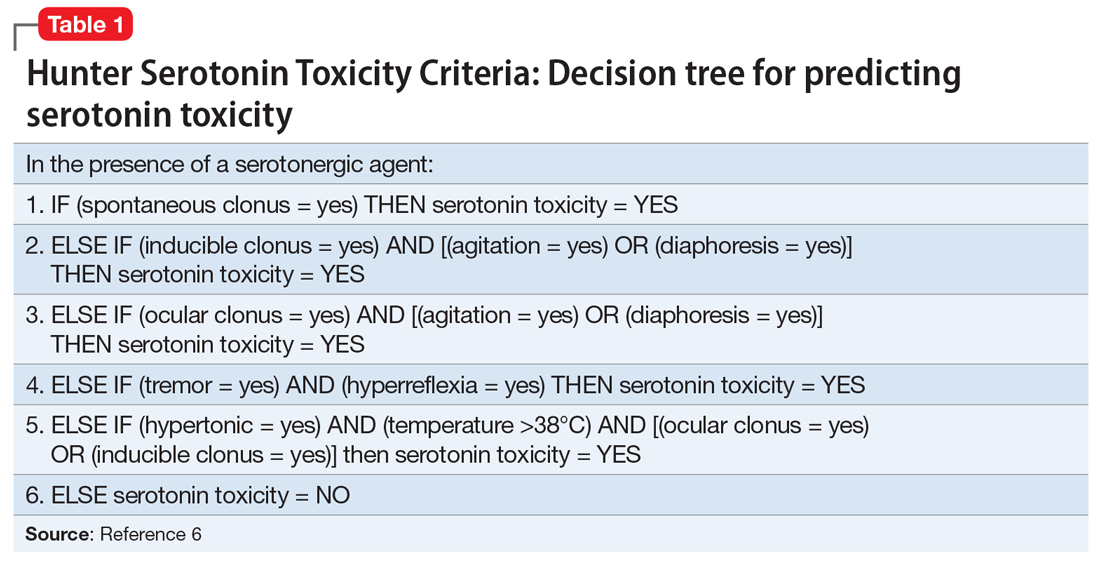
The diagnosis of serotonin syndrome is most accurately made using Hunter Serotonin Toxicity Criteria (Table 16). Because Ms. S had an insidious onset of symptoms, and treatment was initiated before full evaluation, it is unknown if she met Hunter criteria. To meet these criteria, a patient must have ≥1 of the following6:
- spontaneous clonus
- inducible clonus plus agitation or diaphoresis
- ocular clonus plus agitation or diaphoresis
- tremor plus hyperreflexia
- hypertonia plus temperature >38°C plus ocular or inducible clonus.

The Sternbach diagnostic criteria for serotonin syndrome (Table 23) is another commonly used tool.3 These criteria include the addition or increase of a serotonin agent and absence of substances or metabolic derangements that could account for symptoms and at least 3 of the following 10 symptoms3:
- mental status changes (confusion, hypomania)
- agitation
- myoclonus
- hyperreflexia
- diaphoresis
- shivering
- tremor
- diarrhea
- incoordination
- fever.
Continue to: Ms. S met the Sternbach diagnostic criteria...
Ms. S met the Sternbach diagnostic criteria for serotonin syndrome.
Ms. S was taking a single serotonin agent and initially had mild symptoms. More commonly, a patient who presents with serotonin syndrome has been receiving ≥2 serotonergic agents or toxic levels of a single agent, and these agents usually include a psychotropic medication such as a monoamine oxidase inhibitor, tricyclic antidepressant, or SSRI, as well as a medication from a different class, such as dextromethorphan, linezolid, tramadol, methylene blue, and/or St. John’s wort.1,7-13 However, in this case, Ms. S also was taking bupropion, a known inhibitor of cytochrome P450 2D6. Bupropion might have increased Ms. S’s fluoxetine levels.
Ms. S was a healthy, middle-age patient who took no medications other than those listed, had no medical comorbidities, and had a straightforward psychiatric history, which makes the diagnosis of serotonin syndrome clearer. However, other potential differential diagnoses, such as NMS, delirium tremens, and anticholinergic toxicity, might cloud the clinical picture. When differentiating NMS and serotonin syndrome, it is helpful to note whether a patient shows tremor, diarrhea, and myoclonus present in the absence of muscular, “lead-pipe” rigidity, which suggests a diagnosis of serotonin syndrome.2,3,5
[polldaddy:10279173]
The authors’ observations
Treating serotonin syndrome includes supportive care, discontinuing offending agents, administering benzodiazepines, and using a serotonin antagonist as an antidote for patients with moderate-to-severe cases. Cyproheptadine is an antihistaminergic medication with non-specific 5-HT1A and 5-HT2 antagonism. It is FDA-approved for specific allergic reactions, urticaria, and anaphylaxis adjunctive therapy, but not for serotonin syndrome. Case series support the use of cyproheptadine for acute management of serotonin syndrome, with rapid symptom improvement.4,7,14-18 We observed a similar outcome with Ms. S. Her significant autonomic symptoms resolved rapidly, although she experienced some residual, mild symptoms that took weeks to resolve.
Continue to: Because serotonergic agents...
Because serotonergic agents are used frequently and readily by primary care clinicians as well as psychiatrists, the ability to properly diagnose this syndrome is vital, particularly because severe cases can rapidly deteriorate.1,9,16,17 This presentation of a single serotonergic agent causing significant symptoms that worsened over months is not typical, but important to recognize as a patient begins to experience autonomic instability. As was the case with Ms. S, it is important to remain vigilant when changing dosages or adding medications. Symptoms of serotonin syndrome might be vague and difficult to diagnose, especially if the clinician is not aware of the variability of presentation of this syndrome. Cyproheptadine can be used safely and rapidly and should be considered a treatment option for serotonin syndrome.
OUTCOME Hypertension resolves
After her first dose of cyproheptadine, Ms. S’s blood pressure drops to 146/86 mm Hg. Three hours later, she repeats the cyproheptadine dose and her blood pressure drops to 106/60 mm Hg. She reports that her anxiety has lessened, although she is still tremulous. Overall, she says she feels better. She experiences improvement of her condition with a pharmacologic regimen of bupropion, gabapentin, and hydroxyzine.
Several weeks later, her health returns to baseline, with complete resolution of hypertension.
Bottom Line
Although serotonin syndrome is most commonly associated with co-administered serotonergic medications, symptoms can emerge with a single, moderately dosed agent. Treatment includes withdrawing the offending agent, and administering a serotonin antagonist. Mild cases of serotonin syndrome usually resolve.
Related Resources
- Turner AH, Kim JJ, McCarron RM. Differentiating serotonin syndrome and neuroleptic malignant syndrome. Current Psychiatry. 2019;18(2):30-36.
- Iqbal MM, Basil MJ, Kaplan J, et al. Overview of serotonin syndrome. Ann Clin Psychiatry. 2012;24(4):310-318.
Drug Brand Names
Bupropion • Wellbutrin, Zyban
Cyproheptadine • Periactin
Dextromethorphan • Benylin
Duloxetine • Cymbalta
Fluoxetine • Prozac
Gabapentin • Neurontin
Hydroxyzine • Atarax
Linezolid • Zyvox
Tramadol • Ultram, Ryzolt
1. Mason PJ, Morris VA, Balcezak TJ. Serotonin syndrome: presentation of 2 cases and review of literature. Medicine (Baltimore). 2000;79(4):201-209.
2. Boyer EW, Shannon M. The serotonin syndrome. N Engl J Med. 2005;352(11):1112-1120.
3. Sternbach H. The serotonin syndrome. Am J Psychiatry. 1991;148(6):705-713.
4. Graudins A, Stearman A, Chan B. Treatment of the serotonin syndrome with cyproheptadine. J Emerg Med. 1998;16(4):615-619.
5. Mills KC. Serotonin syndrome a clinical update. Crit Care Clin. 1997;13(4):763-783.
6. Dunkley EJ, Isbister GK, Sibbritt D, et al. The Hunter Serotonin Toxicity Criteria: simple and accurate diagnostic decision rules for serotonin toxicity. QJM. 2003;96:635-642.
7. Horowitz BZ, Mullins ME. Cyproheptadine for serotonin syndrome in an accidental pediatric sertraline ingestion. Pediatr Emerg Care. 1999;15(5):325-327.
8. Kolecki P. Isolated venlafaxine-induced serotonin syndrome. J Emerg Med. 1996;15:491-493.
9. Pan J, Shen W. Serotonin syndrome induced by low-dose venlafaxine. Ann Pharmacother. 2003;37(2):209-211.
10. Hernández JL, Ramos FJ, Infante J, et al. Severe serotonin syndrome induced by mirtazapine monotherapy. Ann Pharmacother. 2002;36(4):641-643.
11. Patel DD, Galarneau D. Serotonin syndrome with fluoxetine: two case reports. Ochsner J. 2016;16(4):554-557.
12. Frank C. Recognition and treatment of serotonin syndrome. Can Fam Physician. 2008;54(7):988-992.
13. Zuschlag ZD, Warren MW, K Schultz S. Serotonin toxicity and urinary analgesics: a case report and systematic literature review of methylene blue-induced serotonin syndrome. Psychosomatics. 2018;59(6):539-546.
14. Kapur S, Zipursky RB, Jones C, et al. Cyproheptadine: a potent in vivo serotonin antagonist. Am J Psychiatry. 1997;154(6):884.
15. Baigel GD. Cyproheptadine and the treatment of an unconscious patient with the serotonin syndrome. Eur J Anaesthesiol. 2003;20(7):586-588.
16. Lappin RI, Auchincloss EL. Treatment of the serotonin syndrome with cyproheptadine. N Engl J Med. 1994;331:1021-1022.
17. McDaniel WW. Serotonin syndrome: early management with cyproheptadine. Ann Pharmacother. 2001;35(7-8):870-873.
18. Kolecki P. Venlafaxine induced serotonin syndrome occurring after abstinence from phenelzine for more than two weeks. J Toxicol Clin Toxicol. 1997;35(2):211-212.
CASE Tremors, increasing anxiety
Ms. S, age 56, has a history of depression and anxiety.
The authors’ observations
The incidence of serotonin syndrome has increased because of increasing use of serotonergic agents.1-3 Although the severity could range from benign to life-threatening, the potential lethality combined with difficulty of diagnosis makes this condition of continued interest. Stimulation of the 5-hydroxytryptamine (5-HT) receptor subtypes, specifically 5-HT1A and 5-HT2, are implicated in this syndrome.4,5
Serotonin syndrome is a clinical diagnosis with a triad of symptoms that includes mental status changes, autonomic hyperactivity, and neuromuscular abnormalities.1,2 However, because of the varied presentation and similarity to other syndromes such as NMS, serotonin syndrome often is undiagnosed.5
TREATMENT Discontinue fluoxetine
Several months after the fluoxetine increase, Ms. S's physical symptoms emerge. Several weeks later, she notices significant hypertension of 162/102 mm Hg by checking her blood pressure at home. She had no history of hypertension before taking fluoxetine. She then tells her psychiatrist she has been experiencing confusion, shakiness, loss of balance, forgetfulness, joint pain, sweating, and fatigue, along with worsening anxiety. The treatment team makes a diagnosis of serotonin syndrome and recommends discontinuing fluoxetine and starting cyproheptadine, 4 mg initially, and then repeating the cyproheptadine dose in several hours if her symptoms do not resolve. Approximately, 2.5 months after the serotonin syndrome reaction, Ms. S receives hydroxyzine, 10 mg every 8 hours, as needed for anxiety.
The authors’ observations
The diagnosis of serotonin syndrome is most accurately made using Hunter Serotonin Toxicity Criteria (Table 16). Because Ms. S had an insidious onset of symptoms, and treatment was initiated before full evaluation, it is unknown if she met Hunter criteria. To meet these criteria, a patient must have ≥1 of the following6:
- spontaneous clonus
- inducible clonus plus agitation or diaphoresis
- ocular clonus plus agitation or diaphoresis
- tremor plus hyperreflexia
- hypertonia plus temperature >38°C plus ocular or inducible clonus.
The Sternbach diagnostic criteria for serotonin syndrome (Table 23) is another commonly used tool.3 These criteria include the addition or increase of a serotonin agent and absence of substances or metabolic derangements that could account for symptoms and at least 3 of the following 10 symptoms3:
- mental status changes (confusion, hypomania)
- agitation
- myoclonus
- hyperreflexia
- diaphoresis
- shivering
- tremor
- diarrhea
- incoordination
- fever.
Continue to: Ms. S met the Sternbach diagnostic criteria...
Ms. S met the Sternbach diagnostic criteria for serotonin syndrome.
Ms. S was taking a single serotonin agent and initially had mild symptoms. More commonly, a patient who presents with serotonin syndrome has been receiving ≥2 serotonergic agents or toxic levels of a single agent, and these agents usually include a psychotropic medication such as a monoamine oxidase inhibitor, tricyclic antidepressant, or SSRI, as well as a medication from a different class, such as dextromethorphan, linezolid, tramadol, methylene blue, and/or St. John’s wort.1,7-13 However, in this case, Ms. S also was taking bupropion, a known inhibitor of cytochrome P450 2D6. Bupropion might have increased Ms. S’s fluoxetine levels.
Ms. S was a healthy, middle-age patient who took no medications other than those listed, had no medical comorbidities, and had a straightforward psychiatric history, which makes the diagnosis of serotonin syndrome clearer. However, other potential differential diagnoses, such as NMS, delirium tremens, and anticholinergic toxicity, might cloud the clinical picture. When differentiating NMS and serotonin syndrome, it is helpful to note whether a patient shows tremor, diarrhea, and myoclonus present in the absence of muscular, “lead-pipe” rigidity, which suggests a diagnosis of serotonin syndrome.2,3,5
[polldaddy:10279173]
The authors’ observations
Treating serotonin syndrome includes supportive care, discontinuing offending agents, administering benzodiazepines, and using a serotonin antagonist as an antidote for patients with moderate-to-severe cases. Cyproheptadine is an antihistaminergic medication with non-specific 5-HT1A and 5-HT2 antagonism. It is FDA-approved for specific allergic reactions, urticaria, and anaphylaxis adjunctive therapy, but not for serotonin syndrome. Case series support the use of cyproheptadine for acute management of serotonin syndrome, with rapid symptom improvement.4,7,14-18 We observed a similar outcome with Ms. S. Her significant autonomic symptoms resolved rapidly, although she experienced some residual, mild symptoms that took weeks to resolve.
Continue to: Because serotonergic agents...
Because serotonergic agents are used frequently and readily by primary care clinicians as well as psychiatrists, the ability to properly diagnose this syndrome is vital, particularly because severe cases can rapidly deteriorate.1,9,16,17 This presentation of a single serotonergic agent causing significant symptoms that worsened over months is not typical, but important to recognize as a patient begins to experience autonomic instability. As was the case with Ms. S, it is important to remain vigilant when changing dosages or adding medications. Symptoms of serotonin syndrome might be vague and difficult to diagnose, especially if the clinician is not aware of the variability of presentation of this syndrome. Cyproheptadine can be used safely and rapidly and should be considered a treatment option for serotonin syndrome.
OUTCOME Hypertension resolves
After her first dose of cyproheptadine, Ms. S’s blood pressure drops to 146/86 mm Hg. Three hours later, she repeats the cyproheptadine dose and her blood pressure drops to 106/60 mm Hg. She reports that her anxiety has lessened, although she is still tremulous. Overall, she says she feels better. She experiences improvement of her condition with a pharmacologic regimen of bupropion, gabapentin, and hydroxyzine.
Several weeks later, her health returns to baseline, with complete resolution of hypertension.
Bottom Line
Although serotonin syndrome is most commonly associated with co-administered serotonergic medications, symptoms can emerge with a single, moderately dosed agent. Treatment includes withdrawing the offending agent, and administering a serotonin antagonist. Mild cases of serotonin syndrome usually resolve.
Related Resources
- Turner AH, Kim JJ, McCarron RM. Differentiating serotonin syndrome and neuroleptic malignant syndrome. Current Psychiatry. 2019;18(2):30-36.
- Iqbal MM, Basil MJ, Kaplan J, et al. Overview of serotonin syndrome. Ann Clin Psychiatry. 2012;24(4):310-318.
Drug Brand Names
Bupropion • Wellbutrin, Zyban
Cyproheptadine • Periactin
Dextromethorphan • Benylin
Duloxetine • Cymbalta
Fluoxetine • Prozac
Gabapentin • Neurontin
Hydroxyzine • Atarax
Linezolid • Zyvox
Tramadol • Ultram, Ryzolt
CASE Tremors, increasing anxiety
Ms. S, age 56, has a history of depression and anxiety.
The authors’ observations
The incidence of serotonin syndrome has increased because of increasing use of serotonergic agents.1-3 Although the severity could range from benign to life-threatening, the potential lethality combined with difficulty of diagnosis makes this condition of continued interest. Stimulation of the 5-hydroxytryptamine (5-HT) receptor subtypes, specifically 5-HT1A and 5-HT2, are implicated in this syndrome.4,5
Serotonin syndrome is a clinical diagnosis with a triad of symptoms that includes mental status changes, autonomic hyperactivity, and neuromuscular abnormalities.1,2 However, because of the varied presentation and similarity to other syndromes such as NMS, serotonin syndrome often is undiagnosed.5
TREATMENT Discontinue fluoxetine
Several months after the fluoxetine increase, Ms. S's physical symptoms emerge. Several weeks later, she notices significant hypertension of 162/102 mm Hg by checking her blood pressure at home. She had no history of hypertension before taking fluoxetine. She then tells her psychiatrist she has been experiencing confusion, shakiness, loss of balance, forgetfulness, joint pain, sweating, and fatigue, along with worsening anxiety. The treatment team makes a diagnosis of serotonin syndrome and recommends discontinuing fluoxetine and starting cyproheptadine, 4 mg initially, and then repeating the cyproheptadine dose in several hours if her symptoms do not resolve. Approximately, 2.5 months after the serotonin syndrome reaction, Ms. S receives hydroxyzine, 10 mg every 8 hours, as needed for anxiety.
The authors’ observations
The diagnosis of serotonin syndrome is most accurately made using Hunter Serotonin Toxicity Criteria (Table 16). Because Ms. S had an insidious onset of symptoms, and treatment was initiated before full evaluation, it is unknown if she met Hunter criteria. To meet these criteria, a patient must have ≥1 of the following6:
- spontaneous clonus
- inducible clonus plus agitation or diaphoresis
- ocular clonus plus agitation or diaphoresis
- tremor plus hyperreflexia
- hypertonia plus temperature >38°C plus ocular or inducible clonus.
The Sternbach diagnostic criteria for serotonin syndrome (Table 23) is another commonly used tool.3 These criteria include the addition or increase of a serotonin agent and absence of substances or metabolic derangements that could account for symptoms and at least 3 of the following 10 symptoms3:
- mental status changes (confusion, hypomania)
- agitation
- myoclonus
- hyperreflexia
- diaphoresis
- shivering
- tremor
- diarrhea
- incoordination
- fever.
Continue to: Ms. S met the Sternbach diagnostic criteria...
Ms. S met the Sternbach diagnostic criteria for serotonin syndrome.
Ms. S was taking a single serotonin agent and initially had mild symptoms. More commonly, a patient who presents with serotonin syndrome has been receiving ≥2 serotonergic agents or toxic levels of a single agent, and these agents usually include a psychotropic medication such as a monoamine oxidase inhibitor, tricyclic antidepressant, or SSRI, as well as a medication from a different class, such as dextromethorphan, linezolid, tramadol, methylene blue, and/or St. John’s wort.1,7-13 However, in this case, Ms. S also was taking bupropion, a known inhibitor of cytochrome P450 2D6. Bupropion might have increased Ms. S’s fluoxetine levels.
Ms. S was a healthy, middle-age patient who took no medications other than those listed, had no medical comorbidities, and had a straightforward psychiatric history, which makes the diagnosis of serotonin syndrome clearer. However, other potential differential diagnoses, such as NMS, delirium tremens, and anticholinergic toxicity, might cloud the clinical picture. When differentiating NMS and serotonin syndrome, it is helpful to note whether a patient shows tremor, diarrhea, and myoclonus present in the absence of muscular, “lead-pipe” rigidity, which suggests a diagnosis of serotonin syndrome.2,3,5
[polldaddy:10279173]
The authors’ observations
Treating serotonin syndrome includes supportive care, discontinuing offending agents, administering benzodiazepines, and using a serotonin antagonist as an antidote for patients with moderate-to-severe cases. Cyproheptadine is an antihistaminergic medication with non-specific 5-HT1A and 5-HT2 antagonism. It is FDA-approved for specific allergic reactions, urticaria, and anaphylaxis adjunctive therapy, but not for serotonin syndrome. Case series support the use of cyproheptadine for acute management of serotonin syndrome, with rapid symptom improvement.4,7,14-18 We observed a similar outcome with Ms. S. Her significant autonomic symptoms resolved rapidly, although she experienced some residual, mild symptoms that took weeks to resolve.
Continue to: Because serotonergic agents...
Because serotonergic agents are used frequently and readily by primary care clinicians as well as psychiatrists, the ability to properly diagnose this syndrome is vital, particularly because severe cases can rapidly deteriorate.1,9,16,17 This presentation of a single serotonergic agent causing significant symptoms that worsened over months is not typical, but important to recognize as a patient begins to experience autonomic instability. As was the case with Ms. S, it is important to remain vigilant when changing dosages or adding medications. Symptoms of serotonin syndrome might be vague and difficult to diagnose, especially if the clinician is not aware of the variability of presentation of this syndrome. Cyproheptadine can be used safely and rapidly and should be considered a treatment option for serotonin syndrome.
OUTCOME Hypertension resolves
After her first dose of cyproheptadine, Ms. S’s blood pressure drops to 146/86 mm Hg. Three hours later, she repeats the cyproheptadine dose and her blood pressure drops to 106/60 mm Hg. She reports that her anxiety has lessened, although she is still tremulous. Overall, she says she feels better. She experiences improvement of her condition with a pharmacologic regimen of bupropion, gabapentin, and hydroxyzine.
Several weeks later, her health returns to baseline, with complete resolution of hypertension.
Bottom Line
Although serotonin syndrome is most commonly associated with co-administered serotonergic medications, symptoms can emerge with a single, moderately dosed agent. Treatment includes withdrawing the offending agent, and administering a serotonin antagonist. Mild cases of serotonin syndrome usually resolve.
Related Resources
- Turner AH, Kim JJ, McCarron RM. Differentiating serotonin syndrome and neuroleptic malignant syndrome. Current Psychiatry. 2019;18(2):30-36.
- Iqbal MM, Basil MJ, Kaplan J, et al. Overview of serotonin syndrome. Ann Clin Psychiatry. 2012;24(4):310-318.
Drug Brand Names
Bupropion • Wellbutrin, Zyban
Cyproheptadine • Periactin
Dextromethorphan • Benylin
Duloxetine • Cymbalta
Fluoxetine • Prozac
Gabapentin • Neurontin
Hydroxyzine • Atarax
Linezolid • Zyvox
Tramadol • Ultram, Ryzolt
1. Mason PJ, Morris VA, Balcezak TJ. Serotonin syndrome: presentation of 2 cases and review of literature. Medicine (Baltimore). 2000;79(4):201-209.
2. Boyer EW, Shannon M. The serotonin syndrome. N Engl J Med. 2005;352(11):1112-1120.
3. Sternbach H. The serotonin syndrome. Am J Psychiatry. 1991;148(6):705-713.
4. Graudins A, Stearman A, Chan B. Treatment of the serotonin syndrome with cyproheptadine. J Emerg Med. 1998;16(4):615-619.
5. Mills KC. Serotonin syndrome a clinical update. Crit Care Clin. 1997;13(4):763-783.
6. Dunkley EJ, Isbister GK, Sibbritt D, et al. The Hunter Serotonin Toxicity Criteria: simple and accurate diagnostic decision rules for serotonin toxicity. QJM. 2003;96:635-642.
7. Horowitz BZ, Mullins ME. Cyproheptadine for serotonin syndrome in an accidental pediatric sertraline ingestion. Pediatr Emerg Care. 1999;15(5):325-327.
8. Kolecki P. Isolated venlafaxine-induced serotonin syndrome. J Emerg Med. 1996;15:491-493.
9. Pan J, Shen W. Serotonin syndrome induced by low-dose venlafaxine. Ann Pharmacother. 2003;37(2):209-211.
10. Hernández JL, Ramos FJ, Infante J, et al. Severe serotonin syndrome induced by mirtazapine monotherapy. Ann Pharmacother. 2002;36(4):641-643.
11. Patel DD, Galarneau D. Serotonin syndrome with fluoxetine: two case reports. Ochsner J. 2016;16(4):554-557.
12. Frank C. Recognition and treatment of serotonin syndrome. Can Fam Physician. 2008;54(7):988-992.
13. Zuschlag ZD, Warren MW, K Schultz S. Serotonin toxicity and urinary analgesics: a case report and systematic literature review of methylene blue-induced serotonin syndrome. Psychosomatics. 2018;59(6):539-546.
14. Kapur S, Zipursky RB, Jones C, et al. Cyproheptadine: a potent in vivo serotonin antagonist. Am J Psychiatry. 1997;154(6):884.
15. Baigel GD. Cyproheptadine and the treatment of an unconscious patient with the serotonin syndrome. Eur J Anaesthesiol. 2003;20(7):586-588.
16. Lappin RI, Auchincloss EL. Treatment of the serotonin syndrome with cyproheptadine. N Engl J Med. 1994;331:1021-1022.
17. McDaniel WW. Serotonin syndrome: early management with cyproheptadine. Ann Pharmacother. 2001;35(7-8):870-873.
18. Kolecki P. Venlafaxine induced serotonin syndrome occurring after abstinence from phenelzine for more than two weeks. J Toxicol Clin Toxicol. 1997;35(2):211-212.
1. Mason PJ, Morris VA, Balcezak TJ. Serotonin syndrome: presentation of 2 cases and review of literature. Medicine (Baltimore). 2000;79(4):201-209.
2. Boyer EW, Shannon M. The serotonin syndrome. N Engl J Med. 2005;352(11):1112-1120.
3. Sternbach H. The serotonin syndrome. Am J Psychiatry. 1991;148(6):705-713.
4. Graudins A, Stearman A, Chan B. Treatment of the serotonin syndrome with cyproheptadine. J Emerg Med. 1998;16(4):615-619.
5. Mills KC. Serotonin syndrome a clinical update. Crit Care Clin. 1997;13(4):763-783.
6. Dunkley EJ, Isbister GK, Sibbritt D, et al. The Hunter Serotonin Toxicity Criteria: simple and accurate diagnostic decision rules for serotonin toxicity. QJM. 2003;96:635-642.
7. Horowitz BZ, Mullins ME. Cyproheptadine for serotonin syndrome in an accidental pediatric sertraline ingestion. Pediatr Emerg Care. 1999;15(5):325-327.
8. Kolecki P. Isolated venlafaxine-induced serotonin syndrome. J Emerg Med. 1996;15:491-493.
9. Pan J, Shen W. Serotonin syndrome induced by low-dose venlafaxine. Ann Pharmacother. 2003;37(2):209-211.
10. Hernández JL, Ramos FJ, Infante J, et al. Severe serotonin syndrome induced by mirtazapine monotherapy. Ann Pharmacother. 2002;36(4):641-643.
11. Patel DD, Galarneau D. Serotonin syndrome with fluoxetine: two case reports. Ochsner J. 2016;16(4):554-557.
12. Frank C. Recognition and treatment of serotonin syndrome. Can Fam Physician. 2008;54(7):988-992.
13. Zuschlag ZD, Warren MW, K Schultz S. Serotonin toxicity and urinary analgesics: a case report and systematic literature review of methylene blue-induced serotonin syndrome. Psychosomatics. 2018;59(6):539-546.
14. Kapur S, Zipursky RB, Jones C, et al. Cyproheptadine: a potent in vivo serotonin antagonist. Am J Psychiatry. 1997;154(6):884.
15. Baigel GD. Cyproheptadine and the treatment of an unconscious patient with the serotonin syndrome. Eur J Anaesthesiol. 2003;20(7):586-588.
16. Lappin RI, Auchincloss EL. Treatment of the serotonin syndrome with cyproheptadine. N Engl J Med. 1994;331:1021-1022.
17. McDaniel WW. Serotonin syndrome: early management with cyproheptadine. Ann Pharmacother. 2001;35(7-8):870-873.
18. Kolecki P. Venlafaxine induced serotonin syndrome occurring after abstinence from phenelzine for more than two weeks. J Toxicol Clin Toxicol. 1997;35(2):211-212.

Seniors in long-term care face higher suicide risks
Seniors who move into and live in long-term care facilities are at increased risk of suicide, according to reporting by the PBS NewsHour and Kaiser Health News. The report focused on the story of Roland K. Tiedemann, a senior who, in his younger days, was an outdoorsman, traveled around the world, and served as a surrogate dad to his granddaughter. When his health deteriorated, he moved to a long-term care facility with his wife, who later was diagnosed with dementia. At age 89, Mr. Tiedemann, who was facing a third move into a facility that would take Medicaid, “locked his door ... and jumped to his death from his fourth floor window,” the report said. The death of Mr. Tiedemann led Julie A. Rickard, PhD, to start asking questions at his facility and working with other centers to identify the signs of depression. A few years earlier, after a “rash of suicides, mostly among young people,” Dr. Rickard had started developing the Suicide Prevention Coalition of North Central Washington. It is also important for families to ask whether suicide prevention and mental health protocols are in place at long-term care facilities. Ultimately, Dr. Rickard and Jane Davis – Mr. Tiedemann’s daughter – agree that stigma needs to be reduced so that residents feel free to talk their depression and anxiety. PBS NewsHour.
More and more people are using mental health apps, and a new study has found that few of those apps have a sound scientific basis for their claims. The researchers scoured iTunes and Google Play for 1,435 mental health apps. These were whittled to 73 of the most popular. The apps addressed common mental health disorders, including depression, anxiety, and substance abuse, as well as some less common illnesses, such as schizophrenia. Of the 73 apps, 47 claimed to be able to effectively diagnose the target condition, improve the user symptoms or mood, and bolster self-management. In about 40% of cases, the app site trotted out scientific language to buttress claims of effectiveness. However, when the researchers took a rigorous look at the science behind the apps, only one was based on a published study. Moreover, for about one-third of the apps, no supporting scientific at all could be found. Science speak did not translate into evidence-based science. The annual market for self-improvement products and apps, including those focusing on mental health, is $10 billion in the United States. Forbes.
Police officers trained in helping people with mental health problems can get positive results, a newspaper report shows. That’s what happened when Logan Elliott called Clive, Iowa, police to report that his fiancé had threatened suicide – and had had a prior attempt, according to the Des Moines Register. Mr. Elliott’s fiancé, Codii Lewis, was in a “depressive state,” was suffering from the loss of his dog, and was troubled by uncertainty regarding the cost of a procedure undertaken to confirm his gender as a transgender man; as a result, Mr. Lewis climbed onto a ledge. He streamed video of his encounter with the police on Facebook Live, and eventually, after kicking one of the officers, he was subdued and taken into custody. The training that Clive officers receive “calls for less aggressive behavior by police,” the article said. “It emphasizes de-escalation, especially when the subject may be suicidal. It doesn’t expect officers to be therapists or handle all mental health situations, but it does ask that they handle mental health situations differently” from the way they might handle other calls. People with mental illness that is untreated are 16 times more likely to be killed by law enforcement than are people without mental illness. Des Moines Register.
An exhibit now running at the Dartmouth-Hitchcock Medical Center in Lebanon, N.H., is intended to put a human face on mental illness. The 99 Faces Project: Portraits Without Labels by Boston-area artist Lynda Michaud Cutrell presents photos of people with serious mental illnesses and those who love them, the New Hampshire Union Leader reported. Portraits were taken with the help of three photographers nationwide. The long list was trimmed to 99 that mirror the ethnic makeup of the U.S. population. The roster of individuals includes 33 with schizophrenia and 33 with bipolar disorder. The remaining 33 are “chronically normal” according to Ms. Cutrell. The viewer can’t tell the difference between the mentally affected individuals and those who are not; they look like people one encounters every day. And that’s the point. Marianne Barthel, director of the Dartmouth-Hitchcock Arts Program, hopes the exhibit leads to conversations that help “normalize mental health in our society, to recognize that the people you’re looking at in these images could be you or your family member,” the article said. Ms. Barthel also hopes that the exhibit, which runs until September, will help reduce the stigma around mental illness by showing that “there are people who are living successful lives with these illnesses.” One of the 99 faces is that of actress Glenn Close, who cofounded the organization Bring Change To Mind in 2010 after her sister was diagnosed with bipolar disorder and her nephew with schizoaffective disorder. New Hampshire Union Leader.
Deliberation about the use of the death penalty for a prisoner in Kansas has implications for those with mental illness who commit crimes. As the Topeka Capital-Journal reported, James Kahler was convicted of murdering his estranged wife, her grandmother, and his two teenage daughters in 2009. Two years later, he was sentenced to death, and several years later, the Kansas Supreme Court upheld that conviction. His guilt is not in question. What is at issue is his impairment. His lawyers had earlier argued that severe depression had made his grip on reality tenuous and that he could not be executed. Now comes the news that the U.S. Supreme Court will rule whether the decision by the state of Kansas to abolish insanity as a defense was constitutional under the 8th and 14th amendments. The high court’s ruling will have profound implications for people with mental illness. In addition to those in Kansas, under state laws in Alaska, Idaho, Montana, and Utah, “a traditional insanity defense in which a person must understand the difference between right and wrong before being found guilty of a crime isn’t allowed,” the report said. An accused can cite “mental disease or defect” as a partial defense. However, in such cases, it must be proven that the person had no intention of committing a crime. In their petition to the Supreme Court, his attorneys argued that he knew he was shooting people, but that he was so disturbed at the time that he could not stop himself. “A favorable decision would make it clear that the Constitution requires that a defendant be able to understand the difference between right and wrong before being found guilty, and, in cases like Mr. Kahler’s, put to death,” his defense attorney, Meryle Carver-Allmond, told the Capital-Journal. “We’re hopeful that, in taking Mr. Kahler’s case, the United States Supreme Court has indicated a desire to find that the Constitution requires better of us in our treatment of mentally ill defendants.” The Topeka Capital-Journal.
Seniors who move into and live in long-term care facilities are at increased risk of suicide, according to reporting by the PBS NewsHour and Kaiser Health News. The report focused on the story of Roland K. Tiedemann, a senior who, in his younger days, was an outdoorsman, traveled around the world, and served as a surrogate dad to his granddaughter. When his health deteriorated, he moved to a long-term care facility with his wife, who later was diagnosed with dementia. At age 89, Mr. Tiedemann, who was facing a third move into a facility that would take Medicaid, “locked his door ... and jumped to his death from his fourth floor window,” the report said. The death of Mr. Tiedemann led Julie A. Rickard, PhD, to start asking questions at his facility and working with other centers to identify the signs of depression. A few years earlier, after a “rash of suicides, mostly among young people,” Dr. Rickard had started developing the Suicide Prevention Coalition of North Central Washington. It is also important for families to ask whether suicide prevention and mental health protocols are in place at long-term care facilities. Ultimately, Dr. Rickard and Jane Davis – Mr. Tiedemann’s daughter – agree that stigma needs to be reduced so that residents feel free to talk their depression and anxiety. PBS NewsHour.
More and more people are using mental health apps, and a new study has found that few of those apps have a sound scientific basis for their claims. The researchers scoured iTunes and Google Play for 1,435 mental health apps. These were whittled to 73 of the most popular. The apps addressed common mental health disorders, including depression, anxiety, and substance abuse, as well as some less common illnesses, such as schizophrenia. Of the 73 apps, 47 claimed to be able to effectively diagnose the target condition, improve the user symptoms or mood, and bolster self-management. In about 40% of cases, the app site trotted out scientific language to buttress claims of effectiveness. However, when the researchers took a rigorous look at the science behind the apps, only one was based on a published study. Moreover, for about one-third of the apps, no supporting scientific at all could be found. Science speak did not translate into evidence-based science. The annual market for self-improvement products and apps, including those focusing on mental health, is $10 billion in the United States. Forbes.
Police officers trained in helping people with mental health problems can get positive results, a newspaper report shows. That’s what happened when Logan Elliott called Clive, Iowa, police to report that his fiancé had threatened suicide – and had had a prior attempt, according to the Des Moines Register. Mr. Elliott’s fiancé, Codii Lewis, was in a “depressive state,” was suffering from the loss of his dog, and was troubled by uncertainty regarding the cost of a procedure undertaken to confirm his gender as a transgender man; as a result, Mr. Lewis climbed onto a ledge. He streamed video of his encounter with the police on Facebook Live, and eventually, after kicking one of the officers, he was subdued and taken into custody. The training that Clive officers receive “calls for less aggressive behavior by police,” the article said. “It emphasizes de-escalation, especially when the subject may be suicidal. It doesn’t expect officers to be therapists or handle all mental health situations, but it does ask that they handle mental health situations differently” from the way they might handle other calls. People with mental illness that is untreated are 16 times more likely to be killed by law enforcement than are people without mental illness. Des Moines Register.
An exhibit now running at the Dartmouth-Hitchcock Medical Center in Lebanon, N.H., is intended to put a human face on mental illness. The 99 Faces Project: Portraits Without Labels by Boston-area artist Lynda Michaud Cutrell presents photos of people with serious mental illnesses and those who love them, the New Hampshire Union Leader reported. Portraits were taken with the help of three photographers nationwide. The long list was trimmed to 99 that mirror the ethnic makeup of the U.S. population. The roster of individuals includes 33 with schizophrenia and 33 with bipolar disorder. The remaining 33 are “chronically normal” according to Ms. Cutrell. The viewer can’t tell the difference between the mentally affected individuals and those who are not; they look like people one encounters every day. And that’s the point. Marianne Barthel, director of the Dartmouth-Hitchcock Arts Program, hopes the exhibit leads to conversations that help “normalize mental health in our society, to recognize that the people you’re looking at in these images could be you or your family member,” the article said. Ms. Barthel also hopes that the exhibit, which runs until September, will help reduce the stigma around mental illness by showing that “there are people who are living successful lives with these illnesses.” One of the 99 faces is that of actress Glenn Close, who cofounded the organization Bring Change To Mind in 2010 after her sister was diagnosed with bipolar disorder and her nephew with schizoaffective disorder. New Hampshire Union Leader.
Deliberation about the use of the death penalty for a prisoner in Kansas has implications for those with mental illness who commit crimes. As the Topeka Capital-Journal reported, James Kahler was convicted of murdering his estranged wife, her grandmother, and his two teenage daughters in 2009. Two years later, he was sentenced to death, and several years later, the Kansas Supreme Court upheld that conviction. His guilt is not in question. What is at issue is his impairment. His lawyers had earlier argued that severe depression had made his grip on reality tenuous and that he could not be executed. Now comes the news that the U.S. Supreme Court will rule whether the decision by the state of Kansas to abolish insanity as a defense was constitutional under the 8th and 14th amendments. The high court’s ruling will have profound implications for people with mental illness. In addition to those in Kansas, under state laws in Alaska, Idaho, Montana, and Utah, “a traditional insanity defense in which a person must understand the difference between right and wrong before being found guilty of a crime isn’t allowed,” the report said. An accused can cite “mental disease or defect” as a partial defense. However, in such cases, it must be proven that the person had no intention of committing a crime. In their petition to the Supreme Court, his attorneys argued that he knew he was shooting people, but that he was so disturbed at the time that he could not stop himself. “A favorable decision would make it clear that the Constitution requires that a defendant be able to understand the difference between right and wrong before being found guilty, and, in cases like Mr. Kahler’s, put to death,” his defense attorney, Meryle Carver-Allmond, told the Capital-Journal. “We’re hopeful that, in taking Mr. Kahler’s case, the United States Supreme Court has indicated a desire to find that the Constitution requires better of us in our treatment of mentally ill defendants.” The Topeka Capital-Journal.
Seniors who move into and live in long-term care facilities are at increased risk of suicide, according to reporting by the PBS NewsHour and Kaiser Health News. The report focused on the story of Roland K. Tiedemann, a senior who, in his younger days, was an outdoorsman, traveled around the world, and served as a surrogate dad to his granddaughter. When his health deteriorated, he moved to a long-term care facility with his wife, who later was diagnosed with dementia. At age 89, Mr. Tiedemann, who was facing a third move into a facility that would take Medicaid, “locked his door ... and jumped to his death from his fourth floor window,” the report said. The death of Mr. Tiedemann led Julie A. Rickard, PhD, to start asking questions at his facility and working with other centers to identify the signs of depression. A few years earlier, after a “rash of suicides, mostly among young people,” Dr. Rickard had started developing the Suicide Prevention Coalition of North Central Washington. It is also important for families to ask whether suicide prevention and mental health protocols are in place at long-term care facilities. Ultimately, Dr. Rickard and Jane Davis – Mr. Tiedemann’s daughter – agree that stigma needs to be reduced so that residents feel free to talk their depression and anxiety. PBS NewsHour.
More and more people are using mental health apps, and a new study has found that few of those apps have a sound scientific basis for their claims. The researchers scoured iTunes and Google Play for 1,435 mental health apps. These were whittled to 73 of the most popular. The apps addressed common mental health disorders, including depression, anxiety, and substance abuse, as well as some less common illnesses, such as schizophrenia. Of the 73 apps, 47 claimed to be able to effectively diagnose the target condition, improve the user symptoms or mood, and bolster self-management. In about 40% of cases, the app site trotted out scientific language to buttress claims of effectiveness. However, when the researchers took a rigorous look at the science behind the apps, only one was based on a published study. Moreover, for about one-third of the apps, no supporting scientific at all could be found. Science speak did not translate into evidence-based science. The annual market for self-improvement products and apps, including those focusing on mental health, is $10 billion in the United States. Forbes.
Police officers trained in helping people with mental health problems can get positive results, a newspaper report shows. That’s what happened when Logan Elliott called Clive, Iowa, police to report that his fiancé had threatened suicide – and had had a prior attempt, according to the Des Moines Register. Mr. Elliott’s fiancé, Codii Lewis, was in a “depressive state,” was suffering from the loss of his dog, and was troubled by uncertainty regarding the cost of a procedure undertaken to confirm his gender as a transgender man; as a result, Mr. Lewis climbed onto a ledge. He streamed video of his encounter with the police on Facebook Live, and eventually, after kicking one of the officers, he was subdued and taken into custody. The training that Clive officers receive “calls for less aggressive behavior by police,” the article said. “It emphasizes de-escalation, especially when the subject may be suicidal. It doesn’t expect officers to be therapists or handle all mental health situations, but it does ask that they handle mental health situations differently” from the way they might handle other calls. People with mental illness that is untreated are 16 times more likely to be killed by law enforcement than are people without mental illness. Des Moines Register.
An exhibit now running at the Dartmouth-Hitchcock Medical Center in Lebanon, N.H., is intended to put a human face on mental illness. The 99 Faces Project: Portraits Without Labels by Boston-area artist Lynda Michaud Cutrell presents photos of people with serious mental illnesses and those who love them, the New Hampshire Union Leader reported. Portraits were taken with the help of three photographers nationwide. The long list was trimmed to 99 that mirror the ethnic makeup of the U.S. population. The roster of individuals includes 33 with schizophrenia and 33 with bipolar disorder. The remaining 33 are “chronically normal” according to Ms. Cutrell. The viewer can’t tell the difference between the mentally affected individuals and those who are not; they look like people one encounters every day. And that’s the point. Marianne Barthel, director of the Dartmouth-Hitchcock Arts Program, hopes the exhibit leads to conversations that help “normalize mental health in our society, to recognize that the people you’re looking at in these images could be you or your family member,” the article said. Ms. Barthel also hopes that the exhibit, which runs until September, will help reduce the stigma around mental illness by showing that “there are people who are living successful lives with these illnesses.” One of the 99 faces is that of actress Glenn Close, who cofounded the organization Bring Change To Mind in 2010 after her sister was diagnosed with bipolar disorder and her nephew with schizoaffective disorder. New Hampshire Union Leader.
Deliberation about the use of the death penalty for a prisoner in Kansas has implications for those with mental illness who commit crimes. As the Topeka Capital-Journal reported, James Kahler was convicted of murdering his estranged wife, her grandmother, and his two teenage daughters in 2009. Two years later, he was sentenced to death, and several years later, the Kansas Supreme Court upheld that conviction. His guilt is not in question. What is at issue is his impairment. His lawyers had earlier argued that severe depression had made his grip on reality tenuous and that he could not be executed. Now comes the news that the U.S. Supreme Court will rule whether the decision by the state of Kansas to abolish insanity as a defense was constitutional under the 8th and 14th amendments. The high court’s ruling will have profound implications for people with mental illness. In addition to those in Kansas, under state laws in Alaska, Idaho, Montana, and Utah, “a traditional insanity defense in which a person must understand the difference between right and wrong before being found guilty of a crime isn’t allowed,” the report said. An accused can cite “mental disease or defect” as a partial defense. However, in such cases, it must be proven that the person had no intention of committing a crime. In their petition to the Supreme Court, his attorneys argued that he knew he was shooting people, but that he was so disturbed at the time that he could not stop himself. “A favorable decision would make it clear that the Constitution requires that a defendant be able to understand the difference between right and wrong before being found guilty, and, in cases like Mr. Kahler’s, put to death,” his defense attorney, Meryle Carver-Allmond, told the Capital-Journal. “We’re hopeful that, in taking Mr. Kahler’s case, the United States Supreme Court has indicated a desire to find that the Constitution requires better of us in our treatment of mentally ill defendants.” The Topeka Capital-Journal.
Addressing anxiety helps youth with functional abdominal pain disorders
MILWAUKEE – A stepped-care approach to youth with functional abdominal pain disorders may be effective in targeting those with comorbid anxiety, according to ongoing research.
A study of 79 pediatric patients with a functional abdominal pain disorder (FAPD) and co-occurring anxiety found that those who received cognitive behavioral therapy (CBT) that included a component to address anxiety had less functional disability and anxiety than those who received treatment as usual. Pain scores also dropped, though the difference was not statistically significant.
The patients, aged 9-14 years and mostly white and female, were randomized to treatment allocation. Functional disability scores were significantly lower post-treatment for those who received the stepped therapy compared with the treatment as usual group (P less than .05, Cohen’s D = .49). This indicates a moderate effect size, said Natoshia Cunningham, PhD, speaking at the scientific meeting of the American Pain Society.
Mean scores on an anxiety rating scale also dropped below the threshold for clinical anxiety for those receiving the stepped therapy; on average, the treatment as usual group still scored above the clinical anxiety threshold after treatment (P for difference = .05).
The study, part of ongoing research, tests a hybrid online intervention, dubbed Aim to Decrease Anxiety and Pain Treatment, or ADAPT. The ADAPT program includes some common elements of CBT for anxiety that were not previously included in the pediatric pain CBT in use for the FAPD patients, she said.
The hybrid program began with two in-person sessions, each lasting one hour. These were followed by up to four web-based sessions. Patients viewed videos, read some material online, and complete activities with follow-up assessments. The web-based component was structured so that providers can see how patients fare on assessments – and even see which activities had been opened or completed. This, said Dr. Cunningham, allowed the treating provider to tailor what’s addressed in the associated weekly phone checks that accompany the online content.
Parents were also given practical, evidence-based advice to help manage their child’s FAPD. These include encouraging children to be independent in pain management, stopping “status checks,” encouraging normal school and social activities, and avoiding special privileges when pain interferes with activities.
Overall, up to 40% of pediatric functional abdominal pain patients may not respond to CBT, the most efficacious treatment known, said Dr. Cunningham, a pediatric psychologist at the University of Cincinnati. Her research indicates that comorbid anxiety may predict poor response, and that addressing anxiety improves pain and disability in this complex, common disorder.
With a brief psychosocial screening that identifies patients with anxiety, Dr. Cunningham and her colleagues can implement the targeted, partially web-based therapy strategy that tackles anxiety along with CBT for functional abdominal pain.
“Anxiety is common and related to poor outcomes,” noted Dr. Cunningham, She added that overall, half or more of individuals with chronic pain also have anxiety. Among children with FAPD, “Clinical anxiety predicts disability and poor treatment response.”
The first step, she said, was identifying the patients with FAPD who had anxiety, including those with subclinical anxiety.
At intake, children coming to the Cincinnati Children’s Hospital’s gastroenterology clinic complete anxiety screening via the Screen for Child Anxiety Related Emotional Disorders (SCARED) (Depress Anxiety. 2000;12[2]:85-91). Disability and pain are assessed by the Functional Disability Inventory and the Numeric Rating Scale (J Pediatr Psychol. 1991 Feb;16[1]:39-58).
In earlier research, Dr. Cunningham and her collaborators found a significant association between anxiety and both higher pain levels and more disability. And, clinically significant anxiety was more likely among the FAPD patients with persistent disability after six months of treatment.
A surprising finding from the screenings, said Dr. Cunningham, is that youth endorsed more anxiety symptoms in self-assessment than their parents observed. “Children are often their own best informants of their internalizing symptoms,” she said. “Not only do their parents not notice it, it may not be obvious to their providers, either.”
Since many children with FAPD have anxiety, the next question was “How do we better enhance their treatments?” she continued. To answer that question, she took one step back: “How do these youth respond to our current best practice?”
Looking at Cincinnati Children’s patients with FAPD who did – or did not – have anxiety, Dr. Cunningham found that “those who have clinical levels of anxiety don’t respond as well to CBT.” Pain-directed therapy alone, she said, “is insufficient to treat these patients.”
Together with brief screening, stepped therapy delivered via ADAPT offers promise to boost the efficacy of FAPD treatment, perhaps even in a primary care setting, said Dr. Cunningham. She and her collaborators are continuing to study comorbid anxiety and pain in youth; current work is using functional magnetic resonance imaging to examine cognitive and affective changes in patients receiving the ADAPT intervention.
The study was funded by the American Pain Society Sharon S. Keller Chronic Pain Research Grant, Cincinnati Children’s Hospital, and the National Institutes of Health. Dr. Cunningham reported no relevant conflicts of interest.
[email protected]
SOURCE: Cunningham N. et al. APS 2019.
MILWAUKEE – A stepped-care approach to youth with functional abdominal pain disorders may be effective in targeting those with comorbid anxiety, according to ongoing research.
A study of 79 pediatric patients with a functional abdominal pain disorder (FAPD) and co-occurring anxiety found that those who received cognitive behavioral therapy (CBT) that included a component to address anxiety had less functional disability and anxiety than those who received treatment as usual. Pain scores also dropped, though the difference was not statistically significant.
The patients, aged 9-14 years and mostly white and female, were randomized to treatment allocation. Functional disability scores were significantly lower post-treatment for those who received the stepped therapy compared with the treatment as usual group (P less than .05, Cohen’s D = .49). This indicates a moderate effect size, said Natoshia Cunningham, PhD, speaking at the scientific meeting of the American Pain Society.
Mean scores on an anxiety rating scale also dropped below the threshold for clinical anxiety for those receiving the stepped therapy; on average, the treatment as usual group still scored above the clinical anxiety threshold after treatment (P for difference = .05).
The study, part of ongoing research, tests a hybrid online intervention, dubbed Aim to Decrease Anxiety and Pain Treatment, or ADAPT. The ADAPT program includes some common elements of CBT for anxiety that were not previously included in the pediatric pain CBT in use for the FAPD patients, she said.
The hybrid program began with two in-person sessions, each lasting one hour. These were followed by up to four web-based sessions. Patients viewed videos, read some material online, and complete activities with follow-up assessments. The web-based component was structured so that providers can see how patients fare on assessments – and even see which activities had been opened or completed. This, said Dr. Cunningham, allowed the treating provider to tailor what’s addressed in the associated weekly phone checks that accompany the online content.
Parents were also given practical, evidence-based advice to help manage their child’s FAPD. These include encouraging children to be independent in pain management, stopping “status checks,” encouraging normal school and social activities, and avoiding special privileges when pain interferes with activities.
Overall, up to 40% of pediatric functional abdominal pain patients may not respond to CBT, the most efficacious treatment known, said Dr. Cunningham, a pediatric psychologist at the University of Cincinnati. Her research indicates that comorbid anxiety may predict poor response, and that addressing anxiety improves pain and disability in this complex, common disorder.
With a brief psychosocial screening that identifies patients with anxiety, Dr. Cunningham and her colleagues can implement the targeted, partially web-based therapy strategy that tackles anxiety along with CBT for functional abdominal pain.
“Anxiety is common and related to poor outcomes,” noted Dr. Cunningham, She added that overall, half or more of individuals with chronic pain also have anxiety. Among children with FAPD, “Clinical anxiety predicts disability and poor treatment response.”
The first step, she said, was identifying the patients with FAPD who had anxiety, including those with subclinical anxiety.
At intake, children coming to the Cincinnati Children’s Hospital’s gastroenterology clinic complete anxiety screening via the Screen for Child Anxiety Related Emotional Disorders (SCARED) (Depress Anxiety. 2000;12[2]:85-91). Disability and pain are assessed by the Functional Disability Inventory and the Numeric Rating Scale (J Pediatr Psychol. 1991 Feb;16[1]:39-58).
In earlier research, Dr. Cunningham and her collaborators found a significant association between anxiety and both higher pain levels and more disability. And, clinically significant anxiety was more likely among the FAPD patients with persistent disability after six months of treatment.
A surprising finding from the screenings, said Dr. Cunningham, is that youth endorsed more anxiety symptoms in self-assessment than their parents observed. “Children are often their own best informants of their internalizing symptoms,” she said. “Not only do their parents not notice it, it may not be obvious to their providers, either.”
Since many children with FAPD have anxiety, the next question was “How do we better enhance their treatments?” she continued. To answer that question, she took one step back: “How do these youth respond to our current best practice?”
Looking at Cincinnati Children’s patients with FAPD who did – or did not – have anxiety, Dr. Cunningham found that “those who have clinical levels of anxiety don’t respond as well to CBT.” Pain-directed therapy alone, she said, “is insufficient to treat these patients.”
Together with brief screening, stepped therapy delivered via ADAPT offers promise to boost the efficacy of FAPD treatment, perhaps even in a primary care setting, said Dr. Cunningham. She and her collaborators are continuing to study comorbid anxiety and pain in youth; current work is using functional magnetic resonance imaging to examine cognitive and affective changes in patients receiving the ADAPT intervention.
The study was funded by the American Pain Society Sharon S. Keller Chronic Pain Research Grant, Cincinnati Children’s Hospital, and the National Institutes of Health. Dr. Cunningham reported no relevant conflicts of interest.
[email protected]
SOURCE: Cunningham N. et al. APS 2019.
MILWAUKEE – A stepped-care approach to youth with functional abdominal pain disorders may be effective in targeting those with comorbid anxiety, according to ongoing research.
A study of 79 pediatric patients with a functional abdominal pain disorder (FAPD) and co-occurring anxiety found that those who received cognitive behavioral therapy (CBT) that included a component to address anxiety had less functional disability and anxiety than those who received treatment as usual. Pain scores also dropped, though the difference was not statistically significant.
The patients, aged 9-14 years and mostly white and female, were randomized to treatment allocation. Functional disability scores were significantly lower post-treatment for those who received the stepped therapy compared with the treatment as usual group (P less than .05, Cohen’s D = .49). This indicates a moderate effect size, said Natoshia Cunningham, PhD, speaking at the scientific meeting of the American Pain Society.
Mean scores on an anxiety rating scale also dropped below the threshold for clinical anxiety for those receiving the stepped therapy; on average, the treatment as usual group still scored above the clinical anxiety threshold after treatment (P for difference = .05).
The study, part of ongoing research, tests a hybrid online intervention, dubbed Aim to Decrease Anxiety and Pain Treatment, or ADAPT. The ADAPT program includes some common elements of CBT for anxiety that were not previously included in the pediatric pain CBT in use for the FAPD patients, she said.
The hybrid program began with two in-person sessions, each lasting one hour. These were followed by up to four web-based sessions. Patients viewed videos, read some material online, and complete activities with follow-up assessments. The web-based component was structured so that providers can see how patients fare on assessments – and even see which activities had been opened or completed. This, said Dr. Cunningham, allowed the treating provider to tailor what’s addressed in the associated weekly phone checks that accompany the online content.
Parents were also given practical, evidence-based advice to help manage their child’s FAPD. These include encouraging children to be independent in pain management, stopping “status checks,” encouraging normal school and social activities, and avoiding special privileges when pain interferes with activities.
Overall, up to 40% of pediatric functional abdominal pain patients may not respond to CBT, the most efficacious treatment known, said Dr. Cunningham, a pediatric psychologist at the University of Cincinnati. Her research indicates that comorbid anxiety may predict poor response, and that addressing anxiety improves pain and disability in this complex, common disorder.
With a brief psychosocial screening that identifies patients with anxiety, Dr. Cunningham and her colleagues can implement the targeted, partially web-based therapy strategy that tackles anxiety along with CBT for functional abdominal pain.
“Anxiety is common and related to poor outcomes,” noted Dr. Cunningham, She added that overall, half or more of individuals with chronic pain also have anxiety. Among children with FAPD, “Clinical anxiety predicts disability and poor treatment response.”
The first step, she said, was identifying the patients with FAPD who had anxiety, including those with subclinical anxiety.
At intake, children coming to the Cincinnati Children’s Hospital’s gastroenterology clinic complete anxiety screening via the Screen for Child Anxiety Related Emotional Disorders (SCARED) (Depress Anxiety. 2000;12[2]:85-91). Disability and pain are assessed by the Functional Disability Inventory and the Numeric Rating Scale (J Pediatr Psychol. 1991 Feb;16[1]:39-58).
In earlier research, Dr. Cunningham and her collaborators found a significant association between anxiety and both higher pain levels and more disability. And, clinically significant anxiety was more likely among the FAPD patients with persistent disability after six months of treatment.
A surprising finding from the screenings, said Dr. Cunningham, is that youth endorsed more anxiety symptoms in self-assessment than their parents observed. “Children are often their own best informants of their internalizing symptoms,” she said. “Not only do their parents not notice it, it may not be obvious to their providers, either.”
Since many children with FAPD have anxiety, the next question was “How do we better enhance their treatments?” she continued. To answer that question, she took one step back: “How do these youth respond to our current best practice?”
Looking at Cincinnati Children’s patients with FAPD who did – or did not – have anxiety, Dr. Cunningham found that “those who have clinical levels of anxiety don’t respond as well to CBT.” Pain-directed therapy alone, she said, “is insufficient to treat these patients.”
Together with brief screening, stepped therapy delivered via ADAPT offers promise to boost the efficacy of FAPD treatment, perhaps even in a primary care setting, said Dr. Cunningham. She and her collaborators are continuing to study comorbid anxiety and pain in youth; current work is using functional magnetic resonance imaging to examine cognitive and affective changes in patients receiving the ADAPT intervention.
The study was funded by the American Pain Society Sharon S. Keller Chronic Pain Research Grant, Cincinnati Children’s Hospital, and the National Institutes of Health. Dr. Cunningham reported no relevant conflicts of interest.
[email protected]
SOURCE: Cunningham N. et al. APS 2019.
REPORTING FROM APS 2019
Performance-based pay linked to anxiety, depression
A study from researchers at Washington University in St. Louis and Aarhus University in Denmark charts the relationship of payment based on work done and employee mental health. According to phys.org, an aggregator of science, research, and technology news, performance-based pay is in place in 70% of U.S. companies. This means that employee income is based on a combination of bonuses, commission, profit sharing, and individual/team incentives, rather than guaranteed salaries. For some employees, performance-based pay can prove lucrative. But for others, such systems can lead to poor mental health.
The study, published in the Academy of Management Discoveries, charted the use of prescription medications for anxiety and depression by nearly 319,000 employees at about 1,300 companies in Denmark (2019 Feb 26. doi: 10.5465/amd.2018.0007). Those in lower-paid positions and older employees were most vulnerable.
“Basically, older workers seem to be driving all of this effect,” said coauthor Lamar Pierce, PhD, professor of organization and strategy, and associate dean at Washington University. “One, it’s harder for them to move, so they have less labor mobility. And, two, they have less flexibility: Learning new roles, adapting to change, they have more fully formed preferences at this point.”
A gender link also was evident; women were more likely to leave companies that adopted a pay-for-performance system. “Our study expands existing work by showing that the mental health costs of performance-based pay can be severe enough to necessitate pharmaceutical treatment,” the authors wrote.
Once a firm switched to the pay-for-performance system, the number of employees using anxiety and depression medications, which included Xanax and Zoloft, increased by 5.7%. The actual number of affected employees is almost certainly much higher, according to Dr. Pierce. Projecting the data to the United States, Dr. Pierce and his coauthor, Michael S. Dahl, PhD, estimated that 100,000 Americans could be affected.
“These types of mental health problems are incredibly costly to both the individual and firm. If this is reflective of a broader increase in stress and depression in employees, the costs are very high,” added Dr. Pierce. The study highlights the broader health and wellness implications of the companies’ compensation policies, he said. phys.org.

More and more people in the United States with severe mental illness and addictions reportedly are homeless, particularly in the Pacific Northwest and on the West Coast. Legislation aimed at addressing that problem is under discussion by Washington state lawmakers and appears to have broad support. The bill, which would authorize creation of a teaching hospital with 150 beds for people with mental illness, garnered unanimous support in the state’s House of Representatives and now has passed a Senate committee.
“The need for mental health care across our state has outgrown our facilities and our supply of trained health care professionals,” said State Sen. Annette Cleveland, chair of the Senate Health & Long Term Care Committee. “This important facility will address those needs head-on by expanding our physical capacity, enlarging our skilled workforce and increasing access through the use of telehealth services. The establishment of this dedicated behavioral health facility at the University of Washington would be the first of its kind in the nation.”
Jürgen Unützer, MD, MPH told KOMO News that the facility would be accredited and modern. “We would have a facility that’s from 2021 that’s state of the art, that’s approved, that’s a safe, welcoming environment where people would take their family members and say ‘this is a place that can give me some hope,’ ” said Dr. Unützer, who chairs the department of psychiatry and behavioral services at the University of Washington, Seattle.
The legislation, H.B. 1593, is part of efforts by Gov. Jay Inslee to tackle mental health issues in the state. The state’s aging mental health infrastructure has been losing federal funding, and patient safety issues have been identified at state-run mental health hospitals. KOMO News.
The New York Police Department recently reported a near-doubling of 911 calls by people the city refers to as “emotionally disturbed persons” over the past decade. Encounters between police and people in need reportedly have resulted in the deaths of 14 people over the last 3 years.
“There is a serious problem in New York City in the manner in which the NYPD interacts with mentally ill people,” said attorney Sanford Rubenstein, who is representing seven families whose family members with mental illness have been shot by police since 2016. “The training of police officers with regard to that interaction is limited and the number of patrol officers who have been trained is small. That is unacceptable.”
The problem was recognized years ago, and a plan was put in place by the city to provide mental health training to every police officer. Flash ahead 4 years and less than one-third of the police force has received any mental health training – just 11,970 of the 36,753 uniformed police officers. What’s more, teams of mental health workers and police that were formed 3 years ago to help intervene in responses to emotionally disturbed people have not been brought into the loop of the 911 system. The result has been 911 responses by officers not trained to deal with such situations and without the support of those who could help. The number of 911 calls related to emotionally disturbed people rose from just over 91,000 in 2009 to nearly 180,000 in 2018, averaging almost 500 every day. The calls are disproportionately from predominantly black and Hispanic precincts.
A 2014 announcement of “diversion centers,” where people with emotional disturbances could be brought by police instead of ferrying them to hospitals or jail, has failed to materialize. “[The problem] is overwhelming in the neighborhoods that I represent,” said Bronx council member Ritchie J. Torres. “Whether it be Tremont or Fordham – you can feel it and see it on the ground. ... You see chemically addicted, mentally ill people, who either are languishing on the street or being cycled in and out of the criminal justice system. And I’m wondering to myself, there has to be a better approach. This is insane.” New York Magazine.
Iowa Gov. Kim Reynolds has signed a comprehensive bill that, among other things, aims to make sweeping changes in the state’s mental health system. The new law also requires suicide prevention training for school personnel in the state. “This legislation was pushed over the finish line by individuals and families who knew firsthand the importance of having a robust mental health system,” Gov. Reynolds said. Critics contend that the legislation does not go far enough in several respects, including specifying where funding will come from and ensuring full access to care. Meanwhile, the governor announced plans to sign an executive order “establishing a platform to begin developing a children’s mental health system.” Des Moines Register.
Emergency room staff at AdventHealth hospitals in Orlando and neighboring Kissimmee, Fla., will begin assessing the mental health of patients as part of a pilot project with the University of Central Florida, according to reporting by 90.7 WMFE, a National Public Radio affiliate in central Florida. “How do we start providing that preventive care like we would with a typical chest pain patient? The same type of health care probably doesn’t apply to those patients with that mental health disorder,” said Robert Geissler, director of emergency services at AdventHealth Kissimmee. “And that’s why we’re trying to change the landscape with this particular project.” Similar programs in Michigan and Tennessee have helped curb suicides and lowered costs associated with mental health–related emergency care. As part of the AdventHealth program in Florida, emergency room staff will ask patients about feelings of hopelessness or despair as part of routine assessments. Patients deemed at high risk of suicide will be paired with counselors for the next 3 months, with daily calls and possibly house visits. Other mental health care resources in the community will be enlisted. 90.7 WMFE.
A study from researchers at Washington University in St. Louis and Aarhus University in Denmark charts the relationship of payment based on work done and employee mental health. According to phys.org, an aggregator of science, research, and technology news, performance-based pay is in place in 70% of U.S. companies. This means that employee income is based on a combination of bonuses, commission, profit sharing, and individual/team incentives, rather than guaranteed salaries. For some employees, performance-based pay can prove lucrative. But for others, such systems can lead to poor mental health.
The study, published in the Academy of Management Discoveries, charted the use of prescription medications for anxiety and depression by nearly 319,000 employees at about 1,300 companies in Denmark (2019 Feb 26. doi: 10.5465/amd.2018.0007). Those in lower-paid positions and older employees were most vulnerable.
“Basically, older workers seem to be driving all of this effect,” said coauthor Lamar Pierce, PhD, professor of organization and strategy, and associate dean at Washington University. “One, it’s harder for them to move, so they have less labor mobility. And, two, they have less flexibility: Learning new roles, adapting to change, they have more fully formed preferences at this point.”
A gender link also was evident; women were more likely to leave companies that adopted a pay-for-performance system. “Our study expands existing work by showing that the mental health costs of performance-based pay can be severe enough to necessitate pharmaceutical treatment,” the authors wrote.
Once a firm switched to the pay-for-performance system, the number of employees using anxiety and depression medications, which included Xanax and Zoloft, increased by 5.7%. The actual number of affected employees is almost certainly much higher, according to Dr. Pierce. Projecting the data to the United States, Dr. Pierce and his coauthor, Michael S. Dahl, PhD, estimated that 100,000 Americans could be affected.
“These types of mental health problems are incredibly costly to both the individual and firm. If this is reflective of a broader increase in stress and depression in employees, the costs are very high,” added Dr. Pierce. The study highlights the broader health and wellness implications of the companies’ compensation policies, he said. phys.org.
More and more people in the United States with severe mental illness and addictions reportedly are homeless, particularly in the Pacific Northwest and on the West Coast. Legislation aimed at addressing that problem is under discussion by Washington state lawmakers and appears to have broad support. The bill, which would authorize creation of a teaching hospital with 150 beds for people with mental illness, garnered unanimous support in the state’s House of Representatives and now has passed a Senate committee.
“The need for mental health care across our state has outgrown our facilities and our supply of trained health care professionals,” said State Sen. Annette Cleveland, chair of the Senate Health & Long Term Care Committee. “This important facility will address those needs head-on by expanding our physical capacity, enlarging our skilled workforce and increasing access through the use of telehealth services. The establishment of this dedicated behavioral health facility at the University of Washington would be the first of its kind in the nation.”
Jürgen Unützer, MD, MPH told KOMO News that the facility would be accredited and modern. “We would have a facility that’s from 2021 that’s state of the art, that’s approved, that’s a safe, welcoming environment where people would take their family members and say ‘this is a place that can give me some hope,’ ” said Dr. Unützer, who chairs the department of psychiatry and behavioral services at the University of Washington, Seattle.
The legislation, H.B. 1593, is part of efforts by Gov. Jay Inslee to tackle mental health issues in the state. The state’s aging mental health infrastructure has been losing federal funding, and patient safety issues have been identified at state-run mental health hospitals. KOMO News.
The New York Police Department recently reported a near-doubling of 911 calls by people the city refers to as “emotionally disturbed persons” over the past decade. Encounters between police and people in need reportedly have resulted in the deaths of 14 people over the last 3 years.
“There is a serious problem in New York City in the manner in which the NYPD interacts with mentally ill people,” said attorney Sanford Rubenstein, who is representing seven families whose family members with mental illness have been shot by police since 2016. “The training of police officers with regard to that interaction is limited and the number of patrol officers who have been trained is small. That is unacceptable.”
The problem was recognized years ago, and a plan was put in place by the city to provide mental health training to every police officer. Flash ahead 4 years and less than one-third of the police force has received any mental health training – just 11,970 of the 36,753 uniformed police officers. What’s more, teams of mental health workers and police that were formed 3 years ago to help intervene in responses to emotionally disturbed people have not been brought into the loop of the 911 system. The result has been 911 responses by officers not trained to deal with such situations and without the support of those who could help. The number of 911 calls related to emotionally disturbed people rose from just over 91,000 in 2009 to nearly 180,000 in 2018, averaging almost 500 every day. The calls are disproportionately from predominantly black and Hispanic precincts.
A 2014 announcement of “diversion centers,” where people with emotional disturbances could be brought by police instead of ferrying them to hospitals or jail, has failed to materialize. “[The problem] is overwhelming in the neighborhoods that I represent,” said Bronx council member Ritchie J. Torres. “Whether it be Tremont or Fordham – you can feel it and see it on the ground. ... You see chemically addicted, mentally ill people, who either are languishing on the street or being cycled in and out of the criminal justice system. And I’m wondering to myself, there has to be a better approach. This is insane.” New York Magazine.
Iowa Gov. Kim Reynolds has signed a comprehensive bill that, among other things, aims to make sweeping changes in the state’s mental health system. The new law also requires suicide prevention training for school personnel in the state. “This legislation was pushed over the finish line by individuals and families who knew firsthand the importance of having a robust mental health system,” Gov. Reynolds said. Critics contend that the legislation does not go far enough in several respects, including specifying where funding will come from and ensuring full access to care. Meanwhile, the governor announced plans to sign an executive order “establishing a platform to begin developing a children’s mental health system.” Des Moines Register.
Emergency room staff at AdventHealth hospitals in Orlando and neighboring Kissimmee, Fla., will begin assessing the mental health of patients as part of a pilot project with the University of Central Florida, according to reporting by 90.7 WMFE, a National Public Radio affiliate in central Florida. “How do we start providing that preventive care like we would with a typical chest pain patient? The same type of health care probably doesn’t apply to those patients with that mental health disorder,” said Robert Geissler, director of emergency services at AdventHealth Kissimmee. “And that’s why we’re trying to change the landscape with this particular project.” Similar programs in Michigan and Tennessee have helped curb suicides and lowered costs associated with mental health–related emergency care. As part of the AdventHealth program in Florida, emergency room staff will ask patients about feelings of hopelessness or despair as part of routine assessments. Patients deemed at high risk of suicide will be paired with counselors for the next 3 months, with daily calls and possibly house visits. Other mental health care resources in the community will be enlisted. 90.7 WMFE.
A study from researchers at Washington University in St. Louis and Aarhus University in Denmark charts the relationship of payment based on work done and employee mental health. According to phys.org, an aggregator of science, research, and technology news, performance-based pay is in place in 70% of U.S. companies. This means that employee income is based on a combination of bonuses, commission, profit sharing, and individual/team incentives, rather than guaranteed salaries. For some employees, performance-based pay can prove lucrative. But for others, such systems can lead to poor mental health.
The study, published in the Academy of Management Discoveries, charted the use of prescription medications for anxiety and depression by nearly 319,000 employees at about 1,300 companies in Denmark (2019 Feb 26. doi: 10.5465/amd.2018.0007). Those in lower-paid positions and older employees were most vulnerable.
“Basically, older workers seem to be driving all of this effect,” said coauthor Lamar Pierce, PhD, professor of organization and strategy, and associate dean at Washington University. “One, it’s harder for them to move, so they have less labor mobility. And, two, they have less flexibility: Learning new roles, adapting to change, they have more fully formed preferences at this point.”
A gender link also was evident; women were more likely to leave companies that adopted a pay-for-performance system. “Our study expands existing work by showing that the mental health costs of performance-based pay can be severe enough to necessitate pharmaceutical treatment,” the authors wrote.
Once a firm switched to the pay-for-performance system, the number of employees using anxiety and depression medications, which included Xanax and Zoloft, increased by 5.7%. The actual number of affected employees is almost certainly much higher, according to Dr. Pierce. Projecting the data to the United States, Dr. Pierce and his coauthor, Michael S. Dahl, PhD, estimated that 100,000 Americans could be affected.
“These types of mental health problems are incredibly costly to both the individual and firm. If this is reflective of a broader increase in stress and depression in employees, the costs are very high,” added Dr. Pierce. The study highlights the broader health and wellness implications of the companies’ compensation policies, he said. phys.org.
More and more people in the United States with severe mental illness and addictions reportedly are homeless, particularly in the Pacific Northwest and on the West Coast. Legislation aimed at addressing that problem is under discussion by Washington state lawmakers and appears to have broad support. The bill, which would authorize creation of a teaching hospital with 150 beds for people with mental illness, garnered unanimous support in the state’s House of Representatives and now has passed a Senate committee.
“The need for mental health care across our state has outgrown our facilities and our supply of trained health care professionals,” said State Sen. Annette Cleveland, chair of the Senate Health & Long Term Care Committee. “This important facility will address those needs head-on by expanding our physical capacity, enlarging our skilled workforce and increasing access through the use of telehealth services. The establishment of this dedicated behavioral health facility at the University of Washington would be the first of its kind in the nation.”
Jürgen Unützer, MD, MPH told KOMO News that the facility would be accredited and modern. “We would have a facility that’s from 2021 that’s state of the art, that’s approved, that’s a safe, welcoming environment where people would take their family members and say ‘this is a place that can give me some hope,’ ” said Dr. Unützer, who chairs the department of psychiatry and behavioral services at the University of Washington, Seattle.
The legislation, H.B. 1593, is part of efforts by Gov. Jay Inslee to tackle mental health issues in the state. The state’s aging mental health infrastructure has been losing federal funding, and patient safety issues have been identified at state-run mental health hospitals. KOMO News.
The New York Police Department recently reported a near-doubling of 911 calls by people the city refers to as “emotionally disturbed persons” over the past decade. Encounters between police and people in need reportedly have resulted in the deaths of 14 people over the last 3 years.
“There is a serious problem in New York City in the manner in which the NYPD interacts with mentally ill people,” said attorney Sanford Rubenstein, who is representing seven families whose family members with mental illness have been shot by police since 2016. “The training of police officers with regard to that interaction is limited and the number of patrol officers who have been trained is small. That is unacceptable.”
The problem was recognized years ago, and a plan was put in place by the city to provide mental health training to every police officer. Flash ahead 4 years and less than one-third of the police force has received any mental health training – just 11,970 of the 36,753 uniformed police officers. What’s more, teams of mental health workers and police that were formed 3 years ago to help intervene in responses to emotionally disturbed people have not been brought into the loop of the 911 system. The result has been 911 responses by officers not trained to deal with such situations and without the support of those who could help. The number of 911 calls related to emotionally disturbed people rose from just over 91,000 in 2009 to nearly 180,000 in 2018, averaging almost 500 every day. The calls are disproportionately from predominantly black and Hispanic precincts.
A 2014 announcement of “diversion centers,” where people with emotional disturbances could be brought by police instead of ferrying them to hospitals or jail, has failed to materialize. “[The problem] is overwhelming in the neighborhoods that I represent,” said Bronx council member Ritchie J. Torres. “Whether it be Tremont or Fordham – you can feel it and see it on the ground. ... You see chemically addicted, mentally ill people, who either are languishing on the street or being cycled in and out of the criminal justice system. And I’m wondering to myself, there has to be a better approach. This is insane.” New York Magazine.
Iowa Gov. Kim Reynolds has signed a comprehensive bill that, among other things, aims to make sweeping changes in the state’s mental health system. The new law also requires suicide prevention training for school personnel in the state. “This legislation was pushed over the finish line by individuals and families who knew firsthand the importance of having a robust mental health system,” Gov. Reynolds said. Critics contend that the legislation does not go far enough in several respects, including specifying where funding will come from and ensuring full access to care. Meanwhile, the governor announced plans to sign an executive order “establishing a platform to begin developing a children’s mental health system.” Des Moines Register.
Emergency room staff at AdventHealth hospitals in Orlando and neighboring Kissimmee, Fla., will begin assessing the mental health of patients as part of a pilot project with the University of Central Florida, according to reporting by 90.7 WMFE, a National Public Radio affiliate in central Florida. “How do we start providing that preventive care like we would with a typical chest pain patient? The same type of health care probably doesn’t apply to those patients with that mental health disorder,” said Robert Geissler, director of emergency services at AdventHealth Kissimmee. “And that’s why we’re trying to change the landscape with this particular project.” Similar programs in Michigan and Tennessee have helped curb suicides and lowered costs associated with mental health–related emergency care. As part of the AdventHealth program in Florida, emergency room staff will ask patients about feelings of hopelessness or despair as part of routine assessments. Patients deemed at high risk of suicide will be paired with counselors for the next 3 months, with daily calls and possibly house visits. Other mental health care resources in the community will be enlisted. 90.7 WMFE.
Depression increasing among American teens, young adults
Time spent on social media is seen as partly to blame
Depression, suicidal thoughts, and mental distress appear to be on the rise among American teenagers and young adults, and a new study points to their use of social media as a cause. According to the study’s lead author, Jean M. Twenge, PhD, the findings might be evident of a generational shift in mental illness. The study looked at data from more than 200,000 adolescents aged 12-17 and nearly 400,000 young adults aged 18 and over from 2005 to 2017. During that time, reported symptoms consistent with major depression increased by 52% among the teens and 63% among the young adults. Girls were especially at risk, with one in five teenage girls having experienced major depression in 2017. In addition, by 2017, nearly three-quarters of young adults had experienced feelings of hopelessness about their lives. Meanwhile, the rate of suicide rose during that study period. Dr. Twenge said a major factor contributing to those trends is the plugged-in lifestyle of many teens and young adults. “Spending time on social media tends not to be in real time,” said Dr. Twenge, a psychologist at San Diego State University. “You’re not having a real-time conversation with someone – usually you’re not seeing their face, and you can’t give them a hug; it’s just not as emotionally fulfilling as seeing someone in person,” she said in an interview with National Public Radio. , according to Robert Crosnoe, PhD, a sociologist and adolescent health researcher from the University of Texas at Austin. “I think we are living in a time of great uncertainty, where people are unsure about the future of the country but also their own futures,” he said. “And that is anxiety provoking for anybody, but it’s especially true for young people whose whole future is ahead of them.” NPR.
Alexandra Valoras was a high school student who earned straight As and participated in extracurricular school activities like robotics and pastimes like snowboarding. On the outside, her future looked bright. But inside, Alexandra lived in a world of despair. Her journals revealed profound self-loathing and sadness. She repeatedly expressed a desire to end her own life, reported Jim Axelrod of CBS News. Alexandra is far from alone. The suicide rate for American teens her age is at a 40-year high. One reason is the pressure for perfection, with failure being viewed as catastrophic. “I don’t want this notebook to end, I love it more than myself (?) I need a place where there is no need for me to be perfect,” Alexandra wrote in one entry. “We have a culture that makes kids think that if they’re not perfect, they’re less than good,” said Scott White, a counselor at Alexandra’s high school. Not every person can reach them.” On March 18, 2018, Alexandra wrote her last entry. “What I will miss by dying tonight. The possibility of anything getting better.” She then tidied up her room, walked to an overpass, and jumped. She was 17 years old. Her parents, Dean and Alysia Valoras, shared their daughter’s journals with the hope of helping others. “The hurt, the sadness is evolving,” Mr. Valoras said in the report. “And now there is this thing called living, so that I am a good father, a good husband, a good person.” CBS Sunday Morning.
For college students, accessing mental health services can be a challenge – especially when cost is an issue. In an effort to address that problem Loyola University in New Orleans recently opened a clinic for low-income students in need of psychiatric services. The clinic, opened in February, hopes to serve about 50 patients each week and is open to students and community members. “I’m really stoked about working with this demographic. It’s a population that doesn’t make a lot of money. So you can go to this clinic, pay a small co-pay, and not have to rely on having health insurance,” said Sarah Zoghbi of the New Orleans Musicians’ Clinic & Assistance Foundation, one of the organizations providing support to the clinic. The clinic aims to address the gap in mental health services for the underinsured and uninsured in the area. And it’s sorely needed. Louisiana ranks 38th among the states for lower rates of access to care and higher prevalence of mental illness, according to the 2019 Mental Health America report. About 599,000 adults in Louisiana, about 17% of the population, have a mental illness. “It is our sincere hope to fill a gap in the community by providing high-quality services for those in need,” said the clinic’s director John Dewell, PhD. “No one will be turned away for lack of funds.” The Times-Picayune.
More and more video games are “tackling mental health issues,” Laura Parker wrote in the New York Times. “Mental health is becoming a more central narrative in our culture with efforts to normalize mental health challenges,” according to Eve Crevoshay, of Take This, a group that seeks to destigmatize mental illness within the video game industry. “With that trend comes response from creative industries, including games.” One of the games that Ms. Parker mentioned, called Sea of Solitude, is expected to publish this year. Another, called Celeste, examines depression and anxiety through a protagonist who tries to avoid obstacles. And yet another, called Hellblade, focuses on a warrior who deals with psychosis. Raffael Boccamazzo, PsyD, a psychotherapist who works as clinical director for Take This, said video games can be more effective at helping people bounce back “from negative moods than passive forms of media like TV or movies.” Take This provides resources, guidelines, and training about mental health on its website. The New York Times.
General offers of help to families in crisis are fine but might not get acted upon. It is better to offer something specific, and “the more specific, the better,” wrote Andrea Paterson in the Washington Post. “Not ‘Can I bring dinner sometime?’ Instead, something like, ‘I’d like to come over on Thursday and bring turkey chili.’ Ms. Paterson wrote that she came to that conclusion after her husband was diagnosed with stage 4 metastatic lung cancer in 2013. His death 4½ years later plunged Ms. Paterson and her sons “into crisis,” she wrote. Her tight network of friends and neighbors helped her cope, she said, and their concrete offers of help kept the family going. Such offers need not be earth shattering or monumental, she said. One of her “all-time favorites” was delightfully simple: “ ‘I’m having a cup of tea, watching Audrey learn to roller skate in the driveway. Come join me.’ Needless to say, I joined her.” Ms. Paterson shared several other specifics that might help families in crisis, such as getting a friend to set up a support network of helpers who can pick up prescriptions, meet repairmen, and so on. “Remember that what you offer doesn’t need to be expensive or extravagant,” Ms. Paterson wrote. “ ‘Tomorrow night we are watching the Super Bowl: Join us for tacos and ice cream.’ After all, no one can be in a crisis 24/7.” The Washington Post.
Time spent on social media is seen as partly to blame
Time spent on social media is seen as partly to blame
Depression, suicidal thoughts, and mental distress appear to be on the rise among American teenagers and young adults, and a new study points to their use of social media as a cause. According to the study’s lead author, Jean M. Twenge, PhD, the findings might be evident of a generational shift in mental illness. The study looked at data from more than 200,000 adolescents aged 12-17 and nearly 400,000 young adults aged 18 and over from 2005 to 2017. During that time, reported symptoms consistent with major depression increased by 52% among the teens and 63% among the young adults. Girls were especially at risk, with one in five teenage girls having experienced major depression in 2017. In addition, by 2017, nearly three-quarters of young adults had experienced feelings of hopelessness about their lives. Meanwhile, the rate of suicide rose during that study period. Dr. Twenge said a major factor contributing to those trends is the plugged-in lifestyle of many teens and young adults. “Spending time on social media tends not to be in real time,” said Dr. Twenge, a psychologist at San Diego State University. “You’re not having a real-time conversation with someone – usually you’re not seeing their face, and you can’t give them a hug; it’s just not as emotionally fulfilling as seeing someone in person,” she said in an interview with National Public Radio. , according to Robert Crosnoe, PhD, a sociologist and adolescent health researcher from the University of Texas at Austin. “I think we are living in a time of great uncertainty, where people are unsure about the future of the country but also their own futures,” he said. “And that is anxiety provoking for anybody, but it’s especially true for young people whose whole future is ahead of them.” NPR.
Alexandra Valoras was a high school student who earned straight As and participated in extracurricular school activities like robotics and pastimes like snowboarding. On the outside, her future looked bright. But inside, Alexandra lived in a world of despair. Her journals revealed profound self-loathing and sadness. She repeatedly expressed a desire to end her own life, reported Jim Axelrod of CBS News. Alexandra is far from alone. The suicide rate for American teens her age is at a 40-year high. One reason is the pressure for perfection, with failure being viewed as catastrophic. “I don’t want this notebook to end, I love it more than myself (?) I need a place where there is no need for me to be perfect,” Alexandra wrote in one entry. “We have a culture that makes kids think that if they’re not perfect, they’re less than good,” said Scott White, a counselor at Alexandra’s high school. Not every person can reach them.” On March 18, 2018, Alexandra wrote her last entry. “What I will miss by dying tonight. The possibility of anything getting better.” She then tidied up her room, walked to an overpass, and jumped. She was 17 years old. Her parents, Dean and Alysia Valoras, shared their daughter’s journals with the hope of helping others. “The hurt, the sadness is evolving,” Mr. Valoras said in the report. “And now there is this thing called living, so that I am a good father, a good husband, a good person.” CBS Sunday Morning.
For college students, accessing mental health services can be a challenge – especially when cost is an issue. In an effort to address that problem Loyola University in New Orleans recently opened a clinic for low-income students in need of psychiatric services. The clinic, opened in February, hopes to serve about 50 patients each week and is open to students and community members. “I’m really stoked about working with this demographic. It’s a population that doesn’t make a lot of money. So you can go to this clinic, pay a small co-pay, and not have to rely on having health insurance,” said Sarah Zoghbi of the New Orleans Musicians’ Clinic & Assistance Foundation, one of the organizations providing support to the clinic. The clinic aims to address the gap in mental health services for the underinsured and uninsured in the area. And it’s sorely needed. Louisiana ranks 38th among the states for lower rates of access to care and higher prevalence of mental illness, according to the 2019 Mental Health America report. About 599,000 adults in Louisiana, about 17% of the population, have a mental illness. “It is our sincere hope to fill a gap in the community by providing high-quality services for those in need,” said the clinic’s director John Dewell, PhD. “No one will be turned away for lack of funds.” The Times-Picayune.
More and more video games are “tackling mental health issues,” Laura Parker wrote in the New York Times. “Mental health is becoming a more central narrative in our culture with efforts to normalize mental health challenges,” according to Eve Crevoshay, of Take This, a group that seeks to destigmatize mental illness within the video game industry. “With that trend comes response from creative industries, including games.” One of the games that Ms. Parker mentioned, called Sea of Solitude, is expected to publish this year. Another, called Celeste, examines depression and anxiety through a protagonist who tries to avoid obstacles. And yet another, called Hellblade, focuses on a warrior who deals with psychosis. Raffael Boccamazzo, PsyD, a psychotherapist who works as clinical director for Take This, said video games can be more effective at helping people bounce back “from negative moods than passive forms of media like TV or movies.” Take This provides resources, guidelines, and training about mental health on its website. The New York Times.
General offers of help to families in crisis are fine but might not get acted upon. It is better to offer something specific, and “the more specific, the better,” wrote Andrea Paterson in the Washington Post. “Not ‘Can I bring dinner sometime?’ Instead, something like, ‘I’d like to come over on Thursday and bring turkey chili.’ Ms. Paterson wrote that she came to that conclusion after her husband was diagnosed with stage 4 metastatic lung cancer in 2013. His death 4½ years later plunged Ms. Paterson and her sons “into crisis,” she wrote. Her tight network of friends and neighbors helped her cope, she said, and their concrete offers of help kept the family going. Such offers need not be earth shattering or monumental, she said. One of her “all-time favorites” was delightfully simple: “ ‘I’m having a cup of tea, watching Audrey learn to roller skate in the driveway. Come join me.’ Needless to say, I joined her.” Ms. Paterson shared several other specifics that might help families in crisis, such as getting a friend to set up a support network of helpers who can pick up prescriptions, meet repairmen, and so on. “Remember that what you offer doesn’t need to be expensive or extravagant,” Ms. Paterson wrote. “ ‘Tomorrow night we are watching the Super Bowl: Join us for tacos and ice cream.’ After all, no one can be in a crisis 24/7.” The Washington Post.
Depression, suicidal thoughts, and mental distress appear to be on the rise among American teenagers and young adults, and a new study points to their use of social media as a cause. According to the study’s lead author, Jean M. Twenge, PhD, the findings might be evident of a generational shift in mental illness. The study looked at data from more than 200,000 adolescents aged 12-17 and nearly 400,000 young adults aged 18 and over from 2005 to 2017. During that time, reported symptoms consistent with major depression increased by 52% among the teens and 63% among the young adults. Girls were especially at risk, with one in five teenage girls having experienced major depression in 2017. In addition, by 2017, nearly three-quarters of young adults had experienced feelings of hopelessness about their lives. Meanwhile, the rate of suicide rose during that study period. Dr. Twenge said a major factor contributing to those trends is the plugged-in lifestyle of many teens and young adults. “Spending time on social media tends not to be in real time,” said Dr. Twenge, a psychologist at San Diego State University. “You’re not having a real-time conversation with someone – usually you’re not seeing their face, and you can’t give them a hug; it’s just not as emotionally fulfilling as seeing someone in person,” she said in an interview with National Public Radio. , according to Robert Crosnoe, PhD, a sociologist and adolescent health researcher from the University of Texas at Austin. “I think we are living in a time of great uncertainty, where people are unsure about the future of the country but also their own futures,” he said. “And that is anxiety provoking for anybody, but it’s especially true for young people whose whole future is ahead of them.” NPR.
Alexandra Valoras was a high school student who earned straight As and participated in extracurricular school activities like robotics and pastimes like snowboarding. On the outside, her future looked bright. But inside, Alexandra lived in a world of despair. Her journals revealed profound self-loathing and sadness. She repeatedly expressed a desire to end her own life, reported Jim Axelrod of CBS News. Alexandra is far from alone. The suicide rate for American teens her age is at a 40-year high. One reason is the pressure for perfection, with failure being viewed as catastrophic. “I don’t want this notebook to end, I love it more than myself (?) I need a place where there is no need for me to be perfect,” Alexandra wrote in one entry. “We have a culture that makes kids think that if they’re not perfect, they’re less than good,” said Scott White, a counselor at Alexandra’s high school. Not every person can reach them.” On March 18, 2018, Alexandra wrote her last entry. “What I will miss by dying tonight. The possibility of anything getting better.” She then tidied up her room, walked to an overpass, and jumped. She was 17 years old. Her parents, Dean and Alysia Valoras, shared their daughter’s journals with the hope of helping others. “The hurt, the sadness is evolving,” Mr. Valoras said in the report. “And now there is this thing called living, so that I am a good father, a good husband, a good person.” CBS Sunday Morning.
For college students, accessing mental health services can be a challenge – especially when cost is an issue. In an effort to address that problem Loyola University in New Orleans recently opened a clinic for low-income students in need of psychiatric services. The clinic, opened in February, hopes to serve about 50 patients each week and is open to students and community members. “I’m really stoked about working with this demographic. It’s a population that doesn’t make a lot of money. So you can go to this clinic, pay a small co-pay, and not have to rely on having health insurance,” said Sarah Zoghbi of the New Orleans Musicians’ Clinic & Assistance Foundation, one of the organizations providing support to the clinic. The clinic aims to address the gap in mental health services for the underinsured and uninsured in the area. And it’s sorely needed. Louisiana ranks 38th among the states for lower rates of access to care and higher prevalence of mental illness, according to the 2019 Mental Health America report. About 599,000 adults in Louisiana, about 17% of the population, have a mental illness. “It is our sincere hope to fill a gap in the community by providing high-quality services for those in need,” said the clinic’s director John Dewell, PhD. “No one will be turned away for lack of funds.” The Times-Picayune.
More and more video games are “tackling mental health issues,” Laura Parker wrote in the New York Times. “Mental health is becoming a more central narrative in our culture with efforts to normalize mental health challenges,” according to Eve Crevoshay, of Take This, a group that seeks to destigmatize mental illness within the video game industry. “With that trend comes response from creative industries, including games.” One of the games that Ms. Parker mentioned, called Sea of Solitude, is expected to publish this year. Another, called Celeste, examines depression and anxiety through a protagonist who tries to avoid obstacles. And yet another, called Hellblade, focuses on a warrior who deals with psychosis. Raffael Boccamazzo, PsyD, a psychotherapist who works as clinical director for Take This, said video games can be more effective at helping people bounce back “from negative moods than passive forms of media like TV or movies.” Take This provides resources, guidelines, and training about mental health on its website. The New York Times.
General offers of help to families in crisis are fine but might not get acted upon. It is better to offer something specific, and “the more specific, the better,” wrote Andrea Paterson in the Washington Post. “Not ‘Can I bring dinner sometime?’ Instead, something like, ‘I’d like to come over on Thursday and bring turkey chili.’ Ms. Paterson wrote that she came to that conclusion after her husband was diagnosed with stage 4 metastatic lung cancer in 2013. His death 4½ years later plunged Ms. Paterson and her sons “into crisis,” she wrote. Her tight network of friends and neighbors helped her cope, she said, and their concrete offers of help kept the family going. Such offers need not be earth shattering or monumental, she said. One of her “all-time favorites” was delightfully simple: “ ‘I’m having a cup of tea, watching Audrey learn to roller skate in the driveway. Come join me.’ Needless to say, I joined her.” Ms. Paterson shared several other specifics that might help families in crisis, such as getting a friend to set up a support network of helpers who can pick up prescriptions, meet repairmen, and so on. “Remember that what you offer doesn’t need to be expensive or extravagant,” Ms. Paterson wrote. “ ‘Tomorrow night we are watching the Super Bowl: Join us for tacos and ice cream.’ After all, no one can be in a crisis 24/7.” The Washington Post.
Patients with OCD/hoarding differ from those with OCD/nonhoarding
More autism spectrum disorder symptoms identified as distinguishing factor
Hoarding symptoms are frequently present in patients with obsessive-compulsive disorder (OCD), and significant differences can be found between them and patients with OCD and no hoarding symptoms, a study of 407 patients shows.
The study also identified links to autism spectrum disorder (ASD) among patients with OCD/hoarding symptoms. “The most relevant outcome of this study was the association between persons with OCD/hoarding and the increased severity of autism symptoms,” wrote Yentl E. Boerema of the Amsterdam Public Health Research Institute, and associates. The study was published in the Journal of Affective Disorders.
To conduct the study, the investigators used cross-sectional baseline data from the Netherlands Obsessive Compulsive Disorder Association (NOCDA) study. Participants in the NOCDA sample were aged 18-79 years with current or remitted DSM-IV-TR criteria for OCD. Hoarding symptoms were determined via the adapted version of the Yale-Brown Obsessive Compulsive Scale. A total of 58 patients were found to have both OCD/hoarding symptoms, compared with 349 who did not, the investigators reported.
OCD/hoarding was associated with earlier age of onset (P less than .05) and more severe OCD symptoms (P less than .001), as well as higher scores on all OCD subtypes. It was associated with living without a partner (P less than .05), being less conscientious (P less than .05), and severity of autism symptoms (P less than .001). The investigators speculated that ASD factors might “be responsible for hoarding behavior, including (a) having intense or focused interests, which can lead to collecting of items, and/or (b) having a lack of seeking shared enjoyment, interests, and activity with other people.”
Meanwhile, the investigators found that coexisting OCD/hoarding was not associated with childhood trauma, posttraumatic stress disorder or attention-deficit/hyperactivity disorder – inattentive type or hyperactive type.
“Clinical implications of our findings are to have the treatment follow a more intensive and structured course (i.e., avoid surprises),” having more attention for affective education, and making more use of visual illustrations, the investigators said. “Taken together, this knowledge provides a better understanding of persons with OCD/hoarding and has the potential to improve treatment.”
The study authors reported no conflicts of interest.
More autism spectrum disorder symptoms identified as distinguishing factor
More autism spectrum disorder symptoms identified as distinguishing factor
Hoarding symptoms are frequently present in patients with obsessive-compulsive disorder (OCD), and significant differences can be found between them and patients with OCD and no hoarding symptoms, a study of 407 patients shows.
The study also identified links to autism spectrum disorder (ASD) among patients with OCD/hoarding symptoms. “The most relevant outcome of this study was the association between persons with OCD/hoarding and the increased severity of autism symptoms,” wrote Yentl E. Boerema of the Amsterdam Public Health Research Institute, and associates. The study was published in the Journal of Affective Disorders.
To conduct the study, the investigators used cross-sectional baseline data from the Netherlands Obsessive Compulsive Disorder Association (NOCDA) study. Participants in the NOCDA sample were aged 18-79 years with current or remitted DSM-IV-TR criteria for OCD. Hoarding symptoms were determined via the adapted version of the Yale-Brown Obsessive Compulsive Scale. A total of 58 patients were found to have both OCD/hoarding symptoms, compared with 349 who did not, the investigators reported.
OCD/hoarding was associated with earlier age of onset (P less than .05) and more severe OCD symptoms (P less than .001), as well as higher scores on all OCD subtypes. It was associated with living without a partner (P less than .05), being less conscientious (P less than .05), and severity of autism symptoms (P less than .001). The investigators speculated that ASD factors might “be responsible for hoarding behavior, including (a) having intense or focused interests, which can lead to collecting of items, and/or (b) having a lack of seeking shared enjoyment, interests, and activity with other people.”
Meanwhile, the investigators found that coexisting OCD/hoarding was not associated with childhood trauma, posttraumatic stress disorder or attention-deficit/hyperactivity disorder – inattentive type or hyperactive type.
“Clinical implications of our findings are to have the treatment follow a more intensive and structured course (i.e., avoid surprises),” having more attention for affective education, and making more use of visual illustrations, the investigators said. “Taken together, this knowledge provides a better understanding of persons with OCD/hoarding and has the potential to improve treatment.”
The study authors reported no conflicts of interest.
Hoarding symptoms are frequently present in patients with obsessive-compulsive disorder (OCD), and significant differences can be found between them and patients with OCD and no hoarding symptoms, a study of 407 patients shows.
The study also identified links to autism spectrum disorder (ASD) among patients with OCD/hoarding symptoms. “The most relevant outcome of this study was the association between persons with OCD/hoarding and the increased severity of autism symptoms,” wrote Yentl E. Boerema of the Amsterdam Public Health Research Institute, and associates. The study was published in the Journal of Affective Disorders.
To conduct the study, the investigators used cross-sectional baseline data from the Netherlands Obsessive Compulsive Disorder Association (NOCDA) study. Participants in the NOCDA sample were aged 18-79 years with current or remitted DSM-IV-TR criteria for OCD. Hoarding symptoms were determined via the adapted version of the Yale-Brown Obsessive Compulsive Scale. A total of 58 patients were found to have both OCD/hoarding symptoms, compared with 349 who did not, the investigators reported.
OCD/hoarding was associated with earlier age of onset (P less than .05) and more severe OCD symptoms (P less than .001), as well as higher scores on all OCD subtypes. It was associated with living without a partner (P less than .05), being less conscientious (P less than .05), and severity of autism symptoms (P less than .001). The investigators speculated that ASD factors might “be responsible for hoarding behavior, including (a) having intense or focused interests, which can lead to collecting of items, and/or (b) having a lack of seeking shared enjoyment, interests, and activity with other people.”
Meanwhile, the investigators found that coexisting OCD/hoarding was not associated with childhood trauma, posttraumatic stress disorder or attention-deficit/hyperactivity disorder – inattentive type or hyperactive type.
“Clinical implications of our findings are to have the treatment follow a more intensive and structured course (i.e., avoid surprises),” having more attention for affective education, and making more use of visual illustrations, the investigators said. “Taken together, this knowledge provides a better understanding of persons with OCD/hoarding and has the potential to improve treatment.”
The study authors reported no conflicts of interest.
FROM THE JOURNAL OF AFFECTIVE DISORDERS
For Latino patients, mental illness often goes untreated
Intergenerational trauma, attitudes can allow cycles of depression, anxiety to continue

The stigma tied to mental illness can be particularly difficult to overcome for people of Latin American descent, writes Concepción de León in El Espace, a column in the New York Times focused on news and culture relevant to Latinx communities. Sometimes those seeking help run into familiar mantras. “Let me know if any of these sound familiar: 'Boys don’t cry. We don’t air family business. You have to be strong. Turn to God.' These refrains (all of which I’ve heard at least once...) are just some of the responses that people dealing with mental health challenges in Latino communities have come to know well,” Ms. de León wrote. The unequal access to mental health services and health insurance that is a reality for some Latinos compounds the problem. The result is that mental illness can go untreated. Indeed, according to Ms. de León, Latinos, who are just as likely to suffer from a mental illness as non-Hispanic whites, are half as likely to seek treatment. Adriana Alejandre, a Latina who is a licensed marriage and family therapist in Los Angeles, is seeking to change that statistic. Through her podcast, Latinx Therapy, she seeks to spread the word that seeking therapy for mental illness is a positive step. There’s a long way to go, partly because Latino communities tend to value the group over the individual. “The downfall is that people suffer in silence,” said Ms. Alejandre. Therapy is important for some Latinos, according to Ms. Alejandre, because of intergenerational trauma that “allows the cycle to continue – whether it’s trauma, whether it’s depression, anxiety, domestic violence.” Ms. de León said one strategy she used for more than 1 year while she was in therapy was to set boundaries by not sharing what she was doing with family members. Ms. Alejandre said. “But the system will not change if someone does not initiate the change.” The New York Times.
Some state governments are seeking to make mental health services more available. The proposed budget of democratic Gov. Tony Evers of Wisconsin aims to allocate $22 million in mental health funding to school districts in the state to pay for social workers, psychologists, counselors, and nurses. The money would come on top of the $3 million designated by his predecessor and continues the efforts in Wisconsin to give children with mental health problems more access to needed help. The proposed budget also would add $7 million to a state program that works with local health agencies with the goal of providing mental health services for students and would allocate about $2.5 million annually for school staff training. The news is welcome to school districts across Wisconsin. “Schools are struggling to meet all of those [mental health] needs. I think there is an understanding that this is really something we need to be addressing,” said Joanne Juhnke, policy director at Wisconsin Family Ties, which helps families with children who have mental health challenges. Post Crescent, part of the USA Today network.
In Pennsylvania, the state Supreme Court is set to rule on whether those who provide mental health treatment to people addicted to illicit drugs can be free from prosecution. Right now, they are not. As reported in the Legal Intelligence, the case concerns two physicians at a drug addiction treatment facility who treated a man with an opioid addiction. In July 2018, a three-judge Superior Court panel upheld that physicians should not have liability protections under the Mental Health Procedures Act (MHPA). The ruling reversed a lower court decision. The Superior Court judges sympathized with the view that treatment of mental illness in drug treatment facilities be given more legal leeway. Whether that leeway remains in place depends on the Supreme Court. If judges decide no, physicians who recognize signs of mental illness in patients being treated for drug addiction would treat the illness at the risk of subsequent liability. The case has again raised the issue of whether alcoholism and drug dependency should be considered mental illnesses. “We don’t believe it was the intended purpose of the MPHA to include drug addiction. Our concern is we don’t want hospitals or rehab facilities just having patients be seen by psychiatrists in order to invoke the MHPA,” said Patrick Mintzer, the lawyer who will argue the cases before the court. A counter view came from Jack Panella, one of the three Superior Court judges. In his decision, he wrote: “In light of current scientific research, as well as the recent addition of ‘addiction disorders’ to the American Psychiatric Association’s Diagnostic and Statistical Manual–5, we suggest that the Department of Human Services revise this definition.” The Legal Intelligence.
An op-ed in the Des Moines Register applauds republican Gov. Kim Reynolds for introducing two bills that are aimed at expanding mental health services to children and family in Iowa. “After decades of discussion and growing public support, these two bills take a huge step toward establishing a children’s mental health system,” wrote guest columnists Erin Drinnin of the United Way of Central Iowa and Kim Scorza of Seasons Center for Behavioral Health. The two also serve as cochairs of the Coalition to Advance Mental Health in Iowa for Kids (CAMHI4Kids), which includes more than 50 organizations. “Just like building a house requires a sturdy foundation, these bills are an important first step toward creating a structure for children’s mental well-being. In particular, CAMHI4Kids appreciates that these bills establish a voice and a seat for children and families at a regional level, using a system that is already in place,” wrote Ms. Drinnin and Ms. Scorza. The legislation would spell out the core services that would be available regardless of location in Iowa. The services would be geared toward children, rather than adults, reflecting the different mental health needs of children. “These important steps would finally sew together a patchwork of care that families currently must navigate with little direction. If a child is hurt on the playground, a caregiver knows to follow a clear path of care to help that child recover. But for a caregiver who is concerned about a child’s mental health, they often don’t know where to turn for help and must seek out services that might not exist in their community,” wrote Ms. Drinnin and Ms. Scorza. In Iowa, 80,000 children have a diagnosed serious emotional disturbance. About half of children aged 14 years and older with mental illness drop out of high school, and 70% of youth in Iowa’s juvenile justice system have a mental illness. “We are proud that Iowa is working together in a bipartisan way to ensure that our kids have the best start for future success,” wrote Ms. Drinnin and Ms. Scorza. Des Moines Register.
Bill Reilly is the peer support program manager for Bert Nash Community Mental Health Center in Douglas County, Kan. His mental health troubles began in childhood and led to stints in alcohol rehabilitation and mental hospitals, and he tried to end his life several times. But Mr. Reilly now offers his experience to those in trouble. “Those [experiences] can be viewed as a negative until you turn that conversation around and ask, ‘How can this be helpful to another person?’ And to me, that’s where the urgency comes into the work that we’re doing because a clinical relationship is one thing, but a peer support relationship is something different.” He was speaking in support of an initiative that seeks to train and place peer support people in hospital emergency departments in Kansas. The initiative is being spearheaded by Bob Tryanski, Douglas County director of behavioral health projects. “In addition to giving folks the opportunity to have the work experience in an environment where we need peer support, we would wrap around those peers with training, professional development, with coaching and support in an ongoing way,” Mr. Tryanski said, “so that they could become real, robust, huge resources, not just to the emergency department but in our community.” If approved, hiring and training of peers would begin in April, with the goal of having six people in place in emergency rooms by the summer and hiring an additional six people by year end. LJWorld.com.
Intergenerational trauma, attitudes can allow cycles of depression, anxiety to continue
Intergenerational trauma, attitudes can allow cycles of depression, anxiety to continue
The stigma tied to mental illness can be particularly difficult to overcome for people of Latin American descent, writes Concepción de León in El Espace, a column in the New York Times focused on news and culture relevant to Latinx communities. Sometimes those seeking help run into familiar mantras. “Let me know if any of these sound familiar: 'Boys don’t cry. We don’t air family business. You have to be strong. Turn to God.' These refrains (all of which I’ve heard at least once...) are just some of the responses that people dealing with mental health challenges in Latino communities have come to know well,” Ms. de León wrote. The unequal access to mental health services and health insurance that is a reality for some Latinos compounds the problem. The result is that mental illness can go untreated. Indeed, according to Ms. de León, Latinos, who are just as likely to suffer from a mental illness as non-Hispanic whites, are half as likely to seek treatment. Adriana Alejandre, a Latina who is a licensed marriage and family therapist in Los Angeles, is seeking to change that statistic. Through her podcast, Latinx Therapy, she seeks to spread the word that seeking therapy for mental illness is a positive step. There’s a long way to go, partly because Latino communities tend to value the group over the individual. “The downfall is that people suffer in silence,” said Ms. Alejandre. Therapy is important for some Latinos, according to Ms. Alejandre, because of intergenerational trauma that “allows the cycle to continue – whether it’s trauma, whether it’s depression, anxiety, domestic violence.” Ms. de León said one strategy she used for more than 1 year while she was in therapy was to set boundaries by not sharing what she was doing with family members. Ms. Alejandre said. “But the system will not change if someone does not initiate the change.” The New York Times.
Some state governments are seeking to make mental health services more available. The proposed budget of democratic Gov. Tony Evers of Wisconsin aims to allocate $22 million in mental health funding to school districts in the state to pay for social workers, psychologists, counselors, and nurses. The money would come on top of the $3 million designated by his predecessor and continues the efforts in Wisconsin to give children with mental health problems more access to needed help. The proposed budget also would add $7 million to a state program that works with local health agencies with the goal of providing mental health services for students and would allocate about $2.5 million annually for school staff training. The news is welcome to school districts across Wisconsin. “Schools are struggling to meet all of those [mental health] needs. I think there is an understanding that this is really something we need to be addressing,” said Joanne Juhnke, policy director at Wisconsin Family Ties, which helps families with children who have mental health challenges. Post Crescent, part of the USA Today network.
In Pennsylvania, the state Supreme Court is set to rule on whether those who provide mental health treatment to people addicted to illicit drugs can be free from prosecution. Right now, they are not. As reported in the Legal Intelligence, the case concerns two physicians at a drug addiction treatment facility who treated a man with an opioid addiction. In July 2018, a three-judge Superior Court panel upheld that physicians should not have liability protections under the Mental Health Procedures Act (MHPA). The ruling reversed a lower court decision. The Superior Court judges sympathized with the view that treatment of mental illness in drug treatment facilities be given more legal leeway. Whether that leeway remains in place depends on the Supreme Court. If judges decide no, physicians who recognize signs of mental illness in patients being treated for drug addiction would treat the illness at the risk of subsequent liability. The case has again raised the issue of whether alcoholism and drug dependency should be considered mental illnesses. “We don’t believe it was the intended purpose of the MPHA to include drug addiction. Our concern is we don’t want hospitals or rehab facilities just having patients be seen by psychiatrists in order to invoke the MHPA,” said Patrick Mintzer, the lawyer who will argue the cases before the court. A counter view came from Jack Panella, one of the three Superior Court judges. In his decision, he wrote: “In light of current scientific research, as well as the recent addition of ‘addiction disorders’ to the American Psychiatric Association’s Diagnostic and Statistical Manual–5, we suggest that the Department of Human Services revise this definition.” The Legal Intelligence.
An op-ed in the Des Moines Register applauds republican Gov. Kim Reynolds for introducing two bills that are aimed at expanding mental health services to children and family in Iowa. “After decades of discussion and growing public support, these two bills take a huge step toward establishing a children’s mental health system,” wrote guest columnists Erin Drinnin of the United Way of Central Iowa and Kim Scorza of Seasons Center for Behavioral Health. The two also serve as cochairs of the Coalition to Advance Mental Health in Iowa for Kids (CAMHI4Kids), which includes more than 50 organizations. “Just like building a house requires a sturdy foundation, these bills are an important first step toward creating a structure for children’s mental well-being. In particular, CAMHI4Kids appreciates that these bills establish a voice and a seat for children and families at a regional level, using a system that is already in place,” wrote Ms. Drinnin and Ms. Scorza. The legislation would spell out the core services that would be available regardless of location in Iowa. The services would be geared toward children, rather than adults, reflecting the different mental health needs of children. “These important steps would finally sew together a patchwork of care that families currently must navigate with little direction. If a child is hurt on the playground, a caregiver knows to follow a clear path of care to help that child recover. But for a caregiver who is concerned about a child’s mental health, they often don’t know where to turn for help and must seek out services that might not exist in their community,” wrote Ms. Drinnin and Ms. Scorza. In Iowa, 80,000 children have a diagnosed serious emotional disturbance. About half of children aged 14 years and older with mental illness drop out of high school, and 70% of youth in Iowa’s juvenile justice system have a mental illness. “We are proud that Iowa is working together in a bipartisan way to ensure that our kids have the best start for future success,” wrote Ms. Drinnin and Ms. Scorza. Des Moines Register.
Bill Reilly is the peer support program manager for Bert Nash Community Mental Health Center in Douglas County, Kan. His mental health troubles began in childhood and led to stints in alcohol rehabilitation and mental hospitals, and he tried to end his life several times. But Mr. Reilly now offers his experience to those in trouble. “Those [experiences] can be viewed as a negative until you turn that conversation around and ask, ‘How can this be helpful to another person?’ And to me, that’s where the urgency comes into the work that we’re doing because a clinical relationship is one thing, but a peer support relationship is something different.” He was speaking in support of an initiative that seeks to train and place peer support people in hospital emergency departments in Kansas. The initiative is being spearheaded by Bob Tryanski, Douglas County director of behavioral health projects. “In addition to giving folks the opportunity to have the work experience in an environment where we need peer support, we would wrap around those peers with training, professional development, with coaching and support in an ongoing way,” Mr. Tryanski said, “so that they could become real, robust, huge resources, not just to the emergency department but in our community.” If approved, hiring and training of peers would begin in April, with the goal of having six people in place in emergency rooms by the summer and hiring an additional six people by year end. LJWorld.com.
The stigma tied to mental illness can be particularly difficult to overcome for people of Latin American descent, writes Concepción de León in El Espace, a column in the New York Times focused on news and culture relevant to Latinx communities. Sometimes those seeking help run into familiar mantras. “Let me know if any of these sound familiar: 'Boys don’t cry. We don’t air family business. You have to be strong. Turn to God.' These refrains (all of which I’ve heard at least once...) are just some of the responses that people dealing with mental health challenges in Latino communities have come to know well,” Ms. de León wrote. The unequal access to mental health services and health insurance that is a reality for some Latinos compounds the problem. The result is that mental illness can go untreated. Indeed, according to Ms. de León, Latinos, who are just as likely to suffer from a mental illness as non-Hispanic whites, are half as likely to seek treatment. Adriana Alejandre, a Latina who is a licensed marriage and family therapist in Los Angeles, is seeking to change that statistic. Through her podcast, Latinx Therapy, she seeks to spread the word that seeking therapy for mental illness is a positive step. There’s a long way to go, partly because Latino communities tend to value the group over the individual. “The downfall is that people suffer in silence,” said Ms. Alejandre. Therapy is important for some Latinos, according to Ms. Alejandre, because of intergenerational trauma that “allows the cycle to continue – whether it’s trauma, whether it’s depression, anxiety, domestic violence.” Ms. de León said one strategy she used for more than 1 year while she was in therapy was to set boundaries by not sharing what she was doing with family members. Ms. Alejandre said. “But the system will not change if someone does not initiate the change.” The New York Times.
Some state governments are seeking to make mental health services more available. The proposed budget of democratic Gov. Tony Evers of Wisconsin aims to allocate $22 million in mental health funding to school districts in the state to pay for social workers, psychologists, counselors, and nurses. The money would come on top of the $3 million designated by his predecessor and continues the efforts in Wisconsin to give children with mental health problems more access to needed help. The proposed budget also would add $7 million to a state program that works with local health agencies with the goal of providing mental health services for students and would allocate about $2.5 million annually for school staff training. The news is welcome to school districts across Wisconsin. “Schools are struggling to meet all of those [mental health] needs. I think there is an understanding that this is really something we need to be addressing,” said Joanne Juhnke, policy director at Wisconsin Family Ties, which helps families with children who have mental health challenges. Post Crescent, part of the USA Today network.
In Pennsylvania, the state Supreme Court is set to rule on whether those who provide mental health treatment to people addicted to illicit drugs can be free from prosecution. Right now, they are not. As reported in the Legal Intelligence, the case concerns two physicians at a drug addiction treatment facility who treated a man with an opioid addiction. In July 2018, a three-judge Superior Court panel upheld that physicians should not have liability protections under the Mental Health Procedures Act (MHPA). The ruling reversed a lower court decision. The Superior Court judges sympathized with the view that treatment of mental illness in drug treatment facilities be given more legal leeway. Whether that leeway remains in place depends on the Supreme Court. If judges decide no, physicians who recognize signs of mental illness in patients being treated for drug addiction would treat the illness at the risk of subsequent liability. The case has again raised the issue of whether alcoholism and drug dependency should be considered mental illnesses. “We don’t believe it was the intended purpose of the MPHA to include drug addiction. Our concern is we don’t want hospitals or rehab facilities just having patients be seen by psychiatrists in order to invoke the MHPA,” said Patrick Mintzer, the lawyer who will argue the cases before the court. A counter view came from Jack Panella, one of the three Superior Court judges. In his decision, he wrote: “In light of current scientific research, as well as the recent addition of ‘addiction disorders’ to the American Psychiatric Association’s Diagnostic and Statistical Manual–5, we suggest that the Department of Human Services revise this definition.” The Legal Intelligence.
An op-ed in the Des Moines Register applauds republican Gov. Kim Reynolds for introducing two bills that are aimed at expanding mental health services to children and family in Iowa. “After decades of discussion and growing public support, these two bills take a huge step toward establishing a children’s mental health system,” wrote guest columnists Erin Drinnin of the United Way of Central Iowa and Kim Scorza of Seasons Center for Behavioral Health. The two also serve as cochairs of the Coalition to Advance Mental Health in Iowa for Kids (CAMHI4Kids), which includes more than 50 organizations. “Just like building a house requires a sturdy foundation, these bills are an important first step toward creating a structure for children’s mental well-being. In particular, CAMHI4Kids appreciates that these bills establish a voice and a seat for children and families at a regional level, using a system that is already in place,” wrote Ms. Drinnin and Ms. Scorza. The legislation would spell out the core services that would be available regardless of location in Iowa. The services would be geared toward children, rather than adults, reflecting the different mental health needs of children. “These important steps would finally sew together a patchwork of care that families currently must navigate with little direction. If a child is hurt on the playground, a caregiver knows to follow a clear path of care to help that child recover. But for a caregiver who is concerned about a child’s mental health, they often don’t know where to turn for help and must seek out services that might not exist in their community,” wrote Ms. Drinnin and Ms. Scorza. In Iowa, 80,000 children have a diagnosed serious emotional disturbance. About half of children aged 14 years and older with mental illness drop out of high school, and 70% of youth in Iowa’s juvenile justice system have a mental illness. “We are proud that Iowa is working together in a bipartisan way to ensure that our kids have the best start for future success,” wrote Ms. Drinnin and Ms. Scorza. Des Moines Register.
Bill Reilly is the peer support program manager for Bert Nash Community Mental Health Center in Douglas County, Kan. His mental health troubles began in childhood and led to stints in alcohol rehabilitation and mental hospitals, and he tried to end his life several times. But Mr. Reilly now offers his experience to those in trouble. “Those [experiences] can be viewed as a negative until you turn that conversation around and ask, ‘How can this be helpful to another person?’ And to me, that’s where the urgency comes into the work that we’re doing because a clinical relationship is one thing, but a peer support relationship is something different.” He was speaking in support of an initiative that seeks to train and place peer support people in hospital emergency departments in Kansas. The initiative is being spearheaded by Bob Tryanski, Douglas County director of behavioral health projects. “In addition to giving folks the opportunity to have the work experience in an environment where we need peer support, we would wrap around those peers with training, professional development, with coaching and support in an ongoing way,” Mr. Tryanski said, “so that they could become real, robust, huge resources, not just to the emergency department but in our community.” If approved, hiring and training of peers would begin in April, with the goal of having six people in place in emergency rooms by the summer and hiring an additional six people by year end. LJWorld.com.
Up-close view of climate change proves sobering
Dr. Carl Bell steps away from American College of Psychiatrists meeting and gets a jolt
It used to be difficult to conceive of writing about climate change in light of the illnesses we psychiatrists treat. But talking about climate change has become unavoidable. Sometimes, it seems that things weigh heavy on my heart, and I have to write about them – especially when it is serious.
David Alan Pollack, MD, has been talking about climate change for some years now, and while I understood his concern, I had yet to see the psychological effects up close and personal. After all, I live in Chicago, and we are surrounded by concrete and asphalt.
Thankfully, I also travel, and I get a chance to get into nature. While in Hawaii at the American College of Psychiatrists annual meeting in February, I went snorkeling in Hanauma Bay. I saw coral and fish. The problem is I have a very vivid memories of snorkeling in that exact same nature preserve, which also was a Marine Life Conservation District in 1972 while I was attending the American Psychiatric Association annual meeting.
The contrast between the two experiences leaves me with a glum, sad, disappointed, heart-broken feeling because it was an intimate and personal experience with climate change. In 1972, I saw every type of coral imaginable: brain coral, club finger coral, elk coral, great star coral, pillar coral, staghorn coral, table coral, and tube coral. If I remember correctly, there were corky sea fingers and sea fans, but not sea turtles. In 1972, I saw bigeyefish, damselfish, doctorfish, filefish, goatfish, gobies, hogfish, lemon butterflyfish, lizardfish, parrottfish, porcupinefish, pufferfish, queen angelfish, rock beauties, sergeant majors, soldierfish, spot-tail spot-tail butterflyfish, Spanish hogfish, squirrelfish, tangs, trunkfish, or any bluehead or yellowhead wrasses.
In 2019, I saw two pieces of coral less that 9 inches in diameter and not a single sea urchin. There were maybe three types of tropical fish that I was unfamiliar with seeing. The difference between what I saw in 1972 and what I saw in 2019 was like the difference between the rain forest in Puerto Rico and the dunes of the Sahara Desert.
Sure, I have heard David talk about the mental health effects of climate change on stress, anxiety, and depression, and I have always thought that he was right. But to see climate change up close and personal is a sobering experience. I apologize to them for being part of the system and process that is destroying the planet – and leaving them with a hot mess.
At this point, it seems to me that we cannot just try to save the planet by being better stewards of our garbage and pointing out measurable indicators of climate change. We need to actively rather than passively try to save the planet. Of course, the question is who will pay for the active efforts to depollute Earth. From what I saw for myself in Hanauma Bay, I don’t think we have much time. So I am hoping that more people will take the issue of climate change seriously.
Dr. Bell is a staff psychiatrist at Jackson Park Hospital’s Medical/Surgical-Psychiatry Inpatient Unit in Chicago, clinical psychiatrist emeritus in the department of psychiatry at the University of Illinois at Chicago, former president/CEO of Community Mental Health Council, and former director of the Institute for Juvenile Research (birthplace of child psychiatry), also in Chicago. Check out Dr. Bell’s new book, “Fetal Alcohol Exposure in the African-American Community,” at https://thirdworldpressfoundation.org/product/pre-order-fetal-alcohol-exposure-in-the-african-american-community/.
Dr. Carl Bell steps away from American College of Psychiatrists meeting and gets a jolt
Dr. Carl Bell steps away from American College of Psychiatrists meeting and gets a jolt
It used to be difficult to conceive of writing about climate change in light of the illnesses we psychiatrists treat. But talking about climate change has become unavoidable. Sometimes, it seems that things weigh heavy on my heart, and I have to write about them – especially when it is serious.
David Alan Pollack, MD, has been talking about climate change for some years now, and while I understood his concern, I had yet to see the psychological effects up close and personal. After all, I live in Chicago, and we are surrounded by concrete and asphalt.
Thankfully, I also travel, and I get a chance to get into nature. While in Hawaii at the American College of Psychiatrists annual meeting in February, I went snorkeling in Hanauma Bay. I saw coral and fish. The problem is I have a very vivid memories of snorkeling in that exact same nature preserve, which also was a Marine Life Conservation District in 1972 while I was attending the American Psychiatric Association annual meeting.
The contrast between the two experiences leaves me with a glum, sad, disappointed, heart-broken feeling because it was an intimate and personal experience with climate change. In 1972, I saw every type of coral imaginable: brain coral, club finger coral, elk coral, great star coral, pillar coral, staghorn coral, table coral, and tube coral. If I remember correctly, there were corky sea fingers and sea fans, but not sea turtles. In 1972, I saw bigeyefish, damselfish, doctorfish, filefish, goatfish, gobies, hogfish, lemon butterflyfish, lizardfish, parrottfish, porcupinefish, pufferfish, queen angelfish, rock beauties, sergeant majors, soldierfish, spot-tail spot-tail butterflyfish, Spanish hogfish, squirrelfish, tangs, trunkfish, or any bluehead or yellowhead wrasses.
In 2019, I saw two pieces of coral less that 9 inches in diameter and not a single sea urchin. There were maybe three types of tropical fish that I was unfamiliar with seeing. The difference between what I saw in 1972 and what I saw in 2019 was like the difference between the rain forest in Puerto Rico and the dunes of the Sahara Desert.
Sure, I have heard David talk about the mental health effects of climate change on stress, anxiety, and depression, and I have always thought that he was right. But to see climate change up close and personal is a sobering experience. I apologize to them for being part of the system and process that is destroying the planet – and leaving them with a hot mess.
At this point, it seems to me that we cannot just try to save the planet by being better stewards of our garbage and pointing out measurable indicators of climate change. We need to actively rather than passively try to save the planet. Of course, the question is who will pay for the active efforts to depollute Earth. From what I saw for myself in Hanauma Bay, I don’t think we have much time. So I am hoping that more people will take the issue of climate change seriously.
Dr. Bell is a staff psychiatrist at Jackson Park Hospital’s Medical/Surgical-Psychiatry Inpatient Unit in Chicago, clinical psychiatrist emeritus in the department of psychiatry at the University of Illinois at Chicago, former president/CEO of Community Mental Health Council, and former director of the Institute for Juvenile Research (birthplace of child psychiatry), also in Chicago. Check out Dr. Bell’s new book, “Fetal Alcohol Exposure in the African-American Community,” at https://thirdworldpressfoundation.org/product/pre-order-fetal-alcohol-exposure-in-the-african-american-community/.
It used to be difficult to conceive of writing about climate change in light of the illnesses we psychiatrists treat. But talking about climate change has become unavoidable. Sometimes, it seems that things weigh heavy on my heart, and I have to write about them – especially when it is serious.
David Alan Pollack, MD, has been talking about climate change for some years now, and while I understood his concern, I had yet to see the psychological effects up close and personal. After all, I live in Chicago, and we are surrounded by concrete and asphalt.
Thankfully, I also travel, and I get a chance to get into nature. While in Hawaii at the American College of Psychiatrists annual meeting in February, I went snorkeling in Hanauma Bay. I saw coral and fish. The problem is I have a very vivid memories of snorkeling in that exact same nature preserve, which also was a Marine Life Conservation District in 1972 while I was attending the American Psychiatric Association annual meeting.
The contrast between the two experiences leaves me with a glum, sad, disappointed, heart-broken feeling because it was an intimate and personal experience with climate change. In 1972, I saw every type of coral imaginable: brain coral, club finger coral, elk coral, great star coral, pillar coral, staghorn coral, table coral, and tube coral. If I remember correctly, there were corky sea fingers and sea fans, but not sea turtles. In 1972, I saw bigeyefish, damselfish, doctorfish, filefish, goatfish, gobies, hogfish, lemon butterflyfish, lizardfish, parrottfish, porcupinefish, pufferfish, queen angelfish, rock beauties, sergeant majors, soldierfish, spot-tail spot-tail butterflyfish, Spanish hogfish, squirrelfish, tangs, trunkfish, or any bluehead or yellowhead wrasses.
In 2019, I saw two pieces of coral less that 9 inches in diameter and not a single sea urchin. There were maybe three types of tropical fish that I was unfamiliar with seeing. The difference between what I saw in 1972 and what I saw in 2019 was like the difference between the rain forest in Puerto Rico and the dunes of the Sahara Desert.
Sure, I have heard David talk about the mental health effects of climate change on stress, anxiety, and depression, and I have always thought that he was right. But to see climate change up close and personal is a sobering experience. I apologize to them for being part of the system and process that is destroying the planet – and leaving them with a hot mess.
At this point, it seems to me that we cannot just try to save the planet by being better stewards of our garbage and pointing out measurable indicators of climate change. We need to actively rather than passively try to save the planet. Of course, the question is who will pay for the active efforts to depollute Earth. From what I saw for myself in Hanauma Bay, I don’t think we have much time. So I am hoping that more people will take the issue of climate change seriously.
Dr. Bell is a staff psychiatrist at Jackson Park Hospital’s Medical/Surgical-Psychiatry Inpatient Unit in Chicago, clinical psychiatrist emeritus in the department of psychiatry at the University of Illinois at Chicago, former president/CEO of Community Mental Health Council, and former director of the Institute for Juvenile Research (birthplace of child psychiatry), also in Chicago. Check out Dr. Bell’s new book, “Fetal Alcohol Exposure in the African-American Community,” at https://thirdworldpressfoundation.org/product/pre-order-fetal-alcohol-exposure-in-the-african-american-community/.
Anxiety, depression compromise believability of drug-allergy testing
SAN FRANCISCO – Less than 4% of people who undergo drug-allergy testing are positive and need to avoid the drug in the future, but many patients who undergo drug-allergy testing and have a negative result cling to their allergic status and struggle with letting go.
New findings suggest that preexisting anxiety or depression plays a role in some people who refuse to believe a negative drug-allergy result, which suggests that these people may need a more tailored intervention to drug-allergy testing and its aftermath, including some type of behavioral intervention.
“Underlying anxiety and depression may reduce the effectiveness of negative drug-allergy evaluation and functional delabeling,” Christine Rukasin, MD, said while presenting a poster at the annual meeting of the American Academy of Allergy, Asthma, and Immunology. “In the future, tailored drug-allergy evaluation, behavioral interventions, targeted follow-up communication, and patient education appear necessary to improve the sustained effectiveness of a negative drug-allergy and functional delabeling,” said Dr. Rukasin, an allergy immunology physician at Vanderbilt University in Nashville, Tenn.
The results showed that some people who undergo drug allergy testing “have a high anxiety state and don’t feel comfortable regardless of their test result,” she said in an interview. “This is not where one size fits all. We usually perform a single, oral drug challenge and then pronounce the person free of allergy if the result was negative. We need to better anticipate how effective a drug evaluation will be for someone; will they believe the result?” Individual patients, especially those with diagnosed anxiety or depression, may need multiple challenge tests, both oral and skin, before they believe a negative result, and they may also need referral to a behavioral health specialist, she said.
Dr. Rukasin and her associates ran their study with 100 people who underwent assessment at the Vanderbilt drug-allergy clinic and completed a set of questionnaires. The range of suspected drug allergies included 40% with a suspected reaction to penicillin, 22% to a sulfa-containing drug, 17% to a cephalosporin, 8% to another antibiotic, 7% to an NSAID, and the remainder to other drugs. The 100 participants included 57 people without diagnosed anxiety or depression, 31 diagnosed with anxiety, and 33 diagnosed with depression; some patients had diagnoses for both anxiety and depression.
The questionnaire results from before and after drug-allergy testing showed an apparent association between anxiety, depression, and a decreased willingness to believe the results of a negative drug-allergy test. For example, when posed with the prospect of finding out they were not allergic to the tested drug, 24% of the people with anxiety and 20% of those with depression said that they still would not take the medication if it were prescribed to them, compared with 7% of those without anxiety or depression who gave this response.
Many patients who come to the drug-allergy clinic are scared and worried. “We want to dig deeper, to better help these patients,” Dr. Rukasin said. This is the first reported study to evaluate anxiety in the setting of drug-allergy testing. Further insight into ways to improve the effectiveness of drug-allergy testing hopefully will come from additional analysis of the findings.
Dr. Rukasin had no relevant financial disclosures.
SOURCE: Rukasin C et al. J Allergy Clin Immunol. 2019 Feb;143(2):AB428.
SAN FRANCISCO – Less than 4% of people who undergo drug-allergy testing are positive and need to avoid the drug in the future, but many patients who undergo drug-allergy testing and have a negative result cling to their allergic status and struggle with letting go.
New findings suggest that preexisting anxiety or depression plays a role in some people who refuse to believe a negative drug-allergy result, which suggests that these people may need a more tailored intervention to drug-allergy testing and its aftermath, including some type of behavioral intervention.
“Underlying anxiety and depression may reduce the effectiveness of negative drug-allergy evaluation and functional delabeling,” Christine Rukasin, MD, said while presenting a poster at the annual meeting of the American Academy of Allergy, Asthma, and Immunology. “In the future, tailored drug-allergy evaluation, behavioral interventions, targeted follow-up communication, and patient education appear necessary to improve the sustained effectiveness of a negative drug-allergy and functional delabeling,” said Dr. Rukasin, an allergy immunology physician at Vanderbilt University in Nashville, Tenn.
The results showed that some people who undergo drug allergy testing “have a high anxiety state and don’t feel comfortable regardless of their test result,” she said in an interview. “This is not where one size fits all. We usually perform a single, oral drug challenge and then pronounce the person free of allergy if the result was negative. We need to better anticipate how effective a drug evaluation will be for someone; will they believe the result?” Individual patients, especially those with diagnosed anxiety or depression, may need multiple challenge tests, both oral and skin, before they believe a negative result, and they may also need referral to a behavioral health specialist, she said.
Dr. Rukasin and her associates ran their study with 100 people who underwent assessment at the Vanderbilt drug-allergy clinic and completed a set of questionnaires. The range of suspected drug allergies included 40% with a suspected reaction to penicillin, 22% to a sulfa-containing drug, 17% to a cephalosporin, 8% to another antibiotic, 7% to an NSAID, and the remainder to other drugs. The 100 participants included 57 people without diagnosed anxiety or depression, 31 diagnosed with anxiety, and 33 diagnosed with depression; some patients had diagnoses for both anxiety and depression.
The questionnaire results from before and after drug-allergy testing showed an apparent association between anxiety, depression, and a decreased willingness to believe the results of a negative drug-allergy test. For example, when posed with the prospect of finding out they were not allergic to the tested drug, 24% of the people with anxiety and 20% of those with depression said that they still would not take the medication if it were prescribed to them, compared with 7% of those without anxiety or depression who gave this response.
Many patients who come to the drug-allergy clinic are scared and worried. “We want to dig deeper, to better help these patients,” Dr. Rukasin said. This is the first reported study to evaluate anxiety in the setting of drug-allergy testing. Further insight into ways to improve the effectiveness of drug-allergy testing hopefully will come from additional analysis of the findings.
Dr. Rukasin had no relevant financial disclosures.
SOURCE: Rukasin C et al. J Allergy Clin Immunol. 2019 Feb;143(2):AB428.
SAN FRANCISCO – Less than 4% of people who undergo drug-allergy testing are positive and need to avoid the drug in the future, but many patients who undergo drug-allergy testing and have a negative result cling to their allergic status and struggle with letting go.
New findings suggest that preexisting anxiety or depression plays a role in some people who refuse to believe a negative drug-allergy result, which suggests that these people may need a more tailored intervention to drug-allergy testing and its aftermath, including some type of behavioral intervention.
“Underlying anxiety and depression may reduce the effectiveness of negative drug-allergy evaluation and functional delabeling,” Christine Rukasin, MD, said while presenting a poster at the annual meeting of the American Academy of Allergy, Asthma, and Immunology. “In the future, tailored drug-allergy evaluation, behavioral interventions, targeted follow-up communication, and patient education appear necessary to improve the sustained effectiveness of a negative drug-allergy and functional delabeling,” said Dr. Rukasin, an allergy immunology physician at Vanderbilt University in Nashville, Tenn.
The results showed that some people who undergo drug allergy testing “have a high anxiety state and don’t feel comfortable regardless of their test result,” she said in an interview. “This is not where one size fits all. We usually perform a single, oral drug challenge and then pronounce the person free of allergy if the result was negative. We need to better anticipate how effective a drug evaluation will be for someone; will they believe the result?” Individual patients, especially those with diagnosed anxiety or depression, may need multiple challenge tests, both oral and skin, before they believe a negative result, and they may also need referral to a behavioral health specialist, she said.
Dr. Rukasin and her associates ran their study with 100 people who underwent assessment at the Vanderbilt drug-allergy clinic and completed a set of questionnaires. The range of suspected drug allergies included 40% with a suspected reaction to penicillin, 22% to a sulfa-containing drug, 17% to a cephalosporin, 8% to another antibiotic, 7% to an NSAID, and the remainder to other drugs. The 100 participants included 57 people without diagnosed anxiety or depression, 31 diagnosed with anxiety, and 33 diagnosed with depression; some patients had diagnoses for both anxiety and depression.
The questionnaire results from before and after drug-allergy testing showed an apparent association between anxiety, depression, and a decreased willingness to believe the results of a negative drug-allergy test. For example, when posed with the prospect of finding out they were not allergic to the tested drug, 24% of the people with anxiety and 20% of those with depression said that they still would not take the medication if it were prescribed to them, compared with 7% of those without anxiety or depression who gave this response.
Many patients who come to the drug-allergy clinic are scared and worried. “We want to dig deeper, to better help these patients,” Dr. Rukasin said. This is the first reported study to evaluate anxiety in the setting of drug-allergy testing. Further insight into ways to improve the effectiveness of drug-allergy testing hopefully will come from additional analysis of the findings.
Dr. Rukasin had no relevant financial disclosures.
SOURCE: Rukasin C et al. J Allergy Clin Immunol. 2019 Feb;143(2):AB428.
REPORTING FROM AAAAI 2019
Police department offers mental health care for officers
Police officers often are criticized for the way they respond to people with serious mental illness. A police department in Florida is addressing this issue by hiring a licensed clinical psychologist and making her available to officers on a 24/7 basis, an ABC-TV affiliate reported. “The goal is they come in, they work on what they need to; we get them right, we get them good so that they can go back out and do what they need to do – and then they check in as needed,” Brandy Benson, PsyD, said in the report. The meetings take place in her office and not the police station, which allows officers to maintain confidentiality. Each officer is allotted a set number of free sessions for each issue that is fueling their distress. Issues can range from depression to anxiety to marital problems. The aim is prevention – not reaction to whatever has happened. Getting at the root cause can prevent spillover on the job, which in turn, can prove disastrous for officers, the people they serve, and their families. “It’s okay to go through those emotions, but you don’t want to tie those emotions up because sooner or later it’s going to pop and we want to make sure we address that issue before it goes ‘pop,’ ” said St. Petersburg Police Chief Anthony Holloway. WFTS-TV, Tampa Bay, Fla.

Two women have embarked on their self-described “joy tour” to raise awareness about suicide prevention. Shontice McKenzie and Cedrica Mitchell are on the road with the intention of visiting every state, according to an article on thefix.com, a website that focuses on addiction and recovery. The tour is the brainchild of Ms. McKenzie and is funded by her nonprofit H.U.M.A.N.I.T.Y. 360. During their month-long extended stops in Virginia, North Carolina, South Carolina, Georgia, Florida, and a just-completed stay in Alabama, the women are speaking and providing positive outlets to those in turmoil and contemplating suicide, thefix reported, based on a post on al.com. The choice of Alabama as one of the first stops on the planned nationwide tour was deliberate. The suicide rate in the state has been higher than the national average for nearly 3 decades – 16.2/100,000, compared with 13.9/100,000 nationally. Suicide is the second-leading cause of death of those aged 10-14 years in Alabama. Ms. McKenzie and Ms. Mitchell want to see the stigma surrounding mental illness removed. “We have met so many families who are still in denial about a family member who completed the act of suicide because they don’t want the backlash from the public,” Ms. McKenzie said. “They should have received more support around the topic. Then we can prevent suicides. That’s what the Joy Tour is about.” The end of each state visit includes what the two call a “joy jam” – a free event where people can eat, get information on mental health resources in their area, and learn how to incorporate mental health care into their everyday lives. The tour is slated to wrap up in 2023 in Hawaii. Thefix.com.
An editorial in the Winston-Salem (N.C.) Journal has backed a recently introduced bill in the state legislature that would open the door for mental health screenings for public school students. “This legislation is a worthwhile step in tackling the problem of school shootings as well as other problems that can arise among our children. It should work well in conjunction with other efforts, such as increased school security and gun-law reform,” the paper’s editorial board wrote. The bill would trigger a study by the North Carolina Department of Health and Human Services to come up with a screening system that would identify school children at risk of harming themselves or others. The idea is that all students would be screened initially. “We have nothing that determines if a child has a mental health concern ... to the point they could be contemplating harming themselves or others,” said state Rep. John Torbett, the bill’s main sponsor. “This bill would bring smart people together for determining the appropriate criteria.” One of the bill’s cosponsors, Rep. Debra Forsyth, said school counselors tell her that most of their time is spent dealing with students with emotional and mental issues. “When we were studying the impact of [math and reading standards] a few years back, many parents complained about emotional stress in very young children, so issues can obviously arise at an early age,” Ms. Forsyth said in the article. “Our children are facing pressures from all sides – increased testing, peer pressure, and economic difficulties. They’re not receiving the best resources we could provide. It’s about time they received a helping hand.” Winston-Salem Journal.
A mental health facility has opened in southeast Fresno, Calif., that seeks to provide a bridge for people experiencing a mental health crisis and need a place to live, according to a report by ABC affiliate KFSN. The $5 million, 12,000-square-foot, 16-bed facility is an alternative to hospitalization, said Gerardo Puga-Cervantes, an administrator at the facility. “A facility like this creates a stepping-stone that’s closer to the ones before and after, so when a person is making that pathway toward recovery, it’s not a Grand Canyon they have to leap to get that recovery. It’s really a clear pathway,” said Fresno County Behavioral Health Director Dawan Utecht. The facility, called the Fresno Crisis Residential Treatment Center, will provide psychiatric support to residents and will aim to serve hundreds of people each year. To get into the center, patients must be referred by the county’s behavioral health department. Next, the department hopes to provide residential housing for those who leave the facility. ABC30 Action News/KFSN-TV.

A former dairy farm reincarnated as a school called Green Chimneys in Putnam County, N.Y., is helping children with special needs find solace, the New York Times reported. Aside from usual pigs and goats, the farm’s denizens include more exotic critters, such as camels, an emu, peacocks, miniature horses and donkeys, owls, falcons, and a condor. “Green Chimneys’ approach focuses on an awareness of how trauma impacts human and animal lives, that a healing setting can benefit both, and that there is a broader parallel between human, animal, environmental, and societal well-being,” according to the school’s website. The article describes the experience of 8-year-old Xander DeLeon, who was diagnosed with attention-deficit/hyperactivity disorder and dyslexia, and experienced rages and absences while attending a charter school in Manhattan. Now he is pulling down As and Bs. “The school staff tell him that he won’t be able to work on the farm if he doesn’t continue to do well in school,” said Leslie DeLeon, Xander’s mother. The philosophy is that caring for animals can be a means to confidence and social skills for emotionally challenged children. The day and residential facility now has two campuses in Brewster and Carmel, N.Y., more than 240 students, and about the same number of animals. “There has been a lot of research on pets at home and how healthy it is in the past 10 years,” said Steven Klee, PhD, director of clinical and medical services at Green Chimneys. Yet, as he first became aware of the use of animal intervention for special-needs children, even he was skeptical. “When you have traditional training as a psychologist, you never think about doing anything outside of the office,” Dr. Klee said. But Dr. Klee was converted. “Animals in a sense are purer, more consistent, more accepting. You are kind to the animals; they show their appreciation.” New York Times.
Police officers often are criticized for the way they respond to people with serious mental illness. A police department in Florida is addressing this issue by hiring a licensed clinical psychologist and making her available to officers on a 24/7 basis, an ABC-TV affiliate reported. “The goal is they come in, they work on what they need to; we get them right, we get them good so that they can go back out and do what they need to do – and then they check in as needed,” Brandy Benson, PsyD, said in the report. The meetings take place in her office and not the police station, which allows officers to maintain confidentiality. Each officer is allotted a set number of free sessions for each issue that is fueling their distress. Issues can range from depression to anxiety to marital problems. The aim is prevention – not reaction to whatever has happened. Getting at the root cause can prevent spillover on the job, which in turn, can prove disastrous for officers, the people they serve, and their families. “It’s okay to go through those emotions, but you don’t want to tie those emotions up because sooner or later it’s going to pop and we want to make sure we address that issue before it goes ‘pop,’ ” said St. Petersburg Police Chief Anthony Holloway. WFTS-TV, Tampa Bay, Fla.
Two women have embarked on their self-described “joy tour” to raise awareness about suicide prevention. Shontice McKenzie and Cedrica Mitchell are on the road with the intention of visiting every state, according to an article on thefix.com, a website that focuses on addiction and recovery. The tour is the brainchild of Ms. McKenzie and is funded by her nonprofit H.U.M.A.N.I.T.Y. 360. During their month-long extended stops in Virginia, North Carolina, South Carolina, Georgia, Florida, and a just-completed stay in Alabama, the women are speaking and providing positive outlets to those in turmoil and contemplating suicide, thefix reported, based on a post on al.com. The choice of Alabama as one of the first stops on the planned nationwide tour was deliberate. The suicide rate in the state has been higher than the national average for nearly 3 decades – 16.2/100,000, compared with 13.9/100,000 nationally. Suicide is the second-leading cause of death of those aged 10-14 years in Alabama. Ms. McKenzie and Ms. Mitchell want to see the stigma surrounding mental illness removed. “We have met so many families who are still in denial about a family member who completed the act of suicide because they don’t want the backlash from the public,” Ms. McKenzie said. “They should have received more support around the topic. Then we can prevent suicides. That’s what the Joy Tour is about.” The end of each state visit includes what the two call a “joy jam” – a free event where people can eat, get information on mental health resources in their area, and learn how to incorporate mental health care into their everyday lives. The tour is slated to wrap up in 2023 in Hawaii. Thefix.com.
An editorial in the Winston-Salem (N.C.) Journal has backed a recently introduced bill in the state legislature that would open the door for mental health screenings for public school students. “This legislation is a worthwhile step in tackling the problem of school shootings as well as other problems that can arise among our children. It should work well in conjunction with other efforts, such as increased school security and gun-law reform,” the paper’s editorial board wrote. The bill would trigger a study by the North Carolina Department of Health and Human Services to come up with a screening system that would identify school children at risk of harming themselves or others. The idea is that all students would be screened initially. “We have nothing that determines if a child has a mental health concern ... to the point they could be contemplating harming themselves or others,” said state Rep. John Torbett, the bill’s main sponsor. “This bill would bring smart people together for determining the appropriate criteria.” One of the bill’s cosponsors, Rep. Debra Forsyth, said school counselors tell her that most of their time is spent dealing with students with emotional and mental issues. “When we were studying the impact of [math and reading standards] a few years back, many parents complained about emotional stress in very young children, so issues can obviously arise at an early age,” Ms. Forsyth said in the article. “Our children are facing pressures from all sides – increased testing, peer pressure, and economic difficulties. They’re not receiving the best resources we could provide. It’s about time they received a helping hand.” Winston-Salem Journal.
A mental health facility has opened in southeast Fresno, Calif., that seeks to provide a bridge for people experiencing a mental health crisis and need a place to live, according to a report by ABC affiliate KFSN. The $5 million, 12,000-square-foot, 16-bed facility is an alternative to hospitalization, said Gerardo Puga-Cervantes, an administrator at the facility. “A facility like this creates a stepping-stone that’s closer to the ones before and after, so when a person is making that pathway toward recovery, it’s not a Grand Canyon they have to leap to get that recovery. It’s really a clear pathway,” said Fresno County Behavioral Health Director Dawan Utecht. The facility, called the Fresno Crisis Residential Treatment Center, will provide psychiatric support to residents and will aim to serve hundreds of people each year. To get into the center, patients must be referred by the county’s behavioral health department. Next, the department hopes to provide residential housing for those who leave the facility. ABC30 Action News/KFSN-TV.
A former dairy farm reincarnated as a school called Green Chimneys in Putnam County, N.Y., is helping children with special needs find solace, the New York Times reported. Aside from usual pigs and goats, the farm’s denizens include more exotic critters, such as camels, an emu, peacocks, miniature horses and donkeys, owls, falcons, and a condor. “Green Chimneys’ approach focuses on an awareness of how trauma impacts human and animal lives, that a healing setting can benefit both, and that there is a broader parallel between human, animal, environmental, and societal well-being,” according to the school’s website. The article describes the experience of 8-year-old Xander DeLeon, who was diagnosed with attention-deficit/hyperactivity disorder and dyslexia, and experienced rages and absences while attending a charter school in Manhattan. Now he is pulling down As and Bs. “The school staff tell him that he won’t be able to work on the farm if he doesn’t continue to do well in school,” said Leslie DeLeon, Xander’s mother. The philosophy is that caring for animals can be a means to confidence and social skills for emotionally challenged children. The day and residential facility now has two campuses in Brewster and Carmel, N.Y., more than 240 students, and about the same number of animals. “There has been a lot of research on pets at home and how healthy it is in the past 10 years,” said Steven Klee, PhD, director of clinical and medical services at Green Chimneys. Yet, as he first became aware of the use of animal intervention for special-needs children, even he was skeptical. “When you have traditional training as a psychologist, you never think about doing anything outside of the office,” Dr. Klee said. But Dr. Klee was converted. “Animals in a sense are purer, more consistent, more accepting. You are kind to the animals; they show their appreciation.” New York Times.
Police officers often are criticized for the way they respond to people with serious mental illness. A police department in Florida is addressing this issue by hiring a licensed clinical psychologist and making her available to officers on a 24/7 basis, an ABC-TV affiliate reported. “The goal is they come in, they work on what they need to; we get them right, we get them good so that they can go back out and do what they need to do – and then they check in as needed,” Brandy Benson, PsyD, said in the report. The meetings take place in her office and not the police station, which allows officers to maintain confidentiality. Each officer is allotted a set number of free sessions for each issue that is fueling their distress. Issues can range from depression to anxiety to marital problems. The aim is prevention – not reaction to whatever has happened. Getting at the root cause can prevent spillover on the job, which in turn, can prove disastrous for officers, the people they serve, and their families. “It’s okay to go through those emotions, but you don’t want to tie those emotions up because sooner or later it’s going to pop and we want to make sure we address that issue before it goes ‘pop,’ ” said St. Petersburg Police Chief Anthony Holloway. WFTS-TV, Tampa Bay, Fla.
Two women have embarked on their self-described “joy tour” to raise awareness about suicide prevention. Shontice McKenzie and Cedrica Mitchell are on the road with the intention of visiting every state, according to an article on thefix.com, a website that focuses on addiction and recovery. The tour is the brainchild of Ms. McKenzie and is funded by her nonprofit H.U.M.A.N.I.T.Y. 360. During their month-long extended stops in Virginia, North Carolina, South Carolina, Georgia, Florida, and a just-completed stay in Alabama, the women are speaking and providing positive outlets to those in turmoil and contemplating suicide, thefix reported, based on a post on al.com. The choice of Alabama as one of the first stops on the planned nationwide tour was deliberate. The suicide rate in the state has been higher than the national average for nearly 3 decades – 16.2/100,000, compared with 13.9/100,000 nationally. Suicide is the second-leading cause of death of those aged 10-14 years in Alabama. Ms. McKenzie and Ms. Mitchell want to see the stigma surrounding mental illness removed. “We have met so many families who are still in denial about a family member who completed the act of suicide because they don’t want the backlash from the public,” Ms. McKenzie said. “They should have received more support around the topic. Then we can prevent suicides. That’s what the Joy Tour is about.” The end of each state visit includes what the two call a “joy jam” – a free event where people can eat, get information on mental health resources in their area, and learn how to incorporate mental health care into their everyday lives. The tour is slated to wrap up in 2023 in Hawaii. Thefix.com.
An editorial in the Winston-Salem (N.C.) Journal has backed a recently introduced bill in the state legislature that would open the door for mental health screenings for public school students. “This legislation is a worthwhile step in tackling the problem of school shootings as well as other problems that can arise among our children. It should work well in conjunction with other efforts, such as increased school security and gun-law reform,” the paper’s editorial board wrote. The bill would trigger a study by the North Carolina Department of Health and Human Services to come up with a screening system that would identify school children at risk of harming themselves or others. The idea is that all students would be screened initially. “We have nothing that determines if a child has a mental health concern ... to the point they could be contemplating harming themselves or others,” said state Rep. John Torbett, the bill’s main sponsor. “This bill would bring smart people together for determining the appropriate criteria.” One of the bill’s cosponsors, Rep. Debra Forsyth, said school counselors tell her that most of their time is spent dealing with students with emotional and mental issues. “When we were studying the impact of [math and reading standards] a few years back, many parents complained about emotional stress in very young children, so issues can obviously arise at an early age,” Ms. Forsyth said in the article. “Our children are facing pressures from all sides – increased testing, peer pressure, and economic difficulties. They’re not receiving the best resources we could provide. It’s about time they received a helping hand.” Winston-Salem Journal.
A mental health facility has opened in southeast Fresno, Calif., that seeks to provide a bridge for people experiencing a mental health crisis and need a place to live, according to a report by ABC affiliate KFSN. The $5 million, 12,000-square-foot, 16-bed facility is an alternative to hospitalization, said Gerardo Puga-Cervantes, an administrator at the facility. “A facility like this creates a stepping-stone that’s closer to the ones before and after, so when a person is making that pathway toward recovery, it’s not a Grand Canyon they have to leap to get that recovery. It’s really a clear pathway,” said Fresno County Behavioral Health Director Dawan Utecht. The facility, called the Fresno Crisis Residential Treatment Center, will provide psychiatric support to residents and will aim to serve hundreds of people each year. To get into the center, patients must be referred by the county’s behavioral health department. Next, the department hopes to provide residential housing for those who leave the facility. ABC30 Action News/KFSN-TV.
A former dairy farm reincarnated as a school called Green Chimneys in Putnam County, N.Y., is helping children with special needs find solace, the New York Times reported. Aside from usual pigs and goats, the farm’s denizens include more exotic critters, such as camels, an emu, peacocks, miniature horses and donkeys, owls, falcons, and a condor. “Green Chimneys’ approach focuses on an awareness of how trauma impacts human and animal lives, that a healing setting can benefit both, and that there is a broader parallel between human, animal, environmental, and societal well-being,” according to the school’s website. The article describes the experience of 8-year-old Xander DeLeon, who was diagnosed with attention-deficit/hyperactivity disorder and dyslexia, and experienced rages and absences while attending a charter school in Manhattan. Now he is pulling down As and Bs. “The school staff tell him that he won’t be able to work on the farm if he doesn’t continue to do well in school,” said Leslie DeLeon, Xander’s mother. The philosophy is that caring for animals can be a means to confidence and social skills for emotionally challenged children. The day and residential facility now has two campuses in Brewster and Carmel, N.Y., more than 240 students, and about the same number of animals. “There has been a lot of research on pets at home and how healthy it is in the past 10 years,” said Steven Klee, PhD, director of clinical and medical services at Green Chimneys. Yet, as he first became aware of the use of animal intervention for special-needs children, even he was skeptical. “When you have traditional training as a psychologist, you never think about doing anything outside of the office,” Dr. Klee said. But Dr. Klee was converted. “Animals in a sense are purer, more consistent, more accepting. You are kind to the animals; they show their appreciation.” New York Times.