User login
Higher BMD linked to family history of diabetes in postmenopausal women
according to results of a study.
Lijuan Yang, MD, of First Affiliated Hospital of Wenzhou (China) Medical University and colleagues reported the results in Menopause. The cross-sectional study included 892 normoglycemic postmenopausal women, of whom 147 had a first-degree FHD; the mean age was 55 years among both those with and those without first-degree FHD. The investigators assessed BMDs of the femoral neck and lumbar spine with dual-energy x-ray absorptiometry and insulin resistance with Homeostasis Model Assessment of Insulin Resistance (HOMA-IR).
Lumbar spine BMD was higher in those with first-degree FHD than in those without, at 1.077 and 1.034 g/cm2, respectively; femoral neck BMD was similarly higher at 0.89 vs. 0.85 g/cm2, respectively. HOMA-IR also was higher among those with first-degree FHD than among those without, at 1.85 and 1.60, respectively.
Spearman’s correlation analyses showed that lumbar spine BMD was positively associated with first-degree FHD (P = .008) and HOMA-IR (P = .041), as was femoral neck BMD (P = .013 and P = .005, respectively). Results of multiple stepwise regression analysis showed that first-degree FHD and HOMA-IR were independent factors positively associated with femoral neck BMD (P = .029 and P = .0009, respectively) and lumbar spine BMD (P = .029 and P = .002).
“The present study demonstrated that lumbar spine BMD and femoral neck BMD were positively associated with HOMA-IR in postmenopausal women and that individuals with a first-degree FHD were more likely to have high HOMA-IR,” the investigators said. “We suggest that the elevated BMD in individuals with a first-degree FHD could be attributed to insulin resistance,” which appears to be inherited by persons with a first-degree FHD.
The authors noted that the cross-sectional design is a limitations of this study. They suggested future studies might investigate the relationship between insulin resistance and bone development in these populations by assessing osteocalcin and P1NP.
The study received funding or support from National Key R&D Program of China and from the Wenzhou Science & Technology Bureau. The authors did not disclose any conflicts of interest.
SOURCE: Yang L et al. Menopause. 2019 Aug 19. doi: 10.1097/GME.0000000000001396.
according to results of a study.
Lijuan Yang, MD, of First Affiliated Hospital of Wenzhou (China) Medical University and colleagues reported the results in Menopause. The cross-sectional study included 892 normoglycemic postmenopausal women, of whom 147 had a first-degree FHD; the mean age was 55 years among both those with and those without first-degree FHD. The investigators assessed BMDs of the femoral neck and lumbar spine with dual-energy x-ray absorptiometry and insulin resistance with Homeostasis Model Assessment of Insulin Resistance (HOMA-IR).
Lumbar spine BMD was higher in those with first-degree FHD than in those without, at 1.077 and 1.034 g/cm2, respectively; femoral neck BMD was similarly higher at 0.89 vs. 0.85 g/cm2, respectively. HOMA-IR also was higher among those with first-degree FHD than among those without, at 1.85 and 1.60, respectively.
Spearman’s correlation analyses showed that lumbar spine BMD was positively associated with first-degree FHD (P = .008) and HOMA-IR (P = .041), as was femoral neck BMD (P = .013 and P = .005, respectively). Results of multiple stepwise regression analysis showed that first-degree FHD and HOMA-IR were independent factors positively associated with femoral neck BMD (P = .029 and P = .0009, respectively) and lumbar spine BMD (P = .029 and P = .002).
“The present study demonstrated that lumbar spine BMD and femoral neck BMD were positively associated with HOMA-IR in postmenopausal women and that individuals with a first-degree FHD were more likely to have high HOMA-IR,” the investigators said. “We suggest that the elevated BMD in individuals with a first-degree FHD could be attributed to insulin resistance,” which appears to be inherited by persons with a first-degree FHD.
The authors noted that the cross-sectional design is a limitations of this study. They suggested future studies might investigate the relationship between insulin resistance and bone development in these populations by assessing osteocalcin and P1NP.
The study received funding or support from National Key R&D Program of China and from the Wenzhou Science & Technology Bureau. The authors did not disclose any conflicts of interest.
SOURCE: Yang L et al. Menopause. 2019 Aug 19. doi: 10.1097/GME.0000000000001396.
according to results of a study.
Lijuan Yang, MD, of First Affiliated Hospital of Wenzhou (China) Medical University and colleagues reported the results in Menopause. The cross-sectional study included 892 normoglycemic postmenopausal women, of whom 147 had a first-degree FHD; the mean age was 55 years among both those with and those without first-degree FHD. The investigators assessed BMDs of the femoral neck and lumbar spine with dual-energy x-ray absorptiometry and insulin resistance with Homeostasis Model Assessment of Insulin Resistance (HOMA-IR).
Lumbar spine BMD was higher in those with first-degree FHD than in those without, at 1.077 and 1.034 g/cm2, respectively; femoral neck BMD was similarly higher at 0.89 vs. 0.85 g/cm2, respectively. HOMA-IR also was higher among those with first-degree FHD than among those without, at 1.85 and 1.60, respectively.
Spearman’s correlation analyses showed that lumbar spine BMD was positively associated with first-degree FHD (P = .008) and HOMA-IR (P = .041), as was femoral neck BMD (P = .013 and P = .005, respectively). Results of multiple stepwise regression analysis showed that first-degree FHD and HOMA-IR were independent factors positively associated with femoral neck BMD (P = .029 and P = .0009, respectively) and lumbar spine BMD (P = .029 and P = .002).
“The present study demonstrated that lumbar spine BMD and femoral neck BMD were positively associated with HOMA-IR in postmenopausal women and that individuals with a first-degree FHD were more likely to have high HOMA-IR,” the investigators said. “We suggest that the elevated BMD in individuals with a first-degree FHD could be attributed to insulin resistance,” which appears to be inherited by persons with a first-degree FHD.
The authors noted that the cross-sectional design is a limitations of this study. They suggested future studies might investigate the relationship between insulin resistance and bone development in these populations by assessing osteocalcin and P1NP.
The study received funding or support from National Key R&D Program of China and from the Wenzhou Science & Technology Bureau. The authors did not disclose any conflicts of interest.
SOURCE: Yang L et al. Menopause. 2019 Aug 19. doi: 10.1097/GME.0000000000001396.
FROM MENOPAUSE
Farxiga gets Fast Track status from FDA
The Food and Drug Administration has given Fast Track designation to the development of dapagliflozin (Farxiga) to delay progression of renal failure and to prevent cardiovascular and renal death in patients with chronic kidney disease with and without type 2 diabetes, according to a release from AstraZeneca.

The Fast Track designation is meant to accelerate the development and review process for the treatment of serious conditions that have unmet therapeutic needs.
Dapagliflozin, an oral daily sodium-glucose transporter 2 inhibitor, is approved both as a monotherapy and a component of combination therapy for the improvement of glycemic control in patients with type 2 diabetes, according to the release. It is given as an adjunct to diet and exercise, and has also shown additional benefits of weight loss and reduction in blood pressure.
A phase 3, randomized, placebo-controlled trial, DAPA-CVD (NCT03036150), is currently underway to evaluate the drug’s efficacy specifically in terms of renal outcomes and cardiovascular mortality in patients with chronic kidney disease, with and without type 2 diabetes. Participants receive once-daily dapagliflozin or placebo in addition to standard care.
Taking dapagliflozin carries risks of hypotension, renal impairment, hypoglycemia, and other concerns. The most common adverse reactions (5% or greater incidence) include female genital mycotic infections, nasopharyngitis, and urinary tract infections. Full prescribing information can be found on the agency’s website.
The Food and Drug Administration has given Fast Track designation to the development of dapagliflozin (Farxiga) to delay progression of renal failure and to prevent cardiovascular and renal death in patients with chronic kidney disease with and without type 2 diabetes, according to a release from AstraZeneca.
The Fast Track designation is meant to accelerate the development and review process for the treatment of serious conditions that have unmet therapeutic needs.
Dapagliflozin, an oral daily sodium-glucose transporter 2 inhibitor, is approved both as a monotherapy and a component of combination therapy for the improvement of glycemic control in patients with type 2 diabetes, according to the release. It is given as an adjunct to diet and exercise, and has also shown additional benefits of weight loss and reduction in blood pressure.
A phase 3, randomized, placebo-controlled trial, DAPA-CVD (NCT03036150), is currently underway to evaluate the drug’s efficacy specifically in terms of renal outcomes and cardiovascular mortality in patients with chronic kidney disease, with and without type 2 diabetes. Participants receive once-daily dapagliflozin or placebo in addition to standard care.
Taking dapagliflozin carries risks of hypotension, renal impairment, hypoglycemia, and other concerns. The most common adverse reactions (5% or greater incidence) include female genital mycotic infections, nasopharyngitis, and urinary tract infections. Full prescribing information can be found on the agency’s website.
The Food and Drug Administration has given Fast Track designation to the development of dapagliflozin (Farxiga) to delay progression of renal failure and to prevent cardiovascular and renal death in patients with chronic kidney disease with and without type 2 diabetes, according to a release from AstraZeneca.
The Fast Track designation is meant to accelerate the development and review process for the treatment of serious conditions that have unmet therapeutic needs.
Dapagliflozin, an oral daily sodium-glucose transporter 2 inhibitor, is approved both as a monotherapy and a component of combination therapy for the improvement of glycemic control in patients with type 2 diabetes, according to the release. It is given as an adjunct to diet and exercise, and has also shown additional benefits of weight loss and reduction in blood pressure.
A phase 3, randomized, placebo-controlled trial, DAPA-CVD (NCT03036150), is currently underway to evaluate the drug’s efficacy specifically in terms of renal outcomes and cardiovascular mortality in patients with chronic kidney disease, with and without type 2 diabetes. Participants receive once-daily dapagliflozin or placebo in addition to standard care.
Taking dapagliflozin carries risks of hypotension, renal impairment, hypoglycemia, and other concerns. The most common adverse reactions (5% or greater incidence) include female genital mycotic infections, nasopharyngitis, and urinary tract infections. Full prescribing information can be found on the agency’s website.
Direct-to-patient telemedicine has benefits for providers, patients, and the practice
Innovations in care delivery, as previously introduced by Dr. Robert Gabbay, can enhance the patient and physician experience. Providing care via telemedicine can bring joy to work by introducing variety to practice. It also carries the satisfaction of easing access to care for the patient.
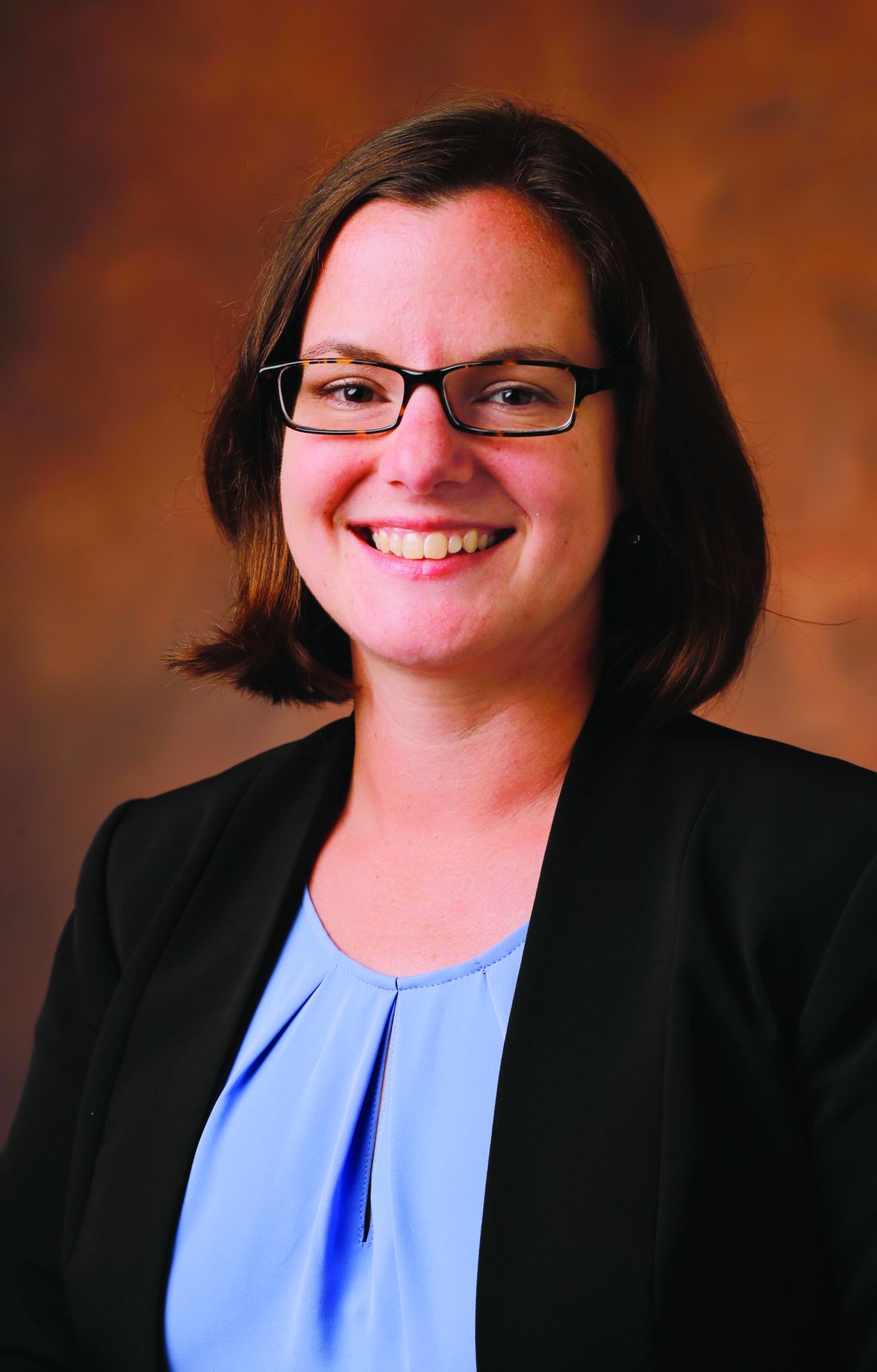
Broadly speaking, telemedicine can be seen as a tool for delivering care when a hands-on exam is not required. In direct-to-patient telemedicine, the patient can use a personal smartphone, tablet, or computer to connect with a provider in a real-time audio and/or video “visit” from home or work. The engagement can be scheduled or on demand. Although telemedicine is generally associated with the delivery of care to patients in remote or rural locations, it is increasingly being used in urban areas, especially with older patients and those for whom transport or time away from work might be difficult.
How the patient benefits
This built-in flexibility is appealing to patients – the easier access and convenience can translate into reduced time away from work or school and possibly a reduction in patient “no-shows.” Patients are more likely to enjoy the benefits of continuity of care with their own providers, rather than seeking independent, consumer-marketed services. In a nationwide survey of 4,345 respondents about attitudes toward telemedicine in primary care, 52% of respondents said they would like to see their own providers via telemedicine, 35% were willing to see a different provider from the same organization, and 15% said they would consider leaving their current provider to see one who offered telemedicine (BMC Health Services Research. 2017;17:784).
In addition, numerous studies have reported on the equivalent clinical outcomes and improved cost-of-care benefits in patients who receive diabetes care through telemedicine. Lui and colleagues looked at patients at the Denver VA Medical Center who were newly diagnosed with diabetes and they compared short-term glycemic control in patients who had telemedicine consultations with patients who had in-person visits. They found that the telemedicine consultations improved short-term glycemic control as effectively as the in-person visits, but with possible added financial benefits for both the patients and the health care system. (J Diabetes Sci Technol. 2016;10[5]:1079-86). Likewise, Fatehi and colleagues have reported that method of consultation – telemedicine or in-person consultation – did not affect concordance of advice between two endocrinologists (Diabetes Technol Ther. 2015;17[10]:717-25).
What telemedicine has to offer
When appropriate diagnostic labs have already been performed, newly diagnosed patients can be counseled on their diagnosis and started on therapy. For patients who have already been diagnosed, follow-up and monitoring of therapy adherence and glycemic control can be more convenient and done more routinely, compared with in-person visits, and thus yield better outcomes.
Use of cloud-based services to review data from glucometers, insulin pumps, and continuous glucose monitors allows the clinicians to access the same data they would in the office. Combining this data review with a video visit, rather than looking at the data in isolation, allows for increased patient engagement, shared decision making, and patient counseling.
Other diagnoses that readily fit at-home telemedicine care include gestational diabetes, as these patients need frequent follow-up, and doing some of their visits via telemedicine can reduce their burden of travel. Hypothyroidism follow-ups, with labs completed before the visit, can be very efficient via telemedicine. Internal surveys of direct-to-patient services at my institution demonstrated a high level of patient satisfaction, with 91% of patients indicating they were satisfied overall, and 81% saying that connection with the provider matched that of an in-person visit.
Gains for the provider, the care team, and the practice
Endocrinologists can derive benefit from telemedicine engagement with their patients, which could have positive implications for other members of the care team and for the practice as a whole. For the provider, being able to streamline clinical workflows and increase practice efficiency can help reduce personal and workplace-related stress and translate into greater personal satisfaction in one’s work and delivery of better-quality care.
At the practice level, the use of telemedicine presents opportunities for expanding the patient base and perhaps working more flexible hours to better accommodate the personal and professional time demands on providers and their staff. In addition, offering telemedicine as a medium of consultation could be a practice differentiator that could give you a competitive edge. That, along with smaller changes, such as enhancing or even reducing space utilization, could contribute to reduced overheads and a boost in revenue, which would have a positive impact on the practice’s bottom line.
Getting started
There is important groundwork to be done before a telemedicine program can get underway. First, bear in mind that there is considerable state-based variation in regulations and insurance coverage, so you need to be sure that you are in compliance with the requirements for your state. If direct-to-patient telemedicine is not widely reimbursed in your state, direct-payment models may be feasible. Providers who accept Medicare payments need to understand restrictions on self-payment for those patients. You may also be able to negotiate with payers to include reimbursement for telemedicine visits in your contracts. Negotiation with payers and direct-pay models may be possible.
Key guidelines. In addition to understanding your state’s regulations around telemedicine, there are specific aspects of practice about which you need to be clear, for example:
- You must be licensed in the state in which your patient is located at the time of their visit.
- Understand any restrictions on prescribing via telemedicine in your state.
- Be aware that Medicare has very specific guidelines and, at this time, does not recognize home as a place of service.
- You must be sure that you use HIPAA-compliant video software.
- If in any doubt, seek guidance from an attorney or your organization’s compliance office.
Infrastructure and outlay. Your infrastructure needs will depend on the specific services that you provide, but in general, you should include a communication platform and video conferencing equipment; sufficient bandwidth and a secure, reliable Internet connection; ready access to sound IT support; and comprehensive staff training at the outset, with subsequent refresher training sessions on a regular basis. Within the practice, you will need to think about adjustments to your existing workflow to accommodate the telemedicine services you plan to offer.
Resources. Two nonprofit groups that offer nonpartisan guidance in telemedicine are the Center for Connected Health Policy and the Regional Telehealth Resource Centers.
Dr. Griffith is assistant professor of medicine and medical director, Ambulatory Telehealth Services, Vanderbilt University Medical Center, in Nashville, Tenn. This article is part of a series based on presentations from the annual meeting of the Endocrine Society in March 2019. Dr. Griffith has no disclosures. Write to her at [email protected].
Innovations in care delivery, as previously introduced by Dr. Robert Gabbay, can enhance the patient and physician experience. Providing care via telemedicine can bring joy to work by introducing variety to practice. It also carries the satisfaction of easing access to care for the patient.
Broadly speaking, telemedicine can be seen as a tool for delivering care when a hands-on exam is not required. In direct-to-patient telemedicine, the patient can use a personal smartphone, tablet, or computer to connect with a provider in a real-time audio and/or video “visit” from home or work. The engagement can be scheduled or on demand. Although telemedicine is generally associated with the delivery of care to patients in remote or rural locations, it is increasingly being used in urban areas, especially with older patients and those for whom transport or time away from work might be difficult.
How the patient benefits
This built-in flexibility is appealing to patients – the easier access and convenience can translate into reduced time away from work or school and possibly a reduction in patient “no-shows.” Patients are more likely to enjoy the benefits of continuity of care with their own providers, rather than seeking independent, consumer-marketed services. In a nationwide survey of 4,345 respondents about attitudes toward telemedicine in primary care, 52% of respondents said they would like to see their own providers via telemedicine, 35% were willing to see a different provider from the same organization, and 15% said they would consider leaving their current provider to see one who offered telemedicine (BMC Health Services Research. 2017;17:784).
In addition, numerous studies have reported on the equivalent clinical outcomes and improved cost-of-care benefits in patients who receive diabetes care through telemedicine. Lui and colleagues looked at patients at the Denver VA Medical Center who were newly diagnosed with diabetes and they compared short-term glycemic control in patients who had telemedicine consultations with patients who had in-person visits. They found that the telemedicine consultations improved short-term glycemic control as effectively as the in-person visits, but with possible added financial benefits for both the patients and the health care system. (J Diabetes Sci Technol. 2016;10[5]:1079-86). Likewise, Fatehi and colleagues have reported that method of consultation – telemedicine or in-person consultation – did not affect concordance of advice between two endocrinologists (Diabetes Technol Ther. 2015;17[10]:717-25).
What telemedicine has to offer
When appropriate diagnostic labs have already been performed, newly diagnosed patients can be counseled on their diagnosis and started on therapy. For patients who have already been diagnosed, follow-up and monitoring of therapy adherence and glycemic control can be more convenient and done more routinely, compared with in-person visits, and thus yield better outcomes.
Use of cloud-based services to review data from glucometers, insulin pumps, and continuous glucose monitors allows the clinicians to access the same data they would in the office. Combining this data review with a video visit, rather than looking at the data in isolation, allows for increased patient engagement, shared decision making, and patient counseling.
Other diagnoses that readily fit at-home telemedicine care include gestational diabetes, as these patients need frequent follow-up, and doing some of their visits via telemedicine can reduce their burden of travel. Hypothyroidism follow-ups, with labs completed before the visit, can be very efficient via telemedicine. Internal surveys of direct-to-patient services at my institution demonstrated a high level of patient satisfaction, with 91% of patients indicating they were satisfied overall, and 81% saying that connection with the provider matched that of an in-person visit.
Gains for the provider, the care team, and the practice
Endocrinologists can derive benefit from telemedicine engagement with their patients, which could have positive implications for other members of the care team and for the practice as a whole. For the provider, being able to streamline clinical workflows and increase practice efficiency can help reduce personal and workplace-related stress and translate into greater personal satisfaction in one’s work and delivery of better-quality care.
At the practice level, the use of telemedicine presents opportunities for expanding the patient base and perhaps working more flexible hours to better accommodate the personal and professional time demands on providers and their staff. In addition, offering telemedicine as a medium of consultation could be a practice differentiator that could give you a competitive edge. That, along with smaller changes, such as enhancing or even reducing space utilization, could contribute to reduced overheads and a boost in revenue, which would have a positive impact on the practice’s bottom line.
Getting started
There is important groundwork to be done before a telemedicine program can get underway. First, bear in mind that there is considerable state-based variation in regulations and insurance coverage, so you need to be sure that you are in compliance with the requirements for your state. If direct-to-patient telemedicine is not widely reimbursed in your state, direct-payment models may be feasible. Providers who accept Medicare payments need to understand restrictions on self-payment for those patients. You may also be able to negotiate with payers to include reimbursement for telemedicine visits in your contracts. Negotiation with payers and direct-pay models may be possible.
Key guidelines. In addition to understanding your state’s regulations around telemedicine, there are specific aspects of practice about which you need to be clear, for example:
- You must be licensed in the state in which your patient is located at the time of their visit.
- Understand any restrictions on prescribing via telemedicine in your state.
- Be aware that Medicare has very specific guidelines and, at this time, does not recognize home as a place of service.
- You must be sure that you use HIPAA-compliant video software.
- If in any doubt, seek guidance from an attorney or your organization’s compliance office.
Infrastructure and outlay. Your infrastructure needs will depend on the specific services that you provide, but in general, you should include a communication platform and video conferencing equipment; sufficient bandwidth and a secure, reliable Internet connection; ready access to sound IT support; and comprehensive staff training at the outset, with subsequent refresher training sessions on a regular basis. Within the practice, you will need to think about adjustments to your existing workflow to accommodate the telemedicine services you plan to offer.
Resources. Two nonprofit groups that offer nonpartisan guidance in telemedicine are the Center for Connected Health Policy and the Regional Telehealth Resource Centers.
Dr. Griffith is assistant professor of medicine and medical director, Ambulatory Telehealth Services, Vanderbilt University Medical Center, in Nashville, Tenn. This article is part of a series based on presentations from the annual meeting of the Endocrine Society in March 2019. Dr. Griffith has no disclosures. Write to her at [email protected].
Innovations in care delivery, as previously introduced by Dr. Robert Gabbay, can enhance the patient and physician experience. Providing care via telemedicine can bring joy to work by introducing variety to practice. It also carries the satisfaction of easing access to care for the patient.
Broadly speaking, telemedicine can be seen as a tool for delivering care when a hands-on exam is not required. In direct-to-patient telemedicine, the patient can use a personal smartphone, tablet, or computer to connect with a provider in a real-time audio and/or video “visit” from home or work. The engagement can be scheduled or on demand. Although telemedicine is generally associated with the delivery of care to patients in remote or rural locations, it is increasingly being used in urban areas, especially with older patients and those for whom transport or time away from work might be difficult.
How the patient benefits
This built-in flexibility is appealing to patients – the easier access and convenience can translate into reduced time away from work or school and possibly a reduction in patient “no-shows.” Patients are more likely to enjoy the benefits of continuity of care with their own providers, rather than seeking independent, consumer-marketed services. In a nationwide survey of 4,345 respondents about attitudes toward telemedicine in primary care, 52% of respondents said they would like to see their own providers via telemedicine, 35% were willing to see a different provider from the same organization, and 15% said they would consider leaving their current provider to see one who offered telemedicine (BMC Health Services Research. 2017;17:784).
In addition, numerous studies have reported on the equivalent clinical outcomes and improved cost-of-care benefits in patients who receive diabetes care through telemedicine. Lui and colleagues looked at patients at the Denver VA Medical Center who were newly diagnosed with diabetes and they compared short-term glycemic control in patients who had telemedicine consultations with patients who had in-person visits. They found that the telemedicine consultations improved short-term glycemic control as effectively as the in-person visits, but with possible added financial benefits for both the patients and the health care system. (J Diabetes Sci Technol. 2016;10[5]:1079-86). Likewise, Fatehi and colleagues have reported that method of consultation – telemedicine or in-person consultation – did not affect concordance of advice between two endocrinologists (Diabetes Technol Ther. 2015;17[10]:717-25).
What telemedicine has to offer
When appropriate diagnostic labs have already been performed, newly diagnosed patients can be counseled on their diagnosis and started on therapy. For patients who have already been diagnosed, follow-up and monitoring of therapy adherence and glycemic control can be more convenient and done more routinely, compared with in-person visits, and thus yield better outcomes.
Use of cloud-based services to review data from glucometers, insulin pumps, and continuous glucose monitors allows the clinicians to access the same data they would in the office. Combining this data review with a video visit, rather than looking at the data in isolation, allows for increased patient engagement, shared decision making, and patient counseling.
Other diagnoses that readily fit at-home telemedicine care include gestational diabetes, as these patients need frequent follow-up, and doing some of their visits via telemedicine can reduce their burden of travel. Hypothyroidism follow-ups, with labs completed before the visit, can be very efficient via telemedicine. Internal surveys of direct-to-patient services at my institution demonstrated a high level of patient satisfaction, with 91% of patients indicating they were satisfied overall, and 81% saying that connection with the provider matched that of an in-person visit.
Gains for the provider, the care team, and the practice
Endocrinologists can derive benefit from telemedicine engagement with their patients, which could have positive implications for other members of the care team and for the practice as a whole. For the provider, being able to streamline clinical workflows and increase practice efficiency can help reduce personal and workplace-related stress and translate into greater personal satisfaction in one’s work and delivery of better-quality care.
At the practice level, the use of telemedicine presents opportunities for expanding the patient base and perhaps working more flexible hours to better accommodate the personal and professional time demands on providers and their staff. In addition, offering telemedicine as a medium of consultation could be a practice differentiator that could give you a competitive edge. That, along with smaller changes, such as enhancing or even reducing space utilization, could contribute to reduced overheads and a boost in revenue, which would have a positive impact on the practice’s bottom line.
Getting started
There is important groundwork to be done before a telemedicine program can get underway. First, bear in mind that there is considerable state-based variation in regulations and insurance coverage, so you need to be sure that you are in compliance with the requirements for your state. If direct-to-patient telemedicine is not widely reimbursed in your state, direct-payment models may be feasible. Providers who accept Medicare payments need to understand restrictions on self-payment for those patients. You may also be able to negotiate with payers to include reimbursement for telemedicine visits in your contracts. Negotiation with payers and direct-pay models may be possible.
Key guidelines. In addition to understanding your state’s regulations around telemedicine, there are specific aspects of practice about which you need to be clear, for example:
- You must be licensed in the state in which your patient is located at the time of their visit.
- Understand any restrictions on prescribing via telemedicine in your state.
- Be aware that Medicare has very specific guidelines and, at this time, does not recognize home as a place of service.
- You must be sure that you use HIPAA-compliant video software.
- If in any doubt, seek guidance from an attorney or your organization’s compliance office.
Infrastructure and outlay. Your infrastructure needs will depend on the specific services that you provide, but in general, you should include a communication platform and video conferencing equipment; sufficient bandwidth and a secure, reliable Internet connection; ready access to sound IT support; and comprehensive staff training at the outset, with subsequent refresher training sessions on a regular basis. Within the practice, you will need to think about adjustments to your existing workflow to accommodate the telemedicine services you plan to offer.
Resources. Two nonprofit groups that offer nonpartisan guidance in telemedicine are the Center for Connected Health Policy and the Regional Telehealth Resource Centers.
Dr. Griffith is assistant professor of medicine and medical director, Ambulatory Telehealth Services, Vanderbilt University Medical Center, in Nashville, Tenn. This article is part of a series based on presentations from the annual meeting of the Endocrine Society in March 2019. Dr. Griffith has no disclosures. Write to her at [email protected].
How innovation can bring more joy to your work
As the incidence of physician burnout increases, so does the overall cost to the health system, both in quality of care and financially, and findings from a recent study suggested that patients are becoming aware of burnout among providers and are concerned about its impact on the quality of the care that they are receiving.2

Burnout can be described as a form of extreme work-related stress manifesting as physical and/or emotional exhaustion that can generate a range of psychological ripple effects, such as depression, mood and anxiety disorders, a crippling sense of worthlessness, and a loss of sense of self. Anyone can be affected by burnout, but there seems to be a greater prevalence among women (50% vs 30% for men); younger doctors, especially residents; and providers of color.3,4
The fallout from burnout affects both our personal and professional lives. In our personal lives, it can translate into broken or strained relationships, alcohol and substance abuse, depression and mood or anxiety disorders, financial difficulties, and suicide (14% have reported thoughts of suicide; 1% have committed suicide). Juggling work and family can be overwhelming, and additional strains, such as caring for a parent or a sick family member, having a child, going through a divorce or a family bereavement, dealing with student debt, and pressure to achieve, can be cumulatively devastating for a hardworking provider.5
In the practice, we see burnout translate into an increase in the number of medical errors, diminished quality of care, lower patient satisfaction with care, decreased productivity and professional effort, dissatisfaction among staff, and an increase in physician turnover.6 Workplace-specific factors that can contribute to burnout include daily use of health information technology, especially the EHR; workplace inequities; pressures to keep abreast with changes in the specialty; and time management challenges and constraints that go along with the continual pressure to deliver better quality care, for less money, in less time.7
Our group wanted to devise innovative, practice-based strategies that would help our colleagues address the burnout crisis. We asked ourselves how – through new, innovative models of care – we could rediscover the joy in our work, and what the steppingstones of “meaningful work” would be. It seemed to us that working as a team and revisiting the care we deliver might be good starting points, and that, if we drilled down further, common themes to address burnout and find joy in work revolve around choice, camaraderie, equity, and cocreating solutions.
Evidence suggests that physicians who spend at least 20% of their professional effort focused on work they find most meaningful have a notably lower risk for burnout.8 Each 1% reduction below this threshold increases the risk of burnout, and there is a ceiling effect to the benefit at 20% – for example, spending 50% of your time in the most meaningful area is associated with similar rates of burnout as spending 20% on it.
So how do we to get to that meaningful threshold of 20%? You can begin with identifying your passion, making the business case, speaking to your boss, getting your colleagues’ buy-in, and even looking for grants and other funding if needed. We came up with five ways you might bring more joy to your work by adopting innovative models of diabetes care: the first – implementing a direct-to-patient telemedicine program – has been written by Michelle Griffith, MD, and is featured here. In coming articles, we will take a look at tackling the impediments of clinical inertia, coordinating care through use of a transfer summary, shifting to team-based care, how to use e-consultations to connect with primary care providers, and devising a business case for these and other innovations.
References
1. Kane L. National Physician Burnout, Depression & Suicide Report 2019. Medscape. Published online Jan 16, 2019.
2. American Society of Health-System Pharmacists. Press release. 2019 Jun 17.
3. Oakes K. Female family physicians come up short in burnout gender divide. Family Practice News. Published online November 27, 2017.
4. Dyrbye L. JAMA Network Open. 2019 Jul 26. doi: 10.1001/jamanetworkopen.2019.7457.
5. Yank V et al. JAMA Intern Med. 2019 Jan 28. doi: 10.1001/jamainternmed.2018.6411.
6 . Panagioti M et al. JAMA Intern Med. 2018;178(10):1317-31.
7. Gardner R et al. J Am Med Inform Assoc. doi: 10.1093/jamia/ocy145.
8. Shanafelt T et al. Am J Med Qual. 2017;32(5):563-5.
Dr. Gabbay is chief medical officer at Joslin Diabetes Center and an associate professor of medicine at Harvard Medical School, both in Boston. This is the introduction to a series of articles based on presentations from the annual meeting of the Endocrine Society in March 2019. Dr. Gabbay reports being an adviser to Lark, Onduo, and HealthReveal. Write to him at [email protected].
As the incidence of physician burnout increases, so does the overall cost to the health system, both in quality of care and financially, and findings from a recent study suggested that patients are becoming aware of burnout among providers and are concerned about its impact on the quality of the care that they are receiving.2
Burnout can be described as a form of extreme work-related stress manifesting as physical and/or emotional exhaustion that can generate a range of psychological ripple effects, such as depression, mood and anxiety disorders, a crippling sense of worthlessness, and a loss of sense of self. Anyone can be affected by burnout, but there seems to be a greater prevalence among women (50% vs 30% for men); younger doctors, especially residents; and providers of color.3,4
The fallout from burnout affects both our personal and professional lives. In our personal lives, it can translate into broken or strained relationships, alcohol and substance abuse, depression and mood or anxiety disorders, financial difficulties, and suicide (14% have reported thoughts of suicide; 1% have committed suicide). Juggling work and family can be overwhelming, and additional strains, such as caring for a parent or a sick family member, having a child, going through a divorce or a family bereavement, dealing with student debt, and pressure to achieve, can be cumulatively devastating for a hardworking provider.5
In the practice, we see burnout translate into an increase in the number of medical errors, diminished quality of care, lower patient satisfaction with care, decreased productivity and professional effort, dissatisfaction among staff, and an increase in physician turnover.6 Workplace-specific factors that can contribute to burnout include daily use of health information technology, especially the EHR; workplace inequities; pressures to keep abreast with changes in the specialty; and time management challenges and constraints that go along with the continual pressure to deliver better quality care, for less money, in less time.7
Our group wanted to devise innovative, practice-based strategies that would help our colleagues address the burnout crisis. We asked ourselves how – through new, innovative models of care – we could rediscover the joy in our work, and what the steppingstones of “meaningful work” would be. It seemed to us that working as a team and revisiting the care we deliver might be good starting points, and that, if we drilled down further, common themes to address burnout and find joy in work revolve around choice, camaraderie, equity, and cocreating solutions.
Evidence suggests that physicians who spend at least 20% of their professional effort focused on work they find most meaningful have a notably lower risk for burnout.8 Each 1% reduction below this threshold increases the risk of burnout, and there is a ceiling effect to the benefit at 20% – for example, spending 50% of your time in the most meaningful area is associated with similar rates of burnout as spending 20% on it.
So how do we to get to that meaningful threshold of 20%? You can begin with identifying your passion, making the business case, speaking to your boss, getting your colleagues’ buy-in, and even looking for grants and other funding if needed. We came up with five ways you might bring more joy to your work by adopting innovative models of diabetes care: the first – implementing a direct-to-patient telemedicine program – has been written by Michelle Griffith, MD, and is featured here. In coming articles, we will take a look at tackling the impediments of clinical inertia, coordinating care through use of a transfer summary, shifting to team-based care, how to use e-consultations to connect with primary care providers, and devising a business case for these and other innovations.
References
1. Kane L. National Physician Burnout, Depression & Suicide Report 2019. Medscape. Published online Jan 16, 2019.
2. American Society of Health-System Pharmacists. Press release. 2019 Jun 17.
3. Oakes K. Female family physicians come up short in burnout gender divide. Family Practice News. Published online November 27, 2017.
4. Dyrbye L. JAMA Network Open. 2019 Jul 26. doi: 10.1001/jamanetworkopen.2019.7457.
5. Yank V et al. JAMA Intern Med. 2019 Jan 28. doi: 10.1001/jamainternmed.2018.6411.
6 . Panagioti M et al. JAMA Intern Med. 2018;178(10):1317-31.
7. Gardner R et al. J Am Med Inform Assoc. doi: 10.1093/jamia/ocy145.
8. Shanafelt T et al. Am J Med Qual. 2017;32(5):563-5.
Dr. Gabbay is chief medical officer at Joslin Diabetes Center and an associate professor of medicine at Harvard Medical School, both in Boston. This is the introduction to a series of articles based on presentations from the annual meeting of the Endocrine Society in March 2019. Dr. Gabbay reports being an adviser to Lark, Onduo, and HealthReveal. Write to him at [email protected].
As the incidence of physician burnout increases, so does the overall cost to the health system, both in quality of care and financially, and findings from a recent study suggested that patients are becoming aware of burnout among providers and are concerned about its impact on the quality of the care that they are receiving.2
Burnout can be described as a form of extreme work-related stress manifesting as physical and/or emotional exhaustion that can generate a range of psychological ripple effects, such as depression, mood and anxiety disorders, a crippling sense of worthlessness, and a loss of sense of self. Anyone can be affected by burnout, but there seems to be a greater prevalence among women (50% vs 30% for men); younger doctors, especially residents; and providers of color.3,4
The fallout from burnout affects both our personal and professional lives. In our personal lives, it can translate into broken or strained relationships, alcohol and substance abuse, depression and mood or anxiety disorders, financial difficulties, and suicide (14% have reported thoughts of suicide; 1% have committed suicide). Juggling work and family can be overwhelming, and additional strains, such as caring for a parent or a sick family member, having a child, going through a divorce or a family bereavement, dealing with student debt, and pressure to achieve, can be cumulatively devastating for a hardworking provider.5
In the practice, we see burnout translate into an increase in the number of medical errors, diminished quality of care, lower patient satisfaction with care, decreased productivity and professional effort, dissatisfaction among staff, and an increase in physician turnover.6 Workplace-specific factors that can contribute to burnout include daily use of health information technology, especially the EHR; workplace inequities; pressures to keep abreast with changes in the specialty; and time management challenges and constraints that go along with the continual pressure to deliver better quality care, for less money, in less time.7
Our group wanted to devise innovative, practice-based strategies that would help our colleagues address the burnout crisis. We asked ourselves how – through new, innovative models of care – we could rediscover the joy in our work, and what the steppingstones of “meaningful work” would be. It seemed to us that working as a team and revisiting the care we deliver might be good starting points, and that, if we drilled down further, common themes to address burnout and find joy in work revolve around choice, camaraderie, equity, and cocreating solutions.
Evidence suggests that physicians who spend at least 20% of their professional effort focused on work they find most meaningful have a notably lower risk for burnout.8 Each 1% reduction below this threshold increases the risk of burnout, and there is a ceiling effect to the benefit at 20% – for example, spending 50% of your time in the most meaningful area is associated with similar rates of burnout as spending 20% on it.
So how do we to get to that meaningful threshold of 20%? You can begin with identifying your passion, making the business case, speaking to your boss, getting your colleagues’ buy-in, and even looking for grants and other funding if needed. We came up with five ways you might bring more joy to your work by adopting innovative models of diabetes care: the first – implementing a direct-to-patient telemedicine program – has been written by Michelle Griffith, MD, and is featured here. In coming articles, we will take a look at tackling the impediments of clinical inertia, coordinating care through use of a transfer summary, shifting to team-based care, how to use e-consultations to connect with primary care providers, and devising a business case for these and other innovations.
References
1. Kane L. National Physician Burnout, Depression & Suicide Report 2019. Medscape. Published online Jan 16, 2019.
2. American Society of Health-System Pharmacists. Press release. 2019 Jun 17.
3. Oakes K. Female family physicians come up short in burnout gender divide. Family Practice News. Published online November 27, 2017.
4. Dyrbye L. JAMA Network Open. 2019 Jul 26. doi: 10.1001/jamanetworkopen.2019.7457.
5. Yank V et al. JAMA Intern Med. 2019 Jan 28. doi: 10.1001/jamainternmed.2018.6411.
6 . Panagioti M et al. JAMA Intern Med. 2018;178(10):1317-31.
7. Gardner R et al. J Am Med Inform Assoc. doi: 10.1093/jamia/ocy145.
8. Shanafelt T et al. Am J Med Qual. 2017;32(5):563-5.
Dr. Gabbay is chief medical officer at Joslin Diabetes Center and an associate professor of medicine at Harvard Medical School, both in Boston. This is the introduction to a series of articles based on presentations from the annual meeting of the Endocrine Society in March 2019. Dr. Gabbay reports being an adviser to Lark, Onduo, and HealthReveal. Write to him at [email protected].

FRAX with BMD may not be accurate for women with diabetes
according to data from 566 women aged 40-90 years.
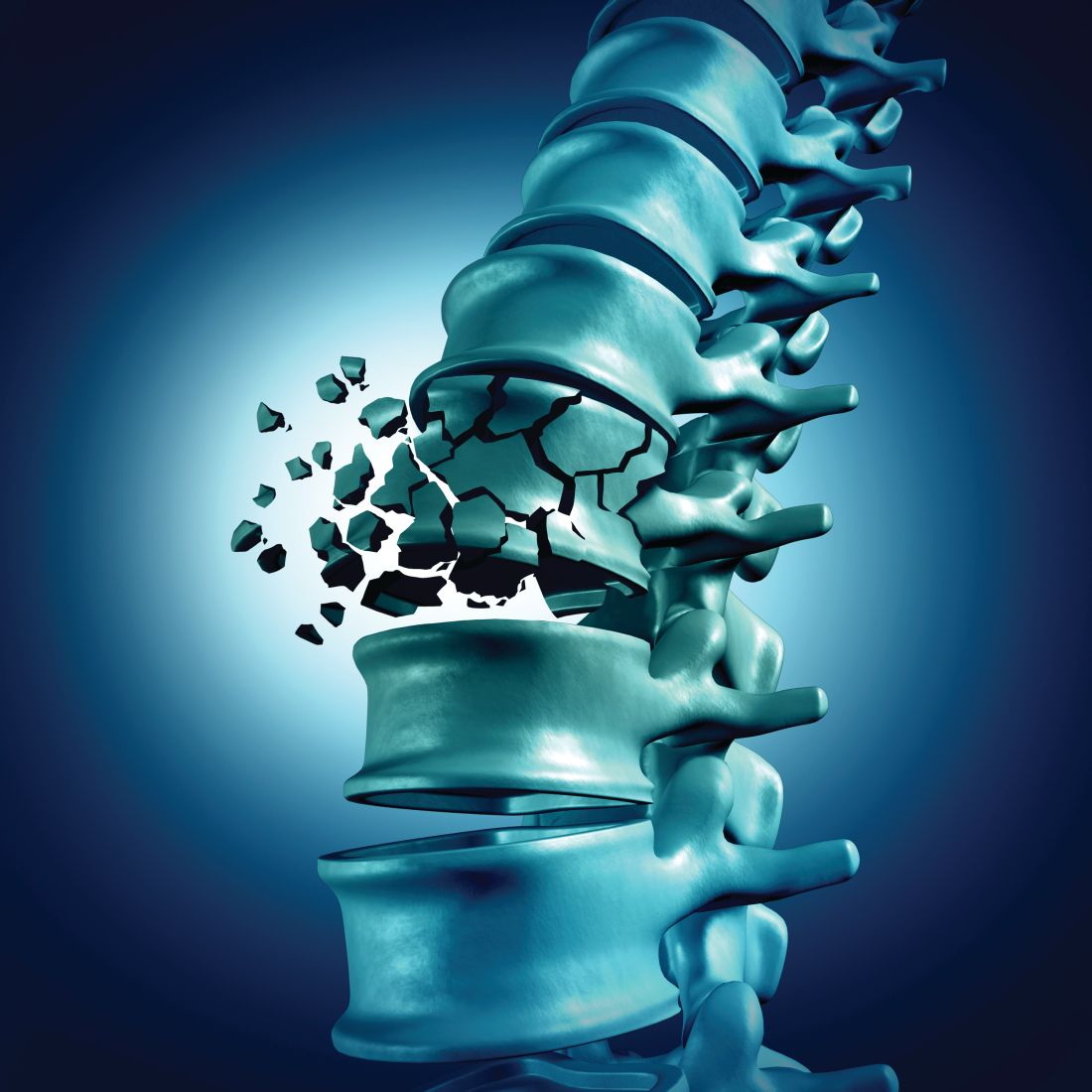
In a study published in Bone Reports, Lelia L.F. de Abreu, MD, of Deakin University, Geelong, Australia, and colleagues investigated the accuracy of FRAX scores and the role of impaired fasting glucose (IFG) and bone mineral density (BMD) on fracture risk by comparing FRAX scores for 252 normoglycemic women, 247 women with IFG, and 67 women with diabetes.
When BMD was not included, women with diabetes had a higher median FRAX score for major osteoporotic fractures of the hip, clinical spine, forearm, and wrist than women without diabetes or women with IFG (7.1, 4.3, and 5.1, respectively). In the diabetes group, 11 major osteoporotic fractures were observed versus 5 predicted by FRAX. In the normoglycemic group, 28 fractures were observed versus 15 predicted, and in the IFG group 31 fractures were observed versus 16 predicted.
When BMD was included, major osteoporotic fractures and hip fractures also were underestimated in the diabetes group (11 observed vs. 4 observed; 6 observed vs. 1 predicted, respectively), but the difference in observed versus predicted fractures trended toward statistical significance but was not significant (P = .055; P = .52, respectively). FRAX with BMD increased the underestimation of major osteoporotic fractures in the normoglycemic and IFG groups (28 observed vs. 13 predicted; 31 observed vs. 13 predicted).
The study findings were limited by several factors including the inability to determine the impact of specific types of diabetes on fracture risk, lack of data on the duration of diabetes in study participants, the use of self-reports, and a relatively small and homogeneous sample size, the researchers noted.
However, the results support data from previous studies showing an increased fracture risk in diabetes patients regardless of BMD, and suggest that FRAX may be unreliable as a predictor of fractures in the diabetes population, they concluded.
The study was supported in part by the Victorian Health Promotion Foundation, National Health and Medical Research Council Australia, and the Geelong Region Medical Research Foundation. Two researchers were supported by university postgraduate rewards and one researcher was supported by a university postdoctoral research fellowship. The remaining coauthors reported no relevant financial conflicts.
SOURCE: de Abreu LLF et al. Bone Reports. 2019 Aug 13. doi: 10.1016/j.bonr.2019.100223.
according to data from 566 women aged 40-90 years.
In a study published in Bone Reports, Lelia L.F. de Abreu, MD, of Deakin University, Geelong, Australia, and colleagues investigated the accuracy of FRAX scores and the role of impaired fasting glucose (IFG) and bone mineral density (BMD) on fracture risk by comparing FRAX scores for 252 normoglycemic women, 247 women with IFG, and 67 women with diabetes.
When BMD was not included, women with diabetes had a higher median FRAX score for major osteoporotic fractures of the hip, clinical spine, forearm, and wrist than women without diabetes or women with IFG (7.1, 4.3, and 5.1, respectively). In the diabetes group, 11 major osteoporotic fractures were observed versus 5 predicted by FRAX. In the normoglycemic group, 28 fractures were observed versus 15 predicted, and in the IFG group 31 fractures were observed versus 16 predicted.
When BMD was included, major osteoporotic fractures and hip fractures also were underestimated in the diabetes group (11 observed vs. 4 observed; 6 observed vs. 1 predicted, respectively), but the difference in observed versus predicted fractures trended toward statistical significance but was not significant (P = .055; P = .52, respectively). FRAX with BMD increased the underestimation of major osteoporotic fractures in the normoglycemic and IFG groups (28 observed vs. 13 predicted; 31 observed vs. 13 predicted).
The study findings were limited by several factors including the inability to determine the impact of specific types of diabetes on fracture risk, lack of data on the duration of diabetes in study participants, the use of self-reports, and a relatively small and homogeneous sample size, the researchers noted.
However, the results support data from previous studies showing an increased fracture risk in diabetes patients regardless of BMD, and suggest that FRAX may be unreliable as a predictor of fractures in the diabetes population, they concluded.
The study was supported in part by the Victorian Health Promotion Foundation, National Health and Medical Research Council Australia, and the Geelong Region Medical Research Foundation. Two researchers were supported by university postgraduate rewards and one researcher was supported by a university postdoctoral research fellowship. The remaining coauthors reported no relevant financial conflicts.
SOURCE: de Abreu LLF et al. Bone Reports. 2019 Aug 13. doi: 10.1016/j.bonr.2019.100223.
according to data from 566 women aged 40-90 years.
In a study published in Bone Reports, Lelia L.F. de Abreu, MD, of Deakin University, Geelong, Australia, and colleagues investigated the accuracy of FRAX scores and the role of impaired fasting glucose (IFG) and bone mineral density (BMD) on fracture risk by comparing FRAX scores for 252 normoglycemic women, 247 women with IFG, and 67 women with diabetes.
When BMD was not included, women with diabetes had a higher median FRAX score for major osteoporotic fractures of the hip, clinical spine, forearm, and wrist than women without diabetes or women with IFG (7.1, 4.3, and 5.1, respectively). In the diabetes group, 11 major osteoporotic fractures were observed versus 5 predicted by FRAX. In the normoglycemic group, 28 fractures were observed versus 15 predicted, and in the IFG group 31 fractures were observed versus 16 predicted.
When BMD was included, major osteoporotic fractures and hip fractures also were underestimated in the diabetes group (11 observed vs. 4 observed; 6 observed vs. 1 predicted, respectively), but the difference in observed versus predicted fractures trended toward statistical significance but was not significant (P = .055; P = .52, respectively). FRAX with BMD increased the underestimation of major osteoporotic fractures in the normoglycemic and IFG groups (28 observed vs. 13 predicted; 31 observed vs. 13 predicted).
The study findings were limited by several factors including the inability to determine the impact of specific types of diabetes on fracture risk, lack of data on the duration of diabetes in study participants, the use of self-reports, and a relatively small and homogeneous sample size, the researchers noted.
However, the results support data from previous studies showing an increased fracture risk in diabetes patients regardless of BMD, and suggest that FRAX may be unreliable as a predictor of fractures in the diabetes population, they concluded.
The study was supported in part by the Victorian Health Promotion Foundation, National Health and Medical Research Council Australia, and the Geelong Region Medical Research Foundation. Two researchers were supported by university postgraduate rewards and one researcher was supported by a university postdoctoral research fellowship. The remaining coauthors reported no relevant financial conflicts.
SOURCE: de Abreu LLF et al. Bone Reports. 2019 Aug 13. doi: 10.1016/j.bonr.2019.100223.
FROM BONE REPORTS
PTSD symptom reduction tied to lower risk of type 2 diabetes
Veterans with a clinically meaningful reduction in symptoms of PTSD are less likely to develop type 2 diabetes, research from a retrospective study shows.
“We cautiously speculate that normalization of hypothalamic-pituitary-adrenal axis and cortisol levels could be one mechanism behind our results,” wrote Jeffrey F. Scherrer, PhD, and colleagues. “PTSD is associated with inflammation, which may in turn be associated with increased risk for [type 2 diabetes].” The study was published in JAMA Psychiatry.
Using medical record data from the Veterans Health Administration, Dr. Scherrer and colleagues identified 5,916 patients with PTSD who visited a VHA medical center between 2008 and 2012, and scored at least 50 points or higher on the PTSD Checklist (PCL) followed by another PCL score at least 8 months after the previous score. The mean age of patients in the study was 42.1 years, the cohort consisted of 84.3% men, and 66.3% patients were white. PCL score reduction was deemed clinically meaningful if there was a decrease of 20 points or more in the score, reported Dr. Scherrer of the department of family and community medicine at Saint Louis University and colleagues.
Patients who were older (mean 43.6 years vs. mean 41.7 years; P = .02) and those who underwent minimally adequate duration of PTSD psychotherapy (P less than .001) were significantly more likely to have a clinically meaningful decrease in PCL scores. Patients who received antidepressants (P = .004) or antipsychotics (P less than .001) were significantly more likely to have less than clinically meaningful decreases in PCL scores. Factors that put patients at significantly higher risk of developing type 2 diabetes included older age (hazard ratio, 1.05; 95% confidence interval, 1.04-1.07; P less than .001), black race/ethnicity (HR, 1.86; 95% CI, 1.23-2.83; P = .004), hypertension (HR, 3.46; 95% CI, 2.33-5.16), hyperlipidemia (HR, 2.82; 95% CI, 1.91-4.16), and obesity (HR, 3.32; 95% CI, 2.12-5.21) (all P less than .001).
Minimally adequate duration of PTSD psychotherapy and high use of primary care health services also were associated with developing type 2 diabetes.
In a Cox proportional hazards regression model, patients with clinically meaningful decreases in PCL scores had significantly lower risk of developing type 2 diabetes, and those results remained consistent after adjusting for age, calculating the results using weighted data, and factoring in hypertension, obesity, and hyperlipidemia.
“This result was independent of numerous demographics and psychiatric and physical comorbidities,” said Dr. Scherrer and colleagues. “The association was also independent of the number of PTSD psychotherapy sessions used, suggesting that a healthy adherer effect, or a general orientation to improve health, is unlikely to explain our observations.”
Dr. Scherrer and colleagues cited several limitations, such as unmeasured confounding and the difficulty of generalizing the results beyond PTSD patients in a VHA setting. In addition, the researchers were unable to calculate the lifetime effect of reduced PTSD symptoms and incidence of type 2 diabetes.
This study was funded in part by a grant from the National Heart, Lung, and Blood Institute. Four authors reported receiving one or more grants from the National Heart, Lung, and Blood Institute during the study period. Some authors reported receiving other support from Noblis Therapeutics and Saint Louis University both during and outside the study period. The other authors reported no relevant conflicts of interest.
SOURCE: Scherrer JF et al. JAMA Psychiatry. 2019 Aug 21. doi: 10.1001/jamapsychiatry.2019.2096.
Veterans with a clinically meaningful reduction in symptoms of PTSD are less likely to develop type 2 diabetes, research from a retrospective study shows.
“We cautiously speculate that normalization of hypothalamic-pituitary-adrenal axis and cortisol levels could be one mechanism behind our results,” wrote Jeffrey F. Scherrer, PhD, and colleagues. “PTSD is associated with inflammation, which may in turn be associated with increased risk for [type 2 diabetes].” The study was published in JAMA Psychiatry.
Using medical record data from the Veterans Health Administration, Dr. Scherrer and colleagues identified 5,916 patients with PTSD who visited a VHA medical center between 2008 and 2012, and scored at least 50 points or higher on the PTSD Checklist (PCL) followed by another PCL score at least 8 months after the previous score. The mean age of patients in the study was 42.1 years, the cohort consisted of 84.3% men, and 66.3% patients were white. PCL score reduction was deemed clinically meaningful if there was a decrease of 20 points or more in the score, reported Dr. Scherrer of the department of family and community medicine at Saint Louis University and colleagues.
Patients who were older (mean 43.6 years vs. mean 41.7 years; P = .02) and those who underwent minimally adequate duration of PTSD psychotherapy (P less than .001) were significantly more likely to have a clinically meaningful decrease in PCL scores. Patients who received antidepressants (P = .004) or antipsychotics (P less than .001) were significantly more likely to have less than clinically meaningful decreases in PCL scores. Factors that put patients at significantly higher risk of developing type 2 diabetes included older age (hazard ratio, 1.05; 95% confidence interval, 1.04-1.07; P less than .001), black race/ethnicity (HR, 1.86; 95% CI, 1.23-2.83; P = .004), hypertension (HR, 3.46; 95% CI, 2.33-5.16), hyperlipidemia (HR, 2.82; 95% CI, 1.91-4.16), and obesity (HR, 3.32; 95% CI, 2.12-5.21) (all P less than .001).
Minimally adequate duration of PTSD psychotherapy and high use of primary care health services also were associated with developing type 2 diabetes.
In a Cox proportional hazards regression model, patients with clinically meaningful decreases in PCL scores had significantly lower risk of developing type 2 diabetes, and those results remained consistent after adjusting for age, calculating the results using weighted data, and factoring in hypertension, obesity, and hyperlipidemia.
“This result was independent of numerous demographics and psychiatric and physical comorbidities,” said Dr. Scherrer and colleagues. “The association was also independent of the number of PTSD psychotherapy sessions used, suggesting that a healthy adherer effect, or a general orientation to improve health, is unlikely to explain our observations.”
Dr. Scherrer and colleagues cited several limitations, such as unmeasured confounding and the difficulty of generalizing the results beyond PTSD patients in a VHA setting. In addition, the researchers were unable to calculate the lifetime effect of reduced PTSD symptoms and incidence of type 2 diabetes.
This study was funded in part by a grant from the National Heart, Lung, and Blood Institute. Four authors reported receiving one or more grants from the National Heart, Lung, and Blood Institute during the study period. Some authors reported receiving other support from Noblis Therapeutics and Saint Louis University both during and outside the study period. The other authors reported no relevant conflicts of interest.
SOURCE: Scherrer JF et al. JAMA Psychiatry. 2019 Aug 21. doi: 10.1001/jamapsychiatry.2019.2096.
Veterans with a clinically meaningful reduction in symptoms of PTSD are less likely to develop type 2 diabetes, research from a retrospective study shows.
“We cautiously speculate that normalization of hypothalamic-pituitary-adrenal axis and cortisol levels could be one mechanism behind our results,” wrote Jeffrey F. Scherrer, PhD, and colleagues. “PTSD is associated with inflammation, which may in turn be associated with increased risk for [type 2 diabetes].” The study was published in JAMA Psychiatry.
Using medical record data from the Veterans Health Administration, Dr. Scherrer and colleagues identified 5,916 patients with PTSD who visited a VHA medical center between 2008 and 2012, and scored at least 50 points or higher on the PTSD Checklist (PCL) followed by another PCL score at least 8 months after the previous score. The mean age of patients in the study was 42.1 years, the cohort consisted of 84.3% men, and 66.3% patients were white. PCL score reduction was deemed clinically meaningful if there was a decrease of 20 points or more in the score, reported Dr. Scherrer of the department of family and community medicine at Saint Louis University and colleagues.
Patients who were older (mean 43.6 years vs. mean 41.7 years; P = .02) and those who underwent minimally adequate duration of PTSD psychotherapy (P less than .001) were significantly more likely to have a clinically meaningful decrease in PCL scores. Patients who received antidepressants (P = .004) or antipsychotics (P less than .001) were significantly more likely to have less than clinically meaningful decreases in PCL scores. Factors that put patients at significantly higher risk of developing type 2 diabetes included older age (hazard ratio, 1.05; 95% confidence interval, 1.04-1.07; P less than .001), black race/ethnicity (HR, 1.86; 95% CI, 1.23-2.83; P = .004), hypertension (HR, 3.46; 95% CI, 2.33-5.16), hyperlipidemia (HR, 2.82; 95% CI, 1.91-4.16), and obesity (HR, 3.32; 95% CI, 2.12-5.21) (all P less than .001).
Minimally adequate duration of PTSD psychotherapy and high use of primary care health services also were associated with developing type 2 diabetes.
In a Cox proportional hazards regression model, patients with clinically meaningful decreases in PCL scores had significantly lower risk of developing type 2 diabetes, and those results remained consistent after adjusting for age, calculating the results using weighted data, and factoring in hypertension, obesity, and hyperlipidemia.
“This result was independent of numerous demographics and psychiatric and physical comorbidities,” said Dr. Scherrer and colleagues. “The association was also independent of the number of PTSD psychotherapy sessions used, suggesting that a healthy adherer effect, or a general orientation to improve health, is unlikely to explain our observations.”
Dr. Scherrer and colleagues cited several limitations, such as unmeasured confounding and the difficulty of generalizing the results beyond PTSD patients in a VHA setting. In addition, the researchers were unable to calculate the lifetime effect of reduced PTSD symptoms and incidence of type 2 diabetes.
This study was funded in part by a grant from the National Heart, Lung, and Blood Institute. Four authors reported receiving one or more grants from the National Heart, Lung, and Blood Institute during the study period. Some authors reported receiving other support from Noblis Therapeutics and Saint Louis University both during and outside the study period. The other authors reported no relevant conflicts of interest.
SOURCE: Scherrer JF et al. JAMA Psychiatry. 2019 Aug 21. doi: 10.1001/jamapsychiatry.2019.2096.
FROM JAMA PSYCHIATRY
Dapagliflozin meets primary endpoint in the DAPA-HF trial
The SGLT2 inhibitor dapagliflozin (Farxiga) successfully met the primary endpoint of the phase 3 DAPA-HF trial in patients with heart failure, according to a press release from AstraZeneca.
DAPA-HF is an international, multicenter, parallel group, randomized, double-blind trial in patients with heart failure and reduced ejection fraction with or without type 2 diabetes. Patients in the study received either 10 mg dapagliflozin or placebo, and the primary outcome was time to a worsening heart failure event or to cardiovascular death. Patients who received dapagliflozin had a statistically significant reduction in incidence of cardiovascular death and an increase in time to a heart failure event.
The adverse events reported for dapagliflozin in DAPA-HF matched the established safety profile for the drug, AstraZeneca noted in the press release.
“The benefits of dapagliflozin in DAPA-HF are very impressive, with a substantial reduction in the primary composite outcome of cardiovascular death or hospital admission. We hope these exciting new findings will ultimately help reduce the terrible burden of disease caused by heart failure and help improve outcomes for our patients,” said John McMurray, MD, of the Institute of Cardiovascular and Medical Sciences at the University of Glasgow.
Another dapagliflozin trial, called DELIVER, is focused on 4,700 patients with heart failure with preserved ejection fraction randomized to dapagliflozin (Farxiga) or placebo. That is due to be completed next year.
The full results from DAPA-HF will be presented at a later date.
The SGLT2 inhibitor dapagliflozin (Farxiga) successfully met the primary endpoint of the phase 3 DAPA-HF trial in patients with heart failure, according to a press release from AstraZeneca.
DAPA-HF is an international, multicenter, parallel group, randomized, double-blind trial in patients with heart failure and reduced ejection fraction with or without type 2 diabetes. Patients in the study received either 10 mg dapagliflozin or placebo, and the primary outcome was time to a worsening heart failure event or to cardiovascular death. Patients who received dapagliflozin had a statistically significant reduction in incidence of cardiovascular death and an increase in time to a heart failure event.
The adverse events reported for dapagliflozin in DAPA-HF matched the established safety profile for the drug, AstraZeneca noted in the press release.
“The benefits of dapagliflozin in DAPA-HF are very impressive, with a substantial reduction in the primary composite outcome of cardiovascular death or hospital admission. We hope these exciting new findings will ultimately help reduce the terrible burden of disease caused by heart failure and help improve outcomes for our patients,” said John McMurray, MD, of the Institute of Cardiovascular and Medical Sciences at the University of Glasgow.
Another dapagliflozin trial, called DELIVER, is focused on 4,700 patients with heart failure with preserved ejection fraction randomized to dapagliflozin (Farxiga) or placebo. That is due to be completed next year.
The full results from DAPA-HF will be presented at a later date.
The SGLT2 inhibitor dapagliflozin (Farxiga) successfully met the primary endpoint of the phase 3 DAPA-HF trial in patients with heart failure, according to a press release from AstraZeneca.
DAPA-HF is an international, multicenter, parallel group, randomized, double-blind trial in patients with heart failure and reduced ejection fraction with or without type 2 diabetes. Patients in the study received either 10 mg dapagliflozin or placebo, and the primary outcome was time to a worsening heart failure event or to cardiovascular death. Patients who received dapagliflozin had a statistically significant reduction in incidence of cardiovascular death and an increase in time to a heart failure event.
The adverse events reported for dapagliflozin in DAPA-HF matched the established safety profile for the drug, AstraZeneca noted in the press release.
“The benefits of dapagliflozin in DAPA-HF are very impressive, with a substantial reduction in the primary composite outcome of cardiovascular death or hospital admission. We hope these exciting new findings will ultimately help reduce the terrible burden of disease caused by heart failure and help improve outcomes for our patients,” said John McMurray, MD, of the Institute of Cardiovascular and Medical Sciences at the University of Glasgow.
Another dapagliflozin trial, called DELIVER, is focused on 4,700 patients with heart failure with preserved ejection fraction randomized to dapagliflozin (Farxiga) or placebo. That is due to be completed next year.
The full results from DAPA-HF will be presented at a later date.
Diabetes effect in heart failure varies by phenotype
Type 2 diabetes is a risk factor for heart failure and a common comorbidity in heart failure patients. New results from a large cohort study in Asia show that, for people with heart failure, having diabetes is associated with changes to the structure of the heart, lower quality of life, more readmissions to hospital, and higher risk of death.

Jonathan Yap, MBBS, MPH, of the National Heart Centre in Singapore, and colleagues, looked at data from a cohort enrolling 6,167 heart failure patients in 11 Asian countries for the prospective ASIAN-HF (Asian Sudden
Cardiac Death in Heart Failure) registry. The researchers identified 5,028 patients with heart failure and reduced left ventricle ejection fraction (LVEF; 22% women), of whom 40% had type 2 diabetes. They also looked at 1,139 patients in the registry with heart failure and preserved LVEF (51% women), of whom 45% had type 2 disease. Controls without heart failure (n = 985; 9% with diabetes) from the SHOP (Singapore Heart Failure Outcomes and Phenotypes) study were included in the analysis, which was published August 21 in the Journal of the American Heart Association.
For both heart failure phenotypes, diabetes was associated with left ventricular hypertrophy, but there was no similar association in patients without diabetes. Dr. Yap and his colleagues reported differences in cardiac remodeling based on heart failure phenotype: The reduced LVEF patients had more eccentric hypertrophy, or dilation, of the left ventricular chamber, whereas the preserved LVEF patients had more concentric hypertrophy, or thickening, of the left ventricular wall.
The researchers also reported that patients with diabetes had lower health-related quality of life scores in both heart failure groups, compared with patients without diabetes, although those in the latter group with preserved LVEF did significantly worse on some quality of life measures. Patients with diabetes had more heart failure rehospitalizations (adjusted hazard ratio, 1.27; 95% confidence interval, 1.05-1.54; P = .014) and higher 1-year rates of a combined measure of all-cause mortality and hospitalization for heart failure (aHR, 1.22; 95% CI, 1.05-1.41; P = .011). No differences were seen between phenotypes for these outcomes.
Dr. Yap and colleagues noted that this was the first large, multinational study investigating diabetes and heart failure in Asia and that “no prior studies have concomitantly included both HF types or controls without HF from the same population.” They listed among the study’s limitations a lack of uniform screening for diabetes that may have resulted in under-identification of diabetics in the cohort.
The Singapore government, the Biomedical Research Council, Boston Scientific, and Bayer sponsored the study. One coauthor disclosed receiving pharmaceutical industry support.
Source: Yap J et al. J Am Heart Assoc. 2019 Aug. doi: 10.1161/JAHA.119.013114.
Type 2 diabetes is a risk factor for heart failure and a common comorbidity in heart failure patients. New results from a large cohort study in Asia show that, for people with heart failure, having diabetes is associated with changes to the structure of the heart, lower quality of life, more readmissions to hospital, and higher risk of death.
Jonathan Yap, MBBS, MPH, of the National Heart Centre in Singapore, and colleagues, looked at data from a cohort enrolling 6,167 heart failure patients in 11 Asian countries for the prospective ASIAN-HF (Asian Sudden
Cardiac Death in Heart Failure) registry. The researchers identified 5,028 patients with heart failure and reduced left ventricle ejection fraction (LVEF; 22% women), of whom 40% had type 2 diabetes. They also looked at 1,139 patients in the registry with heart failure and preserved LVEF (51% women), of whom 45% had type 2 disease. Controls without heart failure (n = 985; 9% with diabetes) from the SHOP (Singapore Heart Failure Outcomes and Phenotypes) study were included in the analysis, which was published August 21 in the Journal of the American Heart Association.
For both heart failure phenotypes, diabetes was associated with left ventricular hypertrophy, but there was no similar association in patients without diabetes. Dr. Yap and his colleagues reported differences in cardiac remodeling based on heart failure phenotype: The reduced LVEF patients had more eccentric hypertrophy, or dilation, of the left ventricular chamber, whereas the preserved LVEF patients had more concentric hypertrophy, or thickening, of the left ventricular wall.
The researchers also reported that patients with diabetes had lower health-related quality of life scores in both heart failure groups, compared with patients without diabetes, although those in the latter group with preserved LVEF did significantly worse on some quality of life measures. Patients with diabetes had more heart failure rehospitalizations (adjusted hazard ratio, 1.27; 95% confidence interval, 1.05-1.54; P = .014) and higher 1-year rates of a combined measure of all-cause mortality and hospitalization for heart failure (aHR, 1.22; 95% CI, 1.05-1.41; P = .011). No differences were seen between phenotypes for these outcomes.
Dr. Yap and colleagues noted that this was the first large, multinational study investigating diabetes and heart failure in Asia and that “no prior studies have concomitantly included both HF types or controls without HF from the same population.” They listed among the study’s limitations a lack of uniform screening for diabetes that may have resulted in under-identification of diabetics in the cohort.
The Singapore government, the Biomedical Research Council, Boston Scientific, and Bayer sponsored the study. One coauthor disclosed receiving pharmaceutical industry support.
Source: Yap J et al. J Am Heart Assoc. 2019 Aug. doi: 10.1161/JAHA.119.013114.
Type 2 diabetes is a risk factor for heart failure and a common comorbidity in heart failure patients. New results from a large cohort study in Asia show that, for people with heart failure, having diabetes is associated with changes to the structure of the heart, lower quality of life, more readmissions to hospital, and higher risk of death.
Jonathan Yap, MBBS, MPH, of the National Heart Centre in Singapore, and colleagues, looked at data from a cohort enrolling 6,167 heart failure patients in 11 Asian countries for the prospective ASIAN-HF (Asian Sudden
Cardiac Death in Heart Failure) registry. The researchers identified 5,028 patients with heart failure and reduced left ventricle ejection fraction (LVEF; 22% women), of whom 40% had type 2 diabetes. They also looked at 1,139 patients in the registry with heart failure and preserved LVEF (51% women), of whom 45% had type 2 disease. Controls without heart failure (n = 985; 9% with diabetes) from the SHOP (Singapore Heart Failure Outcomes and Phenotypes) study were included in the analysis, which was published August 21 in the Journal of the American Heart Association.
For both heart failure phenotypes, diabetes was associated with left ventricular hypertrophy, but there was no similar association in patients without diabetes. Dr. Yap and his colleagues reported differences in cardiac remodeling based on heart failure phenotype: The reduced LVEF patients had more eccentric hypertrophy, or dilation, of the left ventricular chamber, whereas the preserved LVEF patients had more concentric hypertrophy, or thickening, of the left ventricular wall.
The researchers also reported that patients with diabetes had lower health-related quality of life scores in both heart failure groups, compared with patients without diabetes, although those in the latter group with preserved LVEF did significantly worse on some quality of life measures. Patients with diabetes had more heart failure rehospitalizations (adjusted hazard ratio, 1.27; 95% confidence interval, 1.05-1.54; P = .014) and higher 1-year rates of a combined measure of all-cause mortality and hospitalization for heart failure (aHR, 1.22; 95% CI, 1.05-1.41; P = .011). No differences were seen between phenotypes for these outcomes.
Dr. Yap and colleagues noted that this was the first large, multinational study investigating diabetes and heart failure in Asia and that “no prior studies have concomitantly included both HF types or controls without HF from the same population.” They listed among the study’s limitations a lack of uniform screening for diabetes that may have resulted in under-identification of diabetics in the cohort.
The Singapore government, the Biomedical Research Council, Boston Scientific, and Bayer sponsored the study. One coauthor disclosed receiving pharmaceutical industry support.
Source: Yap J et al. J Am Heart Assoc. 2019 Aug. doi: 10.1161/JAHA.119.013114.
FROM THE JOURNAL OF THE AMERICAN HEART ASSOCIATION
Key clinical point: Patients with heart failure and type 2 diabetes have smaller left ventricular ejection fractions, poorer quality of life, and increased risk for all-cause and cardiovascular death and hospitalization for heart failure.
Major finding: Heart failure with comorbid type 2 diabetes is associated with cardiac remodeling, worse clinical outcomes, and higher risk for hospitalization; type of heart failure may have a role.
Study details: A prospective, multicenter cohort of 6,167 patients with heart failure in the ASIAN-HF (Asian Sudden Cardiac Death in Heart Failure) registry enrolled in 11 Asian countries and 965 community-based controls without heart failure recruited as part of the control arm of the SHOP (Singapore Heart Failure Outcomes and Phenotypes) study.
Disclosures: The Singapore government, the Biomedical Research Council, Boston Scientific, and Bayer sponsored the study. One coauthor disclosed receiving pharmaceutical industry support.
Source: Yap J et al. J Am Heart Assoc. 2019 Aug. doi: 10.1161/JAHA.119.013114.
Diabetes targets remain elusive for patients
Some things never change: In 2005, most adults with diabetes missed their treatment targets. In 2016, most adults with diabetes missed their treatment targets. And during that time, from 2005 to 2016, around 96% of men and 94% of women were linked to care.
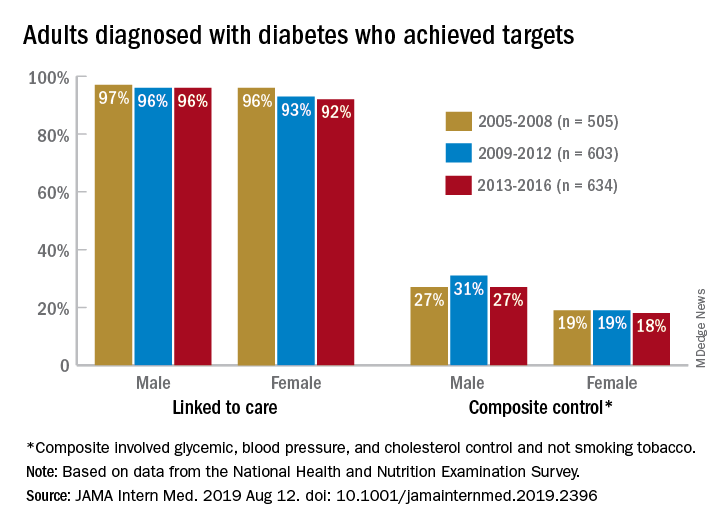
“Fewer than one in four American adults with diagnosed diabetes achieve a controlled level of blood sugar, blood pressure, and cholesterol, and do not smoke tobacco. Our results suggest that, despite major advances in diabetes drug discovery and movement to develop innovative care delivery models over the past two decades, achievement of diabetes care targets has not improved in the United States since 2005,” Pooyan Kazemian, PhD, of Massachusetts General Hospital, Boston, said in a written statement.
During 2013-2016, only 23% of adults with diabetes met a combined composite target of glycemic (HbA1c below a liberal personalized level), blood pressure (less than 140/90 mm Hg), and cholesterol (LDL cholesterol level less than 100 mg/dL) control, as well as not smoking tobacco, Dr. Kazemian and associates reported in JAMA Internal Medicine. The corresponding figures were 25% (2009-2012) and 23% (2005-2008) for the two earlier time periods covered in the study,
The investigators used data for 1,742 nonpregnant adults from the National Health and Nutrition Examination Survey to evaluate the diabetes care cascade, which they defined as “diagnosis, linkage to care, achievement of individual treatment targets, and a composite of all individual targets.”
In 2013-2016, 94% of those diagnosed were linked to care, 64% met their HbA1c target, 70% achieved blood pressure control, 57% met the cholesterol target, and 85% were nonsmokers. When targets were combined, 41% achieved blood pressure and cholesterol control, and 25% met the glycemic, blood pressure, and cholesterol targets, they said.
“We found that none of the U.S. diabetes care variables improved from 2005 to 2016,” Dr. Kazemian and associates noted. Women were less likely than men to meet their treatment goals (see graph) over the course of the study, as were adults aged 18-44 years and black and Hispanic individuals.
“Recent advances in [treatments for diabetes] have not effectively reached the populations at risk and may indicate an immediate need for better approaches to the delivery of diabetes care, including a continued focus on reaching underserved populations with persistent disparities in care,” they wrote.
The study was supported by the Boston Area Diabetes Endocrinology Research Center and Massachusetts General Hospital. One investigator reported that her husband has equity in Apolo1bio. No other disclosures were reported.
SOURCE: Kazemian P et al. JAMA Intern Med. 2019 Aug 12. doi: 10.1001/jamainternmed.2019.2396.
Some things never change: In 2005, most adults with diabetes missed their treatment targets. In 2016, most adults with diabetes missed their treatment targets. And during that time, from 2005 to 2016, around 96% of men and 94% of women were linked to care.
“Fewer than one in four American adults with diagnosed diabetes achieve a controlled level of blood sugar, blood pressure, and cholesterol, and do not smoke tobacco. Our results suggest that, despite major advances in diabetes drug discovery and movement to develop innovative care delivery models over the past two decades, achievement of diabetes care targets has not improved in the United States since 2005,” Pooyan Kazemian, PhD, of Massachusetts General Hospital, Boston, said in a written statement.
During 2013-2016, only 23% of adults with diabetes met a combined composite target of glycemic (HbA1c below a liberal personalized level), blood pressure (less than 140/90 mm Hg), and cholesterol (LDL cholesterol level less than 100 mg/dL) control, as well as not smoking tobacco, Dr. Kazemian and associates reported in JAMA Internal Medicine. The corresponding figures were 25% (2009-2012) and 23% (2005-2008) for the two earlier time periods covered in the study,
The investigators used data for 1,742 nonpregnant adults from the National Health and Nutrition Examination Survey to evaluate the diabetes care cascade, which they defined as “diagnosis, linkage to care, achievement of individual treatment targets, and a composite of all individual targets.”
In 2013-2016, 94% of those diagnosed were linked to care, 64% met their HbA1c target, 70% achieved blood pressure control, 57% met the cholesterol target, and 85% were nonsmokers. When targets were combined, 41% achieved blood pressure and cholesterol control, and 25% met the glycemic, blood pressure, and cholesterol targets, they said.
“We found that none of the U.S. diabetes care variables improved from 2005 to 2016,” Dr. Kazemian and associates noted. Women were less likely than men to meet their treatment goals (see graph) over the course of the study, as were adults aged 18-44 years and black and Hispanic individuals.
“Recent advances in [treatments for diabetes] have not effectively reached the populations at risk and may indicate an immediate need for better approaches to the delivery of diabetes care, including a continued focus on reaching underserved populations with persistent disparities in care,” they wrote.
The study was supported by the Boston Area Diabetes Endocrinology Research Center and Massachusetts General Hospital. One investigator reported that her husband has equity in Apolo1bio. No other disclosures were reported.
SOURCE: Kazemian P et al. JAMA Intern Med. 2019 Aug 12. doi: 10.1001/jamainternmed.2019.2396.
Some things never change: In 2005, most adults with diabetes missed their treatment targets. In 2016, most adults with diabetes missed their treatment targets. And during that time, from 2005 to 2016, around 96% of men and 94% of women were linked to care.
“Fewer than one in four American adults with diagnosed diabetes achieve a controlled level of blood sugar, blood pressure, and cholesterol, and do not smoke tobacco. Our results suggest that, despite major advances in diabetes drug discovery and movement to develop innovative care delivery models over the past two decades, achievement of diabetes care targets has not improved in the United States since 2005,” Pooyan Kazemian, PhD, of Massachusetts General Hospital, Boston, said in a written statement.
During 2013-2016, only 23% of adults with diabetes met a combined composite target of glycemic (HbA1c below a liberal personalized level), blood pressure (less than 140/90 mm Hg), and cholesterol (LDL cholesterol level less than 100 mg/dL) control, as well as not smoking tobacco, Dr. Kazemian and associates reported in JAMA Internal Medicine. The corresponding figures were 25% (2009-2012) and 23% (2005-2008) for the two earlier time periods covered in the study,
The investigators used data for 1,742 nonpregnant adults from the National Health and Nutrition Examination Survey to evaluate the diabetes care cascade, which they defined as “diagnosis, linkage to care, achievement of individual treatment targets, and a composite of all individual targets.”
In 2013-2016, 94% of those diagnosed were linked to care, 64% met their HbA1c target, 70% achieved blood pressure control, 57% met the cholesterol target, and 85% were nonsmokers. When targets were combined, 41% achieved blood pressure and cholesterol control, and 25% met the glycemic, blood pressure, and cholesterol targets, they said.
“We found that none of the U.S. diabetes care variables improved from 2005 to 2016,” Dr. Kazemian and associates noted. Women were less likely than men to meet their treatment goals (see graph) over the course of the study, as were adults aged 18-44 years and black and Hispanic individuals.
“Recent advances in [treatments for diabetes] have not effectively reached the populations at risk and may indicate an immediate need for better approaches to the delivery of diabetes care, including a continued focus on reaching underserved populations with persistent disparities in care,” they wrote.
The study was supported by the Boston Area Diabetes Endocrinology Research Center and Massachusetts General Hospital. One investigator reported that her husband has equity in Apolo1bio. No other disclosures were reported.
SOURCE: Kazemian P et al. JAMA Intern Med. 2019 Aug 12. doi: 10.1001/jamainternmed.2019.2396.
FROM JAMA INTERNAL MEDICINE
Diabetic neuropathy: Often silent, often dangerous
SAN DIEGO – Neuropathy can blur the seriousness of injuries, especially in patients with diabetes, and that can lead to severe consequences such as falls, foot ulcers, gangrene, and amputations, said Lucia M. Novak, MSN, ANP-BC, BC-ADM, CDTC, in a presentation on assessing and treating neuropathies at the Metabolic & Endocrine Disease Summit, sponsored by Global Academy for Medical Education.
As many as half of the cases of diabetic neuropathy may have no symptoms, and more than two-thirds of cases of diabetic neuropathy, even some with obvious symptoms, are ignored or missed by clinicians, said Ms. Novak, director of the Riverside Diabetes Center and adjunct assistant professor at the Uniformed Services University of the Health Sciences, both in Bethesda, Md.
At the same time, she said, diabetic neuropathy is very common. It affects an estimated 10%-15% of newly diagnosed patients with type 2 diabetes, 50% of patients with type 2 disease after 10 years, and as many as 30% of patients with prediabetes.
The condition is less common in type 1 diabetes, affecting an estimated 20% of patients after 20 years, she said.
“All we can do in our patients with type 2 diabetes and diabetic neuropathy, is to slow down the progression, although improving glycemic control can prevent it in type 1,” she said, citing findings suggesting that
A 2012 report analyzed research into the effect of glycemic control on neuropathy in diabetes and found a pair of studies that reported a 60%-70% reduction of risk in patients with type 1 diabetes who received regular insulin dosing. However, the evidence for type 2 diabetes was not as definitive, and analysis of findings from eight randomized, controlled trials in patients with type 2 diabetes supported a relatively small reduction in the development of neuropathy in patients with type 2 diabetes who were receiving enhanced glycemic control (Lancet Neurol. 2012;11[6]:521-34).
Ms. Novak focused mainly on peripheral neuropathy, which is believed to account for 50%-75% of all neuropathy in patients with diabetes. She emphasized the importance of screening because it is crucial for preventing foot ulcers, which affect more than a third of patients with diabetes over their lifetimes.
She recommended following the American Diabetes Association’s 2017 position statement on diabetic neuropathy (Diabetes Care. 2017;40[1]:136-54), beginning with performing a visual examination of the feet at every visit.
Comprehensive screening
In patients with type 1 diabetes, there should be an annual comprehensive screening beginning within 5 years of diagnosis. Patients with type 2 disease should be screened at diagnosis and then annually, as outlined in the ADA statement.
The comprehensive exam involves using tools, such as tuning forks and monofilaments, to test sensation. Different tools are required to test both small and large fibers in the foot, Ms. Novak said, and doing both kinds of testing greatly increases the likelihood of detecting neuropathy.
Check for pulse, bone deformities, dry skin
In addition, “you’ll be feeling for their pulses, looking for bony deformities, and looking at anything is going on between the toes [to make sure] the skin is intact,” she said.
Patients with diabetic neuropathy often have dry skin, she said, so make sure they’re moisturizing. “Look at the condition of their shoes,” she added, “which will tell you how they walk.”
Ill-fitting shoes are a common cause of foot ulcers, said Ms. Novak, who noted that some patients refuse to wear unattractive diabetic shoes and prefer to wear more fashionable – and dangerous – tight-fitting shoes.
Treatment options
Glycemic control makes a difference, especially for patients with type 1, as does control of risk factors, such as obesity. But diabetic neuropathy cannot be reversed.
Pain can be managed with a range of medications. “We can’t cure the neuropathy, we can at least help patients with the symptoms so that they can have a good night’s sleep,” she said.
Ms. Novak also suggested passing on the following snippets of advice to patients:
- Do not walk barefoot.
- Check your feet every day.
- Moisturize your skin, and always dry thoroughly between your toes.
- Seek medical attention if your nails cut into your skin or you develop a callus or areas of redness/warmth.
Global Academy and this news organization are owned by the same parent company. Ms. Novak reported relationships with Nova Nordisk, Sanofi, Janssen, and AstraZeneca.
SAN DIEGO – Neuropathy can blur the seriousness of injuries, especially in patients with diabetes, and that can lead to severe consequences such as falls, foot ulcers, gangrene, and amputations, said Lucia M. Novak, MSN, ANP-BC, BC-ADM, CDTC, in a presentation on assessing and treating neuropathies at the Metabolic & Endocrine Disease Summit, sponsored by Global Academy for Medical Education.
As many as half of the cases of diabetic neuropathy may have no symptoms, and more than two-thirds of cases of diabetic neuropathy, even some with obvious symptoms, are ignored or missed by clinicians, said Ms. Novak, director of the Riverside Diabetes Center and adjunct assistant professor at the Uniformed Services University of the Health Sciences, both in Bethesda, Md.
At the same time, she said, diabetic neuropathy is very common. It affects an estimated 10%-15% of newly diagnosed patients with type 2 diabetes, 50% of patients with type 2 disease after 10 years, and as many as 30% of patients with prediabetes.
The condition is less common in type 1 diabetes, affecting an estimated 20% of patients after 20 years, she said.
“All we can do in our patients with type 2 diabetes and diabetic neuropathy, is to slow down the progression, although improving glycemic control can prevent it in type 1,” she said, citing findings suggesting that
A 2012 report analyzed research into the effect of glycemic control on neuropathy in diabetes and found a pair of studies that reported a 60%-70% reduction of risk in patients with type 1 diabetes who received regular insulin dosing. However, the evidence for type 2 diabetes was not as definitive, and analysis of findings from eight randomized, controlled trials in patients with type 2 diabetes supported a relatively small reduction in the development of neuropathy in patients with type 2 diabetes who were receiving enhanced glycemic control (Lancet Neurol. 2012;11[6]:521-34).
Ms. Novak focused mainly on peripheral neuropathy, which is believed to account for 50%-75% of all neuropathy in patients with diabetes. She emphasized the importance of screening because it is crucial for preventing foot ulcers, which affect more than a third of patients with diabetes over their lifetimes.
She recommended following the American Diabetes Association’s 2017 position statement on diabetic neuropathy (Diabetes Care. 2017;40[1]:136-54), beginning with performing a visual examination of the feet at every visit.
Comprehensive screening
In patients with type 1 diabetes, there should be an annual comprehensive screening beginning within 5 years of diagnosis. Patients with type 2 disease should be screened at diagnosis and then annually, as outlined in the ADA statement.
The comprehensive exam involves using tools, such as tuning forks and monofilaments, to test sensation. Different tools are required to test both small and large fibers in the foot, Ms. Novak said, and doing both kinds of testing greatly increases the likelihood of detecting neuropathy.
Check for pulse, bone deformities, dry skin
In addition, “you’ll be feeling for their pulses, looking for bony deformities, and looking at anything is going on between the toes [to make sure] the skin is intact,” she said.
Patients with diabetic neuropathy often have dry skin, she said, so make sure they’re moisturizing. “Look at the condition of their shoes,” she added, “which will tell you how they walk.”
Ill-fitting shoes are a common cause of foot ulcers, said Ms. Novak, who noted that some patients refuse to wear unattractive diabetic shoes and prefer to wear more fashionable – and dangerous – tight-fitting shoes.
Treatment options
Glycemic control makes a difference, especially for patients with type 1, as does control of risk factors, such as obesity. But diabetic neuropathy cannot be reversed.
Pain can be managed with a range of medications. “We can’t cure the neuropathy, we can at least help patients with the symptoms so that they can have a good night’s sleep,” she said.
Ms. Novak also suggested passing on the following snippets of advice to patients:
- Do not walk barefoot.
- Check your feet every day.
- Moisturize your skin, and always dry thoroughly between your toes.
- Seek medical attention if your nails cut into your skin or you develop a callus or areas of redness/warmth.
Global Academy and this news organization are owned by the same parent company. Ms. Novak reported relationships with Nova Nordisk, Sanofi, Janssen, and AstraZeneca.
SAN DIEGO – Neuropathy can blur the seriousness of injuries, especially in patients with diabetes, and that can lead to severe consequences such as falls, foot ulcers, gangrene, and amputations, said Lucia M. Novak, MSN, ANP-BC, BC-ADM, CDTC, in a presentation on assessing and treating neuropathies at the Metabolic & Endocrine Disease Summit, sponsored by Global Academy for Medical Education.
As many as half of the cases of diabetic neuropathy may have no symptoms, and more than two-thirds of cases of diabetic neuropathy, even some with obvious symptoms, are ignored or missed by clinicians, said Ms. Novak, director of the Riverside Diabetes Center and adjunct assistant professor at the Uniformed Services University of the Health Sciences, both in Bethesda, Md.
At the same time, she said, diabetic neuropathy is very common. It affects an estimated 10%-15% of newly diagnosed patients with type 2 diabetes, 50% of patients with type 2 disease after 10 years, and as many as 30% of patients with prediabetes.
The condition is less common in type 1 diabetes, affecting an estimated 20% of patients after 20 years, she said.
“All we can do in our patients with type 2 diabetes and diabetic neuropathy, is to slow down the progression, although improving glycemic control can prevent it in type 1,” she said, citing findings suggesting that
A 2012 report analyzed research into the effect of glycemic control on neuropathy in diabetes and found a pair of studies that reported a 60%-70% reduction of risk in patients with type 1 diabetes who received regular insulin dosing. However, the evidence for type 2 diabetes was not as definitive, and analysis of findings from eight randomized, controlled trials in patients with type 2 diabetes supported a relatively small reduction in the development of neuropathy in patients with type 2 diabetes who were receiving enhanced glycemic control (Lancet Neurol. 2012;11[6]:521-34).
Ms. Novak focused mainly on peripheral neuropathy, which is believed to account for 50%-75% of all neuropathy in patients with diabetes. She emphasized the importance of screening because it is crucial for preventing foot ulcers, which affect more than a third of patients with diabetes over their lifetimes.
She recommended following the American Diabetes Association’s 2017 position statement on diabetic neuropathy (Diabetes Care. 2017;40[1]:136-54), beginning with performing a visual examination of the feet at every visit.
Comprehensive screening
In patients with type 1 diabetes, there should be an annual comprehensive screening beginning within 5 years of diagnosis. Patients with type 2 disease should be screened at diagnosis and then annually, as outlined in the ADA statement.
The comprehensive exam involves using tools, such as tuning forks and monofilaments, to test sensation. Different tools are required to test both small and large fibers in the foot, Ms. Novak said, and doing both kinds of testing greatly increases the likelihood of detecting neuropathy.
Check for pulse, bone deformities, dry skin
In addition, “you’ll be feeling for their pulses, looking for bony deformities, and looking at anything is going on between the toes [to make sure] the skin is intact,” she said.
Patients with diabetic neuropathy often have dry skin, she said, so make sure they’re moisturizing. “Look at the condition of their shoes,” she added, “which will tell you how they walk.”
Ill-fitting shoes are a common cause of foot ulcers, said Ms. Novak, who noted that some patients refuse to wear unattractive diabetic shoes and prefer to wear more fashionable – and dangerous – tight-fitting shoes.
Treatment options
Glycemic control makes a difference, especially for patients with type 1, as does control of risk factors, such as obesity. But diabetic neuropathy cannot be reversed.
Pain can be managed with a range of medications. “We can’t cure the neuropathy, we can at least help patients with the symptoms so that they can have a good night’s sleep,” she said.
Ms. Novak also suggested passing on the following snippets of advice to patients:
- Do not walk barefoot.
- Check your feet every day.
- Moisturize your skin, and always dry thoroughly between your toes.
- Seek medical attention if your nails cut into your skin or you develop a callus or areas of redness/warmth.
Global Academy and this news organization are owned by the same parent company. Ms. Novak reported relationships with Nova Nordisk, Sanofi, Janssen, and AstraZeneca.
EXPERT ANALYSIS FROM MEDS 2019