User login
Studies examine methotrexate starting dose for RA in monotherapy and combinations
MADRID – A low versus high starting dose of methotrexate given as monotherapy or in combination with glucocorticoids or conventional synthetic disease-modifying antirheumatic drugs to newly diagnosed rheumatoid arthritis patients doesn’t seem to make a difference in short-term disease activity and physical functioning responses, but a higher starting dose of at least 15 mg/week may provide a better chance at achieving a good response at 6 months, according to two separate observational studies presented at the European Congress of Rheumatology.
One of the studies looked at 3- to 6-month disease activity and physical functioning responses to methotrexate used as mono- or combination therapy and the other assessed EULAR clinical responses at 6 months in mostly monotherapy-treated patients.
Low vs. high dose in combination treatments
“Methotrexate is the anchor drug in the treatment of rheumatoid arthritis patients. Current guidelines for methotrexate monotherapy recommend initiating 15 mg/week orally then escalating to 25-30 mg/week or the highest tolerable dose, but no recommendations exist for the drug’s use in combination therapy,” said Sytske Anne Bergstra, first author of a study using the international, observational METEOR database, a cohort with real-world clinical data.

The investigators selected 1,404 RA patients from the METEOR database who had a symptom duration of less than 5 years, had less than 2 months between diagnosis and first visit, and did not change medications (only dose adjustments were allowed). They were divided into three groups: methotrexate monotherapy, methotrexate plus conventional synthetic disease-modifying antirheumatic drugs (csDMARDs), and methotrexate plus glucocorticoids (and possibly csDMARDs). The investigators defined initial starting doses of methotrexate as low (10 mg/week or less) or high (15 mg/week or more) based on the last reported dose of methotrexate at no later than 8 weeks of follow-up.
In each group, females comprised about 80% of patients, and the mean age was 45-48 years. The group that received methotrexate plus csDMARDs had a median symptom duration nearly twice that of the other groups (730 days vs. 365 for monotherapy and 458 for methotrexate plus glucocorticoids). Rheumatoid factor positivity ranged from 77% to 84% and anticitrullinated peptide autoantibody positivity from 72% to 85%.
The use of a high methotrexate starting dose generally trended upward in patients enrolled in the database through 2015, whereas the high point for use of a low dose was 2010 and declined thereafter. Overall, a high starting dose was used in 28% of monotherapy patients, 14% with methotrexate plus csDMARDs, and 46% with methotrexate plus glucocorticoids.
In propensity score–adjusted analyses that helped to control for confounding by indication, there were no differences in the effectiveness of low or high methotrexate starting doses for all three groups after follow-up between 3 and 6 months on Disease Activity Score (DAS), 28-joint DAS, or the Health Assessment Questionnaire (HAQ).
“Our findings seem to contradict the general trend of starting with high methotrexate doses. They indicate that higher doses did not provide better short-term clinical outcome in either monotherapy or combination therapy,” Ms. Bergstra observed.
She continued: “For the moment, we suggest that rheumatologists consider starting with a lower initial methotrexate dose, especially when prescribing in combination with other synthetic DMARDS or glucocorticoids.”
Effect of initial dose on EULAR response
Rebecca Davies of the Centre for Musculoskeletal Research at the University of Manchester (England) presented data from a separate study that examined the effect of giving a low versus a high dose of methotrexate on patients’ rate of response to EULAR criteria at 6 months.
“Methotrexate is the recommended first line treatment for rheumatoid arthritis; however, we have not yet established [a] clear optimal strategy for the starting dose of this therapy,” Ms. Davies said.

The aim of the study was therefore to assess the two most commonly used methotrexate starting doses used in the United Kingdom (7.5 mg/week or less vs. 15 mg/week or more) and how they affected the DAS28 of patients.
A total of 810 patients with rheumatoid arthritis who were starting methotrexate were recruited from the U.K. national, multicenter, longitudinal, observational Rheumatoid Arthritis Medication Study. For inclusion in the study, patients had to have complete DAS28 data at baseline and at 6 months.
The median age of patients was similar among the low- and high-dose groups, at 58 and 61 years, respectively. Most of the participants were female (70% vs. 60%), with a median disease duration of 6 years. Median baseline DAS28 scores were 4.2 in low- and 4.1 in high-dose groups, and baseline HAQ scores were 1.3 and 0.9, respectively.
Ms. Davies noted that 627 (77%) of the patients newly initiated on methotrexate received 15 mg/week, 10 received 20 mg, and 2 received 25 mg. The low dose of 7.5 mg/week was started by 165 patients (20%), 4 started on 5 mg, and 2 started on 2.5 mg. In more than 90% of patients, methotrexate was given orally in both the low- and high-dose groups.
Patients who were initiated on the lower methotrexate dose were more often prescribed concomitant nonbiologic DMARDs (17% vs. 10% of those in the high-dose group). Half of patients in both high- and low-dose groups used oral steroids, and a quarter used intramuscular steroids.
According to the EULAR response criteria, a good response is seen if the final DAS28 drops to 3.2 or below and there is also an improvement of 1.2 or more from baseline values. This was achieved in 23% of patients in the low-dose group and in 33% of patients in the high-dose group. Moderate EULAR clinical responses were seen in 32% and 25%, and nonresponses seen in a respective 45% and 42%.
However, findings on a multinomial logistic regression model “showed that RA patients starting methotrexate on a higher dose have a higher probability of having a good EULAR clinical response, as opposed to nonresponse, at 6 months,” Ms. Davies said.
The unadjusted relative risk ratio in patients starting a high versus low dose was 0.8 for a moderate EULAR response and 1.5 for a good EULAR response. The respective adjusted RRR was 1.0 and 2.7, suggesting that there is no difference between the doses in achieving a moderate response, but the higher dose has the edge at helping patients achieve a good EULAR response by 6 months.
During the discussion following Ms. Davies’ presentation, Roy Fleischmann, MD, of the department of internal medicine at the University of Texas Southwestern Medical Center, Dallas, asked whether a high dose had actually been used at all in the study. Dr. Fleischmann observed that both 7.5 mg/week and 15 mg/week could be considered low doses.
However, one of the chairs of the session, Peter Taylor, PhD , of the University of Oxford (England) noted that the bioavailability of methotrexate does not change much when the dose is above 15 mg via the oral route.
Kimme Hyrich, MD, of the University of Manchester (England) and senior author on the study, pointed out that the point of the analysis was to compare the starting doses of methotrexate among patients, and there might have been patients who received higher doses (25 mg or more) during the 6-month follow-up period. It is expected that future work will look at the change in the dose response over the 6-month time period, she said.
Ms. Bergstra and Ms. Davies reported that they had no relevant financial disclosures. Several coauthors for the METEOR database study disclosed financial relationships with numerous companies that market drugs for RA.
MADRID – A low versus high starting dose of methotrexate given as monotherapy or in combination with glucocorticoids or conventional synthetic disease-modifying antirheumatic drugs to newly diagnosed rheumatoid arthritis patients doesn’t seem to make a difference in short-term disease activity and physical functioning responses, but a higher starting dose of at least 15 mg/week may provide a better chance at achieving a good response at 6 months, according to two separate observational studies presented at the European Congress of Rheumatology.
One of the studies looked at 3- to 6-month disease activity and physical functioning responses to methotrexate used as mono- or combination therapy and the other assessed EULAR clinical responses at 6 months in mostly monotherapy-treated patients.
Low vs. high dose in combination treatments
“Methotrexate is the anchor drug in the treatment of rheumatoid arthritis patients. Current guidelines for methotrexate monotherapy recommend initiating 15 mg/week orally then escalating to 25-30 mg/week or the highest tolerable dose, but no recommendations exist for the drug’s use in combination therapy,” said Sytske Anne Bergstra, first author of a study using the international, observational METEOR database, a cohort with real-world clinical data.
The investigators selected 1,404 RA patients from the METEOR database who had a symptom duration of less than 5 years, had less than 2 months between diagnosis and first visit, and did not change medications (only dose adjustments were allowed). They were divided into three groups: methotrexate monotherapy, methotrexate plus conventional synthetic disease-modifying antirheumatic drugs (csDMARDs), and methotrexate plus glucocorticoids (and possibly csDMARDs). The investigators defined initial starting doses of methotrexate as low (10 mg/week or less) or high (15 mg/week or more) based on the last reported dose of methotrexate at no later than 8 weeks of follow-up.
In each group, females comprised about 80% of patients, and the mean age was 45-48 years. The group that received methotrexate plus csDMARDs had a median symptom duration nearly twice that of the other groups (730 days vs. 365 for monotherapy and 458 for methotrexate plus glucocorticoids). Rheumatoid factor positivity ranged from 77% to 84% and anticitrullinated peptide autoantibody positivity from 72% to 85%.
The use of a high methotrexate starting dose generally trended upward in patients enrolled in the database through 2015, whereas the high point for use of a low dose was 2010 and declined thereafter. Overall, a high starting dose was used in 28% of monotherapy patients, 14% with methotrexate plus csDMARDs, and 46% with methotrexate plus glucocorticoids.
In propensity score–adjusted analyses that helped to control for confounding by indication, there were no differences in the effectiveness of low or high methotrexate starting doses for all three groups after follow-up between 3 and 6 months on Disease Activity Score (DAS), 28-joint DAS, or the Health Assessment Questionnaire (HAQ).
“Our findings seem to contradict the general trend of starting with high methotrexate doses. They indicate that higher doses did not provide better short-term clinical outcome in either monotherapy or combination therapy,” Ms. Bergstra observed.
She continued: “For the moment, we suggest that rheumatologists consider starting with a lower initial methotrexate dose, especially when prescribing in combination with other synthetic DMARDS or glucocorticoids.”
Effect of initial dose on EULAR response
Rebecca Davies of the Centre for Musculoskeletal Research at the University of Manchester (England) presented data from a separate study that examined the effect of giving a low versus a high dose of methotrexate on patients’ rate of response to EULAR criteria at 6 months.
“Methotrexate is the recommended first line treatment for rheumatoid arthritis; however, we have not yet established [a] clear optimal strategy for the starting dose of this therapy,” Ms. Davies said.
The aim of the study was therefore to assess the two most commonly used methotrexate starting doses used in the United Kingdom (7.5 mg/week or less vs. 15 mg/week or more) and how they affected the DAS28 of patients.
A total of 810 patients with rheumatoid arthritis who were starting methotrexate were recruited from the U.K. national, multicenter, longitudinal, observational Rheumatoid Arthritis Medication Study. For inclusion in the study, patients had to have complete DAS28 data at baseline and at 6 months.
The median age of patients was similar among the low- and high-dose groups, at 58 and 61 years, respectively. Most of the participants were female (70% vs. 60%), with a median disease duration of 6 years. Median baseline DAS28 scores were 4.2 in low- and 4.1 in high-dose groups, and baseline HAQ scores were 1.3 and 0.9, respectively.
Ms. Davies noted that 627 (77%) of the patients newly initiated on methotrexate received 15 mg/week, 10 received 20 mg, and 2 received 25 mg. The low dose of 7.5 mg/week was started by 165 patients (20%), 4 started on 5 mg, and 2 started on 2.5 mg. In more than 90% of patients, methotrexate was given orally in both the low- and high-dose groups.
Patients who were initiated on the lower methotrexate dose were more often prescribed concomitant nonbiologic DMARDs (17% vs. 10% of those in the high-dose group). Half of patients in both high- and low-dose groups used oral steroids, and a quarter used intramuscular steroids.
According to the EULAR response criteria, a good response is seen if the final DAS28 drops to 3.2 or below and there is also an improvement of 1.2 or more from baseline values. This was achieved in 23% of patients in the low-dose group and in 33% of patients in the high-dose group. Moderate EULAR clinical responses were seen in 32% and 25%, and nonresponses seen in a respective 45% and 42%.
However, findings on a multinomial logistic regression model “showed that RA patients starting methotrexate on a higher dose have a higher probability of having a good EULAR clinical response, as opposed to nonresponse, at 6 months,” Ms. Davies said.
The unadjusted relative risk ratio in patients starting a high versus low dose was 0.8 for a moderate EULAR response and 1.5 for a good EULAR response. The respective adjusted RRR was 1.0 and 2.7, suggesting that there is no difference between the doses in achieving a moderate response, but the higher dose has the edge at helping patients achieve a good EULAR response by 6 months.
During the discussion following Ms. Davies’ presentation, Roy Fleischmann, MD, of the department of internal medicine at the University of Texas Southwestern Medical Center, Dallas, asked whether a high dose had actually been used at all in the study. Dr. Fleischmann observed that both 7.5 mg/week and 15 mg/week could be considered low doses.
However, one of the chairs of the session, Peter Taylor, PhD , of the University of Oxford (England) noted that the bioavailability of methotrexate does not change much when the dose is above 15 mg via the oral route.
Kimme Hyrich, MD, of the University of Manchester (England) and senior author on the study, pointed out that the point of the analysis was to compare the starting doses of methotrexate among patients, and there might have been patients who received higher doses (25 mg or more) during the 6-month follow-up period. It is expected that future work will look at the change in the dose response over the 6-month time period, she said.
Ms. Bergstra and Ms. Davies reported that they had no relevant financial disclosures. Several coauthors for the METEOR database study disclosed financial relationships with numerous companies that market drugs for RA.
MADRID – A low versus high starting dose of methotrexate given as monotherapy or in combination with glucocorticoids or conventional synthetic disease-modifying antirheumatic drugs to newly diagnosed rheumatoid arthritis patients doesn’t seem to make a difference in short-term disease activity and physical functioning responses, but a higher starting dose of at least 15 mg/week may provide a better chance at achieving a good response at 6 months, according to two separate observational studies presented at the European Congress of Rheumatology.
One of the studies looked at 3- to 6-month disease activity and physical functioning responses to methotrexate used as mono- or combination therapy and the other assessed EULAR clinical responses at 6 months in mostly monotherapy-treated patients.
Low vs. high dose in combination treatments
“Methotrexate is the anchor drug in the treatment of rheumatoid arthritis patients. Current guidelines for methotrexate monotherapy recommend initiating 15 mg/week orally then escalating to 25-30 mg/week or the highest tolerable dose, but no recommendations exist for the drug’s use in combination therapy,” said Sytske Anne Bergstra, first author of a study using the international, observational METEOR database, a cohort with real-world clinical data.
The investigators selected 1,404 RA patients from the METEOR database who had a symptom duration of less than 5 years, had less than 2 months between diagnosis and first visit, and did not change medications (only dose adjustments were allowed). They were divided into three groups: methotrexate monotherapy, methotrexate plus conventional synthetic disease-modifying antirheumatic drugs (csDMARDs), and methotrexate plus glucocorticoids (and possibly csDMARDs). The investigators defined initial starting doses of methotrexate as low (10 mg/week or less) or high (15 mg/week or more) based on the last reported dose of methotrexate at no later than 8 weeks of follow-up.
In each group, females comprised about 80% of patients, and the mean age was 45-48 years. The group that received methotrexate plus csDMARDs had a median symptom duration nearly twice that of the other groups (730 days vs. 365 for monotherapy and 458 for methotrexate plus glucocorticoids). Rheumatoid factor positivity ranged from 77% to 84% and anticitrullinated peptide autoantibody positivity from 72% to 85%.
The use of a high methotrexate starting dose generally trended upward in patients enrolled in the database through 2015, whereas the high point for use of a low dose was 2010 and declined thereafter. Overall, a high starting dose was used in 28% of monotherapy patients, 14% with methotrexate plus csDMARDs, and 46% with methotrexate plus glucocorticoids.
In propensity score–adjusted analyses that helped to control for confounding by indication, there were no differences in the effectiveness of low or high methotrexate starting doses for all three groups after follow-up between 3 and 6 months on Disease Activity Score (DAS), 28-joint DAS, or the Health Assessment Questionnaire (HAQ).
“Our findings seem to contradict the general trend of starting with high methotrexate doses. They indicate that higher doses did not provide better short-term clinical outcome in either monotherapy or combination therapy,” Ms. Bergstra observed.
She continued: “For the moment, we suggest that rheumatologists consider starting with a lower initial methotrexate dose, especially when prescribing in combination with other synthetic DMARDS or glucocorticoids.”
Effect of initial dose on EULAR response
Rebecca Davies of the Centre for Musculoskeletal Research at the University of Manchester (England) presented data from a separate study that examined the effect of giving a low versus a high dose of methotrexate on patients’ rate of response to EULAR criteria at 6 months.
“Methotrexate is the recommended first line treatment for rheumatoid arthritis; however, we have not yet established [a] clear optimal strategy for the starting dose of this therapy,” Ms. Davies said.
The aim of the study was therefore to assess the two most commonly used methotrexate starting doses used in the United Kingdom (7.5 mg/week or less vs. 15 mg/week or more) and how they affected the DAS28 of patients.
A total of 810 patients with rheumatoid arthritis who were starting methotrexate were recruited from the U.K. national, multicenter, longitudinal, observational Rheumatoid Arthritis Medication Study. For inclusion in the study, patients had to have complete DAS28 data at baseline and at 6 months.
The median age of patients was similar among the low- and high-dose groups, at 58 and 61 years, respectively. Most of the participants were female (70% vs. 60%), with a median disease duration of 6 years. Median baseline DAS28 scores were 4.2 in low- and 4.1 in high-dose groups, and baseline HAQ scores were 1.3 and 0.9, respectively.
Ms. Davies noted that 627 (77%) of the patients newly initiated on methotrexate received 15 mg/week, 10 received 20 mg, and 2 received 25 mg. The low dose of 7.5 mg/week was started by 165 patients (20%), 4 started on 5 mg, and 2 started on 2.5 mg. In more than 90% of patients, methotrexate was given orally in both the low- and high-dose groups.
Patients who were initiated on the lower methotrexate dose were more often prescribed concomitant nonbiologic DMARDs (17% vs. 10% of those in the high-dose group). Half of patients in both high- and low-dose groups used oral steroids, and a quarter used intramuscular steroids.
According to the EULAR response criteria, a good response is seen if the final DAS28 drops to 3.2 or below and there is also an improvement of 1.2 or more from baseline values. This was achieved in 23% of patients in the low-dose group and in 33% of patients in the high-dose group. Moderate EULAR clinical responses were seen in 32% and 25%, and nonresponses seen in a respective 45% and 42%.
However, findings on a multinomial logistic regression model “showed that RA patients starting methotrexate on a higher dose have a higher probability of having a good EULAR clinical response, as opposed to nonresponse, at 6 months,” Ms. Davies said.
The unadjusted relative risk ratio in patients starting a high versus low dose was 0.8 for a moderate EULAR response and 1.5 for a good EULAR response. The respective adjusted RRR was 1.0 and 2.7, suggesting that there is no difference between the doses in achieving a moderate response, but the higher dose has the edge at helping patients achieve a good EULAR response by 6 months.
During the discussion following Ms. Davies’ presentation, Roy Fleischmann, MD, of the department of internal medicine at the University of Texas Southwestern Medical Center, Dallas, asked whether a high dose had actually been used at all in the study. Dr. Fleischmann observed that both 7.5 mg/week and 15 mg/week could be considered low doses.
However, one of the chairs of the session, Peter Taylor, PhD , of the University of Oxford (England) noted that the bioavailability of methotrexate does not change much when the dose is above 15 mg via the oral route.
Kimme Hyrich, MD, of the University of Manchester (England) and senior author on the study, pointed out that the point of the analysis was to compare the starting doses of methotrexate among patients, and there might have been patients who received higher doses (25 mg or more) during the 6-month follow-up period. It is expected that future work will look at the change in the dose response over the 6-month time period, she said.
Ms. Bergstra and Ms. Davies reported that they had no relevant financial disclosures. Several coauthors for the METEOR database study disclosed financial relationships with numerous companies that market drugs for RA.
AT THE EULAR 2017 CONGRESS
Key clinical point: For newly diagnosed RA, consider using a lower methotrexate starting dose with combination therapy and a higher dose of 15 mg/week or more in monotherapy.
Major finding: In one study, 23% and 33% of patients taking low-dose or high-dose methotrexate, respectively, achieved a good EULAR clinical response.
Data source: Two studies (METEOR and RAMS) evaluating the comparative effects of initiating low versus high doses of methotrexate for newly diagnosed rheumatoid arthritis.
Disclosures: The presenters reported they had no relevant financial disclosures. Several coauthors for the METEOR database study disclosed financial relationships with numerous companies that market drugs for RA.
Three-drug combo keeps early RA at bay long term
MADRID – A triple combination of methotrexate, hydroxychloroquine, and triamcinolone used to induce remission in patients with early rheumatoid arthritis (RA) was associated with higher long-term remission rates than methotrexate used alone in a study presented at the European Congress of Rheumatology.
The percentages of patients in remission were a respective 88.2% versus 72.1% at 1 year, 86.6% versus 81.9% at 2 years, and 88.0% versus 85.8% at 3 years.
“Combination treatment results in a higher remission rate in the first 2 years of treatment and a similar remission rate in the third year,” said Tammo Brunekreef, a medical student at Ziekenhuisgroep Twente in Almelo, the Netherlands, who presented the findings.
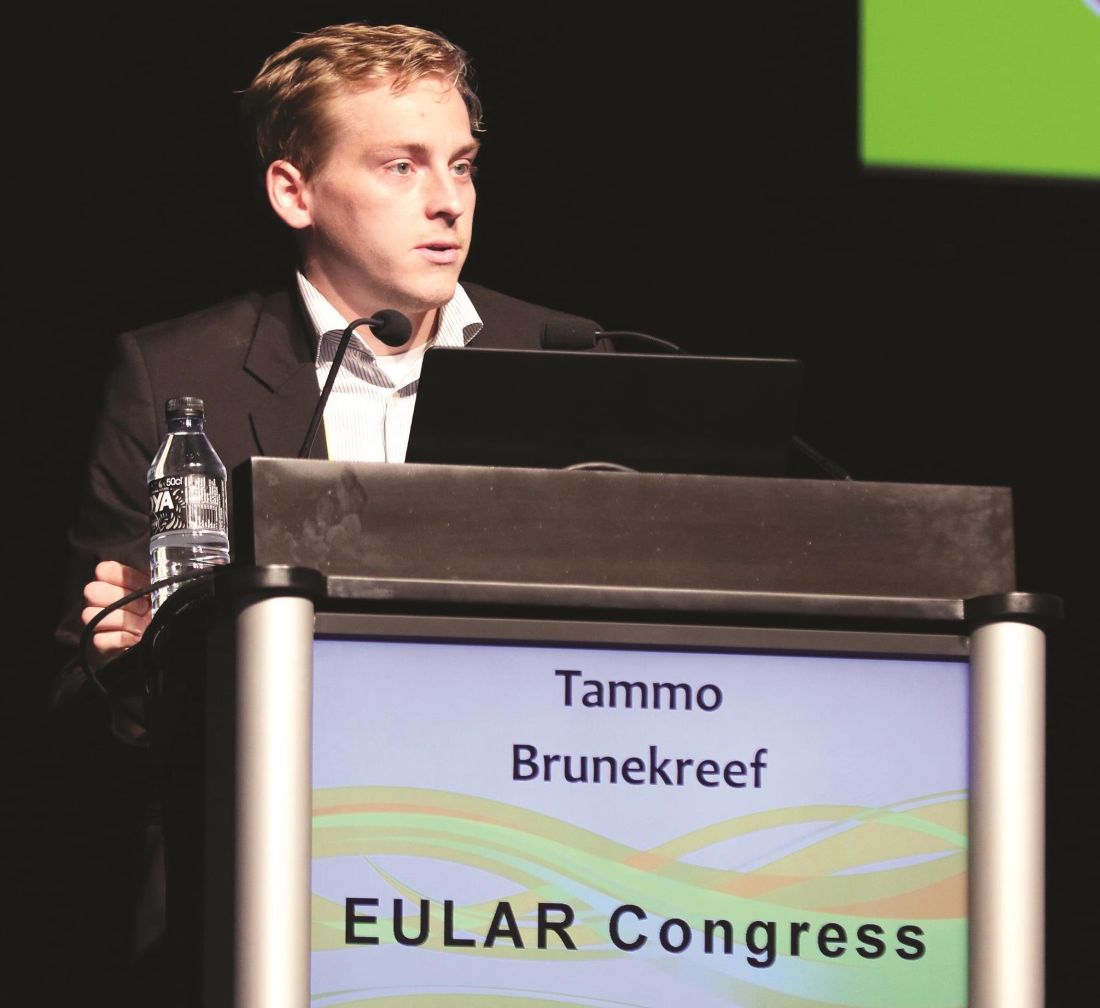
“There is no consensus on what the initial treatment should look like, however,” he said. For instance, should remission be induced with methotrexate alone? Or should methotrexate be used in combination with other synthetic disease-modifying antirheumatic drugs (DMARDs)? Or is methotrexate best combined with steroids?
“The early treatment [of RA] is very important because a shorter time to remission is related to sustainability of remission,” Mr. Brunekreef said. “Combination therapy has also been compared in previous studies with methotrexate monotherapy and had been shown to be more effective at 3 and 6 months, although not at 12 months.”
Data on the longer-term follow-up in routine care is lacking, so Mr. Brunekreef and Dutch rheumatologist Hein J. Bernelot Moens, MD, created two historical cohorts of patients with early RA. One cohort of 296 patients had a disease onset between 2006 and 2011 and had received methotrexate monotherapy initiated at 15-20 mg/week. The other cohort of 157 patients had a disease onset between 2012 and 2014 and had been given a combination of oral methotrexate, started at 20 mg/week; oral hydroxychloroquine, started at 200 mg twice daily; and a single 80-120 mg intramuscular injection of triamcinolone that could be repeated after 4 weeks, if necessary.
The mean age of the recruited patients in the monotherapy and combination cohorts was a respective 59.5 and 58.9 years, and 60.5% and 65% were female. More patients in the combination than monotherapy group were rheumatoid factor positive (72.3% vs. 62.2%), with 72.1% and 64.5% being positive for anticitrullinated protein antibodies.
“A number of patients were lost to follow-up due to death (3.7% vs. 1.9%) [or] drug-free remission (1.7% vs. 0.6%) or did not start methotrexate or for other reasons (2.4% vs. 0.6%), but this was not significantly different,” Mr. Brunekreef reported. This left 273 and 124 in each cohort, respectively, who completed 3 years’ of follow-up.
The same percentage of patients in the methotrexate and combination cohorts started a biologic DMARD in the first year (10.8%). A biologic DMARD was recommended if remission was not achieved within 6 months or if there was sustained disease activity after 6 months.
In the second year, however, 6.6% more patients in the methotrexate cohort started a biologic (9.8% vs. 3.2%). Conversely, 1.3% more patients started a biologic in the third year in the combination arm (4% vs. 2.7%). Overall, the receipt of biologics by 21% of monotherapy patients and 14% of combination therapy patients did not differ significantly.
The mean time to the start of the biologic DMARD was similar, however, at around 11-12 months.

Mr. Brunekreef answered that the DAS28-ESR had been used up to 2015 and then the DAS-CRP from 2016 onward, although the latter was only for patients in year 3, a small number of patients. “We’re looking into a way to translate those data to make them comparable,” Brunekreef said.
“That’s a real problem,” Dr. Fleischmann said, as the DAS28-ESR and DAS28-CRP are not interchangeable. He proposed that these data needed to be looked at using another measure, perhaps the Clinical Disease Activity Index.
Further, Dr. Fleischmann observed that the methotrexate monotherapy data were “absolutely incredible, compared to what we’ve seen in randomized, controlled trials, with 40%-50% of patients in remission.” In clinical trials, about 15% on methotrexate alone achieve an American College of Rheumatology 20 Response Criteria.
“These are very, very strong data, but now I wonder whether or not it’s because of that switch” in DAS28 scoring, Dr. Fleischmann said.
Mr. Brunekreef had no disclosures to report. Dr. Fleischmann has received research grants, research support, and consultancy fees from Pfizer and from AbbVie, Amgen, Bristol-Myers Squibb, Celgene, Eli Lilly, GlaxoSmithKline, Janssen, Novartis, Sanofi Genzyme, and UCB.
MADRID – A triple combination of methotrexate, hydroxychloroquine, and triamcinolone used to induce remission in patients with early rheumatoid arthritis (RA) was associated with higher long-term remission rates than methotrexate used alone in a study presented at the European Congress of Rheumatology.
The percentages of patients in remission were a respective 88.2% versus 72.1% at 1 year, 86.6% versus 81.9% at 2 years, and 88.0% versus 85.8% at 3 years.
“Combination treatment results in a higher remission rate in the first 2 years of treatment and a similar remission rate in the third year,” said Tammo Brunekreef, a medical student at Ziekenhuisgroep Twente in Almelo, the Netherlands, who presented the findings.
“There is no consensus on what the initial treatment should look like, however,” he said. For instance, should remission be induced with methotrexate alone? Or should methotrexate be used in combination with other synthetic disease-modifying antirheumatic drugs (DMARDs)? Or is methotrexate best combined with steroids?
“The early treatment [of RA] is very important because a shorter time to remission is related to sustainability of remission,” Mr. Brunekreef said. “Combination therapy has also been compared in previous studies with methotrexate monotherapy and had been shown to be more effective at 3 and 6 months, although not at 12 months.”
Data on the longer-term follow-up in routine care is lacking, so Mr. Brunekreef and Dutch rheumatologist Hein J. Bernelot Moens, MD, created two historical cohorts of patients with early RA. One cohort of 296 patients had a disease onset between 2006 and 2011 and had received methotrexate monotherapy initiated at 15-20 mg/week. The other cohort of 157 patients had a disease onset between 2012 and 2014 and had been given a combination of oral methotrexate, started at 20 mg/week; oral hydroxychloroquine, started at 200 mg twice daily; and a single 80-120 mg intramuscular injection of triamcinolone that could be repeated after 4 weeks, if necessary.
The mean age of the recruited patients in the monotherapy and combination cohorts was a respective 59.5 and 58.9 years, and 60.5% and 65% were female. More patients in the combination than monotherapy group were rheumatoid factor positive (72.3% vs. 62.2%), with 72.1% and 64.5% being positive for anticitrullinated protein antibodies.
“A number of patients were lost to follow-up due to death (3.7% vs. 1.9%) [or] drug-free remission (1.7% vs. 0.6%) or did not start methotrexate or for other reasons (2.4% vs. 0.6%), but this was not significantly different,” Mr. Brunekreef reported. This left 273 and 124 in each cohort, respectively, who completed 3 years’ of follow-up.
The same percentage of patients in the methotrexate and combination cohorts started a biologic DMARD in the first year (10.8%). A biologic DMARD was recommended if remission was not achieved within 6 months or if there was sustained disease activity after 6 months.
In the second year, however, 6.6% more patients in the methotrexate cohort started a biologic (9.8% vs. 3.2%). Conversely, 1.3% more patients started a biologic in the third year in the combination arm (4% vs. 2.7%). Overall, the receipt of biologics by 21% of monotherapy patients and 14% of combination therapy patients did not differ significantly.
The mean time to the start of the biologic DMARD was similar, however, at around 11-12 months.
Mr. Brunekreef answered that the DAS28-ESR had been used up to 2015 and then the DAS-CRP from 2016 onward, although the latter was only for patients in year 3, a small number of patients. “We’re looking into a way to translate those data to make them comparable,” Brunekreef said.
“That’s a real problem,” Dr. Fleischmann said, as the DAS28-ESR and DAS28-CRP are not interchangeable. He proposed that these data needed to be looked at using another measure, perhaps the Clinical Disease Activity Index.
Further, Dr. Fleischmann observed that the methotrexate monotherapy data were “absolutely incredible, compared to what we’ve seen in randomized, controlled trials, with 40%-50% of patients in remission.” In clinical trials, about 15% on methotrexate alone achieve an American College of Rheumatology 20 Response Criteria.
“These are very, very strong data, but now I wonder whether or not it’s because of that switch” in DAS28 scoring, Dr. Fleischmann said.
Mr. Brunekreef had no disclosures to report. Dr. Fleischmann has received research grants, research support, and consultancy fees from Pfizer and from AbbVie, Amgen, Bristol-Myers Squibb, Celgene, Eli Lilly, GlaxoSmithKline, Janssen, Novartis, Sanofi Genzyme, and UCB.
MADRID – A triple combination of methotrexate, hydroxychloroquine, and triamcinolone used to induce remission in patients with early rheumatoid arthritis (RA) was associated with higher long-term remission rates than methotrexate used alone in a study presented at the European Congress of Rheumatology.
The percentages of patients in remission were a respective 88.2% versus 72.1% at 1 year, 86.6% versus 81.9% at 2 years, and 88.0% versus 85.8% at 3 years.
“Combination treatment results in a higher remission rate in the first 2 years of treatment and a similar remission rate in the third year,” said Tammo Brunekreef, a medical student at Ziekenhuisgroep Twente in Almelo, the Netherlands, who presented the findings.
“There is no consensus on what the initial treatment should look like, however,” he said. For instance, should remission be induced with methotrexate alone? Or should methotrexate be used in combination with other synthetic disease-modifying antirheumatic drugs (DMARDs)? Or is methotrexate best combined with steroids?
“The early treatment [of RA] is very important because a shorter time to remission is related to sustainability of remission,” Mr. Brunekreef said. “Combination therapy has also been compared in previous studies with methotrexate monotherapy and had been shown to be more effective at 3 and 6 months, although not at 12 months.”
Data on the longer-term follow-up in routine care is lacking, so Mr. Brunekreef and Dutch rheumatologist Hein J. Bernelot Moens, MD, created two historical cohorts of patients with early RA. One cohort of 296 patients had a disease onset between 2006 and 2011 and had received methotrexate monotherapy initiated at 15-20 mg/week. The other cohort of 157 patients had a disease onset between 2012 and 2014 and had been given a combination of oral methotrexate, started at 20 mg/week; oral hydroxychloroquine, started at 200 mg twice daily; and a single 80-120 mg intramuscular injection of triamcinolone that could be repeated after 4 weeks, if necessary.
The mean age of the recruited patients in the monotherapy and combination cohorts was a respective 59.5 and 58.9 years, and 60.5% and 65% were female. More patients in the combination than monotherapy group were rheumatoid factor positive (72.3% vs. 62.2%), with 72.1% and 64.5% being positive for anticitrullinated protein antibodies.
“A number of patients were lost to follow-up due to death (3.7% vs. 1.9%) [or] drug-free remission (1.7% vs. 0.6%) or did not start methotrexate or for other reasons (2.4% vs. 0.6%), but this was not significantly different,” Mr. Brunekreef reported. This left 273 and 124 in each cohort, respectively, who completed 3 years’ of follow-up.
The same percentage of patients in the methotrexate and combination cohorts started a biologic DMARD in the first year (10.8%). A biologic DMARD was recommended if remission was not achieved within 6 months or if there was sustained disease activity after 6 months.
In the second year, however, 6.6% more patients in the methotrexate cohort started a biologic (9.8% vs. 3.2%). Conversely, 1.3% more patients started a biologic in the third year in the combination arm (4% vs. 2.7%). Overall, the receipt of biologics by 21% of monotherapy patients and 14% of combination therapy patients did not differ significantly.
The mean time to the start of the biologic DMARD was similar, however, at around 11-12 months.
Mr. Brunekreef answered that the DAS28-ESR had been used up to 2015 and then the DAS-CRP from 2016 onward, although the latter was only for patients in year 3, a small number of patients. “We’re looking into a way to translate those data to make them comparable,” Brunekreef said.
“That’s a real problem,” Dr. Fleischmann said, as the DAS28-ESR and DAS28-CRP are not interchangeable. He proposed that these data needed to be looked at using another measure, perhaps the Clinical Disease Activity Index.
Further, Dr. Fleischmann observed that the methotrexate monotherapy data were “absolutely incredible, compared to what we’ve seen in randomized, controlled trials, with 40%-50% of patients in remission.” In clinical trials, about 15% on methotrexate alone achieve an American College of Rheumatology 20 Response Criteria.
“These are very, very strong data, but now I wonder whether or not it’s because of that switch” in DAS28 scoring, Dr. Fleischmann said.
Mr. Brunekreef had no disclosures to report. Dr. Fleischmann has received research grants, research support, and consultancy fees from Pfizer and from AbbVie, Amgen, Bristol-Myers Squibb, Celgene, Eli Lilly, GlaxoSmithKline, Janssen, Novartis, Sanofi Genzyme, and UCB.
AT THE EULAR 2017 CONGRESS
Key clinical point:
Major finding: A DAS28 less than 2.6 was achieved in 88.2% who received a methotrexate-based triple combination versus 72.1% with methotrexate monotherapy at 1 year, 86.6% versus 81.9% at 2 years, and 88.0% versus 85.8% at 3 years.
Data source: Two historical cohorts of early arthritis patients treated with methotrexate alone (n = 296) or a combination of methotrexate, hydroxychloroquine, and triamcinolone (n = 157) in routine care.
Disclosures: The study presenter had no disclosures to report. An independent commentator has received research grants, research support, and consultancy fees from Pfizer and from AbbVie, Amgen, Bristol-Myers Squibb, Celgene, Eli Lilly, GlaxoSmithKline, Janssen, Novartis, Sanofi Genzyme, and UCB.
VIDEO: Cardiovascular events in rheumatoid arthritis have decreased over decades
MADRID – Recent improvements in the management of rheumatoid arthritis may have had a positive impact on common cardiovascular comorbidities, according to the results of a systematic review and meta-analysis.
Risk ratios (RR) for several CV events in rheumatoid arthritis (RA) patients were found to be lower for data published after 2000 and up to March 2016 when compared with data published up until 2000. Indeed, comparing these two time periods, French researchers found that the RR for myocardial infarction (MI) were a respective 1.32 and 1.18, for heart failure a respective 1.25 and 1.17, and for CV mortality a respective 1.21 and 1.07.
“Systemic inflammation is the cornerstone of both rheumatoid arthritis and atherosclerosis,” Cécile Gaujoux-Viala, MD, PhD, professor of rheumatology at Montpellier University, Nîmes, France, and chief of the rheumatology service at Nîmes University Hospital, said during a press briefing at the European Congress of Rheumatology.
“Over the past 15 years, new treatment strategies such as ‘tight control,’ ‘treat-to-target,’ methotrexate optimization, and use of biologic DMARDs [disease-modifying antirheumatic drugs] have led to better control of this inflammation,” Dr. Gaujoux-Viala added.
The aim of the meta-analysis was to look at the overall risk for CV events in RA patients versus the general population, she said, as well as to see if there had been any temporal shift by analyzing data obtained within two time periods – before 2000 and after 2000.
A systematic literature review was performed using the PubMed and Cochrane Library databases to search for observational studies that provided data about the occurrence of CV events in RA patients and controls. Of 5,714 papers that included reports of stroke, MI, heart failure, or CV death, 28 had the necessary data that could be used for the meta-analysis. Overall, the 28 studies included 227,871 RA patients, with a mean age of 55 years.
Results showed that RA patients had a 17% increased risk for stroke versus controls overall (P = .002), with a RR of 1.17. The RRs were 1.12 before 2000 and 1.23 after 2000, making stroke the only CV event that did not appear to show a downward trend.
Compared with the general population, RA patients had a 24% excess risk of MI, a 22% excess risk of heart failure, and a 18% excess risk of dying from a CV event (all P less than .00001).
These data provide “confirmation of an increased CV risk in RA patients compared to the general population,” said Dr. Gaujoux-Viala, who also discussed the study and its implications in a video interview.
Commenting on the study, Philip J. Mease, MD, of the University of Washington, Seattle, wondered where the studies used in the meta-analysis had been performed because of the potential impact that reduced access to CV medications or prevention strategies in certain countries could have on the results. However, the investigators did not determine where each of the studies used in the review took place.
Dr. Gaujoux-Viala had no relevant conflicts of interest to disclose.
The video associated with this article is no longer available on this site. Please view all of our videos on the MDedge YouTube channel
MADRID – Recent improvements in the management of rheumatoid arthritis may have had a positive impact on common cardiovascular comorbidities, according to the results of a systematic review and meta-analysis.
Risk ratios (RR) for several CV events in rheumatoid arthritis (RA) patients were found to be lower for data published after 2000 and up to March 2016 when compared with data published up until 2000. Indeed, comparing these two time periods, French researchers found that the RR for myocardial infarction (MI) were a respective 1.32 and 1.18, for heart failure a respective 1.25 and 1.17, and for CV mortality a respective 1.21 and 1.07.
“Systemic inflammation is the cornerstone of both rheumatoid arthritis and atherosclerosis,” Cécile Gaujoux-Viala, MD, PhD, professor of rheumatology at Montpellier University, Nîmes, France, and chief of the rheumatology service at Nîmes University Hospital, said during a press briefing at the European Congress of Rheumatology.
“Over the past 15 years, new treatment strategies such as ‘tight control,’ ‘treat-to-target,’ methotrexate optimization, and use of biologic DMARDs [disease-modifying antirheumatic drugs] have led to better control of this inflammation,” Dr. Gaujoux-Viala added.
The aim of the meta-analysis was to look at the overall risk for CV events in RA patients versus the general population, she said, as well as to see if there had been any temporal shift by analyzing data obtained within two time periods – before 2000 and after 2000.
A systematic literature review was performed using the PubMed and Cochrane Library databases to search for observational studies that provided data about the occurrence of CV events in RA patients and controls. Of 5,714 papers that included reports of stroke, MI, heart failure, or CV death, 28 had the necessary data that could be used for the meta-analysis. Overall, the 28 studies included 227,871 RA patients, with a mean age of 55 years.
Results showed that RA patients had a 17% increased risk for stroke versus controls overall (P = .002), with a RR of 1.17. The RRs were 1.12 before 2000 and 1.23 after 2000, making stroke the only CV event that did not appear to show a downward trend.
Compared with the general population, RA patients had a 24% excess risk of MI, a 22% excess risk of heart failure, and a 18% excess risk of dying from a CV event (all P less than .00001).
These data provide “confirmation of an increased CV risk in RA patients compared to the general population,” said Dr. Gaujoux-Viala, who also discussed the study and its implications in a video interview.
Commenting on the study, Philip J. Mease, MD, of the University of Washington, Seattle, wondered where the studies used in the meta-analysis had been performed because of the potential impact that reduced access to CV medications or prevention strategies in certain countries could have on the results. However, the investigators did not determine where each of the studies used in the review took place.
Dr. Gaujoux-Viala had no relevant conflicts of interest to disclose.
The video associated with this article is no longer available on this site. Please view all of our videos on the MDedge YouTube channel
MADRID – Recent improvements in the management of rheumatoid arthritis may have had a positive impact on common cardiovascular comorbidities, according to the results of a systematic review and meta-analysis.
Risk ratios (RR) for several CV events in rheumatoid arthritis (RA) patients were found to be lower for data published after 2000 and up to March 2016 when compared with data published up until 2000. Indeed, comparing these two time periods, French researchers found that the RR for myocardial infarction (MI) were a respective 1.32 and 1.18, for heart failure a respective 1.25 and 1.17, and for CV mortality a respective 1.21 and 1.07.
“Systemic inflammation is the cornerstone of both rheumatoid arthritis and atherosclerosis,” Cécile Gaujoux-Viala, MD, PhD, professor of rheumatology at Montpellier University, Nîmes, France, and chief of the rheumatology service at Nîmes University Hospital, said during a press briefing at the European Congress of Rheumatology.
“Over the past 15 years, new treatment strategies such as ‘tight control,’ ‘treat-to-target,’ methotrexate optimization, and use of biologic DMARDs [disease-modifying antirheumatic drugs] have led to better control of this inflammation,” Dr. Gaujoux-Viala added.
The aim of the meta-analysis was to look at the overall risk for CV events in RA patients versus the general population, she said, as well as to see if there had been any temporal shift by analyzing data obtained within two time periods – before 2000 and after 2000.
A systematic literature review was performed using the PubMed and Cochrane Library databases to search for observational studies that provided data about the occurrence of CV events in RA patients and controls. Of 5,714 papers that included reports of stroke, MI, heart failure, or CV death, 28 had the necessary data that could be used for the meta-analysis. Overall, the 28 studies included 227,871 RA patients, with a mean age of 55 years.
Results showed that RA patients had a 17% increased risk for stroke versus controls overall (P = .002), with a RR of 1.17. The RRs were 1.12 before 2000 and 1.23 after 2000, making stroke the only CV event that did not appear to show a downward trend.
Compared with the general population, RA patients had a 24% excess risk of MI, a 22% excess risk of heart failure, and a 18% excess risk of dying from a CV event (all P less than .00001).
These data provide “confirmation of an increased CV risk in RA patients compared to the general population,” said Dr. Gaujoux-Viala, who also discussed the study and its implications in a video interview.
Commenting on the study, Philip J. Mease, MD, of the University of Washington, Seattle, wondered where the studies used in the meta-analysis had been performed because of the potential impact that reduced access to CV medications or prevention strategies in certain countries could have on the results. However, the investigators did not determine where each of the studies used in the review took place.
Dr. Gaujoux-Viala had no relevant conflicts of interest to disclose.
The video associated with this article is no longer available on this site. Please view all of our videos on the MDedge YouTube channel
AT THE EULAR 2017 CONGRESS
Key clinical point:
Major finding: Risk ratios for myocardial infarction, heart failure, and CV mortality were lower between the period of 2000-2016 than for the period up to 2000.
Data source: Meta-analysis of 28 studies published up to March 2016 that provided data on CV event rates in RA patients and the general population.
Disclosures: Dr. Gaujoux-Viala had no relevant conflicts of interest to disclose.

Tool indicates fracture risk after HSCT
MADRID – The risk of osteoporotic fracture associated with hematopoietic stem cell transplantation (HSCT) could be assessed using the Fracture Risk Assessment Tool (FRAX), researchers from the University of Texas MD Anderson Cancer Center have found.
In a retrospective cohort study, Huifang Lu, MD, and her collaborators found that FRAX could predict the risk of fracture with reasonable accuracy. The area under the receiver operating characteristic curve was 0.66 for predicting a fracture 10 years after HSCT.
“Current guidelines recommend the evaluation of bone health at 1 year following the transplant, but we recommend that this needs to happen at a much earlier time,” Dr. Lu said at the European Congress of Rheumatology.
Determining how to assess risk earlier and prevent bone loss remains a challenge, however. FRAX is an easy and quick tool to use, but its predictive ability is modest, she said.
As the finding comes from a retrospective study, prospective evaluation of FRAX is needed in HSCT patients. If shown predictive in this setting, bone health could be assessed earlier using FRAX, ideally at or before the time of the transplant, to allow appropriate action to be taken, such as prescribing bisphosphonates to those identified to be at high risk.
There is no consensus on preventing and treating bone loss following HSCT, said Dr. Lu. In a meta-analysis performed by Dr. Lu and her associates (Bone Marrow Transplant. 2017;52[5]:663-70), less bone loss was seen in patients who received a bisphosphonate.
As the use of HSCT has expanded over the past two decades, there is an expanding population of survivors with potential long-term effects such as bone loss and a higher risk of fractures, compared with the general population, Dr. Lu explained.
The FRAX tool takes into account pre-HSCT factors such as age, smoking status, alcohol use, prior fracture, body mass index, and corticosteroid use. This can be considered in association with the fracture risk related to the various conditioning and supporting regimens that patients receive around the time of their transplants.
The study included 5,170 adult patients who had undergone HSCT at the University of Texas MD Anderson Cancer Center over a 10-year period. Patients were considered to have entered the cohort at the time of their transplants, Dr. Lu said. Their history of osteoporotic fractures up to 3.3 years later was obtained and verified by radiology and physician assessment. FRAX probabilities were then derived from baseline information.
The mean age of patients included was 52 years, 57% were male and 75% were white. One-quarter had experienced a prior fracture. Of note, 26% of the cohort underwent HSCT for multiple myeloma, 70% of whom had already had a fracture, compared with 9% of those who underwent HSCT for another reason such as leukemia or lymphoma.
Multivariate analyses were performed with and without considering death as a competing risk, and similar results were obtained. Higher FRAX scores (20 or greater) were more likely to be recorded in individuals who sustained a fracture than in those who did not. Patients who had an allogeneic HSCT were 15% more likely to have a fracture as those who received an autologous transplant. Perhaps not surprisingly, patients with multiple myeloma were more likely than those who had HSCT for other reasons to sustain a fracture by 10 years based on FRAX results (hazard ratio, 3.16).
Future research needs to look at the optimal cut offs for FRAX scores predictive of events and see if there is any association between the loss of bone and fracture risk. There also needs to be an evaluation of the use of concomitant medications and health economic analyses performed.
Dr. Lu had no conflicts of interest. The study was funded by the Rolanette and Berdon Lawrence Bone Disease Program of Texas and via Cancer Survivorship Research Seed Monday Grants from the University Cancer Foundation and Duncan Family Institute for Cancer Prevention and Risk Assessment to the University of Texas MD Anderson Cancer Center.
MADRID – The risk of osteoporotic fracture associated with hematopoietic stem cell transplantation (HSCT) could be assessed using the Fracture Risk Assessment Tool (FRAX), researchers from the University of Texas MD Anderson Cancer Center have found.
In a retrospective cohort study, Huifang Lu, MD, and her collaborators found that FRAX could predict the risk of fracture with reasonable accuracy. The area under the receiver operating characteristic curve was 0.66 for predicting a fracture 10 years after HSCT.
“Current guidelines recommend the evaluation of bone health at 1 year following the transplant, but we recommend that this needs to happen at a much earlier time,” Dr. Lu said at the European Congress of Rheumatology.
Determining how to assess risk earlier and prevent bone loss remains a challenge, however. FRAX is an easy and quick tool to use, but its predictive ability is modest, she said.
As the finding comes from a retrospective study, prospective evaluation of FRAX is needed in HSCT patients. If shown predictive in this setting, bone health could be assessed earlier using FRAX, ideally at or before the time of the transplant, to allow appropriate action to be taken, such as prescribing bisphosphonates to those identified to be at high risk.
There is no consensus on preventing and treating bone loss following HSCT, said Dr. Lu. In a meta-analysis performed by Dr. Lu and her associates (Bone Marrow Transplant. 2017;52[5]:663-70), less bone loss was seen in patients who received a bisphosphonate.
As the use of HSCT has expanded over the past two decades, there is an expanding population of survivors with potential long-term effects such as bone loss and a higher risk of fractures, compared with the general population, Dr. Lu explained.
The FRAX tool takes into account pre-HSCT factors such as age, smoking status, alcohol use, prior fracture, body mass index, and corticosteroid use. This can be considered in association with the fracture risk related to the various conditioning and supporting regimens that patients receive around the time of their transplants.
The study included 5,170 adult patients who had undergone HSCT at the University of Texas MD Anderson Cancer Center over a 10-year period. Patients were considered to have entered the cohort at the time of their transplants, Dr. Lu said. Their history of osteoporotic fractures up to 3.3 years later was obtained and verified by radiology and physician assessment. FRAX probabilities were then derived from baseline information.
The mean age of patients included was 52 years, 57% were male and 75% were white. One-quarter had experienced a prior fracture. Of note, 26% of the cohort underwent HSCT for multiple myeloma, 70% of whom had already had a fracture, compared with 9% of those who underwent HSCT for another reason such as leukemia or lymphoma.
Multivariate analyses were performed with and without considering death as a competing risk, and similar results were obtained. Higher FRAX scores (20 or greater) were more likely to be recorded in individuals who sustained a fracture than in those who did not. Patients who had an allogeneic HSCT were 15% more likely to have a fracture as those who received an autologous transplant. Perhaps not surprisingly, patients with multiple myeloma were more likely than those who had HSCT for other reasons to sustain a fracture by 10 years based on FRAX results (hazard ratio, 3.16).
Future research needs to look at the optimal cut offs for FRAX scores predictive of events and see if there is any association between the loss of bone and fracture risk. There also needs to be an evaluation of the use of concomitant medications and health economic analyses performed.
Dr. Lu had no conflicts of interest. The study was funded by the Rolanette and Berdon Lawrence Bone Disease Program of Texas and via Cancer Survivorship Research Seed Monday Grants from the University Cancer Foundation and Duncan Family Institute for Cancer Prevention and Risk Assessment to the University of Texas MD Anderson Cancer Center.
MADRID – The risk of osteoporotic fracture associated with hematopoietic stem cell transplantation (HSCT) could be assessed using the Fracture Risk Assessment Tool (FRAX), researchers from the University of Texas MD Anderson Cancer Center have found.
In a retrospective cohort study, Huifang Lu, MD, and her collaborators found that FRAX could predict the risk of fracture with reasonable accuracy. The area under the receiver operating characteristic curve was 0.66 for predicting a fracture 10 years after HSCT.
“Current guidelines recommend the evaluation of bone health at 1 year following the transplant, but we recommend that this needs to happen at a much earlier time,” Dr. Lu said at the European Congress of Rheumatology.
Determining how to assess risk earlier and prevent bone loss remains a challenge, however. FRAX is an easy and quick tool to use, but its predictive ability is modest, she said.
As the finding comes from a retrospective study, prospective evaluation of FRAX is needed in HSCT patients. If shown predictive in this setting, bone health could be assessed earlier using FRAX, ideally at or before the time of the transplant, to allow appropriate action to be taken, such as prescribing bisphosphonates to those identified to be at high risk.
There is no consensus on preventing and treating bone loss following HSCT, said Dr. Lu. In a meta-analysis performed by Dr. Lu and her associates (Bone Marrow Transplant. 2017;52[5]:663-70), less bone loss was seen in patients who received a bisphosphonate.
As the use of HSCT has expanded over the past two decades, there is an expanding population of survivors with potential long-term effects such as bone loss and a higher risk of fractures, compared with the general population, Dr. Lu explained.
The FRAX tool takes into account pre-HSCT factors such as age, smoking status, alcohol use, prior fracture, body mass index, and corticosteroid use. This can be considered in association with the fracture risk related to the various conditioning and supporting regimens that patients receive around the time of their transplants.
The study included 5,170 adult patients who had undergone HSCT at the University of Texas MD Anderson Cancer Center over a 10-year period. Patients were considered to have entered the cohort at the time of their transplants, Dr. Lu said. Their history of osteoporotic fractures up to 3.3 years later was obtained and verified by radiology and physician assessment. FRAX probabilities were then derived from baseline information.
The mean age of patients included was 52 years, 57% were male and 75% were white. One-quarter had experienced a prior fracture. Of note, 26% of the cohort underwent HSCT for multiple myeloma, 70% of whom had already had a fracture, compared with 9% of those who underwent HSCT for another reason such as leukemia or lymphoma.
Multivariate analyses were performed with and without considering death as a competing risk, and similar results were obtained. Higher FRAX scores (20 or greater) were more likely to be recorded in individuals who sustained a fracture than in those who did not. Patients who had an allogeneic HSCT were 15% more likely to have a fracture as those who received an autologous transplant. Perhaps not surprisingly, patients with multiple myeloma were more likely than those who had HSCT for other reasons to sustain a fracture by 10 years based on FRAX results (hazard ratio, 3.16).
Future research needs to look at the optimal cut offs for FRAX scores predictive of events and see if there is any association between the loss of bone and fracture risk. There also needs to be an evaluation of the use of concomitant medications and health economic analyses performed.
Dr. Lu had no conflicts of interest. The study was funded by the Rolanette and Berdon Lawrence Bone Disease Program of Texas and via Cancer Survivorship Research Seed Monday Grants from the University Cancer Foundation and Duncan Family Institute for Cancer Prevention and Risk Assessment to the University of Texas MD Anderson Cancer Center.
AT THE EULAR 2017 CONGRESS
Key clinical point: The Fracture Risk Assessment Tool (FRAX) helped in predicting osteoporotic fracture risk after hematopoietic stem cell transplantation (HSCT).
Major finding: The area under the receiver operating characteristic curve was 0.66, indicating modest predictive ability,10 years after HSCT.
Data source: A retrospective cohort study of 5,170 adult patients who received HSCT at the University of Texas MD Anderson Cancer Center between 2001 and 2010.
Disclosures: Dr. Lu had no conflicts of interest. The study was funded by the Rolanette and Berdon Lawrence Bone Disease Program of Texas and via Cancer Survivorship Research Seed Monday Grants from the University Cancer Foundation and the Duncan Family Institute for Cancer Prevention and Risk Assessment to the University of Texas MD Anderson Cancer Center.
Prior mycobacterial infection linked to Sjögren’s syndrome
MADRID – in a large population-based study reported at the European Congress of Rheumatology.
Study investigator Hsin-Hua Chen, MD, and his colleagues at the Taichung (Taiwan) Veterans Hospital found that the adjusted odds ratio for having Sjögren’s syndrome after nontuberculous mycobacteria infection (NTM) was 11.24, with a 95% confidence interval of 2.37-53.24.
The risk for having Sjögren’s syndrome was found to be highest in those aged 40-65 years, versus those older than 65 (aOR, 39.24; P = .09) and in those with no prior history of bronchiectasis (aOR, 37.98; P = .09). Although, in both analyses, the 95% CIs were very wide (3.97-387.75 and 3.83-376.92, respectively), and the P values were not significant.

Dr. Chen and his colleagues decided to look at the association between tuberculous or nontuberculous mycobacteria with Sjögren’s syndrome for several reasons. First, mycobacterial infections have been linked to the development of autoimmunity. Second, there has been an increased incidence of tuberculosis reported in patients with Sjögren’s syndrome. Third, both Sjögren’s and infection with NTM occurred predominantly in middle-aged women, suggesting a shared potential mechanism.
To investigate a possible association, a matched case-control study was conducted, with data obtained from the Taiwan National Health Insurance Database. There were 5,751 new cases of Sjögren’s syndrome that were identified and validated by at least two qualified rheumatologists and matched to 86,265 controls from the general population according to age, gender, and year of diagnosis. Patients with rheumatoid arthritis and systemic lupus erythematosus were excluded. International Classification of Disease codes were used to identify individuals who had prior TB or NTM infections.
The mean age of patients in both groups was 55 years, and approximately 87% of participants in both groups were female. There was a significant difference in baseline Charlson Comorbidity Index scores between cases and controls (0.5 vs. 0.4; P less than .001), and more cases than controls had bronchiectasis (4.1% vs. 1.3%; P less than .001). Results were adjusted accordingly.
While there was an association between NTM infection and Sjögren’s syndrome, there was no association with tuberculous mycobacteria infection.
Of course, it is not clear if infection with NTM actually causes the condition, and reverse causality cannot be ruled out, Dr. Chen said, so further mechanistic studies would be needed to investigate NTM’s possible role in the development of Sjögren’s syndrome.
Dr. Chen and coauthors had nothing to disclose.
MADRID – in a large population-based study reported at the European Congress of Rheumatology.
Study investigator Hsin-Hua Chen, MD, and his colleagues at the Taichung (Taiwan) Veterans Hospital found that the adjusted odds ratio for having Sjögren’s syndrome after nontuberculous mycobacteria infection (NTM) was 11.24, with a 95% confidence interval of 2.37-53.24.
The risk for having Sjögren’s syndrome was found to be highest in those aged 40-65 years, versus those older than 65 (aOR, 39.24; P = .09) and in those with no prior history of bronchiectasis (aOR, 37.98; P = .09). Although, in both analyses, the 95% CIs were very wide (3.97-387.75 and 3.83-376.92, respectively), and the P values were not significant.
Dr. Chen and his colleagues decided to look at the association between tuberculous or nontuberculous mycobacteria with Sjögren’s syndrome for several reasons. First, mycobacterial infections have been linked to the development of autoimmunity. Second, there has been an increased incidence of tuberculosis reported in patients with Sjögren’s syndrome. Third, both Sjögren’s and infection with NTM occurred predominantly in middle-aged women, suggesting a shared potential mechanism.
To investigate a possible association, a matched case-control study was conducted, with data obtained from the Taiwan National Health Insurance Database. There were 5,751 new cases of Sjögren’s syndrome that were identified and validated by at least two qualified rheumatologists and matched to 86,265 controls from the general population according to age, gender, and year of diagnosis. Patients with rheumatoid arthritis and systemic lupus erythematosus were excluded. International Classification of Disease codes were used to identify individuals who had prior TB or NTM infections.
The mean age of patients in both groups was 55 years, and approximately 87% of participants in both groups were female. There was a significant difference in baseline Charlson Comorbidity Index scores between cases and controls (0.5 vs. 0.4; P less than .001), and more cases than controls had bronchiectasis (4.1% vs. 1.3%; P less than .001). Results were adjusted accordingly.
While there was an association between NTM infection and Sjögren’s syndrome, there was no association with tuberculous mycobacteria infection.
Of course, it is not clear if infection with NTM actually causes the condition, and reverse causality cannot be ruled out, Dr. Chen said, so further mechanistic studies would be needed to investigate NTM’s possible role in the development of Sjögren’s syndrome.
Dr. Chen and coauthors had nothing to disclose.
MADRID – in a large population-based study reported at the European Congress of Rheumatology.
Study investigator Hsin-Hua Chen, MD, and his colleagues at the Taichung (Taiwan) Veterans Hospital found that the adjusted odds ratio for having Sjögren’s syndrome after nontuberculous mycobacteria infection (NTM) was 11.24, with a 95% confidence interval of 2.37-53.24.
The risk for having Sjögren’s syndrome was found to be highest in those aged 40-65 years, versus those older than 65 (aOR, 39.24; P = .09) and in those with no prior history of bronchiectasis (aOR, 37.98; P = .09). Although, in both analyses, the 95% CIs were very wide (3.97-387.75 and 3.83-376.92, respectively), and the P values were not significant.
Dr. Chen and his colleagues decided to look at the association between tuberculous or nontuberculous mycobacteria with Sjögren’s syndrome for several reasons. First, mycobacterial infections have been linked to the development of autoimmunity. Second, there has been an increased incidence of tuberculosis reported in patients with Sjögren’s syndrome. Third, both Sjögren’s and infection with NTM occurred predominantly in middle-aged women, suggesting a shared potential mechanism.
To investigate a possible association, a matched case-control study was conducted, with data obtained from the Taiwan National Health Insurance Database. There were 5,751 new cases of Sjögren’s syndrome that were identified and validated by at least two qualified rheumatologists and matched to 86,265 controls from the general population according to age, gender, and year of diagnosis. Patients with rheumatoid arthritis and systemic lupus erythematosus were excluded. International Classification of Disease codes were used to identify individuals who had prior TB or NTM infections.
The mean age of patients in both groups was 55 years, and approximately 87% of participants in both groups were female. There was a significant difference in baseline Charlson Comorbidity Index scores between cases and controls (0.5 vs. 0.4; P less than .001), and more cases than controls had bronchiectasis (4.1% vs. 1.3%; P less than .001). Results were adjusted accordingly.
While there was an association between NTM infection and Sjögren’s syndrome, there was no association with tuberculous mycobacteria infection.
Of course, it is not clear if infection with NTM actually causes the condition, and reverse causality cannot be ruled out, Dr. Chen said, so further mechanistic studies would be needed to investigate NTM’s possible role in the development of Sjögren’s syndrome.
Dr. Chen and coauthors had nothing to disclose.
AT THE EULAR 2017 CONGRESS
Key clinical point: Screening for Sjögren’s syndrome might be needed among people infected with nontuberculous mycobacteria if these data are confirmed.
Major finding: A strong association between prior infection with NTM and the development of Sjögren’s syndrome was found.
Data source: A retrospective, population-based study involving 5,751 newly diagnosed cases of Sjögren’s syndrome and 86,265 control subjects.
Disclosures: The author had no disclosures.
Nurses help more rheumatic disease patients get vaccinated
MADRID – A nurse-led program successfully increased the uptake of pneumococcal vaccination among patients with chronic inflammatory rheumatic diseases in a single-center study.
From the start to the end of a 4-month evaluation period, the rate of vaccination of at-risk patients increased from 17.1% (13/76) to 77.6% (59/76; P less than .001).

It is well known that patients with inflammatory rheumatic diseases, such as systemic lupus erythematous (SLE) and systemic vasculitis, are at high risk for contracting pneumococcal disease, reported Tiphaine Goulenok, MD, of Bichat Hospital, Paris, at the European Congress of Rheumatology. This is particularly the case if they are receiving immunosuppressive treatments.
Although French national guidelines were introduced in 2011 that recommend that such patients routinely receive pneumococcal vaccination, the vaccination rate is often lower than is desirable, Dr. Goulenok observed at a press briefing. Her prior research suggests that only 16.2% of patients with an indication for the PCV13 vaccine actually received it.
In the current study, 126 patients with inflammatory rheumatic diseases were consecutively recruited and seen at the day unit of Bichat Hospital. Of these patients, 76 were candidates for pneumococcal vaccination because they were receiving steroids or other immunosuppressive drugs. Of these patients, 13 were already vaccinated, and, of the 63 who were not, nurses correctly identified 56 (88.9%) who needed to be vaccinated, of whom 46 agreed and 10 refused.
“We found a low rate of pneumococcal vaccination among patients,” said Dr. Goulenok, “but, thanks to high screening by the nurses, vaccination coverage was increased and the nurse-led vaccination program was very efficient”.
Robert Landewé, MD, who chaired the press briefing, observed that, despite being in an “era of guidelines,” ways of successfully implementing them in practice remained a challenge. The nurse-led program appeared to be one way to increase pneumococcal vaccination uptake, but perhaps other ways need to be sought, especially as there may be substantial resistance to vaccination among patients, he said.
“Patients are sometimes more afraid of the consequences of vaccination than [of] the disease that is prevented by vaccination,” said Dr. Landewé, who is professor of rheumatology at the Academic Medical Center in Amsterdam (the Netherlands).
Dr. Goulenok and Dr. Landewé reported no disclosures.
MADRID – A nurse-led program successfully increased the uptake of pneumococcal vaccination among patients with chronic inflammatory rheumatic diseases in a single-center study.
From the start to the end of a 4-month evaluation period, the rate of vaccination of at-risk patients increased from 17.1% (13/76) to 77.6% (59/76; P less than .001).
It is well known that patients with inflammatory rheumatic diseases, such as systemic lupus erythematous (SLE) and systemic vasculitis, are at high risk for contracting pneumococcal disease, reported Tiphaine Goulenok, MD, of Bichat Hospital, Paris, at the European Congress of Rheumatology. This is particularly the case if they are receiving immunosuppressive treatments.
Although French national guidelines were introduced in 2011 that recommend that such patients routinely receive pneumococcal vaccination, the vaccination rate is often lower than is desirable, Dr. Goulenok observed at a press briefing. Her prior research suggests that only 16.2% of patients with an indication for the PCV13 vaccine actually received it.
In the current study, 126 patients with inflammatory rheumatic diseases were consecutively recruited and seen at the day unit of Bichat Hospital. Of these patients, 76 were candidates for pneumococcal vaccination because they were receiving steroids or other immunosuppressive drugs. Of these patients, 13 were already vaccinated, and, of the 63 who were not, nurses correctly identified 56 (88.9%) who needed to be vaccinated, of whom 46 agreed and 10 refused.
“We found a low rate of pneumococcal vaccination among patients,” said Dr. Goulenok, “but, thanks to high screening by the nurses, vaccination coverage was increased and the nurse-led vaccination program was very efficient”.
Robert Landewé, MD, who chaired the press briefing, observed that, despite being in an “era of guidelines,” ways of successfully implementing them in practice remained a challenge. The nurse-led program appeared to be one way to increase pneumococcal vaccination uptake, but perhaps other ways need to be sought, especially as there may be substantial resistance to vaccination among patients, he said.
“Patients are sometimes more afraid of the consequences of vaccination than [of] the disease that is prevented by vaccination,” said Dr. Landewé, who is professor of rheumatology at the Academic Medical Center in Amsterdam (the Netherlands).
Dr. Goulenok and Dr. Landewé reported no disclosures.
MADRID – A nurse-led program successfully increased the uptake of pneumococcal vaccination among patients with chronic inflammatory rheumatic diseases in a single-center study.
From the start to the end of a 4-month evaluation period, the rate of vaccination of at-risk patients increased from 17.1% (13/76) to 77.6% (59/76; P less than .001).
It is well known that patients with inflammatory rheumatic diseases, such as systemic lupus erythematous (SLE) and systemic vasculitis, are at high risk for contracting pneumococcal disease, reported Tiphaine Goulenok, MD, of Bichat Hospital, Paris, at the European Congress of Rheumatology. This is particularly the case if they are receiving immunosuppressive treatments.
Although French national guidelines were introduced in 2011 that recommend that such patients routinely receive pneumococcal vaccination, the vaccination rate is often lower than is desirable, Dr. Goulenok observed at a press briefing. Her prior research suggests that only 16.2% of patients with an indication for the PCV13 vaccine actually received it.
In the current study, 126 patients with inflammatory rheumatic diseases were consecutively recruited and seen at the day unit of Bichat Hospital. Of these patients, 76 were candidates for pneumococcal vaccination because they were receiving steroids or other immunosuppressive drugs. Of these patients, 13 were already vaccinated, and, of the 63 who were not, nurses correctly identified 56 (88.9%) who needed to be vaccinated, of whom 46 agreed and 10 refused.
“We found a low rate of pneumococcal vaccination among patients,” said Dr. Goulenok, “but, thanks to high screening by the nurses, vaccination coverage was increased and the nurse-led vaccination program was very efficient”.
Robert Landewé, MD, who chaired the press briefing, observed that, despite being in an “era of guidelines,” ways of successfully implementing them in practice remained a challenge. The nurse-led program appeared to be one way to increase pneumococcal vaccination uptake, but perhaps other ways need to be sought, especially as there may be substantial resistance to vaccination among patients, he said.
“Patients are sometimes more afraid of the consequences of vaccination than [of] the disease that is prevented by vaccination,” said Dr. Landewé, who is professor of rheumatology at the Academic Medical Center in Amsterdam (the Netherlands).
Dr. Goulenok and Dr. Landewé reported no disclosures.
AT THE EULAR 2017 CONGRESS
Key clinical point: A nurse-led program increased the uptake of a guideline-recommended vaccination in patients with chronic inflammatory rheumatic diseases.
Major finding: The pre- and postintervention pneumococcal vaccination rates were 17.1% (13/76) and 77.6% (59/76) of at-risk patients (P less than .001).
Data source: A 4-month, prospective pilot study of 126 consecutively recruited patients with chronic inflammatory rheumatic diseases.
Disclosures: The presenter and commentator had no disclosures to report.
Add-on tofacitinib as good as adalimumab for active RA
MADRID – When it comes to patients with rheumatoid arthritis who are responding inadequately to methotrexate therapy, results of the Oral Rheumatoid Arthritis triaL (ORAL) Strategy study suggest that adding the Janus kinase inhibitor tofacitinib is just as effective as adding the tumor necrosis factor inhibitor adalimumab.
At 6 months’ follow-up, 46% of patients randomized to tofacitinib (Xeljanz) plus methotrexate met the trial’s primary endpoint of an American College of Rheumatology response of at least 50% (ACR50), compared with 44% of those who were given adalimumab (Humira) plus methotrexate. This result met the trial’s prespecified criteria for noninferiority. An ACR50 response means that there was at least 50% improvement in tender or swollen joint counts as well as a 50% improvement in at least three of the other five criteria (acute phase reactant, such as erythrocyte sedimentation rate; patient assessment; physician assessment; pain scale; and disability/functional questionnaire).
Nevertheless, “in circumstances where methotrexate is precluded, tofacitinib monotherapy is a clinically viable option,” lead study author Roy Fleischmann, MD, said at the European Congress of Rheumatology.
“This actually substantiates what I’ve done in clinical practice since [tofacitinib] was approved,” said Dr. Fleischmann, a rheumatologist in group practice in Dallas. “If I have patients on methotrexate and they show an incomplete response, I add tofacitinib; I don’t switch, I add. Then if the patient has a good response – a really good response – then I discontinue [methotrexate].”
Dr. Fleischmann said he does the same when adding a tumor necrosis factor inhibitor to methotrexate and that there are some patients who just do better with combination treatment.
ORAL Strategy was a phase IIIB/IV study that randomized 1,152 adults with active RA, despite treatment for more than 4 months with 15-25 mg/kg of methotrexate per week. Patients had to have four or more painful or tender joints and four or more swollen joints at baseline, and a high-sensitivity C-reactive protein level of 3 mg/L or more.
Patients were randomized to one of the study’s three treatment arms: tofacitinib 5 mg twice daily as monotherapy (n = 384), the same regimen of tofacitinib added to methotrexate (n = 376), or adalimumab 40 mg every 2 weeks added to methotrexate (n = 386). (Two patients in each group did not receive their assigned treatment.) Treatment was for 1 year, and concomitant treatment with nonsteroidal anti-inflammatory drugs, oral glucocorticoids, or both was allowed so long as their doses remained stable and no dose adjustments were necessary.
ACR20 responses were also recorded and were achieved by 65% with tofacitinib monotherapy, 73% with tofacitinib plus methotrexate, and 71% with adalimumab plus methotrexate, and ACR70 responses were 18%, 25%, and 21%, respectively. Comparable improvements from baseline to the end of the study were also seen for Simple Disease Activity Index, Clinical Disease Activity Index, Disease Activity Score in 28 joints using erythrocyte sedimentation rate, and Health Assessment Questionnaire scores in patients given the combination treatments.
The study’s findings were published online (Lancet. 2017 Jun 16. doi: 10.1016/S0140-6736[17]31618-5) to coincide with their presentation in a late-breaking abstract at the meeting.
“The ORAL Strategy trial highlights three benefits from the combination of tofacitinib and methotrexate in active rheumatoid arthritis,” independent commentators David Scott, MD, and Matt D. Stevenson, PhD, wrote in an editorial (Lancet. 2017 Jun 16. doi: 10.1016/S0140-6736[17]31659-8).
“First, this combination’s efficacy and toxicity are similar to injectable biologics such as adalimumab,” said Dr. Scott of King’s College London and Dr. Stevenson of the University of Sheffield (England). Indeed, no new side effects were seen, and side effects were consistent with those seen in previous studies.
“Second,” they wrote, “the onset of action of these drugs seems equally rapid. Third, most patients are able to remain on tofacitinib therapy for 12 months.”
Dr. Scott and Dr. Stevenson suggested these findings are “extremely encouraging” as “they show the ongoing benefits of innovation in drug treatment.”
The findings support the previous RA-BEAM trial (N Engl J Med. 2017;376:652-62) with another Janus kinase inhibitor, baricitinib, Dr. Fleischmann said during his presentation, which had also shown combination therapy with methotrexate was perhaps more beneficial than adding adalimumab.
In the Lancet editorial, Dr. Scott and Dr. Stevenson wrote: “Although a combination of [Janus kinase] inhibitors with methotrexate is likely to be the way they are used in clinical practice, monotherapy results in clinical and functional responses, as shown in the ORAL Strategy trial, and thus might be appropriate in some patients.”
The study was funded by Pfizer. Dr. Fleischmann has received research grants, research support, and consultancy fees from Pfizer and from AbbVie, Amgen, Bristol-Myers Squibb, Celgene, Eli Lilly, GlaxoSmithKline, Janssen, Novartis, Sanofi-Genzyme, and UCB. Dr. Scott has advised Eli Lilly, Roche Products, Napp Pharmaceuticals, Baxalta, and Novartis. Dr. Stevenson did not have any industry disclosures.
MADRID – When it comes to patients with rheumatoid arthritis who are responding inadequately to methotrexate therapy, results of the Oral Rheumatoid Arthritis triaL (ORAL) Strategy study suggest that adding the Janus kinase inhibitor tofacitinib is just as effective as adding the tumor necrosis factor inhibitor adalimumab.
At 6 months’ follow-up, 46% of patients randomized to tofacitinib (Xeljanz) plus methotrexate met the trial’s primary endpoint of an American College of Rheumatology response of at least 50% (ACR50), compared with 44% of those who were given adalimumab (Humira) plus methotrexate. This result met the trial’s prespecified criteria for noninferiority. An ACR50 response means that there was at least 50% improvement in tender or swollen joint counts as well as a 50% improvement in at least three of the other five criteria (acute phase reactant, such as erythrocyte sedimentation rate; patient assessment; physician assessment; pain scale; and disability/functional questionnaire).
Nevertheless, “in circumstances where methotrexate is precluded, tofacitinib monotherapy is a clinically viable option,” lead study author Roy Fleischmann, MD, said at the European Congress of Rheumatology.
“This actually substantiates what I’ve done in clinical practice since [tofacitinib] was approved,” said Dr. Fleischmann, a rheumatologist in group practice in Dallas. “If I have patients on methotrexate and they show an incomplete response, I add tofacitinib; I don’t switch, I add. Then if the patient has a good response – a really good response – then I discontinue [methotrexate].”
Dr. Fleischmann said he does the same when adding a tumor necrosis factor inhibitor to methotrexate and that there are some patients who just do better with combination treatment.
ORAL Strategy was a phase IIIB/IV study that randomized 1,152 adults with active RA, despite treatment for more than 4 months with 15-25 mg/kg of methotrexate per week. Patients had to have four or more painful or tender joints and four or more swollen joints at baseline, and a high-sensitivity C-reactive protein level of 3 mg/L or more.
Patients were randomized to one of the study’s three treatment arms: tofacitinib 5 mg twice daily as monotherapy (n = 384), the same regimen of tofacitinib added to methotrexate (n = 376), or adalimumab 40 mg every 2 weeks added to methotrexate (n = 386). (Two patients in each group did not receive their assigned treatment.) Treatment was for 1 year, and concomitant treatment with nonsteroidal anti-inflammatory drugs, oral glucocorticoids, or both was allowed so long as their doses remained stable and no dose adjustments were necessary.
ACR20 responses were also recorded and were achieved by 65% with tofacitinib monotherapy, 73% with tofacitinib plus methotrexate, and 71% with adalimumab plus methotrexate, and ACR70 responses were 18%, 25%, and 21%, respectively. Comparable improvements from baseline to the end of the study were also seen for Simple Disease Activity Index, Clinical Disease Activity Index, Disease Activity Score in 28 joints using erythrocyte sedimentation rate, and Health Assessment Questionnaire scores in patients given the combination treatments.
The study’s findings were published online (Lancet. 2017 Jun 16. doi: 10.1016/S0140-6736[17]31618-5) to coincide with their presentation in a late-breaking abstract at the meeting.
“The ORAL Strategy trial highlights three benefits from the combination of tofacitinib and methotrexate in active rheumatoid arthritis,” independent commentators David Scott, MD, and Matt D. Stevenson, PhD, wrote in an editorial (Lancet. 2017 Jun 16. doi: 10.1016/S0140-6736[17]31659-8).
“First, this combination’s efficacy and toxicity are similar to injectable biologics such as adalimumab,” said Dr. Scott of King’s College London and Dr. Stevenson of the University of Sheffield (England). Indeed, no new side effects were seen, and side effects were consistent with those seen in previous studies.
“Second,” they wrote, “the onset of action of these drugs seems equally rapid. Third, most patients are able to remain on tofacitinib therapy for 12 months.”
Dr. Scott and Dr. Stevenson suggested these findings are “extremely encouraging” as “they show the ongoing benefits of innovation in drug treatment.”
The findings support the previous RA-BEAM trial (N Engl J Med. 2017;376:652-62) with another Janus kinase inhibitor, baricitinib, Dr. Fleischmann said during his presentation, which had also shown combination therapy with methotrexate was perhaps more beneficial than adding adalimumab.
In the Lancet editorial, Dr. Scott and Dr. Stevenson wrote: “Although a combination of [Janus kinase] inhibitors with methotrexate is likely to be the way they are used in clinical practice, monotherapy results in clinical and functional responses, as shown in the ORAL Strategy trial, and thus might be appropriate in some patients.”
The study was funded by Pfizer. Dr. Fleischmann has received research grants, research support, and consultancy fees from Pfizer and from AbbVie, Amgen, Bristol-Myers Squibb, Celgene, Eli Lilly, GlaxoSmithKline, Janssen, Novartis, Sanofi-Genzyme, and UCB. Dr. Scott has advised Eli Lilly, Roche Products, Napp Pharmaceuticals, Baxalta, and Novartis. Dr. Stevenson did not have any industry disclosures.
MADRID – When it comes to patients with rheumatoid arthritis who are responding inadequately to methotrexate therapy, results of the Oral Rheumatoid Arthritis triaL (ORAL) Strategy study suggest that adding the Janus kinase inhibitor tofacitinib is just as effective as adding the tumor necrosis factor inhibitor adalimumab.
At 6 months’ follow-up, 46% of patients randomized to tofacitinib (Xeljanz) plus methotrexate met the trial’s primary endpoint of an American College of Rheumatology response of at least 50% (ACR50), compared with 44% of those who were given adalimumab (Humira) plus methotrexate. This result met the trial’s prespecified criteria for noninferiority. An ACR50 response means that there was at least 50% improvement in tender or swollen joint counts as well as a 50% improvement in at least three of the other five criteria (acute phase reactant, such as erythrocyte sedimentation rate; patient assessment; physician assessment; pain scale; and disability/functional questionnaire).
Nevertheless, “in circumstances where methotrexate is precluded, tofacitinib monotherapy is a clinically viable option,” lead study author Roy Fleischmann, MD, said at the European Congress of Rheumatology.
“This actually substantiates what I’ve done in clinical practice since [tofacitinib] was approved,” said Dr. Fleischmann, a rheumatologist in group practice in Dallas. “If I have patients on methotrexate and they show an incomplete response, I add tofacitinib; I don’t switch, I add. Then if the patient has a good response – a really good response – then I discontinue [methotrexate].”
Dr. Fleischmann said he does the same when adding a tumor necrosis factor inhibitor to methotrexate and that there are some patients who just do better with combination treatment.
ORAL Strategy was a phase IIIB/IV study that randomized 1,152 adults with active RA, despite treatment for more than 4 months with 15-25 mg/kg of methotrexate per week. Patients had to have four or more painful or tender joints and four or more swollen joints at baseline, and a high-sensitivity C-reactive protein level of 3 mg/L or more.
Patients were randomized to one of the study’s three treatment arms: tofacitinib 5 mg twice daily as monotherapy (n = 384), the same regimen of tofacitinib added to methotrexate (n = 376), or adalimumab 40 mg every 2 weeks added to methotrexate (n = 386). (Two patients in each group did not receive their assigned treatment.) Treatment was for 1 year, and concomitant treatment with nonsteroidal anti-inflammatory drugs, oral glucocorticoids, or both was allowed so long as their doses remained stable and no dose adjustments were necessary.
ACR20 responses were also recorded and were achieved by 65% with tofacitinib monotherapy, 73% with tofacitinib plus methotrexate, and 71% with adalimumab plus methotrexate, and ACR70 responses were 18%, 25%, and 21%, respectively. Comparable improvements from baseline to the end of the study were also seen for Simple Disease Activity Index, Clinical Disease Activity Index, Disease Activity Score in 28 joints using erythrocyte sedimentation rate, and Health Assessment Questionnaire scores in patients given the combination treatments.
The study’s findings were published online (Lancet. 2017 Jun 16. doi: 10.1016/S0140-6736[17]31618-5) to coincide with their presentation in a late-breaking abstract at the meeting.
“The ORAL Strategy trial highlights three benefits from the combination of tofacitinib and methotrexate in active rheumatoid arthritis,” independent commentators David Scott, MD, and Matt D. Stevenson, PhD, wrote in an editorial (Lancet. 2017 Jun 16. doi: 10.1016/S0140-6736[17]31659-8).
“First, this combination’s efficacy and toxicity are similar to injectable biologics such as adalimumab,” said Dr. Scott of King’s College London and Dr. Stevenson of the University of Sheffield (England). Indeed, no new side effects were seen, and side effects were consistent with those seen in previous studies.
“Second,” they wrote, “the onset of action of these drugs seems equally rapid. Third, most patients are able to remain on tofacitinib therapy for 12 months.”
Dr. Scott and Dr. Stevenson suggested these findings are “extremely encouraging” as “they show the ongoing benefits of innovation in drug treatment.”
The findings support the previous RA-BEAM trial (N Engl J Med. 2017;376:652-62) with another Janus kinase inhibitor, baricitinib, Dr. Fleischmann said during his presentation, which had also shown combination therapy with methotrexate was perhaps more beneficial than adding adalimumab.
In the Lancet editorial, Dr. Scott and Dr. Stevenson wrote: “Although a combination of [Janus kinase] inhibitors with methotrexate is likely to be the way they are used in clinical practice, monotherapy results in clinical and functional responses, as shown in the ORAL Strategy trial, and thus might be appropriate in some patients.”
The study was funded by Pfizer. Dr. Fleischmann has received research grants, research support, and consultancy fees from Pfizer and from AbbVie, Amgen, Bristol-Myers Squibb, Celgene, Eli Lilly, GlaxoSmithKline, Janssen, Novartis, Sanofi-Genzyme, and UCB. Dr. Scott has advised Eli Lilly, Roche Products, Napp Pharmaceuticals, Baxalta, and Novartis. Dr. Stevenson did not have any industry disclosures.
AT THE EULAR 2017 CONGRESS
Key clinical point:
Major finding: The primary endpoint of an ACR50 was met by 46% of patients randomized to tofacitinib plus methotrexate vs. 44% of those who were given adalimumab plus methotrexate. This result met the trial’s prespecified criteria for noninferiority.
Data source: ORAL Strategy: A phase IIIB/IV, double-blind, head-to-head, noninferiority, randomized, controlled trial of tofacitinib with or without methotrexate, and adalimumab with methotrexate, in 1,152 RA patients inadequately responding to methotrexate.
Disclosures: The study was funded by Pfizer. The study presenter has received research grants, research support, and consultancy fees from Pfizer and from AbbVie, Amgen, Bristol-Myers Squibb, Celgene, Eli Lilly, GlaxoSmithKline, Janssen, Novartis, Sanofi-Genzyme, and UCB. One independent commentator has advised Eli Lilly, Roche Products, Napp Pharmaceuticals, Baxalta, and Novartis, while the other did not have any industry disclosures.
VIDEO: Does biologic immunogenicity matter in daily practice?
MADRID – Measuring the formation of antibodies against biologic agents has no real value in daily practice as their presence or absence does not really change how patients are likely to be treated, Johannes W.J. Bijlsma, MD, observed at the European Congress of Rheumatology.
Consider a female patient who is 59 years old, diagnosed with rheumatoid arthritis (RA) in 2014, he said. She was being treated with methotrexate at a dose of 20 mg with additional glucocorticoids, initially given at a dose of 10 mg, reduced to 5 mg after 2 years, and then stopped. The patient experiences a disease flare, however, and for various other reasons is given a tumor necrosis factor inhibitor (TNFi). She does well initially but then has another flare, so would there be any point of measuring anti-drug antibodies (ADAbs) as this point? Not really, Dr. Bijlsma suggested, as the same decision to change the biologic agent would probably result if ADAbs were detected or not.
“If I do not measure them, I decide to change the biological. If I measure them and they are present, I change the biological, and if they are absent, I still change the biological,” said Dr. Bijlsma, professor and head of the department of rheumatology and clinical immunology at University Medical Center Utrecht (the Netherlands).
Following the European League Against Rheumatism (EULAR) recommendations for biologic disease-modifying antirheumatic drug (bDMARD) use (Ann Rheum Dis. 2017;76:960-77) would then mean that the first bDMARD, in this case adalimumab (Humira), would be replaced by another biologic with a different mechanism of action or a second TNFi.
“The immune response is always there,” Dr. Bijlsma said. It does not matter what or how it is administered, introducing any foreign protein, humanized or not, will instigate some kind of immune reaction, he said. The extent to which an immune reaction is raised might vary between biologic agents, but it will be there. He cited a review paper (Rheumatology [Oxford]. 2016;55:210-20) showing that the mean estimated occurrence of ADAbs in patients with RA ranges from 0.6% with the interleukin-6-targeting agent tocilizumab (Actemra) to 30% with infliximab (Remicade).
Measuring the level of ADAbs becomes problematic when considering that different biologics will induce different levels of immune response. The level of detection also will be dependent on which of three current types of assays are used. In addition, “humanization of biological agents is not the key point in preventing anti-drug antibodies,” Dr. Bijlsma said, pointing out that the prevalence of ADAbs against adalimumab did not appear to by any lower than ADAbs against infliximab.
Preventing ADAbs can be achieved by co-administering methotrexate or alternating the treatment schedule, Dr. Bijlsma said. Treatment with methotrexate, which is usually continued when patients start a biologic, “diminishes the immune response,” he noted. Indeed, while 50% of patients who are not treated with this conventional DMARD develop ADAbs, only 14%-35% develop them while taking methotrexate, depending on the dose used.
It is likely to be more useful in clinical practice to measure individual patients’ drug trough levels than to measure ADAb levels, he suggested, with dosing continued or adjusted accordingly for each patient. Using drug trough levels to personalize adalimumab treatment has been tested (Ann Rheum Dis. 2015;74:361-8) using a theoretical algorithm based on whether patients achieve a EULAR response at 6 months. If they do achieve a EULAR response and drug trough levels are between 5 and 12 mg/L or greater than 12 mg/L, then adalimumab treatment should continue. However, if the trough levels fall below 5 mg/L, there is probably no point in continuing treatment and this TNFi should be stopped. If patients do not respond and drug testing shows a trough level above 5 mg/L, then a switch to infliximab might be advantageous, while a trough level below this threshold could indicated that a TNFi with a lower immunogenic potential such as etanercept might be a better choice.
Using drug trough levels is still very much research based right now and is not ready for clinical practice just yet, but the theory is that it could help decide if patients should continue, stop, or perhaps switch their biologic, Dr. Bijlsma said.
Dr. Bijlsma spoke about these issues in a video interview at the congress.
Dr. Bijlsma has worked with many of the pharmaceutical companies that produce biologic agents for the management of rheumatic diseases but had no specific disclosures in relation to his comments.
The video associated with this article is no longer available on this site. Please view all of our videos on the MDedge YouTube channel
MADRID – Measuring the formation of antibodies against biologic agents has no real value in daily practice as their presence or absence does not really change how patients are likely to be treated, Johannes W.J. Bijlsma, MD, observed at the European Congress of Rheumatology.
Consider a female patient who is 59 years old, diagnosed with rheumatoid arthritis (RA) in 2014, he said. She was being treated with methotrexate at a dose of 20 mg with additional glucocorticoids, initially given at a dose of 10 mg, reduced to 5 mg after 2 years, and then stopped. The patient experiences a disease flare, however, and for various other reasons is given a tumor necrosis factor inhibitor (TNFi). She does well initially but then has another flare, so would there be any point of measuring anti-drug antibodies (ADAbs) as this point? Not really, Dr. Bijlsma suggested, as the same decision to change the biologic agent would probably result if ADAbs were detected or not.
“If I do not measure them, I decide to change the biological. If I measure them and they are present, I change the biological, and if they are absent, I still change the biological,” said Dr. Bijlsma, professor and head of the department of rheumatology and clinical immunology at University Medical Center Utrecht (the Netherlands).
Following the European League Against Rheumatism (EULAR) recommendations for biologic disease-modifying antirheumatic drug (bDMARD) use (Ann Rheum Dis. 2017;76:960-77) would then mean that the first bDMARD, in this case adalimumab (Humira), would be replaced by another biologic with a different mechanism of action or a second TNFi.
“The immune response is always there,” Dr. Bijlsma said. It does not matter what or how it is administered, introducing any foreign protein, humanized or not, will instigate some kind of immune reaction, he said. The extent to which an immune reaction is raised might vary between biologic agents, but it will be there. He cited a review paper (Rheumatology [Oxford]. 2016;55:210-20) showing that the mean estimated occurrence of ADAbs in patients with RA ranges from 0.6% with the interleukin-6-targeting agent tocilizumab (Actemra) to 30% with infliximab (Remicade).
Measuring the level of ADAbs becomes problematic when considering that different biologics will induce different levels of immune response. The level of detection also will be dependent on which of three current types of assays are used. In addition, “humanization of biological agents is not the key point in preventing anti-drug antibodies,” Dr. Bijlsma said, pointing out that the prevalence of ADAbs against adalimumab did not appear to by any lower than ADAbs against infliximab.
Preventing ADAbs can be achieved by co-administering methotrexate or alternating the treatment schedule, Dr. Bijlsma said. Treatment with methotrexate, which is usually continued when patients start a biologic, “diminishes the immune response,” he noted. Indeed, while 50% of patients who are not treated with this conventional DMARD develop ADAbs, only 14%-35% develop them while taking methotrexate, depending on the dose used.
It is likely to be more useful in clinical practice to measure individual patients’ drug trough levels than to measure ADAb levels, he suggested, with dosing continued or adjusted accordingly for each patient. Using drug trough levels to personalize adalimumab treatment has been tested (Ann Rheum Dis. 2015;74:361-8) using a theoretical algorithm based on whether patients achieve a EULAR response at 6 months. If they do achieve a EULAR response and drug trough levels are between 5 and 12 mg/L or greater than 12 mg/L, then adalimumab treatment should continue. However, if the trough levels fall below 5 mg/L, there is probably no point in continuing treatment and this TNFi should be stopped. If patients do not respond and drug testing shows a trough level above 5 mg/L, then a switch to infliximab might be advantageous, while a trough level below this threshold could indicated that a TNFi with a lower immunogenic potential such as etanercept might be a better choice.
Using drug trough levels is still very much research based right now and is not ready for clinical practice just yet, but the theory is that it could help decide if patients should continue, stop, or perhaps switch their biologic, Dr. Bijlsma said.
Dr. Bijlsma spoke about these issues in a video interview at the congress.
Dr. Bijlsma has worked with many of the pharmaceutical companies that produce biologic agents for the management of rheumatic diseases but had no specific disclosures in relation to his comments.
The video associated with this article is no longer available on this site. Please view all of our videos on the MDedge YouTube channel
MADRID – Measuring the formation of antibodies against biologic agents has no real value in daily practice as their presence or absence does not really change how patients are likely to be treated, Johannes W.J. Bijlsma, MD, observed at the European Congress of Rheumatology.
Consider a female patient who is 59 years old, diagnosed with rheumatoid arthritis (RA) in 2014, he said. She was being treated with methotrexate at a dose of 20 mg with additional glucocorticoids, initially given at a dose of 10 mg, reduced to 5 mg after 2 years, and then stopped. The patient experiences a disease flare, however, and for various other reasons is given a tumor necrosis factor inhibitor (TNFi). She does well initially but then has another flare, so would there be any point of measuring anti-drug antibodies (ADAbs) as this point? Not really, Dr. Bijlsma suggested, as the same decision to change the biologic agent would probably result if ADAbs were detected or not.
“If I do not measure them, I decide to change the biological. If I measure them and they are present, I change the biological, and if they are absent, I still change the biological,” said Dr. Bijlsma, professor and head of the department of rheumatology and clinical immunology at University Medical Center Utrecht (the Netherlands).
Following the European League Against Rheumatism (EULAR) recommendations for biologic disease-modifying antirheumatic drug (bDMARD) use (Ann Rheum Dis. 2017;76:960-77) would then mean that the first bDMARD, in this case adalimumab (Humira), would be replaced by another biologic with a different mechanism of action or a second TNFi.
“The immune response is always there,” Dr. Bijlsma said. It does not matter what or how it is administered, introducing any foreign protein, humanized or not, will instigate some kind of immune reaction, he said. The extent to which an immune reaction is raised might vary between biologic agents, but it will be there. He cited a review paper (Rheumatology [Oxford]. 2016;55:210-20) showing that the mean estimated occurrence of ADAbs in patients with RA ranges from 0.6% with the interleukin-6-targeting agent tocilizumab (Actemra) to 30% with infliximab (Remicade).
Measuring the level of ADAbs becomes problematic when considering that different biologics will induce different levels of immune response. The level of detection also will be dependent on which of three current types of assays are used. In addition, “humanization of biological agents is not the key point in preventing anti-drug antibodies,” Dr. Bijlsma said, pointing out that the prevalence of ADAbs against adalimumab did not appear to by any lower than ADAbs against infliximab.
Preventing ADAbs can be achieved by co-administering methotrexate or alternating the treatment schedule, Dr. Bijlsma said. Treatment with methotrexate, which is usually continued when patients start a biologic, “diminishes the immune response,” he noted. Indeed, while 50% of patients who are not treated with this conventional DMARD develop ADAbs, only 14%-35% develop them while taking methotrexate, depending on the dose used.
It is likely to be more useful in clinical practice to measure individual patients’ drug trough levels than to measure ADAb levels, he suggested, with dosing continued or adjusted accordingly for each patient. Using drug trough levels to personalize adalimumab treatment has been tested (Ann Rheum Dis. 2015;74:361-8) using a theoretical algorithm based on whether patients achieve a EULAR response at 6 months. If they do achieve a EULAR response and drug trough levels are between 5 and 12 mg/L or greater than 12 mg/L, then adalimumab treatment should continue. However, if the trough levels fall below 5 mg/L, there is probably no point in continuing treatment and this TNFi should be stopped. If patients do not respond and drug testing shows a trough level above 5 mg/L, then a switch to infliximab might be advantageous, while a trough level below this threshold could indicated that a TNFi with a lower immunogenic potential such as etanercept might be a better choice.
Using drug trough levels is still very much research based right now and is not ready for clinical practice just yet, but the theory is that it could help decide if patients should continue, stop, or perhaps switch their biologic, Dr. Bijlsma said.
Dr. Bijlsma spoke about these issues in a video interview at the congress.
Dr. Bijlsma has worked with many of the pharmaceutical companies that produce biologic agents for the management of rheumatic diseases but had no specific disclosures in relation to his comments.
The video associated with this article is no longer available on this site. Please view all of our videos on the MDedge YouTube channel
EXPERT ANALYSIS FROM THE EULAR 2017 CONGRESS

Biosimilar immunogenicity studies produce no surprises
AT EULAR 2017
MADRID – Two biosimilar tumor necrosis factor inhibitor (TNFi) products are no more immunogenic than their reference biologic counterparts in patients with rheumatoid arthritis, according to the results of two studies presented at the European Congress of Rheumatology.
Results of one study, which involved 544 RA patients, showed 33.1% treated with SB5, a biosimilar candidate for adalimumab (Humira), and 32% of those who were treated with reference adalimumab developed antidrug antibodies (ADAbs) after 24 weeks’ treatment.
In the second study, which involved 596 RA patients, significantly fewer treated with SB4, a biosimilar candidate for etanercept (Enbrel) developed ADAbs versus reference etanercept (0.7% vs. 13.1%, P less than .001).
In both studies the development of ADAbs with the biosimilar or reference products was found to attenuate the clinical responses seen, with trends towards lower American College of Rheumatology (ACR) scores with higher levels of ADAbs.

Dr. Kay observed that for both SB5 and adalimumab, efficacy at week 24 was higher among patients who achieved drug trough levels of 1.274 microg/mL or more than this threshold set for achieving a good EULAR response. At week 24, 32.9% and 43.2% of patients treated with the biosimilar adalimumab and reference adalimumab, respectively, had drug trough levels greater than or equal to the threshold, and achieved a good EULAR response, with 61.7% and 51.8% achieving a moderate EULAR response, and 5.4% and 5% no EULAR response. Dr. Kay also reported that similar percentages of patients treated with the biosimilar and reference adalimumab achieved a low disease activity (LDA) score or were in remission at 24 weeks if the drug trough levels were 1.274 microg/mL or above, at 32.9% and 43.2% for LDA and 20.8% and 25.9% for remission.
“Efficacy tended to be lower in patients with ADAbs,” Dr. Vencovský, who is vice-director of the Institute of Rheumatology, Charles University in Prague, Czech Republic, said. For both the ACR50 and ACR70 responses at week 24, no differences were seen between the patients who received biosimilar or reference etanercept. The impact on the ACR20 response could not be evaluated in the biosimilar group due to the low incidence of ADAbs, Dr. Vencovský said. The effect of injection site reactions on efficacy was also studied, and while no correlation was found between injection site reactions and the development of ADAbs, efficacy did tend to be slightly lower in some parameters measured in the patients who experienced injection site reactions. Dr. Vencovský reported that fewer patients treated with the biosimilar candidate experienced injection site reactions than those with the reference etanercept (3% vs. 16%).
The study presented by Dr. Kay is currently under consideration for publication and has previously been presented at the American College of Rheumatology.
Samsung Biopics sponsored the studies. The company has several biosimilar products in the pipeline, including SB2, which is a biosimilar for infliximab (Remicade) that was approved for use in the United States in April 2017. Although not yet available in the U.S., the company’s biosimilar adalimumab (SB5) is undergoing regulatory review by the European Medicines Agency (EMA) and it’s biosimilar etanercept is available in Europe as Benpali and Canada as Brenzys.
Dr. Kay has received research support paid to his institution from AbbVie, Genentech, Pfizer, Roche Laboratories, and UCB. He has also acted as a consultant to several companies that develop or market biosimilars including Samsung Bioepis who make the two biosimilar products mentioned in this report. Dr. Vencovský disclosed acting as a consultant to Samsung Bioepis and to Biogen, and acting as a speaker for UCB, Pfizer, AbbVie, MSD, Novartis, and Eli Lilly.
AT EULAR 2017
MADRID – Two biosimilar tumor necrosis factor inhibitor (TNFi) products are no more immunogenic than their reference biologic counterparts in patients with rheumatoid arthritis, according to the results of two studies presented at the European Congress of Rheumatology.
Results of one study, which involved 544 RA patients, showed 33.1% treated with SB5, a biosimilar candidate for adalimumab (Humira), and 32% of those who were treated with reference adalimumab developed antidrug antibodies (ADAbs) after 24 weeks’ treatment.
In the second study, which involved 596 RA patients, significantly fewer treated with SB4, a biosimilar candidate for etanercept (Enbrel) developed ADAbs versus reference etanercept (0.7% vs. 13.1%, P less than .001).
In both studies the development of ADAbs with the biosimilar or reference products was found to attenuate the clinical responses seen, with trends towards lower American College of Rheumatology (ACR) scores with higher levels of ADAbs.
Dr. Kay observed that for both SB5 and adalimumab, efficacy at week 24 was higher among patients who achieved drug trough levels of 1.274 microg/mL or more than this threshold set for achieving a good EULAR response. At week 24, 32.9% and 43.2% of patients treated with the biosimilar adalimumab and reference adalimumab, respectively, had drug trough levels greater than or equal to the threshold, and achieved a good EULAR response, with 61.7% and 51.8% achieving a moderate EULAR response, and 5.4% and 5% no EULAR response. Dr. Kay also reported that similar percentages of patients treated with the biosimilar and reference adalimumab achieved a low disease activity (LDA) score or were in remission at 24 weeks if the drug trough levels were 1.274 microg/mL or above, at 32.9% and 43.2% for LDA and 20.8% and 25.9% for remission.
“Efficacy tended to be lower in patients with ADAbs,” Dr. Vencovský, who is vice-director of the Institute of Rheumatology, Charles University in Prague, Czech Republic, said. For both the ACR50 and ACR70 responses at week 24, no differences were seen between the patients who received biosimilar or reference etanercept. The impact on the ACR20 response could not be evaluated in the biosimilar group due to the low incidence of ADAbs, Dr. Vencovský said. The effect of injection site reactions on efficacy was also studied, and while no correlation was found between injection site reactions and the development of ADAbs, efficacy did tend to be slightly lower in some parameters measured in the patients who experienced injection site reactions. Dr. Vencovský reported that fewer patients treated with the biosimilar candidate experienced injection site reactions than those with the reference etanercept (3% vs. 16%).
The study presented by Dr. Kay is currently under consideration for publication and has previously been presented at the American College of Rheumatology.
Samsung Biopics sponsored the studies. The company has several biosimilar products in the pipeline, including SB2, which is a biosimilar for infliximab (Remicade) that was approved for use in the United States in April 2017. Although not yet available in the U.S., the company’s biosimilar adalimumab (SB5) is undergoing regulatory review by the European Medicines Agency (EMA) and it’s biosimilar etanercept is available in Europe as Benpali and Canada as Brenzys.
Dr. Kay has received research support paid to his institution from AbbVie, Genentech, Pfizer, Roche Laboratories, and UCB. He has also acted as a consultant to several companies that develop or market biosimilars including Samsung Bioepis who make the two biosimilar products mentioned in this report. Dr. Vencovský disclosed acting as a consultant to Samsung Bioepis and to Biogen, and acting as a speaker for UCB, Pfizer, AbbVie, MSD, Novartis, and Eli Lilly.
AT EULAR 2017
MADRID – Two biosimilar tumor necrosis factor inhibitor (TNFi) products are no more immunogenic than their reference biologic counterparts in patients with rheumatoid arthritis, according to the results of two studies presented at the European Congress of Rheumatology.
Results of one study, which involved 544 RA patients, showed 33.1% treated with SB5, a biosimilar candidate for adalimumab (Humira), and 32% of those who were treated with reference adalimumab developed antidrug antibodies (ADAbs) after 24 weeks’ treatment.
In the second study, which involved 596 RA patients, significantly fewer treated with SB4, a biosimilar candidate for etanercept (Enbrel) developed ADAbs versus reference etanercept (0.7% vs. 13.1%, P less than .001).
In both studies the development of ADAbs with the biosimilar or reference products was found to attenuate the clinical responses seen, with trends towards lower American College of Rheumatology (ACR) scores with higher levels of ADAbs.
Dr. Kay observed that for both SB5 and adalimumab, efficacy at week 24 was higher among patients who achieved drug trough levels of 1.274 microg/mL or more than this threshold set for achieving a good EULAR response. At week 24, 32.9% and 43.2% of patients treated with the biosimilar adalimumab and reference adalimumab, respectively, had drug trough levels greater than or equal to the threshold, and achieved a good EULAR response, with 61.7% and 51.8% achieving a moderate EULAR response, and 5.4% and 5% no EULAR response. Dr. Kay also reported that similar percentages of patients treated with the biosimilar and reference adalimumab achieved a low disease activity (LDA) score or were in remission at 24 weeks if the drug trough levels were 1.274 microg/mL or above, at 32.9% and 43.2% for LDA and 20.8% and 25.9% for remission.
“Efficacy tended to be lower in patients with ADAbs,” Dr. Vencovský, who is vice-director of the Institute of Rheumatology, Charles University in Prague, Czech Republic, said. For both the ACR50 and ACR70 responses at week 24, no differences were seen between the patients who received biosimilar or reference etanercept. The impact on the ACR20 response could not be evaluated in the biosimilar group due to the low incidence of ADAbs, Dr. Vencovský said. The effect of injection site reactions on efficacy was also studied, and while no correlation was found between injection site reactions and the development of ADAbs, efficacy did tend to be slightly lower in some parameters measured in the patients who experienced injection site reactions. Dr. Vencovský reported that fewer patients treated with the biosimilar candidate experienced injection site reactions than those with the reference etanercept (3% vs. 16%).
The study presented by Dr. Kay is currently under consideration for publication and has previously been presented at the American College of Rheumatology.
Samsung Biopics sponsored the studies. The company has several biosimilar products in the pipeline, including SB2, which is a biosimilar for infliximab (Remicade) that was approved for use in the United States in April 2017. Although not yet available in the U.S., the company’s biosimilar adalimumab (SB5) is undergoing regulatory review by the European Medicines Agency (EMA) and it’s biosimilar etanercept is available in Europe as Benpali and Canada as Brenzys.
Dr. Kay has received research support paid to his institution from AbbVie, Genentech, Pfizer, Roche Laboratories, and UCB. He has also acted as a consultant to several companies that develop or market biosimilars including Samsung Bioepis who make the two biosimilar products mentioned in this report. Dr. Vencovský disclosed acting as a consultant to Samsung Bioepis and to Biogen, and acting as a speaker for UCB, Pfizer, AbbVie, MSD, Novartis, and Eli Lilly.
Key clinical point:
Major finding: Around one-third of biosimilar and reference adalimumab-treated patients developed anti-drug antibodies, while significantly fewer patients treated with biosimilar etanercept versus reference etanercept did so (0.7% vs. 13/1%, P less than .001).
Data source: Two studies in patients with rheumatoid arthritis treated with biosimilar adalimumab or biosimilar etanercept or the reference products.
Disclosures: Samsung Bioepis sponsored the studies. Dr. Kay has received research support paid to his institution from AbbVie, Pfizer, Genentech, Roche Laboratories, and UCB. He has also acted as a consultant to several companies that develop or market biosimilars including Samsung Bioepis who make the two biosimilar products mentioned in this report. Dr. Vencovský disclosed acting as a consultant to Samsung Bioepis and to Biogen, and acting as a speaker for UCB, Pfizer, AbbVie, MSD, Novartis, and Eli Lilly.
VIDEO: Tocilizumab tested in children with sJIA under 2 years old
MADRID – The results of the first trial of a biologic agent in children less than 2 years of age with systemic juvenile idiopathic arthritis (sJIA) suggest that tocilizumab is likely to be effective in this age group.
“sJIA is the most severe form of childhood arthritis, and as you are aware, it’s the most difficult to treat as well,” said Navita L. Mallalieu, PhD, director of clinical pharmacology at Roche Innovation Center New York, the company that funded the study.
Tocilizumab (Actemra) has been available for the treatment of sJIA, both in the United States and the European Union since 2011, she observed at the European Congress of Rheumatology, but only for children aged 2 years or older at the current time.
Because of this prior history of use in sJIA, “we have confidence in the safety profile, and so we were able to go to the next step of testing children who were even younger than 2 years of age,” Dr. Mallalieu said in a video interview.
[polldaddy:9771949]
Dr. Mallalieu presented findings from an open-label, single-arm, phase I trial that evaluated a 12 mg/kg dosing regimen of tocilizumab, which was given intravenously every 2 weeks for 12 weeks. Eleven children were studied who had a mean age of 1.3 years and active disease for at least 1 month despite treatment with glucocorticoids or nonsteroidal anti-inflammatory drugs.
The primary endpoint was the pharmacokinetics of tocilizumab in this younger patient population, and secondary endpoints were safety, pharmacodynamics, and exploring the efficacy over 12 weeks on top of stable background therapy, she explained.
Results showed that tocilizumab in children under 2 years of age could achieve pharmacokinetics similar to those seen in older children in the TENDER trial (N Engl J Med. 2012;367:2385-95), which is the trial that helped the biologic get licensed for use in the older sJIA population. Reductions in soluble interleukin-6 receptor, C-reactive protein, and the erythrocyte sedimentation rate were seen, again to a similar extent as seen in the TENDER trial. There was also an indication that similar reductions in the Juvenile Arthritis Disease Activity Score (JADAS)-71 score could be achieved, Dr. Mallalieu reported.
While the pattern and nature of adverse events were similar to those seen in the TENDER trial, there were more cases of hypersensitivity in this phase I study. Four cases of hypersensitivity were clinically confirmed, three of which were deemed serious. The three serious cases were observed at day 15, with two of the cases associated with multiple signs and symptoms that were confounded by either subclinical macrophage activation syndrome (MAS) or a faster infusion rate. One patient had urticaria and was hospitalized for observation.
The video associated with this article is no longer available on this site. Please view all of our videos on the MDedge YouTube channel
MADRID – The results of the first trial of a biologic agent in children less than 2 years of age with systemic juvenile idiopathic arthritis (sJIA) suggest that tocilizumab is likely to be effective in this age group.
“sJIA is the most severe form of childhood arthritis, and as you are aware, it’s the most difficult to treat as well,” said Navita L. Mallalieu, PhD, director of clinical pharmacology at Roche Innovation Center New York, the company that funded the study.
Tocilizumab (Actemra) has been available for the treatment of sJIA, both in the United States and the European Union since 2011, she observed at the European Congress of Rheumatology, but only for children aged 2 years or older at the current time.
Because of this prior history of use in sJIA, “we have confidence in the safety profile, and so we were able to go to the next step of testing children who were even younger than 2 years of age,” Dr. Mallalieu said in a video interview.
[polldaddy:9771949]
Dr. Mallalieu presented findings from an open-label, single-arm, phase I trial that evaluated a 12 mg/kg dosing regimen of tocilizumab, which was given intravenously every 2 weeks for 12 weeks. Eleven children were studied who had a mean age of 1.3 years and active disease for at least 1 month despite treatment with glucocorticoids or nonsteroidal anti-inflammatory drugs.
The primary endpoint was the pharmacokinetics of tocilizumab in this younger patient population, and secondary endpoints were safety, pharmacodynamics, and exploring the efficacy over 12 weeks on top of stable background therapy, she explained.
Results showed that tocilizumab in children under 2 years of age could achieve pharmacokinetics similar to those seen in older children in the TENDER trial (N Engl J Med. 2012;367:2385-95), which is the trial that helped the biologic get licensed for use in the older sJIA population. Reductions in soluble interleukin-6 receptor, C-reactive protein, and the erythrocyte sedimentation rate were seen, again to a similar extent as seen in the TENDER trial. There was also an indication that similar reductions in the Juvenile Arthritis Disease Activity Score (JADAS)-71 score could be achieved, Dr. Mallalieu reported.
While the pattern and nature of adverse events were similar to those seen in the TENDER trial, there were more cases of hypersensitivity in this phase I study. Four cases of hypersensitivity were clinically confirmed, three of which were deemed serious. The three serious cases were observed at day 15, with two of the cases associated with multiple signs and symptoms that were confounded by either subclinical macrophage activation syndrome (MAS) or a faster infusion rate. One patient had urticaria and was hospitalized for observation.
The video associated with this article is no longer available on this site. Please view all of our videos on the MDedge YouTube channel
MADRID – The results of the first trial of a biologic agent in children less than 2 years of age with systemic juvenile idiopathic arthritis (sJIA) suggest that tocilizumab is likely to be effective in this age group.
“sJIA is the most severe form of childhood arthritis, and as you are aware, it’s the most difficult to treat as well,” said Navita L. Mallalieu, PhD, director of clinical pharmacology at Roche Innovation Center New York, the company that funded the study.
Tocilizumab (Actemra) has been available for the treatment of sJIA, both in the United States and the European Union since 2011, she observed at the European Congress of Rheumatology, but only for children aged 2 years or older at the current time.
Because of this prior history of use in sJIA, “we have confidence in the safety profile, and so we were able to go to the next step of testing children who were even younger than 2 years of age,” Dr. Mallalieu said in a video interview.
[polldaddy:9771949]
Dr. Mallalieu presented findings from an open-label, single-arm, phase I trial that evaluated a 12 mg/kg dosing regimen of tocilizumab, which was given intravenously every 2 weeks for 12 weeks. Eleven children were studied who had a mean age of 1.3 years and active disease for at least 1 month despite treatment with glucocorticoids or nonsteroidal anti-inflammatory drugs.
The primary endpoint was the pharmacokinetics of tocilizumab in this younger patient population, and secondary endpoints were safety, pharmacodynamics, and exploring the efficacy over 12 weeks on top of stable background therapy, she explained.
Results showed that tocilizumab in children under 2 years of age could achieve pharmacokinetics similar to those seen in older children in the TENDER trial (N Engl J Med. 2012;367:2385-95), which is the trial that helped the biologic get licensed for use in the older sJIA population. Reductions in soluble interleukin-6 receptor, C-reactive protein, and the erythrocyte sedimentation rate were seen, again to a similar extent as seen in the TENDER trial. There was also an indication that similar reductions in the Juvenile Arthritis Disease Activity Score (JADAS)-71 score could be achieved, Dr. Mallalieu reported.
While the pattern and nature of adverse events were similar to those seen in the TENDER trial, there were more cases of hypersensitivity in this phase I study. Four cases of hypersensitivity were clinically confirmed, three of which were deemed serious. The three serious cases were observed at day 15, with two of the cases associated with multiple signs and symptoms that were confounded by either subclinical macrophage activation syndrome (MAS) or a faster infusion rate. One patient had urticaria and was hospitalized for observation.
The video associated with this article is no longer available on this site. Please view all of our videos on the MDedge YouTube channel
AT THE EULAR 2017 CONGRESS
Key clinical point:
Major finding: Similar pharmacokinetics were observed in children under 2 years of age as those seen in a prior study of older children.
Data source: Open-label, single-arm, phase I trial that evaluated a 12-mg/kg dosing regimen of tocilizumab given intravenously every 2 weeks for 12 weeks.
Disclosures: Roche funded the study. The presenter is an employee of Roche.