User login
More severe atopic dermatitis tied with poor sleep health and attention dysregulation
Key clinical point: Children aged <5 years with atopic dermatitis (AD) show a disease severity-dependent increased risk for poor sleep health and attention dysregulation (AdR).
Major finding: AD-induced sleep disturbance on ≥5 nights/week was reported in 76% children with severe AD, 24% children with moderate AD, and none with mild AD (P = .01), and children with more severe AD had greater AdR (correlation coefficient 0.65; P < .01). Severity of AD was a significant predictor of poor sleep health (β 0.79; P < .01) and AdR (β 1.22; P < .01).
Study details: Findings are from a cross-sectional study including 60 children aged 1-4 years with mild-to-severe AD.
Disclosures: This study was supported by the Ann & Robert H. Lurie Children’s Hospital of Chicago and the Agency for Healthcare Research and Quality. The authors declared no conflicts of interest.
Source: Zhou NY et al. Pediatr Dermatol. 2021 (Dec 21). Doi: 10.1111/pde.14889.
Key clinical point: Children aged <5 years with atopic dermatitis (AD) show a disease severity-dependent increased risk for poor sleep health and attention dysregulation (AdR).
Major finding: AD-induced sleep disturbance on ≥5 nights/week was reported in 76% children with severe AD, 24% children with moderate AD, and none with mild AD (P = .01), and children with more severe AD had greater AdR (correlation coefficient 0.65; P < .01). Severity of AD was a significant predictor of poor sleep health (β 0.79; P < .01) and AdR (β 1.22; P < .01).
Study details: Findings are from a cross-sectional study including 60 children aged 1-4 years with mild-to-severe AD.
Disclosures: This study was supported by the Ann & Robert H. Lurie Children’s Hospital of Chicago and the Agency for Healthcare Research and Quality. The authors declared no conflicts of interest.
Source: Zhou NY et al. Pediatr Dermatol. 2021 (Dec 21). Doi: 10.1111/pde.14889.
Key clinical point: Children aged <5 years with atopic dermatitis (AD) show a disease severity-dependent increased risk for poor sleep health and attention dysregulation (AdR).
Major finding: AD-induced sleep disturbance on ≥5 nights/week was reported in 76% children with severe AD, 24% children with moderate AD, and none with mild AD (P = .01), and children with more severe AD had greater AdR (correlation coefficient 0.65; P < .01). Severity of AD was a significant predictor of poor sleep health (β 0.79; P < .01) and AdR (β 1.22; P < .01).
Study details: Findings are from a cross-sectional study including 60 children aged 1-4 years with mild-to-severe AD.
Disclosures: This study was supported by the Ann & Robert H. Lurie Children’s Hospital of Chicago and the Agency for Healthcare Research and Quality. The authors declared no conflicts of interest.
Source: Zhou NY et al. Pediatr Dermatol. 2021 (Dec 21). Doi: 10.1111/pde.14889.
Atopic dermatitis may precede the onset of delinquent behaviors in children and adolescents
Key clinical point: Onset and persistence of atopic dermatitis (AD) in children is associated with delinquent behaviors during childhood and adolescence.
Major finding: AD in children aged 5 years (adjusted odds ratio [aOR] 1.31; 95% CI 1.04-1.64) or 9 years (aOR 1.38; 95% CI 1.14-1.67) was associated with ≥75th percentile of mean delinquent behavior scores at age 9 or 15 years. At 9 years of age, a 1-year history of AD was associated with smoking at age 15 years (aOR 1.46; 95% CI 1.00-2.13), damaging property (aOR 1.38; 95% CI 1.08-1.77), cheating on a test (aOR 1.62; 95% CI 1.17-2.26), and school suspension (aOR 1.36; 95% CI 1.08-1.71).
Study details: Findings are from the prospective, longitudinal birth cohort Fragile Families and Child Wellbeing Study including 4,898 children aged 1, 3, 5, 9, or 15 years, of which 16.4%, 17.5%, and 16% of children aged 5, 9, and 15 years, respectively, had AD.
Disclosures: This study did not report any source of funding. The authors declared no conflicts of interest.
Source: Manjunath J et al. Arch Dermatol Res. 2022 (Jan 10). Doi: 10.1007/s00403-021-02314-y.
Key clinical point: Onset and persistence of atopic dermatitis (AD) in children is associated with delinquent behaviors during childhood and adolescence.
Major finding: AD in children aged 5 years (adjusted odds ratio [aOR] 1.31; 95% CI 1.04-1.64) or 9 years (aOR 1.38; 95% CI 1.14-1.67) was associated with ≥75th percentile of mean delinquent behavior scores at age 9 or 15 years. At 9 years of age, a 1-year history of AD was associated with smoking at age 15 years (aOR 1.46; 95% CI 1.00-2.13), damaging property (aOR 1.38; 95% CI 1.08-1.77), cheating on a test (aOR 1.62; 95% CI 1.17-2.26), and school suspension (aOR 1.36; 95% CI 1.08-1.71).
Study details: Findings are from the prospective, longitudinal birth cohort Fragile Families and Child Wellbeing Study including 4,898 children aged 1, 3, 5, 9, or 15 years, of which 16.4%, 17.5%, and 16% of children aged 5, 9, and 15 years, respectively, had AD.
Disclosures: This study did not report any source of funding. The authors declared no conflicts of interest.
Source: Manjunath J et al. Arch Dermatol Res. 2022 (Jan 10). Doi: 10.1007/s00403-021-02314-y.
Key clinical point: Onset and persistence of atopic dermatitis (AD) in children is associated with delinquent behaviors during childhood and adolescence.
Major finding: AD in children aged 5 years (adjusted odds ratio [aOR] 1.31; 95% CI 1.04-1.64) or 9 years (aOR 1.38; 95% CI 1.14-1.67) was associated with ≥75th percentile of mean delinquent behavior scores at age 9 or 15 years. At 9 years of age, a 1-year history of AD was associated with smoking at age 15 years (aOR 1.46; 95% CI 1.00-2.13), damaging property (aOR 1.38; 95% CI 1.08-1.77), cheating on a test (aOR 1.62; 95% CI 1.17-2.26), and school suspension (aOR 1.36; 95% CI 1.08-1.71).
Study details: Findings are from the prospective, longitudinal birth cohort Fragile Families and Child Wellbeing Study including 4,898 children aged 1, 3, 5, 9, or 15 years, of which 16.4%, 17.5%, and 16% of children aged 5, 9, and 15 years, respectively, had AD.
Disclosures: This study did not report any source of funding. The authors declared no conflicts of interest.
Source: Manjunath J et al. Arch Dermatol Res. 2022 (Jan 10). Doi: 10.1007/s00403-021-02314-y.
Patients with atopic dermatitis at higher risk for COVID-19 infection
Key clinical point: Patients with atopic dermatitis (AD) showed a significantly higher risk of contracting COVID-19 infection irrespective of comorbidities and other demographic factors.
Major finding: Patients with vs. without AD were more likely to have a diagnosis of COVID-19 (4.2% vs. 2.8%; P < .001) with AD remaining significantly associated with COVID-19 even after adjusting for demographic factors and comorbidities (odds ratio 1.29; P < .001).
Study details: Findings are from a case-control cohort, All of Us, including 11,752 patients with AD who were matched with 47,008 healthy controls.
Disclosures: This study did not report any funding. The authors declared no conflicts of interest.
Source: Fan R et al. JAAD Int. 2021 (Dec 27). Doi: 10.1016/j.jdin.2021.12.007.
Key clinical point: Patients with atopic dermatitis (AD) showed a significantly higher risk of contracting COVID-19 infection irrespective of comorbidities and other demographic factors.
Major finding: Patients with vs. without AD were more likely to have a diagnosis of COVID-19 (4.2% vs. 2.8%; P < .001) with AD remaining significantly associated with COVID-19 even after adjusting for demographic factors and comorbidities (odds ratio 1.29; P < .001).
Study details: Findings are from a case-control cohort, All of Us, including 11,752 patients with AD who were matched with 47,008 healthy controls.
Disclosures: This study did not report any funding. The authors declared no conflicts of interest.
Source: Fan R et al. JAAD Int. 2021 (Dec 27). Doi: 10.1016/j.jdin.2021.12.007.
Key clinical point: Patients with atopic dermatitis (AD) showed a significantly higher risk of contracting COVID-19 infection irrespective of comorbidities and other demographic factors.
Major finding: Patients with vs. without AD were more likely to have a diagnosis of COVID-19 (4.2% vs. 2.8%; P < .001) with AD remaining significantly associated with COVID-19 even after adjusting for demographic factors and comorbidities (odds ratio 1.29; P < .001).
Study details: Findings are from a case-control cohort, All of Us, including 11,752 patients with AD who were matched with 47,008 healthy controls.
Disclosures: This study did not report any funding. The authors declared no conflicts of interest.
Source: Fan R et al. JAAD Int. 2021 (Dec 27). Doi: 10.1016/j.jdin.2021.12.007.
Atopic dermatitis: Patients showing suboptimal response to initial dupilumab may benefit from long-term treatment
Key clinical point: Some patients with atopic dermatitis (AD) who failed to achieve ≥75% improvement in Eczema Area and Severity Index (EASI)-75 and Investigator’s Global Assessment score of 0/1 (IGA 0/1) after initial 16-week treatment with dupilumab seemed to benefit from continued long-term treatment.
Major finding: Among patients with a suboptimal 16-week response to dupilumab, 91% achieved EASI-75 by week 100 with 49% of patients receiving initial dupilumab once weekly and 45% on every 2 weeks achieving IGA 0/1 at week 100.
Study details: Findings are a post hoc analysis of 100-week data from dupilumab open-label extension study including 391 adults with moderate-to-severe AD who received 300 mg dupilumab weekly after showing suboptimal response with weekly or every 2 weeks dosing in the parent study.
Disclosures: This study was funded by Sanofi and Regeneron Pharmaceuticals, Inc. Some of the authors declared serving as a consultants, speakers, and investigators or receiving funding and honoraria from various sources. Some of the authors declared being present/former employees or shareholders of Regeneron Pharmaceuticals or Sanofi Genzyme.
Source: Armstrong A et al. Dermatol Ther (Heidelb). 2021 (Dec 13). Doi: 10.1007/s13555-021-00643-4.
Key clinical point: Some patients with atopic dermatitis (AD) who failed to achieve ≥75% improvement in Eczema Area and Severity Index (EASI)-75 and Investigator’s Global Assessment score of 0/1 (IGA 0/1) after initial 16-week treatment with dupilumab seemed to benefit from continued long-term treatment.
Major finding: Among patients with a suboptimal 16-week response to dupilumab, 91% achieved EASI-75 by week 100 with 49% of patients receiving initial dupilumab once weekly and 45% on every 2 weeks achieving IGA 0/1 at week 100.
Study details: Findings are a post hoc analysis of 100-week data from dupilumab open-label extension study including 391 adults with moderate-to-severe AD who received 300 mg dupilumab weekly after showing suboptimal response with weekly or every 2 weeks dosing in the parent study.
Disclosures: This study was funded by Sanofi and Regeneron Pharmaceuticals, Inc. Some of the authors declared serving as a consultants, speakers, and investigators or receiving funding and honoraria from various sources. Some of the authors declared being present/former employees or shareholders of Regeneron Pharmaceuticals or Sanofi Genzyme.
Source: Armstrong A et al. Dermatol Ther (Heidelb). 2021 (Dec 13). Doi: 10.1007/s13555-021-00643-4.
Key clinical point: Some patients with atopic dermatitis (AD) who failed to achieve ≥75% improvement in Eczema Area and Severity Index (EASI)-75 and Investigator’s Global Assessment score of 0/1 (IGA 0/1) after initial 16-week treatment with dupilumab seemed to benefit from continued long-term treatment.
Major finding: Among patients with a suboptimal 16-week response to dupilumab, 91% achieved EASI-75 by week 100 with 49% of patients receiving initial dupilumab once weekly and 45% on every 2 weeks achieving IGA 0/1 at week 100.
Study details: Findings are a post hoc analysis of 100-week data from dupilumab open-label extension study including 391 adults with moderate-to-severe AD who received 300 mg dupilumab weekly after showing suboptimal response with weekly or every 2 weeks dosing in the parent study.
Disclosures: This study was funded by Sanofi and Regeneron Pharmaceuticals, Inc. Some of the authors declared serving as a consultants, speakers, and investigators or receiving funding and honoraria from various sources. Some of the authors declared being present/former employees or shareholders of Regeneron Pharmaceuticals or Sanofi Genzyme.
Source: Armstrong A et al. Dermatol Ther (Heidelb). 2021 (Dec 13). Doi: 10.1007/s13555-021-00643-4.
Upadacitinib and topical corticosteroids combo safe in mild-to-moderate atopic dermatitis
Key clinical point: The combination of upadacitinib and topical corticosteroids (TCS) showed a favorable safety profile in moderate-to-severe atopic dermatitis (AD).
Major finding: Treatment-emergent adverse events (TEAE) were reported by 56% and 64% of patients receiving 15 mg upadacitinib and 30 mg upadacitinib, respectively, vs. 42% of patients receiving placebo. Mild/moderate acne was more frequent with 15 mg upadacitinib (13.2%) and 30 mg (19.8%) vs. placebo (5.6%), but did not lead to treatment discontinuation. No new safety risks or deaths were reported.
Study details: Findings are a 24-week interim safety analysis of an ongoing phase 3 Rising Up trial including 272 patients with moderate-to-severe AD with an inadequate response to systemic treatment who were randomly assigned to 15 mg upadacitinib, 30 mg upadacitinib, or placebo, all in combination with TCS.
Disclosures: This study was funded by AbbVie. The authors declared serving as speakers, consultants, and investigators or receiving honoraria, grants, funding, and scholarship from various sources. Six authors declared being employees or shareholders of AbbVie.
Source: Katoh N et al. JAAD Int. 2021 (Dec 19). Doi: 10.1016/j.jdin.2021.11.001.
Key clinical point: The combination of upadacitinib and topical corticosteroids (TCS) showed a favorable safety profile in moderate-to-severe atopic dermatitis (AD).
Major finding: Treatment-emergent adverse events (TEAE) were reported by 56% and 64% of patients receiving 15 mg upadacitinib and 30 mg upadacitinib, respectively, vs. 42% of patients receiving placebo. Mild/moderate acne was more frequent with 15 mg upadacitinib (13.2%) and 30 mg (19.8%) vs. placebo (5.6%), but did not lead to treatment discontinuation. No new safety risks or deaths were reported.
Study details: Findings are a 24-week interim safety analysis of an ongoing phase 3 Rising Up trial including 272 patients with moderate-to-severe AD with an inadequate response to systemic treatment who were randomly assigned to 15 mg upadacitinib, 30 mg upadacitinib, or placebo, all in combination with TCS.
Disclosures: This study was funded by AbbVie. The authors declared serving as speakers, consultants, and investigators or receiving honoraria, grants, funding, and scholarship from various sources. Six authors declared being employees or shareholders of AbbVie.
Source: Katoh N et al. JAAD Int. 2021 (Dec 19). Doi: 10.1016/j.jdin.2021.11.001.
Key clinical point: The combination of upadacitinib and topical corticosteroids (TCS) showed a favorable safety profile in moderate-to-severe atopic dermatitis (AD).
Major finding: Treatment-emergent adverse events (TEAE) were reported by 56% and 64% of patients receiving 15 mg upadacitinib and 30 mg upadacitinib, respectively, vs. 42% of patients receiving placebo. Mild/moderate acne was more frequent with 15 mg upadacitinib (13.2%) and 30 mg (19.8%) vs. placebo (5.6%), but did not lead to treatment discontinuation. No new safety risks or deaths were reported.
Study details: Findings are a 24-week interim safety analysis of an ongoing phase 3 Rising Up trial including 272 patients with moderate-to-severe AD with an inadequate response to systemic treatment who were randomly assigned to 15 mg upadacitinib, 30 mg upadacitinib, or placebo, all in combination with TCS.
Disclosures: This study was funded by AbbVie. The authors declared serving as speakers, consultants, and investigators or receiving honoraria, grants, funding, and scholarship from various sources. Six authors declared being employees or shareholders of AbbVie.
Source: Katoh N et al. JAAD Int. 2021 (Dec 19). Doi: 10.1016/j.jdin.2021.11.001.
GlcChol levels and GBA activity could serve as biomarkers of therapeutic response in atopic dermatitis
Key clinical point: Children with atopic dermatitis (AD) had higher β-glucocerebrosidase (GBA) activity and glucosyl cholesterol (GlcChol) levels than healthy controls, depicting the role of inflammation in disturbed lipid processing; however, the levels decreased after treatment with topical corticosteroids (TCS).
Major finding: Baseline GBA activity (P < .0001) and GlcChol (P < .01) levels were higher in children with AD vs. healthy controls but decreased after a 6-week TCS therapy (both P < .01). GBA activity and GlcChol levels correlated with the levels of interleukin (IL)-1α and IL-18 (P < .01 for all), and GlcChol levels were associated with disease severity (P < .05).
Study details: The study cohort was derived from a larger study involving 100 children with AD, of which 22 children with AD were matched with 17 healthy controls and 19 children with AD with 9 healthy controls for analyzing GBA activity and GlcChol levels, respectively.
Disclosures: This study was funded by the National Children's Research Centre, Dublin, Ireland. The authors declared no conflicts of interest.
Source: Kezic S et al. Br J Dermatol. 2022 (Jan 7). Doi: 10.1111/bjd.20979.
Key clinical point: Children with atopic dermatitis (AD) had higher β-glucocerebrosidase (GBA) activity and glucosyl cholesterol (GlcChol) levels than healthy controls, depicting the role of inflammation in disturbed lipid processing; however, the levels decreased after treatment with topical corticosteroids (TCS).
Major finding: Baseline GBA activity (P < .0001) and GlcChol (P < .01) levels were higher in children with AD vs. healthy controls but decreased after a 6-week TCS therapy (both P < .01). GBA activity and GlcChol levels correlated with the levels of interleukin (IL)-1α and IL-18 (P < .01 for all), and GlcChol levels were associated with disease severity (P < .05).
Study details: The study cohort was derived from a larger study involving 100 children with AD, of which 22 children with AD were matched with 17 healthy controls and 19 children with AD with 9 healthy controls for analyzing GBA activity and GlcChol levels, respectively.
Disclosures: This study was funded by the National Children's Research Centre, Dublin, Ireland. The authors declared no conflicts of interest.
Source: Kezic S et al. Br J Dermatol. 2022 (Jan 7). Doi: 10.1111/bjd.20979.
Key clinical point: Children with atopic dermatitis (AD) had higher β-glucocerebrosidase (GBA) activity and glucosyl cholesterol (GlcChol) levels than healthy controls, depicting the role of inflammation in disturbed lipid processing; however, the levels decreased after treatment with topical corticosteroids (TCS).
Major finding: Baseline GBA activity (P < .0001) and GlcChol (P < .01) levels were higher in children with AD vs. healthy controls but decreased after a 6-week TCS therapy (both P < .01). GBA activity and GlcChol levels correlated with the levels of interleukin (IL)-1α and IL-18 (P < .01 for all), and GlcChol levels were associated with disease severity (P < .05).
Study details: The study cohort was derived from a larger study involving 100 children with AD, of which 22 children with AD were matched with 17 healthy controls and 19 children with AD with 9 healthy controls for analyzing GBA activity and GlcChol levels, respectively.
Disclosures: This study was funded by the National Children's Research Centre, Dublin, Ireland. The authors declared no conflicts of interest.
Source: Kezic S et al. Br J Dermatol. 2022 (Jan 7). Doi: 10.1111/bjd.20979.
Atopic dermatitis not associated with low bone mineral density in young adults
Key clinical point: Young adults with atopic dermatitis (AD) did not have lower bone mineral density (BMD) compared with healthy controls; however, early onset, longer duration of AD, and lower body mass index (BMI) increased the risk for low BMD.
Major finding: The prevalence rate of low BMD (z-score) was similar in patients with vs. without AD in both men (P = .56) and women (P = .40), with early onset of AD, longer disease duration (both P < .001), and lower BMI (P < .05) being significant risk factors for low BMD in patients with AD.
Study details: Findings are from a case-control cohort including 311 patients with AD who were matched with 8,972 healthy controls.
Disclosures: This study did not report any source of funding. The authors declared no conflicts of interest.
Source: Kim S et al. Sci Rep. 2021;11:24228 (Dec 20). Doi: 10.1038/s41598-021-03630-z.
Key clinical point: Young adults with atopic dermatitis (AD) did not have lower bone mineral density (BMD) compared with healthy controls; however, early onset, longer duration of AD, and lower body mass index (BMI) increased the risk for low BMD.
Major finding: The prevalence rate of low BMD (z-score) was similar in patients with vs. without AD in both men (P = .56) and women (P = .40), with early onset of AD, longer disease duration (both P < .001), and lower BMI (P < .05) being significant risk factors for low BMD in patients with AD.
Study details: Findings are from a case-control cohort including 311 patients with AD who were matched with 8,972 healthy controls.
Disclosures: This study did not report any source of funding. The authors declared no conflicts of interest.
Source: Kim S et al. Sci Rep. 2021;11:24228 (Dec 20). Doi: 10.1038/s41598-021-03630-z.
Key clinical point: Young adults with atopic dermatitis (AD) did not have lower bone mineral density (BMD) compared with healthy controls; however, early onset, longer duration of AD, and lower body mass index (BMI) increased the risk for low BMD.
Major finding: The prevalence rate of low BMD (z-score) was similar in patients with vs. without AD in both men (P = .56) and women (P = .40), with early onset of AD, longer disease duration (both P < .001), and lower BMI (P < .05) being significant risk factors for low BMD in patients with AD.
Study details: Findings are from a case-control cohort including 311 patients with AD who were matched with 8,972 healthy controls.
Disclosures: This study did not report any source of funding. The authors declared no conflicts of interest.
Source: Kim S et al. Sci Rep. 2021;11:24228 (Dec 20). Doi: 10.1038/s41598-021-03630-z.
Atopic dermatitis: Rapid and sustained disease control with dupilumab
Key clinical point: Patients with atopic dermatitis (AD) who received dupilumab therapy experienced rapid and sustained disease control for up to 12 months after therapy initiation.
Major finding: The mean AD Control Tool score reduced from 15.8 at baseline to 6.4 and 4.4 at months 1 and 12, respectively (both P < .001). Furthermore, at month 1, with the use of concomitant AD therapies, flares and skin symptoms, such as skin pain/soreness, hot/burning feeling, and sensitivity to touch, were reduced and health-related quality of life improved with effects sustained until month 12 (all P < .001).
Study details: Findings are from a prospective, longitudinal RELIEVE-AD study including 699 patients with moderate-to-severe AD who initiated treatment with dupilumab and were followed up for 12 months.
Disclosures: The study was funded by Sanofi and Regeneron Pharmaceuticals. The authors declared serving as consultants, advisory board members, and speakers or receiving honoraria and funding from several sources. Some of the authors reported being employees or shareholders of Sanofi, Regeneron Pharmaceuticals, and others.
Source: Strober B et al. JAMA Dermatol. 2021 (Dec 15). Doi: 10.1001/jamadermatol.2021.4778.
Key clinical point: Patients with atopic dermatitis (AD) who received dupilumab therapy experienced rapid and sustained disease control for up to 12 months after therapy initiation.
Major finding: The mean AD Control Tool score reduced from 15.8 at baseline to 6.4 and 4.4 at months 1 and 12, respectively (both P < .001). Furthermore, at month 1, with the use of concomitant AD therapies, flares and skin symptoms, such as skin pain/soreness, hot/burning feeling, and sensitivity to touch, were reduced and health-related quality of life improved with effects sustained until month 12 (all P < .001).
Study details: Findings are from a prospective, longitudinal RELIEVE-AD study including 699 patients with moderate-to-severe AD who initiated treatment with dupilumab and were followed up for 12 months.
Disclosures: The study was funded by Sanofi and Regeneron Pharmaceuticals. The authors declared serving as consultants, advisory board members, and speakers or receiving honoraria and funding from several sources. Some of the authors reported being employees or shareholders of Sanofi, Regeneron Pharmaceuticals, and others.
Source: Strober B et al. JAMA Dermatol. 2021 (Dec 15). Doi: 10.1001/jamadermatol.2021.4778.
Key clinical point: Patients with atopic dermatitis (AD) who received dupilumab therapy experienced rapid and sustained disease control for up to 12 months after therapy initiation.
Major finding: The mean AD Control Tool score reduced from 15.8 at baseline to 6.4 and 4.4 at months 1 and 12, respectively (both P < .001). Furthermore, at month 1, with the use of concomitant AD therapies, flares and skin symptoms, such as skin pain/soreness, hot/burning feeling, and sensitivity to touch, were reduced and health-related quality of life improved with effects sustained until month 12 (all P < .001).
Study details: Findings are from a prospective, longitudinal RELIEVE-AD study including 699 patients with moderate-to-severe AD who initiated treatment with dupilumab and were followed up for 12 months.
Disclosures: The study was funded by Sanofi and Regeneron Pharmaceuticals. The authors declared serving as consultants, advisory board members, and speakers or receiving honoraria and funding from several sources. Some of the authors reported being employees or shareholders of Sanofi, Regeneron Pharmaceuticals, and others.
Source: Strober B et al. JAMA Dermatol. 2021 (Dec 15). Doi: 10.1001/jamadermatol.2021.4778.
FDA approves two JAK-1 inhibitors for moderate to severe atopic dermatitis
The available for this indication in the United States.
“It’s big news because a few years ago we didn’t have any systemic treatments that are safer than the classical immunosuppressants like cyclosporine and methotrexate,” Emma Guttman-Yassky, MD, PhD, Waldman professor and system chair of dermatology at the Icahn School of Medicine at Mount Sinai in New York, told this news organization commenting on upadacitinib’s approval.
“The only oral approved drug for AD up to now was oral prednisone, which has terrible safety concerns. This is basically the first oral medication that we can provide our patients for long-term use.”
Upadacitinib
The approval of upadacitinib (Rinvoq), marketed by AbbVie, for moderate to severe AD in patients ages 12 and older, comes on the heels of findings from three pivotal phase 3 studies involving more than 2,500 adults and children 12 years of age and older with moderate to severe AD: Measure Up 1 and 2, led by Dr. Guttman-Yassky, which evaluated upadacitinib compared with placebo, and AD UP, which compared upadacitinib along with topical corticosteroids, compared with placebo.
Across the three studies, upadacitinib – both 15 mg and 30 mg once daily monotherapy – met all primary and secondary endpoints at week 16, with some patients achieving higher levels of skin clearance based on the Eczema Area and Severity Index 90 (EASI-90) and EASI-100.
“I always say that patients with AD need options,” Dr. Guttman-Yassky said. “We need biologics. We need oral medications. Not everybody likes an injectable. The plus of the class of JAK inhibitors in general is the quick onset of action.” Many patients in her clinic are maintained on upadacitinib more than two years later “and are super happy,” she said. “Many of them failed cyclosporine and other immunosuppressants such as methotrexate and prednisone.”
She predicted that health insurance companies will find coverage cost-effective “because it sets a new bar for efficacy, and because many patients have failed other treatments.”
Abrocitinib
Abrocitinib (Cibinqo), marketed by Pfizer, was approved for adults with moderate to severe AD. The approval was based on results of five clinical trials from a large-scale clinical trial program of more than 1,600 patients. The recommended doses are 100 mg and 200 mg, with the 200 mg dose recommended for patients who are not responding to the 100 mg dose.
The labeling of abrocitinib and upadacitinib include a boxed warning for JAK inhibitors, regarding the risk of serious infections, mortality, malignancy, major adverse cardiovascular events, and thrombosis.
Dr. Guttman-Yassky has served as a principal investigator for AbbVie and has received consulting fees from the company.
The available for this indication in the United States.
“It’s big news because a few years ago we didn’t have any systemic treatments that are safer than the classical immunosuppressants like cyclosporine and methotrexate,” Emma Guttman-Yassky, MD, PhD, Waldman professor and system chair of dermatology at the Icahn School of Medicine at Mount Sinai in New York, told this news organization commenting on upadacitinib’s approval.
“The only oral approved drug for AD up to now was oral prednisone, which has terrible safety concerns. This is basically the first oral medication that we can provide our patients for long-term use.”
Upadacitinib
The approval of upadacitinib (Rinvoq), marketed by AbbVie, for moderate to severe AD in patients ages 12 and older, comes on the heels of findings from three pivotal phase 3 studies involving more than 2,500 adults and children 12 years of age and older with moderate to severe AD: Measure Up 1 and 2, led by Dr. Guttman-Yassky, which evaluated upadacitinib compared with placebo, and AD UP, which compared upadacitinib along with topical corticosteroids, compared with placebo.
Across the three studies, upadacitinib – both 15 mg and 30 mg once daily monotherapy – met all primary and secondary endpoints at week 16, with some patients achieving higher levels of skin clearance based on the Eczema Area and Severity Index 90 (EASI-90) and EASI-100.
“I always say that patients with AD need options,” Dr. Guttman-Yassky said. “We need biologics. We need oral medications. Not everybody likes an injectable. The plus of the class of JAK inhibitors in general is the quick onset of action.” Many patients in her clinic are maintained on upadacitinib more than two years later “and are super happy,” she said. “Many of them failed cyclosporine and other immunosuppressants such as methotrexate and prednisone.”
She predicted that health insurance companies will find coverage cost-effective “because it sets a new bar for efficacy, and because many patients have failed other treatments.”
Abrocitinib
Abrocitinib (Cibinqo), marketed by Pfizer, was approved for adults with moderate to severe AD. The approval was based on results of five clinical trials from a large-scale clinical trial program of more than 1,600 patients. The recommended doses are 100 mg and 200 mg, with the 200 mg dose recommended for patients who are not responding to the 100 mg dose.
The labeling of abrocitinib and upadacitinib include a boxed warning for JAK inhibitors, regarding the risk of serious infections, mortality, malignancy, major adverse cardiovascular events, and thrombosis.
Dr. Guttman-Yassky has served as a principal investigator for AbbVie and has received consulting fees from the company.
The available for this indication in the United States.
“It’s big news because a few years ago we didn’t have any systemic treatments that are safer than the classical immunosuppressants like cyclosporine and methotrexate,” Emma Guttman-Yassky, MD, PhD, Waldman professor and system chair of dermatology at the Icahn School of Medicine at Mount Sinai in New York, told this news organization commenting on upadacitinib’s approval.
“The only oral approved drug for AD up to now was oral prednisone, which has terrible safety concerns. This is basically the first oral medication that we can provide our patients for long-term use.”
Upadacitinib
The approval of upadacitinib (Rinvoq), marketed by AbbVie, for moderate to severe AD in patients ages 12 and older, comes on the heels of findings from three pivotal phase 3 studies involving more than 2,500 adults and children 12 years of age and older with moderate to severe AD: Measure Up 1 and 2, led by Dr. Guttman-Yassky, which evaluated upadacitinib compared with placebo, and AD UP, which compared upadacitinib along with topical corticosteroids, compared with placebo.
Across the three studies, upadacitinib – both 15 mg and 30 mg once daily monotherapy – met all primary and secondary endpoints at week 16, with some patients achieving higher levels of skin clearance based on the Eczema Area and Severity Index 90 (EASI-90) and EASI-100.
“I always say that patients with AD need options,” Dr. Guttman-Yassky said. “We need biologics. We need oral medications. Not everybody likes an injectable. The plus of the class of JAK inhibitors in general is the quick onset of action.” Many patients in her clinic are maintained on upadacitinib more than two years later “and are super happy,” she said. “Many of them failed cyclosporine and other immunosuppressants such as methotrexate and prednisone.”
She predicted that health insurance companies will find coverage cost-effective “because it sets a new bar for efficacy, and because many patients have failed other treatments.”
Abrocitinib
Abrocitinib (Cibinqo), marketed by Pfizer, was approved for adults with moderate to severe AD. The approval was based on results of five clinical trials from a large-scale clinical trial program of more than 1,600 patients. The recommended doses are 100 mg and 200 mg, with the 200 mg dose recommended for patients who are not responding to the 100 mg dose.
The labeling of abrocitinib and upadacitinib include a boxed warning for JAK inhibitors, regarding the risk of serious infections, mortality, malignancy, major adverse cardiovascular events, and thrombosis.
Dr. Guttman-Yassky has served as a principal investigator for AbbVie and has received consulting fees from the company.
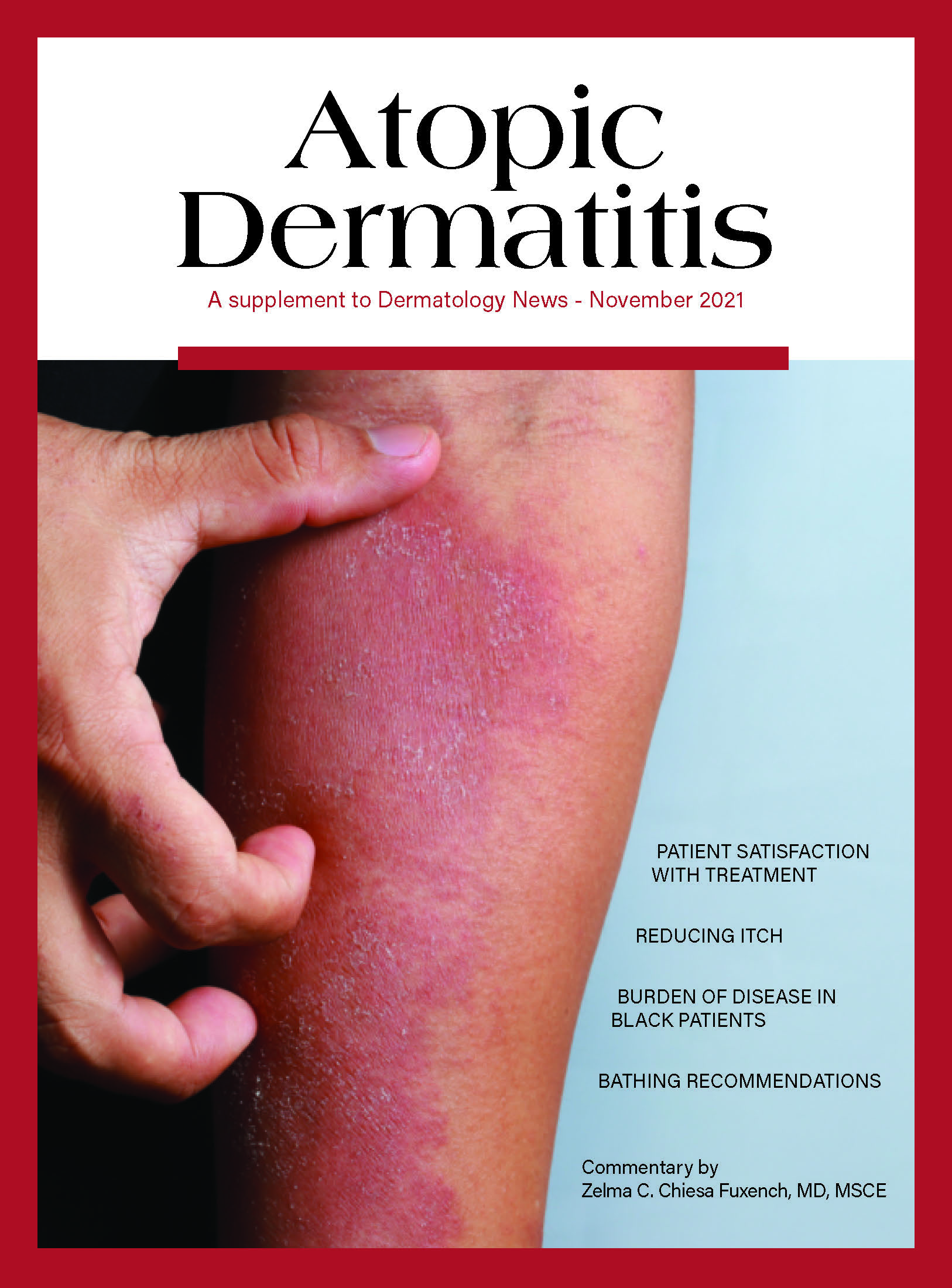
Atopic Dermatitis: A supplement to Dermatology News
- PATIENT SATISFACTION WITH TREATMENT
- REDUCING ITCH
- BURDEN OF DISEASE IN BLACK PATIENTS
- BATHING RECOMMENDATIONS
- PATIENT SATISFACTION WITH TREATMENT
- REDUCING ITCH
- BURDEN OF DISEASE IN BLACK PATIENTS
- BATHING RECOMMENDATIONS
- PATIENT SATISFACTION WITH TREATMENT
- REDUCING ITCH
- BURDEN OF DISEASE IN BLACK PATIENTS
- BATHING RECOMMENDATIONS