User login
Quality of Healthcare Systems Depends on People Caring Within
The experience I describe here is an acute illness that my family experienced. Aside from the actual illness, most of the story will not sound surprising or unique to most of you. It is a story about traversing the medical system to get care for my mom, an elderly patient with Alzheimer’s, over the course of three weeks. It is a story about miscommunications and fumbled handoffs, and complex insurance and payments systems that drive decision-making.
In this column, I aim only to describe our experience, which was both predictable and disappointing, within the healthcare system that we all own.
The Background
Sheila is a 76-year-old Caucasian female with a history of well-controlled hypertension and hyperlipidemia and moderate-stage Alzheimer’s disease, diagnosed about six years ago. She has resided in an assisted living facility for about three years and is still relatively independent in her activities of daily living (ADLs). She has remained relatively healthy and active despite her continuously progressive Alzheimer’s.
Her acute illness started when she developed diarrhea that was moderate in volume and frequency. Over the course of several days, the diarrhea significantly affected her sleep and activities, and she became more confused and essentially confined to her room. By day five, she was visibly dehydrated, with dry, cracked lips and skin tenting. Her daughter, Tara, brought her to the ED in the hospital at which her PCP was on staff. During the eight-hour ED stay, Sheila was rehydrated and was able to keep oral fluids down. Her blood work was normal, although the staff were unable to collect a stool sample. Sheila was discharged with instructions to see her PCP within a few days. No one from the ED contacted the PCP, and no one was able to set up a follow-up appointment.
The next day the diarrhea continued, so Tara contacted the PCP. The office staff noted that their next available appointment was in five days. Tara took that appointment and continued to help her mom with symptom management. Over the next several days, the diarrhea continued and the dehydration worsened again, so Tara took her back to the same ED, where they reassured her that the labs were normal, sent a stool sample off for testing, rehydrated her, and sent her home again. On the discharge paperwork, the ED physician noted that they had “set up home health nursing” and instructed a follow-up with Sheila’s PCP.
The next day, Tara contacted the PCP to check on the upcoming appointment, get advice on what to do, and see when the home health nurse would arrive. The PCP office confirmed the upcoming appointment in two days, told her to continue what she was doing, and said they did not know anything of the home health order and that she should contact the ED to clarify. When she contacted the ED, staff there told her the PCP would have to order the home health; Tara then called the PCP again, and he said he could not order home health, given the fact that he had not yet seen Sheila or her ED record. Tara asked a logical question, “But don’t you have the ED records? That is your hospital, right?”
The same cycle ensued over the next few days—now two weeks into the illness—and Sheila started to require increasing assistance with all of her ADLs, including toileting and showering, along with constant supervision to ensure hydration. The family pieced together as much help as possible. Several days later, on a Thursday night, the dehydration was again obvious, so Tara took her to another ED, given the lack of assistance received from the first two ED visits. In this ED, after evaluation, they admitted Sheila for observation. The family again pieced together 24/7 coverage for the hospital stay. The next day, Sheila continued to have diarrhea, now with vomiting. The ED hydrated her and relieved her vomiting and diarrhea with medications.
Because she was in observation, the hospitalist informed the family that he had written a discharge order. The family requested more time, given the fact that she was extremely confused, was hallucinating, and had not kept anything down by mouth; the hospitalist then changed Sheila to inpatient status for ongoing care. By Saturday, the vomiting and diarrhea were much better controlled with medications, but she had not taken anything by mouth other than a few sips of liquid. She was given a regular diet and kept a few bites down. The rounding hospitalist (the third in three days) told Tara he had consulted gastroenterology but that they were no longer needed and Sheila could be discharged. Tara requested that they fulfill the GI consult instead of discharging Sheila, given the length of time of the illness (now almost three weeks), the fact that she was nowhere near her baseline status, and the lack of diagnosis.
In the meantime, when one of the nurses from the assisted living facility called Tara to check on Sheila, she pointed out that she had noticed her mother’s Alzheimer’s medication “looked different” starting about three weeks ago, which coincided with the onset of the diarrhea. With this information, the GI consultant took a good history, looked at the imaging and lab testing, and told the family he strongly suspected the diarrhea had been caused by a change to generic from brand name, a decision that had been made due to the cost of brand name. He recommended stopping the medication, and, if no improvement was seen in the diarrhea within 48 hours, he would expand his workup.
The next day, a Sunday, the same hospitalist rounded early and wrote discharge orders. When Tara’s sister, Michelle, arrived, the nurse told her of the discharge order. Michelle asked another logical question: “But do we know what is wrong with her yet? Has the diarrhea stopped?” The nurse recounted “only a few bowel movements” over the course of the night and no vomiting. Michelle pleaded with the nurse to at least see if her mom could tolerate breakfast before discharge. She then talked to the hospitalist, who recounted that Sheila had told him that morning that she had not had any diarrhea all night. Michelle asked another logical question, “But you know she has Alzheimer’s, right?”
Sheila did well with breakfast, and, after several hours without diarrhea, she was discharged back to her assisted living facility with Michelle. The PCP never called, home health was never ordered, and the low-cost medication was still on her discharge paperwork.
Bottom Line
Throughout all this, my sisters asked me and others so many logical questions during the three-week illness, such as “Don’t they review the medication list before a patient goes home?” and “Why didn’t the ED contact the PCP? He works in the same hospital, right?” Being hundreds of miles away, and knowing both how the system should work and how it does work, I found it sobering to see all the typical breakdowns happening to my own family. I felt disappointed and dismayed, but not the least bit surprised.
The one person who truly made a difference was the nurse at the assisted living facility, who used common sense (“The medication looks different”) and compassion (“Hi, just calling to check on Sheila”) to help us determine what was wrong. She saved us all additional diagnostic tests and unnecessary visits.
As a chief quality officer, I talk incessantly about systems approaches to improving quality and safety, but while I know how impactful reliable systems can be on good outcomes, the system will only ever be as good as the people caring within.

The experience I describe here is an acute illness that my family experienced. Aside from the actual illness, most of the story will not sound surprising or unique to most of you. It is a story about traversing the medical system to get care for my mom, an elderly patient with Alzheimer’s, over the course of three weeks. It is a story about miscommunications and fumbled handoffs, and complex insurance and payments systems that drive decision-making.
In this column, I aim only to describe our experience, which was both predictable and disappointing, within the healthcare system that we all own.
The Background
Sheila is a 76-year-old Caucasian female with a history of well-controlled hypertension and hyperlipidemia and moderate-stage Alzheimer’s disease, diagnosed about six years ago. She has resided in an assisted living facility for about three years and is still relatively independent in her activities of daily living (ADLs). She has remained relatively healthy and active despite her continuously progressive Alzheimer’s.
Her acute illness started when she developed diarrhea that was moderate in volume and frequency. Over the course of several days, the diarrhea significantly affected her sleep and activities, and she became more confused and essentially confined to her room. By day five, she was visibly dehydrated, with dry, cracked lips and skin tenting. Her daughter, Tara, brought her to the ED in the hospital at which her PCP was on staff. During the eight-hour ED stay, Sheila was rehydrated and was able to keep oral fluids down. Her blood work was normal, although the staff were unable to collect a stool sample. Sheila was discharged with instructions to see her PCP within a few days. No one from the ED contacted the PCP, and no one was able to set up a follow-up appointment.
The next day the diarrhea continued, so Tara contacted the PCP. The office staff noted that their next available appointment was in five days. Tara took that appointment and continued to help her mom with symptom management. Over the next several days, the diarrhea continued and the dehydration worsened again, so Tara took her back to the same ED, where they reassured her that the labs were normal, sent a stool sample off for testing, rehydrated her, and sent her home again. On the discharge paperwork, the ED physician noted that they had “set up home health nursing” and instructed a follow-up with Sheila’s PCP.
The next day, Tara contacted the PCP to check on the upcoming appointment, get advice on what to do, and see when the home health nurse would arrive. The PCP office confirmed the upcoming appointment in two days, told her to continue what she was doing, and said they did not know anything of the home health order and that she should contact the ED to clarify. When she contacted the ED, staff there told her the PCP would have to order the home health; Tara then called the PCP again, and he said he could not order home health, given the fact that he had not yet seen Sheila or her ED record. Tara asked a logical question, “But don’t you have the ED records? That is your hospital, right?”
The same cycle ensued over the next few days—now two weeks into the illness—and Sheila started to require increasing assistance with all of her ADLs, including toileting and showering, along with constant supervision to ensure hydration. The family pieced together as much help as possible. Several days later, on a Thursday night, the dehydration was again obvious, so Tara took her to another ED, given the lack of assistance received from the first two ED visits. In this ED, after evaluation, they admitted Sheila for observation. The family again pieced together 24/7 coverage for the hospital stay. The next day, Sheila continued to have diarrhea, now with vomiting. The ED hydrated her and relieved her vomiting and diarrhea with medications.
Because she was in observation, the hospitalist informed the family that he had written a discharge order. The family requested more time, given the fact that she was extremely confused, was hallucinating, and had not kept anything down by mouth; the hospitalist then changed Sheila to inpatient status for ongoing care. By Saturday, the vomiting and diarrhea were much better controlled with medications, but she had not taken anything by mouth other than a few sips of liquid. She was given a regular diet and kept a few bites down. The rounding hospitalist (the third in three days) told Tara he had consulted gastroenterology but that they were no longer needed and Sheila could be discharged. Tara requested that they fulfill the GI consult instead of discharging Sheila, given the length of time of the illness (now almost three weeks), the fact that she was nowhere near her baseline status, and the lack of diagnosis.
In the meantime, when one of the nurses from the assisted living facility called Tara to check on Sheila, she pointed out that she had noticed her mother’s Alzheimer’s medication “looked different” starting about three weeks ago, which coincided with the onset of the diarrhea. With this information, the GI consultant took a good history, looked at the imaging and lab testing, and told the family he strongly suspected the diarrhea had been caused by a change to generic from brand name, a decision that had been made due to the cost of brand name. He recommended stopping the medication, and, if no improvement was seen in the diarrhea within 48 hours, he would expand his workup.
The next day, a Sunday, the same hospitalist rounded early and wrote discharge orders. When Tara’s sister, Michelle, arrived, the nurse told her of the discharge order. Michelle asked another logical question: “But do we know what is wrong with her yet? Has the diarrhea stopped?” The nurse recounted “only a few bowel movements” over the course of the night and no vomiting. Michelle pleaded with the nurse to at least see if her mom could tolerate breakfast before discharge. She then talked to the hospitalist, who recounted that Sheila had told him that morning that she had not had any diarrhea all night. Michelle asked another logical question, “But you know she has Alzheimer’s, right?”
Sheila did well with breakfast, and, after several hours without diarrhea, she was discharged back to her assisted living facility with Michelle. The PCP never called, home health was never ordered, and the low-cost medication was still on her discharge paperwork.
Bottom Line
Throughout all this, my sisters asked me and others so many logical questions during the three-week illness, such as “Don’t they review the medication list before a patient goes home?” and “Why didn’t the ED contact the PCP? He works in the same hospital, right?” Being hundreds of miles away, and knowing both how the system should work and how it does work, I found it sobering to see all the typical breakdowns happening to my own family. I felt disappointed and dismayed, but not the least bit surprised.
The one person who truly made a difference was the nurse at the assisted living facility, who used common sense (“The medication looks different”) and compassion (“Hi, just calling to check on Sheila”) to help us determine what was wrong. She saved us all additional diagnostic tests and unnecessary visits.
As a chief quality officer, I talk incessantly about systems approaches to improving quality and safety, but while I know how impactful reliable systems can be on good outcomes, the system will only ever be as good as the people caring within.
The experience I describe here is an acute illness that my family experienced. Aside from the actual illness, most of the story will not sound surprising or unique to most of you. It is a story about traversing the medical system to get care for my mom, an elderly patient with Alzheimer’s, over the course of three weeks. It is a story about miscommunications and fumbled handoffs, and complex insurance and payments systems that drive decision-making.
In this column, I aim only to describe our experience, which was both predictable and disappointing, within the healthcare system that we all own.
The Background
Sheila is a 76-year-old Caucasian female with a history of well-controlled hypertension and hyperlipidemia and moderate-stage Alzheimer’s disease, diagnosed about six years ago. She has resided in an assisted living facility for about three years and is still relatively independent in her activities of daily living (ADLs). She has remained relatively healthy and active despite her continuously progressive Alzheimer’s.
Her acute illness started when she developed diarrhea that was moderate in volume and frequency. Over the course of several days, the diarrhea significantly affected her sleep and activities, and she became more confused and essentially confined to her room. By day five, she was visibly dehydrated, with dry, cracked lips and skin tenting. Her daughter, Tara, brought her to the ED in the hospital at which her PCP was on staff. During the eight-hour ED stay, Sheila was rehydrated and was able to keep oral fluids down. Her blood work was normal, although the staff were unable to collect a stool sample. Sheila was discharged with instructions to see her PCP within a few days. No one from the ED contacted the PCP, and no one was able to set up a follow-up appointment.
The next day the diarrhea continued, so Tara contacted the PCP. The office staff noted that their next available appointment was in five days. Tara took that appointment and continued to help her mom with symptom management. Over the next several days, the diarrhea continued and the dehydration worsened again, so Tara took her back to the same ED, where they reassured her that the labs were normal, sent a stool sample off for testing, rehydrated her, and sent her home again. On the discharge paperwork, the ED physician noted that they had “set up home health nursing” and instructed a follow-up with Sheila’s PCP.
The next day, Tara contacted the PCP to check on the upcoming appointment, get advice on what to do, and see when the home health nurse would arrive. The PCP office confirmed the upcoming appointment in two days, told her to continue what she was doing, and said they did not know anything of the home health order and that she should contact the ED to clarify. When she contacted the ED, staff there told her the PCP would have to order the home health; Tara then called the PCP again, and he said he could not order home health, given the fact that he had not yet seen Sheila or her ED record. Tara asked a logical question, “But don’t you have the ED records? That is your hospital, right?”
The same cycle ensued over the next few days—now two weeks into the illness—and Sheila started to require increasing assistance with all of her ADLs, including toileting and showering, along with constant supervision to ensure hydration. The family pieced together as much help as possible. Several days later, on a Thursday night, the dehydration was again obvious, so Tara took her to another ED, given the lack of assistance received from the first two ED visits. In this ED, after evaluation, they admitted Sheila for observation. The family again pieced together 24/7 coverage for the hospital stay. The next day, Sheila continued to have diarrhea, now with vomiting. The ED hydrated her and relieved her vomiting and diarrhea with medications.
Because she was in observation, the hospitalist informed the family that he had written a discharge order. The family requested more time, given the fact that she was extremely confused, was hallucinating, and had not kept anything down by mouth; the hospitalist then changed Sheila to inpatient status for ongoing care. By Saturday, the vomiting and diarrhea were much better controlled with medications, but she had not taken anything by mouth other than a few sips of liquid. She was given a regular diet and kept a few bites down. The rounding hospitalist (the third in three days) told Tara he had consulted gastroenterology but that they were no longer needed and Sheila could be discharged. Tara requested that they fulfill the GI consult instead of discharging Sheila, given the length of time of the illness (now almost three weeks), the fact that she was nowhere near her baseline status, and the lack of diagnosis.
In the meantime, when one of the nurses from the assisted living facility called Tara to check on Sheila, she pointed out that she had noticed her mother’s Alzheimer’s medication “looked different” starting about three weeks ago, which coincided with the onset of the diarrhea. With this information, the GI consultant took a good history, looked at the imaging and lab testing, and told the family he strongly suspected the diarrhea had been caused by a change to generic from brand name, a decision that had been made due to the cost of brand name. He recommended stopping the medication, and, if no improvement was seen in the diarrhea within 48 hours, he would expand his workup.
The next day, a Sunday, the same hospitalist rounded early and wrote discharge orders. When Tara’s sister, Michelle, arrived, the nurse told her of the discharge order. Michelle asked another logical question: “But do we know what is wrong with her yet? Has the diarrhea stopped?” The nurse recounted “only a few bowel movements” over the course of the night and no vomiting. Michelle pleaded with the nurse to at least see if her mom could tolerate breakfast before discharge. She then talked to the hospitalist, who recounted that Sheila had told him that morning that she had not had any diarrhea all night. Michelle asked another logical question, “But you know she has Alzheimer’s, right?”
Sheila did well with breakfast, and, after several hours without diarrhea, she was discharged back to her assisted living facility with Michelle. The PCP never called, home health was never ordered, and the low-cost medication was still on her discharge paperwork.
Bottom Line
Throughout all this, my sisters asked me and others so many logical questions during the three-week illness, such as “Don’t they review the medication list before a patient goes home?” and “Why didn’t the ED contact the PCP? He works in the same hospital, right?” Being hundreds of miles away, and knowing both how the system should work and how it does work, I found it sobering to see all the typical breakdowns happening to my own family. I felt disappointed and dismayed, but not the least bit surprised.
The one person who truly made a difference was the nurse at the assisted living facility, who used common sense (“The medication looks different”) and compassion (“Hi, just calling to check on Sheila”) to help us determine what was wrong. She saved us all additional diagnostic tests and unnecessary visits.
As a chief quality officer, I talk incessantly about systems approaches to improving quality and safety, but while I know how impactful reliable systems can be on good outcomes, the system will only ever be as good as the people caring within.
Poor Continuity of Patient Care Increases Work for Hospitalist Groups

I think every hospitalist group should diligently try to maximize hospitalist-patient continuity, but many seem to adopt schedules and other operational practices that erode it. Let’s walk through the issue of continuity, starting with some history.
Inpatient Continuity in Old Healthcare System
Proudly carrying a pager nearly the size of a loaf of bread and wearing a white shirt and pants with Converse All Stars, I served as a hospital orderly in the 1970s. This position involved things like getting patients out of bed, placing Foley catheters, performing chest compressions during codes, and transporting the bodies of the deceased to the morgue. I really enjoyed the work, and the experience serves as one of my historical frames of reference for how hospital care has evolved since then.
The way I remember it, nearly everyone at the hospital worked a predictable schedule. RN staffing was the same each day; it didn’t vary based on census. Each full-time RN worked five shifts a week, eight hours each. Most or all would work alternate weekends and would have two compensatory days off during the following work week. This resulted in terrific continuity between nurse and patient, and the long length of stays meant patients and nurses got to know one another really well.
Continuity Takes a Hit
But things have changed. Nurse-patient continuity seems to have declined significantly as a result of two main forces: the hospital’s efforts to reduce staffing costs by varying nurse staffing to match daily patient volume, and nurses’ desire for a wide variety of work schedules. Asking a bedside nurse in today’s hospital whether the patient’s confusion, diarrhea, or appetite is meaningfully different today than yesterday typically yields the same reply. “This is my first day with the patient; I’ll have to look at the chart.”
I couldn’t find many research articles or editorials regarding hospital nurse-patient continuity from one day to the next. But several researchers seem to have begun studying this issue and have recently published a proposed framework for assessing it, and I found one study showing it wasn’t correlated with rates of pressure ulcers.1,2.
My anecdotal experience tells me continuity between the patient and caregivers of all stripes matters a lot. Research will be valuable in helping us to better understand its most significant costs and benefits, but I’m already convinced “Continuity is King” and should be one of the most important factors in the design of work schedules and patient allocation models for nurses and hospitalists alike.
While some might say we should wait for randomized trials of continuity to determine its importance, I’m inclined to see it like the authors of “Parachute use to prevent death and major trauma related to gravitational challenge: systematic review of randomised controlled trials.” As a ding against those who insist on research data when common sense may be sufficient, they concluded “…that everyone might benefit if the most radical protagonists of evidence-based medicine organised and participated in a double-blind, randomised, placebo-controlled, crossover trial of the parachute.3
Continuity and Hospitalists
On top of what I see as erosion in nurse-patient continuity, the arrival of hospitalists disrupted doctor-patient continuity across the inpatient and outpatient setting. While there was significant concern about this when our field first took off in the 1990s, it seems to be getting a great deal less attention over the last few years. In many hospitalist groups I work with, it is one of the last factors considered when creating a work schedule. Factors that are examined include the following:
- Solely for provider convenience, a group might regularly schedule a provider for only two or three consecutive daytime shifts, or sometimes only single days;
- Groups that use unit-based hospital (a.k.a. “geographic”) staffing might have a patient transfer to a different attending hospitalist solely as a result of moving to a room in a different nursing unit; and
- As part of morning load leveling, some groups reassign existing patients to a new hospitalist.
I think all groups should work hard to avoid doing these things. And while I seem to be a real outlier on this one, I think the benefits of a separate daytime hospitalist admitter shift are not worth the cost of having different doctors always do the admission and first follow-up visit. Most groups should consider moving the admitter into an additional rounder position and allocating daytime admissions across all hospitalists.
One study found that hospitalist discontinuity was not associated with adverse events, and another found it was associated with higher length of stay for selected diagnoses.4,5 But there is too little research to draw hard conclusions. I’m convinced poor continuity increases the possibility of handoff-related errors, likely results in lower patient satisfaction, and increases the overall work of the hospitalist group, because more providers have to take the time to get to know the patient.
Although there will always be some tension between terrific continuity and a sustainable hospitalist lifestyle—a person can work only so many consecutive days before wearing out—every group should thoughtfully consider whether they are doing everything reasonable to maximize continuity. After all, continuity is king.

References
- Stifter J, Yao Y, Lopez KC, Khokhar A, Wilkie DJ, Keenan GM. Proposing a new conceptual model and an exemplar measure using health information technology to examine the impact of relational nurse continuity on hospital-acquired pressure ulcers. ANS Adv Nurs Sci. 2015;38(3):241-251.
- Stifter J, Yao Y, Lodhi MK, et al. Nurse continuity and hospital-acquired pressure ulcers: a comparative analysis using an electronic health record “big data” set. Nurs Res. 2015;64(5):361-371.
- Smith GC, Pell JP. Parachute use to prevent death and major trauma related to gravitational challenge: systematic review of randomised controlled trials. BMJ. 2003;327(7429):1459-1461.
- O’Leary KJ, Turner J, Christensen N, et al. The effect of hospitalist discontinuity on adverse events. J Hosp Med. 2015;10(3):147-151.
- Epstein K, Juarez E, Epstein A, Loya K, Singer A. The impact of fragmentation of hospitalist care on length of stay. J Hosp Med. 2010;5(6):335-338.
I think every hospitalist group should diligently try to maximize hospitalist-patient continuity, but many seem to adopt schedules and other operational practices that erode it. Let’s walk through the issue of continuity, starting with some history.
Inpatient Continuity in Old Healthcare System
Proudly carrying a pager nearly the size of a loaf of bread and wearing a white shirt and pants with Converse All Stars, I served as a hospital orderly in the 1970s. This position involved things like getting patients out of bed, placing Foley catheters, performing chest compressions during codes, and transporting the bodies of the deceased to the morgue. I really enjoyed the work, and the experience serves as one of my historical frames of reference for how hospital care has evolved since then.
The way I remember it, nearly everyone at the hospital worked a predictable schedule. RN staffing was the same each day; it didn’t vary based on census. Each full-time RN worked five shifts a week, eight hours each. Most or all would work alternate weekends and would have two compensatory days off during the following work week. This resulted in terrific continuity between nurse and patient, and the long length of stays meant patients and nurses got to know one another really well.
Continuity Takes a Hit
But things have changed. Nurse-patient continuity seems to have declined significantly as a result of two main forces: the hospital’s efforts to reduce staffing costs by varying nurse staffing to match daily patient volume, and nurses’ desire for a wide variety of work schedules. Asking a bedside nurse in today’s hospital whether the patient’s confusion, diarrhea, or appetite is meaningfully different today than yesterday typically yields the same reply. “This is my first day with the patient; I’ll have to look at the chart.”
I couldn’t find many research articles or editorials regarding hospital nurse-patient continuity from one day to the next. But several researchers seem to have begun studying this issue and have recently published a proposed framework for assessing it, and I found one study showing it wasn’t correlated with rates of pressure ulcers.1,2.
My anecdotal experience tells me continuity between the patient and caregivers of all stripes matters a lot. Research will be valuable in helping us to better understand its most significant costs and benefits, but I’m already convinced “Continuity is King” and should be one of the most important factors in the design of work schedules and patient allocation models for nurses and hospitalists alike.
While some might say we should wait for randomized trials of continuity to determine its importance, I’m inclined to see it like the authors of “Parachute use to prevent death and major trauma related to gravitational challenge: systematic review of randomised controlled trials.” As a ding against those who insist on research data when common sense may be sufficient, they concluded “…that everyone might benefit if the most radical protagonists of evidence-based medicine organised and participated in a double-blind, randomised, placebo-controlled, crossover trial of the parachute.3
Continuity and Hospitalists
On top of what I see as erosion in nurse-patient continuity, the arrival of hospitalists disrupted doctor-patient continuity across the inpatient and outpatient setting. While there was significant concern about this when our field first took off in the 1990s, it seems to be getting a great deal less attention over the last few years. In many hospitalist groups I work with, it is one of the last factors considered when creating a work schedule. Factors that are examined include the following:
- Solely for provider convenience, a group might regularly schedule a provider for only two or three consecutive daytime shifts, or sometimes only single days;
- Groups that use unit-based hospital (a.k.a. “geographic”) staffing might have a patient transfer to a different attending hospitalist solely as a result of moving to a room in a different nursing unit; and
- As part of morning load leveling, some groups reassign existing patients to a new hospitalist.
I think all groups should work hard to avoid doing these things. And while I seem to be a real outlier on this one, I think the benefits of a separate daytime hospitalist admitter shift are not worth the cost of having different doctors always do the admission and first follow-up visit. Most groups should consider moving the admitter into an additional rounder position and allocating daytime admissions across all hospitalists.
One study found that hospitalist discontinuity was not associated with adverse events, and another found it was associated with higher length of stay for selected diagnoses.4,5 But there is too little research to draw hard conclusions. I’m convinced poor continuity increases the possibility of handoff-related errors, likely results in lower patient satisfaction, and increases the overall work of the hospitalist group, because more providers have to take the time to get to know the patient.
Although there will always be some tension between terrific continuity and a sustainable hospitalist lifestyle—a person can work only so many consecutive days before wearing out—every group should thoughtfully consider whether they are doing everything reasonable to maximize continuity. After all, continuity is king.
References
- Stifter J, Yao Y, Lopez KC, Khokhar A, Wilkie DJ, Keenan GM. Proposing a new conceptual model and an exemplar measure using health information technology to examine the impact of relational nurse continuity on hospital-acquired pressure ulcers. ANS Adv Nurs Sci. 2015;38(3):241-251.
- Stifter J, Yao Y, Lodhi MK, et al. Nurse continuity and hospital-acquired pressure ulcers: a comparative analysis using an electronic health record “big data” set. Nurs Res. 2015;64(5):361-371.
- Smith GC, Pell JP. Parachute use to prevent death and major trauma related to gravitational challenge: systematic review of randomised controlled trials. BMJ. 2003;327(7429):1459-1461.
- O’Leary KJ, Turner J, Christensen N, et al. The effect of hospitalist discontinuity on adverse events. J Hosp Med. 2015;10(3):147-151.
- Epstein K, Juarez E, Epstein A, Loya K, Singer A. The impact of fragmentation of hospitalist care on length of stay. J Hosp Med. 2010;5(6):335-338.
I think every hospitalist group should diligently try to maximize hospitalist-patient continuity, but many seem to adopt schedules and other operational practices that erode it. Let’s walk through the issue of continuity, starting with some history.
Inpatient Continuity in Old Healthcare System
Proudly carrying a pager nearly the size of a loaf of bread and wearing a white shirt and pants with Converse All Stars, I served as a hospital orderly in the 1970s. This position involved things like getting patients out of bed, placing Foley catheters, performing chest compressions during codes, and transporting the bodies of the deceased to the morgue. I really enjoyed the work, and the experience serves as one of my historical frames of reference for how hospital care has evolved since then.
The way I remember it, nearly everyone at the hospital worked a predictable schedule. RN staffing was the same each day; it didn’t vary based on census. Each full-time RN worked five shifts a week, eight hours each. Most or all would work alternate weekends and would have two compensatory days off during the following work week. This resulted in terrific continuity between nurse and patient, and the long length of stays meant patients and nurses got to know one another really well.
Continuity Takes a Hit
But things have changed. Nurse-patient continuity seems to have declined significantly as a result of two main forces: the hospital’s efforts to reduce staffing costs by varying nurse staffing to match daily patient volume, and nurses’ desire for a wide variety of work schedules. Asking a bedside nurse in today’s hospital whether the patient’s confusion, diarrhea, or appetite is meaningfully different today than yesterday typically yields the same reply. “This is my first day with the patient; I’ll have to look at the chart.”
I couldn’t find many research articles or editorials regarding hospital nurse-patient continuity from one day to the next. But several researchers seem to have begun studying this issue and have recently published a proposed framework for assessing it, and I found one study showing it wasn’t correlated with rates of pressure ulcers.1,2.
My anecdotal experience tells me continuity between the patient and caregivers of all stripes matters a lot. Research will be valuable in helping us to better understand its most significant costs and benefits, but I’m already convinced “Continuity is King” and should be one of the most important factors in the design of work schedules and patient allocation models for nurses and hospitalists alike.
While some might say we should wait for randomized trials of continuity to determine its importance, I’m inclined to see it like the authors of “Parachute use to prevent death and major trauma related to gravitational challenge: systematic review of randomised controlled trials.” As a ding against those who insist on research data when common sense may be sufficient, they concluded “…that everyone might benefit if the most radical protagonists of evidence-based medicine organised and participated in a double-blind, randomised, placebo-controlled, crossover trial of the parachute.3
Continuity and Hospitalists
On top of what I see as erosion in nurse-patient continuity, the arrival of hospitalists disrupted doctor-patient continuity across the inpatient and outpatient setting. While there was significant concern about this when our field first took off in the 1990s, it seems to be getting a great deal less attention over the last few years. In many hospitalist groups I work with, it is one of the last factors considered when creating a work schedule. Factors that are examined include the following:
- Solely for provider convenience, a group might regularly schedule a provider for only two or three consecutive daytime shifts, or sometimes only single days;
- Groups that use unit-based hospital (a.k.a. “geographic”) staffing might have a patient transfer to a different attending hospitalist solely as a result of moving to a room in a different nursing unit; and
- As part of morning load leveling, some groups reassign existing patients to a new hospitalist.
I think all groups should work hard to avoid doing these things. And while I seem to be a real outlier on this one, I think the benefits of a separate daytime hospitalist admitter shift are not worth the cost of having different doctors always do the admission and first follow-up visit. Most groups should consider moving the admitter into an additional rounder position and allocating daytime admissions across all hospitalists.
One study found that hospitalist discontinuity was not associated with adverse events, and another found it was associated with higher length of stay for selected diagnoses.4,5 But there is too little research to draw hard conclusions. I’m convinced poor continuity increases the possibility of handoff-related errors, likely results in lower patient satisfaction, and increases the overall work of the hospitalist group, because more providers have to take the time to get to know the patient.
Although there will always be some tension between terrific continuity and a sustainable hospitalist lifestyle—a person can work only so many consecutive days before wearing out—every group should thoughtfully consider whether they are doing everything reasonable to maximize continuity. After all, continuity is king.
References
- Stifter J, Yao Y, Lopez KC, Khokhar A, Wilkie DJ, Keenan GM. Proposing a new conceptual model and an exemplar measure using health information technology to examine the impact of relational nurse continuity on hospital-acquired pressure ulcers. ANS Adv Nurs Sci. 2015;38(3):241-251.
- Stifter J, Yao Y, Lodhi MK, et al. Nurse continuity and hospital-acquired pressure ulcers: a comparative analysis using an electronic health record “big data” set. Nurs Res. 2015;64(5):361-371.
- Smith GC, Pell JP. Parachute use to prevent death and major trauma related to gravitational challenge: systematic review of randomised controlled trials. BMJ. 2003;327(7429):1459-1461.
- O’Leary KJ, Turner J, Christensen N, et al. The effect of hospitalist discontinuity on adverse events. J Hosp Med. 2015;10(3):147-151.
- Epstein K, Juarez E, Epstein A, Loya K, Singer A. The impact of fragmentation of hospitalist care on length of stay. J Hosp Med. 2010;5(6):335-338.
Microemboli May Play a Role in Certain Migraine Auras
The prevalence and frequency of interictal microembolic signals (MES) are higher in migraineurs with higher cortical dysfunction (HCD) during aura, compared with migraineurs without HCD during aura and with healthy controls, according to a study published online ahead of print September 29 in Cephalalgia.
Jasna Zidverc-Trajkovi´c, MD, a neurologist at the Neurology Clinic of the Clinical Center of Serbia in Belgrade, and her colleagues used transcranial Doppler ultrasound to test their hypothesis that the complexity of migraine aura depends on hypoperfusion caused by microemboli that occur in different regions of the brain. The goal was to evaluate the prevalence and clinical impact of interictal MES in migraineurs with HCD during aura.
The investigators enrolled 34 individuals with migraine who experienced language and memory impairment during aura (HCD group), 31 patients who had migraine with only visual or visual and somatosensory symptoms during aura (control group I), and 34 healthy individuals (control group II). A Doppler instrument was used to detect microemboli, and the researchers also compared demographic data, disease features, and the detection of MES between these groups, as well as the predictors of HCD during the aura.
MES Predicted HCD
The duration of aura (34.71 ±18.05 minutes vs 23.87 ±13.64 minutes) was significantly longer, and the frequency of aura per year (16.29 ±14.21 vs 10.10 ±11.00) was significantly higher in the HCD group, compared with control group I. The presence of somatosensory symptoms during the aura was significantly higher in the HCD group as well.
A binary logistic regression analysis identified three independent predictors of HCD occurrence in patients with migraine aura. These predictors were longer duration of the aura, presence of somatosensory symptoms during the aura, and positive MES detection.
MES were interictally detected in 29% of patients with migraine who experienced migraines with HCD during the aura, but in only 3% of participants with visual or somatosensory aura. In addition, the number of detected MES in a single patient was as high as 85 among patients in the HCD group, compared with eight that were detected in other examined patients and healthy controls.
Stroke-Risk Stratification
The detection of MES and investigation of the origin of microembolism could be a valuable tool for screening individuals with migraine with aura for ischemic stroke risk, as well as investigating links between migraine with aura and ischemic stroke, said Dr. Zidverc-Trajkovi´c.
The investigators speculated that in patients who have memory and language impairment during migraine aura, the cerebral cortex may be affected by cortical spreading depression in regions beyond the occipital lobe, and microemboli may trigger cortical spreading depression. This sequence of events, in turn, might contribute to the pathophysiology of migraine aura.
“Further research should include analysis of the influence of microemboli on the neuron–glial interaction or the network modulation and pathophysiology of cortical spreading depression,” the investigators said.
MES Was Recorded Outside Migraine Attacks
“Cortical spreading depression has been shown to occur in humans in ischemic stroke, severe traumatic brain lesions, and following hypoxia, and the scientifically relevant question is how spreading depression is triggered in patients who suffer from migraines with aura,” said Hans-Christoph Diener, MD, PhD, Chair of the Department of Neurology at the University of Duisburg-Essen in Germany, in an accompanying editorial. “The current study proposes that microemboli are a potential trigger.
“Microembolic signals, or MES, were detected in 29.4% of patients with higher cortical aura, which was much higher than in the other two groups,” he added. “But what does this finding implicate? The nature of MES is unknown in patients without atherosclerotic plaques, and one assumed mechanism is right–left shunt either through a patent foramen ovale or through pulmonary shunts. Patent foramen ovale is associated with a higher prevalence of migraine with aura.
“The major shortcoming of the study is the recording of MES outside migraine attacks. It is difficult to understand how MES occurring outside migraine attacks should play a role in the rare events of complex auras, and many of the assumptions and implications of the authors in the discussion are not supported by scientific evidence,” said Dr. Diener.
“In summary, this is an interesting observation with very limited relationship to the pathophysiology of migraine aura, and further research is needed,” Dr. Diener concluded.
—Roxanne Nelson
Suggested Reading
Diener HC. What triggers migraine aura? Cephalalgia. 2015 Sep 28 [Epub ahead of print].
Petrusic I, Podgorac A, Zidverc-Trajkovic J, et al. Do interictal microembolic signals play a role in higher cortical dysfunction during migraine aura? Cephalalgia. 2015 Sep 29 [Epub ahead of print].
The prevalence and frequency of interictal microembolic signals (MES) are higher in migraineurs with higher cortical dysfunction (HCD) during aura, compared with migraineurs without HCD during aura and with healthy controls, according to a study published online ahead of print September 29 in Cephalalgia.
Jasna Zidverc-Trajkovi´c, MD, a neurologist at the Neurology Clinic of the Clinical Center of Serbia in Belgrade, and her colleagues used transcranial Doppler ultrasound to test their hypothesis that the complexity of migraine aura depends on hypoperfusion caused by microemboli that occur in different regions of the brain. The goal was to evaluate the prevalence and clinical impact of interictal MES in migraineurs with HCD during aura.
The investigators enrolled 34 individuals with migraine who experienced language and memory impairment during aura (HCD group), 31 patients who had migraine with only visual or visual and somatosensory symptoms during aura (control group I), and 34 healthy individuals (control group II). A Doppler instrument was used to detect microemboli, and the researchers also compared demographic data, disease features, and the detection of MES between these groups, as well as the predictors of HCD during the aura.
MES Predicted HCD
The duration of aura (34.71 ±18.05 minutes vs 23.87 ±13.64 minutes) was significantly longer, and the frequency of aura per year (16.29 ±14.21 vs 10.10 ±11.00) was significantly higher in the HCD group, compared with control group I. The presence of somatosensory symptoms during the aura was significantly higher in the HCD group as well.
A binary logistic regression analysis identified three independent predictors of HCD occurrence in patients with migraine aura. These predictors were longer duration of the aura, presence of somatosensory symptoms during the aura, and positive MES detection.
MES were interictally detected in 29% of patients with migraine who experienced migraines with HCD during the aura, but in only 3% of participants with visual or somatosensory aura. In addition, the number of detected MES in a single patient was as high as 85 among patients in the HCD group, compared with eight that were detected in other examined patients and healthy controls.
Stroke-Risk Stratification
The detection of MES and investigation of the origin of microembolism could be a valuable tool for screening individuals with migraine with aura for ischemic stroke risk, as well as investigating links between migraine with aura and ischemic stroke, said Dr. Zidverc-Trajkovi´c.
The investigators speculated that in patients who have memory and language impairment during migraine aura, the cerebral cortex may be affected by cortical spreading depression in regions beyond the occipital lobe, and microemboli may trigger cortical spreading depression. This sequence of events, in turn, might contribute to the pathophysiology of migraine aura.
“Further research should include analysis of the influence of microemboli on the neuron–glial interaction or the network modulation and pathophysiology of cortical spreading depression,” the investigators said.
MES Was Recorded Outside Migraine Attacks
“Cortical spreading depression has been shown to occur in humans in ischemic stroke, severe traumatic brain lesions, and following hypoxia, and the scientifically relevant question is how spreading depression is triggered in patients who suffer from migraines with aura,” said Hans-Christoph Diener, MD, PhD, Chair of the Department of Neurology at the University of Duisburg-Essen in Germany, in an accompanying editorial. “The current study proposes that microemboli are a potential trigger.
“Microembolic signals, or MES, were detected in 29.4% of patients with higher cortical aura, which was much higher than in the other two groups,” he added. “But what does this finding implicate? The nature of MES is unknown in patients without atherosclerotic plaques, and one assumed mechanism is right–left shunt either through a patent foramen ovale or through pulmonary shunts. Patent foramen ovale is associated with a higher prevalence of migraine with aura.
“The major shortcoming of the study is the recording of MES outside migraine attacks. It is difficult to understand how MES occurring outside migraine attacks should play a role in the rare events of complex auras, and many of the assumptions and implications of the authors in the discussion are not supported by scientific evidence,” said Dr. Diener.
“In summary, this is an interesting observation with very limited relationship to the pathophysiology of migraine aura, and further research is needed,” Dr. Diener concluded.
—Roxanne Nelson
The prevalence and frequency of interictal microembolic signals (MES) are higher in migraineurs with higher cortical dysfunction (HCD) during aura, compared with migraineurs without HCD during aura and with healthy controls, according to a study published online ahead of print September 29 in Cephalalgia.
Jasna Zidverc-Trajkovi´c, MD, a neurologist at the Neurology Clinic of the Clinical Center of Serbia in Belgrade, and her colleagues used transcranial Doppler ultrasound to test their hypothesis that the complexity of migraine aura depends on hypoperfusion caused by microemboli that occur in different regions of the brain. The goal was to evaluate the prevalence and clinical impact of interictal MES in migraineurs with HCD during aura.
The investigators enrolled 34 individuals with migraine who experienced language and memory impairment during aura (HCD group), 31 patients who had migraine with only visual or visual and somatosensory symptoms during aura (control group I), and 34 healthy individuals (control group II). A Doppler instrument was used to detect microemboli, and the researchers also compared demographic data, disease features, and the detection of MES between these groups, as well as the predictors of HCD during the aura.
MES Predicted HCD
The duration of aura (34.71 ±18.05 minutes vs 23.87 ±13.64 minutes) was significantly longer, and the frequency of aura per year (16.29 ±14.21 vs 10.10 ±11.00) was significantly higher in the HCD group, compared with control group I. The presence of somatosensory symptoms during the aura was significantly higher in the HCD group as well.
A binary logistic regression analysis identified three independent predictors of HCD occurrence in patients with migraine aura. These predictors were longer duration of the aura, presence of somatosensory symptoms during the aura, and positive MES detection.
MES were interictally detected in 29% of patients with migraine who experienced migraines with HCD during the aura, but in only 3% of participants with visual or somatosensory aura. In addition, the number of detected MES in a single patient was as high as 85 among patients in the HCD group, compared with eight that were detected in other examined patients and healthy controls.
Stroke-Risk Stratification
The detection of MES and investigation of the origin of microembolism could be a valuable tool for screening individuals with migraine with aura for ischemic stroke risk, as well as investigating links between migraine with aura and ischemic stroke, said Dr. Zidverc-Trajkovi´c.
The investigators speculated that in patients who have memory and language impairment during migraine aura, the cerebral cortex may be affected by cortical spreading depression in regions beyond the occipital lobe, and microemboli may trigger cortical spreading depression. This sequence of events, in turn, might contribute to the pathophysiology of migraine aura.
“Further research should include analysis of the influence of microemboli on the neuron–glial interaction or the network modulation and pathophysiology of cortical spreading depression,” the investigators said.
MES Was Recorded Outside Migraine Attacks
“Cortical spreading depression has been shown to occur in humans in ischemic stroke, severe traumatic brain lesions, and following hypoxia, and the scientifically relevant question is how spreading depression is triggered in patients who suffer from migraines with aura,” said Hans-Christoph Diener, MD, PhD, Chair of the Department of Neurology at the University of Duisburg-Essen in Germany, in an accompanying editorial. “The current study proposes that microemboli are a potential trigger.
“Microembolic signals, or MES, were detected in 29.4% of patients with higher cortical aura, which was much higher than in the other two groups,” he added. “But what does this finding implicate? The nature of MES is unknown in patients without atherosclerotic plaques, and one assumed mechanism is right–left shunt either through a patent foramen ovale or through pulmonary shunts. Patent foramen ovale is associated with a higher prevalence of migraine with aura.
“The major shortcoming of the study is the recording of MES outside migraine attacks. It is difficult to understand how MES occurring outside migraine attacks should play a role in the rare events of complex auras, and many of the assumptions and implications of the authors in the discussion are not supported by scientific evidence,” said Dr. Diener.
“In summary, this is an interesting observation with very limited relationship to the pathophysiology of migraine aura, and further research is needed,” Dr. Diener concluded.
—Roxanne Nelson
Suggested Reading
Diener HC. What triggers migraine aura? Cephalalgia. 2015 Sep 28 [Epub ahead of print].
Petrusic I, Podgorac A, Zidverc-Trajkovic J, et al. Do interictal microembolic signals play a role in higher cortical dysfunction during migraine aura? Cephalalgia. 2015 Sep 29 [Epub ahead of print].
Suggested Reading
Diener HC. What triggers migraine aura? Cephalalgia. 2015 Sep 28 [Epub ahead of print].
Petrusic I, Podgorac A, Zidverc-Trajkovic J, et al. Do interictal microembolic signals play a role in higher cortical dysfunction during migraine aura? Cephalalgia. 2015 Sep 29 [Epub ahead of print].
Make the Diagnosis - December 2015
Diagnosis: Henoch-Schönlein purpura
Henoch-Schönlein purpura (HSP), also known as immunoglobulin A (IgA) vasculitis, is characterized by palpable purpura, abdominal pain, renal disease, arthritis and/or arthralgia. HSP affects all ages, but is most common in children (the mean age of onset is between six and seven years of age). It also has a slight predilection for males, as well as whites and Asians. Patients are more likely to present during the fall, winter, and spring. It is thought that HSP may be associated with infections that are more prevalent during these times of the year.
Patients typically have purpura and joint or abdominal pain, although some may present without significant skin manifestations or pain. The rash associated with HSP may appear as erythematous macules or papules that coalesce and evolve into palpable purpura with petechiae, ecchymoses, and/or subcutaneous edema. The skin is typically affected in areas that are more dependent or experience more pressure, such as the lower extremities or buttocks. A more diffuse distribution across the entire body can be seen in those who are nonambulatory.

The arthritis associated with HSP usually affects the lower extremities, and it is oligoarticular, nondeforming, and transient, with prominent swelling and tenderness. Gastrointestinal involvement may manifest as nausea, vomiting, abdominal pain, transient paralytic ileus, hemorrhage, bowel ischemia, intussusception (rare in adults), and/or bowel perforation. These symptoms tend to develop 1 week after the rash, but there are reports of gastrointestinal complaints preceding all other manifestations of HSP.
Additionally, there can be renal involvement, which is more common in adults. These patients may experience hematuria with or without red blood cell casts, nephrotic range proteinuria, and/or elevated serum creatinine. Other less common symptoms that have been reported in patients with HSP include scrotal pain and swelling, headaches, seizures, ataxia, central and peripheral neuropathies, impaired lung diffusion capacity, keratitis, and uveitis.
The diagnosis of HSP is classically based upon clinical presentation. The diagnosis may be complicated in cases in which patients do not present with classic signs, such as palpable purpura of the lower extremities and buttocks. In these situations, a biopsy of the skin or kidney may aid in the diagnosis.
The differential diagnosis for HSP includes acute hemorrhagic edema of infancy, coagulopathies, hemolytic uremic syndrome, hypersensitivity vasculitis, IgA nephropathy, immune thrombocytopenia purpura, juvenile idiopathic arthritis, reactive arthritis, rheumatic fever, small vessel vasculitis, and systemic lupus erythematosus.
The etiology of HSP is unclear. Most believe that it is an immune-mediated vasculitis with genetic and environmental influences. In HSP, there is leukocytoclastic vasculitis with deposition of IgA immune complexes, complement component 3 (C3), and fibrin in the affected vessel walls. Small vessels within the papillary dermis are usually present with an inflammatory infiltrate of neutrophils and monocytes.
The treatment of HSP usually consists of supportive care, since most patients will recover spontaneously. Therefore, hydration, rest, and pain relief are essential. Other treatment modalities may be required for more severe or extensive HSP and its complications.
Our patient’s biopsy results were consistent with a leukocytoclastic vasculitis. His biopsy revealed an inflammatory infiltrate of lymphocytes, neutrophils, and nuclear dust with extravasation of erythrocytes and fibrin in the walls of small blood vessels, along with prominent papillary dermal edema and subepidermal vesiculation. Direct immunofluorescence was positive for IgA, C3, and fibrinogen in upper dermal blood vessels. The patient also had renal involvement that was confirmed with a renal biopsy.
This case and photos are courtesy of Tanya Greywal, University of California, San Diego, and Dr. Brooke Resh Sateesh, San Diego Family Dermatology.
Dr. Bilu Martin is in private practice at Premier Dermatology, MD, in Aventura, Fla. More diagnostic cases are available at edermatologynews.com. To submit your case for possible publication, send an email to [email protected].
Diagnosis: Henoch-Schönlein purpura
Henoch-Schönlein purpura (HSP), also known as immunoglobulin A (IgA) vasculitis, is characterized by palpable purpura, abdominal pain, renal disease, arthritis and/or arthralgia. HSP affects all ages, but is most common in children (the mean age of onset is between six and seven years of age). It also has a slight predilection for males, as well as whites and Asians. Patients are more likely to present during the fall, winter, and spring. It is thought that HSP may be associated with infections that are more prevalent during these times of the year.
Patients typically have purpura and joint or abdominal pain, although some may present without significant skin manifestations or pain. The rash associated with HSP may appear as erythematous macules or papules that coalesce and evolve into palpable purpura with petechiae, ecchymoses, and/or subcutaneous edema. The skin is typically affected in areas that are more dependent or experience more pressure, such as the lower extremities or buttocks. A more diffuse distribution across the entire body can be seen in those who are nonambulatory.
The arthritis associated with HSP usually affects the lower extremities, and it is oligoarticular, nondeforming, and transient, with prominent swelling and tenderness. Gastrointestinal involvement may manifest as nausea, vomiting, abdominal pain, transient paralytic ileus, hemorrhage, bowel ischemia, intussusception (rare in adults), and/or bowel perforation. These symptoms tend to develop 1 week after the rash, but there are reports of gastrointestinal complaints preceding all other manifestations of HSP.
Additionally, there can be renal involvement, which is more common in adults. These patients may experience hematuria with or without red blood cell casts, nephrotic range proteinuria, and/or elevated serum creatinine. Other less common symptoms that have been reported in patients with HSP include scrotal pain and swelling, headaches, seizures, ataxia, central and peripheral neuropathies, impaired lung diffusion capacity, keratitis, and uveitis.
The diagnosis of HSP is classically based upon clinical presentation. The diagnosis may be complicated in cases in which patients do not present with classic signs, such as palpable purpura of the lower extremities and buttocks. In these situations, a biopsy of the skin or kidney may aid in the diagnosis.
The differential diagnosis for HSP includes acute hemorrhagic edema of infancy, coagulopathies, hemolytic uremic syndrome, hypersensitivity vasculitis, IgA nephropathy, immune thrombocytopenia purpura, juvenile idiopathic arthritis, reactive arthritis, rheumatic fever, small vessel vasculitis, and systemic lupus erythematosus.
The etiology of HSP is unclear. Most believe that it is an immune-mediated vasculitis with genetic and environmental influences. In HSP, there is leukocytoclastic vasculitis with deposition of IgA immune complexes, complement component 3 (C3), and fibrin in the affected vessel walls. Small vessels within the papillary dermis are usually present with an inflammatory infiltrate of neutrophils and monocytes.
The treatment of HSP usually consists of supportive care, since most patients will recover spontaneously. Therefore, hydration, rest, and pain relief are essential. Other treatment modalities may be required for more severe or extensive HSP and its complications.
Our patient’s biopsy results were consistent with a leukocytoclastic vasculitis. His biopsy revealed an inflammatory infiltrate of lymphocytes, neutrophils, and nuclear dust with extravasation of erythrocytes and fibrin in the walls of small blood vessels, along with prominent papillary dermal edema and subepidermal vesiculation. Direct immunofluorescence was positive for IgA, C3, and fibrinogen in upper dermal blood vessels. The patient also had renal involvement that was confirmed with a renal biopsy.
This case and photos are courtesy of Tanya Greywal, University of California, San Diego, and Dr. Brooke Resh Sateesh, San Diego Family Dermatology.
Dr. Bilu Martin is in private practice at Premier Dermatology, MD, in Aventura, Fla. More diagnostic cases are available at edermatologynews.com. To submit your case for possible publication, send an email to [email protected].
Diagnosis: Henoch-Schönlein purpura
Henoch-Schönlein purpura (HSP), also known as immunoglobulin A (IgA) vasculitis, is characterized by palpable purpura, abdominal pain, renal disease, arthritis and/or arthralgia. HSP affects all ages, but is most common in children (the mean age of onset is between six and seven years of age). It also has a slight predilection for males, as well as whites and Asians. Patients are more likely to present during the fall, winter, and spring. It is thought that HSP may be associated with infections that are more prevalent during these times of the year.
Patients typically have purpura and joint or abdominal pain, although some may present without significant skin manifestations or pain. The rash associated with HSP may appear as erythematous macules or papules that coalesce and evolve into palpable purpura with petechiae, ecchymoses, and/or subcutaneous edema. The skin is typically affected in areas that are more dependent or experience more pressure, such as the lower extremities or buttocks. A more diffuse distribution across the entire body can be seen in those who are nonambulatory.
The arthritis associated with HSP usually affects the lower extremities, and it is oligoarticular, nondeforming, and transient, with prominent swelling and tenderness. Gastrointestinal involvement may manifest as nausea, vomiting, abdominal pain, transient paralytic ileus, hemorrhage, bowel ischemia, intussusception (rare in adults), and/or bowel perforation. These symptoms tend to develop 1 week after the rash, but there are reports of gastrointestinal complaints preceding all other manifestations of HSP.
Additionally, there can be renal involvement, which is more common in adults. These patients may experience hematuria with or without red blood cell casts, nephrotic range proteinuria, and/or elevated serum creatinine. Other less common symptoms that have been reported in patients with HSP include scrotal pain and swelling, headaches, seizures, ataxia, central and peripheral neuropathies, impaired lung diffusion capacity, keratitis, and uveitis.
The diagnosis of HSP is classically based upon clinical presentation. The diagnosis may be complicated in cases in which patients do not present with classic signs, such as palpable purpura of the lower extremities and buttocks. In these situations, a biopsy of the skin or kidney may aid in the diagnosis.
The differential diagnosis for HSP includes acute hemorrhagic edema of infancy, coagulopathies, hemolytic uremic syndrome, hypersensitivity vasculitis, IgA nephropathy, immune thrombocytopenia purpura, juvenile idiopathic arthritis, reactive arthritis, rheumatic fever, small vessel vasculitis, and systemic lupus erythematosus.
The etiology of HSP is unclear. Most believe that it is an immune-mediated vasculitis with genetic and environmental influences. In HSP, there is leukocytoclastic vasculitis with deposition of IgA immune complexes, complement component 3 (C3), and fibrin in the affected vessel walls. Small vessels within the papillary dermis are usually present with an inflammatory infiltrate of neutrophils and monocytes.
The treatment of HSP usually consists of supportive care, since most patients will recover spontaneously. Therefore, hydration, rest, and pain relief are essential. Other treatment modalities may be required for more severe or extensive HSP and its complications.
Our patient’s biopsy results were consistent with a leukocytoclastic vasculitis. His biopsy revealed an inflammatory infiltrate of lymphocytes, neutrophils, and nuclear dust with extravasation of erythrocytes and fibrin in the walls of small blood vessels, along with prominent papillary dermal edema and subepidermal vesiculation. Direct immunofluorescence was positive for IgA, C3, and fibrinogen in upper dermal blood vessels. The patient also had renal involvement that was confirmed with a renal biopsy.
This case and photos are courtesy of Tanya Greywal, University of California, San Diego, and Dr. Brooke Resh Sateesh, San Diego Family Dermatology.
Dr. Bilu Martin is in private practice at Premier Dermatology, MD, in Aventura, Fla. More diagnostic cases are available at edermatologynews.com. To submit your case for possible publication, send an email to [email protected].
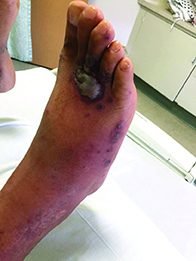
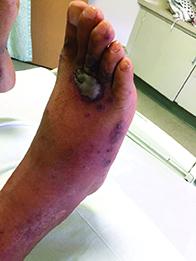
A 40-year-old male with no significant past medical history presented for progressive asymptomatic blisters on the feet, and erythematous lesions on the arms, legs, and trunk. His symptoms began with edema of the feet after a long flight to the Philippines. After a few days, erosions and bullae began forming on his dorsal feet. He was initially evaluated in the Philippines by his primary care physician,who treated him with antibiotics. The patient soon developed pruritic red bumps on his forearms and trunk. The patient was later seen in the emergency department in the United States. At that time, his physical exam was significant for large bullae on a dusky base on the bilateral dorsal feet, and scattered erythematous papules and violaceous macules with dusky centers on the legs, arms, and trunk.
AATS Week Registration & Housing Now Open
Register for AATS Week 2016 today and receive a $100 discount!
Aortic Symposium
May 12–13, 2016
New York, NY
Course Directors
Joseph S. Coselli
Steven L. Lansman
96th Annual Meeting
May 14-18, 2016
Baltimore, MD
President & Annual Meeting Chair
Joseph S. Coselli
Annual Meeting Co-Chairs
Charles D. Fraser
David R. Jones
Annual Meeting Registration Packages
Allied Health Package: Registration for the Saturday Courses, Sunday Symposium and the 96th Annual Meeting (Monday-Wednesday). Register before March 25, 2016 for only $400, after which the fee goes up to $500.
Resident/Fellow and Medical Student Package: Registration for the Saturday Courses, Sunday Symposium and the 96th Annual Meeting (Monday-Wednesday). Register before March 25, 2016 and attend for no charge. After that date, the fee is $300.
Saturday Courses and Sunday Symposium Registration: Register for a Saturday course and/or a Sunday symposium and have access to all other courses/symposia that same day. Note: Registration for the Saturday courses and/or Sunday symposium is separate from the Annual Meeting fee.
Register for AATS Week 2016 today and receive a $100 discount!
Aortic Symposium
May 12–13, 2016
New York, NY
Course Directors
Joseph S. Coselli
Steven L. Lansman
96th Annual Meeting
May 14-18, 2016
Baltimore, MD
President & Annual Meeting Chair
Joseph S. Coselli
Annual Meeting Co-Chairs
Charles D. Fraser
David R. Jones
Annual Meeting Registration Packages
Allied Health Package: Registration for the Saturday Courses, Sunday Symposium and the 96th Annual Meeting (Monday-Wednesday). Register before March 25, 2016 for only $400, after which the fee goes up to $500.
Resident/Fellow and Medical Student Package: Registration for the Saturday Courses, Sunday Symposium and the 96th Annual Meeting (Monday-Wednesday). Register before March 25, 2016 and attend for no charge. After that date, the fee is $300.
Saturday Courses and Sunday Symposium Registration: Register for a Saturday course and/or a Sunday symposium and have access to all other courses/symposia that same day. Note: Registration for the Saturday courses and/or Sunday symposium is separate from the Annual Meeting fee.
Register for AATS Week 2016 today and receive a $100 discount!
Aortic Symposium
May 12–13, 2016
New York, NY
Course Directors
Joseph S. Coselli
Steven L. Lansman
96th Annual Meeting
May 14-18, 2016
Baltimore, MD
President & Annual Meeting Chair
Joseph S. Coselli
Annual Meeting Co-Chairs
Charles D. Fraser
David R. Jones
Annual Meeting Registration Packages
Allied Health Package: Registration for the Saturday Courses, Sunday Symposium and the 96th Annual Meeting (Monday-Wednesday). Register before March 25, 2016 for only $400, after which the fee goes up to $500.
Resident/Fellow and Medical Student Package: Registration for the Saturday Courses, Sunday Symposium and the 96th Annual Meeting (Monday-Wednesday). Register before March 25, 2016 and attend for no charge. After that date, the fee is $300.
Saturday Courses and Sunday Symposium Registration: Register for a Saturday course and/or a Sunday symposium and have access to all other courses/symposia that same day. Note: Registration for the Saturday courses and/or Sunday symposium is separate from the Annual Meeting fee.

A different approach to AML treatment

Image by Tom Ellenberger
PARP inhibitors could prove useful for treating aggressive acute myeloid leukemia (AML), according to preclinical research published in Nature Medicine.
Experiments showed that AML driven by leukemia-associated transcription factors, including AML1-ETO and PML-RARα, was “extremely sensitive” to PARP inhibition.
Mixed-lineage leukemia (MLL) was initially resistant to treatment with PARP inhibitors, but inhibiting Hoxa9 changed that.
“PARP inhibitors could potentially offer a completely different approach to specifically target certain subtypes of acute myeloid leukemia,” said study author Chi Wai Eric So, PhD, of King’s College London in the UK.
He and his colleagues first tested the PARP inhibitor olaparib on primary mouse hematopoietic cells transformed by the leukemia-associated transcription factors AML1-ETO, PML-RARα, MLL-AF9, and E2A-PBX.
The drug suppressed the colony-forming ability of cells transformed by AML1-ETO or PML-RARα by about 90% but had little impact on MLL-AF9- or E2A-PBX-transformed cells. Olaparib also had minimal effects on normal bone marrow.
The investigators observed similar results in experiments with the PARP inhibitor veliparib.
They then tested PARP inhibitors in patient-derived leukemic cell lines carrying AML1-ETO (Kasumi), mutated PML-RARα that is resistant to standard all-trans retinoic acid treatment (NB4-LR2), or MLL-AF9 (THP1).
Similar to the previous experiments, PARP inhibition reduced the colony-forming ability of Kasumi and NB4-LR2 cells but not THP1 cells.
Next, the investigators transplanted the 3 cell lines into immunocompromised mice and treated the mice with olaparib. The drug delayed disease onset and prolonged survival in both the Kasumi and NB4-LR2 models but had no effect on disease onset or survival in the THP1 model.
Dr So and his colleagues said PARP inhibition was likely effective in AML driven by AML1-ETO and PML-RARα because of the suppressed expression of key homologous recombination-associated genes and the compromised DNA-damage response observed in these malignancies.
The team noted that PARP has proven critical in a variety of DNA repair processes, including as a sensor of single-strand breaks in base-excision repair, as a mediator for restarting stalled replication forks of homologous recombination-mediated double-strand break repair, and as a means of preventing the binding of Ku proteins to DNA ends in non-homologous end-joining pathways.
It therefore follows that MLL-driven AML was resistant to treatment with PARP inhibitors because DNA repair is not suppressed in this malignancy. The Hoxa9 protein activates other DNA damage repair pathways in these leukemia cells, keeping them alive.
So the investigators tested drugs that could (indirectly) inhibit Hoxa9—the GSK3 inhibitors LiCl and Li2CO3—in combination with olaparib. Both in vitro and in vivo, treatment with a GSK3 inhibitor and olaparib proved effective against MLL-driven AML.
“While this approach seems promising from these laboratory studies, it is still very early days,” said Matt Kaiser, PhD, head of research at Bloodwise, a charity that helped fund this study.
“We need to see how real patients respond to these drugs and how effective they are. PARP inhibitors such as olaparib are already being used to treat patients with other cancers and have been shown to be safe. This should speed up the time it takes for this potentially effective new treatment to enter clinical trials.” 
Image by Tom Ellenberger
PARP inhibitors could prove useful for treating aggressive acute myeloid leukemia (AML), according to preclinical research published in Nature Medicine.
Experiments showed that AML driven by leukemia-associated transcription factors, including AML1-ETO and PML-RARα, was “extremely sensitive” to PARP inhibition.
Mixed-lineage leukemia (MLL) was initially resistant to treatment with PARP inhibitors, but inhibiting Hoxa9 changed that.
“PARP inhibitors could potentially offer a completely different approach to specifically target certain subtypes of acute myeloid leukemia,” said study author Chi Wai Eric So, PhD, of King’s College London in the UK.
He and his colleagues first tested the PARP inhibitor olaparib on primary mouse hematopoietic cells transformed by the leukemia-associated transcription factors AML1-ETO, PML-RARα, MLL-AF9, and E2A-PBX.
The drug suppressed the colony-forming ability of cells transformed by AML1-ETO or PML-RARα by about 90% but had little impact on MLL-AF9- or E2A-PBX-transformed cells. Olaparib also had minimal effects on normal bone marrow.
The investigators observed similar results in experiments with the PARP inhibitor veliparib.
They then tested PARP inhibitors in patient-derived leukemic cell lines carrying AML1-ETO (Kasumi), mutated PML-RARα that is resistant to standard all-trans retinoic acid treatment (NB4-LR2), or MLL-AF9 (THP1).
Similar to the previous experiments, PARP inhibition reduced the colony-forming ability of Kasumi and NB4-LR2 cells but not THP1 cells.
Next, the investigators transplanted the 3 cell lines into immunocompromised mice and treated the mice with olaparib. The drug delayed disease onset and prolonged survival in both the Kasumi and NB4-LR2 models but had no effect on disease onset or survival in the THP1 model.
Dr So and his colleagues said PARP inhibition was likely effective in AML driven by AML1-ETO and PML-RARα because of the suppressed expression of key homologous recombination-associated genes and the compromised DNA-damage response observed in these malignancies.
The team noted that PARP has proven critical in a variety of DNA repair processes, including as a sensor of single-strand breaks in base-excision repair, as a mediator for restarting stalled replication forks of homologous recombination-mediated double-strand break repair, and as a means of preventing the binding of Ku proteins to DNA ends in non-homologous end-joining pathways.
It therefore follows that MLL-driven AML was resistant to treatment with PARP inhibitors because DNA repair is not suppressed in this malignancy. The Hoxa9 protein activates other DNA damage repair pathways in these leukemia cells, keeping them alive.
So the investigators tested drugs that could (indirectly) inhibit Hoxa9—the GSK3 inhibitors LiCl and Li2CO3—in combination with olaparib. Both in vitro and in vivo, treatment with a GSK3 inhibitor and olaparib proved effective against MLL-driven AML.
“While this approach seems promising from these laboratory studies, it is still very early days,” said Matt Kaiser, PhD, head of research at Bloodwise, a charity that helped fund this study.
“We need to see how real patients respond to these drugs and how effective they are. PARP inhibitors such as olaparib are already being used to treat patients with other cancers and have been shown to be safe. This should speed up the time it takes for this potentially effective new treatment to enter clinical trials.”
Image by Tom Ellenberger
PARP inhibitors could prove useful for treating aggressive acute myeloid leukemia (AML), according to preclinical research published in Nature Medicine.
Experiments showed that AML driven by leukemia-associated transcription factors, including AML1-ETO and PML-RARα, was “extremely sensitive” to PARP inhibition.
Mixed-lineage leukemia (MLL) was initially resistant to treatment with PARP inhibitors, but inhibiting Hoxa9 changed that.
“PARP inhibitors could potentially offer a completely different approach to specifically target certain subtypes of acute myeloid leukemia,” said study author Chi Wai Eric So, PhD, of King’s College London in the UK.
He and his colleagues first tested the PARP inhibitor olaparib on primary mouse hematopoietic cells transformed by the leukemia-associated transcription factors AML1-ETO, PML-RARα, MLL-AF9, and E2A-PBX.
The drug suppressed the colony-forming ability of cells transformed by AML1-ETO or PML-RARα by about 90% but had little impact on MLL-AF9- or E2A-PBX-transformed cells. Olaparib also had minimal effects on normal bone marrow.
The investigators observed similar results in experiments with the PARP inhibitor veliparib.
They then tested PARP inhibitors in patient-derived leukemic cell lines carrying AML1-ETO (Kasumi), mutated PML-RARα that is resistant to standard all-trans retinoic acid treatment (NB4-LR2), or MLL-AF9 (THP1).
Similar to the previous experiments, PARP inhibition reduced the colony-forming ability of Kasumi and NB4-LR2 cells but not THP1 cells.
Next, the investigators transplanted the 3 cell lines into immunocompromised mice and treated the mice with olaparib. The drug delayed disease onset and prolonged survival in both the Kasumi and NB4-LR2 models but had no effect on disease onset or survival in the THP1 model.
Dr So and his colleagues said PARP inhibition was likely effective in AML driven by AML1-ETO and PML-RARα because of the suppressed expression of key homologous recombination-associated genes and the compromised DNA-damage response observed in these malignancies.
The team noted that PARP has proven critical in a variety of DNA repair processes, including as a sensor of single-strand breaks in base-excision repair, as a mediator for restarting stalled replication forks of homologous recombination-mediated double-strand break repair, and as a means of preventing the binding of Ku proteins to DNA ends in non-homologous end-joining pathways.
It therefore follows that MLL-driven AML was resistant to treatment with PARP inhibitors because DNA repair is not suppressed in this malignancy. The Hoxa9 protein activates other DNA damage repair pathways in these leukemia cells, keeping them alive.
So the investigators tested drugs that could (indirectly) inhibit Hoxa9—the GSK3 inhibitors LiCl and Li2CO3—in combination with olaparib. Both in vitro and in vivo, treatment with a GSK3 inhibitor and olaparib proved effective against MLL-driven AML.
“While this approach seems promising from these laboratory studies, it is still very early days,” said Matt Kaiser, PhD, head of research at Bloodwise, a charity that helped fund this study.
“We need to see how real patients respond to these drugs and how effective they are. PARP inhibitors such as olaparib are already being used to treat patients with other cancers and have been shown to be safe. This should speed up the time it takes for this potentially effective new treatment to enter clinical trials.”
EC approves reversal agent for dabigatran

to prevent thrombosis after
knee replacement surgery
© Boehringer Ingelheim
The European Commission (EC) has granted marketing authorization for idarucizumab (Praxbind), a humanized antibody fragment designed to reverse the anticoagulant effects of dabigatran etexilate (Pradaxa) in cases of emergency surgery/urgent procedures or in situations of life-threatening or uncontrolled bleeding.
The EC’s decision applies to the 28 countries of the European Union (EU) as well as Iceland, Lichtenstein, and Norway.
Idarucizumab is the first specific reversal agent for a non-vitamin K antagonist oral anticoagulant to be approved for use in the EU. The drug was approved in the US last month.
The EC’s decision to approve idarucizumab was based on results in healthy volunteers and an interim analysis of the phase 3 RE-VERSE AD trial.
In the study of healthy volunteers, the pharmacokinetic profile of idarucizumab met the requirement for rapid peak exposure and rapid elimination, with no effect on pharmacodynamic parameters. And researchers said the drug was well-tolerated.
In RE-VERSE AD, researchers evaluated idarucizumab in emergency settings. The drug normalized diluted thrombin time and ecarin clotting time in a majority of dabigatran-treated patients with uncontrolled or life-threatening bleeding complications and most patients who required emergency surgery or an invasive procedure.
The researchers said there were no safety concerns related to idarucizumab. However, 23% of patients in this trial experienced serious adverse events, 20% of patients died, and several patients had thrombotic or bleeding events.
Boehringer Ingelheim, the company developing idarucizumab, said it is committed to making the drug available as widely as possible and will launch idarucizumab in European countries as soon as national requirements allow.
Boehringer Ingelheim is also the maker of dabigatran, which is currently approved in the EU for the following indications:
- Prevention of stroke and systemic embolism in patients with non-valvular atrial fibrillation and a risk factor for stroke
- Primary prevention of venous thromboembolic events in patients undergoing elective total hip replacement surgery or total knee replacement surgery
- Treatment of deep vein thrombosis and pulmonary embolism and the prevention of recurrent deep vein thrombosis and pulmonary embolism in adults.
to prevent thrombosis after
knee replacement surgery
© Boehringer Ingelheim
The European Commission (EC) has granted marketing authorization for idarucizumab (Praxbind), a humanized antibody fragment designed to reverse the anticoagulant effects of dabigatran etexilate (Pradaxa) in cases of emergency surgery/urgent procedures or in situations of life-threatening or uncontrolled bleeding.
The EC’s decision applies to the 28 countries of the European Union (EU) as well as Iceland, Lichtenstein, and Norway.
Idarucizumab is the first specific reversal agent for a non-vitamin K antagonist oral anticoagulant to be approved for use in the EU. The drug was approved in the US last month.
The EC’s decision to approve idarucizumab was based on results in healthy volunteers and an interim analysis of the phase 3 RE-VERSE AD trial.
In the study of healthy volunteers, the pharmacokinetic profile of idarucizumab met the requirement for rapid peak exposure and rapid elimination, with no effect on pharmacodynamic parameters. And researchers said the drug was well-tolerated.
In RE-VERSE AD, researchers evaluated idarucizumab in emergency settings. The drug normalized diluted thrombin time and ecarin clotting time in a majority of dabigatran-treated patients with uncontrolled or life-threatening bleeding complications and most patients who required emergency surgery or an invasive procedure.
The researchers said there were no safety concerns related to idarucizumab. However, 23% of patients in this trial experienced serious adverse events, 20% of patients died, and several patients had thrombotic or bleeding events.
Boehringer Ingelheim, the company developing idarucizumab, said it is committed to making the drug available as widely as possible and will launch idarucizumab in European countries as soon as national requirements allow.
Boehringer Ingelheim is also the maker of dabigatran, which is currently approved in the EU for the following indications:
- Prevention of stroke and systemic embolism in patients with non-valvular atrial fibrillation and a risk factor for stroke
- Primary prevention of venous thromboembolic events in patients undergoing elective total hip replacement surgery or total knee replacement surgery
- Treatment of deep vein thrombosis and pulmonary embolism and the prevention of recurrent deep vein thrombosis and pulmonary embolism in adults.
to prevent thrombosis after
knee replacement surgery
© Boehringer Ingelheim
The European Commission (EC) has granted marketing authorization for idarucizumab (Praxbind), a humanized antibody fragment designed to reverse the anticoagulant effects of dabigatran etexilate (Pradaxa) in cases of emergency surgery/urgent procedures or in situations of life-threatening or uncontrolled bleeding.
The EC’s decision applies to the 28 countries of the European Union (EU) as well as Iceland, Lichtenstein, and Norway.
Idarucizumab is the first specific reversal agent for a non-vitamin K antagonist oral anticoagulant to be approved for use in the EU. The drug was approved in the US last month.
The EC’s decision to approve idarucizumab was based on results in healthy volunteers and an interim analysis of the phase 3 RE-VERSE AD trial.
In the study of healthy volunteers, the pharmacokinetic profile of idarucizumab met the requirement for rapid peak exposure and rapid elimination, with no effect on pharmacodynamic parameters. And researchers said the drug was well-tolerated.
In RE-VERSE AD, researchers evaluated idarucizumab in emergency settings. The drug normalized diluted thrombin time and ecarin clotting time in a majority of dabigatran-treated patients with uncontrolled or life-threatening bleeding complications and most patients who required emergency surgery or an invasive procedure.
The researchers said there were no safety concerns related to idarucizumab. However, 23% of patients in this trial experienced serious adverse events, 20% of patients died, and several patients had thrombotic or bleeding events.
Boehringer Ingelheim, the company developing idarucizumab, said it is committed to making the drug available as widely as possible and will launch idarucizumab in European countries as soon as national requirements allow.
Boehringer Ingelheim is also the maker of dabigatran, which is currently approved in the EU for the following indications:
- Prevention of stroke and systemic embolism in patients with non-valvular atrial fibrillation and a risk factor for stroke
- Primary prevention of venous thromboembolic events in patients undergoing elective total hip replacement surgery or total knee replacement surgery
- Treatment of deep vein thrombosis and pulmonary embolism and the prevention of recurrent deep vein thrombosis and pulmonary embolism in adults.
Prognostic test for MM granted CE-IVD mark

Photo courtesy of SkylineDx
The MMprofiler™, a test used to risk-stratify patients with multiple myeloma (MM), has received the CE-IVD mark.
The CE-IVD mark indicates that an in vitro device complies with the European In Vitro Diagnostics Directive and may be legally commercialized and distributed in the European Union.
The MMprofiler classifies patients into high- or standard-risk groups based on the activity of 92 genes considered to be related to MM.
In a 2012 Leukemia paper, researchers described a gene-expression signature, now known as SKY92, that maps the activity of the 92 genes. MM patients who were defined as high-risk by the SKY92 gene signature (called “the EMC92 gene signature” in the paper) had inferior overall survival.
Subsequent studies, including one recently published in Blood, have shown that patients whose plasma cells are SKY92-positive have, on average, 4-times shorter survival and relapse more quickly after treatment than patients whose cells are SKY92-negative.
The intention of the MMprofiler is to classify MM patients according to the SKY92 gene signature and help healthcare professionals select appropriate treatment on the basis of existing guidelines. Healthcare professionals may also decide to monitor patients differently according to their risk group.
The MMprofiler is a product of SkylineDx. The test is run on the company’s proprietary Profiler™ platform, which makes centralized data analysis possible for labs that have the necessary equipment.
To run the MMprofiler test, labs must install a software module on their Affymetrix DX2 Gene scanning equipment and establish a secured gateway connection with the Profiler platform. Then, the lab can process a patient sample and generate the raw genetic data.
The patient’s bone marrow sample is purified, processed, applied to a biochip, and analyzed in the scanner. This is how the MMprofiler determines the active properties of the various genes in the plasma cells of each patient.
The data is then processed via the software system, which reveals the genetic subtype of the plasma cells. Knowing the SKY92 genetic subtype can help healthcare professionals distinguish between high-risk and standard-risk patients.
For more information on the test, visit www.mmprofiler.com.
Photo courtesy of SkylineDx
The MMprofiler™, a test used to risk-stratify patients with multiple myeloma (MM), has received the CE-IVD mark.
The CE-IVD mark indicates that an in vitro device complies with the European In Vitro Diagnostics Directive and may be legally commercialized and distributed in the European Union.
The MMprofiler classifies patients into high- or standard-risk groups based on the activity of 92 genes considered to be related to MM.
In a 2012 Leukemia paper, researchers described a gene-expression signature, now known as SKY92, that maps the activity of the 92 genes. MM patients who were defined as high-risk by the SKY92 gene signature (called “the EMC92 gene signature” in the paper) had inferior overall survival.
Subsequent studies, including one recently published in Blood, have shown that patients whose plasma cells are SKY92-positive have, on average, 4-times shorter survival and relapse more quickly after treatment than patients whose cells are SKY92-negative.
The intention of the MMprofiler is to classify MM patients according to the SKY92 gene signature and help healthcare professionals select appropriate treatment on the basis of existing guidelines. Healthcare professionals may also decide to monitor patients differently according to their risk group.
The MMprofiler is a product of SkylineDx. The test is run on the company’s proprietary Profiler™ platform, which makes centralized data analysis possible for labs that have the necessary equipment.
To run the MMprofiler test, labs must install a software module on their Affymetrix DX2 Gene scanning equipment and establish a secured gateway connection with the Profiler platform. Then, the lab can process a patient sample and generate the raw genetic data.
The patient’s bone marrow sample is purified, processed, applied to a biochip, and analyzed in the scanner. This is how the MMprofiler determines the active properties of the various genes in the plasma cells of each patient.
The data is then processed via the software system, which reveals the genetic subtype of the plasma cells. Knowing the SKY92 genetic subtype can help healthcare professionals distinguish between high-risk and standard-risk patients.
For more information on the test, visit www.mmprofiler.com.
Photo courtesy of SkylineDx
The MMprofiler™, a test used to risk-stratify patients with multiple myeloma (MM), has received the CE-IVD mark.
The CE-IVD mark indicates that an in vitro device complies with the European In Vitro Diagnostics Directive and may be legally commercialized and distributed in the European Union.
The MMprofiler classifies patients into high- or standard-risk groups based on the activity of 92 genes considered to be related to MM.
In a 2012 Leukemia paper, researchers described a gene-expression signature, now known as SKY92, that maps the activity of the 92 genes. MM patients who were defined as high-risk by the SKY92 gene signature (called “the EMC92 gene signature” in the paper) had inferior overall survival.
Subsequent studies, including one recently published in Blood, have shown that patients whose plasma cells are SKY92-positive have, on average, 4-times shorter survival and relapse more quickly after treatment than patients whose cells are SKY92-negative.
The intention of the MMprofiler is to classify MM patients according to the SKY92 gene signature and help healthcare professionals select appropriate treatment on the basis of existing guidelines. Healthcare professionals may also decide to monitor patients differently according to their risk group.
The MMprofiler is a product of SkylineDx. The test is run on the company’s proprietary Profiler™ platform, which makes centralized data analysis possible for labs that have the necessary equipment.
To run the MMprofiler test, labs must install a software module on their Affymetrix DX2 Gene scanning equipment and establish a secured gateway connection with the Profiler platform. Then, the lab can process a patient sample and generate the raw genetic data.
The patient’s bone marrow sample is purified, processed, applied to a biochip, and analyzed in the scanner. This is how the MMprofiler determines the active properties of the various genes in the plasma cells of each patient.
The data is then processed via the software system, which reveals the genetic subtype of the plasma cells. Knowing the SKY92 genetic subtype can help healthcare professionals distinguish between high-risk and standard-risk patients.
For more information on the test, visit www.mmprofiler.com.
EC grants conditional approval for blinatumomab

and solution for infusion
Photo courtesy of Amgen
The European Commission (EC) has granted conditional marketing authorization for blinatumomab (Blincyto) to treat adults with Philadelphia chromosome-negative (Ph-) relapsed or refractory B-precursor acute lymphoblastic leukemia (ALL).
This applies to the 28 member countries of the European Union as well as Iceland, Lichtenstein, and Norway.
Conditional marketing authorizations are valid for 1 year, on a renewable basis. The holder is required to complete ongoing studies or conduct new studies with the goal of confirming that a drug’s benefit-risk balance is positive.
Conditional marketing authorization is converted to a full authorization once these commitments have been fulfilled.
The EC granted conditional marketing authorization for blinatumomab based on a pair of phase 2 trials—Study ‘211 and Study ‘206.
Study ‘211
Results of Study ‘211 were presented at EHA 2014. The trial included 189 patients with Ph- relapsed or refractory B-precursor ALL.
The primary endpoint was complete remission or complete remission with partial hematologic recovery (CR/CRh). About 43% of patients achieved this endpoint within 2 cycles of therapy.
According to researchers, the most serious adverse events in this study were infection (31.7%), neurologic events (16.4%), neutropenia/febrile neutropenia (15.3%), cytokine release syndrome (CRS, 0.5%), and tumor lysis syndrome (0.5%).
Study ‘206
Results of Study ‘206 were presented at ASCO 2012. The trial included 36 patients with relapsed or refractory B-precursor ALL.
In this trial, the CR/CRh rate was 69.4% (25/36), with 15 patients achieving a CR (41.7%), and 10 patients achieving CRh (27.8%).
The “medically important” adverse events in this study, according to researchers, were CRS (n=3), central nervous system (CNS) events (3 seizures and 3 cases of encephalopathy), and fungal infection resulting in death (n=1).
However, the researchers found they could prevent CRS with dexamethasone. In addition, the CNS events were reversible, and blinatumomab could be reintroduced in 4 of the 6 patients with CNS events.
About blinatumomab
Blinatumomab is a bispecific T-cell engager (BiTE®) antibody construct that binds to CD19 on the surface of B cells and CD3 on the surface of T cells.
BiTE antibody constructs are intended to help the immune system detect and target malignant cells. The modified antibodies are designed to engage 2 different targets simultaneously, thereby juxtaposing T cells to cancer cells.
BiTE antibody constructs help place the T cells within reach of the targeted cells, with the intent of allowing T cells to inject toxins and trigger apoptosis in the cancer cells.
Blinatumomab was granted orphan drug designation by the European Medicines Agency in 2009 for the treatment of ALL.
The drug was granted breakthrough therapy designation and priority review by the US Food and Drug Administration.
Blinatumomab has conditional approval in the US to treat patients with relapsed or refractory Ph- B-precursor ALL. Continued approval for this indication may be contingent upon verification of clinical benefit in subsequent trials.
Blinatumomab is being developed by Amgen.
and solution for infusion
Photo courtesy of Amgen
The European Commission (EC) has granted conditional marketing authorization for blinatumomab (Blincyto) to treat adults with Philadelphia chromosome-negative (Ph-) relapsed or refractory B-precursor acute lymphoblastic leukemia (ALL).
This applies to the 28 member countries of the European Union as well as Iceland, Lichtenstein, and Norway.
Conditional marketing authorizations are valid for 1 year, on a renewable basis. The holder is required to complete ongoing studies or conduct new studies with the goal of confirming that a drug’s benefit-risk balance is positive.
Conditional marketing authorization is converted to a full authorization once these commitments have been fulfilled.
The EC granted conditional marketing authorization for blinatumomab based on a pair of phase 2 trials—Study ‘211 and Study ‘206.
Study ‘211
Results of Study ‘211 were presented at EHA 2014. The trial included 189 patients with Ph- relapsed or refractory B-precursor ALL.
The primary endpoint was complete remission or complete remission with partial hematologic recovery (CR/CRh). About 43% of patients achieved this endpoint within 2 cycles of therapy.
According to researchers, the most serious adverse events in this study were infection (31.7%), neurologic events (16.4%), neutropenia/febrile neutropenia (15.3%), cytokine release syndrome (CRS, 0.5%), and tumor lysis syndrome (0.5%).
Study ‘206
Results of Study ‘206 were presented at ASCO 2012. The trial included 36 patients with relapsed or refractory B-precursor ALL.
In this trial, the CR/CRh rate was 69.4% (25/36), with 15 patients achieving a CR (41.7%), and 10 patients achieving CRh (27.8%).
The “medically important” adverse events in this study, according to researchers, were CRS (n=3), central nervous system (CNS) events (3 seizures and 3 cases of encephalopathy), and fungal infection resulting in death (n=1).
However, the researchers found they could prevent CRS with dexamethasone. In addition, the CNS events were reversible, and blinatumomab could be reintroduced in 4 of the 6 patients with CNS events.
About blinatumomab
Blinatumomab is a bispecific T-cell engager (BiTE®) antibody construct that binds to CD19 on the surface of B cells and CD3 on the surface of T cells.
BiTE antibody constructs are intended to help the immune system detect and target malignant cells. The modified antibodies are designed to engage 2 different targets simultaneously, thereby juxtaposing T cells to cancer cells.
BiTE antibody constructs help place the T cells within reach of the targeted cells, with the intent of allowing T cells to inject toxins and trigger apoptosis in the cancer cells.
Blinatumomab was granted orphan drug designation by the European Medicines Agency in 2009 for the treatment of ALL.
The drug was granted breakthrough therapy designation and priority review by the US Food and Drug Administration.
Blinatumomab has conditional approval in the US to treat patients with relapsed or refractory Ph- B-precursor ALL. Continued approval for this indication may be contingent upon verification of clinical benefit in subsequent trials.
Blinatumomab is being developed by Amgen.
and solution for infusion
Photo courtesy of Amgen
The European Commission (EC) has granted conditional marketing authorization for blinatumomab (Blincyto) to treat adults with Philadelphia chromosome-negative (Ph-) relapsed or refractory B-precursor acute lymphoblastic leukemia (ALL).
This applies to the 28 member countries of the European Union as well as Iceland, Lichtenstein, and Norway.
Conditional marketing authorizations are valid for 1 year, on a renewable basis. The holder is required to complete ongoing studies or conduct new studies with the goal of confirming that a drug’s benefit-risk balance is positive.
Conditional marketing authorization is converted to a full authorization once these commitments have been fulfilled.
The EC granted conditional marketing authorization for blinatumomab based on a pair of phase 2 trials—Study ‘211 and Study ‘206.
Study ‘211
Results of Study ‘211 were presented at EHA 2014. The trial included 189 patients with Ph- relapsed or refractory B-precursor ALL.
The primary endpoint was complete remission or complete remission with partial hematologic recovery (CR/CRh). About 43% of patients achieved this endpoint within 2 cycles of therapy.
According to researchers, the most serious adverse events in this study were infection (31.7%), neurologic events (16.4%), neutropenia/febrile neutropenia (15.3%), cytokine release syndrome (CRS, 0.5%), and tumor lysis syndrome (0.5%).
Study ‘206
Results of Study ‘206 were presented at ASCO 2012. The trial included 36 patients with relapsed or refractory B-precursor ALL.
In this trial, the CR/CRh rate was 69.4% (25/36), with 15 patients achieving a CR (41.7%), and 10 patients achieving CRh (27.8%).
The “medically important” adverse events in this study, according to researchers, were CRS (n=3), central nervous system (CNS) events (3 seizures and 3 cases of encephalopathy), and fungal infection resulting in death (n=1).
However, the researchers found they could prevent CRS with dexamethasone. In addition, the CNS events were reversible, and blinatumomab could be reintroduced in 4 of the 6 patients with CNS events.
About blinatumomab
Blinatumomab is a bispecific T-cell engager (BiTE®) antibody construct that binds to CD19 on the surface of B cells and CD3 on the surface of T cells.
BiTE antibody constructs are intended to help the immune system detect and target malignant cells. The modified antibodies are designed to engage 2 different targets simultaneously, thereby juxtaposing T cells to cancer cells.
BiTE antibody constructs help place the T cells within reach of the targeted cells, with the intent of allowing T cells to inject toxins and trigger apoptosis in the cancer cells.
Blinatumomab was granted orphan drug designation by the European Medicines Agency in 2009 for the treatment of ALL.
The drug was granted breakthrough therapy designation and priority review by the US Food and Drug Administration.
Blinatumomab has conditional approval in the US to treat patients with relapsed or refractory Ph- B-precursor ALL. Continued approval for this indication may be contingent upon verification of clinical benefit in subsequent trials.
Blinatumomab is being developed by Amgen.
AHA: New emphasis on percent LDL reduction on-treatment
ORLANDO – The individual variability in percent reduction in LDL cholesterol levels in response to high-intensity statin therapy is far greater than generally appreciated, and this has important implications for clinical practice, Dr. Paul M. Ridker said at the American Heart Association scientific sessions.
A new secondary analysis from the landmark JUPITER trial highlighted this substantial variability in percent reduction in LDL cholesterol on 20 mg/day of rosuvastatin (Crestor). Moreover, it showed that the size of this reduction was directly related to the magnitude of reduction in cardiovascular events.

“These data provide general support for the concept of introducing percent reduction in LDL cholesterol into broader clinical practice,” said Dr. Ridker, director of the Center for Cardiovascular Disease Prevention at Brigham and Women’s Hospital and professor of medicine at Harvard Medical School, Boston.
The concept of percent LDL reduction as a treatment target is already widely embedded in the ACC/AHA, European Society of Cardiology, and Canadian Cardiovascular Society cholesterol management guidelines, he noted.
For example, the 2013 ACC/AHA guidelines state that lower-risk individuals who qualify for statin therapy should receive a moderate-intensity statin regimen capable of reducing LDL by 30%-50% from baseline, while higher-risk patients should be placed on a high-intensity statin, described as an agent that gives a 50% or greater reduction in LDL. The new JUPITER analysis makes the case for featuring percent LDL reduction more prominently as an explicit personalized treatment target in the guidelines, Dr. Ridker continued.
In JUPITER, 17,802 apparently healthy subjects with an LDL cholesterol level below 130 mg/dL were randomized to rosuvastatin or placebo. The trial was halted early, after a median of 1.9 years, because the rosuvastatin group showed a compelling 44% reduction in the composite endpoint of MI, stroke, unstable angina treated by revascularization, or cardiovascular death (N Engl J Med. 2008 Nov 20;359[21]:2195-320).
In JUPITER, rosuvastatin reduced LDL cholesterol by an average of 50% in the 7,856 treated patients. But as the new analysis demonstrates, individual variability in response was huge, ranging from no LDL reduction at all to a greater than 85% reduction. And cardiovascular event rates varied accordingly: from 11.2 events per 1,000 person-years with placebo to 9.2 in rosuvastatin-treated patients with no LDL reduction, 6.7 in those with less than a 50% drop in LDL, and 4.8 events per 1,000 person-years in subjects with a greater than 50% reduction in LDL on rosuvastatin. Thus, the one-half of rosuvastatin-treated patients who had more than a 50% decrease in LDL had an adjusted 59% reduction in major cardiovascular events, compared with placebo, while those with a drop of less than 50% in LDL had a 39% risk reduction.
The same exceptionally wide individual variability was seen in on-treatment reductions in apolipoprotein B cholesterol and non–HDL cholesterol levels, and once again, the magnitude of the percent reduction in these lipids tracked with the size of the reduction in cardiovascular events.
This new analysis from JUPITER essentially confirms the findings of an earlier meta-analysis of eight randomized controlled trials with more than 38,000 patients assigned to statin therapy. The meta-analysis showed very large interindividual variations in reductions in LDL, non–HDL cholesterol, and apolipoprotein B in response to high-dose statin therapy. Moreover, patients who achieved very low LDL levels on-treatment had a lower risk of cardiovascular events than those who achieved more moderate LDL reductions (J Am Coll Cardiol. 2014 Aug 5;64[5]:485-94).
Dr. Ridker said the new findings from JUPITER and the meta-analysis, in addition to their implications for clinical practice, could also be relevant in the future with regard to treatment decisions regarding when to prescribe proprotein convertase subtilisin–kexin type 9 (PCSK9) inhibitors, assuming ongoing clinical trials ultimately show that this novel and expensive class of superpotent LDL-lowering agents reduces the risk of cardiovascular events.
He noted that 20% of rosuvastatin-treated JUPITER participants had a greater than 60% reduction in LDL. In theory, he explained, this might be the group where the PCSK9 inhibitors would have the least benefit because those patients already have a 70%-80% reduction in LDL on a high-intensity statin.
On the other hand, the 35% of JUPITER participants with an on-treatment LDL reduction ranging from zero to less than 40% would have the greatest theoretic benefit from a PCSK9 inhibitor, while patients who obtained a 40%-60% LDL reduction on rosuvastatin would be expected to derive an intermediate benefit from the new drugs.
Discussant Michael J. Pencina, Ph.D., said the current U.S. cholesterol management guidelines focus heavily on cardiovascular risk as determined by the risk calculator equation. This needs to be balanced by a more explicit focus on assessment of the anticipated benefit of therapy, he added. For this reason, he agreed with Dr. Ridker’s call to incorporate measurement of percent reduction in lipid levels into individualized assessment of therapeutic benefit.
It will be important for the ongoing randomized trials of PCSK9 inhibitors to report results stratified by the percent reduction in LDL cholesterol achieved by background statin therapy. This will be useful, as Dr. Ridker said, in figuring out how best to allocate this new class of lipid-lowering medications, added Dr. Pencina, professor of biostatistics and bioinformatics at Duke University, Durham, N.C.
Dr. Ridker reported receiving research grants from AstraZeneca, Pfizer, Amgen, and the National Institutes of Health.
ORLANDO – The individual variability in percent reduction in LDL cholesterol levels in response to high-intensity statin therapy is far greater than generally appreciated, and this has important implications for clinical practice, Dr. Paul M. Ridker said at the American Heart Association scientific sessions.
A new secondary analysis from the landmark JUPITER trial highlighted this substantial variability in percent reduction in LDL cholesterol on 20 mg/day of rosuvastatin (Crestor). Moreover, it showed that the size of this reduction was directly related to the magnitude of reduction in cardiovascular events.
“These data provide general support for the concept of introducing percent reduction in LDL cholesterol into broader clinical practice,” said Dr. Ridker, director of the Center for Cardiovascular Disease Prevention at Brigham and Women’s Hospital and professor of medicine at Harvard Medical School, Boston.
The concept of percent LDL reduction as a treatment target is already widely embedded in the ACC/AHA, European Society of Cardiology, and Canadian Cardiovascular Society cholesterol management guidelines, he noted.
For example, the 2013 ACC/AHA guidelines state that lower-risk individuals who qualify for statin therapy should receive a moderate-intensity statin regimen capable of reducing LDL by 30%-50% from baseline, while higher-risk patients should be placed on a high-intensity statin, described as an agent that gives a 50% or greater reduction in LDL. The new JUPITER analysis makes the case for featuring percent LDL reduction more prominently as an explicit personalized treatment target in the guidelines, Dr. Ridker continued.
In JUPITER, 17,802 apparently healthy subjects with an LDL cholesterol level below 130 mg/dL were randomized to rosuvastatin or placebo. The trial was halted early, after a median of 1.9 years, because the rosuvastatin group showed a compelling 44% reduction in the composite endpoint of MI, stroke, unstable angina treated by revascularization, or cardiovascular death (N Engl J Med. 2008 Nov 20;359[21]:2195-320).
In JUPITER, rosuvastatin reduced LDL cholesterol by an average of 50% in the 7,856 treated patients. But as the new analysis demonstrates, individual variability in response was huge, ranging from no LDL reduction at all to a greater than 85% reduction. And cardiovascular event rates varied accordingly: from 11.2 events per 1,000 person-years with placebo to 9.2 in rosuvastatin-treated patients with no LDL reduction, 6.7 in those with less than a 50% drop in LDL, and 4.8 events per 1,000 person-years in subjects with a greater than 50% reduction in LDL on rosuvastatin. Thus, the one-half of rosuvastatin-treated patients who had more than a 50% decrease in LDL had an adjusted 59% reduction in major cardiovascular events, compared with placebo, while those with a drop of less than 50% in LDL had a 39% risk reduction.
The same exceptionally wide individual variability was seen in on-treatment reductions in apolipoprotein B cholesterol and non–HDL cholesterol levels, and once again, the magnitude of the percent reduction in these lipids tracked with the size of the reduction in cardiovascular events.
This new analysis from JUPITER essentially confirms the findings of an earlier meta-analysis of eight randomized controlled trials with more than 38,000 patients assigned to statin therapy. The meta-analysis showed very large interindividual variations in reductions in LDL, non–HDL cholesterol, and apolipoprotein B in response to high-dose statin therapy. Moreover, patients who achieved very low LDL levels on-treatment had a lower risk of cardiovascular events than those who achieved more moderate LDL reductions (J Am Coll Cardiol. 2014 Aug 5;64[5]:485-94).
Dr. Ridker said the new findings from JUPITER and the meta-analysis, in addition to their implications for clinical practice, could also be relevant in the future with regard to treatment decisions regarding when to prescribe proprotein convertase subtilisin–kexin type 9 (PCSK9) inhibitors, assuming ongoing clinical trials ultimately show that this novel and expensive class of superpotent LDL-lowering agents reduces the risk of cardiovascular events.
He noted that 20% of rosuvastatin-treated JUPITER participants had a greater than 60% reduction in LDL. In theory, he explained, this might be the group where the PCSK9 inhibitors would have the least benefit because those patients already have a 70%-80% reduction in LDL on a high-intensity statin.
On the other hand, the 35% of JUPITER participants with an on-treatment LDL reduction ranging from zero to less than 40% would have the greatest theoretic benefit from a PCSK9 inhibitor, while patients who obtained a 40%-60% LDL reduction on rosuvastatin would be expected to derive an intermediate benefit from the new drugs.
Discussant Michael J. Pencina, Ph.D., said the current U.S. cholesterol management guidelines focus heavily on cardiovascular risk as determined by the risk calculator equation. This needs to be balanced by a more explicit focus on assessment of the anticipated benefit of therapy, he added. For this reason, he agreed with Dr. Ridker’s call to incorporate measurement of percent reduction in lipid levels into individualized assessment of therapeutic benefit.
It will be important for the ongoing randomized trials of PCSK9 inhibitors to report results stratified by the percent reduction in LDL cholesterol achieved by background statin therapy. This will be useful, as Dr. Ridker said, in figuring out how best to allocate this new class of lipid-lowering medications, added Dr. Pencina, professor of biostatistics and bioinformatics at Duke University, Durham, N.C.
Dr. Ridker reported receiving research grants from AstraZeneca, Pfizer, Amgen, and the National Institutes of Health.
ORLANDO – The individual variability in percent reduction in LDL cholesterol levels in response to high-intensity statin therapy is far greater than generally appreciated, and this has important implications for clinical practice, Dr. Paul M. Ridker said at the American Heart Association scientific sessions.
A new secondary analysis from the landmark JUPITER trial highlighted this substantial variability in percent reduction in LDL cholesterol on 20 mg/day of rosuvastatin (Crestor). Moreover, it showed that the size of this reduction was directly related to the magnitude of reduction in cardiovascular events.
“These data provide general support for the concept of introducing percent reduction in LDL cholesterol into broader clinical practice,” said Dr. Ridker, director of the Center for Cardiovascular Disease Prevention at Brigham and Women’s Hospital and professor of medicine at Harvard Medical School, Boston.
The concept of percent LDL reduction as a treatment target is already widely embedded in the ACC/AHA, European Society of Cardiology, and Canadian Cardiovascular Society cholesterol management guidelines, he noted.
For example, the 2013 ACC/AHA guidelines state that lower-risk individuals who qualify for statin therapy should receive a moderate-intensity statin regimen capable of reducing LDL by 30%-50% from baseline, while higher-risk patients should be placed on a high-intensity statin, described as an agent that gives a 50% or greater reduction in LDL. The new JUPITER analysis makes the case for featuring percent LDL reduction more prominently as an explicit personalized treatment target in the guidelines, Dr. Ridker continued.
In JUPITER, 17,802 apparently healthy subjects with an LDL cholesterol level below 130 mg/dL were randomized to rosuvastatin or placebo. The trial was halted early, after a median of 1.9 years, because the rosuvastatin group showed a compelling 44% reduction in the composite endpoint of MI, stroke, unstable angina treated by revascularization, or cardiovascular death (N Engl J Med. 2008 Nov 20;359[21]:2195-320).
In JUPITER, rosuvastatin reduced LDL cholesterol by an average of 50% in the 7,856 treated patients. But as the new analysis demonstrates, individual variability in response was huge, ranging from no LDL reduction at all to a greater than 85% reduction. And cardiovascular event rates varied accordingly: from 11.2 events per 1,000 person-years with placebo to 9.2 in rosuvastatin-treated patients with no LDL reduction, 6.7 in those with less than a 50% drop in LDL, and 4.8 events per 1,000 person-years in subjects with a greater than 50% reduction in LDL on rosuvastatin. Thus, the one-half of rosuvastatin-treated patients who had more than a 50% decrease in LDL had an adjusted 59% reduction in major cardiovascular events, compared with placebo, while those with a drop of less than 50% in LDL had a 39% risk reduction.
The same exceptionally wide individual variability was seen in on-treatment reductions in apolipoprotein B cholesterol and non–HDL cholesterol levels, and once again, the magnitude of the percent reduction in these lipids tracked with the size of the reduction in cardiovascular events.
This new analysis from JUPITER essentially confirms the findings of an earlier meta-analysis of eight randomized controlled trials with more than 38,000 patients assigned to statin therapy. The meta-analysis showed very large interindividual variations in reductions in LDL, non–HDL cholesterol, and apolipoprotein B in response to high-dose statin therapy. Moreover, patients who achieved very low LDL levels on-treatment had a lower risk of cardiovascular events than those who achieved more moderate LDL reductions (J Am Coll Cardiol. 2014 Aug 5;64[5]:485-94).
Dr. Ridker said the new findings from JUPITER and the meta-analysis, in addition to their implications for clinical practice, could also be relevant in the future with regard to treatment decisions regarding when to prescribe proprotein convertase subtilisin–kexin type 9 (PCSK9) inhibitors, assuming ongoing clinical trials ultimately show that this novel and expensive class of superpotent LDL-lowering agents reduces the risk of cardiovascular events.
He noted that 20% of rosuvastatin-treated JUPITER participants had a greater than 60% reduction in LDL. In theory, he explained, this might be the group where the PCSK9 inhibitors would have the least benefit because those patients already have a 70%-80% reduction in LDL on a high-intensity statin.
On the other hand, the 35% of JUPITER participants with an on-treatment LDL reduction ranging from zero to less than 40% would have the greatest theoretic benefit from a PCSK9 inhibitor, while patients who obtained a 40%-60% LDL reduction on rosuvastatin would be expected to derive an intermediate benefit from the new drugs.
Discussant Michael J. Pencina, Ph.D., said the current U.S. cholesterol management guidelines focus heavily on cardiovascular risk as determined by the risk calculator equation. This needs to be balanced by a more explicit focus on assessment of the anticipated benefit of therapy, he added. For this reason, he agreed with Dr. Ridker’s call to incorporate measurement of percent reduction in lipid levels into individualized assessment of therapeutic benefit.
It will be important for the ongoing randomized trials of PCSK9 inhibitors to report results stratified by the percent reduction in LDL cholesterol achieved by background statin therapy. This will be useful, as Dr. Ridker said, in figuring out how best to allocate this new class of lipid-lowering medications, added Dr. Pencina, professor of biostatistics and bioinformatics at Duke University, Durham, N.C.
Dr. Ridker reported receiving research grants from AstraZeneca, Pfizer, Amgen, and the National Institutes of Health.
AT THE AHA SCIENTIFIC SESSIONS
Key clinical point: An individual’s percent reduction in LDL cholesterol achieved on statin therapy is a clinically important measurement.
Major finding: The percent LDL cholesterol lowering achieved with high-intensity statin therapy varies widely between individuals and tracks closely with the magnitude of cardiovascular risk reduction.
Data source: A secondary analysis of the JUPITER trial, in which more than 17,000 apparently healthy subjects were randomized to 20 mg/day of rosuvastatin or placebo.
Disclosures: The presenter reported receiving research grants from AstraZeneca, Pfizer, Amgen, and the National Institutes of Health.