User login
Richard Franki is the associate editor who writes and creates graphs. He started with the company in 1987, when it was known as the International Medical News Group. In his years as a journalist, Richard has worked for Cap Cities/ABC, Disney, Harcourt, Elsevier, Quadrant, Frontline, and Internet Brands. In the 1990s, he was a contributor to the ill-fated Indications column, predecessor of Livin' on the MDedge.
ART overrepresented among low-birth weight infants
Infants born with the use of assisted reproductive technology make up a disproportionately large fraction of low-birth-weight infants, compared with the general birth population, the Centers for Disease Control and Prevention said.
In 2010, 5.6% of all low-birth-weight infants were conceived through ART. In comparison, the overall proportion of infants born who were ART infants was 1.5% that year. ART infants also "accounted for approximately 4.0% of all preterm births" in 2010, the CDC noted.
That same year, ART infants were overrepresented among multiple births, with 19.2% of twin and 32.5% of triplet and higher-order births involving ART. These numbers, however, are the latest in a downward trend, as "the percentage of ART-conceived multiple infants declined by 13.0%" from 2000 to 2010, the CDC reported (MMWR Surveill. Summ. 2013;62(9):1-24).
According to data from the CDC's National ART Surveillance System, there were 147,260 ART procedures performed in 2010 at 443 fertility clinics, resulting in 47,090 live-birth deliveries and 61,564 infants.
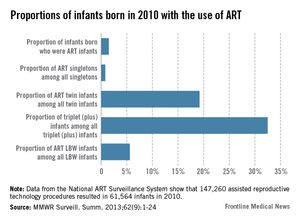
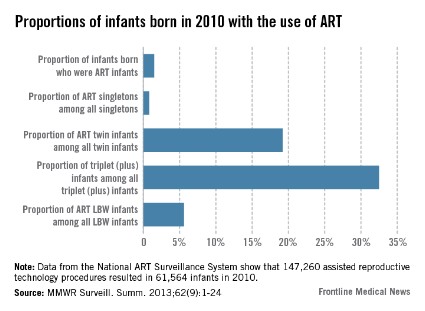
Infants born with the use of assisted reproductive technology make up a disproportionately large fraction of low-birth-weight infants, compared with the general birth population, the Centers for Disease Control and Prevention said.
In 2010, 5.6% of all low-birth-weight infants were conceived through ART. In comparison, the overall proportion of infants born who were ART infants was 1.5% that year. ART infants also "accounted for approximately 4.0% of all preterm births" in 2010, the CDC noted.
That same year, ART infants were overrepresented among multiple births, with 19.2% of twin and 32.5% of triplet and higher-order births involving ART. These numbers, however, are the latest in a downward trend, as "the percentage of ART-conceived multiple infants declined by 13.0%" from 2000 to 2010, the CDC reported (MMWR Surveill. Summ. 2013;62(9):1-24).
According to data from the CDC's National ART Surveillance System, there were 147,260 ART procedures performed in 2010 at 443 fertility clinics, resulting in 47,090 live-birth deliveries and 61,564 infants.
Infants born with the use of assisted reproductive technology make up a disproportionately large fraction of low-birth-weight infants, compared with the general birth population, the Centers for Disease Control and Prevention said.
In 2010, 5.6% of all low-birth-weight infants were conceived through ART. In comparison, the overall proportion of infants born who were ART infants was 1.5% that year. ART infants also "accounted for approximately 4.0% of all preterm births" in 2010, the CDC noted.
That same year, ART infants were overrepresented among multiple births, with 19.2% of twin and 32.5% of triplet and higher-order births involving ART. These numbers, however, are the latest in a downward trend, as "the percentage of ART-conceived multiple infants declined by 13.0%" from 2000 to 2010, the CDC reported (MMWR Surveill. Summ. 2013;62(9):1-24).
According to data from the CDC's National ART Surveillance System, there were 147,260 ART procedures performed in 2010 at 443 fertility clinics, resulting in 47,090 live-birth deliveries and 61,564 infants.
FROM MMWR
Opioid abuse a priority for CDC in 2014
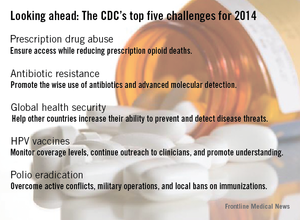
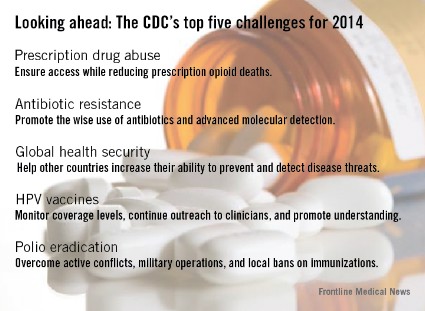
Abuse of prescription opioids and antibiotic resistance are two of the five biggest health care challenges facing the United States in the coming year, according to the Centers for Disease Control and Prevention.
The other three areas the CDC announced that it will be concentrating on 2014 are increasing the rates of HPV vaccination, eradicating polio, and improving global health.
Abuse of prescription opioids and antibiotic resistance are two of the five biggest health care challenges facing the United States in the coming year, according to the Centers for Disease Control and Prevention.
The other three areas the CDC announced that it will be concentrating on 2014 are increasing the rates of HPV vaccination, eradicating polio, and improving global health.
Abuse of prescription opioids and antibiotic resistance are two of the five biggest health care challenges facing the United States in the coming year, according to the Centers for Disease Control and Prevention.
The other three areas the CDC announced that it will be concentrating on 2014 are increasing the rates of HPV vaccination, eradicating polio, and improving global health.
Iron may calm restless legs in children
Treatment with supplemental iron was effective for treating restless legs syndrome in children diagnosed with the condition, according to a chart review.
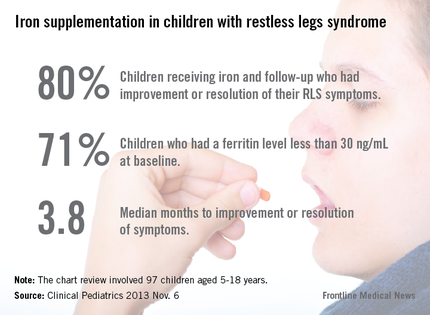
Of the 97 children aged 5-18 years with diagnosed RLS, 65% received iron as either a monotherapy or combined with other treatments. Of those children, approximately 80% had improvement or resolution of their symptoms, said Dr. Louella B. Amos of the Medical College of Wisconsin,Milwaukee, and her associates (Clin. Pediatr. 2013 Nov. 6 [doi: 10.1177/0009922813507997]).
At baseline, patient median ferritin level was 22.7 ng/mL, with 71% of the children having a level below 30 ng/mL. Median time to improvement or resolution was 3.8 months, they reported.
Treatment with supplemental iron was effective for treating restless legs syndrome in children diagnosed with the condition, according to a chart review.
Of the 97 children aged 5-18 years with diagnosed RLS, 65% received iron as either a monotherapy or combined with other treatments. Of those children, approximately 80% had improvement or resolution of their symptoms, said Dr. Louella B. Amos of the Medical College of Wisconsin,Milwaukee, and her associates (Clin. Pediatr. 2013 Nov. 6 [doi: 10.1177/0009922813507997]).
At baseline, patient median ferritin level was 22.7 ng/mL, with 71% of the children having a level below 30 ng/mL. Median time to improvement or resolution was 3.8 months, they reported.
Treatment with supplemental iron was effective for treating restless legs syndrome in children diagnosed with the condition, according to a chart review.
Of the 97 children aged 5-18 years with diagnosed RLS, 65% received iron as either a monotherapy or combined with other treatments. Of those children, approximately 80% had improvement or resolution of their symptoms, said Dr. Louella B. Amos of the Medical College of Wisconsin,Milwaukee, and her associates (Clin. Pediatr. 2013 Nov. 6 [doi: 10.1177/0009922813507997]).
At baseline, patient median ferritin level was 22.7 ng/mL, with 71% of the children having a level below 30 ng/mL. Median time to improvement or resolution was 3.8 months, they reported.
FROM CLINICAL PEDIATRICS
Preterm birth rates show racial/ethnic disparities
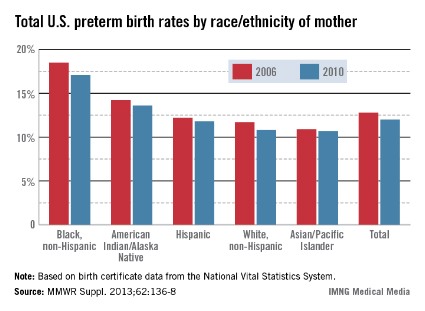
The preterm birth rate for black infants in the United States was lower than ever in 2010, but it was still about 60% higher than the rate for white infants, the Centers for Disease Control and Prevention reported.
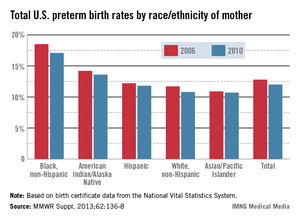
Non-Hispanic black infants had a rate of preterm births (occurring before 37 weeks’ gestation) of 17.1% in 2010, a decrease of about 8% from the 18.5% reported in 2006, according to final birth certificate data from the National Vital Statistics System.
The total U.S. preterm birth rate in 2010 was 12.0%, with non-Hispanic whites (10.8%) and Asian/Pacific Islanders (10.7%) below the average and Hispanics (11.8%) and American Indian/Alaska Natives (13.6%) joining blacks above the national figure, the CDC said (MMWR Suppl. 2013;62:136-8).
The preterm birth rate for black infants in the United States was lower than ever in 2010, but it was still about 60% higher than the rate for white infants, the Centers for Disease Control and Prevention reported.
Non-Hispanic black infants had a rate of preterm births (occurring before 37 weeks’ gestation) of 17.1% in 2010, a decrease of about 8% from the 18.5% reported in 2006, according to final birth certificate data from the National Vital Statistics System.
The total U.S. preterm birth rate in 2010 was 12.0%, with non-Hispanic whites (10.8%) and Asian/Pacific Islanders (10.7%) below the average and Hispanics (11.8%) and American Indian/Alaska Natives (13.6%) joining blacks above the national figure, the CDC said (MMWR Suppl. 2013;62:136-8).
The preterm birth rate for black infants in the United States was lower than ever in 2010, but it was still about 60% higher than the rate for white infants, the Centers for Disease Control and Prevention reported.
Non-Hispanic black infants had a rate of preterm births (occurring before 37 weeks’ gestation) of 17.1% in 2010, a decrease of about 8% from the 18.5% reported in 2006, according to final birth certificate data from the National Vital Statistics System.
The total U.S. preterm birth rate in 2010 was 12.0%, with non-Hispanic whites (10.8%) and Asian/Pacific Islanders (10.7%) below the average and Hispanics (11.8%) and American Indian/Alaska Natives (13.6%) joining blacks above the national figure, the CDC said (MMWR Suppl. 2013;62:136-8).
FROM MMWR
High schoolers smoking more cigars, pipes, e-cigarettes
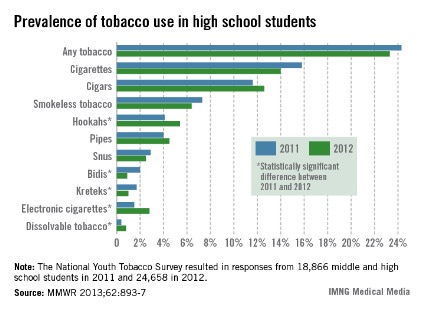
Overall use of tobacco among high school students decreased from 2011 to 2012, but cigar and pipe smoking went up, as did the use of some nonconventional products, the Centers for Disease Control and Prevention reported.
In 2012, 23.3% of high school students surveyed reported current tobacco use, compared with 24.3% in 2011. Use of cigars, driven largely by a significant increase among non-Hispanic black students, went from 11.6% in 2011 to 12.6% in 2012, and pipe use rose from 4.0% to 4.5%, according to data from the National Youth Tobacco Survey.
"Youths are known to have higher rates of cigar use than adults, which might be related to the lower price of some cigars (e.g., cigarillos and ‘little cigars’) relative to cigarettes, or the marketing of flavored cigars that might appeal to youths," the report said (MMWR 2013;62;893-7).
Significant increases in use were seen for electronic cigarettes (1.5% in 2011 to 2.8% in 2012) and hookahs (4.1% to 5.4%), but the use of other nonconventional products such as bidis (small brown cigarettes wrapped in a leaf), kreteks (clove cigarettes), and snus declined, the CDC noted.
The 2012 National Youth Tobacco Survey was conducted at 228 schools, with 24,658 middle and high school students responding. The 2011 survey had a sample size of 18,866.
Overall use of tobacco among high school students decreased from 2011 to 2012, but cigar and pipe smoking went up, as did the use of some nonconventional products, the Centers for Disease Control and Prevention reported.
In 2012, 23.3% of high school students surveyed reported current tobacco use, compared with 24.3% in 2011. Use of cigars, driven largely by a significant increase among non-Hispanic black students, went from 11.6% in 2011 to 12.6% in 2012, and pipe use rose from 4.0% to 4.5%, according to data from the National Youth Tobacco Survey.
"Youths are known to have higher rates of cigar use than adults, which might be related to the lower price of some cigars (e.g., cigarillos and ‘little cigars’) relative to cigarettes, or the marketing of flavored cigars that might appeal to youths," the report said (MMWR 2013;62;893-7).
Significant increases in use were seen for electronic cigarettes (1.5% in 2011 to 2.8% in 2012) and hookahs (4.1% to 5.4%), but the use of other nonconventional products such as bidis (small brown cigarettes wrapped in a leaf), kreteks (clove cigarettes), and snus declined, the CDC noted.
The 2012 National Youth Tobacco Survey was conducted at 228 schools, with 24,658 middle and high school students responding. The 2011 survey had a sample size of 18,866.
Overall use of tobacco among high school students decreased from 2011 to 2012, but cigar and pipe smoking went up, as did the use of some nonconventional products, the Centers for Disease Control and Prevention reported.
In 2012, 23.3% of high school students surveyed reported current tobacco use, compared with 24.3% in 2011. Use of cigars, driven largely by a significant increase among non-Hispanic black students, went from 11.6% in 2011 to 12.6% in 2012, and pipe use rose from 4.0% to 4.5%, according to data from the National Youth Tobacco Survey.
"Youths are known to have higher rates of cigar use than adults, which might be related to the lower price of some cigars (e.g., cigarillos and ‘little cigars’) relative to cigarettes, or the marketing of flavored cigars that might appeal to youths," the report said (MMWR 2013;62;893-7).
Significant increases in use were seen for electronic cigarettes (1.5% in 2011 to 2.8% in 2012) and hookahs (4.1% to 5.4%), but the use of other nonconventional products such as bidis (small brown cigarettes wrapped in a leaf), kreteks (clove cigarettes), and snus declined, the CDC noted.
The 2012 National Youth Tobacco Survey was conducted at 228 schools, with 24,658 middle and high school students responding. The 2011 survey had a sample size of 18,866.
FROM MMWR
Results vary for pregnancy-related antismoking efforts
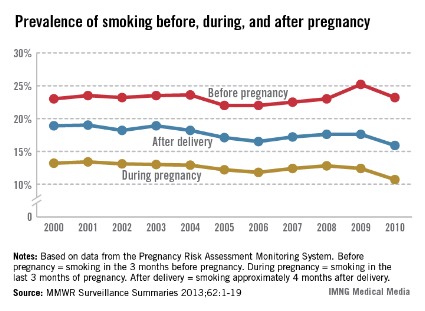
Smoking during pregnancy and after delivery decreased moderately but significantly from 2000 to 2010, while the prevalence of smoking before pregnancy dropped only slightly in that time, the Centers for Disease Control and Prevention reported.
The prevalence of smoking during pregnancy went from 13.2% in 2000 to 10.7% in 2010, and the prevalence of smoking after delivery dropped from 18.9% to 15.9%. In comparison, the prevalence of smoking during the 3 months before pregnancy made a nonsignificant drop from 23% in 2000 to 22.5% in 2007, and rose to 23.2% in 2010, according to data from the Pregnancy Risk Assessment Monitoring System (PRAMS).
The CDC report noted the Healthy People 2020 goal of reducing the prevalence of prenatal smoking to 1.4% and suggested that, "at the current pace ... it could take another 100 years for the United States to reach this goal" (MMWR Surveillance Summaries 2013;62[SS06]:1-19).
For 2010, the data from 27 PRAMS sites nationwide – 26 states and New York City -– represent approximately 52% of live births.
Smoking during pregnancy and after delivery decreased moderately but significantly from 2000 to 2010, while the prevalence of smoking before pregnancy dropped only slightly in that time, the Centers for Disease Control and Prevention reported.
The prevalence of smoking during pregnancy went from 13.2% in 2000 to 10.7% in 2010, and the prevalence of smoking after delivery dropped from 18.9% to 15.9%. In comparison, the prevalence of smoking during the 3 months before pregnancy made a nonsignificant drop from 23% in 2000 to 22.5% in 2007, and rose to 23.2% in 2010, according to data from the Pregnancy Risk Assessment Monitoring System (PRAMS).
The CDC report noted the Healthy People 2020 goal of reducing the prevalence of prenatal smoking to 1.4% and suggested that, "at the current pace ... it could take another 100 years for the United States to reach this goal" (MMWR Surveillance Summaries 2013;62[SS06]:1-19).
For 2010, the data from 27 PRAMS sites nationwide – 26 states and New York City -– represent approximately 52% of live births.
Smoking during pregnancy and after delivery decreased moderately but significantly from 2000 to 2010, while the prevalence of smoking before pregnancy dropped only slightly in that time, the Centers for Disease Control and Prevention reported.
The prevalence of smoking during pregnancy went from 13.2% in 2000 to 10.7% in 2010, and the prevalence of smoking after delivery dropped from 18.9% to 15.9%. In comparison, the prevalence of smoking during the 3 months before pregnancy made a nonsignificant drop from 23% in 2000 to 22.5% in 2007, and rose to 23.2% in 2010, according to data from the Pregnancy Risk Assessment Monitoring System (PRAMS).
The CDC report noted the Healthy People 2020 goal of reducing the prevalence of prenatal smoking to 1.4% and suggested that, "at the current pace ... it could take another 100 years for the United States to reach this goal" (MMWR Surveillance Summaries 2013;62[SS06]:1-19).
For 2010, the data from 27 PRAMS sites nationwide – 26 states and New York City -– represent approximately 52% of live births.
FROM MMWR
Almost 23% of U.S. adults have arthritis
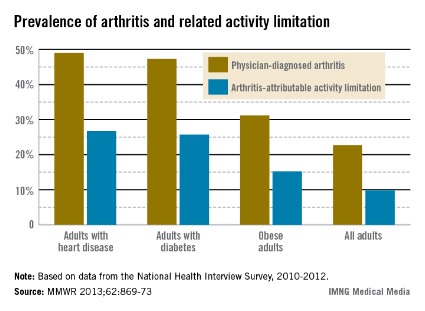
In 2010-2012, almost 23% of the adult population had physician-diagnosed arthritis and almost 10% had some form of activity limitation attributable to their arthritis, the Centers for Disease Control and Prevention reported.
The figures for adults aged 18 years and older with heart disease, diabetes, and obesity were even higher. Data from the National Health Interview Survey (NHIS) put arthritis prevalence at 49% for those with heart disease, 47% for those with diabetes, and 31% for those who are obese, according to the CDC (MMWR 2013;62:869-73).
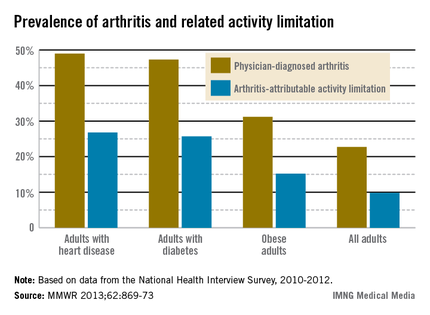
Among patients with heart disease, nearly 27% had arthritis-attributable activity limitation, as did almost 26% of those with diabetes and just over 15% of those who were obese, the CDC said.
The estimate of 52.5 million adults with arthritis "is consistent with an earlier projection and suggests that projections of 55.7 million adults with arthritis by 2015 and 67 million by 2030 are reasonable," the CDC noted, adding that the projected number of those with activity limitations (22.7 million), however, "exceeds the earlier projection of 22 million adults ... by 2020 and, therefore, might exceed the 25 million projected for 2030."
In 2010-2012, almost 23% of the adult population had physician-diagnosed arthritis and almost 10% had some form of activity limitation attributable to their arthritis, the Centers for Disease Control and Prevention reported.
The figures for adults aged 18 years and older with heart disease, diabetes, and obesity were even higher. Data from the National Health Interview Survey (NHIS) put arthritis prevalence at 49% for those with heart disease, 47% for those with diabetes, and 31% for those who are obese, according to the CDC (MMWR 2013;62:869-73).
Among patients with heart disease, nearly 27% had arthritis-attributable activity limitation, as did almost 26% of those with diabetes and just over 15% of those who were obese, the CDC said.
The estimate of 52.5 million adults with arthritis "is consistent with an earlier projection and suggests that projections of 55.7 million adults with arthritis by 2015 and 67 million by 2030 are reasonable," the CDC noted, adding that the projected number of those with activity limitations (22.7 million), however, "exceeds the earlier projection of 22 million adults ... by 2020 and, therefore, might exceed the 25 million projected for 2030."
In 2010-2012, almost 23% of the adult population had physician-diagnosed arthritis and almost 10% had some form of activity limitation attributable to their arthritis, the Centers for Disease Control and Prevention reported.
The figures for adults aged 18 years and older with heart disease, diabetes, and obesity were even higher. Data from the National Health Interview Survey (NHIS) put arthritis prevalence at 49% for those with heart disease, 47% for those with diabetes, and 31% for those who are obese, according to the CDC (MMWR 2013;62:869-73).
Among patients with heart disease, nearly 27% had arthritis-attributable activity limitation, as did almost 26% of those with diabetes and just over 15% of those who were obese, the CDC said.
The estimate of 52.5 million adults with arthritis "is consistent with an earlier projection and suggests that projections of 55.7 million adults with arthritis by 2015 and 67 million by 2030 are reasonable," the CDC noted, adding that the projected number of those with activity limitations (22.7 million), however, "exceeds the earlier projection of 22 million adults ... by 2020 and, therefore, might exceed the 25 million projected for 2030."
FROM MMWR
CVD more prevalent in chronic kidney disease patients
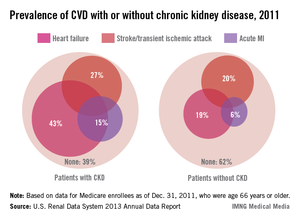
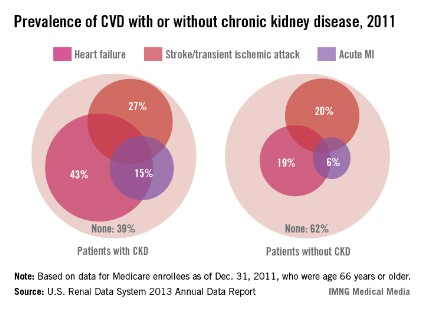
Cardiovascular disease burden is much greater among elderly patients with chronic kidney disease than in those without, the U.S. Renal Disease System reported.
Among Medicare fee-for-service enrollees aged 66 years and older, the prevalence of heart failure in 2011 was 43% for those with CKD and 19% for those without CKD. The prevalence of stroke and transient ischemic attack was 27% among CKD patients and 20% in those with no CKD. Acute MI prevalence in 2011 was 15% in CKD patients and 6% among enrollees without CKD, according to the USRDS.
Cardiovascular disease burden is much greater among elderly patients with chronic kidney disease than in those without, the U.S. Renal Disease System reported.
Among Medicare fee-for-service enrollees aged 66 years and older, the prevalence of heart failure in 2011 was 43% for those with CKD and 19% for those without CKD. The prevalence of stroke and transient ischemic attack was 27% among CKD patients and 20% in those with no CKD. Acute MI prevalence in 2011 was 15% in CKD patients and 6% among enrollees without CKD, according to the USRDS.
Cardiovascular disease burden is much greater among elderly patients with chronic kidney disease than in those without, the U.S. Renal Disease System reported.
Among Medicare fee-for-service enrollees aged 66 years and older, the prevalence of heart failure in 2011 was 43% for those with CKD and 19% for those without CKD. The prevalence of stroke and transient ischemic attack was 27% among CKD patients and 20% in those with no CKD. Acute MI prevalence in 2011 was 15% in CKD patients and 6% among enrollees without CKD, according to the USRDS.
Number of restless leg movements during sleep may predict AFib progression
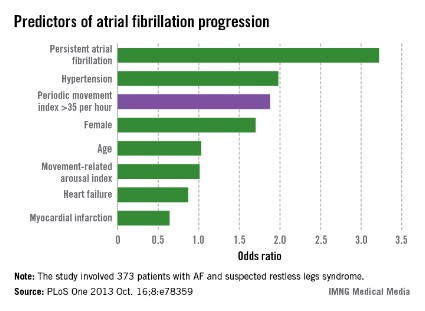
In patients with restless legs syndrome, frequent leg movements during sleep were associated with the progression of atrial fibrillation, reported Dr. Mahek Mirza and her associates.
In their study, 205 patients with more than 35 leg movements per hour were more likely (odds ratio, 1.88) to experience progression of atrial fibrillation during a median of 33 months of follow-up, compared with 168 patients with atrial fibrillation who had a periodic movement index of 35 or less, reported Dr. Mirza of the center for integrative research on cardiovascular aging, Aurora Health Care, Milwaukee, Wis., and her associates.
In the group of patients with a high frequency of leg movements during sleep, those treated with dopaminergic drugs were less likely to experience atrial fibrillation progression (11.6%), compared with those who were not treated (32%). No treatment difference in progression was seen among patients with a low frequency of leg movements, the investigators reported (PLoS One 2013 Oct. 16;8:e78359 [doi:10.1371/journal.pone.0078359]).
Dr. Mirza and one of her associates were supported by grants from the National Heart, Lung, and Blood Institute. The investigators said they had no relevant financial disclosures.

In patients with restless legs syndrome, frequent leg movements during sleep were associated with the progression of atrial fibrillation, reported Dr. Mahek Mirza and her associates.
In their study, 205 patients with more than 35 leg movements per hour were more likely (odds ratio, 1.88) to experience progression of atrial fibrillation during a median of 33 months of follow-up, compared with 168 patients with atrial fibrillation who had a periodic movement index of 35 or less, reported Dr. Mirza of the center for integrative research on cardiovascular aging, Aurora Health Care, Milwaukee, Wis., and her associates.
In the group of patients with a high frequency of leg movements during sleep, those treated with dopaminergic drugs were less likely to experience atrial fibrillation progression (11.6%), compared with those who were not treated (32%). No treatment difference in progression was seen among patients with a low frequency of leg movements, the investigators reported (PLoS One 2013 Oct. 16;8:e78359 [doi:10.1371/journal.pone.0078359]).
Dr. Mirza and one of her associates were supported by grants from the National Heart, Lung, and Blood Institute. The investigators said they had no relevant financial disclosures.
In patients with restless legs syndrome, frequent leg movements during sleep were associated with the progression of atrial fibrillation, reported Dr. Mahek Mirza and her associates.
In their study, 205 patients with more than 35 leg movements per hour were more likely (odds ratio, 1.88) to experience progression of atrial fibrillation during a median of 33 months of follow-up, compared with 168 patients with atrial fibrillation who had a periodic movement index of 35 or less, reported Dr. Mirza of the center for integrative research on cardiovascular aging, Aurora Health Care, Milwaukee, Wis., and her associates.
In the group of patients with a high frequency of leg movements during sleep, those treated with dopaminergic drugs were less likely to experience atrial fibrillation progression (11.6%), compared with those who were not treated (32%). No treatment difference in progression was seen among patients with a low frequency of leg movements, the investigators reported (PLoS One 2013 Oct. 16;8:e78359 [doi:10.1371/journal.pone.0078359]).
Dr. Mirza and one of her associates were supported by grants from the National Heart, Lung, and Blood Institute. The investigators said they had no relevant financial disclosures.
FROM PLOS ONE
Number of US Malaria Cases Hits 40-year High
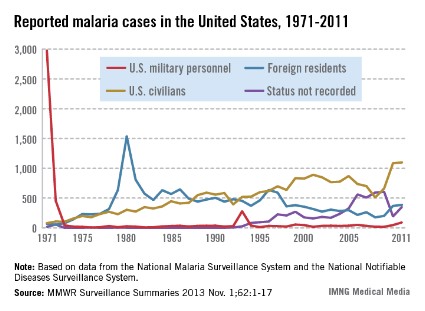
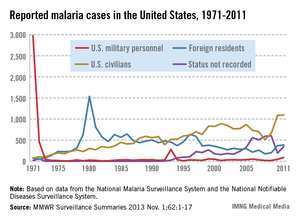
The number of malaria cases reported in the United States for 2011 was the highest since 1971, according to the Centers for Disease Control and Prevention.
Continuing a fairly steady increase since the mid-1970s, the total of 1,925 malaria cases reported in 2011 was up 14% from 2010 and 48% since 2008, the CDC said.
There were 3,180 cases in 1971, although at that time most cases occurred in military personnel. In 2011, there were 91 cases reported among the military, compared with 1,098 in U.S. civilians, 386 in foreign residents, and 350 in individuals whose status was not recorded, the CDC reported (MMWR Surveillance Summaries 2013 Nov. 1;62:1-17).
Most of the U.S. malaria cases – 1,920 – were imported, mainly from sub-Saharan Africa. The CDC noted that travel to Africa as a whole increased only 1% in 2011, but travel to sub-Saharan Africa increased by 6.9% "as a result of the Arab Spring and political transitions in North Africa."
The number of malaria cases reported in the United States for 2011 was the highest since 1971, according to the Centers for Disease Control and Prevention.
Continuing a fairly steady increase since the mid-1970s, the total of 1,925 malaria cases reported in 2011 was up 14% from 2010 and 48% since 2008, the CDC said.
There were 3,180 cases in 1971, although at that time most cases occurred in military personnel. In 2011, there were 91 cases reported among the military, compared with 1,098 in U.S. civilians, 386 in foreign residents, and 350 in individuals whose status was not recorded, the CDC reported (MMWR Surveillance Summaries 2013 Nov. 1;62:1-17).
Most of the U.S. malaria cases – 1,920 – were imported, mainly from sub-Saharan Africa. The CDC noted that travel to Africa as a whole increased only 1% in 2011, but travel to sub-Saharan Africa increased by 6.9% "as a result of the Arab Spring and political transitions in North Africa."
The number of malaria cases reported in the United States for 2011 was the highest since 1971, according to the Centers for Disease Control and Prevention.
Continuing a fairly steady increase since the mid-1970s, the total of 1,925 malaria cases reported in 2011 was up 14% from 2010 and 48% since 2008, the CDC said.
There were 3,180 cases in 1971, although at that time most cases occurred in military personnel. In 2011, there were 91 cases reported among the military, compared with 1,098 in U.S. civilians, 386 in foreign residents, and 350 in individuals whose status was not recorded, the CDC reported (MMWR Surveillance Summaries 2013 Nov. 1;62:1-17).
Most of the U.S. malaria cases – 1,920 – were imported, mainly from sub-Saharan Africa. The CDC noted that travel to Africa as a whole increased only 1% in 2011, but travel to sub-Saharan Africa increased by 6.9% "as a result of the Arab Spring and political transitions in North Africa."
FROM MMWR