User login
PROTECT: Pazopanib falls short as adjuvant therapy for high-risk RCC
CHICAGO – The antiangiogenic agent pazopanib is not efficacious when used as adjuvant therapy for resected renal cell carcinoma (RCC) with features that confer a high risk of recurrence, the PROTECT investigators reported at the annual meeting of the American Society of Clinical Oncology.
Pazopanib (Votrient) is an oral multitargeted tyrosine kinase inhibitor active against the vascular endothelial growth factor receptor (VEGFR). Adjuvant use of other agents in this class has yielded mixed results, noted lead investigator Robert J. Motzer, MD, of Memorial Sloan-Kettering Cancer Center in New York.

In PROTECT, a phase III randomized controlled trial of more than 1,500 patients who had undergone nephrectomy for high-risk locally advanced RCC, pazopanib started at 600 mg daily did not yield significantly better disease-free survival than placebo, the trial’s primary endpoint. The drug did have a significant benefit when started at 800 mg daily, but that dose had to be lowered partway through because of a high rate of discontinuation due to adverse events.
“The trial did not meet its primary endpoint,” Dr. Motzer concluded. “Pazopanib is not recommended for adjuvant therapy following resection of locally advanced RCC.”
Expert perspective
“The current landscape of RCC adjuvant therapy is really controversial,” commented invited discussant Daniel Y. C. Heng, MD, MPH, of the University of Calgary (Alta.) Tom Baker Cancer Centre.

“Are these [factors] important or not? I think a lot of this is being overshadowed by things that are going on right now,” Dr. Heng maintained. “There are newer medications, such as PD-1 and PD-L1 inhibitors that are now being studied. And there are now perioperative studies as well – should we be using these drugs before nephrectomy and after nephrectomy to prime the immune system to get better outcomes?”
At the end of the day, identification of a reliable predictive biomarker will be key to using the VEGFR tyrosine kinase inhibitors, he concluded. “I look forward to the future where we can actually use these tests to determine who will benefit most from adjuvant therapy so that we can maximize patient outcomes.”
Study details
The PROTECT trial was funded by Novartis Oncology and randomized 1,538 patients with resected pT2 (high grade), pT3, or greater nonmetastatic clear cell RCC, a highly vascular tumor typically reliant on aberrant signaling in the VEGF pathway.
The patients were assigned evenly to receive pazopanib or placebo for 1 year. The starting dose was lowered from 800 mg daily to 600 mg daily (with escalation permitted) after 403 patients had been treated.
In intention-to-treat analysis among patients started on the 600-mg dose and having a median follow-up of about 31 months, disease-free survival was better with pazopanib but not significantly so (hazard ratio, 0.86; P = .16), Dr. Motzer reported.
In secondary analyses, pazopanib did have a significant disease-free survival benefit among patients started on the 800-mg dose (hazard ratio, 0.69; P = .02) and among the entire trial population started on either dose (hazard ratio, 0.80; P = .01).
One possible explanation for the differing results seen with the two doses was the difference in follow-up, as the 800-mg group was treated earlier in the trial, he proposed. But with an additional year of blinded follow-up, the benefit in the 600-mg group actually diminished, whereas that in the 800-mg group did not.
Another possibility was the somewhat better performance of the placebo group used for comparison with the lower dose: the 3-year disease-free survival rate with placebo was 64% for the 600-mg comparison but 56% for the 800-mg comparison. “One factor that could explain differences in the outcomes of the placebo groups includes unidentified patient demographic characteristics,” Dr. Motzer noted.
Overall survival was statistically indistinguishable between the pazopanib and placebo groups, regardless of dose. However, “the results are inconclusive as the data are not yet mature,” he said, with a definitive analysis planned for 2019.
Compared with counterparts given placebo, patients started on the 600-mg dose of pazopanib had a higher rate of grade 3 or 4 adverse events overall (60% vs. 21%), driven in large part by higher rates of hypertension and increased alanine aminotransferase levels.
“Although the intent of modifying the protocol dose of pazopanib from 800 mg to 600 mg was to reduce the rate of discontinuation and improve the safety profile ... both cohorts had similar discontinuation rates and safety profiles,” Dr. Motzer noted.
A quality of life analysis for the 600-mg group using the 19-item Functional Assessment of Cancer Therapy (FACT) Kidney Symptom Index (FKSI-19) showed values were consistently lower with the drug than with placebo during treatment, with a crossing of the threshold for a minimally important difference at week 8.
Pharmacokinetic analyses from the trial, reported in a poster at the meeting (Abstract 4564), showed that in the group starting pazopanib at 600 mg, disease-free survival was longer in patients who achieved higher drug trough concentrations at week 3 or 5.
CHICAGO – The antiangiogenic agent pazopanib is not efficacious when used as adjuvant therapy for resected renal cell carcinoma (RCC) with features that confer a high risk of recurrence, the PROTECT investigators reported at the annual meeting of the American Society of Clinical Oncology.
Pazopanib (Votrient) is an oral multitargeted tyrosine kinase inhibitor active against the vascular endothelial growth factor receptor (VEGFR). Adjuvant use of other agents in this class has yielded mixed results, noted lead investigator Robert J. Motzer, MD, of Memorial Sloan-Kettering Cancer Center in New York.
In PROTECT, a phase III randomized controlled trial of more than 1,500 patients who had undergone nephrectomy for high-risk locally advanced RCC, pazopanib started at 600 mg daily did not yield significantly better disease-free survival than placebo, the trial’s primary endpoint. The drug did have a significant benefit when started at 800 mg daily, but that dose had to be lowered partway through because of a high rate of discontinuation due to adverse events.
“The trial did not meet its primary endpoint,” Dr. Motzer concluded. “Pazopanib is not recommended for adjuvant therapy following resection of locally advanced RCC.”
Expert perspective
“The current landscape of RCC adjuvant therapy is really controversial,” commented invited discussant Daniel Y. C. Heng, MD, MPH, of the University of Calgary (Alta.) Tom Baker Cancer Centre.
“Are these [factors] important or not? I think a lot of this is being overshadowed by things that are going on right now,” Dr. Heng maintained. “There are newer medications, such as PD-1 and PD-L1 inhibitors that are now being studied. And there are now perioperative studies as well – should we be using these drugs before nephrectomy and after nephrectomy to prime the immune system to get better outcomes?”
At the end of the day, identification of a reliable predictive biomarker will be key to using the VEGFR tyrosine kinase inhibitors, he concluded. “I look forward to the future where we can actually use these tests to determine who will benefit most from adjuvant therapy so that we can maximize patient outcomes.”
Study details
The PROTECT trial was funded by Novartis Oncology and randomized 1,538 patients with resected pT2 (high grade), pT3, or greater nonmetastatic clear cell RCC, a highly vascular tumor typically reliant on aberrant signaling in the VEGF pathway.
The patients were assigned evenly to receive pazopanib or placebo for 1 year. The starting dose was lowered from 800 mg daily to 600 mg daily (with escalation permitted) after 403 patients had been treated.
In intention-to-treat analysis among patients started on the 600-mg dose and having a median follow-up of about 31 months, disease-free survival was better with pazopanib but not significantly so (hazard ratio, 0.86; P = .16), Dr. Motzer reported.
In secondary analyses, pazopanib did have a significant disease-free survival benefit among patients started on the 800-mg dose (hazard ratio, 0.69; P = .02) and among the entire trial population started on either dose (hazard ratio, 0.80; P = .01).
One possible explanation for the differing results seen with the two doses was the difference in follow-up, as the 800-mg group was treated earlier in the trial, he proposed. But with an additional year of blinded follow-up, the benefit in the 600-mg group actually diminished, whereas that in the 800-mg group did not.
Another possibility was the somewhat better performance of the placebo group used for comparison with the lower dose: the 3-year disease-free survival rate with placebo was 64% for the 600-mg comparison but 56% for the 800-mg comparison. “One factor that could explain differences in the outcomes of the placebo groups includes unidentified patient demographic characteristics,” Dr. Motzer noted.
Overall survival was statistically indistinguishable between the pazopanib and placebo groups, regardless of dose. However, “the results are inconclusive as the data are not yet mature,” he said, with a definitive analysis planned for 2019.
Compared with counterparts given placebo, patients started on the 600-mg dose of pazopanib had a higher rate of grade 3 or 4 adverse events overall (60% vs. 21%), driven in large part by higher rates of hypertension and increased alanine aminotransferase levels.
“Although the intent of modifying the protocol dose of pazopanib from 800 mg to 600 mg was to reduce the rate of discontinuation and improve the safety profile ... both cohorts had similar discontinuation rates and safety profiles,” Dr. Motzer noted.
A quality of life analysis for the 600-mg group using the 19-item Functional Assessment of Cancer Therapy (FACT) Kidney Symptom Index (FKSI-19) showed values were consistently lower with the drug than with placebo during treatment, with a crossing of the threshold for a minimally important difference at week 8.
Pharmacokinetic analyses from the trial, reported in a poster at the meeting (Abstract 4564), showed that in the group starting pazopanib at 600 mg, disease-free survival was longer in patients who achieved higher drug trough concentrations at week 3 or 5.
CHICAGO – The antiangiogenic agent pazopanib is not efficacious when used as adjuvant therapy for resected renal cell carcinoma (RCC) with features that confer a high risk of recurrence, the PROTECT investigators reported at the annual meeting of the American Society of Clinical Oncology.
Pazopanib (Votrient) is an oral multitargeted tyrosine kinase inhibitor active against the vascular endothelial growth factor receptor (VEGFR). Adjuvant use of other agents in this class has yielded mixed results, noted lead investigator Robert J. Motzer, MD, of Memorial Sloan-Kettering Cancer Center in New York.
In PROTECT, a phase III randomized controlled trial of more than 1,500 patients who had undergone nephrectomy for high-risk locally advanced RCC, pazopanib started at 600 mg daily did not yield significantly better disease-free survival than placebo, the trial’s primary endpoint. The drug did have a significant benefit when started at 800 mg daily, but that dose had to be lowered partway through because of a high rate of discontinuation due to adverse events.
“The trial did not meet its primary endpoint,” Dr. Motzer concluded. “Pazopanib is not recommended for adjuvant therapy following resection of locally advanced RCC.”
Expert perspective
“The current landscape of RCC adjuvant therapy is really controversial,” commented invited discussant Daniel Y. C. Heng, MD, MPH, of the University of Calgary (Alta.) Tom Baker Cancer Centre.
“Are these [factors] important or not? I think a lot of this is being overshadowed by things that are going on right now,” Dr. Heng maintained. “There are newer medications, such as PD-1 and PD-L1 inhibitors that are now being studied. And there are now perioperative studies as well – should we be using these drugs before nephrectomy and after nephrectomy to prime the immune system to get better outcomes?”
At the end of the day, identification of a reliable predictive biomarker will be key to using the VEGFR tyrosine kinase inhibitors, he concluded. “I look forward to the future where we can actually use these tests to determine who will benefit most from adjuvant therapy so that we can maximize patient outcomes.”
Study details
The PROTECT trial was funded by Novartis Oncology and randomized 1,538 patients with resected pT2 (high grade), pT3, or greater nonmetastatic clear cell RCC, a highly vascular tumor typically reliant on aberrant signaling in the VEGF pathway.
The patients were assigned evenly to receive pazopanib or placebo for 1 year. The starting dose was lowered from 800 mg daily to 600 mg daily (with escalation permitted) after 403 patients had been treated.
In intention-to-treat analysis among patients started on the 600-mg dose and having a median follow-up of about 31 months, disease-free survival was better with pazopanib but not significantly so (hazard ratio, 0.86; P = .16), Dr. Motzer reported.
In secondary analyses, pazopanib did have a significant disease-free survival benefit among patients started on the 800-mg dose (hazard ratio, 0.69; P = .02) and among the entire trial population started on either dose (hazard ratio, 0.80; P = .01).
One possible explanation for the differing results seen with the two doses was the difference in follow-up, as the 800-mg group was treated earlier in the trial, he proposed. But with an additional year of blinded follow-up, the benefit in the 600-mg group actually diminished, whereas that in the 800-mg group did not.
Another possibility was the somewhat better performance of the placebo group used for comparison with the lower dose: the 3-year disease-free survival rate with placebo was 64% for the 600-mg comparison but 56% for the 800-mg comparison. “One factor that could explain differences in the outcomes of the placebo groups includes unidentified patient demographic characteristics,” Dr. Motzer noted.
Overall survival was statistically indistinguishable between the pazopanib and placebo groups, regardless of dose. However, “the results are inconclusive as the data are not yet mature,” he said, with a definitive analysis planned for 2019.
Compared with counterparts given placebo, patients started on the 600-mg dose of pazopanib had a higher rate of grade 3 or 4 adverse events overall (60% vs. 21%), driven in large part by higher rates of hypertension and increased alanine aminotransferase levels.
“Although the intent of modifying the protocol dose of pazopanib from 800 mg to 600 mg was to reduce the rate of discontinuation and improve the safety profile ... both cohorts had similar discontinuation rates and safety profiles,” Dr. Motzer noted.
A quality of life analysis for the 600-mg group using the 19-item Functional Assessment of Cancer Therapy (FACT) Kidney Symptom Index (FKSI-19) showed values were consistently lower with the drug than with placebo during treatment, with a crossing of the threshold for a minimally important difference at week 8.
Pharmacokinetic analyses from the trial, reported in a poster at the meeting (Abstract 4564), showed that in the group starting pazopanib at 600 mg, disease-free survival was longer in patients who achieved higher drug trough concentrations at week 3 or 5.
AT ASCO 2017
Key clinical point:
Major finding: Compared with placebo, pazopanib started at 600 mg daily did not significantly reduce the risk of disease-free survival events (hazard ratio, 0.86; P = .16).
Data source: A phase III randomized controlled trial among 1,538 patients who had undergone nephrectomy for high-risk locally advanced RCC (PROTECT trial).
Disclosures: Dr. Motzer disclosed that he is a consultant to Eisai, Exelixis, Merck, Novartis, and Pfizer, and that he receives research funding from Bristol-Myers Squibb (institutional), Eisai (institutional), Genentech/Roche (institutional), GlaxoSmithKline (institutional), Novartis (institutional), and Pfizer (institutional). The trial was funded by Novartis Oncology.
Most arrhythmia clinic patients have undetected OSA
BOSTON – In a study of patients without a previous diagnosis of obstructive sleep apnea (OSA), 85% of participants in outpatient arrhythmia clinics had undetected OSA.
The study, which also excluded patients who had ever been treated for OSA, was presented by Colin Shapiro, MD, of the Department of Psychiatry, Toronto Western Hospital, University of Toronto, at the annual meeting of the Associated Professional Sleep Societies.
A binary logistic regression analysis showed that only age and male gender were significant predictors of OSA.
Along with a home sleep study, researchers tested 75 nonselected consecutive patients (mean age of 64 years; 72% male) from three outpatient arrhythmia clinics for symptoms indicative of OSA using the Epworth Sleepiness Scale (ESS), the Fatigue Severity Scale (FSS), the Non-Restorative Sleep Scale (NRSS), and other questionnaires.
On the ESS, 32% of patients had a score of 8 or greater, indicating higher than normal daytime sleepiness. Almost half (47%) of patients had a high level of fatigue on the FSS, and symptoms of nonrestorative sleep were detected in 15% (NRSS score greater than or equal to 46).
Dr. Shapiro noted that “high scores suggestive of daytime sleepiness, fatigue, or insomnia did not particularly predict the presence of OSA in patients with arrhythmia.” He concluded that, “with a hit rate of 85%, just about every patient with an arrhythmia should have a sleep study.”
Dr. Shapiro informed attendees at the annual meeting of the Professional Sleep Societies that he was presenting in place of his student and the abstract’s first author, Dr. Asmaa M. Abumuamar, MD, who was denied a visa to attend the meeting. Dr. Abumuamar is from the Toronto Western Research Institute, University of Toronto.
Dr. Shapiro reported that Dr. Abumuamar has no conflicts of interest. Dr. Shapiro reported that he is an investor in the company that supplied the home sleep testing apparatus.
BOSTON – In a study of patients without a previous diagnosis of obstructive sleep apnea (OSA), 85% of participants in outpatient arrhythmia clinics had undetected OSA.
The study, which also excluded patients who had ever been treated for OSA, was presented by Colin Shapiro, MD, of the Department of Psychiatry, Toronto Western Hospital, University of Toronto, at the annual meeting of the Associated Professional Sleep Societies.
A binary logistic regression analysis showed that only age and male gender were significant predictors of OSA.
Along with a home sleep study, researchers tested 75 nonselected consecutive patients (mean age of 64 years; 72% male) from three outpatient arrhythmia clinics for symptoms indicative of OSA using the Epworth Sleepiness Scale (ESS), the Fatigue Severity Scale (FSS), the Non-Restorative Sleep Scale (NRSS), and other questionnaires.
On the ESS, 32% of patients had a score of 8 or greater, indicating higher than normal daytime sleepiness. Almost half (47%) of patients had a high level of fatigue on the FSS, and symptoms of nonrestorative sleep were detected in 15% (NRSS score greater than or equal to 46).
Dr. Shapiro noted that “high scores suggestive of daytime sleepiness, fatigue, or insomnia did not particularly predict the presence of OSA in patients with arrhythmia.” He concluded that, “with a hit rate of 85%, just about every patient with an arrhythmia should have a sleep study.”
Dr. Shapiro informed attendees at the annual meeting of the Professional Sleep Societies that he was presenting in place of his student and the abstract’s first author, Dr. Asmaa M. Abumuamar, MD, who was denied a visa to attend the meeting. Dr. Abumuamar is from the Toronto Western Research Institute, University of Toronto.
Dr. Shapiro reported that Dr. Abumuamar has no conflicts of interest. Dr. Shapiro reported that he is an investor in the company that supplied the home sleep testing apparatus.
BOSTON – In a study of patients without a previous diagnosis of obstructive sleep apnea (OSA), 85% of participants in outpatient arrhythmia clinics had undetected OSA.
The study, which also excluded patients who had ever been treated for OSA, was presented by Colin Shapiro, MD, of the Department of Psychiatry, Toronto Western Hospital, University of Toronto, at the annual meeting of the Associated Professional Sleep Societies.
A binary logistic regression analysis showed that only age and male gender were significant predictors of OSA.
Along with a home sleep study, researchers tested 75 nonselected consecutive patients (mean age of 64 years; 72% male) from three outpatient arrhythmia clinics for symptoms indicative of OSA using the Epworth Sleepiness Scale (ESS), the Fatigue Severity Scale (FSS), the Non-Restorative Sleep Scale (NRSS), and other questionnaires.
On the ESS, 32% of patients had a score of 8 or greater, indicating higher than normal daytime sleepiness. Almost half (47%) of patients had a high level of fatigue on the FSS, and symptoms of nonrestorative sleep were detected in 15% (NRSS score greater than or equal to 46).
Dr. Shapiro noted that “high scores suggestive of daytime sleepiness, fatigue, or insomnia did not particularly predict the presence of OSA in patients with arrhythmia.” He concluded that, “with a hit rate of 85%, just about every patient with an arrhythmia should have a sleep study.”
Dr. Shapiro informed attendees at the annual meeting of the Professional Sleep Societies that he was presenting in place of his student and the abstract’s first author, Dr. Asmaa M. Abumuamar, MD, who was denied a visa to attend the meeting. Dr. Abumuamar is from the Toronto Western Research Institute, University of Toronto.
Dr. Shapiro reported that Dr. Abumuamar has no conflicts of interest. Dr. Shapiro reported that he is an investor in the company that supplied the home sleep testing apparatus.
AT SLEEP 2017
Key clinical point: The majority of patients attending an outpatient arrhythmia clinic had undetected OSA.
Major finding: Of the participants, 91% of males and 71% of females with no history of OSA were found to have the disorder (85% of total).
Data source: A screening study using a randomized, unselected population drawn from outpatient arrhythmia clinics. Those with a diagnoses of OSA were excluded.
Disclosures: Dr. Shapiro reported that Dr. Abumuamar has no conflicts of interest. Dr. Shapiro reported that he is an investor in the company that supplied the home sleep testing apparatus.
KHN Exclusive: White House task force echoes Pharma proposals
President Donald Trump repeatedly talks tough about reining in the pharmaceutical industry, but his administration’s efforts to lower drug prices are shrouded in secrecy.
Senior administrative officials met Friday to discuss an executive order on the cost of pharmaceuticals, a roundtable informed by Trump’s “Drug Pricing and Innovation Working Group.” Kaiser Health News examined documents that shed light on the workings of this working group.
The documents reveal behind-the-scenes discussions that are influenced by the pharmaceutical industry. Joe Grogan, associate director of health programs for the Office of Management and Budget (OMB), has led the group. Until March, Grogan served as a lobbyist for Gilead Sciences, the pharmaceutical company that priced its hepatitis C drugs at $1,000 per pill.
To solve the crisis of high drug prices, the group discussed strengthening the monopoly rights of pharmaceuticals overseas, ending discounts for low-income hospitals and accelerating drug approvals by the Food and Drug Administration. The White House declined to comment on the working group.
The group initially met May 4 in the Eisenhower Executive Office Building and has since met every two weeks. In addition to OMB, the working group includes officials from the White House National Economic Council, the Domestic Policy Council, Health and Human Services, the FDA, the Federal Trade Commission, the Department of Commerce, the Office of the U.S. Trade Representative and the Department of Justice.
According to the documents – the latest of which is dated June 1– the working group focused on the following “principles” and “talking points”:
1. Extending the patent life of drugs in foreign markets to “provide for protection and enforcement of intellectual property rights.” This will ensure “that American consumers do not unfairly subsidize research and development for people throughout the globe.” Extending monopoly protections for drugs overseas has been one of the pharmaceutical industry’s top priorities since the Trans-Pacific Partnership was defeated last year. That policy would push up global drug prices, according to Médecins Sans Frontières.
2. Promoting competition in the U.S. drug market – both by “modernizing our regulatory and reimbursement systems” and limiting “barrier to entry, including the cost of research and development,” according to the documents. The working group also discussed two broad policy ideas that have been championed by the pharmaceutical industry, according to sources familiar with the process:
3. Value-based pricing, under which pharmaceutical companies keep the list prices of drugs unchanged but offer rebates if patients don’t improve, is one option. It’s unclear who would audit the effectiveness of the drugs, what criteria they would use to evaluate them, and who would receive the rebates. Grogan invited Robert Shapiro – an adviser for Gilead and former secretary of Commerce under President Bill Clinton – to brief the working group on value-based pricing on May 18. Shapiro is the chairman and cofounder of Sonecon, a Washington, D.C., firm that consulted with Gilead, Amgen, and PhRMA, according to his curriculum vitae.
4. Grogan and Shapiro also discussed issuing 10-year U.S. Treasury bonds to drug manufacturers to pay for expensive hepatitis C drugs like Sovaldi and Harvoni under Medicare and Medicaid, to avoid rationing drugs to the sickest patients. The 2015 Senate investigation, for example, found that, though Medicaid spent more than $1 billion on Sovaldi, just 2.4% of Medicaid patients with hepatitis C were treated.
After the working group’s first meeting on May 4, Grogan distributed detailed policy recommendations on options for expediting generic drug approvals, creating a new tax credit “of up to 50%” for investments in generic drug manufacturing, distribution, and research and development. The documents also propose scaling back the 340B program, which requires drug manufacturers to provide some medicines at a discount to hospitals that treat low-income patients.
Most of these policies would not ease patient costs, and at least one would increase prices, said experts who reviewed the documents at the request of Kaiser Health News.
“This six-page document contains the kinds of solutions to the cost-of-drugs problem that you would get if you gathered together all the executives of pharma and asked them ‘What sort of token gestures can we do?’ ” said Vinay Prasad, MD, a professor of medicine at Oregon Health and Sciences University who studies the costs of cancer drugs.
The pharma-friendly recommendations appear to clash with earlier press reports indicating that OMB Director Mick Mulvaney was considering requiring drug makers to pay rebates to Medicare patients, a measure the pharmaceutical lobby fiercely opposes.
Brand-name drug prices – which account for 72% of drug spending – go untouched in the handouts, said Fiona Scott Morton, PhD, a Yale economics professor and former attorney with the Justice Department’s antitrust division.
“The changes to generic markets to promote competition look helpful, but there need to be some more ideas to create more competition for branded drugs or consumers aren’t really going to notice this,” Scott Morton said.
Some of the text in the document is cribbed directly from policy papers published by the pharmaceutical industry’s powerful lobby – Pharmaceutical Research and Manufacturers Association (PhRMA).
Under the subtitle, “Encourage Use of 21st Century Tools for Drug Evaluation, Review, and Approval,” one handout proposes the FDA use less rigorous clinical trial standards to speed drug approvals.
The handout cites a PhRMA paper from March 2016 that includes an identical subtitle, “Encourage Use of 21st Century Tools for Drug Evaluation, Review, and Approval” and recommends the FDA implement less rigorous clinical trial standards.
These recommendations would not lower drug prices, experts say. Such measures “would be like a firefighter spraying gasoline on your burning garage,” Prasad said.
Another section – which recommends giving the FDA more discretion to evaluate generic copies of complex drugs – closely resembles a National Law Review article written by two lobbyists in the pharmaceutical division of Foley & Lardner, whose clients include generic drug makers.
The handouts further recommend allowing drug makers to supply data and off-label information to insurers and pharmacy benefit managers during the clinical trial period, before they secure FDA approval.
That’s a “terrible idea,” said Jerry Avorn, MD, a professor at Harvard Medical School and the chief of the Division of Pharmacoepidemiology and Pharmacoeconomics at Brigham and Women’s Hospital. “That’s why we have the whole approval process, to determine what’s actually true,” he said.
KHN’s coverage of prescription drug development, costs and pricing is supported in part by the Laura and John Arnold Foundation. Kaiser Health News is a national health policy news service that is part of the nonpartisan Henry J. Kaiser Family Foundation.
President Donald Trump repeatedly talks tough about reining in the pharmaceutical industry, but his administration’s efforts to lower drug prices are shrouded in secrecy.
Senior administrative officials met Friday to discuss an executive order on the cost of pharmaceuticals, a roundtable informed by Trump’s “Drug Pricing and Innovation Working Group.” Kaiser Health News examined documents that shed light on the workings of this working group.
The documents reveal behind-the-scenes discussions that are influenced by the pharmaceutical industry. Joe Grogan, associate director of health programs for the Office of Management and Budget (OMB), has led the group. Until March, Grogan served as a lobbyist for Gilead Sciences, the pharmaceutical company that priced its hepatitis C drugs at $1,000 per pill.
To solve the crisis of high drug prices, the group discussed strengthening the monopoly rights of pharmaceuticals overseas, ending discounts for low-income hospitals and accelerating drug approvals by the Food and Drug Administration. The White House declined to comment on the working group.
The group initially met May 4 in the Eisenhower Executive Office Building and has since met every two weeks. In addition to OMB, the working group includes officials from the White House National Economic Council, the Domestic Policy Council, Health and Human Services, the FDA, the Federal Trade Commission, the Department of Commerce, the Office of the U.S. Trade Representative and the Department of Justice.
According to the documents – the latest of which is dated June 1– the working group focused on the following “principles” and “talking points”:
1. Extending the patent life of drugs in foreign markets to “provide for protection and enforcement of intellectual property rights.” This will ensure “that American consumers do not unfairly subsidize research and development for people throughout the globe.” Extending monopoly protections for drugs overseas has been one of the pharmaceutical industry’s top priorities since the Trans-Pacific Partnership was defeated last year. That policy would push up global drug prices, according to Médecins Sans Frontières.
2. Promoting competition in the U.S. drug market – both by “modernizing our regulatory and reimbursement systems” and limiting “barrier to entry, including the cost of research and development,” according to the documents. The working group also discussed two broad policy ideas that have been championed by the pharmaceutical industry, according to sources familiar with the process:
3. Value-based pricing, under which pharmaceutical companies keep the list prices of drugs unchanged but offer rebates if patients don’t improve, is one option. It’s unclear who would audit the effectiveness of the drugs, what criteria they would use to evaluate them, and who would receive the rebates. Grogan invited Robert Shapiro – an adviser for Gilead and former secretary of Commerce under President Bill Clinton – to brief the working group on value-based pricing on May 18. Shapiro is the chairman and cofounder of Sonecon, a Washington, D.C., firm that consulted with Gilead, Amgen, and PhRMA, according to his curriculum vitae.
4. Grogan and Shapiro also discussed issuing 10-year U.S. Treasury bonds to drug manufacturers to pay for expensive hepatitis C drugs like Sovaldi and Harvoni under Medicare and Medicaid, to avoid rationing drugs to the sickest patients. The 2015 Senate investigation, for example, found that, though Medicaid spent more than $1 billion on Sovaldi, just 2.4% of Medicaid patients with hepatitis C were treated.
After the working group’s first meeting on May 4, Grogan distributed detailed policy recommendations on options for expediting generic drug approvals, creating a new tax credit “of up to 50%” for investments in generic drug manufacturing, distribution, and research and development. The documents also propose scaling back the 340B program, which requires drug manufacturers to provide some medicines at a discount to hospitals that treat low-income patients.
Most of these policies would not ease patient costs, and at least one would increase prices, said experts who reviewed the documents at the request of Kaiser Health News.
“This six-page document contains the kinds of solutions to the cost-of-drugs problem that you would get if you gathered together all the executives of pharma and asked them ‘What sort of token gestures can we do?’ ” said Vinay Prasad, MD, a professor of medicine at Oregon Health and Sciences University who studies the costs of cancer drugs.
The pharma-friendly recommendations appear to clash with earlier press reports indicating that OMB Director Mick Mulvaney was considering requiring drug makers to pay rebates to Medicare patients, a measure the pharmaceutical lobby fiercely opposes.
Brand-name drug prices – which account for 72% of drug spending – go untouched in the handouts, said Fiona Scott Morton, PhD, a Yale economics professor and former attorney with the Justice Department’s antitrust division.
“The changes to generic markets to promote competition look helpful, but there need to be some more ideas to create more competition for branded drugs or consumers aren’t really going to notice this,” Scott Morton said.
Some of the text in the document is cribbed directly from policy papers published by the pharmaceutical industry’s powerful lobby – Pharmaceutical Research and Manufacturers Association (PhRMA).
Under the subtitle, “Encourage Use of 21st Century Tools for Drug Evaluation, Review, and Approval,” one handout proposes the FDA use less rigorous clinical trial standards to speed drug approvals.
The handout cites a PhRMA paper from March 2016 that includes an identical subtitle, “Encourage Use of 21st Century Tools for Drug Evaluation, Review, and Approval” and recommends the FDA implement less rigorous clinical trial standards.
These recommendations would not lower drug prices, experts say. Such measures “would be like a firefighter spraying gasoline on your burning garage,” Prasad said.
Another section – which recommends giving the FDA more discretion to evaluate generic copies of complex drugs – closely resembles a National Law Review article written by two lobbyists in the pharmaceutical division of Foley & Lardner, whose clients include generic drug makers.
The handouts further recommend allowing drug makers to supply data and off-label information to insurers and pharmacy benefit managers during the clinical trial period, before they secure FDA approval.
That’s a “terrible idea,” said Jerry Avorn, MD, a professor at Harvard Medical School and the chief of the Division of Pharmacoepidemiology and Pharmacoeconomics at Brigham and Women’s Hospital. “That’s why we have the whole approval process, to determine what’s actually true,” he said.
KHN’s coverage of prescription drug development, costs and pricing is supported in part by the Laura and John Arnold Foundation. Kaiser Health News is a national health policy news service that is part of the nonpartisan Henry J. Kaiser Family Foundation.
President Donald Trump repeatedly talks tough about reining in the pharmaceutical industry, but his administration’s efforts to lower drug prices are shrouded in secrecy.
Senior administrative officials met Friday to discuss an executive order on the cost of pharmaceuticals, a roundtable informed by Trump’s “Drug Pricing and Innovation Working Group.” Kaiser Health News examined documents that shed light on the workings of this working group.
The documents reveal behind-the-scenes discussions that are influenced by the pharmaceutical industry. Joe Grogan, associate director of health programs for the Office of Management and Budget (OMB), has led the group. Until March, Grogan served as a lobbyist for Gilead Sciences, the pharmaceutical company that priced its hepatitis C drugs at $1,000 per pill.
To solve the crisis of high drug prices, the group discussed strengthening the monopoly rights of pharmaceuticals overseas, ending discounts for low-income hospitals and accelerating drug approvals by the Food and Drug Administration. The White House declined to comment on the working group.
The group initially met May 4 in the Eisenhower Executive Office Building and has since met every two weeks. In addition to OMB, the working group includes officials from the White House National Economic Council, the Domestic Policy Council, Health and Human Services, the FDA, the Federal Trade Commission, the Department of Commerce, the Office of the U.S. Trade Representative and the Department of Justice.
According to the documents – the latest of which is dated June 1– the working group focused on the following “principles” and “talking points”:
1. Extending the patent life of drugs in foreign markets to “provide for protection and enforcement of intellectual property rights.” This will ensure “that American consumers do not unfairly subsidize research and development for people throughout the globe.” Extending monopoly protections for drugs overseas has been one of the pharmaceutical industry’s top priorities since the Trans-Pacific Partnership was defeated last year. That policy would push up global drug prices, according to Médecins Sans Frontières.
2. Promoting competition in the U.S. drug market – both by “modernizing our regulatory and reimbursement systems” and limiting “barrier to entry, including the cost of research and development,” according to the documents. The working group also discussed two broad policy ideas that have been championed by the pharmaceutical industry, according to sources familiar with the process:
3. Value-based pricing, under which pharmaceutical companies keep the list prices of drugs unchanged but offer rebates if patients don’t improve, is one option. It’s unclear who would audit the effectiveness of the drugs, what criteria they would use to evaluate them, and who would receive the rebates. Grogan invited Robert Shapiro – an adviser for Gilead and former secretary of Commerce under President Bill Clinton – to brief the working group on value-based pricing on May 18. Shapiro is the chairman and cofounder of Sonecon, a Washington, D.C., firm that consulted with Gilead, Amgen, and PhRMA, according to his curriculum vitae.
4. Grogan and Shapiro also discussed issuing 10-year U.S. Treasury bonds to drug manufacturers to pay for expensive hepatitis C drugs like Sovaldi and Harvoni under Medicare and Medicaid, to avoid rationing drugs to the sickest patients. The 2015 Senate investigation, for example, found that, though Medicaid spent more than $1 billion on Sovaldi, just 2.4% of Medicaid patients with hepatitis C were treated.
After the working group’s first meeting on May 4, Grogan distributed detailed policy recommendations on options for expediting generic drug approvals, creating a new tax credit “of up to 50%” for investments in generic drug manufacturing, distribution, and research and development. The documents also propose scaling back the 340B program, which requires drug manufacturers to provide some medicines at a discount to hospitals that treat low-income patients.
Most of these policies would not ease patient costs, and at least one would increase prices, said experts who reviewed the documents at the request of Kaiser Health News.
“This six-page document contains the kinds of solutions to the cost-of-drugs problem that you would get if you gathered together all the executives of pharma and asked them ‘What sort of token gestures can we do?’ ” said Vinay Prasad, MD, a professor of medicine at Oregon Health and Sciences University who studies the costs of cancer drugs.
The pharma-friendly recommendations appear to clash with earlier press reports indicating that OMB Director Mick Mulvaney was considering requiring drug makers to pay rebates to Medicare patients, a measure the pharmaceutical lobby fiercely opposes.
Brand-name drug prices – which account for 72% of drug spending – go untouched in the handouts, said Fiona Scott Morton, PhD, a Yale economics professor and former attorney with the Justice Department’s antitrust division.
“The changes to generic markets to promote competition look helpful, but there need to be some more ideas to create more competition for branded drugs or consumers aren’t really going to notice this,” Scott Morton said.
Some of the text in the document is cribbed directly from policy papers published by the pharmaceutical industry’s powerful lobby – Pharmaceutical Research and Manufacturers Association (PhRMA).
Under the subtitle, “Encourage Use of 21st Century Tools for Drug Evaluation, Review, and Approval,” one handout proposes the FDA use less rigorous clinical trial standards to speed drug approvals.
The handout cites a PhRMA paper from March 2016 that includes an identical subtitle, “Encourage Use of 21st Century Tools for Drug Evaluation, Review, and Approval” and recommends the FDA implement less rigorous clinical trial standards.
These recommendations would not lower drug prices, experts say. Such measures “would be like a firefighter spraying gasoline on your burning garage,” Prasad said.
Another section – which recommends giving the FDA more discretion to evaluate generic copies of complex drugs – closely resembles a National Law Review article written by two lobbyists in the pharmaceutical division of Foley & Lardner, whose clients include generic drug makers.
The handouts further recommend allowing drug makers to supply data and off-label information to insurers and pharmacy benefit managers during the clinical trial period, before they secure FDA approval.
That’s a “terrible idea,” said Jerry Avorn, MD, a professor at Harvard Medical School and the chief of the Division of Pharmacoepidemiology and Pharmacoeconomics at Brigham and Women’s Hospital. “That’s why we have the whole approval process, to determine what’s actually true,” he said.
KHN’s coverage of prescription drug development, costs and pricing is supported in part by the Laura and John Arnold Foundation. Kaiser Health News is a national health policy news service that is part of the nonpartisan Henry J. Kaiser Family Foundation.
Ear to the door: Five things being weighed in secret health bill also weigh it down
Anyone following the debate over the “repeal and replace” of the Affordable Care Act knows that the 13 Republican senators writing the bill are meeting behind closed doors.
While Senate Majority Leader Mitch McConnell (R-Ky.) continues to push for a vote before the July 4 Senate recess, Washington’s favorite parlor game has become guessing what is, or will be, in the Senate bill.
Spoiler: No one knows what the final Senate bill will look like – not even those writing it.
“It’s an iterative process,” Senate Majority Whip John Cornyn (R-Texas) told Politico, adding that senators in the room are sending options to the Congressional Budget Office to try to figure out, in general, how much they would cost. Those conversations between senators and the CBO – common for lawmakers working on major, complex pieces of legislation – sometimes prompt members to press through and other times to change course.
Although specifics, to the extent there are any, have largely stayed secret, some of the policies under consideration have slipped out, and pressure points of the debate are fairly clear. Anything can happen, but here’s what we know so far:
1. Medicaid expansion
The Republicans are determined to roll back the expansion of Medicaid under the Affordable Care Act. The question is, How to do it? The ACA called for an expansion of the Medicaid program for those with low incomes to everyone who earns less than 133% of poverty (around $16,000 a year for an individual), with the federal government footing much of the bill. The Supreme Court ruled in 2012 that the expansion was optional for states, but 31 have done so, providing new coverage to an estimated 14 million people.
The Republican bill passed by the House on May 4 would phase out the federal funding for those made eligible by the ACA over 2 years, beginning in 2020. But, Republican moderates in the Senate want a much slower end to the additional federal aid. Several have suggested that they could accept a 7-year phaseout.
Keeping the federal expansion money flowing that long, however, would cut into the bill’s budget savings. That matters: In order to protect the Senate’s ability to pass the bill under budget rules that require only a simple majority rather than 60 votes, the bill’s savings must at least match those of the House version. Any extra money spent on Medicaid expansion would have to be cut elsewhere.
2. Medicaid caps
A related issue is whether and at what level to cap federal Medicaid spending. Medicaid currently covers more than 70 million low-income people. Medicaid covers half of all births and half of the nation’s bill for long-term care, including nursing home stays. Right now, the federal government matches whatever states spend at least 50-50 and provides more matching funds for less wealthy states.
The House bill would, for the first time, cap the amount the federal government provides to states for their Medicaid programs. The CBO estimated that the caps would put more of the financial burden for the program on states, which would respond by a combination of cutting payments to health care providers like doctors and hospitals, eliminating benefits for patients, and restricting eligibility.
The Medicaid cap may or may not be included in the Senate bill, depending on whom you ask. However, sources with direct knowledge of the negotiations say the real sticking point is not whether or not to impose a cap – they want to do that. The hurdles are how to be fair to states that get less federal money and how fast the caps should rise.
Again, if the Senate proposal is more generous than the House’s version, it will be harder to meet the bill’s required budget targets.
3. Restrictions on abortion coverage
The senators are actively considering two measures that would limit funding for abortions, though it is not clear if either would be allowed to remain in the bill according to the Senate’s rules. The Senate Parliamentarian, who must review the bill after the senators complete it but before it comes to the floor, will decide.
The House-passed bill would ban the use of federal tax credits to purchase private coverage that includes abortion as a benefit. This is a key demand for a large portion of the Republican base. However, the Senate version of the bill must abide by strict rules that limit its content to provisions that directly impact the federal budget. In the past, abortion language in budget bills has been ruled out of order.
4. Reading between the lines
A related issue is whether House language to temporarily bar Planned Parenthood from participating in the Medicaid program will be allowed in the Senate.
While the Parliamentarian allowed identical language defunding Planned Parenthood to remain in a similar budget bill in 2015, it was not clear at the time that Planned Parenthood would have been the only provider affected by the language. Planned Parenthood backers say they will argue to the Parliamentarian that the budget impact of the language is “merely incidental” to the policy aim and, therefore, should not be allowed in the Senate bill.
5. Insurance market reforms
Senators are also struggling with provisions of the House-passed bill that would allow states to waive certain insurance requirements in the Affordable Care Act, including those laying out “essential” benefits that policies must cover and those banning insurers from charging sicker people higher premiums. That language, as well as an amendment seeking to ensure more funding to help people with preexisting conditions, was instrumental in gaining enough votes for the bill to pass the House.
Eliminating insurance regulations imposed by the ACA is a top priority for conservatives. “Conservatives would like to clear the books of Obamacare’s most costly regulations and free the states to regulate their markets how they wish,” wrote Sen. Mike Lee (R-Utah), who is one of the 13 senators negotiating the details of the bill, in an op-ed in May.
However, budget experts suggest that none of the insurance market provisions is likely to clear the Parliamentarian hurdle as being primarily budget-related.
Kaiser Health News is a national health policy news service that is part of the nonpartisan Henry J. Kaiser Family Foundation.
Anyone following the debate over the “repeal and replace” of the Affordable Care Act knows that the 13 Republican senators writing the bill are meeting behind closed doors.
While Senate Majority Leader Mitch McConnell (R-Ky.) continues to push for a vote before the July 4 Senate recess, Washington’s favorite parlor game has become guessing what is, or will be, in the Senate bill.
Spoiler: No one knows what the final Senate bill will look like – not even those writing it.
“It’s an iterative process,” Senate Majority Whip John Cornyn (R-Texas) told Politico, adding that senators in the room are sending options to the Congressional Budget Office to try to figure out, in general, how much they would cost. Those conversations between senators and the CBO – common for lawmakers working on major, complex pieces of legislation – sometimes prompt members to press through and other times to change course.
Although specifics, to the extent there are any, have largely stayed secret, some of the policies under consideration have slipped out, and pressure points of the debate are fairly clear. Anything can happen, but here’s what we know so far:
1. Medicaid expansion
The Republicans are determined to roll back the expansion of Medicaid under the Affordable Care Act. The question is, How to do it? The ACA called for an expansion of the Medicaid program for those with low incomes to everyone who earns less than 133% of poverty (around $16,000 a year for an individual), with the federal government footing much of the bill. The Supreme Court ruled in 2012 that the expansion was optional for states, but 31 have done so, providing new coverage to an estimated 14 million people.
The Republican bill passed by the House on May 4 would phase out the federal funding for those made eligible by the ACA over 2 years, beginning in 2020. But, Republican moderates in the Senate want a much slower end to the additional federal aid. Several have suggested that they could accept a 7-year phaseout.
Keeping the federal expansion money flowing that long, however, would cut into the bill’s budget savings. That matters: In order to protect the Senate’s ability to pass the bill under budget rules that require only a simple majority rather than 60 votes, the bill’s savings must at least match those of the House version. Any extra money spent on Medicaid expansion would have to be cut elsewhere.
2. Medicaid caps
A related issue is whether and at what level to cap federal Medicaid spending. Medicaid currently covers more than 70 million low-income people. Medicaid covers half of all births and half of the nation’s bill for long-term care, including nursing home stays. Right now, the federal government matches whatever states spend at least 50-50 and provides more matching funds for less wealthy states.
The House bill would, for the first time, cap the amount the federal government provides to states for their Medicaid programs. The CBO estimated that the caps would put more of the financial burden for the program on states, which would respond by a combination of cutting payments to health care providers like doctors and hospitals, eliminating benefits for patients, and restricting eligibility.
The Medicaid cap may or may not be included in the Senate bill, depending on whom you ask. However, sources with direct knowledge of the negotiations say the real sticking point is not whether or not to impose a cap – they want to do that. The hurdles are how to be fair to states that get less federal money and how fast the caps should rise.
Again, if the Senate proposal is more generous than the House’s version, it will be harder to meet the bill’s required budget targets.
3. Restrictions on abortion coverage
The senators are actively considering two measures that would limit funding for abortions, though it is not clear if either would be allowed to remain in the bill according to the Senate’s rules. The Senate Parliamentarian, who must review the bill after the senators complete it but before it comes to the floor, will decide.
The House-passed bill would ban the use of federal tax credits to purchase private coverage that includes abortion as a benefit. This is a key demand for a large portion of the Republican base. However, the Senate version of the bill must abide by strict rules that limit its content to provisions that directly impact the federal budget. In the past, abortion language in budget bills has been ruled out of order.
4. Reading between the lines
A related issue is whether House language to temporarily bar Planned Parenthood from participating in the Medicaid program will be allowed in the Senate.
While the Parliamentarian allowed identical language defunding Planned Parenthood to remain in a similar budget bill in 2015, it was not clear at the time that Planned Parenthood would have been the only provider affected by the language. Planned Parenthood backers say they will argue to the Parliamentarian that the budget impact of the language is “merely incidental” to the policy aim and, therefore, should not be allowed in the Senate bill.
5. Insurance market reforms
Senators are also struggling with provisions of the House-passed bill that would allow states to waive certain insurance requirements in the Affordable Care Act, including those laying out “essential” benefits that policies must cover and those banning insurers from charging sicker people higher premiums. That language, as well as an amendment seeking to ensure more funding to help people with preexisting conditions, was instrumental in gaining enough votes for the bill to pass the House.
Eliminating insurance regulations imposed by the ACA is a top priority for conservatives. “Conservatives would like to clear the books of Obamacare’s most costly regulations and free the states to regulate their markets how they wish,” wrote Sen. Mike Lee (R-Utah), who is one of the 13 senators negotiating the details of the bill, in an op-ed in May.
However, budget experts suggest that none of the insurance market provisions is likely to clear the Parliamentarian hurdle as being primarily budget-related.
Kaiser Health News is a national health policy news service that is part of the nonpartisan Henry J. Kaiser Family Foundation.
Anyone following the debate over the “repeal and replace” of the Affordable Care Act knows that the 13 Republican senators writing the bill are meeting behind closed doors.
While Senate Majority Leader Mitch McConnell (R-Ky.) continues to push for a vote before the July 4 Senate recess, Washington’s favorite parlor game has become guessing what is, or will be, in the Senate bill.
Spoiler: No one knows what the final Senate bill will look like – not even those writing it.
“It’s an iterative process,” Senate Majority Whip John Cornyn (R-Texas) told Politico, adding that senators in the room are sending options to the Congressional Budget Office to try to figure out, in general, how much they would cost. Those conversations between senators and the CBO – common for lawmakers working on major, complex pieces of legislation – sometimes prompt members to press through and other times to change course.
Although specifics, to the extent there are any, have largely stayed secret, some of the policies under consideration have slipped out, and pressure points of the debate are fairly clear. Anything can happen, but here’s what we know so far:
1. Medicaid expansion
The Republicans are determined to roll back the expansion of Medicaid under the Affordable Care Act. The question is, How to do it? The ACA called for an expansion of the Medicaid program for those with low incomes to everyone who earns less than 133% of poverty (around $16,000 a year for an individual), with the federal government footing much of the bill. The Supreme Court ruled in 2012 that the expansion was optional for states, but 31 have done so, providing new coverage to an estimated 14 million people.
The Republican bill passed by the House on May 4 would phase out the federal funding for those made eligible by the ACA over 2 years, beginning in 2020. But, Republican moderates in the Senate want a much slower end to the additional federal aid. Several have suggested that they could accept a 7-year phaseout.
Keeping the federal expansion money flowing that long, however, would cut into the bill’s budget savings. That matters: In order to protect the Senate’s ability to pass the bill under budget rules that require only a simple majority rather than 60 votes, the bill’s savings must at least match those of the House version. Any extra money spent on Medicaid expansion would have to be cut elsewhere.
2. Medicaid caps
A related issue is whether and at what level to cap federal Medicaid spending. Medicaid currently covers more than 70 million low-income people. Medicaid covers half of all births and half of the nation’s bill for long-term care, including nursing home stays. Right now, the federal government matches whatever states spend at least 50-50 and provides more matching funds for less wealthy states.
The House bill would, for the first time, cap the amount the federal government provides to states for their Medicaid programs. The CBO estimated that the caps would put more of the financial burden for the program on states, which would respond by a combination of cutting payments to health care providers like doctors and hospitals, eliminating benefits for patients, and restricting eligibility.
The Medicaid cap may or may not be included in the Senate bill, depending on whom you ask. However, sources with direct knowledge of the negotiations say the real sticking point is not whether or not to impose a cap – they want to do that. The hurdles are how to be fair to states that get less federal money and how fast the caps should rise.
Again, if the Senate proposal is more generous than the House’s version, it will be harder to meet the bill’s required budget targets.
3. Restrictions on abortion coverage
The senators are actively considering two measures that would limit funding for abortions, though it is not clear if either would be allowed to remain in the bill according to the Senate’s rules. The Senate Parliamentarian, who must review the bill after the senators complete it but before it comes to the floor, will decide.
The House-passed bill would ban the use of federal tax credits to purchase private coverage that includes abortion as a benefit. This is a key demand for a large portion of the Republican base. However, the Senate version of the bill must abide by strict rules that limit its content to provisions that directly impact the federal budget. In the past, abortion language in budget bills has been ruled out of order.
4. Reading between the lines
A related issue is whether House language to temporarily bar Planned Parenthood from participating in the Medicaid program will be allowed in the Senate.
While the Parliamentarian allowed identical language defunding Planned Parenthood to remain in a similar budget bill in 2015, it was not clear at the time that Planned Parenthood would have been the only provider affected by the language. Planned Parenthood backers say they will argue to the Parliamentarian that the budget impact of the language is “merely incidental” to the policy aim and, therefore, should not be allowed in the Senate bill.
5. Insurance market reforms
Senators are also struggling with provisions of the House-passed bill that would allow states to waive certain insurance requirements in the Affordable Care Act, including those laying out “essential” benefits that policies must cover and those banning insurers from charging sicker people higher premiums. That language, as well as an amendment seeking to ensure more funding to help people with preexisting conditions, was instrumental in gaining enough votes for the bill to pass the House.
Eliminating insurance regulations imposed by the ACA is a top priority for conservatives. “Conservatives would like to clear the books of Obamacare’s most costly regulations and free the states to regulate their markets how they wish,” wrote Sen. Mike Lee (R-Utah), who is one of the 13 senators negotiating the details of the bill, in an op-ed in May.
However, budget experts suggest that none of the insurance market provisions is likely to clear the Parliamentarian hurdle as being primarily budget-related.
Kaiser Health News is a national health policy news service that is part of the nonpartisan Henry J. Kaiser Family Foundation.
Novel female sexual dysfunction drug effective, phase III studies show
MIAMI – Women distressed by a low desire for sex could have a novel pharmaceutical intervention soon.
Phase III results from the two Reconnect studies of 1,247 premenopausal women with hypoactive sexual desire disorder in stable relationships showed that bremelanotide was associated with statistically significant improvements in sexual desire and levels of distress about hyposexuality, compared with placebo. The phase III results confirm a phase IIb randomized, double-blind, multicenter trial showing that the drug boosts sexual arousal and desire in this population.

The phase III data were presented in a poster and during a session dedicated to new drugs in the pipeline at a meeting of the American Society of Clinical Psychopharmacology, formerly known as the New Clinical Drug Evaluation Unit meeting.
Bremelanotide, administered subcutaneously, is a novel cyclic 7-amino acid melanocortin-receptor agonist with a high affinity for the type-4 receptor. The mechanism of action is thought to be analogous to a peptide alpha-melanocyte–stimulating hormone that is thought to enhance dopamine and norepinephrine, said Dr. Clayton, the David C. Wilson Professor of Psychiatry and Neurobehavioral Sciences, and professor of clinical obstetrics and gynecology at UVA.
Women in the modified, intent-to-treat study were all given a 1-month, no-drug qualification month, followed by a 1-month single-blind placebo treatment, before they were randomly assigned to 24 weeks of either placebo or 1.75 mg bremelanotide. They could choose to use the drug at their discretion, whenever they anticipated that they would like to have sex.
“Women, on average, had sex about four times a month and used the product three times a month,” Dr. Clayton said in an interview. “We don’t have the answer for [why], but the likelihood is that they used it, and then, when they did, they had more desire and so didn’t need to [use it every time]. But, they could have used it every day of the month if they wanted.”
Changes in Female Sexual Function Index (FSFI) scores from baseline to study’s end were 0.24 in the 316 placebo group, compared with 0.54 in the 314 women in the study drug arm of the first study (P less than .0002). In the second study, the 290 women given placebo had a 0.21 improvement in FSFI scores, compared with a 0.63 improvement in the 282 study drug arm (P less than .0001). The FSFI is a validated, 19-item measure of female sexual function across several domains, including arousal and desire, from the past 30 days. Higher scores indicate better sexual function.
Reductions in distress levels as measured by the Female Sexual Distress Scale: Desire, Arousal, Orgasm (FSDS:DAO), item #13, were –0.35 in the placebo group of the first study, compared with –0.74 in the drug arm (P less than .0001). In the second study, the placebo arm had a –0.42 shift in scores from baseline, compared with –0.71 in the study drug arm (P less than .0057). The FSDS:DAO is a validated, 15-item Likert scale that measures aspects of distress surrounding aspects of sexual functioning in the past 30 days.
Across several secondary patient-reported outcomes study wide, when compared with placebo, the women who had been given bremelanotide reported higher levels of perceived benefit for having been in the study and higher levels of overall satisfaction with their sexual relations while taking the intervention. Changes in pain levels experienced during sex and differences from placebo in the number of satisfying sexual events, as defined by the individual woman, were not statistically significant. However, across the combined study arms, the reported number of satisfying sexual events was numerically better than placebo.
“That just means that ‘satisfying sexual events’ is not a very specific measure in studies of HSDD,” Dr. Clayton said, noting that the Food and Drug Administration no longer requires it as a primary endpoint in the most recent guidance on female sexual dysfunction. “[It’s] nonspecific. Some women think, ‘Yeah, I had a satisfying event because I had an orgasm. Others think it’s because they actually wanted to participate in sex, and that was so much better for them than going along with it but thinking, ‘Just get it over with.’ ”
Mild to moderate treatment-emergent adverse events led 18% of women in the combined drug study groups to either discontinue or interrupt treatment, mostly because of nausea, vomiting, flushing, or headaches. This was in comparison to discontinuation or interruption in 2% of the women in the combined placebo arms.
Because all study participants, whose average age was 39 years, were screened for depression and relationship problems, Dr. Clayton said the causes of HSDD in the study cohort were “biologically based” but that hypoactive sexual desire disorder is a biopsychosocial condition.
“These were women who were in a relationship for at least 6 months and had previously had at least 2 years of what they considered adequate or satisfactory sexual desire and function,” Dr. Clayton said. “My experience with these patients is that they are in love with their partners, they agree on their values, they communicate. But, what’s happened is they biologically and physiologically don’t desire sex anymore.”
In 2015, the FDA approved flibanserin (Addyi) a serotonin 1A receptor agonist and a serotonin 2A receptor antagonist, as the first treatment for hypoactive sexual desire disorder in premenopausal women. Flibanserin, a central acting medication that is taken as 100 mg daily, is marketed by Valeant.*
The bremelanotide studies were sponsored by Palatin Technologies, now with a licensing agreement with AMAG Pharmaceuticals. Dr. Clayton reported numerous financial disclosures, including ties with Palatin, Valeant, and S1 Biopharma. She also receives royalties from Guilford Publications and for her role in developing the Changes in Sexual Functioning Questionnaire.
[email protected]
On Twitter @whitneymcknight
* Clarification, 6/21/2017: An earlier version of this story misstated the name of the company marketing Addyi and one of Dr. Clayton’s disclosures. The name of that company is Valeant.
MIAMI – Women distressed by a low desire for sex could have a novel pharmaceutical intervention soon.
Phase III results from the two Reconnect studies of 1,247 premenopausal women with hypoactive sexual desire disorder in stable relationships showed that bremelanotide was associated with statistically significant improvements in sexual desire and levels of distress about hyposexuality, compared with placebo. The phase III results confirm a phase IIb randomized, double-blind, multicenter trial showing that the drug boosts sexual arousal and desire in this population.
The phase III data were presented in a poster and during a session dedicated to new drugs in the pipeline at a meeting of the American Society of Clinical Psychopharmacology, formerly known as the New Clinical Drug Evaluation Unit meeting.
Bremelanotide, administered subcutaneously, is a novel cyclic 7-amino acid melanocortin-receptor agonist with a high affinity for the type-4 receptor. The mechanism of action is thought to be analogous to a peptide alpha-melanocyte–stimulating hormone that is thought to enhance dopamine and norepinephrine, said Dr. Clayton, the David C. Wilson Professor of Psychiatry and Neurobehavioral Sciences, and professor of clinical obstetrics and gynecology at UVA.
Women in the modified, intent-to-treat study were all given a 1-month, no-drug qualification month, followed by a 1-month single-blind placebo treatment, before they were randomly assigned to 24 weeks of either placebo or 1.75 mg bremelanotide. They could choose to use the drug at their discretion, whenever they anticipated that they would like to have sex.
“Women, on average, had sex about four times a month and used the product three times a month,” Dr. Clayton said in an interview. “We don’t have the answer for [why], but the likelihood is that they used it, and then, when they did, they had more desire and so didn’t need to [use it every time]. But, they could have used it every day of the month if they wanted.”
Changes in Female Sexual Function Index (FSFI) scores from baseline to study’s end were 0.24 in the 316 placebo group, compared with 0.54 in the 314 women in the study drug arm of the first study (P less than .0002). In the second study, the 290 women given placebo had a 0.21 improvement in FSFI scores, compared with a 0.63 improvement in the 282 study drug arm (P less than .0001). The FSFI is a validated, 19-item measure of female sexual function across several domains, including arousal and desire, from the past 30 days. Higher scores indicate better sexual function.
Reductions in distress levels as measured by the Female Sexual Distress Scale: Desire, Arousal, Orgasm (FSDS:DAO), item #13, were –0.35 in the placebo group of the first study, compared with –0.74 in the drug arm (P less than .0001). In the second study, the placebo arm had a –0.42 shift in scores from baseline, compared with –0.71 in the study drug arm (P less than .0057). The FSDS:DAO is a validated, 15-item Likert scale that measures aspects of distress surrounding aspects of sexual functioning in the past 30 days.
Across several secondary patient-reported outcomes study wide, when compared with placebo, the women who had been given bremelanotide reported higher levels of perceived benefit for having been in the study and higher levels of overall satisfaction with their sexual relations while taking the intervention. Changes in pain levels experienced during sex and differences from placebo in the number of satisfying sexual events, as defined by the individual woman, were not statistically significant. However, across the combined study arms, the reported number of satisfying sexual events was numerically better than placebo.
“That just means that ‘satisfying sexual events’ is not a very specific measure in studies of HSDD,” Dr. Clayton said, noting that the Food and Drug Administration no longer requires it as a primary endpoint in the most recent guidance on female sexual dysfunction. “[It’s] nonspecific. Some women think, ‘Yeah, I had a satisfying event because I had an orgasm. Others think it’s because they actually wanted to participate in sex, and that was so much better for them than going along with it but thinking, ‘Just get it over with.’ ”
Mild to moderate treatment-emergent adverse events led 18% of women in the combined drug study groups to either discontinue or interrupt treatment, mostly because of nausea, vomiting, flushing, or headaches. This was in comparison to discontinuation or interruption in 2% of the women in the combined placebo arms.
Because all study participants, whose average age was 39 years, were screened for depression and relationship problems, Dr. Clayton said the causes of HSDD in the study cohort were “biologically based” but that hypoactive sexual desire disorder is a biopsychosocial condition.
“These were women who were in a relationship for at least 6 months and had previously had at least 2 years of what they considered adequate or satisfactory sexual desire and function,” Dr. Clayton said. “My experience with these patients is that they are in love with their partners, they agree on their values, they communicate. But, what’s happened is they biologically and physiologically don’t desire sex anymore.”
In 2015, the FDA approved flibanserin (Addyi) a serotonin 1A receptor agonist and a serotonin 2A receptor antagonist, as the first treatment for hypoactive sexual desire disorder in premenopausal women. Flibanserin, a central acting medication that is taken as 100 mg daily, is marketed by Valeant.*
The bremelanotide studies were sponsored by Palatin Technologies, now with a licensing agreement with AMAG Pharmaceuticals. Dr. Clayton reported numerous financial disclosures, including ties with Palatin, Valeant, and S1 Biopharma. She also receives royalties from Guilford Publications and for her role in developing the Changes in Sexual Functioning Questionnaire.
[email protected]
On Twitter @whitneymcknight
* Clarification, 6/21/2017: An earlier version of this story misstated the name of the company marketing Addyi and one of Dr. Clayton’s disclosures. The name of that company is Valeant.
MIAMI – Women distressed by a low desire for sex could have a novel pharmaceutical intervention soon.
Phase III results from the two Reconnect studies of 1,247 premenopausal women with hypoactive sexual desire disorder in stable relationships showed that bremelanotide was associated with statistically significant improvements in sexual desire and levels of distress about hyposexuality, compared with placebo. The phase III results confirm a phase IIb randomized, double-blind, multicenter trial showing that the drug boosts sexual arousal and desire in this population.
The phase III data were presented in a poster and during a session dedicated to new drugs in the pipeline at a meeting of the American Society of Clinical Psychopharmacology, formerly known as the New Clinical Drug Evaluation Unit meeting.
Bremelanotide, administered subcutaneously, is a novel cyclic 7-amino acid melanocortin-receptor agonist with a high affinity for the type-4 receptor. The mechanism of action is thought to be analogous to a peptide alpha-melanocyte–stimulating hormone that is thought to enhance dopamine and norepinephrine, said Dr. Clayton, the David C. Wilson Professor of Psychiatry and Neurobehavioral Sciences, and professor of clinical obstetrics and gynecology at UVA.
Women in the modified, intent-to-treat study were all given a 1-month, no-drug qualification month, followed by a 1-month single-blind placebo treatment, before they were randomly assigned to 24 weeks of either placebo or 1.75 mg bremelanotide. They could choose to use the drug at their discretion, whenever they anticipated that they would like to have sex.
“Women, on average, had sex about four times a month and used the product three times a month,” Dr. Clayton said in an interview. “We don’t have the answer for [why], but the likelihood is that they used it, and then, when they did, they had more desire and so didn’t need to [use it every time]. But, they could have used it every day of the month if they wanted.”
Changes in Female Sexual Function Index (FSFI) scores from baseline to study’s end were 0.24 in the 316 placebo group, compared with 0.54 in the 314 women in the study drug arm of the first study (P less than .0002). In the second study, the 290 women given placebo had a 0.21 improvement in FSFI scores, compared with a 0.63 improvement in the 282 study drug arm (P less than .0001). The FSFI is a validated, 19-item measure of female sexual function across several domains, including arousal and desire, from the past 30 days. Higher scores indicate better sexual function.
Reductions in distress levels as measured by the Female Sexual Distress Scale: Desire, Arousal, Orgasm (FSDS:DAO), item #13, were –0.35 in the placebo group of the first study, compared with –0.74 in the drug arm (P less than .0001). In the second study, the placebo arm had a –0.42 shift in scores from baseline, compared with –0.71 in the study drug arm (P less than .0057). The FSDS:DAO is a validated, 15-item Likert scale that measures aspects of distress surrounding aspects of sexual functioning in the past 30 days.
Across several secondary patient-reported outcomes study wide, when compared with placebo, the women who had been given bremelanotide reported higher levels of perceived benefit for having been in the study and higher levels of overall satisfaction with their sexual relations while taking the intervention. Changes in pain levels experienced during sex and differences from placebo in the number of satisfying sexual events, as defined by the individual woman, were not statistically significant. However, across the combined study arms, the reported number of satisfying sexual events was numerically better than placebo.
“That just means that ‘satisfying sexual events’ is not a very specific measure in studies of HSDD,” Dr. Clayton said, noting that the Food and Drug Administration no longer requires it as a primary endpoint in the most recent guidance on female sexual dysfunction. “[It’s] nonspecific. Some women think, ‘Yeah, I had a satisfying event because I had an orgasm. Others think it’s because they actually wanted to participate in sex, and that was so much better for them than going along with it but thinking, ‘Just get it over with.’ ”
Mild to moderate treatment-emergent adverse events led 18% of women in the combined drug study groups to either discontinue or interrupt treatment, mostly because of nausea, vomiting, flushing, or headaches. This was in comparison to discontinuation or interruption in 2% of the women in the combined placebo arms.
Because all study participants, whose average age was 39 years, were screened for depression and relationship problems, Dr. Clayton said the causes of HSDD in the study cohort were “biologically based” but that hypoactive sexual desire disorder is a biopsychosocial condition.
“These were women who were in a relationship for at least 6 months and had previously had at least 2 years of what they considered adequate or satisfactory sexual desire and function,” Dr. Clayton said. “My experience with these patients is that they are in love with their partners, they agree on their values, they communicate. But, what’s happened is they biologically and physiologically don’t desire sex anymore.”
In 2015, the FDA approved flibanserin (Addyi) a serotonin 1A receptor agonist and a serotonin 2A receptor antagonist, as the first treatment for hypoactive sexual desire disorder in premenopausal women. Flibanserin, a central acting medication that is taken as 100 mg daily, is marketed by Valeant.*
The bremelanotide studies were sponsored by Palatin Technologies, now with a licensing agreement with AMAG Pharmaceuticals. Dr. Clayton reported numerous financial disclosures, including ties with Palatin, Valeant, and S1 Biopharma. She also receives royalties from Guilford Publications and for her role in developing the Changes in Sexual Functioning Questionnaire.
[email protected]
On Twitter @whitneymcknight
* Clarification, 6/21/2017: An earlier version of this story misstated the name of the company marketing Addyi and one of Dr. Clayton’s disclosures. The name of that company is Valeant.
AT THE ASCP ANNUAL MEETING
Key clinical point:
Major finding: Bremelanotide demonstrated statistical significance when meeting its coprimary endpoints of increased sexual desire and decreased distress over hyposexuality. The drug also was associated with significant improvements in overall sexual function.
Data source: Two phase III, multicenter studies of 1,247 premenopausal women with hypoactive sexual desire disorder (HSDD) without depression randomized to either placebo or bremelanotide 1.75 mg to use as needed for 24 weeks.
Disclosures: The bremelanotide studies were sponsored by Palatin Technologies, now with a licensing agreement with AMAG Pharmaceuticals. Dr. Clayton reported numerous financial disclosures, including ties with Palatin; Valeant* and S1 Biopharma. She also receives royalties from Guilford Publications and for her role in developing the Changes in Sexual Functioning Questionnaire.
How patients want their biopsy results
I had just done an ED&C, scraping the friable tumor gently from her tissue paper–thin skin. “Yes,” I replied more loudly than our close proximity would warrant. “This is probably another basal cell carcinoma. When I get the pathology back, I’ll call you.” As my medical assistant was putting on the Band-Aid, my patient exclaimed, “Oh, no! “Don’t call me! Just send me an email, honey.”
At the time of the biopsy, she was 84 years old. My 84-year-old patient just chastised me for not using her preferred method of communication. She didn’t want a follow-up visit or a phone call. She wanted an email.

A certain trend is that patients want speed and convenience. Patients, like all humans, hate to wait. They hate to wait for an appointment. They hate to wait in waiting rooms. They hate to wait for answers. They also hate phone tag and long lines at the TSA (the latter will not be covered in this column).
For most of my biopsy results, I send a secure message – essentially an email – to my patients. I do this for benign results, as well as for treated cancerous growths. For serious diagnoses such as melanoma, I call them and sometimes arrange for a follow-up appointment.
Securely emailing results saves my patients, and me, bags of time. In fact, I not only send them the diagnosis, I include the pathology report. This might seem risky: What will patients make of “atypical melanocytic hyperplasia” or “cannot rule out invasive carcinoma” in their result? I can tell you, not much. After thousands of such emails, I’ve learned that follow-up replies are rare. And I cannot recall any follow-up question that was unhelpful. I’ve even had one correct our report (“Doc, it was on the left arm, not the right”) and at least one that led to a great discussion of different treatments based on my patient’s research.
If nothing else, I hope sending path reports directly to patients will eradicate the unhelpful past medical history of “skin cancer of unknown type or stage.” One biopsy result at a time, thousands of results later, each of my patients has his or her own copy to print and share with their next dermatologist, who might just be you.
“Yes, ma’am, I’ll email the result as soon as it’s back,” I replied, trying to save face. “Great!” she said, showing me her new iPhone, which was one generation advanced from my own. “I’ll get it right here!”
Dr. Benabio is director of Healthcare Transformation and chief of dermatology at Kaiser Permanente San Diego. The opinions expressed in this column are his own and do not represent those of Kaiser Permanente. Dr. Benabio is @Dermdoc on Twitter. Write to him at [email protected].
I had just done an ED&C, scraping the friable tumor gently from her tissue paper–thin skin. “Yes,” I replied more loudly than our close proximity would warrant. “This is probably another basal cell carcinoma. When I get the pathology back, I’ll call you.” As my medical assistant was putting on the Band-Aid, my patient exclaimed, “Oh, no! “Don’t call me! Just send me an email, honey.”
At the time of the biopsy, she was 84 years old. My 84-year-old patient just chastised me for not using her preferred method of communication. She didn’t want a follow-up visit or a phone call. She wanted an email.
A certain trend is that patients want speed and convenience. Patients, like all humans, hate to wait. They hate to wait for an appointment. They hate to wait in waiting rooms. They hate to wait for answers. They also hate phone tag and long lines at the TSA (the latter will not be covered in this column).
For most of my biopsy results, I send a secure message – essentially an email – to my patients. I do this for benign results, as well as for treated cancerous growths. For serious diagnoses such as melanoma, I call them and sometimes arrange for a follow-up appointment.
Securely emailing results saves my patients, and me, bags of time. In fact, I not only send them the diagnosis, I include the pathology report. This might seem risky: What will patients make of “atypical melanocytic hyperplasia” or “cannot rule out invasive carcinoma” in their result? I can tell you, not much. After thousands of such emails, I’ve learned that follow-up replies are rare. And I cannot recall any follow-up question that was unhelpful. I’ve even had one correct our report (“Doc, it was on the left arm, not the right”) and at least one that led to a great discussion of different treatments based on my patient’s research.
If nothing else, I hope sending path reports directly to patients will eradicate the unhelpful past medical history of “skin cancer of unknown type or stage.” One biopsy result at a time, thousands of results later, each of my patients has his or her own copy to print and share with their next dermatologist, who might just be you.
“Yes, ma’am, I’ll email the result as soon as it’s back,” I replied, trying to save face. “Great!” she said, showing me her new iPhone, which was one generation advanced from my own. “I’ll get it right here!”
Dr. Benabio is director of Healthcare Transformation and chief of dermatology at Kaiser Permanente San Diego. The opinions expressed in this column are his own and do not represent those of Kaiser Permanente. Dr. Benabio is @Dermdoc on Twitter. Write to him at [email protected].
I had just done an ED&C, scraping the friable tumor gently from her tissue paper–thin skin. “Yes,” I replied more loudly than our close proximity would warrant. “This is probably another basal cell carcinoma. When I get the pathology back, I’ll call you.” As my medical assistant was putting on the Band-Aid, my patient exclaimed, “Oh, no! “Don’t call me! Just send me an email, honey.”
At the time of the biopsy, she was 84 years old. My 84-year-old patient just chastised me for not using her preferred method of communication. She didn’t want a follow-up visit or a phone call. She wanted an email.
A certain trend is that patients want speed and convenience. Patients, like all humans, hate to wait. They hate to wait for an appointment. They hate to wait in waiting rooms. They hate to wait for answers. They also hate phone tag and long lines at the TSA (the latter will not be covered in this column).
For most of my biopsy results, I send a secure message – essentially an email – to my patients. I do this for benign results, as well as for treated cancerous growths. For serious diagnoses such as melanoma, I call them and sometimes arrange for a follow-up appointment.
Securely emailing results saves my patients, and me, bags of time. In fact, I not only send them the diagnosis, I include the pathology report. This might seem risky: What will patients make of “atypical melanocytic hyperplasia” or “cannot rule out invasive carcinoma” in their result? I can tell you, not much. After thousands of such emails, I’ve learned that follow-up replies are rare. And I cannot recall any follow-up question that was unhelpful. I’ve even had one correct our report (“Doc, it was on the left arm, not the right”) and at least one that led to a great discussion of different treatments based on my patient’s research.
If nothing else, I hope sending path reports directly to patients will eradicate the unhelpful past medical history of “skin cancer of unknown type or stage.” One biopsy result at a time, thousands of results later, each of my patients has his or her own copy to print and share with their next dermatologist, who might just be you.
“Yes, ma’am, I’ll email the result as soon as it’s back,” I replied, trying to save face. “Great!” she said, showing me her new iPhone, which was one generation advanced from my own. “I’ll get it right here!”
Dr. Benabio is director of Healthcare Transformation and chief of dermatology at Kaiser Permanente San Diego. The opinions expressed in this column are his own and do not represent those of Kaiser Permanente. Dr. Benabio is @Dermdoc on Twitter. Write to him at [email protected].
Frequent bronchiectasis exacerbations linked to higher mortality
WASHINGTON – Bronchiectasis patients with three or more exacerbations per year had twice the mortality during 5-year follow-up as patients with no recent exacerbations, in a prospective registry of nearly 2,600 European bronchiectasis patients.
A multivariate analysis showed this statistically significant doubled death rate after adjustment for baseline demographic and clinical differences between patients with no exacerbations during the year before they entered the registry, James D. Chalmers, MD, said at an international conference of the American Thoracic Society.

This 37% prevalence contrasted with a 19% U.S. prevalence of bronchiectasis patients having two or more exacerbations per year among 2,114 patients enrolled in a 13-center U.S. registry that was reported during the same session by Timothy R. Aksamit, MD, a pulmonologist at the Mayo Clinic in Rochester, Minn. During his talk, Dr. Aksamit suggested that the European cohort might include more patients with asthma, chronic obstructive pulmonary disease, or other complications in addition to bronchiectasis. Dr. Aksamit contended that the U.S. registry tried to exclusively enroll patients with bronchiectasis and no other disorder, possibly explaining the prevalence difference between Europe and the United States.
The European registry included patients with bronchiectasis seen in 10 centers in seven European countries and Israel. They averaged 67 years of age. While more than a third had a history of at least three exacerbations a year, one-quarter had no exacerbations during the year before they entered the study.
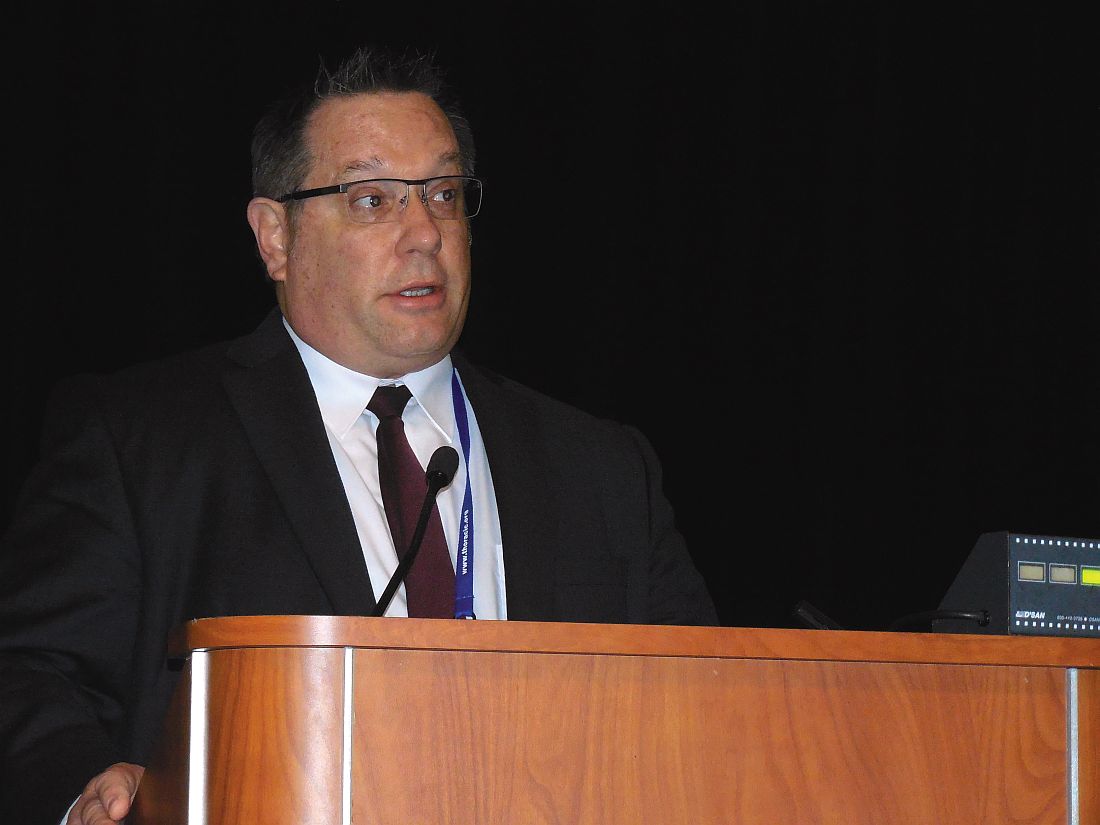
The U.S. registry reported by Dr. Aksamit had 2-year follow-up data for 1,049 of the enrolled patients, a subgroup that closely matched the entire population initially enrolled. The 2-year follow-up showed an overall average exacerbation rate of 0.75 episodes per year, but this was driven largely by the subgroup of patients who entered the registry with a history of two or more exacerbations per year, who then averaged about 2.6 exacerbations during follow-up. In contrast, patients who entered the registry with a history of fewer than two exacerbations per year averaged fewer than a third of an exacerbation per year during follow-up, Dr. Aksamit reported.
The European bronchiectasis registry was partially funded by Bayer. Dr. Chalmers has been a consultant to Bayer and to AstraZeneca, Basilea, Grifols, Napp, and Raptor and has received research funding from Aradigm, AstraZeneca, Bayer, GlaxoSmithKline, and Pfizer. Dr. Aksamit had no disclosures.
[email protected]
On Twitter @mitchelzoler

WASHINGTON – Bronchiectasis patients with three or more exacerbations per year had twice the mortality during 5-year follow-up as patients with no recent exacerbations, in a prospective registry of nearly 2,600 European bronchiectasis patients.
A multivariate analysis showed this statistically significant doubled death rate after adjustment for baseline demographic and clinical differences between patients with no exacerbations during the year before they entered the registry, James D. Chalmers, MD, said at an international conference of the American Thoracic Society.
This 37% prevalence contrasted with a 19% U.S. prevalence of bronchiectasis patients having two or more exacerbations per year among 2,114 patients enrolled in a 13-center U.S. registry that was reported during the same session by Timothy R. Aksamit, MD, a pulmonologist at the Mayo Clinic in Rochester, Minn. During his talk, Dr. Aksamit suggested that the European cohort might include more patients with asthma, chronic obstructive pulmonary disease, or other complications in addition to bronchiectasis. Dr. Aksamit contended that the U.S. registry tried to exclusively enroll patients with bronchiectasis and no other disorder, possibly explaining the prevalence difference between Europe and the United States.
The European registry included patients with bronchiectasis seen in 10 centers in seven European countries and Israel. They averaged 67 years of age. While more than a third had a history of at least three exacerbations a year, one-quarter had no exacerbations during the year before they entered the study.
The U.S. registry reported by Dr. Aksamit had 2-year follow-up data for 1,049 of the enrolled patients, a subgroup that closely matched the entire population initially enrolled. The 2-year follow-up showed an overall average exacerbation rate of 0.75 episodes per year, but this was driven largely by the subgroup of patients who entered the registry with a history of two or more exacerbations per year, who then averaged about 2.6 exacerbations during follow-up. In contrast, patients who entered the registry with a history of fewer than two exacerbations per year averaged fewer than a third of an exacerbation per year during follow-up, Dr. Aksamit reported.
The European bronchiectasis registry was partially funded by Bayer. Dr. Chalmers has been a consultant to Bayer and to AstraZeneca, Basilea, Grifols, Napp, and Raptor and has received research funding from Aradigm, AstraZeneca, Bayer, GlaxoSmithKline, and Pfizer. Dr. Aksamit had no disclosures.
[email protected]
On Twitter @mitchelzoler
WASHINGTON – Bronchiectasis patients with three or more exacerbations per year had twice the mortality during 5-year follow-up as patients with no recent exacerbations, in a prospective registry of nearly 2,600 European bronchiectasis patients.
A multivariate analysis showed this statistically significant doubled death rate after adjustment for baseline demographic and clinical differences between patients with no exacerbations during the year before they entered the registry, James D. Chalmers, MD, said at an international conference of the American Thoracic Society.
This 37% prevalence contrasted with a 19% U.S. prevalence of bronchiectasis patients having two or more exacerbations per year among 2,114 patients enrolled in a 13-center U.S. registry that was reported during the same session by Timothy R. Aksamit, MD, a pulmonologist at the Mayo Clinic in Rochester, Minn. During his talk, Dr. Aksamit suggested that the European cohort might include more patients with asthma, chronic obstructive pulmonary disease, or other complications in addition to bronchiectasis. Dr. Aksamit contended that the U.S. registry tried to exclusively enroll patients with bronchiectasis and no other disorder, possibly explaining the prevalence difference between Europe and the United States.
The European registry included patients with bronchiectasis seen in 10 centers in seven European countries and Israel. They averaged 67 years of age. While more than a third had a history of at least three exacerbations a year, one-quarter had no exacerbations during the year before they entered the study.
The U.S. registry reported by Dr. Aksamit had 2-year follow-up data for 1,049 of the enrolled patients, a subgroup that closely matched the entire population initially enrolled. The 2-year follow-up showed an overall average exacerbation rate of 0.75 episodes per year, but this was driven largely by the subgroup of patients who entered the registry with a history of two or more exacerbations per year, who then averaged about 2.6 exacerbations during follow-up. In contrast, patients who entered the registry with a history of fewer than two exacerbations per year averaged fewer than a third of an exacerbation per year during follow-up, Dr. Aksamit reported.
The European bronchiectasis registry was partially funded by Bayer. Dr. Chalmers has been a consultant to Bayer and to AstraZeneca, Basilea, Grifols, Napp, and Raptor and has received research funding from Aradigm, AstraZeneca, Bayer, GlaxoSmithKline, and Pfizer. Dr. Aksamit had no disclosures.
[email protected]
On Twitter @mitchelzoler
AT ATS 2017
Key clinical point:
Major finding: Patients with frequent exacerbations had twice the mortality rate, compared with bronchiectasis patients with no recent exacerbations.
Data source: A registry of 2,596 bronchiectasis patients from 10 centers in Europe and Israel.
Disclosures: The European bronchiectasis registry was partially funded by Bayer. Dr. Chalmers has been a consultant to Bayer and to AstraZeneca, Basilea, Grifols, Napp, and Raptor and has received research funding from Aradigm, AstraZeneca, Bayer, GlaxoSmithKline, and Pfizer. Dr. Aksamit had no disclosures.
Age, anticoagulation prime issues in choice of mechanical valves
NEW YORK – While bioprosthetic valves have become the predominant choice for cardiothoracic surgeons performing heart valve replacement, situations exist in which a mechanical valve may be a better choice. Young and middle-aged adults are the ideal candidates for mechanical valves, but achieving long-term success with mechanical valves also depends on a patient’s circumstances, according to an expert panel at the American Association for Thoracic Surgery Mitral Conclave 2017 here.
“I think we should put in more mechanical valves,” said panel chair Thoralf M. Sundt III, MD, of Massachusetts General Hospital, Boston and former AATS president. “I think mechanical valves have gotten a bad rap. If patients have a supportive, stable social structure and they can manage their anticoagulation, I don’t think there’s anything wrong with a mechanical valve. I think the pendulum has swung too far.”

Anelechi C. Anyanwu, MD, of Mount Sinai Health System, New York, acknowledged another patient factor that would enter his calculus for recommending a mechanical mitral valve. “We would consider a mechanical valve in the patient who is compliant [and] well informed and understands well the requirements and implications of long-term anticoagulation,” he said. In another scenario – “the patient who’s had multiple reoperations – we may consider a mechanical valve.” Particularly, the patient who has had a reoperation for a bioprosthetic valve resulting from early degeneration will merit consideration of a mechanical prosthesis, Dr. Anyanwu said.
Michael A. Borger, MD, of Columbia University Medical Center, New York, agreed that the younger patient who has had a series of operations is a good candidate for a mechanical mitral valve. “In addition, the mechanical valve does have some hemodynamic advantages over bioprosthetic valves,” Dr. Borger said. “If a surgeon implants a 25-mm tissue valve with a plan for the patient to undergo a series of valve-in-valve operations in the future, mitral stenosis will definitely become a factor at some point.”

Pedro J. del Nido, MD, a pediatric cardiac surgeon at Children’s Hospital, Boston, expanded on that point. “We very, very rarely use mechanical valves in young patients,” Dr. del Nido said. “In very young patients, the reoperation rates for mechanical or biological valves are not much different. We still have to reoperate on both sets of patients. But, the reoperation itself for a mechanical valve is more difficult, and there is the need for full anticoagulation.”
Instead, Dr. del Nido has used the bovine Melody valve (Medtronic) in the mitral position for these patients because it accommodates some growth. Typically, the only time Dr. del Nido considers a mechanical valve in these young patients is for an aortic valve replacement.
Another younger patient that may be a good candidate for a mechanical valve is the 25-year-old male with rheumatic mitral stenosis. “I would err on the side of the mechanical valve in this patient if I were to make a choice, but I would present the patient with informed data on the outcomes of both mechanical valve and bioprosthesis,” according to Dr. Anyanwu

For even younger patients, Dr. del Nido bases his valve choice on their activity level. “I have a lot of young teenagers, and my decision is entirely based on what their background is like – what their regular life is like,” he said. “If they have a support structure than can help them manage anticoagulation, absolutely the mechanical valve is probably the best thing.”
However, there are exceptions because the couching of the device can change over time. “Eventually that 12-year-old [or] that 15-year-old is going to decide he can still snowboard or ride a motorcycle, and that’s when he’s going to get into trouble,” Dr. del Nido said. “If a reoperation is not problematic, I would still say it’s a tossup between the mechanical and biological valve. I would still offer the possibility of a bioprosthesis knowing that they’ll be back in 6, 8, or 10 years.”
Bleeding risk is another factor that can influence valve choice, as mechanical valve recipients must stay on anticoagulation. “The bleeding complication rates are very low when patients are younger, in their 40s or 50s, but the bleeding rates increase exponentially with warfarin for patients in their 80s and 90s,” Dr. Borger said. “The older you are, the more difficult it is to manage anticoagulation. In addition, the ability to stop anticoagulants because of bleeding is different for the two types of prostheses. If a patient develops bleeding during anticoagulation for leaflet immobility after a tissue valve-in-valve procedure, the physician can simply stop the warfarin. But, if you have a mechanical mitral valve in place that’s not an option.”
That’s not necessarily a bad problem to have, Dr. Sundt said, quoting Steven Bolling, MD, of the University of Michigan. “If you’re 25 and you’ve had your valve replaced and you’re worried about bleeding at the age of 80, I call that a success.”
Dr. Borger disclosed he is a speaker for and consultant to Edwards Lifesciences, Medtronic, and CryoLife; a speaker for St. Jude; and a recipient of research support from NeoChord. Dr. Lange disclosed he is a consultant and speaker for Medtronic, St. Jude/Abbott, LivaNova and NeoChord and cofounder of HighLife. Dr. Anyanwu, Dr. del Nido, and Dr. Sundt reported no relevant financial relationships.
NEW YORK – While bioprosthetic valves have become the predominant choice for cardiothoracic surgeons performing heart valve replacement, situations exist in which a mechanical valve may be a better choice. Young and middle-aged adults are the ideal candidates for mechanical valves, but achieving long-term success with mechanical valves also depends on a patient’s circumstances, according to an expert panel at the American Association for Thoracic Surgery Mitral Conclave 2017 here.
“I think we should put in more mechanical valves,” said panel chair Thoralf M. Sundt III, MD, of Massachusetts General Hospital, Boston and former AATS president. “I think mechanical valves have gotten a bad rap. If patients have a supportive, stable social structure and they can manage their anticoagulation, I don’t think there’s anything wrong with a mechanical valve. I think the pendulum has swung too far.”
Anelechi C. Anyanwu, MD, of Mount Sinai Health System, New York, acknowledged another patient factor that would enter his calculus for recommending a mechanical mitral valve. “We would consider a mechanical valve in the patient who is compliant [and] well informed and understands well the requirements and implications of long-term anticoagulation,” he said. In another scenario – “the patient who’s had multiple reoperations – we may consider a mechanical valve.” Particularly, the patient who has had a reoperation for a bioprosthetic valve resulting from early degeneration will merit consideration of a mechanical prosthesis, Dr. Anyanwu said.
Michael A. Borger, MD, of Columbia University Medical Center, New York, agreed that the younger patient who has had a series of operations is a good candidate for a mechanical mitral valve. “In addition, the mechanical valve does have some hemodynamic advantages over bioprosthetic valves,” Dr. Borger said. “If a surgeon implants a 25-mm tissue valve with a plan for the patient to undergo a series of valve-in-valve operations in the future, mitral stenosis will definitely become a factor at some point.”
Pedro J. del Nido, MD, a pediatric cardiac surgeon at Children’s Hospital, Boston, expanded on that point. “We very, very rarely use mechanical valves in young patients,” Dr. del Nido said. “In very young patients, the reoperation rates for mechanical or biological valves are not much different. We still have to reoperate on both sets of patients. But, the reoperation itself for a mechanical valve is more difficult, and there is the need for full anticoagulation.”
Instead, Dr. del Nido has used the bovine Melody valve (Medtronic) in the mitral position for these patients because it accommodates some growth. Typically, the only time Dr. del Nido considers a mechanical valve in these young patients is for an aortic valve replacement.
Another younger patient that may be a good candidate for a mechanical valve is the 25-year-old male with rheumatic mitral stenosis. “I would err on the side of the mechanical valve in this patient if I were to make a choice, but I would present the patient with informed data on the outcomes of both mechanical valve and bioprosthesis,” according to Dr. Anyanwu
For even younger patients, Dr. del Nido bases his valve choice on their activity level. “I have a lot of young teenagers, and my decision is entirely based on what their background is like – what their regular life is like,” he said. “If they have a support structure than can help them manage anticoagulation, absolutely the mechanical valve is probably the best thing.”
However, there are exceptions because the couching of the device can change over time. “Eventually that 12-year-old [or] that 15-year-old is going to decide he can still snowboard or ride a motorcycle, and that’s when he’s going to get into trouble,” Dr. del Nido said. “If a reoperation is not problematic, I would still say it’s a tossup between the mechanical and biological valve. I would still offer the possibility of a bioprosthesis knowing that they’ll be back in 6, 8, or 10 years.”
Bleeding risk is another factor that can influence valve choice, as mechanical valve recipients must stay on anticoagulation. “The bleeding complication rates are very low when patients are younger, in their 40s or 50s, but the bleeding rates increase exponentially with warfarin for patients in their 80s and 90s,” Dr. Borger said. “The older you are, the more difficult it is to manage anticoagulation. In addition, the ability to stop anticoagulants because of bleeding is different for the two types of prostheses. If a patient develops bleeding during anticoagulation for leaflet immobility after a tissue valve-in-valve procedure, the physician can simply stop the warfarin. But, if you have a mechanical mitral valve in place that’s not an option.”
That’s not necessarily a bad problem to have, Dr. Sundt said, quoting Steven Bolling, MD, of the University of Michigan. “If you’re 25 and you’ve had your valve replaced and you’re worried about bleeding at the age of 80, I call that a success.”
Dr. Borger disclosed he is a speaker for and consultant to Edwards Lifesciences, Medtronic, and CryoLife; a speaker for St. Jude; and a recipient of research support from NeoChord. Dr. Lange disclosed he is a consultant and speaker for Medtronic, St. Jude/Abbott, LivaNova and NeoChord and cofounder of HighLife. Dr. Anyanwu, Dr. del Nido, and Dr. Sundt reported no relevant financial relationships.
NEW YORK – While bioprosthetic valves have become the predominant choice for cardiothoracic surgeons performing heart valve replacement, situations exist in which a mechanical valve may be a better choice. Young and middle-aged adults are the ideal candidates for mechanical valves, but achieving long-term success with mechanical valves also depends on a patient’s circumstances, according to an expert panel at the American Association for Thoracic Surgery Mitral Conclave 2017 here.
“I think we should put in more mechanical valves,” said panel chair Thoralf M. Sundt III, MD, of Massachusetts General Hospital, Boston and former AATS president. “I think mechanical valves have gotten a bad rap. If patients have a supportive, stable social structure and they can manage their anticoagulation, I don’t think there’s anything wrong with a mechanical valve. I think the pendulum has swung too far.”
Anelechi C. Anyanwu, MD, of Mount Sinai Health System, New York, acknowledged another patient factor that would enter his calculus for recommending a mechanical mitral valve. “We would consider a mechanical valve in the patient who is compliant [and] well informed and understands well the requirements and implications of long-term anticoagulation,” he said. In another scenario – “the patient who’s had multiple reoperations – we may consider a mechanical valve.” Particularly, the patient who has had a reoperation for a bioprosthetic valve resulting from early degeneration will merit consideration of a mechanical prosthesis, Dr. Anyanwu said.
Michael A. Borger, MD, of Columbia University Medical Center, New York, agreed that the younger patient who has had a series of operations is a good candidate for a mechanical mitral valve. “In addition, the mechanical valve does have some hemodynamic advantages over bioprosthetic valves,” Dr. Borger said. “If a surgeon implants a 25-mm tissue valve with a plan for the patient to undergo a series of valve-in-valve operations in the future, mitral stenosis will definitely become a factor at some point.”
Pedro J. del Nido, MD, a pediatric cardiac surgeon at Children’s Hospital, Boston, expanded on that point. “We very, very rarely use mechanical valves in young patients,” Dr. del Nido said. “In very young patients, the reoperation rates for mechanical or biological valves are not much different. We still have to reoperate on both sets of patients. But, the reoperation itself for a mechanical valve is more difficult, and there is the need for full anticoagulation.”
Instead, Dr. del Nido has used the bovine Melody valve (Medtronic) in the mitral position for these patients because it accommodates some growth. Typically, the only time Dr. del Nido considers a mechanical valve in these young patients is for an aortic valve replacement.
Another younger patient that may be a good candidate for a mechanical valve is the 25-year-old male with rheumatic mitral stenosis. “I would err on the side of the mechanical valve in this patient if I were to make a choice, but I would present the patient with informed data on the outcomes of both mechanical valve and bioprosthesis,” according to Dr. Anyanwu
For even younger patients, Dr. del Nido bases his valve choice on their activity level. “I have a lot of young teenagers, and my decision is entirely based on what their background is like – what their regular life is like,” he said. “If they have a support structure than can help them manage anticoagulation, absolutely the mechanical valve is probably the best thing.”
However, there are exceptions because the couching of the device can change over time. “Eventually that 12-year-old [or] that 15-year-old is going to decide he can still snowboard or ride a motorcycle, and that’s when he’s going to get into trouble,” Dr. del Nido said. “If a reoperation is not problematic, I would still say it’s a tossup between the mechanical and biological valve. I would still offer the possibility of a bioprosthesis knowing that they’ll be back in 6, 8, or 10 years.”
Bleeding risk is another factor that can influence valve choice, as mechanical valve recipients must stay on anticoagulation. “The bleeding complication rates are very low when patients are younger, in their 40s or 50s, but the bleeding rates increase exponentially with warfarin for patients in their 80s and 90s,” Dr. Borger said. “The older you are, the more difficult it is to manage anticoagulation. In addition, the ability to stop anticoagulants because of bleeding is different for the two types of prostheses. If a patient develops bleeding during anticoagulation for leaflet immobility after a tissue valve-in-valve procedure, the physician can simply stop the warfarin. But, if you have a mechanical mitral valve in place that’s not an option.”
That’s not necessarily a bad problem to have, Dr. Sundt said, quoting Steven Bolling, MD, of the University of Michigan. “If you’re 25 and you’ve had your valve replaced and you’re worried about bleeding at the age of 80, I call that a success.”
Dr. Borger disclosed he is a speaker for and consultant to Edwards Lifesciences, Medtronic, and CryoLife; a speaker for St. Jude; and a recipient of research support from NeoChord. Dr. Lange disclosed he is a consultant and speaker for Medtronic, St. Jude/Abbott, LivaNova and NeoChord and cofounder of HighLife. Dr. Anyanwu, Dr. del Nido, and Dr. Sundt reported no relevant financial relationships.
EXPERT ANALYSIS FROM THE 2017 MITRAL VALVE CONCLAVE
IDegLira equals basal-bolus insulin in HbA1c, lowers hypoglycemia risk
SAN DIEGO – When basal insulin alone does not achieve glucose targets in type 2 diabetes, a single fixed-dose injection of insulin degludec and liraglutide (IDegLira) is as effective as multiple insulin injections and has a significantly lower risk of hypoglycemia, according to a randomized, multicenter, open-label, industry-sponsored trial.
After 26 weeks of treatment, average hemoglobin A1c levels dropped similarly with once-daily IDegLira (1.48%) as with basal insulin glargine U100 plus mealtime injections of short-acting insulin aspart (1.46%; P less than .0001 for noninferiority), reported Liana K. Billings, MD, at the annual scientific sessions of the American Diabetes Association.
Patients also needed significantly less insulin and lost significantly more weight on IDegLira, compared with the basal-bolus regimen. “This is some of the most robust, most impressive data I’ve seen in years,” Julio Rosenstock, MD, director of the Dallas Diabetes and Endocrine Center in Texas, commented from the audience. Dr. Rosenstock was not involved in the trial and has studied other combination regimens for type 2 diabetes.
The advent of new insulins and adjunct therapies gives clinicians many potential algorithms for treating type 2 diabetes patients. The ADA recommends that health care professionals consider dual or triple therapy if patients do not meet glycemic targets with lifestyle changes and metformin alone. However, weight gain, hypoglycemia, and complex treatment regimens can make it difficult to intensify treatment in the real world, Dr. Billings said.
Insulin degludec is an ultra–long-acting basal insulin analogue, while liraglutide is a GLP-1 receptor agonist. The open-label, phase III DUAL VII study compared once-daily IDegLira injection (Xultophy, Novo Nordisk) with once-daily basal insulin glargine (Lantus, Sanofi) U100 plus bolus insulin aspart (NovoLog, Novo Nordisk) at mealtimes in 506 adults with type 2 diabetes. All patients were on metformin and glargine (typically 34 U) at baseline. Most were in their late 50s and obese, with an average 13-year duration of type 2 diabetes and HbA1c levels of 8.2% despite treatment. The IDegLira group started at 16 U and titrated by 2 U twice weekly to reach a fasting glucose target of 72-90 mg/dL. Basal-bolus patients maintained their baseline glargine dose and added 4 U mealtime bolus insulin aspart, titrating to target by 1 U twice weekly. The primary endpoint was change in HbA1c levels after 26 weeks. More than 98% of patients completed the trial. Approximately two-thirds of patients in both arms achieved an HbA1c level below 7%, but IDegLira recipients were significantly more likely to do so without gaining weight or experiencing hypoglycemia during the last 12 weeks of treatment (odds ratio, 10.39; 95% CI, 5.76-18.75). The IDegLira arm received significantly less daily insulin than the basal-bolus arm (40 U versus 84 U; P less than .0001), and IDegLira patients lost an average of 0.93 kg, while the comparison group gained 2.64 kg. Rates of serious adverse events were low and similar between arms. The cumulative rate of nausea was higher with IDegLira (11.1%) than with basal-bolus therapy (1.6%), Dr. Billings said. There were no deaths or unexpected adverse events.
Novo Nordisk makes Xultophy and funded the trial. Dr. Billings reported having served on advisory panels and speaker bureaus for Novo Nordisk.
SAN DIEGO – When basal insulin alone does not achieve glucose targets in type 2 diabetes, a single fixed-dose injection of insulin degludec and liraglutide (IDegLira) is as effective as multiple insulin injections and has a significantly lower risk of hypoglycemia, according to a randomized, multicenter, open-label, industry-sponsored trial.
After 26 weeks of treatment, average hemoglobin A1c levels dropped similarly with once-daily IDegLira (1.48%) as with basal insulin glargine U100 plus mealtime injections of short-acting insulin aspart (1.46%; P less than .0001 for noninferiority), reported Liana K. Billings, MD, at the annual scientific sessions of the American Diabetes Association.
Patients also needed significantly less insulin and lost significantly more weight on IDegLira, compared with the basal-bolus regimen. “This is some of the most robust, most impressive data I’ve seen in years,” Julio Rosenstock, MD, director of the Dallas Diabetes and Endocrine Center in Texas, commented from the audience. Dr. Rosenstock was not involved in the trial and has studied other combination regimens for type 2 diabetes.
The advent of new insulins and adjunct therapies gives clinicians many potential algorithms for treating type 2 diabetes patients. The ADA recommends that health care professionals consider dual or triple therapy if patients do not meet glycemic targets with lifestyle changes and metformin alone. However, weight gain, hypoglycemia, and complex treatment regimens can make it difficult to intensify treatment in the real world, Dr. Billings said.
Insulin degludec is an ultra–long-acting basal insulin analogue, while liraglutide is a GLP-1 receptor agonist. The open-label, phase III DUAL VII study compared once-daily IDegLira injection (Xultophy, Novo Nordisk) with once-daily basal insulin glargine (Lantus, Sanofi) U100 plus bolus insulin aspart (NovoLog, Novo Nordisk) at mealtimes in 506 adults with type 2 diabetes. All patients were on metformin and glargine (typically 34 U) at baseline. Most were in their late 50s and obese, with an average 13-year duration of type 2 diabetes and HbA1c levels of 8.2% despite treatment. The IDegLira group started at 16 U and titrated by 2 U twice weekly to reach a fasting glucose target of 72-90 mg/dL. Basal-bolus patients maintained their baseline glargine dose and added 4 U mealtime bolus insulin aspart, titrating to target by 1 U twice weekly. The primary endpoint was change in HbA1c levels after 26 weeks. More than 98% of patients completed the trial. Approximately two-thirds of patients in both arms achieved an HbA1c level below 7%, but IDegLira recipients were significantly more likely to do so without gaining weight or experiencing hypoglycemia during the last 12 weeks of treatment (odds ratio, 10.39; 95% CI, 5.76-18.75). The IDegLira arm received significantly less daily insulin than the basal-bolus arm (40 U versus 84 U; P less than .0001), and IDegLira patients lost an average of 0.93 kg, while the comparison group gained 2.64 kg. Rates of serious adverse events were low and similar between arms. The cumulative rate of nausea was higher with IDegLira (11.1%) than with basal-bolus therapy (1.6%), Dr. Billings said. There were no deaths or unexpected adverse events.
Novo Nordisk makes Xultophy and funded the trial. Dr. Billings reported having served on advisory panels and speaker bureaus for Novo Nordisk.
SAN DIEGO – When basal insulin alone does not achieve glucose targets in type 2 diabetes, a single fixed-dose injection of insulin degludec and liraglutide (IDegLira) is as effective as multiple insulin injections and has a significantly lower risk of hypoglycemia, according to a randomized, multicenter, open-label, industry-sponsored trial.
After 26 weeks of treatment, average hemoglobin A1c levels dropped similarly with once-daily IDegLira (1.48%) as with basal insulin glargine U100 plus mealtime injections of short-acting insulin aspart (1.46%; P less than .0001 for noninferiority), reported Liana K. Billings, MD, at the annual scientific sessions of the American Diabetes Association.
Patients also needed significantly less insulin and lost significantly more weight on IDegLira, compared with the basal-bolus regimen. “This is some of the most robust, most impressive data I’ve seen in years,” Julio Rosenstock, MD, director of the Dallas Diabetes and Endocrine Center in Texas, commented from the audience. Dr. Rosenstock was not involved in the trial and has studied other combination regimens for type 2 diabetes.
The advent of new insulins and adjunct therapies gives clinicians many potential algorithms for treating type 2 diabetes patients. The ADA recommends that health care professionals consider dual or triple therapy if patients do not meet glycemic targets with lifestyle changes and metformin alone. However, weight gain, hypoglycemia, and complex treatment regimens can make it difficult to intensify treatment in the real world, Dr. Billings said.
Insulin degludec is an ultra–long-acting basal insulin analogue, while liraglutide is a GLP-1 receptor agonist. The open-label, phase III DUAL VII study compared once-daily IDegLira injection (Xultophy, Novo Nordisk) with once-daily basal insulin glargine (Lantus, Sanofi) U100 plus bolus insulin aspart (NovoLog, Novo Nordisk) at mealtimes in 506 adults with type 2 diabetes. All patients were on metformin and glargine (typically 34 U) at baseline. Most were in their late 50s and obese, with an average 13-year duration of type 2 diabetes and HbA1c levels of 8.2% despite treatment. The IDegLira group started at 16 U and titrated by 2 U twice weekly to reach a fasting glucose target of 72-90 mg/dL. Basal-bolus patients maintained their baseline glargine dose and added 4 U mealtime bolus insulin aspart, titrating to target by 1 U twice weekly. The primary endpoint was change in HbA1c levels after 26 weeks. More than 98% of patients completed the trial. Approximately two-thirds of patients in both arms achieved an HbA1c level below 7%, but IDegLira recipients were significantly more likely to do so without gaining weight or experiencing hypoglycemia during the last 12 weeks of treatment (odds ratio, 10.39; 95% CI, 5.76-18.75). The IDegLira arm received significantly less daily insulin than the basal-bolus arm (40 U versus 84 U; P less than .0001), and IDegLira patients lost an average of 0.93 kg, while the comparison group gained 2.64 kg. Rates of serious adverse events were low and similar between arms. The cumulative rate of nausea was higher with IDegLira (11.1%) than with basal-bolus therapy (1.6%), Dr. Billings said. There were no deaths or unexpected adverse events.
Novo Nordisk makes Xultophy and funded the trial. Dr. Billings reported having served on advisory panels and speaker bureaus for Novo Nordisk.
AT THE ADA ANNUAL SCIENTIFIC SESSIONS
Key clinical point: A single daily injection of fixed-dose insulin degludec and liraglutide (IDegLira) improved hemoglobin A1c levels as much as basal-bolus insulin therapy while producing significantly less hypoglycemia.
Major finding: HbA1c levels dropped similarly with IDegLira (1.48%) or basal insulin glargine U100 plus mealtime injections of short-acting insulin aspart (1.46%; P less than .0001 for noninferiority).
Data source: DUAL VII, a multicenter, randomized, open-label, phase III trial of 506 adults with type 2 diabetes who did not reach glucose targets on basal insulin glargine and metformin.
Disclosures: Novo Nordisk makes Xultophy and funded the trial. Dr. Billings reported having served on advisory panels and speaker bureaus for Novo Nordisk.
Telemonitoring with feedback improves CPAP
BOSTON – Remote monitoring of continuous positive airway pressure (CPAP) use with feedback messaging to patients improves adherence but only when patients opt to receive continual feedback on their usage, according to a study.
Dennis Hwang, MD, medical director of Kaiser Permanent Fontana Medical Center in California and his colleagues designed the four-arm Tele-OSA study to evaluate the impact of two automated telemedicine interventions: an obstructive sleep apnea (OSA) education program (provided by Emmi Solutions) and a CPAP remote monitoring system with automated patient feedback (U-Sleep, ResMed). Dr. Hwang, who is also cochair of sleep medicine at Southern California Permanente Medical Group, presented his findings at the annual meeting of the Associated Professional Sleep Societies.

CPAP adherence was compared at 3 months and 1 year for patients in all four groups. Dr. Hwang reported findings from 556 patients who completed one-year follow-up.
At 90 days, patients assigned to either of the telemonitoring arms had significantly higher CPAP usage than those who did not receive telemonitoring.
However, at 3 months when the study protocol called for the automated messaging to be turned off, CPAP adherence dropped off. By 8 months, adherence in patients using the telemonitoring system was no different from that in those who never received the automated messaging. That would have been the end of the story, except that there was a glitch in the system.
“Perhaps serendipitously, we had a group of patients, about one-third, for whom we inadvertently did not turn off the messaging,” explained Dr. Hwang. “In these patients who continued to receive feedback, CPAP usage remained elevated throughout the course of the year and, at 12 months, was significantly higher than in the patients who were not receiving any kind of messaging.”
Dr. Hwang added that the telemonitoring required no additional provider intervention, “suggesting that this could be a cost-effective strategy.”
Only one-third of patients (66.7%) assigned to one of the tele-education groups viewed the video. Additionally, the researchers found that, whether patients used the tele-education alone or in combination with the telemonitoring, tele-education use had no impact on 90-day compliance with CPAP.
Dr. Hwang received support from the American Sleep Medicine Foundation and ResMed Science.
BOSTON – Remote monitoring of continuous positive airway pressure (CPAP) use with feedback messaging to patients improves adherence but only when patients opt to receive continual feedback on their usage, according to a study.
Dennis Hwang, MD, medical director of Kaiser Permanent Fontana Medical Center in California and his colleagues designed the four-arm Tele-OSA study to evaluate the impact of two automated telemedicine interventions: an obstructive sleep apnea (OSA) education program (provided by Emmi Solutions) and a CPAP remote monitoring system with automated patient feedback (U-Sleep, ResMed). Dr. Hwang, who is also cochair of sleep medicine at Southern California Permanente Medical Group, presented his findings at the annual meeting of the Associated Professional Sleep Societies.
CPAP adherence was compared at 3 months and 1 year for patients in all four groups. Dr. Hwang reported findings from 556 patients who completed one-year follow-up.
At 90 days, patients assigned to either of the telemonitoring arms had significantly higher CPAP usage than those who did not receive telemonitoring.
However, at 3 months when the study protocol called for the automated messaging to be turned off, CPAP adherence dropped off. By 8 months, adherence in patients using the telemonitoring system was no different from that in those who never received the automated messaging. That would have been the end of the story, except that there was a glitch in the system.
“Perhaps serendipitously, we had a group of patients, about one-third, for whom we inadvertently did not turn off the messaging,” explained Dr. Hwang. “In these patients who continued to receive feedback, CPAP usage remained elevated throughout the course of the year and, at 12 months, was significantly higher than in the patients who were not receiving any kind of messaging.”
Dr. Hwang added that the telemonitoring required no additional provider intervention, “suggesting that this could be a cost-effective strategy.”
Only one-third of patients (66.7%) assigned to one of the tele-education groups viewed the video. Additionally, the researchers found that, whether patients used the tele-education alone or in combination with the telemonitoring, tele-education use had no impact on 90-day compliance with CPAP.
Dr. Hwang received support from the American Sleep Medicine Foundation and ResMed Science.
BOSTON – Remote monitoring of continuous positive airway pressure (CPAP) use with feedback messaging to patients improves adherence but only when patients opt to receive continual feedback on their usage, according to a study.
Dennis Hwang, MD, medical director of Kaiser Permanent Fontana Medical Center in California and his colleagues designed the four-arm Tele-OSA study to evaluate the impact of two automated telemedicine interventions: an obstructive sleep apnea (OSA) education program (provided by Emmi Solutions) and a CPAP remote monitoring system with automated patient feedback (U-Sleep, ResMed). Dr. Hwang, who is also cochair of sleep medicine at Southern California Permanente Medical Group, presented his findings at the annual meeting of the Associated Professional Sleep Societies.
CPAP adherence was compared at 3 months and 1 year for patients in all four groups. Dr. Hwang reported findings from 556 patients who completed one-year follow-up.
At 90 days, patients assigned to either of the telemonitoring arms had significantly higher CPAP usage than those who did not receive telemonitoring.
However, at 3 months when the study protocol called for the automated messaging to be turned off, CPAP adherence dropped off. By 8 months, adherence in patients using the telemonitoring system was no different from that in those who never received the automated messaging. That would have been the end of the story, except that there was a glitch in the system.
“Perhaps serendipitously, we had a group of patients, about one-third, for whom we inadvertently did not turn off the messaging,” explained Dr. Hwang. “In these patients who continued to receive feedback, CPAP usage remained elevated throughout the course of the year and, at 12 months, was significantly higher than in the patients who were not receiving any kind of messaging.”
Dr. Hwang added that the telemonitoring required no additional provider intervention, “suggesting that this could be a cost-effective strategy.”
Only one-third of patients (66.7%) assigned to one of the tele-education groups viewed the video. Additionally, the researchers found that, whether patients used the tele-education alone or in combination with the telemonitoring, tele-education use had no impact on 90-day compliance with CPAP.
Dr. Hwang received support from the American Sleep Medicine Foundation and ResMed Science.
AT SLEEP 2017
Key clinical point: CPAP telemonitoring with feedback messaging improved CPAP adherence with no additional provider intervention needed.
Major finding: CPAP adherence was significantly higher at 3 months in patients who had remote monitoring of usage with subsequent continuous automated feedback. At one year, usage was only higher in those patients who continued to receive messaging during usage of the telemonitoring system and not in those who had the messaging component “turned off.”
Data source: A four-arm, randomized clinical trial that tested tele-education and CPAP telemonitoring interventions in 1,455 patients.
Disclosures: Dr. Hwang received support from the American Sleep Medicine Foundation and ResMed Science Center.