User login
Positive node risk defined for elderly breast cancer patients
LAS VEGAS – In women aged 70 years or older with hormone receptor–positive invasive breast cancer, their tumor size, grade, and histology – but not human epidermal growth factor receptor–2 status – predicted nodal positivity, according to a retrospective analysis.
Investigators at the Mayo Clinic, Rochester, Minn., reviewed 52,532 women in the National Cancer Database from 2010 to 2013 who were at least 70 years old with hormone receptor–positive invasive breast cancer and clinically node negative disease, who had axillary surgery performed. Two-thirds of the cohort was used to identify risk factors, and the remaining third to validate them. About 16% in both groups had cancer in their axillary lymph nodes.
On multivariate analysis, higher clinical T stage, higher grade, and invasive lobular and invasive mammary histology were all associated with positive nodes. Although significant on univariate analysis, age (P = .57) and HER2 status (P = .32) fell out on multivariate analysis.
Nodal positivity was more than five times as likely with clinical T2 tumors, compared with T1a tumors, and far less likely for patients with invasive mucinous carcinoma than for those with invasive ductal carcinoma.
The team expects to release a nomogram for general use in clinical practice to predict the risk of positive nodes for various combinations of tumor size, grade, and histology in older women. When the model predicted a less than 10% chance of node positive disease, the actual rate in the validation set was around 5.5%. When it predicted a 30%-39% chance, the actual rate was 32.6%. The area under the receiver operating characteristic curve was 0.7 in both the development and validation sets, indicating good discrimination.
The work grew out of an effort to implement the Society of Surgical Oncologists’ recommendation not to do routine sentinel node biopsies in clinically node negative, hormone receptor–positive invasive breast cancer in women over the age of 70 years, a recommendation the group made as part of its contribution to the Choosing Wisely campaign.
“After the guideline was released, we were sitting in the clinic thinking how to apply it to our patients,” lead investigator Jessemae Welsh, MD, a surgeon at the Mayo Clinic, said at the American Society of Breast Surgeons annual meeting.
The problem is that nodal positivity is important to know for other aspects of care, including regional nodal irradiation and duration of systemic hormone therapy, and axillary lymph node staging might still be indicated if older women are truly at high risk. “We [wanted] to develop a multivariate model that gives a precise estimate of nodal risk,” to help “patients and surgeons to decide together based on an individual risk” how best to proceed. Also, a prediction of low risk “can help reassure patients that they will do well without axillary surgery,” she said.
Mayo’s nomogram is unique in that it focuses specifically on women 70 years and older. Development of previous nomograms incorporated older women, but did not focus on them specifically, Dr. Welsh said.
Dr. Welsh said she had no relevant disclosures.
[email protected]
LAS VEGAS – In women aged 70 years or older with hormone receptor–positive invasive breast cancer, their tumor size, grade, and histology – but not human epidermal growth factor receptor–2 status – predicted nodal positivity, according to a retrospective analysis.
Investigators at the Mayo Clinic, Rochester, Minn., reviewed 52,532 women in the National Cancer Database from 2010 to 2013 who were at least 70 years old with hormone receptor–positive invasive breast cancer and clinically node negative disease, who had axillary surgery performed. Two-thirds of the cohort was used to identify risk factors, and the remaining third to validate them. About 16% in both groups had cancer in their axillary lymph nodes.
On multivariate analysis, higher clinical T stage, higher grade, and invasive lobular and invasive mammary histology were all associated with positive nodes. Although significant on univariate analysis, age (P = .57) and HER2 status (P = .32) fell out on multivariate analysis.
Nodal positivity was more than five times as likely with clinical T2 tumors, compared with T1a tumors, and far less likely for patients with invasive mucinous carcinoma than for those with invasive ductal carcinoma.
The team expects to release a nomogram for general use in clinical practice to predict the risk of positive nodes for various combinations of tumor size, grade, and histology in older women. When the model predicted a less than 10% chance of node positive disease, the actual rate in the validation set was around 5.5%. When it predicted a 30%-39% chance, the actual rate was 32.6%. The area under the receiver operating characteristic curve was 0.7 in both the development and validation sets, indicating good discrimination.
The work grew out of an effort to implement the Society of Surgical Oncologists’ recommendation not to do routine sentinel node biopsies in clinically node negative, hormone receptor–positive invasive breast cancer in women over the age of 70 years, a recommendation the group made as part of its contribution to the Choosing Wisely campaign.
“After the guideline was released, we were sitting in the clinic thinking how to apply it to our patients,” lead investigator Jessemae Welsh, MD, a surgeon at the Mayo Clinic, said at the American Society of Breast Surgeons annual meeting.
The problem is that nodal positivity is important to know for other aspects of care, including regional nodal irradiation and duration of systemic hormone therapy, and axillary lymph node staging might still be indicated if older women are truly at high risk. “We [wanted] to develop a multivariate model that gives a precise estimate of nodal risk,” to help “patients and surgeons to decide together based on an individual risk” how best to proceed. Also, a prediction of low risk “can help reassure patients that they will do well without axillary surgery,” she said.
Mayo’s nomogram is unique in that it focuses specifically on women 70 years and older. Development of previous nomograms incorporated older women, but did not focus on them specifically, Dr. Welsh said.
Dr. Welsh said she had no relevant disclosures.
[email protected]
LAS VEGAS – In women aged 70 years or older with hormone receptor–positive invasive breast cancer, their tumor size, grade, and histology – but not human epidermal growth factor receptor–2 status – predicted nodal positivity, according to a retrospective analysis.
Investigators at the Mayo Clinic, Rochester, Minn., reviewed 52,532 women in the National Cancer Database from 2010 to 2013 who were at least 70 years old with hormone receptor–positive invasive breast cancer and clinically node negative disease, who had axillary surgery performed. Two-thirds of the cohort was used to identify risk factors, and the remaining third to validate them. About 16% in both groups had cancer in their axillary lymph nodes.
On multivariate analysis, higher clinical T stage, higher grade, and invasive lobular and invasive mammary histology were all associated with positive nodes. Although significant on univariate analysis, age (P = .57) and HER2 status (P = .32) fell out on multivariate analysis.
Nodal positivity was more than five times as likely with clinical T2 tumors, compared with T1a tumors, and far less likely for patients with invasive mucinous carcinoma than for those with invasive ductal carcinoma.
The team expects to release a nomogram for general use in clinical practice to predict the risk of positive nodes for various combinations of tumor size, grade, and histology in older women. When the model predicted a less than 10% chance of node positive disease, the actual rate in the validation set was around 5.5%. When it predicted a 30%-39% chance, the actual rate was 32.6%. The area under the receiver operating characteristic curve was 0.7 in both the development and validation sets, indicating good discrimination.
The work grew out of an effort to implement the Society of Surgical Oncologists’ recommendation not to do routine sentinel node biopsies in clinically node negative, hormone receptor–positive invasive breast cancer in women over the age of 70 years, a recommendation the group made as part of its contribution to the Choosing Wisely campaign.
“After the guideline was released, we were sitting in the clinic thinking how to apply it to our patients,” lead investigator Jessemae Welsh, MD, a surgeon at the Mayo Clinic, said at the American Society of Breast Surgeons annual meeting.
The problem is that nodal positivity is important to know for other aspects of care, including regional nodal irradiation and duration of systemic hormone therapy, and axillary lymph node staging might still be indicated if older women are truly at high risk. “We [wanted] to develop a multivariate model that gives a precise estimate of nodal risk,” to help “patients and surgeons to decide together based on an individual risk” how best to proceed. Also, a prediction of low risk “can help reassure patients that they will do well without axillary surgery,” she said.
Mayo’s nomogram is unique in that it focuses specifically on women 70 years and older. Development of previous nomograms incorporated older women, but did not focus on them specifically, Dr. Welsh said.
Dr. Welsh said she had no relevant disclosures.
[email protected]
AT ASBS 2017
Key clinical point:
Major finding: On multivariate analysis, higher clinical T stage, higher grade, and invasive lobular and invasive mammary histology were all associated with positive nodes.
Data source: An analysis of data from 52,532 women in the National Cancer Database during 2010-2013.
Disclosures: The lead investigator had no disclosures.
Forgo axillary dissection for single suspicious node on ultrasound
LAS VEGAS – About half of breast cancer patients without palpable lymphadenopathy but with preoperative ultrasound-guided, biopsy-proven axillary lymph node metastases have N1 disease, according to a review of 129 women.
Among the 30 women with a primary tumor 2 cm or smaller and only one abnormal lymph node on axillary ultrasound, 22 (73%) had metastases limited to the one lymph node, suggesting that such patients “may undergo ... sentinel lymph node biopsy” instead of a complete axillary lymph node dissection (ALND), the investigators concluded.
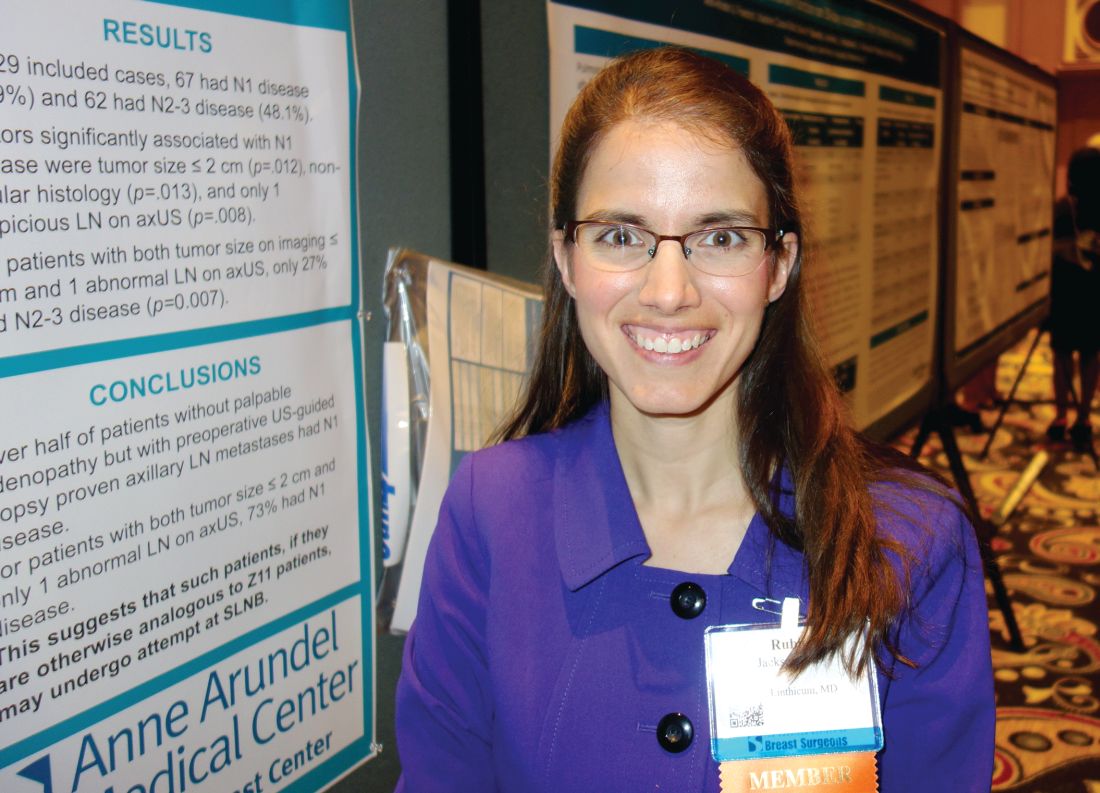
The problem that has come up in clinical practice is that axillary ultrasound is now a routine part of breast cancer workup, but the original trial didn’t address ultrasound, said senior investigator Rubie Sue Jackson, MD, at the annual meeting of the American Society of Breast Surgeons. As a result, “surgeons don’t know what to do with an ultrasound-detected suspicious node. I think a lot of surgeons, if they detect a positive lymph node by ultrasound, even if it’s nonpalpable, would not consider the patient a candidate for sentinel lymph node biopsy. Our data suggest that many of these patients are being overtreated if they have an upfront axillary lymph node dissection,” she said.
The 129 women had 1-3 suspicious, nonpalpable nodes on ultrasound that turned out to have metastatic disease on needle biopsy. They all had subsequent ALNDs.
On final pathology, 67 women (52%) had only one metastatic node. For those women, a sentinel lymph node biopsy was likely all that they required. “They probably did not benefit from having an ALND,” said Dr. Jackson, a breast surgeon at the Anne Arundel Medical Center in Annapolis, Md. The other 62 women (48%) had N2-3 disease.
A primary tumor sized 2 cm or smaller (P = .012); nonlobular histology (P = .013), and having only one suspicious nonpalpable node on ultrasound (P = .008) were all associated with NI disease. Of the women who met the criteria, only eight (27%) had N 2-3 disease (P = .007).
“Patients meeting the three criteria are particularly unlikely to have three or more positive sentinel lymph nodes” and require subsequent ALND. “You don’t need to do a complete axillary lymph node dissection upfront, as long as they are getting a lumpectomy and whole breast radiation,” Dr. Jackson said.
These days at Anne Arundel, “we do the axillary ultrasound, we biopsy the lymph node if it looks suspicious, but we don’t feel forced to do an ALND. If a patient has tumor biology that’s likely to be highly responsive, we do upfront chemotherapy. If they have luminal tumor biology that’s not going to be very responsive to neoadjuvant therapy,” with one or two suspicious nodes, “and they are planning to get breast conserving therapy, I would do a sentinel lymph node biopsy and x-ray the specimen to make sure that I’ve retrieved the clip,” she said.
Dr. Jackson didn’t have any disclosures, and there was no industry funding for the work.
[email protected]
LAS VEGAS – About half of breast cancer patients without palpable lymphadenopathy but with preoperative ultrasound-guided, biopsy-proven axillary lymph node metastases have N1 disease, according to a review of 129 women.
Among the 30 women with a primary tumor 2 cm or smaller and only one abnormal lymph node on axillary ultrasound, 22 (73%) had metastases limited to the one lymph node, suggesting that such patients “may undergo ... sentinel lymph node biopsy” instead of a complete axillary lymph node dissection (ALND), the investigators concluded.
The problem that has come up in clinical practice is that axillary ultrasound is now a routine part of breast cancer workup, but the original trial didn’t address ultrasound, said senior investigator Rubie Sue Jackson, MD, at the annual meeting of the American Society of Breast Surgeons. As a result, “surgeons don’t know what to do with an ultrasound-detected suspicious node. I think a lot of surgeons, if they detect a positive lymph node by ultrasound, even if it’s nonpalpable, would not consider the patient a candidate for sentinel lymph node biopsy. Our data suggest that many of these patients are being overtreated if they have an upfront axillary lymph node dissection,” she said.
The 129 women had 1-3 suspicious, nonpalpable nodes on ultrasound that turned out to have metastatic disease on needle biopsy. They all had subsequent ALNDs.
On final pathology, 67 women (52%) had only one metastatic node. For those women, a sentinel lymph node biopsy was likely all that they required. “They probably did not benefit from having an ALND,” said Dr. Jackson, a breast surgeon at the Anne Arundel Medical Center in Annapolis, Md. The other 62 women (48%) had N2-3 disease.
A primary tumor sized 2 cm or smaller (P = .012); nonlobular histology (P = .013), and having only one suspicious nonpalpable node on ultrasound (P = .008) were all associated with NI disease. Of the women who met the criteria, only eight (27%) had N 2-3 disease (P = .007).
“Patients meeting the three criteria are particularly unlikely to have three or more positive sentinel lymph nodes” and require subsequent ALND. “You don’t need to do a complete axillary lymph node dissection upfront, as long as they are getting a lumpectomy and whole breast radiation,” Dr. Jackson said.
These days at Anne Arundel, “we do the axillary ultrasound, we biopsy the lymph node if it looks suspicious, but we don’t feel forced to do an ALND. If a patient has tumor biology that’s likely to be highly responsive, we do upfront chemotherapy. If they have luminal tumor biology that’s not going to be very responsive to neoadjuvant therapy,” with one or two suspicious nodes, “and they are planning to get breast conserving therapy, I would do a sentinel lymph node biopsy and x-ray the specimen to make sure that I’ve retrieved the clip,” she said.
Dr. Jackson didn’t have any disclosures, and there was no industry funding for the work.
[email protected]
LAS VEGAS – About half of breast cancer patients without palpable lymphadenopathy but with preoperative ultrasound-guided, biopsy-proven axillary lymph node metastases have N1 disease, according to a review of 129 women.
Among the 30 women with a primary tumor 2 cm or smaller and only one abnormal lymph node on axillary ultrasound, 22 (73%) had metastases limited to the one lymph node, suggesting that such patients “may undergo ... sentinel lymph node biopsy” instead of a complete axillary lymph node dissection (ALND), the investigators concluded.
The problem that has come up in clinical practice is that axillary ultrasound is now a routine part of breast cancer workup, but the original trial didn’t address ultrasound, said senior investigator Rubie Sue Jackson, MD, at the annual meeting of the American Society of Breast Surgeons. As a result, “surgeons don’t know what to do with an ultrasound-detected suspicious node. I think a lot of surgeons, if they detect a positive lymph node by ultrasound, even if it’s nonpalpable, would not consider the patient a candidate for sentinel lymph node biopsy. Our data suggest that many of these patients are being overtreated if they have an upfront axillary lymph node dissection,” she said.
The 129 women had 1-3 suspicious, nonpalpable nodes on ultrasound that turned out to have metastatic disease on needle biopsy. They all had subsequent ALNDs.
On final pathology, 67 women (52%) had only one metastatic node. For those women, a sentinel lymph node biopsy was likely all that they required. “They probably did not benefit from having an ALND,” said Dr. Jackson, a breast surgeon at the Anne Arundel Medical Center in Annapolis, Md. The other 62 women (48%) had N2-3 disease.
A primary tumor sized 2 cm or smaller (P = .012); nonlobular histology (P = .013), and having only one suspicious nonpalpable node on ultrasound (P = .008) were all associated with NI disease. Of the women who met the criteria, only eight (27%) had N 2-3 disease (P = .007).
“Patients meeting the three criteria are particularly unlikely to have three or more positive sentinel lymph nodes” and require subsequent ALND. “You don’t need to do a complete axillary lymph node dissection upfront, as long as they are getting a lumpectomy and whole breast radiation,” Dr. Jackson said.
These days at Anne Arundel, “we do the axillary ultrasound, we biopsy the lymph node if it looks suspicious, but we don’t feel forced to do an ALND. If a patient has tumor biology that’s likely to be highly responsive, we do upfront chemotherapy. If they have luminal tumor biology that’s not going to be very responsive to neoadjuvant therapy,” with one or two suspicious nodes, “and they are planning to get breast conserving therapy, I would do a sentinel lymph node biopsy and x-ray the specimen to make sure that I’ve retrieved the clip,” she said.
Dr. Jackson didn’t have any disclosures, and there was no industry funding for the work.
[email protected]
AT ASBS 2017
Key clinical point:
Major finding: Among the 30 women with tumors 2 cm or smaller, and only one abnormal lymph node on axillary ultrasound, 22 (73%) had metastasis limited to the one lymph node.
Data source: A review of 129 women with breast cancer.
Disclosures: There was no industry funding, and the senior investigator had no disclosures.
Consider switch to clopidogrel for DAPT early post ACS
PARIS – A strategy of switching from prasugrel or ticagrelor to clopidogrel 1 month after percutaneous coronary intervention for acute coronary syndrome is superior to the guideline-recommended full 12 months of dual-antiplatelet therapy with either of the newer P2Y12 inhibitors, according to Thomas Cuisset, MD.
In the randomized TOPIC (Timing of Platelet Inhibition After Acute Coronary Syndrome) trial, this switch strategy resulted in a marked reduction in bleeding without an increased risk of ischemic events, compared with a full 12 months of standard dual-antiplatelet therapy (DAPT) using prasugrel (Effient) or ticagrelor (Brilinta).

He added that the cost savings of this switch strategy would be enormous, since generic clopidogrel is vastly less expensive than prasugrel or ticagrelor.
Twelve months of DAPT with aspirin plus either prasugrel or ticagrelor is the guideline-recommended DAPT regimen following PCI for ACS on the strength of the TRITON and PLATO trials, respectively, which showed that those agents were more effective than clopidogrel for the prevention of thrombotic events. But Dr. Cuisset and his coinvestigators noted that the risk of ischemic events was highest in the first month or so following ACS, while the risk of DAPT-related serious bleeding increased after the first month and continued for the duration.
“We need to use the new drugs, and we need to go for 1 year with DAPT. But does that mean we need to go for 1 year with the new drugs?” he asked.
This question was the impetus for TOPIC, an open-label, single-center randomized trial that included 646 ACS patients who were free of major adverse cardiovascular events during their first month on DAPT with prasugrel or ticagrelor. At that point they were randomized to remain on their standard regimen or switch to aspirin at 75 mg/day plus clopidogrel at 75 mg/day for months 2-12. The switch strategy is similar to the way pulmonary embolism is managed: an early phase of high-intensity therapy followed by a backing off to a less intensive regimen, said Dr. Cuisset, a cardiologist at Aix-Marseille University, Provence, France.
The primary endpoint in TOPIC was the cumulative 1-year rate of a composite of all-cause mortality, stroke, urgent revascularization, or clinically significant bleeding as reflected in a Bleeding Academic Research Consortium (BARC) grade 2 or greater bleeding. The primary endpoint occurred in 13.4% of the switch group, a 52% relative risk reduction, compared with the 26.3% cumulative incidence with standard DAPT.
This difference wasn’t due to any between-group disparity in ischemic events, but rather to a 70% reduction in the risk of BARC grade 2 or greater bleeding in the switch group: 4.0% vs. 14.9%.
Some physicians have already been switching to clopidogrel for DAPT after ACS, either because of safety or cost concerns. Now their practice is evidence based, Dr. Cuisset noted.
Asked why TOPIC didn’t use the more stringent bleeding endpoint of BARC grade 3-5 bleeding, the cardiologist replied that it would have required a larger trial to show a significant difference. Besides, he added, BARC grade 2 bleeding is clinically important because it has a negative impact on quality of life and can cause patients to discontinue DAPT, thereby increasing their risk of thrombosis.
The TOPIC protocol didn’t utilize a loading dose of clopidogrel when making the switch. Investigators started clopidogrel the day after stopping prasugrel and at least 12 hours after the final dose of ticagrelor.
Ideally, the novel TOPIC findings should be confirmed in a much larger, randomized, double-blind clinical trial capable of detecting any small differences in stent thrombosis or MI rates before physicians adopt a change in practice, but discussant Chaim Lotan, MD, director of the Heart Institute at Hadassah Medical Center in Jerusalem, dismissed that prospect as unlikely.
“I tried myself to do a similar study and found I got a lot of opposition from the pharma companies as well as from physicians who said, ‘How can you go against the guidelines?’ ” he said.
“I want to congratulate your team because I think this is a groundbreaking study that is going to dictate a changing of the guidelines,” he told Dr. Cuisset.
Dr. Cuisset reported having no financial conflicts regarding this investigator-driven study funded without commercial support.
Simultaneous with his presentation in Paris, the TOPIC findings were published online (Eur Heart J. 2017 May 16. doi: 10.1093/eurheartj/ehx175).
Dr. Cuisset reported no financial conflicts regarding this investigator-driven study funded without commercial support.
[email protected]
PARIS – A strategy of switching from prasugrel or ticagrelor to clopidogrel 1 month after percutaneous coronary intervention for acute coronary syndrome is superior to the guideline-recommended full 12 months of dual-antiplatelet therapy with either of the newer P2Y12 inhibitors, according to Thomas Cuisset, MD.
In the randomized TOPIC (Timing of Platelet Inhibition After Acute Coronary Syndrome) trial, this switch strategy resulted in a marked reduction in bleeding without an increased risk of ischemic events, compared with a full 12 months of standard dual-antiplatelet therapy (DAPT) using prasugrel (Effient) or ticagrelor (Brilinta).
He added that the cost savings of this switch strategy would be enormous, since generic clopidogrel is vastly less expensive than prasugrel or ticagrelor.
Twelve months of DAPT with aspirin plus either prasugrel or ticagrelor is the guideline-recommended DAPT regimen following PCI for ACS on the strength of the TRITON and PLATO trials, respectively, which showed that those agents were more effective than clopidogrel for the prevention of thrombotic events. But Dr. Cuisset and his coinvestigators noted that the risk of ischemic events was highest in the first month or so following ACS, while the risk of DAPT-related serious bleeding increased after the first month and continued for the duration.
“We need to use the new drugs, and we need to go for 1 year with DAPT. But does that mean we need to go for 1 year with the new drugs?” he asked.
This question was the impetus for TOPIC, an open-label, single-center randomized trial that included 646 ACS patients who were free of major adverse cardiovascular events during their first month on DAPT with prasugrel or ticagrelor. At that point they were randomized to remain on their standard regimen or switch to aspirin at 75 mg/day plus clopidogrel at 75 mg/day for months 2-12. The switch strategy is similar to the way pulmonary embolism is managed: an early phase of high-intensity therapy followed by a backing off to a less intensive regimen, said Dr. Cuisset, a cardiologist at Aix-Marseille University, Provence, France.
The primary endpoint in TOPIC was the cumulative 1-year rate of a composite of all-cause mortality, stroke, urgent revascularization, or clinically significant bleeding as reflected in a Bleeding Academic Research Consortium (BARC) grade 2 or greater bleeding. The primary endpoint occurred in 13.4% of the switch group, a 52% relative risk reduction, compared with the 26.3% cumulative incidence with standard DAPT.
This difference wasn’t due to any between-group disparity in ischemic events, but rather to a 70% reduction in the risk of BARC grade 2 or greater bleeding in the switch group: 4.0% vs. 14.9%.
Some physicians have already been switching to clopidogrel for DAPT after ACS, either because of safety or cost concerns. Now their practice is evidence based, Dr. Cuisset noted.
Asked why TOPIC didn’t use the more stringent bleeding endpoint of BARC grade 3-5 bleeding, the cardiologist replied that it would have required a larger trial to show a significant difference. Besides, he added, BARC grade 2 bleeding is clinically important because it has a negative impact on quality of life and can cause patients to discontinue DAPT, thereby increasing their risk of thrombosis.
The TOPIC protocol didn’t utilize a loading dose of clopidogrel when making the switch. Investigators started clopidogrel the day after stopping prasugrel and at least 12 hours after the final dose of ticagrelor.
Ideally, the novel TOPIC findings should be confirmed in a much larger, randomized, double-blind clinical trial capable of detecting any small differences in stent thrombosis or MI rates before physicians adopt a change in practice, but discussant Chaim Lotan, MD, director of the Heart Institute at Hadassah Medical Center in Jerusalem, dismissed that prospect as unlikely.
“I tried myself to do a similar study and found I got a lot of opposition from the pharma companies as well as from physicians who said, ‘How can you go against the guidelines?’ ” he said.
“I want to congratulate your team because I think this is a groundbreaking study that is going to dictate a changing of the guidelines,” he told Dr. Cuisset.
Dr. Cuisset reported having no financial conflicts regarding this investigator-driven study funded without commercial support.
Simultaneous with his presentation in Paris, the TOPIC findings were published online (Eur Heart J. 2017 May 16. doi: 10.1093/eurheartj/ehx175).
Dr. Cuisset reported no financial conflicts regarding this investigator-driven study funded without commercial support.
[email protected]
PARIS – A strategy of switching from prasugrel or ticagrelor to clopidogrel 1 month after percutaneous coronary intervention for acute coronary syndrome is superior to the guideline-recommended full 12 months of dual-antiplatelet therapy with either of the newer P2Y12 inhibitors, according to Thomas Cuisset, MD.
In the randomized TOPIC (Timing of Platelet Inhibition After Acute Coronary Syndrome) trial, this switch strategy resulted in a marked reduction in bleeding without an increased risk of ischemic events, compared with a full 12 months of standard dual-antiplatelet therapy (DAPT) using prasugrel (Effient) or ticagrelor (Brilinta).
He added that the cost savings of this switch strategy would be enormous, since generic clopidogrel is vastly less expensive than prasugrel or ticagrelor.
Twelve months of DAPT with aspirin plus either prasugrel or ticagrelor is the guideline-recommended DAPT regimen following PCI for ACS on the strength of the TRITON and PLATO trials, respectively, which showed that those agents were more effective than clopidogrel for the prevention of thrombotic events. But Dr. Cuisset and his coinvestigators noted that the risk of ischemic events was highest in the first month or so following ACS, while the risk of DAPT-related serious bleeding increased after the first month and continued for the duration.
“We need to use the new drugs, and we need to go for 1 year with DAPT. But does that mean we need to go for 1 year with the new drugs?” he asked.
This question was the impetus for TOPIC, an open-label, single-center randomized trial that included 646 ACS patients who were free of major adverse cardiovascular events during their first month on DAPT with prasugrel or ticagrelor. At that point they were randomized to remain on their standard regimen or switch to aspirin at 75 mg/day plus clopidogrel at 75 mg/day for months 2-12. The switch strategy is similar to the way pulmonary embolism is managed: an early phase of high-intensity therapy followed by a backing off to a less intensive regimen, said Dr. Cuisset, a cardiologist at Aix-Marseille University, Provence, France.
The primary endpoint in TOPIC was the cumulative 1-year rate of a composite of all-cause mortality, stroke, urgent revascularization, or clinically significant bleeding as reflected in a Bleeding Academic Research Consortium (BARC) grade 2 or greater bleeding. The primary endpoint occurred in 13.4% of the switch group, a 52% relative risk reduction, compared with the 26.3% cumulative incidence with standard DAPT.
This difference wasn’t due to any between-group disparity in ischemic events, but rather to a 70% reduction in the risk of BARC grade 2 or greater bleeding in the switch group: 4.0% vs. 14.9%.
Some physicians have already been switching to clopidogrel for DAPT after ACS, either because of safety or cost concerns. Now their practice is evidence based, Dr. Cuisset noted.
Asked why TOPIC didn’t use the more stringent bleeding endpoint of BARC grade 3-5 bleeding, the cardiologist replied that it would have required a larger trial to show a significant difference. Besides, he added, BARC grade 2 bleeding is clinically important because it has a negative impact on quality of life and can cause patients to discontinue DAPT, thereby increasing their risk of thrombosis.
The TOPIC protocol didn’t utilize a loading dose of clopidogrel when making the switch. Investigators started clopidogrel the day after stopping prasugrel and at least 12 hours after the final dose of ticagrelor.
Ideally, the novel TOPIC findings should be confirmed in a much larger, randomized, double-blind clinical trial capable of detecting any small differences in stent thrombosis or MI rates before physicians adopt a change in practice, but discussant Chaim Lotan, MD, director of the Heart Institute at Hadassah Medical Center in Jerusalem, dismissed that prospect as unlikely.
“I tried myself to do a similar study and found I got a lot of opposition from the pharma companies as well as from physicians who said, ‘How can you go against the guidelines?’ ” he said.
“I want to congratulate your team because I think this is a groundbreaking study that is going to dictate a changing of the guidelines,” he told Dr. Cuisset.
Dr. Cuisset reported having no financial conflicts regarding this investigator-driven study funded without commercial support.
Simultaneous with his presentation in Paris, the TOPIC findings were published online (Eur Heart J. 2017 May 16. doi: 10.1093/eurheartj/ehx175).
Dr. Cuisset reported no financial conflicts regarding this investigator-driven study funded without commercial support.
[email protected]
AT EuroPCR
Key clinical point:
Major finding: The cumulative 1-year incidence of all-cause mortality, stroke, urgent revascularization, or clinically significant bleeding was 13.4% in acute coronary syndrome patients who switched to clopidogrel after 1 month on prasugrel or ticagrelor for dual-antiplatelet therapy, compared with 26.3% in those who didn’t switch.
Data source: An open-label, single-center, randomized trial including 646 ACS patients.
Disclosures: The presenter reported no financial conflicts regarding this investigator-driven study funded without commercial support.
HIV research update: April 2017
A great volume of HIV and AIDS research enters the medical literature every month. It’s difficult to monitor everything, so here’s a quick look at some notable news items and journal articles published over the past few weeks.
A study of the clinic experiences of U.S. veterans living with HIV found that those who were not retained in care experienced barriers to retention involving dissatisfaction with clinic wait times, low confidence in clinicians, and customer service concerns.
A study in AIDS Care found that women were less likely to disclose HIV status to their family members in the HAART era after adjusting for social network type, comfort level of disclosure, time to first disclosure, and length of follow-up time.
Incident drug resistance rates were low with “real-world” use of integrase inhibitor (INSTI)-based regimens by HIV-infected patients, a study in the journal AIDS found, although incomplete ART adherence and low CD4 count were associated with increased resistance rates regardless of which INSTI was prescribed.
A recent study found that HIV-infected and HIV/HCV-coinfected patients in opiate replacement treatment with methadone or buprenorphine require higher methadone doses than those without these infections.
Another study in AIDS found no association between HIV or AIDS diagnosis rates and criminal exposure laws across U.S. states over time, suggesting that these laws have had no detectable HIV prevention effect.
Concerns about memory difficulties, anxiety and depression, as well as gender, ethnicity, financial factors, and relationship status, are important contributors to quality of life in older people living with HIV, according to a study in AIDS Research and Therapy.
Italian researchers said that the non-negligible prevalence of metabolic syndrome among HIV-infected patients under combination antiretroviral therapy requires a careful and periodic monitoring of its components, with particular attention to dyslipidemia and hypertension.
Rectal sexually transmitted infections are independently associated with HIV acquisition, according to a study of a Seattle STD clinic. The authors said the findings support the hypothesis that rectal STI play a biologically mediated causal role in HIV acquisition and support screening/treatment of STI for HIV prevention.
A study published in JAIDS found that long-term treatment of HIV patients with tenofovir disoproxil fumarate leads to impaired bone health, not only in terms of bone mineral density, but also in terms of bone quality, another determinant of overall bone strength.
Engaging pregnant couples in couple HIV testing and counseling can have prevention benefits for couples with an HIV-infected pregnant woman, but additional prevention approaches may be needed, according to a report in JAIDS.
A study in the journal AIDS found that frailty according to Study of Osteoporotic Fractures criteria is associated with low spinal bone mineral density values in female HIV-infected patients and osteoporosis in male HIV-infected patients.
In a study of largely well-suppressed HIV-positive participants and HIV-negative controls, HIV-positive status was significantly and independently associated with worse physical and mental health-related quality of life and with an increased likelihood of depression.
[email protected]
On Twitter @richpizzi
A great volume of HIV and AIDS research enters the medical literature every month. It’s difficult to monitor everything, so here’s a quick look at some notable news items and journal articles published over the past few weeks.
A study of the clinic experiences of U.S. veterans living with HIV found that those who were not retained in care experienced barriers to retention involving dissatisfaction with clinic wait times, low confidence in clinicians, and customer service concerns.
A study in AIDS Care found that women were less likely to disclose HIV status to their family members in the HAART era after adjusting for social network type, comfort level of disclosure, time to first disclosure, and length of follow-up time.
Incident drug resistance rates were low with “real-world” use of integrase inhibitor (INSTI)-based regimens by HIV-infected patients, a study in the journal AIDS found, although incomplete ART adherence and low CD4 count were associated with increased resistance rates regardless of which INSTI was prescribed.
A recent study found that HIV-infected and HIV/HCV-coinfected patients in opiate replacement treatment with methadone or buprenorphine require higher methadone doses than those without these infections.
Another study in AIDS found no association between HIV or AIDS diagnosis rates and criminal exposure laws across U.S. states over time, suggesting that these laws have had no detectable HIV prevention effect.
Concerns about memory difficulties, anxiety and depression, as well as gender, ethnicity, financial factors, and relationship status, are important contributors to quality of life in older people living with HIV, according to a study in AIDS Research and Therapy.
Italian researchers said that the non-negligible prevalence of metabolic syndrome among HIV-infected patients under combination antiretroviral therapy requires a careful and periodic monitoring of its components, with particular attention to dyslipidemia and hypertension.
Rectal sexually transmitted infections are independently associated with HIV acquisition, according to a study of a Seattle STD clinic. The authors said the findings support the hypothesis that rectal STI play a biologically mediated causal role in HIV acquisition and support screening/treatment of STI for HIV prevention.
A study published in JAIDS found that long-term treatment of HIV patients with tenofovir disoproxil fumarate leads to impaired bone health, not only in terms of bone mineral density, but also in terms of bone quality, another determinant of overall bone strength.
Engaging pregnant couples in couple HIV testing and counseling can have prevention benefits for couples with an HIV-infected pregnant woman, but additional prevention approaches may be needed, according to a report in JAIDS.
A study in the journal AIDS found that frailty according to Study of Osteoporotic Fractures criteria is associated with low spinal bone mineral density values in female HIV-infected patients and osteoporosis in male HIV-infected patients.
In a study of largely well-suppressed HIV-positive participants and HIV-negative controls, HIV-positive status was significantly and independently associated with worse physical and mental health-related quality of life and with an increased likelihood of depression.
[email protected]
On Twitter @richpizzi
A great volume of HIV and AIDS research enters the medical literature every month. It’s difficult to monitor everything, so here’s a quick look at some notable news items and journal articles published over the past few weeks.
A study of the clinic experiences of U.S. veterans living with HIV found that those who were not retained in care experienced barriers to retention involving dissatisfaction with clinic wait times, low confidence in clinicians, and customer service concerns.
A study in AIDS Care found that women were less likely to disclose HIV status to their family members in the HAART era after adjusting for social network type, comfort level of disclosure, time to first disclosure, and length of follow-up time.
Incident drug resistance rates were low with “real-world” use of integrase inhibitor (INSTI)-based regimens by HIV-infected patients, a study in the journal AIDS found, although incomplete ART adherence and low CD4 count were associated with increased resistance rates regardless of which INSTI was prescribed.
A recent study found that HIV-infected and HIV/HCV-coinfected patients in opiate replacement treatment with methadone or buprenorphine require higher methadone doses than those without these infections.
Another study in AIDS found no association between HIV or AIDS diagnosis rates and criminal exposure laws across U.S. states over time, suggesting that these laws have had no detectable HIV prevention effect.
Concerns about memory difficulties, anxiety and depression, as well as gender, ethnicity, financial factors, and relationship status, are important contributors to quality of life in older people living with HIV, according to a study in AIDS Research and Therapy.
Italian researchers said that the non-negligible prevalence of metabolic syndrome among HIV-infected patients under combination antiretroviral therapy requires a careful and periodic monitoring of its components, with particular attention to dyslipidemia and hypertension.
Rectal sexually transmitted infections are independently associated with HIV acquisition, according to a study of a Seattle STD clinic. The authors said the findings support the hypothesis that rectal STI play a biologically mediated causal role in HIV acquisition and support screening/treatment of STI for HIV prevention.
A study published in JAIDS found that long-term treatment of HIV patients with tenofovir disoproxil fumarate leads to impaired bone health, not only in terms of bone mineral density, but also in terms of bone quality, another determinant of overall bone strength.
Engaging pregnant couples in couple HIV testing and counseling can have prevention benefits for couples with an HIV-infected pregnant woman, but additional prevention approaches may be needed, according to a report in JAIDS.
A study in the journal AIDS found that frailty according to Study of Osteoporotic Fractures criteria is associated with low spinal bone mineral density values in female HIV-infected patients and osteoporosis in male HIV-infected patients.
In a study of largely well-suppressed HIV-positive participants and HIV-negative controls, HIV-positive status was significantly and independently associated with worse physical and mental health-related quality of life and with an increased likelihood of depression.
[email protected]
On Twitter @richpizzi
Early allo SCT advised for high-risk mantle cell lymphoma
High-risk patients with mantle cell lymphoma who have a matched related donor have a better chance for survival if they don’t delay allogeneic hematopoietic stem cell transplantation (allo SCT), based on a small single-center study reported by Daniel Allen Kobrinski, DO, and his colleagues at Loyola University, Chicago.
They based the recommendation on the outcomes of 29 mantle cell lymphoma patients who underwent allo SCT at Loyola University Medical Center between Jan. 1, 1999 and Jan. 1, 2016. Before having allo SCT, 23 of 29 patients had three or more lines of treatment. Six had myeloablative conditioning and 23 had reduced-intensity conditioning; 15 had a related donor, 6 had a matched unrelated donor, and 8 had an unmatched cord blood donor.
Probability estimates for overall survival and non–relapse mortality at 5 years were calculated from the date of allo SCT to the date of patient death or last known follow-up. The 5-year rate of overall survival was 42% and the rate of non–relapse mortality was 53%. Based on a univariate analysis, the risk of death was lower in patients who received total body irradiation-based conditioning (hazard ratio, 0.19; 95% confidence interval, 0.04-0.81; P = .03), and in those who had HLA-matched, related donor transplants (HR, 0.29; 95% CI, 0.11-0.79; P = .02).
Patients who received more than three lines of prior treatment had a higher risk of death (HR, 2.77; 95% CI, 1.05-7.34; P = .04).
Four of the patients had grade III/IV acute graft-versus-host disease (GVHD) and four relapsed. Two patients died from acute GVHD, and most of the other deaths were from treatment-related toxicities.
Dr. Kobrinski had no relationships to disclose.
Allogeneic hematopoietic stem cell transplantation for mantle cell lymphoma in a heavily pretreated patient population. 2017 ASCO Annual Meeting Abstract No: 7558
[email protected]
On Twitter @maryjodales
High-risk patients with mantle cell lymphoma who have a matched related donor have a better chance for survival if they don’t delay allogeneic hematopoietic stem cell transplantation (allo SCT), based on a small single-center study reported by Daniel Allen Kobrinski, DO, and his colleagues at Loyola University, Chicago.
They based the recommendation on the outcomes of 29 mantle cell lymphoma patients who underwent allo SCT at Loyola University Medical Center between Jan. 1, 1999 and Jan. 1, 2016. Before having allo SCT, 23 of 29 patients had three or more lines of treatment. Six had myeloablative conditioning and 23 had reduced-intensity conditioning; 15 had a related donor, 6 had a matched unrelated donor, and 8 had an unmatched cord blood donor.
Probability estimates for overall survival and non–relapse mortality at 5 years were calculated from the date of allo SCT to the date of patient death or last known follow-up. The 5-year rate of overall survival was 42% and the rate of non–relapse mortality was 53%. Based on a univariate analysis, the risk of death was lower in patients who received total body irradiation-based conditioning (hazard ratio, 0.19; 95% confidence interval, 0.04-0.81; P = .03), and in those who had HLA-matched, related donor transplants (HR, 0.29; 95% CI, 0.11-0.79; P = .02).
Patients who received more than three lines of prior treatment had a higher risk of death (HR, 2.77; 95% CI, 1.05-7.34; P = .04).
Four of the patients had grade III/IV acute graft-versus-host disease (GVHD) and four relapsed. Two patients died from acute GVHD, and most of the other deaths were from treatment-related toxicities.
Dr. Kobrinski had no relationships to disclose.
Allogeneic hematopoietic stem cell transplantation for mantle cell lymphoma in a heavily pretreated patient population. 2017 ASCO Annual Meeting Abstract No: 7558
[email protected]
On Twitter @maryjodales
High-risk patients with mantle cell lymphoma who have a matched related donor have a better chance for survival if they don’t delay allogeneic hematopoietic stem cell transplantation (allo SCT), based on a small single-center study reported by Daniel Allen Kobrinski, DO, and his colleagues at Loyola University, Chicago.
They based the recommendation on the outcomes of 29 mantle cell lymphoma patients who underwent allo SCT at Loyola University Medical Center between Jan. 1, 1999 and Jan. 1, 2016. Before having allo SCT, 23 of 29 patients had three or more lines of treatment. Six had myeloablative conditioning and 23 had reduced-intensity conditioning; 15 had a related donor, 6 had a matched unrelated donor, and 8 had an unmatched cord blood donor.
Probability estimates for overall survival and non–relapse mortality at 5 years were calculated from the date of allo SCT to the date of patient death or last known follow-up. The 5-year rate of overall survival was 42% and the rate of non–relapse mortality was 53%. Based on a univariate analysis, the risk of death was lower in patients who received total body irradiation-based conditioning (hazard ratio, 0.19; 95% confidence interval, 0.04-0.81; P = .03), and in those who had HLA-matched, related donor transplants (HR, 0.29; 95% CI, 0.11-0.79; P = .02).
Patients who received more than three lines of prior treatment had a higher risk of death (HR, 2.77; 95% CI, 1.05-7.34; P = .04).
Four of the patients had grade III/IV acute graft-versus-host disease (GVHD) and four relapsed. Two patients died from acute GVHD, and most of the other deaths were from treatment-related toxicities.
Dr. Kobrinski had no relationships to disclose.
Allogeneic hematopoietic stem cell transplantation for mantle cell lymphoma in a heavily pretreated patient population. 2017 ASCO Annual Meeting Abstract No: 7558
[email protected]
On Twitter @maryjodales
FROM ASCO 2017 ANNUAL MEETING
Key clinical point:
Major finding: Based on a univariate analysis, the risk of death was lower in patients who received total body irradiation-based conditioning (HR, 0.1; 95% CI, 0.04-0.81; P = .03), and in those who had HLA-matched, related donor transplants (HR, 0.29; 95% CI, 0.11-0.79; P = .02).
Data source: A retrospective study of all 29 patients who were treated with an allo stem cell transplant for mantle cell lymphoma at Loyola University Medical Center between Jan. 1, 1999 and Jan. 1, 2016.
Disclosures: Dr. Kobrinski had no relationships to disclose.
Citation: Allogeneic hematopoietic stem cell transplantation for mantle cell lymphoma in a heavily pretreated patient population. 2017 ASCO Annual Meeting Abstract No: 7558.
HCV seroconversion rate 0.1% after occupational exposure
An analysis of 13 years of accidental occupational exposures to hepatitis C virus–contaminated fluids or instruments has revealed a seroconversion rate of just 0.1%, significantly lower than that reported in the literature.
That’s according to an longitudinal analysis of data from a prospectively maintained database of 1,361 occupational injuries involving a hepatitis C virus–positive source that occurred between 2002 and 2015 conducted by Francesco M. Egro, MD, and his colleagues from the University of Pittsburgh Medical Center.
In the study, 65% of the exposures were caused by percutaneous injuries and 34% were caused by mucocutaneous injuries, and the remaining 1% were uncertain.
The hand was the most common site of injury (63%), followed by the face and neck (28%) and the arm, foot, leg, or trunk (4%). There was no record of the anatomical location of the injury in 5% of cases.
In nearly three-quarters of cases, blood was the source of exposure, while blood-containing saliva accounted for 3% of cases. The remaining 24% of cases were linked to other fluids such as peritoneal fluid, tracheal secretions, amniotic fluid, bloody irrigation fluid, and blood-containing feces.
“The risk of transmission after exposure to HCV-positive patients’ fluids or tissues other than blood is expected to be low, but has not been formally quantified,” the authors wrote. “Although there have been reports of HCV seroconversion after human bites and after punching a HCV-positive individual in the teeth, percutaneous exposures to the blood of a HCV-positive source remain the most common cause of occupational HCV transmission.”
While the rate of seroconversion was low, the authors encouraged prompt reporting, testing, and follow-up of exposed individuals.
No conflicts of interest were declared.
On Twitter @IDPractitioner
An analysis of 13 years of accidental occupational exposures to hepatitis C virus–contaminated fluids or instruments has revealed a seroconversion rate of just 0.1%, significantly lower than that reported in the literature.
That’s according to an longitudinal analysis of data from a prospectively maintained database of 1,361 occupational injuries involving a hepatitis C virus–positive source that occurred between 2002 and 2015 conducted by Francesco M. Egro, MD, and his colleagues from the University of Pittsburgh Medical Center.
In the study, 65% of the exposures were caused by percutaneous injuries and 34% were caused by mucocutaneous injuries, and the remaining 1% were uncertain.
The hand was the most common site of injury (63%), followed by the face and neck (28%) and the arm, foot, leg, or trunk (4%). There was no record of the anatomical location of the injury in 5% of cases.
In nearly three-quarters of cases, blood was the source of exposure, while blood-containing saliva accounted for 3% of cases. The remaining 24% of cases were linked to other fluids such as peritoneal fluid, tracheal secretions, amniotic fluid, bloody irrigation fluid, and blood-containing feces.
“The risk of transmission after exposure to HCV-positive patients’ fluids or tissues other than blood is expected to be low, but has not been formally quantified,” the authors wrote. “Although there have been reports of HCV seroconversion after human bites and after punching a HCV-positive individual in the teeth, percutaneous exposures to the blood of a HCV-positive source remain the most common cause of occupational HCV transmission.”
While the rate of seroconversion was low, the authors encouraged prompt reporting, testing, and follow-up of exposed individuals.
No conflicts of interest were declared.
On Twitter @IDPractitioner
An analysis of 13 years of accidental occupational exposures to hepatitis C virus–contaminated fluids or instruments has revealed a seroconversion rate of just 0.1%, significantly lower than that reported in the literature.
That’s according to an longitudinal analysis of data from a prospectively maintained database of 1,361 occupational injuries involving a hepatitis C virus–positive source that occurred between 2002 and 2015 conducted by Francesco M. Egro, MD, and his colleagues from the University of Pittsburgh Medical Center.
In the study, 65% of the exposures were caused by percutaneous injuries and 34% were caused by mucocutaneous injuries, and the remaining 1% were uncertain.
The hand was the most common site of injury (63%), followed by the face and neck (28%) and the arm, foot, leg, or trunk (4%). There was no record of the anatomical location of the injury in 5% of cases.
In nearly three-quarters of cases, blood was the source of exposure, while blood-containing saliva accounted for 3% of cases. The remaining 24% of cases were linked to other fluids such as peritoneal fluid, tracheal secretions, amniotic fluid, bloody irrigation fluid, and blood-containing feces.
“The risk of transmission after exposure to HCV-positive patients’ fluids or tissues other than blood is expected to be low, but has not been formally quantified,” the authors wrote. “Although there have been reports of HCV seroconversion after human bites and after punching a HCV-positive individual in the teeth, percutaneous exposures to the blood of a HCV-positive source remain the most common cause of occupational HCV transmission.”
While the rate of seroconversion was low, the authors encouraged prompt reporting, testing, and follow-up of exposed individuals.
No conflicts of interest were declared.
On Twitter @IDPractitioner
FROM THE AMERICAN JOURNAL OF INFECTION CONTROL
Key clinical point: Researchers have observed a low seroconversion rate after accidental occupational exposure to a HCV-contaminated source.
Major finding: The rate of seroconversion after exposure to a HCV-infected source such as blood was just 0.1% and only occurred after percutaneous exposure to blood.
Data source: A single-center database of 1,361 occupational injuries involving an HCV-positive source.
Disclosures: No conflicts of interest were declared.
Device reduces blood draw contamination
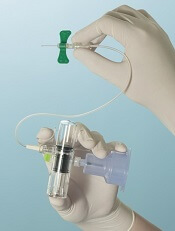
A novel device can significantly reduce contamination of blood cultures, according to research published in Clinical Infectious Diseases.
The SteriPath initial specimen diversion device (ISDD) is a blood collection system that diverts and sequesters the first 1.5 mL to 2 mL of blood drawn, which often carries contaminating skin cells and microbes.
By allowing for the disposal of this blood, the ISDD reduced blood culture contamination by 88%, when compared to standard phlebotomy procedures.
In reducing contamination, the SteriPath ISDD could reduce the unnecessary use of antibiotics, according to researchers.
“A lot of people think this is a minor problem,” said study author Mark Rupp, MD, of the University of Nebraska Medical Center in Omaha.
“However, contaminated blood cultures are a big deal. Physicians can be led astray, and patients may be harmed by additional tests and unnecessary antimicrobial therapy.”
For this study, Dr Rupp and his colleagues compared the ISDD and standard blood draw procedures, collecting a total of 1808 blood samples from 904 patients.
The researchers observed a significantly lower rate of blood culture contamination with the ISDD than with standard procedures—0.22% (2/904) and 1.78% (16/904), respectively (P=0.001).
“The 1.78% baseline rate of contamination may seem small, but we should strive to decrease adverse events to the lowest possible level because of the impact to the patient and the burden to our healthcare system,” Dr Rupp said. “We quite clearly showed the rate of contamination was significantly reduced, and that decrease has a very big impact.”
Dr Rupp and his colleagues also noted that the ISDD was about as sensitive as standard procedures. The ISDD detected true bacteremia in 7.2% (65/904) of patients, and standard procedures detected true bacteremia in 7.6% (69/904) of patients (P=0.41).
“What is important about this device is it can greatly limit the blood culture from being contaminated, so physicians are rarely fooled by false-positive results,” Dr Rupp said. “It gives clinicians confidence that results are accurate.”
This research was supported by Magnolia Medical Technologies, Inc., the company marketing the SteriPath ISDD. 
A novel device can significantly reduce contamination of blood cultures, according to research published in Clinical Infectious Diseases.
The SteriPath initial specimen diversion device (ISDD) is a blood collection system that diverts and sequesters the first 1.5 mL to 2 mL of blood drawn, which often carries contaminating skin cells and microbes.
By allowing for the disposal of this blood, the ISDD reduced blood culture contamination by 88%, when compared to standard phlebotomy procedures.
In reducing contamination, the SteriPath ISDD could reduce the unnecessary use of antibiotics, according to researchers.
“A lot of people think this is a minor problem,” said study author Mark Rupp, MD, of the University of Nebraska Medical Center in Omaha.
“However, contaminated blood cultures are a big deal. Physicians can be led astray, and patients may be harmed by additional tests and unnecessary antimicrobial therapy.”
For this study, Dr Rupp and his colleagues compared the ISDD and standard blood draw procedures, collecting a total of 1808 blood samples from 904 patients.
The researchers observed a significantly lower rate of blood culture contamination with the ISDD than with standard procedures—0.22% (2/904) and 1.78% (16/904), respectively (P=0.001).
“The 1.78% baseline rate of contamination may seem small, but we should strive to decrease adverse events to the lowest possible level because of the impact to the patient and the burden to our healthcare system,” Dr Rupp said. “We quite clearly showed the rate of contamination was significantly reduced, and that decrease has a very big impact.”
Dr Rupp and his colleagues also noted that the ISDD was about as sensitive as standard procedures. The ISDD detected true bacteremia in 7.2% (65/904) of patients, and standard procedures detected true bacteremia in 7.6% (69/904) of patients (P=0.41).
“What is important about this device is it can greatly limit the blood culture from being contaminated, so physicians are rarely fooled by false-positive results,” Dr Rupp said. “It gives clinicians confidence that results are accurate.”
This research was supported by Magnolia Medical Technologies, Inc., the company marketing the SteriPath ISDD.
A novel device can significantly reduce contamination of blood cultures, according to research published in Clinical Infectious Diseases.
The SteriPath initial specimen diversion device (ISDD) is a blood collection system that diverts and sequesters the first 1.5 mL to 2 mL of blood drawn, which often carries contaminating skin cells and microbes.
By allowing for the disposal of this blood, the ISDD reduced blood culture contamination by 88%, when compared to standard phlebotomy procedures.
In reducing contamination, the SteriPath ISDD could reduce the unnecessary use of antibiotics, according to researchers.
“A lot of people think this is a minor problem,” said study author Mark Rupp, MD, of the University of Nebraska Medical Center in Omaha.
“However, contaminated blood cultures are a big deal. Physicians can be led astray, and patients may be harmed by additional tests and unnecessary antimicrobial therapy.”
For this study, Dr Rupp and his colleagues compared the ISDD and standard blood draw procedures, collecting a total of 1808 blood samples from 904 patients.
The researchers observed a significantly lower rate of blood culture contamination with the ISDD than with standard procedures—0.22% (2/904) and 1.78% (16/904), respectively (P=0.001).
“The 1.78% baseline rate of contamination may seem small, but we should strive to decrease adverse events to the lowest possible level because of the impact to the patient and the burden to our healthcare system,” Dr Rupp said. “We quite clearly showed the rate of contamination was significantly reduced, and that decrease has a very big impact.”
Dr Rupp and his colleagues also noted that the ISDD was about as sensitive as standard procedures. The ISDD detected true bacteremia in 7.2% (65/904) of patients, and standard procedures detected true bacteremia in 7.6% (69/904) of patients (P=0.41).
“What is important about this device is it can greatly limit the blood culture from being contaminated, so physicians are rarely fooled by false-positive results,” Dr Rupp said. “It gives clinicians confidence that results are accurate.”
This research was supported by Magnolia Medical Technologies, Inc., the company marketing the SteriPath ISDD.
Research gaps identified for palliative surgical care
Palliative care is a well-established specialty of medicine with several decades of research to guide its implementation in a variety of contexts. Palliative care for surgical patients, however, remains understudied, according to a work group convened by the National Institutes of Health and the National Palliative Care Research Center. The work group, comprising palliative specialists from a range of medical institutions, reviewed the existing literature on palliative surgical care to identify areas in which research is needed to support palliative programs and clinicians.
Despite the 2003 call to action by the American College of Surgeons’ Palliative Care Workgroup for research in seven priority areas of palliative care (surgical, patient-oriented, and end-of-life decision making; symptom management; communications; processes of care; and surgical education on palliative care), few studies have been conducted specifically targeting surgical palliative care. The empirical basis for implementation in the surgical context remains thin, according to the work group, which argues that when it comes to palliative care – and the research to support it – the needs of surgical and nonsurgical patients differ significantly.
The report, published in the Annals of Surgery (2017 May 3. doi: 10.1097/SLA.0000000000002253), outlines an ambitious agenda of recommended research priorities in the areas of outcomes, communication, and delivery aimed at filling the gap.
Measuring outcomes
The report pointed to two areas of outcomes research that are understudied. One is defining outcomes that are meaningful to patients. Surgical research frequently defines outcomes in terms of survival, 30-day readmission, and morbidity, but patients accessing palliative surgical care may not prioritize these outcomes. “Measures of functional independence, disability-free survival, days spent at home, or freedom from pain after surgery provide information on outcomes that are both clinically meaningful and important to patients,” the study authors wrote.
In addition, measures of timely and appropriate delivery of high-quality palliative care in surgery are in scant supply for surgeons and institutions looking to identify targets for improvement. Surgeons searching for studies on effective documentation of advance directives, and quality indicators for care at the end of life, such as hospice enrollment and death on life-sustaining treatments, will find the research cupboard nearly bare.
Communication and decision making
Decision making and communication with patients, family, and surgical team members are made especially challenging by the short time frames and crisis situations in which palliative surgical care typically occurs. For many of these patients, the “trade-offs between cure and quality of life (that is, impaired functional status and prolonged pain and suffering) are typically value sensitive.” But surgeons who want to communicate information about these trade-offs “are severely hampered by the paucity of data comparing longer-term survival, quality of life, and function ... the lack of data hinders the consideration of palliative care as an adjunct or alternative to surgery,” the study authors wrote.
Surgeons have few studies and little evidence to guide them on issues such as advance care planning conversations with surrogates in the crisis-prone surgical ICU setting. Future studies are needed to develop communication tools for in-the-moment crises in which patients, surrogates, and surgeons must choose a course of action that is both clinically sound and in accordance with patient values or wishes.
Delivery of palliative care to surgical patients
The work group reviewed the scanty literature on integrating palliative care principles into routine surgical practice and concluded that much work remains to be done in this area. “Studies of physician- and systems-targeted interventions are needed to redirect treatment options so that surgery is not the default modality for patients known to have extremely poor survival due to baseline serious illness or acute surgical conditions.” Optimal timing of palliative care, patient selection, development of scalable models of palliative care in different settings, and residency training models are all understudied, according to the report. And yet, the demand for evidence and data on these issues continues to rise.
The work group concluded, “As the population ages and technical innovation advances, surgical patients will become increasingly complex as surgeons and patients navigate the blurred boundaries between technically feasible, clinically appropriate, and value-concordant care.”
The study was supported by the National Institute on Aging, a division of NIH, and the National Palliative Care Research Center. The authors report no disclosures relevant to this study.
This report is an overdue assessment of an American College of Surgeons’ initiative to improve palliative care for surgical patients. The initiative commenced 15 years ago, and it is safe to say that at that time we surgeons didn’t know what we didn’t know about palliative care.

This move would eliminate much of the dated, pejorative connotation of palliative surgery as well as the incentive to intervene surgically on behalf of highly symptomatic, fragile patients, which was imposed by fear of the 30-day postop mortality metric. This research agenda is a realistic and compassionate appeal to the engagement of all surgeons in the assimilation of palliative principles in surgical practice.
Geoffrey P. Dunn, MD, FACS, is medical director of the palliative care consultation service at the University of Pittsburgh Medical Center Hamot, and vice chair of the ACS Committee on Surgical Palliative Care.
This report is an overdue assessment of an American College of Surgeons’ initiative to improve palliative care for surgical patients. The initiative commenced 15 years ago, and it is safe to say that at that time we surgeons didn’t know what we didn’t know about palliative care.
This move would eliminate much of the dated, pejorative connotation of palliative surgery as well as the incentive to intervene surgically on behalf of highly symptomatic, fragile patients, which was imposed by fear of the 30-day postop mortality metric. This research agenda is a realistic and compassionate appeal to the engagement of all surgeons in the assimilation of palliative principles in surgical practice.
Geoffrey P. Dunn, MD, FACS, is medical director of the palliative care consultation service at the University of Pittsburgh Medical Center Hamot, and vice chair of the ACS Committee on Surgical Palliative Care.
This report is an overdue assessment of an American College of Surgeons’ initiative to improve palliative care for surgical patients. The initiative commenced 15 years ago, and it is safe to say that at that time we surgeons didn’t know what we didn’t know about palliative care.
This move would eliminate much of the dated, pejorative connotation of palliative surgery as well as the incentive to intervene surgically on behalf of highly symptomatic, fragile patients, which was imposed by fear of the 30-day postop mortality metric. This research agenda is a realistic and compassionate appeal to the engagement of all surgeons in the assimilation of palliative principles in surgical practice.
Geoffrey P. Dunn, MD, FACS, is medical director of the palliative care consultation service at the University of Pittsburgh Medical Center Hamot, and vice chair of the ACS Committee on Surgical Palliative Care.
Palliative care is a well-established specialty of medicine with several decades of research to guide its implementation in a variety of contexts. Palliative care for surgical patients, however, remains understudied, according to a work group convened by the National Institutes of Health and the National Palliative Care Research Center. The work group, comprising palliative specialists from a range of medical institutions, reviewed the existing literature on palliative surgical care to identify areas in which research is needed to support palliative programs and clinicians.
Despite the 2003 call to action by the American College of Surgeons’ Palliative Care Workgroup for research in seven priority areas of palliative care (surgical, patient-oriented, and end-of-life decision making; symptom management; communications; processes of care; and surgical education on palliative care), few studies have been conducted specifically targeting surgical palliative care. The empirical basis for implementation in the surgical context remains thin, according to the work group, which argues that when it comes to palliative care – and the research to support it – the needs of surgical and nonsurgical patients differ significantly.
The report, published in the Annals of Surgery (2017 May 3. doi: 10.1097/SLA.0000000000002253), outlines an ambitious agenda of recommended research priorities in the areas of outcomes, communication, and delivery aimed at filling the gap.
Measuring outcomes
The report pointed to two areas of outcomes research that are understudied. One is defining outcomes that are meaningful to patients. Surgical research frequently defines outcomes in terms of survival, 30-day readmission, and morbidity, but patients accessing palliative surgical care may not prioritize these outcomes. “Measures of functional independence, disability-free survival, days spent at home, or freedom from pain after surgery provide information on outcomes that are both clinically meaningful and important to patients,” the study authors wrote.
In addition, measures of timely and appropriate delivery of high-quality palliative care in surgery are in scant supply for surgeons and institutions looking to identify targets for improvement. Surgeons searching for studies on effective documentation of advance directives, and quality indicators for care at the end of life, such as hospice enrollment and death on life-sustaining treatments, will find the research cupboard nearly bare.
Communication and decision making
Decision making and communication with patients, family, and surgical team members are made especially challenging by the short time frames and crisis situations in which palliative surgical care typically occurs. For many of these patients, the “trade-offs between cure and quality of life (that is, impaired functional status and prolonged pain and suffering) are typically value sensitive.” But surgeons who want to communicate information about these trade-offs “are severely hampered by the paucity of data comparing longer-term survival, quality of life, and function ... the lack of data hinders the consideration of palliative care as an adjunct or alternative to surgery,” the study authors wrote.
Surgeons have few studies and little evidence to guide them on issues such as advance care planning conversations with surrogates in the crisis-prone surgical ICU setting. Future studies are needed to develop communication tools for in-the-moment crises in which patients, surrogates, and surgeons must choose a course of action that is both clinically sound and in accordance with patient values or wishes.
Delivery of palliative care to surgical patients
The work group reviewed the scanty literature on integrating palliative care principles into routine surgical practice and concluded that much work remains to be done in this area. “Studies of physician- and systems-targeted interventions are needed to redirect treatment options so that surgery is not the default modality for patients known to have extremely poor survival due to baseline serious illness or acute surgical conditions.” Optimal timing of palliative care, patient selection, development of scalable models of palliative care in different settings, and residency training models are all understudied, according to the report. And yet, the demand for evidence and data on these issues continues to rise.
The work group concluded, “As the population ages and technical innovation advances, surgical patients will become increasingly complex as surgeons and patients navigate the blurred boundaries between technically feasible, clinically appropriate, and value-concordant care.”
The study was supported by the National Institute on Aging, a division of NIH, and the National Palliative Care Research Center. The authors report no disclosures relevant to this study.
Palliative care is a well-established specialty of medicine with several decades of research to guide its implementation in a variety of contexts. Palliative care for surgical patients, however, remains understudied, according to a work group convened by the National Institutes of Health and the National Palliative Care Research Center. The work group, comprising palliative specialists from a range of medical institutions, reviewed the existing literature on palliative surgical care to identify areas in which research is needed to support palliative programs and clinicians.
Despite the 2003 call to action by the American College of Surgeons’ Palliative Care Workgroup for research in seven priority areas of palliative care (surgical, patient-oriented, and end-of-life decision making; symptom management; communications; processes of care; and surgical education on palliative care), few studies have been conducted specifically targeting surgical palliative care. The empirical basis for implementation in the surgical context remains thin, according to the work group, which argues that when it comes to palliative care – and the research to support it – the needs of surgical and nonsurgical patients differ significantly.
The report, published in the Annals of Surgery (2017 May 3. doi: 10.1097/SLA.0000000000002253), outlines an ambitious agenda of recommended research priorities in the areas of outcomes, communication, and delivery aimed at filling the gap.
Measuring outcomes
The report pointed to two areas of outcomes research that are understudied. One is defining outcomes that are meaningful to patients. Surgical research frequently defines outcomes in terms of survival, 30-day readmission, and morbidity, but patients accessing palliative surgical care may not prioritize these outcomes. “Measures of functional independence, disability-free survival, days spent at home, or freedom from pain after surgery provide information on outcomes that are both clinically meaningful and important to patients,” the study authors wrote.
In addition, measures of timely and appropriate delivery of high-quality palliative care in surgery are in scant supply for surgeons and institutions looking to identify targets for improvement. Surgeons searching for studies on effective documentation of advance directives, and quality indicators for care at the end of life, such as hospice enrollment and death on life-sustaining treatments, will find the research cupboard nearly bare.
Communication and decision making
Decision making and communication with patients, family, and surgical team members are made especially challenging by the short time frames and crisis situations in which palliative surgical care typically occurs. For many of these patients, the “trade-offs between cure and quality of life (that is, impaired functional status and prolonged pain and suffering) are typically value sensitive.” But surgeons who want to communicate information about these trade-offs “are severely hampered by the paucity of data comparing longer-term survival, quality of life, and function ... the lack of data hinders the consideration of palliative care as an adjunct or alternative to surgery,” the study authors wrote.
Surgeons have few studies and little evidence to guide them on issues such as advance care planning conversations with surrogates in the crisis-prone surgical ICU setting. Future studies are needed to develop communication tools for in-the-moment crises in which patients, surrogates, and surgeons must choose a course of action that is both clinically sound and in accordance with patient values or wishes.
Delivery of palliative care to surgical patients
The work group reviewed the scanty literature on integrating palliative care principles into routine surgical practice and concluded that much work remains to be done in this area. “Studies of physician- and systems-targeted interventions are needed to redirect treatment options so that surgery is not the default modality for patients known to have extremely poor survival due to baseline serious illness or acute surgical conditions.” Optimal timing of palliative care, patient selection, development of scalable models of palliative care in different settings, and residency training models are all understudied, according to the report. And yet, the demand for evidence and data on these issues continues to rise.
The work group concluded, “As the population ages and technical innovation advances, surgical patients will become increasingly complex as surgeons and patients navigate the blurred boundaries between technically feasible, clinically appropriate, and value-concordant care.”
The study was supported by the National Institute on Aging, a division of NIH, and the National Palliative Care Research Center. The authors report no disclosures relevant to this study.
FROM ANNALS OF SURGERY
ALC/AMC prognostic in mantle cell lymphoma
The peripheral blood absolute lymphocyte-to-monocyte ratio (ALC/AMC) was prognostic for overall survival in mantle cell lymphoma patients who have undergone induction therapy, based on a retrospective review study of 96 patients by Andre Goy, MD, of John Theurer Cancer Center, Hackensack (NJ) University, and his colleagues.
Overall survival was better when ALC/AMC was 2 or greater following induction therapy, the researchers wrote in an abstract published in conjunction with the annual meeting of the American Society of Clinical Oncology.
The finding indicates that novel maintenance programs, including targeting the microenvironment or immune response, might be appropriate when patients with mantle cell lymphoma have low ALC/AMC.
The researchers examined data for 96 consecutive mantle cell lymphoma patients. The ALC/AMC was determined from peripheral blood counts obtained approximately 30 days following completion of initial therapy or immediately prior to stem cell mobilization in patients who had first line stem cell transplants.
The ALC/AMC was less than 2 in 67 patients and was 2 or greater in 29 patients. The two patient cohorts were similar in median age, ethnicities, stage distributions, elevated beta-2-microglobulin, elevated lactate dehydrogenate, and Mantle Cell Lymphoma International Prognostic Index scores.
ALC/AMC was less than 2 in 10 of 13 transplanted patients and in 57 of 83 patients who did not undergo transplants. At a median follow-up of 43 months, the median overall survival has not been reached in either cohort.
The 5-year survival rate was 90% among patients with an ALC/AMC of 2 or greater and 68% in those with an ALC/AMC less than 2 (log-rank P less than .05).
Similar ALC/AMC 5-year survival trends were noted when subsetting to the 25 patients with high risk Mantle Cell Lymphoma International Prognostic Index scores (72% vs. 45%; P = .07).
Dr. Goy disclosed honoraria from Acerta Pharma, Celgene, Pharmacyclics, and Takeda; a consulting or advisory role with Acerta Pharma, Celgene, Infinity Pharmaceuticals, Pharmacyclics, and Takeda; and speakers’ bureaus participation for Pharmacyclics and Takeda.
Prognostic value of the absolute lymphocyte-to-monocyte (ALC/AMC) ratio on overall survival among patients with mantle cell lymphoma. Published in conjunction with the 2017 ASCO Annual Meeting. Abstract No: e19030.
[email protected]
On Twitter @maryjodales
The peripheral blood absolute lymphocyte-to-monocyte ratio (ALC/AMC) was prognostic for overall survival in mantle cell lymphoma patients who have undergone induction therapy, based on a retrospective review study of 96 patients by Andre Goy, MD, of John Theurer Cancer Center, Hackensack (NJ) University, and his colleagues.
Overall survival was better when ALC/AMC was 2 or greater following induction therapy, the researchers wrote in an abstract published in conjunction with the annual meeting of the American Society of Clinical Oncology.
The finding indicates that novel maintenance programs, including targeting the microenvironment or immune response, might be appropriate when patients with mantle cell lymphoma have low ALC/AMC.
The researchers examined data for 96 consecutive mantle cell lymphoma patients. The ALC/AMC was determined from peripheral blood counts obtained approximately 30 days following completion of initial therapy or immediately prior to stem cell mobilization in patients who had first line stem cell transplants.
The ALC/AMC was less than 2 in 67 patients and was 2 or greater in 29 patients. The two patient cohorts were similar in median age, ethnicities, stage distributions, elevated beta-2-microglobulin, elevated lactate dehydrogenate, and Mantle Cell Lymphoma International Prognostic Index scores.
ALC/AMC was less than 2 in 10 of 13 transplanted patients and in 57 of 83 patients who did not undergo transplants. At a median follow-up of 43 months, the median overall survival has not been reached in either cohort.
The 5-year survival rate was 90% among patients with an ALC/AMC of 2 or greater and 68% in those with an ALC/AMC less than 2 (log-rank P less than .05).
Similar ALC/AMC 5-year survival trends were noted when subsetting to the 25 patients with high risk Mantle Cell Lymphoma International Prognostic Index scores (72% vs. 45%; P = .07).
Dr. Goy disclosed honoraria from Acerta Pharma, Celgene, Pharmacyclics, and Takeda; a consulting or advisory role with Acerta Pharma, Celgene, Infinity Pharmaceuticals, Pharmacyclics, and Takeda; and speakers’ bureaus participation for Pharmacyclics and Takeda.
Prognostic value of the absolute lymphocyte-to-monocyte (ALC/AMC) ratio on overall survival among patients with mantle cell lymphoma. Published in conjunction with the 2017 ASCO Annual Meeting. Abstract No: e19030.
[email protected]
On Twitter @maryjodales
The peripheral blood absolute lymphocyte-to-monocyte ratio (ALC/AMC) was prognostic for overall survival in mantle cell lymphoma patients who have undergone induction therapy, based on a retrospective review study of 96 patients by Andre Goy, MD, of John Theurer Cancer Center, Hackensack (NJ) University, and his colleagues.
Overall survival was better when ALC/AMC was 2 or greater following induction therapy, the researchers wrote in an abstract published in conjunction with the annual meeting of the American Society of Clinical Oncology.
The finding indicates that novel maintenance programs, including targeting the microenvironment or immune response, might be appropriate when patients with mantle cell lymphoma have low ALC/AMC.
The researchers examined data for 96 consecutive mantle cell lymphoma patients. The ALC/AMC was determined from peripheral blood counts obtained approximately 30 days following completion of initial therapy or immediately prior to stem cell mobilization in patients who had first line stem cell transplants.
The ALC/AMC was less than 2 in 67 patients and was 2 or greater in 29 patients. The two patient cohorts were similar in median age, ethnicities, stage distributions, elevated beta-2-microglobulin, elevated lactate dehydrogenate, and Mantle Cell Lymphoma International Prognostic Index scores.
ALC/AMC was less than 2 in 10 of 13 transplanted patients and in 57 of 83 patients who did not undergo transplants. At a median follow-up of 43 months, the median overall survival has not been reached in either cohort.
The 5-year survival rate was 90% among patients with an ALC/AMC of 2 or greater and 68% in those with an ALC/AMC less than 2 (log-rank P less than .05).
Similar ALC/AMC 5-year survival trends were noted when subsetting to the 25 patients with high risk Mantle Cell Lymphoma International Prognostic Index scores (72% vs. 45%; P = .07).
Dr. Goy disclosed honoraria from Acerta Pharma, Celgene, Pharmacyclics, and Takeda; a consulting or advisory role with Acerta Pharma, Celgene, Infinity Pharmaceuticals, Pharmacyclics, and Takeda; and speakers’ bureaus participation for Pharmacyclics and Takeda.
Prognostic value of the absolute lymphocyte-to-monocyte (ALC/AMC) ratio on overall survival among patients with mantle cell lymphoma. Published in conjunction with the 2017 ASCO Annual Meeting. Abstract No: e19030.
[email protected]
On Twitter @maryjodales
IN CONJUNCTION WITH ASCO 2017
Key clinical point:
Major finding: The 5-year survival rate was 90% among patients with an ALC/AMC of 2 or greater and 68% in those with an ALC/AMC less than 2 (log-rank P less than .05).
Data source: A retrospective review study of 96 patients.
Disclosures: Dr. Goy disclosed honoraria from Acerta Pharma, Celgene, Pharmacyclics, and Takeda; a consulting or advisory role with Acerta Pharma, Celgene, Infinity Pharmaceuticals, Pharmacyclics, and Takeda; and speakers’ bureaus participation for Pharmacyclics and Takeda.
Citation: Prognostic value of the absolute lymphocyte-to-monocyte (ALC/AMC) ratio on overall survival among patients with mantle cell lymphoma. Published in conjunction with the 2017 ASCO Annual Meeting. Abstract No: e19030.
Intervention improves use of treat to target in RA
A learning collaborative approach can significantly improve adherence to a treat-to-target approach in patients with rheumatoid arthritis, new research suggests.
While numerous clinical trials have shown that a strategy of treating to target achieves better outcomes, compared with usual care, there is evidence that this approach is not always practiced, wrote Daniel H. Solomon, MD, of the division of rheumatology at Brigham and Women’s Hospital, Boston, and his coauthors.

The intervention first involved the faculty developing a set of principles and concepts to describe the goals for implementing treat to target. These were then disseminated to the sites through a single face-to-face learning session and a series of webinars, which were also recorded and made available online. The first session also worked on team building within sites and on cross-site collaborative relationships.
“In this study, we found large benefits, despite using a relatively low-intensity approach to the learning collaborative, with only one face-to-face meeting,” wrote the authors, who noted that altogether the program involved around 20 hours per provider over 9 months.
The investigators used a composite treat-to-target implementation score as the primary outcome, which was based on the presence or absence of four measures deemed central to the principles and concepts of a treat-to-target strategy. The measures were:
- Specifying a disease activity target.
- Recording RA disease activity, using one of four recommended measures (Disease Activity Score-28, Simplified Disease Activity Index, Clinical Disease Activity Index, or Routine Assessment of Patient Index Data 3), with results described numerically or by category (remission, low, moderate, or high).
- When a decision was being made (change in target or change in treatment), documenting shared decision making.
- Basing treatment decisions on target and disease activity measure or describing reasons why treat to target was not adhered to.
The intervention increased the treat-to-target implementation score by 46 percentage points, from 11% to 57%. In comparison, the control arm had an increase of 14 percentage points, from 11% to 25% (P = .004). It achieved a substantial and significant increase in the proportion of participants for whom a treatment target was documented, from 0.6% at baseline to 45.6% at the 9-month follow-up, compared with a 12.5-point increase in the control group. The recording of disease activity increased from 20% to 89.1% in the intervention arm, compared with an increase from 30.2% to 52.3% in the control arm. Similarly, shared decision making increased from 51.3% to 85.9% in the intervention group, compared with a rise from 24.5% to 43% in the control arm.
The study also examined a range of secondary outcomes representing the impact of the intervention on patients. They found that a positive change in treat-to-target adherence score was seen in 83.8% of patients in the intervention arm, compared with 36.8% of patients in the control arm (P = .0001), when almost no patient visits at baseline were adherent to all components of treat to target.
At the 9-month follow-up, 25.9% of visits in the intervention arm were adherent to all four components of the treat-to-target approach, compared with 5.6% in the control arm.
The authors suggested that their learning collaborative approach could be applied across a range of chronic diseases.
“In fact, our model is consistent with the goals and strategy of the Million Hearts campaign to reduce cardiovascular disease burden across the U.S. by targeting five areas of goal-based therapy.”
There were no significant differences between the intervention and control arms in the number of orders for drug-monitoring laboratory tests or radiology orders. However, patients in the intervention arm had fewer adverse events than did those in the control arm (0.26 vs. 0.43 per patient; P = .043).
The investigators noted that the study was relatively small – involving just 11 sites – and the primary outcome was a process measure that did not reflect clinical outcomes and has not been validated.
The study was supported by the National Institutes of Health. One author declared salary support through research grants to his hospital from pharmaceutical companies, while another declared research grants from AbbVie for treat-to-target research activities.
A learning collaborative approach can significantly improve adherence to a treat-to-target approach in patients with rheumatoid arthritis, new research suggests.
While numerous clinical trials have shown that a strategy of treating to target achieves better outcomes, compared with usual care, there is evidence that this approach is not always practiced, wrote Daniel H. Solomon, MD, of the division of rheumatology at Brigham and Women’s Hospital, Boston, and his coauthors.
The intervention first involved the faculty developing a set of principles and concepts to describe the goals for implementing treat to target. These were then disseminated to the sites through a single face-to-face learning session and a series of webinars, which were also recorded and made available online. The first session also worked on team building within sites and on cross-site collaborative relationships.
“In this study, we found large benefits, despite using a relatively low-intensity approach to the learning collaborative, with only one face-to-face meeting,” wrote the authors, who noted that altogether the program involved around 20 hours per provider over 9 months.
The investigators used a composite treat-to-target implementation score as the primary outcome, which was based on the presence or absence of four measures deemed central to the principles and concepts of a treat-to-target strategy. The measures were:
- Specifying a disease activity target.
- Recording RA disease activity, using one of four recommended measures (Disease Activity Score-28, Simplified Disease Activity Index, Clinical Disease Activity Index, or Routine Assessment of Patient Index Data 3), with results described numerically or by category (remission, low, moderate, or high).
- When a decision was being made (change in target or change in treatment), documenting shared decision making.
- Basing treatment decisions on target and disease activity measure or describing reasons why treat to target was not adhered to.
The intervention increased the treat-to-target implementation score by 46 percentage points, from 11% to 57%. In comparison, the control arm had an increase of 14 percentage points, from 11% to 25% (P = .004). It achieved a substantial and significant increase in the proportion of participants for whom a treatment target was documented, from 0.6% at baseline to 45.6% at the 9-month follow-up, compared with a 12.5-point increase in the control group. The recording of disease activity increased from 20% to 89.1% in the intervention arm, compared with an increase from 30.2% to 52.3% in the control arm. Similarly, shared decision making increased from 51.3% to 85.9% in the intervention group, compared with a rise from 24.5% to 43% in the control arm.
The study also examined a range of secondary outcomes representing the impact of the intervention on patients. They found that a positive change in treat-to-target adherence score was seen in 83.8% of patients in the intervention arm, compared with 36.8% of patients in the control arm (P = .0001), when almost no patient visits at baseline were adherent to all components of treat to target.
At the 9-month follow-up, 25.9% of visits in the intervention arm were adherent to all four components of the treat-to-target approach, compared with 5.6% in the control arm.
The authors suggested that their learning collaborative approach could be applied across a range of chronic diseases.
“In fact, our model is consistent with the goals and strategy of the Million Hearts campaign to reduce cardiovascular disease burden across the U.S. by targeting five areas of goal-based therapy.”
There were no significant differences between the intervention and control arms in the number of orders for drug-monitoring laboratory tests or radiology orders. However, patients in the intervention arm had fewer adverse events than did those in the control arm (0.26 vs. 0.43 per patient; P = .043).
The investigators noted that the study was relatively small – involving just 11 sites – and the primary outcome was a process measure that did not reflect clinical outcomes and has not been validated.
The study was supported by the National Institutes of Health. One author declared salary support through research grants to his hospital from pharmaceutical companies, while another declared research grants from AbbVie for treat-to-target research activities.
A learning collaborative approach can significantly improve adherence to a treat-to-target approach in patients with rheumatoid arthritis, new research suggests.
While numerous clinical trials have shown that a strategy of treating to target achieves better outcomes, compared with usual care, there is evidence that this approach is not always practiced, wrote Daniel H. Solomon, MD, of the division of rheumatology at Brigham and Women’s Hospital, Boston, and his coauthors.
The intervention first involved the faculty developing a set of principles and concepts to describe the goals for implementing treat to target. These were then disseminated to the sites through a single face-to-face learning session and a series of webinars, which were also recorded and made available online. The first session also worked on team building within sites and on cross-site collaborative relationships.
“In this study, we found large benefits, despite using a relatively low-intensity approach to the learning collaborative, with only one face-to-face meeting,” wrote the authors, who noted that altogether the program involved around 20 hours per provider over 9 months.
The investigators used a composite treat-to-target implementation score as the primary outcome, which was based on the presence or absence of four measures deemed central to the principles and concepts of a treat-to-target strategy. The measures were:
- Specifying a disease activity target.
- Recording RA disease activity, using one of four recommended measures (Disease Activity Score-28, Simplified Disease Activity Index, Clinical Disease Activity Index, or Routine Assessment of Patient Index Data 3), with results described numerically or by category (remission, low, moderate, or high).
- When a decision was being made (change in target or change in treatment), documenting shared decision making.
- Basing treatment decisions on target and disease activity measure or describing reasons why treat to target was not adhered to.
The intervention increased the treat-to-target implementation score by 46 percentage points, from 11% to 57%. In comparison, the control arm had an increase of 14 percentage points, from 11% to 25% (P = .004). It achieved a substantial and significant increase in the proportion of participants for whom a treatment target was documented, from 0.6% at baseline to 45.6% at the 9-month follow-up, compared with a 12.5-point increase in the control group. The recording of disease activity increased from 20% to 89.1% in the intervention arm, compared with an increase from 30.2% to 52.3% in the control arm. Similarly, shared decision making increased from 51.3% to 85.9% in the intervention group, compared with a rise from 24.5% to 43% in the control arm.
The study also examined a range of secondary outcomes representing the impact of the intervention on patients. They found that a positive change in treat-to-target adherence score was seen in 83.8% of patients in the intervention arm, compared with 36.8% of patients in the control arm (P = .0001), when almost no patient visits at baseline were adherent to all components of treat to target.
At the 9-month follow-up, 25.9% of visits in the intervention arm were adherent to all four components of the treat-to-target approach, compared with 5.6% in the control arm.
The authors suggested that their learning collaborative approach could be applied across a range of chronic diseases.
“In fact, our model is consistent with the goals and strategy of the Million Hearts campaign to reduce cardiovascular disease burden across the U.S. by targeting five areas of goal-based therapy.”
There were no significant differences between the intervention and control arms in the number of orders for drug-monitoring laboratory tests or radiology orders. However, patients in the intervention arm had fewer adverse events than did those in the control arm (0.26 vs. 0.43 per patient; P = .043).
The investigators noted that the study was relatively small – involving just 11 sites – and the primary outcome was a process measure that did not reflect clinical outcomes and has not been validated.
The study was supported by the National Institutes of Health. One author declared salary support through research grants to his hospital from pharmaceutical companies, while another declared research grants from AbbVie for treat-to-target research activities.
FROM ARTHRITIS & RHEUMATOLOGY
Key clinical point:
Major finding: A site-based intervention increased a treat-to-target implementation score by 46 percentage points – from 11% to 57% – compared with a 14–percentage point increase in the control arm.
Data source: The cluster-randomized, wait list–controlled, quality improvement TRACTION trial, involving 11 sites and 641 patients.
Disclosures: The study was supported by the National Institutes of Health. One author declared salary support through research grants to his hospital from pharmaceutical companies, while another declared research grants from AbbVie for treat-to-target research activities.