User login
Are Non-Nutritive Sweetened Beverages Comparable to Water in Weight Loss Trials?
Study Overview
Objective. To compare the efficacy of non-nutritive sweetened beverages (NNS) or water for weight loss during a 12-week behavioral weight loss treatment program.
Study design. 2-arm equivalence randomized clinical trial.
Setting and participants. Participants were recruited at the University of Colorado and Temple University. A total of 506 participants were screened and 308 were enrolled in the study. Inclusion criteria included being weight stable within 10 pounds in the 6 months prior to the trial, engaging in fewer than 300 min of physical activity per week and consuming at least 3 NNS beverages per week. Exclusion criteria included pregnancy, diabetes, cardiovascular disease, uncontrolled hypertension, and the use of medications affecting metabolism or weight. Participants also had physician approval stating they were in good health and could handle the nutrition and exercise requirements of the trial. Participants were randomly assigned to a NNS or water treatment arm using a computer-generated randomization that equally distributed men and women between the 2 groups. Participants had to be willing to discontinue consumption of NNS beverages for the duration of the 1-year study if they were randomized to the water-only group.
Intervention. The study was designed to include a 12-week weight loss phase followed by a 9-month maintenance phase. All participants received a cognitive-behavioral weight loss intervention called The Colorado Weigh. The program involved weekly hour-long group meetings led by registered dieticians or clinical psychologists. Groups were split by research arm and participants were taught about different weight loss strategies including self-monitoring, portion sizes, and physical activity. Participants were weighed at each meeting. The group curriculum was the same for both arms of the study except in the type of beverage they were encouraged to consume.
Participants were given individual energy targets based on their estimated resting metabolic rate (RMR), determined by using a Tanita Model TBF-300A bioelectrical impedance device that assesses body composition. Group leaders adjusted these targets as needed for participants in order to achieve a goal weight loss of 1 to 2 pounds per week. Physical activity targets were set to increase each participant’s typical physical activity by 10 minutes a week with a final target of 60 minutes a day, 6 days a week. Participants filled out daily exercise logs. Additionally, physical activity was assessed by the use of a Body Media armband that participants wore weeks 1 and 12.
Participants in the NNS group were asked to consume at least 24 fluid ounces of NNS beverage per day. Their water consumption was not limited. A beverage was considered NNS if it had less than 5 kcal per 8-ounce serving, was pre-mixed, and contained non-nutritive sweeteners. Participants in the water-only group were asked to drink at least 24 ounces of water a day and not drink any NNS beverages. They were allowed to eat foods that contained NNS but could not intentionally add NNS to beverages such as coffee. Participants in both groups were asked to record their beverage intake daily. Participants were given manufacturers’ coupons for bottled water or NNS beverages.
Main outcome measures. The primary outcomes were weight loss at 12 weeks (weight loss period) and at 1 year (weight loss maintenance). All assessments were conducted at baseline and after 12 weeks. This was designed as an equivalence trial, and the authors’ hypothesis was that there would be no clinically meaningful difference in weight change between the 2 groups. The authors pre-specified that the bounds of equivalence would be 1.7 kg. Waist circumference was recorded in addition to height and weight. Participant’s blood pressure was also recorded and blood samples were collected to measure lipids and glucose. Urine samples were collected to measure urine osmolality. Participants completed questionnaires at baseline and 12 weeks to assess changes in perceived hunger.
Results. A total of 308 patients were randomized following baseline assessment but 5 did not begin treatment. 279 of the remaining 303 participants completed the full 12-week weight loss phase of the study. The dropout rate in the water group was 10% compared to 5.8% in the NNS group, but this was not statistically significant. 80% of participants were female, 68% were white, and 27% African American. There were no significant differences at baseline in age, gender, race/ethnicity or other measures between the water-only and NNS groups. There was no significant difference in adherence to the beverage requirements between the 2 groups (96.6% in the NNS group and 95.7% in the water-only group), and similarly group attendance did not differ between the 2 groups (90.8% for NNS and 89.7% for water-only).
The mean weight loss difference between the water and NNS groups was –1.85 kg (90% confidence interval [CI], –1.12 to –2.58 kg). Because the lower confidence limit of –2.58 kg was outside the equivalence limit set in the hypothesis, the 2 treatments were not considered equivalent and paired comparisons were carried out. Analysis done using an intention-to-treat scheme indicated that the weight loss in the NNS group (5.95 kg ± 3.94 kg) was significantly higher than the weight loss in the water-only group (4.09 ± 3.74 kg, P < 0.001). 43.0% of participants in the water-only group lost > 5% of their body weight and 64.3% of participants in the NNS group lost > 5% of their body weight (P < 0.001).
After 12 weeks of treatment there was no significant difference between the 2 groups in changes in waist circumference, blood pressure, HDL, triglycerides, or urine osmolality. Reductions in total cholesterol and LDL were significantly greater in the NNS group than the water group. There were no significant changes in physical activity between the 2 groups as measured by the exercise logs or the Body Media armbands. There was a statistically significant difference in hunger between the 2 groups (P = 0.013): participants in the water group reported increased hunger, while participants in the NNS group reported a slight decrease in hunger.
Conclusion. Participants who drank at least 3 servings of NNS beverages a day at baseline lost more weight during a behavioral weight loss program when they continued to drink NNS beverages than participants who were asked to cut NNS beverages and drink only water. The study was designed as an equivalence trial but paired comparisons showed a significant difference in weight loss between the 2 groups.
Commentary
Obesity is a major public health concern in the United States and drinking sugar-sweetened beverages has been indicated as a significant contributing factor. Consumption of sugar-sweetened beverages increased considerably from 1994 to 2004 [1]. Fortunately, there is strong evidence that decreasing the consumption of sugar sweetened beverages can lead to weight loss [2]. Most studies look at the effect of replacing sugar-sweetened beverages with water [3] and, in fact, increased consumption of water has been shown to aid weight loss [4]. The relationship between diet drinks and obesity, however, has been a source of controversy. Since NNS beverages contain little to no calories they are a logical replacement for sugar-sweetened beverages, but observational studies have shown a positive correlation between diet drinks and obesity [5,6] as well as type 2 diabetes [7]. Additionally, a recent study by Suez et al [8] found that consumption of artificial sweeteners affects the gut microbiota and increases glucose intolerance. However this correlation may not be causal; NNS beverage consumption may be higher in overweight individuals. A study by Tate et al [9,10] looked at replacing sugar-sweetened beverages with water or artificially sweetened beverages and found no significant difference in weight loss between the 2 groups. However, the Tate et al study used beverage replacement as the primary intervention. This experiment by Peters et al is unique because it tested the hypothesis that NNS is equivalent to water alone when combined with a structured weight loss program. Their results reject the equivalence hypothesis and suggest that NNS beverages facilitate weight loss for patients already consuming them.
Strengths of this study included the use of a randomized, equivalence design. The study also examined secondary outcomes (eg, waist circumference, lipids, and urine osmolality) that helped reinforce that participants consuming NNS were able to lose weight without compromising their health. Further, they measured hunger and found that participants in the NNS beverage group had decreased hunger while those in the water group had increased hunger, which points to a potential mechanism for their findings.
However, the potential for bias in this study is concerning. One major weakness is that all the participants were initially regular drinkers of NNS beverages. The authors never explain why consuming 3 NNS beverages per week was an inclusion criteria. Participants in the water group had to change their behavior to abstain from NNS beverages and this may have impacted results. More concerning, this study was fully funded by the American Beverage Association, who has an obvious interest in promoting NNS beverage consumption. Finally, the authors mention that 5 participants dropped out after randomization but before the start of treatment and were excluded from the study after baseline assessment. The authors do not provide information about group allocation or if the participants knew which group they were assigned to, calling into question the integrity of the intention-to-treat design.
Applications for Clinical Practice
For patients who already drink NNS beverages and are motivated to lose weight, these results support continued use. However, it is unclear how NNS beverages impact weight loss efforts for patients who do not currently drink them. Further, since other studies have shown potential harm of NNS beverages [6–8], more studies are needed to better elucidate their health effects.
—Susan Creighton and Melanie Jay, MD, MS
1. Bleich SN, Wang YC, Wang Y. Increasing consumption of sugar-sweetened beverages among US adults—1988-1994 to 1999-2004. Am J Clin Nutr 2009;89;372–81.
2. Hu FB. Resolved—there is sufficient scientific evidence that decreasing sugar-sweetened beverage consumption will reduce the prevalence of obesity and obesity-related diseases. Obesity Rev 2013;14;606–19.
3. Stokey JD, Constant F, Gardner CD. Replacing sweetened caloric beverages with drinking water is associated with lower energy intake. Obesity 2007;15;3013–22.
4. Vij VA, Joshi AS. Effect of excessive water intake on body weight, body mass index, body fat, and appetite of overweight female participants. J Nat Sci Biol Med 2014;340–4.
5. Pereira MA. Diet beverages and the risk of obesity, diabetes, and cardiovascular disease: a review of the evidence. Nutr Rev 2013;71:433–40.
6. Fowler SP, Williams K, Resendez RG. Fueling the obesity epidemic? Artificially sweetened beverage use and long-term weight gain. Obesity 2008;16:1894–900.
7. Nettleton JA, Lutsey PL, Wang Y. Diet soda intake and risk of incident metabolic syndrome and type 2 diabetes in the Multi-Ethnic Study of Atherosclerosis (MESA). Diabetes Care 2009;32:688–94.
8. Suez J, Korem T, Zeevi D. Artificial sweeteners induce glucose intolerance by altering the gut microbiota. Nature 2014; 514:181–6.
9. Tate DF, Turner-McGrievy G, Lyons E. Replacing caloric beverages with water or diet beverages for weight loss in adults—main results of the Choose Healthy Options Consciously Everyday (CHOICE) randomized clinical trial. Am J Clin Nutr 2012;95:555–63.
10. Piernas C, Tate DF, Wang X. Does diet-beverage intake affect dietary consumption patterns? Results from the Choose Healthy Options Consciously Everyday (CHOICE) randomized clinical trial. Am J Clin Nutr 2013;97:604–11.
Study Overview
Objective. To compare the efficacy of non-nutritive sweetened beverages (NNS) or water for weight loss during a 12-week behavioral weight loss treatment program.
Study design. 2-arm equivalence randomized clinical trial.
Setting and participants. Participants were recruited at the University of Colorado and Temple University. A total of 506 participants were screened and 308 were enrolled in the study. Inclusion criteria included being weight stable within 10 pounds in the 6 months prior to the trial, engaging in fewer than 300 min of physical activity per week and consuming at least 3 NNS beverages per week. Exclusion criteria included pregnancy, diabetes, cardiovascular disease, uncontrolled hypertension, and the use of medications affecting metabolism or weight. Participants also had physician approval stating they were in good health and could handle the nutrition and exercise requirements of the trial. Participants were randomly assigned to a NNS or water treatment arm using a computer-generated randomization that equally distributed men and women between the 2 groups. Participants had to be willing to discontinue consumption of NNS beverages for the duration of the 1-year study if they were randomized to the water-only group.
Intervention. The study was designed to include a 12-week weight loss phase followed by a 9-month maintenance phase. All participants received a cognitive-behavioral weight loss intervention called The Colorado Weigh. The program involved weekly hour-long group meetings led by registered dieticians or clinical psychologists. Groups were split by research arm and participants were taught about different weight loss strategies including self-monitoring, portion sizes, and physical activity. Participants were weighed at each meeting. The group curriculum was the same for both arms of the study except in the type of beverage they were encouraged to consume.
Participants were given individual energy targets based on their estimated resting metabolic rate (RMR), determined by using a Tanita Model TBF-300A bioelectrical impedance device that assesses body composition. Group leaders adjusted these targets as needed for participants in order to achieve a goal weight loss of 1 to 2 pounds per week. Physical activity targets were set to increase each participant’s typical physical activity by 10 minutes a week with a final target of 60 minutes a day, 6 days a week. Participants filled out daily exercise logs. Additionally, physical activity was assessed by the use of a Body Media armband that participants wore weeks 1 and 12.
Participants in the NNS group were asked to consume at least 24 fluid ounces of NNS beverage per day. Their water consumption was not limited. A beverage was considered NNS if it had less than 5 kcal per 8-ounce serving, was pre-mixed, and contained non-nutritive sweeteners. Participants in the water-only group were asked to drink at least 24 ounces of water a day and not drink any NNS beverages. They were allowed to eat foods that contained NNS but could not intentionally add NNS to beverages such as coffee. Participants in both groups were asked to record their beverage intake daily. Participants were given manufacturers’ coupons for bottled water or NNS beverages.
Main outcome measures. The primary outcomes were weight loss at 12 weeks (weight loss period) and at 1 year (weight loss maintenance). All assessments were conducted at baseline and after 12 weeks. This was designed as an equivalence trial, and the authors’ hypothesis was that there would be no clinically meaningful difference in weight change between the 2 groups. The authors pre-specified that the bounds of equivalence would be 1.7 kg. Waist circumference was recorded in addition to height and weight. Participant’s blood pressure was also recorded and blood samples were collected to measure lipids and glucose. Urine samples were collected to measure urine osmolality. Participants completed questionnaires at baseline and 12 weeks to assess changes in perceived hunger.
Results. A total of 308 patients were randomized following baseline assessment but 5 did not begin treatment. 279 of the remaining 303 participants completed the full 12-week weight loss phase of the study. The dropout rate in the water group was 10% compared to 5.8% in the NNS group, but this was not statistically significant. 80% of participants were female, 68% were white, and 27% African American. There were no significant differences at baseline in age, gender, race/ethnicity or other measures between the water-only and NNS groups. There was no significant difference in adherence to the beverage requirements between the 2 groups (96.6% in the NNS group and 95.7% in the water-only group), and similarly group attendance did not differ between the 2 groups (90.8% for NNS and 89.7% for water-only).
The mean weight loss difference between the water and NNS groups was –1.85 kg (90% confidence interval [CI], –1.12 to –2.58 kg). Because the lower confidence limit of –2.58 kg was outside the equivalence limit set in the hypothesis, the 2 treatments were not considered equivalent and paired comparisons were carried out. Analysis done using an intention-to-treat scheme indicated that the weight loss in the NNS group (5.95 kg ± 3.94 kg) was significantly higher than the weight loss in the water-only group (4.09 ± 3.74 kg, P < 0.001). 43.0% of participants in the water-only group lost > 5% of their body weight and 64.3% of participants in the NNS group lost > 5% of their body weight (P < 0.001).
After 12 weeks of treatment there was no significant difference between the 2 groups in changes in waist circumference, blood pressure, HDL, triglycerides, or urine osmolality. Reductions in total cholesterol and LDL were significantly greater in the NNS group than the water group. There were no significant changes in physical activity between the 2 groups as measured by the exercise logs or the Body Media armbands. There was a statistically significant difference in hunger between the 2 groups (P = 0.013): participants in the water group reported increased hunger, while participants in the NNS group reported a slight decrease in hunger.
Conclusion. Participants who drank at least 3 servings of NNS beverages a day at baseline lost more weight during a behavioral weight loss program when they continued to drink NNS beverages than participants who were asked to cut NNS beverages and drink only water. The study was designed as an equivalence trial but paired comparisons showed a significant difference in weight loss between the 2 groups.
Commentary
Obesity is a major public health concern in the United States and drinking sugar-sweetened beverages has been indicated as a significant contributing factor. Consumption of sugar-sweetened beverages increased considerably from 1994 to 2004 [1]. Fortunately, there is strong evidence that decreasing the consumption of sugar sweetened beverages can lead to weight loss [2]. Most studies look at the effect of replacing sugar-sweetened beverages with water [3] and, in fact, increased consumption of water has been shown to aid weight loss [4]. The relationship between diet drinks and obesity, however, has been a source of controversy. Since NNS beverages contain little to no calories they are a logical replacement for sugar-sweetened beverages, but observational studies have shown a positive correlation between diet drinks and obesity [5,6] as well as type 2 diabetes [7]. Additionally, a recent study by Suez et al [8] found that consumption of artificial sweeteners affects the gut microbiota and increases glucose intolerance. However this correlation may not be causal; NNS beverage consumption may be higher in overweight individuals. A study by Tate et al [9,10] looked at replacing sugar-sweetened beverages with water or artificially sweetened beverages and found no significant difference in weight loss between the 2 groups. However, the Tate et al study used beverage replacement as the primary intervention. This experiment by Peters et al is unique because it tested the hypothesis that NNS is equivalent to water alone when combined with a structured weight loss program. Their results reject the equivalence hypothesis and suggest that NNS beverages facilitate weight loss for patients already consuming them.
Strengths of this study included the use of a randomized, equivalence design. The study also examined secondary outcomes (eg, waist circumference, lipids, and urine osmolality) that helped reinforce that participants consuming NNS were able to lose weight without compromising their health. Further, they measured hunger and found that participants in the NNS beverage group had decreased hunger while those in the water group had increased hunger, which points to a potential mechanism for their findings.
However, the potential for bias in this study is concerning. One major weakness is that all the participants were initially regular drinkers of NNS beverages. The authors never explain why consuming 3 NNS beverages per week was an inclusion criteria. Participants in the water group had to change their behavior to abstain from NNS beverages and this may have impacted results. More concerning, this study was fully funded by the American Beverage Association, who has an obvious interest in promoting NNS beverage consumption. Finally, the authors mention that 5 participants dropped out after randomization but before the start of treatment and were excluded from the study after baseline assessment. The authors do not provide information about group allocation or if the participants knew which group they were assigned to, calling into question the integrity of the intention-to-treat design.
Applications for Clinical Practice
For patients who already drink NNS beverages and are motivated to lose weight, these results support continued use. However, it is unclear how NNS beverages impact weight loss efforts for patients who do not currently drink them. Further, since other studies have shown potential harm of NNS beverages [6–8], more studies are needed to better elucidate their health effects.
—Susan Creighton and Melanie Jay, MD, MS
Study Overview
Objective. To compare the efficacy of non-nutritive sweetened beverages (NNS) or water for weight loss during a 12-week behavioral weight loss treatment program.
Study design. 2-arm equivalence randomized clinical trial.
Setting and participants. Participants were recruited at the University of Colorado and Temple University. A total of 506 participants were screened and 308 were enrolled in the study. Inclusion criteria included being weight stable within 10 pounds in the 6 months prior to the trial, engaging in fewer than 300 min of physical activity per week and consuming at least 3 NNS beverages per week. Exclusion criteria included pregnancy, diabetes, cardiovascular disease, uncontrolled hypertension, and the use of medications affecting metabolism or weight. Participants also had physician approval stating they were in good health and could handle the nutrition and exercise requirements of the trial. Participants were randomly assigned to a NNS or water treatment arm using a computer-generated randomization that equally distributed men and women between the 2 groups. Participants had to be willing to discontinue consumption of NNS beverages for the duration of the 1-year study if they were randomized to the water-only group.
Intervention. The study was designed to include a 12-week weight loss phase followed by a 9-month maintenance phase. All participants received a cognitive-behavioral weight loss intervention called The Colorado Weigh. The program involved weekly hour-long group meetings led by registered dieticians or clinical psychologists. Groups were split by research arm and participants were taught about different weight loss strategies including self-monitoring, portion sizes, and physical activity. Participants were weighed at each meeting. The group curriculum was the same for both arms of the study except in the type of beverage they were encouraged to consume.
Participants were given individual energy targets based on their estimated resting metabolic rate (RMR), determined by using a Tanita Model TBF-300A bioelectrical impedance device that assesses body composition. Group leaders adjusted these targets as needed for participants in order to achieve a goal weight loss of 1 to 2 pounds per week. Physical activity targets were set to increase each participant’s typical physical activity by 10 minutes a week with a final target of 60 minutes a day, 6 days a week. Participants filled out daily exercise logs. Additionally, physical activity was assessed by the use of a Body Media armband that participants wore weeks 1 and 12.
Participants in the NNS group were asked to consume at least 24 fluid ounces of NNS beverage per day. Their water consumption was not limited. A beverage was considered NNS if it had less than 5 kcal per 8-ounce serving, was pre-mixed, and contained non-nutritive sweeteners. Participants in the water-only group were asked to drink at least 24 ounces of water a day and not drink any NNS beverages. They were allowed to eat foods that contained NNS but could not intentionally add NNS to beverages such as coffee. Participants in both groups were asked to record their beverage intake daily. Participants were given manufacturers’ coupons for bottled water or NNS beverages.
Main outcome measures. The primary outcomes were weight loss at 12 weeks (weight loss period) and at 1 year (weight loss maintenance). All assessments were conducted at baseline and after 12 weeks. This was designed as an equivalence trial, and the authors’ hypothesis was that there would be no clinically meaningful difference in weight change between the 2 groups. The authors pre-specified that the bounds of equivalence would be 1.7 kg. Waist circumference was recorded in addition to height and weight. Participant’s blood pressure was also recorded and blood samples were collected to measure lipids and glucose. Urine samples were collected to measure urine osmolality. Participants completed questionnaires at baseline and 12 weeks to assess changes in perceived hunger.
Results. A total of 308 patients were randomized following baseline assessment but 5 did not begin treatment. 279 of the remaining 303 participants completed the full 12-week weight loss phase of the study. The dropout rate in the water group was 10% compared to 5.8% in the NNS group, but this was not statistically significant. 80% of participants were female, 68% were white, and 27% African American. There were no significant differences at baseline in age, gender, race/ethnicity or other measures between the water-only and NNS groups. There was no significant difference in adherence to the beverage requirements between the 2 groups (96.6% in the NNS group and 95.7% in the water-only group), and similarly group attendance did not differ between the 2 groups (90.8% for NNS and 89.7% for water-only).
The mean weight loss difference between the water and NNS groups was –1.85 kg (90% confidence interval [CI], –1.12 to –2.58 kg). Because the lower confidence limit of –2.58 kg was outside the equivalence limit set in the hypothesis, the 2 treatments were not considered equivalent and paired comparisons were carried out. Analysis done using an intention-to-treat scheme indicated that the weight loss in the NNS group (5.95 kg ± 3.94 kg) was significantly higher than the weight loss in the water-only group (4.09 ± 3.74 kg, P < 0.001). 43.0% of participants in the water-only group lost > 5% of their body weight and 64.3% of participants in the NNS group lost > 5% of their body weight (P < 0.001).
After 12 weeks of treatment there was no significant difference between the 2 groups in changes in waist circumference, blood pressure, HDL, triglycerides, or urine osmolality. Reductions in total cholesterol and LDL were significantly greater in the NNS group than the water group. There were no significant changes in physical activity between the 2 groups as measured by the exercise logs or the Body Media armbands. There was a statistically significant difference in hunger between the 2 groups (P = 0.013): participants in the water group reported increased hunger, while participants in the NNS group reported a slight decrease in hunger.
Conclusion. Participants who drank at least 3 servings of NNS beverages a day at baseline lost more weight during a behavioral weight loss program when they continued to drink NNS beverages than participants who were asked to cut NNS beverages and drink only water. The study was designed as an equivalence trial but paired comparisons showed a significant difference in weight loss between the 2 groups.
Commentary
Obesity is a major public health concern in the United States and drinking sugar-sweetened beverages has been indicated as a significant contributing factor. Consumption of sugar-sweetened beverages increased considerably from 1994 to 2004 [1]. Fortunately, there is strong evidence that decreasing the consumption of sugar sweetened beverages can lead to weight loss [2]. Most studies look at the effect of replacing sugar-sweetened beverages with water [3] and, in fact, increased consumption of water has been shown to aid weight loss [4]. The relationship between diet drinks and obesity, however, has been a source of controversy. Since NNS beverages contain little to no calories they are a logical replacement for sugar-sweetened beverages, but observational studies have shown a positive correlation between diet drinks and obesity [5,6] as well as type 2 diabetes [7]. Additionally, a recent study by Suez et al [8] found that consumption of artificial sweeteners affects the gut microbiota and increases glucose intolerance. However this correlation may not be causal; NNS beverage consumption may be higher in overweight individuals. A study by Tate et al [9,10] looked at replacing sugar-sweetened beverages with water or artificially sweetened beverages and found no significant difference in weight loss between the 2 groups. However, the Tate et al study used beverage replacement as the primary intervention. This experiment by Peters et al is unique because it tested the hypothesis that NNS is equivalent to water alone when combined with a structured weight loss program. Their results reject the equivalence hypothesis and suggest that NNS beverages facilitate weight loss for patients already consuming them.
Strengths of this study included the use of a randomized, equivalence design. The study also examined secondary outcomes (eg, waist circumference, lipids, and urine osmolality) that helped reinforce that participants consuming NNS were able to lose weight without compromising their health. Further, they measured hunger and found that participants in the NNS beverage group had decreased hunger while those in the water group had increased hunger, which points to a potential mechanism for their findings.
However, the potential for bias in this study is concerning. One major weakness is that all the participants were initially regular drinkers of NNS beverages. The authors never explain why consuming 3 NNS beverages per week was an inclusion criteria. Participants in the water group had to change their behavior to abstain from NNS beverages and this may have impacted results. More concerning, this study was fully funded by the American Beverage Association, who has an obvious interest in promoting NNS beverage consumption. Finally, the authors mention that 5 participants dropped out after randomization but before the start of treatment and were excluded from the study after baseline assessment. The authors do not provide information about group allocation or if the participants knew which group they were assigned to, calling into question the integrity of the intention-to-treat design.
Applications for Clinical Practice
For patients who already drink NNS beverages and are motivated to lose weight, these results support continued use. However, it is unclear how NNS beverages impact weight loss efforts for patients who do not currently drink them. Further, since other studies have shown potential harm of NNS beverages [6–8], more studies are needed to better elucidate their health effects.
—Susan Creighton and Melanie Jay, MD, MS
1. Bleich SN, Wang YC, Wang Y. Increasing consumption of sugar-sweetened beverages among US adults—1988-1994 to 1999-2004. Am J Clin Nutr 2009;89;372–81.
2. Hu FB. Resolved—there is sufficient scientific evidence that decreasing sugar-sweetened beverage consumption will reduce the prevalence of obesity and obesity-related diseases. Obesity Rev 2013;14;606–19.
3. Stokey JD, Constant F, Gardner CD. Replacing sweetened caloric beverages with drinking water is associated with lower energy intake. Obesity 2007;15;3013–22.
4. Vij VA, Joshi AS. Effect of excessive water intake on body weight, body mass index, body fat, and appetite of overweight female participants. J Nat Sci Biol Med 2014;340–4.
5. Pereira MA. Diet beverages and the risk of obesity, diabetes, and cardiovascular disease: a review of the evidence. Nutr Rev 2013;71:433–40.
6. Fowler SP, Williams K, Resendez RG. Fueling the obesity epidemic? Artificially sweetened beverage use and long-term weight gain. Obesity 2008;16:1894–900.
7. Nettleton JA, Lutsey PL, Wang Y. Diet soda intake and risk of incident metabolic syndrome and type 2 diabetes in the Multi-Ethnic Study of Atherosclerosis (MESA). Diabetes Care 2009;32:688–94.
8. Suez J, Korem T, Zeevi D. Artificial sweeteners induce glucose intolerance by altering the gut microbiota. Nature 2014; 514:181–6.
9. Tate DF, Turner-McGrievy G, Lyons E. Replacing caloric beverages with water or diet beverages for weight loss in adults—main results of the Choose Healthy Options Consciously Everyday (CHOICE) randomized clinical trial. Am J Clin Nutr 2012;95:555–63.
10. Piernas C, Tate DF, Wang X. Does diet-beverage intake affect dietary consumption patterns? Results from the Choose Healthy Options Consciously Everyday (CHOICE) randomized clinical trial. Am J Clin Nutr 2013;97:604–11.
1. Bleich SN, Wang YC, Wang Y. Increasing consumption of sugar-sweetened beverages among US adults—1988-1994 to 1999-2004. Am J Clin Nutr 2009;89;372–81.
2. Hu FB. Resolved—there is sufficient scientific evidence that decreasing sugar-sweetened beverage consumption will reduce the prevalence of obesity and obesity-related diseases. Obesity Rev 2013;14;606–19.
3. Stokey JD, Constant F, Gardner CD. Replacing sweetened caloric beverages with drinking water is associated with lower energy intake. Obesity 2007;15;3013–22.
4. Vij VA, Joshi AS. Effect of excessive water intake on body weight, body mass index, body fat, and appetite of overweight female participants. J Nat Sci Biol Med 2014;340–4.
5. Pereira MA. Diet beverages and the risk of obesity, diabetes, and cardiovascular disease: a review of the evidence. Nutr Rev 2013;71:433–40.
6. Fowler SP, Williams K, Resendez RG. Fueling the obesity epidemic? Artificially sweetened beverage use and long-term weight gain. Obesity 2008;16:1894–900.
7. Nettleton JA, Lutsey PL, Wang Y. Diet soda intake and risk of incident metabolic syndrome and type 2 diabetes in the Multi-Ethnic Study of Atherosclerosis (MESA). Diabetes Care 2009;32:688–94.
8. Suez J, Korem T, Zeevi D. Artificial sweeteners induce glucose intolerance by altering the gut microbiota. Nature 2014; 514:181–6.
9. Tate DF, Turner-McGrievy G, Lyons E. Replacing caloric beverages with water or diet beverages for weight loss in adults—main results of the Choose Healthy Options Consciously Everyday (CHOICE) randomized clinical trial. Am J Clin Nutr 2012;95:555–63.
10. Piernas C, Tate DF, Wang X. Does diet-beverage intake affect dietary consumption patterns? Results from the Choose Healthy Options Consciously Everyday (CHOICE) randomized clinical trial. Am J Clin Nutr 2013;97:604–11.
VIDEO: Most baby boomers didn’t know their hep C status
BOSTON– Almost two-thirds of baby boomers presenting to Alabama emergency departments were unaware of their hepatitis C virus status, despite having such high-risk factors as past intravenous drug use or receipt of a blood transfusion prior to 1992.
Equally concerning, only 48% of patients who knew they were HCV positive were aware of some of the highly efficacious treatments now available, study author and medical student Derek Wells of the University of Alabama-Birmingham said in a video interview at the annual meeting of the American Association for the Study of Liver Diseases.
Mr. Wells called for increased awareness among front-line providers to improve screening and help eradicate HCV in the United States.
Mr. Wells reported no financial disclosures.
The video associated with this article is no longer available on this site. Please view all of our videos on the MDedge YouTube channel
BOSTON– Almost two-thirds of baby boomers presenting to Alabama emergency departments were unaware of their hepatitis C virus status, despite having such high-risk factors as past intravenous drug use or receipt of a blood transfusion prior to 1992.
Equally concerning, only 48% of patients who knew they were HCV positive were aware of some of the highly efficacious treatments now available, study author and medical student Derek Wells of the University of Alabama-Birmingham said in a video interview at the annual meeting of the American Association for the Study of Liver Diseases.
Mr. Wells called for increased awareness among front-line providers to improve screening and help eradicate HCV in the United States.
Mr. Wells reported no financial disclosures.
The video associated with this article is no longer available on this site. Please view all of our videos on the MDedge YouTube channel
BOSTON– Almost two-thirds of baby boomers presenting to Alabama emergency departments were unaware of their hepatitis C virus status, despite having such high-risk factors as past intravenous drug use or receipt of a blood transfusion prior to 1992.
Equally concerning, only 48% of patients who knew they were HCV positive were aware of some of the highly efficacious treatments now available, study author and medical student Derek Wells of the University of Alabama-Birmingham said in a video interview at the annual meeting of the American Association for the Study of Liver Diseases.
Mr. Wells called for increased awareness among front-line providers to improve screening and help eradicate HCV in the United States.
Mr. Wells reported no financial disclosures.
The video associated with this article is no longer available on this site. Please view all of our videos on the MDedge YouTube channel
AT THE LIVER MEETING 2014

Telehealth as an Alternative to Traditional, In-Person Diabetes Self-Management Support
Study Overview
Objective. To investigate the feasibility and effectiveness of administering diabetes self-management support (DSMS) via telephone or secure messaging.
Design. Prospective, longitudinal quasi-experimental study.
Setting and participants. Participants (n = 150) who had previously completed diabetes self-management education (DSME) received follow-up DSMS in 1 of 3 self-selected ways: a one-time in-person visit, 3 brief visits by telephone, or via secure messaging via the electronic health record. The (usual care) in-person group (n = 47) received 1 follow-up appointment at the patient’s request with a certified diabetes educator (CDE) within 3 to 6 months of DSME completion. The telephone group (n = 44) was given follow-up phone appointments with a CDE, each lasting approximately 20 minutes, at 3, 6, and 9 months post-DSME. The secure message group (n = 59) received follow-up messages via the patient portal from a CDE at 3, 6, and 9 months post-DSME. At each interval, patients received 3 messages, an initial one followed by 2 structured replies. Motivational interviewing techniques were used in all 3 groups to identify barriers to achieving behavior goals and solutions.
Main outcome measures. Behavior goal measures, feasibility measures, and physiologic measures at 9 months’ post DSME. Behavior goal achievement was measured using a survey that asked patients to rate their achievement regarding the following AADE7 goals: healthy eating, being active, self-monitoring, taking medications, problem solving, reducing risks, and healthy coping. Goals are rated on a scale from 0 to 10, with a rating ≥ 7 considered successful completion. Feasibility to integrate this technology into a DSME platform was assessed by comparing the number of attempts to contact patients with the number of contacts achieved; also calculated was intervention completion, mean time spent with the CDE, and total cost of each visit. Physiologic measures included HbA1C and LDL levels collected through medical record review.
Results. There were no statistically significant differences between groups with respect to any of the primary outcomes. Behavioral goals were achieved by 59% of the in-person group, 73% of the telephone group, and 77% of the secure message group . Mean goal achievement for all 3 groups combined improved from 6.2 ± 2.4 to 7.2 ± 1.8 (P < 0.05). Overall, 70.3% ± 0.46% achieved behavioral goals, with no difference among groups. In terms of feasibility, at 3 months the contact success rate was 39%, 46%, and 29% in the in-person, telephone, and secure message groups, respectively. At 6 months, the contact success rate was 47% in the phone group versus 32% in the secure message group. At 9 months, the contact success rate was 35% in the phone group versus 21% in the secure message group. Sixty-two participants (41%) completed the intervention per protocol: 51% of in-person patients, 47% of phone patients, and 28% of secure message patients (P < 0.02). Visits lasted and cost, on average, 60 minutes and $50.00, 45.3 minutes and $37.75, and 17.8 minutes (P < 0.05) and $14.83 for the in-person, telephone, and secure message groups, respectively. There was no difference in HbA1c among groups. Overall, HbA1c decreased by −0.88% ± 1.63 (P < 0.05) from baseline to 9 months. Change in LDL was not significant, and neither were there statistical differences among groups.
Conclusion. Diabetes follow-up care delivered via telephone and secure messaging is feasible. Using either of these methods results in similar outcomes compared with the traditional in-person visit, while requiring less staff time.
Commentary
Diabetes mellitus is a growing epidemic in the United States, affecting nearly 10% of American adults [1]. The disease is associated with multiple, potentially fatal complications, including heart disease, stroke, kidney failure, and limb amputation [1]. Studies show that ongoing diabetes self-management education (DSME) can result in lifestyle and behavioral changes that improve glycemic control, ultimately reducing the risk of complications [2,3]. However, traditional follow-up care and education for patients with diabetes requires considerable time on the part of patients and providers, and is both costly and resource-intensive [4]. The use of telehealth to educate and monitor patients with diabetes is a growing phenomenon. Theoretically, telehealth enables providers to reach greater subsets of the population who may not otherwise be able to consult with a doctor or nurse regularly. However, little is known about the overall effectiveness of telehealth compared with regular office visits with respect to diabetes and patient outcomes.
This study investigated the feasibility of using telephone and secure message methods to deliver ongoing DSMS after the completion of an existing DSME program. The results suggest that there is no difference in behavioral goal achievement, feasibility, and clinical outcomes among usual care and intervention groups.
This study had a number of strengths, including a strong scientific background in support of research that examines telehealth options for diabetes management. The inclusion criteria were straightforward and appropriate for the targeted patient population: all participants were over 18 and had previously completed the DSME class; all participants in the phone group were required to have a working telephone line, while the secure message group participants were required to have internet access. However, there were some methodologic weaknesses, most of which were pointed out by the authors. These included (1) lack of randomization, (2) a high attrition rate, and (3) nonspecific outcome measures. In addition, participants were able to self-enroll into a category of their choice. The lack of randomization enabled selection bias and prohibits the authors from inferring a causal effect between DSMS and improved health outcomes. Attrition rates were also problematic in this study. Not only did 59% of enrolled participants fail to complete the intervention, but the overall contact success rates declined over time. Finally, the outcome measure for feasibility is poorly defined because the authors never provide a numerical measure limitation. External validity is limited by a largely Caucasian sample that is predominately female. Due to the weaknesses inherent in the study’s methodology, the findings should be interpreted with some degree of caution.
Applications for Clinical Practice
Given the potential for long-term complications from diabetes, the rising cost of health care services, and the overall shortage of medical and nursing personnel, alternative methods of patient follow-up are needed in the management of diabetes. Telehealth has the potential to reach a significant portion of the population that is receiving little or no care in rural and underserved areas in a convenient and less costly way than traditional care. Investigating which alternatives to usual care are effective for which patient groups will pave the way for resource optimization and cost-effectiveness. Providing DSME follow-up through telehealth methodologies may be an effective alternative to in-person visits. Additional research is needed to support the outcomes of this study and to determine the duration of DSMS that is needed to ensure sufficient diabetes self-management.
—Amy Burchard, BA, and Tina Sadarangani, MSN, ANP-BC, GNP-BC
1. Centers for Disease Control and Prevention. National diabetes fact sheet: national estimates and general information on diabetes and prediabetes in the United States. Atlanta, GA: US Department of Health and Human Services; 2011.
2. Norris SL, Lau J, Smith SJ, et al. Self-management education for adults with type 2 diabetes: a meta-analysis of the effect on glycemic control. Diabetes Care 2002;25:1159–71.
3. Stratton IM, Adler AI, Neil HAW, et al. Association of glycaemia with macrovascular and microvascular complications of type 2 diabetes (UKPDS 35): prospective observational study. BMJ 2000;321:405–12.
4. Shani M, Sasson N, Lustman A, et al. Structured nursing follow-up: does it help in diabetes care? Isr J Health Policy Res 2014;3:27.
Study Overview
Objective. To investigate the feasibility and effectiveness of administering diabetes self-management support (DSMS) via telephone or secure messaging.
Design. Prospective, longitudinal quasi-experimental study.
Setting and participants. Participants (n = 150) who had previously completed diabetes self-management education (DSME) received follow-up DSMS in 1 of 3 self-selected ways: a one-time in-person visit, 3 brief visits by telephone, or via secure messaging via the electronic health record. The (usual care) in-person group (n = 47) received 1 follow-up appointment at the patient’s request with a certified diabetes educator (CDE) within 3 to 6 months of DSME completion. The telephone group (n = 44) was given follow-up phone appointments with a CDE, each lasting approximately 20 minutes, at 3, 6, and 9 months post-DSME. The secure message group (n = 59) received follow-up messages via the patient portal from a CDE at 3, 6, and 9 months post-DSME. At each interval, patients received 3 messages, an initial one followed by 2 structured replies. Motivational interviewing techniques were used in all 3 groups to identify barriers to achieving behavior goals and solutions.
Main outcome measures. Behavior goal measures, feasibility measures, and physiologic measures at 9 months’ post DSME. Behavior goal achievement was measured using a survey that asked patients to rate their achievement regarding the following AADE7 goals: healthy eating, being active, self-monitoring, taking medications, problem solving, reducing risks, and healthy coping. Goals are rated on a scale from 0 to 10, with a rating ≥ 7 considered successful completion. Feasibility to integrate this technology into a DSME platform was assessed by comparing the number of attempts to contact patients with the number of contacts achieved; also calculated was intervention completion, mean time spent with the CDE, and total cost of each visit. Physiologic measures included HbA1C and LDL levels collected through medical record review.
Results. There were no statistically significant differences between groups with respect to any of the primary outcomes. Behavioral goals were achieved by 59% of the in-person group, 73% of the telephone group, and 77% of the secure message group . Mean goal achievement for all 3 groups combined improved from 6.2 ± 2.4 to 7.2 ± 1.8 (P < 0.05). Overall, 70.3% ± 0.46% achieved behavioral goals, with no difference among groups. In terms of feasibility, at 3 months the contact success rate was 39%, 46%, and 29% in the in-person, telephone, and secure message groups, respectively. At 6 months, the contact success rate was 47% in the phone group versus 32% in the secure message group. At 9 months, the contact success rate was 35% in the phone group versus 21% in the secure message group. Sixty-two participants (41%) completed the intervention per protocol: 51% of in-person patients, 47% of phone patients, and 28% of secure message patients (P < 0.02). Visits lasted and cost, on average, 60 minutes and $50.00, 45.3 minutes and $37.75, and 17.8 minutes (P < 0.05) and $14.83 for the in-person, telephone, and secure message groups, respectively. There was no difference in HbA1c among groups. Overall, HbA1c decreased by −0.88% ± 1.63 (P < 0.05) from baseline to 9 months. Change in LDL was not significant, and neither were there statistical differences among groups.
Conclusion. Diabetes follow-up care delivered via telephone and secure messaging is feasible. Using either of these methods results in similar outcomes compared with the traditional in-person visit, while requiring less staff time.
Commentary
Diabetes mellitus is a growing epidemic in the United States, affecting nearly 10% of American adults [1]. The disease is associated with multiple, potentially fatal complications, including heart disease, stroke, kidney failure, and limb amputation [1]. Studies show that ongoing diabetes self-management education (DSME) can result in lifestyle and behavioral changes that improve glycemic control, ultimately reducing the risk of complications [2,3]. However, traditional follow-up care and education for patients with diabetes requires considerable time on the part of patients and providers, and is both costly and resource-intensive [4]. The use of telehealth to educate and monitor patients with diabetes is a growing phenomenon. Theoretically, telehealth enables providers to reach greater subsets of the population who may not otherwise be able to consult with a doctor or nurse regularly. However, little is known about the overall effectiveness of telehealth compared with regular office visits with respect to diabetes and patient outcomes.
This study investigated the feasibility of using telephone and secure message methods to deliver ongoing DSMS after the completion of an existing DSME program. The results suggest that there is no difference in behavioral goal achievement, feasibility, and clinical outcomes among usual care and intervention groups.
This study had a number of strengths, including a strong scientific background in support of research that examines telehealth options for diabetes management. The inclusion criteria were straightforward and appropriate for the targeted patient population: all participants were over 18 and had previously completed the DSME class; all participants in the phone group were required to have a working telephone line, while the secure message group participants were required to have internet access. However, there were some methodologic weaknesses, most of which were pointed out by the authors. These included (1) lack of randomization, (2) a high attrition rate, and (3) nonspecific outcome measures. In addition, participants were able to self-enroll into a category of their choice. The lack of randomization enabled selection bias and prohibits the authors from inferring a causal effect between DSMS and improved health outcomes. Attrition rates were also problematic in this study. Not only did 59% of enrolled participants fail to complete the intervention, but the overall contact success rates declined over time. Finally, the outcome measure for feasibility is poorly defined because the authors never provide a numerical measure limitation. External validity is limited by a largely Caucasian sample that is predominately female. Due to the weaknesses inherent in the study’s methodology, the findings should be interpreted with some degree of caution.
Applications for Clinical Practice
Given the potential for long-term complications from diabetes, the rising cost of health care services, and the overall shortage of medical and nursing personnel, alternative methods of patient follow-up are needed in the management of diabetes. Telehealth has the potential to reach a significant portion of the population that is receiving little or no care in rural and underserved areas in a convenient and less costly way than traditional care. Investigating which alternatives to usual care are effective for which patient groups will pave the way for resource optimization and cost-effectiveness. Providing DSME follow-up through telehealth methodologies may be an effective alternative to in-person visits. Additional research is needed to support the outcomes of this study and to determine the duration of DSMS that is needed to ensure sufficient diabetes self-management.
—Amy Burchard, BA, and Tina Sadarangani, MSN, ANP-BC, GNP-BC
Study Overview
Objective. To investigate the feasibility and effectiveness of administering diabetes self-management support (DSMS) via telephone or secure messaging.
Design. Prospective, longitudinal quasi-experimental study.
Setting and participants. Participants (n = 150) who had previously completed diabetes self-management education (DSME) received follow-up DSMS in 1 of 3 self-selected ways: a one-time in-person visit, 3 brief visits by telephone, or via secure messaging via the electronic health record. The (usual care) in-person group (n = 47) received 1 follow-up appointment at the patient’s request with a certified diabetes educator (CDE) within 3 to 6 months of DSME completion. The telephone group (n = 44) was given follow-up phone appointments with a CDE, each lasting approximately 20 minutes, at 3, 6, and 9 months post-DSME. The secure message group (n = 59) received follow-up messages via the patient portal from a CDE at 3, 6, and 9 months post-DSME. At each interval, patients received 3 messages, an initial one followed by 2 structured replies. Motivational interviewing techniques were used in all 3 groups to identify barriers to achieving behavior goals and solutions.
Main outcome measures. Behavior goal measures, feasibility measures, and physiologic measures at 9 months’ post DSME. Behavior goal achievement was measured using a survey that asked patients to rate their achievement regarding the following AADE7 goals: healthy eating, being active, self-monitoring, taking medications, problem solving, reducing risks, and healthy coping. Goals are rated on a scale from 0 to 10, with a rating ≥ 7 considered successful completion. Feasibility to integrate this technology into a DSME platform was assessed by comparing the number of attempts to contact patients with the number of contacts achieved; also calculated was intervention completion, mean time spent with the CDE, and total cost of each visit. Physiologic measures included HbA1C and LDL levels collected through medical record review.
Results. There were no statistically significant differences between groups with respect to any of the primary outcomes. Behavioral goals were achieved by 59% of the in-person group, 73% of the telephone group, and 77% of the secure message group . Mean goal achievement for all 3 groups combined improved from 6.2 ± 2.4 to 7.2 ± 1.8 (P < 0.05). Overall, 70.3% ± 0.46% achieved behavioral goals, with no difference among groups. In terms of feasibility, at 3 months the contact success rate was 39%, 46%, and 29% in the in-person, telephone, and secure message groups, respectively. At 6 months, the contact success rate was 47% in the phone group versus 32% in the secure message group. At 9 months, the contact success rate was 35% in the phone group versus 21% in the secure message group. Sixty-two participants (41%) completed the intervention per protocol: 51% of in-person patients, 47% of phone patients, and 28% of secure message patients (P < 0.02). Visits lasted and cost, on average, 60 minutes and $50.00, 45.3 minutes and $37.75, and 17.8 minutes (P < 0.05) and $14.83 for the in-person, telephone, and secure message groups, respectively. There was no difference in HbA1c among groups. Overall, HbA1c decreased by −0.88% ± 1.63 (P < 0.05) from baseline to 9 months. Change in LDL was not significant, and neither were there statistical differences among groups.
Conclusion. Diabetes follow-up care delivered via telephone and secure messaging is feasible. Using either of these methods results in similar outcomes compared with the traditional in-person visit, while requiring less staff time.
Commentary
Diabetes mellitus is a growing epidemic in the United States, affecting nearly 10% of American adults [1]. The disease is associated with multiple, potentially fatal complications, including heart disease, stroke, kidney failure, and limb amputation [1]. Studies show that ongoing diabetes self-management education (DSME) can result in lifestyle and behavioral changes that improve glycemic control, ultimately reducing the risk of complications [2,3]. However, traditional follow-up care and education for patients with diabetes requires considerable time on the part of patients and providers, and is both costly and resource-intensive [4]. The use of telehealth to educate and monitor patients with diabetes is a growing phenomenon. Theoretically, telehealth enables providers to reach greater subsets of the population who may not otherwise be able to consult with a doctor or nurse regularly. However, little is known about the overall effectiveness of telehealth compared with regular office visits with respect to diabetes and patient outcomes.
This study investigated the feasibility of using telephone and secure message methods to deliver ongoing DSMS after the completion of an existing DSME program. The results suggest that there is no difference in behavioral goal achievement, feasibility, and clinical outcomes among usual care and intervention groups.
This study had a number of strengths, including a strong scientific background in support of research that examines telehealth options for diabetes management. The inclusion criteria were straightforward and appropriate for the targeted patient population: all participants were over 18 and had previously completed the DSME class; all participants in the phone group were required to have a working telephone line, while the secure message group participants were required to have internet access. However, there were some methodologic weaknesses, most of which were pointed out by the authors. These included (1) lack of randomization, (2) a high attrition rate, and (3) nonspecific outcome measures. In addition, participants were able to self-enroll into a category of their choice. The lack of randomization enabled selection bias and prohibits the authors from inferring a causal effect between DSMS and improved health outcomes. Attrition rates were also problematic in this study. Not only did 59% of enrolled participants fail to complete the intervention, but the overall contact success rates declined over time. Finally, the outcome measure for feasibility is poorly defined because the authors never provide a numerical measure limitation. External validity is limited by a largely Caucasian sample that is predominately female. Due to the weaknesses inherent in the study’s methodology, the findings should be interpreted with some degree of caution.
Applications for Clinical Practice
Given the potential for long-term complications from diabetes, the rising cost of health care services, and the overall shortage of medical and nursing personnel, alternative methods of patient follow-up are needed in the management of diabetes. Telehealth has the potential to reach a significant portion of the population that is receiving little or no care in rural and underserved areas in a convenient and less costly way than traditional care. Investigating which alternatives to usual care are effective for which patient groups will pave the way for resource optimization and cost-effectiveness. Providing DSME follow-up through telehealth methodologies may be an effective alternative to in-person visits. Additional research is needed to support the outcomes of this study and to determine the duration of DSMS that is needed to ensure sufficient diabetes self-management.
—Amy Burchard, BA, and Tina Sadarangani, MSN, ANP-BC, GNP-BC
1. Centers for Disease Control and Prevention. National diabetes fact sheet: national estimates and general information on diabetes and prediabetes in the United States. Atlanta, GA: US Department of Health and Human Services; 2011.
2. Norris SL, Lau J, Smith SJ, et al. Self-management education for adults with type 2 diabetes: a meta-analysis of the effect on glycemic control. Diabetes Care 2002;25:1159–71.
3. Stratton IM, Adler AI, Neil HAW, et al. Association of glycaemia with macrovascular and microvascular complications of type 2 diabetes (UKPDS 35): prospective observational study. BMJ 2000;321:405–12.
4. Shani M, Sasson N, Lustman A, et al. Structured nursing follow-up: does it help in diabetes care? Isr J Health Policy Res 2014;3:27.
1. Centers for Disease Control and Prevention. National diabetes fact sheet: national estimates and general information on diabetes and prediabetes in the United States. Atlanta, GA: US Department of Health and Human Services; 2011.
2. Norris SL, Lau J, Smith SJ, et al. Self-management education for adults with type 2 diabetes: a meta-analysis of the effect on glycemic control. Diabetes Care 2002;25:1159–71.
3. Stratton IM, Adler AI, Neil HAW, et al. Association of glycaemia with macrovascular and microvascular complications of type 2 diabetes (UKPDS 35): prospective observational study. BMJ 2000;321:405–12.
4. Shani M, Sasson N, Lustman A, et al. Structured nursing follow-up: does it help in diabetes care? Isr J Health Policy Res 2014;3:27.
Behavioral Health Problems in Medical Patients
From Michigan State University, East Lansing, MI.
Abstract
- Objective: To describe the clinical presentations of medical patients attending a behavioral health clinic staffed by medical residents and faculty in the patients’ usual medical setting.
- Methods: We extracted the following clinical data from the patients’ electronic medical records: duration of problem; symptom presentation; symptom types; use of narcotics, antidepressants, benzodiazepines, antipsychotics, and mood stabilizers; impairment/disability; PHQ-9 scores and DSM-V diagnoses; and prior care from behavioral health professionals.
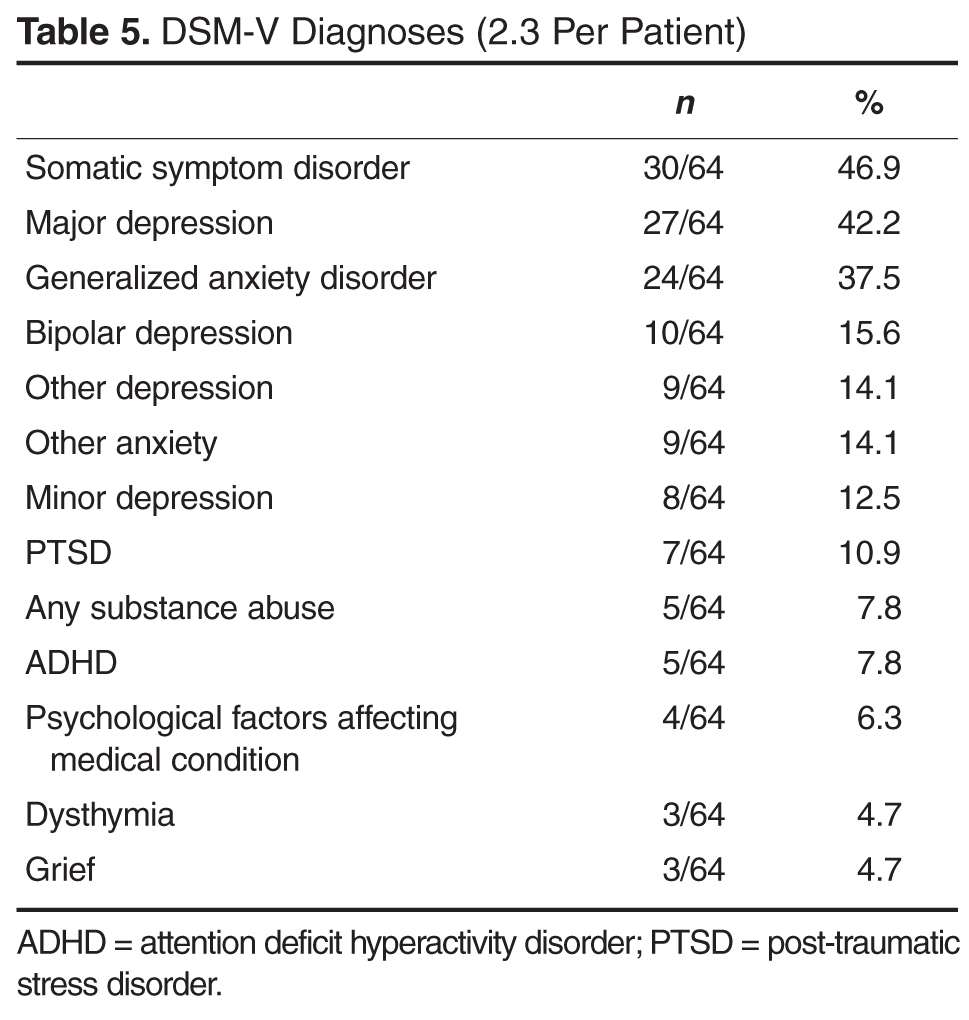
- Results: There were 64 patients, with an average age of 48.6 years. 68.8% were female, and 81.3% had had the presenting problem > 5 years. Presentation was psychological in 21/64 (32.8%), physical in 16/64 (25%), and both in 27/64 (42.2%). Patients averaged 3.3 common comorbid medical disease diagnoses. DSM-V diagnoses averaged 2.3 per patient; 30/64 (46.9%) had somatic symptom disorder, 27/64 (42.2%) had major depressive disorder, and 24/64 (37.5%) had generalized anxiety disorder. Social and economic impairment was present in > 70%. Some narcotic use occurred in 35/64 (54.7%) but only 7/35 (20.0%) were on unsafe doses; 46/64 (71.9%) took antidepressants but only 6/46 (13.0%) were on subtherapeutic doses. Averaging 71.9 months in the same clinic, only 18/64 (28.1%) had received behavioral health care for the presenting problem, and only 10.9% from psychiatrists.
- Conclusion: We described the chronic behavioral health problems of medical patients receiving behavioral care in their own medical setting from medical residents and faculty. These data can guide educators interested in training residents to manage common but now unattended behavioral health problems.
Patients with “any DSM behavioral health disorder” (mental health and substance use problems) account for 25% of patients seen in medical clinics [1]. These patients frequently present with poorly explained and sometimes confusing physical symptoms, and less often with psychological symptoms [2,3]. Common complaints in this population include chronic pain in almost any location, bowel complaints, insomnia, and fatigue [4]. Multiple somatic symptoms and increasing severity of symptoms correlate with the likelihood of an underlying depressive or anxiety disorder [3]. Unfortunately, medical physicians often do not recognize behavioral health problems and provide inadequate treatment for those they do [5].
As part of a Health Resources and Services Administration (HRSA) grant to develop behavioral health training guidelines for medical residents [6], we developed a special clinic for these patients. The clinic was located in their regular clinic area, and care was provided by medical residents and faculty. The objective of this paper is to describe the clinical presentation of patients attending the behavioral health care clinic, thus highlighting the common problems for which medical physicians are increasingly called upon to diagnose and treat.
Methods
We are in the third year of a 5-year HRSA grant to develop a method for teaching residents a primary care behavioral health care treatment model based on patient-centered, cognitive-behavioral, pharmacologic, and teamwork principles [6]. It is derived from consultation-liaison psychiatry, multidisciplinary pain management, and primary care research [7–10] and adapted for medical physicians. Described in detail elsewhere [6], we intensively train PGY-2 and PGY-3 residents in the Complex Patient Clinic (CPC), the name we applied to a behavioral health care clinic and the focus of this report.
Theoretical Base
The theoretical basis for this approach is general system theory and its medical derivative, the biopsychosocial (BPS) model [11]. In describing prevalent but overlooked behavioral health problems of patients attending our CPC, we underscore the importance of the BPS model relative to the prevailing biomedical, disease-only model. The latter does not include behavioral or psychosocial dimensions, the result being that they are largely excluded from medical education and, hence, overlooked in practice. The BPS model provides the theoretical basis for including these behavioral health patients in teaching and care.
Patients
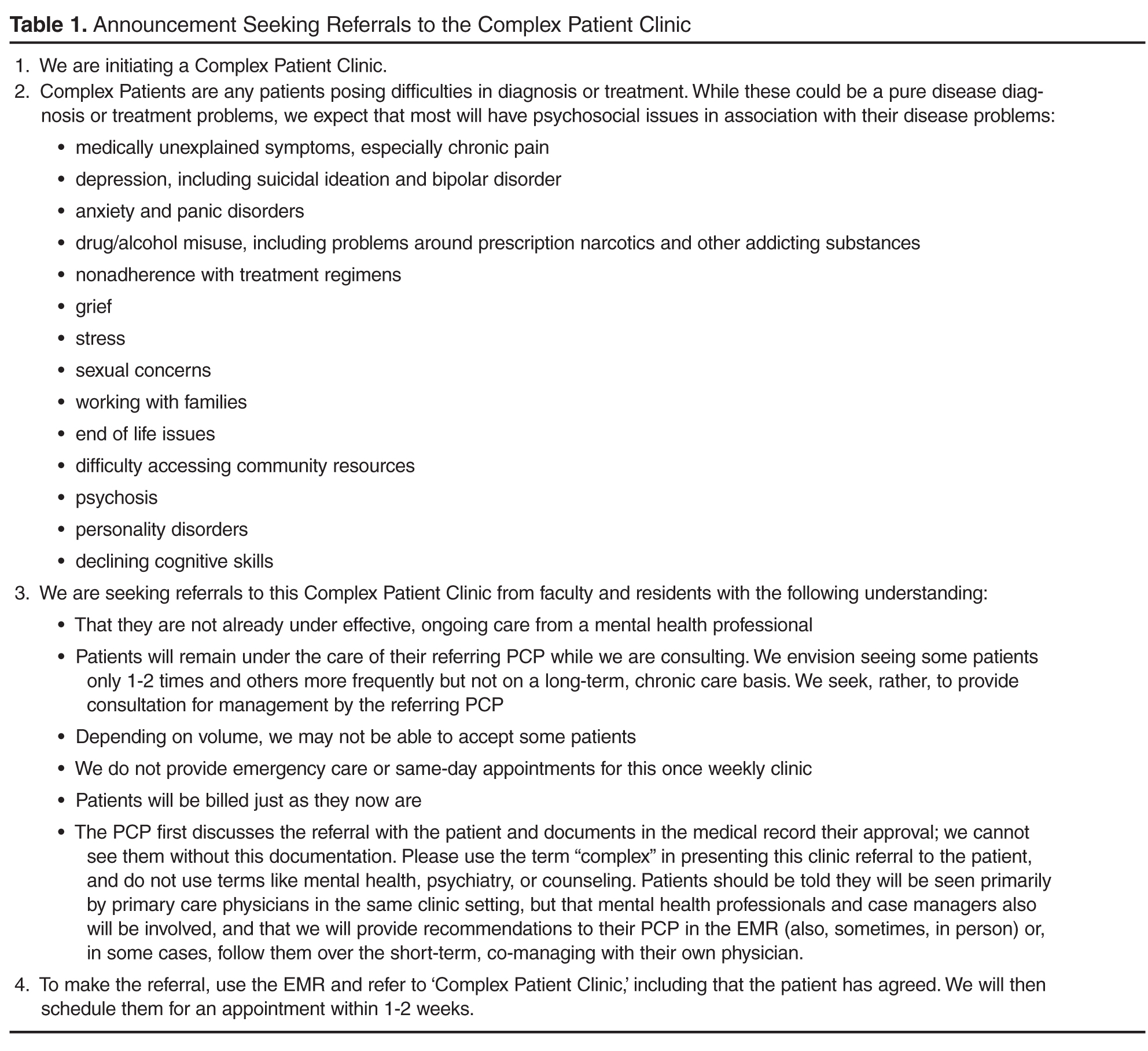
Observations
The CPC uses 3 examination rooms for one half-day a week in the usual resident and faculty area of the Clinical Center of Michigan State University Department of Medicine. Rooms are similar to other clinic examination rooms except that a second computer attached to small audio video recorder is placed on the physician’s desk. Visible to the patient, it broadcasts live the patient-resident interaction to a nearby room where teaching faculty observe the interaction on a computer linked by a special software program (Vidyo, Hackensack, NJ) [12]. Access and control of Vidyo virtual rooms is restricted and rooms can only be entered by participating faculty using pre-assigned usernames and passwords. No recordings of the interactions are made.
Training faculty and the resident reviewed the patient’s EMR before each interaction and faculty continued to review it while observing the interaction. Both faculty and trainee documented information in the EMR in the fashion used with other patients.
Data
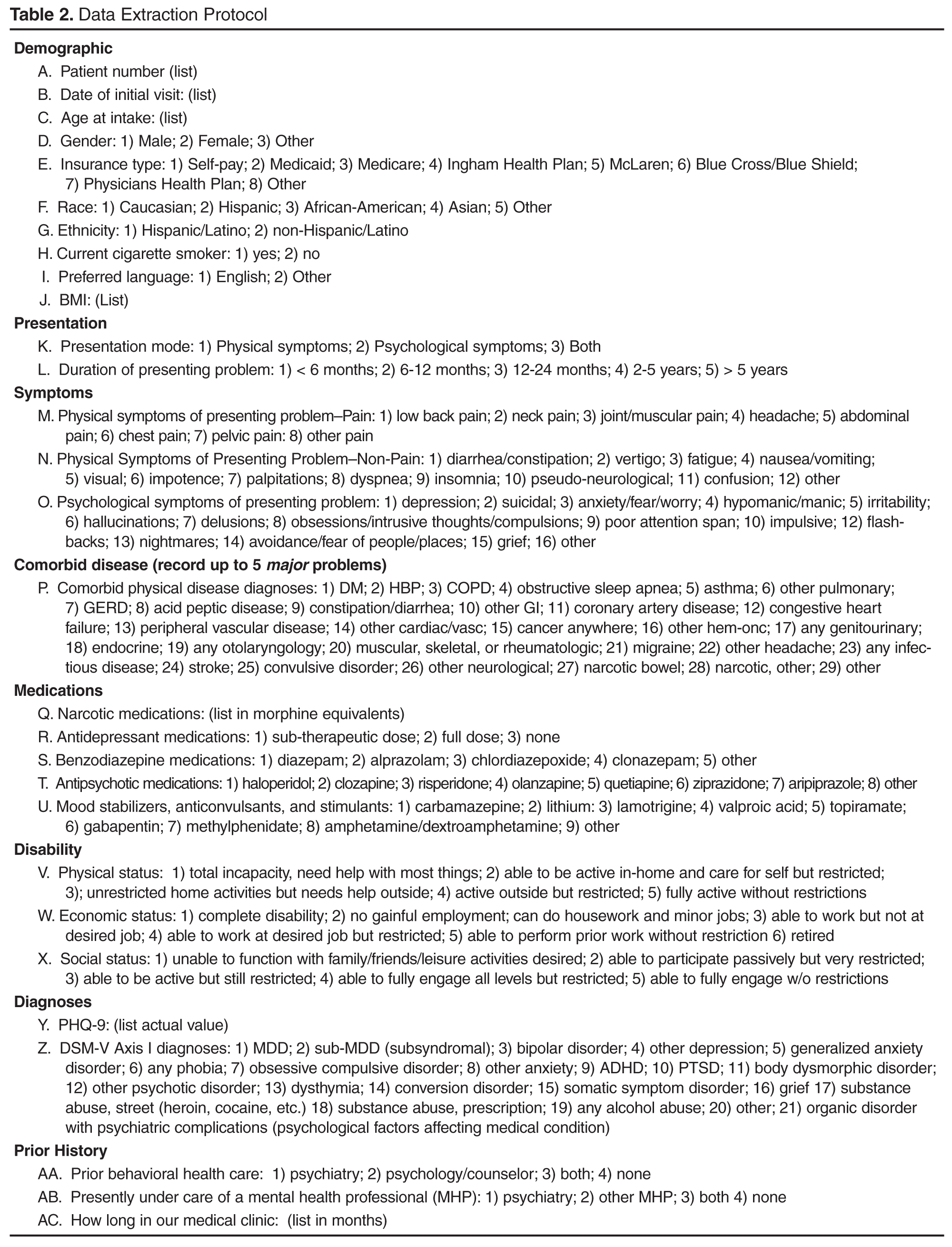
Two authors, RCS and AD, independently reviewed the EMR records of CPC visits, including follow-up visits and free text sources, and recorded results on an Excel spreadsheet; records of visits prior to CPC consultation were not reviewed nor were later non-CPC visits. They abstracted chart information on the first 5 patients and then updated and refined criteria. This was repeated again for the next 5 patients and near 100% agreement was obtained on all items except disability where > 90% agreement was achieved. All subsequent ratings were independently obtained and any differences were then jointly resolved in this extraction of mostly straightforward descriptive data. RCS is a senior faculty active in teaching and AD is a senior medical resident rated as superior by her faculty.
Results
Of 77 patients referred between 19 February 2013 and 10 December 2013, 13 (16.9%) did not complete the first scheduled or any subsequently scheduled appointments, while the remaining 64 patients (83.1%) completed referral to the CPC. Of the 64 attending the CPC, 6 (9.4%) missed the first appointment but made their first visit an average of 36.2 days later. The mean age was 48.6 years (range 25–75), 44/64 (68.8%) were women, 55/64 (85.9%) were Caucasian, 60/64 (93.8%) were non-Hispanic/Latino, and 63/64 (98.4%) were English speaking. All had insurance of some type, and 25/64 (39.1%) were Medicaid patients. Of 3583 total patients seen in the referring clinics during the same period, we found a mean age of 57 years (range, 17–97), 53% women, 75% Caucasian, 95% non-Hispanic/Latino, 97% English-speaking, and 9% Medicaid.
Current cigarette smokers were 22/64 (34.4%) of the population, higher than in national databases but similar to many behavioral health populations [23]. The BMI was 25 or less in 21/64 (32.8%), similar to the national distribution demonstrating that approximately 2/3 of patients are overweight or obese; 12/64 (18.8%) had a BMI of 25–30 (overweight), lower than national data, and 33/64 (48.5%) had a BMI >30 (obesity), higher than national data [24]. Similar increased rates of obesity are found in other behavioral health populations [25].
Mode of Symptom Presentation
Psychological symptoms were the sole mode of presentation in 21/64 (32.8%), while physical symptoms were the sole presenting complaint in 16/64 (25.0%). Combined psychological and physical symptoms were the predominant pattern at 27/64 (42.2%). Thus, 43/64 (67.2%) had physical symptoms and 48/64 (75.0%) had psychological symptoms at presentation. The mean duration of presenting symptoms was > 5 years in 52/64 (81.3%); only 5/64 (7.8%) had symptoms < 12 months in duration.
Presenting Symptoms
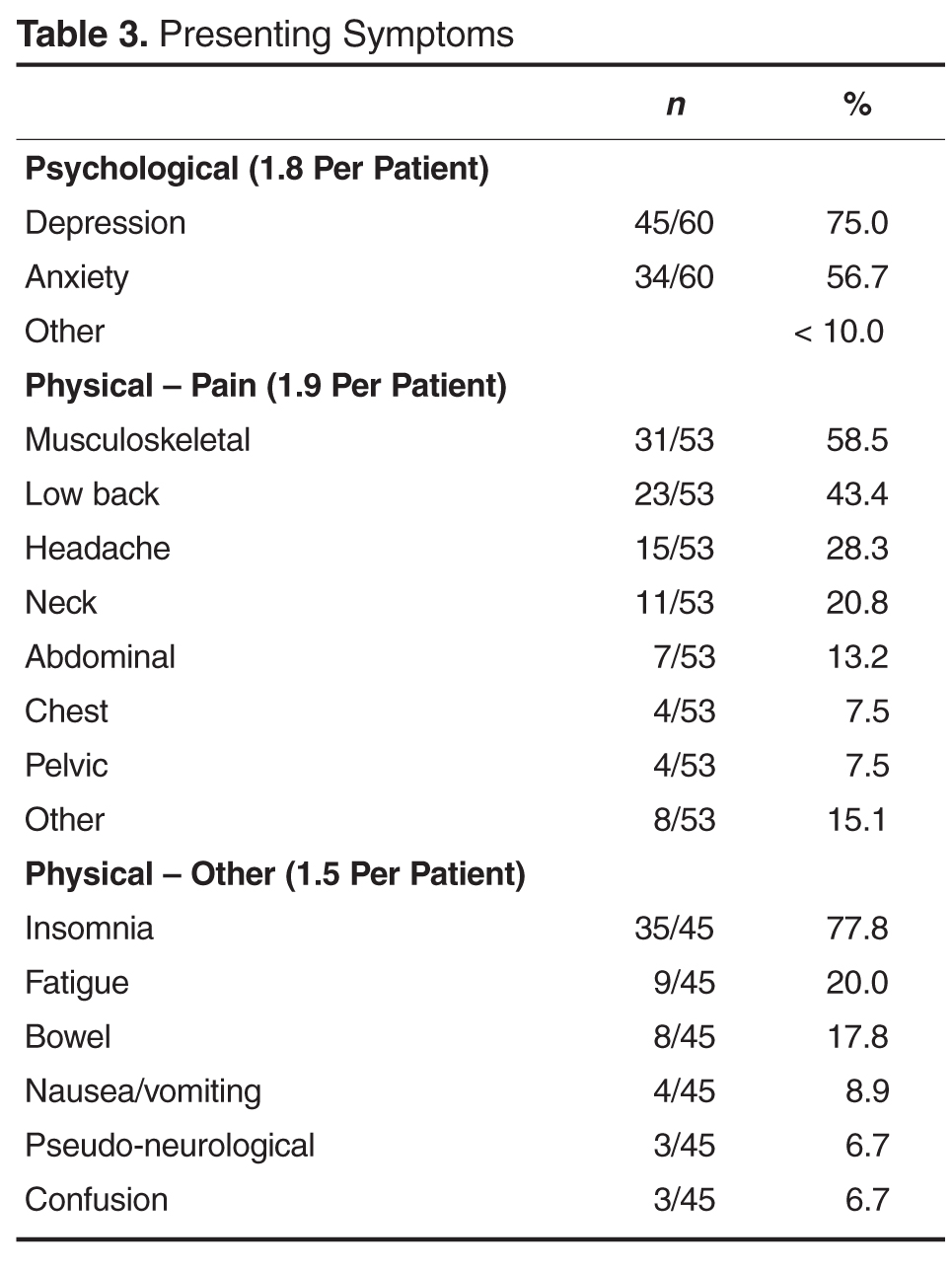
Pain symptoms were present in 53/64 (82.8%) and averaged 1.9 per patient. The details presented in Table 3 demonstrate a high frequency of musculoskeletal problems.
Non-pain physical symptoms were present in 45/64 (70.3%) and averaged 1.5 per patient. There was a very high frequency of insomnia (Table 3).
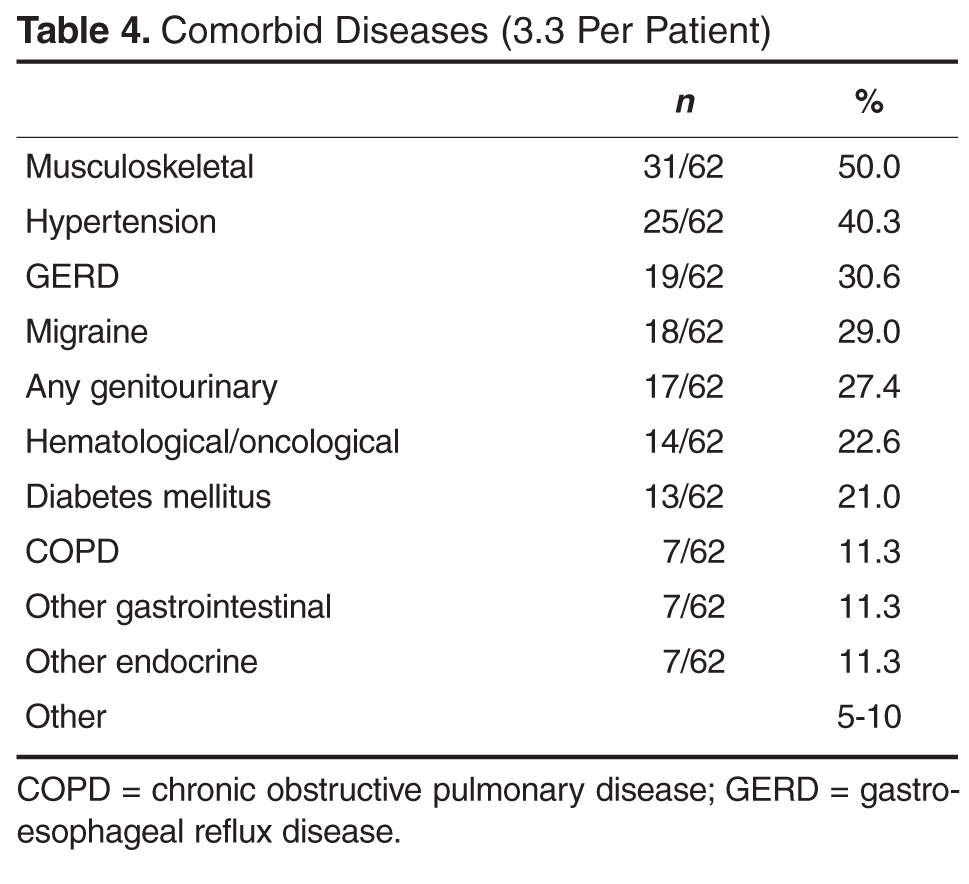
Comorbid Physical Diseases
Medications
Narcotic use was found in 35/64 (54.7%) patients; of these, 23/35 (65.7%) were using 80 or fewer morphine equivalents and 12/35 (34.3%) were using > 80 morphine equivalents, only 7/35 (20.0%) at > 120 morphine equivalents. Thus, only the latter took unsafe doses. There was no narcotic use in 29/64 (45.3%).
Antidepressant use was found in 46/64 (71.9%); only 6/46 (13.0%) were on subtherapeutic doses while 40/46 (87.0%) were on “usual therapeutic” doses. There was no antidepressant use in 18/64 (28.1%).
Benzodiazepine use was found in 31/64 (48.4%), antipsychotic use in 8/64 (12.5%), and mood stabilizer use in 10/64 (15.6%).
Impairment/Disability
Major physical impairment was present in 27/64 (42.2%), major economic impairment was present in 45/64 (70.3%), and major social impairment occurred in 49/64 (76.6%).
Diagnoses
The PHQ-9 was available in 41/64 (64.1%) of cases. Of these, it was < 5 (normal) in 3/41 (7.3%), from 5–10 (mild depression) in 11/41 (26.8%), from 10–15 (moderate depression) in 13/41 (31.7%), from 15–20 (severe depression) in 3/41 (7.3%), and > 20 (very severe depression) in 11/41 (26.8%).
Prior Care History
Behavioral health care for problems prior to the presentation problem had been received by 27/64 (42.2%): 11/27 (40.7%) from non-psychiatrists, 10/27 (37.0%) from psychiatrists, and 6/27 (22.2%) from both. Behavioral care for the presentation problem had been received by only 18/64 (28.1%): 11/18 (61.1%) from non-psychiatrists, 3/18 (16.7%) from psychiatrists, and 4/18 (22.2%) from both. Thus, of all 64 CPC patients, only 7 (10.9%) had received psychiatric care. Patients had received care in the same medical clinic for an average of 71.9 months.
Discussion
We identified the clinical profile of medical patients referred to a behavioral health care clinic. Located in the patients’ usual clinic area, care in the CPC was provided by medical residents and faculty. CPC patients were predominantly middle-aged, female, white, and non-Hispanic/Latino. Obesity and tobacco use were greater than in the general population but at levels often found in psychiatric populations [23,25]. Presenting symptoms of most patients were of > 5 years’ duration. The most common presentation was a combination of psychological and physical symptoms rather than either alone. Psychological symptoms were mainly depression and anxiety, while physical presentations primarily involved insomnia and many types of pain. These findings parallel the literature, except that psychological symptoms were more prominent than often reported [2,3]. This may indicate better recognition by referring physicians (and thus referral) of patients having a psychological presentation [26].
On average, there were 3.3 common comorbid physical disease diagnoses and 2.3 DSM-V diagnoses in each patient. The most common DSM-V diagnoses were somatic symptom disorder (46.9%), major depressive disorder (42.2%), and generalized anxiety disorder (37.5%) [22]. Representing diagnoses with which residents likely would have less recognition, several other disorders were in the 5% to 15% range: bipolar disorder, PTSD, various types of substance abuse, ADHD, psychological factors affecting medical conditions, and dysthymia.
Based on the literature and frequent comments from faculty and residents, we had expected greater narcotic use, especially at unsafe levels [27]. But, nearly half were taking none. Of those taking narcotics, only 20% received unsafe doses (more than 120 morphine equivalents). At odds with the literature citing frequent subtherapeutic antidepressant use by physicians [16], only 13.0% of the 71.9% taking antidepressants were at subtherapeutic levels. This suggests that referring physicians were not remiss when prescribing a single drug and that multiple drugs may be necessary [28]. Referring physicians may not be comfortable initiating and managing these more complex regimens. The narcotic and antidepressant practices by referring physicians suggested that the patients referred were more complex than can be addressed by good general medical care (low-dose narcotics and full-dose antidepressants). The complexity of these patients is further suggested by the PHQ-9 data, which indicated that more than one-third were in the severe to very severe range for depression [21]. The extent of economic and social impairment was striking (> 70%).
Even though these patients had been in the same medical clinic for nearly 6 years, only 28.1% had received behavioral health care for the presenting problem, and only 10.9% by a psychiatrist [5]. This suggests failure to recognize the problem [5] and/or the inability to access increasingly unavailable psychiatric consultation [29]. The latter is consistent with the literature that psychiatrists care for < 15% of all mental health patients [30], are of insufficient numbers in 96% of U.S. counties [31], and that most medical physicians find it nearly impossible to obtain a psychiatric consultation [29]. We also demonstrated behavioral health patients’ ready acceptance of behavioral health consultation in a medical setting by medical physicians. The 16.9% no-show rate for referrals to the CPC compares favorably to completion of psychiatry referrals where 50% to 60% no-show rates are not uncommon [32]. While our results may be due to decreased stigma in a medical setting [33], they likely also reflect that direct appointments were made by the referring physician at the time of the appointment (rather than the frequent psychiatry practice of having the patient make the appointment later by telephone), and that there was no more than a 1- to 2-week waiting period [34].
There were important limitations. The patient population from this small academic medical center may vary from that seen in different clinic types, and its physicians may differ in their referral practices. Although it is possible that our results are unique to the CPC and not generalizable, the similarity of our patients to those reported in the survey literature of primary care strongly suggests that these are indeed the types of patients who would be referred to and attend such clinics elsewhere. Patients also were mostly white, so the results may not apply in other populations. Further, some reports indicate using unstructured records from the EMR alone for diagnosing depression has significant limitations [35]. We did not have structured data, and the quality of documentation cannot be assured. A further limitation is that we did not verify our findings by talking with the physicians or with the patients, nor did we use formal diagnostic tools administered to patients, such as the World Health Organization Composite International Diagnostic Interview [36], to establish independently our DSM-V diagnoses [22]. Nevertheless, CPC diagnoses were made by experienced clinicians familiar with DSM-V.
Conclusion
This descriptive research demonstrated the clinical presentation of behavioral health patients when consultation was provided by medical physicians in their usual clinic. We have identified the types of patients for which educators may want to prepare their residents (and students) and for which practitioners can seek continuing education. Specifically, we demonstrated that learners will need to know how to diagnose and manage patients presenting with many different physical symptoms, often difficult to explain on a disease basis. Further, they will need to recognize that the usual mode of presentation of a primary care behavioral health problem, typically underlying depression and anxiety, is with multiple physical symptoms [37]. Learners will, in turn, need to be taught the relational, cognitive behavioral, pharmacologic, and teamwork principles that must be used in treatment [37].
Nevertheless, practically speaking, training practitioners has been ineffective [38], and training residents and students would not yield results for many years, Thus, these data also highlight the need for increased training of consultation-liaison and other psychiatrists. The well-established success of collaborative care [39] warrants increased support, as do related team efforts such as the patient-centered medical home. As well, more support for services and implementation research is badly needed to facilitate behavioral care in the medical setting.
The well-trained physician of the future can greatly complement these current efforts. If we can address all the multiple factors involved, we can look ahead to a much changed behavioral health care scene in 10 to 15 years [40].
Acknowledgements: The authors would like to acknowledge key advisory roles played by the following parts of our team in developing this project. Heather Spotts, MSW, advised and participated in team management. Jose Herrera, MD, was crucial in providing psychiatry continuity in the Complex Patient Clinic. Carmen Meerschaert, MD, played a key initial role in developing the structure of the Complex Patient Clinic. Geraud Plantegenest, MS, was responsible to developing and ensuring the function of our internet technology work in the Complex Patient Clinic.
Corresponding author: Robert C. Smith, B312 Clinical Center, 788 Service Rd., Michigan State Univ., East Lansing, MI 48824, [email protected].
Funding/support: We are grateful for the generous support from the Health Resources and Services Administration (HRSA) (D58HP23259) that provides the opportunity to develop this curriculum and produce papers from it. HRSA had no role in the study design; collection, analysis, and interpretation of data; writing the report; or in decision to submit the article for publication.
Financial disclosures: None.
Author contributions: conception and design, FCD, DD, JF, AD, DS, RCS; analysis and interpretation of data, FCD, AD, KGS, DS, RCS; drafting of article, FCD, HLF, LF, DD, JF, AD, KGS, DS, RCS; critical revision of the article, FCD, HLF, LF, DD, JF, AD, KGS, DS, RCS; provision of study materials or patients, FCD, HLF, LF, RCS; statistical expertise, AD, KGS, DS; obtaining of funding, FCD, LF, RCS; administrative or technical support, FCD, HLF, KGS, RCS; collection and assembly of data, AD, RCS.
1. Norquist GS, Regier DA. The epidemiology of psychiatric disorders and the de facto mental health care system. Annu Rev Med 1996;47:473–9.
2. Collins C, Hewson D, Munger R, Wade T. Evolving models of behavioral health integration in primary care. In: Fund MM, editor. New York: Milbank Memorial Fund; 2010.
3. Kroenke K. The interface between physical and psychological symptoms. Prim Care Companion J Clin Psychiatry 2003;5(Suppl 7):11–8.
4. Kroenke K, Price RK. Symptoms in the community--prevalence, classification, and psychiatric comorbidity. Arch Intern Med 1993;153:2474–80.
5. Melek S, Norris D. Chronic conditions and comorbid psychological disorders. Millman Research Report. Seattle, WA: Millman 2008:19.
6. Smith R, Laird-Fick H, D’Mello D, et al. Addressing mental health issues in primary care: an initial curriculum for medical residents. Patient Educ Couns 2013;94:33–42.
7. Cutler RB, Fishbain DA, Rosomoff HL, et al. Does nonsurgical pain center treatment of chronic pain return patients to work? -- a review and meta-analysis of the literature. Spine 1994;19:643–52.
8. Katon W, von Korff M, Lin E, et al. Distressed high utilizers of medical care: DSM-III-R diagnoses and treatment needs. Gen Hosp Psychiatry 1990;12:355–62.
9. Sharpe M, Hawton K, Simkin S, et al. Cognitive behaviour therapy for the chronic fatigue syndrome:a randomised controlled trial. BMJ 1996;312:22–6.
10. World Organization of Family Doctors. Accessed 26 Aug 2013 at www.who.int/workforcealliance/members_partners/member_list/wonca/en/index.html.
11. Engel GL. The need for a new medical model: a challenge for biomedicine. Science 1977;196:129–36.
12. Vidyo. www.vidyo.com/products/use/.
13. Allison JJ, Wall TC, Spettell CM, et al. The art and science of chart review. Jt Comm J Qual Improve 2000;26:115–36.
14. Vieweg WV, Lipps WF, Fernandez A. Opioids and methadone equivalents for clinicians. Prim Care Companion J Clin Psychiatry 2005;7:86–8.
15. Dunn KM, Saunders KW, Rutter CM, et al. Opioid prescriptions for chronic pain and overdose: a cohort study. Ann Intern Med 2010;152:85–92.
16. Kessler R, Stafford D. Primary care is the de facto mental health system. In: Kessler R, Stafford D, editors. Collaborative medicine case studies—evidence in practice. New York: Springer; 2008:9–21.
17. Schneider RK, Levenson JL. Psychiatry essentials for primary care. Philadelphia: American College of Physicians; 2008.
18. Von Korff M, Ormel J, Katon W, Lin EHB. Disability and depression among high utilizers of health care—a longitudinal analysis. Arch Gen Psychiatry 1992;49:91–100.
19. Von Korff M, Ustun TB, Ormel J, et al. Self-report disability in an international primary care study of psychological illness. J Clin Epidemiol 1996;49:297–303.
20. Fairbank JC, Couper J, Davies JB, O’Brien JP. The Oswestry low back pain disability questionnaire. Physiotherapy 1980;66:271–3.
21. Kroenke K, Spitzer RL, Williams JB, Lowe B. The Patient Health Questionnaire Somatic, Anxiety, and Depressive Symptom Scales: a systematic review. Gen Hosp Psychiatry 2010;32:345–59.
22. Diagnostic and Statistical Manual of Mental Disorders. 5th ed. Washington, DC: American Psychiatric Association; 2013.
23. Lasser K, Boyd JW, Woolhandler S, et al. Smoking and mental illness: A population-based prevalence study. JAMA 2000;284:2606–10.
24. NIDDK. Overweight and obesity statistics. Accessed 30 May 2014 at win.niddk.nih.gov/statistics/
25. Allison DB, Newcomer JW, Dunn AL, et al. Obesity among those with mental disorders: a National Institute of Mental Health meeting report. Am J Prev Med 2009;36:341–50.
26. Salmon P, Humphris GM, Ring A, et al. Primary care consultations about medically unexplained symptoms: patient presentations and doctor responses that influence the probability of somatic intervention. Psychosom Med 2007;69:571–7.
27. Sullivan MD, Howe CQ. Opioid therapy for chronic pain in the United States: promises and perils. Pain 2013;154 Suppl 1:S94–100.
28. Rush AJ. STAR*D: what have we learned? Am J Psychiatry 2007;164:201–4.
29. Cunningham PJ. Beyond parity: primary care physicians’ perspectives on access to mental health care. Health Aff (Millwood) 2009;28:w490–501.
30. Wang PS, Lane M, Olfson M, et al. Twelve-month use of mental health services in the United States—results from the National Comorbidity Survey Replication. Arch Gen Psychiatry 2005;62:629–40.
31. Morrisey J, Thomas K, Ellis A, Konrad T. Development of a new method for designation of mental health professional shortage areas. Chapel Hill, NC: University of North Carolina at Chapel Hill; 2007.
32. deGruy F. Mental health care in the primary care setting. In: Donaldson MS, Yordy KD, Lohr KN, Vanselow NA, editors. Primary care—America’s health in a new era. Washington, DC: National Academy Press; 1996:285–311.
33. World Organization of Family Doctors. Companion to primary care mental health. New York: WONCA and Radcliffe Publishing; 2012.
34. Craig TJ, Huffine CL, Brooks M. Completion of referral to psychiatric services by inner city residents. Arch Gen Psychiatry 1974;31:353–7.
35. Chen Y, Li H, Li Y, et al. Resemblance of symptoms for major depression assessed at interview versus from hospital record review. PLoS ONE 2012;7:e28734.
36. World Health Organization. Composite International Diagnostic Interview (CIDI) – core version 2.1. Geneva: WHO; 1997.
37. Smith RC, Lein C, Collins C, et al. Treating patients with medically unexplained symptoms in primary care. J Gen Intern Med 2003;18:478–89.
38. Lin EH, Simon GE, Katzelnick DJ, Pearson SD. Does physician education on depression management improve treatment in primary care? J Gen Intern Med 2001;16:614–9.
39. Huffman JC, Niazi SK, Rundell JR, et al. Essential articles on collaborative care models for the treatment of psychiatric disorders in medical settings: a publication by the Academy of Psychosomatic Medicine Research and Evidence-Based Practice Committee. Psychosomatics 2014;55:109–22.
40. Summergrad P, Kathol R. A vision of integrated psychiatric and medical care for 2023. In: Summergrad P, Kathol R, editors. Integrated care in psychiatry: redefining the role of mental health professionals in the medical setting. New York: Springer; 2014.
From Michigan State University, East Lansing, MI.
Abstract
- Objective: To describe the clinical presentations of medical patients attending a behavioral health clinic staffed by medical residents and faculty in the patients’ usual medical setting.
- Methods: We extracted the following clinical data from the patients’ electronic medical records: duration of problem; symptom presentation; symptom types; use of narcotics, antidepressants, benzodiazepines, antipsychotics, and mood stabilizers; impairment/disability; PHQ-9 scores and DSM-V diagnoses; and prior care from behavioral health professionals.
- Results: There were 64 patients, with an average age of 48.6 years. 68.8% were female, and 81.3% had had the presenting problem > 5 years. Presentation was psychological in 21/64 (32.8%), physical in 16/64 (25%), and both in 27/64 (42.2%). Patients averaged 3.3 common comorbid medical disease diagnoses. DSM-V diagnoses averaged 2.3 per patient; 30/64 (46.9%) had somatic symptom disorder, 27/64 (42.2%) had major depressive disorder, and 24/64 (37.5%) had generalized anxiety disorder. Social and economic impairment was present in > 70%. Some narcotic use occurred in 35/64 (54.7%) but only 7/35 (20.0%) were on unsafe doses; 46/64 (71.9%) took antidepressants but only 6/46 (13.0%) were on subtherapeutic doses. Averaging 71.9 months in the same clinic, only 18/64 (28.1%) had received behavioral health care for the presenting problem, and only 10.9% from psychiatrists.
- Conclusion: We described the chronic behavioral health problems of medical patients receiving behavioral care in their own medical setting from medical residents and faculty. These data can guide educators interested in training residents to manage common but now unattended behavioral health problems.
Patients with “any DSM behavioral health disorder” (mental health and substance use problems) account for 25% of patients seen in medical clinics [1]. These patients frequently present with poorly explained and sometimes confusing physical symptoms, and less often with psychological symptoms [2,3]. Common complaints in this population include chronic pain in almost any location, bowel complaints, insomnia, and fatigue [4]. Multiple somatic symptoms and increasing severity of symptoms correlate with the likelihood of an underlying depressive or anxiety disorder [3]. Unfortunately, medical physicians often do not recognize behavioral health problems and provide inadequate treatment for those they do [5].
As part of a Health Resources and Services Administration (HRSA) grant to develop behavioral health training guidelines for medical residents [6], we developed a special clinic for these patients. The clinic was located in their regular clinic area, and care was provided by medical residents and faculty. The objective of this paper is to describe the clinical presentation of patients attending the behavioral health care clinic, thus highlighting the common problems for which medical physicians are increasingly called upon to diagnose and treat.
Methods
We are in the third year of a 5-year HRSA grant to develop a method for teaching residents a primary care behavioral health care treatment model based on patient-centered, cognitive-behavioral, pharmacologic, and teamwork principles [6]. It is derived from consultation-liaison psychiatry, multidisciplinary pain management, and primary care research [7–10] and adapted for medical physicians. Described in detail elsewhere [6], we intensively train PGY-2 and PGY-3 residents in the Complex Patient Clinic (CPC), the name we applied to a behavioral health care clinic and the focus of this report.
Theoretical Base
The theoretical basis for this approach is general system theory and its medical derivative, the biopsychosocial (BPS) model [11]. In describing prevalent but overlooked behavioral health problems of patients attending our CPC, we underscore the importance of the BPS model relative to the prevailing biomedical, disease-only model. The latter does not include behavioral or psychosocial dimensions, the result being that they are largely excluded from medical education and, hence, overlooked in practice. The BPS model provides the theoretical basis for including these behavioral health patients in teaching and care.
Patients
Observations
The CPC uses 3 examination rooms for one half-day a week in the usual resident and faculty area of the Clinical Center of Michigan State University Department of Medicine. Rooms are similar to other clinic examination rooms except that a second computer attached to small audio video recorder is placed on the physician’s desk. Visible to the patient, it broadcasts live the patient-resident interaction to a nearby room where teaching faculty observe the interaction on a computer linked by a special software program (Vidyo, Hackensack, NJ) [12]. Access and control of Vidyo virtual rooms is restricted and rooms can only be entered by participating faculty using pre-assigned usernames and passwords. No recordings of the interactions are made.
Training faculty and the resident reviewed the patient’s EMR before each interaction and faculty continued to review it while observing the interaction. Both faculty and trainee documented information in the EMR in the fashion used with other patients.
Data
Two authors, RCS and AD, independently reviewed the EMR records of CPC visits, including follow-up visits and free text sources, and recorded results on an Excel spreadsheet; records of visits prior to CPC consultation were not reviewed nor were later non-CPC visits. They abstracted chart information on the first 5 patients and then updated and refined criteria. This was repeated again for the next 5 patients and near 100% agreement was obtained on all items except disability where > 90% agreement was achieved. All subsequent ratings were independently obtained and any differences were then jointly resolved in this extraction of mostly straightforward descriptive data. RCS is a senior faculty active in teaching and AD is a senior medical resident rated as superior by her faculty.
Results
Of 77 patients referred between 19 February 2013 and 10 December 2013, 13 (16.9%) did not complete the first scheduled or any subsequently scheduled appointments, while the remaining 64 patients (83.1%) completed referral to the CPC. Of the 64 attending the CPC, 6 (9.4%) missed the first appointment but made their first visit an average of 36.2 days later. The mean age was 48.6 years (range 25–75), 44/64 (68.8%) were women, 55/64 (85.9%) were Caucasian, 60/64 (93.8%) were non-Hispanic/Latino, and 63/64 (98.4%) were English speaking. All had insurance of some type, and 25/64 (39.1%) were Medicaid patients. Of 3583 total patients seen in the referring clinics during the same period, we found a mean age of 57 years (range, 17–97), 53% women, 75% Caucasian, 95% non-Hispanic/Latino, 97% English-speaking, and 9% Medicaid.
Current cigarette smokers were 22/64 (34.4%) of the population, higher than in national databases but similar to many behavioral health populations [23]. The BMI was 25 or less in 21/64 (32.8%), similar to the national distribution demonstrating that approximately 2/3 of patients are overweight or obese; 12/64 (18.8%) had a BMI of 25–30 (overweight), lower than national data, and 33/64 (48.5%) had a BMI >30 (obesity), higher than national data [24]. Similar increased rates of obesity are found in other behavioral health populations [25].
Mode of Symptom Presentation
Psychological symptoms were the sole mode of presentation in 21/64 (32.8%), while physical symptoms were the sole presenting complaint in 16/64 (25.0%). Combined psychological and physical symptoms were the predominant pattern at 27/64 (42.2%). Thus, 43/64 (67.2%) had physical symptoms and 48/64 (75.0%) had psychological symptoms at presentation. The mean duration of presenting symptoms was > 5 years in 52/64 (81.3%); only 5/64 (7.8%) had symptoms < 12 months in duration.
Presenting Symptoms
Pain symptoms were present in 53/64 (82.8%) and averaged 1.9 per patient. The details presented in Table 3 demonstrate a high frequency of musculoskeletal problems.
Non-pain physical symptoms were present in 45/64 (70.3%) and averaged 1.5 per patient. There was a very high frequency of insomnia (Table 3).
Comorbid Physical Diseases
Medications
Narcotic use was found in 35/64 (54.7%) patients; of these, 23/35 (65.7%) were using 80 or fewer morphine equivalents and 12/35 (34.3%) were using > 80 morphine equivalents, only 7/35 (20.0%) at > 120 morphine equivalents. Thus, only the latter took unsafe doses. There was no narcotic use in 29/64 (45.3%).
Antidepressant use was found in 46/64 (71.9%); only 6/46 (13.0%) were on subtherapeutic doses while 40/46 (87.0%) were on “usual therapeutic” doses. There was no antidepressant use in 18/64 (28.1%).
Benzodiazepine use was found in 31/64 (48.4%), antipsychotic use in 8/64 (12.5%), and mood stabilizer use in 10/64 (15.6%).
Impairment/Disability
Major physical impairment was present in 27/64 (42.2%), major economic impairment was present in 45/64 (70.3%), and major social impairment occurred in 49/64 (76.6%).
Diagnoses
The PHQ-9 was available in 41/64 (64.1%) of cases. Of these, it was < 5 (normal) in 3/41 (7.3%), from 5–10 (mild depression) in 11/41 (26.8%), from 10–15 (moderate depression) in 13/41 (31.7%), from 15–20 (severe depression) in 3/41 (7.3%), and > 20 (very severe depression) in 11/41 (26.8%).
Prior Care History
Behavioral health care for problems prior to the presentation problem had been received by 27/64 (42.2%): 11/27 (40.7%) from non-psychiatrists, 10/27 (37.0%) from psychiatrists, and 6/27 (22.2%) from both. Behavioral care for the presentation problem had been received by only 18/64 (28.1%): 11/18 (61.1%) from non-psychiatrists, 3/18 (16.7%) from psychiatrists, and 4/18 (22.2%) from both. Thus, of all 64 CPC patients, only 7 (10.9%) had received psychiatric care. Patients had received care in the same medical clinic for an average of 71.9 months.
Discussion
We identified the clinical profile of medical patients referred to a behavioral health care clinic. Located in the patients’ usual clinic area, care in the CPC was provided by medical residents and faculty. CPC patients were predominantly middle-aged, female, white, and non-Hispanic/Latino. Obesity and tobacco use were greater than in the general population but at levels often found in psychiatric populations [23,25]. Presenting symptoms of most patients were of > 5 years’ duration. The most common presentation was a combination of psychological and physical symptoms rather than either alone. Psychological symptoms were mainly depression and anxiety, while physical presentations primarily involved insomnia and many types of pain. These findings parallel the literature, except that psychological symptoms were more prominent than often reported [2,3]. This may indicate better recognition by referring physicians (and thus referral) of patients having a psychological presentation [26].
On average, there were 3.3 common comorbid physical disease diagnoses and 2.3 DSM-V diagnoses in each patient. The most common DSM-V diagnoses were somatic symptom disorder (46.9%), major depressive disorder (42.2%), and generalized anxiety disorder (37.5%) [22]. Representing diagnoses with which residents likely would have less recognition, several other disorders were in the 5% to 15% range: bipolar disorder, PTSD, various types of substance abuse, ADHD, psychological factors affecting medical conditions, and dysthymia.
Based on the literature and frequent comments from faculty and residents, we had expected greater narcotic use, especially at unsafe levels [27]. But, nearly half were taking none. Of those taking narcotics, only 20% received unsafe doses (more than 120 morphine equivalents). At odds with the literature citing frequent subtherapeutic antidepressant use by physicians [16], only 13.0% of the 71.9% taking antidepressants were at subtherapeutic levels. This suggests that referring physicians were not remiss when prescribing a single drug and that multiple drugs may be necessary [28]. Referring physicians may not be comfortable initiating and managing these more complex regimens. The narcotic and antidepressant practices by referring physicians suggested that the patients referred were more complex than can be addressed by good general medical care (low-dose narcotics and full-dose antidepressants). The complexity of these patients is further suggested by the PHQ-9 data, which indicated that more than one-third were in the severe to very severe range for depression [21]. The extent of economic and social impairment was striking (> 70%).
Even though these patients had been in the same medical clinic for nearly 6 years, only 28.1% had received behavioral health care for the presenting problem, and only 10.9% by a psychiatrist [5]. This suggests failure to recognize the problem [5] and/or the inability to access increasingly unavailable psychiatric consultation [29]. The latter is consistent with the literature that psychiatrists care for < 15% of all mental health patients [30], are of insufficient numbers in 96% of U.S. counties [31], and that most medical physicians find it nearly impossible to obtain a psychiatric consultation [29]. We also demonstrated behavioral health patients’ ready acceptance of behavioral health consultation in a medical setting by medical physicians. The 16.9% no-show rate for referrals to the CPC compares favorably to completion of psychiatry referrals where 50% to 60% no-show rates are not uncommon [32]. While our results may be due to decreased stigma in a medical setting [33], they likely also reflect that direct appointments were made by the referring physician at the time of the appointment (rather than the frequent psychiatry practice of having the patient make the appointment later by telephone), and that there was no more than a 1- to 2-week waiting period [34].
There were important limitations. The patient population from this small academic medical center may vary from that seen in different clinic types, and its physicians may differ in their referral practices. Although it is possible that our results are unique to the CPC and not generalizable, the similarity of our patients to those reported in the survey literature of primary care strongly suggests that these are indeed the types of patients who would be referred to and attend such clinics elsewhere. Patients also were mostly white, so the results may not apply in other populations. Further, some reports indicate using unstructured records from the EMR alone for diagnosing depression has significant limitations [35]. We did not have structured data, and the quality of documentation cannot be assured. A further limitation is that we did not verify our findings by talking with the physicians or with the patients, nor did we use formal diagnostic tools administered to patients, such as the World Health Organization Composite International Diagnostic Interview [36], to establish independently our DSM-V diagnoses [22]. Nevertheless, CPC diagnoses were made by experienced clinicians familiar with DSM-V.
Conclusion
This descriptive research demonstrated the clinical presentation of behavioral health patients when consultation was provided by medical physicians in their usual clinic. We have identified the types of patients for which educators may want to prepare their residents (and students) and for which practitioners can seek continuing education. Specifically, we demonstrated that learners will need to know how to diagnose and manage patients presenting with many different physical symptoms, often difficult to explain on a disease basis. Further, they will need to recognize that the usual mode of presentation of a primary care behavioral health problem, typically underlying depression and anxiety, is with multiple physical symptoms [37]. Learners will, in turn, need to be taught the relational, cognitive behavioral, pharmacologic, and teamwork principles that must be used in treatment [37].
Nevertheless, practically speaking, training practitioners has been ineffective [38], and training residents and students would not yield results for many years, Thus, these data also highlight the need for increased training of consultation-liaison and other psychiatrists. The well-established success of collaborative care [39] warrants increased support, as do related team efforts such as the patient-centered medical home. As well, more support for services and implementation research is badly needed to facilitate behavioral care in the medical setting.
The well-trained physician of the future can greatly complement these current efforts. If we can address all the multiple factors involved, we can look ahead to a much changed behavioral health care scene in 10 to 15 years [40].
Acknowledgements: The authors would like to acknowledge key advisory roles played by the following parts of our team in developing this project. Heather Spotts, MSW, advised and participated in team management. Jose Herrera, MD, was crucial in providing psychiatry continuity in the Complex Patient Clinic. Carmen Meerschaert, MD, played a key initial role in developing the structure of the Complex Patient Clinic. Geraud Plantegenest, MS, was responsible to developing and ensuring the function of our internet technology work in the Complex Patient Clinic.
Corresponding author: Robert C. Smith, B312 Clinical Center, 788 Service Rd., Michigan State Univ., East Lansing, MI 48824, [email protected].
Funding/support: We are grateful for the generous support from the Health Resources and Services Administration (HRSA) (D58HP23259) that provides the opportunity to develop this curriculum and produce papers from it. HRSA had no role in the study design; collection, analysis, and interpretation of data; writing the report; or in decision to submit the article for publication.
Financial disclosures: None.
Author contributions: conception and design, FCD, DD, JF, AD, DS, RCS; analysis and interpretation of data, FCD, AD, KGS, DS, RCS; drafting of article, FCD, HLF, LF, DD, JF, AD, KGS, DS, RCS; critical revision of the article, FCD, HLF, LF, DD, JF, AD, KGS, DS, RCS; provision of study materials or patients, FCD, HLF, LF, RCS; statistical expertise, AD, KGS, DS; obtaining of funding, FCD, LF, RCS; administrative or technical support, FCD, HLF, KGS, RCS; collection and assembly of data, AD, RCS.
From Michigan State University, East Lansing, MI.
Abstract
- Objective: To describe the clinical presentations of medical patients attending a behavioral health clinic staffed by medical residents and faculty in the patients’ usual medical setting.
- Methods: We extracted the following clinical data from the patients’ electronic medical records: duration of problem; symptom presentation; symptom types; use of narcotics, antidepressants, benzodiazepines, antipsychotics, and mood stabilizers; impairment/disability; PHQ-9 scores and DSM-V diagnoses; and prior care from behavioral health professionals.
- Results: There were 64 patients, with an average age of 48.6 years. 68.8% were female, and 81.3% had had the presenting problem > 5 years. Presentation was psychological in 21/64 (32.8%), physical in 16/64 (25%), and both in 27/64 (42.2%). Patients averaged 3.3 common comorbid medical disease diagnoses. DSM-V diagnoses averaged 2.3 per patient; 30/64 (46.9%) had somatic symptom disorder, 27/64 (42.2%) had major depressive disorder, and 24/64 (37.5%) had generalized anxiety disorder. Social and economic impairment was present in > 70%. Some narcotic use occurred in 35/64 (54.7%) but only 7/35 (20.0%) were on unsafe doses; 46/64 (71.9%) took antidepressants but only 6/46 (13.0%) were on subtherapeutic doses. Averaging 71.9 months in the same clinic, only 18/64 (28.1%) had received behavioral health care for the presenting problem, and only 10.9% from psychiatrists.
- Conclusion: We described the chronic behavioral health problems of medical patients receiving behavioral care in their own medical setting from medical residents and faculty. These data can guide educators interested in training residents to manage common but now unattended behavioral health problems.
Patients with “any DSM behavioral health disorder” (mental health and substance use problems) account for 25% of patients seen in medical clinics [1]. These patients frequently present with poorly explained and sometimes confusing physical symptoms, and less often with psychological symptoms [2,3]. Common complaints in this population include chronic pain in almost any location, bowel complaints, insomnia, and fatigue [4]. Multiple somatic symptoms and increasing severity of symptoms correlate with the likelihood of an underlying depressive or anxiety disorder [3]. Unfortunately, medical physicians often do not recognize behavioral health problems and provide inadequate treatment for those they do [5].
As part of a Health Resources and Services Administration (HRSA) grant to develop behavioral health training guidelines for medical residents [6], we developed a special clinic for these patients. The clinic was located in their regular clinic area, and care was provided by medical residents and faculty. The objective of this paper is to describe the clinical presentation of patients attending the behavioral health care clinic, thus highlighting the common problems for which medical physicians are increasingly called upon to diagnose and treat.
Methods
We are in the third year of a 5-year HRSA grant to develop a method for teaching residents a primary care behavioral health care treatment model based on patient-centered, cognitive-behavioral, pharmacologic, and teamwork principles [6]. It is derived from consultation-liaison psychiatry, multidisciplinary pain management, and primary care research [7–10] and adapted for medical physicians. Described in detail elsewhere [6], we intensively train PGY-2 and PGY-3 residents in the Complex Patient Clinic (CPC), the name we applied to a behavioral health care clinic and the focus of this report.
Theoretical Base
The theoretical basis for this approach is general system theory and its medical derivative, the biopsychosocial (BPS) model [11]. In describing prevalent but overlooked behavioral health problems of patients attending our CPC, we underscore the importance of the BPS model relative to the prevailing biomedical, disease-only model. The latter does not include behavioral or psychosocial dimensions, the result being that they are largely excluded from medical education and, hence, overlooked in practice. The BPS model provides the theoretical basis for including these behavioral health patients in teaching and care.
Patients
Observations
The CPC uses 3 examination rooms for one half-day a week in the usual resident and faculty area of the Clinical Center of Michigan State University Department of Medicine. Rooms are similar to other clinic examination rooms except that a second computer attached to small audio video recorder is placed on the physician’s desk. Visible to the patient, it broadcasts live the patient-resident interaction to a nearby room where teaching faculty observe the interaction on a computer linked by a special software program (Vidyo, Hackensack, NJ) [12]. Access and control of Vidyo virtual rooms is restricted and rooms can only be entered by participating faculty using pre-assigned usernames and passwords. No recordings of the interactions are made.
Training faculty and the resident reviewed the patient’s EMR before each interaction and faculty continued to review it while observing the interaction. Both faculty and trainee documented information in the EMR in the fashion used with other patients.
Data
Two authors, RCS and AD, independently reviewed the EMR records of CPC visits, including follow-up visits and free text sources, and recorded results on an Excel spreadsheet; records of visits prior to CPC consultation were not reviewed nor were later non-CPC visits. They abstracted chart information on the first 5 patients and then updated and refined criteria. This was repeated again for the next 5 patients and near 100% agreement was obtained on all items except disability where > 90% agreement was achieved. All subsequent ratings were independently obtained and any differences were then jointly resolved in this extraction of mostly straightforward descriptive data. RCS is a senior faculty active in teaching and AD is a senior medical resident rated as superior by her faculty.
Results
Of 77 patients referred between 19 February 2013 and 10 December 2013, 13 (16.9%) did not complete the first scheduled or any subsequently scheduled appointments, while the remaining 64 patients (83.1%) completed referral to the CPC. Of the 64 attending the CPC, 6 (9.4%) missed the first appointment but made their first visit an average of 36.2 days later. The mean age was 48.6 years (range 25–75), 44/64 (68.8%) were women, 55/64 (85.9%) were Caucasian, 60/64 (93.8%) were non-Hispanic/Latino, and 63/64 (98.4%) were English speaking. All had insurance of some type, and 25/64 (39.1%) were Medicaid patients. Of 3583 total patients seen in the referring clinics during the same period, we found a mean age of 57 years (range, 17–97), 53% women, 75% Caucasian, 95% non-Hispanic/Latino, 97% English-speaking, and 9% Medicaid.
Current cigarette smokers were 22/64 (34.4%) of the population, higher than in national databases but similar to many behavioral health populations [23]. The BMI was 25 or less in 21/64 (32.8%), similar to the national distribution demonstrating that approximately 2/3 of patients are overweight or obese; 12/64 (18.8%) had a BMI of 25–30 (overweight), lower than national data, and 33/64 (48.5%) had a BMI >30 (obesity), higher than national data [24]. Similar increased rates of obesity are found in other behavioral health populations [25].
Mode of Symptom Presentation
Psychological symptoms were the sole mode of presentation in 21/64 (32.8%), while physical symptoms were the sole presenting complaint in 16/64 (25.0%). Combined psychological and physical symptoms were the predominant pattern at 27/64 (42.2%). Thus, 43/64 (67.2%) had physical symptoms and 48/64 (75.0%) had psychological symptoms at presentation. The mean duration of presenting symptoms was > 5 years in 52/64 (81.3%); only 5/64 (7.8%) had symptoms < 12 months in duration.
Presenting Symptoms
Pain symptoms were present in 53/64 (82.8%) and averaged 1.9 per patient. The details presented in Table 3 demonstrate a high frequency of musculoskeletal problems.
Non-pain physical symptoms were present in 45/64 (70.3%) and averaged 1.5 per patient. There was a very high frequency of insomnia (Table 3).
Comorbid Physical Diseases
Medications
Narcotic use was found in 35/64 (54.7%) patients; of these, 23/35 (65.7%) were using 80 or fewer morphine equivalents and 12/35 (34.3%) were using > 80 morphine equivalents, only 7/35 (20.0%) at > 120 morphine equivalents. Thus, only the latter took unsafe doses. There was no narcotic use in 29/64 (45.3%).
Antidepressant use was found in 46/64 (71.9%); only 6/46 (13.0%) were on subtherapeutic doses while 40/46 (87.0%) were on “usual therapeutic” doses. There was no antidepressant use in 18/64 (28.1%).
Benzodiazepine use was found in 31/64 (48.4%), antipsychotic use in 8/64 (12.5%), and mood stabilizer use in 10/64 (15.6%).
Impairment/Disability
Major physical impairment was present in 27/64 (42.2%), major economic impairment was present in 45/64 (70.3%), and major social impairment occurred in 49/64 (76.6%).
Diagnoses
The PHQ-9 was available in 41/64 (64.1%) of cases. Of these, it was < 5 (normal) in 3/41 (7.3%), from 5–10 (mild depression) in 11/41 (26.8%), from 10–15 (moderate depression) in 13/41 (31.7%), from 15–20 (severe depression) in 3/41 (7.3%), and > 20 (very severe depression) in 11/41 (26.8%).
Prior Care History
Behavioral health care for problems prior to the presentation problem had been received by 27/64 (42.2%): 11/27 (40.7%) from non-psychiatrists, 10/27 (37.0%) from psychiatrists, and 6/27 (22.2%) from both. Behavioral care for the presentation problem had been received by only 18/64 (28.1%): 11/18 (61.1%) from non-psychiatrists, 3/18 (16.7%) from psychiatrists, and 4/18 (22.2%) from both. Thus, of all 64 CPC patients, only 7 (10.9%) had received psychiatric care. Patients had received care in the same medical clinic for an average of 71.9 months.
Discussion
We identified the clinical profile of medical patients referred to a behavioral health care clinic. Located in the patients’ usual clinic area, care in the CPC was provided by medical residents and faculty. CPC patients were predominantly middle-aged, female, white, and non-Hispanic/Latino. Obesity and tobacco use were greater than in the general population but at levels often found in psychiatric populations [23,25]. Presenting symptoms of most patients were of > 5 years’ duration. The most common presentation was a combination of psychological and physical symptoms rather than either alone. Psychological symptoms were mainly depression and anxiety, while physical presentations primarily involved insomnia and many types of pain. These findings parallel the literature, except that psychological symptoms were more prominent than often reported [2,3]. This may indicate better recognition by referring physicians (and thus referral) of patients having a psychological presentation [26].
On average, there were 3.3 common comorbid physical disease diagnoses and 2.3 DSM-V diagnoses in each patient. The most common DSM-V diagnoses were somatic symptom disorder (46.9%), major depressive disorder (42.2%), and generalized anxiety disorder (37.5%) [22]. Representing diagnoses with which residents likely would have less recognition, several other disorders were in the 5% to 15% range: bipolar disorder, PTSD, various types of substance abuse, ADHD, psychological factors affecting medical conditions, and dysthymia.
Based on the literature and frequent comments from faculty and residents, we had expected greater narcotic use, especially at unsafe levels [27]. But, nearly half were taking none. Of those taking narcotics, only 20% received unsafe doses (more than 120 morphine equivalents). At odds with the literature citing frequent subtherapeutic antidepressant use by physicians [16], only 13.0% of the 71.9% taking antidepressants were at subtherapeutic levels. This suggests that referring physicians were not remiss when prescribing a single drug and that multiple drugs may be necessary [28]. Referring physicians may not be comfortable initiating and managing these more complex regimens. The narcotic and antidepressant practices by referring physicians suggested that the patients referred were more complex than can be addressed by good general medical care (low-dose narcotics and full-dose antidepressants). The complexity of these patients is further suggested by the PHQ-9 data, which indicated that more than one-third were in the severe to very severe range for depression [21]. The extent of economic and social impairment was striking (> 70%).
Even though these patients had been in the same medical clinic for nearly 6 years, only 28.1% had received behavioral health care for the presenting problem, and only 10.9% by a psychiatrist [5]. This suggests failure to recognize the problem [5] and/or the inability to access increasingly unavailable psychiatric consultation [29]. The latter is consistent with the literature that psychiatrists care for < 15% of all mental health patients [30], are of insufficient numbers in 96% of U.S. counties [31], and that most medical physicians find it nearly impossible to obtain a psychiatric consultation [29]. We also demonstrated behavioral health patients’ ready acceptance of behavioral health consultation in a medical setting by medical physicians. The 16.9% no-show rate for referrals to the CPC compares favorably to completion of psychiatry referrals where 50% to 60% no-show rates are not uncommon [32]. While our results may be due to decreased stigma in a medical setting [33], they likely also reflect that direct appointments were made by the referring physician at the time of the appointment (rather than the frequent psychiatry practice of having the patient make the appointment later by telephone), and that there was no more than a 1- to 2-week waiting period [34].
There were important limitations. The patient population from this small academic medical center may vary from that seen in different clinic types, and its physicians may differ in their referral practices. Although it is possible that our results are unique to the CPC and not generalizable, the similarity of our patients to those reported in the survey literature of primary care strongly suggests that these are indeed the types of patients who would be referred to and attend such clinics elsewhere. Patients also were mostly white, so the results may not apply in other populations. Further, some reports indicate using unstructured records from the EMR alone for diagnosing depression has significant limitations [35]. We did not have structured data, and the quality of documentation cannot be assured. A further limitation is that we did not verify our findings by talking with the physicians or with the patients, nor did we use formal diagnostic tools administered to patients, such as the World Health Organization Composite International Diagnostic Interview [36], to establish independently our DSM-V diagnoses [22]. Nevertheless, CPC diagnoses were made by experienced clinicians familiar with DSM-V.
Conclusion
This descriptive research demonstrated the clinical presentation of behavioral health patients when consultation was provided by medical physicians in their usual clinic. We have identified the types of patients for which educators may want to prepare their residents (and students) and for which practitioners can seek continuing education. Specifically, we demonstrated that learners will need to know how to diagnose and manage patients presenting with many different physical symptoms, often difficult to explain on a disease basis. Further, they will need to recognize that the usual mode of presentation of a primary care behavioral health problem, typically underlying depression and anxiety, is with multiple physical symptoms [37]. Learners will, in turn, need to be taught the relational, cognitive behavioral, pharmacologic, and teamwork principles that must be used in treatment [37].
Nevertheless, practically speaking, training practitioners has been ineffective [38], and training residents and students would not yield results for many years, Thus, these data also highlight the need for increased training of consultation-liaison and other psychiatrists. The well-established success of collaborative care [39] warrants increased support, as do related team efforts such as the patient-centered medical home. As well, more support for services and implementation research is badly needed to facilitate behavioral care in the medical setting.
The well-trained physician of the future can greatly complement these current efforts. If we can address all the multiple factors involved, we can look ahead to a much changed behavioral health care scene in 10 to 15 years [40].
Acknowledgements: The authors would like to acknowledge key advisory roles played by the following parts of our team in developing this project. Heather Spotts, MSW, advised and participated in team management. Jose Herrera, MD, was crucial in providing psychiatry continuity in the Complex Patient Clinic. Carmen Meerschaert, MD, played a key initial role in developing the structure of the Complex Patient Clinic. Geraud Plantegenest, MS, was responsible to developing and ensuring the function of our internet technology work in the Complex Patient Clinic.
Corresponding author: Robert C. Smith, B312 Clinical Center, 788 Service Rd., Michigan State Univ., East Lansing, MI 48824, [email protected].
Funding/support: We are grateful for the generous support from the Health Resources and Services Administration (HRSA) (D58HP23259) that provides the opportunity to develop this curriculum and produce papers from it. HRSA had no role in the study design; collection, analysis, and interpretation of data; writing the report; or in decision to submit the article for publication.
Financial disclosures: None.
Author contributions: conception and design, FCD, DD, JF, AD, DS, RCS; analysis and interpretation of data, FCD, AD, KGS, DS, RCS; drafting of article, FCD, HLF, LF, DD, JF, AD, KGS, DS, RCS; critical revision of the article, FCD, HLF, LF, DD, JF, AD, KGS, DS, RCS; provision of study materials or patients, FCD, HLF, LF, RCS; statistical expertise, AD, KGS, DS; obtaining of funding, FCD, LF, RCS; administrative or technical support, FCD, HLF, KGS, RCS; collection and assembly of data, AD, RCS.
1. Norquist GS, Regier DA. The epidemiology of psychiatric disorders and the de facto mental health care system. Annu Rev Med 1996;47:473–9.
2. Collins C, Hewson D, Munger R, Wade T. Evolving models of behavioral health integration in primary care. In: Fund MM, editor. New York: Milbank Memorial Fund; 2010.
3. Kroenke K. The interface between physical and psychological symptoms. Prim Care Companion J Clin Psychiatry 2003;5(Suppl 7):11–8.
4. Kroenke K, Price RK. Symptoms in the community--prevalence, classification, and psychiatric comorbidity. Arch Intern Med 1993;153:2474–80.
5. Melek S, Norris D. Chronic conditions and comorbid psychological disorders. Millman Research Report. Seattle, WA: Millman 2008:19.
6. Smith R, Laird-Fick H, D’Mello D, et al. Addressing mental health issues in primary care: an initial curriculum for medical residents. Patient Educ Couns 2013;94:33–42.
7. Cutler RB, Fishbain DA, Rosomoff HL, et al. Does nonsurgical pain center treatment of chronic pain return patients to work? -- a review and meta-analysis of the literature. Spine 1994;19:643–52.
8. Katon W, von Korff M, Lin E, et al. Distressed high utilizers of medical care: DSM-III-R diagnoses and treatment needs. Gen Hosp Psychiatry 1990;12:355–62.
9. Sharpe M, Hawton K, Simkin S, et al. Cognitive behaviour therapy for the chronic fatigue syndrome:a randomised controlled trial. BMJ 1996;312:22–6.
10. World Organization of Family Doctors. Accessed 26 Aug 2013 at www.who.int/workforcealliance/members_partners/member_list/wonca/en/index.html.
11. Engel GL. The need for a new medical model: a challenge for biomedicine. Science 1977;196:129–36.
12. Vidyo. www.vidyo.com/products/use/.
13. Allison JJ, Wall TC, Spettell CM, et al. The art and science of chart review. Jt Comm J Qual Improve 2000;26:115–36.
14. Vieweg WV, Lipps WF, Fernandez A. Opioids and methadone equivalents for clinicians. Prim Care Companion J Clin Psychiatry 2005;7:86–8.
15. Dunn KM, Saunders KW, Rutter CM, et al. Opioid prescriptions for chronic pain and overdose: a cohort study. Ann Intern Med 2010;152:85–92.
16. Kessler R, Stafford D. Primary care is the de facto mental health system. In: Kessler R, Stafford D, editors. Collaborative medicine case studies—evidence in practice. New York: Springer; 2008:9–21.
17. Schneider RK, Levenson JL. Psychiatry essentials for primary care. Philadelphia: American College of Physicians; 2008.
18. Von Korff M, Ormel J, Katon W, Lin EHB. Disability and depression among high utilizers of health care—a longitudinal analysis. Arch Gen Psychiatry 1992;49:91–100.
19. Von Korff M, Ustun TB, Ormel J, et al. Self-report disability in an international primary care study of psychological illness. J Clin Epidemiol 1996;49:297–303.
20. Fairbank JC, Couper J, Davies JB, O’Brien JP. The Oswestry low back pain disability questionnaire. Physiotherapy 1980;66:271–3.
21. Kroenke K, Spitzer RL, Williams JB, Lowe B. The Patient Health Questionnaire Somatic, Anxiety, and Depressive Symptom Scales: a systematic review. Gen Hosp Psychiatry 2010;32:345–59.
22. Diagnostic and Statistical Manual of Mental Disorders. 5th ed. Washington, DC: American Psychiatric Association; 2013.
23. Lasser K, Boyd JW, Woolhandler S, et al. Smoking and mental illness: A population-based prevalence study. JAMA 2000;284:2606–10.
24. NIDDK. Overweight and obesity statistics. Accessed 30 May 2014 at win.niddk.nih.gov/statistics/
25. Allison DB, Newcomer JW, Dunn AL, et al. Obesity among those with mental disorders: a National Institute of Mental Health meeting report. Am J Prev Med 2009;36:341–50.
26. Salmon P, Humphris GM, Ring A, et al. Primary care consultations about medically unexplained symptoms: patient presentations and doctor responses that influence the probability of somatic intervention. Psychosom Med 2007;69:571–7.
27. Sullivan MD, Howe CQ. Opioid therapy for chronic pain in the United States: promises and perils. Pain 2013;154 Suppl 1:S94–100.
28. Rush AJ. STAR*D: what have we learned? Am J Psychiatry 2007;164:201–4.
29. Cunningham PJ. Beyond parity: primary care physicians’ perspectives on access to mental health care. Health Aff (Millwood) 2009;28:w490–501.
30. Wang PS, Lane M, Olfson M, et al. Twelve-month use of mental health services in the United States—results from the National Comorbidity Survey Replication. Arch Gen Psychiatry 2005;62:629–40.
31. Morrisey J, Thomas K, Ellis A, Konrad T. Development of a new method for designation of mental health professional shortage areas. Chapel Hill, NC: University of North Carolina at Chapel Hill; 2007.
32. deGruy F. Mental health care in the primary care setting. In: Donaldson MS, Yordy KD, Lohr KN, Vanselow NA, editors. Primary care—America’s health in a new era. Washington, DC: National Academy Press; 1996:285–311.
33. World Organization of Family Doctors. Companion to primary care mental health. New York: WONCA and Radcliffe Publishing; 2012.
34. Craig TJ, Huffine CL, Brooks M. Completion of referral to psychiatric services by inner city residents. Arch Gen Psychiatry 1974;31:353–7.
35. Chen Y, Li H, Li Y, et al. Resemblance of symptoms for major depression assessed at interview versus from hospital record review. PLoS ONE 2012;7:e28734.
36. World Health Organization. Composite International Diagnostic Interview (CIDI) – core version 2.1. Geneva: WHO; 1997.
37. Smith RC, Lein C, Collins C, et al. Treating patients with medically unexplained symptoms in primary care. J Gen Intern Med 2003;18:478–89.
38. Lin EH, Simon GE, Katzelnick DJ, Pearson SD. Does physician education on depression management improve treatment in primary care? J Gen Intern Med 2001;16:614–9.
39. Huffman JC, Niazi SK, Rundell JR, et al. Essential articles on collaborative care models for the treatment of psychiatric disorders in medical settings: a publication by the Academy of Psychosomatic Medicine Research and Evidence-Based Practice Committee. Psychosomatics 2014;55:109–22.
40. Summergrad P, Kathol R. A vision of integrated psychiatric and medical care for 2023. In: Summergrad P, Kathol R, editors. Integrated care in psychiatry: redefining the role of mental health professionals in the medical setting. New York: Springer; 2014.
1. Norquist GS, Regier DA. The epidemiology of psychiatric disorders and the de facto mental health care system. Annu Rev Med 1996;47:473–9.
2. Collins C, Hewson D, Munger R, Wade T. Evolving models of behavioral health integration in primary care. In: Fund MM, editor. New York: Milbank Memorial Fund; 2010.
3. Kroenke K. The interface between physical and psychological symptoms. Prim Care Companion J Clin Psychiatry 2003;5(Suppl 7):11–8.
4. Kroenke K, Price RK. Symptoms in the community--prevalence, classification, and psychiatric comorbidity. Arch Intern Med 1993;153:2474–80.
5. Melek S, Norris D. Chronic conditions and comorbid psychological disorders. Millman Research Report. Seattle, WA: Millman 2008:19.
6. Smith R, Laird-Fick H, D’Mello D, et al. Addressing mental health issues in primary care: an initial curriculum for medical residents. Patient Educ Couns 2013;94:33–42.
7. Cutler RB, Fishbain DA, Rosomoff HL, et al. Does nonsurgical pain center treatment of chronic pain return patients to work? -- a review and meta-analysis of the literature. Spine 1994;19:643–52.
8. Katon W, von Korff M, Lin E, et al. Distressed high utilizers of medical care: DSM-III-R diagnoses and treatment needs. Gen Hosp Psychiatry 1990;12:355–62.
9. Sharpe M, Hawton K, Simkin S, et al. Cognitive behaviour therapy for the chronic fatigue syndrome:a randomised controlled trial. BMJ 1996;312:22–6.
10. World Organization of Family Doctors. Accessed 26 Aug 2013 at www.who.int/workforcealliance/members_partners/member_list/wonca/en/index.html.
11. Engel GL. The need for a new medical model: a challenge for biomedicine. Science 1977;196:129–36.
12. Vidyo. www.vidyo.com/products/use/.
13. Allison JJ, Wall TC, Spettell CM, et al. The art and science of chart review. Jt Comm J Qual Improve 2000;26:115–36.
14. Vieweg WV, Lipps WF, Fernandez A. Opioids and methadone equivalents for clinicians. Prim Care Companion J Clin Psychiatry 2005;7:86–8.
15. Dunn KM, Saunders KW, Rutter CM, et al. Opioid prescriptions for chronic pain and overdose: a cohort study. Ann Intern Med 2010;152:85–92.
16. Kessler R, Stafford D. Primary care is the de facto mental health system. In: Kessler R, Stafford D, editors. Collaborative medicine case studies—evidence in practice. New York: Springer; 2008:9–21.
17. Schneider RK, Levenson JL. Psychiatry essentials for primary care. Philadelphia: American College of Physicians; 2008.
18. Von Korff M, Ormel J, Katon W, Lin EHB. Disability and depression among high utilizers of health care—a longitudinal analysis. Arch Gen Psychiatry 1992;49:91–100.
19. Von Korff M, Ustun TB, Ormel J, et al. Self-report disability in an international primary care study of psychological illness. J Clin Epidemiol 1996;49:297–303.
20. Fairbank JC, Couper J, Davies JB, O’Brien JP. The Oswestry low back pain disability questionnaire. Physiotherapy 1980;66:271–3.
21. Kroenke K, Spitzer RL, Williams JB, Lowe B. The Patient Health Questionnaire Somatic, Anxiety, and Depressive Symptom Scales: a systematic review. Gen Hosp Psychiatry 2010;32:345–59.
22. Diagnostic and Statistical Manual of Mental Disorders. 5th ed. Washington, DC: American Psychiatric Association; 2013.
23. Lasser K, Boyd JW, Woolhandler S, et al. Smoking and mental illness: A population-based prevalence study. JAMA 2000;284:2606–10.
24. NIDDK. Overweight and obesity statistics. Accessed 30 May 2014 at win.niddk.nih.gov/statistics/
25. Allison DB, Newcomer JW, Dunn AL, et al. Obesity among those with mental disorders: a National Institute of Mental Health meeting report. Am J Prev Med 2009;36:341–50.
26. Salmon P, Humphris GM, Ring A, et al. Primary care consultations about medically unexplained symptoms: patient presentations and doctor responses that influence the probability of somatic intervention. Psychosom Med 2007;69:571–7.
27. Sullivan MD, Howe CQ. Opioid therapy for chronic pain in the United States: promises and perils. Pain 2013;154 Suppl 1:S94–100.
28. Rush AJ. STAR*D: what have we learned? Am J Psychiatry 2007;164:201–4.
29. Cunningham PJ. Beyond parity: primary care physicians’ perspectives on access to mental health care. Health Aff (Millwood) 2009;28:w490–501.
30. Wang PS, Lane M, Olfson M, et al. Twelve-month use of mental health services in the United States—results from the National Comorbidity Survey Replication. Arch Gen Psychiatry 2005;62:629–40.
31. Morrisey J, Thomas K, Ellis A, Konrad T. Development of a new method for designation of mental health professional shortage areas. Chapel Hill, NC: University of North Carolina at Chapel Hill; 2007.
32. deGruy F. Mental health care in the primary care setting. In: Donaldson MS, Yordy KD, Lohr KN, Vanselow NA, editors. Primary care—America’s health in a new era. Washington, DC: National Academy Press; 1996:285–311.
33. World Organization of Family Doctors. Companion to primary care mental health. New York: WONCA and Radcliffe Publishing; 2012.
34. Craig TJ, Huffine CL, Brooks M. Completion of referral to psychiatric services by inner city residents. Arch Gen Psychiatry 1974;31:353–7.
35. Chen Y, Li H, Li Y, et al. Resemblance of symptoms for major depression assessed at interview versus from hospital record review. PLoS ONE 2012;7:e28734.
36. World Health Organization. Composite International Diagnostic Interview (CIDI) – core version 2.1. Geneva: WHO; 1997.
37. Smith RC, Lein C, Collins C, et al. Treating patients with medically unexplained symptoms in primary care. J Gen Intern Med 2003;18:478–89.
38. Lin EH, Simon GE, Katzelnick DJ, Pearson SD. Does physician education on depression management improve treatment in primary care? J Gen Intern Med 2001;16:614–9.
39. Huffman JC, Niazi SK, Rundell JR, et al. Essential articles on collaborative care models for the treatment of psychiatric disorders in medical settings: a publication by the Academy of Psychosomatic Medicine Research and Evidence-Based Practice Committee. Psychosomatics 2014;55:109–22.
40. Summergrad P, Kathol R. A vision of integrated psychiatric and medical care for 2023. In: Summergrad P, Kathol R, editors. Integrated care in psychiatry: redefining the role of mental health professionals in the medical setting. New York: Springer; 2014.
Interferon-free regimen benefits HCV-infected liver transplant recipients
An oral, interferon-free drug regimen produced a 97% rate of sustained virologic response in liver transplant recipients who had recurrent hepatitis C viral infection – “an historically difficult-to-treat population” at high risk of death who have extremely limited treatment options, according to a study reported at the annual meeting of the American Association for the Study of Liver Diseases.
In an industry-sponsored, open-label phase II trial involving 34 adults with recurrent HCV infection following liver transplantation, 24 weeks of daily ombitasvir plus the ritonavir-boosted protease inhibitor ABT-450 (ABT-50/r), added to dasabuvir and ribavirin, eradicated every patient’s HCV RNA levels within 4 months. Only one patient had a relapse during a further 24 weeks of follow-up, said Dr. Parvez Mantry of the Liver Institute at Methodist Dallas, who presented the data at the meeting.*

Results of the study, which was conducted at 10 transplant centers in the United States and Spain, were presented at the meeting and simultaneously published online Nov. 11 in the New England Journal of Medicine (N. Engl. J. Med. 2014 Nov. 11 [doi: 10.1056/NEJMoa1408921]).
The standard of care for treating recurrent HCV infection after liver transplantation has been 48 weeks of peginterferon with ribavirin, but response rates are relatively low (13%-43%) because of interferon’s toxic effects. Moreover, the agent is known to induce graft injury, reducing both graft and patient survival.
The investigators assessed the safety and efficacy of a tablet formulation combining ombitasvir, a potent NS5A inhibitor, with ABT-50/r, a protease inhibitor that increases peak, trough, and overall drug exposure and allows once-daily dosing. To this was added standard dasabuvir and ribavirin, with ribavirin dosing adjusted according to the treating physician’s discretion to avert adverse hematologic effects in these immunosuppressed transplant recipients. Modified doses of standard calcineurin inhibitors (cyclosporine or tacrolimus) also were recommended for all patients, and low-dose glucocorticoids were permitted as needed.
The study participants were 18-70 years of age (mean age, 59.6 years) and had received liver transplants because of chronic HCV infection a minimum of 1 year previously. They had no or only mild liver fibrosis, were receiving stable cyclosporine- or tacrolimus-based immunosuppression, and were not coinfected with HIV or hepatitis B.
The primary efficacy endpoint was a sustained virologic response (SVR) 12 weeks after treatment was completed. All the study participants achieved an SVR by week 4 of treatment, which persisted in all of them until treatment was completed. At that time, 1 patient relapsed, so the overall SVR rate was 97%. This same SVR rate was sustained through final follow-up at post-treatment week 24.
In the patient who relapsed, HCV DNA showed resistance-associated genetic variants that had not been present at baseline. This patient also had been unresponsive to previous peginterferon-ribavirin therapy.
Adverse events were common, although the majority were mild or moderate in severity. Fatigue, headache, and cough were the most frequent adverse events. Grade 2 elevations in total bilirubin developed in two patients (6%), with no jaundice or scleral icterus. Nine patients showed grade 2 decreases in hemoglobin; none required a blood transfusion, and five required erythropoietin. There were no deaths and no cases of graft rejection.
One patient discontinued the study drug at week 18 after developing moderate rash, memory impairment, and anxiety deemed to be possibly drug related. However, that patient had already achieved an SVR before discontinuing treatment, and that SVR persisted at final follow-up 12 weeks later.
However, this study was not large enough to allow adequate assessment of adverse event rates or comparison of them with rates for other treatments, the investigators noted.
The researchers also noted that these study participants were easier to treat than the general population of liver transplant recipients with recurrent HCV, because they did not have advanced fibrosis or comorbid infections. In addition, patients with early, aggressive forms of recurrent HCV, such as fibrosing cholestatic hepatitis, were excluded from this study, as were patients maintained on immunosuppressive agents other than cyclosporine or tacrolimus.
This trial was sponsored by AbbVie, whose employees also designed the study, gathered and analyzed the data, and wrote the report. Study investigator Dr. Paul Y. Kwo reported receiving personal fees and grants from, and serving on advisory boards for, AbbVie, Bristol-Myers Squibb, and other companies. His associates reported ties to numerous industry sources.
*Clarification, 11/11/14: A previous version of this story did not state that the data were presented by Dr. Mantry
An oral, interferon-free drug regimen produced a 97% rate of sustained virologic response in liver transplant recipients who had recurrent hepatitis C viral infection – “an historically difficult-to-treat population” at high risk of death who have extremely limited treatment options, according to a study reported at the annual meeting of the American Association for the Study of Liver Diseases.
In an industry-sponsored, open-label phase II trial involving 34 adults with recurrent HCV infection following liver transplantation, 24 weeks of daily ombitasvir plus the ritonavir-boosted protease inhibitor ABT-450 (ABT-50/r), added to dasabuvir and ribavirin, eradicated every patient’s HCV RNA levels within 4 months. Only one patient had a relapse during a further 24 weeks of follow-up, said Dr. Parvez Mantry of the Liver Institute at Methodist Dallas, who presented the data at the meeting.*
Results of the study, which was conducted at 10 transplant centers in the United States and Spain, were presented at the meeting and simultaneously published online Nov. 11 in the New England Journal of Medicine (N. Engl. J. Med. 2014 Nov. 11 [doi: 10.1056/NEJMoa1408921]).
The standard of care for treating recurrent HCV infection after liver transplantation has been 48 weeks of peginterferon with ribavirin, but response rates are relatively low (13%-43%) because of interferon’s toxic effects. Moreover, the agent is known to induce graft injury, reducing both graft and patient survival.
The investigators assessed the safety and efficacy of a tablet formulation combining ombitasvir, a potent NS5A inhibitor, with ABT-50/r, a protease inhibitor that increases peak, trough, and overall drug exposure and allows once-daily dosing. To this was added standard dasabuvir and ribavirin, with ribavirin dosing adjusted according to the treating physician’s discretion to avert adverse hematologic effects in these immunosuppressed transplant recipients. Modified doses of standard calcineurin inhibitors (cyclosporine or tacrolimus) also were recommended for all patients, and low-dose glucocorticoids were permitted as needed.
The study participants were 18-70 years of age (mean age, 59.6 years) and had received liver transplants because of chronic HCV infection a minimum of 1 year previously. They had no or only mild liver fibrosis, were receiving stable cyclosporine- or tacrolimus-based immunosuppression, and were not coinfected with HIV or hepatitis B.
The primary efficacy endpoint was a sustained virologic response (SVR) 12 weeks after treatment was completed. All the study participants achieved an SVR by week 4 of treatment, which persisted in all of them until treatment was completed. At that time, 1 patient relapsed, so the overall SVR rate was 97%. This same SVR rate was sustained through final follow-up at post-treatment week 24.
In the patient who relapsed, HCV DNA showed resistance-associated genetic variants that had not been present at baseline. This patient also had been unresponsive to previous peginterferon-ribavirin therapy.
Adverse events were common, although the majority were mild or moderate in severity. Fatigue, headache, and cough were the most frequent adverse events. Grade 2 elevations in total bilirubin developed in two patients (6%), with no jaundice or scleral icterus. Nine patients showed grade 2 decreases in hemoglobin; none required a blood transfusion, and five required erythropoietin. There were no deaths and no cases of graft rejection.
One patient discontinued the study drug at week 18 after developing moderate rash, memory impairment, and anxiety deemed to be possibly drug related. However, that patient had already achieved an SVR before discontinuing treatment, and that SVR persisted at final follow-up 12 weeks later.
However, this study was not large enough to allow adequate assessment of adverse event rates or comparison of them with rates for other treatments, the investigators noted.
The researchers also noted that these study participants were easier to treat than the general population of liver transplant recipients with recurrent HCV, because they did not have advanced fibrosis or comorbid infections. In addition, patients with early, aggressive forms of recurrent HCV, such as fibrosing cholestatic hepatitis, were excluded from this study, as were patients maintained on immunosuppressive agents other than cyclosporine or tacrolimus.
This trial was sponsored by AbbVie, whose employees also designed the study, gathered and analyzed the data, and wrote the report. Study investigator Dr. Paul Y. Kwo reported receiving personal fees and grants from, and serving on advisory boards for, AbbVie, Bristol-Myers Squibb, and other companies. His associates reported ties to numerous industry sources.
*Clarification, 11/11/14: A previous version of this story did not state that the data were presented by Dr. Mantry
An oral, interferon-free drug regimen produced a 97% rate of sustained virologic response in liver transplant recipients who had recurrent hepatitis C viral infection – “an historically difficult-to-treat population” at high risk of death who have extremely limited treatment options, according to a study reported at the annual meeting of the American Association for the Study of Liver Diseases.
In an industry-sponsored, open-label phase II trial involving 34 adults with recurrent HCV infection following liver transplantation, 24 weeks of daily ombitasvir plus the ritonavir-boosted protease inhibitor ABT-450 (ABT-50/r), added to dasabuvir and ribavirin, eradicated every patient’s HCV RNA levels within 4 months. Only one patient had a relapse during a further 24 weeks of follow-up, said Dr. Parvez Mantry of the Liver Institute at Methodist Dallas, who presented the data at the meeting.*
Results of the study, which was conducted at 10 transplant centers in the United States and Spain, were presented at the meeting and simultaneously published online Nov. 11 in the New England Journal of Medicine (N. Engl. J. Med. 2014 Nov. 11 [doi: 10.1056/NEJMoa1408921]).
The standard of care for treating recurrent HCV infection after liver transplantation has been 48 weeks of peginterferon with ribavirin, but response rates are relatively low (13%-43%) because of interferon’s toxic effects. Moreover, the agent is known to induce graft injury, reducing both graft and patient survival.
The investigators assessed the safety and efficacy of a tablet formulation combining ombitasvir, a potent NS5A inhibitor, with ABT-50/r, a protease inhibitor that increases peak, trough, and overall drug exposure and allows once-daily dosing. To this was added standard dasabuvir and ribavirin, with ribavirin dosing adjusted according to the treating physician’s discretion to avert adverse hematologic effects in these immunosuppressed transplant recipients. Modified doses of standard calcineurin inhibitors (cyclosporine or tacrolimus) also were recommended for all patients, and low-dose glucocorticoids were permitted as needed.
The study participants were 18-70 years of age (mean age, 59.6 years) and had received liver transplants because of chronic HCV infection a minimum of 1 year previously. They had no or only mild liver fibrosis, were receiving stable cyclosporine- or tacrolimus-based immunosuppression, and were not coinfected with HIV or hepatitis B.
The primary efficacy endpoint was a sustained virologic response (SVR) 12 weeks after treatment was completed. All the study participants achieved an SVR by week 4 of treatment, which persisted in all of them until treatment was completed. At that time, 1 patient relapsed, so the overall SVR rate was 97%. This same SVR rate was sustained through final follow-up at post-treatment week 24.
In the patient who relapsed, HCV DNA showed resistance-associated genetic variants that had not been present at baseline. This patient also had been unresponsive to previous peginterferon-ribavirin therapy.
Adverse events were common, although the majority were mild or moderate in severity. Fatigue, headache, and cough were the most frequent adverse events. Grade 2 elevations in total bilirubin developed in two patients (6%), with no jaundice or scleral icterus. Nine patients showed grade 2 decreases in hemoglobin; none required a blood transfusion, and five required erythropoietin. There were no deaths and no cases of graft rejection.
One patient discontinued the study drug at week 18 after developing moderate rash, memory impairment, and anxiety deemed to be possibly drug related. However, that patient had already achieved an SVR before discontinuing treatment, and that SVR persisted at final follow-up 12 weeks later.
However, this study was not large enough to allow adequate assessment of adverse event rates or comparison of them with rates for other treatments, the investigators noted.
The researchers also noted that these study participants were easier to treat than the general population of liver transplant recipients with recurrent HCV, because they did not have advanced fibrosis or comorbid infections. In addition, patients with early, aggressive forms of recurrent HCV, such as fibrosing cholestatic hepatitis, were excluded from this study, as were patients maintained on immunosuppressive agents other than cyclosporine or tacrolimus.
This trial was sponsored by AbbVie, whose employees also designed the study, gathered and analyzed the data, and wrote the report. Study investigator Dr. Paul Y. Kwo reported receiving personal fees and grants from, and serving on advisory boards for, AbbVie, Bristol-Myers Squibb, and other companies. His associates reported ties to numerous industry sources.
*Clarification, 11/11/14: A previous version of this story did not state that the data were presented by Dr. Mantry
Key clinical point: An oral, interferon-free drug combination produced a 97% sustained virologic response rate in liver transplant recipients with recurrent HCV infection.
Major finding: The primary efficacy endpoint, an SVR 12 weeks after completion of treatment, was 97% (33 of 34 patients).
Data source: An industry-sponsored, multicenter, open-label phase II trial involving 34 adults with chronic HCV infection despite liver transplantation.
Disclosures: This trial was sponsored by AbbVie, whose employees also designed the study, gathered and analyzed the data, and wrote the report. Dr. Kwo reported receiving personal fees and grants from, and serving on advisory boards for, AbbVie, Bristol-Myers Squibb, and other companies. His associates reported ties to numerous industry sources.

Compounds could treat CML more effectively

Credit: Darren Baker
A handful of newly identified compounds may be able to treat chronic myelogenous leukemia (CML) more effectively than the tyrosine kinase inhibitors (TKIs) currently on the market, new research suggests.
Investigators identified 7 molecules that exhibited the potential to be more potent than approved TKIs.
Experiments suggested that 5 of the compounds—DB07107, DB06977, ST013616, DB04200, and ST007180—were more effective at inhibiting T315I-mutant BCR-ABL than wild-type BCR-ABL.
And 2 of them—ST019342 and DB01172—were effective only against mutant BCR-ABL.
Hemanth Naick Banavath, a PhD student at Pondicherry University-India, and his colleagues detailed these results in Nature: Scientific Reports.
To identify compounds to treat CML, the investigators screened several small molecule databases and docked against wild-type and drug-resistant T315I-mutant BCR-ABL.
The team also docked the TKIs ponatinib, bosutinib, bafetinib, dasatinib, nilotinib, and imatinib.
They identified 7 lead molecules—DB07107, DB06977, ST013616, DB04200, ST007180, ST019342, and DB01172—with better binding affinity and higher binding free energy than the TKIs.
Molecular dynamics simulations showed the dynamic behavior of protein-ligand complexes.
The protein backbone and ligand backbone of DB07107, DB06977, ST013616, DB04200, ST007180, and DB01172 were stable throughout the simulation period.
But the backbone of ST019342 showed anomalous fluctuations, and DB01172 showed instability with wild-type BCR-ABL.
A hydrogen bond analysis revealed that DB01172 has 6 hydrogens on average. However, in wild-type, it has 2 to 3 hydrogens on average. The investigators said this suggests low efficacy toward wild-type BCR-ABL.
Taking these findings together, the team said they cannot recommend ST019342 and DB01172 as potential treatments for CML.
On the other hand, they can endorse DB07107, DB06977, ST013616, DB04200, and ST007180, which showed “remarkable results.” 
Credit: Darren Baker
A handful of newly identified compounds may be able to treat chronic myelogenous leukemia (CML) more effectively than the tyrosine kinase inhibitors (TKIs) currently on the market, new research suggests.
Investigators identified 7 molecules that exhibited the potential to be more potent than approved TKIs.
Experiments suggested that 5 of the compounds—DB07107, DB06977, ST013616, DB04200, and ST007180—were more effective at inhibiting T315I-mutant BCR-ABL than wild-type BCR-ABL.
And 2 of them—ST019342 and DB01172—were effective only against mutant BCR-ABL.
Hemanth Naick Banavath, a PhD student at Pondicherry University-India, and his colleagues detailed these results in Nature: Scientific Reports.
To identify compounds to treat CML, the investigators screened several small molecule databases and docked against wild-type and drug-resistant T315I-mutant BCR-ABL.
The team also docked the TKIs ponatinib, bosutinib, bafetinib, dasatinib, nilotinib, and imatinib.
They identified 7 lead molecules—DB07107, DB06977, ST013616, DB04200, ST007180, ST019342, and DB01172—with better binding affinity and higher binding free energy than the TKIs.
Molecular dynamics simulations showed the dynamic behavior of protein-ligand complexes.
The protein backbone and ligand backbone of DB07107, DB06977, ST013616, DB04200, ST007180, and DB01172 were stable throughout the simulation period.
But the backbone of ST019342 showed anomalous fluctuations, and DB01172 showed instability with wild-type BCR-ABL.
A hydrogen bond analysis revealed that DB01172 has 6 hydrogens on average. However, in wild-type, it has 2 to 3 hydrogens on average. The investigators said this suggests low efficacy toward wild-type BCR-ABL.
Taking these findings together, the team said they cannot recommend ST019342 and DB01172 as potential treatments for CML.
On the other hand, they can endorse DB07107, DB06977, ST013616, DB04200, and ST007180, which showed “remarkable results.”
Credit: Darren Baker
A handful of newly identified compounds may be able to treat chronic myelogenous leukemia (CML) more effectively than the tyrosine kinase inhibitors (TKIs) currently on the market, new research suggests.
Investigators identified 7 molecules that exhibited the potential to be more potent than approved TKIs.
Experiments suggested that 5 of the compounds—DB07107, DB06977, ST013616, DB04200, and ST007180—were more effective at inhibiting T315I-mutant BCR-ABL than wild-type BCR-ABL.
And 2 of them—ST019342 and DB01172—were effective only against mutant BCR-ABL.
Hemanth Naick Banavath, a PhD student at Pondicherry University-India, and his colleagues detailed these results in Nature: Scientific Reports.
To identify compounds to treat CML, the investigators screened several small molecule databases and docked against wild-type and drug-resistant T315I-mutant BCR-ABL.
The team also docked the TKIs ponatinib, bosutinib, bafetinib, dasatinib, nilotinib, and imatinib.
They identified 7 lead molecules—DB07107, DB06977, ST013616, DB04200, ST007180, ST019342, and DB01172—with better binding affinity and higher binding free energy than the TKIs.
Molecular dynamics simulations showed the dynamic behavior of protein-ligand complexes.
The protein backbone and ligand backbone of DB07107, DB06977, ST013616, DB04200, ST007180, and DB01172 were stable throughout the simulation period.
But the backbone of ST019342 showed anomalous fluctuations, and DB01172 showed instability with wild-type BCR-ABL.
A hydrogen bond analysis revealed that DB01172 has 6 hydrogens on average. However, in wild-type, it has 2 to 3 hydrogens on average. The investigators said this suggests low efficacy toward wild-type BCR-ABL.
Taking these findings together, the team said they cannot recommend ST019342 and DB01172 as potential treatments for CML.
On the other hand, they can endorse DB07107, DB06977, ST013616, DB04200, and ST007180, which showed “remarkable results.”
Group develops cancer health literacy tool

patient and her father
Credit: Rhoda Baer
A new tool can identify patients with limited cancer health literacy, according to research published in the Journal of Health Communications.
The study authors noted that cancer patients are expected to play an active role in their care by adhering to medication regimens, distinguishing between scientifically credible medical evidence and misconceptions, and communicating with their providers about treatment decisions, risks, and survival rates.
However, patients with limited cancer health literacy can struggle with these responsibilities and potentially jeopardize their health by making uninformed decisions.
So Levent Dumenci, PhD, of Virginia Commonwealth University in Richmond, and his colleagues developed a tool to assess health literacy among cancer patients.
“Before now, there were only instruments that measured a particular aspect of general health literacy,” Dr Dumenci said. “It is important to have a tool that is specific to cancer because of the complex treatment options that cancer patients face, along with the increased demand for self-care.”
To meet that need, he and his colleagues developed the Cancer Health Literacy Test (CHLT)-30. The test, which is given via a touch-screen device, includes 30
questions about cancer treatment, medication side effects, and other cancer-related issues.
Six of the questions (CHLT-6) were specifically designed to quickly identify individuals with limited cancer health literacy.
The researchers tested the CHLT-30 in 1306 African American and Caucasian patients who were treated at oncology clinics in Virginia.
The team said the test accurately measured literacy and quickly identified patients with limited cancer health literacy. Eighteen percent of cancer patients had limited literacy, with an overrepresentation of African American, undereducated, and low-income patients.
“Using this tool, it takes just 1 to 2 minutes in the doctor’s office waiting room to identify patients with limited [cancer health literacy],” Dr Dumenci said. “Then, this information can be digitally communicated to the doctors prior to seeing the patients, so that they are prepared to talk with the patients in terms they can understand. This simple change could lead to big improvements in health outcomes.”
In future studies, the researchers hope to evaluate the cancer health literacy of Hispanic patients because prior research has pointed to disparities in this population’s health literacy.
patient and her father
Credit: Rhoda Baer
A new tool can identify patients with limited cancer health literacy, according to research published in the Journal of Health Communications.
The study authors noted that cancer patients are expected to play an active role in their care by adhering to medication regimens, distinguishing between scientifically credible medical evidence and misconceptions, and communicating with their providers about treatment decisions, risks, and survival rates.
However, patients with limited cancer health literacy can struggle with these responsibilities and potentially jeopardize their health by making uninformed decisions.
So Levent Dumenci, PhD, of Virginia Commonwealth University in Richmond, and his colleagues developed a tool to assess health literacy among cancer patients.
“Before now, there were only instruments that measured a particular aspect of general health literacy,” Dr Dumenci said. “It is important to have a tool that is specific to cancer because of the complex treatment options that cancer patients face, along with the increased demand for self-care.”
To meet that need, he and his colleagues developed the Cancer Health Literacy Test (CHLT)-30. The test, which is given via a touch-screen device, includes 30
questions about cancer treatment, medication side effects, and other cancer-related issues.
Six of the questions (CHLT-6) were specifically designed to quickly identify individuals with limited cancer health literacy.
The researchers tested the CHLT-30 in 1306 African American and Caucasian patients who were treated at oncology clinics in Virginia.
The team said the test accurately measured literacy and quickly identified patients with limited cancer health literacy. Eighteen percent of cancer patients had limited literacy, with an overrepresentation of African American, undereducated, and low-income patients.
“Using this tool, it takes just 1 to 2 minutes in the doctor’s office waiting room to identify patients with limited [cancer health literacy],” Dr Dumenci said. “Then, this information can be digitally communicated to the doctors prior to seeing the patients, so that they are prepared to talk with the patients in terms they can understand. This simple change could lead to big improvements in health outcomes.”
In future studies, the researchers hope to evaluate the cancer health literacy of Hispanic patients because prior research has pointed to disparities in this population’s health literacy.
patient and her father
Credit: Rhoda Baer
A new tool can identify patients with limited cancer health literacy, according to research published in the Journal of Health Communications.
The study authors noted that cancer patients are expected to play an active role in their care by adhering to medication regimens, distinguishing between scientifically credible medical evidence and misconceptions, and communicating with their providers about treatment decisions, risks, and survival rates.
However, patients with limited cancer health literacy can struggle with these responsibilities and potentially jeopardize their health by making uninformed decisions.
So Levent Dumenci, PhD, of Virginia Commonwealth University in Richmond, and his colleagues developed a tool to assess health literacy among cancer patients.
“Before now, there were only instruments that measured a particular aspect of general health literacy,” Dr Dumenci said. “It is important to have a tool that is specific to cancer because of the complex treatment options that cancer patients face, along with the increased demand for self-care.”
To meet that need, he and his colleagues developed the Cancer Health Literacy Test (CHLT)-30. The test, which is given via a touch-screen device, includes 30
questions about cancer treatment, medication side effects, and other cancer-related issues.
Six of the questions (CHLT-6) were specifically designed to quickly identify individuals with limited cancer health literacy.
The researchers tested the CHLT-30 in 1306 African American and Caucasian patients who were treated at oncology clinics in Virginia.
The team said the test accurately measured literacy and quickly identified patients with limited cancer health literacy. Eighteen percent of cancer patients had limited literacy, with an overrepresentation of African American, undereducated, and low-income patients.
“Using this tool, it takes just 1 to 2 minutes in the doctor’s office waiting room to identify patients with limited [cancer health literacy],” Dr Dumenci said. “Then, this information can be digitally communicated to the doctors prior to seeing the patients, so that they are prepared to talk with the patients in terms they can understand. This simple change could lead to big improvements in health outcomes.”
In future studies, the researchers hope to evaluate the cancer health literacy of Hispanic patients because prior research has pointed to disparities in this population’s health literacy.
AABB creates new guidelines for platelet transfusion
The AABB has developed new guidelines that specify situations
in which adults should receive platelet transfusions.
The group’s
recommendations are based on results of a systematic review.
The
suggestions cover several clinical situations in which platelet
transfusions might be an option, such as therapy-induced hypoproliferative thrombocytopenia, central venous catheter placement, diagnostic lumbar puncture, and cardiac surgery.
To formulate the guidelines, researchers conducted a review of randomized clinical trials and observational studies published from 1900 through September 2014. All studies reported clinical outcomes in patients receiving prophylactic or therapeutic platelet transfusions.
Based on the collected data, the AABB now strongly recommends prophylactic platelet transfusions to reduce the risk for spontaneous bleeding in hospitalized adults with therapy-induced hypoproliferative thrombocytopenia and a platelet count of 10 x 109 cells/L or less. The recommendation states that transfusing 0.5 to 1 apheresis unit is sufficient in these patients.
A weaker recommendation is that prophylactic platelet transfusions be given to patients undergoing elective central venous catheter placement who have a platelet count of less than 20 x 109 cells/L.
Likewise, the AABB says prophylactic transfusions should be given to patients having elective diagnostic lumbar puncture or major elective nonneuraxial surgery who have a platelet count less than 50 x 109 cells/L.
Another weak recommendation advises against routine prophylactic platelet transfusions in patients who are nonthrombocytopenic and have cardiac surgery with cardiopulmonary bypass.
The AABB also suggests (without recommending) that patients with perioperative bleeding and thrombocytopenia or platelet dysfunction may benefit from transfusions.
Finally, the AABB said it cannot recommend for or against platelet transfusions in patients receiving antiplatelet therapy who have intracranial hemorrhage (traumatic or spontaneous).
For more details, see the complete guidelines in Annals of Internal Medicine.
The AABB has developed new guidelines that specify situations
in which adults should receive platelet transfusions.
The group’s
recommendations are based on results of a systematic review.
The
suggestions cover several clinical situations in which platelet
transfusions might be an option, such as therapy-induced hypoproliferative thrombocytopenia, central venous catheter placement, diagnostic lumbar puncture, and cardiac surgery.
To formulate the guidelines, researchers conducted a review of randomized clinical trials and observational studies published from 1900 through September 2014. All studies reported clinical outcomes in patients receiving prophylactic or therapeutic platelet transfusions.
Based on the collected data, the AABB now strongly recommends prophylactic platelet transfusions to reduce the risk for spontaneous bleeding in hospitalized adults with therapy-induced hypoproliferative thrombocytopenia and a platelet count of 10 x 109 cells/L or less. The recommendation states that transfusing 0.5 to 1 apheresis unit is sufficient in these patients.
A weaker recommendation is that prophylactic platelet transfusions be given to patients undergoing elective central venous catheter placement who have a platelet count of less than 20 x 109 cells/L.
Likewise, the AABB says prophylactic transfusions should be given to patients having elective diagnostic lumbar puncture or major elective nonneuraxial surgery who have a platelet count less than 50 x 109 cells/L.
Another weak recommendation advises against routine prophylactic platelet transfusions in patients who are nonthrombocytopenic and have cardiac surgery with cardiopulmonary bypass.
The AABB also suggests (without recommending) that patients with perioperative bleeding and thrombocytopenia or platelet dysfunction may benefit from transfusions.
Finally, the AABB said it cannot recommend for or against platelet transfusions in patients receiving antiplatelet therapy who have intracranial hemorrhage (traumatic or spontaneous).
For more details, see the complete guidelines in Annals of Internal Medicine.
The AABB has developed new guidelines that specify situations
in which adults should receive platelet transfusions.
The group’s
recommendations are based on results of a systematic review.
The
suggestions cover several clinical situations in which platelet
transfusions might be an option, such as therapy-induced hypoproliferative thrombocytopenia, central venous catheter placement, diagnostic lumbar puncture, and cardiac surgery.
To formulate the guidelines, researchers conducted a review of randomized clinical trials and observational studies published from 1900 through September 2014. All studies reported clinical outcomes in patients receiving prophylactic or therapeutic platelet transfusions.
Based on the collected data, the AABB now strongly recommends prophylactic platelet transfusions to reduce the risk for spontaneous bleeding in hospitalized adults with therapy-induced hypoproliferative thrombocytopenia and a platelet count of 10 x 109 cells/L or less. The recommendation states that transfusing 0.5 to 1 apheresis unit is sufficient in these patients.
A weaker recommendation is that prophylactic platelet transfusions be given to patients undergoing elective central venous catheter placement who have a platelet count of less than 20 x 109 cells/L.
Likewise, the AABB says prophylactic transfusions should be given to patients having elective diagnostic lumbar puncture or major elective nonneuraxial surgery who have a platelet count less than 50 x 109 cells/L.
Another weak recommendation advises against routine prophylactic platelet transfusions in patients who are nonthrombocytopenic and have cardiac surgery with cardiopulmonary bypass.
The AABB also suggests (without recommending) that patients with perioperative bleeding and thrombocytopenia or platelet dysfunction may benefit from transfusions.
Finally, the AABB said it cannot recommend for or against platelet transfusions in patients receiving antiplatelet therapy who have intracranial hemorrhage (traumatic or spontaneous).
For more details, see the complete guidelines in Annals of Internal Medicine.
Malaria prevents hospitals from meeting blood demands
PHILADELPHIA—The demand for blood transfusions increases substantially during high malaria transmission season, according to a study of hospitals in Tanzania.
On average, blood demand increased about 24% from low transmission season to high transmission season.
And some hospitals could not meet the increased demand. Unmet demand was highest in government hospitals, followed by faith-based institutions and private facilities.
Bakary Drammeh, DrPH, of the Centers for Disease Control and Prevention in Atlanta, Georgia, and his colleagues presented these results in a poster (SP356) at the AABB Annual Meeting 2014.
The researchers analyzed 14,706 blood prescriptions at 42 Tanzanian hospitals—21 government, 9 private, and 12 faith-based institutions.
The team assessed the number of blood prescriptions according to high and low malaria transmission periods—June-July vs August-September.
On average, there were 130 monthly blood prescriptions written per 100 beds during high malaria transmission season and 107 written during low transmission season.
There were 189 and 153 units of blood or blood components requested per 100 beds during high and low seasons, respectively. And there were 159 and 127 units issued, respectively.
Ultimately, an average of 145 units were transfused per 100 beds during high malaria transmission season, and 122 were transfused during low transmission season.
Across all 42 hospitals, total blood prescriptions increased 29% from low malaria transmission season to high transmission season.
The number of units requested increased 26%, the number of units issued increased 34%, and the number of units transfused increased 28%.
So, on average, blood demand increased 23.5% at these 42 hospitals during high malaria transmission season. And some hospitals did not have enough blood to meet demand.
The unmet blood demand was highest in government hospitals, at 25%, compared to faith-based hospitals, at 11%, and private hospitals, at 5%.
The researchers said these results suggest blood services should monitor malaria transmission surveillance reports and revise or project blood collection targets to meet the anticipated demand.
PHILADELPHIA—The demand for blood transfusions increases substantially during high malaria transmission season, according to a study of hospitals in Tanzania.
On average, blood demand increased about 24% from low transmission season to high transmission season.
And some hospitals could not meet the increased demand. Unmet demand was highest in government hospitals, followed by faith-based institutions and private facilities.
Bakary Drammeh, DrPH, of the Centers for Disease Control and Prevention in Atlanta, Georgia, and his colleagues presented these results in a poster (SP356) at the AABB Annual Meeting 2014.
The researchers analyzed 14,706 blood prescriptions at 42 Tanzanian hospitals—21 government, 9 private, and 12 faith-based institutions.
The team assessed the number of blood prescriptions according to high and low malaria transmission periods—June-July vs August-September.
On average, there were 130 monthly blood prescriptions written per 100 beds during high malaria transmission season and 107 written during low transmission season.
There were 189 and 153 units of blood or blood components requested per 100 beds during high and low seasons, respectively. And there were 159 and 127 units issued, respectively.
Ultimately, an average of 145 units were transfused per 100 beds during high malaria transmission season, and 122 were transfused during low transmission season.
Across all 42 hospitals, total blood prescriptions increased 29% from low malaria transmission season to high transmission season.
The number of units requested increased 26%, the number of units issued increased 34%, and the number of units transfused increased 28%.
So, on average, blood demand increased 23.5% at these 42 hospitals during high malaria transmission season. And some hospitals did not have enough blood to meet demand.
The unmet blood demand was highest in government hospitals, at 25%, compared to faith-based hospitals, at 11%, and private hospitals, at 5%.
The researchers said these results suggest blood services should monitor malaria transmission surveillance reports and revise or project blood collection targets to meet the anticipated demand.
PHILADELPHIA—The demand for blood transfusions increases substantially during high malaria transmission season, according to a study of hospitals in Tanzania.
On average, blood demand increased about 24% from low transmission season to high transmission season.
And some hospitals could not meet the increased demand. Unmet demand was highest in government hospitals, followed by faith-based institutions and private facilities.
Bakary Drammeh, DrPH, of the Centers for Disease Control and Prevention in Atlanta, Georgia, and his colleagues presented these results in a poster (SP356) at the AABB Annual Meeting 2014.
The researchers analyzed 14,706 blood prescriptions at 42 Tanzanian hospitals—21 government, 9 private, and 12 faith-based institutions.
The team assessed the number of blood prescriptions according to high and low malaria transmission periods—June-July vs August-September.
On average, there were 130 monthly blood prescriptions written per 100 beds during high malaria transmission season and 107 written during low transmission season.
There were 189 and 153 units of blood or blood components requested per 100 beds during high and low seasons, respectively. And there were 159 and 127 units issued, respectively.
Ultimately, an average of 145 units were transfused per 100 beds during high malaria transmission season, and 122 were transfused during low transmission season.
Across all 42 hospitals, total blood prescriptions increased 29% from low malaria transmission season to high transmission season.
The number of units requested increased 26%, the number of units issued increased 34%, and the number of units transfused increased 28%.
So, on average, blood demand increased 23.5% at these 42 hospitals during high malaria transmission season. And some hospitals did not have enough blood to meet demand.
The unmet blood demand was highest in government hospitals, at 25%, compared to faith-based hospitals, at 11%, and private hospitals, at 5%.
The researchers said these results suggest blood services should monitor malaria transmission surveillance reports and revise or project blood collection targets to meet the anticipated demand.
New-Onset Perioperative Atrial Fibrillation Associated With Increased Risk of Ischemic Stroke
Clinical question
For patients undergoing any inpatient surgery, is the presence of new-onset perioperative atrial fibrillation associated with a greater long-term risk of ischemic stroke?
Bottom line
Perioperative atrial fibrillation (AF) is associated with an increased risk of ischemic stroke for patients who are hospitalized for surgery. (LOE = 2b)
Reference
Study design
Cohort (retrospective)
Funding source
Government
Setting
Inpatient (any location)
Synopsis
New-onset perioperative AF is very common but its long-term association with ischemic stroke is unknown. Using administrative data, these investigators identified all adult patients who underwent inpatient surgery during a 4-year period. Patients with preexisiting AF and those with documented cerebrovascular disease were excluded. More than 1.7 million patients were included in the study, with a mean follow-up of 2 years.
Overall, perioperative AF was found in 1.4% of this population, more frequently following cardiac surgery than any other type of surgery (16% vs 0.78%; P < .001). Patients who experienced perioperative AF were also more likely to have high vascular comorbidities, such as hypertension, diabetes, and coronary artery disease. The incidence of ischemic stroke after discharge in the overall cohort was 0.81%.
After adjusting for potential confounders, including age, sex, race, and cardiovascular comorbidities, perioperative AF was independently associated with ischemic stroke both following noncardiac surgery (hazard ratio [HR] 2.0, 95% CI 1.7 - 2.3) and cardiac surgery (HR 1.3, 95% CI 1.1 - 1.6). A further analysis using a specific diagnostic code for cardioembolic stroke showed an even greater association between perioperative AF and this subset of stroke (noncardiac surgery: HR 4.9, 95% CI 3.5 - 6.7; cardiac surgery: HR 2.1, 95% CI 1.4 - 3.1).
Of note, sicker patients in this study may have had more intense cardiac monitoring following their surgeries, leading to an ascertainment bias that could overestimate the association between perioperative AF and stroke. However, a sensitivity analysis using a comorbidity index did not change the findings of the primary analysis.
Dr. Kulkarni is an assistant professor of hospital medicine at Northwestern University in Chicago.
Clinical question
For patients undergoing any inpatient surgery, is the presence of new-onset perioperative atrial fibrillation associated with a greater long-term risk of ischemic stroke?
Bottom line
Perioperative atrial fibrillation (AF) is associated with an increased risk of ischemic stroke for patients who are hospitalized for surgery. (LOE = 2b)
Reference
Study design
Cohort (retrospective)
Funding source
Government
Setting
Inpatient (any location)
Synopsis
New-onset perioperative AF is very common but its long-term association with ischemic stroke is unknown. Using administrative data, these investigators identified all adult patients who underwent inpatient surgery during a 4-year period. Patients with preexisiting AF and those with documented cerebrovascular disease were excluded. More than 1.7 million patients were included in the study, with a mean follow-up of 2 years.
Overall, perioperative AF was found in 1.4% of this population, more frequently following cardiac surgery than any other type of surgery (16% vs 0.78%; P < .001). Patients who experienced perioperative AF were also more likely to have high vascular comorbidities, such as hypertension, diabetes, and coronary artery disease. The incidence of ischemic stroke after discharge in the overall cohort was 0.81%.
After adjusting for potential confounders, including age, sex, race, and cardiovascular comorbidities, perioperative AF was independently associated with ischemic stroke both following noncardiac surgery (hazard ratio [HR] 2.0, 95% CI 1.7 - 2.3) and cardiac surgery (HR 1.3, 95% CI 1.1 - 1.6). A further analysis using a specific diagnostic code for cardioembolic stroke showed an even greater association between perioperative AF and this subset of stroke (noncardiac surgery: HR 4.9, 95% CI 3.5 - 6.7; cardiac surgery: HR 2.1, 95% CI 1.4 - 3.1).
Of note, sicker patients in this study may have had more intense cardiac monitoring following their surgeries, leading to an ascertainment bias that could overestimate the association between perioperative AF and stroke. However, a sensitivity analysis using a comorbidity index did not change the findings of the primary analysis.
Dr. Kulkarni is an assistant professor of hospital medicine at Northwestern University in Chicago.
Clinical question
For patients undergoing any inpatient surgery, is the presence of new-onset perioperative atrial fibrillation associated with a greater long-term risk of ischemic stroke?
Bottom line
Perioperative atrial fibrillation (AF) is associated with an increased risk of ischemic stroke for patients who are hospitalized for surgery. (LOE = 2b)
Reference
Study design
Cohort (retrospective)
Funding source
Government
Setting
Inpatient (any location)
Synopsis
New-onset perioperative AF is very common but its long-term association with ischemic stroke is unknown. Using administrative data, these investigators identified all adult patients who underwent inpatient surgery during a 4-year period. Patients with preexisiting AF and those with documented cerebrovascular disease were excluded. More than 1.7 million patients were included in the study, with a mean follow-up of 2 years.
Overall, perioperative AF was found in 1.4% of this population, more frequently following cardiac surgery than any other type of surgery (16% vs 0.78%; P < .001). Patients who experienced perioperative AF were also more likely to have high vascular comorbidities, such as hypertension, diabetes, and coronary artery disease. The incidence of ischemic stroke after discharge in the overall cohort was 0.81%.
After adjusting for potential confounders, including age, sex, race, and cardiovascular comorbidities, perioperative AF was independently associated with ischemic stroke both following noncardiac surgery (hazard ratio [HR] 2.0, 95% CI 1.7 - 2.3) and cardiac surgery (HR 1.3, 95% CI 1.1 - 1.6). A further analysis using a specific diagnostic code for cardioembolic stroke showed an even greater association between perioperative AF and this subset of stroke (noncardiac surgery: HR 4.9, 95% CI 3.5 - 6.7; cardiac surgery: HR 2.1, 95% CI 1.4 - 3.1).
Of note, sicker patients in this study may have had more intense cardiac monitoring following their surgeries, leading to an ascertainment bias that could overestimate the association between perioperative AF and stroke. However, a sensitivity analysis using a comorbidity index did not change the findings of the primary analysis.
Dr. Kulkarni is an assistant professor of hospital medicine at Northwestern University in Chicago.