User login
Richard Franki is the associate editor who writes and creates graphs. He started with the company in 1987, when it was known as the International Medical News Group. In his years as a journalist, Richard has worked for Cap Cities/ABC, Disney, Harcourt, Elsevier, Quadrant, Frontline, and Internet Brands. In the 1990s, he was a contributor to the ill-fated Indications column, predecessor of Livin' on the MDedge.
Measles count for 2019 now over 900 cases
according to the Centers for Disease Control and Prevention.
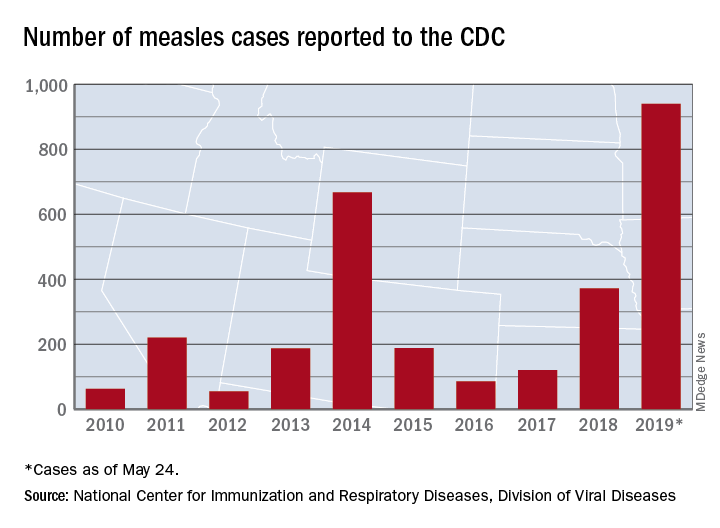
The CDC received reports of 60 new measles cases last week – up from 41 the previous week – bringing the U.S. total to 940 for the year as of May 24. The CDC is currently tracking 10 outbreaks in seven states: California (3), Georgia, Maryland, Michigan, New York (2), Pennsylvania, and Washington.
The Maine Center for Disease Control and Prevention confirmed the state’s first case on May 20. The school-aged child from Somerset County had been vaccinated and is fully recovered from the disease. It’s not yet known where the child was exposed to measles, but sporadic cases are not unexpected, the Maine CDC said.
New Mexico’s first measles case of the year, a 1-year-old in Sierra County, has at least one state lawmaker considering changes to the state’s immunization exemption laws, the Farmington Daily Times reported.
according to the Centers for Disease Control and Prevention.
The CDC received reports of 60 new measles cases last week – up from 41 the previous week – bringing the U.S. total to 940 for the year as of May 24. The CDC is currently tracking 10 outbreaks in seven states: California (3), Georgia, Maryland, Michigan, New York (2), Pennsylvania, and Washington.
The Maine Center for Disease Control and Prevention confirmed the state’s first case on May 20. The school-aged child from Somerset County had been vaccinated and is fully recovered from the disease. It’s not yet known where the child was exposed to measles, but sporadic cases are not unexpected, the Maine CDC said.
New Mexico’s first measles case of the year, a 1-year-old in Sierra County, has at least one state lawmaker considering changes to the state’s immunization exemption laws, the Farmington Daily Times reported.
according to the Centers for Disease Control and Prevention.
The CDC received reports of 60 new measles cases last week – up from 41 the previous week – bringing the U.S. total to 940 for the year as of May 24. The CDC is currently tracking 10 outbreaks in seven states: California (3), Georgia, Maryland, Michigan, New York (2), Pennsylvania, and Washington.
The Maine Center for Disease Control and Prevention confirmed the state’s first case on May 20. The school-aged child from Somerset County had been vaccinated and is fully recovered from the disease. It’s not yet known where the child was exposed to measles, but sporadic cases are not unexpected, the Maine CDC said.
New Mexico’s first measles case of the year, a 1-year-old in Sierra County, has at least one state lawmaker considering changes to the state’s immunization exemption laws, the Farmington Daily Times reported.
Costs of oral cancer drugs rising faster than inflation
The cost of oral cancer drugs increased by almost 6% over inflation from 2010 to 2018, leading to increases in out-of-pocket costs for Medicare patients despite reductions in the Part D coverage gap, according to an analysis of formulary and pricing data.
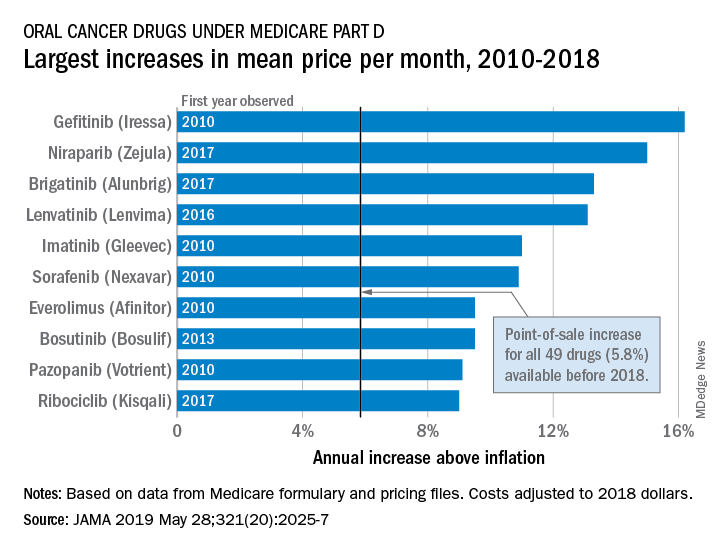
Point-of-sale prices for the 49 oral cancer drugs available before 2018 rose by 40.4% from 2010 to 2018 – an annual increase of 5.8% above the rate of inflation, Stacie B. Dusetzina, PhD, of Vanderbilt University, Nashville, Tenn., and associates reported in JAMA. Another five drugs with data that first became available in 2018 were not included in the cost-increase calculations.
The largest overall increase, 306% (16.2% above inflation per year), belonged to gefitinib (Iressa). Its point-of-sale price rose from $1,960 a month in 2010 to $7,960 in 2018. The award for largest reduction – only two others had a decrease – goes to the only generic available, imatinib. Its monthly cost dropped 44% (–28.1% below inflation per year) from $8,570 in 2016 to $4,822 in 2018, the investigators said (JAMA 2019 May 28;321[20]:2025-7).
Annual out-of-pocket spending for the 13 drugs available for the entire study period increased from $8,794 in 2010 to an expected $10,470 in 2019. Medicare patients’ out-of-pocket costs for those 13 cancer drugs in 2019 are expected to range from $7,220 for lapatinib to $15,472 for lenalidomide, they reported.
“Savings expected through closing the Part D coverage gap or through other policy changes, such as point-of-sale rebates, will be unlikely to offer financial protections to patients needing anticancer drugs. Moreover, because beneficiaries pay a percentage of the drug’s price and have no out-of-pocket spending limits on Part D, even large price decreases may not provide sufficient financial relief to patients requiring long-term anticancer drug use,” Dr. Dusetzina and associates wrote.
The study was supported by the Commonwealth Fund and the Leukemia and Lymphoma Society. The investigators reported receiving grant funding from the study funders.
The cost of oral cancer drugs increased by almost 6% over inflation from 2010 to 2018, leading to increases in out-of-pocket costs for Medicare patients despite reductions in the Part D coverage gap, according to an analysis of formulary and pricing data.
Point-of-sale prices for the 49 oral cancer drugs available before 2018 rose by 40.4% from 2010 to 2018 – an annual increase of 5.8% above the rate of inflation, Stacie B. Dusetzina, PhD, of Vanderbilt University, Nashville, Tenn., and associates reported in JAMA. Another five drugs with data that first became available in 2018 were not included in the cost-increase calculations.
The largest overall increase, 306% (16.2% above inflation per year), belonged to gefitinib (Iressa). Its point-of-sale price rose from $1,960 a month in 2010 to $7,960 in 2018. The award for largest reduction – only two others had a decrease – goes to the only generic available, imatinib. Its monthly cost dropped 44% (–28.1% below inflation per year) from $8,570 in 2016 to $4,822 in 2018, the investigators said (JAMA 2019 May 28;321[20]:2025-7).
Annual out-of-pocket spending for the 13 drugs available for the entire study period increased from $8,794 in 2010 to an expected $10,470 in 2019. Medicare patients’ out-of-pocket costs for those 13 cancer drugs in 2019 are expected to range from $7,220 for lapatinib to $15,472 for lenalidomide, they reported.
“Savings expected through closing the Part D coverage gap or through other policy changes, such as point-of-sale rebates, will be unlikely to offer financial protections to patients needing anticancer drugs. Moreover, because beneficiaries pay a percentage of the drug’s price and have no out-of-pocket spending limits on Part D, even large price decreases may not provide sufficient financial relief to patients requiring long-term anticancer drug use,” Dr. Dusetzina and associates wrote.
The study was supported by the Commonwealth Fund and the Leukemia and Lymphoma Society. The investigators reported receiving grant funding from the study funders.
The cost of oral cancer drugs increased by almost 6% over inflation from 2010 to 2018, leading to increases in out-of-pocket costs for Medicare patients despite reductions in the Part D coverage gap, according to an analysis of formulary and pricing data.
Point-of-sale prices for the 49 oral cancer drugs available before 2018 rose by 40.4% from 2010 to 2018 – an annual increase of 5.8% above the rate of inflation, Stacie B. Dusetzina, PhD, of Vanderbilt University, Nashville, Tenn., and associates reported in JAMA. Another five drugs with data that first became available in 2018 were not included in the cost-increase calculations.
The largest overall increase, 306% (16.2% above inflation per year), belonged to gefitinib (Iressa). Its point-of-sale price rose from $1,960 a month in 2010 to $7,960 in 2018. The award for largest reduction – only two others had a decrease – goes to the only generic available, imatinib. Its monthly cost dropped 44% (–28.1% below inflation per year) from $8,570 in 2016 to $4,822 in 2018, the investigators said (JAMA 2019 May 28;321[20]:2025-7).
Annual out-of-pocket spending for the 13 drugs available for the entire study period increased from $8,794 in 2010 to an expected $10,470 in 2019. Medicare patients’ out-of-pocket costs for those 13 cancer drugs in 2019 are expected to range from $7,220 for lapatinib to $15,472 for lenalidomide, they reported.
“Savings expected through closing the Part D coverage gap or through other policy changes, such as point-of-sale rebates, will be unlikely to offer financial protections to patients needing anticancer drugs. Moreover, because beneficiaries pay a percentage of the drug’s price and have no out-of-pocket spending limits on Part D, even large price decreases may not provide sufficient financial relief to patients requiring long-term anticancer drug use,” Dr. Dusetzina and associates wrote.
The study was supported by the Commonwealth Fund and the Leukemia and Lymphoma Society. The investigators reported receiving grant funding from the study funders.
FROM JAMA
When adolescents visit the ED, 10% leave with an opioid
although there was a small but significant decrease in prescriptions over that time, according to an analysis of two nationwide ambulatory care surveys.
For adolescents aged 13-17 years, 10.4% of ED visits were associated with a prescription for an opioid versus 1.6% among outpatient visits. There was a slight but significant decrease in the rate of opioid prescriptions in the ED setting over the study period, with an odds ratio of 0.95 (95% confidence interval, 0.92-0.97), but there was no significant change in the trend over time in the outpatient setting (OR, 1.02; 95% CI, 0.99-1.09), Joel D. Hudgins, MD, and associates reported in Pediatrics.
“Opioid prescribing in ambulatory care visits is particularly high in the ED setting and … certain diagnoses appear to be routinely treated with an opioid,” said Dr. Hudgins and associates from Boston Children’s Hospital.
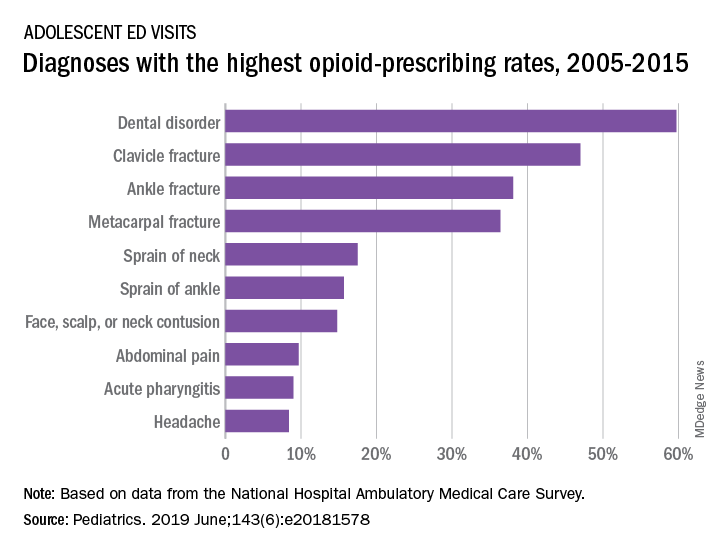
The highest rates of opioid prescribing among adolescents visiting the ED involved dental disorders (60%) and acute injuries such as fractures of the clavicle (47%), ankle (38%), and metacarpals (36%). “However, when considering the total volume of opioid prescriptions dispensed [over 7.8 million during 2005-2015], certain common conditions, including abdominal pain, acute pharyngitis, urinary tract infection, and headache, contributed large numbers of prescriptions as well,” they added.
The study involved data from the National Hospital Ambulatory Medical Care Survey (hospital-based EDs) and the National Ambulatory Medical Care Survey (office-based practices), which both are conducted annually by the National Center for Health Statistics.
The senior investigator is supported by an award from the Burroughs Wellcome Fund by the Harvard-MIT Center for Regulatory Science. The authors said that they have no relevant financial relationships.
SOURCE: Hudgins JD et al. Pediatrics. 2019 June. doi: 10.1542/peds.2018-1578.
although there was a small but significant decrease in prescriptions over that time, according to an analysis of two nationwide ambulatory care surveys.
For adolescents aged 13-17 years, 10.4% of ED visits were associated with a prescription for an opioid versus 1.6% among outpatient visits. There was a slight but significant decrease in the rate of opioid prescriptions in the ED setting over the study period, with an odds ratio of 0.95 (95% confidence interval, 0.92-0.97), but there was no significant change in the trend over time in the outpatient setting (OR, 1.02; 95% CI, 0.99-1.09), Joel D. Hudgins, MD, and associates reported in Pediatrics.
“Opioid prescribing in ambulatory care visits is particularly high in the ED setting and … certain diagnoses appear to be routinely treated with an opioid,” said Dr. Hudgins and associates from Boston Children’s Hospital.
The highest rates of opioid prescribing among adolescents visiting the ED involved dental disorders (60%) and acute injuries such as fractures of the clavicle (47%), ankle (38%), and metacarpals (36%). “However, when considering the total volume of opioid prescriptions dispensed [over 7.8 million during 2005-2015], certain common conditions, including abdominal pain, acute pharyngitis, urinary tract infection, and headache, contributed large numbers of prescriptions as well,” they added.
The study involved data from the National Hospital Ambulatory Medical Care Survey (hospital-based EDs) and the National Ambulatory Medical Care Survey (office-based practices), which both are conducted annually by the National Center for Health Statistics.
The senior investigator is supported by an award from the Burroughs Wellcome Fund by the Harvard-MIT Center for Regulatory Science. The authors said that they have no relevant financial relationships.
SOURCE: Hudgins JD et al. Pediatrics. 2019 June. doi: 10.1542/peds.2018-1578.
although there was a small but significant decrease in prescriptions over that time, according to an analysis of two nationwide ambulatory care surveys.
For adolescents aged 13-17 years, 10.4% of ED visits were associated with a prescription for an opioid versus 1.6% among outpatient visits. There was a slight but significant decrease in the rate of opioid prescriptions in the ED setting over the study period, with an odds ratio of 0.95 (95% confidence interval, 0.92-0.97), but there was no significant change in the trend over time in the outpatient setting (OR, 1.02; 95% CI, 0.99-1.09), Joel D. Hudgins, MD, and associates reported in Pediatrics.
“Opioid prescribing in ambulatory care visits is particularly high in the ED setting and … certain diagnoses appear to be routinely treated with an opioid,” said Dr. Hudgins and associates from Boston Children’s Hospital.
The highest rates of opioid prescribing among adolescents visiting the ED involved dental disorders (60%) and acute injuries such as fractures of the clavicle (47%), ankle (38%), and metacarpals (36%). “However, when considering the total volume of opioid prescriptions dispensed [over 7.8 million during 2005-2015], certain common conditions, including abdominal pain, acute pharyngitis, urinary tract infection, and headache, contributed large numbers of prescriptions as well,” they added.
The study involved data from the National Hospital Ambulatory Medical Care Survey (hospital-based EDs) and the National Ambulatory Medical Care Survey (office-based practices), which both are conducted annually by the National Center for Health Statistics.
The senior investigator is supported by an award from the Burroughs Wellcome Fund by the Harvard-MIT Center for Regulatory Science. The authors said that they have no relevant financial relationships.
SOURCE: Hudgins JD et al. Pediatrics. 2019 June. doi: 10.1542/peds.2018-1578.
FROM PEDIATRICS
By the numbers: Readmissions for skin conditions
Almost 10% of patients
Data from the Nationwide Readmissions Database also showed that the same-cause readmission rate was 3.3% after 30 days and 7.8% within the calendar year (CY) over the 5-year study period of 2010-2014, Myron Zhang, MD, of the department of dermatology at Weill Cornell Medicine, New York, and his associates reported in the Journal of the American Academy of Dermatology.
The total cost of the CY readmissions was $2.54 billion, which works out to $508 million per year or $8,995 per visit. The most common dermatologic diagnosis – cellulitis made up 83.6% of all hospitalizations – was also the most expensive in terms of readmissions, resulting in $1.9 billion in CY costs, Dr. Zhang and associates wrote.
Overall readmission rates for cellulitis were not provided, but annual rates ranged from 9.1% to 9.3% (30-day all cause), from 7.7% to 8.1% (CY same cause), and from 3.1% to 3.3% (30-day same cause), they wrote.
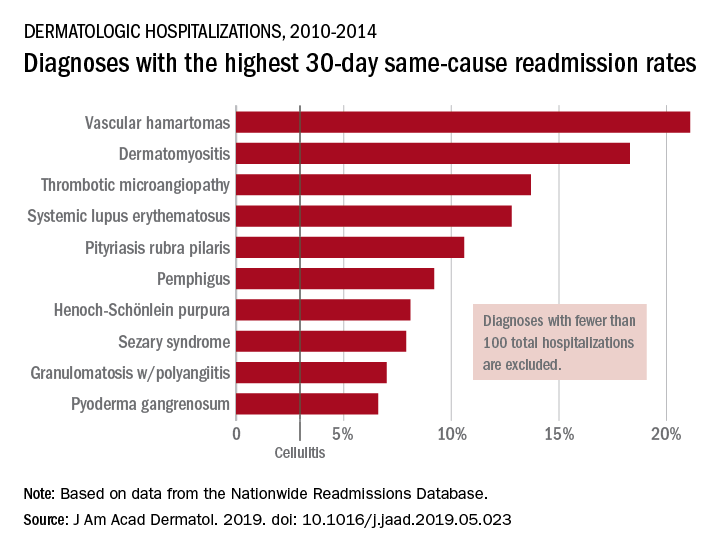
The dermatologic diagnosis with the highest 30-day same-cause readmission rate was vascular hamartomas at 21.1%, followed by dermatomyositis (18.3%) and thrombotic microangiopathy (13.7%). Dermatomyositis had the highest CY same-cause readmission rate (30.8%) and mycosis fungoides had the highest 30-day all-cause rate (32.3%), according to the investigators.
“Diseases, characteristics, and comorbidities associated with high readmission rates should trigger hospitals to consider dermatology consultation, coordinate outpatient follow-up, and support underinsured outpatient access. These measures have been shown to reduce readmissions or hospital visits in general dermatologic settings, but outcomes in individual diseases are not well studied,” Dr. Zhang and associates wrote. They noted that there have been “very few prior studies of readmissions for skin diseases.”
[email protected]
SOURCE: Zhang M et al. J Am Acad. Dermatol. 2019. doi: 10.1016/j.jaad.2019.05.023. .
Almost 10% of patients
Data from the Nationwide Readmissions Database also showed that the same-cause readmission rate was 3.3% after 30 days and 7.8% within the calendar year (CY) over the 5-year study period of 2010-2014, Myron Zhang, MD, of the department of dermatology at Weill Cornell Medicine, New York, and his associates reported in the Journal of the American Academy of Dermatology.
The total cost of the CY readmissions was $2.54 billion, which works out to $508 million per year or $8,995 per visit. The most common dermatologic diagnosis – cellulitis made up 83.6% of all hospitalizations – was also the most expensive in terms of readmissions, resulting in $1.9 billion in CY costs, Dr. Zhang and associates wrote.
Overall readmission rates for cellulitis were not provided, but annual rates ranged from 9.1% to 9.3% (30-day all cause), from 7.7% to 8.1% (CY same cause), and from 3.1% to 3.3% (30-day same cause), they wrote.
The dermatologic diagnosis with the highest 30-day same-cause readmission rate was vascular hamartomas at 21.1%, followed by dermatomyositis (18.3%) and thrombotic microangiopathy (13.7%). Dermatomyositis had the highest CY same-cause readmission rate (30.8%) and mycosis fungoides had the highest 30-day all-cause rate (32.3%), according to the investigators.
“Diseases, characteristics, and comorbidities associated with high readmission rates should trigger hospitals to consider dermatology consultation, coordinate outpatient follow-up, and support underinsured outpatient access. These measures have been shown to reduce readmissions or hospital visits in general dermatologic settings, but outcomes in individual diseases are not well studied,” Dr. Zhang and associates wrote. They noted that there have been “very few prior studies of readmissions for skin diseases.”
[email protected]
SOURCE: Zhang M et al. J Am Acad. Dermatol. 2019. doi: 10.1016/j.jaad.2019.05.023. .
Almost 10% of patients
Data from the Nationwide Readmissions Database also showed that the same-cause readmission rate was 3.3% after 30 days and 7.8% within the calendar year (CY) over the 5-year study period of 2010-2014, Myron Zhang, MD, of the department of dermatology at Weill Cornell Medicine, New York, and his associates reported in the Journal of the American Academy of Dermatology.
The total cost of the CY readmissions was $2.54 billion, which works out to $508 million per year or $8,995 per visit. The most common dermatologic diagnosis – cellulitis made up 83.6% of all hospitalizations – was also the most expensive in terms of readmissions, resulting in $1.9 billion in CY costs, Dr. Zhang and associates wrote.
Overall readmission rates for cellulitis were not provided, but annual rates ranged from 9.1% to 9.3% (30-day all cause), from 7.7% to 8.1% (CY same cause), and from 3.1% to 3.3% (30-day same cause), they wrote.
The dermatologic diagnosis with the highest 30-day same-cause readmission rate was vascular hamartomas at 21.1%, followed by dermatomyositis (18.3%) and thrombotic microangiopathy (13.7%). Dermatomyositis had the highest CY same-cause readmission rate (30.8%) and mycosis fungoides had the highest 30-day all-cause rate (32.3%), according to the investigators.
“Diseases, characteristics, and comorbidities associated with high readmission rates should trigger hospitals to consider dermatology consultation, coordinate outpatient follow-up, and support underinsured outpatient access. These measures have been shown to reduce readmissions or hospital visits in general dermatologic settings, but outcomes in individual diseases are not well studied,” Dr. Zhang and associates wrote. They noted that there have been “very few prior studies of readmissions for skin diseases.”
[email protected]
SOURCE: Zhang M et al. J Am Acad. Dermatol. 2019. doi: 10.1016/j.jaad.2019.05.023. .
FROM THE JOURNAL OF THE AMERICAN ACADEMY OF DERMATOLOGY
Bed bug fossils, dogs in your DNA, and coffee colon
Goodnight, sleep tight ...
File this under creepy-crawly things you never wanted to learn about but now you know. New research into cimicid fossils (a.k.a. bed bugs) shows that the blood-sucking parasites are as old as the dinosaurs.

Bed bugs have been on earth for 115 million years – approximately the same amount of time it takes to get rid of them from your home.
Bats have long been assumed to be the ancestral host of these horrific pests, but a bed bug fossil shows that they precede bats by nearly 30 million years. The idea of a bed bug “fossil” is a little suspicious to us over here at LOTME, though, because we are pretty positive bed bugs only multiply and never die.
The new research, published in Cell, confirmed that the bed bug species had a major split into the two most common forms millions of years before humans arrived. Also confirmed: Dinosaurs clearly slept in beds, and that’s where bed bugs came from.
Dog person? It’s in the genes
Are you a total dog lover? Would you totally risk a little infectious bug if you got to play with some pups? Turns out, your love for Fido might be predicted by your DNA.

An in-depth examination of the Swedish Twin Registry and national dog registers in Sweden found that genetic factors greatly contribute to dog ownership in Sweden. The study could not identify which genes are involved in our choices to keep dogs or if they related to evolution-related factors.
This is good news for dog people, though, because it suggests that if you love dogs, so does your family, and therefore you will be surrounded by dogs forever. At least that is what we’re choosing to believe.
This study could not be repeated with cat owners, because everyone knows cats own their humans, and the cats of Sweden were not interested in participating.
Gastroenterologists answer the big questions
Why does coffee make you poop? All coffee drinkers know this to be the case, and many even plan their mornings around it. But the real reason for this little side effect has always been a bit of a mystery.

Now, a group of researchers from the University of Texas may have an answer.
In a study presented at the annual Digestive Disease Week, the researchers fed coffee to rats for 3 days, analyzing their feces for changes in composition and bacterial make-up. (The joys of being a scientist.) They found that this diet suppressed the bacterial content of the feces; in addition, bacterial growth within the poop was suppressed when exposed to a 1.5% coffee solution on a petri dish.
An analysis of the rats’ intestines – dream job material right there – showed increased muscular motility. All of these effects occurred regardless of caffeine content.
And here’s a bonus: This was more than research just for research’s sake! The researchers claim that, given future study into the subject, coffee could be used as a treatment for ileus, a condition encountered after surgery where the intestines stop working. Apparently, it’s not just your brain that needs to be woken up – even your digestive system could use a coffee now and again.
Big honor for a small pharmaceutical partner
This week, we ask an important medical question: What’s your favorite microbe? Think about that for a minute while we discuss New Jersey’s new bacterial BFF.

S. griseus, it turns out, was discovered in the soil of New Jersey in 1916 and also was “isolated from the gullet of a healthy New Jersey chicken.” In 1943, researchers from Rutgers University (the state university of New Jersey, by the way) used it to create streptomycin, the first antibiotic to treat cholera and tuberculosis. In 1952, Rutgers researcher Selman Waksman received a Nobel Prize for discovering the microbe and creating the antibiotic.
LOTME certainly acknowledges the place of S. griseus in history, but we’ve selected another significant organism as our official microbe: Saccharomyces cerevisiae, also known as brewer’s yeast.
And since we know you were wondering, our official amphibian is the Eastern Hellbender salamander, our official fabric is Carrickmacross lace, our official soil is Harney silt loam, our official fictional opera singer is Placebo Domingo, and our official sport is jousting.

Goodnight, sleep tight ...
File this under creepy-crawly things you never wanted to learn about but now you know. New research into cimicid fossils (a.k.a. bed bugs) shows that the blood-sucking parasites are as old as the dinosaurs.
Bed bugs have been on earth for 115 million years – approximately the same amount of time it takes to get rid of them from your home.
Bats have long been assumed to be the ancestral host of these horrific pests, but a bed bug fossil shows that they precede bats by nearly 30 million years. The idea of a bed bug “fossil” is a little suspicious to us over here at LOTME, though, because we are pretty positive bed bugs only multiply and never die.
The new research, published in Cell, confirmed that the bed bug species had a major split into the two most common forms millions of years before humans arrived. Also confirmed: Dinosaurs clearly slept in beds, and that’s where bed bugs came from.
Dog person? It’s in the genes
Are you a total dog lover? Would you totally risk a little infectious bug if you got to play with some pups? Turns out, your love for Fido might be predicted by your DNA.
An in-depth examination of the Swedish Twin Registry and national dog registers in Sweden found that genetic factors greatly contribute to dog ownership in Sweden. The study could not identify which genes are involved in our choices to keep dogs or if they related to evolution-related factors.
This is good news for dog people, though, because it suggests that if you love dogs, so does your family, and therefore you will be surrounded by dogs forever. At least that is what we’re choosing to believe.
This study could not be repeated with cat owners, because everyone knows cats own their humans, and the cats of Sweden were not interested in participating.
Gastroenterologists answer the big questions
Why does coffee make you poop? All coffee drinkers know this to be the case, and many even plan their mornings around it. But the real reason for this little side effect has always been a bit of a mystery.
Now, a group of researchers from the University of Texas may have an answer.
In a study presented at the annual Digestive Disease Week, the researchers fed coffee to rats for 3 days, analyzing their feces for changes in composition and bacterial make-up. (The joys of being a scientist.) They found that this diet suppressed the bacterial content of the feces; in addition, bacterial growth within the poop was suppressed when exposed to a 1.5% coffee solution on a petri dish.
An analysis of the rats’ intestines – dream job material right there – showed increased muscular motility. All of these effects occurred regardless of caffeine content.
And here’s a bonus: This was more than research just for research’s sake! The researchers claim that, given future study into the subject, coffee could be used as a treatment for ileus, a condition encountered after surgery where the intestines stop working. Apparently, it’s not just your brain that needs to be woken up – even your digestive system could use a coffee now and again.
Big honor for a small pharmaceutical partner
This week, we ask an important medical question: What’s your favorite microbe? Think about that for a minute while we discuss New Jersey’s new bacterial BFF.
S. griseus, it turns out, was discovered in the soil of New Jersey in 1916 and also was “isolated from the gullet of a healthy New Jersey chicken.” In 1943, researchers from Rutgers University (the state university of New Jersey, by the way) used it to create streptomycin, the first antibiotic to treat cholera and tuberculosis. In 1952, Rutgers researcher Selman Waksman received a Nobel Prize for discovering the microbe and creating the antibiotic.
LOTME certainly acknowledges the place of S. griseus in history, but we’ve selected another significant organism as our official microbe: Saccharomyces cerevisiae, also known as brewer’s yeast.
And since we know you were wondering, our official amphibian is the Eastern Hellbender salamander, our official fabric is Carrickmacross lace, our official soil is Harney silt loam, our official fictional opera singer is Placebo Domingo, and our official sport is jousting.
Goodnight, sleep tight ...
File this under creepy-crawly things you never wanted to learn about but now you know. New research into cimicid fossils (a.k.a. bed bugs) shows that the blood-sucking parasites are as old as the dinosaurs.
Bed bugs have been on earth for 115 million years – approximately the same amount of time it takes to get rid of them from your home.
Bats have long been assumed to be the ancestral host of these horrific pests, but a bed bug fossil shows that they precede bats by nearly 30 million years. The idea of a bed bug “fossil” is a little suspicious to us over here at LOTME, though, because we are pretty positive bed bugs only multiply and never die.
The new research, published in Cell, confirmed that the bed bug species had a major split into the two most common forms millions of years before humans arrived. Also confirmed: Dinosaurs clearly slept in beds, and that’s where bed bugs came from.
Dog person? It’s in the genes
Are you a total dog lover? Would you totally risk a little infectious bug if you got to play with some pups? Turns out, your love for Fido might be predicted by your DNA.
An in-depth examination of the Swedish Twin Registry and national dog registers in Sweden found that genetic factors greatly contribute to dog ownership in Sweden. The study could not identify which genes are involved in our choices to keep dogs or if they related to evolution-related factors.
This is good news for dog people, though, because it suggests that if you love dogs, so does your family, and therefore you will be surrounded by dogs forever. At least that is what we’re choosing to believe.
This study could not be repeated with cat owners, because everyone knows cats own their humans, and the cats of Sweden were not interested in participating.
Gastroenterologists answer the big questions
Why does coffee make you poop? All coffee drinkers know this to be the case, and many even plan their mornings around it. But the real reason for this little side effect has always been a bit of a mystery.
Now, a group of researchers from the University of Texas may have an answer.
In a study presented at the annual Digestive Disease Week, the researchers fed coffee to rats for 3 days, analyzing their feces for changes in composition and bacterial make-up. (The joys of being a scientist.) They found that this diet suppressed the bacterial content of the feces; in addition, bacterial growth within the poop was suppressed when exposed to a 1.5% coffee solution on a petri dish.
An analysis of the rats’ intestines – dream job material right there – showed increased muscular motility. All of these effects occurred regardless of caffeine content.
And here’s a bonus: This was more than research just for research’s sake! The researchers claim that, given future study into the subject, coffee could be used as a treatment for ileus, a condition encountered after surgery where the intestines stop working. Apparently, it’s not just your brain that needs to be woken up – even your digestive system could use a coffee now and again.
Big honor for a small pharmaceutical partner
This week, we ask an important medical question: What’s your favorite microbe? Think about that for a minute while we discuss New Jersey’s new bacterial BFF.
S. griseus, it turns out, was discovered in the soil of New Jersey in 1916 and also was “isolated from the gullet of a healthy New Jersey chicken.” In 1943, researchers from Rutgers University (the state university of New Jersey, by the way) used it to create streptomycin, the first antibiotic to treat cholera and tuberculosis. In 1952, Rutgers researcher Selman Waksman received a Nobel Prize for discovering the microbe and creating the antibiotic.
LOTME certainly acknowledges the place of S. griseus in history, but we’ve selected another significant organism as our official microbe: Saccharomyces cerevisiae, also known as brewer’s yeast.
And since we know you were wondering, our official amphibian is the Eastern Hellbender salamander, our official fabric is Carrickmacross lace, our official soil is Harney silt loam, our official fictional opera singer is Placebo Domingo, and our official sport is jousting.

U.S. measles total sees smallest increase in 2 months
according to the Centers for Disease Control and Prevention.
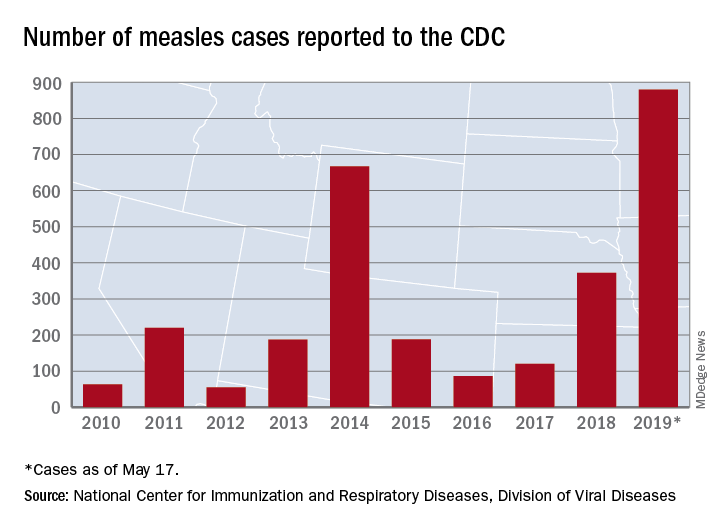
That weekly increase of 41 cases is the smallest since the week ending March 14, when the total rose by 40. The largest 1-week rise of the year came during the week ending April 11, when there were 90 new cases, CDC data show.
A case that has been reported by the media in the last week but not officially through the CDC would make New Mexico the 25th state with a measles case this year. The state’s health department has confirmed measles in a 1-year-old from Sierra County, which is New Mexico’s first case since 2014, the Las Cruces Sun News reported, adding that 4,441 school-aged children had an exemption for vaccination filed with the state in 2018.
Making a return appearance to the CDC’s list of outbreaks is Washington State, which reported six new cases last week in three Puget Sound counties (King, Pierce, and Snohomish). The most likely location and date of exposure was at Seattle-Tacoma International Airport on April 25, the Washington State Department of Health said. In February and March, there were 71 cases in Clark County on the state’s border with Oregon.
The ongoing outbreak in Michigan had been quiet since April, but the state’s Department of Health and Human Services confirmed a measles case in St. Clair County on May 17, bringing the total to 44 for the year. The new case, which is not related to an earlier outbreak that occurred mainly in Oakland County, involves an international traveler visiting Michigan.
according to the Centers for Disease Control and Prevention.
That weekly increase of 41 cases is the smallest since the week ending March 14, when the total rose by 40. The largest 1-week rise of the year came during the week ending April 11, when there were 90 new cases, CDC data show.
A case that has been reported by the media in the last week but not officially through the CDC would make New Mexico the 25th state with a measles case this year. The state’s health department has confirmed measles in a 1-year-old from Sierra County, which is New Mexico’s first case since 2014, the Las Cruces Sun News reported, adding that 4,441 school-aged children had an exemption for vaccination filed with the state in 2018.
Making a return appearance to the CDC’s list of outbreaks is Washington State, which reported six new cases last week in three Puget Sound counties (King, Pierce, and Snohomish). The most likely location and date of exposure was at Seattle-Tacoma International Airport on April 25, the Washington State Department of Health said. In February and March, there were 71 cases in Clark County on the state’s border with Oregon.
The ongoing outbreak in Michigan had been quiet since April, but the state’s Department of Health and Human Services confirmed a measles case in St. Clair County on May 17, bringing the total to 44 for the year. The new case, which is not related to an earlier outbreak that occurred mainly in Oakland County, involves an international traveler visiting Michigan.
according to the Centers for Disease Control and Prevention.
That weekly increase of 41 cases is the smallest since the week ending March 14, when the total rose by 40. The largest 1-week rise of the year came during the week ending April 11, when there were 90 new cases, CDC data show.
A case that has been reported by the media in the last week but not officially through the CDC would make New Mexico the 25th state with a measles case this year. The state’s health department has confirmed measles in a 1-year-old from Sierra County, which is New Mexico’s first case since 2014, the Las Cruces Sun News reported, adding that 4,441 school-aged children had an exemption for vaccination filed with the state in 2018.
Making a return appearance to the CDC’s list of outbreaks is Washington State, which reported six new cases last week in three Puget Sound counties (King, Pierce, and Snohomish). The most likely location and date of exposure was at Seattle-Tacoma International Airport on April 25, the Washington State Department of Health said. In February and March, there were 71 cases in Clark County on the state’s border with Oregon.
The ongoing outbreak in Michigan had been quiet since April, but the state’s Department of Health and Human Services confirmed a measles case in St. Clair County on May 17, bringing the total to 44 for the year. The new case, which is not related to an earlier outbreak that occurred mainly in Oakland County, involves an international traveler visiting Michigan.
Survey: Physicians predict increase in measles deaths
by real-time market insights technology firm InCrowd.
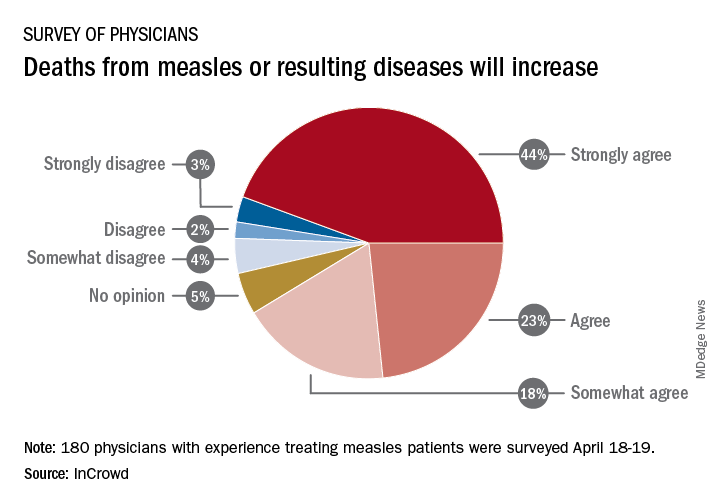
Among the 180 physicians with experience treating measles, 23% agreed and 44% said that they strongly agreed with the statement that measles deaths would increase, and another 18% said that they somewhat agreed. Only 9% expressed some level of disagreement, InCrowd said.
Most of those respondents also believe that summer travel will increase measles outbreaks (29% agreed and 30% strongly agreed) and that more communities will adopt requirements for measles vaccinations (26% and 36%). A majority also said that education about vaccinations will improve (26% agreed and 29% strongly agreed), but almost half of the physicians surveyed also expect vaccination misinformation to get worse (29% and 19%), InCrowd reported.
“With 44% of respondents predicting a high likelihood that deaths caused by measles will increase, the data show the imperative for physicians and patients to keep up the dialogue. … We have a long way to go before declaring victory,” said Diane Hayes, PhD, president and cofounder of InCrowd.
The InCrowd 5-minute microsurvey was conducted on April 18-19, 2019, and included 455 primary care physicians, of whom 40% said that they have treated or knew of colleagues in their facility or community who have treated patients with measles. Of those 180 respondents, 89 were pediatricians and 91 were in other primary care specialties.
by real-time market insights technology firm InCrowd.
Among the 180 physicians with experience treating measles, 23% agreed and 44% said that they strongly agreed with the statement that measles deaths would increase, and another 18% said that they somewhat agreed. Only 9% expressed some level of disagreement, InCrowd said.
Most of those respondents also believe that summer travel will increase measles outbreaks (29% agreed and 30% strongly agreed) and that more communities will adopt requirements for measles vaccinations (26% and 36%). A majority also said that education about vaccinations will improve (26% agreed and 29% strongly agreed), but almost half of the physicians surveyed also expect vaccination misinformation to get worse (29% and 19%), InCrowd reported.
“With 44% of respondents predicting a high likelihood that deaths caused by measles will increase, the data show the imperative for physicians and patients to keep up the dialogue. … We have a long way to go before declaring victory,” said Diane Hayes, PhD, president and cofounder of InCrowd.
The InCrowd 5-minute microsurvey was conducted on April 18-19, 2019, and included 455 primary care physicians, of whom 40% said that they have treated or knew of colleagues in their facility or community who have treated patients with measles. Of those 180 respondents, 89 were pediatricians and 91 were in other primary care specialties.
by real-time market insights technology firm InCrowd.
Among the 180 physicians with experience treating measles, 23% agreed and 44% said that they strongly agreed with the statement that measles deaths would increase, and another 18% said that they somewhat agreed. Only 9% expressed some level of disagreement, InCrowd said.
Most of those respondents also believe that summer travel will increase measles outbreaks (29% agreed and 30% strongly agreed) and that more communities will adopt requirements for measles vaccinations (26% and 36%). A majority also said that education about vaccinations will improve (26% agreed and 29% strongly agreed), but almost half of the physicians surveyed also expect vaccination misinformation to get worse (29% and 19%), InCrowd reported.
“With 44% of respondents predicting a high likelihood that deaths caused by measles will increase, the data show the imperative for physicians and patients to keep up the dialogue. … We have a long way to go before declaring victory,” said Diane Hayes, PhD, president and cofounder of InCrowd.
The InCrowd 5-minute microsurvey was conducted on April 18-19, 2019, and included 455 primary care physicians, of whom 40% said that they have treated or knew of colleagues in their facility or community who have treated patients with measles. Of those 180 respondents, 89 were pediatricians and 91 were in other primary care specialties.
Texting a stroke, game-show grants, and, um, The Beast
Autocorrect, or worse?
Is it just fat thumbs, or something more serious? Incoherent text messages could be the first sign of a stroke for adults, as displayed in two case reports presented at the annual meeting of the American Academy of Neurology.

It makes sense that stroke can cause dystextia: Typing on a phone involves some fine motor, language, and vision skills. Stroke can affect all these functions, leading to bizarre typos or angry political rants on Facebook.
Just kidding; those are equally as concerning but require a whole different diagnosis.
‘Research Funds’ for $11,000, Alex
In the universal struggle for research funding, many a scientist has resorted to desperate measures to keep the lab assistants paid, the JAX Mice fed, and the frontiers of medical science expanding ever outward.

Marina Simian is a biologist for Argentina’s National Scientific and Technical Research Council. She runs a research lab focused on oncology treatments for breast cancer. Faced with a national economic crisis and cuts to research funding, Simian says government funding has nearly dried up. Where did she turn instead?
Enter the local version of the TV game show “Who Wants to be a Millionaire?” Simian went on the show as a contestant, explaining that she needed money to support her cancer research. And when the camera cut away to commercials, Simian walked away with 500,000 pesos ($11,000) in winnings. Which she used to buy more lab supplies.
Admittedly, the “Slumdog Millionaire” approach may not save every cash-strapped scientist’s pet project, but it does give us an idea for game show super champ James Holzhauer’s career when he finally wears out his “Jeopardy!” buzzer: medical research funding consultant.
FDA tames THE BEAST
The LOTME staff had a meeting the other day with our editor (we think he might be the love child of Lois Lane and Ron Burgundy), who said that lately we’ve been “too juvenile” and “not medical enough” and told us to get our “dirty little minds out of the gutter.”

After we stopped crying, he offered up this item from the Food and Drug Administration:
“STIFF BOY LLC. Issues Voluntary Nationwide Recall of THE BEAST Capsules Due to Presence of Undeclared Sildenafil” (no, we did not add the all-caps).
Okay, here goes.
THE BEAST was marketed as a dietary supplement for “male enhancement” (add nonjuvenile but hilarious remark about tumescence), which would not be regulated by the FDA. The presence of Viagra’s active ingredient in the capsules, however, “renders it an unapproved drug for which safety and efficacy have not been established and, therefore, subject to recall,” the FDA said (insert comment about seemingly serious but totally fictitious side effects).
Although the sildenafil in THE BEAST may interact with nitrates found in some prescription drugs, STIFF BOY said that it had not received any reports of adverse events before the recall (imagine a guy working on the engine of his pickup truck).
Seek immediate medical attention if your laughter lasts for more than 4 hours after reading this.
Time flies when you’re having ‘fun’
Match Day is one of the most exciting times in any young, prospective doctor’s life. Finally, the specialty of your dreams is yours. You know the training will be stressful and the hours will be long, but how bad could it be?

It’s not like it’ll take years off your life, right?
Well, according to new research published in Biological Psychiatry, that’s almost exactly what medical residency will do to you.
The researchers took a group of medical students at the University of Michigan, Ann Arbor, entering their first year of residency and measured their telomere length both before and after their internship year, comparing it with a group of first-year undergraduates. Rapidly shrinking telomere length is a well-accepted sign of aging, and interns had their telomeres shrink at a rate six times faster than their nonmedical peers, who were apparently too busy doing upside-down kegstands to notice how stressful college can be.
Oh, don’t worry, there was most definitely an association between hours worked and increased telomere shrinkage. Those who had to work more than 80 hours a week aged most of all.
So, if you emerge from a particularly difficult internship with the sudden desire to yell at those darn kids for being on your lawn, we completely understand.

Autocorrect, or worse?
Is it just fat thumbs, or something more serious? Incoherent text messages could be the first sign of a stroke for adults, as displayed in two case reports presented at the annual meeting of the American Academy of Neurology.
It makes sense that stroke can cause dystextia: Typing on a phone involves some fine motor, language, and vision skills. Stroke can affect all these functions, leading to bizarre typos or angry political rants on Facebook.
Just kidding; those are equally as concerning but require a whole different diagnosis.
‘Research Funds’ for $11,000, Alex
In the universal struggle for research funding, many a scientist has resorted to desperate measures to keep the lab assistants paid, the JAX Mice fed, and the frontiers of medical science expanding ever outward.
Marina Simian is a biologist for Argentina’s National Scientific and Technical Research Council. She runs a research lab focused on oncology treatments for breast cancer. Faced with a national economic crisis and cuts to research funding, Simian says government funding has nearly dried up. Where did she turn instead?
Enter the local version of the TV game show “Who Wants to be a Millionaire?” Simian went on the show as a contestant, explaining that she needed money to support her cancer research. And when the camera cut away to commercials, Simian walked away with 500,000 pesos ($11,000) in winnings. Which she used to buy more lab supplies.
Admittedly, the “Slumdog Millionaire” approach may not save every cash-strapped scientist’s pet project, but it does give us an idea for game show super champ James Holzhauer’s career when he finally wears out his “Jeopardy!” buzzer: medical research funding consultant.
FDA tames THE BEAST
The LOTME staff had a meeting the other day with our editor (we think he might be the love child of Lois Lane and Ron Burgundy), who said that lately we’ve been “too juvenile” and “not medical enough” and told us to get our “dirty little minds out of the gutter.”
After we stopped crying, he offered up this item from the Food and Drug Administration:
“STIFF BOY LLC. Issues Voluntary Nationwide Recall of THE BEAST Capsules Due to Presence of Undeclared Sildenafil” (no, we did not add the all-caps).
Okay, here goes.
THE BEAST was marketed as a dietary supplement for “male enhancement” (add nonjuvenile but hilarious remark about tumescence), which would not be regulated by the FDA. The presence of Viagra’s active ingredient in the capsules, however, “renders it an unapproved drug for which safety and efficacy have not been established and, therefore, subject to recall,” the FDA said (insert comment about seemingly serious but totally fictitious side effects).
Although the sildenafil in THE BEAST may interact with nitrates found in some prescription drugs, STIFF BOY said that it had not received any reports of adverse events before the recall (imagine a guy working on the engine of his pickup truck).
Seek immediate medical attention if your laughter lasts for more than 4 hours after reading this.
Time flies when you’re having ‘fun’
Match Day is one of the most exciting times in any young, prospective doctor’s life. Finally, the specialty of your dreams is yours. You know the training will be stressful and the hours will be long, but how bad could it be?
It’s not like it’ll take years off your life, right?
Well, according to new research published in Biological Psychiatry, that’s almost exactly what medical residency will do to you.
The researchers took a group of medical students at the University of Michigan, Ann Arbor, entering their first year of residency and measured their telomere length both before and after their internship year, comparing it with a group of first-year undergraduates. Rapidly shrinking telomere length is a well-accepted sign of aging, and interns had their telomeres shrink at a rate six times faster than their nonmedical peers, who were apparently too busy doing upside-down kegstands to notice how stressful college can be.
Oh, don’t worry, there was most definitely an association between hours worked and increased telomere shrinkage. Those who had to work more than 80 hours a week aged most of all.
So, if you emerge from a particularly difficult internship with the sudden desire to yell at those darn kids for being on your lawn, we completely understand.
Autocorrect, or worse?
Is it just fat thumbs, or something more serious? Incoherent text messages could be the first sign of a stroke for adults, as displayed in two case reports presented at the annual meeting of the American Academy of Neurology.
It makes sense that stroke can cause dystextia: Typing on a phone involves some fine motor, language, and vision skills. Stroke can affect all these functions, leading to bizarre typos or angry political rants on Facebook.
Just kidding; those are equally as concerning but require a whole different diagnosis.
‘Research Funds’ for $11,000, Alex
In the universal struggle for research funding, many a scientist has resorted to desperate measures to keep the lab assistants paid, the JAX Mice fed, and the frontiers of medical science expanding ever outward.
Marina Simian is a biologist for Argentina’s National Scientific and Technical Research Council. She runs a research lab focused on oncology treatments for breast cancer. Faced with a national economic crisis and cuts to research funding, Simian says government funding has nearly dried up. Where did she turn instead?
Enter the local version of the TV game show “Who Wants to be a Millionaire?” Simian went on the show as a contestant, explaining that she needed money to support her cancer research. And when the camera cut away to commercials, Simian walked away with 500,000 pesos ($11,000) in winnings. Which she used to buy more lab supplies.
Admittedly, the “Slumdog Millionaire” approach may not save every cash-strapped scientist’s pet project, but it does give us an idea for game show super champ James Holzhauer’s career when he finally wears out his “Jeopardy!” buzzer: medical research funding consultant.
FDA tames THE BEAST
The LOTME staff had a meeting the other day with our editor (we think he might be the love child of Lois Lane and Ron Burgundy), who said that lately we’ve been “too juvenile” and “not medical enough” and told us to get our “dirty little minds out of the gutter.”
After we stopped crying, he offered up this item from the Food and Drug Administration:
“STIFF BOY LLC. Issues Voluntary Nationwide Recall of THE BEAST Capsules Due to Presence of Undeclared Sildenafil” (no, we did not add the all-caps).
Okay, here goes.
THE BEAST was marketed as a dietary supplement for “male enhancement” (add nonjuvenile but hilarious remark about tumescence), which would not be regulated by the FDA. The presence of Viagra’s active ingredient in the capsules, however, “renders it an unapproved drug for which safety and efficacy have not been established and, therefore, subject to recall,” the FDA said (insert comment about seemingly serious but totally fictitious side effects).
Although the sildenafil in THE BEAST may interact with nitrates found in some prescription drugs, STIFF BOY said that it had not received any reports of adverse events before the recall (imagine a guy working on the engine of his pickup truck).
Seek immediate medical attention if your laughter lasts for more than 4 hours after reading this.
Time flies when you’re having ‘fun’
Match Day is one of the most exciting times in any young, prospective doctor’s life. Finally, the specialty of your dreams is yours. You know the training will be stressful and the hours will be long, but how bad could it be?
It’s not like it’ll take years off your life, right?
Well, according to new research published in Biological Psychiatry, that’s almost exactly what medical residency will do to you.
The researchers took a group of medical students at the University of Michigan, Ann Arbor, entering their first year of residency and measured their telomere length both before and after their internship year, comparing it with a group of first-year undergraduates. Rapidly shrinking telomere length is a well-accepted sign of aging, and interns had their telomeres shrink at a rate six times faster than their nonmedical peers, who were apparently too busy doing upside-down kegstands to notice how stressful college can be.
Oh, don’t worry, there was most definitely an association between hours worked and increased telomere shrinkage. Those who had to work more than 80 hours a week aged most of all.
So, if you emerge from a particularly difficult internship with the sudden desire to yell at those darn kids for being on your lawn, we completely understand.
U.S. measles cases climb to over 800 for the year
according to the Centers for Disease Control and Prevention.
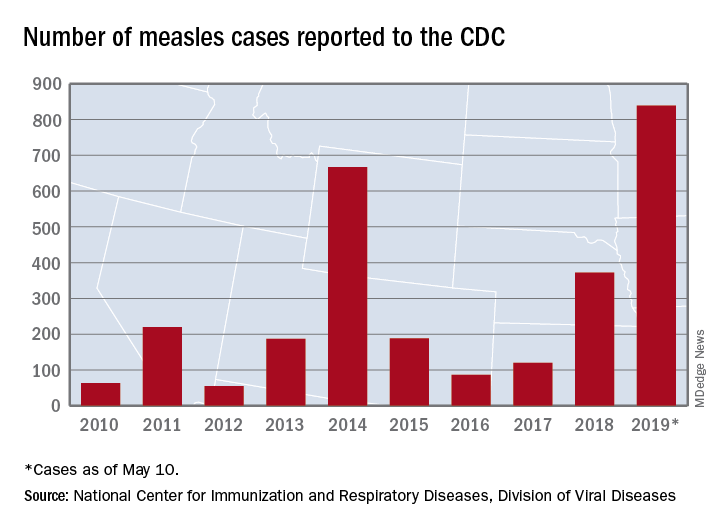
There are 10 states dealing with ongoing outbreaks now that Pennsylvania has been added to the list, the CDC reported May 13. The state has had five cases so far, all in Allegheny County. New York City continued to have the most active outbreak, adding 43 more cases in Brooklyn last week for a total of 410 in the city since the beginning of 2019, NYC Health said.
Several of this year’s outbreaks were predicted in an analysis published in the Lancet Infectious Diseases (2019 May 9. doi: 10.1016/S1473-3099(19)30231-2). Investigators identified the 25 counties most likely to experience a measles outbreak in 2019 – a list that includes Queens, N.Y. (adjacent to Brooklyn), Multnomah, Ore. (adjacent to Clark County, Wash., where 71 people were infected earlier this year), and San Mateo, Calif., where 4 cases have been reported.
“We recommend that public health officials and policymakers prioritize monitoring the counties we identify to be at high risk that have not yet reported cases, especially those that lie adjacent to counties with ongoing outbreaks and those that house large international airports,” senior author Lauren Gardner of Johns Hopkins University, Baltimore, said in a written statement.
The outbreak in Clark County was declared over in late April, but Gov. Jay Inslee signed a bill on May 10 that removes the personal/philosophical exemption for the MMR vaccine from the state’s school and child care immunization requirements. “We must step up our leadership to educate the public about the critical role vaccines have in keeping us healthy and safe, and continue working with communities to improve vaccination rates,” Washington State Secretary of Health John Wiesman said in a written statement.
In Oregon, a bill that would eliminate religious and philosophical exemptions to child vaccination requirements passed the state house of representatives by a 35-25 vote and is moving to the senate. Gov. Kate Brown has said that she plans to sign the bill, according to OregonLive.com.
according to the Centers for Disease Control and Prevention.
There are 10 states dealing with ongoing outbreaks now that Pennsylvania has been added to the list, the CDC reported May 13. The state has had five cases so far, all in Allegheny County. New York City continued to have the most active outbreak, adding 43 more cases in Brooklyn last week for a total of 410 in the city since the beginning of 2019, NYC Health said.
Several of this year’s outbreaks were predicted in an analysis published in the Lancet Infectious Diseases (2019 May 9. doi: 10.1016/S1473-3099(19)30231-2). Investigators identified the 25 counties most likely to experience a measles outbreak in 2019 – a list that includes Queens, N.Y. (adjacent to Brooklyn), Multnomah, Ore. (adjacent to Clark County, Wash., where 71 people were infected earlier this year), and San Mateo, Calif., where 4 cases have been reported.
“We recommend that public health officials and policymakers prioritize monitoring the counties we identify to be at high risk that have not yet reported cases, especially those that lie adjacent to counties with ongoing outbreaks and those that house large international airports,” senior author Lauren Gardner of Johns Hopkins University, Baltimore, said in a written statement.
The outbreak in Clark County was declared over in late April, but Gov. Jay Inslee signed a bill on May 10 that removes the personal/philosophical exemption for the MMR vaccine from the state’s school and child care immunization requirements. “We must step up our leadership to educate the public about the critical role vaccines have in keeping us healthy and safe, and continue working with communities to improve vaccination rates,” Washington State Secretary of Health John Wiesman said in a written statement.
In Oregon, a bill that would eliminate religious and philosophical exemptions to child vaccination requirements passed the state house of representatives by a 35-25 vote and is moving to the senate. Gov. Kate Brown has said that she plans to sign the bill, according to OregonLive.com.
according to the Centers for Disease Control and Prevention.
There are 10 states dealing with ongoing outbreaks now that Pennsylvania has been added to the list, the CDC reported May 13. The state has had five cases so far, all in Allegheny County. New York City continued to have the most active outbreak, adding 43 more cases in Brooklyn last week for a total of 410 in the city since the beginning of 2019, NYC Health said.
Several of this year’s outbreaks were predicted in an analysis published in the Lancet Infectious Diseases (2019 May 9. doi: 10.1016/S1473-3099(19)30231-2). Investigators identified the 25 counties most likely to experience a measles outbreak in 2019 – a list that includes Queens, N.Y. (adjacent to Brooklyn), Multnomah, Ore. (adjacent to Clark County, Wash., where 71 people were infected earlier this year), and San Mateo, Calif., where 4 cases have been reported.
“We recommend that public health officials and policymakers prioritize monitoring the counties we identify to be at high risk that have not yet reported cases, especially those that lie adjacent to counties with ongoing outbreaks and those that house large international airports,” senior author Lauren Gardner of Johns Hopkins University, Baltimore, said in a written statement.
The outbreak in Clark County was declared over in late April, but Gov. Jay Inslee signed a bill on May 10 that removes the personal/philosophical exemption for the MMR vaccine from the state’s school and child care immunization requirements. “We must step up our leadership to educate the public about the critical role vaccines have in keeping us healthy and safe, and continue working with communities to improve vaccination rates,” Washington State Secretary of Health John Wiesman said in a written statement.
In Oregon, a bill that would eliminate religious and philosophical exemptions to child vaccination requirements passed the state house of representatives by a 35-25 vote and is moving to the senate. Gov. Kate Brown has said that she plans to sign the bill, according to OregonLive.com.
Survey: High costs lead to skipped or postponed health care
Half of all Americans with employer-sponsored health benefits say that they or someone in their family has skipped or postponed care because of the cost, according to a survey by the Kaiser Family Foundation and the Los Angeles Times.
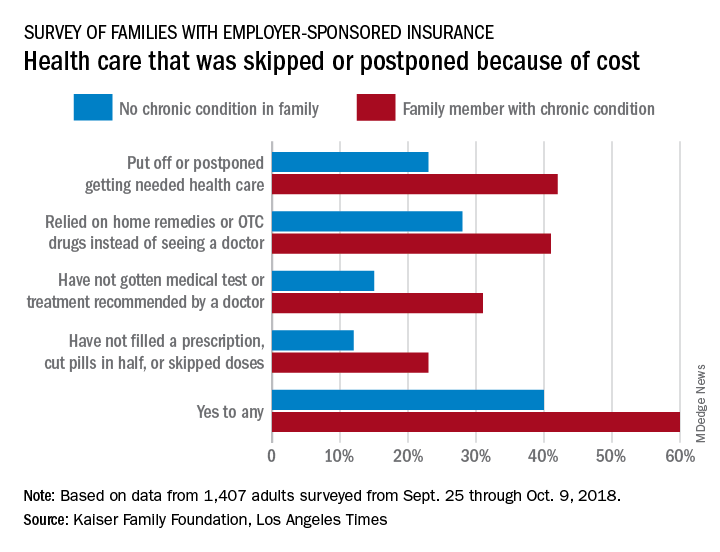
That number changes, however, when chronic conditions are considered. In the survey of Americans covered by employer-sponsored health insurance, 60% of those with a family member who had a chronic condition said that cost had altered the care of someone in the family over the previous 12 months, compared with 40% of those who had no chronic condition in their family, the KFF and L.A. Times noted in their report.
More specifically, families with an individual who had a chronic condition were more likely to put off or postpone needed care (42% vs. 23%) and to rely on home remedies or OTC drugs instead of visiting a physician (41% vs. 28%) than were families without chronic conditions, the report’s authors said.
When asked about the affordability of their health care, 49% of those in families with a chronic health condition said they had a problem paying for their coverage in the past year, compared with 29% of respondents in families with no chronic condition.
“Drilling down into the consequences of these affordability problems reveals more about the financial burden of health care on families with chronic conditions,” compared with those without chronic conditions: cut back spending on food, clothes, household items (35% vs. 16%); used up all or most of their savings (26% vs. 11%); and borrowed money from friends or family (14% vs. 6%), according to the researchers.
Although respondents felt “that the cost of health care for people like them is too high, more say the current U.S. health insurance system works well for people with employer coverage than say it works well for people on Medicare or Medicaid or those who purchase their own insurance. Asked who is to blame for high costs, majorities point the finger at pharmaceutical and insurance companies, while fewer see hospitals, doctors, or employers as deserving of blame,” the KFF and L.A. Times investigators wrote.
The survey involved a sample of 1,407 adults aged 18-64 years and was conducted from Sept. 25 through Oct. 9, 2018. The margin of the sampling error is ±3 percentage points.
Half of all Americans with employer-sponsored health benefits say that they or someone in their family has skipped or postponed care because of the cost, according to a survey by the Kaiser Family Foundation and the Los Angeles Times.
That number changes, however, when chronic conditions are considered. In the survey of Americans covered by employer-sponsored health insurance, 60% of those with a family member who had a chronic condition said that cost had altered the care of someone in the family over the previous 12 months, compared with 40% of those who had no chronic condition in their family, the KFF and L.A. Times noted in their report.
More specifically, families with an individual who had a chronic condition were more likely to put off or postpone needed care (42% vs. 23%) and to rely on home remedies or OTC drugs instead of visiting a physician (41% vs. 28%) than were families without chronic conditions, the report’s authors said.
When asked about the affordability of their health care, 49% of those in families with a chronic health condition said they had a problem paying for their coverage in the past year, compared with 29% of respondents in families with no chronic condition.
“Drilling down into the consequences of these affordability problems reveals more about the financial burden of health care on families with chronic conditions,” compared with those without chronic conditions: cut back spending on food, clothes, household items (35% vs. 16%); used up all or most of their savings (26% vs. 11%); and borrowed money from friends or family (14% vs. 6%), according to the researchers.
Although respondents felt “that the cost of health care for people like them is too high, more say the current U.S. health insurance system works well for people with employer coverage than say it works well for people on Medicare or Medicaid or those who purchase their own insurance. Asked who is to blame for high costs, majorities point the finger at pharmaceutical and insurance companies, while fewer see hospitals, doctors, or employers as deserving of blame,” the KFF and L.A. Times investigators wrote.
The survey involved a sample of 1,407 adults aged 18-64 years and was conducted from Sept. 25 through Oct. 9, 2018. The margin of the sampling error is ±3 percentage points.
Half of all Americans with employer-sponsored health benefits say that they or someone in their family has skipped or postponed care because of the cost, according to a survey by the Kaiser Family Foundation and the Los Angeles Times.
That number changes, however, when chronic conditions are considered. In the survey of Americans covered by employer-sponsored health insurance, 60% of those with a family member who had a chronic condition said that cost had altered the care of someone in the family over the previous 12 months, compared with 40% of those who had no chronic condition in their family, the KFF and L.A. Times noted in their report.
More specifically, families with an individual who had a chronic condition were more likely to put off or postpone needed care (42% vs. 23%) and to rely on home remedies or OTC drugs instead of visiting a physician (41% vs. 28%) than were families without chronic conditions, the report’s authors said.
When asked about the affordability of their health care, 49% of those in families with a chronic health condition said they had a problem paying for their coverage in the past year, compared with 29% of respondents in families with no chronic condition.
“Drilling down into the consequences of these affordability problems reveals more about the financial burden of health care on families with chronic conditions,” compared with those without chronic conditions: cut back spending on food, clothes, household items (35% vs. 16%); used up all or most of their savings (26% vs. 11%); and borrowed money from friends or family (14% vs. 6%), according to the researchers.
Although respondents felt “that the cost of health care for people like them is too high, more say the current U.S. health insurance system works well for people with employer coverage than say it works well for people on Medicare or Medicaid or those who purchase their own insurance. Asked who is to blame for high costs, majorities point the finger at pharmaceutical and insurance companies, while fewer see hospitals, doctors, or employers as deserving of blame,” the KFF and L.A. Times investigators wrote.
The survey involved a sample of 1,407 adults aged 18-64 years and was conducted from Sept. 25 through Oct. 9, 2018. The margin of the sampling error is ±3 percentage points.