User login
Hot Threads in ACS Communities
Your colleagues have a lot to say! Here are the top discussion threads in ACS Communities in March (all of these threads are from the General Surgery community):
1. Sully
3. Time has changed
4. Who fires your EEA staplers?
5. Neurosurgeon Sentenced to Life in Prison
6. Close the current VA health system as it is …
7. Surgery resident hours
8. Diagnostic laparotomy/laparoscopy
9. High jejunal resection in critically ill
10. Consults: Phone call or Text
To join communities, log in to ACS Communities at http://acscommunities.facs.org/home, go to “Browse All Communities” near the top of any page, and click the blue “Join” button next to the community you’d like to join. If you have any questions, please send them to [email protected].
Your colleagues have a lot to say! Here are the top discussion threads in ACS Communities in March (all of these threads are from the General Surgery community):
1. Sully
3. Time has changed
4. Who fires your EEA staplers?
5. Neurosurgeon Sentenced to Life in Prison
6. Close the current VA health system as it is …
7. Surgery resident hours
8. Diagnostic laparotomy/laparoscopy
9. High jejunal resection in critically ill
10. Consults: Phone call or Text
To join communities, log in to ACS Communities at http://acscommunities.facs.org/home, go to “Browse All Communities” near the top of any page, and click the blue “Join” button next to the community you’d like to join. If you have any questions, please send them to [email protected].
Your colleagues have a lot to say! Here are the top discussion threads in ACS Communities in March (all of these threads are from the General Surgery community):
1. Sully
3. Time has changed
4. Who fires your EEA staplers?
5. Neurosurgeon Sentenced to Life in Prison
6. Close the current VA health system as it is …
7. Surgery resident hours
8. Diagnostic laparotomy/laparoscopy
9. High jejunal resection in critically ill
10. Consults: Phone call or Text
To join communities, log in to ACS Communities at http://acscommunities.facs.org/home, go to “Browse All Communities” near the top of any page, and click the blue “Join” button next to the community you’d like to join. If you have any questions, please send them to [email protected].

Hemorrhagic Stroke Increases Risk of Depression and Subsequent Dementia
HOUSTON—Hemorrhagic stroke sharply increases the risk of new-onset depression which, in turn, is associated with a 30% increased risk of dementia within five years, according to research presented at the International Stroke Conference 2017.

“This is of great importance from a research and clinical standpoint, as it may represent a marker of ongoing cognitive deterioration,” said Dr. Biffi.
Hemorrhagic Stroke and Mood Disorders
Previous studies have found that patients with ICH have a significantly increased risk of mood disorders and cognitive decline. “There is probably a link between mood disorders and cognition after ICH, as is the case for a number of other neurologic conditions,” said Dr. Biffi. “Cerebrovascular small-vessel disease is likely to be involved in the underlying pathogenesis for these disorders, as it is also a risk factor for late-life depression in the general population. Therefore, depression and dementia after ICH may share some etiologic connections.”
Dr. Biffi and his colleagues enrolled 695 patients with ICH into their study and followed them for a mean of five years. None of the subjects had ever been diagnosed with a mood disorder or cognitive decline. The researchers conducted telephone interviews with patients every six months.
At baseline, investigators collected CT and MRI imaging data, epidemiologic exposure data, and apolipoprotein E4 genotype. The outcomes were new-onset depression and incident dementia.
Subjects had a mean age of 74 at baseline. In addition, approximately 70% of patients had hypertension, and 15% had heart disease. Less than 1% of the cohort was positive for the APOE e4 gene. Imaging-confirmed white matter disease was present in 65% of participants. During the follow-up period, new-onset depression developed in 278 (40%) patients. The temporal incidence of this outcome was consistent at about 7% per year.
Factors That Influenced Risk of Dementia
Researchers discovered that having more than a single copy of the APOE e4 allele at baseline (hazard ratio [HR], 1.7) and the presence of white matter disease at baseline (HR, 1.82), were significantly associated with new-onset depression. Having had at least 10 years of school protected against depression (HR, 0.75), as did functional independence (HR, 0.52). By the end of the follow-up period, dementia had developed in 80% of individuals with depression (220). In 81% of cases, depression preceded dementia, with an average time lag of 1.5 years, said Dr. Biffi.
In a multivariate analysis, several factors were significantly associated with incident dementia. Higher education reduced the risk by 40% (HR, 0.60). Factors that increased the risk of dementia were black race (HR, 1.48), APOE e4 gene (HR, 2.12), white matter disease (HR, 1.7), and poststroke new-onset depression (HR, 1.29). The study shows only association, said Dr. Biffi. “No causal relationship can be inferred by this study. We also cannot capture the severity of the mood symptoms, and we are unable to examine the relationship between cognition and apathy, which is another highly relevant neuropsychiatric manifestation of small-vessel disease,” he said.
—Michelle G. Sullivan
HOUSTON—Hemorrhagic stroke sharply increases the risk of new-onset depression which, in turn, is associated with a 30% increased risk of dementia within five years, according to research presented at the International Stroke Conference 2017.
“This is of great importance from a research and clinical standpoint, as it may represent a marker of ongoing cognitive deterioration,” said Dr. Biffi.
Hemorrhagic Stroke and Mood Disorders
Previous studies have found that patients with ICH have a significantly increased risk of mood disorders and cognitive decline. “There is probably a link between mood disorders and cognition after ICH, as is the case for a number of other neurologic conditions,” said Dr. Biffi. “Cerebrovascular small-vessel disease is likely to be involved in the underlying pathogenesis for these disorders, as it is also a risk factor for late-life depression in the general population. Therefore, depression and dementia after ICH may share some etiologic connections.”
Dr. Biffi and his colleagues enrolled 695 patients with ICH into their study and followed them for a mean of five years. None of the subjects had ever been diagnosed with a mood disorder or cognitive decline. The researchers conducted telephone interviews with patients every six months.
At baseline, investigators collected CT and MRI imaging data, epidemiologic exposure data, and apolipoprotein E4 genotype. The outcomes were new-onset depression and incident dementia.
Subjects had a mean age of 74 at baseline. In addition, approximately 70% of patients had hypertension, and 15% had heart disease. Less than 1% of the cohort was positive for the APOE e4 gene. Imaging-confirmed white matter disease was present in 65% of participants. During the follow-up period, new-onset depression developed in 278 (40%) patients. The temporal incidence of this outcome was consistent at about 7% per year.
Factors That Influenced Risk of Dementia
Researchers discovered that having more than a single copy of the APOE e4 allele at baseline (hazard ratio [HR], 1.7) and the presence of white matter disease at baseline (HR, 1.82), were significantly associated with new-onset depression. Having had at least 10 years of school protected against depression (HR, 0.75), as did functional independence (HR, 0.52). By the end of the follow-up period, dementia had developed in 80% of individuals with depression (220). In 81% of cases, depression preceded dementia, with an average time lag of 1.5 years, said Dr. Biffi.
In a multivariate analysis, several factors were significantly associated with incident dementia. Higher education reduced the risk by 40% (HR, 0.60). Factors that increased the risk of dementia were black race (HR, 1.48), APOE e4 gene (HR, 2.12), white matter disease (HR, 1.7), and poststroke new-onset depression (HR, 1.29). The study shows only association, said Dr. Biffi. “No causal relationship can be inferred by this study. We also cannot capture the severity of the mood symptoms, and we are unable to examine the relationship between cognition and apathy, which is another highly relevant neuropsychiatric manifestation of small-vessel disease,” he said.
—Michelle G. Sullivan
HOUSTON—Hemorrhagic stroke sharply increases the risk of new-onset depression which, in turn, is associated with a 30% increased risk of dementia within five years, according to research presented at the International Stroke Conference 2017.
“This is of great importance from a research and clinical standpoint, as it may represent a marker of ongoing cognitive deterioration,” said Dr. Biffi.
Hemorrhagic Stroke and Mood Disorders
Previous studies have found that patients with ICH have a significantly increased risk of mood disorders and cognitive decline. “There is probably a link between mood disorders and cognition after ICH, as is the case for a number of other neurologic conditions,” said Dr. Biffi. “Cerebrovascular small-vessel disease is likely to be involved in the underlying pathogenesis for these disorders, as it is also a risk factor for late-life depression in the general population. Therefore, depression and dementia after ICH may share some etiologic connections.”
Dr. Biffi and his colleagues enrolled 695 patients with ICH into their study and followed them for a mean of five years. None of the subjects had ever been diagnosed with a mood disorder or cognitive decline. The researchers conducted telephone interviews with patients every six months.
At baseline, investigators collected CT and MRI imaging data, epidemiologic exposure data, and apolipoprotein E4 genotype. The outcomes were new-onset depression and incident dementia.
Subjects had a mean age of 74 at baseline. In addition, approximately 70% of patients had hypertension, and 15% had heart disease. Less than 1% of the cohort was positive for the APOE e4 gene. Imaging-confirmed white matter disease was present in 65% of participants. During the follow-up period, new-onset depression developed in 278 (40%) patients. The temporal incidence of this outcome was consistent at about 7% per year.
Factors That Influenced Risk of Dementia
Researchers discovered that having more than a single copy of the APOE e4 allele at baseline (hazard ratio [HR], 1.7) and the presence of white matter disease at baseline (HR, 1.82), were significantly associated with new-onset depression. Having had at least 10 years of school protected against depression (HR, 0.75), as did functional independence (HR, 0.52). By the end of the follow-up period, dementia had developed in 80% of individuals with depression (220). In 81% of cases, depression preceded dementia, with an average time lag of 1.5 years, said Dr. Biffi.
In a multivariate analysis, several factors were significantly associated with incident dementia. Higher education reduced the risk by 40% (HR, 0.60). Factors that increased the risk of dementia were black race (HR, 1.48), APOE e4 gene (HR, 2.12), white matter disease (HR, 1.7), and poststroke new-onset depression (HR, 1.29). The study shows only association, said Dr. Biffi. “No causal relationship can be inferred by this study. We also cannot capture the severity of the mood symptoms, and we are unable to examine the relationship between cognition and apathy, which is another highly relevant neuropsychiatric manifestation of small-vessel disease,” he said.
—Michelle G. Sullivan

Removal of the Distal Aspect of a Broken Tibial Nail
Take-Home Points
- Nail breakage is a known complication of intramedullary nail (IMN) fixation of tibial fractures.
- Several techniques have been described for broken IMN extraction.
Intramedullary nail (IMN) fixation is reliably used to manage tibial fractures and has become very popular for managing fractures of varying complexity.1-4 An occasional complication of intramedullary nailing is nail breakage,5-7 which can result from a fatigue fracture (from excessive fracture site instability caused by inadequate nail diameter, delayed fracture healing, or fracture nonunion) and direct traumatic impact.5-7 Several case reports have described unique methods used to facilitate removal of broken hollow and solid IMNs from tibias and femurs.4,8-16 In this article, we describe an efficient technique for extracting broken tibial IMNs—a technique that can be used before attempting more invasive extraction methods. The patient provided written informed consent for print and electronic publication of this case report.
Case Report and Surgical Technique
A 34-year-old male logger presented to our facility (Department of Orthopaedics, Warren Alpert School of Medicine, Brown University) with a new fracture of the left tibia and fibula with an associated broken IMN after a tree fell on his leg at work (Figures 1A, 1B). 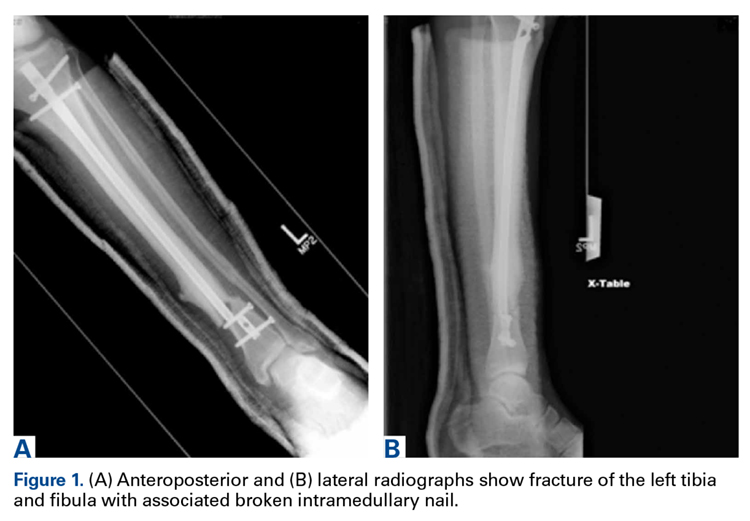
The original IMN had been placed through a paramedian incision, with lateral to medial distal locking screws. The tibial shaft fracture and broken nail were displaced in the coronal plane (Figures 1A, 1B). For restoration of the central canal of the nail, closed reduction was performed in the operating room (Figure 2A). Once the fracture was reduced, the more proximal of the 2 distal interlocking screws was partially backed out so the extraction hook could be passed antegrade into the distal segment of the nail (Figure 2A). 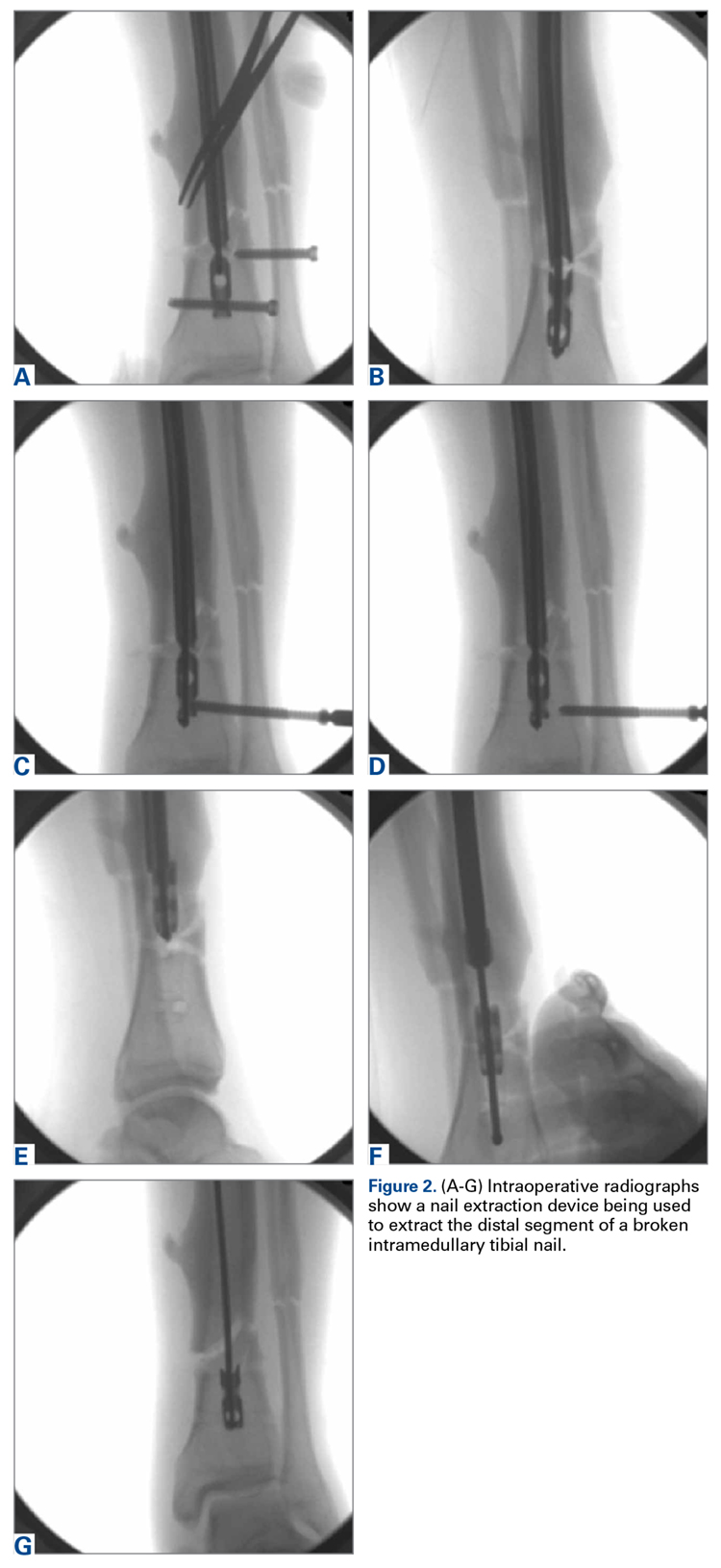
A ball-tipped guide wire was then passed down again, and reaming was carried out distally to 11.5 mm. A new tibial nail (10 mm × 315 mm) was placed down the intramedullary canal over the guide wire. The tibia was derotated to obtain better anatomical alignment using the fracture as an osteotomy, and 2 new distal interlocking screws were placed. The nail was then back-slapped to obtain impaction, and a single proximal dynamic interlocking screw was placed.
After surgery, the patient was allowed a gradual weight-bearing protocol. 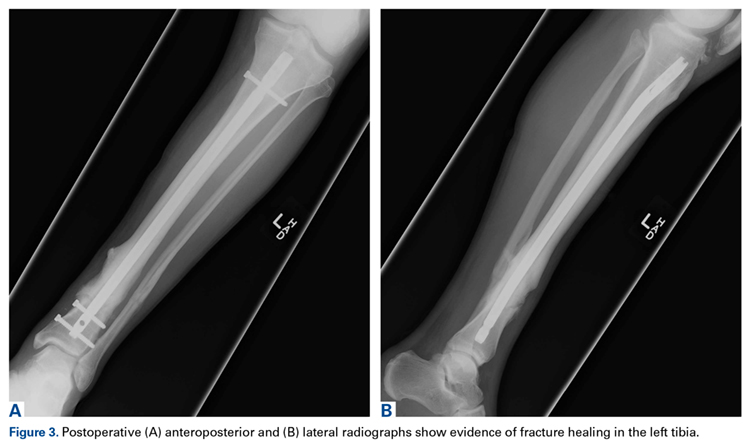
Discussion
IMN fixation of tibial fractures is reliable.1-4 An occasional complication of intramedullary nailing is nail breakage. Several case reports have described unique methods used to facilitate removal of broken hollow and solid IMNs from knees and femurs.4,8-16
Our patient’s case involved a cannulated tibial IMN that broke secondary to an acute traumatic event. Several techniques have been used to remove the distal segment of broken cannulated tibial IMNs.8,9,14,17 Abdelgawad and Kanlic8 described a technique in which a small distractor hook was introduced past the distal end of the broken distal piece, and a small (~2 in) piece of flexible nail was introduced into the slot of the distal interlocking screw hole. The hook was pulled back and became incarcerated in the nail by the flexible nail piece, allowing the hook to extract the distal segment of the nail.
Charnley and Farrington9 used Petelin laparoscopic grasping forceps to extract the distal segment of a broken cannulated tibial IMN under fluoroscopic guidance. This tibial canal was initially reamed before inserting the instrument and removing the distal segment of the nail.
Levine and Georgiadis14 used a 4.5-mm bit to drill a hole in the distal aspect of the medial malleolus. A smooth Steinmann pin was used to engage the tip of the IMN. The nail was hammered several centimeters up the medullary canal of the tibia. A 3.0-mm ball-tipped guide wire was inserted in the hole in the medial malleolus and advanced through the distal aspect of the nail under fluoroscopic guidance. The guide wire was advanced through the extent of the nail proximally until it emerged through the knee incision. The distal segment of the broken nail was extracted with the guide wire; the end of the guide wire with the ball engaged the distal aspect of the nail.
Our technique allowed us to use a nail extraction device to extract the distal segment of a broken tibial IMN. This device is usually on hand for routine nail extraction. We used the more distal of the 2 distal interlocking screws to push the extraction hook over the distal lip of the nail, allowing for extraction without additional incisions or additional drill holes in bone. Our technique was efficient in this particular situation and avoided more time-consuming extraction methods. In cases in which the extraction hook does not engage the distal aspect of the nail secondary to bone ingrowth, our technique should be used before attempting other extraction methods.
Am J Orthop. 2017;46(2):E112-E115. Copyright Frontline Medical Communications Inc. 2017. All rights reserved.
1. Bone LB, Kassman S, Stegemann P, France J. Prospective study of union rate of open tibial fractures treated with locked, unreamed intramedullary nails. J Orthop Trauma. 1994;8(1):45-49.
2. Blachut PA, O’Brien PJ, Meek RN, Broekhuyse HM. Interlocking intramedullary nailing with and without reaming for the treatment of closed fractures of the tibial shaft. A prospective, randomized study. J Bone Joint Surg Am. 1997;79(5):640-646.
3. Bonnevialle P, Savorit L, Combes JM, Rongières M, Bellumore Y, Mansat M. Value of intramedullary locked nailing in distal fractures of the tibia [in French]. Rev Chir Orthop Reparatrice Appar Mot. 1996;82(5):428-436.
4. Polat A, Kose O, Canbora K, Yanık S, Guler F. Intramedullary nailing versus minimally invasive plate osteosynthesis for distal extra-articular tibial fractures: a prospective randomized clinical trial. J Orthop Sci. 2015;20(4):695-701.
5. Bucholz RW, Ross SE, Lawrence KL. Fatigue fracture of the interlocking nail in the treatment of fractures of the distal part of the femoral shaft. J Bone Joint Surg Am. 1987;69(9):1391-1399.
6. Zimmerman KW, Klasen HJ. Mechanical failure of intramedullary nails after fracture union. J Bone Joint Surg Br. 1983;65(3):274-275.
7. Hahn D, Bradbury N, Hartley R, Radford PJ. Intramedullary nail breakage in distal fractures of the tibia. Injury. 1996;27(5):323-327.
8. Abdelgawad AA, Kanlic E. Removal of a broken cannulated intramedullary nail: review of the literature and a case report of a new technique. Case Rep Orthop. 2013;2013:461703.
9. Charnley GJ, Farrington WJ. Laparoscopic forceps removal of a broken tibial intramedullary nail. Injury. 1998;29(6):489-490.
10. Georgilas I, Mouzopoulos G, Neila C, Morakis E, Tzurbakis M. Removal of broken distal intramedullary nail with a simple method: a case report. Arch Orthop Trauma Surg. 2008;129(2):203-205.
11. Giannoudis PV, Matthews SJ, Smith RM. Removal of the retained fragment of broken solid nails by the intra-medullary route. Injury. 2001;32(5):407-410.
12. Gosling T, Allami M, Koenemann B, Hankemeier S, Krettek C. Minimally invasive exchange tibial nailing for a broken solid nail: case report and description of a new technique. J Orthop Trauma. 2005;19(10):744-747.
13. Hellemondt FJ, Haeff MJ. Removal of a broken solid intramedullary interlocking nail. A technical note. Acta Orthop Scand. 1996;67(5):512.
14. Levine JW, Georgiadis GM. Removal of a broken cannulated tibial nail: a simple intramedullary technique. J Orthop Trauma. 2004;18(4):247-249.
15. Schmidgen A, Naumann O, Wentzensen A. A simple and rapid method for removal of broken unreamed tibial nails [in German]. Unfallchirurg. 1999;102(12):975-978.
16. Steinberg EL, Luger E, Menahem A, Helfet DL. Removal of a broken distal closed section intramedullary nail: report of a case using a simple method. J Orthop Trauma. 2004;18(4):233-235.
17. Marwan M, Ibrahim M. Simple method for retrieval of distal segment of the broken interlocking intramedullary nail. Injury. 1999;30(5):333-335.
Take-Home Points
- Nail breakage is a known complication of intramedullary nail (IMN) fixation of tibial fractures.
- Several techniques have been described for broken IMN extraction.
Intramedullary nail (IMN) fixation is reliably used to manage tibial fractures and has become very popular for managing fractures of varying complexity.1-4 An occasional complication of intramedullary nailing is nail breakage,5-7 which can result from a fatigue fracture (from excessive fracture site instability caused by inadequate nail diameter, delayed fracture healing, or fracture nonunion) and direct traumatic impact.5-7 Several case reports have described unique methods used to facilitate removal of broken hollow and solid IMNs from tibias and femurs.4,8-16 In this article, we describe an efficient technique for extracting broken tibial IMNs—a technique that can be used before attempting more invasive extraction methods. The patient provided written informed consent for print and electronic publication of this case report.
Case Report and Surgical Technique
A 34-year-old male logger presented to our facility (Department of Orthopaedics, Warren Alpert School of Medicine, Brown University) with a new fracture of the left tibia and fibula with an associated broken IMN after a tree fell on his leg at work (Figures 1A, 1B).
The original IMN had been placed through a paramedian incision, with lateral to medial distal locking screws. The tibial shaft fracture and broken nail were displaced in the coronal plane (Figures 1A, 1B). For restoration of the central canal of the nail, closed reduction was performed in the operating room (Figure 2A). Once the fracture was reduced, the more proximal of the 2 distal interlocking screws was partially backed out so the extraction hook could be passed antegrade into the distal segment of the nail (Figure 2A).
A ball-tipped guide wire was then passed down again, and reaming was carried out distally to 11.5 mm. A new tibial nail (10 mm × 315 mm) was placed down the intramedullary canal over the guide wire. The tibia was derotated to obtain better anatomical alignment using the fracture as an osteotomy, and 2 new distal interlocking screws were placed. The nail was then back-slapped to obtain impaction, and a single proximal dynamic interlocking screw was placed.
After surgery, the patient was allowed a gradual weight-bearing protocol.
Discussion
IMN fixation of tibial fractures is reliable.1-4 An occasional complication of intramedullary nailing is nail breakage. Several case reports have described unique methods used to facilitate removal of broken hollow and solid IMNs from knees and femurs.4,8-16
Our patient’s case involved a cannulated tibial IMN that broke secondary to an acute traumatic event. Several techniques have been used to remove the distal segment of broken cannulated tibial IMNs.8,9,14,17 Abdelgawad and Kanlic8 described a technique in which a small distractor hook was introduced past the distal end of the broken distal piece, and a small (~2 in) piece of flexible nail was introduced into the slot of the distal interlocking screw hole. The hook was pulled back and became incarcerated in the nail by the flexible nail piece, allowing the hook to extract the distal segment of the nail.
Charnley and Farrington9 used Petelin laparoscopic grasping forceps to extract the distal segment of a broken cannulated tibial IMN under fluoroscopic guidance. This tibial canal was initially reamed before inserting the instrument and removing the distal segment of the nail.
Levine and Georgiadis14 used a 4.5-mm bit to drill a hole in the distal aspect of the medial malleolus. A smooth Steinmann pin was used to engage the tip of the IMN. The nail was hammered several centimeters up the medullary canal of the tibia. A 3.0-mm ball-tipped guide wire was inserted in the hole in the medial malleolus and advanced through the distal aspect of the nail under fluoroscopic guidance. The guide wire was advanced through the extent of the nail proximally until it emerged through the knee incision. The distal segment of the broken nail was extracted with the guide wire; the end of the guide wire with the ball engaged the distal aspect of the nail.
Our technique allowed us to use a nail extraction device to extract the distal segment of a broken tibial IMN. This device is usually on hand for routine nail extraction. We used the more distal of the 2 distal interlocking screws to push the extraction hook over the distal lip of the nail, allowing for extraction without additional incisions or additional drill holes in bone. Our technique was efficient in this particular situation and avoided more time-consuming extraction methods. In cases in which the extraction hook does not engage the distal aspect of the nail secondary to bone ingrowth, our technique should be used before attempting other extraction methods.
Am J Orthop. 2017;46(2):E112-E115. Copyright Frontline Medical Communications Inc. 2017. All rights reserved.
Take-Home Points
- Nail breakage is a known complication of intramedullary nail (IMN) fixation of tibial fractures.
- Several techniques have been described for broken IMN extraction.
Intramedullary nail (IMN) fixation is reliably used to manage tibial fractures and has become very popular for managing fractures of varying complexity.1-4 An occasional complication of intramedullary nailing is nail breakage,5-7 which can result from a fatigue fracture (from excessive fracture site instability caused by inadequate nail diameter, delayed fracture healing, or fracture nonunion) and direct traumatic impact.5-7 Several case reports have described unique methods used to facilitate removal of broken hollow and solid IMNs from tibias and femurs.4,8-16 In this article, we describe an efficient technique for extracting broken tibial IMNs—a technique that can be used before attempting more invasive extraction methods. The patient provided written informed consent for print and electronic publication of this case report.
Case Report and Surgical Technique
A 34-year-old male logger presented to our facility (Department of Orthopaedics, Warren Alpert School of Medicine, Brown University) with a new fracture of the left tibia and fibula with an associated broken IMN after a tree fell on his leg at work (Figures 1A, 1B).
The original IMN had been placed through a paramedian incision, with lateral to medial distal locking screws. The tibial shaft fracture and broken nail were displaced in the coronal plane (Figures 1A, 1B). For restoration of the central canal of the nail, closed reduction was performed in the operating room (Figure 2A). Once the fracture was reduced, the more proximal of the 2 distal interlocking screws was partially backed out so the extraction hook could be passed antegrade into the distal segment of the nail (Figure 2A).
A ball-tipped guide wire was then passed down again, and reaming was carried out distally to 11.5 mm. A new tibial nail (10 mm × 315 mm) was placed down the intramedullary canal over the guide wire. The tibia was derotated to obtain better anatomical alignment using the fracture as an osteotomy, and 2 new distal interlocking screws were placed. The nail was then back-slapped to obtain impaction, and a single proximal dynamic interlocking screw was placed.
After surgery, the patient was allowed a gradual weight-bearing protocol.
Discussion
IMN fixation of tibial fractures is reliable.1-4 An occasional complication of intramedullary nailing is nail breakage. Several case reports have described unique methods used to facilitate removal of broken hollow and solid IMNs from knees and femurs.4,8-16
Our patient’s case involved a cannulated tibial IMN that broke secondary to an acute traumatic event. Several techniques have been used to remove the distal segment of broken cannulated tibial IMNs.8,9,14,17 Abdelgawad and Kanlic8 described a technique in which a small distractor hook was introduced past the distal end of the broken distal piece, and a small (~2 in) piece of flexible nail was introduced into the slot of the distal interlocking screw hole. The hook was pulled back and became incarcerated in the nail by the flexible nail piece, allowing the hook to extract the distal segment of the nail.
Charnley and Farrington9 used Petelin laparoscopic grasping forceps to extract the distal segment of a broken cannulated tibial IMN under fluoroscopic guidance. This tibial canal was initially reamed before inserting the instrument and removing the distal segment of the nail.
Levine and Georgiadis14 used a 4.5-mm bit to drill a hole in the distal aspect of the medial malleolus. A smooth Steinmann pin was used to engage the tip of the IMN. The nail was hammered several centimeters up the medullary canal of the tibia. A 3.0-mm ball-tipped guide wire was inserted in the hole in the medial malleolus and advanced through the distal aspect of the nail under fluoroscopic guidance. The guide wire was advanced through the extent of the nail proximally until it emerged through the knee incision. The distal segment of the broken nail was extracted with the guide wire; the end of the guide wire with the ball engaged the distal aspect of the nail.
Our technique allowed us to use a nail extraction device to extract the distal segment of a broken tibial IMN. This device is usually on hand for routine nail extraction. We used the more distal of the 2 distal interlocking screws to push the extraction hook over the distal lip of the nail, allowing for extraction without additional incisions or additional drill holes in bone. Our technique was efficient in this particular situation and avoided more time-consuming extraction methods. In cases in which the extraction hook does not engage the distal aspect of the nail secondary to bone ingrowth, our technique should be used before attempting other extraction methods.
Am J Orthop. 2017;46(2):E112-E115. Copyright Frontline Medical Communications Inc. 2017. All rights reserved.
1. Bone LB, Kassman S, Stegemann P, France J. Prospective study of union rate of open tibial fractures treated with locked, unreamed intramedullary nails. J Orthop Trauma. 1994;8(1):45-49.
2. Blachut PA, O’Brien PJ, Meek RN, Broekhuyse HM. Interlocking intramedullary nailing with and without reaming for the treatment of closed fractures of the tibial shaft. A prospective, randomized study. J Bone Joint Surg Am. 1997;79(5):640-646.
3. Bonnevialle P, Savorit L, Combes JM, Rongières M, Bellumore Y, Mansat M. Value of intramedullary locked nailing in distal fractures of the tibia [in French]. Rev Chir Orthop Reparatrice Appar Mot. 1996;82(5):428-436.
4. Polat A, Kose O, Canbora K, Yanık S, Guler F. Intramedullary nailing versus minimally invasive plate osteosynthesis for distal extra-articular tibial fractures: a prospective randomized clinical trial. J Orthop Sci. 2015;20(4):695-701.
5. Bucholz RW, Ross SE, Lawrence KL. Fatigue fracture of the interlocking nail in the treatment of fractures of the distal part of the femoral shaft. J Bone Joint Surg Am. 1987;69(9):1391-1399.
6. Zimmerman KW, Klasen HJ. Mechanical failure of intramedullary nails after fracture union. J Bone Joint Surg Br. 1983;65(3):274-275.
7. Hahn D, Bradbury N, Hartley R, Radford PJ. Intramedullary nail breakage in distal fractures of the tibia. Injury. 1996;27(5):323-327.
8. Abdelgawad AA, Kanlic E. Removal of a broken cannulated intramedullary nail: review of the literature and a case report of a new technique. Case Rep Orthop. 2013;2013:461703.
9. Charnley GJ, Farrington WJ. Laparoscopic forceps removal of a broken tibial intramedullary nail. Injury. 1998;29(6):489-490.
10. Georgilas I, Mouzopoulos G, Neila C, Morakis E, Tzurbakis M. Removal of broken distal intramedullary nail with a simple method: a case report. Arch Orthop Trauma Surg. 2008;129(2):203-205.
11. Giannoudis PV, Matthews SJ, Smith RM. Removal of the retained fragment of broken solid nails by the intra-medullary route. Injury. 2001;32(5):407-410.
12. Gosling T, Allami M, Koenemann B, Hankemeier S, Krettek C. Minimally invasive exchange tibial nailing for a broken solid nail: case report and description of a new technique. J Orthop Trauma. 2005;19(10):744-747.
13. Hellemondt FJ, Haeff MJ. Removal of a broken solid intramedullary interlocking nail. A technical note. Acta Orthop Scand. 1996;67(5):512.
14. Levine JW, Georgiadis GM. Removal of a broken cannulated tibial nail: a simple intramedullary technique. J Orthop Trauma. 2004;18(4):247-249.
15. Schmidgen A, Naumann O, Wentzensen A. A simple and rapid method for removal of broken unreamed tibial nails [in German]. Unfallchirurg. 1999;102(12):975-978.
16. Steinberg EL, Luger E, Menahem A, Helfet DL. Removal of a broken distal closed section intramedullary nail: report of a case using a simple method. J Orthop Trauma. 2004;18(4):233-235.
17. Marwan M, Ibrahim M. Simple method for retrieval of distal segment of the broken interlocking intramedullary nail. Injury. 1999;30(5):333-335.
1. Bone LB, Kassman S, Stegemann P, France J. Prospective study of union rate of open tibial fractures treated with locked, unreamed intramedullary nails. J Orthop Trauma. 1994;8(1):45-49.
2. Blachut PA, O’Brien PJ, Meek RN, Broekhuyse HM. Interlocking intramedullary nailing with and without reaming for the treatment of closed fractures of the tibial shaft. A prospective, randomized study. J Bone Joint Surg Am. 1997;79(5):640-646.
3. Bonnevialle P, Savorit L, Combes JM, Rongières M, Bellumore Y, Mansat M. Value of intramedullary locked nailing in distal fractures of the tibia [in French]. Rev Chir Orthop Reparatrice Appar Mot. 1996;82(5):428-436.
4. Polat A, Kose O, Canbora K, Yanık S, Guler F. Intramedullary nailing versus minimally invasive plate osteosynthesis for distal extra-articular tibial fractures: a prospective randomized clinical trial. J Orthop Sci. 2015;20(4):695-701.
5. Bucholz RW, Ross SE, Lawrence KL. Fatigue fracture of the interlocking nail in the treatment of fractures of the distal part of the femoral shaft. J Bone Joint Surg Am. 1987;69(9):1391-1399.
6. Zimmerman KW, Klasen HJ. Mechanical failure of intramedullary nails after fracture union. J Bone Joint Surg Br. 1983;65(3):274-275.
7. Hahn D, Bradbury N, Hartley R, Radford PJ. Intramedullary nail breakage in distal fractures of the tibia. Injury. 1996;27(5):323-327.
8. Abdelgawad AA, Kanlic E. Removal of a broken cannulated intramedullary nail: review of the literature and a case report of a new technique. Case Rep Orthop. 2013;2013:461703.
9. Charnley GJ, Farrington WJ. Laparoscopic forceps removal of a broken tibial intramedullary nail. Injury. 1998;29(6):489-490.
10. Georgilas I, Mouzopoulos G, Neila C, Morakis E, Tzurbakis M. Removal of broken distal intramedullary nail with a simple method: a case report. Arch Orthop Trauma Surg. 2008;129(2):203-205.
11. Giannoudis PV, Matthews SJ, Smith RM. Removal of the retained fragment of broken solid nails by the intra-medullary route. Injury. 2001;32(5):407-410.
12. Gosling T, Allami M, Koenemann B, Hankemeier S, Krettek C. Minimally invasive exchange tibial nailing for a broken solid nail: case report and description of a new technique. J Orthop Trauma. 2005;19(10):744-747.
13. Hellemondt FJ, Haeff MJ. Removal of a broken solid intramedullary interlocking nail. A technical note. Acta Orthop Scand. 1996;67(5):512.
14. Levine JW, Georgiadis GM. Removal of a broken cannulated tibial nail: a simple intramedullary technique. J Orthop Trauma. 2004;18(4):247-249.
15. Schmidgen A, Naumann O, Wentzensen A. A simple and rapid method for removal of broken unreamed tibial nails [in German]. Unfallchirurg. 1999;102(12):975-978.
16. Steinberg EL, Luger E, Menahem A, Helfet DL. Removal of a broken distal closed section intramedullary nail: report of a case using a simple method. J Orthop Trauma. 2004;18(4):233-235.
17. Marwan M, Ibrahim M. Simple method for retrieval of distal segment of the broken interlocking intramedullary nail. Injury. 1999;30(5):333-335.
Laparoscopic and abdominal hysterectomy yield equivalent survival
Laparoscopic hysterectomy yields equivalent disease-free and overall survival at 4.5 years, compared with abdominal hysterectomy in stage I endometrial cancer, according to a report published online March 28 in JAMA.
Several short-term advantages with the laparoscopic approach have been well documented, including less pain, less morbidity, better quality of life, decreased risk of surgery-related adverse events, and cost savings. But until now, no large international trial has demonstrated that longer-term survival outcomes are at least as good with laparoscopic as with open abdominal hysterectomy in this patient population, reported Monika Janda, PhD, of Queensland University of Technology, Brisbane (Australia) and her colleagues.
They conducted the Laparoscopic Approach to Cancer of the Endometrium (LACE) trial, a randomized equivalence study involving 760 women treated at 20 medical centers in Australia, New Zealand, and Hong Kong during 2005-2010. The women were followed for a median of 4.5 years.
All of the women had histologically confirmed stage I adenocarcinoma of the endometrium. A total of 407 patients were randomly assigned to undergo total laparoscopic hysterectomy and 353 patients to undergo total abdominal hysterectomy. Medical comorbidities were equally distributed between the two study groups, and there were no significant between-group differences in tumor type, histologic grade, number of involved lymph nodes, or adjuvant treatments.
Disease-free survival at 4.5 years was 81.6% with laparoscopic hysterectomy and 81.3% with abdominal hysterectomy, meeting the criteria for equivalence. Overall survival at 4.5 years was 92.0% and 92.4%, respectively. Cancer recurred near the operative site in 3% of each group and at a regional or distant site in 2% or less of each group. Causes of death also were similar between the two study groups, with 56% of all deaths attributed to endometrial cancer (JAMA. 2017;317[12]:1224-33).
Of note, two patients who underwent laparoscopic surgery developed port-site metastases and two patients who underwent abdominal surgery developed metastases at the site of the abdominal wound.
The study was funded by Cancer Councils in Australia, the National Health and Medical Research Council, Cancer Australia, QLD Health, and numerous others. Dr. Janda reported having no relevant financial disclosures; one of her coauthors reported ties to the O.R. Company, SurgicalPerformance Pty, and Covidien.
This study adds to a growing body of literature that suggests laparoscopic hysterectomy is not only safe, but also the preferred modality of hysterectomy for women with endometrial cancer.
Despite the clear benefits of laparoscopic hysterectomy, the findings from the LACE trial should be interpreted in the context of the study design. Importantly, patients randomized to the study represent a highly select group of women with endometrial cancer. The study entry criteria involved a low-risk population of women with stage I tumors of endometrioid histology with a uterine size of less than 10 weeks’ gestation. In practice, laparoscopic hysterectomy is now routinely used for women with nonendometrioid histologies and in those with more advanced disease.

The LACE trial reported by Janda et al. provides confirmation that laparoscopic hysterectomy is a safe and effective treatment modality for women with early-stage endometrial cancer. The favorable short-term outcomes along with equivalent oncological outcomes make laparoscopic hysterectomy the preferred surgical modality in this setting. Even though the road to defining the benefits of laparoscopic hysterectomy has been long, efforts to promote the procedure for women with endometrial cancer should now be a priority.
Jason D. Wright, MD, is at the Herbert Irving Comprehensive Cancer Center and the department of ob.gyn. at Columbia University, New York. He reported having no relevant financial disclosures. These comments are excerpted from an accompanying editorial (JAMA 2017;317[12]:1215-6).
This study adds to a growing body of literature that suggests laparoscopic hysterectomy is not only safe, but also the preferred modality of hysterectomy for women with endometrial cancer.
Despite the clear benefits of laparoscopic hysterectomy, the findings from the LACE trial should be interpreted in the context of the study design. Importantly, patients randomized to the study represent a highly select group of women with endometrial cancer. The study entry criteria involved a low-risk population of women with stage I tumors of endometrioid histology with a uterine size of less than 10 weeks’ gestation. In practice, laparoscopic hysterectomy is now routinely used for women with nonendometrioid histologies and in those with more advanced disease.
The LACE trial reported by Janda et al. provides confirmation that laparoscopic hysterectomy is a safe and effective treatment modality for women with early-stage endometrial cancer. The favorable short-term outcomes along with equivalent oncological outcomes make laparoscopic hysterectomy the preferred surgical modality in this setting. Even though the road to defining the benefits of laparoscopic hysterectomy has been long, efforts to promote the procedure for women with endometrial cancer should now be a priority.
Jason D. Wright, MD, is at the Herbert Irving Comprehensive Cancer Center and the department of ob.gyn. at Columbia University, New York. He reported having no relevant financial disclosures. These comments are excerpted from an accompanying editorial (JAMA 2017;317[12]:1215-6).
This study adds to a growing body of literature that suggests laparoscopic hysterectomy is not only safe, but also the preferred modality of hysterectomy for women with endometrial cancer.
Despite the clear benefits of laparoscopic hysterectomy, the findings from the LACE trial should be interpreted in the context of the study design. Importantly, patients randomized to the study represent a highly select group of women with endometrial cancer. The study entry criteria involved a low-risk population of women with stage I tumors of endometrioid histology with a uterine size of less than 10 weeks’ gestation. In practice, laparoscopic hysterectomy is now routinely used for women with nonendometrioid histologies and in those with more advanced disease.
The LACE trial reported by Janda et al. provides confirmation that laparoscopic hysterectomy is a safe and effective treatment modality for women with early-stage endometrial cancer. The favorable short-term outcomes along with equivalent oncological outcomes make laparoscopic hysterectomy the preferred surgical modality in this setting. Even though the road to defining the benefits of laparoscopic hysterectomy has been long, efforts to promote the procedure for women with endometrial cancer should now be a priority.
Jason D. Wright, MD, is at the Herbert Irving Comprehensive Cancer Center and the department of ob.gyn. at Columbia University, New York. He reported having no relevant financial disclosures. These comments are excerpted from an accompanying editorial (JAMA 2017;317[12]:1215-6).
Laparoscopic hysterectomy yields equivalent disease-free and overall survival at 4.5 years, compared with abdominal hysterectomy in stage I endometrial cancer, according to a report published online March 28 in JAMA.
Several short-term advantages with the laparoscopic approach have been well documented, including less pain, less morbidity, better quality of life, decreased risk of surgery-related adverse events, and cost savings. But until now, no large international trial has demonstrated that longer-term survival outcomes are at least as good with laparoscopic as with open abdominal hysterectomy in this patient population, reported Monika Janda, PhD, of Queensland University of Technology, Brisbane (Australia) and her colleagues.
They conducted the Laparoscopic Approach to Cancer of the Endometrium (LACE) trial, a randomized equivalence study involving 760 women treated at 20 medical centers in Australia, New Zealand, and Hong Kong during 2005-2010. The women were followed for a median of 4.5 years.
All of the women had histologically confirmed stage I adenocarcinoma of the endometrium. A total of 407 patients were randomly assigned to undergo total laparoscopic hysterectomy and 353 patients to undergo total abdominal hysterectomy. Medical comorbidities were equally distributed between the two study groups, and there were no significant between-group differences in tumor type, histologic grade, number of involved lymph nodes, or adjuvant treatments.
Disease-free survival at 4.5 years was 81.6% with laparoscopic hysterectomy and 81.3% with abdominal hysterectomy, meeting the criteria for equivalence. Overall survival at 4.5 years was 92.0% and 92.4%, respectively. Cancer recurred near the operative site in 3% of each group and at a regional or distant site in 2% or less of each group. Causes of death also were similar between the two study groups, with 56% of all deaths attributed to endometrial cancer (JAMA. 2017;317[12]:1224-33).
Of note, two patients who underwent laparoscopic surgery developed port-site metastases and two patients who underwent abdominal surgery developed metastases at the site of the abdominal wound.
The study was funded by Cancer Councils in Australia, the National Health and Medical Research Council, Cancer Australia, QLD Health, and numerous others. Dr. Janda reported having no relevant financial disclosures; one of her coauthors reported ties to the O.R. Company, SurgicalPerformance Pty, and Covidien.
Laparoscopic hysterectomy yields equivalent disease-free and overall survival at 4.5 years, compared with abdominal hysterectomy in stage I endometrial cancer, according to a report published online March 28 in JAMA.
Several short-term advantages with the laparoscopic approach have been well documented, including less pain, less morbidity, better quality of life, decreased risk of surgery-related adverse events, and cost savings. But until now, no large international trial has demonstrated that longer-term survival outcomes are at least as good with laparoscopic as with open abdominal hysterectomy in this patient population, reported Monika Janda, PhD, of Queensland University of Technology, Brisbane (Australia) and her colleagues.
They conducted the Laparoscopic Approach to Cancer of the Endometrium (LACE) trial, a randomized equivalence study involving 760 women treated at 20 medical centers in Australia, New Zealand, and Hong Kong during 2005-2010. The women were followed for a median of 4.5 years.
All of the women had histologically confirmed stage I adenocarcinoma of the endometrium. A total of 407 patients were randomly assigned to undergo total laparoscopic hysterectomy and 353 patients to undergo total abdominal hysterectomy. Medical comorbidities were equally distributed between the two study groups, and there were no significant between-group differences in tumor type, histologic grade, number of involved lymph nodes, or adjuvant treatments.
Disease-free survival at 4.5 years was 81.6% with laparoscopic hysterectomy and 81.3% with abdominal hysterectomy, meeting the criteria for equivalence. Overall survival at 4.5 years was 92.0% and 92.4%, respectively. Cancer recurred near the operative site in 3% of each group and at a regional or distant site in 2% or less of each group. Causes of death also were similar between the two study groups, with 56% of all deaths attributed to endometrial cancer (JAMA. 2017;317[12]:1224-33).
Of note, two patients who underwent laparoscopic surgery developed port-site metastases and two patients who underwent abdominal surgery developed metastases at the site of the abdominal wound.
The study was funded by Cancer Councils in Australia, the National Health and Medical Research Council, Cancer Australia, QLD Health, and numerous others. Dr. Janda reported having no relevant financial disclosures; one of her coauthors reported ties to the O.R. Company, SurgicalPerformance Pty, and Covidien.
FROM JAMA
Key clinical point:
Major finding: Disease-free survival at 4.5 years was 81.6% with laparoscopic hysterectomy and 81.3% with abdominal hysterectomy.
Data source: An international, randomized, phase III equivalence trial involving 760 women treated with total abdominal or total laparoscopic hysterectomy.
Disclosures: The study was funded by Cancer Councils in Australia, the National Health and Medical Research Council, Cancer Australia, QLD Health, and others. Dr. Janda reported having no relevant financial disclosures; one of her coauthors reported ties to the O.R. Company, SurgicalPerformance Pty, and Covidien.

One peanut daily might maintain childhood immunotherapy gains
ATLANTA – One year or more after peanut immunotherapy, 27 of 33 (82%) children were eating peanuts regularly, most without problems, in a survey from the Children’s Hospital of Philadelphia.
The finding speaks to the durability of peanut immunotherapy, something that’s been a concern for physicians and families. It suggests that peanut immunotherapy might give children long-term protection from accidental exposure, so long as they continue to eat a small amount of peanut almost every day after desensitization.
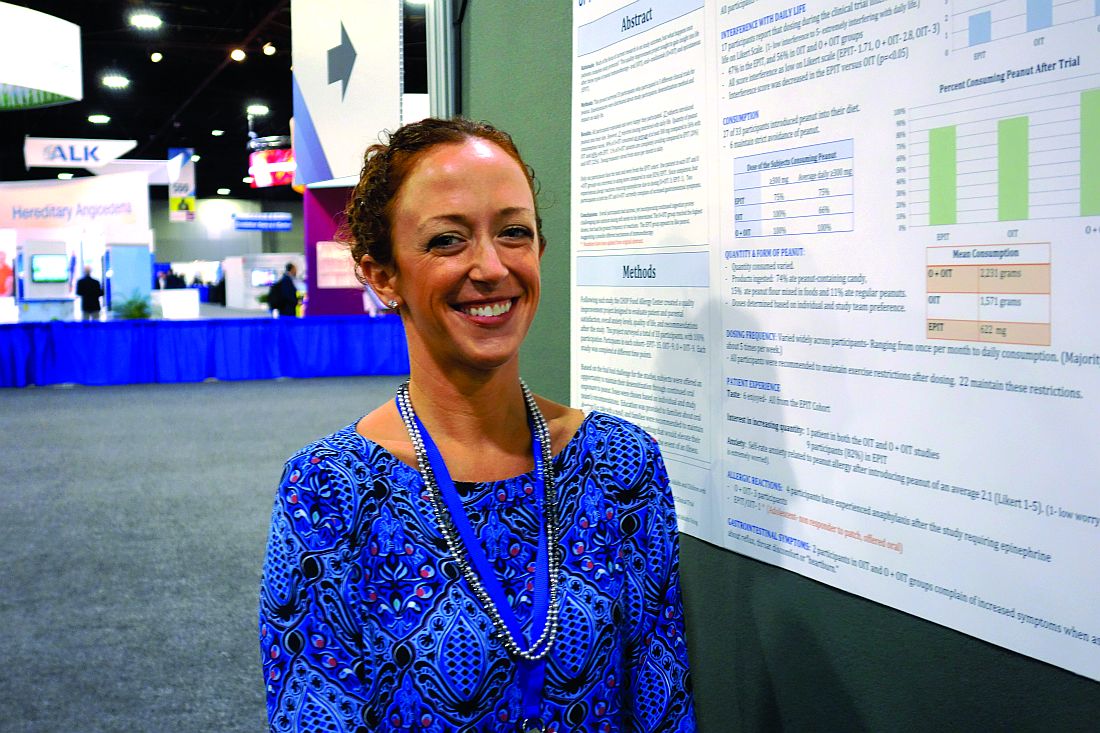
She and her team surveyed the families of 15 children who completed a trial of epicutaneous peanut immunotherapy (EPIT) and 9 who completed a trial of oral immunotherapy (OIT) about a year after the studies ended. They also surveyed families of nine children about 2 years after they completed a trial of OIT plus omalizumab (Xolair) for peanut allergy. The investigators and families chose maintenance doses based on results from the final peanut challenges, and children were warned against running around within 2 hours of their dose, to prevent exercised-induced reactions.
The point of using omalizumab in the one trial was to see if it helped children ramp up immunotherapy more quickly and tolerate higher final peanut doses. It did, and the nine omalizumab children were on the highest maintenance doses of peanut at 2-year follow-up, with almost all of them consuming an average of at least one peanut a day. Perhaps because of that, three of the four anaphylactic reactions were in the omalizumab group.
The fourth reaction was in a child who completed the OIT trial. There was no anaphylaxis in EPIT children. About 60% in both groups reported eating an average of at least a peanut a day at 1-year follow-up.
About three-quarters of the children ate peanut-containing candy to get their maintenance dose. Others ate peanuts or peanut butter or sprinkled peanut flour on their food. Just six children, all from the EPIT cohort, said they liked the taste of peanuts.
Meanwhile, 6 of the 33 children (18%) – 1 in the omalizumab group, 3 in the EPIT arm, and 2 in the OIT group – refused to eat peanuts after their immunotherapy trials.
Posttrial peanut dosing ranged from once a month to daily, and the majority of subjects ate peanut about five times per week. All of the anaphylaxis children recovered without incident and resumed peanut maintenance. A couple of the children in the EPIT group had an itch in their throat when they switched to eating peanuts, but it resolved on its own. One child in the omalizumab group and one in the OIT group reported gastrointestinal symptoms with maintenance dosing.
The original trials funded the follow-up. Ms. Ott Lewis had no relevant financial disclosures.
ATLANTA – One year or more after peanut immunotherapy, 27 of 33 (82%) children were eating peanuts regularly, most without problems, in a survey from the Children’s Hospital of Philadelphia.
The finding speaks to the durability of peanut immunotherapy, something that’s been a concern for physicians and families. It suggests that peanut immunotherapy might give children long-term protection from accidental exposure, so long as they continue to eat a small amount of peanut almost every day after desensitization.
She and her team surveyed the families of 15 children who completed a trial of epicutaneous peanut immunotherapy (EPIT) and 9 who completed a trial of oral immunotherapy (OIT) about a year after the studies ended. They also surveyed families of nine children about 2 years after they completed a trial of OIT plus omalizumab (Xolair) for peanut allergy. The investigators and families chose maintenance doses based on results from the final peanut challenges, and children were warned against running around within 2 hours of their dose, to prevent exercised-induced reactions.
The point of using omalizumab in the one trial was to see if it helped children ramp up immunotherapy more quickly and tolerate higher final peanut doses. It did, and the nine omalizumab children were on the highest maintenance doses of peanut at 2-year follow-up, with almost all of them consuming an average of at least one peanut a day. Perhaps because of that, three of the four anaphylactic reactions were in the omalizumab group.
The fourth reaction was in a child who completed the OIT trial. There was no anaphylaxis in EPIT children. About 60% in both groups reported eating an average of at least a peanut a day at 1-year follow-up.
About three-quarters of the children ate peanut-containing candy to get their maintenance dose. Others ate peanuts or peanut butter or sprinkled peanut flour on their food. Just six children, all from the EPIT cohort, said they liked the taste of peanuts.
Meanwhile, 6 of the 33 children (18%) – 1 in the omalizumab group, 3 in the EPIT arm, and 2 in the OIT group – refused to eat peanuts after their immunotherapy trials.
Posttrial peanut dosing ranged from once a month to daily, and the majority of subjects ate peanut about five times per week. All of the anaphylaxis children recovered without incident and resumed peanut maintenance. A couple of the children in the EPIT group had an itch in their throat when they switched to eating peanuts, but it resolved on its own. One child in the omalizumab group and one in the OIT group reported gastrointestinal symptoms with maintenance dosing.
The original trials funded the follow-up. Ms. Ott Lewis had no relevant financial disclosures.
ATLANTA – One year or more after peanut immunotherapy, 27 of 33 (82%) children were eating peanuts regularly, most without problems, in a survey from the Children’s Hospital of Philadelphia.
The finding speaks to the durability of peanut immunotherapy, something that’s been a concern for physicians and families. It suggests that peanut immunotherapy might give children long-term protection from accidental exposure, so long as they continue to eat a small amount of peanut almost every day after desensitization.
She and her team surveyed the families of 15 children who completed a trial of epicutaneous peanut immunotherapy (EPIT) and 9 who completed a trial of oral immunotherapy (OIT) about a year after the studies ended. They also surveyed families of nine children about 2 years after they completed a trial of OIT plus omalizumab (Xolair) for peanut allergy. The investigators and families chose maintenance doses based on results from the final peanut challenges, and children were warned against running around within 2 hours of their dose, to prevent exercised-induced reactions.
The point of using omalizumab in the one trial was to see if it helped children ramp up immunotherapy more quickly and tolerate higher final peanut doses. It did, and the nine omalizumab children were on the highest maintenance doses of peanut at 2-year follow-up, with almost all of them consuming an average of at least one peanut a day. Perhaps because of that, three of the four anaphylactic reactions were in the omalizumab group.
The fourth reaction was in a child who completed the OIT trial. There was no anaphylaxis in EPIT children. About 60% in both groups reported eating an average of at least a peanut a day at 1-year follow-up.
About three-quarters of the children ate peanut-containing candy to get their maintenance dose. Others ate peanuts or peanut butter or sprinkled peanut flour on their food. Just six children, all from the EPIT cohort, said they liked the taste of peanuts.
Meanwhile, 6 of the 33 children (18%) – 1 in the omalizumab group, 3 in the EPIT arm, and 2 in the OIT group – refused to eat peanuts after their immunotherapy trials.
Posttrial peanut dosing ranged from once a month to daily, and the majority of subjects ate peanut about five times per week. All of the anaphylaxis children recovered without incident and resumed peanut maintenance. A couple of the children in the EPIT group had an itch in their throat when they switched to eating peanuts, but it resolved on its own. One child in the omalizumab group and one in the OIT group reported gastrointestinal symptoms with maintenance dosing.
The original trials funded the follow-up. Ms. Ott Lewis had no relevant financial disclosures.
Key clinical point: Eating more than that might increase the risk of reaction.
Major finding: There were four anaphylactic reactions, three of which were among children on the highest maintenance doses.
Data source: Follow-up surveys a year or more after peanut desensitization trials in 33 children.
Disclosures: The original trials funded the follow-up. The lead investigator had no relevant financial disclosures.
How to Manage the Risks Associated With Epilepsy and Pregnancy

Taking Precautions Before Pregnancy
“In keeping with the CDC recommendations to help prevent spina bifida and other birth defects, we should encourage women with epilepsy to start taking folate at menarche and to keep it up through menopause or until they have a hysterectomy or tubal ligation,” Dr. Meador said. He pointed out that half of pregnancies in the US are not planned, whether the woman is married or not. “So, if you wait for a woman to say, ‘I want to get pregnant,’ before you address AED pregnancy risks and the need for folate supplementation, you are going to miss half of the children who may be adversely affected.”
Among women with epilepsy, folate may confer additional benefits. In the Neurodevelopmental Effects of AEDs (NEAD) study, Dr. Meador and colleagues found that mean IQ was 6 points higher at age 6 in children whose mothers had taken periconceptional folate than in those whose mothers had not. Data from NEAD, a prospective, observational, multicenter study in the US and UK, have been used to assess various outcomes in children born to women with epilepsy taking carbamazepine, lamotrigine, phenytoin, or valproate monotherapy during pregnancy who were enrolled between October 1999 and February 2004.
For women who do not want to become pregnant, it is important to note that carbamazepine, phenobarbital, phenytoin, topiramate at doses greater than 200 mg, oxcarbazepine at doses greater than 1,200 mg, and other AEDs may lessen the effect of hormonal contraceptives. Some drugs, such as clonazepam, levetiracetam, and lamotrigine, do not significantly affect blood levels of hormonal contraceptive agents, Dr. Meador said. Estradiol has been shown to lower blood levels of lamotrigine, and while valproate does not appear to interact significantly with contraceptive agents, it can interact with other drugs.
Hormonal contraception may increase seizure rates significantly across all AED categories, compared with nonhormonal contraception, according to the preliminary findings of the Epilepsy Birth Control Registry. Compared with combined pills, both hormonal patch and progestin-only pills had greater risk ratios for seizure increase.
“My favorite reversible contraception for women with epilepsy is the intrauterine device, because it does not have systemic effects, and AEDs do not interfere with it,” Dr. Meador said.
AED Clearance During Pregnancy
Pregnancy appears to affect blood levels of AEDs. In a retrospective analysis of 115 pregnancies in 95 women with epilepsy, significant changes in clearance during pregnancy were observed for lamotrigine and levetiracetam, with average peak clearance increases of 191% and 207%, respectively. The investigators recommended the monitoring of serum AED concentrations in pregnant women who have epilepsy, with dosage adjustments as needed. “My approach is to assess blood levels either before pregnancy or early on, to draw blood monthly, and to maintain the blood level at the preconception level if they were seizure-free prior to pregnancy,” Dr. Meador said. “AED dosages should be adjusted within seven to 10 days after the baby is delivered to avoid toxicity, because the metabolism goes back to normal.”
Congenital Malformations
Although the majority of children born to women with epilepsy are healthy, congenital malformations associated with fetal exposure to AEDs can include heart defects, orofacial clefts, and skeletal, urologic, and neural tube defects, Dr. Meador pointed out. The European and International Registry of AEDs in Pregnancy showed an increase in malformation rates with increasing dose at the time of conception of monotherapy with carbamazepine, lamotrigine, valproic acid, and phenobarbital. Lamotrigine at doses lower than 300 mg/day and carbamazepine at doses lower than 400 mg/day had significantly lower risks of malformations than did valproic acid and phenobarbital at all investigated doses, and low-dose lamotrigine had lower risks than carbamazepine had at doses of 400 mg/day or greater.
A review of studies using the European Surveillance of Congenital Anomalies database showed a 2.6 odds ratio for spina bifida with fetal exposure to carbamazepine during the first trimester, compared with no use of an AED. The odds ratio for spina bifida after valproate exposure was 12.7, compared with no use of an AED. Fetal exposure to valproate also was associated with significantly increased odds for atrial septal defect, cleft palate, hypospadias, polydactyly, and craniosynostosis.
“We made many advances in the past 20 years in our knowledge of congenital malformations through these epilepsy registries around the world,” Dr. Meador said.
“I encourage physicians to urge women, especially those on new anticonvulsant drugs or who are on polytherapy, to join the North American AED Pregnancy Registry.”
Cognitive Defects
In the NEAD study, the mean IQ of 3-year-olds who had been exposed in utero to valproate was 9 points lower than that of children exposed in utero to lamotrigine, 7 points lower than that of children exposed in utero to phenytoin, and 6 points lower than that of children exposed in utero to carbamazepine. The association between valproate exposure and IQ was dose-dependent. “Verbal abilities were lower for valproate, compared with the other three drugs,” Dr. Meador said. “Children exposed to lamotrigine had better nonverbal abilities than those exposed to valproate, and the other two drugs had a trend in the same direction.”
At age 6, the same children who had been exposed to valproate did poorly on measures of verbal and memory abilities, compared with children exposed to the other AEDs, and on nonverbal and executive functions, compared with children exposed to lamotrigine (but not compared with children exposed to carbamazepine or phenytoin). High doses of valproate were negatively associated with IQ, verbal abilities, nonverbal abilities, memory, and executive function, but other AEDs were not. IQ at age 6 correlated with IQ at younger ages, and IQ improved with age for infants exposed to any AED.
Breastfeeding
Research has established that breastfeeding is beneficial for mother and child. “A concern has been raised that there is a risk that exposure to AEDs in breast milk might cause damage to the baby,” Dr. Meador remarked. To analyze that possibility, he and his colleagues examined data for the 42.9% of study children who were breastfed for a mean of 7.2 months. There were no differences in breastfeeding rates and duration between drugs. Although more study is needed to fully delineate the effects of all AEDs, the adjusted IQ was 4 points higher at age 6 for breastfed children than for children who were not breastfed, and verbal abilities were greater, as well.
—Adriene Marshall
Taking Precautions Before Pregnancy
“In keeping with the CDC recommendations to help prevent spina bifida and other birth defects, we should encourage women with epilepsy to start taking folate at menarche and to keep it up through menopause or until they have a hysterectomy or tubal ligation,” Dr. Meador said. He pointed out that half of pregnancies in the US are not planned, whether the woman is married or not. “So, if you wait for a woman to say, ‘I want to get pregnant,’ before you address AED pregnancy risks and the need for folate supplementation, you are going to miss half of the children who may be adversely affected.”
Among women with epilepsy, folate may confer additional benefits. In the Neurodevelopmental Effects of AEDs (NEAD) study, Dr. Meador and colleagues found that mean IQ was 6 points higher at age 6 in children whose mothers had taken periconceptional folate than in those whose mothers had not. Data from NEAD, a prospective, observational, multicenter study in the US and UK, have been used to assess various outcomes in children born to women with epilepsy taking carbamazepine, lamotrigine, phenytoin, or valproate monotherapy during pregnancy who were enrolled between October 1999 and February 2004.
For women who do not want to become pregnant, it is important to note that carbamazepine, phenobarbital, phenytoin, topiramate at doses greater than 200 mg, oxcarbazepine at doses greater than 1,200 mg, and other AEDs may lessen the effect of hormonal contraceptives. Some drugs, such as clonazepam, levetiracetam, and lamotrigine, do not significantly affect blood levels of hormonal contraceptive agents, Dr. Meador said. Estradiol has been shown to lower blood levels of lamotrigine, and while valproate does not appear to interact significantly with contraceptive agents, it can interact with other drugs.
Hormonal contraception may increase seizure rates significantly across all AED categories, compared with nonhormonal contraception, according to the preliminary findings of the Epilepsy Birth Control Registry. Compared with combined pills, both hormonal patch and progestin-only pills had greater risk ratios for seizure increase.
“My favorite reversible contraception for women with epilepsy is the intrauterine device, because it does not have systemic effects, and AEDs do not interfere with it,” Dr. Meador said.
AED Clearance During Pregnancy
Pregnancy appears to affect blood levels of AEDs. In a retrospective analysis of 115 pregnancies in 95 women with epilepsy, significant changes in clearance during pregnancy were observed for lamotrigine and levetiracetam, with average peak clearance increases of 191% and 207%, respectively. The investigators recommended the monitoring of serum AED concentrations in pregnant women who have epilepsy, with dosage adjustments as needed. “My approach is to assess blood levels either before pregnancy or early on, to draw blood monthly, and to maintain the blood level at the preconception level if they were seizure-free prior to pregnancy,” Dr. Meador said. “AED dosages should be adjusted within seven to 10 days after the baby is delivered to avoid toxicity, because the metabolism goes back to normal.”
Congenital Malformations
Although the majority of children born to women with epilepsy are healthy, congenital malformations associated with fetal exposure to AEDs can include heart defects, orofacial clefts, and skeletal, urologic, and neural tube defects, Dr. Meador pointed out. The European and International Registry of AEDs in Pregnancy showed an increase in malformation rates with increasing dose at the time of conception of monotherapy with carbamazepine, lamotrigine, valproic acid, and phenobarbital. Lamotrigine at doses lower than 300 mg/day and carbamazepine at doses lower than 400 mg/day had significantly lower risks of malformations than did valproic acid and phenobarbital at all investigated doses, and low-dose lamotrigine had lower risks than carbamazepine had at doses of 400 mg/day or greater.
A review of studies using the European Surveillance of Congenital Anomalies database showed a 2.6 odds ratio for spina bifida with fetal exposure to carbamazepine during the first trimester, compared with no use of an AED. The odds ratio for spina bifida after valproate exposure was 12.7, compared with no use of an AED. Fetal exposure to valproate also was associated with significantly increased odds for atrial septal defect, cleft palate, hypospadias, polydactyly, and craniosynostosis.
“We made many advances in the past 20 years in our knowledge of congenital malformations through these epilepsy registries around the world,” Dr. Meador said.
“I encourage physicians to urge women, especially those on new anticonvulsant drugs or who are on polytherapy, to join the North American AED Pregnancy Registry.”
Cognitive Defects
In the NEAD study, the mean IQ of 3-year-olds who had been exposed in utero to valproate was 9 points lower than that of children exposed in utero to lamotrigine, 7 points lower than that of children exposed in utero to phenytoin, and 6 points lower than that of children exposed in utero to carbamazepine. The association between valproate exposure and IQ was dose-dependent. “Verbal abilities were lower for valproate, compared with the other three drugs,” Dr. Meador said. “Children exposed to lamotrigine had better nonverbal abilities than those exposed to valproate, and the other two drugs had a trend in the same direction.”
At age 6, the same children who had been exposed to valproate did poorly on measures of verbal and memory abilities, compared with children exposed to the other AEDs, and on nonverbal and executive functions, compared with children exposed to lamotrigine (but not compared with children exposed to carbamazepine or phenytoin). High doses of valproate were negatively associated with IQ, verbal abilities, nonverbal abilities, memory, and executive function, but other AEDs were not. IQ at age 6 correlated with IQ at younger ages, and IQ improved with age for infants exposed to any AED.
Breastfeeding
Research has established that breastfeeding is beneficial for mother and child. “A concern has been raised that there is a risk that exposure to AEDs in breast milk might cause damage to the baby,” Dr. Meador remarked. To analyze that possibility, he and his colleagues examined data for the 42.9% of study children who were breastfed for a mean of 7.2 months. There were no differences in breastfeeding rates and duration between drugs. Although more study is needed to fully delineate the effects of all AEDs, the adjusted IQ was 4 points higher at age 6 for breastfed children than for children who were not breastfed, and verbal abilities were greater, as well.
—Adriene Marshall
Taking Precautions Before Pregnancy
“In keeping with the CDC recommendations to help prevent spina bifida and other birth defects, we should encourage women with epilepsy to start taking folate at menarche and to keep it up through menopause or until they have a hysterectomy or tubal ligation,” Dr. Meador said. He pointed out that half of pregnancies in the US are not planned, whether the woman is married or not. “So, if you wait for a woman to say, ‘I want to get pregnant,’ before you address AED pregnancy risks and the need for folate supplementation, you are going to miss half of the children who may be adversely affected.”
Among women with epilepsy, folate may confer additional benefits. In the Neurodevelopmental Effects of AEDs (NEAD) study, Dr. Meador and colleagues found that mean IQ was 6 points higher at age 6 in children whose mothers had taken periconceptional folate than in those whose mothers had not. Data from NEAD, a prospective, observational, multicenter study in the US and UK, have been used to assess various outcomes in children born to women with epilepsy taking carbamazepine, lamotrigine, phenytoin, or valproate monotherapy during pregnancy who were enrolled between October 1999 and February 2004.
For women who do not want to become pregnant, it is important to note that carbamazepine, phenobarbital, phenytoin, topiramate at doses greater than 200 mg, oxcarbazepine at doses greater than 1,200 mg, and other AEDs may lessen the effect of hormonal contraceptives. Some drugs, such as clonazepam, levetiracetam, and lamotrigine, do not significantly affect blood levels of hormonal contraceptive agents, Dr. Meador said. Estradiol has been shown to lower blood levels of lamotrigine, and while valproate does not appear to interact significantly with contraceptive agents, it can interact with other drugs.
Hormonal contraception may increase seizure rates significantly across all AED categories, compared with nonhormonal contraception, according to the preliminary findings of the Epilepsy Birth Control Registry. Compared with combined pills, both hormonal patch and progestin-only pills had greater risk ratios for seizure increase.
“My favorite reversible contraception for women with epilepsy is the intrauterine device, because it does not have systemic effects, and AEDs do not interfere with it,” Dr. Meador said.
AED Clearance During Pregnancy
Pregnancy appears to affect blood levels of AEDs. In a retrospective analysis of 115 pregnancies in 95 women with epilepsy, significant changes in clearance during pregnancy were observed for lamotrigine and levetiracetam, with average peak clearance increases of 191% and 207%, respectively. The investigators recommended the monitoring of serum AED concentrations in pregnant women who have epilepsy, with dosage adjustments as needed. “My approach is to assess blood levels either before pregnancy or early on, to draw blood monthly, and to maintain the blood level at the preconception level if they were seizure-free prior to pregnancy,” Dr. Meador said. “AED dosages should be adjusted within seven to 10 days after the baby is delivered to avoid toxicity, because the metabolism goes back to normal.”
Congenital Malformations
Although the majority of children born to women with epilepsy are healthy, congenital malformations associated with fetal exposure to AEDs can include heart defects, orofacial clefts, and skeletal, urologic, and neural tube defects, Dr. Meador pointed out. The European and International Registry of AEDs in Pregnancy showed an increase in malformation rates with increasing dose at the time of conception of monotherapy with carbamazepine, lamotrigine, valproic acid, and phenobarbital. Lamotrigine at doses lower than 300 mg/day and carbamazepine at doses lower than 400 mg/day had significantly lower risks of malformations than did valproic acid and phenobarbital at all investigated doses, and low-dose lamotrigine had lower risks than carbamazepine had at doses of 400 mg/day or greater.
A review of studies using the European Surveillance of Congenital Anomalies database showed a 2.6 odds ratio for spina bifida with fetal exposure to carbamazepine during the first trimester, compared with no use of an AED. The odds ratio for spina bifida after valproate exposure was 12.7, compared with no use of an AED. Fetal exposure to valproate also was associated with significantly increased odds for atrial septal defect, cleft palate, hypospadias, polydactyly, and craniosynostosis.
“We made many advances in the past 20 years in our knowledge of congenital malformations through these epilepsy registries around the world,” Dr. Meador said.
“I encourage physicians to urge women, especially those on new anticonvulsant drugs or who are on polytherapy, to join the North American AED Pregnancy Registry.”
Cognitive Defects
In the NEAD study, the mean IQ of 3-year-olds who had been exposed in utero to valproate was 9 points lower than that of children exposed in utero to lamotrigine, 7 points lower than that of children exposed in utero to phenytoin, and 6 points lower than that of children exposed in utero to carbamazepine. The association between valproate exposure and IQ was dose-dependent. “Verbal abilities were lower for valproate, compared with the other three drugs,” Dr. Meador said. “Children exposed to lamotrigine had better nonverbal abilities than those exposed to valproate, and the other two drugs had a trend in the same direction.”
At age 6, the same children who had been exposed to valproate did poorly on measures of verbal and memory abilities, compared with children exposed to the other AEDs, and on nonverbal and executive functions, compared with children exposed to lamotrigine (but not compared with children exposed to carbamazepine or phenytoin). High doses of valproate were negatively associated with IQ, verbal abilities, nonverbal abilities, memory, and executive function, but other AEDs were not. IQ at age 6 correlated with IQ at younger ages, and IQ improved with age for infants exposed to any AED.
Breastfeeding
Research has established that breastfeeding is beneficial for mother and child. “A concern has been raised that there is a risk that exposure to AEDs in breast milk might cause damage to the baby,” Dr. Meador remarked. To analyze that possibility, he and his colleagues examined data for the 42.9% of study children who were breastfed for a mean of 7.2 months. There were no differences in breastfeeding rates and duration between drugs. Although more study is needed to fully delineate the effects of all AEDs, the adjusted IQ was 4 points higher at age 6 for breastfed children than for children who were not breastfed, and verbal abilities were greater, as well.
—Adriene Marshall

Quick Byte: ACA jump-starts 61,000 demo projects
Since 2010, the Affordable Care Act’s Center for Medicare and Medicaid Innovation has run, financed, or partnered on 61,000 demonstration projects, allowing people and institutions to try new things and scale up what works, according to The New York Times article “A Bipartisan Reason to Save Obamacare.”1

Reference
1. Rosenberg T. A Bipartisan Reason to Save Obamacare. The New York Times. January 4, 2017. Available at: http://www.nytimes.com. Accessed January 10, 2017.
Since 2010, the Affordable Care Act’s Center for Medicare and Medicaid Innovation has run, financed, or partnered on 61,000 demonstration projects, allowing people and institutions to try new things and scale up what works, according to The New York Times article “A Bipartisan Reason to Save Obamacare.”1
Reference
1. Rosenberg T. A Bipartisan Reason to Save Obamacare. The New York Times. January 4, 2017. Available at: http://www.nytimes.com. Accessed January 10, 2017.
Since 2010, the Affordable Care Act’s Center for Medicare and Medicaid Innovation has run, financed, or partnered on 61,000 demonstration projects, allowing people and institutions to try new things and scale up what works, according to The New York Times article “A Bipartisan Reason to Save Obamacare.”1
Reference
1. Rosenberg T. A Bipartisan Reason to Save Obamacare. The New York Times. January 4, 2017. Available at: http://www.nytimes.com. Accessed January 10, 2017.

What about the ‘B’ in LGBTQ?
Lesbian, gay, bisexual, transgender, and questioning or queer (LGBTQ) youth face bias and discrimination within the health care setting and experience disparities in health, compared with their heterosexual cisgender peers. This is an area that is receiving increasing attention and study as health care providers and researchers work to achieve health equity within these populations.
Studies focusing specifically on the health of bisexual youth and adults are lacking. The few that do exist suggest that the experiences of people who identify as bisexual may be different from those who identify as lesbian or gay. Myths and misconceptions about bisexual, pansexual, queer, and fluid identities may in some cases put these populations at increased risks. Common myths include that bisexuality is just a phase or that youth who identify as bisexual are just confused. Studies suggest that bisexual youth account for almost half of youth who identify as LGBTQ. Understanding more about some of the challenges bisexual youth and adults may face can help us better care for all of our patients and families.

• Bisexual adults are more likely to engage in self-harming behaviors, attempt suicide, or think about suicide than heterosexual adults, lesbian women, or gay men.1
• Bisexual women have higher rates of high blood pressure, compared with heterosexual and lesbian women.2
• Bisexual women have higher rates of alcohol-related disorders than lesbian and heterosexual women.1
Some disparities appear to be related to lack of preventive care. A survey by the Williams Institute found that 39% of bisexual men and 33% of bisexual women did not disclose their sexual orientation, compared with 13% of gay men and 10% of lesbian women.1 The effect of intersecting identities also must be considered when discussing these health disparities. More than 40% of LGBTQ people of color identify as bisexual, and almost half of transgender people describe their sexual orientation as bisexual or queer.1 These individuals may be especially vulnerable to health disparities as they may experience a combination of racism, transphobia, and biphobia.
Risk factors for these disparities may develop early in life. A 2012 survey of LGBTQ youth found that:3
• Bisexual youth were less likely than lesbian and gay youth to report having supportive adults who they could turn to if they were sad.
• Only 5% of bisexual youth reported being very happy, compared with 8% of gay and lesbian youth and 21% of non-LGBT youth.
• Bisexual youth reported higher rates of experimentation with drugs and alcohol, compared with their lesbian, gay, and heterosexual peers.
• Bisexual youth reported lower levels of family acceptance and knowledge of social support systems in their communities than lesbian and gay youth. Both family acceptance and knowledge of social support systems have been identified as protective factors in the development of youth.
• Bisexual youth are less likely to be out to their friends, families, and communities.
As health care providers, recognizing, respecting, and supporting the identities of our bisexual patients is important. A few simple things we can do in practice are as follows:
• Don’t mislabel patients as lesbian, gay, or straight when they have disclosed a bisexual identity.
• Don’t assume that bisexuality is just a phase or that youths are confused when they disclose their identity.
• Don’t assume you know a patient’s sexual orientation or behaviors on the basis of the sex of the current partner or current behaviors.
• Do ask open and nonjudgmental questions about sexual attraction and behaviors, and be familiar with the terms bisexual, queer, questioning, and pansexual in addition to lesbian, gay, and straight.
• Do use inclusive terms like LGBT when referring to the community rather than gay rights.
• Do recognize potential biases and assumptions regarding sexuality and bisexuality and work to change them.
Dr. Chelvakumar is an attending physician in the division of adolescent medicine at Nationwide Children’s Hospital and an assistant professor of clinical pediatrics at the Ohio State University, both in Columbus.
Terms and definitions:
Bisexual – A person who can be attracted to more than one sex, gender, or gender identity. “Bi” is often used as an abbreviation.
Biphobia – Prejudice, fear, or hatred directed toward bisexual people.
Queer – A term people often use to express fluid identities and orientations. Historically considered a pejorative term, but used by many youth to describe their identity.
Pansexual – A person who can be attracted to any sex, gender, or gender identity.
References:
1. ”Health Disparities Among Bisexual People,” brief by the Human Rights Campaign Foundation.
2. “New Mexico’s Progress in Collecting Lesbian, Gay, Bisexual, and Transgender Health Data and Its Implications for Addressing Health Disparities,” New Mexico Department of Health, April 2010.
3. “Supporting and Caring for Our Bisexual Youth,” the Human Rights Campaign Foundation, 2014.
Lesbian, gay, bisexual, transgender, and questioning or queer (LGBTQ) youth face bias and discrimination within the health care setting and experience disparities in health, compared with their heterosexual cisgender peers. This is an area that is receiving increasing attention and study as health care providers and researchers work to achieve health equity within these populations.
Studies focusing specifically on the health of bisexual youth and adults are lacking. The few that do exist suggest that the experiences of people who identify as bisexual may be different from those who identify as lesbian or gay. Myths and misconceptions about bisexual, pansexual, queer, and fluid identities may in some cases put these populations at increased risks. Common myths include that bisexuality is just a phase or that youth who identify as bisexual are just confused. Studies suggest that bisexual youth account for almost half of youth who identify as LGBTQ. Understanding more about some of the challenges bisexual youth and adults may face can help us better care for all of our patients and families.
• Bisexual adults are more likely to engage in self-harming behaviors, attempt suicide, or think about suicide than heterosexual adults, lesbian women, or gay men.1
• Bisexual women have higher rates of high blood pressure, compared with heterosexual and lesbian women.2
• Bisexual women have higher rates of alcohol-related disorders than lesbian and heterosexual women.1
Some disparities appear to be related to lack of preventive care. A survey by the Williams Institute found that 39% of bisexual men and 33% of bisexual women did not disclose their sexual orientation, compared with 13% of gay men and 10% of lesbian women.1 The effect of intersecting identities also must be considered when discussing these health disparities. More than 40% of LGBTQ people of color identify as bisexual, and almost half of transgender people describe their sexual orientation as bisexual or queer.1 These individuals may be especially vulnerable to health disparities as they may experience a combination of racism, transphobia, and biphobia.
Risk factors for these disparities may develop early in life. A 2012 survey of LGBTQ youth found that:3
• Bisexual youth were less likely than lesbian and gay youth to report having supportive adults who they could turn to if they were sad.
• Only 5% of bisexual youth reported being very happy, compared with 8% of gay and lesbian youth and 21% of non-LGBT youth.
• Bisexual youth reported higher rates of experimentation with drugs and alcohol, compared with their lesbian, gay, and heterosexual peers.
• Bisexual youth reported lower levels of family acceptance and knowledge of social support systems in their communities than lesbian and gay youth. Both family acceptance and knowledge of social support systems have been identified as protective factors in the development of youth.
• Bisexual youth are less likely to be out to their friends, families, and communities.
As health care providers, recognizing, respecting, and supporting the identities of our bisexual patients is important. A few simple things we can do in practice are as follows:
• Don’t mislabel patients as lesbian, gay, or straight when they have disclosed a bisexual identity.
• Don’t assume that bisexuality is just a phase or that youths are confused when they disclose their identity.
• Don’t assume you know a patient’s sexual orientation or behaviors on the basis of the sex of the current partner or current behaviors.
• Do ask open and nonjudgmental questions about sexual attraction and behaviors, and be familiar with the terms bisexual, queer, questioning, and pansexual in addition to lesbian, gay, and straight.
• Do use inclusive terms like LGBT when referring to the community rather than gay rights.
• Do recognize potential biases and assumptions regarding sexuality and bisexuality and work to change them.
Dr. Chelvakumar is an attending physician in the division of adolescent medicine at Nationwide Children’s Hospital and an assistant professor of clinical pediatrics at the Ohio State University, both in Columbus.
Terms and definitions:
Bisexual – A person who can be attracted to more than one sex, gender, or gender identity. “Bi” is often used as an abbreviation.
Biphobia – Prejudice, fear, or hatred directed toward bisexual people.
Queer – A term people often use to express fluid identities and orientations. Historically considered a pejorative term, but used by many youth to describe their identity.
Pansexual – A person who can be attracted to any sex, gender, or gender identity.
References:
1. ”Health Disparities Among Bisexual People,” brief by the Human Rights Campaign Foundation.
2. “New Mexico’s Progress in Collecting Lesbian, Gay, Bisexual, and Transgender Health Data and Its Implications for Addressing Health Disparities,” New Mexico Department of Health, April 2010.
3. “Supporting and Caring for Our Bisexual Youth,” the Human Rights Campaign Foundation, 2014.
Lesbian, gay, bisexual, transgender, and questioning or queer (LGBTQ) youth face bias and discrimination within the health care setting and experience disparities in health, compared with their heterosexual cisgender peers. This is an area that is receiving increasing attention and study as health care providers and researchers work to achieve health equity within these populations.
Studies focusing specifically on the health of bisexual youth and adults are lacking. The few that do exist suggest that the experiences of people who identify as bisexual may be different from those who identify as lesbian or gay. Myths and misconceptions about bisexual, pansexual, queer, and fluid identities may in some cases put these populations at increased risks. Common myths include that bisexuality is just a phase or that youth who identify as bisexual are just confused. Studies suggest that bisexual youth account for almost half of youth who identify as LGBTQ. Understanding more about some of the challenges bisexual youth and adults may face can help us better care for all of our patients and families.
• Bisexual adults are more likely to engage in self-harming behaviors, attempt suicide, or think about suicide than heterosexual adults, lesbian women, or gay men.1
• Bisexual women have higher rates of high blood pressure, compared with heterosexual and lesbian women.2
• Bisexual women have higher rates of alcohol-related disorders than lesbian and heterosexual women.1
Some disparities appear to be related to lack of preventive care. A survey by the Williams Institute found that 39% of bisexual men and 33% of bisexual women did not disclose their sexual orientation, compared with 13% of gay men and 10% of lesbian women.1 The effect of intersecting identities also must be considered when discussing these health disparities. More than 40% of LGBTQ people of color identify as bisexual, and almost half of transgender people describe their sexual orientation as bisexual or queer.1 These individuals may be especially vulnerable to health disparities as they may experience a combination of racism, transphobia, and biphobia.
Risk factors for these disparities may develop early in life. A 2012 survey of LGBTQ youth found that:3
• Bisexual youth were less likely than lesbian and gay youth to report having supportive adults who they could turn to if they were sad.
• Only 5% of bisexual youth reported being very happy, compared with 8% of gay and lesbian youth and 21% of non-LGBT youth.
• Bisexual youth reported higher rates of experimentation with drugs and alcohol, compared with their lesbian, gay, and heterosexual peers.
• Bisexual youth reported lower levels of family acceptance and knowledge of social support systems in their communities than lesbian and gay youth. Both family acceptance and knowledge of social support systems have been identified as protective factors in the development of youth.
• Bisexual youth are less likely to be out to their friends, families, and communities.
As health care providers, recognizing, respecting, and supporting the identities of our bisexual patients is important. A few simple things we can do in practice are as follows:
• Don’t mislabel patients as lesbian, gay, or straight when they have disclosed a bisexual identity.
• Don’t assume that bisexuality is just a phase or that youths are confused when they disclose their identity.
• Don’t assume you know a patient’s sexual orientation or behaviors on the basis of the sex of the current partner or current behaviors.
• Do ask open and nonjudgmental questions about sexual attraction and behaviors, and be familiar with the terms bisexual, queer, questioning, and pansexual in addition to lesbian, gay, and straight.
• Do use inclusive terms like LGBT when referring to the community rather than gay rights.
• Do recognize potential biases and assumptions regarding sexuality and bisexuality and work to change them.
Dr. Chelvakumar is an attending physician in the division of adolescent medicine at Nationwide Children’s Hospital and an assistant professor of clinical pediatrics at the Ohio State University, both in Columbus.
Terms and definitions:
Bisexual – A person who can be attracted to more than one sex, gender, or gender identity. “Bi” is often used as an abbreviation.
Biphobia – Prejudice, fear, or hatred directed toward bisexual people.
Queer – A term people often use to express fluid identities and orientations. Historically considered a pejorative term, but used by many youth to describe their identity.
Pansexual – A person who can be attracted to any sex, gender, or gender identity.
References:
1. ”Health Disparities Among Bisexual People,” brief by the Human Rights Campaign Foundation.
2. “New Mexico’s Progress in Collecting Lesbian, Gay, Bisexual, and Transgender Health Data and Its Implications for Addressing Health Disparities,” New Mexico Department of Health, April 2010.
3. “Supporting and Caring for Our Bisexual Youth,” the Human Rights Campaign Foundation, 2014.

Consider apps for better patient health
Hospitalists should not overlook apps as tools for better health: Smartphone ownership is rising among all demographic groups, and more than 165,000 health apps exist in app stores. Many apps are aimed at helping caregivers and patients with complex medical conditions.
“Patient-facing mobile health applications (mHealth apps) – those intended for use by patients to manage their health – have the potential to help high-need, high-cost populations manage their health, but a variety of questions related to their utility and function have not previously been explored,” Karandeep Singh, MD, MMSc, said in “Many Mobile Health Apps Target High-Need, High-Cost Populations, But Gaps Remain.”1
- How well do apps serve the needs of patients with varying levels of engagement with their health?
- Can we infer an app’s clinical utility or usability based on its app store rating?
- Do apps appropriately respond to information entered by the user indicating that he or she might be in danger?
- How well do apps protect the privacy and security of user-entered health data?
- Are app costs a barrier to patients’ purchasing and using them?
- The study team found a variety of apps for patients with chronic conditions.
“While many apps allow users to track health information, most apps did not respond appropriately when a user entered potentially dangerous health information,” Dr. Singh says. “Consumers’ ratings of apps on the iOS and Android app stores were poor indications of the apps’ clinical utility or usability. Finally, we found that many apps enable sharing of information with others but primarily through insecure means. This is especially problematic because just under two-thirds of apps we evaluated had a privacy policy.”
He cautions hospitalists that app ratings may have little bearing on its clinical utility as judged by a physician.
“Additionally, for patients tracking health findings using apps during an inpatient stay, the most secure way of sharing this information is the old-fashioned way, in person or in print,” he explains. “Unlike hospital-based health information systems, health data stored in apps is generally not regulated by HIPAA. Hospitalists should not assume that a ‘secure messaging’ system provided by a patient-facing app is actually secure.”
The American Medical Association, American Heart Association, Healthcare Information and Management Systems Society, and digital health nonprofit DHX Group are the founders of the new guideline-writing organization called Xcertia. Xcertia will provide guidance for developing, evaluating, or recommending mHealth apps.
“I hope that hospitalists keenly interested in apps will take an active role in Xcertia, to ensure that their voices are heard in what looks to be an unprecedented large-scale effort in the United States,” Dr. Singh says. “While a medication list printed on a discharge summary cannot remind patients to take their meds, apps can do this quite well.”
Reference
1. Singh, K, Drouin, K, Newmark, L, et al. Many mobile health apps target high-need, high-cost populations, but gaps remain. Health Affairs. 2016;35(12):2310-8.
Hospitalists should not overlook apps as tools for better health: Smartphone ownership is rising among all demographic groups, and more than 165,000 health apps exist in app stores. Many apps are aimed at helping caregivers and patients with complex medical conditions.
“Patient-facing mobile health applications (mHealth apps) – those intended for use by patients to manage their health – have the potential to help high-need, high-cost populations manage their health, but a variety of questions related to their utility and function have not previously been explored,” Karandeep Singh, MD, MMSc, said in “Many Mobile Health Apps Target High-Need, High-Cost Populations, But Gaps Remain.”1
- How well do apps serve the needs of patients with varying levels of engagement with their health?
- Can we infer an app’s clinical utility or usability based on its app store rating?
- Do apps appropriately respond to information entered by the user indicating that he or she might be in danger?
- How well do apps protect the privacy and security of user-entered health data?
- Are app costs a barrier to patients’ purchasing and using them?
- The study team found a variety of apps for patients with chronic conditions.
“While many apps allow users to track health information, most apps did not respond appropriately when a user entered potentially dangerous health information,” Dr. Singh says. “Consumers’ ratings of apps on the iOS and Android app stores were poor indications of the apps’ clinical utility or usability. Finally, we found that many apps enable sharing of information with others but primarily through insecure means. This is especially problematic because just under two-thirds of apps we evaluated had a privacy policy.”
He cautions hospitalists that app ratings may have little bearing on its clinical utility as judged by a physician.
“Additionally, for patients tracking health findings using apps during an inpatient stay, the most secure way of sharing this information is the old-fashioned way, in person or in print,” he explains. “Unlike hospital-based health information systems, health data stored in apps is generally not regulated by HIPAA. Hospitalists should not assume that a ‘secure messaging’ system provided by a patient-facing app is actually secure.”
The American Medical Association, American Heart Association, Healthcare Information and Management Systems Society, and digital health nonprofit DHX Group are the founders of the new guideline-writing organization called Xcertia. Xcertia will provide guidance for developing, evaluating, or recommending mHealth apps.
“I hope that hospitalists keenly interested in apps will take an active role in Xcertia, to ensure that their voices are heard in what looks to be an unprecedented large-scale effort in the United States,” Dr. Singh says. “While a medication list printed on a discharge summary cannot remind patients to take their meds, apps can do this quite well.”
Reference
1. Singh, K, Drouin, K, Newmark, L, et al. Many mobile health apps target high-need, high-cost populations, but gaps remain. Health Affairs. 2016;35(12):2310-8.
Hospitalists should not overlook apps as tools for better health: Smartphone ownership is rising among all demographic groups, and more than 165,000 health apps exist in app stores. Many apps are aimed at helping caregivers and patients with complex medical conditions.
“Patient-facing mobile health applications (mHealth apps) – those intended for use by patients to manage their health – have the potential to help high-need, high-cost populations manage their health, but a variety of questions related to their utility and function have not previously been explored,” Karandeep Singh, MD, MMSc, said in “Many Mobile Health Apps Target High-Need, High-Cost Populations, But Gaps Remain.”1
- How well do apps serve the needs of patients with varying levels of engagement with their health?
- Can we infer an app’s clinical utility or usability based on its app store rating?
- Do apps appropriately respond to information entered by the user indicating that he or she might be in danger?
- How well do apps protect the privacy and security of user-entered health data?
- Are app costs a barrier to patients’ purchasing and using them?
- The study team found a variety of apps for patients with chronic conditions.
“While many apps allow users to track health information, most apps did not respond appropriately when a user entered potentially dangerous health information,” Dr. Singh says. “Consumers’ ratings of apps on the iOS and Android app stores were poor indications of the apps’ clinical utility or usability. Finally, we found that many apps enable sharing of information with others but primarily through insecure means. This is especially problematic because just under two-thirds of apps we evaluated had a privacy policy.”
He cautions hospitalists that app ratings may have little bearing on its clinical utility as judged by a physician.
“Additionally, for patients tracking health findings using apps during an inpatient stay, the most secure way of sharing this information is the old-fashioned way, in person or in print,” he explains. “Unlike hospital-based health information systems, health data stored in apps is generally not regulated by HIPAA. Hospitalists should not assume that a ‘secure messaging’ system provided by a patient-facing app is actually secure.”
The American Medical Association, American Heart Association, Healthcare Information and Management Systems Society, and digital health nonprofit DHX Group are the founders of the new guideline-writing organization called Xcertia. Xcertia will provide guidance for developing, evaluating, or recommending mHealth apps.
“I hope that hospitalists keenly interested in apps will take an active role in Xcertia, to ensure that their voices are heard in what looks to be an unprecedented large-scale effort in the United States,” Dr. Singh says. “While a medication list printed on a discharge summary cannot remind patients to take their meds, apps can do this quite well.”
Reference
1. Singh, K, Drouin, K, Newmark, L, et al. Many mobile health apps target high-need, high-cost populations, but gaps remain. Health Affairs. 2016;35(12):2310-8.

USPSTF: No recommendation on screening for celiac disease
The current evidence is insufficient for the U.S. Preventive Services Task Force to recommend either for or against routine screening of asymptomatic people for celiac disease, according to a Recommendation Statement published online March 28 in JAMA.
The USPSTF is tasked with making recommendations regarding the effectiveness of specific preventive health care services for patients who have no related signs or symptoms. In this case, the group commissioned a systematic review of the literature on celiac disease from 1946 through June 2016, which became the basis for the evidence report informing their Recommendation Statement, said Kirsten Bibbins-Domingo, PhD, MD, chair of the USPSTF and lead author of the statement, and her associates.
However, only 4 studies out of the 3,036 that were examined addressed the question of screening adequately, and they offered few data of use. According to Roger Chou, MD, lead author of the Evidence Report, and his associates, no trials assessed the screening of asymptomatic children, adolescents, or adults for celiac disease with regard to morbidity, mortality, or quality of life. The evidence also was inadequate concerning targeted screening of at-risk individuals, and there were no studies of the effectiveness of treatment after screen-detected celiac disease was found.
There was some evidence supporting the diagnostic accuracy of the tissue transglutaminase-IgA test to detect celiac disease, but “little or no evidence ... to inform most of the key questions related to benefits and harms of screening for celiac disease in asymptomatic individuals,” said Dr. Chou, of the Pacific Northwest Evidence-Based Practice Center and Oregon Health & Science University, both in Portland, and his associates (JAMA. 2017 Mar 28. doi: 10.1001/jama.2016.10395).
Dr. Bibbins-Domingo noted that the American Academy of Family Physicians also has concluded that the evidence is insufficient to assess the balance of screening’s benefits and harms. In contrast, the American College of Gastroenterology recommends that screening be considered in asymptomatic people who have a first-degree relative with a confirmed diagnosis of celiac disease (JAMA. 2017 Mar 28. doi: 10.1001/jama.2017.1462).
In addition, the North American Society for Pediatric Gastroenterology, Hepatology, and Nutrition recommends screening at age 3 years for asymptomatic children who have conditions associated with celiac disease, including type 1 diabetes, autoimmune thyroiditis, Down syndrome, Turner syndrome, William’s syndrome, or selective IgA deficiency, said Dr. Bobbins-Domingo, who is also professor of medicine at the University of California, San Francisco.
Copies of the Recommendation Statement, the Evidence Report, the authors’ disclosures, and other materials are available at www.uspreventiveservicestaskforce.org.
Even though the current evidence on the effectiveness of screening for celiac disease is scarce or absent, it remains reasonable for clinicians to have a low threshold for testing patients, especially in high-risk populations such as those with an affected family member or a related autoimmune disorder.
This is because most celiac disease is unrecognized, and patients can present with diverse symptoms rather than the classic triad of abdominal pain, diarrhea, and weight loss.

Rok Seon Choung, MD, and Joseph A. Murray, MD , are in the division of gastroenterology and hepatology at Mayo Clinic, Rochester, Minn. Dr. Murray reported ties to Alvine Pharmaceuticals, Alba Therapeutics, Celimmune, BioLineRx, and numerous others. Dr. Choung and Dr. Murray made these remarks in an editorial accompanying the USPSTF reports (JAMA. 2017 Mar 28;317:1221-3).
Even though the current evidence on the effectiveness of screening for celiac disease is scarce or absent, it remains reasonable for clinicians to have a low threshold for testing patients, especially in high-risk populations such as those with an affected family member or a related autoimmune disorder.
This is because most celiac disease is unrecognized, and patients can present with diverse symptoms rather than the classic triad of abdominal pain, diarrhea, and weight loss.
Rok Seon Choung, MD, and Joseph A. Murray, MD , are in the division of gastroenterology and hepatology at Mayo Clinic, Rochester, Minn. Dr. Murray reported ties to Alvine Pharmaceuticals, Alba Therapeutics, Celimmune, BioLineRx, and numerous others. Dr. Choung and Dr. Murray made these remarks in an editorial accompanying the USPSTF reports (JAMA. 2017 Mar 28;317:1221-3).
Even though the current evidence on the effectiveness of screening for celiac disease is scarce or absent, it remains reasonable for clinicians to have a low threshold for testing patients, especially in high-risk populations such as those with an affected family member or a related autoimmune disorder.
This is because most celiac disease is unrecognized, and patients can present with diverse symptoms rather than the classic triad of abdominal pain, diarrhea, and weight loss.
Rok Seon Choung, MD, and Joseph A. Murray, MD , are in the division of gastroenterology and hepatology at Mayo Clinic, Rochester, Minn. Dr. Murray reported ties to Alvine Pharmaceuticals, Alba Therapeutics, Celimmune, BioLineRx, and numerous others. Dr. Choung and Dr. Murray made these remarks in an editorial accompanying the USPSTF reports (JAMA. 2017 Mar 28;317:1221-3).
The current evidence is insufficient for the U.S. Preventive Services Task Force to recommend either for or against routine screening of asymptomatic people for celiac disease, according to a Recommendation Statement published online March 28 in JAMA.
The USPSTF is tasked with making recommendations regarding the effectiveness of specific preventive health care services for patients who have no related signs or symptoms. In this case, the group commissioned a systematic review of the literature on celiac disease from 1946 through June 2016, which became the basis for the evidence report informing their Recommendation Statement, said Kirsten Bibbins-Domingo, PhD, MD, chair of the USPSTF and lead author of the statement, and her associates.
However, only 4 studies out of the 3,036 that were examined addressed the question of screening adequately, and they offered few data of use. According to Roger Chou, MD, lead author of the Evidence Report, and his associates, no trials assessed the screening of asymptomatic children, adolescents, or adults for celiac disease with regard to morbidity, mortality, or quality of life. The evidence also was inadequate concerning targeted screening of at-risk individuals, and there were no studies of the effectiveness of treatment after screen-detected celiac disease was found.
There was some evidence supporting the diagnostic accuracy of the tissue transglutaminase-IgA test to detect celiac disease, but “little or no evidence ... to inform most of the key questions related to benefits and harms of screening for celiac disease in asymptomatic individuals,” said Dr. Chou, of the Pacific Northwest Evidence-Based Practice Center and Oregon Health & Science University, both in Portland, and his associates (JAMA. 2017 Mar 28. doi: 10.1001/jama.2016.10395).
Dr. Bibbins-Domingo noted that the American Academy of Family Physicians also has concluded that the evidence is insufficient to assess the balance of screening’s benefits and harms. In contrast, the American College of Gastroenterology recommends that screening be considered in asymptomatic people who have a first-degree relative with a confirmed diagnosis of celiac disease (JAMA. 2017 Mar 28. doi: 10.1001/jama.2017.1462).
In addition, the North American Society for Pediatric Gastroenterology, Hepatology, and Nutrition recommends screening at age 3 years for asymptomatic children who have conditions associated with celiac disease, including type 1 diabetes, autoimmune thyroiditis, Down syndrome, Turner syndrome, William’s syndrome, or selective IgA deficiency, said Dr. Bobbins-Domingo, who is also professor of medicine at the University of California, San Francisco.
Copies of the Recommendation Statement, the Evidence Report, the authors’ disclosures, and other materials are available at www.uspreventiveservicestaskforce.org.
The current evidence is insufficient for the U.S. Preventive Services Task Force to recommend either for or against routine screening of asymptomatic people for celiac disease, according to a Recommendation Statement published online March 28 in JAMA.
The USPSTF is tasked with making recommendations regarding the effectiveness of specific preventive health care services for patients who have no related signs or symptoms. In this case, the group commissioned a systematic review of the literature on celiac disease from 1946 through June 2016, which became the basis for the evidence report informing their Recommendation Statement, said Kirsten Bibbins-Domingo, PhD, MD, chair of the USPSTF and lead author of the statement, and her associates.
However, only 4 studies out of the 3,036 that were examined addressed the question of screening adequately, and they offered few data of use. According to Roger Chou, MD, lead author of the Evidence Report, and his associates, no trials assessed the screening of asymptomatic children, adolescents, or adults for celiac disease with regard to morbidity, mortality, or quality of life. The evidence also was inadequate concerning targeted screening of at-risk individuals, and there were no studies of the effectiveness of treatment after screen-detected celiac disease was found.
There was some evidence supporting the diagnostic accuracy of the tissue transglutaminase-IgA test to detect celiac disease, but “little or no evidence ... to inform most of the key questions related to benefits and harms of screening for celiac disease in asymptomatic individuals,” said Dr. Chou, of the Pacific Northwest Evidence-Based Practice Center and Oregon Health & Science University, both in Portland, and his associates (JAMA. 2017 Mar 28. doi: 10.1001/jama.2016.10395).
Dr. Bibbins-Domingo noted that the American Academy of Family Physicians also has concluded that the evidence is insufficient to assess the balance of screening’s benefits and harms. In contrast, the American College of Gastroenterology recommends that screening be considered in asymptomatic people who have a first-degree relative with a confirmed diagnosis of celiac disease (JAMA. 2017 Mar 28. doi: 10.1001/jama.2017.1462).
In addition, the North American Society for Pediatric Gastroenterology, Hepatology, and Nutrition recommends screening at age 3 years for asymptomatic children who have conditions associated with celiac disease, including type 1 diabetes, autoimmune thyroiditis, Down syndrome, Turner syndrome, William’s syndrome, or selective IgA deficiency, said Dr. Bobbins-Domingo, who is also professor of medicine at the University of California, San Francisco.
Copies of the Recommendation Statement, the Evidence Report, the authors’ disclosures, and other materials are available at www.uspreventiveservicestaskforce.org.
FROM JAMA
Key clinical point: The current evidence is insufficient for the USPSTF to recommend either for or against routine screening of asymptomatic people for celiac disease.
Major finding: Only 4 studies out of the 3,036 that were examined addressed the question of screening adequately.
Data source: An assessment of the benefits and harms of screening based on a review of four studies.
Disclosures: The USPSTF’s work is supported by the U.S. Agency for Healthcare Research and Quality. The authors’ financial disclosures are available at www.uspreventiveservicestaskforce.org.