User login
Proceed cautiously with liver cancer resection in elderly patients
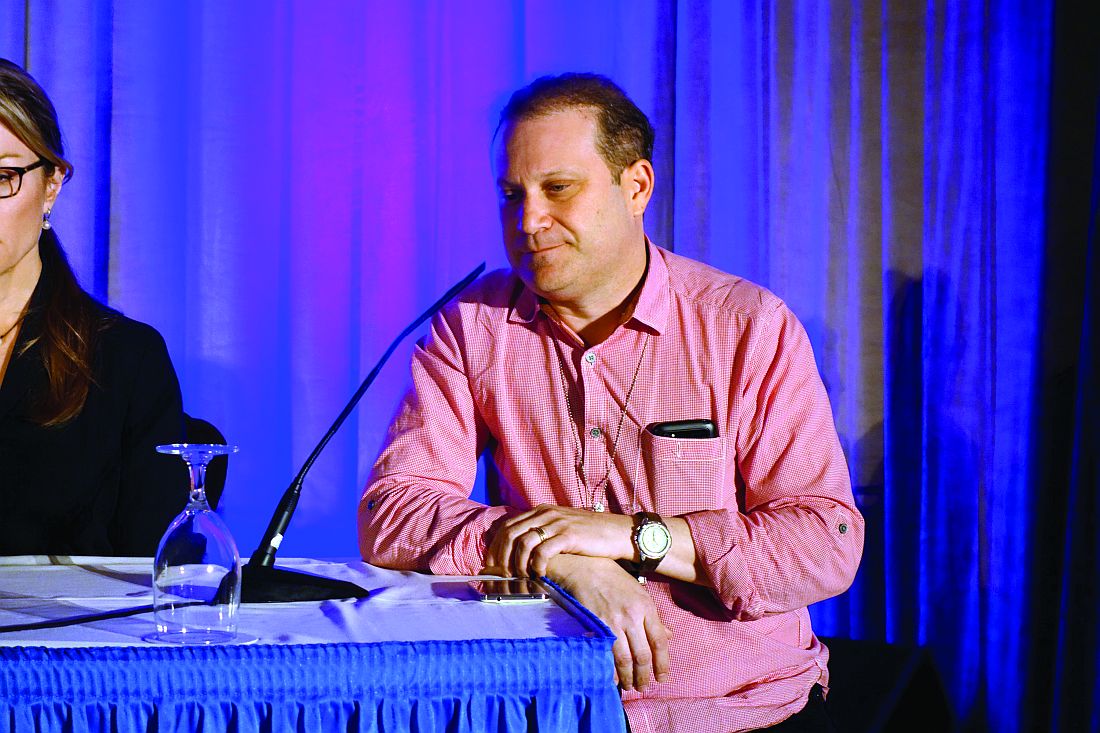
MIAMI BEACH – A decision to proceed with major hepatectomy in patients 75 and older with perihilar cholangiocarcinoma should be made on a case-by-case basis following strict selection, Thuy Tran, MD, said, based on a study of 210 patients.
“As the U.S. population ages, an increasing number of elderly patients are being evaluated for resection of GI malignancies,” Dr. Tran said at the annual meeting of the Americas Hepato-Pancreato-Biliary Association.
“Advanced age has been regarded as contraindication to resection for complex hepatobiliary malignancies,” she explained, with concerns that “it may be too risky, and the survival benefit is limited in elderly populations. However, the oncologic benefit of aggressive surgical strategies in perihilar cholangiocarcinoma remains a subject of debate.”
Dr. Tran and her colleagues identified patients who underwent curative resection for perihilar cholangiocarcinoma (CCA) in the U.S. Extrahepatic Biliary Malignancy Consortium database. They compared outcomes of those younger than 75 years versus patients 75 years and older. A total of 59% of the cohort were men, 20% were 75 years and older, and the median age was 66 years.
CCA is a rare and aggressive malignancy, often presenting with obstructive jaundice, said Dr. Tran, a postdoctoral research fellow in general surgery at Stanford (Calif.) University.
Preoperative characteristics were similar in the groups, except that cardiac morbidity was higher in the older cohort. In addition, pathology characteristics did not differ significantly between age groups, including tumor stage, nodal status, grade, size, and margin status.
The in-hospital mortality was double for the older patients, 15% versus 8%, despite the similarities, Dr. Tran said. “This supports the notion that it is more difficult to salvage older patients when they run into a complication,” she added.
Postoperative morbidity was also higher in older patients, 78% versus 68%, but did not reach statistical significance (P = .34).
The 90-day mortality rate was 22% in patients 75 years and older, compared with 10% in younger patients, a nonsignificant difference (P = .09).
Five-year survival was 15% in the older cohort and 22% for the younger patients (P = .003). There was a “more significant drop in the survival curves in the older age group, but then they get closer,” Dr. Tran said. The disease-specific survival did not differ significantly at 46 months versus 37 months, respectively.
Advanced-stage cancer and elevated CA 19-9 tumor marker levels were independent predictors of survival in a multivariate analysis, but age was not. Higher body mass index was associated with a higher perioperative mortality in older patients, but sex, cardiac morbidity, and ASA status were not. Dr. Tran said, “Lower BMI may be a useful tool to select elderly patients,” she noted.
“Elderly patients have double the mortality following major hepatectomy for perihilar cholangiocarcinoma,” Dr. Tran said. “However, the long-term, cancer-specific outcome appears similar to that of younger patients.” Physiologically robust older patients may be better candidates for surgery, she suggested.
Of the six patients who died in the 75 and older group, two patients died from liver failure, one from sepsis, one intraoperatively, one from unknown causes, and one died who required reoperation for postop bleeding, Dr. Tran said. “We did not find patients dying from MI or pneumonia, probably due to the small number of patients.”
Dr. Tran said that 2.5% of the older group and 5% of the younger group received neoadjuvant chemotherapy, which was not a statistically significant difference.
A meeting attendee asked if left versus right hepatectomy made a difference, and why the researchers chose 75 years as the cutoff age between younger and older groups.
“Left vs. right laterality does not seem to make an impact in terms of survival,” Dr. Tran said. “The median age was 66 years, and we used the upper limit of standard deviation, which was 75.”
Dr. Tran had no relevant financial disclosures.
MIAMI BEACH – A decision to proceed with major hepatectomy in patients 75 and older with perihilar cholangiocarcinoma should be made on a case-by-case basis following strict selection, Thuy Tran, MD, said, based on a study of 210 patients.
“As the U.S. population ages, an increasing number of elderly patients are being evaluated for resection of GI malignancies,” Dr. Tran said at the annual meeting of the Americas Hepato-Pancreato-Biliary Association.
“Advanced age has been regarded as contraindication to resection for complex hepatobiliary malignancies,” she explained, with concerns that “it may be too risky, and the survival benefit is limited in elderly populations. However, the oncologic benefit of aggressive surgical strategies in perihilar cholangiocarcinoma remains a subject of debate.”
Dr. Tran and her colleagues identified patients who underwent curative resection for perihilar cholangiocarcinoma (CCA) in the U.S. Extrahepatic Biliary Malignancy Consortium database. They compared outcomes of those younger than 75 years versus patients 75 years and older. A total of 59% of the cohort were men, 20% were 75 years and older, and the median age was 66 years.
CCA is a rare and aggressive malignancy, often presenting with obstructive jaundice, said Dr. Tran, a postdoctoral research fellow in general surgery at Stanford (Calif.) University.
Preoperative characteristics were similar in the groups, except that cardiac morbidity was higher in the older cohort. In addition, pathology characteristics did not differ significantly between age groups, including tumor stage, nodal status, grade, size, and margin status.
The in-hospital mortality was double for the older patients, 15% versus 8%, despite the similarities, Dr. Tran said. “This supports the notion that it is more difficult to salvage older patients when they run into a complication,” she added.
Postoperative morbidity was also higher in older patients, 78% versus 68%, but did not reach statistical significance (P = .34).
The 90-day mortality rate was 22% in patients 75 years and older, compared with 10% in younger patients, a nonsignificant difference (P = .09).
Five-year survival was 15% in the older cohort and 22% for the younger patients (P = .003). There was a “more significant drop in the survival curves in the older age group, but then they get closer,” Dr. Tran said. The disease-specific survival did not differ significantly at 46 months versus 37 months, respectively.
Advanced-stage cancer and elevated CA 19-9 tumor marker levels were independent predictors of survival in a multivariate analysis, but age was not. Higher body mass index was associated with a higher perioperative mortality in older patients, but sex, cardiac morbidity, and ASA status were not. Dr. Tran said, “Lower BMI may be a useful tool to select elderly patients,” she noted.
“Elderly patients have double the mortality following major hepatectomy for perihilar cholangiocarcinoma,” Dr. Tran said. “However, the long-term, cancer-specific outcome appears similar to that of younger patients.” Physiologically robust older patients may be better candidates for surgery, she suggested.
Of the six patients who died in the 75 and older group, two patients died from liver failure, one from sepsis, one intraoperatively, one from unknown causes, and one died who required reoperation for postop bleeding, Dr. Tran said. “We did not find patients dying from MI or pneumonia, probably due to the small number of patients.”
Dr. Tran said that 2.5% of the older group and 5% of the younger group received neoadjuvant chemotherapy, which was not a statistically significant difference.
A meeting attendee asked if left versus right hepatectomy made a difference, and why the researchers chose 75 years as the cutoff age between younger and older groups.
“Left vs. right laterality does not seem to make an impact in terms of survival,” Dr. Tran said. “The median age was 66 years, and we used the upper limit of standard deviation, which was 75.”
Dr. Tran had no relevant financial disclosures.
MIAMI BEACH – A decision to proceed with major hepatectomy in patients 75 and older with perihilar cholangiocarcinoma should be made on a case-by-case basis following strict selection, Thuy Tran, MD, said, based on a study of 210 patients.
“As the U.S. population ages, an increasing number of elderly patients are being evaluated for resection of GI malignancies,” Dr. Tran said at the annual meeting of the Americas Hepato-Pancreato-Biliary Association.
“Advanced age has been regarded as contraindication to resection for complex hepatobiliary malignancies,” she explained, with concerns that “it may be too risky, and the survival benefit is limited in elderly populations. However, the oncologic benefit of aggressive surgical strategies in perihilar cholangiocarcinoma remains a subject of debate.”
Dr. Tran and her colleagues identified patients who underwent curative resection for perihilar cholangiocarcinoma (CCA) in the U.S. Extrahepatic Biliary Malignancy Consortium database. They compared outcomes of those younger than 75 years versus patients 75 years and older. A total of 59% of the cohort were men, 20% were 75 years and older, and the median age was 66 years.
CCA is a rare and aggressive malignancy, often presenting with obstructive jaundice, said Dr. Tran, a postdoctoral research fellow in general surgery at Stanford (Calif.) University.
Preoperative characteristics were similar in the groups, except that cardiac morbidity was higher in the older cohort. In addition, pathology characteristics did not differ significantly between age groups, including tumor stage, nodal status, grade, size, and margin status.
The in-hospital mortality was double for the older patients, 15% versus 8%, despite the similarities, Dr. Tran said. “This supports the notion that it is more difficult to salvage older patients when they run into a complication,” she added.
Postoperative morbidity was also higher in older patients, 78% versus 68%, but did not reach statistical significance (P = .34).
The 90-day mortality rate was 22% in patients 75 years and older, compared with 10% in younger patients, a nonsignificant difference (P = .09).
Five-year survival was 15% in the older cohort and 22% for the younger patients (P = .003). There was a “more significant drop in the survival curves in the older age group, but then they get closer,” Dr. Tran said. The disease-specific survival did not differ significantly at 46 months versus 37 months, respectively.
Advanced-stage cancer and elevated CA 19-9 tumor marker levels were independent predictors of survival in a multivariate analysis, but age was not. Higher body mass index was associated with a higher perioperative mortality in older patients, but sex, cardiac morbidity, and ASA status were not. Dr. Tran said, “Lower BMI may be a useful tool to select elderly patients,” she noted.
“Elderly patients have double the mortality following major hepatectomy for perihilar cholangiocarcinoma,” Dr. Tran said. “However, the long-term, cancer-specific outcome appears similar to that of younger patients.” Physiologically robust older patients may be better candidates for surgery, she suggested.
Of the six patients who died in the 75 and older group, two patients died from liver failure, one from sepsis, one intraoperatively, one from unknown causes, and one died who required reoperation for postop bleeding, Dr. Tran said. “We did not find patients dying from MI or pneumonia, probably due to the small number of patients.”
Dr. Tran said that 2.5% of the older group and 5% of the younger group received neoadjuvant chemotherapy, which was not a statistically significant difference.
A meeting attendee asked if left versus right hepatectomy made a difference, and why the researchers chose 75 years as the cutoff age between younger and older groups.
“Left vs. right laterality does not seem to make an impact in terms of survival,” Dr. Tran said. “The median age was 66 years, and we used the upper limit of standard deviation, which was 75.”
Dr. Tran had no relevant financial disclosures.
Key clinical point: Patients 75 years and older undergoing hepatectomy for perihilar cholangiocarcinoma trended toward higher mortality but experienced cancer-specific outcomes similar to younger patients.
Major finding: 90-day mortality was 22% in patients 75 years and older versus 10% in younger patients (nonsignificant, P = .09).
Data source: Retrospective database study of 210 people who had curative intent resection for perihilar cholangiocarcinoma.
Disclosures: Dr. Tran had no relevant financial disclosures.
FDA: REMS no longer necessary for epoetin, darbepoetin
The Food and Drug Administration no longer requires certification of doctors and hospitals to prescribe epoetin alfa (Procrit, Epogen) or darbepoetin alfa (Aranesp) for chemotherapy anemia.
A Risk Evaluation and Mitigation Strategy (REMS) program was put in place in 2011 to make sure that the benefits of erythropoiesis-stimulating agents (ESAs) outweighed the risks when prescribed. Under the program, providers were required to become certified in the ESA REMS and to demonstrate that each patient had received counseling on the benefits and risks of the therapies prior to use.
Amgen’s prescriber surveys demonstrated “acceptable knowledge” of the need to counsel patients about the risks. Utilization data indicated “appropriate prescribing” as an alternative to transfusion.
In addition, in an evaluation of the impact of multiple regulatory actions, the FDA determined that full implementation of the ESA REMS in 2011 had minimal impact on trends in ESA utilization metrics, the FDA wrote.
The FDA concluded that regulatory actions and label changes – and the cut in payments for nonrenal indications from the Center for Medicare & Medicaid Services – were enough to reduce overuse in chemotherapy.
However, while the REMS is no longer necessary, the FDA says serious risks of shortened overall survival and/or increased risk of tumor progression or recurrence associated with these drugs remain and health care providers should continue to discuss the risks and benefits of using ESAs with each patient before initiating use.
The Food and Drug Administration no longer requires certification of doctors and hospitals to prescribe epoetin alfa (Procrit, Epogen) or darbepoetin alfa (Aranesp) for chemotherapy anemia.
A Risk Evaluation and Mitigation Strategy (REMS) program was put in place in 2011 to make sure that the benefits of erythropoiesis-stimulating agents (ESAs) outweighed the risks when prescribed. Under the program, providers were required to become certified in the ESA REMS and to demonstrate that each patient had received counseling on the benefits and risks of the therapies prior to use.
Amgen’s prescriber surveys demonstrated “acceptable knowledge” of the need to counsel patients about the risks. Utilization data indicated “appropriate prescribing” as an alternative to transfusion.
In addition, in an evaluation of the impact of multiple regulatory actions, the FDA determined that full implementation of the ESA REMS in 2011 had minimal impact on trends in ESA utilization metrics, the FDA wrote.
The FDA concluded that regulatory actions and label changes – and the cut in payments for nonrenal indications from the Center for Medicare & Medicaid Services – were enough to reduce overuse in chemotherapy.
However, while the REMS is no longer necessary, the FDA says serious risks of shortened overall survival and/or increased risk of tumor progression or recurrence associated with these drugs remain and health care providers should continue to discuss the risks and benefits of using ESAs with each patient before initiating use.
The Food and Drug Administration no longer requires certification of doctors and hospitals to prescribe epoetin alfa (Procrit, Epogen) or darbepoetin alfa (Aranesp) for chemotherapy anemia.
A Risk Evaluation and Mitigation Strategy (REMS) program was put in place in 2011 to make sure that the benefits of erythropoiesis-stimulating agents (ESAs) outweighed the risks when prescribed. Under the program, providers were required to become certified in the ESA REMS and to demonstrate that each patient had received counseling on the benefits and risks of the therapies prior to use.
Amgen’s prescriber surveys demonstrated “acceptable knowledge” of the need to counsel patients about the risks. Utilization data indicated “appropriate prescribing” as an alternative to transfusion.
In addition, in an evaluation of the impact of multiple regulatory actions, the FDA determined that full implementation of the ESA REMS in 2011 had minimal impact on trends in ESA utilization metrics, the FDA wrote.
The FDA concluded that regulatory actions and label changes – and the cut in payments for nonrenal indications from the Center for Medicare & Medicaid Services – were enough to reduce overuse in chemotherapy.
However, while the REMS is no longer necessary, the FDA says serious risks of shortened overall survival and/or increased risk of tumor progression or recurrence associated with these drugs remain and health care providers should continue to discuss the risks and benefits of using ESAs with each patient before initiating use.

Reduced-intensity conditioning may not preserve fertility in young girls after bone marrow transplant
ORLANDO – Girls who undergo reduced-intensity conditioning for a bone marrow transplant may face fertility problems in the future, even if they experience an outwardly normal puberty.
In the first-ever study to compare high- and low-intensity chemotherapeutic conditioning regimens among young girls, significantly more who underwent the reduced-intensity regimen had normal estradiol, luteinizing hormone, and follicle-stimulating hormone compared with those who had high-intensity conditioning. But anti-Müllerian hormone was low or absent in almost all the girls, no matter which conditioning regimen they had, Jonathan C. Howell, MD, PhD, said at the annual meeting of the Endocrine Society.
While not a perfect predictor of future fertility, anti-Müllerian hormone is a good indicator of ovarian follicular reserve, said Dr. Howell, a pediatric endocrinologist at Cincinnati Children’s Hospital Medical Center.
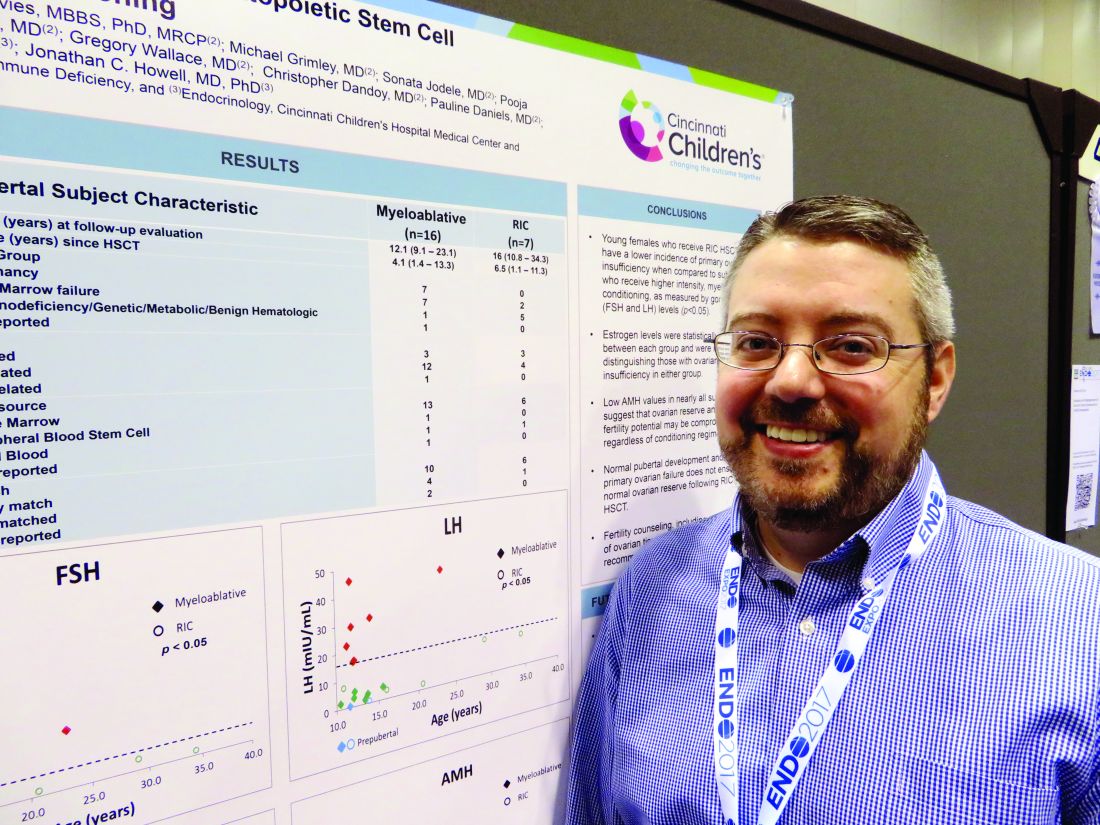
Dr. Howell and his colleagues, Holly R. Hoefgen, MD, Kasiani C. Myers, MD, and Helen Oquendo-Del Toro, MD, all of Cincinnati Children’s Hospital Medical Center, are following 49 females aged 1-40 years who had preconditioning chemotherapy in advance of hematopoietic stem cell transplantation.
At the meeting, Dr. Howell reported data on 23 girls who were in puberty during their treatment (mean age 12 years). The mean follow-up was 4 years, but this varied widely, from 1 to 13 years. Most (16) had high-intensity myeloablation; the remainder had reduced-intensity conditioning. Diagnoses varied between the groups. Among those with high-intensity conditioning, malignancy and bone marrow failure were the most common indications (seven patients each); one patient had an immunodeficiency, and the cause was unknown for another.
Among those who had the reduced-intensity regimen, five had an immunodeficiency and two had bone marrow failure.
The discrepancy in diagnoses between the groups isn’t surprising, Dr. Howell said. “Diagnosis can dictate which treatment patients receive. People with malignancies or a prior history of leukemia or lymphoma often receive the high-intensity conditioning. You want to wipe out every single malignant cell.”
Reduced-intensity conditioning may be an option for patients with other problems such as bone marrow failure, immunodeficiencies, or genetic or metabolic problems. The less-intense regimen does confer some benefits, Dr. Howell noted. “The short-term need for intensive medical therapy while getting the stem cells is less. The medical benefit of these less-intense regimens is certainly there, but the long-term endocrine impact has yet to be defined.”
Most of the girls in the high-intensity regimen group (64%) had high follicle stimulating hormone and luteinizing hormone, suggesting primary ovarian failure; 71% of them also had low estradiol levels. However, all of these hormones were normal in the reduced-intensity group. But regardless of conditioning treatment, anti-Müllerian hormone was abnormally low in nearly all of the patients (87%). Only one girl with myeloablative conditioning and two girls with reduced intensity condition had normal anti-Müllerian levels. “This tells us that fertility potential may not be preserved, despite [their] getting the reduced-intensity conditioning,” Dr. Howell said.
The story here is only beginning to unfold, he said. “Fertility is defined as the ability to conceive a child, and that’s not something we have looked at yet. We would like to know the long-term outcomes of fertility in these patients, and whether they can conceive when they’re ready to start a family. Our goal is to follow these young women into their 20s and 30s, and to see if that’s an opportunity they are able to experience.”
The study is a cooperative project involving the hospital’s divisions of Pediatric and Adolescent Gynecology, Bone Marrow Transplantation and Immunology, and Endocrinology.
Neither Dr. Howell nor any of his colleagues had any financial disclosures.
Fertility preservation talks: The earlier, the better
A talk about fertility preservation can be the first step into a new future for families of children with a cancer diagnosis.
“Talking about your baby having a baby can be the farthest thing from your mind,” when you’re the parent of a child about to undergo cancer treatment, said Dr. Hoefgen. “But we know from survivors that this can be a very important issue in the future. We simply start by telling parents, ‘This will be important to your child at some point, and we want to talk about it now, while there is still something we may be able to do about it.’ ”
Dr. Hoefgen, a staff member at the hospital’s Comprehensive Fertility Care and Preservation Program, said parents “sometimes find it weird” to be talking about unborn grandchildren when they’re consumed with making critical decisions for their own child. But by asking them to consider that child’s long-term future, the discussion offers its own message of hope.
The talks always begin with a basic discussion of how cancer treatments can affect the reproductive organs. The hospital has a series of short animated videos that are very helpful in relaying the information. Another video in that series describes the different methods of fertility preservation: mature oocyte or sperm harvesting, or, for younger patients, removing and freezing ovarian and testicular tissue. Parents and children can watch them together, get grounding in the basics, and be prepared for a productive conversation.
Talks always include the team oncologist, who creates a specialized risk assessment for each patient. The group discusses each preservation method, the risks and benefits, and the cost. But the talks are exploratory, too, helping both clinicians and families understand what’s most important to them, she said.
“Common things that we typically talk about are genetics, religion, and ethics – which may mean different things to different families.”
Dr. Hoefgen and her team reach out to more than 95% of families that face a pediatric cancer diagnosis. After the in-depth discussions, she said, about 20% decide to investigate some form of fertility preservation.
“The most important thing is having the conversation early, while we still have options,” she said.
Dr. Hoefgen had no financial disclosures.
ORLANDO – Girls who undergo reduced-intensity conditioning for a bone marrow transplant may face fertility problems in the future, even if they experience an outwardly normal puberty.
In the first-ever study to compare high- and low-intensity chemotherapeutic conditioning regimens among young girls, significantly more who underwent the reduced-intensity regimen had normal estradiol, luteinizing hormone, and follicle-stimulating hormone compared with those who had high-intensity conditioning. But anti-Müllerian hormone was low or absent in almost all the girls, no matter which conditioning regimen they had, Jonathan C. Howell, MD, PhD, said at the annual meeting of the Endocrine Society.
While not a perfect predictor of future fertility, anti-Müllerian hormone is a good indicator of ovarian follicular reserve, said Dr. Howell, a pediatric endocrinologist at Cincinnati Children’s Hospital Medical Center.
Dr. Howell and his colleagues, Holly R. Hoefgen, MD, Kasiani C. Myers, MD, and Helen Oquendo-Del Toro, MD, all of Cincinnati Children’s Hospital Medical Center, are following 49 females aged 1-40 years who had preconditioning chemotherapy in advance of hematopoietic stem cell transplantation.
At the meeting, Dr. Howell reported data on 23 girls who were in puberty during their treatment (mean age 12 years). The mean follow-up was 4 years, but this varied widely, from 1 to 13 years. Most (16) had high-intensity myeloablation; the remainder had reduced-intensity conditioning. Diagnoses varied between the groups. Among those with high-intensity conditioning, malignancy and bone marrow failure were the most common indications (seven patients each); one patient had an immunodeficiency, and the cause was unknown for another.
Among those who had the reduced-intensity regimen, five had an immunodeficiency and two had bone marrow failure.
The discrepancy in diagnoses between the groups isn’t surprising, Dr. Howell said. “Diagnosis can dictate which treatment patients receive. People with malignancies or a prior history of leukemia or lymphoma often receive the high-intensity conditioning. You want to wipe out every single malignant cell.”
Reduced-intensity conditioning may be an option for patients with other problems such as bone marrow failure, immunodeficiencies, or genetic or metabolic problems. The less-intense regimen does confer some benefits, Dr. Howell noted. “The short-term need for intensive medical therapy while getting the stem cells is less. The medical benefit of these less-intense regimens is certainly there, but the long-term endocrine impact has yet to be defined.”
Most of the girls in the high-intensity regimen group (64%) had high follicle stimulating hormone and luteinizing hormone, suggesting primary ovarian failure; 71% of them also had low estradiol levels. However, all of these hormones were normal in the reduced-intensity group. But regardless of conditioning treatment, anti-Müllerian hormone was abnormally low in nearly all of the patients (87%). Only one girl with myeloablative conditioning and two girls with reduced intensity condition had normal anti-Müllerian levels. “This tells us that fertility potential may not be preserved, despite [their] getting the reduced-intensity conditioning,” Dr. Howell said.
The story here is only beginning to unfold, he said. “Fertility is defined as the ability to conceive a child, and that’s not something we have looked at yet. We would like to know the long-term outcomes of fertility in these patients, and whether they can conceive when they’re ready to start a family. Our goal is to follow these young women into their 20s and 30s, and to see if that’s an opportunity they are able to experience.”
The study is a cooperative project involving the hospital’s divisions of Pediatric and Adolescent Gynecology, Bone Marrow Transplantation and Immunology, and Endocrinology.
Neither Dr. Howell nor any of his colleagues had any financial disclosures.
Fertility preservation talks: The earlier, the better
A talk about fertility preservation can be the first step into a new future for families of children with a cancer diagnosis.
“Talking about your baby having a baby can be the farthest thing from your mind,” when you’re the parent of a child about to undergo cancer treatment, said Dr. Hoefgen. “But we know from survivors that this can be a very important issue in the future. We simply start by telling parents, ‘This will be important to your child at some point, and we want to talk about it now, while there is still something we may be able to do about it.’ ”
Dr. Hoefgen, a staff member at the hospital’s Comprehensive Fertility Care and Preservation Program, said parents “sometimes find it weird” to be talking about unborn grandchildren when they’re consumed with making critical decisions for their own child. But by asking them to consider that child’s long-term future, the discussion offers its own message of hope.
The talks always begin with a basic discussion of how cancer treatments can affect the reproductive organs. The hospital has a series of short animated videos that are very helpful in relaying the information. Another video in that series describes the different methods of fertility preservation: mature oocyte or sperm harvesting, or, for younger patients, removing and freezing ovarian and testicular tissue. Parents and children can watch them together, get grounding in the basics, and be prepared for a productive conversation.
Talks always include the team oncologist, who creates a specialized risk assessment for each patient. The group discusses each preservation method, the risks and benefits, and the cost. But the talks are exploratory, too, helping both clinicians and families understand what’s most important to them, she said.
“Common things that we typically talk about are genetics, religion, and ethics – which may mean different things to different families.”
Dr. Hoefgen and her team reach out to more than 95% of families that face a pediatric cancer diagnosis. After the in-depth discussions, she said, about 20% decide to investigate some form of fertility preservation.
“The most important thing is having the conversation early, while we still have options,” she said.
Dr. Hoefgen had no financial disclosures.
ORLANDO – Girls who undergo reduced-intensity conditioning for a bone marrow transplant may face fertility problems in the future, even if they experience an outwardly normal puberty.
In the first-ever study to compare high- and low-intensity chemotherapeutic conditioning regimens among young girls, significantly more who underwent the reduced-intensity regimen had normal estradiol, luteinizing hormone, and follicle-stimulating hormone compared with those who had high-intensity conditioning. But anti-Müllerian hormone was low or absent in almost all the girls, no matter which conditioning regimen they had, Jonathan C. Howell, MD, PhD, said at the annual meeting of the Endocrine Society.
While not a perfect predictor of future fertility, anti-Müllerian hormone is a good indicator of ovarian follicular reserve, said Dr. Howell, a pediatric endocrinologist at Cincinnati Children’s Hospital Medical Center.
Dr. Howell and his colleagues, Holly R. Hoefgen, MD, Kasiani C. Myers, MD, and Helen Oquendo-Del Toro, MD, all of Cincinnati Children’s Hospital Medical Center, are following 49 females aged 1-40 years who had preconditioning chemotherapy in advance of hematopoietic stem cell transplantation.
At the meeting, Dr. Howell reported data on 23 girls who were in puberty during their treatment (mean age 12 years). The mean follow-up was 4 years, but this varied widely, from 1 to 13 years. Most (16) had high-intensity myeloablation; the remainder had reduced-intensity conditioning. Diagnoses varied between the groups. Among those with high-intensity conditioning, malignancy and bone marrow failure were the most common indications (seven patients each); one patient had an immunodeficiency, and the cause was unknown for another.
Among those who had the reduced-intensity regimen, five had an immunodeficiency and two had bone marrow failure.
The discrepancy in diagnoses between the groups isn’t surprising, Dr. Howell said. “Diagnosis can dictate which treatment patients receive. People with malignancies or a prior history of leukemia or lymphoma often receive the high-intensity conditioning. You want to wipe out every single malignant cell.”
Reduced-intensity conditioning may be an option for patients with other problems such as bone marrow failure, immunodeficiencies, or genetic or metabolic problems. The less-intense regimen does confer some benefits, Dr. Howell noted. “The short-term need for intensive medical therapy while getting the stem cells is less. The medical benefit of these less-intense regimens is certainly there, but the long-term endocrine impact has yet to be defined.”
Most of the girls in the high-intensity regimen group (64%) had high follicle stimulating hormone and luteinizing hormone, suggesting primary ovarian failure; 71% of them also had low estradiol levels. However, all of these hormones were normal in the reduced-intensity group. But regardless of conditioning treatment, anti-Müllerian hormone was abnormally low in nearly all of the patients (87%). Only one girl with myeloablative conditioning and two girls with reduced intensity condition had normal anti-Müllerian levels. “This tells us that fertility potential may not be preserved, despite [their] getting the reduced-intensity conditioning,” Dr. Howell said.
The story here is only beginning to unfold, he said. “Fertility is defined as the ability to conceive a child, and that’s not something we have looked at yet. We would like to know the long-term outcomes of fertility in these patients, and whether they can conceive when they’re ready to start a family. Our goal is to follow these young women into their 20s and 30s, and to see if that’s an opportunity they are able to experience.”
The study is a cooperative project involving the hospital’s divisions of Pediatric and Adolescent Gynecology, Bone Marrow Transplantation and Immunology, and Endocrinology.
Neither Dr. Howell nor any of his colleagues had any financial disclosures.
Fertility preservation talks: The earlier, the better
A talk about fertility preservation can be the first step into a new future for families of children with a cancer diagnosis.
“Talking about your baby having a baby can be the farthest thing from your mind,” when you’re the parent of a child about to undergo cancer treatment, said Dr. Hoefgen. “But we know from survivors that this can be a very important issue in the future. We simply start by telling parents, ‘This will be important to your child at some point, and we want to talk about it now, while there is still something we may be able to do about it.’ ”
Dr. Hoefgen, a staff member at the hospital’s Comprehensive Fertility Care and Preservation Program, said parents “sometimes find it weird” to be talking about unborn grandchildren when they’re consumed with making critical decisions for their own child. But by asking them to consider that child’s long-term future, the discussion offers its own message of hope.
The talks always begin with a basic discussion of how cancer treatments can affect the reproductive organs. The hospital has a series of short animated videos that are very helpful in relaying the information. Another video in that series describes the different methods of fertility preservation: mature oocyte or sperm harvesting, or, for younger patients, removing and freezing ovarian and testicular tissue. Parents and children can watch them together, get grounding in the basics, and be prepared for a productive conversation.
Talks always include the team oncologist, who creates a specialized risk assessment for each patient. The group discusses each preservation method, the risks and benefits, and the cost. But the talks are exploratory, too, helping both clinicians and families understand what’s most important to them, she said.
“Common things that we typically talk about are genetics, religion, and ethics – which may mean different things to different families.”
Dr. Hoefgen and her team reach out to more than 95% of families that face a pediatric cancer diagnosis. After the in-depth discussions, she said, about 20% decide to investigate some form of fertility preservation.
“The most important thing is having the conversation early, while we still have options,” she said.
Dr. Hoefgen had no financial disclosures.
AT ENDO 2017
Key clinical point:
Major finding: Anti-Müllerian hormone was abnormally low or absent in all treated girls, whether they had reduced-intensity or high-intensity conditioning.
Data source: The prospective study is following 49 females aged 1-40 years.
Disclosures: Neither Dr. Howell nor any of his colleagues had any financial disclosures.
Serotonergic dysfunction documented in hoarding disorder
SAN FRANCISCO – Hoarding disorder is characterized by a distinct pattern of serotonergic dysfunction different from that seen in obsessive-compulsive disorder (OCD) or major depression, Sanjaya Saxena, MD, reported at the annual conference of the Anxiety and Depression Association of America.
He presented the findings of the first-ever study to examine neurotransmitter function in patients with hoarding disorder. In contrast to hoarding disorder, the neurobiology of OCD is among the most extensively studied and best understood of any psychiatric disorder, with Dr. Saxena having made important contributions to this body of knowledge.
The findings underscore the prescience of the authors of DSM-5 in removing hoarding disorder from under the umbrella of OCD and giving it its own separate diagnostic category.
“Our study provides more evidence suggesting that OCD and hoarding disorder are two separate disorders that do sometimes occur together in patients, but not necessarily more often than other disorders do. OCD is found in only about 15% of patients with hoarding disorder, and vice versa. Depression is much more commonly comorbid, and [attention-deficit/hyperactivity disorder] is present in about one-quarter of hoarding disorder patients,” according to the psychiatrist.
His study included 8 patients with hoarding disorder and 14 age- and sex-matched normal controls who underwent positron emission tomography with carbon-11-labeled DASP, a ligand that binds with high selectivity to the brain serotonin transporter. The serotonin transporter is a neuronal membrane protein whose main function is to recycle serotonin from synapse back into the neuronal cell body. The serotonin transporter also is the primary site to which serotonin reuptake inhibitor medications bind. Serotonin transporter binding is associated with fear conditioning, amygdala reactivity, the cortisol response, and state anxiety.
Subjects with hoarding disorder proved to have significantly greater serotonin transporter binding than healthy controls in the bilateral amygdala, nucleus accumbens, putamen, and right caudate nucleus. In contrast, their serotonin transporter binding was significantly diminished, compared with controls, in the bilateral retrosplenial posterior cingulate cortex. Severity of hoarding symptoms was correlated with serotonin transporter binding in the right anterior cingulate cortex and right orbitofrontal cortex, but negatively correlated with serotonin transporter binding in the bilateral posterior thalamus, Dr. Saxena reported.
“The binding pattern is almost opposite that seen in OCD,” he observed.
The new study of serotonergic function in hoarding disorder, taken together with earlier brain imaging studies of regional glucose metabolism and functional MRI studies conducted by Dr. Saxena and other research groups, point to a couple of areas of the brain as being strongly implicated in the pathophysiology of hoarding disorder – most notably, the anterior and posterior cingulate cortex.
Particularly intriguing, in Dr. Saxena’s view, is the retrosplenial posterior cingulate cortex, located in Brodmann areas 29 and 30. The retrosplenial posterior cingulate cortex, part of the default mode network, is involved in emotional functioning, learning, planning, navigation, as well as autobiographical, episodic, and visuospatial memory.
“Abnormalities of all those functions are found in hoarding disorder patients, so the retrosplenial posterior cingulate cortex is a candidate for further study,” according to Dr. Saxena.
His neurotransmitter study was funded by the university’s department of psychiatry. He reported having no financial conflicts.
SAN FRANCISCO – Hoarding disorder is characterized by a distinct pattern of serotonergic dysfunction different from that seen in obsessive-compulsive disorder (OCD) or major depression, Sanjaya Saxena, MD, reported at the annual conference of the Anxiety and Depression Association of America.
He presented the findings of the first-ever study to examine neurotransmitter function in patients with hoarding disorder. In contrast to hoarding disorder, the neurobiology of OCD is among the most extensively studied and best understood of any psychiatric disorder, with Dr. Saxena having made important contributions to this body of knowledge.
The findings underscore the prescience of the authors of DSM-5 in removing hoarding disorder from under the umbrella of OCD and giving it its own separate diagnostic category.
“Our study provides more evidence suggesting that OCD and hoarding disorder are two separate disorders that do sometimes occur together in patients, but not necessarily more often than other disorders do. OCD is found in only about 15% of patients with hoarding disorder, and vice versa. Depression is much more commonly comorbid, and [attention-deficit/hyperactivity disorder] is present in about one-quarter of hoarding disorder patients,” according to the psychiatrist.
His study included 8 patients with hoarding disorder and 14 age- and sex-matched normal controls who underwent positron emission tomography with carbon-11-labeled DASP, a ligand that binds with high selectivity to the brain serotonin transporter. The serotonin transporter is a neuronal membrane protein whose main function is to recycle serotonin from synapse back into the neuronal cell body. The serotonin transporter also is the primary site to which serotonin reuptake inhibitor medications bind. Serotonin transporter binding is associated with fear conditioning, amygdala reactivity, the cortisol response, and state anxiety.
Subjects with hoarding disorder proved to have significantly greater serotonin transporter binding than healthy controls in the bilateral amygdala, nucleus accumbens, putamen, and right caudate nucleus. In contrast, their serotonin transporter binding was significantly diminished, compared with controls, in the bilateral retrosplenial posterior cingulate cortex. Severity of hoarding symptoms was correlated with serotonin transporter binding in the right anterior cingulate cortex and right orbitofrontal cortex, but negatively correlated with serotonin transporter binding in the bilateral posterior thalamus, Dr. Saxena reported.
“The binding pattern is almost opposite that seen in OCD,” he observed.
The new study of serotonergic function in hoarding disorder, taken together with earlier brain imaging studies of regional glucose metabolism and functional MRI studies conducted by Dr. Saxena and other research groups, point to a couple of areas of the brain as being strongly implicated in the pathophysiology of hoarding disorder – most notably, the anterior and posterior cingulate cortex.
Particularly intriguing, in Dr. Saxena’s view, is the retrosplenial posterior cingulate cortex, located in Brodmann areas 29 and 30. The retrosplenial posterior cingulate cortex, part of the default mode network, is involved in emotional functioning, learning, planning, navigation, as well as autobiographical, episodic, and visuospatial memory.
“Abnormalities of all those functions are found in hoarding disorder patients, so the retrosplenial posterior cingulate cortex is a candidate for further study,” according to Dr. Saxena.
His neurotransmitter study was funded by the university’s department of psychiatry. He reported having no financial conflicts.
SAN FRANCISCO – Hoarding disorder is characterized by a distinct pattern of serotonergic dysfunction different from that seen in obsessive-compulsive disorder (OCD) or major depression, Sanjaya Saxena, MD, reported at the annual conference of the Anxiety and Depression Association of America.
He presented the findings of the first-ever study to examine neurotransmitter function in patients with hoarding disorder. In contrast to hoarding disorder, the neurobiology of OCD is among the most extensively studied and best understood of any psychiatric disorder, with Dr. Saxena having made important contributions to this body of knowledge.
The findings underscore the prescience of the authors of DSM-5 in removing hoarding disorder from under the umbrella of OCD and giving it its own separate diagnostic category.
“Our study provides more evidence suggesting that OCD and hoarding disorder are two separate disorders that do sometimes occur together in patients, but not necessarily more often than other disorders do. OCD is found in only about 15% of patients with hoarding disorder, and vice versa. Depression is much more commonly comorbid, and [attention-deficit/hyperactivity disorder] is present in about one-quarter of hoarding disorder patients,” according to the psychiatrist.
His study included 8 patients with hoarding disorder and 14 age- and sex-matched normal controls who underwent positron emission tomography with carbon-11-labeled DASP, a ligand that binds with high selectivity to the brain serotonin transporter. The serotonin transporter is a neuronal membrane protein whose main function is to recycle serotonin from synapse back into the neuronal cell body. The serotonin transporter also is the primary site to which serotonin reuptake inhibitor medications bind. Serotonin transporter binding is associated with fear conditioning, amygdala reactivity, the cortisol response, and state anxiety.
Subjects with hoarding disorder proved to have significantly greater serotonin transporter binding than healthy controls in the bilateral amygdala, nucleus accumbens, putamen, and right caudate nucleus. In contrast, their serotonin transporter binding was significantly diminished, compared with controls, in the bilateral retrosplenial posterior cingulate cortex. Severity of hoarding symptoms was correlated with serotonin transporter binding in the right anterior cingulate cortex and right orbitofrontal cortex, but negatively correlated with serotonin transporter binding in the bilateral posterior thalamus, Dr. Saxena reported.
“The binding pattern is almost opposite that seen in OCD,” he observed.
The new study of serotonergic function in hoarding disorder, taken together with earlier brain imaging studies of regional glucose metabolism and functional MRI studies conducted by Dr. Saxena and other research groups, point to a couple of areas of the brain as being strongly implicated in the pathophysiology of hoarding disorder – most notably, the anterior and posterior cingulate cortex.
Particularly intriguing, in Dr. Saxena’s view, is the retrosplenial posterior cingulate cortex, located in Brodmann areas 29 and 30. The retrosplenial posterior cingulate cortex, part of the default mode network, is involved in emotional functioning, learning, planning, navigation, as well as autobiographical, episodic, and visuospatial memory.
“Abnormalities of all those functions are found in hoarding disorder patients, so the retrosplenial posterior cingulate cortex is a candidate for further study,” according to Dr. Saxena.
His neurotransmitter study was funded by the university’s department of psychiatry. He reported having no financial conflicts.
Key clinical point:
Major finding: Serotonin transporter binding is markedly reduced in the retrosplenial posterior cingulate cortex of hoarding disorder patients, compared with normal controls.
Data source: This positron emission tomography study, the first ever to examine brain serotonin transporter binding patterns in hoarding disorder, included 8 affected patients and 14 matched normal controls.
Disclosures: The study was funded by the University of California, San Diego, department of psychiatry. The presenter reported having no financial conflicts.
Maternal Tdap vaccination highly protective against infant pertussis
, results of a study show.
From 2010 to 2015, researchers collected data from a cohort study of full-term infants born at Kaiser Permanente of Northern California. “We estimated the effectiveness of maternal pertussis vaccination for protecting newborns against pertussis in the first 2 months of life and in the first year of life, accounting for each infant DTaP dose,” said Roger Baxter, MD, and his associates at Kaiser Permanente Vaccine Study Center, Oakland, Calif. 
The vaccine effectiveness was an estimated 88% before infants had any DTaP vaccine doses, 81% between doses 1 and 2, 6% between doses 2 and 3, and 66% after infants had 3 DTaP doses.
“This result is consistent with 2 earlier studies in the United Kingdom” showing protection in infants less than 3 months of age, and a U.S. study showing maternal Tdap vaccination conferring protection to infants in the first 8 weeks of life, the researchers said.
In conclusion, even after infant DTaP dosing, there was evidence of additional protection from maternal Tdap vaccination for the first year of life (Pediatrics. 2017 Apr 3. doi: 10.1542/peds.2016-4091).
, results of a study show.
From 2010 to 2015, researchers collected data from a cohort study of full-term infants born at Kaiser Permanente of Northern California. “We estimated the effectiveness of maternal pertussis vaccination for protecting newborns against pertussis in the first 2 months of life and in the first year of life, accounting for each infant DTaP dose,” said Roger Baxter, MD, and his associates at Kaiser Permanente Vaccine Study Center, Oakland, Calif.
The vaccine effectiveness was an estimated 88% before infants had any DTaP vaccine doses, 81% between doses 1 and 2, 6% between doses 2 and 3, and 66% after infants had 3 DTaP doses.
“This result is consistent with 2 earlier studies in the United Kingdom” showing protection in infants less than 3 months of age, and a U.S. study showing maternal Tdap vaccination conferring protection to infants in the first 8 weeks of life, the researchers said.
In conclusion, even after infant DTaP dosing, there was evidence of additional protection from maternal Tdap vaccination for the first year of life (Pediatrics. 2017 Apr 3. doi: 10.1542/peds.2016-4091).
, results of a study show.
From 2010 to 2015, researchers collected data from a cohort study of full-term infants born at Kaiser Permanente of Northern California. “We estimated the effectiveness of maternal pertussis vaccination for protecting newborns against pertussis in the first 2 months of life and in the first year of life, accounting for each infant DTaP dose,” said Roger Baxter, MD, and his associates at Kaiser Permanente Vaccine Study Center, Oakland, Calif.
The vaccine effectiveness was an estimated 88% before infants had any DTaP vaccine doses, 81% between doses 1 and 2, 6% between doses 2 and 3, and 66% after infants had 3 DTaP doses.
“This result is consistent with 2 earlier studies in the United Kingdom” showing protection in infants less than 3 months of age, and a U.S. study showing maternal Tdap vaccination conferring protection to infants in the first 8 weeks of life, the researchers said.
In conclusion, even after infant DTaP dosing, there was evidence of additional protection from maternal Tdap vaccination for the first year of life (Pediatrics. 2017 Apr 3. doi: 10.1542/peds.2016-4091).

App may improve CPAP adherence
Use of a mobile app may help sleep apnea patients adhere to continuous positive airway pressure (CPAP) therapy, a small study suggests.
The app – SleepMapper (SM) – has interactive algorithms that are modeled on the same theories of behavior change that have improved adherence to CPAP when delivered in person or through telephone-linked communication, wrote Jordanna M. Hostler of Walter Reed National Military Medical Center, Bethesda, Md., and her coinvestigators (J Sleep Res. 2017;26:139-46).
“Despite our small sample size, patients in the SM group were more than three times as likely to meet Medicare criteria for [CPAP] adherence (greater than 4 hours per night for 70% of nights), a trend that just missed statistical significance (P = .06),” the researchers noted.
“The magnitude of the increase [in CPAP use] indicates likely clinical benefit,” they added.
SleepMapper allows patients to self-monitor the outcomes of positive airway pressure (PAP) therapy by providing information on their adherence, Apnea-Hypopnea Index, and mask leak. The app, which can be downloaded on a smartphone or personal computer, also includes training modules on how to use PAP. The system, owned by Phillips Respironics, will sync with Philips Respironics’ Encore Anywhere software program.
The study comprised 61 patients who had been diagnosed with obstructive sleep apnea (OSA) via overnight, in-lab polysomnography. The patients were initiating PAP for the first time at Walter Reed National Military Medical Center’s Sleep Disorders Center in Bethesda, Md., as participants in the center’s program. Such a program included group sessions with instruction on sleep hygiene and training in the use of PAP, an initial one-on-one meeting with a physician, and a follow-up appointment with a physician 4 weeks after initiating the therapy.
Thirty of the program participants included in the study used SleepMapper in addition to the center’s standard education and follow-up. The researchers analyzed 11 weeks of data for all 61 study participants.
Patients in the SleepMapper group used their PAP machines for a greater percentage of days and achieved more than 4 hours of use on more days of participation in the program, compared with patients who did not use the app. The patients using the app also showed a trend toward using PAP for more hours per night overall. Specifically, nine of the patients in the app group used their PAP machines greater than 4 hours per night for 70% of nights, versus three of the patients in the control group (P = .06). SleepMapper usage remained significantly associated with percentage of nights including greater than 4 hours of PAP use, in a multivariate linear regression analysis.
The researchers observed many similarities between patients using the app and patients in the control group, including Apnea-Hypopnea Index scores, central apnea index scores, and percentages of time spent in periodic breathing.
Some additional advantages to use of SleepMapper over simply participating in the center’s educational program are that the app provides ongoing coaching and immediate access to Apnea-Hypopnea Index and PAP use data, according to the researchers. They touted the app’s educational videos about OSA and PAP therapy and “structured motivational enhancement techniques such as feedback and goal setting, which have shown benefit when delivered by health care professionals in other studies.”
The researchers called for an additional study of the app’s usefulness in a larger group of patients.
The authors did not receive any funding or support for this study.
Feedback to patients regarding their clinical status is rarely a bad thing. I’m a big fan of tools that give patients information on their CPAP adherence and outcomes, of which several now exist, including some that are not affiliated with any particular respiratory device company, and are able to read a number of different device downloads.
In the end, the use of technology for monitoring CPAP adherence is here to stay, and the incremental cost of making it available to our patients is low. Taking the time to educate patients who are newly prescribed CPAP about interpreting their outcome data is likely to be time well spent.
Feedback to patients regarding their clinical status is rarely a bad thing. I’m a big fan of tools that give patients information on their CPAP adherence and outcomes, of which several now exist, including some that are not affiliated with any particular respiratory device company, and are able to read a number of different device downloads.
In the end, the use of technology for monitoring CPAP adherence is here to stay, and the incremental cost of making it available to our patients is low. Taking the time to educate patients who are newly prescribed CPAP about interpreting their outcome data is likely to be time well spent.
Feedback to patients regarding their clinical status is rarely a bad thing. I’m a big fan of tools that give patients information on their CPAP adherence and outcomes, of which several now exist, including some that are not affiliated with any particular respiratory device company, and are able to read a number of different device downloads.
In the end, the use of technology for monitoring CPAP adherence is here to stay, and the incremental cost of making it available to our patients is low. Taking the time to educate patients who are newly prescribed CPAP about interpreting their outcome data is likely to be time well spent.
Use of a mobile app may help sleep apnea patients adhere to continuous positive airway pressure (CPAP) therapy, a small study suggests.
The app – SleepMapper (SM) – has interactive algorithms that are modeled on the same theories of behavior change that have improved adherence to CPAP when delivered in person or through telephone-linked communication, wrote Jordanna M. Hostler of Walter Reed National Military Medical Center, Bethesda, Md., and her coinvestigators (J Sleep Res. 2017;26:139-46).
“Despite our small sample size, patients in the SM group were more than three times as likely to meet Medicare criteria for [CPAP] adherence (greater than 4 hours per night for 70% of nights), a trend that just missed statistical significance (P = .06),” the researchers noted.
“The magnitude of the increase [in CPAP use] indicates likely clinical benefit,” they added.
SleepMapper allows patients to self-monitor the outcomes of positive airway pressure (PAP) therapy by providing information on their adherence, Apnea-Hypopnea Index, and mask leak. The app, which can be downloaded on a smartphone or personal computer, also includes training modules on how to use PAP. The system, owned by Phillips Respironics, will sync with Philips Respironics’ Encore Anywhere software program.
The study comprised 61 patients who had been diagnosed with obstructive sleep apnea (OSA) via overnight, in-lab polysomnography. The patients were initiating PAP for the first time at Walter Reed National Military Medical Center’s Sleep Disorders Center in Bethesda, Md., as participants in the center’s program. Such a program included group sessions with instruction on sleep hygiene and training in the use of PAP, an initial one-on-one meeting with a physician, and a follow-up appointment with a physician 4 weeks after initiating the therapy.
Thirty of the program participants included in the study used SleepMapper in addition to the center’s standard education and follow-up. The researchers analyzed 11 weeks of data for all 61 study participants.
Patients in the SleepMapper group used their PAP machines for a greater percentage of days and achieved more than 4 hours of use on more days of participation in the program, compared with patients who did not use the app. The patients using the app also showed a trend toward using PAP for more hours per night overall. Specifically, nine of the patients in the app group used their PAP machines greater than 4 hours per night for 70% of nights, versus three of the patients in the control group (P = .06). SleepMapper usage remained significantly associated with percentage of nights including greater than 4 hours of PAP use, in a multivariate linear regression analysis.
The researchers observed many similarities between patients using the app and patients in the control group, including Apnea-Hypopnea Index scores, central apnea index scores, and percentages of time spent in periodic breathing.
Some additional advantages to use of SleepMapper over simply participating in the center’s educational program are that the app provides ongoing coaching and immediate access to Apnea-Hypopnea Index and PAP use data, according to the researchers. They touted the app’s educational videos about OSA and PAP therapy and “structured motivational enhancement techniques such as feedback and goal setting, which have shown benefit when delivered by health care professionals in other studies.”
The researchers called for an additional study of the app’s usefulness in a larger group of patients.
The authors did not receive any funding or support for this study.
Use of a mobile app may help sleep apnea patients adhere to continuous positive airway pressure (CPAP) therapy, a small study suggests.
The app – SleepMapper (SM) – has interactive algorithms that are modeled on the same theories of behavior change that have improved adherence to CPAP when delivered in person or through telephone-linked communication, wrote Jordanna M. Hostler of Walter Reed National Military Medical Center, Bethesda, Md., and her coinvestigators (J Sleep Res. 2017;26:139-46).
“Despite our small sample size, patients in the SM group were more than three times as likely to meet Medicare criteria for [CPAP] adherence (greater than 4 hours per night for 70% of nights), a trend that just missed statistical significance (P = .06),” the researchers noted.
“The magnitude of the increase [in CPAP use] indicates likely clinical benefit,” they added.
SleepMapper allows patients to self-monitor the outcomes of positive airway pressure (PAP) therapy by providing information on their adherence, Apnea-Hypopnea Index, and mask leak. The app, which can be downloaded on a smartphone or personal computer, also includes training modules on how to use PAP. The system, owned by Phillips Respironics, will sync with Philips Respironics’ Encore Anywhere software program.
The study comprised 61 patients who had been diagnosed with obstructive sleep apnea (OSA) via overnight, in-lab polysomnography. The patients were initiating PAP for the first time at Walter Reed National Military Medical Center’s Sleep Disorders Center in Bethesda, Md., as participants in the center’s program. Such a program included group sessions with instruction on sleep hygiene and training in the use of PAP, an initial one-on-one meeting with a physician, and a follow-up appointment with a physician 4 weeks after initiating the therapy.
Thirty of the program participants included in the study used SleepMapper in addition to the center’s standard education and follow-up. The researchers analyzed 11 weeks of data for all 61 study participants.
Patients in the SleepMapper group used their PAP machines for a greater percentage of days and achieved more than 4 hours of use on more days of participation in the program, compared with patients who did not use the app. The patients using the app also showed a trend toward using PAP for more hours per night overall. Specifically, nine of the patients in the app group used their PAP machines greater than 4 hours per night for 70% of nights, versus three of the patients in the control group (P = .06). SleepMapper usage remained significantly associated with percentage of nights including greater than 4 hours of PAP use, in a multivariate linear regression analysis.
The researchers observed many similarities between patients using the app and patients in the control group, including Apnea-Hypopnea Index scores, central apnea index scores, and percentages of time spent in periodic breathing.
Some additional advantages to use of SleepMapper over simply participating in the center’s educational program are that the app provides ongoing coaching and immediate access to Apnea-Hypopnea Index and PAP use data, according to the researchers. They touted the app’s educational videos about OSA and PAP therapy and “structured motivational enhancement techniques such as feedback and goal setting, which have shown benefit when delivered by health care professionals in other studies.”
The researchers called for an additional study of the app’s usefulness in a larger group of patients.
The authors did not receive any funding or support for this study.
Gut microbiome dysregulation implicated in OCD
SAN FRANCISCO – Patients with obsessive-compulsive disorder have a gut bacterial microbiome marked by diminished species diversity and abundance, compared with that of healthy controls, according to the first study to examine the issue.
Results of this pilot study also suggest that OCD patients with tic disorder have a distinctly different gut microbiome, compared with other OCD patients, Jasmine Turna said at the annual conference of the Anxiety and Depression Association of America.
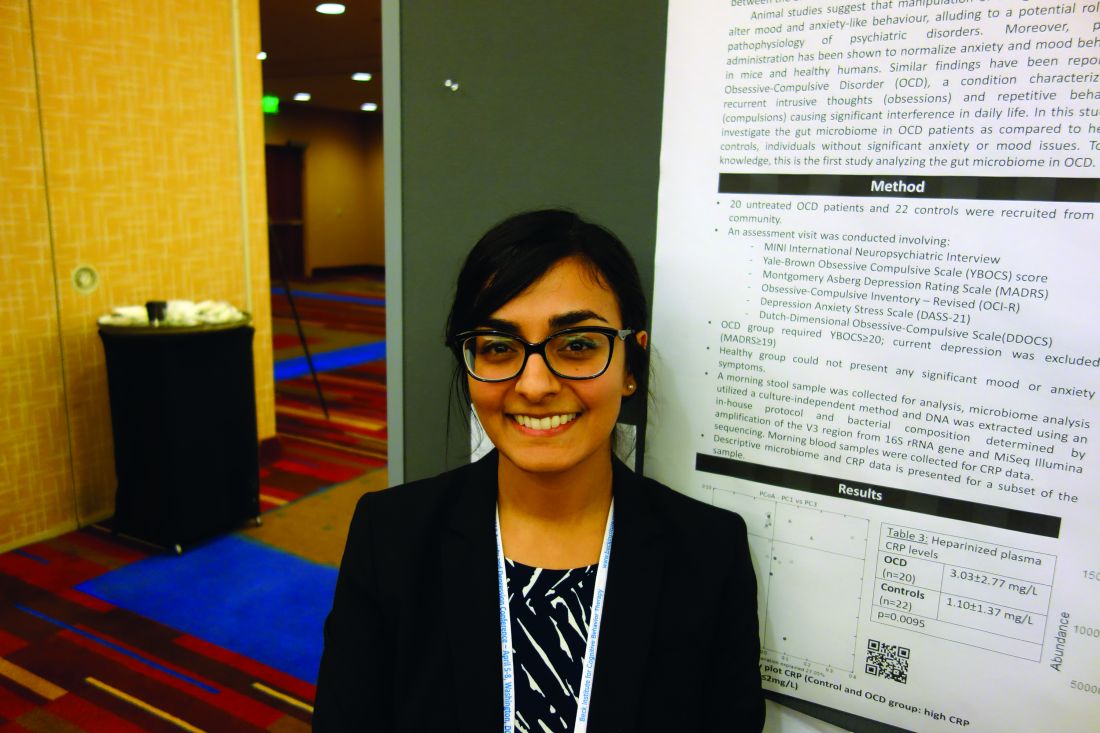
She reported on 11 OCD patients and 12 healthy controls who underwent gut microbiome analysis using DNA extracted from their morning stool samples. Results from another nine OCD patients and 10 controls remained pending at the time of the conference but will be completed shortly.
In addition to the decreased abundance and diversity of bacteria present in the microbiomes of the OCD patients, compared with controls, another key finding was that the OCD patients had increased levels of systemic inflammation. Their mean level of high-sensitivity C-reactive protein was 3.03 mg/L, compared with 1.1 mg/L in the controls. In addition, the microbiome in those OCD patients who had elevated systemic inflammation as defined by a CRP level greater than 2.0 mg/L was more restricted than was that of OCD patients with a normal-range CRP.
In an interview, Ms. Turna noted that a cross-sectional study such as this is hypothesis generating and not definitive. Even if these findings are replicated, that will not answer the key question of whether the altered microbiome present in OCD patients is a contributing cause or a consequence of the psychiatric disorder. But she and her coinvestigators already have launched a prospective randomized controlled trial that attempts to address this question by having a group of OCD patients regularly consume a probiotic in an effort to diversify their gut microbiome.
“Maybe getting more fermented foods into the diet – kimchi, miso, yogurt, kefir – could be an adjunctive therapy,” she said. “Right now, OCD research is kind of at a standstill. Our treatments work in a lot of people, but they also don’t work in a lot of people. Our research opens up a new place to explore.”
Ms. Turna reported having no financial conflicts.
SAN FRANCISCO – Patients with obsessive-compulsive disorder have a gut bacterial microbiome marked by diminished species diversity and abundance, compared with that of healthy controls, according to the first study to examine the issue.
Results of this pilot study also suggest that OCD patients with tic disorder have a distinctly different gut microbiome, compared with other OCD patients, Jasmine Turna said at the annual conference of the Anxiety and Depression Association of America.
She reported on 11 OCD patients and 12 healthy controls who underwent gut microbiome analysis using DNA extracted from their morning stool samples. Results from another nine OCD patients and 10 controls remained pending at the time of the conference but will be completed shortly.
In addition to the decreased abundance and diversity of bacteria present in the microbiomes of the OCD patients, compared with controls, another key finding was that the OCD patients had increased levels of systemic inflammation. Their mean level of high-sensitivity C-reactive protein was 3.03 mg/L, compared with 1.1 mg/L in the controls. In addition, the microbiome in those OCD patients who had elevated systemic inflammation as defined by a CRP level greater than 2.0 mg/L was more restricted than was that of OCD patients with a normal-range CRP.
In an interview, Ms. Turna noted that a cross-sectional study such as this is hypothesis generating and not definitive. Even if these findings are replicated, that will not answer the key question of whether the altered microbiome present in OCD patients is a contributing cause or a consequence of the psychiatric disorder. But she and her coinvestigators already have launched a prospective randomized controlled trial that attempts to address this question by having a group of OCD patients regularly consume a probiotic in an effort to diversify their gut microbiome.
“Maybe getting more fermented foods into the diet – kimchi, miso, yogurt, kefir – could be an adjunctive therapy,” she said. “Right now, OCD research is kind of at a standstill. Our treatments work in a lot of people, but they also don’t work in a lot of people. Our research opens up a new place to explore.”
Ms. Turna reported having no financial conflicts.
SAN FRANCISCO – Patients with obsessive-compulsive disorder have a gut bacterial microbiome marked by diminished species diversity and abundance, compared with that of healthy controls, according to the first study to examine the issue.
Results of this pilot study also suggest that OCD patients with tic disorder have a distinctly different gut microbiome, compared with other OCD patients, Jasmine Turna said at the annual conference of the Anxiety and Depression Association of America.
She reported on 11 OCD patients and 12 healthy controls who underwent gut microbiome analysis using DNA extracted from their morning stool samples. Results from another nine OCD patients and 10 controls remained pending at the time of the conference but will be completed shortly.
In addition to the decreased abundance and diversity of bacteria present in the microbiomes of the OCD patients, compared with controls, another key finding was that the OCD patients had increased levels of systemic inflammation. Their mean level of high-sensitivity C-reactive protein was 3.03 mg/L, compared with 1.1 mg/L in the controls. In addition, the microbiome in those OCD patients who had elevated systemic inflammation as defined by a CRP level greater than 2.0 mg/L was more restricted than was that of OCD patients with a normal-range CRP.
In an interview, Ms. Turna noted that a cross-sectional study such as this is hypothesis generating and not definitive. Even if these findings are replicated, that will not answer the key question of whether the altered microbiome present in OCD patients is a contributing cause or a consequence of the psychiatric disorder. But she and her coinvestigators already have launched a prospective randomized controlled trial that attempts to address this question by having a group of OCD patients regularly consume a probiotic in an effort to diversify their gut microbiome.
“Maybe getting more fermented foods into the diet – kimchi, miso, yogurt, kefir – could be an adjunctive therapy,” she said. “Right now, OCD research is kind of at a standstill. Our treatments work in a lot of people, but they also don’t work in a lot of people. Our research opens up a new place to explore.”
Ms. Turna reported having no financial conflicts.
AT ANXIETY AND DEPRESSION CONFERENCE 2017
Key clinical point:
Major finding: Patients with obsessive-compulsive disorder have a gut bacterial microbiome that is distinctly different from healthy controls, with less abundance and species diversity.
Data source: This study analyzed DNA extracted from morning stool samples to map the gut microbiomes of 11 patients with obsessive-compulsive disorder and 12 healthy controls.
Disclosures: The study presenter reported having no financial conflicts.
Know your new hyaluronic acid–based fillers
WAILEA, HAWAII – American dermatologists are now gaining access to a lot of new hyaluronic acid-based fillers, designed to address limitations in the older, tried-and-true product lines, according to Nowell Solish, MD.
These products have been available in Canada for years. Dr. Solish, a dermatologist at the University of Toronto, shared insights regarding their optimal use, based on his extensive experience with them.
Allergan’s earlier Juvéderm Ultra range of dermal fillers is based on Hylacross, which utilizes crosslinked high–molecular weight HA.
“These products have been around a long time and have lots of benefits, but there were definitely some things missing in the product line,” he explained. “We wanted more control of gel swelling – that is, how much water the hyaluronic acid takes up.”
The Vycross technology employs a proprietary mix of low– and high–molecular weight HA, which results in a highly crosslinked gel that’s moldable immediately after injection, displays minimal gel swelling, and is designed to last longer than earlier-generation fillers.
The main difference between the three products lies in their HA concentrations: Juvéderm Voluma XC has the highest concentration of HA and Juvéderm Volbella XC the lowest, with Volift in between.
The company claims that outcomes with Volbella and Volift last up to 12 months, while Voluma outcomes lasts for up to 24 months. Dr. Solish suggested that his American colleagues take that with a grain of salt.
“I would say I always underpromise and overdeliver with my patients,” he noted. “I think you can probably detect Voluma at 2 years, but, the question is, how good is the effect? How happy is the patient? I think 2 years is a little bit of a stretch. I think it lasts for about 9 months to a year before reinjection.”
Voluma has been available in the United States for several years, while Dr. Solish has been using it far longer. His impression is that Voluma is great for creating volume, especially in the cheeks, midface, and submalar area. He finds that he gets his best results by implanting the product in a series of small, 0.2-mL, tent-like boluses. The reinjection volume is typically substantially less than that employed in initial treatment.
Volbella received approval from the FDA in autumn 2016 for perioral injection and is just now reaching the U.S. marketplace.
“In my humble opinion, I don’t think Volbella is really good for volume,” he explained. “I think it’s great for what I call lip hydration, to give that lip a lipstick look. Where I find that I use this product the most is for the perioral rhytids – the vertical lip lines people sometimes call smokers’ lines. I implant it in the lip mucosa to straighten out the folds.”
Dr. Solish cautioned that Volbella is a fast-flowing product.
“The thing you have to be careful about with Volbella is it has a very low extrusion force,” he noted. “That means it’s very easy to unload the syringe and get too much product out. And there’s no question that there’s a direct correlation between speed of injection and adverse events, mainly edema. So, just remember to slow your hand down, or off-label to add a 31- or even 32-gauge needle to the syringe.”
Volift is not yet approved in the United States, but it’s coming. Dr. Solish called it “a good workhorse product” for mild-to-moderate lines around the face.
“Sales will be much higher than for Volbella, because Volift is great for the in-between things,” the dermatologist continued. “You have Voluma for volume on the midface and cheeks, but Volift is great for nasolabial folds and, especially, for marionette lines and smile lines, where you don’t want a lot of bulk.”
The main adverse event encountered with any of the three products is delayed-onset development of nonpainful inflammatory nodules arising 3-6 months post injection. In one Canadian study, the incidence was less than 0.5% (Dermatol Surg. 2015 Sep;41[9]:1060-7).
Dr. Solish recommended treating the nodules with weekly or biweekly intralesional injections of hyaluronidase, followed by intralesional injections of 0.1 mL/cm2 of triamcinolone (Kenalog) at 2.5 mg/mL to 5.0 mg/mL.
Turning to Galderma’s NASHA technology, Dr. Solish explained that it relies on naturally occurring entanglement of HA chains to create gel particles formulated at 20 mg/dL. By varying the gel particle size and the amount of crosslinking, the company has created a series of products with different properties.
Restylane Refyne features smaller-size particles and less crosslinking, which makes for a softer gel. It’s an excellent option for marionette lines, mild nasolabial folds, and small perioral lines, and “it’s my absolute go-to for tear troughs,” Dr. Solish said.
In contrast, Restylane Defyne has bigger gel particles and more extensive HA crosslinking. It is firmer than Refyne and is best suited for achieving lift and volume. He implants it in the cheeks, forehead, temples, and deeper nasolabial folds.
In addition to these two products, which are new to the United States, Galderma has rebranded Perlane as Restylane Lyft, approved for midfacial augmentation. Another product, Restylane Silk, is similar to Volbella in that it is fast-flowing and not a big volumizer. Dr. Solish called it “lipstick in a syringe,” best suited for improving definition of the lips and for addressing perioral fine lines.
Dr. Solish reported serving as an investigator and/or consultant for Allergan, Galderma, Indeed, Merz, Revance Therapeutics, and Valeant. The SDEF and this news organization are owned by the same parent company.
WAILEA, HAWAII – American dermatologists are now gaining access to a lot of new hyaluronic acid-based fillers, designed to address limitations in the older, tried-and-true product lines, according to Nowell Solish, MD.
These products have been available in Canada for years. Dr. Solish, a dermatologist at the University of Toronto, shared insights regarding their optimal use, based on his extensive experience with them.
Allergan’s earlier Juvéderm Ultra range of dermal fillers is based on Hylacross, which utilizes crosslinked high–molecular weight HA.
“These products have been around a long time and have lots of benefits, but there were definitely some things missing in the product line,” he explained. “We wanted more control of gel swelling – that is, how much water the hyaluronic acid takes up.”
The Vycross technology employs a proprietary mix of low– and high–molecular weight HA, which results in a highly crosslinked gel that’s moldable immediately after injection, displays minimal gel swelling, and is designed to last longer than earlier-generation fillers.
The main difference between the three products lies in their HA concentrations: Juvéderm Voluma XC has the highest concentration of HA and Juvéderm Volbella XC the lowest, with Volift in between.
The company claims that outcomes with Volbella and Volift last up to 12 months, while Voluma outcomes lasts for up to 24 months. Dr. Solish suggested that his American colleagues take that with a grain of salt.
“I would say I always underpromise and overdeliver with my patients,” he noted. “I think you can probably detect Voluma at 2 years, but, the question is, how good is the effect? How happy is the patient? I think 2 years is a little bit of a stretch. I think it lasts for about 9 months to a year before reinjection.”
Voluma has been available in the United States for several years, while Dr. Solish has been using it far longer. His impression is that Voluma is great for creating volume, especially in the cheeks, midface, and submalar area. He finds that he gets his best results by implanting the product in a series of small, 0.2-mL, tent-like boluses. The reinjection volume is typically substantially less than that employed in initial treatment.
Volbella received approval from the FDA in autumn 2016 for perioral injection and is just now reaching the U.S. marketplace.
“In my humble opinion, I don’t think Volbella is really good for volume,” he explained. “I think it’s great for what I call lip hydration, to give that lip a lipstick look. Where I find that I use this product the most is for the perioral rhytids – the vertical lip lines people sometimes call smokers’ lines. I implant it in the lip mucosa to straighten out the folds.”
Dr. Solish cautioned that Volbella is a fast-flowing product.
“The thing you have to be careful about with Volbella is it has a very low extrusion force,” he noted. “That means it’s very easy to unload the syringe and get too much product out. And there’s no question that there’s a direct correlation between speed of injection and adverse events, mainly edema. So, just remember to slow your hand down, or off-label to add a 31- or even 32-gauge needle to the syringe.”
Volift is not yet approved in the United States, but it’s coming. Dr. Solish called it “a good workhorse product” for mild-to-moderate lines around the face.
“Sales will be much higher than for Volbella, because Volift is great for the in-between things,” the dermatologist continued. “You have Voluma for volume on the midface and cheeks, but Volift is great for nasolabial folds and, especially, for marionette lines and smile lines, where you don’t want a lot of bulk.”
The main adverse event encountered with any of the three products is delayed-onset development of nonpainful inflammatory nodules arising 3-6 months post injection. In one Canadian study, the incidence was less than 0.5% (Dermatol Surg. 2015 Sep;41[9]:1060-7).
Dr. Solish recommended treating the nodules with weekly or biweekly intralesional injections of hyaluronidase, followed by intralesional injections of 0.1 mL/cm2 of triamcinolone (Kenalog) at 2.5 mg/mL to 5.0 mg/mL.
Turning to Galderma’s NASHA technology, Dr. Solish explained that it relies on naturally occurring entanglement of HA chains to create gel particles formulated at 20 mg/dL. By varying the gel particle size and the amount of crosslinking, the company has created a series of products with different properties.
Restylane Refyne features smaller-size particles and less crosslinking, which makes for a softer gel. It’s an excellent option for marionette lines, mild nasolabial folds, and small perioral lines, and “it’s my absolute go-to for tear troughs,” Dr. Solish said.
In contrast, Restylane Defyne has bigger gel particles and more extensive HA crosslinking. It is firmer than Refyne and is best suited for achieving lift and volume. He implants it in the cheeks, forehead, temples, and deeper nasolabial folds.
In addition to these two products, which are new to the United States, Galderma has rebranded Perlane as Restylane Lyft, approved for midfacial augmentation. Another product, Restylane Silk, is similar to Volbella in that it is fast-flowing and not a big volumizer. Dr. Solish called it “lipstick in a syringe,” best suited for improving definition of the lips and for addressing perioral fine lines.
Dr. Solish reported serving as an investigator and/or consultant for Allergan, Galderma, Indeed, Merz, Revance Therapeutics, and Valeant. The SDEF and this news organization are owned by the same parent company.
WAILEA, HAWAII – American dermatologists are now gaining access to a lot of new hyaluronic acid-based fillers, designed to address limitations in the older, tried-and-true product lines, according to Nowell Solish, MD.
These products have been available in Canada for years. Dr. Solish, a dermatologist at the University of Toronto, shared insights regarding their optimal use, based on his extensive experience with them.
Allergan’s earlier Juvéderm Ultra range of dermal fillers is based on Hylacross, which utilizes crosslinked high–molecular weight HA.
“These products have been around a long time and have lots of benefits, but there were definitely some things missing in the product line,” he explained. “We wanted more control of gel swelling – that is, how much water the hyaluronic acid takes up.”
The Vycross technology employs a proprietary mix of low– and high–molecular weight HA, which results in a highly crosslinked gel that’s moldable immediately after injection, displays minimal gel swelling, and is designed to last longer than earlier-generation fillers.
The main difference between the three products lies in their HA concentrations: Juvéderm Voluma XC has the highest concentration of HA and Juvéderm Volbella XC the lowest, with Volift in between.
The company claims that outcomes with Volbella and Volift last up to 12 months, while Voluma outcomes lasts for up to 24 months. Dr. Solish suggested that his American colleagues take that with a grain of salt.
“I would say I always underpromise and overdeliver with my patients,” he noted. “I think you can probably detect Voluma at 2 years, but, the question is, how good is the effect? How happy is the patient? I think 2 years is a little bit of a stretch. I think it lasts for about 9 months to a year before reinjection.”
Voluma has been available in the United States for several years, while Dr. Solish has been using it far longer. His impression is that Voluma is great for creating volume, especially in the cheeks, midface, and submalar area. He finds that he gets his best results by implanting the product in a series of small, 0.2-mL, tent-like boluses. The reinjection volume is typically substantially less than that employed in initial treatment.
Volbella received approval from the FDA in autumn 2016 for perioral injection and is just now reaching the U.S. marketplace.
“In my humble opinion, I don’t think Volbella is really good for volume,” he explained. “I think it’s great for what I call lip hydration, to give that lip a lipstick look. Where I find that I use this product the most is for the perioral rhytids – the vertical lip lines people sometimes call smokers’ lines. I implant it in the lip mucosa to straighten out the folds.”
Dr. Solish cautioned that Volbella is a fast-flowing product.
“The thing you have to be careful about with Volbella is it has a very low extrusion force,” he noted. “That means it’s very easy to unload the syringe and get too much product out. And there’s no question that there’s a direct correlation between speed of injection and adverse events, mainly edema. So, just remember to slow your hand down, or off-label to add a 31- or even 32-gauge needle to the syringe.”
Volift is not yet approved in the United States, but it’s coming. Dr. Solish called it “a good workhorse product” for mild-to-moderate lines around the face.
“Sales will be much higher than for Volbella, because Volift is great for the in-between things,” the dermatologist continued. “You have Voluma for volume on the midface and cheeks, but Volift is great for nasolabial folds and, especially, for marionette lines and smile lines, where you don’t want a lot of bulk.”
The main adverse event encountered with any of the three products is delayed-onset development of nonpainful inflammatory nodules arising 3-6 months post injection. In one Canadian study, the incidence was less than 0.5% (Dermatol Surg. 2015 Sep;41[9]:1060-7).
Dr. Solish recommended treating the nodules with weekly or biweekly intralesional injections of hyaluronidase, followed by intralesional injections of 0.1 mL/cm2 of triamcinolone (Kenalog) at 2.5 mg/mL to 5.0 mg/mL.
Turning to Galderma’s NASHA technology, Dr. Solish explained that it relies on naturally occurring entanglement of HA chains to create gel particles formulated at 20 mg/dL. By varying the gel particle size and the amount of crosslinking, the company has created a series of products with different properties.
Restylane Refyne features smaller-size particles and less crosslinking, which makes for a softer gel. It’s an excellent option for marionette lines, mild nasolabial folds, and small perioral lines, and “it’s my absolute go-to for tear troughs,” Dr. Solish said.
In contrast, Restylane Defyne has bigger gel particles and more extensive HA crosslinking. It is firmer than Refyne and is best suited for achieving lift and volume. He implants it in the cheeks, forehead, temples, and deeper nasolabial folds.
In addition to these two products, which are new to the United States, Galderma has rebranded Perlane as Restylane Lyft, approved for midfacial augmentation. Another product, Restylane Silk, is similar to Volbella in that it is fast-flowing and not a big volumizer. Dr. Solish called it “lipstick in a syringe,” best suited for improving definition of the lips and for addressing perioral fine lines.
Dr. Solish reported serving as an investigator and/or consultant for Allergan, Galderma, Indeed, Merz, Revance Therapeutics, and Valeant. The SDEF and this news organization are owned by the same parent company.
EXPERT ANALYSIS FROM THE SDEF HAWAII DERMATOLOGY SEMINAR
Hoarding disorder patients deem few treatments as acceptable
SAN FRANCISCO – Patients with hoarding disorder are notoriously difficult to engage in treatment. They are embarrassed by their behavior and reluctant to seek help. And Carolyn I. Rodriguez, MD, PhD, has a good idea why: Her first-of-its-kind survey of individuals with hoarding disorder showed they find the currently available array of treatments and services by and large unacceptable.
The online survey included 203 individuals with clinically significant hoarding symptoms as defined by a Saving Inventory–Revised score of at least 40. The survey contained written and audio thumbnail descriptions of 11 current treatments and services, some evidence based, others not. Participants were asked to rate the acceptability of each of the 11 interventions on a 0-10 scale, with 0 being not at all acceptable.
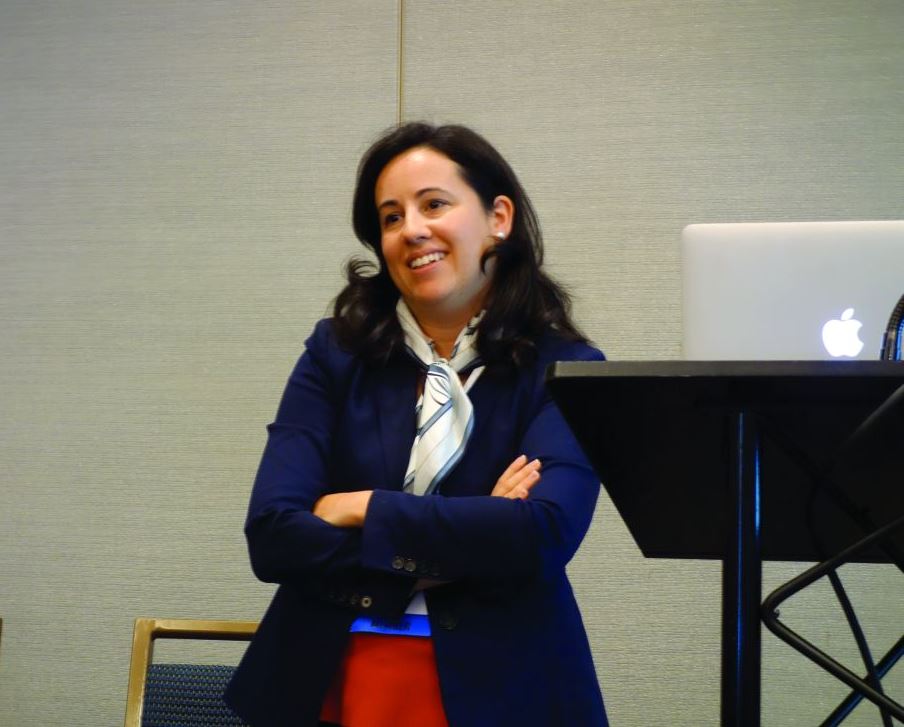
The results? “Nobody wanted anything!” Dr. Rodriguez said at the annual conference of the Anxiety and Depression Association of America.
Acceptability of a given intervention was defined a priori as an average score of 6 or more on the Likert Scale. She had hoped to see some 7s and 8s, strong endorsements that might have helped guide her efforts to develop attractive and engaging new therapies for this common disorder. But in fact, only 3 of the 11 items squeaked by the acceptability threshold with tepid endorsements hovering around 6: individual cognitive-behavioral therapy (CBT), with an average rating of 6.2; use of a professional organizing service, at 6.1; and use of a self-help book, at 6.0.
The least acceptable of the 11 options, not surprisingly, was a court-appointed guardian, with an average score of less than 1. Next most unpopular was use of a cleaning and removal service, followed by pharmacotherapy with a serotonin reuptake inhibitor, drug therapy with a stimulant, and group CBT.
Rounding out the list of 11 treatments and services were an online support group, a facilitated support group based upon the model described in the book “Buried in Treasures” (Oxford University Press, 2013), by David F. Tolin, PhD; Randy O. Frost, PhD; and Gail Steketee, PhD; and involvement of a case manager.
Participants were asked to describe what they liked and disliked about the 11 options. What they liked about the three that were acceptable – albeit barely – was the prospect of personalized care, being held accountable, and their belief that those three strategies really work. What they disliked about the least acceptable interventions was the feeling that they would have no control over the process, anticipation that these treatments and services would cause them distress, and skepticism about their efficacy.
Actually, while the evidence regarding pharmacotherapy is limited to a few open-label, uncontrolled, prospective case series involving hoarding disorder patients not concurrently in psychotherapy, the medication data look quite promising, according to Dr. Rodriguez, who is affiliated with the department of psychiatry and behavioral sciences at Stanford (Calif.) University.
Investigators at the University of California, San Diego, treated 24 patients meeting DSM-5 criteria for hoarding disorder with extended-release venlafaxine (Effexor XR) for 12 weeks. Twenty-three of the 24 completed the study, achieving a mean 32% reduction in Saving Inventory–Revised scores and a 36% reduction in UCLA Hoarding Severity Scale scores (Int Clin Psychopharmacol. 2014 Sep;29[5]:266-73).
Sixteen of the 23 completers were categorized as treatment responders. The investigators noted that this 70% efficacy rate for venlafaxine extended-release was markedly better than published CBT success rates, which hover around 28% for individual CBT and range from 10% to 30% for group CBT.
Also, Dr. Rodriguez has published her experience in prescribing extended-release methylphenidate for four patients with hoarding disorder without comorbid attention-deficit/hyperactivity disorder, all of whom previously had failed to respond to at least one serotonin reuptake inhibitor. The therapeutic rationale for stimulant therapy was that patients with hoarding disorder have problems with attention and decision making that may contribute to accumulation of clutter.
In this 4-week study, patients were started on methylphenidate extended-release at 18 mg/day, with the dosing increased by 18 mg/day each week to a maximum of 72 mg/day. Three of the four patients achieved at least a 50% reduction in measures of inattention, and two patients showed decreases in hoarding symptoms of 25% and 32% on the Saving Inventory–Revised. But at the end of 4 weeks, all four patients opted not to continue on the medication because they didn’t like the side effects, mainly insomnia and palpitations (J Clin Psychopharmacol. 2013 Jun;33[3]:444-7).
Pharmacotherapy has a couple of other potentially appealing features: It works much faster than does psychotherapy, and it also is effective therapy for some of the other psychiatric conditions commonly comorbid with hoarding disorder.
Several audience members observed that even though survey participants did not rate group CBT or facilitated support groups as acceptable treatments, in their own experience as therapists, they’ve found these interventions to be among the most successful. Dr. Rodriguez agreed. Based in part upon her survey findings, her new research initiatives emphasize offering choice, since there’s clearly no one-size-fits-all intervention. She’s also stressing accountability, incorporation of tools aimed at reducing shame and stigma, and providing more information about evidence-based therapies to strengthen patients’ beliefs that treatment actually works.
Toward that end, she recently has trained individuals from the community in how to run a 3-month, skills-based, group therapy program using the Buried in Treasures approach with group in-home visits and decluttering sessions. These group therapy modules will be evaluated formally as to acceptability and efficacy.
Hoarding disorder has a prevalence of 2%-6%. It’s a condition that poses significant public health risks, including fire hazard and pest infestation. Hoarding disorder typically starts in childhood or the teen years and follows a chronic, progressive course. Affected individuals do not initiate treatment until age 50, on average. The condition is more common in men than women. They are often single, highly educated, and live alone. Insight is often poor. A family history of hoarding is common. Psychiatric comorbidity also is common, with depression topping the list.
Dr. Rodriguez’s survey was funded by the National Institute of Mental Health and foundation grants. She reported serving as a consultant to Allergan, Rugen Therapeutics, and BlackThorn Therapeutics.
SAN FRANCISCO – Patients with hoarding disorder are notoriously difficult to engage in treatment. They are embarrassed by their behavior and reluctant to seek help. And Carolyn I. Rodriguez, MD, PhD, has a good idea why: Her first-of-its-kind survey of individuals with hoarding disorder showed they find the currently available array of treatments and services by and large unacceptable.
The online survey included 203 individuals with clinically significant hoarding symptoms as defined by a Saving Inventory–Revised score of at least 40. The survey contained written and audio thumbnail descriptions of 11 current treatments and services, some evidence based, others not. Participants were asked to rate the acceptability of each of the 11 interventions on a 0-10 scale, with 0 being not at all acceptable.
The results? “Nobody wanted anything!” Dr. Rodriguez said at the annual conference of the Anxiety and Depression Association of America.
Acceptability of a given intervention was defined a priori as an average score of 6 or more on the Likert Scale. She had hoped to see some 7s and 8s, strong endorsements that might have helped guide her efforts to develop attractive and engaging new therapies for this common disorder. But in fact, only 3 of the 11 items squeaked by the acceptability threshold with tepid endorsements hovering around 6: individual cognitive-behavioral therapy (CBT), with an average rating of 6.2; use of a professional organizing service, at 6.1; and use of a self-help book, at 6.0.
The least acceptable of the 11 options, not surprisingly, was a court-appointed guardian, with an average score of less than 1. Next most unpopular was use of a cleaning and removal service, followed by pharmacotherapy with a serotonin reuptake inhibitor, drug therapy with a stimulant, and group CBT.
Rounding out the list of 11 treatments and services were an online support group, a facilitated support group based upon the model described in the book “Buried in Treasures” (Oxford University Press, 2013), by David F. Tolin, PhD; Randy O. Frost, PhD; and Gail Steketee, PhD; and involvement of a case manager.
Participants were asked to describe what they liked and disliked about the 11 options. What they liked about the three that were acceptable – albeit barely – was the prospect of personalized care, being held accountable, and their belief that those three strategies really work. What they disliked about the least acceptable interventions was the feeling that they would have no control over the process, anticipation that these treatments and services would cause them distress, and skepticism about their efficacy.
Actually, while the evidence regarding pharmacotherapy is limited to a few open-label, uncontrolled, prospective case series involving hoarding disorder patients not concurrently in psychotherapy, the medication data look quite promising, according to Dr. Rodriguez, who is affiliated with the department of psychiatry and behavioral sciences at Stanford (Calif.) University.
Investigators at the University of California, San Diego, treated 24 patients meeting DSM-5 criteria for hoarding disorder with extended-release venlafaxine (Effexor XR) for 12 weeks. Twenty-three of the 24 completed the study, achieving a mean 32% reduction in Saving Inventory–Revised scores and a 36% reduction in UCLA Hoarding Severity Scale scores (Int Clin Psychopharmacol. 2014 Sep;29[5]:266-73).
Sixteen of the 23 completers were categorized as treatment responders. The investigators noted that this 70% efficacy rate for venlafaxine extended-release was markedly better than published CBT success rates, which hover around 28% for individual CBT and range from 10% to 30% for group CBT.
Also, Dr. Rodriguez has published her experience in prescribing extended-release methylphenidate for four patients with hoarding disorder without comorbid attention-deficit/hyperactivity disorder, all of whom previously had failed to respond to at least one serotonin reuptake inhibitor. The therapeutic rationale for stimulant therapy was that patients with hoarding disorder have problems with attention and decision making that may contribute to accumulation of clutter.
In this 4-week study, patients were started on methylphenidate extended-release at 18 mg/day, with the dosing increased by 18 mg/day each week to a maximum of 72 mg/day. Three of the four patients achieved at least a 50% reduction in measures of inattention, and two patients showed decreases in hoarding symptoms of 25% and 32% on the Saving Inventory–Revised. But at the end of 4 weeks, all four patients opted not to continue on the medication because they didn’t like the side effects, mainly insomnia and palpitations (J Clin Psychopharmacol. 2013 Jun;33[3]:444-7).
Pharmacotherapy has a couple of other potentially appealing features: It works much faster than does psychotherapy, and it also is effective therapy for some of the other psychiatric conditions commonly comorbid with hoarding disorder.
Several audience members observed that even though survey participants did not rate group CBT or facilitated support groups as acceptable treatments, in their own experience as therapists, they’ve found these interventions to be among the most successful. Dr. Rodriguez agreed. Based in part upon her survey findings, her new research initiatives emphasize offering choice, since there’s clearly no one-size-fits-all intervention. She’s also stressing accountability, incorporation of tools aimed at reducing shame and stigma, and providing more information about evidence-based therapies to strengthen patients’ beliefs that treatment actually works.
Toward that end, she recently has trained individuals from the community in how to run a 3-month, skills-based, group therapy program using the Buried in Treasures approach with group in-home visits and decluttering sessions. These group therapy modules will be evaluated formally as to acceptability and efficacy.
Hoarding disorder has a prevalence of 2%-6%. It’s a condition that poses significant public health risks, including fire hazard and pest infestation. Hoarding disorder typically starts in childhood or the teen years and follows a chronic, progressive course. Affected individuals do not initiate treatment until age 50, on average. The condition is more common in men than women. They are often single, highly educated, and live alone. Insight is often poor. A family history of hoarding is common. Psychiatric comorbidity also is common, with depression topping the list.
Dr. Rodriguez’s survey was funded by the National Institute of Mental Health and foundation grants. She reported serving as a consultant to Allergan, Rugen Therapeutics, and BlackThorn Therapeutics.
SAN FRANCISCO – Patients with hoarding disorder are notoriously difficult to engage in treatment. They are embarrassed by their behavior and reluctant to seek help. And Carolyn I. Rodriguez, MD, PhD, has a good idea why: Her first-of-its-kind survey of individuals with hoarding disorder showed they find the currently available array of treatments and services by and large unacceptable.
The online survey included 203 individuals with clinically significant hoarding symptoms as defined by a Saving Inventory–Revised score of at least 40. The survey contained written and audio thumbnail descriptions of 11 current treatments and services, some evidence based, others not. Participants were asked to rate the acceptability of each of the 11 interventions on a 0-10 scale, with 0 being not at all acceptable.
The results? “Nobody wanted anything!” Dr. Rodriguez said at the annual conference of the Anxiety and Depression Association of America.
Acceptability of a given intervention was defined a priori as an average score of 6 or more on the Likert Scale. She had hoped to see some 7s and 8s, strong endorsements that might have helped guide her efforts to develop attractive and engaging new therapies for this common disorder. But in fact, only 3 of the 11 items squeaked by the acceptability threshold with tepid endorsements hovering around 6: individual cognitive-behavioral therapy (CBT), with an average rating of 6.2; use of a professional organizing service, at 6.1; and use of a self-help book, at 6.0.
The least acceptable of the 11 options, not surprisingly, was a court-appointed guardian, with an average score of less than 1. Next most unpopular was use of a cleaning and removal service, followed by pharmacotherapy with a serotonin reuptake inhibitor, drug therapy with a stimulant, and group CBT.
Rounding out the list of 11 treatments and services were an online support group, a facilitated support group based upon the model described in the book “Buried in Treasures” (Oxford University Press, 2013), by David F. Tolin, PhD; Randy O. Frost, PhD; and Gail Steketee, PhD; and involvement of a case manager.
Participants were asked to describe what they liked and disliked about the 11 options. What they liked about the three that were acceptable – albeit barely – was the prospect of personalized care, being held accountable, and their belief that those three strategies really work. What they disliked about the least acceptable interventions was the feeling that they would have no control over the process, anticipation that these treatments and services would cause them distress, and skepticism about their efficacy.
Actually, while the evidence regarding pharmacotherapy is limited to a few open-label, uncontrolled, prospective case series involving hoarding disorder patients not concurrently in psychotherapy, the medication data look quite promising, according to Dr. Rodriguez, who is affiliated with the department of psychiatry and behavioral sciences at Stanford (Calif.) University.
Investigators at the University of California, San Diego, treated 24 patients meeting DSM-5 criteria for hoarding disorder with extended-release venlafaxine (Effexor XR) for 12 weeks. Twenty-three of the 24 completed the study, achieving a mean 32% reduction in Saving Inventory–Revised scores and a 36% reduction in UCLA Hoarding Severity Scale scores (Int Clin Psychopharmacol. 2014 Sep;29[5]:266-73).
Sixteen of the 23 completers were categorized as treatment responders. The investigators noted that this 70% efficacy rate for venlafaxine extended-release was markedly better than published CBT success rates, which hover around 28% for individual CBT and range from 10% to 30% for group CBT.
Also, Dr. Rodriguez has published her experience in prescribing extended-release methylphenidate for four patients with hoarding disorder without comorbid attention-deficit/hyperactivity disorder, all of whom previously had failed to respond to at least one serotonin reuptake inhibitor. The therapeutic rationale for stimulant therapy was that patients with hoarding disorder have problems with attention and decision making that may contribute to accumulation of clutter.
In this 4-week study, patients were started on methylphenidate extended-release at 18 mg/day, with the dosing increased by 18 mg/day each week to a maximum of 72 mg/day. Three of the four patients achieved at least a 50% reduction in measures of inattention, and two patients showed decreases in hoarding symptoms of 25% and 32% on the Saving Inventory–Revised. But at the end of 4 weeks, all four patients opted not to continue on the medication because they didn’t like the side effects, mainly insomnia and palpitations (J Clin Psychopharmacol. 2013 Jun;33[3]:444-7).
Pharmacotherapy has a couple of other potentially appealing features: It works much faster than does psychotherapy, and it also is effective therapy for some of the other psychiatric conditions commonly comorbid with hoarding disorder.
Several audience members observed that even though survey participants did not rate group CBT or facilitated support groups as acceptable treatments, in their own experience as therapists, they’ve found these interventions to be among the most successful. Dr. Rodriguez agreed. Based in part upon her survey findings, her new research initiatives emphasize offering choice, since there’s clearly no one-size-fits-all intervention. She’s also stressing accountability, incorporation of tools aimed at reducing shame and stigma, and providing more information about evidence-based therapies to strengthen patients’ beliefs that treatment actually works.
Toward that end, she recently has trained individuals from the community in how to run a 3-month, skills-based, group therapy program using the Buried in Treasures approach with group in-home visits and decluttering sessions. These group therapy modules will be evaluated formally as to acceptability and efficacy.
Hoarding disorder has a prevalence of 2%-6%. It’s a condition that poses significant public health risks, including fire hazard and pest infestation. Hoarding disorder typically starts in childhood or the teen years and follows a chronic, progressive course. Affected individuals do not initiate treatment until age 50, on average. The condition is more common in men than women. They are often single, highly educated, and live alone. Insight is often poor. A family history of hoarding is common. Psychiatric comorbidity also is common, with depression topping the list.
Dr. Rodriguez’s survey was funded by the National Institute of Mental Health and foundation grants. She reported serving as a consultant to Allergan, Rugen Therapeutics, and BlackThorn Therapeutics.
AT ANXIETY AND DEPRESSION CONFERENCE 2017
Key clinical point:
Major finding: Only three interventions received even lukewarm endorsement: individual cognitive-behavioral therapy, a professional organizing service, and self-help books.
Data source: In an online survey, 203 individuals with clinically significant hoarding disorder symptoms rated the acceptability of 11 different therapies and services.
Disclosures: This work was funded by the National Institute of Mental Health and foundation grants. The study presenter reported serving as a consultant to Allergan, Rugen Therapeutics, and BlackThorn Therapeutics.
Low-calorie sweeteners may allow more glucose to enter fat cells
ORLANDO – Consumption of low-calorie sweeteners was associated with upregulation of gene expression for glucose transporters in experiments using human mesenchymal stromal cells and adipose tissue, according to new research.
The effect was strongest in individuals with obesity.
Using human subcutaneous fat tissue taken from individuals who consumed low-calorie sweeteners, Sabyasachi Sen, MD, of George Washington University, Washington, and his colleagues showed that these cells had at least a twofold overexpression of glucose transporters. Also overexpressed were sweet taste receptors and adipogenic genes.
Dr. Sen and his colleagues first tested the effects of both physiologic and supraphysiologic doses of sucralose on human adipose-derived mesenchymal stromal cells (MSCs). In the presence of adipogenic media, sucralose was added to the MSCs for a period of 12 days.
When sucralose was added at a concentration of 0.2 millimoles (mM), the investigators detected “small but reproducible” increases in expression of adiponectin, as well as genes that encode for the production of fatty acid binding proteins (FABP4) and proteins implicated in body weight homeostasis (CEBPA). Increases ranged from 1.04- to 1.32-fold.
Dr. Sen explained that the 0.2 mM concentration approximates the amount of sucralose in the tissues of individuals with high low-calorie sweetener consumption.
These effects were more pronounced when the sucralose concentration was raised to a supraphysiologic 1 mM. Then, CEBPA expression increased by a factor of 3.45, adiponectin by 4.39, and FABP4 by 4.06. More intracellular fat droplets were seen with higher sucralose concentrations in a “dose dependent fashion,” said Dr. Sen and his colleagues.
The researchers also took subcutaneous fat biopsies from four individuals of healthy weight (body mass index [BMI] less than 24.9 kg/m2) and from four individuals with obesity (BMI greater than 24.9). Participants ranged in age from 36 years to 60 years.
Individuals in both groups had kept a 7-day food diary before the biopsies were taken, so Dr. Sen and his coinvestigators knew whether or not they had consumed low-calorie sweeteners and in what quantity. Reported sweeteners were sucralose, acesulfame-potassium, and aspartame.
The adipose tissue biopsies were examined for mRNA expression of adipogenic genes, as well as for glucose transporters and inflammatory markers.
In individuals with low-calorie sweetener exposure, the glucose transporter GLUT1 was overexpressed by 2- to 2.2-fold, while the glucose transporter GLUT4 was overexpressed by a factor of 2.7-4.3.
In addition, low-calorie sweetener consumption was associated with up to 2.5-fold overexpression of the sweet taste receptor TAS1R3. Sweet taste receptors are G protein–coupled receptors that are present in taste buds and in other tissues, serving as carbohydrate sensors.
Adipogenic genes were also overexpressed; a 1.5- to 2.4-fold increase was seen in PPARG, for example.
“This expression pattern was most apparent in obese individuals,” the investigators wrote in the abstract accompanying the study, which was presented at the annual meeting of the Endocrine Society.
Further and larger studies are called for, especially in individuals with diabetes and obesity, Dr. Sen said. “However, from our study, we believe that low-calorie sweeteners promote additional fat formation by allowing more glucose to enter the cells, and promote inflammation, which may be more detrimental to obese individuals.”
Dr. Sen and his collaborators reported no relevant disclosures.
[email protected]
On Twitter @karioakes
ORLANDO – Consumption of low-calorie sweeteners was associated with upregulation of gene expression for glucose transporters in experiments using human mesenchymal stromal cells and adipose tissue, according to new research.
The effect was strongest in individuals with obesity.
Using human subcutaneous fat tissue taken from individuals who consumed low-calorie sweeteners, Sabyasachi Sen, MD, of George Washington University, Washington, and his colleagues showed that these cells had at least a twofold overexpression of glucose transporters. Also overexpressed were sweet taste receptors and adipogenic genes.
Dr. Sen and his colleagues first tested the effects of both physiologic and supraphysiologic doses of sucralose on human adipose-derived mesenchymal stromal cells (MSCs). In the presence of adipogenic media, sucralose was added to the MSCs for a period of 12 days.
When sucralose was added at a concentration of 0.2 millimoles (mM), the investigators detected “small but reproducible” increases in expression of adiponectin, as well as genes that encode for the production of fatty acid binding proteins (FABP4) and proteins implicated in body weight homeostasis (CEBPA). Increases ranged from 1.04- to 1.32-fold.
Dr. Sen explained that the 0.2 mM concentration approximates the amount of sucralose in the tissues of individuals with high low-calorie sweetener consumption.
These effects were more pronounced when the sucralose concentration was raised to a supraphysiologic 1 mM. Then, CEBPA expression increased by a factor of 3.45, adiponectin by 4.39, and FABP4 by 4.06. More intracellular fat droplets were seen with higher sucralose concentrations in a “dose dependent fashion,” said Dr. Sen and his colleagues.
The researchers also took subcutaneous fat biopsies from four individuals of healthy weight (body mass index [BMI] less than 24.9 kg/m2) and from four individuals with obesity (BMI greater than 24.9). Participants ranged in age from 36 years to 60 years.
Individuals in both groups had kept a 7-day food diary before the biopsies were taken, so Dr. Sen and his coinvestigators knew whether or not they had consumed low-calorie sweeteners and in what quantity. Reported sweeteners were sucralose, acesulfame-potassium, and aspartame.
The adipose tissue biopsies were examined for mRNA expression of adipogenic genes, as well as for glucose transporters and inflammatory markers.
In individuals with low-calorie sweetener exposure, the glucose transporter GLUT1 was overexpressed by 2- to 2.2-fold, while the glucose transporter GLUT4 was overexpressed by a factor of 2.7-4.3.
In addition, low-calorie sweetener consumption was associated with up to 2.5-fold overexpression of the sweet taste receptor TAS1R3. Sweet taste receptors are G protein–coupled receptors that are present in taste buds and in other tissues, serving as carbohydrate sensors.
Adipogenic genes were also overexpressed; a 1.5- to 2.4-fold increase was seen in PPARG, for example.
“This expression pattern was most apparent in obese individuals,” the investigators wrote in the abstract accompanying the study, which was presented at the annual meeting of the Endocrine Society.
Further and larger studies are called for, especially in individuals with diabetes and obesity, Dr. Sen said. “However, from our study, we believe that low-calorie sweeteners promote additional fat formation by allowing more glucose to enter the cells, and promote inflammation, which may be more detrimental to obese individuals.”
Dr. Sen and his collaborators reported no relevant disclosures.
[email protected]
On Twitter @karioakes
ORLANDO – Consumption of low-calorie sweeteners was associated with upregulation of gene expression for glucose transporters in experiments using human mesenchymal stromal cells and adipose tissue, according to new research.
The effect was strongest in individuals with obesity.
Using human subcutaneous fat tissue taken from individuals who consumed low-calorie sweeteners, Sabyasachi Sen, MD, of George Washington University, Washington, and his colleagues showed that these cells had at least a twofold overexpression of glucose transporters. Also overexpressed were sweet taste receptors and adipogenic genes.
Dr. Sen and his colleagues first tested the effects of both physiologic and supraphysiologic doses of sucralose on human adipose-derived mesenchymal stromal cells (MSCs). In the presence of adipogenic media, sucralose was added to the MSCs for a period of 12 days.
When sucralose was added at a concentration of 0.2 millimoles (mM), the investigators detected “small but reproducible” increases in expression of adiponectin, as well as genes that encode for the production of fatty acid binding proteins (FABP4) and proteins implicated in body weight homeostasis (CEBPA). Increases ranged from 1.04- to 1.32-fold.
Dr. Sen explained that the 0.2 mM concentration approximates the amount of sucralose in the tissues of individuals with high low-calorie sweetener consumption.
These effects were more pronounced when the sucralose concentration was raised to a supraphysiologic 1 mM. Then, CEBPA expression increased by a factor of 3.45, adiponectin by 4.39, and FABP4 by 4.06. More intracellular fat droplets were seen with higher sucralose concentrations in a “dose dependent fashion,” said Dr. Sen and his colleagues.
The researchers also took subcutaneous fat biopsies from four individuals of healthy weight (body mass index [BMI] less than 24.9 kg/m2) and from four individuals with obesity (BMI greater than 24.9). Participants ranged in age from 36 years to 60 years.
Individuals in both groups had kept a 7-day food diary before the biopsies were taken, so Dr. Sen and his coinvestigators knew whether or not they had consumed low-calorie sweeteners and in what quantity. Reported sweeteners were sucralose, acesulfame-potassium, and aspartame.
The adipose tissue biopsies were examined for mRNA expression of adipogenic genes, as well as for glucose transporters and inflammatory markers.
In individuals with low-calorie sweetener exposure, the glucose transporter GLUT1 was overexpressed by 2- to 2.2-fold, while the glucose transporter GLUT4 was overexpressed by a factor of 2.7-4.3.
In addition, low-calorie sweetener consumption was associated with up to 2.5-fold overexpression of the sweet taste receptor TAS1R3. Sweet taste receptors are G protein–coupled receptors that are present in taste buds and in other tissues, serving as carbohydrate sensors.
Adipogenic genes were also overexpressed; a 1.5- to 2.4-fold increase was seen in PPARG, for example.
“This expression pattern was most apparent in obese individuals,” the investigators wrote in the abstract accompanying the study, which was presented at the annual meeting of the Endocrine Society.
Further and larger studies are called for, especially in individuals with diabetes and obesity, Dr. Sen said. “However, from our study, we believe that low-calorie sweeteners promote additional fat formation by allowing more glucose to enter the cells, and promote inflammation, which may be more detrimental to obese individuals.”
Dr. Sen and his collaborators reported no relevant disclosures.
[email protected]
On Twitter @karioakes
Key clinical point:
Major finding: Glucose transporters and sweet taste receptors were upregulated by 2.0- to 4.3-fold in participants who used low-calorie sweeteners.
Data source: In vitro examination of human adipose tissue-derived mesenchymal stromal cells, and examination of biopsied adipose tissue from eight individuals with varying low-calorie sweetener intake.
Disclosures: None of the study authors reported relevant disclosures, and no external source of funding was reported.