User login
CARPREG II fine-tunes assessment of cardiac complication risk in pregnancy
A study of pregnant women with heart disease has yielded a new risk index that improves on its predecessor by integrating general, lesion-specific, and delivery-of-care variables, investigators say.
“Compared with other published risk indices, including the original CARPREG [Cardiac Disease in Pregnancy] score, CARPREG II risk index had the highest discriminative and calibrative accuracy in our study group,” investigators said in a report published in the Journal of the American College of Cardiology.
First author on the report was Candice K. Silversides, MD, division of cardiology, University of Toronto pregnancy and heart disease research program, Mount Sinai Hospital/Sinai Health System.
The widely used, original CARPREG risk index was the first to predict maternal cardiac complications based on general clinical and echocardiographic data from the baseline antepartum visit, the researchers wrote in their report.
The new index developed by Dr. Silversides and her colleagues stems from a study of pregnant women with heart disease receiving care at two large Canadian obstetric centers.
Based on analysis of 1,938 pregnancies progressing beyond 20 weeks of gestation, the investigators found that cardiac complications were overall quite common in pregnant women with heart disease, occurring in 16% of participants. However, maternal cardiac deaths or cardiac arrests were rare, they said, occurring in just 11 (0.6%) of the pregnancies.
Most complications (64%) occurred in the antepartum period, according to the report.
Looking at patient data before or after 2001, investigators found the rates of most complications were consistent over time. However, rates of pulmonary edema decreased in the post-2001 period.
Multivariate analysis of these findings revealed 10 predictors of adverse cardiac events. Those included five general factors, including previous cardiac events or arrhythmia, four lesion-specific variables including pulmonary hypertension and coronary artery disease, and one process of care variable: late pregnancy assessment.
Only 4 of those 10 factors were included in the original CARPREG index, investigators noted.
In CARPREG II, each of the 10 factors is weighted with 1-3 points, depending on risk. For example, history of prior cardiac events was associated with a higher odds ratio, and so was assigned 3 points.
The predicted risk of primary cardiac events ranges from 5% for women with a total of 0-1 points, up to 41% for women with 5 or more points.
The finding that some predictors had higher odds ratios than others reinforces the “foundational role” of clinical assessment, investigators said in the report.
“There may be other factors that affect outcomes,” they wrote. “Risk assessment for the individual patient will need to integrate risk score estimates, known lesion-specific information, and clinical judgment by an experienced physician.”
Dr. Silversides and her coauthors reported that they had no relationships to disclose relevant to the contents of their report on the study.
SOURCE: Silversides CK et al. J Am Coll Cardiol. 2018;71:2419-30.
This update and expansion of the original CARPREG scoring system is a “useful starting point” for prediction of the risk of pregnancy in women with cardiac disease, according to Uri Elkayam, MD.
However, a detailed and lesion specific evaluation is still required for a more precise determination of risk for any given patient, Dr. Elkayam cautioned in an editorial accompanying the article.
Clinicians need to thoroughly understand how the patient’s cardiac condition could be affected by hemodynamic changes during pregnancy, labor, delivery, and the postpartum period, Dr. Elkayam added in his comments.
To fully take advantage of CARPREG II, clinicians need to take into account the limitations of the scoring system, he said, including the fact that it is based on population studies.
“Although the system presented is designed to examine all adverse cardiac events that could have an impact on maternal health, it is less effective for distinguishing between mild and easily manageable events that do not have serious effects on maternal or fetal outcomes and those that may be severe, life-threatening, or require hospitalizations or early delivery,” he wrote.
Dr. Elkayam is with the department of medicine, division of cardiovascular medicine, and the department of obstetrics and gynecology, University of Southern California, Los Angeles. These comments are derived from his editorial in the Journal of the American College of Cardiology . Dr. Elkayam reported he had no relationships relevant to the contents of this paper to disclose.
This update and expansion of the original CARPREG scoring system is a “useful starting point” for prediction of the risk of pregnancy in women with cardiac disease, according to Uri Elkayam, MD.
However, a detailed and lesion specific evaluation is still required for a more precise determination of risk for any given patient, Dr. Elkayam cautioned in an editorial accompanying the article.
Clinicians need to thoroughly understand how the patient’s cardiac condition could be affected by hemodynamic changes during pregnancy, labor, delivery, and the postpartum period, Dr. Elkayam added in his comments.
To fully take advantage of CARPREG II, clinicians need to take into account the limitations of the scoring system, he said, including the fact that it is based on population studies.
“Although the system presented is designed to examine all adverse cardiac events that could have an impact on maternal health, it is less effective for distinguishing between mild and easily manageable events that do not have serious effects on maternal or fetal outcomes and those that may be severe, life-threatening, or require hospitalizations or early delivery,” he wrote.
Dr. Elkayam is with the department of medicine, division of cardiovascular medicine, and the department of obstetrics and gynecology, University of Southern California, Los Angeles. These comments are derived from his editorial in the Journal of the American College of Cardiology . Dr. Elkayam reported he had no relationships relevant to the contents of this paper to disclose.
This update and expansion of the original CARPREG scoring system is a “useful starting point” for prediction of the risk of pregnancy in women with cardiac disease, according to Uri Elkayam, MD.
However, a detailed and lesion specific evaluation is still required for a more precise determination of risk for any given patient, Dr. Elkayam cautioned in an editorial accompanying the article.
Clinicians need to thoroughly understand how the patient’s cardiac condition could be affected by hemodynamic changes during pregnancy, labor, delivery, and the postpartum period, Dr. Elkayam added in his comments.
To fully take advantage of CARPREG II, clinicians need to take into account the limitations of the scoring system, he said, including the fact that it is based on population studies.
“Although the system presented is designed to examine all adverse cardiac events that could have an impact on maternal health, it is less effective for distinguishing between mild and easily manageable events that do not have serious effects on maternal or fetal outcomes and those that may be severe, life-threatening, or require hospitalizations or early delivery,” he wrote.
Dr. Elkayam is with the department of medicine, division of cardiovascular medicine, and the department of obstetrics and gynecology, University of Southern California, Los Angeles. These comments are derived from his editorial in the Journal of the American College of Cardiology . Dr. Elkayam reported he had no relationships relevant to the contents of this paper to disclose.
A study of pregnant women with heart disease has yielded a new risk index that improves on its predecessor by integrating general, lesion-specific, and delivery-of-care variables, investigators say.
“Compared with other published risk indices, including the original CARPREG [Cardiac Disease in Pregnancy] score, CARPREG II risk index had the highest discriminative and calibrative accuracy in our study group,” investigators said in a report published in the Journal of the American College of Cardiology.
First author on the report was Candice K. Silversides, MD, division of cardiology, University of Toronto pregnancy and heart disease research program, Mount Sinai Hospital/Sinai Health System.
The widely used, original CARPREG risk index was the first to predict maternal cardiac complications based on general clinical and echocardiographic data from the baseline antepartum visit, the researchers wrote in their report.
The new index developed by Dr. Silversides and her colleagues stems from a study of pregnant women with heart disease receiving care at two large Canadian obstetric centers.
Based on analysis of 1,938 pregnancies progressing beyond 20 weeks of gestation, the investigators found that cardiac complications were overall quite common in pregnant women with heart disease, occurring in 16% of participants. However, maternal cardiac deaths or cardiac arrests were rare, they said, occurring in just 11 (0.6%) of the pregnancies.
Most complications (64%) occurred in the antepartum period, according to the report.
Looking at patient data before or after 2001, investigators found the rates of most complications were consistent over time. However, rates of pulmonary edema decreased in the post-2001 period.
Multivariate analysis of these findings revealed 10 predictors of adverse cardiac events. Those included five general factors, including previous cardiac events or arrhythmia, four lesion-specific variables including pulmonary hypertension and coronary artery disease, and one process of care variable: late pregnancy assessment.
Only 4 of those 10 factors were included in the original CARPREG index, investigators noted.
In CARPREG II, each of the 10 factors is weighted with 1-3 points, depending on risk. For example, history of prior cardiac events was associated with a higher odds ratio, and so was assigned 3 points.
The predicted risk of primary cardiac events ranges from 5% for women with a total of 0-1 points, up to 41% for women with 5 or more points.
The finding that some predictors had higher odds ratios than others reinforces the “foundational role” of clinical assessment, investigators said in the report.
“There may be other factors that affect outcomes,” they wrote. “Risk assessment for the individual patient will need to integrate risk score estimates, known lesion-specific information, and clinical judgment by an experienced physician.”
Dr. Silversides and her coauthors reported that they had no relationships to disclose relevant to the contents of their report on the study.
SOURCE: Silversides CK et al. J Am Coll Cardiol. 2018;71:2419-30.
A study of pregnant women with heart disease has yielded a new risk index that improves on its predecessor by integrating general, lesion-specific, and delivery-of-care variables, investigators say.
“Compared with other published risk indices, including the original CARPREG [Cardiac Disease in Pregnancy] score, CARPREG II risk index had the highest discriminative and calibrative accuracy in our study group,” investigators said in a report published in the Journal of the American College of Cardiology.
First author on the report was Candice K. Silversides, MD, division of cardiology, University of Toronto pregnancy and heart disease research program, Mount Sinai Hospital/Sinai Health System.
The widely used, original CARPREG risk index was the first to predict maternal cardiac complications based on general clinical and echocardiographic data from the baseline antepartum visit, the researchers wrote in their report.
The new index developed by Dr. Silversides and her colleagues stems from a study of pregnant women with heart disease receiving care at two large Canadian obstetric centers.
Based on analysis of 1,938 pregnancies progressing beyond 20 weeks of gestation, the investigators found that cardiac complications were overall quite common in pregnant women with heart disease, occurring in 16% of participants. However, maternal cardiac deaths or cardiac arrests were rare, they said, occurring in just 11 (0.6%) of the pregnancies.
Most complications (64%) occurred in the antepartum period, according to the report.
Looking at patient data before or after 2001, investigators found the rates of most complications were consistent over time. However, rates of pulmonary edema decreased in the post-2001 period.
Multivariate analysis of these findings revealed 10 predictors of adverse cardiac events. Those included five general factors, including previous cardiac events or arrhythmia, four lesion-specific variables including pulmonary hypertension and coronary artery disease, and one process of care variable: late pregnancy assessment.
Only 4 of those 10 factors were included in the original CARPREG index, investigators noted.
In CARPREG II, each of the 10 factors is weighted with 1-3 points, depending on risk. For example, history of prior cardiac events was associated with a higher odds ratio, and so was assigned 3 points.
The predicted risk of primary cardiac events ranges from 5% for women with a total of 0-1 points, up to 41% for women with 5 or more points.
The finding that some predictors had higher odds ratios than others reinforces the “foundational role” of clinical assessment, investigators said in the report.
“There may be other factors that affect outcomes,” they wrote. “Risk assessment for the individual patient will need to integrate risk score estimates, known lesion-specific information, and clinical judgment by an experienced physician.”
Dr. Silversides and her coauthors reported that they had no relationships to disclose relevant to the contents of their report on the study.
SOURCE: Silversides CK et al. J Am Coll Cardiol. 2018;71:2419-30.
FROM THE JOURNAL OF THE AMERICAN COLLEGE OF CARDIOLOGY
Key clinical point: A newly developed risk index enhances the ability to predict maternal cardiac complications by combining general, lesion-specific, and delivery-of-care variables.
Major finding: Investigators developed the CARPREG II risk index based on 10 predictors of maternal cardiac complications (5 general, 4 lesion-specific, and 1 related to delivery of care).
Study details: The CARPREG II Study, which included more than 2,000 prospectively enrolled consecutive pregnant women with heart disease seen at one of two large Canadian obstetric centers.
Disclosures: Authors reported that they had no relationships to disclose relevant to the contents of their report on the study.
Source: Silversides CK et al. J Am Coll Cardiol. 2018;71:2419-30.
Uvulopalatopharyngoplasty may reduce cardiac risk in sleep apnea
Surgical remodeling of the tissues of the throat using uvulopalatopharyngoplasty (UPPP) could significantly reduce the cardiac complications of obstructive sleep apnea (OSA), according to a study published in Sleep Medicine.
Researchers examined the incidence of newly diagnosed myocardial infarction, congestive heart failure, and atrial fibrillation in 192,316 patients with a new diagnosis of obstructive sleep apnea – 22,213 of whom had undergone UPPP – and 961,590 controls.
The individuals who had had UPPP had a significantly lower incidence of all three cardiovascular events, compared with those who had not undergone the procedure. The hazard ratios for myocardial infarction, congestive heart failure, and atrial fibrillation among individuals with OSA who had uvulopalatopharyngoplasty, compared with controls, were 1.002, 0.757 and 1.117, respectively. By comparison, those hazard ratios in patients with OSA who had not had UPPP, compared with controls, were 1.070, 1.165, and 1.39 for myocardial infarction, congestive heart failure, and atrial fibrillation respectively.
These figures were after accounting for confounding factors, such as age, sex, diabetes, hypertension, and dyslipidemia.
The authors wrote that the most distinctive finding of their study was that uvulopalatopharyngoplasty lowered the incidence of congestive heart failure and atrial fibrillation in patients with obstructive sleep apnea to the point that they had the same level of risk as individuals without obstructive sleep apnea.
“Prior studies have evaluated the success of UPPP based on reductions of AHI [apnea-hypopnea index], with the average success rate for the surgery being low for most patients,” wrote Heung-Man Lee, MD, PhD, then from the Guro Hospital at Korea University, Seoul, and his coauthors.
“However, the current study suggests that the effects of UPPP, regardless of the effects on AHI, can significantly reduce cardiac morbidity in patients with OSA.”
Patients without diabetes showed more benefit from UPPP in reducing the incidence of congestive heart failure, compared with those with diabetes. However, those with diabetes showed greater reductions in the risk of atrial fibrillation, compared with those without diabetes.
Similarly, the incidence of atrial fibrillation was reduced after uvulopalatopharyngoplasty but only in patients with hypertension or dyslipidemia and not in those with normal blood pressure or lipid levels.
“These differences in outcomes after UPPP are probably due to the different etiologies of cardiovascular disease,” the authors wrote. “OSA increases free fatty acid in the blood because intermittent hypoxia associated with OSA induces adipose tissue lipolysis.”
One limitation of the study was the absence of polysomnography information. The researchers relied on diagnostic codes for confirmation of OSA. They also did not have information on other sleep apnea therapies, such as CPAP or a mandibular advancing device, which may have been used in the patients who did not undergo uvulopalatopharyngoplasty.
The study was supported by the Korean Society of Otorhinolaryngology Head and Neck Surgery. No conflicts of interest were declared.
SOURCE: Lee HM et al. Sleep Med. 2018 May;45:11-16.
Surgical remodeling of the tissues of the throat using uvulopalatopharyngoplasty (UPPP) could significantly reduce the cardiac complications of obstructive sleep apnea (OSA), according to a study published in Sleep Medicine.
Researchers examined the incidence of newly diagnosed myocardial infarction, congestive heart failure, and atrial fibrillation in 192,316 patients with a new diagnosis of obstructive sleep apnea – 22,213 of whom had undergone UPPP – and 961,590 controls.
The individuals who had had UPPP had a significantly lower incidence of all three cardiovascular events, compared with those who had not undergone the procedure. The hazard ratios for myocardial infarction, congestive heart failure, and atrial fibrillation among individuals with OSA who had uvulopalatopharyngoplasty, compared with controls, were 1.002, 0.757 and 1.117, respectively. By comparison, those hazard ratios in patients with OSA who had not had UPPP, compared with controls, were 1.070, 1.165, and 1.39 for myocardial infarction, congestive heart failure, and atrial fibrillation respectively.
These figures were after accounting for confounding factors, such as age, sex, diabetes, hypertension, and dyslipidemia.
The authors wrote that the most distinctive finding of their study was that uvulopalatopharyngoplasty lowered the incidence of congestive heart failure and atrial fibrillation in patients with obstructive sleep apnea to the point that they had the same level of risk as individuals without obstructive sleep apnea.
“Prior studies have evaluated the success of UPPP based on reductions of AHI [apnea-hypopnea index], with the average success rate for the surgery being low for most patients,” wrote Heung-Man Lee, MD, PhD, then from the Guro Hospital at Korea University, Seoul, and his coauthors.
“However, the current study suggests that the effects of UPPP, regardless of the effects on AHI, can significantly reduce cardiac morbidity in patients with OSA.”
Patients without diabetes showed more benefit from UPPP in reducing the incidence of congestive heart failure, compared with those with diabetes. However, those with diabetes showed greater reductions in the risk of atrial fibrillation, compared with those without diabetes.
Similarly, the incidence of atrial fibrillation was reduced after uvulopalatopharyngoplasty but only in patients with hypertension or dyslipidemia and not in those with normal blood pressure or lipid levels.
“These differences in outcomes after UPPP are probably due to the different etiologies of cardiovascular disease,” the authors wrote. “OSA increases free fatty acid in the blood because intermittent hypoxia associated with OSA induces adipose tissue lipolysis.”
One limitation of the study was the absence of polysomnography information. The researchers relied on diagnostic codes for confirmation of OSA. They also did not have information on other sleep apnea therapies, such as CPAP or a mandibular advancing device, which may have been used in the patients who did not undergo uvulopalatopharyngoplasty.
The study was supported by the Korean Society of Otorhinolaryngology Head and Neck Surgery. No conflicts of interest were declared.
SOURCE: Lee HM et al. Sleep Med. 2018 May;45:11-16.
Surgical remodeling of the tissues of the throat using uvulopalatopharyngoplasty (UPPP) could significantly reduce the cardiac complications of obstructive sleep apnea (OSA), according to a study published in Sleep Medicine.
Researchers examined the incidence of newly diagnosed myocardial infarction, congestive heart failure, and atrial fibrillation in 192,316 patients with a new diagnosis of obstructive sleep apnea – 22,213 of whom had undergone UPPP – and 961,590 controls.
The individuals who had had UPPP had a significantly lower incidence of all three cardiovascular events, compared with those who had not undergone the procedure. The hazard ratios for myocardial infarction, congestive heart failure, and atrial fibrillation among individuals with OSA who had uvulopalatopharyngoplasty, compared with controls, were 1.002, 0.757 and 1.117, respectively. By comparison, those hazard ratios in patients with OSA who had not had UPPP, compared with controls, were 1.070, 1.165, and 1.39 for myocardial infarction, congestive heart failure, and atrial fibrillation respectively.
These figures were after accounting for confounding factors, such as age, sex, diabetes, hypertension, and dyslipidemia.
The authors wrote that the most distinctive finding of their study was that uvulopalatopharyngoplasty lowered the incidence of congestive heart failure and atrial fibrillation in patients with obstructive sleep apnea to the point that they had the same level of risk as individuals without obstructive sleep apnea.
“Prior studies have evaluated the success of UPPP based on reductions of AHI [apnea-hypopnea index], with the average success rate for the surgery being low for most patients,” wrote Heung-Man Lee, MD, PhD, then from the Guro Hospital at Korea University, Seoul, and his coauthors.
“However, the current study suggests that the effects of UPPP, regardless of the effects on AHI, can significantly reduce cardiac morbidity in patients with OSA.”
Patients without diabetes showed more benefit from UPPP in reducing the incidence of congestive heart failure, compared with those with diabetes. However, those with diabetes showed greater reductions in the risk of atrial fibrillation, compared with those without diabetes.
Similarly, the incidence of atrial fibrillation was reduced after uvulopalatopharyngoplasty but only in patients with hypertension or dyslipidemia and not in those with normal blood pressure or lipid levels.
“These differences in outcomes after UPPP are probably due to the different etiologies of cardiovascular disease,” the authors wrote. “OSA increases free fatty acid in the blood because intermittent hypoxia associated with OSA induces adipose tissue lipolysis.”
One limitation of the study was the absence of polysomnography information. The researchers relied on diagnostic codes for confirmation of OSA. They also did not have information on other sleep apnea therapies, such as CPAP or a mandibular advancing device, which may have been used in the patients who did not undergo uvulopalatopharyngoplasty.
The study was supported by the Korean Society of Otorhinolaryngology Head and Neck Surgery. No conflicts of interest were declared.
SOURCE: Lee HM et al. Sleep Med. 2018 May;45:11-16.
FROM SLEEP MEDICINE
Key clinical point: Uvulopalatopharyngoplasty might avert cardiac complications caused by obstructive sleep apnea.
Major finding: Compared with controls, the hazard ratios for MI, congestive heart failure, and atrial fibrillation 1.002, 0.757, and 1.117, respectively, among individuals with OSA who had had UPPP and 1.070, 1.165, and 1.39 among those who had not had UPPP.
Study details: Study of 192,316 patients with obstructive sleep apnea and 961,590 controls.
Disclosures: The study was supported by the Korean Society of Otorhinolaryngology–Head and Neck Surgery. No conflicts of interest were declared.
Source: Lee HM et al. Sleep Med. 2018 May;45:11-16.
8-Isoprostane levels predict OSA in children
The oxidative stress biomarker 8-isoprostane (8-IsoP) predicted obstructive sleep apnea (OSA) and disease severity in children better than the fractional concentration of exhaled nitric oxide (FENO), according to results published in Sleep Medicine.
In an analysis of 46 patients with sleep-disordered breathing and 20 controls, 8-IsoP values were also correlated with apnea hypopnea index (AHI) (r, 0.40; P = .003) and oxygen saturation, also known as SaO2, (r, –0.50; P = .001), reported Dr. Mario Berreto of the Pediatric Unit at Sant’Andrea Hospital in Rome and his coauthors.
The investigators studied 66 children aged 4.5-15.1 years, of whom 46 had sleep-disordered breathing (SDB) and were enrolled in the hospital’s Pediatric Sleep Center. The 20 healthy controls had no history of sleep problems, including snoring, apneas, and restless sleep. Exclusion criteria included acute respiratory infections in the 4 weeks preceding the study, chronic respiratory comorbidities, and therapy with corticosteroids or other anti-inflammatory drugs for at least 3 weeks.
Patients with SDB had a medical examination followed by overnight standard polysomnography (PSG), and EBC 8-IsoP and FENO measurements were collected the next morning upon waking. The SDB group also had spirometry and skin prick testing for common allergens. The children in the control group had the same tests and measurements done, except for PSG, Dr. Berreto and his colleagues wrote.
Central, obstructive, and mixed apnea events were counted according to American Academy of Sleep Medicine (AASM) criteria. AHI was defined as the average number of apnea and hypopnea events per hour of sleep. OSA was diagnosed with an AHI of one episode per hour and confirmed by the presence of SDB symptoms with AHI of one episode per hour.
Children with snoring and an AHI of less than one episode per hour were diagnosed with primary snoring (PS). Patients with an AHI greater than one episode per hour and less than five episodes per hour were diagnosed with mild OSA. Children with an AHI of greater than five episodes per hour were diagnosed with moderate to severe OSA, the authors said.
While 8-IsoP concentrations correlated with OSA severity for AHI and SaO2, FENO did not, Dr. Berreto and colleagues reported.
The difference in 8-IsoP concentrations for children with SDB and controls (mean, 39.6; P = .006) was increased when adjusted using multiple linear regression (mean, 43.2; P = .007), and the difference was even more pronounced when adjusted for all potential confounding variables (mean, 53.1; P = .008). The difference in FENO levels between SDB patients and controls was not statistically significant (mean, 1.67; P = .358) and did not change significantly when adjusted for confounding variables.
High area under the curve values were observed for 8-IsoP as a predictor of OSA (.839; 95% confidence interval, .744-.933, P = .000). The sensitivity and specificity of cutoff values of 8-IsoP concentrations above the 50th percentile were 76.5% and 78.1%, respectively.
“[It] seems that biomarkers of oxidative stress reflect OSA severity in children more closely than biomarkers of atopic-eosinophilic airway inflammation,” the authors concluded.
No disclosures or conflicts of interest were reported.
SOURCE: Barreto M et al. Sleep Medicine. 2018. doi: 10.1016/j.sleep.2018.01.011.
The oxidative stress biomarker 8-isoprostane (8-IsoP) predicted obstructive sleep apnea (OSA) and disease severity in children better than the fractional concentration of exhaled nitric oxide (FENO), according to results published in Sleep Medicine.
In an analysis of 46 patients with sleep-disordered breathing and 20 controls, 8-IsoP values were also correlated with apnea hypopnea index (AHI) (r, 0.40; P = .003) and oxygen saturation, also known as SaO2, (r, –0.50; P = .001), reported Dr. Mario Berreto of the Pediatric Unit at Sant’Andrea Hospital in Rome and his coauthors.
The investigators studied 66 children aged 4.5-15.1 years, of whom 46 had sleep-disordered breathing (SDB) and were enrolled in the hospital’s Pediatric Sleep Center. The 20 healthy controls had no history of sleep problems, including snoring, apneas, and restless sleep. Exclusion criteria included acute respiratory infections in the 4 weeks preceding the study, chronic respiratory comorbidities, and therapy with corticosteroids or other anti-inflammatory drugs for at least 3 weeks.
Patients with SDB had a medical examination followed by overnight standard polysomnography (PSG), and EBC 8-IsoP and FENO measurements were collected the next morning upon waking. The SDB group also had spirometry and skin prick testing for common allergens. The children in the control group had the same tests and measurements done, except for PSG, Dr. Berreto and his colleagues wrote.
Central, obstructive, and mixed apnea events were counted according to American Academy of Sleep Medicine (AASM) criteria. AHI was defined as the average number of apnea and hypopnea events per hour of sleep. OSA was diagnosed with an AHI of one episode per hour and confirmed by the presence of SDB symptoms with AHI of one episode per hour.
Children with snoring and an AHI of less than one episode per hour were diagnosed with primary snoring (PS). Patients with an AHI greater than one episode per hour and less than five episodes per hour were diagnosed with mild OSA. Children with an AHI of greater than five episodes per hour were diagnosed with moderate to severe OSA, the authors said.
While 8-IsoP concentrations correlated with OSA severity for AHI and SaO2, FENO did not, Dr. Berreto and colleagues reported.
The difference in 8-IsoP concentrations for children with SDB and controls (mean, 39.6; P = .006) was increased when adjusted using multiple linear regression (mean, 43.2; P = .007), and the difference was even more pronounced when adjusted for all potential confounding variables (mean, 53.1; P = .008). The difference in FENO levels between SDB patients and controls was not statistically significant (mean, 1.67; P = .358) and did not change significantly when adjusted for confounding variables.
High area under the curve values were observed for 8-IsoP as a predictor of OSA (.839; 95% confidence interval, .744-.933, P = .000). The sensitivity and specificity of cutoff values of 8-IsoP concentrations above the 50th percentile were 76.5% and 78.1%, respectively.
“[It] seems that biomarkers of oxidative stress reflect OSA severity in children more closely than biomarkers of atopic-eosinophilic airway inflammation,” the authors concluded.
No disclosures or conflicts of interest were reported.
SOURCE: Barreto M et al. Sleep Medicine. 2018. doi: 10.1016/j.sleep.2018.01.011.
The oxidative stress biomarker 8-isoprostane (8-IsoP) predicted obstructive sleep apnea (OSA) and disease severity in children better than the fractional concentration of exhaled nitric oxide (FENO), according to results published in Sleep Medicine.
In an analysis of 46 patients with sleep-disordered breathing and 20 controls, 8-IsoP values were also correlated with apnea hypopnea index (AHI) (r, 0.40; P = .003) and oxygen saturation, also known as SaO2, (r, –0.50; P = .001), reported Dr. Mario Berreto of the Pediatric Unit at Sant’Andrea Hospital in Rome and his coauthors.
The investigators studied 66 children aged 4.5-15.1 years, of whom 46 had sleep-disordered breathing (SDB) and were enrolled in the hospital’s Pediatric Sleep Center. The 20 healthy controls had no history of sleep problems, including snoring, apneas, and restless sleep. Exclusion criteria included acute respiratory infections in the 4 weeks preceding the study, chronic respiratory comorbidities, and therapy with corticosteroids or other anti-inflammatory drugs for at least 3 weeks.
Patients with SDB had a medical examination followed by overnight standard polysomnography (PSG), and EBC 8-IsoP and FENO measurements were collected the next morning upon waking. The SDB group also had spirometry and skin prick testing for common allergens. The children in the control group had the same tests and measurements done, except for PSG, Dr. Berreto and his colleagues wrote.
Central, obstructive, and mixed apnea events were counted according to American Academy of Sleep Medicine (AASM) criteria. AHI was defined as the average number of apnea and hypopnea events per hour of sleep. OSA was diagnosed with an AHI of one episode per hour and confirmed by the presence of SDB symptoms with AHI of one episode per hour.
Children with snoring and an AHI of less than one episode per hour were diagnosed with primary snoring (PS). Patients with an AHI greater than one episode per hour and less than five episodes per hour were diagnosed with mild OSA. Children with an AHI of greater than five episodes per hour were diagnosed with moderate to severe OSA, the authors said.
While 8-IsoP concentrations correlated with OSA severity for AHI and SaO2, FENO did not, Dr. Berreto and colleagues reported.
The difference in 8-IsoP concentrations for children with SDB and controls (mean, 39.6; P = .006) was increased when adjusted using multiple linear regression (mean, 43.2; P = .007), and the difference was even more pronounced when adjusted for all potential confounding variables (mean, 53.1; P = .008). The difference in FENO levels between SDB patients and controls was not statistically significant (mean, 1.67; P = .358) and did not change significantly when adjusted for confounding variables.
High area under the curve values were observed for 8-IsoP as a predictor of OSA (.839; 95% confidence interval, .744-.933, P = .000). The sensitivity and specificity of cutoff values of 8-IsoP concentrations above the 50th percentile were 76.5% and 78.1%, respectively.
“[It] seems that biomarkers of oxidative stress reflect OSA severity in children more closely than biomarkers of atopic-eosinophilic airway inflammation,” the authors concluded.
No disclosures or conflicts of interest were reported.
SOURCE: Barreto M et al. Sleep Medicine. 2018. doi: 10.1016/j.sleep.2018.01.011.
FROM SLEEP MEDICINE
Key clinical point: The biomarker 8-isoprostane predicted OSA and correlated with disease severity in children.
Major finding: Children with OSA had higher levels of 8-IsoP than patients with primary snoring (PS) and controls; 8-IsoP values were also correlated with apnea hypopnea index (r, 0.40; P = .003).
Study details: A single-center, cross-sectional observational study of 46 children with sleep-disordered breathing and 20 healthy controls.
Disclosures: No disclosures or conflicts of interest were reported.
Source: Barreto M et al. Sleep Medicine. 2018. doi: https://doi.org/10.1016/j.sleep.2018.01.011.
Cemiplimab impresses in advanced CSCC
CHICAGO – The investigational programmed cell death protein 1 checkpoint inhibitor cemiplimab proved highly effective for the treatment of locally advanced or metastatic cutaneous squamous cell carcinoma in a phase 1 clinical trial, Michael R. Migden, MD, reported at the annual meeting of the American College of Mohs Surgery.
And this was no ordinary phase 1 study, he noted. Because there is no Food and Drug Administration–approved treatment for advanced cutaneous squamous cell carcinoma (CSCC), cemiplimab has been granted both Breakthrough Drug and Orphan Drug status by the FDA and the European Medicines Agency.

Given the likelihood that cemiplimab will receive expeditious regulatory approval to address this major unmet need, he offered his colleagues practical tips on its use, including information about the drug’s chief side effects as well as a heads-up regarding the importance of early recognition of the pseudoprogression phenomenon that can occur with the drug.
He predicted this fully human monoclonal antibody directed at programmed cell death protein 1 (PD-1) is going to be an important drug for Mohs surgeons.
“Immunotherapy is becoming increasingly relevant to micrographic surgery and dermatologic oncology practice and fellowship training. Care for larger, advanced CSCC falls within our scope of practice and we should play an essential role, inclusive of multidisciplinary care, in the management and follow-up of these patients,” asserted Dr. Migden, a dermatologic surgeon at the University of Texas MD Anderson Cancer Center, Houston.
The open-label, phase 1 study included seven patients with distant metastatic CSCC and nine with locally and/or regionally advanced disease. They were treated with 3 mg/kg IV cemiplimab every 2 weeks for 48 weeks, with Response Evaluation Criteria In Solid Tumors 1.1 criteria used for assessment of response status every 8 weeks. More than 80% of the tumors were located in the head and neck. The great majority of study participants had previously been treated with radiation therapy and systemic agents, to little effect.
The complete response rate at 48 weeks was 12.5%, with tumor clearance occurring as quickly as 14 weeks. Another 25% of patients had a partial response, for an overall response rate of 37.5%. But that’s not the full success story, as another 31% of patients had stable disease. Thus, 11 of 16 patients, or 69%, experienced disease control.
“A disease-control rate of nearly 70% is really important because these are patients with life-threatening tumors. To be able to hold them steady is a big deal,” Dr. Migden observed.
One-quarter of study participants experienced progressive disease. The remainder weren’t evaluated for various reasons.
The dermatologist pointed out that locally advanced disease was particularly responsive to cemiplimab, with four of nine affected patients experiencing complete or partial response, for an overall response rate of 44%. This is consistent with the preliminary results of the pivotal phase 2 study, in which the overall response rate in the 78 participants with unresectable, locally advanced CSCC was 46%.
The phase 2 trial also includes another 59 patients with metastatic CSCC on 3 mg/kg IV cemiplimab every 14 days, as well as 56 patients with metastatic disease assigned to flat-dose 350-mg IV cemiplimab every 21 days.
Treatment side effects
In the phase 1 study, immunotherapy with cemiplimab was far better tolerated than in traditional cancer chemotherapy. There were two grade 3 cases of elevated liver enzymes and one of arthralgia, but no significant fatigue or nausea and no hypothyroidism. However, judging from the cumulative experience accrued with the five PD-1 checkpoint inhibitors already approved for treatment of other cancers, one must be prepared to encounter hypothyroidism and other endocrinopathies, pneumonitis, hepatitis, and rashes.
“The clinician must have a very high index of suspicion for these immune-related adverse events and a low threshold to consult with colleagues in other specialties – pulmonary, endocrine, and medical oncology – for evaluation and management of these possible side effects. I tell all the patients who are on cemiplimab, ‘Any new anything – a slight cough, mild diarrhea – you’re coming in and you’re getting checked,’ ” according to Dr. Migden.
That being said, the majority of immune-related adverse events because of PD-1 inhibitors are mild to moderate. Of the few that reach grade 3 or above, most can be successfully managed by pausing or discontinuing anti–PD-1 therapy coupled with prompt initiation of immunosuppressive therapy, typically with high-dose steroids, he added.
Look sharp for pseudoprogression
Pseudoprogression is a phenomenon whereby immunotherapy results in inflammatory changes bringing about a temporary increase in tumor size that precedes tumor shrinkage. It’s uncommon, occurring in 3 of 16 patients in the phase 1 study. The mechanism probably involves tumor infiltration by massive numbers of activated T cells. And there is evidence from other PD-1 inhibitor studies in advanced cancers that pseudoprogression may actually be a marker for increased likelihood of survival beyond 1 year.
“Pseudoprogression is important to recognize because the patients you treat with cemiplimab can get worse before they get better,” the dermatologist explained. “So you don’t want to prematurely discontinue treatment because you’re misclassifying it as tumor progression.”
The rationale for anti-PD-1 therapy in CSCC
Tumors that express PD-1 bind to PD–ligand 1 on T cells, switching off T-cell mediated tumor destruction and thereby allowing the malignancy to thrive.
“Simplified, the strategy here is to interfere with the interaction at the T-cell off switch, either with an antibody to PD–ligand 1, such as atezolizumab [Tecentriq], or an antibody to the PD-1 receptor, where cemiplimab works. By turning off the off switch, we get a T cell fully on and attacking the tumor cell,” Dr. Migden said.
“The more the tumor mutation burden, the better immunotherapy works – and CSCC has the highest tumor mutation burden of any tumor type in the Cancer Genome Atlas, several times higher than melanoma. Interestingly, basal cell carcinoma has an even higher tumor mutation burden than CSCC, but it’s not part of the atlas,” he continued.
Although the proportion of CSCCs that are locally advanced hasn’t been well established, it’s clear that CSCC is the deadliest nonmelanoma skin cancer, accounting for 3,900-8,800 deaths annually in the United States.
The cemiplimab phase 1 and 2 clinical trials for CSCC were jointly sponsored by Regeneron and Sanofi. The monoclonal antibody is also being developed for treatment of myeloma and lung cancer. Dr. Migden reported receiving honoraria from Regeneron and Sanofi, as well as from Genentech, Lilly, Novartis, and Sun Pharmaceuticals.
CHICAGO – The investigational programmed cell death protein 1 checkpoint inhibitor cemiplimab proved highly effective for the treatment of locally advanced or metastatic cutaneous squamous cell carcinoma in a phase 1 clinical trial, Michael R. Migden, MD, reported at the annual meeting of the American College of Mohs Surgery.
And this was no ordinary phase 1 study, he noted. Because there is no Food and Drug Administration–approved treatment for advanced cutaneous squamous cell carcinoma (CSCC), cemiplimab has been granted both Breakthrough Drug and Orphan Drug status by the FDA and the European Medicines Agency.
Given the likelihood that cemiplimab will receive expeditious regulatory approval to address this major unmet need, he offered his colleagues practical tips on its use, including information about the drug’s chief side effects as well as a heads-up regarding the importance of early recognition of the pseudoprogression phenomenon that can occur with the drug.
He predicted this fully human monoclonal antibody directed at programmed cell death protein 1 (PD-1) is going to be an important drug for Mohs surgeons.
“Immunotherapy is becoming increasingly relevant to micrographic surgery and dermatologic oncology practice and fellowship training. Care for larger, advanced CSCC falls within our scope of practice and we should play an essential role, inclusive of multidisciplinary care, in the management and follow-up of these patients,” asserted Dr. Migden, a dermatologic surgeon at the University of Texas MD Anderson Cancer Center, Houston.
The open-label, phase 1 study included seven patients with distant metastatic CSCC and nine with locally and/or regionally advanced disease. They were treated with 3 mg/kg IV cemiplimab every 2 weeks for 48 weeks, with Response Evaluation Criteria In Solid Tumors 1.1 criteria used for assessment of response status every 8 weeks. More than 80% of the tumors were located in the head and neck. The great majority of study participants had previously been treated with radiation therapy and systemic agents, to little effect.
The complete response rate at 48 weeks was 12.5%, with tumor clearance occurring as quickly as 14 weeks. Another 25% of patients had a partial response, for an overall response rate of 37.5%. But that’s not the full success story, as another 31% of patients had stable disease. Thus, 11 of 16 patients, or 69%, experienced disease control.
“A disease-control rate of nearly 70% is really important because these are patients with life-threatening tumors. To be able to hold them steady is a big deal,” Dr. Migden observed.
One-quarter of study participants experienced progressive disease. The remainder weren’t evaluated for various reasons.
The dermatologist pointed out that locally advanced disease was particularly responsive to cemiplimab, with four of nine affected patients experiencing complete or partial response, for an overall response rate of 44%. This is consistent with the preliminary results of the pivotal phase 2 study, in which the overall response rate in the 78 participants with unresectable, locally advanced CSCC was 46%.
The phase 2 trial also includes another 59 patients with metastatic CSCC on 3 mg/kg IV cemiplimab every 14 days, as well as 56 patients with metastatic disease assigned to flat-dose 350-mg IV cemiplimab every 21 days.
Treatment side effects
In the phase 1 study, immunotherapy with cemiplimab was far better tolerated than in traditional cancer chemotherapy. There were two grade 3 cases of elevated liver enzymes and one of arthralgia, but no significant fatigue or nausea and no hypothyroidism. However, judging from the cumulative experience accrued with the five PD-1 checkpoint inhibitors already approved for treatment of other cancers, one must be prepared to encounter hypothyroidism and other endocrinopathies, pneumonitis, hepatitis, and rashes.
“The clinician must have a very high index of suspicion for these immune-related adverse events and a low threshold to consult with colleagues in other specialties – pulmonary, endocrine, and medical oncology – for evaluation and management of these possible side effects. I tell all the patients who are on cemiplimab, ‘Any new anything – a slight cough, mild diarrhea – you’re coming in and you’re getting checked,’ ” according to Dr. Migden.
That being said, the majority of immune-related adverse events because of PD-1 inhibitors are mild to moderate. Of the few that reach grade 3 or above, most can be successfully managed by pausing or discontinuing anti–PD-1 therapy coupled with prompt initiation of immunosuppressive therapy, typically with high-dose steroids, he added.
Look sharp for pseudoprogression
Pseudoprogression is a phenomenon whereby immunotherapy results in inflammatory changes bringing about a temporary increase in tumor size that precedes tumor shrinkage. It’s uncommon, occurring in 3 of 16 patients in the phase 1 study. The mechanism probably involves tumor infiltration by massive numbers of activated T cells. And there is evidence from other PD-1 inhibitor studies in advanced cancers that pseudoprogression may actually be a marker for increased likelihood of survival beyond 1 year.
“Pseudoprogression is important to recognize because the patients you treat with cemiplimab can get worse before they get better,” the dermatologist explained. “So you don’t want to prematurely discontinue treatment because you’re misclassifying it as tumor progression.”
The rationale for anti-PD-1 therapy in CSCC
Tumors that express PD-1 bind to PD–ligand 1 on T cells, switching off T-cell mediated tumor destruction and thereby allowing the malignancy to thrive.
“Simplified, the strategy here is to interfere with the interaction at the T-cell off switch, either with an antibody to PD–ligand 1, such as atezolizumab [Tecentriq], or an antibody to the PD-1 receptor, where cemiplimab works. By turning off the off switch, we get a T cell fully on and attacking the tumor cell,” Dr. Migden said.
“The more the tumor mutation burden, the better immunotherapy works – and CSCC has the highest tumor mutation burden of any tumor type in the Cancer Genome Atlas, several times higher than melanoma. Interestingly, basal cell carcinoma has an even higher tumor mutation burden than CSCC, but it’s not part of the atlas,” he continued.
Although the proportion of CSCCs that are locally advanced hasn’t been well established, it’s clear that CSCC is the deadliest nonmelanoma skin cancer, accounting for 3,900-8,800 deaths annually in the United States.
The cemiplimab phase 1 and 2 clinical trials for CSCC were jointly sponsored by Regeneron and Sanofi. The monoclonal antibody is also being developed for treatment of myeloma and lung cancer. Dr. Migden reported receiving honoraria from Regeneron and Sanofi, as well as from Genentech, Lilly, Novartis, and Sun Pharmaceuticals.
CHICAGO – The investigational programmed cell death protein 1 checkpoint inhibitor cemiplimab proved highly effective for the treatment of locally advanced or metastatic cutaneous squamous cell carcinoma in a phase 1 clinical trial, Michael R. Migden, MD, reported at the annual meeting of the American College of Mohs Surgery.
And this was no ordinary phase 1 study, he noted. Because there is no Food and Drug Administration–approved treatment for advanced cutaneous squamous cell carcinoma (CSCC), cemiplimab has been granted both Breakthrough Drug and Orphan Drug status by the FDA and the European Medicines Agency.
Given the likelihood that cemiplimab will receive expeditious regulatory approval to address this major unmet need, he offered his colleagues practical tips on its use, including information about the drug’s chief side effects as well as a heads-up regarding the importance of early recognition of the pseudoprogression phenomenon that can occur with the drug.
He predicted this fully human monoclonal antibody directed at programmed cell death protein 1 (PD-1) is going to be an important drug for Mohs surgeons.
“Immunotherapy is becoming increasingly relevant to micrographic surgery and dermatologic oncology practice and fellowship training. Care for larger, advanced CSCC falls within our scope of practice and we should play an essential role, inclusive of multidisciplinary care, in the management and follow-up of these patients,” asserted Dr. Migden, a dermatologic surgeon at the University of Texas MD Anderson Cancer Center, Houston.
The open-label, phase 1 study included seven patients with distant metastatic CSCC and nine with locally and/or regionally advanced disease. They were treated with 3 mg/kg IV cemiplimab every 2 weeks for 48 weeks, with Response Evaluation Criteria In Solid Tumors 1.1 criteria used for assessment of response status every 8 weeks. More than 80% of the tumors were located in the head and neck. The great majority of study participants had previously been treated with radiation therapy and systemic agents, to little effect.
The complete response rate at 48 weeks was 12.5%, with tumor clearance occurring as quickly as 14 weeks. Another 25% of patients had a partial response, for an overall response rate of 37.5%. But that’s not the full success story, as another 31% of patients had stable disease. Thus, 11 of 16 patients, or 69%, experienced disease control.
“A disease-control rate of nearly 70% is really important because these are patients with life-threatening tumors. To be able to hold them steady is a big deal,” Dr. Migden observed.
One-quarter of study participants experienced progressive disease. The remainder weren’t evaluated for various reasons.
The dermatologist pointed out that locally advanced disease was particularly responsive to cemiplimab, with four of nine affected patients experiencing complete or partial response, for an overall response rate of 44%. This is consistent with the preliminary results of the pivotal phase 2 study, in which the overall response rate in the 78 participants with unresectable, locally advanced CSCC was 46%.
The phase 2 trial also includes another 59 patients with metastatic CSCC on 3 mg/kg IV cemiplimab every 14 days, as well as 56 patients with metastatic disease assigned to flat-dose 350-mg IV cemiplimab every 21 days.
Treatment side effects
In the phase 1 study, immunotherapy with cemiplimab was far better tolerated than in traditional cancer chemotherapy. There were two grade 3 cases of elevated liver enzymes and one of arthralgia, but no significant fatigue or nausea and no hypothyroidism. However, judging from the cumulative experience accrued with the five PD-1 checkpoint inhibitors already approved for treatment of other cancers, one must be prepared to encounter hypothyroidism and other endocrinopathies, pneumonitis, hepatitis, and rashes.
“The clinician must have a very high index of suspicion for these immune-related adverse events and a low threshold to consult with colleagues in other specialties – pulmonary, endocrine, and medical oncology – for evaluation and management of these possible side effects. I tell all the patients who are on cemiplimab, ‘Any new anything – a slight cough, mild diarrhea – you’re coming in and you’re getting checked,’ ” according to Dr. Migden.
That being said, the majority of immune-related adverse events because of PD-1 inhibitors are mild to moderate. Of the few that reach grade 3 or above, most can be successfully managed by pausing or discontinuing anti–PD-1 therapy coupled with prompt initiation of immunosuppressive therapy, typically with high-dose steroids, he added.
Look sharp for pseudoprogression
Pseudoprogression is a phenomenon whereby immunotherapy results in inflammatory changes bringing about a temporary increase in tumor size that precedes tumor shrinkage. It’s uncommon, occurring in 3 of 16 patients in the phase 1 study. The mechanism probably involves tumor infiltration by massive numbers of activated T cells. And there is evidence from other PD-1 inhibitor studies in advanced cancers that pseudoprogression may actually be a marker for increased likelihood of survival beyond 1 year.
“Pseudoprogression is important to recognize because the patients you treat with cemiplimab can get worse before they get better,” the dermatologist explained. “So you don’t want to prematurely discontinue treatment because you’re misclassifying it as tumor progression.”
The rationale for anti-PD-1 therapy in CSCC
Tumors that express PD-1 bind to PD–ligand 1 on T cells, switching off T-cell mediated tumor destruction and thereby allowing the malignancy to thrive.
“Simplified, the strategy here is to interfere with the interaction at the T-cell off switch, either with an antibody to PD–ligand 1, such as atezolizumab [Tecentriq], or an antibody to the PD-1 receptor, where cemiplimab works. By turning off the off switch, we get a T cell fully on and attacking the tumor cell,” Dr. Migden said.
“The more the tumor mutation burden, the better immunotherapy works – and CSCC has the highest tumor mutation burden of any tumor type in the Cancer Genome Atlas, several times higher than melanoma. Interestingly, basal cell carcinoma has an even higher tumor mutation burden than CSCC, but it’s not part of the atlas,” he continued.
Although the proportion of CSCCs that are locally advanced hasn’t been well established, it’s clear that CSCC is the deadliest nonmelanoma skin cancer, accounting for 3,900-8,800 deaths annually in the United States.
The cemiplimab phase 1 and 2 clinical trials for CSCC were jointly sponsored by Regeneron and Sanofi. The monoclonal antibody is also being developed for treatment of myeloma and lung cancer. Dr. Migden reported receiving honoraria from Regeneron and Sanofi, as well as from Genentech, Lilly, Novartis, and Sun Pharmaceuticals.
REPORTING FROM THE ACMS ANNUAL MEETING
Key clinical point:
Major finding: Disease control was achieved in 11 of 16 patients (69%).
Study details: The open-label, phase 1 study included seven patients with distant metastatic cutaneous squamous cell carcinoma and nine with locally and/or regionally advanced disease.
Disclosures: The cemiplimab phase 1 and 2 clinical trials for CSCC were jointly sponsored by Regeneron and Sanofi. Dr. Migden reported receiving honoraria from Regeneron and Sanofi as well as from Genentech, Lilly, Novartis, and Sun Pharmaceuticals.
New device could noninvasively detect osteoarthritis using sound and motion
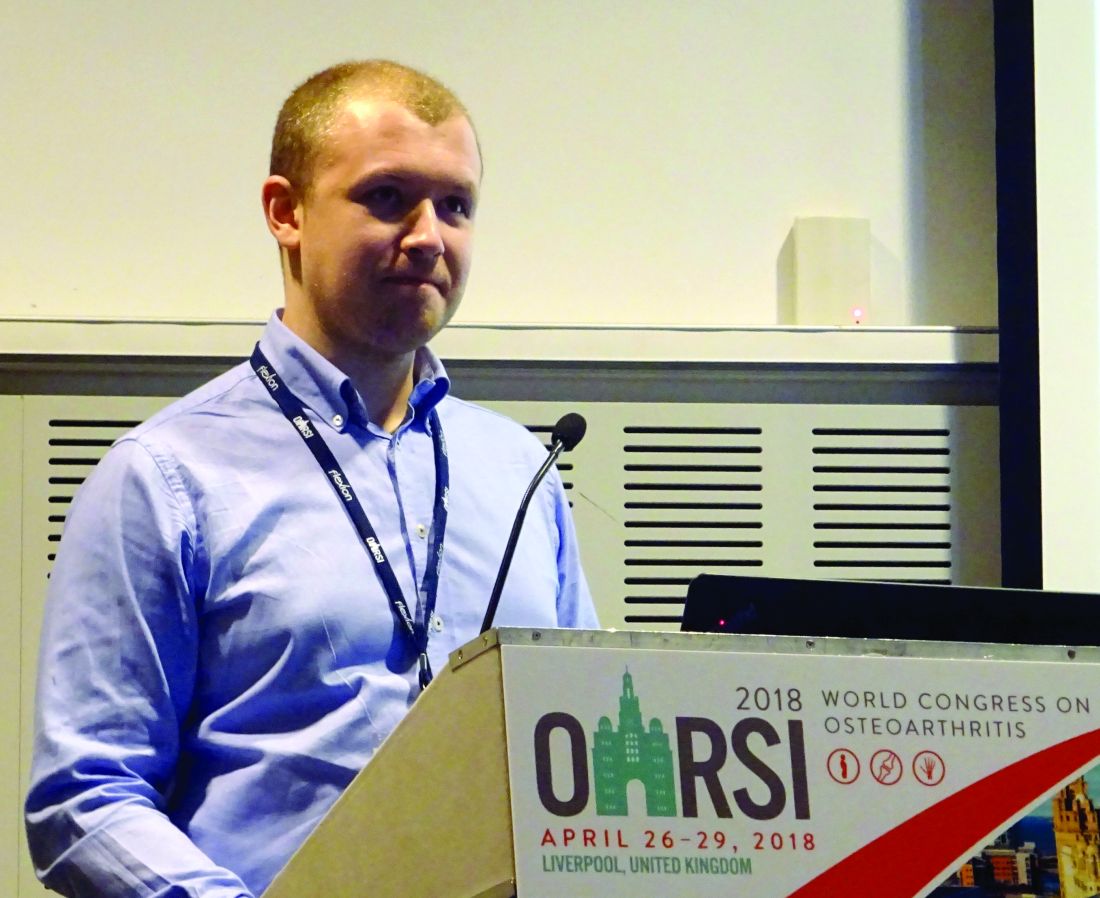
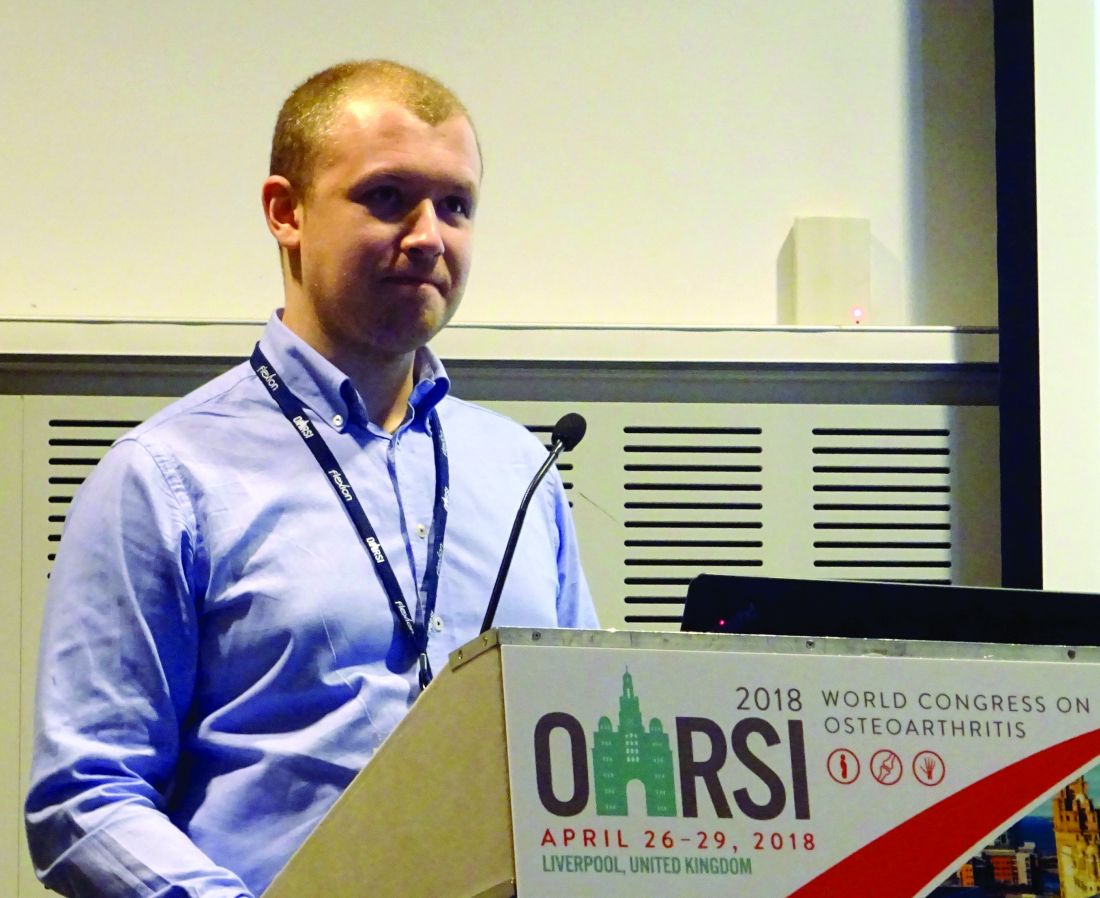
LIVERPOOL, ENGLAND – The measurement of acoustic emissions and kinetic instability of the knee could become a promising noninvasive way to detect osteoarthritis (OA), according to a recent study.
Researchers at the University of Oulu (Finland) have developed a prototype device that allows multimodal assessment of the sound and motion of the knee.
“The OA diagnostic chain has many problems, some modalities are very expensive, and some have a low sensitivity as well,” said study investigator Aleksei Tiulpin, MSc, at the World Congress on Osteoarthritis, referring to magnetic resonance imaging, x-ray imaging, and symptomatic assessment, respectively.
The investigational device that the research team has developed is worn like a brace around the knee and has microphones embedded within it to capture sound coming from the right and left sides of the knee. The device also uses two accelerometers, one placed on the thigh and one on the lower limb to measure movement simultaneously.
“We developed all the software and all the hardware ourselves for this project,” Mr. Tiulpin noted at the congress, sponsored by the Osteoarthritis Research Society International. “The acoustic and kinematic information was measured simultaneously.”
To see whether the prototype device was able to aid the diagnosis of OA, Mr. Tiulpin and his associates recruited 66 women aged 44-67 years old, roughly half of whom (51.5%) had radiographically confirmed knee OA of Kellgren-Lawrence grade 2 or higher.
The participants were asked to perform three exercise tests while wearing the device. First, they had to stand from a sitting position 10 times. Second, they were asked to extend the leg from the knee while sitting down (flexion-extension) 10 times. Third, and finally, they were asked to perform a one leg stand on the right leg twice.
For the acoustic data analysis, data from the standing phase of the sit-to-stand test and the extension phase of the flexion-extension tests were used. Mr. Tuilpin explained that the acoustic signals underwent processing to segment and filter them into candidate locations. The average sound patterns seen in the candidate locations were then analyzed, then a consistency analysis was undertaken. With this approach, inconsistent patterns of knee crepitation could be captured, Mr. Tiulpin explained.
Kinematic signals received from the movement sensors were used to determine the degree of knee instability. Higher signal magnitudes could potentially indicate stability problems, which can be quantified using signal power, Mr. Tiulpin’s slides stated.
A variety of statistical calculations were made to see how well the device might predict OA changes, and a model combining body mass index and age had an area under the curve of 84%, which suggested that it might be possible to improve OA detection with the addition of the device versus BMI and age alone.
“Our results indicated highly promising applications of the method,” Mr. Tiulpin suggested.
These findings are “very interesting,” commented one of the moderators of the session, Erwin van Spil, MD, of University Medical Center Utrecht (The Netherlands) as he opened up the floor to questions.
“I’ve had this question for years … what causes the clicks?” one delegate asked Mr. Tiulpin during discussion. He responded that it could be down to many things, one of which is cartilage components grinding against each other.
Dr. Spil, who was not involved in the study, commented in an interview that using acoustics in the detection of knee OA was still quite a novel concept. “It’s noninvasive, which is quite unique in our general approach, and it might enable an early diagnosis of OA, which is what we are aiming for.”
Although the study did have control subjects, it’s not clear at this point whether very early OA was being assessed, Dr. Spil suggested. “We did not have the opportunity to ask about the OA characteristics. I think they had radiographic OA, but we don’t know the grade and we were not informed about the clinical situation, so we don’t know if anyone had pain, for example.”
Mr. Tiulpin did not have any conflicts of interest to disclose.
SOURCE: Tiulpin A et al. Osteoarthritis Cartilage 2018;26(1):S40–S41.
LIVERPOOL, ENGLAND – The measurement of acoustic emissions and kinetic instability of the knee could become a promising noninvasive way to detect osteoarthritis (OA), according to a recent study.
Researchers at the University of Oulu (Finland) have developed a prototype device that allows multimodal assessment of the sound and motion of the knee.
“The OA diagnostic chain has many problems, some modalities are very expensive, and some have a low sensitivity as well,” said study investigator Aleksei Tiulpin, MSc, at the World Congress on Osteoarthritis, referring to magnetic resonance imaging, x-ray imaging, and symptomatic assessment, respectively.
The investigational device that the research team has developed is worn like a brace around the knee and has microphones embedded within it to capture sound coming from the right and left sides of the knee. The device also uses two accelerometers, one placed on the thigh and one on the lower limb to measure movement simultaneously.
“We developed all the software and all the hardware ourselves for this project,” Mr. Tiulpin noted at the congress, sponsored by the Osteoarthritis Research Society International. “The acoustic and kinematic information was measured simultaneously.”
To see whether the prototype device was able to aid the diagnosis of OA, Mr. Tiulpin and his associates recruited 66 women aged 44-67 years old, roughly half of whom (51.5%) had radiographically confirmed knee OA of Kellgren-Lawrence grade 2 or higher.
The participants were asked to perform three exercise tests while wearing the device. First, they had to stand from a sitting position 10 times. Second, they were asked to extend the leg from the knee while sitting down (flexion-extension) 10 times. Third, and finally, they were asked to perform a one leg stand on the right leg twice.
For the acoustic data analysis, data from the standing phase of the sit-to-stand test and the extension phase of the flexion-extension tests were used. Mr. Tuilpin explained that the acoustic signals underwent processing to segment and filter them into candidate locations. The average sound patterns seen in the candidate locations were then analyzed, then a consistency analysis was undertaken. With this approach, inconsistent patterns of knee crepitation could be captured, Mr. Tiulpin explained.
Kinematic signals received from the movement sensors were used to determine the degree of knee instability. Higher signal magnitudes could potentially indicate stability problems, which can be quantified using signal power, Mr. Tiulpin’s slides stated.
A variety of statistical calculations were made to see how well the device might predict OA changes, and a model combining body mass index and age had an area under the curve of 84%, which suggested that it might be possible to improve OA detection with the addition of the device versus BMI and age alone.
“Our results indicated highly promising applications of the method,” Mr. Tiulpin suggested.
These findings are “very interesting,” commented one of the moderators of the session, Erwin van Spil, MD, of University Medical Center Utrecht (The Netherlands) as he opened up the floor to questions.
“I’ve had this question for years … what causes the clicks?” one delegate asked Mr. Tiulpin during discussion. He responded that it could be down to many things, one of which is cartilage components grinding against each other.
Dr. Spil, who was not involved in the study, commented in an interview that using acoustics in the detection of knee OA was still quite a novel concept. “It’s noninvasive, which is quite unique in our general approach, and it might enable an early diagnosis of OA, which is what we are aiming for.”
Although the study did have control subjects, it’s not clear at this point whether very early OA was being assessed, Dr. Spil suggested. “We did not have the opportunity to ask about the OA characteristics. I think they had radiographic OA, but we don’t know the grade and we were not informed about the clinical situation, so we don’t know if anyone had pain, for example.”
Mr. Tiulpin did not have any conflicts of interest to disclose.
SOURCE: Tiulpin A et al. Osteoarthritis Cartilage 2018;26(1):S40–S41.
LIVERPOOL, ENGLAND – The measurement of acoustic emissions and kinetic instability of the knee could become a promising noninvasive way to detect osteoarthritis (OA), according to a recent study.
Researchers at the University of Oulu (Finland) have developed a prototype device that allows multimodal assessment of the sound and motion of the knee.
“The OA diagnostic chain has many problems, some modalities are very expensive, and some have a low sensitivity as well,” said study investigator Aleksei Tiulpin, MSc, at the World Congress on Osteoarthritis, referring to magnetic resonance imaging, x-ray imaging, and symptomatic assessment, respectively.
The investigational device that the research team has developed is worn like a brace around the knee and has microphones embedded within it to capture sound coming from the right and left sides of the knee. The device also uses two accelerometers, one placed on the thigh and one on the lower limb to measure movement simultaneously.
“We developed all the software and all the hardware ourselves for this project,” Mr. Tiulpin noted at the congress, sponsored by the Osteoarthritis Research Society International. “The acoustic and kinematic information was measured simultaneously.”
To see whether the prototype device was able to aid the diagnosis of OA, Mr. Tiulpin and his associates recruited 66 women aged 44-67 years old, roughly half of whom (51.5%) had radiographically confirmed knee OA of Kellgren-Lawrence grade 2 or higher.
The participants were asked to perform three exercise tests while wearing the device. First, they had to stand from a sitting position 10 times. Second, they were asked to extend the leg from the knee while sitting down (flexion-extension) 10 times. Third, and finally, they were asked to perform a one leg stand on the right leg twice.
For the acoustic data analysis, data from the standing phase of the sit-to-stand test and the extension phase of the flexion-extension tests were used. Mr. Tuilpin explained that the acoustic signals underwent processing to segment and filter them into candidate locations. The average sound patterns seen in the candidate locations were then analyzed, then a consistency analysis was undertaken. With this approach, inconsistent patterns of knee crepitation could be captured, Mr. Tiulpin explained.
Kinematic signals received from the movement sensors were used to determine the degree of knee instability. Higher signal magnitudes could potentially indicate stability problems, which can be quantified using signal power, Mr. Tiulpin’s slides stated.
A variety of statistical calculations were made to see how well the device might predict OA changes, and a model combining body mass index and age had an area under the curve of 84%, which suggested that it might be possible to improve OA detection with the addition of the device versus BMI and age alone.
“Our results indicated highly promising applications of the method,” Mr. Tiulpin suggested.
These findings are “very interesting,” commented one of the moderators of the session, Erwin van Spil, MD, of University Medical Center Utrecht (The Netherlands) as he opened up the floor to questions.
“I’ve had this question for years … what causes the clicks?” one delegate asked Mr. Tiulpin during discussion. He responded that it could be down to many things, one of which is cartilage components grinding against each other.
Dr. Spil, who was not involved in the study, commented in an interview that using acoustics in the detection of knee OA was still quite a novel concept. “It’s noninvasive, which is quite unique in our general approach, and it might enable an early diagnosis of OA, which is what we are aiming for.”
Although the study did have control subjects, it’s not clear at this point whether very early OA was being assessed, Dr. Spil suggested. “We did not have the opportunity to ask about the OA characteristics. I think they had radiographic OA, but we don’t know the grade and we were not informed about the clinical situation, so we don’t know if anyone had pain, for example.”
Mr. Tiulpin did not have any conflicts of interest to disclose.
SOURCE: Tiulpin A et al. Osteoarthritis Cartilage 2018;26(1):S40–S41.
REPORTING FROM OARSI 2018
Key clinical point: A prototype device showed a promising application as a noninvasive method to detect osteoarthritis.
Major finding: In a model that combined it with BMI and age, the device had an area under the curve of 84%, which suggested that this device might be able to improve OA detection.
Study details: Single-center study of 66 women aged 44-67 years old; 51.5% had radiographically confirmed OA of Kellgren-Lawrence grade 2 or higher.
Disclosures: Mr. Tiulpin did not have any conflicts of interest to disclose.
Source: Tiulpin A et al. Osteoarthritis Cartilage. 2018;26(1):S40–S41.
FDA Updates
First Anti-CGRP Monoclonal Antibody Gains FDA Approval
The FDA approved Aimovig (erenumab-aooe) for the preventive treatment of migraine in adults. Aimovig is the first FDA-approved preventive migraine treatment in a new class of drugs that blocks the activity of calcitonin gene-related peptide (CGRP). The treatment is given by once-monthly self-injections. Aimovig’s effectiveness was evaluated in three placebo-controlled clinical trials. The first included 955 patients with episodic migraine. Over six months, treated patients had, on average, one to two fewer monthly migraine days than controls. The second study included 577 patients with episodic migraine. Over three months, treated patients had, on average, one fewer migraine day per month than controls. The third stu
FDA Approves Gilenya for Pediatric Use
The FDA has approved Gilenya (fingolimod) for the treatment of children and adolescents between the ages of 10 and 18 with relapsing forms of multiple sclerosis (MS), making it the first disease-modifying therapy indicated for these young patients. The approval extends the age range for the drug, which was previously approved for patients age 18 and older with relapsing MS. Gilenya was granted Breakthrough Therapy status in December 2017 for this pediatric indication. The approval was supported by PARADIGMS, a double-blind, randomized, multicenter phase III safety and efficacy study of Gilenya versus interferon beta-1a. In this study, oral Gilenya reduced the annualized relapse rate by approximately 82% for as long as two years, compared with interferon beta-1a intramuscular injections in adolescents with relapsing MS. Gilenya is marketed by Novartis.
FDA Approves Treatment for CIDP
The FDA has approved Hizentra (immune globulin subcutaneous [human] 20% liquid) as the first subcutaneous immunoglobulin (SCIg) for the treatment of chronic inflammatory demyelinating polyneuropathy (CIDP) as maintenance therapy to prevent relapse of neuromuscular disability and impairment. The approval was based on the phase III PATH study, which was the largest controlled clinical study of patients with CIDP to date. The percentage of patients experiencing CIDP relapse or withdrawal for any other reason during SCIg treatment was significantly lower with Hizentra (38.6% on low-dose Hizentra [0.2 g/kg weekly], 32.8% on high-dose Hizentra [0.4 g/kg weekly]) than with placebo (63.2%). Treated patients reported fewer systemic adverse reactions per infusion, compared with IVIg treatment (2.7% vs 9.8%, respectively). Approximately 93% of infusions caused no adverse reactions. Hizentra is marketed by CSL Behring.
DBS Device Approved for Refractory Epilepsy
The FDA granted premarket approval for Medtronic’s deep brain stimulation (DBS) therapy as adjunctive treatment for reducing the frequency of partial-onset seizures in patients age 18 or older who are refractory to three or more antiepileptic drugs. The approval is based on the blinded phase and seven-year follow-up data from the SANTE trial, which included 110 patients. The median total seizure frequency reduction from baseline was 40.4% in implanted patients versus 14.5% for the placebo group at three months and 75% at seven years with ongoing open-label therapy. Twenty subjects (18%) had at least one six-month seizure-free period between implant and year seven, including eight subjects (7%) who were seizure-free for the preceding two years. Seizure severity and quality-of-life scales showed statistically significant improvement from baseline to year seven. No significant cognitive declines or worsening of depression were noted.
FDA Issues Warning About Lamictal
The FDA recently warned that Lamictal (lamotrigine), frequently used for treating seizures and bipolar disorder, can cause a rare but serious immune system reaction called hemophagocytic lymphohistiocytosis (HLH), which can be life-threatening. HLH typically presents as a persistent fever, usually greater than 101° F, and can lead to severe problems with blood cells and vital organs. Health care professionals should be aware that prompt recognition and early treatment are important for improving HLH outcomes and decreasing mortality. Diagnosis is often complicated because early signs and symptoms, such as rash and fever, are not specific. HLH also may be confused with other serious immune-related adverse reactions such as drug reaction with eosinophilia and systemic symptoms (DRESS). The FDA is requiring a change to the drug’s prescribing information and drug labeling.
First Anti-CGRP Monoclonal Antibody Gains FDA Approval
The FDA approved Aimovig (erenumab-aooe) for the preventive treatment of migraine in adults. Aimovig is the first FDA-approved preventive migraine treatment in a new class of drugs that blocks the activity of calcitonin gene-related peptide (CGRP). The treatment is given by once-monthly self-injections. Aimovig’s effectiveness was evaluated in three placebo-controlled clinical trials. The first included 955 patients with episodic migraine. Over six months, treated patients had, on average, one to two fewer monthly migraine days than controls. The second study included 577 patients with episodic migraine. Over three months, treated patients had, on average, one fewer migraine day per month than controls. The third stu
FDA Approves Gilenya for Pediatric Use
The FDA has approved Gilenya (fingolimod) for the treatment of children and adolescents between the ages of 10 and 18 with relapsing forms of multiple sclerosis (MS), making it the first disease-modifying therapy indicated for these young patients. The approval extends the age range for the drug, which was previously approved for patients age 18 and older with relapsing MS. Gilenya was granted Breakthrough Therapy status in December 2017 for this pediatric indication. The approval was supported by PARADIGMS, a double-blind, randomized, multicenter phase III safety and efficacy study of Gilenya versus interferon beta-1a. In this study, oral Gilenya reduced the annualized relapse rate by approximately 82% for as long as two years, compared with interferon beta-1a intramuscular injections in adolescents with relapsing MS. Gilenya is marketed by Novartis.
FDA Approves Treatment for CIDP
The FDA has approved Hizentra (immune globulin subcutaneous [human] 20% liquid) as the first subcutaneous immunoglobulin (SCIg) for the treatment of chronic inflammatory demyelinating polyneuropathy (CIDP) as maintenance therapy to prevent relapse of neuromuscular disability and impairment. The approval was based on the phase III PATH study, which was the largest controlled clinical study of patients with CIDP to date. The percentage of patients experiencing CIDP relapse or withdrawal for any other reason during SCIg treatment was significantly lower with Hizentra (38.6% on low-dose Hizentra [0.2 g/kg weekly], 32.8% on high-dose Hizentra [0.4 g/kg weekly]) than with placebo (63.2%). Treated patients reported fewer systemic adverse reactions per infusion, compared with IVIg treatment (2.7% vs 9.8%, respectively). Approximately 93% of infusions caused no adverse reactions. Hizentra is marketed by CSL Behring.
DBS Device Approved for Refractory Epilepsy
The FDA granted premarket approval for Medtronic’s deep brain stimulation (DBS) therapy as adjunctive treatment for reducing the frequency of partial-onset seizures in patients age 18 or older who are refractory to three or more antiepileptic drugs. The approval is based on the blinded phase and seven-year follow-up data from the SANTE trial, which included 110 patients. The median total seizure frequency reduction from baseline was 40.4% in implanted patients versus 14.5% for the placebo group at three months and 75% at seven years with ongoing open-label therapy. Twenty subjects (18%) had at least one six-month seizure-free period between implant and year seven, including eight subjects (7%) who were seizure-free for the preceding two years. Seizure severity and quality-of-life scales showed statistically significant improvement from baseline to year seven. No significant cognitive declines or worsening of depression were noted.
FDA Issues Warning About Lamictal
The FDA recently warned that Lamictal (lamotrigine), frequently used for treating seizures and bipolar disorder, can cause a rare but serious immune system reaction called hemophagocytic lymphohistiocytosis (HLH), which can be life-threatening. HLH typically presents as a persistent fever, usually greater than 101° F, and can lead to severe problems with blood cells and vital organs. Health care professionals should be aware that prompt recognition and early treatment are important for improving HLH outcomes and decreasing mortality. Diagnosis is often complicated because early signs and symptoms, such as rash and fever, are not specific. HLH also may be confused with other serious immune-related adverse reactions such as drug reaction with eosinophilia and systemic symptoms (DRESS). The FDA is requiring a change to the drug’s prescribing information and drug labeling.
First Anti-CGRP Monoclonal Antibody Gains FDA Approval
The FDA approved Aimovig (erenumab-aooe) for the preventive treatment of migraine in adults. Aimovig is the first FDA-approved preventive migraine treatment in a new class of drugs that blocks the activity of calcitonin gene-related peptide (CGRP). The treatment is given by once-monthly self-injections. Aimovig’s effectiveness was evaluated in three placebo-controlled clinical trials. The first included 955 patients with episodic migraine. Over six months, treated patients had, on average, one to two fewer monthly migraine days than controls. The second study included 577 patients with episodic migraine. Over three months, treated patients had, on average, one fewer migraine day per month than controls. The third stu
FDA Approves Gilenya for Pediatric Use
The FDA has approved Gilenya (fingolimod) for the treatment of children and adolescents between the ages of 10 and 18 with relapsing forms of multiple sclerosis (MS), making it the first disease-modifying therapy indicated for these young patients. The approval extends the age range for the drug, which was previously approved for patients age 18 and older with relapsing MS. Gilenya was granted Breakthrough Therapy status in December 2017 for this pediatric indication. The approval was supported by PARADIGMS, a double-blind, randomized, multicenter phase III safety and efficacy study of Gilenya versus interferon beta-1a. In this study, oral Gilenya reduced the annualized relapse rate by approximately 82% for as long as two years, compared with interferon beta-1a intramuscular injections in adolescents with relapsing MS. Gilenya is marketed by Novartis.
FDA Approves Treatment for CIDP
The FDA has approved Hizentra (immune globulin subcutaneous [human] 20% liquid) as the first subcutaneous immunoglobulin (SCIg) for the treatment of chronic inflammatory demyelinating polyneuropathy (CIDP) as maintenance therapy to prevent relapse of neuromuscular disability and impairment. The approval was based on the phase III PATH study, which was the largest controlled clinical study of patients with CIDP to date. The percentage of patients experiencing CIDP relapse or withdrawal for any other reason during SCIg treatment was significantly lower with Hizentra (38.6% on low-dose Hizentra [0.2 g/kg weekly], 32.8% on high-dose Hizentra [0.4 g/kg weekly]) than with placebo (63.2%). Treated patients reported fewer systemic adverse reactions per infusion, compared with IVIg treatment (2.7% vs 9.8%, respectively). Approximately 93% of infusions caused no adverse reactions. Hizentra is marketed by CSL Behring.
DBS Device Approved for Refractory Epilepsy
The FDA granted premarket approval for Medtronic’s deep brain stimulation (DBS) therapy as adjunctive treatment for reducing the frequency of partial-onset seizures in patients age 18 or older who are refractory to three or more antiepileptic drugs. The approval is based on the blinded phase and seven-year follow-up data from the SANTE trial, which included 110 patients. The median total seizure frequency reduction from baseline was 40.4% in implanted patients versus 14.5% for the placebo group at three months and 75% at seven years with ongoing open-label therapy. Twenty subjects (18%) had at least one six-month seizure-free period between implant and year seven, including eight subjects (7%) who were seizure-free for the preceding two years. Seizure severity and quality-of-life scales showed statistically significant improvement from baseline to year seven. No significant cognitive declines or worsening of depression were noted.
FDA Issues Warning About Lamictal
The FDA recently warned that Lamictal (lamotrigine), frequently used for treating seizures and bipolar disorder, can cause a rare but serious immune system reaction called hemophagocytic lymphohistiocytosis (HLH), which can be life-threatening. HLH typically presents as a persistent fever, usually greater than 101° F, and can lead to severe problems with blood cells and vital organs. Health care professionals should be aware that prompt recognition and early treatment are important for improving HLH outcomes and decreasing mortality. Diagnosis is often complicated because early signs and symptoms, such as rash and fever, are not specific. HLH also may be confused with other serious immune-related adverse reactions such as drug reaction with eosinophilia and systemic symptoms (DRESS). The FDA is requiring a change to the drug’s prescribing information and drug labeling.
Register for the Vascular Annual Meeting Today
The 2018 Vascular Annual Meeting is less than a month away. Join colleagues and friends in Boston for this year’s VAM, June 20 to 23. Scientific sessions are June 21-23 and the Exhibit Hall is open June 21 to 22. Click here to register and here to obtain housing (the deadline for housing currently is today, May 22). To get a full schedule and begin creating your own personal agenda, complete with marking sessions as favorites, see the VAM Planner.
The 2018 Vascular Annual Meeting is less than a month away. Join colleagues and friends in Boston for this year’s VAM, June 20 to 23. Scientific sessions are June 21-23 and the Exhibit Hall is open June 21 to 22. Click here to register and here to obtain housing (the deadline for housing currently is today, May 22). To get a full schedule and begin creating your own personal agenda, complete with marking sessions as favorites, see the VAM Planner.
The 2018 Vascular Annual Meeting is less than a month away. Join colleagues and friends in Boston for this year’s VAM, June 20 to 23. Scientific sessions are June 21-23 and the Exhibit Hall is open June 21 to 22. Click here to register and here to obtain housing (the deadline for housing currently is today, May 22). To get a full schedule and begin creating your own personal agenda, complete with marking sessions as favorites, see the VAM Planner.
Trump proposes cutting Planned Parenthood funds
The planned revival of a policy dating to Ronald Reagan’s presidency may finally present a way for President Donald Trump to fulfill his campaign promise to “defund” Planned Parenthood. Or at least to evict it from the federal family planning program, where it provides care to more than 40% of that program’s 4 million patients.
The rules now under review, according to Trump administration officials, would require facilities receiving federal family planning funds to be physically separate from those that perform abortion; would eliminate the requirement that women with unintended pregnancies be counseled on their full range of reproductive options; and would ban abortion referrals.
All those changes would particularly affect Planned Parenthood.
Planned Parenthood, which provides a broad array of reproductive health services to women and men, also provides abortion services using nonfederal funds. Cutting off funding has been the top priority for anti-abortion groups, which supported candidate Trump.
“A win like this would immediately disentangle taxpayers from the abortion business and energize the grassroots as we head into the critical midterm elections,” Marjorie Dannenfelser, president of the anti-abortion Susan B. Anthony List, said in a statement.
In a conference call with reporters, Planned Parenthood officials said they would fight the new rules.
“We’ve been very clear, Planned Parenthood has an unwavering commitment to ensuring everyone has access to the full range of reproductive health care, and that includes abortion,” said Dawn Laguens, executive vice president of the Planned Parenthood Federation of America.
Here is a guide to what the proposal could do and what it could mean for Planned Parenthood and the family planning program:
What is Title X?
The federal family planning program, known as “Title Ten,” is named for its section in the federal Public Health Service Act. It became law in 1970, 3 years before the Supreme Court legalized abortion in Roe v Wade.
The original bill was sponsored by then Rep. George H.W. Bush (R-Texas) and signed into law by President Richard Nixon.
The program provides wellness exams and comprehensive contraceptive services, as well as screenings for cancer and sexually transmitted diseases for both women and men.
In 2016, the most recent year for which statistics have been published, Title X served 4 million patients at just under 4,000 sites.
Title X patients are overwhelmingly young, female, and low-income. An estimated 11% of Title X patients in 2016 were male; two-thirds of patients were under age 30; and nearly two-thirds had income below the federal poverty line.
What is Planned Parenthood’s relationship to Title X and Medicaid?
Planned Parenthood affiliates account for about 13% of total Title X sites but serve an estimated 40% of its patients. Only about half of Planned Parenthood affiliates perform abortions, although the organization in its entirety is the nation’s leading abortion provider.
Planned Parenthood also gets much more federal funding for services provided to patients on the Medicaid program (although not for abortion) than it does through Title X.
Eliminating Medicaid funding for Planned Parenthood has proved more difficult for lawmakers opposed to the organization because the federal Medicaid law includes the right for patients to select their providers. Changing that also would require a 60-vote majority in the Senate. So that particular line of funding is likely not at risk.
While opponents of federal funding for Planned Parenthood have said that other safety-net clinics could make up the difference if Planned Parenthood no longer participates in Title X, several studies have suggested that in many remote areas Planned Parenthood is the only provider of family planning services and the only provider that regularly stocks all methods of birth control.
Texas, Iowa, and Missouri in recent years have stopped offering family planning services through a special Medicaid program to keep from funding Planned Parenthood. Texas is seeking a waiver from the Trump administration so that its program banning abortion providers could still receive federal funding. No decision has been made yet, federal officials said.
Why is Planned Parenthood’s involvement with Title X controversial?
Even though Planned Parenthood cannot use federal funding for abortions, anti-abortion groups claim that federal funding is “fungible” and there is no way to ensure that some of the funding provided for other services does not cross-subsidize abortion services.
Planned Parenthood has also been a longtime public target for anti-abortion forces because it is such a visible provider and vocal proponent of legal abortion services.
In the early 1980s, the Reagan administration tried to separate the program from its federal funding by requiring parental permission for teens to obtain birth control. That was followed by efforts to eliminate abortion counseling.
Starting in 2011, undercover groups accused the organization of ignoring sex traffickers and selling fetal body parts in an effort to get the organization defunded. Planned Parenthood denies the allegations.
What happened the last time an administration tried to move Planned Parenthood out of Title X?
In 1987, the Reagan administration proposed what came to be known as the “gag rule.” Though the administration’s new proposal is not yet public, because the details are still under review by the Office of Management and Budget, the White House released a summary, saying the new rule will be similar although not identical to the Reagan-era proposal.
The original gag rule would have forbidden Title X providers from abortion counseling or referring patients for abortions, required physical separation of Title X and abortion-providing facilities and forbidden recipients from using nonfederal funds for lobbying, distributing information or in any way advocating or encouraging abortion. (The Planned Parenthood Federation of America, the umbrella group for local affiliates, has a separate political and advocacy arm, the Planned Parenthood Action Fund.)
Those rules were the subject of heated congressional debate through most of the George H.W. Bush administration and were upheld in a 5-4 Supreme Court ruling in 1991, Rust v Sullivan.
Even then, the gag rule did not go into effect because subsequent efforts to relax the rules somewhat to allow doctors (but not other health professionals) to counsel patients on the availability of abortion created another round of legal fights.
Eventually the rule was in effect for only about a month before it was again blocked by a U.S. appeals court. President Bill Clinton canceled the rules by executive order on his second day in office, and no other president tried to revive them until now.
How is the Trump administration’s proposal different from earlier rules?
According to the summary of the new proposal, released May 18, it will require physical separation of family planning and abortion facilities, repeal current counseling requirements, and ban abortion referrals.
One of the biggest differences, however, is that the new rules will not explicitly forbid abortion counseling by Title X providers.
But Planned Parenthood officials say that allowing counseling while banning referrals is a distinction without a difference.
Kashif Syed, a senior policy analyst for the organization said: “Blocking doctors from telling a patient where they can get safe and legal care in this country is the definition of a gag rule.”
What happens next?
All proposed rules are reviewed by the Office of Management and Budget. Sometimes they emerge and are published in a few days; sometimes they are rewritten, and it takes months.
Meanwhile, Planned Parenthood officials said they will not know if they will take legal action until they see the final language of the rule. But they say they do plan to use the regulatory process to fight the changes that have been made public so far.
KHN’s coverage of women’s health care issues is supported in part by The David and Lucile Packard Foundation. Kaiser Health News is a nonprofit national health policy news service. It is an editorially independent program of the Henry J. Kaiser Family Foundation that is not affiliated with Kaiser Permanente.
The planned revival of a policy dating to Ronald Reagan’s presidency may finally present a way for President Donald Trump to fulfill his campaign promise to “defund” Planned Parenthood. Or at least to evict it from the federal family planning program, where it provides care to more than 40% of that program’s 4 million patients.
The rules now under review, according to Trump administration officials, would require facilities receiving federal family planning funds to be physically separate from those that perform abortion; would eliminate the requirement that women with unintended pregnancies be counseled on their full range of reproductive options; and would ban abortion referrals.
All those changes would particularly affect Planned Parenthood.
Planned Parenthood, which provides a broad array of reproductive health services to women and men, also provides abortion services using nonfederal funds. Cutting off funding has been the top priority for anti-abortion groups, which supported candidate Trump.
“A win like this would immediately disentangle taxpayers from the abortion business and energize the grassroots as we head into the critical midterm elections,” Marjorie Dannenfelser, president of the anti-abortion Susan B. Anthony List, said in a statement.
In a conference call with reporters, Planned Parenthood officials said they would fight the new rules.
“We’ve been very clear, Planned Parenthood has an unwavering commitment to ensuring everyone has access to the full range of reproductive health care, and that includes abortion,” said Dawn Laguens, executive vice president of the Planned Parenthood Federation of America.
Here is a guide to what the proposal could do and what it could mean for Planned Parenthood and the family planning program:
What is Title X?
The federal family planning program, known as “Title Ten,” is named for its section in the federal Public Health Service Act. It became law in 1970, 3 years before the Supreme Court legalized abortion in Roe v Wade.
The original bill was sponsored by then Rep. George H.W. Bush (R-Texas) and signed into law by President Richard Nixon.
The program provides wellness exams and comprehensive contraceptive services, as well as screenings for cancer and sexually transmitted diseases for both women and men.
In 2016, the most recent year for which statistics have been published, Title X served 4 million patients at just under 4,000 sites.
Title X patients are overwhelmingly young, female, and low-income. An estimated 11% of Title X patients in 2016 were male; two-thirds of patients were under age 30; and nearly two-thirds had income below the federal poverty line.
What is Planned Parenthood’s relationship to Title X and Medicaid?
Planned Parenthood affiliates account for about 13% of total Title X sites but serve an estimated 40% of its patients. Only about half of Planned Parenthood affiliates perform abortions, although the organization in its entirety is the nation’s leading abortion provider.
Planned Parenthood also gets much more federal funding for services provided to patients on the Medicaid program (although not for abortion) than it does through Title X.
Eliminating Medicaid funding for Planned Parenthood has proved more difficult for lawmakers opposed to the organization because the federal Medicaid law includes the right for patients to select their providers. Changing that also would require a 60-vote majority in the Senate. So that particular line of funding is likely not at risk.
While opponents of federal funding for Planned Parenthood have said that other safety-net clinics could make up the difference if Planned Parenthood no longer participates in Title X, several studies have suggested that in many remote areas Planned Parenthood is the only provider of family planning services and the only provider that regularly stocks all methods of birth control.
Texas, Iowa, and Missouri in recent years have stopped offering family planning services through a special Medicaid program to keep from funding Planned Parenthood. Texas is seeking a waiver from the Trump administration so that its program banning abortion providers could still receive federal funding. No decision has been made yet, federal officials said.
Why is Planned Parenthood’s involvement with Title X controversial?
Even though Planned Parenthood cannot use federal funding for abortions, anti-abortion groups claim that federal funding is “fungible” and there is no way to ensure that some of the funding provided for other services does not cross-subsidize abortion services.
Planned Parenthood has also been a longtime public target for anti-abortion forces because it is such a visible provider and vocal proponent of legal abortion services.
In the early 1980s, the Reagan administration tried to separate the program from its federal funding by requiring parental permission for teens to obtain birth control. That was followed by efforts to eliminate abortion counseling.
Starting in 2011, undercover groups accused the organization of ignoring sex traffickers and selling fetal body parts in an effort to get the organization defunded. Planned Parenthood denies the allegations.
What happened the last time an administration tried to move Planned Parenthood out of Title X?
In 1987, the Reagan administration proposed what came to be known as the “gag rule.” Though the administration’s new proposal is not yet public, because the details are still under review by the Office of Management and Budget, the White House released a summary, saying the new rule will be similar although not identical to the Reagan-era proposal.
The original gag rule would have forbidden Title X providers from abortion counseling or referring patients for abortions, required physical separation of Title X and abortion-providing facilities and forbidden recipients from using nonfederal funds for lobbying, distributing information or in any way advocating or encouraging abortion. (The Planned Parenthood Federation of America, the umbrella group for local affiliates, has a separate political and advocacy arm, the Planned Parenthood Action Fund.)
Those rules were the subject of heated congressional debate through most of the George H.W. Bush administration and were upheld in a 5-4 Supreme Court ruling in 1991, Rust v Sullivan.
Even then, the gag rule did not go into effect because subsequent efforts to relax the rules somewhat to allow doctors (but not other health professionals) to counsel patients on the availability of abortion created another round of legal fights.
Eventually the rule was in effect for only about a month before it was again blocked by a U.S. appeals court. President Bill Clinton canceled the rules by executive order on his second day in office, and no other president tried to revive them until now.
How is the Trump administration’s proposal different from earlier rules?
According to the summary of the new proposal, released May 18, it will require physical separation of family planning and abortion facilities, repeal current counseling requirements, and ban abortion referrals.
One of the biggest differences, however, is that the new rules will not explicitly forbid abortion counseling by Title X providers.
But Planned Parenthood officials say that allowing counseling while banning referrals is a distinction without a difference.
Kashif Syed, a senior policy analyst for the organization said: “Blocking doctors from telling a patient where they can get safe and legal care in this country is the definition of a gag rule.”
What happens next?
All proposed rules are reviewed by the Office of Management and Budget. Sometimes they emerge and are published in a few days; sometimes they are rewritten, and it takes months.
Meanwhile, Planned Parenthood officials said they will not know if they will take legal action until they see the final language of the rule. But they say they do plan to use the regulatory process to fight the changes that have been made public so far.
KHN’s coverage of women’s health care issues is supported in part by The David and Lucile Packard Foundation. Kaiser Health News is a nonprofit national health policy news service. It is an editorially independent program of the Henry J. Kaiser Family Foundation that is not affiliated with Kaiser Permanente.
The planned revival of a policy dating to Ronald Reagan’s presidency may finally present a way for President Donald Trump to fulfill his campaign promise to “defund” Planned Parenthood. Or at least to evict it from the federal family planning program, where it provides care to more than 40% of that program’s 4 million patients.
The rules now under review, according to Trump administration officials, would require facilities receiving federal family planning funds to be physically separate from those that perform abortion; would eliminate the requirement that women with unintended pregnancies be counseled on their full range of reproductive options; and would ban abortion referrals.
All those changes would particularly affect Planned Parenthood.
Planned Parenthood, which provides a broad array of reproductive health services to women and men, also provides abortion services using nonfederal funds. Cutting off funding has been the top priority for anti-abortion groups, which supported candidate Trump.
“A win like this would immediately disentangle taxpayers from the abortion business and energize the grassroots as we head into the critical midterm elections,” Marjorie Dannenfelser, president of the anti-abortion Susan B. Anthony List, said in a statement.
In a conference call with reporters, Planned Parenthood officials said they would fight the new rules.
“We’ve been very clear, Planned Parenthood has an unwavering commitment to ensuring everyone has access to the full range of reproductive health care, and that includes abortion,” said Dawn Laguens, executive vice president of the Planned Parenthood Federation of America.
Here is a guide to what the proposal could do and what it could mean for Planned Parenthood and the family planning program:
What is Title X?
The federal family planning program, known as “Title Ten,” is named for its section in the federal Public Health Service Act. It became law in 1970, 3 years before the Supreme Court legalized abortion in Roe v Wade.
The original bill was sponsored by then Rep. George H.W. Bush (R-Texas) and signed into law by President Richard Nixon.
The program provides wellness exams and comprehensive contraceptive services, as well as screenings for cancer and sexually transmitted diseases for both women and men.
In 2016, the most recent year for which statistics have been published, Title X served 4 million patients at just under 4,000 sites.
Title X patients are overwhelmingly young, female, and low-income. An estimated 11% of Title X patients in 2016 were male; two-thirds of patients were under age 30; and nearly two-thirds had income below the federal poverty line.
What is Planned Parenthood’s relationship to Title X and Medicaid?
Planned Parenthood affiliates account for about 13% of total Title X sites but serve an estimated 40% of its patients. Only about half of Planned Parenthood affiliates perform abortions, although the organization in its entirety is the nation’s leading abortion provider.
Planned Parenthood also gets much more federal funding for services provided to patients on the Medicaid program (although not for abortion) than it does through Title X.
Eliminating Medicaid funding for Planned Parenthood has proved more difficult for lawmakers opposed to the organization because the federal Medicaid law includes the right for patients to select their providers. Changing that also would require a 60-vote majority in the Senate. So that particular line of funding is likely not at risk.
While opponents of federal funding for Planned Parenthood have said that other safety-net clinics could make up the difference if Planned Parenthood no longer participates in Title X, several studies have suggested that in many remote areas Planned Parenthood is the only provider of family planning services and the only provider that regularly stocks all methods of birth control.
Texas, Iowa, and Missouri in recent years have stopped offering family planning services through a special Medicaid program to keep from funding Planned Parenthood. Texas is seeking a waiver from the Trump administration so that its program banning abortion providers could still receive federal funding. No decision has been made yet, federal officials said.
Why is Planned Parenthood’s involvement with Title X controversial?
Even though Planned Parenthood cannot use federal funding for abortions, anti-abortion groups claim that federal funding is “fungible” and there is no way to ensure that some of the funding provided for other services does not cross-subsidize abortion services.
Planned Parenthood has also been a longtime public target for anti-abortion forces because it is such a visible provider and vocal proponent of legal abortion services.
In the early 1980s, the Reagan administration tried to separate the program from its federal funding by requiring parental permission for teens to obtain birth control. That was followed by efforts to eliminate abortion counseling.
Starting in 2011, undercover groups accused the organization of ignoring sex traffickers and selling fetal body parts in an effort to get the organization defunded. Planned Parenthood denies the allegations.
What happened the last time an administration tried to move Planned Parenthood out of Title X?
In 1987, the Reagan administration proposed what came to be known as the “gag rule.” Though the administration’s new proposal is not yet public, because the details are still under review by the Office of Management and Budget, the White House released a summary, saying the new rule will be similar although not identical to the Reagan-era proposal.
The original gag rule would have forbidden Title X providers from abortion counseling or referring patients for abortions, required physical separation of Title X and abortion-providing facilities and forbidden recipients from using nonfederal funds for lobbying, distributing information or in any way advocating or encouraging abortion. (The Planned Parenthood Federation of America, the umbrella group for local affiliates, has a separate political and advocacy arm, the Planned Parenthood Action Fund.)
Those rules were the subject of heated congressional debate through most of the George H.W. Bush administration and were upheld in a 5-4 Supreme Court ruling in 1991, Rust v Sullivan.
Even then, the gag rule did not go into effect because subsequent efforts to relax the rules somewhat to allow doctors (but not other health professionals) to counsel patients on the availability of abortion created another round of legal fights.
Eventually the rule was in effect for only about a month before it was again blocked by a U.S. appeals court. President Bill Clinton canceled the rules by executive order on his second day in office, and no other president tried to revive them until now.
How is the Trump administration’s proposal different from earlier rules?
According to the summary of the new proposal, released May 18, it will require physical separation of family planning and abortion facilities, repeal current counseling requirements, and ban abortion referrals.
One of the biggest differences, however, is that the new rules will not explicitly forbid abortion counseling by Title X providers.
But Planned Parenthood officials say that allowing counseling while banning referrals is a distinction without a difference.
Kashif Syed, a senior policy analyst for the organization said: “Blocking doctors from telling a patient where they can get safe and legal care in this country is the definition of a gag rule.”
What happens next?
All proposed rules are reviewed by the Office of Management and Budget. Sometimes they emerge and are published in a few days; sometimes they are rewritten, and it takes months.
Meanwhile, Planned Parenthood officials said they will not know if they will take legal action until they see the final language of the rule. But they say they do plan to use the regulatory process to fight the changes that have been made public so far.
KHN’s coverage of women’s health care issues is supported in part by The David and Lucile Packard Foundation. Kaiser Health News is a nonprofit national health policy news service. It is an editorially independent program of the Henry J. Kaiser Family Foundation that is not affiliated with Kaiser Permanente.
Ropivacaine called top anesthesia for nail surgery
CHICAGO – Ropivacaine has a fast onset of action, longer duration than either lidocaine or bupivacaine, and it’s the only one of the three that’s inherently vasoconstrictive. For Brienne Cressey, MD, those features make ropivacaine the local anesthetic of choice in performing nail surgery.
“Local anesthesia is really key for nail surgery. If you don’t have good anesthesia it’s not a good experience for either the surgeon or the patient,” she observed at the annual meeting of the American College of Mohs Surgery.

Lidocaine has a fast onset – less than 1 minute – but a problematic short duration of 30-120 minutes. Bupivacaine has the disadvantage of a slow onset of up to 5 minutes, albeit with a longer duration of anesthesia at 2-4 hours. Ropivacaine has a fast onset, plus a duration of up to 8 hours. And unlike lidocaine and bupivacaine, which are vasodilatory, ropivacaine is vasoconstrictive.
“With lidocaine, you get a lot of blood right after you take off your tourniquet. With ropivacaine, you get really nice reperfusion, but it’s not too much. You take off the tourniquet, check to see you’ve got reperfusion, then you add a little ropivacaine – about 0.5 mL – on either side of the base of the distal phalanx. It stops the bleeding immediately and you can easily put on a pressure dressing. It’s a nice way to get the patient over the hump of those first hours of pain and lets them drive home in comfort,” explained Dr. Cressey, a dermatologist working in a group practice at Dermatology Professionals in East Greenwich, R.I.
Ropivacaine is less cardiotoxic than bupivacaine. And ropivacaine offers an additional advantage: Its pH is such that no buffering is necessary. “Ropivacaine doesn’t require any compounding. You can just use it at 1% straight out of the bottle. That’s what we do in our office, and we’ve had very good experience with it,” according to the dermatologist.
Achieving smooth sailing with local anesthesia
Dr. Cressey delivers ropivacaine slowly through a 30-gauge needle, which makes for a smaller, less painful puncture. She utilizes a topical cold spray, and places a vibrating machine as a distractant proximal to where she is injecting. She keeps the anesthetic at room temperature or warms it to body temperature in a water bath as another means of reducing the pain of injection.
The distal digital block
This is a cross between a traditional proximal digital block and a wing block. It works well for the second, third, and fourth digits, which are mostly volar dominant. The block bathes the volar nerve branch in anesthesia at the midline of the finger or toe.
Dr. Cressey begins by injecting ropivacaine proximal and lateral to the junction of the proximal nail fold and lateral nail fold. After creating a dermal wheal, she directs her needle perpendicularly downward toward the finger or toe pad, injecting 1-4 mL of anesthesia, depending upon digit size. Visible blanching will progress digitally. If resistance is encountered, it suggests the needle has penetrated a ligament or other fibrous tissue. Simply withdraw the needle and continue injecting.
“What’s nice about the distal digital block is you get an immediate effect, and there’s good hemostasis during the procedure as well,” she said.
Dr. Cressey reported no financial conflicts regarding her presentation.
CHICAGO – Ropivacaine has a fast onset of action, longer duration than either lidocaine or bupivacaine, and it’s the only one of the three that’s inherently vasoconstrictive. For Brienne Cressey, MD, those features make ropivacaine the local anesthetic of choice in performing nail surgery.
“Local anesthesia is really key for nail surgery. If you don’t have good anesthesia it’s not a good experience for either the surgeon or the patient,” she observed at the annual meeting of the American College of Mohs Surgery.
Lidocaine has a fast onset – less than 1 minute – but a problematic short duration of 30-120 minutes. Bupivacaine has the disadvantage of a slow onset of up to 5 minutes, albeit with a longer duration of anesthesia at 2-4 hours. Ropivacaine has a fast onset, plus a duration of up to 8 hours. And unlike lidocaine and bupivacaine, which are vasodilatory, ropivacaine is vasoconstrictive.
“With lidocaine, you get a lot of blood right after you take off your tourniquet. With ropivacaine, you get really nice reperfusion, but it’s not too much. You take off the tourniquet, check to see you’ve got reperfusion, then you add a little ropivacaine – about 0.5 mL – on either side of the base of the distal phalanx. It stops the bleeding immediately and you can easily put on a pressure dressing. It’s a nice way to get the patient over the hump of those first hours of pain and lets them drive home in comfort,” explained Dr. Cressey, a dermatologist working in a group practice at Dermatology Professionals in East Greenwich, R.I.
Ropivacaine is less cardiotoxic than bupivacaine. And ropivacaine offers an additional advantage: Its pH is such that no buffering is necessary. “Ropivacaine doesn’t require any compounding. You can just use it at 1% straight out of the bottle. That’s what we do in our office, and we’ve had very good experience with it,” according to the dermatologist.
Achieving smooth sailing with local anesthesia
Dr. Cressey delivers ropivacaine slowly through a 30-gauge needle, which makes for a smaller, less painful puncture. She utilizes a topical cold spray, and places a vibrating machine as a distractant proximal to where she is injecting. She keeps the anesthetic at room temperature or warms it to body temperature in a water bath as another means of reducing the pain of injection.
The distal digital block
This is a cross between a traditional proximal digital block and a wing block. It works well for the second, third, and fourth digits, which are mostly volar dominant. The block bathes the volar nerve branch in anesthesia at the midline of the finger or toe.
Dr. Cressey begins by injecting ropivacaine proximal and lateral to the junction of the proximal nail fold and lateral nail fold. After creating a dermal wheal, she directs her needle perpendicularly downward toward the finger or toe pad, injecting 1-4 mL of anesthesia, depending upon digit size. Visible blanching will progress digitally. If resistance is encountered, it suggests the needle has penetrated a ligament or other fibrous tissue. Simply withdraw the needle and continue injecting.
“What’s nice about the distal digital block is you get an immediate effect, and there’s good hemostasis during the procedure as well,” she said.
Dr. Cressey reported no financial conflicts regarding her presentation.
CHICAGO – Ropivacaine has a fast onset of action, longer duration than either lidocaine or bupivacaine, and it’s the only one of the three that’s inherently vasoconstrictive. For Brienne Cressey, MD, those features make ropivacaine the local anesthetic of choice in performing nail surgery.
“Local anesthesia is really key for nail surgery. If you don’t have good anesthesia it’s not a good experience for either the surgeon or the patient,” she observed at the annual meeting of the American College of Mohs Surgery.
Lidocaine has a fast onset – less than 1 minute – but a problematic short duration of 30-120 minutes. Bupivacaine has the disadvantage of a slow onset of up to 5 minutes, albeit with a longer duration of anesthesia at 2-4 hours. Ropivacaine has a fast onset, plus a duration of up to 8 hours. And unlike lidocaine and bupivacaine, which are vasodilatory, ropivacaine is vasoconstrictive.
“With lidocaine, you get a lot of blood right after you take off your tourniquet. With ropivacaine, you get really nice reperfusion, but it’s not too much. You take off the tourniquet, check to see you’ve got reperfusion, then you add a little ropivacaine – about 0.5 mL – on either side of the base of the distal phalanx. It stops the bleeding immediately and you can easily put on a pressure dressing. It’s a nice way to get the patient over the hump of those first hours of pain and lets them drive home in comfort,” explained Dr. Cressey, a dermatologist working in a group practice at Dermatology Professionals in East Greenwich, R.I.
Ropivacaine is less cardiotoxic than bupivacaine. And ropivacaine offers an additional advantage: Its pH is such that no buffering is necessary. “Ropivacaine doesn’t require any compounding. You can just use it at 1% straight out of the bottle. That’s what we do in our office, and we’ve had very good experience with it,” according to the dermatologist.
Achieving smooth sailing with local anesthesia
Dr. Cressey delivers ropivacaine slowly through a 30-gauge needle, which makes for a smaller, less painful puncture. She utilizes a topical cold spray, and places a vibrating machine as a distractant proximal to where she is injecting. She keeps the anesthetic at room temperature or warms it to body temperature in a water bath as another means of reducing the pain of injection.
The distal digital block
This is a cross between a traditional proximal digital block and a wing block. It works well for the second, third, and fourth digits, which are mostly volar dominant. The block bathes the volar nerve branch in anesthesia at the midline of the finger or toe.
Dr. Cressey begins by injecting ropivacaine proximal and lateral to the junction of the proximal nail fold and lateral nail fold. After creating a dermal wheal, she directs her needle perpendicularly downward toward the finger or toe pad, injecting 1-4 mL of anesthesia, depending upon digit size. Visible blanching will progress digitally. If resistance is encountered, it suggests the needle has penetrated a ligament or other fibrous tissue. Simply withdraw the needle and continue injecting.
“What’s nice about the distal digital block is you get an immediate effect, and there’s good hemostasis during the procedure as well,” she said.
Dr. Cressey reported no financial conflicts regarding her presentation.
EXPERT ANALYSIS FROM THE ACMS ANNUAL MEETING
Cultural sensitivity key to delivering effective psychiatric care
NEW YORK – A mental health clinic started for an urban Hispanic community in Connecticut in 1972 continues to generate lessons on how to apply cultural sensitivity to improve care, according to a critical assessment of the program presented at the annual meeting of the American Psychiatric Association.
“Reviews of the literature show that there is a difference when clinicians are culturally responsive and sensitive to the populations they serve,” reported Esperanza Díaz, MD, of the department of psychiatry at Yale University and medical director, Latino Behavioral Health System (LBHS), both in New Haven, Conn.

“How can I talk about depression treatment to a patient who does not have a place to live?” Dr. Díaz asked. Citing a variety of evidence that links mental health to social issues, Dr. Díaz explained, “We learned to partner with everyone in the community to achieve treatment goals.”
By “everyone,” Dr. Díaz was referring to primary care clinicians, family members, church community groups, social support groups, and even local politicians. She also credited success to peer counselors, which are prior patients trained to provide supportive care. Not least important, family members are recruited to help.
“In the Latino community, family is central to identity,” Dr. Díaz explained. One of treatment goals is to help patients reestablish ties with family and other community members who were lost during a mental health crisis. For this task, peer counselors have proven particularly effective for mitigating stigma and providing guidance.
All of these strategies are relevant to cultural competence, a concept for delivering effective mental health services that received particular attention in the DSM-5. Of strategies and tools relevant to this topic in the DSM-5, Dr. Díaz indicated that the Cultural Formulation Interview (CFI) should be considered particularly important for aiding clinicians in understanding mental health issues in a cultural context.
“For us as psychiatrists, the interview is our tool. ” Dr. Díaz asked. She led a recent study demonstrating that the CFI can help clinicians identify unique needs and preferences in a Hispanic population (Psychiatr Serv. 2017 Feb 1;68[2]:112-4). She said the principles of the CFI are relevant to any cultural group.
For evaluating and demonstrating efficacy of mental health services developed for a target cultural group, Dr. Díaz recommended identifying goals and then performance measures to track success. At her own center, quarterly reports track effectiveness and communicate value to the community and those providing funding its activities.
In the period during 2008-2017, 950 adult patients received mental health or substance use services from LBHS, Dr. Díaz reported. In addition to the full-time staff, LBHS has provided training to social workers and psychologists. In addition, 11 psychiatric residents in their third or fourth year of training have worked in LBHS during this period. Many of the peer counselors trained at LBHS have been hired away because of the skills they acquired.
Of the many elements that Dr. Díaz believes are important to the success of the LBHS, “confianza” has provided a key to patient willingness to stay with care through recovery. This word, Spanish for trust, recognizes that patients must have confidence in the ability of clinicians to understand and resolve their problems.
Recognizing the importance of collaborating with the community to design effective therapy, Dr. Díaz also emphasized the importance of humility to the success of LBHS.
“Humility to accept recommendations from people who are not supposedly experts, like family members,” Dr. Díaz said. “We learned that we need to know how to partner.”
NEW YORK – A mental health clinic started for an urban Hispanic community in Connecticut in 1972 continues to generate lessons on how to apply cultural sensitivity to improve care, according to a critical assessment of the program presented at the annual meeting of the American Psychiatric Association.
“Reviews of the literature show that there is a difference when clinicians are culturally responsive and sensitive to the populations they serve,” reported Esperanza Díaz, MD, of the department of psychiatry at Yale University and medical director, Latino Behavioral Health System (LBHS), both in New Haven, Conn.
“How can I talk about depression treatment to a patient who does not have a place to live?” Dr. Díaz asked. Citing a variety of evidence that links mental health to social issues, Dr. Díaz explained, “We learned to partner with everyone in the community to achieve treatment goals.”
By “everyone,” Dr. Díaz was referring to primary care clinicians, family members, church community groups, social support groups, and even local politicians. She also credited success to peer counselors, which are prior patients trained to provide supportive care. Not least important, family members are recruited to help.
“In the Latino community, family is central to identity,” Dr. Díaz explained. One of treatment goals is to help patients reestablish ties with family and other community members who were lost during a mental health crisis. For this task, peer counselors have proven particularly effective for mitigating stigma and providing guidance.
All of these strategies are relevant to cultural competence, a concept for delivering effective mental health services that received particular attention in the DSM-5. Of strategies and tools relevant to this topic in the DSM-5, Dr. Díaz indicated that the Cultural Formulation Interview (CFI) should be considered particularly important for aiding clinicians in understanding mental health issues in a cultural context.
“For us as psychiatrists, the interview is our tool. ” Dr. Díaz asked. She led a recent study demonstrating that the CFI can help clinicians identify unique needs and preferences in a Hispanic population (Psychiatr Serv. 2017 Feb 1;68[2]:112-4). She said the principles of the CFI are relevant to any cultural group.
For evaluating and demonstrating efficacy of mental health services developed for a target cultural group, Dr. Díaz recommended identifying goals and then performance measures to track success. At her own center, quarterly reports track effectiveness and communicate value to the community and those providing funding its activities.
In the period during 2008-2017, 950 adult patients received mental health or substance use services from LBHS, Dr. Díaz reported. In addition to the full-time staff, LBHS has provided training to social workers and psychologists. In addition, 11 psychiatric residents in their third or fourth year of training have worked in LBHS during this period. Many of the peer counselors trained at LBHS have been hired away because of the skills they acquired.
Of the many elements that Dr. Díaz believes are important to the success of the LBHS, “confianza” has provided a key to patient willingness to stay with care through recovery. This word, Spanish for trust, recognizes that patients must have confidence in the ability of clinicians to understand and resolve their problems.
Recognizing the importance of collaborating with the community to design effective therapy, Dr. Díaz also emphasized the importance of humility to the success of LBHS.
“Humility to accept recommendations from people who are not supposedly experts, like family members,” Dr. Díaz said. “We learned that we need to know how to partner.”
NEW YORK – A mental health clinic started for an urban Hispanic community in Connecticut in 1972 continues to generate lessons on how to apply cultural sensitivity to improve care, according to a critical assessment of the program presented at the annual meeting of the American Psychiatric Association.
“Reviews of the literature show that there is a difference when clinicians are culturally responsive and sensitive to the populations they serve,” reported Esperanza Díaz, MD, of the department of psychiatry at Yale University and medical director, Latino Behavioral Health System (LBHS), both in New Haven, Conn.
“How can I talk about depression treatment to a patient who does not have a place to live?” Dr. Díaz asked. Citing a variety of evidence that links mental health to social issues, Dr. Díaz explained, “We learned to partner with everyone in the community to achieve treatment goals.”
By “everyone,” Dr. Díaz was referring to primary care clinicians, family members, church community groups, social support groups, and even local politicians. She also credited success to peer counselors, which are prior patients trained to provide supportive care. Not least important, family members are recruited to help.
“In the Latino community, family is central to identity,” Dr. Díaz explained. One of treatment goals is to help patients reestablish ties with family and other community members who were lost during a mental health crisis. For this task, peer counselors have proven particularly effective for mitigating stigma and providing guidance.
All of these strategies are relevant to cultural competence, a concept for delivering effective mental health services that received particular attention in the DSM-5. Of strategies and tools relevant to this topic in the DSM-5, Dr. Díaz indicated that the Cultural Formulation Interview (CFI) should be considered particularly important for aiding clinicians in understanding mental health issues in a cultural context.
“For us as psychiatrists, the interview is our tool. ” Dr. Díaz asked. She led a recent study demonstrating that the CFI can help clinicians identify unique needs and preferences in a Hispanic population (Psychiatr Serv. 2017 Feb 1;68[2]:112-4). She said the principles of the CFI are relevant to any cultural group.
For evaluating and demonstrating efficacy of mental health services developed for a target cultural group, Dr. Díaz recommended identifying goals and then performance measures to track success. At her own center, quarterly reports track effectiveness and communicate value to the community and those providing funding its activities.
In the period during 2008-2017, 950 adult patients received mental health or substance use services from LBHS, Dr. Díaz reported. In addition to the full-time staff, LBHS has provided training to social workers and psychologists. In addition, 11 psychiatric residents in their third or fourth year of training have worked in LBHS during this period. Many of the peer counselors trained at LBHS have been hired away because of the skills they acquired.
Of the many elements that Dr. Díaz believes are important to the success of the LBHS, “confianza” has provided a key to patient willingness to stay with care through recovery. This word, Spanish for trust, recognizes that patients must have confidence in the ability of clinicians to understand and resolve their problems.
Recognizing the importance of collaborating with the community to design effective therapy, Dr. Díaz also emphasized the importance of humility to the success of LBHS.
“Humility to accept recommendations from people who are not supposedly experts, like family members,” Dr. Díaz said. “We learned that we need to know how to partner.”
REPORTING FROM APA