User login
VIDEO: Canagliflozin’s HbA1c effect muted over time by placebo group effects
BOSTON – In a large, long-term study of canagliflozin versus placebo, an excess of discontinuations in the placebo group contributed to a dampening in the magnitude of improvement in hemoglobin A1c.
That’s according to investigators who reported the findings at the annual meeting of the American Association of Clinical Endocrinologists.
A higher rate of starting new antihyperglycemic agents in the placebo arm also likely contributed to the decrease in the difference in HbA1c after 52 weeks in CANVAS (Canagliflozin Cardiovascular Assessment Study), according to investigator Carol Wysham, MD, of the University of Washington, Spokane.
As previously reported, the two randomized trials in the CANVAS program showed that canagliflozin reduced risk of cardiovascular events in patients with type 2 diabetes at elevated risk of cardiovascular disease.
While the CANVAS program was not designed to assess glucose lowering – and, in fact, allowed adjustment of background antihyperglycemic agents at any time – canagliflozin patients were more likely than placebo-treated patients to achieve HbA1c less than 7.0%.
However, the mean placebo-subtracted reduction in HbA1c peaked at –0.64% at week 26 but shrank to –0.24% by week 338, the end of the study.
“In this case, [the analysis] is helping to understand why we might have seen a deterioration in A1c control over a very long period of time,” Dr. Wysham explained.
The analysis showed that, after week 52 of the study, more patients discontinued placebo, compared with those taking canagliflozin. Over the entire CANVAS program, investigators said, the rate of discontinuation was 118.0 per 1,000 patient-years in the placebo group and 94.1 per 1,000 patient-years for canagliflozin.
In addition, while the concomitant use of antihyperglycemic agents was well balanced at baseline, the number of participants initiating new antihyperglycemic agents over the course of the study was 27% for the placebo-treated patients and 17.8% for the canagliflozin-treated patients, investigators found.
All together, the CANVAS program has provided the longest-term experience to date regarding glycemic control with canagliflozin, demonstrating greater reductions in HbA1c, versus placebo, over about 6.5 years, Dr. Wysham and her coinvestigators said in their poster presentation.
The new analysis provides better clarity on why the durability in HbA1c benefit seemed somewhat attenuated over time, according to Dr. Wysham.
“Most of us think that, if you start an SGLT2 inhibitor, especially starting it relatively early in diagnosis of diabetes, it gives you better durability than what you might see with other agents,” she said. “In fact, that’s been seen in many of the clinical trials, compared to sulphonylurea or DPP-4 inhibitor.”
Dr. Wysham reported disclosures related to AstraZeneca, Boehringer Ingelheim, Eli Lilly, Insulet, Janssen Scientific Affairs, Novo Nordisk, and Sanofi Pasteur.
SOURCE: Wysham C et al. AACE 2018, Abstract 262.
BOSTON – In a large, long-term study of canagliflozin versus placebo, an excess of discontinuations in the placebo group contributed to a dampening in the magnitude of improvement in hemoglobin A1c.
That’s according to investigators who reported the findings at the annual meeting of the American Association of Clinical Endocrinologists.
A higher rate of starting new antihyperglycemic agents in the placebo arm also likely contributed to the decrease in the difference in HbA1c after 52 weeks in CANVAS (Canagliflozin Cardiovascular Assessment Study), according to investigator Carol Wysham, MD, of the University of Washington, Spokane.
As previously reported, the two randomized trials in the CANVAS program showed that canagliflozin reduced risk of cardiovascular events in patients with type 2 diabetes at elevated risk of cardiovascular disease.
While the CANVAS program was not designed to assess glucose lowering – and, in fact, allowed adjustment of background antihyperglycemic agents at any time – canagliflozin patients were more likely than placebo-treated patients to achieve HbA1c less than 7.0%.
However, the mean placebo-subtracted reduction in HbA1c peaked at –0.64% at week 26 but shrank to –0.24% by week 338, the end of the study.
“In this case, [the analysis] is helping to understand why we might have seen a deterioration in A1c control over a very long period of time,” Dr. Wysham explained.
The analysis showed that, after week 52 of the study, more patients discontinued placebo, compared with those taking canagliflozin. Over the entire CANVAS program, investigators said, the rate of discontinuation was 118.0 per 1,000 patient-years in the placebo group and 94.1 per 1,000 patient-years for canagliflozin.
In addition, while the concomitant use of antihyperglycemic agents was well balanced at baseline, the number of participants initiating new antihyperglycemic agents over the course of the study was 27% for the placebo-treated patients and 17.8% for the canagliflozin-treated patients, investigators found.
All together, the CANVAS program has provided the longest-term experience to date regarding glycemic control with canagliflozin, demonstrating greater reductions in HbA1c, versus placebo, over about 6.5 years, Dr. Wysham and her coinvestigators said in their poster presentation.
The new analysis provides better clarity on why the durability in HbA1c benefit seemed somewhat attenuated over time, according to Dr. Wysham.
“Most of us think that, if you start an SGLT2 inhibitor, especially starting it relatively early in diagnosis of diabetes, it gives you better durability than what you might see with other agents,” she said. “In fact, that’s been seen in many of the clinical trials, compared to sulphonylurea or DPP-4 inhibitor.”
Dr. Wysham reported disclosures related to AstraZeneca, Boehringer Ingelheim, Eli Lilly, Insulet, Janssen Scientific Affairs, Novo Nordisk, and Sanofi Pasteur.
SOURCE: Wysham C et al. AACE 2018, Abstract 262.
BOSTON – In a large, long-term study of canagliflozin versus placebo, an excess of discontinuations in the placebo group contributed to a dampening in the magnitude of improvement in hemoglobin A1c.
That’s according to investigators who reported the findings at the annual meeting of the American Association of Clinical Endocrinologists.
A higher rate of starting new antihyperglycemic agents in the placebo arm also likely contributed to the decrease in the difference in HbA1c after 52 weeks in CANVAS (Canagliflozin Cardiovascular Assessment Study), according to investigator Carol Wysham, MD, of the University of Washington, Spokane.
As previously reported, the two randomized trials in the CANVAS program showed that canagliflozin reduced risk of cardiovascular events in patients with type 2 diabetes at elevated risk of cardiovascular disease.
While the CANVAS program was not designed to assess glucose lowering – and, in fact, allowed adjustment of background antihyperglycemic agents at any time – canagliflozin patients were more likely than placebo-treated patients to achieve HbA1c less than 7.0%.
However, the mean placebo-subtracted reduction in HbA1c peaked at –0.64% at week 26 but shrank to –0.24% by week 338, the end of the study.
“In this case, [the analysis] is helping to understand why we might have seen a deterioration in A1c control over a very long period of time,” Dr. Wysham explained.
The analysis showed that, after week 52 of the study, more patients discontinued placebo, compared with those taking canagliflozin. Over the entire CANVAS program, investigators said, the rate of discontinuation was 118.0 per 1,000 patient-years in the placebo group and 94.1 per 1,000 patient-years for canagliflozin.
In addition, while the concomitant use of antihyperglycemic agents was well balanced at baseline, the number of participants initiating new antihyperglycemic agents over the course of the study was 27% for the placebo-treated patients and 17.8% for the canagliflozin-treated patients, investigators found.
All together, the CANVAS program has provided the longest-term experience to date regarding glycemic control with canagliflozin, demonstrating greater reductions in HbA1c, versus placebo, over about 6.5 years, Dr. Wysham and her coinvestigators said in their poster presentation.
The new analysis provides better clarity on why the durability in HbA1c benefit seemed somewhat attenuated over time, according to Dr. Wysham.
“Most of us think that, if you start an SGLT2 inhibitor, especially starting it relatively early in diagnosis of diabetes, it gives you better durability than what you might see with other agents,” she said. “In fact, that’s been seen in many of the clinical trials, compared to sulphonylurea or DPP-4 inhibitor.”
Dr. Wysham reported disclosures related to AstraZeneca, Boehringer Ingelheim, Eli Lilly, Insulet, Janssen Scientific Affairs, Novo Nordisk, and Sanofi Pasteur.
SOURCE: Wysham C et al. AACE 2018, Abstract 262.
REPORTING FROM AACE 2018
Key clinical point: and a higher rate of starting new antihyperglycemic agents in the placebo arm.
Major finding: After week 52 of the study, more patients discontinued placebo versus canagliflozin. The number of participants initiating new antihyperglycemic agents over the course of the study was 17.8% for the canagliflozin arm and 27% for placebo.
Study details: An analysis of the effects of canagliflozin on HbA1c and changes in use of antihyperglycemic agents in the CANVAS study.
Disclosures: Dr. Wysham reported disclosures related to AstraZeneca, Boehringer Ingelheim, Eli Lilly, Insulet, Janssen Scientific Affairs, Novo Nordisk, and Sanofi Pasteur.
Source: Wysham C et al. AACE 2018, Abstract 262.
cfDNA reveals targetable mutations in pediatric neuroblastoma, sarcoma
PITTSBURGH – Genetic analysis of circulating free DNA (cfDNA) from pediatric solid tumors can noninvasively identify somatic mutations and copy number alterations that could be used to identify therapeutic targets, investigators reported.
An analysis of tumor specimens and plasma samples from children with neuroblastoma, osteosarcoma, and Wilms tumor revealed in cfDNA both somatic mutations and copy number alterations that had already been detected in the solid tumors, and new, potentially targetable mutations, reported Prachi Kothari, DO, and her colleagues from Memorial Sloan Kettering Cancer Center in New York.
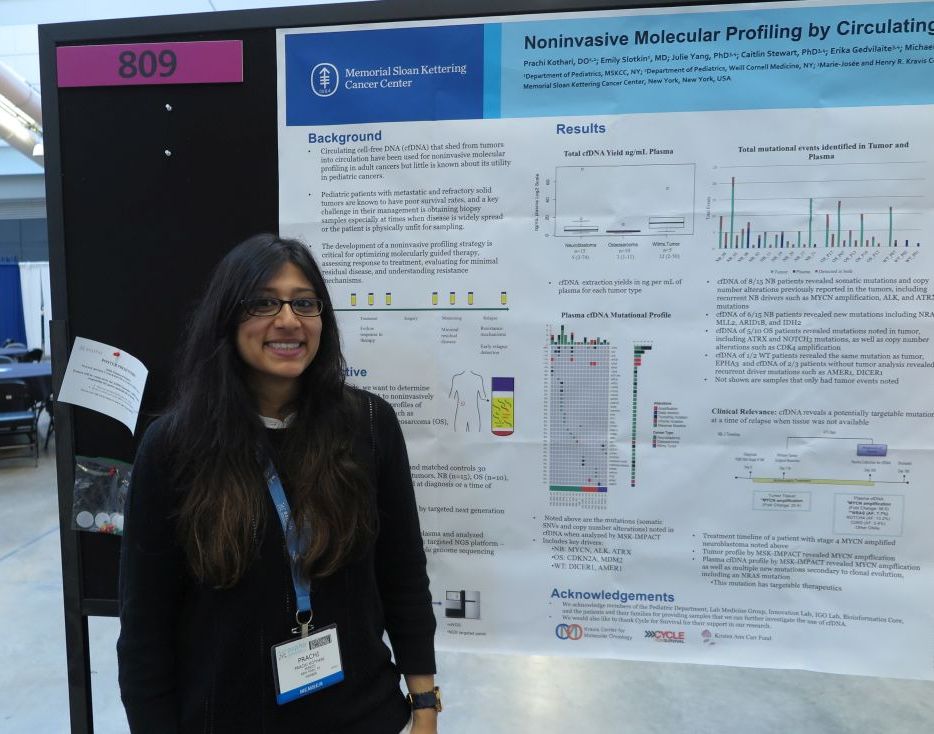
“Circulating free DNA is much less invasive than a tumor biopsy, and you can do it throughout the patient’s entire timeline of treatment, so you get real-time information or after they relapse to see what’s going on if you’re not able to get a tumor biopsy,” Dr. Kothari said at annual meeting of the American Society of Pediatric Hematology/Oncology.
So-called “liquid biopsy” using cfDNA has been used for molecular profiling of adults malignancies, but there are few data on its use in pediatric tumors, Dr. Kothari said.
To see whether the technique could provide useful clinical information for the management of pediatric tumors, the investigators examined tumor samples taken at diagnosis or at the time of disease progression from 15 patients with neuroblastoma, 10 with osteosarcoma, and 5 with Wilms tumor. They analyzed the tumor samples using targeted next-generation sequencing (NGS), and cfDNA using three different genomic analysis techniques, including NGS, MSK-IMPACT (Integrated Mutation Profiling of Actionable Cancer Targets), and shallow whole genome sequencing.
For each of the tumor types studies, cfDNA analysis with the MSK-IMPACT platform identified key drivers of malignancy, including MYCN, ALK, and ATRX in neuroblastoma; CDKN2A and MDM2 in osteosarcoma; and DICER1 and AMER1 in Wilms tumor.
The cfDNA samples also revealed somatic mutations and copy number alterations previously reported in the tumors of 8 of the 15 patients with neuroblastoma, as well as potentially targetable new mutations in 6 of the 15 patients, including NRAS, MLL2, ARID1B, and IDH2.
For example, in one patient with stage 4 MYCN-amplified neuroblastoma, both tumor analysis and cfDNA revealed MYCN amplification, but cfDNA also show multiple new mutations, including a targetable NRAS mutation, secondary to clonal mutation.
In 5 of the 10 patients with osteosarcoma, cfDNA detected mutations that had been seen in the tumor samples, including mutations in ATRX and NOTCH3, and copy number alterations such as CDK4 amplification,
Of the five patients with Wilms tumors, cfDNA analysis was performed on two samples, one of which showed the same mutation as the tumor. Additionally, for the three patients without tumor analysis, cfDNA showed recurrent driver mutations such as AMER1 and DICER1.
The investigators have used the data from this study to create a genome-wide z score derived from shallow whole genome sequencing profiles and cfDNA, and found that a high genomewide z score, compared with a low score was significantly associated a more than four-fold greater risk for worse survival (hazard ratio, 4.42; P = .049).
“Establishing a platform using cfDNA to identify molecular profiles of these tumors can serve as a powerful tool for guiding treatment and monitoring response to treatment,” the investigators concluded.
The study was supported by Cycle for Survival and the Kristen Ann Carr Fund. The investigators reported having no conflicts of interest.
SOURCE: Kothari P et al. ASPHO 2018. Abstract #809.
PITTSBURGH – Genetic analysis of circulating free DNA (cfDNA) from pediatric solid tumors can noninvasively identify somatic mutations and copy number alterations that could be used to identify therapeutic targets, investigators reported.
An analysis of tumor specimens and plasma samples from children with neuroblastoma, osteosarcoma, and Wilms tumor revealed in cfDNA both somatic mutations and copy number alterations that had already been detected in the solid tumors, and new, potentially targetable mutations, reported Prachi Kothari, DO, and her colleagues from Memorial Sloan Kettering Cancer Center in New York.
“Circulating free DNA is much less invasive than a tumor biopsy, and you can do it throughout the patient’s entire timeline of treatment, so you get real-time information or after they relapse to see what’s going on if you’re not able to get a tumor biopsy,” Dr. Kothari said at annual meeting of the American Society of Pediatric Hematology/Oncology.
So-called “liquid biopsy” using cfDNA has been used for molecular profiling of adults malignancies, but there are few data on its use in pediatric tumors, Dr. Kothari said.
To see whether the technique could provide useful clinical information for the management of pediatric tumors, the investigators examined tumor samples taken at diagnosis or at the time of disease progression from 15 patients with neuroblastoma, 10 with osteosarcoma, and 5 with Wilms tumor. They analyzed the tumor samples using targeted next-generation sequencing (NGS), and cfDNA using three different genomic analysis techniques, including NGS, MSK-IMPACT (Integrated Mutation Profiling of Actionable Cancer Targets), and shallow whole genome sequencing.
For each of the tumor types studies, cfDNA analysis with the MSK-IMPACT platform identified key drivers of malignancy, including MYCN, ALK, and ATRX in neuroblastoma; CDKN2A and MDM2 in osteosarcoma; and DICER1 and AMER1 in Wilms tumor.
The cfDNA samples also revealed somatic mutations and copy number alterations previously reported in the tumors of 8 of the 15 patients with neuroblastoma, as well as potentially targetable new mutations in 6 of the 15 patients, including NRAS, MLL2, ARID1B, and IDH2.
For example, in one patient with stage 4 MYCN-amplified neuroblastoma, both tumor analysis and cfDNA revealed MYCN amplification, but cfDNA also show multiple new mutations, including a targetable NRAS mutation, secondary to clonal mutation.
In 5 of the 10 patients with osteosarcoma, cfDNA detected mutations that had been seen in the tumor samples, including mutations in ATRX and NOTCH3, and copy number alterations such as CDK4 amplification,
Of the five patients with Wilms tumors, cfDNA analysis was performed on two samples, one of which showed the same mutation as the tumor. Additionally, for the three patients without tumor analysis, cfDNA showed recurrent driver mutations such as AMER1 and DICER1.
The investigators have used the data from this study to create a genome-wide z score derived from shallow whole genome sequencing profiles and cfDNA, and found that a high genomewide z score, compared with a low score was significantly associated a more than four-fold greater risk for worse survival (hazard ratio, 4.42; P = .049).
“Establishing a platform using cfDNA to identify molecular profiles of these tumors can serve as a powerful tool for guiding treatment and monitoring response to treatment,” the investigators concluded.
The study was supported by Cycle for Survival and the Kristen Ann Carr Fund. The investigators reported having no conflicts of interest.
SOURCE: Kothari P et al. ASPHO 2018. Abstract #809.
PITTSBURGH – Genetic analysis of circulating free DNA (cfDNA) from pediatric solid tumors can noninvasively identify somatic mutations and copy number alterations that could be used to identify therapeutic targets, investigators reported.
An analysis of tumor specimens and plasma samples from children with neuroblastoma, osteosarcoma, and Wilms tumor revealed in cfDNA both somatic mutations and copy number alterations that had already been detected in the solid tumors, and new, potentially targetable mutations, reported Prachi Kothari, DO, and her colleagues from Memorial Sloan Kettering Cancer Center in New York.
“Circulating free DNA is much less invasive than a tumor biopsy, and you can do it throughout the patient’s entire timeline of treatment, so you get real-time information or after they relapse to see what’s going on if you’re not able to get a tumor biopsy,” Dr. Kothari said at annual meeting of the American Society of Pediatric Hematology/Oncology.
So-called “liquid biopsy” using cfDNA has been used for molecular profiling of adults malignancies, but there are few data on its use in pediatric tumors, Dr. Kothari said.
To see whether the technique could provide useful clinical information for the management of pediatric tumors, the investigators examined tumor samples taken at diagnosis or at the time of disease progression from 15 patients with neuroblastoma, 10 with osteosarcoma, and 5 with Wilms tumor. They analyzed the tumor samples using targeted next-generation sequencing (NGS), and cfDNA using three different genomic analysis techniques, including NGS, MSK-IMPACT (Integrated Mutation Profiling of Actionable Cancer Targets), and shallow whole genome sequencing.
For each of the tumor types studies, cfDNA analysis with the MSK-IMPACT platform identified key drivers of malignancy, including MYCN, ALK, and ATRX in neuroblastoma; CDKN2A and MDM2 in osteosarcoma; and DICER1 and AMER1 in Wilms tumor.
The cfDNA samples also revealed somatic mutations and copy number alterations previously reported in the tumors of 8 of the 15 patients with neuroblastoma, as well as potentially targetable new mutations in 6 of the 15 patients, including NRAS, MLL2, ARID1B, and IDH2.
For example, in one patient with stage 4 MYCN-amplified neuroblastoma, both tumor analysis and cfDNA revealed MYCN amplification, but cfDNA also show multiple new mutations, including a targetable NRAS mutation, secondary to clonal mutation.
In 5 of the 10 patients with osteosarcoma, cfDNA detected mutations that had been seen in the tumor samples, including mutations in ATRX and NOTCH3, and copy number alterations such as CDK4 amplification,
Of the five patients with Wilms tumors, cfDNA analysis was performed on two samples, one of which showed the same mutation as the tumor. Additionally, for the three patients without tumor analysis, cfDNA showed recurrent driver mutations such as AMER1 and DICER1.
The investigators have used the data from this study to create a genome-wide z score derived from shallow whole genome sequencing profiles and cfDNA, and found that a high genomewide z score, compared with a low score was significantly associated a more than four-fold greater risk for worse survival (hazard ratio, 4.42; P = .049).
“Establishing a platform using cfDNA to identify molecular profiles of these tumors can serve as a powerful tool for guiding treatment and monitoring response to treatment,” the investigators concluded.
The study was supported by Cycle for Survival and the Kristen Ann Carr Fund. The investigators reported having no conflicts of interest.
SOURCE: Kothari P et al. ASPHO 2018. Abstract #809.
REPORTING FROM ASPHO 2018
Key clinical point: Circulating free DNA analysis is a noninvasive method for detecting potential therapeutic targets.
Major finding: cfDNA revealed potentially targetable new mutations in 6 of 15 patients with neuroblastoma.
Study details: Retrospective analysis of tumor and plasma samples in 30 patients with neuroblastoma, osteosarcoma, or Wilms tumor.
Disclosures: The study was supported by Cycle for Survival and the Kristen Ann Carr Fund. The investigators reported having no conflicts of interest.
Source: Kothari P et al. ASPHO 2018. Abstract #809.
VIDEO: Acromegaly study reveals gender-specific differences
BOSTON – , according to study results presented at the annual meeting of the American Association of Clinical Endocrinologists.
The study was based on data for 112 patients (54 male, 58 female) operated on by one neurosurgeon between 1994 and 2016. The mean age at surgery was 43.6 years in men and 48.7 in women (P = .04), according to Talin Handa, Emory University, Atlanta, who presented the retrospective analysis.
The video associated with this article is no longer available on this site. Please view all of our videos on the MDedge YouTube channel
Men had higher mean IGF-1 levels (874 ng/mL vs. 716 ng/mL for women; P less than .01), and were more likely to have hypopituitarism.
Adjuvant treatment for acromegaly was needed in 57% of men and 49% of women. Following adjuvant treatment, 72% of men maintained surgical remission or achieved normal IGF-1 levels, compared with 89% of women (P = .03). Mean follow-up was shorter in men, 3.6 years, versus 5.2 years for women (P = .02), the researchers reported.
Six-year event-free survival was higher in women (P less than .01), according to the researchers.
For more study findings, watch our video interview.
SOURCE: Handa T et al. AACE 2018. Abstract #824.
BOSTON – , according to study results presented at the annual meeting of the American Association of Clinical Endocrinologists.
The study was based on data for 112 patients (54 male, 58 female) operated on by one neurosurgeon between 1994 and 2016. The mean age at surgery was 43.6 years in men and 48.7 in women (P = .04), according to Talin Handa, Emory University, Atlanta, who presented the retrospective analysis.
The video associated with this article is no longer available on this site. Please view all of our videos on the MDedge YouTube channel
Men had higher mean IGF-1 levels (874 ng/mL vs. 716 ng/mL for women; P less than .01), and were more likely to have hypopituitarism.
Adjuvant treatment for acromegaly was needed in 57% of men and 49% of women. Following adjuvant treatment, 72% of men maintained surgical remission or achieved normal IGF-1 levels, compared with 89% of women (P = .03). Mean follow-up was shorter in men, 3.6 years, versus 5.2 years for women (P = .02), the researchers reported.
Six-year event-free survival was higher in women (P less than .01), according to the researchers.
For more study findings, watch our video interview.
SOURCE: Handa T et al. AACE 2018. Abstract #824.
BOSTON – , according to study results presented at the annual meeting of the American Association of Clinical Endocrinologists.
The study was based on data for 112 patients (54 male, 58 female) operated on by one neurosurgeon between 1994 and 2016. The mean age at surgery was 43.6 years in men and 48.7 in women (P = .04), according to Talin Handa, Emory University, Atlanta, who presented the retrospective analysis.
The video associated with this article is no longer available on this site. Please view all of our videos on the MDedge YouTube channel
Men had higher mean IGF-1 levels (874 ng/mL vs. 716 ng/mL for women; P less than .01), and were more likely to have hypopituitarism.
Adjuvant treatment for acromegaly was needed in 57% of men and 49% of women. Following adjuvant treatment, 72% of men maintained surgical remission or achieved normal IGF-1 levels, compared with 89% of women (P = .03). Mean follow-up was shorter in men, 3.6 years, versus 5.2 years for women (P = .02), the researchers reported.
Six-year event-free survival was higher in women (P less than .01), according to the researchers.
For more study findings, watch our video interview.
SOURCE: Handa T et al. AACE 2018. Abstract #824.
REPORTING FROM AACE 2018
Key clinical point: Men with acromegaly present at a younger age, have higher IGF-1 levels, and achieve lower biochemical control rates than do women with the disorder.
Major finding: Men were less likely than women to have surgical remissions or normal IGF-1 levels after adjuvant treatment (72% for men and 89% for women; P = .03).
Study details: A retrospective analysis of 112 patients (54 male, 58 female) operated on by one neurosurgeon during 1994-2016.
Disclosures: The presenter had no disclosures related to the presentation.
Source: Handa T et al. AACE 2018. Abstract #824.
VIDEO: Location of thyroid nodules may predict malignancy
BOSTON – according to the results of a retrospective, single-center study presented at the annual meeting of the American Association of Clinical Endocrinologists.
When nodules were located in the upper pole of the gland, the risk of malignancy was about 4 times higher than it was for nodules at other locations in the gland. Researchers confirmed the association using a multiple logistic regression model with adjustment for age, gender, body mass index, laterality, and number of nodules (odds ratio, 4.6; P = 0.03). The findings are believed to be the first to show an association between location of thyroid nodules on ultrasound and malignancy risk.
The results appear to elevate the value of ultrasound for predicting thyroid malignancy and should affect guidelines for ultrasound classification of thyroid nodules, researcher Fan Zhang, MD, PhD, a fellow at State University of New York, Brooklyn, said in a video interview. “In the future, I would recommend maybe we could consider including the location of thyroid nodules in the guidelines for better predictive value of malignancies,” she said.
Other ultrasound characteristics known to be associated with malignancy include findings of microcalcifications, increased vascularity, and nodules that are taller than they are wide, according to Dr. Zhang.
The retrospective review included data on 219 clinic patients with thyroid nodules who underwent fine-needle aspiration biopsy between July 2016 and June 2017. Nearly 80% of the nodules in the review were located in the lower pole of the gland, about 10% were in the upper pole, 7% were in the middle pole, and about 2% were found in the isthmus.
Fourteen nodules, or 7.4%, were found to be malignant, Dr. Zhang and her coauthors said in their presentation. Of those 14 malignancies, 7 were among the 149 nodules in the lower pole, 4 were among the 18 in the upper pole, and 3 were among the 21 in the middle pole.
The anatomy of the thyroid gland may be a factor in why upper pole nodules would be more likely to be associated with malignancy, according to Dr. Zhang. “The veins in the upper lobe are more tortuous compared to in the lower lobe,” she said, noting that slow venous drainage may increase the possibility of developing malignancy.
Dr. Zhang had no relevant disclosures to report.
SOURCE: Zhang F et al. AACE 2018, Abstract 1204.
BOSTON – according to the results of a retrospective, single-center study presented at the annual meeting of the American Association of Clinical Endocrinologists.
When nodules were located in the upper pole of the gland, the risk of malignancy was about 4 times higher than it was for nodules at other locations in the gland. Researchers confirmed the association using a multiple logistic regression model with adjustment for age, gender, body mass index, laterality, and number of nodules (odds ratio, 4.6; P = 0.03). The findings are believed to be the first to show an association between location of thyroid nodules on ultrasound and malignancy risk.
The results appear to elevate the value of ultrasound for predicting thyroid malignancy and should affect guidelines for ultrasound classification of thyroid nodules, researcher Fan Zhang, MD, PhD, a fellow at State University of New York, Brooklyn, said in a video interview. “In the future, I would recommend maybe we could consider including the location of thyroid nodules in the guidelines for better predictive value of malignancies,” she said.
Other ultrasound characteristics known to be associated with malignancy include findings of microcalcifications, increased vascularity, and nodules that are taller than they are wide, according to Dr. Zhang.
The retrospective review included data on 219 clinic patients with thyroid nodules who underwent fine-needle aspiration biopsy between July 2016 and June 2017. Nearly 80% of the nodules in the review were located in the lower pole of the gland, about 10% were in the upper pole, 7% were in the middle pole, and about 2% were found in the isthmus.
Fourteen nodules, or 7.4%, were found to be malignant, Dr. Zhang and her coauthors said in their presentation. Of those 14 malignancies, 7 were among the 149 nodules in the lower pole, 4 were among the 18 in the upper pole, and 3 were among the 21 in the middle pole.
The anatomy of the thyroid gland may be a factor in why upper pole nodules would be more likely to be associated with malignancy, according to Dr. Zhang. “The veins in the upper lobe are more tortuous compared to in the lower lobe,” she said, noting that slow venous drainage may increase the possibility of developing malignancy.
Dr. Zhang had no relevant disclosures to report.
SOURCE: Zhang F et al. AACE 2018, Abstract 1204.
BOSTON – according to the results of a retrospective, single-center study presented at the annual meeting of the American Association of Clinical Endocrinologists.
When nodules were located in the upper pole of the gland, the risk of malignancy was about 4 times higher than it was for nodules at other locations in the gland. Researchers confirmed the association using a multiple logistic regression model with adjustment for age, gender, body mass index, laterality, and number of nodules (odds ratio, 4.6; P = 0.03). The findings are believed to be the first to show an association between location of thyroid nodules on ultrasound and malignancy risk.
The results appear to elevate the value of ultrasound for predicting thyroid malignancy and should affect guidelines for ultrasound classification of thyroid nodules, researcher Fan Zhang, MD, PhD, a fellow at State University of New York, Brooklyn, said in a video interview. “In the future, I would recommend maybe we could consider including the location of thyroid nodules in the guidelines for better predictive value of malignancies,” she said.
Other ultrasound characteristics known to be associated with malignancy include findings of microcalcifications, increased vascularity, and nodules that are taller than they are wide, according to Dr. Zhang.
The retrospective review included data on 219 clinic patients with thyroid nodules who underwent fine-needle aspiration biopsy between July 2016 and June 2017. Nearly 80% of the nodules in the review were located in the lower pole of the gland, about 10% were in the upper pole, 7% were in the middle pole, and about 2% were found in the isthmus.
Fourteen nodules, or 7.4%, were found to be malignant, Dr. Zhang and her coauthors said in their presentation. Of those 14 malignancies, 7 were among the 149 nodules in the lower pole, 4 were among the 18 in the upper pole, and 3 were among the 21 in the middle pole.
The anatomy of the thyroid gland may be a factor in why upper pole nodules would be more likely to be associated with malignancy, according to Dr. Zhang. “The veins in the upper lobe are more tortuous compared to in the lower lobe,” she said, noting that slow venous drainage may increase the possibility of developing malignancy.
Dr. Zhang had no relevant disclosures to report.
SOURCE: Zhang F et al. AACE 2018, Abstract 1204.
REPORTING FROM AACE 2018
Key clinical point: Thyroid nodules located in the upper pole may be considered a risk factor for malignancy.
Major finding: Assessment by location showed that 28.6% of nodules found in the upper pole were malignant, compared with 4.9% in the lower pole, 18.2% in the middle pole, and 14.3% in the isthmus (odds ratio, 5.8; P = 0.01).
Study details: A retrospective review including data on 219 clinic patients with thyroid nodules who underwent fine-needle aspiration biopsy between July 2016 and June 2017.
Disclosures: Dr. Zhang had no relevant disclosures to report.
Source: Zhang F et al. AACE 2018, Abstract 1204.
VIDEO: Move beyond BMI to see obesity as a disease
BOSTON – , W. Timothy Garvey, MD, said.
“The term ‘obesity’ means so many things to different people,” Dr. Garvey explained in a video interview at the annual meeting of the American Association of Clinical Endocrinologists. “It doesn’t tell you what the impact is of excess adiposity on health.”
In fact, obesity meets the criteria needed to be defined as a disease, said Dr. Garvey, who coauthored a 2017 AACE position statement recommending a new diagnostic term for obesity: adiposity-based chronic disease, or ABCD.
“It’s not going to replace the general use of the term ‘obesity,’ of course; but for medical diagnosis, this term does tell you what we’re treating, and why we’re treating it,” noted Dr. Garvey, of the University of Alabama at Birmingham.
Instead of relying on BMI [body mass index], the ABCD model emphasizes a “complications-centric” approach that drives therapeutic decisions, which may include medication.
“A structured lifestyle intervention is the key to therapy, but if we add medications on to any lifestyle intervention, we’re going to get more bang for the buck,” Dr. Garvey explained.
“We’re going to get more weight loss and be able to keep it off for a longer period of time,” he added. “We want that in situations in particular where the patient really has complications. This could be diabetes, it could be prediabetes, it could be obstructive sleep apnea, symptomatic osteoarthritis in the knees, stress incontinence, hypertension – any one of a number of weight-related complications that are really impairing health.”
The five medications approved for chronic management of obesity all have been shown to be safe and effective in clinical trials. But they have different mechanisms of action, different side effect profiles, and different warnings and precautions, Dr. Garvey noted.
Understanding the pharmacology of all five drugs is important to help a specific patient achieve the best outcomes.
“There’s no drug that can be recommended, in a hierarchical sense, as being better than any others across the board in all patients,” Dr. Garvey explained. “We really need to individualize therapy based on their side effect profile and their types of complications that present with the patient.”
Endocrinologists can be particularly helpful in incorporating weight loss therapy into the overall therapeutic plan for refractory cases, he said, or in patients significantly burdened with metabolic complications, including dysglycemia, diabetes, hypertriglyceridemia, and nonalcoholic fatty liver disease.
Primary care physicians, advanced practice clinicians, dietitians, and others are needed on the team to engineer a successful lifestyle intervention for the obese patient. However, Dr. Garvey emphasized that the endocrinology subspecialty encompasses not only endocrinology and diabetes, but also metabolism.
“We need to take the lead here,” Dr. Garvey said. “Obesity is the most common metabolic disease on the planet.”
Dr. Garvey reported disclosures related to Janssen, Novo Nordisk, and Sanofi.
BOSTON – , W. Timothy Garvey, MD, said.
“The term ‘obesity’ means so many things to different people,” Dr. Garvey explained in a video interview at the annual meeting of the American Association of Clinical Endocrinologists. “It doesn’t tell you what the impact is of excess adiposity on health.”
In fact, obesity meets the criteria needed to be defined as a disease, said Dr. Garvey, who coauthored a 2017 AACE position statement recommending a new diagnostic term for obesity: adiposity-based chronic disease, or ABCD.
“It’s not going to replace the general use of the term ‘obesity,’ of course; but for medical diagnosis, this term does tell you what we’re treating, and why we’re treating it,” noted Dr. Garvey, of the University of Alabama at Birmingham.
Instead of relying on BMI [body mass index], the ABCD model emphasizes a “complications-centric” approach that drives therapeutic decisions, which may include medication.
“A structured lifestyle intervention is the key to therapy, but if we add medications on to any lifestyle intervention, we’re going to get more bang for the buck,” Dr. Garvey explained.
“We’re going to get more weight loss and be able to keep it off for a longer period of time,” he added. “We want that in situations in particular where the patient really has complications. This could be diabetes, it could be prediabetes, it could be obstructive sleep apnea, symptomatic osteoarthritis in the knees, stress incontinence, hypertension – any one of a number of weight-related complications that are really impairing health.”
The five medications approved for chronic management of obesity all have been shown to be safe and effective in clinical trials. But they have different mechanisms of action, different side effect profiles, and different warnings and precautions, Dr. Garvey noted.
Understanding the pharmacology of all five drugs is important to help a specific patient achieve the best outcomes.
“There’s no drug that can be recommended, in a hierarchical sense, as being better than any others across the board in all patients,” Dr. Garvey explained. “We really need to individualize therapy based on their side effect profile and their types of complications that present with the patient.”
Endocrinologists can be particularly helpful in incorporating weight loss therapy into the overall therapeutic plan for refractory cases, he said, or in patients significantly burdened with metabolic complications, including dysglycemia, diabetes, hypertriglyceridemia, and nonalcoholic fatty liver disease.
Primary care physicians, advanced practice clinicians, dietitians, and others are needed on the team to engineer a successful lifestyle intervention for the obese patient. However, Dr. Garvey emphasized that the endocrinology subspecialty encompasses not only endocrinology and diabetes, but also metabolism.
“We need to take the lead here,” Dr. Garvey said. “Obesity is the most common metabolic disease on the planet.”
Dr. Garvey reported disclosures related to Janssen, Novo Nordisk, and Sanofi.
BOSTON – , W. Timothy Garvey, MD, said.
“The term ‘obesity’ means so many things to different people,” Dr. Garvey explained in a video interview at the annual meeting of the American Association of Clinical Endocrinologists. “It doesn’t tell you what the impact is of excess adiposity on health.”
In fact, obesity meets the criteria needed to be defined as a disease, said Dr. Garvey, who coauthored a 2017 AACE position statement recommending a new diagnostic term for obesity: adiposity-based chronic disease, or ABCD.
“It’s not going to replace the general use of the term ‘obesity,’ of course; but for medical diagnosis, this term does tell you what we’re treating, and why we’re treating it,” noted Dr. Garvey, of the University of Alabama at Birmingham.
Instead of relying on BMI [body mass index], the ABCD model emphasizes a “complications-centric” approach that drives therapeutic decisions, which may include medication.
“A structured lifestyle intervention is the key to therapy, but if we add medications on to any lifestyle intervention, we’re going to get more bang for the buck,” Dr. Garvey explained.
“We’re going to get more weight loss and be able to keep it off for a longer period of time,” he added. “We want that in situations in particular where the patient really has complications. This could be diabetes, it could be prediabetes, it could be obstructive sleep apnea, symptomatic osteoarthritis in the knees, stress incontinence, hypertension – any one of a number of weight-related complications that are really impairing health.”
The five medications approved for chronic management of obesity all have been shown to be safe and effective in clinical trials. But they have different mechanisms of action, different side effect profiles, and different warnings and precautions, Dr. Garvey noted.
Understanding the pharmacology of all five drugs is important to help a specific patient achieve the best outcomes.
“There’s no drug that can be recommended, in a hierarchical sense, as being better than any others across the board in all patients,” Dr. Garvey explained. “We really need to individualize therapy based on their side effect profile and their types of complications that present with the patient.”
Endocrinologists can be particularly helpful in incorporating weight loss therapy into the overall therapeutic plan for refractory cases, he said, or in patients significantly burdened with metabolic complications, including dysglycemia, diabetes, hypertriglyceridemia, and nonalcoholic fatty liver disease.
Primary care physicians, advanced practice clinicians, dietitians, and others are needed on the team to engineer a successful lifestyle intervention for the obese patient. However, Dr. Garvey emphasized that the endocrinology subspecialty encompasses not only endocrinology and diabetes, but also metabolism.
“We need to take the lead here,” Dr. Garvey said. “Obesity is the most common metabolic disease on the planet.”
Dr. Garvey reported disclosures related to Janssen, Novo Nordisk, and Sanofi.
REPORTING FROM AACE 2018
Complete MUS mesh removal not linked to incontinence
SAN FRANCISCO – Stress urinary incontinence (SUI) following removal of a mid-urethral sling (MUS) mesh is not necessarily associated with increased risk of postsurgical urinary incontinence, according to a retrospective study at a high-volume, tertiary medical center.
Follow-up procedures occurred more often in women with preoperative urodynamic SUI and less often in women who were stress continent.

Among women who were stress continent, obesity and postmenopausal status were linked to postsurgical SUI. There was no association between postsurgical SUI and the extent of mesh excision or prior revisions.
The study grew out of observations that SUI occurred less often than expected.
“There’s an increasing recognition of complications related to synthetic MUS,” said Janine Oliver, MD, who presented the study at the annual meeting of the American Urological Association. “As mesh removal procedures were being performed, we assumed that the majority of patients, if not all, would be incontinent afterward, since we were removing the sling that was put in to fix stress incontinence in most cases.”
In a patient who would benefit from a complete mesh removal, “the fear that it may lead to a higher risk of urinary incontinence is not a good justification to not do it,” Dr. Oliver said. She did note, however, that the procedures were done by specialists, so findings may not be applicable to general practitioners.
The study was performed while Dr. Oliver was a fellow at the University of California, Los Angeles. She is now with the division of urology at the University of Colorado, Anschutz, in Aurora.
Dr. Oliver and her colleagues analyzed data from 233 patients who underwent MUS excision at UCLA for MUS-related complications during 2013-2015, and who had at least 3 months of follow-up. The average patient age was 55.4 years; an average of 5.4 years passed between the placement and excision of MUS. The mean body mass index was 28.9, and mean follow-up was 23.5 months.
A total of 84% of patients underwent a total excision; 45% of MUS were retropubic, 35% were transobturator, 10% were single incision, and 10% were multiple incision.
Nearly half (49%) of patients required a second procedure for SUI, such as bulking agent injection, bladder neck suspension, or repeat sling procedure.
In the entire cohort, multivariate analyses found significant associations between heightened risk of postoperative SUI and increasing time to MUS excision (odds ratio, 1.16; 95% confidence interval, 1.03-1.30), total MUS excision (OR, 4.14; 95% CI, 1.38-12.37), and preoperative urodynamic SUI (OR, 4.66; 95% CI, 2.13-10.19).
Of 51 patients who had preoperative urodynamic SUI, 39 (76%) ultimately underwent another surgery. Although increased time to MUS excision and total mesh removal were associated with urinary incontinence in this group in univariate analyses, they were no longer significant following a multivariate analysis.
Of 140 patients with a negative preoperative urodynamic testing for SUI, 59 (42%) went on to have another SUI procedure. After multivariate analysis, the only risk factors for urinary incontinence were obesity (OR, 4.74; 95% CI, 1.73-13.02) and postmenopausal status (OR, 3.78; 95% CI, 1.16-12.33).
“I think there’s a lot of fear, even among urologists and specialists who see these problems, that complete mesh removal is associated with a higher risk of complications and a higher risk of incontinence,” said Dr. Oliver. “These data would suggest that, in certain subgroups, that’s not true. The risks factors that we identified in a multivariate analysis were being obese and being postmenopausal, but not complete mesh removal.”
The study received no external funding. Dr. Oliver reported having no financial conflicts of interest.
SOURCE: Oliver J et al. AUA Annual Meeting. Abstract PD05-10.
SAN FRANCISCO – Stress urinary incontinence (SUI) following removal of a mid-urethral sling (MUS) mesh is not necessarily associated with increased risk of postsurgical urinary incontinence, according to a retrospective study at a high-volume, tertiary medical center.
Follow-up procedures occurred more often in women with preoperative urodynamic SUI and less often in women who were stress continent.
Among women who were stress continent, obesity and postmenopausal status were linked to postsurgical SUI. There was no association between postsurgical SUI and the extent of mesh excision or prior revisions.
The study grew out of observations that SUI occurred less often than expected.
“There’s an increasing recognition of complications related to synthetic MUS,” said Janine Oliver, MD, who presented the study at the annual meeting of the American Urological Association. “As mesh removal procedures were being performed, we assumed that the majority of patients, if not all, would be incontinent afterward, since we were removing the sling that was put in to fix stress incontinence in most cases.”
In a patient who would benefit from a complete mesh removal, “the fear that it may lead to a higher risk of urinary incontinence is not a good justification to not do it,” Dr. Oliver said. She did note, however, that the procedures were done by specialists, so findings may not be applicable to general practitioners.
The study was performed while Dr. Oliver was a fellow at the University of California, Los Angeles. She is now with the division of urology at the University of Colorado, Anschutz, in Aurora.
Dr. Oliver and her colleagues analyzed data from 233 patients who underwent MUS excision at UCLA for MUS-related complications during 2013-2015, and who had at least 3 months of follow-up. The average patient age was 55.4 years; an average of 5.4 years passed between the placement and excision of MUS. The mean body mass index was 28.9, and mean follow-up was 23.5 months.
A total of 84% of patients underwent a total excision; 45% of MUS were retropubic, 35% were transobturator, 10% were single incision, and 10% were multiple incision.
Nearly half (49%) of patients required a second procedure for SUI, such as bulking agent injection, bladder neck suspension, or repeat sling procedure.
In the entire cohort, multivariate analyses found significant associations between heightened risk of postoperative SUI and increasing time to MUS excision (odds ratio, 1.16; 95% confidence interval, 1.03-1.30), total MUS excision (OR, 4.14; 95% CI, 1.38-12.37), and preoperative urodynamic SUI (OR, 4.66; 95% CI, 2.13-10.19).
Of 51 patients who had preoperative urodynamic SUI, 39 (76%) ultimately underwent another surgery. Although increased time to MUS excision and total mesh removal were associated with urinary incontinence in this group in univariate analyses, they were no longer significant following a multivariate analysis.
Of 140 patients with a negative preoperative urodynamic testing for SUI, 59 (42%) went on to have another SUI procedure. After multivariate analysis, the only risk factors for urinary incontinence were obesity (OR, 4.74; 95% CI, 1.73-13.02) and postmenopausal status (OR, 3.78; 95% CI, 1.16-12.33).
“I think there’s a lot of fear, even among urologists and specialists who see these problems, that complete mesh removal is associated with a higher risk of complications and a higher risk of incontinence,” said Dr. Oliver. “These data would suggest that, in certain subgroups, that’s not true. The risks factors that we identified in a multivariate analysis were being obese and being postmenopausal, but not complete mesh removal.”
The study received no external funding. Dr. Oliver reported having no financial conflicts of interest.
SOURCE: Oliver J et al. AUA Annual Meeting. Abstract PD05-10.
SAN FRANCISCO – Stress urinary incontinence (SUI) following removal of a mid-urethral sling (MUS) mesh is not necessarily associated with increased risk of postsurgical urinary incontinence, according to a retrospective study at a high-volume, tertiary medical center.
Follow-up procedures occurred more often in women with preoperative urodynamic SUI and less often in women who were stress continent.
Among women who were stress continent, obesity and postmenopausal status were linked to postsurgical SUI. There was no association between postsurgical SUI and the extent of mesh excision or prior revisions.
The study grew out of observations that SUI occurred less often than expected.
“There’s an increasing recognition of complications related to synthetic MUS,” said Janine Oliver, MD, who presented the study at the annual meeting of the American Urological Association. “As mesh removal procedures were being performed, we assumed that the majority of patients, if not all, would be incontinent afterward, since we were removing the sling that was put in to fix stress incontinence in most cases.”
In a patient who would benefit from a complete mesh removal, “the fear that it may lead to a higher risk of urinary incontinence is not a good justification to not do it,” Dr. Oliver said. She did note, however, that the procedures were done by specialists, so findings may not be applicable to general practitioners.
The study was performed while Dr. Oliver was a fellow at the University of California, Los Angeles. She is now with the division of urology at the University of Colorado, Anschutz, in Aurora.
Dr. Oliver and her colleagues analyzed data from 233 patients who underwent MUS excision at UCLA for MUS-related complications during 2013-2015, and who had at least 3 months of follow-up. The average patient age was 55.4 years; an average of 5.4 years passed between the placement and excision of MUS. The mean body mass index was 28.9, and mean follow-up was 23.5 months.
A total of 84% of patients underwent a total excision; 45% of MUS were retropubic, 35% were transobturator, 10% were single incision, and 10% were multiple incision.
Nearly half (49%) of patients required a second procedure for SUI, such as bulking agent injection, bladder neck suspension, or repeat sling procedure.
In the entire cohort, multivariate analyses found significant associations between heightened risk of postoperative SUI and increasing time to MUS excision (odds ratio, 1.16; 95% confidence interval, 1.03-1.30), total MUS excision (OR, 4.14; 95% CI, 1.38-12.37), and preoperative urodynamic SUI (OR, 4.66; 95% CI, 2.13-10.19).
Of 51 patients who had preoperative urodynamic SUI, 39 (76%) ultimately underwent another surgery. Although increased time to MUS excision and total mesh removal were associated with urinary incontinence in this group in univariate analyses, they were no longer significant following a multivariate analysis.
Of 140 patients with a negative preoperative urodynamic testing for SUI, 59 (42%) went on to have another SUI procedure. After multivariate analysis, the only risk factors for urinary incontinence were obesity (OR, 4.74; 95% CI, 1.73-13.02) and postmenopausal status (OR, 3.78; 95% CI, 1.16-12.33).
“I think there’s a lot of fear, even among urologists and specialists who see these problems, that complete mesh removal is associated with a higher risk of complications and a higher risk of incontinence,” said Dr. Oliver. “These data would suggest that, in certain subgroups, that’s not true. The risks factors that we identified in a multivariate analysis were being obese and being postmenopausal, but not complete mesh removal.”
The study received no external funding. Dr. Oliver reported having no financial conflicts of interest.
SOURCE: Oliver J et al. AUA Annual Meeting. Abstract PD05-10.
REPORTING FROM THE AUA ANNUAL MEETING
Key clinical point: There was no association between postsurgical incontinence risk and complete mesh removal.
Major finding: In patients without presurgical urodynamic incontinence, only obesity (OR, 4.74) and postmenopausal status (OR, 3.78) were linked to incontinence risk.
Study details: A retrospective analysis of 233 patients.
Disclosures: The study received no external funding. Dr. Oliver reported having no financial conflicts of interest.
Source: Oliver J et al. AUA Annual Meeting. Abstract PD05-10.
VIDEO: Calming microglia might control fibromyalgia
SANDESTIN, FLA. – Activated microglia may be a root cause of fibromyalgia, and bringing them back to a resting state an effective path to symptom relief.
Jarred Younger, PhD, is particularly interested in dextronaltrexone, the right-handed isomer of the drug commonly employed in addiction medicine, for calming microglia in fibromyalgia.
The video associated with this article is no longer available on this site. Please view all of our videos on the MDedge YouTube channel
Unlike the commercially available levo-naltrexone, which binds at both the mu-opioid receptor and Toll-like receptor 4 (TLR4), dextronaltrexone blocks only TLR4. Blocking this receptor interferes with the cells’ ability to recruit peripheral immune cells, which may enter the brain, release cytokines, and induce a proinflammatory environment. By targeting only TLR4 and sparing opioid receptors, , Dr. Younger said in a video interview at the annual Congress of Clinical Rheumatology.
He already has investigated low-dose levo-naltrexone in a small positive crossover trial in 31 fibromyalgia patients. While taking the drug, patients reported significantly less pain and improved mood.
Dr. Younger also recently published a study suggesting that low-dose naltrexone actively improves peripheral proinflammatory cytokine levels.
The placebo-controlled crossover trial enrolled eight women with moderately severe fibromyalgia who took 4.5 mg naltrexone daily for 8 weeks. Compared with baseline, they had significantly reduced plasma levels of a variety of interleukin (IL) subtypes. Also reduced were interferon-alpha, transforming growth factor-alpha and -beta, TNF-alpha, and granulocyte-colony stimulating factor. Patients experienced a mean 15% reduction in fibromyalgia pain and an 18% reduction in overall symptoms.
But proving the drug’s method of action continues to be a challenge, he admitted. It’s not easy to observe microglial trafficking and cellular response to immune signaling in the brain.
Dr. Younger is preparing to launch an innovative PET study that should prove whether activated microglia are recruiting peripheral leukocytes into the brains of fibromyalgia patients. He intends to isolate T and B cells from blood, tag them with a PET radioligand, and reinject them into the subject.
“Since those cells are tagged, a few days later, we can scan the person and see if those cells made it into the brain,” Dr. Younger explained. “If we find T cells and B cells in the brain, that’s clear evidence that the peripheral immune system is attacking and infiltrating the brain, which would be very good in telling us what’s going on in fibromyalgia.”
Low-dose naltrexone is not approved for treating fibromyalgia, he noted. However, during the discussion period after Dr. Younger’s presentation, a number of physicians said they have been using the drug in fibromyalgia patients; some said it has been useful for patients with multiple sclerosis, as well.
Dr. Younger had no relevant financial disclosures.
SANDESTIN, FLA. – Activated microglia may be a root cause of fibromyalgia, and bringing them back to a resting state an effective path to symptom relief.
Jarred Younger, PhD, is particularly interested in dextronaltrexone, the right-handed isomer of the drug commonly employed in addiction medicine, for calming microglia in fibromyalgia.
The video associated with this article is no longer available on this site. Please view all of our videos on the MDedge YouTube channel
Unlike the commercially available levo-naltrexone, which binds at both the mu-opioid receptor and Toll-like receptor 4 (TLR4), dextronaltrexone blocks only TLR4. Blocking this receptor interferes with the cells’ ability to recruit peripheral immune cells, which may enter the brain, release cytokines, and induce a proinflammatory environment. By targeting only TLR4 and sparing opioid receptors, , Dr. Younger said in a video interview at the annual Congress of Clinical Rheumatology.
He already has investigated low-dose levo-naltrexone in a small positive crossover trial in 31 fibromyalgia patients. While taking the drug, patients reported significantly less pain and improved mood.
Dr. Younger also recently published a study suggesting that low-dose naltrexone actively improves peripheral proinflammatory cytokine levels.
The placebo-controlled crossover trial enrolled eight women with moderately severe fibromyalgia who took 4.5 mg naltrexone daily for 8 weeks. Compared with baseline, they had significantly reduced plasma levels of a variety of interleukin (IL) subtypes. Also reduced were interferon-alpha, transforming growth factor-alpha and -beta, TNF-alpha, and granulocyte-colony stimulating factor. Patients experienced a mean 15% reduction in fibromyalgia pain and an 18% reduction in overall symptoms.
But proving the drug’s method of action continues to be a challenge, he admitted. It’s not easy to observe microglial trafficking and cellular response to immune signaling in the brain.
Dr. Younger is preparing to launch an innovative PET study that should prove whether activated microglia are recruiting peripheral leukocytes into the brains of fibromyalgia patients. He intends to isolate T and B cells from blood, tag them with a PET radioligand, and reinject them into the subject.
“Since those cells are tagged, a few days later, we can scan the person and see if those cells made it into the brain,” Dr. Younger explained. “If we find T cells and B cells in the brain, that’s clear evidence that the peripheral immune system is attacking and infiltrating the brain, which would be very good in telling us what’s going on in fibromyalgia.”
Low-dose naltrexone is not approved for treating fibromyalgia, he noted. However, during the discussion period after Dr. Younger’s presentation, a number of physicians said they have been using the drug in fibromyalgia patients; some said it has been useful for patients with multiple sclerosis, as well.
Dr. Younger had no relevant financial disclosures.
SANDESTIN, FLA. – Activated microglia may be a root cause of fibromyalgia, and bringing them back to a resting state an effective path to symptom relief.
Jarred Younger, PhD, is particularly interested in dextronaltrexone, the right-handed isomer of the drug commonly employed in addiction medicine, for calming microglia in fibromyalgia.
The video associated with this article is no longer available on this site. Please view all of our videos on the MDedge YouTube channel
Unlike the commercially available levo-naltrexone, which binds at both the mu-opioid receptor and Toll-like receptor 4 (TLR4), dextronaltrexone blocks only TLR4. Blocking this receptor interferes with the cells’ ability to recruit peripheral immune cells, which may enter the brain, release cytokines, and induce a proinflammatory environment. By targeting only TLR4 and sparing opioid receptors, , Dr. Younger said in a video interview at the annual Congress of Clinical Rheumatology.
He already has investigated low-dose levo-naltrexone in a small positive crossover trial in 31 fibromyalgia patients. While taking the drug, patients reported significantly less pain and improved mood.
Dr. Younger also recently published a study suggesting that low-dose naltrexone actively improves peripheral proinflammatory cytokine levels.
The placebo-controlled crossover trial enrolled eight women with moderately severe fibromyalgia who took 4.5 mg naltrexone daily for 8 weeks. Compared with baseline, they had significantly reduced plasma levels of a variety of interleukin (IL) subtypes. Also reduced were interferon-alpha, transforming growth factor-alpha and -beta, TNF-alpha, and granulocyte-colony stimulating factor. Patients experienced a mean 15% reduction in fibromyalgia pain and an 18% reduction in overall symptoms.
But proving the drug’s method of action continues to be a challenge, he admitted. It’s not easy to observe microglial trafficking and cellular response to immune signaling in the brain.
Dr. Younger is preparing to launch an innovative PET study that should prove whether activated microglia are recruiting peripheral leukocytes into the brains of fibromyalgia patients. He intends to isolate T and B cells from blood, tag them with a PET radioligand, and reinject them into the subject.
“Since those cells are tagged, a few days later, we can scan the person and see if those cells made it into the brain,” Dr. Younger explained. “If we find T cells and B cells in the brain, that’s clear evidence that the peripheral immune system is attacking and infiltrating the brain, which would be very good in telling us what’s going on in fibromyalgia.”
Low-dose naltrexone is not approved for treating fibromyalgia, he noted. However, during the discussion period after Dr. Younger’s presentation, a number of physicians said they have been using the drug in fibromyalgia patients; some said it has been useful for patients with multiple sclerosis, as well.
Dr. Younger had no relevant financial disclosures.
REPORTING FROM CCR 2018
VIDEO: Second wave of psoriatic arthritis therapies
SANDESTIN, FLA. – An array of potential new options for psoriatic arthritis offers new targeted options and poses challenges for how to use the drugs, Arthur Kavanaugh, MD, professor of medicine at the University of California, San Diego, said in a video interview at the annual Congress of Clinical Rheumatology.
“We’re seeing a second wave – a second wave driven by the additional ways that we have to target aspects of the immune system relevant to psoriatic arthritis,” he said.
First used to treat rheumatoid arthritis, monoclonal antibodies to interleukin targets, including IL12 and IL23 (ustekinumab) and IL17 (secukinumab and ixekizumab), have become established psoriatic arthritis therapies. Additionally, the Janus kinase (JAK) inhibitor tofacitinib has become an option.
Other options in the pipeline include the JAK inhibitor baricitinib; the anti-IL23 monoclonal antibodies guselkumab, risankizumab, and tildrakizumab; and even more anti-IL17 therapies, including brodalumab and bimekizumab .
“Now we have the synergy of having novel therapeutic approaches to maybe address some of the different domains of disease,” he said. Despite efforts to develop better biomarkers, it’s hard to predict how an individual patient will respond to a specific therapy. The longer the menu of therapeutic options, the better it is for patients.
As methotrexate remains a go-to treatment for many patients, new data from the SEAM trial assessing etanercept and methotrexate will address the question of whether the conventional drug and tumor necrosis factor inhibitors create therapeutic synergy in patients with psoriatic arthritis.
Dr. Kavanaugh discussed the implications of the trial’s findings, which are expected to go public this summer.
SANDESTIN, FLA. – An array of potential new options for psoriatic arthritis offers new targeted options and poses challenges for how to use the drugs, Arthur Kavanaugh, MD, professor of medicine at the University of California, San Diego, said in a video interview at the annual Congress of Clinical Rheumatology.
“We’re seeing a second wave – a second wave driven by the additional ways that we have to target aspects of the immune system relevant to psoriatic arthritis,” he said.
First used to treat rheumatoid arthritis, monoclonal antibodies to interleukin targets, including IL12 and IL23 (ustekinumab) and IL17 (secukinumab and ixekizumab), have become established psoriatic arthritis therapies. Additionally, the Janus kinase (JAK) inhibitor tofacitinib has become an option.
Other options in the pipeline include the JAK inhibitor baricitinib; the anti-IL23 monoclonal antibodies guselkumab, risankizumab, and tildrakizumab; and even more anti-IL17 therapies, including brodalumab and bimekizumab .
“Now we have the synergy of having novel therapeutic approaches to maybe address some of the different domains of disease,” he said. Despite efforts to develop better biomarkers, it’s hard to predict how an individual patient will respond to a specific therapy. The longer the menu of therapeutic options, the better it is for patients.
As methotrexate remains a go-to treatment for many patients, new data from the SEAM trial assessing etanercept and methotrexate will address the question of whether the conventional drug and tumor necrosis factor inhibitors create therapeutic synergy in patients with psoriatic arthritis.
Dr. Kavanaugh discussed the implications of the trial’s findings, which are expected to go public this summer.
SANDESTIN, FLA. – An array of potential new options for psoriatic arthritis offers new targeted options and poses challenges for how to use the drugs, Arthur Kavanaugh, MD, professor of medicine at the University of California, San Diego, said in a video interview at the annual Congress of Clinical Rheumatology.
“We’re seeing a second wave – a second wave driven by the additional ways that we have to target aspects of the immune system relevant to psoriatic arthritis,” he said.
First used to treat rheumatoid arthritis, monoclonal antibodies to interleukin targets, including IL12 and IL23 (ustekinumab) and IL17 (secukinumab and ixekizumab), have become established psoriatic arthritis therapies. Additionally, the Janus kinase (JAK) inhibitor tofacitinib has become an option.
Other options in the pipeline include the JAK inhibitor baricitinib; the anti-IL23 monoclonal antibodies guselkumab, risankizumab, and tildrakizumab; and even more anti-IL17 therapies, including brodalumab and bimekizumab .
“Now we have the synergy of having novel therapeutic approaches to maybe address some of the different domains of disease,” he said. Despite efforts to develop better biomarkers, it’s hard to predict how an individual patient will respond to a specific therapy. The longer the menu of therapeutic options, the better it is for patients.
As methotrexate remains a go-to treatment for many patients, new data from the SEAM trial assessing etanercept and methotrexate will address the question of whether the conventional drug and tumor necrosis factor inhibitors create therapeutic synergy in patients with psoriatic arthritis.
Dr. Kavanaugh discussed the implications of the trial’s findings, which are expected to go public this summer.
REPORTING FROM CCR
VIDEO: Diabetes patients achieve lipid goals on alirocumab
BOSTON – The PCSK9 inhibitor alirocumab was superior to ezetimibe in meeting multiple lipid goals In patients with type 2 diabetes, according to results from a pooled analysis of randomized clinical trials.
“Alirocumab is an efficient therapy to get patients at target, which is our clinical daily business and the reason to treat patients,” said investigator Dirk Müller-Wieland, MD, an internist at University Hospital Aachen, Germany.
Dr. Müller-Wieland and his colleagues conducted a pooled analysis of 407 individuals with type 2 diabetes enrolled in one of three randomized trials who had hypercholesterolemia despite background lipid-lowering treatments. They found a total of 241 patients with diabetes who had received alirocumab in the trials, and 166 who had received ezetimibe.
With alirocumab on top of statins, 75.0% of patients met a combined LDL cholesterol, non–HDL cholesterol, and apolipoprotein B threshold after 24 weeks of treatment, compared with 56.7% of patients receiving ezetimibe along with their statins, a significant difference, it was reported at the annual meeting of the American Association of Clinical Endocrinologists.
The proportion of patients achieving LDL levels of less than 70 or 100 mg/dL (depending on cardiovascular risk) was significantly larger in the alirocumab group than in the ezetimibe group, at 80.8% versus 64.3%, Dr. Müller-Wieland reported.
In patients with extreme cardiovascular risk, the proportion of patients achieving LDL levels of less than 55 mg/dL was 66.0% in the alirocumab group, compared with 36.6% in the ezetimibe group, suggesting the PCSK9 inhibitor was “much more efficient than ezetimibe” in reaching that goal, Dr. Müller-Wieland said in a video interview.
For patients in the extreme cardiovascular risk category, as defined in recent guidelines, the AACE recommends a new LDL treatment goal of less than 55 mg/dL, Dr. Müller-Wieland noted.
Significant differences in favor of alirocumab were also reported for the proportion of patients achieving non-HDL and ApoB goals, the report showed.
Adverse events related to treatment occurred in a similar proportion of patients in the alirocumab and ezetimibe groups, according to the investigators.
SOURCE: Müller-Wieland D et al. AACE 2018. Abstract #402.
BOSTON – The PCSK9 inhibitor alirocumab was superior to ezetimibe in meeting multiple lipid goals In patients with type 2 diabetes, according to results from a pooled analysis of randomized clinical trials.
“Alirocumab is an efficient therapy to get patients at target, which is our clinical daily business and the reason to treat patients,” said investigator Dirk Müller-Wieland, MD, an internist at University Hospital Aachen, Germany.
Dr. Müller-Wieland and his colleagues conducted a pooled analysis of 407 individuals with type 2 diabetes enrolled in one of three randomized trials who had hypercholesterolemia despite background lipid-lowering treatments. They found a total of 241 patients with diabetes who had received alirocumab in the trials, and 166 who had received ezetimibe.
With alirocumab on top of statins, 75.0% of patients met a combined LDL cholesterol, non–HDL cholesterol, and apolipoprotein B threshold after 24 weeks of treatment, compared with 56.7% of patients receiving ezetimibe along with their statins, a significant difference, it was reported at the annual meeting of the American Association of Clinical Endocrinologists.
The proportion of patients achieving LDL levels of less than 70 or 100 mg/dL (depending on cardiovascular risk) was significantly larger in the alirocumab group than in the ezetimibe group, at 80.8% versus 64.3%, Dr. Müller-Wieland reported.
In patients with extreme cardiovascular risk, the proportion of patients achieving LDL levels of less than 55 mg/dL was 66.0% in the alirocumab group, compared with 36.6% in the ezetimibe group, suggesting the PCSK9 inhibitor was “much more efficient than ezetimibe” in reaching that goal, Dr. Müller-Wieland said in a video interview.
For patients in the extreme cardiovascular risk category, as defined in recent guidelines, the AACE recommends a new LDL treatment goal of less than 55 mg/dL, Dr. Müller-Wieland noted.
Significant differences in favor of alirocumab were also reported for the proportion of patients achieving non-HDL and ApoB goals, the report showed.
Adverse events related to treatment occurred in a similar proportion of patients in the alirocumab and ezetimibe groups, according to the investigators.
SOURCE: Müller-Wieland D et al. AACE 2018. Abstract #402.
BOSTON – The PCSK9 inhibitor alirocumab was superior to ezetimibe in meeting multiple lipid goals In patients with type 2 diabetes, according to results from a pooled analysis of randomized clinical trials.
“Alirocumab is an efficient therapy to get patients at target, which is our clinical daily business and the reason to treat patients,” said investigator Dirk Müller-Wieland, MD, an internist at University Hospital Aachen, Germany.
Dr. Müller-Wieland and his colleagues conducted a pooled analysis of 407 individuals with type 2 diabetes enrolled in one of three randomized trials who had hypercholesterolemia despite background lipid-lowering treatments. They found a total of 241 patients with diabetes who had received alirocumab in the trials, and 166 who had received ezetimibe.
With alirocumab on top of statins, 75.0% of patients met a combined LDL cholesterol, non–HDL cholesterol, and apolipoprotein B threshold after 24 weeks of treatment, compared with 56.7% of patients receiving ezetimibe along with their statins, a significant difference, it was reported at the annual meeting of the American Association of Clinical Endocrinologists.
The proportion of patients achieving LDL levels of less than 70 or 100 mg/dL (depending on cardiovascular risk) was significantly larger in the alirocumab group than in the ezetimibe group, at 80.8% versus 64.3%, Dr. Müller-Wieland reported.
In patients with extreme cardiovascular risk, the proportion of patients achieving LDL levels of less than 55 mg/dL was 66.0% in the alirocumab group, compared with 36.6% in the ezetimibe group, suggesting the PCSK9 inhibitor was “much more efficient than ezetimibe” in reaching that goal, Dr. Müller-Wieland said in a video interview.
For patients in the extreme cardiovascular risk category, as defined in recent guidelines, the AACE recommends a new LDL treatment goal of less than 55 mg/dL, Dr. Müller-Wieland noted.
Significant differences in favor of alirocumab were also reported for the proportion of patients achieving non-HDL and ApoB goals, the report showed.
Adverse events related to treatment occurred in a similar proportion of patients in the alirocumab and ezetimibe groups, according to the investigators.
SOURCE: Müller-Wieland D et al. AACE 2018. Abstract #402.
REPORTING FROM AACE 2018
Key clinical point:
Major finding: 75.0% of alirocumab-treated individuals met a combined LDL-C, non–HDL-C, and ApoB threshold, compared with 56.7% of ezetimibe-treated individuals (P = .0003).
Study details: A pooled analysis of 407 individuals with type 2 diabetes enrolled in one of three randomized trials of alirocumab. Of them, 241 had received alirocumab, and 166 received ezetimibe.
Disclosures: Dr. Müller-Wieland reported speakers bureau and consultant/advisory board fees from Amgen, Astrazeneca, Boehringer Ingelheim, Merck Sharp & Dohme, Novartis, Novo Nordisk, and Sanofi.
Source: Müller-Wieland D et al. AACE 2018. Abstract #402.
Three days of beta-lactam beat clinically stable CAP
MADRID – Three days of beta-lactam therapy was just as effective as 8 days for clinically stable patients presenting with community-acquired pneumonia.
In a randomized, placebo-controlled trial, 15-day cure rates were 69.9% in patients who took 3 days of antibiotics and 61.2% in those who took 8 days – a nonsignificant difference, Aurélien Dinh, MD, said at the European Society of Clinical Microbiology and Infectious Diseases annual congress.
“Reducing treatment time now appears to be manageable and effective in a number of infectious diseases,” Dr. Dinh explained. “Although there are some limits, surely, this change in practice might lead to reduced rates of multidrug-resistant bacteria, fewer adverse events, and surely lower costs.”
The French PTC Trial (Short Duration Treatment of Non-Severe Community-Acquired Pneumonia) randomized 310 patients (mean age, 73.5 years) to either short- or long-course treatment with a beta-lactam antibiotic. Patients were eligible for the study if they were admitted to the hospital for community-acquired pneumonia based on respiratory signs, fever of 38° C or higher, and evidence of new infiltrate on chest radiograph.
All patients were treated with 3 days of amoxicillin/clavulanic acid (Augmentin) or third-generation cephalosporin. Those who had responded clinically by day 3 entered the 5-day randomization period, receiving placebo or 5 more days of active therapy with the same agent.
Clinical requirements for randomization included being afebrile with stable heart and respiratory rate, a systolic blood pressure of at least 90 mm Hg, and oxygen saturation of at least 90%.
The primary endpoint was clinical cure at day 15: no fever, absence of or improvement in respiratory symptoms (dyspnea, cough, purulent sputum, and cackles), and no need for additional antibiotic treatment for any indication.
Secondary endpoints were cure at day 30, 30-day mortality, adverse events, length of stay, return to usual activities by day 30, and quality of life at day 30.
Many of the generally elderly patient cohort had comorbid illnesses, including diabetes (about 20%), chronic obstructive pulmonary disease (about 35%), and coronary insufficiency (about 14%). About 20% were active smokers. Less than 10% had gotten a pneumococcal vaccine in the past 5 years.
At admission, more than half of patients were dyspneic, 80% had cough, and 39% had purulent sputum. The median PSI/PORT Score was 82.
After 3 days of treatment, clinical cure was not significantly different between the 3- and 8-day groups, either in the intent-to-treat analysis (69.9% vs. 61.2%) or in the per-protocol analysis (75.7% vs. 68.7%).
Because the trial had closed days before the ECCMID meeting, only the primary endpoints were available for discussion, Dr. Dinh said. Investigators are analyzing the secondary endpoint data, which he said would be published at a later date.
Despite the positive results, Dr. Dinh cautioned against using the study as justification for a one-size-fits-all treatment for community-acquired pneumonia.
“Although I think we demonstrated that 3 days of treatment with beta-lactam is not inferior to 8 days, this cannot be imposed without regard to individual patient status,” he cautioned. Such a treatment paradigm would not be advisable for patients with moderately severe pneumonia, who were excluded from the study, or those with compromised immune systems.
Nor does Dr. Dinh expect wholesale clinical embracing of the encouraging results, which bolster the ever-accumulating data in favor of shorter courses of antibiotics for some infectious diseases.
“I think there is a chance that clinicians who normally treat for 9 or 10 days may now feel comfortable reducing to 7,” he said with a chuckle.
The French Ministry of Health sponsored the study. Dr. Dinh had no competing financial interests.
SOURCE: Dinh et al. ECCMID 2018, Oral Abstract O1126.
MADRID – Three days of beta-lactam therapy was just as effective as 8 days for clinically stable patients presenting with community-acquired pneumonia.
In a randomized, placebo-controlled trial, 15-day cure rates were 69.9% in patients who took 3 days of antibiotics and 61.2% in those who took 8 days – a nonsignificant difference, Aurélien Dinh, MD, said at the European Society of Clinical Microbiology and Infectious Diseases annual congress.
“Reducing treatment time now appears to be manageable and effective in a number of infectious diseases,” Dr. Dinh explained. “Although there are some limits, surely, this change in practice might lead to reduced rates of multidrug-resistant bacteria, fewer adverse events, and surely lower costs.”
The French PTC Trial (Short Duration Treatment of Non-Severe Community-Acquired Pneumonia) randomized 310 patients (mean age, 73.5 years) to either short- or long-course treatment with a beta-lactam antibiotic. Patients were eligible for the study if they were admitted to the hospital for community-acquired pneumonia based on respiratory signs, fever of 38° C or higher, and evidence of new infiltrate on chest radiograph.
All patients were treated with 3 days of amoxicillin/clavulanic acid (Augmentin) or third-generation cephalosporin. Those who had responded clinically by day 3 entered the 5-day randomization period, receiving placebo or 5 more days of active therapy with the same agent.
Clinical requirements for randomization included being afebrile with stable heart and respiratory rate, a systolic blood pressure of at least 90 mm Hg, and oxygen saturation of at least 90%.
The primary endpoint was clinical cure at day 15: no fever, absence of or improvement in respiratory symptoms (dyspnea, cough, purulent sputum, and cackles), and no need for additional antibiotic treatment for any indication.
Secondary endpoints were cure at day 30, 30-day mortality, adverse events, length of stay, return to usual activities by day 30, and quality of life at day 30.
Many of the generally elderly patient cohort had comorbid illnesses, including diabetes (about 20%), chronic obstructive pulmonary disease (about 35%), and coronary insufficiency (about 14%). About 20% were active smokers. Less than 10% had gotten a pneumococcal vaccine in the past 5 years.
At admission, more than half of patients were dyspneic, 80% had cough, and 39% had purulent sputum. The median PSI/PORT Score was 82.
After 3 days of treatment, clinical cure was not significantly different between the 3- and 8-day groups, either in the intent-to-treat analysis (69.9% vs. 61.2%) or in the per-protocol analysis (75.7% vs. 68.7%).
Because the trial had closed days before the ECCMID meeting, only the primary endpoints were available for discussion, Dr. Dinh said. Investigators are analyzing the secondary endpoint data, which he said would be published at a later date.
Despite the positive results, Dr. Dinh cautioned against using the study as justification for a one-size-fits-all treatment for community-acquired pneumonia.
“Although I think we demonstrated that 3 days of treatment with beta-lactam is not inferior to 8 days, this cannot be imposed without regard to individual patient status,” he cautioned. Such a treatment paradigm would not be advisable for patients with moderately severe pneumonia, who were excluded from the study, or those with compromised immune systems.
Nor does Dr. Dinh expect wholesale clinical embracing of the encouraging results, which bolster the ever-accumulating data in favor of shorter courses of antibiotics for some infectious diseases.
“I think there is a chance that clinicians who normally treat for 9 or 10 days may now feel comfortable reducing to 7,” he said with a chuckle.
The French Ministry of Health sponsored the study. Dr. Dinh had no competing financial interests.
SOURCE: Dinh et al. ECCMID 2018, Oral Abstract O1126.
MADRID – Three days of beta-lactam therapy was just as effective as 8 days for clinically stable patients presenting with community-acquired pneumonia.
In a randomized, placebo-controlled trial, 15-day cure rates were 69.9% in patients who took 3 days of antibiotics and 61.2% in those who took 8 days – a nonsignificant difference, Aurélien Dinh, MD, said at the European Society of Clinical Microbiology and Infectious Diseases annual congress.
“Reducing treatment time now appears to be manageable and effective in a number of infectious diseases,” Dr. Dinh explained. “Although there are some limits, surely, this change in practice might lead to reduced rates of multidrug-resistant bacteria, fewer adverse events, and surely lower costs.”
The French PTC Trial (Short Duration Treatment of Non-Severe Community-Acquired Pneumonia) randomized 310 patients (mean age, 73.5 years) to either short- or long-course treatment with a beta-lactam antibiotic. Patients were eligible for the study if they were admitted to the hospital for community-acquired pneumonia based on respiratory signs, fever of 38° C or higher, and evidence of new infiltrate on chest radiograph.
All patients were treated with 3 days of amoxicillin/clavulanic acid (Augmentin) or third-generation cephalosporin. Those who had responded clinically by day 3 entered the 5-day randomization period, receiving placebo or 5 more days of active therapy with the same agent.
Clinical requirements for randomization included being afebrile with stable heart and respiratory rate, a systolic blood pressure of at least 90 mm Hg, and oxygen saturation of at least 90%.
The primary endpoint was clinical cure at day 15: no fever, absence of or improvement in respiratory symptoms (dyspnea, cough, purulent sputum, and cackles), and no need for additional antibiotic treatment for any indication.
Secondary endpoints were cure at day 30, 30-day mortality, adverse events, length of stay, return to usual activities by day 30, and quality of life at day 30.
Many of the generally elderly patient cohort had comorbid illnesses, including diabetes (about 20%), chronic obstructive pulmonary disease (about 35%), and coronary insufficiency (about 14%). About 20% were active smokers. Less than 10% had gotten a pneumococcal vaccine in the past 5 years.
At admission, more than half of patients were dyspneic, 80% had cough, and 39% had purulent sputum. The median PSI/PORT Score was 82.
After 3 days of treatment, clinical cure was not significantly different between the 3- and 8-day groups, either in the intent-to-treat analysis (69.9% vs. 61.2%) or in the per-protocol analysis (75.7% vs. 68.7%).
Because the trial had closed days before the ECCMID meeting, only the primary endpoints were available for discussion, Dr. Dinh said. Investigators are analyzing the secondary endpoint data, which he said would be published at a later date.
Despite the positive results, Dr. Dinh cautioned against using the study as justification for a one-size-fits-all treatment for community-acquired pneumonia.
“Although I think we demonstrated that 3 days of treatment with beta-lactam is not inferior to 8 days, this cannot be imposed without regard to individual patient status,” he cautioned. Such a treatment paradigm would not be advisable for patients with moderately severe pneumonia, who were excluded from the study, or those with compromised immune systems.
Nor does Dr. Dinh expect wholesale clinical embracing of the encouraging results, which bolster the ever-accumulating data in favor of shorter courses of antibiotics for some infectious diseases.
“I think there is a chance that clinicians who normally treat for 9 or 10 days may now feel comfortable reducing to 7,” he said with a chuckle.
The French Ministry of Health sponsored the study. Dr. Dinh had no competing financial interests.
SOURCE: Dinh et al. ECCMID 2018, Oral Abstract O1126.
REPORTING FROM ECCMID 2018
Key clinical point: Three days of beta-lactam treatment were as effective as 8 days in curing clinically stable patients with community-acquired pneumonia.
Major finding: Cure rates at 15 days were 69.9% in the 3-day group, compared with 61.2% in the 8-day group, a nonsignificant difference.
Study details: The placebo-controlled study randomized 310 patients to treatment.
Disclosures: The French Ministry of Health sponsored the trial. Dr. Dinh had no financial disclosures.
Source: Dinh et al. ECCMID 2018, oral abstract O1126.