User login
Two multitarget stool tests show promise for CRC screening: Studies
VANCOUVER –
In a blinded, prospective, cross-sectional study, researchers assessed a multitarget stool RNA test (mt-sRNA; Colosense, Geneoscopy) vs. colonoscopy for detection of advanced adenomas and CRC in average-risk individuals aged 45 years and older.
In a prospective, cross-sectional study, investigators evaluated the clinical performance of a next-generation multitarget stool DNA (mt-sDNA; Cologuard, Exact Sciences) and fecal hemoglobin assay for CRC screening in adults aged 40 years and older.
Both studies were presented at the ACG: American College of Gastroenterology 2023 Annual Scientific Meeting.
RNA as a biomarker
For CRC-PREVENT, which evaluated the mt-sRNA test, David Lieberman, MD, professor of medicine and former chief of the division of gastroenterology and hepatology at the Oregon Health & Science University, Portland, and colleagues recruited a diverse group of 8,289 adults undergoing colonoscopy at one of more than 3,800 endoscopy centers nationwide. Recruitment included outreach through social media, which could be used to improve future screening rates, Dr. Lieberman said.
The full study findings of CRC-PREVENT were also published online in the Journal of the American Medical Association.
Participants provided stool samples before colonoscopy. Colosense includes a commercially available fecal immunochemical test (FIT) and tests for eight different strands of RNA. The mt-sRNA test results were compared with the colonoscopy results.
The mt-sRNA test had 100% sensitivity for early, stage I cancers, which were detected in 12 patients. Advanced adenomas were detected with an overall sensitivity of 45%. When the advanced adenomas were ≥ 2 cm, sensitivity increased to 51%.
Specificity was 87% among patients with negative findings for hyperplastic polyps or lesions.
The mt-sRNA test showed significant improvements in sensitivity for CRC (94% vs. 77%; P = .029) and advanced adenomas (45% vs 29%; P < .001), when compared with the FIT results alone.
“This is the first large study to include the 45- to 49-year-old population, for whom screening is now recommended,” Dr. Lieberman told this news organization.
Results show a sensitivity of 100% for detecting CRC and 44% for advanced adenomas in this younger age group. That performance is “excellent,” said Dr. Lieberman.
Results also were reliable across all ages.
“The consistent performance across all age groups for whom screening is recommended is a key finding and was totally unknown” before this study, Dr. Lieberman said.
RNA-based testing may have an advantage over DNA biomarker tests, which can be prone to age-related DNA methylation changes, he added.
Detection by DNA
Thomas Imperiale, MD, distinguished professor of medicine at Indiana University, Indianapolis, and colleagues conducted the BLUE-C trial to validate the next-generation mt-sDNA test for CRC screening.
The mt-sDNA assay tests for three novel methylated DNA markers and fecal hemoglobin.
Dr. Imperiale and colleagues studied 20,176 adults (mean age, 63 years) scheduled for screening colonoscopy at one of 186 U.S. sites. Participants provided a stool sample for the mt-sDNA test and comparator FIT prior to colonoscopy preparation. They compared results to colonoscopy and FIT findings.
Colonoscopy revealed 98 people with CRC, 2,144 with advanced precancerous lesions, and 17,934 with no advanced neoplasia.
Sensitivity of the mt-sDNA test for detecting CRC was 93.9% (95% confidence interval, 87.1-97.7), advanced precancerous lesions was 43.4% (95% CI, 41.3-45.6), and advanced precancerous lesions with high-grade dysplasia was 74.6% (95% CI, 65.6-82.3).
Sensitivities of the mt-sDNA test for detecting CRC and advanced precancerous lesions were significantly higher than FIT (P < .0001).
In terms of specificity, the mt-sDNA test had a specificity of 90.6% (95% CI, 90.1-91.0) for the absence of advanced neoplasia. Specificity for non-neoplastic findings or negative colonoscopy was 92.7% (95% CI, 92.2-93.1).
The mt-sDNA test demonstrated high specificity and high CRC and advanced precancerous lesion sensitivity. The test outperformed FIT for these factors on sensitivity but not specificity, the authors noted.
Improved specificity was a goal of developing this next-generation assay. The BLUE-C trial demonstrated a 30% improvement in specificity that “will decrease the number of unnecessary colonoscopies performed for false-positive results,” said Dr. Imperiale.
“I was pleased to see the robust results support this new battery of markers,” Dr. Imperiale added. Improvements associated with this next-generation test could “help further reduce the incidence of and mortality from colorectal cancer.”
Tests to provide more noninvasive options
Both are “important studies” that look at a large, average-risk screening population in the United States, said Aasma Shaukat, MD, MPH, who was not affiliated with the research. “Both show high sensitivity for detecting CRC and decent specificity for advanced adenomas.”
While we will have to wait for the full publications, U.S. Food and Drug Administration approvals, and insurance coverage, gastroenterologists can expect to see these tests in clinical use in the near future, added Dr. Shaukat, professor of medicine and population health at NYU Langone Health, New York, and lead author of the ACG 2021 Colorectal Cancer Screening Guidelines.
These tests provide more noninvasive options for CRC screening and are more accurate, which hopefully will translate into increased screening and a reduced burden of CRC, she said.
“We are always looking for ways to increase colon cancer screening uptake,” said Brooks Cash, MD, professor and chief of the division of gastroenterology, hepatology, and nutrition at the University of Texas, Houston, who also was not affiliated with the research.
Certainly, the multitarget stool DNA is not a new concept with Cologuard, but it is a new assay, Dr. Cash said.
“It’s significantly different than their previous version, and they were able to show improved sensitivity as well as specificity, which has been one of the concerns,” he said.
The multitarget stool RNA test “shows very similar results,” Dr. Cash added. “Their predicate is that it’s slightly different and actually may return very good sensitivity for older patients, where you don’t have the same methylation issues with the DNA.”
“It will be interesting to see how they play out,” he added.
“The critical part to all of these tests is that if a patient has a positive test, they need to get a colonoscopy. That doesn’t always happen,” Dr. Cash said. “We have to make sure that there’s appropriate education for not only patients but also providers, many of whom will not be gastroenterologists.”
Geneoscopy funded the CRC-PREVENT trial. Exact Sciences funded the BLUE-C trial. Dr. Lieberman is an advisor or review panel member for Geneoscopy. Dr. Imperiale receives grant or research support from Exact Sciences. Dr. Shaukat reports no relevant financial relationships. Dr. Cash is on the advisory board for Exact Sciences.
A version of this article first appeared on Medscape.com.
VANCOUVER –
In a blinded, prospective, cross-sectional study, researchers assessed a multitarget stool RNA test (mt-sRNA; Colosense, Geneoscopy) vs. colonoscopy for detection of advanced adenomas and CRC in average-risk individuals aged 45 years and older.
In a prospective, cross-sectional study, investigators evaluated the clinical performance of a next-generation multitarget stool DNA (mt-sDNA; Cologuard, Exact Sciences) and fecal hemoglobin assay for CRC screening in adults aged 40 years and older.
Both studies were presented at the ACG: American College of Gastroenterology 2023 Annual Scientific Meeting.
RNA as a biomarker
For CRC-PREVENT, which evaluated the mt-sRNA test, David Lieberman, MD, professor of medicine and former chief of the division of gastroenterology and hepatology at the Oregon Health & Science University, Portland, and colleagues recruited a diverse group of 8,289 adults undergoing colonoscopy at one of more than 3,800 endoscopy centers nationwide. Recruitment included outreach through social media, which could be used to improve future screening rates, Dr. Lieberman said.
The full study findings of CRC-PREVENT were also published online in the Journal of the American Medical Association.
Participants provided stool samples before colonoscopy. Colosense includes a commercially available fecal immunochemical test (FIT) and tests for eight different strands of RNA. The mt-sRNA test results were compared with the colonoscopy results.
The mt-sRNA test had 100% sensitivity for early, stage I cancers, which were detected in 12 patients. Advanced adenomas were detected with an overall sensitivity of 45%. When the advanced adenomas were ≥ 2 cm, sensitivity increased to 51%.
Specificity was 87% among patients with negative findings for hyperplastic polyps or lesions.
The mt-sRNA test showed significant improvements in sensitivity for CRC (94% vs. 77%; P = .029) and advanced adenomas (45% vs 29%; P < .001), when compared with the FIT results alone.
“This is the first large study to include the 45- to 49-year-old population, for whom screening is now recommended,” Dr. Lieberman told this news organization.
Results show a sensitivity of 100% for detecting CRC and 44% for advanced adenomas in this younger age group. That performance is “excellent,” said Dr. Lieberman.
Results also were reliable across all ages.
“The consistent performance across all age groups for whom screening is recommended is a key finding and was totally unknown” before this study, Dr. Lieberman said.
RNA-based testing may have an advantage over DNA biomarker tests, which can be prone to age-related DNA methylation changes, he added.
Detection by DNA
Thomas Imperiale, MD, distinguished professor of medicine at Indiana University, Indianapolis, and colleagues conducted the BLUE-C trial to validate the next-generation mt-sDNA test for CRC screening.
The mt-sDNA assay tests for three novel methylated DNA markers and fecal hemoglobin.
Dr. Imperiale and colleagues studied 20,176 adults (mean age, 63 years) scheduled for screening colonoscopy at one of 186 U.S. sites. Participants provided a stool sample for the mt-sDNA test and comparator FIT prior to colonoscopy preparation. They compared results to colonoscopy and FIT findings.
Colonoscopy revealed 98 people with CRC, 2,144 with advanced precancerous lesions, and 17,934 with no advanced neoplasia.
Sensitivity of the mt-sDNA test for detecting CRC was 93.9% (95% confidence interval, 87.1-97.7), advanced precancerous lesions was 43.4% (95% CI, 41.3-45.6), and advanced precancerous lesions with high-grade dysplasia was 74.6% (95% CI, 65.6-82.3).
Sensitivities of the mt-sDNA test for detecting CRC and advanced precancerous lesions were significantly higher than FIT (P < .0001).
In terms of specificity, the mt-sDNA test had a specificity of 90.6% (95% CI, 90.1-91.0) for the absence of advanced neoplasia. Specificity for non-neoplastic findings or negative colonoscopy was 92.7% (95% CI, 92.2-93.1).
The mt-sDNA test demonstrated high specificity and high CRC and advanced precancerous lesion sensitivity. The test outperformed FIT for these factors on sensitivity but not specificity, the authors noted.
Improved specificity was a goal of developing this next-generation assay. The BLUE-C trial demonstrated a 30% improvement in specificity that “will decrease the number of unnecessary colonoscopies performed for false-positive results,” said Dr. Imperiale.
“I was pleased to see the robust results support this new battery of markers,” Dr. Imperiale added. Improvements associated with this next-generation test could “help further reduce the incidence of and mortality from colorectal cancer.”
Tests to provide more noninvasive options
Both are “important studies” that look at a large, average-risk screening population in the United States, said Aasma Shaukat, MD, MPH, who was not affiliated with the research. “Both show high sensitivity for detecting CRC and decent specificity for advanced adenomas.”
While we will have to wait for the full publications, U.S. Food and Drug Administration approvals, and insurance coverage, gastroenterologists can expect to see these tests in clinical use in the near future, added Dr. Shaukat, professor of medicine and population health at NYU Langone Health, New York, and lead author of the ACG 2021 Colorectal Cancer Screening Guidelines.
These tests provide more noninvasive options for CRC screening and are more accurate, which hopefully will translate into increased screening and a reduced burden of CRC, she said.
“We are always looking for ways to increase colon cancer screening uptake,” said Brooks Cash, MD, professor and chief of the division of gastroenterology, hepatology, and nutrition at the University of Texas, Houston, who also was not affiliated with the research.
Certainly, the multitarget stool DNA is not a new concept with Cologuard, but it is a new assay, Dr. Cash said.
“It’s significantly different than their previous version, and they were able to show improved sensitivity as well as specificity, which has been one of the concerns,” he said.
The multitarget stool RNA test “shows very similar results,” Dr. Cash added. “Their predicate is that it’s slightly different and actually may return very good sensitivity for older patients, where you don’t have the same methylation issues with the DNA.”
“It will be interesting to see how they play out,” he added.
“The critical part to all of these tests is that if a patient has a positive test, they need to get a colonoscopy. That doesn’t always happen,” Dr. Cash said. “We have to make sure that there’s appropriate education for not only patients but also providers, many of whom will not be gastroenterologists.”
Geneoscopy funded the CRC-PREVENT trial. Exact Sciences funded the BLUE-C trial. Dr. Lieberman is an advisor or review panel member for Geneoscopy. Dr. Imperiale receives grant or research support from Exact Sciences. Dr. Shaukat reports no relevant financial relationships. Dr. Cash is on the advisory board for Exact Sciences.
A version of this article first appeared on Medscape.com.
VANCOUVER –
In a blinded, prospective, cross-sectional study, researchers assessed a multitarget stool RNA test (mt-sRNA; Colosense, Geneoscopy) vs. colonoscopy for detection of advanced adenomas and CRC in average-risk individuals aged 45 years and older.
In a prospective, cross-sectional study, investigators evaluated the clinical performance of a next-generation multitarget stool DNA (mt-sDNA; Cologuard, Exact Sciences) and fecal hemoglobin assay for CRC screening in adults aged 40 years and older.
Both studies were presented at the ACG: American College of Gastroenterology 2023 Annual Scientific Meeting.
RNA as a biomarker
For CRC-PREVENT, which evaluated the mt-sRNA test, David Lieberman, MD, professor of medicine and former chief of the division of gastroenterology and hepatology at the Oregon Health & Science University, Portland, and colleagues recruited a diverse group of 8,289 adults undergoing colonoscopy at one of more than 3,800 endoscopy centers nationwide. Recruitment included outreach through social media, which could be used to improve future screening rates, Dr. Lieberman said.
The full study findings of CRC-PREVENT were also published online in the Journal of the American Medical Association.
Participants provided stool samples before colonoscopy. Colosense includes a commercially available fecal immunochemical test (FIT) and tests for eight different strands of RNA. The mt-sRNA test results were compared with the colonoscopy results.
The mt-sRNA test had 100% sensitivity for early, stage I cancers, which were detected in 12 patients. Advanced adenomas were detected with an overall sensitivity of 45%. When the advanced adenomas were ≥ 2 cm, sensitivity increased to 51%.
Specificity was 87% among patients with negative findings for hyperplastic polyps or lesions.
The mt-sRNA test showed significant improvements in sensitivity for CRC (94% vs. 77%; P = .029) and advanced adenomas (45% vs 29%; P < .001), when compared with the FIT results alone.
“This is the first large study to include the 45- to 49-year-old population, for whom screening is now recommended,” Dr. Lieberman told this news organization.
Results show a sensitivity of 100% for detecting CRC and 44% for advanced adenomas in this younger age group. That performance is “excellent,” said Dr. Lieberman.
Results also were reliable across all ages.
“The consistent performance across all age groups for whom screening is recommended is a key finding and was totally unknown” before this study, Dr. Lieberman said.
RNA-based testing may have an advantage over DNA biomarker tests, which can be prone to age-related DNA methylation changes, he added.
Detection by DNA
Thomas Imperiale, MD, distinguished professor of medicine at Indiana University, Indianapolis, and colleagues conducted the BLUE-C trial to validate the next-generation mt-sDNA test for CRC screening.
The mt-sDNA assay tests for three novel methylated DNA markers and fecal hemoglobin.
Dr. Imperiale and colleagues studied 20,176 adults (mean age, 63 years) scheduled for screening colonoscopy at one of 186 U.S. sites. Participants provided a stool sample for the mt-sDNA test and comparator FIT prior to colonoscopy preparation. They compared results to colonoscopy and FIT findings.
Colonoscopy revealed 98 people with CRC, 2,144 with advanced precancerous lesions, and 17,934 with no advanced neoplasia.
Sensitivity of the mt-sDNA test for detecting CRC was 93.9% (95% confidence interval, 87.1-97.7), advanced precancerous lesions was 43.4% (95% CI, 41.3-45.6), and advanced precancerous lesions with high-grade dysplasia was 74.6% (95% CI, 65.6-82.3).
Sensitivities of the mt-sDNA test for detecting CRC and advanced precancerous lesions were significantly higher than FIT (P < .0001).
In terms of specificity, the mt-sDNA test had a specificity of 90.6% (95% CI, 90.1-91.0) for the absence of advanced neoplasia. Specificity for non-neoplastic findings or negative colonoscopy was 92.7% (95% CI, 92.2-93.1).
The mt-sDNA test demonstrated high specificity and high CRC and advanced precancerous lesion sensitivity. The test outperformed FIT for these factors on sensitivity but not specificity, the authors noted.
Improved specificity was a goal of developing this next-generation assay. The BLUE-C trial demonstrated a 30% improvement in specificity that “will decrease the number of unnecessary colonoscopies performed for false-positive results,” said Dr. Imperiale.
“I was pleased to see the robust results support this new battery of markers,” Dr. Imperiale added. Improvements associated with this next-generation test could “help further reduce the incidence of and mortality from colorectal cancer.”
Tests to provide more noninvasive options
Both are “important studies” that look at a large, average-risk screening population in the United States, said Aasma Shaukat, MD, MPH, who was not affiliated with the research. “Both show high sensitivity for detecting CRC and decent specificity for advanced adenomas.”
While we will have to wait for the full publications, U.S. Food and Drug Administration approvals, and insurance coverage, gastroenterologists can expect to see these tests in clinical use in the near future, added Dr. Shaukat, professor of medicine and population health at NYU Langone Health, New York, and lead author of the ACG 2021 Colorectal Cancer Screening Guidelines.
These tests provide more noninvasive options for CRC screening and are more accurate, which hopefully will translate into increased screening and a reduced burden of CRC, she said.
“We are always looking for ways to increase colon cancer screening uptake,” said Brooks Cash, MD, professor and chief of the division of gastroenterology, hepatology, and nutrition at the University of Texas, Houston, who also was not affiliated with the research.
Certainly, the multitarget stool DNA is not a new concept with Cologuard, but it is a new assay, Dr. Cash said.
“It’s significantly different than their previous version, and they were able to show improved sensitivity as well as specificity, which has been one of the concerns,” he said.
The multitarget stool RNA test “shows very similar results,” Dr. Cash added. “Their predicate is that it’s slightly different and actually may return very good sensitivity for older patients, where you don’t have the same methylation issues with the DNA.”
“It will be interesting to see how they play out,” he added.
“The critical part to all of these tests is that if a patient has a positive test, they need to get a colonoscopy. That doesn’t always happen,” Dr. Cash said. “We have to make sure that there’s appropriate education for not only patients but also providers, many of whom will not be gastroenterologists.”
Geneoscopy funded the CRC-PREVENT trial. Exact Sciences funded the BLUE-C trial. Dr. Lieberman is an advisor or review panel member for Geneoscopy. Dr. Imperiale receives grant or research support from Exact Sciences. Dr. Shaukat reports no relevant financial relationships. Dr. Cash is on the advisory board for Exact Sciences.
A version of this article first appeared on Medscape.com.
AT ACG 2023
Rare lymphomas: Desperately seeking new txs

“Over the past 5 years, researchers have gotten a clearer picture of the different subtypes of peripheral T-cell lymphomas, and with this knowledge we are trying to identify potential targets of new treatments. Despite some progress, the need for these new treatments is still acute, due to the disease’s many subtypes and the difficulty of enrolling sufficient numbers of patients in clinical trials,” said Julie M. Vose, MD, MBA, of the University of Nebraska Medical Center, Omaha, speaking at the Lymphoma, Leukemia and Myeloma Congress 2023, in New York. Before her presentation at this year’s conference, Dr. Vose was awarded the SASS-ARENA Foundation’s John Ultmann Award for Major Contributions to Lymphoma Research.
Dr. Vose noted that only one subtype of PTCL, ALK+ ALCL, responds well to frontline treatment with CHOP (cyclophosphamide, doxorubicin, vincristine, prednisolone). Patients with the ALK+ ALCL signature treated with CHOP have a 5-year overall survival (OS) rate of 70%-90%, but this group only makes up about 6% of PTCL cases in North America, she added.
One of the most promising breakthroughs in treatment has been the addition of the anti-CD30 antibody-drug conjugate brentuximab vedotin (BV) to chemotherapy with CHP (cyclophosphamide, doxorubicin, prednisone), Dr. Vose said. Results from the ECHELON-2 trial indicate that CD30+ PTCL patients have improved performance with R-CHP, compared with CHOP; 5-year progression free survival (PFS) rates were 51.4% with R+CHP versus 43.0% with CHOP, and 5-year overall survival rates were 70.1% versus 61.0%, respectively.
“ALCL is one of the most prevalent PTCL subtypes and accounts for about 24% of all PTCL; the current standard-of-care for induction treatment in these patients is BV-CHP,” said Jia Ruan, MD, PhD, of Weill Cornell Medicine in New York. Dr. Ruan explained the limitation of adding BV-CHP, saying “We don’t have as effective biological targeted therapies in other subtypes of T-cell lymphoma, such as PTCL NOS [not-other specified] or angioimmunoblastic T-cell lymphoma.”
There is evidence that autologous stem cell transplant (ACST) can increase PFS and OS in newly diagnosed patients with angioimmunoblastic T-cell lymphoma (AITL), but not in patients with other types of newly diagnosed PTCL. The estimated 2-year OS and PFS for patients with AITL who received ASCT + chemotherapy were 93.3% and 68.8 respectively versus 52.9% and 41.2 in the non-ASCT group. This news is promising, yet Dr. Vose presented statistics indicating that AITL PTCL has been estimated to account for less than 19% of PTCL cases.
Despite the improvements in PFS and OS in a few subtypes for frontline PTCL, 60% of patients with non-ALCL PTCL will relapse, and relapsed/ refractory (R/R) PTCL patients have a median PFS of 9.6 months. Several studies have shown some promise for improving outcomes in R/R PTCL patients, such as the phase-II PRIMO study of duvelisib (a dual PI3K-delta,gamma inhibitor), in which there was an overall response rate of 50% and a complete response rate of 32%. Despite these modest gains, the prognosis for most PTCL patients remains poor. Dr. Vose concluded her presentation by reiterating the need for new agents and for further research. She emphasized that studies will need to be collaborative and international to enroll sufficient patients.
Dr Ruan drew a similar conclusion, noting “We need to increase clinical, translational and basic research on a collaborative scale, so that we can advance bench-to-bedside discovery and bring new treatment to patients quickly.”
Dr. Vose disclosed research funding from Epizyme, GenMab, Kite, Novartis, and Lilly. Dr. Ruan disclosed clinical research trial support from BMS and Daiichi Sankyo.
“Over the past 5 years, researchers have gotten a clearer picture of the different subtypes of peripheral T-cell lymphomas, and with this knowledge we are trying to identify potential targets of new treatments. Despite some progress, the need for these new treatments is still acute, due to the disease’s many subtypes and the difficulty of enrolling sufficient numbers of patients in clinical trials,” said Julie M. Vose, MD, MBA, of the University of Nebraska Medical Center, Omaha, speaking at the Lymphoma, Leukemia and Myeloma Congress 2023, in New York. Before her presentation at this year’s conference, Dr. Vose was awarded the SASS-ARENA Foundation’s John Ultmann Award for Major Contributions to Lymphoma Research.
Dr. Vose noted that only one subtype of PTCL, ALK+ ALCL, responds well to frontline treatment with CHOP (cyclophosphamide, doxorubicin, vincristine, prednisolone). Patients with the ALK+ ALCL signature treated with CHOP have a 5-year overall survival (OS) rate of 70%-90%, but this group only makes up about 6% of PTCL cases in North America, she added.
One of the most promising breakthroughs in treatment has been the addition of the anti-CD30 antibody-drug conjugate brentuximab vedotin (BV) to chemotherapy with CHP (cyclophosphamide, doxorubicin, prednisone), Dr. Vose said. Results from the ECHELON-2 trial indicate that CD30+ PTCL patients have improved performance with R-CHP, compared with CHOP; 5-year progression free survival (PFS) rates were 51.4% with R+CHP versus 43.0% with CHOP, and 5-year overall survival rates were 70.1% versus 61.0%, respectively.
“ALCL is one of the most prevalent PTCL subtypes and accounts for about 24% of all PTCL; the current standard-of-care for induction treatment in these patients is BV-CHP,” said Jia Ruan, MD, PhD, of Weill Cornell Medicine in New York. Dr. Ruan explained the limitation of adding BV-CHP, saying “We don’t have as effective biological targeted therapies in other subtypes of T-cell lymphoma, such as PTCL NOS [not-other specified] or angioimmunoblastic T-cell lymphoma.”
There is evidence that autologous stem cell transplant (ACST) can increase PFS and OS in newly diagnosed patients with angioimmunoblastic T-cell lymphoma (AITL), but not in patients with other types of newly diagnosed PTCL. The estimated 2-year OS and PFS for patients with AITL who received ASCT + chemotherapy were 93.3% and 68.8 respectively versus 52.9% and 41.2 in the non-ASCT group. This news is promising, yet Dr. Vose presented statistics indicating that AITL PTCL has been estimated to account for less than 19% of PTCL cases.
Despite the improvements in PFS and OS in a few subtypes for frontline PTCL, 60% of patients with non-ALCL PTCL will relapse, and relapsed/ refractory (R/R) PTCL patients have a median PFS of 9.6 months. Several studies have shown some promise for improving outcomes in R/R PTCL patients, such as the phase-II PRIMO study of duvelisib (a dual PI3K-delta,gamma inhibitor), in which there was an overall response rate of 50% and a complete response rate of 32%. Despite these modest gains, the prognosis for most PTCL patients remains poor. Dr. Vose concluded her presentation by reiterating the need for new agents and for further research. She emphasized that studies will need to be collaborative and international to enroll sufficient patients.
Dr Ruan drew a similar conclusion, noting “We need to increase clinical, translational and basic research on a collaborative scale, so that we can advance bench-to-bedside discovery and bring new treatment to patients quickly.”
Dr. Vose disclosed research funding from Epizyme, GenMab, Kite, Novartis, and Lilly. Dr. Ruan disclosed clinical research trial support from BMS and Daiichi Sankyo.
“Over the past 5 years, researchers have gotten a clearer picture of the different subtypes of peripheral T-cell lymphomas, and with this knowledge we are trying to identify potential targets of new treatments. Despite some progress, the need for these new treatments is still acute, due to the disease’s many subtypes and the difficulty of enrolling sufficient numbers of patients in clinical trials,” said Julie M. Vose, MD, MBA, of the University of Nebraska Medical Center, Omaha, speaking at the Lymphoma, Leukemia and Myeloma Congress 2023, in New York. Before her presentation at this year’s conference, Dr. Vose was awarded the SASS-ARENA Foundation’s John Ultmann Award for Major Contributions to Lymphoma Research.
Dr. Vose noted that only one subtype of PTCL, ALK+ ALCL, responds well to frontline treatment with CHOP (cyclophosphamide, doxorubicin, vincristine, prednisolone). Patients with the ALK+ ALCL signature treated with CHOP have a 5-year overall survival (OS) rate of 70%-90%, but this group only makes up about 6% of PTCL cases in North America, she added.
One of the most promising breakthroughs in treatment has been the addition of the anti-CD30 antibody-drug conjugate brentuximab vedotin (BV) to chemotherapy with CHP (cyclophosphamide, doxorubicin, prednisone), Dr. Vose said. Results from the ECHELON-2 trial indicate that CD30+ PTCL patients have improved performance with R-CHP, compared with CHOP; 5-year progression free survival (PFS) rates were 51.4% with R+CHP versus 43.0% with CHOP, and 5-year overall survival rates were 70.1% versus 61.0%, respectively.
“ALCL is one of the most prevalent PTCL subtypes and accounts for about 24% of all PTCL; the current standard-of-care for induction treatment in these patients is BV-CHP,” said Jia Ruan, MD, PhD, of Weill Cornell Medicine in New York. Dr. Ruan explained the limitation of adding BV-CHP, saying “We don’t have as effective biological targeted therapies in other subtypes of T-cell lymphoma, such as PTCL NOS [not-other specified] or angioimmunoblastic T-cell lymphoma.”
There is evidence that autologous stem cell transplant (ACST) can increase PFS and OS in newly diagnosed patients with angioimmunoblastic T-cell lymphoma (AITL), but not in patients with other types of newly diagnosed PTCL. The estimated 2-year OS and PFS for patients with AITL who received ASCT + chemotherapy were 93.3% and 68.8 respectively versus 52.9% and 41.2 in the non-ASCT group. This news is promising, yet Dr. Vose presented statistics indicating that AITL PTCL has been estimated to account for less than 19% of PTCL cases.
Despite the improvements in PFS and OS in a few subtypes for frontline PTCL, 60% of patients with non-ALCL PTCL will relapse, and relapsed/ refractory (R/R) PTCL patients have a median PFS of 9.6 months. Several studies have shown some promise for improving outcomes in R/R PTCL patients, such as the phase-II PRIMO study of duvelisib (a dual PI3K-delta,gamma inhibitor), in which there was an overall response rate of 50% and a complete response rate of 32%. Despite these modest gains, the prognosis for most PTCL patients remains poor. Dr. Vose concluded her presentation by reiterating the need for new agents and for further research. She emphasized that studies will need to be collaborative and international to enroll sufficient patients.
Dr Ruan drew a similar conclusion, noting “We need to increase clinical, translational and basic research on a collaborative scale, so that we can advance bench-to-bedside discovery and bring new treatment to patients quickly.”
Dr. Vose disclosed research funding from Epizyme, GenMab, Kite, Novartis, and Lilly. Dr. Ruan disclosed clinical research trial support from BMS and Daiichi Sankyo.
AT LLM CONGRESS 2023

New initiative aims to test investigational OA treatments in high-risk patients after knee injury
David Felson, MD, MPH, often steps out of his physician’s role to help patients with osteoarthritis (OA). “I have one now who needed me to write to her landlord to get her to a ground floor apartment because she’s unable to navigate the stairs,” said Dr. Felson, a professor of medicine and epidemiology at Boston University.

Rheumatologists don’t have a lot of options to treat patients with OA, Dr. Felson said. The most effective treatments are NSAIDs. While reasonably effective, they have a lot of side effects and are not always safe to use, he said.
Exercise also works, but people don’t adhere to it after a while. “Another useful strategy is getting cortisone injections into the affected joint, but that doesn’t last for very long, and I think we’re all reluctant to do it over and over again,” Dr. Felson said.
Some might say, “Well, why can’t they just get a knee replacement?” Many patients don’t want the surgery, and others are too frail to qualify. They’re also not 100% successful. Patients after the surgery sometimes say that they’re still in pain.
There’s an urgent need for more effective therapies, said Dr. Felson, who’s been working on a unique approach to target patients at high risk for OA by studying two specific populations who sustain knee injury.
Previous clinical trials have failed
Clinical trials to test OA treatments have run into some roadblocks. The market for this is enormous, with the potential to benefit millions of patients, Dr. Felson continued.
However, very few large pharmaceutical companies or even biotech companies are pursuing treatment development in osteoarthritis because there have been a lot of expensive failures. “It’s made them gun shy,” Dr. Felson noted.
One issue is OA has a long disease course, taking decades to progress and see changes, said Jason Kim, PhD, vice president for osteoarthritis research at the Arthritis Foundation in Atlanta.

The typical clinical trial window runs just 2-5 years, which is insufficient to see adequate results in a disease like OA. Longer trials are prohibitively costly, especially for corporations with near-term pressures, Dr. Kim said.
Many of these trials also apply disease-modifying drugs to participants with OA who are “too far gone” and beyond repair. By the time older people present with OA to the doctor, their disease is far advanced, and it may not be reversible or even stoppable, Dr. Felson said.
Finding patients with ACL reconstruction with ‘bad outcomes’
Dr. Kim and Dr. Felson have joined other researchers to test a new approach, using people with anterior cruciate ligament (ACL) reconstruction as a starting block to sleuth out OA tendencies years before it even begins.
When someone gets an ACL or meniscal tear, the knee in many cases begins the process of developing OA. However, that process can take 10-20 years, or sometimes even longer.
“We can’t do trials that last that long,” Dr. Felson said. But there are a few people who do quickly develop OA when they sustain those injuries. “If we can grab those people and get them involved in a study where we test treatments, we could probably figure out what kinds of treatments would be effective,” Dr. Felson explained.
The challenge is finding enough patients with ACL reconstruction with bad outcomes to effectively study OA prevention and treatment. While that sounds unfortunate, “it’s what we needed,” Dr. Felson said.
A longitudinal study known as the MOON trial that tracked 2,340 ACL reconstruction cases offered some initial clues, providing a foundation for future research. Dr. Felson and Dr. Kim joined lead researcher Kurt Spindler, MD, to create the “MOON” cohort for people who underwent surgery after an ACL tear, following them for a decade.
Through the MOON trial, Spindler et al. were able to assess how many people developed OA over 2, 6, and 10 years of follow-up, and how many experienced pain.
“It allowed us to guesstimate whether we were going to have enough numbers of people getting bad outcomes to see if we could get enough numbers to treat,” Dr. Felson said.
Clinical trial to test FastOA criteria
The Arthritis Foundation, which funded the MOON trial along with the National Institutes of Health and The American Orthopaedic Society for Sports Medicine, launched the FastOA initiative, based on its findings.
FastOA is defined as “the rapid development of OA in those who have sustained a major joint injury.” One criterion for FastOA is older age. Eighteen- to 25-year-olds generally don’t have high risk for injury or OA. “It’s only when you get to your late 20s and 30s where your risk really starts to increase substantially, just like the risk of osteoarthritis does,” Dr. Felson said.
The other major risk factor for FastOA is pain. Pain after ACL reconstruction usually takes a long time to surface. Many people never experience pain. However, for a subgroup of people who get ACL reconstruction, their pain never goes away. “What the MOON data told us was that those are the people who continue to have pain later and who get osteoarthritis quicker,” he added.
The MOON results also informed researchers on the types of patients they should seek out for a future trial. “We wouldn’t just take everybody with ACL reconstructions. We’d take selected people who we knew based on the MOON data were at really high likelihood of developing FastOA,” Dr. Felson said .
Armed with these risk factors, Dr. Felson and colleagues plan to apply FastOA to a new clinical trial, Post-Injury Knee Arthritis Severity Outcomes (PIKASO), that will test the use of metformin, a well-known diabetes drug, in 500 patients at high risk of developing post-traumatic OA in the knee following ACL reconstruction.
Two groups will participate in the PIKASO trial, an initiative of the Arthritis Foundation’s Osteoarthritis Clinical Trials Network (OA-CTN).
“If you have pain at the time of ACL reconstruction, we are interested in you. And if even you don’t have pain, if you’re among older people who need ACL reconstruction, we’re also interested in you,” Dr. Felson said.
People aged 25-40 are eligible for the older category and those 18-40 are eligible for the pain group. It’s important to include younger people in the study, Dr. Felson said. One of his colleagues, a physical therapist, was disabled by a sports injury in her late teens. Now in her 30s, she’s disabled by OA and will have to wait up to 15 years to qualify for a knee replacement.
“It’s a good idea for us to focus in on the younger folks who develop osteoarthritis at a very early age where there’s nothing we can do for them in terms of surgical options for a few years,” he said.
Targeting specific groups means fewer patients will need to be followed over the period of the study, which will lower costs, Dr. Kim said.
Metformin, a popular diabetes drug with a good safety profile, is an ideal treatment for this trial, Dr. Felson said. It’s been tested in multiple animal models and has been shown to protect against OA in all those models.
Researchers will employ imaging and biomechanics measurements to assess changes in joint structure. Eight institutions will participate, including Mass General Brigham, the trial’s clinical coordinating center, and the Cleveland Clinic and University of North Carolina at Chapel Hill, which will coordinate the collection and analysis of MRI data and biomechanical and function assessments, respectively.
“Positive results from this trial would have the potential to enable surgeons to immediately prescribe the drug before a patient undergoes surgery to slow the disease progression, or even fully prevent” post-traumatic OA, according to a statement from the Arthritis Foundation.
‘We’re taking a leap’
PIKASO doesn’t come without its challenges. “There’s a lot of dangers here,” Dr. Felson acknowledged.
Even with the application of the FastOA risk factors, not enough people may end up getting OA. “We could do an expensive study with 500 people and not get enough people with OA to be able to test a treatment,” he said.
Another risk is metformin might not work in these participants to prevent disease. “We’re taking a leap and we’re hoping that leap works out,” Dr. Felson added.
Physicians outside of this project are hopeful that FastOA will facilitate the development of new OA therapeutic strategies.
“We all intuitively understand that a joint injury will increase our risk of arthritis in 5, 10 years, even 20 years if we’re lucky,” said Dominik R. Haudenschild, PhD, professor and director of translational orthopaedic research at Houston Methodist Academic Institute.
Most patients with a painful joint can recall when an injury took place. Focusing on treatments closer to the time of injury before irreversible disease sets in makes sense, he added.
The MOON researchers found that pain is not uncommon in patients with ACL reconstruction, making them an excellent choice for analysis, Dr. Haudenschild continued.
PIKASO could face some limitations, specifically with respect to the effect size – how big of a difference a treatment can make the moment a measurement is taken.
“If we’re looking at earlier disease, the intensity of pain is likely lower, or pain isn’t felt as frequently, or the extent of structural damage in the joint is smaller,” he explained. Even a perfect treatment would only make a smaller difference at the moment measurements are taken, which can be harder to measure.
“But I expect that many of the limitations can likely be overcome by making sure the appropriate outcomes are chosen,” he said.
Nancy E. Lane, MD, professor of medicine and rheumatology at UC Davis Health System, is hoping the research will better inform physicians and patients about ACL tears. They should be aware “that within a few months of an ACL injury, the bone structure around the joint changes and there are cartilage changes,” Dr. Lane said.
While early changes may not necessarily lead to OA, patients who develop joint pain with activity or joint swelling would benefit from education, additional imaging, and modifying their activities to prevent progression, she said.
“Hopefully, within a few years we will have effective treatments to slow or reverse the development of knee OA,” Dr. Lane said.
The PIKASO trial is scheduled to begin enrollment at the end of this year or in early 2024.
Dr. Felson is a board member and past and current awardee of the Arthritis Foundation. Dr. Kim is a staff member of the Arthritis Foundation. Dr. Haudenschild received a grant from the Arthritis Foundation and participates in local, regional, and national activities with the Arthritis Foundation. Dr. Lane had no disclosures.
David Felson, MD, MPH, often steps out of his physician’s role to help patients with osteoarthritis (OA). “I have one now who needed me to write to her landlord to get her to a ground floor apartment because she’s unable to navigate the stairs,” said Dr. Felson, a professor of medicine and epidemiology at Boston University.
Rheumatologists don’t have a lot of options to treat patients with OA, Dr. Felson said. The most effective treatments are NSAIDs. While reasonably effective, they have a lot of side effects and are not always safe to use, he said.
Exercise also works, but people don’t adhere to it after a while. “Another useful strategy is getting cortisone injections into the affected joint, but that doesn’t last for very long, and I think we’re all reluctant to do it over and over again,” Dr. Felson said.
Some might say, “Well, why can’t they just get a knee replacement?” Many patients don’t want the surgery, and others are too frail to qualify. They’re also not 100% successful. Patients after the surgery sometimes say that they’re still in pain.
There’s an urgent need for more effective therapies, said Dr. Felson, who’s been working on a unique approach to target patients at high risk for OA by studying two specific populations who sustain knee injury.
Previous clinical trials have failed
Clinical trials to test OA treatments have run into some roadblocks. The market for this is enormous, with the potential to benefit millions of patients, Dr. Felson continued.
However, very few large pharmaceutical companies or even biotech companies are pursuing treatment development in osteoarthritis because there have been a lot of expensive failures. “It’s made them gun shy,” Dr. Felson noted.
One issue is OA has a long disease course, taking decades to progress and see changes, said Jason Kim, PhD, vice president for osteoarthritis research at the Arthritis Foundation in Atlanta.
The typical clinical trial window runs just 2-5 years, which is insufficient to see adequate results in a disease like OA. Longer trials are prohibitively costly, especially for corporations with near-term pressures, Dr. Kim said.
Many of these trials also apply disease-modifying drugs to participants with OA who are “too far gone” and beyond repair. By the time older people present with OA to the doctor, their disease is far advanced, and it may not be reversible or even stoppable, Dr. Felson said.
Finding patients with ACL reconstruction with ‘bad outcomes’
Dr. Kim and Dr. Felson have joined other researchers to test a new approach, using people with anterior cruciate ligament (ACL) reconstruction as a starting block to sleuth out OA tendencies years before it even begins.
When someone gets an ACL or meniscal tear, the knee in many cases begins the process of developing OA. However, that process can take 10-20 years, or sometimes even longer.
“We can’t do trials that last that long,” Dr. Felson said. But there are a few people who do quickly develop OA when they sustain those injuries. “If we can grab those people and get them involved in a study where we test treatments, we could probably figure out what kinds of treatments would be effective,” Dr. Felson explained.
The challenge is finding enough patients with ACL reconstruction with bad outcomes to effectively study OA prevention and treatment. While that sounds unfortunate, “it’s what we needed,” Dr. Felson said.
A longitudinal study known as the MOON trial that tracked 2,340 ACL reconstruction cases offered some initial clues, providing a foundation for future research. Dr. Felson and Dr. Kim joined lead researcher Kurt Spindler, MD, to create the “MOON” cohort for people who underwent surgery after an ACL tear, following them for a decade.
Through the MOON trial, Spindler et al. were able to assess how many people developed OA over 2, 6, and 10 years of follow-up, and how many experienced pain.
“It allowed us to guesstimate whether we were going to have enough numbers of people getting bad outcomes to see if we could get enough numbers to treat,” Dr. Felson said.
Clinical trial to test FastOA criteria
The Arthritis Foundation, which funded the MOON trial along with the National Institutes of Health and The American Orthopaedic Society for Sports Medicine, launched the FastOA initiative, based on its findings.
FastOA is defined as “the rapid development of OA in those who have sustained a major joint injury.” One criterion for FastOA is older age. Eighteen- to 25-year-olds generally don’t have high risk for injury or OA. “It’s only when you get to your late 20s and 30s where your risk really starts to increase substantially, just like the risk of osteoarthritis does,” Dr. Felson said.
The other major risk factor for FastOA is pain. Pain after ACL reconstruction usually takes a long time to surface. Many people never experience pain. However, for a subgroup of people who get ACL reconstruction, their pain never goes away. “What the MOON data told us was that those are the people who continue to have pain later and who get osteoarthritis quicker,” he added.
The MOON results also informed researchers on the types of patients they should seek out for a future trial. “We wouldn’t just take everybody with ACL reconstructions. We’d take selected people who we knew based on the MOON data were at really high likelihood of developing FastOA,” Dr. Felson said .
Armed with these risk factors, Dr. Felson and colleagues plan to apply FastOA to a new clinical trial, Post-Injury Knee Arthritis Severity Outcomes (PIKASO), that will test the use of metformin, a well-known diabetes drug, in 500 patients at high risk of developing post-traumatic OA in the knee following ACL reconstruction.
Two groups will participate in the PIKASO trial, an initiative of the Arthritis Foundation’s Osteoarthritis Clinical Trials Network (OA-CTN).
“If you have pain at the time of ACL reconstruction, we are interested in you. And if even you don’t have pain, if you’re among older people who need ACL reconstruction, we’re also interested in you,” Dr. Felson said.
People aged 25-40 are eligible for the older category and those 18-40 are eligible for the pain group. It’s important to include younger people in the study, Dr. Felson said. One of his colleagues, a physical therapist, was disabled by a sports injury in her late teens. Now in her 30s, she’s disabled by OA and will have to wait up to 15 years to qualify for a knee replacement.
“It’s a good idea for us to focus in on the younger folks who develop osteoarthritis at a very early age where there’s nothing we can do for them in terms of surgical options for a few years,” he said.
Targeting specific groups means fewer patients will need to be followed over the period of the study, which will lower costs, Dr. Kim said.
Metformin, a popular diabetes drug with a good safety profile, is an ideal treatment for this trial, Dr. Felson said. It’s been tested in multiple animal models and has been shown to protect against OA in all those models.
Researchers will employ imaging and biomechanics measurements to assess changes in joint structure. Eight institutions will participate, including Mass General Brigham, the trial’s clinical coordinating center, and the Cleveland Clinic and University of North Carolina at Chapel Hill, which will coordinate the collection and analysis of MRI data and biomechanical and function assessments, respectively.
“Positive results from this trial would have the potential to enable surgeons to immediately prescribe the drug before a patient undergoes surgery to slow the disease progression, or even fully prevent” post-traumatic OA, according to a statement from the Arthritis Foundation.
‘We’re taking a leap’
PIKASO doesn’t come without its challenges. “There’s a lot of dangers here,” Dr. Felson acknowledged.
Even with the application of the FastOA risk factors, not enough people may end up getting OA. “We could do an expensive study with 500 people and not get enough people with OA to be able to test a treatment,” he said.
Another risk is metformin might not work in these participants to prevent disease. “We’re taking a leap and we’re hoping that leap works out,” Dr. Felson added.
Physicians outside of this project are hopeful that FastOA will facilitate the development of new OA therapeutic strategies.
“We all intuitively understand that a joint injury will increase our risk of arthritis in 5, 10 years, even 20 years if we’re lucky,” said Dominik R. Haudenschild, PhD, professor and director of translational orthopaedic research at Houston Methodist Academic Institute.
Most patients with a painful joint can recall when an injury took place. Focusing on treatments closer to the time of injury before irreversible disease sets in makes sense, he added.
The MOON researchers found that pain is not uncommon in patients with ACL reconstruction, making them an excellent choice for analysis, Dr. Haudenschild continued.
PIKASO could face some limitations, specifically with respect to the effect size – how big of a difference a treatment can make the moment a measurement is taken.
“If we’re looking at earlier disease, the intensity of pain is likely lower, or pain isn’t felt as frequently, or the extent of structural damage in the joint is smaller,” he explained. Even a perfect treatment would only make a smaller difference at the moment measurements are taken, which can be harder to measure.
“But I expect that many of the limitations can likely be overcome by making sure the appropriate outcomes are chosen,” he said.
Nancy E. Lane, MD, professor of medicine and rheumatology at UC Davis Health System, is hoping the research will better inform physicians and patients about ACL tears. They should be aware “that within a few months of an ACL injury, the bone structure around the joint changes and there are cartilage changes,” Dr. Lane said.
While early changes may not necessarily lead to OA, patients who develop joint pain with activity or joint swelling would benefit from education, additional imaging, and modifying their activities to prevent progression, she said.
“Hopefully, within a few years we will have effective treatments to slow or reverse the development of knee OA,” Dr. Lane said.
The PIKASO trial is scheduled to begin enrollment at the end of this year or in early 2024.
Dr. Felson is a board member and past and current awardee of the Arthritis Foundation. Dr. Kim is a staff member of the Arthritis Foundation. Dr. Haudenschild received a grant from the Arthritis Foundation and participates in local, regional, and national activities with the Arthritis Foundation. Dr. Lane had no disclosures.
David Felson, MD, MPH, often steps out of his physician’s role to help patients with osteoarthritis (OA). “I have one now who needed me to write to her landlord to get her to a ground floor apartment because she’s unable to navigate the stairs,” said Dr. Felson, a professor of medicine and epidemiology at Boston University.
Rheumatologists don’t have a lot of options to treat patients with OA, Dr. Felson said. The most effective treatments are NSAIDs. While reasonably effective, they have a lot of side effects and are not always safe to use, he said.
Exercise also works, but people don’t adhere to it after a while. “Another useful strategy is getting cortisone injections into the affected joint, but that doesn’t last for very long, and I think we’re all reluctant to do it over and over again,” Dr. Felson said.
Some might say, “Well, why can’t they just get a knee replacement?” Many patients don’t want the surgery, and others are too frail to qualify. They’re also not 100% successful. Patients after the surgery sometimes say that they’re still in pain.
There’s an urgent need for more effective therapies, said Dr. Felson, who’s been working on a unique approach to target patients at high risk for OA by studying two specific populations who sustain knee injury.
Previous clinical trials have failed
Clinical trials to test OA treatments have run into some roadblocks. The market for this is enormous, with the potential to benefit millions of patients, Dr. Felson continued.
However, very few large pharmaceutical companies or even biotech companies are pursuing treatment development in osteoarthritis because there have been a lot of expensive failures. “It’s made them gun shy,” Dr. Felson noted.
One issue is OA has a long disease course, taking decades to progress and see changes, said Jason Kim, PhD, vice president for osteoarthritis research at the Arthritis Foundation in Atlanta.
The typical clinical trial window runs just 2-5 years, which is insufficient to see adequate results in a disease like OA. Longer trials are prohibitively costly, especially for corporations with near-term pressures, Dr. Kim said.
Many of these trials also apply disease-modifying drugs to participants with OA who are “too far gone” and beyond repair. By the time older people present with OA to the doctor, their disease is far advanced, and it may not be reversible or even stoppable, Dr. Felson said.
Finding patients with ACL reconstruction with ‘bad outcomes’
Dr. Kim and Dr. Felson have joined other researchers to test a new approach, using people with anterior cruciate ligament (ACL) reconstruction as a starting block to sleuth out OA tendencies years before it even begins.
When someone gets an ACL or meniscal tear, the knee in many cases begins the process of developing OA. However, that process can take 10-20 years, or sometimes even longer.
“We can’t do trials that last that long,” Dr. Felson said. But there are a few people who do quickly develop OA when they sustain those injuries. “If we can grab those people and get them involved in a study where we test treatments, we could probably figure out what kinds of treatments would be effective,” Dr. Felson explained.
The challenge is finding enough patients with ACL reconstruction with bad outcomes to effectively study OA prevention and treatment. While that sounds unfortunate, “it’s what we needed,” Dr. Felson said.
A longitudinal study known as the MOON trial that tracked 2,340 ACL reconstruction cases offered some initial clues, providing a foundation for future research. Dr. Felson and Dr. Kim joined lead researcher Kurt Spindler, MD, to create the “MOON” cohort for people who underwent surgery after an ACL tear, following them for a decade.
Through the MOON trial, Spindler et al. were able to assess how many people developed OA over 2, 6, and 10 years of follow-up, and how many experienced pain.
“It allowed us to guesstimate whether we were going to have enough numbers of people getting bad outcomes to see if we could get enough numbers to treat,” Dr. Felson said.
Clinical trial to test FastOA criteria
The Arthritis Foundation, which funded the MOON trial along with the National Institutes of Health and The American Orthopaedic Society for Sports Medicine, launched the FastOA initiative, based on its findings.
FastOA is defined as “the rapid development of OA in those who have sustained a major joint injury.” One criterion for FastOA is older age. Eighteen- to 25-year-olds generally don’t have high risk for injury or OA. “It’s only when you get to your late 20s and 30s where your risk really starts to increase substantially, just like the risk of osteoarthritis does,” Dr. Felson said.
The other major risk factor for FastOA is pain. Pain after ACL reconstruction usually takes a long time to surface. Many people never experience pain. However, for a subgroup of people who get ACL reconstruction, their pain never goes away. “What the MOON data told us was that those are the people who continue to have pain later and who get osteoarthritis quicker,” he added.
The MOON results also informed researchers on the types of patients they should seek out for a future trial. “We wouldn’t just take everybody with ACL reconstructions. We’d take selected people who we knew based on the MOON data were at really high likelihood of developing FastOA,” Dr. Felson said .
Armed with these risk factors, Dr. Felson and colleagues plan to apply FastOA to a new clinical trial, Post-Injury Knee Arthritis Severity Outcomes (PIKASO), that will test the use of metformin, a well-known diabetes drug, in 500 patients at high risk of developing post-traumatic OA in the knee following ACL reconstruction.
Two groups will participate in the PIKASO trial, an initiative of the Arthritis Foundation’s Osteoarthritis Clinical Trials Network (OA-CTN).
“If you have pain at the time of ACL reconstruction, we are interested in you. And if even you don’t have pain, if you’re among older people who need ACL reconstruction, we’re also interested in you,” Dr. Felson said.
People aged 25-40 are eligible for the older category and those 18-40 are eligible for the pain group. It’s important to include younger people in the study, Dr. Felson said. One of his colleagues, a physical therapist, was disabled by a sports injury in her late teens. Now in her 30s, she’s disabled by OA and will have to wait up to 15 years to qualify for a knee replacement.
“It’s a good idea for us to focus in on the younger folks who develop osteoarthritis at a very early age where there’s nothing we can do for them in terms of surgical options for a few years,” he said.
Targeting specific groups means fewer patients will need to be followed over the period of the study, which will lower costs, Dr. Kim said.
Metformin, a popular diabetes drug with a good safety profile, is an ideal treatment for this trial, Dr. Felson said. It’s been tested in multiple animal models and has been shown to protect against OA in all those models.
Researchers will employ imaging and biomechanics measurements to assess changes in joint structure. Eight institutions will participate, including Mass General Brigham, the trial’s clinical coordinating center, and the Cleveland Clinic and University of North Carolina at Chapel Hill, which will coordinate the collection and analysis of MRI data and biomechanical and function assessments, respectively.
“Positive results from this trial would have the potential to enable surgeons to immediately prescribe the drug before a patient undergoes surgery to slow the disease progression, or even fully prevent” post-traumatic OA, according to a statement from the Arthritis Foundation.
‘We’re taking a leap’
PIKASO doesn’t come without its challenges. “There’s a lot of dangers here,” Dr. Felson acknowledged.
Even with the application of the FastOA risk factors, not enough people may end up getting OA. “We could do an expensive study with 500 people and not get enough people with OA to be able to test a treatment,” he said.
Another risk is metformin might not work in these participants to prevent disease. “We’re taking a leap and we’re hoping that leap works out,” Dr. Felson added.
Physicians outside of this project are hopeful that FastOA will facilitate the development of new OA therapeutic strategies.
“We all intuitively understand that a joint injury will increase our risk of arthritis in 5, 10 years, even 20 years if we’re lucky,” said Dominik R. Haudenschild, PhD, professor and director of translational orthopaedic research at Houston Methodist Academic Institute.
Most patients with a painful joint can recall when an injury took place. Focusing on treatments closer to the time of injury before irreversible disease sets in makes sense, he added.
The MOON researchers found that pain is not uncommon in patients with ACL reconstruction, making them an excellent choice for analysis, Dr. Haudenschild continued.
PIKASO could face some limitations, specifically with respect to the effect size – how big of a difference a treatment can make the moment a measurement is taken.
“If we’re looking at earlier disease, the intensity of pain is likely lower, or pain isn’t felt as frequently, or the extent of structural damage in the joint is smaller,” he explained. Even a perfect treatment would only make a smaller difference at the moment measurements are taken, which can be harder to measure.
“But I expect that many of the limitations can likely be overcome by making sure the appropriate outcomes are chosen,” he said.
Nancy E. Lane, MD, professor of medicine and rheumatology at UC Davis Health System, is hoping the research will better inform physicians and patients about ACL tears. They should be aware “that within a few months of an ACL injury, the bone structure around the joint changes and there are cartilage changes,” Dr. Lane said.
While early changes may not necessarily lead to OA, patients who develop joint pain with activity or joint swelling would benefit from education, additional imaging, and modifying their activities to prevent progression, she said.
“Hopefully, within a few years we will have effective treatments to slow or reverse the development of knee OA,” Dr. Lane said.
The PIKASO trial is scheduled to begin enrollment at the end of this year or in early 2024.
Dr. Felson is a board member and past and current awardee of the Arthritis Foundation. Dr. Kim is a staff member of the Arthritis Foundation. Dr. Haudenschild received a grant from the Arthritis Foundation and participates in local, regional, and national activities with the Arthritis Foundation. Dr. Lane had no disclosures.

Commentary: Axillary Surgery, PM2.5, and Treatment With Tucatinib in Breast Cancer, November 2023

Hormone receptor–positive breast cancer is the most common subtype, with established risk factors including exposure to exogenous hormones, reproductive history, and lifestyle components (alcohol intake, obesity). There are also less-recognized environmental influences that may disrupt endocrine pathways and, as a result, affect tumor development. Fine particulate matter (PM2.5), produced by combustion processes (vehicles, industrial facilities), burning wood, and fires, among other sources, is composed of various airborne pollutants (metals, organic compounds, ammonium, nitrate, ozone, sulfate, etc.). Prior studies evaluating the association of PM2.5 and breast cancer development have shown mixed results.3,4 A prospective US cohort study including 196,905 women without a prior history of breast cancer estimated historical annual average PM2.5 concentrations between 1980 and 1984 (10 years prior to enrollment) (White et al). A total of 15,870 breast cancer cases were identified, and a 10 μg/m3 increase in PM2.5 was associated with an 8% increase in overall breast cancer incidence (HR 1.08; 95% CI 1.02-1.13). The association was observed for estrogen-receptor (ER)-positive (HR 1.10; 95% CI 1.04-1.17) but not ER-negative tumors. Future studies focusing on historic exposures, investigating geographic differences and the resultant effect on cancer development, are of interest.
HER2CLIMB was a pivotal phase 3 randomized, double-blinded trial that demonstrated significant improvement in survival outcomes with the combination of tucatinib/trastuzumab/capecitabine vs tucatinib/trastuzumab/placebo among patients with previously treated human epidermal growth factor receptor 2 (HER2)-positive metastatic breast cancer.5 Real-world data help inform our daily practice because patients enrolled in clinical trials do not always accurately represent the general population. A retrospective cohort study including 3449 patients with HER2-positive metastatic breast cancer evaluated outcomes with tucatinib in a real-world setting, demonstrating results similar to those seen in HER2CLIMB. Among all patients who received tucatinib (n = 216), median real-world time to treatment discontinuation was 6.5 months (95% CI 5.4-8.8), median real-world time to next treatment (which can serve as a proxy for progression-free survival) was 8.7 months (95% CI 6.8-10.7), and real-world overall survival was 26.6 months (95% CI 20.2–not reached). Median real-world time to treatment discontinuation was 8.1 months (95% CI 5.7-9.5) for patients who received the approved tucatinib triplet combination after one or more HER2-directed regimens in the metastatic setting and 9.4 months (95% CI 6.3-14.1) for those receiving it in the second- or third-line setting (Kaufman et al). These results support the efficacy of tucatinib in a real-world population, suggesting that earlier use (second or third line) may result in better outcomes. Future studies will continue to address the positioning of tucatinib in the treatment algorithm for HER2-positive metastatic breast cancer, including the evaluation of novel combinations.
Additional References
- Giuliano AE et al. Effect of axillary dissection vs no axillary dissection on 10-year overall survival among women with invasive breast cancer and sentinel node metastasis: The ACOSOG Z0011 (Alliance) randomized clinical trial. JAMA. 2017;318:918-926. doi: 10.1001/jama.2017.11470
- Bartels SAL, Donker M, et al. Radiotherapy or surgery of the axilla after a positive sentinel node in breast cancer: 10-year results of the randomized controlled EORTC 10981-22023 AMAROS Trial. J Clin Oncol. 2023;41:2159-2165. doi: 10.1200/JCO.22.01565
- Gabet S, Lemarchand C, Guénel P, Slama R. Breast cancer risk in association with atmospheric pollution exposure: A meta-analysis of effect estimates followed by a health impact assessment. Environ Health Perspect. 2021;129:57012. doi: 10.1289/EHP8419
- Hvidtfeldt UA et al. Breast cancer incidence in relation to long-term low-level exposure to air pollution in the ELAPSE pooled cohort. Cancer Epidemiol Biomarkers Prev. 2023;32:105-113. doi: 10.1158/1055-9965.EPI-22-0720
- Murthy RK et al. Tucatinib, trastuzumab, and capecitabine for HER2-positive metastatic breast cancer. N Engl J Med. 2020;382:597-609. doi:10.1056/NEJMoa1914609
Hormone receptor–positive breast cancer is the most common subtype, with established risk factors including exposure to exogenous hormones, reproductive history, and lifestyle components (alcohol intake, obesity). There are also less-recognized environmental influences that may disrupt endocrine pathways and, as a result, affect tumor development. Fine particulate matter (PM2.5), produced by combustion processes (vehicles, industrial facilities), burning wood, and fires, among other sources, is composed of various airborne pollutants (metals, organic compounds, ammonium, nitrate, ozone, sulfate, etc.). Prior studies evaluating the association of PM2.5 and breast cancer development have shown mixed results.3,4 A prospective US cohort study including 196,905 women without a prior history of breast cancer estimated historical annual average PM2.5 concentrations between 1980 and 1984 (10 years prior to enrollment) (White et al). A total of 15,870 breast cancer cases were identified, and a 10 μg/m3 increase in PM2.5 was associated with an 8% increase in overall breast cancer incidence (HR 1.08; 95% CI 1.02-1.13). The association was observed for estrogen-receptor (ER)-positive (HR 1.10; 95% CI 1.04-1.17) but not ER-negative tumors. Future studies focusing on historic exposures, investigating geographic differences and the resultant effect on cancer development, are of interest.
HER2CLIMB was a pivotal phase 3 randomized, double-blinded trial that demonstrated significant improvement in survival outcomes with the combination of tucatinib/trastuzumab/capecitabine vs tucatinib/trastuzumab/placebo among patients with previously treated human epidermal growth factor receptor 2 (HER2)-positive metastatic breast cancer.5 Real-world data help inform our daily practice because patients enrolled in clinical trials do not always accurately represent the general population. A retrospective cohort study including 3449 patients with HER2-positive metastatic breast cancer evaluated outcomes with tucatinib in a real-world setting, demonstrating results similar to those seen in HER2CLIMB. Among all patients who received tucatinib (n = 216), median real-world time to treatment discontinuation was 6.5 months (95% CI 5.4-8.8), median real-world time to next treatment (which can serve as a proxy for progression-free survival) was 8.7 months (95% CI 6.8-10.7), and real-world overall survival was 26.6 months (95% CI 20.2–not reached). Median real-world time to treatment discontinuation was 8.1 months (95% CI 5.7-9.5) for patients who received the approved tucatinib triplet combination after one or more HER2-directed regimens in the metastatic setting and 9.4 months (95% CI 6.3-14.1) for those receiving it in the second- or third-line setting (Kaufman et al). These results support the efficacy of tucatinib in a real-world population, suggesting that earlier use (second or third line) may result in better outcomes. Future studies will continue to address the positioning of tucatinib in the treatment algorithm for HER2-positive metastatic breast cancer, including the evaluation of novel combinations.
Additional References
- Giuliano AE et al. Effect of axillary dissection vs no axillary dissection on 10-year overall survival among women with invasive breast cancer and sentinel node metastasis: The ACOSOG Z0011 (Alliance) randomized clinical trial. JAMA. 2017;318:918-926. doi: 10.1001/jama.2017.11470
- Bartels SAL, Donker M, et al. Radiotherapy or surgery of the axilla after a positive sentinel node in breast cancer: 10-year results of the randomized controlled EORTC 10981-22023 AMAROS Trial. J Clin Oncol. 2023;41:2159-2165. doi: 10.1200/JCO.22.01565
- Gabet S, Lemarchand C, Guénel P, Slama R. Breast cancer risk in association with atmospheric pollution exposure: A meta-analysis of effect estimates followed by a health impact assessment. Environ Health Perspect. 2021;129:57012. doi: 10.1289/EHP8419
- Hvidtfeldt UA et al. Breast cancer incidence in relation to long-term low-level exposure to air pollution in the ELAPSE pooled cohort. Cancer Epidemiol Biomarkers Prev. 2023;32:105-113. doi: 10.1158/1055-9965.EPI-22-0720
- Murthy RK et al. Tucatinib, trastuzumab, and capecitabine for HER2-positive metastatic breast cancer. N Engl J Med. 2020;382:597-609. doi:10.1056/NEJMoa1914609
Hormone receptor–positive breast cancer is the most common subtype, with established risk factors including exposure to exogenous hormones, reproductive history, and lifestyle components (alcohol intake, obesity). There are also less-recognized environmental influences that may disrupt endocrine pathways and, as a result, affect tumor development. Fine particulate matter (PM2.5), produced by combustion processes (vehicles, industrial facilities), burning wood, and fires, among other sources, is composed of various airborne pollutants (metals, organic compounds, ammonium, nitrate, ozone, sulfate, etc.). Prior studies evaluating the association of PM2.5 and breast cancer development have shown mixed results.3,4 A prospective US cohort study including 196,905 women without a prior history of breast cancer estimated historical annual average PM2.5 concentrations between 1980 and 1984 (10 years prior to enrollment) (White et al). A total of 15,870 breast cancer cases were identified, and a 10 μg/m3 increase in PM2.5 was associated with an 8% increase in overall breast cancer incidence (HR 1.08; 95% CI 1.02-1.13). The association was observed for estrogen-receptor (ER)-positive (HR 1.10; 95% CI 1.04-1.17) but not ER-negative tumors. Future studies focusing on historic exposures, investigating geographic differences and the resultant effect on cancer development, are of interest.
HER2CLIMB was a pivotal phase 3 randomized, double-blinded trial that demonstrated significant improvement in survival outcomes with the combination of tucatinib/trastuzumab/capecitabine vs tucatinib/trastuzumab/placebo among patients with previously treated human epidermal growth factor receptor 2 (HER2)-positive metastatic breast cancer.5 Real-world data help inform our daily practice because patients enrolled in clinical trials do not always accurately represent the general population. A retrospective cohort study including 3449 patients with HER2-positive metastatic breast cancer evaluated outcomes with tucatinib in a real-world setting, demonstrating results similar to those seen in HER2CLIMB. Among all patients who received tucatinib (n = 216), median real-world time to treatment discontinuation was 6.5 months (95% CI 5.4-8.8), median real-world time to next treatment (which can serve as a proxy for progression-free survival) was 8.7 months (95% CI 6.8-10.7), and real-world overall survival was 26.6 months (95% CI 20.2–not reached). Median real-world time to treatment discontinuation was 8.1 months (95% CI 5.7-9.5) for patients who received the approved tucatinib triplet combination after one or more HER2-directed regimens in the metastatic setting and 9.4 months (95% CI 6.3-14.1) for those receiving it in the second- or third-line setting (Kaufman et al). These results support the efficacy of tucatinib in a real-world population, suggesting that earlier use (second or third line) may result in better outcomes. Future studies will continue to address the positioning of tucatinib in the treatment algorithm for HER2-positive metastatic breast cancer, including the evaluation of novel combinations.
Additional References
- Giuliano AE et al. Effect of axillary dissection vs no axillary dissection on 10-year overall survival among women with invasive breast cancer and sentinel node metastasis: The ACOSOG Z0011 (Alliance) randomized clinical trial. JAMA. 2017;318:918-926. doi: 10.1001/jama.2017.11470
- Bartels SAL, Donker M, et al. Radiotherapy or surgery of the axilla after a positive sentinel node in breast cancer: 10-year results of the randomized controlled EORTC 10981-22023 AMAROS Trial. J Clin Oncol. 2023;41:2159-2165. doi: 10.1200/JCO.22.01565
- Gabet S, Lemarchand C, Guénel P, Slama R. Breast cancer risk in association with atmospheric pollution exposure: A meta-analysis of effect estimates followed by a health impact assessment. Environ Health Perspect. 2021;129:57012. doi: 10.1289/EHP8419
- Hvidtfeldt UA et al. Breast cancer incidence in relation to long-term low-level exposure to air pollution in the ELAPSE pooled cohort. Cancer Epidemiol Biomarkers Prev. 2023;32:105-113. doi: 10.1158/1055-9965.EPI-22-0720
- Murthy RK et al. Tucatinib, trastuzumab, and capecitabine for HER2-positive metastatic breast cancer. N Engl J Med. 2020;382:597-609. doi:10.1056/NEJMoa1914609
RSV more common in IBD
A study presented this week in Vancouver at the ACG: American College of Gastroenterology annual meeting suggests that
RSV has historically been recognized in young and elderly populations and in patients who have received organ transplants. In fact, there is a body of literature that highlights the morbidity and mortality impact on immunocompromised organ transplant patients, but there is little research on the impact of RSV on patients with IBD.
For patients with inflammatory bowel disease (IBD), particularly those with comorbidities, an RSV infection can turn serious, said Ryan Smith, MD, a gastroenterology and hepatology fellow with the University of Wisconsin–Madison, who presented the study at the meeting.
“These patients are known to be at increased risk for infections, especially respiratory infections, with diseases such as influenza, pneumococcal pneumonia, and PJP (pneumocystis jirovecii pneumonia) being big risks,” he said during his presentation.
The Smith et al. study was a retrospective cohort study using data from the global TriNetX research network. It included an IBD cohort of 206,475 patients and a control cohort of 4.2 million patients without IBD.
Researchers found higher rates of RSV diagnoses in IBD cohorts across age groups (P <.0001 for all groups), but also when comorbidities were present. Patients with IBD who were being treated with immunomodulators or anti-TNF therapy were at increased risk for infection, but not just any infection – serious infections, Dr. Smith said.
“This risk [in general] seems to exist across all age groups from our youngest to our elderly populations And, this risk increases for our patients with underlying comorbidities in our inflammatory bowel disease group,” he said.
Among patients 18 and younger, 0.36% of the IBD cohort were at increased risk of RSV infection, compared with 0.16% of the control group. Among those 18-49 years old, the risk was 0.26% of the IBD cohort and 0.15% of the control group. Among patients older than 65 years, the risk was 0.55% for patients with IBD, compared with 0.24% of the control group.
In terms of hospitalizations, 47.3% of the patients 18 years old and younger were hospitalized, compared with 39.7% of the control group. For those 65 years and older, 56.4% of the IBD cohort were hospitalized, compared with 47.3% of the control group. The mortality rate in the IBD cohort was 4.7%.
New RSV vaccines approved this year
RSV is relatively common in the United States and accounts for approximately 1.4 million outpatient visits each year, but health care officials are concerned that number will rise this year as the 2023-2024 RSV season gets underway. In September, the Centers for Disease Control and Prevention issued a statement saying there has already been an increase in RSV activity in the southeastern part of the United States.
In May, the Food and Drug Administration approved Arexvy (GSK) for the prevention of RSV-related lower respiratory tract disease for use in adults ages 60 years and older. Also approved in May was Abrysvo (Pfizer) for pregnant women to prevent RSV-related lower respiratory tract disease (LRTD) and severe LRTD in infants from birth through 6 months of age.
The Centers for Disease Control and Prevention recommends that adults 60 years or older receive a single dose of RSV vaccine “using shared clinical decision-making and prioritizing those at highest risk for severe disease.” It also recommendeds a new immunization starting this fall to help protect all infants under 8 months and babies between 8 and 19 months who are at increased risk of severe RSV disease.
Patients who are eligible for the RSV vaccination should get it, said Freddy Caldera, DO, a physician-scientist in gastroenterology and hepatology at the University of Wisconsin–Madison and lead author of the IBD study presented at ACG. The study is intended to help clinicians who treat patients with IBD address questions from patients about the recently introduced RSV vaccines.
At this point, Dr. Caldera said, there is not enough evidence to say all adults with IBD should get RSV vaccinations. More work needs to be done to address this question, such as a replication of the findings of the work presented at ACG, he said. And in many cases too, insurers may not cover the RSV vaccine. In regards to other patients, the data presented at ACG can be part of a larger conversation between clinicians and patients.
Fielding questions from patients
In an interview, Jessica Philpott, MD, PhD, a gastroenterologist at Cleveland Clinic, described the study findings as an important attempt to understand the risk for RSV among patients with IBD.
Dr. Philpott said she is already getting questions from her patients about RSV vaccinations. Many patients with IBD are immunocompromised and thus have been interested in following up after learning about the new RSV vaccinations, especially after seeing news reports about rising cases, she said. “Certainly, every week I receive messages about the RSV vaccine” from patients, she said.
Dr. Philpott also said it’s too early to make blanket recommendations about RSV vaccinations for adults with IBS, as it is going to take some time to understand how these products work for these patients, she said.
But people with IBD know they already may be at high risk and will factor that in as they weigh whether to seek RSV vaccination, especially given its low risk for side effects, Dr. Philpott said. Patients with IBD who would not have insurance coverage for the vaccine may consider taking it anyway, she said.
“We would advocate to get this covered by their insurance because we have this data that shows they’re at greater risks than the average population,” she said.
This study received no outside funding. Dr. Smith indicated no relevant financial relationships. Dr. Caldera has served as a consultant for GlaxoSmithKline. Francis Farraye has served on a GSK advisory committee.
A study presented this week in Vancouver at the ACG: American College of Gastroenterology annual meeting suggests that
RSV has historically been recognized in young and elderly populations and in patients who have received organ transplants. In fact, there is a body of literature that highlights the morbidity and mortality impact on immunocompromised organ transplant patients, but there is little research on the impact of RSV on patients with IBD.
For patients with inflammatory bowel disease (IBD), particularly those with comorbidities, an RSV infection can turn serious, said Ryan Smith, MD, a gastroenterology and hepatology fellow with the University of Wisconsin–Madison, who presented the study at the meeting.
“These patients are known to be at increased risk for infections, especially respiratory infections, with diseases such as influenza, pneumococcal pneumonia, and PJP (pneumocystis jirovecii pneumonia) being big risks,” he said during his presentation.
The Smith et al. study was a retrospective cohort study using data from the global TriNetX research network. It included an IBD cohort of 206,475 patients and a control cohort of 4.2 million patients without IBD.
Researchers found higher rates of RSV diagnoses in IBD cohorts across age groups (P <.0001 for all groups), but also when comorbidities were present. Patients with IBD who were being treated with immunomodulators or anti-TNF therapy were at increased risk for infection, but not just any infection – serious infections, Dr. Smith said.
“This risk [in general] seems to exist across all age groups from our youngest to our elderly populations And, this risk increases for our patients with underlying comorbidities in our inflammatory bowel disease group,” he said.
Among patients 18 and younger, 0.36% of the IBD cohort were at increased risk of RSV infection, compared with 0.16% of the control group. Among those 18-49 years old, the risk was 0.26% of the IBD cohort and 0.15% of the control group. Among patients older than 65 years, the risk was 0.55% for patients with IBD, compared with 0.24% of the control group.
In terms of hospitalizations, 47.3% of the patients 18 years old and younger were hospitalized, compared with 39.7% of the control group. For those 65 years and older, 56.4% of the IBD cohort were hospitalized, compared with 47.3% of the control group. The mortality rate in the IBD cohort was 4.7%.
New RSV vaccines approved this year
RSV is relatively common in the United States and accounts for approximately 1.4 million outpatient visits each year, but health care officials are concerned that number will rise this year as the 2023-2024 RSV season gets underway. In September, the Centers for Disease Control and Prevention issued a statement saying there has already been an increase in RSV activity in the southeastern part of the United States.
In May, the Food and Drug Administration approved Arexvy (GSK) for the prevention of RSV-related lower respiratory tract disease for use in adults ages 60 years and older. Also approved in May was Abrysvo (Pfizer) for pregnant women to prevent RSV-related lower respiratory tract disease (LRTD) and severe LRTD in infants from birth through 6 months of age.
The Centers for Disease Control and Prevention recommends that adults 60 years or older receive a single dose of RSV vaccine “using shared clinical decision-making and prioritizing those at highest risk for severe disease.” It also recommendeds a new immunization starting this fall to help protect all infants under 8 months and babies between 8 and 19 months who are at increased risk of severe RSV disease.
Patients who are eligible for the RSV vaccination should get it, said Freddy Caldera, DO, a physician-scientist in gastroenterology and hepatology at the University of Wisconsin–Madison and lead author of the IBD study presented at ACG. The study is intended to help clinicians who treat patients with IBD address questions from patients about the recently introduced RSV vaccines.
At this point, Dr. Caldera said, there is not enough evidence to say all adults with IBD should get RSV vaccinations. More work needs to be done to address this question, such as a replication of the findings of the work presented at ACG, he said. And in many cases too, insurers may not cover the RSV vaccine. In regards to other patients, the data presented at ACG can be part of a larger conversation between clinicians and patients.
Fielding questions from patients
In an interview, Jessica Philpott, MD, PhD, a gastroenterologist at Cleveland Clinic, described the study findings as an important attempt to understand the risk for RSV among patients with IBD.
Dr. Philpott said she is already getting questions from her patients about RSV vaccinations. Many patients with IBD are immunocompromised and thus have been interested in following up after learning about the new RSV vaccinations, especially after seeing news reports about rising cases, she said. “Certainly, every week I receive messages about the RSV vaccine” from patients, she said.
Dr. Philpott also said it’s too early to make blanket recommendations about RSV vaccinations for adults with IBS, as it is going to take some time to understand how these products work for these patients, she said.
But people with IBD know they already may be at high risk and will factor that in as they weigh whether to seek RSV vaccination, especially given its low risk for side effects, Dr. Philpott said. Patients with IBD who would not have insurance coverage for the vaccine may consider taking it anyway, she said.
“We would advocate to get this covered by their insurance because we have this data that shows they’re at greater risks than the average population,” she said.
This study received no outside funding. Dr. Smith indicated no relevant financial relationships. Dr. Caldera has served as a consultant for GlaxoSmithKline. Francis Farraye has served on a GSK advisory committee.
A study presented this week in Vancouver at the ACG: American College of Gastroenterology annual meeting suggests that
RSV has historically been recognized in young and elderly populations and in patients who have received organ transplants. In fact, there is a body of literature that highlights the morbidity and mortality impact on immunocompromised organ transplant patients, but there is little research on the impact of RSV on patients with IBD.
For patients with inflammatory bowel disease (IBD), particularly those with comorbidities, an RSV infection can turn serious, said Ryan Smith, MD, a gastroenterology and hepatology fellow with the University of Wisconsin–Madison, who presented the study at the meeting.
“These patients are known to be at increased risk for infections, especially respiratory infections, with diseases such as influenza, pneumococcal pneumonia, and PJP (pneumocystis jirovecii pneumonia) being big risks,” he said during his presentation.
The Smith et al. study was a retrospective cohort study using data from the global TriNetX research network. It included an IBD cohort of 206,475 patients and a control cohort of 4.2 million patients without IBD.
Researchers found higher rates of RSV diagnoses in IBD cohorts across age groups (P <.0001 for all groups), but also when comorbidities were present. Patients with IBD who were being treated with immunomodulators or anti-TNF therapy were at increased risk for infection, but not just any infection – serious infections, Dr. Smith said.
“This risk [in general] seems to exist across all age groups from our youngest to our elderly populations And, this risk increases for our patients with underlying comorbidities in our inflammatory bowel disease group,” he said.
Among patients 18 and younger, 0.36% of the IBD cohort were at increased risk of RSV infection, compared with 0.16% of the control group. Among those 18-49 years old, the risk was 0.26% of the IBD cohort and 0.15% of the control group. Among patients older than 65 years, the risk was 0.55% for patients with IBD, compared with 0.24% of the control group.
In terms of hospitalizations, 47.3% of the patients 18 years old and younger were hospitalized, compared with 39.7% of the control group. For those 65 years and older, 56.4% of the IBD cohort were hospitalized, compared with 47.3% of the control group. The mortality rate in the IBD cohort was 4.7%.
New RSV vaccines approved this year
RSV is relatively common in the United States and accounts for approximately 1.4 million outpatient visits each year, but health care officials are concerned that number will rise this year as the 2023-2024 RSV season gets underway. In September, the Centers for Disease Control and Prevention issued a statement saying there has already been an increase in RSV activity in the southeastern part of the United States.
In May, the Food and Drug Administration approved Arexvy (GSK) for the prevention of RSV-related lower respiratory tract disease for use in adults ages 60 years and older. Also approved in May was Abrysvo (Pfizer) for pregnant women to prevent RSV-related lower respiratory tract disease (LRTD) and severe LRTD in infants from birth through 6 months of age.
The Centers for Disease Control and Prevention recommends that adults 60 years or older receive a single dose of RSV vaccine “using shared clinical decision-making and prioritizing those at highest risk for severe disease.” It also recommendeds a new immunization starting this fall to help protect all infants under 8 months and babies between 8 and 19 months who are at increased risk of severe RSV disease.
Patients who are eligible for the RSV vaccination should get it, said Freddy Caldera, DO, a physician-scientist in gastroenterology and hepatology at the University of Wisconsin–Madison and lead author of the IBD study presented at ACG. The study is intended to help clinicians who treat patients with IBD address questions from patients about the recently introduced RSV vaccines.
At this point, Dr. Caldera said, there is not enough evidence to say all adults with IBD should get RSV vaccinations. More work needs to be done to address this question, such as a replication of the findings of the work presented at ACG, he said. And in many cases too, insurers may not cover the RSV vaccine. In regards to other patients, the data presented at ACG can be part of a larger conversation between clinicians and patients.
Fielding questions from patients
In an interview, Jessica Philpott, MD, PhD, a gastroenterologist at Cleveland Clinic, described the study findings as an important attempt to understand the risk for RSV among patients with IBD.
Dr. Philpott said she is already getting questions from her patients about RSV vaccinations. Many patients with IBD are immunocompromised and thus have been interested in following up after learning about the new RSV vaccinations, especially after seeing news reports about rising cases, she said. “Certainly, every week I receive messages about the RSV vaccine” from patients, she said.
Dr. Philpott also said it’s too early to make blanket recommendations about RSV vaccinations for adults with IBS, as it is going to take some time to understand how these products work for these patients, she said.
But people with IBD know they already may be at high risk and will factor that in as they weigh whether to seek RSV vaccination, especially given its low risk for side effects, Dr. Philpott said. Patients with IBD who would not have insurance coverage for the vaccine may consider taking it anyway, she said.
“We would advocate to get this covered by their insurance because we have this data that shows they’re at greater risks than the average population,” she said.
This study received no outside funding. Dr. Smith indicated no relevant financial relationships. Dr. Caldera has served as a consultant for GlaxoSmithKline. Francis Farraye has served on a GSK advisory committee.
FROM ACG 2023
Testosterone treatment helps correct anemia in men with hypogonadism
, according to a new analysis published online in JAMA Network Open.
The analysis comes from a randomized, placebo-controlled trial that included 5,204 men with hypogonadism at 316 U.S. sites. This study was nested within the Testosterone Replacement Therapy for Assessment of Long-term Vascular Events and Efficacy Response in Hypogonadal Men (TRAVERSE) Study. That study looked at whether TRT had an effect on major cardiovascular events and results were published earlier this year in the New England Journal of Medicine.
Hypogonadism increases with age
Hypogonadism includes specific symptoms in addition to a low testosterone level and has a lower prevalence (about 6%-12% vs. about 25% with low testosterone alone) in men 40-70 years old in the Massachusetts Male Aging Study (MMAS). But it is still common and increases with age, note authors of the current study, led by Karol M. Pencina, PhD, with the Research Program in Men’s Health: Aging and Metabolism, at Brigham and Women’s Hospital and Harvard Medical School, Boston.
Symptoms of hypogonadism include lower libido, erectile dysfunction, fatigue, reduced muscle mass, poor concentration, and disturbed sleep.
No approved treatment
Currently, there is no approved treatment for unexplained anemia during aging and nearly 15% of older men with hypogonadism experience anemia, the authors explain.
The proportion of participants whose anemia was corrected was significantly higher in the TRT group than the placebo group at 6 months (143 of 349 [41.0%] vs. 122 of 360 [27.5%]), 12 months (45.0% vs. 33.9%), 24 months (42.8% vs. 30.9%), 36 months (43.5% vs. 33.2%), and 48 months (44.6% vs. 39.2%); omnibus test P = .002.
A second aim in the study was to determine the effect of TRT on the development of anemia in participants who did not have anemia at enrollment.
In that group, a significantly smaller proportion of participants in the treatment group developed anemia, compared with the placebo group at 6 months (143 of 1,997 [7.2%] vs. 203 of 1,958 [10.4%]), 12 months (7.1% vs. 9.0%), 24 months (10.0% vs. 12.3%), 36 months (10.0% vs. 12.9%), and 48 months (9.0% vs 10.2%); omnibus test P = .02.
The men in the study had an average age of 64.8; 66.7% were White; 30.3% were Black; 2% were other.
Clinical implications
Shabbir M. H. Alibhai, MD, MSc, with the Institute of Health Policy, Management, and Evaluation, Institute of Medical Sciences, department of medicine, University of Toronto, writes in an invited commentary that this is one of the largest trials of TRT and was well-designed and executed. He points out that it had a long follow-up (mean duration on TRT was more than 20 months).
Given the results, he says, “TRT appears to be generally safe in middle-aged and older men with symptomatic hypogonadism, corrected mild anemia in 10%-15% of recipients, and prevented anemia in 2%-3%, with small improvements in energy but no effect on self-reported cognitive function.”
He said that without further details on long-term benefit, “I would not offer TRT primarily to treat asymptomatic normocytic anemia in men with low testosterone levels. It is reasonable to offer TRT to men with symptomatic hypogonadism regardless of hemoglobin level.”
He advises counseling patients that they could see small increases in hemoglobin levels with TRT, with a small boost in energy if they had anemia, but the effect on cognition, well-being, or function is unclear.
He further advised, “Hemoglobin levels should be monitored in men starting TRT (to detect the development of polycythemia), and prostate-specific antigen levels should be normal prior to start of treatment. Of course, a basic workup for causes of anemia, guided by history and basic parameters such as the mean corpuscular volume and blood film, should be performed in all men with anemia regardless of levels.”
The study was funded by a consortium of testosterone manufacturers led by AbbVie. Coauthors Dr. Artz, Dr. Chan, and Dr. Diegel report receiving consulting fees, grants, or employment from several pharmaceutical companies including AbbVie. Dr. Alibhai reports no relevant financial relationships.
, according to a new analysis published online in JAMA Network Open.
The analysis comes from a randomized, placebo-controlled trial that included 5,204 men with hypogonadism at 316 U.S. sites. This study was nested within the Testosterone Replacement Therapy for Assessment of Long-term Vascular Events and Efficacy Response in Hypogonadal Men (TRAVERSE) Study. That study looked at whether TRT had an effect on major cardiovascular events and results were published earlier this year in the New England Journal of Medicine.
Hypogonadism increases with age
Hypogonadism includes specific symptoms in addition to a low testosterone level and has a lower prevalence (about 6%-12% vs. about 25% with low testosterone alone) in men 40-70 years old in the Massachusetts Male Aging Study (MMAS). But it is still common and increases with age, note authors of the current study, led by Karol M. Pencina, PhD, with the Research Program in Men’s Health: Aging and Metabolism, at Brigham and Women’s Hospital and Harvard Medical School, Boston.
Symptoms of hypogonadism include lower libido, erectile dysfunction, fatigue, reduced muscle mass, poor concentration, and disturbed sleep.
No approved treatment
Currently, there is no approved treatment for unexplained anemia during aging and nearly 15% of older men with hypogonadism experience anemia, the authors explain.
The proportion of participants whose anemia was corrected was significantly higher in the TRT group than the placebo group at 6 months (143 of 349 [41.0%] vs. 122 of 360 [27.5%]), 12 months (45.0% vs. 33.9%), 24 months (42.8% vs. 30.9%), 36 months (43.5% vs. 33.2%), and 48 months (44.6% vs. 39.2%); omnibus test P = .002.
A second aim in the study was to determine the effect of TRT on the development of anemia in participants who did not have anemia at enrollment.
In that group, a significantly smaller proportion of participants in the treatment group developed anemia, compared with the placebo group at 6 months (143 of 1,997 [7.2%] vs. 203 of 1,958 [10.4%]), 12 months (7.1% vs. 9.0%), 24 months (10.0% vs. 12.3%), 36 months (10.0% vs. 12.9%), and 48 months (9.0% vs 10.2%); omnibus test P = .02.
The men in the study had an average age of 64.8; 66.7% were White; 30.3% were Black; 2% were other.
Clinical implications
Shabbir M. H. Alibhai, MD, MSc, with the Institute of Health Policy, Management, and Evaluation, Institute of Medical Sciences, department of medicine, University of Toronto, writes in an invited commentary that this is one of the largest trials of TRT and was well-designed and executed. He points out that it had a long follow-up (mean duration on TRT was more than 20 months).
Given the results, he says, “TRT appears to be generally safe in middle-aged and older men with symptomatic hypogonadism, corrected mild anemia in 10%-15% of recipients, and prevented anemia in 2%-3%, with small improvements in energy but no effect on self-reported cognitive function.”
He said that without further details on long-term benefit, “I would not offer TRT primarily to treat asymptomatic normocytic anemia in men with low testosterone levels. It is reasonable to offer TRT to men with symptomatic hypogonadism regardless of hemoglobin level.”
He advises counseling patients that they could see small increases in hemoglobin levels with TRT, with a small boost in energy if they had anemia, but the effect on cognition, well-being, or function is unclear.
He further advised, “Hemoglobin levels should be monitored in men starting TRT (to detect the development of polycythemia), and prostate-specific antigen levels should be normal prior to start of treatment. Of course, a basic workup for causes of anemia, guided by history and basic parameters such as the mean corpuscular volume and blood film, should be performed in all men with anemia regardless of levels.”
The study was funded by a consortium of testosterone manufacturers led by AbbVie. Coauthors Dr. Artz, Dr. Chan, and Dr. Diegel report receiving consulting fees, grants, or employment from several pharmaceutical companies including AbbVie. Dr. Alibhai reports no relevant financial relationships.
, according to a new analysis published online in JAMA Network Open.
The analysis comes from a randomized, placebo-controlled trial that included 5,204 men with hypogonadism at 316 U.S. sites. This study was nested within the Testosterone Replacement Therapy for Assessment of Long-term Vascular Events and Efficacy Response in Hypogonadal Men (TRAVERSE) Study. That study looked at whether TRT had an effect on major cardiovascular events and results were published earlier this year in the New England Journal of Medicine.
Hypogonadism increases with age
Hypogonadism includes specific symptoms in addition to a low testosterone level and has a lower prevalence (about 6%-12% vs. about 25% with low testosterone alone) in men 40-70 years old in the Massachusetts Male Aging Study (MMAS). But it is still common and increases with age, note authors of the current study, led by Karol M. Pencina, PhD, with the Research Program in Men’s Health: Aging and Metabolism, at Brigham and Women’s Hospital and Harvard Medical School, Boston.
Symptoms of hypogonadism include lower libido, erectile dysfunction, fatigue, reduced muscle mass, poor concentration, and disturbed sleep.
No approved treatment
Currently, there is no approved treatment for unexplained anemia during aging and nearly 15% of older men with hypogonadism experience anemia, the authors explain.
The proportion of participants whose anemia was corrected was significantly higher in the TRT group than the placebo group at 6 months (143 of 349 [41.0%] vs. 122 of 360 [27.5%]), 12 months (45.0% vs. 33.9%), 24 months (42.8% vs. 30.9%), 36 months (43.5% vs. 33.2%), and 48 months (44.6% vs. 39.2%); omnibus test P = .002.
A second aim in the study was to determine the effect of TRT on the development of anemia in participants who did not have anemia at enrollment.
In that group, a significantly smaller proportion of participants in the treatment group developed anemia, compared with the placebo group at 6 months (143 of 1,997 [7.2%] vs. 203 of 1,958 [10.4%]), 12 months (7.1% vs. 9.0%), 24 months (10.0% vs. 12.3%), 36 months (10.0% vs. 12.9%), and 48 months (9.0% vs 10.2%); omnibus test P = .02.
The men in the study had an average age of 64.8; 66.7% were White; 30.3% were Black; 2% were other.
Clinical implications
Shabbir M. H. Alibhai, MD, MSc, with the Institute of Health Policy, Management, and Evaluation, Institute of Medical Sciences, department of medicine, University of Toronto, writes in an invited commentary that this is one of the largest trials of TRT and was well-designed and executed. He points out that it had a long follow-up (mean duration on TRT was more than 20 months).
Given the results, he says, “TRT appears to be generally safe in middle-aged and older men with symptomatic hypogonadism, corrected mild anemia in 10%-15% of recipients, and prevented anemia in 2%-3%, with small improvements in energy but no effect on self-reported cognitive function.”
He said that without further details on long-term benefit, “I would not offer TRT primarily to treat asymptomatic normocytic anemia in men with low testosterone levels. It is reasonable to offer TRT to men with symptomatic hypogonadism regardless of hemoglobin level.”
He advises counseling patients that they could see small increases in hemoglobin levels with TRT, with a small boost in energy if they had anemia, but the effect on cognition, well-being, or function is unclear.
He further advised, “Hemoglobin levels should be monitored in men starting TRT (to detect the development of polycythemia), and prostate-specific antigen levels should be normal prior to start of treatment. Of course, a basic workup for causes of anemia, guided by history and basic parameters such as the mean corpuscular volume and blood film, should be performed in all men with anemia regardless of levels.”
The study was funded by a consortium of testosterone manufacturers led by AbbVie. Coauthors Dr. Artz, Dr. Chan, and Dr. Diegel report receiving consulting fees, grants, or employment from several pharmaceutical companies including AbbVie. Dr. Alibhai reports no relevant financial relationships.
FROM JAMA NETWORK OPEN
‘We finally made it’: Amivantamab comes of age in NSCLC
MADRID – , experts said at the annual meeting of the European Society for Medical Oncology (ESMO).
The results of the three trials – PAPILLON, MARIPOSA, and MARIPOSA-2 – are “really exciting” for patients harboring EGFR mutations, said Silke Gillessen, MD, head of the department of medical oncology, Università della Svizzera Italiana in Lugano, Switzerland, and the ESMO 2023 scientific chair.
Presenting findings from PAPILLON, Nicolas Girard, MD, PhD, highlighted outcomes among patients with EGFR exon 20 insertion-mutated advanced NSCLC. These patients, who represent about 2%-3% of NSCLC cases, have “historically poor” outcomes, with a 5-year overall survival rate of just 8%.
Tumors harboring exon 20 insertions are largely insensitive to targeted and immune checkpoint therapies, explained Dr. Girard, from Curie-Montsouris Thorax Institute, Institut Curie, Paris. That leaves platinum-based chemotherapy as the standard of care, which has “limited efficacy,” he noted.
The FDA approved amivantamab in 2021 for EGFR exon 20 insertion-mutated advanced NSCLC after progression on platinum-based chemotherapy, but the PAPILLON trial explored whether combining the two therapies upfront would provide a more meaningful benefit.
In the trial, 308 treatment-naive patients with locally advanced or metastatic NSCLC and documented exon 20 insertions were randomly assigned to amivantamab plus chemotherapy or chemotherapy alone. The median age was about 62 years, approximately half were female, and just over 60% were Asian – a similar patient profile as MARIPOSA and MARIPOSA-2.
The results, simultaneously published in The New England Journal of Medicine, showed that amivantamab plus chemotherapy significantly increased progression-free survival (PFS). More specifically, after a median follow-up of 14.9 months, patients receiving the combination had a median PFS of 11.4 months vs. 5.7 months with chemotherapy alone (hazard ratio, 0.395; P < .0001). This benefit consistently occurred across predefined subgroups.
Amivantamab plus chemotherapy was associated with a lower risk of a second progression, with the median not reached vs. 17.2 months with chemotherapy alone (HR, 0.493; P = .001).
A higher proportion of patients receiving the combination had an objective response – 73% vs. 47% – and these patients had a longer duration of response as well – 9.7 months vs. 4.4 months.
The overall survival data were immature but showed a trend toward a reduced risk of death for those on the combination (HR, 0.675; P = .106).
The rates of grade ≥ 3 adverse events were 75% with amivantamab plus chemotherapy and 54% with chemotherapy alone, and adverse events leading to discontinuation of amivantamab occurred in 7% of patients. Pneumonitis/interstitial lung disease (ILD) was reported in 3% of patients in the combination therapy arm.
Dr. Girard concluded that, with a safety profile “consistent” with that seen for the individual agents, amivantamab plus chemotherapy “represents a new standard of care” for first-line treatment of EGFR exon 20 insertion-mutated advanced NSCLC.
Benjamin Besse, MD, PhD, who was not involved in the research, agreed that this combination is “definitely a new standard of care.”
The effect of giving amivantamab alongside chemotherapy “seems to be really additive,” said Dr. Besse, director of clinical research at the Gustave Roussy Institute and professor of medical oncology at Paris-Saclay University, both in Paris. But he noted that amivantamab is a “challenging drug in terms of toxicity.”
The MARIPOSA trials
The two MARIPOSA trials also demonstrated that amivantamab, in combination with other agents, improved PFS among patients with EGFR-mutated advanced NSCLC.
Byoung Chul Cho, MD, PhD, Yonsei Cancer Center, Seoul, South Korea, presented results from MARIPOSA, which focused on patients with any kind of EGFR mutation.
Although the EGFR tyrosine kinase inhibitor (TKI) osimertinib is the current standard of care in this first-line setting, “resistance and disease progression are nearly inevitable,” and secondary EGFR and MET mutations may account for up to 50% of tumor resistance, Dr. Cho noted.
Early clinical data suggest that combining amivantamab with the highly selective third-generation EGFR TKI lazertinib leads to clinical activity and durable responses.
For the phase 3 MARIPOSA trial, 1,074 patients with treatment-naive locally advanced or metastatic EGFR-mutant NSCLC were randomly assigned to amivantamab plus lazertinib (n = 429), osimertinib alone (n = 429), or lazertinib alone (n = 216).
After a median follow-up of 22 months, the median PFS among patients on the combination was 23.7 months vs. 16.6 months for those on osimertinib alone (HR, 0.70; P < .001) and 18.5 months for those on lazertinib alone.
The PFS benefit observed with amivantamab plus lazertinib occurred across subgroups, including among patients with brain metastases. The combination reduced the risk for extracranial progression or death by 32% and improved median PFS by 9 months, compared with osimertinib alone (HR, 0.68; P < .001).
The risk for a second progression was also lower with the combination (HR, 0.75).
Interim overall survival data suggested a benefit with the combination therapy, compared with osimertinib alone (HR, 0.80; P = .11).
Grade 3 or higher adverse events were more common among patients treated with the combination vs. osimertinib alone – 75% vs. 43%. Higher rates of treatment-related discontinuation of any agent were observed in the combination group – 35% vs. 14% – though rates of adverse events leading to death were similar between the groups – 8% and 7%, respectively.
As in PAPILLON, rates of ILD/pneumonitis were “low,” said Dr. Cho, at approximately 3% in both treatment arms. However, he noted, rates of venous thromboembolism were higher with the combination, with grade ≥ 3 events occurring in 11% vs. 3.7% of patients on osimertinib.
Based on the findings, amivantamab plus lazertinib “represents a new standard of care in first-line EGFR-mutant advanced NSCLC,” Dr. Cho said. “It has been a long way and we finally made it.”
Next up is MARIPOSA-2, which evaluated patients with EGFR-mutated locally advanced or metastatic NSCLC who had progressed on or after osimertinib.
In this trial, 657 patients were randomly assigned to amivantamab plus lazertinib and chemotherapy (n = 263), amivantamab plus chemotherapy (n = 263), or chemotherapy alone (n = 131).
Given the increased risk for hematologic toxicities, the study protocol was adjusted in the triple therapy arm so that patients received lazertinib after completing carboplatin.
The findings, presented by study investigator Antonio Passaro, MD, PhD, were simultaneously published in Annals of Oncology.
After a median follow-up of 8.7 months, the triple therapy reduced the risk for progression or death by 56% (HR,0.44) and amivantamab plus chemotherapy reduced the risk for progression or death by 52% (HR, 0.48). Overall, the median PFS was 8.3 months in the triple combination arm, 6.3 months in the amivantamab plus chemotherapy arm, and 4.2 months in the chemotherapy arm.
This PFS benefit was observed across prespecified subgroups with both combination therapies. The combinations also reduced the risk for intracranial progression (HR, 0.58 in the triple therapy arm; HR, 0.55 in the amivantamab plus chemotherapy arm).
The current interim analysis did not show an overall survival benefit with either combination therapy vs. chemotherapy alone, although the survival curve hinted at a benefit in the amivantamab plus chemotherapy arm.
The median duration of response was 9.4 months for triple therapy, 6.9 months for the double combination, and 5.6 months for monotherapy.
Rates of grade ≥ 3 adverse events were notably higher in the combination groups – 92% of patients on triple therapy, 72% on double, and 48% on chemotherapy alone. But the treatment duration was longer in the combination groups and adverse events leading to death were low, as was discontinuation.
Amivantamab plus chemotherapy or plus lazertinib and chemotherapy are the “first regimens to demonstrate improved PFS vs. chemotherapy in EGFR-mutated NSCLC after disease progression on osimertinib,” concluded Dr. Passaro, from the European Institute of Oncology IRCCS, Milan, who presented the findings.
Dr. Passaro added that, given the consistent efficacy and more favorable safety profile, “we can say that amivantamab plus chemotherapy is the new standard of care for patients that are progressing after osimertinib,” although more follow-up is required to understand its “real impact” in the clinic.
Zofia Piotrowska, MD, who was not involved in either MARIPOSA trial, said both “are really important” in the EGFR-mutant NSCLC space.
The studies “addressed two different questions,” but both were “positive, and I think clinically significantly,” said Dr. Piotrowska, a lung cancer specialist at Massachusetts General Hospital Cancer Center, Boston.
However, Dr. Piotrowska noted that a core question for the community will be “how we find that balance between the clinical benefits [and] the toxicities.”
“There’s not going to be one easy answer” and treatment selection will have to be made on a “patient-by-patient basis,” she said.
PAPILLON, MARIPOSA, and MARIPOSA-2 were funded by Janssen Pharmaceuticals. Dr. Girard declared relationships with AstraZeneca, Boehringer-Ingelheim, Bristol-Myers Squibb, Hoffmann La Roche, Lilly, Merck Sharp Dohme, Novartis, Pfizer, and others. Dr. Cho declared relationships with Novartis, AstraZeneca, Boehringer-Ingelheim, Roche, BMS, Onegene Biotechnology, Pfizer, Eli Lilly, and others. Dr. Passaro declared relationships with AstraZeneca, Bristol-Myers Squibb, Eli Lilly, Janssen, Pfizer, Roche, Bayer, Boehringer-Ingelheim, Merck Sharp & Dohme, Mundipharma, Daiichi Sankyo, Medscape, and eCancer. Dr. Besse declared institutional relationships with AbbVie, Amgen, AstraZeneca, BeiGene, Blueprint Medicines, Daiichi-Sankyo, Eli Lilly, EISAI, Genzyme Corporation, GSK, and others. Dr. Piotrowska declared relationships with numerous companies including AstraZeneca, Novartis, and Takeda.
A version of this article first appeared on Medscape.com.
MADRID – , experts said at the annual meeting of the European Society for Medical Oncology (ESMO).
The results of the three trials – PAPILLON, MARIPOSA, and MARIPOSA-2 – are “really exciting” for patients harboring EGFR mutations, said Silke Gillessen, MD, head of the department of medical oncology, Università della Svizzera Italiana in Lugano, Switzerland, and the ESMO 2023 scientific chair.
Presenting findings from PAPILLON, Nicolas Girard, MD, PhD, highlighted outcomes among patients with EGFR exon 20 insertion-mutated advanced NSCLC. These patients, who represent about 2%-3% of NSCLC cases, have “historically poor” outcomes, with a 5-year overall survival rate of just 8%.
Tumors harboring exon 20 insertions are largely insensitive to targeted and immune checkpoint therapies, explained Dr. Girard, from Curie-Montsouris Thorax Institute, Institut Curie, Paris. That leaves platinum-based chemotherapy as the standard of care, which has “limited efficacy,” he noted.
The FDA approved amivantamab in 2021 for EGFR exon 20 insertion-mutated advanced NSCLC after progression on platinum-based chemotherapy, but the PAPILLON trial explored whether combining the two therapies upfront would provide a more meaningful benefit.
In the trial, 308 treatment-naive patients with locally advanced or metastatic NSCLC and documented exon 20 insertions were randomly assigned to amivantamab plus chemotherapy or chemotherapy alone. The median age was about 62 years, approximately half were female, and just over 60% were Asian – a similar patient profile as MARIPOSA and MARIPOSA-2.
The results, simultaneously published in The New England Journal of Medicine, showed that amivantamab plus chemotherapy significantly increased progression-free survival (PFS). More specifically, after a median follow-up of 14.9 months, patients receiving the combination had a median PFS of 11.4 months vs. 5.7 months with chemotherapy alone (hazard ratio, 0.395; P < .0001). This benefit consistently occurred across predefined subgroups.
Amivantamab plus chemotherapy was associated with a lower risk of a second progression, with the median not reached vs. 17.2 months with chemotherapy alone (HR, 0.493; P = .001).
A higher proportion of patients receiving the combination had an objective response – 73% vs. 47% – and these patients had a longer duration of response as well – 9.7 months vs. 4.4 months.
The overall survival data were immature but showed a trend toward a reduced risk of death for those on the combination (HR, 0.675; P = .106).
The rates of grade ≥ 3 adverse events were 75% with amivantamab plus chemotherapy and 54% with chemotherapy alone, and adverse events leading to discontinuation of amivantamab occurred in 7% of patients. Pneumonitis/interstitial lung disease (ILD) was reported in 3% of patients in the combination therapy arm.
Dr. Girard concluded that, with a safety profile “consistent” with that seen for the individual agents, amivantamab plus chemotherapy “represents a new standard of care” for first-line treatment of EGFR exon 20 insertion-mutated advanced NSCLC.
Benjamin Besse, MD, PhD, who was not involved in the research, agreed that this combination is “definitely a new standard of care.”
The effect of giving amivantamab alongside chemotherapy “seems to be really additive,” said Dr. Besse, director of clinical research at the Gustave Roussy Institute and professor of medical oncology at Paris-Saclay University, both in Paris. But he noted that amivantamab is a “challenging drug in terms of toxicity.”
The MARIPOSA trials
The two MARIPOSA trials also demonstrated that amivantamab, in combination with other agents, improved PFS among patients with EGFR-mutated advanced NSCLC.
Byoung Chul Cho, MD, PhD, Yonsei Cancer Center, Seoul, South Korea, presented results from MARIPOSA, which focused on patients with any kind of EGFR mutation.
Although the EGFR tyrosine kinase inhibitor (TKI) osimertinib is the current standard of care in this first-line setting, “resistance and disease progression are nearly inevitable,” and secondary EGFR and MET mutations may account for up to 50% of tumor resistance, Dr. Cho noted.
Early clinical data suggest that combining amivantamab with the highly selective third-generation EGFR TKI lazertinib leads to clinical activity and durable responses.
For the phase 3 MARIPOSA trial, 1,074 patients with treatment-naive locally advanced or metastatic EGFR-mutant NSCLC were randomly assigned to amivantamab plus lazertinib (n = 429), osimertinib alone (n = 429), or lazertinib alone (n = 216).
After a median follow-up of 22 months, the median PFS among patients on the combination was 23.7 months vs. 16.6 months for those on osimertinib alone (HR, 0.70; P < .001) and 18.5 months for those on lazertinib alone.
The PFS benefit observed with amivantamab plus lazertinib occurred across subgroups, including among patients with brain metastases. The combination reduced the risk for extracranial progression or death by 32% and improved median PFS by 9 months, compared with osimertinib alone (HR, 0.68; P < .001).
The risk for a second progression was also lower with the combination (HR, 0.75).
Interim overall survival data suggested a benefit with the combination therapy, compared with osimertinib alone (HR, 0.80; P = .11).
Grade 3 or higher adverse events were more common among patients treated with the combination vs. osimertinib alone – 75% vs. 43%. Higher rates of treatment-related discontinuation of any agent were observed in the combination group – 35% vs. 14% – though rates of adverse events leading to death were similar between the groups – 8% and 7%, respectively.
As in PAPILLON, rates of ILD/pneumonitis were “low,” said Dr. Cho, at approximately 3% in both treatment arms. However, he noted, rates of venous thromboembolism were higher with the combination, with grade ≥ 3 events occurring in 11% vs. 3.7% of patients on osimertinib.
Based on the findings, amivantamab plus lazertinib “represents a new standard of care in first-line EGFR-mutant advanced NSCLC,” Dr. Cho said. “It has been a long way and we finally made it.”
Next up is MARIPOSA-2, which evaluated patients with EGFR-mutated locally advanced or metastatic NSCLC who had progressed on or after osimertinib.
In this trial, 657 patients were randomly assigned to amivantamab plus lazertinib and chemotherapy (n = 263), amivantamab plus chemotherapy (n = 263), or chemotherapy alone (n = 131).
Given the increased risk for hematologic toxicities, the study protocol was adjusted in the triple therapy arm so that patients received lazertinib after completing carboplatin.
The findings, presented by study investigator Antonio Passaro, MD, PhD, were simultaneously published in Annals of Oncology.
After a median follow-up of 8.7 months, the triple therapy reduced the risk for progression or death by 56% (HR,0.44) and amivantamab plus chemotherapy reduced the risk for progression or death by 52% (HR, 0.48). Overall, the median PFS was 8.3 months in the triple combination arm, 6.3 months in the amivantamab plus chemotherapy arm, and 4.2 months in the chemotherapy arm.
This PFS benefit was observed across prespecified subgroups with both combination therapies. The combinations also reduced the risk for intracranial progression (HR, 0.58 in the triple therapy arm; HR, 0.55 in the amivantamab plus chemotherapy arm).
The current interim analysis did not show an overall survival benefit with either combination therapy vs. chemotherapy alone, although the survival curve hinted at a benefit in the amivantamab plus chemotherapy arm.
The median duration of response was 9.4 months for triple therapy, 6.9 months for the double combination, and 5.6 months for monotherapy.
Rates of grade ≥ 3 adverse events were notably higher in the combination groups – 92% of patients on triple therapy, 72% on double, and 48% on chemotherapy alone. But the treatment duration was longer in the combination groups and adverse events leading to death were low, as was discontinuation.
Amivantamab plus chemotherapy or plus lazertinib and chemotherapy are the “first regimens to demonstrate improved PFS vs. chemotherapy in EGFR-mutated NSCLC after disease progression on osimertinib,” concluded Dr. Passaro, from the European Institute of Oncology IRCCS, Milan, who presented the findings.
Dr. Passaro added that, given the consistent efficacy and more favorable safety profile, “we can say that amivantamab plus chemotherapy is the new standard of care for patients that are progressing after osimertinib,” although more follow-up is required to understand its “real impact” in the clinic.
Zofia Piotrowska, MD, who was not involved in either MARIPOSA trial, said both “are really important” in the EGFR-mutant NSCLC space.
The studies “addressed two different questions,” but both were “positive, and I think clinically significantly,” said Dr. Piotrowska, a lung cancer specialist at Massachusetts General Hospital Cancer Center, Boston.
However, Dr. Piotrowska noted that a core question for the community will be “how we find that balance between the clinical benefits [and] the toxicities.”
“There’s not going to be one easy answer” and treatment selection will have to be made on a “patient-by-patient basis,” she said.
PAPILLON, MARIPOSA, and MARIPOSA-2 were funded by Janssen Pharmaceuticals. Dr. Girard declared relationships with AstraZeneca, Boehringer-Ingelheim, Bristol-Myers Squibb, Hoffmann La Roche, Lilly, Merck Sharp Dohme, Novartis, Pfizer, and others. Dr. Cho declared relationships with Novartis, AstraZeneca, Boehringer-Ingelheim, Roche, BMS, Onegene Biotechnology, Pfizer, Eli Lilly, and others. Dr. Passaro declared relationships with AstraZeneca, Bristol-Myers Squibb, Eli Lilly, Janssen, Pfizer, Roche, Bayer, Boehringer-Ingelheim, Merck Sharp & Dohme, Mundipharma, Daiichi Sankyo, Medscape, and eCancer. Dr. Besse declared institutional relationships with AbbVie, Amgen, AstraZeneca, BeiGene, Blueprint Medicines, Daiichi-Sankyo, Eli Lilly, EISAI, Genzyme Corporation, GSK, and others. Dr. Piotrowska declared relationships with numerous companies including AstraZeneca, Novartis, and Takeda.
A version of this article first appeared on Medscape.com.
MADRID – , experts said at the annual meeting of the European Society for Medical Oncology (ESMO).
The results of the three trials – PAPILLON, MARIPOSA, and MARIPOSA-2 – are “really exciting” for patients harboring EGFR mutations, said Silke Gillessen, MD, head of the department of medical oncology, Università della Svizzera Italiana in Lugano, Switzerland, and the ESMO 2023 scientific chair.
Presenting findings from PAPILLON, Nicolas Girard, MD, PhD, highlighted outcomes among patients with EGFR exon 20 insertion-mutated advanced NSCLC. These patients, who represent about 2%-3% of NSCLC cases, have “historically poor” outcomes, with a 5-year overall survival rate of just 8%.
Tumors harboring exon 20 insertions are largely insensitive to targeted and immune checkpoint therapies, explained Dr. Girard, from Curie-Montsouris Thorax Institute, Institut Curie, Paris. That leaves platinum-based chemotherapy as the standard of care, which has “limited efficacy,” he noted.
The FDA approved amivantamab in 2021 for EGFR exon 20 insertion-mutated advanced NSCLC after progression on platinum-based chemotherapy, but the PAPILLON trial explored whether combining the two therapies upfront would provide a more meaningful benefit.
In the trial, 308 treatment-naive patients with locally advanced or metastatic NSCLC and documented exon 20 insertions were randomly assigned to amivantamab plus chemotherapy or chemotherapy alone. The median age was about 62 years, approximately half were female, and just over 60% were Asian – a similar patient profile as MARIPOSA and MARIPOSA-2.
The results, simultaneously published in The New England Journal of Medicine, showed that amivantamab plus chemotherapy significantly increased progression-free survival (PFS). More specifically, after a median follow-up of 14.9 months, patients receiving the combination had a median PFS of 11.4 months vs. 5.7 months with chemotherapy alone (hazard ratio, 0.395; P < .0001). This benefit consistently occurred across predefined subgroups.
Amivantamab plus chemotherapy was associated with a lower risk of a second progression, with the median not reached vs. 17.2 months with chemotherapy alone (HR, 0.493; P = .001).
A higher proportion of patients receiving the combination had an objective response – 73% vs. 47% – and these patients had a longer duration of response as well – 9.7 months vs. 4.4 months.
The overall survival data were immature but showed a trend toward a reduced risk of death for those on the combination (HR, 0.675; P = .106).
The rates of grade ≥ 3 adverse events were 75% with amivantamab plus chemotherapy and 54% with chemotherapy alone, and adverse events leading to discontinuation of amivantamab occurred in 7% of patients. Pneumonitis/interstitial lung disease (ILD) was reported in 3% of patients in the combination therapy arm.
Dr. Girard concluded that, with a safety profile “consistent” with that seen for the individual agents, amivantamab plus chemotherapy “represents a new standard of care” for first-line treatment of EGFR exon 20 insertion-mutated advanced NSCLC.
Benjamin Besse, MD, PhD, who was not involved in the research, agreed that this combination is “definitely a new standard of care.”
The effect of giving amivantamab alongside chemotherapy “seems to be really additive,” said Dr. Besse, director of clinical research at the Gustave Roussy Institute and professor of medical oncology at Paris-Saclay University, both in Paris. But he noted that amivantamab is a “challenging drug in terms of toxicity.”
The MARIPOSA trials
The two MARIPOSA trials also demonstrated that amivantamab, in combination with other agents, improved PFS among patients with EGFR-mutated advanced NSCLC.
Byoung Chul Cho, MD, PhD, Yonsei Cancer Center, Seoul, South Korea, presented results from MARIPOSA, which focused on patients with any kind of EGFR mutation.
Although the EGFR tyrosine kinase inhibitor (TKI) osimertinib is the current standard of care in this first-line setting, “resistance and disease progression are nearly inevitable,” and secondary EGFR and MET mutations may account for up to 50% of tumor resistance, Dr. Cho noted.
Early clinical data suggest that combining amivantamab with the highly selective third-generation EGFR TKI lazertinib leads to clinical activity and durable responses.
For the phase 3 MARIPOSA trial, 1,074 patients with treatment-naive locally advanced or metastatic EGFR-mutant NSCLC were randomly assigned to amivantamab plus lazertinib (n = 429), osimertinib alone (n = 429), or lazertinib alone (n = 216).
After a median follow-up of 22 months, the median PFS among patients on the combination was 23.7 months vs. 16.6 months for those on osimertinib alone (HR, 0.70; P < .001) and 18.5 months for those on lazertinib alone.
The PFS benefit observed with amivantamab plus lazertinib occurred across subgroups, including among patients with brain metastases. The combination reduced the risk for extracranial progression or death by 32% and improved median PFS by 9 months, compared with osimertinib alone (HR, 0.68; P < .001).
The risk for a second progression was also lower with the combination (HR, 0.75).
Interim overall survival data suggested a benefit with the combination therapy, compared with osimertinib alone (HR, 0.80; P = .11).
Grade 3 or higher adverse events were more common among patients treated with the combination vs. osimertinib alone – 75% vs. 43%. Higher rates of treatment-related discontinuation of any agent were observed in the combination group – 35% vs. 14% – though rates of adverse events leading to death were similar between the groups – 8% and 7%, respectively.
As in PAPILLON, rates of ILD/pneumonitis were “low,” said Dr. Cho, at approximately 3% in both treatment arms. However, he noted, rates of venous thromboembolism were higher with the combination, with grade ≥ 3 events occurring in 11% vs. 3.7% of patients on osimertinib.
Based on the findings, amivantamab plus lazertinib “represents a new standard of care in first-line EGFR-mutant advanced NSCLC,” Dr. Cho said. “It has been a long way and we finally made it.”
Next up is MARIPOSA-2, which evaluated patients with EGFR-mutated locally advanced or metastatic NSCLC who had progressed on or after osimertinib.
In this trial, 657 patients were randomly assigned to amivantamab plus lazertinib and chemotherapy (n = 263), amivantamab plus chemotherapy (n = 263), or chemotherapy alone (n = 131).
Given the increased risk for hematologic toxicities, the study protocol was adjusted in the triple therapy arm so that patients received lazertinib after completing carboplatin.
The findings, presented by study investigator Antonio Passaro, MD, PhD, were simultaneously published in Annals of Oncology.
After a median follow-up of 8.7 months, the triple therapy reduced the risk for progression or death by 56% (HR,0.44) and amivantamab plus chemotherapy reduced the risk for progression or death by 52% (HR, 0.48). Overall, the median PFS was 8.3 months in the triple combination arm, 6.3 months in the amivantamab plus chemotherapy arm, and 4.2 months in the chemotherapy arm.
This PFS benefit was observed across prespecified subgroups with both combination therapies. The combinations also reduced the risk for intracranial progression (HR, 0.58 in the triple therapy arm; HR, 0.55 in the amivantamab plus chemotherapy arm).
The current interim analysis did not show an overall survival benefit with either combination therapy vs. chemotherapy alone, although the survival curve hinted at a benefit in the amivantamab plus chemotherapy arm.
The median duration of response was 9.4 months for triple therapy, 6.9 months for the double combination, and 5.6 months for monotherapy.
Rates of grade ≥ 3 adverse events were notably higher in the combination groups – 92% of patients on triple therapy, 72% on double, and 48% on chemotherapy alone. But the treatment duration was longer in the combination groups and adverse events leading to death were low, as was discontinuation.
Amivantamab plus chemotherapy or plus lazertinib and chemotherapy are the “first regimens to demonstrate improved PFS vs. chemotherapy in EGFR-mutated NSCLC after disease progression on osimertinib,” concluded Dr. Passaro, from the European Institute of Oncology IRCCS, Milan, who presented the findings.
Dr. Passaro added that, given the consistent efficacy and more favorable safety profile, “we can say that amivantamab plus chemotherapy is the new standard of care for patients that are progressing after osimertinib,” although more follow-up is required to understand its “real impact” in the clinic.
Zofia Piotrowska, MD, who was not involved in either MARIPOSA trial, said both “are really important” in the EGFR-mutant NSCLC space.
The studies “addressed two different questions,” but both were “positive, and I think clinically significantly,” said Dr. Piotrowska, a lung cancer specialist at Massachusetts General Hospital Cancer Center, Boston.
However, Dr. Piotrowska noted that a core question for the community will be “how we find that balance between the clinical benefits [and] the toxicities.”
“There’s not going to be one easy answer” and treatment selection will have to be made on a “patient-by-patient basis,” she said.
PAPILLON, MARIPOSA, and MARIPOSA-2 were funded by Janssen Pharmaceuticals. Dr. Girard declared relationships with AstraZeneca, Boehringer-Ingelheim, Bristol-Myers Squibb, Hoffmann La Roche, Lilly, Merck Sharp Dohme, Novartis, Pfizer, and others. Dr. Cho declared relationships with Novartis, AstraZeneca, Boehringer-Ingelheim, Roche, BMS, Onegene Biotechnology, Pfizer, Eli Lilly, and others. Dr. Passaro declared relationships with AstraZeneca, Bristol-Myers Squibb, Eli Lilly, Janssen, Pfizer, Roche, Bayer, Boehringer-Ingelheim, Merck Sharp & Dohme, Mundipharma, Daiichi Sankyo, Medscape, and eCancer. Dr. Besse declared institutional relationships with AbbVie, Amgen, AstraZeneca, BeiGene, Blueprint Medicines, Daiichi-Sankyo, Eli Lilly, EISAI, Genzyme Corporation, GSK, and others. Dr. Piotrowska declared relationships with numerous companies including AstraZeneca, Novartis, and Takeda.
A version of this article first appeared on Medscape.com.
AT ESMO 2023
New study ties ultra-processed foods to IBD
, suggesting another field for inquiry about the potential role of industrial-produced edible food products in IBD.
The study, which was a meta-analysis of four studies, found a 47% greater risk of IBD in adults who consumed high levels of ultra-processed foods, compared with adults in reference groups.
“Our data are also consistent with other observational studies that found increased consumption of junk food, along with reduced intakes of fresh fruit and vegetables, are associated with the development of IBD. Because Americans consume over 60% of their calories in the form of ultra-processed foods, reductions in this level of consumption could meaningfully decrease the incidence of IBD,” wrote authors who were led by Eric Hecht, MD, PhD, MPH, president and executive director of the nonprofit Institute of Etiological Research, Boca Raton, Fla.
The potential effect of poor diet on the gut is a critical public health question, he said. Diet may be just one possible contributor to inflammatory bowel disease. Other contributors include genetics and having a compromised immune system.
Dr. Hecht and colleagues began this study with a search on the PubMed database of published research on IBD that included details of diet. Of 10 relevant studies, 4 studies met the inclusion criteria for the analysis.
The four studies included 652,880 adults, 2,240 cases of IBD with a follow-up period ranging from 2.3 to 22.3 years. Statistically significant elevated risks for both Crohn’s disease and ulcerative colitis were documented in the studies. There was a relative risk of 1.47 (95% confidence interval, 1.29-1.66) for IBD; 1.94 (95% CI, 1.45-2.58) for Crohn’s disease, and 1.26 (95% CI, 1.10-1.45) for ulcerative colitis.
Findings from the 4 studies
Chen et al. reported, in the Journal of Crohn’s and Colitis, the results of a cross-sectional and prospective cohort study of 187,854 adults who were followed for an average of 10 years. They found that a higher intake of ultra-processed foods was associated with a higher incidence of Crohn’s disease but not ulcerative colitis. It also found that people who were already diagnosed with an IBD consumed more ultra-processed foods than did those without a diagnosis. The authors called for further studies to address the impact of UPF intake.
Vasseur et al. documented, in Inflammatory Bowel Diseases, research drawn from the NutriNet-Santé Study, a large French web-based prospective study. It did not find that ultra-processed foods were significantly associated with the risk of incident IBD. But the authors noted that certain types of food items or dietary patterns could partly explain the increase in the incidence of IBD observed in several countries, saying that further large-scale studies would be needed to support pathophysiological assumptions made about the dietary risk factors and IBD.
In September 2020 in Gastroenterology, Lo et al. used data from the Nurses’ Health Study (1984-2014), Nurses’ Health Study II (1991-2015), and Health Professionals Follow-up Study (1986-2012). The authors reported finding dietary patterns associated with high inflammatory potential to be associated with increased risk of Crohn’s disease but not ulcerative colitis.
In October 2021 in Gastroenterology, Narula et al. reported finding no significant association between certain dietary patterns and risk of ulcerative colitis. There was some signal for Crohn’s disease, in keeping with findings from earlier research. Longer term follow-up is needed to clarify whether the observed excess risk for Crohn’s disease becomes more evident as more cases accumulate.
However, in an email interview with GI & Hepatology News, Neeraj Narula, MD, MPH, of McMaster University, Hamilton, Ont., cited two of his other published works that did make a connection between diet and IBD. In July 2021 in BMJ, he and colleagues reported findings of a prospective cohort study that found that higher intake of ultra-processed food was positively associated with risk of IBD. Further studies are needed to identify the contributory factors within ultra-processed foods, they wrote. He and colleagues published a meta-analysis of 5 cohort studies which concluded that higher ultra-processed food and lower unprocessed/minimally processed food intakes were associated with higher risk of Crohn’s disease but not ulcerative colitis.
Study limitations
Aviva Musicus, ScD, the science director for the nonprofit Center for Science in the Public Interest (CSPI), said the Dr. Hecht et al. meta-analysis suggests there could be a signal in the association between higher ultra-processed food consumption and IBD, but there’s also a lot of “noise” in this presentation.
It’s not clear from these analyses presented what might be driving the relationship between IBD and ultra-processed food, she said. “Is it the nutrient content of these foods, given that many are high in added sugar, sodium, and saturated fat and low in dietary fiber (potential risk factors for IBD)? Is it the emulsifiers used in some of these foods, or other chemicals added during processing? Or, is it something else?” Dr. Musicus said.
She said further studies are needed on the issue of ultra-processed food and IBD.
“I wasn’t convinced by the conclusion of this research abstract. It’s not clear to me that general reductions in UPF (ultra-processed foods) consumption could meaningfully decrease the incidence of IBD, given that it may be a subset of these (somewhat heterogeneous) foods driving the associations, and people may not reduce their consumption of that specific subset upon hearing this news,” Dr. Musicus said.
“However, we already know that consumers can reduce chronic disease risk by eating more vegetables, fruits, whole grains, and legumes (good sources of dietary fiber) and limiting consumption of added sugars, sodium, and saturated fat,” she added.
Miguel Regueiro, MD, chair of the Digestive Disease and Surgery Institute at Cleveland Clinic, agreed with the need for further study. There are limitations with the methodology used in the research from Dr. Hecht and colleagues, he said.
“Meta-analyses aren’t perfect and I think we all acknowledge that,” he said, adding that the Hecht poster provides “a larger perspective on the topic.”
There’s widespread agreement that ultraprocessed foods are not healthy, raising heart and cancer risks, he said. In counseling his patients, Dr. Regueiro said he acknowledges the challenges many people face in trying to pursue a healthier diet. Ultraprocessed foods tend to be cheap and readily available, and many people need help in spotting them, such as learning to look at labels for unfamiliar terms.
“What I tell my own patients in the clinic is to really try to clean up the diet as much as possible and in a realistic way,” he said.
The authors of the ACG poster did not report any financial conflicts. Dr. Hecht said he founded the Institute for Etiological Research to pursue questions about public health. Its funders include the Bertarelli Foundation.
, suggesting another field for inquiry about the potential role of industrial-produced edible food products in IBD.
The study, which was a meta-analysis of four studies, found a 47% greater risk of IBD in adults who consumed high levels of ultra-processed foods, compared with adults in reference groups.
“Our data are also consistent with other observational studies that found increased consumption of junk food, along with reduced intakes of fresh fruit and vegetables, are associated with the development of IBD. Because Americans consume over 60% of their calories in the form of ultra-processed foods, reductions in this level of consumption could meaningfully decrease the incidence of IBD,” wrote authors who were led by Eric Hecht, MD, PhD, MPH, president and executive director of the nonprofit Institute of Etiological Research, Boca Raton, Fla.
The potential effect of poor diet on the gut is a critical public health question, he said. Diet may be just one possible contributor to inflammatory bowel disease. Other contributors include genetics and having a compromised immune system.
Dr. Hecht and colleagues began this study with a search on the PubMed database of published research on IBD that included details of diet. Of 10 relevant studies, 4 studies met the inclusion criteria for the analysis.
The four studies included 652,880 adults, 2,240 cases of IBD with a follow-up period ranging from 2.3 to 22.3 years. Statistically significant elevated risks for both Crohn’s disease and ulcerative colitis were documented in the studies. There was a relative risk of 1.47 (95% confidence interval, 1.29-1.66) for IBD; 1.94 (95% CI, 1.45-2.58) for Crohn’s disease, and 1.26 (95% CI, 1.10-1.45) for ulcerative colitis.
Findings from the 4 studies
Chen et al. reported, in the Journal of Crohn’s and Colitis, the results of a cross-sectional and prospective cohort study of 187,854 adults who were followed for an average of 10 years. They found that a higher intake of ultra-processed foods was associated with a higher incidence of Crohn’s disease but not ulcerative colitis. It also found that people who were already diagnosed with an IBD consumed more ultra-processed foods than did those without a diagnosis. The authors called for further studies to address the impact of UPF intake.
Vasseur et al. documented, in Inflammatory Bowel Diseases, research drawn from the NutriNet-Santé Study, a large French web-based prospective study. It did not find that ultra-processed foods were significantly associated with the risk of incident IBD. But the authors noted that certain types of food items or dietary patterns could partly explain the increase in the incidence of IBD observed in several countries, saying that further large-scale studies would be needed to support pathophysiological assumptions made about the dietary risk factors and IBD.
In September 2020 in Gastroenterology, Lo et al. used data from the Nurses’ Health Study (1984-2014), Nurses’ Health Study II (1991-2015), and Health Professionals Follow-up Study (1986-2012). The authors reported finding dietary patterns associated with high inflammatory potential to be associated with increased risk of Crohn’s disease but not ulcerative colitis.
In October 2021 in Gastroenterology, Narula et al. reported finding no significant association between certain dietary patterns and risk of ulcerative colitis. There was some signal for Crohn’s disease, in keeping with findings from earlier research. Longer term follow-up is needed to clarify whether the observed excess risk for Crohn’s disease becomes more evident as more cases accumulate.
However, in an email interview with GI & Hepatology News, Neeraj Narula, MD, MPH, of McMaster University, Hamilton, Ont., cited two of his other published works that did make a connection between diet and IBD. In July 2021 in BMJ, he and colleagues reported findings of a prospective cohort study that found that higher intake of ultra-processed food was positively associated with risk of IBD. Further studies are needed to identify the contributory factors within ultra-processed foods, they wrote. He and colleagues published a meta-analysis of 5 cohort studies which concluded that higher ultra-processed food and lower unprocessed/minimally processed food intakes were associated with higher risk of Crohn’s disease but not ulcerative colitis.
Study limitations
Aviva Musicus, ScD, the science director for the nonprofit Center for Science in the Public Interest (CSPI), said the Dr. Hecht et al. meta-analysis suggests there could be a signal in the association between higher ultra-processed food consumption and IBD, but there’s also a lot of “noise” in this presentation.
It’s not clear from these analyses presented what might be driving the relationship between IBD and ultra-processed food, she said. “Is it the nutrient content of these foods, given that many are high in added sugar, sodium, and saturated fat and low in dietary fiber (potential risk factors for IBD)? Is it the emulsifiers used in some of these foods, or other chemicals added during processing? Or, is it something else?” Dr. Musicus said.
She said further studies are needed on the issue of ultra-processed food and IBD.
“I wasn’t convinced by the conclusion of this research abstract. It’s not clear to me that general reductions in UPF (ultra-processed foods) consumption could meaningfully decrease the incidence of IBD, given that it may be a subset of these (somewhat heterogeneous) foods driving the associations, and people may not reduce their consumption of that specific subset upon hearing this news,” Dr. Musicus said.
“However, we already know that consumers can reduce chronic disease risk by eating more vegetables, fruits, whole grains, and legumes (good sources of dietary fiber) and limiting consumption of added sugars, sodium, and saturated fat,” she added.
Miguel Regueiro, MD, chair of the Digestive Disease and Surgery Institute at Cleveland Clinic, agreed with the need for further study. There are limitations with the methodology used in the research from Dr. Hecht and colleagues, he said.
“Meta-analyses aren’t perfect and I think we all acknowledge that,” he said, adding that the Hecht poster provides “a larger perspective on the topic.”
There’s widespread agreement that ultraprocessed foods are not healthy, raising heart and cancer risks, he said. In counseling his patients, Dr. Regueiro said he acknowledges the challenges many people face in trying to pursue a healthier diet. Ultraprocessed foods tend to be cheap and readily available, and many people need help in spotting them, such as learning to look at labels for unfamiliar terms.
“What I tell my own patients in the clinic is to really try to clean up the diet as much as possible and in a realistic way,” he said.
The authors of the ACG poster did not report any financial conflicts. Dr. Hecht said he founded the Institute for Etiological Research to pursue questions about public health. Its funders include the Bertarelli Foundation.
, suggesting another field for inquiry about the potential role of industrial-produced edible food products in IBD.
The study, which was a meta-analysis of four studies, found a 47% greater risk of IBD in adults who consumed high levels of ultra-processed foods, compared with adults in reference groups.
“Our data are also consistent with other observational studies that found increased consumption of junk food, along with reduced intakes of fresh fruit and vegetables, are associated with the development of IBD. Because Americans consume over 60% of their calories in the form of ultra-processed foods, reductions in this level of consumption could meaningfully decrease the incidence of IBD,” wrote authors who were led by Eric Hecht, MD, PhD, MPH, president and executive director of the nonprofit Institute of Etiological Research, Boca Raton, Fla.
The potential effect of poor diet on the gut is a critical public health question, he said. Diet may be just one possible contributor to inflammatory bowel disease. Other contributors include genetics and having a compromised immune system.
Dr. Hecht and colleagues began this study with a search on the PubMed database of published research on IBD that included details of diet. Of 10 relevant studies, 4 studies met the inclusion criteria for the analysis.
The four studies included 652,880 adults, 2,240 cases of IBD with a follow-up period ranging from 2.3 to 22.3 years. Statistically significant elevated risks for both Crohn’s disease and ulcerative colitis were documented in the studies. There was a relative risk of 1.47 (95% confidence interval, 1.29-1.66) for IBD; 1.94 (95% CI, 1.45-2.58) for Crohn’s disease, and 1.26 (95% CI, 1.10-1.45) for ulcerative colitis.
Findings from the 4 studies
Chen et al. reported, in the Journal of Crohn’s and Colitis, the results of a cross-sectional and prospective cohort study of 187,854 adults who were followed for an average of 10 years. They found that a higher intake of ultra-processed foods was associated with a higher incidence of Crohn’s disease but not ulcerative colitis. It also found that people who were already diagnosed with an IBD consumed more ultra-processed foods than did those without a diagnosis. The authors called for further studies to address the impact of UPF intake.
Vasseur et al. documented, in Inflammatory Bowel Diseases, research drawn from the NutriNet-Santé Study, a large French web-based prospective study. It did not find that ultra-processed foods were significantly associated with the risk of incident IBD. But the authors noted that certain types of food items or dietary patterns could partly explain the increase in the incidence of IBD observed in several countries, saying that further large-scale studies would be needed to support pathophysiological assumptions made about the dietary risk factors and IBD.
In September 2020 in Gastroenterology, Lo et al. used data from the Nurses’ Health Study (1984-2014), Nurses’ Health Study II (1991-2015), and Health Professionals Follow-up Study (1986-2012). The authors reported finding dietary patterns associated with high inflammatory potential to be associated with increased risk of Crohn’s disease but not ulcerative colitis.
In October 2021 in Gastroenterology, Narula et al. reported finding no significant association between certain dietary patterns and risk of ulcerative colitis. There was some signal for Crohn’s disease, in keeping with findings from earlier research. Longer term follow-up is needed to clarify whether the observed excess risk for Crohn’s disease becomes more evident as more cases accumulate.
However, in an email interview with GI & Hepatology News, Neeraj Narula, MD, MPH, of McMaster University, Hamilton, Ont., cited two of his other published works that did make a connection between diet and IBD. In July 2021 in BMJ, he and colleagues reported findings of a prospective cohort study that found that higher intake of ultra-processed food was positively associated with risk of IBD. Further studies are needed to identify the contributory factors within ultra-processed foods, they wrote. He and colleagues published a meta-analysis of 5 cohort studies which concluded that higher ultra-processed food and lower unprocessed/minimally processed food intakes were associated with higher risk of Crohn’s disease but not ulcerative colitis.
Study limitations
Aviva Musicus, ScD, the science director for the nonprofit Center for Science in the Public Interest (CSPI), said the Dr. Hecht et al. meta-analysis suggests there could be a signal in the association between higher ultra-processed food consumption and IBD, but there’s also a lot of “noise” in this presentation.
It’s not clear from these analyses presented what might be driving the relationship between IBD and ultra-processed food, she said. “Is it the nutrient content of these foods, given that many are high in added sugar, sodium, and saturated fat and low in dietary fiber (potential risk factors for IBD)? Is it the emulsifiers used in some of these foods, or other chemicals added during processing? Or, is it something else?” Dr. Musicus said.
She said further studies are needed on the issue of ultra-processed food and IBD.
“I wasn’t convinced by the conclusion of this research abstract. It’s not clear to me that general reductions in UPF (ultra-processed foods) consumption could meaningfully decrease the incidence of IBD, given that it may be a subset of these (somewhat heterogeneous) foods driving the associations, and people may not reduce their consumption of that specific subset upon hearing this news,” Dr. Musicus said.
“However, we already know that consumers can reduce chronic disease risk by eating more vegetables, fruits, whole grains, and legumes (good sources of dietary fiber) and limiting consumption of added sugars, sodium, and saturated fat,” she added.
Miguel Regueiro, MD, chair of the Digestive Disease and Surgery Institute at Cleveland Clinic, agreed with the need for further study. There are limitations with the methodology used in the research from Dr. Hecht and colleagues, he said.
“Meta-analyses aren’t perfect and I think we all acknowledge that,” he said, adding that the Hecht poster provides “a larger perspective on the topic.”
There’s widespread agreement that ultraprocessed foods are not healthy, raising heart and cancer risks, he said. In counseling his patients, Dr. Regueiro said he acknowledges the challenges many people face in trying to pursue a healthier diet. Ultraprocessed foods tend to be cheap and readily available, and many people need help in spotting them, such as learning to look at labels for unfamiliar terms.
“What I tell my own patients in the clinic is to really try to clean up the diet as much as possible and in a realistic way,” he said.
The authors of the ACG poster did not report any financial conflicts. Dr. Hecht said he founded the Institute for Etiological Research to pursue questions about public health. Its funders include the Bertarelli Foundation.
FROM ACG 2023
Induction chemotherapy in first line improves survival for locally advanced cervical cancer
and should be considered the new standard of care, according to Mary McCormack, MBBS, PhD, a gynecologic and breast oncologist at the University College Hospital, London.
Dr. McCormack was the lead investigator on a phase 3 trial called INTERLACE that tested the approach against stand-alone chemoradiation – the current standard of care – in 500 women, majority in the United Kingdom and Mexico.
She made her comments after presenting the results at the annual meeting of the European Society for Medical Oncology.
The 250 women randomized to induction chemotherapy before chemoradiation (CRT) had a 35% improvement in progression-free survival (PFS), with a 5-year PFS of 73% versus 64% among 250 randomized to CRT alone. Likewise, overall survival (OS) improved 39% in the induction group, with a 5-year OS of 80% versus 72% among women who went straight to CRT.
Induction chemotherapy consisted of 6 weekly doses of carboplatin AUC2 and paclitaxel 80 mg/m2 followed by CRT within 7 days. CRT consisted of 5 weekly doses of cisplatin 40 mg/m2 plus external beam radiotherapy and brachytherapy. Compliance in both arms was high.
“Induction chemotherapy with weekly paclitaxel and carboplatin delivered immediately before chemoradiotherapy should be considered the new standard in locally advanced cervical cancer, and [it] is feasible across diverse healthcare settings,” Dr. McCormack said.
Study discussant Krishnansu Tewari, MD, a gynecologic oncologist at the University of California, Irvine, was impressed by the results.
“This is the first phase 3 randomized trial in locally advanced cervical cancer that has shown [an overall] survival benefit in over 2 decades. Physicians taking care of these patients could consider induction chemotherapy ... tomorrow morning,” he said.
Dr. Tewari brought up how to incorporate the findings with another trial presented earlier at the meeting, KEYNOTE-A18.
KEYNOTE-A18 added pembrolizumab to CRT, which resulted in substantially better PFS and a strong trend towards better OS that could reach statistical significance with additional follow-up.
Both trials are “practice changing” for locally advanced cervical cancer. “I think we are ready for a paradigm shift,” Dr. Tewari said.
He noted a limit in the INTERLACE presentation was that outcomes were not broken down by tumor stage.
Over three-quarters of the women had stage 2 disease; 9% had stage 1 disease, and only 14% had stage 3B or 4A tumors. Almost 60% of the women were node negative.
It’s unclear at this point if women who have node-negative stage 1B3 or stage 2A-B disease “really need induction chemotherapy. I would think that those patients are probably curable by standard chemoradiation plus brachytherapy, and that the real [benefit would be] for stage 3B and 4A patients,” he said.
The median age in the study was 46 years, and 82% of the women had squamous cell tumors.
Grade 3/4 adverse events were higher in the induction arm, 59% versus 48%, driven mostly by a higher incidence of neutropenia and other hematologic adverse events with induction.
One woman died of adverse events in the induction arm and two died in the CRT-alone arm.
Local and pelvic relapse rates were equal in both groups at 16%, but total distant relapses were lower with induction chemotherapy, 12% versus 20%, over a median follow-up of 64 months.
The work was funded by Cancer Research UK. Dr. McCormack is a consultant for AstraZeneca, Eisai, and GSK, and disclosed honoraria/meeting expenses from Daiicho Sankyo, Roche, and Medscape, the publisher of this article. Among other industry ties, Dr. Tewari is an advisor/consultant, researcher, and speaker for Merck, SeaGen, and AstraZeneca.
and should be considered the new standard of care, according to Mary McCormack, MBBS, PhD, a gynecologic and breast oncologist at the University College Hospital, London.
Dr. McCormack was the lead investigator on a phase 3 trial called INTERLACE that tested the approach against stand-alone chemoradiation – the current standard of care – in 500 women, majority in the United Kingdom and Mexico.
She made her comments after presenting the results at the annual meeting of the European Society for Medical Oncology.
The 250 women randomized to induction chemotherapy before chemoradiation (CRT) had a 35% improvement in progression-free survival (PFS), with a 5-year PFS of 73% versus 64% among 250 randomized to CRT alone. Likewise, overall survival (OS) improved 39% in the induction group, with a 5-year OS of 80% versus 72% among women who went straight to CRT.
Induction chemotherapy consisted of 6 weekly doses of carboplatin AUC2 and paclitaxel 80 mg/m2 followed by CRT within 7 days. CRT consisted of 5 weekly doses of cisplatin 40 mg/m2 plus external beam radiotherapy and brachytherapy. Compliance in both arms was high.
“Induction chemotherapy with weekly paclitaxel and carboplatin delivered immediately before chemoradiotherapy should be considered the new standard in locally advanced cervical cancer, and [it] is feasible across diverse healthcare settings,” Dr. McCormack said.
Study discussant Krishnansu Tewari, MD, a gynecologic oncologist at the University of California, Irvine, was impressed by the results.
“This is the first phase 3 randomized trial in locally advanced cervical cancer that has shown [an overall] survival benefit in over 2 decades. Physicians taking care of these patients could consider induction chemotherapy ... tomorrow morning,” he said.
Dr. Tewari brought up how to incorporate the findings with another trial presented earlier at the meeting, KEYNOTE-A18.
KEYNOTE-A18 added pembrolizumab to CRT, which resulted in substantially better PFS and a strong trend towards better OS that could reach statistical significance with additional follow-up.
Both trials are “practice changing” for locally advanced cervical cancer. “I think we are ready for a paradigm shift,” Dr. Tewari said.
He noted a limit in the INTERLACE presentation was that outcomes were not broken down by tumor stage.
Over three-quarters of the women had stage 2 disease; 9% had stage 1 disease, and only 14% had stage 3B or 4A tumors. Almost 60% of the women were node negative.
It’s unclear at this point if women who have node-negative stage 1B3 or stage 2A-B disease “really need induction chemotherapy. I would think that those patients are probably curable by standard chemoradiation plus brachytherapy, and that the real [benefit would be] for stage 3B and 4A patients,” he said.
The median age in the study was 46 years, and 82% of the women had squamous cell tumors.
Grade 3/4 adverse events were higher in the induction arm, 59% versus 48%, driven mostly by a higher incidence of neutropenia and other hematologic adverse events with induction.
One woman died of adverse events in the induction arm and two died in the CRT-alone arm.
Local and pelvic relapse rates were equal in both groups at 16%, but total distant relapses were lower with induction chemotherapy, 12% versus 20%, over a median follow-up of 64 months.
The work was funded by Cancer Research UK. Dr. McCormack is a consultant for AstraZeneca, Eisai, and GSK, and disclosed honoraria/meeting expenses from Daiicho Sankyo, Roche, and Medscape, the publisher of this article. Among other industry ties, Dr. Tewari is an advisor/consultant, researcher, and speaker for Merck, SeaGen, and AstraZeneca.
and should be considered the new standard of care, according to Mary McCormack, MBBS, PhD, a gynecologic and breast oncologist at the University College Hospital, London.
Dr. McCormack was the lead investigator on a phase 3 trial called INTERLACE that tested the approach against stand-alone chemoradiation – the current standard of care – in 500 women, majority in the United Kingdom and Mexico.
She made her comments after presenting the results at the annual meeting of the European Society for Medical Oncology.
The 250 women randomized to induction chemotherapy before chemoradiation (CRT) had a 35% improvement in progression-free survival (PFS), with a 5-year PFS of 73% versus 64% among 250 randomized to CRT alone. Likewise, overall survival (OS) improved 39% in the induction group, with a 5-year OS of 80% versus 72% among women who went straight to CRT.
Induction chemotherapy consisted of 6 weekly doses of carboplatin AUC2 and paclitaxel 80 mg/m2 followed by CRT within 7 days. CRT consisted of 5 weekly doses of cisplatin 40 mg/m2 plus external beam radiotherapy and brachytherapy. Compliance in both arms was high.
“Induction chemotherapy with weekly paclitaxel and carboplatin delivered immediately before chemoradiotherapy should be considered the new standard in locally advanced cervical cancer, and [it] is feasible across diverse healthcare settings,” Dr. McCormack said.
Study discussant Krishnansu Tewari, MD, a gynecologic oncologist at the University of California, Irvine, was impressed by the results.
“This is the first phase 3 randomized trial in locally advanced cervical cancer that has shown [an overall] survival benefit in over 2 decades. Physicians taking care of these patients could consider induction chemotherapy ... tomorrow morning,” he said.
Dr. Tewari brought up how to incorporate the findings with another trial presented earlier at the meeting, KEYNOTE-A18.
KEYNOTE-A18 added pembrolizumab to CRT, which resulted in substantially better PFS and a strong trend towards better OS that could reach statistical significance with additional follow-up.
Both trials are “practice changing” for locally advanced cervical cancer. “I think we are ready for a paradigm shift,” Dr. Tewari said.
He noted a limit in the INTERLACE presentation was that outcomes were not broken down by tumor stage.
Over three-quarters of the women had stage 2 disease; 9% had stage 1 disease, and only 14% had stage 3B or 4A tumors. Almost 60% of the women were node negative.
It’s unclear at this point if women who have node-negative stage 1B3 or stage 2A-B disease “really need induction chemotherapy. I would think that those patients are probably curable by standard chemoradiation plus brachytherapy, and that the real [benefit would be] for stage 3B and 4A patients,” he said.
The median age in the study was 46 years, and 82% of the women had squamous cell tumors.
Grade 3/4 adverse events were higher in the induction arm, 59% versus 48%, driven mostly by a higher incidence of neutropenia and other hematologic adverse events with induction.
One woman died of adverse events in the induction arm and two died in the CRT-alone arm.
Local and pelvic relapse rates were equal in both groups at 16%, but total distant relapses were lower with induction chemotherapy, 12% versus 20%, over a median follow-up of 64 months.
The work was funded by Cancer Research UK. Dr. McCormack is a consultant for AstraZeneca, Eisai, and GSK, and disclosed honoraria/meeting expenses from Daiicho Sankyo, Roche, and Medscape, the publisher of this article. Among other industry ties, Dr. Tewari is an advisor/consultant, researcher, and speaker for Merck, SeaGen, and AstraZeneca.
FROM ESMO CONGRESS 2023
Cutaneous Collagenous Vasculopathy With Ocular Involvement
To the Editor:
Cutaneous collagenous vasculopathy (CCV) is an uncommon microangiopathy that presents with progressive telangiectases on the lower extremities that can eventually spread to involve the upper extremities and trunk. Systemic involvement is uncommon. The diagnosis is confirmed by biopsy, which demonstrates dilated capillaries and postcapillary venules with eosinophilic hyalinized walls. Treatment generally has focused on the use of vascular lasers.1 We report a patient with advanced CCV and ocular involvement that responded to a combination of pulsed dye laser (PDL) therapy and sclerotherapy for cutaneous lesions.
A 63-year-old woman presented with partially blanchable, purple-black patches on the lower extremities (Figure 1). The upper extremities had minimal involvement at the time of presentation. A medical history revealed the lesions presented on the legs 10 years prior but were beginning to form on the arms. She had a history of hypertension and bleeding in the retina.
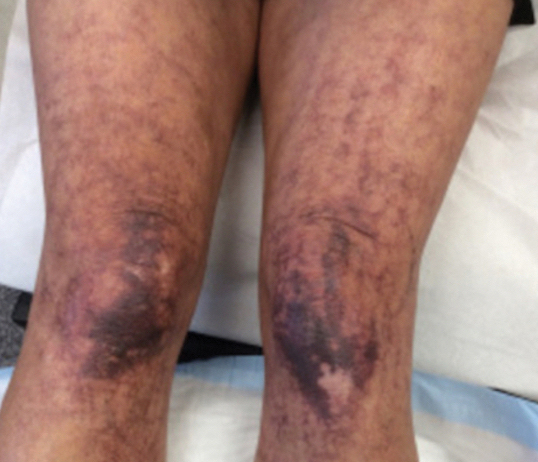
Histopathology revealed prominent dilation of postcapillary venules with eosinophilic collagenous materials in the vessel walls that was positive on periodic acid–Schiff stain, confirming the diagnosis of CCV. The perivascular collagenous material failed to stain with Congo red. Laboratory testing for serum protein electrophoresis, antinuclear antibodies, and baseline hematologic and metabolic panels revealed no abnormalities.
Over 3 years of treatment with PDL, most of the black patches resolved, but prominent telangiectatic vessels remained (Figure 2). Sclerotherapy with polidocanol (10 mg/mL) resulted in clearance of the majority of telangiectatic vessels. After each sclerotherapy treatment, Unna boots were applied for a minimum of 24 hours. The patient had no adverse effects from either PDL or sclerotherapy and was pleased with the results (Figure 3). An ophthalmologist had attributed the retinal bleeding to central serous chorioretinopathy, but tortuosity of superficial scleral and episcleral vessels progressed, suggesting CCV as the more likely cause (Figure 4). Currently, she is being followed for visual changes and further retinal bleeding.
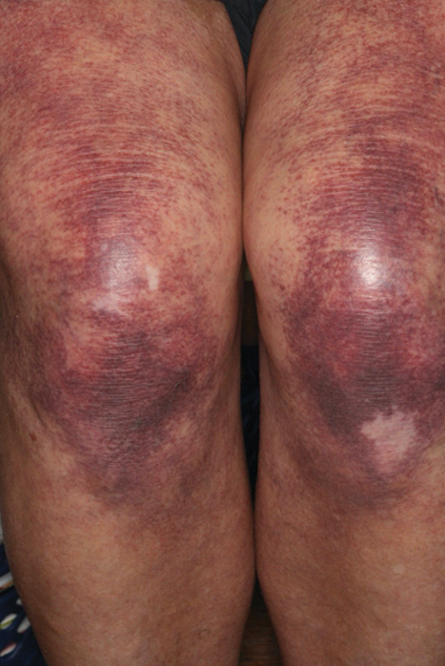
Early CCV typically appears as blanchable pink or red macules, telangiectases, or petechiae on the lower extremities, progressing to involve the trunk and upper extremity.1-3 In rare cases, CCV presents in a papular or annular variant instead of the typical telangiectatic form.4,5 As the lesions progress, they often darken in appearance. Bleeding can occur, and the progressive patches are disfiguring.6,7 Middle-aged to older adults typically present with CCV (range, 16–83 years), with a mean age of 62 years.1,2,6 This disease affects both males and females, predominantly in White individuals.1 Extracutaneous manifestations are rare.1,2,6 One case of mucosal involvement was described in a patient with glossitis and oral erosions.8 We found no prior reports of nail or eye changes.1,2
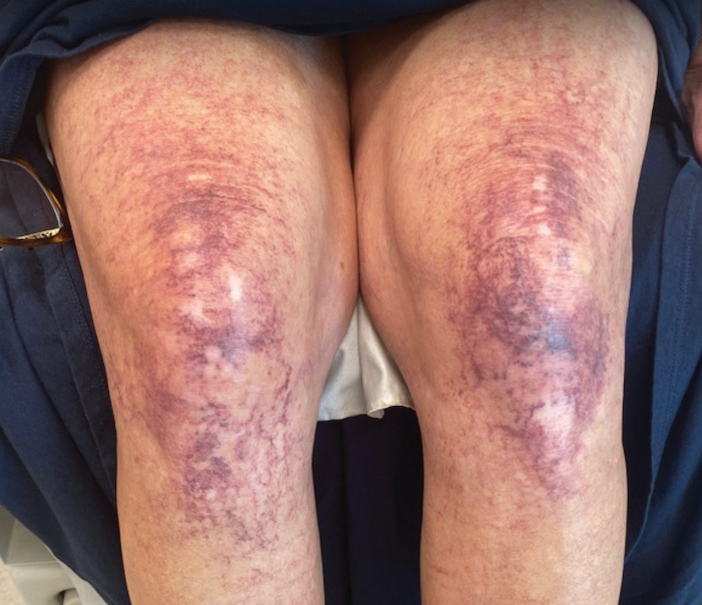
The etiology of CCV is unknown, but different theories have been proposed. One is that CCV is due to a genetic defect that changes collagen synthesis in the cutaneous microvasculature. Another more widely held belief is that CCV originates from an injury that occurs to the microvasculature endothelial cells. Regardless of the cause of the triggering injury, the result is induced intravascular occlusive microthrombi that cause perivascular fibrosis and endothelial hyperplasia.2,6,7,9

Cutaneous collagenous vasculopathy may be influenced by systemic diseases. The most common comorbidities are hypertension, cardiovascular disease, diabetes mellitus, and hyperlipidemia.1,3,6-8 The presentation of CCV with a malignancy is rare; 1 patient was diagnosed with multiple myeloma 18 months after CCV, and another patient’s cutaneous presentation led to discovery of pancreatic cancer with metastasis.8,10 In this setting, the increased growth factors or hypercoagulability of malignancy may play a role in endothelial cell damage and hyperplasia. Autoimmune vascular injury also has been suggested to trigger CCV; 1 case involved antiribonucleoprotein antibodies, while another case involved anti–endothelial cell antibody assays.11 In addition, CCV has been reported in hypercoagulable patients, demonstrating another route for endothelial damage, with 1 patient being heterozygous for prothrombin G20210A, a report of CCV in a patient with cryofibrinogenemia, and another patient being found positive for lupus anticoagulant.11,12 Drugs also have been thought to influence CCV, including corticosteroids, lithium, thiothixene, interferon, isotretinoin, calcium channel blockers, antibiotics, hydroxyurea, and antidepressants.7,11
The diagnosis of CCV is confirmed using light microscopy and collagen-specific immunostaining. Examination shows hyaline eosinophilic deposition of type IV collagen around the affected vessels, with the postcapillary venules showing characteristic duplication of the basal lamina.3,9 The material stains positive with periodic acid-Schiff and Masson trichrome.3
Underreporting may contribute to the low incidence of CCV. The clinical presentation of CCV is similar to generalized essential telangiectasia, with biopsy distinguishing the two. Other diagnoses in the differential include hereditary hemorrhagic telangiectasia, which typically would have mucosal involvement; radiating telangiectatic mats and a strong family history; and hereditary benign telangiectasia, which typically presents in younger patients aged 1 year to adolescence.1
Treatment with vascular lasers has been the main focus, using either the 595-nm PDL or the 1064-nm Nd:YAG laser.6,13 Pulsed dye laser or intense pulsed light devices can improve patient well-being1,2; intense pulsed light allows for a larger spot size and may be preferred in patients with a larger body surface area involved.13 However, a few other treatments have been proposed. One case report noted poor response to sclerotherapy.1 In another case, a patient treated with a chemotherapy agent, bortezomib, for their concurrent multiple myeloma showed notable CCV cutaneous improvement. The proposed mechanism for bortezomib improving CCV is through its antiproliferative effect on endothelial cells of the superficial dermal vessels.8 Our patient did not achieve an adequate response with PDL, but the addition of sclerotherapy with polidocanol induced a successful response.
Patients should be examined for evidence of ocular involvement and referred to an ophthalmologist for appropriate care. Although there is no definite association with systemic illnesses or mediation, recent associations with an autoimmune disorder or underlying malignancy have been noted.8,10,11 Age-appropriate cancer screening and attention to associated signs and symptoms are recommended.
- Brady BG, Ortleb M, Boyd AS, et al. Cutaneous collagenous vasculopathy. J Clin Aesthet Dermatol. 2015;8:49-52. https://doi.org/10.1097/dad.0000000000000194
- Castiñeiras-Mato I, Rodríguez-Lojo R, Fernández-Díaz ML, et al. Cutaneous collagenous vasculopathy: a case report and review of the literature. Actas Dermosifiliogr. 2016;107:444-447. https://doi.org/10.1016/j.ad.2015.11.006
- Rambhia KD, Hadawale SD, Khopkar US. Cutaneous collagenous vasculopathy: a rare case report. Indian Dermatol Online J. 2016;7:40-42. https://doi.org/10.4103/2229-5178.174327
- Conde-Ferreirós A, Roncero-Riesco M, Cañueto J, et al. Cutaneous collagenous vasculopathy: papular form [published online August 15, 2019]. Dermatol Online J. https://doi.org/10.5070/d3258045128
- García-Martínez P, Gomez-Martin I, Lloreta J, et al. Multiple progressive annular telangiectasias: a clinicopathological variant of cutaneous collagenous vasculopathy? J Cutan Pathol. 2017;44:982-985. https://doi.org/10.1111/cup.13029
- Sartori DS, de Almeida Jr HL, Dorn TV, et al. Cutaneous collagenous vasculopathy: light and transmission electron microscopy. An Bras Dermatol. 2019;94:211-213. https://doi.org/10.1590/abd1806-4841.20198166
- Basso D, Ribero S, Blazek C, et al. Cutaneous collagenous vasculopathy: a rare form of microangiopathy successfully treated with a combination of multiplex laser and optimized pulsed light with a review of the literature. Dermatology. 2016;232:107-111. https://doi.org/10.1159/000439126
- Dura M, Pock L, Cetkovska P, et al. A case of cutaneous collagenous vasculopathy associated with multiple myeloma and with a pathogenic variant of the glucocerebrosidase gene. J Cutan Pathol. 2022;49:717-721. https://doi.org/10.1111/cup.14227
- Salama S, Chorneyko K, Belovic B. Cutaneous collagenous vasculopathy associated with intravascular occlusive fibrin thrombi. J Cutan Pathol. 2014;41:386-393. https://doi.org/10.1111/cup.12285
- Holder E, Schreckenberg C, Lipsker D. Cutaneous collagenous vasculopathy leading to the diagnosis of an advanced pancreatic cancer. J Eur Acad Dermatol Venereol. 2022;36:E699-E701. https://doi.org/10.1111/jdv.18152
- Grossman ME, Cohen M, Ravits M, et al. Cutaneous collagenous vasculopathy: a report of three cases. J Cutan Pathol. 2022;49:491-495. https://doi.org/10.1111/cup.14192
- Eldik H, Leisenring NH, Al-Rohil RN, et al. Cutaneous collagenous vasculopathy in a middle-aged woman with a history of prothrombin G20210A thrombophilia. J Cutan Pathol. 2022;49:679-682. https://doi.org/10.1111/cup.13895
- Weiss E, Lazzara DR. Commentary on clinical improvement of cutaneous collagenous vasculopathy with intense pulsed light therapy. Dermatol Surg. 2021;47:1412. https://doi.org/10.1097/DSS.0000000000003209
To the Editor:
Cutaneous collagenous vasculopathy (CCV) is an uncommon microangiopathy that presents with progressive telangiectases on the lower extremities that can eventually spread to involve the upper extremities and trunk. Systemic involvement is uncommon. The diagnosis is confirmed by biopsy, which demonstrates dilated capillaries and postcapillary venules with eosinophilic hyalinized walls. Treatment generally has focused on the use of vascular lasers.1 We report a patient with advanced CCV and ocular involvement that responded to a combination of pulsed dye laser (PDL) therapy and sclerotherapy for cutaneous lesions.
A 63-year-old woman presented with partially blanchable, purple-black patches on the lower extremities (Figure 1). The upper extremities had minimal involvement at the time of presentation. A medical history revealed the lesions presented on the legs 10 years prior but were beginning to form on the arms. She had a history of hypertension and bleeding in the retina.
Histopathology revealed prominent dilation of postcapillary venules with eosinophilic collagenous materials in the vessel walls that was positive on periodic acid–Schiff stain, confirming the diagnosis of CCV. The perivascular collagenous material failed to stain with Congo red. Laboratory testing for serum protein electrophoresis, antinuclear antibodies, and baseline hematologic and metabolic panels revealed no abnormalities.
Over 3 years of treatment with PDL, most of the black patches resolved, but prominent telangiectatic vessels remained (Figure 2). Sclerotherapy with polidocanol (10 mg/mL) resulted in clearance of the majority of telangiectatic vessels. After each sclerotherapy treatment, Unna boots were applied for a minimum of 24 hours. The patient had no adverse effects from either PDL or sclerotherapy and was pleased with the results (Figure 3). An ophthalmologist had attributed the retinal bleeding to central serous chorioretinopathy, but tortuosity of superficial scleral and episcleral vessels progressed, suggesting CCV as the more likely cause (Figure 4). Currently, she is being followed for visual changes and further retinal bleeding.
Early CCV typically appears as blanchable pink or red macules, telangiectases, or petechiae on the lower extremities, progressing to involve the trunk and upper extremity.1-3 In rare cases, CCV presents in a papular or annular variant instead of the typical telangiectatic form.4,5 As the lesions progress, they often darken in appearance. Bleeding can occur, and the progressive patches are disfiguring.6,7 Middle-aged to older adults typically present with CCV (range, 16–83 years), with a mean age of 62 years.1,2,6 This disease affects both males and females, predominantly in White individuals.1 Extracutaneous manifestations are rare.1,2,6 One case of mucosal involvement was described in a patient with glossitis and oral erosions.8 We found no prior reports of nail or eye changes.1,2
The etiology of CCV is unknown, but different theories have been proposed. One is that CCV is due to a genetic defect that changes collagen synthesis in the cutaneous microvasculature. Another more widely held belief is that CCV originates from an injury that occurs to the microvasculature endothelial cells. Regardless of the cause of the triggering injury, the result is induced intravascular occlusive microthrombi that cause perivascular fibrosis and endothelial hyperplasia.2,6,7,9
Cutaneous collagenous vasculopathy may be influenced by systemic diseases. The most common comorbidities are hypertension, cardiovascular disease, diabetes mellitus, and hyperlipidemia.1,3,6-8 The presentation of CCV with a malignancy is rare; 1 patient was diagnosed with multiple myeloma 18 months after CCV, and another patient’s cutaneous presentation led to discovery of pancreatic cancer with metastasis.8,10 In this setting, the increased growth factors or hypercoagulability of malignancy may play a role in endothelial cell damage and hyperplasia. Autoimmune vascular injury also has been suggested to trigger CCV; 1 case involved antiribonucleoprotein antibodies, while another case involved anti–endothelial cell antibody assays.11 In addition, CCV has been reported in hypercoagulable patients, demonstrating another route for endothelial damage, with 1 patient being heterozygous for prothrombin G20210A, a report of CCV in a patient with cryofibrinogenemia, and another patient being found positive for lupus anticoagulant.11,12 Drugs also have been thought to influence CCV, including corticosteroids, lithium, thiothixene, interferon, isotretinoin, calcium channel blockers, antibiotics, hydroxyurea, and antidepressants.7,11
The diagnosis of CCV is confirmed using light microscopy and collagen-specific immunostaining. Examination shows hyaline eosinophilic deposition of type IV collagen around the affected vessels, with the postcapillary venules showing characteristic duplication of the basal lamina.3,9 The material stains positive with periodic acid-Schiff and Masson trichrome.3
Underreporting may contribute to the low incidence of CCV. The clinical presentation of CCV is similar to generalized essential telangiectasia, with biopsy distinguishing the two. Other diagnoses in the differential include hereditary hemorrhagic telangiectasia, which typically would have mucosal involvement; radiating telangiectatic mats and a strong family history; and hereditary benign telangiectasia, which typically presents in younger patients aged 1 year to adolescence.1
Treatment with vascular lasers has been the main focus, using either the 595-nm PDL or the 1064-nm Nd:YAG laser.6,13 Pulsed dye laser or intense pulsed light devices can improve patient well-being1,2; intense pulsed light allows for a larger spot size and may be preferred in patients with a larger body surface area involved.13 However, a few other treatments have been proposed. One case report noted poor response to sclerotherapy.1 In another case, a patient treated with a chemotherapy agent, bortezomib, for their concurrent multiple myeloma showed notable CCV cutaneous improvement. The proposed mechanism for bortezomib improving CCV is through its antiproliferative effect on endothelial cells of the superficial dermal vessels.8 Our patient did not achieve an adequate response with PDL, but the addition of sclerotherapy with polidocanol induced a successful response.
Patients should be examined for evidence of ocular involvement and referred to an ophthalmologist for appropriate care. Although there is no definite association with systemic illnesses or mediation, recent associations with an autoimmune disorder or underlying malignancy have been noted.8,10,11 Age-appropriate cancer screening and attention to associated signs and symptoms are recommended.
To the Editor:
Cutaneous collagenous vasculopathy (CCV) is an uncommon microangiopathy that presents with progressive telangiectases on the lower extremities that can eventually spread to involve the upper extremities and trunk. Systemic involvement is uncommon. The diagnosis is confirmed by biopsy, which demonstrates dilated capillaries and postcapillary venules with eosinophilic hyalinized walls. Treatment generally has focused on the use of vascular lasers.1 We report a patient with advanced CCV and ocular involvement that responded to a combination of pulsed dye laser (PDL) therapy and sclerotherapy for cutaneous lesions.
A 63-year-old woman presented with partially blanchable, purple-black patches on the lower extremities (Figure 1). The upper extremities had minimal involvement at the time of presentation. A medical history revealed the lesions presented on the legs 10 years prior but were beginning to form on the arms. She had a history of hypertension and bleeding in the retina.
Histopathology revealed prominent dilation of postcapillary venules with eosinophilic collagenous materials in the vessel walls that was positive on periodic acid–Schiff stain, confirming the diagnosis of CCV. The perivascular collagenous material failed to stain with Congo red. Laboratory testing for serum protein electrophoresis, antinuclear antibodies, and baseline hematologic and metabolic panels revealed no abnormalities.
Over 3 years of treatment with PDL, most of the black patches resolved, but prominent telangiectatic vessels remained (Figure 2). Sclerotherapy with polidocanol (10 mg/mL) resulted in clearance of the majority of telangiectatic vessels. After each sclerotherapy treatment, Unna boots were applied for a minimum of 24 hours. The patient had no adverse effects from either PDL or sclerotherapy and was pleased with the results (Figure 3). An ophthalmologist had attributed the retinal bleeding to central serous chorioretinopathy, but tortuosity of superficial scleral and episcleral vessels progressed, suggesting CCV as the more likely cause (Figure 4). Currently, she is being followed for visual changes and further retinal bleeding.
Early CCV typically appears as blanchable pink or red macules, telangiectases, or petechiae on the lower extremities, progressing to involve the trunk and upper extremity.1-3 In rare cases, CCV presents in a papular or annular variant instead of the typical telangiectatic form.4,5 As the lesions progress, they often darken in appearance. Bleeding can occur, and the progressive patches are disfiguring.6,7 Middle-aged to older adults typically present with CCV (range, 16–83 years), with a mean age of 62 years.1,2,6 This disease affects both males and females, predominantly in White individuals.1 Extracutaneous manifestations are rare.1,2,6 One case of mucosal involvement was described in a patient with glossitis and oral erosions.8 We found no prior reports of nail or eye changes.1,2
The etiology of CCV is unknown, but different theories have been proposed. One is that CCV is due to a genetic defect that changes collagen synthesis in the cutaneous microvasculature. Another more widely held belief is that CCV originates from an injury that occurs to the microvasculature endothelial cells. Regardless of the cause of the triggering injury, the result is induced intravascular occlusive microthrombi that cause perivascular fibrosis and endothelial hyperplasia.2,6,7,9
Cutaneous collagenous vasculopathy may be influenced by systemic diseases. The most common comorbidities are hypertension, cardiovascular disease, diabetes mellitus, and hyperlipidemia.1,3,6-8 The presentation of CCV with a malignancy is rare; 1 patient was diagnosed with multiple myeloma 18 months after CCV, and another patient’s cutaneous presentation led to discovery of pancreatic cancer with metastasis.8,10 In this setting, the increased growth factors or hypercoagulability of malignancy may play a role in endothelial cell damage and hyperplasia. Autoimmune vascular injury also has been suggested to trigger CCV; 1 case involved antiribonucleoprotein antibodies, while another case involved anti–endothelial cell antibody assays.11 In addition, CCV has been reported in hypercoagulable patients, demonstrating another route for endothelial damage, with 1 patient being heterozygous for prothrombin G20210A, a report of CCV in a patient with cryofibrinogenemia, and another patient being found positive for lupus anticoagulant.11,12 Drugs also have been thought to influence CCV, including corticosteroids, lithium, thiothixene, interferon, isotretinoin, calcium channel blockers, antibiotics, hydroxyurea, and antidepressants.7,11
The diagnosis of CCV is confirmed using light microscopy and collagen-specific immunostaining. Examination shows hyaline eosinophilic deposition of type IV collagen around the affected vessels, with the postcapillary venules showing characteristic duplication of the basal lamina.3,9 The material stains positive with periodic acid-Schiff and Masson trichrome.3
Underreporting may contribute to the low incidence of CCV. The clinical presentation of CCV is similar to generalized essential telangiectasia, with biopsy distinguishing the two. Other diagnoses in the differential include hereditary hemorrhagic telangiectasia, which typically would have mucosal involvement; radiating telangiectatic mats and a strong family history; and hereditary benign telangiectasia, which typically presents in younger patients aged 1 year to adolescence.1
Treatment with vascular lasers has been the main focus, using either the 595-nm PDL or the 1064-nm Nd:YAG laser.6,13 Pulsed dye laser or intense pulsed light devices can improve patient well-being1,2; intense pulsed light allows for a larger spot size and may be preferred in patients with a larger body surface area involved.13 However, a few other treatments have been proposed. One case report noted poor response to sclerotherapy.1 In another case, a patient treated with a chemotherapy agent, bortezomib, for their concurrent multiple myeloma showed notable CCV cutaneous improvement. The proposed mechanism for bortezomib improving CCV is through its antiproliferative effect on endothelial cells of the superficial dermal vessels.8 Our patient did not achieve an adequate response with PDL, but the addition of sclerotherapy with polidocanol induced a successful response.
Patients should be examined for evidence of ocular involvement and referred to an ophthalmologist for appropriate care. Although there is no definite association with systemic illnesses or mediation, recent associations with an autoimmune disorder or underlying malignancy have been noted.8,10,11 Age-appropriate cancer screening and attention to associated signs and symptoms are recommended.
- Brady BG, Ortleb M, Boyd AS, et al. Cutaneous collagenous vasculopathy. J Clin Aesthet Dermatol. 2015;8:49-52. https://doi.org/10.1097/dad.0000000000000194
- Castiñeiras-Mato I, Rodríguez-Lojo R, Fernández-Díaz ML, et al. Cutaneous collagenous vasculopathy: a case report and review of the literature. Actas Dermosifiliogr. 2016;107:444-447. https://doi.org/10.1016/j.ad.2015.11.006
- Rambhia KD, Hadawale SD, Khopkar US. Cutaneous collagenous vasculopathy: a rare case report. Indian Dermatol Online J. 2016;7:40-42. https://doi.org/10.4103/2229-5178.174327
- Conde-Ferreirós A, Roncero-Riesco M, Cañueto J, et al. Cutaneous collagenous vasculopathy: papular form [published online August 15, 2019]. Dermatol Online J. https://doi.org/10.5070/d3258045128
- García-Martínez P, Gomez-Martin I, Lloreta J, et al. Multiple progressive annular telangiectasias: a clinicopathological variant of cutaneous collagenous vasculopathy? J Cutan Pathol. 2017;44:982-985. https://doi.org/10.1111/cup.13029
- Sartori DS, de Almeida Jr HL, Dorn TV, et al. Cutaneous collagenous vasculopathy: light and transmission electron microscopy. An Bras Dermatol. 2019;94:211-213. https://doi.org/10.1590/abd1806-4841.20198166
- Basso D, Ribero S, Blazek C, et al. Cutaneous collagenous vasculopathy: a rare form of microangiopathy successfully treated with a combination of multiplex laser and optimized pulsed light with a review of the literature. Dermatology. 2016;232:107-111. https://doi.org/10.1159/000439126
- Dura M, Pock L, Cetkovska P, et al. A case of cutaneous collagenous vasculopathy associated with multiple myeloma and with a pathogenic variant of the glucocerebrosidase gene. J Cutan Pathol. 2022;49:717-721. https://doi.org/10.1111/cup.14227
- Salama S, Chorneyko K, Belovic B. Cutaneous collagenous vasculopathy associated with intravascular occlusive fibrin thrombi. J Cutan Pathol. 2014;41:386-393. https://doi.org/10.1111/cup.12285
- Holder E, Schreckenberg C, Lipsker D. Cutaneous collagenous vasculopathy leading to the diagnosis of an advanced pancreatic cancer. J Eur Acad Dermatol Venereol. 2022;36:E699-E701. https://doi.org/10.1111/jdv.18152
- Grossman ME, Cohen M, Ravits M, et al. Cutaneous collagenous vasculopathy: a report of three cases. J Cutan Pathol. 2022;49:491-495. https://doi.org/10.1111/cup.14192
- Eldik H, Leisenring NH, Al-Rohil RN, et al. Cutaneous collagenous vasculopathy in a middle-aged woman with a history of prothrombin G20210A thrombophilia. J Cutan Pathol. 2022;49:679-682. https://doi.org/10.1111/cup.13895
- Weiss E, Lazzara DR. Commentary on clinical improvement of cutaneous collagenous vasculopathy with intense pulsed light therapy. Dermatol Surg. 2021;47:1412. https://doi.org/10.1097/DSS.0000000000003209
- Brady BG, Ortleb M, Boyd AS, et al. Cutaneous collagenous vasculopathy. J Clin Aesthet Dermatol. 2015;8:49-52. https://doi.org/10.1097/dad.0000000000000194
- Castiñeiras-Mato I, Rodríguez-Lojo R, Fernández-Díaz ML, et al. Cutaneous collagenous vasculopathy: a case report and review of the literature. Actas Dermosifiliogr. 2016;107:444-447. https://doi.org/10.1016/j.ad.2015.11.006
- Rambhia KD, Hadawale SD, Khopkar US. Cutaneous collagenous vasculopathy: a rare case report. Indian Dermatol Online J. 2016;7:40-42. https://doi.org/10.4103/2229-5178.174327
- Conde-Ferreirós A, Roncero-Riesco M, Cañueto J, et al. Cutaneous collagenous vasculopathy: papular form [published online August 15, 2019]. Dermatol Online J. https://doi.org/10.5070/d3258045128
- García-Martínez P, Gomez-Martin I, Lloreta J, et al. Multiple progressive annular telangiectasias: a clinicopathological variant of cutaneous collagenous vasculopathy? J Cutan Pathol. 2017;44:982-985. https://doi.org/10.1111/cup.13029
- Sartori DS, de Almeida Jr HL, Dorn TV, et al. Cutaneous collagenous vasculopathy: light and transmission electron microscopy. An Bras Dermatol. 2019;94:211-213. https://doi.org/10.1590/abd1806-4841.20198166
- Basso D, Ribero S, Blazek C, et al. Cutaneous collagenous vasculopathy: a rare form of microangiopathy successfully treated with a combination of multiplex laser and optimized pulsed light with a review of the literature. Dermatology. 2016;232:107-111. https://doi.org/10.1159/000439126
- Dura M, Pock L, Cetkovska P, et al. A case of cutaneous collagenous vasculopathy associated with multiple myeloma and with a pathogenic variant of the glucocerebrosidase gene. J Cutan Pathol. 2022;49:717-721. https://doi.org/10.1111/cup.14227
- Salama S, Chorneyko K, Belovic B. Cutaneous collagenous vasculopathy associated with intravascular occlusive fibrin thrombi. J Cutan Pathol. 2014;41:386-393. https://doi.org/10.1111/cup.12285
- Holder E, Schreckenberg C, Lipsker D. Cutaneous collagenous vasculopathy leading to the diagnosis of an advanced pancreatic cancer. J Eur Acad Dermatol Venereol. 2022;36:E699-E701. https://doi.org/10.1111/jdv.18152
- Grossman ME, Cohen M, Ravits M, et al. Cutaneous collagenous vasculopathy: a report of three cases. J Cutan Pathol. 2022;49:491-495. https://doi.org/10.1111/cup.14192
- Eldik H, Leisenring NH, Al-Rohil RN, et al. Cutaneous collagenous vasculopathy in a middle-aged woman with a history of prothrombin G20210A thrombophilia. J Cutan Pathol. 2022;49:679-682. https://doi.org/10.1111/cup.13895
- Weiss E, Lazzara DR. Commentary on clinical improvement of cutaneous collagenous vasculopathy with intense pulsed light therapy. Dermatol Surg. 2021;47:1412. https://doi.org/10.1097/DSS.0000000000003209
Practice Points
- Collagenous vasculopathy is an underrecognized entity.
- Although most patients exhibit only cutaneous disease, systemic involvement also should be assessed.