User login
Systemic inflammation expands clinical challenge in IBD
ORLANDO – Prescribing optimal therapy for a patient with inflammatory bowel disease can be challenging under ordinary circumstances, but add an extra-intestinal manifestation and the complexity grows greater still. Until more evidence-based findings emerge to help guide and individualize systemic or combination therapy, one of the advantages of biologics – their ability to target the intestine – can be a drawback when patients present with other manifestations.
To highlight the challenges and propose management strategies, Corey A. Siegel, MD, presented the case of a 45-year-old man seeking care 8 years after a diagnosis of ileocolonic Crohn’s disease. Seven years earlier, after the patient failed 5-aminosalicylic acid medication and prednisone therapy, clinicians prescribed infliximab (Remicade, Janssen) monotherapy. He experienced a “great response,” Dr. Siegel said at the Advances in Inflammatory Bowel Diseases meeting.

“Unfortunately, he had a real-life delayed hypersensitivity reaction 2 years ago with no drug present at trough and good antibodies, equal to 12 on a drug tolerant assay,” added Dr. Siegel, director of the Inflammatory Bowel Disease Center at Dartmouth-Hitchcock Medical Center in Lebanon, N.H., and moderator of a case discussion panel session. So physicians initiated combination therapy with adalimumab (Humira, AbbVie) and methotrexate, but the patient “never felt as good as he did on infliximab, even with weekly dosing.”
A colonoscopy 9 months ago revealed mild to mildly active ileal and ascending colon disease. “So he still has residual disease present, even with weekly dosing of adalimumab,” Dr. Siegel explained. At the time, clinicians prescribed vedolizumab (Entyvio, Takeda) and the patient reported IBD symptom improvement. “He was doing better but not fantastic, and now his joints were bothering him, and they never bothered him before.” The man reported joint pain in his hands, knees, and hips. A more recent, follow-up colonoscopy revealed improvement, although mildly active disease was still present.
Do we need to dose-optimize vedolizumab or is it time to move on here? Dr. Siegel asked an expert panel: Bruce E. Sands, MD, David T. Rubin, MD, and Gary L. Lichtenstein, MD.

Instead of considering a third anti–tumor necrosis factor (anti-TNF) agent when the patient has already not responded fully to others in that class, Dr. Sands suggested ustekinumab (Stelara, Janssen). “It could be that ustekinumab would be a better choice versus dose escalation of vedolizumab, unless you add something to the dose-escalated vedolizumab to treat the arthralgias like celecoxib.”
Next, Dr. Siegel asked if the arthralgias are truly extra-intestinal manifestations of inflammatory bowel disease “or is it what my patients are telling me – what they see all over the Internet – that vedolizumab causes arthralgias or arthropathies?
“That is an important question,” said Dr. Rubin, section chief of gastroenterology, hepatology, and nutrition at the University of Chicago. “My question back to you is when did the joint pain start – right after vedolizumab was initiated? Right after steroids were tapered? Or after the patient was on stable dosing for some time?”
The arthralgias seemed to start right after the patient started vedolizumab, Dr. Siegel said. But when clinicians inquired a little further, the patient reported “it was when he came off the adalimumab that things really started.”

It could be that systemically active infliximab and adalimumab with methotrexate were essentially covering up an extra-intestinal manifestation that was later uncovered with the selective mechanism of vedolizumab, Dr. Rubin said. “If that’s true, I don’t think I would give him more vedolizumab to treat his joint pain – that certainly wouldn’t do it. I would make sure his disease is responding from mucosal view, then I would add methotrexate or even consider sulfasalazine.”
A meeting attendee said that the patient did very well with infliximab, and asked “can we ever go back?”
“Probably not easily,” Dr. Sands said. “For someone with a bona fide delayed hypersensitivity reaction – I wouldn’t go there, and I wouldn’t think that you could.”
Another attendee asked if there is a role for adding another biologic to vedolizumab. “We hope to initiate a study soon looking at combination of biologics, such as vedolizumab with adalimumab, with and without an immunomodulator, Dr. Sands replied. They cover somewhat different targets – so it’s sort of a ‘belts and suspenders approach’ … but there are no data whatsoever [yet].”
Dr. Siegel wrapped up the case discussion with the patient’s outcomes. “We did move him on to ustekinumab. He felt better and his arthralgias went away.”
The meeting was sponsored by the Crohn’s & Colitis Foundation of America.
Dr. Siegel and Dr. Rubin disclosed ties with AbbVie, Janssen, and Takeda. Dr. Sands disclosed ties with AbbVie, Janssen Biotech, and Takeda. Dr. Lichtenstein disclosed ties with AbbVie, Janssen Orthobiotech, and Takeda.
ORLANDO – Prescribing optimal therapy for a patient with inflammatory bowel disease can be challenging under ordinary circumstances, but add an extra-intestinal manifestation and the complexity grows greater still. Until more evidence-based findings emerge to help guide and individualize systemic or combination therapy, one of the advantages of biologics – their ability to target the intestine – can be a drawback when patients present with other manifestations.
To highlight the challenges and propose management strategies, Corey A. Siegel, MD, presented the case of a 45-year-old man seeking care 8 years after a diagnosis of ileocolonic Crohn’s disease. Seven years earlier, after the patient failed 5-aminosalicylic acid medication and prednisone therapy, clinicians prescribed infliximab (Remicade, Janssen) monotherapy. He experienced a “great response,” Dr. Siegel said at the Advances in Inflammatory Bowel Diseases meeting.
“Unfortunately, he had a real-life delayed hypersensitivity reaction 2 years ago with no drug present at trough and good antibodies, equal to 12 on a drug tolerant assay,” added Dr. Siegel, director of the Inflammatory Bowel Disease Center at Dartmouth-Hitchcock Medical Center in Lebanon, N.H., and moderator of a case discussion panel session. So physicians initiated combination therapy with adalimumab (Humira, AbbVie) and methotrexate, but the patient “never felt as good as he did on infliximab, even with weekly dosing.”
A colonoscopy 9 months ago revealed mild to mildly active ileal and ascending colon disease. “So he still has residual disease present, even with weekly dosing of adalimumab,” Dr. Siegel explained. At the time, clinicians prescribed vedolizumab (Entyvio, Takeda) and the patient reported IBD symptom improvement. “He was doing better but not fantastic, and now his joints were bothering him, and they never bothered him before.” The man reported joint pain in his hands, knees, and hips. A more recent, follow-up colonoscopy revealed improvement, although mildly active disease was still present.
Do we need to dose-optimize vedolizumab or is it time to move on here? Dr. Siegel asked an expert panel: Bruce E. Sands, MD, David T. Rubin, MD, and Gary L. Lichtenstein, MD.
Instead of considering a third anti–tumor necrosis factor (anti-TNF) agent when the patient has already not responded fully to others in that class, Dr. Sands suggested ustekinumab (Stelara, Janssen). “It could be that ustekinumab would be a better choice versus dose escalation of vedolizumab, unless you add something to the dose-escalated vedolizumab to treat the arthralgias like celecoxib.”
Next, Dr. Siegel asked if the arthralgias are truly extra-intestinal manifestations of inflammatory bowel disease “or is it what my patients are telling me – what they see all over the Internet – that vedolizumab causes arthralgias or arthropathies?
“That is an important question,” said Dr. Rubin, section chief of gastroenterology, hepatology, and nutrition at the University of Chicago. “My question back to you is when did the joint pain start – right after vedolizumab was initiated? Right after steroids were tapered? Or after the patient was on stable dosing for some time?”
The arthralgias seemed to start right after the patient started vedolizumab, Dr. Siegel said. But when clinicians inquired a little further, the patient reported “it was when he came off the adalimumab that things really started.”
It could be that systemically active infliximab and adalimumab with methotrexate were essentially covering up an extra-intestinal manifestation that was later uncovered with the selective mechanism of vedolizumab, Dr. Rubin said. “If that’s true, I don’t think I would give him more vedolizumab to treat his joint pain – that certainly wouldn’t do it. I would make sure his disease is responding from mucosal view, then I would add methotrexate or even consider sulfasalazine.”
A meeting attendee said that the patient did very well with infliximab, and asked “can we ever go back?”
“Probably not easily,” Dr. Sands said. “For someone with a bona fide delayed hypersensitivity reaction – I wouldn’t go there, and I wouldn’t think that you could.”
Another attendee asked if there is a role for adding another biologic to vedolizumab. “We hope to initiate a study soon looking at combination of biologics, such as vedolizumab with adalimumab, with and without an immunomodulator, Dr. Sands replied. They cover somewhat different targets – so it’s sort of a ‘belts and suspenders approach’ … but there are no data whatsoever [yet].”
Dr. Siegel wrapped up the case discussion with the patient’s outcomes. “We did move him on to ustekinumab. He felt better and his arthralgias went away.”
The meeting was sponsored by the Crohn’s & Colitis Foundation of America.
Dr. Siegel and Dr. Rubin disclosed ties with AbbVie, Janssen, and Takeda. Dr. Sands disclosed ties with AbbVie, Janssen Biotech, and Takeda. Dr. Lichtenstein disclosed ties with AbbVie, Janssen Orthobiotech, and Takeda.
ORLANDO – Prescribing optimal therapy for a patient with inflammatory bowel disease can be challenging under ordinary circumstances, but add an extra-intestinal manifestation and the complexity grows greater still. Until more evidence-based findings emerge to help guide and individualize systemic or combination therapy, one of the advantages of biologics – their ability to target the intestine – can be a drawback when patients present with other manifestations.
To highlight the challenges and propose management strategies, Corey A. Siegel, MD, presented the case of a 45-year-old man seeking care 8 years after a diagnosis of ileocolonic Crohn’s disease. Seven years earlier, after the patient failed 5-aminosalicylic acid medication and prednisone therapy, clinicians prescribed infliximab (Remicade, Janssen) monotherapy. He experienced a “great response,” Dr. Siegel said at the Advances in Inflammatory Bowel Diseases meeting.
“Unfortunately, he had a real-life delayed hypersensitivity reaction 2 years ago with no drug present at trough and good antibodies, equal to 12 on a drug tolerant assay,” added Dr. Siegel, director of the Inflammatory Bowel Disease Center at Dartmouth-Hitchcock Medical Center in Lebanon, N.H., and moderator of a case discussion panel session. So physicians initiated combination therapy with adalimumab (Humira, AbbVie) and methotrexate, but the patient “never felt as good as he did on infliximab, even with weekly dosing.”
A colonoscopy 9 months ago revealed mild to mildly active ileal and ascending colon disease. “So he still has residual disease present, even with weekly dosing of adalimumab,” Dr. Siegel explained. At the time, clinicians prescribed vedolizumab (Entyvio, Takeda) and the patient reported IBD symptom improvement. “He was doing better but not fantastic, and now his joints were bothering him, and they never bothered him before.” The man reported joint pain in his hands, knees, and hips. A more recent, follow-up colonoscopy revealed improvement, although mildly active disease was still present.
Do we need to dose-optimize vedolizumab or is it time to move on here? Dr. Siegel asked an expert panel: Bruce E. Sands, MD, David T. Rubin, MD, and Gary L. Lichtenstein, MD.
Instead of considering a third anti–tumor necrosis factor (anti-TNF) agent when the patient has already not responded fully to others in that class, Dr. Sands suggested ustekinumab (Stelara, Janssen). “It could be that ustekinumab would be a better choice versus dose escalation of vedolizumab, unless you add something to the dose-escalated vedolizumab to treat the arthralgias like celecoxib.”
Next, Dr. Siegel asked if the arthralgias are truly extra-intestinal manifestations of inflammatory bowel disease “or is it what my patients are telling me – what they see all over the Internet – that vedolizumab causes arthralgias or arthropathies?
“That is an important question,” said Dr. Rubin, section chief of gastroenterology, hepatology, and nutrition at the University of Chicago. “My question back to you is when did the joint pain start – right after vedolizumab was initiated? Right after steroids were tapered? Or after the patient was on stable dosing for some time?”
The arthralgias seemed to start right after the patient started vedolizumab, Dr. Siegel said. But when clinicians inquired a little further, the patient reported “it was when he came off the adalimumab that things really started.”
It could be that systemically active infliximab and adalimumab with methotrexate were essentially covering up an extra-intestinal manifestation that was later uncovered with the selective mechanism of vedolizumab, Dr. Rubin said. “If that’s true, I don’t think I would give him more vedolizumab to treat his joint pain – that certainly wouldn’t do it. I would make sure his disease is responding from mucosal view, then I would add methotrexate or even consider sulfasalazine.”
A meeting attendee said that the patient did very well with infliximab, and asked “can we ever go back?”
“Probably not easily,” Dr. Sands said. “For someone with a bona fide delayed hypersensitivity reaction – I wouldn’t go there, and I wouldn’t think that you could.”
Another attendee asked if there is a role for adding another biologic to vedolizumab. “We hope to initiate a study soon looking at combination of biologics, such as vedolizumab with adalimumab, with and without an immunomodulator, Dr. Sands replied. They cover somewhat different targets – so it’s sort of a ‘belts and suspenders approach’ … but there are no data whatsoever [yet].”
Dr. Siegel wrapped up the case discussion with the patient’s outcomes. “We did move him on to ustekinumab. He felt better and his arthralgias went away.”
The meeting was sponsored by the Crohn’s & Colitis Foundation of America.
Dr. Siegel and Dr. Rubin disclosed ties with AbbVie, Janssen, and Takeda. Dr. Sands disclosed ties with AbbVie, Janssen Biotech, and Takeda. Dr. Lichtenstein disclosed ties with AbbVie, Janssen Orthobiotech, and Takeda.
AT AIBD 2016
Key clinical point: Extra-intestinal manifestations of inflammatory bowel disease can leave gastroenterologists wondering about the best approach to treatment.
Major finding: Less gut-specific drug action may actually be better for these patients.
Data source: Panel discussion of challenging cases at AIBD 2016.
Disclosures: Dr. Siegel and Dr. Rubin disclosed ties with AbbVie, Janssen, and Takeda. Dr. Sands disclosed ties with AbbVie, Janssen Biotech, and Takeda. Dr. Lichtenstein disclosed ties with AbbVie, Janssen Orthobiotech, and Takeda.

Stress management for ambitious students
Most parents hope that their children will be motivated and hard-working at school, but ambitious students usually face very high levels of stress. Ambitious young people typically push themselves very hard and may not spend enough time in play, relaxation, or exploring potential interests. Their time with peers might be more competitive than social or fun. They may become rigidly focused on a goal, paving the way for devastation if they fall short of their own expectations. They may internalize stress and not ask for help if it starts to take a toll on their mental health. But ambition is not incompatible with healthy development and well-being. Pediatricians usually know who the ambitious students in their practice are, and will hear about the stress they may be experiencing. You have the opportunity to offer them (or their parents) some strategies to manage their high stress levels, and build resilience.
Support ambition, but not perfectionism
It can be helpful to acknowledge to young people that they are ambitious, enabling them to acknowledge this fact about themselves. This kind of drive can be an admirable strength when it is part of an emerging identity, a wish to be successful as defined by the patient.

It is more likely to be problematic if it is a product of a parent’s need to have a child perform as they deem best. Second, it is critical to differentiate ambition from perfectionism. While ambition can keep someone focused and motivated in the face of difficulty, perfectionism is a bully that leaves a person feeling perpetually inadequate. Ambition without a specific interest or focus can lead to general perfectionism in a young person, and parents might unwittingly support this by applauding successes or becoming overinvested in this success reflecting onto them. When the pediatrician points out to a patient (and parents) that perfection is neither possible nor desirable, they may respond, “why wouldn’t I want to be perfect?” Remind them that perfectionism is actually the enemy of long-term accomplishment, discouraging risk-taking, reflection, and growth.
Celebrate failure!
The critical difference between an ambitious person who is persistent and determined (and thus equipped to succeed) and the brittle perfectionist is the ability to tolerate failure and setbacks. Point out to your patients that ambition means there will be a lot of setbacks, disappointments, and failures, as they attempt things that are challenging. Indeed, they should embrace each little failure, as that is how real learning and growth happen, especially if they are constantly stretching their goals.
As children or teenagers learn that failure is evidence that they are on track, working hard, and improving, they will develop tenacity and flexibility. Carol S. Dweck, PhD, a psychologist who has studied school performance in young people, has demonstrated that when young people are praised for their results they tend to give up when they fail, whereas if they are praised for their hard work and persistence, they redouble their effort when they fail. Parents, teachers, and pediatricians have the power to shift an ambitious child’s mindset (Dweck’s term) by helping the child change his or her thinking about what failure really means.

Cultivate self-awareness and perspective
It is one of the central tasks of growing up to learn what one’s interests, talents, and values are, and this self-knowledge is especially critical in ambitious young people. Without genuine interests or passions, ambition may feel like a hollow quest for approval. It is more likely to become general perfectionism. So children and teenagers need adults who are curious about their underlying interests, who patiently help them to cultivate these interests and dedicate their ambition to the pursuit of these passions. Younger children need adult time and support to explore a variety of interests, dabbling so they might figure out where their interests and talents converge. This can provide plenty of opportunity to celebrate effort over achievement. By adolescence, they should have a clearer sense of their personal interests and abilities, and will be deepening their efforts in fewer areas. Adolescence is also when they start to build a narrative of who they are and what values are truly their own. Parents can serve as models and facilitators for their teenagers’ emerging sets of values. Values such as honesty, compassion, or generosity (for example) organize one’s efforts, giving them deeper meaning and keeping difficulties in perspective. Values also will help ambitious young people set their own goals and create an individualized and meaningful definition of success, and keep bigger failures, losses, or disappointments in perspective.
Teach self-care
It seems obvious to state that learning how to care for one’s self is essential to well-being, but for ambitious young people (and adults), self-care is often the first thing to go (or the last thing they consider) in their busy days. Explain to your patients (and parents) that without adequate, consistent, restful sleep, all of their hard work will be inefficient or likely squandered. Explain that daily cardiovascular exercise is not frivolous, but rather essential to balance their cognitive efforts, and offers potent protection for their physical and mental health. There is even robust evidence that sleep and exercise are directly helpful to memory, learning, and creativity. When a parent models this kind of self-care, it is far more powerful than simply talking about it!
Relaxation is self-care!
While most teenagers do not need to be taught how to relax, those very ambitious ones are likely to need permission and even help in learning how to effectively and efficiently blow off steam. Help them to approach relaxation as they would approach a new subject, open-minded and trying different things to determine what works for them. Some may find exercise relaxing, while some may need a cognitive distraction (sometimes called “senseless fun,” an activity not dedicated to achievement) such as reading, family games, or television. Social time often is very effective relaxation for teenagers, and they should know that it is as important as sleep and studying for their performance. Some may find that a calming activity such as yoga or meditation recharges their batteries, whereas others may need noisy video games to feel renewed. Suggest that they should protect (just a little) time for relaxation even on their busiest days to help them develop good habits of self-care. Without consistent, reliable relaxation, ambitious young people are at risk for burnout or for impulsive and extreme behaviors such as binge-drinking.
Be on the lookout for red flags
In the same way that high performing athletes are at risk for stress fractures or other injuries of repetitive, intense physical activity, ambitious students are vulnerable to some of the problems that can follow sustained, intense cognitive effort. These risks go up if they are sleep deprived, stop exercising, or are socially isolated. Parents can be on the lookout for signs of depression or anxiety disorders, such as loss of energy, withdrawal from friends or beloved activities, persistent unhappiness or irritability (sustained over days to weeks), and of course morbid preoccupations.
Intense perfectionism is common among young people at risk for eating disorders, depression and self-injury, and anxiety disorders. Beyond recognizing signs, it is even more important for parents and pediatricians to equip ambitious young people to stay connected and ask for help if they experience a change in their emotional equilibrium. Suggest to your patients that they should never worry alone. They should ask for help if they are struggling to sleep, to sustain their motivation or effort, or notice feeling panicked, unusually tearful, or hopeless. Depression and anxiety are common and treatable problems in adolescents, but ambitious adolescents might be inclined to try to soldier through them. Caring adults should demystify and destigmatize mood and anxiety problems. You might point out that they would ask for help for a toothache or a painful knee joint, and that their mental health should be no different.
Many ambitious children have ambitious parents who might look back on their own adolescence and wonder if they were sufficiently balanced in their approach or whether they overreacted to failure. Sometimes honest sharing of successes, failures, and enduring dilemmas can build an empathic bridge from one generation to the next.
Dr. Swick is an attending psychiatrist in the division of child psychiatry at Massachusetts General Hospital, Boston, and director of the Parenting at a Challenging Time (PACT) Program at the Vernon Cancer Center at Newton Wellesley Hospital, also in Boston. Dr. Jellinek is professor emeritus of psychiatry and pediatrics, Harvard Medical School, Boston. Email them at [email protected].
Most parents hope that their children will be motivated and hard-working at school, but ambitious students usually face very high levels of stress. Ambitious young people typically push themselves very hard and may not spend enough time in play, relaxation, or exploring potential interests. Their time with peers might be more competitive than social or fun. They may become rigidly focused on a goal, paving the way for devastation if they fall short of their own expectations. They may internalize stress and not ask for help if it starts to take a toll on their mental health. But ambition is not incompatible with healthy development and well-being. Pediatricians usually know who the ambitious students in their practice are, and will hear about the stress they may be experiencing. You have the opportunity to offer them (or their parents) some strategies to manage their high stress levels, and build resilience.
Support ambition, but not perfectionism
It can be helpful to acknowledge to young people that they are ambitious, enabling them to acknowledge this fact about themselves. This kind of drive can be an admirable strength when it is part of an emerging identity, a wish to be successful as defined by the patient.
It is more likely to be problematic if it is a product of a parent’s need to have a child perform as they deem best. Second, it is critical to differentiate ambition from perfectionism. While ambition can keep someone focused and motivated in the face of difficulty, perfectionism is a bully that leaves a person feeling perpetually inadequate. Ambition without a specific interest or focus can lead to general perfectionism in a young person, and parents might unwittingly support this by applauding successes or becoming overinvested in this success reflecting onto them. When the pediatrician points out to a patient (and parents) that perfection is neither possible nor desirable, they may respond, “why wouldn’t I want to be perfect?” Remind them that perfectionism is actually the enemy of long-term accomplishment, discouraging risk-taking, reflection, and growth.
Celebrate failure!
The critical difference between an ambitious person who is persistent and determined (and thus equipped to succeed) and the brittle perfectionist is the ability to tolerate failure and setbacks. Point out to your patients that ambition means there will be a lot of setbacks, disappointments, and failures, as they attempt things that are challenging. Indeed, they should embrace each little failure, as that is how real learning and growth happen, especially if they are constantly stretching their goals.
As children or teenagers learn that failure is evidence that they are on track, working hard, and improving, they will develop tenacity and flexibility. Carol S. Dweck, PhD, a psychologist who has studied school performance in young people, has demonstrated that when young people are praised for their results they tend to give up when they fail, whereas if they are praised for their hard work and persistence, they redouble their effort when they fail. Parents, teachers, and pediatricians have the power to shift an ambitious child’s mindset (Dweck’s term) by helping the child change his or her thinking about what failure really means.
Cultivate self-awareness and perspective
It is one of the central tasks of growing up to learn what one’s interests, talents, and values are, and this self-knowledge is especially critical in ambitious young people. Without genuine interests or passions, ambition may feel like a hollow quest for approval. It is more likely to become general perfectionism. So children and teenagers need adults who are curious about their underlying interests, who patiently help them to cultivate these interests and dedicate their ambition to the pursuit of these passions. Younger children need adult time and support to explore a variety of interests, dabbling so they might figure out where their interests and talents converge. This can provide plenty of opportunity to celebrate effort over achievement. By adolescence, they should have a clearer sense of their personal interests and abilities, and will be deepening their efforts in fewer areas. Adolescence is also when they start to build a narrative of who they are and what values are truly their own. Parents can serve as models and facilitators for their teenagers’ emerging sets of values. Values such as honesty, compassion, or generosity (for example) organize one’s efforts, giving them deeper meaning and keeping difficulties in perspective. Values also will help ambitious young people set their own goals and create an individualized and meaningful definition of success, and keep bigger failures, losses, or disappointments in perspective.
Teach self-care
It seems obvious to state that learning how to care for one’s self is essential to well-being, but for ambitious young people (and adults), self-care is often the first thing to go (or the last thing they consider) in their busy days. Explain to your patients (and parents) that without adequate, consistent, restful sleep, all of their hard work will be inefficient or likely squandered. Explain that daily cardiovascular exercise is not frivolous, but rather essential to balance their cognitive efforts, and offers potent protection for their physical and mental health. There is even robust evidence that sleep and exercise are directly helpful to memory, learning, and creativity. When a parent models this kind of self-care, it is far more powerful than simply talking about it!
Relaxation is self-care!
While most teenagers do not need to be taught how to relax, those very ambitious ones are likely to need permission and even help in learning how to effectively and efficiently blow off steam. Help them to approach relaxation as they would approach a new subject, open-minded and trying different things to determine what works for them. Some may find exercise relaxing, while some may need a cognitive distraction (sometimes called “senseless fun,” an activity not dedicated to achievement) such as reading, family games, or television. Social time often is very effective relaxation for teenagers, and they should know that it is as important as sleep and studying for their performance. Some may find that a calming activity such as yoga or meditation recharges their batteries, whereas others may need noisy video games to feel renewed. Suggest that they should protect (just a little) time for relaxation even on their busiest days to help them develop good habits of self-care. Without consistent, reliable relaxation, ambitious young people are at risk for burnout or for impulsive and extreme behaviors such as binge-drinking.
Be on the lookout for red flags
In the same way that high performing athletes are at risk for stress fractures or other injuries of repetitive, intense physical activity, ambitious students are vulnerable to some of the problems that can follow sustained, intense cognitive effort. These risks go up if they are sleep deprived, stop exercising, or are socially isolated. Parents can be on the lookout for signs of depression or anxiety disorders, such as loss of energy, withdrawal from friends or beloved activities, persistent unhappiness or irritability (sustained over days to weeks), and of course morbid preoccupations.
Intense perfectionism is common among young people at risk for eating disorders, depression and self-injury, and anxiety disorders. Beyond recognizing signs, it is even more important for parents and pediatricians to equip ambitious young people to stay connected and ask for help if they experience a change in their emotional equilibrium. Suggest to your patients that they should never worry alone. They should ask for help if they are struggling to sleep, to sustain their motivation or effort, or notice feeling panicked, unusually tearful, or hopeless. Depression and anxiety are common and treatable problems in adolescents, but ambitious adolescents might be inclined to try to soldier through them. Caring adults should demystify and destigmatize mood and anxiety problems. You might point out that they would ask for help for a toothache or a painful knee joint, and that their mental health should be no different.
Many ambitious children have ambitious parents who might look back on their own adolescence and wonder if they were sufficiently balanced in their approach or whether they overreacted to failure. Sometimes honest sharing of successes, failures, and enduring dilemmas can build an empathic bridge from one generation to the next.
Dr. Swick is an attending psychiatrist in the division of child psychiatry at Massachusetts General Hospital, Boston, and director of the Parenting at a Challenging Time (PACT) Program at the Vernon Cancer Center at Newton Wellesley Hospital, also in Boston. Dr. Jellinek is professor emeritus of psychiatry and pediatrics, Harvard Medical School, Boston. Email them at [email protected].
Most parents hope that their children will be motivated and hard-working at school, but ambitious students usually face very high levels of stress. Ambitious young people typically push themselves very hard and may not spend enough time in play, relaxation, or exploring potential interests. Their time with peers might be more competitive than social or fun. They may become rigidly focused on a goal, paving the way for devastation if they fall short of their own expectations. They may internalize stress and not ask for help if it starts to take a toll on their mental health. But ambition is not incompatible with healthy development and well-being. Pediatricians usually know who the ambitious students in their practice are, and will hear about the stress they may be experiencing. You have the opportunity to offer them (or their parents) some strategies to manage their high stress levels, and build resilience.
Support ambition, but not perfectionism
It can be helpful to acknowledge to young people that they are ambitious, enabling them to acknowledge this fact about themselves. This kind of drive can be an admirable strength when it is part of an emerging identity, a wish to be successful as defined by the patient.
It is more likely to be problematic if it is a product of a parent’s need to have a child perform as they deem best. Second, it is critical to differentiate ambition from perfectionism. While ambition can keep someone focused and motivated in the face of difficulty, perfectionism is a bully that leaves a person feeling perpetually inadequate. Ambition without a specific interest or focus can lead to general perfectionism in a young person, and parents might unwittingly support this by applauding successes or becoming overinvested in this success reflecting onto them. When the pediatrician points out to a patient (and parents) that perfection is neither possible nor desirable, they may respond, “why wouldn’t I want to be perfect?” Remind them that perfectionism is actually the enemy of long-term accomplishment, discouraging risk-taking, reflection, and growth.
Celebrate failure!
The critical difference between an ambitious person who is persistent and determined (and thus equipped to succeed) and the brittle perfectionist is the ability to tolerate failure and setbacks. Point out to your patients that ambition means there will be a lot of setbacks, disappointments, and failures, as they attempt things that are challenging. Indeed, they should embrace each little failure, as that is how real learning and growth happen, especially if they are constantly stretching their goals.
As children or teenagers learn that failure is evidence that they are on track, working hard, and improving, they will develop tenacity and flexibility. Carol S. Dweck, PhD, a psychologist who has studied school performance in young people, has demonstrated that when young people are praised for their results they tend to give up when they fail, whereas if they are praised for their hard work and persistence, they redouble their effort when they fail. Parents, teachers, and pediatricians have the power to shift an ambitious child’s mindset (Dweck’s term) by helping the child change his or her thinking about what failure really means.
Cultivate self-awareness and perspective
It is one of the central tasks of growing up to learn what one’s interests, talents, and values are, and this self-knowledge is especially critical in ambitious young people. Without genuine interests or passions, ambition may feel like a hollow quest for approval. It is more likely to become general perfectionism. So children and teenagers need adults who are curious about their underlying interests, who patiently help them to cultivate these interests and dedicate their ambition to the pursuit of these passions. Younger children need adult time and support to explore a variety of interests, dabbling so they might figure out where their interests and talents converge. This can provide plenty of opportunity to celebrate effort over achievement. By adolescence, they should have a clearer sense of their personal interests and abilities, and will be deepening their efforts in fewer areas. Adolescence is also when they start to build a narrative of who they are and what values are truly their own. Parents can serve as models and facilitators for their teenagers’ emerging sets of values. Values such as honesty, compassion, or generosity (for example) organize one’s efforts, giving them deeper meaning and keeping difficulties in perspective. Values also will help ambitious young people set their own goals and create an individualized and meaningful definition of success, and keep bigger failures, losses, or disappointments in perspective.
Teach self-care
It seems obvious to state that learning how to care for one’s self is essential to well-being, but for ambitious young people (and adults), self-care is often the first thing to go (or the last thing they consider) in their busy days. Explain to your patients (and parents) that without adequate, consistent, restful sleep, all of their hard work will be inefficient or likely squandered. Explain that daily cardiovascular exercise is not frivolous, but rather essential to balance their cognitive efforts, and offers potent protection for their physical and mental health. There is even robust evidence that sleep and exercise are directly helpful to memory, learning, and creativity. When a parent models this kind of self-care, it is far more powerful than simply talking about it!
Relaxation is self-care!
While most teenagers do not need to be taught how to relax, those very ambitious ones are likely to need permission and even help in learning how to effectively and efficiently blow off steam. Help them to approach relaxation as they would approach a new subject, open-minded and trying different things to determine what works for them. Some may find exercise relaxing, while some may need a cognitive distraction (sometimes called “senseless fun,” an activity not dedicated to achievement) such as reading, family games, or television. Social time often is very effective relaxation for teenagers, and they should know that it is as important as sleep and studying for their performance. Some may find that a calming activity such as yoga or meditation recharges their batteries, whereas others may need noisy video games to feel renewed. Suggest that they should protect (just a little) time for relaxation even on their busiest days to help them develop good habits of self-care. Without consistent, reliable relaxation, ambitious young people are at risk for burnout or for impulsive and extreme behaviors such as binge-drinking.
Be on the lookout for red flags
In the same way that high performing athletes are at risk for stress fractures or other injuries of repetitive, intense physical activity, ambitious students are vulnerable to some of the problems that can follow sustained, intense cognitive effort. These risks go up if they are sleep deprived, stop exercising, or are socially isolated. Parents can be on the lookout for signs of depression or anxiety disorders, such as loss of energy, withdrawal from friends or beloved activities, persistent unhappiness or irritability (sustained over days to weeks), and of course morbid preoccupations.
Intense perfectionism is common among young people at risk for eating disorders, depression and self-injury, and anxiety disorders. Beyond recognizing signs, it is even more important for parents and pediatricians to equip ambitious young people to stay connected and ask for help if they experience a change in their emotional equilibrium. Suggest to your patients that they should never worry alone. They should ask for help if they are struggling to sleep, to sustain their motivation or effort, or notice feeling panicked, unusually tearful, or hopeless. Depression and anxiety are common and treatable problems in adolescents, but ambitious adolescents might be inclined to try to soldier through them. Caring adults should demystify and destigmatize mood and anxiety problems. You might point out that they would ask for help for a toothache or a painful knee joint, and that their mental health should be no different.
Many ambitious children have ambitious parents who might look back on their own adolescence and wonder if they were sufficiently balanced in their approach or whether they overreacted to failure. Sometimes honest sharing of successes, failures, and enduring dilemmas can build an empathic bridge from one generation to the next.
Dr. Swick is an attending psychiatrist in the division of child psychiatry at Massachusetts General Hospital, Boston, and director of the Parenting at a Challenging Time (PACT) Program at the Vernon Cancer Center at Newton Wellesley Hospital, also in Boston. Dr. Jellinek is professor emeritus of psychiatry and pediatrics, Harvard Medical School, Boston. Email them at [email protected].

Control of COPD Symptoms: Addressing an Unmet Need
This series for primary care physicians covers key topics in the management of chronic obstructive pulmonary disease (COPD) and asthma within the context of current national guidelines and clinical practice.
Click here to read the supplement

Randall Brown, MD, MPH, AE-C
Center for Managing Chronic Disease
University of Michigan, Ann Arbor
This series for primary care physicians covers key topics in the management of chronic obstructive pulmonary disease (COPD) and asthma within the context of current national guidelines and clinical practice.
Click here to read the supplement
Randall Brown, MD, MPH, AE-C
Center for Managing Chronic Disease
University of Michigan, Ann Arbor
This series for primary care physicians covers key topics in the management of chronic obstructive pulmonary disease (COPD) and asthma within the context of current national guidelines and clinical practice.
Click here to read the supplement
Randall Brown, MD, MPH, AE-C
Center for Managing Chronic Disease
University of Michigan, Ann Arbor

Counsel women against unnecessary prophylactic mastectomies
Women with breast cancer are much less likely to opt for contralateral prophylactic mastectomies if they know it won’t prolong their lives, according to a survey of 2,402 women with unilateral stage 0-II breast cancer.
Contralateral prophylactic mastectomy (CPM) – removing the healthy breast along with the cancerous one – is on the rise for early-stage, unilateral breast cancer because of “celebrity exposure and publicity,” said investigators led by Reshma Jagsi, MD, of the University of Michigan, Ann Arbor (JAMA Surg. 2016 Dec 21. doi: 10.1001/jamasurg.2016.4749).
CPM might make sense for women at genetic risk for breast cancer, like actress Angelina Jolie – who made headlines in 2013 when she opted for double mastectomy – but the survey found that nearly one in five women with no genetic risks also opted for CPM when their surgeons made no recommendation either way.
When surgeons advised against the procedure, the number fell to about 2%. Meanwhile, many women said their surgeons stayed silent on the issue, which is a problem, according to the investigators.
Overall, about 44% of women in the survey considered CPM, but just 38% of them said they knew that CPM didn’t improve survival for all women with breast cancer.
“Some patients may pursue CPM for cosmetic symmetry or other reasons. However, it is not clear that average-risk patients who choose CPM truly understand that it will not improve their survival or alter recurrence risk,” the investigators noted.
Surgeons’ knowledge and communication practices could be targets for quality improvement interventions, the investigators wrote. “Our findings should motivate surgeons to broach these difficult conversations with their patients, to make their recommendations clear, and to promote patients’ peace of mind by emphasizing how other treatments complement surgery to reduce the risk of both tumor recurrence and subsequent cancer development,” they said.
Women in the study were identified through the Surveillance Epidemiology and End Results (SEER) registries of Los Angeles County and Georgia. They were 62 years old, on average. CPM was associated with younger age, white race, higher educational level, family history, and private insurance.
The National Institutes of Health supported the study. Dr. Jagsi reported having no disclosures. A coauthor reported research funding from Myriad Genetics, Invitae, Ambry Genetics, GeneDx, and Genomic Health.
Although CPM is not associated with improved survival, it reduces the risk of contralateral breast cancer, and the significance of this fact to some patients should not be minimized.
As we move toward an ever-more personalized, patient-centered approach to care, we must thoughtfully weigh the balance between respecting patients’ preferences and leaving them with the long-term consequences associated with an “unnecessary” operation. For many women who choose CPM, the peace of mind associated with a reduced – albeit not eliminated – likelihood of subsequent cancer justifies the additional surgery and the potential attendant complications, even if the avoided cancer might not have actually shortened their lives. Furthermore, concerns about postsurgical cosmesis and symmetry can significantly affect the self-esteem of young women with breast cancer and affect their quality of life as much as, if not more than, concerns surrounding mortality and risk reduction.
Patients should be supported to make their own value-based medical decisions, but the medical community must continue to do its part to educate patients on the negligible benefits of this procedure and help to overcome the fears and misperceptions that often drive this decision.
Oluwadamilola M. Fayanju, MD, and E. Shelley Hwang, MD, are at Duke University in Durham, N.C. Their comments are adapted from an editorial (JAMA Surg. 2016 Dec 21. doi: 10.1001/jamasurg.2016.4750). They reported having no conflicts of interest.
Although CPM is not associated with improved survival, it reduces the risk of contralateral breast cancer, and the significance of this fact to some patients should not be minimized.
As we move toward an ever-more personalized, patient-centered approach to care, we must thoughtfully weigh the balance between respecting patients’ preferences and leaving them with the long-term consequences associated with an “unnecessary” operation. For many women who choose CPM, the peace of mind associated with a reduced – albeit not eliminated – likelihood of subsequent cancer justifies the additional surgery and the potential attendant complications, even if the avoided cancer might not have actually shortened their lives. Furthermore, concerns about postsurgical cosmesis and symmetry can significantly affect the self-esteem of young women with breast cancer and affect their quality of life as much as, if not more than, concerns surrounding mortality and risk reduction.
Patients should be supported to make their own value-based medical decisions, but the medical community must continue to do its part to educate patients on the negligible benefits of this procedure and help to overcome the fears and misperceptions that often drive this decision.
Oluwadamilola M. Fayanju, MD, and E. Shelley Hwang, MD, are at Duke University in Durham, N.C. Their comments are adapted from an editorial (JAMA Surg. 2016 Dec 21. doi: 10.1001/jamasurg.2016.4750). They reported having no conflicts of interest.
Although CPM is not associated with improved survival, it reduces the risk of contralateral breast cancer, and the significance of this fact to some patients should not be minimized.
As we move toward an ever-more personalized, patient-centered approach to care, we must thoughtfully weigh the balance between respecting patients’ preferences and leaving them with the long-term consequences associated with an “unnecessary” operation. For many women who choose CPM, the peace of mind associated with a reduced – albeit not eliminated – likelihood of subsequent cancer justifies the additional surgery and the potential attendant complications, even if the avoided cancer might not have actually shortened their lives. Furthermore, concerns about postsurgical cosmesis and symmetry can significantly affect the self-esteem of young women with breast cancer and affect their quality of life as much as, if not more than, concerns surrounding mortality and risk reduction.
Patients should be supported to make their own value-based medical decisions, but the medical community must continue to do its part to educate patients on the negligible benefits of this procedure and help to overcome the fears and misperceptions that often drive this decision.
Oluwadamilola M. Fayanju, MD, and E. Shelley Hwang, MD, are at Duke University in Durham, N.C. Their comments are adapted from an editorial (JAMA Surg. 2016 Dec 21. doi: 10.1001/jamasurg.2016.4750). They reported having no conflicts of interest.
Women with breast cancer are much less likely to opt for contralateral prophylactic mastectomies if they know it won’t prolong their lives, according to a survey of 2,402 women with unilateral stage 0-II breast cancer.
Contralateral prophylactic mastectomy (CPM) – removing the healthy breast along with the cancerous one – is on the rise for early-stage, unilateral breast cancer because of “celebrity exposure and publicity,” said investigators led by Reshma Jagsi, MD, of the University of Michigan, Ann Arbor (JAMA Surg. 2016 Dec 21. doi: 10.1001/jamasurg.2016.4749).
CPM might make sense for women at genetic risk for breast cancer, like actress Angelina Jolie – who made headlines in 2013 when she opted for double mastectomy – but the survey found that nearly one in five women with no genetic risks also opted for CPM when their surgeons made no recommendation either way.
When surgeons advised against the procedure, the number fell to about 2%. Meanwhile, many women said their surgeons stayed silent on the issue, which is a problem, according to the investigators.
Overall, about 44% of women in the survey considered CPM, but just 38% of them said they knew that CPM didn’t improve survival for all women with breast cancer.
“Some patients may pursue CPM for cosmetic symmetry or other reasons. However, it is not clear that average-risk patients who choose CPM truly understand that it will not improve their survival or alter recurrence risk,” the investigators noted.
Surgeons’ knowledge and communication practices could be targets for quality improvement interventions, the investigators wrote. “Our findings should motivate surgeons to broach these difficult conversations with their patients, to make their recommendations clear, and to promote patients’ peace of mind by emphasizing how other treatments complement surgery to reduce the risk of both tumor recurrence and subsequent cancer development,” they said.
Women in the study were identified through the Surveillance Epidemiology and End Results (SEER) registries of Los Angeles County and Georgia. They were 62 years old, on average. CPM was associated with younger age, white race, higher educational level, family history, and private insurance.
The National Institutes of Health supported the study. Dr. Jagsi reported having no disclosures. A coauthor reported research funding from Myriad Genetics, Invitae, Ambry Genetics, GeneDx, and Genomic Health.
Women with breast cancer are much less likely to opt for contralateral prophylactic mastectomies if they know it won’t prolong their lives, according to a survey of 2,402 women with unilateral stage 0-II breast cancer.
Contralateral prophylactic mastectomy (CPM) – removing the healthy breast along with the cancerous one – is on the rise for early-stage, unilateral breast cancer because of “celebrity exposure and publicity,” said investigators led by Reshma Jagsi, MD, of the University of Michigan, Ann Arbor (JAMA Surg. 2016 Dec 21. doi: 10.1001/jamasurg.2016.4749).
CPM might make sense for women at genetic risk for breast cancer, like actress Angelina Jolie – who made headlines in 2013 when she opted for double mastectomy – but the survey found that nearly one in five women with no genetic risks also opted for CPM when their surgeons made no recommendation either way.
When surgeons advised against the procedure, the number fell to about 2%. Meanwhile, many women said their surgeons stayed silent on the issue, which is a problem, according to the investigators.
Overall, about 44% of women in the survey considered CPM, but just 38% of them said they knew that CPM didn’t improve survival for all women with breast cancer.
“Some patients may pursue CPM for cosmetic symmetry or other reasons. However, it is not clear that average-risk patients who choose CPM truly understand that it will not improve their survival or alter recurrence risk,” the investigators noted.
Surgeons’ knowledge and communication practices could be targets for quality improvement interventions, the investigators wrote. “Our findings should motivate surgeons to broach these difficult conversations with their patients, to make their recommendations clear, and to promote patients’ peace of mind by emphasizing how other treatments complement surgery to reduce the risk of both tumor recurrence and subsequent cancer development,” they said.
Women in the study were identified through the Surveillance Epidemiology and End Results (SEER) registries of Los Angeles County and Georgia. They were 62 years old, on average. CPM was associated with younger age, white race, higher educational level, family history, and private insurance.
The National Institutes of Health supported the study. Dr. Jagsi reported having no disclosures. A coauthor reported research funding from Myriad Genetics, Invitae, Ambry Genetics, GeneDx, and Genomic Health.
FROM JAMA SURGERY
Key clinical point:
Major finding: Overall, about 44% of women in the survey considered CPM, but just 38% of them knew that it did not improve survival.
Data source: Survey of 2,402 women with unilateral stage 0-II breast cancer.
Disclosures: The National Institutes of Health supported the study. One investigator reported research funding from Myriad Genetics, Invitae, Ambry Genetics, GeneDx, and Genomic Health.
CMS finalizes cardiac pay bundles, but their future is unclear
The Centers for Medicare & Medicaid Services has finalized three cardiac payment bundles that will qualify as advanced alternative payment models under MACRA’s Quality Payment Program, but questions linger as to whether the bundles will survive in the Trump administration.
The bundles include the Acute Myocardial Infarction (AMI) model, the Coronary Artery Bypass Graft (CABG) model, and the Cardiac Rehabilitation Incentive Payment model. The three programs were proposed in July 2016 and finalized in a rule posted Dec. 20, and scheduled for publication in the Federal Register on Jan. 3, 2017.
The bundled payment model will place accountability for patient outcomes 90 days after discharge on the hospital where treatment occurred. Beginning July 1, 2017, hospitals in 98 randomly selected metropolitan statistical areas will be placed under this model and monitored for 5 years to test whether the model leads to improved outcomes and lower costs.
Physician participation will be voluntary; those who do participate will eligible for bonus payments as part of a Quality Payment Program advanced Alternative Payment Model (APM) when savings are generated, and responsible for penalties when costs exceed targets. Physician participation would begin in 2018.

CMS also finalized a program to test whether an incentive payment will increase the use of cardiac rehabilitation services.
Participating hospitals will receive an initial payment of $25 per cardiac rehabilitation service for each of the first 11 services paid for by Medicare post-AMI or post-CABG, and $175 per service during the care period after 11 services. The care period runs parallel with the 90-day period for the AMI and CABG episode payment bundled.
“As we move from volume-based care to value-based care, this new path for cardiologists to participate in advanced alternative payment models under MACRA’s Quality Payment Program is a challenging step,” American College of Cardiology President Richard A. Chazal, MD, said in a statement. “It is our sincere hope that the end result will be opportunities for coordinated care and improvement in quality, while also decreasing costs for patients with heart attack or who undergo bypass surgery.”
The final rule also will test the Medicare ACO Track 1+ model, an accountable care organization that qualifies as an APM but has a lower risk of penalty than other ACOs, starting in 2018.
These new programs could be short-lived, depending on the direction taken by the Trump Administration. Rep. Tom Price, MD (R-Ga.), the incoming administration’s choice to lead the Health & Human Services department, was a lead cosigner to a Sept. 29 letter to Dr. Conway and CMS Acting Administrator Andy Slavitt that called on the agency to “cease all current and future planned mandatory initiatives” generating from the Centers for Medicare and Medicaid Innovation, which is where the bundles were developed. The letter said that the mandatory models “overhaul major payment systems, commandeer clinical decision-making, and dramatically alter the delivery of care.”
During the teleconference, Dr. Conway avoided answering questions about how the incoming administration might handle these models.
The final rule also offered a new bundle for patients requiring surgery after a hip fracture and provided updates to the Comprehensive Care for Joint Replacement (CJR) model.
The Centers for Medicare & Medicaid Services has finalized three cardiac payment bundles that will qualify as advanced alternative payment models under MACRA’s Quality Payment Program, but questions linger as to whether the bundles will survive in the Trump administration.
The bundles include the Acute Myocardial Infarction (AMI) model, the Coronary Artery Bypass Graft (CABG) model, and the Cardiac Rehabilitation Incentive Payment model. The three programs were proposed in July 2016 and finalized in a rule posted Dec. 20, and scheduled for publication in the Federal Register on Jan. 3, 2017.
The bundled payment model will place accountability for patient outcomes 90 days after discharge on the hospital where treatment occurred. Beginning July 1, 2017, hospitals in 98 randomly selected metropolitan statistical areas will be placed under this model and monitored for 5 years to test whether the model leads to improved outcomes and lower costs.
Physician participation will be voluntary; those who do participate will eligible for bonus payments as part of a Quality Payment Program advanced Alternative Payment Model (APM) when savings are generated, and responsible for penalties when costs exceed targets. Physician participation would begin in 2018.
CMS also finalized a program to test whether an incentive payment will increase the use of cardiac rehabilitation services.
Participating hospitals will receive an initial payment of $25 per cardiac rehabilitation service for each of the first 11 services paid for by Medicare post-AMI or post-CABG, and $175 per service during the care period after 11 services. The care period runs parallel with the 90-day period for the AMI and CABG episode payment bundled.
“As we move from volume-based care to value-based care, this new path for cardiologists to participate in advanced alternative payment models under MACRA’s Quality Payment Program is a challenging step,” American College of Cardiology President Richard A. Chazal, MD, said in a statement. “It is our sincere hope that the end result will be opportunities for coordinated care and improvement in quality, while also decreasing costs for patients with heart attack or who undergo bypass surgery.”
The final rule also will test the Medicare ACO Track 1+ model, an accountable care organization that qualifies as an APM but has a lower risk of penalty than other ACOs, starting in 2018.
These new programs could be short-lived, depending on the direction taken by the Trump Administration. Rep. Tom Price, MD (R-Ga.), the incoming administration’s choice to lead the Health & Human Services department, was a lead cosigner to a Sept. 29 letter to Dr. Conway and CMS Acting Administrator Andy Slavitt that called on the agency to “cease all current and future planned mandatory initiatives” generating from the Centers for Medicare and Medicaid Innovation, which is where the bundles were developed. The letter said that the mandatory models “overhaul major payment systems, commandeer clinical decision-making, and dramatically alter the delivery of care.”
During the teleconference, Dr. Conway avoided answering questions about how the incoming administration might handle these models.
The final rule also offered a new bundle for patients requiring surgery after a hip fracture and provided updates to the Comprehensive Care for Joint Replacement (CJR) model.
The Centers for Medicare & Medicaid Services has finalized three cardiac payment bundles that will qualify as advanced alternative payment models under MACRA’s Quality Payment Program, but questions linger as to whether the bundles will survive in the Trump administration.
The bundles include the Acute Myocardial Infarction (AMI) model, the Coronary Artery Bypass Graft (CABG) model, and the Cardiac Rehabilitation Incentive Payment model. The three programs were proposed in July 2016 and finalized in a rule posted Dec. 20, and scheduled for publication in the Federal Register on Jan. 3, 2017.
The bundled payment model will place accountability for patient outcomes 90 days after discharge on the hospital where treatment occurred. Beginning July 1, 2017, hospitals in 98 randomly selected metropolitan statistical areas will be placed under this model and monitored for 5 years to test whether the model leads to improved outcomes and lower costs.
Physician participation will be voluntary; those who do participate will eligible for bonus payments as part of a Quality Payment Program advanced Alternative Payment Model (APM) when savings are generated, and responsible for penalties when costs exceed targets. Physician participation would begin in 2018.
CMS also finalized a program to test whether an incentive payment will increase the use of cardiac rehabilitation services.
Participating hospitals will receive an initial payment of $25 per cardiac rehabilitation service for each of the first 11 services paid for by Medicare post-AMI or post-CABG, and $175 per service during the care period after 11 services. The care period runs parallel with the 90-day period for the AMI and CABG episode payment bundled.
“As we move from volume-based care to value-based care, this new path for cardiologists to participate in advanced alternative payment models under MACRA’s Quality Payment Program is a challenging step,” American College of Cardiology President Richard A. Chazal, MD, said in a statement. “It is our sincere hope that the end result will be opportunities for coordinated care and improvement in quality, while also decreasing costs for patients with heart attack or who undergo bypass surgery.”
The final rule also will test the Medicare ACO Track 1+ model, an accountable care organization that qualifies as an APM but has a lower risk of penalty than other ACOs, starting in 2018.
These new programs could be short-lived, depending on the direction taken by the Trump Administration. Rep. Tom Price, MD (R-Ga.), the incoming administration’s choice to lead the Health & Human Services department, was a lead cosigner to a Sept. 29 letter to Dr. Conway and CMS Acting Administrator Andy Slavitt that called on the agency to “cease all current and future planned mandatory initiatives” generating from the Centers for Medicare and Medicaid Innovation, which is where the bundles were developed. The letter said that the mandatory models “overhaul major payment systems, commandeer clinical decision-making, and dramatically alter the delivery of care.”
During the teleconference, Dr. Conway avoided answering questions about how the incoming administration might handle these models.
The final rule also offered a new bundle for patients requiring surgery after a hip fracture and provided updates to the Comprehensive Care for Joint Replacement (CJR) model.

FDA expands indication for continuous glucose monitoring system
People with diabetes have come a step closer to a life without multiple daily finger sticks. The with diabetes, the Food and Drug Administration announced .
“Although this system still requires calibration with two daily fingersticks, it eliminates the need for any additional fingerstick blood glucose testing in order to make treatment decisions,” Alberto Gutierrez, Ph.D., director of the office of in vitro diagnostics and radiological health in the FDA’s Center for Devices and Radiological Health, said in the FDA statement.
The FDA based its decision on data from two clinical studies of 130 adults and children aged 2 years and older with diabetes. No serious adverse events were reported during a 7-day period when system readings were compared with blood glucose meter values and lab glucose measures.
The action comes just a few months after the agency approved the MiniMed 670G by Medtronic, a hybrid closed-loop system designed to automatically monitor glucose and deliver appropriate basal insulin doses in patients aged 14 years and older. Medtronic is currently evaluating the safety and efficacy of the device in children aged 7-13 years.
People with diabetes have come a step closer to a life without multiple daily finger sticks. The with diabetes, the Food and Drug Administration announced .
“Although this system still requires calibration with two daily fingersticks, it eliminates the need for any additional fingerstick blood glucose testing in order to make treatment decisions,” Alberto Gutierrez, Ph.D., director of the office of in vitro diagnostics and radiological health in the FDA’s Center for Devices and Radiological Health, said in the FDA statement.
The FDA based its decision on data from two clinical studies of 130 adults and children aged 2 years and older with diabetes. No serious adverse events were reported during a 7-day period when system readings were compared with blood glucose meter values and lab glucose measures.
The action comes just a few months after the agency approved the MiniMed 670G by Medtronic, a hybrid closed-loop system designed to automatically monitor glucose and deliver appropriate basal insulin doses in patients aged 14 years and older. Medtronic is currently evaluating the safety and efficacy of the device in children aged 7-13 years.
People with diabetes have come a step closer to a life without multiple daily finger sticks. The with diabetes, the Food and Drug Administration announced .
“Although this system still requires calibration with two daily fingersticks, it eliminates the need for any additional fingerstick blood glucose testing in order to make treatment decisions,” Alberto Gutierrez, Ph.D., director of the office of in vitro diagnostics and radiological health in the FDA’s Center for Devices and Radiological Health, said in the FDA statement.
The FDA based its decision on data from two clinical studies of 130 adults and children aged 2 years and older with diabetes. No serious adverse events were reported during a 7-day period when system readings were compared with blood glucose meter values and lab glucose measures.
The action comes just a few months after the agency approved the MiniMed 670G by Medtronic, a hybrid closed-loop system designed to automatically monitor glucose and deliver appropriate basal insulin doses in patients aged 14 years and older. Medtronic is currently evaluating the safety and efficacy of the device in children aged 7-13 years.

Professional time
As I write this article, the snow is piling up outside. While Cleveland’s west side citizens are raking up the last of fallen leaves, its east siders will dig out of 2 feet of snow. The lake effect is affecting us. The snow plow trucks vainly clear a path only for it to disappear in minutes. There seems to be no end to the torrents of white flakes that are each unique and tiny, but in aggregate uniform and overwhelming.
A blizzard of patients awaits my return from the annual meeting of the American Society of Hematology in San Diego. Like snowflakes, they are each unique, but in aggregate can be overwhelming. Plowing through a clinic, we go from patient to patient knowing that we will eventually see them all, then return to our offices or home to finish the labor of charting.

For some physicians, this is a daily reality. Whether patients in the clinic, or cases in the queue, some hematologists revisit the storm every day. Most, however, are engaged in an academic practice where at least some respite from direct patient care is offered. Whether teaching medical students, analyzing data, participating in administrative meetings, or writing manuscripts, most of us do something more beyond the clinic. We do this during our “protected time.”
But what are we protected from? Patients and their concerns? Really, this is what we want to be protected from?
“Protected” is the wrong word. The time we spend pursuing academics is really “professional” time. Some centers call it administrative time, but this also falls short. Time allotted to nonclinical activities keeps us fresh, sharpens our intellect, and ultimately helps our patients. Professional time helps prevent burnout by making us more present when we are in clinic. Professional time allows for scientific inquiry to advance treatments, and encourages continuing education to remain at the cutting edge of technology. Professional time, though, competes with patient time and that tension can drive disengagement.
Patients, and their problems, do not operate according to half-day clinic schedules. When there exists any professional time, patient time is always interfering. The interference becomes more acute as academic success increases and the allotted professional time seems inadequate. Hematologists then start to blame patients for interfering with their careers. A pernicious disdain for patient care may develop because it interrupts the academic motivations that drive many physicians once they get a taste of success. Manifestations of this attitude include dread of inpatient service, negotiations to reduce clinic time for research, and refusal to see or sometimes even talk to patients when not assigned to clinic. The more successful the academic hematologist becomes, the less he or she wants to be troubled with patients without whom professional success could not have been achieved.
The professional and patient time balance is as important to recognize as work and life balance, as one tension directly impacts the other. When nature sends a snowstorm, a warm home allows survival, but if one never ventures from home, the beauty and grandeur of nature is lost. True satisfaction comes from a balance of the two and no one person knows how best to accomplish it. I believe we can learn to manage our professional and patient time better by exchanging ideas and best practices. Please email me at [email protected] with your ideas and we will post as many as we can on the Hematology News website for all to learn from.
Dr. Kalaycio is Editor in Chief of Hematology News. Dr. Kalaycio chairs the department of hematologic oncology and blood disorders at Cleveland Clinic Taussig Cancer Institute. Contact him at [email protected].
As I write this article, the snow is piling up outside. While Cleveland’s west side citizens are raking up the last of fallen leaves, its east siders will dig out of 2 feet of snow. The lake effect is affecting us. The snow plow trucks vainly clear a path only for it to disappear in minutes. There seems to be no end to the torrents of white flakes that are each unique and tiny, but in aggregate uniform and overwhelming.
A blizzard of patients awaits my return from the annual meeting of the American Society of Hematology in San Diego. Like snowflakes, they are each unique, but in aggregate can be overwhelming. Plowing through a clinic, we go from patient to patient knowing that we will eventually see them all, then return to our offices or home to finish the labor of charting.
For some physicians, this is a daily reality. Whether patients in the clinic, or cases in the queue, some hematologists revisit the storm every day. Most, however, are engaged in an academic practice where at least some respite from direct patient care is offered. Whether teaching medical students, analyzing data, participating in administrative meetings, or writing manuscripts, most of us do something more beyond the clinic. We do this during our “protected time.”
But what are we protected from? Patients and their concerns? Really, this is what we want to be protected from?
“Protected” is the wrong word. The time we spend pursuing academics is really “professional” time. Some centers call it administrative time, but this also falls short. Time allotted to nonclinical activities keeps us fresh, sharpens our intellect, and ultimately helps our patients. Professional time helps prevent burnout by making us more present when we are in clinic. Professional time allows for scientific inquiry to advance treatments, and encourages continuing education to remain at the cutting edge of technology. Professional time, though, competes with patient time and that tension can drive disengagement.
Patients, and their problems, do not operate according to half-day clinic schedules. When there exists any professional time, patient time is always interfering. The interference becomes more acute as academic success increases and the allotted professional time seems inadequate. Hematologists then start to blame patients for interfering with their careers. A pernicious disdain for patient care may develop because it interrupts the academic motivations that drive many physicians once they get a taste of success. Manifestations of this attitude include dread of inpatient service, negotiations to reduce clinic time for research, and refusal to see or sometimes even talk to patients when not assigned to clinic. The more successful the academic hematologist becomes, the less he or she wants to be troubled with patients without whom professional success could not have been achieved.
The professional and patient time balance is as important to recognize as work and life balance, as one tension directly impacts the other. When nature sends a snowstorm, a warm home allows survival, but if one never ventures from home, the beauty and grandeur of nature is lost. True satisfaction comes from a balance of the two and no one person knows how best to accomplish it. I believe we can learn to manage our professional and patient time better by exchanging ideas and best practices. Please email me at [email protected] with your ideas and we will post as many as we can on the Hematology News website for all to learn from.
Dr. Kalaycio is Editor in Chief of Hematology News. Dr. Kalaycio chairs the department of hematologic oncology and blood disorders at Cleveland Clinic Taussig Cancer Institute. Contact him at [email protected].
As I write this article, the snow is piling up outside. While Cleveland’s west side citizens are raking up the last of fallen leaves, its east siders will dig out of 2 feet of snow. The lake effect is affecting us. The snow plow trucks vainly clear a path only for it to disappear in minutes. There seems to be no end to the torrents of white flakes that are each unique and tiny, but in aggregate uniform and overwhelming.
A blizzard of patients awaits my return from the annual meeting of the American Society of Hematology in San Diego. Like snowflakes, they are each unique, but in aggregate can be overwhelming. Plowing through a clinic, we go from patient to patient knowing that we will eventually see them all, then return to our offices or home to finish the labor of charting.
For some physicians, this is a daily reality. Whether patients in the clinic, or cases in the queue, some hematologists revisit the storm every day. Most, however, are engaged in an academic practice where at least some respite from direct patient care is offered. Whether teaching medical students, analyzing data, participating in administrative meetings, or writing manuscripts, most of us do something more beyond the clinic. We do this during our “protected time.”
But what are we protected from? Patients and their concerns? Really, this is what we want to be protected from?
“Protected” is the wrong word. The time we spend pursuing academics is really “professional” time. Some centers call it administrative time, but this also falls short. Time allotted to nonclinical activities keeps us fresh, sharpens our intellect, and ultimately helps our patients. Professional time helps prevent burnout by making us more present when we are in clinic. Professional time allows for scientific inquiry to advance treatments, and encourages continuing education to remain at the cutting edge of technology. Professional time, though, competes with patient time and that tension can drive disengagement.
Patients, and their problems, do not operate according to half-day clinic schedules. When there exists any professional time, patient time is always interfering. The interference becomes more acute as academic success increases and the allotted professional time seems inadequate. Hematologists then start to blame patients for interfering with their careers. A pernicious disdain for patient care may develop because it interrupts the academic motivations that drive many physicians once they get a taste of success. Manifestations of this attitude include dread of inpatient service, negotiations to reduce clinic time for research, and refusal to see or sometimes even talk to patients when not assigned to clinic. The more successful the academic hematologist becomes, the less he or she wants to be troubled with patients without whom professional success could not have been achieved.
The professional and patient time balance is as important to recognize as work and life balance, as one tension directly impacts the other. When nature sends a snowstorm, a warm home allows survival, but if one never ventures from home, the beauty and grandeur of nature is lost. True satisfaction comes from a balance of the two and no one person knows how best to accomplish it. I believe we can learn to manage our professional and patient time better by exchanging ideas and best practices. Please email me at [email protected] with your ideas and we will post as many as we can on the Hematology News website for all to learn from.
Dr. Kalaycio is Editor in Chief of Hematology News. Dr. Kalaycio chairs the department of hematologic oncology and blood disorders at Cleveland Clinic Taussig Cancer Institute. Contact him at [email protected].

Cutaneous Adnexal Carcinoma With Apocrine Differentiation
Differentiation between a primary adnexal carcinoma and a metastatic carcinoma to the skin is a challenging yet critical task for dermatologists and pathologists. Carcinomas that have metastasized to the skin are a sign of widespread systemic involvement and poor prognosis, while primary adnexal carcinomas tend to progress with an indolent clinical course. Although many patients with cutaneous metastases from an internal primary neoplasm can expect a median survival of no more than 12 months,1 patients with primary adnexal carcinomas are reported to have a 5-year survival rate of 95.5% for localized disease and 85% with spread to regional lymph nodes.2 We report a case of multiple cutaneous neoplasms of unknown primary origin in a 71-year-old man and describe our approach to identification of the possible primary site as well as management of the disease.
Case Report
A 71-year-old man initially presented to his primary physician for evaluation of a mass on the left side of the neck of 3 months' duration. On physical examination, a firm 2.5×3.0-cm nodule was noted at the anterior border of the trapezius muscle. Palpation of the thyroid revealed an additional right-sided nodule. The submandibular and parotid glands were unremarkable to palpation. The patient was referred to general surgery for biopsy, which revealed an infiltrating, moderately differentiated adenocarcinoma with extensive lymphatic permeation. Immunohistochemical staining for cytokeratin (CK) 7 was positive, while CK20 and thyroid transcription factor 1 were negative. A positron emission tomography/computed tomography (CT) fusion scan demonstrated 3 areas of enhanced uptake: one in the right side of the thyroid, a second corresponding to the mass on the left side of the neck at the level of the trapezius muscle, and a third in the left masseter muscle. Surgical excision with negative margins with possible chemotherapy was recommended; however, the patient declined treatment and was lost to follow-up until 2 years later when he presented to his primary physician with an additional lesion on his scalp.
Four years after the biopsy, the patient presented to the dermatology department with additional tumor nodules including a 4-cm, annular, indurated, focally eroded plaque on the left side of the lateral neck (Figure 1); 3 separate 1-cm nodules on the right side of the lateral neck; and an ulcerated, crusted, 10×8-cm plaque on the posterior aspect of the scalp. Despite the extensive lesions, the patient remained in good health and reported no recent weight loss or signs or symptoms of systemic involvement. The posterior scalp lesion, which developed 2 years after the initial appearance of the mass on the neck and was thought to represent a possible metastasis of the tumor, was biopsied and showed diffuse infiltration of the dermis by poorly differentiated tumor cells with vacuolated cytoplasm arranged in nests and cords and sometimes in a single-file arrangement (Figure 2). A CT scan demonstrated pretracheal lymphadenopathy as well as small intraparenchymal and subpleural pulmonary nodules throughout both lung fields.
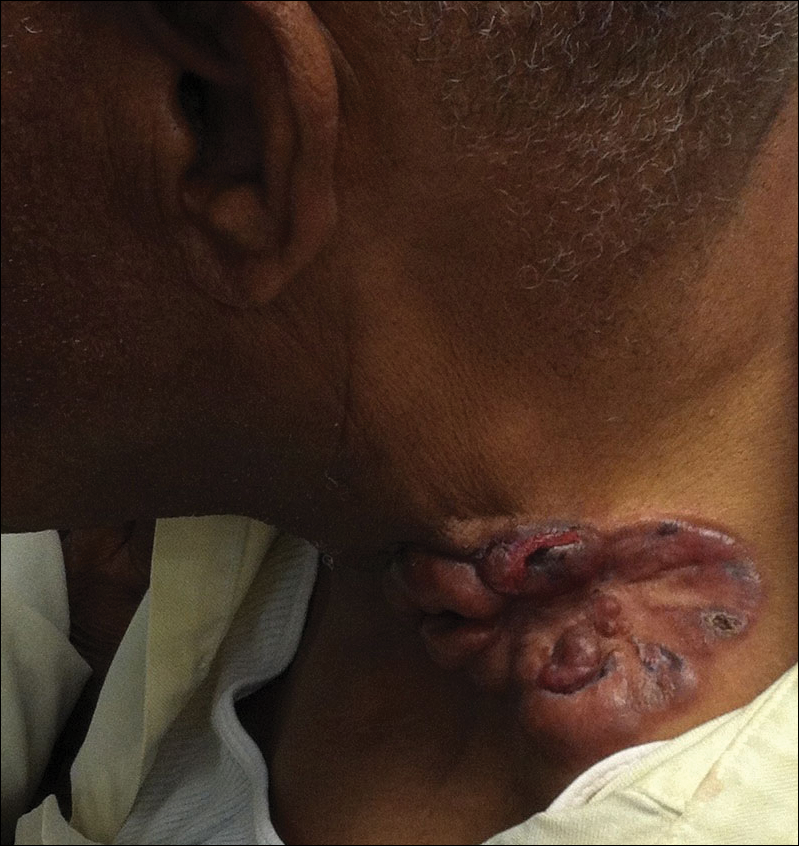
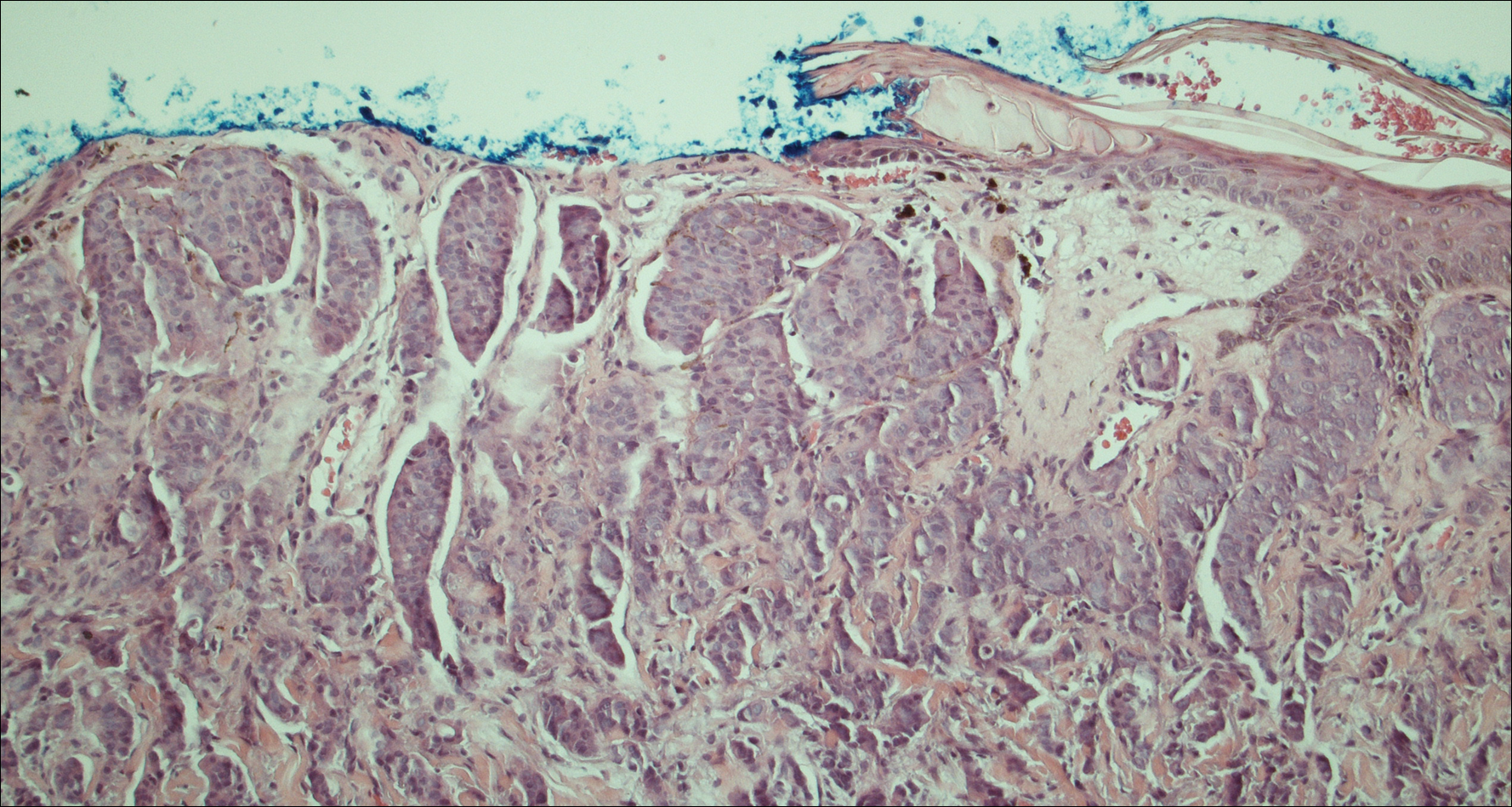
Another scalp biopsy was taken. Tumor cells were negative on mucicarmine staining. Additional immunohistochemical staining, including a periodic acid-Schiff stain with diastase digestion for epithelial mucin revealed minimal luminal positivity. Immunostaining was positive for CK7, carcinoembryonic antigen, CD15, estrogen receptor, progesterone receptor, gross cystic disease fluid protein 15 (GCDFP-15), and mammaglobin, and negative for CK20, podoplanin, thyroid transcription factor 1, S-100 protein, p63, and prostate specific antigen. ERBB2 (formerly HER2/neu) staining was negative according to fluorescence in situ hybridization analysis. Tumor cells showed a Ki-67 nuclear proliferation index of greater than 50%, indicating progression to aggressive carcinoma.
Based on the histological and immunochemical studies, the differential diagnosis included primary cutaneous apocrine carcinoma versus breast carcinoma; however, the prolonged clinical progression of these lesions favored a primary cutaneous adnexal tumor over a metastatic adenocarcinoma. Nevertheless, despite the initially indolent growth of the lesions over the first 5 years, the Ki-67 proliferation index and presence of widespread metastases on the posterior scalp indicated progression to an aggressive carcinoma. Chemotherapy was recommended as the treatment of choice. At his most recent follow-up visit 4 months later, the patient chose to begin treatment with tamoxifen and refused other treatment options.
Comment
The distinction between primary adnexal and metastatic adenocarcinomas of the skin is challenging both clinically and histologically. Some pathologists have argued that metastatic breast carcinomas and primary cutaneous apocrine carcinomas are essentially indistinguishable.3 Patients with cutaneous metastases, which occur in approximately 5.3% of all malignancies,4 typically can expect survival of no more than 12 months from the time of detection.1 In contrast, primary apocrine carcinomas of the skin, though much less common, carry a remarkably better prognosis, with 5-year relative survival rates of 95.5% and 85.5% reported for patients with localized disease and spread to regional lymph nodes, respectively.2
Fewer than 100 cases of primary cutaneous adnexal (apocrine) carcinomas have been reported overall, with the earliest known report dating back to 1944.5 According to the literature, primary apocrine carcinomas were diagnosed at a median age of 66 years and were slightly more common in females than males.2,6 Apocrine carcinomas were seen most frequently on the head, neck, and trunk,2 generally presenting in the form of asymptomatic nodules or plaques of 2 to 3 cm in size, with gradual progression occurring over months to years.6 Approximately 40% of patients have been reported with positive regional lymph nodes at diagnosis. Treatment of apocrine carcinoma typically has involved local excision with clear margins with or without lymph node dissection. Chemotherapy and radiation therapy have shown no proven benefit.7
Currently, there is no standardized approach to evaluating patients with possible cutaneous metastasis versus primary cutaneous adnexal carcinomas. Imaging studies such as mammography and abdominal CT typically reveal an internal primary cancer in one-third of patients. However, additional studies such as gastrointestinal radiography, chest and pelvic CT, barium enema, and intravenous pyelogram have shown to be of limited value.8 Although specificity and sensitivity of immunohistochemistry is limited, a number of immunomarkers, including CK7 and CK20, are routinely studied to narrow the differential diagnosis of a cutaneous neoplasm of unclear origin. Urothelial, gastric, colorectal, and pancreatic carcinomas generally are positive for CK20; CK7-positive adenocarcinomas include salivary, non-small cell lung, breast, ovarian, pancreatic, endometrial, and transitional cell adenocarcinomas. Carcinomas negative for both CK7 and CK20 include colorectal, hepatocellular, renal cell, prostate, and squamous cell carcinoma of the lung.
The presence of positive staining for estrogen and progesterone receptors as well as GCDFP-15 and mammaglobin raised the possibility of primary breast adenocarcinoma in our patient, but given that these markers can be positive in primary cutaneous adnexal tumors, immunohistochemistry results were not able to provide a definitive primary site. The overall staining pattern was nearly identical to 26 cases of primary cutaneous cribriform apocrine carcinoma, which was found to be positive for CK7 and carcinoembryonic antigen, and negative for CK20 and S-100. The only difference was in GCDFP-15 staining, which was positive in our case and negative in the cases of cribriform apocrine carcinoma.9 Histologic features favoring a primary apocrine origin include normal apocrine glands in the vicinity, glandular structures with decapitation secretion high in the dermis, and intracytoplasmic iron granules.10 Additionally, positive estrogen receptor staining appears to be much more common in apocrine carcinomas (5/10) than in eccrine carcinomas (1/7).11
A number of other markers have been investigated for possible diagnostic utility for distinction between primary adnexal carcinomas and metastatic adenocarcinomas. The nuclear transcription factor p63, which plays a role in keratinocyte differentiation, is preferentially expressed in a number of primary adnexal carcinomas and is purported to be the most sensitive marker overall, with a sensitivity of 78% to 91%.12-14 However, p63 has shown incomplete specificity for primary adnexal neoplasms, having been reported as positive in 11% to 22% of adenocarcinomas metastatic to skin.15-18 Nestin and CK15, which are expressed in hair follicle progenitor cells, also are potential specific markers for some primary adnexal lesions, specifically eccrine carcinoma, porocarcinoma, hidradenocarcinoma, and microcystic adnexal carcinoma; however, in one report, none of the apocrine carcinomas were positive for p63, cytokeratin 15, or D2-40.19 Thus, while markers for some primary adnexal neoplasms are emerging, specific tests at the immunohistochemical level for the apocrine carcinoma subgroup are still lacking.
Conclusion
In summary, a conclusive distinction between primary cutaneous apocrine carcinoma and metastatic adenocarcinoma to the skin remains challenging. Although new markers provide more specificity and sensitivity for neoplasms of eccrine origin, these markers do not appear to differentiate between primary apocrine carcinoma and metastatic breast carcinoma. In this case, as in other recent reports, diagnosis remained dependent on the clinical course of the patient. Although considerable progress has been made regarding immunohistochemical analysis of these cases, additional markers, especially ones more specific for primary skin cancers with apocrine differentiation, are still needed.
- Nashan D, Müller ML, Braun-Falco M, et al. Cutaneous metastases of visceral tumours: a review. J Cancer Res Clin Oncol. 2009;135:1-14.
- Blake PW, Bradford PT, Devesa SS, et al. Cutaneous appendageal carcinoma incidence and survival patterns in the United States: a population-based study. Arch Dermatol. 2010;146:625-632.
- Fernandez-Flores A. The elusive differential diagnosis of cutaneous apocrine adenocarcinoma vs. metastasis: the current role of clinical correlation. Acta Dermatovenerol Alp Pannonica Adriat. 2009;18:141-142.
- Lookingbill DP, Spangler N, Sexton FM. Skin involvement as the presenting sign of internal carcinoma. A retrospective study of 7316 cancer patients. J Am Acad Dermatol. 1990;22:19-26.
- Horn RC. Malignant papillary cystadenoma of sweat glands with metastases to the regional lymph nodes. Surgery. 1944;16:348-355.
- Pucevich B, Catinchi-Jaime S, Ho J, et al. Invasive primary ductal apocrine adenocarcinoma of axilla: a case report with immunohistochemical profiling and a review of literature. Dermatol Online J. 2008;14:5.
- Vasilakaki T, Skafida E, Moustou E, et al. Primary cutaneous apocrine carcinoma of sweat glands: a rare case report [published online December 17, 2011]. Case Rep Oncol. 2011;4:597-601.
- Hainsworth JD, Greco FA. Treatment of patients with cancer of an unknown primary site. N Engl J Med. 1993;329:257-263.
- Rutten A, Kutzner H, Mentzel T, et al. Primary cutaneous cribriform apocrine carcinoma: a clinicopathologic and immunohistochemical study of 26 cases of an under-recognized cutaneous adnexal neoplasm. J Am Acad Dermatol. 2009;61:644-651.
- Elder DE, Elenitsas R, Johnson BL Jr, et al, eds. Lever's Histopathology of the Skin. 10th ed. Philadelphia, PA: Lippincott, Williams, and Wilkins; 2009.
- Le LP, Dias-Santagata D, Pawlak AC, et al. Apocrine-eccrine carcinomas: molecular and immunohistochemical analyses. PLoS One. 2012;7:e47290.
- Levrero M, De Laurenzi V, Costanzo A, et al. The p53/p63/p73 family of transcription factors: overlapping and distinct functions. J Cell Sci. 2000;113:1661-1670.
- Pellegrini G, Dellambra E, Golisano O, et al. p63 identifies keratinocyte stem cells. Proc Natl Acad Sci U S A. 2001;98:3156-3161.
- Reis-Filho JS, Torio B, Albergaria A, et al. p63 expression in normal skin and usual cutaneous carcinomas. J Cutan Pathol. 2002;29:517-523.
- Sariya D, Ruth K, Adams-McDonnell R, et al. Clinicopathologic correlation of cutaneous metastases: experience from a cancer center. Arch Dermatol. 2007;143:613-620.
- Liang H, Wu H, Giorgadze TA, et al. Podoplanin is a highly sensitive and specific marker to distinguish primary skin adnexal carcinomas from adenocarcinomas metastatic to skin. Am J Surg Pathol. 2007;31:304-310.
- Kanitakis J, Chouvet B. Expression of p63 in cutaneous metastases. Am J Clin Pathol. 2007;128:753-758.
- Qureshi HS, Ormsby AH, Lee MW, et al. The diagnostic utility of p63, CK5/6, CK 7, and CK 20 in distinguishing primary cutaneous adnexal neoplasms from metastatic carcinomas. J Cutan Pathol. 2004;31:145-152.
- Mahalingam M, Nguyen LP, Richards JE, et al. The diagnostic utility of immunohistochemistry in distinguishing primary skin adnexal carcinomas from metastatic adenocarcinoma to skin: an immunohistochemical reappraisal using cytokeratin 15, nestin, p63, D2-40, and calretinin. Mod Pathol. 2010;23:713-719.
Differentiation between a primary adnexal carcinoma and a metastatic carcinoma to the skin is a challenging yet critical task for dermatologists and pathologists. Carcinomas that have metastasized to the skin are a sign of widespread systemic involvement and poor prognosis, while primary adnexal carcinomas tend to progress with an indolent clinical course. Although many patients with cutaneous metastases from an internal primary neoplasm can expect a median survival of no more than 12 months,1 patients with primary adnexal carcinomas are reported to have a 5-year survival rate of 95.5% for localized disease and 85% with spread to regional lymph nodes.2 We report a case of multiple cutaneous neoplasms of unknown primary origin in a 71-year-old man and describe our approach to identification of the possible primary site as well as management of the disease.
Case Report
A 71-year-old man initially presented to his primary physician for evaluation of a mass on the left side of the neck of 3 months' duration. On physical examination, a firm 2.5×3.0-cm nodule was noted at the anterior border of the trapezius muscle. Palpation of the thyroid revealed an additional right-sided nodule. The submandibular and parotid glands were unremarkable to palpation. The patient was referred to general surgery for biopsy, which revealed an infiltrating, moderately differentiated adenocarcinoma with extensive lymphatic permeation. Immunohistochemical staining for cytokeratin (CK) 7 was positive, while CK20 and thyroid transcription factor 1 were negative. A positron emission tomography/computed tomography (CT) fusion scan demonstrated 3 areas of enhanced uptake: one in the right side of the thyroid, a second corresponding to the mass on the left side of the neck at the level of the trapezius muscle, and a third in the left masseter muscle. Surgical excision with negative margins with possible chemotherapy was recommended; however, the patient declined treatment and was lost to follow-up until 2 years later when he presented to his primary physician with an additional lesion on his scalp.
Four years after the biopsy, the patient presented to the dermatology department with additional tumor nodules including a 4-cm, annular, indurated, focally eroded plaque on the left side of the lateral neck (Figure 1); 3 separate 1-cm nodules on the right side of the lateral neck; and an ulcerated, crusted, 10×8-cm plaque on the posterior aspect of the scalp. Despite the extensive lesions, the patient remained in good health and reported no recent weight loss or signs or symptoms of systemic involvement. The posterior scalp lesion, which developed 2 years after the initial appearance of the mass on the neck and was thought to represent a possible metastasis of the tumor, was biopsied and showed diffuse infiltration of the dermis by poorly differentiated tumor cells with vacuolated cytoplasm arranged in nests and cords and sometimes in a single-file arrangement (Figure 2). A CT scan demonstrated pretracheal lymphadenopathy as well as small intraparenchymal and subpleural pulmonary nodules throughout both lung fields.
Another scalp biopsy was taken. Tumor cells were negative on mucicarmine staining. Additional immunohistochemical staining, including a periodic acid-Schiff stain with diastase digestion for epithelial mucin revealed minimal luminal positivity. Immunostaining was positive for CK7, carcinoembryonic antigen, CD15, estrogen receptor, progesterone receptor, gross cystic disease fluid protein 15 (GCDFP-15), and mammaglobin, and negative for CK20, podoplanin, thyroid transcription factor 1, S-100 protein, p63, and prostate specific antigen. ERBB2 (formerly HER2/neu) staining was negative according to fluorescence in situ hybridization analysis. Tumor cells showed a Ki-67 nuclear proliferation index of greater than 50%, indicating progression to aggressive carcinoma.
Based on the histological and immunochemical studies, the differential diagnosis included primary cutaneous apocrine carcinoma versus breast carcinoma; however, the prolonged clinical progression of these lesions favored a primary cutaneous adnexal tumor over a metastatic adenocarcinoma. Nevertheless, despite the initially indolent growth of the lesions over the first 5 years, the Ki-67 proliferation index and presence of widespread metastases on the posterior scalp indicated progression to an aggressive carcinoma. Chemotherapy was recommended as the treatment of choice. At his most recent follow-up visit 4 months later, the patient chose to begin treatment with tamoxifen and refused other treatment options.
Comment
The distinction between primary adnexal and metastatic adenocarcinomas of the skin is challenging both clinically and histologically. Some pathologists have argued that metastatic breast carcinomas and primary cutaneous apocrine carcinomas are essentially indistinguishable.3 Patients with cutaneous metastases, which occur in approximately 5.3% of all malignancies,4 typically can expect survival of no more than 12 months from the time of detection.1 In contrast, primary apocrine carcinomas of the skin, though much less common, carry a remarkably better prognosis, with 5-year relative survival rates of 95.5% and 85.5% reported for patients with localized disease and spread to regional lymph nodes, respectively.2
Fewer than 100 cases of primary cutaneous adnexal (apocrine) carcinomas have been reported overall, with the earliest known report dating back to 1944.5 According to the literature, primary apocrine carcinomas were diagnosed at a median age of 66 years and were slightly more common in females than males.2,6 Apocrine carcinomas were seen most frequently on the head, neck, and trunk,2 generally presenting in the form of asymptomatic nodules or plaques of 2 to 3 cm in size, with gradual progression occurring over months to years.6 Approximately 40% of patients have been reported with positive regional lymph nodes at diagnosis. Treatment of apocrine carcinoma typically has involved local excision with clear margins with or without lymph node dissection. Chemotherapy and radiation therapy have shown no proven benefit.7
Currently, there is no standardized approach to evaluating patients with possible cutaneous metastasis versus primary cutaneous adnexal carcinomas. Imaging studies such as mammography and abdominal CT typically reveal an internal primary cancer in one-third of patients. However, additional studies such as gastrointestinal radiography, chest and pelvic CT, barium enema, and intravenous pyelogram have shown to be of limited value.8 Although specificity and sensitivity of immunohistochemistry is limited, a number of immunomarkers, including CK7 and CK20, are routinely studied to narrow the differential diagnosis of a cutaneous neoplasm of unclear origin. Urothelial, gastric, colorectal, and pancreatic carcinomas generally are positive for CK20; CK7-positive adenocarcinomas include salivary, non-small cell lung, breast, ovarian, pancreatic, endometrial, and transitional cell adenocarcinomas. Carcinomas negative for both CK7 and CK20 include colorectal, hepatocellular, renal cell, prostate, and squamous cell carcinoma of the lung.
The presence of positive staining for estrogen and progesterone receptors as well as GCDFP-15 and mammaglobin raised the possibility of primary breast adenocarcinoma in our patient, but given that these markers can be positive in primary cutaneous adnexal tumors, immunohistochemistry results were not able to provide a definitive primary site. The overall staining pattern was nearly identical to 26 cases of primary cutaneous cribriform apocrine carcinoma, which was found to be positive for CK7 and carcinoembryonic antigen, and negative for CK20 and S-100. The only difference was in GCDFP-15 staining, which was positive in our case and negative in the cases of cribriform apocrine carcinoma.9 Histologic features favoring a primary apocrine origin include normal apocrine glands in the vicinity, glandular structures with decapitation secretion high in the dermis, and intracytoplasmic iron granules.10 Additionally, positive estrogen receptor staining appears to be much more common in apocrine carcinomas (5/10) than in eccrine carcinomas (1/7).11
A number of other markers have been investigated for possible diagnostic utility for distinction between primary adnexal carcinomas and metastatic adenocarcinomas. The nuclear transcription factor p63, which plays a role in keratinocyte differentiation, is preferentially expressed in a number of primary adnexal carcinomas and is purported to be the most sensitive marker overall, with a sensitivity of 78% to 91%.12-14 However, p63 has shown incomplete specificity for primary adnexal neoplasms, having been reported as positive in 11% to 22% of adenocarcinomas metastatic to skin.15-18 Nestin and CK15, which are expressed in hair follicle progenitor cells, also are potential specific markers for some primary adnexal lesions, specifically eccrine carcinoma, porocarcinoma, hidradenocarcinoma, and microcystic adnexal carcinoma; however, in one report, none of the apocrine carcinomas were positive for p63, cytokeratin 15, or D2-40.19 Thus, while markers for some primary adnexal neoplasms are emerging, specific tests at the immunohistochemical level for the apocrine carcinoma subgroup are still lacking.
Conclusion
In summary, a conclusive distinction between primary cutaneous apocrine carcinoma and metastatic adenocarcinoma to the skin remains challenging. Although new markers provide more specificity and sensitivity for neoplasms of eccrine origin, these markers do not appear to differentiate between primary apocrine carcinoma and metastatic breast carcinoma. In this case, as in other recent reports, diagnosis remained dependent on the clinical course of the patient. Although considerable progress has been made regarding immunohistochemical analysis of these cases, additional markers, especially ones more specific for primary skin cancers with apocrine differentiation, are still needed.
Differentiation between a primary adnexal carcinoma and a metastatic carcinoma to the skin is a challenging yet critical task for dermatologists and pathologists. Carcinomas that have metastasized to the skin are a sign of widespread systemic involvement and poor prognosis, while primary adnexal carcinomas tend to progress with an indolent clinical course. Although many patients with cutaneous metastases from an internal primary neoplasm can expect a median survival of no more than 12 months,1 patients with primary adnexal carcinomas are reported to have a 5-year survival rate of 95.5% for localized disease and 85% with spread to regional lymph nodes.2 We report a case of multiple cutaneous neoplasms of unknown primary origin in a 71-year-old man and describe our approach to identification of the possible primary site as well as management of the disease.
Case Report
A 71-year-old man initially presented to his primary physician for evaluation of a mass on the left side of the neck of 3 months' duration. On physical examination, a firm 2.5×3.0-cm nodule was noted at the anterior border of the trapezius muscle. Palpation of the thyroid revealed an additional right-sided nodule. The submandibular and parotid glands were unremarkable to palpation. The patient was referred to general surgery for biopsy, which revealed an infiltrating, moderately differentiated adenocarcinoma with extensive lymphatic permeation. Immunohistochemical staining for cytokeratin (CK) 7 was positive, while CK20 and thyroid transcription factor 1 were negative. A positron emission tomography/computed tomography (CT) fusion scan demonstrated 3 areas of enhanced uptake: one in the right side of the thyroid, a second corresponding to the mass on the left side of the neck at the level of the trapezius muscle, and a third in the left masseter muscle. Surgical excision with negative margins with possible chemotherapy was recommended; however, the patient declined treatment and was lost to follow-up until 2 years later when he presented to his primary physician with an additional lesion on his scalp.
Four years after the biopsy, the patient presented to the dermatology department with additional tumor nodules including a 4-cm, annular, indurated, focally eroded plaque on the left side of the lateral neck (Figure 1); 3 separate 1-cm nodules on the right side of the lateral neck; and an ulcerated, crusted, 10×8-cm plaque on the posterior aspect of the scalp. Despite the extensive lesions, the patient remained in good health and reported no recent weight loss or signs or symptoms of systemic involvement. The posterior scalp lesion, which developed 2 years after the initial appearance of the mass on the neck and was thought to represent a possible metastasis of the tumor, was biopsied and showed diffuse infiltration of the dermis by poorly differentiated tumor cells with vacuolated cytoplasm arranged in nests and cords and sometimes in a single-file arrangement (Figure 2). A CT scan demonstrated pretracheal lymphadenopathy as well as small intraparenchymal and subpleural pulmonary nodules throughout both lung fields.
Another scalp biopsy was taken. Tumor cells were negative on mucicarmine staining. Additional immunohistochemical staining, including a periodic acid-Schiff stain with diastase digestion for epithelial mucin revealed minimal luminal positivity. Immunostaining was positive for CK7, carcinoembryonic antigen, CD15, estrogen receptor, progesterone receptor, gross cystic disease fluid protein 15 (GCDFP-15), and mammaglobin, and negative for CK20, podoplanin, thyroid transcription factor 1, S-100 protein, p63, and prostate specific antigen. ERBB2 (formerly HER2/neu) staining was negative according to fluorescence in situ hybridization analysis. Tumor cells showed a Ki-67 nuclear proliferation index of greater than 50%, indicating progression to aggressive carcinoma.
Based on the histological and immunochemical studies, the differential diagnosis included primary cutaneous apocrine carcinoma versus breast carcinoma; however, the prolonged clinical progression of these lesions favored a primary cutaneous adnexal tumor over a metastatic adenocarcinoma. Nevertheless, despite the initially indolent growth of the lesions over the first 5 years, the Ki-67 proliferation index and presence of widespread metastases on the posterior scalp indicated progression to an aggressive carcinoma. Chemotherapy was recommended as the treatment of choice. At his most recent follow-up visit 4 months later, the patient chose to begin treatment with tamoxifen and refused other treatment options.
Comment
The distinction between primary adnexal and metastatic adenocarcinomas of the skin is challenging both clinically and histologically. Some pathologists have argued that metastatic breast carcinomas and primary cutaneous apocrine carcinomas are essentially indistinguishable.3 Patients with cutaneous metastases, which occur in approximately 5.3% of all malignancies,4 typically can expect survival of no more than 12 months from the time of detection.1 In contrast, primary apocrine carcinomas of the skin, though much less common, carry a remarkably better prognosis, with 5-year relative survival rates of 95.5% and 85.5% reported for patients with localized disease and spread to regional lymph nodes, respectively.2
Fewer than 100 cases of primary cutaneous adnexal (apocrine) carcinomas have been reported overall, with the earliest known report dating back to 1944.5 According to the literature, primary apocrine carcinomas were diagnosed at a median age of 66 years and were slightly more common in females than males.2,6 Apocrine carcinomas were seen most frequently on the head, neck, and trunk,2 generally presenting in the form of asymptomatic nodules or plaques of 2 to 3 cm in size, with gradual progression occurring over months to years.6 Approximately 40% of patients have been reported with positive regional lymph nodes at diagnosis. Treatment of apocrine carcinoma typically has involved local excision with clear margins with or without lymph node dissection. Chemotherapy and radiation therapy have shown no proven benefit.7
Currently, there is no standardized approach to evaluating patients with possible cutaneous metastasis versus primary cutaneous adnexal carcinomas. Imaging studies such as mammography and abdominal CT typically reveal an internal primary cancer in one-third of patients. However, additional studies such as gastrointestinal radiography, chest and pelvic CT, barium enema, and intravenous pyelogram have shown to be of limited value.8 Although specificity and sensitivity of immunohistochemistry is limited, a number of immunomarkers, including CK7 and CK20, are routinely studied to narrow the differential diagnosis of a cutaneous neoplasm of unclear origin. Urothelial, gastric, colorectal, and pancreatic carcinomas generally are positive for CK20; CK7-positive adenocarcinomas include salivary, non-small cell lung, breast, ovarian, pancreatic, endometrial, and transitional cell adenocarcinomas. Carcinomas negative for both CK7 and CK20 include colorectal, hepatocellular, renal cell, prostate, and squamous cell carcinoma of the lung.
The presence of positive staining for estrogen and progesterone receptors as well as GCDFP-15 and mammaglobin raised the possibility of primary breast adenocarcinoma in our patient, but given that these markers can be positive in primary cutaneous adnexal tumors, immunohistochemistry results were not able to provide a definitive primary site. The overall staining pattern was nearly identical to 26 cases of primary cutaneous cribriform apocrine carcinoma, which was found to be positive for CK7 and carcinoembryonic antigen, and negative for CK20 and S-100. The only difference was in GCDFP-15 staining, which was positive in our case and negative in the cases of cribriform apocrine carcinoma.9 Histologic features favoring a primary apocrine origin include normal apocrine glands in the vicinity, glandular structures with decapitation secretion high in the dermis, and intracytoplasmic iron granules.10 Additionally, positive estrogen receptor staining appears to be much more common in apocrine carcinomas (5/10) than in eccrine carcinomas (1/7).11
A number of other markers have been investigated for possible diagnostic utility for distinction between primary adnexal carcinomas and metastatic adenocarcinomas. The nuclear transcription factor p63, which plays a role in keratinocyte differentiation, is preferentially expressed in a number of primary adnexal carcinomas and is purported to be the most sensitive marker overall, with a sensitivity of 78% to 91%.12-14 However, p63 has shown incomplete specificity for primary adnexal neoplasms, having been reported as positive in 11% to 22% of adenocarcinomas metastatic to skin.15-18 Nestin and CK15, which are expressed in hair follicle progenitor cells, also are potential specific markers for some primary adnexal lesions, specifically eccrine carcinoma, porocarcinoma, hidradenocarcinoma, and microcystic adnexal carcinoma; however, in one report, none of the apocrine carcinomas were positive for p63, cytokeratin 15, or D2-40.19 Thus, while markers for some primary adnexal neoplasms are emerging, specific tests at the immunohistochemical level for the apocrine carcinoma subgroup are still lacking.
Conclusion
In summary, a conclusive distinction between primary cutaneous apocrine carcinoma and metastatic adenocarcinoma to the skin remains challenging. Although new markers provide more specificity and sensitivity for neoplasms of eccrine origin, these markers do not appear to differentiate between primary apocrine carcinoma and metastatic breast carcinoma. In this case, as in other recent reports, diagnosis remained dependent on the clinical course of the patient. Although considerable progress has been made regarding immunohistochemical analysis of these cases, additional markers, especially ones more specific for primary skin cancers with apocrine differentiation, are still needed.
- Nashan D, Müller ML, Braun-Falco M, et al. Cutaneous metastases of visceral tumours: a review. J Cancer Res Clin Oncol. 2009;135:1-14.
- Blake PW, Bradford PT, Devesa SS, et al. Cutaneous appendageal carcinoma incidence and survival patterns in the United States: a population-based study. Arch Dermatol. 2010;146:625-632.
- Fernandez-Flores A. The elusive differential diagnosis of cutaneous apocrine adenocarcinoma vs. metastasis: the current role of clinical correlation. Acta Dermatovenerol Alp Pannonica Adriat. 2009;18:141-142.
- Lookingbill DP, Spangler N, Sexton FM. Skin involvement as the presenting sign of internal carcinoma. A retrospective study of 7316 cancer patients. J Am Acad Dermatol. 1990;22:19-26.
- Horn RC. Malignant papillary cystadenoma of sweat glands with metastases to the regional lymph nodes. Surgery. 1944;16:348-355.
- Pucevich B, Catinchi-Jaime S, Ho J, et al. Invasive primary ductal apocrine adenocarcinoma of axilla: a case report with immunohistochemical profiling and a review of literature. Dermatol Online J. 2008;14:5.
- Vasilakaki T, Skafida E, Moustou E, et al. Primary cutaneous apocrine carcinoma of sweat glands: a rare case report [published online December 17, 2011]. Case Rep Oncol. 2011;4:597-601.
- Hainsworth JD, Greco FA. Treatment of patients with cancer of an unknown primary site. N Engl J Med. 1993;329:257-263.
- Rutten A, Kutzner H, Mentzel T, et al. Primary cutaneous cribriform apocrine carcinoma: a clinicopathologic and immunohistochemical study of 26 cases of an under-recognized cutaneous adnexal neoplasm. J Am Acad Dermatol. 2009;61:644-651.
- Elder DE, Elenitsas R, Johnson BL Jr, et al, eds. Lever's Histopathology of the Skin. 10th ed. Philadelphia, PA: Lippincott, Williams, and Wilkins; 2009.
- Le LP, Dias-Santagata D, Pawlak AC, et al. Apocrine-eccrine carcinomas: molecular and immunohistochemical analyses. PLoS One. 2012;7:e47290.
- Levrero M, De Laurenzi V, Costanzo A, et al. The p53/p63/p73 family of transcription factors: overlapping and distinct functions. J Cell Sci. 2000;113:1661-1670.
- Pellegrini G, Dellambra E, Golisano O, et al. p63 identifies keratinocyte stem cells. Proc Natl Acad Sci U S A. 2001;98:3156-3161.
- Reis-Filho JS, Torio B, Albergaria A, et al. p63 expression in normal skin and usual cutaneous carcinomas. J Cutan Pathol. 2002;29:517-523.
- Sariya D, Ruth K, Adams-McDonnell R, et al. Clinicopathologic correlation of cutaneous metastases: experience from a cancer center. Arch Dermatol. 2007;143:613-620.
- Liang H, Wu H, Giorgadze TA, et al. Podoplanin is a highly sensitive and specific marker to distinguish primary skin adnexal carcinomas from adenocarcinomas metastatic to skin. Am J Surg Pathol. 2007;31:304-310.
- Kanitakis J, Chouvet B. Expression of p63 in cutaneous metastases. Am J Clin Pathol. 2007;128:753-758.
- Qureshi HS, Ormsby AH, Lee MW, et al. The diagnostic utility of p63, CK5/6, CK 7, and CK 20 in distinguishing primary cutaneous adnexal neoplasms from metastatic carcinomas. J Cutan Pathol. 2004;31:145-152.
- Mahalingam M, Nguyen LP, Richards JE, et al. The diagnostic utility of immunohistochemistry in distinguishing primary skin adnexal carcinomas from metastatic adenocarcinoma to skin: an immunohistochemical reappraisal using cytokeratin 15, nestin, p63, D2-40, and calretinin. Mod Pathol. 2010;23:713-719.
- Nashan D, Müller ML, Braun-Falco M, et al. Cutaneous metastases of visceral tumours: a review. J Cancer Res Clin Oncol. 2009;135:1-14.
- Blake PW, Bradford PT, Devesa SS, et al. Cutaneous appendageal carcinoma incidence and survival patterns in the United States: a population-based study. Arch Dermatol. 2010;146:625-632.
- Fernandez-Flores A. The elusive differential diagnosis of cutaneous apocrine adenocarcinoma vs. metastasis: the current role of clinical correlation. Acta Dermatovenerol Alp Pannonica Adriat. 2009;18:141-142.
- Lookingbill DP, Spangler N, Sexton FM. Skin involvement as the presenting sign of internal carcinoma. A retrospective study of 7316 cancer patients. J Am Acad Dermatol. 1990;22:19-26.
- Horn RC. Malignant papillary cystadenoma of sweat glands with metastases to the regional lymph nodes. Surgery. 1944;16:348-355.
- Pucevich B, Catinchi-Jaime S, Ho J, et al. Invasive primary ductal apocrine adenocarcinoma of axilla: a case report with immunohistochemical profiling and a review of literature. Dermatol Online J. 2008;14:5.
- Vasilakaki T, Skafida E, Moustou E, et al. Primary cutaneous apocrine carcinoma of sweat glands: a rare case report [published online December 17, 2011]. Case Rep Oncol. 2011;4:597-601.
- Hainsworth JD, Greco FA. Treatment of patients with cancer of an unknown primary site. N Engl J Med. 1993;329:257-263.
- Rutten A, Kutzner H, Mentzel T, et al. Primary cutaneous cribriform apocrine carcinoma: a clinicopathologic and immunohistochemical study of 26 cases of an under-recognized cutaneous adnexal neoplasm. J Am Acad Dermatol. 2009;61:644-651.
- Elder DE, Elenitsas R, Johnson BL Jr, et al, eds. Lever's Histopathology of the Skin. 10th ed. Philadelphia, PA: Lippincott, Williams, and Wilkins; 2009.
- Le LP, Dias-Santagata D, Pawlak AC, et al. Apocrine-eccrine carcinomas: molecular and immunohistochemical analyses. PLoS One. 2012;7:e47290.
- Levrero M, De Laurenzi V, Costanzo A, et al. The p53/p63/p73 family of transcription factors: overlapping and distinct functions. J Cell Sci. 2000;113:1661-1670.
- Pellegrini G, Dellambra E, Golisano O, et al. p63 identifies keratinocyte stem cells. Proc Natl Acad Sci U S A. 2001;98:3156-3161.
- Reis-Filho JS, Torio B, Albergaria A, et al. p63 expression in normal skin and usual cutaneous carcinomas. J Cutan Pathol. 2002;29:517-523.
- Sariya D, Ruth K, Adams-McDonnell R, et al. Clinicopathologic correlation of cutaneous metastases: experience from a cancer center. Arch Dermatol. 2007;143:613-620.
- Liang H, Wu H, Giorgadze TA, et al. Podoplanin is a highly sensitive and specific marker to distinguish primary skin adnexal carcinomas from adenocarcinomas metastatic to skin. Am J Surg Pathol. 2007;31:304-310.
- Kanitakis J, Chouvet B. Expression of p63 in cutaneous metastases. Am J Clin Pathol. 2007;128:753-758.
- Qureshi HS, Ormsby AH, Lee MW, et al. The diagnostic utility of p63, CK5/6, CK 7, and CK 20 in distinguishing primary cutaneous adnexal neoplasms from metastatic carcinomas. J Cutan Pathol. 2004;31:145-152.
- Mahalingam M, Nguyen LP, Richards JE, et al. The diagnostic utility of immunohistochemistry in distinguishing primary skin adnexal carcinomas from metastatic adenocarcinoma to skin: an immunohistochemical reappraisal using cytokeratin 15, nestin, p63, D2-40, and calretinin. Mod Pathol. 2010;23:713-719.
Practice Points
- Despite advances in immunohistochemical analysis, differentiating between primary apocrine carcinoma and metastatic breast carcinoma remains largely dependent on the clinical course of the patient.
- Treatment of apocrine carcinoma typically involves local excision with clear margins with or without lymph node dissection.

Choline and prevention of prevalent mental illnesses
Advocating on behalf of the power of prevention in psychiatry has been my life’s work. I ran a world-class community mental health center with a strong wellness component; have taught, researched, written, and spoken extensively about the importance of prevention; and have incorporated preventive ideas into my current clinical practice.
I would like to think that I have been one of the forces that helped start a new movement called “positive psychiatry,” the idea that mental health must encompass more than the reduction or elimination of psychiatric illness. In the new book edited by American Psychiatric Association Past-President Dilip V. Jeste, MD, and Barton W. Palmer, PhD, called “Positive Psychiatry” (Arlington, Va.: American Psychiatric Association Publishing, 2015), I contributed a chapter on the psychosocial factors tied to positive outcomes. In addition, I am part of a group of psychiatrists and researchers affiliated with the World Psychiatric Association who are starting an interest group focusing on positive psychiatry.

Recently, because of the prevalence of neurobehavioral disorder associated with prenatal alcohol exposure (ND-PAE) (the American Psychiatric Association’s DSM-5 version of fetal alcohol spectrum disorders) in my community, I have begun to tout this problem as a major public health issue. When we formulated the Institute of Medicine’s 2009 Preventing Mental, Emotional, and Behavioral Disorders Among Young People: Progress and Possibilities report, we did not include the problem of fetal alcohol exposure – and this was an unfortunate oversight.
However, this area of interest had not yet fully developed, and nearly 8 years later, there have been some confluent developments regarding potential prevention of this problem. They both involve choline.
First, we know that when women drink while pregnant, the alcohol they consume rids their bodies of choline, a nutrient the fetus needs for proper cell construction, neurogenesis, and neurodevelopment. Accordingly, several scientists are exploring using choline both pre- and postnatally to see if the defects on ND-PAE can be ameliorated or prevented. All of the research in this area is new, but it looks very promising.
Recently, I had the good fortune to present an idea during the Andrea Delgado Memorial Lecture at the Black Psychiatrists of America transcultural conference in the Bahamas. I also spoke at a mini-plenary at the 32nd Annual Rosalynn Carter Mental Health Policy Symposium in Atlanta. The core of the presentations were not too deep (to paraphrase a line Morgan Freeman used on Jack Nicholson in the movie “The Bucket List” – ‘I have seen bathtubs that are deeper’), but I think it explicated an essential idea. Jessie Aujla, a 4th-year medical student, and I explored the content of choline in the 25 top prenatal vitamins and found none of them contained the 450-mg daily recommended dose of choline advised by the Institute of Medicine in 1998. In fact, only two contain 50 mg; six others contain less than 30 mg; and the other 17 have no choline whatsoever (this study is in press at the Journal of Family Medicine and Prevention). So we are advocating that the prenatal vitamin manufacturers increase the choline content of their prenatal vitamins, because although women may be getting some choline from their food diets, we found one large study illustrating that 90% of pregnant women are choline deficient.
The other area of interest regarding choline as a preventive agent for mental illness is work published by researchers at the University of Colorado Denver. This research group is proposing that choline may prevent the development of autism, attention-deficit/hyperactivity disorder, and schizophrenia by an epigenetic mechanism involving a nicotinic acetylcholine receptor. This makes perfectly good sense clinically among those of us who are treating patients with ND-PAE. Some of us are starting to think of ND-PAE as a choline deficiency disorder and see symptoms that are extremely similar to autism, ADHD, and schizophrenia in such patients. Many patients with ND-PAE are misdiagnosed with these disorders. Accordingly, there appears to be some common ground between ideas aimed at preventing fetal alcohol exposure and those aimed at preventing autism, ADHD, and schizophrenia – specifically, ensuring that pregnant women get an adequate supply of choline.
There is certainly a great need to do more research to nail down these two potential preventive actions. But until that research is done, it seems to me that the least we can do is to advocate for a position that the manufacturers of prenatal vitamins at least include the daily recommended dose of choline (450 mg/day) pregnant women need per the findings of the Institute of Medicine’s Standing Committee on the Scientific Evaluation of Dietary Reference Intakes and its Panel on Folate, Other B Vitamins, and Choline, published in 1998.
Dr. Bell is a staff psychiatrist at Jackson Park Hospital Family Medicine Clinic in Chicago; clinical psychiatrist emeritus, department of psychiatry, at the University of Illinois at Chicago; former president/CEO of Community Mental Health Council; and former director of the Institute for Juvenile Research (birthplace of child psychiatry), also in Chicago.
Advocating on behalf of the power of prevention in psychiatry has been my life’s work. I ran a world-class community mental health center with a strong wellness component; have taught, researched, written, and spoken extensively about the importance of prevention; and have incorporated preventive ideas into my current clinical practice.
I would like to think that I have been one of the forces that helped start a new movement called “positive psychiatry,” the idea that mental health must encompass more than the reduction or elimination of psychiatric illness. In the new book edited by American Psychiatric Association Past-President Dilip V. Jeste, MD, and Barton W. Palmer, PhD, called “Positive Psychiatry” (Arlington, Va.: American Psychiatric Association Publishing, 2015), I contributed a chapter on the psychosocial factors tied to positive outcomes. In addition, I am part of a group of psychiatrists and researchers affiliated with the World Psychiatric Association who are starting an interest group focusing on positive psychiatry.
Recently, because of the prevalence of neurobehavioral disorder associated with prenatal alcohol exposure (ND-PAE) (the American Psychiatric Association’s DSM-5 version of fetal alcohol spectrum disorders) in my community, I have begun to tout this problem as a major public health issue. When we formulated the Institute of Medicine’s 2009 Preventing Mental, Emotional, and Behavioral Disorders Among Young People: Progress and Possibilities report, we did not include the problem of fetal alcohol exposure – and this was an unfortunate oversight.
However, this area of interest had not yet fully developed, and nearly 8 years later, there have been some confluent developments regarding potential prevention of this problem. They both involve choline.
First, we know that when women drink while pregnant, the alcohol they consume rids their bodies of choline, a nutrient the fetus needs for proper cell construction, neurogenesis, and neurodevelopment. Accordingly, several scientists are exploring using choline both pre- and postnatally to see if the defects on ND-PAE can be ameliorated or prevented. All of the research in this area is new, but it looks very promising.
Recently, I had the good fortune to present an idea during the Andrea Delgado Memorial Lecture at the Black Psychiatrists of America transcultural conference in the Bahamas. I also spoke at a mini-plenary at the 32nd Annual Rosalynn Carter Mental Health Policy Symposium in Atlanta. The core of the presentations were not too deep (to paraphrase a line Morgan Freeman used on Jack Nicholson in the movie “The Bucket List” – ‘I have seen bathtubs that are deeper’), but I think it explicated an essential idea. Jessie Aujla, a 4th-year medical student, and I explored the content of choline in the 25 top prenatal vitamins and found none of them contained the 450-mg daily recommended dose of choline advised by the Institute of Medicine in 1998. In fact, only two contain 50 mg; six others contain less than 30 mg; and the other 17 have no choline whatsoever (this study is in press at the Journal of Family Medicine and Prevention). So we are advocating that the prenatal vitamin manufacturers increase the choline content of their prenatal vitamins, because although women may be getting some choline from their food diets, we found one large study illustrating that 90% of pregnant women are choline deficient.
The other area of interest regarding choline as a preventive agent for mental illness is work published by researchers at the University of Colorado Denver. This research group is proposing that choline may prevent the development of autism, attention-deficit/hyperactivity disorder, and schizophrenia by an epigenetic mechanism involving a nicotinic acetylcholine receptor. This makes perfectly good sense clinically among those of us who are treating patients with ND-PAE. Some of us are starting to think of ND-PAE as a choline deficiency disorder and see symptoms that are extremely similar to autism, ADHD, and schizophrenia in such patients. Many patients with ND-PAE are misdiagnosed with these disorders. Accordingly, there appears to be some common ground between ideas aimed at preventing fetal alcohol exposure and those aimed at preventing autism, ADHD, and schizophrenia – specifically, ensuring that pregnant women get an adequate supply of choline.
There is certainly a great need to do more research to nail down these two potential preventive actions. But until that research is done, it seems to me that the least we can do is to advocate for a position that the manufacturers of prenatal vitamins at least include the daily recommended dose of choline (450 mg/day) pregnant women need per the findings of the Institute of Medicine’s Standing Committee on the Scientific Evaluation of Dietary Reference Intakes and its Panel on Folate, Other B Vitamins, and Choline, published in 1998.
Dr. Bell is a staff psychiatrist at Jackson Park Hospital Family Medicine Clinic in Chicago; clinical psychiatrist emeritus, department of psychiatry, at the University of Illinois at Chicago; former president/CEO of Community Mental Health Council; and former director of the Institute for Juvenile Research (birthplace of child psychiatry), also in Chicago.
Advocating on behalf of the power of prevention in psychiatry has been my life’s work. I ran a world-class community mental health center with a strong wellness component; have taught, researched, written, and spoken extensively about the importance of prevention; and have incorporated preventive ideas into my current clinical practice.
I would like to think that I have been one of the forces that helped start a new movement called “positive psychiatry,” the idea that mental health must encompass more than the reduction or elimination of psychiatric illness. In the new book edited by American Psychiatric Association Past-President Dilip V. Jeste, MD, and Barton W. Palmer, PhD, called “Positive Psychiatry” (Arlington, Va.: American Psychiatric Association Publishing, 2015), I contributed a chapter on the psychosocial factors tied to positive outcomes. In addition, I am part of a group of psychiatrists and researchers affiliated with the World Psychiatric Association who are starting an interest group focusing on positive psychiatry.
Recently, because of the prevalence of neurobehavioral disorder associated with prenatal alcohol exposure (ND-PAE) (the American Psychiatric Association’s DSM-5 version of fetal alcohol spectrum disorders) in my community, I have begun to tout this problem as a major public health issue. When we formulated the Institute of Medicine’s 2009 Preventing Mental, Emotional, and Behavioral Disorders Among Young People: Progress and Possibilities report, we did not include the problem of fetal alcohol exposure – and this was an unfortunate oversight.
However, this area of interest had not yet fully developed, and nearly 8 years later, there have been some confluent developments regarding potential prevention of this problem. They both involve choline.
First, we know that when women drink while pregnant, the alcohol they consume rids their bodies of choline, a nutrient the fetus needs for proper cell construction, neurogenesis, and neurodevelopment. Accordingly, several scientists are exploring using choline both pre- and postnatally to see if the defects on ND-PAE can be ameliorated or prevented. All of the research in this area is new, but it looks very promising.
Recently, I had the good fortune to present an idea during the Andrea Delgado Memorial Lecture at the Black Psychiatrists of America transcultural conference in the Bahamas. I also spoke at a mini-plenary at the 32nd Annual Rosalynn Carter Mental Health Policy Symposium in Atlanta. The core of the presentations were not too deep (to paraphrase a line Morgan Freeman used on Jack Nicholson in the movie “The Bucket List” – ‘I have seen bathtubs that are deeper’), but I think it explicated an essential idea. Jessie Aujla, a 4th-year medical student, and I explored the content of choline in the 25 top prenatal vitamins and found none of them contained the 450-mg daily recommended dose of choline advised by the Institute of Medicine in 1998. In fact, only two contain 50 mg; six others contain less than 30 mg; and the other 17 have no choline whatsoever (this study is in press at the Journal of Family Medicine and Prevention). So we are advocating that the prenatal vitamin manufacturers increase the choline content of their prenatal vitamins, because although women may be getting some choline from their food diets, we found one large study illustrating that 90% of pregnant women are choline deficient.
The other area of interest regarding choline as a preventive agent for mental illness is work published by researchers at the University of Colorado Denver. This research group is proposing that choline may prevent the development of autism, attention-deficit/hyperactivity disorder, and schizophrenia by an epigenetic mechanism involving a nicotinic acetylcholine receptor. This makes perfectly good sense clinically among those of us who are treating patients with ND-PAE. Some of us are starting to think of ND-PAE as a choline deficiency disorder and see symptoms that are extremely similar to autism, ADHD, and schizophrenia in such patients. Many patients with ND-PAE are misdiagnosed with these disorders. Accordingly, there appears to be some common ground between ideas aimed at preventing fetal alcohol exposure and those aimed at preventing autism, ADHD, and schizophrenia – specifically, ensuring that pregnant women get an adequate supply of choline.
There is certainly a great need to do more research to nail down these two potential preventive actions. But until that research is done, it seems to me that the least we can do is to advocate for a position that the manufacturers of prenatal vitamins at least include the daily recommended dose of choline (450 mg/day) pregnant women need per the findings of the Institute of Medicine’s Standing Committee on the Scientific Evaluation of Dietary Reference Intakes and its Panel on Folate, Other B Vitamins, and Choline, published in 1998.
Dr. Bell is a staff psychiatrist at Jackson Park Hospital Family Medicine Clinic in Chicago; clinical psychiatrist emeritus, department of psychiatry, at the University of Illinois at Chicago; former president/CEO of Community Mental Health Council; and former director of the Institute for Juvenile Research (birthplace of child psychiatry), also in Chicago.

Secukinumab tames severe scalp psoriasis
VIENNA – Secukinumab proved highly effective specifically for the treatment of moderate to severe scalp psoriasis in a phase IIIb clinical trial, Mark G. Lebwohl, MD, reported at the annual congress of the European Academy of Dermatology and Venereology.
The scalp is one of the areas most commonly affected by psoriasis, yet few treatment trials have focused on patients with primarily moderate to severe scalp psoriasis. This phase IIIb study was designed to do just that. The 102 participants had psoriasis over a mean of 60% of their scalp for at least 6 months at baseline despite various forms of therapy; 40% had 70% or greater scalp involvement. The study population’s mean baseline Psoriasis Scalp Severity Index score was 34 out of a possible 72, noted Dr. Lebwohl, professor and chairman of the department of dermatology at the Icahn School of Medicine at Mount Sinai, New York.

“The mean involved body surface area was only 11.2%, and the PASI was 8.4. That is below the entry score required for most biologic studies, yet scalp involvement was substantial,” he observed.
Participants in the double-blind trial were randomized to either subcutaneous secukinumab (Cosentyx) at 300 mg on the approved treatment schedule for psoriasis or to placebo, with the primary endpoint being at least a 90% improvement in Psoriasis Area and Severity Index scores (PASI 90 response) at 12 weeks.
“The results were striking. Quite stunning,” Dr. Lebwohl said.
A PASI 90 response was achieved in 53% of secukinumab-treated patients, compared with 2% of controls. Already by week 3 a significant difference was apparent between the two study arms: At that early point, 12% of the secukinumab group, but none of the controls, had a PASI 90 response.
The secondary endpoint was change in the Investigator’s Global Assessment of scalp disease. At baseline, roughly 80% of patients had an IGA of 3 out of a possible 4 and the rest were at 4. At 3 weeks, 26% of the secukinumab group had a score of 0 or 1, signifying a clear or almost clear scalp, compared with 6% of controls. At 12 weeks, 57% of patients on secukinumab had an IGA of 0 or 1, as did 6% of those on placebo.
Side effects of secukinumab in the 12-week study were minimal. There were no serious adverse events. One case of candidiasis occurred in each study arm. Both responded readily to standard therapy.
Secukinumab is a fully human monoclonal antibody that inhibits interleukin-17A. It’s approved for treatment of moderate-to-severe psoriasis, psoriatic arthritis, and ankylosing spondylitis.
This phase IIIb clinical trial was sponsored by Novartis. Dr. Lebwohl reported that his department receives research funding from Novartis and roughly a dozen other pharmaceutical companies.
VIENNA – Secukinumab proved highly effective specifically for the treatment of moderate to severe scalp psoriasis in a phase IIIb clinical trial, Mark G. Lebwohl, MD, reported at the annual congress of the European Academy of Dermatology and Venereology.
The scalp is one of the areas most commonly affected by psoriasis, yet few treatment trials have focused on patients with primarily moderate to severe scalp psoriasis. This phase IIIb study was designed to do just that. The 102 participants had psoriasis over a mean of 60% of their scalp for at least 6 months at baseline despite various forms of therapy; 40% had 70% or greater scalp involvement. The study population’s mean baseline Psoriasis Scalp Severity Index score was 34 out of a possible 72, noted Dr. Lebwohl, professor and chairman of the department of dermatology at the Icahn School of Medicine at Mount Sinai, New York.
“The mean involved body surface area was only 11.2%, and the PASI was 8.4. That is below the entry score required for most biologic studies, yet scalp involvement was substantial,” he observed.
Participants in the double-blind trial were randomized to either subcutaneous secukinumab (Cosentyx) at 300 mg on the approved treatment schedule for psoriasis or to placebo, with the primary endpoint being at least a 90% improvement in Psoriasis Area and Severity Index scores (PASI 90 response) at 12 weeks.
“The results were striking. Quite stunning,” Dr. Lebwohl said.
A PASI 90 response was achieved in 53% of secukinumab-treated patients, compared with 2% of controls. Already by week 3 a significant difference was apparent between the two study arms: At that early point, 12% of the secukinumab group, but none of the controls, had a PASI 90 response.
The secondary endpoint was change in the Investigator’s Global Assessment of scalp disease. At baseline, roughly 80% of patients had an IGA of 3 out of a possible 4 and the rest were at 4. At 3 weeks, 26% of the secukinumab group had a score of 0 or 1, signifying a clear or almost clear scalp, compared with 6% of controls. At 12 weeks, 57% of patients on secukinumab had an IGA of 0 or 1, as did 6% of those on placebo.
Side effects of secukinumab in the 12-week study were minimal. There were no serious adverse events. One case of candidiasis occurred in each study arm. Both responded readily to standard therapy.
Secukinumab is a fully human monoclonal antibody that inhibits interleukin-17A. It’s approved for treatment of moderate-to-severe psoriasis, psoriatic arthritis, and ankylosing spondylitis.
This phase IIIb clinical trial was sponsored by Novartis. Dr. Lebwohl reported that his department receives research funding from Novartis and roughly a dozen other pharmaceutical companies.
VIENNA – Secukinumab proved highly effective specifically for the treatment of moderate to severe scalp psoriasis in a phase IIIb clinical trial, Mark G. Lebwohl, MD, reported at the annual congress of the European Academy of Dermatology and Venereology.
The scalp is one of the areas most commonly affected by psoriasis, yet few treatment trials have focused on patients with primarily moderate to severe scalp psoriasis. This phase IIIb study was designed to do just that. The 102 participants had psoriasis over a mean of 60% of their scalp for at least 6 months at baseline despite various forms of therapy; 40% had 70% or greater scalp involvement. The study population’s mean baseline Psoriasis Scalp Severity Index score was 34 out of a possible 72, noted Dr. Lebwohl, professor and chairman of the department of dermatology at the Icahn School of Medicine at Mount Sinai, New York.
“The mean involved body surface area was only 11.2%, and the PASI was 8.4. That is below the entry score required for most biologic studies, yet scalp involvement was substantial,” he observed.
Participants in the double-blind trial were randomized to either subcutaneous secukinumab (Cosentyx) at 300 mg on the approved treatment schedule for psoriasis or to placebo, with the primary endpoint being at least a 90% improvement in Psoriasis Area and Severity Index scores (PASI 90 response) at 12 weeks.
“The results were striking. Quite stunning,” Dr. Lebwohl said.
A PASI 90 response was achieved in 53% of secukinumab-treated patients, compared with 2% of controls. Already by week 3 a significant difference was apparent between the two study arms: At that early point, 12% of the secukinumab group, but none of the controls, had a PASI 90 response.
The secondary endpoint was change in the Investigator’s Global Assessment of scalp disease. At baseline, roughly 80% of patients had an IGA of 3 out of a possible 4 and the rest were at 4. At 3 weeks, 26% of the secukinumab group had a score of 0 or 1, signifying a clear or almost clear scalp, compared with 6% of controls. At 12 weeks, 57% of patients on secukinumab had an IGA of 0 or 1, as did 6% of those on placebo.
Side effects of secukinumab in the 12-week study were minimal. There were no serious adverse events. One case of candidiasis occurred in each study arm. Both responded readily to standard therapy.
Secukinumab is a fully human monoclonal antibody that inhibits interleukin-17A. It’s approved for treatment of moderate-to-severe psoriasis, psoriatic arthritis, and ankylosing spondylitis.
This phase IIIb clinical trial was sponsored by Novartis. Dr. Lebwohl reported that his department receives research funding from Novartis and roughly a dozen other pharmaceutical companies.
AT THE EADV CONGRESS
Key clinical point:
Major finding: 53% of patients with chronic moderate to severe scalp psoriasis experienced at least a 90% improvement after 12 weeks on secukinumab, compared with 2% of controls.
Data source: This prospective, double-blind, phase IIIb clinical trial randomized 102 patients with moderate to severe scalp psoriasis to secukinumab or placebo.
Disclosures: The study was sponsored by Novartis. The presenter reported that his academic department receives research funding from Novartis and roughly a dozen other pharmaceutical companies.