User login
Treatment withdrawal without prior liver biopsy found safe in well-controlled autoimmune hepatitis
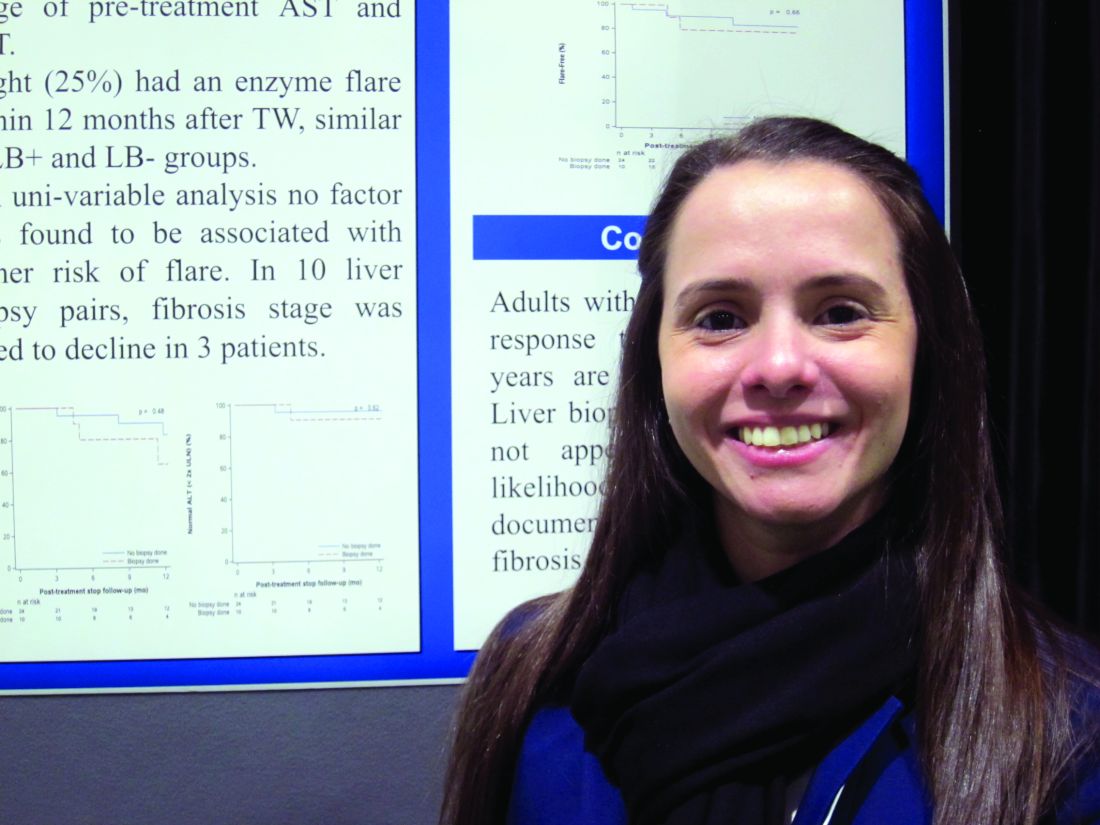
BOSTON – Although current guidance calls for a liver biopsy prior to treatment withdrawal in autoimmune hepatitis (AIH), a retrospective observational analysis conducted by researchers from the Cleveland Clinic offers a different view.
“Maybe not everyone needs a liver biopsy before withdrawing treatment,” Yilien Alonso, MD, an internist at the Cleveland Clinic in Weston, Fla., said in an interview at the annual meeting of the American Association for the Study of Liver Diseases.
Both the European Association for Study of the Liver and the AASLD recommend liver biopsy prior to treatment withdrawal in AIH, but the expensive procedure is not without risk of morbidity and mortality. Dr. Alonso and her coinvestigators reviewed the records of 508 AIH patients seen at their institution between January 2001 and April 2015. After excluding the records of patients who’d had juvenile onset of AIH, or who were treated with agents other than corticosteroids and azathioprine, the researchers found 34 adults with similar pretreatment profiles who’d had treatment withdrawal after 2 years of excellent response to treatment, 10 of whom had a liver biopsy prior to treatment withdrawal.
The outcomes at 1 year post treatment withdrawal for all 34 were similar, with no difference in flare rates or reinitiation of treatment. In those who’d had the second liver biopsy, the fibrosis stage was noted at 1 year to have declined in three patients.
“If you have a stable patient population that you are tracking every 3-6 months, we don’t see why you can’t stop the treatment without having to have another invasive procedure,” Dr. Alonso said.
[email protected]
On Twitter @whitneymcknight
BOSTON – Although current guidance calls for a liver biopsy prior to treatment withdrawal in autoimmune hepatitis (AIH), a retrospective observational analysis conducted by researchers from the Cleveland Clinic offers a different view.
“Maybe not everyone needs a liver biopsy before withdrawing treatment,” Yilien Alonso, MD, an internist at the Cleveland Clinic in Weston, Fla., said in an interview at the annual meeting of the American Association for the Study of Liver Diseases.
Both the European Association for Study of the Liver and the AASLD recommend liver biopsy prior to treatment withdrawal in AIH, but the expensive procedure is not without risk of morbidity and mortality. Dr. Alonso and her coinvestigators reviewed the records of 508 AIH patients seen at their institution between January 2001 and April 2015. After excluding the records of patients who’d had juvenile onset of AIH, or who were treated with agents other than corticosteroids and azathioprine, the researchers found 34 adults with similar pretreatment profiles who’d had treatment withdrawal after 2 years of excellent response to treatment, 10 of whom had a liver biopsy prior to treatment withdrawal.
The outcomes at 1 year post treatment withdrawal for all 34 were similar, with no difference in flare rates or reinitiation of treatment. In those who’d had the second liver biopsy, the fibrosis stage was noted at 1 year to have declined in three patients.
“If you have a stable patient population that you are tracking every 3-6 months, we don’t see why you can’t stop the treatment without having to have another invasive procedure,” Dr. Alonso said.
[email protected]
On Twitter @whitneymcknight
BOSTON – Although current guidance calls for a liver biopsy prior to treatment withdrawal in autoimmune hepatitis (AIH), a retrospective observational analysis conducted by researchers from the Cleveland Clinic offers a different view.
“Maybe not everyone needs a liver biopsy before withdrawing treatment,” Yilien Alonso, MD, an internist at the Cleveland Clinic in Weston, Fla., said in an interview at the annual meeting of the American Association for the Study of Liver Diseases.
Both the European Association for Study of the Liver and the AASLD recommend liver biopsy prior to treatment withdrawal in AIH, but the expensive procedure is not without risk of morbidity and mortality. Dr. Alonso and her coinvestigators reviewed the records of 508 AIH patients seen at their institution between January 2001 and April 2015. After excluding the records of patients who’d had juvenile onset of AIH, or who were treated with agents other than corticosteroids and azathioprine, the researchers found 34 adults with similar pretreatment profiles who’d had treatment withdrawal after 2 years of excellent response to treatment, 10 of whom had a liver biopsy prior to treatment withdrawal.
The outcomes at 1 year post treatment withdrawal for all 34 were similar, with no difference in flare rates or reinitiation of treatment. In those who’d had the second liver biopsy, the fibrosis stage was noted at 1 year to have declined in three patients.
“If you have a stable patient population that you are tracking every 3-6 months, we don’t see why you can’t stop the treatment without having to have another invasive procedure,” Dr. Alonso said.
[email protected]
On Twitter @whitneymcknight
AT THE LIVER MEETING 2016
Key clinical point:
Major finding: Flare rates were similar post treatment withdrawal at 1 year in autoimmune hepatitis patients with and without a prior liver biopsy.
Data source: Retrospective observational analysis of 34 adults with well-controlled autoimmune hepatitis given treatment withdrawal with and without liver biopsy in large academic practice.
Disclosures: Dr. Alonso did not have any relevant disclosures.
Hypervirulent Mycobacterium clone infecting cystic fibrosis patients worldwide
A recently evolved strain of Mycobacterium is circulating in hospitals worldwide, causing nearly impossible-to-treat lung infections among patients with cystic fibrosis.
A genome-wide study has determined that Mycobacterium abscessus is not transmitted through soil and water, as once thought, but is a nosocomial infection transmitted person to person through droplet and surface contamination, Andres Floto, MD, reported in Science (2016 Nov 11;354[6313]:751-7).
“The bug initially seems to have entered the patient population from the environment, but we think it has recently evolved to become capable of jumping from patient to patient, getting more virulent as it does so,” Dr. Floto of the University of Cambridge, England, wrote in a press statement.
The path of global transmission is not yet entirely clear, the authors noted. But since it first appeared, around 1978, M. abscessus has spread globally, strongly suggesting that asymptomatic carriers may be one source of transmission.
“We found no evidence of cystic fibrosis patients or of equipment moving between centers in different countries, indicating that the global spread of M. abscessus may be driven by alternative human, zoonotic, or environmental vectors of transmission,” the researchers wrote.
The team conducted whole-genome sequencing on 1,080 samples of M. abscessus obtained from 517 cystic fibrosis patients in clinics and hospitals within the United States, the United Kingdom, Europe, and Australia. They identified three subspecies, some of which contained nearly genetically identical strains, “suggesting widespread transmission of circulating clones within the global cystic fibrosis patient community.”
Most patients (74%) were infected with these genetically identical strains despite their diverse geographic locations. The isolates were amazingly similar, the authors noted: 90% differed by less than 20 single nucleotide polymorphisms.
Using these strains, the researchers were able to construct several possible transmission chains in most of the cystic fibrosis centers included in the study. The three dominant circulating clones were all observed in the United States, European, and Australian samples, indicating transcontinental transmission.
“We also detected numerous examples of identical or near-identical isolates infecting groups of patients in different cystic fibrosis centers and, indeed, across different countries, indicating the recent global spread of M. abscessus clones throughout the international cystic fibrosis patient community.”
The team also determined that the common ancestor of these strains probably emerged around 1978.
Another sequencing series tracked specific isolates among individual patients. This strongly suggests person-to-person transmission. Adding this to their previous work on M. abscessus transmission, the authors postulated that spread was probably by surface contamination by droplet contamination and by cough aerosol from infected patients.
The team then looked at clinical outcomes associated with the bacteria and treatment with amikacin and macrolides – antibiotics typically used to fight this very-challenging infection. “We did observe increased rates of chronic infection in individuals,” infected with the clones, which were resistant to both those medications, they said.
In immunodeficient mice, the strains were more likely to cause granulomatous and inflammatory lung changes. And the bacteria tended to survive even after being consumed by macrophages, “suggesting that the establishment of transmission chains may have permitted multiple rounds of within-host genetic adaptation to allow M. abscessus to evolve from an environmental organism to a true lung pathogen.”
The research was funded by the Wellcome Trust and the Cystic Fibrosis Trust in the United Kingdom. There were no financial disclosures.
[email protected]
On Twitter @alz_gal
Approximately 30,000 American adults, children, and infants have cystic fibrosis. Nontuberculous mycobacteria (NTM) are ubiquitous environmental microorganisms, and it has been known for some time that these infections can be transmitted person to person. Any patient, actually, who has preexisting lung disease – and especially those with poor mucociliary clearance – are at risk for a nontuberculous mycobacterial infection. This type of lung infection also can be difficult to diagnose and hard to treat. The U.S. Cystic Fibrosis Foundation in conjunction with the European Cystic Fibrosis Society has developed consensus guidelines for infection control, evaluation, and treatment of this problem. This executive summary was published last January (Floto et al. Thorax.2016;71:i1-i22).

At our center, in addition to the standard contact precautions we use for every CF patient, patients with confirmed NTM infections are seen at every clinic visit in an airborne infection isolation room. We also require all CF patients to wear an isolation mask when entering the hospital or clinic facility, when going to a laboratory, or even when going to the bathroom down the hall. Finally, we stress the significant importance of good hand hygiene.
Susan Millard, MD, FCCP, is a pediatric pulmonologist with Spectrum Health/Butterworth Hospital in Grand Rapids, Mich.
Approximately 30,000 American adults, children, and infants have cystic fibrosis. Nontuberculous mycobacteria (NTM) are ubiquitous environmental microorganisms, and it has been known for some time that these infections can be transmitted person to person. Any patient, actually, who has preexisting lung disease – and especially those with poor mucociliary clearance – are at risk for a nontuberculous mycobacterial infection. This type of lung infection also can be difficult to diagnose and hard to treat. The U.S. Cystic Fibrosis Foundation in conjunction with the European Cystic Fibrosis Society has developed consensus guidelines for infection control, evaluation, and treatment of this problem. This executive summary was published last January (Floto et al. Thorax.2016;71:i1-i22).
At our center, in addition to the standard contact precautions we use for every CF patient, patients with confirmed NTM infections are seen at every clinic visit in an airborne infection isolation room. We also require all CF patients to wear an isolation mask when entering the hospital or clinic facility, when going to a laboratory, or even when going to the bathroom down the hall. Finally, we stress the significant importance of good hand hygiene.
Susan Millard, MD, FCCP, is a pediatric pulmonologist with Spectrum Health/Butterworth Hospital in Grand Rapids, Mich.
Approximately 30,000 American adults, children, and infants have cystic fibrosis. Nontuberculous mycobacteria (NTM) are ubiquitous environmental microorganisms, and it has been known for some time that these infections can be transmitted person to person. Any patient, actually, who has preexisting lung disease – and especially those with poor mucociliary clearance – are at risk for a nontuberculous mycobacterial infection. This type of lung infection also can be difficult to diagnose and hard to treat. The U.S. Cystic Fibrosis Foundation in conjunction with the European Cystic Fibrosis Society has developed consensus guidelines for infection control, evaluation, and treatment of this problem. This executive summary was published last January (Floto et al. Thorax.2016;71:i1-i22).
At our center, in addition to the standard contact precautions we use for every CF patient, patients with confirmed NTM infections are seen at every clinic visit in an airborne infection isolation room. We also require all CF patients to wear an isolation mask when entering the hospital or clinic facility, when going to a laboratory, or even when going to the bathroom down the hall. Finally, we stress the significant importance of good hand hygiene.
Susan Millard, MD, FCCP, is a pediatric pulmonologist with Spectrum Health/Butterworth Hospital in Grand Rapids, Mich.
A recently evolved strain of Mycobacterium is circulating in hospitals worldwide, causing nearly impossible-to-treat lung infections among patients with cystic fibrosis.
A genome-wide study has determined that Mycobacterium abscessus is not transmitted through soil and water, as once thought, but is a nosocomial infection transmitted person to person through droplet and surface contamination, Andres Floto, MD, reported in Science (2016 Nov 11;354[6313]:751-7).
“The bug initially seems to have entered the patient population from the environment, but we think it has recently evolved to become capable of jumping from patient to patient, getting more virulent as it does so,” Dr. Floto of the University of Cambridge, England, wrote in a press statement.
The path of global transmission is not yet entirely clear, the authors noted. But since it first appeared, around 1978, M. abscessus has spread globally, strongly suggesting that asymptomatic carriers may be one source of transmission.
“We found no evidence of cystic fibrosis patients or of equipment moving between centers in different countries, indicating that the global spread of M. abscessus may be driven by alternative human, zoonotic, or environmental vectors of transmission,” the researchers wrote.
The team conducted whole-genome sequencing on 1,080 samples of M. abscessus obtained from 517 cystic fibrosis patients in clinics and hospitals within the United States, the United Kingdom, Europe, and Australia. They identified three subspecies, some of which contained nearly genetically identical strains, “suggesting widespread transmission of circulating clones within the global cystic fibrosis patient community.”
Most patients (74%) were infected with these genetically identical strains despite their diverse geographic locations. The isolates were amazingly similar, the authors noted: 90% differed by less than 20 single nucleotide polymorphisms.
Using these strains, the researchers were able to construct several possible transmission chains in most of the cystic fibrosis centers included in the study. The three dominant circulating clones were all observed in the United States, European, and Australian samples, indicating transcontinental transmission.
“We also detected numerous examples of identical or near-identical isolates infecting groups of patients in different cystic fibrosis centers and, indeed, across different countries, indicating the recent global spread of M. abscessus clones throughout the international cystic fibrosis patient community.”
The team also determined that the common ancestor of these strains probably emerged around 1978.
Another sequencing series tracked specific isolates among individual patients. This strongly suggests person-to-person transmission. Adding this to their previous work on M. abscessus transmission, the authors postulated that spread was probably by surface contamination by droplet contamination and by cough aerosol from infected patients.
The team then looked at clinical outcomes associated with the bacteria and treatment with amikacin and macrolides – antibiotics typically used to fight this very-challenging infection. “We did observe increased rates of chronic infection in individuals,” infected with the clones, which were resistant to both those medications, they said.
In immunodeficient mice, the strains were more likely to cause granulomatous and inflammatory lung changes. And the bacteria tended to survive even after being consumed by macrophages, “suggesting that the establishment of transmission chains may have permitted multiple rounds of within-host genetic adaptation to allow M. abscessus to evolve from an environmental organism to a true lung pathogen.”
The research was funded by the Wellcome Trust and the Cystic Fibrosis Trust in the United Kingdom. There were no financial disclosures.
[email protected]
On Twitter @alz_gal
A recently evolved strain of Mycobacterium is circulating in hospitals worldwide, causing nearly impossible-to-treat lung infections among patients with cystic fibrosis.
A genome-wide study has determined that Mycobacterium abscessus is not transmitted through soil and water, as once thought, but is a nosocomial infection transmitted person to person through droplet and surface contamination, Andres Floto, MD, reported in Science (2016 Nov 11;354[6313]:751-7).
“The bug initially seems to have entered the patient population from the environment, but we think it has recently evolved to become capable of jumping from patient to patient, getting more virulent as it does so,” Dr. Floto of the University of Cambridge, England, wrote in a press statement.
The path of global transmission is not yet entirely clear, the authors noted. But since it first appeared, around 1978, M. abscessus has spread globally, strongly suggesting that asymptomatic carriers may be one source of transmission.
“We found no evidence of cystic fibrosis patients or of equipment moving between centers in different countries, indicating that the global spread of M. abscessus may be driven by alternative human, zoonotic, or environmental vectors of transmission,” the researchers wrote.
The team conducted whole-genome sequencing on 1,080 samples of M. abscessus obtained from 517 cystic fibrosis patients in clinics and hospitals within the United States, the United Kingdom, Europe, and Australia. They identified three subspecies, some of which contained nearly genetically identical strains, “suggesting widespread transmission of circulating clones within the global cystic fibrosis patient community.”
Most patients (74%) were infected with these genetically identical strains despite their diverse geographic locations. The isolates were amazingly similar, the authors noted: 90% differed by less than 20 single nucleotide polymorphisms.
Using these strains, the researchers were able to construct several possible transmission chains in most of the cystic fibrosis centers included in the study. The three dominant circulating clones were all observed in the United States, European, and Australian samples, indicating transcontinental transmission.
“We also detected numerous examples of identical or near-identical isolates infecting groups of patients in different cystic fibrosis centers and, indeed, across different countries, indicating the recent global spread of M. abscessus clones throughout the international cystic fibrosis patient community.”
The team also determined that the common ancestor of these strains probably emerged around 1978.
Another sequencing series tracked specific isolates among individual patients. This strongly suggests person-to-person transmission. Adding this to their previous work on M. abscessus transmission, the authors postulated that spread was probably by surface contamination by droplet contamination and by cough aerosol from infected patients.
The team then looked at clinical outcomes associated with the bacteria and treatment with amikacin and macrolides – antibiotics typically used to fight this very-challenging infection. “We did observe increased rates of chronic infection in individuals,” infected with the clones, which were resistant to both those medications, they said.
In immunodeficient mice, the strains were more likely to cause granulomatous and inflammatory lung changes. And the bacteria tended to survive even after being consumed by macrophages, “suggesting that the establishment of transmission chains may have permitted multiple rounds of within-host genetic adaptation to allow M. abscessus to evolve from an environmental organism to a true lung pathogen.”
The research was funded by the Wellcome Trust and the Cystic Fibrosis Trust in the United Kingdom. There were no financial disclosures.
[email protected]
On Twitter @alz_gal
FROM SCIENCE
Key clinical point:
Major finding: Hypervirulent clones of Mycobacterium abscessus with apparent person-to-person transmission, are appearing in cystic fibrosis centers worldwide.
Data source: Gene sequencing was performed on 1,080 samples of M. abscessus from the United States, the United Kingdom, Europe, and Australia.
Disclosures: The research was funded by the Wellcome Trust and the Cystic Fibrosis Trust in the United Kingdom.

Pharmacists: Weight-loss drugs and diabetes can mix
SAN DIEGO –
In light of their side effects and other complications, weight-loss drugs haven’t reached their full diet-in-a-pill potential. Diet drugs remain controversial even as the Food and Drug Administration continues to approve new formulations. Such weight-loss medications can still play a role in the care of diabetic patient, according to a pair of diabetes educators.
The key, they say, is to understand the limits of their potential and their not-so-limited drawbacks. “There is no magic pill,” said Charmaine Rochester, PharmD, an associate professor of pharmacy with the University of Maryland School of Pharmacy, Baltimore. “Patients need to know that it is not an easy fix. They still have to change their lifestyles with the medications.”
Dr. Rochester and Lisa Meade, PharmD, CDE, an associate professor of pharmacy at Wingate (N.C.) University School of Pharmacy, spoke about weight loss medications and diabetes care at the annual meeting of the American Association of Diabetes Educators and in later interviews.
These medications produce weight loss in the 5%-10% range. Still, “weight loss as little as 5% can significantly improve glycemic control, and modest weight loss of 5% to under 10% has been associated with significant improvements in cardiovascular disease risk factors at 1 year – decreased inflammation, improvement in insulin resistance, improved blood pressure, and improved cholesterol,” Dr. Meade said. “Also, weight loss may decrease the amount of medication needed to achieve glycemic control.”
According to Dr. Meade, it’s common for diabetic patients to ask about weight-loss drugs. “They have heard about them from friends or have seen advertisements on TV or the Internet or in magazines,” she said. However, “in general we do not encourage the use of medications for weight loss until the patient has demonstrated weight loss on their own. Counseling is very important so patients realize they will have more weight loss if combined with diet and exercise.”
Dr. Meade noted that the newer weight-loss medications – Qsymia (phentermine and topiramate), Belviq (lorcaserin HCl), Contrave (naltrexone HCl/bupropion HCl), and Saxenda (liraglutide) – are indicated in obese adults with a body mass index of 30 or above or those with a BMI of 27 with at least one comorbid condition, such as hypertension, type 2 diabetes, or dyslipidemia. Contrave is unusual: It’s a mix of the antidepressant bupropion (Wellbutrin) and the addiction drug naltrexone (Revia).
There are several other weight-loss drugs, including orlistat, which is available both by prescription (Xenical) and over-the-counter (Alli). Orlistat is famously linked to “anal leakage” – GI problems and oily and fatty stools.
Weight-loss drugs are controversial. Consumer Reports has warned against using Alli, Xenical, Belviq, Qsymia, and Saxenda “because they don’t help most people lose much, if any, weight, and they all carry potentially serious risks.” Earlier this year, Consumer Reports took aim at Contrave, too: “Nearly 1 in 4 people in the clinical trials stopped taking the prescription weight loss pill because they couldn’t tolerate the common side effects, including nausea, headache, and vomiting.”
As for other side effects, Dr. Meade noted that weight loss can cause hypoglycemia, so diabetes medications may need to be reduced. “Educators need to know that phentermine [in Qsymia and other weight-loss medications] is contraindicated for patients with any type of coronary artery disease [uncontrolled hypertension, stroke, arrhythmias or heart failure],” she said. There are concerns about cardiac issues in patients who take other weight-loss drugs, too.
Also, Belviq is not recommended in patients who are taking certain medications for depression, Dr. Meade said, “and some medications for depression and smoking cessation would be contraindicated with Contrave.”
Dr. Meade cautioned that the new drugs often aren’t covered by insurance and can be too expensive for patients. Goodrx.com estimates the cash price for a month’s supply of Contrave at $264-$295, although discounts and coupons can reduce that amount.
If patients do want to try the weight-loss drugs, Dr. Rochester urges educators to inform them about “the reality of the weight loss expected and remind patients that the research was completed in patients who also incorporated diet and exercise.”
Dr. Rochester and Dr. Meade report no relevant disclosures.
SAN DIEGO –
In light of their side effects and other complications, weight-loss drugs haven’t reached their full diet-in-a-pill potential. Diet drugs remain controversial even as the Food and Drug Administration continues to approve new formulations. Such weight-loss medications can still play a role in the care of diabetic patient, according to a pair of diabetes educators.
The key, they say, is to understand the limits of their potential and their not-so-limited drawbacks. “There is no magic pill,” said Charmaine Rochester, PharmD, an associate professor of pharmacy with the University of Maryland School of Pharmacy, Baltimore. “Patients need to know that it is not an easy fix. They still have to change their lifestyles with the medications.”
Dr. Rochester and Lisa Meade, PharmD, CDE, an associate professor of pharmacy at Wingate (N.C.) University School of Pharmacy, spoke about weight loss medications and diabetes care at the annual meeting of the American Association of Diabetes Educators and in later interviews.
These medications produce weight loss in the 5%-10% range. Still, “weight loss as little as 5% can significantly improve glycemic control, and modest weight loss of 5% to under 10% has been associated with significant improvements in cardiovascular disease risk factors at 1 year – decreased inflammation, improvement in insulin resistance, improved blood pressure, and improved cholesterol,” Dr. Meade said. “Also, weight loss may decrease the amount of medication needed to achieve glycemic control.”
According to Dr. Meade, it’s common for diabetic patients to ask about weight-loss drugs. “They have heard about them from friends or have seen advertisements on TV or the Internet or in magazines,” she said. However, “in general we do not encourage the use of medications for weight loss until the patient has demonstrated weight loss on their own. Counseling is very important so patients realize they will have more weight loss if combined with diet and exercise.”
Dr. Meade noted that the newer weight-loss medications – Qsymia (phentermine and topiramate), Belviq (lorcaserin HCl), Contrave (naltrexone HCl/bupropion HCl), and Saxenda (liraglutide) – are indicated in obese adults with a body mass index of 30 or above or those with a BMI of 27 with at least one comorbid condition, such as hypertension, type 2 diabetes, or dyslipidemia. Contrave is unusual: It’s a mix of the antidepressant bupropion (Wellbutrin) and the addiction drug naltrexone (Revia).
There are several other weight-loss drugs, including orlistat, which is available both by prescription (Xenical) and over-the-counter (Alli). Orlistat is famously linked to “anal leakage” – GI problems and oily and fatty stools.
Weight-loss drugs are controversial. Consumer Reports has warned against using Alli, Xenical, Belviq, Qsymia, and Saxenda “because they don’t help most people lose much, if any, weight, and they all carry potentially serious risks.” Earlier this year, Consumer Reports took aim at Contrave, too: “Nearly 1 in 4 people in the clinical trials stopped taking the prescription weight loss pill because they couldn’t tolerate the common side effects, including nausea, headache, and vomiting.”
As for other side effects, Dr. Meade noted that weight loss can cause hypoglycemia, so diabetes medications may need to be reduced. “Educators need to know that phentermine [in Qsymia and other weight-loss medications] is contraindicated for patients with any type of coronary artery disease [uncontrolled hypertension, stroke, arrhythmias or heart failure],” she said. There are concerns about cardiac issues in patients who take other weight-loss drugs, too.
Also, Belviq is not recommended in patients who are taking certain medications for depression, Dr. Meade said, “and some medications for depression and smoking cessation would be contraindicated with Contrave.”
Dr. Meade cautioned that the new drugs often aren’t covered by insurance and can be too expensive for patients. Goodrx.com estimates the cash price for a month’s supply of Contrave at $264-$295, although discounts and coupons can reduce that amount.
If patients do want to try the weight-loss drugs, Dr. Rochester urges educators to inform them about “the reality of the weight loss expected and remind patients that the research was completed in patients who also incorporated diet and exercise.”
Dr. Rochester and Dr. Meade report no relevant disclosures.
SAN DIEGO –
In light of their side effects and other complications, weight-loss drugs haven’t reached their full diet-in-a-pill potential. Diet drugs remain controversial even as the Food and Drug Administration continues to approve new formulations. Such weight-loss medications can still play a role in the care of diabetic patient, according to a pair of diabetes educators.
The key, they say, is to understand the limits of their potential and their not-so-limited drawbacks. “There is no magic pill,” said Charmaine Rochester, PharmD, an associate professor of pharmacy with the University of Maryland School of Pharmacy, Baltimore. “Patients need to know that it is not an easy fix. They still have to change their lifestyles with the medications.”
Dr. Rochester and Lisa Meade, PharmD, CDE, an associate professor of pharmacy at Wingate (N.C.) University School of Pharmacy, spoke about weight loss medications and diabetes care at the annual meeting of the American Association of Diabetes Educators and in later interviews.
These medications produce weight loss in the 5%-10% range. Still, “weight loss as little as 5% can significantly improve glycemic control, and modest weight loss of 5% to under 10% has been associated with significant improvements in cardiovascular disease risk factors at 1 year – decreased inflammation, improvement in insulin resistance, improved blood pressure, and improved cholesterol,” Dr. Meade said. “Also, weight loss may decrease the amount of medication needed to achieve glycemic control.”
According to Dr. Meade, it’s common for diabetic patients to ask about weight-loss drugs. “They have heard about them from friends or have seen advertisements on TV or the Internet or in magazines,” she said. However, “in general we do not encourage the use of medications for weight loss until the patient has demonstrated weight loss on their own. Counseling is very important so patients realize they will have more weight loss if combined with diet and exercise.”
Dr. Meade noted that the newer weight-loss medications – Qsymia (phentermine and topiramate), Belviq (lorcaserin HCl), Contrave (naltrexone HCl/bupropion HCl), and Saxenda (liraglutide) – are indicated in obese adults with a body mass index of 30 or above or those with a BMI of 27 with at least one comorbid condition, such as hypertension, type 2 diabetes, or dyslipidemia. Contrave is unusual: It’s a mix of the antidepressant bupropion (Wellbutrin) and the addiction drug naltrexone (Revia).
There are several other weight-loss drugs, including orlistat, which is available both by prescription (Xenical) and over-the-counter (Alli). Orlistat is famously linked to “anal leakage” – GI problems and oily and fatty stools.
Weight-loss drugs are controversial. Consumer Reports has warned against using Alli, Xenical, Belviq, Qsymia, and Saxenda “because they don’t help most people lose much, if any, weight, and they all carry potentially serious risks.” Earlier this year, Consumer Reports took aim at Contrave, too: “Nearly 1 in 4 people in the clinical trials stopped taking the prescription weight loss pill because they couldn’t tolerate the common side effects, including nausea, headache, and vomiting.”
As for other side effects, Dr. Meade noted that weight loss can cause hypoglycemia, so diabetes medications may need to be reduced. “Educators need to know that phentermine [in Qsymia and other weight-loss medications] is contraindicated for patients with any type of coronary artery disease [uncontrolled hypertension, stroke, arrhythmias or heart failure],” she said. There are concerns about cardiac issues in patients who take other weight-loss drugs, too.
Also, Belviq is not recommended in patients who are taking certain medications for depression, Dr. Meade said, “and some medications for depression and smoking cessation would be contraindicated with Contrave.”
Dr. Meade cautioned that the new drugs often aren’t covered by insurance and can be too expensive for patients. Goodrx.com estimates the cash price for a month’s supply of Contrave at $264-$295, although discounts and coupons can reduce that amount.
If patients do want to try the weight-loss drugs, Dr. Rochester urges educators to inform them about “the reality of the weight loss expected and remind patients that the research was completed in patients who also incorporated diet and exercise.”
Dr. Rochester and Dr. Meade report no relevant disclosures.
EXPERT ANALYSIS FROM AADE 16
VIDEO: Novel agent inclisiran dramatically lowers LDL
NEW ORLEANS – A single 300-mg injection of inclisiran, a novel non–monoclonal antibody PCSK9 inhibitor, plus statin therapy, achieved a mean 51% reduction in LDL cholesterol, compared with placebo plus a statin, an effect sustained for 90 days.
Moreover, a second subcutaneous 300-mg dose given at day 90 resulted in a 57% reduction in LDL sustained at day 180 with a highly favorable safety profile in the phase II ORION-1 study, Kausik K. Ray, MD, reported at the American Heart Association scientific sessions.
“The efficacy, safety and dosing profile of inclisiran are likely to ensure significant and durable reductions in LDL-C and thus could potentially impact cardiovascular outcomes,” said Dr. Ray, professor of public health at Imperial College London.
Inclisiran is a synthetic RNA interference agent. After injection it selectively goes to the liver, bypassing other tissues and thereby limiting toxicity. Inclisiran halts PCSK9 protein synthesis in the liver, with a resultant sharp, steep, and sustained drop in LDL levels.
Inclisiran achieves LDL lowering of a magnitude similar to that of the PCSK9-inhibiting monoclonal antibodies alirocumab (Praluent) and evolocumab (Repatha), but it will be less expensive to produce and far less costly to administer than the monoclonal antibodies. Dosing is planned to be two or three injections per year, rather than every 2 or 4 weeks, as with the PCSK9 inhibitor monoclonal antibodies, which cost a hefty $14,000 per year. And the sustained efficacy of a dose of inclisiran should make patient adherence to LDL-lowering therapy less of an issue, Dr. Ray continued.
ORION-1 (Inhibition of PCSK9 Synthesis Via RNA Interference) was a double-blind, randomized, placebo-controlled trial comprising 501 patients already on maximally tolerated statin therapy for atherosclerotic cardiovascular disease or at high risk. Nevertheless, their baseline LDL was 125-135 mg/dL. Participants were randomized to one of six doses of inclisiran or placebo. At 90 days they received a second dose. Dr. Ray presented 90- and 180-day outcomes.
This was primarily a safety and dose-ranging study. Side effects at 90 days were no different from placebo regardless of whether patients received 100, 200, 300, or 500 mg of inclisiran. There was no signal of a problem with myalgia or elevated liver enzymes. Mild injection site reactions lasting for more than 4 hours occurred in 1.5%-3.3% of inclisiran-treated patients, but not in a dose-dependent fashion.
One 300-mg dose of inclisiran, in addition to achieving a mean 51% reduction in LDL from baseline at day 90, resulted in a mean 28% reduction in total cholesterol, a modest 10% drop in triglycerides, a 9% increase in HDL, a 37% drop in Apo-B, and a median 23% reduction in Lp(a). Plasma PCSK9 levels plunged in parallel with LDL.
The mean drop in LDL from baseline at day 180 after two 300-mg doses of inclisiran spaced 90 days apart was 65 mg/dL. The LDL reduction ranged from a minimum of 26.5 mg/dL to a maximum of 122 mg/dL.
Dr. Ray’s presentation of the ORION-1 findings followed on the heels of publication of a positive but much smaller phase I study of inclisiran (N Engl J Med. 2016 Nov 13. doi: 10.1056/NEJMoa1609243).
A large phase II clinical trial with cardiovascular outcomes is planned.
Discussant Borge G. Nordestgaard, MD, could find no fault with ORION-1 or inclisiran’s performance to date.
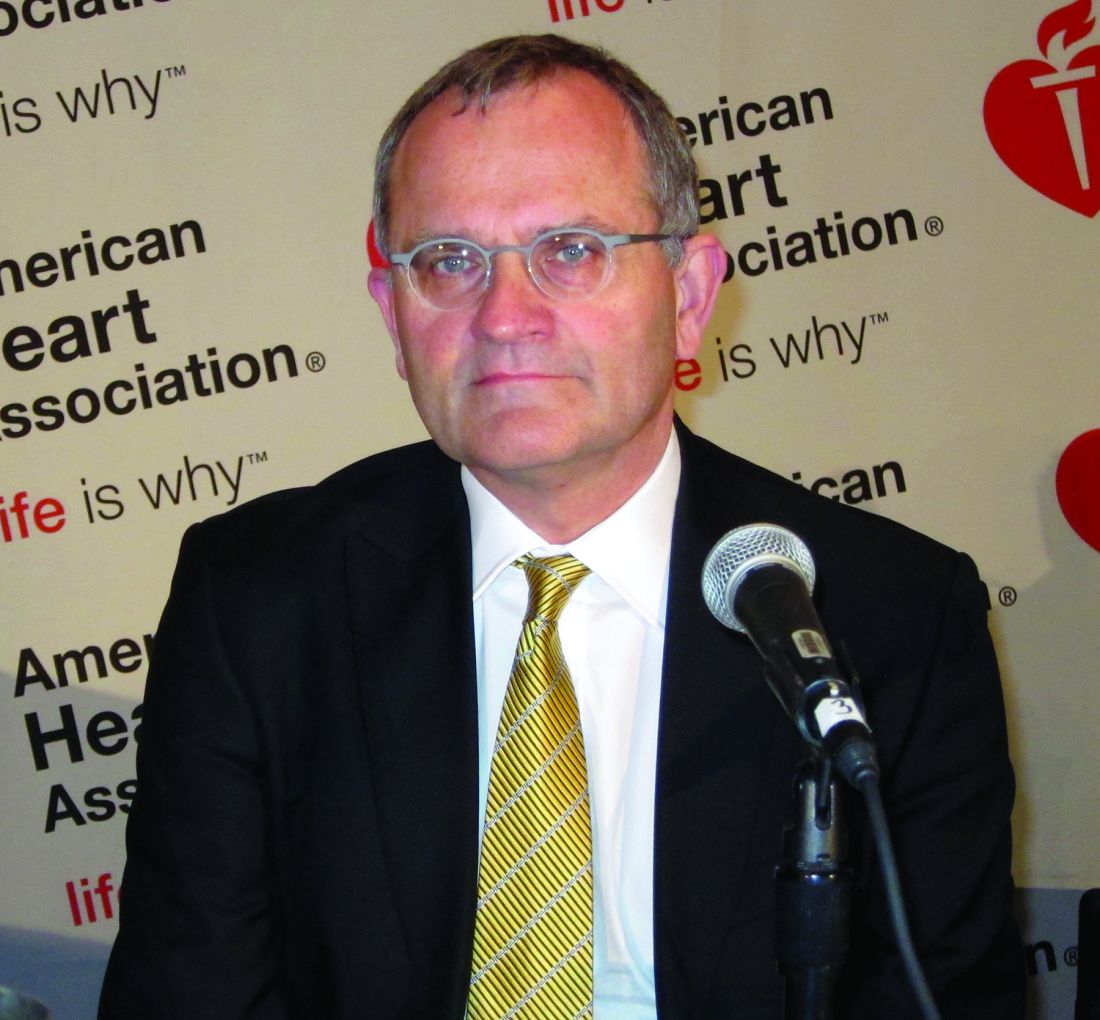
“A 50%-60% reduction in LDL lasting for 3-6 months, with two or three injections per year – it seems fantastic. And there don’t seem to be side effects except for mild injection site reactions. It looks really, really encouraging, I must say,” said Dr. Nordestgaard, professor of genetic epidemiology at the University of Copenhagen.
“I think the key question is, will the very impressive LDL reduction that we see now be sustainable over time in the longer phase III trials,” he added.
Dr. Ray reported serving as a consultant to the Medicines Company, which together with Alnylam Pharmaceuticals sponsored ORION-1, and receiving research grants from and/or serving as a consultant to more than half a dozen other pharmaceutical companies.
Dr. Ray discussed his findings in a video interview at the meeting.
The video associated with this article is no longer available on this site. Please view all of our videos on the MDedge YouTube channel
NEW ORLEANS – A single 300-mg injection of inclisiran, a novel non–monoclonal antibody PCSK9 inhibitor, plus statin therapy, achieved a mean 51% reduction in LDL cholesterol, compared with placebo plus a statin, an effect sustained for 90 days.
Moreover, a second subcutaneous 300-mg dose given at day 90 resulted in a 57% reduction in LDL sustained at day 180 with a highly favorable safety profile in the phase II ORION-1 study, Kausik K. Ray, MD, reported at the American Heart Association scientific sessions.
“The efficacy, safety and dosing profile of inclisiran are likely to ensure significant and durable reductions in LDL-C and thus could potentially impact cardiovascular outcomes,” said Dr. Ray, professor of public health at Imperial College London.
Inclisiran is a synthetic RNA interference agent. After injection it selectively goes to the liver, bypassing other tissues and thereby limiting toxicity. Inclisiran halts PCSK9 protein synthesis in the liver, with a resultant sharp, steep, and sustained drop in LDL levels.
Inclisiran achieves LDL lowering of a magnitude similar to that of the PCSK9-inhibiting monoclonal antibodies alirocumab (Praluent) and evolocumab (Repatha), but it will be less expensive to produce and far less costly to administer than the monoclonal antibodies. Dosing is planned to be two or three injections per year, rather than every 2 or 4 weeks, as with the PCSK9 inhibitor monoclonal antibodies, which cost a hefty $14,000 per year. And the sustained efficacy of a dose of inclisiran should make patient adherence to LDL-lowering therapy less of an issue, Dr. Ray continued.
ORION-1 (Inhibition of PCSK9 Synthesis Via RNA Interference) was a double-blind, randomized, placebo-controlled trial comprising 501 patients already on maximally tolerated statin therapy for atherosclerotic cardiovascular disease or at high risk. Nevertheless, their baseline LDL was 125-135 mg/dL. Participants were randomized to one of six doses of inclisiran or placebo. At 90 days they received a second dose. Dr. Ray presented 90- and 180-day outcomes.
This was primarily a safety and dose-ranging study. Side effects at 90 days were no different from placebo regardless of whether patients received 100, 200, 300, or 500 mg of inclisiran. There was no signal of a problem with myalgia or elevated liver enzymes. Mild injection site reactions lasting for more than 4 hours occurred in 1.5%-3.3% of inclisiran-treated patients, but not in a dose-dependent fashion.
One 300-mg dose of inclisiran, in addition to achieving a mean 51% reduction in LDL from baseline at day 90, resulted in a mean 28% reduction in total cholesterol, a modest 10% drop in triglycerides, a 9% increase in HDL, a 37% drop in Apo-B, and a median 23% reduction in Lp(a). Plasma PCSK9 levels plunged in parallel with LDL.
The mean drop in LDL from baseline at day 180 after two 300-mg doses of inclisiran spaced 90 days apart was 65 mg/dL. The LDL reduction ranged from a minimum of 26.5 mg/dL to a maximum of 122 mg/dL.
Dr. Ray’s presentation of the ORION-1 findings followed on the heels of publication of a positive but much smaller phase I study of inclisiran (N Engl J Med. 2016 Nov 13. doi: 10.1056/NEJMoa1609243).
A large phase II clinical trial with cardiovascular outcomes is planned.
Discussant Borge G. Nordestgaard, MD, could find no fault with ORION-1 or inclisiran’s performance to date.
“A 50%-60% reduction in LDL lasting for 3-6 months, with two or three injections per year – it seems fantastic. And there don’t seem to be side effects except for mild injection site reactions. It looks really, really encouraging, I must say,” said Dr. Nordestgaard, professor of genetic epidemiology at the University of Copenhagen.
“I think the key question is, will the very impressive LDL reduction that we see now be sustainable over time in the longer phase III trials,” he added.
Dr. Ray reported serving as a consultant to the Medicines Company, which together with Alnylam Pharmaceuticals sponsored ORION-1, and receiving research grants from and/or serving as a consultant to more than half a dozen other pharmaceutical companies.
Dr. Ray discussed his findings in a video interview at the meeting.
The video associated with this article is no longer available on this site. Please view all of our videos on the MDedge YouTube channel
NEW ORLEANS – A single 300-mg injection of inclisiran, a novel non–monoclonal antibody PCSK9 inhibitor, plus statin therapy, achieved a mean 51% reduction in LDL cholesterol, compared with placebo plus a statin, an effect sustained for 90 days.
Moreover, a second subcutaneous 300-mg dose given at day 90 resulted in a 57% reduction in LDL sustained at day 180 with a highly favorable safety profile in the phase II ORION-1 study, Kausik K. Ray, MD, reported at the American Heart Association scientific sessions.
“The efficacy, safety and dosing profile of inclisiran are likely to ensure significant and durable reductions in LDL-C and thus could potentially impact cardiovascular outcomes,” said Dr. Ray, professor of public health at Imperial College London.
Inclisiran is a synthetic RNA interference agent. After injection it selectively goes to the liver, bypassing other tissues and thereby limiting toxicity. Inclisiran halts PCSK9 protein synthesis in the liver, with a resultant sharp, steep, and sustained drop in LDL levels.
Inclisiran achieves LDL lowering of a magnitude similar to that of the PCSK9-inhibiting monoclonal antibodies alirocumab (Praluent) and evolocumab (Repatha), but it will be less expensive to produce and far less costly to administer than the monoclonal antibodies. Dosing is planned to be two or three injections per year, rather than every 2 or 4 weeks, as with the PCSK9 inhibitor monoclonal antibodies, which cost a hefty $14,000 per year. And the sustained efficacy of a dose of inclisiran should make patient adherence to LDL-lowering therapy less of an issue, Dr. Ray continued.
ORION-1 (Inhibition of PCSK9 Synthesis Via RNA Interference) was a double-blind, randomized, placebo-controlled trial comprising 501 patients already on maximally tolerated statin therapy for atherosclerotic cardiovascular disease or at high risk. Nevertheless, their baseline LDL was 125-135 mg/dL. Participants were randomized to one of six doses of inclisiran or placebo. At 90 days they received a second dose. Dr. Ray presented 90- and 180-day outcomes.
This was primarily a safety and dose-ranging study. Side effects at 90 days were no different from placebo regardless of whether patients received 100, 200, 300, or 500 mg of inclisiran. There was no signal of a problem with myalgia or elevated liver enzymes. Mild injection site reactions lasting for more than 4 hours occurred in 1.5%-3.3% of inclisiran-treated patients, but not in a dose-dependent fashion.
One 300-mg dose of inclisiran, in addition to achieving a mean 51% reduction in LDL from baseline at day 90, resulted in a mean 28% reduction in total cholesterol, a modest 10% drop in triglycerides, a 9% increase in HDL, a 37% drop in Apo-B, and a median 23% reduction in Lp(a). Plasma PCSK9 levels plunged in parallel with LDL.
The mean drop in LDL from baseline at day 180 after two 300-mg doses of inclisiran spaced 90 days apart was 65 mg/dL. The LDL reduction ranged from a minimum of 26.5 mg/dL to a maximum of 122 mg/dL.
Dr. Ray’s presentation of the ORION-1 findings followed on the heels of publication of a positive but much smaller phase I study of inclisiran (N Engl J Med. 2016 Nov 13. doi: 10.1056/NEJMoa1609243).
A large phase II clinical trial with cardiovascular outcomes is planned.
Discussant Borge G. Nordestgaard, MD, could find no fault with ORION-1 or inclisiran’s performance to date.
“A 50%-60% reduction in LDL lasting for 3-6 months, with two or three injections per year – it seems fantastic. And there don’t seem to be side effects except for mild injection site reactions. It looks really, really encouraging, I must say,” said Dr. Nordestgaard, professor of genetic epidemiology at the University of Copenhagen.
“I think the key question is, will the very impressive LDL reduction that we see now be sustainable over time in the longer phase III trials,” he added.
Dr. Ray reported serving as a consultant to the Medicines Company, which together with Alnylam Pharmaceuticals sponsored ORION-1, and receiving research grants from and/or serving as a consultant to more than half a dozen other pharmaceutical companies.
Dr. Ray discussed his findings in a video interview at the meeting.
The video associated with this article is no longer available on this site. Please view all of our videos on the MDedge YouTube channel
AT THE AHA SCIENTIFIC SESSIONS
Key clinical point:
Major finding: A single 300-mg subcutaneous injection of inclisiran quickly dropped elevated LDL-cholesterol levels by 51% and kept them there for 90 days.
Data source: ORION-1, a double-blind, randomized, placebo-controlled, phase II study conducted in 501 patients assigned to various doses of inclisiran or placebo on top of maximally tolerated statin therapy.
Disclosures: Dr. Ray reported serving as a consultant to the Medicines Company, which together with Alnylam Pharmaceuticals sponsored ORION-1, and receiving research grants from and/or serving as a consultant to more than half a dozen other pharmaceutical companies.

HIV research update: Late October 2016
A great volume of HIV and AIDS research enters the medical literature every month. It’s difficult to monitor everything, so here’s a quick look at some notable news items and journal articles published over the past few weeks.
A study in the American Journal of Pathology found that HIV impairs Mycobacterium tuberculosis antigen presentation in human dendritic cells, thereby suppressing an important cell-linking innate and adaptive immune response in TB.
A study of the uptake of HIV preexposure prophylaxis (PrEP) among commercially insured persons in the U.S. found that interventions are needed to increase PrEP use by women at substantial risk of acquiring HIV infection.
Implementation of proper and integrated malaria preventive measures as well as frequent monitoring of anemia on prescription of antiretroviral therapy could likely improve the health conditions of HIV-infected children, according to a study in Cameroon.
A Colombian study of the clinical outcomes of a generic version of abacavir/lamivudine and efavirenz in HIV treatment naive patients showed the expected safety and effectiveness profile of proprietary antiretroviral drugs.
Skin autofluorescence is increased in HIV-infected subjects and related with smoking, low nadir CD4 count, and men who have sex with men, according to a study in the journal AIDS, but researchers say larger studies are needed to confirm whether skin autofluorescence is an independent predictor of cardiovascular disease events.
Researchers at Vanderbilt University, Nashville, Tenn., said that, as the HIV-positive population ages, structured subjective cognitive assessment may be beneficial to identify the early signs of cognitive impairment, and to allow for earlier interventions to maintain cognitive performance.
An antiretroviral therapy roll-out in rural Malawi resulted in a sustained 10-year gain in adult life expectancy for HIV-positive individuals, according to a study in the International Journal of Epidemiology.
Increasing HIV virulence driven by universal testing and treatment is likely not a major public health concern, according to a modeling study, but should be monitored in sentinel surveillance, in a manner similar to transmitted resistance to antiretroviral drugs.
A South African study found no association between duration of tenofovir exposure in utero and early linear growth in HIV-exposed, uninfected infants.
In 2014, 17.9% of AIDS cases reported by 29 countries in the European Union and European Economic Area (EU/EEA) presented with TB as an AIDS-defining illness, indicating that TB/HIV coinfection is a substantial problem in the EU/EEA.
A study of malnourished antiretroviral therapy (ART)-eligible adults in sub-Saharan Africa found that pre-ART mortality was twice that in the early post-ART period, suggesting many early ART deaths represent advanced HIV disease rather than treatment-related events.
A study in Taiwan found that HIV patients had an increased risk of stroke, particularly those with cryptococcal meningitis, cytomegalovirus, or P. marneffei infection.
A study of older patients living with HIV found that the associations between cognitive impairment and patient-reported outcome measures were weak, possibly because impairment was mild and therefore largely asymptomatic.
[email protected]
On Twitter @richpizzi
A great volume of HIV and AIDS research enters the medical literature every month. It’s difficult to monitor everything, so here’s a quick look at some notable news items and journal articles published over the past few weeks.
A study in the American Journal of Pathology found that HIV impairs Mycobacterium tuberculosis antigen presentation in human dendritic cells, thereby suppressing an important cell-linking innate and adaptive immune response in TB.
A study of the uptake of HIV preexposure prophylaxis (PrEP) among commercially insured persons in the U.S. found that interventions are needed to increase PrEP use by women at substantial risk of acquiring HIV infection.
Implementation of proper and integrated malaria preventive measures as well as frequent monitoring of anemia on prescription of antiretroviral therapy could likely improve the health conditions of HIV-infected children, according to a study in Cameroon.
A Colombian study of the clinical outcomes of a generic version of abacavir/lamivudine and efavirenz in HIV treatment naive patients showed the expected safety and effectiveness profile of proprietary antiretroviral drugs.
Skin autofluorescence is increased in HIV-infected subjects and related with smoking, low nadir CD4 count, and men who have sex with men, according to a study in the journal AIDS, but researchers say larger studies are needed to confirm whether skin autofluorescence is an independent predictor of cardiovascular disease events.
Researchers at Vanderbilt University, Nashville, Tenn., said that, as the HIV-positive population ages, structured subjective cognitive assessment may be beneficial to identify the early signs of cognitive impairment, and to allow for earlier interventions to maintain cognitive performance.
An antiretroviral therapy roll-out in rural Malawi resulted in a sustained 10-year gain in adult life expectancy for HIV-positive individuals, according to a study in the International Journal of Epidemiology.
Increasing HIV virulence driven by universal testing and treatment is likely not a major public health concern, according to a modeling study, but should be monitored in sentinel surveillance, in a manner similar to transmitted resistance to antiretroviral drugs.
A South African study found no association between duration of tenofovir exposure in utero and early linear growth in HIV-exposed, uninfected infants.
In 2014, 17.9% of AIDS cases reported by 29 countries in the European Union and European Economic Area (EU/EEA) presented with TB as an AIDS-defining illness, indicating that TB/HIV coinfection is a substantial problem in the EU/EEA.
A study of malnourished antiretroviral therapy (ART)-eligible adults in sub-Saharan Africa found that pre-ART mortality was twice that in the early post-ART period, suggesting many early ART deaths represent advanced HIV disease rather than treatment-related events.
A study in Taiwan found that HIV patients had an increased risk of stroke, particularly those with cryptococcal meningitis, cytomegalovirus, or P. marneffei infection.
A study of older patients living with HIV found that the associations between cognitive impairment and patient-reported outcome measures were weak, possibly because impairment was mild and therefore largely asymptomatic.
[email protected]
On Twitter @richpizzi
A great volume of HIV and AIDS research enters the medical literature every month. It’s difficult to monitor everything, so here’s a quick look at some notable news items and journal articles published over the past few weeks.
A study in the American Journal of Pathology found that HIV impairs Mycobacterium tuberculosis antigen presentation in human dendritic cells, thereby suppressing an important cell-linking innate and adaptive immune response in TB.
A study of the uptake of HIV preexposure prophylaxis (PrEP) among commercially insured persons in the U.S. found that interventions are needed to increase PrEP use by women at substantial risk of acquiring HIV infection.
Implementation of proper and integrated malaria preventive measures as well as frequent monitoring of anemia on prescription of antiretroviral therapy could likely improve the health conditions of HIV-infected children, according to a study in Cameroon.
A Colombian study of the clinical outcomes of a generic version of abacavir/lamivudine and efavirenz in HIV treatment naive patients showed the expected safety and effectiveness profile of proprietary antiretroviral drugs.
Skin autofluorescence is increased in HIV-infected subjects and related with smoking, low nadir CD4 count, and men who have sex with men, according to a study in the journal AIDS, but researchers say larger studies are needed to confirm whether skin autofluorescence is an independent predictor of cardiovascular disease events.
Researchers at Vanderbilt University, Nashville, Tenn., said that, as the HIV-positive population ages, structured subjective cognitive assessment may be beneficial to identify the early signs of cognitive impairment, and to allow for earlier interventions to maintain cognitive performance.
An antiretroviral therapy roll-out in rural Malawi resulted in a sustained 10-year gain in adult life expectancy for HIV-positive individuals, according to a study in the International Journal of Epidemiology.
Increasing HIV virulence driven by universal testing and treatment is likely not a major public health concern, according to a modeling study, but should be monitored in sentinel surveillance, in a manner similar to transmitted resistance to antiretroviral drugs.
A South African study found no association between duration of tenofovir exposure in utero and early linear growth in HIV-exposed, uninfected infants.
In 2014, 17.9% of AIDS cases reported by 29 countries in the European Union and European Economic Area (EU/EEA) presented with TB as an AIDS-defining illness, indicating that TB/HIV coinfection is a substantial problem in the EU/EEA.
A study of malnourished antiretroviral therapy (ART)-eligible adults in sub-Saharan Africa found that pre-ART mortality was twice that in the early post-ART period, suggesting many early ART deaths represent advanced HIV disease rather than treatment-related events.
A study in Taiwan found that HIV patients had an increased risk of stroke, particularly those with cryptococcal meningitis, cytomegalovirus, or P. marneffei infection.
A study of older patients living with HIV found that the associations between cognitive impairment and patient-reported outcome measures were weak, possibly because impairment was mild and therefore largely asymptomatic.
[email protected]
On Twitter @richpizzi

Interatrial shunt benefits sustained for 1 year in HFpEF patients
NEW ORLEANS – An interatrial septal shunt device continued to provide “sustained and meaningful clinical benefit” at 1-year follow-up for 64 patients who had heart failure with preserved ejection fraction (HFpEF), David M. Kaye, MD, PhD, reported at the American Heart Association scientific sessions.
The device is implanted via cardiac catheterization and is intended to reduce elevated left atrial pressure, particularly that associated with exertion, by allowing a small amount but not excessive left-to-right shunting. Patients showed improvements in 6-minute walk distance, New York Heart Association class, and HF-related quality of life scores at 6 months, and those effects persisted at the most recent (12-month) follow-up, he said in a presentation that was simultaneously published online in Circulation (2016 Nov 16).
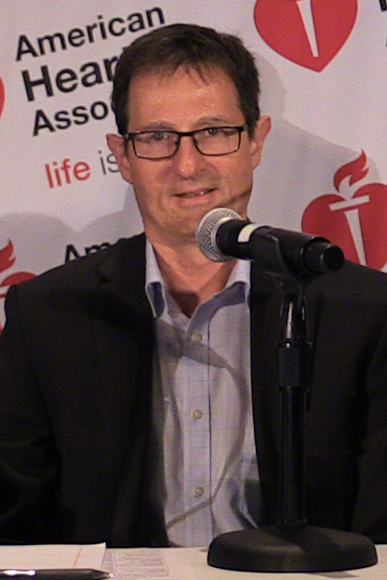
Overall survival at 1 year was 95%. Three patients died (one from combined pneumonia and renal failure, one from a fatal stroke, and one from an undetermined cause) and one was lost to follow-up. Thirteen patients required 17 hospitalizations for heart failure.
Six-minute walk distance improved from 331 meters at baseline to 363 meters. NYHA classification improved dramatically, as did quality of life scores as assessed by the Minnesota Living with HF questionnaire.
All 48 devices that were evaluable on echocardiographic imaging remained patent, showing continued left-to-right shunting. Left ventricular ejection fraction remained unchanged while right ventricular ejection fraction was significantly elevated over baseline levels. “In conjunction, there were modest but stable reductions in LV end-diastolic volume index with a concomitant rise in RV end-diastolic index,” he said.
A subset of 18 study participants underwent heart catheterization during both rest and exercise so that hemodynamics could be assessed. Exercise time increased significantly, from 8.2 minutes at baseline to 9.7 minutes at 6 months and to 10.4 minutes at 1 year. Similarly, peak work capacity during supine cycling increased from 48 watts at baseline to 60 watts at 6 months and 55 watts at 1 year. These benefits occurred without any increase in pulmonary capillary wedge pressure.
Systemic blood pressure did not change over time, either at rest or during exercise. Left and right atrial volumes also remained unchanged.
Perhaps most importantly, Dr. Kaye said, right-sided cardiac output increased significantly, while left-sided cardiac output remained unchanged. There was no evidence of increased pulmonary pressure or pulmonary vascular resistance. This meant that patients could do more physical activity for a given level of left atrial pressure, he said.
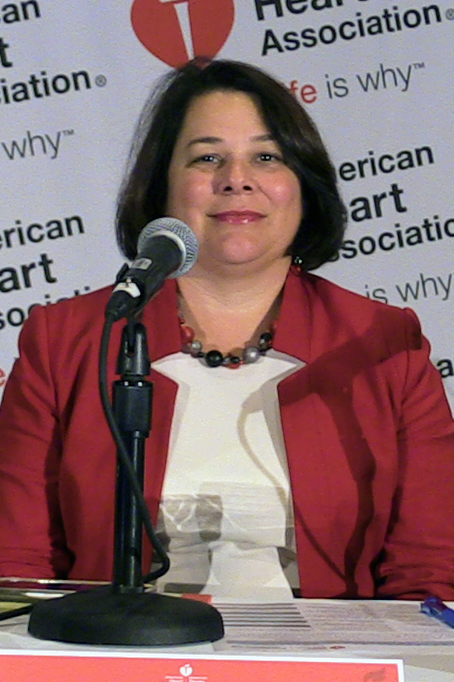
Furthermore, 1-year mortality was lower in this trial, at 4.6%, than in the placebo groups of the I-PRESERVE trial in irbesartan (5.2%) and the U.S. group of the TOPCAT trial in spironolactone (7.7%), said Dr. Kaye, professor and chief of cardiology at the University of Arizona, Tuscon.
Device therapy could have an enormous impact in carefully selected patients with HFpEF, for whom there are no medical treatments, despite the nonrandomized nature of the trial.
REDUCE LAP-HF was funded by Corvia Medical, maker of the shunt device. Dr. Kaye is an unpaid member of Corvia’s scientific advisory group. Dr. Sweitzer is an investigator in the ongoing randomized trial of the interatrial shunt.
NEW ORLEANS – An interatrial septal shunt device continued to provide “sustained and meaningful clinical benefit” at 1-year follow-up for 64 patients who had heart failure with preserved ejection fraction (HFpEF), David M. Kaye, MD, PhD, reported at the American Heart Association scientific sessions.
The device is implanted via cardiac catheterization and is intended to reduce elevated left atrial pressure, particularly that associated with exertion, by allowing a small amount but not excessive left-to-right shunting. Patients showed improvements in 6-minute walk distance, New York Heart Association class, and HF-related quality of life scores at 6 months, and those effects persisted at the most recent (12-month) follow-up, he said in a presentation that was simultaneously published online in Circulation (2016 Nov 16).
Overall survival at 1 year was 95%. Three patients died (one from combined pneumonia and renal failure, one from a fatal stroke, and one from an undetermined cause) and one was lost to follow-up. Thirteen patients required 17 hospitalizations for heart failure.
Six-minute walk distance improved from 331 meters at baseline to 363 meters. NYHA classification improved dramatically, as did quality of life scores as assessed by the Minnesota Living with HF questionnaire.
All 48 devices that were evaluable on echocardiographic imaging remained patent, showing continued left-to-right shunting. Left ventricular ejection fraction remained unchanged while right ventricular ejection fraction was significantly elevated over baseline levels. “In conjunction, there were modest but stable reductions in LV end-diastolic volume index with a concomitant rise in RV end-diastolic index,” he said.
A subset of 18 study participants underwent heart catheterization during both rest and exercise so that hemodynamics could be assessed. Exercise time increased significantly, from 8.2 minutes at baseline to 9.7 minutes at 6 months and to 10.4 minutes at 1 year. Similarly, peak work capacity during supine cycling increased from 48 watts at baseline to 60 watts at 6 months and 55 watts at 1 year. These benefits occurred without any increase in pulmonary capillary wedge pressure.
Systemic blood pressure did not change over time, either at rest or during exercise. Left and right atrial volumes also remained unchanged.
Perhaps most importantly, Dr. Kaye said, right-sided cardiac output increased significantly, while left-sided cardiac output remained unchanged. There was no evidence of increased pulmonary pressure or pulmonary vascular resistance. This meant that patients could do more physical activity for a given level of left atrial pressure, he said.
Furthermore, 1-year mortality was lower in this trial, at 4.6%, than in the placebo groups of the I-PRESERVE trial in irbesartan (5.2%) and the U.S. group of the TOPCAT trial in spironolactone (7.7%), said Dr. Kaye, professor and chief of cardiology at the University of Arizona, Tuscon.
Device therapy could have an enormous impact in carefully selected patients with HFpEF, for whom there are no medical treatments, despite the nonrandomized nature of the trial.
REDUCE LAP-HF was funded by Corvia Medical, maker of the shunt device. Dr. Kaye is an unpaid member of Corvia’s scientific advisory group. Dr. Sweitzer is an investigator in the ongoing randomized trial of the interatrial shunt.
NEW ORLEANS – An interatrial septal shunt device continued to provide “sustained and meaningful clinical benefit” at 1-year follow-up for 64 patients who had heart failure with preserved ejection fraction (HFpEF), David M. Kaye, MD, PhD, reported at the American Heart Association scientific sessions.
The device is implanted via cardiac catheterization and is intended to reduce elevated left atrial pressure, particularly that associated with exertion, by allowing a small amount but not excessive left-to-right shunting. Patients showed improvements in 6-minute walk distance, New York Heart Association class, and HF-related quality of life scores at 6 months, and those effects persisted at the most recent (12-month) follow-up, he said in a presentation that was simultaneously published online in Circulation (2016 Nov 16).
Overall survival at 1 year was 95%. Three patients died (one from combined pneumonia and renal failure, one from a fatal stroke, and one from an undetermined cause) and one was lost to follow-up. Thirteen patients required 17 hospitalizations for heart failure.
Six-minute walk distance improved from 331 meters at baseline to 363 meters. NYHA classification improved dramatically, as did quality of life scores as assessed by the Minnesota Living with HF questionnaire.
All 48 devices that were evaluable on echocardiographic imaging remained patent, showing continued left-to-right shunting. Left ventricular ejection fraction remained unchanged while right ventricular ejection fraction was significantly elevated over baseline levels. “In conjunction, there were modest but stable reductions in LV end-diastolic volume index with a concomitant rise in RV end-diastolic index,” he said.
A subset of 18 study participants underwent heart catheterization during both rest and exercise so that hemodynamics could be assessed. Exercise time increased significantly, from 8.2 minutes at baseline to 9.7 minutes at 6 months and to 10.4 minutes at 1 year. Similarly, peak work capacity during supine cycling increased from 48 watts at baseline to 60 watts at 6 months and 55 watts at 1 year. These benefits occurred without any increase in pulmonary capillary wedge pressure.
Systemic blood pressure did not change over time, either at rest or during exercise. Left and right atrial volumes also remained unchanged.
Perhaps most importantly, Dr. Kaye said, right-sided cardiac output increased significantly, while left-sided cardiac output remained unchanged. There was no evidence of increased pulmonary pressure or pulmonary vascular resistance. This meant that patients could do more physical activity for a given level of left atrial pressure, he said.
Furthermore, 1-year mortality was lower in this trial, at 4.6%, than in the placebo groups of the I-PRESERVE trial in irbesartan (5.2%) and the U.S. group of the TOPCAT trial in spironolactone (7.7%), said Dr. Kaye, professor and chief of cardiology at the University of Arizona, Tuscon.
Device therapy could have an enormous impact in carefully selected patients with HFpEF, for whom there are no medical treatments, despite the nonrandomized nature of the trial.
REDUCE LAP-HF was funded by Corvia Medical, maker of the shunt device. Dr. Kaye is an unpaid member of Corvia’s scientific advisory group. Dr. Sweitzer is an investigator in the ongoing randomized trial of the interatrial shunt.
AT THE AHA SCIENTIFIC SESSIONS 2016
Key clinical point: An interatrial septal shunt device continued to provide sustained and meaningful clinical benefit at 1-year follow-up for 64 patients who had heart failure with preserved ejection fraction.
Major finding: Six-minute walk distance improved from 331 meters at baseline to 363 meters at 1 year, NYHA classification improved dramatically, and HF-related quality of life scores also improved.
Data source: REDUCE LAP-HF, a multicenter, prospective, open-label study involving 64 patients followed for 1 year after transcatheter implantation of a shunt device.
Disclosures: REDUCE LAP-HF was funded by Corvia Medical, maker of the shunt device. Dr. Kaye is an unpaid member of Corvia’s scientific advisory group.
Medicaid restrictions loosening on access to HCV therapies
BOSTON – State Medicaid programs have begun to loosen restrictions and improve transparency around access to direct-acting antiviral agents to treat hepatitis C virus infection, but inconsistencies are still the norm nationwide.
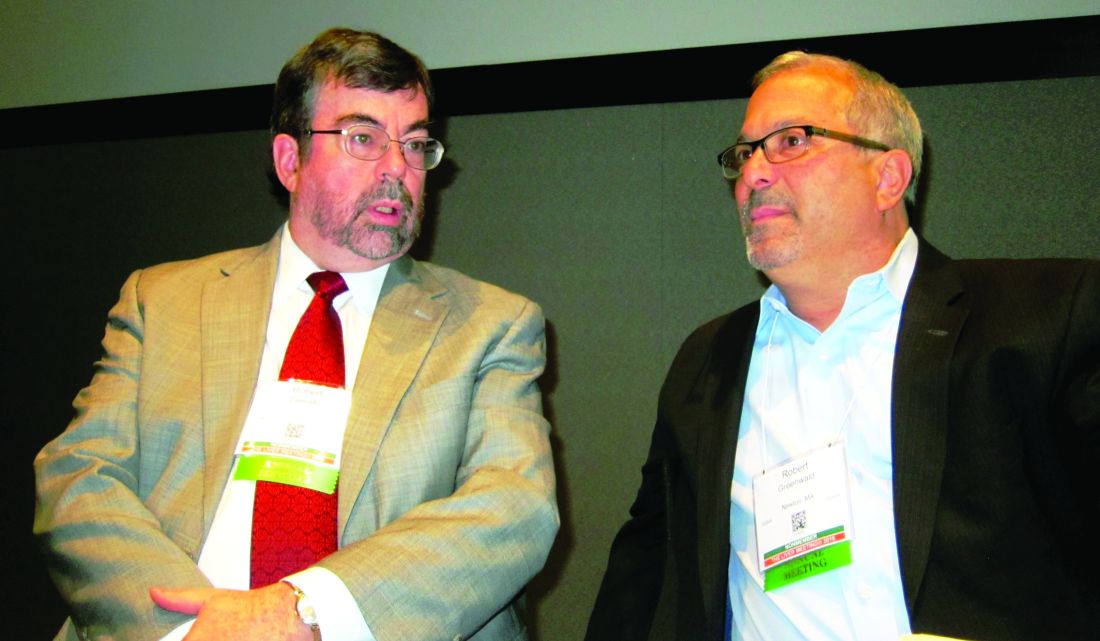
“Far too many states continue to restrict access in defiance to their obligations under the law,” said Robert Greenwald, clinical professor of law at Harvard University Center for Health Law and Policy Innovation (CHLPI), Boston.
Since 2014, the number of states that do not publish their access criteria for direct-acting antiviral agents (DAA) has dropped from 17 to 7, according to a report from CHLPI and the National Viral Hepatitis Roundtable (NVHR). Also during that period, 16 states relaxed or dropped fibrosis levels to qualify for access, and 7 decreased sobriety restrictions. The number of states that publish prescriber limitations has increased from 28 to 35. Because cost restrictions vary across insurance plans, some patients who need access get it, and others don’t, even if they have coverage, said Mr. Greenwald and Ryan Clary, NVHR executive director, who presented the report at the annual meeting of the American Association for the Study of Liver Diseases.
NVHR is a coalition of advocacy groups and local governmental agencies with interests in HCV, HIV, and infectious diseases. Its sponsors include AbbVie, Gilead Sciences, Merck, Bristol-Myers Squibb, Janssen, OraSure Technologies, Quest Diagnostics, and Walgreens. CHLPI is supported in part by Gilead, BMS, Johnson & Johnson, and ViiV Health Care.
In November 2015, the Centers for Medicaid & Medicare Services issued guidance to states, noting that while the cost of DAAs is prohibitive, states should use “sound clinical judgment” when determining access, and to “not unreasonably restrict coverage.” Varied interpretation of the guidance by state Medicaid directors means there is still a great deal of inconsistency in coverage.
Robert W. Zavoski, MD, Connecticut medical director of social services, noted that his state is making gains on balancing patient and taxpayer interests by emphasizing prevention, curbing reinfection rates, and using predictive modeling to determine the cost of HCV comorbidities.
Aligning incentives between institutions and payers that are based on long-term patient outcomes would mean not just lowered costs, but actual savings said Doug Dieterich, MD, professor of medicine at Mount Sinai Hospital in New York.
“It’s incredibly effective to treat hepatitis C virtually independent of the price of the drug. If patients remain in the same [health insurance] plan for 3-5 years after treatment, then the cost of treatment is very effective because the cost of health care drops precipitously – about 300% per patient – as soon as you cure hepatitis C,” Dr. Dieterich said.
Reducing the cost of treatments does not automatically result in better access, according John McHutchison, MD, executive vice president of clinical research at Gilead Sciences. Gilead’s DAAs (sofosbuvir and ledipasvir/sofosbuvir) were priced to the standard of care; however, miscalculations of demand drove up costs and “blew up” budgets, he said at the meeting.
Rebates to payers, discounts to patients, and the influx of new treatments to market are helping to drive down costs, Dr. McHutchison said, but while industry “wants to develop curative therapies, our system promotes chronic therapies from the financial perspective.”
The situation is compounded by the fact that state Medicaid programs negotiate individually with pharmaceutical companies and do not make their dealings public, said Brian Edlin, MD, chief medical officer for the CDC National Center for HIV/AIDS, Viral Hepatitis, STD, and TB Prevention. He called for more transparency regarding actual thresholds for profit and cure so that all restrictions could be dropped, and everyone could benefit. “How can much can we expect people to pay, what can we afford? All of that is out of the public domain,” he said.
Further dismantling of the barriers to care caused by high cost could be in the works if a recent proposal by FDA Commissioner Robert Califf, MD, gains traction. In an editorial published in JAMA, Dr. Califf called for collaboration between federal agencies to hasten and clarify public notification of the necessary criteria for a drug’s approval, coverage, and payment.
In the meantime, Mr. Greenwald said he and other advocates “are putting Medicaid directors on notice.”
[email protected]
On Twitter @whitneymcknight
BOSTON – State Medicaid programs have begun to loosen restrictions and improve transparency around access to direct-acting antiviral agents to treat hepatitis C virus infection, but inconsistencies are still the norm nationwide.
“Far too many states continue to restrict access in defiance to their obligations under the law,” said Robert Greenwald, clinical professor of law at Harvard University Center for Health Law and Policy Innovation (CHLPI), Boston.
Since 2014, the number of states that do not publish their access criteria for direct-acting antiviral agents (DAA) has dropped from 17 to 7, according to a report from CHLPI and the National Viral Hepatitis Roundtable (NVHR). Also during that period, 16 states relaxed or dropped fibrosis levels to qualify for access, and 7 decreased sobriety restrictions. The number of states that publish prescriber limitations has increased from 28 to 35. Because cost restrictions vary across insurance plans, some patients who need access get it, and others don’t, even if they have coverage, said Mr. Greenwald and Ryan Clary, NVHR executive director, who presented the report at the annual meeting of the American Association for the Study of Liver Diseases.
NVHR is a coalition of advocacy groups and local governmental agencies with interests in HCV, HIV, and infectious diseases. Its sponsors include AbbVie, Gilead Sciences, Merck, Bristol-Myers Squibb, Janssen, OraSure Technologies, Quest Diagnostics, and Walgreens. CHLPI is supported in part by Gilead, BMS, Johnson & Johnson, and ViiV Health Care.
In November 2015, the Centers for Medicaid & Medicare Services issued guidance to states, noting that while the cost of DAAs is prohibitive, states should use “sound clinical judgment” when determining access, and to “not unreasonably restrict coverage.” Varied interpretation of the guidance by state Medicaid directors means there is still a great deal of inconsistency in coverage.
Robert W. Zavoski, MD, Connecticut medical director of social services, noted that his state is making gains on balancing patient and taxpayer interests by emphasizing prevention, curbing reinfection rates, and using predictive modeling to determine the cost of HCV comorbidities.
Aligning incentives between institutions and payers that are based on long-term patient outcomes would mean not just lowered costs, but actual savings said Doug Dieterich, MD, professor of medicine at Mount Sinai Hospital in New York.
“It’s incredibly effective to treat hepatitis C virtually independent of the price of the drug. If patients remain in the same [health insurance] plan for 3-5 years after treatment, then the cost of treatment is very effective because the cost of health care drops precipitously – about 300% per patient – as soon as you cure hepatitis C,” Dr. Dieterich said.
Reducing the cost of treatments does not automatically result in better access, according John McHutchison, MD, executive vice president of clinical research at Gilead Sciences. Gilead’s DAAs (sofosbuvir and ledipasvir/sofosbuvir) were priced to the standard of care; however, miscalculations of demand drove up costs and “blew up” budgets, he said at the meeting.
Rebates to payers, discounts to patients, and the influx of new treatments to market are helping to drive down costs, Dr. McHutchison said, but while industry “wants to develop curative therapies, our system promotes chronic therapies from the financial perspective.”
The situation is compounded by the fact that state Medicaid programs negotiate individually with pharmaceutical companies and do not make their dealings public, said Brian Edlin, MD, chief medical officer for the CDC National Center for HIV/AIDS, Viral Hepatitis, STD, and TB Prevention. He called for more transparency regarding actual thresholds for profit and cure so that all restrictions could be dropped, and everyone could benefit. “How can much can we expect people to pay, what can we afford? All of that is out of the public domain,” he said.
Further dismantling of the barriers to care caused by high cost could be in the works if a recent proposal by FDA Commissioner Robert Califf, MD, gains traction. In an editorial published in JAMA, Dr. Califf called for collaboration between federal agencies to hasten and clarify public notification of the necessary criteria for a drug’s approval, coverage, and payment.
In the meantime, Mr. Greenwald said he and other advocates “are putting Medicaid directors on notice.”
[email protected]
On Twitter @whitneymcknight
BOSTON – State Medicaid programs have begun to loosen restrictions and improve transparency around access to direct-acting antiviral agents to treat hepatitis C virus infection, but inconsistencies are still the norm nationwide.
“Far too many states continue to restrict access in defiance to their obligations under the law,” said Robert Greenwald, clinical professor of law at Harvard University Center for Health Law and Policy Innovation (CHLPI), Boston.
Since 2014, the number of states that do not publish their access criteria for direct-acting antiviral agents (DAA) has dropped from 17 to 7, according to a report from CHLPI and the National Viral Hepatitis Roundtable (NVHR). Also during that period, 16 states relaxed or dropped fibrosis levels to qualify for access, and 7 decreased sobriety restrictions. The number of states that publish prescriber limitations has increased from 28 to 35. Because cost restrictions vary across insurance plans, some patients who need access get it, and others don’t, even if they have coverage, said Mr. Greenwald and Ryan Clary, NVHR executive director, who presented the report at the annual meeting of the American Association for the Study of Liver Diseases.
NVHR is a coalition of advocacy groups and local governmental agencies with interests in HCV, HIV, and infectious diseases. Its sponsors include AbbVie, Gilead Sciences, Merck, Bristol-Myers Squibb, Janssen, OraSure Technologies, Quest Diagnostics, and Walgreens. CHLPI is supported in part by Gilead, BMS, Johnson & Johnson, and ViiV Health Care.
In November 2015, the Centers for Medicaid & Medicare Services issued guidance to states, noting that while the cost of DAAs is prohibitive, states should use “sound clinical judgment” when determining access, and to “not unreasonably restrict coverage.” Varied interpretation of the guidance by state Medicaid directors means there is still a great deal of inconsistency in coverage.
Robert W. Zavoski, MD, Connecticut medical director of social services, noted that his state is making gains on balancing patient and taxpayer interests by emphasizing prevention, curbing reinfection rates, and using predictive modeling to determine the cost of HCV comorbidities.
Aligning incentives between institutions and payers that are based on long-term patient outcomes would mean not just lowered costs, but actual savings said Doug Dieterich, MD, professor of medicine at Mount Sinai Hospital in New York.
“It’s incredibly effective to treat hepatitis C virtually independent of the price of the drug. If patients remain in the same [health insurance] plan for 3-5 years after treatment, then the cost of treatment is very effective because the cost of health care drops precipitously – about 300% per patient – as soon as you cure hepatitis C,” Dr. Dieterich said.
Reducing the cost of treatments does not automatically result in better access, according John McHutchison, MD, executive vice president of clinical research at Gilead Sciences. Gilead’s DAAs (sofosbuvir and ledipasvir/sofosbuvir) were priced to the standard of care; however, miscalculations of demand drove up costs and “blew up” budgets, he said at the meeting.
Rebates to payers, discounts to patients, and the influx of new treatments to market are helping to drive down costs, Dr. McHutchison said, but while industry “wants to develop curative therapies, our system promotes chronic therapies from the financial perspective.”
The situation is compounded by the fact that state Medicaid programs negotiate individually with pharmaceutical companies and do not make their dealings public, said Brian Edlin, MD, chief medical officer for the CDC National Center for HIV/AIDS, Viral Hepatitis, STD, and TB Prevention. He called for more transparency regarding actual thresholds for profit and cure so that all restrictions could be dropped, and everyone could benefit. “How can much can we expect people to pay, what can we afford? All of that is out of the public domain,” he said.
Further dismantling of the barriers to care caused by high cost could be in the works if a recent proposal by FDA Commissioner Robert Califf, MD, gains traction. In an editorial published in JAMA, Dr. Califf called for collaboration between federal agencies to hasten and clarify public notification of the necessary criteria for a drug’s approval, coverage, and payment.
In the meantime, Mr. Greenwald said he and other advocates “are putting Medicaid directors on notice.”
[email protected]
On Twitter @whitneymcknight
Debunking Psoriasis Myths: Do Psoriasis Therapies Cause Depression?
Myth: Psoriasis treatments may cause depression
It has been well documented that patients with inflammatory diseases such as psoriasis have an increased risk for depression. One population-based cohort study in the United Kingdom reported the risk of depression was greater in patients with severe psoriasis versus mild psoriasis. Younger psoriasis patients also had a higher risk compared to older patients. A US population-based study also reported that psoriasis was associated with major depression, but the severity of psoriasis and patient's age were unrelated. Therefore, all psoriasis patients may be at risk.
But are some therapies associated with an increased risk of depression? Increased concentrations of proinflammatory cytokines such as tumor necrosis factor α have been associated with depression apart from psoriasis. Administering immunomodulating agents has been shown to increase the risk of depression.
Depression has been cited as an adverse effect of apremilast in the drug's package insert, which states, "Before using [apremilast] in patients with a history of depression and/or suicidal thoughts or behavior prescribers should carefully weigh the risks and benefits of treatment." In clinical trials, 1.3% (12/920) of participants treated with apremilast reported depression compared to 0.4% (2/506) treated with placebo. Dermatologists should remain vigilant about monitoring for symptoms of depression in patients treated with apremilast.
However, depression in the context of autoimmune disorders or any disorder with increased inflammation has responded to treatment with tumor necrosis factor α antagonists. The relationship between depression and inflammation suggests that there is an inflammatory subtype of depression and use of anti-inflammatory agents may treat both inflammation and depression.
Disease control has been shown to improve symptoms of depression in psoriasis patients. A study of 618 patients with moderate to severe psoriasis who were treated with etanercept or placebo for 12 weeks revealed that more patients receiving etanercept experienced 50% improvement in 2 rating scales of depression compared to placebo.
Excessive worrying, a form of psychological distress, can impact treatment outcomes in patients with psoriasis. A 2003 study found that patients with psoriasis who are classified as high-level worriers may benefit from adjunctive psychological intervention before and during treatment. In this cohort of psoriasis patients receiving psoralen plus UVA (PUVA) therapy, high-level worry was the only significant predictor of time taken for PUVA to clear psoriasis (P=.01). Patients in the high-level worry group cleared with PUVA treatment at a rate of 1.8 times slower than the low-level worry group.
In conclusion, psoriasis patients should follow the treatment plan outlined by dermatologists, as improving psoriasis symptoms may help alleviate depression or prevent it from occurring. Patients with a history of depression should be monitored carefully by dermatologists or referred to another health care professional, and patients as well as family and friends should be encouraged to report any depression symptoms.
Expert Commentary
The prescribing information for apremilast lists a warning (but not a black-box warning) for depression. Long-term registries will determine if there is truly an increased risk of depression when taking apremilast. When I counsel patients before prescribing apremilast, I mention this potential increased risk of depression as noted in the prescribing information, but I tell them that the risk is very low and that a true risk has not yet been determined in long-term registries. I mention to patients that if they really do feel depressed after starting apremilast, they should stop taking apremilast and contact me.
Long-term registries for etanercept, adalimumab, infliximab, and ustekinumab do not indicate an increased risk for depression. Intuitively, if a patient with severe psoriasis has depression worsened by their psoriasis, it stands to reason that improving their skin will likely improve their mood, which clinical trials have shown using patient-related outcomes.
—Jashin J. Wu, MD (Los Angeles, California)
Almond M. Depression and inflammation: examining the link. Current Psychiatry. 2013;12:24-32.
Cohen BE, Martires KJ, Ho RS. Psoriasis and the risk of depression in the US population: National Health and Nutrition Examination Survey 2009-2012. JAMA Dermatol. 2016;152:73-79.
Fortune DG, Richards HL, Kirby B, et al. Psychological distress impairs clearance of psoriasis in patients treated with photochemotherapy. Arch Dermatol. 2003;139:752-756.
Kurd SK, Troxel AB, Crits-Christoph P, et al. The risk of depression, anxiety and suicidality in patients with psoriasis: a population-based cohort study. Arch Dermatol. 2010;146:891-895.
Otezla [package insert]. Summit, NJ: Celgene Corporation; 2015.Research links psoriasis, depression [press release]. New York, NY: American Academy of Dermatology; August 20, 2015. https://www.aad.org/media/news-releases/research-links-psoriasis-depression. Accessed November 16, 2016.
Tyring S, Gottlieb A, Papp K, et al. Etanercept and clinical outcomes, fatigue, and depression in psoriasis: double-blind placebo-controlled randomised phase III trial. Lancet. 2006;367:29-35
Myth: Psoriasis treatments may cause depression
It has been well documented that patients with inflammatory diseases such as psoriasis have an increased risk for depression. One population-based cohort study in the United Kingdom reported the risk of depression was greater in patients with severe psoriasis versus mild psoriasis. Younger psoriasis patients also had a higher risk compared to older patients. A US population-based study also reported that psoriasis was associated with major depression, but the severity of psoriasis and patient's age were unrelated. Therefore, all psoriasis patients may be at risk.
But are some therapies associated with an increased risk of depression? Increased concentrations of proinflammatory cytokines such as tumor necrosis factor α have been associated with depression apart from psoriasis. Administering immunomodulating agents has been shown to increase the risk of depression.
Depression has been cited as an adverse effect of apremilast in the drug's package insert, which states, "Before using [apremilast] in patients with a history of depression and/or suicidal thoughts or behavior prescribers should carefully weigh the risks and benefits of treatment." In clinical trials, 1.3% (12/920) of participants treated with apremilast reported depression compared to 0.4% (2/506) treated with placebo. Dermatologists should remain vigilant about monitoring for symptoms of depression in patients treated with apremilast.
However, depression in the context of autoimmune disorders or any disorder with increased inflammation has responded to treatment with tumor necrosis factor α antagonists. The relationship between depression and inflammation suggests that there is an inflammatory subtype of depression and use of anti-inflammatory agents may treat both inflammation and depression.
Disease control has been shown to improve symptoms of depression in psoriasis patients. A study of 618 patients with moderate to severe psoriasis who were treated with etanercept or placebo for 12 weeks revealed that more patients receiving etanercept experienced 50% improvement in 2 rating scales of depression compared to placebo.
Excessive worrying, a form of psychological distress, can impact treatment outcomes in patients with psoriasis. A 2003 study found that patients with psoriasis who are classified as high-level worriers may benefit from adjunctive psychological intervention before and during treatment. In this cohort of psoriasis patients receiving psoralen plus UVA (PUVA) therapy, high-level worry was the only significant predictor of time taken for PUVA to clear psoriasis (P=.01). Patients in the high-level worry group cleared with PUVA treatment at a rate of 1.8 times slower than the low-level worry group.
In conclusion, psoriasis patients should follow the treatment plan outlined by dermatologists, as improving psoriasis symptoms may help alleviate depression or prevent it from occurring. Patients with a history of depression should be monitored carefully by dermatologists or referred to another health care professional, and patients as well as family and friends should be encouraged to report any depression symptoms.
Expert Commentary
The prescribing information for apremilast lists a warning (but not a black-box warning) for depression. Long-term registries will determine if there is truly an increased risk of depression when taking apremilast. When I counsel patients before prescribing apremilast, I mention this potential increased risk of depression as noted in the prescribing information, but I tell them that the risk is very low and that a true risk has not yet been determined in long-term registries. I mention to patients that if they really do feel depressed after starting apremilast, they should stop taking apremilast and contact me.
Long-term registries for etanercept, adalimumab, infliximab, and ustekinumab do not indicate an increased risk for depression. Intuitively, if a patient with severe psoriasis has depression worsened by their psoriasis, it stands to reason that improving their skin will likely improve their mood, which clinical trials have shown using patient-related outcomes.
—Jashin J. Wu, MD (Los Angeles, California)
Myth: Psoriasis treatments may cause depression
It has been well documented that patients with inflammatory diseases such as psoriasis have an increased risk for depression. One population-based cohort study in the United Kingdom reported the risk of depression was greater in patients with severe psoriasis versus mild psoriasis. Younger psoriasis patients also had a higher risk compared to older patients. A US population-based study also reported that psoriasis was associated with major depression, but the severity of psoriasis and patient's age were unrelated. Therefore, all psoriasis patients may be at risk.
But are some therapies associated with an increased risk of depression? Increased concentrations of proinflammatory cytokines such as tumor necrosis factor α have been associated with depression apart from psoriasis. Administering immunomodulating agents has been shown to increase the risk of depression.
Depression has been cited as an adverse effect of apremilast in the drug's package insert, which states, "Before using [apremilast] in patients with a history of depression and/or suicidal thoughts or behavior prescribers should carefully weigh the risks and benefits of treatment." In clinical trials, 1.3% (12/920) of participants treated with apremilast reported depression compared to 0.4% (2/506) treated with placebo. Dermatologists should remain vigilant about monitoring for symptoms of depression in patients treated with apremilast.
However, depression in the context of autoimmune disorders or any disorder with increased inflammation has responded to treatment with tumor necrosis factor α antagonists. The relationship between depression and inflammation suggests that there is an inflammatory subtype of depression and use of anti-inflammatory agents may treat both inflammation and depression.
Disease control has been shown to improve symptoms of depression in psoriasis patients. A study of 618 patients with moderate to severe psoriasis who were treated with etanercept or placebo for 12 weeks revealed that more patients receiving etanercept experienced 50% improvement in 2 rating scales of depression compared to placebo.
Excessive worrying, a form of psychological distress, can impact treatment outcomes in patients with psoriasis. A 2003 study found that patients with psoriasis who are classified as high-level worriers may benefit from adjunctive psychological intervention before and during treatment. In this cohort of psoriasis patients receiving psoralen plus UVA (PUVA) therapy, high-level worry was the only significant predictor of time taken for PUVA to clear psoriasis (P=.01). Patients in the high-level worry group cleared with PUVA treatment at a rate of 1.8 times slower than the low-level worry group.
In conclusion, psoriasis patients should follow the treatment plan outlined by dermatologists, as improving psoriasis symptoms may help alleviate depression or prevent it from occurring. Patients with a history of depression should be monitored carefully by dermatologists or referred to another health care professional, and patients as well as family and friends should be encouraged to report any depression symptoms.
Expert Commentary
The prescribing information for apremilast lists a warning (but not a black-box warning) for depression. Long-term registries will determine if there is truly an increased risk of depression when taking apremilast. When I counsel patients before prescribing apremilast, I mention this potential increased risk of depression as noted in the prescribing information, but I tell them that the risk is very low and that a true risk has not yet been determined in long-term registries. I mention to patients that if they really do feel depressed after starting apremilast, they should stop taking apremilast and contact me.
Long-term registries for etanercept, adalimumab, infliximab, and ustekinumab do not indicate an increased risk for depression. Intuitively, if a patient with severe psoriasis has depression worsened by their psoriasis, it stands to reason that improving their skin will likely improve their mood, which clinical trials have shown using patient-related outcomes.
—Jashin J. Wu, MD (Los Angeles, California)
Almond M. Depression and inflammation: examining the link. Current Psychiatry. 2013;12:24-32.
Cohen BE, Martires KJ, Ho RS. Psoriasis and the risk of depression in the US population: National Health and Nutrition Examination Survey 2009-2012. JAMA Dermatol. 2016;152:73-79.
Fortune DG, Richards HL, Kirby B, et al. Psychological distress impairs clearance of psoriasis in patients treated with photochemotherapy. Arch Dermatol. 2003;139:752-756.
Kurd SK, Troxel AB, Crits-Christoph P, et al. The risk of depression, anxiety and suicidality in patients with psoriasis: a population-based cohort study. Arch Dermatol. 2010;146:891-895.
Otezla [package insert]. Summit, NJ: Celgene Corporation; 2015.Research links psoriasis, depression [press release]. New York, NY: American Academy of Dermatology; August 20, 2015. https://www.aad.org/media/news-releases/research-links-psoriasis-depression. Accessed November 16, 2016.
Tyring S, Gottlieb A, Papp K, et al. Etanercept and clinical outcomes, fatigue, and depression in psoriasis: double-blind placebo-controlled randomised phase III trial. Lancet. 2006;367:29-35
Almond M. Depression and inflammation: examining the link. Current Psychiatry. 2013;12:24-32.
Cohen BE, Martires KJ, Ho RS. Psoriasis and the risk of depression in the US population: National Health and Nutrition Examination Survey 2009-2012. JAMA Dermatol. 2016;152:73-79.
Fortune DG, Richards HL, Kirby B, et al. Psychological distress impairs clearance of psoriasis in patients treated with photochemotherapy. Arch Dermatol. 2003;139:752-756.
Kurd SK, Troxel AB, Crits-Christoph P, et al. The risk of depression, anxiety and suicidality in patients with psoriasis: a population-based cohort study. Arch Dermatol. 2010;146:891-895.
Otezla [package insert]. Summit, NJ: Celgene Corporation; 2015.Research links psoriasis, depression [press release]. New York, NY: American Academy of Dermatology; August 20, 2015. https://www.aad.org/media/news-releases/research-links-psoriasis-depression. Accessed November 16, 2016.
Tyring S, Gottlieb A, Papp K, et al. Etanercept and clinical outcomes, fatigue, and depression in psoriasis: double-blind placebo-controlled randomised phase III trial. Lancet. 2006;367:29-35

Higher sRAGE found in nonfocal ARDS
A biomarker may show whether acute respiratory distress syndrome (ARDS) is focal or nonfocal, a study showed.
This is an important distinction because some research suggests nonfocal ARDS, characterized by diffuse lung aeration loss, may have a worse prognosis and the two subtypes may respond differently to interventions such as positive end-expiratory pressure and recruitment maneuvers.
At present, the only way to identify focal versus nonfocal ARDS is a computed tomography scan, but that is often impractical because of the risks of moving the patient.
The current research, published in the November issue of CHEST (2016;150:998-1007), revealed that patients with nonfocal ARDS have higher plasma levels of the soluble form of the receptor for advanced glycation end product (sRAGE). At a cutoff of 1,188 pg/ml, the blood test differentiated between focal and nonfocal ARDS with a 94% sensitivity and an 84% specificity.
“Elevated baseline plasma sRAGE is a strong marker of nonfocal CT-based lung-imaging pattern in patients with early ARDS,” reported Jean-Michel Constantin of University Hospital of Clermont-Ferrand (France) and colleagues in the Azurea network.
The researchers recruited 119 consecutive ARDS patients from 10 intensive care units in France. They measured plasma levels of sRAGE, plasminogen activator inhibitor–1 (PAI-1), soluble intercellular adhesion molecule–1, and surfactant protein–D within 24 hours of ARDS onset. Each patient underwent a lung CT scan within 48 hours to assess focal versus nonfocal lung morphology.
Twenty-seven percent of patients had focal ARDS, while 73% were categorized as nonfocal. Mean plasma levels of sRAGE were much higher in nonfocal patients (3,074 pg/ml vs. 877 pg/ml, P less than .001). A cutoff value of 1,188 ng/ml distinguished focal and nonfocal ARDS with a sensitivity of 93% (95% confidence interval, 85%-97%) and a specificity of 84% (95% CI, 66%-95%). The test’s positive predictive value was 94% (95% CI, 87%-98%), and its negative predictive value was 81% (95% CI, 64%-93%).
The research is still in its early stage, but has a couple possible applications, according to Daniel R. Ouellette, MD, of Henry Ford Hospital, Detroit. “We might conceive of using this as a marker for nonfocal ARDS, and potentially use it to identify patients with worse outcomes. The other thing is, it may be a clue to help us learn about the underlying physiology of the disease,” he said in an interview.
If physicians can confidently categorize a patient, it could inform treatment. “We know that patients who have diffuse disease may be more likely to be treated successfully with advanced ventilator techniques. These techniques would be more useful and likely to lead to recovery in patients that don’t have focal disease,” said Dr. Ouellette.
However, he added that more research is needed. “These results are exciting, but they are very preliminary,” Dr Ouellette said.
The study was funded by the Auvergne Regional Council, the French Agence Nationale de la Recherche, and the Direction Generale de l’Offre de Soins, and the University Hospital of Clermont-Ferrand. The authors reported receiving funds from various pharmaceutical companies.
“Mechanical stress is concentrated at the border zones between well-[aerated] and poorly aerated lung units, which is thought to predispose to mechanical lung injury in these regions during tidal ventilation. … The results of the current study support this possibility that mechanical lung injury persists in regions of stress concentration during low tidal volume ventilation, contributing to higher mortality in nonfocal ARDS.
“The current study also provides additional evidence that a plasma biomarker, such as sRAGE, could improve our ability to endotype patients with [acute respiratory distress syndrome], forecast prognosis, and identify subgroups for targeting of specific therapies early in the course of [acute respiratory distress syndrome].”
Michael A. Matthay , MD, is a professor of medicine and anesthesia at the University of California, San Francisco, and is with the Cardiovascular Research Institute. Jeremy R. Beitler, MD, is with the department of medicine at the University of California, San Diego. Dr. Matthay consults for Cerus Therapeutics, GlaxoSmithKline, Boerhinger-Ingleheim, Bayer, Biogen, Quark Pharmaceuticals, and Incardia. Dr. Beitler has received research support from Amgen and GlaxoSmithKline.
“Mechanical stress is concentrated at the border zones between well-[aerated] and poorly aerated lung units, which is thought to predispose to mechanical lung injury in these regions during tidal ventilation. … The results of the current study support this possibility that mechanical lung injury persists in regions of stress concentration during low tidal volume ventilation, contributing to higher mortality in nonfocal ARDS.
“The current study also provides additional evidence that a plasma biomarker, such as sRAGE, could improve our ability to endotype patients with [acute respiratory distress syndrome], forecast prognosis, and identify subgroups for targeting of specific therapies early in the course of [acute respiratory distress syndrome].”
Michael A. Matthay , MD, is a professor of medicine and anesthesia at the University of California, San Francisco, and is with the Cardiovascular Research Institute. Jeremy R. Beitler, MD, is with the department of medicine at the University of California, San Diego. Dr. Matthay consults for Cerus Therapeutics, GlaxoSmithKline, Boerhinger-Ingleheim, Bayer, Biogen, Quark Pharmaceuticals, and Incardia. Dr. Beitler has received research support from Amgen and GlaxoSmithKline.
“Mechanical stress is concentrated at the border zones between well-[aerated] and poorly aerated lung units, which is thought to predispose to mechanical lung injury in these regions during tidal ventilation. … The results of the current study support this possibility that mechanical lung injury persists in regions of stress concentration during low tidal volume ventilation, contributing to higher mortality in nonfocal ARDS.
“The current study also provides additional evidence that a plasma biomarker, such as sRAGE, could improve our ability to endotype patients with [acute respiratory distress syndrome], forecast prognosis, and identify subgroups for targeting of specific therapies early in the course of [acute respiratory distress syndrome].”
Michael A. Matthay , MD, is a professor of medicine and anesthesia at the University of California, San Francisco, and is with the Cardiovascular Research Institute. Jeremy R. Beitler, MD, is with the department of medicine at the University of California, San Diego. Dr. Matthay consults for Cerus Therapeutics, GlaxoSmithKline, Boerhinger-Ingleheim, Bayer, Biogen, Quark Pharmaceuticals, and Incardia. Dr. Beitler has received research support from Amgen and GlaxoSmithKline.
A biomarker may show whether acute respiratory distress syndrome (ARDS) is focal or nonfocal, a study showed.
This is an important distinction because some research suggests nonfocal ARDS, characterized by diffuse lung aeration loss, may have a worse prognosis and the two subtypes may respond differently to interventions such as positive end-expiratory pressure and recruitment maneuvers.
At present, the only way to identify focal versus nonfocal ARDS is a computed tomography scan, but that is often impractical because of the risks of moving the patient.
The current research, published in the November issue of CHEST (2016;150:998-1007), revealed that patients with nonfocal ARDS have higher plasma levels of the soluble form of the receptor for advanced glycation end product (sRAGE). At a cutoff of 1,188 pg/ml, the blood test differentiated between focal and nonfocal ARDS with a 94% sensitivity and an 84% specificity.
“Elevated baseline plasma sRAGE is a strong marker of nonfocal CT-based lung-imaging pattern in patients with early ARDS,” reported Jean-Michel Constantin of University Hospital of Clermont-Ferrand (France) and colleagues in the Azurea network.
The researchers recruited 119 consecutive ARDS patients from 10 intensive care units in France. They measured plasma levels of sRAGE, plasminogen activator inhibitor–1 (PAI-1), soluble intercellular adhesion molecule–1, and surfactant protein–D within 24 hours of ARDS onset. Each patient underwent a lung CT scan within 48 hours to assess focal versus nonfocal lung morphology.
Twenty-seven percent of patients had focal ARDS, while 73% were categorized as nonfocal. Mean plasma levels of sRAGE were much higher in nonfocal patients (3,074 pg/ml vs. 877 pg/ml, P less than .001). A cutoff value of 1,188 ng/ml distinguished focal and nonfocal ARDS with a sensitivity of 93% (95% confidence interval, 85%-97%) and a specificity of 84% (95% CI, 66%-95%). The test’s positive predictive value was 94% (95% CI, 87%-98%), and its negative predictive value was 81% (95% CI, 64%-93%).
The research is still in its early stage, but has a couple possible applications, according to Daniel R. Ouellette, MD, of Henry Ford Hospital, Detroit. “We might conceive of using this as a marker for nonfocal ARDS, and potentially use it to identify patients with worse outcomes. The other thing is, it may be a clue to help us learn about the underlying physiology of the disease,” he said in an interview.
If physicians can confidently categorize a patient, it could inform treatment. “We know that patients who have diffuse disease may be more likely to be treated successfully with advanced ventilator techniques. These techniques would be more useful and likely to lead to recovery in patients that don’t have focal disease,” said Dr. Ouellette.
However, he added that more research is needed. “These results are exciting, but they are very preliminary,” Dr Ouellette said.
The study was funded by the Auvergne Regional Council, the French Agence Nationale de la Recherche, and the Direction Generale de l’Offre de Soins, and the University Hospital of Clermont-Ferrand. The authors reported receiving funds from various pharmaceutical companies.
A biomarker may show whether acute respiratory distress syndrome (ARDS) is focal or nonfocal, a study showed.
This is an important distinction because some research suggests nonfocal ARDS, characterized by diffuse lung aeration loss, may have a worse prognosis and the two subtypes may respond differently to interventions such as positive end-expiratory pressure and recruitment maneuvers.
At present, the only way to identify focal versus nonfocal ARDS is a computed tomography scan, but that is often impractical because of the risks of moving the patient.
The current research, published in the November issue of CHEST (2016;150:998-1007), revealed that patients with nonfocal ARDS have higher plasma levels of the soluble form of the receptor for advanced glycation end product (sRAGE). At a cutoff of 1,188 pg/ml, the blood test differentiated between focal and nonfocal ARDS with a 94% sensitivity and an 84% specificity.
“Elevated baseline plasma sRAGE is a strong marker of nonfocal CT-based lung-imaging pattern in patients with early ARDS,” reported Jean-Michel Constantin of University Hospital of Clermont-Ferrand (France) and colleagues in the Azurea network.
The researchers recruited 119 consecutive ARDS patients from 10 intensive care units in France. They measured plasma levels of sRAGE, plasminogen activator inhibitor–1 (PAI-1), soluble intercellular adhesion molecule–1, and surfactant protein–D within 24 hours of ARDS onset. Each patient underwent a lung CT scan within 48 hours to assess focal versus nonfocal lung morphology.
Twenty-seven percent of patients had focal ARDS, while 73% were categorized as nonfocal. Mean plasma levels of sRAGE were much higher in nonfocal patients (3,074 pg/ml vs. 877 pg/ml, P less than .001). A cutoff value of 1,188 ng/ml distinguished focal and nonfocal ARDS with a sensitivity of 93% (95% confidence interval, 85%-97%) and a specificity of 84% (95% CI, 66%-95%). The test’s positive predictive value was 94% (95% CI, 87%-98%), and its negative predictive value was 81% (95% CI, 64%-93%).
The research is still in its early stage, but has a couple possible applications, according to Daniel R. Ouellette, MD, of Henry Ford Hospital, Detroit. “We might conceive of using this as a marker for nonfocal ARDS, and potentially use it to identify patients with worse outcomes. The other thing is, it may be a clue to help us learn about the underlying physiology of the disease,” he said in an interview.
If physicians can confidently categorize a patient, it could inform treatment. “We know that patients who have diffuse disease may be more likely to be treated successfully with advanced ventilator techniques. These techniques would be more useful and likely to lead to recovery in patients that don’t have focal disease,” said Dr. Ouellette.
However, he added that more research is needed. “These results are exciting, but they are very preliminary,” Dr Ouellette said.
The study was funded by the Auvergne Regional Council, the French Agence Nationale de la Recherche, and the Direction Generale de l’Offre de Soins, and the University Hospital of Clermont-Ferrand. The authors reported receiving funds from various pharmaceutical companies.
FROM CHEST
Key clinical point:
Major finding: At a cutoff of 1,188 pg/ml, the sRAGE blood test differentiated between focal and nonfocal ARDS with a 94% sensitivity and an 84% specificity.
Data source: A prospective multicenter cohort study.
Disclosures: The study was funded by the Auvergne Regional Council, the French Agence Nationale de la Recherche, and the Direction Generale de l’Offre de Soins, and the University Hospital of Clermont-Ferrand. The authors reported receiving funds from various pharmaceutical companies.
Arthroscopic Transosseous and Transosseous-Equivalent Rotator Cuff Repair: An Analysis of Cost, Operative Time, and Clinical Outcomes
The rate of medical visits for rotator cuff pathology and the US incidence of arthroscopic rotator cuff repair (RCR) have increased over the past 10 years.1 The increased use of RCR has been justified with improved patient outcomes.2,3 Advances in surgical techniques and instrumentation have contributed to better outcomes for patients with rotator cuff pathology.3-5 Several studies have validated RCR with functional outcome measures, cost–benefit analysis, and health-related quality-of-life measurements.6-9
Healthcare reimbursement models are being changed to include capitated care, pay for performance, and penalties.10 Given the changing healthcare climate and the increasing incidence of RCR, it is becoming increasingly important for orthopedic surgeons to critically evaluate and modify their practice and procedures to decrease costs without compromising outcomes.11 RCR outcome studies have focused on comparing open/mini-open with arthroscopic techniques, and single-row with double-row techniques, among others.4,12-18 Furthermore, several studies on the cost-effectiveness of these surgical techniques have been conducted.19-21Arthroscopic anchorless (transosseous [TO]) RCR, which is increasingly popular,22 combines the minimal invasiveness of arthroscopic procedures with the biomechanical strength of open TO repair. In addition, this technique avoids the potential complications and costs associated with suture anchors, such as anchor pullout and greater tuberosity osteolysis.22,23 Several studies have documented the effectiveness of this technique.24-26 Biomechanical and clinical outcome data supporting arthroscopic TO-RCR have been published, but there are no reports of studies that have analyzed the cost savings associated with this technique.
In this study, we compared implant costs associated with arthroscopic TO-RCR and arthroscopic TO-equivalent (TOE) RCR. We also evaluated these techniques’ operative time and outcomes. Our hypothesis was that arthroscopic TO-RCR can be performed at lower cost and without increasing operative time or compromising outcomes.
Materials and Methods
Our Institutional Review Board approved this study. Between February 2013 and January 2014, participating surgeons performed 43 arthroscopic TO-RCRs that met the study’s inclusion criteria. Twenty-one of the 43 patients enrolled and became the study group. The control group of 21 patients, who underwent arthroscopic TOE-RCR the preceding year (between January 2012 and January 2013), was matched to the study group on tear size and concomitant procedures, including biceps treatment, labral treatment, acromioplasty, and distal clavicle excision (Table 1). 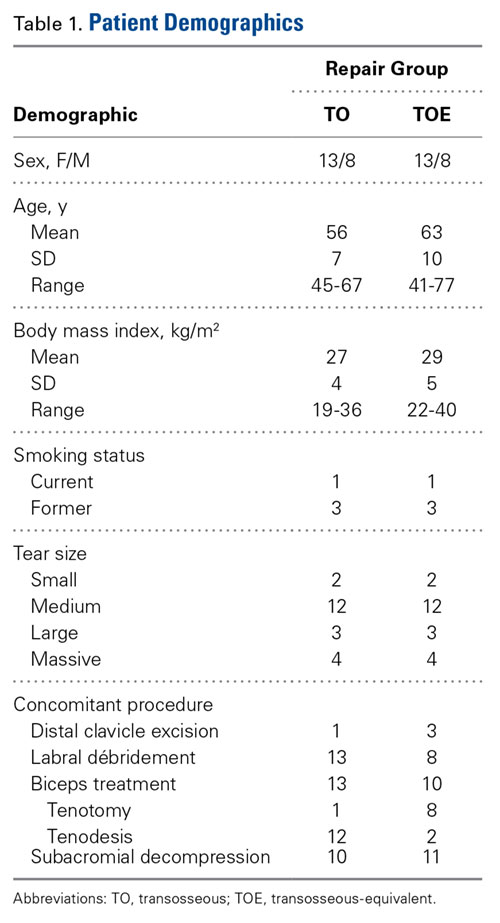
The primary outcome measure was implant cost (amount paid by institution). Cost was determined and reported by an independent third party using Cerner Surginet as the operating room documentation system and McKessen Pathways Materials Management System for item pricing.
All arthroscopic RCRs were performed by 1 of 3 orthopedic surgeons fellowship-trained in either sports medicine or shoulder and elbow surgery. Using the Cofield classification,27 the treating surgeon recorded the size of the rotator cuff tear: small (<1 cm), medium (1-3 cm), large (3-5 cm), massive (>5 cm). The surgeon also recorded the number of suture anchors used, repair technique, biceps treatment, execution of subacromial decompression, execution of distal clavicle excision, and intraoperative complications. TO repair surgical technique is described in the next section. TOE repair was double-row repair with suture anchors. The number of suture anchors varied by tear size: small (3 anchors), medium (2-5 anchors), large (4-6 anchors), massive (4-5 anchors).
Secondary outcome measures were operative time (time from cut to close) and scores on pain VAS (visual analog scale), SANE (Single Assessment Numeric Evaluation), and SST (Simple Shoulder Test). Demographic information was also obtained: age, sex, body mass index, smoking status (Table 1). All patients were asked to fill out questionnaires before surgery and 3, 6, and >12 months after surgery. Outcome surveys were scored by a single research coordinator, who recorded each patient’s outcome scores at the preoperative and postoperative intervals. Follow-up of >12 months was reached by 17 (81%) of the 21 TO patients and 14 (67%) of the 21 TOE patients. For >12 months, the overall rate of follow-up was 74%.
All patients followed the same postoperative rehabilitation protocol: sling immobilization with pendulums for 6 weeks starting at 2 weeks, passive range of motion starting at 6 weeks, and active range of motion starting at 8 weeks. At 3 months, they were allowed progressive resistant exercises with a 10-pound limit, and at 4.5 months they progressed to a 20-pound limit. At 6 months, they were cleared for discharge.
Surgical Technique: Arthroscopic Transosseous Repair
Surgery was performed with the patient in either the beach-chair position or the lateral decubitus position, based on surgeon preference. Our technique is similar to what has been described in the past.22,28 The glenohumeral joint is accessed through a standard posterior portal, followed by an anterior accessory portal through the rotator interval. Standard diagnostic arthroscopy is performed and intra-articular pathology addressed. Next, the scope is placed in the subacromial space through the posterior portal. A lateral subacromial portal is established and cannulated, and a bursectomy performed. The scope is then placed in a posterolateral portal for better visualization of the rotator cuff tear. The greater tuberosity is débrided with a curette to prepare the bed for repair. An ArthroTunneler (Tornier) is used to pass sutures through the greater tuberosity. For standard 2-tunnel repair, 3 sutures are placed through each tunnel. All 6 sutures are next passed (using a suture passer) through the rotator cuff. The second and fifth suture ends that are passed through the cuff are brought out through the cannula and tied together. They are then brought into the shoulder by pulling on the opposite ends and tied alongside the greater tuberosity to create a box stitch. The box stitch acts as a medial row fixation and as a rip stitch that strengthens the vertical mattress sutures against pullout. The other 4 sutures are tied in vertical mattress configuration.
Statistical Analysis
After obtaining the TO and TOE implant costs, we compared them using a generalized linear model with negative binomial distribution and an identity link function so returned parameters were in additive dollars. This comparison included evaluation of tear size and concomitant procedures. Operative times for TO and TOE were obtained and evaluated, and then compared using time-to-event analysis and the log-rank test. Outcome scores were obtained from patients at baseline and 3, 6, and >12 months after surgery and were compared using a linear mixed model that identified change in outcome scores over time, and difference in outcome scores between the TO and TOE groups.
Results
Table 1 lists patient demographics, including age, sex, body mass index, smoking status, and concomitant procedures. The TO and TOE groups had identical tear-size distributions. In addition, they had similar numbers of concomitant procedures, though our study was underpowered to confirm equivalence. Treatment techniques differed: more biceps tenodesis cases in the TO group (n = 12) than in the TOE group (n = 2) and more biceps tenotomy cases in the TOE group (n = 8) than in the TO group (n = 1).
TO implant cost was significantly lower than TOE implant cost for all tear sizes and independent of concomitant procedures (Figure 1). 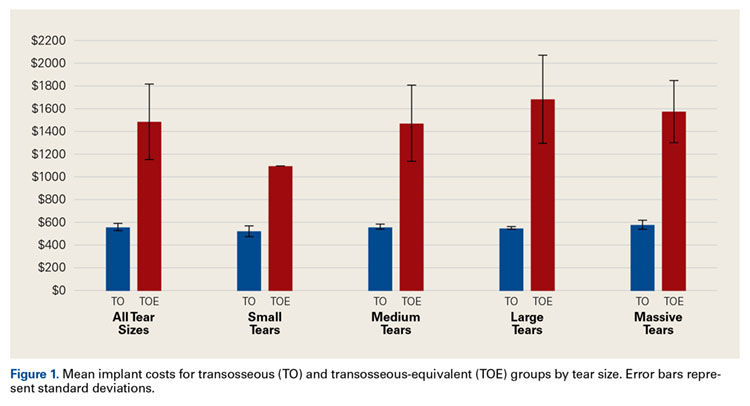
Operative time was not significantly different between the TO and TOE groups. Mean (SD) operative time was 82.38 (24.09) minutes for the TO group and 81.71 (17.27) minutes for the TOE group. With all other factors controlled, mean operative time was 5.96 minutes shorter for the TOE group, but the difference was not significant (P = .549).
There was no significant difference in preoperative pain VAS (P = .93), SANE (P = .35), or SST (P = .36) scores between the TO and TOE groups. 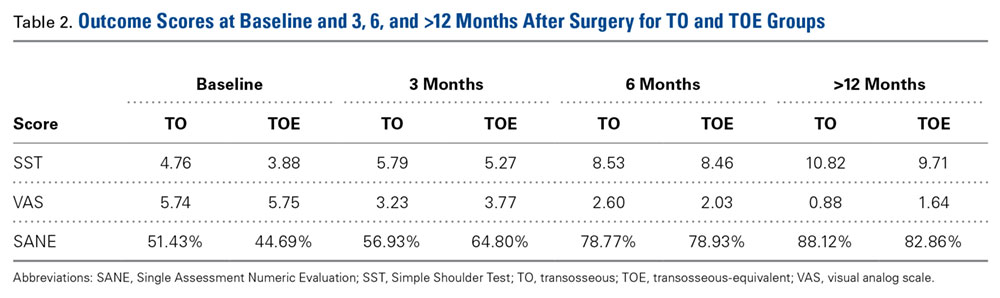
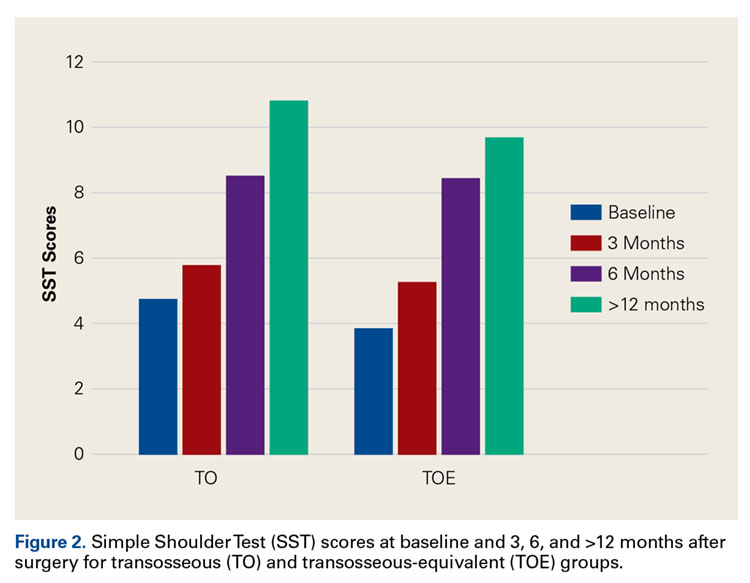
Discussion
RCR is one of the most common orthopedic surgical procedures, and its use has increased over the past decade.9,21 This increase coincides with the emergence of new repair techniques and implants. These advancements come at a cost. Given the increasingly cost-conscious healthcare environment and its changing reimbursement models, now surgeons must evaluate the economics of their surgical procedures in an attempt to decrease costs without compromising outcomes. We hypothesized that arthroscopic TO-RCR can be performed at lower cost relative to arthroscopic TOE-RCR and without increasing operative time or compromising short-term outcomes.
Studies on the cost-effectiveness of different RCR techniques have been conducted.19-21 Adla and colleagues19 found that open RCR was more cost-effective than arthroscopic RCR, with most of the difference attributable to disposables and suture anchors. Genuario and colleagues21 found that double-row RCR was not as cost-effective as single-row RCR in treating tears of any size. They attributed the difference to 2 more anchors and about 15 more minutes in the operating room.
The increased interest in healthcare costs and the understanding that a substantial part of the cost of arthroscopic RCR is attributable to implants (suture anchors, specifically) led to recent efforts to eliminate the need for anchors. Newly available instrumentation was designed to assist in arthroscopic anchorless repair constructs using the concepts of traditional TO repair.22 Although still considered to be the RCR gold standard, TO fixation has been used less often in recent years, owing to the shift from open to arthroscopic surgery.24 Arthroscopic TO-RCR allows for all the benefits of arthroscopic surgery, plus the biological and mechanical benefits of traditional open or mini-open TO repair. In addition, this technique eliminates the cost of anchors. Kummer and colleagues25 confirmed with biomechanical testing that arthroscopic TO repair and double-row TOE repair are similar in strength, with a trend of less tendon displacement in the TO group.
Our study results support the hypothesis that arthroscopic TO repair provides significant cost savings over tear size–matched arthroscopic TOE repair. Implant cost was substantially higher for TOE repair than for TO repair. Mean (SD) total savings of $946.91 ($100.70) (P < .0001) can be realized performing TO rather than TOE repair. In the United States, where about 250,000 RCRs are performed each year, the use of TO repair would result in an annual savings of almost $250 million.6Operative time was analyzed as well. Running an operating room in the United States costs an estimated $62 per minute (range, $22-$133 per minute).29 Much of this cost is indirect, unrelated to the surgery (eg, capital investment, personnel, insurance), and is being paid even when the operating room is not in use. Therefore, for the hospital’s bottom line, operative time savings are less important than direct cost savings (supplies, implants). However, operative time has more of an effect on the surgeon’s bottom line, and longer procedures reduce the number of surgeries that can be performed and billed. We found no significant difference in operative time between TO and TOE repairs. Critical evaluation revealed that operative time was 5.96 minutes shorter for TOE repairs, but this difference was not significant (P = .677).
Our study results showed no significant difference in clinical outcomes between TO and TOE repair patients. Both groups’ outcome scores improved. At all follow-ups, both groups’ VAS, SANE, and SST scores were significantly improved. Overall, this is the first study to validate the proposed cost benefit of arthroscopic TO repair and confirm no compromise in patient outcomes.
This study had limitations. First, it enrolled relatively few patients, particularly those with small tears. In addition, despite the fact that patients were matched on tear size and concomitant procedures, the groups differed in their biceps pathology treatments. Of the 13 TO patients who had biceps treatment, 12 underwent tenodesis (1 had tenotomy); in contrast, of the 10 TOE patients who had biceps treatment, only 2 underwent tenodesis (8 had tenotomy). The difference is explained by the consecutive course of this study and the increasing popularity of tenodesis over tenotomy. The TOE group underwent surgery before the TO group did, at a time when the involved surgeons were routinely performing tenotomy more than tenodesis. We did not include the costs of implants related to biceps treatment in our analysis, as our focus was on the implant cost of RCR. As for operative time, biceps tenodesis would be expected to extend surgery and potentially affect the comparison of operative times between the TO and TOE groups. However, despite the fact that 12 of the 13 TO patients underwent biceps tenodesis, there was no significant difference in overall operative time. Last, regarding the effect of biceps treatment on clinical outcomes, there are no data showing improved outcomes with tenodesis over tenotomy in the setting of RCR.
A final limitation is lack of data from longer term (>12 months) follow-up for all patients. Our analysis included cost and operative time data for all 42 enrolled patients, but our clinical outcome data represent only 74% of the patients enrolled. Eleven of the 42 patients were lost to follow-up at >12 months, and outcome scores could not be obtained, despite multiple attempts at contact (phone, mail, email). The study design and primary outcome variable focused on cost analysis rather than clinical outcomes. Nevertheless, our data support our hypothesis that there is no difference in clinical outcomes between TO and TOE repairs.
Conclusion
Arthroscopic TO-RCR provides significant cost savings over arthroscopic TOE-RCR without increasing operative time or compromising outcomes. Arthroscopic TO-RCR may have an important role in the evolving healthcare environment and its changing reimbursement models.
Am J Orthop. 2016;45(7):E415-E420. Copyright Frontline Medical Communications Inc. 2016. All rights reserved.
1. Colvin AC, Egorova N, Harrison AK, Moskowitz A, Flatow EL. National trends in rotator cuff repair. J Bone Joint Surg Am. 2012;94(3):227-233.
2. Pedowitz RA, Yamaguchi K, Ahmad CS, et al. American Academy of Orthopaedic Surgeons Clinical Practice Guideline on: optimizing the management of rotator cuff problems. J Bone Joint Surg Am. 2012;94(2):163-167.
3. Wolf BR, Dunn WR, Wright RW. Indications for repair of full-thickness rotator cuff tears. Am J Sports Med. 2007;35(6):1007-1016.
4. Yamaguchi K, Ball CM, Galatz LM. Arthroscopic rotator cuff repair: transition from mini-open to all-arthroscopic. Clin Orthop Relat Res. 2001;(390):83-94.
5. Yamaguchi K, Levine WN, Marra G, Galatz LM, Klepps S, Flatow EL. Transitioning to arthroscopic rotator cuff repair: the pros and cons. Instr Course Lect. 2003;52:81-92.
6. Mather RC 3rd, Koenig L, Acevedo D, et al. The societal and economic value of rotator cuff repair. J Bone Joint Surg Am. 2013;95(22):1993-2000.
7. Milne JC, Gartsman GM. Cost of shoulder surgery. J Shoulder Elbow Surg. 1994;3(5):295-298.
8. Savoie FH 3rd, Field LD, Jenkins RN. Costs analysis of successful rotator cuff repair surgery: an outcome study. Comparison of gatekeeper system in surgical patients. Arthroscopy. 1995;11(6):672-676.
9. Vitale MA, Vitale MG, Zivin JG, Braman JP, Bigliani LU, Flatow EL. Rotator cuff repair: an analysis of utility scores and cost-effectiveness. J Shoulder Elbow Surg. 2007;16(2):181-187.
10. Ihejirika RC, Sathiyakumar V, Thakore RV, et al. Healthcare reimbursement models and orthopaedic trauma: will there be change in patient management? A survey of orthopaedic surgeons. J Orthop Trauma. 2015;29(2):e79-e84.
11. Black EM, Higgins LD, Warner JJ. Value-based shoulder surgery: practicing outcomes-driven, cost-conscious care. J Shoulder Elbow Surg. 2013;22(7):1000-1009.
12. Barber FA, Hapa O, Bynum JA. Comparative testing by cyclic loading of rotator cuff suture anchors containing multiple high-strength sutures. Arthroscopy. 2010;26(9 suppl):S134-S141.
13. Barros RM, Matos MA, Ferreira Neto AA, et al. Biomechanical evaluation on tendon reinsertion by comparing trans-osseous suture and suture anchor at different stages of healing: experimental study on rabbits. J Shoulder Elbow Surg. 2010;19(6):878-883.
14. Cole BJ, ElAttrache NS, Anbari A. Arthroscopic rotator cuff repairs: an anatomic and biomechanical rationale for different suture-anchor repair configurations. Arthroscopy. 2007;23(6):662-669.
15. Ghodadra NS, Provencher MT, Verma NN, Wilk KE, Romeo AA. Open, mini-open, and all-arthroscopic rotator cuff repair surgery: indications and implications for rehabilitation. J Orthop Sports Phys Ther. 2009;39(2):81-89.
16. Pietschmann MF, Fröhlich V, Ficklscherer A, et al. Pullout strength of suture anchors in comparison with transosseous sutures for rotator cuff repair. Knee Surg Sports Traumatol Arthrosc. 2008;16(5):504-510.
17. van der Zwaal P, Thomassen BJ, Nieuwenhuijse MJ, Lindenburg R, Swen JW, van Arkel ER. Clinical outcome in all-arthroscopic versus mini-open rotator cuff repair in small to medium-sized tears: a randomized controlled trial in 100 patients with 1-year follow-up. Arthroscopy. 2013;29(2):266-273.
18. Wang VM, Wang FC, McNickle AG, et al. Medial versus lateral supraspinatus tendon properties: implications for double-row rotator cuff repair. Am J Sports Med. 2010;38(12):2456-2463.
19. Adla DN, Rowsell M, Pandey R. Cost-effectiveness of open versus arthroscopic rotator cuff repair. J Shoulder Elbow Surg. 2010;19(2):258-261.
20. Churchill RS, Ghorai JK. Total cost and operating room time comparison of rotator cuff repair techniques at low, intermediate, and high volume centers: mini-open versus all-arthroscopic. J Shoulder Elbow Surg. 2010;19(5):716-721.
21. Genuario JW, Donegan RP, Hamman D, et al. The cost-effectiveness of single-row compared with double-row arthroscopic rotator cuff repair. J Bone Joint Surg Am. 2012;94(15):1369-1377.
22. Garofalo R, Castagna A, Borroni M, Krishnan SG. Arthroscopic transosseous (anchorless) rotator cuff repair. Knee Surg Sports Traumatol Arthrosc. 2012;20(6):1031-1035.
23. Benson EC, MacDermid JC, Drosdowech DS, Athwal GS. The incidence of early metallic suture anchor pullout after arthroscopic rotator cuff repair. Arthroscopy. 2010;26(3):310-315.
24. Baudi P, Rasia Dani E, Campochiaro G, Rebuzzi M, Serafini F, Catani F. The rotator cuff tear repair with a new arthroscopic transosseous system: the Sharc-FT®. Musculoskelet Surg. 2013;97(suppl 1):57-61.
25. Kummer FJ, Hahn M, Day M, Meislin RJ, Jazrawi LM. A laboratory comparison of a new arthroscopic transosseous rotator cuff repair to a double row transosseous equivalent rotator cuff repair using suture anchors. Bull Hosp Joint Dis. 2013;71(2):128-131.
26. Kuroda S, Ishige N, Mikasa M. Advantages of arthroscopic transosseous suture repair of the rotator cuff without the use of anchors. Clin Orthop Relat Res. 2013;471(11):3514-3522.
27. Cofield RH. Subscapular muscle transposition for repair of chronic rotator cuff tears. Surg Gynecol Obstet. 1982;154(5):667-672.
28. Paxton ES, Lazarus MD. Arthroscopic transosseous rotator cuff repair. Orthop Knowledge Online J. 2014;12(2). http://orthoportal.aaos.org/oko/article.aspx?article=OKO_SHO052#article. Accessed October 4, 2016.
29. Macario A. What does one minute of operating room time cost? J Clin Anesth. 2010;22(4):233-236.
The rate of medical visits for rotator cuff pathology and the US incidence of arthroscopic rotator cuff repair (RCR) have increased over the past 10 years.1 The increased use of RCR has been justified with improved patient outcomes.2,3 Advances in surgical techniques and instrumentation have contributed to better outcomes for patients with rotator cuff pathology.3-5 Several studies have validated RCR with functional outcome measures, cost–benefit analysis, and health-related quality-of-life measurements.6-9
Healthcare reimbursement models are being changed to include capitated care, pay for performance, and penalties.10 Given the changing healthcare climate and the increasing incidence of RCR, it is becoming increasingly important for orthopedic surgeons to critically evaluate and modify their practice and procedures to decrease costs without compromising outcomes.11 RCR outcome studies have focused on comparing open/mini-open with arthroscopic techniques, and single-row with double-row techniques, among others.4,12-18 Furthermore, several studies on the cost-effectiveness of these surgical techniques have been conducted.19-21Arthroscopic anchorless (transosseous [TO]) RCR, which is increasingly popular,22 combines the minimal invasiveness of arthroscopic procedures with the biomechanical strength of open TO repair. In addition, this technique avoids the potential complications and costs associated with suture anchors, such as anchor pullout and greater tuberosity osteolysis.22,23 Several studies have documented the effectiveness of this technique.24-26 Biomechanical and clinical outcome data supporting arthroscopic TO-RCR have been published, but there are no reports of studies that have analyzed the cost savings associated with this technique.
In this study, we compared implant costs associated with arthroscopic TO-RCR and arthroscopic TO-equivalent (TOE) RCR. We also evaluated these techniques’ operative time and outcomes. Our hypothesis was that arthroscopic TO-RCR can be performed at lower cost and without increasing operative time or compromising outcomes.
Materials and Methods
Our Institutional Review Board approved this study. Between February 2013 and January 2014, participating surgeons performed 43 arthroscopic TO-RCRs that met the study’s inclusion criteria. Twenty-one of the 43 patients enrolled and became the study group. The control group of 21 patients, who underwent arthroscopic TOE-RCR the preceding year (between January 2012 and January 2013), was matched to the study group on tear size and concomitant procedures, including biceps treatment, labral treatment, acromioplasty, and distal clavicle excision (Table 1).
The primary outcome measure was implant cost (amount paid by institution). Cost was determined and reported by an independent third party using Cerner Surginet as the operating room documentation system and McKessen Pathways Materials Management System for item pricing.
All arthroscopic RCRs were performed by 1 of 3 orthopedic surgeons fellowship-trained in either sports medicine or shoulder and elbow surgery. Using the Cofield classification,27 the treating surgeon recorded the size of the rotator cuff tear: small (<1 cm), medium (1-3 cm), large (3-5 cm), massive (>5 cm). The surgeon also recorded the number of suture anchors used, repair technique, biceps treatment, execution of subacromial decompression, execution of distal clavicle excision, and intraoperative complications. TO repair surgical technique is described in the next section. TOE repair was double-row repair with suture anchors. The number of suture anchors varied by tear size: small (3 anchors), medium (2-5 anchors), large (4-6 anchors), massive (4-5 anchors).
Secondary outcome measures were operative time (time from cut to close) and scores on pain VAS (visual analog scale), SANE (Single Assessment Numeric Evaluation), and SST (Simple Shoulder Test). Demographic information was also obtained: age, sex, body mass index, smoking status (Table 1). All patients were asked to fill out questionnaires before surgery and 3, 6, and >12 months after surgery. Outcome surveys were scored by a single research coordinator, who recorded each patient’s outcome scores at the preoperative and postoperative intervals. Follow-up of >12 months was reached by 17 (81%) of the 21 TO patients and 14 (67%) of the 21 TOE patients. For >12 months, the overall rate of follow-up was 74%.
All patients followed the same postoperative rehabilitation protocol: sling immobilization with pendulums for 6 weeks starting at 2 weeks, passive range of motion starting at 6 weeks, and active range of motion starting at 8 weeks. At 3 months, they were allowed progressive resistant exercises with a 10-pound limit, and at 4.5 months they progressed to a 20-pound limit. At 6 months, they were cleared for discharge.
Surgical Technique: Arthroscopic Transosseous Repair
Surgery was performed with the patient in either the beach-chair position or the lateral decubitus position, based on surgeon preference. Our technique is similar to what has been described in the past.22,28 The glenohumeral joint is accessed through a standard posterior portal, followed by an anterior accessory portal through the rotator interval. Standard diagnostic arthroscopy is performed and intra-articular pathology addressed. Next, the scope is placed in the subacromial space through the posterior portal. A lateral subacromial portal is established and cannulated, and a bursectomy performed. The scope is then placed in a posterolateral portal for better visualization of the rotator cuff tear. The greater tuberosity is débrided with a curette to prepare the bed for repair. An ArthroTunneler (Tornier) is used to pass sutures through the greater tuberosity. For standard 2-tunnel repair, 3 sutures are placed through each tunnel. All 6 sutures are next passed (using a suture passer) through the rotator cuff. The second and fifth suture ends that are passed through the cuff are brought out through the cannula and tied together. They are then brought into the shoulder by pulling on the opposite ends and tied alongside the greater tuberosity to create a box stitch. The box stitch acts as a medial row fixation and as a rip stitch that strengthens the vertical mattress sutures against pullout. The other 4 sutures are tied in vertical mattress configuration.
Statistical Analysis
After obtaining the TO and TOE implant costs, we compared them using a generalized linear model with negative binomial distribution and an identity link function so returned parameters were in additive dollars. This comparison included evaluation of tear size and concomitant procedures. Operative times for TO and TOE were obtained and evaluated, and then compared using time-to-event analysis and the log-rank test. Outcome scores were obtained from patients at baseline and 3, 6, and >12 months after surgery and were compared using a linear mixed model that identified change in outcome scores over time, and difference in outcome scores between the TO and TOE groups.
Results
Table 1 lists patient demographics, including age, sex, body mass index, smoking status, and concomitant procedures. The TO and TOE groups had identical tear-size distributions. In addition, they had similar numbers of concomitant procedures, though our study was underpowered to confirm equivalence. Treatment techniques differed: more biceps tenodesis cases in the TO group (n = 12) than in the TOE group (n = 2) and more biceps tenotomy cases in the TOE group (n = 8) than in the TO group (n = 1).
TO implant cost was significantly lower than TOE implant cost for all tear sizes and independent of concomitant procedures (Figure 1).
Operative time was not significantly different between the TO and TOE groups. Mean (SD) operative time was 82.38 (24.09) minutes for the TO group and 81.71 (17.27) minutes for the TOE group. With all other factors controlled, mean operative time was 5.96 minutes shorter for the TOE group, but the difference was not significant (P = .549).
There was no significant difference in preoperative pain VAS (P = .93), SANE (P = .35), or SST (P = .36) scores between the TO and TOE groups.
Discussion
RCR is one of the most common orthopedic surgical procedures, and its use has increased over the past decade.9,21 This increase coincides with the emergence of new repair techniques and implants. These advancements come at a cost. Given the increasingly cost-conscious healthcare environment and its changing reimbursement models, now surgeons must evaluate the economics of their surgical procedures in an attempt to decrease costs without compromising outcomes. We hypothesized that arthroscopic TO-RCR can be performed at lower cost relative to arthroscopic TOE-RCR and without increasing operative time or compromising short-term outcomes.
Studies on the cost-effectiveness of different RCR techniques have been conducted.19-21 Adla and colleagues19 found that open RCR was more cost-effective than arthroscopic RCR, with most of the difference attributable to disposables and suture anchors. Genuario and colleagues21 found that double-row RCR was not as cost-effective as single-row RCR in treating tears of any size. They attributed the difference to 2 more anchors and about 15 more minutes in the operating room.
The increased interest in healthcare costs and the understanding that a substantial part of the cost of arthroscopic RCR is attributable to implants (suture anchors, specifically) led to recent efforts to eliminate the need for anchors. Newly available instrumentation was designed to assist in arthroscopic anchorless repair constructs using the concepts of traditional TO repair.22 Although still considered to be the RCR gold standard, TO fixation has been used less often in recent years, owing to the shift from open to arthroscopic surgery.24 Arthroscopic TO-RCR allows for all the benefits of arthroscopic surgery, plus the biological and mechanical benefits of traditional open or mini-open TO repair. In addition, this technique eliminates the cost of anchors. Kummer and colleagues25 confirmed with biomechanical testing that arthroscopic TO repair and double-row TOE repair are similar in strength, with a trend of less tendon displacement in the TO group.
Our study results support the hypothesis that arthroscopic TO repair provides significant cost savings over tear size–matched arthroscopic TOE repair. Implant cost was substantially higher for TOE repair than for TO repair. Mean (SD) total savings of $946.91 ($100.70) (P < .0001) can be realized performing TO rather than TOE repair. In the United States, where about 250,000 RCRs are performed each year, the use of TO repair would result in an annual savings of almost $250 million.6Operative time was analyzed as well. Running an operating room in the United States costs an estimated $62 per minute (range, $22-$133 per minute).29 Much of this cost is indirect, unrelated to the surgery (eg, capital investment, personnel, insurance), and is being paid even when the operating room is not in use. Therefore, for the hospital’s bottom line, operative time savings are less important than direct cost savings (supplies, implants). However, operative time has more of an effect on the surgeon’s bottom line, and longer procedures reduce the number of surgeries that can be performed and billed. We found no significant difference in operative time between TO and TOE repairs. Critical evaluation revealed that operative time was 5.96 minutes shorter for TOE repairs, but this difference was not significant (P = .677).
Our study results showed no significant difference in clinical outcomes between TO and TOE repair patients. Both groups’ outcome scores improved. At all follow-ups, both groups’ VAS, SANE, and SST scores were significantly improved. Overall, this is the first study to validate the proposed cost benefit of arthroscopic TO repair and confirm no compromise in patient outcomes.
This study had limitations. First, it enrolled relatively few patients, particularly those with small tears. In addition, despite the fact that patients were matched on tear size and concomitant procedures, the groups differed in their biceps pathology treatments. Of the 13 TO patients who had biceps treatment, 12 underwent tenodesis (1 had tenotomy); in contrast, of the 10 TOE patients who had biceps treatment, only 2 underwent tenodesis (8 had tenotomy). The difference is explained by the consecutive course of this study and the increasing popularity of tenodesis over tenotomy. The TOE group underwent surgery before the TO group did, at a time when the involved surgeons were routinely performing tenotomy more than tenodesis. We did not include the costs of implants related to biceps treatment in our analysis, as our focus was on the implant cost of RCR. As for operative time, biceps tenodesis would be expected to extend surgery and potentially affect the comparison of operative times between the TO and TOE groups. However, despite the fact that 12 of the 13 TO patients underwent biceps tenodesis, there was no significant difference in overall operative time. Last, regarding the effect of biceps treatment on clinical outcomes, there are no data showing improved outcomes with tenodesis over tenotomy in the setting of RCR.
A final limitation is lack of data from longer term (>12 months) follow-up for all patients. Our analysis included cost and operative time data for all 42 enrolled patients, but our clinical outcome data represent only 74% of the patients enrolled. Eleven of the 42 patients were lost to follow-up at >12 months, and outcome scores could not be obtained, despite multiple attempts at contact (phone, mail, email). The study design and primary outcome variable focused on cost analysis rather than clinical outcomes. Nevertheless, our data support our hypothesis that there is no difference in clinical outcomes between TO and TOE repairs.
Conclusion
Arthroscopic TO-RCR provides significant cost savings over arthroscopic TOE-RCR without increasing operative time or compromising outcomes. Arthroscopic TO-RCR may have an important role in the evolving healthcare environment and its changing reimbursement models.
Am J Orthop. 2016;45(7):E415-E420. Copyright Frontline Medical Communications Inc. 2016. All rights reserved.
The rate of medical visits for rotator cuff pathology and the US incidence of arthroscopic rotator cuff repair (RCR) have increased over the past 10 years.1 The increased use of RCR has been justified with improved patient outcomes.2,3 Advances in surgical techniques and instrumentation have contributed to better outcomes for patients with rotator cuff pathology.3-5 Several studies have validated RCR with functional outcome measures, cost–benefit analysis, and health-related quality-of-life measurements.6-9
Healthcare reimbursement models are being changed to include capitated care, pay for performance, and penalties.10 Given the changing healthcare climate and the increasing incidence of RCR, it is becoming increasingly important for orthopedic surgeons to critically evaluate and modify their practice and procedures to decrease costs without compromising outcomes.11 RCR outcome studies have focused on comparing open/mini-open with arthroscopic techniques, and single-row with double-row techniques, among others.4,12-18 Furthermore, several studies on the cost-effectiveness of these surgical techniques have been conducted.19-21Arthroscopic anchorless (transosseous [TO]) RCR, which is increasingly popular,22 combines the minimal invasiveness of arthroscopic procedures with the biomechanical strength of open TO repair. In addition, this technique avoids the potential complications and costs associated with suture anchors, such as anchor pullout and greater tuberosity osteolysis.22,23 Several studies have documented the effectiveness of this technique.24-26 Biomechanical and clinical outcome data supporting arthroscopic TO-RCR have been published, but there are no reports of studies that have analyzed the cost savings associated with this technique.
In this study, we compared implant costs associated with arthroscopic TO-RCR and arthroscopic TO-equivalent (TOE) RCR. We also evaluated these techniques’ operative time and outcomes. Our hypothesis was that arthroscopic TO-RCR can be performed at lower cost and without increasing operative time or compromising outcomes.
Materials and Methods
Our Institutional Review Board approved this study. Between February 2013 and January 2014, participating surgeons performed 43 arthroscopic TO-RCRs that met the study’s inclusion criteria. Twenty-one of the 43 patients enrolled and became the study group. The control group of 21 patients, who underwent arthroscopic TOE-RCR the preceding year (between January 2012 and January 2013), was matched to the study group on tear size and concomitant procedures, including biceps treatment, labral treatment, acromioplasty, and distal clavicle excision (Table 1).
The primary outcome measure was implant cost (amount paid by institution). Cost was determined and reported by an independent third party using Cerner Surginet as the operating room documentation system and McKessen Pathways Materials Management System for item pricing.
All arthroscopic RCRs were performed by 1 of 3 orthopedic surgeons fellowship-trained in either sports medicine or shoulder and elbow surgery. Using the Cofield classification,27 the treating surgeon recorded the size of the rotator cuff tear: small (<1 cm), medium (1-3 cm), large (3-5 cm), massive (>5 cm). The surgeon also recorded the number of suture anchors used, repair technique, biceps treatment, execution of subacromial decompression, execution of distal clavicle excision, and intraoperative complications. TO repair surgical technique is described in the next section. TOE repair was double-row repair with suture anchors. The number of suture anchors varied by tear size: small (3 anchors), medium (2-5 anchors), large (4-6 anchors), massive (4-5 anchors).
Secondary outcome measures were operative time (time from cut to close) and scores on pain VAS (visual analog scale), SANE (Single Assessment Numeric Evaluation), and SST (Simple Shoulder Test). Demographic information was also obtained: age, sex, body mass index, smoking status (Table 1). All patients were asked to fill out questionnaires before surgery and 3, 6, and >12 months after surgery. Outcome surveys were scored by a single research coordinator, who recorded each patient’s outcome scores at the preoperative and postoperative intervals. Follow-up of >12 months was reached by 17 (81%) of the 21 TO patients and 14 (67%) of the 21 TOE patients. For >12 months, the overall rate of follow-up was 74%.
All patients followed the same postoperative rehabilitation protocol: sling immobilization with pendulums for 6 weeks starting at 2 weeks, passive range of motion starting at 6 weeks, and active range of motion starting at 8 weeks. At 3 months, they were allowed progressive resistant exercises with a 10-pound limit, and at 4.5 months they progressed to a 20-pound limit. At 6 months, they were cleared for discharge.
Surgical Technique: Arthroscopic Transosseous Repair
Surgery was performed with the patient in either the beach-chair position or the lateral decubitus position, based on surgeon preference. Our technique is similar to what has been described in the past.22,28 The glenohumeral joint is accessed through a standard posterior portal, followed by an anterior accessory portal through the rotator interval. Standard diagnostic arthroscopy is performed and intra-articular pathology addressed. Next, the scope is placed in the subacromial space through the posterior portal. A lateral subacromial portal is established and cannulated, and a bursectomy performed. The scope is then placed in a posterolateral portal for better visualization of the rotator cuff tear. The greater tuberosity is débrided with a curette to prepare the bed for repair. An ArthroTunneler (Tornier) is used to pass sutures through the greater tuberosity. For standard 2-tunnel repair, 3 sutures are placed through each tunnel. All 6 sutures are next passed (using a suture passer) through the rotator cuff. The second and fifth suture ends that are passed through the cuff are brought out through the cannula and tied together. They are then brought into the shoulder by pulling on the opposite ends and tied alongside the greater tuberosity to create a box stitch. The box stitch acts as a medial row fixation and as a rip stitch that strengthens the vertical mattress sutures against pullout. The other 4 sutures are tied in vertical mattress configuration.
Statistical Analysis
After obtaining the TO and TOE implant costs, we compared them using a generalized linear model with negative binomial distribution and an identity link function so returned parameters were in additive dollars. This comparison included evaluation of tear size and concomitant procedures. Operative times for TO and TOE were obtained and evaluated, and then compared using time-to-event analysis and the log-rank test. Outcome scores were obtained from patients at baseline and 3, 6, and >12 months after surgery and were compared using a linear mixed model that identified change in outcome scores over time, and difference in outcome scores between the TO and TOE groups.
Results
Table 1 lists patient demographics, including age, sex, body mass index, smoking status, and concomitant procedures. The TO and TOE groups had identical tear-size distributions. In addition, they had similar numbers of concomitant procedures, though our study was underpowered to confirm equivalence. Treatment techniques differed: more biceps tenodesis cases in the TO group (n = 12) than in the TOE group (n = 2) and more biceps tenotomy cases in the TOE group (n = 8) than in the TO group (n = 1).
TO implant cost was significantly lower than TOE implant cost for all tear sizes and independent of concomitant procedures (Figure 1).
Operative time was not significantly different between the TO and TOE groups. Mean (SD) operative time was 82.38 (24.09) minutes for the TO group and 81.71 (17.27) minutes for the TOE group. With all other factors controlled, mean operative time was 5.96 minutes shorter for the TOE group, but the difference was not significant (P = .549).
There was no significant difference in preoperative pain VAS (P = .93), SANE (P = .35), or SST (P = .36) scores between the TO and TOE groups.
Discussion
RCR is one of the most common orthopedic surgical procedures, and its use has increased over the past decade.9,21 This increase coincides with the emergence of new repair techniques and implants. These advancements come at a cost. Given the increasingly cost-conscious healthcare environment and its changing reimbursement models, now surgeons must evaluate the economics of their surgical procedures in an attempt to decrease costs without compromising outcomes. We hypothesized that arthroscopic TO-RCR can be performed at lower cost relative to arthroscopic TOE-RCR and without increasing operative time or compromising short-term outcomes.
Studies on the cost-effectiveness of different RCR techniques have been conducted.19-21 Adla and colleagues19 found that open RCR was more cost-effective than arthroscopic RCR, with most of the difference attributable to disposables and suture anchors. Genuario and colleagues21 found that double-row RCR was not as cost-effective as single-row RCR in treating tears of any size. They attributed the difference to 2 more anchors and about 15 more minutes in the operating room.
The increased interest in healthcare costs and the understanding that a substantial part of the cost of arthroscopic RCR is attributable to implants (suture anchors, specifically) led to recent efforts to eliminate the need for anchors. Newly available instrumentation was designed to assist in arthroscopic anchorless repair constructs using the concepts of traditional TO repair.22 Although still considered to be the RCR gold standard, TO fixation has been used less often in recent years, owing to the shift from open to arthroscopic surgery.24 Arthroscopic TO-RCR allows for all the benefits of arthroscopic surgery, plus the biological and mechanical benefits of traditional open or mini-open TO repair. In addition, this technique eliminates the cost of anchors. Kummer and colleagues25 confirmed with biomechanical testing that arthroscopic TO repair and double-row TOE repair are similar in strength, with a trend of less tendon displacement in the TO group.
Our study results support the hypothesis that arthroscopic TO repair provides significant cost savings over tear size–matched arthroscopic TOE repair. Implant cost was substantially higher for TOE repair than for TO repair. Mean (SD) total savings of $946.91 ($100.70) (P < .0001) can be realized performing TO rather than TOE repair. In the United States, where about 250,000 RCRs are performed each year, the use of TO repair would result in an annual savings of almost $250 million.6Operative time was analyzed as well. Running an operating room in the United States costs an estimated $62 per minute (range, $22-$133 per minute).29 Much of this cost is indirect, unrelated to the surgery (eg, capital investment, personnel, insurance), and is being paid even when the operating room is not in use. Therefore, for the hospital’s bottom line, operative time savings are less important than direct cost savings (supplies, implants). However, operative time has more of an effect on the surgeon’s bottom line, and longer procedures reduce the number of surgeries that can be performed and billed. We found no significant difference in operative time between TO and TOE repairs. Critical evaluation revealed that operative time was 5.96 minutes shorter for TOE repairs, but this difference was not significant (P = .677).
Our study results showed no significant difference in clinical outcomes between TO and TOE repair patients. Both groups’ outcome scores improved. At all follow-ups, both groups’ VAS, SANE, and SST scores were significantly improved. Overall, this is the first study to validate the proposed cost benefit of arthroscopic TO repair and confirm no compromise in patient outcomes.
This study had limitations. First, it enrolled relatively few patients, particularly those with small tears. In addition, despite the fact that patients were matched on tear size and concomitant procedures, the groups differed in their biceps pathology treatments. Of the 13 TO patients who had biceps treatment, 12 underwent tenodesis (1 had tenotomy); in contrast, of the 10 TOE patients who had biceps treatment, only 2 underwent tenodesis (8 had tenotomy). The difference is explained by the consecutive course of this study and the increasing popularity of tenodesis over tenotomy. The TOE group underwent surgery before the TO group did, at a time when the involved surgeons were routinely performing tenotomy more than tenodesis. We did not include the costs of implants related to biceps treatment in our analysis, as our focus was on the implant cost of RCR. As for operative time, biceps tenodesis would be expected to extend surgery and potentially affect the comparison of operative times between the TO and TOE groups. However, despite the fact that 12 of the 13 TO patients underwent biceps tenodesis, there was no significant difference in overall operative time. Last, regarding the effect of biceps treatment on clinical outcomes, there are no data showing improved outcomes with tenodesis over tenotomy in the setting of RCR.
A final limitation is lack of data from longer term (>12 months) follow-up for all patients. Our analysis included cost and operative time data for all 42 enrolled patients, but our clinical outcome data represent only 74% of the patients enrolled. Eleven of the 42 patients were lost to follow-up at >12 months, and outcome scores could not be obtained, despite multiple attempts at contact (phone, mail, email). The study design and primary outcome variable focused on cost analysis rather than clinical outcomes. Nevertheless, our data support our hypothesis that there is no difference in clinical outcomes between TO and TOE repairs.
Conclusion
Arthroscopic TO-RCR provides significant cost savings over arthroscopic TOE-RCR without increasing operative time or compromising outcomes. Arthroscopic TO-RCR may have an important role in the evolving healthcare environment and its changing reimbursement models.
Am J Orthop. 2016;45(7):E415-E420. Copyright Frontline Medical Communications Inc. 2016. All rights reserved.
1. Colvin AC, Egorova N, Harrison AK, Moskowitz A, Flatow EL. National trends in rotator cuff repair. J Bone Joint Surg Am. 2012;94(3):227-233.
2. Pedowitz RA, Yamaguchi K, Ahmad CS, et al. American Academy of Orthopaedic Surgeons Clinical Practice Guideline on: optimizing the management of rotator cuff problems. J Bone Joint Surg Am. 2012;94(2):163-167.
3. Wolf BR, Dunn WR, Wright RW. Indications for repair of full-thickness rotator cuff tears. Am J Sports Med. 2007;35(6):1007-1016.
4. Yamaguchi K, Ball CM, Galatz LM. Arthroscopic rotator cuff repair: transition from mini-open to all-arthroscopic. Clin Orthop Relat Res. 2001;(390):83-94.
5. Yamaguchi K, Levine WN, Marra G, Galatz LM, Klepps S, Flatow EL. Transitioning to arthroscopic rotator cuff repair: the pros and cons. Instr Course Lect. 2003;52:81-92.
6. Mather RC 3rd, Koenig L, Acevedo D, et al. The societal and economic value of rotator cuff repair. J Bone Joint Surg Am. 2013;95(22):1993-2000.
7. Milne JC, Gartsman GM. Cost of shoulder surgery. J Shoulder Elbow Surg. 1994;3(5):295-298.
8. Savoie FH 3rd, Field LD, Jenkins RN. Costs analysis of successful rotator cuff repair surgery: an outcome study. Comparison of gatekeeper system in surgical patients. Arthroscopy. 1995;11(6):672-676.
9. Vitale MA, Vitale MG, Zivin JG, Braman JP, Bigliani LU, Flatow EL. Rotator cuff repair: an analysis of utility scores and cost-effectiveness. J Shoulder Elbow Surg. 2007;16(2):181-187.
10. Ihejirika RC, Sathiyakumar V, Thakore RV, et al. Healthcare reimbursement models and orthopaedic trauma: will there be change in patient management? A survey of orthopaedic surgeons. J Orthop Trauma. 2015;29(2):e79-e84.
11. Black EM, Higgins LD, Warner JJ. Value-based shoulder surgery: practicing outcomes-driven, cost-conscious care. J Shoulder Elbow Surg. 2013;22(7):1000-1009.
12. Barber FA, Hapa O, Bynum JA. Comparative testing by cyclic loading of rotator cuff suture anchors containing multiple high-strength sutures. Arthroscopy. 2010;26(9 suppl):S134-S141.
13. Barros RM, Matos MA, Ferreira Neto AA, et al. Biomechanical evaluation on tendon reinsertion by comparing trans-osseous suture and suture anchor at different stages of healing: experimental study on rabbits. J Shoulder Elbow Surg. 2010;19(6):878-883.
14. Cole BJ, ElAttrache NS, Anbari A. Arthroscopic rotator cuff repairs: an anatomic and biomechanical rationale for different suture-anchor repair configurations. Arthroscopy. 2007;23(6):662-669.
15. Ghodadra NS, Provencher MT, Verma NN, Wilk KE, Romeo AA. Open, mini-open, and all-arthroscopic rotator cuff repair surgery: indications and implications for rehabilitation. J Orthop Sports Phys Ther. 2009;39(2):81-89.
16. Pietschmann MF, Fröhlich V, Ficklscherer A, et al. Pullout strength of suture anchors in comparison with transosseous sutures for rotator cuff repair. Knee Surg Sports Traumatol Arthrosc. 2008;16(5):504-510.
17. van der Zwaal P, Thomassen BJ, Nieuwenhuijse MJ, Lindenburg R, Swen JW, van Arkel ER. Clinical outcome in all-arthroscopic versus mini-open rotator cuff repair in small to medium-sized tears: a randomized controlled trial in 100 patients with 1-year follow-up. Arthroscopy. 2013;29(2):266-273.
18. Wang VM, Wang FC, McNickle AG, et al. Medial versus lateral supraspinatus tendon properties: implications for double-row rotator cuff repair. Am J Sports Med. 2010;38(12):2456-2463.
19. Adla DN, Rowsell M, Pandey R. Cost-effectiveness of open versus arthroscopic rotator cuff repair. J Shoulder Elbow Surg. 2010;19(2):258-261.
20. Churchill RS, Ghorai JK. Total cost and operating room time comparison of rotator cuff repair techniques at low, intermediate, and high volume centers: mini-open versus all-arthroscopic. J Shoulder Elbow Surg. 2010;19(5):716-721.
21. Genuario JW, Donegan RP, Hamman D, et al. The cost-effectiveness of single-row compared with double-row arthroscopic rotator cuff repair. J Bone Joint Surg Am. 2012;94(15):1369-1377.
22. Garofalo R, Castagna A, Borroni M, Krishnan SG. Arthroscopic transosseous (anchorless) rotator cuff repair. Knee Surg Sports Traumatol Arthrosc. 2012;20(6):1031-1035.
23. Benson EC, MacDermid JC, Drosdowech DS, Athwal GS. The incidence of early metallic suture anchor pullout after arthroscopic rotator cuff repair. Arthroscopy. 2010;26(3):310-315.
24. Baudi P, Rasia Dani E, Campochiaro G, Rebuzzi M, Serafini F, Catani F. The rotator cuff tear repair with a new arthroscopic transosseous system: the Sharc-FT®. Musculoskelet Surg. 2013;97(suppl 1):57-61.
25. Kummer FJ, Hahn M, Day M, Meislin RJ, Jazrawi LM. A laboratory comparison of a new arthroscopic transosseous rotator cuff repair to a double row transosseous equivalent rotator cuff repair using suture anchors. Bull Hosp Joint Dis. 2013;71(2):128-131.
26. Kuroda S, Ishige N, Mikasa M. Advantages of arthroscopic transosseous suture repair of the rotator cuff without the use of anchors. Clin Orthop Relat Res. 2013;471(11):3514-3522.
27. Cofield RH. Subscapular muscle transposition for repair of chronic rotator cuff tears. Surg Gynecol Obstet. 1982;154(5):667-672.
28. Paxton ES, Lazarus MD. Arthroscopic transosseous rotator cuff repair. Orthop Knowledge Online J. 2014;12(2). http://orthoportal.aaos.org/oko/article.aspx?article=OKO_SHO052#article. Accessed October 4, 2016.
29. Macario A. What does one minute of operating room time cost? J Clin Anesth. 2010;22(4):233-236.
1. Colvin AC, Egorova N, Harrison AK, Moskowitz A, Flatow EL. National trends in rotator cuff repair. J Bone Joint Surg Am. 2012;94(3):227-233.
2. Pedowitz RA, Yamaguchi K, Ahmad CS, et al. American Academy of Orthopaedic Surgeons Clinical Practice Guideline on: optimizing the management of rotator cuff problems. J Bone Joint Surg Am. 2012;94(2):163-167.
3. Wolf BR, Dunn WR, Wright RW. Indications for repair of full-thickness rotator cuff tears. Am J Sports Med. 2007;35(6):1007-1016.
4. Yamaguchi K, Ball CM, Galatz LM. Arthroscopic rotator cuff repair: transition from mini-open to all-arthroscopic. Clin Orthop Relat Res. 2001;(390):83-94.
5. Yamaguchi K, Levine WN, Marra G, Galatz LM, Klepps S, Flatow EL. Transitioning to arthroscopic rotator cuff repair: the pros and cons. Instr Course Lect. 2003;52:81-92.
6. Mather RC 3rd, Koenig L, Acevedo D, et al. The societal and economic value of rotator cuff repair. J Bone Joint Surg Am. 2013;95(22):1993-2000.
7. Milne JC, Gartsman GM. Cost of shoulder surgery. J Shoulder Elbow Surg. 1994;3(5):295-298.
8. Savoie FH 3rd, Field LD, Jenkins RN. Costs analysis of successful rotator cuff repair surgery: an outcome study. Comparison of gatekeeper system in surgical patients. Arthroscopy. 1995;11(6):672-676.
9. Vitale MA, Vitale MG, Zivin JG, Braman JP, Bigliani LU, Flatow EL. Rotator cuff repair: an analysis of utility scores and cost-effectiveness. J Shoulder Elbow Surg. 2007;16(2):181-187.
10. Ihejirika RC, Sathiyakumar V, Thakore RV, et al. Healthcare reimbursement models and orthopaedic trauma: will there be change in patient management? A survey of orthopaedic surgeons. J Orthop Trauma. 2015;29(2):e79-e84.
11. Black EM, Higgins LD, Warner JJ. Value-based shoulder surgery: practicing outcomes-driven, cost-conscious care. J Shoulder Elbow Surg. 2013;22(7):1000-1009.
12. Barber FA, Hapa O, Bynum JA. Comparative testing by cyclic loading of rotator cuff suture anchors containing multiple high-strength sutures. Arthroscopy. 2010;26(9 suppl):S134-S141.
13. Barros RM, Matos MA, Ferreira Neto AA, et al. Biomechanical evaluation on tendon reinsertion by comparing trans-osseous suture and suture anchor at different stages of healing: experimental study on rabbits. J Shoulder Elbow Surg. 2010;19(6):878-883.
14. Cole BJ, ElAttrache NS, Anbari A. Arthroscopic rotator cuff repairs: an anatomic and biomechanical rationale for different suture-anchor repair configurations. Arthroscopy. 2007;23(6):662-669.
15. Ghodadra NS, Provencher MT, Verma NN, Wilk KE, Romeo AA. Open, mini-open, and all-arthroscopic rotator cuff repair surgery: indications and implications for rehabilitation. J Orthop Sports Phys Ther. 2009;39(2):81-89.
16. Pietschmann MF, Fröhlich V, Ficklscherer A, et al. Pullout strength of suture anchors in comparison with transosseous sutures for rotator cuff repair. Knee Surg Sports Traumatol Arthrosc. 2008;16(5):504-510.
17. van der Zwaal P, Thomassen BJ, Nieuwenhuijse MJ, Lindenburg R, Swen JW, van Arkel ER. Clinical outcome in all-arthroscopic versus mini-open rotator cuff repair in small to medium-sized tears: a randomized controlled trial in 100 patients with 1-year follow-up. Arthroscopy. 2013;29(2):266-273.
18. Wang VM, Wang FC, McNickle AG, et al. Medial versus lateral supraspinatus tendon properties: implications for double-row rotator cuff repair. Am J Sports Med. 2010;38(12):2456-2463.
19. Adla DN, Rowsell M, Pandey R. Cost-effectiveness of open versus arthroscopic rotator cuff repair. J Shoulder Elbow Surg. 2010;19(2):258-261.
20. Churchill RS, Ghorai JK. Total cost and operating room time comparison of rotator cuff repair techniques at low, intermediate, and high volume centers: mini-open versus all-arthroscopic. J Shoulder Elbow Surg. 2010;19(5):716-721.
21. Genuario JW, Donegan RP, Hamman D, et al. The cost-effectiveness of single-row compared with double-row arthroscopic rotator cuff repair. J Bone Joint Surg Am. 2012;94(15):1369-1377.
22. Garofalo R, Castagna A, Borroni M, Krishnan SG. Arthroscopic transosseous (anchorless) rotator cuff repair. Knee Surg Sports Traumatol Arthrosc. 2012;20(6):1031-1035.
23. Benson EC, MacDermid JC, Drosdowech DS, Athwal GS. The incidence of early metallic suture anchor pullout after arthroscopic rotator cuff repair. Arthroscopy. 2010;26(3):310-315.
24. Baudi P, Rasia Dani E, Campochiaro G, Rebuzzi M, Serafini F, Catani F. The rotator cuff tear repair with a new arthroscopic transosseous system: the Sharc-FT®. Musculoskelet Surg. 2013;97(suppl 1):57-61.
25. Kummer FJ, Hahn M, Day M, Meislin RJ, Jazrawi LM. A laboratory comparison of a new arthroscopic transosseous rotator cuff repair to a double row transosseous equivalent rotator cuff repair using suture anchors. Bull Hosp Joint Dis. 2013;71(2):128-131.
26. Kuroda S, Ishige N, Mikasa M. Advantages of arthroscopic transosseous suture repair of the rotator cuff without the use of anchors. Clin Orthop Relat Res. 2013;471(11):3514-3522.
27. Cofield RH. Subscapular muscle transposition for repair of chronic rotator cuff tears. Surg Gynecol Obstet. 1982;154(5):667-672.
28. Paxton ES, Lazarus MD. Arthroscopic transosseous rotator cuff repair. Orthop Knowledge Online J. 2014;12(2). http://orthoportal.aaos.org/oko/article.aspx?article=OKO_SHO052#article. Accessed October 4, 2016.
29. Macario A. What does one minute of operating room time cost? J Clin Anesth. 2010;22(4):233-236.