User login
‘I Don’t Know How to Get Exercise’
Much research has been devoted to the importance of exercise and finding out how to get people to exercise more. Yet > 1 in 4 American adults over the age of 50 do not engage in physical activity, according to a CDC report. Women are more likely to be inactive than men (30% vs 26%), and inactivity is highest in the South (30%) and Midwest (28%), although the Northeast (27%) and West (23%) followed closely.
Related: Walk the Talk: VA Mental Health Care Professionals’ Role in Promoting Physical Activity
A study of 110 women living in rural southern Illinois may help clarify the reasons for inactivity. The women, divided into 4 age groups, participated in focus groups held in various community settings across 7 counties.
The women talked about engaging in physical activity to relieve chronic pain, manage illness, improve mental health, and feel more energetic. However, they also talked about the barriers to being physically active, such as not knowing how to fit exercise into their lives.
Related: Exercise Lowers Risk of Some Cancers
When the researchers analyzed responses by age, they found that young women did not describe exercise as an activity to do with other women. For them, work, household, and family commitments competed with social activities, including those associated with physical activity. Older women, on the other hand, might be more inclined to spend time in activity-related groups, such as walking groups, to spend time with others. But all of the women over the age of 30 described physical and mental health challenges that interfered with being active.
Younger women and mothers also were more likely to be interested in spaces for outdoor recreation, where they could be active with their children. Older women rarely discussed outdoor resources; perhaps because they had more flexible schedules that allowed for structured groups and more affordable options due to senior discounts, the researchers suggest.
Related: A Call to Action: Intensive Lifestyle Intervention Against Diabesity
By understanding the multifactorial reasons for why women aren’t getting enough exercise, the researchers speculate that it might be possible to develop interventions that reduce the barriers and “capitalize on what motivates women at different times in their lives.”
Much research has been devoted to the importance of exercise and finding out how to get people to exercise more. Yet > 1 in 4 American adults over the age of 50 do not engage in physical activity, according to a CDC report. Women are more likely to be inactive than men (30% vs 26%), and inactivity is highest in the South (30%) and Midwest (28%), although the Northeast (27%) and West (23%) followed closely.
Related: Walk the Talk: VA Mental Health Care Professionals’ Role in Promoting Physical Activity
A study of 110 women living in rural southern Illinois may help clarify the reasons for inactivity. The women, divided into 4 age groups, participated in focus groups held in various community settings across 7 counties.
The women talked about engaging in physical activity to relieve chronic pain, manage illness, improve mental health, and feel more energetic. However, they also talked about the barriers to being physically active, such as not knowing how to fit exercise into their lives.
Related: Exercise Lowers Risk of Some Cancers
When the researchers analyzed responses by age, they found that young women did not describe exercise as an activity to do with other women. For them, work, household, and family commitments competed with social activities, including those associated with physical activity. Older women, on the other hand, might be more inclined to spend time in activity-related groups, such as walking groups, to spend time with others. But all of the women over the age of 30 described physical and mental health challenges that interfered with being active.
Younger women and mothers also were more likely to be interested in spaces for outdoor recreation, where they could be active with their children. Older women rarely discussed outdoor resources; perhaps because they had more flexible schedules that allowed for structured groups and more affordable options due to senior discounts, the researchers suggest.
Related: A Call to Action: Intensive Lifestyle Intervention Against Diabesity
By understanding the multifactorial reasons for why women aren’t getting enough exercise, the researchers speculate that it might be possible to develop interventions that reduce the barriers and “capitalize on what motivates women at different times in their lives.”
Much research has been devoted to the importance of exercise and finding out how to get people to exercise more. Yet > 1 in 4 American adults over the age of 50 do not engage in physical activity, according to a CDC report. Women are more likely to be inactive than men (30% vs 26%), and inactivity is highest in the South (30%) and Midwest (28%), although the Northeast (27%) and West (23%) followed closely.
Related: Walk the Talk: VA Mental Health Care Professionals’ Role in Promoting Physical Activity
A study of 110 women living in rural southern Illinois may help clarify the reasons for inactivity. The women, divided into 4 age groups, participated in focus groups held in various community settings across 7 counties.
The women talked about engaging in physical activity to relieve chronic pain, manage illness, improve mental health, and feel more energetic. However, they also talked about the barriers to being physically active, such as not knowing how to fit exercise into their lives.
Related: Exercise Lowers Risk of Some Cancers
When the researchers analyzed responses by age, they found that young women did not describe exercise as an activity to do with other women. For them, work, household, and family commitments competed with social activities, including those associated with physical activity. Older women, on the other hand, might be more inclined to spend time in activity-related groups, such as walking groups, to spend time with others. But all of the women over the age of 30 described physical and mental health challenges that interfered with being active.
Younger women and mothers also were more likely to be interested in spaces for outdoor recreation, where they could be active with their children. Older women rarely discussed outdoor resources; perhaps because they had more flexible schedules that allowed for structured groups and more affordable options due to senior discounts, the researchers suggest.
Related: A Call to Action: Intensive Lifestyle Intervention Against Diabesity
By understanding the multifactorial reasons for why women aren’t getting enough exercise, the researchers speculate that it might be possible to develop interventions that reduce the barriers and “capitalize on what motivates women at different times in their lives.”
His & Hers Hair Loss
A 29-year-old woman and her 40-year-old husband present together for evaluation of similar problems: One month ago, they both experienced sudden hair loss—the wife in two spots on her scalp, the husband in his beard. In both cases, the hair came out suddenly, without any symptoms. Neither has had this problem before. Both patients are otherwise healthy, but they admit to being under a great deal of stress in the weeks prior to onset of the condition.
Before consulting dermatology, they were seen in an urgent care clinic, where they were diagnosed with “ringworm.” Twice-daily application of nystatin cream was prescribed—to no good effect.
EXAMINATION
On each side of the woman’s parietal scalp is a round, completely hairless patch with exceptionally well-defined margins. The sites are otherwise unremarkable, free of redness, edema, or scaling. Each lesion measures about 3.5 cm in diameter. No lymph nodes are palpable in the adjacent neck.
On the man’s left jawline is a solitary, round, 4-cm, hairless patch. It is also free of edema, erythema, or epidermal disturbance of any kind. There are no palpable lymph nodes in the drainage area.
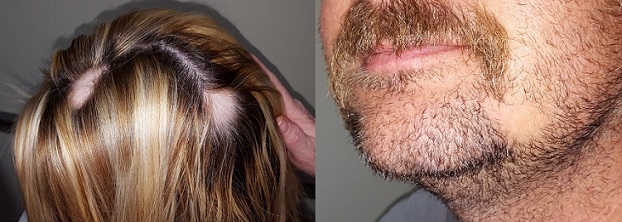
What is the diagnosis?
DISCUSSION
Sudden, asymptomatic, complete, well-marginated hair loss in any hair-bearing area is likely to be alopecia areata (AA). AA is an autoimmune process in which hair follicles are immobilized and unable to grow new hair until the process stops, which usually happens within weeks to months.
Because stress and AA have a suspected correlation, the patients’ histories of recent stress corroborate the diagnosis. Other features that bolster this impression are the lack of epidermal disturbance (eg, scaling, redness, edema) or palpable nodes in the area. The unusual factor in this case was the simultaneous appearance of the condition in husband and wife—for which I have no good explanation.
There are many items in the differential for localized hair loss, including discoid lupus, lichen planopilaris, and tinea capitis. However, these almost always manifest with frank inflammation characterized by epidermal disturbance.
Treatments such as intralesional steroid injection can promote modest hair growth but are generally ineffective for long-term recovery; unless the procedure is repeated, the hair will continue to fall out. These patients were offered treatment but declined, and they recovered in a short period of time.
TAKE-HOME LEARNING POINTS
• Alopecia areata (AA) typically displays as acute, asymptomatic, complete hair loss in one or more hair-bearing locations, usually in a round, well-defined configuration.
• AA is an autoimmune process that immobilizes hair follicles, causing them to fall out and not be replaced until the process ceases. This can take months, and the condition does not respond well to treatment.
• AA can affect the scalp, beard, brows, or even genital hair.
• The differential for localized hair loss includes tinea capitis, discoid lupus, lichen planopilaris, and lues; however, these all involve disruption of the overlying skin with scaling, redness, or edema.
A 29-year-old woman and her 40-year-old husband present together for evaluation of similar problems: One month ago, they both experienced sudden hair loss—the wife in two spots on her scalp, the husband in his beard. In both cases, the hair came out suddenly, without any symptoms. Neither has had this problem before. Both patients are otherwise healthy, but they admit to being under a great deal of stress in the weeks prior to onset of the condition.
Before consulting dermatology, they were seen in an urgent care clinic, where they were diagnosed with “ringworm.” Twice-daily application of nystatin cream was prescribed—to no good effect.
EXAMINATION
On each side of the woman’s parietal scalp is a round, completely hairless patch with exceptionally well-defined margins. The sites are otherwise unremarkable, free of redness, edema, or scaling. Each lesion measures about 3.5 cm in diameter. No lymph nodes are palpable in the adjacent neck.
On the man’s left jawline is a solitary, round, 4-cm, hairless patch. It is also free of edema, erythema, or epidermal disturbance of any kind. There are no palpable lymph nodes in the drainage area.
What is the diagnosis?
DISCUSSION
Sudden, asymptomatic, complete, well-marginated hair loss in any hair-bearing area is likely to be alopecia areata (AA). AA is an autoimmune process in which hair follicles are immobilized and unable to grow new hair until the process stops, which usually happens within weeks to months.
Because stress and AA have a suspected correlation, the patients’ histories of recent stress corroborate the diagnosis. Other features that bolster this impression are the lack of epidermal disturbance (eg, scaling, redness, edema) or palpable nodes in the area. The unusual factor in this case was the simultaneous appearance of the condition in husband and wife—for which I have no good explanation.
There are many items in the differential for localized hair loss, including discoid lupus, lichen planopilaris, and tinea capitis. However, these almost always manifest with frank inflammation characterized by epidermal disturbance.
Treatments such as intralesional steroid injection can promote modest hair growth but are generally ineffective for long-term recovery; unless the procedure is repeated, the hair will continue to fall out. These patients were offered treatment but declined, and they recovered in a short period of time.
TAKE-HOME LEARNING POINTS
• Alopecia areata (AA) typically displays as acute, asymptomatic, complete hair loss in one or more hair-bearing locations, usually in a round, well-defined configuration.
• AA is an autoimmune process that immobilizes hair follicles, causing them to fall out and not be replaced until the process ceases. This can take months, and the condition does not respond well to treatment.
• AA can affect the scalp, beard, brows, or even genital hair.
• The differential for localized hair loss includes tinea capitis, discoid lupus, lichen planopilaris, and lues; however, these all involve disruption of the overlying skin with scaling, redness, or edema.
A 29-year-old woman and her 40-year-old husband present together for evaluation of similar problems: One month ago, they both experienced sudden hair loss—the wife in two spots on her scalp, the husband in his beard. In both cases, the hair came out suddenly, without any symptoms. Neither has had this problem before. Both patients are otherwise healthy, but they admit to being under a great deal of stress in the weeks prior to onset of the condition.
Before consulting dermatology, they were seen in an urgent care clinic, where they were diagnosed with “ringworm.” Twice-daily application of nystatin cream was prescribed—to no good effect.
EXAMINATION
On each side of the woman’s parietal scalp is a round, completely hairless patch with exceptionally well-defined margins. The sites are otherwise unremarkable, free of redness, edema, or scaling. Each lesion measures about 3.5 cm in diameter. No lymph nodes are palpable in the adjacent neck.
On the man’s left jawline is a solitary, round, 4-cm, hairless patch. It is also free of edema, erythema, or epidermal disturbance of any kind. There are no palpable lymph nodes in the drainage area.
What is the diagnosis?
DISCUSSION
Sudden, asymptomatic, complete, well-marginated hair loss in any hair-bearing area is likely to be alopecia areata (AA). AA is an autoimmune process in which hair follicles are immobilized and unable to grow new hair until the process stops, which usually happens within weeks to months.
Because stress and AA have a suspected correlation, the patients’ histories of recent stress corroborate the diagnosis. Other features that bolster this impression are the lack of epidermal disturbance (eg, scaling, redness, edema) or palpable nodes in the area. The unusual factor in this case was the simultaneous appearance of the condition in husband and wife—for which I have no good explanation.
There are many items in the differential for localized hair loss, including discoid lupus, lichen planopilaris, and tinea capitis. However, these almost always manifest with frank inflammation characterized by epidermal disturbance.
Treatments such as intralesional steroid injection can promote modest hair growth but are generally ineffective for long-term recovery; unless the procedure is repeated, the hair will continue to fall out. These patients were offered treatment but declined, and they recovered in a short period of time.
TAKE-HOME LEARNING POINTS
• Alopecia areata (AA) typically displays as acute, asymptomatic, complete hair loss in one or more hair-bearing locations, usually in a round, well-defined configuration.
• AA is an autoimmune process that immobilizes hair follicles, causing them to fall out and not be replaced until the process ceases. This can take months, and the condition does not respond well to treatment.
• AA can affect the scalp, beard, brows, or even genital hair.
• The differential for localized hair loss includes tinea capitis, discoid lupus, lichen planopilaris, and lues; however, these all involve disruption of the overlying skin with scaling, redness, or edema.
“Jock itch” or something else?
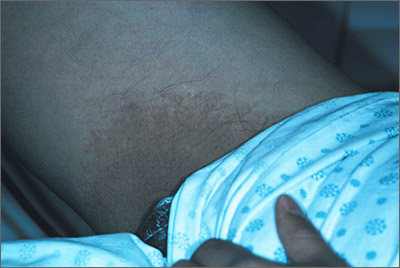
The family physician (FP) agreed that this could be a tinea cruris infection. He performed a potassium hydroxide (KOH) preparation, but did not see any hyphae or fungal elements. (See video on how to perform a KOH preparation here.)
He told the patient that there was no evidence of fungus under the microscope, and took out his Woods lamp (ultraviolet light) to check for erythrasma. The involved area fluoresced a coral red, confirming the diagnosis of erythrasma. Erythrasma is a bacterial infection caused by Corynebacterium minutissimum.
Treatment options include topical erythromycin, topical clindamycin, oral erythromycin, or oral clarithromycin. The patient decided to take oral erythromycin and the FP prescribed 250 mg twice a day for 2 weeks. At a follow-up visit one month later, the rash had completely resolved.
Photos and text for Photo Rounds Friday courtesy of Richard P. Usatine, MD. This case was adapted from: Usatine R, Smith M. Tinea cruris. In: Usatine R, Smith M, Mayeaux EJ, et al, eds. Color Atlas of Family Medicine. 2nd ed. New York, NY: McGraw-Hill; 2013:795-798.
To learn more about the Color Atlas of Family Medicine, see: www.amazon.com/Color-Family-Medicine-Richard-Usatine/dp/0071769641/
You can now get the second edition of the Color Atlas of Family Medicine as an app by clicking on this link: usatinemedia.com
The family physician (FP) agreed that this could be a tinea cruris infection. He performed a potassium hydroxide (KOH) preparation, but did not see any hyphae or fungal elements. (See video on how to perform a KOH preparation here.)
He told the patient that there was no evidence of fungus under the microscope, and took out his Woods lamp (ultraviolet light) to check for erythrasma. The involved area fluoresced a coral red, confirming the diagnosis of erythrasma. Erythrasma is a bacterial infection caused by Corynebacterium minutissimum.
Treatment options include topical erythromycin, topical clindamycin, oral erythromycin, or oral clarithromycin. The patient decided to take oral erythromycin and the FP prescribed 250 mg twice a day for 2 weeks. At a follow-up visit one month later, the rash had completely resolved.
Photos and text for Photo Rounds Friday courtesy of Richard P. Usatine, MD. This case was adapted from: Usatine R, Smith M. Tinea cruris. In: Usatine R, Smith M, Mayeaux EJ, et al, eds. Color Atlas of Family Medicine. 2nd ed. New York, NY: McGraw-Hill; 2013:795-798.
To learn more about the Color Atlas of Family Medicine, see: www.amazon.com/Color-Family-Medicine-Richard-Usatine/dp/0071769641/
You can now get the second edition of the Color Atlas of Family Medicine as an app by clicking on this link: usatinemedia.com
The family physician (FP) agreed that this could be a tinea cruris infection. He performed a potassium hydroxide (KOH) preparation, but did not see any hyphae or fungal elements. (See video on how to perform a KOH preparation here.)
He told the patient that there was no evidence of fungus under the microscope, and took out his Woods lamp (ultraviolet light) to check for erythrasma. The involved area fluoresced a coral red, confirming the diagnosis of erythrasma. Erythrasma is a bacterial infection caused by Corynebacterium minutissimum.
Treatment options include topical erythromycin, topical clindamycin, oral erythromycin, or oral clarithromycin. The patient decided to take oral erythromycin and the FP prescribed 250 mg twice a day for 2 weeks. At a follow-up visit one month later, the rash had completely resolved.
Photos and text for Photo Rounds Friday courtesy of Richard P. Usatine, MD. This case was adapted from: Usatine R, Smith M. Tinea cruris. In: Usatine R, Smith M, Mayeaux EJ, et al, eds. Color Atlas of Family Medicine. 2nd ed. New York, NY: McGraw-Hill; 2013:795-798.
To learn more about the Color Atlas of Family Medicine, see: www.amazon.com/Color-Family-Medicine-Richard-Usatine/dp/0071769641/
You can now get the second edition of the Color Atlas of Family Medicine as an app by clicking on this link: usatinemedia.com
STUDY: More children have access to care, insurance
Children’s access to pediatricians has improved since 2000 with markedly more patients carrying health insurance, according to a new study.
An analysis showed the rate of uninsured children dropped from 12% in 2000 to 5% in 2014, while children’s access rose for physician visits and regular care.
Kandyce Larson, PhD, of the American Academy of Pediatrics and her colleagues reviewed trends for 178,038 children in the Centers for Disease Control & Prevention’ National Health Interview Survey from 2000 to 2014. Researchers examined statistics for health insurance and trends across five access indicators: well-child visits, doctor office visits, dental visits, usual source of care, and unmet health needs. Results showed the uninsured rate declined by more than 50% from 12% of children in 2000 to 5% in 2014. Findings showed an accompanying increase in public health insurance coverage (19% to 39%), while private coverage decreased (69% to 56%) during the same time period (Pediatrics. 2016 Nov 15. doi: 10.1542/peds.2016-2176).
Uninsured rates for minority and poor children showed the largest decreases, the study found. The uninsured rate for Hispanic children decreased from 26% in 2000 to 9% in 2014, while uninsured black children dropped from 12% to 3%, according to the study. Significant declines in the uninsured rate also were seen for children in poor families (22% to 6%) and near-poor families (21% to 9%).
Health care access improved across all five indicators. Rates for no well-child visit declined from 29% in 2000 to 16% in 2014, while no doctor office visit went from 13% to 9%, and no dental visit decreased from 30% to 21%. No usual source of care dropped from 7% to 4%, and unmet health care needs decreased from 8% to 6%. The results amounted to an additional 9 million children receiving a well-child visit in 2014, compared with 2000. Improvements in access were generally greater for black and Hispanic children and those in poor and near-poor families, according to the study.

“It’s critical for our nation’s future health that we provide children at all income levels access to quality health care,” he said in a statement.
The rise in children who have a usual source of care and are undergoing regular well-child visits is especially heartening, added pediatrician Andrew D. Racine, MD, PhD, coauthor of the study and a member of the AAP Committee on Child Health Financing.
“When children see providers who know their medical history and can monitor their physical and socio-emotional development, they are more likely to have better overall health, be up to date on immunizations, perform better in school, and receive care in the most cost-effective way,” he said in a statement. Dr. Racine is a professor of clinical pediatrics at Albert Einstein College of Medicine, Bronx, N.Y.
[email protected]
On Twitter @legal_med
The findings of the current study have important implications for future child health care policy decisions.
First, children should have coverage, and strong efforts must be made to reach the 5.3% of children who remain uninsured. Second, the reauthorization and continued funding of the Children’s Health Insurance Plan, due to terminate in 2019, is essential and should be addressed sooner rather than later.
In addition, while this study focuses attention on health care access measures, advocates and policy makers need to address having meaningful health outcomes. Because health care only contributes 10% to 20% to maximizing population health, a new child health policy should focus on addressing the social determinants of health and the reduction of behaviors that compromise health, such as smoking, excessive alcohol intake, substance abuse, and poor nutrition.
Stephen Berman, MD, is a professor of pediatrics at the University of Colorado at Denver, holds an endowed chair in academic general pediatrics at the Children’s Hospital Colorado, and is the director of the Center for Global Health in the Colorado School of Public Health, all in Aurora. These remarks are excerpted from an accompanying editorial (Pediatrics. 2016 Nov 15. doi: 10.1542/peds.2016-2823). He reported having no relevant financial disclosures.
The findings of the current study have important implications for future child health care policy decisions.
First, children should have coverage, and strong efforts must be made to reach the 5.3% of children who remain uninsured. Second, the reauthorization and continued funding of the Children’s Health Insurance Plan, due to terminate in 2019, is essential and should be addressed sooner rather than later.
In addition, while this study focuses attention on health care access measures, advocates and policy makers need to address having meaningful health outcomes. Because health care only contributes 10% to 20% to maximizing population health, a new child health policy should focus on addressing the social determinants of health and the reduction of behaviors that compromise health, such as smoking, excessive alcohol intake, substance abuse, and poor nutrition.
Stephen Berman, MD, is a professor of pediatrics at the University of Colorado at Denver, holds an endowed chair in academic general pediatrics at the Children’s Hospital Colorado, and is the director of the Center for Global Health in the Colorado School of Public Health, all in Aurora. These remarks are excerpted from an accompanying editorial (Pediatrics. 2016 Nov 15. doi: 10.1542/peds.2016-2823). He reported having no relevant financial disclosures.
The findings of the current study have important implications for future child health care policy decisions.
First, children should have coverage, and strong efforts must be made to reach the 5.3% of children who remain uninsured. Second, the reauthorization and continued funding of the Children’s Health Insurance Plan, due to terminate in 2019, is essential and should be addressed sooner rather than later.
In addition, while this study focuses attention on health care access measures, advocates and policy makers need to address having meaningful health outcomes. Because health care only contributes 10% to 20% to maximizing population health, a new child health policy should focus on addressing the social determinants of health and the reduction of behaviors that compromise health, such as smoking, excessive alcohol intake, substance abuse, and poor nutrition.
Stephen Berman, MD, is a professor of pediatrics at the University of Colorado at Denver, holds an endowed chair in academic general pediatrics at the Children’s Hospital Colorado, and is the director of the Center for Global Health in the Colorado School of Public Health, all in Aurora. These remarks are excerpted from an accompanying editorial (Pediatrics. 2016 Nov 15. doi: 10.1542/peds.2016-2823). He reported having no relevant financial disclosures.
Children’s access to pediatricians has improved since 2000 with markedly more patients carrying health insurance, according to a new study.
An analysis showed the rate of uninsured children dropped from 12% in 2000 to 5% in 2014, while children’s access rose for physician visits and regular care.
Kandyce Larson, PhD, of the American Academy of Pediatrics and her colleagues reviewed trends for 178,038 children in the Centers for Disease Control & Prevention’ National Health Interview Survey from 2000 to 2014. Researchers examined statistics for health insurance and trends across five access indicators: well-child visits, doctor office visits, dental visits, usual source of care, and unmet health needs. Results showed the uninsured rate declined by more than 50% from 12% of children in 2000 to 5% in 2014. Findings showed an accompanying increase in public health insurance coverage (19% to 39%), while private coverage decreased (69% to 56%) during the same time period (Pediatrics. 2016 Nov 15. doi: 10.1542/peds.2016-2176).
Uninsured rates for minority and poor children showed the largest decreases, the study found. The uninsured rate for Hispanic children decreased from 26% in 2000 to 9% in 2014, while uninsured black children dropped from 12% to 3%, according to the study. Significant declines in the uninsured rate also were seen for children in poor families (22% to 6%) and near-poor families (21% to 9%).
Health care access improved across all five indicators. Rates for no well-child visit declined from 29% in 2000 to 16% in 2014, while no doctor office visit went from 13% to 9%, and no dental visit decreased from 30% to 21%. No usual source of care dropped from 7% to 4%, and unmet health care needs decreased from 8% to 6%. The results amounted to an additional 9 million children receiving a well-child visit in 2014, compared with 2000. Improvements in access were generally greater for black and Hispanic children and those in poor and near-poor families, according to the study.
“It’s critical for our nation’s future health that we provide children at all income levels access to quality health care,” he said in a statement.
The rise in children who have a usual source of care and are undergoing regular well-child visits is especially heartening, added pediatrician Andrew D. Racine, MD, PhD, coauthor of the study and a member of the AAP Committee on Child Health Financing.
“When children see providers who know their medical history and can monitor their physical and socio-emotional development, they are more likely to have better overall health, be up to date on immunizations, perform better in school, and receive care in the most cost-effective way,” he said in a statement. Dr. Racine is a professor of clinical pediatrics at Albert Einstein College of Medicine, Bronx, N.Y.
[email protected]
On Twitter @legal_med
Children’s access to pediatricians has improved since 2000 with markedly more patients carrying health insurance, according to a new study.
An analysis showed the rate of uninsured children dropped from 12% in 2000 to 5% in 2014, while children’s access rose for physician visits and regular care.
Kandyce Larson, PhD, of the American Academy of Pediatrics and her colleagues reviewed trends for 178,038 children in the Centers for Disease Control & Prevention’ National Health Interview Survey from 2000 to 2014. Researchers examined statistics for health insurance and trends across five access indicators: well-child visits, doctor office visits, dental visits, usual source of care, and unmet health needs. Results showed the uninsured rate declined by more than 50% from 12% of children in 2000 to 5% in 2014. Findings showed an accompanying increase in public health insurance coverage (19% to 39%), while private coverage decreased (69% to 56%) during the same time period (Pediatrics. 2016 Nov 15. doi: 10.1542/peds.2016-2176).
Uninsured rates for minority and poor children showed the largest decreases, the study found. The uninsured rate for Hispanic children decreased from 26% in 2000 to 9% in 2014, while uninsured black children dropped from 12% to 3%, according to the study. Significant declines in the uninsured rate also were seen for children in poor families (22% to 6%) and near-poor families (21% to 9%).
Health care access improved across all five indicators. Rates for no well-child visit declined from 29% in 2000 to 16% in 2014, while no doctor office visit went from 13% to 9%, and no dental visit decreased from 30% to 21%. No usual source of care dropped from 7% to 4%, and unmet health care needs decreased from 8% to 6%. The results amounted to an additional 9 million children receiving a well-child visit in 2014, compared with 2000. Improvements in access were generally greater for black and Hispanic children and those in poor and near-poor families, according to the study.
“It’s critical for our nation’s future health that we provide children at all income levels access to quality health care,” he said in a statement.
The rise in children who have a usual source of care and are undergoing regular well-child visits is especially heartening, added pediatrician Andrew D. Racine, MD, PhD, coauthor of the study and a member of the AAP Committee on Child Health Financing.
“When children see providers who know their medical history and can monitor their physical and socio-emotional development, they are more likely to have better overall health, be up to date on immunizations, perform better in school, and receive care in the most cost-effective way,” he said in a statement. Dr. Racine is a professor of clinical pediatrics at Albert Einstein College of Medicine, Bronx, N.Y.
[email protected]
On Twitter @legal_med
Key clinical point:
Major finding: The rate of uninsured children dropped from 12% in 2000 to 5% in 2014.
Data source: Study of survey data of 178,038 children.
Disclosures: The authors have indicated they have no relevant financial disclosures.

Palbociclib extends PFS in advanced breast cancer
Adding the CDK inhibitor palbociclib to standard endocrine therapy (letrozole) extended progression-free survival in a manufacturer-sponsored phase III trial of advanced ER-positive, HER2-negative breast cancer, investigators reported in the New England Journal of Medicine.
Compared with placebo, palbociclib significantly improved progression-free survival regardless of patient age, patient performance status, site of metastasis, prior use of chemotherapy, prior use of endocrine therapy, length of the disease-free interval before progression, or the cancer’s histologic subtype. “The median progression-free survival of 24.8 months in [our study] is longer than that seen in other phase III studies involving women with advanced breast cancer. Whether this progression-free survival will result in longer overall survival is uncertain until further follow-up is completed,” wrote Richard S. Finn, MD, of the University of California, Los Angeles, and his associates.

The primary endpoint – time to disease progression or death – was 24.8 months with active treatment, compared with 14.5 months with placebo, for a hazard ratio of 0.58. The rate of disease progression or death was 43.7% in the palbociclib group, compared with 61.7% in the placebo group. In addition, the rate of objective tumor response was 42.1% with palbociclib, compared with 34.7% with placebo, they reported.
“Data on overall survival were immature at the time of this analysis of the primary end point, and the final overall survival analysis will be performed when a total of 390 deaths occur, per protocol and in agreement with regulatory agencies,” Dr. Finn and his associates said (N Engl J Med. 2016 Nov. 17. doi: 10.1056/NEJMoa1607303). As expected, the rate of hematologic adverse events was high with palbociclib. “Although the incidence of neutropenia of any grade in the palbobiclib/letrozole group was 79.5% in the current study, the incidence of febrile neutropenia was lower than 2%. In addition, the rate of permanent treatment discontinuation associated with an adverse event did not differ significantly between the two study groups, although dose reductions were more common with palbociclib than with placebo,” they added.
Myelotoxic effects have been managed successfully with appropriate supportive care and dose reductions. At the time of this analysis, 199 patients (44.8%) in the active-treatment group were still taking palbociclib and letrozole, the investigators said.
This study was supported by Pfizer. Dr. Finn reported receiving grants, personal fees, and other support from Pfizer, Bayer, Novartis, and Bristol-Myers Squibb. His associates reported ties to numerous industry sources.
Inhibition of CDK4 and CDK6, in combination with antiestrogens, is clearly the new standard of treatment for advanced ER-positive breast cancer.

Antonio C. Wolff, MD, is professor of oncology at Johns Hopkins University’s Sidney Kimmel Comprehensive Cancer Center, Baltimore, and executive officer of the Translational Breast Cancer Research Consortium. He reported ties to Pfizer. Dr. Wolff made these remarks in an editorial accompanying Dr. Finn’s report (N Engl J Med. 2016 Nov 17. doi: 10.1056/NEJMe1611926).
Inhibition of CDK4 and CDK6, in combination with antiestrogens, is clearly the new standard of treatment for advanced ER-positive breast cancer.
Antonio C. Wolff, MD, is professor of oncology at Johns Hopkins University’s Sidney Kimmel Comprehensive Cancer Center, Baltimore, and executive officer of the Translational Breast Cancer Research Consortium. He reported ties to Pfizer. Dr. Wolff made these remarks in an editorial accompanying Dr. Finn’s report (N Engl J Med. 2016 Nov 17. doi: 10.1056/NEJMe1611926).
Inhibition of CDK4 and CDK6, in combination with antiestrogens, is clearly the new standard of treatment for advanced ER-positive breast cancer.
Antonio C. Wolff, MD, is professor of oncology at Johns Hopkins University’s Sidney Kimmel Comprehensive Cancer Center, Baltimore, and executive officer of the Translational Breast Cancer Research Consortium. He reported ties to Pfizer. Dr. Wolff made these remarks in an editorial accompanying Dr. Finn’s report (N Engl J Med. 2016 Nov 17. doi: 10.1056/NEJMe1611926).
Adding the CDK inhibitor palbociclib to standard endocrine therapy (letrozole) extended progression-free survival in a manufacturer-sponsored phase III trial of advanced ER-positive, HER2-negative breast cancer, investigators reported in the New England Journal of Medicine.
Compared with placebo, palbociclib significantly improved progression-free survival regardless of patient age, patient performance status, site of metastasis, prior use of chemotherapy, prior use of endocrine therapy, length of the disease-free interval before progression, or the cancer’s histologic subtype. “The median progression-free survival of 24.8 months in [our study] is longer than that seen in other phase III studies involving women with advanced breast cancer. Whether this progression-free survival will result in longer overall survival is uncertain until further follow-up is completed,” wrote Richard S. Finn, MD, of the University of California, Los Angeles, and his associates.
The primary endpoint – time to disease progression or death – was 24.8 months with active treatment, compared with 14.5 months with placebo, for a hazard ratio of 0.58. The rate of disease progression or death was 43.7% in the palbociclib group, compared with 61.7% in the placebo group. In addition, the rate of objective tumor response was 42.1% with palbociclib, compared with 34.7% with placebo, they reported.
“Data on overall survival were immature at the time of this analysis of the primary end point, and the final overall survival analysis will be performed when a total of 390 deaths occur, per protocol and in agreement with regulatory agencies,” Dr. Finn and his associates said (N Engl J Med. 2016 Nov. 17. doi: 10.1056/NEJMoa1607303). As expected, the rate of hematologic adverse events was high with palbociclib. “Although the incidence of neutropenia of any grade in the palbobiclib/letrozole group was 79.5% in the current study, the incidence of febrile neutropenia was lower than 2%. In addition, the rate of permanent treatment discontinuation associated with an adverse event did not differ significantly between the two study groups, although dose reductions were more common with palbociclib than with placebo,” they added.
Myelotoxic effects have been managed successfully with appropriate supportive care and dose reductions. At the time of this analysis, 199 patients (44.8%) in the active-treatment group were still taking palbociclib and letrozole, the investigators said.
This study was supported by Pfizer. Dr. Finn reported receiving grants, personal fees, and other support from Pfizer, Bayer, Novartis, and Bristol-Myers Squibb. His associates reported ties to numerous industry sources.
Adding the CDK inhibitor palbociclib to standard endocrine therapy (letrozole) extended progression-free survival in a manufacturer-sponsored phase III trial of advanced ER-positive, HER2-negative breast cancer, investigators reported in the New England Journal of Medicine.
Compared with placebo, palbociclib significantly improved progression-free survival regardless of patient age, patient performance status, site of metastasis, prior use of chemotherapy, prior use of endocrine therapy, length of the disease-free interval before progression, or the cancer’s histologic subtype. “The median progression-free survival of 24.8 months in [our study] is longer than that seen in other phase III studies involving women with advanced breast cancer. Whether this progression-free survival will result in longer overall survival is uncertain until further follow-up is completed,” wrote Richard S. Finn, MD, of the University of California, Los Angeles, and his associates.
The primary endpoint – time to disease progression or death – was 24.8 months with active treatment, compared with 14.5 months with placebo, for a hazard ratio of 0.58. The rate of disease progression or death was 43.7% in the palbociclib group, compared with 61.7% in the placebo group. In addition, the rate of objective tumor response was 42.1% with palbociclib, compared with 34.7% with placebo, they reported.
“Data on overall survival were immature at the time of this analysis of the primary end point, and the final overall survival analysis will be performed when a total of 390 deaths occur, per protocol and in agreement with regulatory agencies,” Dr. Finn and his associates said (N Engl J Med. 2016 Nov. 17. doi: 10.1056/NEJMoa1607303). As expected, the rate of hematologic adverse events was high with palbociclib. “Although the incidence of neutropenia of any grade in the palbobiclib/letrozole group was 79.5% in the current study, the incidence of febrile neutropenia was lower than 2%. In addition, the rate of permanent treatment discontinuation associated with an adverse event did not differ significantly between the two study groups, although dose reductions were more common with palbociclib than with placebo,” they added.
Myelotoxic effects have been managed successfully with appropriate supportive care and dose reductions. At the time of this analysis, 199 patients (44.8%) in the active-treatment group were still taking palbociclib and letrozole, the investigators said.
This study was supported by Pfizer. Dr. Finn reported receiving grants, personal fees, and other support from Pfizer, Bayer, Novartis, and Bristol-Myers Squibb. His associates reported ties to numerous industry sources.
FROM THE NEW ENGLAND JOURNAL OF MEDICINE
Key clinical point:
Major finding: The primary endpoint – time to disease progression or death – was 24.8 months with active treatment, compared with 14.5 months with placebo, for an hazard ratio of 0.58.
Data source: An international, randomized, double-blind phase III clinical trial involving 666 women.
Disclosures: This study was supported by Pfizer. Dr. Finn reported receiving grants, personal fees, and other support from Pfizer, Bayer, Novartis, and Bristol-Myers Squibb. His associates reported ties to numerous industry sources.

Ustekinumab leads to high 6-week clinical response and 44-week remission rates
Intravenous induction of the monoclonal antibody ustekinumab induced significantly higher 6-week clinical response rates in patients with moderately to severely active Crohn’s disease, compared with those who received placebo.
In addition, among those who had achieved clinical response to induction therapy, subcutaneous administration of ustekinumab led to high 44-week remission rates.

All three trials were global, multisite, double-blind, placebo-controlled studies involving adults who had Crohn’s Disease Activity Index (CDAI) scores ranging from 220 to 450 out of 600, with higher scores indicating more severe disease.
“At week 0, patients in both induction trials were randomly assigned, in a 1:1:1 ratio, to receive a single intravenous infusion of 130 mg of ustekinumab, a weight-range–based dose that approximated 6 mg of ustekinumab per kilogram of body weight, or placebo,” Dr. Feagan, Dr. Sandborn, and their associates wrote.
A total of 741 patients participated in UNITI-1, while 628 patients participated in the UNITI-2 trial. Baseline and disease characteristics were similar among all groups, according to the researchers.
In UNITI-1, the percentage of patients who achieved the study’s primary endpoint of 6-week clinical response (defined as a 100-point decrease from baseline CDAI score or total CDAI score less than 150) was significantly higher in the groups that received ustekinumab at a dose of either 130 mg or 6 mg/kg (34.3% and 33.7%, respectively) than in the placebo group (21.5%).
The absolute difference between the 130-mg ustekinumab group and the placebo group was 12.8 percentage points (95% confidence interval, 5.0-20.7; P = .002), and the absolute difference between the 6-mg/kg ustekinumab dose and placebo was 12.3 percentage points (95% CI, 4.5-20.1; P = .003), the investigators reported.
Similarly, in UNITI-2, the percentages of patients who achieved 6-week clinical response also were significantly higher in the groups that received ustekinumab at a dose of either 130 mg or 6-mg/kg (51.7% and 55.5%, respectively), compared with the placebo group (28.7%).
The absolute difference between the 130-mg ustekinumab dose and placebo was 23.0 percentage points (95% CI, 13.8-32.1; P less than .001). Between the 6-mg/kg ustekinumab dose and placebo, the absolute difference was 26.8 percentage points (95% CI, 17.7-35.9; P less than .001).
“In the induction trials, both doses of ustekinumab were associated with greater reductions in and normalization of serum [C-reactive protein] levels than was placebo. The differences between ustekinumab and placebo were nominally significant and were observed as early as week 3 and persisted through week 8. Similar effects were observed for fecal calprotectin levels at week 6,” the investigators summarized.
In the maintenance trial IM-UNITI, patients from UNITI-1 and UNITI-2 (n = 1,281) who had a response to ustekinumab induction therapy at week 8 were randomly assigned, in a 1:1:1 ratio, to receive subcutaneous injections of 90 mg of ustekinumab every 8 weeks, 90 mg of ustekinumab every 12 weeks, or placebo through week 40.
In general, participants who received maintenance therapy with ustekinumab had significantly higher 44-week remission rates, compared with those who received placebo (53.1% for 8-week group, 48.8% for 12-week group, 35.9% for placebo).
“The rate of remission at week 44 was significantly higher among patients who entered maintenance in remission and who received treatment every 8 weeks – but not those who received treatment every 12 weeks – than among those who received placebo,” Dr. Feagan, Dr. Sandborn and their associates added.
Janssen Research and Development supported this study. Dr. Feagan, Dr. Sandborn, and 24 other investigators reported receiving financial compensation from various pharmaceutical companies, including Janssen. Nine of the investigators are employees of Janssen.
[email protected]
On Twitter @jessnicolecraig
Intravenous induction of the monoclonal antibody ustekinumab induced significantly higher 6-week clinical response rates in patients with moderately to severely active Crohn’s disease, compared with those who received placebo.
In addition, among those who had achieved clinical response to induction therapy, subcutaneous administration of ustekinumab led to high 44-week remission rates.
All three trials were global, multisite, double-blind, placebo-controlled studies involving adults who had Crohn’s Disease Activity Index (CDAI) scores ranging from 220 to 450 out of 600, with higher scores indicating more severe disease.
“At week 0, patients in both induction trials were randomly assigned, in a 1:1:1 ratio, to receive a single intravenous infusion of 130 mg of ustekinumab, a weight-range–based dose that approximated 6 mg of ustekinumab per kilogram of body weight, or placebo,” Dr. Feagan, Dr. Sandborn, and their associates wrote.
A total of 741 patients participated in UNITI-1, while 628 patients participated in the UNITI-2 trial. Baseline and disease characteristics were similar among all groups, according to the researchers.
In UNITI-1, the percentage of patients who achieved the study’s primary endpoint of 6-week clinical response (defined as a 100-point decrease from baseline CDAI score or total CDAI score less than 150) was significantly higher in the groups that received ustekinumab at a dose of either 130 mg or 6 mg/kg (34.3% and 33.7%, respectively) than in the placebo group (21.5%).
The absolute difference between the 130-mg ustekinumab group and the placebo group was 12.8 percentage points (95% confidence interval, 5.0-20.7; P = .002), and the absolute difference between the 6-mg/kg ustekinumab dose and placebo was 12.3 percentage points (95% CI, 4.5-20.1; P = .003), the investigators reported.
Similarly, in UNITI-2, the percentages of patients who achieved 6-week clinical response also were significantly higher in the groups that received ustekinumab at a dose of either 130 mg or 6-mg/kg (51.7% and 55.5%, respectively), compared with the placebo group (28.7%).
The absolute difference between the 130-mg ustekinumab dose and placebo was 23.0 percentage points (95% CI, 13.8-32.1; P less than .001). Between the 6-mg/kg ustekinumab dose and placebo, the absolute difference was 26.8 percentage points (95% CI, 17.7-35.9; P less than .001).
“In the induction trials, both doses of ustekinumab were associated with greater reductions in and normalization of serum [C-reactive protein] levels than was placebo. The differences between ustekinumab and placebo were nominally significant and were observed as early as week 3 and persisted through week 8. Similar effects were observed for fecal calprotectin levels at week 6,” the investigators summarized.
In the maintenance trial IM-UNITI, patients from UNITI-1 and UNITI-2 (n = 1,281) who had a response to ustekinumab induction therapy at week 8 were randomly assigned, in a 1:1:1 ratio, to receive subcutaneous injections of 90 mg of ustekinumab every 8 weeks, 90 mg of ustekinumab every 12 weeks, or placebo through week 40.
In general, participants who received maintenance therapy with ustekinumab had significantly higher 44-week remission rates, compared with those who received placebo (53.1% for 8-week group, 48.8% for 12-week group, 35.9% for placebo).
“The rate of remission at week 44 was significantly higher among patients who entered maintenance in remission and who received treatment every 8 weeks – but not those who received treatment every 12 weeks – than among those who received placebo,” Dr. Feagan, Dr. Sandborn and their associates added.
Janssen Research and Development supported this study. Dr. Feagan, Dr. Sandborn, and 24 other investigators reported receiving financial compensation from various pharmaceutical companies, including Janssen. Nine of the investigators are employees of Janssen.
[email protected]
On Twitter @jessnicolecraig
Intravenous induction of the monoclonal antibody ustekinumab induced significantly higher 6-week clinical response rates in patients with moderately to severely active Crohn’s disease, compared with those who received placebo.
In addition, among those who had achieved clinical response to induction therapy, subcutaneous administration of ustekinumab led to high 44-week remission rates.
All three trials were global, multisite, double-blind, placebo-controlled studies involving adults who had Crohn’s Disease Activity Index (CDAI) scores ranging from 220 to 450 out of 600, with higher scores indicating more severe disease.
“At week 0, patients in both induction trials were randomly assigned, in a 1:1:1 ratio, to receive a single intravenous infusion of 130 mg of ustekinumab, a weight-range–based dose that approximated 6 mg of ustekinumab per kilogram of body weight, or placebo,” Dr. Feagan, Dr. Sandborn, and their associates wrote.
A total of 741 patients participated in UNITI-1, while 628 patients participated in the UNITI-2 trial. Baseline and disease characteristics were similar among all groups, according to the researchers.
In UNITI-1, the percentage of patients who achieved the study’s primary endpoint of 6-week clinical response (defined as a 100-point decrease from baseline CDAI score or total CDAI score less than 150) was significantly higher in the groups that received ustekinumab at a dose of either 130 mg or 6 mg/kg (34.3% and 33.7%, respectively) than in the placebo group (21.5%).
The absolute difference between the 130-mg ustekinumab group and the placebo group was 12.8 percentage points (95% confidence interval, 5.0-20.7; P = .002), and the absolute difference between the 6-mg/kg ustekinumab dose and placebo was 12.3 percentage points (95% CI, 4.5-20.1; P = .003), the investigators reported.
Similarly, in UNITI-2, the percentages of patients who achieved 6-week clinical response also were significantly higher in the groups that received ustekinumab at a dose of either 130 mg or 6-mg/kg (51.7% and 55.5%, respectively), compared with the placebo group (28.7%).
The absolute difference between the 130-mg ustekinumab dose and placebo was 23.0 percentage points (95% CI, 13.8-32.1; P less than .001). Between the 6-mg/kg ustekinumab dose and placebo, the absolute difference was 26.8 percentage points (95% CI, 17.7-35.9; P less than .001).
“In the induction trials, both doses of ustekinumab were associated with greater reductions in and normalization of serum [C-reactive protein] levels than was placebo. The differences between ustekinumab and placebo were nominally significant and were observed as early as week 3 and persisted through week 8. Similar effects were observed for fecal calprotectin levels at week 6,” the investigators summarized.
In the maintenance trial IM-UNITI, patients from UNITI-1 and UNITI-2 (n = 1,281) who had a response to ustekinumab induction therapy at week 8 were randomly assigned, in a 1:1:1 ratio, to receive subcutaneous injections of 90 mg of ustekinumab every 8 weeks, 90 mg of ustekinumab every 12 weeks, or placebo through week 40.
In general, participants who received maintenance therapy with ustekinumab had significantly higher 44-week remission rates, compared with those who received placebo (53.1% for 8-week group, 48.8% for 12-week group, 35.9% for placebo).
“The rate of remission at week 44 was significantly higher among patients who entered maintenance in remission and who received treatment every 8 weeks – but not those who received treatment every 12 weeks – than among those who received placebo,” Dr. Feagan, Dr. Sandborn and their associates added.
Janssen Research and Development supported this study. Dr. Feagan, Dr. Sandborn, and 24 other investigators reported receiving financial compensation from various pharmaceutical companies, including Janssen. Nine of the investigators are employees of Janssen.
[email protected]
On Twitter @jessnicolecraig
FROM THE NEW ENGLAND JOURNAL OF MEDICINE
Key clinical point:
Major finding: 53.1% of patients who received ustekinumab every 8 weeks achieved 44-week remission, compared with 35.9% for placebo.
Data source: Three multisite, double-blind, placebo-controlled studies.
Disclosures: Janssen Research and Development supported this study. Dr. Feagan, Dr. Sandborn, and 24 other investigators reported receiving financial compensation from various pharmaceutical companies, including Janssen. Nine of the investigators are employees of Janssen.

Empirical micafungin falls short for treating suspected fungal infection in the ICU
MILAN – Empirical antifungal treatment did not improve the rate of survival free of invasive fungal infection among high-risk colonized patients in the intensive care unit, based on results from the EMPIRICUS randomized controlled trial.
Trial participants were 260 nonneutropenic, nontransplanted critically ill patients with ICU-acquired sepsis, Candida colonization of at least one site, and multiple organ failure who were exposed to broad-spectrum antibacterial agents. They were randomized to 14 days of empirical treatment with micafungin (Mycamine, 100 mg once daily) or placebo.
By day 28, about two-thirds of patients overall remained alive and free of proven invasive fungal infection, with no significant difference between groups, according to data reported at the annual congress of the European Society of Intensive Care Medicine and simultaneously published online (JAMA. 2016 Oct 5. doi: 10.1001/jama.2016.14655). Results were similar in subsets of patients having established risk factors for candidemia.
The EMPIRICUS (Empirical Antifungal Treatment in ICUs) findings add to data from other studies suggesting that, in this patient population, sepsis is seldom a result of invasive fungal infection and Candida colonization status is not helpful for guiding treatment, according to the researchers, who were led by Dr. Jean-Francois Timsit of Inserm/Paris Diderot University and department of medical intensive care and infectious diseases, Hôpital Bichat-Claude-Bernard, Paris.
“Altogether, these results call into question the routine use of systematic surveillance for Candida colonization. Besides sparing unnecessary use of health care resources, it may also avoid inducing resistances to antifungals,” they maintain. “Whether this trial closes 3 decades of clinical research on Candida colonization deserves consideration.”
Patients were recruited to EMPIRICUS from 19 ICUs in France. On average, study participants had three Candida-colonized sites.
A modified intent-to-treat analysis showed that, by day 28 after enrollment, 68% of patients in the micafungin group and 60.2% in the placebo group were alive and free of invasive fungal infection, a nonsignificant difference.
Findings were similar in the subset of patients having high serum levels of (1-3)-beta-D-glucan and in the subset of patients having high Sepsis-Related Organ Failure Assessment (SOFA) scores – both risk factors for candidemia – and regardless of the number of colonized sites.
In analyses of secondary outcomes, empirical micafungin was associated with a lower rate of new invasive fungal infection when compared with placebo (3% vs. 12%; P = .008), but the rate of mortality was statistically indistinguishable (30% vs. 29.7%).
The groups were statistically indistinguishable with respect to the number of organ failure–free days and the rate of ventilator-acquired pneumonia.
Dr. Timsit disclosed that he receives lecture fees from Gilead, Pfizer, Merck, and Astellas; research grants to his university and research organization from Astellas, Gilead, Merck, and Pfizer companies; a consultancy honorarium from Bayer; and personal fees from Abbott for scientific board participation; additionally, he disclosed participation on a scientific committee of epidemiological studies organized by Astellas and Merck companies outside the submitted work. Astellas provided a research grant to the Grenoble Alpes University Hospital based on the final study protocol. The study was sponsored by the University of Grenoble 1/Albert Michallon University Hospital. The University of Grenoble provided compensation to the participating hospitals and universities for extra costs associated with the study.
Taken together, findings from EMPIRICUS and similar trials suggest that empirical antifungal treatment may reduce rates of invasive infection in critically ill patients, but does not improve survival.
These findings highlight two emerging themes in critical care medicine – less is more and targeted therapies are important when treating invasive fungal infection. In particular, the safety and efficacy of the newer antifungal agents are driving greater empirical use, yet this practice increases the cost of care and may contribute to antifungal resistance.
Guidelines have been implemented for empirical treatment of Candida and serial surveillance, yet there are no conclusive mortality benefits for this approach. Data have not ruled out the possibility that some subgroups of patients may see a survival benefit but, in light of the situation, guidelines concerning empirical treatment and surveillance should be revisited.
Like other prophylactic interventions, the risks and potential benefits of empirical echinocandin therapy for critically ill, immune-competent patients in the ICU need to be studied. Novel biomarkers or clinical risk assessment algorithms may help in identifying those patients who are at highest risk of infection-related morbidity and mortality and would benefit most from targeted preventive therapies.
Trishul Siddharthan, MD, Petros C. Karakousis, MD, and William Checkley, MD, PhD, are with the Johns Hopkins University in Baltimore. They made their remarks in an accompanying editorial in JAMA (2016 Oct 5. doi: 10.1001/jama.2016.13801).
Taken together, findings from EMPIRICUS and similar trials suggest that empirical antifungal treatment may reduce rates of invasive infection in critically ill patients, but does not improve survival.
These findings highlight two emerging themes in critical care medicine – less is more and targeted therapies are important when treating invasive fungal infection. In particular, the safety and efficacy of the newer antifungal agents are driving greater empirical use, yet this practice increases the cost of care and may contribute to antifungal resistance.
Guidelines have been implemented for empirical treatment of Candida and serial surveillance, yet there are no conclusive mortality benefits for this approach. Data have not ruled out the possibility that some subgroups of patients may see a survival benefit but, in light of the situation, guidelines concerning empirical treatment and surveillance should be revisited.
Like other prophylactic interventions, the risks and potential benefits of empirical echinocandin therapy for critically ill, immune-competent patients in the ICU need to be studied. Novel biomarkers or clinical risk assessment algorithms may help in identifying those patients who are at highest risk of infection-related morbidity and mortality and would benefit most from targeted preventive therapies.
Trishul Siddharthan, MD, Petros C. Karakousis, MD, and William Checkley, MD, PhD, are with the Johns Hopkins University in Baltimore. They made their remarks in an accompanying editorial in JAMA (2016 Oct 5. doi: 10.1001/jama.2016.13801).
Taken together, findings from EMPIRICUS and similar trials suggest that empirical antifungal treatment may reduce rates of invasive infection in critically ill patients, but does not improve survival.
These findings highlight two emerging themes in critical care medicine – less is more and targeted therapies are important when treating invasive fungal infection. In particular, the safety and efficacy of the newer antifungal agents are driving greater empirical use, yet this practice increases the cost of care and may contribute to antifungal resistance.
Guidelines have been implemented for empirical treatment of Candida and serial surveillance, yet there are no conclusive mortality benefits for this approach. Data have not ruled out the possibility that some subgroups of patients may see a survival benefit but, in light of the situation, guidelines concerning empirical treatment and surveillance should be revisited.
Like other prophylactic interventions, the risks and potential benefits of empirical echinocandin therapy for critically ill, immune-competent patients in the ICU need to be studied. Novel biomarkers or clinical risk assessment algorithms may help in identifying those patients who are at highest risk of infection-related morbidity and mortality and would benefit most from targeted preventive therapies.
Trishul Siddharthan, MD, Petros C. Karakousis, MD, and William Checkley, MD, PhD, are with the Johns Hopkins University in Baltimore. They made their remarks in an accompanying editorial in JAMA (2016 Oct 5. doi: 10.1001/jama.2016.13801).
MILAN – Empirical antifungal treatment did not improve the rate of survival free of invasive fungal infection among high-risk colonized patients in the intensive care unit, based on results from the EMPIRICUS randomized controlled trial.
Trial participants were 260 nonneutropenic, nontransplanted critically ill patients with ICU-acquired sepsis, Candida colonization of at least one site, and multiple organ failure who were exposed to broad-spectrum antibacterial agents. They were randomized to 14 days of empirical treatment with micafungin (Mycamine, 100 mg once daily) or placebo.
By day 28, about two-thirds of patients overall remained alive and free of proven invasive fungal infection, with no significant difference between groups, according to data reported at the annual congress of the European Society of Intensive Care Medicine and simultaneously published online (JAMA. 2016 Oct 5. doi: 10.1001/jama.2016.14655). Results were similar in subsets of patients having established risk factors for candidemia.
The EMPIRICUS (Empirical Antifungal Treatment in ICUs) findings add to data from other studies suggesting that, in this patient population, sepsis is seldom a result of invasive fungal infection and Candida colonization status is not helpful for guiding treatment, according to the researchers, who were led by Dr. Jean-Francois Timsit of Inserm/Paris Diderot University and department of medical intensive care and infectious diseases, Hôpital Bichat-Claude-Bernard, Paris.
“Altogether, these results call into question the routine use of systematic surveillance for Candida colonization. Besides sparing unnecessary use of health care resources, it may also avoid inducing resistances to antifungals,” they maintain. “Whether this trial closes 3 decades of clinical research on Candida colonization deserves consideration.”
Patients were recruited to EMPIRICUS from 19 ICUs in France. On average, study participants had three Candida-colonized sites.
A modified intent-to-treat analysis showed that, by day 28 after enrollment, 68% of patients in the micafungin group and 60.2% in the placebo group were alive and free of invasive fungal infection, a nonsignificant difference.
Findings were similar in the subset of patients having high serum levels of (1-3)-beta-D-glucan and in the subset of patients having high Sepsis-Related Organ Failure Assessment (SOFA) scores – both risk factors for candidemia – and regardless of the number of colonized sites.
In analyses of secondary outcomes, empirical micafungin was associated with a lower rate of new invasive fungal infection when compared with placebo (3% vs. 12%; P = .008), but the rate of mortality was statistically indistinguishable (30% vs. 29.7%).
The groups were statistically indistinguishable with respect to the number of organ failure–free days and the rate of ventilator-acquired pneumonia.
Dr. Timsit disclosed that he receives lecture fees from Gilead, Pfizer, Merck, and Astellas; research grants to his university and research organization from Astellas, Gilead, Merck, and Pfizer companies; a consultancy honorarium from Bayer; and personal fees from Abbott for scientific board participation; additionally, he disclosed participation on a scientific committee of epidemiological studies organized by Astellas and Merck companies outside the submitted work. Astellas provided a research grant to the Grenoble Alpes University Hospital based on the final study protocol. The study was sponsored by the University of Grenoble 1/Albert Michallon University Hospital. The University of Grenoble provided compensation to the participating hospitals and universities for extra costs associated with the study.
MILAN – Empirical antifungal treatment did not improve the rate of survival free of invasive fungal infection among high-risk colonized patients in the intensive care unit, based on results from the EMPIRICUS randomized controlled trial.
Trial participants were 260 nonneutropenic, nontransplanted critically ill patients with ICU-acquired sepsis, Candida colonization of at least one site, and multiple organ failure who were exposed to broad-spectrum antibacterial agents. They were randomized to 14 days of empirical treatment with micafungin (Mycamine, 100 mg once daily) or placebo.
By day 28, about two-thirds of patients overall remained alive and free of proven invasive fungal infection, with no significant difference between groups, according to data reported at the annual congress of the European Society of Intensive Care Medicine and simultaneously published online (JAMA. 2016 Oct 5. doi: 10.1001/jama.2016.14655). Results were similar in subsets of patients having established risk factors for candidemia.
The EMPIRICUS (Empirical Antifungal Treatment in ICUs) findings add to data from other studies suggesting that, in this patient population, sepsis is seldom a result of invasive fungal infection and Candida colonization status is not helpful for guiding treatment, according to the researchers, who were led by Dr. Jean-Francois Timsit of Inserm/Paris Diderot University and department of medical intensive care and infectious diseases, Hôpital Bichat-Claude-Bernard, Paris.
“Altogether, these results call into question the routine use of systematic surveillance for Candida colonization. Besides sparing unnecessary use of health care resources, it may also avoid inducing resistances to antifungals,” they maintain. “Whether this trial closes 3 decades of clinical research on Candida colonization deserves consideration.”
Patients were recruited to EMPIRICUS from 19 ICUs in France. On average, study participants had three Candida-colonized sites.
A modified intent-to-treat analysis showed that, by day 28 after enrollment, 68% of patients in the micafungin group and 60.2% in the placebo group were alive and free of invasive fungal infection, a nonsignificant difference.
Findings were similar in the subset of patients having high serum levels of (1-3)-beta-D-glucan and in the subset of patients having high Sepsis-Related Organ Failure Assessment (SOFA) scores – both risk factors for candidemia – and regardless of the number of colonized sites.
In analyses of secondary outcomes, empirical micafungin was associated with a lower rate of new invasive fungal infection when compared with placebo (3% vs. 12%; P = .008), but the rate of mortality was statistically indistinguishable (30% vs. 29.7%).
The groups were statistically indistinguishable with respect to the number of organ failure–free days and the rate of ventilator-acquired pneumonia.
Dr. Timsit disclosed that he receives lecture fees from Gilead, Pfizer, Merck, and Astellas; research grants to his university and research organization from Astellas, Gilead, Merck, and Pfizer companies; a consultancy honorarium from Bayer; and personal fees from Abbott for scientific board participation; additionally, he disclosed participation on a scientific committee of epidemiological studies organized by Astellas and Merck companies outside the submitted work. Astellas provided a research grant to the Grenoble Alpes University Hospital based on the final study protocol. The study was sponsored by the University of Grenoble 1/Albert Michallon University Hospital. The University of Grenoble provided compensation to the participating hospitals and universities for extra costs associated with the study.
FROM ESICM CONGRESS 2016
Key clinical point:
Major finding: The day 28 invasive fungal infection–free survival was 68% with empirical micafungin and 60.2% with placebo, a nonsignificant difference.
Data source: A randomized controlled trial among 260 critically ill patients with ICU-acquired sepsis, Candida colonization, and multiple organ failure who were exposed to broad-spectrum antibacterial agents (EMPIRICUS trial).
Disclosures: Dr. Timsit disclosed that he receives lecture fees from Gilead, Pfizer, Merck, and Astellas; research grants to his university and research organization from Astellas, Gilead, Merck, and Pfizer companies; a consultancy honorarium from Bayer; and personal fees from Abbott for scientific board participation; additionally, he discloses participation on a scientific committee of epidemiological studies organized by Astellas and Merck companies outside the submitted work. Astellas provided a research grant to the Grenoble Alpes University Hospital based on the final study protocol. The study was sponsored by the University of Grenoble 1/Albert Michallon University Hospital. The University of Grenoble provided compensation to the participating hospitals and universities for extra costs associated with the study.
How will Donald Trump change health care?
Much speculation has already been written on what a Trump administration may look like, but comparatively little has been said about the potential impact of that administration on physicians, hospitals, and patients. While details will obviously not be available for some time, some early generalizations are possible, based on the position paper President-elect Donald Trump issued in March and the statements he has made since then.
One of Mr. Trump’s earliest and most repeated pledges was the one to repeal the Affordable Care Act and replace it with “something fantastic.” A repeal would be welcome news to many physicians, even without any idea of what its “fantastic” replacement might be; but Trump has hedged already. In mid-November, he told the Wall Street Journal that Obamacare would be “amended, or repealed and replaced,” which introduces considerable wiggle room.

In an interview with CNN, Mr. Trump indicated he would keep the individual mandate; but the next day, he tweeted – and then reiterated in his position paper – that he would remove the mandate and install a “backstop for preexisting conditions.” In the 1990s, when a few states tried to prohibit discrimination based on preexisting conditions without a corresponding mandate, premiums increased precipitously, driving away healthy customers, forcing insurers to stop selling policies in those states, and demonstrating that one cannot work without the other. Perhaps a more-informed Mr. Trump will come to see this.
Other proposals have been more enlightened. Mr. Trump has said that he favors portability of health insurance from state to state. In theory, this will introduce more competition into the system and drive premiums down. He has also proposed making health insurance premiums fully tax deductible for individuals, as they are now for businesses, further lowering premium costs.
He has proposed expanding the health savings account program, making contributions tax free, cumulative, and part of a patient’s estate. I have been a fan of HSAs since their inception because they eliminate the insurance “middleman,” which is good for physicians as well as for patients, who are more aware of what services they are receiving and what they are paying for them. Along the same lines, he has called for price transparency, so that patients can shop for the best prices for procedures and examinations, which now vary widely from one hospital or clinic to another.
Another good idea, in my opinion, is the removal of barriers to the sale of cheaper foreign-manufactured drugs in this country. Such barriers have kept drug prices higher here than anywhere else; consumers should be able to import their medications, from Canada, India, and elsewhere, as long as they are similarly safe and effective. Mr. Trump has also said that Medicare should be able to negotiate drug prices, which should have been true from the outset. The savings, particularly where biologics and other expensive new drugs are concerned, could be significant, since Medicare frequently sets the standard for prices in the industry. He also would raise the Medicare eligibility age, which I believe is a good idea as well.
Less inspired is his proposal to turn over administration of Medicaid to the states, supported by federal block grants. This plan does not take into account that Medicaid, an expensive and inefficient program with a narrow network of doctors, desperately needs an overhaul. Simply expanding it, and handing over full responsibility to the states, is not a viable solution, in my opinion.
Mr. Trump’s position paper also contains the dubious assumption that enforcing immigration laws will significantly decrease health care costs. Sealing the Southern border, he reasons, will help hospitals overburdened by the costs of services they provide to illegal immigrants who can’t pay for them and curtail the burgeoning heroin trade and its associated medical costs. There is little evidence to support either assumption – or even that the border can be effectively sealed in the first place.
So Mr. Trump has a health care plan, of sorts. How it will look by Inauguration Day, and what portion will be implemented, remains to be seen.
Dr. Eastern practices dermatology and dermatologic surgery in Belleville, N.J. He is the author of numerous articles and textbook chapters, and is a longtime monthly columnist for Dermatology News. Write to him at [email protected].
Much speculation has already been written on what a Trump administration may look like, but comparatively little has been said about the potential impact of that administration on physicians, hospitals, and patients. While details will obviously not be available for some time, some early generalizations are possible, based on the position paper President-elect Donald Trump issued in March and the statements he has made since then.
One of Mr. Trump’s earliest and most repeated pledges was the one to repeal the Affordable Care Act and replace it with “something fantastic.” A repeal would be welcome news to many physicians, even without any idea of what its “fantastic” replacement might be; but Trump has hedged already. In mid-November, he told the Wall Street Journal that Obamacare would be “amended, or repealed and replaced,” which introduces considerable wiggle room.
In an interview with CNN, Mr. Trump indicated he would keep the individual mandate; but the next day, he tweeted – and then reiterated in his position paper – that he would remove the mandate and install a “backstop for preexisting conditions.” In the 1990s, when a few states tried to prohibit discrimination based on preexisting conditions without a corresponding mandate, premiums increased precipitously, driving away healthy customers, forcing insurers to stop selling policies in those states, and demonstrating that one cannot work without the other. Perhaps a more-informed Mr. Trump will come to see this.
Other proposals have been more enlightened. Mr. Trump has said that he favors portability of health insurance from state to state. In theory, this will introduce more competition into the system and drive premiums down. He has also proposed making health insurance premiums fully tax deductible for individuals, as they are now for businesses, further lowering premium costs.
He has proposed expanding the health savings account program, making contributions tax free, cumulative, and part of a patient’s estate. I have been a fan of HSAs since their inception because they eliminate the insurance “middleman,” which is good for physicians as well as for patients, who are more aware of what services they are receiving and what they are paying for them. Along the same lines, he has called for price transparency, so that patients can shop for the best prices for procedures and examinations, which now vary widely from one hospital or clinic to another.
Another good idea, in my opinion, is the removal of barriers to the sale of cheaper foreign-manufactured drugs in this country. Such barriers have kept drug prices higher here than anywhere else; consumers should be able to import their medications, from Canada, India, and elsewhere, as long as they are similarly safe and effective. Mr. Trump has also said that Medicare should be able to negotiate drug prices, which should have been true from the outset. The savings, particularly where biologics and other expensive new drugs are concerned, could be significant, since Medicare frequently sets the standard for prices in the industry. He also would raise the Medicare eligibility age, which I believe is a good idea as well.
Less inspired is his proposal to turn over administration of Medicaid to the states, supported by federal block grants. This plan does not take into account that Medicaid, an expensive and inefficient program with a narrow network of doctors, desperately needs an overhaul. Simply expanding it, and handing over full responsibility to the states, is not a viable solution, in my opinion.
Mr. Trump’s position paper also contains the dubious assumption that enforcing immigration laws will significantly decrease health care costs. Sealing the Southern border, he reasons, will help hospitals overburdened by the costs of services they provide to illegal immigrants who can’t pay for them and curtail the burgeoning heroin trade and its associated medical costs. There is little evidence to support either assumption – or even that the border can be effectively sealed in the first place.
So Mr. Trump has a health care plan, of sorts. How it will look by Inauguration Day, and what portion will be implemented, remains to be seen.
Dr. Eastern practices dermatology and dermatologic surgery in Belleville, N.J. He is the author of numerous articles and textbook chapters, and is a longtime monthly columnist for Dermatology News. Write to him at [email protected].
Much speculation has already been written on what a Trump administration may look like, but comparatively little has been said about the potential impact of that administration on physicians, hospitals, and patients. While details will obviously not be available for some time, some early generalizations are possible, based on the position paper President-elect Donald Trump issued in March and the statements he has made since then.
One of Mr. Trump’s earliest and most repeated pledges was the one to repeal the Affordable Care Act and replace it with “something fantastic.” A repeal would be welcome news to many physicians, even without any idea of what its “fantastic” replacement might be; but Trump has hedged already. In mid-November, he told the Wall Street Journal that Obamacare would be “amended, or repealed and replaced,” which introduces considerable wiggle room.
In an interview with CNN, Mr. Trump indicated he would keep the individual mandate; but the next day, he tweeted – and then reiterated in his position paper – that he would remove the mandate and install a “backstop for preexisting conditions.” In the 1990s, when a few states tried to prohibit discrimination based on preexisting conditions without a corresponding mandate, premiums increased precipitously, driving away healthy customers, forcing insurers to stop selling policies in those states, and demonstrating that one cannot work without the other. Perhaps a more-informed Mr. Trump will come to see this.
Other proposals have been more enlightened. Mr. Trump has said that he favors portability of health insurance from state to state. In theory, this will introduce more competition into the system and drive premiums down. He has also proposed making health insurance premiums fully tax deductible for individuals, as they are now for businesses, further lowering premium costs.
He has proposed expanding the health savings account program, making contributions tax free, cumulative, and part of a patient’s estate. I have been a fan of HSAs since their inception because they eliminate the insurance “middleman,” which is good for physicians as well as for patients, who are more aware of what services they are receiving and what they are paying for them. Along the same lines, he has called for price transparency, so that patients can shop for the best prices for procedures and examinations, which now vary widely from one hospital or clinic to another.
Another good idea, in my opinion, is the removal of barriers to the sale of cheaper foreign-manufactured drugs in this country. Such barriers have kept drug prices higher here than anywhere else; consumers should be able to import their medications, from Canada, India, and elsewhere, as long as they are similarly safe and effective. Mr. Trump has also said that Medicare should be able to negotiate drug prices, which should have been true from the outset. The savings, particularly where biologics and other expensive new drugs are concerned, could be significant, since Medicare frequently sets the standard for prices in the industry. He also would raise the Medicare eligibility age, which I believe is a good idea as well.
Less inspired is his proposal to turn over administration of Medicaid to the states, supported by federal block grants. This plan does not take into account that Medicaid, an expensive and inefficient program with a narrow network of doctors, desperately needs an overhaul. Simply expanding it, and handing over full responsibility to the states, is not a viable solution, in my opinion.
Mr. Trump’s position paper also contains the dubious assumption that enforcing immigration laws will significantly decrease health care costs. Sealing the Southern border, he reasons, will help hospitals overburdened by the costs of services they provide to illegal immigrants who can’t pay for them and curtail the burgeoning heroin trade and its associated medical costs. There is little evidence to support either assumption – or even that the border can be effectively sealed in the first place.
So Mr. Trump has a health care plan, of sorts. How it will look by Inauguration Day, and what portion will be implemented, remains to be seen.
Dr. Eastern practices dermatology and dermatologic surgery in Belleville, N.J. He is the author of numerous articles and textbook chapters, and is a longtime monthly columnist for Dermatology News. Write to him at [email protected].

VIDEO: Biologics: Proposed guideline addresses perioperative management
WASHINGTON – Biologic agents should be stopped prior to elective total knee or hip arthroplasty in patients with rheumatic diseases, according to a draft guideline developed by the American College of Rheumatology and the American Association of Hip and Knee Surgeons.
The guideline, which address the perioperative management of antirheumatic medications in patients with rheumatoid arthritis, spondyloarthritis, psoriatic arthritis, juvenile idiopathic arthritis (JIA), or lupus who are undergoing such surgery, is currently under review, Dr. Susan Goodman, MD, coprincipal investigator, reported at the annual meeting of the American College of Rheumatology.
The draft guideline was created because “guidance was needed for common clinical situations, even where data were sparse. We didn’t want to configure treatment mandates – that’s not what these are,” Dr. Goodman of Cornell University, New York, said.
The recommendations are conditional, she said, meaning that the benefits probably outweigh the harms, that the recommendations apply to most but not all patients, and that future research may lead to changes.
“They’re also preference sensitive,” she said, explaining that patients’ values and preferences should be carefully considered, as they might differ from those of the patient panel consulted during guideline development; the panel expressed greater concern about the risk of infection following surgery than about perioperative flares resulting from medication discontinuation.
Based on agreement by at least 80% of a voting panel which considered available evidence in the context of their clinical experience along with the input from the patient panel, the draft guideline states that:
• Current doses of methotrexate, leflunomide, hydroxychloroquine, and sulfasalazine should be continued in patients with rheumatic diseases undergoing elective hip and knee replacement. This recommendation is based on an extensive literature review that showed the infection rate is decreased in patients who continue these medications, Dr. Goodman said.
• All biologics should be withheld prior to surgery in patients with inflammatory arthritis, and surgery should be planned for the end of the dosing cycle. This matter wasn’t specifically addressed in the literature; however, numerous randomized controlled trials outside of the surgical setting demonstrate an increased risk of infection associated with their use, she noted.
“All of the biologic medications were found to be associated with an increased risk of infection,” she said. “Because of this and the level of importance patients place on minimizing infection risk, we’ve recommended that biologics be withheld prior to surgery.”
• Tofacitinib, which was considered in a separate oral, targeted therapy category, should be withheld for at least 7 days prior to surgery in patients with RA, spondyloarthritis, and JIA. Data from systematic reviews and meta-analyses showed an increased risk of infection with tofacitinib, although more research is needed in order to “firm up” this recommendation, Dr. Goodman said.
• In lupus patients, rituximab and belimumab should be withheld prior to surgery, and surgery should be planned for the end of the dosing period.
“Again, this was not answered in the literature. We depended on observational studies that we reviewed that did show that patients with severe active lupus were at much higher risk for adverse events. But since rituximab isn’t approved by the [Food and Drug Administration] for use in lupus, and belimumab isn’t approved for use in severe lupus – and those seem to be the high-risk patients – we thought withholding them was more prudent,” she said.
• Patients with severe lupus should continue on current doses of methotrexate, mycophenolic acid, azathioprine, mizoribine, cyclosporine, and tacrolimus through surgery. This recommendation is based on indirect data from experience in organ transplant patients.
• All medications should be discontinued in patients whose lupus is not severe.
“Our recommendation is to withhold for 7 days to 2-5 days after surgery in the absence of any wound healing complications or any other complications,” she said, noting that the literature does not directly address this; the recommendation is based on indirect evidence in patients with either active infection or who are at risk for infection.
“We thought that careful monitoring of the patient would permit us to identify flare and intervene quickly. … and that, for mild cases of lupus, the morbidity associated with infection might not be greater than the morbidity associated with the disease flare,” she said.
• Biologics should be restarted once surgical wounds show evidence of healing and there is no clinical evidence of infection. The literature does not directly address this; the recommendation is based on the rationale for use of these medications in patients with either active infection or risk for infection.
• Current daily doses of glucocorticoids, rather than supraphysiologic doses, should be continued in adults with RA, lupus, or inflammatory arthritis. A meta-analysis and systematic review of randomized controlled trial data and observational data showed no hemodynamic difference between daily doses and stress doses.
“In addition, there are abundant observational data demonstrating an increase in infection in patients on chronic steroids greater than 15 mg, and we thought that part of the optimization of the patient would be getting them on the lowest possible steroid dose,” she said, stressing that this refers only to adults receiving glucocorticoids for their rheumatic disease, and not to those with a history of JIA who may have received steroids during development, or to those receiving glucocorticoids for primary, adrenal, or hypothalamic disease.
According to Dr. Goodman, the time is right for the introduction of these recommendations, because the increased use of disease-modifying drugs and biologics means that most patients coming in for these surgeries will be taking these medications.
Further, despite the widespread use of the medications, the rate of total knee and hip arthroplasty surgeries among patients with rheumatic diseases is about the same as it was 20 or 30 years ago – and their risk for devastating complications, including infections, remains high, she said, noting that appropriate medication management provides an opportunity to mitigate risk.
Coprincipal investigator, Bryan Springer, MD, further emphasized the importance of the guideline, noting that the 5-year survival among rheumatic disease patients who develop certain perioperative complications is lower than for many common cancers, and that the literature offers little guidance on managing medications in the perioperative period.
“We now have a document that’s based on the available evidence, and also based on expert opinion, to help us manage these patients much more thoroughly in the perioperative period,” Dr. Springer, an orthopedic surgeon in Charlotte, N.C., said during a press briefing on the guideline.
Dr. Springer highlighted the value of the unique collaboration between the ACR and the AAHKS, calling the effort a win both for patients, and for “collaborative efforts, collaborative research, which we just really don’t do enough of,” he said. “I hope this is a huge step towards that direction.”
This guideline development process was funded by the ACR and AAHKS.
The video associated with this article is no longer available on this site. Please view all of our videos on the MDedge YouTube channel
WASHINGTON – Biologic agents should be stopped prior to elective total knee or hip arthroplasty in patients with rheumatic diseases, according to a draft guideline developed by the American College of Rheumatology and the American Association of Hip and Knee Surgeons.
The guideline, which address the perioperative management of antirheumatic medications in patients with rheumatoid arthritis, spondyloarthritis, psoriatic arthritis, juvenile idiopathic arthritis (JIA), or lupus who are undergoing such surgery, is currently under review, Dr. Susan Goodman, MD, coprincipal investigator, reported at the annual meeting of the American College of Rheumatology.
The draft guideline was created because “guidance was needed for common clinical situations, even where data were sparse. We didn’t want to configure treatment mandates – that’s not what these are,” Dr. Goodman of Cornell University, New York, said.
The recommendations are conditional, she said, meaning that the benefits probably outweigh the harms, that the recommendations apply to most but not all patients, and that future research may lead to changes.
“They’re also preference sensitive,” she said, explaining that patients’ values and preferences should be carefully considered, as they might differ from those of the patient panel consulted during guideline development; the panel expressed greater concern about the risk of infection following surgery than about perioperative flares resulting from medication discontinuation.
Based on agreement by at least 80% of a voting panel which considered available evidence in the context of their clinical experience along with the input from the patient panel, the draft guideline states that:
• Current doses of methotrexate, leflunomide, hydroxychloroquine, and sulfasalazine should be continued in patients with rheumatic diseases undergoing elective hip and knee replacement. This recommendation is based on an extensive literature review that showed the infection rate is decreased in patients who continue these medications, Dr. Goodman said.
• All biologics should be withheld prior to surgery in patients with inflammatory arthritis, and surgery should be planned for the end of the dosing cycle. This matter wasn’t specifically addressed in the literature; however, numerous randomized controlled trials outside of the surgical setting demonstrate an increased risk of infection associated with their use, she noted.
“All of the biologic medications were found to be associated with an increased risk of infection,” she said. “Because of this and the level of importance patients place on minimizing infection risk, we’ve recommended that biologics be withheld prior to surgery.”
• Tofacitinib, which was considered in a separate oral, targeted therapy category, should be withheld for at least 7 days prior to surgery in patients with RA, spondyloarthritis, and JIA. Data from systematic reviews and meta-analyses showed an increased risk of infection with tofacitinib, although more research is needed in order to “firm up” this recommendation, Dr. Goodman said.
• In lupus patients, rituximab and belimumab should be withheld prior to surgery, and surgery should be planned for the end of the dosing period.
“Again, this was not answered in the literature. We depended on observational studies that we reviewed that did show that patients with severe active lupus were at much higher risk for adverse events. But since rituximab isn’t approved by the [Food and Drug Administration] for use in lupus, and belimumab isn’t approved for use in severe lupus – and those seem to be the high-risk patients – we thought withholding them was more prudent,” she said.
• Patients with severe lupus should continue on current doses of methotrexate, mycophenolic acid, azathioprine, mizoribine, cyclosporine, and tacrolimus through surgery. This recommendation is based on indirect data from experience in organ transplant patients.
• All medications should be discontinued in patients whose lupus is not severe.
“Our recommendation is to withhold for 7 days to 2-5 days after surgery in the absence of any wound healing complications or any other complications,” she said, noting that the literature does not directly address this; the recommendation is based on indirect evidence in patients with either active infection or who are at risk for infection.
“We thought that careful monitoring of the patient would permit us to identify flare and intervene quickly. … and that, for mild cases of lupus, the morbidity associated with infection might not be greater than the morbidity associated with the disease flare,” she said.
• Biologics should be restarted once surgical wounds show evidence of healing and there is no clinical evidence of infection. The literature does not directly address this; the recommendation is based on the rationale for use of these medications in patients with either active infection or risk for infection.
• Current daily doses of glucocorticoids, rather than supraphysiologic doses, should be continued in adults with RA, lupus, or inflammatory arthritis. A meta-analysis and systematic review of randomized controlled trial data and observational data showed no hemodynamic difference between daily doses and stress doses.
“In addition, there are abundant observational data demonstrating an increase in infection in patients on chronic steroids greater than 15 mg, and we thought that part of the optimization of the patient would be getting them on the lowest possible steroid dose,” she said, stressing that this refers only to adults receiving glucocorticoids for their rheumatic disease, and not to those with a history of JIA who may have received steroids during development, or to those receiving glucocorticoids for primary, adrenal, or hypothalamic disease.
According to Dr. Goodman, the time is right for the introduction of these recommendations, because the increased use of disease-modifying drugs and biologics means that most patients coming in for these surgeries will be taking these medications.
Further, despite the widespread use of the medications, the rate of total knee and hip arthroplasty surgeries among patients with rheumatic diseases is about the same as it was 20 or 30 years ago – and their risk for devastating complications, including infections, remains high, she said, noting that appropriate medication management provides an opportunity to mitigate risk.
Coprincipal investigator, Bryan Springer, MD, further emphasized the importance of the guideline, noting that the 5-year survival among rheumatic disease patients who develop certain perioperative complications is lower than for many common cancers, and that the literature offers little guidance on managing medications in the perioperative period.
“We now have a document that’s based on the available evidence, and also based on expert opinion, to help us manage these patients much more thoroughly in the perioperative period,” Dr. Springer, an orthopedic surgeon in Charlotte, N.C., said during a press briefing on the guideline.
Dr. Springer highlighted the value of the unique collaboration between the ACR and the AAHKS, calling the effort a win both for patients, and for “collaborative efforts, collaborative research, which we just really don’t do enough of,” he said. “I hope this is a huge step towards that direction.”
This guideline development process was funded by the ACR and AAHKS.
The video associated with this article is no longer available on this site. Please view all of our videos on the MDedge YouTube channel
WASHINGTON – Biologic agents should be stopped prior to elective total knee or hip arthroplasty in patients with rheumatic diseases, according to a draft guideline developed by the American College of Rheumatology and the American Association of Hip and Knee Surgeons.
The guideline, which address the perioperative management of antirheumatic medications in patients with rheumatoid arthritis, spondyloarthritis, psoriatic arthritis, juvenile idiopathic arthritis (JIA), or lupus who are undergoing such surgery, is currently under review, Dr. Susan Goodman, MD, coprincipal investigator, reported at the annual meeting of the American College of Rheumatology.
The draft guideline was created because “guidance was needed for common clinical situations, even where data were sparse. We didn’t want to configure treatment mandates – that’s not what these are,” Dr. Goodman of Cornell University, New York, said.
The recommendations are conditional, she said, meaning that the benefits probably outweigh the harms, that the recommendations apply to most but not all patients, and that future research may lead to changes.
“They’re also preference sensitive,” she said, explaining that patients’ values and preferences should be carefully considered, as they might differ from those of the patient panel consulted during guideline development; the panel expressed greater concern about the risk of infection following surgery than about perioperative flares resulting from medication discontinuation.
Based on agreement by at least 80% of a voting panel which considered available evidence in the context of their clinical experience along with the input from the patient panel, the draft guideline states that:
• Current doses of methotrexate, leflunomide, hydroxychloroquine, and sulfasalazine should be continued in patients with rheumatic diseases undergoing elective hip and knee replacement. This recommendation is based on an extensive literature review that showed the infection rate is decreased in patients who continue these medications, Dr. Goodman said.
• All biologics should be withheld prior to surgery in patients with inflammatory arthritis, and surgery should be planned for the end of the dosing cycle. This matter wasn’t specifically addressed in the literature; however, numerous randomized controlled trials outside of the surgical setting demonstrate an increased risk of infection associated with their use, she noted.
“All of the biologic medications were found to be associated with an increased risk of infection,” she said. “Because of this and the level of importance patients place on minimizing infection risk, we’ve recommended that biologics be withheld prior to surgery.”
• Tofacitinib, which was considered in a separate oral, targeted therapy category, should be withheld for at least 7 days prior to surgery in patients with RA, spondyloarthritis, and JIA. Data from systematic reviews and meta-analyses showed an increased risk of infection with tofacitinib, although more research is needed in order to “firm up” this recommendation, Dr. Goodman said.
• In lupus patients, rituximab and belimumab should be withheld prior to surgery, and surgery should be planned for the end of the dosing period.
“Again, this was not answered in the literature. We depended on observational studies that we reviewed that did show that patients with severe active lupus were at much higher risk for adverse events. But since rituximab isn’t approved by the [Food and Drug Administration] for use in lupus, and belimumab isn’t approved for use in severe lupus – and those seem to be the high-risk patients – we thought withholding them was more prudent,” she said.
• Patients with severe lupus should continue on current doses of methotrexate, mycophenolic acid, azathioprine, mizoribine, cyclosporine, and tacrolimus through surgery. This recommendation is based on indirect data from experience in organ transplant patients.
• All medications should be discontinued in patients whose lupus is not severe.
“Our recommendation is to withhold for 7 days to 2-5 days after surgery in the absence of any wound healing complications or any other complications,” she said, noting that the literature does not directly address this; the recommendation is based on indirect evidence in patients with either active infection or who are at risk for infection.
“We thought that careful monitoring of the patient would permit us to identify flare and intervene quickly. … and that, for mild cases of lupus, the morbidity associated with infection might not be greater than the morbidity associated with the disease flare,” she said.
• Biologics should be restarted once surgical wounds show evidence of healing and there is no clinical evidence of infection. The literature does not directly address this; the recommendation is based on the rationale for use of these medications in patients with either active infection or risk for infection.
• Current daily doses of glucocorticoids, rather than supraphysiologic doses, should be continued in adults with RA, lupus, or inflammatory arthritis. A meta-analysis and systematic review of randomized controlled trial data and observational data showed no hemodynamic difference between daily doses and stress doses.
“In addition, there are abundant observational data demonstrating an increase in infection in patients on chronic steroids greater than 15 mg, and we thought that part of the optimization of the patient would be getting them on the lowest possible steroid dose,” she said, stressing that this refers only to adults receiving glucocorticoids for their rheumatic disease, and not to those with a history of JIA who may have received steroids during development, or to those receiving glucocorticoids for primary, adrenal, or hypothalamic disease.
According to Dr. Goodman, the time is right for the introduction of these recommendations, because the increased use of disease-modifying drugs and biologics means that most patients coming in for these surgeries will be taking these medications.
Further, despite the widespread use of the medications, the rate of total knee and hip arthroplasty surgeries among patients with rheumatic diseases is about the same as it was 20 or 30 years ago – and their risk for devastating complications, including infections, remains high, she said, noting that appropriate medication management provides an opportunity to mitigate risk.
Coprincipal investigator, Bryan Springer, MD, further emphasized the importance of the guideline, noting that the 5-year survival among rheumatic disease patients who develop certain perioperative complications is lower than for many common cancers, and that the literature offers little guidance on managing medications in the perioperative period.
“We now have a document that’s based on the available evidence, and also based on expert opinion, to help us manage these patients much more thoroughly in the perioperative period,” Dr. Springer, an orthopedic surgeon in Charlotte, N.C., said during a press briefing on the guideline.
Dr. Springer highlighted the value of the unique collaboration between the ACR and the AAHKS, calling the effort a win both for patients, and for “collaborative efforts, collaborative research, which we just really don’t do enough of,” he said. “I hope this is a huge step towards that direction.”
This guideline development process was funded by the ACR and AAHKS.
The video associated with this article is no longer available on this site. Please view all of our videos on the MDedge YouTube channel
AT THE ACR ANNUAL MEETING

Ebola research update: October 2016
The struggle to defeat Ebola virus disease continues globally, although it may not always make the headlines. To catch up on what you may have missed, here are some notable news items and journal articles published over the past few weeks that are worth a second look.
The National Institutes of Health has established a new program to strengthen the research capacity to study Ebola, Lassa fever, yellow fever, and other emerging viral diseases.
A special supplement on the Ebola outbreak in West Africa was released by The Journal of Infectious Diseases.
Investigators at Virginia Tech University, Blacksburg, released a study on the aerosolization of Ebola virus, which includes emission rates that could help inform risk assessment of inhalation exposure to Ebola virus.
Insights from a recent study into the molecular interactions behind the Ebola virus suggest new approaches for fighting the disease, specifically, blocking the viral protein from binding to Niemann-Pick C1 protein.
Despite challenges, the hazardous work with Ebola virus disease (EVD) patients in Sierra Leone was experienced as meaningful by health care workers and an important motivator, according to a study in the Journal of Advanced Nursing.
Researchers combined two common modeling methods – estimation of epidemic parameters using mathematical models, and estimation of associations using ecological regression models – to identify some factors predicting rapid and severe EVD epidemics in West African subnational regions.
A report in Nature showed how evolutionary analyses of Ebola virus genome sequences provided key insights into virus origins, evolution, and spread during the 2013-2016 West African epidemic.
Chinese researchers said there is no robust evidence that the 2014 Ebola virus outbreak in West Africa was fast-evolving and -adapting to humans, and that the unprecedented nature of the 2014 outbreak might be more likely related to nonvirological elements, such as environmental and sociological factors.
Several concerns were associated with new Ebola vaccine candidates, according to a recent analysis, including the safety profile in some particular populations, the immunization schedule for emergency vaccination, and the persistence of the protection.
Age younger than 5 years, bleeding, and high viral loads were poor prognostic indicators of children with EVD, according to results of a study in Liberia and Sierra Leone.
Fear, myth, and misconceptions were common among health care workers during the 2014 EVD outbreak in Nigeria, according to a study in PLOS One. The authors said strategies to allay fear are required to contain future outbreaks of EVD in Nigerian hospitals.
The risk of nosocomial transmission of the Ebola virus within Ebola Holding Units during the 2014 EVD epidemic in Sierra Leone was low, according to a recent analysis.
An unusual case of Ebola virus chain of transmission was uncovered in Conakry, Guinea in 2015, according to a research letter in Emerging Infectious Diseases.
[email protected]
On Twitter @richpizzi
The struggle to defeat Ebola virus disease continues globally, although it may not always make the headlines. To catch up on what you may have missed, here are some notable news items and journal articles published over the past few weeks that are worth a second look.
The National Institutes of Health has established a new program to strengthen the research capacity to study Ebola, Lassa fever, yellow fever, and other emerging viral diseases.
A special supplement on the Ebola outbreak in West Africa was released by The Journal of Infectious Diseases.
Investigators at Virginia Tech University, Blacksburg, released a study on the aerosolization of Ebola virus, which includes emission rates that could help inform risk assessment of inhalation exposure to Ebola virus.
Insights from a recent study into the molecular interactions behind the Ebola virus suggest new approaches for fighting the disease, specifically, blocking the viral protein from binding to Niemann-Pick C1 protein.
Despite challenges, the hazardous work with Ebola virus disease (EVD) patients in Sierra Leone was experienced as meaningful by health care workers and an important motivator, according to a study in the Journal of Advanced Nursing.
Researchers combined two common modeling methods – estimation of epidemic parameters using mathematical models, and estimation of associations using ecological regression models – to identify some factors predicting rapid and severe EVD epidemics in West African subnational regions.
A report in Nature showed how evolutionary analyses of Ebola virus genome sequences provided key insights into virus origins, evolution, and spread during the 2013-2016 West African epidemic.
Chinese researchers said there is no robust evidence that the 2014 Ebola virus outbreak in West Africa was fast-evolving and -adapting to humans, and that the unprecedented nature of the 2014 outbreak might be more likely related to nonvirological elements, such as environmental and sociological factors.
Several concerns were associated with new Ebola vaccine candidates, according to a recent analysis, including the safety profile in some particular populations, the immunization schedule for emergency vaccination, and the persistence of the protection.
Age younger than 5 years, bleeding, and high viral loads were poor prognostic indicators of children with EVD, according to results of a study in Liberia and Sierra Leone.
Fear, myth, and misconceptions were common among health care workers during the 2014 EVD outbreak in Nigeria, according to a study in PLOS One. The authors said strategies to allay fear are required to contain future outbreaks of EVD in Nigerian hospitals.
The risk of nosocomial transmission of the Ebola virus within Ebola Holding Units during the 2014 EVD epidemic in Sierra Leone was low, according to a recent analysis.
An unusual case of Ebola virus chain of transmission was uncovered in Conakry, Guinea in 2015, according to a research letter in Emerging Infectious Diseases.
[email protected]
On Twitter @richpizzi
The struggle to defeat Ebola virus disease continues globally, although it may not always make the headlines. To catch up on what you may have missed, here are some notable news items and journal articles published over the past few weeks that are worth a second look.
The National Institutes of Health has established a new program to strengthen the research capacity to study Ebola, Lassa fever, yellow fever, and other emerging viral diseases.
A special supplement on the Ebola outbreak in West Africa was released by The Journal of Infectious Diseases.
Investigators at Virginia Tech University, Blacksburg, released a study on the aerosolization of Ebola virus, which includes emission rates that could help inform risk assessment of inhalation exposure to Ebola virus.
Insights from a recent study into the molecular interactions behind the Ebola virus suggest new approaches for fighting the disease, specifically, blocking the viral protein from binding to Niemann-Pick C1 protein.
Despite challenges, the hazardous work with Ebola virus disease (EVD) patients in Sierra Leone was experienced as meaningful by health care workers and an important motivator, according to a study in the Journal of Advanced Nursing.
Researchers combined two common modeling methods – estimation of epidemic parameters using mathematical models, and estimation of associations using ecological regression models – to identify some factors predicting rapid and severe EVD epidemics in West African subnational regions.
A report in Nature showed how evolutionary analyses of Ebola virus genome sequences provided key insights into virus origins, evolution, and spread during the 2013-2016 West African epidemic.
Chinese researchers said there is no robust evidence that the 2014 Ebola virus outbreak in West Africa was fast-evolving and -adapting to humans, and that the unprecedented nature of the 2014 outbreak might be more likely related to nonvirological elements, such as environmental and sociological factors.
Several concerns were associated with new Ebola vaccine candidates, according to a recent analysis, including the safety profile in some particular populations, the immunization schedule for emergency vaccination, and the persistence of the protection.
Age younger than 5 years, bleeding, and high viral loads were poor prognostic indicators of children with EVD, according to results of a study in Liberia and Sierra Leone.
Fear, myth, and misconceptions were common among health care workers during the 2014 EVD outbreak in Nigeria, according to a study in PLOS One. The authors said strategies to allay fear are required to contain future outbreaks of EVD in Nigerian hospitals.
The risk of nosocomial transmission of the Ebola virus within Ebola Holding Units during the 2014 EVD epidemic in Sierra Leone was low, according to a recent analysis.
An unusual case of Ebola virus chain of transmission was uncovered in Conakry, Guinea in 2015, according to a research letter in Emerging Infectious Diseases.
[email protected]
On Twitter @richpizzi